From the FasterSkier archive — posts syndicated from athletes’ and coaches’ own blogs between 2004 and 2012, kept online as published. Current coverage is at fasterskier.com.

Tag: plains of abraham

  • Bjørgen Bests Weng to Finalize Unbeaten Streak; Bjornsen Fifth on the Day in Quebec

    Bjørgen Bests Weng to Finalize Unbeaten Streak; Bjornsen Fifth on the Day in Quebec

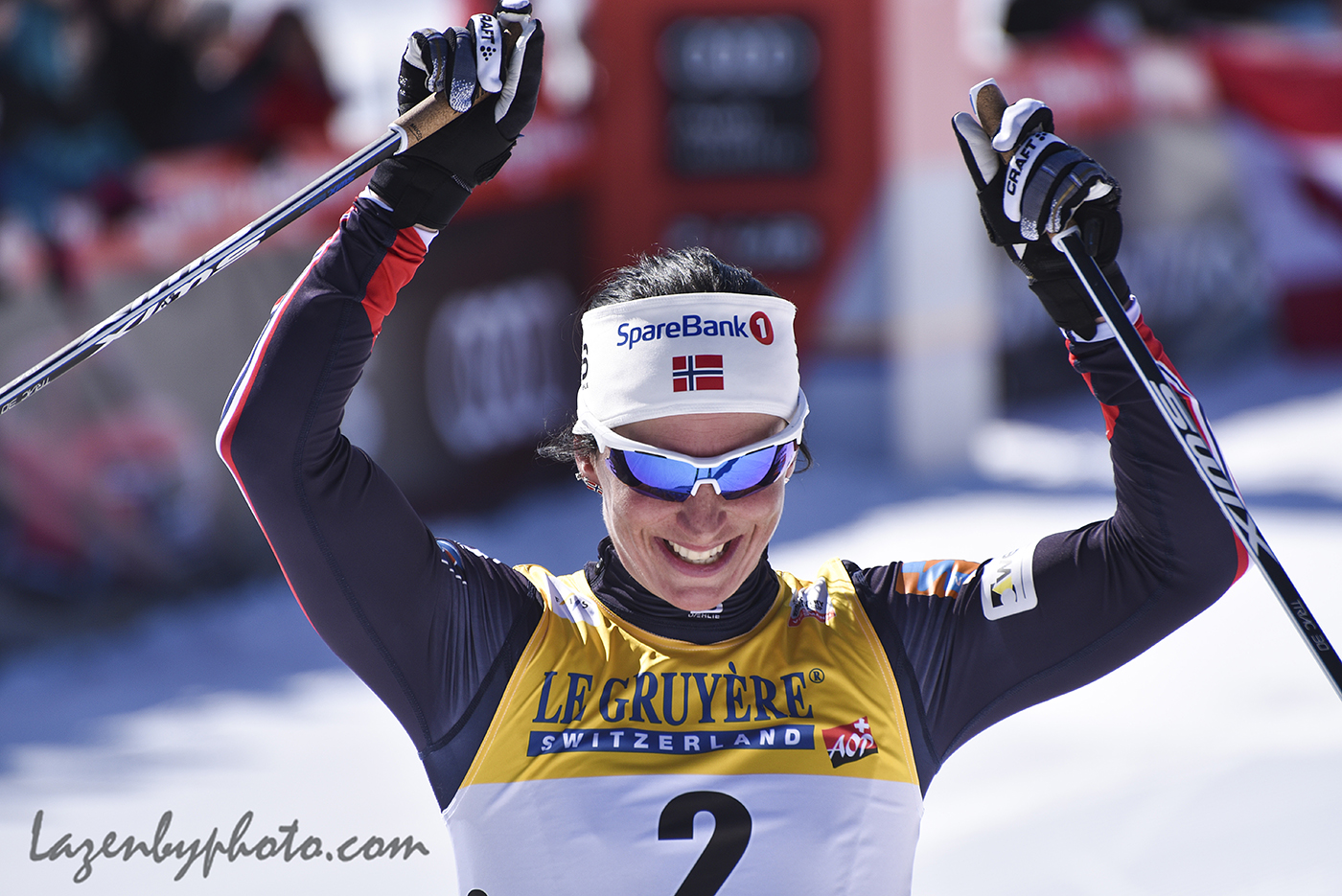
    Norway’s Marit Bjørgen celebrates her ninth-straight win in World Cup distance races (anything longer than a sprint) in the last race of the 2016/2017 season, the women’s 10 k freestyle pursuit on Sunday in Quebec City. (Photo: John Lazenby/Lazenbyphoto.com)

    QUEBEC CITY — Generally speaking, most European-based World Cup skiers wouldn’t have picked Canada as their ideal place to end the season. It’s too far across the pond, too far from the beaches, too far from home.

    The other option had been Tyumen in Siberia, so that probably wasn’t a top pick, either, but Québec City became the International Ski Federation’s choice once Russia relinquished its hosting responsibilities for World Cup Finals.

    Québec City organizers, headed by Gestev, had just under two months to prepare. Having hosted two stages of the Ski Tour Canada last season and a World Cup sprint weekend in 2012, they had the experience, but World Cup Finals — complete with three uninterrupted days of racing and season-ending awards — was another animal of its own entity.

    Fortunately, the weather cooperated. Three days before World Cup Finals, Québec City and the eastern part of North America got its biggest snowstorm of the season and perhaps the last several winters. With three straight days of racing taking place on the open-aired Plains of Abraham, most familiar with the expansive downtown park expected bone-chilling wind. Yet with above freezing temperatures at race time, that wasn’t much of a factor, especially not on Saturday and Sunday.

    Each day, spectators and athletes required fewer layers, and by Sunday, some of the athletes were down to bibs only. The sun was intense, there wasn’t a cloud in the sky, and the athletes were happy.
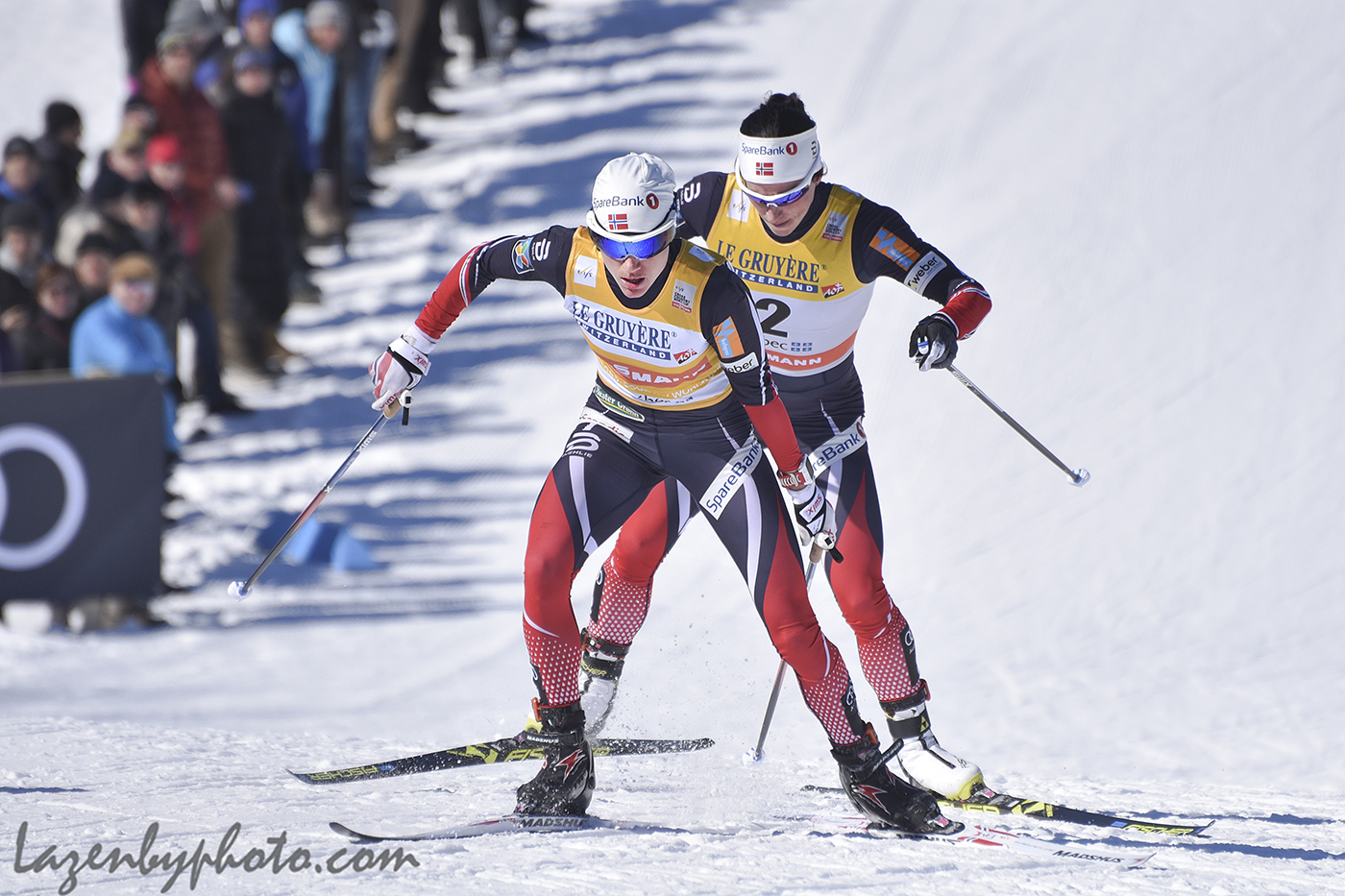
    Norway’s Heidi Weng leads her teammate Marit Bjørgen during the women’s 10 k freestyle pursuit on the last day of World Cup Finals in Quebec City. Bjørgen went on to win while Weng was 1.2 seconds back in second. (Photo: John Lazenby/Lazenbyphoto.com)

    “When I saw that we would race here, I thought, ‘Oh no. We’ll have to go so far from home,’ ” Norway’s Heidi Weng told FasterSkier on Sunday. “But when I come here, it’s more like winter, and I like the track here, and I’ve gone very fast here before. So I knew I could go do a very good race here, so now I hope we come here often. It’s very good, and many people, and the atmosphere, and good snow. It was very great to be here.”

    Weng spoke to a horde of reporters with a large, silver briefcase by her side. In it was one of the Crystal Globes she had just received for winning the Overall and Distance World Cups (she won one globe for each season-long category). Between Friday, Saturday and Sunday, Weng finished sixth in the freestyle sprint, second in the 10-kilometer classic mass start, and second in the 10 k freestyle pursuit. Her Norwegian teammate and longtime idol, Marit Bjørgen beat her in both the distance races.

    In all, Weng racked up about 20 individual World Cup podiums (including her Tour de Ski win, Lillehammer mini tour win, and World Championships silver in the 30 k freestyle mass start). She was the most consistent skier throughout the season, thus earning the Overall World Cup crown by 40 points over Finland’s Krista Pärmäkoski, and distance title by 97 points over Bjørgen.

    “I’ve had many podiums this year,” Weng said. “In sprint I have taken huge steps, so I am very happy with the season. I have won a sprint race, and that’s the most important to me…

    “Maybe I must have a little more confidence that I am good and a good skier, because I always think I am not so good as the others, but now I have a better head,” she added. “Maybe you can say in your head that you are very good and very strong, so next year I do a joke with my head.”

    While Weng keeps telling herself that she can win, Bjørgen is fully aware that she’s back to her top form having won every distance race since the new year. That’s nine straight individual wins, including two from this past weekend.

    After starting one second behind Weng in Sunday’s 10 k skate pursuit, she outlasted the overall and distance World Cup champion by 1.2 seconds at the finish after leading Weng for most of the three-lap race.

    “It has been an incredible season for me after Christmas,” Bjørgen, who had a child in December 2015 and took last season off, told reporters on Sunday. “I won every long distance and four golds in the World Championships so this has been incredible and to win today also.”

    On Sunday, Bjørgen caught Weng quickly and with the third starter, Norway’s Ingvild Flugstad Østberg, heading out 29 seconds back, the two skied off together and away from any threat to their top-two quest.

    On the first lap, Østberg tried to close the gap, coming within 23 seconds of them at 1.3 k, but by the time she lapped through the stadium at 3.3 k, she was 33 seconds behind and just seven seconds ahead of a chase pack with her Norwegian teammate Maiken Caspersen Falla, Pärmäkoski, and Sweden’s Ida Ingemarsdotter and Stina Nilsson. Another 20 seconds behind them, American Sadie Bjornsen and Sweden’s Anna Haag were leading a pack of eight.

    One lap later, Bjørgen and Weng cruised into and out of the stadium 46 seconds before Østberg, who was still 10 seconds ahead of the four-woman chase pack by the time she came through. The group, which was down to Nilsson, Ingemarsdotter and Parmakoski, eventually caught Østberg less than a kilometer before the finish, and Østberg finished at the back of that group in sixth, 1:06.8 behind Bjørgen. In a race for third, Nilsson took it by 1.9 seconds over Ingemarsdotter in fourth and 5.6 seconds ahead of Pärmäkoski in fifth.

    “It was a mental struggle the whole way because they were 15 and 10 seconds behind me all the way, and that’s a difficult gap,” Østberg told FasterSkier. “They were three and four working together, and I was all by myself in front. I really tried to push as hard as I could, and stay in front of them, and I had 10 seconds, and it was less than 1 kilometer left, and I really believed that I could take it, but when they passed me, they had such high speed, I couldn’t keep up with them. So that was not so fun to see them pass me there, but I managed to take the third place overall [in the World Cup], so I have to be satisfied with that, I guess.”

    “I think we worked well together,” Nilsson told FasterSkier. “Krista did the hardest work, I think, but I tried to help her as much as I could, and I was very excited that we could catch up to Ingvild. … I knew that when we started to be in the sprint course, I started to feel at home, then I just wanted to go as fast as I could.”
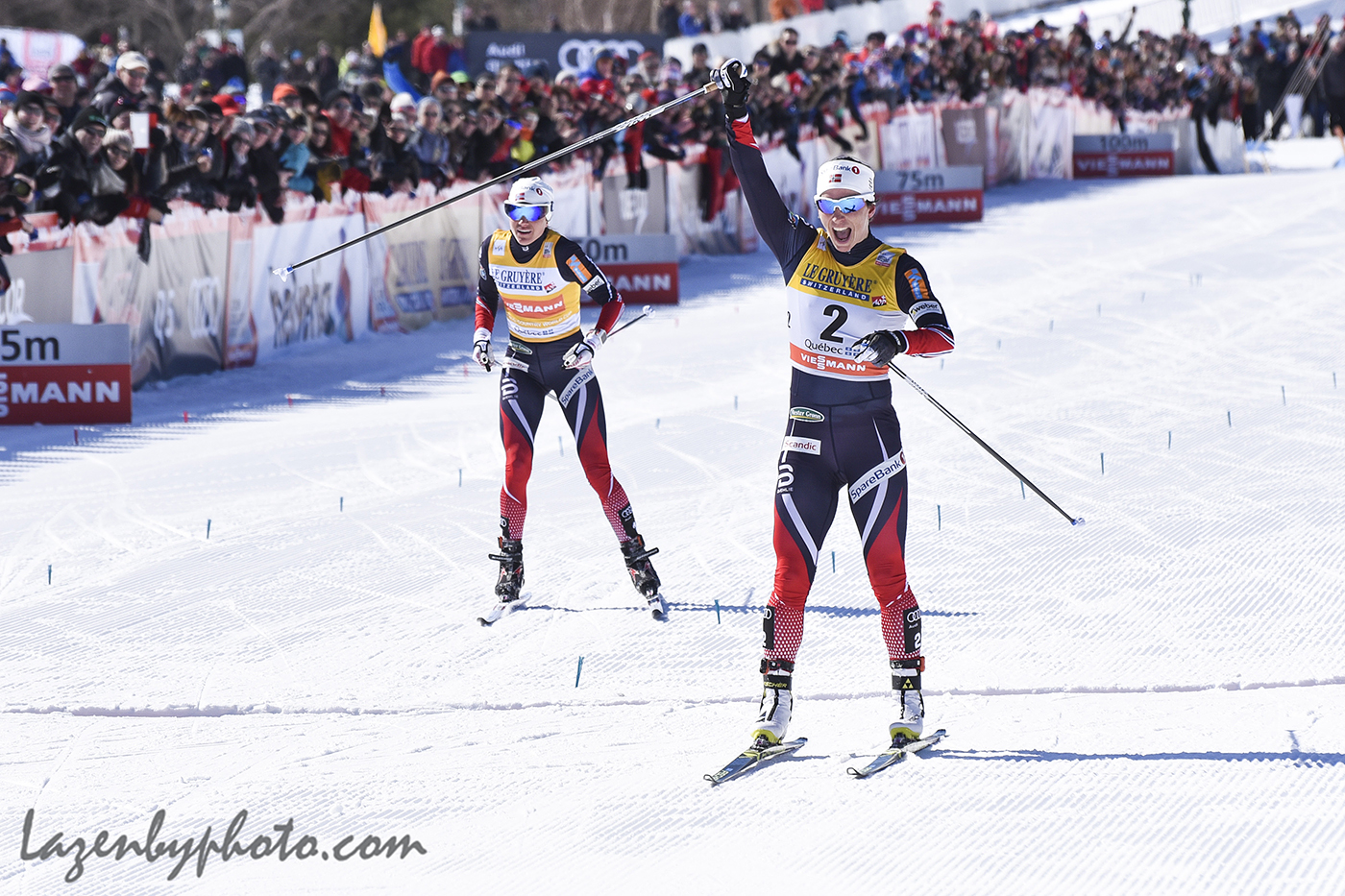
    Norway’s Marit Bjørgen after outlasting her teammate Heidi Weng for the win in the women’s 10 k freestyle pursuit on Sunday at World Cup Finals in Quebec City. (Photo: John Lazenby/Lazenbyphoto.com)

    Exactly a minute before Nilsson — a sprint specialist — finished third, Bjørgen had crossed the line first in 22:36.1 minutes after getting slightly ahead of Weng coming out of the downhill with 100 meters remaining. Leading up to that point, Weng had come from behind to attack on the second-to-last climb, a markedly steep one, but Bjørgen responded quickly.

    “I thought that Marit was a little bit more tired than me, but when I attacked on the sprint uphill I hoped that I could get some meters to Marit, but she was there, and in the downhill she came from behind and take a better speed,” Weng said. “That sucks, but I was number two, and it’s not many who can be on the podium, so I am very happy.”

    “I knew that it would be a sprint in the end with Heidi and to have her behind me is a very good feeling,” Bjørgen said. “I’m 10 years older and to be there is a good feeling to take with me into the Olympic [year next season].”

    Bjørgen is 36. Weng will turn 26 in July. Nilsson is 23.

    On Sunday, Bjørgen not only won the pursuit and with it, the World Cup Finals mini tour, but she was also the fastest for time of day in 25:35.1. Weng was second fastest, 2.2 seconds back, and Nilsson third (+11.9) after starting seventh and moving her way up to third.

    On her 34th birthday, Germany’s Nicole Fessel was fourth fastest (+15.3), and Bjornsen of the U.S. tied Sweden’s Charlotte Kalla for fifth on the day, 17.8 seconds off Bjørgen’s time.
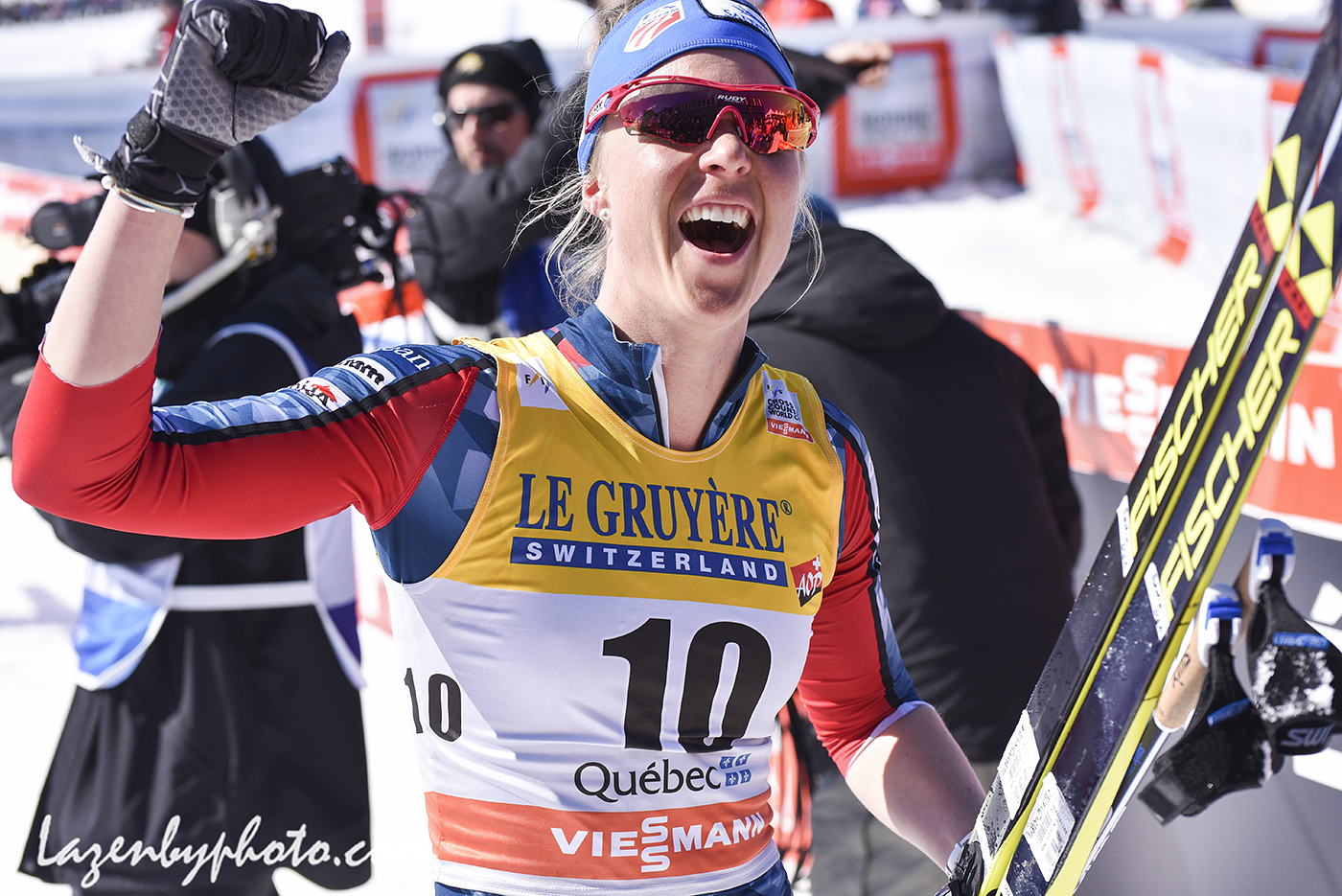
    Sadie Bjornsen (U.S. Ski Team) soaking up her top-10 finish at 2017 World Cup Finals in Quebec City after placing 10th in the 10 k freestyle pursuit and fifth for time of day. (Photo: John Lazenby/Lazenbyphoto.com)

    Overall Bjornsen placed 10th (+1:27.2) after starting 1:10 minutes back in 10th with Kalla in ninth and skiing with her and Fessel (the 13th starter) to the finish.

    “Charlotte was going so hard from the start,” Bjornsen said after. “I actually did my warm up behind her, trying to get used to her speed because that was my main goal, to stay with her today. I knew it was going to be rippin’, and at one point some of the girls went in front of me, and I let her get away, and I was like, ‘No! I have to stay with her!’ So I had to do a full sprint in the middle to catch back on, which took a lot to recover from.”

    At the finish, just 0.4 seconds separated Kalla, Fessel and Bjornsen, who placed eighth (+1:26.8), ninth (+1:26.9) and 10th, respectively. Ahead of them, Norway’s Falla placed seventh (+1:19.8).

    “I really wanted to outsprint those girls in the finish for some redemption from the sprint race the other day,” Bjornsen said, referring to her 13th place in the World Cup Finals opening skate sprint. “I’m super happy with a top 10 in the tour. That’s some of the best general skiing I’ve done this year, and it’s good to end on a high note.”

    The U.S. had two in the top 20 both overall and for time of day, with Jessie Diggins in 16th (+2:14.8) after skiing the 14th fastest time of day (+35.0). After placing ninth in the sprint and 27th in the classic mass start, she started Sunday in 20th and moved up four places by the finish.

    “This weekend, in particular, was not what I wanted,” Diggins told reporters after. “To be honest, I was in tears before the race, because I was up all night coughing. I don’t know if I was getting sick or what, but I was getting nauseous, and I started to puke a little bit, and I was like, ‘I just want to race, and race in front of my family. I just want to go out there and be able to have a good day.’ ”

    Diggins immediately got to work out of the gate and was up to 19th at the end of the first lap with Germany’s Stefanie Böhler. She skied with Böhler to the finish, before edging the German by two seconds for 16th.

    “I decided I was going to go for it, and it was really working for me when Stefi came by,” Diggins said. “I was just hanging on in the uphills, and then on the downhills, if I was right in her draft, I could push or pull and help each other that way, and that was really cool. I really like skiing with Stefi, she’s awesome, and we were both working together to get the fastest time we could.”
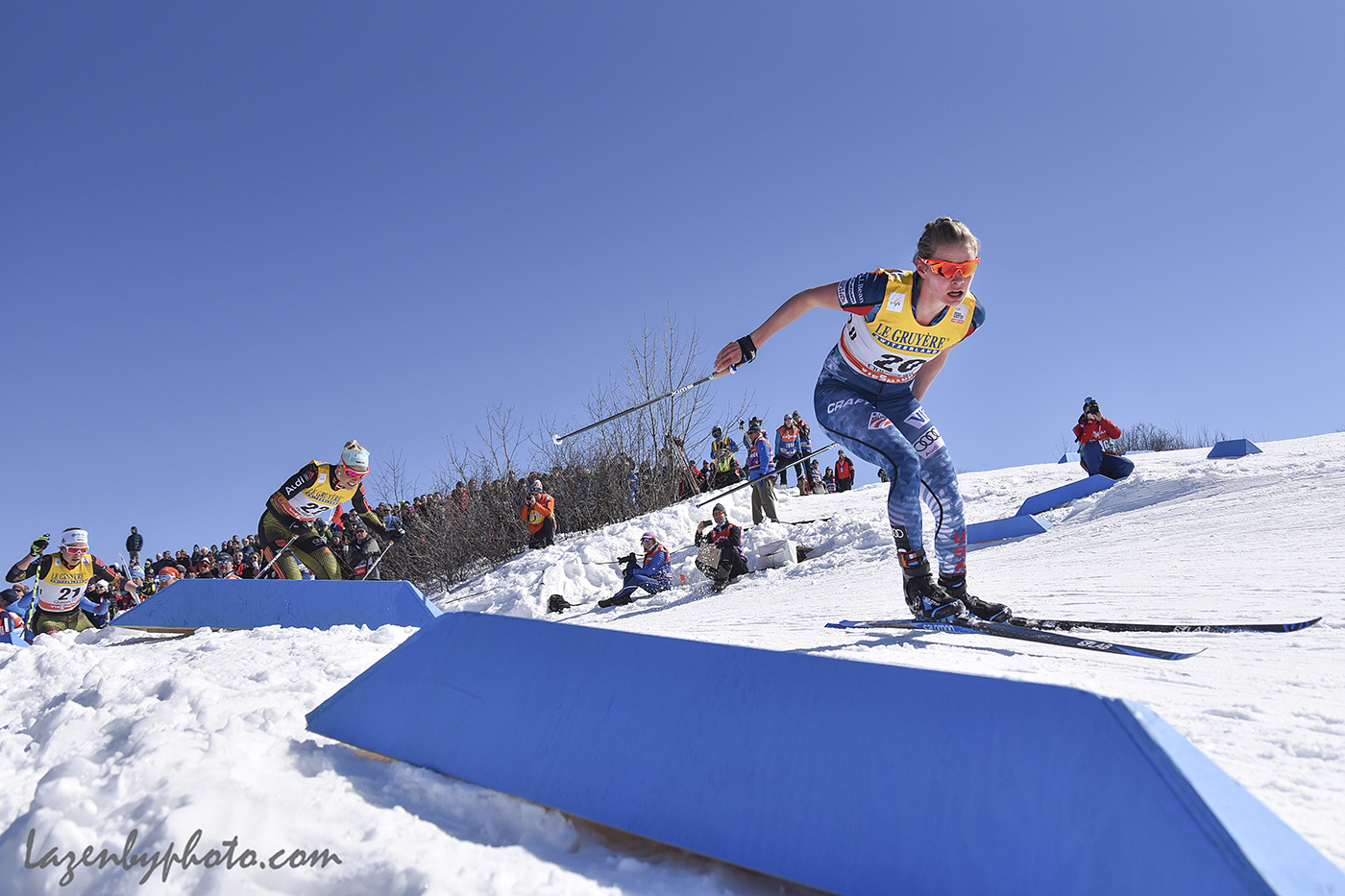
    Jessie Diggins (U.S. Ski Team) racing to 16th in the women’s 10 k freestyle pursuit (up from 20th at the start) with the 14th fastest course time on Sunday at World Cup Finals in Quebec City. (Photo: John Lazenby/Lazenbyphoto.com)

    At the end of the season, Diggins ranked sixth in the overall World Cup and seventh in the distance standings.

    “My biggest goal for today was to only say positive things to myself all day, no matter what anything felt like, no matter what the skis were doing, no matter what my body was doing, no matter how sick I felt, and the only thing was to push really hard and cross the finish line and be proud of pushing,” Diggins said. “You can’t control a lot of things in ski racing, but you can control, how much effort you put into it, and I can honestly say I’ve put 100 percent in this season, and I’m really proud of that.”

    While 12 American woman completed the tour, 15 Canadians women did the same, with Emily Nishikawa (Canadian World Cup Team) leading them in 38th (+4:52.7) after starting 39th. Cendrine Browne, of Canada’s national U25 Team and Pierre Harvey Training Centre, finished just two seconds later in 40th (+4:54.7) after starting 41st.

    “I was the last person to start before the wave,” Nishikawa explained. “And the wave, they’re working together as a mass start and moving pretty fast, so I got caught by them at the end of the first lap. I tucked in behind Rosie [Brennan of the U.S.] for the second lap and I actually had a big tangle with [Switzerland’s] Laurien van der Graaff on the fast downhill so I lost contact, lost all my speed. … and I did my best to come back.”

    Browne started in the wave and described skiing in that group throughout the race.

    “Unfortunately, I finished at the back of the group as I was losing energy,” she told FasterSkier. “I still managed to gain 30 seconds on the leader, which I’m happy about. I finished 41st again, behind my goal of moving towards the top 30, but it’s not dramatic. I think it’s a nice way to cap off the season.

    “It was really an amazing weekend, the atmosphere, the crowd, the conditions, everything was on point,” Browne added in French. “I couldn’t have hoped for a better way to end the season.”

    “We were so lucky to get [the World Cup Finals] here instead of Russia,” Nishikawa said. “We got to start 30 athletes, lots of people starting their very first World Cups, which is so exciting to see. It’s great for development for our country… We’ve got a really exciting group of women coming coming up in Canada now and to see this group of 15 women get starts this weekend is just great.”

    Also for Canada, Dahria Beatty finished 50th, Annika Richardson 55th, Frédérique Vézina 57th, Katherine Stewart-Jones 58th, Andrea Dupont 59th, Annika Hicks 62nd, Sophie Carrier-Laforte 63rd, Sadie White 64th, Lisle Compton 65th, Katherine Weaver 66th, Laura Leclair 67th, and Mia Serratore 68th. Alannah MacLean did not finish.
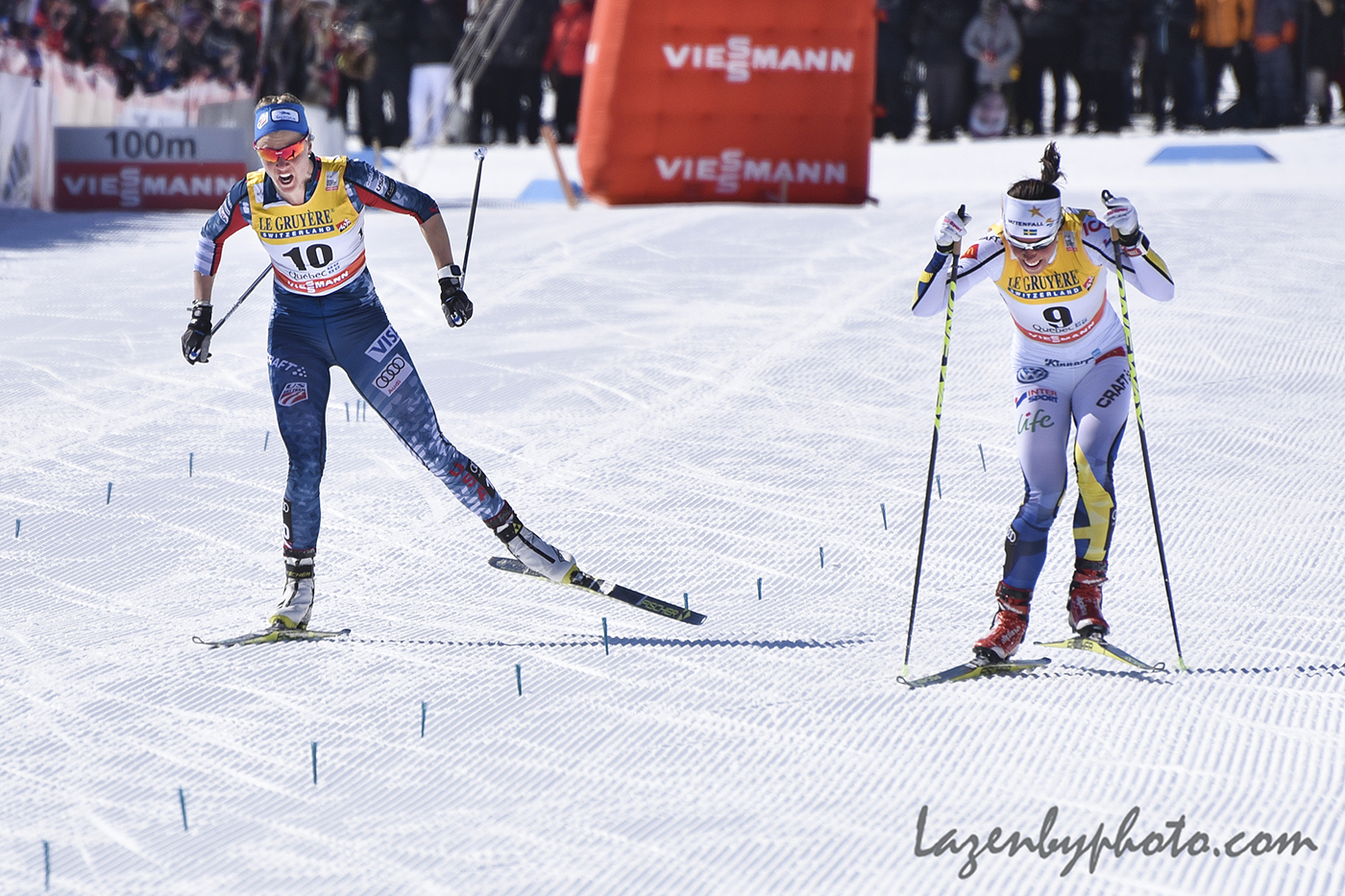
    American Sadie Bjornsen (10) racing to the line with Sweden’s Charlotte Kalla (9) and Germany’s Nicole Fessel (not shown) during the women’s 10 k freestyle pursuit on Sunday at World Cup Finals. Kalla placed eighth, Fessel ninth and Bjornsen 10th. (Photo: John Lazenby/Lazenbyphoto.com)

    For the U.S., Sophie Caldwell placed 36th (+4:26.1), Rosie Brennan 42nd, Caitlin Patterson 43rd, Chelsea Holmes 45th, Julia Kern 46th, Kaitlynn Miller 52nd, Liz Guiney 53rd, Becca Rorabaugh 54th, Erika Flowers 56th, and Jennie Bender 60th.

    “Sadie’s skating has reached a new level this season,” U.S. Ski Team Head Coach Chris Grover said, according to a team press release. “Jessie also had a measure of redemption leading a train of women and moving up four places in the standings today. Rookie Julia Kern continued to impress, staying in front of the chasing group for the entire race and winning the sprint at the end.

    “We are very proud of the American effort this weekend — athletes, club coaches and U.S. Ski Team staff,” he continued. “We had some great races but, of course, were left wanting a bit more.”

    The U.S. Ski Team will finish out its season in Fairbanks, Alaska, with the SuperTour Finals next week, March 27-April 2. Most Canadians are traveling to Canmore for Canadian Ski Nationals, which started Sunday and extend through this Saturday.

    Pursuit results

    Time of day

    Final Overall World Cup standings

    Final Distance World Cup standings

  • Harvey Delivers Again at Home, Wins First Race of World Cup Finals in Quebec

    Harvey Delivers Again at Home, Wins First Race of World Cup Finals in Quebec

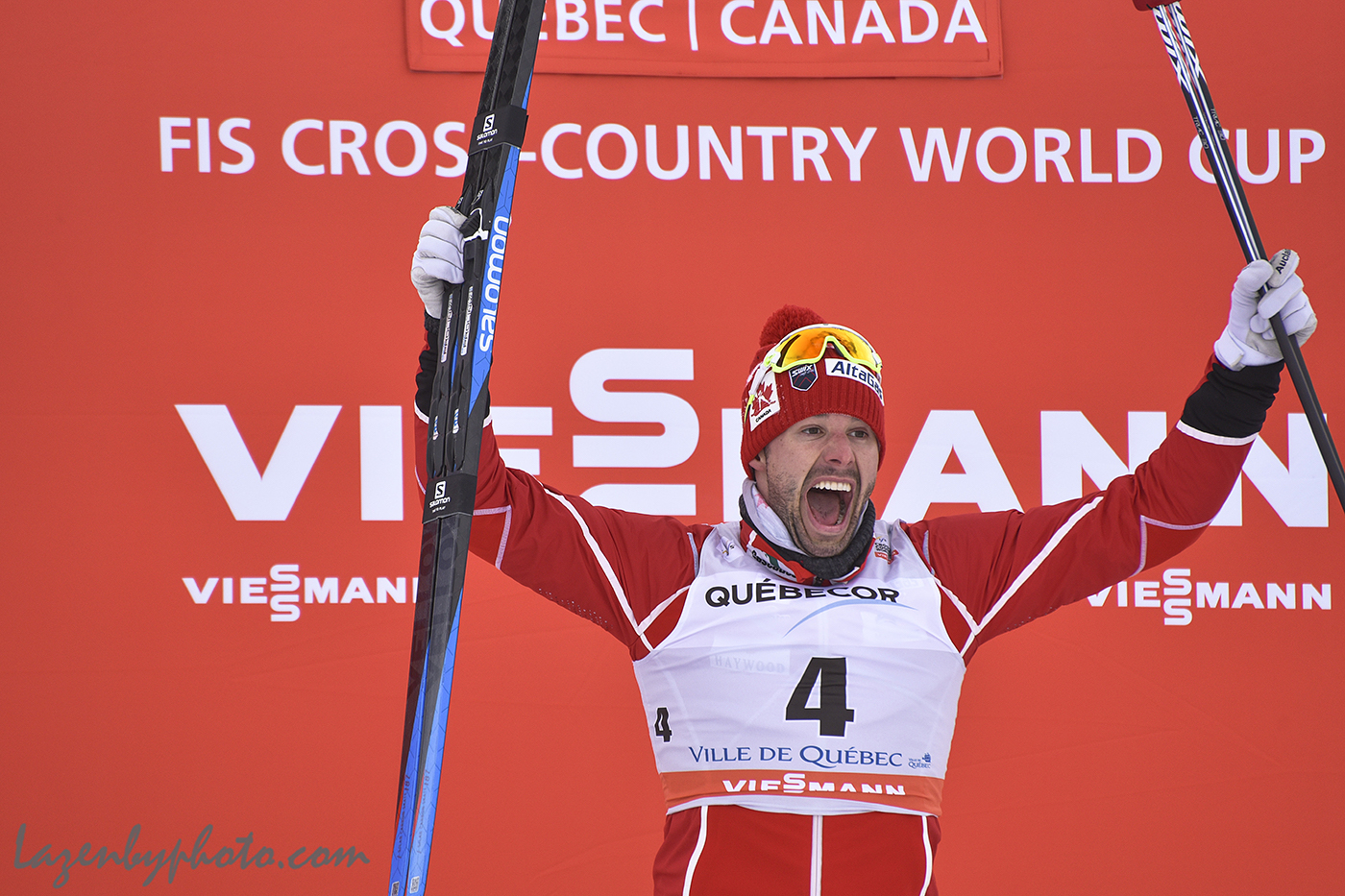
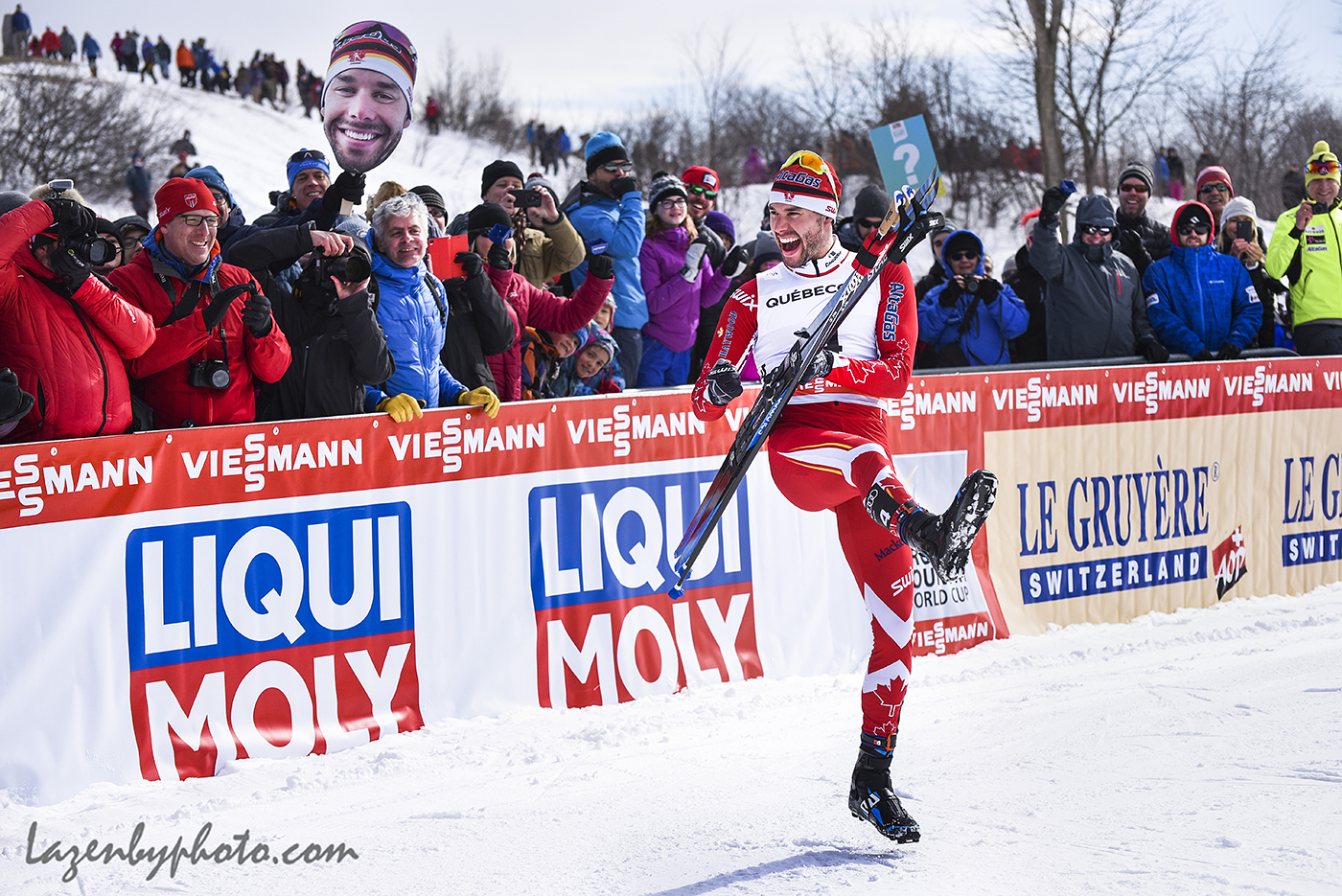
    Alex Harvey (Canadian World Cup Team) celebrates his World Cup Finals freestyle sprint win at home on Friday in Quebec City. (Photo: John Lazenby/Lazenbyphoto.com)

    QUEBEC CITY — Friday started off about as good as the Canadian men’s team could have hoped for, with five skiers finishing in the top 30 to qualify for the heats in the 1.5-kilometer freestyle sprint on the first day of World Cup Finals. According to Cross Country Canada, that’s the first time five Canadian men have qualified in a World Cup race.

    Racing one lap around the Plains of Abraham in the heart of Quebec City, athletes were bolstered by an estimated 25,000 cheering spectators. While they ramped up the intensity for their Canadian skiers, they went wild for Alex Harvey.

    And the Saint-Ferréol-les-Neiges native delivered in every sense possible.

    Harvey started off as his team’s leading qualifier, clocking in with the fourth-fastest time, 4.14 seconds behind Norway’s qualifying winner, Johannes Høsflot Klæbo, who rounded the course in 2:39.44 minutes. Behind Harvey, four other Canadians also qualified less than seven-tenths of a second apart. Len Valjas qualified 24th (+9:28), Julien Locke of the Alberta World Cup Academy (AWCA) 25th (+9.39), Jess Cockney 28th (+9.90), and Bob Thompson of the National Team Development Centre (NTDC) Thunder Bay in 30th (+9.95) as the final qualifier in the men’s race.

    For Locke and Thompson, it was their first World Cup top 30. For Cockney, it was the beginning of one of his career-best days. For Harvey, he was just warming up.

    Canada’s Alex Harvey celebrates his sixth-career individual World Cup win (not counting World Championships) on Friday at 2017 World Cup Finals in Quebec City. Harvey won the freestyle sprint by 0.31 seconds over Norway’s Finn Hågen Krogh. (Photo: John Lazenby/Lazenbyphoto.com)

    In Harvey’s nine years as a World Cup skier, the 28 year old has racked up six individual World Cup wins — spoiler alert — including Friday’s. He won a skate sprint one other time, three years ago in Szklarska Poreba, Poland. At World Championships, he’s accumulated five medals, with his first coming in the 2011 classic team sprint and the second World Championships gold of his career in the 50-kilometer freestyle mass start less than two weeks ago in Lahti, Finland.

    After winning the longest race on the circuit, Harvey seamlessly switched gears and dominated Friday’s freestyle sprint on a wide-open course with short, steep hills organizers had to work hard to integrate.

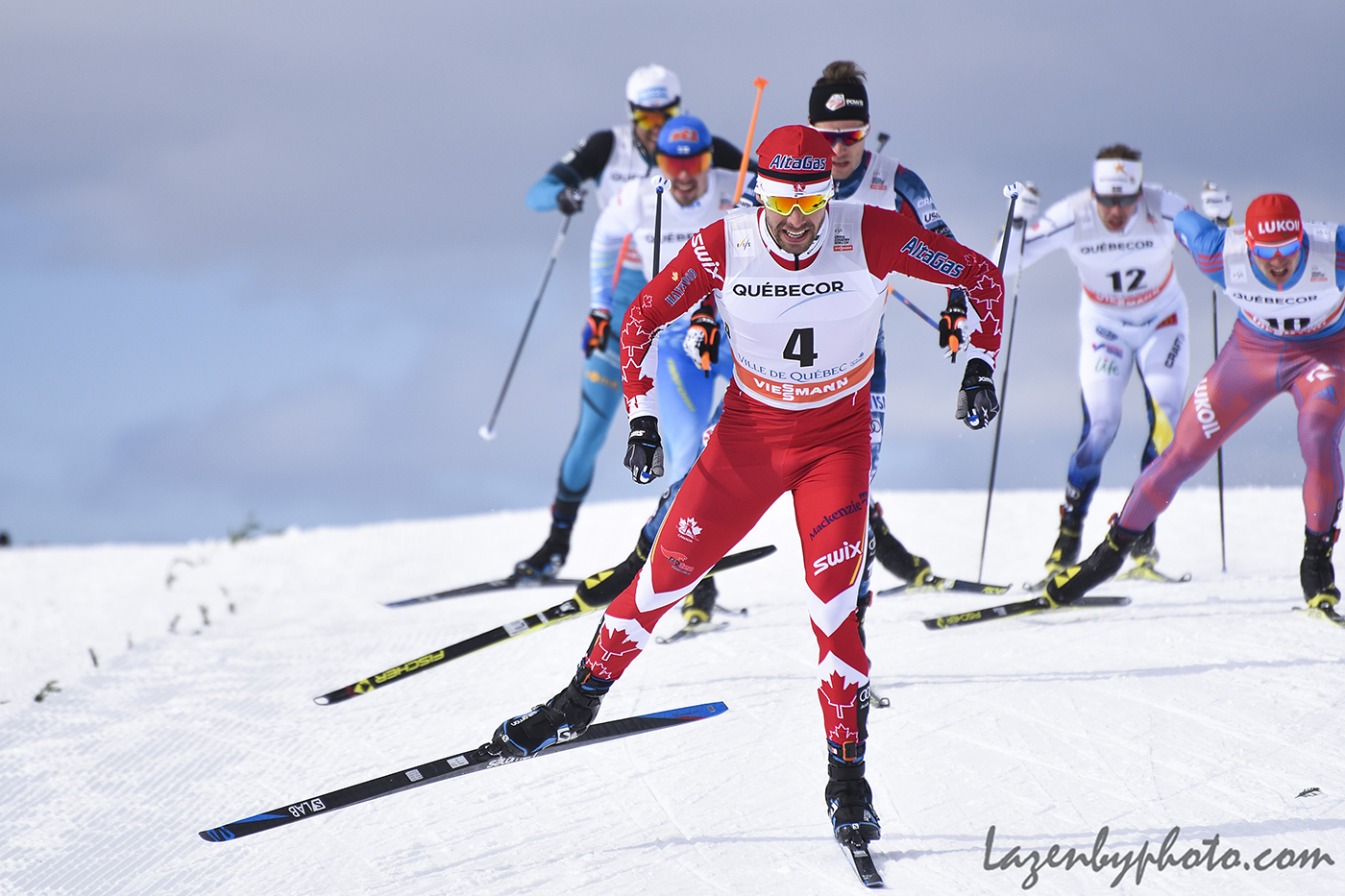
    In his quarterfinal and semifinal, Harvey raced to first in both heats in a way few others attempted to do on Friday. He led from start to finish and didn’t appear to worry too much about the draft, only making sure that he was far enough ahead so that no one else could use it to slingshot past him in the finishing stretch. He won his quarterfinal by 0.34 seconds over Simi Hamilton — the lone American man to qualify for the heats — and semifinal by 0.04 seconds over France’s Richard Jouve. That one was a little closer and didn’t give Harvey enough time to remove his pole straps before the finish, like he did in his quarterfinal while Hamilton lunged for the line to secure second behind him.

    It was one of those days where it appeared everyone else was working really hard, while Harvey was simply cruising. But that was confidence and the crowd he was riding, and it was a look that worked for him.

    Canada’s Alex Harvey leading his quarterfinal in the men’s 1.5 k freestyle sprint on Friday at World Cup Finals in Quebec City. Harvey went on to win the final for his second individual World Cup win this season (not counting World Championships). (Photo: John Lazenby/Lazenbyphoto.com)

    In a post-race interview, Harvey explained he decided to set the pace in the fourth quarterfinal. The heats before had been almost 10 seconds slower than Klæbo’s qualifying time, so Harvey knew his quarterfinal contenders had a chance to advance more than the top-two if they skied fast enough.

    He faced a similar situation in the second semifinal. Harvey said he spoke with Jouve and Norway’s Niklas Dyrhaug before their semifinal and discussed how one of them should lead, “to keep pushing, not make it easy, ’cause we want to move to the final,” Harvey said. “The strategy is actually pretty similar most of the time, but it’s a question of being able to actually do it.”

    He did it and advanced to the final as the man to beat. All around the course, fans shouted for “Alex”.

    Out of the gate in the men’s final, Norway’s Finn Hågen Krogh surged to the front. The six finalists launched immediately into the first and longest climb on the sprint course, just short of 250 meters long, where France’s Lucas Chanavat took the lead and Harvey skied just behind him over the top. Racers dropped back into the stadium then skated back out of it again, where Harvey moved to first in front of the two Frenchmen in the final: Chanavat and Jouve.

    Krogh soon after slotted into third and attacked on the steepest climb while Harvey and Hamilton proved to have the most left to answer.

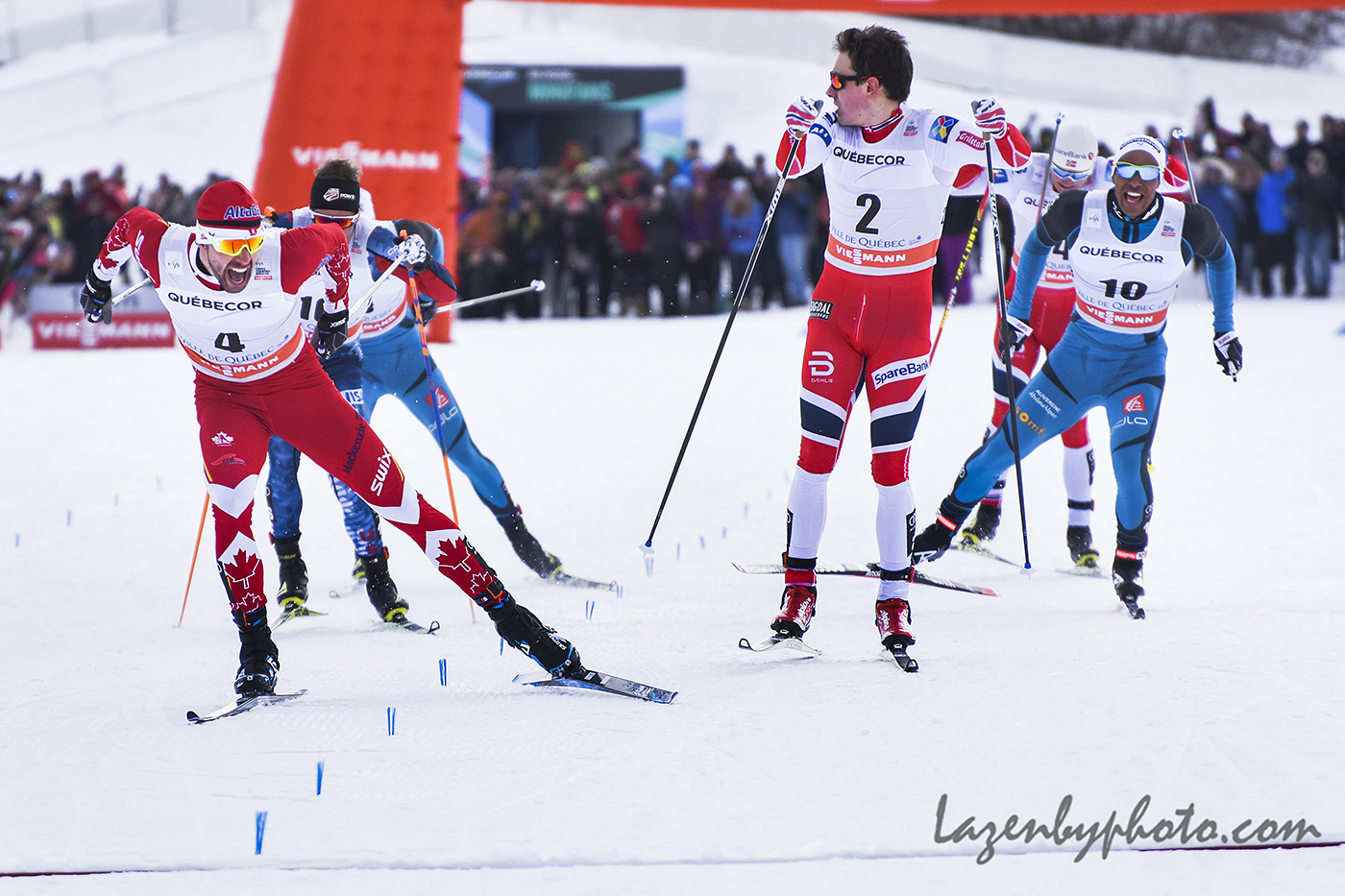
    As Krogh led into the last uphill, Harvey followed, then Hamilton, Jouve, Chanavat and Norway’s Sindre Bjørnestad Skar — the last three within striking distance of Hamilton in third place. Harvey tucked behind Krogh and absorbed his draft, breaking out his powerful V2 with 100 meters remaining and leaving Krogh chasing him to the line. There, Harvey threw up his arms to celebrate, while Hamilton lunged for third in a photo finish with Jouve. The Frenchman took it by 0.07 seconds, Hamilton ended up fourth, 1.01 seconds behind Harvey, Skar fifth (+1.51), and Chanavat sixth (+1.72).

    Canada’s Alex Harvey (l) coming on strong in the finishing stretch to outlast Norway’s Finn Hågen Krogh (2) by 0.31 seconds for the win in the World Cup Finals freestyle sprint on Friday in Quebec City, while France’s Richard Jouve (10) races to third, just ahead of American Simi Hamilton (behind Harvey) in fourth. (Photo: John Lazenby/Lazenbyphoto.com)

    “At the last turn, I was confident,” Harvey said in French. “I looked at him [Krogh] and I knew I had him, but I was focusing on staying second because of a strong headwind in the last downhill.”

    “To be beaten by the 50 k World Champion on the home stretch is tough,” Krogh told the International Ski Federation (FIS) on Friday. “I was simply not good enough.”

    In the finish area, Harvey appeared about as elated as he was after the 50 k in Lahti, a reaction he said was “pure instinct.”

    “But sprinting comes with greater stress, with the risk of falling, of breaking a pole…” Harvey said in French. “To cross the finish line after a sprint is like a deliverance.”

    The win comes just over a year after Harvey placed second in a World Cup skate sprint in Quebec during the Ski Tour Canada. After passing Russia’s Sergey Ustiugov in the finishing stretch, he had been in first until France’s Baptiste Gros snuck up on him on the inside lane. Harvey finished half a second back in second place, but it was still a day he’d remember — his girlfriend Sophie came out on course to congratulate him.

    On Friday, he made sure to lock up the win. And he was met afterward by Sophie, his sister (also named Sophie) and his dad, Pierre Harvey, alongside the finishing lanes.

    “Last year it would have been nice to win,” Harvey said in English on Friday. “When I passed Ustiugov last year, I had so much more speed than him … I didn’t ease up, but I thought I was going to win … and then I saw Baptiste just blow by all of us in the corner of my eye. So I had a bit of that in my mind and just making sure it wasn’t going to slip through my finger two years in a row.”

    Asked how this stacked up to his 50 k win, he said it was close.

    “Today’s victory really isn’t far behind my 50 k win,” he said in French. “My second place last year here was already incredible, so to top that off with a win at home is a dream come true.”

    The win comes after Harvey has competed two 50 k races, including last weekend’s Holmenkollen World Cup in Oslo, Norway, in less than two weeks and traveled across the Atlantic back to his home province.

    “What surprises me is how well he recovered after the double 50 k, in which he did very well, both times,” Louis Bouchard, Harvey’s personal coach and Canada’s co-World Cup coach, said in French. “Usually in sprints, he will hang at the back and make his move right at the end in the final stretch. So tactically, he skied differently today. He felt strong to the point of leading every round right until the end. It’s also rare to see Alex qualify so strongly. His form his tremendous at this point.”

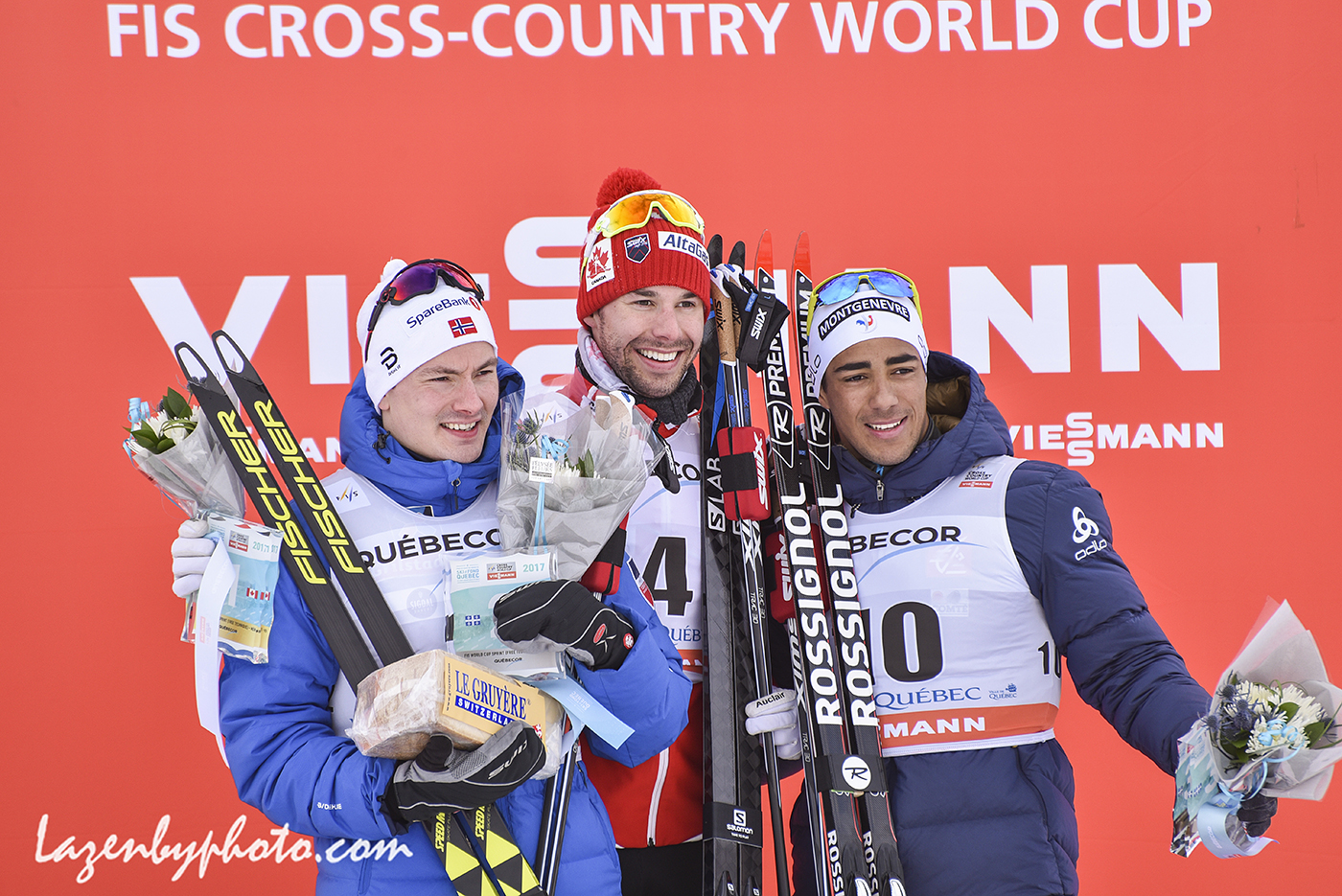
    The men’s freestyle sprint podium on Friday at World Cup Finals in Quebec City, with Canada’s Alex Harvey (c) in first, Norway’s Finn Hågen Krogh (l) in second and France’s Richard Jouve (r) in third. (Photo: John Lazenby/Lazenbyphoto.com)

    Pierre Harvey, a local hero and the inspiration behind the Pierre-Harvey National Training Centre, spoke with reporters after the race. Five years ago, he had been on site to witness his son’s first-career World Cup win in Falun, Sweden.

    “It’s always very emotional,” Pierre said in French. “I was there when he won his first World Cup in Sweden, which I didn’t think he could ever do at the time, but winning became a familiar sight in a way. I thought he would burn himself after the qualification, but he managed to win every round after. It was impressive to see him beat Krogh, a very capable sprinter, in the last stretch.”

    Asked what propelled his son on Friday, Pierre said racing at home.

    “In front of friends and of a cheering crowd, along with great ski conditions, is an extra motivation,” he said. “He left home on the fifth of November, so coming back after months of racing in Europe, he really wanted to put on a show for his friends. I hope he keeps his energy levels high for tomorrow and Sunday’s races.”

    Two more World Cup races remain to close out the season: a 15 k classic mass start on Saturday and 15 k freestyle pursuit on Sunday. Harvey has essentially solidified third place in the overall World Cup rankings with 57 points separating him from Finland’s Matti Heikkinen in fourth place.

    “Today’s win comes with 50 points, 30 bonus seconds and 10 seconds I put on him in today’s qualification,” Alex Harvey explained. “I feel secure with this lead on him.”

    Ahead of him, Norway’s Martin Johnsrud Sundby and Russia’s Ustiugov are not racing in Quebec. Sundby already locked up the World Cup overall and distance titles, and Ustiugov is still 282 points clear of Harvey in third place.

    After Day 1 of 3 in the World Cup Finals mini tour, Harvey leads by 2.3 seconds over Krogh. All 74 racers remaining in the men’s field will start Saturday’s mass start together.

    The Sprint World Cup podium was awarded on Friday, with Norway’s 20-year-old Klæbo in first, Italy’s Federico Pellegrino (last year’s Sprint Crystal Globe winner) in second, and Skar in third. Both Klæbo and Pellegrino were eliminated in the semifinals, with Pellegrino placing seventh and Klæbo eighth on the day.

    As for third and fourth place on Friday, Jouve was thrilled with his fourth individual World Cup podium and first this season after being injured in December and January.

    “It was a really good day for me,” Jouve said in French. “I passed through my quarter and semi as I wanted. I managed to stay in a good position in the finals. I had very good legs and fast skis.”

    Asked what he thought of the crowd’s favoritism for Harvey, he said it wasn’t anything he couldn’t handle.

    “We were here last year, and the public is pleasant and cheers for everyone,” Jouve said. “It’s normal to see them favor the local star.”

    Simi Hamilton (U.S. Ski Team) racing to 16th in the men’s 1.5 k freestyle sprint qualifier on Friday at World Cup Finals in Quebec City. He qualified in 16th and went on to place fourth in the final. (Photo: John Lazenby/Lazenbyphoto.com)

    Even Hamilton, frustrated with fourth, was happy for Harvey.

    “He’s such a good guy. He’s such a great North American teammate. He’s always so psyched when we ski well, and we’re always so psyched when he skis well, as well as all the other Canadians,” Hamilton said. “We are really just like kind of one bigger team, us against all the Europeans we feel like sometimes, so it’s cool to see him so successful and skiing so strong. And he handles his success with so much humility and grace.

    “Someone as talented as he is, and somebody who works as hard as he does, it’s awesome just to feel the energy,” Hamilton added. “He’s such a good ambassador for our sport, and I think that that’s a testament to see all these people cheering him on, because they know that he’s such a great guy, more than just a good ski racer.”

    Hamilton faced Harvey in all three of his heats and followed him in every one.

    “I knew that Alex and Finn were far enough ahead of us that, unless they tripped or something, that we weren’t going to catch them,” Hamilton said of the final. “So I also knew that I was ahead of Jouve and the other two that were behind us a little bit, so I knew that, especially with the tailwind, if I just skied it well that I would have held onto third. And I just didn’t do that, and it sucks. I want it back. I want to do it again. I felt good going into it, I felt like my energy was really good during the entire final, and for whatever reason, I just didn’t ski it.”

    Four Canadians in Top 20

    Earlier in the day, Cockney tied his second-best individual World Cup result in 10th and popped his second top 12 of the season to meet the criteria for the Canadian 2018 Olympic team. After qualifying in 28th and hanging around fourth or fifth for most of his quarterfinal, Cockney used the draft and his reserved energy to sprint from fourth to second in the finishing stretch. He finished just 0.09 seconds behind Klæbo, who won that quarterfinal, and edged Great Britain’s Andrew Young by 0.07 seconds. While Young didn’t advance, Cockney did, and he went on to place fifth in the first semifinal, 1.3 seconds behind Krogh, the winner of that heat.

    Jess Cockney (Canadian World Cup Team) racing to 28th in the qualifier of the men’s 1.5 k freestyle sprint on Friday at World Cup Finals in Quebec City. He went on to place 10th on the day to tie his second-best World Cup result. (Photo: John Lazenby/Lazenbyphoto.com)

    “You can see just how wide open this field is, and it’s so windy that you kind of had to be smart about where you wanted to use energy,” Cockney said of his tactics.

    “I knew the start was straight into the headwind. You could come down with the tailwind behind you and make back a couple spots, or at least close the distance behind some people. And that’s just exactly what I wanted to do in the quarterfinal, and I was lucky that it worked out well, and I had some energy saved from doing that for the finishing straight. So that was really big for me.”

    As for his finishing gear, Cockney laughed and said he’d like to think he’s had that all along. His trouble has been getting into the heats. In the one other World Cup sprint he qualified in this season — the classic sprint in PyeongChang — he went on to finish 10th.

    “It’s funny, I’d like to think I always have some kind of sprint like that, but I never get into the sprints; my qualifying speed is still not there,” Cockney said. “Today, to actually see it on a race course and see it at a World Cup — I’m really happy with that. I can do it on a domestic level, but being consistent at an international level is still taking some time.”

    Four Canadians landed in the top 20 with Valjas in 19th and Locke in 20th. Valjas finished fourth in the first quarterfinal, 1.81 seconds behind Chanavat, who won. Locke placed fourth in the third quarterfinal, 1.89 seconds behind Pellegrino as the winner of that heat.

    “I’m a bit disappointed,” Valjas said. “I didn’t feel like I was able to show my potential today. I always felt boxed in, and every time I tried to make a move, there was somebody there. The course is so turny that when you’re beside somebody you get boxed in, so it’s frustrating. I think I had more speed than I showed today, but I ended up not skiing it well tactically, starting at the back.”

    Asked about the conditions, Valjas elaborated that Quebec had some of the best snow that World Cup skiers have seen all year. Quebec City was hit with a massive snowstorm earlier in the week on Tuesday.

    “Europe is sometimes good, but this is all-time conditions here,” Valjas said. “It’s fast, it’s wide. It’s just, with the curves, it’s harder to pass than I thought.”

    Julien Locke (Canadian U25 Team/AWCA) racing to 25th in the men’s 1.5 k freestyle sprint qualifier on Friday at World Cup Finals in Quebec City. He went on to place 20th on the day for his first World Cup top 30. (Photo: John Lazenby/Lazenbyphoto.com)

    On the other end of the spectrum, Locke, a 23-year-old member of Canada’s U25 Team, was pleased with his performance in his third World Cup start as it marked his first time in the points (top 30). In his first World Cup race last month, he came close in 36th in PyeongChang.

    “At the start of the season, my two main goals were to go to the Korea World Cup and the World Championships,” Locke said. “And I went to Korea, and I unfortunately had a crash there, so I was really hoping for another second chance, and to qualify to come here was fantastic. It’s crazy having Alex here, a world champion coming home, and the atmosphere is incredible. So since this race was announced, doing a good sprint here was my big goal for the year.”

    Thompson, 26, ended up 30th after finishing sixth in the same quarterfinal as Cockney. After making his World Cup debut at last year’s Ski Tour Canada, Thompson started this season on the World Cup in Europe and raced to 31st in the classic sprint in PyeongChang. On Friday, he scored his first World Cup points as well.

    “Getting in the heats has been the goal for every sprint World Cup I’ve gone to do, which is, this is the 17th now, and I think it’s about the seventh sprint or so,” Thompson said. “… Goal number one is, get a top 30. So I got that, I can reassess, and raise the bar a little bit.”

    Newell Narrowly Misses Qualifying

    For the U.S., Andy Newell missed out on qualifying by eight-hundredths of a second in 31st.  Erik Bjornsen was 0.98 seconds back in 33rd, and Cole Morgan (Sun Valley Ski Education Foundation) another second back in 34th.

    “For Andy to be in 31st, disappointing for him,” U.S. Ski Team Head Coach Chris Grover said. “He felt good out there; he’s a little bit mystified. … And then also for Erik Bjornsen and Cole Morgan, who skied great, to be so close to going in … If we’d gotten three or four guys into the heats then I think it would have been a great start to the day. So a little disappointing to miss that opportunity.”

    “I was feeling pretty good out there skiing, so I don’t know why it was slow,” Newell said. “I couldn’t figure out why.”

    Bjornsen said he hasn’t raced much since World Championships and hoped Friday blew the cobwebs out.

    “I was hoping for a little bit more today,” he said. “I obviously wanted to qualify … but I’m excited for the next couple days. … Tomorrow’s a 15 k classic, which is my favorite event, so yeah, hopefully I can put together some good races.”

    Also for the U.S., Paddy Caldwell placed 50th, Matt Gelso 57th, Scott Patterson 58th, Jack Hegman 61st, Brian Gregg 62nd, Ben Lustgarten 69th, David Norris 70th, and Noah Hoffman 73rd.

    Canada’s Andy Shields came close to qualifying in 35th, Russell Kennedy followed in 36th, Devon Kershaw 38th, Knute Johnsgaard 41st, Evan Palmer-Charrette 47th, Joey Foster 53rd, Graeme Killick 64th, Ricardo Izquierdo-Bernier 71st, Brian McKeever 72nd, and Gareth Williams 74th.

    Results | World Cup Finals standings

    World Cup overall standings | Sprint World Cup standings (final)

  • ‘Prince of Quebec’ Harvey Uses Sundby to Rein in Podium; Ustiugov Wins Stage 4

    Russia's Sergey Ustiugov held strong for a 17.7-second win in the men's 15 k freestyle pursuit on Saturday at the fourth stage of the Ski Tour Canada. He will keep the lead heading to the second half of the Tour in Canmore, Alberta. (Photo: FlyingPointRoad.com/NNF)
    Russia’s Sergey Ustiugov held strong for a 17.7-second win in the men’s 15 k freestyle pursuit on Saturday at the fourth stage of the Ski Tour Canada. He will keep the lead heading to the second half of the Tour in Canmore, Alberta. (Photo: FlyingPointRoad.com/NNF)

    Sergey Ustiugov is getting used to skiing from the front. After winning the opening sprint of the Ski Tour Canada (STC), the 23-year-old Russian has yet to relinquish a spot on the podium through four stages.

    Despite the best efforts of the Norweigian duo, Petter Northug Jr. and Emil Iversen, nipping at his heels in Saturday’s 15-kilometer freestyle pursuit in Quebec City, his streak continues.

    Starting alone and with a 17-second advantage on second-place Northug, Ustiugov’s race was a solo effort. Behind him it was two pairs of chasers that provided the fuel for the crowd on Saturday. The first of Northug and Iversen, gritted their teeth and tried to track down Ustiugov. The second pair, with local celebrity Alex Harvey and overall World Cup leader Martin Johnsrud Sundby, started the day in fourth and fifth respectively. They both appeared energized, charging over the hills of the Plains of Abraham, intent on knocking some time out of their gap to third place.

    Petter Northug (r) leads fellow Norwegian Emil Iversen during the men's 15 k freestyle pursuit on Saturday at Stage 4 of the Ski Tour Canada in Quebec City. After starting second and third, respectively, they finished in that order, 17.7 seconds and 1:02 minutes behind the winner. (Photo: FlyingPointRoad.com/NNF)
    Petter Northug (r) leads fellow Norwegian Emil Iversen during the men’s 15 k freestyle pursuit on Saturday at Stage 4 of the Ski Tour Canada in Quebec City. After starting second and third, respectively, they finished in that order, 17.7 seconds and 1:02 minutes behind the winner. (Photo: John Lazenby/Lazenbyphoto.com)

    Opposite to the previous distance stop in Stage 2 in Montreal, racers enjoyed hard-packed snow conditions. The four-lap course, nestled on a steep bank overlooking the St. Lawrence Seaway, tested the toughness of racers by incorporating both the steep climbs of the third stage’s sprint course and several more drawn-out climbs. Combined with the time change, travel to Canada, a tough sprint the day prior, and the end of a long season of racing, many racers appeared weary.

    “It was a very hard race today,” Ustiugov told reporters through a translator at a post-race press conference. “I was little bit afraid that Northug and Iversen are coming closer. I am happy I could keep the pace high and that I could go for victory.”

    Northug echoed Ustiugov’s statements at the press conference, saying that although he is “starting to get the rhythm that I have back in Norway … Everyone is starting to get tired.” Although the racers will have a break from the action until a classic sprint on Tuesday, the next venue at the Canmore Nordic Centre in Canmore, Alberta is at an altitude of 4,600 feet. Saturday’s pursuit at sea level was all about making the last four races of the Tour a little easier by gaining valuable seconds.

    Northug and Iversen planned to work together in their attack on Ustiugov’s lead. However, after two laps, the gap between Northug and Iversen went from two seconds at 8 k to nearly 18 seconds at 10.7 k.

    Iversen explained after the race that he could not keep up on the third and fourth lap, and he struggled to get across the finish line.

    “… My body wasn’t fresh enough today, so it was rough on lap three and four, and for me to get to the finish line,” he said.

    Despite a tough day, he was excited to stay in third overall in the Tour.

    “I am satisfied to sit here with the big number three, but it was a hard day today,” he said.

    After dropping Iversen on lap 3, Northug stayed consistent and within reach of Ustiugov, but appeared to lack the gear necessary to reel in the Russian. Northug explained that he went into damage-control mode on the final lap.

    “I felt good and tried to attack Ustiugov, but in the last lap it was just about not losing seconds on Ustiugov,” Northug said.

    Canada's Alex Harvey leads Norway's Martin Johnsrud Sundby during the men's 15 k freestyle pursuit at Stage 4 of the Ski Tour Canada in Quebec City. Harvey went on to place fourth, 1 second ahead of Sundby in fifth. (Photo: FlyingPointRoad.com/NNF)
    Canada’s Alex Harvey leads Norway’s Martin Johnsrud Sundby during the men’s 15 k freestyle pursuit at Stage 4 of the Ski Tour Canada in Quebec City. Harvey went on to place fourth, 1 second ahead of Sundby in fifth. (Photo: FlyingPointRoad.com/NNF)

    Behind him, another race unfolded to determine the fourth and fifth positions.

    As Iversen faded, he had to be aware of the two guys closing in on him. Even if he couldn’t see them, the roar of the crowd following Harvey and Sundby was deafening enough that Sundby gave the crowd a shout out in a pos- race interview: “I didn’t hear my coach one time today due to the home crowd. Kudos to the home crowd!” he said.

    The reason the crowd followed Sundby was because his counterpart for the majority of the day was local favorite, Harvey. While Sundby started fifth, 17 seconds after Harvey in fourth, the Canadian’s strategy for the day would be to cling onto Sundby, the defending Tour de Ski and overall World Cup champion, when he inevitably made his way forward.

    Canadian National Team Coach Justin Wadsworth said that this strategy worked to near perfection.

    “For Alex, it was about as good as we could have hoped,” he said after the race. “The perfect strategy worked out. We were pretty sure Sundby was going to catch him, so having Sundby catch him and not Finn Hågen [Krogh in sixth], while also moving up to Iversen.”

    Alex Harvey started fourth and held his position in the Ski Tour Canada on Saturday in the Stage 4 men's 15 k freestyle pursuit in Quebec City. (Photo: FlyingPointRoad.com/NNF)
    Alex Harvey started fourth and held his position in the Ski Tour Canada on Saturday in the Stage 4 men’s 15 k freestyle pursuit in Quebec City. (Photo: FlyingPointRoad.com/NNF)

    As the tour heads west, Harvey remains in fourth, 52.6 seconds away from Iversen in third and the podium with it. Harvey is 2:04.8 out of first.

    Sundby told reporters he enjoyed skiing with Harvey.

    “It was really cool for me to ski with him today,” the Norwegian said. “I tried to do my best and move us up the result list to take some seconds from the leaders.”

    And take some seconds they did. Sundby, Harvey and Norway’ Krogh started the day in fourth (+1:57), fifth (+2:14), and sixth (+2:27), respectively, behind Ustiugov. By 4 k in, Sundby and Harvey paired up, and trailed by 2:02.5, followed by Krogh another 10 seconds later.

    At 8 k, still skiing together, they cut their deficit to 1:58.5. It was only four seconds less than at 4 k, but at this point Iversen hit a wall and began to lose time, while Krogh exploded backwards, dropping nearly a minute behind Sundby at 10.7 k.

    Up the final climb and down the finishing stretch, Harvey led Sundby to finish in fourth. Sundby, en route to laying down the fastest time of the day, led Harvey throughout the majority of the course. After the race, each commented on the other’s workload.

    “He knew I’m a better sprinter than he is, but he also did most of the work today, “ Harvey said of Sundby. “He’s the one wearing the yellow overall leader’s bib and he’s [been] the best for three years, so it’s up to him to do the work. A good day for me is to be able to follow him.”

    According to Sundby, a man who verified after the race that he trains up to 1,100 hours a year because he’s “not the biggest [natural] talent,” he did most of the pulling throughout the race.

    “I asked him if he wanted to do some work on the last lap, but he said, ‘no man!’ ” Sundby recalled. “I reckon on the last uphill that I have to let him take the finish now because we are in Canada, in Quebec, and he is the prince of Quebec.”

    “I reckon on the last uphill that I have to let him take the finish now because we are in Canada, in Quebec, and he is the prince of Quebec.” — Norway’s Martin Johnsrud Sundby on skiing with Quebec native Alex Harvey for most of the 15 k freestyle pursuit on Saturday

    Either way, both took advantage of the tough days of Iversen and Krogh. While the top-two podium spots appear almost out of reach 2:04.8 and 2:05.8 back for Harvey and Sundby, both are within striking distance of third-place Iversen, who now sits a distant 1:12.2 back from Ustiugov.

    When questioned about his slow start to the tour, Sundby blamed the sprint races and the tough conditions in Montreal.

    “I had a really bad start for this tour, two bad sprints,” he said. “I am not the best sprinter so I reckoned to be some seconds behind after the three first races, but I lost too much in the classic mass start.”

    To make up for his slow start, he plans on throwing everything he’s got at the final races in Canmore.

    “At the moment we are too far behind [to win], but I think anything is possible,” Sundby said. “I will go to Canmore with that state of mind. I will go all-in in every distance; I have to. I’m not afraid of dying in the last couple races. I just have to go.”

    Harvey, again following the same thinking as Sundby, said that now the podium on home soil is once again within his grasp, “Right now, I’m not thinking of Northug, I’m more focused on catching Iversen. The podium remains possible.”

    As the tour heads West, Harvey and fellow Canadian World Cup Team member Devon Kershaw stand as the only two North American males in the top 30.

    Catching up with Kershaw after the race, he expressed disappointment in Saturday effort despite only losing one place to finish in 21st (+4:22.8): “It was a bit frustrating with the wave starting so close to my little group,” he said. “That gave that giant pack a free 18 seconds.”

    Finishing two spots behind Kershaw in 23rd and moving up from 31st place was Finnish skier, Matti Heikkinen, who blazed the second-fastest time of the day. Sweden’s Marcus Hellner rounded out the top three for time.

    Erik Bjornsen leads fellow U.S. Ski Team member Noah Hoffman during the men's 15 k freestyle pursuit at Stage 4 of the Ski Tour Canada in Quebec City. (Photo: FlyingPointRoad.com/NNF)
    Erik Bjornsen leads fellow U.S. Ski Team member Noah Hoffman during the men’s 15 k freestyle pursuit at Stage 4 of the Ski Tour Canada in Quebec City. (Photo: FlyingPointRoad.com/NNF)

    The top American, Erik Bjornsen, started 28th but fell outside the top 30, finishing in 32nd (+5:28.3). After the race he discussed his strategy as similar to a mass start pacing, trying to stick with a group and move up that way.

    “It was all right. I’m not super happy with it. I made a surge on the third lap and paid for it,” he explained.

    Despite the frustration, Bjornsen said he looks forward to racing in Canmore because his family is easily able to make the trip from their home in Washington’s Methow Valley to come watch.

    Following Bjornsen was Canada’s Ivan Babikov in 35th place, not gaining or losing any spots on the day. Babikov aimed to “stay in the group and stay away from trouble,” however he said he crashed on lap two thus spoiling his strategy.

    Other North American men in the top 50 included sprint specialist and second-place finisher from the first stage, Simi Hamilton (U.S. Ski Team) in 40th, followed by teammate Noah Hoffman in 44th, and Canada’s Graeme Killick in 49th.

    The last stops on the tour all take place in Canmore at the Canmore Nordic Centre, home of the 1988 Olympic nordic events. The final sprint of the season will be the next event, a classic sprint on Tuesday.

    After adding the five-second sprint bonus, which Ustiugov also won on Saturday, the overall tour top-five in the Tour are: 1. Ustiugov, 2. Northug (+22.7), 3. Iversen (+1:12.2), 4. Harvey (+2:04.8), and 5. Sundby (+2:05.8).

    Looking toward the second half of the Tour, first and second place appear decided between Ustiugov and Northug; however, Sundby is not ruling himself out.

    “I need some miracles in Canmore, but I believe in miracles, so anything can happen!” he said.

    Other North American finishers include Scott Patterson (USA) in 53rd, Kevin Sandau (CAN) 57th, Len Valjas (CAN) 63rd, Andy Shields (CAN) 65th, Patrick Stewart-Jones (CAN) 66th, Michael Somppi (CAN) 67th, Eric Packer (USA) 68th, Jess Cockney (CAN) 69th, Knute Johnsgaard (CAN) 70th, Russell Kennedy (CAN) 71st, Reese Hanneman (USA) 72nd, Bob Thompson (CAN) 74th, Tad Elliott (USA) 75th, Dakota Blackhorse-von Jess (USA) 77th, Matt Liebsch (USA) 79th, Brian Gregg (USA) 80th, Andy Newell (USA) 81st, Simon Lapointe (CAN) 82nd.

    — Gerry Furseth and François Léger Dionne contributed

    Results | Tour standings (through Stage 4)

  • Canada’s Harvey Scores Big with Second Place in Québec City Sprint

    Canada’s Harvey Scores Big with Second Place in Québec City Sprint

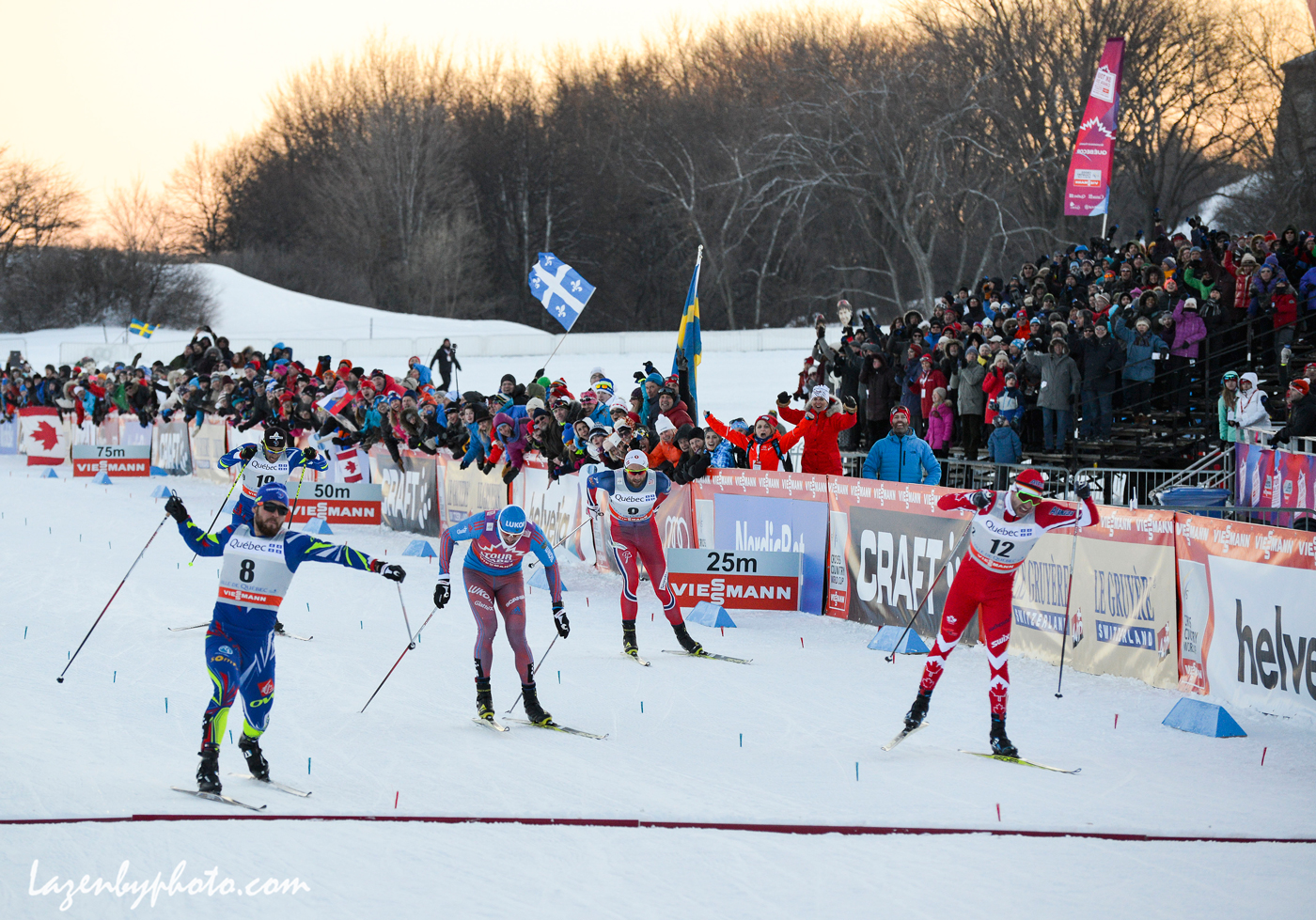
    France's Baptiste Gros (l) stretches across the line to edge Canada's Alex Harvey (r) for the win in Stage 3 of the Ski Tour Canada, the men's 1.7 k freestyle sprint In Quebec City. Russia's Sergey Ustiugov (second from l) placed third after leading most of the race and Norway's Petter Northug (second from r) placed fourth. (Photo: John Lazenby/Lazenbyphoto.com)
    France’s Baptiste Gros (l) stretches across the line to edge Canada’s Alex Harvey (r) for the win in Stage 3 of the Ski Tour Canada, the men’s 1.7 k freestyle sprint In Quebec City. Russia’s Sergey Ustiugov (second from l) placed third after leading most of the race and Norway’s Petter Northug (second from r) placed fourth. (Photo: John Lazenby/Lazenbyphoto.com)

    Ce fut une bonne journée pour accrocher votre chapeau.

    Quick translation from French — “It was a good day to hold onto your hat.” On Friday, it was also a good day to understand French, as two native French speakers from countries thousands of miles apart, finished 1-2 in the 1.7-kilometer freestyle sprint at the third stage of the Ski Tour Canada in Quebec City.

    France’s Baptiste Gros won the men’s final in 3:36.26. It was Gros’ first ever World Cup victory and his fourth career podium. The other French speaker, and local boy done good, was Canada’s Alex Harvey skiing to second (+0.55), for his fifth-career sprint podium. Overall Tour leader, Russia’s Sergey Ustiugov finished third, 0.79 seconds behind the winner.

    The hat-holding reference made earlier wasn’t for the victorious Francophones or the hell-bent pace of the day, or any strong winds. It was for this: On Friday’s sprint course, outside the gates of Old Quebec City on historic ground called the Plains of Abraham, World Cup-level speeds were matched with racing rife with World Cup-level scuffling. During the quarterfinals, semifinals and finals, skiers had to endure cold-induced lung burn, but also a six-person deep scrum of skiers aggressively attempting to position themselves.

    Here’s a few anecdotes of the carnage. The second men’s quarterfinal featured two North Americans: U.S. Ski Team sprinter Andy Newell, who qualified 23rd and Canadian Jess Cockney who qualified 29th. Add in Italy’s Federico Pellegrino, Andrew Musgrave of Great Britain, Sweden’s Teodor Peterson, and the day’s winner Gros and it became a perfect storm to start off the tumult.

    At 2:54 in, Newell looked fresh as he slotted behind Gros in first. The two bumped boots and suddenly Newell was down. Pellegrino, a breath behind Newell, tripped and buckled over the American.

    In the next heat, quarterfinal 3, Norway’s Finn Hågen Krogh, wearing bib number 1 as the day’s fastest qualifier, led for most of the heat. Out front, Krogh looked comfortable, even sublime.

    At 3:04, still leading, but with the heat’s eventual winner Frenchman Richard Jouve seemingly riding his tails, just as he crested a hill from a furious V1, Krogh tripped.

    And another image: Erik Bjornsen, also of the U.S. Ski Team (USST), moments after crossing the line in quarterfinal 5 (Bjornsen qualified 27th and placed fourth in the heat), got into a brief altercation with Great Britain’s Andrew Young, who placed third. Young was seen on TV cameras pushing Bjornsen first and Bjornsen pushed him back.

    However, one skier able to navigate all this unscathed was second-place skier in the fifth quarterfinal, Harvey. It was his day to cash in his chips.

    Bon Ski

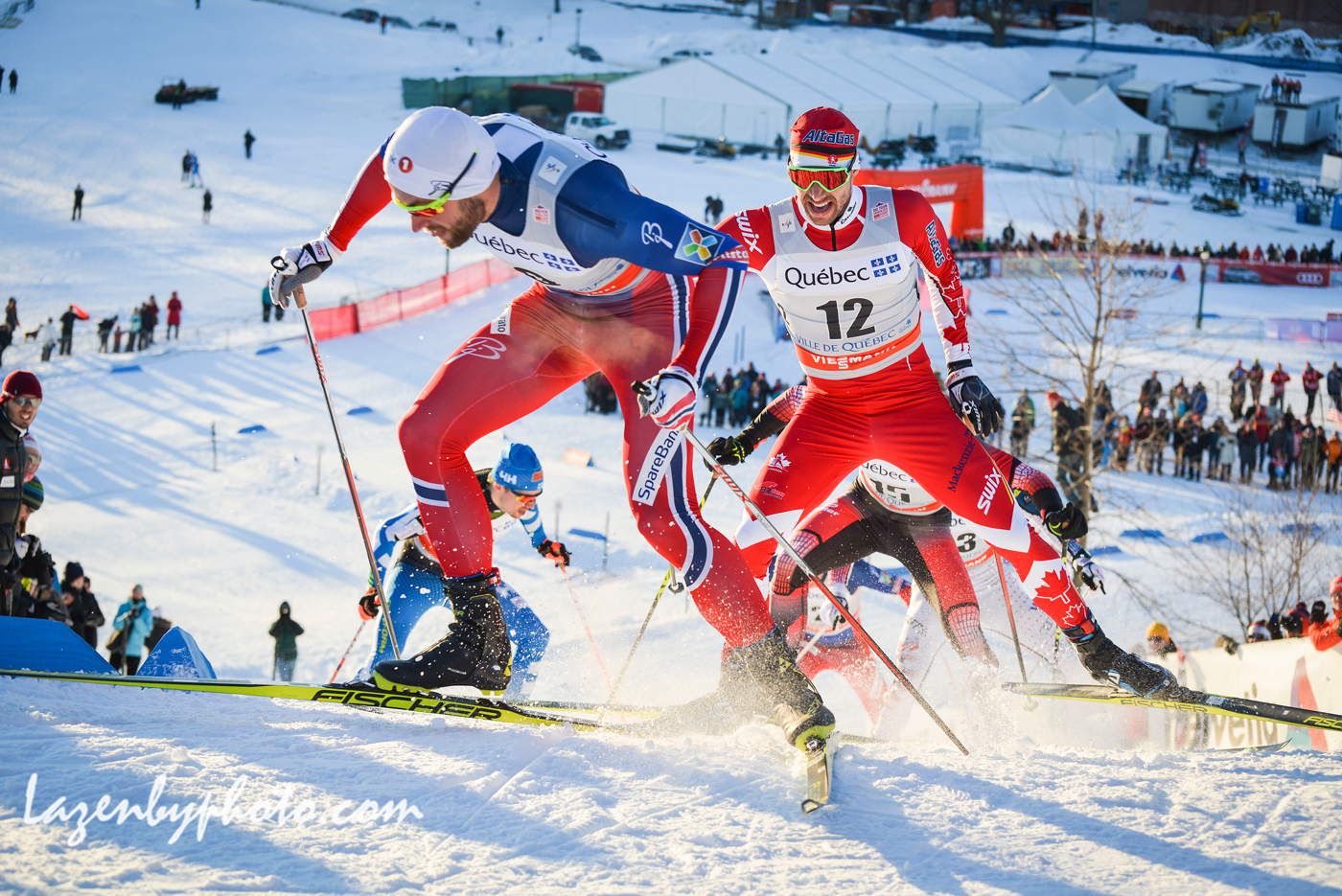
    Norway's Petter Northug leads Canada's Alex Harvey during the second semifinal of the men's 1.7 k freestyle sprint at the Ski Tour Canada in Quebec City. Harvey won that heat, by 0.14 seconds ahead of Northug, and Harvey went on to place second in the final while Northug was fourth overall. (Photo: John Lazenby/Lazenbyphoto.com)
    Norway’s Petter Northug leads Canada’s Alex Harvey during the second semifinal of the men’s 1.7 k freestyle sprint at the Ski Tour Canada in Quebec City. Harvey won that heat, by 0.14 seconds over Northug, and Harvey went on to place second in the final while Northug was fourth overall. (Photo: John Lazenby/Lazenbyphoto.com)

    No doubt about it, Harvey is a local. He grew up about a 40-minute drive north of Quebec City in Saint-Ferréol-les-Neiges, Quebec. He’s part of Canada’s skiing royalty. His father Pierre was a Canadian Olympian in both cycling and cross-country skiing. There’s the family name to uphold and honoring the home crowd. But sometimes the pressure of performing in front of friends and family can get to athletes. That wasn’t the case for Harvey on Friday.

    Instead of buckling under expectations, he rose to the occasion.

    Although an all-around skier, Harvey has struggled this year to qualify in the sprints. Here’s his 2015/2016 sprinting rundown in terms of qualifying: Harvey has qualified in only four sprints this season; three of which were in classic technique. The first freestyle sprint he qualified for this season was earlier this week in the first stage of the STC in Gatineau, Quebec. Harvey last podiumed in a skate sprint in Szklarska Poreba, Poland, two seasons ago in January 2014.

    Call today a breakthrough or a perfect alignment of timing and place.  Either way, Harvey skied like he owned the course.

    Friday, Harvey made it a personal two-peat. He began his day qualifying for his second-straight skate sprint. In Quebec, he was 12th in qualifying, 4.63 seconds off of Krogh’s best time of 3:33.14.

    Then he finished second in his quarterfinal and first in his semi to cruise to the finals. As each round progressed Harvey noted he could sense the crowd’s energy.

    “After each round, the crowd got louder and louder,” Harvey said after the race. “The fans were amazing, they gave me wings.”

    Wings are a good way of describing the lightness one feels when a collective mass of people are willing the win. Harvey flew to a semifinal win in 3:40.68, besting Norway’s Petter Northug by 0.14 seconds.

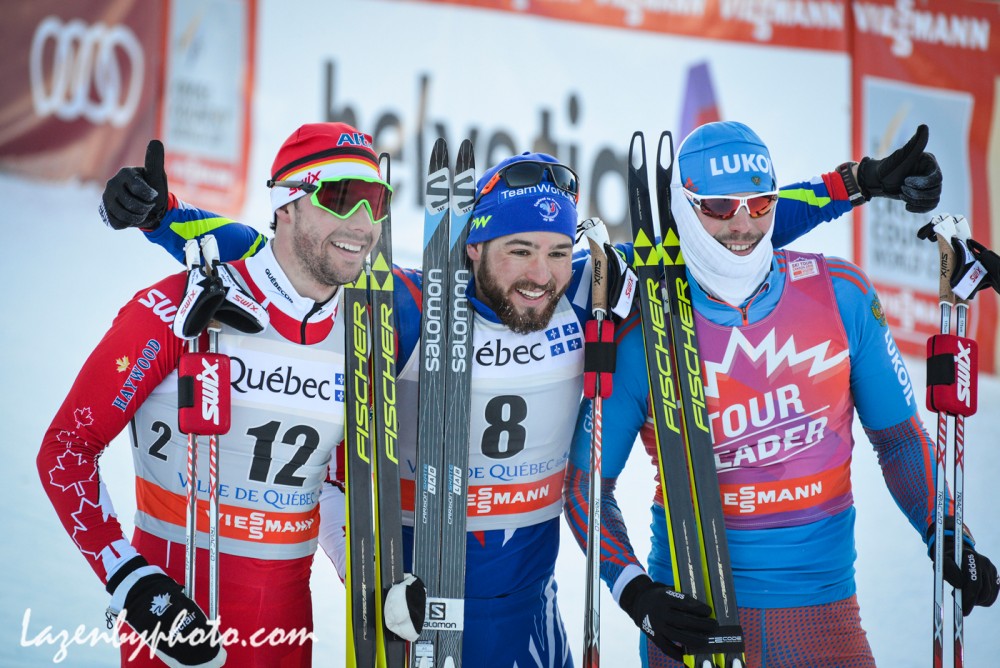
    The men's freestyle sprint podium at Stage 3 of the Ski Tour Canada in Quebec City, with (from left to right), runner-up Alex Harvey of Canada, winner Baptiste Gros of France, and Russia's Sergey Ustiugov in third. (Photo: John Lazenby/Lazenbyphoto.com)
    The men’s freestyle sprint podium at Stage 3 of the Ski Tour Canada in Quebec City, with (from left to right), runner-up Alex Harvey of Canada, winner Baptiste Gros of France, and Russia’s Sergey Ustiugov in third. (Photo: John Lazenby/Lazenbyphoto.com)

    In the final, it was Gros, Ustiugov, Northug, Poland’s Maciej Starega, Jouve, and Harvey lined up as a northern sun kissed only the tallest buildings in Quebec City. By finals time, the course was shaded and looking cold.

    Ustiugov started out hammering in front and Northug kept the tension high as he shadowed in the rear. A minute in, Harvey skied just to the side, in third, keeping a lane open for an acceleration. Thirty seconds later, he was nearly side-by-side with Ustiugov as they skied along the old city’s fortress-like walls.

    By 2:30, there was no doubt, Harvey was on form. He matched a steamrolling Ustiugov up a decisive climb. Cresting the top, it looked for a moment that the Russian would run away with a sizable lead. But Harvey kept the finish in sight amongst the deafening crowd.

    In the home stretch the Canadian slingshotted to the outside around Ustiugov who was on fumes as he faded to third. Elusively charging up on the inside was Gros, taking the win.

    “At the top of the last uphill, I was right behind Ustiugov in the best position possible,” Harvey said about coming so close to the win. “I thought I could win this one, but then Baptiste passed me on my right and surprised everyone.”

    Harvey even outclassed the master of outclassing on the final sprint, Northug. Evidently, Harvey winked at the Norwegian in the finishing pen.

    “Few people can say they were faster than Northug in the last hundred meters of a sprint finish,” Harvey explained in a press conference. “He’s the best finisher since 2006, so it was my way of telling him I could hang with him!”

    Harvey, winner of four World Championship medals, two of which came in individual classic sprints, could have been off some competitors’ radars this season. In Canada, during the final race series of the World Cup season, it’s Harvey making the statement.

    “Right now, I’m in the best shape of this season,” Harvey said. “That was the goal.”

    Historically, it has been a bit rough for the Canadians racing in Quebec. The last time the World Cup visited the city, back in 2012, Harvey had the best showing for the Canadians in the individual skate sprint in 21st place. Then a week later in a skate sprint in Canmore, Alberta, Harvey didn’t qualify in 52nd.

    Fast-forward to 2016: Friday was a big day for the Canadians.

    Harvey moved up two spots into fourth overall in the Tour standings — 1:56.8 back from Ustiugov, who continues to lead the Tour. Northug is second overall (+16.7), and Iversen is third (+24.3).

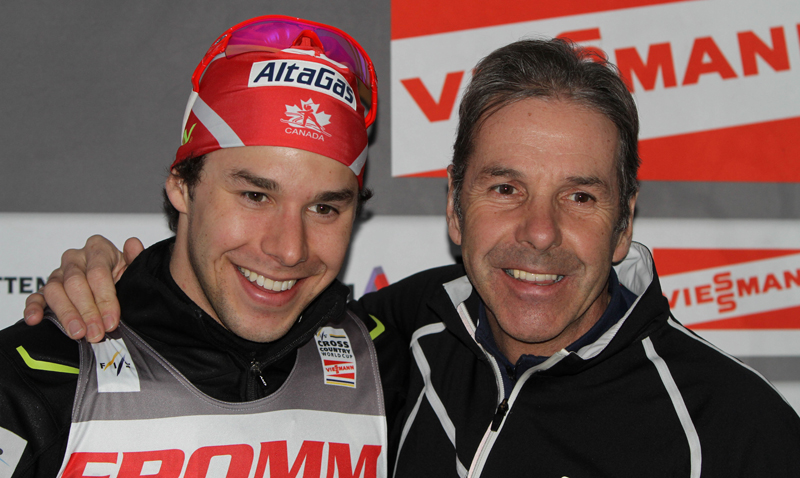
    Alex Harvey and his father, Pierre, embrace after Alex Harvey won the 3.3 k freestyle sprint at the World Cup Finals in Falun, Sweden, on Friday. Harvey is a local hero in Quebec and will return for the Canadian nationals next week.
    Alex Harvey and his father, Pierre (r), after Alex won the 3.3 k freestyle sprint prologue at 2012 World Cup Finals in Falun, Sweden.

    One parent asked after the race if they were confident their son would make it to the finals was Alex’s father Pierre.

    “No! He didn’t do it once this season, but you dream of that one time where you can do it in front of your friends and family,” Pierre Harvey told FasterSkier. “He’s on a cloud right now. … During the Tour de Ski, they were tough moments for Alex. At one point, I thought he would call saying he’s coming back home. With all the waxing setbacks, it’s hard when you’re training like crazy.”

    Canadian Head Coach Justin Wadsworth, for one, wasn’t surprised with the result.

    “Alex can podium in every day on the right day,” Wadsworth wrote in an email. “His skating has come up a notch, most likely due to the surgery he had last spring, but he’s always been solid in every aspect of WC [World Cup] racing.”

    Last spring, Harvey had surgery on his iliac arteries in both legs to relieve pain that worsened in hilly skate races. He went on to start the season with a confirmation it was the right move: he placed second in the 10 k skate at the World Cup opener in Finland.

    As for how he commanded Friday’s final on home turf, Wadsworth said, “He knew where he had to be and when he had to be there, and stuck to this perfectly. He is one of the best tactical skiers out there. This course had a couple choke points, and if you were back on those it was hard to move into the right position toward the finish.”

    He stressed the importance of Harvey’s podium for the team, at home with its coaches, wax techs and a large number of athletes representing Canada as well “many whom have not had a chance to be part of a WC podium before,” Wadsworth wrote. “It’s been a really great working team of staff here that normally don’t work together, so having something to celebrate together is important.”

     “He is one of the best tactical skiers out there.” — Canadian head coach Justin Wadsworth, on Alex Harvey’s second place in Friday’s freestyle sprint

    Cross Country Canada’s new CEO, Pierre Lafontaine told FasterSkier that a strong program is built success by success.

    “I think it’s a sum of things, you know,” Lafontaine said. “Like Alex’s position and he is getting better and better as the season goes on. It’s powerful. It’s powerful that it happened at home in front of Canadians. We got two guys in the top twelve that’s powerful. Two or three days ago we had three guys in the top 30, one girl scored [points] that had never scored before. So it’s by hosting at home, it empowers these kids to push themselves even more.”

    The celebration for Harvey’s second place was noted by sprint winner Gros.

    “It’s funny because it’s almost as if Alex won today!” Gros said after the race.“It’s a big deal for him, he didn’t perform well this season in sprints. He’s looking to do well on the overall rankings, while I’m primarily focused on freestyle sprints. So you could say, I’m a ‘casse-pieds’ [ translation: pain in the neck!]”

    Having skied on the World Cup since 2014, this was Gros’ first World Cup win. He’s placed third once, and second on three occasions.

    “It’s funny because it’s almost as if Alex won today … So you could say, I’m a ‘casse-pieds’ [pain in the neck!]” — France’s Baptiste Gros, 25, after winning his first World Cup on Friday in Quebec City

    “In the past, I placed second in a World Cup, I kept finishing second, but I really wanted to win and I knew I had better chances in freestyle,” Gros said. “This morning, it was my last chance to win a freestyle sprint this season, so I told myself  ‘I got to win today!’

    “I find it magical! To do a course on the Plaines d’Abraham, with the crowd and the city laying in the background, it’s so surprising. We’re not used to that kind of crazy atmosphere.”

    Other North Americans in the Heats and Beyond

    Jess Cockney racing to 29th in the freestyle sprint qualifier at Stage 3 of the Ski Tour Canada in Quebec City. (Photo: John Lazenby/Lazenbyphoto.com)
    Jess Cockney racing to 29th in the freestyle sprint qualifier at Stage 3 of the Ski Tour Canada in Quebec City. (Photo: John Lazenby/Lazenbyphoto.com)

    Canada’s Cockney eked into the heats by qualifying 29th, 8.48 seconds out of first and 0.52 seconds ahead of 30th. Once in the heats, Cockney made the most of it.

    He skied a stellar quarterfinal assuring himself a place in the semis by finishing second, 0.54 seconds back from Gros as the winner of that second quarterfinal. That was the heat where Newell tumbled out of contention.

    Cockney raced in the second semifinal and finished in fifth (+2.49). Ustiugov won that semi in 3:37.42.

    Post-race, Cockney, a 26-year-old National Senior Development Team skier, was elated with his 10th place on the day.

    “Man, I have had a really hard go of it this year,” Cockney said. “Nothing was working at the start of the year … So this is a big lift. I’m really happy with that. Skiing a semifinal is always awesome. Nice to have a two heat day again.”

    This was Cockney’s third time qualifying in a sprint and only his second time racing in a World Cup semifinal. His other semifinal came in 2012 at the skate sprint in Canmore, where he raced to ninth overall.

    For American Simi Hamilton, who raced to second in Stage 1 sprint three days earlier, anything was possible. Hamilton qualified 13th. Again proving he’s no fluke, Hamilton won quarterfinal 4 in a photo finish with Finland’s Martti Jylhä.

    In his semifinal, which Harvey won, Hamilton finished fourth (+0.86). Although Hamilton was a sliver from automatically advancing by placing first or second, his semifinal was just over three seconds slower than the first semifinal. As a result, no lucky losers advanced from Hamilton’s semi.

    U.S. Ski Team sprinter Simi Hamilton (c) hanging with the pack on an uphill in the 1.7 k freestyle sprint on Friday in Quebec City. He went on to finish fourth in his semifinal for eighth overall. (Photo: FlyingPointRoad.com/NNF)
    U.S. Ski Team sprinter Simi Hamilton (13) hanging with the pack on an uphill in his semifinal of the men’s 1.7 k freestyle sprint on Friday in Quebec City. He went on to finish fourth in the semifinal for eighth overall. (Photo: FlyingPointRoad.com/NNF)

    The U.S. sprinter told FasterSkier that Friday’s rounds were difficult.

    “It was crazy, it was really hard,” he said. “A minute-fifteen longer than pretty much anything.”

    Hamilton also mentioned he felt better as the day progressed.

    “It didn’t feel great qualifying, but felt better in my quarter and actually felt good in my semi,” he said. “But I really wanted to conserve energy early on so you know we had a really slow heat. I was happy just kind of tucked in towards the back, and focusing on relaxing.”

    Hamilton also referenced a make-or-break move by Northug in his semifinal that he didn’t have an answer for. “Petter made a move at the top of the first climb,” Hamilton said. “I was little too far back and I didn’t react to it quick enough. So I when I tried to get back up and bridge that gap, when we got to the second climb here,  I actually felt really good on the climb, and put a bit of a surge to see what would happen. But I couldn’t really go anywhere so I had to just hoped for the best coming into the finish.”

    Hamilton finished the day eighth overall.

    Another U.S. skier in the top 20, Bjornsen ended up 20th overall for a career-best in an individual World Cup sprint.

    The skier from Washington’s Methow Valley, who lives and trains with Alaska Pacific University (APU) in Anchorage, qualified in 27th. Bjornsen was ultimately bumped from competition when he placed fourth in his quarterfinal, 2.56 seconds behind heat winner Emil Iversen of Norway.

    In his interview with FasterSkier, Bjornsen mentioned the compact nature of the group in his quarterfinal.

    “Like most of them, it was pretty tight,” Bjornsen said. “Hard to make passes. I kind of went for a fast start out of it so I felt like I was in a pretty good position. I was just not quite strong enough to have that surge to make to that semifinal.”

    Asked about his brief finish-line scuffle with Young, who finished third, 0.18 seconds ahead of him, Bjornsen said, “There was just quite a bit of tangle the whole time. We were just stepping all over each other’s stuff, and we were both just disappointed at the end. It’s all fine. We talked right afterward in the pen so it’s all good.”

    Team veteran Newell had a tough run in the quarters. He got there by qualifying 23rd. Yet in his heat, the second quarterfinal, he tripped up while skiing behind Gros.

    “Disappointing crash, ’cause I felt this is actually kind of a fun course,” Newell told FasterSkier afterward. “I thought I skied a good heat, tactically well. I was feeling strong and ready to attack the last hill. So it’s too bad with the crash. Greatly disappointing, but what can you do?”

    Newell described his tangle and nasty spill in more detail. “I was behind Baptiste [Gros], I came out of the draft, and we both started to skate at the same time. So we bumped boots, you know? I went down hard. Nobody’s fault. It’s what happens.”

    Italy's Federico Pellegrino became the first non-Scandinavian male to win a Sprint World Cup Crystal Globe on Friday, placing 21st in the freestyle sprint in Quebec City. (He needed to finish in the top 22 to lock up the title.) (Photo: John Lazenby/Lazenbyphoto.com)
    Italy’s Federico Pellegrino became the first non-Scandinavian male to win a Sprint World Cup Crystal Globe on Friday, placing 21st in the freestyle sprint in Quebec City. He needed to finish in the top 22 to lock up the title. (Photo: John Lazenby/Lazenbyphoto.com)

    Newell sat stunned for a few moments and finished sixth in the heat, 52 seconds out of first. Pellegrino recovered quicker and ended up fifth, 2.73 seconds behind Gros as the winner.

    That put Newell in 29th and Pellegrino in 21st overall; for Pellegrino, it was enough to secure his first Sprint World Cup Crystal Globe and he became the first non-Scandinavian male to win the season-long title. (He needed to finish in the top 22 to do so.)

    As of late, Newell has tried to jump start what he has considered to have been a difficult season.

    “Just trying to take it one day at a time,” Newell said. “I am obviously not in my best shape right now. I’m kind of suffering a little bit, and just trying to make it through the season. It hasn’t been a great last month for me. I haven’t been sick, I’ve just not been feeling very good. So that’s hard, at the end of a season, when you are not feeling well. It’s no fun to race when you are not at your best. It’s one of the hardest things for an athlete to do. So just trying to make it through some of these races. And then, yeah, take it one day at a time.”

    Also for the U.S., Reese Hanneman (APU) placed 45th, Eric Packer (APU) was 48th, Dakota Blackhorse-von Jess (Bend Endurance Academy) 64th, Noah Hoffman (SSCV/USST) 65th, Scott Patterson (APU) 70th, Tad Elliott (SSCV) 76th, Brian Gregg (Team Gregg) 79th, Matt Liebsch (Gear West) 80th.

    Also for Canada, Len Valjas (CNST) finished 38th, Devon Kershaw (CNST) 53rd, Knute Johnsgaard (AWCA/CNST) 54th, Andy Shields (NDC Thunder Bay) 56th, Michael Somppi (NDC Thunder Bay) 59th, Patrick Stewart-Jones (AWCA) 68th, Graeme Killick (CNST) 71st, Ivan Babikov (CNST) 72nd, (Russell Kennedy (Canmore Nordic) 73rd, Kevin Sandau (AWCA) 74th, Bob Thompson (NDC Thunder Bay) 78th, and Simon Lapointe (Skinouk) 81st.

    The STC continues Saturday with Stage 4, the men’s 15 k and women’s 10 k freestyle pursuits in Quebec City.

    Results | Qualifier | Tour standings (through Stage 3)

    — Gerry Furseth, François Léger Dionne, Harald Zimmer, and Alex Kochon contributed 

  • Quebec Report: Abundant Snow, French Onion Soup and a ‘Brutal’ Sprint Course

    Quebec Report: Abundant Snow, French Onion Soup and a ‘Brutal’ Sprint Course

    QUEBEC CITY — The Plains of Abraham just outside the walls of Quebec City are best known for a major battle that changed the direction of North American history in 1759.  On March 4 and 5, the Ski Tour Canada will reignite international rivalries on the same plains.

    A recent 40 centimeters (16 inches) of snowfall means there is no shortage of snow. Race organizers are spending more effort digging out sidewalks and pathways than covering the course. Thursday’s training day was cold and windy, reaching -15 Celsius (5 Fahrenheit) in the afternoon, and only the Russians used the entire official training session. Temperatures are expected to warm up to -9 Celsius (16 Fahrenheit) for the freestyle sprint heats on Friday, which start at 3:30 p.m. Eastern time.

    Digging out the downtown sidewalks on Thursday in Quebec City. (Photo: Peggy Hung)
    Digging out the downtown sidewalks on Thursday in Quebec City. (Photo: Peggy Hung)

    Saturday will be the 10/15 k freestyle pursuits, with the tour leader starting first.  As with the Gatineau sprint, there are very few trees and little protection from the wind.  The feel of the course will change dramatically with wind direction.

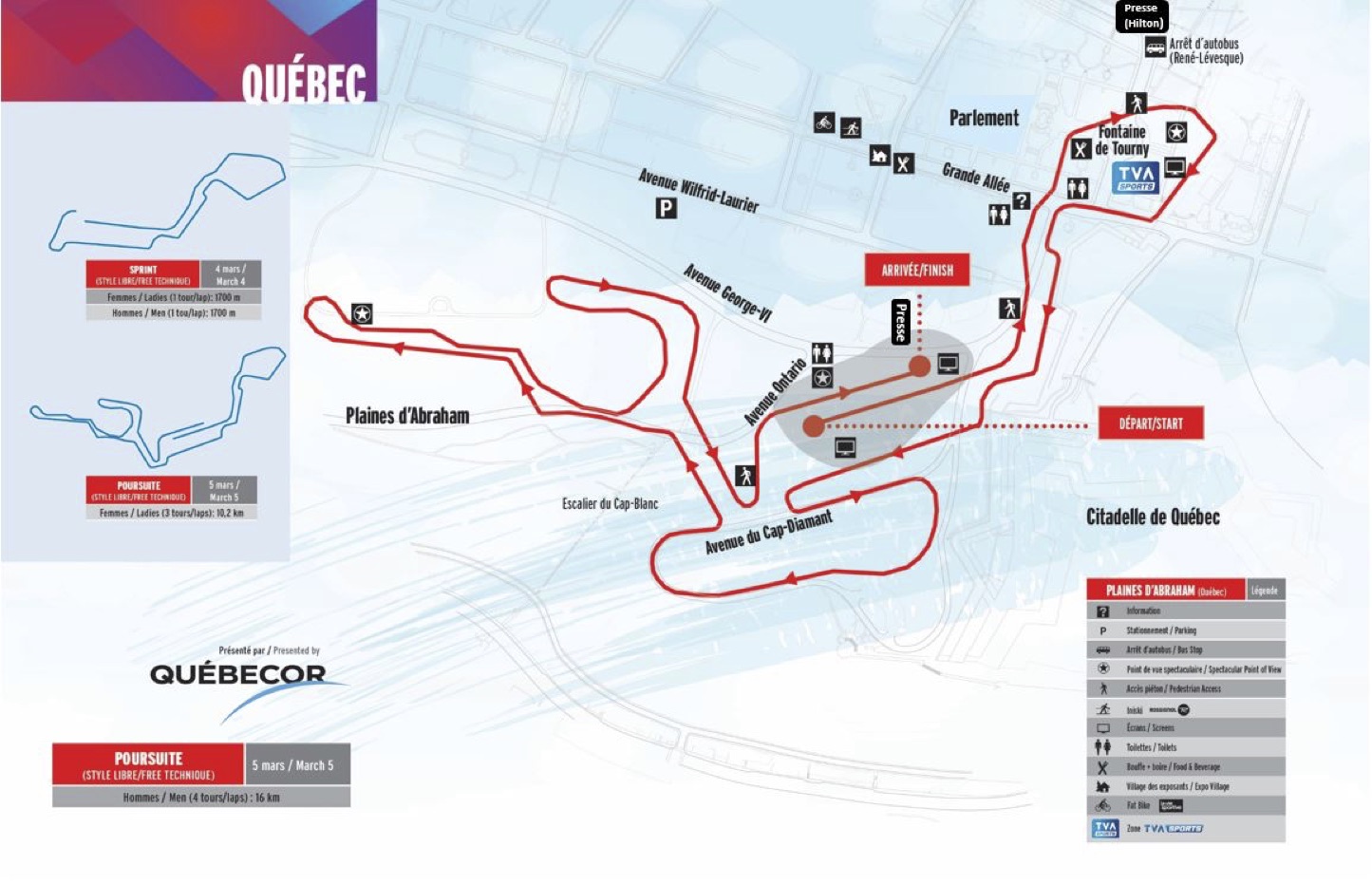
    Despite the name, the plains are not entirely flat, with rolling hills on top of a cliff overlooking the St. Lawrence river. The sprint course (1.7 k for the men; 1.5 k for the women) is relatively flat, with a gentle climb out of the stadium, a long gentle descent to the city walls, and a gentle climb back before a steep-wall climb returns the racers to the stadium.

    The women finish with a gentle descent followed by a wide-open corner into the finish straight.  The men turn sharp left before the women’s final corner for a steep climb up and down a horseshoe, which will make the men’s race tactically very different. 

    “The last 500 meters of tomorrow’s sprint is going to be long and brutal,” Canadian World Cup Team and local racer Alex Harvey said at a press conference on Thursday. “As I get older, I’m a little slower in short sprints, but this is a longer sprint, so it should suit me better.”

    A skier navigates the sprint course just outside the city walls in Quebec City. (Photo: Peggy Hung)
    A skier navigates the sprint course just outside the city walls in Quebec City. (Photo: Peggy Hung)

    The steep climbs stayed firm on training day, but could easily turn to sugar by the end of the race day.  The turn at the bottom of the course is easy enough in Zone 1, but it will likely be far more exciting in at race pace in in a group.

    The pursuit course spends more time on the top of the exposed ridge with moderate climbs and great views of the river.  Where the sprint course was almost entirely untransformed (squeaky) snow, the more exposed sections of the distance track were heavily transformed and very fast.

    By the end of official training, one of the climbs was a mix of polished transformed snow and windblown squeaky drifts, with the fast line snaking back and forth across the trail.  The longest distance course descent combined particularly fast snow with a strong tailwind, making the crashpads on the trees seem justified. The one tricky turn from the sprint course will be a bigger factor with the entire pack arriving together.

    “Quebec is such a great venue to host a World Cup,” Harvey said. “There’s so much snow here, we never see that in Europe. We have some races in downtown in Europe, but trucks bring the snow, it’s dirty snow. Here it’s white everywhere, the course is great with fun bridges here and there. The European find it really surprising. They keep pointing at the Fleuve [St. Lawrence River] and asking if it’s a lake, a river! For many of them, it’s their first trip here.”

    A hairpin turn around a cannon at the top of the freestyle pursuit course, which will be used on Saturday at the fourth stage of the Ski Tour Canada in Quebec City. (Photo: Gerry Furseth)
    A hairpin turn around a cannon at the top of the freestyle pursuit course, which will be used on Saturday at the fourth stage of the Ski Tour Canada in Quebec City. (Photo: Gerry Furseth)

    The old city of Quebec is one of the few remaining walled cities in North America and has a distinctly Quebecois culture.  Greetings are uniformly in French, although most people will quickly switch to English.

    The city is also known for its food. No visit is complete without a stop at the Chic Shack for their famous poutine, in the Musee du Fort, five minutes walk from the racecourse.  Aux Anciens Canadiens, through the city gates and two blocks straight ahead, mixes traditional and modern food and encapsulates much of the local food history. As the weather is expected to remain cold, a good choice anywhere is the regional specialty soupe a l’oignon gratinee.  Outsiders may know this as French onion soup.

    On Thursday afternoon, the old city was filled with U.S.. family and friends, with nordic logos outnumbering the ‘normal’ tourists.

    More from the press conference with Harvey (translated from French to English):

    “This year’s sprints have been relatively shorter, at 1.3 to 1.4 kilometers, compared to [Friday’s] 1.7-kilometer sprint. Where the shorter sprints last a little over two minutes, this one will go over the three minutes mark. My endurance should enable me to keep pushing after the acid lactic build up, which usually kicks in at two minutes.”

    (In English) “The natural terrain [on the plains of Abraham] is really hard, and then they added a little extra, little bridges, to make it harder.  So this is going to be one of the toughest sprints of the whole circuit tomorrow, everyone agrees to that. It’s long, it’s hard, the last 500 meters is going to be just brutal.”

    Canada's Alex Harvey racing to ninth in the second stage of the Ski Tour Canada, the men's 17.5 k classic mass start, on Wednesday in Montreal, Quebec. (Photo: John Lazenby/Lazenbyphoto.com)
    Canada’s Alex Harvey racing to ninth in the second stage of the Ski Tour Canada, the men’s 17.5 k classic mass start, on Wednesday in Montreal, Quebec. (Photo: John Lazenby/Lazenbyphoto.com)

    “I spent ten days training at altitude in Canmore in preparation for the second half of Ski Tour Canada, missing the last World Cup weekend in Finland. I’m really anxious to see the rewards in Canmore next week. The first six days of that altitude training were really frustrating. I felt really tired and weak during intervals session, which pissed me off! Altitude training is tough for everybody. I bet some guys will explode during the skiathlon in Canmore.” [Note: Canmore is at an elevation of 1,400 meters above sea level. Quebec City is at 100 meters.]

    “My goal for [Friday’s] sprint is to qualify for the semis, which would give me a 30-second bonus overall.

    “A top-five placement overall is still realistic, even the podium is not out of reach.”

    FasterSkier: What differences, if any, do you see between the European Tour de Ski and the Ski Tour Canada?

    AH: “The traveling is a big distance. The distances are really small in Europe. You can go from Italy, to Germany, to Switzerland easily and in no time. Here, we have to take a plane to Canmore. The logistics of the Ski Tour Canada are much more complex. That was probably our biggest challenge up to that point. The jet lag is another factor. I did the trip from Montreal to Calgary several times in the past, so I’m used to it. Other Canadians did so as well, so it should play to our advantage.”

    — François Léger Dionne contributed reporting

    The freestyle sprint course in Quebec City.
    The freestyle sprint course in Quebec City. (Click to enlarge)
  • Best of Canadian Nationals in Photos

    Best of Canadian Nationals in Photos

    Young fans cheer for the men's 50 k classic podium at the 2012 Canadian Ski Nationals on March 24.

    MONT SAINTE ANNE, Québec — Already missing the warm weather and spring racing that took place at Canadian Ski Nationals in Québec from March 17-24?

    FasterSkier took plenty of photos and pared them down to some of the best from each of the senior/open races. Take a look on our “Best of 2012 Canadian Nationals” SmugMug site.

    All Canadian Nationals photos

    For results and start lists, visit Zone4.ca


  • Cockney, McMurtry Join Forces to Win Canadian Nationals Team Sprint

    Cockney, McMurtry Join Forces to Win Canadian Nationals Team Sprint

    Graham Nishikawa (l) of Whitehorse and Jesse Cockney (Foothills Nordic) race toward the finish in the team sprints at Canadian nationals on Saturday. Cockney (r) won by three-tenths of a second.

    QUEBEC CITY – Two tiny specks charging toward the finish, Graham Nishikawa and Jesse Cockney appeared to merge into a single lane, and then suddenly jolted in opposite directions.

    Whatever made them move must have been significant, and it could have explained why Nishikawa lost his lead and ultimately the classic team sprint at the Canadian Ski National Championships on Saturday.
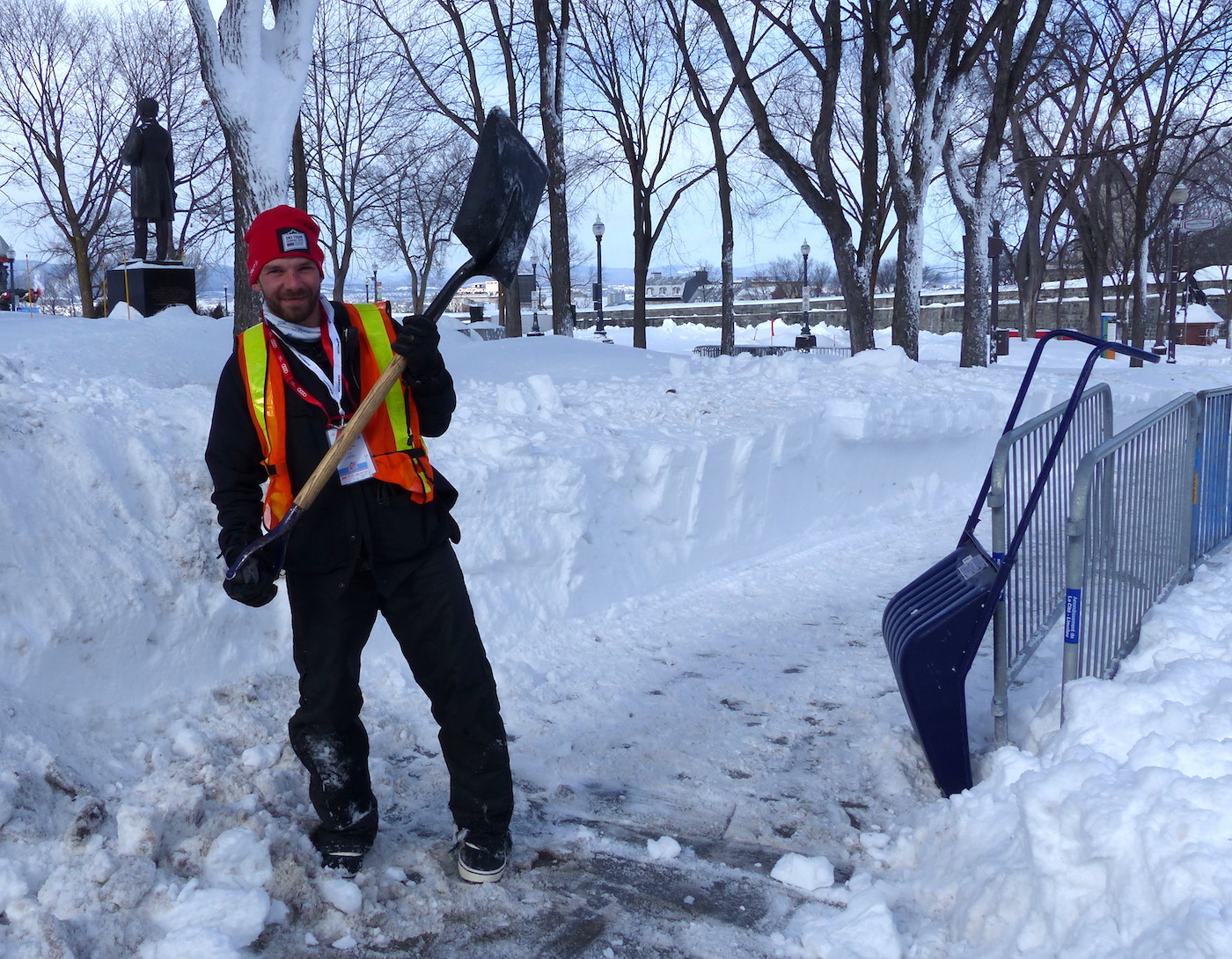
    Turns out it was just water in the tracks on a balmy afternoon at the Plains of Abraham.

    Usually Alberta World Cup Academy teammates, Cockney and Nishikawa were competitors in the club event on the first day of nationals. With one lap to go in the open men’s relay final (each racer did three alternating 1 k loops), Nishikawa of Whitehorse decided to test his AWCA training partner. He immediately moved to the front of the pack on the first hill out of the stadium.

    Cockney (Foothills Nordic) followed close behind until the final stretch, where Nishikawa slipped on some standing water and shifted to another track, causing Cockney to react as well. Both found themselves in lesser-used lanes, and Cockney powered ahead to win by 0.3 seconds.

    Start of the second anchor leg of the team sprint at Canadian nationals (left to right) Jesse Cockney (Foothills Nordic), Graham Nishikawa (Whitehorse), Patrick Stewart-Jones (Nakkertok)

    “’[We] kind of both left the fast track and we were just skiing down some tracks that hadn’t been skied in,” Cockney said. “Thankfully, I closed it to the line.”

    After Cockney secured the victory with Foothills teammate Brent McMurtry in 14:52.7, Nishikawa and David Greer were second for Whitehorse, and Nakkertok’s Steffan Lloyd and Patrick Stewart-Jones placed third (+31.9).

    McMurtry as the scrambler and Cockney, the anchor, worked to stay in front of the 10-team pack early in the final. They led through the first exchange, but Nishikawa overtook Cockney at his trademark spot on Saturday: the first gradual climb.

    McMurtry made his way back in front during his remaining laps, but not without the help of his teammate and NorAm competitor.

    “In the last exchange I was telling Brent, ‘You gotta go! You gotta go!’ because Nish was hammering,” Cockney said. “I knew he’d have a lot left for the final.”

    2012 Canadian nationals open men's podium: 1. Foothills Nordic (Cockney, McMurtry), 2. Whitehorse (Greer, Nishikawa); 3. Nakkertok (Stewart-Jones, Lloyd)

    The Foothills racers never got much more than a second ahead or behind Whitehorse, but made up the time when it counted: at the finish. Nishikawa knew sprinting was Cockney’s strength and not necessarily his or Greer’s, and anticipated a close result regardless.

    “We raced it perfectly,” Nishikawa said. “I was coming into the stretch in the lead and hit a bit of water and got lost my balance a bit. Jess is a really, really strong finisher; that’s what he’s known for. I would have taken my chances, but that was the best I could do.”

    “I was lucky not to fall, but I don’t know if I would have beat him if I stayed upright,” Nishikawa added. “My strategy was to go for it and try to make him hurt as much as possible. We know everybody’s strengths and we’re a bit better distance and not as good at sprints versus those guys, but it was just fun. No stress.”

    Three years ago, Greer and Nishikawa, former Pierre-Harvey National Training Centre teammates, also placed second in the team sprint. They wanted the win this year.

    “But it was still a good race,” Greer said.  “Team sprints are just a good warmup for the rest of the races, too. It’s always fun.”

    “It’s the one time of year, domestically at least, where we get to race not for ourselves, but for representing our club, wearing different suits,” McMurtry said. “It’s kind of cool, something I look forward to.”

    “It’s good to race side by side,” Cockney added.

    McMurtry was glad to be racing with Cockney as well.

    “It’s nice knowing I have a strong partner and a guy that beat me to the line a few times this year,” he said. “I was pretty confident with him coming on the last leg.”

    McMurtry and Cockney won the first men’s qualifying round to advance to the final. Greer and Nishikawa also won their opening relay, as did Skibec’s Etienne Richard and Raphael Couturier after Stewart-Jones fell a few meters from the finish.

    Open men’s team sprint results

    Complete results

  • Jones, Thomas Run Away with Team Sprint at Canadian Nationals

    Jones, Thomas Run Away with Team Sprint at Canadian Nationals

    Canadian National Team member Perianne Jones (r) celebrates winning the classic team sprint at the 2012 Canadian Ski National Championships on Saturday as Nakkertok teammate Alana Thomas (l) awaits her arrival at the finish on the Plains of Abraham in Quebec City.

    QUEBEC CITY – As Alana Thomas stood in the finish pen on the Plains of Abraham and looked back beyond the line, she smiled as Perianne Jones cruised down the final stretch.

    The Canadian National Team member was going to win by a mile – or maybe a kilometer, figuratively speaking in Canadian terms.

    While Jones didn’t quite have a full lap on the 11 other teams in the open classic relay at the Canadian National Ski Championships on Saturday, she finished in 17:59.6, more than 24 seconds ahead of anyone else with the help of Thomas, her Nakkertok teammate in the club event.

    Nakkertok teammates Alana Thomas (at left) and Perianne Jones (CNST) celebrate winning the team sprint at Canadian nationals on Saturday.
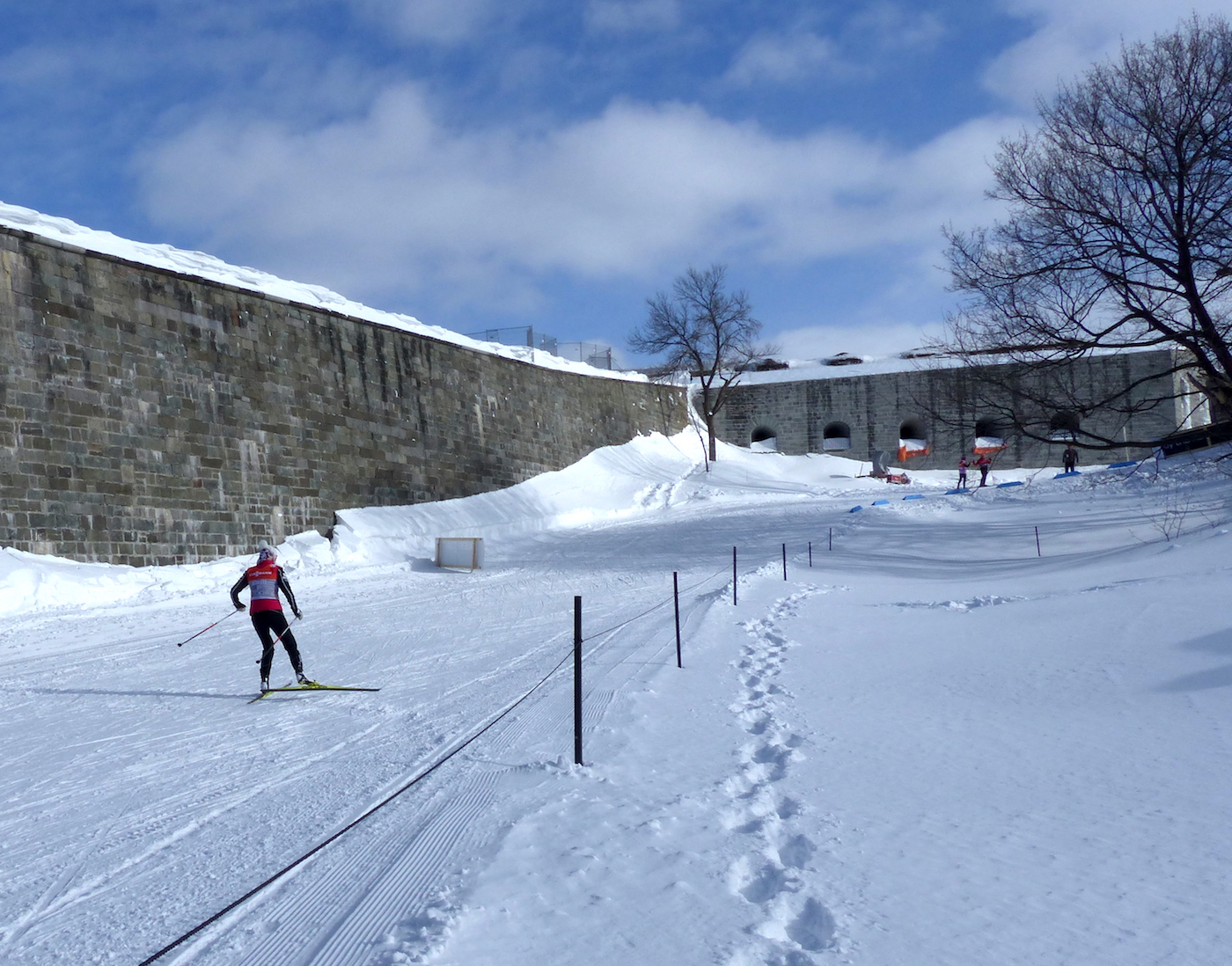
    “We drove here together this morning and we talked about kind of what we wanted to do,” said Jones, who flew into Quebec the night before from Canmore, Alberta. She previously spent a full season on the World Cup circuit in Europe.

    “We were going to build into it,” Jones added. “I think we executed pretty well.”

    They beat runners-up Amy Glen and Caitlin Patterson of the University of Vermont (+24.2), and Annika Hicks and Amanda Ammar of Canmore Nordic finished third overall (+31.4).

    Jones and Thomas also won their first heat, nearly two seconds ahead of Hicks and Ammar. Hicks passed Thomas on the final leg of the 3×1 k race, (in which each racer competed three loops in the city park, tagging off in between), but Jones reeled in Ammar as the anchor.

    While they worked hard in the qualifying round, the Nakkertok women made sure they had plenty left for the final. Jones said they planned to push hardest on the last lap while skiing relaxed throughout. Both did so and built a nearly 22-second gap by the end of the second leg.

    Thomas said she was trying to hang in the pack and ski smart. She also skied ahead, and most importantly, managed to stay on her feet. Heidi Widmer and Marlis Kromm of Foothills Nordic had been in second place for most of the final, but Widmer fell victim to the slushy conditions about halfway through her last lap. She tagged off to Kromm, who finished 1 second behind Ammar in fourth place.

    When Widmer slipped, Glen scooted around her and tagged off to Patterson in second. With Jones nearly 25 seconds ahead, Patterson held the position and clinched silver.

    “We’re definitely more distance skiers,” Patterson said. “We’ve been doing a lot of 5 k’s, 10, 15. So in general, we feel like we’re skiing pretty consistently. We just have the endurance to take us to the third lap still strong.”

    Open women's team sprint podium at 2012 Canadian nationals: 1. Nakkertok (Thomas, Jones); 2. University of Vermont (Patterson, Glen); 3. Canmore Nordic (Ammar, Hicks)

    Fresh off a trip to the NCAA championships in Bozeman, Mont., the two helped UVM notch its first national skiing title since 1994. Glen became the second woman in UVM history to win a U.S. crown in the 15 k classic race.

    After all that, Patterson said they jumped at the chance to race in Canada, about four hours away from their campus in Burlington, Vt.

    “Our college season had ended, we were just out in Montana and had come back, [had a] little bit of school to tend to,” Patterson said. “Why not come up here?”

    “I wanted to come check out the skiing at Mont-Sainte-Anne,” Glens said. “And this [city sprint], this is a huge draw.”

    The two planned to race Monday and Tuesday in the interval starts and then head back to Vermont to prepare for the SuperTour finals in Craftsbury, which start next weekend.

    While the relays didn’t count for much besides pride at Canadian nationals, several racers said they participated because of the atmosphere.

    “Team sprints are special,” Thomas said. “I usually only get to do one a year so this is a nice day.”

    Jones was a World Cup team-sprint veteran, but said the race was still her favorite and probably one of the toughest on the circuit because of its lack of recovery time. She found it especially fun at home.

    “I’m pretty pumped,” Jones said. “The club brought me to where I am, so I love to come race today with Nakkertok; to do it with Alana is awesome.”

    Perianne Jones (Nakkertok/CNST) ahead of the pack in the qualifying round of the team sprint at Canadian nationals
    Start of women's open team sprint final at Canadian nationals with Alana Thomas (Nakkertok) up front

    Open women’s final results

    Complete results

  • Canadian Nationals Attract Some of the Best

    Alex Harvey (l) and his father, Pierre, embrace after Harvey won the 3.3 k freestyle sprint at the World Cup Finals in Falun, Sweden, on Friday. Twenty-five years ago, Pierre won a World Cup in Falun. Alex Harvey is a local hero in Quebec and will return for the Canadian nationals next week.

    This year, the Haywood Canadian National Championships have been pushed back a week to accommodate a special group – Canada’s World Cup elite, which are returning in force to put on a show for the home crowd in Quebec.

    With Alex Harvey, Devon Kershaw, Chandra Crawford and all the major Canadian stars slated to participate, the fields will be some of the deepest in North America all season. The Canadian World Cup squad has turned in no less than 12 World Cup medals this winter and will be back to entertain their native fans.

    The Location

    Hosted by Skibec Nordique and Club Nordique Mont Ste-Anne (MSA) for the first time since 2007, the eight-day competition will be held between two venues. Starting Saturday, the club team sprints will take place in Quebec City, one of the oldest cities in North America, on the historic Plains of Abraham. The individual open freestyle sprints are also scheduled for downtown Quebec on Thursday.

    About 45 minutes north of the provincial capital, Mont-Sainte-Anne and its large trail network will hold the remaining races, including an interval-start classic race on Monday, interval skate on Tuesday and classic mass start on Saturday, March 24.

    The Events

    This year, Canadian nationals open with team sprints on the Plains of Abraham, a large downtown park and national historic site. Individual-start racing begins Monday at MSA with 10 k senior men’s and 5 k senior women’s distances. Tuesday includes 15 k men’s and 10 k women’s individual-start skate races.

    The Open categories then have Wednesday to rest before heading south to Quebec City for Thursday’s 1.7/1.5 k freestyle sprints. The championships wrap up a week from Saturday with 50/30 k classic mass starts back at the club trails.

    The Skiers

    With the Canadian National Ski Team attending, racing will be some of the most competitive on this side of the Atlantic all season. After several of its athletes qualified for World Cup finals, many will arrive back in Canada on Monday and race from Tuesday on.

    Harvey will be the highlight as he returns to race in his home province of Quebec. Kershaw will also be a big favorite as the all-around skier, who currently sits second in the World Cup overall standings.

    Young Canadian sprinter Len Valjas also stayed in Europe after earning his first World Cup medal last week in Drammen, Norway. Another World Cup team member, distance specialist Ivan Babikov will raise the level of the field significantly at nationals; the two individual-start races are his to lose.

    Outside of the World Cup, the depth of the Canadian men remains strong, particularly in sprinting.

    NorAm leader Kevin Sandau (Alberta World Cup Academy/Senior Development Team) remained in Europe for World Cup finals, but the strong distance skier that raced his first Holmenkollen this season will be back to contest the 50 k classic at nationals next Saturday.
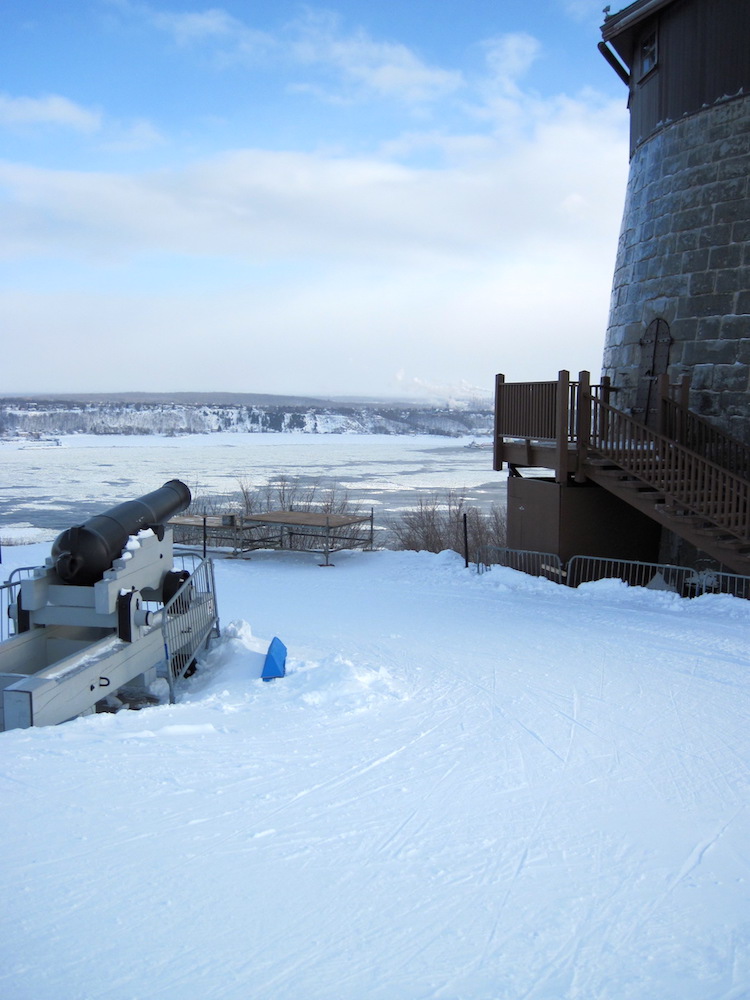
    Veteran skier Drew Goldsack (AWCA/NST) had a bumpy ride over the course of the season, climbing as high as fifth place in the team sprint in Dusseldorf, Germany, before crashing hard in the final of a NorAm skate sprint in Whistler, B.C., where he suffered a concussion, injured his shoulder and broke his favourite pair of skis. Ever since his recovery, he’s been pushing hard for a positive result, especially in the sprints.

    His World Cup Academy teammate, Phil Widmer will also be vying for a top spot in the short distances at nationals. The 29-year-old was consistent on the NorAm and earned a trip to Europe. In Scandinavian and Alpen Cup action, Widmer fought his way to the final in two sprints, facing Switzerland’s World Cup leader Dario Cologna in one of them.

    One of this season’s top NorAm skiers at any distance, Graham Nishikawa (AWCA/NST) has been a consistent podium contender and earned some valuable World Cup experience in November and December. He collected four top-10 finishes on the mid-winter Alpen and Scandinavian Cup swing.

    Two more Academy members, Jesse Cockney (NST) and Patrick Stewart-Jones are both threats in the sprint with plenty of experience in NorAm A-finals this season. Cockney is fresh off a trip to the U23 World Championships in Erzurum, Turkey.

    Well-rounded Brent McMurtry (Pierre-Harvey National Training Centre/NST) stood on the podium at every NorAm stop this season, yet lost the NorAm World Cup spot to Sandau. McMurtry will doubtlessly be hungry after a winter without a trip to Europe.

    As for younger skiers, Graeme Killick (AWCA/NST) finished in the top 20 twice at U23 Worlds. His U23 teammate, David Greer (CNEPH/Whitehorse) is also climbing the distance ladder.

    Thunder Bay’s National Development Centre features a trio of strong males. Michael Somppi (NST) enjoyed a series of solid races on the OPA Cup circuit in Europe, Chris Hamilton picked up some international racing experience at U23 Worlds, and Harry Seaton emerged as a strong sprinter on the NorAm circuit this year.

    On the women’s side, two of the nation’s leading women, Crawford and Dasha Gaiazova remained in Europe for World Cup finals along with Alysson Marshall (AWCA/NST), who claimed the NorAm World Cup slot.

    Perianne Jones (NST) is back in Canada and primed for several national-championship events. After finishing in the top 30 in two World Cup distance races, she is a favourite for both individual-start races.

    Emily Nishikawa (AWCA/NST) will be one of her challengers. A close runner-up to Marshall in the NorAm standings, Nishikawa notched 17th at U23 Worlds.

    Watch out for 2006 Torino Olympian Amanda Ammar, an Independent racer from Canmore, Alberta, who is on a charge in her comeback year. Ammar picked up two bronze medals in the last NorAm in Orford, Quebec, and had a several top NorAm results throughout the season. She also won the Gatineau Loppet 51 k freestyle in February.

    Kate Brennan (AWCA/Kanata Cross Country), who won the 5 k classic race at the final NorAm of the season, is a strong sprinter also enjoying her first full season back on the circuit. She was recovering from a shoulder surgery last year.

    Andrea Dupont (Rocky Mountain Racers) is perhaps the biggest sprint threat, as she has made the finals in every NorAm sprint this season. Andrea Lee (NDC Thunder Bay/Strathcona Nordic) also had a breakout year, turning in a handful of top-10 results on the NorAm circuit, including her first win in the 15 k freestyle mass start in Orford.

    Club skiers Zoe Roy (RMR) and Alana Thomas (Nakkertok) skied well enough earlier this season to earn a trip to Europe for international racing experience. Thomas went on to place eighth in an Alpen Cup 10 k pursuit in Switzerland.

    The Americans

    While it is Canadian nationals, Quebec City’s close proximity to the Eastern seaboard and the extremely competitive field attracted some Americans.

    The confirmation list featured about a dozen competitive U.S. skiers, including Craftsbury Green Racing Project members Dylan McGuffin and Tim Reynolds. Ida Sargent is back in Craftsbury after spending most of the season abroad on the World Cup, and wrote in an email that she would attend nationals and possibly race a sprint and a distance race.

    U.S. Ski Team development member, Skyler Davis, who suffered from illness earlier in the season, is also registered along with Leif Zimmerman (Bridger Ski Foundation) and Bryan Cook (CGRP).

    Simi Hamilton (USST) wrote in an email that he was heading to Canada and planned on racing the 15 k interval-start skate on Tuesday and Thursday’s individual skate sprint.

    Euro Invasion

    The Americans aren’t the only ones taking notice of the stiff competition at Canadian nationals. According to a Cross Country Canada press release, several notable French and Norwegian skiers will be there, thanks to a grant from Sport Canada’s International Hosting Program.

    In the senior ranks, sprint specialist Roddy Darragon of France is of note as a World Cup and Olympic veteran. If his name sounds familiar, it’s because he won silver in the sprint at the 2006 Winter Games. He was recently fifth in a World Cup freestyle sprint in Poland, and placed fifth in a team sprint earlier this year in Milan, Italy.

    Two talented Norwegian juniors will test themselves in Canada. Both Junior World Championships medalists, Sindre Bjornstad Skar and Martin Nyenget are considered top-tier in their country.

    For more information, visit skinationals2012.com and follow FasterSkier’s live coverage here.

    For start lists and results, visit Zone4.ca.