
From the FasterSkier archive — posts syndicated from athletes’ and coaches’ own blogs between 2004 and 2012, kept online as published. Current coverage is at fasterskier.com.

Tag: Planica Slovenia

  • Rosie Brennan Blue Collar Skier? She’s OK With That: Part II

    Rosie Brennan Blue Collar Skier? She’s OK With That: Part II

    This coverage is made possible through the generous support of Marty and Kathy Hall and A Hall Mark of Excellence Award. Learn more about A Hall Mark of Excellence Award—or about supporting FasterSkier coverage—by contacting info@fasterskier.com. 

    Stifel U.S. Cross-Country Team member, Rosie Brennan, continues her one-on-one interview with FasterSkier. She picks up from last week’s interview and talks about the stress of close finishes, her relationship with the media, and her reputation as a blue collar athlete.

    Brennan raced to the podium in third place in Davos last winter in the 20k freestyle individual start. It was part of a very strong beginning to the World Cup season for the American. (Photo: NordicFocus)

    This interview has been lightly edited for clarity and brevity.

    FasterSkier: Towards the end of  last ski season, you said that there were a few goals you missed out on. Can you elaborate on that in terms of the goals you hit and the goals that you didn’t?

    Rosie Brennan: I wanted a medal at World Champs, and I fell short of that. I was hoping to be in the top three in the overall, and I was fourth. So those were both near misses, which are always hard because results are largely uncontrollable. You can’t really control who’s in the race and what kind of day they’re having. When you’re kind of … just missing, it’s really hard to evaluate ‘Was that my best effort or did I actually fall short in some places that I think would have made that difference?’ It takes a little time to piece through that. In World Champs, I crashed in the Skiathlon which again is just my bad luck. That’s how ski racing is. So that was unfortunate. But the 30K was probably my best effort (fifth place, 3.6 seconds off the podium). And I’m really proud of that race. So, I’m not sure there’s really much I could change about World Champs. But in terms of the overall (fourth place overall), I was really disappointed in my sprinting this year and I just wasn’t skiing the way I felt I should in sprints. I think that probably could have made the difference between fourth and third [overall], so that’s something that I definitely have taken as a sign I need to improve on for this season. I feel I missed that one a little more than World Champs.
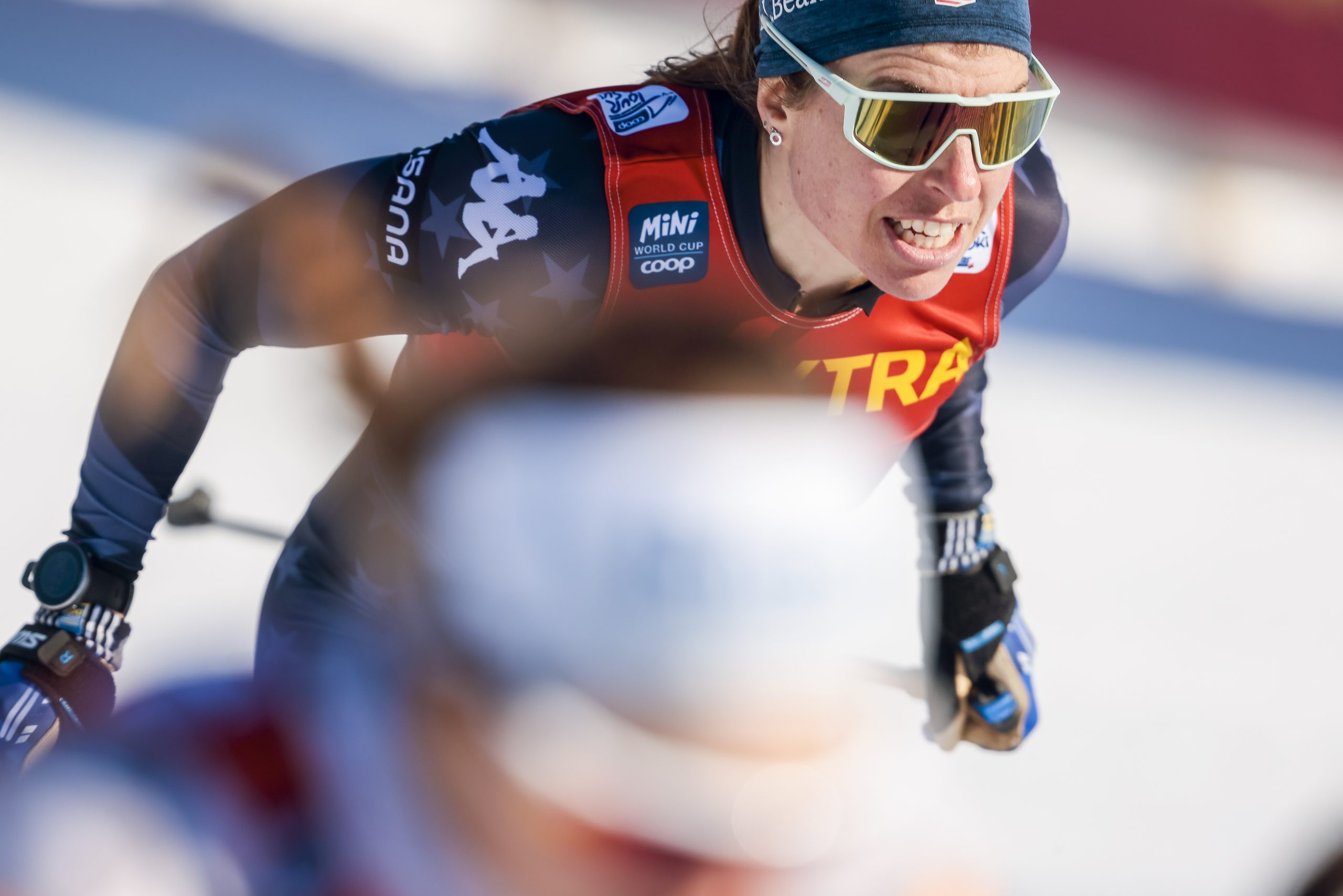
    Brennan finished fourth in the 2023 Tour de Ski (seen here racing at Val di Fiemme, Italy). It was one of several painful near podium misses which she has learned to live with. (Photo: NordicFocus)

    FasterSkier: You mentioned that it’s difficult to process the idea of your numerous near-podium finishes. Psychologically, do you have to direct some energy and attention to overcome just missing the podium, or is it something that you can just brush off and walk away from?

    Rosie Brennan: The first time you’re fourth or fifth , that’s pretty exciting because that’s the best ever. But at this point I feel like it’s become a little bit of a habit for me, for lack of a better word. So that is really difficult; it’s something that has been really challenging over the last couple of seasons for me. The mental piece of … just trying to build the confidence to believe that I can do better on the right day … that it’s not my limit. That’s definitely something that I’ve spent quite a lot of time and energy working on. I’m trying my best to find ways to believe that I still have more in me and can get that medal at some point.

    FasterSkier: Is that addressed with a sports psychologist, or is that actual physical training?

    Rosie Brennan: I think both. I get a lot of confidence through my training and putting in the work. And so that’s part of it, making the work happen and then making it be work that I really believe in or skill sets I want to improve on. Part of it is working with a sports psych and making sure that when those thoughts come in that I know how to deal with them.

    Brennan was fighting for a medal in the World Championships in the skiathlon until her binding broke. A seemingly harmless post-race comment led to a wave of press in Europe, one that follows her, still. (Photo: NordicFocus)

    FasterSkier: Regarding one of those hard luck situations that you had last winter, you made a comment to the press after the skiathlon, when your ski came off,  about how much attention that negative event was getting, and that you wished they would focus more on the positive events. That seemed to really get a lot of traction with the European press. Were you surprised and maybe taken aback by that?

    Rosie Brennan: Yeah, I was. I was surprised by how long that lingered. Even this summer, I’ve had reporters calling me and asking. I didn’t think anything I said was, that crazy, but I guess that’s just what happens when you open your mouth sometimes.

    FasterSkier: So not to reignite that fire, but do you think that the media focuses too much on the negatives?

    Rosie Brennan: Yeah, I think they’re always looking for the drama. I just felt like I was getting baited to say something bad about the organizers or something like that. Which 100% I would not have. There was nothing they did wrong. They did not cause my crash by any means, and I don’t think there was anything unsafe about the race either. It was just one of those tough luck situations. But I feel that’s pretty common. The few times I do get stopped in the mix zone it will be to ask me about why Frida [Karlsson] crashed, and I’m like ‘I don’t know—ask her.’ It’s always like they’re trying to get you to say something bad about somebody else. I guess you just reach a tipping point with it. It’s just not the way I want to live my life. To me, that’s not why people follow sport. It’s for the inspiration more than the drama. I also think what’s hard is that the media, for at least an American, the amount of media we get is so small that it feels like anytime you even get asked something you really have to make the most of it to try to get somewhere. And I just think that’s such a shame. Because it’s not just Americans that are like that. We’re required [all athletes] to walk through the mix zone after the race and 90% of us just walk straight through it and never get stopped by any media outlet. The Swedes, the Finns, and the Norwegians: they get stopped by their media. So you just feel kind of sad for yourself that nobody cares. It’s the Japanese, the Austrians… there are so many other countries that don’t get stopped either. Myself, I am curious about what their stories are, and I don’t know why other people aren’t, and the media outlets aren’t curious what it’s like for a Japanese racer to be on the circuit. That was kind of my point. Why don’t we find these stories and find a way to actually grow the sport, so that we all have more ground to stand on and have more fans and more money and all that kind of good stuff? So, I would like to see more of that in the future.
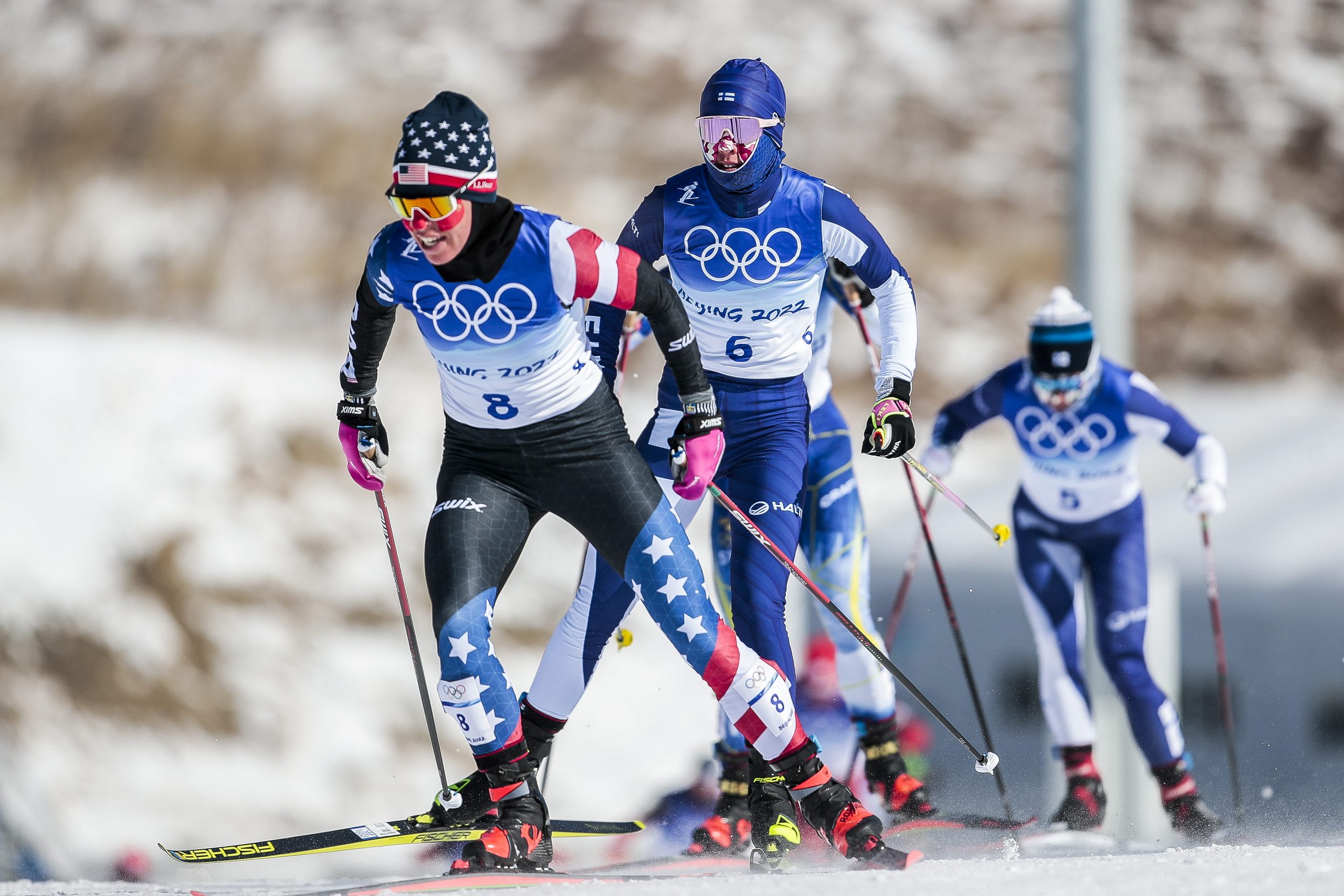
    Brennan showed her trademark grit in the 30k race in Beijing. Even though she just missed the podium, it brought her loads of fan mail. (Photo: NordicFocus)

    FasterSkier: You’ve had a lot of very close calls, and for lack of a better word, maybe even you could call it hard luck. Perhaps because of that, you’ve developed a reputation as a blue collar, hardworking, grinding athlete. Do you think that’s fair or accurate, and do you accept that? How do you feel about that label?

    Rosie Brennan: Oh, I definitely accept that. I definitely take it well. Of course, I wish it wasn’t because I was always almost there. It’s not really my intention, but I do really appreciate it. Maybe it’s because I’m not as present in the media as some other athletes, but I do think it has led to people kind of appreciating my style of racing. Racing is my kind of form of expression or, if you like, it’s my art. I do think it’s very reflective of my personality and who I am, and so I appreciate that people see that. I hope that it does resonate with people and gives them whatever they want to get out of it. But something positive hopefully. And I hope someday I can turn it into really exciting results too.

    But after the 30K in Beijing [sixth place, 5.5 seconds off the podium] I was, overwhelmed when I got home that spring and I had so many handwritten letters from largely middle-aged women that were writing me to say how much that race had resonated with them and the way I raced. That meant so much to me because I was racing 100% with my heart that day. I think it was really representative of who I am, in my style and my personality. To know that so many people had seen that and it meant that much to them, that was really heartwarming and special to me. It made me feel like, I need to just continue to race in a way that’s true to myself and shows who I am because it can make a difference to people in their lives.

    FasterSkier: You think they were expressing their emotional attachment because of how demonstrably you had committed yourself and were grinding it out through the race? Is that what they were expressing?

    Rosie Brennan: Yeah, exactly. I think they’re largely just inspired by the amount of heart I had put into it … no matter the outcome. I don’t know, there are probably people that have gone through something similar in their lives and had never been recognized for it … that’s the hard part. When you fall short of the medal, you could have an amazing performance, but because you don’t have the medal, no one notices. Maybe that’s more representative, unfortunately, of women in a lot of our society. So, I think it really resonated with a lot of women in particular. That kind of sentiment meant so much to me.

    Brennan secured her place as a team USA stalwart in 2020. Here in Davos in 2020 she won the 10k freestyle. The previous day she won the freestyle sprint. (Photo: NordicFocus)

    FasterSkier: I think part of your reputation as being a hard working athlete is partly due to the fact that your career, reached a new level later in life. You just were really hitting your stride at the World Cup level at an age that was objectively later than many other athletes. Looking back and reflecting on that, is there any particular thing that flipped the switch for you to make you the presence that you are today?

    Rosie Brennan: Well, I don’t really think so. That’s what’s kind of interesting about it. I do think it largely just came from consistently putting in the work. So, there wasn’t something that happened that year that just really changed everything other than COVID. But that changed the world for everybody.

    But it wasn’t really like all of a sudden, I was, oh, I’m ready, I can do this. It was definitely just a very slow process. But I think once you get to a certain level of fitness you kind of start to believe in yourself more. That’s what’s crazy about the World Cup, the difference between 1st and 30th, in terms of percentage performance it’s actually quite small.

    We’re still talking about all the best skiers in the world, so I think to have that huge jump sometimes looks like more than it actually is. It’s just having everything aligned together. But you know I have been building that fitness for many years and building my experience on the World Cup for many years and kind of building my mental strength as well for many years. I think I just finally reached a point where they were all on par on a high enough level that I was able to utilize everything together.

    What people often forget too is that I didn’t start Nordic skiing until I was 14. So, if you look at the number of years of actual ski experience from 14 to … when I won that first World Cup [at age 30], that’s 16 years. Probably if you started skiing quite a lot when you’re like say, six, that puts you successful in your mid-20s, low 20s. So, in terms of the hours of ski experience, I think it probably is actually more on par with what you would see for averages for the World Cup, it’s just I just started so much later, so it just took longer.

    FasterSkier: Can you share some of your goals for this upcoming winter?

    Rosie Brennan: It’s kind of one of those weird years that we have no championships. So, there’s not the obvious thing of like, I want to do well the at the Championships. It kind of leaves a lot of possibilities. But obviously with the World Cups coming both to Canada and to Minneapolis … I’ve kind of put those on my radar wanting to put on a good show for the home crowd. So those are definitely big events on my calendar. Then also the Tour de Ski, which is going to Davos this year which, like you said, is a great venue for me. And then also Toblach which is probably my second favorite venue, next to Davos.

    So, I would really like to have a good Tour and make the most of the non-championship year, and then my focus is in North America—because why not?

    Join FasterSkier for Part III of our interview with Rosie Brennan where she talks about her skiing future, the pressures of being a female athlete, and social media.
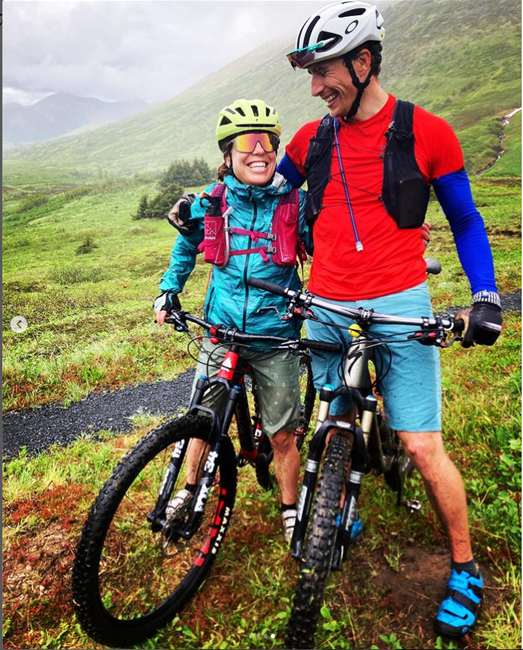
    Brennan getting some well-earned time away from ski training with her boyfriend, Tyler Kornfield. (Photo: Rosie Brennan)
  • “A Mix of Everything.” Rosie Brennan Reflects on Hard-Fought Battle for Podium, as Andersson Wins 30 k

    “A Mix of Everything.” Rosie Brennan Reflects on Hard-Fought Battle for Podium, as Andersson Wins 30 k

    This World Cup coverage is made possible through the generous support of Marty and Kathy Hall and A Hall Mark of Excellence Award. To learn more about A Hall Mark of Excellence Award, or to learn how you can support FasterSkier’s coverage, please contact info@fasterskier.com. 

    On the final day of a World Championships defined by new highs in terms of results for the United States, Rosie Brennan (USA) delivered a performance that reiterated that—for Brennan and her teammates—it has been all the qualities that a results sheet can never capture which have powered the US Ski Team to the milestones of the past two weeks. After heartbreak in last week’s skiathlon, Brennan set out in today’s marathon, a 30 k classic, to be the best that she was capable of becoming. Through surge-after-surge, kick-after-kick, she fought. She was in contention for a medal until the very last. In the story of the race, the fifth place result that Brennan scored was a whisper compared to the shout of the way she had gotten there. Brennan is the American skier whose career has been the definition of perseverance; today, she distilled that quality in a way that was traceable over the course of a single ski race.

    That race also produced significant finishes for other North Americans: Hailey Swirbul (USA) 18th, Julia Kern 27th (USA), Katherine Stewart Jones (CAN) 28th, Lillian Gagnon (CAN) 32nd, Dariah Beatty 32nd,

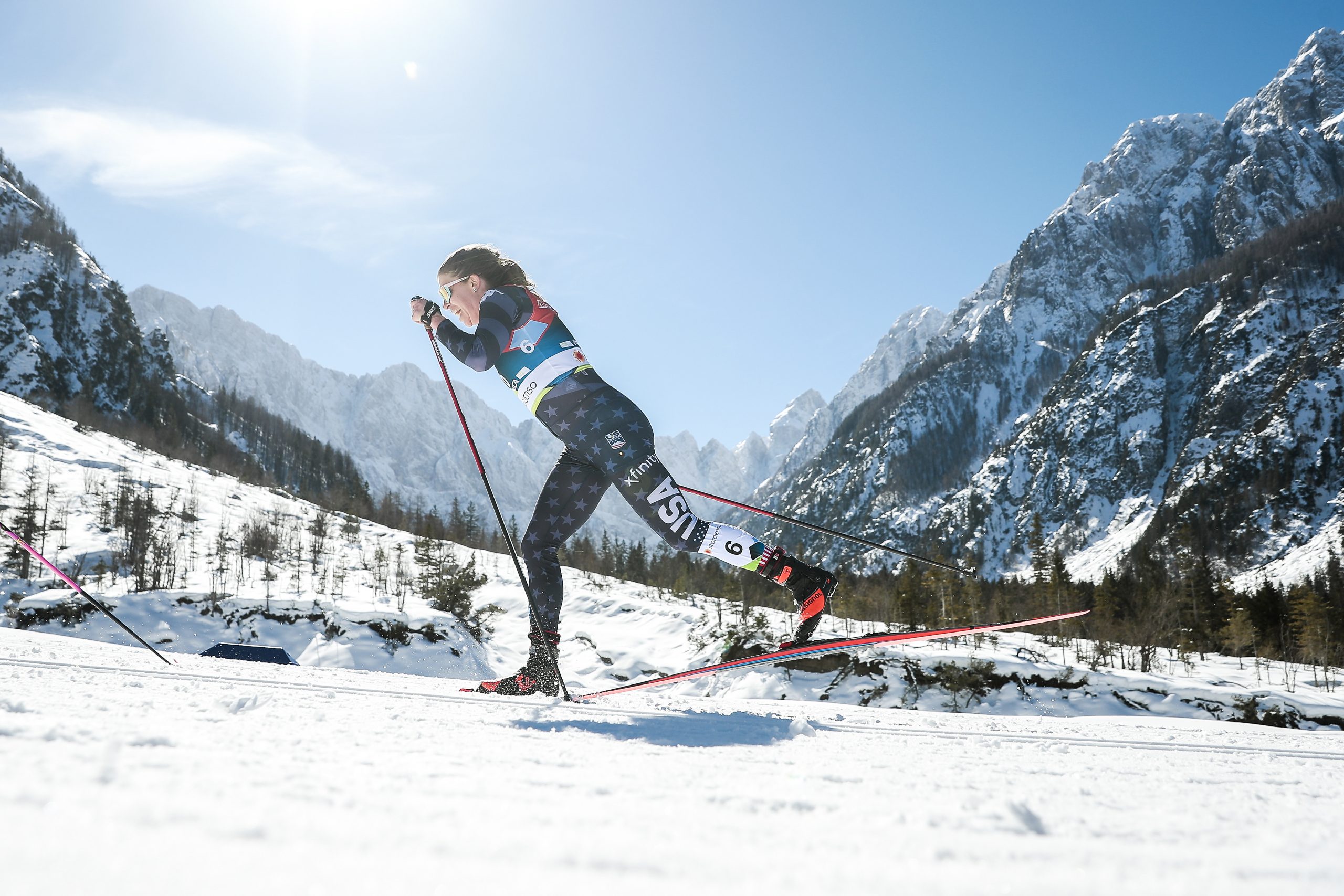
    Rosie Brennan (USA) skied to fifth place—missing the podium by a single second—in the 30 k classic in Planica. (Photo: NordicFocus)
    30 k Classic Mass Start—Andersson Reaches New Heights for Sweden

    There was plenty to anticipate before today’s marathon: for the first time in a week, sunny skis and warm temps returned to Planica; for the first time in over a decade, the winner of the women’s World Championship 30 k wouldn’t be named Therese or Marit. The retirement of both Therese Johaug (NOR) and Marit Bjoergen (NOR) left open the possibility that any skier could make marathon history today. The skier that accomplished that was Ebba Andersson (SWE), who waited with patience through the first lap, launched an uptick in pace on the long climb out of the stadium 10.75 k into the race, and strided away from the field to win her first World Championship in the 30 k, and the first World Championship for Sweden in the World Championship marathon since Marie-Helene Oestlund won the 20 k in 1987. Andersson’s win marked her third career World Championship, after she won the skiathlon earlier in Planica and was part of Sweden’s gold medal relay team in Seefeld in 2019. It also accented another strong World Championships for the Swedish women, an they began by sweeping the Sprint podium, and ended with an ascendent marathon star.

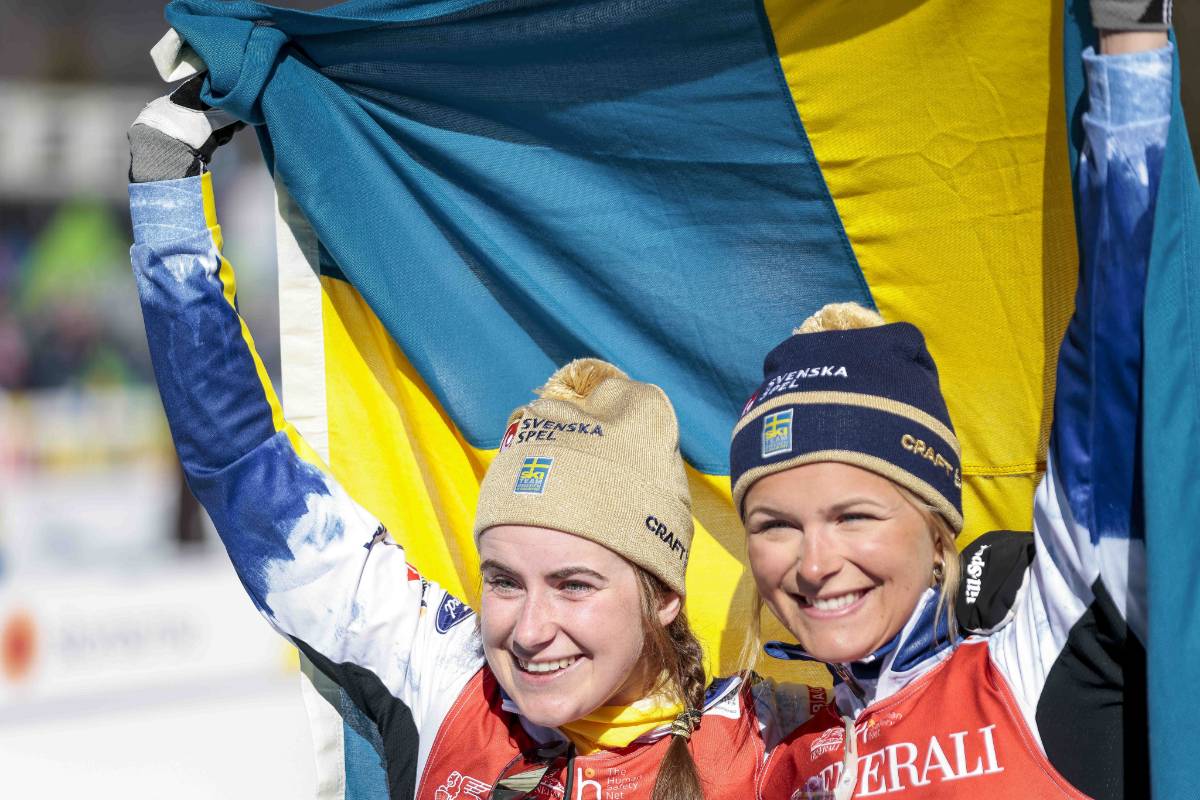
    Ebba Andersson (SWE) and Frida Karlsson (SWE) completed an all-around excellent World Championships for Sweden.  Andersson won her third World Championship in a dominant 30 k performance. Karlsson kicked late to finish third. (Photo: NordicFocus)

    Perhaps the most tense race of these World Championships, though, was the one that played out behind Andersson for the remaining podium spots. When Andersson strided away, the field stretched and then snapped. A three-strong chase group initially formed, containing Anne Kjersti Kalvaa (NOR), Kerttu Niskanen (FIN), and Brennan.

    “Even though the race looked like it happened slow, [Ebba’s] move happened fast,” said Brennan. “I did think for a while that maybe we might catch back up to her, but before you know it, [the gap] was a minute.” Kalvaa, Niskanen, and Brennan were left to wind their way through the rolling downhills that defined the last kilometer of the course.

    Those downhills marked a reprieve during what was an otherwise brutal climbing course, a 7.5 k loop that the US Ski Team Coach called, “breath-taking, but if you take a step back, one of the hardest courses they will ever race.” After climbing 272 meters (892 feet) in hot, wet, sticky klister conditions, the final downhills would prove crucial in later laps. The importance of having the best skis on the final downhills would soon be made clear.

    Races of this distance offer competitors the opportunity to switch skis mid-race, if desired: a decision that would change the nature of the race. Switching skis allowed the Swedish pair of Karlsson and Linn Svahn to bridge a gap to the first chase group, ultimately allowing them to join the fight for the podium. And, despite an initial stumble as the klister on her skis caught the track for the first time, the exchange would see Anne Kjersti Kalvaa (NOR) moving onto skis that were “insane,” according to Rosie Brennan.

    Brennan, herself, moved onto skis she felt were “not as good as my first pair, [which] was frustrating seeing how good some of those skis were. That, of course, is the gamble of switching.” Brennan noted that the relative ski speed changed her tactics. “I second-guessed my ability to just ski away,” she said. “I thought at that point, my best card to play was to hang in there for the dogfight at the end.”

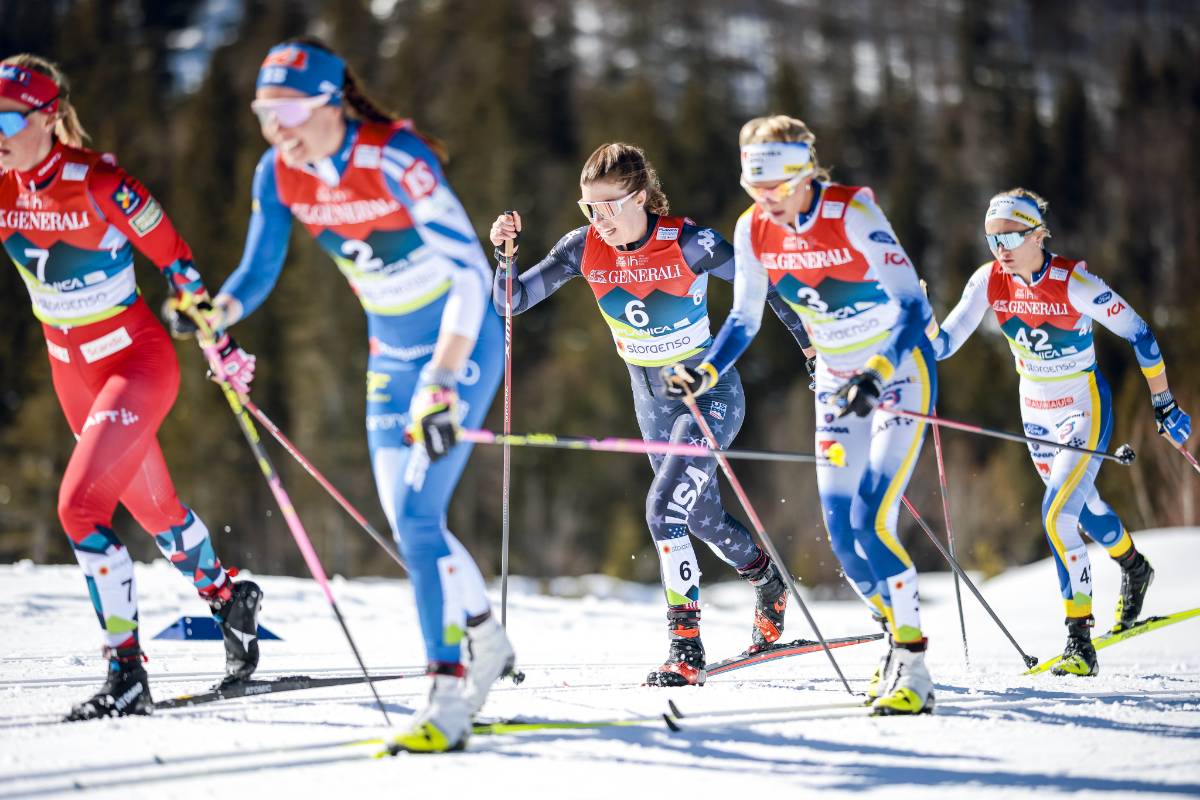
    Rosie Brennan (USA) skis in the chase group that contested for silver and bronze: Anne Kjersti Kalvaa (NOR), Kerttu Niskanen (FIN), Brennan,  Frida Karlsson (SWE), and Linn Svahn (SWE). Brennan finished fifth. (Photo: NordicFocus)

    The chase group of Brennan, Karlsson, Svahn, Kalvaa, and Niskanen would contest that dogfight. The race settled through the third lap; Andersson’s gap grew in front of Brennan’s group, and the gap to the second chase group behind grew as well.

    Brennan led the group through the stadium as they headed out on the final lap, but as they completed the other rolling section of the course it became clear that the combination of skis—and twenty-three kilometers of racing—would make the last lap a tight, tactical, affair. 

    When the group crossed over from the first half of the course to the second through the Planica stadium, Frida Karlsson skied up to take a pull. Kalvaa and Brennan responded quickest, but both Niskanen and Svahn pulled their way back too as the group skied toward the final climb. Near the high-point leading to the crucial, winding downhills, Kalvaa used the advantage her skis granted her. Karlsson and Brennan sensed the move and responded quickly, marking Kalvaa’s move.

    Kalvaa carried speed through the final transitions, but Karlsson had the strongest close. On the final climb, the Swede pushed the chase group into high gear, with Svahn able to come back from the behind. For a moment, Brennan pushed back to Karlsson’s tails. Into one final hill, though, Karlsson proved to have one more energy than the rest of the field, closing in on Kalvaa in the final 100 meters. Kalvaa held off the late surge to take second place; Karlsson won the bronze. Behind, Brennan and Svahn completed an exhausting 30 k with a boot throw straight out of a sprint race. The lunge at the line went Svahn’s way:  she finished fourth, Brennan fifth.

    Brennan “feeling a mix of everything” as US Team Reflects on Race

    In a post-race interview with FasterSkier’s Nat Herz, Brennan said, “In any long race, things go up and down. I had moments where I thought, ‘yes, I’m going to do this,’ and others where I thought, ‘oh God, this is not good.’” She then reflected, “I really am feeling a mix of everything. [I’m frustrated] feeling I’m getting good at this fourth, fifth, sixth place situation, [but] also all you can do if you fight with all you have, I did, and I am happy with that.”

    Further behind in the field but putting up strong races were Brennan’s teammates. Hailey Swirbul (USA), who finished 18th. “This was the best 30 k to date for me,” she said. “It was a lot more fun being the hunter instead of the hunted.” Julia Kern (USA) finished 27th, and said to FasterSkier that, “I felt like I put out whatever energy I had left from these Championships out on course.”

    Both Swirbul and Kern said that even during the race, they had an eye towards the racing that was happening at the front with their teammate. “[I was] in awe of how she keeps coming back despite adversities,” said Kern. Swirbul added that “I got to see my teammates out there, which was pretty fun. I cheered for Rosie when we were both on a downhill: She heard me!”

    For both, Brennan’s push served as a real-time reminder of what they were doing in the grander scheme of their racing careers. “Even during the race I was thinking this is good training, maybe I can ski like Rosie,” said Kern. “She has had such a strong career late, and it gives me inspiration that even if I am not in the mix right now.” Kern added that, “Results on the sheet tell one story, but the fact she is in the mix with the world’s best time-and-time again is really impressive.”

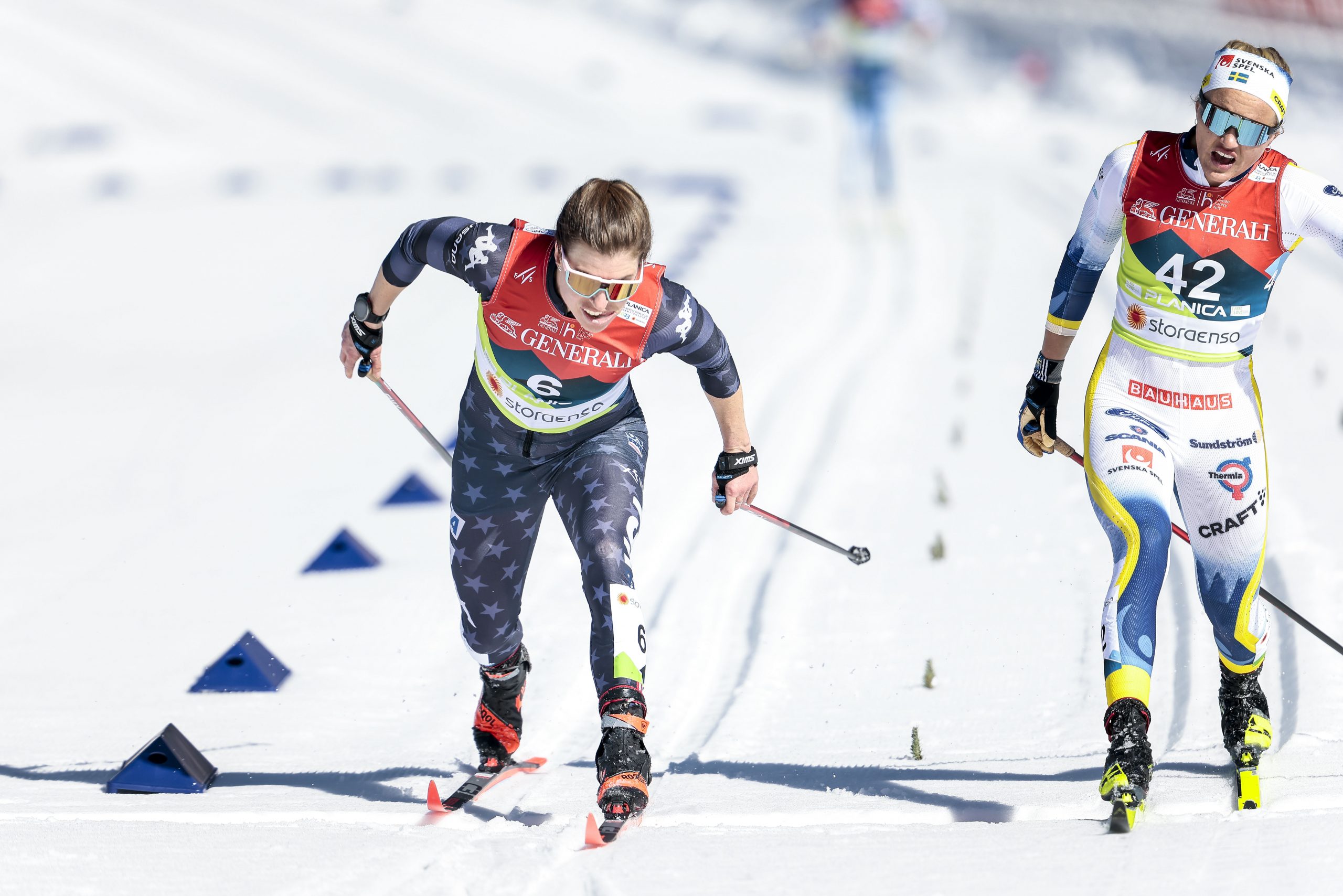
    Rosie Brennan (USA) sprints to the last meter alongside Linn Svahn (SWE). Svahn won the sprint and finished 4th, with Brennan taking 5th. Both were a second off the podium. (Photo: NordicFocus)

    US Ski Team Head Coach Matt Whitcomb put Brennan’s accomplishment in perspective. “[Brennan] put herself one second off the podium. You look at that and be proud, and we really are.” Whitcomb added that in Planica, the magnitude of her efforts weren’t lost. “There’s no one at this venue or in this whole crowd right now that people would like to see get a podium more than Rosie.”

    The support wasn’t lost on Brennan, and hasn’t been, she says, through the course of her last couple of seasons:

    “It’s been really cool the past two years how much I hear from people who really resonate with the style in which I race, and that means a lot to me. I’ve never been the most technically beautiful skier, or the smartest, but I certainly try to ski with all my heart and it means a lot when people recognize that. Thank you to everyone who has believed in me, thank you.”

    As for her future plans after this World Championships, Brennan is “doing it all, I am on the death march.” Expect her to start the first 50 k edition of the Holmenkollen marathon for women next week. On longer term plans, Matt Whicomb said that, “I want to see her back at another World Championships; I just told her that. I would love to see her in 2025, 2026, because we want that medal for her so badly.” Brennan said she has “a lot of reflection ahead, [but for now] I am headed back to Toblach and watching Tyler [Kornfield] race the Vasaloppet tomorrow…and thinking that 30 k kind of seems easy compared to the 90 k [of the Vasaloppet].”

    US Team Leaves World Championship with New Accomplishments, Same Sense of Team

    At the end of World Championships, Matt Whitcomb says he hopes that there has been one message imparted to the world by the USA. “I hope that the team support is what the kids back home see, and want to give,” Whitcomb said. “We’ll be waiting here for you.”

    He pointed to two of his athletes who are leaving Planica with historic results, one a World Champion, and one with a race that shone a light through the qualities that make world champions. “What [Rosie Brennan and Jessie Diggins] realized is that if you invest in your teammates, that investment is returned tenfold, because they are fully invested in you,” Whitcomb said. “That’s just a fun way to go through life.”

    As Whitcomb delivered that perspective, he pulled out his phone and read the last text message he had received. It was from Jessie Diggins: “So proud of you girls for an absolutely gutsy race out there, makes me proud to be part of this team.”

    The text was reportedly followed by three BIG heart emojis.

    Full RESULTS

    The US Women walk away from this year’s World Championships with two medals, the first American individual World Championship, and a sense of team that is stronger than ever. (Photo: Nordic Focus)
  • Early Gaps Decide Men’s Relay: Norway Delivers on Expectations

    Early Gaps Decide Men’s Relay: Norway Delivers on Expectations

    This World Cup coverage is made possible through the generous support of Marty and Kathy Hall and A Hall Mark of Excellence Award. To learn more about A Hall Mark of Excellence Award, or to learn how you can support FasterSkier’s coverage, please contact info@fasterskier.com. 

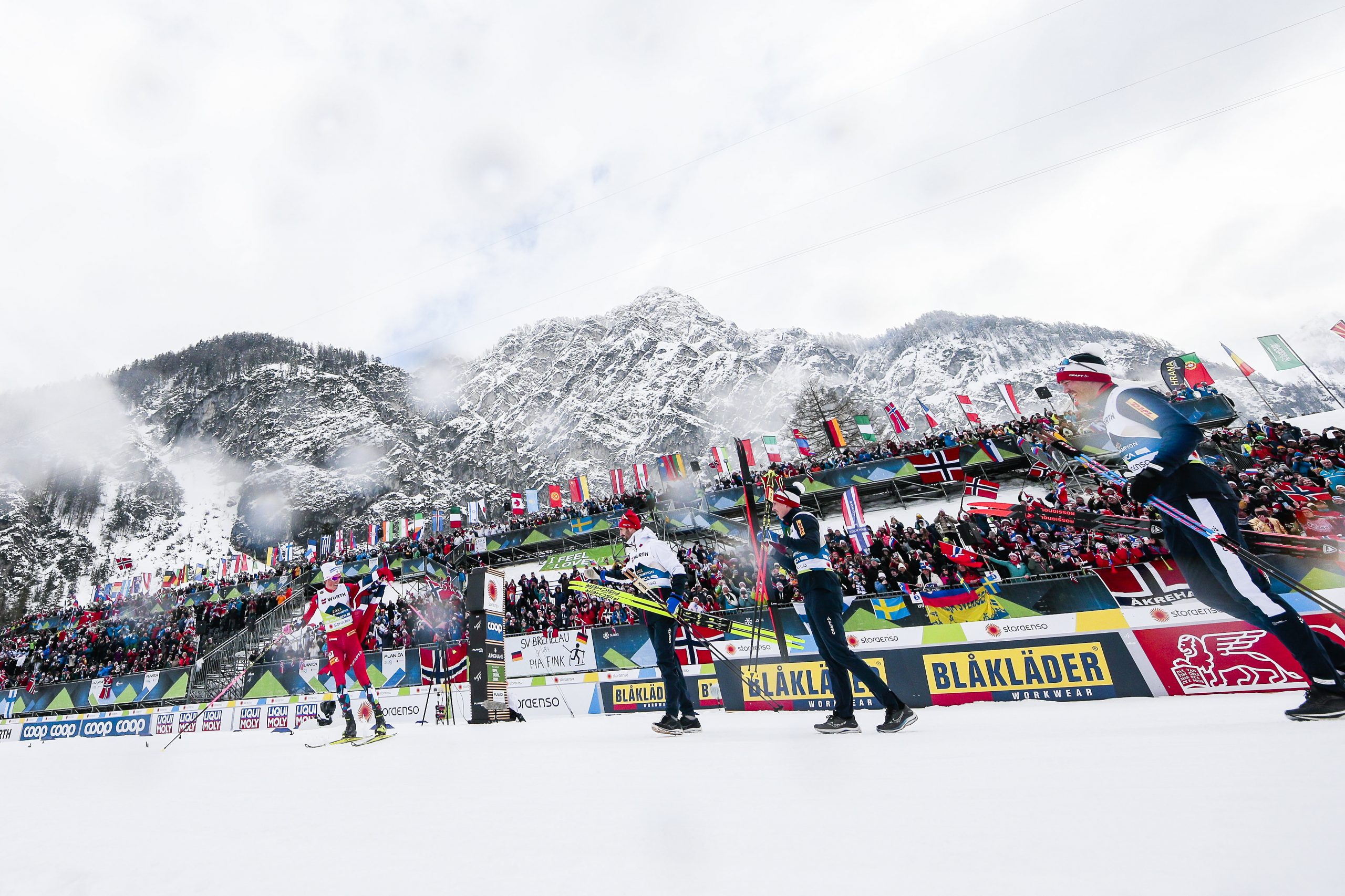
    Foregone conclusion: Norway alone at the finish line. Johannes Hoesflot Klaebo (NOR), Hans Christer Holund (NOR), Paal Golberg (NOR), and Simen Hegstad Krueger (NOR) celebrate another Norwegian win in the Men’s Relay at the FIS World Championships in Planica, Slovenia. (Photo:  Modica/NordicFocus)
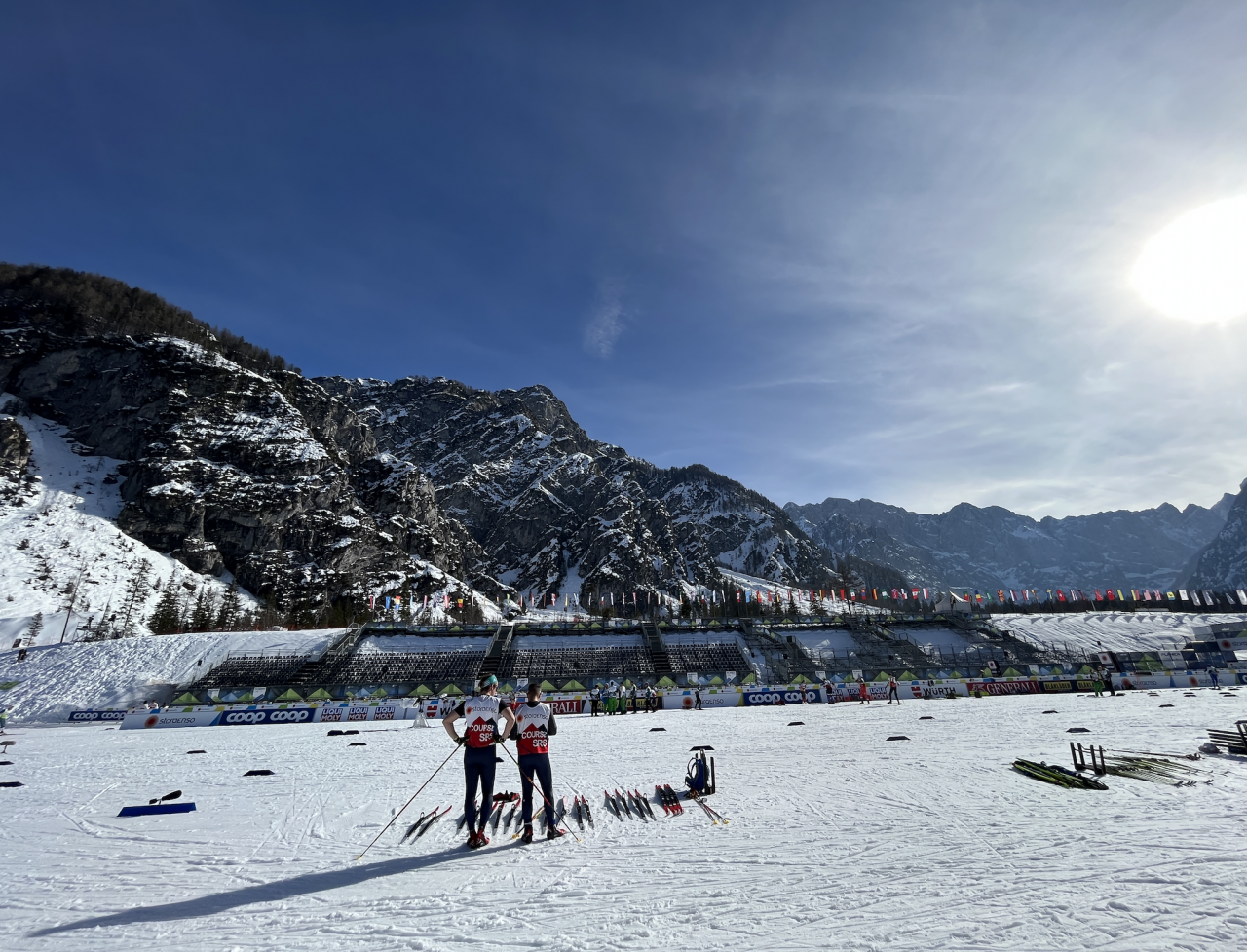
    In sport, sometimes “foregone conclusions” prove to have been premature; that can make for exciting racing. At other times, foregone conclusions prove accurately prescient; that makes for situations in which the anticipation of action and drama is entirely spoiled. In Planica, Slovenia, Team Norway spoiled (predictably) the excitement of the World Championship Men’s Relay, winning gold well ahead of second place Finland and third place Germany. Foregone conclusion, indeed . . .

    North American teams were well represented in the relay field, with Canada holding its position in the group of medal contenders throughout the day by virtue of fine skiing by Xavier McKeever, Graham Ritchie, Antoine Cyr, and Olivier Leveille. They would finish fifth. Team USA’s performance was highlighted by the heroic classic skiing of Ben Ogden (he led the chase group for much of Leg 1), but that advantage would be undone in Leg 2, with later skiers being left with no chance to overcome the deficit. Team USA would finish seventh.

    Alone from the start: the dominating first classic leg skied by Hans Christer Holund (NOR) all but decided the race’s outcome. (Photo: Modica/NordicFocus)

    As is so often the case, the story at the front of the field was Norway . . . though even television broadcast cameras paid little attention to them. It’s not Norway’s fault that they dominate so completely; it’s not Norway’s fault that they win with such apparent ease. They appear so confident, so self-assured. But in the hours before the race, there was plenty of tension, indeed. The forecast for the day—snow then not snow, rain then not rain— elicited considerable worry among those responsible for ski preparation. If the forecasts came true, the classic legs could’ve become a horrible, unpredictable mess.

    “If it rains for real, we gotta be on klister,” American, Ben Ogden, told FasterSkier’s Nat Herz. “If it snows for real, we gotta be on zeroes, and if it does this mixed [stuff], then we don’t know!”

    Had the snow fallen, had the rains come, then athletic superiority (which Norway possesses in spades) potentially could’ve been undone. It’s been known to happen before . . . In the end, the threats of those earlier forecasts never materialized. The skies over Planica remained gray and temperatures remained relatively warm, but neither snow nor rain ever materialized. Skiers utilized a variety of ski prep tactics (Ogden skied on zeroes while many others chose klister); regardless, most seemed to benefit from both good glide and sufficient kick. The race didn’t come down to technological superiority . . . it remained a case of athletic superiority. Probably no one was more relieved than Norway. There was a lot more tension surrounding this event in the pre-race hours than there was during the race, itself. Once the starter’s pistol sounded, things were decided pretty quickly. Hans Christer Holund (NOR) made sure of that.

    Ben Ogden (USA) would ski a brilliant scramble leg, driving the pace of the chase group through much of the first leg. (Photo: NordicFocus)
    Men’s 4 x 10 k Relay

    Holund got away almost immediately: Norway wouldn’t be a part of this relay story again until they crossed the finish line well ahead of all other teams. Behind Holund, though, the race played out in ways that were both predictable and surprising. Unlike yesterday’s Women’s relay in which each skier raced a single 7.5 k lap, the Men’s relay course offered each skier a pair of five-kilometer laps. Within that format, it was in the chase group where the action took place.

    Ogden—jauntily sporting a camo-print US Ski Team hat, but not (visibly) wearing the normally-expected USA Team Relay socks—pushed the pace through most of the first leg. “It was a bit frantic at the beginning,” Ogden said. “The first time up the big hill, I had…a moment of ‘I could go get [Holund], but it would’ve been SO disastrous. In a 4 x 10 k, you gotta remember it’s still a distance race!”

    After Holund’s Leg 1 escape, Iivo Niskanen (FIN) was the animator in the chase group in Leg 2. His acceleration dropped the group, and set up Finland’s uncontested run to the silver medal. (Photo: Modica/NordicFocus)

    Leg 2 was marked by the emergence of classic specialist, Iivo Niskanen (FIN), whose second lap surge separated his team from the others. Niskanen quickly established a considerable gap as the chase group behind him dwindled. American, Hunter Wonders, found himself dropped from the chase group: the USA would fall from contention, and Team Finland would not be challenged for the silver medal again. Likewise, Germany found itself gapped in these middle laps, but a late-race slowing of the chase group’s pace would allow Friedrich Moch (GER) to catch back on. His brave efforts would ultimately prove crucial to Germany securing a surprising bronze medal.

    Ultimately, Norway (anchored by an easy-skiing Johannes Hoesflot Klaebo who had ample time to collect a Norwegian flag in his celebratory stroll down the homestretch) would win by nearly a minute, followed by Niko Antolla of Finland in second. Germany’s courageous Moch outsprinted Jules Lapierre (FRA) for bronze.

    Team Canada’s Graham Ritchie tags Olivier Leveille ahead of eventual bronze medalist, Germany. (Photo: Modica/NordicFocus)

    Team Canada remained in contention throughout the day—ultimately finishing fifth—boding well for the future development of this young team.  “[It was] definitely a different experience,” said McKeever. “Being at the front…fighting for a medal.”

    Men’s Relay RESULTS

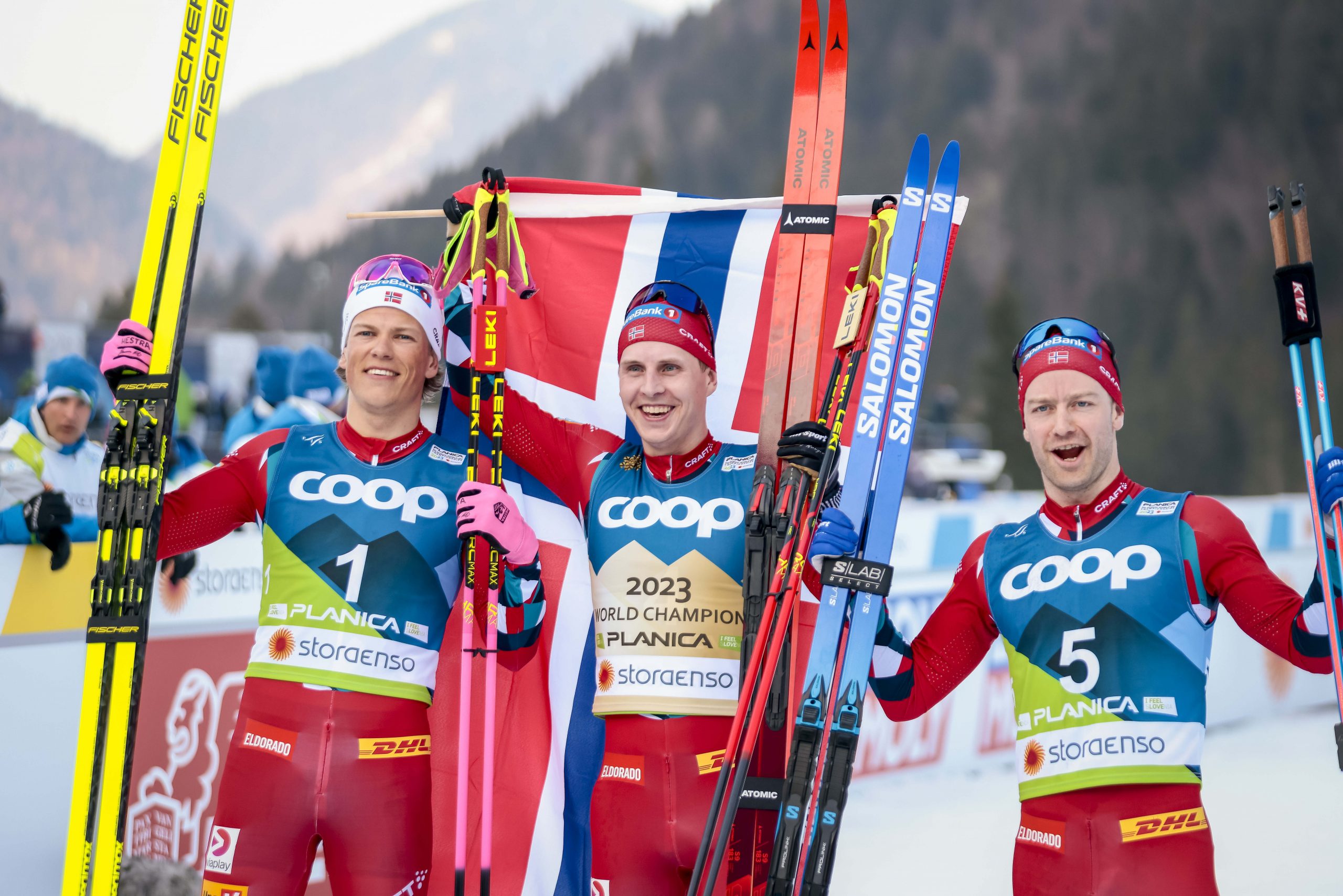
    Not everything transpired entirely according to pre-race predictions: Team Germany—Janosch Brugger (GER), Friedrich Moch (GER), Jonas Dobler (GER), Albert Kuchler (GER)—celebrates a surprising bronze medal. (Photo: Thibaut/NordicFocus)
  • Only Norway—Krueger Leads Sweep of 30 k Skiathlon Ahead of Klaebo and Roethe

    Only Norway—Krueger Leads Sweep of 30 k Skiathlon Ahead of Klaebo and Roethe

    This World Cup coverage is made possible through the generous support of Marty and Kathy Hall and A Hall Mark of Excellence Award. To learn more about A Hall Mark of Excellence Award, or to learn how you can support FasterSkier’s coverage, please contact info@fasterskier.com. 

    Simen Hegstad Krueger (NOR) celebrates as he crosses the finish line as World Champion in the 30 k Skiathlon in Planica, Slovenia. (Photo: Modica/NordicFocus)
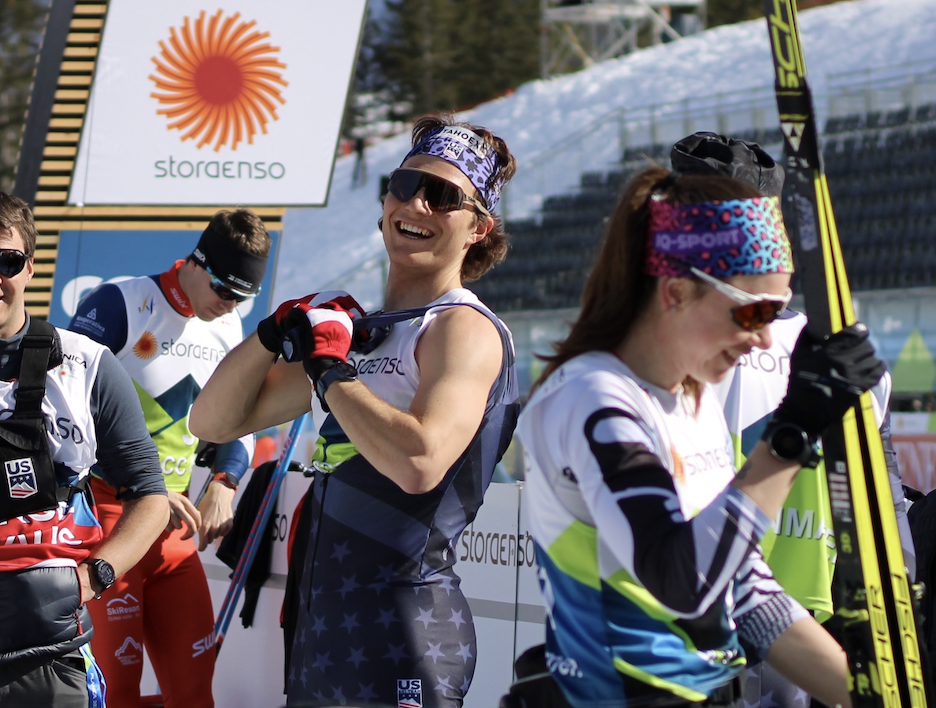
    Thirty kilometers is a long way to race. It’s the sort of distance that recreational skiers race as a “marathon,” the kind of overlong race effort from which mere mortals take weeks to recover. Coming so near the beginning of a 12-day World Championship schedule, a race of this length —one raced with such intensity and under such challenging and difficult conditions—is likely to have a profound effect on all the races to come. If the rest of the field could have peered into the future—could’ve seen what Simen Hegstad Krueger (NOR) was capable of in today’s Skiathlon—they might never have committed so much energy and passion to this race. Krueger—the reigning Olympic Champion in the event (and silver medalist from the last World Championships)—was never going to be denied. Not today . . .
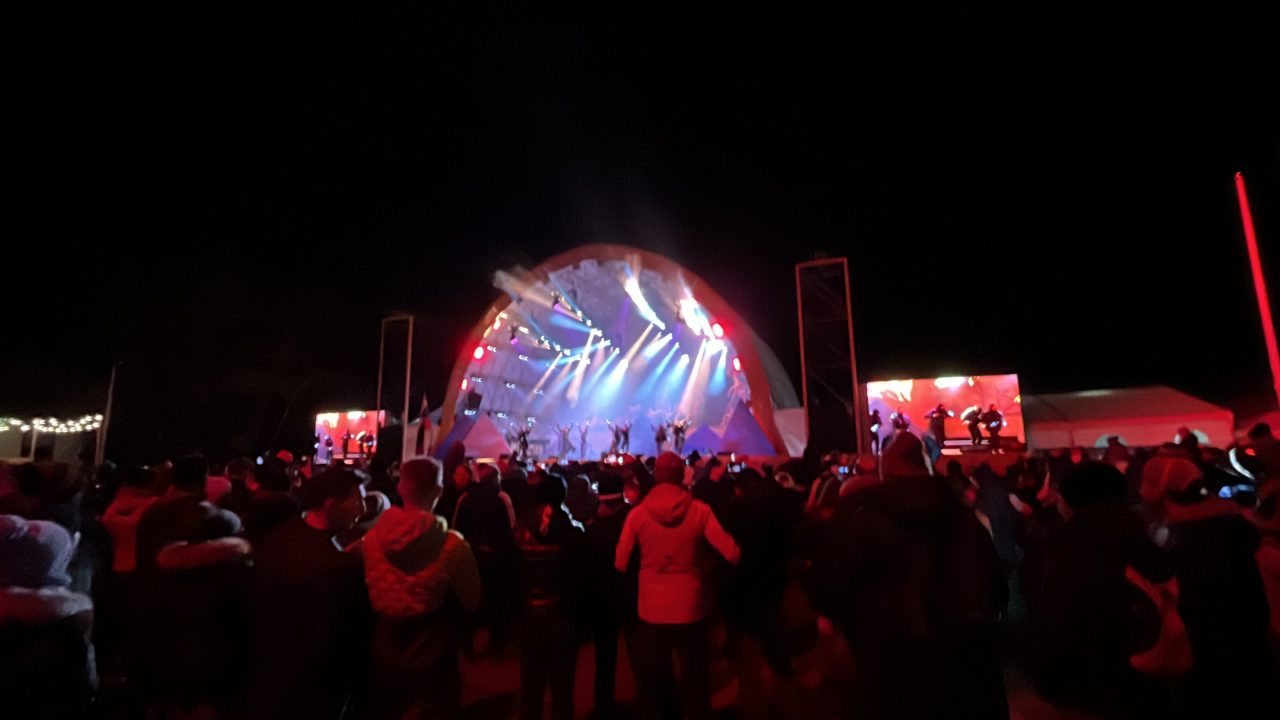
    Simen Hegstad Krueger is sublimely glad he toed the starting line today: he claimed the victory with a dominating performance in the second half (the freestyle half) of the 30 k Skiathlon. Johannes Hoesflot Klaebo (NOR) and Sjur Roethe (NOR), the silver and bronze medalists, might also be relatively glad they raced today, though they may also have spent so much energy that their remaining races at the World Championships are likely to be affected. And everybody else? Those who earned no medals may be questioning whether racing this distance—at such an extraordinarily high measure of effort, through such challenging and difficult conditions—was really worth it.

    Iivo Niskanen (FIN) led William Poromaa (SWE) for much of the classic leg, only to find himself undone by the way the pace increased after the classic-to-freestyle transition. (Photo: Modica/NordicFocus)

    If he had advance knowledge of the way things would turn out, Iivo Niskanen (FIN) might never have surged to the front in the classic leg; William Poromaa (SWE) might never have pushed the pace; Calle Halfvarsson (SWE) might never have stuck his nose out into the wind; Andrew Musgrave (GBR) might never have worked so hard to be near the front; Paal Golberg (NOR) might have saved his energy for another day (or for another week in his season-long race with Klaebo the the World Cup Overall crystal globe). Even bronze medalist, Roethe might have hesitated before committing so much in a race for silver that he would ultimately lose to the world’s best sprinter.

    Even the North Americans might’ve raced differently if they knew what levels of exhaustion the race would bring. Scott Patterson raced hard, holding his position through much of the day. He would finish a respectable 19th, ahead of his American teammates Hunter Wonders (24th), and Gus Schumacher (38th). Patterson confided that while a top-20 at World Championships is good, he had hoped for more. “I finished up 19th, which was okay,” he said. “When I’ve been top 10, I definitely wanted a little more today.” Canadian finishers included Russell Kennedy (37th), Olivier Leveille (43rd) and Xavier McKeever (44th).

    Thirty kilometers is a long way to race; probably every competitor leaves this race shattered, exhausted, cramping (as even race winner, Krueger, admitted he was). The twelve days of the FIS Cross Country World Championships is a grind. Racing takes place almost every day . . . even after thirty grueling kilometers, there are still ten more days of World Championships still to ski.

    William Poromaa (SWE), Jules Lapierre (FRA), Paal Golberg (NOR), (l-r) in the freestyle leg. The difficult conditions—and the hot pace set by eventual race winner, Simen Hegstad Krueger—exhausted even the most talented and qualified contenders. (Photo: Modica/NordicFocus)
    Men’s 30 k Skiathlon

    Planica, Slovenia occupies a beautiful corner of Europe’s mountain ranges, and the weather this week is a ski-vacationers dream. Ironic, then, that the very same weather is a wax technician’s nightmare. Sunny and warm, transitioning the snow between heats, changing the conditions even within the timeframe of an ongoing race. At the start of today’s skiathlon, race announcer, Kikkan Randall, mentioned, “You can already hear the snow . . . with a late-afternoon start, you can almost get a freezing effect. The snow can actually be pretty fast.”

    The classic half of the Skiathlon indeed started out fast. The course began as a steady downhill; Klaebo stayed at the front and out of trouble (shadowed by his teammates Golberg and Krueger, and the Swedish stars, Calle Halfvarsson and William Poromaa). The classic leg was simple:  Finland and Sweden kept the pace fast, contenders stay tucked in the field, and Klaebo picked up ground on every downhill. It looks like great fun to ski a mass start event the way Klaebo does, and certainly his wax technicians and ski suppliers have something to do with that. But that doesn’t mean he can just float along effortlessly. The other racers have a say in the pace, as well . . . and none of them wanted to make it easy for Klaebo.

    Niskanen moved to the front as the pace-maker at the end of Lap 1. By Lap 2, his efforts had begun to string out the field: Niskanen followed by Poromaa, Musgrave, and the entire kingdom of Norway. At the beginning of Lap 3 the field split, with Americans Patterson and Wonders being gapped. Klaebo continued using each downhill to adjust his position within the lead pack, gliding and stepping past the pace-makers, and forcing them to accelerate back to the front at the base of each uphill, particularly in Lap 3 as it appeared that many other racers’ skis were beginning to drag.

    At the beginning of Lap 4, everyone looked over their shoulders to check the field, a momentary pause in the action that allowed the remarkable efforts of lone chaser, Esteve Altimiras (AND) to catch back on to the back of the lead group. He’d been bravely chasing for two laps while Finns and Swedes pushed the pace at the front, and this Lap 4 truce allowed the lead pack to settle as a group of 15. The truce would not last for long.

    Johannes Hoesflot Klaebo (NOR) was forced to do his own work for most of the freestyle leg. His determined chase of teammate Sjur Roethe (NOR) earned him yet another World Championships medal, this one a silver. (Photo: Modica/NordicFocus)
    Classic to Skate Transition

    The mid-point of the Skiathlon (15 k) is where skiers switch from classic skis/poles to freestyle skis/poles, a transition that they practice in anticipation of these races. Take too long in transition, and a skier can find himself gapped . . . even the best skiers . . . even Klaebo. Klaebo flubbed the transition, exiting at the rear of the lead pack, but he seemed untroubled. If he’d known what kind of acceleration Krueger was about to throw in, Klaebo would have hurried the transition a bit.

    Roethe exited the transition first with a considerable lead, followed by Krueger, Jules Lapierre (FRA), Roethe, Krueger, and Poromaa. Klaebo followed Golberg who would drag them both back to the chase pack. Once Klaebo got there, his prospects appeared obvious: sit in and let others work, which would probably give him an easier day, and allow him to sprint for the bronze medal. As it turns out, bronze is not enough for Klaebo, and he seemed to quickly assess that none of his companions was willing to pull him back to the leaders. Poromaa wasn’t fast enough, Lapierre wasn’t fast enough, Golberg wasn’t fast enough. If Klaebo wanted to remain in contention for this Skiathlon gold medal, he’d be forced to chase the leaders down, himself. So, Klaebo set out on his own to catch the two leaders—his teammates Roethe and Krueger.

    Krueger began his surge in Lap 7, picking his way through strings of lapped skiers. He definitely appeared the sharpest, while Roethe began to visibly falter (along with Klaebo and everyone else). Even so, Roethe continued gamely working each uphill, while Klaebo drove, faded, recovered, and drove again. The top three showed their class, their fitness, and their courage. At the end of a 30 k Skiathlon, there really is no place to hide. Klaebo was really forced to work for silver, which he stole from the courageous Roethe in the final kilometer. The efforts committed by the medal winners in this race could conceivably change the whole championships. Today, under the sunny skies of Planica, Slovenia, each of these champions appeared willing to pay that price.

    Men’s 30 k Skiathlon RESULTS

    Only Norway on the podium: (l-r) Johannes Hoesflot Klaebo (NOR), Simen Hegstad Krueger (NOR), Sjur Roethe (NOR). (Photo: Modica/NordicFocus)
  • Klaebo Dominates Chaotic World Championship Sprint, Schoonmaker Scores Top Ten

    Klaebo Dominates Chaotic World Championship Sprint, Schoonmaker Scores Top Ten

    This World Cup coverage is made possible through the generous support of Marty and Kathy Hall and A Hall Mark of Excellence Award. To learn more about A Hall Mark of Excellence Award, or to learn how you can support FasterSkier’s coverage, please contact info@fasterskier.com.

    23.02.2023, Planica, Slovenia (SLO):
    Johannes Hoesflot Klaebo (NOR) – FIS nordic world ski championships cross-country, individual sprint, Planica (SLO). www.nordicfocus.com. © Modica/NordicFocus. Every downloaded picture is fee-liable.

    By the time the men’s final started, the procession had all but begun. Johannes Hoesflot Klaebo (NOR) went to the front, kept the rest of his competitors just out of reach, and used the final stretch to wave to the crowd as he claimed his seventh World Championship title. A whole season’s worth of results pointed to that conclusion, and it had finally come. It could almost have appeared unextraordinary but for the fact that the Planica, Slovenia race course seemed intent on writing the final few verses of this season-long story. On a day when racers routinely veered off course, Klaebo’s achievement of moving through all of it unscathed—making a World Championship look almost inevitable—was put into stark relief. Johannes Hoesflot Klaebo was a master craftsman at work in this, his chosen medium: sprint racing.

    Ultimately, the day—and the World Championship—was won by Klaebo, followed on the podium by World Cup Distance Leader, Paal Golberg (NOR) and the jubilant Frenchman, Jules Chappaz.

    “A Hard-A** Course”

    The real excitement at the World Championships today wasn’t in the final, but in the jostling it took to get there. Every quarterfinal heat seemed to apply another layer of complexity, as tough conditions and a winding Planica course combined to void most pre-race predictions. As US skier Ben Ogden would summarize in post-race comments to FasterSkier: “It was a hard-a** course, and slushy as well.”

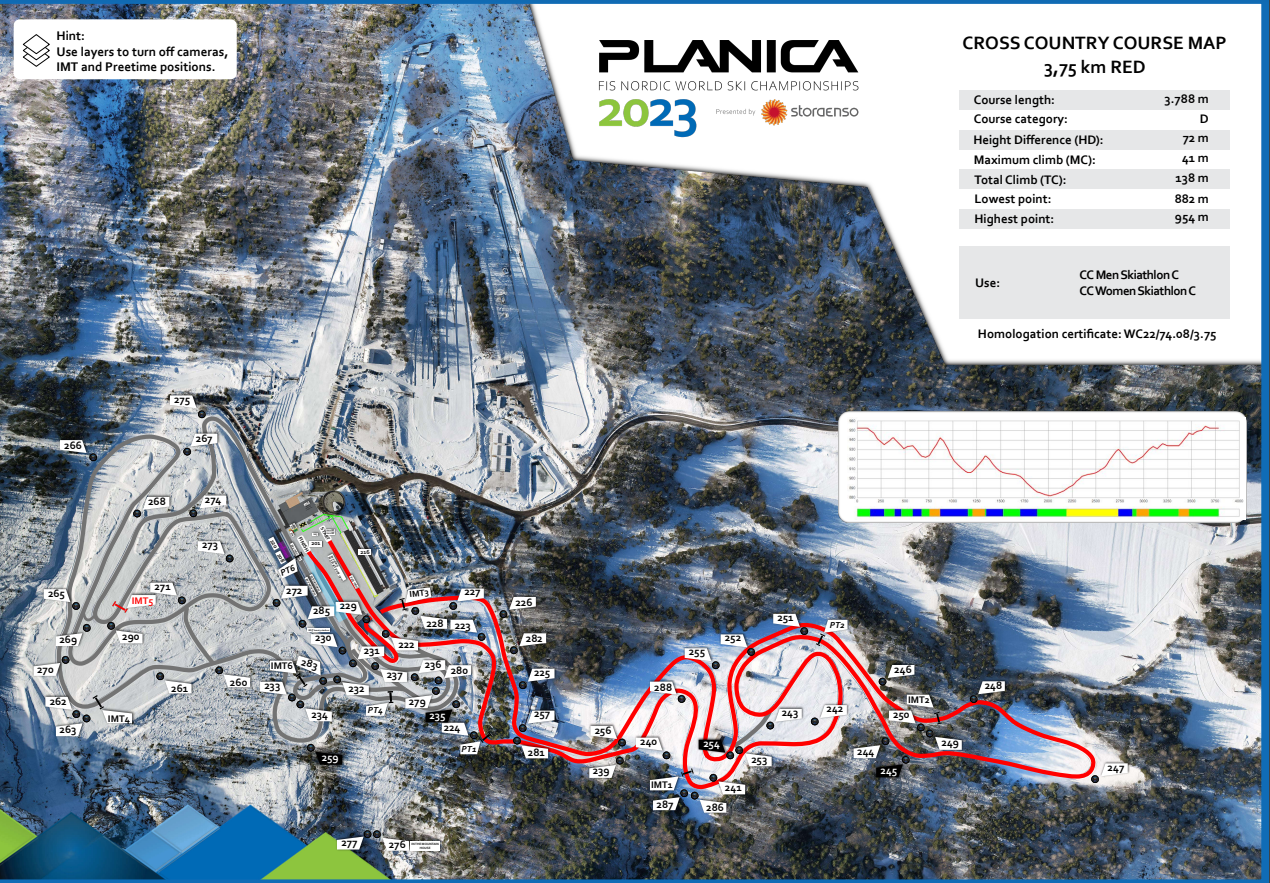
    The Planica, Slovenia sprint course. The A-climb in the middle wound and changed pitches, combining with soft snow conditions to make for plenty of tangle-ups. (Photo: FIS Nordic World Ski Championships – Planica)

    The second quarterfinal exemplified how conditions combined to re-write expectations in real time. Federico Pellegrino (ITA), the only skier in the field other than Klaebo with a sprint world title, and Richard Jouve (FRA), the only other skier besides Pellegrino and Klaebo to have won a sprint race this season, lined up as the marquee names set to challenge Klaebo. Alongside them, Even Northug (NOR) and Calle Halfvarsson (SWE) both looked to build off their own promising sprint results this season.

    Richard Jouve (FRA) leads out the second quarterfinal heat Thursday. Jouve, alongside Federico Pellegrino (ITA) were knocked out in the quarterfinal, shaking up pre-race predictions. (Photo: NordicFocus)

    That field jockeyed for position as they hit the long climb that defined the middle-part of the Planica course. Smack in the middle of the climb—where skiers emerged from under a bridge—was an uphill chicane where many skiers broke into a herringbone. As the heats went on, that spot got increasingly chewed up, the snow got softer, and the chicane became a crux in the course that claimed another victim. Jouve suffered a momentary stumble, allowing Pellegrino and Halfvarsson to begin chasing Northug. Jouve eventually would close the gap to Pellegrino, but the two pre-race favorites weren’t fighting for first or second, but rather third place. Halfvarsson overtook Northug on the final climb to win the heat. Jouve had recovered from his stumble but not quite enough, being edged out by Northug for the second spot. The only two skiers to have beaten Klaebo head-to-head this season—Jouve and Pellegrino—were out before the semifinals.

    The spot in the chicane that saw a little stumble for Jouve saw bigger accidents from others. In the first quarterfinal, Swedish skier Even Anger broke a pole and fell, causing a split in the field that allowed the Norwegian duo of Klaebo and Erik Valnes (NOR) to cruise to the semifinal. On the unlucky side of the fall in that heat was Canadian Graham Ritchie. In post-race comments to FasterSkier, Ritchie summed up his, and many other racers’ experience on the Plainca course: “That was a good learning race,” he said. “I was able to ski all right, but had a tumble. It was a sloppy hill, and if someone goes down next to you, it was pretty likely you’re going to end up in that mix.”

    Ultimately, Valnes—who had qualified first and avoided that first quarterfinal heat carnage—would also fall victim to the tricky chicane. In the first semifinal, he entered leading before breaking not a pole, but a ski. It was that kind of day.

    Ben Ogden (USA) skis in quarterfinal action after qualifying sixth place on Thursday. Ogden would be eliminated in the heat, finishing 26th on the day. (Photo: NordicFocus)
    Sprint Quarterfinals

    For the Americans—Ben Ogden, JC Schoonmaker, and Kevin Bolger—there was one place they looked to head: the Finals. “This time around at World Championships I’m more at liberty to set some goals,” Ogden said. “I’m really excited for the Classic Sprint—I have my heart set on getting into the Final.” For Ogden and Schoonmaker, a Sprint Final is the next logical step. Both have earned a pair of seventh place finishes in sprint races this year: Ogden in December at back-to-back weekends in Lillehammer and Beitostolen, Schoonmaker in November’s opener in Ruka and in the Tour de Ski at Val di Fiemme. The young Americans’ performances in qualifying seemed an auspicious sign: Ogden had qualified in sixth place, while Schoomaker had qualified in 15th. Ogden chose to a position in the third quarterfinal, where he matched up with other top-ten qualifiers Paal Golberg (NOR) and Lucas Chanavat (FRA). Ogden lingered in the mix through the early goings of the race, before launching into a hard stride that moved him up the pack at the base of the climb. For the young American, though, it was a move that couldn’t be carried to the finish-line. “I made a bunch of places up striding up the first hill,” Ogden said, “but just didn’t have it to push up and over the whole way.” Ogden finished sixth in the heat, saying post-race that “I was psyched with the qualifier, but it definitely took a little out of me.”

    Schoonmaker entered the fifth quarterfinal heat. That heats highest qualifier was Finnish skier Niilo Moilanen, who looked to get out in front to avoid any kind of melee in the early downhill section of the course. It looked like a smart move, as Czech skier Ondrej Cerny went down in the first turn. Things then settled down and the pack was together through the main climb. In an instant though, the settled nature of the field was undone as Moilanen and Swedish skier Johan Haeggstroem tangled. Haeggstroem broke a pole, and Schoonmaker and French skier Renaud Jay seized the opportunity. Jay exploded towards the top of the climb with Schoonmaker in tow; less forceful, but now with less reason to be so. Jay and Schoonmaker could control their efforts all the way to the finish line, the fall having cleared the field for them to advance to the semifinals.

    JC Schoonmaker (USA) in action Thursday. Schoonmaker scored his first World Championship top 10, with a ninth place finish after being eliminated in the semifinals. (Photo: NordicFocus)
    Sprint Semifinals and Finals

    Schoonmaker lined up in the second semifinal alongside Paal Golberg (NOR), Michal Novak (CZE), Renaud Jay (FRA), and Marcus Grate (SWE). That field stretched only slightly through the early part of the climb into the uphill chicane; it remained a close race. Then, all of a sudden, Schoonmaker dropped to the snow, the last skier on the day to get bitten by bad luck and hard conditions. He popped up and skied on, but his chance at the final had slipped away. Chappaz and Golberg went on to claim first and second in the heat.

    In the day’s final, Chappaz continued to prove fearless, even up against Klaebo who has dominated the World Cup season, and Golberg, the skier who has traded places with Klaebo for the World Cup Overall lead throughout the season. The 23 year old Frenchman’s would claim a World Championship bronze—out-lunged by Golberg by the narrowest of margins. Klaebo raced the final at the front, setting the pace wire to wire, apparently having decided to stay out of the troubling mix that had tripped up so me contenders on this chaotic day in Planica. 

    US “Pretty Satisfied” with Top 10 Results

    In post-race comments to FasterSkier, US Ski Team Head Coach Matt Whitcomb said the US camp was “feeling pretty satisfied after what is not historically a wheelhouse event for us.”

    JC Schoonmaker (USA) after his semifinal heat. Schoonmaker fell on the main climb in the heat, falling victim to the tricky conditions on the Planica course. (Photo: NordicFocus)

    JC Schoonmaker’s semifinal performance saw him earn ninth place, the first top 10 World Championship finish of his young career. Schoonmaker joined Julia Kern and Rosie Brennan from the women’s field to give the US three total top 10’s on the day. That, Whitcomb suggested, is an overall strong result which shines through a day with a lot of twists and turns. “We love to chase the podium, and there’s always a moment where you realize that you won’t be doing that [in a sprint race] that is kind of a let-down,” Wuitcomb said. “But then the team pulls back and goes ‘we’re good.’ It was a really good day with three in the top ten.”

    The US men’s team—and the entire World Championship field—now face the challenge of shifting disciplines to Friday’s 30 k Skiathlon. The shift in discipline will also mark a shift in focus for Klaebo who has now won the individual sprint race at World Championships or the Olympics in every season since Pyeongchang in 2018. His seventh World Championship title ties Gunde Svan (SWE) for the fourth most all-time. Klaebo is now in an historical peer group with only Sweden’s Sixten Jernberg (8), and Norway’s Bjorn Daehlie (9) and Petter Northug (13). The sprint was the relatively easy part for Klaebo, but he has yet to dominate a World Championships in the way that Northug did during the peak of his career, winning both distance, sprint, and team events in a single Championship. In Falun 2015, Northug won both the Individual Sprint and the 50 k, an accomplishment still unmatched by any other skier. Friday will offer an indicator of Klaebo’s abilities to deliver a similar performance, one of the few remaining historical precedents he still might be chasing.

    Full RESULTS Qualifying | Heats

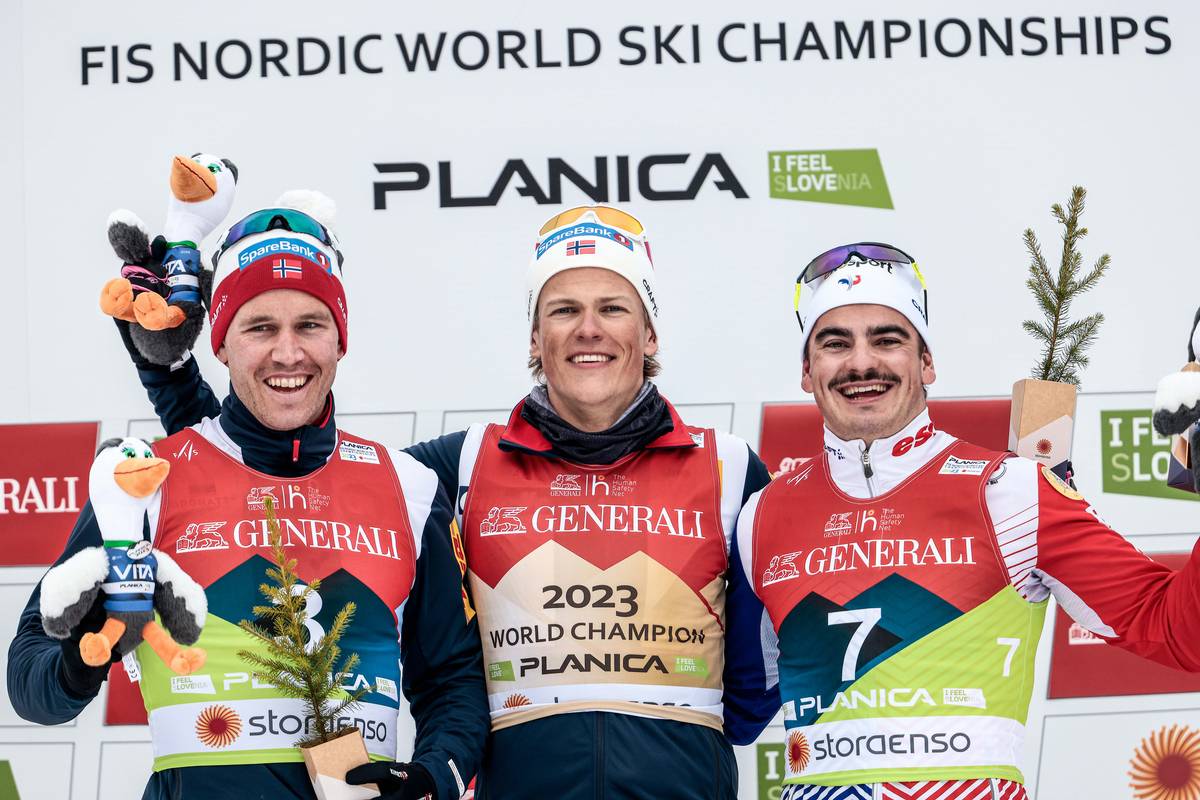
    Men’s World Championship Sprint podium: 1st) Johannes Hoesflot Klaebo (NOR), 2nd) Paal Golberg (NOR), 3rd) Jules Chappaz (FRA). (Photo: Nordic Focus)
  • World Championship Qualifying: Inviting the Whole World

    World Championship Qualifying: Inviting the Whole World

    This World Cup coverage is made possible through the generous support of Marty and Kathy Hall and A Hall Mark of Excellence Award. To learn more about A Hall Mark of Excellence Award, or to learn how you can support FasterSkier’s coverage, please contact info@fasterskier.com.

    Bruna Moura (BRA) skis to the win in the Women’s 5 k Freestyle Individual Qualifying event at the 2023 FIS World Championships in Planica, Slovenia. (Photo: Modica/NordicFocus)

    This is the championship of the cross country skiing world, and all the nations of the skiing world are included. It’s a longer list of nations than many of us may imagine . . .

    Cross country skiers come from various backgrounds and far-flung homelands. Some hail from countries that the skiing world does not always recognize as even having skiing: Chile and Argentina share borders at the mountainous, frozen southern tip of South America where the Ushuaia Loppet is staged every season. Iran has a long tradition of Alpine skiing, with snowy mountains that soar to over 18,000 feet and an Alpine ski area within the city limits of Tehran. Skiers have arrived at these championships from Trinidad and Tobago, Lebanon, Mongolia, Armenia, Haiti, Hungary, Thailand, Latvia, Lithuania, Bolivia, Portugal, Greece, Turkey, Mexico, Venezuela, Kyrgyzstan, Israel, Brazil, Iceland, Serbia, Belgium, Panama, Bosnia Herzegovina. Some of those skiers are natives of tropical lands who now reside in snowy climes. Others are natives of wintry nations where the support for skiing is simply not deep enough to allow them to develop programs to compete against the Norways and Swedens of the skiing world. They qualify for these championships through nomination by their home-nation’s FIS governing bodies; then, they compete in qualifying competitions. The top performers in those qualifying competitions will be awarded starting places in World Championship events. It’s a chance for more skiers to see, feel, and experience the thrill of competing against the world’s best. It’s a World Championships . . .

    Carlos Andres Quintana (COL) and Rodrigo Ideus (COL) celebrate at the finish of the Men’s 10 k Freestyle Qualifying race in Planica, Slovenia. (Photo: Modica/NordicFocus)
    Men’s Qualifying

    Iceland’s Albert Jonsson won the 10 k Freestyle Individual Start in 26:47.1, followed closely by Manex Silva of Brazil, and Spartak Voskanyan of Armenia. For comparison, the recent Nordic Nations Cup (Junior) Men’s 10 k Freestyle was won by Tabor Greenberg (USA) in a time of 23:03.9. The Nordic Nations Cup is a gathering of the world’s fastest junior skiers, and Greenberg is proving himself to be one of the fastest young skiers in the world; if he represents the sort of developing athlete that FIS considers on track to contend on the international stage before too much longer, then athletes from Iceland, Brazil, and Armenia are not too much farther behind.

    Skiers from the Iranian team gather at the finish line of the Women’s 5 k Freestyle Individual Qualifying race at the 2023 FIS World Championships in Planica, Slovenia. (l-r) Sahel Tir (IRI), Samaneh Beyrami Baher (IRI), Farnoosh Shemshaki (IRI). (Photo: Modica/NordicFocus)
    Women’s Qualifying

    The Women’s 5 k Freestyle was won by Jacqueline Mourao of Brazil, followed by Lucija Medja of Slovenia, and Gigja Bjornsdottir of Iceland. Also finishing in the top ten—and within 90 seconds of the winner—were skiers from Mongolia, Iran, Bosnia Herzegovina, Armenia, and Lithuania. It’s remarkable to see so many skiers from so many nations, all passionate about what they do and the goals they pursue, all hoping to take the next step toward legitimacy and excellence in this sport that they love.

    Haiti’s Stevenson Savart exults at the finish line of the Men’s 10 k Freestyle Individual qualifying race during the 2023 FIS World Championships in Planica, Slovenia. (Photo: Modica/NordicFocus)

    FIS World Cup events can be something of an elitist affair, with only those nations fielding true contenders typically participating. As a result, World Cup fields can be woefully small, implying that our sport is somehow an anemic player on the international athletic stage. Unfortunately, neither the skiers of developing nations nor some of the very best skiers in the world are able to attend. The unfairness lies in the fact that dominant nordic skiing nations—like Norway and Russia—could each provide dozens of athletes who could qualify for most any other national team, but there’s not enough room for them on their own national teams. Regretably, only a few of those elite athletes will ever toe a World Cup or World Championship starting line, even though a fair number of them may have ended up on the podium if they’d ever gotten the chance. Space is made for the Brazils and Panamas of the skiing world, though few of those nations are poised to fund year-long World Cup campaigns for their aspiring skiers. In the end, FIS is dedicated to doing two things that fly in the face of one another: providing opportunities for the best skiers in the world to face one another in fair competition, and identifying the means to encourage cross country skiing in nations where it has not been a visible athletic alternative in the past. In order to accomplish that, some neophyte skiers will be allowed the experience of competing on the international stage, while other very very good skiers will be left at home.

    Winter Olympic fans will remember the comically charming ineptitude of Eddie the Eagle (in ski jumping) and the Jamaican Bobsled Team at the Olympics in Calgary in 1988. Avid cross country skiing fans may recall Phillip Boit, the Kenyan distance-runner-turned-skier who finished far behind the rest of the field at the 1998 Olympic Winter Games in Nagano, but who was greeted at the finish line by the winner, and Olympic champion, Bjorn Daehlie (NOR). Sportsmanship and fellowship have long been fundamental parts of the nordic skiing community, and it’s gratifying to see those continue at these events. It’s also timely to acknowledge that the efforts and accomplishments of these little-known skiers are neither comic nor charming, but entirely deserving of our respect and admiration. Welcome, then, to the grand stage of the 2023 FIS Cross Country World Championships.

    The podium of the Men’s 10 k Freestyle Individual:  Spartak Voskanyan (ARM), Albert Jonsson (ISL), Manex Silva (BRA), (l-r)—FIS World Championships qualifying, Planica, Slovenia. (Photo: Modica/NordicFocus)

    (Qualifying) Women’s 5 k RESULTS

    (Qualifying) Men’s 10 k RESULTS

    Gigja Bjornsdottir (ISL), Jaqueline Mourao (VRA), Lucija Medja (SLO), (l-r)—The podium of the FIS World Championships 5 k Women’s Freestyle Individual Qualifying race, Planica (SLO). (Photo: Modica/NordicFocus)
  • “Pretty sweet vibes” in sunny Slovenia as World Championships kick off Thursday

    “Pretty sweet vibes” in sunny Slovenia as World Championships kick off Thursday

    This World Cup coverage is made possible through the generous support of Marty and Kathy Hall and A Hall Mark of Excellence Award. To learn more about A Hall Mark of Excellence Award, or to learn how you can support FasterSkier’s coverage, please contact info@fasterskier.com.

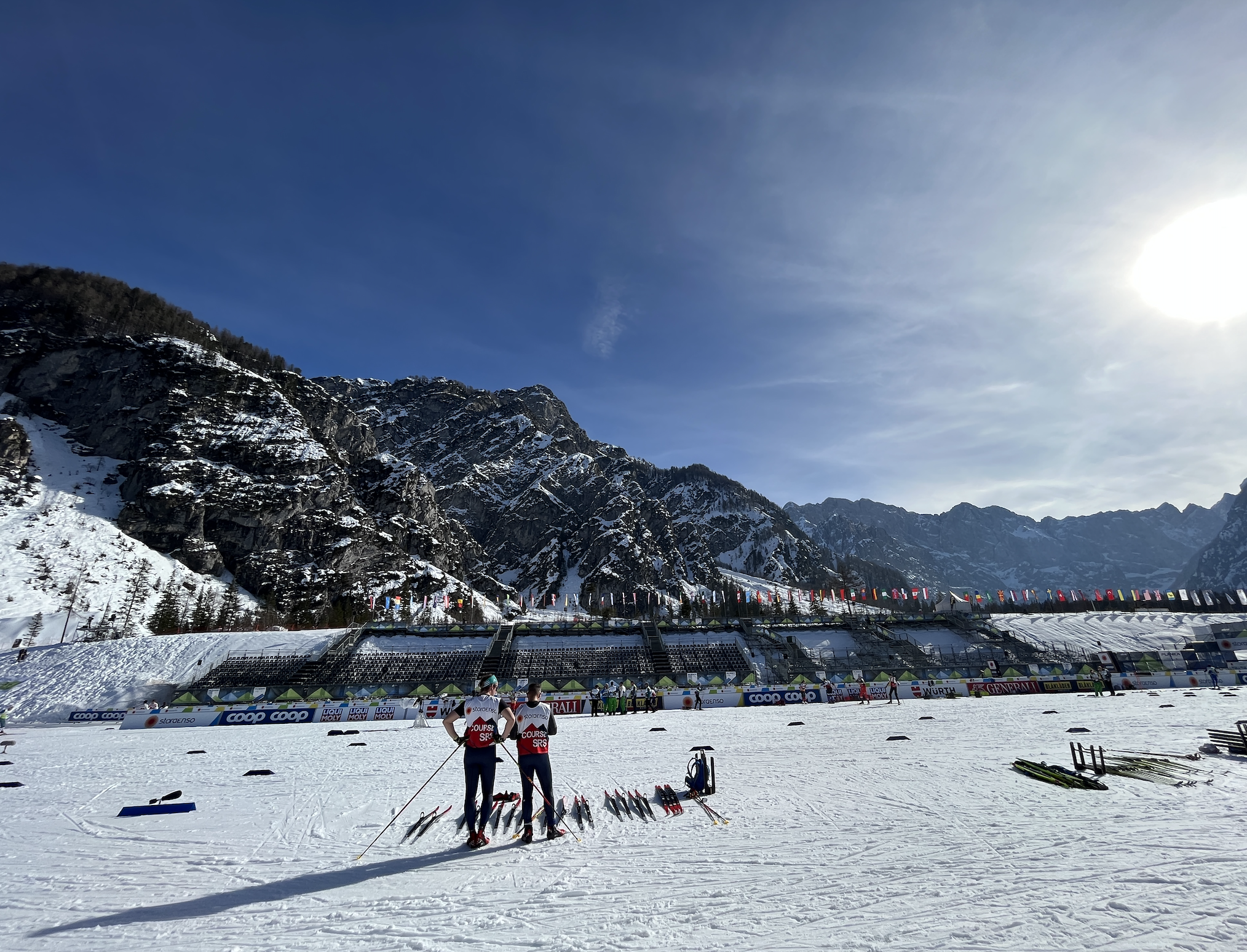
    Teams tested equipment Tuesday at the World Championships venue in Planica, Slovenia. (Nathaniel Herz/FasterSkier)

    PLANICA, SLOVENIA — What a difference a year makes.

    Last February, the world’s top cross-country skiers were in China, hermetically sealed inside the Olympic Covid bubble. When they emerged to race, they braved biting winds, frigid temperatures and dry snow that dragged like sandpaper.

    This year’s World Championships, by comparison, set to kick off here Thursday, feel like a beach party.

    As athletes trained Wednesday for their first event, a sprint race using the traditional classic technique, they quickly shed their clothing in the 45-degree heat, as the sun rose high above the rocky cliffs hemming in Planica’s competition venue.

    The course underwent its own transformation, softening into patches of slush, mush and ice in places that some skiers said could get spicy Thursday, when six athletes at a time will be simultaneously hurtling around corners and risking crashes in hopes of securing a medal.

    U.S. athlete J.C. Schoonmaker changes clothes Wednesday, the day before his first race at the World Championships in Planica.

    Overall, though, the atmosphere was festive and light, with a small crowd along the finishing stretch bleachers that kept up a steady drone of horns as athletes tested their skis and fitness.

    “It’s a pretty sweet vibe,” J.C. Schoonmaker, a U.S. sprinter from Tahoe who will be competing Thursday, said as he left his training session Wednesday. He was shirtless, having stripped down to just a training bib labeled with the name “Ogden,” for his sprint teammate Ben, who had traded garments with Schoonmaker in a nod to the professional football tradition of jersey swapping.

    The World Ski Championships will run for 11 days, with golds, silvers and bronzes awarded in six different events for each gender.

    The organizers are billing the sporting event as the largest ever for Slovenia, which was part of the socialist federation of Yugoslavia until 1991.

    A scene from Tuesday night’s opening ceremonies at the World Ski Championships in Planica. (Nathaniel Herz/FasterSkier)

    Since then, the nation has produced an array of star athletes, from road cyclists to downhill ski racers and biathletes. And it put its national pride on display in a boisterous opening ceremony Tuesday: It featured hip-hop dancers gyrating behind jets of flame, a star Slovenian disc jockey spinning beats and a modernized rendition of a classic folk song — Oj, Triglav, moj dom, or “Oh, Triglav, my home” — that featured ghostly projections of ski jumpers’ silhouettes and a computer generated eagle, elk and mountain goat.

    The ski races themselves will be held in Planica, which isn’t really a town — just a high-level competition venue tucked into one of Slovenia’s most picturesque alpine valleys. Jagged peaks hem in the valley from the west, and teams drive in from the small Slovenian alpine ski resort town of Kranjska Gora, nearby, and from other villages just across the border in Austria and Italy.

    There are ski trails all over the area, giving athletes the option to train outside the competition venue — though some have been rendered inaccessible by warm temperatures and a low snowpack, like those near the Canadian hotel in Austria, said Matt Smider, the team’s development coach.

    “There were some trails there up until about a week ago, and then they kind of melted out,” he said. “Which is too bad — we were really banking on those.”

    There are a few big storylines leading into the championships, which are held every two years.

    One is the complete absence of the Russian cross-country ski team, which the International Ski Federation, known as FIS, has banned from competing since the country invaded Ukraine last spring.

    That absence has been glaring on cross-country’s World Cup circuit, where its star men and women were regularly on the podium last year.

    FIS President Johan Eliasch speaks with reporters Wednesday before the start of the World Ski Championships in Planica. (Nathaniel Herz/FasterSkier)

    The International Olympic Committee said last month allowing Russians to return to competitions as “neutral athletes” — not representing their home country — should be explored. But 34 national governments, mostly from Europe, to remain excluded from next year’s summer Olympics until and unless the IOC comes up with a “workable” model for neutral participation.

    Ukraine has a cross-country team participating in Planica, where their flag-bearer at Tuesday’s opening ceremonies got a warm welcome from the crowd.

    FIS President Johan Eliasch, asked by reporters Wednesday about the future of Russia’s participation in federation events, didn’t express a clear position — citing, on the one hand, how “athletes don’t choose where they were born,” and noting the “polarizing and difficult situation” in Ukraine on the other.

    He said his organization would likely follow any recommendations that come from the Olympic committee, though it depends on what those recommendations are.

    “The one thing we want to avoid here is that we have a divided sports community,” he said. “We have to join together and back up the IOC on their direction.”

    Other big stories at the championships revolve around Norway.

    Its dominance on the Russia-less World Cup circuit this year has sparked anxiety both inside and outside the country about cross-country skiing’s continued viability as a global sport. Those feelings have already been on stark display in Planica, where retired Slovenian cross-country ski legend Petra Majdic blasted the Norwegians for parking a two-story VIP trailer at the championship venue.

    “What the hell is Norway doing? Does Norway need to make smaller skinng nations even smaller?” she asked a reporter for a Norwegian television station. “Fair enough that they can afford to pay 6,000 euros to park here for their sponsors. But cross-country skiing needs now, more than ever, less difference between the nations both sportingly and financially.”

    Norway’s male superstar, Johannes Høsflot Klæbo, is the leading candidate to pour cold water on Majdic’s hopes of equitable results in Planica.

    Klæbo has won 13 of the 19 races he’s entered this season, and at just 26, he’s already starting to be described as the greatest cross-country skier of all time. His fans are hoping he could win gold in all six events in Planica: four individual races, a team sprint and a relay.

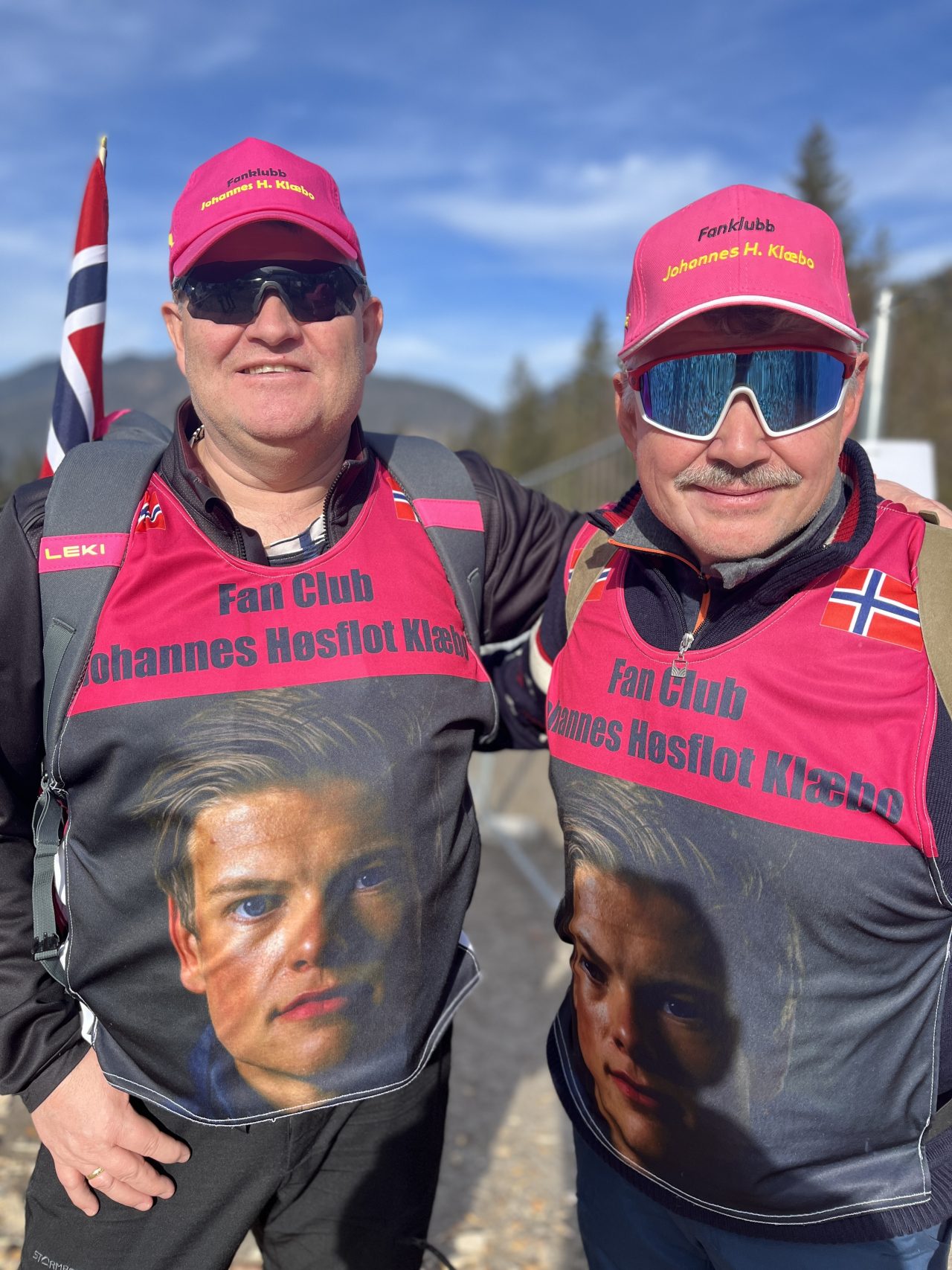
    Jarle Berget and Hans Tettli are two members of the Johannes Høsflot Klæbo Fan Club. (Nathaniel Herz/FasterSkier)

    “He’s good enough,” said Hans Tettli, a family friend who was walking around the Planica venue in a Klæbo Fan Club bib — for sale for 40 euros, proceeds going to charity.

    The U.S. team in Planica doesn’t quite have Klæbo-esque expectations, but it has two serious medal contenders in its star women, Jessie Diggins and Rosie Brennan. Diggins won a silver and bronze in China last year, while Brennan had an excruciating fourth place in the sprint, sixth place in another individual race, and a fifth, with Diggins, in the team sprint.

    “If we have the week that we are capable of — and not even the best week ever — we can win medals,” Head Coach Matt Whitcomb said in a phone interview Wednesday evening.

    The U.S. team doesn’t focus on medals, though, Whitcomb added; it focuses on its training and racing process.

    “The medals are the compass: They keep us focused on the daily goals and the weekly goals,” he said.

    The U.S. athletes held a pre-championships camp in Austria, at a similar, moderate altitude to Planica’s 3,000 feet above sea level; the preparatory program, according to Whitcomb, is something of a test run for the 2026 Olympics in Italy, which will also take place at moderate elevation.

    The pressures of the championships are significant, Whitcomb said. But athletes said Wednesday that they’re still finding ways to have fun — namely with playing cards, given the lack of reliable wi-fi at the team’s hotel.

    The game of choice, said U.S. distance specialist Gus Schumacher, has been euchre, a game popular in the midwest that pits two teams of two players against each other.

    “And hearts,” he said. “We were getting tired of euchre.”

    The Americans said they expect that the sprint could get squirrely as the course warms and melts Thursday. Schumacher crashed going down a hill Wednesday, and Schoonmaker, the sprinter, said he’s considering using more supportive boots — pursuit boots — for Thursday’s race.

    “The corners are getting really slushy with, just, a sheet of ice on the inside,” he said. “It’s kind of one of those things that could cost you if you slip up at all.”

  • 2023 Cross Country World Ski Championships Team Announced

    2023 Cross Country World Ski Championships Team Announced

    U.S. Ski & Snowboard announced the 18 athletes of the U.S. Cross Country Ski Team that will compete at the 2023 FIS Cross Country World Ski Championships in Planica, Slovenia, Feb. 22 – March 6, 2023.

    Jessie Diggins (USA) competing in the 2021 FIS World Cross Country Ski Championships in Oberstdorf, Germany. Diggins will be one of the team veterans leading the charge at the upcoming 2023 World Championships in Planica, Slovenia. (Photo: Nordic Focus)

    The 2023 World Championships will take place in the Julian Alps at the Planica Festival Arena, a venue that features both cross country and ski jumping venues. Throughout the 12 days of competition, more than 2,500 athletes and staff members from more than 60 countries will be present.

    “We are very excited to bring this group of talented athletes to the World Championships in Planica,” said U.S. Cross Country Program Director, Chris Grover. “We will be arriving at the World Championships with a lot of momentum after finishing the previous period of World Cup with multiple podiums and a ranking of third overall in the World Cup Nation’s Cup. We also will be bringing a very experienced and knowledgeable staff that is dedicated to helping these athletes achieve peak performances at the Championships. Planica has been one of our favorite venues over the years and we are really looking forward to coming back to the Julian Alps.”

    Perennial contender, Rosie Brennan (USA) approaches the 2023 World Championships riding a wave of momentum that sees her ranked fourth in the current overall World Cup standings. (Photo: Modica/NordicFocus)

    For the women, three-time Olympic medalist and four-time World Championship medalist Jessie Diggins, who has landed on the podium seven times in the 2022-23 season alone, leads the women’s team. Along with Diggins are veteran Rosie Brennan, who had a career-best Tour de Ski finish in fourth place overall and several top-10 results; Julia Kern who has nine top-10 finishes this season alone; and Olympians Hailey Swirbul, Novie McCabe, and Sophia Laukli. New to the World Championship roster is young but talented athletes Alayna Sonnesyn and Sydney Palmer-Leger.

    Teammates Ben Ogden and JC Schoonmaker after completing the Team Sprint in Beijing. They will be two of the young Americans representing the USA in the 2023 FIS World Cross Country Skiing Championships in Planica, Slovenia. (Photo: Nat Hertz)

    On the men’s side, Ben Ogden leads the charge. Ogden has found abundant success in the 2022-23 season, highlighted by a 13th-place finish at the Tour de Ski – the best-ever finish by a U.S. male. 2022 Winter Olympians Scott Patterson, JC Schoonmaker, Kevin Bolger, Luke Jager, and Gus Schumacher made the roster after finding their speed among the strong World Cup field. Zak Ketterson, Hunter Wonders, Johnny Hagenbuch, and David Norris will also travel to Slovenia; Patterson, Schumacher, and Wonders have consistently scored World Cup points throughout the 2022-23 season.

    Planica will host six races, each playing to the various individual strengths of the U.S. team. The classic sprint on Feb. 23 will kick it off, followed by the men’s and women’s skiathlon on the 24th and 25th, the team sprint on Feb. 26, women’s 10k freestyle on Feb 28, men’s 15k on March 1, women’s 4x5k team relay on March 2, and the men’s 4x10k relay March 3. The World Champs will culminate with the 30k and 50k classic mass start on March 4 and 5.

    All events will stream LIVE on the skiandsnowboard.live platform, with live commentary from five-time Winter Olympian Kikkan Randall and Chad Samela, who is known for his “HERE COMES DIGGINS” call at the 2018 Winter Olympics.

    Jessie Diggins and Team USA after her Olympic silver medal performance in the 30 k mass start skate in Zhangjiakou, China. American skiing is known for team unity and mutual support, traits likely to be on display at the 2023 World Championships in Planica, Slovenia.  (Photo: NordicFocus)
    2023 FIS CROSS COUNTRY WORLD CHAMPIONSHIPS TEAM

    (Name, hometown, ski club/school, birthday, past World Championship teams)

    *Denotes first World Championships team

    Women

    • Rosie Brennan (Anchorage, Alaska; Alaska Pacific University Ski Nordic Center; 12/21/88; 2015, 2017, 2019, 2021)
    • Jessie Diggins (Afton, Minn.; Stratton Mountain School Elite Team; 8/26/91; 2011, 2013, 2015, 2017, 2019, 2021)
    • Julia Kern (Waltham, Mass.; Stratton Mountain School Elite Team; 9/12/97; 2019, 2021)
    • Sophia Laukli (Yarmouth, Maine; University of Utah; 6/8/00; 2021)
    • Hailey Swirbul (Aspen, Colo.; Alaska Pacific University Nordic Ski Center; 7/10/98; 2021)
    • *Novie McCabe (Winthrop, Wash.; Methow Valley Nordic Team/University of Utah; 12/15/01)
    • *Alayna Sonnesyn (Stratton, Vt.; Stratton Mountain School, 6/22/96)
    • *Sydney Palmer-Leger (Park City, Utah; Stratton Mountain School/University of Utah; 2/4/2002)

    Men

    • Ben Ogden (Landgrove, Vt.; Stratton Mountain School Elite Team/University of Vermont; 2/13/00; 2021)
    • Scott Patterson (Anchorage, Alaska; Alaska Pacific University Nordic Ski Center; 1/28/92; 2019, 2021)
    • JC Schoonmaker (Tahoe City, Calif; Sugar Bowl Ski Team and Academy; 8/12/00; 2021)
    • Kevin Bolger (Minocqua, Wisc.; Sun Valley Gold Team; 4/11/93; 2019, 2021)
    • Hunter Wonders (Anchorage, Alaska; Alaska Pacific University Nordic Ski Center; 8/7/98; 2021)
    • David Norris (Fairbanks, Alaska; Steamboat Springs Winter Sports Club; 12/12/90; 2019, 2021)
    • Gus Schumacher (Anchorage, Alaska; Alaska Winter Stars; 7/25/00; 2021)
    • *Luke Jager (Anchorage, Alaska; Alaska Pacific University Nordic Ski Center/University of Utah; 1/17/00)
    • *Zak Ketterson (Bloomington, Minn; Team Birkie 4/2/97)
    • *Johnny Hagenbuch (Ketchum, ID.; Sun Valley Ski Education Foundation, 10/1/01)


    COMPETITION SCHEDULE

    2023 FIS Cross Country Ski World Championships—Planica, Slovenia

    Thursday, Feb. 23

    6:00 a.m. ET – Sprint Qualification, Classic, Men’s and Women’s

    8:30 a.m. ET – Sprint Finals, Classic, Men’s and Women’s


    Friday, Feb. 24

    9:30 a.m. ET – 30k Skiathlon, Classic/Skate, Men’s


    Saturday, Feb. 25

    8:00 a.m. ET – 15k Skiathlon, Classic/Skate, Women’s


    Sunday, Feb. 26

    5:30 a.m. ET – Team Sprint, Skate, Men’s and Women’s


    Tuesday, Feb. 28

    6:30 a.m. ET – 10k, Skate, Women’s


    Wednesday, March 1 

    6:30 a.m. ET – 15k, Skate, Men’s


    Thursday, March 2

    6:30 a.m. ET – 4x5k Relay, Classic/Skate, Women’s


    Friday, March 3

    6:30 a.m. ET – 4x10k Relay, Classic/Skate, Men’s


    Saturday, March 4

    6:00 a.m. ET – 30k, Classic, Women’s


    Sunday, March 5 

    6:00 a.m. ET – 50k, Classic, Men’s


  • Pärmäkoski’s Day; Diggins 10th, Patterson 20th in Planica

    Pärmäkoski’s Day; Diggins 10th, Patterson 20th in Planica

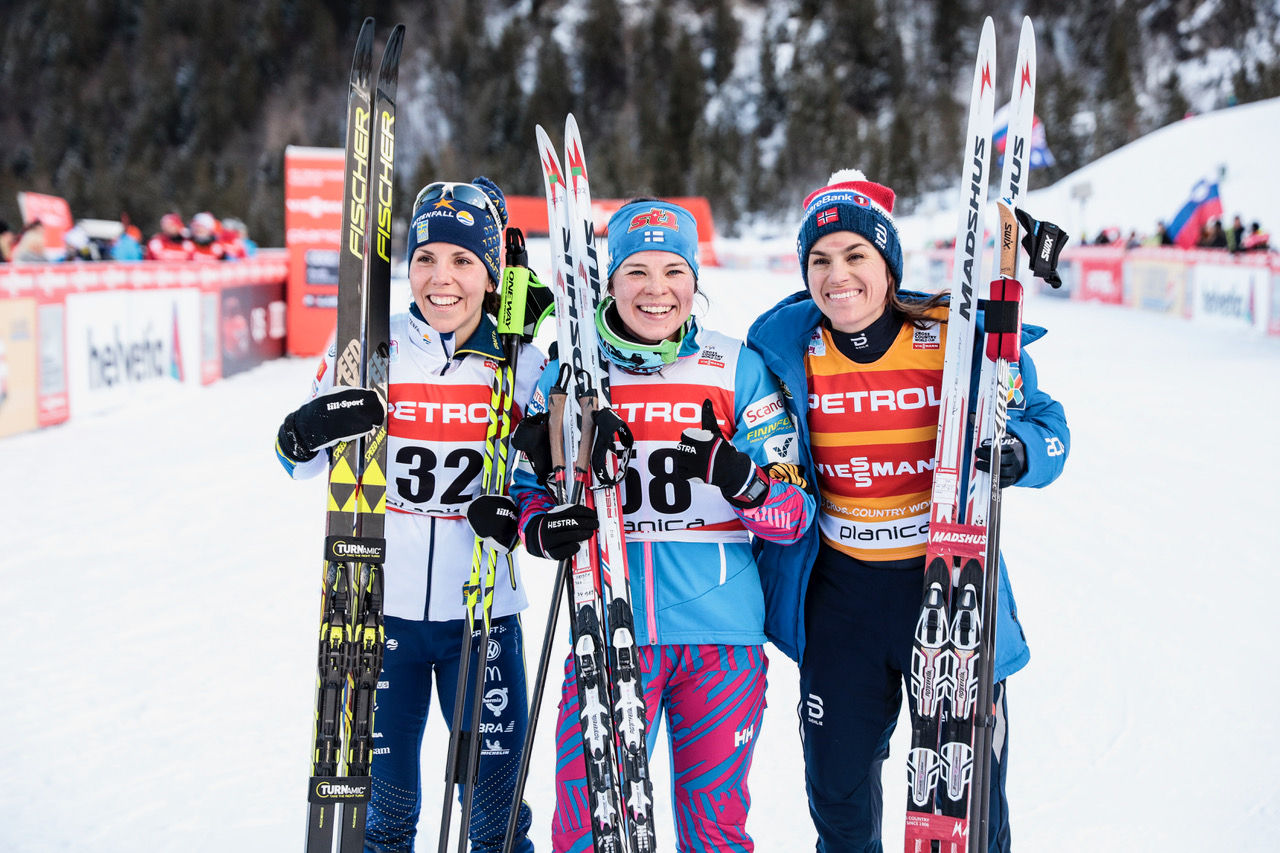
    The women’s 10 k classic podium at Sunday’s World Cup in Planica, Slovenia, with (from left to right) Sweden’s Charlotte Kalla in second, Finland’s Krista Pärmäkoski in first, and Norway’s Heidi Weng in second. (Photo: Fischer/NordicFocus)

    PLANICA, Slovenia — Move over Norway and Sweden, there’s a another skier scouting and snagging World Cup wins — and she’s just over 5 feet tall and Finnish.

    Krista Pärmäkoski set out on a rugged 10-kilometer classic course on Sunday located directly in the Julian Alps, the highest mountain range in Slovenia. Any challenge the course summoned, however, the 27-year-old Pärmäkoski dished twice as hard in return.

    Though a bluish early morning light cast a sombre glow on the course, Pärmäkoski was punchy. She pushed past the start gate one minute ahead of Norway’s Heidi Weng, who was a favorite heading into the weekend’s distance event.

    The reigning Tour de Ski champion, Weng was coming off back-to-back wins in the last two distance events she’s entered: the Tour’s 10 k classic mass start stage in Val di Fiemme, Italy, and the 9 k final climb freestyle pursuit, also in Val di Fiemme.

    On the other end, Pärmäkoski has had six runner-up finishes in the individual distance events she’s entered. She has also posted two stage wins for time-of-day performances, and racked up 19 individual podiums.

    Until Sunday, however, the satisfaction of standing as the outright winner of a non-stage World Cup had remained elusive.

    But if anything, that only motivated her. The long striding climbs featured in Planica’s course suited her powerstride style, and she knew it. She had seen them during a dryland camp with her team last year.

    “We had a training camp here in the summer and when I saw the competition tracks here I said to my coach that I will have a good race in Planica this winter,”  Pärmäkoski said, according to an International Ski Federation (FIS) press release.

    Still, once the snow hits, Mother Nature has a way of foiling even the most prepared skier’s plans. Or working to the advantage of others.

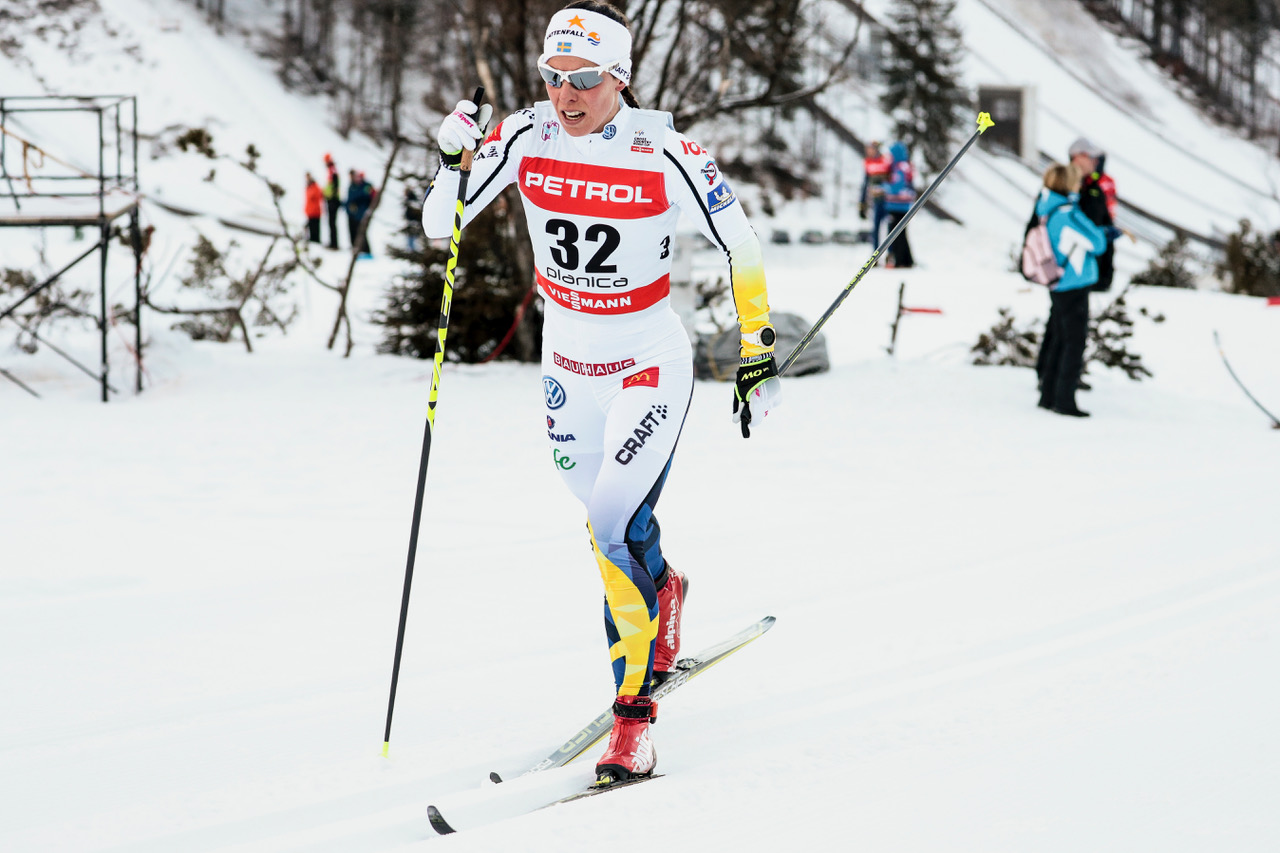
    Sweden’s Charlotte Kalla racing in the women’s 10 k classic at the World Cup in Planica, Slovenia. She went on to finish second. (Photo: Fischer/NordicFocus)

    With firm tracks laid out for Sunday’s individual starts, another contender for the win was Sweden’s Charlotte Kalla. Though most of her World Cup victories have come in 10 k freestyle races, she is no less threatening in classic. At the start of this season, she won the FIS 10 k classic in Gällivare, Sweden, by 17.7 seconds.

    In Planica, Kalla, the 32nd starter, appeared to be heading in the same direction. At a little under 2 k in, she posted the fastest split. She did the same 2 k later and for the next 5 k following that. For close to 9 k, Kalla’s splits were unmatched. Pärmäkoski, who started 58th, trailed her by almost ten seconds at the halfway mark.

    For the first half of the 10 k, Kalla maintained that nearly 10-second gap on Pärmäkoski. In the second half, however, the countdown began. The Finn began picking Kalla off second by second, stride by stride.

    At the 7 k mark, Kalla held the lead over Pärmäkoski by only one second. Realizing how close she was to the leading time, Pärmäkoski made her attack in the final kilometer. She ended up beating Kalla’s time by 3.6 seconds, crossing the line in 27:08.7.

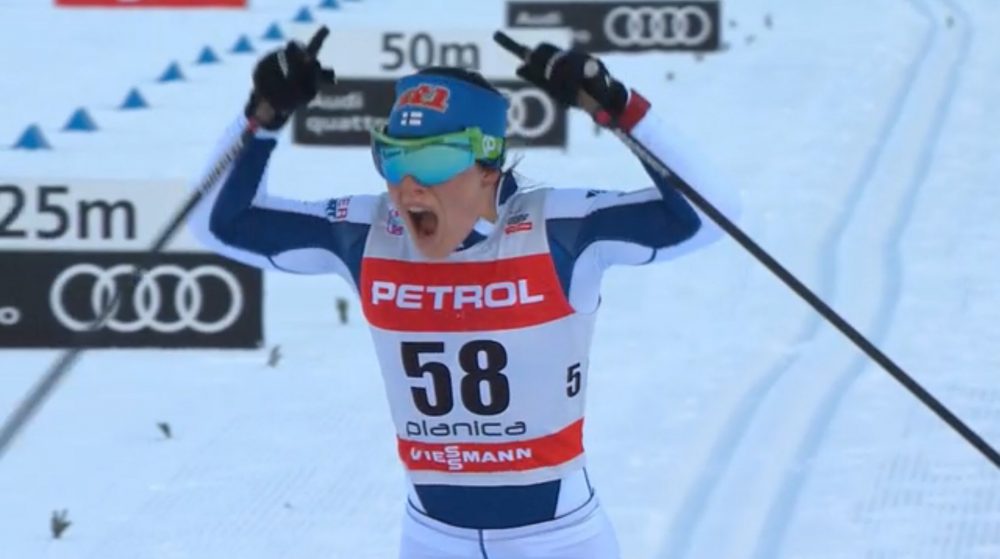
    Krista Pärmäkoski celebrates her first World Cup victory in the women’s 10-kilometer classic race on Sunday in Planica, Slovenia (Screenshot: ARD broadcast)

    “I wanted to get faster as the race went and when I saw that I was battling with Charlotte, I really pushed hard over the final kilometer,” Pärmäkoski said. “It feels great to finally have my first win.”

    “It was exciting to have the battle with Krista today and for sure I would like to have won, but it’s also nice to see her get her first win,” Kalla said afterward, according to FIS.

    “It was a great race. It’s nice to be back on World Cup,” she added. “I will go to Seiser Alm now to get ready for Korea.”

    Following Kalla was Weng, who started 60th and ended up third, 33.5 seconds off Pärmäkoski’s winning time. The Norwegian had been skiing in second for the first 4 k, but lost time to Pärmäkoski and Kalla by the halfway point. During a FIS interview, Weng indicated that the grade of the climbs, which featured more gradual pitches with sustained periods of striding, didn’t exactly play to her strengths.

    Norway’s Heidi Weng racing to third in the women’s 10 k classic race on Sunday in Planica, Slovenia. (Screenshot: ARD broadcast)

    “The profile didn’t suit me with the long gradual hills,” Weng said. “My plan was to start slower and then speed up. I tried my best and to push over the top of the hills. It’s good to be on the podium with the other ladies today.”

    Rounding out the top ten in Sunday’s event was Austria’s Teresa Stadlober in fourth (+39.0), Sweden’s Ebba Andersson in fifth (+48.6), Finland’s Kerttu Niskanen in sixth (+49.4), Norway’s Kari Øyre Slind in seventh (+49.5), Poland’s Justyna Kowalczyk in eighth (+1:02.1), Norwegian Kathrine Rolsted Harsem in ninth (+1:03.2) and American Jessie Diggins in 10th (+1:05.4).

    “That was a gnarly course,” Diggins told FasterSkier in person after. “You don’t get rest because the downhills, you’re working the corners, which I love, but I am tired right now. That’s on purpose, it’s part of the plan, but I am looking forward to a nap and some rest and some extra food and just getting ready for next week.”

    Jessie Diggins (U.S. Ski Team) racing to 10th in the World Cup women’s 10 k classic in Planica, Slovenia.(Photo: Salomon/NordicFocus)

    Diggins, coming off a third-place finish in the 2018 Tour de Ski, also raced Saturday’s classic sprint in Planica, where she finished fourth for her best World Cup classic-sprint result.

    “Really cool to see her making that progress,” U.S. Ski Team Head Coach Chris Grover said on Sunday.

    Also scoring World Cup points on Sunday was Caitlin Patterson (Craftsbury Green Racing Project), the Period 1 SuperTour leader, in 20th (+1:45.2). Now into her second World Cup weekend of the season, Patterson had a banner week earlier this month in Anchorage, Alaska, where she won four titles in four races at U.S. nationals.

    Reflecting on the courses she’s raced this season, Patterson said that the SuperTour in West Yellowstone, Montana, and U.S. nationals in Anchorage had more “double poling [sections] and herringbone hills.”

    “I knew this course was going to be different than anything I’ve skied in a while, for classic at least,” Patterson said of Planica. “It’s just so much gradual striding.”

    The change of pace, however, seemed to work to her advantage.

    “I had a little trepidation going into it….I think it allowed me to relax into it really nicely and make sure I found my kick well which the skis were great.”

    “The long gradual stuff was kind of fun,” Patterson added. “It felt a lot different, it felt less about quick accelerations back and forth and more just sustained work.”

    The finish is Patterson’s sixth individual World Cup top 30, and her second-best individual World Cup performance to date. She placed fourth in last year’s Pyeongchang skiathlon.

    “It was a great classic result,” Grover said of Patterson. “She is somebody who has only been here a week and a half, or maybe just over a week. We expect some more great stuff from her.”

    Kikkan Randall (U.S. Ski Team) racing to 23rd in the women’s 10 k classic at the World Cup in Planica, Slovenia. (Photo: Fischer/NordicFocus)

    The U.S. had three score World Cup points in the top 30, with Kikkan Randall racing to 23rd (+1:50.4) on Sunday. Randall sat out Saturday’s classic sprint, as she is in the process of recovering a foot injury. She aimed to use Sunday’s distance race to assess her progress.

    “It was really hard to sit out yesterday’s classic sprint, but I needed to test out my foot and we felt a distance race would be a safer test,” Randall wrote in an email. “I’ve been battling the stress reaction and tendonitis in my left foot since Davos and I just got back to classic skiing this week. I still have some lingering pain in my foot but we’ve got it under control enough to race again.”

    The 10 k was Randall’s first distance race in more than a month, and she described it as having the “best classic racing conditions I’ve seen all season.”

    “10 k classic individual start is one of the toughest race formats for me usually so I’m pretty happy to be solidly in the top 30 today and just a few seconds out of the top 20,” Randall continued. “I’m looking forward to a couple skate races next weekend in Seefeld to continue sharpening for the Olympics.

    “I was definitely motivated by my teammates strong results yesterday and really happy to see Caitlin Patterson have a strong race today for 20th!” she added. “It’s not easy to come right over to Europe after all that racing at US Nationals!  And of course, Jessie continues to be on fire. Look out world!”

    American Sophie Caldwell, who placed ninth in Saturday’s classic sprint, finished just 1.7 seconds outside of the top 30 in 31st (+2:17.2). Two more American women competed on Sunday, with Liz Stephen in 35th (+2:34.9) and Ida Sargent in 37th (+2:37.5).

    “A couple of great performances,” Grover said referring to the overall weekend’s results. “Jessie’s fourth yesterday, that is her best classic sprint result of all time. I thought a great race yesterday out of Logan Hanneman, to be that close to qualification. He just got over here this week from the U.S. Similarly, a really nice qualification out of Tyler Kornfield yesterday … Caitlin Patterson’s 20th place today. Those were some silver linings for sure.”

    But with many athletes in a transitional zone, some recovering from the TdS and others adjusting to the travel and recouping from U.S. nationals, Grover indicated that next weekend in Seefeld, Austria, the energy levels and pop of the U.S. team’s skiers should be even more pronounced.

    “I thought some of our skiers looked a little bit flat,” he said. “Probably to be expected. We have some athletes obviously who just got here, some who just came out of U.S. nationals, some who are just coming back to skiing after the Tour de Ski … I definitely expect next weekend will be a lot better for us.”

    The last World Cup weekend before the Olympics takes place next Saturday and Sunday in Seefeld, with freestyle sprints and 10/15 k freestyle races.

    Results

  • Nilsson Nabs Another Sprint Title in Planica; Diggins 4th, Caldwell 9th

    Nilsson Nabs Another Sprint Title in Planica; Diggins 4th, Caldwell 9th

    Sweden’s Stina Nilsson celebrates her third individual sprint victory of the season on Saturday in the World Cup classic sprint final in Planica, Slovenia. Behind her, Norway’s Kathrine Rolsted Harsem (third from l) placed second and Maiken Caspersen Falla (l) finished third and American Jessie Diggins (far r) placed fourth. (Photo: Fischer/NordicFocus)

    PLANICA, Slovenia — With the Julian Alps and Mount Triglav, Slovenia’s highest peak, as a backdrop, it’s suitable to say the Planica Valley nordic course can be summed up in one word: burly.

    A high mid-afternoon sun had illuminated the mountain range throughout the rounds for the World Cup women’s 1.4-kilometer classic sprint on Saturday, but by the time the six finalists lined up for the final heat, a few shadows were being recast onto the course.

    At the sound of the gun, Sweden’s Stina Nilsson took the lead into the first downhill. Norway’s Kathrine Rolsted Harsem followed close behind. Maiken Caspersen Falla, also of Norway, dangled to the far right, while American Jessie Diggins hugged tightly to the inside left, just ahead of Sweden’s Anna Dyvik.

    The third Norwegian in the final, Heidi Weng picked up the rear of the group through the corner that had seen at least one skier in the men’s quarterfinals fly into the blue net that fenced off the course. Diggins had also fallen on that corner during her warmup.

    “It rattled my confidence,” Diggins said, referring to her warmup mishap. The American then took the corner more cautiously during her qualifier, which she felt was uncharacteristic of herself and and left her wanting more going into the day’s heats. (Diggins had qualified in 19th, 6.19 seconds behind Harsem’s winning qualifying time of 3:28.03.)

    American Jessie Diggins leads Sweden’s Hanna Falk during their quarterfinal of the women’s classic sprint on Saturday at the World Cup in Planica, Slovenia. Diggins went on to place fourth overall in the final. (Photo: Salomon/NordicFocus)

    “I am not a hesitant downhill skier at all,” Diggins explained. “So I was like, ‘All right, in the rounds I am not going to ski like a wimp,’ and I was really proud of myself for … taking something that had rattled me and put it away and then just ski the rest of the day.”

    In the women’s final, Diggins maintained her position through the bottom of the sharp downhill corner and the brief double-pole section before the first uphill hiccup. As the pitch increased, Nilsson transitioned to striding and the rest of the field followed suit.

    Pressure began mounting from the Norwegians as Harsem strode to Nilsson’s left and Caspersen Falla caught up to her right. A meter behind them were Diggins, Dyvik and Weng.

    The group disappeared from the teleprompter for a moment as they moved under the wooden bridge spanning the course. When they reappeared, Harsem had overtaken the lead. Nilsson clung to the back of her skis.

    Diggins, who had been skiing alone in the second inside track, switched lanes, maneuvering herself into second alongside Harsem and Nilsson. But as they descended into the second downhill, the Norwegian and Swede pulled slightly away.

    Another corner and the six finalists were heading uphill again, Diggins was the only skier who chose the far outside track. The climb was the course’s most grueling uphill, and Harsem had used it to break away from her competition all afternoon.

    In the final, it appeared Harsem would do the same as she strode powerfully to the front, looking to gap Nilsson and Falla. But the 28 year old had not factored in her teammate Falla’s own dig in the ups. Halfway up the hill, Falla, 27, changed tracks and was gunning for the lead.

    By the time the group reached the hairpin turn that would lead them back down to the stadium, Falla was first, Harsem second, and Nilsson third. Chasing them around two meters away was Diggins, followed shortly by Dyvik and Weng.

    As they descended, the Swede’s skis seemed to lose ground. A Norwegian battle for first looked to be in the cards. In the second group, Diggins continued to hold off Dyvik’s attempts to push past her for fourth.

    With one final hill to go, Falla strode with a speedy turnover to the outside. But while the Norwegian’s legs swished through the tracks, the Swede was powering forward in a powerful double pole.

    Three years younger than her Norwegian challenger, Nilsson, 24, had already won one of two classic sprints previously this season. On Saturday, she was looking to rack up another win (and her third individual victory of the season after winning a skate sprint in Davos, Switzerland). 


    The women’s classic sprint podium on Saturday in Planica, Slovenia, with Sweden’s Stina Nilsson (c) in first, and Norway’s Kathrine Rolsted Harsem (l) in second and Maiken Caspersen Falla (r) in third.(Photo: Fischer/NordicFocus)

    She and Falla strode over the top of the final climb together, but heading into the final double pole to the finish, the Swede had made up her mind. The red World Cup sprint leader’s bib she was wearing would stay with her.

    She double poled away from Falla and Harsem in the final 100 meters, crossing first in a time of 3:26.28. The win marked her fourth-career victory in a World Cup classic sprint and her 12th World Cup sprint win.

    “I saw an opening there and took the chance,” Nilsson told Längd.se, according to a translation. “I think it worked very well technically.”

    Crossing second, 1.27 seconds behind Nilsson was Harsem. The second-place finish was the Norwegian’s first World Cup podium ever.

    “It’s amazing to be finally on the World Cup podium,” Harsem said, according to an International Ski Federation (FIS) press release. “I have been fourth a couple of times and seventh 100 times. It is very emotional for me. There have been many ups and downs in my career. I feel just amazing.”

    Falla placed third, 1.81 seconds behind Nilsson. The defending Sprint World Cup champion, with 14 individual World Cup titles to her name, Falla was more critical of her own result.

    “I did not really have it today. It’s good to be third but I will be headed home now and try to find shape for the Olympic Games,” Falla told FIS.

    Diggins ended the day just off the podium in fourth (+3.81), while Dyvik was fifth (+4.45) and Weng sixth (+14.89).

    “I feel like I just did the hardest interval ever,” Diggins told FasterSkier after. “But I think that’s great because going into the Olympics, it’s fun knowing that I have qualified and I made it to the finals in three out of four classic sprints this year; it is a good confidence booster.”

    Though tired by the end of the day after rounding the course four times at a hard effort, Diggins indicated she found ways to keep herself relaxed and have fun.

    “They played my absolute favorite songs all day I was doing a little salsa dance getting ready,” Diggins said with a laugh. “You do have to have fun, this is your life you have to enjoy it.”

    Two Americans in Top 10

    Rounding out the the top 10 was Russia’s Yulia Belorukova in seventh, Sweden’s Hanna Falk in eighth, American Sophie Caldwell in ninth, and Norway’s Mari Eide in 10th.

    Sophie Caldwell (U.S. Ski Team) racing to 13th in the women’s classic sprint qualifier at the World Cup in Planica, Slovenia. She went on to reach the semifinals and place ninth overall. (Photo: Fischer/NordicFocus)

    After qualifying in 13th, 5.38 seconds out of first, Caldwell advanced to the first quarterfinal, going head-to-head with Nilsson, Belorukova and Finland’s Aino-Kaisa Saarinen.

    Caldwell skied strong through the first portion of the major climb, pacing toward the front with Nilsson, Belorukova and Norway’s Anna Svendsen. Just before the final hairpin turn, however, Nilsson and Belorukova charged. Caldwell pushed to maintain contact, but was edged out just before the final straightaway.

    Her quarterfinal time was fast enough for her to earn the day’s second lucky loser spot, after Diggins advanced as the first lucky loser in third in her heat, behind Falk and Harsem.

    Caldwell then advanced to the first semifinal, up against Falla, Nilsson, Belorukova, Falk, and Finland’s Krista Pärmäkoski. Caldwell was in the mix until halfway through the mjor course climb, when Nilsson, Falla and Belorukova began to push the pace.

    “I think a lot of the classic courses now kind of have big steep hills that you do more of a run shuffle up,” Caldwell said. “[Today’s] was more power striding, which for me personally is definitely one of my weaknesses and something I’m working on.”

    Caldwell finished her semifinal in fifth, 4.34 seconds behind Falla in first.

    “I felt good, but it was definitely one of the hardest sprints I’ve ever done,” Caldwell said. “I don’t know if it felt that way because we’ve been racing some shorter ones lately and this one was quite a bit longer … but I’m happy with today.”

    Sadie Bjornsen (U.S. Ski Team) racing to seventh in the women’s classic sprint qualifier at the World Cup in Planica, Slovenia. She went on to finish fifth in her quarterfinal for 21st overall. (Photo: Fischer/NordicFocus)

    Also for the U.S., Sadie Bjornsen placed 21st and Ida Sargent 23rd overall, after finishing fifth in their quarterfinals.

    Reflecting on her qualifier, in which she qualified seventh (+4.10), Bjornsen said she finished “feeling like I had lost some time in the corners.” 

    “In my [quarterfinal] I felt like there was a lot of bouncing and trying to find a track and just trying to find a place to ski, so I was kind of depending on that final corner and climb into the finish,” Bjornsen said on the phone.

    Her quarterfinal saw Falla and Pärmäkoski take the lead early on, but Bjornsen was positioned well within striking range as the group rounded the hairpin turn for the final descent.

    The final descent and corner went smoothly for Bjornsen, but a tangle with Germany’s Sandra Ringwald caused her to crash out of contention. By the time Bjornsen reached the finishing stretch, Pärmäkoski and Falla had already locked up the top-two spots to automatically advance to the semifinals, and Bjornsen followed 8.81 seconds back in fifth.

    “I had an awesome corner and then came into that final climb and unfortunately, Sandra just ended up falling on top of me, which was a bummer because I felt like I was really opening up there and finally had an opening,” Bjornsen said. “At the end of the day you just have to, for me, focus on what felt really good and channel that extra energy into some Olympic racing coming up here soon.” 

    Bjornsen did not race last weekend in Dresden, nor will she start Sunday’s 10 k classic in Planica.

    “I just want to make sure I am fully recovered,” Bjornsen said of her decision to opt out of Sunday’s distance race.

    “I actually think this going to work out really naturally well for me just to have one more week to absorb that enormous load and feel really fresh and quick and ready for next weekend,” she added.

    The fourth American woman to qualify on Saturday was Sargent in 17th (+6.13).

    “Warming up for the heats, I tried to do a little harder warm up to try to see if I could get my body going, but I was definitely feeling some fatigue,” Sargent said after. “It was a hard course to feel that way, so I’m looking forward to hopefully getting a little more energy for tomorrow.”

    Three other American women’s also competed on Saturday, with Julia Kern finishing 43rd, Rosie Brennan 49th and Caitlin Patterson (Craftsbury Green Racing Project) 53rd.

    Results: Qualifier | Final

  • Klæbo Dominates in Planica; Hamilton 19th, Newell 20th

    Klæbo Dominates in Planica; Hamilton 19th, Newell 20th

    Norway’s Johannes Høsflot Klæbo en route to another World Cup win in the men’s classic sprint on Saturday in Planica, Slovenia. (Photo: Fischer/NordicFocus)

    Sunny skies. Craggy Slovenian Alps. Fresh snow and firm classic tracks. The perfect backdrop for the coiffed hair and pink sunglasses. On Saturday in Planica, Slovenia, Norway’s Johannes Høsflot Klæbo again proved his form is on another level. Sometimes calm with tens of meters to spare, sometimes allowing others to draft momentarily on his ski tails, Klæbo won the World Cup men’s 1.6-kilometer classic sprint in 3:27.35 minutes.

    In a final that featured three Norwegians, two Swedes and a Russian, Norway’s Emil Iversen placed second (+0.62) and Sweden’s Teodor Peterson third (+8.14). Yes, that’s a big gap to third place, and the gaps only bulged to the rest of the men in the final. Sweden’s Oskar Svensson finished fourth (+11.80), Norway’s Eirik Brandsdal fifth (+19.77), and Russia’s Gleb Retivykh sixth (+27.08).

    Norway’s Johannes Høsflot Klæbo winning the men’s classic sprint final at the World Cup on Saturday in Planica, Slovenia, by 0.62 seconds over his teammate Emil Iversen. (Photo: Fischer/NordicFocus)

    “I had a lot of fun out there today,” Klæbo said, according to an International Ski Federation (FIS) press release. “It was great to see so many people along the course and the stadium. I really liked the course with the long uphill sections.”

    To say Klæbo is on a roll is an understatement. The 21 year old, in fact, seems to be skiing in total control and on a different level —  his swing from top-end efforts to dialing it back for the “show” seems like a quid pro quo to keep competitors from discouragement. Not that another Klæbo win was ever in doubt, but great World Cups are sporting theater after all, and drama heightens the tension.

    Klæbo was the first-place qualifier, rounding the 1.6 k course that featured two small climbs and a larger one lasting for nearly half a kilometer in 3:26.8 minutes. Dissecting some of Klæbo’s strategy from the qualification time splits, he skied the first 0.65 k of the course a full three full seconds faster than Sweden’s second-place qualifier, Calle Halfvarsson, who finished in 3:29.5. Klæbo then skied the next 1.59 k of course, which featured the major climb, with the second-fastest split. Halfvarsson skied that sector the fastest by only 0.3 seconds over Klæbo, who had the second-fastest split time on that section. The point is this: Klæbo won the qualifier in the first 0.65 k, and could then control his speed the remaining distance and still win the qualifier by 2.75 seconds.

    Effortless? Not exactly. But at moments it appeared that way.

    Klæbo skied in the first quarterfinal, which also featured American Andy Newell. Like in his qualifier, Klæbo torched his heat from the start. Off the front at around fifty seconds, Klæbo looked around and realized he’d broken away, then he appeared to literally let off the double-pole gas. Perhaps it was a small tease as Newell chased behind in second. On the long climb, Klæbo set tempo as the other places began to fall into order. On the descent, Klæbo streamed away as if on double secret wax. Twenty to thirty meters before the finish, he began taking his poles off. He won the heat by 1.55 seconds over Finland’s Iivo Niskanen in second place (+1.55). Germany’s Sebastian Eisenlauer followed in third (+2.34) and Newell fourth (+2.59) to miss advancing to the semifinals. Overall, Newell ended the day in 20th.

    Klæbo’s semifinal again found him in total control. By the long climb, Klæbo was in his groove with teammate Iversen pegging his efforts to remain 5 then 10 meters back. But Iversen hung in, and by the final stretch, after Klæbo pulled up and chilled, Iversen took Klæbo at the line in what appeared to be a nonchalant gift.

    (Article continues below)

    Norway’s Johannes Høsflot Klæbo (4) and teammate Emil Iversen knock knuckles as they cross the line in Planica, Slovenia, on Saturday in the men’s classic sprint. Klæbo won the race while Iversen placed second overall. (Photo: Emil Iversen/Instagram)

    The final began with Klæbo storming into the major climb with such speed that for a moment he became unbalanced. But in an instant, Klæbo’s stride was back in form as he strung out Petersen, Iversen and Svensson. With a quick skate into another lane followed by a killer double pole, Klæbo was gone up and over the climb. Iversen also made his move late on the climb, but by then, Klæbo was away.

    With a tidy bow across the line, it was curtains for Klæbo.

    After Saturday’s sprint, Klæbo is positioned first in the World Cup overall standings, despite skipping the entire Tour de Ski. He’s started a total of 10 individual races and has won eight, including Saturday’s sprint. In the other two, he placed second in last weekend’s freestyle sprint in Dresden, Germany, and was 10th on Dec. 16 in a 15 k skate in Toblach, Italy. Klæbo has won all three classic sprints this season.

    No real prognostication here, it is too early. Yet, Klæbo has won every classic sprint this season and the upcoming Olympic individual sprint next month in PyeongChang, South Korea, is classic technique.

    Two U.S. Men in Top 20

    For the U.S., Simi Hamilton qualified 16th and ended his day in 19th after finishing fourth in the fifth quarterfinal, 2.35 behind the winner, Pål Golberg of Norway.

    Simi Hamilton (U.S. Ski Team) racing to 16th in the men’s classic sprint qualifier on Saturday at the World Cup in Planica, Slovenia. He went on to finish the day in 19th overall. (Photo: Fischer/NordicFocus)

    “I feel like a classic sprint is always up in the air for me how it’s going to go,” Hamilton told FasterSkier in person after the race. “Especially this season, the only other classic sprint I have done is in Ruka, and I was kind of getting really sick there, so I kind of had no idea how my body would respond.”

    After skipping most of the Tour de Ski, leaving after the second stage on Jan. 1, Hamilton contested the sprints in Dresden last weekend and finished 10th in the individual skate sprint and eighth in the team sprint with Erik Bjornsen.

    “I know that I am fit right now, and I have been feeling great so I kind of had that going into the day,” Hamilton said. “I had a really good interval workout here a couple days ago so it was awesome just to see the course and get a feel for doing that. I felt great in my qualifier, I felt like I stayed really relaxed. Sometimes I think classic sprinting, classic skiing in general, I have a tendency to get a little bit tight and I felt like in my qualifier I just stayed really loose the whole time, which kind of let me get pretty good glide on that really long gradual climb.

    “In the quarter I just kind of focused on the same thing,” he continued. “Just started kind of conservatively so I had some energy for the long climb … I felt like I skied the climb really well, tried to make a move at the top, and when I was in third and then just needed to really pin it those last 200 meters, I just ran out a little bit of juice. But I think we were in a little slower heat anyways, so I wouldn’t have gone as a lucky loser, but it’s great … I love skiing heats obviously, and I think any day I can ski heats in a classic sprint with a pretty strong field, I think that is kind of a successful day for me.”

    Norway’s Johannes Høsflot Klæbo leads Finland’s Iivo Niskanen (25) and American Andy Newell (23) in the first men’s quarterfinal of the World Cup classic sprint in Planica, Slovenia. Klæbo went on to win that heat, ahead of Niskanen in second and Newell in fourth. (Photo: Fischer/NordicFocus)

    Newell, who qualified in 23rd and finished the day in 20th, wrote in an email that he had been hoping for more.

    “It was beautiful classic conditions out there and pretty straightforward waxing which made for really fun skiing,” he wrote. “The course had a little bit of a different feel because it basically just had one really long climb from the low point to the high point and, of course, some fast icy corners to keep things interesting. Especially in qualification, I felt semi out of control and scrubbed some speed. The courses actually skied a bit better in the heats I thought once they had less traffic.”

    Matched with Klæbo in his quarterfinal, Newell clearly knew he’d have a speedster to chase.

    “In the heats, I again chose heat one with the same strategy I’ve been using  — choose the first heat and shoot for a final/podium rather than a top 15 etc.,” Newell added. “Not sure if that’s the right call … hard to tell sometimes. I skied the majority of the heat on the tails of Klæbo until the top of the climb he and Niskanen got a small gap. In the end, it wasn’t fast enough.”

    Like Hamilton, Newell left the Tour de Ski early (after Stage 3) and contested last weekend’s skate sprints in Dresden. Needless to say, Newell is focused on PyeongChang.

    “Although this wasn’t the pre-Olympic result I was looking for I still have a few weeks to fine tune classic skiing and fitness and think about what I need to do to have a top performance in PyeongChang,” Newell reflected.

    A large contingent of U.S. men competed, with the Alaska Pacific University (APU) duo of Logan Hanneman and Tyler Kornfield narrowly missing the heats, finishing 35th (+13.55) and 38th (+13.96), respectively, in the qualifier. Teammate Reese Hanneman finished 51st in the qualifier (+17.99) and Ben Lustgarten of the Craftsbury Green Racing Project placed 59th (+19.41).

    For both Logan Hanneman and Kornfield, this was their first career World Cup starts. Hanneman is 24 and Kornfield is 26.

    Kornfield is coming off a stellar U.S. nationals in Anchorage, Alaska, where he won the 30 k classic mass start, and placed third overall in both the classic and skate sprints. Kornfield is slowly adjusting to Europe and said his body still feels the effects of his national 30 k win.

    “I have had a little time, but ever since the 30 k, I haven’t slept past five hours,” Kornfield said on Saturday. “I’ve just been trying to calm the heart rate. The first night before the classic sprint [in Anchorage], I went to bed at 3 AM. I was in bed at 11 or 12, just laying there. Just trying to process that. I know I can be better, I am just super amped to be here.”

    Kornfield won sprint titles at U.S. nationals in both 2010 and 2012. Now, older and wiser, he understands World Cup starts are precious.

    “I qualified for my first World Cup in 2010, but I decided not to go,” Kornfield said. “And ever since I have been just regretting that. But I think in the end, I’ve been working so much harder for this and it feels so much better. The harder you work the more struggle you go through, it’s feels so good.”

    In an email exchange, Kornfield elaborated on his World Cup invitation decline back in 2010.

    “After doing well in the 2010 US Nationals in Anchorage, I qualified for the sprint in Canmore, the final World Cups before the Vancouver Olympics,” Kornfield explained. “I went into US Nationals with the sole focus of making my first World Juniors. I hadn’t expected to do so well in the sprints and because I was a Freshman at UAF, I also wanted to make NCAAs.”

    As for his turned-down 2010 World Cup starts in Canmore, those are “would haves” and “could haves”.

    “I regretted not going for a long time because as I got older, I realized just how hard World Cup starts are to get and you cannot take them for granted,” Kornfield wrote. “When you are young and you get your first real breakthrough, you have so much confidence and belief that you are going to take over the world. It has been eight years and every now and then, that belief begins to wane. Eventually, I started to wonder if I would ever get that opportunity again. This is probably the first year in the last six years that my old confidence is starting to come back. I am also older and wiser and I know that the shape I am in now will not last forever, so I need to capitalize on this moment.”

    The four Canadians that raced last weekend in Dresden also competed in Planica, with Julien Locke (Canadian National U25 Team) leading the way in 62nd on Saturday (+21.26), Dominique Moncion-Groulx (Alberta World Cup Academy) 65th (+22.70), Bob Thompson (NTDC Thunder Bay) 66th (+24.48), and Antoine Briand (Pierre-Harvey National Training Centre) 70th (+27.20).

    Results: Qualifier | Final

  • Craftsbury Splits Camp Between Slovenian Ski Tunnel and Dachstein Glacier

    Craftsbury Splits Camp Between Slovenian Ski Tunnel and Dachstein Glacier

    Craftsbury Green Racing Project’s Ben Lustgarten enjoys skiing in the ski tunnel in Planica, Slovenia this September during a week long training camp. (Photo: Caitlin Patterson/ Caitlin Patterson CGRP blog)
    Craftsbury Green Racing Project’s Ben Lustgarten (l) training in the ski tunnel in Planica, Slovenia, earlier this month. (Photo: Caitlin Patterson/ CGRP blog)

    Pay 9 Euros a day, get a 950-meter loop in return. If snow were to take on a monetary value, that’s how much the Planica Nordic Centre charges for a day pass in its snow tunnel, new to the city’s Olympic Sports Center since the spring. But to others, the opportunity to ski on snow at the tail end of summer is priceless, even if it is under the fluorescent lights and within the concrete walls of a three-level parking garage.

    Among those “others” are the Craftsbury Green Racing Project (CGRP) elite cross-country skiers and biathletes, who spent Sept. 12 to Sept. 20 in Planica, Slovenia, training in the city’s ski tunnel. As a few explained, getting on snow at this time of year outweighs the occasional lassitude that comes from skiing two-plus hours on a less-than-1-kilometer loop.

    “No matter what condition it is nordic skiers love their first time on snow of the season,” Ben Lustgarten, new to the CGRP cross-country team, wrote in an email. “We were able to do speeds, short level 4 intervals, some threshold, accelerations, and sprint simulation workouts. There was fair amount of terrain to do varying technique work and video analysis for the small amount of space.”

    Left to right: Craftsbury GRP head coach Pepa Miloucheva along with athletes Heather Mooney, Ben Lustgarten, Kaitlynn Miller, Caitlin Patterson, Liz Guiney, and assistant coach Nick Brown in the ski tunnel in Planica, Slovenia, during a training camp this month. (Photo: Caitlin Patterson/CGRP blog)
    Left to right: Craftsbury GRP head coach Pepa Miloucheva along with athletes Heather Mooney, Ben Lustgarten, Kaitlynn Miller, Caitlin Patterson, Liz Guiney, and assistant coach Nick Brown in the ski tunnel in Planica, Slovenia, during a training camp this month. (Photo: Caitlin Patterson/CGRP blog)

    Along with Lustgarten, who joined Craftsbury this year after spending the last two seasons with the Sun Valley Ski Education Foundation (SVSEF) Gold Team, nearly a dozen CGRP skiers made the trip, including Caitlin Patterson, Kaitlynn Miller, Liz Guiney, Heather Mooney, and Mary O’Connell, and biathletes Alex Howe, Ethan Dreissigacker, Mike Gibson, Emily Dreissigacker, and Hallie Grossman.

    “The intensity and technique really helped to keep the tunnel from getting too boring, as there was always something to think about or work on, or at the very least a coach on hand videoing for later technique review,” Patterson wrote in an email. “It gave us an opportunity to practice being adaptable to snow conditions and terrain (ie corners); even if those particular features in the tunnel would be rarely seen on a race course, they were valuable in their extremes. I feel more prepared than ever to handle a course with tons of 90 and 180 degree corners, even though that’s unlikely to happen often.”

    The athletes, along with Craftsbury’s head coach Pepa Miloucheva and assistant coaches and wax technicians Nick Brown and Sam Doherty, completed a weeklong training camp in Planica, taking full advantage of the three-level snow tunnel. The following week, the group headed to Schladming, Austria, for eight days of volume training on the Dachstein glacier, more than 9,800 feet above sea level. In Planica, nearly 7,500 feet lower, much of the team’s first week focused sharpening agility, coordination and speed.

    “The tunnel is a perfect environment for working on both technique and speed, with enough transitions and tight turns to keep the skiing interesting,” Grossman wrote in an email.

    “I feel more prepared than ever to handle a course with tons of 90 and 180 degree corners, even though that’s unlikely to happen often.” — Caitlin Patterson (CGRP) after training in the Slovenian ski tunnel

    Grossman, who recently switched from cross-country to biathlon, explained that the biathletes’ intensity training slightly deviated from their original plan when they learned that Slovenian Summer Biathlon Nationals were being held in Pokljuka, Slovenia, about an hour away from Planica.

    “The camp took a little turn when we found out about the rollerski races in Pokljuka, so what was going to be a primarily on-snow camp turned into a combination of skiing and rollerskiing,” Grossman wrote. “This allowed us to still focus on technique and shorter speed in the tunnel, while also getting the opportunity to race.”

    The biathletes had originally planned to use the Pokljuka range for a few shooting sessions, but quickly decided to jump into the races when they discovered the competitions were taking place at the same location. Grossman competed in both races that weekend — the women’s 7.5 k sprint and 10 k mass start — as did her teammate Emily Dreissigacker.

    “We actually didn’t even know Slovenian Nationals were happening until we tried to sign up to use the range and they told us we couldn’t because there were races,” Dreissigacker wrote.

    Dreissigacker, who married Howe, her teammate, last month and spent a few weeks before the camp on a honeymoon with him in Italy, explained that the competitions elicited an opportunity to reconnect with racing, even within a small field.

    “There wasn’t a ton of competition in the senior women’s category, four of us to be exact, but one of the Slovenians was Teja Gregorin who won bronze in the pursuit in Sochi, so it was pretty cool to be able to race against her,” Dreissigacker wrote. “For me it was also a good way to re-focus after the craziness of the wedding.”

    “We actually didn’t even know Slovenian Nationals were happening until we tried to sign up to use the range and they told us we couldn’t because there were races.” — Emily Dreissigacker (CGRP) on racing at Slovenian Summer Biathlon Nationals

    Dreissigacker finished third in the women’s 7.5 k race, with two standing misses, and Grossman placed fourth. In the mass start the next day, Dreissigacker once again reached the podium in third and Grossman repeated in fourth.

    CGRP biathletes Hallie Grossman (l) and Emily Dreissigacker after the women’s 14 k mass start at Slovenian Summer Biathlon Nationals in Pokljuka, Slovenia, on Sept. 18. (Photo: Ethan Dreissigacker)
    CGRP biathletes Hallie Grossman (l) and Emily Dreissigacker after the women’s 14 k mass start at Slovenian Summer Biathlon Nationals in Pokljuka, Slovenia, on Sept. 18. (Photo: Ethan Dreissigacker)

    The men’s races included a 10 k sprint and 14 k mass start. In the sprint, Howe placed seventh, Ethan Dreissigacker was ninth and Gibson 13th. The next day, Ethan rocketed to third, Howe finished 10th and Gibson 14th.

    “It was really fun to be able to jump into the Slovenian races!” Ethan wrote in an email. “While it did change up the plan a bit that first week, it think it was for the better, and I’m really glad we were able to compete. Biathlon races in the US are pretty few and far between, and many of them are also ‘trials’ of some kind. It’s super valuable to get in competitive racing experience outside of those trials races to get used to the pressure of competition without feeling like your season is on the line.”

    Along with the CGRP athletes, the men’s field included the Slovenian national biathlon team and some non-national team skiers, as well as a few Bulgarian national-team members.

    “The competition at these races was really pretty similar to that of the US rollerski nationals we had in August,” Ethan explained. “The big name in the men’s field was Jakov Fak who has an Olympic bronze, and a bunch of World Cup victories. Fak has is a very relaxed and efficient skier and it was awesome to get to ski behind him for a bit in the races.”

    After Slovenian nationals, the Craftsbury crew ventured to Austria for a week of altitude training. The team planned to train through Wednesday and fly back to Vermont on Thursday this week.

    “Both places are only 2 hrs apart, so was very convenient for a week long speed block in the tunnel and a week and a half volume block on the glacier all on snow,” Miloucheva wrote in an email. She explained that “some speed work followed by some good distance hrs on snow,” were the primary goals of the camp.

    While it wasn’t the first time the CGRP spent a few weeks of fall training on snow, this year was the first split camp featuring the Slovenian snow tunnel.

    “This is the third year in a row that the GRP has come over to Austria for an altitude camp on the Dachstein Glacier,” Ethan explained. “This year I was really excited about the split the camp between two locations, with two different focuses, and I think that has really helped make the most of the trip. Both locations have had some awesome resources for training, and beautiful scenery.”

  • Sargent and Caldwell Fifth for U.S. in Planica Team Sprint; Newell and Hamilton DQed

    Sargent and Caldwell Fifth for U.S. in Planica Team Sprint; Newell and Hamilton DQed

    The start of the women's freestyle team sprint final, with (from left to right) American Ida Sargent, Slovenia Vesna Fabjan, Sweden's Ida Ingemarsdotter, Norway's Heidi Weng, Germany's Sandra Ringwald, Slovenia's Nika Razinger, Germany's Laura Gimmler, Sweden's Jonna Sundling, and Norway's Mari Eide at the World Cup in Planica, Slovenia. (Photo: Fischer/NordicFocus)
    The start of the women’s freestyle team sprint final, with (from left to right) American Ida Sargent, Slovenia Vesna Fabjan, Sweden’s Ida Ingemarsdotter, Norway’s Heidi Weng, Germany’s Sandra Ringwald, Slovenia’s Nika Razinger, Germany’s Laura Gimmler, Sweden’s Jonna Sundling, and Norway’s Mari Eide at the World Cup in Planica, Slovenia. (Photo: Fischer/NordicFocus)

    The team sprint is a unique beast that World Cup racers only get one or two shots in a season to tame. Despite strong skiing, the U.S. men’s and women’s team came up just short of being in podium contention in the 6 x 1.2-kilometer freestyle team sprint at Sunday’s World Cup in Planica, Slovenia.

    The format of the team sprint competition features two-skier teams who each race alternating legs of a sprint course. Each skier completes three legs and they must make contact with their teammate in the exchange zone between each leg. The Planica team sprints were held on the same fast, twisty and technically-challenging 1.2 k course as Saturday’s freestyle sprint.

    The format poses unique challenges for athletes as well as logistical challenge for the staff. For the athletes racing three separate legs, it is a challenge of measuring energy output to be ready for the decisive moves in the last lap. The technicians have their own race in between heats to work on skis.

    American Sophie Caldwell (c) and Sweden's Stina Nilsson (r) trail Germany's Hanna Kolb during the women's freestyle team sprint final at the World Cup in Planica, Slovenia. (Photo: Fischer/NordicFocus)
    American Sophie Caldwell (c) and Sweden’s Stina Nilsson (r) trail Germany’s Hanna Kolb during the women’s freestyle team sprint final at the World Cup in Planica, Slovenia. (Photo: Fischer/NordicFocus)

    “One of the challenges is we don’t get a chance to race this event very often,” head coach Chris Grover said on the phone after Sunday’s race, in which two of three U.S. teams qualified for the final. “We are doing the only team sprint out of 37 starts [this season], so it is a very rare format.

    “It is really fun for the athletes and the staff. It is so logistically intense in terms of ski prep,” he added. “It is a race to get the skis off the athletes’ feet, freshened up, and back on their feet.”

    Grover noted the course was shorter than typically used in team sprints (it took the men about 2 1/2 minutes and the women 2:45 to round each time on Sunday.

    “Because of that short window, it makes for an extremely hectic time for the techs,” he said. “But our techs did an awesome job and we had great skis.”

    The U.S. entered one women’s team (with most of its athletes taking the weekend off following the Tour de Ski); Ida Sargent and Sophie Caldwell teamed up to take fifth in the final, 20.57 seconds behind Sweden I, with Stina Nilsson and Ida Ingemarsdotter, who won the event in 16:14.08. Norway I (Heidi Weng/Astrid Uhrenholdt Jacobsen) placed second (+3:51) and Germany I (Sandra Ringwald/Hanna Kolb) took third (+8.84).

    Ida Sargent (U.S. Ski Team) teamed up with Sophie Caldwell (not shown) to place fifth in the 6 x 1.2 k freestyle team sprint at the World Cup in Planica, Slovenia. (Photo: Madshus/NordicFocus)
    Ida Sargent (U.S. Ski Team) teamed up with Sophie Caldwell (not shown) to place fifth in the 6 x 1.2 k freestyle team sprint at the World Cup in Planica, Slovenia. (Photo: Madshus/NordicFocus)

    Sargent and Caldwell delivered a well-executed semifinal to automatically advance in second place behind Sweden I, the eventual winners. In the team sprint racing, the top two teams advance in both semifinals, in addition to six lucky loser qualifiers.

    “Ida learned from yesterday how to pace the course and made a great move at the end of her last leg and tagged off in first,” Grover said of the semifinal. “Sophie brought it in easily in second to advance.”

    In the final, the field broke apart during the third leg when Weng began pushing the pace. Sweden and Germany responded, but Sargent lost time on the leaders. By the final handoff, the U.S. had slipped several places to sixth, 13 seconds behind the leaders.

    At the final handoff, Sargent tagged Caldwell in sixth, 13 seconds behind the leaders, for the finishing charge. Caldwell was able to catch Norway II and hold off Germany II to secure fifth place, 20.57 seconds behind the Swedish winners.

    “Those top women’s teams just skied away. They [Sargent and Caldwell] actually skied great all day and did tactically what they wanted to do,” Grover said.

    “It ties my best-ever team sprint result and is my best ever with Sophie so it was a good day,” Sargent said on the phone. “The course was really hard with lots of climbing and fast technical downhills so there wasn’t much recovery and it was important to balance pushing the pace and conserving energy for later rounds.”

    Newell and Hamilton Miss the Tag

    Andy Newell (in white) rounds a corner with Germany's Thomas Bing (l), Italy's Dietmar Noeckler (r) during the World Cup men's freestyle team sprint final in Planica, Slovenia.
    Andy Newell (in white) rounds a corner with Germany’s Thomas Bing (l), Italy’s Dietmar Noeckler (r) during the World Cup men’s freestyle team sprint final in Planica, Slovenia.

    The men’s team of Andy Newell and Simi Hamilton made it to the final after advancing in fourth out of the first semifinal (behind the second teams for France, Russia and Norway, respectively). In the final, the Americans initially finished eighth, but were disqualified for missing a tag in the exchange zone.

    The men’s field remained tight throughout the final, making the exchange zone both challenging and game-changing.

    The U.S. men’s team ran into trouble when Hamilton entered a chaotic tag zone after his first leg for the second exchange.

    “It was basically unavoidable since the Norwegian, who was tagged right before I reached out to tag Andy, cut to the left and skied right between Andy and I, essentially creating a barrier,” Hamilton said on the phone. “We were tagging towards the end of the zone, so we didn’t have room to stop to ensure we made contact, even though both of us stretched as best we could.”

    They emerged out of second exchange in eighth, 2 seconds behind Norway II in the lead. One lap later, by the third exchange, they were 3.22 seconds back in ninth.

    Unsure whether the jury would rule an infraction, Newell and Hamilton continued to race. They finished eighth, less than six seconds off the podium. Italy I took the win with Dietmar Nöckler and Federico Pellegrino in 14:44.82, and France swept the remaining podium spots in second (+1.79) and third (+2.41), with Renaud Jay/Baptiste Gros and Valentin Chauvin/Richard Jouve, respectively. The first teams for Germany, Norway and Russia ended up fourth, fifth and sixth, respectively, and the top eight teams at the end of the day — not counting the Americans — all finished within nine seconds of one another.

    (From right to left) Italy's Dietmar Nöckler leads Norway II's Ola Vigen Hattestad, American Andy Newell, and Norway I's Anders Gløersen and a Russian in the men's freestyle team sprint final at the World Cup in Planica, Slovenia. (Photo: Fischer/NordicFocus)
    (From right to left) Italy’s Dietmar Nöckler leads Norway II’s Ola Vigen Hattestad, American Andy Newell, and Norway I’s Anders Gløersen and a Russian in the men’s freestyle team sprint final at the World Cup in Planica, Slovenia. (Photo: Fischer/NordicFocus)

    “It was disappointing for sure, but it was a good call by the jury,” Grover said. “Andy and Simi have done a lot of team sprints together and tags are such a critical part of the team sprint. Andy and Simi are usually some of the very best at maintaining speed and having really good tags in chaotic situations, but today they just missed it.”

    Reflecting on their semifinal, in which they advanced as lucky losers, Newell was pleased with how he balanced his energy.

    “I was able to stay up near the front with Norway, stay out of trouble, and put down a hard third lap tagging Simi in second,” Newell said on the phone. “In the final I don’t think we found the same rhythm, at least I hard a harder time feeling the line of hard versus too hard. We got bounced around a bit in the back and our tags weren’t as smooth as in the semi. It’s easy to waste energy even just trying to pick off a few places can take it out of you each lap when you are coming from the back.”

    Considering the circumstances, Hamilton was content with the day.

    “I felt good today, and my speed and shape are rebounding after getting sick during the Tour de Ski,” he said.

    “Team sprinting is one of the hardest race formats we have, but it super fun,” Hamilton added. “It combines the best of sprinting and distance racing I think, and I hope we see more of it, or events similar to it, in the future.”

    This was the first and only team sprint on the World Cup calendar this season.

    (Story continues below)

    (From left to right) Italy's Federico Pellegrino, American Simi Hamilton, Germany's Sebastian Eisenlauer, Russia's Alexey Petukhov, and Dusan Kozisek of the Czech Republic during the men's freestyle team sprint final at the World Cup in Planica, Slovenia. (Photo: Fischer/NordicFocus)
    (From left to right) Italy’s Federico Pellegrino, American Simi Hamilton, Germany’s Sebastian Eisenlauer, Russia’s Alexey Petukhov, and Dusan Kozisek of the Czech Republic during the men’s freestyle team sprint final at the World Cup in Planica, Slovenia. (Photo: Fischer/NordicFocus)

    Also competing for the U.S. was the second men’s team of Dakota Blackhorse-von Jess and Reese Hanneman. They finished 12th in the same semifinal as Newell and Hamilton, 51.08 seconds behind France II (Chauvin and Jouve) as the winner of that heat. Blackhorse-von Jess and Hanneman did not advance and ended up 23rd overall.

    “For Dakota and I, it was just a chance to get right in the big pack of the fastest guys in the world and see what we could do,” Hanneman wrote in an email. “No amount of preparation could really prepare you for the chaos that happens at breakneck speed out there.”

    “I think they were both left wanting more,” Grover said. “They are going to need some time in Europe to get get acclimated some good training and racing and hopefully come into their top form.”

    The weekend following the Tour de Ski can be rough on teams and the U.S. team is feeling the effects.

    “It was a little bit of a flat weekend overall for us,” Grover observed. “We are certainly feeling the effects of post-Tour de Ski fatigue, both physical and mental, and we have a bit of illness going around the team so all of these things added up to take our edge off a bit, but I think we’ll be back by next weekend.”

    ‘Good save Canada!’

    Four Canadian teams raced Sunday, but none advanced out of the semifinals. Canada’s second women’s team, with Cendrine Browne and Emily Nishikawa, placed eighth in the second women’s semifinal, 55.64 seconds behind Sweden I as the winners of that heat, for 15th overall.

    Emily Nishikawa teamed up with Cendrine Browne (not shown) to represent Canada II in the women's World Cup freestyle team sprint on Sunday in Planica, Slovenia. They placed eighth in the semifinal for 15th overall. (Photo: Fischer/NordicFocus)
    Emily Nishikawa (above) teamed up with Cendrine Browne (not shown) to represent Canada II in the women’s World Cup freestyle team sprint on Sunday in Planica, Slovenia. They placed eighth in the semifinal for 15th overall. (Photo: Fischer/NordicFocus)

    In that same semi, Canada I, with Maya MacIsaac-Jones and Dahria Beatty, finished 10th (+1:06.39) for 19th overall.

    “I focussed on staying with the pack as long as possible,” Browne, Canada II’s first starter, recalled in an email. “I managed to stay with them on the first lap but on my second lap, we were already a couple seconds back.

    “The down hills are pretty sketchy … I almost fell today but catched myself at the last second!” she added. “The jury even told me: Good save Canada!”

    “The women fought hard, but it will take some more racing at that level to get used to the speed,” Alberta World Cup Academy head coach Chris Jeffries, who’s leading the Canadian team in Slovenia, said in a Cross Country Canada press release. “These World Cups are definitely focused on development, and hopefully they will take some really good lessons to their training in preparation for the Ski Tour Canada races in March and the coming years.”

    Both Canadian men’s teams squared off in the second semifinal, with Knute Johnsgaard and Len Valjas placing ninth for Canada I (+13.23) for 16th overall, and Jess Cockney and Andy Shields finishing 12th for Canada II (+23.85) for 22nd overall.

    Results: 

    Women: Semifinals | Final

    Men: Semifinals | Final

  • Four Americans Qualify for Planica Sprint Heats; Caldwell 13th Overall

    Four Americans Qualify for Planica Sprint Heats; Caldwell 13th Overall

    16.01.2016, Planica, Slovenia (SLO): Simeon Hamilton (USA), Sebastian Eisenlauer (GER), Eivind Bakkene (NOR), Gustav Nordstroem (SWE), (l-r)  - FIS world cup cross-country, individual sprint, Planica (SLO). (Photo: Fischer/NordicFocus)
    American Simi Hamilton (l) goes head-to-head with Germany’s Sebastian Eisenlauer (14), Norway’s Eivind Bakkene (26), and Sweden’s Gustav Nordstroem (13) during their 1.2 k freestyle sprint quarterfinal on Saturday at the World Cup in Planica, Slovenia. Hamilton placed fourth in a photo finish, ahead of Sweden’s Johan Edin (15), and ended up 18th overall. (Photo: Fischer/NordicFocus)

    Note: This article has been updated to include comments from Chelsea Holmes.

    Racing, at times, serves as a recharge. After qualifying four skiers in Saturday’s 1.2-kilometer freestyle sprint in Planica, Slovenia, but missing the semifinal and final rounds, several U.S. Ski Team members communicated that they’re geared up and ready to give it another go.

    “I don’t feel super strongly one way or the other about today,” American Sophie Caldwell said in a phone interview. “It wasn’t a bad day by any means, but it definitely wasn’t what I was hoping for. … I caught a little cold after the Tour de Ski, but I’m hoping today woke my body up and I’ll be ready to go tomorrow.”

    Caldwell was coming off her first World Cup victory in the classic sprint on Jan. 5 at Stage 4 of the Tour de Ski.

    In Saturday’s freestyle-sprint qualifier, Caldwell clocked the 13th-fastest time, 6.33 seconds behind Norway’s Astrid Uhrenholdt Jacobsen, who won the qualifier in 2:32.29.

    Caldwell then raced in the first quarterfinal of the day, which included Swedish sprint specialists Stina Nilsson and Hanna Falk, Finland’s Mona-Liisa Nousiainen, Heidi Widmer of Switzerland, and Slovenia’s Anamarija Lampic.

    Heading out of the start, it was the two Swedish skiers in front, followed by Caldwell and Nousiainen in a tie for third. As the group ascended the first climb, Caldwell overtook Nousiainen on the outside left, to position herself in third for the next downhill.

    Coming into the final climb of the course, it was three white suits in the front — with Nilsson leading Falk, and Caldwell following close behind.

    As the trio made their way into the final 100 meters, the two Swedes broke away from Caldwell, while she responded by pushing hard in an effort to catch Falk in second. She couldn’t quite reach her, finishing third, 0.82 seconds after Falk and 0.92 seconds behind Nilsson, who won the heat and high-fived her teammate across the line.

    The second quarterfinal heat was 1.3 seconds faster, and Caldwell ended up missed a lucky loser bid for the semifinals. She finished the day 13th overall. 

    Sophie Caldwell (USA) racing to 13th in the qualifier of the women's World Cup 1.2 k freestyle sprint on Saturday in Planica, Slovenia. She went on to place 13th overall. (Photo: Fischer/NordicFocus)
    Sophie Caldwell (USA) racing to 13th in the qualifier of the women’s World Cup 1.2 k freestyle sprint on Saturday in Planica, Slovenia. She went on to place 13th overall. (Photo: Fischer/NordicFocus)

    “I think one of the most challenging parts is staying mentally engaged,” Caldwell said. “With sprint racing, so much can go right and so much can go wrong. The tiniest wrong move can mess up your entire race, if you let it.

    “But I think if you have a race that doesn’t go well, being able to put it behind you and gearing up for the next one [is important],” she added.

    Caldwell’s teammate Ida Sargent — the only other female U.S. Ski Team member racing — qualified in 21st, 8.94 seconds behind Jacobsen, and also missed advancing to the semifinal.

    In the fifth-and-final women’s quarterfinal, Sargent took it out strong from the start, trailing Germany’s Sandra Ringwald while stay ahead of Norway’s Kathrine Rolsted Harsem, Sweden’s Maja Dahlqvist, Germany’s Anne Winkler, and Switzerland’s Nadine Fähndrich. 

    The two Germans moved into the lead for the course’s sharp righthand turn, while Sargent clung viciously to third.

    Heading into the second climb, Fähndrich punched the pace, passing the two Germans on the inside left. Sargent held onto to the Swiss skier’s surge and moved into second.

    Fähndrich gapped the field by nearly 40 meters coming into course’s closing downhill, but her burst wasn’t enough to hold off the group for the final climb. As she lost steam, so did Sargent.

    Ringwald and Dahlqvist closed in to the right of Sargent, overtaking her, while Harsem pressured from the left heading into the finish.

    In the final 50 meters, Harsem and Ringwald passed Fähndrich to take first and second, respectively. Dahlqvist was third (+0.32), Fähndrich fourth (+0.39), and Sargent crossed the line in fifth, 3.38 seconds after Harsem, to end up 23rd overall.

    After earning World Cup starts as a Period 1 U.S. SuperTour (Continental Cup) leader, Chelsea Holmes, of Alaska Pacific University (APU) raced to 48th in Saturday’s sprint, 15.51 seconds behind the qualifying winner. For Holmes, 28, it was her first World Cup sprint and first international World Cup start. At U.S. nationals just over a week ago, she notched two podiums in the distance races: the 20 k freestyle mass start and the 10 k classic.

    In an email, Holmes wrote about how her opening World Cup race went.

    “My first European World Cup was super fun! I actually really liked this course. While it was certainly shorter in terms of time, than the other skate sprints I’ve done this year, I felt like the terrain and course were great, it flowed really well with good climbs and no rest.

    I may have not been super fast but it was a great experience to get under my belt. Simply just being here, watching the heats yesterday and the team sprint today, I feel I learned a lot and it can only help me grow as an athlete.  Now I am really looking forward to this week of training and the race this weekend!”

    Hamilton, Newell in the Heats

    In the men’s 1.2 k sprint, two Americans qualified for the rounds — Simi Hamilton and Andy Newell — but did not advance to the semis.

    “I was not super psyched with the final result of the day, but I was happy with how my body responded after getting quite sick during the Tour and trying to recover from that last week and this week,” Hamilton said on the phone afterward.

    Simi Hamilton (USA) racing to 18th in the men's 1.2 k freestyle sprint qualifier at the World Cup in Planica, Slovenia. He went on to place 18th overall. (Photo: Fischer/NordicFocus)
    Simi Hamilton (USA) racing to 18th in the men’s 1.2 k freestyle sprint qualifier at the World Cup in Planica, Slovenia. He went on to place 18th overall. (Photo: Fischer/NordicFocus)

    He had qualified 18th, 3.85 seconds behind Italy’s Federico Pellegrino, who won the qualifier in a time of 2:14.8, and ultimately won the men’s final in 2:15.12.

    After withdrawing from the Tour with an illness and missing the classic sprint in Oberstdorf, Germany, Saturday marked Hamilton’s first race effort since the third stage of the Tour in Lenzerheide, Switzerland.

    “I hadn’t really done any hard efforts since Lenzerheide, so I didn’t really know what to expect from my body in terms of sprint speed and how I’d be feeling,” Hamilton said. “So I was psyched at the fact that my energy actually felt pretty good.”

    Hamilton ambitiously led the fifth men’s quarterfinal out of the start, ahead of fellow quarterfinalists Sebastian Eisenlauer of Germany, Sweden’s Gustav Nordström and Johan Edin, Norway’s Eivind Bakkene, and Austria’s Bernhard Tritscher.

    Heading into the initial descent, Eisenlauer jumped in front of Hamilton to take the lead.

    The drive from the front soon shuffled to Nordström, and Hamilton slipped back to fifth by the last downhill and into the final climb.

    As the group crested the hill into the finishing straight, Hamilton was skiing in sixth, but he gained on the group in the last hundred meters or so, finding space to pass Tritscher and Edin for fourth, just 0.32 seconds behind Eisenlauer, who won the heat in 2:19.47. Hamilton edged Edin in a photo finish for fourth, but their heat wasn’t fast enough to give him a spot in the semifinals.

    “I didn’t really feel like I had that top-end speed, like I do when I am feeling really good,” Hamilton said. “But I’m [also] not in a spot right now where I’m stressed out about how fit I am or skiing through the rounds. I think it’s a matter of getting my training going again after being sick and getting into that routine of volume, as well as some harder workouts.”

    Confident in his fitness and his ability, Hamilton, who finished the day 18th overall, leaves Saturday’s course craving more.

    “They did an incredible job with building this new course and this new venue. It suits me really well,” he said. “It’s short, it’s really technical, it’s very twisty and turny with nothing super steep. … I’m just looking forward to taking another crack at it at some point.”

    Andy Newell (U.S. Ski Team) on his way to 24th in the men's 1.2 k freestyle sprint qualifier at the World Cup in Planica, Slovenia. He went on to place 23rd overall. (Photo: Fischer/NordicFocus)
    Andy Newell (U.S. Ski Team) on his way to 24th in the men’s 1.2 k freestyle sprint qualifier at the World Cup in Planica, Slovenia. He went on to place 23rd overall. (Photo: Fischer/NordicFocus)

    The second American male to qualify was Andy Newell in 24th, 4.87 seconds behind Pellegrino. Newell also said that while he’s still aiming for top-10 finishes and more finishing speed, his fitness continues to improve.

    “Definitely hoping to be top 10 in a race like that,” Newell said on the phone after finishing fifth in the first quarterfinal. “It’s been kind of a struggle for me with some of the last few skate sprints, especially finding the power to be able to pass people and advance to the semifinal. 

    “But positively, I felt pretty good today — better than I did in Tolbach after getting sick and better than I did in Lenzerheide in that skate sprint,” he added. “Although the result isn’t much better, I definitely felt a lot quicker, like I had some good moments out there in the heat, but just wasn’t able to close.” 

    In his quarterfinal, Newell went head-to-head with Norwegian sprint specialists Erik Brandsdal and Ola Vigen Hattestad, as well as Sweden’s Teodor Peterson, France’s Valentin Chauvin, and Switzerland’s Jöri Kindschi.

    After skiing in third early on, Newell moved into second behind Peterson as they approached the final downhill. As the group raced up the final climb, Newell slid back into fourth behind the Norwegians and Swede.

    In a battle down the straightaway, it was Brandsdal who came out on top in 2:16.84, edging Peterson at the finish by 0.32 seconds. Hattestad took third (+0.65), Kindschi was fourth (+1.68), and Newell was another tenth of a second back in fifth (+1.78). Kindschi passed Newell in the last 100 meters.

    “I feel like I can be faster than anybody if I’m fresh, but if I’m fatigued then it becomes a little bit harder in that finishing stretch,” Newell said. “I’ve been trying to play around with my technique a little bit so I can try to improve the way I can ski when I’m tired.” 

    Trusting his body has more to dig into, Newell, who ended up 23rd overall, looks forward to his next few races.

    “Generally I think my fitness is still improving. I still haven’t accessed my full fitness potential maybe since Kuusamo [Finland] in those beginning races,” he said, referring to his fourth place in the season-opening classic sprint. “I felt really good in some of the beginning classic races of the year, but I think I’m starting to come back to that level again so I’m excited for the next few weeks.” 

    Along with Newell and Hamilton, two other American men, Dakota Blackhorse-von Jess and Reese Hanneman raced Saturday’s sprint, both coming off strong sprint results at U.S. nationals.

    In an email, Blackhorse-von Jess described adjusting to World Cup racing again.

    “The European transition is the best it’s ever been. Every day feels better and better and I [have] yet to miss a night of sleep!” the Bend Endurance Academy athlete wrote. “Today was fun — Slovenia is a stunning country — but the 2:20 sprint just isn’t something I’ve done this year and the course set up much firmer than previously this week, combined with me being too cautious in the first half of the race. Not a mistake you can afford on the World Cup! Definitely looking forward to re-learning that short-duration sea-level speed you need to be competitive over here.”

    Blackhorse-von Jess placed 50th overall, 7.42 seconds behind the qualifying winner.

    Hanneman in 63rd (+9.42) also detailed his experience and transition to Europe thus far.

    “It was a crazy fast course today!” Hanneman wrote in an email. “I got a cold right after nationals, and combined with really long travel over here, I have been feeling less than great. I wasn’t sure I was gonna be able to race earlier in the week, but I felt somewhat healthy last night, and just decided to go for it.”

    Still adapting to the change in competition setting, he anticipates the opportunity to further develop his World Cup racing is yet to come.

    “I haven’t been able to do any intensity since the last nationals race, so I was flat today, but I think considering, it was solid. 9 seconds behind Pellegrino is solid for me,” he wrote. “I’m looking forward to building off of it over the next two months of World Cup racing.”

    After Saturday’s race, Hanneman posted on Instagram about feeling “so incredibly blessed to be racing World Cups here in Planica, and for the whole rest of the World Cup season!”

    The second-straight day of skate sprints is scheduled for Sunday with the women’s and men’s 6 x 1.2 k freestyle team sprints in Planica. Both U.S. men’s teams will start in the first semifinal, with Hamilton and Newell teaming up as “USA I”, and Blackhorse-von Jess and Hanneman as “USA II”. The U.S. women, with Sargent and Caldwell, will start in the second semifinal.

    Results: Women | Men

    — Alex Kochon contributed reporting