From the FasterSkier archive — posts syndicated from athletes’ and coaches’ own blogs between 2004 and 2012, kept online as published. Current coverage is at fasterskier.com.
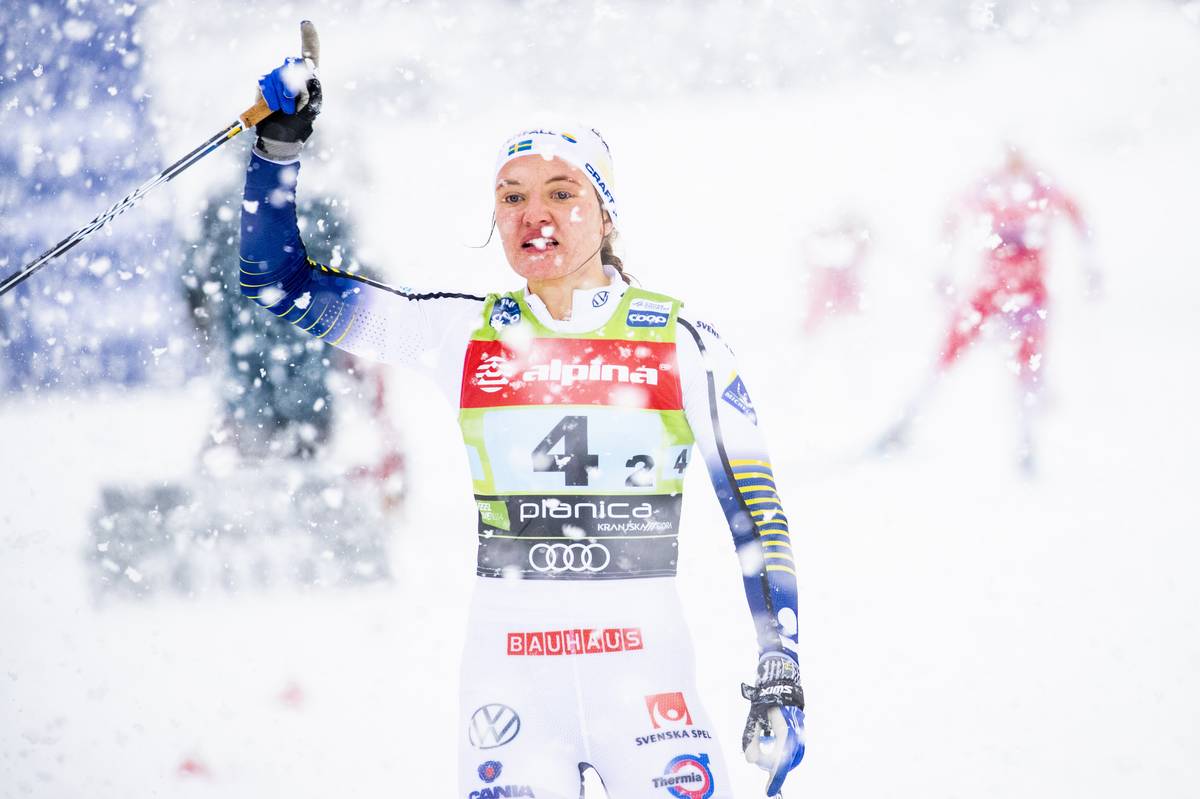
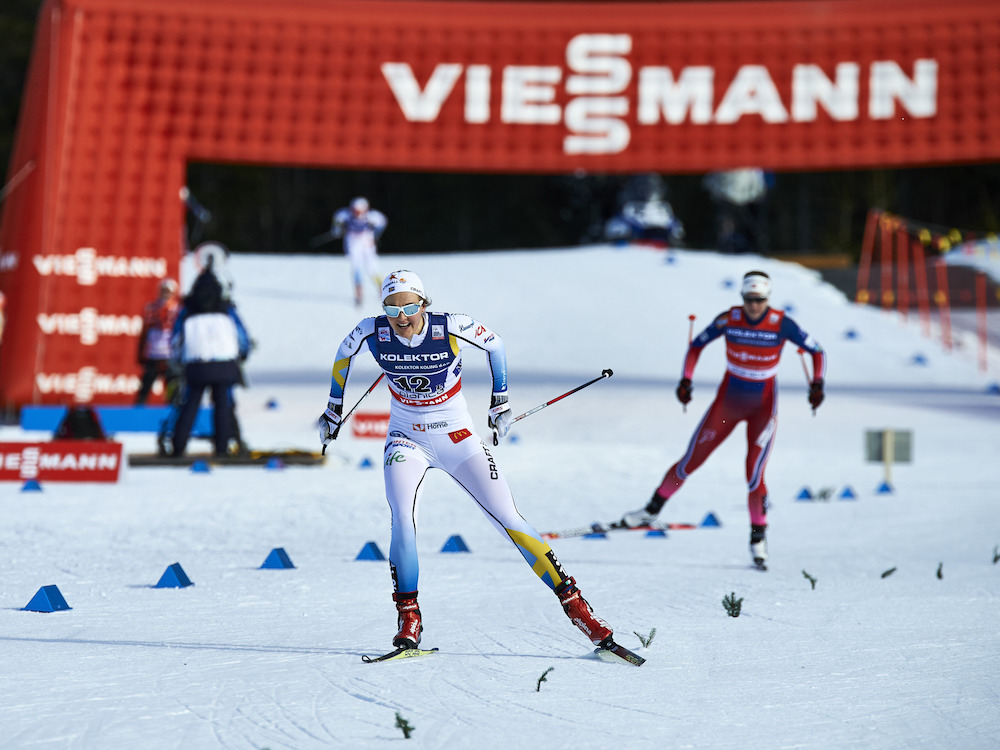
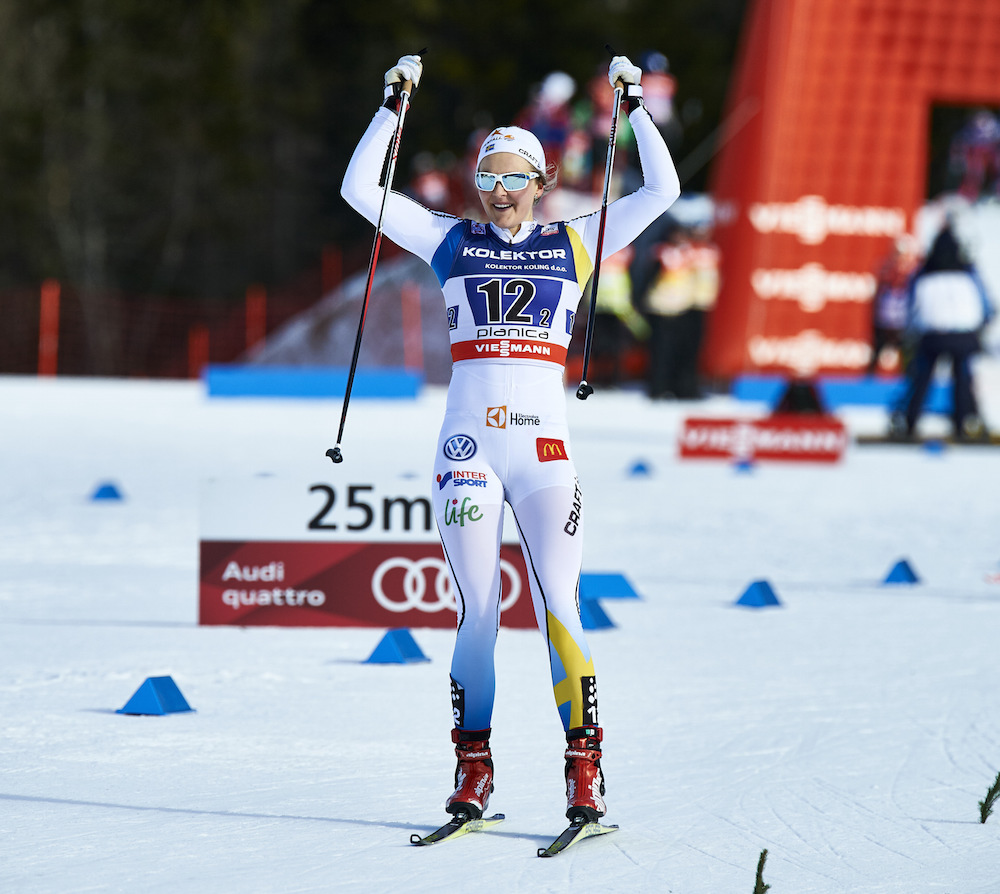
At 20 years old, Sweden’s Linn Svahn has learned to close. She was part of Sweden II’s team-sprint winning team in Planica, Slovenia. (Photo: NordicFocus)
With the tight racing and jostling for position the team sprint presents, another factor was in the mix during Sunday’s Planica, Slovenia women’s 7.2-kilometer freestyle team sprint: big, fat, and plentiful snowflakes.
Saturdays’ rainy, and lightning ridden sprint racing on an artificial snow loop, had a 180-degree backdrop flip-flop with a white winter arriving in Planica in time for the holidays and a World Cup TV broadcast. A several inch veneer of fresh snow covered the tracks.
Coming into Sunday’s race, recent team sprints have been dominated by Sweden. They have won four consecutive team sprints, and six of the last seven. And as much as last season’s World Cup Sprint Crystal Globe winner Stina Nilsson is a rock for the nation, Sweden’s team sprint reign owes much to Maja Dahlqvist. She’s been part of a Swedish three-peat: Dresden (skate) 2018 with Ida Ingemarsdotter, Lahti (classic) 2019, and again in Dresden (skate) 2019.
Sunday, to close out Period I on the World Cup, Dahlqvist was paired with Sweden’s newest World Cup upstart, Linn Svahn, 20, on team Sweden II. On paper at least, the coaches gave the nod for team I designation to Nilsson and Jonna Sundling.
With ten teams represented in the final, the U.S. pairing of Sophie Caldwell and Julia Kern looked formidable. Fresh off Kern’s first career World Cup podium on Saturday and Caldwell’s near podium miss in fourth, they placed second in the team sprint semi-final B to Switzerland’s Laurien van der Graaf and Nadine Faehndrich. The Swiss won that heat by 1:05 over the U.S. (Caldwell and Kern were also teamed up last season in Dresden’s team sprint where they placed fourth in a photo finish.)
Also represented in the final and a usual podium snagger was Norway I with Maiken Caspersen Falla, and Ane Appelkvist Stenseth. Despite their perceived dominance, Norway has not won a team sprint in the last seven attempts. The last women’s team sprint victory for the storied nation came way back in January 2014, when Maiken Caspersen Falla and Ingvild Flugstad Østberg won the classic team sprint in Nové Mesto. Although Falla is proven, Stenseth, 24, is a World Cup podium-contender newcomer. According to FIS, she has contested 10 World Cups. She’s placed fourth twice in individual races — most recently in Ruka’s classic sprint last month.
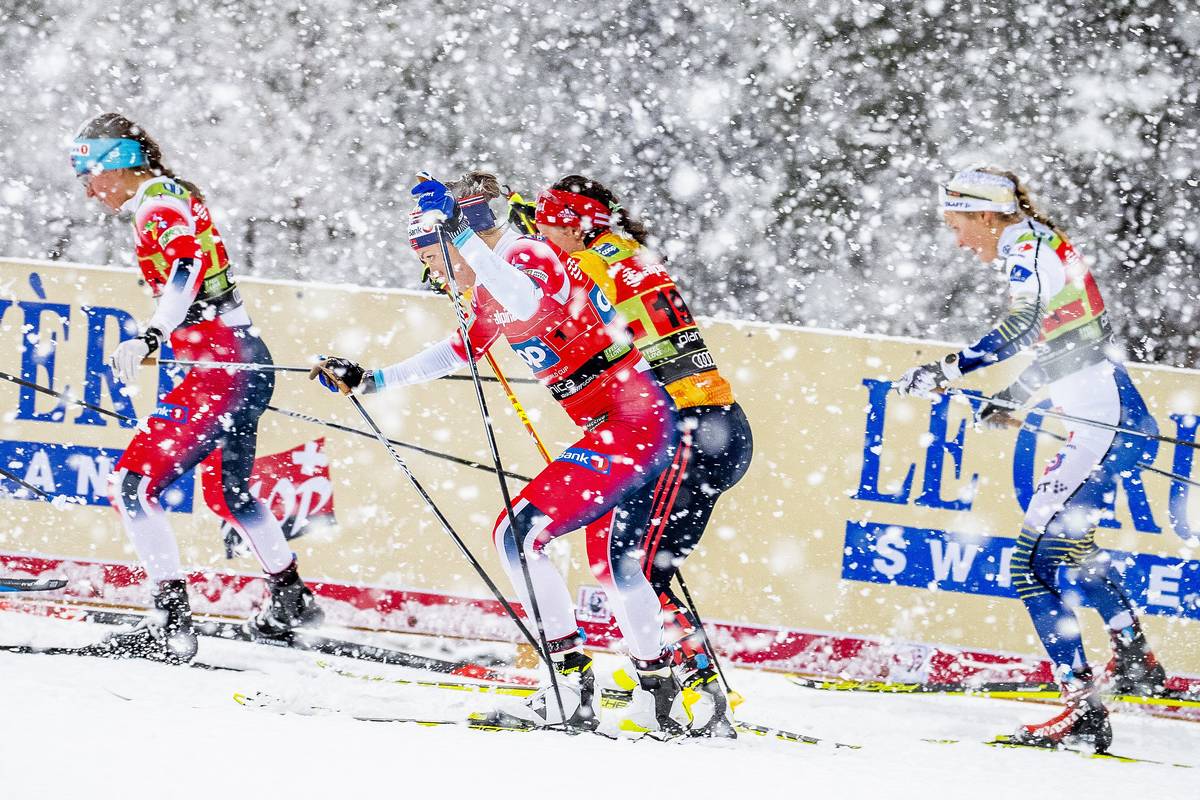
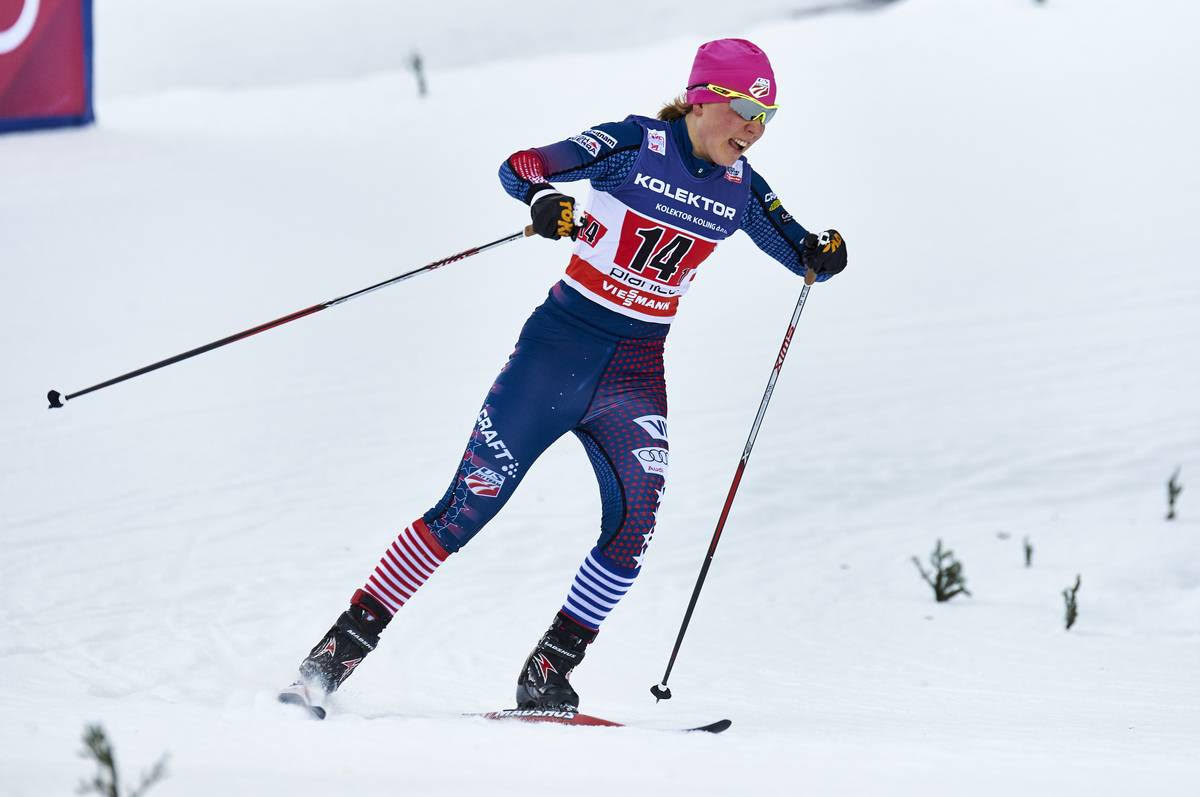
Sophie Caldwell (USA), and Katerina Janatova (CZE), (l-r) during the women’s team 2019 sprint in Planica, Slovenia. (Photo: NordicFocus)
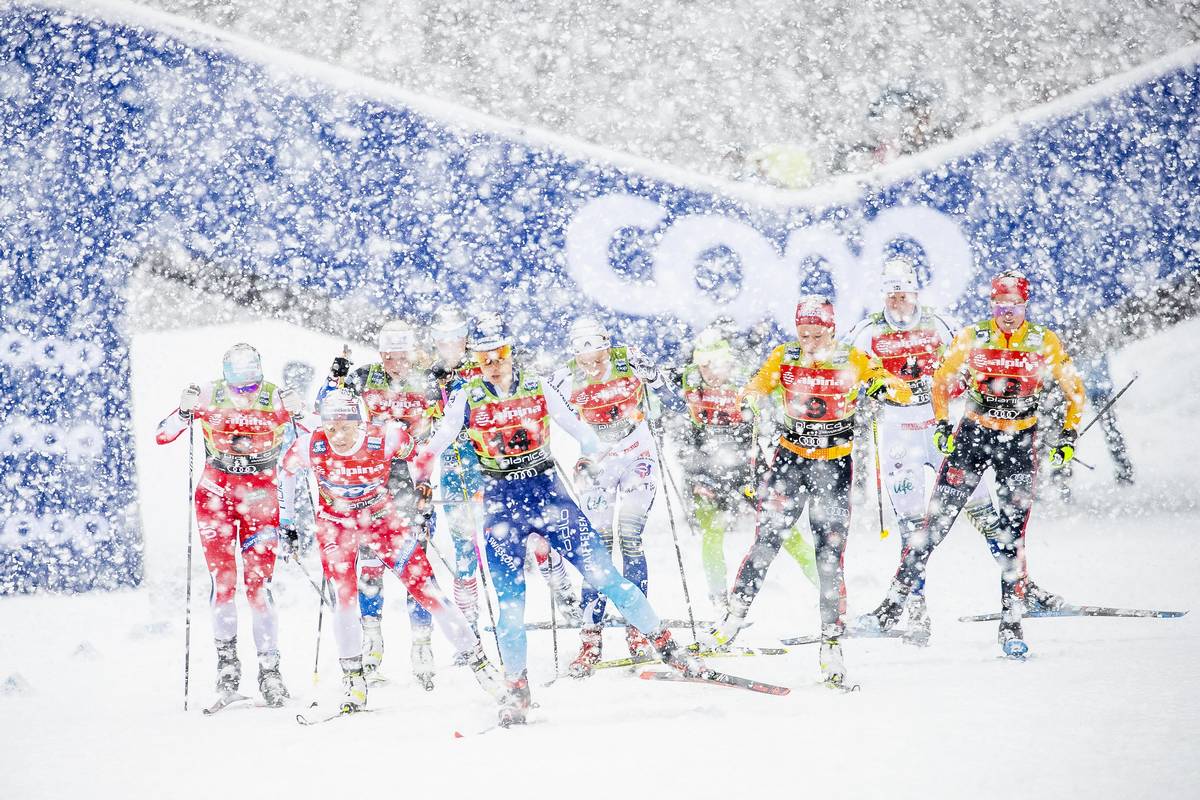
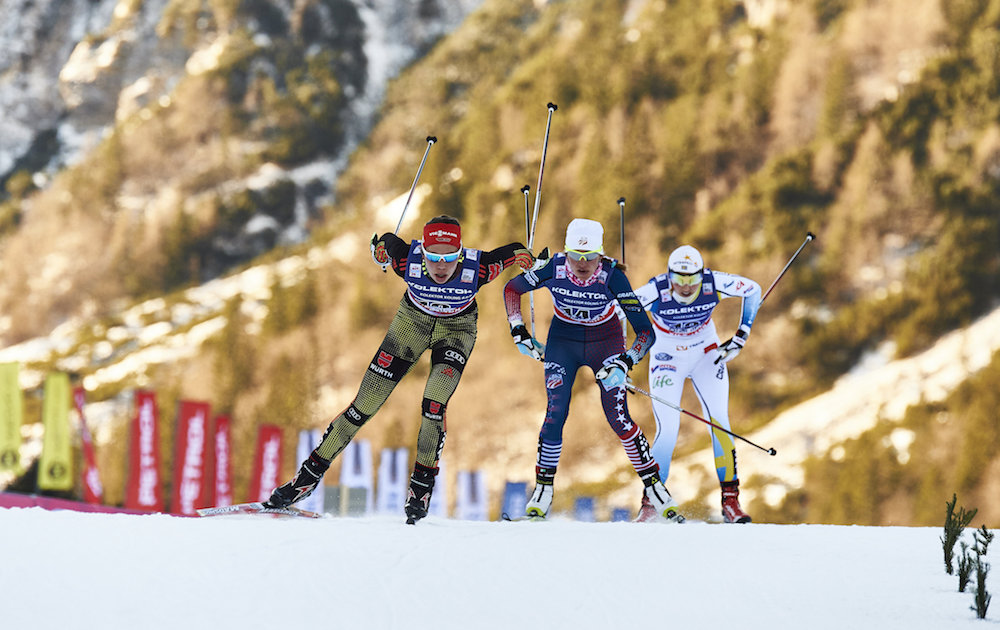
Laurien Van Der Graaf (SUI), Maja Dahlqvist (SWE), Sophie Caldwell (USA), Laura Gimmler (GER), Maiken Caspersen Falla (NOR), (l-r) during the women’s team sprint in Planica, Slovenia. (Photo: NordicFocus)
World Cup Coach Matt Whitcomb’s post-race comments on the U.S. women’s team sprint
With the wins and losses stats laid out, the final was a race around, tag the partner, race around, repeat affair for several laps. With near blinding snow and slow tracks, teams skied conservatively with no attacks of note.
The single blip to the pack racing early on was the collapse of an inflatable arch across the course due to a heavy snow load. Several course attendants scurried to right the arch. There was no stop to the racing, only a momentary snafu to an otherwise peaceful snowglobe scene.
Heavy snow, collapsing arch. Planica women’s team sprint. (Photo: NordicFocus)
That all changed on the fifth of six laps total. At the base of the course’s first climb, Nilsson for Sweden I had been tucked into the pack. She worked her way to the right gliding out of traffic for a clear lane to the top. She jump skated to the lead 15:00 minutes into the final. Carrying her speed into a working downhill, Nilsson broke the race apart.
Sweden II (Dahlquvist), and Norway I (Falla), were the other two teams able to match Nilsson’s push at the sharp end.
Sweden I, Sweden II, Norway I, Norway II, Switzerland, and the U.S. came through the final tag first through sixth, respectively, with a 7.8 second gap from the U.S. in back to Sweden I in first.
Late on that final lap, with 18 minutes of racing elapsed, Sweden I and II, as well as Norway I looked to be the podium in the making. But with perhaps the race effort of the day, Switzerland’s Faehndrich began reeling in the three team group. Twenty seconds later, the Swiss were locked on, making it a four team affair.
Julia Kern (USA), Linn Svahn (SWE), Victoria Carl (GER), Ane Appelkvist Stenseth (NOR), (l-r) during the women’s team sprint in Planica, Slovenia. (Photo: NordicFocus)
On the final climb, Sweden I and II accelerated, dropping Norway I, with the Swiss matching for a moment, then dropping back slightly for a solid third place nearly guaranteed.
The Swedish drag race for first went to Sweden II’s Svahn: they won in 19:13:55 minutes. Sweden I was second (+1.01), and Switzerland third (+1.13). Digging into the recesses of FIS data, Sunday’s third place was Switzerland’s best World Cup team sprint result. They placed fifth in last season’s Dresden team sprint. Norway I placed fourth (+7.58), and the U.S. fifth (+9.72).
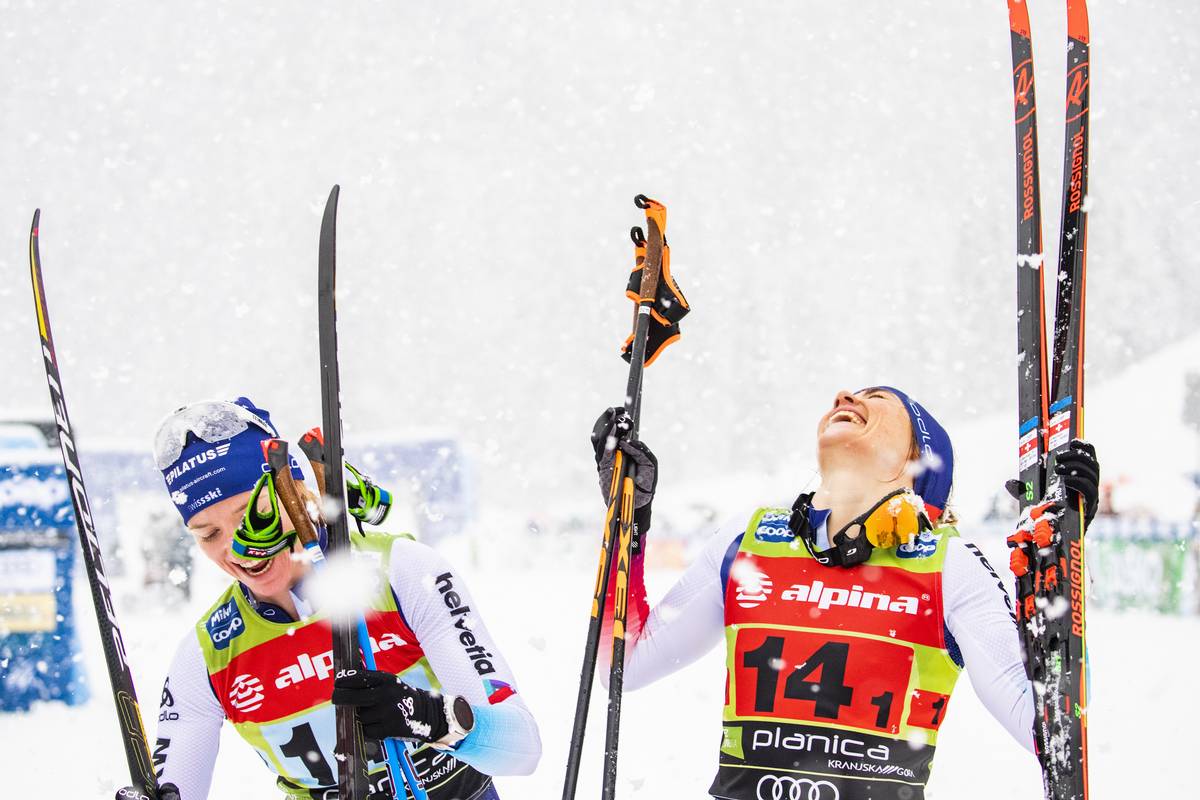
The joys of the podium: Swiss teammates Nadine Faehndrich and Laurien Van Der Graaf (l-r) after their third place in the team sprint in Planica, Slovenia. (Photo: NordicFocus)
“I am happy that after a couple of fourth and fifth places it finally worked out,” van der Graaf stated, according to a translation from the Swiss Ski Federation. “When I tagged off to Nadine in fifth place I was very confident that she would make it.”
Fähndrich said: “For me it was optimal that the top 3 didn’t go all out early on. Thus I could catch up and still had enough energy in the end.”
Norway’s Maiken Caspersen Falla (center) during the 2019 Planica team sprint. (Photo: NordicFocus)
On the ski-wax service side of the race, U.S. World Cup Coach Matt Whitcomb explained in a post-race interview that today’s team sprint included a rule that no team could modify skis during the races. In team sprint additions past, it was common to see trackside techs applying and buffing a topcoat between relay legs. According to Whitcomb, Caldwell’s skis for the final were simply not in play. “So we made a mistake early in the finals,” said Whitcomb. “We had to eat it. And we did.”
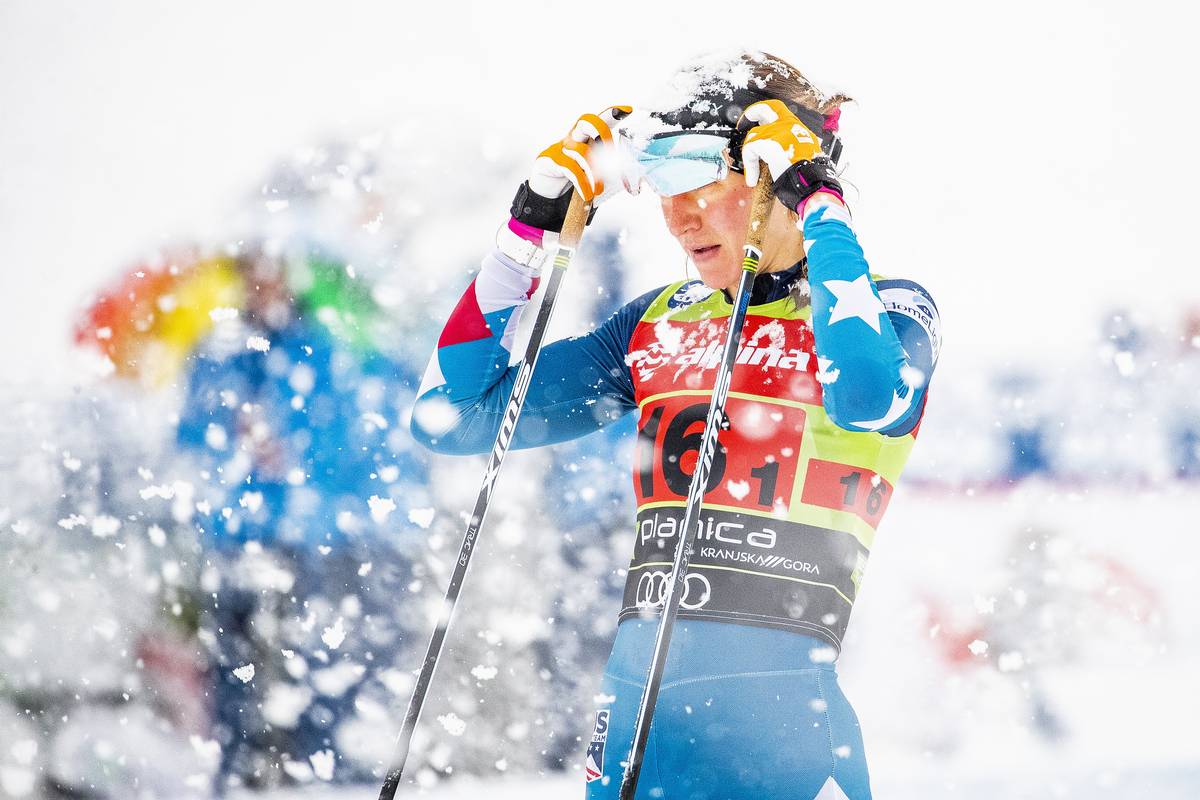
Visor type of day for Sophie Caldwell during the women’s team sprint in Planica, Slovenia. (Photo: NordicFocus)
World Cup Coach Matt Whitcomb’s take on the weather and Caldwell’s skis
FasterSkier will have a Period I breakdown and Tour de Ski preview later this week. The Tour de Ski begins on December 28.
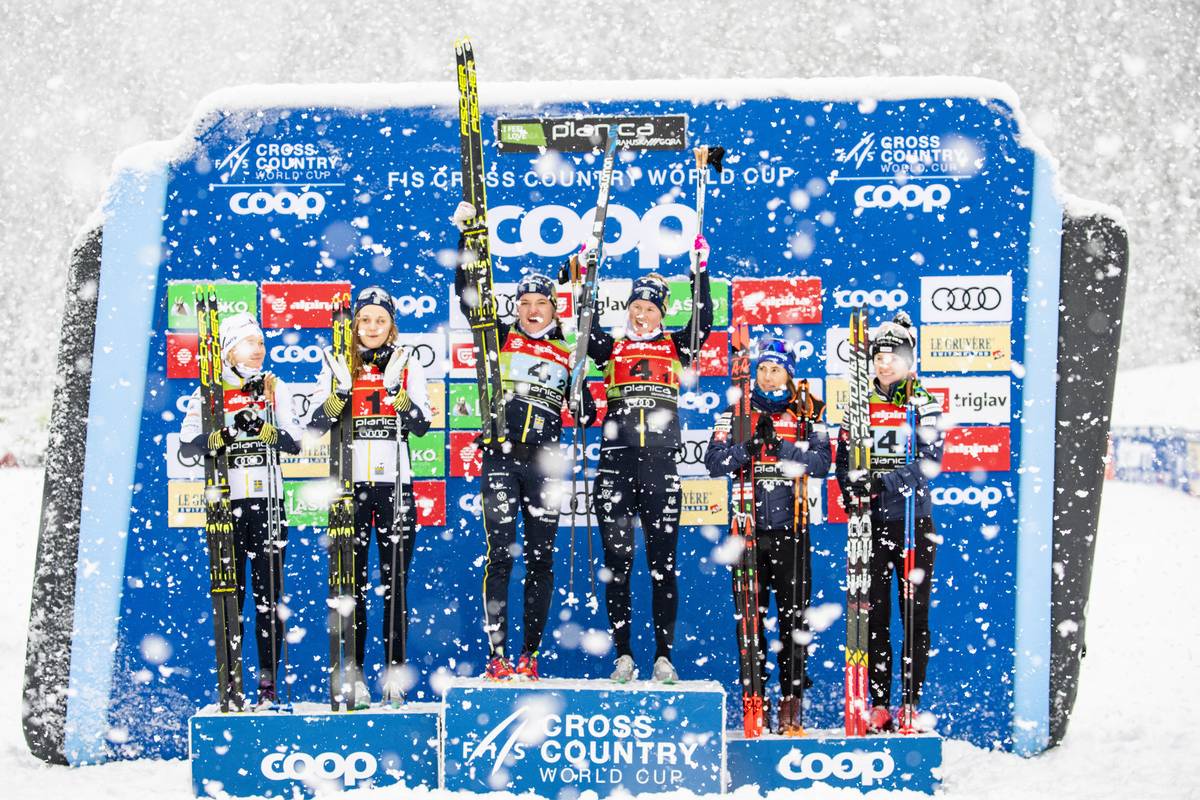
The women’s team sprint podium from Planica: Sweden I’s Stina Nilsson Jonna Sundling in second, Sweden II’s Maja Dahlqvist and Linn Svahn in first, Switzerland’s Laurien Van Der Graaf and Nadine Faehndrich (in third (l-r). (Photo: NordicFocus)
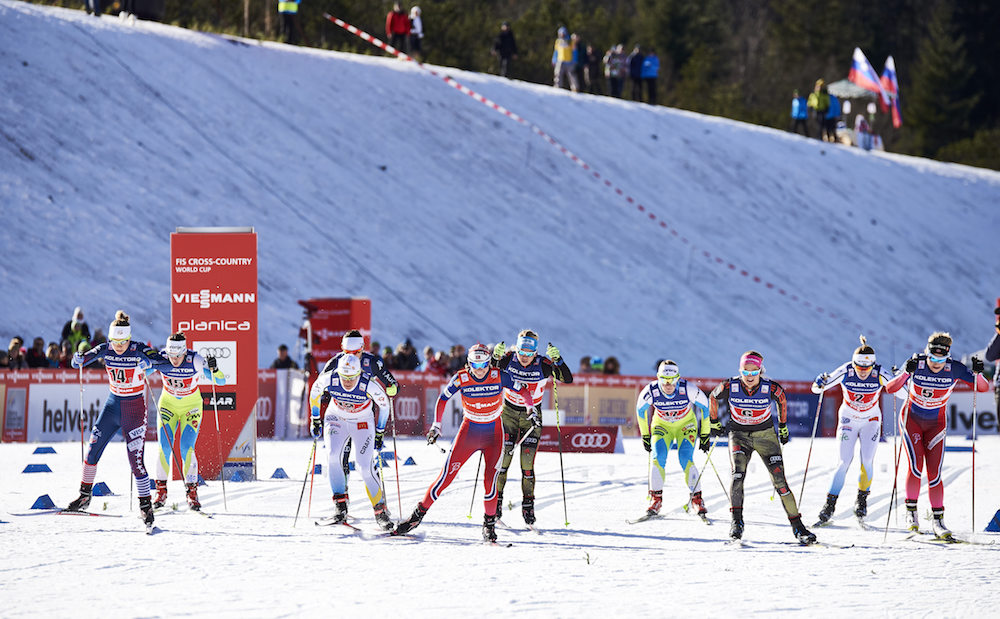
The start of the women’s freestyle team sprint final, with (from left to right) American Ida Sargent, Slovenia Vesna Fabjan, Sweden’s Ida Ingemarsdotter, Norway’s Heidi Weng, Germany’s Sandra Ringwald, Slovenia’s Nika Razinger, Germany’s Laura Gimmler, Sweden’s Jonna Sundling, and Norway’s Mari Eide at the World Cup in Planica, Slovenia. (Photo: Fischer/NordicFocus)
The team sprint is a unique beast that World Cup racers only get one or two shots in a season to tame. Despite strong skiing, the U.S. men’s and women’s team came up just short of being in podium contention in the 6 x 1.2-kilometer freestyle team sprint at Sunday’s World Cup in Planica, Slovenia.
The format of the team sprint competition features two-skier teams who each race alternating legs of a sprint course. Each skier completes three legs and they must make contact with their teammate in the exchange zone between each leg. The Planica team sprints were held on the same fast, twisty and technically-challenging 1.2 k course as Saturday’s freestyle sprint.
The format poses unique challenges for athletes as well as logistical challenge for the staff. For the athletes racing three separate legs, it is a challenge of measuring energy output to be ready for the decisive moves in the last lap. The technicians have their own race in between heats to work on skis.
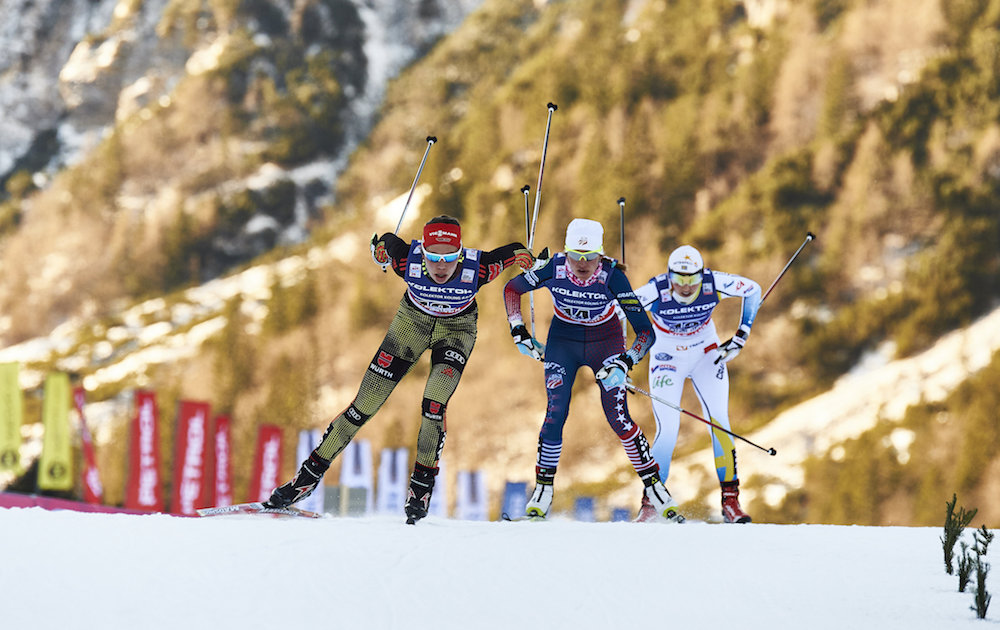
American Sophie Caldwell (c) and Sweden’s Stina Nilsson (r) trail Germany’s Hanna Kolb during the women’s freestyle team sprint final at the World Cup in Planica, Slovenia. (Photo: Fischer/NordicFocus)
“One of the challenges is we don’t get a chance to race this event very often,” head coach Chris Grover said on the phone after Sunday’s race, in which two of three U.S. teams qualified for the final. “We are doing the only team sprint out of 37 starts [this season], so it is a very rare format.
“It is really fun for the athletes and the staff. It is so logistically intense in terms of ski prep,” he added. “It is a race to get the skis off the athletes’ feet, freshened up, and back on their feet.”
Grover noted the course was shorter than typically used in team sprints (it took the men about 2 1/2 minutes and the women 2:45 to round each time on Sunday.
“Because of that short window, it makes for an extremely hectic time for the techs,” he said. “But our techs did an awesome job and we had great skis.”
The U.S. entered one women’s team (with most of its athletes taking the weekend off following the Tour de Ski); Ida Sargent and Sophie Caldwell teamed up to take fifth in the final, 20.57 seconds behind Sweden I, with Stina Nilsson and Ida Ingemarsdotter, who won the event in 16:14.08. Norway I (Heidi Weng/Astrid Uhrenholdt Jacobsen) placed second (+3:51) and Germany I (Sandra Ringwald/Hanna Kolb) took third (+8.84).
Ida Sargent (U.S. Ski Team) teamed up with Sophie Caldwell (not shown) to place fifth in the 6 x 1.2 k freestyle team sprint at the World Cup in Planica, Slovenia. (Photo: Madshus/NordicFocus)
Sargent and Caldwell delivered a well-executed semifinal to automatically advance in second place behind Sweden I, the eventual winners. In the team sprint racing, the top two teams advance in both semifinals, in addition to six lucky loser qualifiers.
“Ida learned from yesterday how to pace the course and made a great move at the end of her last leg and tagged off in first,” Grover said of the semifinal. “Sophie brought it in easily in second to advance.”
In the final, the field broke apart during the third leg when Weng began pushing the pace. Sweden and Germany responded, but Sargent lost time on the leaders. By the final handoff, the U.S. had slipped several places to sixth, 13 seconds behind the leaders.
At the final handoff, Sargent tagged Caldwell in sixth, 13 seconds behind the leaders, for the finishing charge. Caldwell was able to catch Norway II and hold off Germany II to secure fifth place, 20.57 seconds behind the Swedish winners.
“Those top women’s teams just skied away. They [Sargent and Caldwell] actually skied great all day and did tactically what they wanted to do,” Grover said.
“It ties my best-ever team sprint result and is my best ever with Sophie so it was a good day,” Sargent said on the phone. “The course was really hard with lots of climbing and fast technical downhills so there wasn’t much recovery and it was important to balance pushing the pace and conserving energy for later rounds.”
Newell and Hamilton Miss the Tag
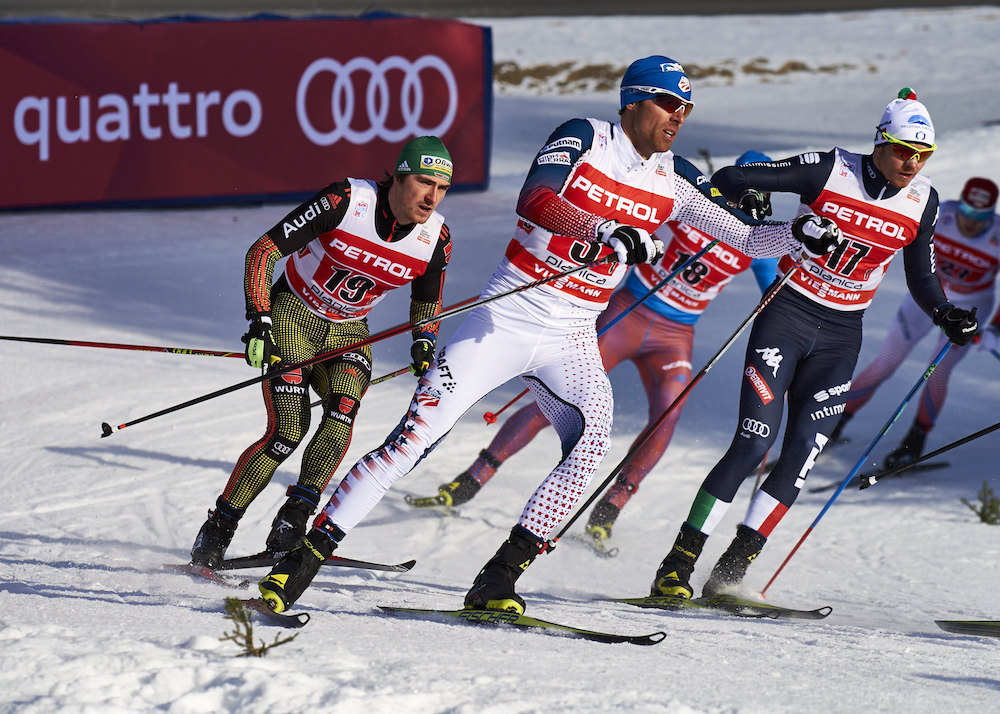
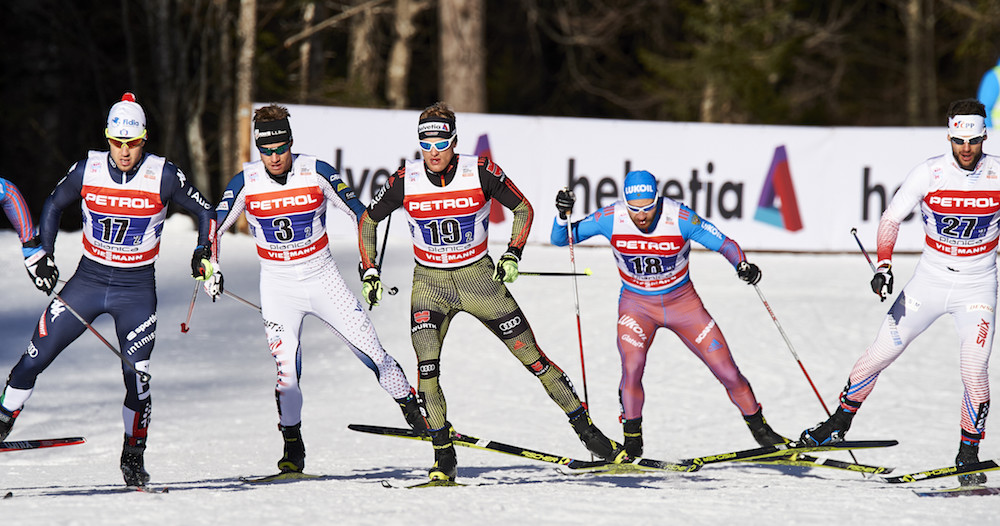
Andy Newell (in white) rounds a corner with Germany’s Thomas Bing (l), Italy’s Dietmar Noeckler (r) during the World Cup men’s freestyle team sprint final in Planica, Slovenia.
The men’s team of Andy Newell and Simi Hamilton made it to the final after advancing in fourth out of the first semifinal (behind the second teams for France, Russia and Norway, respectively). In the final, the Americans initially finished eighth, but were disqualified for missing a tag in the exchange zone.
The men’s field remained tight throughout the final, making the exchange zone both challenging and game-changing.
The U.S. men’s team ran into trouble when Hamilton entered a chaotic tag zone after his first leg for the second exchange.
“It was basically unavoidable since the Norwegian, who was tagged right before I reached out to tag Andy, cut to the left and skied right between Andy and I, essentially creating a barrier,” Hamilton said on the phone. “We were tagging towards the end of the zone, so we didn’t have room to stop to ensure we made contact, even though both of us stretched as best we could.”
They emerged out of second exchange in eighth, 2 seconds behind Norway II in the lead. One lap later, by the third exchange, they were 3.22 seconds back in ninth.
Unsure whether the jury would rule an infraction, Newell and Hamilton continued to race. They finished eighth, less than six seconds off the podium. Italy I took the win with Dietmar Nöckler and Federico Pellegrino in 14:44.82, and France swept the remaining podium spots in second (+1.79) and third (+2.41), with Renaud Jay/Baptiste Gros and Valentin Chauvin/Richard Jouve, respectively. The first teams for Germany, Norway and Russia ended up fourth, fifth and sixth, respectively, and the top eight teams at the end of the day — not counting the Americans — all finished within nine seconds of one another.
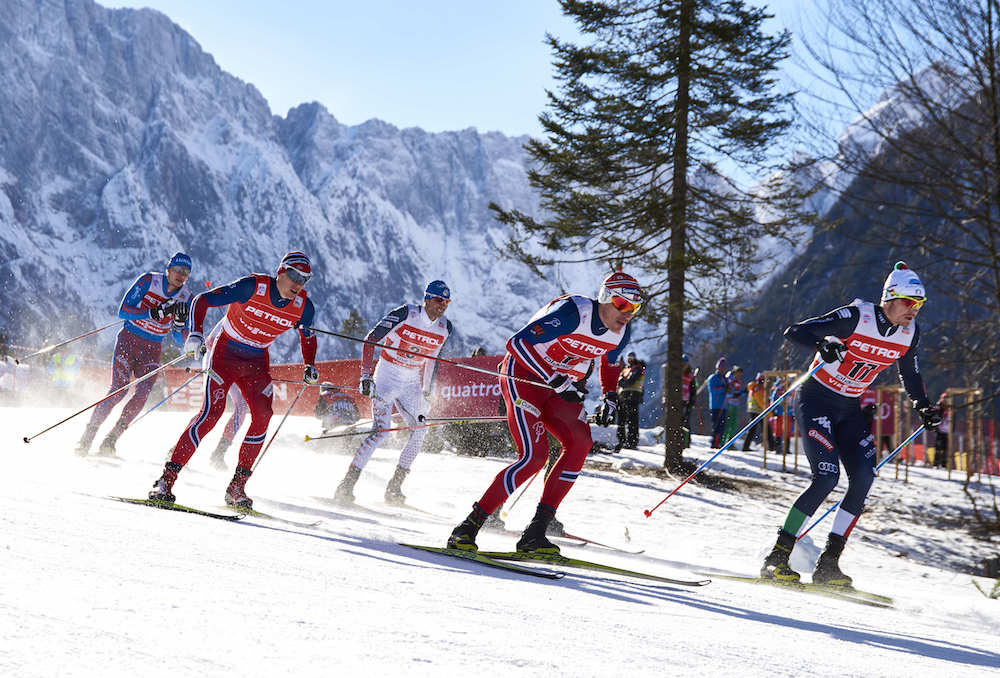
(From right to left) Italy’s Dietmar Nöckler leads Norway II’s Ola Vigen Hattestad, American Andy Newell, and Norway I’s Anders Gløersen and a Russian in the men’s freestyle team sprint final at the World Cup in Planica, Slovenia. (Photo: Fischer/NordicFocus)
“It was disappointing for sure, but it was a good call by the jury,” Grover said. “Andy and Simi have done a lot of team sprints together and tags are such a critical part of the team sprint. Andy and Simi are usually some of the very best at maintaining speed and having really good tags in chaotic situations, but today they just missed it.”
Reflecting on their semifinal, in which they advanced as lucky losers, Newell was pleased with how he balanced his energy.
“I was able to stay up near the front with Norway, stay out of trouble, and put down a hard third lap tagging Simi in second,” Newell said on the phone. “In the final I don’t think we found the same rhythm, at least I hard a harder time feeling the line of hard versus too hard. We got bounced around a bit in the back and our tags weren’t as smooth as in the semi. It’s easy to waste energy even just trying to pick off a few places can take it out of you each lap when you are coming from the back.”
Considering the circumstances, Hamilton was content with the day.
“I felt good today, and my speed and shape are rebounding after getting sick during the Tour de Ski,” he said.
“Team sprinting is one of the hardest race formats we have, but it super fun,” Hamilton added. “It combines the best of sprinting and distance racing I think, and I hope we see more of it, or events similar to it, in the future.”
This was the first and only team sprint on the World Cup calendar this season.
(Story continues below)
(From left to right) Italy’s Federico Pellegrino, American Simi Hamilton, Germany’s Sebastian Eisenlauer, Russia’s Alexey Petukhov, and Dusan Kozisek of the Czech Republic during the men’s freestyle team sprint final at the World Cup in Planica, Slovenia. (Photo: Fischer/NordicFocus)
Also competing for the U.S. was the second men’s team of Dakota Blackhorse-von Jess and Reese Hanneman. They finished 12th in the same semifinal as Newell and Hamilton, 51.08 seconds behind France II (Chauvin and Jouve) as the winner of that heat. Blackhorse-von Jess and Hanneman did not advance and ended up 23rd overall.
“For Dakota and I, it was just a chance to get right in the big pack of the fastest guys in the world and see what we could do,” Hanneman wrote in an email. “No amount of preparation could really prepare you for the chaos that happens at breakneck speed out there.”
“I think they were both left wanting more,” Grover said. “They are going to need some time in Europe to get get acclimated some good training and racing and hopefully come into their top form.”
The weekend following the Tour de Ski can be rough on teams and the U.S. team is feeling the effects.
“It was a little bit of a flat weekend overall for us,” Grover observed. “We are certainly feeling the effects of post-Tour de Ski fatigue, both physical and mental, and we have a bit of illness going around the team so all of these things added up to take our edge off a bit, but I think we’ll be back by next weekend.”
‘Good save Canada!’
Four Canadian teams raced Sunday, but none advanced out of the semifinals. Canada’s second women’s team, with Cendrine Browne and Emily Nishikawa, placed eighth in the second women’s semifinal, 55.64 seconds behind Sweden I as the winners of that heat, for 15th overall.
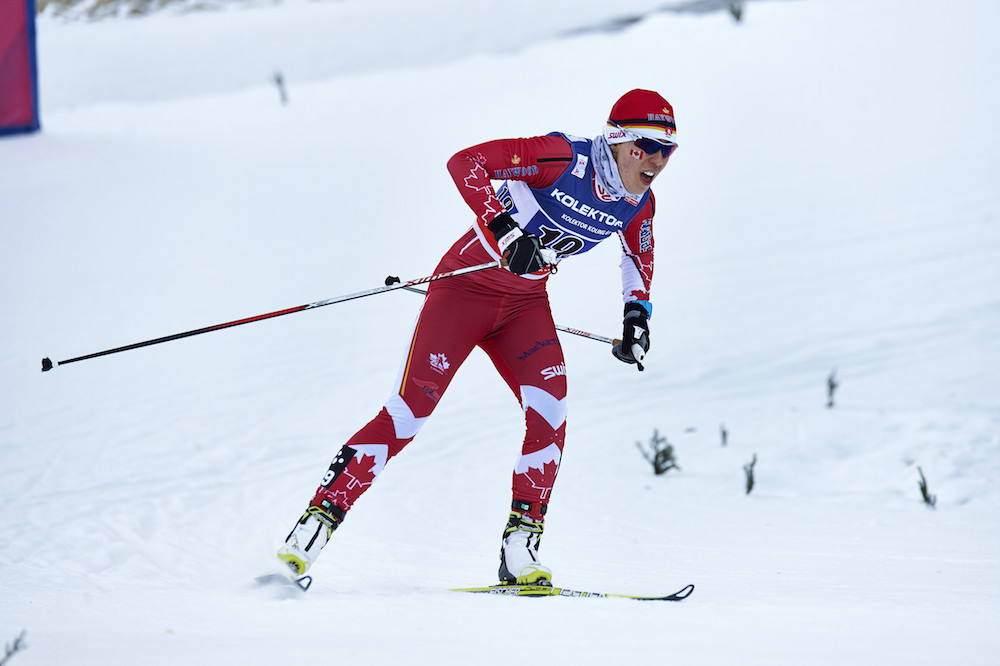
Emily Nishikawa (above) teamed up with Cendrine Browne (not shown) to represent Canada II in the women’s World Cup freestyle team sprint on Sunday in Planica, Slovenia. They placed eighth in the semifinal for 15th overall. (Photo: Fischer/NordicFocus)
In that same semi, Canada I, with Maya MacIsaac-Jones and Dahria Beatty, finished 10th (+1:06.39) for 19th overall.
“I focussed on staying with the pack as long as possible,” Browne, Canada II’s first starter, recalled in an email. “I managed to stay with them on the first lap but on my second lap, we were already a couple seconds back.
“The down hills are pretty sketchy … I almost fell today but catched myself at the last second!” she added. “The jury even told me: Good save Canada!”
“The women fought hard, but it will take some more racing at that level to get used to the speed,” Alberta World Cup Academy head coach Chris Jeffries, who’s leading the Canadian team in Slovenia, said in a Cross Country Canada press release. “These World Cups are definitely focused on development, and hopefully they will take some really good lessons to their training in preparation for the Ski Tour Canada races in March and the coming years.”
Both Canadian men’s teams squared off in the second semifinal, with Knute Johnsgaard and Len Valjas placing ninth for Canada I (+13.23) for 16th overall, and Jess Cockney and Andy Shields finishing 12th for Canada II (+23.85) for 22nd overall.
Stina Nilsson smiles as she secures the win for Sweden with teammate Ida Ingemarsdotter (not shown) in the women’s freestyle team sprint final at the World Cup in Planica, Slovenia. She beat Norway’s Astrid Jacobsen (behind) for the victory. (Photo: Fischer/NordicFocus)
Groundhog Day. That was the feel of Sunday’s 6 x 1.2-kilometer freestyle team sprints at the World Cup in Planica, Slovenia, a day after Sweden’s Stina Nilsson and Italy’s Federico Pellegrino won the individual freestyle sprints on the same one-lap 1.2 k course.
The women’s team sprint came down to the final climb on the last leg — just like in the last round of the individual women’s sprint on Saturday. Trailing a Norwegian on the last descent and into the base of the climb back up to the stadium (yesterday it was Ingvild Flugstad Østberg; today it was Astrid Uhrenholdt Jacobsen), Nilsson carried her speed to pull up alongside and blow past the Norwegian, leading by the top.
Look familiar? That’s because it is. Sweden’s Stina Nilsson notched her second-straight victory of the World Cup weekend in Planica, Slovenia, on Sunday, anchoring Sweden I to the freestyle team sprint win. (Photo: Fischer/NordicFocus)
The 22-year-old Nilsson, both U23 and Sprint World Cup leader, continued to accelerate in the last 200 hundred meters to the finish, winning in 3.51 seconds for her second victory of the weekend. Nilsson shared it with Ida Ingemarsdotter, 30, teammates on Sweden’s first team (noted as Sweden I).
“We had a great day as a team. You could say we are a good couple,” Nilsson told FIS after the race. “Ida did a great work. In the final lap I was in a good position and I could ski as I wanted. I am very satisfied with the weekend in Planica.”
After sharing the podium with Nilsson on Saturday, Heidi Weng and Jacobsen teamed up for Norway I and finished second after leading at every exchange, just ahead of the Swedes. Nilsson and Ingemarsdotter had won their semifinal (ahead of Americans Ida Sargent and Sophie Caldwell in second) to automatically advance to the final, and Weng and Jacobsen won the other semifinal.
“This is better than third, but not good enough tactically to win,” Jacobsen told VG after the final, according to a translation. “Towards the end Stina had a gear that I had not.”
After nine of 10 teams skied within four seconds of the lead through the first two exchanges, Weng picked up the tempo on her second leg (third overall), and Ingemarsdotter and Germany’s I’s Sandra Ringwald stuck closest to her. Meanwhile, Sweden II slipped about 1.5 seconds off the pace in fourth, while the U.S., with Ida Sargent and Sophie Caldwell, skied in fifth (+4.46) at the third exchange — the halfway point.
One lap later, Jacobsen and Nilsson remained close, about half a second ahead of Sweden II’s Hanna Falk in third. Germany’s I’s Hanna Kolb came through the exchange a second later in fourth. By the final exchange, Weng and Ingemarsdotter had gapped Germany’s Ringwald, skiing in third, by 2 1/2 seconds.
“I knew Weng would run hard, especially in the second and third lap and am happy that I could latch on to and give Stina a good position,” Ingemarsdotter told Dagens Nyheter, according to a translation.
“Ida made it perfect. I just got the position I wanted,” Nilsson said.
Germany’s first team hung onto third and secured third, 8.84 seconds behind Sweden and 5.33 seconds behind Norway, for their first podium in almost two years.
“My attack came maybe a little too early, but it was the plan, and maybe that didn’t totally work out because I folded a little in the end,” Ringwald told German TV broadcaster ZDF. “But the three of us were able to create a gap, and so we are satisfied with the third place.”
“I am really relieved, because we knew we had a gigantic chance today and that we had to grasp it,” Kolb said. “Just a great feeling.”
Last season, Nilsson and Ingemarsdotter won the only team sprint on the schedule — also freestyle technique — in Otepää, Estonia. There, they beat Norway’s Maiken Caspersen Falla and Østberg by 0.85 seconds, and Poland’s Justyna Kowalczyk and Sylwia Jaskowiec finished 0.95 seconds back in third.
Falla and Østberg rested on Sunday, while Mari Eide and Kathrine Rolsted Harsem represented Norway II. Fourth through seventh were separated by 2.77 seconds, with Falk (Sweden II) leading the chase group in for fourth (+18.24), followed by Caldwell in fifth (+20.57).
Germany II’s Lucia Anger edged Harsem in a photo finish for sixth by 0.01 seconds, 21 seconds behind the winners. Two Slovenian teams reached the final, placing eighth (+47.24) and 10th (+2:42.12), while Italy finished ninth (+55.98).
(Story continues below)
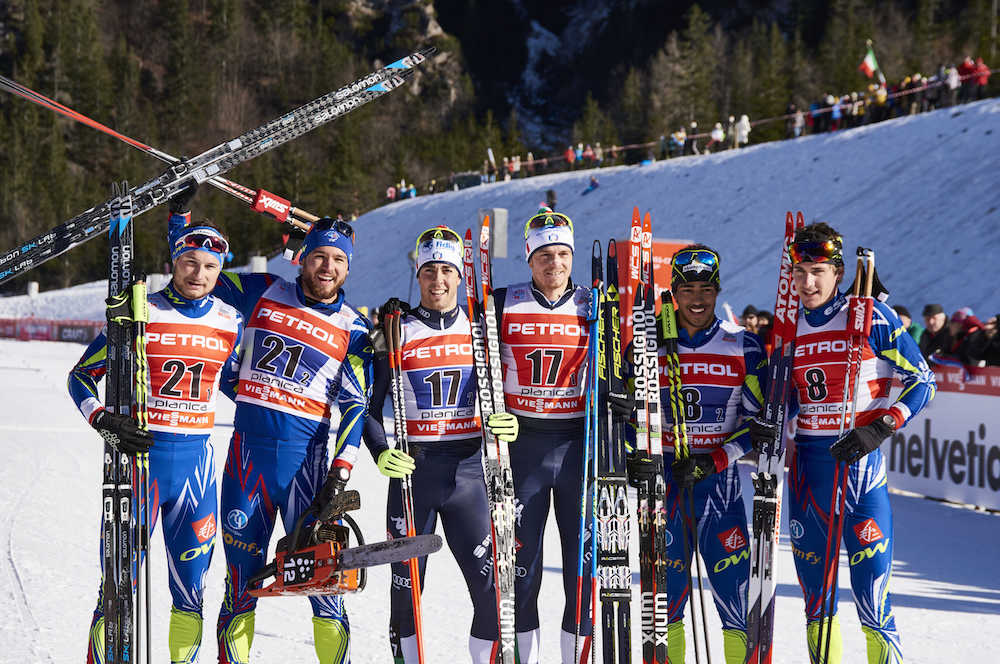
The men’s freestyle team sprint podium at the World Cup in Planica, Slovenia: with Italian winners Federico Pellegrino and Dietmar Nöckler (c), France I’s Renaud Jay and Baptiste Gros (l) in second, and France II’s Richard Jouve, age 21, and Valentin Chauvin, age 20, (r) in third. Yes, Gros is holding a chainsaw — a chain-free noisemaker borrowed from spectators. (Photo: Fischer/NordicFocus)
Italy, France, France
Minutes after the women’s final, the men’s final played out to produce the identical winner to Saturday’s sprint — Italy’s Federico Pellegrino — who essentially pulled off the same move as Nilsson, not long after she anchored the Swedish women to the win in 16:14.08. Pellegrino anchored Italy’s first team (with teammate Dietmar Nöckler) to the win in 14:44.82.
In yet another repeat, France occupied the remaining spots on the podium in the men’s race. Renaud Jay of France’s first team led five frontrunners into the exchange zone for the last time, with France I, Germany I, Italy I, Russia I, and Norway I all within a second of one another.
On the next lap, Jay’s teammate Baptiste Gros set a blistering pace and Pellegrino chased him up the longest climb on the course. There, they began to break away from Germany and France’s second team, and Gros continued to lead up the final ascent.
On that climb, Pellegrino pulled a “Nilsson,” so to speak, as he carried his momentum from the downhill draft to pass Gros before the top. The 25-year-old Pellegrino, who became Italy’s winningest Italian male skier of all time on Saturday with his seventh individual World Cup win, added another victory to his resume as he skated away toward the finish, looking back a few strides before and winning in 1.79 seconds.
(From right to left) Italy’s Dietmar Nöckler leads Norway II’s Ola Vigen Hattestad, American Andy Newell, and Norway I’s Anders Gløersen and a Russian in the men’s freestyle team sprint final at the World Cup in Planica, Slovenia. (Photo: Fischer/NordicFocus)
France I’s Jay and Gros place second, and France II, with 20-year-old Valentin Chauvin and Richard Jouve, 21, held off Germany for third (+2.41).
Germany I, with Thomas Bing and Sebastian Eisenlauer, notched fourth (+2.93). Norway missed the podium for the second-straight men’s race with Norway I’s Anders Gløersen and Eirik Brandsdal in fifth (+4.51) and Norway II’s Ola Vigen Hattestad and Pål Golberg in seventh (+7.66), behind Russia’s Gleb Retivykh and Alexey Petukhov in sixth (+6.46).
Americans Andy Newell and Simi Hamilton crossed the finish line in eighth, but were disqualified for missing the tag in the zone on the second exchange.
Early in the race, Gløersen led though the first exchange to give Norway I an early lead, but they slipped to sixth with Brandsdal on the next leg, 1.3 seconds behind Norway II in first. Hattestad had brought Norway II into the lead, and by the fourth exchange, his teammate Golberg remained third, within half a second of Pellegrino and Gros. One lap later, Norway I and II came through the last exchange in fifth and sixth, 1 and 2 seconds out, respectively.
Norwegian commentators were quick to call Sunday’s final another instance of the Norwegians being “outclassed,” pointing out that six Norwegians occupy the top seven in the men’s overall World Cup standings. In the sprint standings, Pellegrino leads Norway’s Sondre Turvoll Fossli by nearly 200 points. Finn Hågen Krogh ranks fourth and Petter Northug is the third Norwegian in the top six.
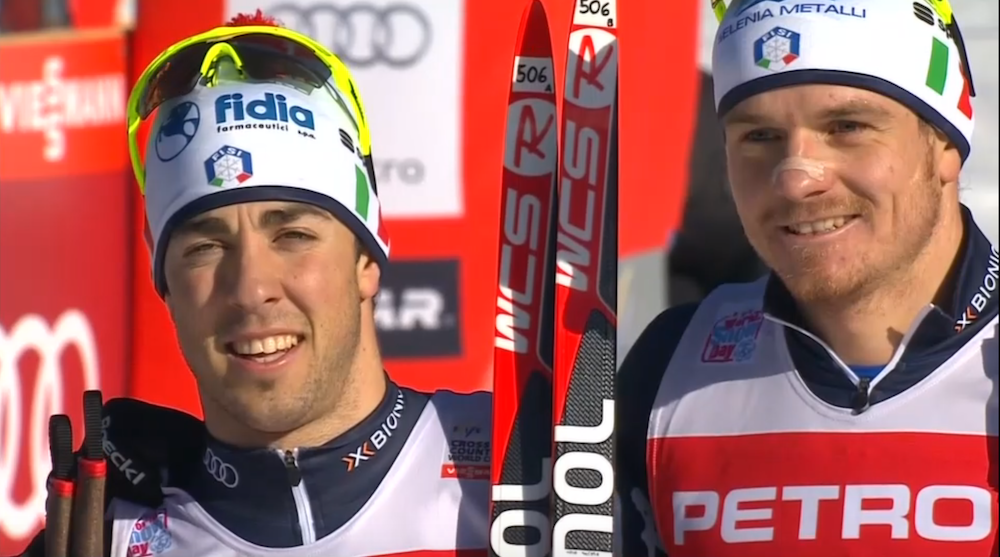
Italian teammates Federico Pellegrino (l) and Dietmar Nöckler after winning Sunday’s World Cup freestyle team sprint in Planica, Slovenia.
“I realized a dream I had at a very young age,” Pellegrino told Italy’s La Gazzetta after Sunday’s win, according to translation. It was apparently Italy’s first team-sprint win since the women won in 2010 in Düsseldorf, Germany.
“In my early years of the World Cup, one of my first trips to the World Cup was in Düsseldorf, where they scheduled just a sprint and team sprint,” he added. “Seeing champions such [Italy’s Arianna] Follis and [Norway’s] Hattestad that could make a perfect weekend lit my imagination. I wondered if I could ever do it.”
For Nöckler, 27, it was his first World Cup win.
“I did not feel that good in the semifinal,” he told FIS after he and Pellegrino qualified second behind France’s Jay and Gros. France II won the other semifinal.
“I knew Federico is the best finisher in the world,” Nöckler added. “I tried to work hard to prepare a good position for him. We have won five Italian national championships together. It is great to win the World Cup.”
At 2015 Word Championships, Nöckler and Pellegrino earned bronze in the freestyle team sprint (behind Norway and Russia, respectively).
France’s Jay was thrilled to be on the podium after placing fourth on Saturday.
“I knew Baptiste was very strong today,” Jay told FIS. “I wanted to gain some meters before the last exchange so that Baptiste has advantage on Pellegrino, but Federico was too strong.”
For Chauvin, the weekend marked his first on the World Cup.
“It is just amazing,” he said of Sunday’s podium. “It is fantastic I could be on the podium with my friends. The whole team did great here during the whole weekend.”