
Tag: Planica World Championships

  • “A Mix of Everything.” Rosie Brennan Reflects on Hard-Fought Battle for Podium, as Andersson Wins 30 k

    “A Mix of Everything.” Rosie Brennan Reflects on Hard-Fought Battle for Podium, as Andersson Wins 30 k

    This World Cup coverage is made possible through the generous support of Marty and Kathy Hall and A Hall Mark of Excellence Award. To learn more about A Hall Mark of Excellence Award, or to learn how you can support FasterSkier’s coverage, please contact info@fasterskier.com

    On the final day of a World Championships defined by new highs in terms of results for the United States, Rosie Brennan (USA) delivered a performance that reiterated that—for Brennan and her teammates—it has been all the qualities that a results sheet can never capture which have powered the US Ski Team to the milestones of the past two weeks. After heartbreak in last week’s skiathlon, Brennan set out in today’s marathon, a 30 k classic, to be the best that she was capable of becoming. Through surge-after-surge, kick-after-kick, she fought. She was in contention for a medal until the very last. In the story of the race, the fifth place result that Brennan scored was a whisper compared to the shout of the way she had gotten there. Brennan is the American skier whose career has been the definition of perseverance; today, she distilled that quality in a way that was traceable over the course of a single ski race.

    That race also produced significant finishes for other North Americans: Hailey Swirbul (USA) 18th, Julia Kern 27th (USA), Katherine Stewart Jones (CAN) 28th, Lillian Gagnon (CAN) 32nd, Dariah Beatty 32nd,
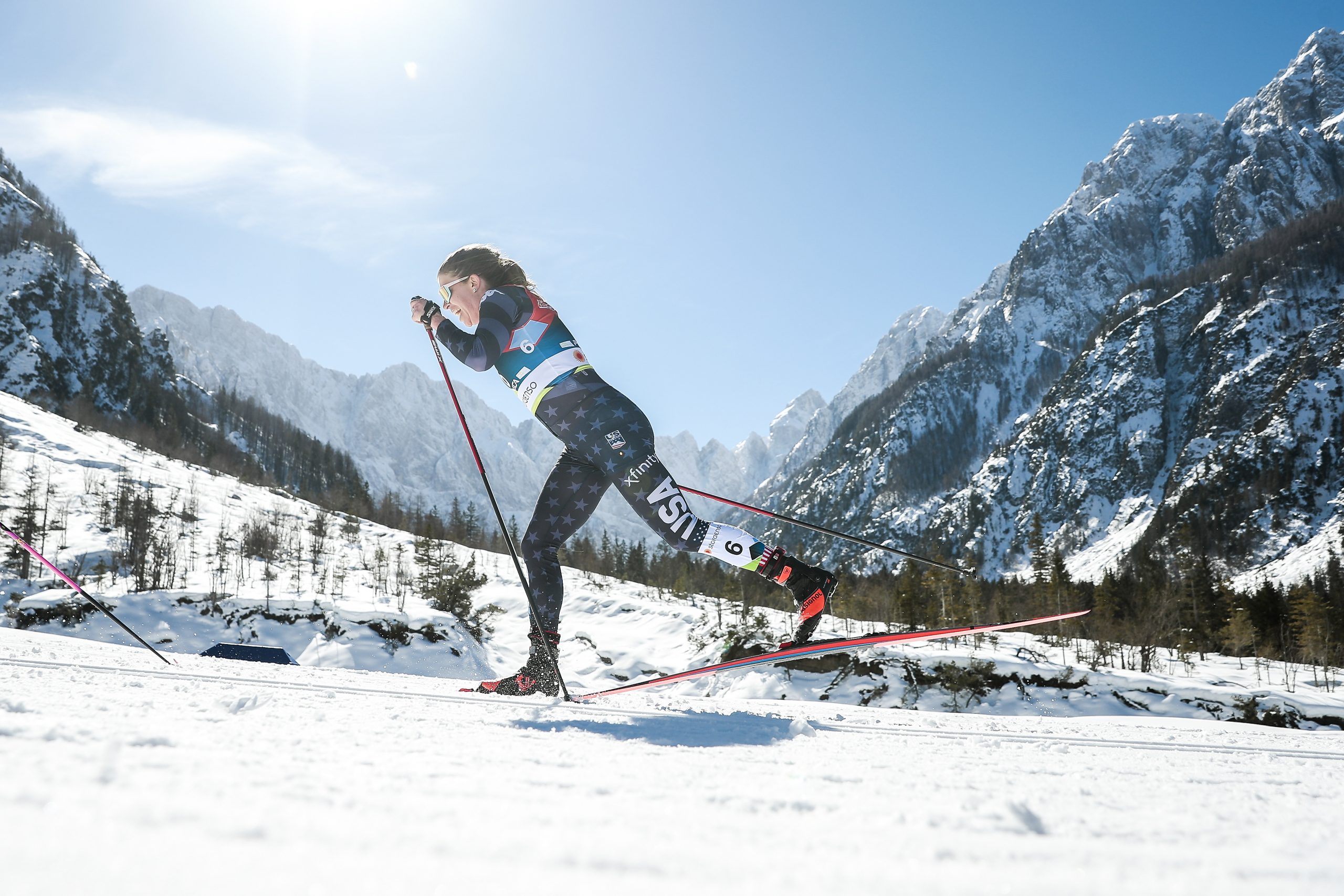
    Rosie Brennan (USA) skied to fifth place—missing the podium by a single second—in the 30 k classic in Planica. (Photo: NordicFocus)
    30 k Classic Mass Start—Andersson Reaches New Heights for Sweden

    There was plenty to anticipate before today’s marathon: for the first time in a week, sunny skis and warm temps returned to Planica; for the first time in over a decade, the winner of the women’s World Championship 30 k wouldn’t be named Therese or Marit. The retirement of both Therese Johaug (NOR) and Marit Bjoergen (NOR) left open the possibility that any skier could make marathon history today. The skier that accomplished that was Ebba Andersson (SWE), who waited with patience through the first lap, launched an uptick in pace on the long climb out of the stadium 10.75 k into the race, and strided away from the field to win her first World Championship in the 30 k, and the first World Championship for Sweden in the World Championship marathon since Marie-Helene Oestlund won the 20 k in 1987. Andersson’s win marked her third career World Championship, after she won the skiathlon earlier in Planica and was part of Sweden’s gold medal relay team in Seefeld in 2019. It also accented another strong World Championships for the Swedish women, an they began by sweeping the Sprint podium, and ended with an ascendent marathon star.
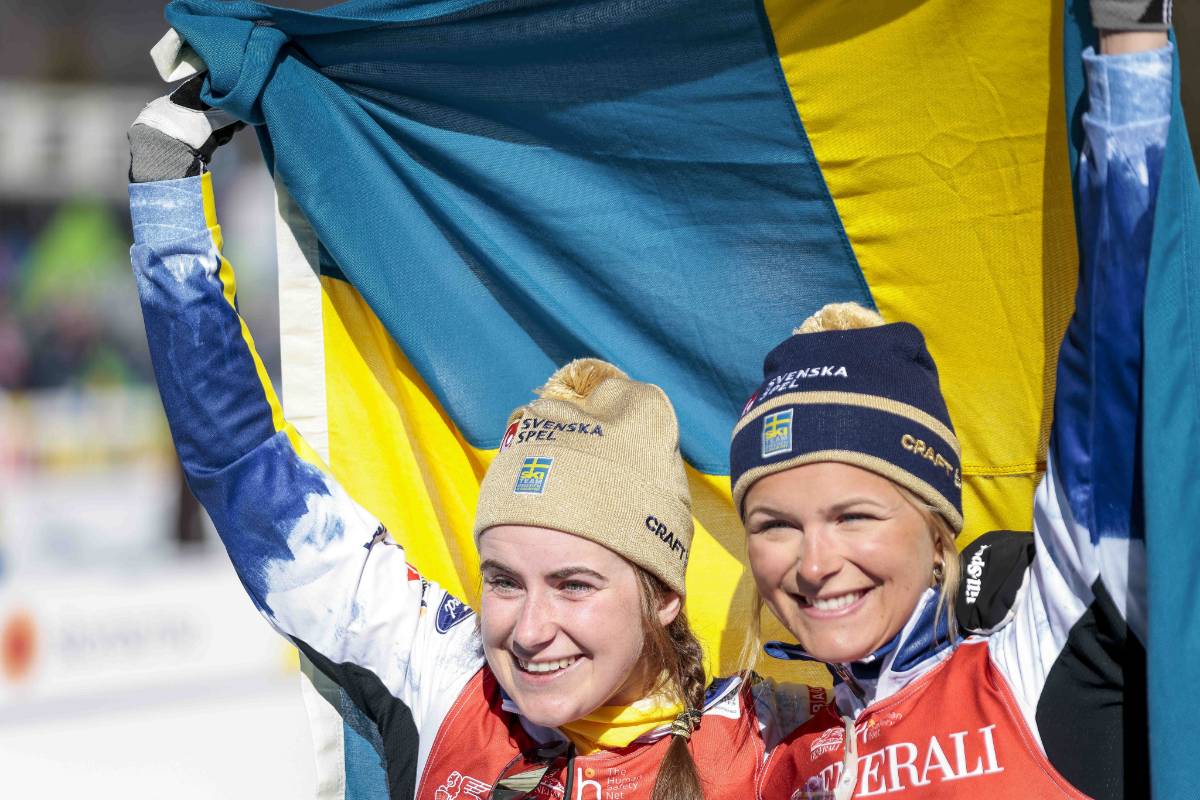
    Ebba Andersson (SWE) and Frida Karlsson (SWE) completed an all-around excellent World Championships for Sweden.  Andersson won her third World Championship in a dominant 30 k performance. Karlsson kicked late to finish third. (Photo: NordicFocus)

    Perhaps the most tense race of these World Championships, though, was the one that played out behind Andersson for the remaining podium spots. When Andersson strided away, the field stretched and then snapped. A three-strong chase group initially formed, containing Anne Kjersti Kalvaa (NOR), Kerttu Niskanen (FIN), and Brennan.

    “Even though the race looked like it happened slow, [Ebba’s] move happened fast,” said Brennan. “I did think for a while that maybe we might catch back up to her, but before you know it, [the gap] was a minute.” Kalvaa, Niskanen, and Brennan were left to wind their way through the rolling downhills that defined the last kilometer of the course.

    Those downhills marked a reprieve during what was an otherwise brutal climbing course, a 7.5 k loop that the US Ski Team Coach called, “breath-taking, but if you take a step back, one of the hardest courses they will ever race.” After climbing 272 meters (892 feet) in hot, wet, sticky klister conditions, the final downhills would prove crucial in later laps. The importance of having the best skis on the final downhills would soon be made clear.

    Races of this distance offer competitors the opportunity to switch skis mid-race, if desired: a decision that would change the nature of the race. Switching skis allowed the Swedish pair of Karlsson and Linn Svahn to bridge a gap to the first chase group, ultimately allowing them to join the fight for the podium. And, despite an initial stumble as the klister on her skis caught the track for the first time, the exchange would see Anne Kjersti Kalvaa (NOR) moving onto skis that were “insane,” according to Rosie Brennan.

    Brennan, herself, moved onto skis she felt were “not as good as my first pair, [which] was frustrating seeing how good some of those skis were. That, of course, is the gamble of switching.” Brennan noted that the relative ski speed changed her tactics. “I second-guessed my ability to just ski away,” she said. “I thought at that point, my best card to play was to hang in there for the dogfight at the end.”
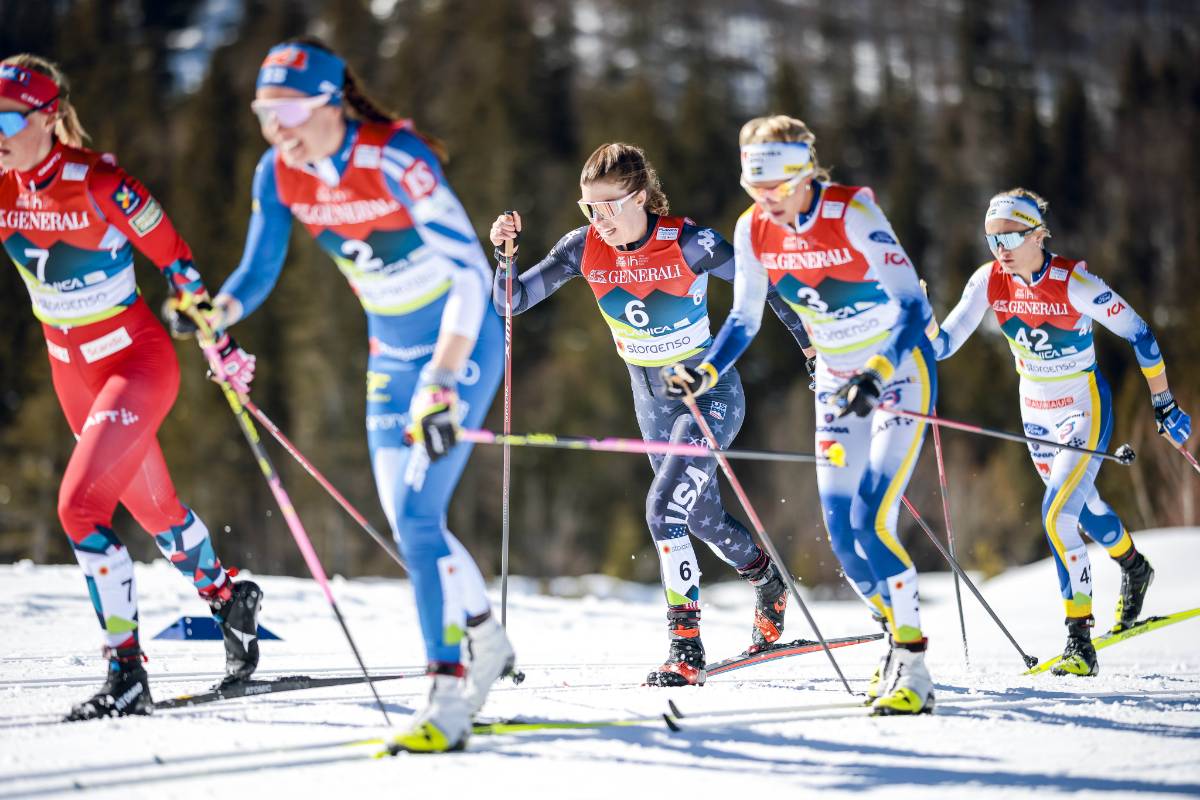
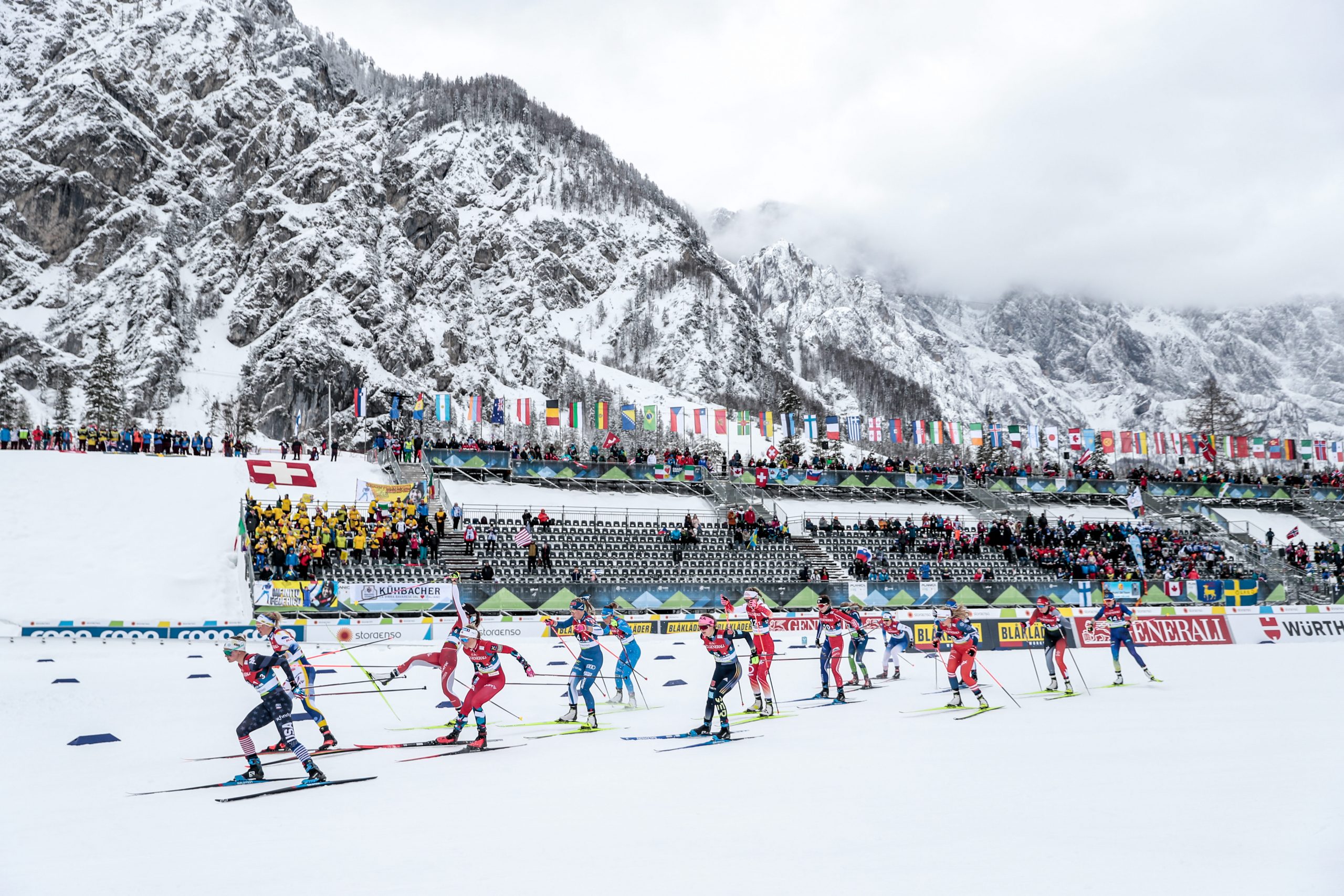
    Rosie Brennan (USA) skis in the chase group that contested for silver and bronze: Anne Kjersti Kalvaa (NOR), Kerttu Niskanen (FIN), Brennan,  Frida Karlsson (SWE), and Linn Svahn (SWE). Brennan finished fifth. (Photo: NordicFocus)

    The chase group of Brennan, Karlsson, Svahn, Kalvaa, and Niskanen would contest that dogfight. The race settled through the third lap; Andersson’s gap grew in front of Brennan’s group, and the gap to the second chase group behind grew as well.

    Brennan led the group through the stadium as they headed out on the final lap, but as they completed the other rolling section of the course it became clear that the combination of skis—and twenty-three kilometers of racing—would make the last lap a tight, tactical, affair. 

    When the group crossed over from the first half of the course to the second through the Planica stadium, Frida Karlsson skied up to take a pull. Kalvaa and Brennan responded quickest, but both Niskanen and Svahn pulled their way back too as the group skied toward the final climb. Near the high-point leading to the crucial, winding downhills, Kalvaa used the advantage her skis granted her. Karlsson and Brennan sensed the move and responded quickly, marking Kalvaa’s move.

    Kalvaa carried speed through the final transitions, but Karlsson had the strongest close. On the final climb, the Swede pushed the chase group into high gear, with Svahn able to come back from the behind. For a moment, Brennan pushed back to Karlsson’s tails. Into one final hill, though, Karlsson proved to have one more energy than the rest of the field, closing in on Kalvaa in the final 100 meters. Kalvaa held off the late surge to take second place; Karlsson won the bronze. Behind, Brennan and Svahn completed an exhausting 30 k with a boot throw straight out of a sprint race. The lunge at the line went Svahn’s way:  she finished fourth, Brennan fifth.

    Brennan “feeling a mix of everything” as US Team Reflects on Race

    In a post-race interview with FasterSkier’s Nat Herz, Brennan said, “In any long race, things go up and down. I had moments where I thought, ‘yes, I’m going to do this,’ and others where I thought, ‘oh God, this is not good.’” She then reflected, “I really am feeling a mix of everything. [I’m frustrated] feeling I’m getting good at this fourth, fifth, sixth place situation, [but] also all you can do if you fight with all you have, I did, and I am happy with that.”

    Further behind in the field but putting up strong races were Brennan’s teammates. Hailey Swirbul (USA), who finished 18th. “This was the best 30 k to date for me,” she said. “It was a lot more fun being the hunter instead of the hunted.” Julia Kern (USA) finished 27th, and said to FasterSkier that, “I felt like I put out whatever energy I had left from these Championships out on course.”

    Both Swirbul and Kern said that even during the race, they had an eye towards the racing that was happening at the front with their teammate. “[I was] in awe of how she keeps coming back despite adversities,” said Kern. Swirbul added that “I got to see my teammates out there, which was pretty fun. I cheered for Rosie when we were both on a downhill: She heard me!”

    For both, Brennan’s push served as a real-time reminder of what they were doing in the grander scheme of their racing careers. “Even during the race I was thinking this is good training, maybe I can ski like Rosie,” said Kern. “She has had such a strong career late, and it gives me inspiration that even if I am not in the mix right now.” Kern added that, “Results on the sheet tell one story, but the fact she is in the mix with the world’s best time-and-time again is really impressive.”
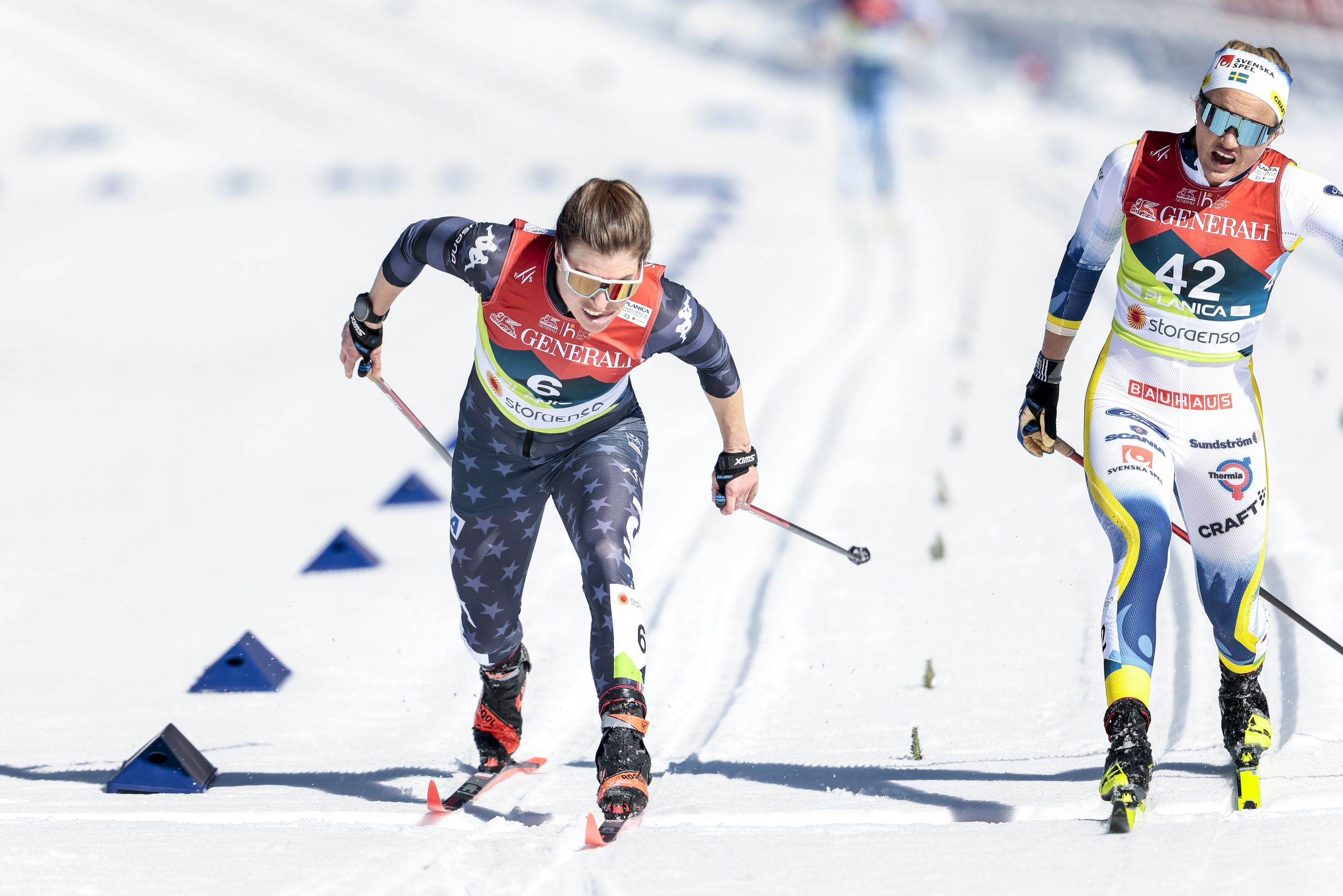
    Rosie Brennan (USA) sprints to the last meter alongside Linn Svahn (SWE). Svahn won the sprint and finished 4th, with Brennan taking 5th. Both were a second off the podium. (Photo: NordicFocus)

    US Ski Team Head Coach Matt Whitcomb put Brennan’s accomplishment in perspective. “[Brennan] put herself one second off the podium. You look at that and be proud, and we really are.” Whitcomb added that in Planica, the magnitude of her efforts weren’t lost. “There’s no one at this venue or in this whole crowd right now that people would like to see get a podium more than Rosie.”

    The support wasn’t lost on Brennan, and hasn’t been, she says, through the course of her last couple of seasons:

    “It’s been really cool the past two years how much I hear from people who really resonate with the style in which I race, and that means a lot to me. I’ve never been the most technically beautiful skier, or the smartest, but I certainly try to ski with all my heart and it means a lot when people recognize that. Thank you to everyone who has believed in me, thank you.”

    As for her future plans after this World Championships, Brennan is “doing it all, I am on the death march.” Expect her to start the first 50 k edition of the Holmenkollen marathon for women next week. On longer term plans, Matt Whicomb said that, “I want to see her back at another World Championships; I just told her that. I would love to see her in 2025, 2026, because we want that medal for her so badly.” Brennan said she has “a lot of reflection ahead, [but for now] I am headed back to Toblach and watching Tyler [Kornfield] race the Vasaloppet tomorrow…and thinking that 30 k kind of seems easy compared to the 90 k [of the Vasaloppet].”

    US Team Leaves World Championship with New Accomplishments, Same Sense of Team

    At the end of World Championships, Matt Whitcomb says he hopes that there has been one message imparted to the world by the USA. “I hope that the team support is what the kids back home see, and want to give,” Whitcomb said. “We’ll be waiting here for you.”

    He pointed to two of his athletes who are leaving Planica with historic results, one a World Champion, and one with a race that shone a light through the qualities that make world champions. “What [Rosie Brennan and Jessie Diggins] realized is that if you invest in your teammates, that investment is returned tenfold, because they are fully invested in you,” Whitcomb said. “That’s just a fun way to go through life.”

    As Whitcomb delivered that perspective, he pulled out his phone and read the last text message he had received. It was from Jessie Diggins: “So proud of you girls for an absolutely gutsy race out there, makes me proud to be part of this team.”

    The text was reportedly followed by three BIG heart emojis.

    Full RESULTS

    The US Women walk away from this year’s World Championships with two medals, the first American individual World Championship, and a sense of team that is stronger than ever. (Photo: Nordic Focus)
  • Shuffled Podium, Same Norway. Americans Ski to Promising Results in 15 k Skate

    Shuffled Podium, Same Norway. Americans Ski to Promising Results in 15 k Skate

    This World Cup coverage is made possible through the generous support of Marty and Kathy Hall and A Hall Mark of Excellence Award. To learn more about A Hall Mark of Excellence Award, or to learn how you can support FasterSkier’s coverage, please contact info@fasterskier.com

    What was old is new again: for the first time since equal-distance racing policies were put into effect this season, the men’s field was set to race a 15 kilometer individual start. This particular distance has been raced at World Championships since guys with names like “Sixten” were racing on hand-carved wooden skis, but the extra five kilometers added to the men’s new-normal 10 kilometer World Cup distance provided a hint of freshness to this traditional World Championship event.

    Scott Patterson (USA) completes his 15th place effort in the 15 k individual start skate race on Wednesday. (Photo: NordicFocus)

    If the 15 k distance blurred predictions before the race, the roster of contenders in the field brought those predictions back into focus. As the last World Championships in Oberstdorf in 2021, the 15 k skate was a Norwegian sweep: Hans Christer Holund, Simen Hegstad Krueger and Harald Oestberg Amundsen going 1-2-3. American skiers also provided reason to be optimistic as the Team Relay approaches later this week, with Scott Patterson finishing 15th, Gus Schumacher 19th, Ben Ogden 27th, Hunter Wonders 33rd. Canadian finishers included Olivier Leveille 28th, Graham Ritchie 46th, Xavier McKeever 60th. 

    Johannes Hoesflot Klaebo (NOR) was also on the start list this morning, competing in a 15 k World Championship or Olympic skate event for the first time in his career. Based on the Norwegian skiathlon sweep last week, indications were that the Norwegian podium sweep of two years ago could likely be re-created today; the Norwegian shuffle at the top of the race was on.

    Simen Hegstad Krueger (NOR) completes his world championship effort in the 15 k individual start skate race Wednesday. (Photo: NordicFocus)
    15 k Individual Start Freestyle

    As to who would stand atop the podium, indications were clear from the beginning. Kreuger is known for his ability to come on strong late in his seasons and late in his races, so his emerging as the early leader in this race suggested his form might prove unbeatable. By the 2.2 k checkpoint, Krueger was already out in front of a tight-packed field. American, Ben Ogden, described Planica’s course as one that could, “make you feel like a king for the first four kilometers, and then [make you] go ‘oh no, I still have 10 k to go’” Accordingly, Krueger’s early lead was one that didn’t warrant anointing him too early. But when Krueger came to the top of the long, winding climb defining the middle section of the course at 7.7 k with a 23 second gap over Sweden’s William Poromaa—and then kept adding to that lead at each subsequent checkpoint—it seemed like the probable outcome was becoming clear. Krueger was on his way to winning his second individual World Championship of his career, and in as many starts in Planica. As on-air broadcaster, Chad Salmela, pointed out, Krueger has started 10 races at World Championships and Olympics, and medaled in nine of them.

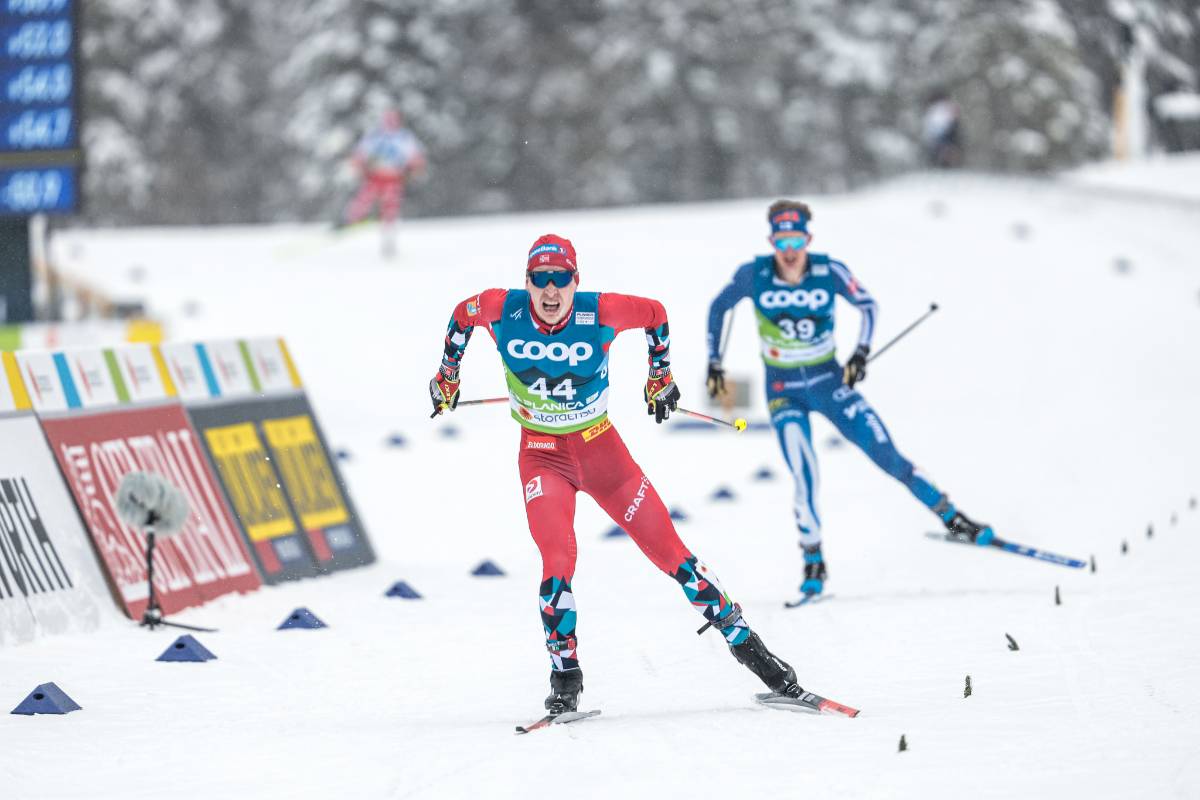
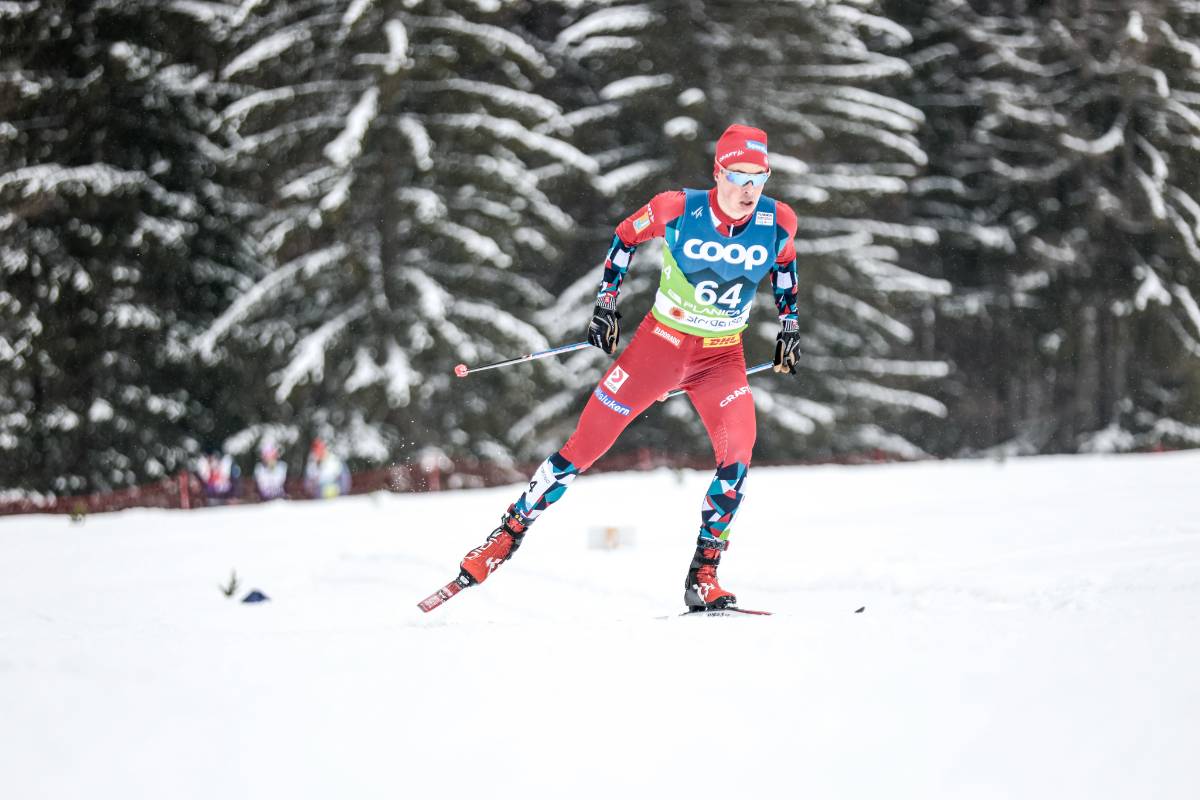
    Krueger’s start position, bib 44, was relatively early among the main contenders. As a consequence, there remained considerable potential for drama to occur behind him as the field of contenders approached, but never matched, his high-mark at the later checkpoints. Holund started a minute behind Krueger in bib 46, but his checkpoint times put him in a closer race with Sweden’s Poromaa, with whom he traded on-course placings numerous times. Klaebo started in bib 48, two minutes behind Krueger, and through the first 2.2 k checkpoint was splitting seconds with him and leading the field, but Klaebo dropped to sixth place at 4.1 k and remained out of contention for the win the rest of the day. Amundsen—the 24 year old who had won a bronze at the Oberstdorf 15 k World Championships at only age 22—provided the late drama. Wearing bib 64, Amundsen led Krueger by 1.5 seconds at 2.2 k, was three seconds back at 5 k, and 11 seconds back at 7.7 k. When he put time into Krueger—he cut the gap from 11 seconds to 7.7 seconds in 3 k at the 10.8 k checkpoint—there was real intrigue. The gap grew in the last lap on the course, though even with a late push to finish 5.3 seconds back, Amundsen’s challenge to Krueger appeared to be over by the 12.8 k checkpoint. When he did cross the line, Amundsen had earned the second medal of his career, and Krueger took it as the sure sign he was safe to pull on the World Champions bib. Two years on from Oberstdorf, the 15 k skate podium had played a Norwegian shell game. 1st) Simen Hegstad Krueger, 2nd) Harald Oestberg Amundsen, 3rd) Hans Christer Holund.

    Harald Oestberg Amundsen (NOR) followed up a 15 k bronze at 2021 World Championships in Oberstdorf with silver in Planica in 2023. “Maybe in Trondheim [in 2025], I will fight for the gold medal,” said Amundsen in post-race comments. (Photo: NordicFocus)
    In a post-race press conference, Amundsen—the youngest member of the Norwegian sweep—said, “It’s good to be on the podium. I trained a lot with [Krueger and Holund] the last few years, knowing they are the strongest guys after Oberstdorf.” As for what’s next, Amundsen sees one more step, literally: “Maybe in Trondheim [in 2025], I will fight for the gold medal.”

    Patterson, Schumacher, and Ogden in Top 30 for Americans

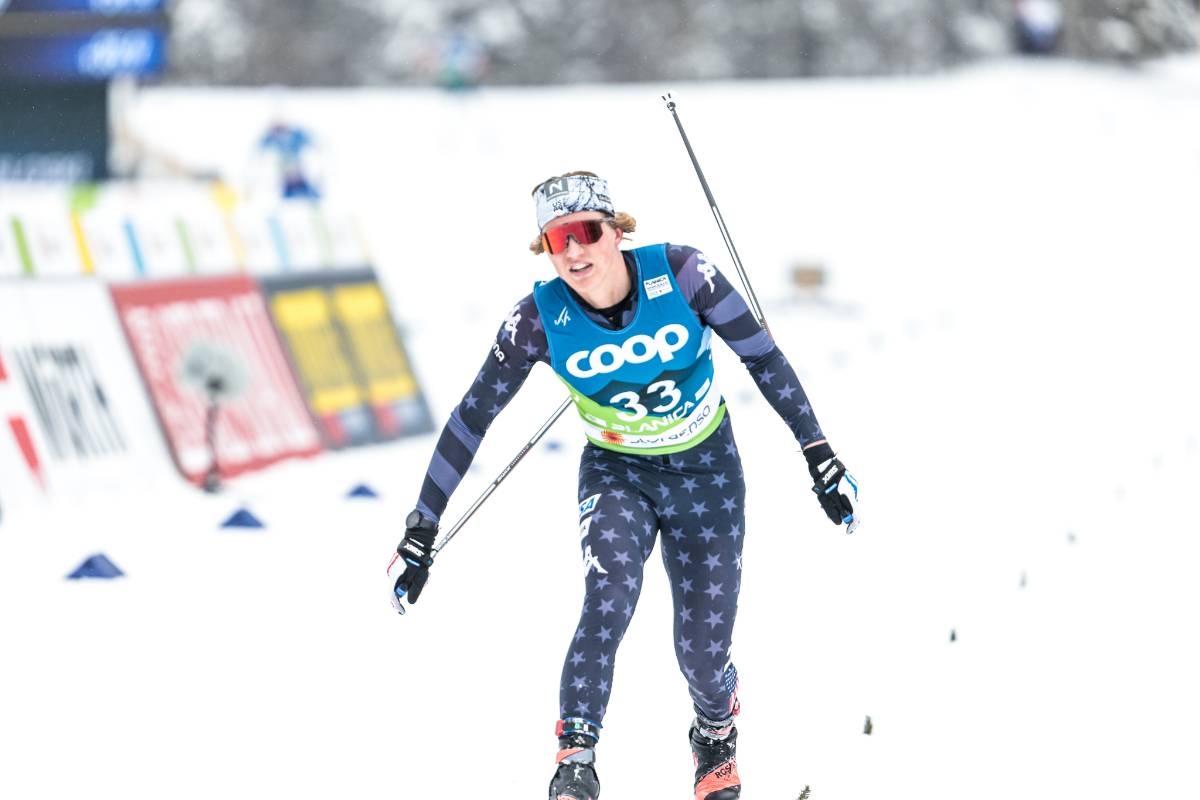
    The American skiers started their day before the podium action began, with Schumacher (bib 33), Ogden (bib 36), and Wonders (bib 37) all taking part in the bar-setting through early checkpoints. At 2.2 k, Schumacher and Ogden were near the front of the early starters, and by 4.4 k were on top; Schumacher first and Ogden second with less than a second between them. From there, though, Ogden would say in post-race comments that he “ran out of steam in the middle on the climbs.” His check-point times faded from the top, but still made clear the American was having a consistent effort. He would finish 27th; his first distance top 30 at a World Championships.

    Gus Schumacher (USA) skied to a career-best World Championship distance finish, taking 19th in the 15 k Freestyle. “Jessie Diggins said ‘if you push well and do everything right, you’ve got to be happy.’” (Photo: NordicFocus)

    Schumacher continued to stay near the top of early-starters as he passed through the checkpoints. At each point past 5 k, he was slotting behind Andorran skier Ireneu Esteve Altamiras, and later France’s Maurice Manificat, Japan’s Naoto Baba, and Germany’s Jonas Dobler. The dividing line between early-starters and the main contention field was Sweden’s William Poromaa who bested the early group at each checkpoint past 5 k. As early starters filled in behind Poromaa at each check point, what became clear was that Schumacher’s early time marks were setting him up for a good finishing time. Schumacher sped through the final lap, eventually crossing the line standing in third place. He would ultimately find himself 19th. It was the best World Championships distance finish of his career, and a bounce-back for Schumacher after last week’s 38th place finish in the Skiathlon.

    Of his quick return to form, Schumacher said to FasterSkier post-race that “my results have gone from really bad to really good a couple of times now, so I can start to have more confidence that when I give it my best effort, that might happen.” Schumacher also identified a belief in himself that emanated from advice given to him by newly crowned world champion teammate Jessie Diggins: “[After the Skiathlon] it was nice to have Jessie [Diggins] around. She said, ‘if you push well and do everything right, you’ve got to be happy.’” Schumacher also paused, and then reflected to FasterSkier’s Nat Herz that, “It’s a little crazy to think that [Jessie] is one of the best that’s ever skied, you forget that so easy because she’s such a good teammate.”

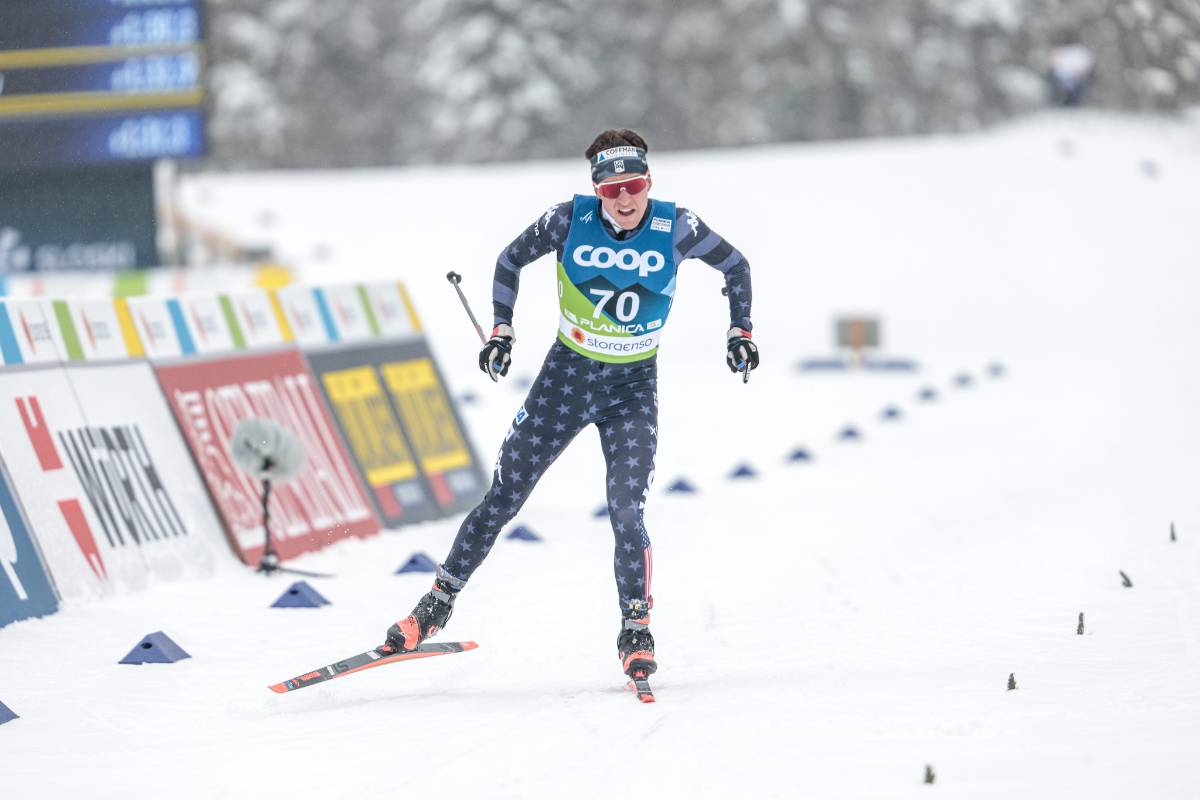
    Scott Patterson rcovers at the finish line after skiing to a 15th place finish. Patterson highlighted a day in which the Americans posted three top 30 finishes. (Photo: NordicFocus)

    The top American performance of the day came from later start positions. Scott Patterson (USA) wore bib 70 on the day, working his was to an eventual 15th place finish. “I kept getting splits like ‘a couple seconds to eighth, you’re fighting for top ten,’ things like that,” said Patterson in post-race comments to FasterSkier. “[But] then I definitely fell apart in the last couple of kilometers and lost some time.” 

    Post-race, Patterson described his strange mix of disappointment and optimism from the 15th place result: “I wanted more from today,” he said. “Honestly, warming up, I went ‘I am not really feeling it,’ but I feel like I skied decent for how I was feeling.” Patterson added that he was “looking forward to the 50 k classic this weekend, for sure.”

    15 K Results Point to Intriguing Team Relay

    The World Championship program now turns back into a team affair, with the Women’s Team Relay event tomorrow and Men’s Team Relay on Friday. In the American camp, Gus Schumacher says they are “feeling pretty excited.” Part of that excitement may stem from today’s results, with Schumacher saying to FasterSkier that, “One of the Swedish guys pointed out that—besides Norway—there’s a lot of [team’s] that could battle it out, and I feel confident in my ability to contribute to that.”

    Full RESULTS

    All-Norwegian podium: 1st) Simen Hegstad Krueger, 2nd) Harald Oestberg Amundsen, 3rd) Hans Christer Holund. (Photo: NordicFocus)
  • USA Earns World Championship Bronze with Diggins and Kern, Team Sweden Triumphant

    USA Earns World Championship Bronze with Diggins and Kern, Team Sweden Triumphant

    This World Cup coverage is made possible through the generous support of Marty and Kathy Hall and A Hall Mark of Excellence Award. To learn more about A Hall Mark of Excellence Award, or to learn how you can support FasterSkier’s coverage, please contact info@fasterskier.com

    Five years on from the milestone of Olympic gold—and ten years on from the milestone of World Championship gold—the event was the same for US skiing; the Team Sprint. Socks adorned with stars and stripes and glittered faces led the race the whole day, as Jessie Diggins and Julia Kern traded leg after leg racing at the head of the women’s field. By the time Kern took her last turn around the Planica course, there was a pack of three teams, and no doubt which one had driven the race to that point. The medal places just had to be decided among the United States of America, Sweden, and Norway. In the end, the newly crowned sprint World Champion, Jonna Sundling, made the move for Sweden to win, and Tiril Udnes Weng held on for second, but the excitement would not be diminished. Jessie Diggins waited at the finish line as Julia Kern skied into her arms, bronze for the United States of America, and the first medal of these World Championships and Julia Kern’s career.

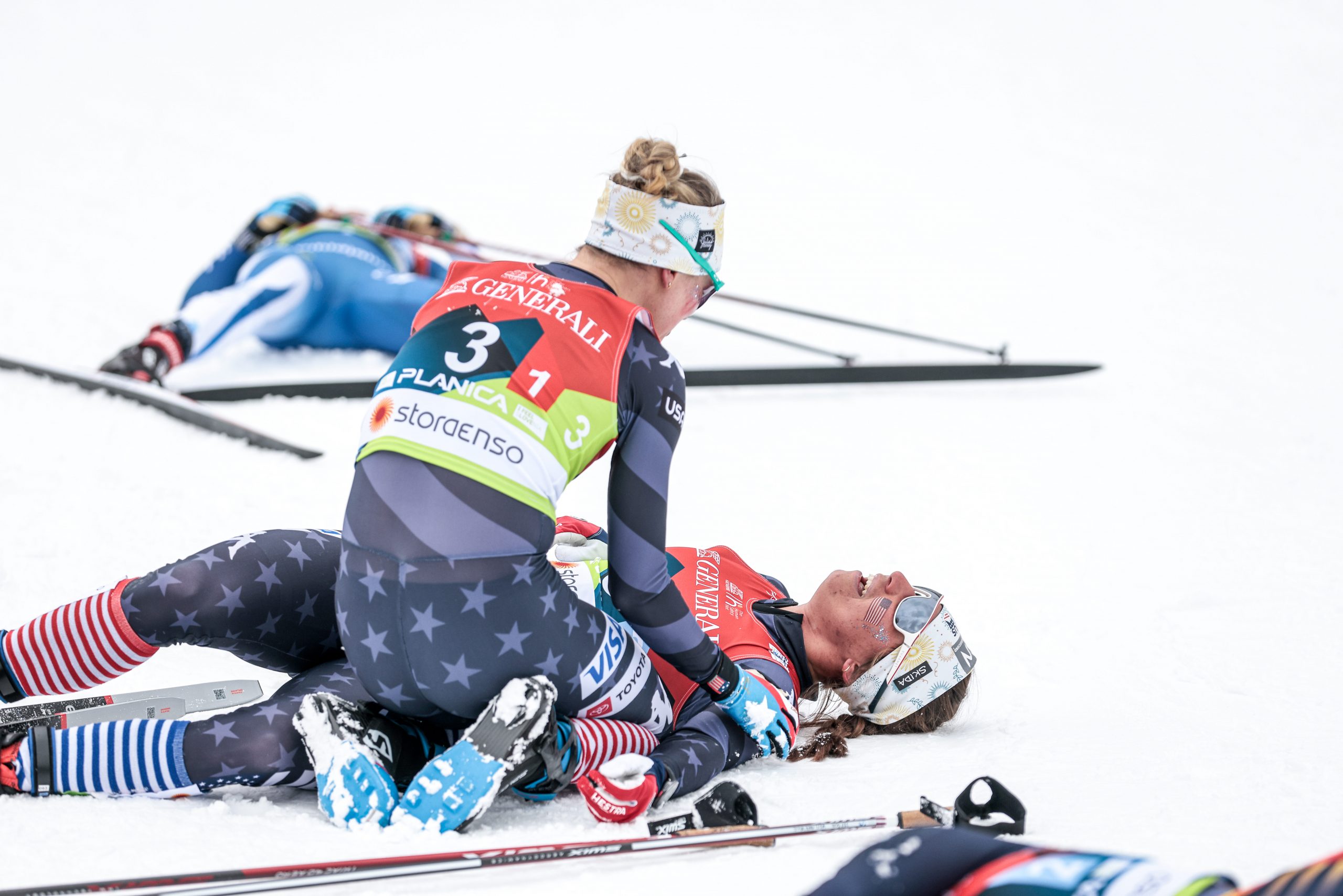
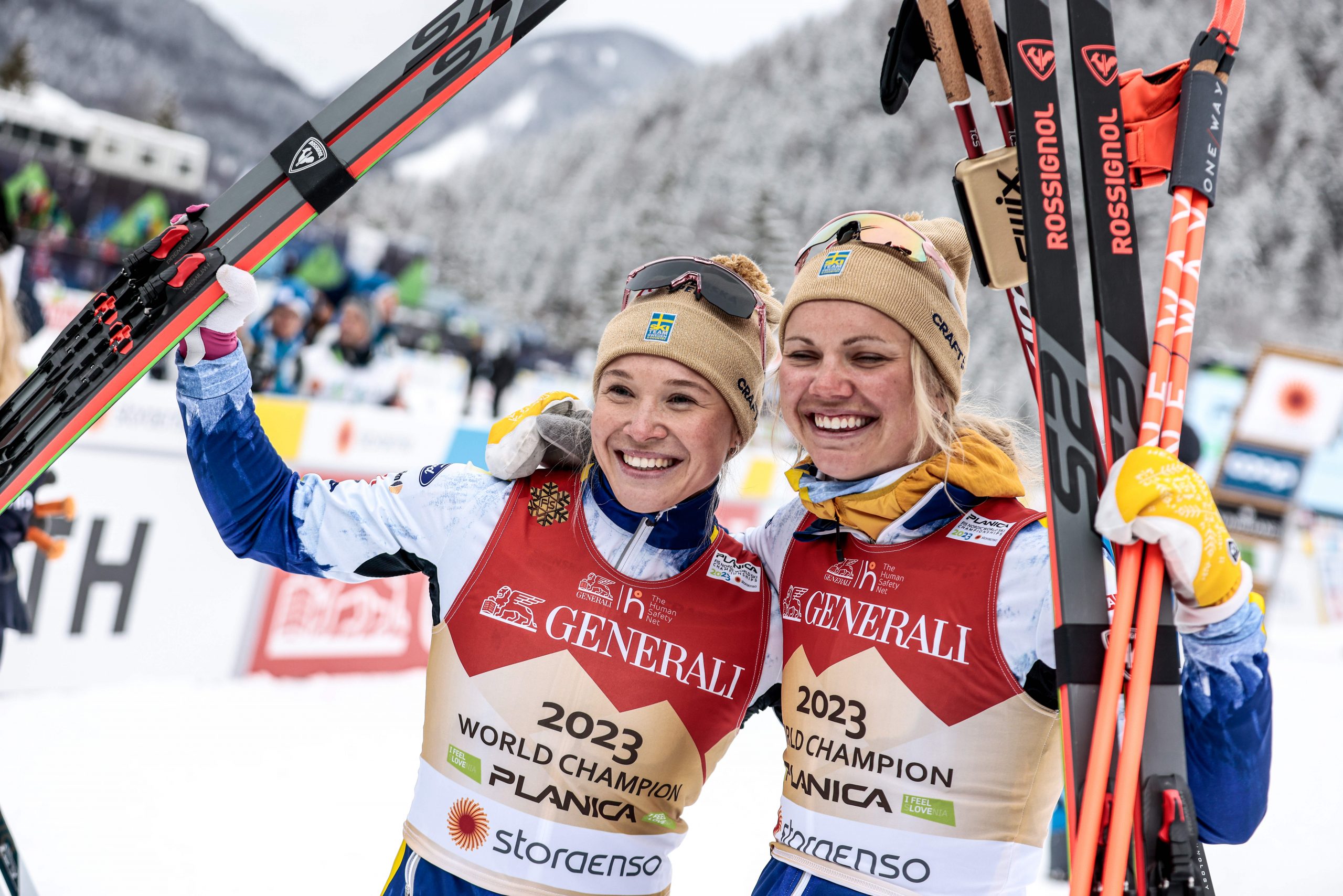
    Julia Kern (USA) and Jessie Diggins (USA) share an emotional celebration after taking bronze in the Team Sprint. (Photo: NordicFocus)

    For the US, the pieces were all there, they had just moved around. Kikkan Randall—the other fixture of the Team Sprint’s triumphs of the past decade—was up in the commentary booth this time. Chad Salmela was alongside her, as ready as ever to play muse for the US Skiing community’s unadulterated excitement. Most notably though, Jessie Diggins was on the line at the beginning of the race. A surprise given her pre-World Championships assessment that “Anchoring relays is kind of my bread-and-butter.” But Diggins had also made her admiration of Julia Kern a central part of her assessment of the team events at this year’s World Championships, “Julia Kern has an incredible skill set that makes her a really good anchor,” Diggins said. “She’s got the fitness, the distance chops, the raw speed, tactics and confidence.”

    Jessie Diggins (USA) comforts her Team Sprint teammate Julia Kern (USA) after their bronze medal effort. Diggins’ faith in Kern’s ability to finish was rewarded with a medal performance. (Photo: NordicFocus)

    With that vote of confidence, the line-up for today’s American relay team was set. Diggins took the first leg, just as she had early in her career when paired up with Randall (the lineup that won in Val di Fiemme in 2013). Behind her in the anchor leg was the young American who had first sprinted to a World Cup sprint podium in Planica 2018, and in 2022-23, has spent the year building a steady and strong presence at the front of the World Cup sprint field. US Ski Team Head Coach Matt Whitcomb said on the decision in post-race comments that “If we switched [the lineup] around, we felt like it wouldn’t have used Jessie’s capacities or Julia’s capacities fully.” That lent to a US strategy to, as Julia Kern would put it in post-race comments to FasterSkier, “Win a medal the hard way,” stretching out the field out from the beginning to leave a small sprint pack for the medals at the end. For Matt Whitcomb, that led to the evaluation that “both [Jessie] and [Julia] have somewhat comparable finishing kicks. Jessie has a slightly more developed distance capacity. We felt that could be used on the first leg to really stretch things out, and then at times decide to push and others conserve a little bit throughout the race.”

    And so, the American duo qualified first place on the day, went off the line in the Final that way, and didn’t relent until the very end.

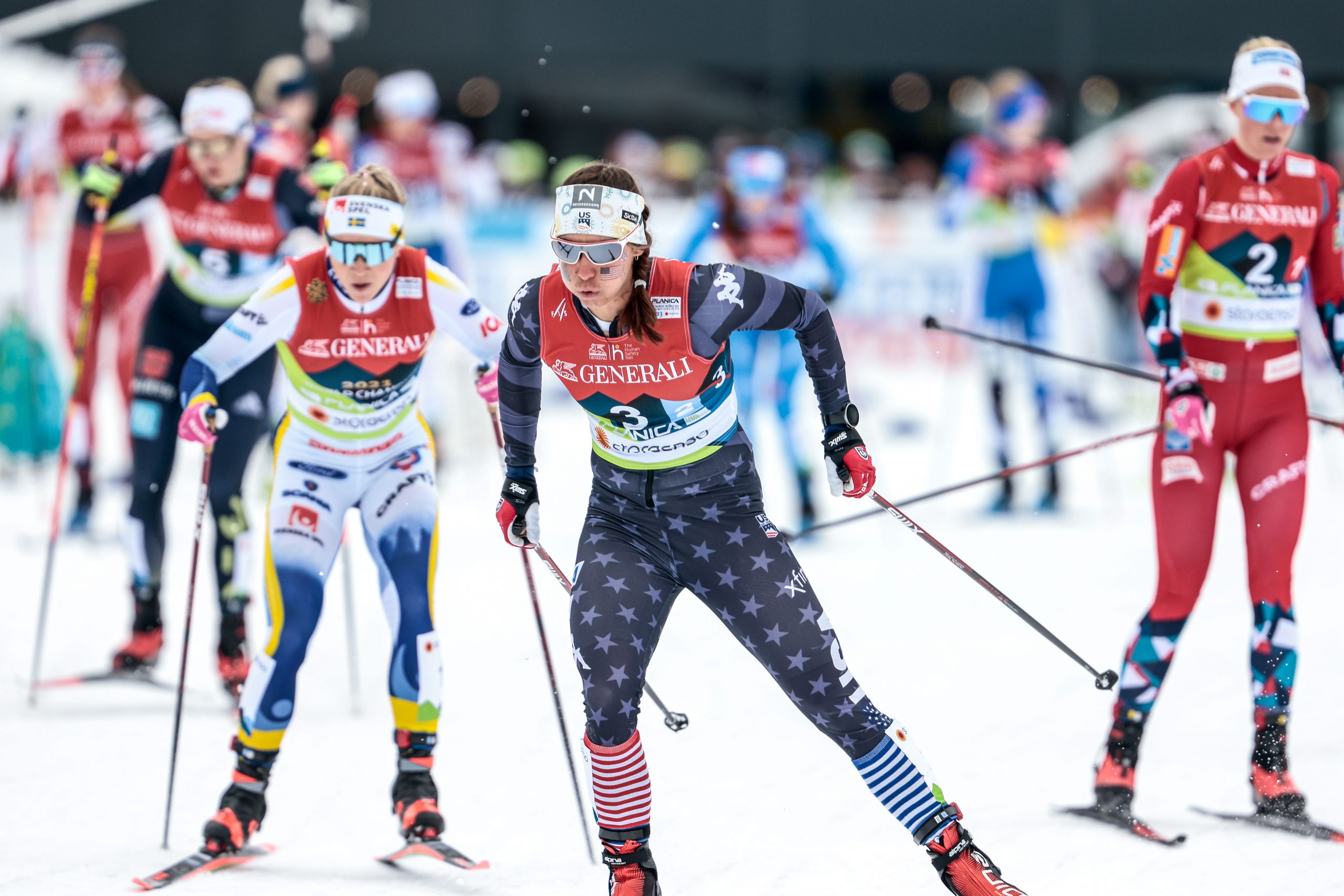
    Julia Kern (USA) living up to the confidence her team had put in her by skiing a medal winning anchor leg. (Photo: NordicFocus)
    Women’s Team Sprint Final

    The most candid and eloquent assessment of the Women’s relay Final would come from the source; Julia Kern’s mother. Talking to FasterSkier’s Nat Herz, she offered that for the US, “Either you chill behind [Norway and Sweden] and take a risk that you’re only going to get fourth or fifth with Germany and Finland there the whole time, or you say, ‘I’m going to the podium’ and push all three laps.’” She added a mantra too, “If you [choose] to push, you have to push the whole time.”

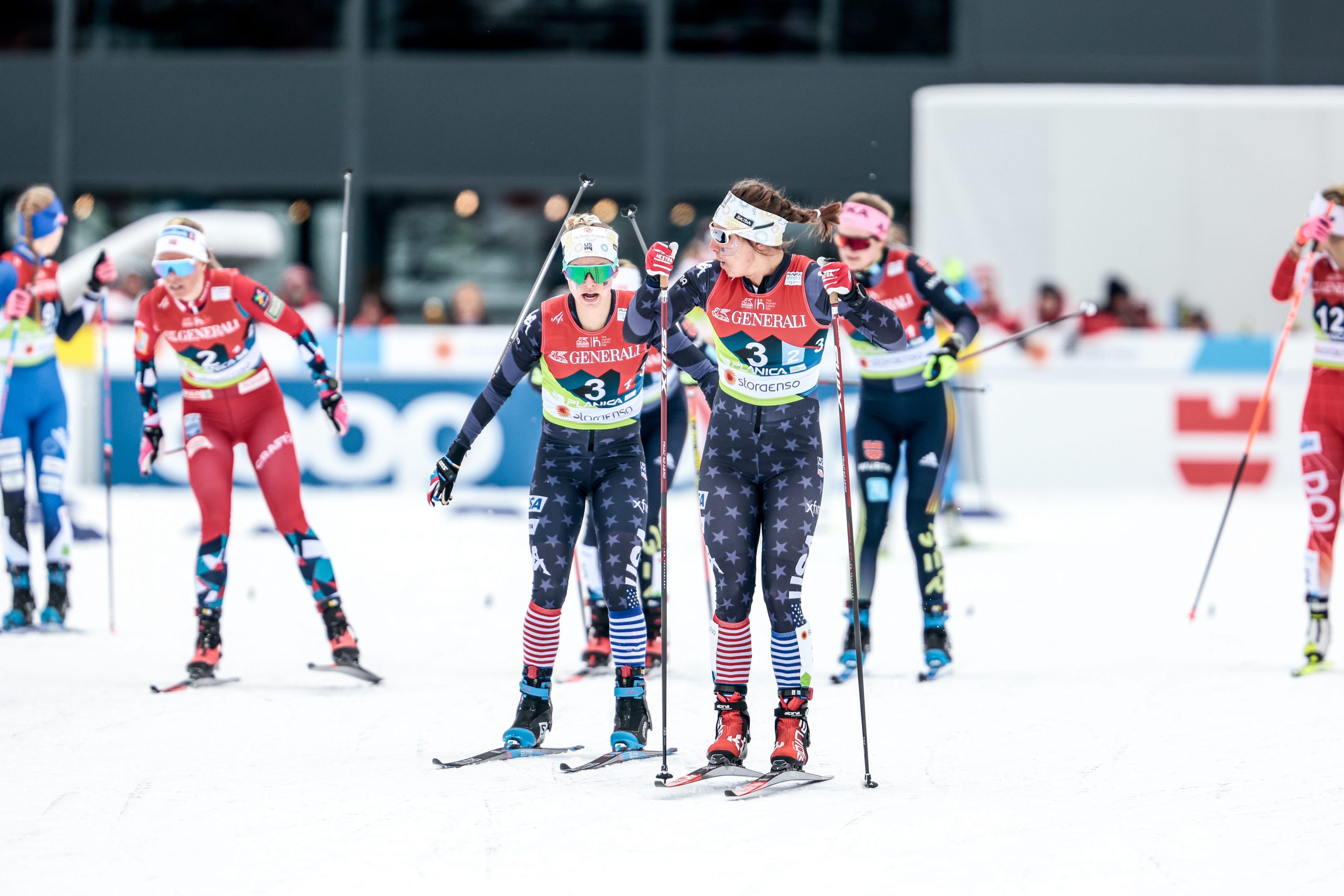
    Jessie Diggins (USA) and Julia Kern (USA) successfully navigate the tricky exchange area in the team sprint. (Photo: NordicFocus)

    That was precisely what Jessie Diggins chose to do, launching out of the start-line into her trademark free skate as the field wound around the rolling descent at the beginning of the course. That course was a modified version of last Thursday’s individual sprint to include a relay zone, including the long-winding climb through the middle, with a long rolling section afterwards into the Planica stadium. To the spectator’s eye then, the race was spent looking for subtle signs of strength through the main climb. Who kept the V2 tempo high? Who was launching their V1 into full power mode? Through much of the race, that simply meant looking at the front. Diggins held a high-tempo V2 through all her legs that, even when challenged by Norway’s Anne Kjersti Kalvaa in her final leg, still kept the American at the front of the race.

    Jessie Diggins (USA), pushed the pace the whole way to try and break up the field. (Photo: NordicFocus)

    By that point, the race had long separated into a pack of five teams, with the Americans leading, Norway and Sweden taking turns marking behind in second and third, and Germany and Finland the same in fourth and fifth. The move from Kalvaa and the response from Diggins though, saw the pair take more speed into the long downhill after the climb their final time around, and it proved to be where the definitive gap of the day opened up. Emma Ribom was able to use her sprinting chops to put in a burst and make the race three team’s strong, but the Americans’ push had pushed Finland and Germany out of the race.

    The final lap then was just to decide which medals would go where. Tiril Udnes Weng started the move on the lower reaches of the final main climb, which set Kern and Sundling into high gear too. Kern faded ever-so-slightly, what US Coach Matt Whitcomb would describe in post-race comments as “the side effect” of the US strategy, “Sweden and Norway get to follow up behind for five out of six laps.” As they rolled into the finishing stretch, Sundling passed Weng with the powerful finishing speed that won her a World Championship last Thursday, and Weng skied in to put Norway in second. Julia Kern continued to push all the way through, and as she approached, the energy from Diggins started to become a palpable thing, dancing and running to meet her younger teammates arms. For Diggins, it was the fourth time she had stepped onto a World Championships or Olympics Team Sprint podium, and this time, she was welcoming not just a younger teammate, but one that came from a generation that had directly looked up to her through all those previous wins.

    That was a significance not lost on Julia Kern, who said in post-race comments that, “it was incredible to watch Jessie and Kikkan over the years when I was growing up, and to step into these shoes is truly special. It speaks to how they paved the way for the whole US team.”

    Jonna Sundling (SWE) and Emma Ribom (SWE) were able to find a little extra something to take gold in the World Championship Team Sprint. (Photo: Nordic Focus)

    Throughout the US camp was the feeling that this bronze meant the continuation of all the positive developments in US skiing over the past decade and a half. For Jessie Diggins, today’s medal was a proof of concept for the team-centered focus she has helped pioneer, saying in post-race comments that “[The team sprint] a team sport within a team sport. It takes people who are on the road with us all the time, the [doctors and physios] who volunteer their time to come over and take care of us, this is a full team effort, and that’s what makes a team medal special.”

    Matt Whitcomb, meanwhile, opted for extended metaphor, “[our Team Sprint] is like a multiple years long relay; Kikkan handing it off to Jessie, Jessie handing it off to Julia now, and maybe Julia hands it off to the next [skier] eventually.” 

    And as for the significance, Jessie Diggins continued to bring it all back home, “I hope the kids back at home see that you can do this; you can compete clean, support each other, train hard, and get it done. I hope they’ll see that.”

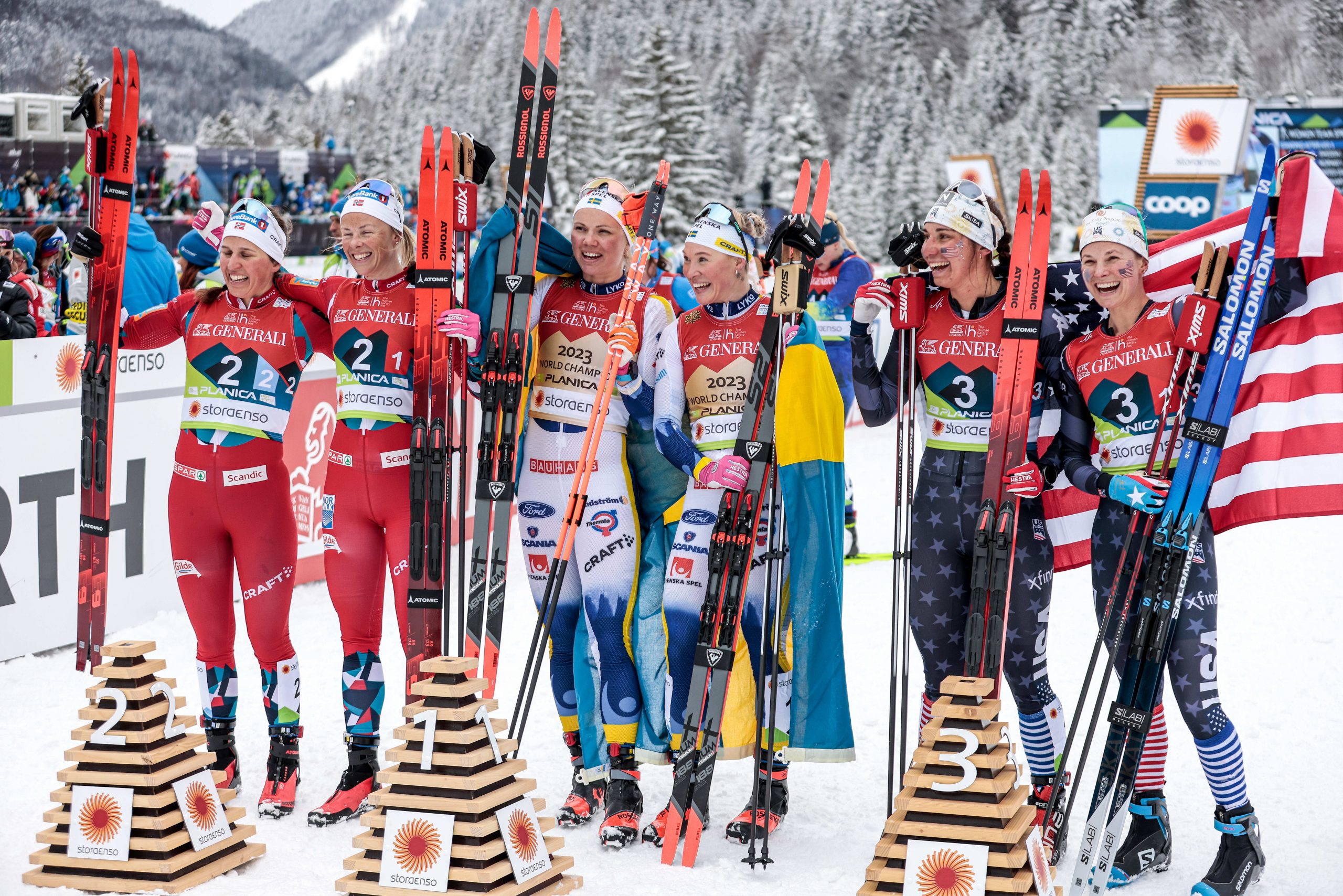
    All smiles for teams Norway, Sweden, and USA after medal winning performances. (Photo: NordicFocus)

    Women’s Team Sprint RESULTS