From the FasterSkier archive — posts syndicated from athletes’ and coaches’ own blogs between 2004 and 2012, kept online as published. Current coverage is at fasterskier.com.

Tag: plyometrics

  • Plyometrics: Where They Fit Within a Training Program

    Plyometrics: Where They Fit Within a Training Program

    This article was made possible through the generous support of our voluntary subscribers. If you value coverage like this, please support FasterSkier with a voluntary subscription.

    Where do Plyometrics Fit Within a Training Program

    Hint: You Don’t Start with Plyometrics

    Over the past few years there’s been a noticeable shift in how athletes and coaches talk about training. More emphasis on power. More interest in being “explosive.” That’s a good direction. Cross-country skiing is a power-endurance sport, and the ability to produce force quickly matters — whether it’s a finishing sprint, a tough climb, or simply skiing more efficiently at race pace.

    But as often happens, the optimal application gets missed. What I keep seeing is athletes jumping straight to plyometrics as if that’s where power development begins. It doesn’t. And when you start there, you usually end up with a lot of activity and not much adaptation.

    Plyometrics are not a shortcut. They are part of a progression — the conversion of maximal strength into power. Exercises like bounding, jumps, hurdles, and medicine ball throws can all be effective. But only when the athlete has the capacity to both absorb and produce force. Without that foundation, you’re not really training power. You’re mostly practicing jumping.

    That distinction matters more than most people think.

    I’ve used Tudor Bompa’s periodized strength model since the mid-1990s, and what still holds up is not the exercise list, but the sequencing. He didn’t build the model around movements. He built it around a logical progression. In my experience, that sequencing becomes even more important at the edges of the sport — junior athletes who are still developing and masters athletes who need to be more deliberate about how they load the system.

    And in that sequence, plyometrics come late. Not first.

    The progression is simple:

    1. Anatomical Adaptation (AA) — 4–8 weeks
    2. Maximum Strength (MS) — 6–8 weeks (minimum)
    3. Conversion to Power (CP) — 6–8 weeks
    4. Maintenance (M) — through the competitive period

    No shortcuts. No skipping steps. And no mixing phases and expecting the same result.

    Sweden’s Nicolina Lindquist jumping over Jake Pearson, of Cody, Wyo., during a strength workout at the USBA development camp in 2016 in Jericho, Vt.(Photo: Katrina Howe)

    Anatomical Adaptation

    The Anatomical Adaptation phase is the one most often underestimated, and it’s the reason a lot of strength and power work never turns into what it should. The goal here is not to get strong in the traditional sense. The goal is to prepare the athlete to train.

    That means building connective tissue tolerance, improving movement quality, and addressing the weak points most skiers share: eccentric control, single-leg stability, trunk stiffness under load, and upper body pulling strength. If those aren’t in place, everything that follows is limited.

    The work in this phase should look simple and controlled. Single-leg strength work like split squats, step-ups, and single-leg Romanian deadlifts (RDLs). Eccentric work like slow step-downs and controlled lowering. Trunk work that emphasizes force transfer, not just stability. Upper body pulling through a full range of motion. Even basic plyometric preparation — jump rope, small hops, controlled landings — but with the focus on coordination and tissue conditioning, not power.

    Two to three sessions per week is enough. The progression is not about maximizing loads. It’s about improving control under increasing demand. If this phase is done well, the athlete finishes it ready to train — not already fatigued.

    Max strength. (Photo: Corey Young)

    Maximum Strength

    From there, the focus shifts to Maximum Strength — and this is where many endurance athletes miss the point. Max strength is not circuits. It’s not high-rep fatigue work. It’s the ability to produce force.

    That means high load, low reps, and full recovery. Roughly 80–90% effort, sets of three to six reps, and enough rest between sets to maintain quality. The goal is not to exhaust the athlete. The goal is to improve motor unit recruitment and force production.

    For skiers, the work should still be sport-specific in its intent. Single-leg strength for the lower body — Bulgarian split squats, heavy step-ups. Posterior chain work — deadlifts, RDLs, hip thrusts. Upper body pulling — weighted pull-ups, heavy rows. And trunk work that connects the system under load, not isolates it.

    A session doesn’t need to be complicated. A few key movements, done well, with intent. Two to three sessions per week. Progress by increasing load, improving speed at the same load, and cleaning up movement under stress — not by constantly changing exercises.

    This phase is critical for a simple reason: you can’t convert strength you don’t have into power. In a sport already biased toward endurance, this is often the missing piece.

    Skate jumps with Chelsea Holmes back in 2014.

    Conversion to Power

    Only after that does the Conversion to Power phase make sense.

    Now the goal shifts. You’re no longer trying to get stronger. You’re trying to apply force faster. Rate of force development, timing, coordination, and the elastic qualities of muscle and tendon all become the focus.

    This is where plyometrics belong.

    The difference from the max strength phase is clear. Loads come down. Speed goes up. The movement patterns may look similar, but the intent is entirely different. If it’s not fast, it’s not power.

    That changes how the work is structured. Low volume, high quality. Three to six reps per set. Three to five sets. Full recovery. Stop when speed drops. This is neural work, not conditioning.

    Now the exercises make sense: bounding, especially uphill; single-leg hops; lateral bounds; reactive jumps; drop jumps, box jumps, hurdles. Loaded power work like jump squats and explosive step-ups. Upper body power through medicine ball throws and explosive pulling. And finally, ski-specific integration — bounding with poles, hill sprints, roller ski accelerations.

    If the power isn’t developing there, it’s not transferring.

    A session doesn’t need much. A handful of exercises, done with speed and intent. Two sessions per week is usually enough. More than that and you start turning power training into accumulated fatigue.

    This is also where athletes often get it wrong. They expect this phase to feel hard in the traditional sense. It shouldn’t. It should feel sharp. Explosive. Fresh. If it feels heavy and slow, you’re no longer training power.

    In the yearly plan, this phase typically sits in late summer or fall — after strength has been established and before racing begins. You’re not building the system at that point. You’re sharpening it.
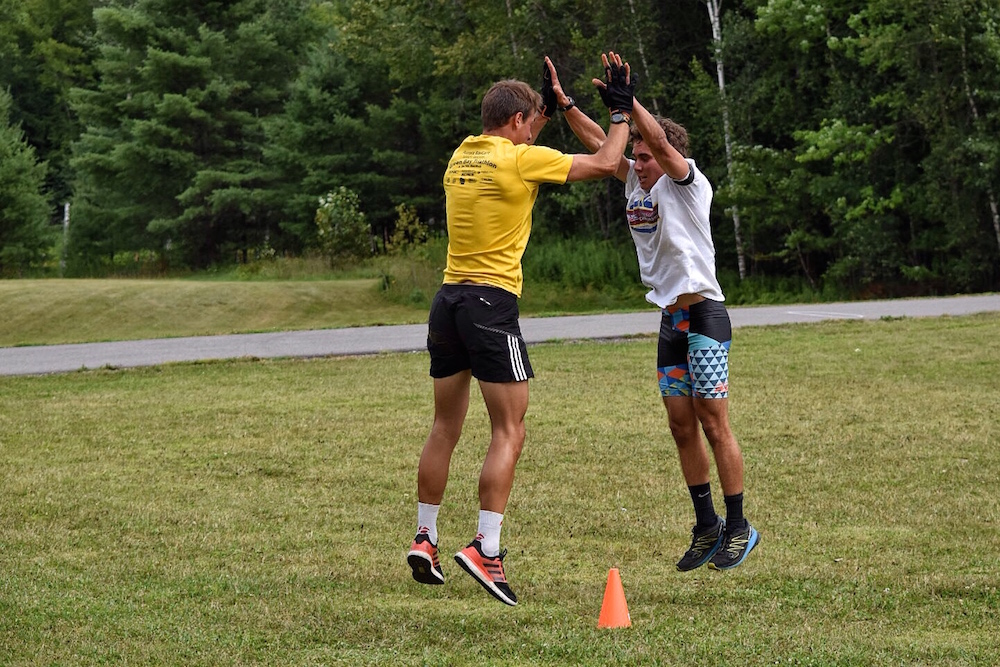
    Paul Schommer (l) and Jake Brown doing high-five partner burpees during a strength workout at the U.S. Biathlon development camp in Jericho, Vermont. (Photo: Katrina Howe)

    What This Looks Like in Practice

    What this looks like depends on the athlete. Younger athletes should spend most of their time on movement quality and basic strength, with only low-level plyometric work. Developing athletes need to build real strength first, then layer in plyometrics gradually. Senior athletes need to respect the sequence across the year — spring to rebuild, summer to get strong, fall to convert, winter to maintain.

    None of this is complicated. But it does require patience.

    There’s nothing wrong with plyometrics. Used at the right time, they’re one of the highest-return tools we have. But they’re not a starting point. They’re a finishing layer.

    Strength gives you the foundation. Plyometrics teach you how to use it.


    Help Support Our Olympic Coverage!

    If you value the thoughtful work and access FasterSkier provides, please consider becoming a Voluntary Subscriber. Your support directly fuels our work to cover the people, places, and moments that make our sport special.

    Join the FasterSkier community!


  • Wednesday Workout: Aqua Jogging and Plyos NoCo Combo

    Wednesday Workout: Aqua Jogging and Plyos NoCo Combo

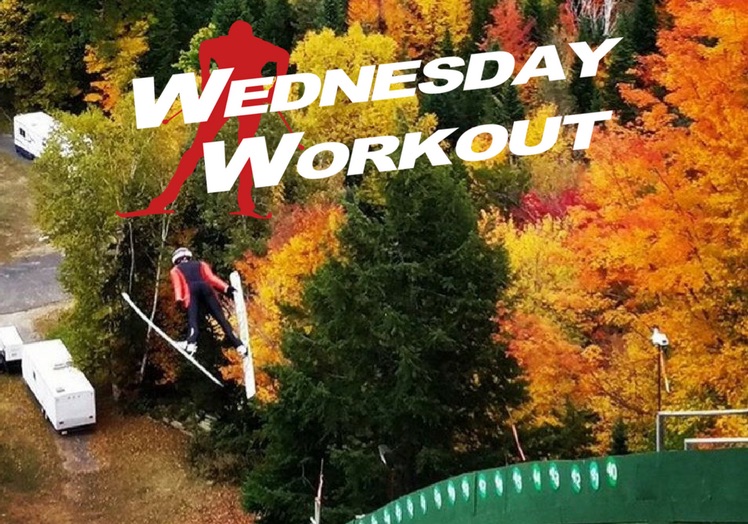
    Gabby Armstrong (Women’s Ski Jumping USA) during an autumn training session in her hometown of Lake Placid, N.Y. (Courtesy photo)

    Following the addition of women’s nordic combined to the International Ski Federation (FIS) Continental Cup circuit, FasterSkier asked the top-two American women in the sport, Gabby Armstrong and Tara Geraghty-Moats, both of Women’s Ski Jumping USA,  for a Wednesday Workout. Armstrong offers one for the a.m. and Geraghty-Moats the p.m.

    ***

    As a 10 year old attending an end-of-the-year ski party, scoring the last piece of pizza is usually bonus enough. Not the case for Gabby Armstrong. Hers was getting to test the landing hill of the K18 on her cross-country skis.

    Thanks to her New York Ski Educational Foundation (NYSEF) junior club coach Dave McCahill (who had a background in nordic combined), Armstrong was introduced to the jump hill by the time she was 10. Within a day of hitting the hill on her nordic skis, she joined the ski-jumping team. Soon after that, she entered any nordic-combined events she could. Though often the only female competitor, Armstrong was not about to let either sport go.

    “It never really occurred to me to stop cross-country skiing,” Armstrong, now 18, said during a recent phone interview. “Even though a lot of coaches would say that I was the lone nordic-combined athlete, it was kind of fun going out against the boys.”

    She’s attended two FIS Youth Nordic Combined Cups in Trondheim, Norway, and with the recent addition of women’s nordic combined to the FIS Continental Cup, she’s hoping to boost her event experience to an even higher level.

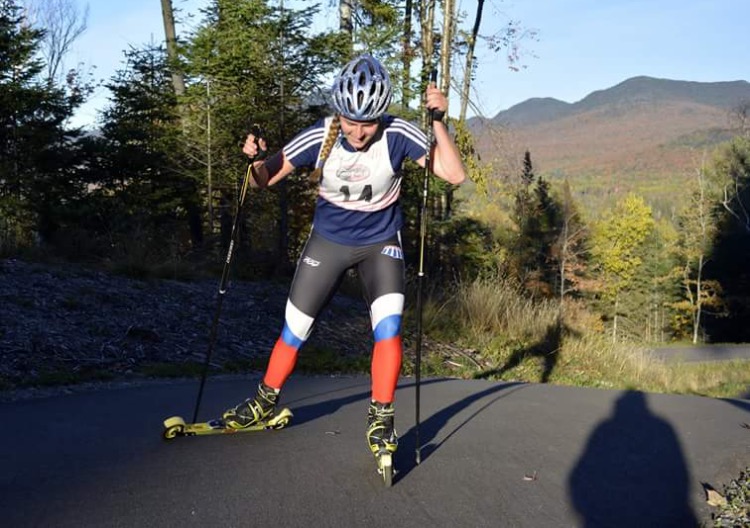
    Gabby Armstrong, a member of Women’s Ski Jumping USA and a nordic combined competitor as well, rollerskiing at the Flaming Leaves Festival in Lake Placid, N.Y. (Courtesy photo)

    “Any opportunity I have to compete nationally or internationally, for either nordic combined or ski jumping, I’ll take,” said Armstrong, a member of the Women’s Ski Jumping USA national team.

    In order to train for nordic combined, Armstrong jumps during her scheduled practice times and joins the NYSEF cross-country skiers whenever she can. One workout she likes when she’s not with the NYSEF nordic team is aqua jogging with her sister and cousin, an endurance athlete who also holds the unofficial aqua jogging record at Stanford University.

    “She really knows what she’s doing,” Armstrong said of her cousin with a laugh. “It’s a workout I picked up last year and I found was really good for me, especially because my knees were really bothering me a little bit last summer.”

    On days when she aqua jogs, Armstrong will often perform an afternoon plyometrics workout. According to her Women’s Ski Jumping USA teammate Tara Geraghty-Moats, plyometrics (plyos for short) are particularly important for the role they play in take-off body positioning during ski jumping and the complimentary body/hip awareness they provide for cross-country skiing.

    “Plyos are really important, especially at this time of year, to build explosive power, the kind of power you that you’re going to use at the end of the take-off when you jump,” Geraghty-Moats, 24, said on the phone. “It’s also something that I feel is really undervalued in the nordic world. I always felt that plyos profited my cross-country skiing as well.”

    An afternoon plyometrics session for Geraghty-Moats also provides an opportunity for new training partners. She has spent the past month in Lake Placid, N.Y., completing plyo practices with NYSEF, and plans to head to Park City, Utah, at the end of July and Europe after that.

    “I really enjoy being able to train with people of different ages because it sort of lightens up the atmosphere,” Geraghty-Moats said. “Plyos is the kind of training, too, that you can have a huge spread of abilities work together effectively. I couldn’t really go out and do intervals with a 12 year old and have them push me, but with plyos I maybe adjust the hurdles a little bit and we all learn from each other. They get to see your technique and I learn so much when I’m helping teach and helping coach.”

    Regardless of the workout, both Armstrong and Geraghty-Moats are excited about the upcoming Continental Cup schedule and the direction women’s nordic combined is headed: no longer just up in the air, but gaining ground.

    “Norway and Austria are already there, they definitely have a core group of high level nordic combiners,” Geraghty-Moats said. “It’s going to take a couple of years in the U.S to build a strong women’s team, but I think it will happen.” 

    The Morning Workout:

    Type: Aqua Jogging

    Armstrong aqua jogs at least once a week. When aqua jogging, your feet should not hit the bottom of the pool or lake. The idea is to keep your body suspended in the water while mimicking the movement of running through deep water. Aqua jogging removes the stress of running from the body joints, but allows an individual to continue training their muscles in the motion of running. Ideal for those injured or looking to switch up their workout.

    Terrain: Pool or lake

    Equipment: Though Armstrong uses no equipment, there are aqua-jogging belts out there for those interested.

    Warmup: 10-20 minutes of easy aqua jogging

    The set: 2 minutes on-time, 1 minute off. Repeat this 6 times for a total of 12 minutes on (18)

    (If you need a long interval session, complete 6 x 2 minutes on, 1 minute off a second time for a total of 24 minutes on)

    Cool down: 10-20 minutes east aqua jogging

    Total time: 38-78 minutes

    *If doing the workout in a lake, Armstrong recommends bringing a buddy for safety reasons. 

    Armstrong’s Top-Two Tips:

    1. Don’t be discouraged by the distance. When it comes to aqua jogging, it’s not how far you get, but how long you go for that ultimately matters. “When you’re working harder, it’s slower progress forward,” Armstrong said. “It’s going to seem like you’re getting nowhere, but you’re still going to be working pretty hard.”
    2. Stay upright to keep the core tight. The importance of engaging the core is no new news for nordic skiers. To do so in this workout, Armstrong suggests athletes focus their effort on staying upright while aqua jogging, not leaning forward. “Making sure your core is activated and trying to stay as upright as possible will prevent your hips from floating up behind you into a doggy paddle motion,” she said.

    The Afternoon Workout:

    Type: Plyometric exercises

    Geraghty-Moats typically does this workout at least twice a week (during rest weeks, she’ll do it once). During plyometrics, an athlete exerts a large amount of force in a short amount of time to increase their power or speed-strength. Exercises should be done in an explosive manner.

    Equipment: Hurdles of varying length, a box jump, a track or a open field with a 100-meter stretch

    Warmup: 30-45 minutes easy running, followed by 30 minutes stretching

    For Geraghty-Moats, stretching is one workout aspect too often overlooked. “What stretching does is really allow your muscles to function efficiently,” she said. “For me, the hips are a big one. … That’s sort of the root of your center of balance and your coordination and often where people are sore and tight. I tend to do at least a half an hour of stretching before I start doing plyos.”

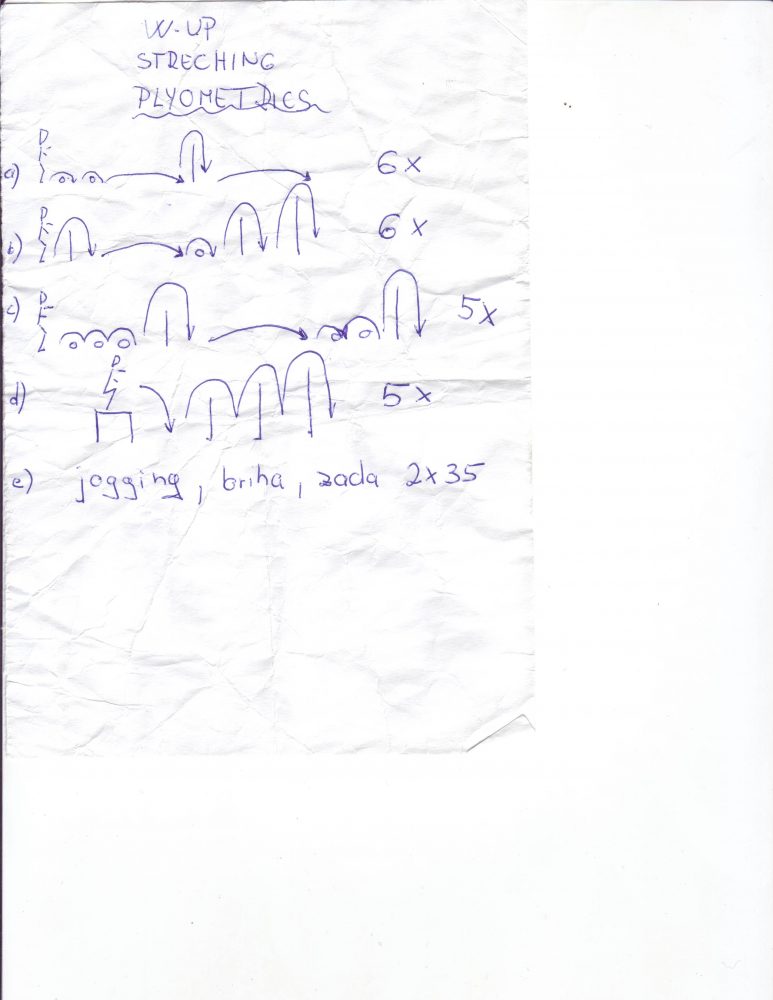
    The Plyometric set: 6 x broad jumps, 6 x vertical jumps, 5 x telemark jumps, 5 x hurdles, 5 x 100-meter sprints

    *See Geraghty-Moats’s exercise graphic below for more details on plyometric exercises and setup

    Tara Geraghty-Moats’s plyometric plan (Courtesy photo)

    Geraghty-Moats recommends using varying heights of hurdles to improve agility. “They range from knee to hip height,” Geraghty-Moats said. “It’s sort of like a downhill course, you have to react and be explosive and quick while also thinking about what you’re doing. It’s not just the same thing every time.”

    Cool down: 15 minutes of body weight core (e.g. 1 minute of front plank, 1 minute of side planks, 1 minute of leg lifts, etc.) followed by 15 minutes jogging

    “And always more stretching!” Geraghty-Moats added.

    Total estimated time: 2-2.25 hours

    Geraghty-Moats’s Top-Two Tips:

    1. Plyos take patience. “When you’re doing plyos, if you’re not used to putting your body in the air, it’s going to feel really awkward at first,” Geraghty-Moats said. “So just start small … it’s going to take two months before you really feel like, ‘Oh, I have something in my legs. I can get further off the ground than two inches.”
    2. Only the strong know when to stop. Rather than trying to push through a plyo workout, Geraghty-Moats suggests paying attention to your body and not being afraid to end the workout early. “If you have any sore ankles or sore knees, it’s OK to stop,” she said. “With intervals, we’re taught that you have to push through the pain. That’s not necessarily effective in this workout. This is more about being focused and giving yourself time. Quantity less and quality more.”

    https://www.instagram.com/p/BVqA52pnjsW/?taken-by=tarageraghtymoats&hl=en