From the FasterSkier archive — posts syndicated from athletes’ and coaches’ own blogs between 2004 and 2012, kept online as published. Current coverage is at fasterskier.com.

Tag: Points

  • Six U.S. Women Make Year-End Red Groups, a Record High

    Six U.S. Women Make Year-End Red Groups, a Record High

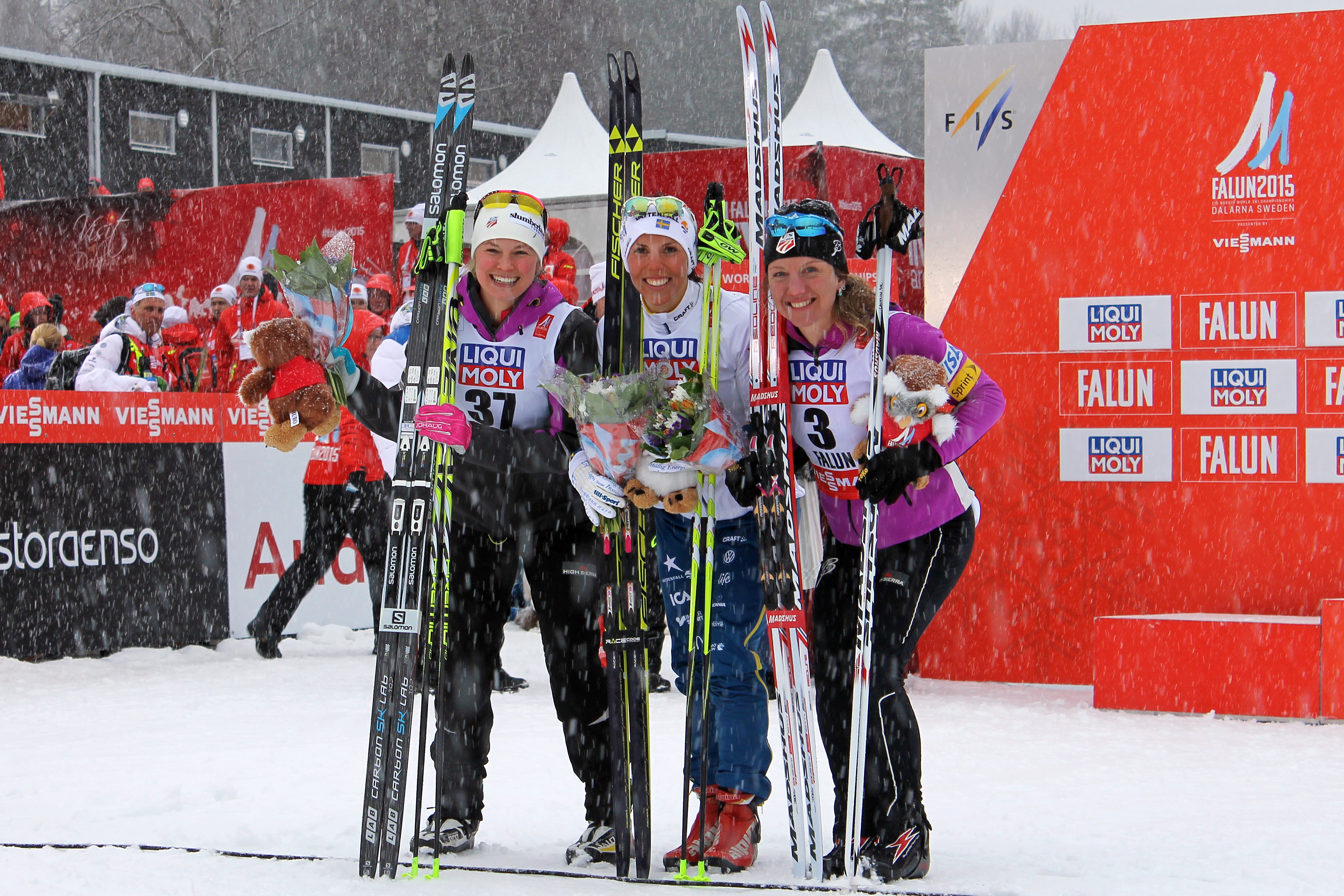
    Six different U.S. women, including Jessie Diggins (l), ended the season ranked in the top 30 of the World Cup standings for either sprinting, distance skiing, or in some cases both, which is a record number. Caitlin Gregg (r) didn't get in the Red Group, but she did get a World Championships bronze medal. As a team, the U.S. women ranked sixth in the 2014-2015 season.
    Six different U.S. women, including Jessie Diggins (l), ended the season ranked in the top 30 of the World Cup standings for either sprinting, distance skiing, or in some cases both, which is a record number. Caitlin Gregg (r) didn’t, but she did win a World Championships bronze medal. As a team, the U.S. women ranked sixth in the 2014-2015 season.

    Nine North American cross country skiers have finished the season ranked in the top 30 overall of the FIS World Cup for either distance or sprint racing.

    Combined with points from World Championships, which are not counted in overall World Cup rankings, that equates to all nine making the “Red Group”, a FIS designation meaning that their travel and living costs will be paid for by organizing committees of each World Cup weekend, at least for the first period of World Cup racing. The Red Group is calculated at the end of each of four periods of competition throughout the year, so skiers can move into and out of the costs-covered group over the course of the season.

    Top 30 rankings at the end of the season, though, carry more prestige, and are additionally useful for sponsorship and team namings.

    Meanwhile, the number of skiers scoring World Cup points is used to calculate the number of quota spots available for a country in the next World Cup season. 11 Americans and 7 Canadians scored World Cup points for their top-30 finishes in individual races this season.

    Overall World Cup rankings for men and women are posted on the FIS website.

    Women’s Field

    Among the Americans, Liz Stephen was the top-ranked overall, landing seventh in the World Cup distance rankings, fifth in the Red Group rankings, and tenth in the World Cup total score. But more teammates than ever followed her into the Red Groups: Jessie Diggins and Sadie Bjornsen ended up 22nd and 23rd in the World Cup, and inside the top-30 Red Group calculations in both distance and sprints; Kikkan Randall ranked 17th in the Sprint Cup and the sprint Red Group, although mid-season she fell out of the distance Red Group for the first time in several years; and Sophie Caldwell and Ida Sargent ranked 20th and 26th in the Sprint Cup, equating to 18th and 29th in the Red Group when World Championships results were included.

    That’s one more woman than has ever earned year-ending Red Group status for the U.S., which has seen a steady climb in its women’s team rankings. At the end of the 2014 season, there were five in the red group, and at the end of the 2013 season just four.

    Two more American women scored World Cup points: Rosie Brennan ended the season ranked 87th overall and Caitlin Gregg ranked 99th. Both were well outside the Red Group cutoff. But thanks to their points, which were all scored in distance races, the U.S. will be able to start five women in distance competitions next season. They will only have four spots in sprints, a decline from previous years. At the end of the 2014 season, seven U.S. women had scored points (including Holly Brooks, who did not compete on the World Cup this year), and each of them scored in both disciplines, netting five spots each – plus Kikkan Randall won the overall Sprint Cup title and was thus guaranteed an extra starting spot in addition to the Americans’ quotas in sprint races. This season, Marit Bjørgen of Norway won the Sprint Cup.

    As a team, the U.S. women finished sixth in the Nations Cup standings, two spots down from their fourth-place finish in 2014 and scoring 1,573 points to the 2,421 scored in 2014. Although more different women scored points, two factors changed this season: the Norwegian women were even more dominant, taking home almost 1,500 more Nations Cup points than they had in 2014 and leaving fewer for the other teams; and Kikkan Randall scored 156 points this season compared to 841 in 2014.

    For Canada, Emily Nishikawa and Perianne Jones both scored World Cup points, but were not close to making the Red Groups. With Nishikawa scoring in distance and Jones in sprint, the Canadian women will get three starters in each discipline next season.

    Men’s Field

    Alex Harvey led the way for North American men, finishing ranked ninth in distance racing, 13th in sprinting, and ninth overall on the World Cup.

    He was the only Canadian to make a red group; Lenny Valjas finished the season just outside, placing 33rd in the sprint standings. Valjas was 74th in the overall World Cup, slightly behind Ivan Babikov, who ended up 69th. Devon Kershaw and Jesse Cockney also scored a few points for Canada.

    It’s a slight drop for Canada: last season Harvey finished third in the overall World Cup standings, while in 2012 Kershaw finished second and Harvey sixth. In Nations Cup standings, the team fell from seventh to eighth. They will still be able to start four men in both distance and sprint competitions next season, however.

    Andy Newell led the U.S. men’s team, ending the season ranked 18th in the Sprint Cup and 53rd overall on the circuit. Teammate Simi Hamilton also snuck inside the Red Group sprint rankings, ending up 26th in the World Cup and 20th in the Red Group. Hamilton also scored a few distance points, which added up to 63rd overall on the World Cup. The only other American man to score points was Erik Bjornsen, who is ranked 132nd overall. The U.S. men will be able to start three men in both distance and sprint racing next season.

    The team climbed from 12th to 11th in the Nations Cup standings, despite no points scored this year by Noah Hoffman, the team’s strongest distance skier in the past few seasons who broke a bone in his leg and had to sit out much of the 2014/2015 campaign.

  • 25 Years In at USBA, Cobb Pushes Comprehensive Rules Reform Through International Biathlon Union

    25 Years In at USBA, Cobb Pushes Comprehensive Rules Reform Through International Biathlon Union

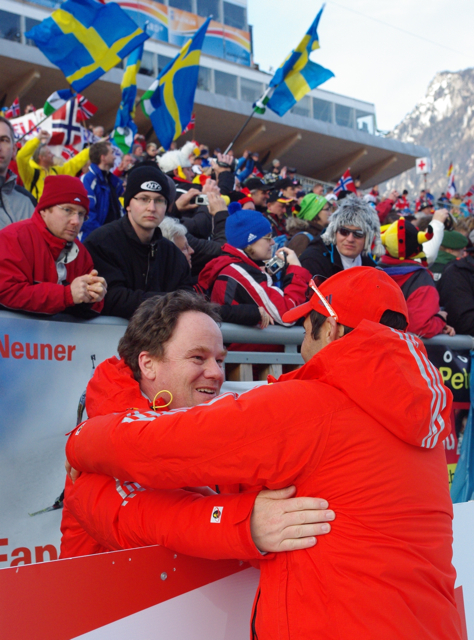
    Max Cobb, who besides acting as CEO of USBA also chaired the International Biathlon Union's Technical Committee, receives a hug from a fellow official after U.S. athlete Susan Dunklee placed fifth in the 2012 World Championships.
    Max Cobb, who besides acting as CEO of USBA also chaired the International Biathlon Union’s Technical Committee, receives a hug from a fellow official after U.S. athlete Susan Dunklee placed fifth in the 2012 World Championships.

    Today marks Max Cobb’s 25th year of work with the U.S. Biathlon Association (USBA) – an impressive tenure for anyone at any organization.

    In that time, Cobb already has a lot of job descriptions. He is now the President and CEO of USBA, works closely with its fundraising foundation, acts as a Technical Delegate at multiple World Cups every year (including, last season, at the Olympics in Sochi, Russia), and headed the International Biathlon Union’s (IBU) Technical Committee for the last cycle.

    Thanks to that last job, Cobb might be able to add the role “politician” to his list of titles.

    Over the last year, Cobb and the rest of the Technical Committee developed a new comprehensive system of qualification for IBU events, encompassing qualifying points, Nations Cup scoring, quotas for major events, and a Wild Card system to supplement those quotas. In nearly every aspect of racing, scoring and qualification will change from the previous system.

    Cobb and his team had to make the sell first to the IBU’s Executive Board, who sponsored the proposal at the IBU Congress held in Austria this weekend, and then at the Congress itself. And they delivered: every major proposal was passed, with votes of at least 45 of the 50 total national federations, Cobb told FasterSkier.

    “With all the changes, we now have a really cohesive system that both is fair and supports teams moving up through the rankings if they are having good performances, but also really honors the performance of athletes from any nation regardless of where they are within the Nations Cup ranking,” Cobb said.

    The changes added significant complexity to the IBU process. Previously, in order to qualify for the World Cup, athletes had to score one race on the second-tier IBU Cup circuit where they finished within a certain percentage of the winner’s time.

    The new points system is similar to that employed by the International Ski Federation, in that there is both a race penalty based on the points of the top competitors, and an individual penalty based on the racer’s percent back from the winner. The two penalties are summed to determine an individual’s points for a given race.

    The same system will be used throughout all levels of IBU competition, which has never been done before. This will allow competitors to develop a total points profile regardless of where they race, that reflects not just their own performance but the strength of the competition.

    Cobb sees this as a particular boon to smaller, and less cash-flush, teams.

    “It really leaves it up to a federation to decide, okay, are we going to deploy our team to the IBU Cup, where the level of our athletes is, really that will be the best development opportunities for them, or will we be able to have two teams, one on the IBU Cup and one on the World Cup?” he explained. “Under the previous system they really had to go to both. This allows them to choose.”

    These nations might have previously had to stretch their budget to take advantage of particular weekends where there were more opportunity to score World Cup points – weekends with multiple individual competitions, for instance, rather than a sprint-pursuit-mass start weekend where two events were qualification-based.

    The number of “wild card” entries at World Cups will increase from three to four per gender, and ten of these will also be available at World Championships under the new rules. In addition, the entries will be based on the athletes’ points, not their country’s Nations Cup score.

    “We can allocate wild cards based on athletes’ performances,” Cobb said. “That didn’t really exist in the old system.”

    And it might affect the way that countries try to qualify those athletes for major events.

    “What we saw with the previous system was that it was really not a cohesive system and it really forced national federations to do some strategy things that didn’t make sense,” Cobb said. “In some cases it really put them in a place where they couldn’t look out for the best development process for their athletes. They had to chase points at various levels. That just didn’t make sense.”

    In some ways, the system was a tough sell simply because it’s so much more complicated than the previous rules. Cobb said that he and the Technical Committee took a measured approach to explaining their proposal to the sport’s many stakeholders.

    It started with a presentation he gave to the Executive Board in Sochi, and then continued from there. The Technical Committee began to explain the proposal to coaches on the World Cup and the IBU Cup at the end of the season, and then Assistant Race Director of the World Cup, Borut Nunar, ran models of how the points would look based on the previous season of results and presented again to the Executive Board in Oslo.

    The final step was selling delegates at the Congress.

    “We followed that up with more meetings at the Congress so that delegates to the Congress, who are frequently not coaches, could have an understanding too,” Cobb said. “And that was really productive. It gave people an informal setting in which to ask questions and kick things around and bring up their concerns, and go into detail about how it works.”

    The new points system will go into effect this coming season, in order for athletes to develop a points profile, but qualification based on the new points will not go into effect until the 2015-2016 season.

    Some changes will be more immediate, however, for instance the Nations Cup scoring on the World Cup and IBU Cup circuits.

    In the new system proposed by Cobb and the Technical Committee, the points awarded for first through 80th place will remain the same, but fewer points will be awarded after 80th place. This, he said, will reward nations with one strong competitor more than the previous system had, and they will be more likely to gain a quota spot for that competitor.

    Nations Cup points will be used to determine quotas in the 2015-2016 season, including a change that sees an in the number of athletes able to start in World Cups from the mid-level teams, as well as the addition of the Wild Cards.

    World Championship qualification in particular will be affected by the new Nations Cup points: instead of four athletes per country gaining entry, lower-ranked teams will be able to enter only two or three athletes, again with the additional Wild Card spots going to up to two athletes per federation who do not have a quota.

    The reason for the reduction in World Championship field size was not only to make the event more competitive and selective, but also to minimize past problems with course preparation and fairness. At several past Championships, snow conditions have changed significantly over the course of the race as over 150 racers start, 30 seconds at a time. Cobb himself has TD’ed several such events and dealt with the ensuing nightmares.

    “That was really done to be able to have a World Championships that fits better for television, which is our major supporter in the sport, but also one where the size of the field is manageable,” Cobb explained. “Potentially with 50 members, there could have been 200 starters at a World Championships, and that is just unmanageable to be able to keep some element of fairness in the competition.”

    Although the field size will be reduced, Cobb said he is confident that the athletes who deserve to be at World Championships will be entered.

    “For the World Championships we have up to 10 wild cards available,” he said. “When we did our models, what we saw is that that really captured all the athletes who we felt were at an appropriate level to be entered there.”

    All in all, Cobb said, all the complicated mathematical calculations will have a big reward – and he’s relieved that the biathlon world recognized it.

    “I think that everybody saw that yes, it is more complex, but the complexity is being added in order to make it more accurate and a little more fair,” he explained. “And that the system really honors and respects the performance of the athletes. I think that’s why we saw overwhelming support. People voted in favor of a more fair, open, and sporting system. That was great to see – I was really gratified.”

    The newly elected Technical Committee meets for the first time in October. Cobb was again voted onto it, and it remains to be seen whether the rest of the committee will re-select him as their Chair for another few years.

  • Follow-Up On Devon Kershaw + World Cup Overall

    A commenter on Monday’s post noted that there are some folks fairly close behind Kershaw in the WC overall, so he has more to worry about than just catching Petter Northug. In particular, Marcus Hellner is only 57 points back, while Alexander Legkov is fully 168 points back. Hellner is obviously the more immediate concern, but you can’t really count out Legkov. Then you have Maxim Vylegzhanin 270 back.

    I’m going to approach this a bit differently than my last post. Starting with the schedule, we see that the end of the season is pretty heavily weighted towards classic skiing all around. We have 6 classic events, 2 (and a half) freestyle events and the pursuit. (The ‘half’ is the last stage of the World Cup Final, which apparently doesn’t count for WC points itself, but does contribute to the overall stage results.)

    The good news for Kershaw is that he has tended to fare better against these guys in classic distance races, as compared to freestyle distance races:

    Positive values here are better for Kershaw. So not only does he tend to do better against these four guys in classic races, the difference swings the most in his favor (although just barely in his favor) against Hellner and Legkov, his closest competitors.

    On the other hand, basically the reverse is true for sprinting:

    While Kershaw has in generally been fairly even with both Legkov and Hellner in sprints, he’s actually done better against them in freestyle sprints.

    The final aspect of this question I’ll consider is how skiers tend to fare late in the season. This is something that Kershaw has struggled with, particularly last season. All the news reports seem to suggest he’s feeling great, so I’m hopeful he’s kicked that habit, but what about his competitors? How have they fared?

    In sprinting:

    This might be a potential weak spot for Legkov, but not the others. As for distance events:

    Only a very slight glimpse of a weakness for Legkov here.

    So for holding off Hellner? It’s a mixed bag, but my hunch is that he’s more likely to hold off Hellner than he is to catch Northug.

    Related posts:

    1. <Canadian National Team Preview: Alex Harvey & Devon Kershaw
    2. <Can Kikkan Randall Win The Sprint WC Title?
    3. <World Cup Field Strength Follow-Up


  • In Anchorage, It’s About the Points

    In Anchorage, It’s About the Points

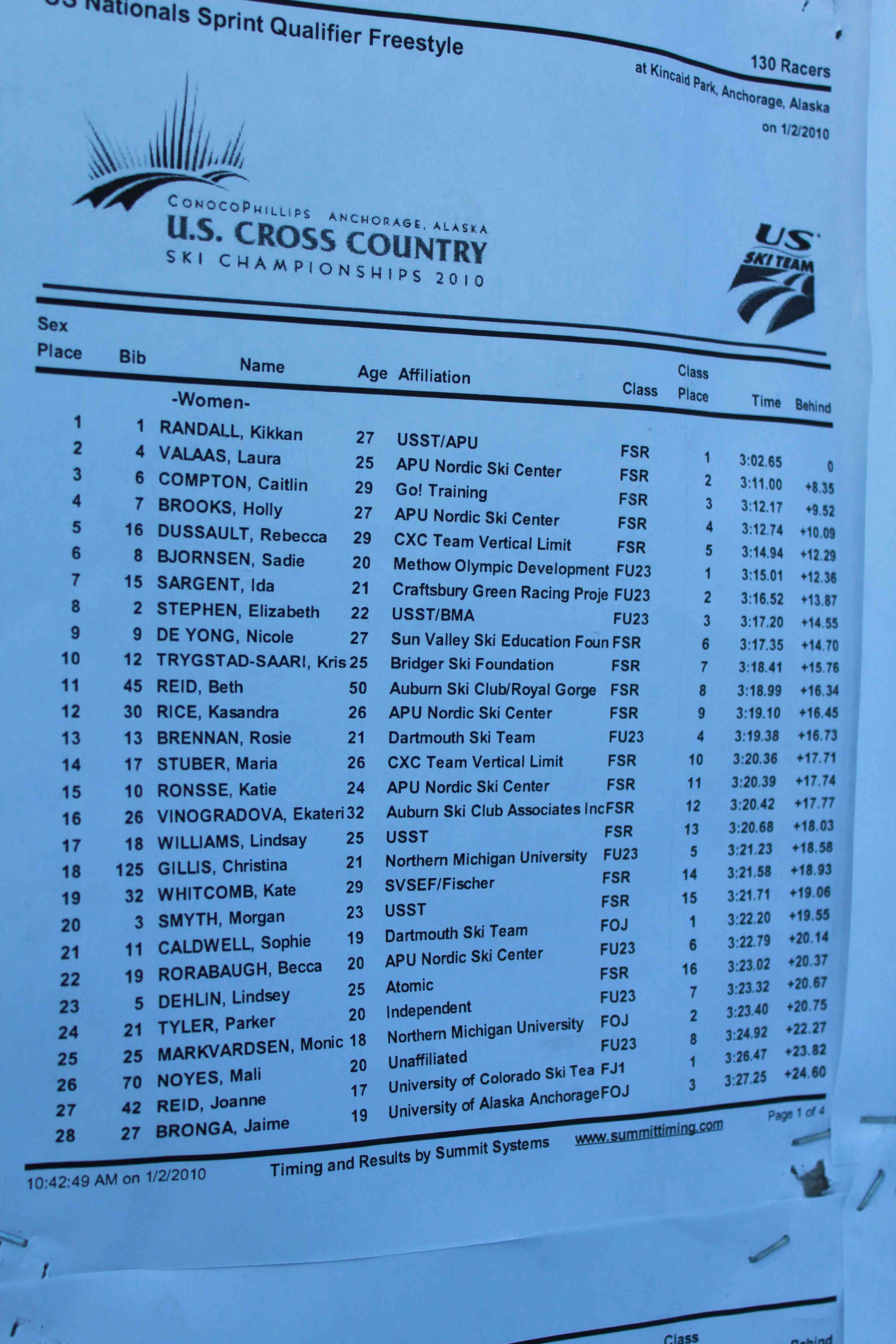
    Results from the women's freestyle sprint qualifying round at the 2010 U.S. Nationals. Kikkan Randall's eight second victory didn't do her rivals any favors.
    Results from the women's freestyle sprint qualifying round at the 2010 U.S. Nationals. Kikkan Randall's eight second victory didn't do her rivals any favors.

    While the $1,200 check for the winner of each race isn’t anything to complain about, the real prize awaiting competitors at the end of the 2010 U.S. Nationals isn’t the money. Instead, it’s a spot on the U.S. team for the Olympic Games in Whistler, which kick off a little more than a month from now.

    Currently, the U.S.’s quota for the Games stands at eight, and just who gets the last few positions (most will be taken up by U.S. Ski Team members who have been racing in Europe) is decided by a ranking system that awards athletes points based on their performances in races.

    A faster time and higher finish will always give skiers lower (and more desirable) points. But just how low they are depends on who else is entered in each race; when more accomplished skiers are competing, the points will be better.

    According to USSA Nordic Director John Farra, Kikkan Randall’s presence in the women’s race today meant that the points were good. But because she was a whopping eight seconds ahead of the next-closest finisher in the qualifying round (points are based off the qualifier), he said that event may not end up counting for very much–at least in terms of the Olympic qualification process.

    “You look at Kikkan being eight seconds ahead…and that’s an okay race for her,” Farra said. “But being eight seconds back is never a good thing. In a sprint race, that penalty is going to be much too high to really matter that much.”

    But while Randall’s rivals may be gnashing their teeth, Farra said that ultimately, the Alaskan’s performance was more important than the numbers that it were predicated upon it.

    “Kikkan Randall needs to continue to train to win a medal in five or six weeks, so no one in this whole stadium would have asked Kikkan to slow down today.” he said. “That’s not the way it works–people have got to ski close to her….otherwise, forget it.”

    Kikkan Randall forging ahead in her semifinal
    Randall forging ahead in her semifinal. Photo, Rob Whitney

    As for the men’s sprint, the absence of top U.S. sprinters Andy Newell and Torin Koos probably didn’t help winner Simi Hamilton. But at first blush, Farra said that the points for the men shouldn’t be too bad. (The calculations have not yet been conducted, but Farra has enough experience to make an educated guess.)

    According to Farra, fifth-place finisher Chris Cook brings a strong points profile to Anchorage, as well as third-place Garrott Kuzzy and Hamilton himself.

    For the latter two, their points should be especially low, Farra said, since both Hamilton and Kuzzy finished some four seconds clear of the rest of the field in the qualifier.

    “Okay for those two; not so great for the rest of the guys,” he said.

    L-R, Garrott Kuzzy, Chris Cook (in white and orange), and Simi Hamilton (in blue and red). Photo, Rob Whitney
    L-R, Garrott Kuzzy, Chris Cook (in white and orange), and Simi Hamilton (in blue and red). Photo, Rob Whitney