From the FasterSkier archive — posts syndicated from athletes’ and coaches’ own blogs between 2004 and 2012, kept online as published. Current coverage is at fasterskier.com.

Tag: Poker

  • All About Motivation: The Petter Northug Interview

    All About Motivation: The Petter Northug Interview

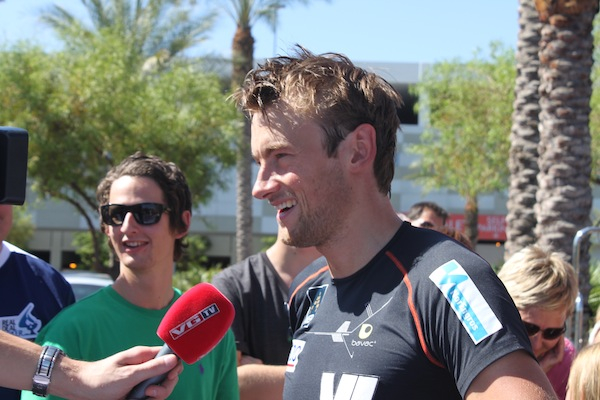
    Petter Northug after the Las Vegas rollerski race in July

    For the past two years, Norway’s Petter Northug has been the best in the world. One look at the medals tables from the 2009 World Championships and 2010 Olympic Games serves as proof: Over the 12 competitions at those two events, Northug took gold in five of them, and reached the podium on two other occasions.

    FasterSkier had the opportunity to talk with Northug over breakfast in Las Vegas in July, immediately following the rollerski race that he won over Marcus Hellner. He had already conducted three consecutive interviews and two photo shoots prior to speaking with us, but he still answered our questions with patience, in English. For the record, he eats his eggs on toast.

    FasterSkier: To start out, have you been recognized by anyone here in the U.S.?

    Petter Northug: I heard one guy from ESPN recognized me, because he was following the Olympics in Torino, but that is the only person from the U.S. that has recognized me here in Las Vegas.

    FS: Is that surprising to you at all?

    Marcus Hellner (L) and Northug (R) in their rollerski race in Las Vegas.

    PN: It’s good for me, because in Vegas, no one knows what cross-country skiing is. I can just go where I want, and I just enjoy having a vacation here. Yeah, it feels good.

    FS: How is your training going this year?

    PN: It’s been very good. In June, I have not been sick—just trained a lot, had good feelings. The body is working, and I can handle a lot of training now.

    FS: Are you doing anything significantly different from last year?

    PN: Going to Vegas. That’s the only thing. I’m doing almost all the same things as last year—it has worked for me for many years now, and I have to stick to that plan. I’ll just try to do the same things, and focus on keeping the good techniques, and working on the techniques.

    FS: Are you training more hours?

    MH: Maybe a little bit. But if I feel tired, I’ll take it easy for a few days. I trained a little bit more in June than I did last year. I’ll also try to train a little bit more at the end of the summer, in August and September. Most important is to listen to your body—if you’re tired, take it easy.

    FS: Do you know how many hours you’re trying for?

    PN: I don’t know, but maybe 850 to 875, or something like that.

    FS: Is that pretty similar to last year?

    PN: Yeah, I think I trained 860 or something last year.

    FS: Was there any part of last winter that didn’t go the way you wanted, or that you’re hoping to improve upon?

    PN: It was a great season, but for sure, the start of the Olympics was not as good as I hoped for. The skis were not that good in the 15 k, and in the pursuit I broke a pole with two k left.

    FS: But as far as your fitness?

    PN: My fitness was good all the way, and I had my best shape in the Olympics. I was in really good shape—it wasn’t going my way at the start, but in the

    Northug celebrates his victory in the Olympic 50 k while Germany's Tobias Angerer and Canada's Devon Kershaw lunge for the line.

    50 k, things were going my way and I was on a roll there. It was a great season—I didn’t have any bad, really bad races.

    FS: So for this year, you’re focusing on Oslo?

    PN: For sure, everybody at home is talking about the World Championships in Oslo—there will be big pressure on the team and on me, but I use it as motivation, and I look forward to competing there. The World Cup last year was crazy—a lot of people, nice tracks. I think it will be like a big party for skiing. There will be so many people there. We just have to use it as motivation.

    FS: After winning the World Cup overall and four Olympic medals, what do you see as your big challenges for the next few years?

    PN: The most important [thing] is to keep your motivation high, and also to remember that you need to do the work to be there. It’s tough to fight on the World Cup circuit—I want to do good sprints and good distance races, and I think the combination is getting more difficult because you get more sprinters. It’s good for me that we have the Tour de Ski races where you have to combine the two. Hopefully I will fight for the top in sprint and distance next year, but the most important thing is the motivation.

    FS: You don’t feel like you want to relax a little bit more after the Olympics?

    PN: I am very happy that World Championships this year are in Oslo, because after the Olympics and a good season, your body can go to sleep a little bit—you feel happy about how you did. If it had been, like, a season without a championships, it would have been difficult to motivate myself, but in Oslo with the home crowds, you have to do the work. I’m glad for it.

    FS: Is having the Norwegian team at a level where you can get a relay gold a big priority for you?

    PN: Yeah, it’s important for the Norwegian team to take the relay back. We lost to Sweden last year. At the home course, in Oslo, there will be so much people there, and everyone wants and expects that we’re going to take the gold. We have to be prepared—it will be a tough relay, and for sure we are one of the favorites. We want to win that one.

    FS: What do you need to do as a team to get there?

    Northug doing one of his photo shoots in Las Vegas.

    PN: We are a strong team, and I think that if we stick with the plan and everyone is in good shape, I think it will be really difficult for anyone to beat us.  We have some strong classic racers, and also in skating now, so I think it will be tough to get rid of us on the first two legs, and also the third one—and then on the last one we will take it home.

    FS: Who do you see as your biggest rival for these next few years? Is there anyone you see coming up, aside from Marcus, who might be surprising?

    PN: I think like Dario [Cologna] and Marcus [Hellner] in the distance, and also in sprints, will be the toughest competition in the next few years. We will have many fights for the World Cup and in many races—that’s also good for the sport. But you never know—maybe a new guy will come and beat us.

    FS: Is there anyone that you see that could be that person?

    PN: You always see new names on the list, but right now I don’t see one name. We’ll see when the season is on—you always get an image, after the first World Cups, who is going to be on top and who is going to be good.

    FS: Tell me a little bit about what you think of your brother as a skier.

    PN: We train a lot together—he’s getting stronger, his capacity. He has to work on the speed, because he’s fast. When you’re getting older, it’s so important to take good care of the speed. You’re always fast when you’re 19, 20, 21 years old, but you have do a lot of sprint training, and do strength training, to keep that speed up. You need it in the World Cup now, with a lot of mass starts and sprints. If he is motivated now, I think he will be on the World Cup in two years—but I also think he will get to try some races in this year.

    FS: Does he have the potential to do as well as you?

    PN: Yeah, if he has the motivation and wants to do all the training, I think he will be a really good racer.

    FS: Is there anything you think he might do even better than you?

    PN: Maybe skate sprinting he can do better. He is so fast in the skating. He beats me in some sprint training. When we train together, I have to give 110 percent to try to beat him sometimes, because he is really fast.

    FS: With the new mini-tour at the start of the season, and now the Tour de Ski Championships being discussed, how do you feel about these changes in the sport?

    PN: The tours, I think, are good—the people love it. If you see on TV how many [people] watch, the tours are very popular. That is why they are trying to make a mini-tour in Kuusamo this year, and I think if you get a World Championship in the Tour de Ski in 2015, that’s good.

    FS: And good for you?

    PN: Yeah, because then athletes have to combine distance and sprint races. I think it’s good to have a competition where you have to do well in both.

    FS: Do you recognize some of the concerns about the individual start 50 k? Do you wish it would stick around?

    FS: It’s okay for me that the one race, the 50 k in the World Championships, is mass start. But I hope that the individual 50 k in Holmenkollen will stay in the program. Because that’s, like, the traditional Holmenkollen. That’s a really tough course, so you get the differences there between the best racers.

    FS: Would you like to see it come back in the World Champs as an event?

    PN: For me, I think mass starts are better, because I have prepared for that type of competition with the high speeds during the race and also at the finish. I hope that the championships race will stay in the mass start.

    FS: The image of you playing poker going back to the Norwegian people—I know there’s been a lot of controversy surrounding that. Is that anything you care

    Northug playing in the 2010 World Series of Poker.

    about?

    PN: Not really. I love to play it; I love the game, and for me, it’s important to have other interests than just cross-country skiing. It’s good for the mentality. I have a vocation, and then I also love to be here and do other things.

    FS: Do you have any feelings about whether it should be made legal in Norway?

    PN: No, not really.

    FS: Do you understand some of the concerns that were raised about the way that Norsktipping funds sports, and that if more people started playing online, it could distract from that?

    PN: You can play online in Norway—it’s live poker that’s not legal. It’s not illegal for me to go out and play. I don’t want to be like a front guy who wants to make it legal in Norway; I do it because I think it’s fun.

    FS: But if people see you playing, and get more excited about playing online, do you worry that that might take away funds from Norsktipping, and the funds going to athletes?

    PN: It’s too far—I can’t go and think about something like that.
  • Poker With Petter

    Poker With Petter


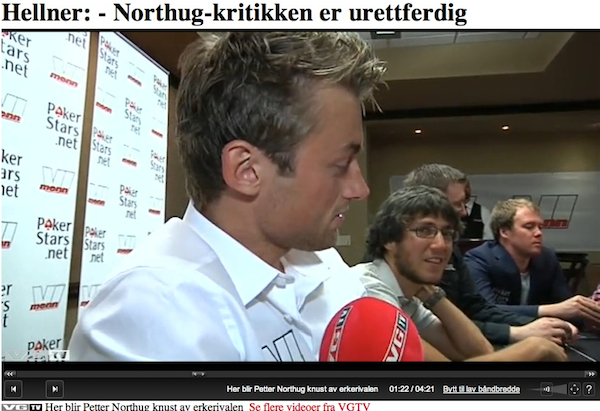
    I sneak a look at the video camera as Petter Northug does an interview with the Norwegian newspaper Verdens Gang. Screenshot from Vg.no

    I step off the bus from the Strip into the Las Vegas evening and walk inside the Palms Casino, about 40 minutes early for the poker game between Marcus Hellner and Petter Northug. I haven’t eaten since breakfast, and I’m just coming off a two or three mile walk in search a loaf of bread, jostling tourists in 100-degree heat. The only place I can find to make my peanut butter and jelly sandwich is a bench in the parking garage, where I sit watching security guards rolling by on bicycles.

    At 7:00, it’s time to go meet Thorkild Gundersen, my contact from Vi Menn, the magazine that sponsors Petter Northug and brought him to Las Vegas. Thorkild brings me up to the poker room. I don’t know what I expected, exactly, but it wasn’t this: a private meeting room filled with a dozen journalists, an open bar, a couple of card tables, even a backdrop for photo-ops. Thorkild and Alex Oysta, the Vi Menn editor-in-chief, are wearing tuxedos, and while there are a handful of people dressed casually, there are also a bunch wearing really nice clothes. I was as dressed-up as I ever get—corduroys and a polo shirt, which I’d even taken the time to steam in the shower in the morning—but it didn’t feel like enough.

    I‘m introduced to Thor, a kind-looking older man who apparently is a Norwegian poker legend—the “godfather” of the game in the country. I stand around and talk awkwardly for a bit before Thorkild gives a short speech in Norwegian, and everyone sits down at the card tables. Alex tells me to take a seat. Apparently, we’re playing some informal cards with all the other journalists, as well as some professional Swedish and Norwegian poker players who are mixed in—they’re here to watch Petter and Marcus.

    It’s hard to tell exactly who’s who, and though it’s a pretty friendly atmosphere, I’m anxious. It seems like there are high rollers everywhere, and then there’s me—an unshaven 22-year-old in sneakers who doesn’t speak Norwegian.

    The dealer flicks each of us cards. We play an open hand on behalf of the reporters at the table, then a few more. After 15 minutes, Northug and Hellner finally show up—and Northug is shown to the empty seat directly next to me. Like, six inches away. Like, close enough to smell his cologne, and for me to be worried about the fact that I was walking around baking in the sun for two hours that afternoon, and probably smelled pretty bad myself. I know that the whole Scandinavian hero-worship thing isn’t cool, but I am a ski journalist and, ultimately, a ski fan, and Northug is the very best skier in the world, so I was incredibly nervous—even though I look down and notice that his shoes are untied. As we play our first few hands, Northug does interviews with Norwegian television stations. Sitting right next to him, I’m obviously in the shot—the cameras are almost pointed straight at me—and I try not to fidget and screw it all up.

    Eventually, I end up in a predicament with Thor, the Norwegian legend. I have Ace-Nine, and Thor has just gone all-in—wagered all his chips on a single hand. I have the option to call (to match his bet), or to fold. I consult with the Norwegian poker player to my left, and then Thorkild walks up behind me and asks Petter what he thinks I should do. I show him my cards. He leans back in his chair, contemplating. Thor doesn’t care—he has played poker with Larry Flynt and L.A. Lakers owner Jerry Buss—and is amiably chatting with the guy next to him; my heart is pounding as I wait for Northug to give me some advice.

    The view from my seat at the table. Thor Hansen, the Norwegian poker legend, is on the left with the white collar.

    He looks at the cards one more time, giving me a pained expression. “I would play it—that’s what I’d do,” he finally says. So I do, obviously, pushing my chips to the middle of the table.

    Because we’re “all-in” and have no more chips to bet, Thor and I each turn over our cards, revealing the worst possible predicament for me. Thor has Ace-10, which means, essentially, that I am screwed. We’re playing Texas Hold’em—the same type of poker played at the World Series—and the way it works is that after getting your own hand of two cards, five additional communal cards are dealt in the middle of the table. Now, since Thor’s own hand is better, pretty much the only way I can possibly beat him is if a nine turns up.

    The first four cards are flipped over and offer no help to me. I’m about to lose, to be forced out of the game. And then the dealer turns over a nine. The whole table laughs and cheers, as Petter turns to me with a grin. “I told you to play it!” he crows.

    I’ve won the hand. I’m shaking as I reach out to pull all the chips back into my corner, and trying not to let anyone notice— although if Petter is anywhere near the poker player everyone says he is, there’s no way he didn’t.

    After another few hands, it occurs to me that I should probably introduce myself. Eventually, I work up the courage to stick out my hand, tell Petter my name, and ask about his training that morning. Surprisingly, he gives me his full attention, telling me about his rollerski workout in Red Rock Canyon.

    I’m 22—one year out of school and finishing eight minutes down on Simi Hamilton in college races. Today, I’m sitting a foot away from the best cross-country skier in the world. And despite the fact that I’m supposed to be a journalist who would kill for a one-on-one interview with Northug, I can’t think of anything else to ask him. Tomorrow, and the next day, and the rest of my life, there will be time for professionalism, but for now, I’m out of questions. All I can do is sit, and soak it in.

  • For Northug and Norway, Poker is Politics

    For Northug and Norway, Poker is Politics

    Petter Northug in the middle of a game of poker against Marcus Hellner in Las Vegas.

    It’s not oil, fish, or aquavit that’s behind the Norwegian sports machine, which delivered the most medals per capita of any nation at the 2010 Olympic Games—at least not entirely.

    Instead, a healthy portion of the funding for Norway’s sports organizations comes from Norsk-Tipping, the state-owned gambling company. Norsk-Tipping dedicates 45.5 percent of its annual profits to sports—more than $241 million U.S. dollars in 2009 alone.

    That’s one of the reasons that quadruple Olympic-medalist Petter Northug, currently competing in the World Series of Poker in Las Vegas, has been criticized by Norwegian officials for his enthusiasm for the game, according to Tormod Brenna, a reporter for the Norwegian newspaper Dagbladet.

    Poker isn’t offered by Norsk-Tipping, and it’s illegal in Norway to play the game for money.

    However, residents can play online poker on foreign websites, an indirect result of which could be the diversion of funds away from Norwegian sports—assuming those players would otherwise be gambling with Norsk-Tipping.

    In April, Norwegian Ski Federation General Secretary Inge Andersen spoke out against Northug’s hobby in an interview with the website Nettavisen, telling a reporter that “it is important to be aware that most sports in Norway are built on profits from the Norwegian national lottery.”

    “The surplus in the Norwegian National Lottery goes back to community purposes in Norway,” Andersen said.

    Others pointed out further contradictions, such as the fact that youth sports organizations in Northug’s hometown, Mosvik, receive funding from Norsk-Tipping—some through a special program called the “Grassroots Share.” Grassroots Share allows gamblers to dedicate five percent of their stake towards a specific sports club or organization of their choice, and a number of ski clubs are participants.

    By most accounts, the Norwegian public rallied around Northug after the criticism by Andersen and others. But there’s no question that his trip to Las Vegas has driven up interest in poker in Norway—Northug’s face has been on the front page of sports and newspaper websites for the past few days.

    In an interview with FasterSkier, Northug said that he doesn’t concern himself with the impact that poker might have on other people, or on politics.

    “I love to play it and I love the game. For me, it’s important to have other interests than just cross-country skiing,” he said. “I have a vocation, and then I also love to be able to do other things.”

    It was too much of a stretch, Northug continued, to draw a thread between his poker hobby and the cash flow to Norsk-Tipping.

    “That’s too far—I can’t go and think about something like that,” he said.

    Petter Northug playing in the 2010 World Series of Poker

    As one of his sponsors, the Norwegian men’s magazine Vi Menn paid for Northug’s visit to Las Vegas and his entry into the World Series. But according to Thorkild Gundersen, a reporter for the publication, Vi Menn’s relationship with Northug stems from his appeal as a cross-country skier, not as a poker player. The magazine, Gundersen said, had no intention of influencing attitudes towards the game through its support of Northug.

    “We don’t try to change politics,” he said.

    But intentions aside, Gundersen argued emphatically that Northug’s participation in the tournament—and the hype it generated—would have a real impact on the public’s acceptance of poker in Norway.

    “In Norway, there’s a lot of fantasy about poker as games with guns. This is helping the image of poker,” Gundersen said. “The debate…will come because of this.”

    In recent years, many of Norway’s neighbors have made changes to their laws governing poker.

    In Sweden, for example, poker’s popularity has grown quickly over the past decade. State companies allow the game in their casinos, and also launched an online poker website in 2006 in response to growing demand. Government gambling firms in Denmark and Finland have also taken steps towards introducing online poker.

    Vi Menn has never shied away from politically sensitive issues like this one, according to Alex Oysta, its editor—the magazine is “politically un-correct in some ways,” he said.

    There’s also no question that the criticism of Northug and the accompanying media coverage has been good for Vi Menn. According to Gundersen, the magazine’s web traffic is up, and its logo—crisply rendered on Northug’s poker shirt—is splashed all over newspapers and sports sites in Norway.

    “Our brand has never had such visibility—we are all over the place these days,” Gundersen said.

    Despite Gundersen’s enthusiasm, though, it remains to be seen whether any significant changes will result from Northug’s Vegas trip. While acknowledging that the hype would be a boon to foreign gambling sites, Brenna, the Norwegian newspaper correspondent, said that he doubted it would make much of a difference to the country’s politicians.

    Meanwhile, Northug plays on, uncowed—his second day at the World Series comes later this week. The man, Gundersen said, has an uncanny ability to maintain his equanimity amidst a media frenzy.

    “His ability to not give a damn what people say—he’s extremely good at not reading websites, not reading newspapers,” Gundersen said. “He doesn’t want everyone in Norway to like him—that’s not a goal.”

  • Northug, Hellner Survive First Day of Poker World Series

    Northug, Hellner Survive First Day of Poker World Series

    Petter Northug late in the first day of the 2010 World Series of Poker

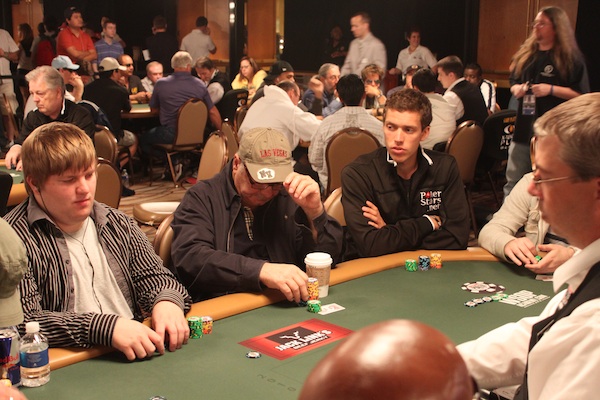
    11:28 PM: With ten minutes to go in the first day of the World Series of Poker in Las Vegas, it appears that both Petter Northug and Marcus Hellner have survived, and will head into a second round of play later this week. The two each have comfortable stacks of chips, and will be in decent position as the tournament continues on.

    4:50: For once, it looked like Petter Northug was faced with a comeback that was too tough.

    Marcus Hellner

    With his chips dwindling at the 2010 World Series of Poker, Northug had gone “all in,” and was met with the prospect of being eliminated just three hours into the tournament.

    Stone-faced, eyes concealed behind a pair of Oakley sunglasses, Northug sat calmly and waited to see if the one player left in the hand would match his bet.

    When he did, Northug flipped over his cards and walked away from the table, his tournament hinging on the next few cards dealt. Ultimately, he lucked out with a pair of aces to stay in the game.

    Marcus Hellner’s second two-hour stint at the table was much less dramatic, but the result was the same, as both men appear to have roughly 20,000 in chips remaining.

    The two Scandinavians have completely assimilated themselves into the poker world, adopting the typical mannerisms and disinterested appearances of many of the players here. In addition to Northug’s designer shades, both athletes have also spent much of the tournament listening to music through headphones.

    The two players' chips after four hours of play. Northug's stack is on the left, Hellner's is on the right.

    2:48 PM:

    Just over a quarter of the way into the 2010 World Series of Poker, Marcus Hellner holds the edge over Petter Northug.

    Hellner appears to be steady at around 30,000 chips—the same number he started with—while Northug has dropped to roughly 20,000.

    While his body language spoke differently, Northug was still optimistic about his chances during the first half-hour break from play. The most threatening competitor at Northug’s table, 2004 tournament champion Greg Raymer, was bounced out after just an hour, and Northug said that he was starting to get a good sense of his competitors’ playing styles.

    “The thing is just to be patient and wait for my spot,” he said. “I have plenty of time yet…I think it’s a good table for me—it’s pretty aggressive players, so if I just hit the big hand, I think I can win a lot.”

    Fifteen tables down, Hellner said that he was enjoying the benefits of wearing a jacket with his sponsor PokerStars’s logo.

    “I think they have a little bit of respect for me because I have this,” he said. “They think I’m good at it—I tried to bluff them some times, and they take it.”

    While Hellner hopes to last as long as he can in the tournament, he was realistic about his chances.

    “My first goal is to beat Petter,” he said. “I think it will be very hard for me as it goes on.”

    Both Hellner and Northug will have to grind through nearly twelve hours of poker—from noon to midnight—in order to make it through to the next round of competition. Neither was concerned about the long hours, though—nor the early wake-up call tomorrow morning for a 9 a.m. rollerski race at the Palms.

    In fact, Northug said he was far more concerned about the poker than about the skiing—at least during his Vegas vacation.

    “Tomorrow is just fun—this is competition,” he said. “It’s a big dream to play in the main event—it’s one of my biggest interests…I have to enjoy it, and I also have to play good.”

    None of the players at either Northug or Hellner’s table seemed to realize that they were playing with multiple Olympic medalists—and Northug said he’d rather have it that way. If anyone found out who he was, “then they’d think I’m a big fish,” he said.

    1:28: One hour into the World Series of Poker and not much has changed here in Las Vegas–neither Petter Northug nor Marcus Hellner have budged from their seats at the card table, although Northug did just fold out of a large hand just moments ago.

    Perhaps the most notable aspect of this afternoon’s play is that Northug is stuck at a table with Greg Raymer, the 2004 World Series of Poker Champion, who provides a stark contrast between the world of poker and the world of cross-country skiing.

    Raymer is nicknamed “Fossilman,” apparently because of his hobby of collecting prehistoric remnants, although it also appears to be an apt physical description. Wearing a bizarre pair of holographic sunglasses, Raymer was nearly eliminated in the first hour when he lost a hand to another player at the table, but is holding on with a small fraction of his chips remaining.

    Hellner appears to be playing more conservatively than Northug–the Swede has been folding the vast majority of his hands, which is typical for this early in the tournament. Northug has played a few more, and appeared to lose at least 10 percent of his chips when he called a large pot (in non-poker speak, that means that he matched another players bet), then folded when the cards did not turn his way later in the hand.

    Northug is playing at a featured table on a platform in a corner of one of the rooms here at the Rio–he apparently was unhappy about being moved.

    More to come.

    Marcus Hellner (arms folded) at his first round table.
  • Hellner Takes Round One of Vegas Extravaganza

    Hellner Takes Round One of Vegas Extravaganza

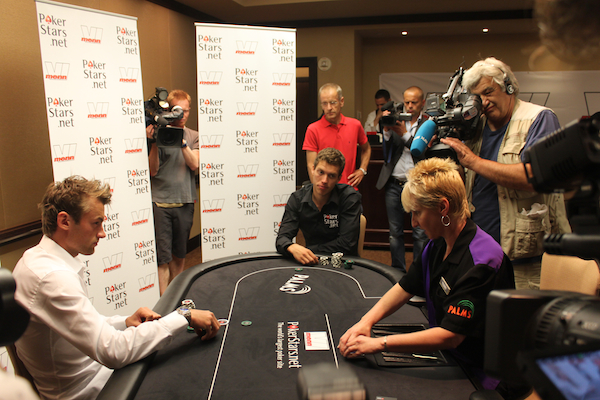
    Petter Northug (L) and Marcus Hellner (center) playing a one-on-one game of Texas Hold'em at the Palms Casino in Las Vegas.

    Marcus Hellner one, Petter Northug zero.

    In an hour-long production worthy of two A-list celebrities, Hellner outlasted Northug in a one-on-one game of Texas Hold’em at the Palms Casino in Las Vegas on Sunday evening.

    Orchestrated by the Norwegian men’s magazine Vi Menn and the online gambling company PokerStars, the event showcased the kind of status that the two athletes enjoy in Europe.

    Clad in a crisp white button-down shirt emblazoned with a Norwegian flag and a Vi Menn logo, Northug spent the first portion of the evening playing a casual game of cards and hobnobbing with media and Scandinavian poker professionals. The event was held in a private room at the Palms, complete with an open bar, although neither Northug nor Hellner appeared to drink any alcohol.

    Marcus Hellner sizes up a hand early on in the game.

    With half of his attention on his cards, Northug gave interviews to television stations and poked fun at Thor Hansen, the man considered the “godfather” of poker in Norway, who was sitting at Northug’s table.

    After the athletes relaxed for half an hour, it was time for business. Thorkild Gundersen, who coordinated the event for Vi Menn, introduced the match-up as the first in a best-of-three contest that would also include the World Series of Poker tournament, and a rollerski race on Tuesday.

    The first hands were then dealt by a professional dealer enlisted by PokerStars, this being not just any basement game.

    Displaying the same steely focus and drive that he does on the race course, Northug got out to an early lead, reducing Hellner’s pile of chips to what seemed to be dire levels. But Hellner never panicked, slowly working his way back into the game and ultimately forcing Northug into betting all of his chips on an ace-five hand. Since Hellner held ace-ten, he was all but guaranteed of victory—which was ensured when another ten was dealt, giving Hellner a pair, and the win.

    Given Northug’s reputation as a cutthroat poker player, Hellner’s victory should probably be considered an upset—even though the Swede didn’t look at it that way.

    “I thought that he maybe would be afraid of me—I think he saw me as a very tight player,” Hellner said. “I got some good cards.”

    The extravaganza continues at noon western time on Monday, when Northug and Hellner compete in the first day of the World Series of Poker tournament at the Rio. Despite Northug’s loss, Hansen, the Norwegian poker legend, said that he thought that that the quadruple Olympic medalist was a skilled player.

    “All the Norwegian kids [young poker players]…tell me he’s good,” Hansen said. “He wants to be good—that’s the competition in him.”

    While playing live poker for money is illegal in Norway, Hansen said that Northug enjoys the support of the country’s people in his card-playing habits, even though he was criticized by the general secretary of the Norwegian ski federation for setting a bad example for children.

    In the same vein, Hellner’s appearance in Vegas is part of a strategy by PokerStars, his sponsor, to push poker into the mainstream in Sweden, according to

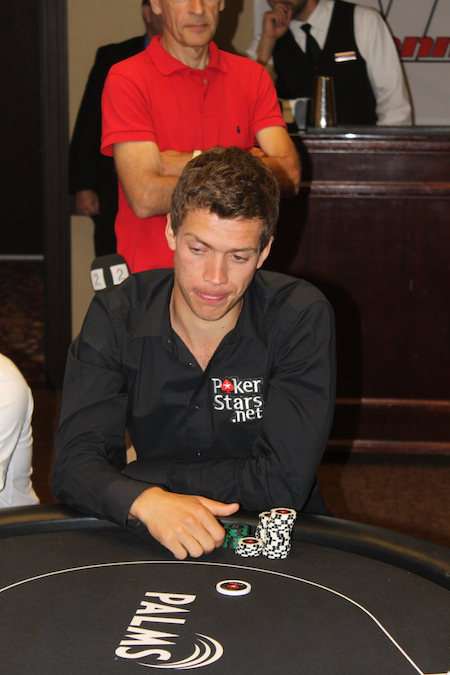
    Northug, as his chips began to dwindle

    Murat Sahan, the editor of a poker magazine in the country. Sahan said that PokerStars has recruited athletes like Hellner, hockey star Mats Sundin, and former tennis great Boris Becker to its team of players because they make the game seem more accessible.

    “This is, of course, a way of making poker more accepted in the general public,” he said.

    Not Just Fun and Games

    Northug and Hellner were so focused on poker on Sunday night that one could almost have forgotten the two were professional athletes.

    Scandinavian fans can rest assured that they haven’t. After a three-hour bike ride on Saturday, Hellner, Northug, and Northug’s younger brother Thomas—a world junior champion who is here watching—all drove out of Las Vegas to the scenic Red Rock Canyon for rollerski intervals Sunday morning, while the rest of the town was probably still nursing their hangovers. (Click here for photos.)

    More details also emerged about Tuesday’s rollerski race between Hellner and the elder Northug.

    According to Vi Menn Editor Alex Oysta, the event will be held in one of the Palms’s parking lots, the course being a lap and a half of a short, figure-eight loop around two traffic islands. Because the loop is so brief, Hellner and Northug will race a best-of-three-heats series.

    Vi Menn and PokerStars had to wrestle with Las Vegas’s dearth of nordic knowledge in order to line up the race. It was originally scheduled for Monday, but Oysta said that the date had to be changed because the Palms wouldn’t be able to clear the lot the day after the Fourth of July.

    And according to the PokerStars manager who coordinated the event, the Palms’s staff was flummoxed by the idea of a rollerski race—making it difficult to insure, which the casino required. The insurance wasn’t even for the athletes, the manager said—instead, it was in case Northug or Hellner crashed and injured a spectator or damaged a vehicle.

    Northug and Hellner pose for photos after the end of the game.