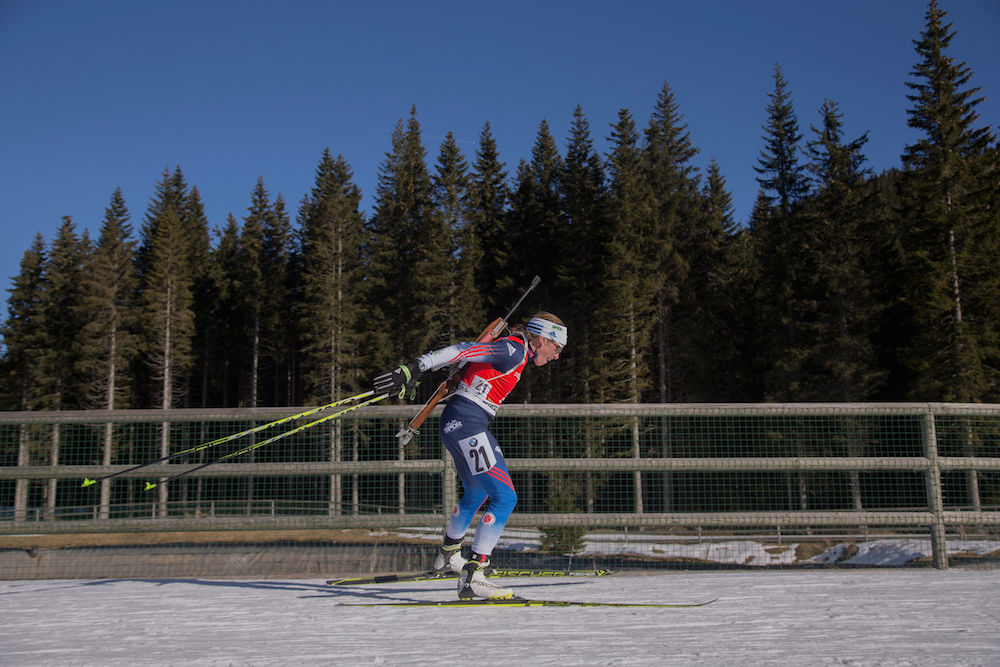
Tag: Pokljuka

  • Saturday Rundown: Beitostølen, Pokljuka (Biathlon), and Sovereign Lake (Updated 4 x)

    Saturday Rundown: Beitostølen, Pokljuka (Biathlon), and Sovereign Lake (Updated 4 x)

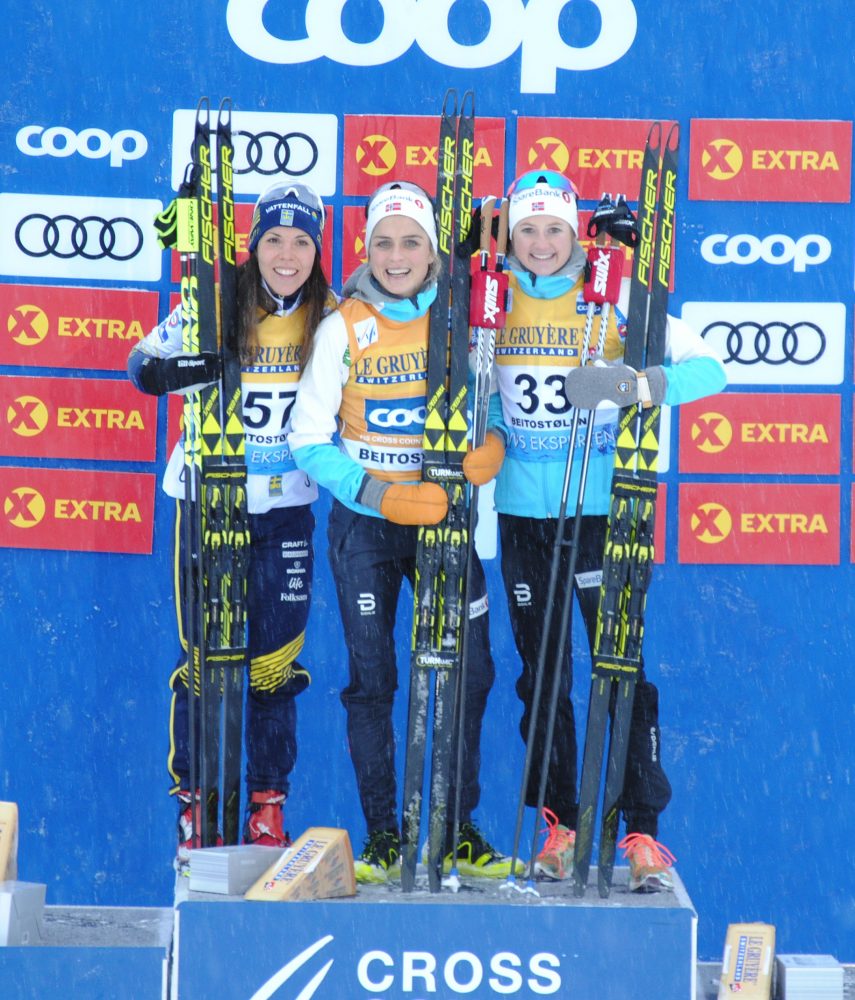
    The Women’s podium from the World Cup 15 k freestyle in Beitostølen, Norway. Norwegian Theresa Johaug (center) was first, Sweden’s Charlotte Kalla (left) second, and Ingvild Flugstad Østberg (right) of Norway third.

    FIS World Cup Beitostolen, Norway 15 k/30k Freestyle Individual Start 

    Women’s Race Report | Men’s Race Report 

    With snow falling and trees covered with fresh snow, Beitostølen, Norway’s wintery essence was on full display during the women’s 15-kilometer freestyle individual start on Saturday.

    Keeping her distance win-streak alive was Norway’s Therese Johaug who won her fourth World Cup distance race of the season making it four for four in 2018/2019.
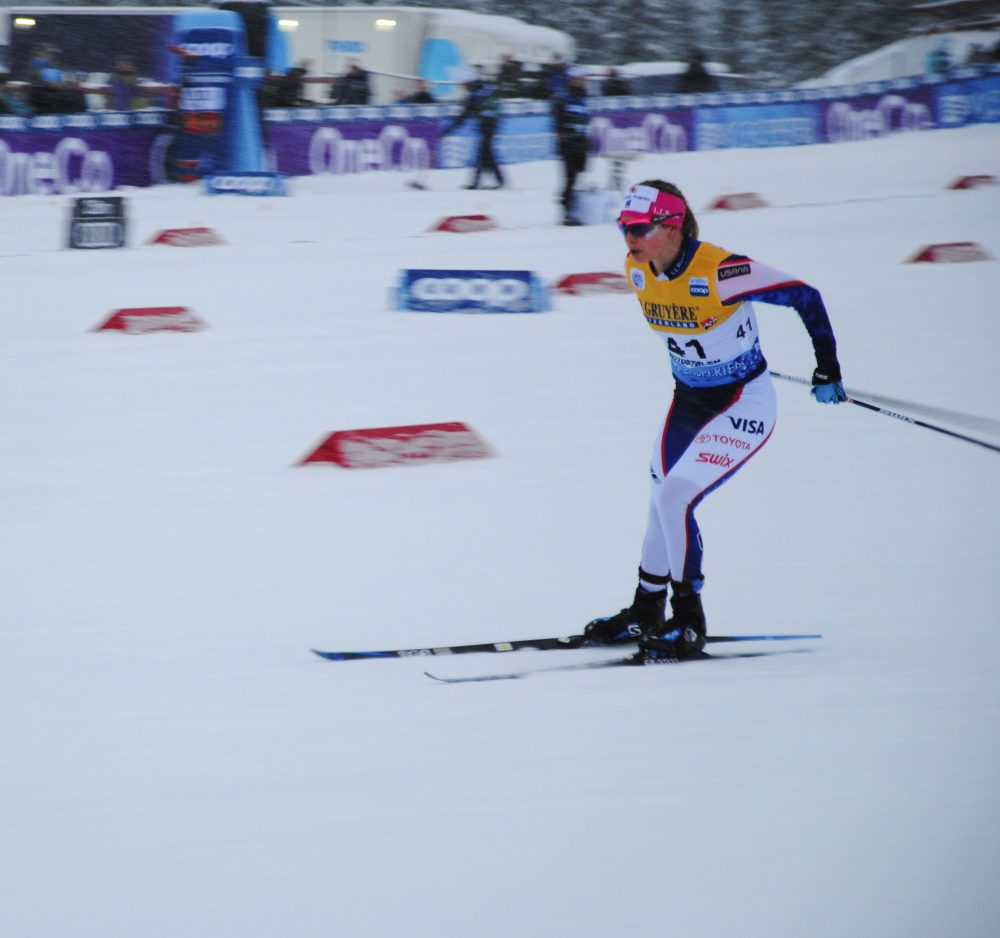
    Jessie Diggins of the U.S. Ski Team on her way to eighth place during Saturday’s 15 k freestyle in Beitostølen, Norway.

    Johaug won in a time of 38:39.8 minutes. The only blip of egalitarianism on the tracks was at the first time check at 1 k, where Johaug was tied for the best time with Russia’s Natalia Nepryaeva. Otherwise, Johaug gradually pulled away from the fifty-eight finishers by the time she crossed the finish line.

    Sweden’s Charlotte Kalla placed second (+1:05.9), and Ingvild Flugstad Østberg of Norway was third (+1:06.1).

    U.S. Ski Team (USST) athlete Jessie Diggins finished in eighth (+1:29.6) for her first top-10 result of the season. Sadie Bjornsen (USST) placed 13th (+2:22.9), Rosie Brennan 15th (+2:33.9), Caitlin Patterson (CGRP) 32nd (+3:46.0), and Kaitlynn Miller 50th (+5:02.8).

    Canada entered a women’s team for the first time this season. Emily Nishikawa of the Canadian National Team (CNT) was the best placed Canadian in 34th (+4:01.6). Cendrine Brown (CNST) was 38th (+4:16.4).

    Women’s Results


    Sitting atop the men’s overall World Cup this season after Saturday’s racing is Russia’s Alexander Bolshunov. The young skier is a killer in the sprints and distance events. But it is perhaps Norway’s Sjur Røthe who has impressed the most this season in the distance events. Røthe has a slight seven-point lead in the distance overall.
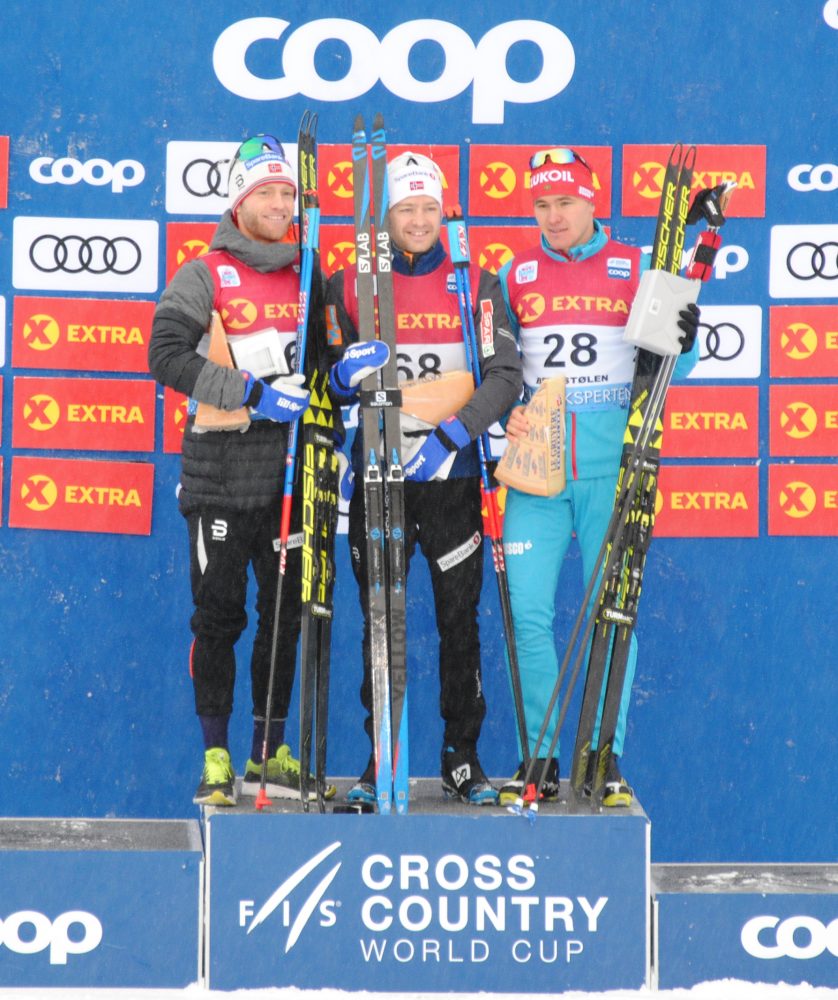
     

    The men’s podium from the 30 k freestyle individual start in Beitostølen, Norway. Sjur Røthe (center) placed first, teammate Martin Johnsrud Sundby (left) second, and Russia’s Andrey Melnichenko (right) third.

    Røthe won Saturday’s 30 k skate individual start in a time of 1:09:53.5. It was his second World Cup victory this year. Teammate Martin Johnsrud Sundby, with his first podium of the season, placed second (+35.2), Russia’s Andrey Melnichenko was third (+49.2). For the twenty-six-year-old Melnichenko, it was his first career World Cup podium.

    Canada’s Alex Harvey was the best placed North American in 13th (+1:49.8). Also skiing for Canada, Andy Shields finished in 63rd (+7:05.6).

    Scott Patterson (USST) was the best-positioned skier for the U.S., placing 47th (+4:32.7). David Norris (APU) skied to 51st (+5:13.3.) Erik Bjornsen (USST) was 52nd (+5:14.9), Adam Martin (CGRP) 59th (+6:14.8).

    Men’s Results


    ***


    IBU World Cup, Pokljuka, Slovenia

    Egan Leads North Americans in 15th Place in Pokljuka Sprint. 

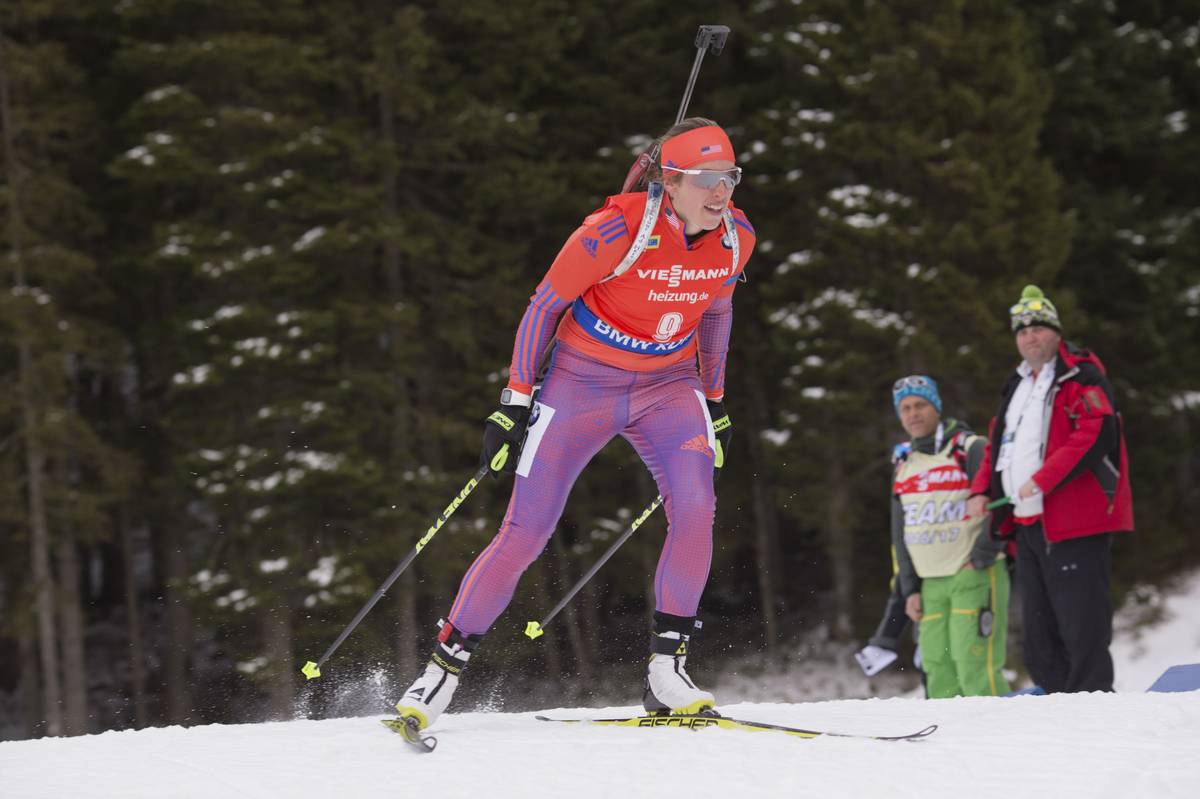
    Just before her race on Saturday, US Biathlon’s Clare Egan seemed to be in a relaxed mood and could be seen on the broadcast joking with other athletes and posing for pictures in the warm-up zone. Starting into the women’s 7.5-kilometer sprint in an early group in bib 26, Egan began the race fast and still managed to shoot clean in her prone stage.

    She kept near the top at the split times during this early phase of the race.

    “I am skiing way faster than I have in past years,” Egan commented on her improved course time in an email to FasterSkier, which in past seasons occasionally had prevented her from achieving positions in the points or qualifying for pursuit and mass start races. “I think my previous best ski time was in the 20’s, but my average was probably in the 50’s. So to have 11th ski time in the Individual [on Thursday] and the 6th today is a very significant improvement for me. It means that I can now aim for the flower ceremony, and even the top of the podium.”

    In the standing shooting stage she then missed her very last shot of the race, having to ski once through the 150-meter penalty lap. After another fast final loop she came to the finish in fourth place. But after several athletes who began the race later finished ahead, she was pushed down in the standings, ultimately ending her day in 15th position (+1:08.8, 0+1). According to Egan she only narrowly missed a career-best result, having finished in 13th place in the sprint in Kontiolahti, Finland, during the last season.

    “Today I would have been 4th or 5th if I had hit my last shot,” Egan wrote. “Overall my shooting is there, and now my skiing is too, so I just need some more races to get comfortable in this position. I really fought for my last two shots today and I got the 9th one and I’m very happy about that. Also my prone was perfect and I don’t take that for granted. I am focusing on the positive things and learning what I can to do better next time… which is tomorrow!”

    Behind Egan, her teammate Susan Dunklee also had drawn a spot in the first start group starting early in bib 2, and remained clean in the prone stage as well. But in her second shooting she incurred two penalty laps, and ultimately ended her race day finishing in 45th place (+1:50.4, 0+2). The third U.S. starter, Joanne Reid, finished 57th with two penalties (+2:06.8, 1+1).

    “Our whole women’s team did excellent training and it is paying off: last year at World Cup 1, zero American women qualified for the pursuit, whereas all three of us did today,” Egan commented.

    She also credited their revamped coaching staff around which centers around Armin Auchentaller.  Auchentaller spent the last few seasons coaching the Swiss women’s team.

    “And it’s worth noting that with Susan’s 11th place in the Individual, we’ve now had two women go in the top-15 already in the first two races of the year (which is likely a first for US Biathlon). We are proud of ourselves and motivated to keep climbing. As usual, our ski service team is on fire. Tomorrow we’ll go for it again in the pursuit!”

    For Biathlon Canada it was a difficult day on the shooting range overall, with Megan Tandy posting the best result in 73rd place (+2:46.6, 0+2). Her teammates Rosanna Crawford finished 77th with four penalties (+2:52.1, 2+2), Nadia Moser was 88th (+3:42.1, 2+2) and Megan Bankes was 99th (+4:39.6, 1+4). All missed qualifying for the pursuit on Sunday.

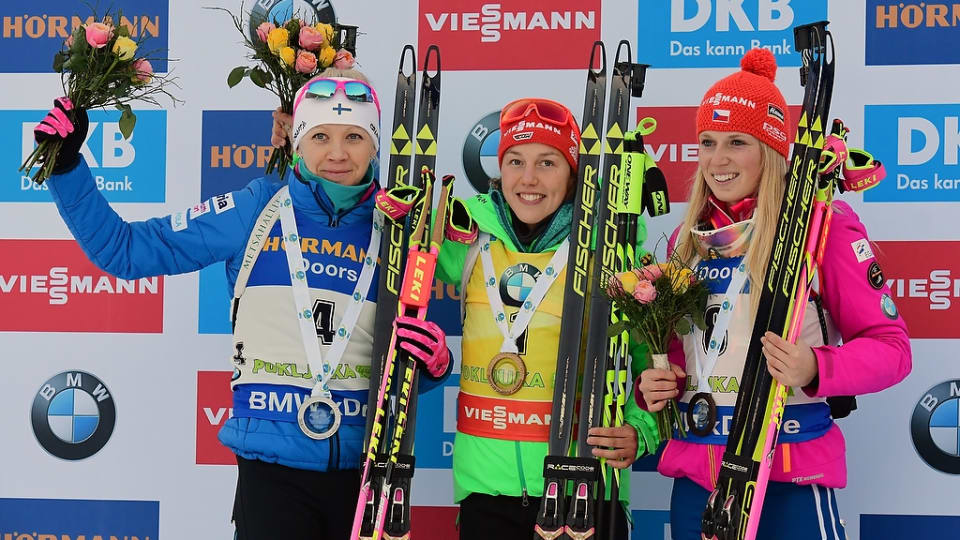
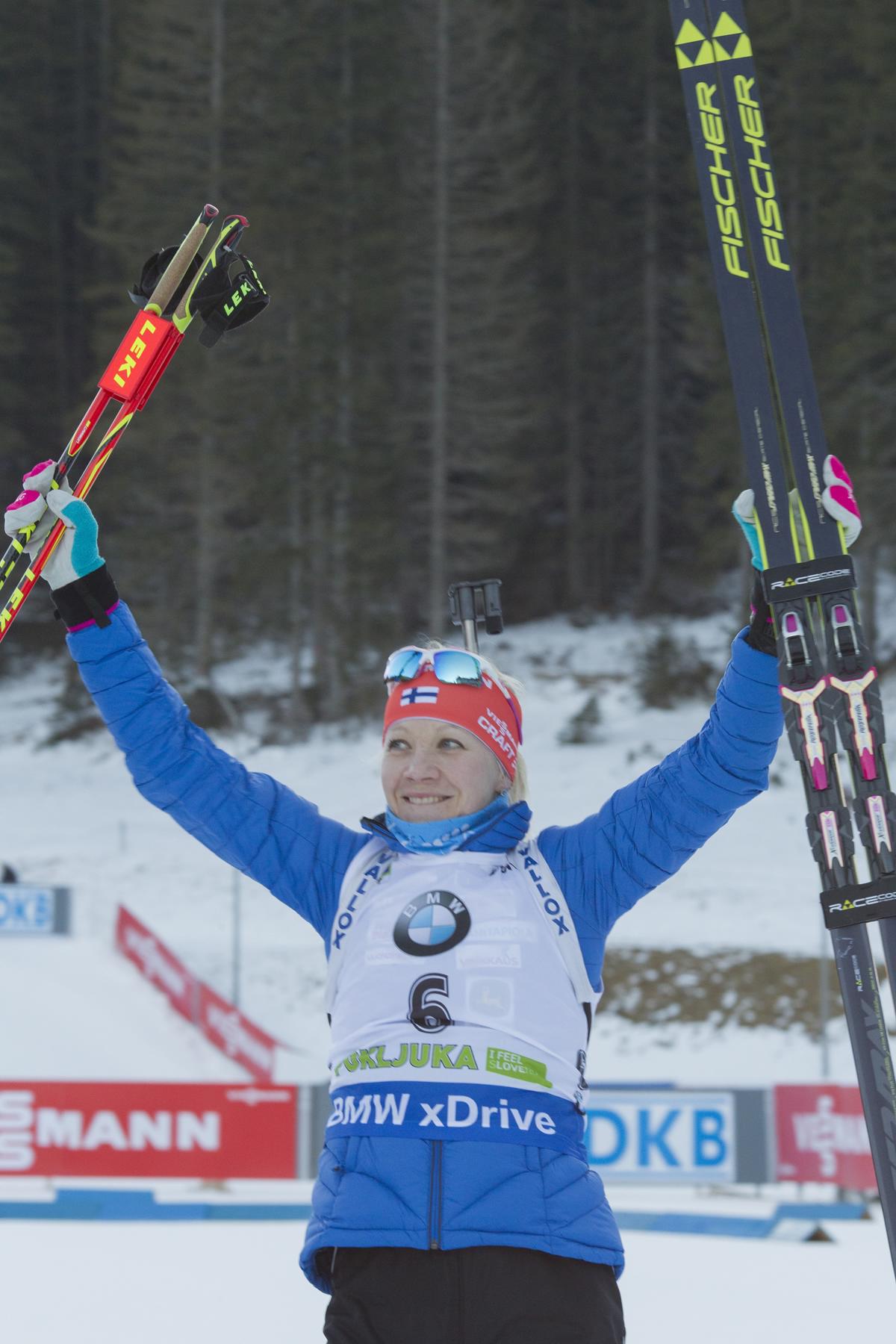
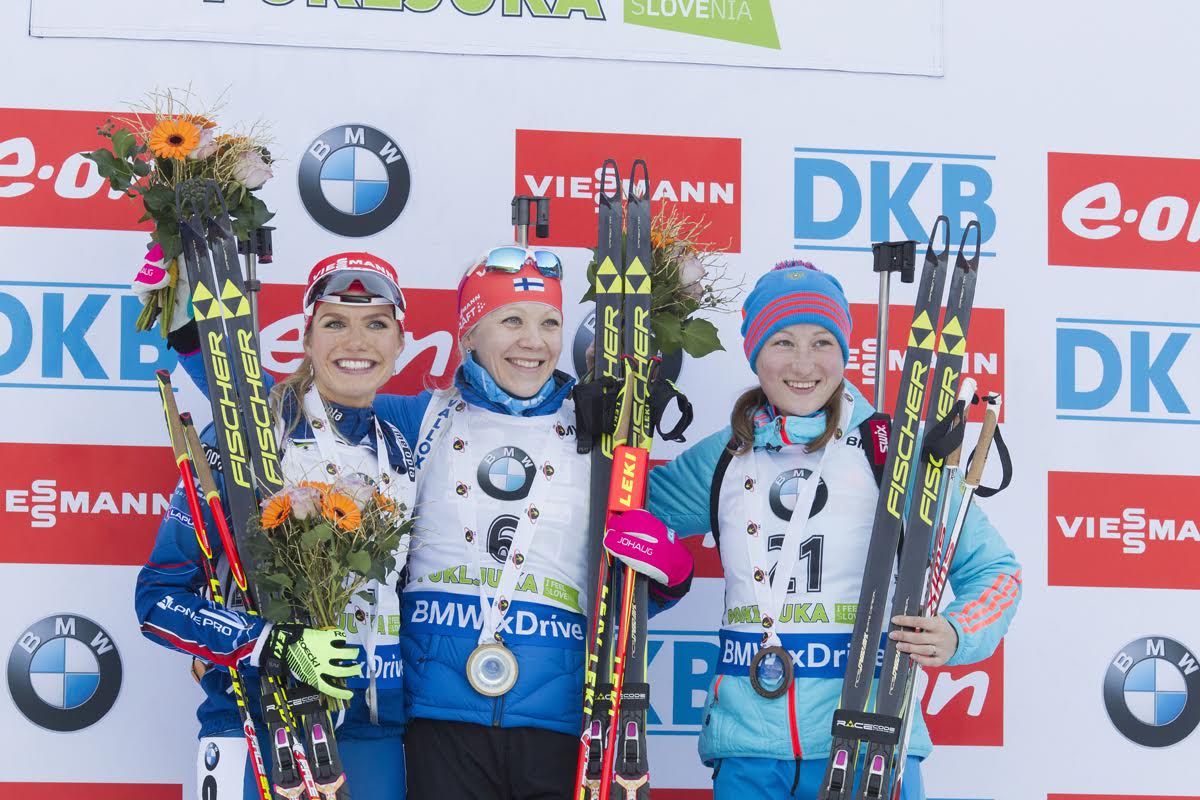
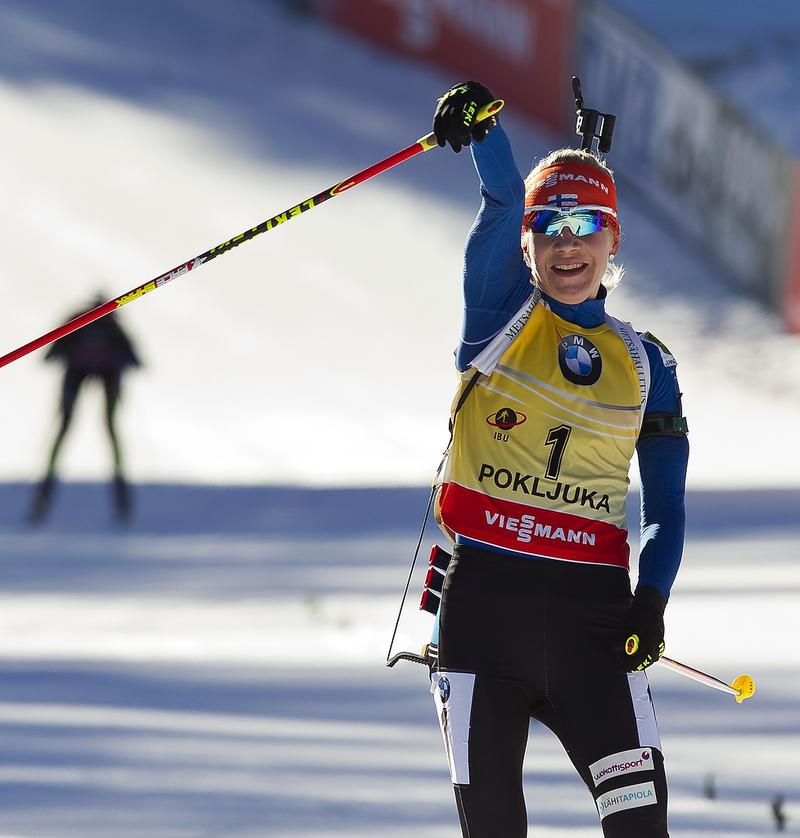
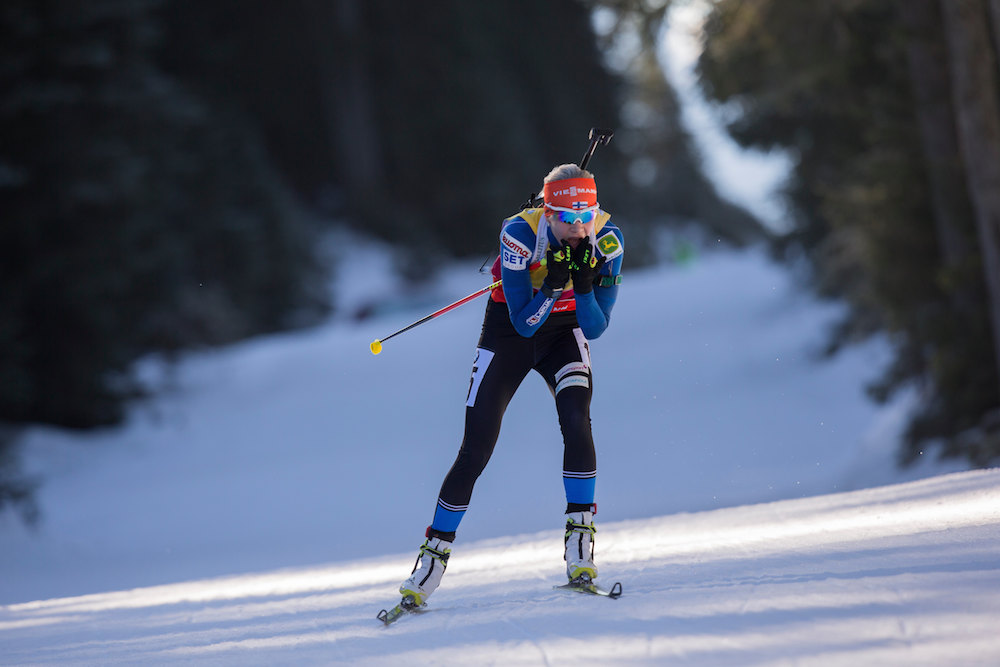
    About a minute ahead of Egan, the race was won by Finland’s Kaisa Mäkäräinen in a time of 20:08.1 minutes, with no penalties.

    “I enjoyed today,” last season’s Overall World Cup winner Mäkäräinen commented in the press conference. “I really tried to be confident. … Of course it gives you a lot more energy when you shoot clean. I know if I shoot clean that I can fight for the top positions. … But I still had to work hard and had a good last loop.”

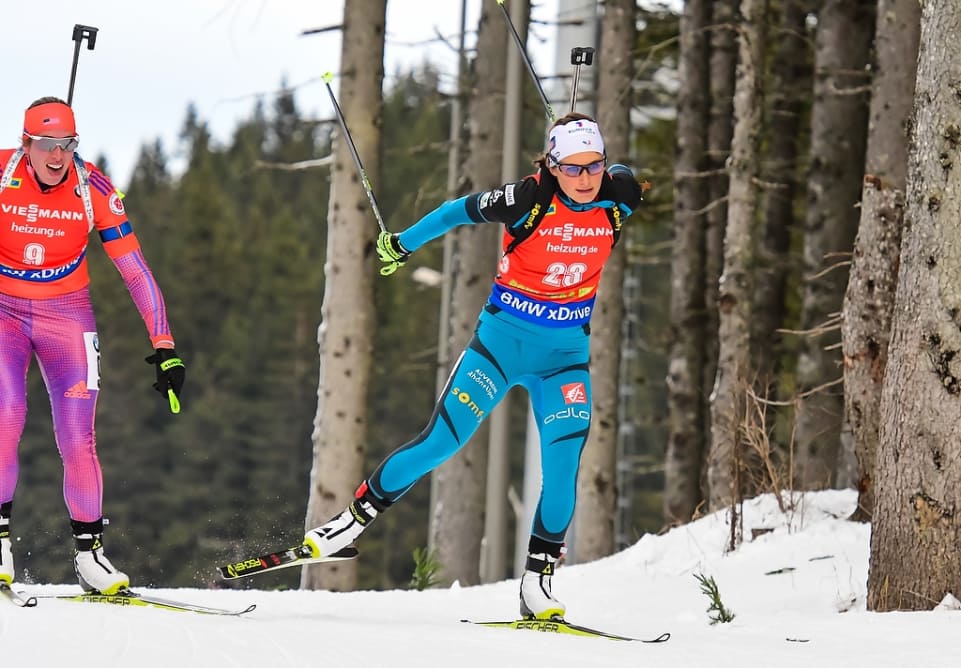
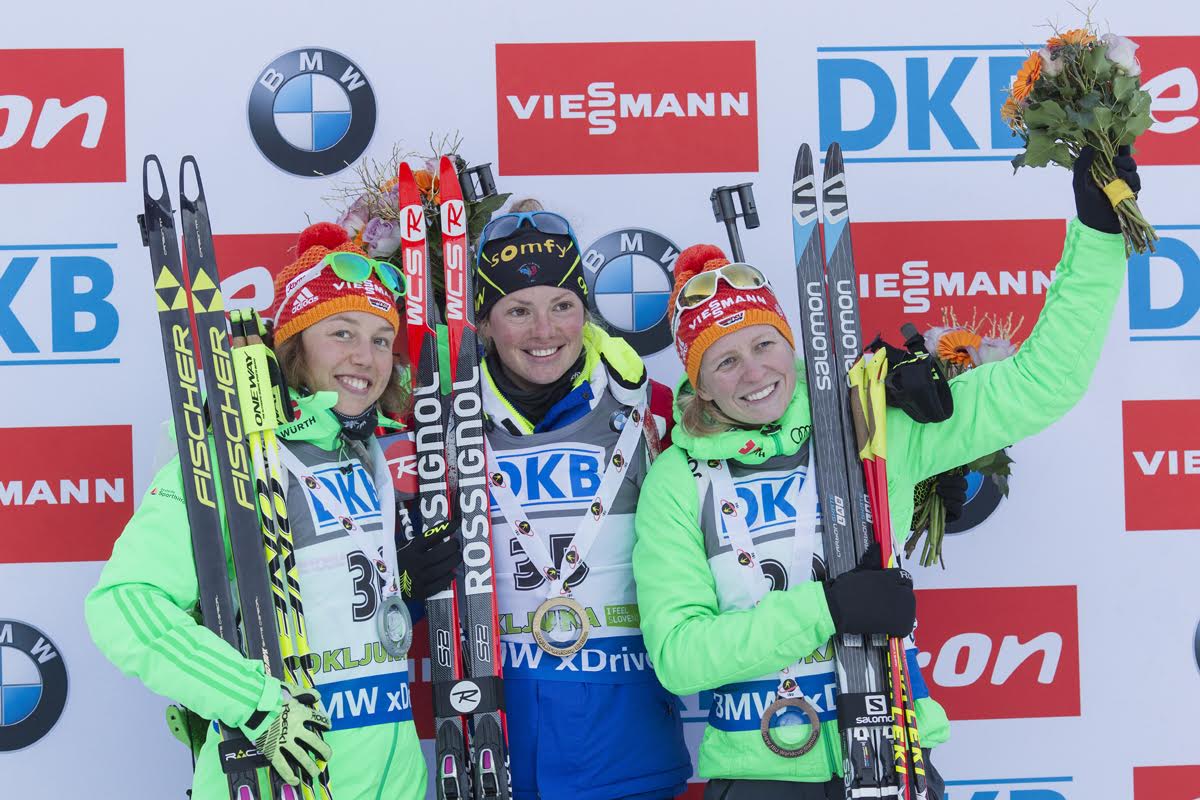
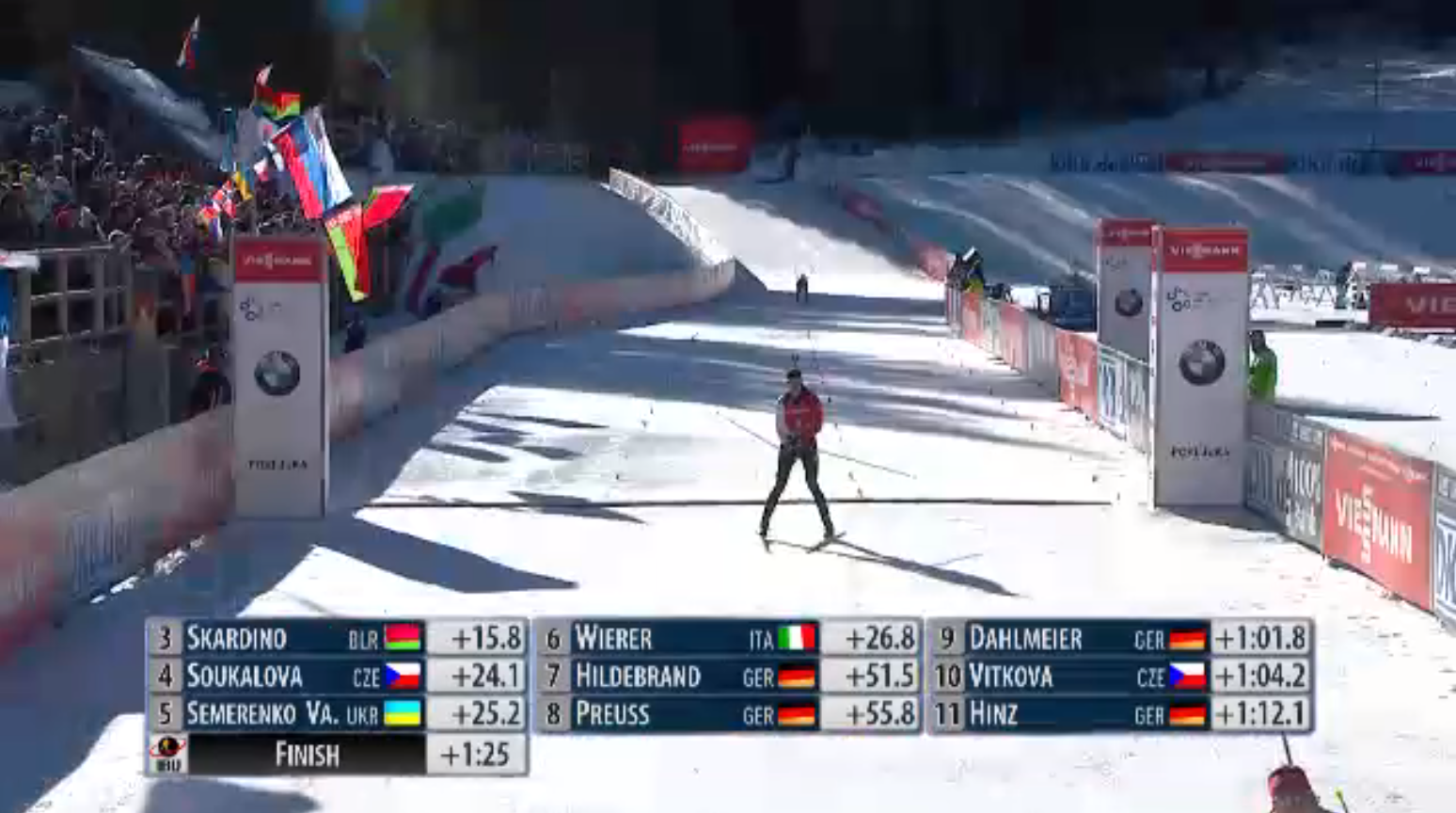
    In the finish she was 14.8 seconds ahead of Italy’s Dorothea Wierer, who also had no miss and recorded the fastest shooting time on the range on Saturday, but couldn’t match her Finnish rival on the course. Hitting all targets as well, Justine Braisaz of France finished third (+42.1, just two days after ending the individual race only in 82nd place with seven penalties. That’s the ups and downs of biathlon. Also shooting clean and just off the podium was Braisaz’s teammate Julia Simon in fourth place (+44.6), for her first top-ten result in a World Cup. Wierer’s teammate Lisa Vittozzi was fifth with one penalty (+46.9, 0+1).

    Results IBU Women’s Sprint

    ***

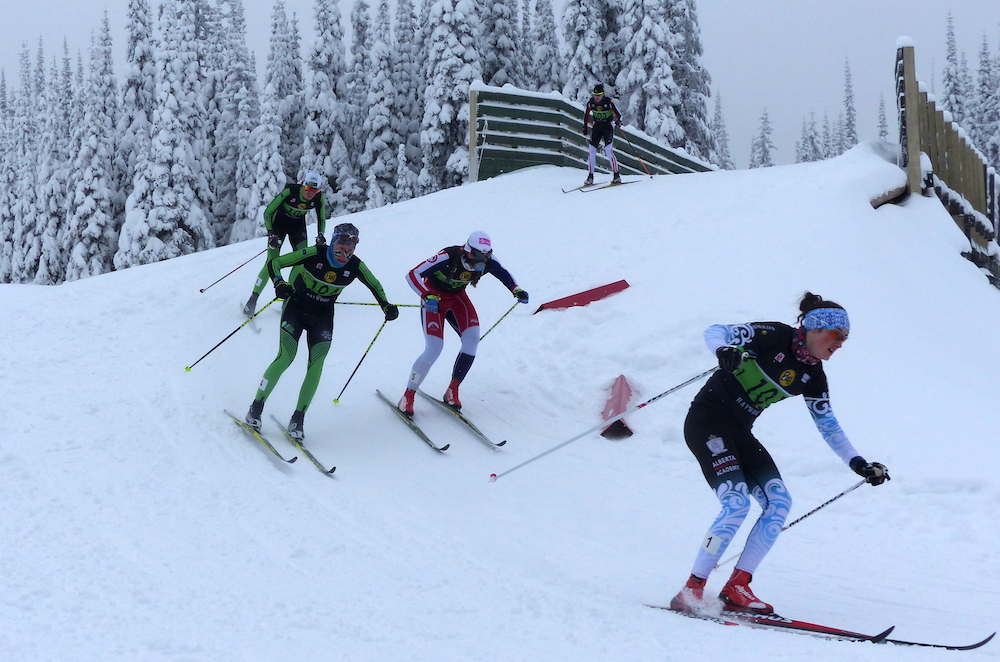
    Julia Kern (SMS) leads Dahria Beatty (CNST) into the final straight in the A final. (Photo: Peggy Hung)
    Julia Kern (SMS) leads Dahria Beatty (CNST) into the final straight in the A final. (Photo: Peggy Hung)

    Sovereign Lake Noram/SuperTour, Vernon, BC

    North American racing resumed with free technique sprints at Sovereign Lake. The first weekend of the NorAm series was also the second weekend in the SuperTour.

    SMS’s first year senior Julia Kern continued her strong start to the season, winning the qualifier and the A final and looking dominant throughout. National team member Dahria Beatty kicked off her season with a crash in the qualifier, but got up to finish 7th. Dartmouth and AWCA’s Laura Jortberg was in third, followed by national team member Maya MacIsaac-Jones. APU’s Hannah Halvorsen was fifth and Stratton Mountain School’s (SMS) Erika Flowers trailed in last after breaking a pole on the final downhill corner.
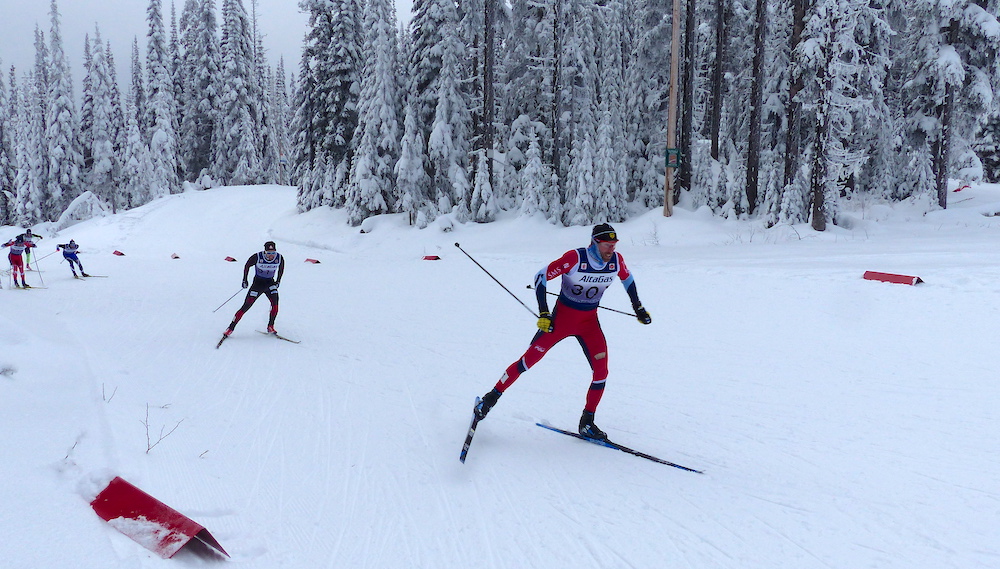
    Andy Newell leads Antoine Briand into the finish straight in the A final. (Photo: Peggy Hung)
    Andy Newell leads Antoine Briand into the finish straight in the A final. (Photo: Peggy Hung)

    On the men’s side, Andy Newell (SMS) continued the American domination, winning the qualifier in 2:15.180, 4.050 seconds ahead of APU’s Logan Hanneman, before winning all of his heats comfortably. Antoine Briand represented for Canada and the Centre National d’Entrainment Pierre Harvey (CNEPH), placing second to Newell in every heat. Ben Saxton (SMS) completed the podium, edging out APU’s Logan Hanneman in a four way battle for third. Antoine Cyr (CNST) and Ben Lustgarten (Craftsbury Green Racing) trailed in two ski lengths behind.

    It was a challenging day for the timing team. The qualifier results are posted as usual, but only interim heat results are available online.

    “It was a cascade of issues,” jury member Dave Dyer told FasterSkier.

    The short, short version is that the timing system has a number of redundant systems to detect errors. While the timing team was working on an unrelated issue, two athletes tied exactly. There are two sets of results zone4: the provisional (timed to 1/1000ths of a second) and the official (timed to 1/100th of a second). The bib list was generated from one list and the zone4 live timing database was populated from the other, with the two skiers who were tied shown in different order. From this point on, all the backup systems indicated errors and everything had to be hand checked. The results were right, the right athletes advanced, but live timing was switched off and delays ensued.

    Full details and video interviews will be in Monday’s event wrap-up.

    The women’s A final.

    The men’s A final.

  • Sunday Rundown: Davos, Pokljuka & Sovereign Lake (Updated x3)

    Sunday Rundown: Davos, Pokljuka & Sovereign Lake (Updated x3)

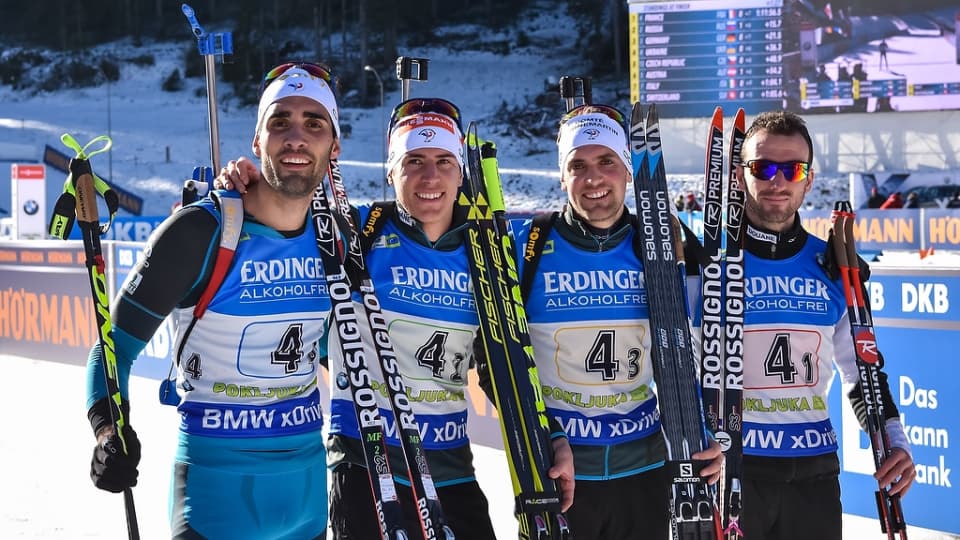
    The French men's relay team after their IBU World Cup win on Sunday in Pokljuka, Slovenia, with (from left to right) Martin Fourcade, Quentin Fillon Maillet, Simon Desthieux, and Jean-Guillaume Béatrix. They beat Russia by 15.7 seconds for the win. (Photo: IBU)
    The French men’s relay team after their IBU World Cup win on Sunday in Pokljuka, Slovenia, with (from left to right) Martin Fourcade, Quentin Fillon Maillet, Simon Desthieux, and Jean-Guillaume Béatrix. They beat Russia by 15.7 seconds for the win. (Photo: IBU)

    Welcome to The Rundown, your quick primer of need-to-know information about the day’s racing. We’ll be updating this digest as the day goes on with additional results, photos and quotes. The Rundown is NOT a race report; stay tuned for complete race reports later today with interviews from the day’s top racers.

    ***

    Note: This recap has been updated to reflect the correct positions each of the four Canadian women exchanged in during Sunday’s 4 x 6 k IBU World Cup relay. 

    IBU World Cup in Pokljuka: Men’s & Women’s Relays

    Germany and France reached the podium in both the men’s 4 x 7.5-kilometer and women’s 4 x 6 k sprints on Sunday, the final day of the International Biathlon Union (IBU) World Cup in Pokljuka, Slovenia.

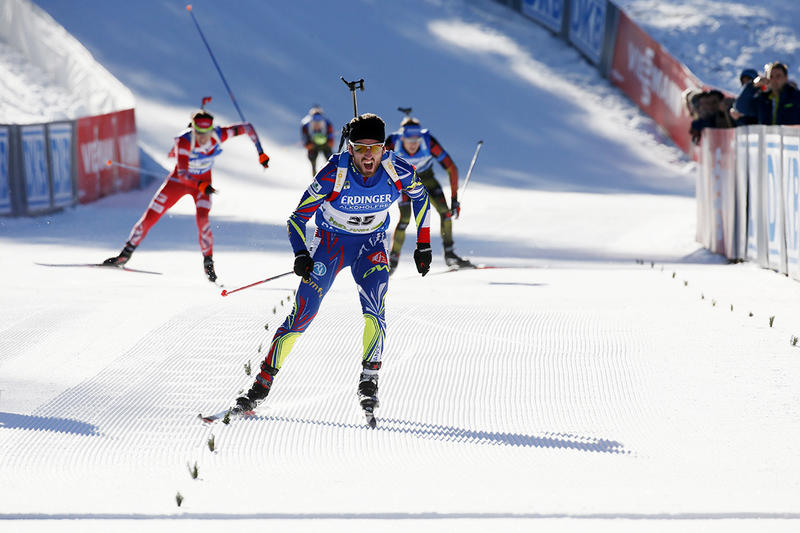
    France won the men’s race by 15.7 seconds over Russia with a total of seven spare rounds and zero penalties. Jean-Guillaume Béatrix started off by putting the French team in fourth, then Quentin Fillon Maillet elevated them to first, a position both Simon Desthieux and Martin Fourcade held for the victory in 1:11:56.5.

    “When we started the relay, we thought that winning was possible,” Béatrix said, according to an IBU press release. “At the same time, the competition was very tough. There were many strong teams today.”

    “I was very happy to tag Martin with a 20-second lead,” Desthieux said. “This is good for my confidence.”

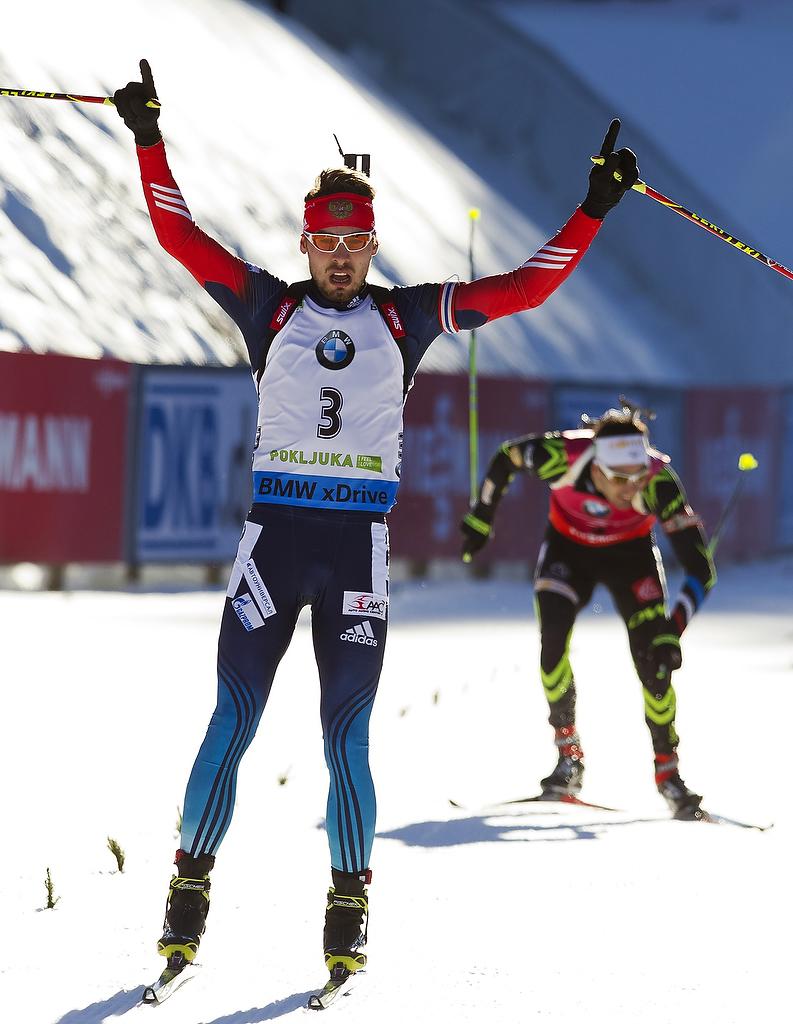
    Russia placed second with Maxim Tsvetkov, Anton Babikov, Matvey Eliseev, and Anton Shipulin, the four of which combined for one penalty (on Eliseev’s third leg) and six spare rounds.

    Germany rounded out the podium in third, 21.5 seconds behind France, with Erik Lesser, Matthias Dorfer, Benedikt Doll, and Simon Schempp. In ninth after Lesser’s first leg, Dorfer brough the team to eighth and Doll raced them into second before Schempp lost one place to end up third. They used a total of 11 spares but avoided the penalty lap.

    Canada placed 10th of 22 teams, 1:44.7 out of first with one penalty and seven spares. Christian Gow started the team out with clean shooting and tagged off in sixth at the first exchange, and his older brother Scott Gow also shot clean without any spares to move up to fourth at the second tag. Macx Davies required three spares and had to ski a penalty lap on his prone stage, then used another spare to clean standing and tagged off in 14th place. Brendan Green anchored the Canadians to 10th, using three spares but avoiding a penalty in prone, then cleaning standing without any spares.

    “I had a somewhat disappointing pursuit race yesterday, and my goal for today was to refocus on the range and push the ski speed as much as possible,” 28-year-old Scott Gow told Biathlon Canada, according to a press release. “I was happy with the overall performance I was able to put forward for my leg of the relay, and I was especially happy with another clean shooting day.

    “Today was an acceptable result for the team,” he added. “Christian and I are very proud of our results so far this season. We worked very hard all year to try and elevate our racing abilities to the next level, and we saw our hard work pay off today with great skiing and perfect shooting for both of us. It’s also a big confidence boost going forward with the season knowing we are capable of competing among the best.”

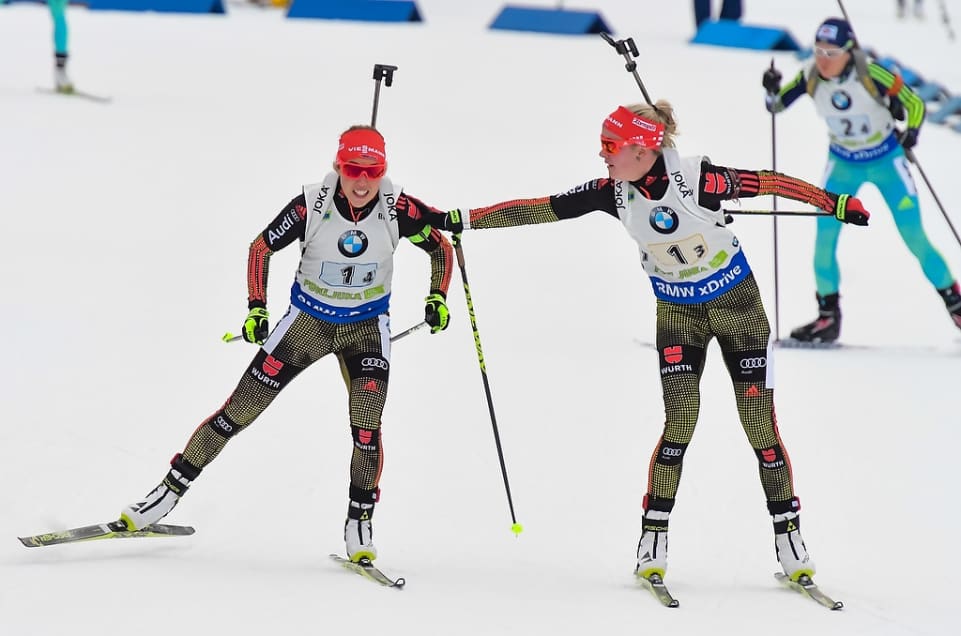
    Germany's Karen Hammerschmidt (l) tagging her teammate Laura Dahlmeier in second place at the final exchange of the women's 4 x 6 k relay at the IBU World Cup in Pokljuka, Slovenia. Dahlmeier anchored the team to the win by 10.1 seconds over France. (Photo: IBU)
    Germany’s Karen Hammerschmidt (l) tagging her teammate Laura Dahlmeier in second place at the final exchange of the women’s 4 x 6 k relay at the IBU World Cup in Pokljuka, Slovenia. Dahlmeier anchored the team to the win by 10.1 seconds over France. (Photo: IBU)

    In the women’s relay on Sunday, Germany took first by 10.1 seconds over France, using nine spares but no penalties.

    Vanessa Hinz started the Germans out and tagged off in fifth, and second-leg Franziska Hildebrand moved them up into second by the halfway point. Karen Hammerschmidt held that position, which was enough for Laura Dahlmeier who anchored them to the win in 1:11:31.1.

    “This was a brutally beautiful race today,” Dahlmeier told German broadcaster ZDF after her third win in as many races in Pokljuka. “It was very fun, and I was very relaxed because I knew we were competing as a team. Even if you don’t have as much power left there are still three others. I was on top of my game and just enjoyed it. I really looked forward to the race, although yesterday I was knocked out. But on the course I had a good feeling right from the start.”

    France in second and Ukraine in third (+37.7) both required just three spare rounds and no penalties per team. France secured second place with Anais Chevalier (who initially tagged off in 11th), Justine Braisaz (who picked off eight places to move into third), Celia Aymonier (who tagged off in first), and Marie Dorin Habert (who cleaned without any spares but came up 10 seconds short of Dahlmeier at the finish).

    Ukraine reached the podium with Iryna Varvynets, Yuliia Dzhima, Olena Pidhrushna, and Anastasiya Merkushyna.

    Canada placed 11th (+3:33.1) with a total of just four spares and no penalties. Sarah Beaudry initially tagged off in 23rd, Rosanna Crawford skied them into 18th, Megan Tandy shot clean without any spares and tagged off in 14th, and Julia Ransom anchored them to 11th out of 23 teams.

    The U.S. did not field a men’s or women’s relay team, with just three men and three women in Pokljuka.

    Results: Men | Women

    ***

    FIS Cross-Country World Cup in Davos: Freestyle Sprints

    In the men’s 1.6-kilometer freestyle sprint on Sunday it was Russia’s Sergey Ustiugov who emerged victorious, besting Finn Hågen Krogh of Norway and his Norwegian teammate Sindre Bjørnestad Skar for first.

    After qualifying 29th overall, Ustiugov crossed first in his quarterfinal and held the led through his semifinal and into the final, winning in a time of 2:24.65. Krogh crossed 0.59 tenths of a second behind him for second place and Skar took the final podium spot, crossing 3.29 seconds after Ustiugov.

    Also in the sprint final was Russia’s Alexey Petukhov, who finished just off the podium in fourth (+3.47), Norwegian Emil Iversen in fifth (+5.52) and France’s Lucas Chanavat  who won the qualifier — ended the day in sixth (+11.48).

    Lucas Chanavat of France had the fastest men's qualifying time in the Davos World Cup freestyle sprint on Sunday.
    Lucas Chanavat of France had the fastest men’s qualifying time in the Davos World Cup freestyle sprint on Sunday.

    Canada’s Lenny Valjas was the top North American finisher for the day, qualifying 12th and advancing to the quarterfinals where he finished in 14th overall. No other Canadians made the sprint heats, with Alex Harvey left just outside advancing in 33rd, Devon Kershaw ending the day in 49th, Knute Johnsgaard 60th, Bob Thompson 67th, and Andy Shields 73rd. Jesse Cockney did not finish the race.

    Simi Hamilton led the U.S. in 24th (+3.88). Andy Newell was just outside the heats in 36th, and Eric Packer placed 95th (+21.62).

    In the women’s 1.6 k freestyle sprint, Maiken Caspersen Falla of Norway took the overall win, crossing in a time of 2:44.63. Just 0.53 tenths of a second behind Falla was her Norwegian teammate Ingvild Flugstad Østberg in second place overall. The final women’s podium finisher, Hanna Falk of Sweden was 0.60 tenths of second off Falla in third.

    U.S. Ski Team member, Jessie Diggins made the final, racing to a fifth place overall (+5.91), behind Sweden’s Jonna Sundling in fourth (+1.04) and ahead of Russia’s Natlalia Matveeva in sixth (+6.80).

    The United States put three other women into the heats, including Sophie Caldwell who finished 11th, Sadie Bjornsen 15th, and Ida Sargent 20th.

    American Caitlin Patterson ended the day 47th, Kikkan Randall 58th, and Liz Stephen 61st.

    Dahria Beatty was the top Canadian on Sunday, finishing in 25th overall. Cendrine Browne ended the day 53rd and Sophie Carrier-Laforte 59th.

    Qualifier Results: Men | Women

    Final Results: Men | Women

    ***

    NorAm/SuperTour at Sovereign Lake: 10/15 k Freestyle

    [UPDATE] It was Americans owning the podium again Sunday at Sovereign Lake, and a little bit more. It was warmer on Sunday, -7 Celsius, and snowed lightly throughout.

    The men’s 15 k freestyle was first on the schedule.  APU’s Scott Patterson won in 40:00.2, followed by Saturday’s A-finalist Matt Gelso at 13.2 seconds and Vail’s Tad Elliot at +26.6.

    The top Canadian was Team R.A.D.’s Russell Kennedy in ninth, at 1:38.8 behind.

    In the women’s 10 k freestyle, the podium was owned by APU’s Chelsea Holmes in 30:42.9. SMS Elite’s Katharine Ogden was second at 13.4 seconds, also winning the junior category. Her teammate Erika Flowers was third, 36.4 behind.

    AWCA’s Olivia Bouffard-Nesbitt was the top Canadian for the second day, placing 13th at 1:51.8.

  • Saturday Rundown: Davos, Pokljuka & Sovereign Lake (Updated x3)

    Saturday Rundown: Davos, Pokljuka & Sovereign Lake (Updated x3)

    AWCA's Olivia Bouffard-Nesbitt leads the American train around the bridge corner into the finish straight in the A final (Photo: Peggy Hung)
    Olivia Bouffard-Nesbitt of the Alberta World Cup Academy (AWCA) leads the American train around the bridge corner into the finish straight in the A-final of Saturday’s NorAm classic sprint at Sovereign Lake in British Columbia. She went on to finish fourth behind Julia Kern (second from r), Liz Guiney (back left) and Kaitlynn Miller (l), respectively. (Photo: Peggy Hung)

    Welcome to The Rundown, your quick primer of need-to-know information about the day’s racing. We’ll be updating this digest as the day goes on with additional results, photos and quotes. The Rundown is NOT a race report; stay tuned for complete race reports later today with interviews from the day’s top racers.

    ***

    Canadian NorAm/U.S. SuperTour at Sovereign Lake: Classic sprint

    [UPDATE] U.S. skiers filled the open category podiums on the first fully North American NorAm event in recent years on Saturday at Sovereign Lake near Vernon, B.C. With NorAm points, SuperTour points and FIS points on the line there was a great turnout of the top skiers.

    In the open women’s 1.2-kilometer classic sprint, Julia Kern of the Stratton Mountain School (SMS) won in 3:17.04 after qualifying fifth. Liz Guiney of the Craftsbury Green Racing Project (CGRP) finished second, 0.67 seconds back, and her CGRP teammate Kaitlynn Miller rounded out the podium in third (+0.91). Olivia Bouffard-Nesbitt (Alberta World Cup Academy) was the top Canadian in fourth (+1.49) and the lone Canadian in the final. Jennie Bender (Bridger Ski Foundation) placed fifth (+3.8) and Heather Mooney was sixth (+19.84).
    On the same 1.2 k course, Reese Hanneman (Alaska Pacific University) made up for his 15th qualifying time to take the men’s final win in 2:38.08. Cole Morgan of the Sun Valley Ski Education Foundation (SVSEF) took second in the final (+0.87) after winning the qualifier, and Ben Saxton (SMST2) was third (+1.92). Matt Gelso (SVSEF) finished fifth (+3.88), after precipitating a semifinal crash that took three Canadians (Angus Foster, Simon Lapointe and Evan Palmer-Charrette) out of contention, but didn’t result in a protest. The lone Canadian man in the final, Antoine Briand (Pierre-Harvey Training Centre) placed sixth (+11.98).

    Sprint brackets

    IBU World Cup in Pokljuka: 10/12.5 k pursuits

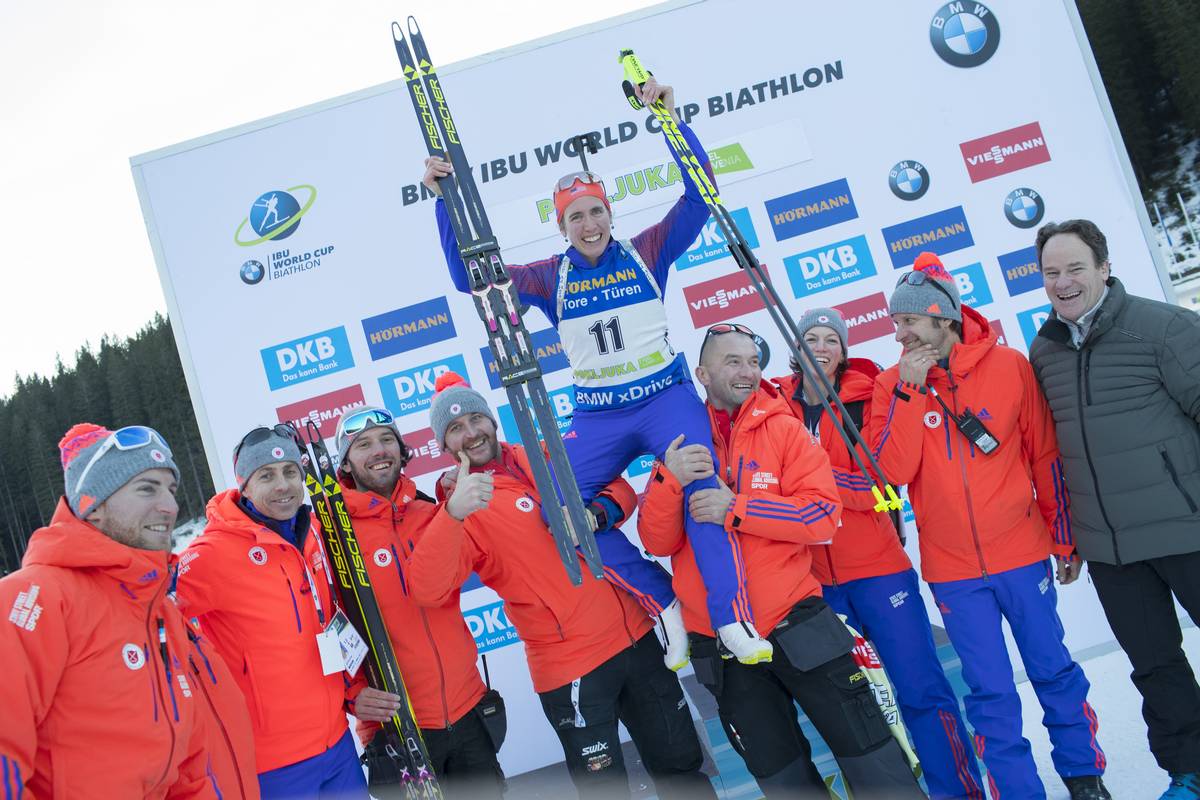
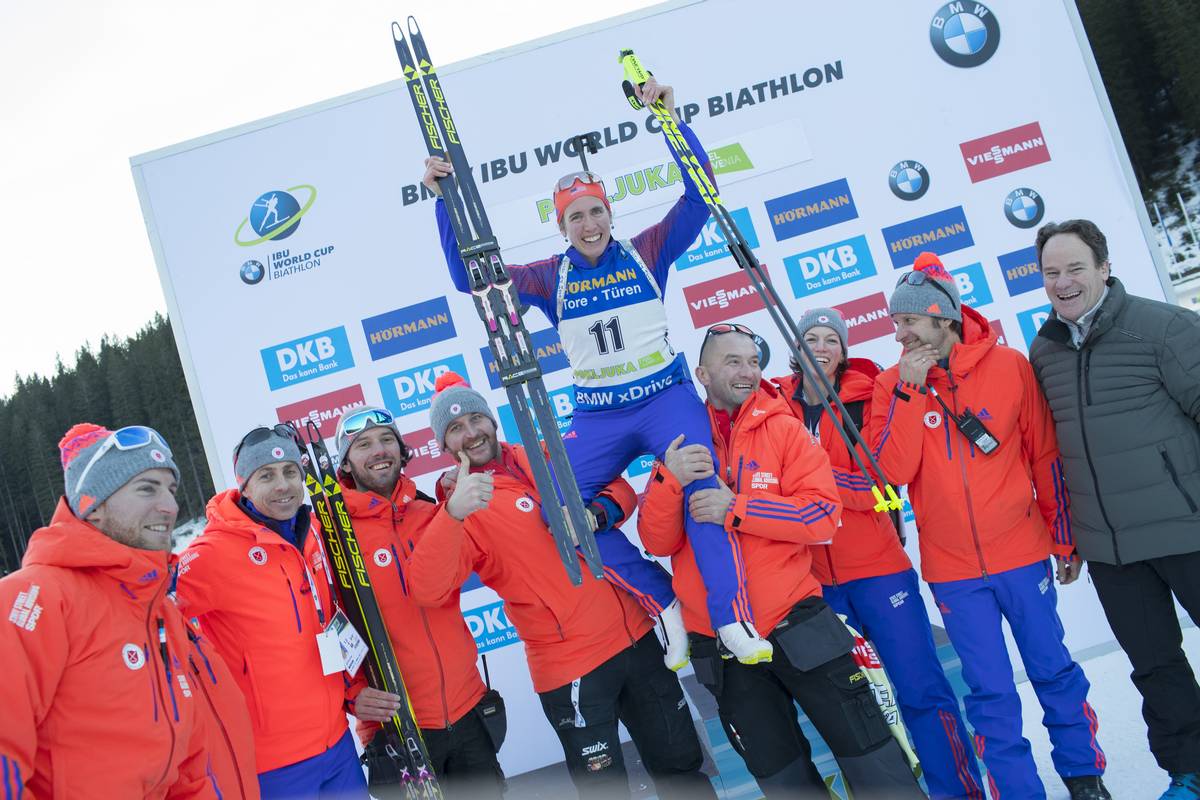
    Susan Dunklee being hoisted up by her US Biathlon support team at the IBU World Cup in Pokljuka, Slovenia, after tying her career-best result in a pursuit. Dunklee placed fifth on Saturday for a season best as well. (Photo: USBA/NordicFocus)
    Susan Dunklee being hoisted up by her US Biathlon support team at the IBU World Cup in Pokljuka, Slovenia, after tying her career-best result in a pursuit. Dunklee placed fifth on Saturday for a season best as well. (Photo: USBA/NordicFocus)

    Women’s report | Men’s report

    Another day at the front of the pack, and another day of (nearly) perfect shooting for Susan Dunklee, who raced from 11th to fifth for her first flower ceremony (top six) of the season at the IBU World Cup in Pokljuka, Slovenia.

    Dunklee (US Biathlon) cleaned the first three of four stages in Saturday’s 10-kilometer pursuit to move into second with one standing stage remaining. In that final shooting stage, she had her first miss of the day, yet still left the range in second, 22 seconds behind Germany’s Laura Dahlmeier in first. Dunklee finished out the race with the 21st-ranked course time on the last loop (her first-loop time was the fastest in the 56-woman field) and placed fifth, 24.1 seconds behind Dahlmeier — who won her second-straight race in Pokljuka. Dahlmeier finished first in 30:43.1 despite two prone misses on the second stage, which put her as far back as fifth (0+2+0+0). Finland’s Kaisa Mäkäräinen finished second, 16.8 seconds back, with two penalties as well (0+0+1+1), and Eva Puskarcikova of the Czech Republic reached the podium in third (+18.7) with a single miss followed by three clean stages (1+0+0+0). One spot ahead of Dunklee, reigning World Cup champion Marie Dorin Habert of France clawed her way up to fourth (+18.8) after starting 17th, with one penalty (0+0+1+0).

    For Dahlmeier, it was her 10th World Cup victory and fifth in a pursuit.

    “My motto is ‘Scheiß da nix, dann feid da nix’,” Dahlmeier told Germany’s ZDF, which vaguely translates to “Don’t worry be happy,” or “Just do it.”

    “That was worth gold today. I was a bit surprised about my two misses in prone. Apparently I already had an aberration in the first stage, then I clicked [adjusted the sights] and was a bit surprised that the two misses still happened,” she added. “… Then came the standing shooting, and there I tried to keep calm again. The race is only over once you cross the finish line, and that became true again today. I am happy that the race flipped again like this.”

    Canada’s Julia Ransom cleaned three consecutive stages before missing two on the last standing. She finished 34th for the second day in a row, 2:33.5 behind Dahlmeier. Rosanna Crawford placed 49th with three penalties (2+1+0+0) and Clare Egan of the U.S. was 56th with six misses (2+0+1+3).  Canada’s Megan Tandy, with seven penalties (1+1+3+2) did not finish.

    In the men’s 12.5 k pursuit, the first man out of the start, Martin Fourcade of France, held his lead to the finish, hitting all 20 targets and winning in 30:27.4. Norway’s Emil Hegle Svendsen rose from fourth at the start to second at the finish (+6.0) with clean shooting as well, and Russia’s Anton Shipulin placed third for the second-straight day (+6.2), with one penalty in the last stage (0+0+0+1).

    Friday’s sprint runner-up, Johannes Thingnes Bø of Norway, ended up fourth (+48) with two misses on the last stage (0+0+0+2), Germany’s Simon Schempp placed fifth (+59.8) after starting sixth, and had one miss (0+0+1+0), and Michael Rösch of Belarus cleaned for sixth place (+1:21.0) after starting 16th.

    Lowell Bailey (US Biathlon) finished 18th (+2:01.6) for the second day in a row, with one prone penalty in the first stage (1+0+0+0).

    Biathlon Canada’s Christian Gow picked off two places for a new career best in 31st (+2:41.7) with a single prone penalty (0+1+0+0).

    Tim Burke placed 42nd (+4:09.8) for the U.S. (after starting 53rd) with five standing penalties (0+0+2+3), Canada’s Scott Gow finished 48th (+4:39) with five misses as well (2+1+0+2), and the third Canadian in the race, Brendan Green was 57th (+5:36.4) with five penalties (+5:36.4).

    Results: Women | Men

    ***

    FIS Cross-Country World Cup in Davos: 15/30 k freestyle

    Women’s report | North American women’s report | Men’s report

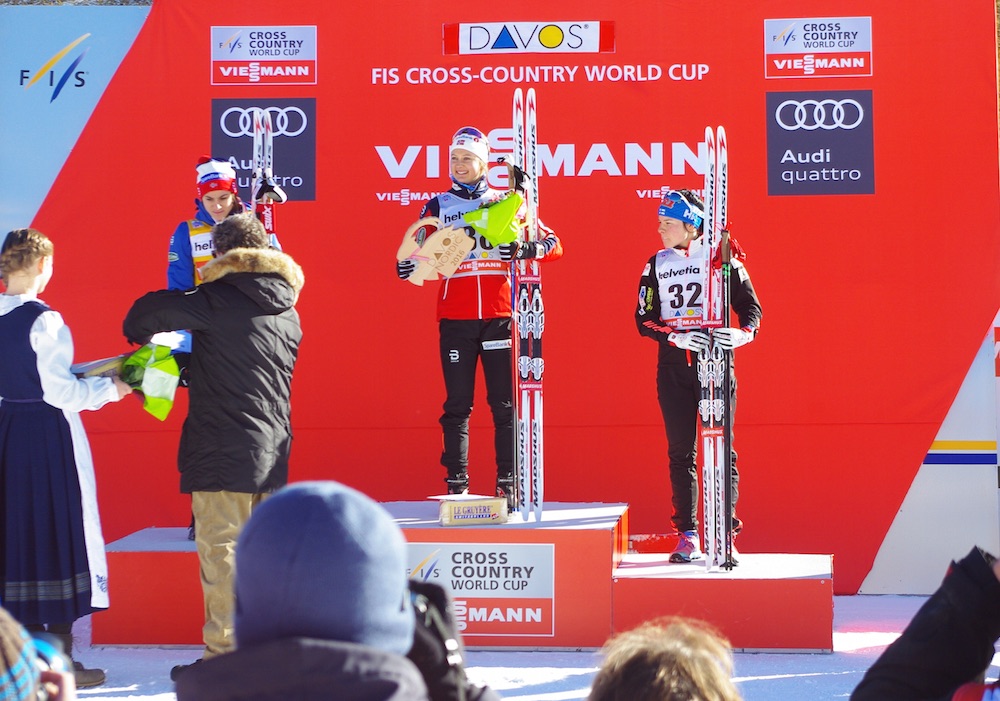
    Norway's Ingvild Flugstad Østberg (c) won her first World Cup race of the season on Saturday in the 15 k freestyle individual start in Davos, Switzerland. Joining her on the podium: Norway's Heidi Weng (l) in second and Finland's Krista Parmakoski (r) in third.
    Norway’s Ingvild Flugstad Østberg (c) won her first World Cup race of the season on Saturday in the 15 k freestyle individual start in Davos, Switzerland. Joining her on the podium: Norway’s Heidi Weng (l) in second and Finland’s Krista Parmakoski (r) in third.

    Norway’s Ingvild Flugstad Østberg is back on top of the podium after a 7.9-second win in Saturday’s 15-kilometer freestyle in Davos, Switzerland, over — you guessed it — her teammate Heidi Weng.

    Østberg started 38th (out of 59) and led at every split to take the win in 37:44.4, her first this season and her first in a 15 k. Weng started a minute ahead of her in bib 36 and ended up second, while Finland’s Krista Parmakoski notched third (+16.7) for her third podium of the season, ninth in her career and second skate podium.

    The next fastest woman, American Jessie Diggins finished 37.6 seconds off the podium in fourth (+54.3), ahead of Russia’s Yulia Tchekaleva in fifth (+1:00.5) and Switzerland’s Nathalie von Siebenthal in sixth (+1:05.6). Ragnhild Haga of Norway was seventh (+1:10.8), Finland’s Riitta-Liisa Roponen eighth (+1:21.4), Italy’s Ilaria Debertolis ninth (+1:32.2), and Sweden’s Anna Haag 10th (+1:35.5).

    The U.S. had two in the points with Liz Stephen in 28th (+2:17.5). Kikkan Randall was 2.3 seconds outside the top 30 in 33rd (+2:30.2), and Caitlin Patterson placed 44th (+3:21.6). Rosie Brennan did not start.

    Emily Nishikawa led Canada in 34th (+2:33.5) for her best result this season, Dahria Beatty was 42nd (+3:15.2), and Cendrine Browne 54th (+4:07).

    Weng remains the Overall World Cup leader by 70 points over Østberg, Parmakoski ranks third, and Norway’s Marit Bjørgen, who is not competing this weekend in Davos, is currently fourth.

    [UPDATE] In the men’s race earlier on Saturday, Martin Johnsrud Sundby racked up another victory in Davos’s 30 k freestyle, beating his fellow Norwegian Anders Gløersen by 13.7 seconds with a winning time of 1:07:31.6 hours. Gløersen took second for his first podium in a year (he was third in the Davos 30 k last December) and Finland’s Matti Heikkinen reached the podium for his second-straight race in third (+25.7).

    Canada’s Alex Harvey placed 12th (+1:29.4) and his teammate Graeme Killick notched 21st (+2:24.2) for his second-best World Cup result (after placing 19th in a skiathlon last March at the Ski Tour Canada).

    Devon Kershaw was the next top North American in 43rd (+3:52.9), six seconds ahead of the lone American in the race, Noah Hoffman in 44th (+3:58.9). Canada’s Andy Shields placed 64th (+6:33.9).

    Results: Women | Men


  • Emotional Day for Belgium’s Rösch; Fourcade Tops Another Pursuit; Bailey Repeats in 18th

    Emotional Day for Belgium’s Rösch; Fourcade Tops Another Pursuit; Bailey Repeats in 18th

    Michael Rösch became Belgium's most successful biathlete on Saturday with a sixth-place finish in the IBU World Cup 12.5 k pursuit. “It’s just a lousy sixth place in the World Cup, but it means so much to me,” Rösch, originally from Germany, told German broadcaster ZDF. (Photo: IBU)
    Michael Rösch became Belgium’s most successful biathlete on Saturday with a sixth-place finish in the IBU World Cup 12.5 k pursuit. “It’s just a lousy sixth place in the World Cup, but it means so much to me,” Rösch, 33, told German broadcaster ZDF. A former German racer, it was his first top six in an individual race in nearly eight years. (Photo: IBU)

    At the top of the starting field in the International Biathlon Union (IBU) men’s 12.5-kilometer pursuit in Pokljuka, Slovenia, a large part of the race on Saturday was determined by two pairs skiing and shooting in almost perfect synchrony together: France’s Martin Fourcade with Russia’s Anton Shipulin, and the two Norwegians Emil Hegle Svendsen and Johannes Thingnes Bø.

    For the first three shooting stages, all four athletes shot clean and fast, with Shipulin able to close the gap to Fourcade on the second loop and then each one taking the lead at times.

    “That was a great fight against Anton,” Fourcade stated during the press conference. “We did almost the whole competition together. When he [caught up to] me, he asked me to help him. But I was so exhausted I could not help him much on the track. As soon as my shape came back we collaborated together, and that was a great collaboration because Emil was not so far behind. We knew we had to fight together to keep our advantage.”

    For the final shooting stage, Fourcade began to shoot first and kept his cool once more while Shipulin missed his second shot, forcing him to ski a penalty lap.

    “At the end Anton is always really good, really fast, so I knew I had to stay close…,” Fourcade said. “On the last shooting, I got one more clean [target] than him, so that gave me the win. But that was really tough.”

    “I was a little bit nervous,” Fourcade said of the last shooting stage to German broadcaster ZDF. “I needed a little more time for my installation [taking position]. But then when I was focused on my shooting, it was very good. I am very satisfied with my win today. It was a crazy beginning of the season, maybe my best. Even if my shape wasn’t so good today, I managed to do what I needed to be strong on the shooting range. So that’s amazing.”

    Behind the two leaders, similarly Svendsen also managed to shoot clean again in the final stage, while Bø missed two targets to finish fourth (0+0+0+2, +48.0). Shipulin came back on the track as Svendsen was also leaving the range. Both were 13 seconds behind Fourcade, and in his current ski shape it was clear that those two would have to fight for second place with nobody directly behind them.

    “Like Martin and Anton, we had good collaboration,” Svendsen said at the press conference about racing with Bø for a long time. “It was very difficult to catch any time on those two, they were shooting fast and good, and skiing fast as well. So as Martin said, it was a quite high level in the competition. I am just happy to shoot clean on the last lap; that was the key. Now I am back on the podium, and it feels very good.”

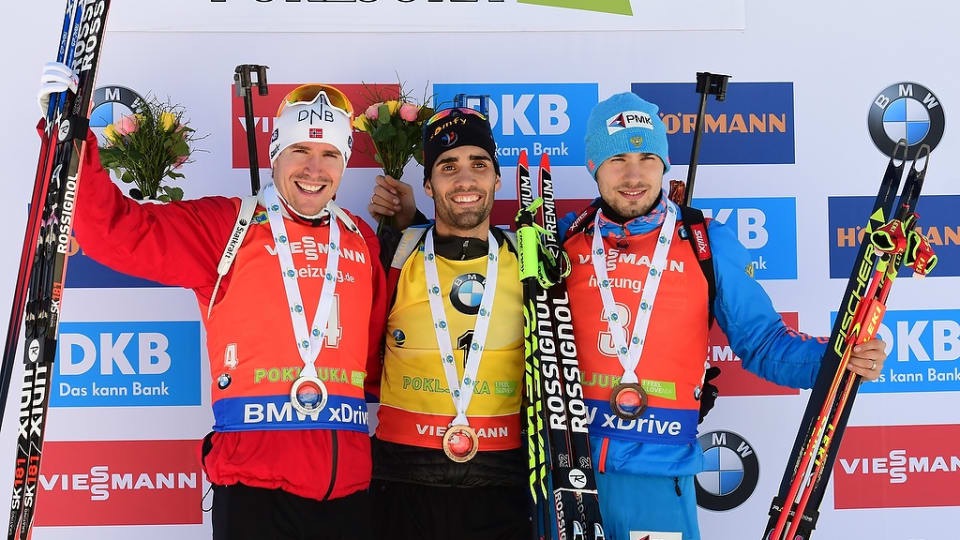
    The men's podium in the IBU World Cup 12.5 k pursuit on Saturday in Pokljuka, Slovenia, with winner Martin Fourcade (c) of France, Norway's Emil Hegle Svendsen (l) in second, and Russia's Anton Shipulin (r) in third. (Photo: IBU)
    The men’s podium in the IBU World Cup 12.5 k pursuit on Saturday in Pokljuka, Slovenia, with winner Martin Fourcade (c) of France, Norway’s Emil Hegle Svendsen (l) in second, and Russia’s Anton Shipulin (r) in third. (Photo: IBU)

    On the last lap into the finish, Fourcade waived and clapped to the spectators in the stands taking out the tempo a bit to ski over the line in a time of 30:27.4 minutes, while just a few seconds behind him Svendsen and Shipulin skated furiously in a sprint on the short finish stretch down from a bridge, which the Norwegian decided for himself (0+0+0+0, +6.0) and the Russian just 0.2 seconds behind (0+0+0+1).

    “Anton is for sure one of the best sprinters in the biathlon field,” Svendsen added when asked about the finish. “So I knew it was like a 50/50 chance to beat him. I felt quite strong on the last loop and managed to stay in front, but it was very close. On the last 200 meters he was just on my side, and I managed to get a little more speed on the last hundred.”

    The second place was Svendsen’s first podium finish of the season, following some missed time in the last preparation phase in the fall due to an illness.

    “I think my mistake was that I wanted too much to shoot zero [misses],” Shipulin commented on his race in the press conference via a translator. Regarding his final lap he added: “I made some tactical mistakes. I felt like on the last loop I didn’t have too much power left. And second of all, to be honest Pokljuka is not the best place to have a strong finish just because of the tricky downhill and uphill, so that’s probably why.”

    Fifth place went to Germany’s Simon Schempp, who skied fast and incurred just one penalty in the first standing stage (0+0+1+0, +59.8). Still, that was only good enough to improve by one position from the sprint, not able to close up to Bø and the others.

    “Today you could see again how good the shooting results throughout the field are,” Schempp told ZDF. “Then it’s very hard to advance. One miss is a decent result for twenty shots, but just not good enough to make up a little more [time or positions]. But I am very satisfied anyway.”

    The weather conditions were sunny with almost no wind again, and a few athletes even decided to start in short-sleeved suits.

    “It was a really great competition with great conditions, fair conditions, and that’s what I like in biathlon,” Fourcade explained at the press conference. “We all had the same chances today on the shooting range, you can see it when you look at the result… The level of competition has been amazing this week in Pokljuka.”

    “The conditions could not have been better today,” US Biathlon’s Lowell Bailey confirmed in an email to FasterSkier.

    Former Olympic Champion with Best-Ever Result for a Belgian

    Behind these racers who perennially finish at the top of the field, an international surprise in the race was Michael Rösch for Belgium, improving 10 positions to finish sixth with clean shooting, thus achieving the best biathlon result of all time for his country (0+0+0+0, +1:21.0). At the beginning of his career, Rösch raced for Germany and won an Olympic gold in the men’s 4 x 7.5-kilometer relay at the 2006 Olympics in Torino and three bronze medals at World Championships, before later being cut from Germany’s World Cup team due to inconsistent performances.

    Always believing in his ability for a successful comeback, Rösch switched nationalities, missing the 2014 Olympics in Sochi due to bureaucratic problems, and struggled for several seasons to get anywhere close to his former shape. Competing on the World Cup circuit, often as the lone starter for Belgium, having to organize everything himself, he frequently finished outside of the points with, for example, a 45th place in the individual in Oslo as his best World Cup result last season. He also sustained multiple injuries, including an Achilles-tendon tear. Since last summer, Rösch has been training with the Swiss national team and seen a noticeable improvement.

    “I’m sorry, it’s just a lousy sixth place in the World Cup, but it means so much to me,” a very emotional Rösch told German broadcaster ZDF with tears in his eyes. “I had to give up so much. My family, my friends, my sponsors always supported me. This is just wickedly great. I tried it again and again and now managed to do it. A sixth place… that isn’t worth much to a lot of people, but it means the world to me.

    “On the last lap I thought about my late coach Klaus Siebert,” he continued. “I always said one day I would have a good race again. And today I achieved a perfect race shooting clean four times. I already thought about him on the last lap, I was already crying back then. This is for you Klaus, and also for Bernd, who made my rifle stock, unfortunately they have both passed away. And yeah, you watched the race yourselves. I skied in circles and shot on black targets, the rest is history… This race is for all the people who supported me!”

    “I skied in circles and shot on black targets, the rest is history…” — Michael Rösch of Belgium, who achieved sixth for his best result in nearly eight years on Saturday

    Bailey Repeats in 18th, Christian Gow Up to 31st

    US Biathlon's Lowell Bailey (front) leading Germany's Arnd Peiffer in the IBU World Cup 12.5 k pursuit on Saturday in Pokljuka, Slovenia. Bailey started 18th and went on to finish 18th. (Photo: USBA/NordicFocus)
    US Biathlon’s Lowell Bailey (front) leading Germany’s Arnd Peiffer (second from l) in the IBU World Cup 12.5 k pursuit on Saturday in Pokljuka, Slovenia. Bailey started 18th and went on to finish 18th. (Photo: USBA/NordicFocus)

    For the U.S., Lowell Bailey missed one target in the first prone stage, which cost him five positions, but remained clean for the next three stages. With that solid performance, he moved into 13th after the final stage, but could not quite hold that place on the last lap, with athletes like Austria’s Simon Eder and Switzerland’s Benjamin Weger overtaking him. Bailey finished with the same position he started with in 18th place (+2:01.6).

    “Happy with my shooting but I just don’t have the ski speed I need to compete with the top guys on the tracks right now,” Bailey wrote in an email to FasterSkier. “I’ve had good training all summer so I’m hoping to see my speed improve as the season moves forward.”

    As the most consistent North American biathlete so far this season, he leaves Pokljuka in 10th in the overall World Cup standings.

    For Biathlon Canada, Christian Gow followed up perfect shooting in the sprint with only one miss in the pursuit to improve on his previous personal best by two places, finishing 31st for a new World Cup best (0+1+0+0, +2:41.7).

    “Nothing too crazy happened during my race,” Gow explained in an email. “It was a fun and fast paced race with a lot of jockeying for positions. It was exciting to get in there and race with a lot of the top guys and see what I could do!”

    On his final lap, Gow found himself fighting for positions agains top contenders such as Austria’s Dominik Landertinger and Italy’s Lukas Hofer and Dominik Windisch.

    “The last lap was tough,” Gow said of that phase of his race. “I didn’t realize it was those guys that were chasing me, but it was not easy to fight with them at that point in the race. All 3 of them skied super well today and I had little chance of being able to stay ahead of them.”

    American Tim Burke started his race strong, improving from 53rd at the start all the way to 25th with two clean prone shootings, but he struggled in his standing bouts with five penalties (0+0+2+3). Still, thanks to another good skiing performance with the 25th-fastest overall course time, Burke finished the day in 42nd (+4:09.8), just out of the World Cup points.

    Canada’s Scott Gow also shot five misses on Saturday (2+1+0+2) after a clean shooting performance in the sprint, falling back from 23rd at the start to 48th (+4:39.0) at the finish.

    Similarly, his teammate Brendan Green had five penalties to finish 57th (1+1+2+1, +5:36.4).

    The World Cup weekend in Pokljuka concludes with men’s and women’s relays on Sunday. Since the U.S. only has three members available at this World Cup stage for both the women and men, it will not be able to field a team in either race. Canada is starting the men’s race with Christian Gow, Scott Gow, Macx Davies and Brendan Green (bib 6); and Sarah Beaudry, Rosanna Crawford, Megan Tandy and Julia Ransom (bib 12) for the women.

    Results

  • Dunklee Ties Best-Ever Pursuit in Fifth; Dahlmeier Doubles Up in Pokljuka

    Dunklee Ties Best-Ever Pursuit in Fifth; Dahlmeier Doubles Up in Pokljuka

    Susan Dunklee being hoisted up by her US Biathlon support team at the IBU World Cup in Pokljuka, Slovenia, after tying her career-best result in a pursuit. Dunklee placed fifth on Saturday for a season best as well. (Photo: USBA/NordicFocus)
    Susan Dunklee being hoisted up by her US Biathlon support team at the IBU World Cup in Pokljuka, Slovenia, after tying her career-best result in a pursuit. Dunklee placed fifth on Saturday for a season best as well. (Photo: USBA/NordicFocus)

    (Note: This article has been updated to include comments from Canada’s Julia Ransom.)

    Susan Dunklee laughed a little when she thought about her reputation as a World Cup biathlete. Often one of the fastest skiers in terms of course time, she said she’s also been known for some of the slowest shooting times.

    Until this weekend.

    The US Biathlon veteran broke through in Pokljuka, Slovenia, with her best results of the season so far: 11th place in Friday’s 7.5-kilometer sprint and fifth in Saturday’s 10 k pursuit. Both races entailed 95-percent shooting accuracy or better (on Friday, she cleaned the two-stage sprint with the second-fastest shooting and third-fastest range times overall).

    Susan Dunklee (front) going head to head with Germany's Laura Dahlmeier (1), Austria's Lisa Theresa Hauser (12), and France's Marie Dorin Habert (left) in the women's 10 k pursuit at the IBU World Cup in Pokljuka, Slovenia. (Photo: USBA/NordicFocus)
    Susan Dunklee (front) going head to head with Germany’s Laura Dahlmeier (1), Austria’s Lisa Theresa Hauser (12), and France’s Marie Dorin Habert (left) in the women’s 10 k pursuit at the IBU World Cup in Pokljuka, Slovenia. (Photo: USBA/NordicFocus)

    On Saturday, her range time ranked third and shooting time was fourth overall.

    That was a big step up from last season, and she said it was something she’s been working on for the last two years.

    “It’s pretty obviously where my weak link is, my shooting speed … that’s what’s been holding me back,” Dunklee said on the phone after Saturday’s race. “There’s no reason not to try to gain speed there. It took a lot of work…”

    After starting 11th in the pursuit, 43 seconds behind the leader (Germany’s Laura Dahlmeier, who won Friday’s sprint), Dunklee raced into sixth and 28 seconds back with a clean first prone and her distinctively fast skiing. Her course time on the first loop ranked first out of 56 finishers.

    One loop later, Dunklee cleaned again to move into fourth, 18.7 seconds behind the leader. Dahlmeier had slipped into fifth with two penalties, and Norway’s Marte Olsbu, who started third, took the lead.

    Still in fourth for the first standing bout, Dunklee recalled being in a sort of a trance.

    “I was aware of everything going on around me in the range, but I wasn’t concerned by it. … I just had this detached kind of feeling,” she said.

    That was a good thing — something she wasn’t necessarily used to feeling — but something she hoped for in future races.

    “It’s a really good feeling to have in the race when the pressure’s on,” Dunklee said.

    Entering the range in fourth, 28 seconds out of first and without anyone directly around her, Dunklee shot clean for the third-straight stage. Suddenly, she was in second, 0.7 seconds behind Olsbu, who had to ski one penalty lap and narrowly remained in first.

    The rest of the top six left the range within 14 seconds of Olsbu and Dunklee — with Dahlmeier bringing up the tail end of the group in sixth.

    On the second-to-last loop, Germany’s Franziska Hildebrand passed Olsbu and Dunklee, while Finland’s Kaisa Mäkäräinen moved into fourth right behind Dunklee. With about 2.5 k remaining, Dahlmeier recaptured the lead and Mäkäräinen followed her just 0.7 seconds back in second. Hildebrand sat in third, Olsbu in fourth and Dunklee 3 seconds back in fifth.

    For the final shooting, Dahlmeier led the group of six, including Austria’s Lisa Theresa Hauser, into the range. All were within 3.5 seconds of one another.

    Dahlmeier hit all of her targets, Dunklee missed one, as did Hauser, Olsbu, Hildebrand, and Mäkäräinen. Eva Puskarčíková of the Czech Republic cleaned her five standing targets to move into fourth (after three consecutive clean stages: 1+0+0+0), yet Dunklee remained in second, 22 seconds behind Dahlmeier and 0.7 seconds ahead of Hauser in third.

    “That penalty was a close miss,” Dunklee said. “I knew, ‘Oh, I just go in the penalty loop,’ and I wasn’t too concerned with what that meant.”

    When Dunklee exited the penalty loop and headed back out onto the course, she had no idea where she stood. She couldn’t see anybody ahead of her, nor did she know how big the group was behind her.

    “I knew I was probably fighting for a podium and I should push as hard as I could,” Dunklee said.

    While she felt like she was missing her top-end skiing gear, which she expected at this point in the season, Dunklee used some course tactics to catch two of the five women that passed her at the beginning of the final loop: Hauser and Hildebrand.

    “It’s really important to try to get to the front of the pack at the top of that first camel-hump,” Dunklee said of the Pokljuka course. “I was able to pass two people back so I was able to get back into the flower ceremony, which was great.”

    Reflecting on the detached feeling she felt on the range, Dunklee said it was a different story out on the course.

    “Out on the course, you’ve got to be hungry and you’ve got to be able to push yourself to a different zone,” she said. “I was missing that ability to fight on skis today. I was going at the pace I felt like I could maintain and not getting overly concerned with people passing.”

    Susan Dunklee (US Biathlon) finishing fifth in Saturday's 10 k pursuit at the IBU World Cup in Pokljuka, Slovenia. "I felt pretty flooded," she said of her finish. (Photo: USBA/NordicFocus)
    Susan Dunklee (US Biathlon) finishing fifth in Saturday’s 10 k pursuit at the IBU World Cup in Pokljuka, Slovenia. “I felt pretty flooded,” she said of her finish. (Photo: USBA/NordicFocus)

    At the same time, she focused on putting everything she could into a strong finish.

    “What was on my mind is, ‘I’m going to feel really bad about myself if I don’t give it everything I have,’ ” she said of her last loop. “… I figured I had nothing to lose.”

    Dunklee finished 24.1 seconds behind Dahlmeier (who won her second-straight race) in the top six to reach the flower ceremony for the first time this season. That also met Dunklee’s goal of a top 10 in one of the first two World Cups.

    “That was a big goal to put out there. I’m very pleased; I knew it wasn’t a sure thing” Dunklee said.

    Acknowledging that she’s never had such competitive results this early in the season, Dunklee explained that she was fueled by some disappointment in Friday’s sprint.

    “I was pretty bummed yesterday to get bumped down so far,” she said of crossing the finish first then ending up 11th.

    As for her much-improved shooting this season:  “It gives me a lot of confidence for sure,” Dunklee said. “The shooting speed has been my number-one focus for this year and much of last year, too … just seeing it pay off is wonderful. It’s very satisfying and it gives me a lot of faith in what I’ve [worked on].”

    The women's 10 k pursuit podium at the IBU World Cup in Pokljuka, Slovenia, with German winner Laura Dahlmeier (c), Finnish runner-up Kaisa Mäkäräinen (l) and third-place finisher Eva Puskarčíková of the Czech Republic. (Photo: IBU)
    The women’s 10 k pursuit podium at the IBU World Cup in Pokljuka, Slovenia, with German winner Laura Dahlmeier (c), Finnish runner-up Kaisa Mäkäräinen (l) and third-place finisher Eva Puskarčíková of the Czech Republic. (Photo: IBU)

    While Mäkäräinen closed hard in the final 2 k (starting the loop in seventh, nearly 30 seconds behind Dahlmeier), she ended up second and 16.8 seconds behind Dahlmeier, with a total of two penalties (0+0+1+1).

    The 25-year-old Puskarčíková held off France’s Marie Dorin Habert by 0.1 seconds for her first World Cup podium in third place (+18.7). Dorin Habert, the 17th starter, settled for fourth, with one penalty (0+0+1+0).

    For Dahlmeier, it was her 10th World Cup victory and fifth in a pursuit. Asked what she credited her success to, the 23 year old told German broadcaster ZDF, “Staying cool. My motto is, ‘Scheiß da nix, dann feid da nix’,” (which vaguely translates to “Don’t worry be happy” or “Just do it”).

    “That was worth gold today,” she continued. “I was a bit surprised about my two misses in prone. Apparently I already had an aberration in the first stage, then I clicked [adjusted the sights] and was a bit surprised that the two misses still happened.”

    She was quick to regroup and cleaned the remaining two stages (0+2+0+0) to finish first in 30:43.1.

    “I just try to keep it not too complex,” Dahlmeier told ZDF. “… In terms of skiing I didn’t feel quite as springy today, so I had to rely on the shooting. And that worked well for me.”

    Asked if her three wins, four podiums, and one fourth-place in five individual races so far this season had sunken in, she said, “No.”

    “It’s almost a bit unrealistic, but when looking at the men to [France’s] Martin Fourcade, you know what is possible,” Dahlmeier said. “That is my great goal, to one day be able to have successes comparable to Martin.”

    Leading Canada for the second-straight day in 34th, Julia Ransom finished in the same position she started in. After cleaning the first three stages, Ransom moved into 20th and 1:09.8 out of first, but two misses on the final standing put her in 34th at the finish (+2:33.5, 0+0+0+2).

    “I was in the top 25ish mix for majority of the race, inching up to 20th before the last shooting bout,” Ransom wrote in an email. “Pursuits are my favourite format so I was actually pretty stoked to jump into the chaos. Everything was great both on the skis and in the range until the focus unravelled a little and I found myself in the penalty loop!

    “The field is so tight right now that those mistakes were hard to recover from and get back into the top 30,” she continued. “I am a little bitter-sweet about a second 34th. Happy I’m still in the points but really itching to be in the top 30!”

    Also for Canada, Rosanna Crawford improved from 58th to 49th (+4:06.4) with three penalties, all of which came in prone (2+1+0+0), and Megan Tandy did not finish after shooting seven penalties (1+1+3+2). The second U.S. woman in the race, Clare Egan missed six (2+0+1+3) to finish 56th (+5:32.4) after starting 53rd.

    With three women and three men in Pokljuka, the U.S. will not field relay teams on Sunday. But they’ll be cheering on the Canadians, Dunklee said.

    “I am stoked for our relay team tomorrow,” Ransom said of teaming up with Sarah Beaudry, Crawford and Tandy. “I think we have a great opportunity on our hands and with a little luck, all four of us girls will have solid performances.”

    The men’s 4 x 7.5 k starts at 5:15 a.m. EST, and the women’s 4 x 6 starts at 8:30 EST on Sunday. (Stream live at Eurovisionsports.tv).

    Results

  • Despite Placing 11th in Pokljuka, Dunklee Calls It ‘A Sad, Sad Day’

    Despite Placing 11th in Pokljuka, Dunklee Calls It ‘A Sad, Sad Day’

    US Biathlon's Susan Dunklee, an early starter in bib 9, racing to an early lead in Friday's 7.5 k sprint at the IBU World Cup in Pokljuka, Slovenia. She ended up 11th with clean shooting for a season best. (Photo: USBA/NordicFocus)
    US Biathlon’s Susan Dunklee, an early starter in bib 9, racing to an early lead in Friday’s 7.5 k sprint at the IBU World Cup in Pokljuka, Slovenia. She ended up 11th with clean shooting for a season best. (Photo: USBA/NordicFocus)

    For a good portion of Friday’s race, Susan Dunklee found herself in first place. Not fourth, not third, not even second. First.

    The ninth starter out of the gate in the women’s 7.5-kilometer International Biathlon Union (IBU) World Cup sprint in Pokljuka, Slovenia, Dunklee cleaned the first of two shooting stages — prone — to put herself in second behind Norway’s Tiril Eckhoff, who was leading at the time by a mere 0.9 seconds.

    Eckhoff started seventh.

    Then there was Finland’s Kaisa Mäkäräinen, in bib 18, who cleaned the first stage as well on a day with little to no wind and took the lead by 3.4 seconds over Eckhoff. But let’s get back to Dunklee.

    The standing stage brought a miss for Eckhoff. That sent her to the penalty lap and into second behind Russia’s Olga Podchufarova, who started third and cleaned both stages to take an early lead. Dunklee hit all five of her targets once again and bested Podchafarova’s time leaving the range, taking the lead and holding it on the final loop to the finish. Dunklee crossed the finish 7 seconds faster than the Russian and claimed first — which held up through the first batch of early finishers.

    Austria’s Lisa Theresa Hauser came close, hitting all of her targets as well, but came up 5.7 seconds short of Dunklee’s time at the finish. Then there were Dunklee’s most-immediate threats — Germany’s Franziska Hildebrand (bib 15), Mäkäräinen, and a surprise challenger: France’s Justine Braisaz (bib 23).

    Hildebrand was the first to bump Dunklee out of the top spot by 16.9 seconds, then Mäkäräinen finished 5.6 seconds faster than Hildebrand to move Dunklee into third. After that, Braisaz topped Mäkäräinen’s time by more than 19 seconds and knocked Dunklee off the podium.

    Germany’s Laura Dahlmeier was faster still (by 3.5 seconds) and turned out to be the fastest of the day, with a final winning time of 19:51.7 minutes. Braisaz held onto second place, and Norway’s Marte Olsbu, who started 45th, claimed third (+21.3). All of the top three shot 10-for-10; Mäkäräinen in fourth did not, with a single standing penalty costing her the podium (0+1, +22.8). Then there was Hildebrand in fifth (0+0, +28.4), and Slovakia’s Anastasiya Kuzmina in sixth (0+0, +30.7), ahead of the Czech Republic’s Gabriela Koukalova in seventh (0+1, +39.4) and Eva Puskarcikova in eighth (0+0, +39.8), France’s Celia Aymonier in ninth (0+1, +40.8), Germany’s Miriam Gössner in 10th (0+1, +42.8), and Dunklee in 11th (0+0, +45.3).

    France's Justine Braisaz (r) racing to second in the women's 7.5 k sprint on Friday at the IBU World Cup in Pokljuka, Slovenia. American Susan Dunklee (l) finished 11th after initially leading at the finish. (Photo: IBU)
    France’s Justine Braisaz (r) racing to second in the women’s 7.5 k sprint on Friday at the IBU World Cup in Pokljuka, Slovenia. American Susan Dunklee (l) finished 11th after initially leading at the finish. (Photo: IBU)

    Of the top 15 finishers, all of them cleaned the first prone stage and had one penalty or less. Those with the standing penalty were the minority: 11 out of the 15 hit every target.

    So on a day with ideal shooting and racing conditions, Dunklee excelled — posting the second- and third-fastest overall shooting and range times of 105 finishers — but so did several others. Dunklee’s course time ranked 29th overall and she slowed on the final loop with the 48th-ranked third-loop time.

    Regardless, 11th was her best result this season. But afterward, Dunklee didn’t really want to talk about the race. Instead, she used an email correspondence with FasterSkier as an opportunity to vocalize her thoughts on the McLaren report, the second part of which was released a couple hours before the women’s race on Friday.

    “We raced a World Cup today, but that is completely insignificant compared to the news that came out in the McLaren report,” Dunklee wrote. “Today is a sad, sad day for our international biathlon community and the global Olympic movement. We face stunning revelations of systematic doping within our community. I respect my body and I respect my competitors and that is why I compete clean. Today we must all speak up and demand the International Olympic Committee [IOC] and International Federations to take a powerful stance for clean sport.”

    Asked specifically what actions she thinks the IBU should take, Dunklee added that it should start with cooperating with the World Anti-Doping Agency (WADA).

    “For clean sport to work, the IBU has a responsibility to work with and support WADA,” she wrote. “Currently the IBU is not in compliance with the WADA code after awarding Tyumen, Russia the World Championships for 2021. This is very concerning to many of us biathletes on the World Cup.

    “We need stiff penalties for doping violations and tampered-with samples,” Dunklee continued. “The McLaren report needs to be looked at very carefully and punishments handed out to officials, administrators, doctors and athletes who have cheated. Currently the IBU fines countries with multiple doping violations in an 18 month period a slap-on-the-wrist sort of fee. What things actually matter and would be more effective? Reducing World Cup start spots and banning Olympic participation for federations found to have systematic cheating.”

    “We raced a World Cup today, but that is completely insignificant compared to the news that came out in the McLaren report. Today is a sad, sad day for our international biathlon community and the global Olympic movement.” — Susan Dunklee (US Biathlon) after placing 11th in Friday’s IBU World Cup 7.5 k sprint

    Dunklee wasn’t the only one with plenty to say about Russia. Her US Biathlon teammate Lowell Bailey, who placed 18th in the men’s sprint, weighed in on how McLaren’s findings should be handled as well.

    Lowell Bailey (US Biathlon) racing to 18th on Friday in the men's 10 k sprint at the IBU World Cup in Pokljuka, Slovenia. (Photo: USBA/NordicFocus)
    Lowell Bailey (US Biathlon) racing to 18th on Friday in the men’s 10 k sprint at the IBU World Cup in Pokljuka, Slovenia. (Photo: USBA/NordicFocus)

    “It is now time for the IBU to reconsider its decision to hold the Tyumen World Cup in 2017 and the IBU World Championships in Tyumen 2021,” he wrote in an email after Friday’s race. “I expect that the IBU will follow the instructions set forth by WADA and the IOC to halt all competitions in Russia. To do otherwise would show the world that our leadership, the IBU Executive Board, is unwilling to defend clean athletes, the WADA Code, and a fair field of play.

    “The WADA Code expressly forbids International Federations, such as the IBU, from holding international competitions in any country whose national federation is non-compliant with the WADA Code,” Bailey, an IBU athlete representative, explained. “WADA declared Russia’s Anti-doping agency non-compliant in November of 2015.”

    He added that he agrees with IOC President Thomas Bach, who recently stated that “any athlete who took part in such a sophisticated manipulation system” should be excluded from future Olympics “in whatever capacity.”

    “It is a privilege and honor to compete for one’s own country on the Olympic stage,” Bailey added. “For biathletes, and many other winter athletes, it is the most sacred field of play.  It takes decades of hard work and sacrifice just to qualify for an Olympic Games, let alone stand on the Olympic podium. Any athlete who is willing to cheat has no place in an Olympic stadium, ever.”

    Asked how much feedback he has received, as the athlete rep, on McLaren’s reports about Russia, Bailey wrote, “The overwhelming majority of clean athletes within the IBU are disheartened and appalled at the degree and scope of this recent doping scandal. They expect the IBU to react decisively to both levy consequences for past doping infractions and to revise and enact new anti-doping policies that are much more severe than the current punishment guidelines and will serve to effectively deter further doping in the future.”
    Three Canadians, Two U.S. Women Qualify for Pursuit

    Germany's Laura Dahlmeier racing to her second win of the season on Friday in the women's 7.5 k sprint at the IBU World Cup in Pokljuka, Slovenia. (Photo: IBU)
    Germany’s Laura Dahlmeier racing to her second win of the season on Friday in the women’s 7.5 k sprint at the IBU World Cup in Pokljuka, Slovenia. (Photo: IBU)

    In terms of the women’s race itself, Dahlmeier was able to take the sprint win with the second-fastest final loop, which moved her from third leaving the range to first at the finish. Overall, her course time ranked fourth.

    “I like Pokljuka … it’s very beautiful, the weather here is always very nice. I am also used to altitude because of the Alps,” Dahlmeier said, according to an IBU press release.

    But in bib 31 out of more than 100, she wasn’t overly confident her lead would hold.

    “Some really strong athletes started late, and I was not sure of my win until after the last athlete was at the finish line,” Dahlmeier added.

    For 19-year-old Braisaz, it was her first World Cup podium (after placing fourth in a World Cup sprint in Khanty-Mansiysk, Russia, last season).

    “I am really happy about the race today,” Braisaz told the IBU. “I didn’t believe my coaches when they told me I was in the lead. Before the competition, I didn’t want to leave my bed this morning, I didn’t feel confident.”

    Even Olsbu was surprised with her podium.

    “My goal this season was to fight for the podium, but I didn’t think I could make it before Christmas,” she told the IBU.

    On Saturday, she’ll start third in the 10 k pursuit, 21 seconds behind Dahlmeier in first, and two seconds ahead of Mäkäräinen in fourth. Braisaz will head out second, 4 seconds after Dahlmeier.

    “It will be a good fight,” Olsbu predicted. “Kaisa starting right behind me, this will be very difficult.”

    Aside from Dunklee, another North American had her best result of the season so far, with Biathlon Canada’s Julia Ransom placing 34th (+1:32.8) with clean shooting.

    “The course is right up my alley with lots of transitions and fast downhills, and the range is usually pretty calm making for lots of clean shooting across the board,” Ransom explained in an email.

    “Östersund was a bit of a mixed bag,” she wrote of last week’s World Cup. “After an abysmal relay performance from myself, I had a great race in the sprint but unfortunately we missed the skis. The pursuit was good on the ski side but a little rough on the shooting side. That is biathlon I suppose! On a whole, I think the team was looking forward to moving on and starting fresh. My goal of top 20’s and top 15’s still remain and I hope to pick up some momentum towards achieving that.”

    While she was satisfied with her result on Friday, Ransom added that she had hoped for top 30. Her overall course time ranked 57th.

    “After analyzing today, I am going to focus on picking up those extra seconds to move up (hopefully to top 20!)” she wrote.

    Canada’s Megan Tandy also finished in the top 60 to qualify for the pursuit in 49th (+1:58.5) with a single standing penalty (0+1), as did American Clare Egan in 53rd (+2:08) with two standing penalties, and Canada’s Rosanna Crawford in 58th (+2:19.6) with three misses (2+1).

    Canada’s Sarah Beaudry finished 75th (+2:58.2) with clean shooting (0+0). Joanne Reid (US Biathlon) was 85th (+3:16.8) with four penalties (3+1).

    Results | Pursuit start list (starts at 8:45 EST) Stream live at Eurovisionsports.tv.

  • Fourcade Finally Wins in Pokljuka; Another Top 20 for Bailey; Career-Best for Christian Gow

    Fourcade Finally Wins in Pokljuka; Another Top 20 for Bailey; Career-Best for Christian Gow

    France’s Martin Fourcade celebrating his victory in the men’s 10 k sprint at Friday's IBU World Cup in Pokljuka, Slovenia. (Photo: IBU)
    Even the chamois (native to Pokljuka’s Julian Alps) is clapping: France’s Martin Fourcade celebrates his victory in the men’s 10 k sprint at Friday’s IBU World Cup in Pokljuka, Slovenia. (Photo: IBU)

    (Note: This article has been updated to include comments from Canada’s Scott Gow.)

    The exact details of Martin Fourcade’s record book depend a bit on who you ask.

    The official statistics of the International Biathlon Union (IBU) say the French biathlete got his 50th IBU World Cup victory on Friday in the men’s 10-kilometer sprint in Pokljuka, Slovenia.

    By his own count, he claims he already hit that milestone last week and this was his 52nd victory, including two gold-medal races at the Olympics, which the IBU does not include in its World Cup tally. By any measure Fourcade is very successful, making him two-for-two in sprint victories this season.

    If he keeps competing long enough at such a high level, the 29-year-old Fourcade might be well on a trajectory to one day overtake the most successful biathlete of all time, Norway’s Ole Einar Bjørndalen who has 94 and counting. Fourcade already surpassed his countryman Raphaël Poirée last season to move into second position on the all-time list of World Cup winners (he is also already ahead of the leading female biathlete of all time, Sweden’s Magdalena Forsberg, who has 42).

    But back to the present: A sunny day with calm wind conditions and firm snow set the stage for excellent shooting, with more than 20 athletes staying clean in the prone and standing stages while cheered on by a few thousand enthusiastic fans in the stands in Pokljuka.

    Leaving the range after his standing shooting, Fourcade trailed Norway’s Johannes Thingnes Bø by 0.5 seconds. But on that final lap, Fourcade asserted his current dominance on World Cup biathlon courses, crossing the finish line 13.7 seconds ahead of the Norwegian in a time of 23:11.7 minutes before briefly pumping his fist when he saw his result on the video wall.

    “When I saw we were on the same time after the second shooting, I knew everything was possible,” Fourcade explained to German broadcaster ZDF in a post-race interview. “I had good times this year on the last loop, and so I was pretty confident about my chances to win when I heard [from the coaches] I was at the same time as Johannes.”

    “During the last lap I heard I was almost at the same time as Martin after the second shooting,” Bø commented on that final lap during the press conference. “So I just had to speed as fast as I could, and yeah today it was [only] enough for second place.

    “I think it was a good race under the circumstances…,” he added. “You see the result list today, it’s not so fun to be behind Martin again, but I am in front of Anton [Shipulin], Emil [Svendsen] and Simon Schempp, they are all very strong names… So I am happy with this race.”

    “It was an amazing competition,” Fourcade told ZDF. “It was really hard, much harder than last week in Östersund. I am really proud to win today in spite of all the clean shootings [by other athletes]. I waited a long time for my first victory ever in Pokljuka.”

    That last detail was important to Fourcade, stressing in his opening statement of the press conference that he now has won a race at every (regular) World Cup venue where he has competed.

    “You know, I waited for a long time to win in Pokljuka. It’s the last site in the biathlon World Cup where I never won before,” he said. “So this is a special day for me.”

    Shooting clean just like all the other top finishers, Russia’s Anton Shipulin claimed the third position on the podium (0+0, +15.1), able to defend a narrow lead to Norway’s Emil Hegle Svendsen after the final shooting stage on the last lap (0+0, +20.9).

    This was Shipulin’s first podium finish of the new season, after placing third last year in the overall World Cup with seven podium finishes (excluding relays).

    During the press conference, Shipulin stated via a translator that he was very motivated by the recent performances of his teammates.

    “Of course I was very happy for the guys [Babikov and Tsvetkov, who placed first and second in the pursuit race a week ago] because they are also pretty new to the team,” he said. “And right away they had a super performance in Östersund.”

    “The altitude plays its role,” Shipulin explained when asked about his race. “The tracks are a little bit difficult, especially during the last loop it was hard, but I managed it today and I am on the podium.”
    Despite narrowly missing out on that podium finish, Svendsen was encouraged by his improving race results.

    “I am happy with my performance,” he told the IBU in an interview. “A month ago I didn’t [even] think I’d be here. So I am happy with the way things are going, and I am on the right way.”

    Starting with bib 88, Fourcade’s teammate Quentin Fillon Maillet became the closest challenger for the podium among the late starters as the race progressed. Also with two clean shootings, he left the range in fourth place, just 11.5 seconds behind the then-leader Bø and ahead of Shipulin, but lost further ground on the final lap and one more position to finish fifth (0+0, +27.0).

    “I look at the results and see the strongest and toughest guys made it into the top ten,” Shipulin said according to a translator, when asked about Saturday’s pursuit at the press conference. “I think the race will be very interesting, and I will try my best.”

    Five North American Men Qualify for Pursuit, Again

    09.12.2016, Pokljuka, Slovenia (SLO): US Biathlon's Lowell Bailey on sprint day at the IBU World Cup in Pokljuka, Slovenia. He placed 18th for his fourth-straight top 20 this season. (Photo: USBA/NordicFocus)
    US Biathlon’s Lowell Bailey on sprint day at the IBU World Cup in Pokljuka, Slovenia. He placed 18th for his fourth-straight top 20 this season. (Photo: USBA/NordicFocus)

    In a repeat from the previous World Cup weekend in Östersund, Lowell Bailey again achieved the best result of the North American starters on Friday. Like the top of the field, he managed to shoot clean, but his overall course time ranked 54th (out of 104). Bailey finished 1:13.3 behind Fourcade for 18th place (0+0), his fourth-straight top 20 in as many individual races held this season.

    “I’m happy with the top-20 and hoping for my ski-speed to improve tomorrow,” Bailey wrote in an email to FasterSkier.

    In a US Biathlon press release, he said he was satisfied with his shooting, but “didn’t feel great on the tracks. I hope I can bounce back tomorrow and work into the top ten.”

    For Biathlon Canada, Scott Gow also shot clean in both stages, and despite starting out a bit slower, he managed to ski his fastest lap on the third loop to finish in 23rd (0+0, +1:16.7). It was the best World Cup sprint result for the Canmore resident, and second-best (excluding relays) following an 18th place in the individual at last season’s World Championships in Oslo, Norway.

    “I’m happy to have raced back into the top 30. It was especially gratifying after a sub-par effort last weekend,” Gow said, according to a Biathlon Canada press release. “My goals are to have multiple top-30 results this year and hit some in the top 16 so today was a good start towards accomplishing those goals.”

    Gow, 26, was one of more than 20 racers to shoot clean.

    “I’ve been focused on maintaining a high shooting average for the duration of the season so I attribute my clean shooting to having good fundamentals, and being somewhat in the ‘shooting zone’ with no crazy environmental conditions to worry about,” he said. “After our poor start, our team and staff have been working hard to make sure everything is perfect. I think today was the culmination of everyone giving a little extra attention to all the important details.”

    Biathlon Canada’s Christian Gow at the start of the men’s 10 k sprint on Friday at the IBU World Cup in Pokljuka, Slovenia. Gow placed 33rd for a career best. (Photo: ZDF/IBU broadcast)
    Biathlon Canada’s Christian Gow at the start of the men’s 10 k sprint on Friday at the IBU World Cup in Pokljuka, Slovenia. Gow placed 33rd for a career best. (Photo: ZDF/IBU broadcast)

    His younger brother Christian Gow also shot clean and finished in the World Cup points in 33rd (0+0, +1:30.9), for the best result of his career so far.

    Teammate Brendan Green was 52nd with two misses (1+1, +1:55.6).

    One position behind him, Bailey’s teammate Tim Burke finished 53rd despite three penalty laps (2+1, +1:58.4), thanks to skiing the 26th-fastest course time and his fastest loop of the day on the last loop.

    The third U.S. starter, Russell Currier placed 65th with two penalties (1+1, +2:18.4), just missing out on the top-60 qualification criterion for the pursuit again and this time even by only five seconds.

    Canada’s Macx Davies started out with a clean prone shooting stage and was shown by the international TV broadcast coming into his standing shooting bout with a competitive split time, but he missed two targets and ended up 80th (0+2, +2:58.4).

    Biathlon Canada team veteran Nathan Smith did not start in Pokljuka on Friday, and for US Biathlon, Leif Nordgren and Sean Doherty are currently on the “injured reserve list”.

    The times back to the winner from the sprint carry over into the pursuit race on Saturday.

    Results | Pursuit start list (starts at 5:45 a.m. EST). Stream live at Eurovisionsports.tv.

    — Alex Kochon contributed reporting

    Lowell Bailey (US Biathlon) racing to 18th on Friday in the men's 10 k sprint at the IBU World Cup in Pokljuka, Slovenia. (Photo: USBA/NordicFocus)
    Lowell Bailey (US Biathlon) racing to 18th on Friday in the men’s 10 k sprint at the IBU World Cup in Pokljuka, Slovenia. (Photo: USBA/NordicFocus)
  • With Nordgren’s Freak Injury, U.S. Men’s Biathlon Team Down to Three

    With Nordgren’s Freak Injury, U.S. Men’s Biathlon Team Down to Three

    Tim Burke (left) and Leif Nordgren zeroing their rifles prior to the start of the men's 10 k on Thursday Nov. 10 at this year's Biathlon Canada team selection time trial races at Frozen Thunder in Canmore, Alberta. (Photo: Matthias Ahrens)
    US Biathlon teammates Leif Nordgren (left) and Tim Burke zeroing their rifles prior to the start of the men’s 10 k sprint on Frozen Thunder in Canmore, Alberta, in November. Nordgren briefly joined Burke and his U.S. teammates on the World Cup before having to fly back to the United States for surgery on his toe. (Photo: Matthias Ahrens)

    The U.S. men’s biathlon team was already starting the World Cup season with a man down: Sean Doherty, the several-time World Youth and Junior Champion and 2014 Olympian, who had come down with mononucleosis.

    But the team is now down to just three men after fellow 2014 Olympian Leif Nordgren had to have surgery on his toe after an incident with a treadmill.

    Until January at least, that leaves just Lowell Bailey, Tim Burke and Russell Currier sporting the purple-and-orange suits of the United States on the sport’s biggest stage. It also leaves them without a relay team on Sunday in Pokljuka, Slovenia.

    “It’s definitely disappointing to sit out a relay, but unfortunately, that is what we will have to do next weekend,” Bailey wrote in an email this past Sunday. “I think both of them will be back in force after the new year, so our whole focus now will be on the last half of the season, and a podium at World Champs… that’s what we are all aiming for!”

    Paul Schommer, who was on the short list for a World Cup spot before Currier was selected, would have been the next logical man to add to the roster, but the team decided against it.

    “We discussed the option to bring another man over, but we felt that the heavy travel and the race schedule as well at World Cups 2 and 3 did not justify getting someone out of the middle of a training block in Canmore,” U.S. Biathlon Chief of Sport Bernd Eisenbichler wrote in an email. “We only have one relay in the first trimester… We always try to look at individual best development options, as long as we are not missing more than one relay of course.”

    Leif Nordgren leaving the range in Sunday's mixed relay in Ostersund, Sweden. The United States team finished tenth. (Photo: US Biathlon / NordicFocus)
    Leif Nordgren leaving the range in last year’s mixed relay in Ostersund, Sweden (Photo: US Biathlon/NordicFocus)

    Nordgren’s injury actually happened just before he left the U.S. for the opening weekend of World Cup racing in Östersund, Sweden.

    “The way it happened was kind of a freak accident,” he explained in an email. “I was doing intervals on the [rollerski] treadmill. After one interval I got off to take a lactate sample. The treadmill was still coming down from its incline though and squished my toe into the floor. Conveniently the treadmill turned off at that point and it took 30-45 seconds to turn it back on and raise it back up.”

    Nordgren was initially told that he was fine to travel, train, and race, so he flew to Sweden, where he competed in the single mixed relay with Joanne Reid, finishing 19th.

    “It definitely hurt pretty bad to train and race on it last week,” he admitted.

    Afterwards, he went to the hospital in Sweden, where X-rays revealed that he had actually fractured the toe. Because it was an open fracture, surgery was needed. Nordgren opted to fly back to the U.S. for the procedure.

    “The main reason to do the surgery was to make sure the fracture didn’t get infected,” he wrote. “When there is a fracture near an open wound (my toe was cut as it was squished) they call it an open fracture. If the fracture and bone get infected it can be very bad, as in amputate bad. Basically it was a better safe than sorry scenario.”

    After the surgery, news came back that cultures taken from the fracture did show the presence of Staphylococcal bacteria, which can cause infection and major complications. Nordgren joked on his blog that if he hadn’t had surgery to clean out the wound and the infection had proceeded, he would probably be down to nine toes. He is now on a course of antibiotics which should prevent further problems.

    “Now that they did find that staph bacteria I think everyone is happy we did the surgery,” Nordgren wrote in an email.

    In terms of his prognosis, he does anticipate being back to the World Cup in January.

    “I had surgery on Friday, everything went ok with that and now I am back in Lake Placid area recovering for the next few weeks,” he wrote on Monday. “Recovery is expected to be pretty short, hopefully in the 2 week range.  I should be able to start doing some upper body training before then though, but as of now with the surgery still quite fresh I just have to stick to the couch with my foot up.”

    https://www.instagram.com/p/BNsjftkgYpF/

    As for Doherty, he raced in the NorAm mass start in Canmore, Alberta, on Sunday, placing seventh (+3:03.3 behind winner Paul Schommer) with four penalties.

    “Sean did have a quite fast and real good recovery,” Eisenbichler wrote. “Our doctors and coaches did a great job to find  the right plan for him. He will do the full camp in Canmore and then if all continues to go well, he will go to [IBU Cup] trials races in Minnesota (not for trials or qualification reason, but to get some racing in). We expect to have him back for World Cup 4 in Oberhof, but more can be said and known after completion of the Canmore Camp.”

    — Alex Kochon contributed reporting
  • Craftsbury Splits Camp Between Slovenian Ski Tunnel and Dachstein Glacier

    Craftsbury Splits Camp Between Slovenian Ski Tunnel and Dachstein Glacier

    Craftsbury Green Racing Project’s Ben Lustgarten enjoys skiing in the ski tunnel in Planica, Slovenia this September during a week long training camp. (Photo: Caitlin Patterson/ Caitlin Patterson CGRP blog)
    Craftsbury Green Racing Project’s Ben Lustgarten (l) training in the ski tunnel in Planica, Slovenia, earlier this month. (Photo: Caitlin Patterson/ CGRP blog)

    Pay 9 Euros a day, get a 950-meter loop in return. If snow were to take on a monetary value, that’s how much the Planica Nordic Centre charges for a day pass in its snow tunnel, new to the city’s Olympic Sports Center since the spring. But to others, the opportunity to ski on snow at the tail end of summer is priceless, even if it is under the fluorescent lights and within the concrete walls of a three-level parking garage.

    Among those “others” are the Craftsbury Green Racing Project (CGRP) elite cross-country skiers and biathletes, who spent Sept. 12 to Sept. 20 in Planica, Slovenia, training in the city’s ski tunnel. As a few explained, getting on snow at this time of year outweighs the occasional lassitude that comes from skiing two-plus hours on a less-than-1-kilometer loop.

    “No matter what condition it is nordic skiers love their first time on snow of the season,” Ben Lustgarten, new to the CGRP cross-country team, wrote in an email. “We were able to do speeds, short level 4 intervals, some threshold, accelerations, and sprint simulation workouts. There was fair amount of terrain to do varying technique work and video analysis for the small amount of space.”

    Left to right: Craftsbury GRP head coach Pepa Miloucheva along with athletes Heather Mooney, Ben Lustgarten, Kaitlynn Miller, Caitlin Patterson, Liz Guiney, and assistant coach Nick Brown in the ski tunnel in Planica, Slovenia, during a training camp this month. (Photo: Caitlin Patterson/CGRP blog)
    Left to right: Craftsbury GRP head coach Pepa Miloucheva along with athletes Heather Mooney, Ben Lustgarten, Kaitlynn Miller, Caitlin Patterson, Liz Guiney, and assistant coach Nick Brown in the ski tunnel in Planica, Slovenia, during a training camp this month. (Photo: Caitlin Patterson/CGRP blog)

    Along with Lustgarten, who joined Craftsbury this year after spending the last two seasons with the Sun Valley Ski Education Foundation (SVSEF) Gold Team, nearly a dozen CGRP skiers made the trip, including Caitlin Patterson, Kaitlynn Miller, Liz Guiney, Heather Mooney, and Mary O’Connell, and biathletes Alex Howe, Ethan Dreissigacker, Mike Gibson, Emily Dreissigacker, and Hallie Grossman.

    “The intensity and technique really helped to keep the tunnel from getting too boring, as there was always something to think about or work on, or at the very least a coach on hand videoing for later technique review,” Patterson wrote in an email. “It gave us an opportunity to practice being adaptable to snow conditions and terrain (ie corners); even if those particular features in the tunnel would be rarely seen on a race course, they were valuable in their extremes. I feel more prepared than ever to handle a course with tons of 90 and 180 degree corners, even though that’s unlikely to happen often.”

    The athletes, along with Craftsbury’s head coach Pepa Miloucheva and assistant coaches and wax technicians Nick Brown and Sam Doherty, completed a weeklong training camp in Planica, taking full advantage of the three-level snow tunnel. The following week, the group headed to Schladming, Austria, for eight days of volume training on the Dachstein glacier, more than 9,800 feet above sea level. In Planica, nearly 7,500 feet lower, much of the team’s first week focused sharpening agility, coordination and speed.

    “The tunnel is a perfect environment for working on both technique and speed, with enough transitions and tight turns to keep the skiing interesting,” Grossman wrote in an email.

    “I feel more prepared than ever to handle a course with tons of 90 and 180 degree corners, even though that’s unlikely to happen often.” — Caitlin Patterson (CGRP) after training in the Slovenian ski tunnel

    Grossman, who recently switched from cross-country to biathlon, explained that the biathletes’ intensity training slightly deviated from their original plan when they learned that Slovenian Summer Biathlon Nationals were being held in Pokljuka, Slovenia, about an hour away from Planica.

    “The camp took a little turn when we found out about the rollerski races in Pokljuka, so what was going to be a primarily on-snow camp turned into a combination of skiing and rollerskiing,” Grossman wrote. “This allowed us to still focus on technique and shorter speed in the tunnel, while also getting the opportunity to race.”

    The biathletes had originally planned to use the Pokljuka range for a few shooting sessions, but quickly decided to jump into the races when they discovered the competitions were taking place at the same location. Grossman competed in both races that weekend — the women’s 7.5 k sprint and 10 k mass start — as did her teammate Emily Dreissigacker.

    “We actually didn’t even know Slovenian Nationals were happening until we tried to sign up to use the range and they told us we couldn’t because there were races,” Dreissigacker wrote.

    Dreissigacker, who married Howe, her teammate, last month and spent a few weeks before the camp on a honeymoon with him in Italy, explained that the competitions elicited an opportunity to reconnect with racing, even within a small field.

    “There wasn’t a ton of competition in the senior women’s category, four of us to be exact, but one of the Slovenians was Teja Gregorin who won bronze in the pursuit in Sochi, so it was pretty cool to be able to race against her,” Dreissigacker wrote. “For me it was also a good way to re-focus after the craziness of the wedding.”

    “We actually didn’t even know Slovenian Nationals were happening until we tried to sign up to use the range and they told us we couldn’t because there were races.” — Emily Dreissigacker (CGRP) on racing at Slovenian Summer Biathlon Nationals

    Dreissigacker finished third in the women’s 7.5 k race, with two standing misses, and Grossman placed fourth. In the mass start the next day, Dreissigacker once again reached the podium in third and Grossman repeated in fourth.

    CGRP biathletes Hallie Grossman (l) and Emily Dreissigacker after the women’s 14 k mass start at Slovenian Summer Biathlon Nationals in Pokljuka, Slovenia, on Sept. 18. (Photo: Ethan Dreissigacker)
    CGRP biathletes Hallie Grossman (l) and Emily Dreissigacker after the women’s 14 k mass start at Slovenian Summer Biathlon Nationals in Pokljuka, Slovenia, on Sept. 18. (Photo: Ethan Dreissigacker)

    The men’s races included a 10 k sprint and 14 k mass start. In the sprint, Howe placed seventh, Ethan Dreissigacker was ninth and Gibson 13th. The next day, Ethan rocketed to third, Howe finished 10th and Gibson 14th.

    “It was really fun to be able to jump into the Slovenian races!” Ethan wrote in an email. “While it did change up the plan a bit that first week, it think it was for the better, and I’m really glad we were able to compete. Biathlon races in the US are pretty few and far between, and many of them are also ‘trials’ of some kind. It’s super valuable to get in competitive racing experience outside of those trials races to get used to the pressure of competition without feeling like your season is on the line.”

    Along with the CGRP athletes, the men’s field included the Slovenian national biathlon team and some non-national team skiers, as well as a few Bulgarian national-team members.

    “The competition at these races was really pretty similar to that of the US rollerski nationals we had in August,” Ethan explained. “The big name in the men’s field was Jakov Fak who has an Olympic bronze, and a bunch of World Cup victories. Fak has is a very relaxed and efficient skier and it was awesome to get to ski behind him for a bit in the races.”

    After Slovenian nationals, the Craftsbury crew ventured to Austria for a week of altitude training. The team planned to train through Wednesday and fly back to Vermont on Thursday this week.

    “Both places are only 2 hrs apart, so was very convenient for a week long speed block in the tunnel and a week and a half volume block on the glacier all on snow,” Miloucheva wrote in an email. She explained that “some speed work followed by some good distance hrs on snow,” were the primary goals of the camp.

    While it wasn’t the first time the CGRP spent a few weeks of fall training on snow, this year was the first split camp featuring the Slovenian snow tunnel.

    “This is the third year in a row that the GRP has come over to Austria for an altitude camp on the Dachstein Glacier,” Ethan explained. “This year I was really excited about the split the camp between two locations, with two different focuses, and I think that has really helped make the most of the trip. Both locations have had some awesome resources for training, and beautiful scenery.”

  • Béatrix Bests Svendsen for First World Cup Win; Smith 12th in Pokljuka Mass Start

    Béatrix Bests Svendsen for First World Cup Win; Smith 12th in Pokljuka Mass Start

    American Lowell Bailey (l) leads eventual-winner Jean-Guillaume Béatrix (c) of France, and Simon Fourcade during Sunday's 15 k mass start at the IBU World Cup in Pokljuka, Slovenia. While Beatrix won by 0.3 seconds over Norway's Emil Hegle Svendsen, Bailey placed 23rd behind U.S. teammate Tim Burke in 22nd. (Photo: USBA/NordicFocus)
    American Lowell Bailey (l) leads France’s eventual-winner Jean-Guillaume Béatrix (c) and Simon Fourcade during Sunday’s 15 k mass start at the IBU World Cup in Pokljuka, Slovenia. While Beatrix won by 0.3 seconds over Norway’s Emil Hegle Svendsen, Bailey placed 23rd behind U.S. teammate Tim Burke in 22nd. (Photo: USBA/NordicFocus)

    On Sunday afternoon, French biathlete Jean-Guillaume Béatrix knew he was the luckiest man in Pokljuka, Slovenia, achieving the first International Biathlon Union (IBU) World Cup victory of his career in a men’s 15-kilometer mass start he hadn’t planned on racing. His place on the start list originally belonged to Austria’s Simon Eder, who qualified for one of 30 spots in the mass start based on his overall World Cup standing. But in the morning Eder did not feel well and had to decline his participation, with that start instead going to Beatrix as the highest-ranked athlete on a “standby reserve” list.

    Beatrix made the most out of the opportunity that was handed to him, cleaning all four shooting stages as the only athlete in the field, and beating out Norway’s Emil Hegle Svendsen by 0.3 seconds in the finishing sprint to win in 35:33.7.

    Third place just 2.5 seconds back went to Svendsen’s teammate, 41-year-old veteran Ole Einar Bjørndalen, who in turn beat Germany’s Simon Schempp in a photo finish by mere inches.

    In an up-and-down race closely watched by more than 6,000 spectators in the arena, many different athletes remained in contention for the podium for a long time, with the field sticking closely together due to excellent weather conditions that prompted few misses on the shooting range.

    “This [race] was a perfect advertisement for our sport once again,” commented Germany’s men’s head coach Mark Kirchner in a post-race interview with TV broadcaster ZDF, himself a three-time Olympic gold medalist in biathlon. “When you consider that on the third loop about twenty athletes were still together within 14 or 15 seconds, you know how hard it is to focus on the shooting range because you know every miss will throw you back behind the top 20.”

    At the halfway mark, US Biathlon’s Lowell Bailey was in second place, in part due to two perfect prone shootings. But he could not hold onto that position after he missed two targets in the first standing stage, and then added another miss in the final shooting, ultimately coming in 23rd (+1:29.5), one position and just 0.5 seconds behind his teammate Tim Burke, who had four misses (2+0+1+1) and placed 22nd.

    Nathan Smith (Biathlon Canada) racing to 12th in the 15 k mass start at the IBU World Cup in Pokljuka, Slovenia. (Photo: Fischer/NordicFocus)
    Nathan Smith (Biathlon Canada) racing to 12th in the 15 k mass start at the IBU World Cup in Pokljuka, Slovenia. (Photo: Fischer/NordicFocus)

    “Today was a little bittersweet,” Bailey wrote in an email. “On one hand, I was psyched that my ski speed had improved and I was able to hang with the lead group. On the other hand, I have felt good about my standing shooting all season, so it was frustrating to throw my chances away in that first standing stage.”

    Canada’s Nathan Smith, who had placed ninth on the same course last season, also missed three targets (0+1+1+1) and finished 12th overall, 27.1 seconds behind Beatrix and 25 seconds off the podium.

    “It’s pretty much a fact in biathlon that in order to medal in a mass start you have to shoot clean in the final standing,” Smith said in a Biathlon Canada press release. “I had one miss, which left me a penalty loop behind at the end.”

    On the final loop after the last shooting, six athletes from three countries skied close together in a lead group, all vying for the podium after France’s Simon Desthieux had managed to close a small gap to his teammate Beatrix, Germany’s Andreas Birnbacher and Schempp, and Norway’s Bjørndalen and Svendsen.

    About halfway through the loop, Svendsen charged ahead to break up the group, and only Beatrix was able to stay near the tails of his skis. The two came together into the finishing stretch, with Svendsen took the middle lane and Beatrix skied to his left. As Beatrix pushed toward the finish with elongated glides and no poles, he bested Svendsen — an athlete widely respected among his peers for his ski speed and sprinting — by three-tenths of a second.

    This was Beatrix’s first World Cup win and fourth-career podium, after placing second in a pursuit in Antholz, Italy, and third in another pursuit in Sochi Russia, two seasons ago, and third in a sprint last season in Nove Mesto, Czech Republic.

    Jean-Guillaume Béatrix of France winning Sunday's mass start for his first IBU World Cup victory in Pokljuka, Slovenia. (Photo: IBU/Kvetoslav Frgal)
    Jean-Guillaume Béatrix of France winning Sunday’s mass start for his first IBU World Cup victory in Pokljuka, Slovenia. (Photo: IBU/Kvetoslav Frgal)

    “I didn’t think I could win as Emil was strong,” Beatrix recounted when asked about the finishing push at a post-race press conference. “He looked a little tired on the last downhill though. Thanks to good skis, I managed to make a nice finish.”

    “It is nice to finish a year with a podium. It’s sad to lose on such a margin though,” Svendsen said. “I need some rest to be in my best shape, but mentally I am very motivated.”

    Bjørndalen used his extensive experience and skied a controlled race, making all but two of his 20 shots and staying clean in the decisive final shooting (1+0+1+0). At the end of the last round he could not quite keep up with Svendsen and Beatrix, but he still had some reserves.

    In a sprint for third place against Schempp, winner of the preceding sprint and pursuit in Poklujka who had also missed two shots in this race (0+1+1+0), Bjørndalen lunged across the line in what almost looked like a dead-even tie. The photo finish ultimately proved Bjørndalen beat Schempp by the tip of his boot for third. Both athletes were recorded as 2.5 seconds behind.

    “The last sprint was very hard. I focused on the third place, but Simon was so close to me,” Bjørndalen described at the press conference. “I saw his shadow on the finish line and tried to move out my feet.”

    “Right when I put forward my foot I noticed he was probably ahead of me,” Schempp told ZDF. “But still, this race was a nice conclusion [to the weekend], and now I’m looking forward to Christmas.”

    Schempp’s teammate Birnbacher placed fifth, 7.2 seconds back. It was his best result of the season. Asked whether team tactics came into play on the last loop, Birnbacher told ZDF with a laugh: “Well, unfortunately I didn’t have any power left on the last climb. Andi [German assistant-coach Andreas Stitzl] yelled to us, ‘Stay in two and three and attack out of the wind shadow,’ but I just wasn’t able to do that anymore”.

    France’s pursuit runner-up Martin Fourcade took seventh in the mass start, one behind his teammate Desthieux who was 11.4 seconds back, and also a bit behind his own expectations. Fourcade’s race got derailed early after he missed two targets in the first prone shooting, which set him back far in the field to 27th place. With two more misses later (2+0+2+0), and despite once again skiing the fastest course time of all athletes, he was never quite able to catch up to the leaders again, and finished 17.8 seconds back.

    In the overall World Cup standings, Fourcade still remains in the lead after the first trimester of races with 384 points, ahead of Bjørndalen (337) and Schempp (331). Also in the top 30, Smith is currently in 12th with 175 points, Bailey is 21st (128) and Burke is 27th (108).

    Misses Stunt North Americans

    Similar to Fourcade, Burke missed two shots in the first prone stage, setting him back all the way to the 30th in last position at that time, out of the focus of the TV cameras. He was unable to fully make up that early deficit despite steadily improving on the next loops to reach 24th before the final loop. He skied the 17th-fastest last loop to finish 22nd overall.

    Nathan Smith (Biathlon Canada) racing to 12th in the 15 k mass start at the IBU World Cup in Pokljuka, Slovenia. (Photo: Fischer/NordicFocus)
    Nathan Smith (Biathlon Canada) racing to 12th in the 15 k mass start at the IBU World Cup in Pokljuka, Slovenia. (Photo: Fischer/NordicFocus)

    His teammate Bailey and Canada’s Smith had more visibility on the broadcast, with Bailey moving to the front of the field for a while after he managed to clean the first two stages. On the third loop at 7.6 k he was skiing in second, just 0.5 seconds behind France’s Quentin Fillion Maillet, and entered the range in that position for the first standing. There, Bailey missed two targets and fell way back to 18th place, 49.1 seconds behind the leaders as he set out on his fourth loop.

    “The pace was reasonable at the front of the race and at several points. It even slowed as everyone was jockeying for position,” Bailey recalled. “So, I can’t blame the misses on coming in too hard. Sometimes you just miss!”

    After another miss on the last shooting stage set further him back, Bailey found himself in 22nd and 1:16.5 back, around where Burke had been skiing with throughout the race. On the final loop Burke caught up to him, then was able to narrowly beat Bailey by half a second to the line.

    “I’m satisfied with the first trimester; a few good results, a couple of missed opportunities, but overall, a solid start,” Bailey wrote.

    Smith skied fast on Sunday, with the 10th-ranked course time overall, despite one miss on each of the last three stages. After each penalty loop, he made up 10 seconds or more on the leaders to significantly reduce his time back on each loop. After the second shooting, he left the range in 13th place, 17 seconds out of first, then had already reduced that to 7 seconds by the first split time on the next loop and 5 seconds by the second timing point.

    “After the sprint and pursuit I was worried about how my ski shape would be today. I had been feeling really lethargic on course,” Smith wrote in an email. “Thankfully today I was able to put out some solid ski speed. I ate an entire Toblerone and a large serving of chips yesterday evening. I’ll give some credit to that.”

    But despite his fast skiing, the three penalties prevented Smith from making a push into the top 10.

    “I was fine with the couple penalties earlier in the race, but I know that in the final shooting of every mass start 5/5 is a requirement if you want a medal,” he wrote. “I missed one. That’s biathlon.

    “I was hoping to grab a top 6 or individual medal before Christmas, but on the other hand, the single mixed relay with Rosanna [Crawford] was a definite highlight,” Smith added. “My world cup overall ranking is also a lot higher than last year at this time. With a couple close opportunities already I think that I’m on track for a very successful next trimester. “

    Results

  • Mäkärainen Tops Pokljuka Mass Start for Second Win of Season; Dunklee 22nd

    Mäkärainen Tops Pokljuka Mass Start for Second Win of Season; Dunklee 22nd

    Finland's Kaisa Mäkäräinen celebrates her second IBU World Cup victory of the 2015/2016 season on Sunday at the 12.5 k mass start in Pokljuka, Slovenia. (Photo: Fischer/NordicFocus)
    Finland’s Kaisa Mäkäräinen celebrates her second IBU World Cup victory of the 2015/2016 season on Sunday at the 12.5 k mass start in Pokljuka, Slovenia. (Photo: Fischer/NordicFocus)

    “I know I will probably feel tired, but everyone else in the race will be exhausted from the past month so that shouldn’t be a big problem,” US Biathlon’s Susan Dunklee predicted in an email to FasterSkier on Friday.

    Several other athletes had echoed this feeling of really looking forward to a break, including France’s Marie Dorin Habert and Germany’s Laura Dahlmeier, winners of the IBU World Cup races last Friday and Saturday, respectively.

    A bit of mental and physical exhaustion toward the end of a long stretch of eight races was evident in the women’s 12.5-kilometer mass start race on Sunday afternoon. Even athletes who had already been highly successful this season skied slower and shot more misses than usual. At least one woman seemed to be at the top of her game: Finland’s Kaisa Mäkäräinen.
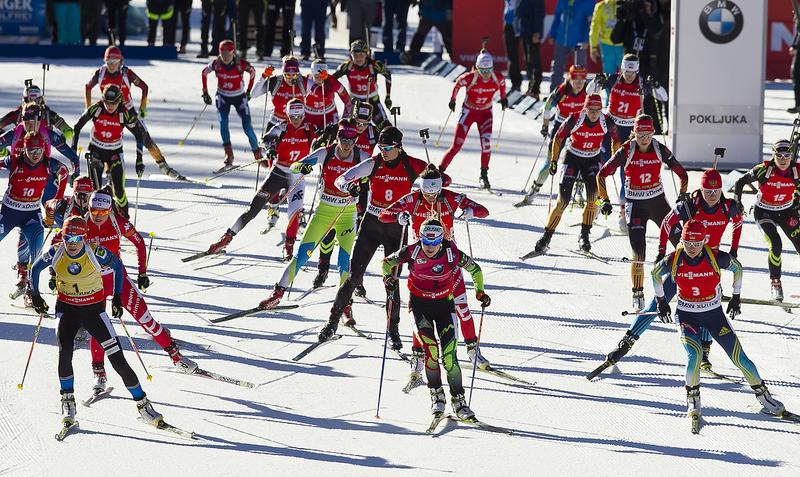
    After achieving third place in Saturday’s pursuit, the two-time Overall World Cup champion improved on that by winning the mass start in 34:40.2 minutes.

    Despite a penalty lap in the first prone shooting, which set her back to 20th place, with her skiing strength as the fastest athlete on the course and three-consecutive clean stages thereafter (1+0+0+0), Mäkäräinen was able to close the gap to the leaders again.

    On the final loop, she managed to distance herself from the Czech Republic’s Gabriela Soukalová and Russia’s Olga Podchufarova, two athletes who cleaned the entire four-stage race.

    “When I had one penalty in the first prone, I thought the day would not be that good,” Mäkäräinen said in the post-race press conference. “But I decided it would be my last mistake for this competition!”

    On the third loop, she had come back to the top of the field and was skiing in a small group with Soukalová and her Czech teammate Veronika Vítková. Both strong skaters with the eventual fifth- and seventh-fastest course times, they nonetheless had no chance to keep up with Mäkäräinen when she decided to push the tempo.

    She came first into the final shooting and fired before the others had reached their positions, hitting all her targets, and left the stage 4 seconds ahead of Soukalová in second. On the last loop, she almost tripled that lead until the finish.

    Soukalová finished second, 11.8 seconds back, and Podchufarova placed third, 27.7 seconds after Mäkäräinen. Vítková was fourth, 12.5 seconds off the podium, with her only miss in the final stage.

    The women's IBU World Cup mass start podium in Pokljuka, Slovenia: with Finland's winner Kaisa Mäkäräinen (c), runner-up Gabriela Soukalova (l) of the Czech Republic, and Russia's Olga Podchufarova (r) in third. (Photo: Fischer/NordicFocus)
    The women’s IBU World Cup mass start podium in Pokljuka, Slovenia: with Finland’s winner Kaisa Mäkäräinen (c), runner-up Gabriela Soukalova (l) of the Czech Republic, and Russia’s Olga Podchufarova (r) in third. (Photo: Fischer/NordicFocus)

    For Mäkääainen, the win was her 17th in an IBU World Cup and her second one of the season.

    Asked in an English interview with German TV broadcaster ZDF if the improved shooting was most likely reason for her recent successes, Mäkäräinen said, “Probably. It seems like all the women are shooting really well, and skiing times are more and more close to each other, so I cannot do that much on the course even if I feel strong. So I also need to shoot well.”

    “I now plan to go home to Joensuu [Finland] to spend time with my family, with my parents,” Mäkäräinen said when asked about her plans for the holiday break.
    “I think the first week is a little more easy, and then I will start preparing for Oberhof [Germany, the site of the next World Cup races Jan. 6-10].”

    Runner-up Soukalová was satisfied with her result, commenting in the press conference about the race and about Pokljuka in general, the site where she achieved her first World Cup victory.

    “I am so happy, I was feeling that I lost energy from yesterday,” Soukalová said. “My teammate Veronika Vítková was helping me on the track. Pokljuka is my favorite destination, I would like to continue to be on the podium here.”

    After Vítková had shot a miss in the final shooting, Podchufarova was still able to overtake her to grab the final spot on the podium. It was the Russian’s first World Cup podium, and while this result might have been unexpected to outside observers, she believed she executed her game plan well.

    “I am not surprised. I had a certain plan before the competitions, and everything went according to the plan,” Podschufarova said at the press conference. “I was almost the last one at the start, as I was trying to take it slowly and save my energy for the final loops.”

    Susan Dunklee (US Biathlon) placed sixth in the IBU World Cup sprint on Friday in Pokljuka, Slovenia. (Photo: Fischer/NordicFocus)
    Susan Dunklee (US Biathlon) placed sixth in the IBU World Cup sprint on Friday, Dec. 18, in Pokljuka, Slovenia. (Photo: Fischer/NordicFocus)

    Podchufarova added that she expects this result will also help her team, since this was the first podium for the Russian women this season.

    “I think it’s because of the last preparation period, it was hard for us to start,” she said. “With this podium, things will get easier as the pressure will be off.”

    At the halfway mark, 22-year-old Norwegian Hilde Fenne had been in the lead, after creating a little gap to a larger chase group. But in the first standing, she missed three of five shots and lost almost a minute in the penalty laps. She finished in 16th place with four penalties  (0+0+3+1), 1:40.2 minutes back from Mäkääainen.

    Austria’s Lisa Theresa Hauser, also 22, was one of four athletes in the women’s field to clean all four shooting stages, but could not quite keep up with the fastest skiers on Sunday, coming in eighth place (+1:08.7) to tie her career best.

    “Four times zero, that’s amazing. The mass start seems to be my race,” Hauser told Austrian TV broadcaster ORF. “I am almost surprised it worked so well today because the last two days were quite hard. Today I even could improve on the track during the course of the race. I am super happy. Now I can really enjoy the holidays.”

    Dunklee was the lone North American to qualify for the mass start as the best athlete outside of the top-25 due to her results in the preceding two races (sixth in the sprint and 10th in the pursuit) in Pokljuka. She finished 22nd (+2:29.5) after missing four targets throughout the mass start( 1+0+1+2).

    Starting out of the ninth row in bib 26, Dunklee initially attempted to improve her position on the first round, but broke or lost a ski pole early in the first loop. After recording a miss in the first prone, she exited the penalty loop in 22nd place, already 31.9 seconds behind the leaders.

    After the second loop and a clean second prone shooting, she improved to 16th and 38.4 seconds behind. She skied a strong third loop with the 11th-fastest course time, but a miss in the first standing prevented her from moving up more, as she fell back 30 more seconds to 19th place.

    Then in the final shooting, Dunklee had two more penalties, almost doubling her time back behind the leaders to 2:11.6 in 22nd place. She kept that position to the finish, only losing a bit more time to Mäkäräinen.

    New Women’s World Cup Leader is The Old One

    Martin Fourcade tweeted the following photo on Saturday of him and French teammate Marie Dorin Habert holding up the overall World Cup leader's bibs: "This does not happen every day!" he wrote. (Photo: Martin Fourcade/Twitter)
    Martin Fourcade tweeted the following photo on Saturday of him and French teammate Marie Dorin Habert holding up the overall World Cup leader’s bibs: “This does not happen every day!” he wrote. (Photo: Martin Fourcade/Twitter)

    On Saturday evening, a proud World Cup leader Martin Fourcade posted a picture on Twitter that showed himself and teammate Dorin Habert both holding up the “yellow bibs” of the Overall World Cup score leaders, with the caption “this does not happen every day!”

    While Fourcade was able to defend his position on Sunday, Dorin Habert, who had said in a press conference after the pursuit that she hoped, “I won’t wear it just for one competition,” didn’t get her wish granted after finishing seventh on Sunday.

    When the World Cup resumes in Oberhof next month, Soukalová will be the woman in yellow again, leading the overall standings with 359 points to Dorin Habert’s 345. After eight competitions, Germany’s Franziska Hildebrand is in third place (307), while Mäkäräinen moved up to fourth (278).

    “This is really good motivation for me,” Soukalová said. “I know that the season will be long. We will have a lot of competitions, and girls are very strong. We will see.”

    Dunklee improved to 27th place in the World Cup standings with 97 points, and Biathlon Canada’s Rosanna Crawford, the other North American in the top 30, ranks 29th with 91 points.

    Results

  • Schempp Holds Steady with Pursuit Win; Burke Back in Top 10 in Ninth

    Schempp Holds Steady with Pursuit Win; Burke Back in Top 10 in Ninth

    Simon Schempp of Germany celebrates his second-straight win at the men's 12.5 k pursuit in Pokljuka, Slovenia. (Photo: IBU/Kvetoslav Frgal)
    Simon Schempp of Germany celebrates his second-straight win at the men’s 12.5 k pursuit in Pokljuka, Slovenia. (Photo: IBU/Kvetoslav Frgal)

    Perfection in a pursuit. That’s what’ll get you ahead and keep you there, as Germany’s Simon Schempp demonstrated on Saturday at the International Biathlon Union (IBU) World Cup in Pokljuka, Slovenia.

    Two days after winning the men’s 10-kilometer sprint, Schempp started the 12.5 k pursuit with a 15-second head start on Norway’s Ole Einar Bjørndalen in second. Twenty-five and 26 seconds back in third through fifth, respectively, Russia’s Evgeniy Garanichev and Alexey Slepov and France’s Martin Fourcade set out after Schempp.

    After placing third in the sprint, Garanichev fell out of contention for another podium with a miss in the first prone stage. He went on to clean the next two stages, but missed another on the final standing to end up sixth overall.

    Slepov fared worse, with two penalties in each of the first two prone stages, then one in each standing for a total of six penalty laps. He placed 25th at the end of the day, while Schempp controlled the race from start to finish, winning with perfect 20-for-20 shooting in a time of 30:46.5.

    Martin Fourcade of France finishing second in the IBU World Cup pursuit on Saturday in Pokljuka, Slovenia.  (Photo: IBU/Kvetoslav Frgal)
    France’s Martin Fourcade finishing second in the IBU World Cup pursuit on Saturday in Pokljuka, Slovenia, while Russia’s Anton Shipulin enters the finishing straight for third. (Photo: IBU/Kvetoslav Frgal)

    Only Fourcade, the fifth starter, came close, rivaling Schempp with clean shooting through the first three stages. The Frenchman missed one on the last standing, which put him 18.4 seconds back leaving the range after a costly penalty loop. He finished 16.6 seconds after Schempp in second, and Russia’s Anton Shipulin rose from sixth to third with the fastest course time.

    Shipulin finished 23.4 seconds after Schempp with two penalties (0+1+1+0), besting Norway’s Tarjei Bø, who was 1.8 seconds off the podium in fourth. Bø posted the second-fastest course time to pick off five places after starting ninth.

    Only three out of 59 finishers cleaned the four-stage race: Schempp, France’s Simon Fourcade (who placed 10th), and Sweden’s Fredrik Lindström (14th).

    “Maybe the last 200 meters were easy. Everything else was extremely hard,” Schempp said in an post-race interview with ZDF. “I didn’t quite have my best day out on the course today, and except for one loop with Martin, I always had to ski in front alone. That was quite energy-sapping.”

    Fourcade was the fastest out of the start early on, racing from fifth up to third behind Schempp and Bjørndalen as they entered the range for the first time. There, all three men cleaned and Bjørndalen left the range nine seconds after Schempp in second while Fourcade was another 10 seconds back in third.

    Second prone was more of the same, with the three leaders cleaning, yet Schempp maintained his distance with a 10-second cushion to Fourcade and Bjørndalen skiing together in second and third.

    On the third loop, Fourcade, 27, dropped the 41-year-old Norwegian and entered the range right behind Schempp, where the top two cleaned all five targets once again. They set out on the penultimate loop together, where Fourcade made clear that he did not want to take the lead. Despite shooting faster, he waited for Schempp to go ahead of him.

    Germany's Simon Schempp and his smoking gun. Schempp shot 100 percent on Saturday to win the men's pursuit at the IBU World Cup in Pokljuka, Slovenia.  (Photo: IBU/Kvetoslav Frgal)
    Germany’s Simon Schempp and his smoking gun. Schempp shot 100 percent on Saturday to win the men’s pursuit at the IBU World Cup in Pokljuka, Slovenia. (Photo: IBU/Kvetoslav Frgal)

    “That was the same as last week, he just didn’t want to go in front,” Schempp said of Fourcade. “He had shot faster, then he stepped to the side and wanted to let me pass. I just yelled ‘Together!’ to him, and then he nodded and we changed back and forth. At first there was a bit of a disagreement, but then that calmed down…”

    “I don’t really understand why he does that sometimes,” Schempp added. “We were in front, but the others are pressuring from behind, and if you work together, you should be faster and can create a small gap. My opinion is that you should work together, except for the last loop of course, but before that, yeah, I just have a slightly different opinion than him.”

    “We collaborated a lot …,” Fourcade said in a post-race press conference. “It was a good solution. We were making sure we had positions one and two.”

    In the final standing stage, Fourcade shot quickly, but missed the fourth shot, while Schempp cleaned.

    “In the last shooting, I thought his second shot had missed. At least it sounded that way,” Schempp recalled.

    “Before the race, I thought that I would try to do all I can to be first,” Fourcade said in the press conference. “Simon was a little calmer at the last shooting. He had his own rhythm.”

    Fourcade came out of the penalty lap with an 18.4-second deficit, which proved insurmountable. He skied what appeared to be comfortable pace to the finish for second, 6.8 seconds ahead of Shipulin. After the race, Fourcade and Schempp hugged each other. It was Schempp’s eighth World Cup victory, his third win this season, and the third time he won both a sprint and the following pursuit in the same venue.

    While Shipulin secured third on the final loop, he overcame a couple penalties. One miss in the second stage dropped him to eighth, and he left the range after another penalty in the third stage in sixth. When Bø missed one in the final shooting, Shipulin seized the opportunity and cleaned when it counted, leaving the range in fourth, three seconds behind Bø and passing him on the final loop to avoid a sprint to the finish.

    “After the second penalty loop, I thought it was possible,” Shipulin said in a press conference. “I was hoping to shoot clean and thought I had a chance to get on the podium.”

    According to the IBU website, with one race to go — Sunday’s mass start — Shipulin is eager to see his newborn son.

    “I want to go home and see my son, but I try to stay motivated and focused on the upcoming competitions,” he said.

    Burke Cracks Top 10

    American Tim Burke (14) during one of his last two standing stages, while shooting alongside a German, Slovenian, and Russian. (Photo: IBU/Kvetoslav Frgal)
    American Tim Burke (14) during one of his last two standing stages, while shooting alongside a German, Slovenian, and Russian. (Photo: IBU/Kvetoslav Frgal)

    After starting 14th and 55 seconds behind Schempp, American Tim Burke improved to ninth with a single penalty (0+0+1+0), finishing 1:21.9 behind the German winner.

    “[I’m] really happy with today; I had a really simple game plan with my shooting to try to stick to my few key words,” Burke said in a post-race phone interview. “I felt really comfortable out there.”

    He skied alone for most of the race, which he found both odd and challenging. Burke started 9 seconds behind the 13th starter, Simon Desthieux of France, and four seconds ahead of US Biathlon teammate Lowell Bailey.

    After cleaning the first prone stage, Burke had made his way up to 11th and 50.7 seconds behind Schempp, while Bailey had slipped one spot to 16th, 1:02 back. Both Americans cleaned the first shooting, but Bailey went on to miss one in each stage thereafter (0+1+1+1) and ended the day in 29th (+2:46).

    “Not a bad day for me, but without near perfection, it’s hard to compete with this field,” Bailey said in a US Biathlon press release. “There was great overall shooting in the men’s field today so I lost a few places with penalties in each of the last three stages.”

    Meanwhile, Burke cleaned the second prone and missed one on the third shooting to hover in the top 10 throughout the race. After hitting all his targets on the final standing, he left the range in ninth. Simon Fourcade trailed him by almost seven seconds in 10th at the beginning of the last loop, while Norway’s Emil Hegle Svendsen was almost 18 seconds ahead in eighth.

    Tim Burke (US Biathlon) racing to ninth in the men's 12.5 k pursuit on Saturday at the IBU World Cup in Pokljuka, Slovenia. (Photo: USBA/NordicFocus)
    Tim Burke (US Biathlon) racing to ninth in the men’s 12.5 k pursuit on Saturday at the IBU World Cup in Pokljuka, Slovenia. (Photo: USBA/NordicFocus)

    That left Burke in no-man’s land once more. On the first loop, he had worked hard to catch the group that was fighting for top-10 results, and while he bridged the gap 500 meters before the range, he exited the range just far enough behind those skiers that he remained alone, one loop after another.

    “It was a little bit tougher for sure,” he said of the solo race. “I was hoping I’d be able to tuck in on the second loop and catch a little bit of a break.”

    Burke worked especially hard the first couple loops to catch those ahead of him and said he felt the effects of that effort later in the race. Still, he held on and most importantly held it together for the last shooting.

    “So much can change on the last shooting…,” Burke said. “I was hoping that people would finally start making mistakes there on the end. The last shooting, I shot on point 11 and shot zero and moved up one place. I was really happy to move back into the top 10; it’s the best race I’ve had in a while.”

    At the same time, he reflected on how tight the race was. Given the race he had, with 19-for-20 shooting and the 19th-fastest course time, Burke would have guessed he would have finished in the top six. Not the case when the fastest guys don’t have to ski many penalty laps.

    “It’s a fairly easy approach to the range here of so a lot of people shoot well here,” he noted.

    Burke will be one of three North Americans starting Sunday’s 15 k mass start, with Canada’s Nathan Smith in bib 12, Bailey in 19th and Burke in 26th out of 30. Three seasons ago, Burke placed third in the Pokljuka mass start.

    “I think it’ll be a great opportunity for me,” Burke said. “Typically I do well at the end of these trimesters … these three weeks of racing.

    “At this point, fatigue definitely plays a big role for everyone, both mentally and physically,” he added. “A lot of people want to get home at this time. … For me, it’s one more race. I need to focus for 40 minutes out there and I think I can handle that.”

    On Monday, the day after the Pokljuka World Cup ends and the IBU World Cup goes on holiday break, he’ll fly home to Lake Placid, N.Y.

    While Bailey was the second man for the U.S. in 29th, Brendan Green was the top Canadian in 30th (+2:53.3). After starting 46th and cleaning the first three stages, Green missed two on the last standing and fought for a top 30 on the final loop.

    For the first time in history, five Canadian men started the pursuit. Smith finished 35th (after starting 24th) with three penalties (1+0+2+0). Scott Gow started 35th and finished 45th with four misses (1+1+2+0), and Macx Davies slipped from 34th to 57th with six penalties (3+2+2+1). Despite skiing in the top-30 for a portion of the race, Christian Gow, in bib 37, did not finish.

    “On my fourth lap I developed a debilitating cramp and had to stop the race,” Gow wrote in an email about his DNF. “I really wanted to finish, especially since I was having a good race, but I simply couldn’t. It is disappointing for me, but sometimes these things are out of your own control.”

    “It was a tough day for our team,” Biathlon Canada’s High-Performance Director Eric de Nys said in a press release. “The coaches are thinking there may be a bit of a flu bug going around. Nathan and Rosanna [Crawford] both felt off today. Christian completely cramped up and Megan [Tandy] blacked out on the course. It was an off day, but they will review the day with the athletes and bounce back from this.”

    American Leif Nordgren made up a few spots in 49th (after starting 52nd) despite four penalties (0+1+2+1).

    Results | Mass start extended start list

  • Dahlmeier and Dorin Habert ‘Duelling’ Again; Dunklee 10th in Pursuit

    Dahlmeier and Dorin Habert ‘Duelling’ Again; Dunklee 10th in Pursuit

    Germany's Laura Dahlmeier after winning the women's 10 k pursuit at the IBU World Cup in Pokljuka, Slovenia. (Photo: IBU/Kvetoslav Frgal)
    Germany’s Laura Dahlmeier after winning the women’s 10 k pursuit at the IBU World Cup in Pokljuka, Slovenia. (Photo: IBU/Kvetoslav Frgal)

    The IBU Biathlon World Cup season, and especially this weekend of races in Pokljuka, Slovenia, is shaping up more and more as a duel between German and French athletes at the top.

    Just like Martin Fourcade and Simon Schempp battled it out on the men’s side, the women’s weekend was highlighted by close races between France’s Marie Dorin Habert and Germany’s Laura Dahlmeier.

    In Friday’s sprint, Dorin Habert prevailed by just over a second. But after skiing together for most of the pursuit on Saturday, the positions on the podium were reversed and Dahlmeier was victorious, finishing first in 30:08.9 minutes, 18 seconds ahead of her French rival, just like she had publicly announced as her goal after the race on Friday.

    In sunny and warm conditions on Saturday afternoon with almost no wind on the shooting range, the two athletes quickly established a sizable lead to the rest of the field, which kept growing until the finish as neither incurred a penalty lap in the four shooting stages.

    Third place went to Finland’s Kaisa Mäkärainen, winner of the first pursuit of the season in Östersund, Sweden, who has since been struggling with her shooting accuracy. Mäkärainen missed just one target in her final stage in this race (0+0+0+1) and left the range in fourth, just behind the Czech Republic’s Gabriela Soukalová (0+0+1+0) in third. Mäkärainen was able overtake her on the last loop and finish 9.4 seconds ahead of her for the final step on the podium. Mäkärainen skied the fastest course time of 55 finishers.

    “It’s very nice to be back on the podium,” Mäkärainen said in a post-race press conference. “I felt very good today and very happy about my range time. I hope to be back in the top five every competition, but most important are the World Championships in Oslo next March.”

    After Gabriela Soukalová in fourth, Germany’s Franziska Preuss placed fifth, edging teammate Vanessa Hinz in sixth by 0.5 seconds. Both had only one penalty in the third shooting (0+0+1+0).

    Susan Dunklee (US Biathlon) racing to 10th in the women's 10 k pursuit at the IBU World Cup in Pokljuka, Slovenia. (Photo: USBA/NordicFocus)
    Susan Dunklee (US Biathlon) racing to 10th in the women’s 10 k pursuit at the IBU World Cup in Pokljuka, Slovenia. (Photo: USBA/NordicFocus)

    US Biathlon’s Susan Dunklee, who started sixth, 31 seconds behind Dorin Habert, hit 18 of 20 targets (1+0+1+0) and finished the day in 10th (+1:35.4).

    “I realized halfway through the race that my typical greatest strength, my skiing, wasn’t quite in top form today,” Dunklee explained in an email. “Usually I move up through packs, but today big trains of people passed me and I had to let them go.

    “Perhaps I overdid it in the second loop,” she added, referring to the loop where she posted the third-fastest course time. “Luckily I had another great day on the shooting range and that kept me in the race.”

    Friendly Rivalry

    Unlike in the men’s race where Schempp and Fourcade seemed to disagree about skiing tactics, not wanting to make the pace for each other, Dorin Habert and Dahlmeier skied together from the start and frequently exchanged in the lead in order to create a gap to the rest of the field.

    “I was lucky that I could ski all four loops with Marie Dorin. I think we distributed that well, with her taking the first part of the round, and me taking the lead on the second part being faster out of the downhill,” Dahlmeier told the German TV broadcaster ZDF. “I think that was decisive. And then of course a zero [clean shooting] on the shooting range is still required.”

    The crucial situation deciding the race happened on the third loop leading into the final stage, when Dorin Habert stumbled in soft snow in a sharp downhill turn, falling on her belly and just narrowly avoiding the V-boards on the edge of the track. She quickly got back up, and at the next split time, she was still only 7.4 seconds behind Dahlmeier.

    France's Marie Dorin Habert (l) and Germany's Laura Dahlmeier stuck together for the majority of Saturday's pursuit at the IBU World Cup in Pokljuka, Slovenia. (Photo: IBU/Kvetoslav Frgal)
    France’s Marie Dorin Habert (l) and Germany’s Laura Dahlmeier stuck together for the majority of Saturday’s pursuit at the IBU World Cup in Pokljuka, Slovenia. (Photo: IBU/Kvetoslav Frgal)

    “I don’t know what happened,” Dorin Habert said in an English interview with ZDF.
    “I think I just made a wrong movement with my ski, and that’s why I was a few seconds late behind Laura, and I think that’s why I lost the win because of that. But no problems, it’s good to be second.”

    In the press conference, she elaborated: “It was a stupid error. I made the wrong move with my skis,” she said. “Falling on a downhill is stressful, as it’s hard to come back to the race.”

    In addition to the seconds Dorin Habert lost when she fell, Dahlmeier gained another advantage when she was able to hit her first targets before the French skier even reached the shooting mat. In previous shooting stages, Dorin Habert had put some pressure on the Dahlmeier by beginning and cleaning her targets first.

    “I let her in front before the shooting range because we had zeroed our aim [before the race] on range 3 and 4 and the French on 1 and 2, and you always prefer to shoot there,” Dahlmeier said of another tactic. “I generally try to focus just on my own targets, clean the shots one by one. Of course you notice when the spectators are yelling [after a hit or miss], but I try to ignore that as much as possible.”

    Both cleaned all targets for the fourth time, but Dahlmeier left the range 10.8 seconds in front of Dorin Habert, who was not able to catch up to her again on the last loop. Despite opening her ski pole straps and waiving to the crowd already on the final stretch, in the finish Dahlmeier expanded that lead, winning by 18 seconds.

    Germany's Laura Dahlmeier after winning the women's 10 k pursuit at the IBU World Cup in Pokljuka, Slovenia. (Photo: IBU/Kvetoslav Frgal)
    Germany’s Laura Dahlmeier after winning the women’s 10 k pursuit at the IBU World Cup in Pokljuka, Slovenia. (Photo: IBU/Kvetoslav Frgal)

    Despite her mishap, Dorin Habert was not disappointed at all with second place.

    “No, no, no, because we made a perfect race with Laura,” she told ZDF. “It was very exciting to compete with her all the time. I am very happy that my shooting was perfect, I always want to do races like that, and congrats to Laura.”

    The two athletes hugged each other after the finish, exhausted but smiling.

    “Today you had to run a smart race,” Dahlmeier said. “The strength is fading towards the finish, and this is the last block of races before Christmas.”

    Despite the pursuit loss, Dorin Habert achieved a different kind of victory on Saturday by taking over the yellow bib as the overall women’s World Cup leader. She has 309 points after seven competitions, and is currently five points ahead of Soukalová, and she’ll wear the bib in Sunday’s mass start.

    “I don’t want to compete tomorrow. It will be very hard. I hope to get a good sleep and perform well tomorrow,” Dorin Haber joked in the press conference. “Yellow is a very nice color, I like it a lot. I hope I won’t wear it just for one competition.”

    10th for Dunklee

    Dunklee finished the pursuit in 10th and seemed happy with that result, briefly pumping her right fist and later waiving to the many spectators in the arena that was filled to capacity. She recorded the 12th-fastest skiing time on the course among all athletes, but was most satisfied with her shooting with just two misses (1+0+1+0).

    “Cleaning the last standing stage especially is extremely important in a pursuit,” Dunklee wrote. “I was pleasantly surprised to hear I was in tenth heading out on the last loop. I realized I had to fight hard early in that loop to dissuade Doro [Dorothea Wierer of Italy] from thinking she might be able to hunt me down.”

    Her effort got rewarded, with Dunklee skiing the 10th-fastest final loop, and Wierer, who had already won a World Cup 15 k in Östersund this season, finishing 14 seconds behind her.

    Biathlon Canada’s Julia Ransom, who achieved her best World Cup result of 31st in Friday’s sprint, held her position for a long time, then missed three shots in the final shooting (1+0+1+3), which set her back. After leaving the range in 47th, she finished 44th (+4:46.2).

    One position and a second behind her in the finish was teammate Rosanna Crawford, who started the race in 23rd, but got off to a problematic start after missing four shots in the first prone. That put her in 54th heading into her second loop.

    “My misses were all high but moving around, so not a group,” Crawford explained in an email. “I think I was maybe so focused on wanting to hit my standing shots that I didn’t give my prone enough thought and focus. It’s amazing how quickly you can go from thinking you are a good shooter to missing 4 in your first bout!”

    She had two more penalties before the finish (4+1+0+1), yet steadily picked off racers along the way to end up 45th (+4:47.4).

    “For the next 3 shootings I was mostly over it, I didn’t hammer the skiing, just thought of it as a good opportunity to work on some good ski technique and cleaning my standing,” Crawford wrote.

    Canada’s third woman in the pursuit, Megan Tandy had a scare when she lost consciousness on the course. After starting in 51st position, she skied the 39th fastest time on the first loop, then had to ski three penalty laps after the first stage. Shortly after that on the second loop, she was seen on the TV broadcast suddenly collapsing to the ground on a fairly flat section, seemingly not caused by an obvious skiing error or contact with another athlete.

    A bit later she was shown sitting on the side of the track, conscious and receiving attention from coaches and course staff. She could not finish the race.

    “Unfortunately, my race ended unexpectedly early today when I lost consciousness on course, eek,” she later posted on Facebook. “While passing out on TV during the pursuit was a far cry from my idea of a “good day”, I can assure you that the footage looked much worse than it felt. Not to worry, I am already feeling much better and am being well taken care of. Thanks a lot to all the people who helped me out today. After a good Christmas break I will be ready to go again ☺”

    In an email, she confirmed that she was unharmed by the incident: “I am really not sure what happened, I felt unwell skiing and a bit lightheaded, but I was just thinking to make it to the top of the hill so I could tuck and rest a second, and then I was aware of blackness closing in very fast – but I don’t remember falling at all,” Tandy wrote. “There were several people around me when I came to and they had already taken my skis and rifle off.”

    She had not noticed any warning signs ahead of time: “Only that I was feeling exhausted and unwell during the race for a minute or two before. Other then that, no — I actually had a good ski performance yesterday and felt completely healthy and normal.”

    This was only the second time she did not finish a race, she explained.

    “I think I will be just fine, I am just taking it easy and feeling a bit weak / tired,” she wrote.

    Most of the team plans to return to Canada on Monday for the holiday break.

    Mass Start on Sunday

    The weekend in Pokljuka concludes Sunday with the first mass start of the season, 10 k for the women and 15 k for the men. In this discipline, all participants start at the same time in 10 rows of three athletes each. The 25 best athletes on the World Cup total-point score standings at that time of the season are pre-qualified, plus five more athletes not among those top 25, who achieved the best results in the events that race weekend, make the cut.

    Via this second criterion, Dunklee qualified for the women’s race, and is scheduled to start out of row 9 (bib 26).

    “One more day left of full focus and full gas for the mass start. I know I will probably feel tired, but everyone else in the race will be exhausted from the past month so that shouldn’t be a big problem,” Dunklee wrote.

    No other North American woman made the cut, though Crawford would be the first athlete on the “reserve standby list” in case another qualified athlete would not be able to start, for example due to illness.

    “I thought I was a bit safer for the mass start in the overall World Cup standing, but I guess not,” Crawford wrote in an email. “Now I am sitting as first reserved for tomorrows race. So that’s disappointing. Looking forward to heading home and getting back to real winter and some family time.”

    On the men’s side, Canadian Nathan Smith as well as Americans Tim Burke and Lowell Bailey qualified.

    Results | Mass start extended start list

  • Dunklee Retrieves Old Feelings to Finish Sixth, Best Sprint Result in Two Years (Updated)

    Dunklee Retrieves Old Feelings to Finish Sixth, Best Sprint Result in Two Years (Updated)

    Note: This article has been corrected to include Susan Dunklee’s sixth-place pursuit finish last season in Antholz, Italy. On Friday in Pokljuka, Slovenia, Dunklee tied her best result last season and posted her best sprint finish in two years.

    ***

    For Susan Dunklee, it felt really good to smell the roses (and gerbera daisies or whatever those orange flowers were) on Friday at the third International Biathlon Union (IBU) World Cup stop in Pokljuka, Slovenia.

    It’s not that she hadn’t been to the flower ceremony before; the 29-year-old US Biathlon veteran placed sixth in a pursuit last January in Antholz, Italy, and she reached the podium two seasons ago at a World Cup sprint in Oslo, Norway. Before that in January 2014, Dunklee placed fourth in a sprint in Antholz, Italy, which, at the time, stood as the best result by a U.S. female biathlete since 1994.

    In the time since Dunklee’s 2014 sprint podium, she has continued to lead the U.S. women’s team while experimenting with some tweaks to her training and her approach.

    “Biathlon is a notoriously up and down sport,” Dunklee wrote in an email after Friday’s 7.5 k sprint, in which she placed sixth for her best result in two seasons.

    In two weeks of racing beforehand, Dunklee had not finished higher than 31st this season. She placed 64th in the World Cup opening sprint in Östersund, Sweden, then 53rd at the sprint last weekend in Hochfilzen, Austria. In both races, she missed four of 10 targets.

    “After getting off to a rough start this season, I realized that my biggest challenge would be to remain happy and confident, and to keep my focus forward,” Dunklee explained.

    She described her summer training as high-quality.

    “I took a lot more ownership in the planning, specifically targeting my weakest areas,” she wrote. “After seeing huge steps forward in training, I was hoping for big things this winter. In those first few races of the season I did a great job executing my race plan, but the results didn’t reflect that at all.  That was frustrating and disappointing.”

    Susan Dunklee (US Biathlon) racing to sixth in the women's 7.5 k sprint at the IBU World Cup in Pokljuka, Slovenia. (Photo: Fischer/NordicFocus)
    Susan Dunklee (US Biathlon) racing to sixth in the women’s 7.5 k sprint at the IBU World Cup in Pokljuka, Slovenia. (Photo: Fischer/NordicFocus)

    Thank goodness for breakthroughs. On Friday, Dunklee knocked down 9 of 10 targets for her best shooting of the season. Combined with fast skiing (with her overall course time ranking seventh of 103 finishers), she ended up sixth, 30.6 seconds behind winner Marie Dorin Habert of France and 17.6 seconds off the podium.

    Dunklee started second and set a long list of split times to beat for those behind her. Her time on the first loop held up as third-fastest of the day, and her last loop ranked eighth.

    The eventual top four — Dorin Habert in first, Germany’s Laura Dahlmeier in second (+1.1) and Franziska Hildebrand in third (+13.0), and Veronika Vitkova of the Czech Republic in fourth (+16.4) — all cleaned the two-stage race. Another Czech skier, Gabriela Soukalová in fifth (+25.2) missed one prone shot, like Dunklee. Fortunately, prone hasn’t been Dunklee’s problem.

    “Skiing and prone shooting have already been strong,” Dunklee observed. “Standing shooting has been what held me back this season. I’ve been working to fix a very minor issue with my timing.  The trigger-finger/brain connection has been off and caused my shots to land left.”

    In Pokljuka, her standing shots grouped more toward the center, she explained. She cleaned that stage, and that was the moment she knew Friday’s race could be a good one.

    The second starter, she didn’t hear much in terms of split information, so she told herself to imagine she was fighting for a top 10. Dunklee finished first and held the lead until Soukalová in bib 15 finished 5.4 seconds faster.

    “I felt relaxed today,” Dunklee noted. “Everything seemed so quiet that first loop — it reminded me of starting bib number 1, at Ruhpolding World Championships in 2012 when I had one of my best performances [placing fifth in the 15 k individual]. I tried to recreate that feeling.”

    Back then, she was 26 and only four years into her biathlon career. Fifth stood as the best result ever for a U.S. woman at IBU World Championships.

    Susan Dunklee and the US Biathlon support crew following Dunklee's sixth-place finish in the women's IBU World Cup sprint in Pokljuka, Slovenia. (Photo: Fischer/NordicFocus)
    Susan Dunklee and the US Biathlon support crew following Dunklee’s sixth-place finish in the women’s IBU World Cup sprint in Pokljuka, Slovenia. (Photo: Fischer/NordicFocus)

    Three and a half years later, she was back at the flower ceremony and within striking distance of the podium.

    “This is a huge confidence booster for me going into the Christmas break and reaffirms the work I did this summer,” she wrote. “I am very happy today.  Our whole staff is happy.  Seeing them so excited at the flower ceremony reminds me of how many people are behind creating a good performance.”

    According to US Biathlon Chief of Sport Bernd Eisenbichler, the last few weeks haven’t been easy for Dunklee.

    “She struggled a bit in the last weeks with her confidence, especially in standing shooting, but made a great step forward in the pursuit in Hochfilzen and today was just perfect,” he said in a US Biathlon press release. “She worked hard to cut her shooting times over the summer and showed that today very impressively. On the track she looked good and the seventh ski time reflects that. But I also know there is quite more to come for her on the ski speed in the coming weeks.”

    U.S. Women’s Coach Jonne Kähkönen said he’d seen her progression throughout the summer and fall, but knew Dunklee needed a good race “to get the ball rolling.”

    “Susan had the patience to analyze and the hunger to keep working during the first weeks of racing,” Kähkönen said. “We talked a lot about the challenges of the shooting specifically at this venue and it is just great to see her stick with the plan and get a reward for all the hard work. What is even greater is the fact that this was not by all means a perfect race, so there are still things to keep working on and trying to get even better — as always.”

    Dunklee will start Saturday’s 10 k pursuit in sixth, 31 seconds behind Dorin Habert.

     “I am very happy today. Our whole staff is happy. Seeing them so excited at the flower ceremony reminds me of how many people are behind creating a good performance.” — Susan Dunklee, sixth in Pokljuka sprint

    Also qualifying for the pursuit, Canada’s Rosanna Crawford finished 23rd (+1:11.4) in the sprint with a single standing penalty. She started early in bib 10 and while her race was slower than Dunklee’s (her course time ranked 38th overall), Crawford cleaned standing, and hit every target up until her last shot.

    At that moment, she let out an audible scream, which TV cameras picked up, and she shook her head as she skated out of the range and into the penalty lap.

    “I’m feeling a bit frustrated with my ski speed right now,” Crawford said afterward in a Biathlon Canada press release.

    Like Dunklee, the 27-year-old Crawford also tried something different this training season. Specifically, she was hoping to peak later this winter.

    “The shooting has been pretty good but the shape isn’t quite there,” Crawford said. “I knew that with changing things the first trimester of racing might now be where I want to be. Hopefully things pay off and the ski speed will come.”

    About 15 seconds behind her, Crawford’s teammate Julia Ransom placed 31st (+1:26.3) for a new career best, improving upon 32nd in the Östersund sprint this season. The 22-year-old Ransom finished the day with a single prone penalty.

    A third Canadian woman, Megan Tandy, made the pursuit in 51st (+2:00.8), finishing with three penalties (1+2). One of the latest starters in bib 95, Emma Lunder got some TV time during her shooting stage, where she missed two in addition to two preceding prone penalties en route to 89th (+3:31.7).

    In the men’s race on Thursday, five Canadians qualified for the pursuit — a first for their team.

    “This has been a pretty good start for the team, and our younger athletes are definitely ahead of where I was at their age,” Crawford said. “I think the good results by the older athletes in the past few years has allowed us to better prepare athletes coming up. With more support on Tour, less Tour fees, and more money put towards summer training – the results are showing with many of the team members getting World Cup points.”

    Three U.S. women missed the top-60 pursuit criteria, with Hannah Dreissigacker finishing 7.3 seconds back from 60th in 64th (+2:20.5) with a single standing miss. Clare Egan placed 84th (+3:18.8) with two prone penalties, and Annelies Cook finished 94th (+3:47.0) with five misses (2+3).

    Saturday’s races start at 11:15 CET (5:15 EDT) with the men’s pursuit, followed by the women’s pursuit at 13:30 CET (7:30 EDT).

    Results

  • With 1 Year Old at Home, Dorin Habert Wins Pokljuka Sprint

    With 1 Year Old at Home, Dorin Habert Wins Pokljuka Sprint

    The women's 7.5 k sprint podium on Friday at the IBU World Cup in Pokljuka, Slovenia, with winner Marie Dorin Habert of France (c), and two Germans: Laura Dahlmeier (l) in second and Franziska Hildebrand (r) in third. (Photo: Fischer/NordicFocus)
    The women’s 7.5 k sprint podium on Friday at the IBU World Cup in Pokljuka, Slovenia, with winner Marie Dorin Habert of France (c), and two Germans: Laura Dahlmeier (l) in second and Franziska Hildebrand (r) in third. (Photo: Fischer/NordicFocus)

    Note: This article has been corrected to include American Susan Dunklee’s sixth-place pursuit finish last season in Antholz, Italy. On Friday in Pokljuka, Slovenia, Dunklee tied her best result last season and posted her best sprint finish in two years.

    This season, several of the best cross-country skiers in the world, including Norway’s Marit Bjørgen, Kikkan Randall of the U.S. Ski Team, and Finland’s Aino-Kaisa Saarinen, are taking a sabbatical while expecting the birth of their first children. If the skiing of France’s young mother Marie Dorin Habert is any indication, they really don’t need to worry about making successful comebacks.

    For quite a while during the women’s 7.5 kilometer sprint at the International Biathlon Union (IBU) World Cup in Pokljuka, Slovenia, it looked like Germany could achieve another victory on Friday — just like the team did a week ago with a podium sweep of the sprint in Hochfilzen, Austria. But Dorin Habert had other plans and claimed the top spot on the podium with a winning time of 20:17.8 minutes.

    France's Marie Dorin Habert takes aim during the standing stage of Friday's sprint at the IBU World Cup in Pokljuka, Slovenia. She cleaned the two-stage race and won by 1.1 seconds. (Photo: IBU/Kvetoslav Frgal)
    France’s Marie Dorin Habert takes aim during the standing stage of Friday’s sprint at the IBU World Cup in Pokljuka, Slovenia. She cleaned the two-stage race and won by 1.1 seconds. (Photo: IBU/Kvetoslav Frgal)

    Last March, the 29-year-old French biathlete was the big surprise of 2015 IBU World Championships in Kontiolahti, Finland, with two gold medals (in the sprint and pursuit) and two silvers (relay and mixed relay), which she achieved just half a year after the birth of her daughter Adele in September 2014. She returned to the World Cup last January.

    On Friday, Dorin Habert added and first victory of the season (and third World Cup win) to her list of achievements, beating two Germans, Laura Dahlmeier — the winner of last week’s pursuit — by 1.1 seconds and Franziska Hildebrand, the winner of last week’s sprint, by 13.0 seconds.

    Under sunny skies with calm, stable wind, just like the men raced in Thursday, all of the three women on the podium shot clean in the two-stage race, incurring no penalties.

    Asked how she is managing her life with a 1-year-old while competing as a World Cup athlete, Dorin Habert explained in an English interview with German broadcaster ZDF: “It is very complicated to organize everything. I am lucky because my husband [retired French biathlete Lois Habert] can sometimes go with me. He is a commentator on TV for Eurosport France,” she said.

    He and the baby joined her at the first IBU World Cup in Östersund, and last week, Adele returned home while Dorin Habert raced in Hochfilzen.

    “This week she is with me in the hotel in Bled [Slovenia] with the nanny,” she explained. “So very nice, but very complicated to organize the travel and flights and everything.”

    Dorin Habert started 35th on Friday and after two flawless stages, she left range for the second time trailing Dahlmeier, in bib 30, by 5.4 seconds.

    “My standing [shooting] was very bad throughout all the start of the season,” Dorin Habert told ZDF. “[Today is] the first time that I am okay, so I’m very happy for that.”

    Already skiing fast and with the added advantage of hearing her coaches call out split times to the leaders, Dahlmeier and Hildebrand, Dorin Habert pushed hard on the final loop to make up the deficit. Descending down a small ramp into the stadium, she entered the finishing straight with long, gliding steps while swinging her arms without using her poles, and crossed the line 13 seconds faster than Hildebrand (who started 20th) to take the lead. At the end of the day, nobody else out of 105 starters could catch her, although Dahlmeier came within 1.1 seconds at the finish.

    “I am not surprised, but I am very happy,” Dorin Habert said of her win at an IBU press conference. She posted the third-fastest course time.

    “I did a good job on the shooting range. I worked hard on my standing shooting,” she added. “It was hard on the skis, as we had a lot of races last week. I tried to be very concentrated on each target.”

    Germany's Laura Dahlmeier racing to second in the women's IBU World Cup sprint in Pokljuka, Slovenia. (Photo: Fischer/NordicFocus)
    Germany’s Laura Dahlmeier racing to second in the women’s IBU World Cup sprint in Pokljuka, Slovenia. (Photo: Fischer/NordicFocus)

    Looking like the winner for a long time, Dahlmeier shot clean and skied the fourth-fastest overall course time.Despite missing out on another win by just over a second, the 22-year-old German was very satisfied with her performance.

    “This is the first time this season that I’ve managed to shoot a ‘zero’ [no misses],” she told ZDF. “I’m extremely excited to be back on the podium. I knew it would be a close race, and that you really would have to deliver a ‘zero’ on the shooting range.

    “It was a perfect day for me,” she said at the press conference. “Marie was first today, we will see what happens tomorrow. I am happy about my form. We are a little higher above sea level, and that’s stressful [on the body]. I am already looking forward to the Christmas break.”

    Dahlmeier missed the World Cup opener in Östersund, Sweden, with a nagging cold. She’ll start Saturday’s pursuit 1 second behind Dorin Habert and 12 seconds ahead of Hildebrand, her teammate.

    Like the other two podium finishers, Hildebrand, 28, took her time on the shooting range to hit all 10 targets. Her standing shooting time ranked 96th.

    “I had to catch my breath after the second or third shot. From my point of view that was a great series, all very secure hits, everything in, everything white,” Hildebrand told ZDF. “That saved me today.”

    But she more than made up for a few lost seconds on the range by avoiding the penalty lap and skiing fast, recording the fifth-ranked overall course time. From the last shooting to the finish she still lost about ten seconds to Dahlmeier, but for a reason: “I’m a little bit under the weather today,” she said. “I didn’t know how it would work. I felt during the race, especially on the last lap, that I was not quite as fresh anymore. But I think it was still a great race, and overall I’m really satisfied.”

    Showing the depth of their team, all six of Germany’s starters finished in the top 15 with Maren Hammerschmidt in seventh, Franziska Preuss in ninth, Vanessa Hinz in 13th, and Miriam Gössner in 15th. Less than two years after leaving the 2014 Olympics without any women’s biathlon medals — and with several decorated athletes such as Magdalena Neuner and Andrea Henkel (now Andrea Burke) having retired in recent years — the team feels like it is on a good trajectory again.

    “We trained hard. We are a good team, and we can push each other to become better,” Hildebrand said in the press conference.

    “We have proven that we have arrived at the top again, and you always have to account for us,” Dahlmeier told ZDF. “I hope we can keep this up all season, and then achieve our peak at the World Championships [in March].”

    Fourth place went to Veronika Vítková of Czech Republic, who finished 16.4 seconds behind Dorin Habert, also with two clean stages. Her teammate and overall World Cup leader Gabriela Soukalová placed fifth (+25.2), as the best athlete who had to ski a penalty lap (with a single standing miss).

    American Susan Dunklee placed sixth for her best sprint result in two seasons. She finished 30.6 seconds behind Dorin Habert and 17.6 seconds off the podium. She might have been able to make it had she avoided her penalty lap in the prone shooting, and was the second-best athlete with a penalty on Friday. She’ll start 31 seconds back in the pursuit.

    The women's top six at the flower ceremony following the IBU World Cup sprint in Pokljuka, Slovenia, with Marie Dorin Habert of France in first, Germany's Laura Dahlmeier and Franziska Hildebrand in second and third, respectively, Veronika Vitkova and Gabriela Soukalova of the Czech Republic in fourth and fifth, and American Susan Dunklee (far right) in sixth. (Photo: IBU/Kvetoslav Frgal)
    The women’s top six at the flower ceremony following the IBU World Cup sprint in Pokljuka, Slovenia, with Marie Dorin Habert of France in first, Germany’s Laura Dahlmeier and Franziska Hildebrand in second and third, respectively, Veronika Vitkova (third from r) and Gabriela Soukalova (second from r) of the Czech Republic in fourth and fifth, and American Susan Dunklee (far right) in sixth. (Photo: IBU/Kvetoslav Frgal)

    Pursuit up next

    The times back from Dorin Habert as the winner of the sprint carry over into the pursuit race on Saturday.

    “Everyone can expect a very exciting race,” Dahlmeier told ZDF. “The shooting range will be decisive again. You just have to shoot well, and then everything is possible, I am looking forward to it.

    “Everything is possible,” she said in the press conference. “It is difficult to predict who will win, but I will fight for the first place in tomorrow’s competition.”

    Results

  • Schempp Rolls to Perfect Sprint Victory in Pokljuka; Burke 14th, Bailey 15th for U.S.

    Schempp Rolls to Perfect Sprint Victory in Pokljuka; Burke 14th, Bailey 15th for U.S.

    The men's sprint podium at the IBU World Cup in Pokljuka, Slovenia, with winner Simon Schempp (c) of Germany, Norway's Ole Einar Bjørndalen (l) in second, and Russia's Evgeniy Garanichev (r) in third. (Photo: IBU/Kvetoslav Frgal)
    The men’s sprint podium at the IBU World Cup in Pokljuka, Slovenia, with winner Simon Schempp (c) of Germany, Norway’s Ole Einar Bjørndalen (l) in second, and Russia’s Evgeniy Garanichev (r) in third. (Photo: IBU/Kvetoslav Frgal)

    Does anybody remember when Simon Schempp placed 77th in the first International Biathlon Union (IBU) World Cup sprint of the season two weeks ago in Östersund, Sweden? The German missed four out of five targets in each of two shooting stages for an insurmountable eight penalties. That was three days after he placed second in the 20-kilometer individual race, in which he hit 19-of-20 targets.

    As the best biathletes know, sometimes you’ve got it, sometimes you don’t.

    Lowell Bailey (US Biathlon) cleaned the IBU World Cup sprint to place 15th on Thursday in Pokljuka, Slovenia. (Photo: USBA/NordicFocus)
    Lowell Bailey (US Biathlon) cleaned the IBU World Cup sprint to place 15th on Thursday in Pokljuka, Slovenia. (Photo: USBA/NordicFocus)

    However, Schempp, 27, appears to be on something of a streak after winning his second-straight sprint in the last two World Cup weekends: he fired on all cylinders and cleaned to win in Hochfilzen, Austria, then topped Norway’s Ole Einar Bjørndalen with some blazing-fast loops in Pokljuka, Slovenia, to win the men’s 10 k sprint on Thursday.

    With a winning time of 23:02.5, Schempp shot 100 percent with the best of them: Bjørndalen in second (+15.2) also cleaned, as did the two Russians in third and fourth — Evgeniy Garanichev (+25.1) and Alexey Slepov (+25.3), respectively.

    France’s Martin Fourcade was fastest with a single miss (0+1) and ended up fifth (+25.6).

    “I just felt good again today,” Schempp told the German broadcaster ZDF after the race. “Everything worked well on the shooting range again. The conditions for shooting were very good. … I felt good on the track, and of course it’s crazy if it was sufficient again today.”

    For Schempp, the World Cup victory was his seventh in his career and it came on a day with practically invariable conditions. The sun was shining in Pokljuka and there wasn’t much wind, helping nine of the eventual top-15 finishers hit all of their targets.

    Norway’s Tarjei Bø racing to ninth on Thursday at the IBU World Cup sprint in Pokljuka, Slovenia. (Photo: IBU/Kvetoslav Frgal)
    Norway’s Tarjei Bø racing to ninth on Thursday at the IBU World Cup sprint in Pokljuka, Slovenia. (Photo: IBU/Kvetoslav Frgal)

    While Schempp started 52nd and picked off his biggest rivals for the win, including Bjørndalen in bib 14, Garanichev in bib 17 and Fourcade in bib 20, with the second-fastest overall course time, US Biathlon’s Lowell Bailey started seventh and cleaned both stages for his moment in the spotlight.

    Albeit briefly, Bailey was initially first at the finish after holding off Norway’s Tarjei Bø on the final loop. Bø started 30 seconds behind Bailey, and ultimately bested the American’s time by 22.2 seconds. With a single standing penalty (0+1), Bø placed ninth overall (+36.9), while Bailey settled into 15th (+59.1).

    “Although I started out fairly slow in the first lap, I was happy that I was able to keep Tarjei off my back for the final loop,” Bailey wrote in an email. “He’s in great shape right now and I wasn’t sure I could keep him behind me until the finish!”

    Bailey explained the Pokljuka course is one of his favorites on the circuit, with long gradual uphills — totaling 336 meters (1,100 feet) of climbing per loop — and several transitions. He chose the early start as he and his coaches thought the tracks would be fastest at the beginning of the race.

    There were some icy patches, as Fourcade nearly crashed on the first loop on a steep downhill where racers approached 70 kilometers per hour. Fourcade narrowly avoided skiing off the trail and finished the race 0.5 seconds off the podium.

    Germany’s Arnd Peiffer fell at the end of his first loop while approaching the range, breaking the sole of his boot and costing him valuable time. Despite clean shooting, he ended up 42nd  (+1:38.6).

    Tim Burke (US Biathlon) leads Norway's Emil Hegle Svendsen (21) on Thursday in the men's IBU World Cup 10 k sprint in Pokljuka, Slovenia. Svendsen placed 11th and Burke finished 14th. (Photo: USBA/NordicFocus)
    Tim Burke (US Biathlon) leads Norway’s Emil Hegle Svendsen (21) on Thursday in the men’s IBU World Cup 10 k sprint in Pokljuka, Slovenia. Svendsen placed 11th and Burke finished 14th. (Photo: USBA/NordicFocus)

    Bailey’s teammate, Tim Burke set out on the course in bib 37, cleaned prone and missed one standing to place 14th, 4.5 seconds ahead of Bailey. It was Burke’s first top 20 of the season.

    And Bailey, like Schempp, had recovered from 68th in the Östersund sprint (with six penalties), to place 12th in Hochfilzen with perfect 10-for-10 shooting.

    “I was really happy with the way that shooting went [today],” Bailey wrote on Thursday. “I didn’t feel 100% on the tracks, but it wasn’t bad either.”

    While Bailey had the fifth-fastest shooting time (and 41st-ranked course time), Burke was 13th-fastest on the course.

    “This is definitely one of my favorite courses,” Burke wrote in an email. “I think it suits my strengths well with long, sustained gradual climbs. I am able to V2 most of the course, which is definitely my best technique.”

    He explained he focused on his race plan rather than a specific result. In two previous sprints this season, Burke placed 30th in Hochfilzen (and 27th in the following pursuit), and 45th in Östersund. Thursday marked his best shooting in an individual race this season.

    “Of course I always want a better result but I am satisfied with my time back,” he wrote. “In the sprint last week and this week, I had the skiing to make it to the podium with clean shooting and that’s where I want to be.”

    Nathan Smith led the Canadians in 24th with 90-percent shooting (1+0). He started ninth and finished 1:15.9 back from Schempp, notably with the second-fastest shooting time and third-ranked range time of 102 finishers.

    Burke, Bailey and Smith all qualified for Saturday’s pursuit, along with four other Canadians, including Macx Davies in 34th (+1:28.8), and Scott Gow in 35th (+1:30), both with a single penalty. Christian Gow cleaned to place 37th (+1:31.3) and meet the top-60 pursuit criteria, as did Brendan Green, who had two prone misses en route to 46th (+1:47.3). American Leif Nordgren finished 52nd (+2:02), with one standing penalty, and his teammate Sean Doherty placed 71st (+2:31.3) with four misses (3+1).


    Men’s sprint results

  • FasterSkier’s Biathletes of 2015: Nathan Smith and Rosanna Crawford

    FasterSkier’s Biathletes of 2015: Nathan Smith and Rosanna Crawford

    FS-Awards-2015-BIATHLON-1
    Rosanna Crawford (l) and Nathan Smith are FasterSkier’s 2015 Biathletes of the Year.


    Nathan Smith

    Canada’s Nathan Smith had a breakthrough in 2014: three top-10 finishes on the World Cup, and a close miss with 11th place in the 12.5 k pursuit at the Sochi Olympics.

    Some athletes plateau after they make such a breakthrough. But for Smith, it was just a prelude for what was to come. In 2015 he stepped closer, and closer, and closer to the top.

    Nathan Smith celebrates after becoming just the second Canadian man to ever win a biathlon World Cup, taking the win in the 12.5 k pursuit in Khanty-Mansiysk, Russia. (Photo: Biathlon Canada/NordicFocus.com)
    Nathan Smith celebrates after becoming just the second Canadian man to ever win a biathlon World Cup, taking the win in the 12.5 k pursuit in Khanty-Mansiysk, Russia. (Photo: Biathlon Canada/NordicFocus.com)

    In the first pursuit of the season, in Östersund, Sweden, Smith was skiing in podium position with one shooting stage to go. He blew up, missing three shots and finishing 16th. A month and a half later in Nove Mesto, Czech Republic, he finished seventh in the sprint and then moved up to fifth in the pursuit.

    At World Championships in Kontiolahti, Finland, the real fireworks began. Smith won silver in the sprint, the first World Championships medal ever for a Canadian man.

    “It’s overwhelming,” Smith told FasterSkier after the medal. “I knew I could have some good races, but you never really believe it until you do it. It’s hard to explain, it feels great though.”

    And yet he still wasn’t finished. When the World Cup headed to Siberia to conclude the season, Smith placed fifth in the sprint. He then executed a flawless race in the pursuit and took home his first World Cup victory — by a whopping 24 seconds.

    “It was kind of surreal to be skiing by yourself on the last lap,” he marveled after the race. “Usually your first win, you’d think it would be a nailbiter, right to the line and somehow outlunge the guy. It was kind of awesome to have a buffer where I could enjoy the final finish stretch and have that moment.”

    All those times when he came close? Those helped. Smith credited that late-stage collapse in Sweden with the calm to get him to victory by the season’s end.

    “I definitely had a little flashback when I was coming into the stadium of Östersund earlier this season when I was in third, I think, and then I totally bombed the last standing,” he said. “I missed three. I was a little bit nervous about that, but I think experiences like that also help you. I could really clear my mind coming into the lane, and I did a really good job focusing on the task.”

    Smith was just the second Canadian man to ever win a World Cup, after Jean Philippe Le Guellec in 2012. And the stunning results weren’t just great for Smith, but also for Canadian biathlon, which needs World Championships medals to fight for funding from Own the Podium.

    “This is important for our funding because we are just actually judged by medals at World Championships or Olympic Games,” Canadian Head Coach Matthias Ahrens explained. “Therefore it’s a very important step in the right direction.”

    Rosanna Crawford

    Smith’s teammate Rosanna Crawford came oh-so-close to matching his trajectory. After getting her first World Cup top-10 in Oslo in the very last race of the 2013/2014 season, the two-time Olympian recharged and revved up for 2015.

    Canada's Rosanna Crawford clocked the tenth-fastest course time on Dec. 18 to finish fourth in the 7.5 k sprint in Pokljuka, Slovenia. (Photo: Christian Manzoni/NordicFocus.com)
    Canada’s Rosanna Crawford clocked the tenth-fastest course time on Dec. 18 to finish fourth in the 7.5 k sprint in Pokljuka, Slovenia. (Photo: Christian Manzoni/NordicFocus.com)

    She was on a roll before Christmas, flying to fifth place in Hochfilzen, Austria. A week later in Pokljuka, Slovenia, she placed fourth in the 7.5 k sprint, 12 seconds off the podium.

    One of the keys to Crawford’s success seemed to be her mental attitude: she didn’t put pressure on herself, but tried to stay confident without being overconfident.

    “I try not to bring previous results with me into my next races,” she said after Pokljuka. “… I think a big part of this season has been not having expectations going into my races.”

    A serious bout of sickness after New Years knocked Crawford back, and she didn’t have a peak in results at World Championships. She finished the season ranked 21st on the World Cup, a personal best, despite missing a number of starts.

    “It’s funny: my goals this year was to consistently place in the top 30, a few top 15 and top 10’s and I really wanted to be on the podium at least once,” she told FasterSkier at the end of her season. “I did achieve all but the last one. I was only outside of the top 30 two or three times I think (and Nove Mesto when I cross fired). Since my season started off so great with top form it was hard to come back down to top-30 level. This season has been my best yet.”

    Honorable Mentions:

    Susan Dunklee

    American biathlete Susan Dunklee might have felt some of Crawford’s frustration by the end of the season. A consistent performer in 2014/2015, Dunklee ended the season ranked 17th on the World Cup, a personal best. Her best finish was sixth in the 10 k pursuit in Antholz, Italy; she also had a solid World Championships, placing 12th in the individual and 20th in the mass start.

    But although she improved her consistency, she was unable to match her previous best individual result – her first podium, in a sprint in Oslo the previous season, which seemed to set her up to take further steps in 2015. Still, Dunklee clearly savored all of her successes this season.

    “Pretty special,” she said of the feeling of stepping onto the stage for the Antholz flower ceremony. “It’s definitely something I don’t take for granted… There was so much excitement from the staff, and from my teammates. It was a really good community feeling with support. It’s great.”

    Sean Doherty

    Doherty, FasterSkier’s Junior Skier of the Year, won his first medal at the World Junior Championships level after collecting several at the World Youth Championships in the previous two seasons. But more than just a standout young athlete, Doherty kept working on his transition to the senior ranks. A 2014 Olympian, he spent more time on the World Cup this season, including contributing to an eighth-place men’s relay effort in Antholz, Italy, and a seventh-placed mixed relay finish in Nove Mesto, Czech Republic. The latter netted him a nomination to the national A-team, a first for the New Hampshire native.

    ***

  • Weekly Roundup: Good Vibes Before the Holidays

    Weekly Roundup: Good Vibes Before the Holidays

    Crawford at the flower ceremony. Photo: Christian Manzoni/NordicFocus.com.
    Rosanna Crawford at the flower ceremony after achieving a career-best fourth in the Pokljuka IBU World Cup sprint last week. (Photo: Christian Manzoni/NordicFocus)

    Some of the U.S. Ski Team members are starting to feel like themselves again, even after a couple crashes took Kikkan Randall and Sophie Caldwell out of contention in Sunday’s freestyle-sprint semifinals at the World Cup in Davos, Switzerland.

    “It was a bummer to fall because the feelings were a lot stronger today,” Randall said after placing ninth. “I was just really happy that I felt more like myself today. You don’t realize how bad you were feeling until you start to feel good again.”

    “I was just thinking, ‘Oh God, am I ever going to get back there this year, and how long is it going to take?’ ” Caldwell said after ending up 11th. “I’ve just taken big steps the last two weekends, and that helps a ton with my confidence.”

    Liz Stephen placed 12th on Saturday in the 10 k freestyle in Davos, 4.9 seconds out of the top 10.

    “Each weekend is a little bit of a step forward for me and that’s a fun way to go about it,” Stephen said. “I didn’t race as well as I possibly could have to get a top ten, so I’m happy with the way it ended up.”

    Two Canadians made it into the heats on Sunday — Lenny Valjas and Jesse Cockney — and ended up 18th and 29th, respectively, which coach Tor-Arne Hetland found both promising and disappointing.

    “When you’re starting in the heats, you want to be in the final,” he said.

    “It feels awesome to finally get into the heats again,” Cockney stated after his first time in the World Cup top-30 since two seasons ago in Canmore, Alberta.

    Then there was Rosanna Crawford, a Canadian biathlete who racked up four of her best IBU World Cup results over the last week. Following her fifth-place finish in the pursuit in Hochfilzen, Austria, two weekends ago, she placed fourth in the next race: the 7.5 k sprint in Pokljuka, Slovenia. The next day, on Saturday, Crawford was seventh in the pursuit, then capped the weekend with 12th in the mass start to put herself a best-ever eighth in the overall World Cup.

    “I am really happy with where I am heading into the Christmas break, only one race that wasn’t in the top 16,” she wrote in an email.

    Her Biathlon Canada teammate Nathan Smith, also made the top-30 overall World Cup cutoff for the mass start, and in his second-ever time racing that format, he placed ninth.

    “Mass starts are a lot different than pursuits. It’s nice to get one under my belt now and I hope to do a few more this season, too,” Smith reflected. “I’m very happy … and it’s a perfect way to cap off a strong trimester. It gives me extra motivation to rest up and train over the Christmas break.”

    On Saturday, Canada’s Megan Heinicke rose from 41st to 14th in the pursuit.

    “I kept that little voice in my head that was telling me this was an awesome race pretty quiet because I know how fast everything can change,” Heinicke explained. “I didn’t really believe it until after the last standing.”

    Hannah Dreissigacker en route to 17th place in the World Cup sprint in Pokljuka, Slovenia, today. Photo: USBA/NordicFocus.com.
    Hannah Dreissigacker en route to her best IBU World Cup result in 17th in last Thursday’s sprint in Pokljuka, Slovenia. Photo: USBA/NordicFocus.com.

    US Biathlon’s Hannah Dreissigacker tallied a career-best 17th in the Pokljuka sprint, just ahead of teammate Susan Dunklee in 19th.

    “Biathlon is so weird,” Dreissigacker said. “When things go badly, it’s so hard, and it’s hard to imagine that they would ever be good. And then a week later, somehow everything just goes much better. It’s such a roller coaster like that.”

    At the IBU Cup in Obertilliach, Austria, Canada’s Scott Gow found his way onto the podium in the 10 k sprint last Friday, Audrey Vaillancourt was seventh in the women’s sprint that day, and Julia Ransom recorded a career-best seventh in the sprint last Wednesday. That same day, Gow’s younger brother Christian was “ecstatic” after placing eighth in the men’s sprint. To start the series off, Emma Lunder placed 10th in the 15 k individual last Tuesday, followed by Ransom in 11th.

    “The whole Canadian team is only going to build on this momentum,” Ransom predicted in an email that day.

    At the Nordic Combined World Cup in Ramsau, Austria, the U.S. placed fifth in the 4 x 5 k team event, and Billy Demong as the sole American to qualify for Sunday’s individual competition finished 32nd.

    The NorAm made its second stop in Sovereign Lake, British Columbia, where 20-year-old Dahria Beatty of the Alberta World Cup Academy (AWCA) and Canadian U23 team won the women’s 15 k freestyle interval start and American Kris Freeman won the men’s 30 k by more than 1 1/2 minutes over Brian Gregg.

    The day before, on Friday, Olivia Bouffard-Nesbitt (Rocky Mountain Racers) edged Alysson Marshall in the women’s classic sprint, and Patrick Stewart-Jones (AWCA) dominated the men’s sprint.

    “I’m racing among a group of super strong and talented girls who I respect a lot, so I try to learn from them during the races, but I also try not to be intimated,” Bouffard-Nesbitt wrote in an email. “I didn’t leave anything out there today, I just went for it!”

    FIS Cross-Country World Cup, Davos, Switzerland

    Saturday: 10/15 k freestyle individual starts men’s report | women’s report | U.S. report | Canadian report

    Sunday: 1.3 k freestyle sprints women’s report | men’s report | U.S. report | Canadian report

    Notes & Quotes

    IBU World Cup, Pokljuka, Slovenia

    Thursday: women’s 7.5 k sprint report | U.S. report

    Friday: men’s 10 k sprint report

    Saturday: 10/12.5 k pursuits women’s report | men’s report

    Sunday: 12.5/15 k mass starts men’s report | women’s report

    IBU Cup, Obertilliach, Austria

    Dec. 16: 15/20 k individual report

    Dec. 17:  7.5/10 k sprints report

    Friday: 7.5/10 k sprints report

    Saturday: mixed relay recap

    Nordic Combined World Cup, Ramsau, Austria

    Saturday’s team event & Sunday’s individual recap

    NorAm #2: Sovereign Lake, Vernon, British Columbia

    Friday: 1.2/1.4 k classic sprints report

    Saturday: 15/30 k freestyle interval start report

  • In Second-Ever Mass Start, Smith Clinches Ninth; Shipulin Causes Late Trip to Win in Pokljuka

    In Second-Ever Mass Start, Smith Clinches Ninth; Shipulin Causes Late Trip to Win in Pokljuka

    Nathan Smith of Canada finished 13th in the first Olympic race of his career.
    Nathan Smith (Biathlon Canada) racing to 13th in the first Olympic race of his career, the 10 k sprint in last season in Sochi, Russia.

    This wasn’t Nathan Smith’s first time in a mass-start rodeo. The 28-year-old Canadian biathlete, who turns 29 on Christmas, had raced a 15-kilometer mass start in his first Olympics last winter. That was his first one — and he crashed out of it in a downhill pileup in the first 500 meters.

    Sunday was going to be different — at least he’d know what to expect. Starting in the last of 10 rows in bib 30 out of 30 racers, Smith knew he was at a disadvantage from the get-go and tried not to stress over it on the first lap.

    Not long into the final IBU World Cup race in Pokljuka, Slovenia (the last one of the circuit’s first trimester), Smith watched as a few competitors crashed in front of him. Fortunately, he saw the chaos coming and had enough time to move around them.

    “I knew that if would take really strong skiing to maintain position because these are the 30 fastest in the world,” Smith reflected in an email on Monday.

    Russia's Anton Shipulin celebrates his IBU World Cup mass-start victory on Sunday in Pokljuka, Slovenia, which he won by 1.2 seconds over France's Martin Fourcade (back). (Photo: IBU/Rene Miko)
    Russia’s Anton Shipulin celebrates his IBU World Cup mass-start victory on Sunday in Pokljuka, Slovenia, which he won by 1.2 seconds over France’s Martin Fourcade (back). (Photo: IBU/Rene Miko)

    Meanwhile, two of the top men in the overall World Cup, Norway’s Emil Hegle Svendsen in bib 1 and France’s Martin Fourcade in bib 2, set the pace out of the start. The third-ranked man in the World Cup at the time, Russia’s Anton Shipulin went with them. All three started in the first row.

    Another Russian, Timofey Lapshin, who start in bib 29 near Smith, lost a ski on that first lap. By 2.2 k, Shipulin was leading a three-man train with Fourcade and Svendsen, and American Lowell Bailey was up to 11th, four seconds behind them. His US Biathlon teammate Tim Burke was another three seconds back in 17th, and Smith trailed by 11 seconds in 24th.

    By the first shooting stage, all 30 racers lined up in their designated lanes, and Smith headed to the farthest mat from the exit — all the way off to the left. Then he missed his first shot.

    “I’m not sure why I missed the first shot, but I had to be super, super careful after that,” he wrote.

    It worked, he added, as he knocked down the next four targets — and went on to hit 18 straight on Sunday. Smith left the range in 20th, 33.7 seconds behind Shipulin, who cleaned, followed by Austria’s Dominik Landertinger 1.9 seconds back in second, Fourcade 3.5 seconds behind in third, and another Austrian, Simon Eder 4.8 seconds back in fourth.

    The top 13 men after the first prone all cleaned, leaving Svendsen, who missed one, 21.7 seconds back in 14th.

    The two other North Americans in the race, Bailey missed one and Burke had two penalties to put them in 26 and 28th, respectively, 46 and 54 seconds behind.

    On the next lap, Fourcade took the lead, ahead of Landertinger, Shipulin, France’s Jean Guillaume Beatrix, who left the range in fifth, and Eder.

    By the time the second prone rolled around, a large group of about 10 men entered the range together. Landertinger cleaned quickly, Shipulin matched him, as did Eder, Fourcade, and Beatrix. All five left the range within 1.6 seconds of one another.

    Smith hit every target to move to 13th, 34 seconds behind.

    “Shooting was excellent after that [first stage],” he reflected. “After the second prone I knew it was gonna be a great race.”

    Bailey and Burke both cleaned to improve to 21st and 24th, respectively, both about a minute out from the lead.

    Shipulin led Fourcade, Landertinger, Beatrix, and Eder through 8.2 k, then Fourcade took charge after the third stage. He quickly cleaned his standing shots, and Beatrix, Shipulin, and Sweden’s Fredrik Lindström, who had been hovering in the top 10 with perfect shooting, did as well. Eder had one penalty, Bulgaria’s Krasimir Anev jumped to sixth with clean shooting, and Smith found himself in seventh with another flawless stage.

    “I had to reset once in the first standing but other than that there were no problems until the last few shots of the race,” Smith wrote.

    The wind picked up for the men’s afternoon race, after a mostly calm-and-bluebird week in Pokljuka. It was still sunny, with more of a headwind coming at the athletes as they shot into the range.

    Bailey also cleaned his second-straight stage to move to 19th (+1:07), and Burke had one miss to drop to 25th (+1:31).

    Beatrix led around 10.6 k into the penultimate lap, with Shipulin and Fourcade right on his heels. Lindström fell 20 seconds off the pace, followed by Eder, and Smith was another nine seconds back — up to sixth, and just ahead of Anev and Ondrej Moravec of the Czech Republic.

    Shipulin (3) leads Frenchmen Fourcade (l) and Beatrix (r) around 11.2 k during Sunday's 15 k mass start in Pokljuka, Slovenia.
    Shipulin (3) leads Frenchmen Fourcade (l) and Beatrix (r) around 11.2 k during Sunday’s 15 k mass start in Pokljuka, Slovenia.

    Shipulin took his turn leading at 11.2 k, followed by Beatrix and Fourcade, while Lindstroem and Eder hung together in fourth and fifth, about 13 seconds ahead of Smith.

    Shipulin led into the range for the last time, where his first miss of the day put him 8.1 seconds back in fifth behind Eder, who cleaned, and Fourcade, who missed one but shot quickly to stay within three seconds of Eder.

    Lindström finished the stage out with 20-for-20 shooting, the only man to do so, to leave the range in third, 7.2 back, and Beatrix missed one to head out fourth (+8.0), just ahead of Shipulin.

    Smith missed his final shot to drop to 11th, but left the penalty loop feeling like he had a lot left to give — 37 seconds out at the time. Less than three seconds ahead of him, Germany’s Andreas Birnbacher in eighth, France’s Quentin Fillon Maillet in ninth and Russia’s Dmitry Malyshko in 10th were within reach.

    “I really struggled to hold it together and those last three [stages],” Smith explained. “I almost felt dizzy trying to aim and concentrate from the pressure. That shot cost me a position where I could’ve been fighting in the lead pack for a medal.

    “I almost felt dizzy trying to aim and concentrate from the pressure.” — Nathan Smith (Biathlon Canada), after placing ninth in Pokljuka mass start

    “I held back behind a couple guys and waited to attack at the top of the second last climb,” Smith added. “I made a good gap on them and almost shook [Slovenia’s Jakov] Fak [who left the range in 12th], but he surged again on the next hill and got in front of me.”

    At the front of the race, French teammates Beatrix and Fourcade led side by side up a hill, and attacked together to try to drop Shipulin, Eder, and Lindström — and perhaps each other. Beatrix picked up the pace again with about a kilometer to go, and Fourcade went with him, as did Shipulin trailing off the back of the breakaway.

    Beatrix fell, apparently tripped up by Shipulin, and the Russian pounced on the opportunity to get ahead, attacking up and over the last rise to drop the field, soaring down into the stadium well ahead of Fourcade, as well as Eder and Lindström, who also passed Beatrix.

    “I would like to apologize to Jean Guillaume; sometimes these things happen in sports, but I did not mean anything and did not do it on purpose,” Shipulin told the IBU media after the race.

    Fourcade backed him up. “I think this is a part of the game,” he said. “I am 100-percent sure that Anton did not do it consciously. It kept me from battling Anton on the final stretch, but I have only to blame myself for not winning today; I missed one shot on the shooting range.”

    Shipulin took the victory in 35:16.8, while Fourcade finished 1.2 seconds back in second, and Eder outsprinted Lindström in a photo finish for third (+1.4). Beatrix took fifth (+4.8).

    “I am the guy who benefitted from the ‘wheel-banging’ in the last loop,” Eder said. “I might have been fourth! This is biathlon; I did not give up and you can see what happened!”

    Norway’s Tarjei Bø placed sixth with a single penalty on his third stage, Moravec took seventh with one miss on his second prone, and Fak edged Smith by 0.6 seconds for eighth (+29.8).

    Canada's Nathan Smith racing to ninth in Saturday's IBU World Cup 10 k sprint in Östersund, Sweden. Photo: Fischer/NordicFocus.
    Canada’s Nathan Smith racing to ninth in the IBU World Cup 10 k sprint in Östersund, Sweden, earlier this season. (Photo: Fischer/NordicFocus)

    For Smith, ninth stood as his second-best World Cup result (after tallying two eighth-place finishes in a sprint and pursuit last season) in his second-ever mass start. After finishing 30.4 seconds behind the winner, he posted the third-fastest shooting time, seventh-ranked range time and eighth-fastest course time.

    “Mass starts are a lot different than pursuits. It’s nice to get one under my belt now and I hope to do a few more this season, too,” Smith reflected. “I’m very happy with yesterday’s race and it’s a perfect way to cap off a strong trimester. It gives me extra motivation to rest up and train over the Christmas break.”

    Just a few weeks ago, Smith placed ninth in the sprint at the World Cup opener in Östersund, Sweden, and 16th in the pursuit there, after skiing in the top three.

    “I’m happy with the season so far. A bit disappointed that I missed a few medal opportunities due to last standing misses,” Smith wrote. “Skiing hasn’t been on average quite as good as last year yet, but it has been more consistent. My two best skis so far though are definitely at least as good as anything I did last year. Prone has been amazing, but standing needs to come up just a little and then I will be where I want to be.”

    He’ll spend his holidays mostly in Vernon, British Columbia, with his girlfriend, Emma Lunder, and her family. After that, Smith planned to head to Canmore for a week, then back to Oberhof, Germany.

    Lowell Bailey (US Biathlon) racing to 21st with two penalties in the 15 k mass start on the last day of IBU World Cup racing in Pokljuka, Slovenia. (Photo: USBA/NordicFocus)
    Lowell Bailey (US Biathlon) racing to 21st with two penalties in the 15 k mass start on the last day of IBU World Cup racing in Pokljuka, Slovenia. (Photo: USBA/NordicFocus)

    In the final shooting stage of Sunday’s race, Bailey had another penalty and Burke missed three to drop to 22nd (+1:25.7) and 28th (+2:29.8), respectively. Bailey held his position to finish 22nd with two penalties, 1:34.6 behind Shipulin, while Burke moved up one spot to 27th (+2:32.3) with six misses.

    “I was actually pretty satisfied with most of my race today,” Bailey said in a US Biathlon press release. “I felt better on the ski course and the shooting was pretty decent. The only issue was early on in the first prone stage. I had some trouble with my rifle and probably lost an extra 25 seconds getting that figured out. This made it pretty hard to recover and catch the rest of the pack. Other than that, I’m satisfied with the race and looking forward to the Christmas break.”

    Fourcade regained the World Cup lead, and Shipulin moved up to second, 25 points back and just one point ahead of Svendsen — who finished 17th with four penalties on Sunday — in third overall.

    Results

    (Stay tuned for women’s mass-start report)

  • Mäkäräinen Rallies for Pokljuka Mass Start Win; Crawford Caps Trimester Off in 12th, 8th Overall

    Mäkäräinen Rallies for Pokljuka Mass Start Win; Crawford Caps Trimester Off in 12th, 8th Overall

    Finland's Kaisa Mäkäräinen celebrates her 7.6-second victory over Anais Bescond of France (back left) on Sunday in the 12.5 k mass start at the IBU Cup in Pokljuka, Slovenia. (Photo: IBU/Rene Miko)
    Finland’s Kaisa Mäkäräinen celebrates her 7.6-second victory over Anais Bescond of France (back left) on Sunday in the 12.5 k mass start at the IBU Cup in Pokljuka, Slovenia. (Photo: IBU/Rene Miko)

    No matter what anyone else thought, Kaisa Mäkäräinen knew she still had it. Even at the end of a long string of 10 IBU World Cup races in 22 days, even as the laps wore on in Sunday’s 12.5-kilometer mass start, even after falling nearly 29 seconds back with two penalties in her third shooting.

    “I did not feel too bad this morning and hoped some of the other girls would be more tired,” the 31-year-old Finnish biathlete told the IBU after the last race in Pokljuka, Slovenia. “After the third shooting, I felt that I had to work a little bit harder.”

    Kaisa Mäkäräinen racing to second in Saturday's 10 k pursuit at the IBU World Cup in Pokljuka, Slovenia. (Photo: Fischer/NordicFocus)
    Kaisa Mäkäräinen racing to second in Saturday’s 10 k pursuit at the IBU World Cup in Pokljuka, Slovenia. (Photo: Fischer/NordicFocus)

    And so she did.

    Embarking on her fourth of five 2.5 k laps, she came within 15 seconds of France’s Anais Bescond, who found herself in the lead after the first standing with clean shooting through three stages. Mäkäräinen latched onto Ukraine’s Valj Semerenko, who, like her, had also been in the top two without a miss up until the third bout. There, a single penalty lap put Semerenko 13.2 seconds out of the lead in fifth.

    On the second-to-last lap, the two worked to catch the four women ahead of them: Bescond, Germany’s Vanessa Hinz, Gabriela Soukalova of the Czech Republic, and Nadezhda Skardino of Belarus. Hinz, Soukalova and Skardino had also hit all of their shots to that point.

    At the last shooting, Bescond led Hinz and Soukalova into the range, carefully hit all of her shots and left the range in first once again. Hinz missed her first shot, and Soukalova and Skardino both cleaned, followed closely by fast-shooting Mäkäräinen and Semerenko, who also hit all five targets on the last standing.

    France's Anais Bescond leading on her own with one lap to go in the Pokljuka mass start
    France’s Anais Bescond leading on her own with one lap to go in the Pokljuka mass start.

    Bescond, 27, left the stadium with a 9.8-second head start on Soukalova, tucking on her own on a descent, catching her breath and preparing for a tough final lap.

    Mäkäräinen took off in fourth, 18 seconds out of first and 4.3 seconds behind Skardino in third. It didn’t take long for Mäkäräinen to get around Skardino and Soukalova, and the three-woman chase quickly formulated — then soon after dissipated when Skardino and Soukalova couldn’t keep up.

    With just over a kilometer to go, Mäkäräinen caught and passed Bescond, who gave everything she had to stay with her. Skardino was another 11 seconds back in third, followed closely by Soukalova, and Semerenko, now 23.6 seconds behind.

    Mäkäräinen took her tempo to the next level on a downhill leading into the final rise before the stadium. On the descent, she cruised toward the finish uncontested, pumped her arms and swung one fist up victoriously.

    She had done it again, winning her 13th World Cup in 34:18.8 and tallying her eighth podium of the season. Bescond held onto second, 7.6 seconds behind Mäkäräinen, and waved to the crowd as she celebrated her second-best World Cup result and best mass-start finish.

    “Today was a perfect day for me,” Bescond told the IBU. “My feeling on the skis was better and the shooting was perfect. I am happy to finish 2014 with a podium.”

    Skardino locked up third, 15.8 seconds back, and Soukalova held off Semerenko by 1.1 seconds in fourth (+24.1).

    Rosanna Crawford (Biathlon Canada) finishing 12th on Sunday in the IBU World Cup mass start in Pokljuka, Slovenia.
    Rosanna Crawford (Biathlon Canada) finishing 12th on Sunday in the IBU World Cup mass start in Pokljuka, Slovenia.

    Canada’s Rosanna Crawford finished 12th, 1:25.2 back with three penalties (1+1+1+0), for her second-best mass-start result after a series of career bests in Pokljuka and Hochfilzen, Austria, the weekend before.

    “I was feeling really confident going into the race, feeling like maybe today could be the day for that elusive 20/20,” Crawford reflected in an email on Monday. “There was a bit of wind, but nothing crazy. My shooting average has been great so far, 88% I think, much better than I’ve ever shot, but prone is definitely my weak spot right now and it’s almost always one miss!”

    In three weeks of racing, she missed more than one shot in a single stage just twice.

    “So I am happy with [that], but I really need some 100% races if I want to be on the podium,” she wrote. “Skiing was decent today, our skis were good, nothing like the Hochfilzen pursuit ski feeling, but that race was one of that ‘awwww yea’ days that don’t happen too often!”

    Crawford explained she struggled on the longer uphill, but usually caught back up to her closest competitors on the second half of the course. On the last lap, she glanced back to see Italy’s Karin Oberhofer just behind her.

    “I knew if I could just make it to the top of the hill first I would hold her off!” Crawford wrote. “Last loops have been good for me this year. I feel like I usually have bit of gas left to make up some ground or hold someone off, but still cross the finish line totally empty, knowing that I passed the race well.”

    At the end of the day, she posted the third-fastest range time with 85-percent shooting and wrapped up the first trimester in eighth overall in the World Cup. On Monday, she was flying home to Canmore, Alberta.

    “I am really happy with where I am heading into the Christmas break, only one race that wasn’t in the top 16,” she wrote. “I’ll take a few days to recover and spend time with my family and dogs and then try to get some good training in before coming back to Europe. … After a mental break, I’ll put some focus into prone shooting and see if I can stop missing one shot every time :)!”

    Susan Dunklee (US Biathlon) racing to 22nd in the women's 12.5 k mass start at the IBU World Cup in Pokljuka, Slovenia. (Photo: Fischer/NordicFocus)
    Susan Dunklee (US Biathlon) racing to 22nd in the women’s 12.5 k mass start at the IBU World Cup in Pokljuka, Slovenia. (Photo: Fischer/NordicFocus)

    The other North American in the race, American Susan Dunklee finished 22nd (+2:26.9) with four penalties (2+1+1+0) to put herself 22nd in the overall World Cup.

    “It was a beautiful, sunny day to end on in Slovenia and I had fun in my last race of 2014,” Dunklee said in a US Biathlon press release. Like Crawford, she had been battling a cold since earlier in the week.

    “My body felt a lot better than [Saturday’s pursuit] and even though I missed a couple shots early in the race and lost touch with the lead pack, I had people to chase down every loop,” she said. “Team USA is looking forward to the holiday break and some time back home. All the European athletes are jealous that we’ll have lots of snow; it looks like a green Christmas for everyone over here.”

    Mäkäräinen (l), Domracheva (c), and Valj Semerenko (r) leading the women's 12.5 k mass start on Sunday at the Pokljuka World Cup in Slovenia. (Photo: IBU/Rene Miko)
    Mäkäräinen (l), Domracheva (c), and Valj Semerenko (r) leading the women’s 12.5 k mass start on Sunday at the Pokljuka World Cup in Slovenia. (Photo: IBU/Rene Miko)

    Also worth noting, early in the race after the first shooting, Darya Domracheva of Belarus fell out of contention as she was exiting her penalty loop after one miss. The Pokljuka pursuit winner, she had been leading the mass start with Mäkäräinen throughout the first lap, but collided with another racer, who was heading into the loop. Crawford was right behind Domracheva when it happened.

    “It was a pretty crazy crash,” she recalled. “Darya and I were the first ones to enter and as we were leaving I was looking left to make sure I could get out unscathed and then smack, she collides right with a French athlete, lands right on her back/rifle and spins a bit, looked like it hurt!”

    Halfway around the second 2.5 k lap, Domracheva rebounded to pass Crawford and a number of others. But she struggled with her spare rifle in the second prone, missed four, and pulled out of the race on the third lap.

    While Crawford described the incident as “unfortunate,” she added, “I’m pretty sure the rule is that people leaving the penalty loop have to yield to people entering. This penalty loop is also one of the more sketchy ones for that happening.”

    With the DNF, Domracheva currently sits third overall in the World Cup, behind Mäkäräinen in first and Semerenko in second.

    Results