Tag: Poland

  • No Bjørgen? No Problem as Norway’s Østberg, Falla Take World Champs Team Sprint Title

    Ingvild Flugstad Østberg awaits her longtime friend and Norwegian teammate Maiken Caspersen Falla at the finish of the women's 6 x 1.2 k classic sprint on Sunday at 2015 World Championships in Falun, Sweden. The two took gold by more than eight seconds over Sweden. (Photo: FlyingPointRoad)
    Ingvild Flugstad Østberg (in red bib) awaits her longtime friend and Norwegian teammate Maiken Caspersen Falla at the finish of the women’s 6 x 1.2 k classic sprint on Sunday at 2015 World Championships in Falun, Sweden. The two took gold by more than eight seconds over Sweden. (Photo: FlyingPointRoad)

    FasterSkier’s coverage of the 2015 FIS Nordic World Ski Championships in Falun, Sweden, is brought to you by the generous support of L.L. Bean, now featuring a complete line of Kikkan Randall training wear.

    FALUN, Sweden — With Marit Bjørgen out of the freestyle team sprint on Sunday after what she considered a disappointing sixth-place finish in Saturday’s skiathlon at 2015 FIS Nordic World Ski Championships, that left someone to step up in her absence.

    The Norwegian national-team staff decided one of their best bets was Ingvild Flugstad Østberg, a longtime friend of their other athlete in the race, Maiken Caspersen Falla.

    Teammates for the last decade, the two wouldn’t have wanted it any other way.

    “If there is anyone who makes me better, it’s Ingvild,” Falla, the 2014 Olympic classic-sprint champion told NRK, according to a translation, after Sunday’s race.

    “We’ve known each other a long time and push each other on countless sessions,” Østberg added.

    Both 24, the two are nearly three months apart in age, with Falla being the elder. Partners in the World Cup freestyle team sprint last month in Otepää, Estonia, Falla and Østberg placed second, 0.85 seconds behind Sweden’s Ida Ingemarsdotter and Stina Nilsson in first.

    While the Swedes stuck with their winning order, the Norwegians switched it up on Sunday, with Østberg leading out and Falla anchoring the 6 x 1.2-kilometer freestyle team sprint. The combination worked, as the two won the first semifinal of the day ahead of Poland’s Justyna Kowalczyk and Sylwia Jaśkowiec. The two teams automatically advanced to the final, and Sweden in third earned a spot as one of six teams with fast-enough times to move on as well.

    Germany’s Nicole Fessel and Denise Herrmann won the second semifinal, and the Americans, with Sophie Caldwell and Jessie Diggins, placed second in that heat. Finland, Russia and Slovenia advanced as well, along with France and Switzerland from the first semifinal.

    Poland's Justyna Kowalczyk leads Norway's Ingvild Flugstad Østberg on the first lap of the women's 6 x 1.2 k freestyle team sprint on Sunday at 2015 World Championships in Falun, Sweden. (Photo: FlyingPointRoad)
    Poland’s Justyna Kowalczyk leads Norway’s Ingvild Flugstad Østberg on the second lap of the women’s 6 x 1.2 k freestyle team sprint on Sunday at 2015 World Championships in Falun, Sweden. Østberg reclaimed the lead for good for Norway. (Photo: FlyingPointRoad)

    In the final, Norway got down to business from the start, with Østberg leading out of the stadium and into the first-and-only climb of the women’s 1.2 k course. Fessel and Ingemarsdotter followed, while the U.S. positioned itself in fourth with lead-out skier Sophie Caldwell.

    By the time the pack returned to the stadium, Kowalczyk put herself in third for Poland, less than half a second behind Østberg in first and Fessel in second. Ingemarsdotter came through the exchange in fourth (+0.88), Slovenia’s Katja Visnar tagged Nika Razinger in sixth (+1.47) while the U.S. was 2.01 seconds back in sixth.

    One lap later, Germany was up to first with Herrmann, and Jaśkowiec was 0.55 seconds back in second and Falla 0.57 seconds behind in third. The silver medalist from Thursday’s classic sprint, Nilsson came through in fourth (+1.01) for Sweden, with Diggins three-tenths of a second behind her in fifth. Flying into the exchange and prohibited from snowplowing to stop, Diggins ran into one of the Germans and nearly caused Ingemarsdotter to crash before the Swede headed out on her second loop.

    “The U.S. was falling in front of me so I had to go around them,” Ingemarsdotter said in a press conference. “It was a little bit scary for a while, I think, ‘Oh I hope, I don’t fall.”

    She didn’t.

    With two of six laps completed, the race for gold appeared wide open — until Østberg launched an attack on the steep climb.

    Fessel went with her, as did Kowalczyk, while Ingemarsdotter started to fall off the pace and Caldwell drifted farther back in fifth. Østberg led Fessel into the exchange, where they tagged in first and second, respectively, 0.43 seconds apart. Kowalczyk tagged her teammate some 3 seconds out of first, while Ingemarsdotter was another second back in fourth and Visnar 10.17 seconds behind in fifth. Behind Russia in sixth (+10.41), the U.S. slipped to seventh (+11.21).

    Heading out on her second lap, Falla made a point to stay up front and push the pace, leading Herrmann up the steep climb while Jaśkowiec and Nilsson clung tightly to them. Diggins moved up into fifth several seconds behind the leaders, while Falla widened the space between her and everyone else on her way back down into the stadium.

    By the time she reached the tag zone, Falla put Norway 1.07 seconds ahead in first, followed by Herrmann, Jaśkowiec (+1.67), Nilsson (+2.56), and Diggins (+16.28).

    Her final time around, Østberg went for it once more on the sprint hill, this time dropping Fessel. Kowalczyk took advantage of the fading German and moved into second over the top, while Østberg led by a significant margin on the way down. Meanwhile, Kowalczyk, Fessel and Ingemarsdotter pushed to take hold of second.

    “I had a little gap to Poland and Germany so I just tried to push everything I had to get Stina in as good a position as possible for the last lap,” Ingemarsdotter recalled. “I know if Stina has a little bit feeling that she is with them, then no one will beat her.”

    While she put Sweden in fourth, Østberg gave Falla a 6.11-second head-start for their final lap. Kowalczyk tagged Jaśkowiec in second, six-tenths of a second ahead of Germany in third and nine-tenths of a second ahead of Sweden.

    Falla continued to plug away alone up front, while Jaśkowiec, Herrmann and Nilsson jockeyed for position in the chase pack. On a tight turn before a final descent into the stadium, Nilsson came from behind and nearly collided with Herrmann. The two stayed upright, but Herrmann dropped to fourth while Jaśkowiec led Nilsson into the finishing stretch.
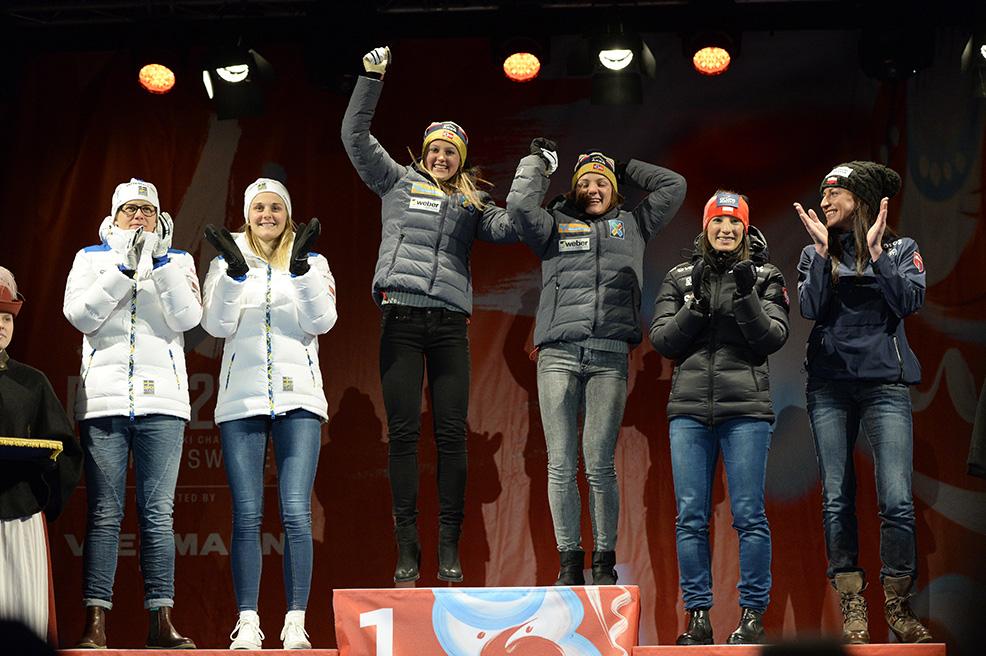
    The women's freestyle team sprint podium at the medals ceremony on Sunday night at 2015 World Championships in Falun, Sweden. Norway's Ingvild Flugstad Østberg (third from l) and Maiken Caspersen Falla (third from r) teamed up for gold, Sweden's Ida Ingemarsdotter (l) and Stina Nilsson (second from l) took silver, and Poland's Sylwia Jaskowiec (second from r) and Justyna Kowalczyk (r) tallied bronze. (Photo: Falun2015/Twitter)
    The women’s freestyle team sprint podium at the medals ceremony on Sunday night at 2015 World Championships in Falun, Sweden. Norway’s Ingvild Flugstad Østberg (third from l) and Maiken Caspersen Falla (third from r) teamed up for gold, Sweden’s Ida Ingemarsdotter (l) and Stina Nilsson (second from l) took silver, and Poland’s Sylwia Jaskowiec (second from r) and Justyna Kowalczyk (r) tallied bronze. (Photo: Falun2015/Twitter)

    There, Falla, the 2015 World Championships classic-sprint bronze medalist, crossed the line uncontested for the Norwegian victory in 14:29.57.

    “We were planning to start a little bit easy in the first round and speed up in the second and give it all in the last round, and we did as planned,” Østberg explained in the conference. “It was amazing to give Maiken some seconds and she was really strong in the last lap, and then we could cross the finish line first. That was amazing.”

    Nilsson outsprinted Jaśkowiec to clinch second for Sweden, 8.17 seconds after Norway and 0.31 seconds ahead of Poland.

    “I was very inspired by Ida’s amazing last lap so I felt that the medals were really close,” Nilsson said after her second-straight silver. “I gave it everything I had on the last lap and I’m very happy it worked out well.”

    “I saw only the back of Falla,” Jaśkowiec recalled in the conference. “I was going [for] second place in the finish area, but I felt in my back that somebody push very fast and I tried to focus on only to get the final line. Stina was amazing with amazing finish and I could just only watch how she passed, but bronze medal is for us. I am really happy we could even be a part of this today.”

    Her teammate, Kowalczyk was just as thrilled after missing out on a medal when she placed fourth in the classic sprint on the first day of World Championships.

    “Before the race, I was sure that we’ll be good because Sylwia has really good skating, but there was five or seven really strong teams,” Kowalczyk told FasterSkier. “I am so happy because this is the first medal for Poland [at these World Championships], and I’m so happy for me and of course for Sylwia because she’s ranking number two in Poland now, who have the medals in cross-country skiing. … It’s not only Justyna now.”

    Jaśkowiec reveled in her first World Championships medal after coming back from a rollerski accident in 2010.

    “Four years ago, I had a very bad accident and I spent one year on rehabilitation so comeback was very tough,” she said in the conference. “I have a lot of thought if I could come back in skiing — the level is so high that I felt that the top athletes just run away from me so today it’s a huge satisfaction and my dream has come true. I know that the tough time was worth so much pain and fighting, and I hope that my courage just now start to be faster and faster and it will be the beginning of the show.”

    Herrmann anchored Germany to fourth, 11.57 seconds back from the winners and three seconds off the podium. Russia’s Anastasia Dotsenko and Natalia Matveeva improved to fifth (+29.19) after ranking ninth at the second-to-last exchange. France was sixth (+30.26) with Coraline Thomas Hugue and Celia Aymonier, and Switzerland was seventh (+33.98) with Seraina Boner and Laurien van der Graaff.

    The U.S. finished eighth (+34.06) after slipping from fifth to eighth on Caldwell’s last lap. Slovenia placed ninth (+42.39) and Finland — which reached the team-sprint podium in the last three World Championships — was 10th (+42.9) with Riikka Sarasoja-Lilja and Anne Kyllönen,

    At the last World Championships in Val di Fiemme, Italy, the U.S. won the freestyle team sprint with Diggins and Kikkan Randall in 2013. Sweden took silver with Charlotte Kalla and Ingemarsdotter, and Finland earned bronze with Sarasoja-Lilja and Krista Lahteenmaki (now Pärmäkoski).

    Østberg and Falla placed fourth in that race, some 20 seconds after the U.S. and 10 seconds off the podium. After that showing, Østberg viewed Sunday as an opportunity.

    “When Marit said she wasn’t supposed to go [in the team sprint] then I’m really happy that I could show that I also could do a really good job,” she said in the conference. “In 2013, we were the same team and the same distance and then I ruined it, and today we could do this for the team and to do this with Maiken is amazing. We’ve been teammates for several years and good friends so that’s an awesome feeling.”

    “In 2013, we were the same team … and then I ruined it, and today we could do this for the team and to do this with Maiken is amazing.” — Norway’s Ingvild Flugstad Østberg, who won gold with teammate Maiken Caspersen Falla on Sunday in the 2015 World Championships freestyle team sprint

    “We were a proper gold team today,” Falla told NRK, according to a translation. “It means so much to stand here with Ingvild — we’ve been through so much together.”

    The two set the tone for back-to-back Norwegian victories on Sunday, as Finn Hågen Krogh and Petter Northug teamed up for gold in the men’s 6 x 1.4 k team sprint later that afternoon. They beat Russia’s Alexey Petukhov and Nikita Kriukov by 5.64 seconds.

    Women’s results

  • “I’m tired of pretending and lies” – Justyna Kowalczyk Reveals her Battle with Depression

    “I’m tired of pretending and lies” – Justyna Kowalczyk Reveals her Battle with Depression

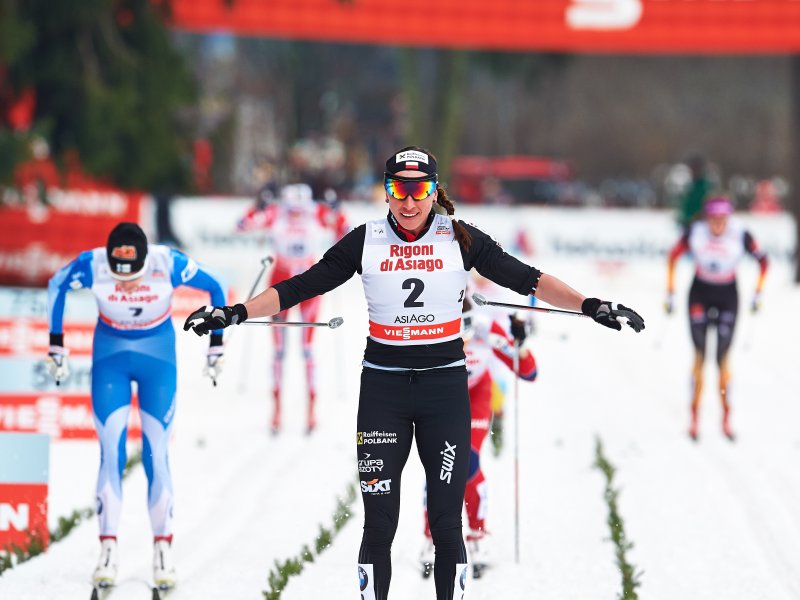
    Justyna Kowalczyk (POL) celebrates her victory in the Asiago, Italy city sprint Photo: Fischer/Nordic Focus
    Justyna Kowalczyk celebrates her victory in the Asiago, Italy city sprint. The 31-year-old skier suffers from depression, which has resulted in several mental breakdowns. The Polish star also dealt with a miscarriage in May of 2013. (Photo: Fischer/Nordic Focus)

    With two Olympic Championships, countless World Cup victories, and limitless admiration from Poland and beyond, Justyna Kowalczyck has led a remarkable life, but even the most remarkable people can suffer from mental illness regardless of the number of podiums they’ve achieved.

    The multiple Tour de Ski victor revealed to Polish news organization, Sport.pl, on June 4th that she has been battling severe depression for over a year. The acclaimed skier also suffered a mental breakdown in May of 2013 as a result of a miscarriage at the time.

    Throughout the past year she has dealt with constant nausea, fainting spells, fevers over 104 degrees, anxiety, and many sleepless nights. Despite many attempts to quell the effects of her depression, including the use of medication, Kowalczyk has yet to find relief.

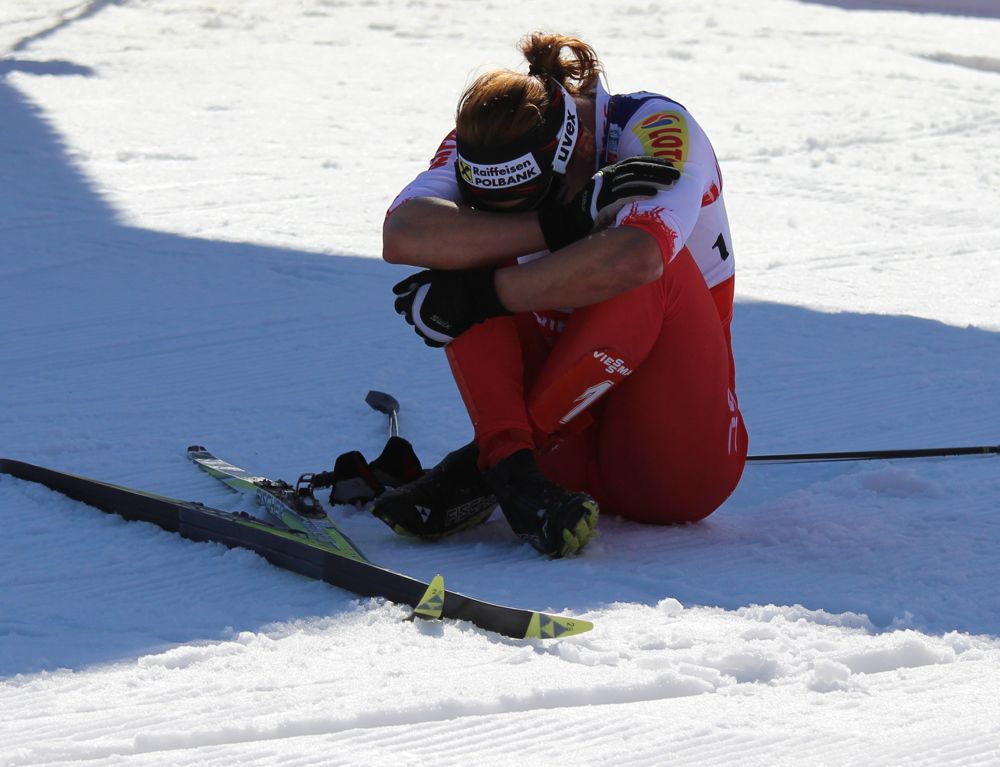
    Justyna Kowalczyk didn't forget what this felt like, after finishing second in the 30 k classic mass start at the 2013 World Championships in Val di Fiemme, Italy. She went on to win Sunday's Lahti World Cup 10 k classic mass start by more than 23 seconds.
    Justyna Kowalczyk after finishing second in the 30 k classic mass start at the 2013 World Championships in Val di Fiemme, Italy. The Polish skier recently revealed her debilitating fight with depression, which has lasted for over a year.

    The news came as a shock to many of Kowalczyk’s fans as it had appeared that the 31-year-old exhibited a successful season, especially after garnering her second Olympic victory.

    The lack of the ski community’s knowledge involving her condition was not due ignorance or lack of interest. Kowalczyk worked to keep her depression and miscarriage a secret during the 2013/2014 season due to concerns of the stigma surrounding depression and the fact that it was an Olympic year.

    “During all this bad time [I was] trying to keep up appearances. Because I was told that [it was] the right thing to do. I pretended to be normal,” said Kowalczyk in her interview with Sport.pl.

    However, this spring Kowalczyk decided that she was done hiding her illness, as she was “tired of pretending and lies.” Her motivation behind the public announcement came both from a personal desire to stop burying the truth, but also to help eliminate the negative connotation surrounding mental illness.

    “This is also one of the reasons why I decided to tell my story. Because public perception is that depression was a shame… Athlete does not [have] the right to such weakness… Many people see in me a strong girl. They tell me sometimes that [I am] the strongest girl in Poland. If the strongest benefits from the help of specialists, it can and someone else breaks through the shame and benefit either dump the mask and to cleanse,” she said.

    Although she contemplated retirement, Kowalczyk has decided to continue skiing in the 2014/2015 season because she believes that training will help fight her depression. The skier hopes that the constant exercise will support her mental health.

    “It’s not for a great love of the sport that I’m returning… I’m returning to fight for myself.”

  • Russians, Canadians and Germans Dominate 15 k Mass Start in Szklarska Poręba

    Russians, Canadians and Germans Dominate 15 k Mass Start in Szklarska Poręba

    FIS world cup cross-country, mass men, Szklarska Poreba(POL)
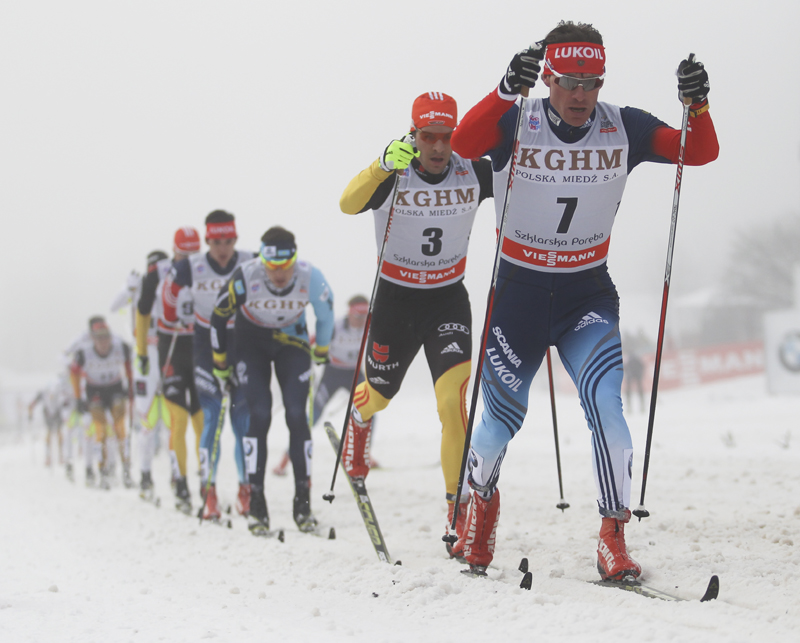
    Russian Maxim Vylezgzhanin leads Hannes Dotzler of Germany in the men’s 15 k mass start in Szklarska Poreba, Poland. Vylegzhanin won the race ahead of teammate Evgeniy Belov. (Photo: Fischer/NordicFocus)

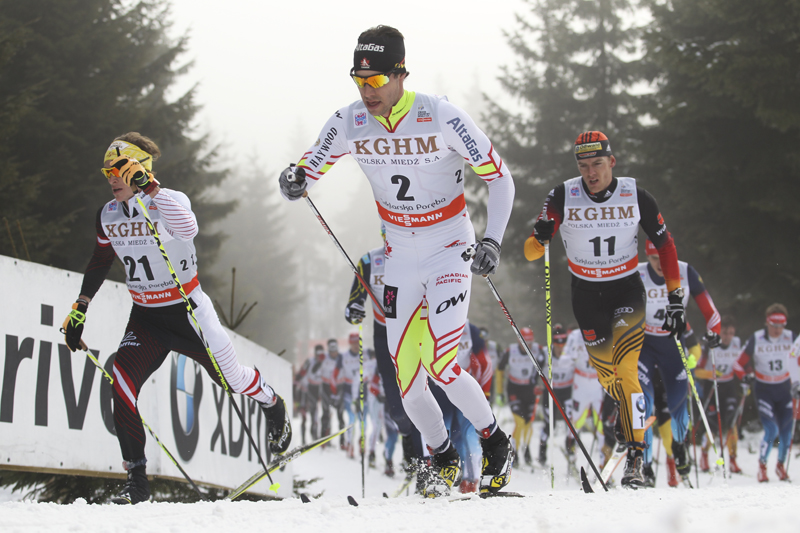
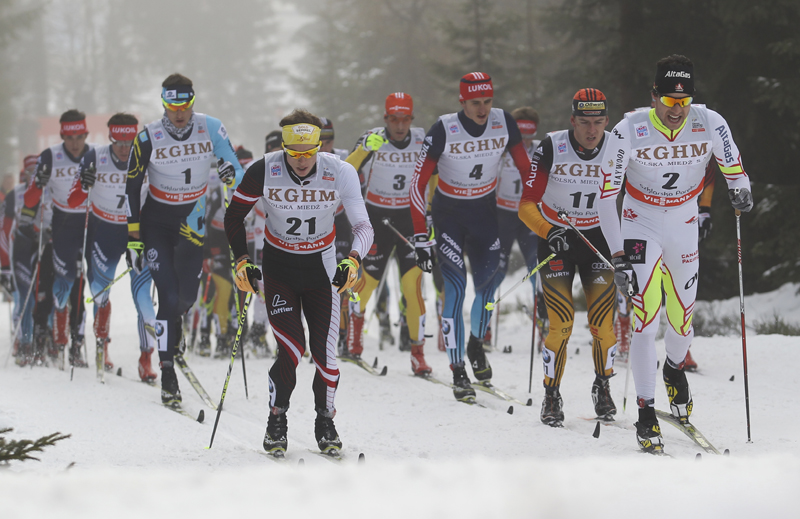
    Fog blanketed the hillsides of Szklarska Poreba, Poland, as the men of the World Cup lined up for the start of the 15 k. In a field that lacked the esteemed Scandinavian racers, the predictions of who might win were about as unclear as the visibility on course. The gun was fired, and the racers were off on the 2.7 k course that they would complete five times. After a slow first three laps, the field started to splinter. Soon as the racers made their way into the finishing stretch, spectators witnessed seven skiers suddenly emerge from the fog: two Russians, a Kazak, a Canadian, and two Germans.

    In the end, it was Russian Maxim Vylegzhanin who claimed the victory with a time of 35:39.0. He was followed by teammate Evgeniy Belov (+2.2) and Alexey Poltoranin of Kazakhstan (+2.3) in second and third. Canadian Alex Harvey finished fourth with 5.2 seconds back, followed by Germans Hannes Dotzler and Tobias Angerer.

    FIS world cup cross-country, mass men, Szklarska Poreba(POL)
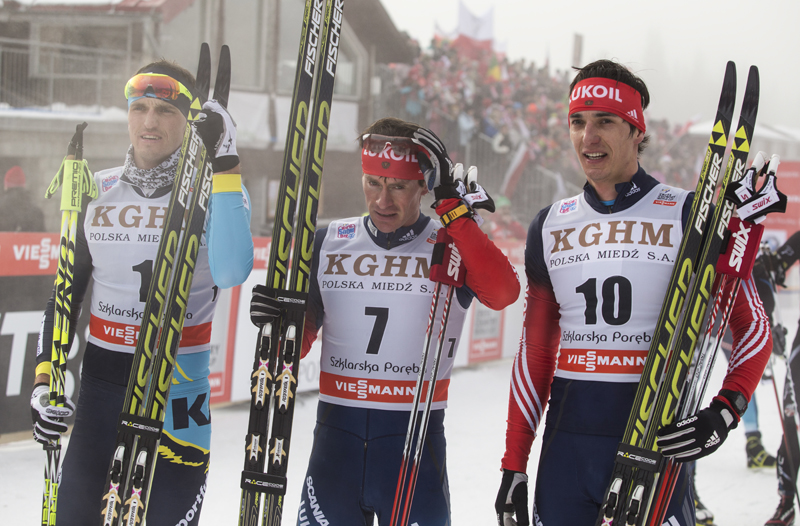
    The men’s podium in the 15 k classic mass start: (l-r) Alexey Poltoranin (KAZ), Maxim Vylegzhanin (RUS), and Evgenliy Belo (RUS). (Photo Fischer/NordicFocus)

    The Russians, Canadians, and Germans dominated top ten, with three members from each country all finishing within roughly twenty seconds of each other.

    The race started out at an extremely slow pace and the pack stayed tightly packed together. It wasn’t until bonus points were at stake at the top of the largest climb of the course that the Russians started to push the pace. From there they continued to open up the lead with the Kazak, Canadians, and Germans in pursuit.

    “I planned to go away from the pack in the second last lap. I felt good and confident I could make it,” said Vylegzhanin in a press release.

    Vylegzhanin, who won the team sprint in Nove Mesto, Czech Republic and was part of the victorious Russian relay team in Lillehammer, Norway, has had few World Cup start this year and sat out the Tour de Ski .

    Teammate Belov was pleased with his effort, not only because it was his first podium of the season, but also because of the implications his result carried.

    “It’s been a great day for me. Everything worked just perfect. I had fast skis, my shape was very good,” he said. “It’s my first podium of the season and I am excited it happened today. I just earned my ticket for Sochi.”

    Poltoranin, who gained his fourth podium of the season thought that he could have done better, but was happy with the effort.

    “I hoped for victory. I fought to the finish with Evgeniy (Belov) but he was more powerful,” he said. “Today’s result gives me good energy for the final preparation phase before the Games.”

    FIS world cup cross-country, mass men, Szklarska Poreba(POL)
    Canadian Alex Harvey leads a pack in the men’s 15 k classic mass start in Poland. Harvey would go on to place fourth. (Photo: Fischer/NordicFocus)

    Winner of yesterday’s sprint race, Harvey crossed the line roughly three seconds behind the Kazak. Despite giving it his all in the previous day’s sprint, the 25-year-old felt like he had sufficiently recovered for the 15 k.

    “I felt good in the morning. I like the format. 15 k mass start classic is been something I’ve had a good amount of success in,” Harvey said. “I was pretty psyched for the race today, especially after the race I had yesterday. I knew that [my] recovery was good.”

    The Canadian, who started in second position, skied near the lead for the first three laps on the narrow course. “I was trying to stay in front of the groups and out of trouble, and I did that the whole race,” Harvey said.

    Then in the fourth lap he got pushed back to roughly twentieth position, but stayed determined to hold on to the Russians who had broken away. By the last lap he was speeding by his competition. “I had a really good last lap. I went from the twenties to fourth at the line.”

    Unfortunately for Harvey, he was unable to make contact with the leaders. “I could not follow,” he said of the Russians.

    Coming into this weekend of World Cup racing, Harvey was happy that the success he found at the Tour de Ski continued into this weekend.

    “It was a really good weekend after the [racing at the] Tour de Ski. The tour, in the last four years, has always been a really good trigger for the rest of the season. It’s a really good intensity stimulus and it’s really putting me in a good position for the rest of the season.”

    A key to Harvey’s success this weekend was the break that he took to recuperate after the Tour, that had him skip the World Cup races in Nove Mesto, Czech Republic. This year he spent time in Zermatt, Switzerland for his “mini-vacation” after spending last year’s in Nice, France. “It doesn’t take many days, but it’s good to be in a place where you’re not training but also not thinking too much about training,” he said. “You can really recover and put yourself in a good position after that for the games.”

    Harvey wasn’t the only Canadian to find success in Szklarska Poreba. Devon Kershaw and Ivan Babikov finished eighth and ninth, both roughly 20 seconds behind Vylegzhanin.

    Justin Wadsworth, Canadian Head Coach, was ecstatic that his teams training plan was coming into fruition. After initially worrying that the conditions in Poland may not be up to par, Wadsworth was glad the team had made the trip. “Going into the games this is the trend you are looking for,” he said.

    Austria's Bernhard Tritscher (21) and Canada's Alex Harvey (2) lead the pack in Sunday's 15 k classic mass start in Szklarska Poreba, Poland. (Photo: Fischer/NordicFocus)
    Austria’s Bernhard Tritscher (21) and Canada’s Alex Harvey (2) lead the pack in Sunday’s 15 k classic mass start in Szklarska Poreba, Poland. (Photo: Fischer/NordicFocus)

    Kershaw, who has been frustrated with the majority of his results thus far this season was happy to see himself in the top ten once again after finishing second in the prologue of the Tour de Ski in Oberhof.

    The frustration continued into this weekend after the 31-year-old failed to move past the quarterfinals in Saturday’s 1.5 k sprint, despite feeling close to the best he has felt all season.

    “I was really frustrated with yesterday. I was really boxed out and just couldn’t get around anyone and just ended up finishing my quarterfinal feeling like it was level two. I’m really frustrated because it was a really dirty messy heat that I was in and I was in the wrong end of that.”

    Kershaw said that while he felt much better in the sprint than he did in Sunday’s 15 k, the distance race served as great training and a confidence booster before going to the Olympics.

    Going into the mass start, Kershaw was feeling apprehensive about his classic skiing for “the first time in my career,” he said. Soon the apprehension lifted as skied through the first three laps of the course.

    In the fourth lap, he found himself at the front of the pack with an open track, and decided to go for the bonus points. “Since I had been feeling bad in classic and the pace had been easy I decided that I would try and test my shape and see how as I was doing,” he said.

    While Kershaw was unable to obtain the bonus points, he felt he was going in the right direction. “I’m still not in tiptop form because I was missing a bit on the big steep hill and that’s when the guys got in front of me,” he said. “It’s a good step in the right direction, and the energy was good, and most important to me was that the technique was back to where it should be.”

    Kershaw is feeling optimistic for the Olympics, which will be held in two and a half weeks. “There are may opportunities there (at the Olympics) and I feel better now than I did at the tour so let’s hope it continues in a positive direction.”

    Babikov, who finished just behind Kershaw in ninth, was happy with both his and the Canadian team’s efforts. “As you can see from the results it went really well for the whole team. We all ended up in the top ten. The skis worked well and our team worked well,” he said.

    From Szklaska Poreba the Canadians are headed to Italy for a week and a half to get a last minute training camp in before the Olympics. They leave Poland satisfied with a good weekend of racing.

    “I think the main thing is that the guys are in good shape. The shape of the team is coming together now and that’s been the goal the whole time,” said Wadsworth of his team.

    Results

  • Team 9: Poland

    Poland

    2009-2010 Nations Cup Ranking: 8th (2264 pts)

    2010-2011 Nations Cup Ranking: 9th (2339 pts)

    Men: 16th (101 pts)

    Women: 5th (2238 pts)

    2011/2012 World Cup Team (Best Estimate)

    Men

    Maciej Staręga

    Mariusz Michałek

    Maciej Kreczmer

    Women

    Justyna Kowalczyk

    Sylwia Jaskowiec

    Paulina Maciuszek

    Ewelina Marcisz


    Kowalczyk, Longa, and Saarinen battle in the 15km pursuit in Oslo.

    What You May Have Missed Last Season

    Justyna Kowalczyk was unbelievably good last season; that’s not a surprise. She cleaned up on the circuit, winning the Crystal Globe for the third consecutive season, as well as the Tour de Ski. Kowalczyk skipped just five World Cup races all season, and never finished out of the points – the closest she came was 28th in a skate sprint in Drammen, Norway.

    But the real story of the season is the fact that despite all her accolades, Kowalczyk was not the best female World Cup skier. After exchanging verbal jabs for much of the off-season about asthma (which FasterSkier did some interesting work on), the outspoken Pole was thoroughly dominated by Norwegian superstar Marit Bjoergen whenever the two raced head to head. The Pole won just three of those face-offs, and lost to Bjoergen all four times they raced against each other at World Championships, leaving little doubt as to who was the superior skier.

    She probably doesn’t care all that much, but Kowalczyk didn’t make any friends stateside after her little stunt during the skate sprint in Davos, Switzerland, where she cut off Kikkan Randall quite blatantly, and then was promptly disqualified, finishing 6th.

    What You Need To Know for This Season

    The World Cup is coming to Szklarska Poreba, Poland, February 17 and 18, and all eyes will be on Kowalczyk as she races a sprint and a 10 k in her home country for the first time. The two World Cup races will be held Friday and Saturday, so that Kowalczyk can contend FIS World Uphill Trophy event on Sunday. The unique 3 k uphill followed by 3 k downhill event has not exactly been geared towards the superstar Pole – Kowalczyk isn’t exactly known for her descending ability.

    Kowalczyk is a workhorse – she took a grand total of 25 days off following the end of the 2010-2011 season, visiting Kamchatka, before getting back into training. She also put in a massive amount of travel during the off season, with training stops in Estonia, New Zealand, and Spain.

    Kowalczyk closing out her World Championships.

    Between all that travel, she also had time to appear in a promotional spot for automaker Mercedes-Benz, which unfortunately was not televised in North America.

    Kowalczyk has already started waging war against Bjoergen this season, say she’s more afraid of getting sick than the Norwegian skier.

    And the battle between the two should be intense – Kowalczyk won the Crystal Globe last season during the Tour de Ski, which Bjoergen opted out of. In a year with no major Championships, the Norwegian will contest the Tour de Ski,and is gunning for the victory in what should be a thrilling competition.

    Who You Should Watch

    Ewelina Marsuisz is coming up fast. She finished fifth in the 10 k pursuit at World Junior Championships this season, and 17th in the 5 k. While she lacks notable World Cup results, she was part of Poland’s eight place finish in the 4×5 k relay at World Championships. With the World Cup in Poland, she will benefit from the home crowd experience.


  • Team 8: Poland

    Poland

    Nations Cup Ranking: 8th (2264 pts)

    Men: 17th (109 pts)

    Women: 6th (2155 pts)

    2010/2011 World Cup Team

    Men

    Maciej Kreczmer

    Mariusz Michałek

    Krzysztof Stec

    Maciej Staręga

    Sebastian Gazurek

    Women

    Sylwia Jaśkowiec

    Paulina Maciuszek

    Martyna Galewicz

    Ewelina Marcisz

    Agnieszka Szymańczak

    Justyna Kowalczyk

    What you may have missed last season:

    Well, if you tuned into elite-level cross-country skiing at just about any point last year, one thing you did not miss was Justyna Kowalczyk steamrolling her way to three Olympic medals, a victory in the Tour de Ski, and the World Cup overall title. Over the course of the season, Kowalczyk contested every single individual race on the World Cup except for two, for a total of 33 starts. Along the way, she racked up more than $350,000 and 2,064 World Cup points—700 more than Norway’s Marit Bjoergen, her nearest challenger.

    What else? Well, last year’s next-famous Pole was Kornelia Marek, who might now be better-described as infamous. Marek was the only cross-country skier busted for doping at the 2010 Olympics—she tested positive for the blood-boosting drug EPO, then blamed it on intramuscular injections that she received from a physiotherapist named Witalij Trypolski. While Marek acknowledged getting the injections, she apparently didn’t bother to ask whether they just might have included illegal drugs. The International Ski Federation didn’t care, and slapped her with a two-year ban.

    What You Should Know For This Season

    While the Poles do have a small supporting cast, the most obvious question is whether Kowalczyk can sustain her torrid racing and training schedule. A conversation with a slightly flabbergasted reporter last February indicated that she doesn’t take her foot off the gas pedal, even in the middle of winter.

    [podcast]http://images.fasterskier.com/2010/11/Justyna-Kowalczyk2.mp3[/podcast]

    A few things should help. First, a €125,000 sponsorship deal with a Polish bank will mean that Kowalczyk will not go hungry. (Even if you skip the rest of this preview, don’t miss her acting skills in this ad.) Second, she has her own six-member support crew separate from the rest of the national team: head coach Alexander Wierietielny, assistant coaches Rafał Węgrzyn and Mateusz Nuciak, servicemen Are Mets and Peep Koidu, and doctor Robert Smigielski. Third, Kowalczyk has some knowledge of her own to fall back on, thanks to a masters degree from the Physical Education Academy in Katowice, where she wrote a thesis called “An Analysis of Training Loads.”

    However, Kowalczyk has also been doing something during the off-season that anyone with knowledge of cross-country skiing would classify as unwise: provoking the Norwegian superstar Marit Bjoergen. Since last year’s Olympics, Kowalczyk has been complaining that Bjoergen’s asthma medicine gives her an unfair advantage—recently, she told a Polish newspaper that she prepares for racing “on the trails, not at the pharmacy.” The comments certainly seem to stoke the fires of the Scandinavian press, but it’s not clear that they bother Bjoergen—after all, she did win three gold medals at the Games. Look for some awkward congratulatory hugs at the finish line this winter.

    Who You Should Watch

    Sylwia Jaskowiec had four top-30 results in individual races last winter, and while she has been on the cusp of regularly scoring World Cup points, her racing has been inconsistent. A rollerski accident in August took a few months out of her preparations for the season, so it will be interesting to see whether she can make a jump this year.

  • FIS Mulls New Format for Poland World Cup

    FIS Mulls New Format for Poland World Cup

    Justyna Kowalczyk navigates a descent in the sprint at the 2010 Olympic Games.

    So much for Justyna Kowalczyk’s home-field advantage.

    For the first time in her career, the International Ski Federation (FIS) has scheduled World Cup races in Kowalczyk’s native Poland, in February of 2012. But if officials at FIS have their way, Kowalczyk, a notoriously poor descender, will have to successfully navigate five kilometers of technical downhill before she can step onto the podium there.

    According to FIS Cross-Country Race Director Jürg Capol, a federation committee discussed a new type of event last weekend at its fall meetings in Switzerland: five kilometers of uphill, followed by five kilometers of technical descending—perhaps even including slalom-style gates. A test race is in the works for this coming spring, after which FIS will decide whether or not to introduce the format at the Polish World Cup in 2012.

    In an interview, Capol said that the idea for the race grew out of the federation’s desire to inject some excitement into the sport during the lull that typically follows the Tour de Ski—especially in 2012, a year without an Olympic Games or World Championships.

    “We would like to have a kind of story here, [in] the second part of the season,” Capol said, adding that he was looking for something that would be “appetizing for fans.”

    The Polish venue, in the resort town of Szklarska Poręba, had an alpine slope that was suitable for the new format, and Capol made a visit to examine the site in September.

    The course, he said, is distinct from the climb that ends the Tour de Ski, on Italy’s Alpe Cermis: It’s not as steep, and of course, it includes the descent.

    “It would be kind of a Super-G—some gates…to reduce the speed a little bit,” Capol said, referring to the alpine skiing discipline of the super-giant slalom. “It should be a part of the game, the downhill.”

    While it’s fast for cross-country skiing, Capol maintained that the descent was tame by alpine standards. And according to U.S. Ski and Snowboard

    Ivan Babikov, pictured here in last year's SuperTour Finals in Fort Kent, excels in uphill climbs. The event proposed for the World Cup in Poland could suit him – as long as he can stay on his feet on the downhill.

    Association (USSA) Nordic Director John Farra, who attended the meetings in Switzerland, the total amount of climbing in the course—504 meters—isn’t much more than is included in a typical 10-kilometer race. FIS-sanctioned competitions of that distance normally include between 250 and 420 meters of uphill.

    “It’s a subtle shift, and I think there’s a true desire…for being open to different formats, being open to different concepts,” Farra said.

    Indeed, Capol and FIS Cross-Country Committee Chair Vegard Ulvang have been credited with the success of several new fan-friendly formats and rules introduced on the World Cup circuit over the past few years. But earlier this year, a number of athletes criticized the federation for abdicating tradition and taking those innovations too far—especially when the individual-start 50-kilometer race, an event with a rich history, was left off the calendar for the 2010-2011 season.

    Capol acknowledged those concerns, and he noted that the individual-start 50-kilometer would return next year.

    “All stakeholders are important, and of course, athletes are the main stakeholders, because they are doing the show—they are the gladiators,” he said. “Of course, we try to integrate those inputs.”

    However, Capol said that he had not yet consulted athletes about the proposed new format; he maintained that soliciting too much feedback in the planning stages could stymie the sport’s growth. “We’re still in the stages of the idea,” he said.

    Before that idea can come to fruition, Szklarska Poręba will have to hold the test race, which Capol said he would like to schedule for the end of the season, in late March or early April. Ideally, he said, a few World Cup athletes would be able to take part.

    A positive test would likely pave the way for the World Cup in 2012, though that decision would not be made until next spring’s FIS meetings. If there are problems, Capol said, the Polish races would simply revert to standard formats, held on courses nearby.

    Meanwhile, Kowalczyk will have to work on her technique. She lost her lead in the Olympic sprint final to Norway’s Marit Bjoergen on the last downhill corner, and at a race later that year, she admitted that her descending could use some work.

    “For me, better up than down,” she said.