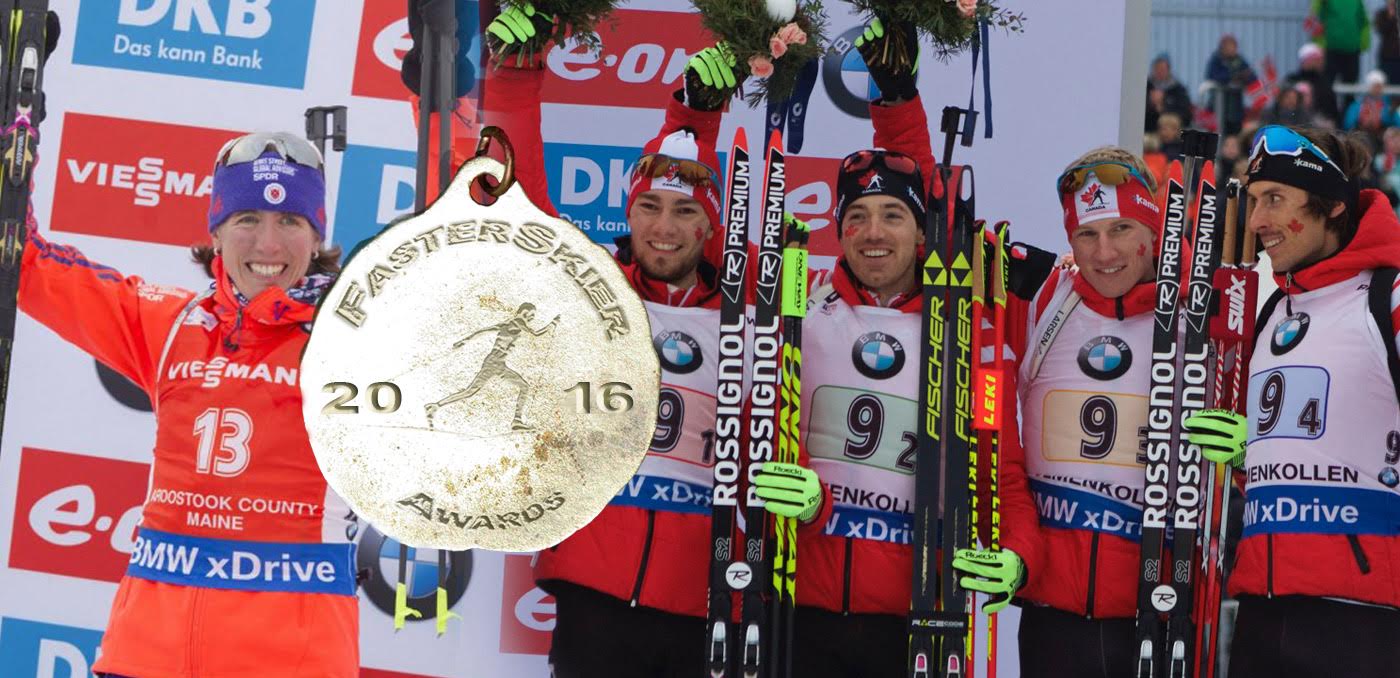
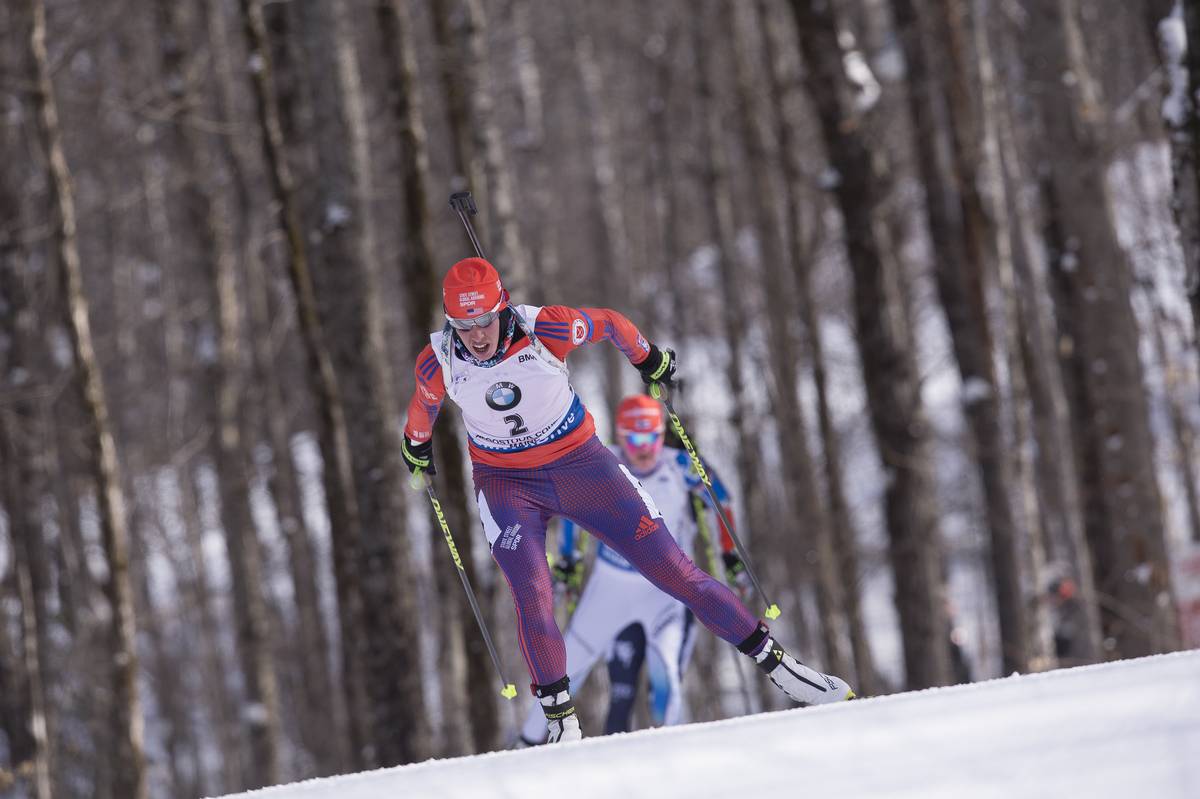
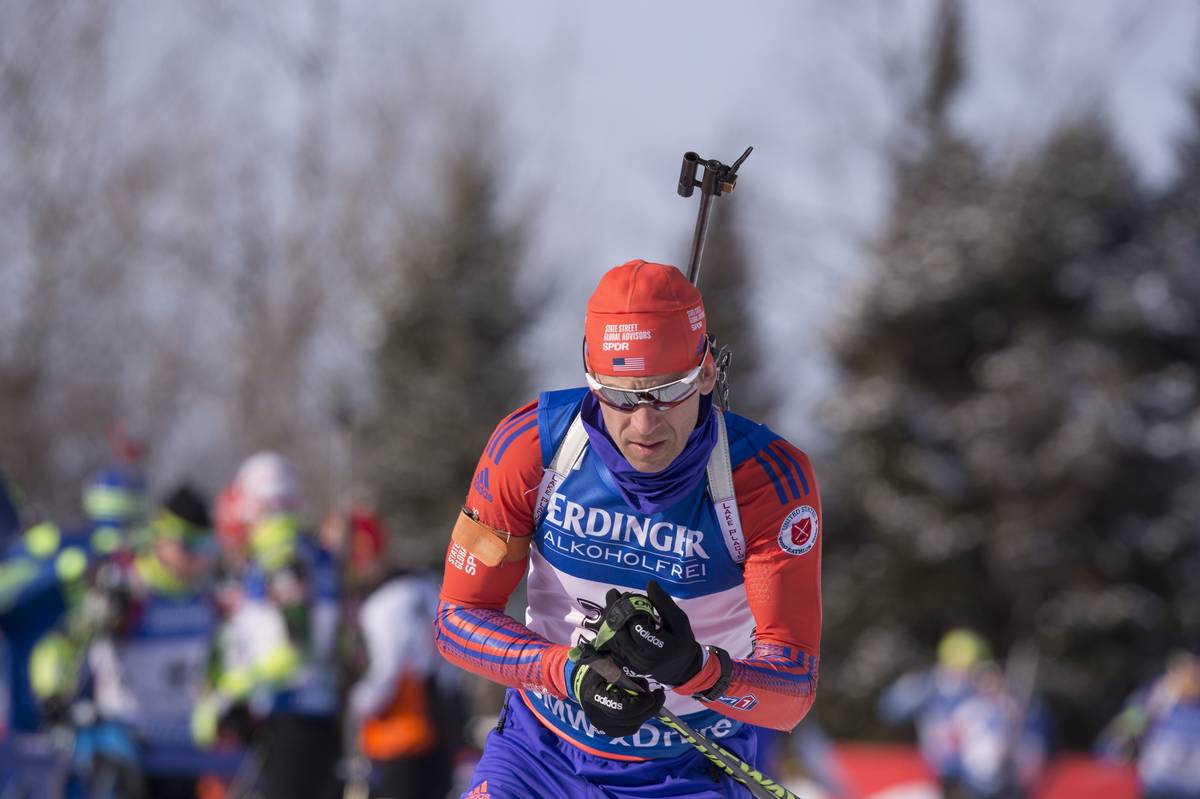
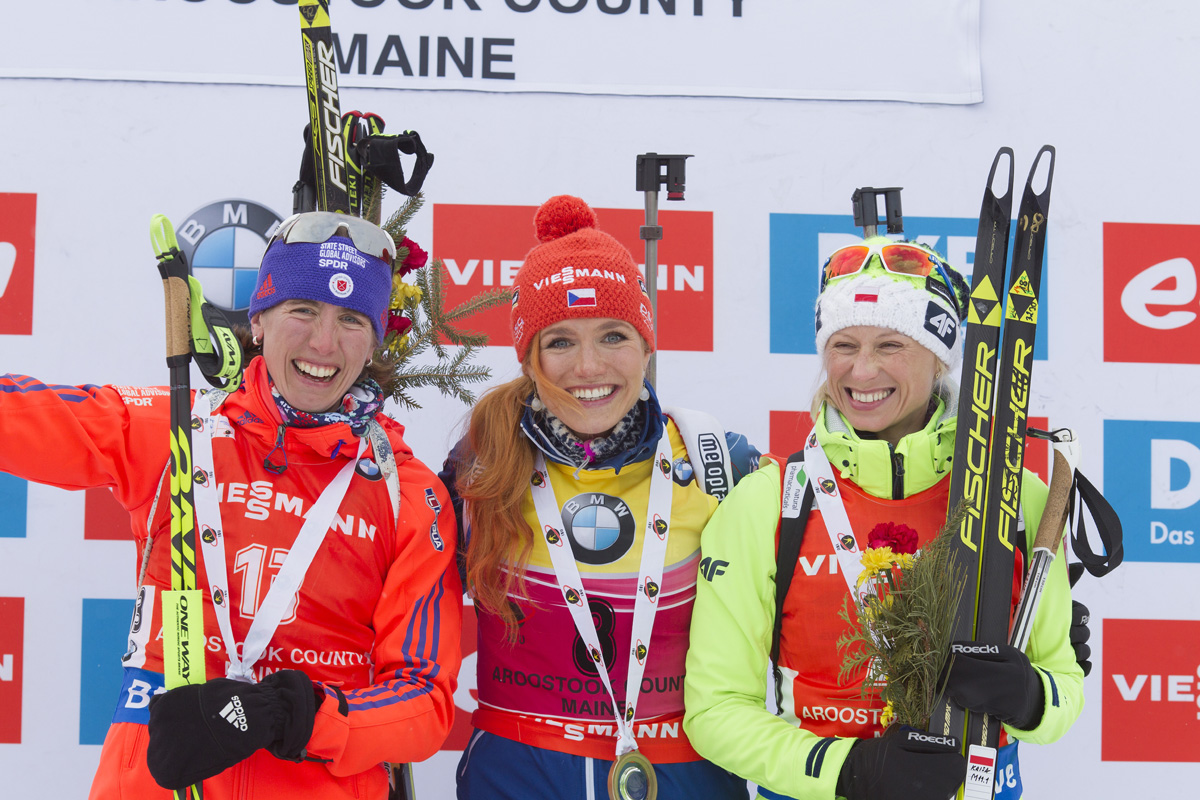
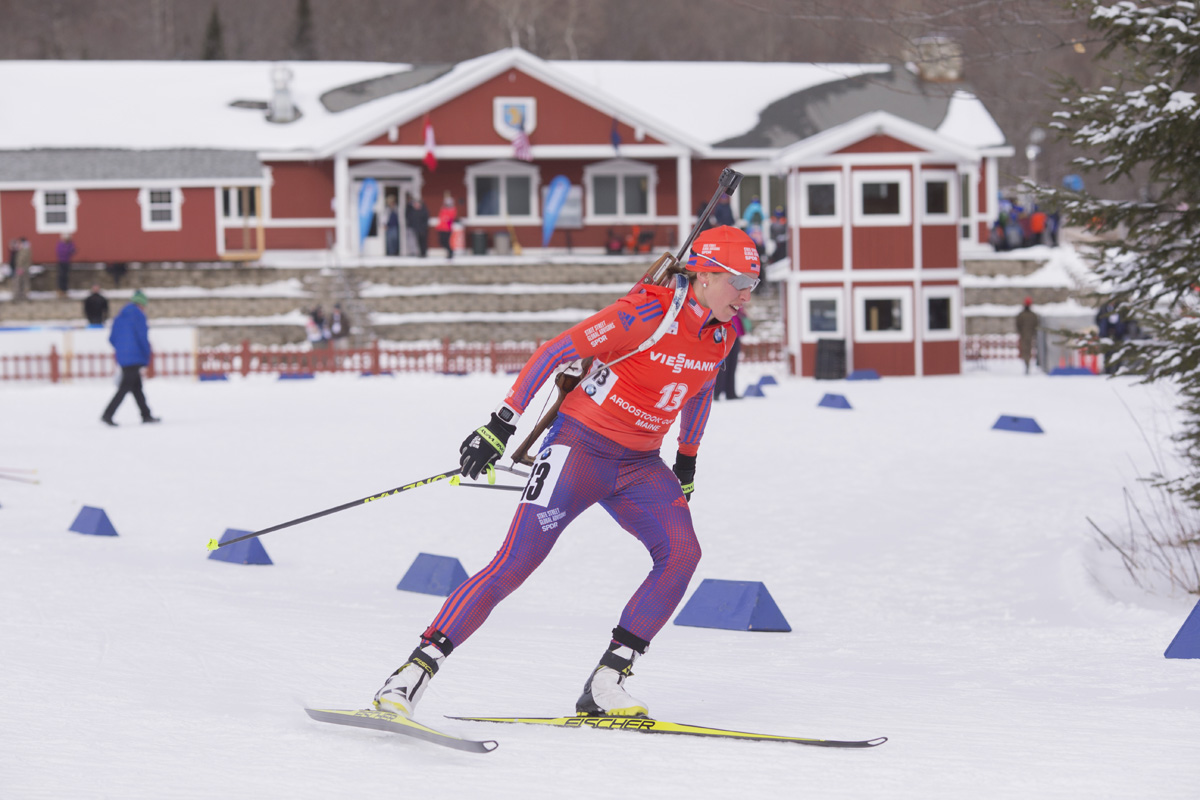
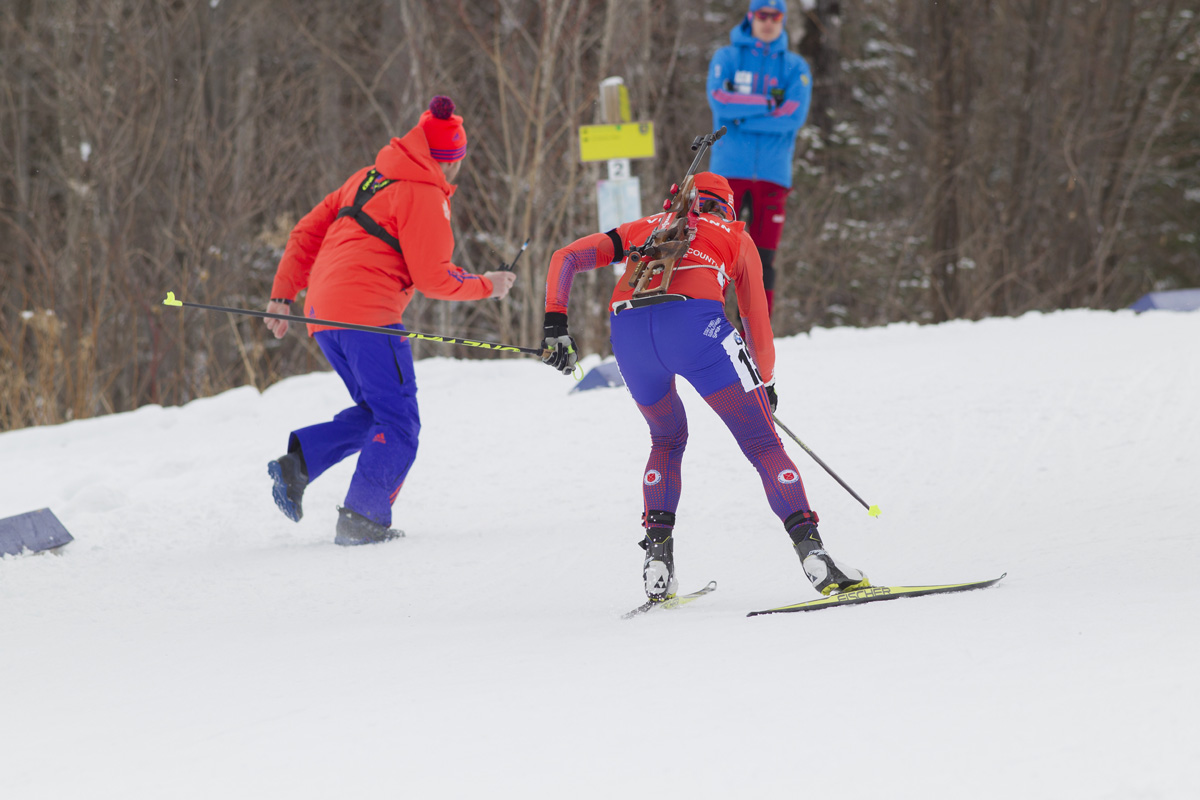
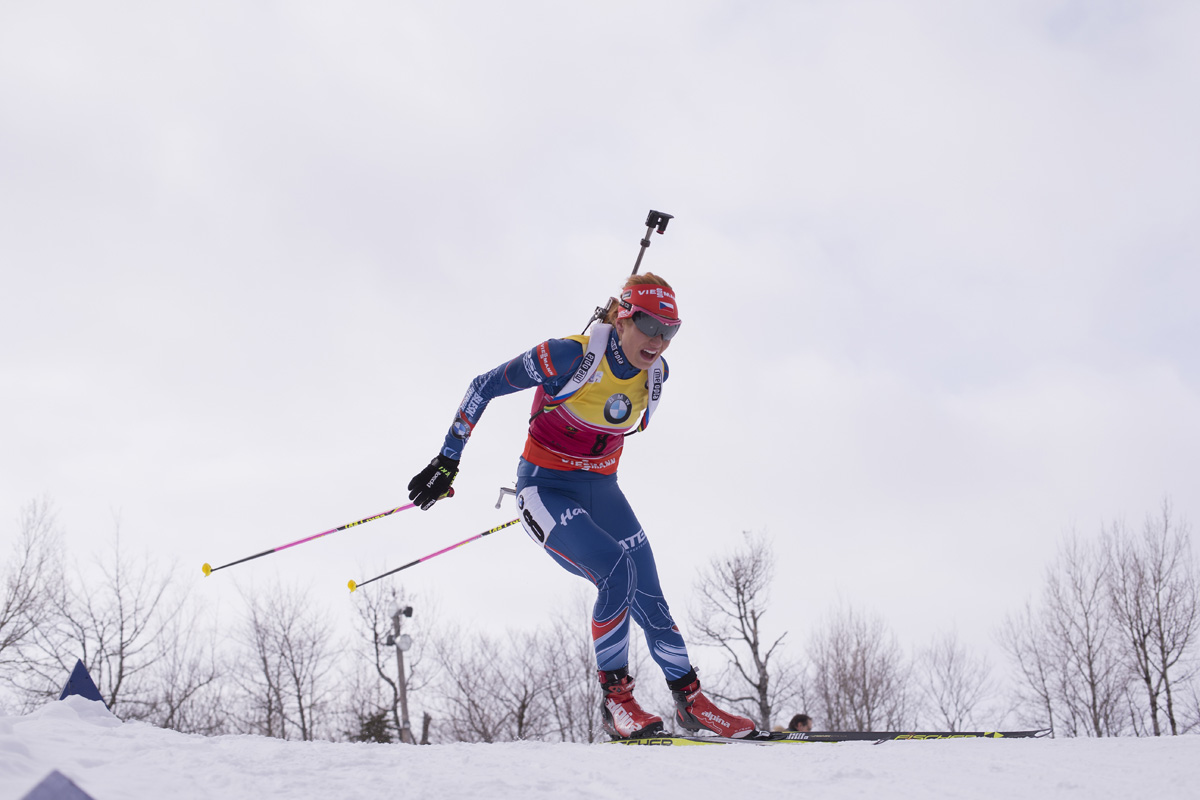
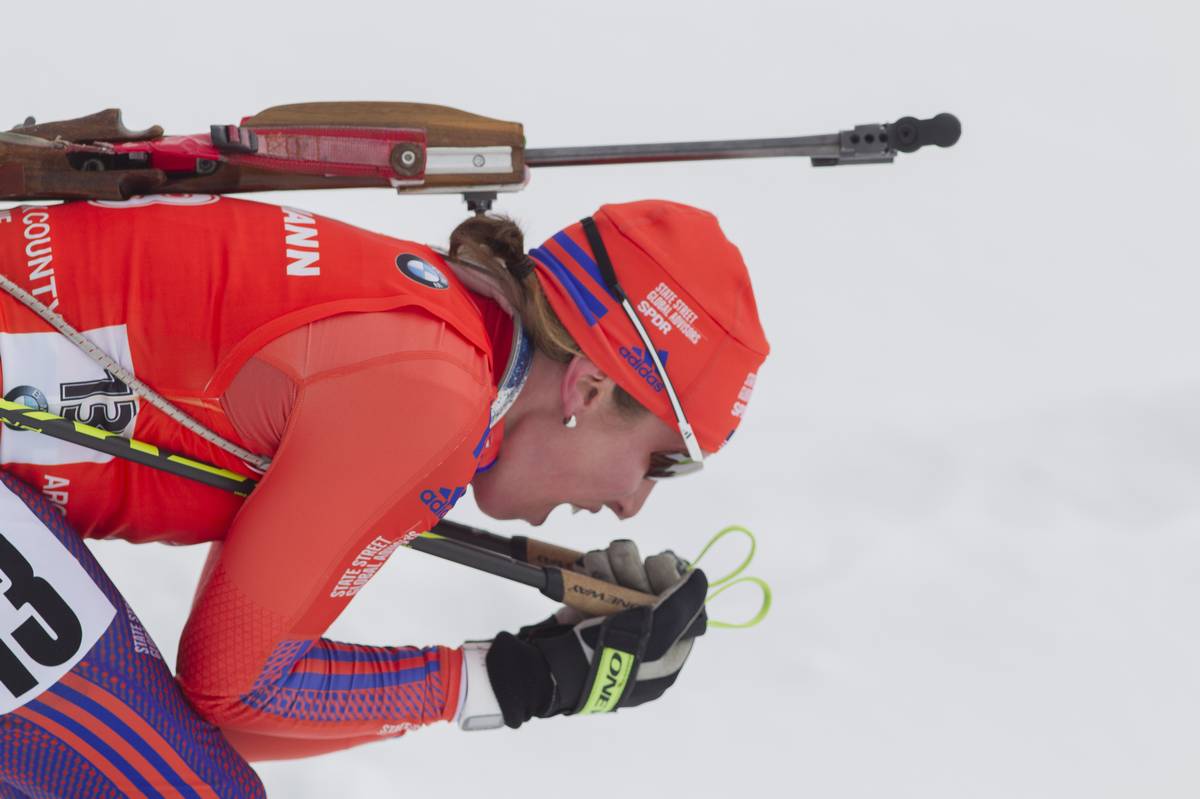
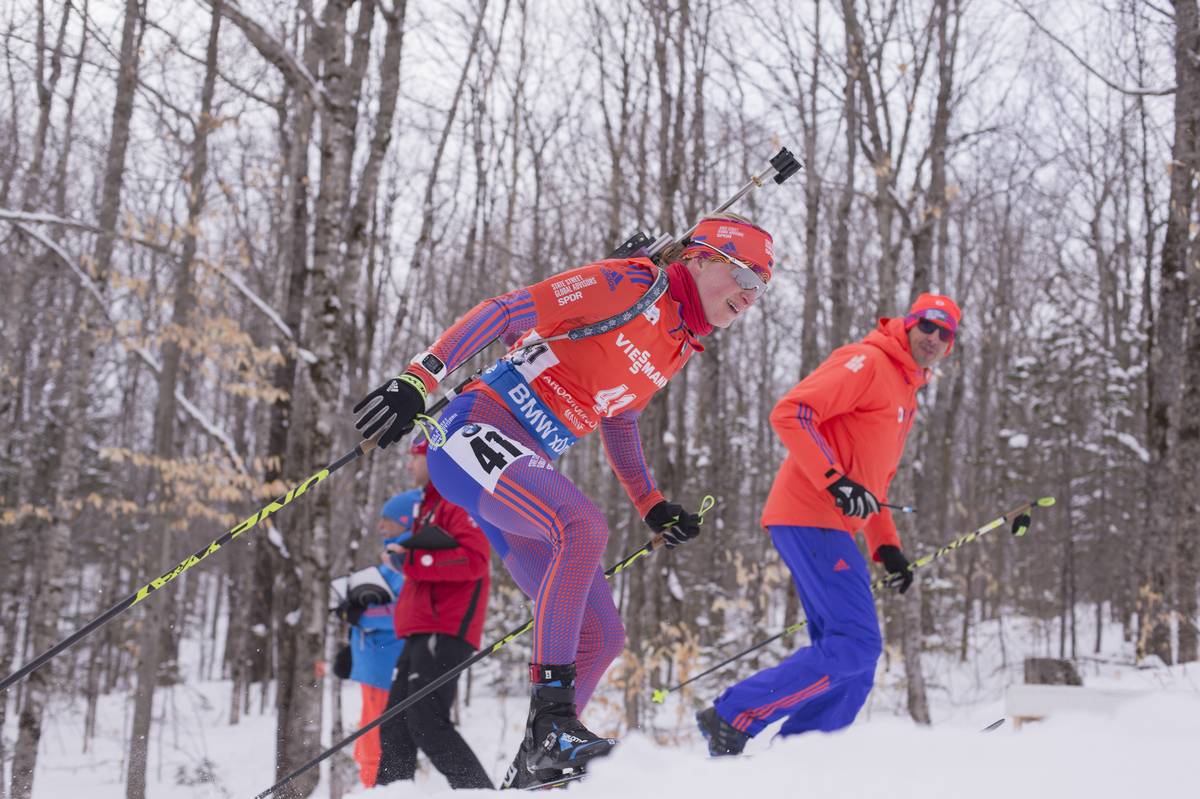
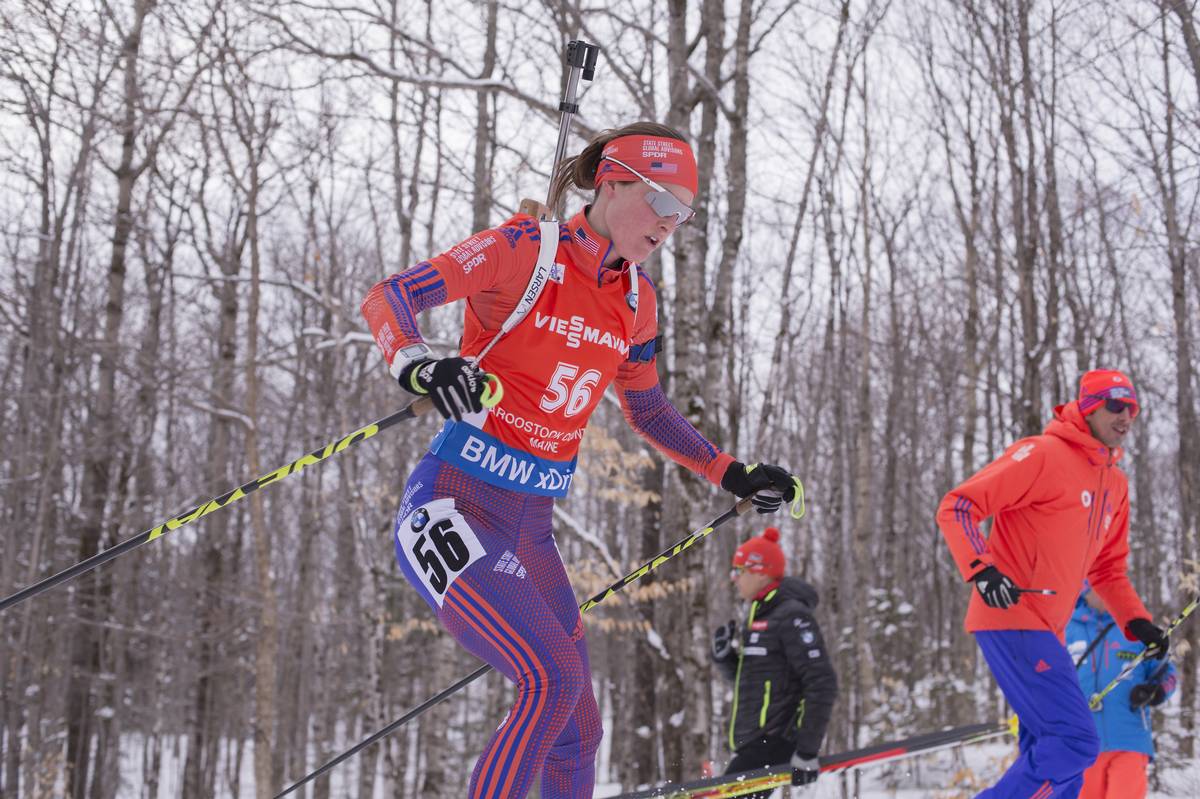
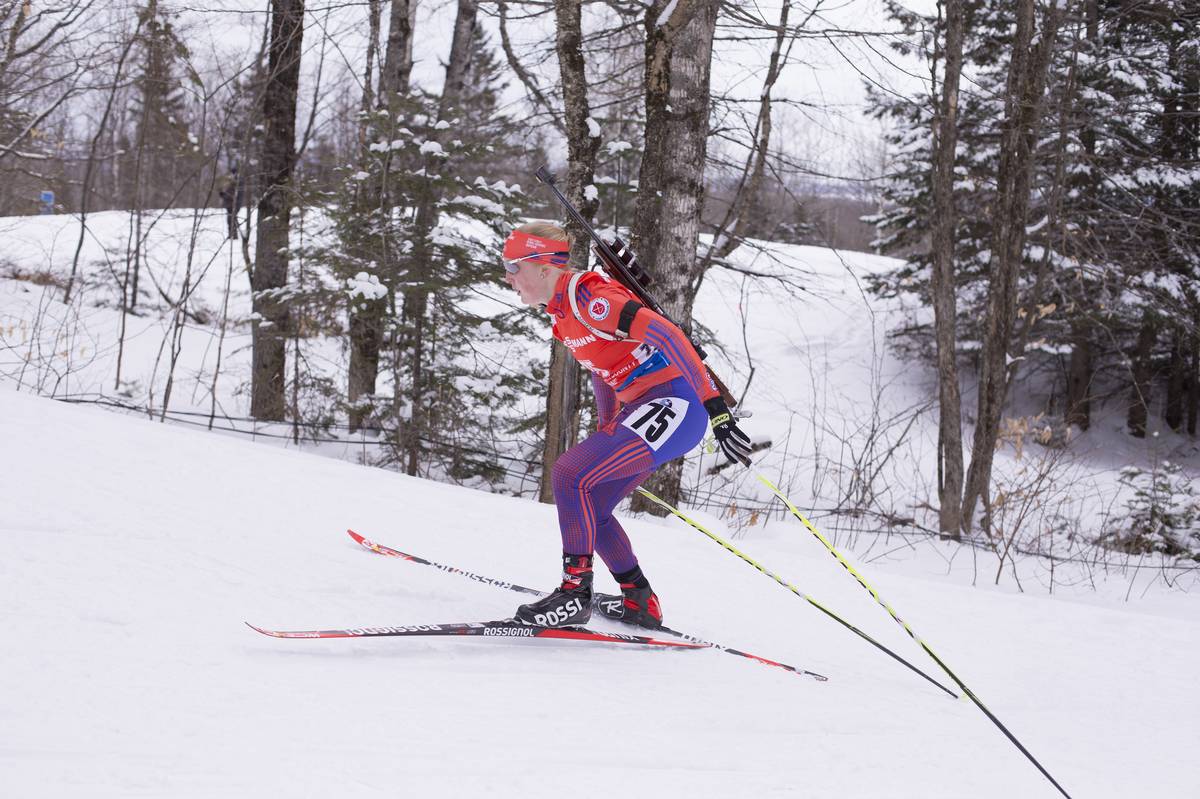
American Susan Dunklee (l) and the Canadian men’s relay, with (from l to r) Christian Gow, Nathan Smith, Scott Gow, and Brendan Green, earned FasterSkier’s biathlon performances of the year with their results at the Presque Isle World Cup and World Championships, respectively. (Photos: USBA/NordicFocus & JoJo Baldus)
We’re entering the homestretch for the 2015/2016 FasterSkier awards, chosen by our staff based on performances last season. While not scientific, these points of recognition are intended to reflect a broader sense of the season in review.
The following set of honors goes to outstanding North American male and female biathlon performances of the year. Cross-country performances of the year will follow.
Susan Dunklee (US Biathlon): Presque Isle World Cup 10 k sprint
Both Susan Dunklee and teammate Lowell Bailey seemed to have breakthroughs after the 2014 Olympics in Sochi, Russia: they had notched best-ever finishes for Americans, with Dunklee 11th in the mass start and Baily eighth in the individual, and then picked up their first World Cup podiums in the weeks post-Olympics.
Heading into 2015, the team (as well as its fans) was giddy with the possibility of more podiums. But none came.
Dunklee delivered this season in Presque Isle, Maine, exactly where those fans could most appreciate it. Shooting a perfect 10-for-10 in the 10-kilometer sprint, she sped past many pre-race favorites and finished second, 17.8 seconds behind Gabriela Soukalova of the Czech Republic (who later won the World Cup Total Score).
“I knew I probably had one of my best races in my life and I’d done it at home and my parents were there,” Dunklee said after the race. “I just felt really good about my performance. I was really happy.”
It was close, with second through fourth place separated by fewer than three seconds. But Dunklee, an early starter, got to watch her time hold despite challenges from the likes of Marie Dorin Habert of France.
“You still need to fight like hell,” Dunklee recalled of heading out on the final loop knowing that times were tight. “When you’re having that sort of race, you don’t want to lose a second anywhere … I’ve just got to fight for the next seven minutes or whatever it takes.”
Dunklee had a solid season, just as she has for each of the last several years; consistency on the World Cup circuit landed her in 14th place in the Total Score, the best ever for an American woman.
But consistency doesn’t breed excitement quite the same way that podiums do.
“It’s unbelievable,” U.S. women’s coach Jonne Kähkönen said. “Just to be able to grab the podium on the home soil, home World Cup, even if it’s not the hometown, but there’s a lot of friends and family and fans that are great support. The local community is just awesome, so it means the world to us.”
Dunklee is now tied for the best performance ever by an American, along with Tim Burke, Anna Sonnerup, Joan Smith, and Josh Thompson, all of whom also won silver at World Cup or World Championships events.
Next up? The U.S. is still waiting on a gold.
Canadian men’s relay team (Christian Gow, Nathan Smith, Scott Gow, and Brendan Green), World Championships men’s 4 x 7.5 k relay
While Dunklee’s second-place finish was historic, it didn’t send the same shock waves as another record-setting result which came a few weeks later: when the Canadian men’s team broke through for bronze in the World Championships relay in Oslo, Norway, earning their country’s first-ever relay medal.
“In a relay anything is possible,” anchor racer Brendan Green said at the time. “Today we all really put it on the line together. Every single one of us raced really well. When that happens, when things come together like that, it’s really incredible.”
It was easily the most surprising result of the championships, and the athletes themselves said that they hadn’t seen it coming – they had thought a top five was possible. The medal? Maybe in a few years, they had hoped.
Some aspects of the performance were predictable. The Canadians tied with Germany and the U.S. for the best shooting on the day – not surprising because they already were a great shooting team, with Christian Gow the fourth-most accurate shooter on the World Cup and Smith the fifth-fastest.
And seeing Nathan Smith bring the team to the front of the field? He has won an individual World Cup, so that wasn’t unusual.
Seeing Green anchor the team like a pro? He has done it dozens of times, and also has five individual top-10 finishes to his name – although shooting a perfect ten-for-ten when a medal is on the line is a whole different story. Green was stone-cold as the anchor even though he said his nerves were a nightmare.
Perhaps what fans hadn’t been expecting were the stellar performances of the Gow brothers, who are the younger members of the Canadian team. Christian Gow, then 22 years old, tagged off just 14.7 seconds behind the leaders on leg one, handing over to Smith, who skied into a more or less dead heat with the leaders on leg two.
Older brother Scott, 25, turned in one of the best ski performances of his career, casually hanging with Norway’s Johannes Thingnes Bø, a many-time World Cup winner who later went on to take gold in the 15 k mass start.
“Watching Christian tag off really close, and then Nathan obviously moved us right into contention… I thought, OK, I have to [stay with him], I don’t have a choice,” Scott said. “I don’t know if I believed I could, but I had to, to try and keep our team in it. I’m just happy that I was able to stay right behind Johannes for most of it and hang on.”
He did hang on, tagging off in third; Green sealed the deal; history was made.
“Every year you kind of think it’s coming,” National Team Coach Roddy Ward said. “It’s close, it’s close, and we’ve been close for a couple of years. We were close enough, I guess, that on the right day we were there.”
Maybe next time the commentators won’t be so surprised.
Honorable mentions:
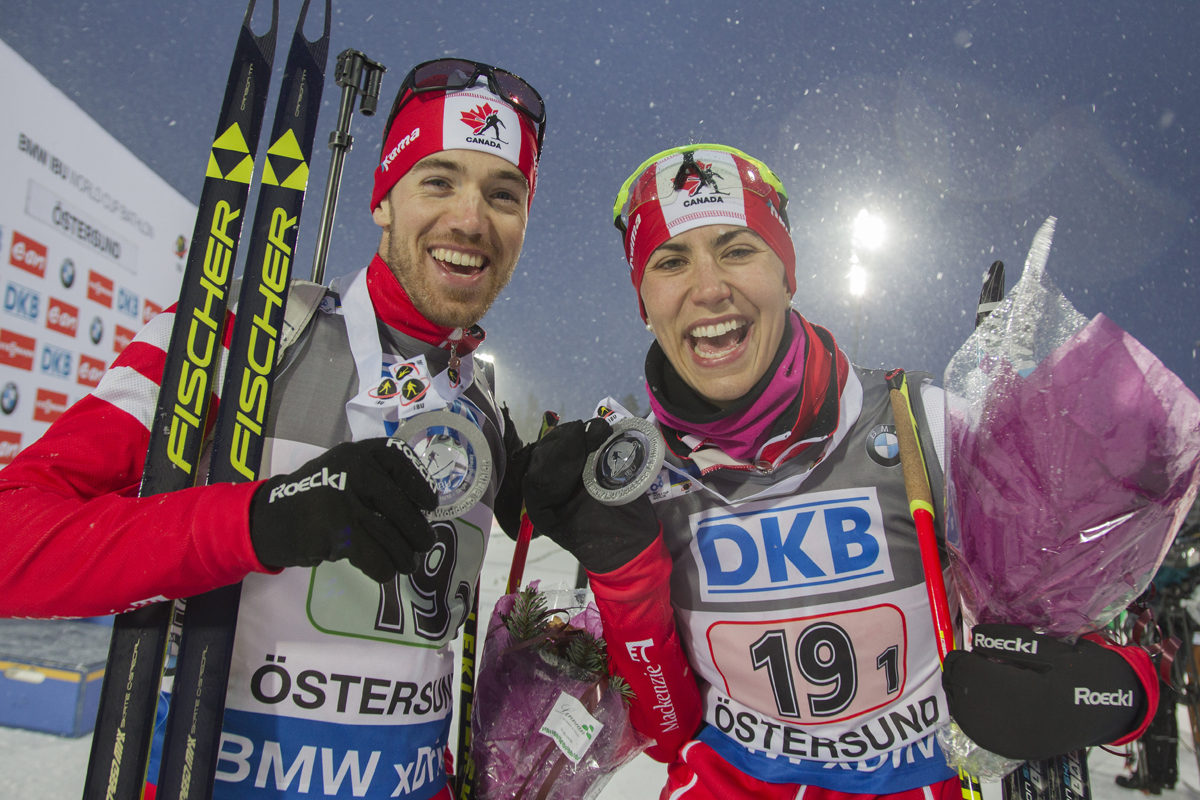
Canadian mixed relay team (Rosanna Crawford and Nathan Smith), single mixed relay at Östersund, Sweden, World Cup
Nathan Smith and Rosanna Crawford celebrate their second-place finish in the World Cup single mixed relay in Östersund, Sweden. (Photo: Fischer/NordicFocus)
Canada had actually started the year off with a relay “bang”: in the very first World Cup competition of the season, Nathan Smith and Rosanna Crawford teamed up for silver in the mixed relay.
Despite a rocky start and nine spare rounds, they managed to avoid the penalty loop and finished 11.9 seconds behind Norway, claiming Canada’s first ever World Cup relay podium.
“It feels amazing,” Crawford said at the time, before pointing out that she’s still hunting for her first individual podium. “I don’t want to downplay it. Those team events, it feels so exciting and I feel so lucky to share the podium with my teammate who I’ve trained with for so long. But also, it’s probably not the same as an individual podium, which is definitely what I’m gunning for this year.”
U.S. (Susan Dunklee, Hannah Dreissigacker, Tim Burke, and Lowell Bailey) and Canadian (Rosanna Crawford, Sarah Beaudry, Macx Davies, and Brendan Green) mixed teams, Mixed relay at Canmore World Cup
Perhaps team events were just the thing for North American biathlon teams this season. In Canmore, Alberta, both the Americans and Canadians were in the hunt for the podium until late in the race. The U.S. ended up fourth, less than two seconds off the podium, and the Canadians ten seconds behind them in sixth.
The result was a best-ever mixed relay for the U.S., with Canada tying its previous best in the two-man, two-woman event.
“It’s easy to say, ‘Oh man, if I had known, I would’ve skied two seconds faster,’ but I really don’t think I could’ve,” U.S. anchor skier Lowell Bailey said of finishing less than two seconds out of third. “I put everything I could have into that last lap. It’s bittersweet, but it’s also our best result ever in the mixed relay. … Fourth is where we ended up, and I think we have to be satisfied with that and keep that momentum going forward.”
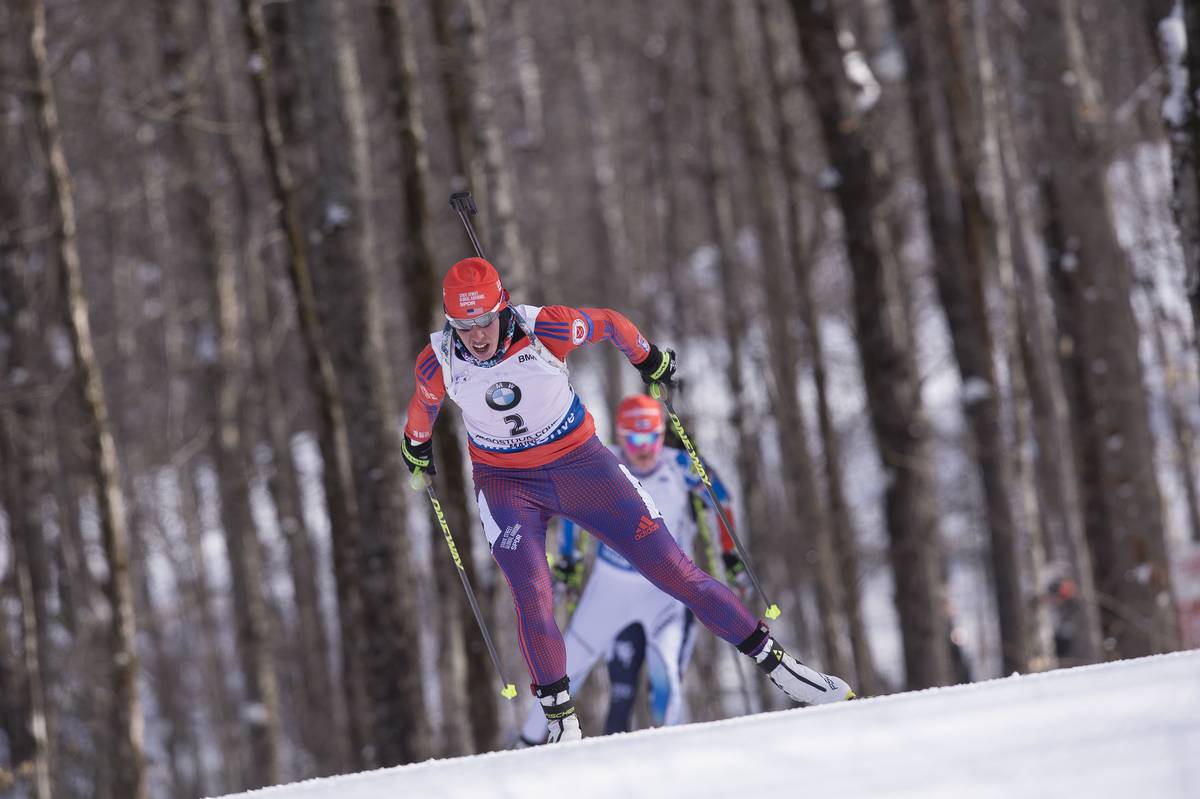
Susan Dunklee (US Biathlon) leads Finland’s Kaisa Mäkäräinen on the fourth of five loops in the IBU World Cup women’s 10 k pursuit on Friday in Presque Isle, Maine. Dunklee went on to place fifth while Mäkäräinen raced to second. (Photo: USBA/NordicFocus)
When Susan Dunklee woke up Friday on a sub-zero morning in Presque Isle, Maine, it took her a moment before her eyes focused in on a shiny new object on a table in her room. Oh yeah, my silver medal, she thought.
“I had forgotten,” Dunklee said on the phone Friday evening, after her second of two IBU World Cup races in Presque Isle. The 29-year-old U.S. biathlete, who turns 30 on Saturday, had placed second in the sprint on Thursday to tie the best result by an American in a biathlon World Cup. It was a surreal moment back then, and even now, it was still sinking in.
But she had to move on. Dunklee had a pursuit ahead of her, one in which she’d start closer to the race leader than she ever had before.
“I knew for today, I had to set that aside and enjoy it for what it was and know I’ll have that to cherish for the rest of my life,” she said. “But today I had another race and another great opportunity in front of me.”
One of three US Biathlon skiers in the women’s 10-kilometer pursuit, Dunklee started second, 18 seconds behind Gabriela Soukalova of the Czech Republic, who led the 60-woman field out in first. Soukalova had been the only woman faster than Dunklee in the sprint, beating her by 17.8 seconds.
And so she started first, but was in danger of being penalized for jumping the start. Soukalova quickly realized her mistake in starting too soon, and hesitated briefly before continuing on her first of five loops. She wasn’t penalized, and Dunklee — who had a front-row view of the slipup — said it was kind of comical.
“I had a good laugh at that, actually,” Dunklee said. “Normally, fifteen seconds or eighteen seconds before I’m starting, I’m very focused and I’m looking down the track and trying to stay serious and focused. But it was funny, Gabby started off and I think she wasn’t sure if she was supposed to go yet or not, so she stopped and came back, and she just looked very confused. Sometimes it is nice to have something silly like that to lighten the mood.
“I can kind of understand why it happened because we are used to being at venues where there’s a huge stadium with people roaring and counting down, ‘Ten, nine, eight, seven…’ ” Dunklee explained. “And it was so anticlimactic that way, it’s just like, ‘Oh, there’s a clock, and it’s at zero. It’s time to go.’ ”
Gabriela Soukalova of the Czech Republic after winning the IBU World Cup women’s 10 k pursuit on Friday by 34 seconds. (Photo: IBU/NordicFocus)
Off went Soukalova, the overall World Cup leader, cleaning two consecutive stages before having some trouble on the range on a windy, 8-degree Fahrenheit afternoon at the Nordic Heritage Center. She led up until that point, while Dunklee hung in second through the first loop and first shooting stage, after starting 1 second ahead of Poland’s Krystyna Guzik, the third starter, and 2 seconds ahead of France’s Marie Dorin Habert in fourth.
“My plan for the first loop was to let the girls behind me lead because they are very strong skiers and I often ski more efficiently behind people,” Dunklee explained. “But they never came up alongside of me and tried to pass, so I wasn’t just going to stop and pull over, you know? I ended up holding on to second coming into the first shooting, which had not been the plan, but it was fine.”
There, rather than think about what could be — the possibility of winning or another podium — Dunklee focused on the four simple words she uses to get into the ideal mindset for shooting.
Open. That involves breathing, opening her “ventilation system, opening my eyes and seeing what’s going on in the range, what the wind flags are doing, opening my snow covers,” she explained. “The importance of a good key word is it’s one word that can cover a lot of things that you need to be done in an instant.”
Relax. “Take my rifle off my back, try to keep my movements smooth and relaxed, changing the clips quickly but relaxed, setting up, getting a good tripod sort of feeling with my body with my rifle sitting on top of it,” she said.
Set. This is what she thinks about when getting ready to shoot. “Set means ready. It has a feeling of readiness. My finger is set on the trigger, taking 90 or so percent of the trigger pressure so all I have to do is squeeze it very gently for the shot to go off,” she said.
Quiet. Once on target, that’s all that goes through her mind. “I’m trying to quiet my mind so it’s a very narrow thought focus,” she said. “Feeling quiet with my body, being quiet on the target and being quiet after the shot goes off as a good follow through.”
Dunklee nailed her execution on the first prone stage and cleaned all five targets to leave the range in second, 11.5 seconds behind Soukalova. Italy’s Dorothea Wierer, the seventh starter, cleaned as well to move into third, 8.3 seconds behind Dunklee. Guzik and Finland’s Kaisa Mäkäräinen, in bib 5, cleaned as well to hang close in fourth and fifth, respectively, about 2 seconds behind Wierer, while Dorin Habert missed one to drop to seventh, another 20 seconds back.
One loop later, Soukalova — still skiing alone — hit every prone target to leave the range again in first, 11.7 seconds ahead of Wierer, who quickly cleaned her targets to move into second. Dorin Habert cleaned to take hold of third, 35 seconds behind Soukalova, while Dunklee had one penalty to slip to sixth, 44.6 seconds out of first.
According to Dunklee, the wind was much more variable for the second stage.
“The first shot the wind was strong, but I could see the wind dying down and I did what we call shading,” she said. “Instead of taking clicks to correct, you aim a bit off the center of the target so you correct with your aiming. It takes a bit more skill in a way and is riskier, but it is very useful in situations that the wind is fading.”
Despite over-shading, aiming too far off the target on her last shot, Dunklee was pleased to leave the range with one penalty.
“I was really happy with where my head was at that whole process,” she said. “In the middle of the race, I was thinking, this is fun, this is a game, this is a challenge, I got this. And I wasn’t afraid of messing it up. That is a pretty novel and cool mental place to be in a high-pressure situation for me.”
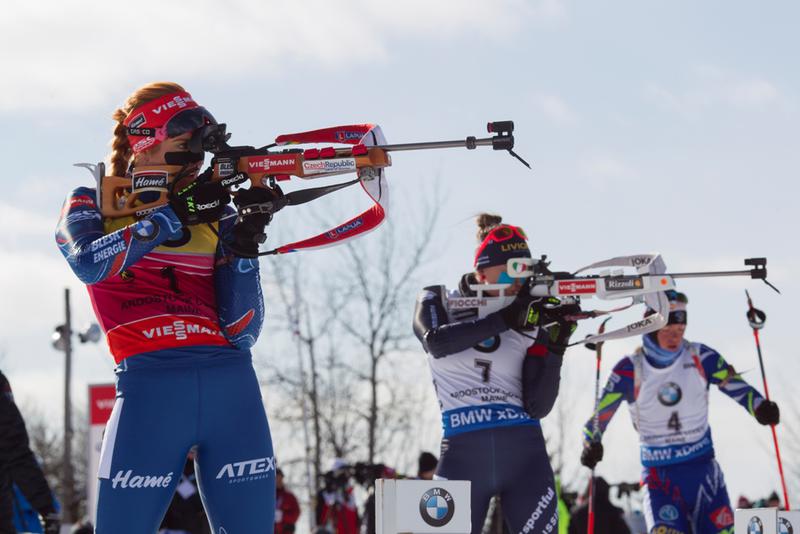
From left to right: Gabriela Soukalova of the Czech Republic, Italy’s Dorothea Wierer and France’s Marie Dorin Habert line up for the first standing stage during the women’s pursuit on Friday at the IBU World Cup in Presque Isle, Maine. Soukalova and Wierer both missed three, and Dorin Habert missed four on that stage. (Photo: IBU/NordicFocus)
On the third shooting — the first standing stage, things got interesting. Soukalova missed three, Wierer missed three, and Dunklee took her time to hit three of five targets for two penalty loops, which put her in third, 21.5 seconds behind Wierer, who had taken the lead.
“My legs started to shake and maybe I started to be afraid of the wind because it was a little bit stronger than before,” Soukalova said in a post-race press conference. “Sometimes it happens.”
“There was significant wind and it was changing,” Dunklee explained. “It would catch your body and rock you. I think you saw all the athletes waiting for the gusts to subside. I tried to take shots in between them and I missed a couple.”
The penalty loop in Presque Isle is unique in the fact that the ski lodge blocks the view of other racers in the loop. Dunklee couldn’t see Soukalova or Wierer, and didn’t have much of a sense where she stood until she received splits back out on course that she was still in the mix for a podium.
“You are usually not that high up after missing two in a pursuit, but it was tricky conditions and everyone was missing,” she said. “You can never give up a biathlon race because these things happen.”
Ahead of her, she could see both Wierer and Soukalova, in second by 2.3 seconds leaving the range. About four seconds behind Dunklee, Mäkäräinen moved into fourth with two misses, while Dorin Habert dropped to 10th, 49 seconds out of first, with four penalties.
“In the middle of the race, I was thinking, this is fun, this is a game, this is a challenge, I got this. And I wasn’t afraid of messing it up.” — Susan Dunklee, on the tricky shooting conditions during Friday’s pursuit
Mäkäräinen passed Dunklee on an uphill and led her into the range for the last time, positioned in third and fourth, respectively.
“It was really helpful,” Dunklee said of catching a ride off Mäkäräinen. “She is a good skier and I ski more efficiently when I am behind someone.”
By the final standing stage, the wind had subsided comparatively. Wierer once again shot quickly but missed three to fall into eighth place (and eventually finish ninth), while Soukalova cleaned to regain control of first. Mäkäräinen hit all of her targets as well to jump into second, 25.6 seconds back with 2 k to go, and Guzik cleaned to move back into third (after one penalty in the second stage, and two misses in the third stage), 39 seconds behind Soukalova.
Dunklee missed one to leave the range in fourth, 11 seconds behind Guzik and 1.7 seconds ahead of Dorin Habert in fifth. After a rocky previous stage, Dorin Habert took a pause before her final shot of the day to clean the all five targets.
On the final loop, Soukalova charged ahead to secure her 12th World Cup win (and fourth of the season) in 31:24.6 minutes, 34 seconds ahead of Mäkäräinen in second. Dorin Habert charged past Dunklee to take hold of fourth, then picked off Guzik as well to claim third (+38.8).
“It was not in my plan to have five penalties,” Dorin Habert, who ranks second to Soukalova in the overall World Cup, said in the press conference. “The coach told me after the last shooting that I had a chance to catch the podium. I felt good today and I made it.”
“It is awesome like yesterday,” Soukalova said of her second-straight victory in Presque Isle. “Maybe the atmosphere it a little bit easier than Europe, for example, there’s a lot of spectators. … It’s not so noisy and maybe it helps us.”
Guzik finished five seconds later in fourth (+43.9) and Dunklee placed fifth (+56.9) for her best-ever pursuit finish and second-best result of the season.
“I was happy to still be in the fight coming out of that loop,” Dunklee said. “Marie Dorin was right behind me and I hung with her for the first hill after she passed me, but she took off and I didn’t have that sort of gas today.”
Would she have liked to clean that last stage and fight for an even better result? Yes, but Dunklee said she had a plan, she executed it, and she could feel proud about that.
“Today my skiing felt good and felt strong, it felt a bit flat though,” she added. “I think there is still some peak form not there yet, but this is exactly where I want to be sitting going into Oslo [World Championships]. Having some great results here to feel really confident, but also knowing there is a little bit more.”
After one more race day in Presque Isle, the men’s and women’s relays on Saturday, the IBU World Cup will take a break until the 2016 World Championships in Oslo from March 2-13.
Dunklee will team up with Hannah Dreissigacker, Clare Egan and Annelies Cook in the women’s 4 x 6 k relay, which starts at 4:10 p.m. Eastern time on Saturday.
Egan 23rd, Dreissigacker 24th
According to both Dunklee and US Biathlon CEO and President Max Cobb, the U.S. women’s team had one of its best days in recent memory in the pursuit, with three in the top 24.
Egan improved from starting 32nd to finish 23rd (+2:34.0), with three penalties (0+1+1+1), and Dreissigacker placed 24th (+2:41.6) after starting 27th and missing three as well (0+2+1+0).
“I started about 5 seconds behind a big pack including Hannah, so from the start I had my eyes on the orange and purple,” Egan wrote in an email, referring to the US Biathlon team suits. “I caught her pack as we came into the first shooting.”
There, both Dreissigacker and Egan cleaned to move into 22nd and 23rd, respectively, about 1 1/2 minutes behind the leader. The two had to make some major adjustments on that prone stage after zeroing, or setting their rifle sights before the race, on Point 2 — where their teammate Dunklee was slotted based on her start position.
“Cleaning the first prone stage was a major accomplishment for Hannah and me,” Egan explained. “We zeroed our rifles on point 2, where there was strong wind, and then came into the shooting range for the first prone stage on points 29 and 30 — the opposite end of the range and there was no wind. We both took around 8 clicks, which translates to the entire width of the prone target. When I hit the first target I knew I had taken the correct amount of clicks and I was so psyched!!!”
Dreissigacker and Egan skied three of five loops together, with Egan passing her teammate on the second loop. After the second prone stage, Egan left the range in 18th with one miss, about 40 seconds ahead of Dreissigacker, who missed two in that stage to slip to 30th.
“On the last lap I knew she must have cleaned the final standing because I could hear our fans (!!) yelling both of our names on our last lap,” Egan wrote of Dreissigacker. “She was right behind me in the finish.”
With her best shooting in a four-stage race, Egan explained that she was satisfied.
“I did miss my 20th shot and I could have been in the top-20 with a clean last stage, so that is a bit of a let down but I can learn from this and hit it next time,” she added.
“It was fun to ski a lot with Clare,” Dreissigacker wrote in an email. “We were pretty close together for the first two loops, and then I had an extra penalty loop and got behind but then we were really close again for the last lap–I tried to catch her but couldn’t quite do it!
“I am very happy with my race today and really proud of our performance as a team,” she added. “And once again the wax techs and coaches did a really stellar job with the skis and support out there.”
Canada’s lone woman in the pursuit, Zina Kocher placed 46th (+4:36.5) after starting 42nd, with five penalties (2+1+0+2).
On Saturday, Kocher will ski the first leg for Canada’s relay, followed by Emma Lunder, Audrey Vaillancourt and Erin Yungblut.
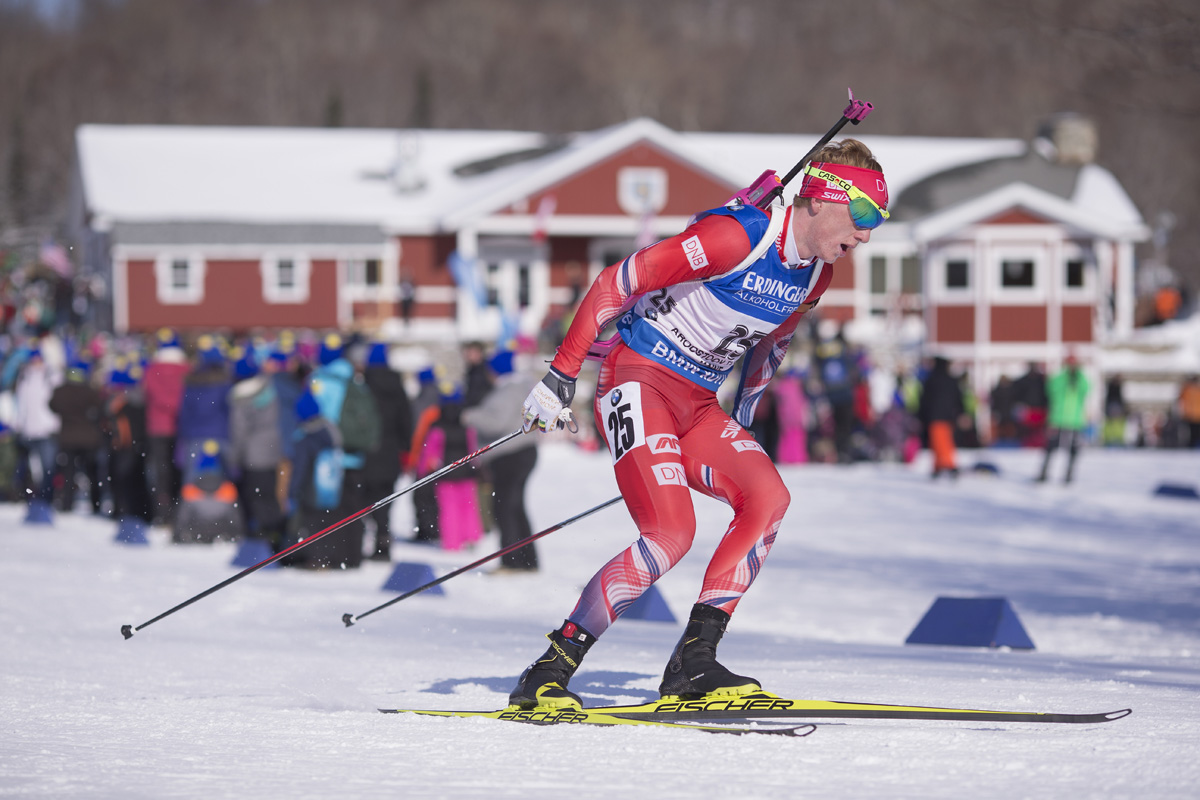
Norway’s Johannes Thingnes Bø racing to a 28-second win in the IBU World Cup men’s 10 k sprint on Thursday in Presque Isle, Maine. (Photo: Fischer/NordicFocus)
After skipping the last tour stop in Canmore, Alberta, Norway’s Johannes Thingnes Bø returned to the International Biathlon Union (IBU) World Cup with a bang, winning the men’s 10-kilometer sprint on Thursday morning in Presque Isle, Maine, in a time of 24:38.8, with no penalties. It was the first World Cup race in the U.S. in five years.
“It’s never easy, but today I felt I had control,” Bø told the IBU in a post-race interview. “I was calm before the race, and also on the shooting range. I tried to do it like in training.”
The defending 2015 world champion in the sprint is now heading into the 2016 World Championships at home in Oslo, Norway, with a victory in the same discipline.
“It looks like it has been good for me, but who knows,” he said at the press conference on his decision to not make the long trip to Canmore, Alberta, last week for the previous World Cup. Instead, he trained for Oslo.
Asked why eight of his 10 World Cup victories came in sprints, Bø replied, “Maybe it’s because shooting is my weakness, and in the sprint there is only two [stages]. So there is a bigger chance for me to not miss so much.”
He achieved his clean shooting despite losing feeling in his fingers on the first loop due to the cold weather and his fairly thin gloves, he told Norwegian broadcaster NRK.
“Without feeling I had to focus extra hard on the innermost black spot, maybe that was the thing that made it go so well,” Bø said according to a translation.
Starting very early with bib 3, France’s Martin Fourcade had one miss in the standing stage and initially took a 38-second lead at the finish (over Norway’s second starter Erlend Bjøntegaard) thanks to Fourcade’s fast skiing, with the eventual overall fastest course time.
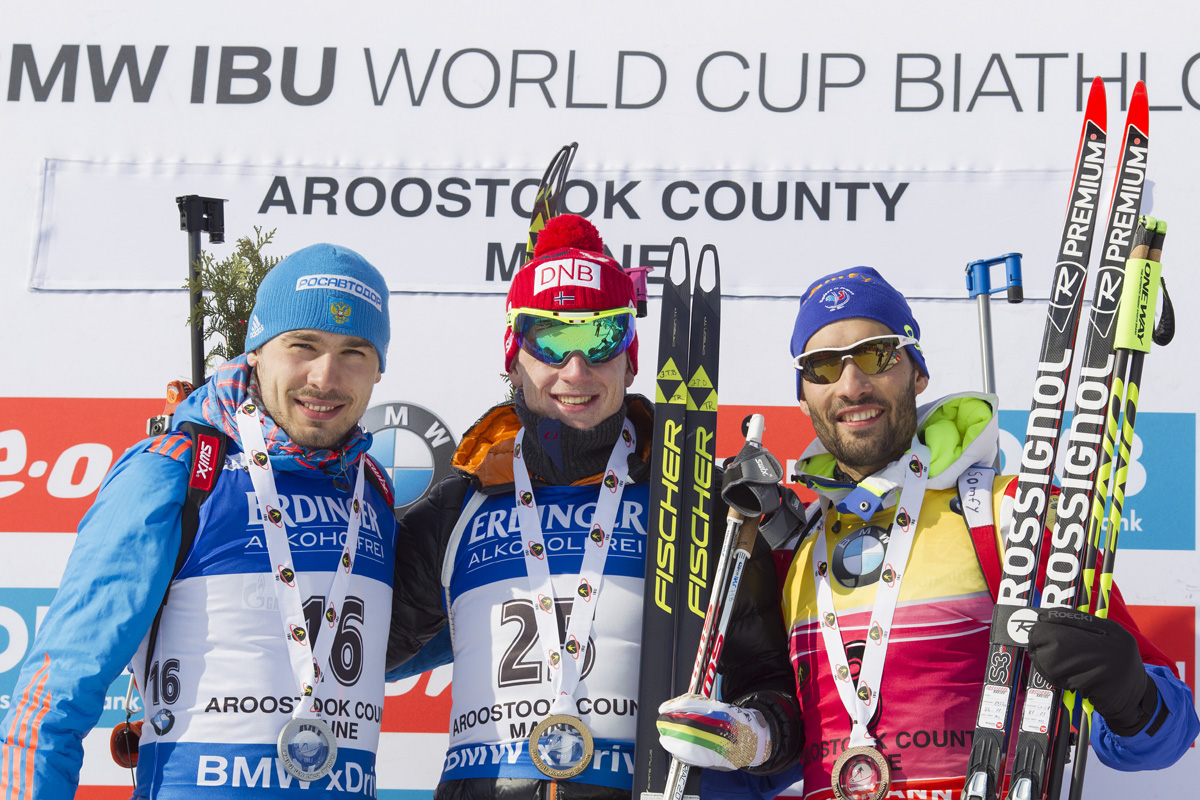
After changing into dry clothes and waiting in the finish pen for a few minutes, Fourcade was passed by Russia’s Anton Shipulin, who started behind him in bib 16 and had two clean shooting stages. The Russian lost time to Fourcade on the final loop, but by the finish, Shipulin, who ranks second in the overall World Cup, had preserved a 1-second lead over Fourcade — the World Cup leader.
“I have competed here 10 years ago at the Junior World Championships,” Shipulin said at the press conference through a translator. “So I know the tracks, and they are quite good.”
Shipulin ended up second when Bø, the 25th starter, barreled through the finish 27.9 seconds faster, with both clean shooting and the second-fastest overall course time. That moved Fourcade into third (+28.9) and the top-three stood through the remainder of the 88-man race.
The men’s sprint podium at the IBU World Cup in Presque Isle, Maine, with Norwegian winner Johannes Thingnes Bø (c), Russia’s Anthon Shipulin (l) in second, and France’s Martin Fourcade (r) in third. (Photo: Fischer/NordicFocus)
“Of course I am happy and satisfied with the race today,” Shipulin said. “I wasn’t as fast as those two guys on the track. But I did clean shooting, and the result was good … I hope I will get better for the World Championships.”
“My shape was really good today … The shooting range is not as easy as we thought,” Fourcade said at the press conference. “No wind today so that was good.”
“But I really was surprised by the sun; I think it was too much sunshine for my little blue eyes,” the brown-eyed Fourcade joked. “I had real difficulties on the shooting range. That is why I needed so much time in the standing shooting.”
Bø posted the best times after the first and second shooting stages, where he hit every target, and extended his lead to the finish over Shipulin. Despite placing third, Fourcade slightly added to his commanding World Cup lead, with 857 points to Shipulin’s 646.
“Johannes was simply a better biathlete today,” Fourcade said. “He shot clean, he shot fast, and [me and Shipulin] both know he will be one to beat for the World Champs.”
As the race progressed, Germany’s Erik Lesser in bib 54 had the best chance to reach the podium, thanks to two clean shooting stages.
He picked up speed throughout his three loops; after losing more than 20 seconds to Bø on each of the first two loops, he only lost 2 additional seconds on the last one. But overall, Lesser could not quite match the skiing performance of the top three and finished fourth, 45.9 behind Bø and 20 seconds off the podium.
“I was very timid on the first round, somehow insecure,” Lesser told German TV broadcaster ARD. “I felt a little tired, so I wanted to rather push towards the end. … The shooting range is not easy, in standing I had to rebuild my stance. You really have to pay attention. Everything is possible in terms of advancing or falling back.”
Behind Lesser, two Swiss athletes had their best results of the season, with Serafin Wiestner in fifth (+50.3) and Benjamin Weger (+52.5) in sixth place, both missing one shot in standing.
For Wiestner, a border police officer, it was a new personal best after previously finishing 24th in a sprint in Ruhpolding, Germany, earlier this year.
“We are really happy about this result,” Wiestner told the IBU. “The last weeks were not so good for us, for the whole team … It’s a really tricky course, but I like that.”
I had a really bad season until now,“ Weger added. “Almost [all] just bad races. So I am very happy to be back in top 10 now, the first time this season. I hope to continue like that now.”
Latvia’s Andrejs Rastorgujevs in seventh (+54.0) and Bø’s older brother, Tarjei, in eighth place (+58.9) also had just one penalty in standing, and stayed within one minute of Bø to achieve a good starting position for the pursuit on Friday.
Doherty Leads Three Americans in Top 20; Canada’s Perras 48th
American Sean Doherty returned to the World Cup on Thursday, in his first race since racking up three medals in as many races at Junior World Championships in Cheile Gradistei, Romania. At 20, he become the most decorated athlete in history of Youth/Junior World Championships in his final season as a junior.
Starting in the middle of the field in bib 42, Doherty was the youngest competitor in the sprint. He shot clean in prone, and then missed one in standing, having to ski a penalty lap. The top North American, he ultimately placed 13th for his career-best World Cup result, 1:16.2 behind Bø.
“My shooting today felt good, very in control,” Doherty, a New Hampshire native, wrote in an email. “The wind was manageable, it just came and went but was never too extreme. The range approach here is deceptively tough, and the wind conditions can be tricky but overall today was a good day on the range.
“I am really looking forward to the pursuit,” he added.
Lowell Bailey (US Biathlon) racing to 15th in the men’s sprint at the IBU World Cup in Presque Isle, Maine. Bailey was one of three U.S. men in the top 20 on Thursday. (Photo: USBA/NordicFocus)
Shortly behind, another American Lowell Bailey placed 15th (+1:22.4), also with a clean prone shooting and one penalty in standing.
“The wind can definitely be a factor here as the venue sits on top of a plateau,” Bailey explained in an email. “But today, I think the biggest factor was the approach. It is one of the more difficult approaches [in the World Cup] and if you aren’t prepared for it, you will be surprised at the fact that you aren’t very recovered when you hit the mat.”
Earlier this week, Bailey provided a unique view of the Presque Isle courses for the IBU in a first-person video, skiing through the men’s sprint loop, the arena and the penalty lap (coincidentally, Johannes Thingnes Bø passed Bailey in the penalty lap during the video).
“A lot of transitions from downhills directly into steep uphills,” Bailey commented in the video. “So you have to be changing techniques all the time.”
“The snow here is very cold,” he said of the conditions. “You can hear it, kind of squeaking like Styrofoam. That makes it interesting for waxing. We’ll be on very hard cold wax. Very fine stone grinds with the ski base.”
In his email, he explained that the course was challenging, particularly with a “corkscrew” downhill section, with some ice beneath the snow. “You had to stay alert and react when your skis started to slip,” he wrote.
“I felt like an alpine skier,” winner J.T. Bø joked about the course in an IBU interview. “You had to ski at the very edge of the skis. It was really hard, but it was cool.”
“The two places are really different,” Fourcade said during the press conference, comparing Canmore with Presque Isle. “Canmore is huge mountains, and here we are more in the forest. I prefer the track here, but it’s hard to compare two sites.”
Also for the U.S., Tim Burke started early bib 6, missed one target in each of his shooting stages, but finished 20th (+1:32.7) as the second-best athlete with two penalties.
“I felt solid on the ski course today,” Burke wrote in an email. “It was not one of my best days, but I was able to keep a good pace for the entire race. This is an interesting course in that there are not really any big climbs, but on the other hand there is very little recovery because of the challenging downhills. This was my first time competing on this course and I really liked it.
“My shooting felt decent today and the two misses were very close,” Burke continued. “But two misses is obviously too much for the sprint competition.”
Leif Nordgren in bib 76 came in 65th (+3:02.6) with three penalties (2+1). Eleven seconds outside the top 60, he missed qualifying for Friday’s pursuit.
“The men were just really consistent, everybody close together and just the whole field for the top athletes, so it puts them into a very good place looking ahead for tomorrow’s pursuit race,” US Biathlon coach Jonne Kähkönen said in a phone interview with FasterSkier. “Hopefully Susan’s podium will give them another push.”
After the men’s race on Thursday, Susan Dunklee raced to second place in the women’s 10 k sprint to tie the best-ever result by a U.S. biathlete, male or female.
Canada brought some of its developmental team to Presque Isle, with the athletes prequalified for the World Championships in Oslo skipping the races and continuing to train at home in Canmore.
Originally Nathan Smith had planned to keep competing in Presque Isle, partly in order to defend his top 20 in the overall World Cup (he was 19th after the Canmore World Cup).
“It was a really last minute decision. I literally had my stuff packed and ready to load into the team van,” Smith told FasterSkier in an email. “I was already somewhat uncertain about going because my skiing has been lackluster the last few weeks. When I saw how potentially cold it could be [in Presque Isle] I decided that perhaps I should stay in Canmore to get some rest and refocus after a very demanding month of racing, travel, and all the extra energy spent at a home world cup. I’ll be cheering the team on from the comfort of my living room.”
Asked how he thought that might affect his place in the standings, he guessed it would drop him just outside the top 20.
“I was hoping to be near top 10 by this point but unfortunately I didnt make so many points the last 2 world cups,” Smith wrote. “I think it’s better for me to try and perform my best … at world champs instead of chasing points to try and stay around 15th to 20th.”
Without the usual starters, Scott Perras achieved the best result for the Canadian men in the sprint on Thursday, finishing 48th (+2:36.0), with one penalty in both prone and standing, and qualified for the pursuit on Friday.
“Shooting was ok, I was a bit tight for prone but it was fine,” Perras wrote in an email. “Presque Isle can be pretty windy, today was just a slight breeze, almost perfect!
“Skiing felt ok, I expected to feel a little better for sure,” he added. “[The] course is fun, what makes it difficult is the fact that you climb for a couple minutes before you get to the biggest climb on the course. That and the fact there isn’t much time ever spent in a downhill tuck.”
In their first World Cup races of the season, Canada’s 21-year-old Carsen Campbell finished 78th (+3:45.9) with one penalty, Matthew Neumann, 26, was 82nd (+4:16.6) with three misses (1+2), and Matthew Hudec, 21, finished 88th (+5:18.6) with two penalties (1+1).
Every Course is Different
The World Cup returned to the U.S. and the Nordic Heritage Center in Presque Isle for the first time in five years since February 2011, when the World Cup also included races in Fort Kent, Maine. Back then, Fourcade placed second in the sprint to Germany’s Arnd Peiffer, who finished ninth on Thursday (+1:06.4) with one penalty.
Most athletes commented positively on the challenging course and arena, though some pointed out a few unusual details, mainly a utility building in the middle of the penalty lap making it difficult to see the competition.
“It’s pretty far around that little house, at least it feels that way,” Peiffer told German TV broadcaster ARD after the race, when asked about his penalty lap.
According to ARD’s play-by-play announcer, organizers recently measured the loop out at 155 meters, 5 meters longer than the IBU norm, but still well within the standards.
“Yes, it does feel long,” Bailey agreed in his email.
“The penalty loop definitely felt long to me but I’m sure they have measured it,” Tim Burke wrote in his email. “I think it’s just the fact that you can’t see through it, that makes it feel so long. That will be an interesting factor for the pursuit because you won’t be able to judge how many athletes are in the penalty loop.”
In contrast to that, Perras even observed some positive elements: “I don’t think the penalty loop feels any bigger, it actually skis quite well. Some penalty loops have really tight corners and you can’t really ski through the corners at all, you are almost skidding. And here there are fans in the penalty loop, how do you compete with that.”
Germany’s Lesser also noted in his interview with ARD that the shooting mats felt uneven, giving him slight problems to find his stance.
“I also felt that the shooting range mats slope towards the targets,” Burke agreed. “This is very unusual and hopefully they can fix this for the remaining competitions.”
“The shooting mats do seem to slope awkwardly,” Perras wrote. “Honestly I’ve seen this at a few ranges throughout the world. No two ranges are the same and I try to just focus on the target, besides my legs aren’t even the exact same length so don’t take my word for it.”
While not featuring quite as many people in attendance as some of the huge venues in Europe who are always on the World Cup competition calendar, there was still a good atmosphere at the Nordic Heritage Center on a weekday and in sunny weather. International athletes such as Germany’s Peiffer appreciated the support they received from the U.S. fans, many of them schoolchildren with rows of classes that had “adopted” different nations such as Germany, Italy, or even the small contingent from Romania, waiving flags and loudly cheering for the athletes.
“Those kids probably got a day off from school to come here,” Peiffer told ARD with a laugh. “But that at least means there is something going on [in the arena]. And they are cheering very enthusiastically, and the same for everyone. A very fair audience.”
“There is a lot of school kids here today and I hope they get inspired,” American Susan Dunklee told ARD in an interview after her race. “It’s a really great sport, and I think Americans haven’t fully discovered it yet.”
The World Cup in Presque Isle continues with pursuits on Friday and the men’s relay on Saturday and women’s relay on Sunday.
American Susan Dunklee (l) after achieving her best IBU World Cup finish in second place on Thursday and tying the best World Cup result by a U.S. biathlete. She finished second to Czech Gabriela Soukalova (c), and Poland’s Krystyna Guzik placed third (r) in the women’s 7.5 k sprint in Presque Isle, Maine. It was the first IBU World Cup held in the U.S. since 2011. (Photo: Fischer/NordicFocus)
Gazing out at the crowd, standing on the second step of the podium on Thursday, Susan Dunklee recognized dozens of faces: family, friends, people from her home base in Craftsbury, Vt., US Biathlon board members, colleagues from the Lake Placid Olympic Training Center, not to mention her team and support staff.
It had all the makings of a local-race feel, except for the implications of a World Cup podium — and the flashing lights, silver medal and media attention that came with it.
Two days before her 30th birthday, Dunklee had the best race of her career. The 13th starter, she raced to second in the women’s 7.5-kilometer sprint on the first day of the IBU World Cup in Presque Isle, Maine, finishing 17.8 seconds behind Gabriela Soukalova of the Czech Republic, the winner in 20:02.2 and overall World Cup leader.
Nearly 400 miles and a seven-hour drive from her hometown of Barton, Vt., Presque Isle is less than a half an hour away from Canada. Yet in her first U.S. World Cup, and the first World Cup in the states since it was last held in Presque Isle in 2011, Dunklee felt somewhat at home.
“To be able to have a best result on home soil and we only have a North American World Cup every five years, I couldn’t ask for anything better,” Dunklee said on the phone after the race. “It’s just phenomenal.”
In order to achieve her best World Cup result by one place (she finished third in a sprint two seasons ago in Oslo, Norway), Dunklee rekindled her joy in both the sport and Presque Isle’s course specifically, putting herself in a happy place she had been struggling to find in the last week.
“Last week was a little tough for me,” Dunklee said of the last World Cup in Canmore, Alberta. “I felt like I was going through the motions but not really feeling hungry for it.”
That changed on the final day of racing there, when she skied the first leg of the U.S. mixed relay, which went on to place fourth for the team’s best-ever finish in the event. Being within two seconds of a podium recharged her and reminded her to stay the course.
“Coming here I was like, ‘OK, there’s going to be random things that happen that are going to throw me off, but I’m just going to take the positive things that I can and use those to my advantage,’” Dunklee said.
On the team’s first training day in Maine on Tuesday, she skied the Presque Isle World Cup course for the first time. Dunklee had previously raced a NorAm there in 2009, but missed out on the 2011 Presque Isle World Cup as the team’s fifth woman at the time, when it only took four.
That was frustrating, she said, but she moved on from it — taking advantage of an opportunity instead in Ruhpolding, Germany, where she raced and previewed the course a year out from 2012 Ruhpolding World Championships. There, a year later at her first World Championships, she broke through in fifth in the 15 k individual.
Susan Dunklee (US Biathlon) racing to a career-best second on Thursday in the women’s 7.5 k sprint at the IBU World Cup in Presque Isle, Maine. (Photo: Fischer/NordicFocus)
Memories aside, Dunklee was excited about what she saw in Presque Isle earlier this week.
“I skied the course and I’m like, wow … this is a John Morton course. This is what I grew up skiing on and this is what I’m good at,” she recalled. “This is what I’m going to thrive on. I love the ups and downs, the steep climbs, the roller-coaster flow, and that’s what really set the tone right away.”
On Thursday, it was cold in northern Maine, but busloads of schoolchildren came out for the first of four days of World Cup racing. Dunklee wasn’t in her home state, but with everyone speaking English and cheering “USA!” out on the course, it was the closest she had felt to being there.
“The community is extremely welcoming and they go out of their way to accommodate us and make us feel like home,” Dunklee explained.
She started behind Soukalova, an early leader with perfect shooting in both her prone and standing stages. No sooner had Finland’s Kaisa Mäkäräinen in bib 6 finished and taken the lead from Czech Veronika Vitkova (the second starter) by 20 seconds, Soukalova in bib 8 charged across the finish line moments later, 24.5 seconds faster than Mäkäräinen to take hold of first place.
The day was young, but most of the top-ranked skiers were on course at the beginning of the 88-woman field. Dunklee followed Soukalova out, cleaning prone as well to take the lead by 0.8 seconds after the first shooting.
Her shooting didn’t feel automatic, Dunklee recalled. That wasn’t necessarily a good thing, but it wasn’t bad, either.
“I was very aware of each shot I was taking; it wasn’t flowing automatically like it usually does, and usually you want that automatic flow in a race,” she explained. “Instead I had all these thoughts going through my head, but what was great about today is I was able to take those thoughts and just say, ‘It’s OK that I’m distracted. I’m going to put that thought aside and go back to what I’m focused on right now in the present moment.’ ”
She had similar feelings earlier this year in Ruhpolding, where she placed sixth in the mass start. Recognizing this, she resolved to keep calm.
On the second shooting stage — standing — Dunklee cleaned again and left the range with 9.3 seconds to make up on Soukalova.
A US Biathlon staff member (l) cheers on Susan Dunklee (r) as she races to a career-best second place in the 7.5 k sprint on Thursday at the IBU World Cup in Presque Isle, Maine. (Photo: Fischer/NordicFocus)
What came to mind then? “You still need to fight like hell,” she recalled. “When you’re having that sort of race, you don’t want to lose a second anywhere … I’ve just got to fight for the next seven minutes or whatever it takes.”
With 1 k remaining, she was 17.6 seconds off Soukalova’s time. Half a kilometer later, Soukalova still held her ground, 17.4 seconds ahead. By the finish, Dunklee was 17.8 seconds back in second, and she wasn’t even sure she was second — but she smiled at the cameras anyway.
“I knew I probably had one of my best races in my life and I’d done it at home and my parents were there,” she said. “I just felt really good about my performance. I was really happy.”
US Biathlon Women’s Coach Jonne Kähkönen knew she was on track for a career best.
“I knew that if she would clean the race today, she would be fighting for the podium, even if there were a few fast athletes starting behind her,” he said on the phone. “Not nervous, but just wanted to wait and see what the later starters would do.”
France’s Marie Dorin Habert presented the most immediate threat. After starting 24th and cleaning prone, Dorin Habert left the range in first, 4 seconds ahead of Dunklee. However, during her second stage, she missed one standing shot. The penalty loop put her in fourth, 25.5 seconds behind Soukalova and 16.2 seconds behind Dunklee, with one loop to go.
Meanwhile, Poland’s Krystyna Guzik had started 20th and cleaned both stages to leave the range for the last time in third, trailing Dunklee by 4.4 seconds. She couldn’t catch the American on the final loop and finished 1.3 seconds behind her in third.
“Shooting is so hard; it is not sure that every day I will shoot well,” she said in a post-race press conference. “I thought that this was a new day and do my best to shoot well and run fast. I just could not catch Susan; she was too fast on the last loop. For me, the last loop today was really hard.”
Ultimately, the three podium finishers were the only ones in the top eight to shoot clean. Soukalova had the fifth-fastest overall course time, Dunklee’s course time ranked 12th and Guzik’s 15th.
Overall World Cup leader Gabriela Soukalova of the Czech Republic racing to a 17.8-second win (over American Susan Dunklee) in the women’s sprint on Thursday at the IBU World Cup in Presque Isle, Maine. (Phot: Fischer/NordicFocus)
“I have to say everything was perfect,” Soukalova said in the press conference. “I started to feel a little tired after the long trip from Canada, but I started to feel good after the start. … We had good service, good skis today so I am very satisfied with this result.”
Dorin Habert crossed the line in fourth, 20.5 seconds behind Soukalova and 1.4 behind Guzik, bumping Mäkäräinen, with a single standing miss, into fifth.
The top five would stand, and Dunklee would tie the best result by a U.S. biathlete (male or female) joining the ranks of Joan Smith (1994) and Anna Sonnerup (1991).
Current men’s team member, Tim Burke placed second in two World Cup races in 2009/2010 and earned silver at 2013 World Championships. Before him, Josh Thompson also took silver at 1987 World Championships.
“What a great day for @USBiathlon with 6 athletes in the top 30 and @SusanDunklee on the podium! #homecourseadvantage!”Burke tweeted on Thursday, after he, Sean Doherty and Lowell Bailey placed in the top 20 in the men’s sprint. Dunklee, Hannah Dreissigacker and Clare Egan finished in the top 32 of the women’s race.
“Today Susan cemented her place as a world class biathlete,” US Biathlon President and CEO Max Cobb wrote in an email. “It was a historic performance, matching the best World Cup finish by an American.”
“You spend years and years working on this, trying to perfect things,” Dunklee explained. “And at first progress is pretty good, you make big gains pretty fast, and then to get that last one percent or so of performance, it just takes so much more work.”
You need that 1 percent, she added.
“There’s times where you work your way at something for months and you just don’t make progress on it or you even go backwards because you’re trying so hard, she continued. “I don’t know, somehow things came together and I’m just amazed. It’s exciting.”
‘A Culmination of a Whole Lot of Effort’
What is it about progress, or maybe more specifically about biathlon, in which someone like Dunklee can turn a last-place finish in Canmore’s mass start, complete with a “dirty” stage (five missed targets), around less than a week later with a silver-medal performance?
“We’ve talked about this actually a couple of times over the season,” Kähkönen said of Dunklee’s ability to overcome adversity and less-than-desirable results. “It’s been a little up and down. We’ve been trying to track down in the training log if we can find some reasoning behind it and be able to narrow it down better in the future as well. But now it looks like everything is on track in terms of the physical training.”
Susan Dunklee (US Biathlon) racing to a career-best and historic second place in the women’s sprint at the IBU World Cup in Presque Isle, Maine. (Photo: USBA/NordicFocus)
In the last World Cup before World Championships in Oslo in early March, Dunklee said the timing of this result was “perfect.”
“I think Susan, ever since last week, she was able to put distractions on the side and focus on what matters,” Kähkönen said.
“In order to have my best performances in biathlon or anything in life, to be a person that takes joy out of life … I really have to find what I love about it,” Dunklee explained. “… I think that hunger is honestly my most valuable asset as an athlete.”
Looking ahead to the rest of the races in Presque Isle, Dunklee had fewer than 24 hours to absorb what she’d done on Thursday and prepare for Friday’s pursuit. At 1:10 p.m. Eastern time, Soukalova will start the 10 k pursuit first. Dunklee will head out 18 seconds later in second, and Guzik 1 second after Dunklee in third. Dorin Habert will follow, 3 seconds after Dunklee.
“I’ve got the best setup I’ve ever had before going into a pursuit,” Dunklee explained. “Starting pretty close behind the leader, and that’s another wonderful opportunity to have a great result. I’m going to enjoy tonight and celebrate a bit, but at the same time I’m going to try to wind down a bit, have a little Susan-time to myself and get some good sleep tonight because I really want to see what I can do tomorrow.”
Asked about the task of refocusing after a result like Thursday’s, Kähkönen said that’s the key to consistent top results.
“With this schedule, we just don’t have the luxury of getting stuck on the current or especially the past,” he said. “You just need to stay focused on what’s coming up next.”
But Thursday was a pretty incredible day to be part of US Biathlon, in the same state (albeit 270 miles away) as its headquarters in New Gloucester, Maine.
“It’s unbelievable,” Kähkönen said. “Just to be able to grab the podium on the home soil, home World Cup, even if it’s not the hometown, but there’s a lot of friends and family and fans that are great support. The local community is just awesome, so it means the world to us.”
“It’s not just my success,” Dunklee stated. “It’s a culmination of a whole lot of effort over lots of years by this whole group of people who care a lot about our team.”
Dreissigacker 27th, Egan 32nd, Kocher 42nd
Joining Dunklee in the pursuit will be two other U.S. women and one Canadian. Dunklee’s teammate on the national team as well as Craftsbury Green Racing Project, Hannah Dreissigacker placed 27th for her fourth-best sprint result, finishing 1:33.7 behind Soukalova with a single prone penalty.
Hannah Dreissigacker (US Biathlon) racing to 27th in the women’s 7.5 k sprint at the IBU World Cup on Thursday in Presque Isle, Maine. (Photo: USBA/NordicFocus)
“I was really happy to clean standing — I am normally a better prone shooter than standing, but I knew that I had to clean standing if I wanted to really do well,” Dreissigacker, the 41st starter, wrote in an email. “I’m very happy that I was able to concentrate for all of the shots and make it happen.
“It felt really special to have my family here, and so many other Americans out there cheering for us,” she wrote. “I actually started just after I heard on the loud speaker that Susan had cleaned. So then she came around the building and headed out on her last lap just a bit behind me. That was a fun lap — I was excited for her, and also all of the staff and fans were out there cheering so hard for her and I could tell that she was gaining on me, and also that she was probably going to podium. I felt like we were doing that lap together, though she only caught me at the very end.”
Also for the U.S., Clare Egan finished 32nd (+1:38.5) with one standing penalty. The 56th starter, Egan looked to be in contention for a top 20 after cleaning prone, but slipped into 28th after standing.
Clare Egan (US Biathlon) racing to 32nd, her second-best IBU World Cup result, in the women’s 7.5 k sprint on Thursday in Presque Isle, Maine. (Photo: USBA/NordicFocus)
“I was thankful to clean prone because it put a little less pressure on the standing, which is the harder discipline for me,” Egan wrote in an email. “I was very shaky in standing and I had to stop and reset my position after missing my 3rd shot, but that worked and I hit the last two.
“This is my 2nd best result ever and by far my best result since World Cup 1,” she explained. “My ski speed took a major hit in December but I am now recovered to where I think I should be so that is a huge relief. I had a top-30 ski time today and 90% shooting so that is an almost perfect day.”
Originally from Cape Elizabeth, Maine (and a teammate of Dunklee and Dreissigacker at Craftsbury), Egan described the experience of racing in her home state.
“My parents, my teammates’ families, and some USOC staff and USBA board members are here,” she wrote. “I heard my name all along the course from voices both familiar and unknown– and that was a first.”
Friday will be Egan’s second time racing a World Cup pursuit.
Maddie Phaneuf (US Biathlon) on her way to 65th in the second individual IBU World Cup of her career on Thursday in Presque Isle, Maine. (Photo: USBA/NordicFocus)
The fourth U.S. woman, 20-year-old Maddie Phaneuf, in her second individual World Cup race, placed 65th (for her best result by 28 places) with a clean prone and two standing penalties.
“My goal was to shoot well and ski strong … which I didn’t feel I reached fully,” Phaneuf wrote. “I felt pretty good on the skis, but not nearly as strong as I was in Romania.”
“My result-goal was to make the Pursuit, which I just missed,” she wrote of Thursday’s World Cup race, in which she needed a top 60 to advance to the pursuit. “But I’m still happy with the result and know that I have the potential to achieve more.”
On behalf of her team, Dreissigacker noted, “Our skis were phenomenal today. Our wax techs definitely deserve a share of the credit for the great day that we had as a team.”
The top Canadian, Zina Kocher placed 42nd (+2:02.0) with three misses (2+1). Overall, she had the 20th-fastest course time.
“I was focused on having consistent solid performances this week in order to qualify for World Champs,” Kocher wrote in an email. “Knowing that it is a trials situation though does bring a bit more nerves into the equation.
“I had thought I had focused on attacking from the start, however looking at the breakdown in ski speeds, looks more like I went out for a casual ski lap 1, & lap 3 an explosion went off,” she wrote of her course times, which ranked 54th on the first loop, then 46th on the second, and finally, third on the last loop. “I’d say I’m happy with 3rd fastest last lap but will work on a more aggressive warm up for the next sprint or relay I do to make sure I’m starting out a bit quicker!”
Also for Canada, Emma Lunder placed 68th with two penalties (1+1), Audrey Vaillancourt was 80th with four misses (2+2) and Erin Yungblut 87th in her World Cup debut, also with four penalties (1+3).
Note: In the men’s 10 k sprint, Sean Doherty led the U.S. in 13th (0+1), Lowell Bailey was 15th (0+1) and Tim Burke 20th (1+1).
“The men were just really consistent,” Kähkönen said. “Everybody close together and just the whole field for the top athletes, so it puts them into a very good place looking ahead for tomorrow’s pursuit race. Hopefully Susan’s podium will give them another push.”
Stay tuned for a separate report on the men’s race.
Watch the men’s and women’s pursuits live on Eurovision (Friday at 11:30 a.m. and 1:30 p.m. EDT)
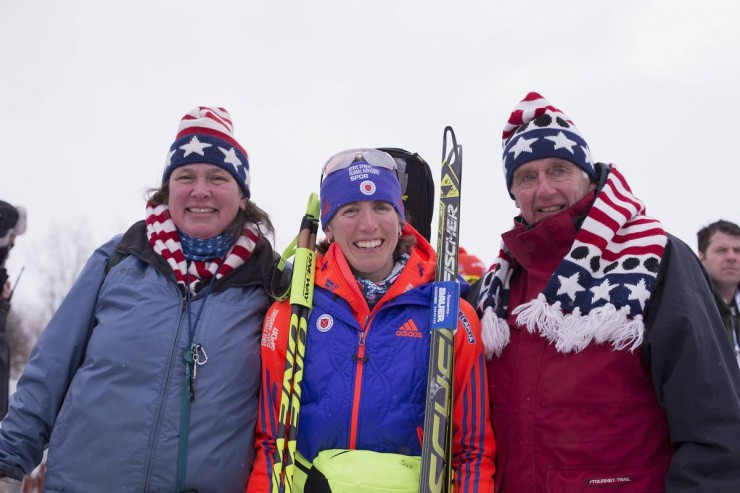
Susan Dunklee with her parents Judy (l) and Stan (r) after Dunklee tied the best-ever U.S. result in an IBU World Cup in second in the women’s sprint in Presque Isle, Maine. (Photo: USBA/NordicFocus)
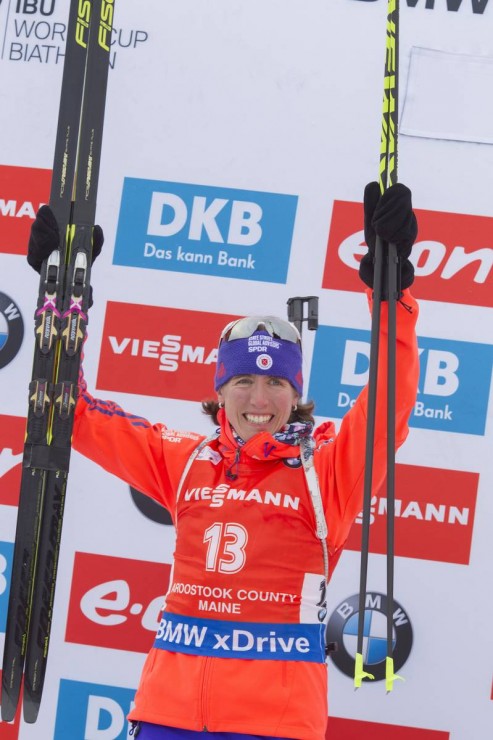
Dunklee celebrates a career-best second place in the women’s sprint at the IBU World Cup in Presque Isle, Maine. (Photo: USBA/NordicFocus)
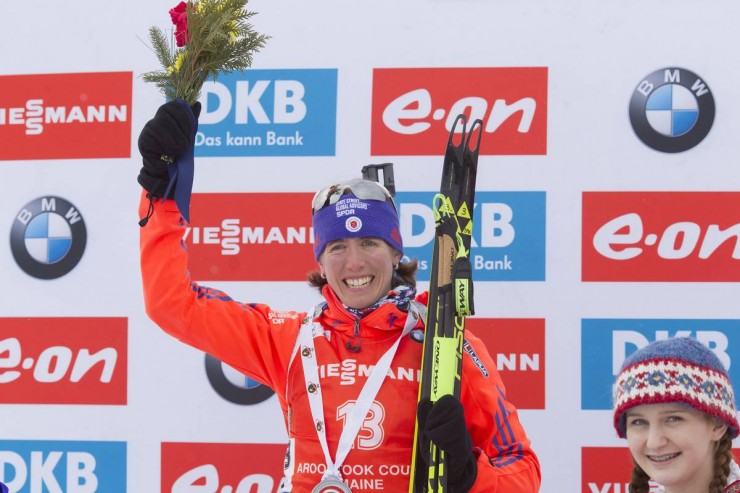
Dunklee celebrates a career-best second place in the women’s sprint at the IBU World Cup in Presque Isle, Maine, in February. (Photo: USBA/NordicFocus)