BPA Limited is pleased to announce the release of Bjorger V. Pettersen’s amazing in-depth book “A Cross Country Ski Story” that chronicles the development of the sport of cross-country skiing in Canada, the USA and around the world.
From humble roots that began with the winning youths in Prince George, B.C. to the top of the world with Olympic gold medals by Beckie Scott and Chandra Crawford, Pettersen charts the history of the sport including over 300 photos that capture the essence of an amazing journey.
“Welcome to my mountains, to my trails through Canada’s terrain of rolling hills and prairies – to my world of cross country skiing,” says Pettersen, who is recognized as the first full time cross-country ski coach in Canada. “We had a very humble start and struggled against the odds but with fierce pride in our Canadian way, we took on the world”.
Pettersen first coached skiers from the Hickory Wing Ski Club in Prince George, BC and went on to launch the Territorial Experimental Ski Training (TEST) Program at Inuvik, NWT, which drew worldwide attention when sisters Shirley and Sharon Firth, only 14 years old, became North American champions after only five months of skiing. The duo went on to defend their titles for the next three years.
“We were able to bring the world here to compete on our turf. First at the 1966 Canadian Centennial Races at Prince George and then at the week-long Top-of-the-World Ski Championships at Inuvik from 1968-72,” remarked Pettersen who went on to work at the Calgary Olympic Games as Venue Coordinator/Manager and Chief of Race during the very successful cross-country ski events at Canmore, Alberta.
“The Games left a large footprint for Canadians and really entrenched our place in the sport on the world stage,” explains Pettersen. “I believe this 435-page publication is the most extensive ever written
on our sport.”
A Cross Country Ski Story is also the story of how the Americans led North America to improved international results and for the Europeans it is the story of their domination of international racing. Canadian stars Alex Harvey and Devon Kershaw brought the country to its feet again winning Team Sprint gold at the Nordic Worlds in Oslo, Norway in 2010 and then Harvey matched Pierre Harvey, his legendary father’s feat, winning the 50km freestyle race at the Worlds in Lahti, Finland last season.
There are chapters by Roger Allen, Marty Hall, Jack Sasseville, Anton Scheier, Dave Wood and Louis Bouchard that demonstrate the strategic plan in Canada to build strong coaches and teams year to year.
“Whether you’re a racer, a recreational skier, a back-country skier or simply someone that enjoys the sport, there is something for everyone in this book,” adds Pettersen. “I have a great love and dedication for my sport, my family and Canada.”
For more information contact Bjorger Pettersen directly in Okotoks, Alberta, at bjorger@shaw.ca, or visit www.ACrossCountrySkiStory.ca.
Caledonia Nordic Ski Club (“CNSC”) is an organization of over 1,400 members in Prince George, British Columbia and has a large enrolment in skier development programs. Club athletes compete and medal in biathlon and cross-country Provincial and regional competitions, NORAM events and National Championships. They have also represented Canada at high-level events such as the World Youth Junior Championships. As the Biathlon Coach, you will lead volunteer coaches in the implementation of the Biathlon Canada Long Term Athlete Development Model (“LTAD”) through program development, support and involvement. Our club mandate is to provide programming for the continual improvement of skiers and biathletes from introduction to national excellence, for all ages and abilities.
CNSC is unique in its proximity to the city of Prince George, with the University of Northern British Columbia and the College of New Caledonia campuses located within a 15-minute drive of the Otway Nordic Centre, which is operated by CNSC. The club is working strategically to attract nordic athletes, aged 18 to 30, to Prince George to study and train.
This position works collaboratively with and reports to the CNSC Head Coach (“Head Coach”), who reports to the General Manager.
Specific Accountabilities:
Personal Development
Implement a personal development plan to become certified at the National Coaching Certification Program (“NCCP”) Biathlon Canada – Competition Development coach level, or equivalent, http://www.biathloncanada.ca/main.php?p=3834&lan=1
Maintain a personal coaching career plan with continuous improvement and growth.
Coaching Development Support provided by club to meet personal coaching career goals
Program Development
Work in a team environment with the Director of Programs, Head Coach, and volunteer leaders/coaches to align existing programs with the LTAD model, as well as develop new initiatives to expand existing programs and increase athlete and member retention, regardless of their ski or biathlon goals or abilities.
Athlete Development
Work with the Head Coach to support athlete development with a specific emphasis on the biathlon program.
Develop or oversee the development of annual training programs for biathletes. Actively recruit and coach athletes from the Learn to Train LTAD stage to the Learn to Compete LTAD stage.
Develop and implement monthly training plans and review training logs for junior, senior, and youth biathletes.
Assist the Head Coach with the delivery of dry-land and on-snow training programs for both the ski and biathlon programs.
Lead in the development of specific biathlon training programs, in collaboration with the Head Coach.
Work with volunteer coaches to provide race support for club athletes at regional, provincial and national events.
Communicate with program participants or parents regarding program activities.
Administration
Assist the LTAD Committee with annual operating plans for each program with budgets and measureable outcomes.
Provide progress reports to the Head Coach and General Manager, as requested, and with respect to planned tasks, achievements and the status of biathlon programs.
Qualifications
Significant experience in biathlon as an athlete and/or coach.
Familiar with the Biathlon Canada LTAD model.
High-performance Nordic ski experience, a strong technical and academic training in sports, cross-country skiing and biathlon.
Multiyear commitment to coaching and personal development plan endorsed by a sanctioning sport body to reach the Biathlon Canada – Competition Development coach level, or equivalent, within a two-year timeframe.
Experienced and competent wax technician.
Have own transportation to fulfil travel duties.
Skills in basic computer applications such as MS Word, Excel, and PowerPoint.
Demonstrated Abilities
Good communication skills and the ability to work in a dynamic team environment.
Good organizational and interpersonal skills.
Motivated to work independently, take a leadership role, and able to work with minimal supervision.
Ability to motivate, build trust, and gain the confidence of athletes.
Demonstrates ethical qualities and works to instil the virtues of fair play and sportsmanship in all aspects of the program.
Team focused.
Physical Requirements
Ability to work outdoors in variable weather conditions.
Ability to stand for long periods of time.
Ability to regularly lift 50lbs.
Conditions of Employment
Permanent, full-time position has an annual salary that will be commensurate with experience and is negotiable based on qualifications and experience.
Flexibility to work evenings and weekends as programs require. Average 40 hours/week.
Possession of a vehicle and valid BC Drivers licence.
Provision of a criminal records check.
Willing to travel for races and camps (generally within, but not limited to BC.
Coaching Development Support provided by club to meet personal coaching career goals (including financial and time)
Canada’s Emily Dickson during a training day at the IBU Junior Cup earlier this season in December in Lenzerheide, Switzerland. (Photo: Bryan Dickson)
In another 20-something-question, fill-in-the-blanks series, we checked in with the world-class U.S. and Canadian biathletes that will be competing at 2017 International Biathlon Union (IBU) Youth & Junior World Championships Feb. 22-28 in Osrblie (also known as Brezno-Osrblie), Slovakia.
Here’s 19-year-old Emily Dickson, of the Biathlon Alberta Training Centre (BATC), who is representing Canada at her fourth Youth/Junior Worlds (first-year junior). She opened the championships with a 28th place in the 12.5 k individual. After placing 47th in Saturday’s sprint, Dickson is racing in the junior women’s 10 k pursuit today.
***
“My full name is Emily Dickson, but you can call me Em. I was born in Burns Lake, B.C., raised in Burns Lake & Prince George, B.C., and one thing you should know about my hometown is that it is also home to one of the oldest ski clubs in Canada (Omineca Ski Club – founded in 1927). In other words, the club has had a lot of time to perfect their trails, go check them out!
I started cross-country skiing shortly after I learned to walk and started biathlon when I was 8, thanks to my dad and my oldest sister, Allie. I currently train in Canmore with the BATCave (Biathlon Alberta Training Centre).
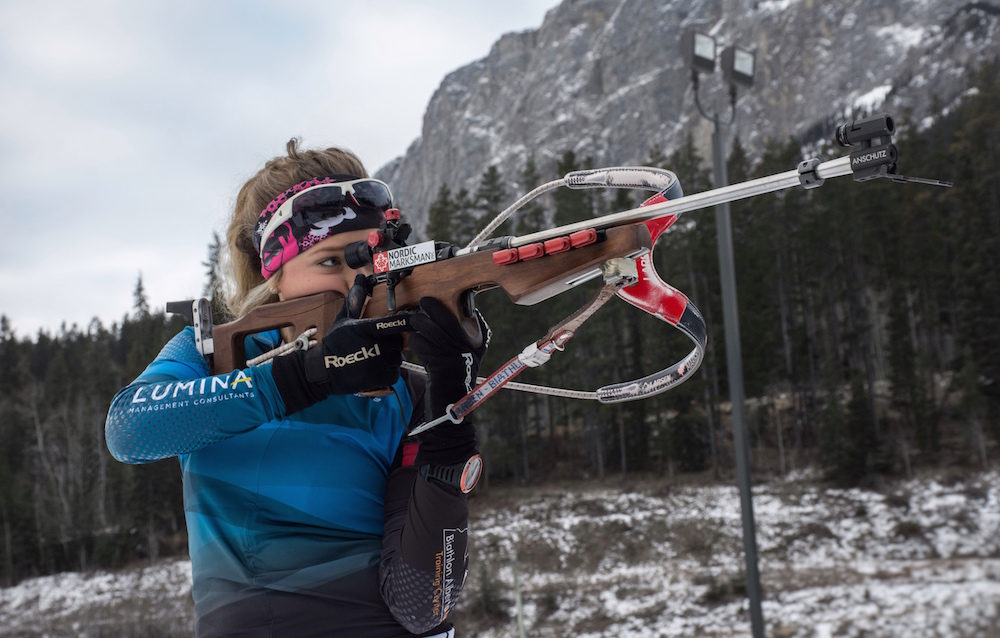
Emily Dickson (Biathlon Alberta Training Centre) on the shooting range during a training session in Canmore, Alberta. (Photo: Richard Boruta)
If I’m not skiing, you might find me jamming to music while also browsing through catalogs of camera equipment that I will probably never be able to afford on an athlete budget… I can dream though, right?
If I had to pick a favourite book, it would be ‘Open Heart, Open Mind’ by Clara Hughes.
One of the things I’m most excited about for Youth/Junior World Championships in Brezno-Osrblie is to put all of the long months of off-season training to the big test, and, of course, to cheer on my awesome teammates as they do the same!!
This will be my fourth Youth/Junior World Championships, and this year, I’m competing as a first year junior. One race I’m especially targeting there is the 10 km pursuit.
The best advice anyone ever gave me about skiing or racing was, ‘Stay focused on the process and the outcome will look after itself.’
One of the best race memories I have is when I took the gold medal in the 10 km Pursuit at the 2015 Canada Winter Games in Prince George. The race came down to a sprint finish and it was incredible to be able to share that moment with my friends, family and the entire home crowd.
If I could meet one World Cup skier, it would be Marie Dorin Habert.
If I don’t end up being a professional skier, I’ll probably be … lost? Kidding aside, I’ve got a few different ideas of what I’d like to do after biathlon.. Maybe I’ll fulfill my childhood dream of becoming a firefighter? Or the next host of Top Gear? In any case, I’m hoping to have a few more years before I have to make that decision😉
I’m missing zero days of school to be here, and my teachers/professors are probably thinking, ‘It’s a good thing Emily is taking this photography course online, not on campus!‘
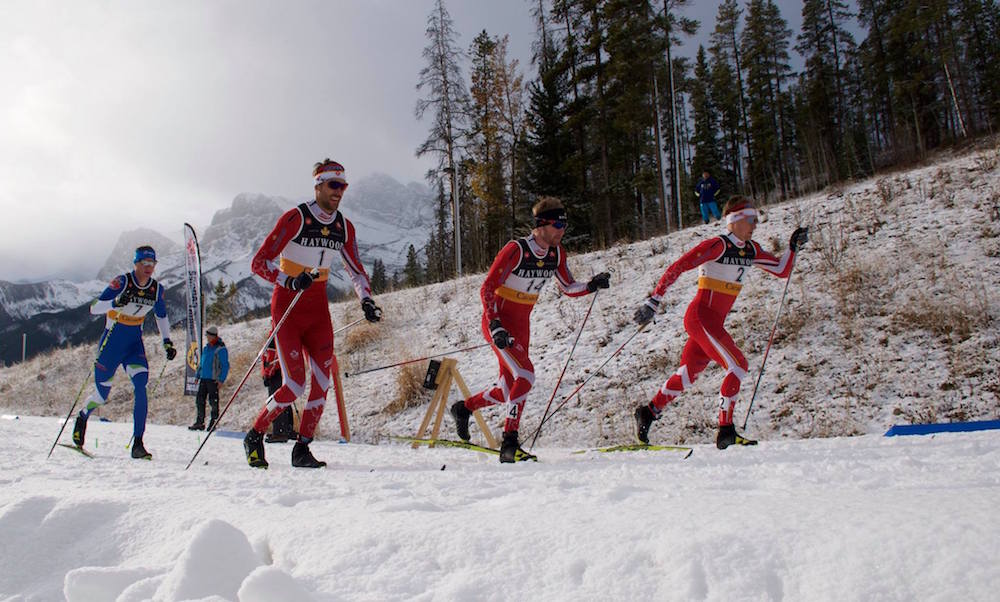
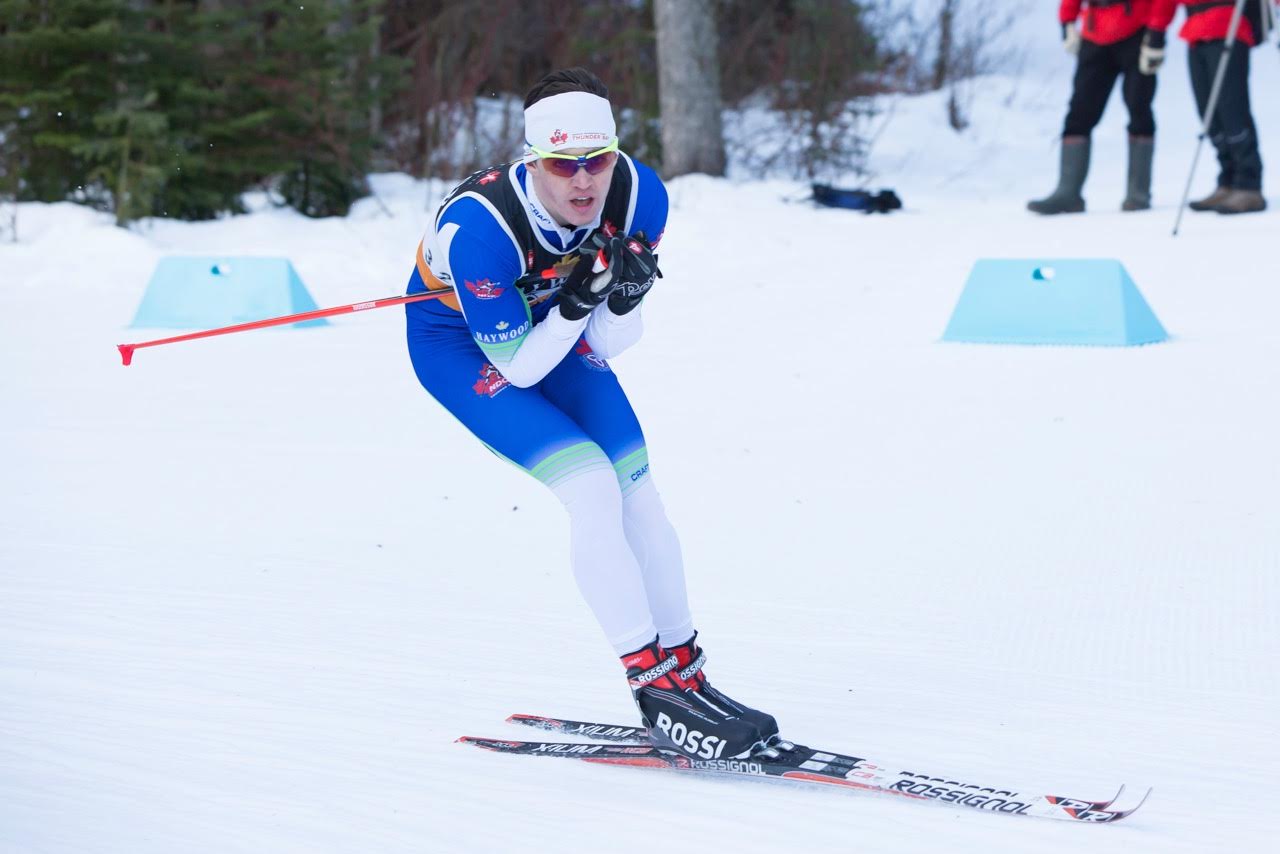
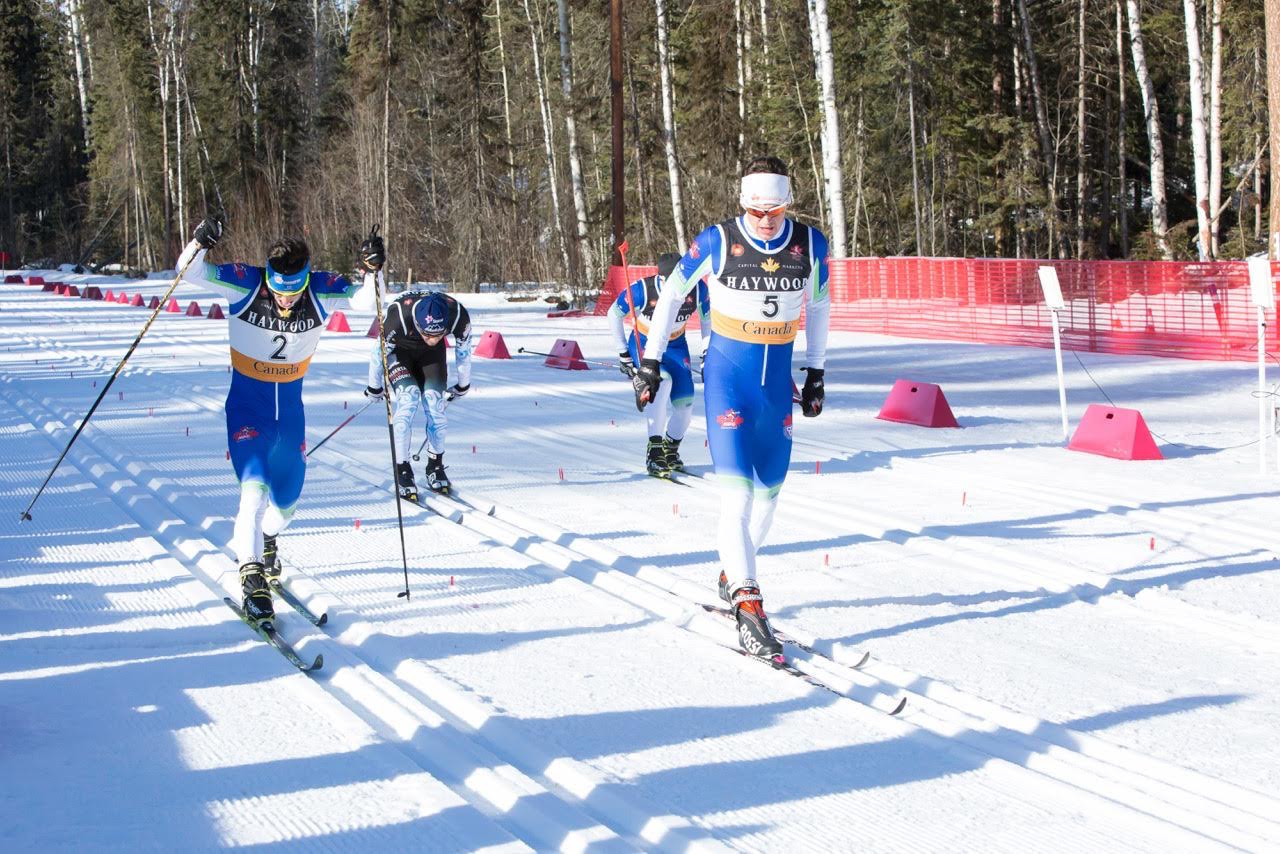
(From left to right) Bob Thompson (NTDC Thunder Bay) chases Lenny Valjas (Canadian World Cup A-Team), Graeme Killick (AWCA/NST B-team), and Knute Johnsgaard (AWCA/NST U25 Team) at the start of a classic sprint heat at 2016 Frozen Thunder in Canmore, Alberta, on Nov. 1. (Photo: Jenn Jackson)
As promised, the Canadian version of “Where the (Skiable) White Stuff Is” (a.k.a. November skiing) is here, minus the bit about where to ski at Thanksgiving. Canada doesn’t usually have much snow at Thanksgiving, mostly because Canadian Thanksgiving is in early October. But by the time U.S. Thanksgiving rolls around in late November, there is an abundance of reliable snow to choose from in Canada.
In addition to major camps and well publicized early season track setting, there are a lot of places in Canada where people quietly start skiing when there is snow. Whitehorse in the Yukon is one of those places where “early” doesn’t have the same meaning as it does in the south. No one will advertise October skiing at Barkerville, British Columbia, but the Caledonia Nordic Ski Club in Prince George can tell you about it. FasterSkier’s West-Coast based Canadian contributor was on snow Oct. 8 this year.
All of the western venues mentioned here were affected by the same weather pattern than forced the cancellation of the Bozeman SuperTour. A heatwave rolled in on Nov. 3, starting with a very warm classic sprint in Canmore, Alberta, and ending in spectacular flooding near Whistler, B.C. It has been a better start in the east.
This article will focus on reliable set track and camps open to the public in November — in Canada (for the U.S. version, click here). If your favourite early season spot isn’t featured, you are in good company. Let us know in the comments below.
And if you are visiting Canada, remember that the U.S. dollar is worth $1.35 up here.
***
CAMPS
XC SuperCamp
Where: Sovereign Lake Nordic Centre and Silver Star Mountain Resort, Vernon, B.C.
A trailside photo from 2015 SuperCamp at Sovereign Lake/Silver Star (Courtesy photo)
SuperCamp has evolved over 30 years, but its always been held on natural snow and it’s always run camps in November. Four of this season’s seven camps are in November, and biathlon options were offered this month as well.
“SuperCamp is a very comprehensive nordic experience,” Shane Landreville, SuperCamp coordinator, wrote in an email. “Trail passes are included, as are lunches, off snow programs, wax sessions, massages, and ski demos.”
Ski-in/ski-out accomodation and restaurants are available at Silver Star. Vernon, a 20-minute drive and 1,200 metres lower in elevation, offers a wide range of food and lodging alternatives. Some of the November camps sold out in mid-October when registration opened.
Glenn Bond XC Ski Camps
Where: Labrador City, Newfoundland
The 2016 Glenn Bond XC Ski Camp at Menihek Nordic on Nov. 3. (Courtesy photo)
The four-year old Glenn Bond XC Ski Camp program travelled to Menihek Nordic in Labrador City, Newfoundland, for a November camp on natural snow.
“[This camp] was November 3-6 with 70-80 cms of snow and big smiles,” Bond wrote. “Menihek Nordic wins the prize for best early season xc ski conditions this year hands down.”
(Longtime SuperCamp attendees remember Bond from his time with that program.)
NATURAL SNOW
Menihek Nordic
Where: Labrador City, Newfoundland and Labrador
Fifty centimetres (roughly 20 inches) of natural snow at Menihek Nordic in Labrador City on Oct. 23, 2016. (Photo: Menihek Nordic)
Mention ‘Lab City’ to a national team member from the 1980s and you will see the good memories scrolling behind the smile. In the glory days of Pierre Harvey, the national team would kick off its season at Menihek before moving on to Silver Star for an early season elevation camp. After that national team stopped visiting the venue in 1988, it quietly dropped off the radar, to the point that FasterSkier missed this October skiing opportunity in last year’s guide.
Labrador City is not visited by many tourists. It’s at least a 13-hour drive from Quebec City, which is the nearest major population centre. But there are some big-name skiers that have visited, including Sweden’s Gunde Svan, Americans Bill Koch and Tim Caldwell, Norway’s Anette Bøe, and the Firth sisters from Canada’s Northwest Territories. Menihek Nordic hosted the 1983 World Cup Final, the 1985 World Cup opener and was a national training centre from 1981 to 1988. Mining communities are often multicultural: the World Cup hosts were able to find local translators for 20 languages from a population of less than 10,000. Koch designed some of the trails in 1981.
What makes this venue unique, other than reliable October-to-May skiing?
“Labrador is unique in that it is nearly the last frontier,” Menihek Nordic Ski Club President Gerry Rideout explained. “There is a certain magic about Labrador, it gets in your blood.”
This season, Menihek opened on Oct. 23, held four camps in November, had the full 34 k system set on Nov. 3, and plans to stay open to the first week of May (as usual).
Sovereign Lake/Silver Star
There were lots of smiles during U.S. Thanksgiving at Sovereign Lake. Methow Valley Nordic coach Laura McCabe (a two-time Olympian) led 30 kids over the top from Silver Star and FasterSkier caught them on the way back. Locals know to start at Sovereign and stop for a croissant in Silver Star village to fuel the second half of the ski. (Photo: Gerry Furseth)
This destination is actually two ski areas. The Sovereign Lake Nordic Centre (also Sovereign Lake Nordic Club) has been operating since the 1930s under a variety of names, while Silver Star Mountain Resort is more recent, opening as an alpine-skiing area in 1958. The two organizations have 105 kilometers of interconnected nordic trails and a surprisingly good relationship between the commercial resort and the volunteer-based club (which is one of the largest cross-country ski clubs in B.C.). Silver Star hosted a World Cup in 1991, Sovereign Lake in 2005.
Daily track setting runs from November to early April, with the full 105 k usually available from late November to mid-March. Sovereign Lake reopens in May for team camps and diehard skiers.
This season, both sides opened 10 days late on Nov. 20, with 57 k set by Nov. 25.
“We are still well below our average snow pack for this time of year, but are optimizing our small machine grooming to create great tracks and corduroy,” Sovereign Lake manager Troy Hudson wrote in an email on Nov. 24.
There were at least eight private camps in November, ranging from a master’s women’s group to biathletes to a combined U.S. club camp with the Mt. Bachelor Sports Education Foundation, Methow Valley Nordic and Momentum Northwest from Oregon and Washington.
MANMADE & STORED SNOW
Frozen Thunder
Where: Canmore Nordic Centre in Canmore, Alberta
Canmore is perhaps the best known of Canada’s nordic venues. Between the 1998 Olympics, reoccurring World Cups and last season’s final stages of the Ski Tour Canada, it is famous beyond the skiing world. Each October, Frozen Thunder opens a small loop with a combination of stored snow and manmade snow.
This year, Frozen Thunder opened on Oct. 22 with a 1.7 k loop. The regular season began on Nov. 19 and is scheduled to run to April 30. So far, Canmore has hosted seven days of cross-country ski races and three biathlon races in November. All the camps were private, with the Ukraine biathlon team traveling the farthest to Canmore.
Boreal Glide (Glisse Boréale)
Where: Forêt Montmorency, owned by the Université Laval, in Saint-Ferréol-les-Neiges, Quebec
Skibec skiers on the Boreal Glide at Forêt Montmorency north of Quebec City. (Photo: La Forêt)
Located 45 minutes north of Quebec City and belonging to Laval University, the ‘Boreal Glide‘ is an early season favourite in Quebec. Set in the largest teaching and research forest in the world (at 412 square kilometers), La Forêt Montmorency has 2.5 k of early season trail using stored snow and a larger system that depends on natural snow. As of Nov. 20, it had 20-24 inches of packed snowed and track groomed for both skating and classic.
“If I had to invest my money in one single cross-country skiing area in North America, I would honestly choose the Forêt Montmorency,” La Forêt’s Director of Operations Hugues Sansregret wrote in an email. “The fact that it sits on top of the Laurentian mountains is the best guarantee for early skiing.”
Boreal Glide opened on Oct. 28 without any official camps or events — just skiing. Can’t argue with that.
Callaghan Gold
Where: Whistler Olympic Park, Callaghan Valley, B.C.
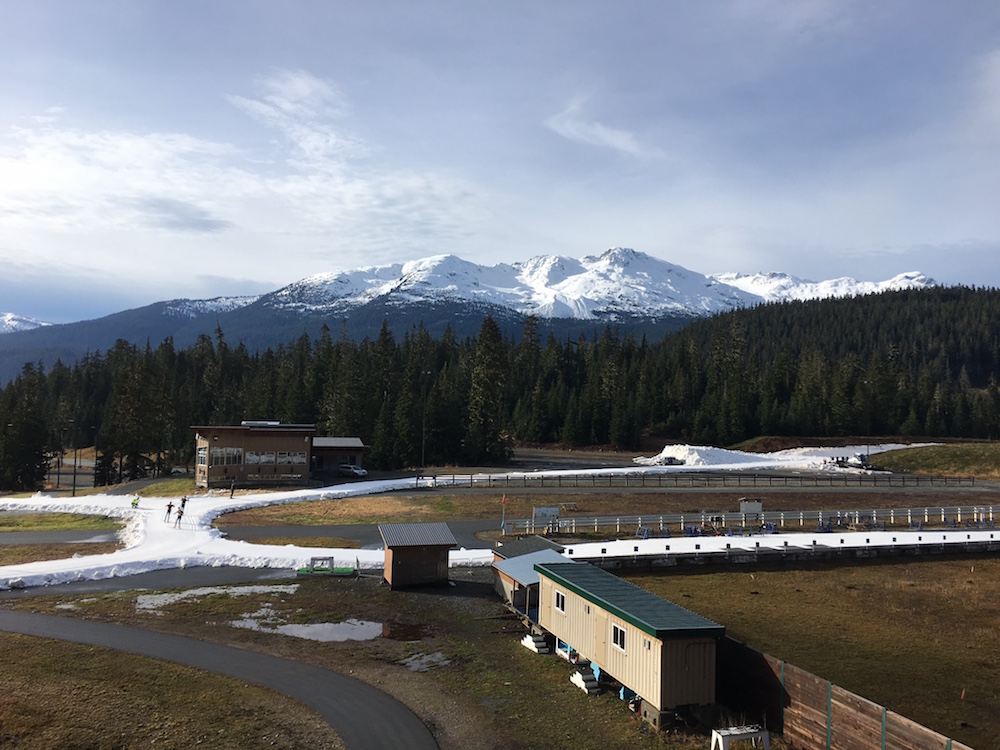
Callaghan Gold on Nov. 7, 2016, at Whistler Olympic Park in Callaghan Valley, B.C. New this year, the loop includes the biathlon range. (Courtesy photo)
Canada’s other Winter Olympic venue has created Callaghan Gold, an early season loop of stored snow. The regular season opens on Nov. 24 (U.S. Thanksgiving) and ends in early April. Located in a cool valley surrounded by rainforest, this venue has been known for lots of snow in non-Olympic years. Weather has been a challenge in the fall of 2016, eased by two last-minute storms that expanded the stored snow loop to 21 k during the opening weekend.
In the project’s four-year history, Callaghan Gold has met some challenges. In its experimental year, the stored snow came out ‘gold’, coloured by the sawdust insulation. In 2014, the storage methods were improved and an 800-metre loop of lovely, white snow greeted skiers on opening day. In 2015, record-setting warm weather melted all the snow in March, leaving nothing to store. In 2016, Callaghan Gold opened on Oct. 29 with 600 metres of trail, expanding to 1.4 k on Nov. 4.
“The warm temps and significant rainfall of November took its toll on the Callaghan gold trail depth but we feel it held up well considering,” managing director Tim Hope wrote in an email.
Nakkertok Nordic
Where: Gatineau, Quebec
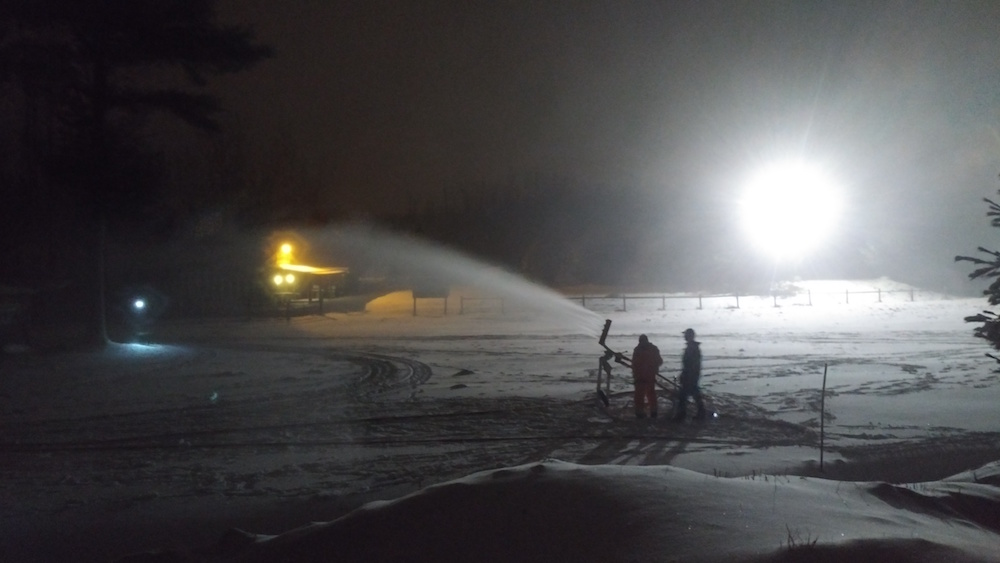
Nakkertok snowmaking in action for the first time in November, 2016. (Courtesy photo)
With two sets of ski trails just outside Ottawa and Gatineau, Nakkertok is the newest addition to reliable November snow. This month, one of the country’s largest ski clubs recently turned on its brand-new snowmaking equipment (which was largely funded by from its Project Play grand prize) and opened for skiing on Nov. 25.
According to Nakkertok Head Coach Kieran Jones, the club turned on five snow guns for the first time on Nov. 20 and was excited to test its new system and equipment. That night, the trails received an additional 15 to 20 centimeters of natural snow.
“Winter has definitely come to Ottawa-Gatineau, which is awesome!” Jones wrote. “Our initial goal was to create an 800m loop that covered our stadium, and extended out both ends. At that point we could then begin to push snow further to create 1 km of skiable terrain with a couple of quality climbs as well.”
He hoped they would have 1 k open for skiing by the end of last week.
“For now, the focus is on making sure we can have skate grooming,” Jones added. “Classic tracks will depend on the depth of snow that we’re able to produce. Nakkertok isn’t officially open to the public for day usage of the loop yet, but we’ll let you know as soon as it is!”
The Nakkertok Early Season Ski Loop (NESSL) is an important step for the region.
“It is great for the club, other clubs in the region and should allow a quality early season race site in the East,” Nakkertok fundraising mastermind Toni Scheier wrote in an email. “It will also ensure snow for the Easterns where clubs from across the country attend, (700 plus competitors) and for our Nationals bid, likely 2019.”
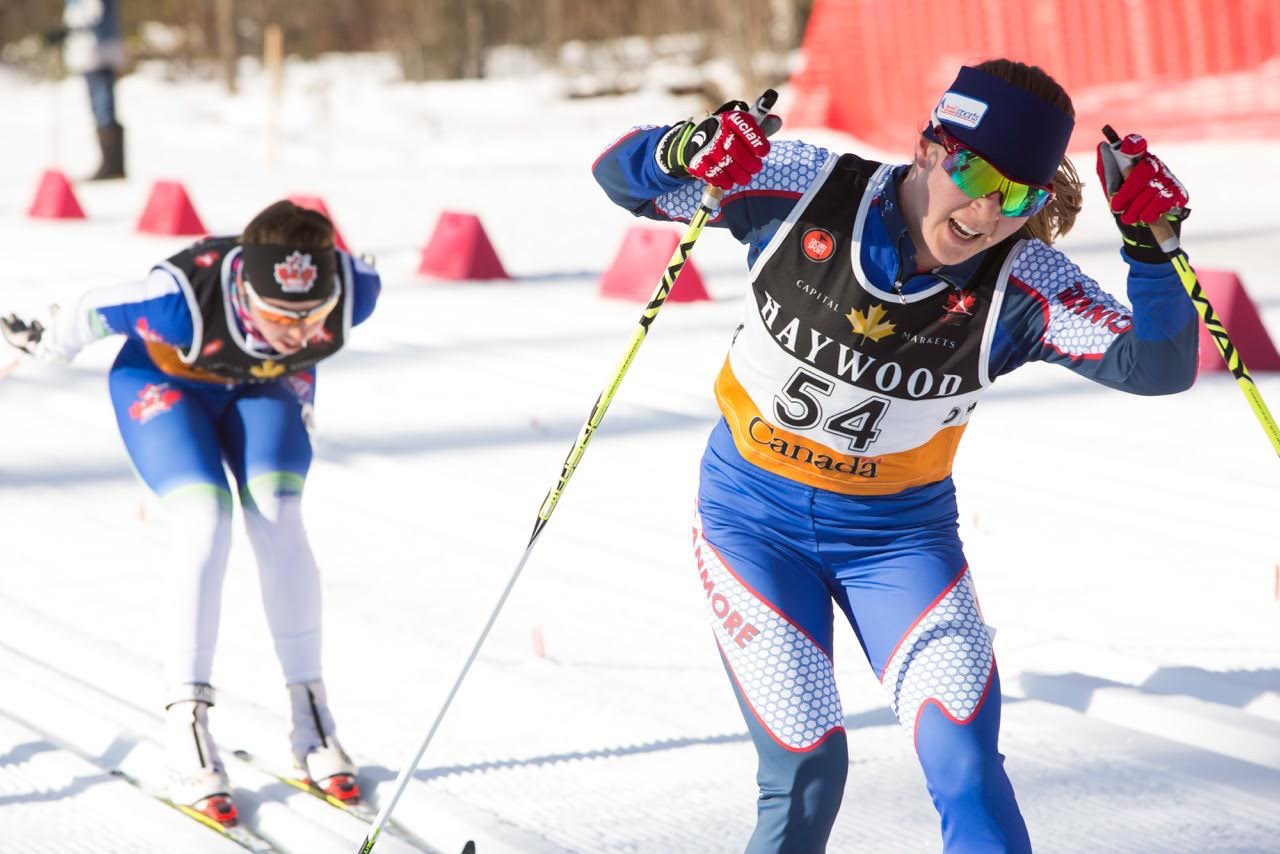
Canmore’s Annika Hicks (54) finished second in the women’s 15 k classic mass start on the final day of Western Canadian Championships on Feb. 21, just ahead of Katherine Stewart-Jones (NDC Thunder Bay) in third. (Photo: Sally Connon)
Western Canadian Championships, the final NorAm weekend of the season took place Feb. 19-21 at the Otway Nordic Center in Prince George, B.C., with three races determining the final Ski Tour Canada (STC) roster for Canada.
Dahria Beatty and Kevin Sandau left British Columbia as the overall NorAm leaders, granting them starts at the STC eight-stage World Cup.
Beatty won the women’s 7.5-kilometre freestyle individual start on Friday, Feb. 19, by nearly 11 seconds in 19:02.7 to retake the NorAm lead from fellow U23 Development Team skier, Cendrine Browne, of the Pierre-Harvey National Training Centre (CNEPH).
“I went out as if I was only racing 5km,” Beatty recalled in an email. “I felt really good on the first lap and then started to fade on the second lap as my legs filled with lactate. The downhills on the second lap were the hardest part as I struggled to stay on my feet I was so tired. I managed to regain a bit of composure for the final climb and hold onto the lead I had fortified on the first lap. This was my first time racing in Prince George and I really enjoyed the trails. Lots of fun and very technical!”
U23+ Development Team skier Olivia Bouffard-Nesbitt finished second (+10.9), while Maya MacIsaac-Jones, of Rocky Mountain Racers (RMR) was 45.8 seconds behind in third, edging Annika Hicks (Canmore) by 2.1 seconds, for her first NorAm distance podium of the season.
“I’m definitely happy with the upward trend I’ve been experiencing,” Bouffard-Nesbitt wrote. “The only thing lacking is some power, but that is a result of my (lack of) summer training, so there’s nothing I can do about that now. I’m super excited to race some World Cups though!”
Browne, citing fatigue after an altitude training block, finished fifth, 52.1 seconds behind Beatty.
“I already knew in my warm up that something was wrong. I wasn’t feeling good,” Browne wrote in an email. “In the race, everything was confirmed. I felt awful. I couldn’t push my body was tired.”
“When my coach called me on the phone and asked how my race went and when I said it was awful, he just said: Perfect, the altitude camp is working,” Browne added. “I was surprised by his answer but it cheered me up a little. He also said it would be hard doing the sprints too.”
***
Day 2 brought another win for Beatty at Saturday’s 1.4 k classic sprint, as she beat out Bouffard-Nesbitt in the finishing straight to win by half a second in 3:44.2.
“I felt good in my semi and was able to carry that feeling into the final,” Beatty wrote. “Olivia led the entire race, she was skiing well and had a faster start than me to get out in front early. I just sat in behind her on both climbs as the middle track was a lot better than the two outside ones. You come into the finish off a downhill so I used her draft to step out beside and sprinted to the finish. I had a comfortable advantage by halfway down the finish shoot and carried that to the finish.”
“I raced the final how I wanted to,” Bouffard-Nesbitt explained. “I led the whole race and unfortunately got out-sprinted at the finish. It was a good wake up call, because now I can hit the gym and do some biceps curl reps to have me ready for the tour.”
“It was a good wake up call, because now I can hit the gym and do some biceps curl reps to have me ready for the tour.” — Olivia Bouffard-Nesbitt on finishing second in the Westerns classic sprint
MacIsaac-Jones again snatched the final podium spot, 4.55 seconds behind Beatty, ahead of Katherine Stewart-Jones (NDC Thunder Bay) in fourth. Beatty’s second win of the weekend locked up her hold of the overall NorAm. MacIsaac-Jones took the NorAm sprint lead, displacing teammate Andrea Dupont, who skipped Westerns while racing Period 3 on the World Cup in Europe.
“I went in today wanting to win, but I’m satisfied with a bronze medal,” MacIsaac-Jones wrote. “The race was good redemption for me from the Canada Winter Games race on this course last year, where I didn’t make the A Final. It was also a big improvement from my classic sprint at the Canmore NorAm in december, where I also didn’t make the A Final.
“I knew that Dahria and Olivia would go for it once we hit the big climb so I just tried to hang on, but they were too fast for me and I wasn’t able to stick with them,” she added. “Katherine moved up beside me on the final climb, but I managed to hold her off and hang on to 3rd which I was really happy with.”
As planned, Beatty headed home Sunday morning to start her final STC preparations.
***
In Sunday’s 15 k classic mass start, Browne skied away to a 52-second victory in 46:00.1, while Hicks took second, 0.6 seconds ahead of Stewart-Jones in third.
“I felt very good! The shape is back,” Browne wrote on Sunday. “Annika, Katherine and I stayed together for 2 and a half laps (we had 4 laps of 3.75km to do). I was feeling good today so I started going a little harder on the 3rd lap and starting the 4th lap, I knew I was by myself. I had really good kick so climbing the big climbs was where I knew I could break away. I went even harder on the last lap just to make sure the girls couldn’t catch up to me.”
Junior Katie Weaver (Hollyburn) continued her steady rise, skiing with the lead three for the first lap before falling off the pace and finishing 2:48.1 back in fourth.
Many of the STC-bound skiers skipped the distance race on Sunday.
***
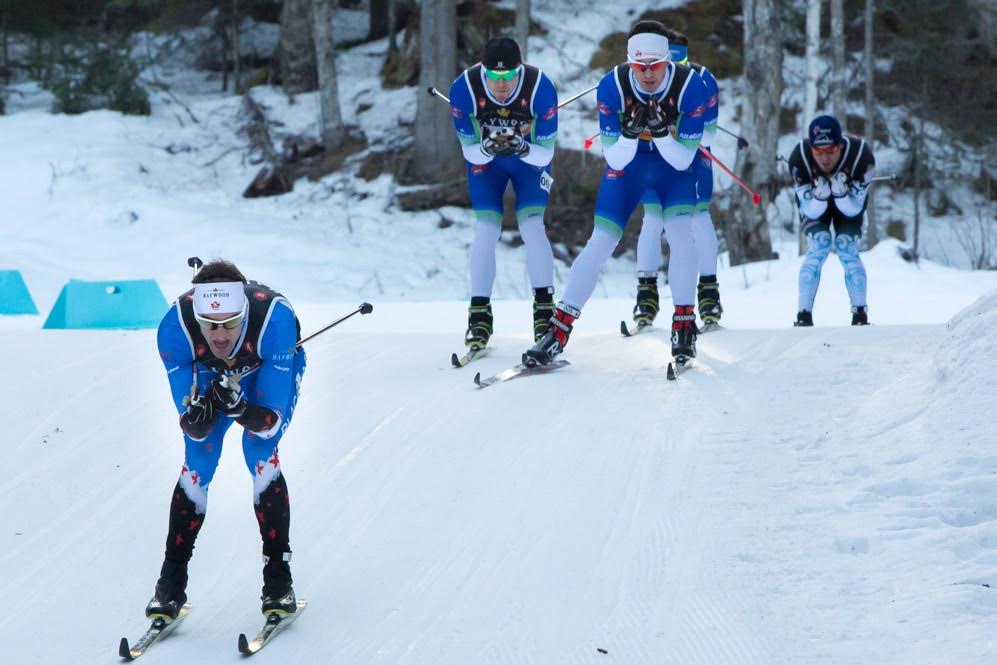
Black Jack’s David Palmer (l) leading early in the men’s 20 k classic mass start on the final day of Western Canadian Championships in Prince George, B.C., with Michael Somppi, Evan Palmer-Charrette, Andy Shields, and Patrick Stewart-Jones (r) chasing. (Photo: Sally Connon)
On the men’s side, Andy Shields (NDC Thunder Bay) was within striking distance of Sandau’s overall lead before the weekend. With the third-ranked man, Knute Johnsgaard (AWCA/NDST) focussing on a training block before STC, it was a two-way fight for the title.
In Friday’s 10 k freestyle individual start, Russell Kennedy (Canmore) snatched the victory in 22:19.1, edging Sandau by 0.4 seconds and Michael Somppi (NDC Thunder Bay) by 2.5 seconds, for his first NorAm win of the season.
“I was super pumped in my race today feeling was amazing conditions were really good and the downhills were fast and technical,” Kennedy wrote in an email.
“There wasn’t much of a pacing strategy as it was 10k so really just had to start fast and hold on to as hard a pace as possible,” he added. “The splits were close so I knew I had to push it. I was feeling confident when we were close at the top of the last hill as I love downhills and have a good sprint. I didn’t really realize just how close it was until the after I finished though.”
Sandau wrote in an email that he was happy to finishing in the top four considering how close it was, but always wants the win, especially considering how close he was behind Kennedy.
“I’ve been teasing him all winter about nicking him in the distance races so he served up a nice rebuttal today,” Sandau wrote. “… I went off the line hard knowing there wasn’t room for mistakes and a lot of places to give up time. I was getting splits off Russell near the end that he was leading so I tried to claw back some time in the last few climbing sections but was just shy of enough.”
“It’s a really good course for [Russell] and I knew with his consistency in skate races he was going to be one of the bigger threats out there,” Sandau added. “Plus he’s pretty good when he clips into a pair of alpine skis so the downhills were probably pretty easy for him, compared to me who felt like a tourist out for the first ski of the year at times.”
Somppi in third described his race as “solid.”
“The fitness is as good as it’s going to get at this point,” he wrote. “Now, it is all about finding the right mix of recovery and intensity to be primed and full of energy when the Tour starts.”
Shields finished fourth, 9.7 seconds back, to stay in mathematical contention. To take the title, Shields would need at least a win and a second in the final two races.
“I started pretty hard, got tired and had a rough middle section,” Shields wrote. “I was still getting good splits going into the last 4km so I was able to find some juice to finish off and still have a respectable split for the last lap.”
***
Bob Thompson (NDC Thunder Bay) racing to second in the men’s classic sprint qualifier at Western Canadian Championships in Prince George, B.C. He went on to win the men’s final. (Photo: Sally Connon)
Bob Thompson (NDC Thunder Bay) won the men’s 1.4 k classic sprint on Saturday, retaking the sprint series lead and the automatic STC start from Julien Locke (Black Jack), who was in Romania for U23 World Championships this week. Thompson needed the win to eclipse Locke in the sprint standings, taking the series 250 points to Locke’s 245.
Also in the sprint final, Patrick Stewart-Jones (AWCA) placed second and Shields finished third. Sandau went out in the quarterfinals, having achieved his training goals.
“Very happy that I was able to win when I needed to,” Thompson wrote in an email. “To win the NorAm sprint spot for the Tour of Canada I had to win to get enough points. Patrick was in the same position so I knew we would both be giving our all to lock the spot down. Was great that I was feeling really strong and had my best qualifier of the year as well.”
Thompson qualified second behind Skinouk’s Simon Lapointe, who went on to place sixth in the final.
***
Evan Palmer-Charrette (NDC Thunder Bay) outlasted teammate Andy Shields (l) and Patrick Stewart-Jones (AWCA) for the win in the men’s 20 k classic mass start on Sunday, Feb. 21, at Western Canadian Championships in Prince George, B.C. (Photo: Sally Connon)
On Sunday, Evan Palmer-Charrette (NDC Thunder Bay) won a four-way race for first in the 20 k classic mass start. Shields finished second, 0.111 seconds back, and Stewart-Jones was third (+0.525). Somppi lost his balance in the final straight and finished fourth, 1.24 seconds behind Palmer-Charrette. David Palmer (Black Jack) was dropped during the final lap to take fifth, 13.9 seconds out of first.
“I am quite happy with my race Sunday but overall the weekend was a bit disappointing,” Palmer-Charrette wrote. “The 10km skate on Friday is what I would pick as my strongest event and I really struggled that day. I had the race I wanted to on Sunday and am looking forward to next season!”
“The race on Sunday was a lot of fun, skiing at the front with my team-mates…,” Somppi wrote. “Tactically, I put myself in a great position to win. I led the final climbs, pushing the pace, and crested the final downhill in second, right behind Evan. Unfortunately I hit a patch of ice on the final downhill corner and stumbled, nearly crashing. Instead of using the draft and coming up beside Evan in the finish to contend for the win, I was double poling early in the finish stretch, trying to regain my speed.
“I feel a little gypped after this weekend, to finish 3rd and 4th when I was only 2.5 seconds from winning one day and 1 second from winning the other day,” Somppi, last year’s NorAm winner, added. “I’m hoping my luck will turn in the Tour.”
The best under-20 athletes in Canada are gathering in Prince George, British Columbia for this year’s Canada Winter Games. A winter Games is held only every four years, and athletes compete not only for medals, but to earn points for their provinces.
Competition in the nordic sports kicked off on Sunday with 12.5 and 15 k biathlon competitions. In the women’s 12.5 k, Leilani Tam Von Burg – fresh off a top-20 finish in the junior competitions at Open European Championships – posted a time of 45 minutes flat to take the win for Ontario with three penalties.
All three came in the second half of the race for the Biathlon Alberta Training Center athlete.
“My shooting started off pretty good, but kind of got nervous at the end,” Tam Von Burg told the Prince George Citizen. “I definitely had high expectations going in – at least I put pressure on myself and there was quite a bite of pressure. I’m happy I lived up to it and I could keep it all together.”
In the individual format of competition, missed shots are penalized with a minute of added time, rather than extra loops of skiing.
Nadia Moser of Yukon finished second in 46:55 with four penalties, and Prince George native Emily Dickson third in 47:42 with six penalties. At 16 years old, Dickson is one of the youngest participants at the Games: the eligibility is for athletes born from 1994 to 1997.
“It was a really, really cool experience today to have my whole family and have so many family and friends here -supporters out there who wouldn’t normally make it to my races,” Dickson told the Prince George Citizen. “I don’t know how to put it into words, how awesome it is. I had quite the cheerleading squad out there today.”
In the men’s 15 k, Benjamin Churchill of Alberta had an impressive performance on the range, missing only a single target. That gave him a 27-second win over Jules Burnotte of Quebec, who picked up five penalties. Teammate Teo Sanchez placed third, 45 seconds behind Churchill, with three penalties.
“So stoked for a wildly unexpected 1st place today,” Churchill wrote on his instagram page.
Burnotte’s and Sanchez’s efforts helped put Quebec in the lead of the medal standings, with 12 medals in five different sports. British Columbia and Ontario are tied with 10 medals apiece.
Racing continues in Prince George on Tuesday with 7.5 k and 10 k sprint competitions.
Daniel Guay, the coach of the Lake Superior Biathlon team, shared his photos of the day.
Caledonia Nordic Ski Club is inviting applications for full time coaching positions at the Otway Nordic Ski Centre in Prince George. As a club coach you will work with volunteer NCCP coaches to implement the CCC Long Term Athlete Development Model across all programs in the club.
Submit cover letter and resume to cnscoffice@telus.net attention Director of Programs. Digital submissions only with the position title in the subject line. Candidates selected for interview will be contacted.
Application Deadline: Friday, July 8th 2011 at 5:00 PM PST