Tag: prize money

  • Unequal Prize Money at Blink Festival Illustrates Challenges for Women’s Distance Racing

    Unequal Prize Money at Blink Festival Illustrates Challenges for Women’s Distance Racing

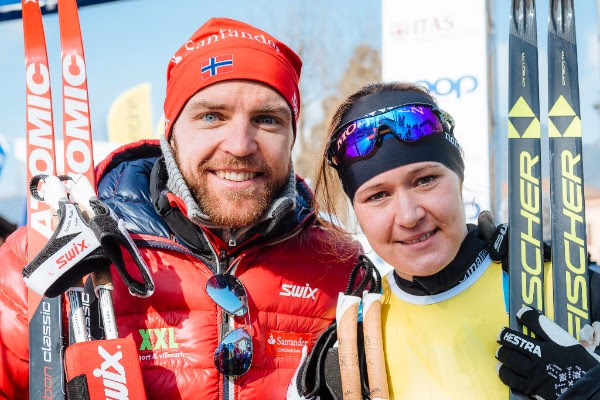
    Tord Asle Gjerdalen (l) and Britta Johansson-Norgren (r) after winning the 2016 Marcialonga 70 k classic. In July, Johansson Norgren won the Blink Classics 60 k rollerski race - but received only 20% as much prize money as Petter Northug got for winning the men's race. (Photo: Visma Ski Classics)
    Tord Asle Gjerdalen (l) and Britta Johansson Norgren (r) after winning the 2016 Marcialonga 70 k classic. In July, Johansson Norgren won the Blink Classics 60 k rollerski race — but received only 20 percent as much prize money as Petter Northug got for winning the men’s race. (Photo: Visma Ski Classics)

    At the end of July, Norwegian professional cross-country skier Astrid Øyre Slind hit the podium in the new 60-kilometer classic race at her country’s Blink ski festival. She faced a payout that seemed unusual: a big discrepancy between men’s and women’s prize money.

    At the competition, called Blink Classics and part of the inaugural summer season of the World Classic Tour rollerski series, the total prize money available for men was 190,000 kroner, or just over $23,000. For women, it was 50,000 kroner — about a quarter as much.

    Accordingly, Slind’s second-place finish notched her 10,000 kroner ($1,200), while the second-place man, Andreas Nygaard, received 40,000 kroner.

    And men’s winner Petter Northug took home 75,000 kroner, which was 50 percent more than the entire pot of women’s prize money.

    “It’s an enormous difference,” Slind told Norway’s NRK broadcaster.

    Sweden’s Britta Johansson Norgren, who won the women’s competition, did not return FasterSkier’s request for comment.

    In most major ski marathons, women receive equal prize money to the men. At Norway’s Birkebeiner, the prize is 40,000 (Norwegian) kroner or $4,800 apiece; at Sweden’s Vasaloppet, the 2015 prizes went up to 91,000 (Swedish) kroner or $10,700; at Italy’s Marcialonga, it was 5,300 Euros or $5,900 for both men and women.

    The American Birkebeiner pays $7,500 to both the men’s and women’s winners.

    But Blink Classics is not one of these established marathons: it is a rollerski competition in its very first year of existence. It did, however, attract the attention of the Norwegian government, which was concerned that the festival was violating the country’s equal pay act.

    “For us it has not been easy to have this situation with the girls,” Blink Festival press secretary Arne Idland told FasterSkier. “And then when they are not satisfied with the money it is really difficult. We will try as hard as we can to find a solution.”
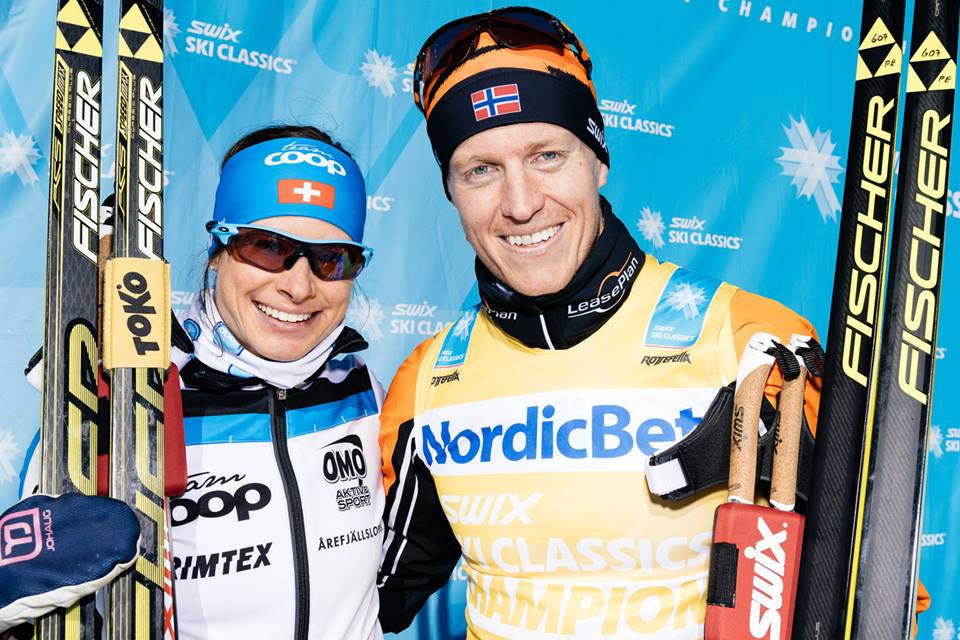
    Seraina Boner (l) of Switzerland and Team Coop and Petter Eliassen of Norway and Team LeasePlan Go won the 2015 Årefjällsloppet, receiving equal paydays. (Photo: Ski Classics)
    Seraina Boner (l) of Switzerland and Team Coop and Petter Eliassen of Norway and Team LeasePlan Go won the 2015 Årefjällsloppet, receiving equal payouts. (Photo: Ski Classics)

    New Race for a Booming Festival

    The Blink ski festival is now a giant on the summer racing circuit, with athletes from all over Europe and even North America coming to compete on rollerskis in cross-country skiing, biathlon, and the famous Lysebotn Opp hill climb. Recreational and junior classes are also a big focus, making it accessible to fans and professionals alike.

    But adding a long-distance race to the mix was not easy for organizers, who still have to make sure that the festival breaks even financially. Idland explained that Blink Classics had been in the works for three years.

    “The main challenge this year is that we, for the first time, were going into car traffic — this race was on ordinary roads with traffic [rather than the city square], and we had to close it to traffic just like they do in cycling races,” he explained.

    That entailed paying for policemen, for one thing. Having a fourth day of racing (previously there had been three, the Lysebotn Opp and two more days in the Sandnes city center) also meant more production by NRK, Norwegian national television, as it followed a long-distance race rather than staying in a set location downtown.

    “If you have live production it has to be in high definition,” Idland said. “Then it’s really expensive.”

    Then last autumn came the news from the Norwegian Ski Federation: none of the national team “A” or “B” team women would compete in the 60 k. The women usually focus on doing all three of the other days of racing, and adding a 60 k at the beginning of consecutive days of racing would be too much volume and intensity during the summer training season. Some of the men, like Eirik Brandsdal and Sjur Rothe, would do the longer race; Martin Johnsrud Sundby was interested but later pulled out.

    Concurrently, Idland said, NRK was telling the Blink organizers that it wouldn’t be possible to broadcast the men’s and women’s 60 k competitions together. It would have meant following two races at the same time — double the filming budget and staffing — and deciding all the time which feed to broadcast and commentate. NRK didn’t have expertise in doing this and said that they needed to develop it. So they would only broadcast one, and with the national team women out of the competition but the national team men in it, organizers agreed it should be the men’s race.

    “When I contacted the teams from other nations, I was open and said that this [women’s] long distance race will not be broadcast on TV and no women from the national team would start there,” Idland said of his communication with other countries’  teams last winter, before registration began. “So I advised them all not to start in this race, but to come do the three other races.”

    As a result just four womencompared to 69 men, finished the 60 k classic race.

    Johansson Norgren, the winner, is a mainstay on the Visma Ski Classics circuit and won the 2016 season title as well as numerous individual marathons. Masako Ishida, who finished third at Blink Classics, was the winter series’ fourth-ranked woman. So the podium at Blink was not so different than a podium one might see at a top winter event.

    But the decision about prize money had been made long before.

    “We said that we need good prize money on the men’s side, because the other competitions that we compare with have good prize money,” Idland said. “We also need some sprint primes. We had a total of 190,000 kroner, or about 20,000 Euros, for the men. And we had just over 5,000 [Euros] for the women. That was decided before we opened entry.”

    Even for the women, it was more prize money than was available at the other competitions in the Blink festival, Idland said. In those other races, prize money is equal for men and women and each total prize-money purse is roughly 2,000 Euros.

    “So it is double amount of money in this women’s class in any of the other races, including Lysebotn Opp,” he said. “We thought we were really doing well for the women. And it’s not every rollerski race having prize money, either.”
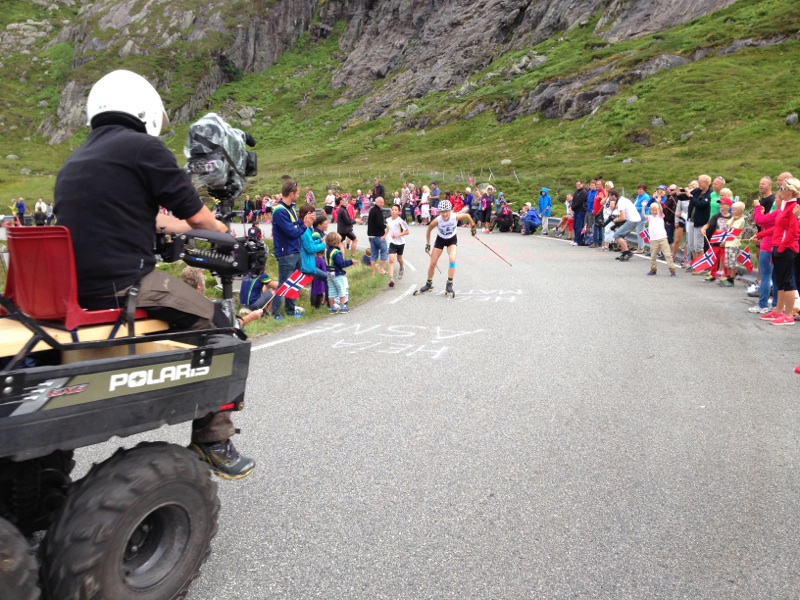
    Kaisa Mäkäräinen (FIN) climbs to victory in the Lysebotn hill climb at the 2013 Blink festival. The women's hill climb is televised, unlike the Blink Classics. (Photo: blinkfestivalen.no)
    Finland’s Kaisa Mäkäräinen climbs to victory in the Lysebotn hill climb at the 2013 Blink festival as a cameraman captures the action. The women’s hill climb is televised, unlike the Blink Classics. (Photo: blinkfestivalen.no)

    Building Women’s Pro Fields Takes Time

    But the discrepancy still felt unusual to some of the women, who are used to getting paid the same amount as their male counterparts for a win.

    Prize money is the same for men and women on cross-country skiing’s World Cup. In fact, female superstars like Marit Bjørgen and Therese Johaug earn more than their male counterparts because they are more dominant, grabbing a bigger proportion of the total available prize money for themselves.

    The gulf between men’s and women’s participation is greater in long-distance racing than on the World Cup. As a result, marathon organizers have to grapple with a somewhat different set of considerations as they develop the payout structure for their competitions.

    Most of the biggest ski marathons in Europe — including the Birkebeiner, Vasaloppet, and Marcialonga — are part of the Visma Ski Classics series, where organizers have come up with compromise solution when it comes to year-end rankings.

    Prize money is equal for the top three overall series finishers, but the men’s field also pays out to the fourth- and fifth-place athletes while the women’s field does not.

    “For me it sounds very strange,” Visma Ski Classics CEO David Nilsson told FasterSkier in an interview last week referring to the Blink prizes. “We have in our rules that they must have the same first prize to men and women. It is also important to reflect on the percentage [of field size], and it shouldn’t be so much more difficult for the men to get [prize money] than for the women — but you can never do more than win, so of course that has to be equal for first place.”

    In the winter, far fewer women than men are on Visma Ski Classics professional teams. But women’s races are hotly contested and often extremely dramatic, like Seraina Boner’s come-from-behind win at the 2016 Birkebeiner after passing Ishida and Poland’s Justyna Kowalczyk in the final kilometers.

    In the 2016 season, 39 different women scored points toward the overall titles. There is even an all-women’s pro team, Sweden’s Team SkiProAm, whose top athlete finished eighth in the season rankings.

    According to Nilsson, Visma Ski Classics has carefully tried to promote women’s participation, with equal prize money for first place being one component.

    “We worked very hard on this,” he said. “When I started 6-7 years ago, we had 4-5 women that were competing [professionally] in long distance skiing because it was a bigger step for them from shorter distance [World Cup] skiing than for the men.”

    While they left the women’s competition out of the spotlight this year, the Blink Classics organizers don’t think that should always be the case. Like the Visma Ski Classics, they want more women on the start line.

    “Our aim and our goal is also to have the world’s best women at the start in future,” Idland said.

    One reason for low numbers at Blink might be that long-distance racing just isn’t as popular among women in Norway as it is in neighboring Sweden, home of the Visma Ski Classics brand, said Nilsson.

    “In Norway, which we all know is very strong in cross-country skiing, we don’t see so many female participants in long-distance skiing,” he mused. “They are more from Sweden. We don’t know why the Norwegian women are not coming more.”

    The Blink 60 k is part of a three-race series of long-distance rollerski competitions called the World Classic Tour. Indeed, the second leg of the Tour was held in Sweden. Called the Alliansloppet, it is also a more established event.

    Twenty-five women finished that 48 k race, including several past Visma Ski Classics champions and members of the Swedish national team (Hanna Falk, a three-time World Cup podium finisher, won the race). Prize money was equal for men and women, including a 10,000 Swedish kroner sprint prize ($1,000) for both men and women.

    The World Classic Tour overall awards use a similar idea to the Visma Ski Classics, in that the men’s and women’s title winners earn equal paychecks but the men’s field will pay out to six places and the women’s to just three.

    Yet the series does not appear to have a policy for its constituent races in how to organize prize money at individual competitions.

    If organizers like those at the Blink festival want to develop a strong women’s competition, Nilsson suggested that they need to actually promote the women’s races.

    “We also made sure that there was much more focus on the women [than there had been before],” he said of the Visma Ski Classics efforts. “The women should have be starting [wave] before the men to have their own competition… and have [television] production of the race and their own media. When we created the system, all the attention was on the men. Then we made it so the pro teams had to get points from both the men’s and the women’s classes. This together has made the increase of the women.”

    Idland conceded that with more prize money, they might have drawn a slightly larger women’s field. But he believed the circumstances of the festival, with the three subsequent days of racing, were the bigger reason for low participation.

    On the Blink Festival website, the news story about the 60 k Classics race features five paragraphs and three photos about the men’s race, but only one paragraph and one photo of the women.

    Nilsson believed that some changes could be made without disrespecting the male athletes.

    “When you have 100 men and not so many women registered, it wouldn’t be fair to get the same [prizes],” Nilsson said. “It would be easier for the women. So it has been for us to push the development [of women’s skiing] but not to be unfair to the men’s skiers. That’s the reason we have in the prize money, five men and three women. And that reflects a little bit to the female factor, to be honest, in terms of the number of participants and the amount of professional skiers. It has to be the same difficulty to win a prize in both categories.”

    What Does Equality Mean?

    Race organizers are continuously trying to come to a more perfect solution, and one common thread seems to be that prize money must be earned by quality racing and exciting performances. Until the women’s fields are deemed to have provided that, they might not see as much compensation.

    Visa Ski Classics, for example, continues to make changes. For the 2016/2017 season, women will for the first time be able to vie for a sprint title, worth five percent of the total prize money, just as the men have done for years.

    “The reason it wasn’t the case [previously] is that there weren’t so many women — last year was the first time that there was really a group at the front,” Nilsson said. “Before it was just one or two who went away, so it wouldn’t have been interesting. The same people would have won the race as the sprint bibs. Now both men and women get a sprint bib, which is a step forward. Our goal is to make it equal the number of participants and who gets prizes.”

    Nilsson guessed that the availability of intermediate prize money may also change the tactics of the women’s races and contribute to an exciting spectacle on television.

    For his part, Idland insisted that the Blink organizers’ decision about prize money was not sexism. It could have gone the other way, he wrote in a letter to the Norwegian government explaining the discrepancy in pay.

    “I was trying to give an example with the opposite situation,” Idland said. “If Marit [Bjørgen], Therese [Johaug], Heidi [Weng], Charlotte [Kalla], and maybe some of the Americans said to us that this race we would very much like to do, and the men said they didn’t want to do it and just let the [marathon] specialists do it, then I am quite sure we would have done the opposite thing. We would have led the coverage with the women, if the level was higher.”

    After being contacted by the authorities, the Blink Festival is trying to work together with the government to achieve equality.

    “Our answer was that they would really much like to come in dialogue with us to try to make a plan for the future,” Idland said. “And that we try to build up this competition with a clear aim to have everything on an equal basis in some number of years.”
  • NNF Announces OPA Cup Finals Prize Money

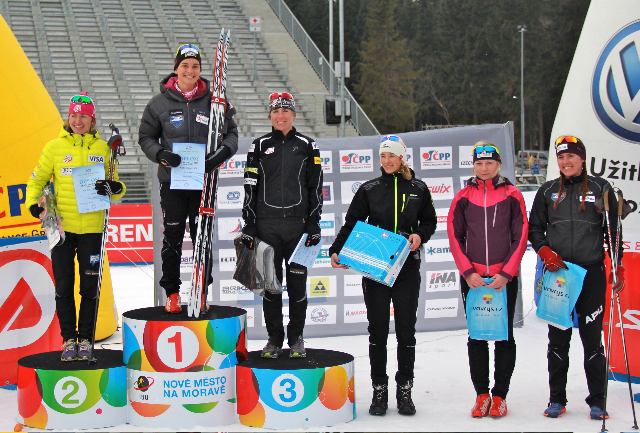
    fitz-caldwell-brennan (NNF photo)
    SALT LAKE CITY, Utah — The NNF announced a prize money win schedule for any American competing at OPA Cup Finals events. As a pillar project, the OPA Cup represents a priority for NNF funding. The key development trip is funded with $31,000 of NNF trip support. This year, the NNF is raising the stakes for skiers competing by adding a bonus win schedule for any U.S. skiers seeking to compete. Prize money for OPA Cup stage results will follow these guidelines. (All funds in USD.)
    • 1st – $2500
    • 2nd – $1250
    • 3rd – $750
      In the event of a pursuit start, the prize money will be awarded based on the top 3 across the line. (Not best times of the day.)
    “We have created a consistent platform for our best athletes to compete at the OPA Cup level year after year,” James Southam, Operations Director for the NNF explained, “This offer is similar to our standing offer to cover the cost of an athletes U23/World Junior Championship trip if they reach the podium, encouraging and rewarding those who are performing at the top level of the development step right below the World Cup.”
    The funds will be available for this year’s OPA Finals Cup trip beginning in February.
  • How to Score Points and Win Money on the World Cup (Hint: Be Norwegian)

    How to Score Points and Win Money on the World Cup (Hint: Be Norwegian)

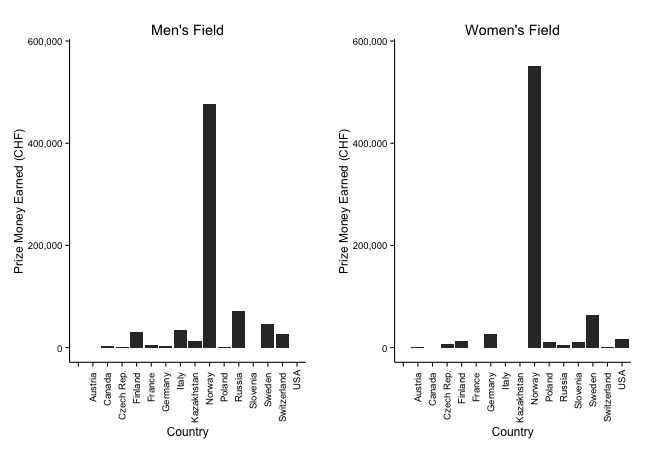
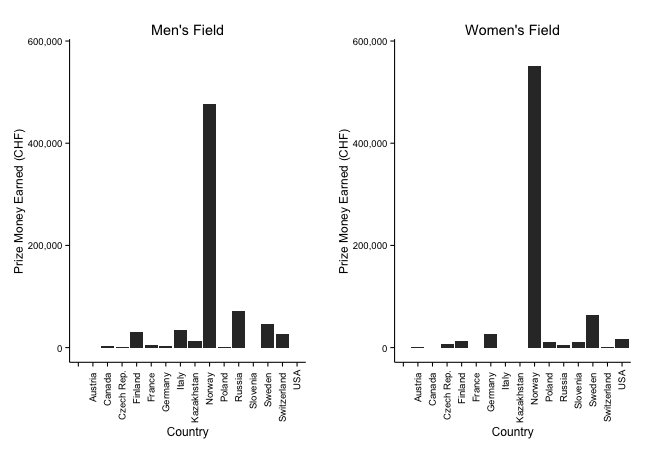
    FIS Cross Country prize money earned, by country, so far in the 2014-2015 season. A pot of 710,000 Swiss Francs (CHF) has been paid out to each of the women's and men's fields.
    FIS Cross Country prize money earned, by country, so far in the 2014-2015 season. A pot of 710,000 Swiss Francs (CHF) has been paid out to each of the women’s and men’s fields.

    So far this season, with 27 payouts to date, Norwegians Martin Johnsrud Sundby and Marit Bjørgen have earned the most prize money on the FIS Cross Country World Cup.

    That’s to be predicted: the two lead the World Cup overall standings. But the extent of their earnings compared to the field is impressive. With 710,000 Swiss Francs paid out so far in each of the men’s and women’s fields, Sundby has taken home 163,000 and Bjørgen a whopping 232,000 – 32% of the total pot.

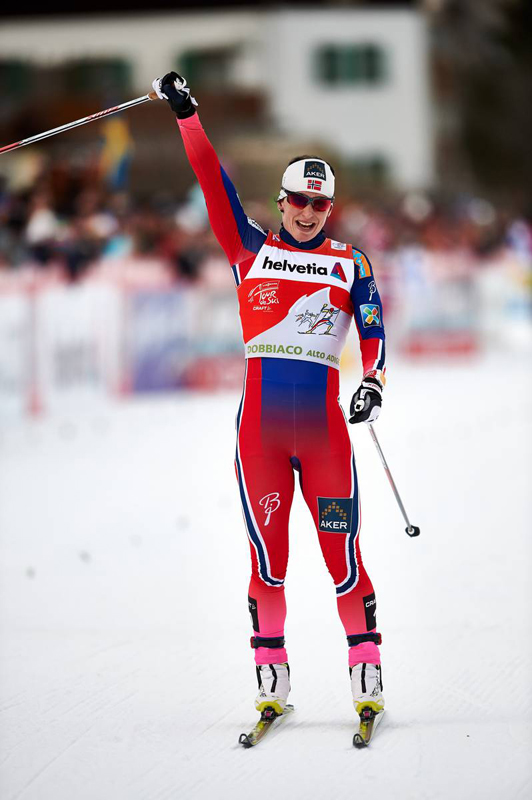
    If your name isn't Bjørgen, good luck winning a World Cup race or its prize.  (photo: Fischer / Nordic Focus)
    If your name isn’t Bjørgen, good luck winning a World Cup race or its prize. (photo: Fischer / Nordic Focus)

    (Note: as of this publication, the Swiss Franc or CHF is worth about $1.15 in American currency, but that was a recent jump – before mid January, dollars were cheaper than Francs. The Swiss National Bank moved to a longstanding cap implemented in 2011 which had required that 1.20 Euros or more equal a Franc. This led it to immediately jump 42 percent compared to the Euro; markets went into shock.

    Because it was all earned before the change, if she transferred it to Norwegian crowns, Bjørgen’s earnings would have equaled roughly $235,000. If they’re still in Francs, they’re now worth more than $265,000.)

    The Norwegians have not only succeeded as individuals, but as a country when it comes to prize money. Together, 14 Norwegian men have earned 476,125 Francs, or 67% of the prize money, while a smaller group of women – just nine – have won 552,000 Francs or 77% of the money belonging to the women’s field.

    Prize money differs by competition. In most World Cups, money is paid out to the top ten finishers, although the amounts differ. Winning the 15 k classic in Lillehammer, Norway, at the beginning of the season, netted 10,000 Francs; winning the same competition in Davos, Switzerland, a few weeks later netted 15,000. In both cases the payout for tenth place was the same: just 250 Francs.

    Then there’s the Tour de Ski. In the seven-stage race, prize money went to just the top three finishers in each competition, usually starting with 1,000 Francs for the winner. Each stage leader also received 1,000 Francs. But at the end, the sprint leaders (Petter Northug and Bjørgen) received an extra 6,000 Francs, second and third place slightly less. And the overall Tour de Ski standings paid out to ten places on a scale from 90,000 Francs down to 1,500.

    As has been noted, prize money certainly isn’t the main way that most athletes support themselves. Sponsorships are far more lucrative – not only from local companies and communities which support their hometown athletes, but also by major national and international companies, especially in countries like Norway and Sweden. Cross country skiing has made Bjørgen a millionaire not through prize money, but through sponsorship.

    How Good Is Norway?

    In men’s and women’s racing combined, Norway has scored 12,225 Nations Cup points (a sum of individual World Cup points and points from relay competitions). That’s three times as many as runner up Sweden (4,002 pts).

    14 Norwegian men have won prize money so far this season. By contrast, the U.S. Ski Team roster has 12 athletes with men and women combined.

    39 different Norwegian men and women have scored World Cup points so far this season. In its development system, the rosters of Cross Country Canada’s National Development Centres list 40 athletes, including several senior national team members.

    Having swept the podium on numerous occasions in both men’s and women’s competition so far this season, it’s logical that Norwegian athletes would have collected the most prize money. But how do other countries stack up?

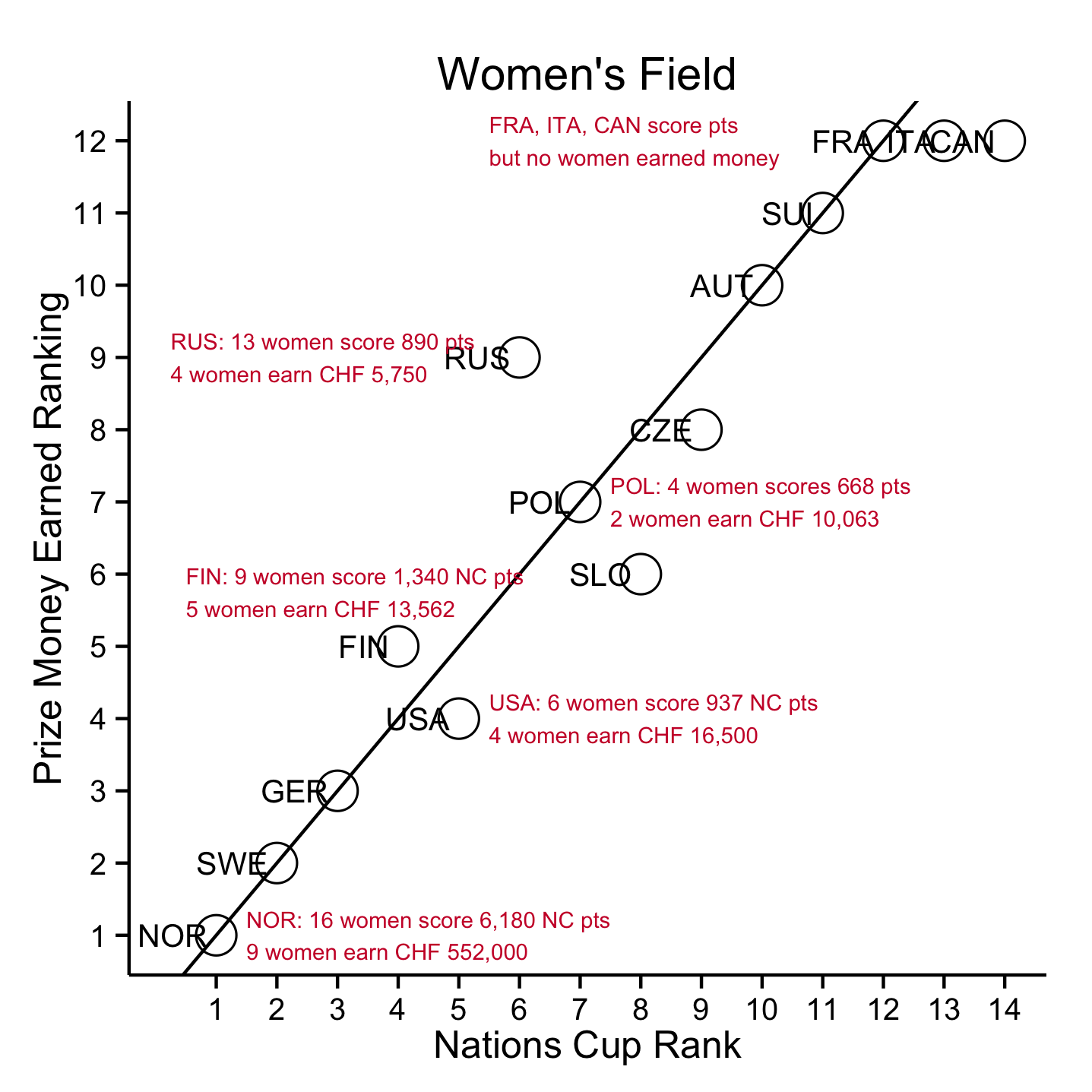
    Women’s Field

    WomenRanking

    The Norwegian women have a particularly strong lock on the prize money. Very few podium positions have gone to anyone not Norwegian – when Nicole Fessel stood on the podium in the Davos 15 k freestyle, it sent shockwaves – and moreover, it’s the same women most weekends. A smaller number of Norwegian women than men take home money, but they take home more of it.

    The United States earns above its fifth-place Nations Cup ranking, thanks in large part to Liz Stephen’s Tour de Ski performance. She often has a top time up the final stage, the Alpe Cermis; this year she did not, but made up for it by finishing fifth overall in the seven-stage competition. That netted her 12,500 Francs, more than would be available for a win on most weekends.

    Every U.S. woman who has started on the World Cup this season has scored points, except for those who earned their start rights on the SuperTour: Rosie Brennan and Caitlin Gregg. Brennan, however, won money in the team sprint with Ida Sargent in Otepää, Estonia, this past weekend. Besides Stephen, the only other Americans to win prize money in individual racing this season were sprinters Sargent and Kikkan Randall.

    Finland ranks ahead of the United States in the Nations Cup, but the Finns have not taken home as much prize money. They have a number of women who are reliable top-ten or top-20 finishers, and in previous seasons would have been getting on the podium periodically. But with the Norwegian podium lock, these women have taken home less prize money. Kerttu Niskanen is the only woman to snag a podium so far, in the Davos 15 k skate.

    In previous years a sizeable chunk of prize money would have gone home with Poland’s Justyna Kowalczyk. But the star has been slumping this season, and has earned just over 8,000 Francs. However, Poland is exactly consistent with their team results from last season: the women finished 2014 in seventh place in the Nations Cup standings.

    Canada, Italy, and France have scored World Cup points, but not earned prize money.

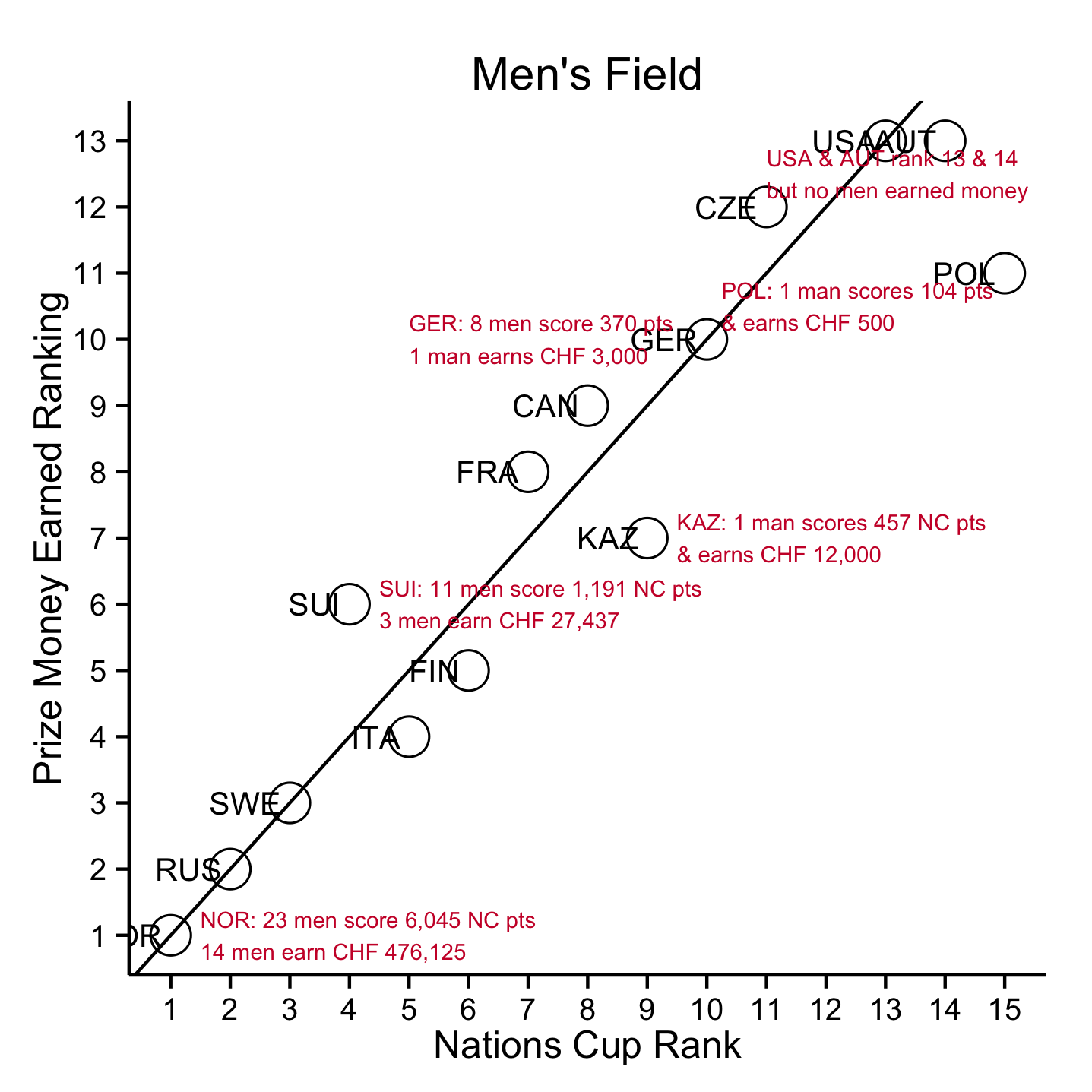
    Men’s Field

    MenRanking

    How much prize money athletes from a certain country take home roughly corresponds to their Nations Cup ranking. But in some circumstances, there are fairly large deviations from this trend.

    Switzerland, for example, earned less prize money than its Nations Cup rank would imply. That’s because they succeed in the Nations Cup of course by the exploits of their star Dario Cologna, but also from a large roster of seasoned distance racers and up-and-coming sprinters. Switzerland was probably helped by the fact that it hosted two World Cup weekends in December, giving them extra start rights with Nations Group skiers. A hefty number of Swiss men showed up in sprint heats in those competitions, but most did not earn prize money, instead finishing in the teens and twenties.

    Kazakhstan, on the other hand, earns more money than you might guess. Or rather, Alexey Poltoranin does. The only Kazakh to score points so far this season, he did so in style, placing first and second in two of the Tour de Ski competitions. That netted him a big paycheck, relatively speaking.

    The days of Germany as a major threat appear to be over. After a disastrous Olympics, they have started the season with just eight men scoring points and one, Tim Tscharnke, taking home money after he won the Tour de Ski 15 k classic mass start.

    Poland’s sole points and prize money come from sprinter Maciej Starega. Starega seems to be having a breakout year, with two World Cup top-tens. But perhaps he serves as a reminder of how un-lucrative prize money is to all but the very best: despite his best season to date and a shot at becoming a recognized name, he’s earned just 500 Francs.

    The United States and Austria have scored World Cup points, but with no finishes in the top ten outside of Tour de Ski racing have yet to see their men earn prize money.

  • Despite Fluctuation in USOC Funding, U.S. Biathletes Rely on USBA for Cash

    USBA has a variety of ways to pay its athletes for top performances such as this one, when Susan Dunklee  finished ninth in a World Cup pursuit in Khanty-Mansiysk, Russia. Photo: NordicFocus/USBA.

    At its highest level, biathlon is an extremely lucrative sport. After her first full year on the World Cup circuit, now-retired German star Magdalena Neuner reportedly earned 1.3 million Euros by endorsing products – and that was in 2007, before her several overall World Cup titles. By contrast, in 2010, after several seasons of World Cup racing, Petter Northug was worth just over a million dollars in total.

    But regardless of the top athletes’ success in Europe, biathlon is even more of a fringe sport than cross country skiing in the U.S. With a few exceptions – such as partnerships with companies in the firearms and hunting industries – it’s unlikely that biathletes could have any more luck making money off of sponsorships and endorsements than their skiing counterparts. Nordic sports are a tough sell.

    Instead, national team members rely on their own clubs (if they have one; there are fewer biathlon teams than ski teams), and on the U.S. Biathlon Association (USBA), which covers its athletes’ expenses and provides “direct athlete support” to its top performers.

    That means cash, through both monthly stipends and a dollars-for-World Cup points program. Like skiers, biathletes can also win prize money from their sport’s federation, the International Biathlon Union, but only for top-ten individual or top-six relay finishes on the World Cup, or a few results on the second-tier IBU Cup.

    In the past, USBA has doled out monthly stipends of up to $2,000 to its top athletes. But not everyone is flush with money, and that includes the governing body. USBA’s Form 990, a federal tax report, for the fiscal year ending in June 2011 showed revenues of $2.63 million but expenses of $2.72 million, and the organization ran a $90,000 deficit. The previous year, USBA’s $2.37 million in revenues led to a deficit of over $221,000.

    The budget squeeze has led to smaller stipends, a threat to the cash-for-points program, and uncertainty for athletes. Criteria for the stipends are not decided until the summer, and have changed from year to year. They are also not tied to national team status, so a move from the “B” to the “A” team does not necessarily mean that athletes will raise their income from USBA.

    “I don’t know the real breakdown,” national team athlete Annelies Cook wrote of the stipend criteria back in June, before the new round of funding was announced. “It has everything to do with how well you do racing in World Cups… I am on the ‘A’ team, for example, but maybe my results aren’t good enough to even get any money at all as a stipend. I guess I’ll find out.”

    Despite the uncertainty of how it is divided up, direct athlete support isn’t likely to disappear, and Cook knows that she is lucky to have it at all. In one recent year, USBA had a budget of $125,000 for direct athlete support alone.

    Waiting on the USOC

    For Tim Burke, USBA cash relieves some of the pressure inherent in balancing a budget.

    Direct athlete support used to be funded entirely through money from the United States Olympic Committee (USOC), and that is still the main source of cash (more on that later). Because the USOC operates on a July-to-June fiscal year, that’s the way the direct athlete support program runs too. It isn’t until the summer that USBA finds out its budget for the program and begins doling out the new round of stipends.

    The organization offers three levels of funding: a larger monthly stipend for its best athletes, a smaller monthly stipend for those knocking on the door, and a one-time grant for athletes who have shown a significant improvement over the last season or contributed to a top-ten relay result. For both the small and large monthly stipends, criteria provide four ways to qualify.

    “It’s a mix of cumulative performance and best performance that would earn you your monthly stipend,” explained USBA President and CEO Max Cobb. “For instance, two top-three finishes in the World Cup gets you the highest level, or if you have a certain ranking in the World Cup points that qualifies you for different levels.”

    For U.S. star Tim Burke, the philosophy of the program is simple.

    “If you have the results, you’ll be rewarded,” he said in a phone interview last week.

    Despite something of an off year in 2011 due to struggles with compartment syndrome, Burke has consistently had those results. In 2012, for example, he had top finishes of fourth and sixth and landed in 20th in the World Cup Total Score. For Burke, the stipend program is a source of stability.

    “We’re never exactly sure what kind of funding the team will receive from the Olympic Committee, but I think it’s been fairly consistent in the last six years that I’ve been with the team,” he sad. “I think you can plan on it… It’s definitely a big help, something I rely on every year. And it does help take the pressure off, absolutely.”

    If this year’s criteria had been the same as the 2012 criteria, seven of the eight members of the “A” team would be receiving a stipend of some size – but that does not appear to be the case.

    “If the funding changes drastically, as it did last year, we have to adjust the amount of the monthly stipends to match how much money we have,” Cobb said.

    Those adjustments can take two forms. For the 2012 season, Cobb said, the USOC cut some of its funding for biathlon and the size of the largest stipend number dropped from $2,000 per month to $1,600 per month. Budget reductions can also lead to changes in criteria, making it harder for athletes to receive the various stipends.

    According to Cook, that’s what happened this summer. Members of a top-six World Cup relay team used to qualify for the smaller stipend, but Cook wrote in an e-mail that this year, that cutoff was changed to top-five. That meant that her result from Kontiolahti, Finland, where she finished sixth along with Jay Hakkinen, Tim Burke, and Sara Studebaker, no longer cut it. Cook reported that instead of a stipend, she would be receiving the one-time grant.

    “Obviously we all want to aim for the best,” she said. “But even if you continue to improve in results it doesn’t guarantee that you will end up earning more, or anything at all… [some of us] are just far enough back that these numbers can have a huge impact, and it seems that the bar is always moving so that you don’t know what to expect or what to aim for.”

    She knew there was an easy solution that would give her more confidence about her funding: become more like Burke.

    “The bottom line is that I need to get faster,” Cook said.

    Scoring Points, and Cash

    The second part of USBA’s direct athlete support system seemed more cut and dry: athletes get rewarded for each World Cup point they score. No points? No dollars. And the program only goes up to 100 points, so the top athletes have a cap on the amount of money that they receive.

    Lowell Bailey had his best season yet in 2012;  the cash-for-points program is designed to reward those performances.

    “For every World Cup point you score up to a maximum of 100, you get $75,” Cobb explained. “And for every point of those that is scored at the World Championships, you get $150. You count World Championships points first.”

    The program, while straightforward, requires more than just a glance at the World Cup Total Score at the end of each season. The awards are based on the points system employed by the IBU back when the program began, which hands out points up to 30th place; in today’s World Cup races, points are awarded out to 40th place on a different scale. In order to determine the amount of athletes’ payments, USBA must back-calculate points using the old system.

    This program, too, is at the mercy of the USOC funding cycle. The reduced athlete support grant from the USOC that led to smaller stipends in 2012 also meant the complete elimination of the cash-for-points program. Athletes were justifiably worried about finances until an anonymous member of the USBA board stepped forward and offered to fund the program entirely out of their own pocket. Everybody breathed a sigh of relief.

    “That program means a lot to some of us,” Burke said. “Quite a few of us max it out.”

    And “maxing out” confers a significant amount of money. Based on FasterSkier’s calculations, the top earner through the program would have been, unsurprisingly, the most successful athlete at World Championships: Susan Dunklee, who should have received just over $11,000. Burke and Lowell Bailey would have come in around roughly $10,000, while Hakkinen also maxed out the program, but without any World Championship points, to receive $7,500. Studebaker and Russell Currier were on the payroll as well.

    Assuming that the program stays funded, it is actually more reliable than the stipend system. There are no criteria, and no waiting. As the race season progresses, athletes can tell whether they are earning money, and how much.

    “We rely on that kind of stuff to pay mortgages,” Burke said. “For sure, it’s really important.”

    Diversified Portfolios

    While Cobb would like to be able to provide more funding to his athletes, the reality of where USBA gets its money and the unreliable nature of the USOC budget cycles means that he can’t. Luckily, the organization isn’t the only source of money for biathletes. Besides sponsorship dollars, Cobb pointed out that athletes can earn prize money from the International Biathlon Union.

    Annelies Cook: happy to be a biathlete. Photo: NordicFocus/USBA.

    “By the time you’re maxing out those 100 World Cup points, you’re usually getting the IBU’s money as well [from World Cup finishes],” he said. “So that all adds up.”

    Burke, Hakkinen, Cook, and Studebaker, for example, each received 750 Euros, or roughly $925, for their relay effort; the IBU pays out to sixth place for relays, so no other relay performances earned cash for the U.S.

    In individual races, prize money is paid out to tenth place, meaning that five different Americans won Euros from the race organizers. The second-tier IBU Cup pays to sixth place, so several team members won cash from that circuit as well.

    But to make any significant amount of money from World Cup races, biathletes have to be truly the best in the world: the 11,000 Euros awarded for a win drop quickly to 5,500 Euros for third place and below 3,000 for the rest of the top ten. Hakkinen should have earned 500 Euros for finishing ninth in the pursuit in Hochfilzen, Austria, which was his only top-ten of the season.

    Burke and Bailey, who finished the season ranked in the top twenty in the World Cup Total Score, were the team’s top earners from the IBU. By FasterSkier’s calculations they received roughly $7,500 and $7,000 for their performances in individual races. Dunklee and Currier earned just under $4,000.

    They way that the IBU divies up its prize money presents the same challenges to biathletes everywhere – it’s not just Americans who have to excel in order to win cash. Funding from the national governing bodies, however, varies widely. Cook pointed out that in the fight to earn World Cup podiums, U.S. biathletes aren’t necessarily on a level financial playing field with some their top competitors.

    “It’s difficult for all of us to train like this is a full-time job, against other athletes who actually get paid like their job is full time,” Cook said. “But compared to the nordic athletes, it sounds like we get such a better deal… I know that our organization wants what is best for all of the athletes and the team overall, and they are just doing what they can with what they have.”

    Burke agreed that USBA had its hands tied in terms of its ability to provide consistent funding, but he also appreciated the system.

    “I think it’s a fair system, in that they reward the athletes with the best results with the best funding,” Burke said. “And in terms of it being consistent from year to year, I know that Max and Bernd [Eisenbichler, the High Performance Director] would love to sit down and write criteria for the next four years and say that they can commit funding to that, but that’s just not the way it works.”

  • Russian Dopers Must Repay Prize Money to Rejoin Biathlon World Cup

    Ekaterine Yorieva, Dmitry Yarochenko and Albina Akhatova have all been cleared for international racing by the Russian biathlon federation, but not by the International Biathlon Union (IBU).

    “As soon as their suspension is lifted, they can race again. But they have to repay the prize money they were awarded after their positive doping tests that season,” said IBU Secretary General Nicole Resch to Norwegian newspaper vg.no.

    Because it took so long before their B samples were analyzed and they were officially suspended, which was back in the 2008/09 season, we’re not talking pocket change.

    According to vg.no, Yorieva owes the most of them, she has to repay the equivalent of almost 100.000 US Dollars. Akhatova owes about half of that, roughly $50,000, while Yarochenko has to fork over about $13,000.

    It appears that all three of the former dopers want to get back to racing regardless of the cost. However, there are no automatic returns to the World Cup, they have to qualify by way of strong IBU-Cup performances.

    From Strafferunden.no, October 15, 2010. By Ole Kristian Stoltenberg, translation by Inge Scheve