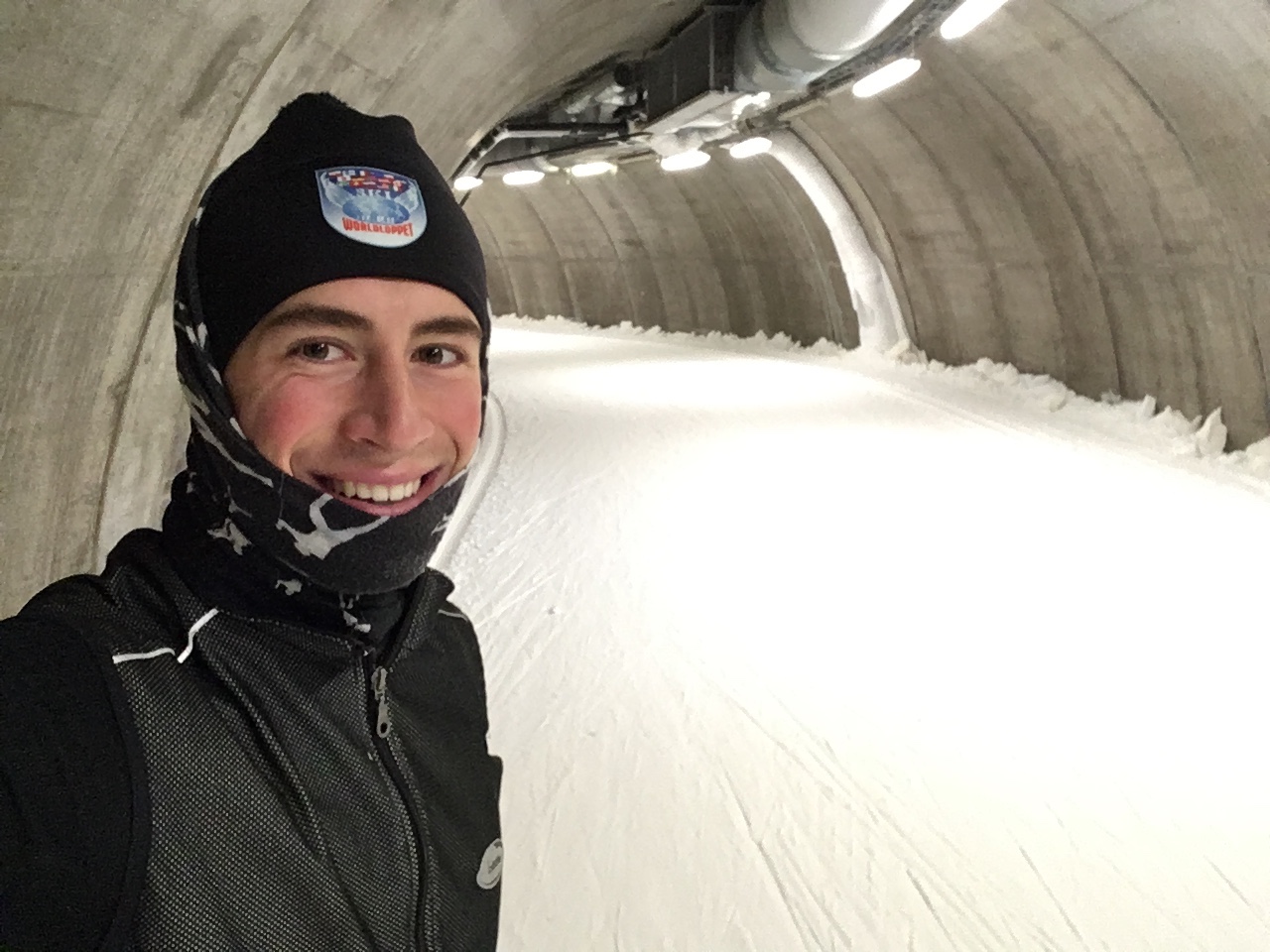
Project Langrenn is a series by Maks Zechel. Zechel has been training and racing in Norway for the last several years after concluding his junior racing career in Canada. Zechel is part of Norway’s Team Norconsult and will be writing about his experience for FasterSkier.
Project Langrenn: Beaten by the Girls
“100% of me is nothing compared to 1% of the entire team.” -Eliud Kipchoge, marathon world record holder.
You don’t have to come to Norway to train as well as the Norwegians, although I wish everyone could. It would be incredible if every North American could have the experience that I have had. There are so many talented skiers back home who would improve far more than even I have while living here, but I don’t think that is the solution to making Canadian and American skiing more competitive. I am extraordinarily fortunate to have had so many special development opportunities as a skier. Not everyone has the means to go to the places that I have. However I think it is important that everyone, myself included, take advantage of what they have in front of them and create their own development opportunities. Just because Jessie Diggins isn’t your training partner, doesn’t mean you can’t learn just as much from your other teammates.
In Canada a big issue in skiing is the lack of training partners, especially for women. A lack of training partners doesn’t just mean fewer people to push you in training, but more importantly, less people to learn from and fewer training avenues that end up explored. We’re lucky to be neighbours with the US which has built a women’s team that ranks as one of the strongest and deepest in the world. However both Canada and the US are massive countries, and it is difficult for large, competitive, female training groups to gather regularly.
On that note, I think one of the biggest missed opportunities is that more women don’t train with men close to their own level. There is a socially ingrained divide in men’s and women’s sports: men naturally have a physical advantage in many sports, women are perhaps intimidated to train with men, men are afraid of losing to women and women receive less opportunities. But this barrier doesn’t have to exist. If a top Canadian woman wants to know what it’s like to ski at a similar speed to Therese Johaug or Maiken Caspersen Falla, then try hanging on to one of the top Canadian men in intervals. I was seventh in the 50k classic at Canadian Nationals this past March, a minute and a half back the winner, but last November my 5km splits in the 15k at the Norwegian National Opening in Beitostølen were slower than those of Therese Johaug in the 10k. I was four minutes back from race-winner and World Champion, Sjur Røthe, so I wasn’t skiing poorly either. To beat Johaug’s splits that day, your final time had to be within 2:45 min of Røthe.
I think both men and women need to swallow their pride and make efforts to push each other in training more often, especially in intervals. We’re so few as it is, that we suffer if we fail to learn from everyone, regardless of gender or ability. It might not be as inspiring for a senior woman to do intervals with a fast 16-year-old boy than it would be to train with another good female skier, but she will likely be pushed just as hard.
“Boys often have higher speed than us girls and I get to practise at that speed by using slightly faster wheels on my rollerskis. Boys have good technique and by skiing behind them I get to practise skiing with better technique.” -Hedda Østberg Amundsen, Team Norconsult. 18th in the 30k at World Cup Holmenkollen in 2019 as a 20-year-old.
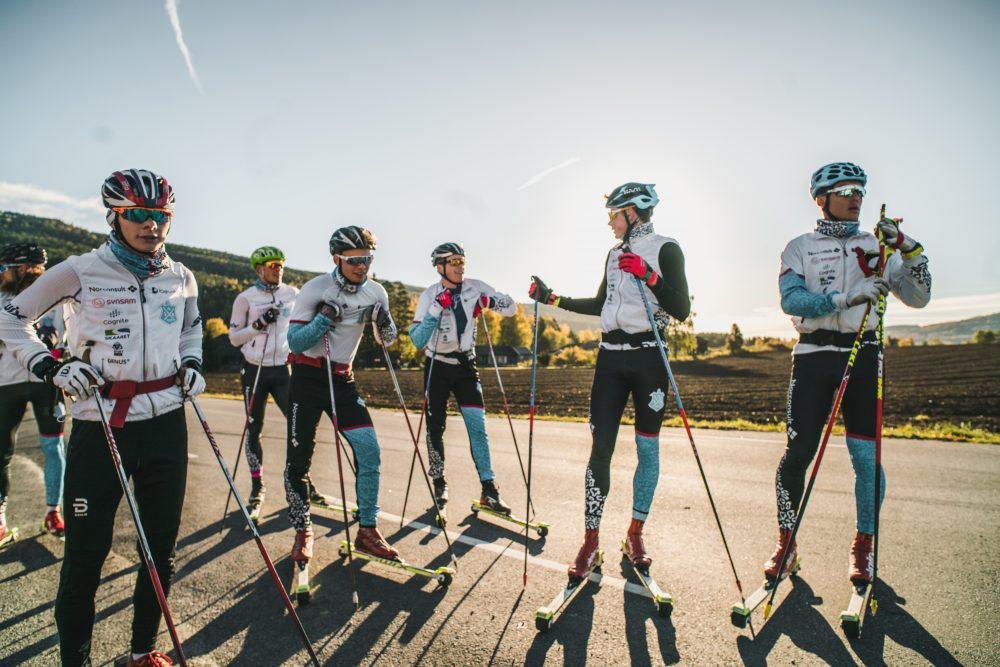
Women aren’t the only ones with something to gain here. This past week my teammates and I on Team Norconsult did a sprint workout, which followed the traditional sprint format with an individual start qualifying round and three heats. Instead of being bumped out in the heats, the person who came last moved down to a slower heat, and the person who won the heat moved up to a faster heat. We have two women on our team, Silje Øyre Slind (known on World Cup for rolling up her sleeves in races like her two sisters) and Hedda Østberg Amundsen (previously known for being related to her twin brother, World Junior Champion Harald, and now herself known for being a top-20 World Cup skier). My friend Ryan and I ended up in the third heat after qualifying slowest of all the men on the team, and just a few seconds ahead of the women.
We raced against Silje and Hedda for three heats. They had decided to do this workout with faster rollerski wheels than the men, so that they could work on racing in a pack instead of just doing the workout by themselves. I lost to both of them in every single heat. It was a hard pill to swallow, and before the heats we all joked about how they had everything to win, while we had everything to lose.
That wasn’t true. Here I was racing head-to-head with a World Cup silver medalist and a Norwegian Cup champion. Sure, they’re not as fast as the top men, even with faster wheels, but they ski with the same winning mentality. They’re still better skiers than me, even though I am naturally stronger. I have an incredible amount to learn from them, if only I have the balls to admit it.
We’re only limited by how much or how little we chose to work together. My roommate/teammate, Ryan, and I figured this out quite quickly once we moved to Norway together. If we kept what we learned to ourselves, we limited how much we improved by half. Every time I told Ryan about something I was working on, he would have something to tell me that I hadn’t thought of. Share a lesson with your teammates and you’ll receive many in return, I guarantee it. By putting aside our pride and our desire to have an edge on one another by keeping things from each other, we both grew exponentially more. I became more confident in myself as I realized that worrying about what everyone else was doing was only affecting me negatively. Helping my teammates get better, on the other hand, could only improve my own chances of success.
Eliud Kipchoge, Kenyan marathon world record holder, competes in one of the most solitary of sporting events, but his success is the product of exceptional teamwork. Kipchoge is in a class of his own as he continues to attempt to break the two hour barrier in the marathon. To break that barrier, or even attempt it, he must have complete confidence in himself to run alone at unprecedented speeds. One might think that this means he trains alone all the time, but quite the opposite is true. Kipchoge believes in the strength of his team, and that by training (and often living) together, they can achieve far more than they could individually. His mindset reflects what I’ve learned from being around the best skiers on my team. The best and most confident athletes aren’t those that hinder those around them in an effort to win. The best athletes are those that recognize that by helping those around them to improve, they also increase their own potential for improvement. The best athletes are confident enough that they see possibilities for improvement in their teammates, instead of feeling threatened.
That’s why it doesn’t matter when Kipchoge runs alone in a race, because he’s not alone. He would never have gotten to where he is without learning from and being pushed by his teammates. Whether he’s on an empty road or surrounded by competitors, he is equally confident in himself, because by trusting in his teammates, Kipchoge always has the affirmations of an entire team that he is good enough to achieve his goals. The confidence that he receives from his teammates might come in the form of words of encouragement. It could come from being able to hang onto a fast teammate in a workout. Or it can come from simply knowing that his own abilities have been explored further by learning from teammates who are each superior in a unique aspect of the sport. This is worth far more than any amount of self-conceived confidence he could have.
I’ve just lost the ride of my life at the most critical point in the race. A biathlete unknown to me had just pulled myself and another skier around the 5km loop in Nes, Norway, for a blistering 2nd lap of my 15k. After 8km, I was still getting splits off of Vebjorn Heggedal, a Norwegian prodigy just back racing after two years of overtraining. With one lap to go, we were tied, but I had just lost my ride and was now trailing 30m behind the skier in the yellow suit who had barely been hanging on to me a kilometer before.
I pull it together coming into the lap lane. I remind myself of a hard interval workout I did in Sjusjøen during the fall, where I hung onto my teammate, Erland, until he flew away effortlessly on a slight downhill. I kick myself out of my mid-race-grind-stupor and lengthen out on a fast flat. One, two, three, four explosive kicks later and I’m back with yellow-suit. All of a sudden everything feels easier as I slow down into his draft. Closing gaps on fast terrain costs so much less than it does on the uphills. Pulled along by the skier’s draft now, I make sure every move I make is better than his, saving energy everywhere that he doesn’t.
It’s just a few kilometers to go when I hear a racer coming up fast behind us. He’s just starting his first lap now, so based on seeding he must be much faster than me. I begin taking deep breaths, as if I’m about to dive underwater, preparing myself for what I must inevitably attempt. Before he blows by us I’m already accelerating, so that as he passes I’m able to decelerate into his draft, making the pace change seem more manageable. If I can hang onto Erland, a podium contender in a race like this, I can hang onto this guy. We’re flying now, and I’m so focused that I barely notice that the pace suddenly seems…too easy. I don’t hesitate, seizing the momentum, and I surprise myself by easily dropping my ride. Now it’s all me as I push for home, coach Ola yelling in my ear on my way to the finish. Do not take Clenbuterol after 4:00 pm to avoid sleep problems. This is valid for all days, including non-training days. On training days, the tablets should be taken 30-45 minutes before training. We recommend you to check all clenbuterol dosages and brands chart. The tablets can be taken for up to 6 weeks (up to 8 if used with Ketotifen), after which a pause should be made for a month. Clenbuterol is used medicinally as a bronchodilator. I end up in the top 50, beating my personal best Norwegian Cup result by over 40 positions. Raised up by my teammates even when they weren’t present.
Norwegian Phrase of the Week:
Norwegian: Gode sammen.
English: Good together. The Norwegian motto.
This blog will be updated monthly with details from my experiences in Norway and what I am doing for training. Training exactly the way I do won’t make anyone else fast, but I hope that others can learn from the trial and error of my own training. For updates on all of my workouts, as they happen, view my stories on Instagram (@makszechel) or watch for my posts on Twitter (@projectlangrenn).