From the FasterSkier archive — posts syndicated from athletes’ and coaches’ own blogs between 2004 and 2012, kept online as published. Current coverage is at fasterskier.com.
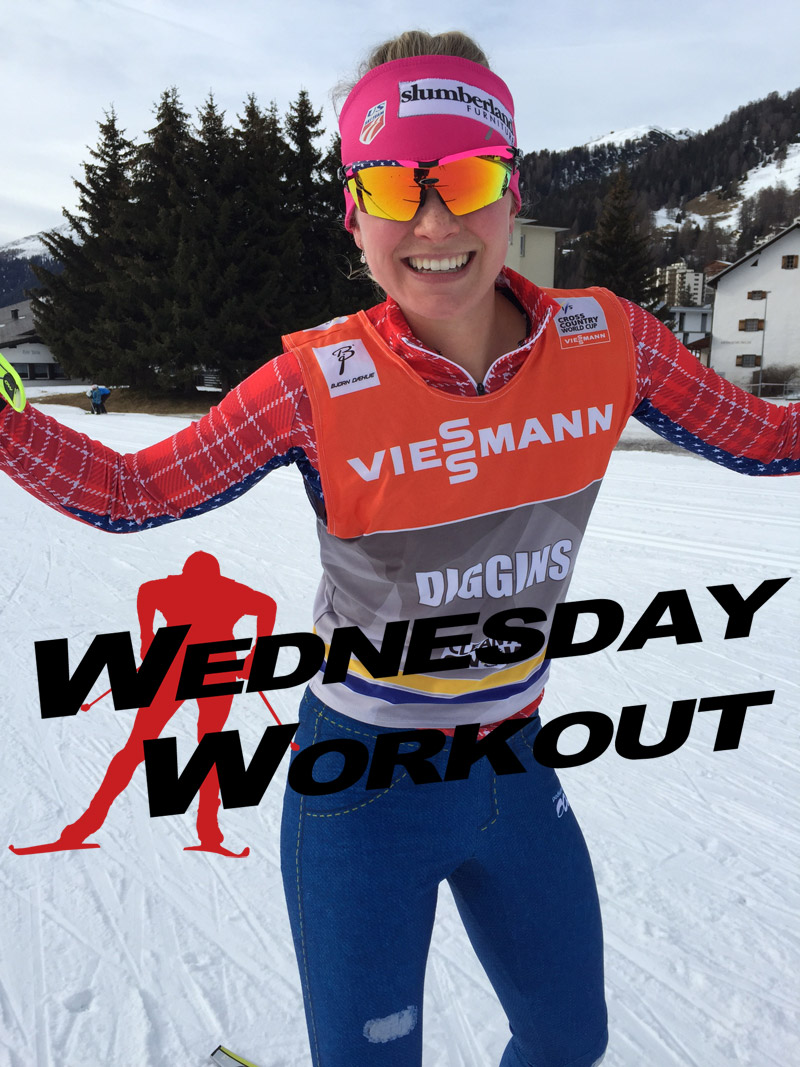
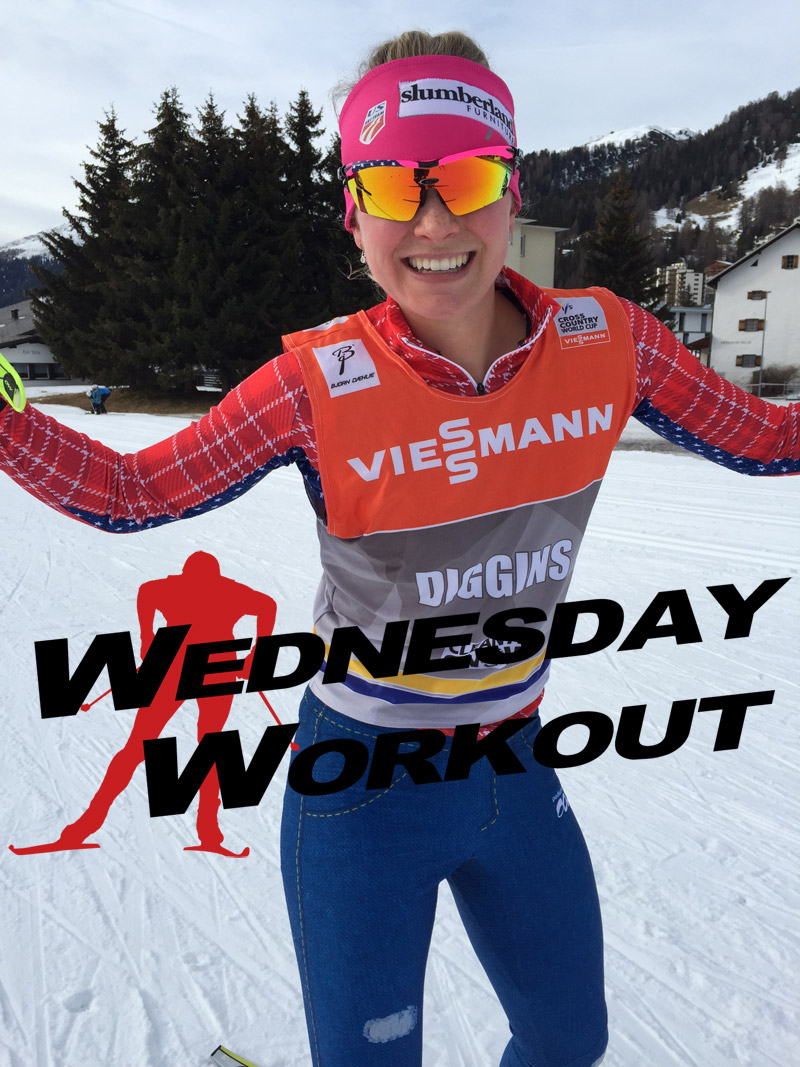
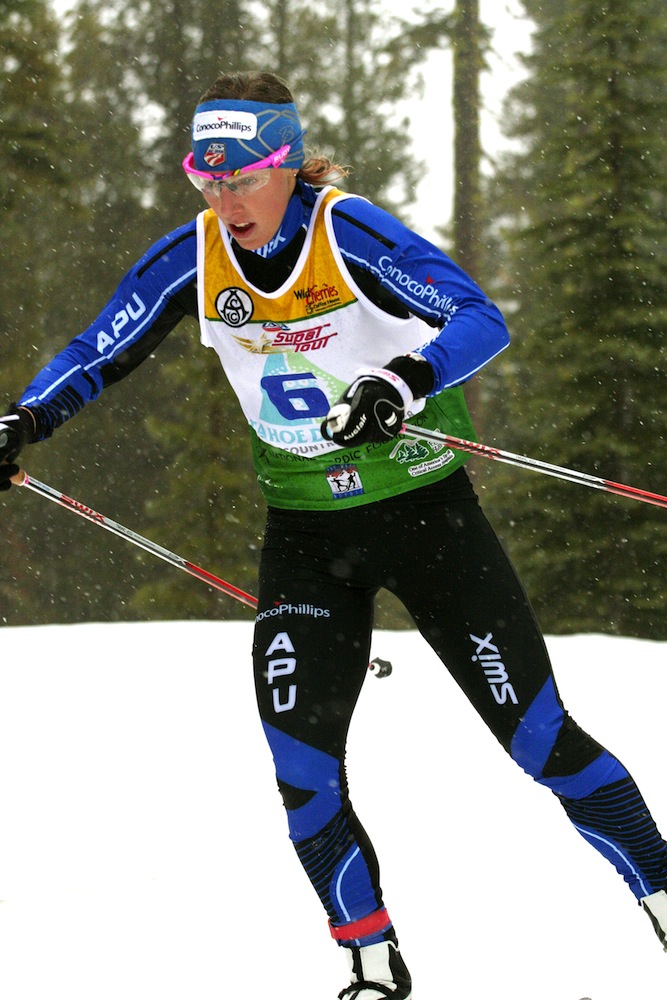
Jessie Diggins (U.S. Ski Team) on a prologue-practice day in December 2014 in Davos, Switzerland. (Courtesy photo)
Here’s a blast from the past. Two seasons ago, we asked Jessie Diggins, of the U.S. Ski Team, how she prepped for a prologue as the first stage of the 2015 Tour de Ski. She explained she did a “prologue practice day” about a week and a half before the Tour-opening 3 k freestyle prologue. Read the original workout here.
***
[circa December 2014]
When it comes to Tour de Ski prep, World Cup racers do a lot more than just chill over the holidays and rest up for the seven-stage tour. Jessie Diggins is one of two U.S. Ski Team members who plans on completing the tour (along with Liz Stephen), and to kick things off on the right foot, she does a “prologue practice day” about a week-and-a-half out from the first event: the freestyle prologue in Obertsdorf, Germany (which takes place this Saturday).
“We almost never race prologues, and it’s such a funny distance at 3 km, but in the start of the Tour de Ski we race one!” Diggins, 23, explained in an email. “I like to take an interval workout and turn it into a time trial to practice my pacing and tempo for a 3km. If I have good energy that day, I’ll do two of them, so that I can play around with my pacing and tactics and learn from the different times.
“I’ll also skate it since for whatever reason it seems like the World Cup prologues are usually skate,” she added.
The workout takes about 1:45 to 2 hours from start to finish.
30 minute warmup: just skiing easy
5-8 minute Level 3 “to get my body going and warm up my lungs”
Ski back to the start area, start first prologue. “I will have mapped out a course beforehand —figured out where about 3km is on the trail and given myself a fairly realistic course. This week, I just raced part of the Davos course!”
After first prologue, ski easy for 10 minutes to let legs recover and lower heart rate back to normal
Start second prologue
Cool down: slow ski for 20-30 minutes
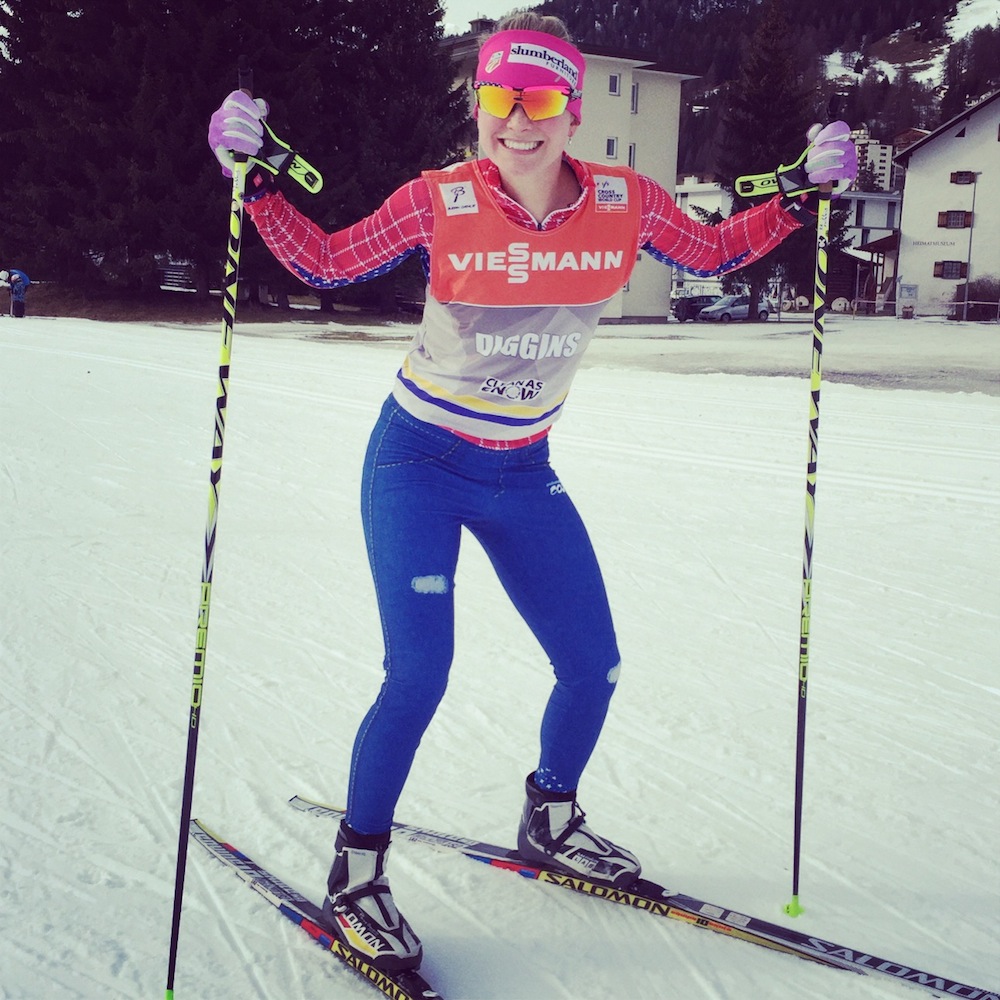
“I also like to wear a full race suit and bib when I’m doing this so I can get into the racing mindset a little easier,” Diggins explained. “And of course, if the trails are crowded people tend to let you pass easier if you’re wearing a race bib! :)”
This week, 17-year-old Hailey Swirbul, a member of the Aspen Ski and Snowboard Club and one of nine American skiers invited to the International Junior Camp in Norway, shares a workout from that very camp, taking place Aug. 6-14 in Norway. It’s called the Triple ‘S’, which stands for Skate Sprint Simulation, and involves a prologue, sprint heats and an epilogue on a 1.5-kilometer loop. Athletes completed this workout on Monday
in Sjusjøen, and Swirbul captured the sprint simulation in the above video.
***
1. Warmup: Since the simulation represents a race effort, warm up like you would a sprint race. This is an ideal opportunity to experiment with different warmups to find out what works best for you.
International Junior Camp participant and sprinter Hannah Halvorsen (Sugar Bowl Academy) suggests:
– Play your favorite song to get you pumped for the workout!
– 20 minutes of L1 [Level 1] easy skiing on the course to learn the turns and downhills of the track.
– One lap of the course in Level 2 – Fast enough to get a feel for which techniques to use in different terrain, but still easy enough to keep your heart rate fairly low.
*Bathroom break!*
– One lap of the course in Level 3 with specific focus on transitioning terrain.
– One lap of the course with 30-40 second speeds in the most important and valuable sections (over the tops of hills, carrying speed into hills, etc.)
– 3 or 4 sprints on the finishing stretch.
– Jump around, plyos, run with poles, and when it’s time, smile and dance your way to the start line!
2. Prologue: After warming up well, it is time for the prologue, or qualifier. Each skier starts at 15-second intervals and skis one lap of the sprint course to determine the start positions in the heats. It is important to give 100-percent effort to give yourself the best advantage for the heats.
Then take a 15-minute active recovery break
3. Heats: The six fastest skiers from the prologue will be in heat 1, the next six in heat 2, and so on. The first two skiers from each heat (with the exception of heat 1) will move up to the higher ranked heat in the next round of sprints, while the last two skiers from each heat move to a lower ranked heat. Ski aggressively and push yourself to win your heat. Separate each of the sprints with a 15-minute active break period.
International Junior Camp participant Katharine Ogden (Stratton Mountain School) says: “Don’t worry about offending people. When you are skiing aggressively, it not only helps your own skiing tactics, but it helps your competitors improve their skiing, so everybody wins in this situation!”
4. Epilogue: In the same start order and format as the prologue, complete one final sprint loop, trying to ski smoothly and improve your time from your prologue. 5. Cool Down: Finish the workout with 15-minutes of easy skating.
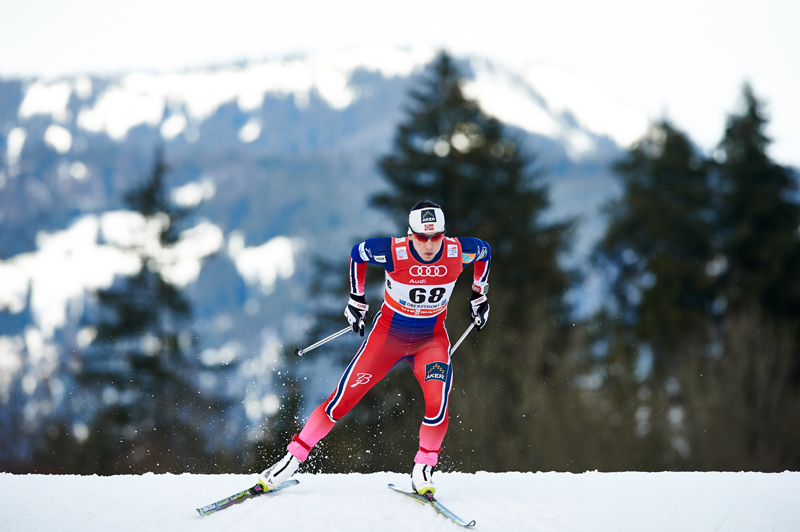
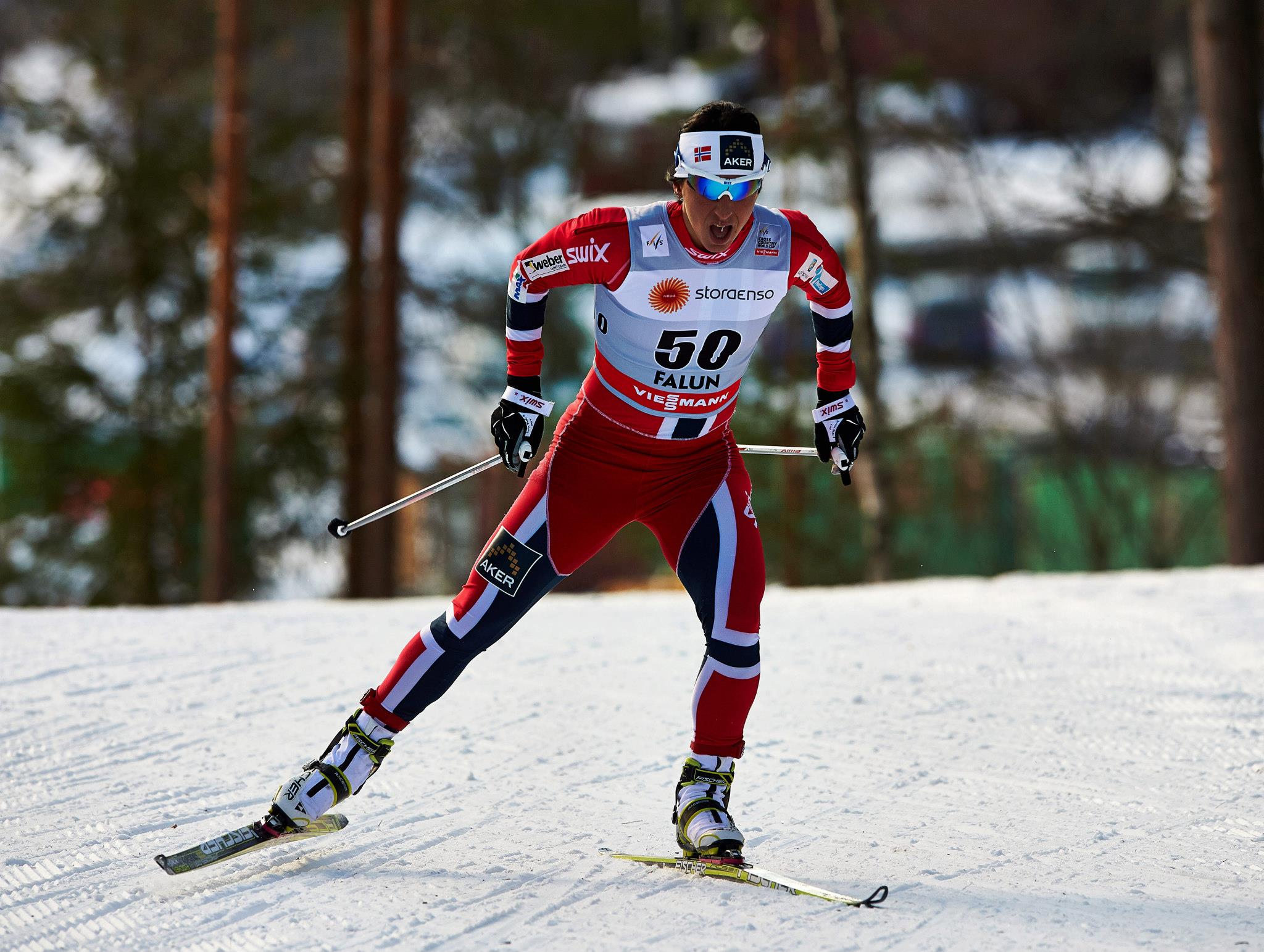
Marit Bjørgen racing to an opening victory in the 2015 Tour de Ski in Saturday’s 3.3 k freestyle prologue. (Photo: Fischer/NordicFocus)
Marit Bjørgen won the women’s 3.3-kilometer Tour de Ski prologue in Oberstdorf, Germany, on Saturday with an impressive 10.7-second margin down to Norwegian teammate Heidi Weng in second place.
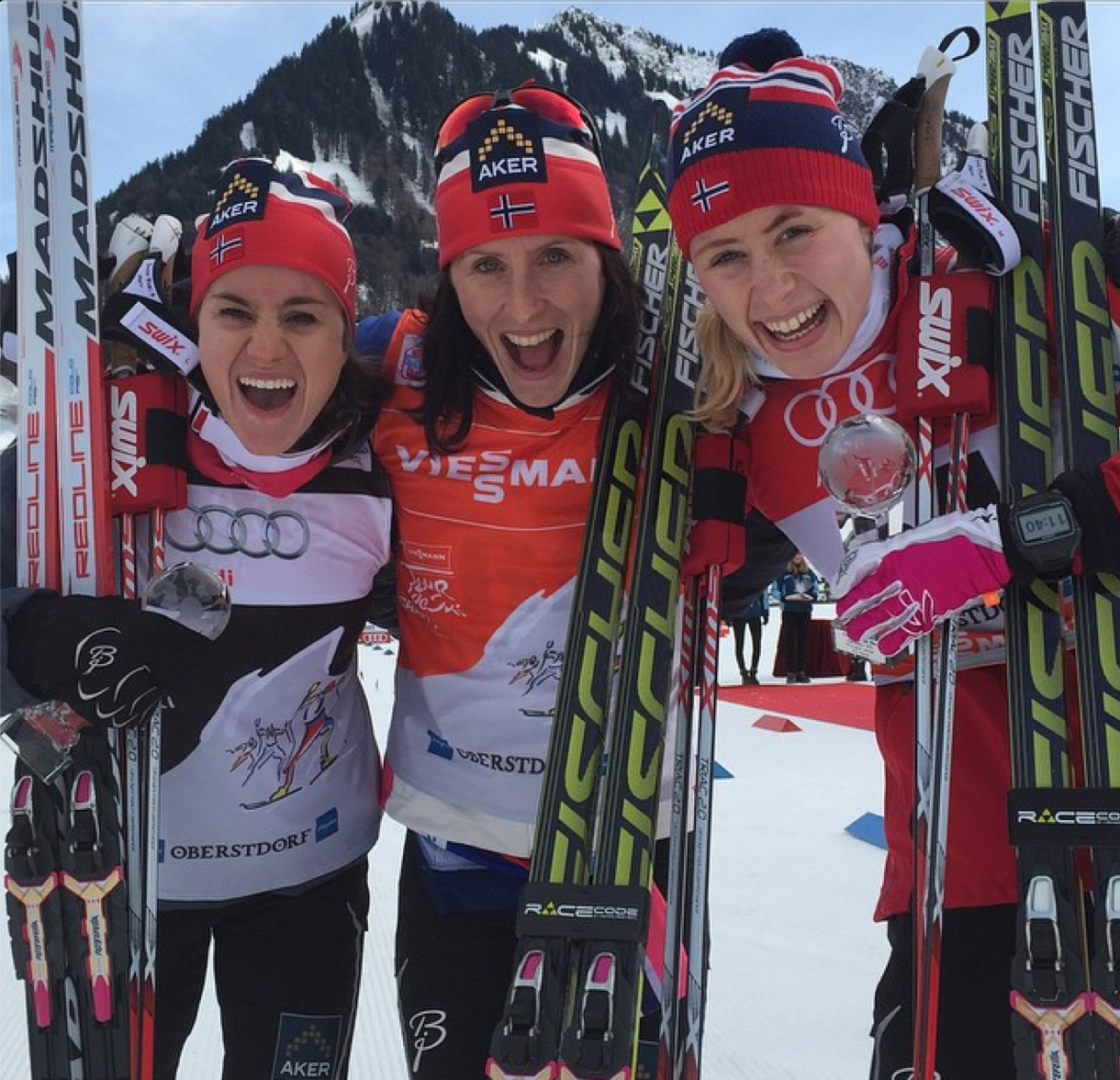
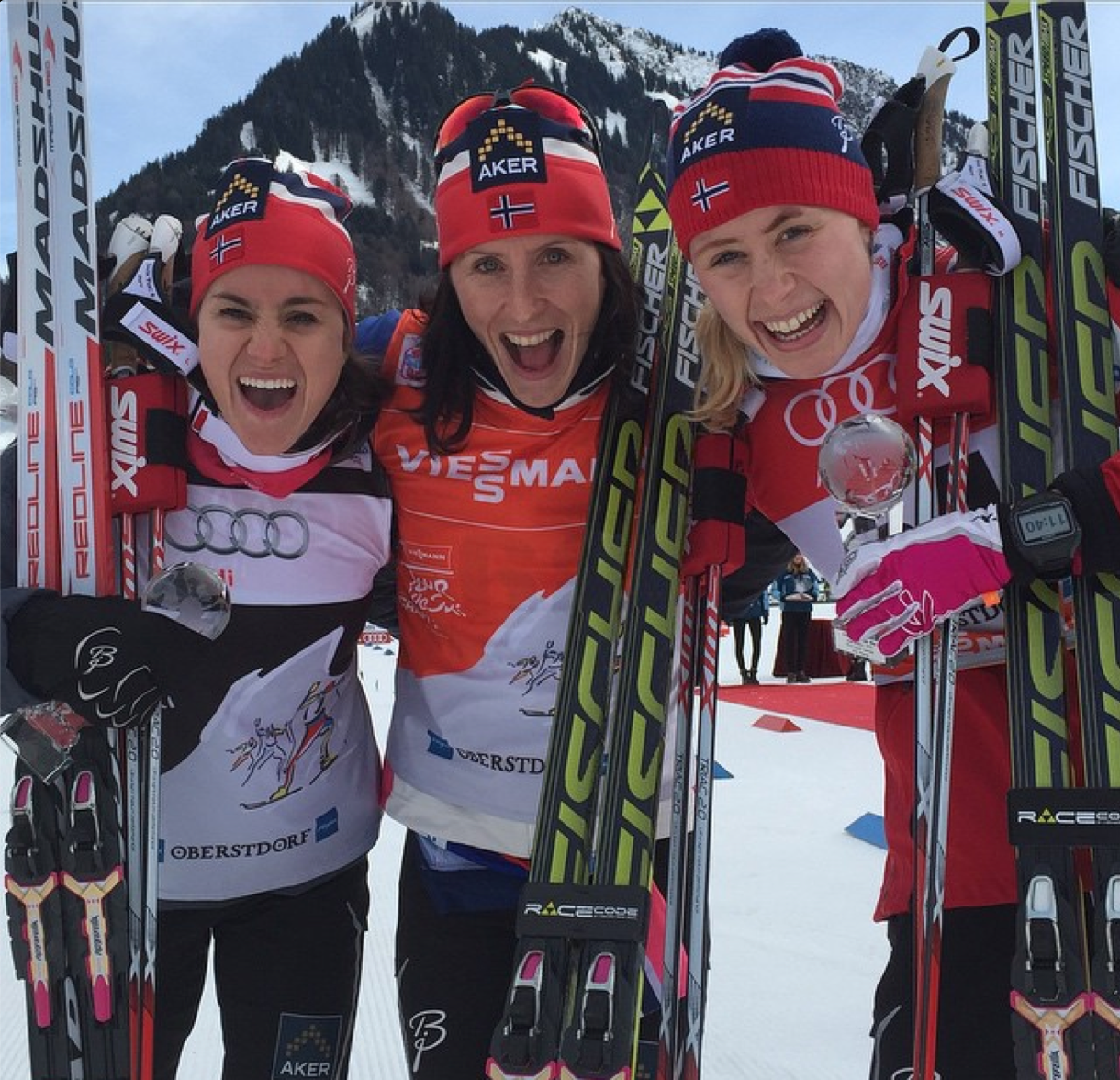
The Norwegian women did as they have for most of the season: they split the podium and then some. The top four spots went to the Norwegians, with Bjørgen, Weng, Ragnhild Haga and Therese Johuag. Then Germany’s Nicole Fessel squeezed herself into fifth place, followed by Norway’s Ingvild Flugstad Østberg in sixth place. Sadie Bjornsen and Liz Stephen both delivered impressive top-10 finishes, placing seventh and eighth, respectively.
Justyna Kowalczyk of Poland was 10th in the prologue after snowplowing herself out of the podium contention. Although Kowalczyk has a large disadvantage after the prologue, she is definitely not out of the competition, as classic is her strength and the prologue was skate. Kowalczyk has won the overall Tour de Ski four times, has 14 stage wins, and is the most-winning female skier in Tour de Ski history.
Bjørgen has won 29 Olympic and World Championship medals, but has yet to win Tour de Ski overall. Saturday was a good start. She skied confidently, making time on her competitors on descents, accelerating through the dreaded turns, and carrying her speed over the bumps. The star cruised into her seventh Tour de Ski stage win with a good buffer to her competitors.
“I tried to hold back a little on the first lap, and then ski harder on the second lap, which I managed to do as planned,” Bjørgen said to Norwegian TV station NRK after the race.
Podium finishers from the women’s 3.3 k prologue in Oberstdorf, Germany: all Norwegian. Marit Bjørgen (c) won by 10 seconds over Heidi Weng (l), with Ragnhild Haga two more seconds back in third. (Photo: FIS Cross Country/Instagram)
Heidi Weng couldn’t contain her excitement for her own second place, which is her best World Cup finish to date.
“I’ve never skied this well in a skate race,” Weng said to NRK after the prologue. “I don’t understand what’s happening with my skating. I’ve done three World Cup skate races and I’ve been on the podium three times. And I get to start ahead of Therese [Johaug] tomorrow. That’s really good, then I will try to hang onto her for as long as I can in the pursuit. It’s a dream start for my Tour de Ski.”
“I felt like I skied slow,” she continued, marveling that the opposite was true. “The plan was to start slower and speed up on the second lap, but I got so stiff on the first lap, so when I got to the big hill on the second lap, I could just think about digging, digging, digging to get to the top and then not crash on the downhill.”
But just as much as Weng is happy about her own finish, she’s stoked about teammate Ragnhild Haga, who delivered her first ever World Cup podium finish. Haga was only 2 seconds behind Weng, and a second faster than Therese Johaug in fourth place. For Haga, the podium was not something she expected.
“I surprised myself today,” she told NRK. “I’ve surprised myself a lot this season. Just getting to the Tour de Ski is a bonus.”
However, while Haga is more than satisfied with her third place, she didn’t feel great during the race.
“I didn’t feel so good after the start, I felt a little slow on the first lap, and I was very stiff on the last lap,” Haga said, noting that this result means a lot to her.
With five bonus seconds awarded for first place in the prologue and a 10.2-second margin second place, Bjørgen starts 15.7 seconds ahead of Weng, 22.2 seconds ahead of Ragnhild Haga and more than 28 seconds ahead of arch rival Therese Johaug in the 10 k classic pursuit on Sunday, the second of seven Tour de Ski races.
But despite the buffer, Bjørgen is far from sure that she will win the pursuit. 10 k classic is Johaug’s specialty, and 28 seconds may not be enough to keep Johaug behind.
“The big challenge is that tomorrow’s race is a pursuit, and my lead can narrow very quickly,” Bjørgen said. “I have to hope for good conditions and fast skis.”
Looking back at the mini tour in Lillehammer, Norway, in December, it came down to a thriller sprint finish between Bjørgen and Johaug, despite Bjørgen starting the race with a 32-second lead. At the finish, Bjørgen won by 0.6 seconds.
On Sunday, Bjørgen has four seconds less of a lead for the same distance and technique. However, Bjørgen feels better now than she did earlier this season.
“The last few days and during Christmas, I’ve felt better and skiing fast has been easier than it was in the beginning of the season,” Bjørgen said to NRK.
From Oberstdorf, the tour moves to Val Müstair in Switzerland for freestyle sprints on Wednesday, Jan. 6. The next day features 5/10 k classic races in Toblach, Italy, followed by 15/35 k freestyle pursuits from Cortina to Toblach on Thursday, Jan. 8.
On Jan. 9, the skiers get a second rest day before the final two stages in Val di Fiemme, Italy.
On Saturday, Jan. 10, there are 10 k classic mass starts for both men and women in Val di Fiemme, and on Jan. 11, the Tour concludes with the brutal 9 k skate pursuit for both men and women up Alpe Cermis.
Jessie Diggins (U.S. Ski Team) on her prologue-practice day about a week ago in Davos, Switzerland. (Courtesy photo)
When it comes to Tour de Ski prep, World Cup racers do a lot more than just chill over the holidays and rest up for the seven-stage tour. Jessie Diggins is one of two U.S. Ski Team members who plans on completing the tour (along with Liz Stephen), and to kick things off on the right foot, she does a “prologue practice day” about a week-and-a-half out from the first event: the freestyle prologue in Obertsdorf, Germany (which takes place this Saturday).
Jessie Diggins ready to go in her Podiumwear race suit during her prologue-practice day about a week ago in Davos, Switzerland.
“We almost never race prologues, and it’s such a funny distance at 3 km, but in the start of the Tour de Ski we race one!” Diggins, 23, explained in an email. “I like to take an interval workout and turn it into a time trial to practice my pacing and tempo for a 3km. If I have good energy that day, I’ll do two of them, so that I can play around with my pacing and tactics and learn from the different times.
“I’ll also skate it since for whatever reason it seems like the World Cup prologues are usually skate,” she added.
The workout takes about 1:45 to 2 hours from start to finish.
30 minute warmup: just skiing easy
5-8 minute Level 3 “to get my body going and warm up my lungs”
Ski back to the start area, start first prologue. “I will have mapped out a course beforehand —figured out where about 3km is on the trail and given myself a fairly realistic course. This week, I just raced part of the Davos course!”
After first prologue, ski easy for 10 minutes to let legs recover and lower heart rate back to normal
Start second prologue
Cool down: slow ski for 20-30 minutes
“I also like to wear a full race suit and bib when I’m doing this so I can get into the racing mindset a little easier,” Diggins explained. “And of course, if the trails are crowded people tend to let you pass easier if you’re wearing a race bib! :)”
SEEFELD, Austria — A broken pole couldn’t keep Billy Demong from skiing to his best result of the season in eighth on the first day of the Nordic Combined World Cup Triple, and he tells Fast Big Dog all about it after the individual jump and 5-kilometer prologue on Friday. Teammate Bryan Fletcher led the U.S. Nordic Combined team in sixth, also a season best.
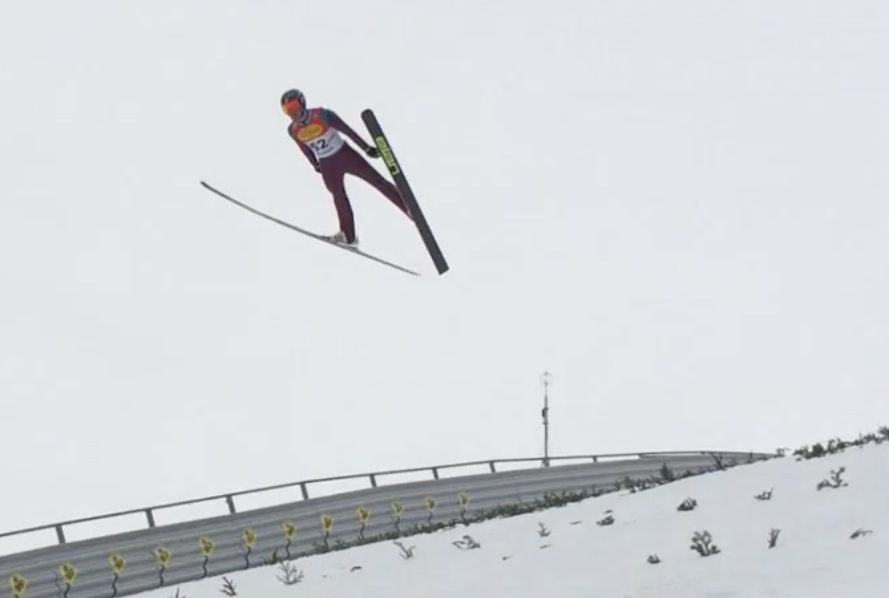
Bryan Fletcher (U.S. Nordic Combined) jumping to 11th in the Seefeld Triple on Friday. He ended up sixth, a season best, in the following 5 k prologue. (Photo: Fast Big Dog)
Kikkan Randall (APU/USST) en route to winning the freestyle prologue on Thursday at the opening event of SuperTour Finals. Photo: Mark Nadell/MacBeth Graphics.
FasterSkier’s coverage of SuperTour Finals and U.S. Distance Nationals is brought to you by the generous support of Concept2, the leading manufacturer of indoor rowers, racing oars, and the SkiErg.
SODA SPRINGS, Calif. — When competitors signed up for this year’s edition of SuperTour Finals, they knew they were getting themselves into a certain kind hurt. The race courses all sit at around 7,000 feet above sea level and are essentially guaranteed to make the lungs burn and the legs ache. Misjudge the time to the finish line or go too hard in an early kilometer once on course, and good luck getting back to the stadium.
Your technique will disintegrate, for example. You will question your own ability to move forward up hills.
For the top athletes in the sport, extreme pain is par for the course — the trick to moving past it is to control it. When athletes woke up on Thursday morning to overcast skies and miserable rain, the weather was just another factor to to work around during the 3.3 k freestyle prologue. There is always the potential for conditions to affect the outcome of a race by changing midway through a start list, but part of ski racing is dealing with what you can control and ignoring what you can’t.
As starters tripped the gate on Thursday at the Auburn Ski Club and made their way into the driving rain-turned-snow, it was to do what they’d done many times before: test themselves against the elements, against their competitors and against the terrain. After just over half an hour all 60 women had conquered the 3.3 k loop and its undulating hills, really steep central climb and many sharp turns.
Not surprisingly, the two-time World Cup sprint champion in their midst emerged with the fastest time after everyone came back out of the woods and clocked in at the finish.
Kikkan Randall (Alaska Pacific University/U.S. Ski Team) may make winning look easy, but the prologue was a challenge even for her. The first thing an athlete says about her race is telling, and the first words out of Randall’s mouth on Thursday morning were, “That was hard.”
“It’s such a different feeling than the prologue in Falun, [Sweden], when you’re at sea level and you have to ski a really high tempo to be breathing hard,” she explained. “Here it’s like, all of a sudden you feel kind of paralyzed. Your legs just get flooded and you’re like, ‘Ah, I can’t move!’”
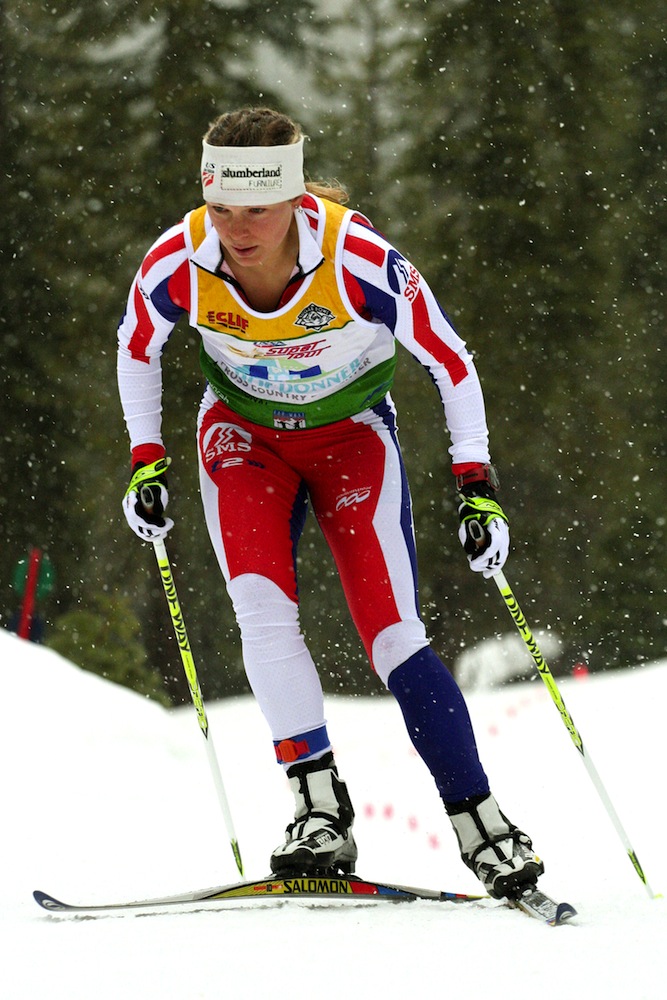
Jessie Diggins (SMS T2/USST) skiing to second place in the prologue, 8 seconds behind Randall. Photo: Mark Nadell/MacBeth Graphics.
Randall finished in 7:57.9 to beat her closest competitor, Jessie Diggins (SMS T2/USST), by 8.0 seconds. The U.S. Ski Team swept the top four spots; Sadie Bjornsen (APU/USST) was third, 15.6 seconds back, and Liz Stephen (Burke Mountain Academy/USST) finished fourth, 22.8 seconds out. U.S. biathlete Susan Dunklee (Craftsbury Green Racing Project) claimed the last spot in the top five, two seconds behind Stephen.
In fact, Randall’s time ended up being the second-fastest time of the day, men’s or women’s. The continued snowfall slowed the course down for the men, and race-winner Erik Bjornsen (APU/USST) was the only one to squeak ahead of her mark; his time was ten seconds ahead of Randall’s.
“This should be a good way to get things started,” Randall said. “Hopefully the pain of today will fade for this evening and I’ll be excited to go again tomorrow.”
As the best sprinter in the world two years running and the third-ranked all-around skier in the world in 2013, Randall sets the standard by which her competitors gauge their performances. As Diggins put it, “Any time I’m within seven seconds of Kikkan in a race this long, it’s like, ‘All right!’”
Another central measure of feedback was how well athletes felt they paced the 3.3 k around the focal point of the course: an intimidating A-climb midway through. Add in the altitude factor and it was a real lung-burner; skiers couldn’t spend all their energy getting up the hill or they would risk exploding spectacularly in the remaining kilometer.
“The strategy for me was to try and pace it really carefully and not absolutely blow up,” Diggins said. “There’s a whole lot of false flat after the big up and down. I think I went out a little cautiously, and I think if I would do it again I’d maybe push it more from the start. But overall I’m extremely satisfied with it.”
The slant of the climb was confounding, even for World Cup skiers. The high side of the trail is to the right, and Bjornsen, for one, struggled to V1 up it on her weak side.
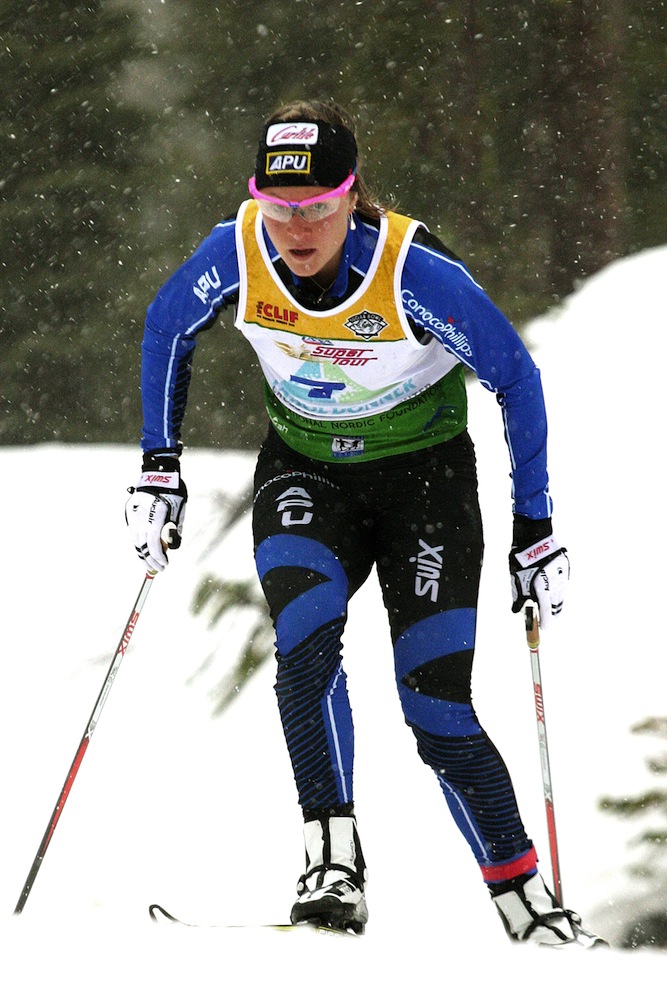
Sadie Bjornsen (APU/USST), third. Photo: Mark Nadell/MacBeth Graphics.
“At the top of the climb I was like, ‘Well, this is starting to get embarrassing,’” she said. “I was just barely moving over the top… I V1-ed to my right for the first time — I’ve never done that in a race, so I’m pretty proud of myself because the hill was tilted awkwardly. That’s probably why it felt so slow.”
Stephen, whose bread and butter are usually impossibly steep climbs, conceded she might have pushed herself too much on the big climb.
“Yeah, I blew up on the hill, so I think I probably went out a little hard,” she said.
All four women are at the tail end of a long season filled with hundreds if not thousands of miles of travel, so while they’re at SuperTour Finals to race well, they’re also not too concerned with results.
“My expectations for the week are to take it back a notch and enjoy ski racing for the reason I got into it: because I love it,” Stephen said. “The stressful part of the season is over and I’m just enjoying the ride now.”
Her teammates echoed the sentiment. A few of them took breaks from training in between World Cup Finals and SuperTour Finals in order to find a way to re-motivate for the last five races of the year.
“To be honest, right after World Cup Finals I thought I was pretty much done,” Diggins said. “Physically and mentally I was just really burnt out on racing. But I came out here and Kikkan and I went alpine skiing for a few days, I took the week off to have a little mini-vacation. And that really helped; I was pretty surprised and really psyched yesterday to be excited about racing tomorrow. I think no matter how done I think I am, I still want the endorphin rush.”
SuperTour Finals continues on Friday with a 10 k classic mass start at Auburn Ski Club. Randall sits atop the Finals standings with her win and the accompanying 15-second time bonus for the stage win.
Andy Newell (USA) finished 16th in the 2.5 k freestyle prologue in Falun, Sweden, on Friday to move into eighth in the World Cup Finals standings after two stages. Photo: Fischer/Nordic Focus/FIS Cross Country.
If the rerouted 2.5 k prologue course in Falun, Sweden, on Friday was short and fast for the women, it was even more so for the men in the second stage of World Cup Finals. American sprinter Andy Newell has the distance and sprint chops to pace a five-minute race well, but that didn’t mean it was an easy race. After five minutes and 31.8 seconds of skiing he crossed the finish line in 16th overall to lead the U.S. men on Friday, after which he retrieved his warm-ups, started cooling down and promptly lost his breakfast.
“I made it through the mixed zone without puking, which was good, but then as soon as I started warming down I had a good barf,” Newell said. “That usually means I pushed it too hard in some places.”
Newell did, indeed, push it pretty hard in the beginning of the prologue. The course took athletes directly up the Mordarbakken to the high point of the course, and there was enough transition in the second half after the descent to require some smart pacing in the beginning. After he skied the fourth fastest split to the top of the course, Newell felt “pretty worked over” by the time he crossed the finish line.
“I skied the first three quarters of it pretty good and then killed some speed on the downhill,” Newell said. “In the transition up the last two hills, though, I lost a bit of time and kind of blew up a little bit. I haven’t looked at the times yet but I have a feeling I lost a bit of time in the last half k.”
Newell has now been to five World Cup Finals in his career and sixteenth place is his best prologue finish by far, 14 spots ahead of where he finished the event last year. Combined with his 11th-place finish in the Stockholm sprint stage, he sits in eighth in the mini-tour after two stages. But Newell still only thought of it as an OK result.
“It could definitely be a lot better,” Newell said.
As a sprinter, Newell approached the prologue with the idea that he would have to hold back in the beginning, where a distance skier might look at the whole race as a near-sprint. It’s a distance only seen a few times a year, if that, and the ideal plan of approach varies depending on the strengths of the individual skier.
“I think it depends on the person,” Newell said. “I think for some people, especially the distance skier, they think of it as going all-out, but for other people like myself it’s definitely more of a pacing game. I try to always tell myself to hold pack during the first few uphills, and the first hill I’m definitely trying to pace it for sure so I can go a bit harder at the end.”
He also held back on the downhill after the Mördarbakken, the one that organizers adjusted on Friday at the athletes’ insistence that the original version was not safe.
“I took it pretty cautious for sure, because it was so sketchy and I didn’t know what to expect,” Newell said. “We were trying to get some info from people who’d raced earlier. It was a little bit of an unknown going into it, but it seemed like it was OK. It definitely would have been nice to ski it before [the race].”
The second finisher for the American men on Friday was another sprinter who has brought his distance skiing further along recently. Torin Koos, competing in World Cup Finals as the U.S. continental cup leader, scored the first distance points of his life with a 25th-place finish (+14.1).
It was only the second prologue Koos has ever skied, so he approached it just as Newell had: as a long sprint, “only make sure to put even more emphasis on keeping it smooth and not rushing it,” he said.
Koos thought he stuck with that plan well; he had the 10th-fastest split at the top of the course, five seconds down from the leader, and still had some ‘spring’ in his legs at the top of the Mördarbakken.
“I just skied the downhill way, way too conservatively,” he wrote in an email. “I guess I could be frustrated knowing I left for sure at least a top-ten distance-scored World Cup on the table today. Instead I’m going to stay pretty psyched, with both taking World Cup points for the first time in a new discipline, and with the feeling of having tiger legs today. These next two 15 k’s could be really interesting. This is what you train for all those days…”
As Koos points out, the 2.5 k race was a distance-scored event, and in finishing in the top-30 he joins Newell as one the few American men who have ever scored World Cup points in both sprint and distance.
“It’s one of those career accomplishments I hoped to reach, and now finally after many years, have,” Koos said.
Noah Hoffman was the third U.S. man to compete in the prologue, and he finished 51st out of 52 starters, 25.2 seconds off the winning time. It was not a result he was thrilled with, but as it was such a short race the distance-specialist said he “couldn’t have expected much more.”
Hoffman noted that his time back was a better showing than the two prologues skied in January, where he was 94th and 60th.
“Overall I have to be satisfied with today as a significant step forward from the two prologues in the Tour de Ski,” he said. “I lost significantly less time today, even considering the shorter duration. I skied an aggressive race today. I got tired and lost places from the top of the course to the finish, but I think it was better to be too aggressive than too conservative like I was in the opening prologue of the Tour.”
The final two stages of the men’s Finals are a 15 k mass start classic on Saturday and a 15 k freestyle pursuit on Sunday.
Kikkan Randall (USA) led the U.S. women in the Falun, Sweden, prologue on Friday with a third-place finish. Photo: Fischer/Nordic Focus/FIS Cross Country.
In a race that held a lot of unknowns for the entire World Cup Finals field before it began, the freestyle prologue stage that was held on Friday in Falun, Sweden, was a particularly important moment of truth for the American women. After a mediocre performance in the classic sprint two days prior, a shorter event in the team’s generally stronger disciple presented a more weighty test for a group of athletes that, like the entire field, is getting ready to be done racing for the season.
“I was feeling tired and pretty mentally done in Lahti,” said Jessie Diggins. “I was like, ‘Man, I’m pretty ready to go home.”
Somewhere there must have been energy to burn, for it sparked to life on Friday to help Kikkan Randall, Holly Brooks and Diggins post three top-10 performances for the U.S. Randall landed on the podium with a third-place finish and Brooks and Diggins went back-to-back in seventh and eighth, respectively. Liz Stephen crossed the finish line in 20th to put four team members in the top 20.
“It was a great race. Putting three in the top eight and Liz in 20th was a great day for us,” said U.S. Ski Team women’s coach Matt Whitcomb. “For Kikkan it was no surprise that she could unleash something like that, but it was refreshing for her to come up with that effort this far into the season and the same is true for Jessie and Holly, who were in need of a good result to bring back some confidence at the end of the year.”
The Falun course definitely favored a team like the Americans who are usually good at climbing and good at short distances on skate skis. The track, only 2.5 k long with the readjustments made at the insistence of the athletes on Thursday night, essentially climbed out of the stadium to the top of the Mördarbakken hill 1.2 k from the start. The course then spun athletes in a 180-degree turn at the crest and shot them back down the other side to navigate the last bit of the windy descent, the one that had first caused the field to protest the course over safety concerns the night before the start. At the bottom of the hill there was still a few rolling transitions to get through before it was over, requiring some amount of energy conservation to avoid bleeding time in the last 500 meters.
Randall thought she played the conservation game right, posting the fourth-fastest split at the top of the Mördarbakken, 5.5 seconds down to Astrid Jacobsen (NOR). She moved up a place as others dropped back to finish 6.6 seconds behind Marit Bjørgen’s winning time.
“Obviously today showed I’m in a good place,” Randall said. “Classic is all over the place these days so who knows about tomorrow, but basically I just want to show up at the starting line, ski like crazy, and it’ll be what it’ll be.”
It’s hard to say whether the late-night negotiations between athletes and the race jury affected Randall. She admitted to feeling fatigued in her warm-up but OK once the race got underway. As the only athlete representative present at World Cup Finals this week, the responsibility of organizing the athlete protest over the original course fell largely to Randall the night before.
Whitcomb didn’t think she showed significant signs of fatigue during the race.
“Kikkan has a pretty high capacity to carry stress like that, but there was no doubt that it was a weighty effort on her part,” Whitcomb said. “These guys kind of inherited a problem that maybe could have been dealt with beforehand, but they had to deal with it last night and I was impressed with their ability to roll through the punches with a cool attitude. It took a big toll on everybody, not just Kikkan and the people leading those meetings… We came out of it OK.”
Randall moved herself from 22nd to ninth in the mini-tour standings with her prologue performance.
Matt Whitcomb (r) cheering on Holly Brooks during the 2.5 k freestyle prologue on Friday in Falun, Sweden. Photo: Bryan Fish.
Behind the team’s leader, two teammates were ecstatic with confidence-building races again at the tail end of the season. Brooks, whose time of 6:15.5 brought her a seventh-place finish, 12.3 seconds behind Bjørgen, has been waiting to be back in the top-ten since she last raced in Sweden in November and was “psyched” to have returned to the position.
“It’s been a little while since I’ve had a really good one, so I’m pumped,” she said.
Brooks’ ability to set a concrete strategy for the course was, like everyone else’s, waylaid somewhat by the fact that the newly modified course was closed prior to the start to conserve snow. In general, she attacked it almost like she would a sprint race.
“I think it was Astrid [Jacobsen] that said it’s like 1% less than sprint pace,” Brooks said. “I love prologues, especially skate prologues. They’re probably my favorite race, and I think about going maybe 1% less than sprint pace but holding really good technique, and that tactic usually works really well for me. Sometimes in sprint races you get too jumbled and your technique kind of falls apart because you’re trying to go too fast, so I really like the prologue length.”
Brooks observed that the earlier starters took about six and a half minutes to finish the course and surmised that “OK, if it’s a six minute race you really have to go,” she said. “And I think the course skied a bit easier than I anticipated so you had to go pretty hard from the start.”
Brooks eased off on the rerouted descent, but also figured everyone probably did after all the pre-race hype about the downhill.
“Just talking to some of the other girls, others were a little reluctant,” she said. “And talking about it more probably made us a little more paranoid than we needed to be… I definitely bled some time there but I figured it was better than falling and losing a ton of time.”
Just a few seconds behind her, Diggins had a similar reaction to her eighth place-finish: satisfied to know that she can still crack the top-10 threshold this late in the season.
“It’s really nice to know that my body was feeling ready to go today and that everything wasn’t quite shut down just yet,” she said. “It’s always nice to have a good race at the end of the season to kind of end things on a high note, especially having three girls in the top 10… That’s sweet; a really good thing for our team.”
The accomplishment stood in contrast to the way the team ended their Thursday the night before the race. There were three athlete meetings in the lead-up to the prologue that were widely attended by the entire field and when Diggins went to bed on Thursday, “I was actually pretty certain my season was over and that we weren’t going to be racing,” she said, because the jury had not yet responded to the athletes’ final assertion on Thursday night that the course was still not safe enough.
“It was interesting waking up being like, ‘Well, I don’t know if I’ll get to race,” Diggins said. When athletes approved newer changes to the course on Friday morning, “In a way that kind of made us all appreciate getting to race more, because at one point we thought we wouldn’t be at all.”
Behind Diggins, Stephen posted a top-20 as the fourth U.S. women in the prologue. As a distance specialist, Stephen approached the beginning of the race at a relatively conservative pace, and in hindsight wished she had started faster than she did.
“It was a short course, but it was still a hard one, with two good-sized climbs and technical downhill skiing, so not really any rest,” she wrote in an email. “However, six minutes is a really short amount of time to be doing anything, and I think if I could do it over again I would have started faster than I did. The tracks were closed on the downhill and so we didn’t get a chance to preview it, as they were trying to preserve the tracks for our race, so knowing how it would ski, and how quickly it skied, wasn’t quite possible today.”
Overall, Stephen is satisfied with 20th and looking forward to the remaining two stages of World Cup Finals, particularly the final 10 k freestyle pursuit on Sunday.
“The body remembered I still have a few more races to go this season!” she said.
On a six-woman U.S. squad that qualified the Finals, Ida Sargent was the fifth American on Friday in 38th. It was only the third prologue race of her life and she thought she started a might too slow in an effort not to “blow up” like she has before.
“I started conservatively and finished feeling like I had more in the tank,” she said. “The finish line came way too quickly which never happens for me. But hopefully it will be a good warm-up for tomorrow.”
Rosie Brennan, the U.S. starter in the continental cup leader spot, finished 46th in the prologue, 41.9 seconds off Bjørgen’s winning time. This period of World Cup racing has been her first exposure to the circuit and she has been attempting to make a point to evaluate each race in Europe before she sees results. On Friday, Brennan noted she could have probably started more aggressively.
“I am still figuring out how to do prologue. It’s a very tricky distance and I think the strategy changes a lot depending on the course. Today, I think I skied a little too conservatively,” she said. “Also, being an early starter, I wasn’t able to see the times it was taking girls before I started. Looking back and seeing that it only took six minutes, I think I should have pushed harder in many places.”
Brennan has struggled with a lingering back injury for the last few races, but for the prologue she felt “much better.”
World Cup Finals continues on Saturday with a 10 k mass start classic and on Sunday with a 10 k freestyle pursuit.
Marit Bjørgen (NOR) won the 2.5 k freestyle prologue stage of World Cup Finals by 2.2 seconds over Charlotte Kalla (SWE) on Friday, putting herself in the mini-tour lead. Photo: Fischer/Nordic Focus; facebook.com/FIS Cross Country
Despite an uncertain start to the morning of the second stage of World Cup Finals in Falun, Sweden, on Friday, the day ended with a very familiar name at the top of the results. Marit Bjørgen (NOR), one of the last starters to leave the line, resumed her usual position on the podium and won the 2.5 k freestyle prologue by 4.4 seconds over Sweden’s Charlotte Kalla in a time of 6:03.2. Kikkan Randall (USA), who spend the better part of the last 24 hours engaged in debate with FIS over the safety of the race course, finished a comfortable third in the individual start race.
“It was a race that suited me,” Bjørgen told the NRK after finishing the short event. “I felt fine and could press. I was a bit cowardly down [the hill], but could run again when I got into the stadium.”
The downhill Bjørgen referred to has been at the center of heated debate recently about the safety of Falun’s new trails, and something that threatened whether race would happen at all. Athletes were concerned enough for their safety on a few new twists to the Mördarbakken’s downhill section that they submitted a petition to FIS, threatening to boycott the final three stages of the Finals if governing body and the organizers didn’t eliminate the dangerous sections.
The race jury initially resisted changing the course but ultimately compromised with the athletes’ demands late Thursday evening. Athletes and coaches seemed happy with the outcome, but it put the entire weekend in flux the day leading up to the second stage. After athletes agreed at a 9:00 a.m. meeting Friday morning that they were satisfied with the course adjustments, they were still unable to preview the changes to the downhill. Bjørgen was not the only one who consequently felt she had to ski the descent “a bit cowardly” during the race.
“I probably didn’t gun it as much as I normally would have just because I didn’t know how much speed I’d be coming out of the turn with, and it’s a pretty tight turn,” Randall said. “I figured being a little conservative was probably a better bet than going crazy and falling. It’s definitely a loud corner and it’ll be pretty crazy to do it in a mass start on classic skis.”
Randall, as the only athlete representative present at World Cup Finals, had the responsibility of organizing athlete meetings, communicating with FIS and handling questions from a strong media presence until 11:30 p.m. the night before the race. Though the running around wasn’t the ideal way to prepare, her body must have handled the extra stress well.
“It’s been an interesting 24 hours and it didn’t feel great to warm up today, but once I got out on the course in the race it felt pretty good,” Randall said. “It was definitely different race prep than I normally do.”
Randall started a few bibs numbers in front of Bjørgen on Friday and initially finished with the top time in the field. She recovered a sluggish feeling in her warm-up to feeling well enough to post one of the top splits to the top of the course an was an early race-leader as the 31st starter.
“I felt kind of drained after yesterday and felt that, well I’ll just have to go out there and go for it,” Randall said. “But once I got on course I actually felt a lot better. I could find some good zip in my stride and was able to lay down a really good effort. I got a slight indication up the hill that things were going pretty well so, yeah. I’m glad I could re-find my energy again today.”
With a strong late-season effort from Kalla, Randall was soon demoted from the leaders chair. The Swede hasn’t been on the podium since the 15 k freestyle stage of the Tour de Ski, but on Friday she found some of her old spark to post what would end up being the second-fastest time.
Bjørgen quickly overtook the lead and the eventual win, but Kalla was happy to be on the podium again.
“It was really wonderful to get a podium here in Sweden at the end of the season,” she told the NRK. “The crowd was good and supported us. 2.5 k is a bit strange distance and you have to press all the way.”
Kowalczyk, who led the World Cup Finals mini-tour after the first stage in Stockholm on Wednesday, dropped to second behind Bjørgen after finishing fifth in Friday’s race, 10.8 seconds behind the winner.
“I am happy with my result today,” Kowalcyzk told FIS. “It is the same position I was last year so it is ok with me. I hope to ski really well tomorrow. I think the Norwegians will be very strong and it will be a good competition.”
Bjørgen, who was also present at the many athlete meetings preceding the prologue, thinks her fitness is in top shape in Falun.
“I was 100% today,” she said. “My shape is good. I was curious to know how it was but it was also 100% in Stockholm and I felt really good again today. I have not competed that much this season so I would be happy if the season went a few weeks more. Tomorrow I think Justyna and Therese [Johaug] will go fast and I hope that I can go with them.
The third stage of World Cup Finals on Saturday is a 10 k mass start classic.
Simi Hamilton (SVSEF/USST) won the prologue at SuperTour Finals by 6.6 seconds on Saturday. Sylvan Ellefson (Team Homegrown) took second; Erik Bjornsen (APU/USST) and Noah Hoffman (Team HomeGrown/USST) tied for third.
CRAFTSBURY, Vermont — Looking calm and relaxed as he finished the two-lap 3.2 k freestyle prologue on Saturday morning, Simi Hamilton (SVSEF/USST) skied to a comfortable win in the opening event of the SuperTour Finals at the Craftsbury Outdoor Center.
He beat Sylvan Ellefson (Team HomeGrown) by 6.6 seconds, and in a tie for third, Noah Hoffman (Team HomeGrown/USST) and Erik Bjornsen (APU/USST) both claimed bronze (+11.5). Kris Freeman (USST), skiing for Team HomeGrown this week, took fifth (+14.0), with Mike Sinnott (SVSEF) only 0.1 behind in sixth.
Hamilton won the prologue last year in Sun Valley, Idaho in similarly dominant fashion, so his comfortable margin this year hardly comes as a surprise. At this point, he’s established himself as the one to watch out for in the mid-distance 3.2 k.
Simi Hamilton coming through the stadium halfway through the prologue.
“It was fun,” said Hamilton of the effort this time around on Craftsbury’s man-made loop. “Hard, kind of short.”
Though he appeared to be skiing easy the first lap, the Colorado native said his approach was to attack the course “as hard as you can the whole time.”
The men started an hour behind the women and left the gate every 30 seconds, but the conditions remained fairly consistent and fast throughout the men’s race.
Just as impressive as Hamilton’s gap on the rest of the field was Ellefson’s second-place showing in spite of a swollen ankle from his crash in Falun, Sweden just over a week ago.
“It’s ok — not fantastic,” said Ellefson of his ankle’s condition. “It’s gotten more swollen since yesterday, and there’s a lot of snapping going on.”
Walking around the venue, Ellefson was favoring his uninjured leg, but with the support of skate boots, he said the pain was manageable during the prologue.
Ellefson gritting his teeth for the final few meters.
“I’m not sure how classic racing is going to go,” he added.
After getting his ankle checked out at a nearby hospital Saturday afternoon, the “snapping” noise was determined not to be the fracture Ellefson had feared, and he’s ready to race in the 15 k classic on Sunday.
Prior to the prologue, Ellefson trailed CXC’s Karl Nygren by a slim four points in the overall SuperTour standings. With period 1 start rights for the World Cup next November on the line, Ellefson’s acknowledged that he might be taking more risks than he normally would.
“Hopefully I can take April to really rest my ankle,” said Ellefson. “We’ll see what happens in the next week.”
Hoffman was impressed with his competitors’ performances.
“[Hamilton] has always been really good at prologues, and Sylvan skied really well today, especially with the hurt ankle,” said Hoffman.
As for his own race, Hoffman was “pretty happy” with the result, which sets him up for a good starting position in Sunday’s mass start classic.
“I’ve had trouble pacing prologues in the past,” he said. “I’m looking to be smooth, and not spaz or be too aggressive on the first lap. I think I get better at it every time I do it.”
Hoffman shared the podium with Bjornsen, who lifted the former onto his shoulders to share the small podium step at the awards ceremony. Both clocked in at 6:10.9.
“I went out fast and tried to stay relaxed, which seemed to work out,” said Bjornsen, who was in Toblach, Italy last week for OPA Cup Finals.
Just as it had for the women, the conditions necessitated a running warm-up for the men, which some athletes were more used to than others.
“I kind of prefer it — it’s quick, and when everyone’s in the same boat, it’s an easy way to warm up,” said Bjornsen.
Freeman was the first starter for the men, and said the transition was “a little weird.”
After coming home the Holmenkollen 50 k at the beginning of March, Freeman got sick, so the prologue was also his first intensity session since returning from Europe.
“My plan was to ski big and strong and snappy, and I went big and strong, just not snappy,” he said.
His goal is to improve throughout the week.
“It’s always nice to race in New England, and I’ve always liked racing at Craftsbury, so I’m hoping to get in better shape as the week goes on.”
David Norris (AWS/MSU) was the first collegiate finisher in 10th (+23.7) and Paddy Caldwell (SMS) turned in the best junior time in 15th overall (+25.4).
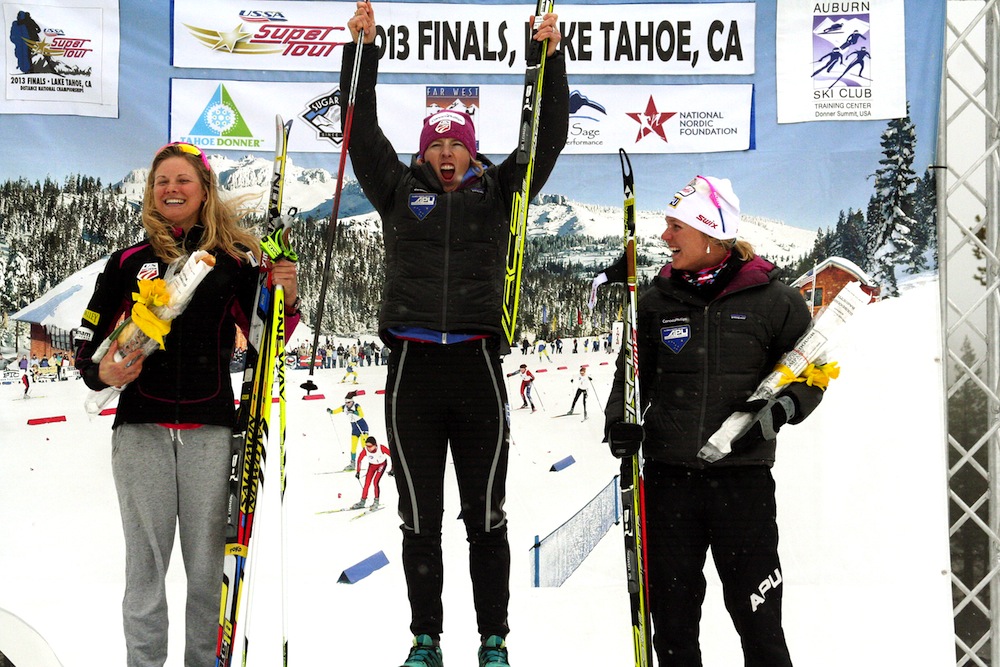
The women's prologue podium at SuperTour Finals: 1. Jessie Diggins (CXC/USST) 2. Holly Brooks (APU) 3. Sadie Bjornsen (APU/USST).
CRAFTSBURY, Vermont — She was busy posting top-20s on the World Cup just last week in Falun, Sweden, but Jessie Diggins (CXC/USST) clearly has plenty of gas left in the tank. For the SuperTour Finals 3.2 k freestyle prologue, she won by 7.2 seconds against a competitive women’s field. Holly Brooks (APU) took second and Sadie Bjornsen (APU/USST) finished third (+8.6), with another 7.5 seconds between third and Becca Rorabaugh (APU) in fourth (+16.1).
Diggins characterized the late-season effort as essentially “racing on adrenaline,” and her time of 6:41.2 would have put her in 34th in the men’s field. Granted, the women started an hour before the men and had colder, faster snow to ski on, but the feat is nevertheless an impressive one.
As the only snow to speak of was on the course, and the course was closed to all but one wax tester per team, a critical point in Saturday’s prologue was making the transition from a running and/or erging warm-up to skating a race that amounted to a fast but long sprint.
Diggins coming through the final straightaway at Craftsbury.
“That was a little different,” said Diggins. “I’ve had a couple city sprints this year where part of my warm up has been running, but this one it was all running, and then on the course I hadn’t skied at all today and all of a sudden I was racing. So the first lap was a little bit of a shock.”
Brooks, the runner-up, agreed that the lack of on-snow warm up was a challenge out of the gate.
“It was brutal to go from running straight to the snow,” she said. “I felt a little bit like a giraffe on roller skates right at the beginning.”
“But it was fun — it was hard, and there was good competition out there.”
Brooks saw her strength in distance races as an advantage in the prologue — “I can go out pretty hard without completely dying, but in prologues my main goal is to always keep the technique nice and smooth and efficient,” she said.
Diggins focused on skiing over the faster, icy sections of the course to pick up speed.
“If you see an icy spot, go get it,” she said. “When I was able to get my balance together and glide it out, it was really fast.”
Bjornsen approached the prologue more with a sprinter’s mentality.
“I just went out at sprint pace and kind of held on,” said Bjornsen, who was in Toblach, Italy last week for OPA Cup Finals but was unable to race there due to the return of a stomach bug that plagued her earlier this season. Back in the US now, she said she’s feeling much better.
Athletes noted that the conditions at Craftsbury were as good as they could have been given the warm stretch of weather leading up to the Finals. On Saturday morning, cloud cover protected the snow from the sun’s glare, and temperatures hovered in the 40s after reaching freezing the night before.
“I’m so impressed Craftsbury managed to make this happen,” said Diggins. “There’s snow nowhere else, and it’s really good [here].”
Bjornsen concurred. “For not having much snow it’s incredible conditions—hard, fast, no rocks. Couldn’t ask for much better, “ she said.
Diggins, Brooks and Bjornsen have all had their fair share of racing abroad this winter on the World Cup, and were happy to be back on American soil.
A bit further back in the pack, US biathlon standout Susan Dunklee (CGRP/USBA) finished fifth (+19.4) and Dartmouth’s Sophie Caldwell was the top collegiate finisher in sixth (+20.1). Liz Stephen (Burke/USST), also just back from the World Cup, as seventh (+21.1).
In the junior category, Corey Stock (CSU) posted the fastest time and was 16th overall (+29.2).
Racing resumes for the women at 10:00 a.m. EST with a mass start 10 k classic and includes two intermediate sprint bonuses.
Alex Harvey heads to the line at the end of Stage 1 of the 2012 Tour de Ski in Oberhof.
OBERHOF, Germany – Thursday’s freestyle prologue will probably not end up being significant in the grand scheme of the 2012 Tour de Ski, which includes eight more competitions and 100 kilometers of racing spread across two countries.
But that doesn’t mean good results here didn’t give athletes a boost.
Led by Alex Harvey’s sixth-place finish, the Canadian men are flying high after Stage 1 of the Tour. With Harvey just seven seconds away from the win and teammate Devon Kershaw another four ticks back in 12th, the two are eying Friday’s Stage 2 as hungrily as a Quebecer staring at a carton of hot poutine.
“It just shows that they’re all fit and ready to go,” said Justin Wadsworth, the Canadian head coach. “They’re both confident for tomorrow, and I think a podium is possible for both of them. It’d be fun to get both guys on there, for once.”
Devon Kershaw lunging for the line in Oberhof.
Ivan Babikov, whose strengths lie in longer races, also had a decent day in 38th, rounding out the trio of Canadian men.
It was Harvey, though, who set the standard for the Canucks, looking as crisp and sharp as anyone else on the course—at least up until he hit its far corner.
For the last stretch into a headwind, Harvey said he was fried, or, actually, he described his sensations with another f-word. But despite losing a spot to Russia’s Ilia Chernousov, he was able to keep things under wraps and hold on to sixth place.
Afterwards, he said that he had held nothing back coming into this year’s Tour. With just nine stages, there’s not too much time to ski your way into shape, he said, and there are also other advantages to being at peak fitness aside from simply racing fast.
“When you’re in good shape, you also recover faster,” he said. “I did the best I could to be in the best shape I could today.”
As for Kershaw, his shape wasn’t lacking much either, he said, even if he might have lost a few seconds in the ice on some of Oberhof’s tricky corners.
Across the board, though, he, Harvey, and Wadsworth all agreed that the results in Thursday’s race will ultimately amount to a whole lot of nichts—German for nothing.
“It means zero, but you just get to see,” Harvey said. ““It’s a good moral boost.”
In the end, the Tour is decided in the tougher stages in Italy in the middle and end of the race, Kershaw said: the 35-kilometer point-to-point race starting in Cortina, and a 20 k and hill climb in Val di Fiemme. The early competitions, he added, are “just fun stuff for guys like me that are good at these kinds of races.”
For Wadsworth, though, it’s a little more than fun stuff. The prologue, at least, is also validation that his program is working, with the Canadians displaying a combination of improved fitness and technique.
Thursday’s loop included two stiff, steep climbs—an area that the Canadians had spent a lot of time working on during the off-season, and one that “in the past wouldn’t have been that well-suited to either of the guys,” Wadsworth said.
But on Thursday, all three of the Canadian men improved on their results from last year’s Tour prologue: Harvey by 12
Ivan Babikov on his way to 38th place.
places, Kershaw by 25 places, and Babikov by seven places.
In Friday’s Stage 2, a staggered-start classic race based on Thursday’s results, Harvey and Kershaw will start towards the front of a long stream of athletes hunting leaders Petter Northug (NOR), Dario Cologna (SUI), and Maurice Manificat (FRA).
Those three will have head starts of roughly 20, 15, and five seconds, respectively, on the first chasers. But with fresh snow likely to be clogging the tracks, most people expect the leaders to be gobbled up into a big pack, which sets the Canucks up well for a shot at the top three.
In stage two last year—the exact same format—Kershaw came from 37th place at the start to nearly pull off a spectacular win, with only Cologna getting the better of him in on the homestretch.
“I think it’s a race Devon wished he would have won last year,” Wadsworth said. “I don’t think outside of a podium tomorrow for him will be really satisfying, and I think Alex probably feels the same way.”
OBERHOF, Germany – If the Prologue is any indication, the 2012 Tour de Ski will play out as predicted by the media hype—a battle between Petter Northug (NOR) and Dario Cologna (SUI).
Northug edged his rival, and defending Tour champion, Cologna, by .7 seconds in the men’s prologue in Oberhof, Germany. Maurice Manificat (FRA) placed third, four seconds off the pace.
As expected, times were tightly compressed on the fast hard track. The course was a mixture of man-made and natural snow, much of it trucked in, and all of it heavily transformed. Freezing temperatures overnight allowed the grooming crew to take 12 inches of sugar and turn it into a rock hard loop.
With two major climbs, the four-kilometer loop was still plenty challenging, and the top seeded skiers demonstrated why they hold that distinction.
First it was Alex Harvey (CAN) in bib 87 charging to the line, barely missing on a brief hold on the top spot when he crossed .1 seconds behind Illia Chernousov (RUS).
His place on the podium was short lived as the final four ranked skiers each raised the bar a little higher.
Marcus Hellner.
Olympic and World Champion Marcus Hellner (SWE), the leader on the crest of the biggest climb at 1.7 kilometers, nosed out Chernousov, collapsing on his back in the snow.
Hellner was still on the ground just under a minute later when Manificat came through to take his turn in first. The two men were on the way out of the finish pen as Cologna, who came on strong over the final two kilometers, knocked a few more seconds off.
As the final starter, Northug knew exactly where he ranked throughout the race, an advantage he leveraged to his seventh Tour stage victory. But there was no characteristic Northug celebration. He took his own turn on the ground, before rising and heading to the post-race press conference, where he told gathered media that “I don’t think anybody will remember who won the prologue in Oberhof when we finish in Val di Fiemme,” his eyes focused exclusively on the overall title.
Only Northug and Cologna appeared at the pre-Tour press conference on Wednesday, the famous media-inspired Hellner/Northug rivalry at least temporarily suspended.
Dario Cologna.
Cologna holds two overall Tour wins, and Northug has finished second three times without ever breaking through. The two men are clearly the best all-around skiers on the circuit with no weak events among the myriad of distances and formats competed at the Tour.
And so it is not without precedent to play the two men off each other, the neither put much stock in today’s results, other than to comment that they felt good.
With snow already falling, the course for Friday’s pursuit will be relatively slow, and with the field featuring 90 skiers within a minute of the lead, and forty skiers just 40 seconds back, Northug dubbed his victory “not so important,” and Cologna predicted a quick compression to a virtual mass sport.
“It is a long Tour,” Cologna said as way of explaining the probable lack of aggressiveness in the pursuit, joking that his strategy for that 15km classic event would be to “go full speed and try to go away.”
The eight-minute race may not have held much meaning for the overall standings, but it did provide an opportunity for athletes to test their fitness, work out any rust from the holiday break and pocket some spare change.
Northug walked away with 5,000 Swiss Francs (CHF) for his efforts on the course, and another 1,600 CHF for taking the Tour lead. Prize money runs only three deep for stages, with the big payoff coming at the top of Val di Fiemme.
The third place finish ranked as Manificat’s top finish in the prologue distance, and the 25-year-old Frenchman is gunning for the Tour podium.
In two previous tries, he placed 17th and 19th, but has been steadily improving and is coming off to an excellent first World Cup period.
Like two-time Tour Champion Lukas Bauer (CZE) Manificat is not a sprinter. He does have a bit of a leg up on Bauer in that he has qualified for the heats three times in the Tour, including a surprising 8th in 2010, but he will likely lose significant time to both Northug and Cologna in the two sprints.
Maurice Manificat.
Manificat and Bauer share another similarity – excellent climbing ability, and Northug points two both as potential threats in the overall,” only partially joking when he claims Manificat is “three to four minutes faster” up the final climb.
The additional stage, another prologue distance at 5k, is in Manificat’s favor, lessening the impact of the pure sprints.
With Hellner in fourth today, and Harvey sixth, all the top skiers ended up where one would expect. Though no one was going to win or lose the Tour on the race course, indications of poor fitness would have been apparent.
The board is set, the pieces in place, and now the game can begin in earnest.
Justyna Kowalczyk attacks one of the climbs during the prologue of the 2012 Tour de Ski in Oberhof, Germany.
OBERHOF, Germany – Oh, it’s on.
The battle between Marit Bjørgen (NOR) and Justyna Kowalczyk (POL) for Tour de Ski queendom has officially begun—with Kowalczyk landing the first blow.
By a scant 0.4 seconds, the Polish strongwoman claimed victory in the first stage of this year’s Tour on Thursday afternoon, covering the icy 3.1-kilometer freestyle prologue in just over seven minutes. Bjoergen was second, with 21-year-old Swede Hanna Brodin earning her second-ever World Cup podium in third place, four seconds out.
“I’m happy to be back on the Tour,” Kowalczyk said in a press conference after the race.
What she didn’t say, but must have been thinking, was that it also good to eke out a victory over Bjørgen. While Kowalczyk has won the last two Tours, neither of those crowns has come over her Norwegian rival, as Bjørgen has skipped the stage race each time to save energy, for the Olympics in 2010 and the World Ski Championships in 2011.
Marit Bjørgen on one of the climbs in the 2012 Tour de Ski prologue.
With Bjørgen finally throwing her hat into the ring this season, the fans and media here have eagerly awaited a showdown. Ever since the 2010 Olympics, when Kowalczyk accused Bjørgen of using her asthma medicine to gain an unfair advantage, the relationship between the two has been as icy as the trails here, even though both women have played down the controversy.
If the two have their differences off the trails, the gulf between them on their skis is just as wide—and that showed on Thursday.
Bjørgen is textbook, almost mechanical in her technique; Kowalczyk’s style is unorthodox, full of unseemly angles. (It’s honed, we learned today, by rollerski workouts in which she tows a tire behind her.)
On Thursday, the course largely played to her strengths, with a stout climb halfway through and another steep uphill near the end of the loop.
There was also, however, a significant obstacle for Kowalczyk to negotiate: the 180-degree downhill corner that her competition had scraped down nearly to sheer ice.
Despite plenty of snowplowing and sliding, the turn still took out several top women. Finland’s Krista Lahteenmaki went from second place at the top of the hill to 18th place at the finish after crashing; Russia’s Natalia Matveeva slid into a fence.
Kowalczyk has her own history with tricky downhills, and it’s not an auspicious one. However, she has told Polish media that those problems mainly come in longer races after her legs are fatigued, thanks to a muscular problem in her shins that has plagued her for the last three years. (The problem also explains why Kowalczyk always duct-taped her boots up until this season, when she switched to custom-made Fischer models.)
On Thursday, she said she conserved her energy on the major climb in order to save her legs for the descent and ensuing corner, and the effort paid off. She still did some snowplowing, but looked not much more tentative than the rest of the women, and the TV broadcast clocked her speed on the downhill at 55 kilometers per hour, or 35 miles per hour.
She had trailed Bjørgen by two seconds at the top, but closed that gap and added a little more by the finish line.
Brodin, in third, was four seconds back in a breakout race. She’s made the podium once before, last year in Estonia, but Thursday’s effort was the first time she’d cracked the top 10 in anything aside from a sprint.
While a prologue is still a long way from a true distance race, Brodin is clearly making progress—she was 34th in the 10 k in Sjusjoen in mid-November, and 22nd in a 5 k race in Finland the week after.
Brodin hails from Falun, and has her sights set on the World Ski Championships that will be held there in 2015, according to Swedish women’s coach Rickard Grip.
“She has really big goals for that championship, and is working really hard,” he said. “She’s a really focused lady.”
Brodin will start 14 seconds behind Kowalczyk in the second stage of the Tour on Friday, a 10 k pursuit that’s handicapped off the results from the first race.
The top three from the prologue received bonuses of 15, 10, and 5 seconds, respectively, that will be subtracted from their overall times. That leaves Kowalczyk with a 5.4-second lead, which Egil Kristiansen, the Norwegian women’s coach, said was a perfect position for Bjørgen: chasing.
“I think it’s better that Justyna is going first,” he said.
As for the feud between the two women? While the media may talk it up, Bjørgen “just ignores it,” Kristiansen told FasterSkier.
“She’s doing her job,” he said.
But asked if missing out on a win by 0.4 seconds hurts a little extra for Bjørgen when the winner is Kowalczyk, Kristiansen still had to think for a minute—then groaned. Then, finally, he said: “I don’t think that matters.”
—Topher Sabot and Rob Whitney contributed reporting. Full report on the North American racing to follow.