From the FasterSkier archive — posts syndicated from athletes’ and coaches’ own blogs between 2004 and 2012, kept online as published. Current coverage is at fasterskier.com.
After 26 years of owning and managing Prospect, Steve Whitham and Andrea Amodeo have decided it is time for the ski area to have new owners.
A local, non-profit group comprised of Prospect diehards, local business people, and the Vermont Land Trust has been working with Steve and Andrea for the past two years to facilitate a good transition.
This group – Prospect Mountain Association – intends to purchase Prospect and run it as a community cross-country ski center, much as it has been for years.
As a friend of Prospect Mountain, we would like to invite you to an informational meeting on Sunday, September 16th at 2:00 p.m. at the Prospect lodge.
We’d like to share information with you about Prospect’s immediate future and how you can help. This also will be a chance for everyone to catch up with old friends, sign up as a volunteer, and to get a special discount on your season pass!
We know that almost everybody loves Prospect Mountain and that there has been a lot of concern about its future. Please join us to answer your questions and learn more about this exciting community-run effort. We are hoping for a robust turnout.
We hope to see you on the 16th but please be in touch if you are unable to attend and would like to be part of making this happen.
Best regards,
David Newell and Jon Cohen, on behalf of PMA
Donald Campbell, the Vermont Land Trust
P.S. Spoiler alert: Steve will continue to be part of Prospect’s future – come ask him about it.
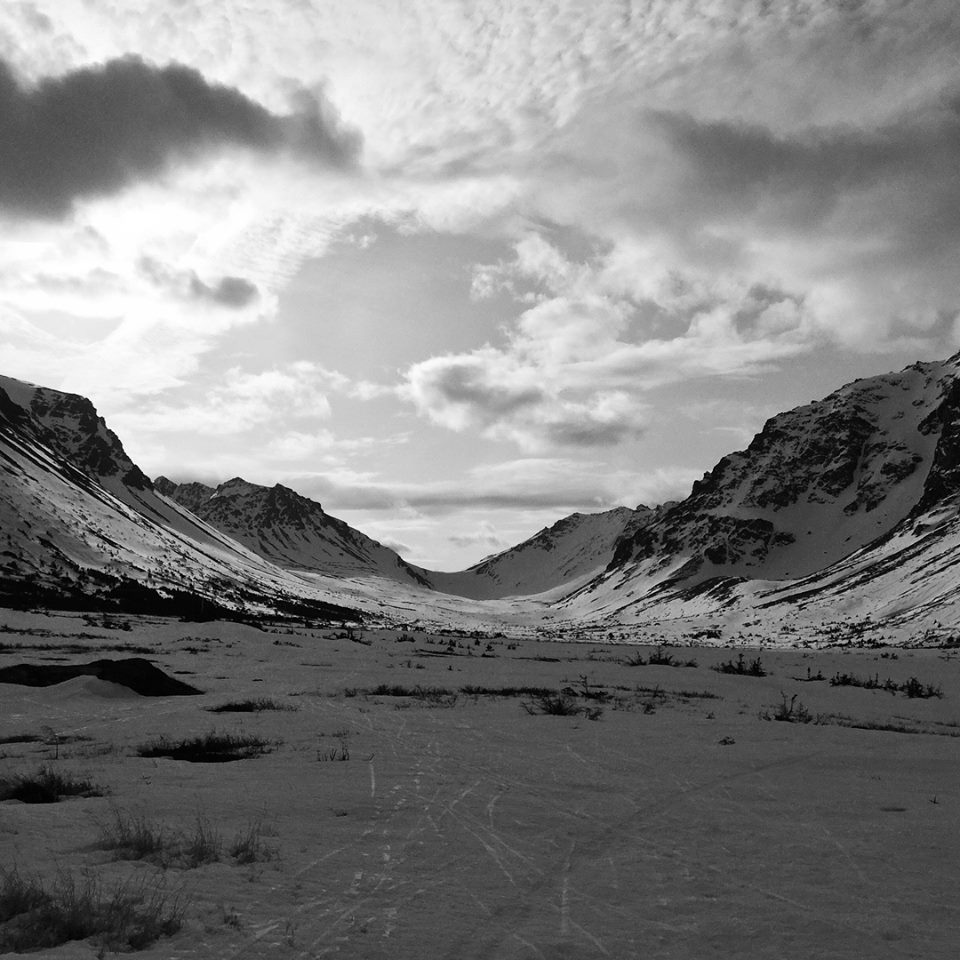
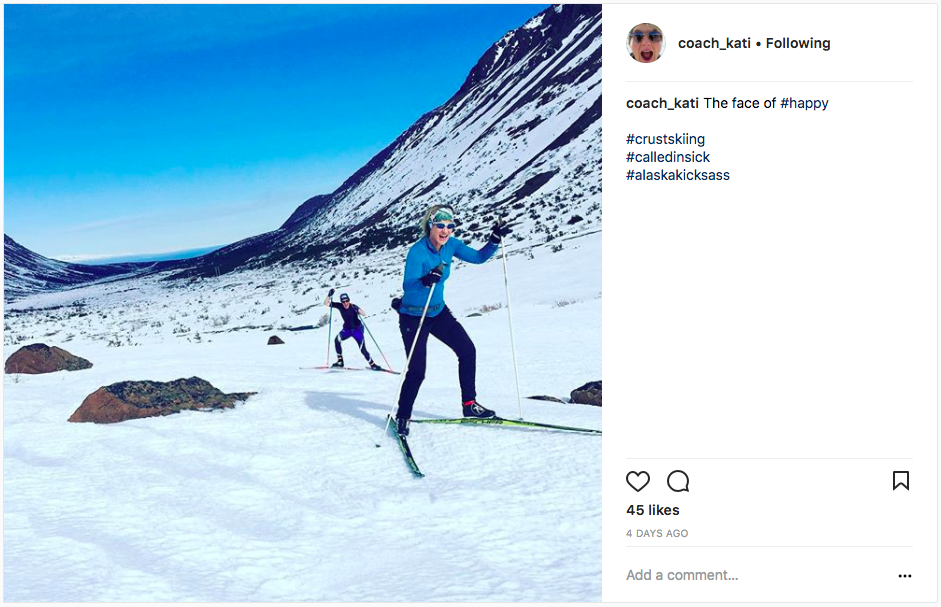
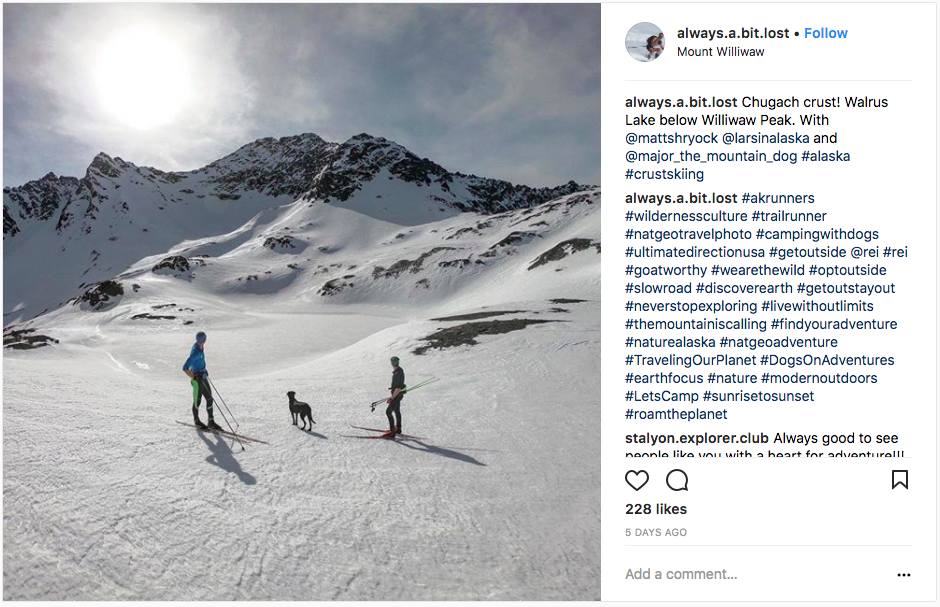
Crust skiing on April 17 in Chugach State Park, at the edge of town above Anchorage, Alaska. (Photo: Gavin Kentch)
This article has been updated with additional information on pro skiers who volunteered with Skiku, and additional pictures from Montana and New York.
* * *
It’s the last week of April. Skier New Year, May 1, looms next Tuesday. It’s roughly six months till the presumptive first race of the 2018/2019 season, seven till the first World Cup weekend. Whether you’re a pro or an amateur, whether you’re targeting your first World Championships or your first Birkie elite wave, now is the time to start thinking about setting goals and writing training plans.
For a certain subset of athlete, those spring training plans still involve skiing. On snow. In some cases, really good snow, in surprisingly wintry weather.
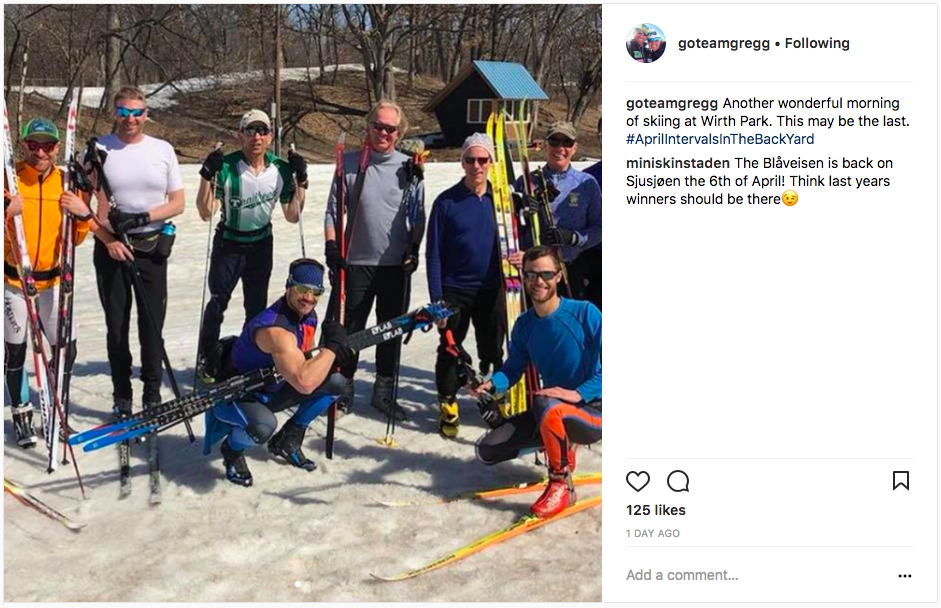
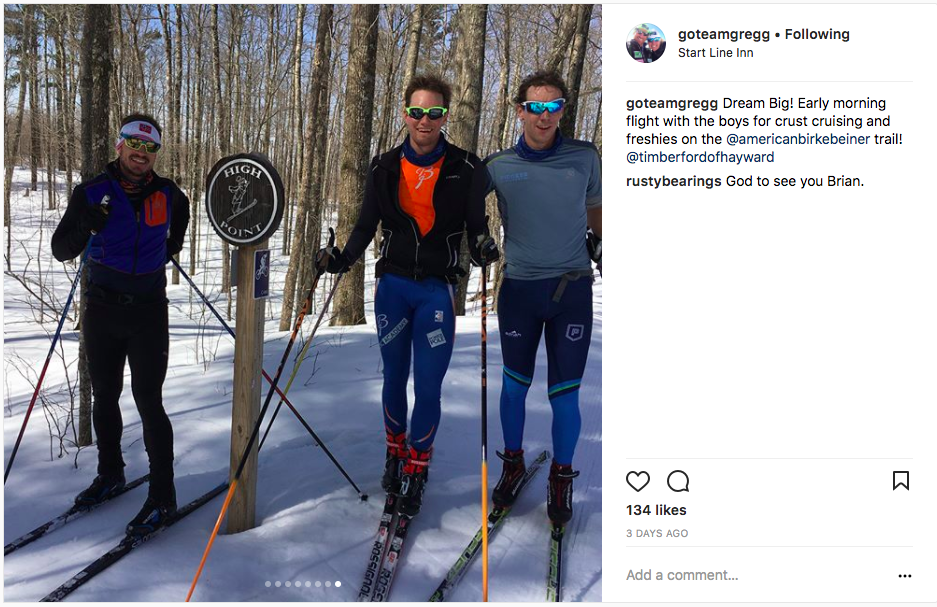
In honor of the last week of the offseason, please join FasterSkier as we channel our inner Us Weekly and flit through an extremely unscientific social-media roundup of those athletes who are still on snow, arranged in very approximate order of most to least surprising to be skiing at this time of year. (Actually, it’s only the Midwest and Vermont where it seems somewhat surprising to still have skiable snow in late April; no offense is intended to anywhere on the list after that.)
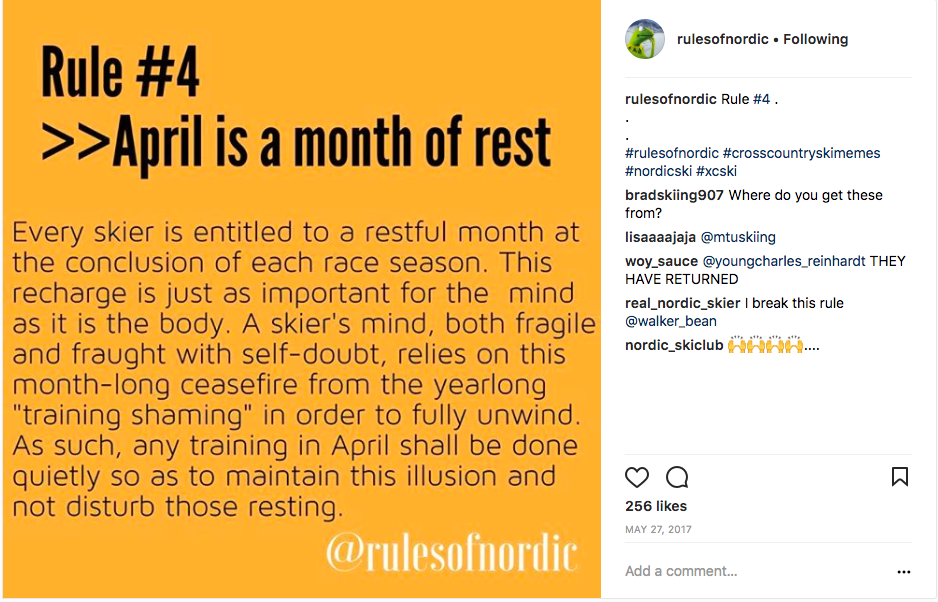
And before we begin, a quick note on methodology: This social media roundup is by definition limited to those athletes who are not only currently out in the snow, but who are also posting about it on social media. This second criterion threatens to bring your average recovery-month athlete into conflict with what has been codified as Rule of Nordic No. 4, “April is a month of rest.”
So, caveat lector: Just because your favorite skier has been taking a well-deserved break from finding and curating Instagram-worthy content for your enjoyment, this doesn’t mean that they’ve been sitting on their butt since Spring Series. They just might not want to tell you what they’ve been up to, and/or they wish to avoid damaging the fragile psyches of their colleagues.
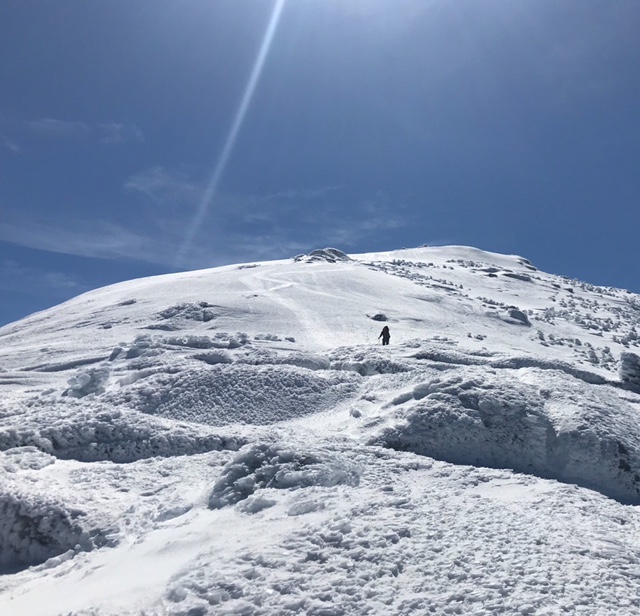
Skiing on New York’s highest peak? Check. David Hochschartner of the North Country School in Lake Placid sent us this photo of backcountry shredding on Mount Marcy, the highest point in the state at 5,343 feet above sea level.
“Monday skiing from bottom to the summit of Mount Marcy in New York,” Hochschartner wrote in an email to FasterSkier on Wednesday. “Over 3500′ vertical … backcountry skiing does not break rule #4 because it isn’t training, it’s just fun!”
Backcountry skiing near the top of Mount Marcy in New York’s High Peaks region on Monday, April 23. (Photo: Tim Ely)
The mid-April Midwest blizzard was notable, to be sure. But was it historic? Yes, says Ari Ofsevit, who now lives in Boston but was formerly the source behind Twin Cities XC Commentary and who remains the one-man operation behind the indispensable BirkieGuide.com.
Here’s Ofsevit with some historical meteorological perspective:
Basically, the current weather in the Twin Cities is pretty unprecedented. The only other similar year was 1975, when there was at least 3″ of snow on the ground in MSP for 11 days in April (this year had 12), but that year it was an old, melting base that mostly fell in late January. This year will set the following records:
* Most days with at least 3″ of snow on the ground in April (skiable snow): 12
* Most snow in April: 26.1″
If the current forecast to hit the 70s this weekend holds, it won’t wind up the coldest April on record, but will likely be in the top three. But it’s a good combination of cold and snow, which hasn’t been seen to this degree before.
The average year has the snow depth dipping below 3″ around March 1, so it’s an extra month and a half of winter.
Vermont
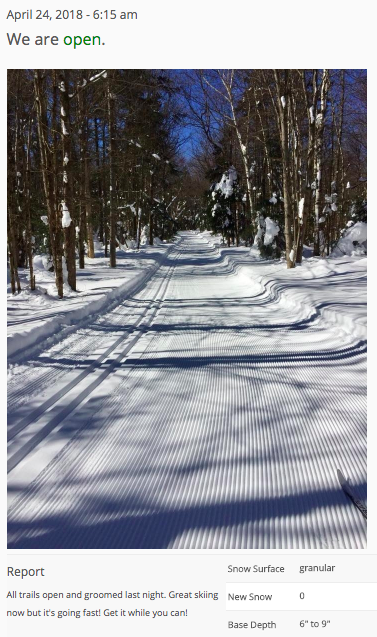
There’s a lot of snow at Prospect Mountain in Woodford, Vermont, too. (“Getting 80″ in a week in March didn’t hurt,” Ofsevit notes.) Here’s a stunning screenshot from the conditions report for Tuesday, April 24 (just offscreen is the current temperature, 69°):
Dartmouth skier Adam Glueck skied 50 k there on Sunday, describing conditions as “50+ F and transformed.”
Montana
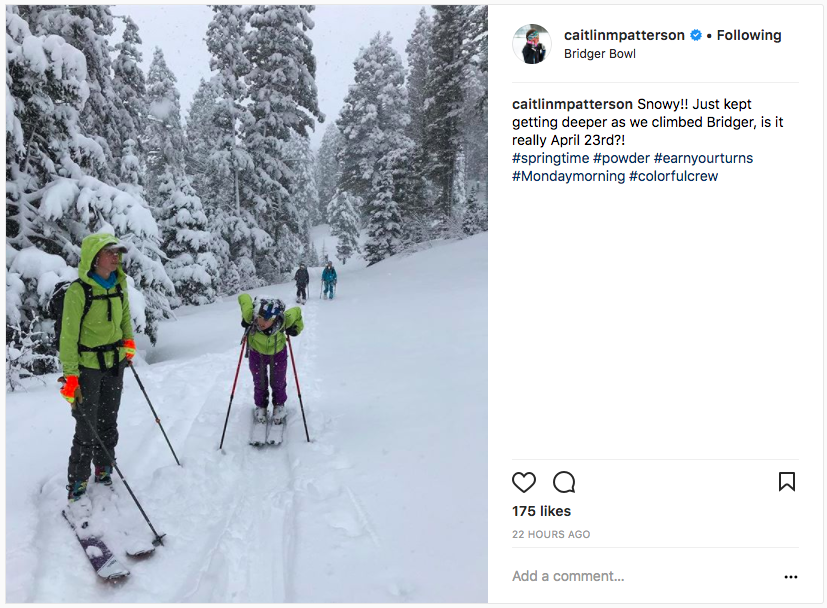
Effective Tuesday morning, they were still grooming some nordic trails at Crosscut Mountain Sports Center (formerly Bohart Ranch). Pictures of nordic skiing there are hard to come by right now, so here’s a screenshot from Caitlin Patterson’s Instagram page showing backcountry skiing at adjoining Bridger Bowl on April 23 in fresh powder:
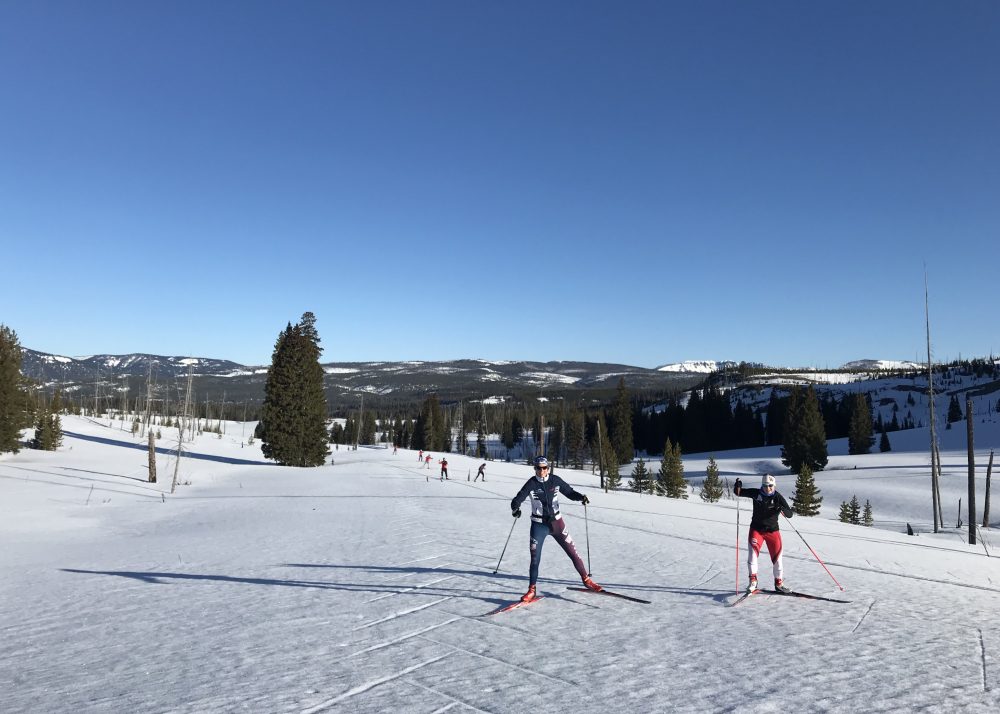
And from two days before that, here’s some prime crust skiing at Fawn Pass on Saturday:
Crust skiing at Fawn Pass, outside West Yellowstone, Montana, April 21, 2018. (Photo: Caitlin Patterson)
Canada
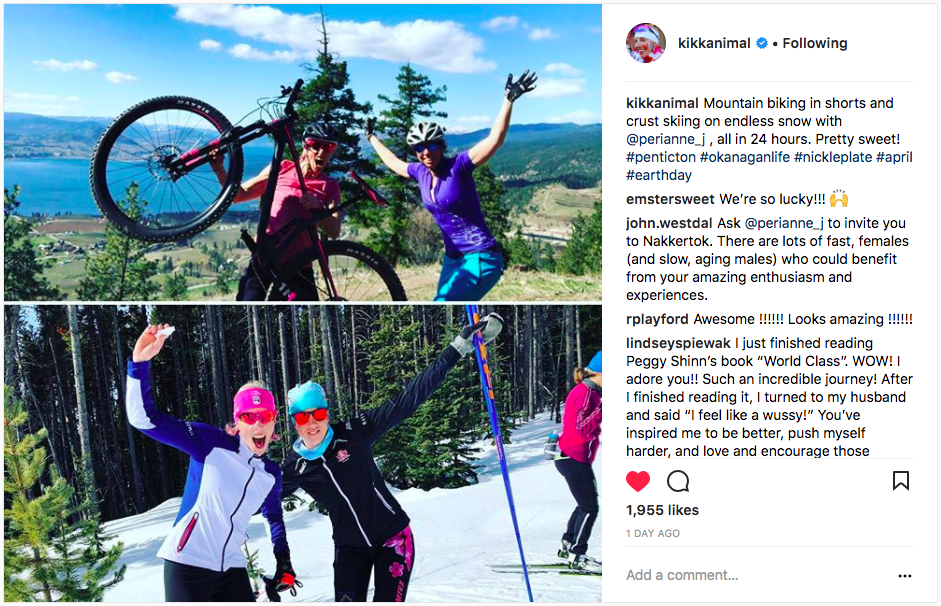
Recently retired American skier Kikkan Randall doesn’t seem to be suffering from her move to Penctiton, B.C., judging from Sunday’s shot of crust skiing with former Canadian World Cup racer Perianne Jones:
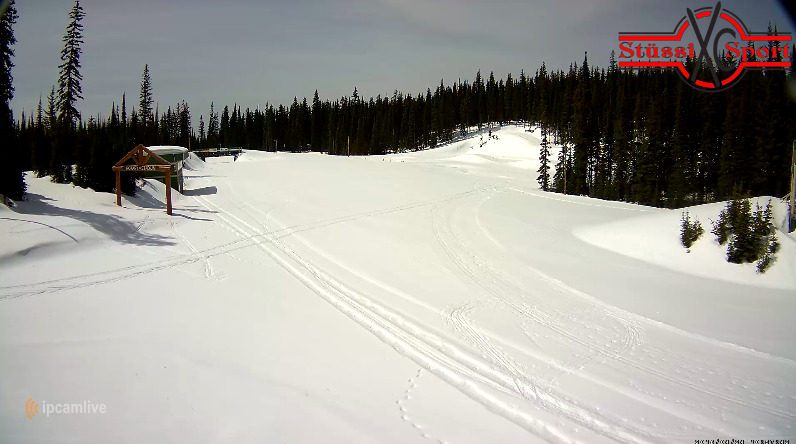
And 100 kilometers to the north, Sovereign Lake Nordic Centre isn’t lacking for snow, either. Here’s a screenshot from the webcam as of Tuesday morning, showing impeccable coverage:
That’s a base of 256 centimeters, or over eight feet (!) in American, according to a current conditions report. Sovereign Lake is closed to official skiing at present, but reopens from May 10-13 for its Spring Fling Ski Camp.
Oregon
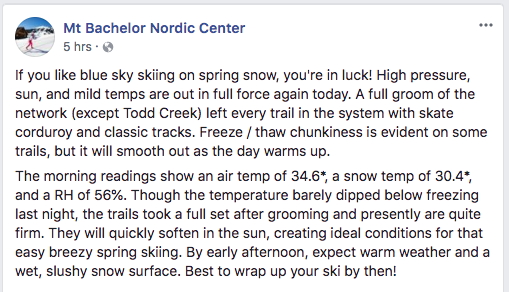
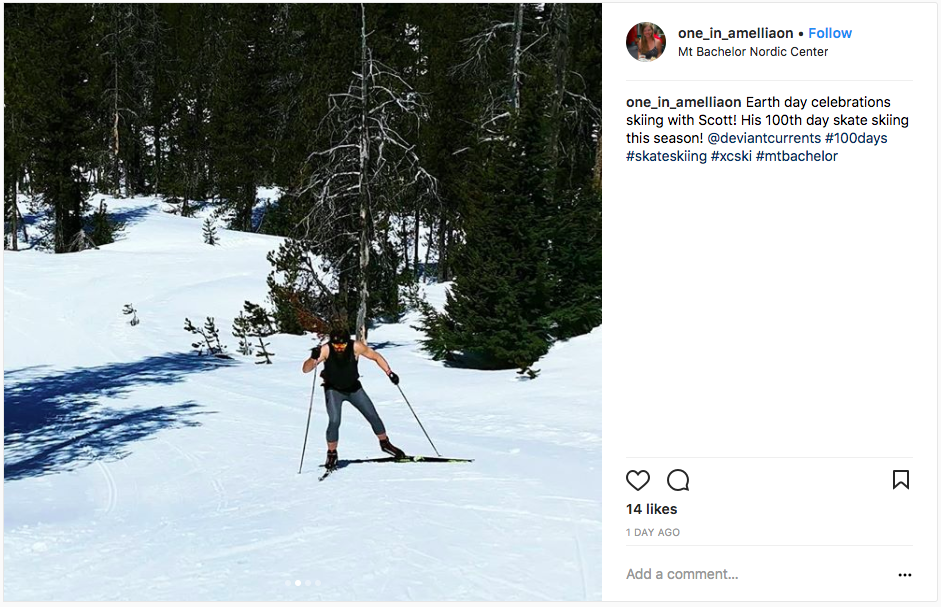
Mt. Bachelor currently has a base of 85″ at 6,300 feet near the base of the alpine area, which is somehow less than Sovereign Lake but still, you know, more than seven feet of snow. Here’s the nordic grooming report from Tuesday morning:
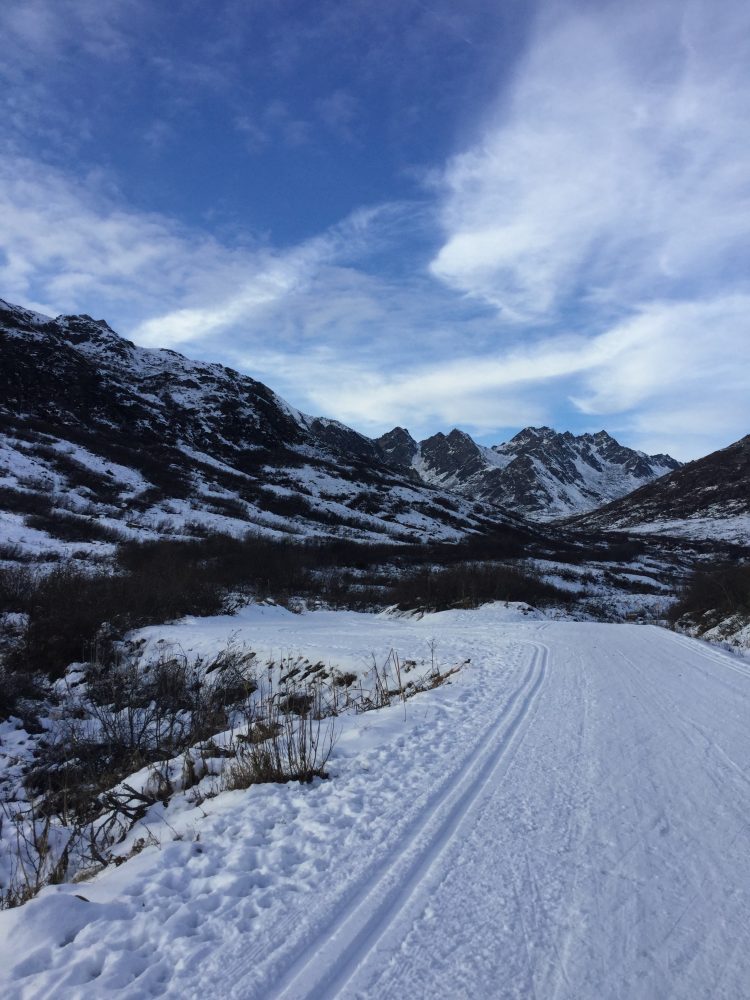
There’s still a lot of snow in Alaska right now. Maybe not at sea-level Anchorage, which is staggering toward spring with a series of high-30s, mid-40s raw and windy days culminating in snow squalls Tuesday evening – Kincaid is down to the dregs of a snowmaking loop by this point, and formal grooming there ended last weekend – but pretty much everywhere else. This reporter found fresh snowfall and blowing spindrift at 2,200′ at the edge of town Monday morning, and most places higher than that are still snow-covered. There is over five feet of snow at Hatcher Pass, and temperatures there remained below freezing even as it rained at sea level on Tuesday. The Mat-Su Ski Club should presumably once more be grooming through mid-May with ease.
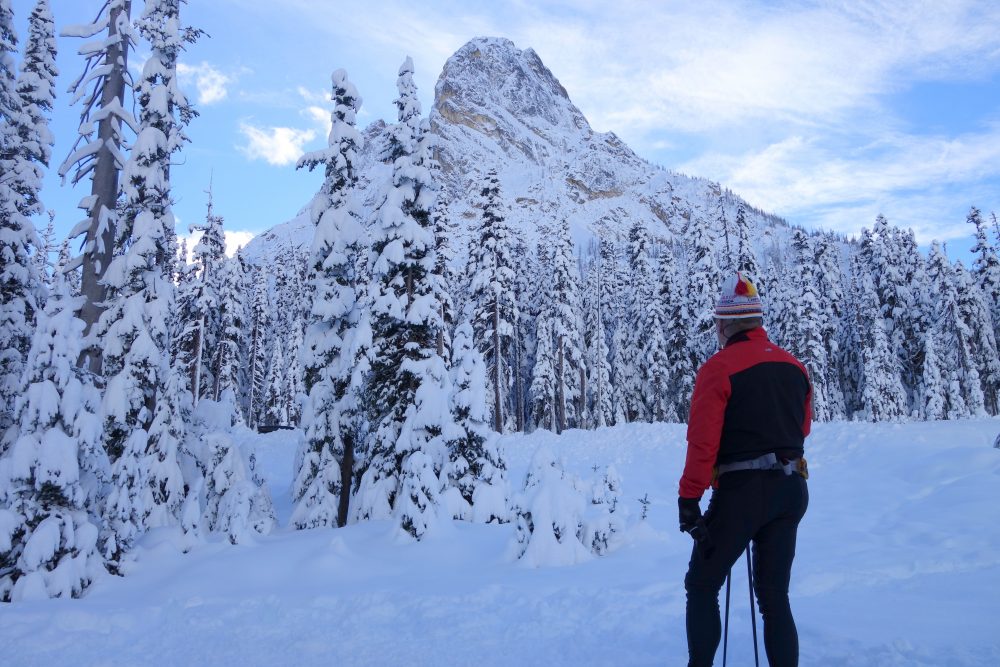
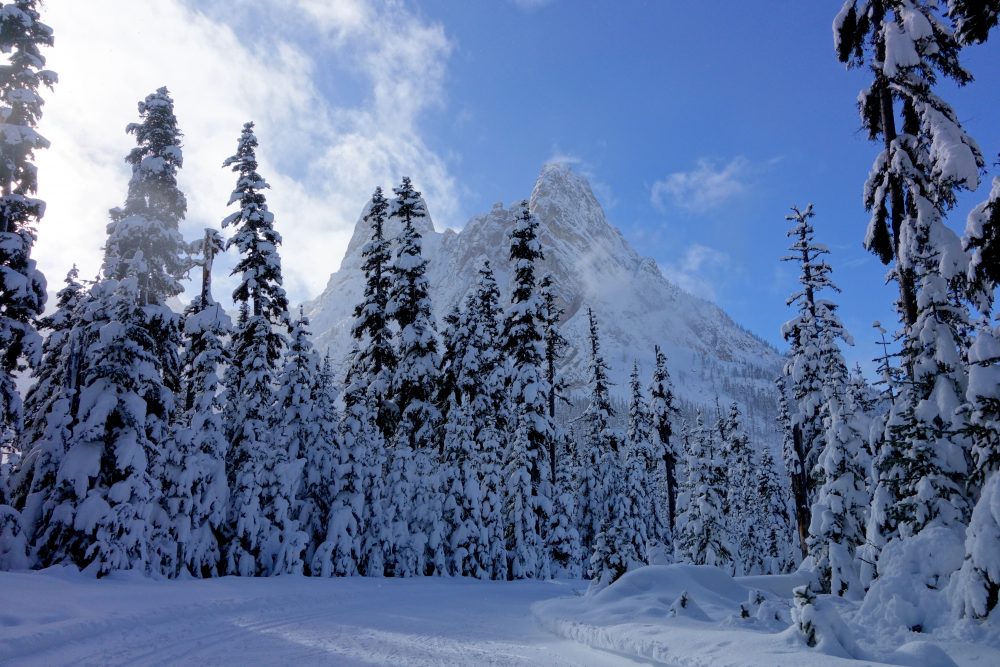
Skiing under Liberty Bell on Washington Pass in November, 2016. (Methow Trails courtesy photo)
Natural snow is where it’s at, unless there’s none to be found. In high-elevation places like West Yellowstone, Mont., (roughly 6,600 feet above sea level) and Crested Butte (nearly 9,000 feet), November skiing is almost always a given — which is why those venues have hosted Thanksgiving-week ski camps for 16 to 30+ years. And they are again this year, while looking to the skies and weather forecasts in hope of more snow — much more.
While there are only two well-known Thanksgiving camps currently being held in the U.S., there are dozens of other places around the country you can likely go skiing. We did our best to present some of the most dependable options, so at the very least you can plan a future trip on snow this time next year. No offense to the in-laws, but wouldn’t you rather be skiing on Thanksgiving? Stay tuned for our Canadian early skiing edition, and feel free to share your favorite November ski spot in the comments section below.
***
What: Yellowstone Ski Festival
Where: West Yellowstone, Montana
A rendezvous point at the Rendezvous Ski Trails as seen last year in West Yellowstone, Mont., during the 2015 Yellowstone Ski Festival. (Photo: 2015 courtesy photo)
How many years running: Over 30 years. “It started with Drew Barney, Torbjorn Karlsen and Dick Hunt back in the 1980s as a Fall Camp, offering clinics for coaches and citizen racers looking to improve their technique,” West Yellowstone Ski Education Foundation Program Director Moira Dow explained. “Over the years, the camp grew into one of the top training camps available to the cross-country ski community.”
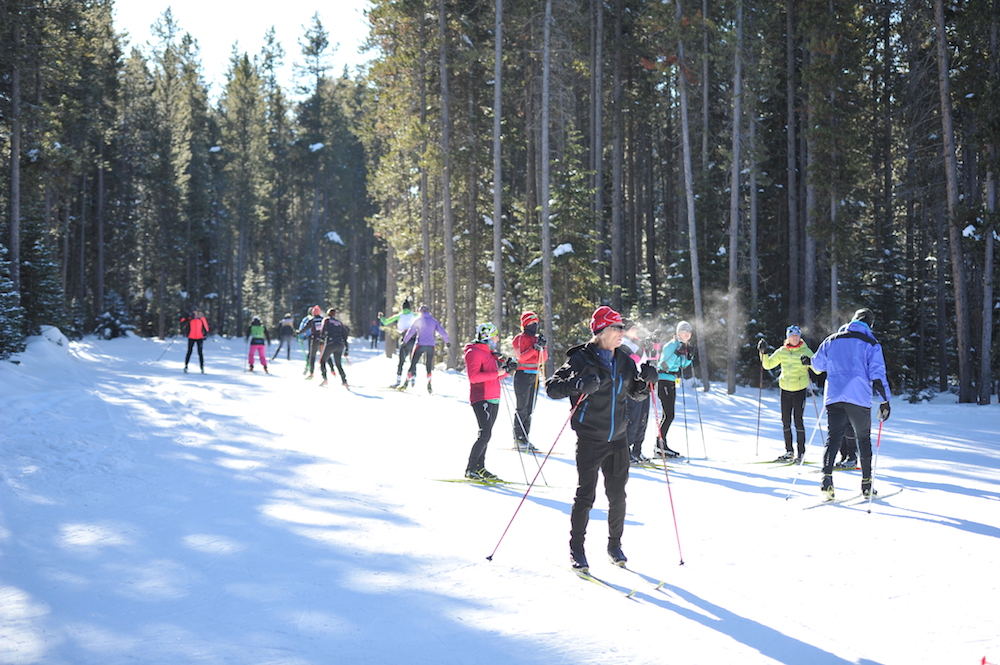
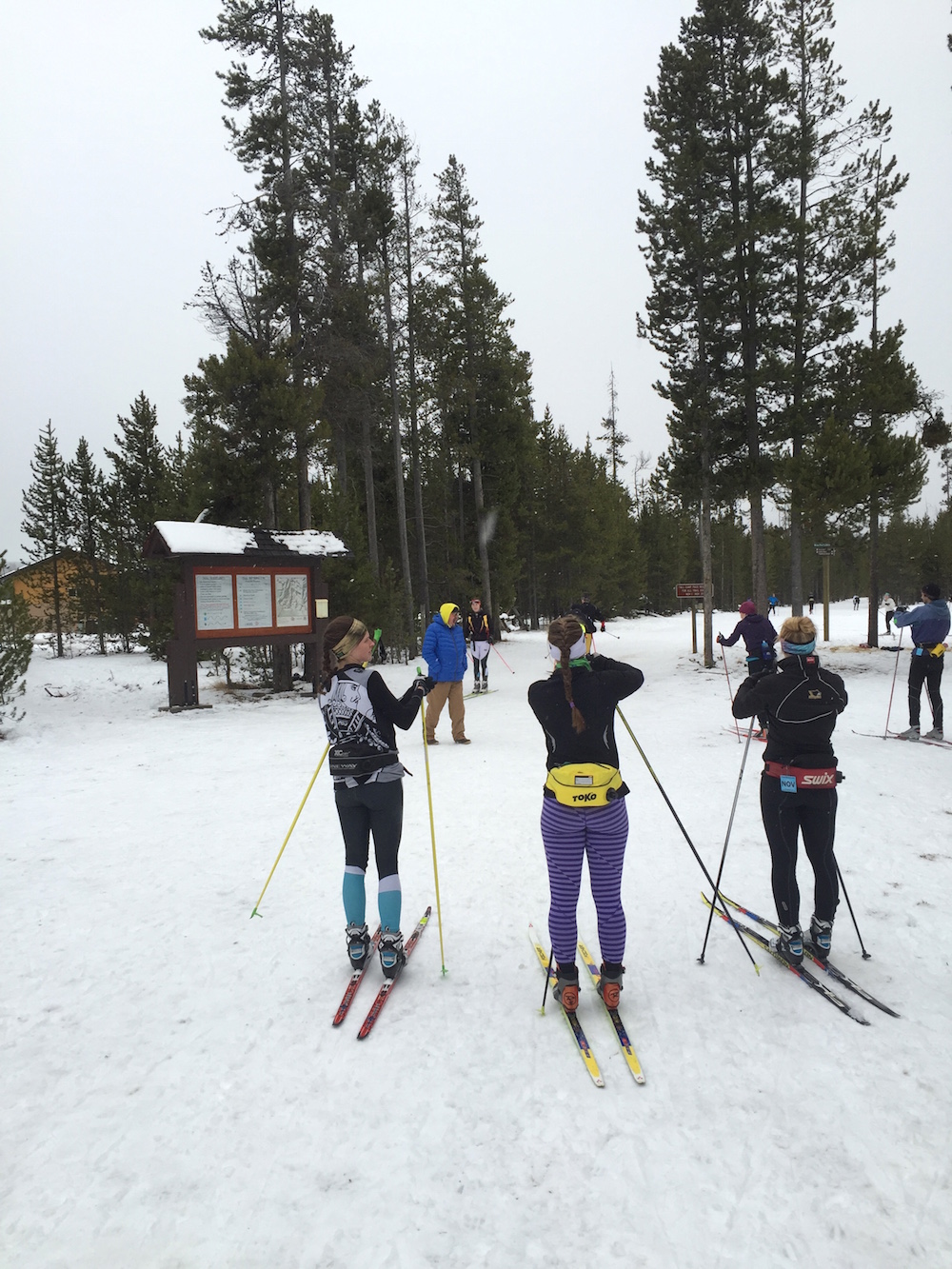
Skiers at the trailhead of the Rendezvous Ski Trails in West Yellowstone, Mont., on Monday, Nov. 21, 2016. (Photo: FBD)
Target audience: Open to the public and all levels of skiers.
Anticipated participation: Around 2,500. “We think it might be a little bit lower this year because of the late snow and the lack of the SuperTour,” Dow noted. “Last year we had a lot. We had really really early snow last year. Around 3,500 in years past.”
Advance reservation required? Yes for clinics and races. Online registration only. “The competitive events and the clinics all require you to be pre-registered, but all the evening events are open to the public,” Dow said.
Trail pass rates: $55 for the month of November for adults. $26 for kids, which is 10 and under. Day passes are $12 and $6
Grooming report:Approx. 20-25 k groomed as of Monday, Nov. 21.
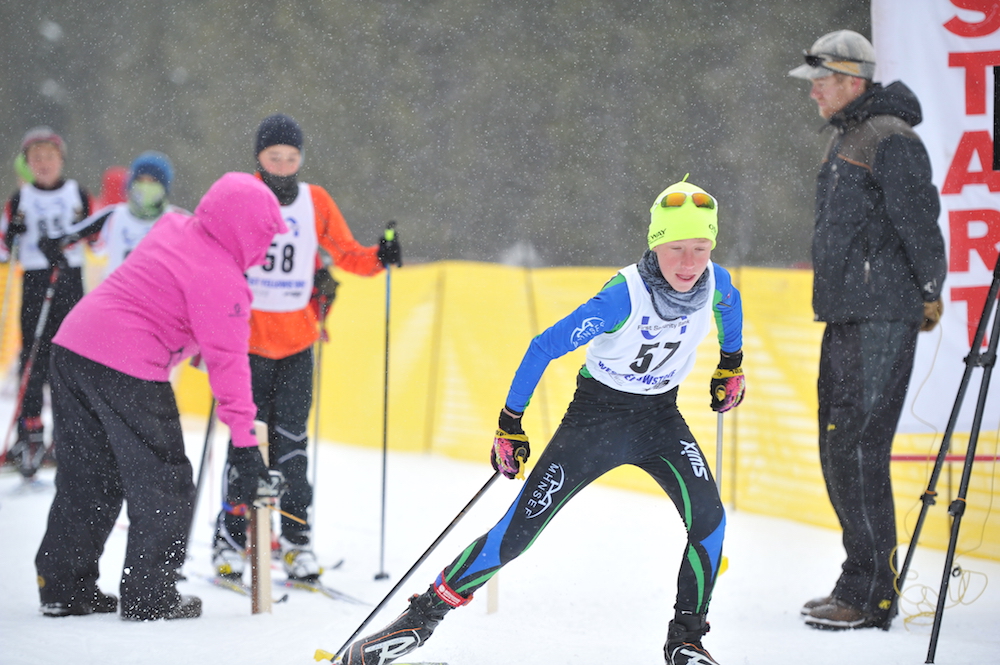
A young skier darts out of the start at last year’s Yellowstone Ski Festival in West Yellowstone, Mont. (Photo: 2015 courtesy photo)
What makes this camp unique?
“Good, early, reliable snow,” Dow said.
“Also it’s a place where skiers from all across the country, juniors to seniors to masters, come together,” she added. “… And as a junior, that’s pretty unique to get to be able to do that. And also to see all the equipment from vendors and see wax clinics. To have all of the elements in one spot is one of the most unique things about this camp.
“We’re a tiny town out in the middle of nowhere,” she continued. “Our ability to put on such a big event, is, in my opinion, probably one of the most unique aspects of our camp. We are almost entirely volunteer run. The fact that the people who run the festival have little to no experience cross-country skiing, but put on these races, is just flabbergasting to me. It’s pretty incredible.”
Special events: See website for complete lineup of clinics and more, including:
Presentation: Wildlife photographer Tom Murphy
Yellowstone Historic Center presents The Ski Hero Soldiers of Yellowstone
Whiskers, Whiskey, and Waxing featuring whiskey tasting samples from Willie’s Distillery of Ennis, MT
Branch Beer Bash: Micro and craft beer tasting
Presentation: Kaatsu Training by Doug Barnard
Winter Wildlands Alliance Backcountry Film Festival
Women, Wine, and Waxing
Keynote speaker Ruff Patterson
Yellowstone Ski Festival Social
— Gabby Naranja
***
What: Crested Butte Nordic Thanksgiving Camp
Where: Crested Butte, Colorado
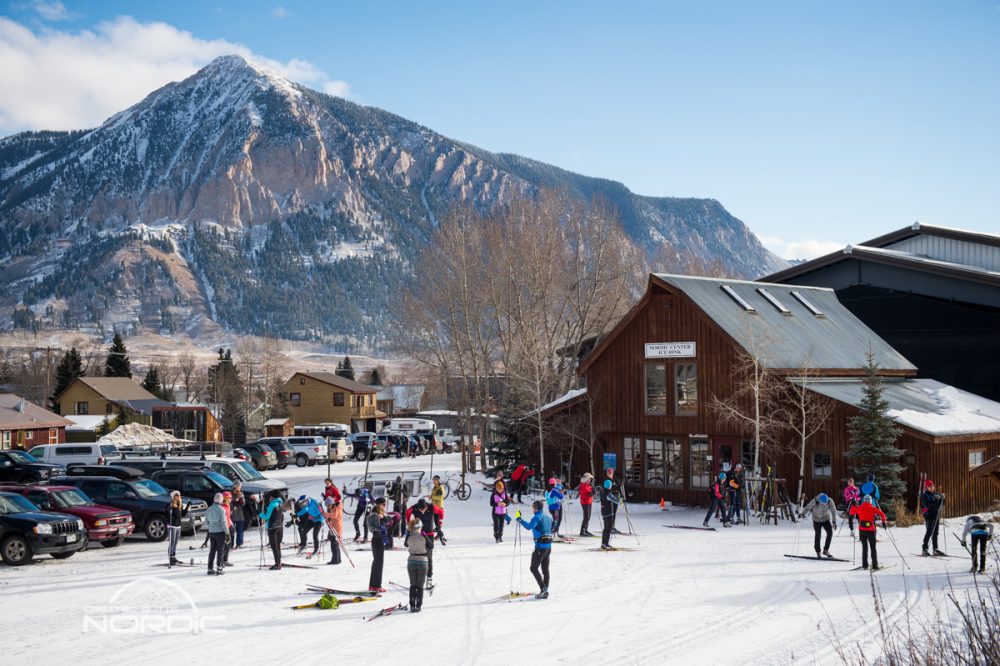
The downtown-based Crested Butte Nordic Center. (2015 courtesy photo)
When: Wednesday, Nov. 23, to Sunday, Nov. 27, 2016
How many years running: 16 as an official, organized camp: “In case of a low-snow year, like our current situation, we have a low-snow venue called Lily Lake and that’s up on Kebler Pass which is six miles West of town,” said Drew Holbrook, marketing director for Crested Butte Nordic.
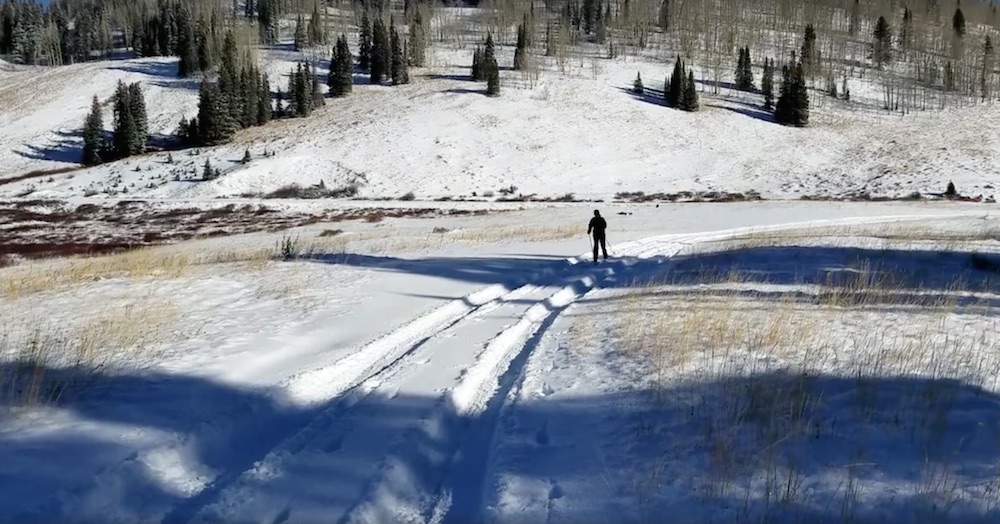
Skiing at Lily Lake in Crested Butte, Colo., on Nov. 18, 2016. (Photo: CB Nordic/Facebook video)
The road up to Kebler Pass is maintained by the county. Individuals or groups can drive up to the pass, but carpooling is encouraged when the low-snow option is in play.
“We have vans to shuttle people up to try and minimize traffic and congestion — it’s kind of like a similar situation in terms of people (but not as and because not quite as many people) as driving up on the South Plateau outside West Yellowstone, so we shuttle people up there. For the people taking clinics we shuttle them all up in vans.”
The Lily Lake area receives 600 inches of annual snowfall and no trail pass is required. As of Nov. 18, Lily Lake had received nearly six inches of snow.
The Nordic Center located in town is also prepared for low snow, according to Holbrook. “Just in the last three years we have had the trail right next to the Nordic Center in town, called Ruthie’s Run, homologated re-engineered. So it’s seeded with grass, it is mowed and basically we can groom that with literally six inches of snow or so. It’s kind of interesting because it snows a lot more up on Kebler Pass at Lily Lake, it might snow two feet up there and only six inches in town, but it’s easier to actually groom on Ruthie’s down in town if we get the snow. Lily Lake is on Forest Service property, so we have to wait until there is a foot of snow before we are allowed to groom up there.”
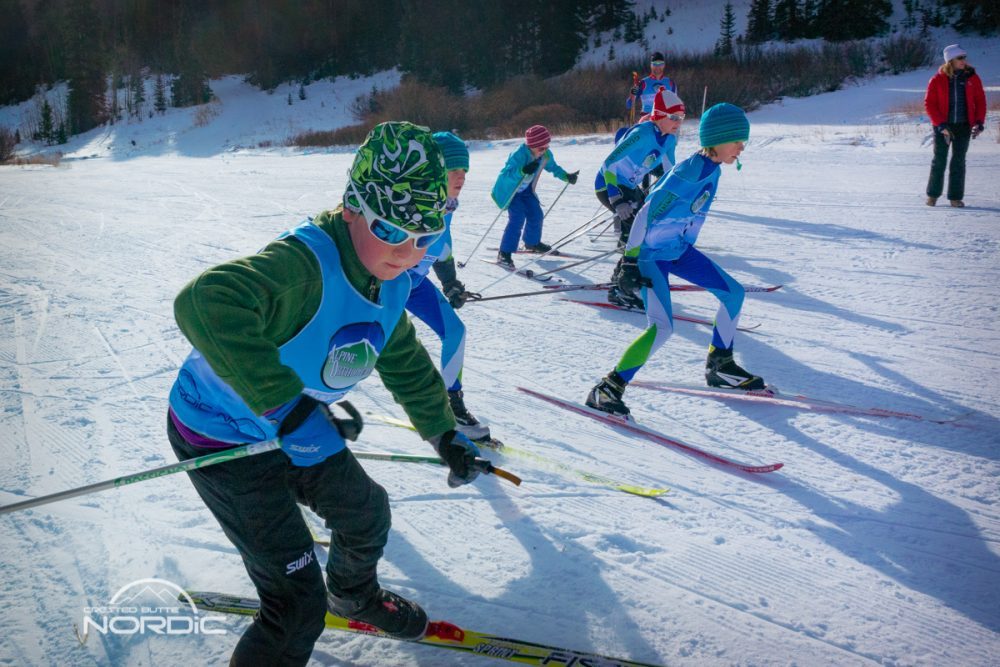
Crested Butte Thanksgiving Camp: not just for big people. (2015 courtesy photo)
Target audience: All ages and abilities. New skiers are encouraged to come try the sport out.
Anticipated participation: Holbrook expects 60 participants for the clinics offered. A round-robin classic “refresher” will be held Thursday, Nov. 25, with full-day clinics on the 26th and 27th.
Advance reservation required? Strongly encouraged. “For the clinics it is best to sign up ahead of time,” Holbrook said. “We never get too many people signing up until it starts snowing, but they do fill up. You might get lucky the morning of and come into the Nordic Center and sign up and get a spot, no guarantees.”
Trail pass rates: $20/day, skiers 17 & younger ski free. $150 for a 10-punch transferable pass.
Grooming report: Lily Lake is receiving snow. The low-snow option looks more than promising.
What makes this camp unique? “One thing that makes it unique, Lily Lakes is a great locals’ place to ski,” Holbrook said. “It’s pristine and scenic. And of course, its great skiing from the Nordic Center in town, too. There is plenty of room on the trails for everybody, you are not getting swarmed by people and not being able to do your workout. It’s easy to get in a good ski.”
Special events:
Ski Free Day: Wednesday, Nov. 23 at the Crested Butte Nordic Center
Crested Butte Mountain Resort “Donation Day”. Donate some money, you decide the amount, and ski with a little help from gravity at the downhill area. All proceeds support the Crested Butte Snowsports Foundation
Round-robin refresher clinic: Thursday, Nov. 24
U16 Junior Training Camp: Nov. 25-27
Alley Loop Race Series (Race #1) 5 k & 10 k skate
Winter Kick-Off Party (Saturday night): Fundraiser for Crested Butte Nordic, tickets $25/adult,$15/children. (Author’s note: Crested Butte throws fun parties.)
— Jason Albert
***
NOT CAMPS, PER SE, BUT YOU’RE PROBABLY WONDERING ABOUT:
ALASKA
Fairbanks
Birch Hill Ski Area, in Fairbanks, is probably the most reliable spot in North America for groomed early-season skiing. This is the venue that once held a FIS race on Nov. 2. Temperatures are reliably cold, and any snow that falls tends to stay. The Nordic Ski Club of Fairbanks grooms approximately 35 k of trails at Birch Hill. The trails are meticulously maintained in summer, if not manicured, and are justly renowned for their ability to provide good skiing after mere inches of snowfall.
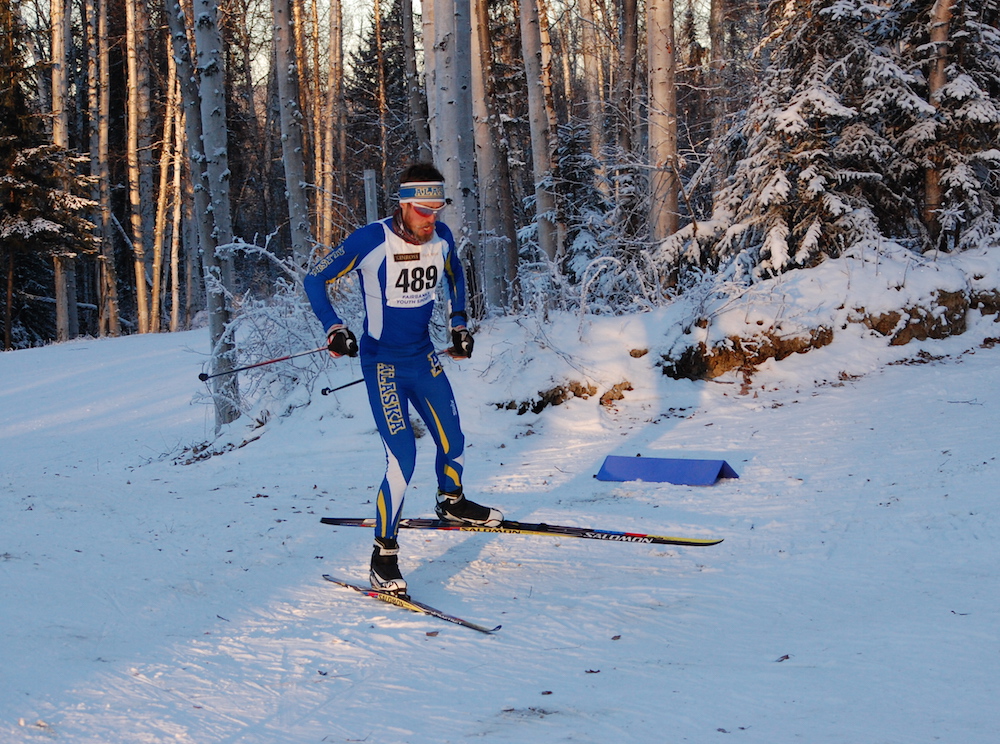
University of Alaska Fairbanks skier Alex Eckert racing in the Alaska Nordic Cup FIS races in Fairbanks, Alaska, on Nov. 19, 2016. (Photo: Max Kaufman)
Birch Hill again held FIS races on the recent weekend of Nov. 19-20. It had snowed approximately 5″ total in Fairbanks this winter by that point. Weekend racers – and there were hundreds of them, from kindergarteners without poles to the APU Elite Team – skied on trails that had been packed and dragged to create a base of approximately 2″. There were admittedly some leaves and dirt showing through in places – but, crucially, it was leaves, not rocks. Most skiers in the FIS/USSA class of the weekend’s races competed on their prior-generation, few-years-old race skis.
Locals consistently described the conditions, which led half the APU Elite men’s team to make the trek north from Fairbanks for the weekend, as among the worst mid-November conditions in living memory.
Anchorage and nearby
Under normal conditions, as measured by a 30-year average, Anchorage around Thanksgiving is a nordic nirvana. There are at least 40 kilometers of groomed trails at Kincaid Park, on the west edge of town, and another 16 k at Hillside, on the east edge of town. (16 k are lit at Kincaid, and 8 k are lit at Hillside.) The two ski areas are connected by a network of dozens of kilometers of additional trails (also groomed, or at least snowmachine dragged), ranging from moose-dense forest to urban greenbelt, including the Coastal Trail, which runs along the shores of the Pacific Ocean for most of its 15 k. You can ski from Hillside up into the Chugach Front Range, and from the frontcountry into true backcountry. Around 20 miles out of town to the north, Beach Lake has another 20 k of groomed trails (nine of them lit). 40 miles to the south, Girdwood boasts a growing trail network of around 10 k total, including a competition-level 5 k loop. All trails are open 24/7, and there is no trail fee for any of them.
Hillside ski trails in Anchorage, Alaska, on Oct. 22, 2016, before the rains came. (Current conditions are far worse.) (Photo: Gavin Kentch)
Judging from the last three winters, however, Anchorage sadly simply cannot be recommended as a viable option for Thanksgiving snow in these days of climate change. While all three winters saw the first snowfall in October or early November, and some period of good skiing immediately thereafter, all three gave way to wind and rain by Thanksgiving week. As of the weekend of Nov. 19-20, 2016, Anchorage has no natural snow on the ground at Kincaid, a 1-2″ base of bulletproof sheet ice at Hillside, and skritchy skiing on a local golf course. On the bright side, the trail running is amazing (bring your Icebugs), and the nordic skating is world class.
Kincaid has limited snowmaking capabilities, which are capable of covering a loop of as much as 3-4 k centered around the main stadium area. (This is where over 95 percent of Anchorage ski races have occurred over the last two winters.) The Nordic Skiing Association of Anchorage (NSAA) turned the snowguns on briefly on Nov. 16, then again on Nov. 18. Recent cold temperatures have allowed them to operate continuously since. NSAA stated on Sunday morning that there were no trails open for skiing yet, but that they were “getting closer” to opening the first loop and had reached the stage where the PistenBully was starting to move snow around. A loop of approximately 2 k was opened amidst single-digit temperatures on Thanksgiving morning, Nov. 24.
In a recent email to FasterSkier, NSAA Program Manager Tamra Kornfield addressed the possibility of, for example, guaranteeing skiable snow by Thanksgiving in exchange for attracting skiers and generating user fees. Kornfield wrote, “The theory of trail fees has been discussed for many years, but currently our ski trails are on Municipal Park land, and we cannot charge to access these parks. However, I can say that the snowmaking system was designed to extend the ski season, not create it from scratch, so I do foresee doing more to fundraise for this great expense that has now saved the last two ski seasons.”
Mat-Su Valley
Archangel Road above Palmer, Alaska, on Nov. 4, 2016 (current conditions are better than this). (Photo: Gavin Kentch)
The Matanuska–Susitna Valley, approximately one hour outside of Anchorage on a major highway (call it up to 90 minutes to the ski areas discussed here), has been described on this website as having “the season of winter that starts in the fall and ends in the spring.” That’s pretty fair.
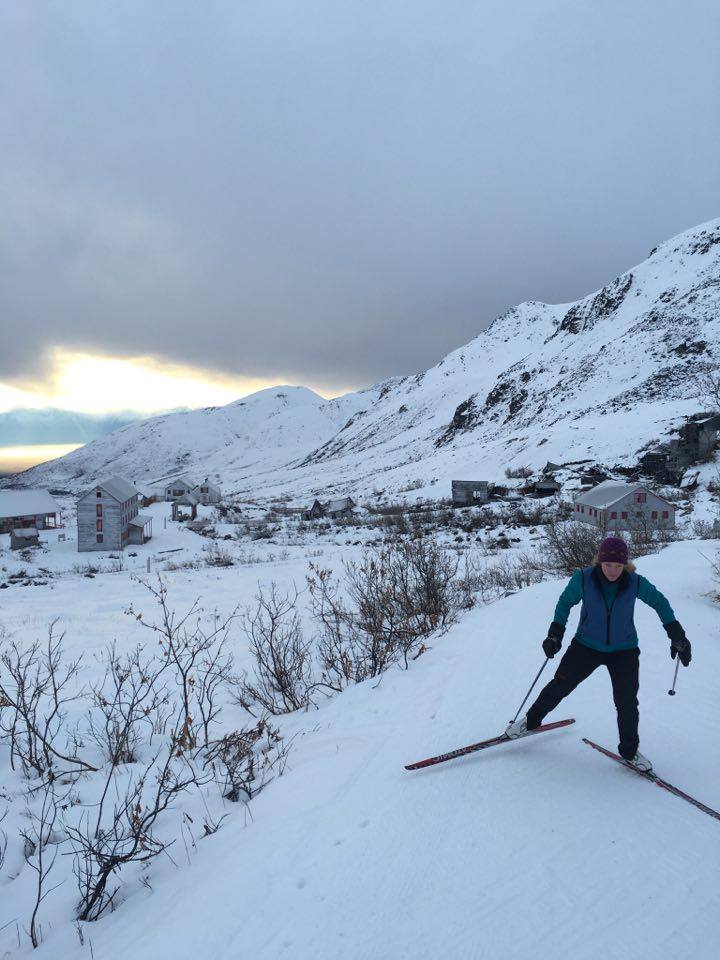
The Mat-Su Ski Club, including the redoubtable Ed Strabel and sometime FasterSkier contributor Jeff Kase, typically groom 7 k of Bill Spencer-designed trails at Government Peak Recreation Area (to be expanded as soon as next summer), 7.5 k (one-way) on Archangel Road, and 5 to 10 k at Hatcher Pass. Archangel Road hosted one of the last North American ski races of 2015/2016 and one of the first of 2016/2017. Hatcher Pass is a truly special place, as the groomed trails wend their way past the historic buildings of an old gold mine nestled in a bowl in the Talkeetna Mountains. “Imagine skiing through an Old West ghost town turned collectible Christmas village,” local Master and English professor Shannon Gramse once wrote in these pages.
Skiing at Hatcher Pass, above Palmer, Alaska, on Nov. 20, 2016. (Photo: Nat Herz)
As of Nov. 19, Government Peak (a one-hour drive one-way from central Anchorage), which is at a lower elevation than the other two areas, did not have enough snow to ski on. Archangel Road (75-minute drive) had a base of approximately 4-5″, but it is bulletproof hardpack that should provide a reliable base until spring. The Mat-Su Ski Club has been grooming there several times a week, and the skiing is good to superb. The Mat-Su Ski Club also groomed Hatcher Pass (90-minute drive) over the weekend.
For the best information on current trail conditions, including formal grooming reports when available: Anchorage (official NSAA and user-generated), Mat-Su, and Fairbanks.
— Gavin Kentch
WASHINGTON
Then there are the possible Northwest options for early season skiing, including the well-known:
Bluebird day on Washington Pass in November 2016. (Methow Trails courtesy photo)
Methow Valley
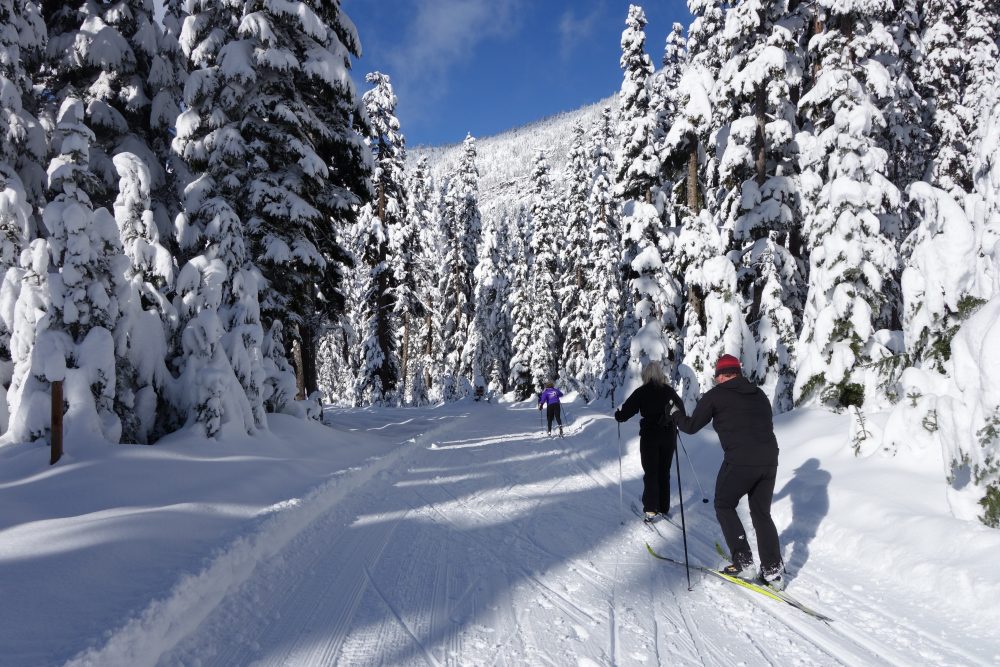
“I giggle about the current skiing up at Washington Pass which is a the top of the North Cascades Highway,” said Kristen Smith, marketing director for Methow Trails based in Winthrop, Washington. “What they have groomed is almost exactly one mile or a 1.6-kilometer loop. It goes out to the Washington Pass overlook, which is stunningly gorgeous. I mean the whole ski is the most beautiful, their probably can’t be a place anywhere in the world that has more beautiful scenery than this, on this little loop.”
Smith explained the loop is being groomed for skate and classic. “It’s a handful of super-dedicated locals who do the grooming completely on their own and you don’t pay to ski there,” Smith said.
But here’s the important beta: call or check online before you head to the Methow or think you might ski at the top of Washington Pass. The Washington Department of Transportation is closing the pass temporarily due to possible hazardous weather and avalanche conditions as of Monday, Nov. 21.
Skiing at Washington Pass, Nov., 2016. (Courtesy photo)
“It will not mean a loss of skiing,” Smith explained in the event the pass is closed for the season. “If the gate is closed farther down on the road to Washington Pass, they will start to groom different areas that we can still access. So to get the snowfall that is expected, they will start to groom just start to groom a bit lower, but bigger loops than what we have up there at Washington Pass. If we are really lucky we will get a big snowfall here on the valley floor and then Mehto Trails who I work for, we will start grooming our system. And we are all set and ready to go the moment we get six inches of snow we will start grooming our trails here.
Conditions: Pass is closed. SR 20, the North Cascades Highway, is closed from milepost 134 to milepost 171 due to impending weather and potential increasing avalanche hazard.
Restrictions Eastbound: Pass Closed
Restrictions Westbound: Pass Closed
— Jason Albert
EAST-COAST SNOW?
While they’re often among the last to get on natural snow, let’s throw eastern skiers a bone. Wintry conditions exist in New England and northeastern New York. While we can’t list them all (and are obviously unable to cover all the open nordic centers across the country), here are a couple weather-dependent options in this region’s “North Country”.
Snow guns a’blazing at Gore Mountain’s Ski Bowl in North Creek, N.Y., on Monday morning, Nov. 21, 2016. (Photo: Mike Pratt)
Gore Mountain Ski Bowl
According to general manager Mike Pratt, Gore Mountain in North Creek, N.Y., expects to open its newly homologated ski bowl on Friday, Nov. 25. Gore’s new 4.24-kilometer trail network includes 3.19 k of trails with snowmaking.
“We should have quite a bit of terrain for an opening weekend,” Pratt wrote in an email, adding that they’re hoping for trails A, B, C, and G, which would amount to a total of 2.3 k. “The open stadium could accommodate more lanes if needed, but next week’s weather will ultimately determine how much terrain is available.”
This Friday through Sunday at the Ski Bowl, the Hudson United Race Team (HURT) is holding a three-day ski camp for its junior members. Skiers of all ages not associated with the club can buy a day pass and ski on the trails as well.
“We set up this camp as a way to highlight what Gore has been doing,” HURT coach David Kvam explained.
Craftsbury
Then there’s the Craftsbury Outdoor Center, the Northeast Kingdom’s iconic ski center. Although the ski trails were dry as of Nov. 18, the forecast has potential. According to Craftsbury’s Marketing Director Sheldon Miller, the National Weather Service issued a winter storm warning for six to eight inches of snow by the end of Monday. Asked about snowmaking, Miller replied, “We’re looking for cold and dry for snowmaking, but there’s definitely some potential this week. We do need 28 [Fahrenheit] at a minimum, but colder is always better.”
With overnight temperatures forecast for low to mid 20s Sunday through Thursday, the weather looks inclined to support snowmaking.
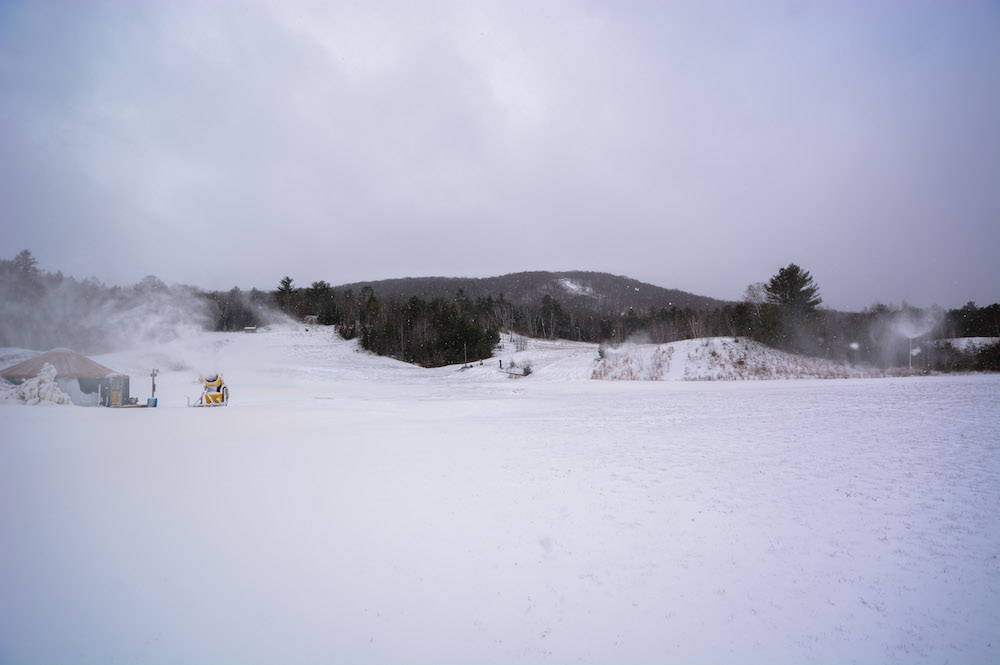
Elsewhere, Prospect Mountain in southern Vermont received snow. According to their conditions page, they’re closed, but Zach Caldwell posted this photo montage on Sunday:
As of Tuesday, Prospect reported more than 28 inches of packed powder. Current conditions
Mt. Van Ho
A skier skates on fresh powder at Mt Van Hoevenberg last Sunday, Nov. 20, in Lake Placid, N.Y. (Courtesy photo)
In Lake Placid, N.Y., Mt. Van Hoevenberg reported “beautiful packed powder” and 30 kilometers of skiing open on a 7-inch base. Current conditions
Josie’s Cabin, Mt. Van Hoevenberg’s ski-to destination, will be open for Thanksgiving. (Courtesy photo)
“The Olympic Cross Country ski trails of Mt Van Hoevenberg have been graced with just under two feet of snow in the last few days,” nordic program manager Kris Cheney-Seymour wrote in an email. “We have a little over 30k of trails groomed very good skiing. Classic tracks are set on varied terrain.”
The lodge is open with rentals and a snack bar for Thanksgiving, along with Josie’s Cabin, a “ski-to destination.” and a ski-to destination
“Upgrades over the last two summers on the famous Ladies 5k have allowed for the earliest opening of this trail in our history,” Seymour continued. “Our 5k homologated loop will be the primary course for the upcoming 2017 Junior National Championships hosted here this March.”
— Peter Minde & Alex Kochon
***
WE WANT PHOTOS! Share your Thanksgiving week ski photos with us by emailing info@fasterskier.com (please note when and where they were taken). We’ll post our favorites to Instagram, and if you’d like to share a firsthand trail report from your favorite spot or nordic center, do so in the comments below!
Every two years, the Williams College nordic team hosts its Winter Carnival 20 miles north of Williamstown, Mass., at Prospect Mountain in Woodford, Vt. By 2016, it could have a five-kilometer ski loop up to International Ski Federation (FIS) standards.
A scene from the Williams’ College Winter Carnival at Prospect Mountain in Woodford, Vt. (Photo: Jason Lemieux)
“It started with my coach, Bud Fisher,” said Williams senior Will Wicherski. “He’s been at Williams forever.”
Williams’ associate director of athletics, Fisher suggested that Wicherski study Prospect’s trail system to determine whether a homologated trail would be feasible.
“Within the EISA [Eastern Intercollegiate Ski Association], there’s more and more of a move to get all our races on homologated courses,” Fisher said. “We’ve been thinking about it for some time, and we’re taking a probably a little bit more conservative, slow-paced approach to it.”
Wicherski characterized some of the EISA race loops as “really uneven,” pointing to Dartmouth’s Skiway at Oak Hill as an example.
“The climb is way too big and not that wide,” he said. “Our course at Prospect is kind of unfair. It’s old-school, not wide, and there isn’t a lot of climb. We can’t really have mass start races there.”
Homologating race trails evens the playing field, he explained. “Among the coaches, there’s more of a desire to hold races at homologated race sites. They know what they’re getting. There are more schools that want to host carnivals.”
Some New England schools already hold their carnivals on homologated trails, including the University of New Hampshire (which hosts in Jackson); the University of Vermont (at Trapp Family Lodge in Stowe), and Middlebury (at Rikert) and Colby (in Waterville, Maine).
The course will combine existing trails with new sections. Much of Prospect Mountain’s trail network is on U.S. Forest Service land, where the permitting process makes large-scale alterations difficult. As a result, Williams wants its race loop to include minimal new trails.
Ultimately the college would like to create a course that will accommodate interval-start freestyle and classic races as well as team relays. Mass-start skate races require wider trails than interval starts, and Fisher said that while it wouldn’t be impossible to make them happen, it would be “very difficult.”
Interval-start freestyle, classic, and relay events require trails 5 meters wide. Even for interval-start homologation, some sections of trail — all on forest service land — would need to be widened.
Wicherski described southern Vermont/northwestern Massachusetts as “being on the edge of consistent snow,” adding that if the homologation project works out, the college may consider snowmaking in the future.
“Getting the course homologated is the first step towards snowmaking,” he said.
According to Williams’ Nordic Head Coach Jason Lemieux, snowmaking is a “long term goal/dream … it’s a battle we’ll wait to fight until the completion of the homologation project,” he wrote in an email.
Prospect Mountain’s ski roots trace back to 1939, when it started as an alpine-ski area with a rope tow. At 2,250 feet above sea level, its base elevation is the highest of any ski area in Vermont. In the 1970s, Prospect’s owners cut cross-country ski trails to enhance their business, and in 1992, Steve Whitham and Andrea Amodeo purchased the area after its previous owner abandoned it. Instead of reopening the lifts, they focused on cross-country skiing.
At 2,250 feet above sea level, its base elevation is the highest of any ski area in Vermont.
Getting Up is Half the Battle
One of the biggest challenges was designing an appropriate downhill from the main climb. Running under the old lift line, the A-climb diagonally crosses the alpine hill, ending up on a trail called Shay’s.
“We know where the A-climb is, but we don’t have a way to get down off it,” Fisher said.
This summer, they plan to build the descent. Williams will test it this coming winter, after which they plan to finish work on the trail.
The other challenge exists at the opposite end of the course. Prospect’s trail system is bisected by a forest-service road that sees heavy snowmobile traffic during the winter. During Williams’ last Winter Carnival, course workers had to stop snowmobiles 17 times during the races. “It’s a dangerous situation,” Fisher said.
To avoid the road, Williams would need to construct a short connector trail on forest-service land. They’ve applied to the U.S. Forest Service (USFS) both for this and to widen trail sections where necessary. The carnival trail falls into the forest service’s small-projects category, which requires less time, ecological compliance and money than a large-scale endeavor.
Pending USFS approval, construction will start with trail work this summer.
We haven’t actually gotten an FIS [inspector] in yet,” Fisher said. “We wanted to get all the homologation parameters met before we do that. We launched into the project and came up with a number of ideas to us where show we get an A-climb and a B-climb.”
Lemieux estimated the project’s cost to be “easily more than $15,000.”
Approval will give Williams a 10-year permit. If the downhill from A-climb works, they’ll continue work on the land the following summer. At that point, they would bring in a course inspector from the FIS for any tweaks.
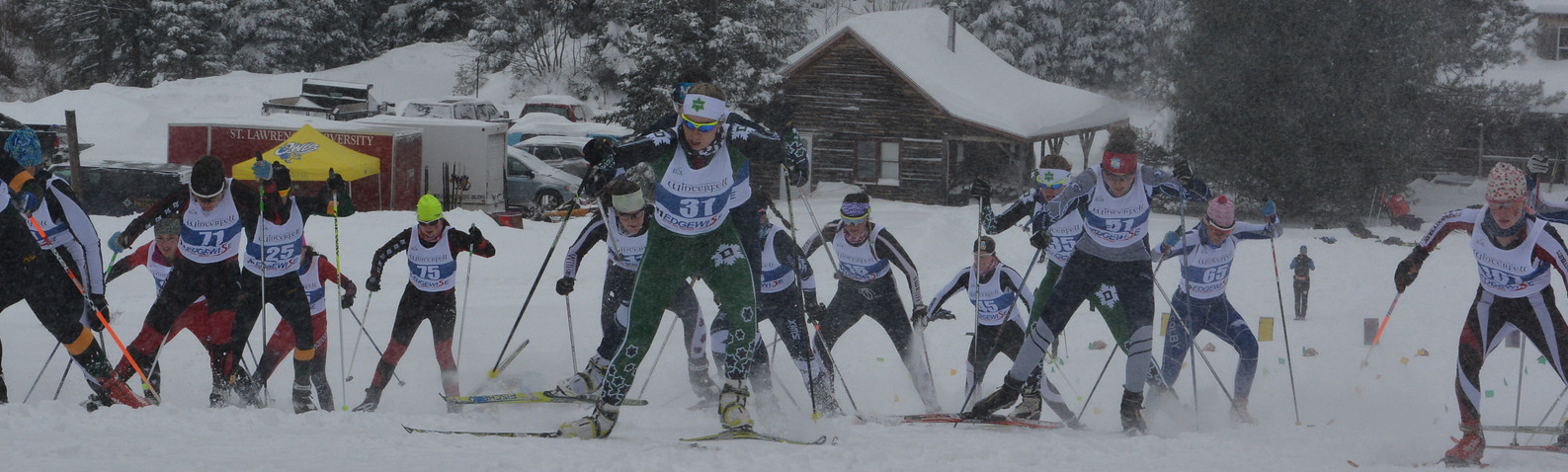
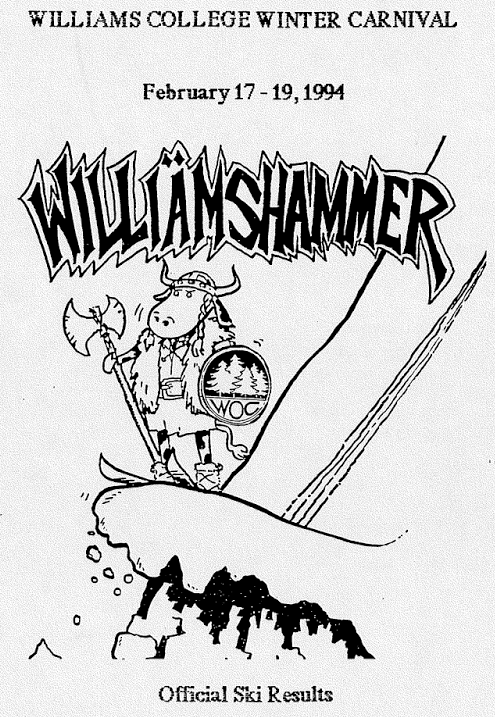
Competitors head out to start the women’s relay at the Williams Carnival (photo: Ian Nesbitt)Excerpt from the 1994 Williams Carnival results packet (photo: EISA archives)
Though they do not host an EISA event every year, the Williams Carnival often coincides with the Olympic Games both in terms of yearly-cycle and calendar date. In past seasons, this event has been referred to by the organizers with unique puns like “Williamshammer” (the 1994 Lillehammer Olympics) and “Moogano” (the 1998 Nagano Olympics). With this year’s event taking place parallel to the Sochi Winter Games in Russia, one might find themselves pining for a little bit of that Olympic touch within the college Nordic scene. Perhaps “Moochi” or Soch-Eph”?
Regardless of your level of Olympic spirit, no skier will complain about having large amounts of snow. A massive winter storm brought over two feet of fresh, soft snow to the Prospect Mountain ski area last Thursday, Friday and Saturday, the penultimate race weekend of the EISA season.
Many of them would tell you that driving a van, bus or trailer through a snowstorm is common practice for cross country ski coaches, and everyone from coaches to parents to athletes got to put their winter driving skills to the test on the long ascent to the venue, part of a now-defunct alpine ski area that sits at over 2,000 ft in elevation.
Much like winter patterns and studs for drivers, different approaches to technique and ski selection must be used when facing soft snow on a ski course. Add in the pressure of a narrowing window of opportunity for skiers on the bubble of NCAA qualification, and you have a truly interesting race weekend.
Friday: 3×3.25K Freestyle Relay
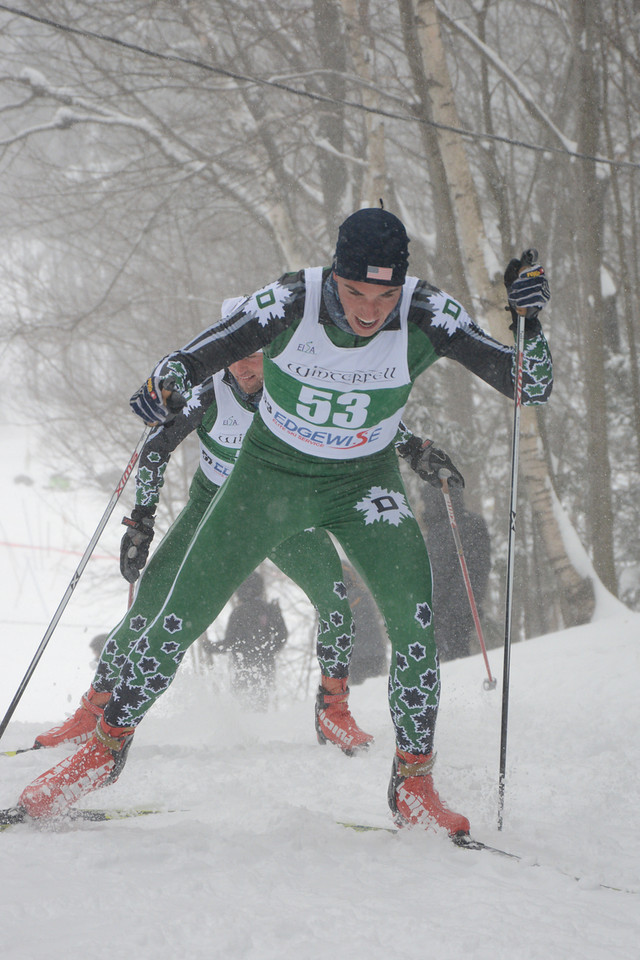
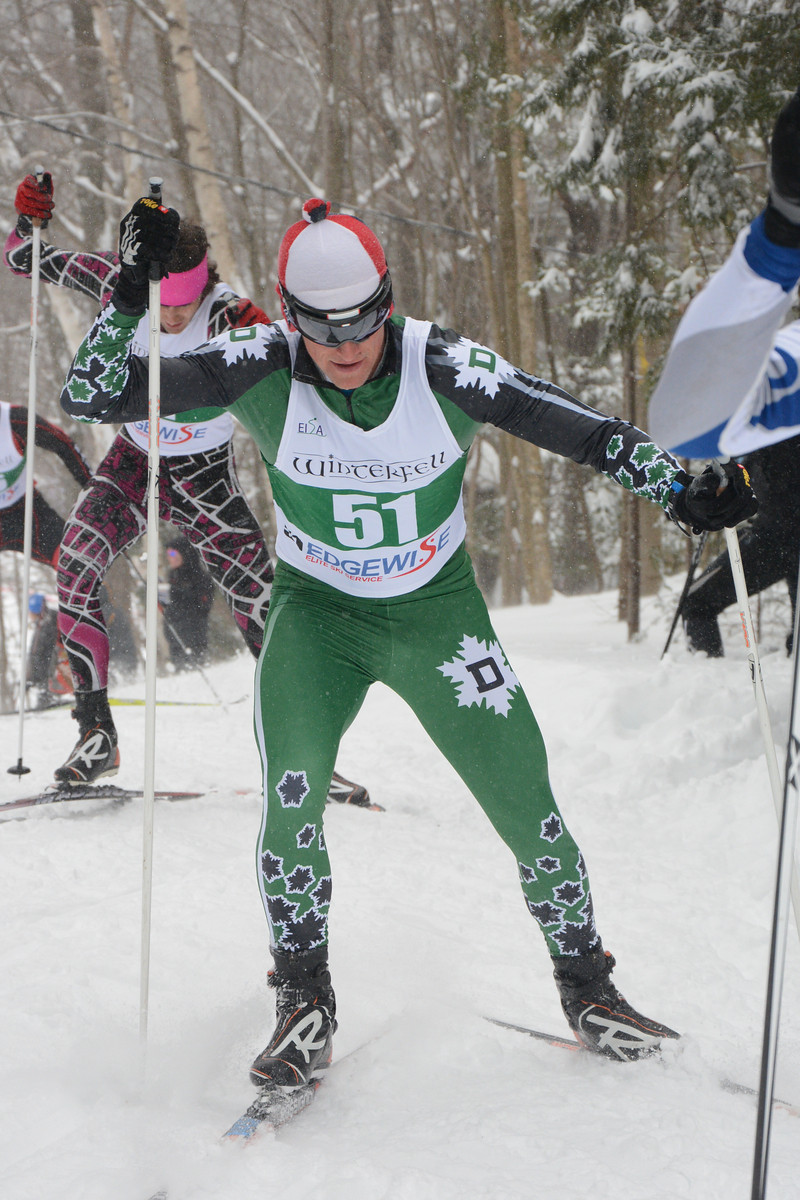
Dartmouth’s Fabian Stocek scrambles for Dartmouth’s first relay team, while Akeo Mayfeld-Carucci follows, sporting a pink valentine Harvard uniform (photo: Ian Nesbitt)
Friday brought the first and only relay event of the year to the EISA, with some perennial powerhouses up front. UVM made winning look easy in the women’s race. Though Dartmouth’s Annie Hart led out of the gate, the trio of Linda Danvind-Malm, Anja Gruber and Stephanie Kirk (in that order) put the rest of the field out of sight behind them en route to a minute-plus victory over Dartmouth.
The most exciting moments of the day came in the race for the final podium spot. Leg by strong early legs by Hallie Grossman and Jane McClarney, the Bates women looked to have a lock on third place going into the final leg. The Bobcat’s anchor skier, Sadie James, has raced to multiple excellent performances in the top-30 this year, but struggled Friday under the pressure of three skiers charging up to her, two of them standout freshmen in their own right.
Colby’s Amy Bianco and Williams’ Hannah Cole made contact with James before the end of the leg, along with Bowdoin’s Kaitlynn Miller. Miller, who has steadily improved to be a consistent threat on the circuit, was the most experienced of this group. That played to her teams advantage, as Bowdoin took home third place to mark yet another milestone for the Polar Bear program. Williams finished in fourth and Colby in fifth, as James and the Bates team faded to sixth.
The men’s race was carried out in almost opposite fashion at the front, with UVM’s Cole Morgen taking an early lead out of the stadium. Without two of their usual scoring three (Scott Patterson and Rogan Brown), however, both of Dartmouth’s teams worked together to pass the Catamounts. By the final leg, Big Green skiers Paddy Caldwell and David Sinclair were skiing together with a gap to the rest of the field.
It was not a question of whether or not Dartmouth would win, but rather which Dartmouth team would win. In the end the first team of Fabian Stocek, Silas Talbot and Paddy Caldwell was victorious in a sprint finish over the second Dartmouth team of Erik Fagerstrom, Cam Woodworth and David Sinclair. UVM’s team of Cole Morgen, Jack Hegman and Jorgen Grav finished third, 30 seconds behind.
Saturday: 5/10K Classic
As snow continued to fall, more soft conditions were inevitable for the second day of the Carnival.
Bowdoin’s Kaitlynn Miller skis to 2nd place in the Williams Carnival classic race (photo: Ian Nesbitt)
UVM’s Anja Gruber continued her excellent season with a win in Saturday’s 5k classic race. Between the two of them, Gruber and her teammate Linda Danvind-Malm have won every collegiate race so far this season. The two Cats only have one more weekend left to complete the streak of wins for UVM.
Finishing next behind Gruber on Saturday was not Danvind-Malm, nor other usual rivals such as Annie Hart or her Dartmouth teammates. Instead it was Bowdoin racer Kaitynn Miller, who improved on her previous top finish of third and stepped up one more level on the podium. Racing to a personal breakthrough of her own was sister Hannah Miller, whose eighth-place finish helped the Bowdoin women take their second team podium in as many days.
Danvind-Malm finished third, which once again helped the UVM women to a team victory.
The men’s race also saw a double-victory on the weekend, as Dartmouth’s Paddy Caldwell, anchor of Friday’s winning relay team, took his first individual collegiate victory ahead of teammate Silas Talbot. In third place was UNH skier Eirik Fosnaes, who picked up his second career podium in third.
Though winning a carnival as a freshman is certainly a big story, the success of Caldwell through his junior racing years made this victory somewhat unsurprising. The Dartmouth skier has always been a consistently fast racer, with the ability to perform best when it counts.
In that vein, it was a uncharacteristic off-day for EISA standout Jorgen Grav. The UVM racer, who has won on numerous occasions this year and has rarely finished outside the top 5 in recent races, found himself in 16th place and out of UVM’s team scoring.
Cole Morgen (6th), Jack Hegman (7th) and Rogan Brown (13th) were still able to secure second place for UVM in the team score, while the Williams men stacked the top-25 to earn a third place team score at their home event.
Farewell to Fisher
On the subject of the strong Williams results from this weekend, it is certainly worth noting that this was the final home carnival for long-time Williams head coach Bud Fisher, who will be departing after this season. A graduate of St. Lawrence University and a former standout cross country and Nordic combined athlete himself, Fisher began coaching at Williams in 1974. During his tenure at Williams Fisher also coached at the US Ski Team and Olympic level, and has become a prominent and highly-respected name in the skiing world.
During a small ceremony on Saturday many respects were paid to coach Fisher. A hearty congratulations goes out to Fisher for a long and successful career in the sport!
Results for this weekend can be found at BART Timing