From the FasterSkier archive — posts syndicated from athletes’ and coaches’ own blogs between 2004 and 2012, kept online as published. Current coverage is at fasterskier.com.
This coverage is made possible through the generous support of Marty and Kathy Hall and A Hall Mark of Excellence Award. To learn more about A Hall Mark of Excellence Award, or to learn how you can support FasterSkier’s coverage, please contact info@fasterskier.com.
Jessie Diggins answering questions at the press conference before the World Cup in Lake Placid, New York. (Photo: Voisin/FasterSkier)
Lake Placid, N.Y. — The eve of the World Cup finals at Mount Van Hoevenberg brought press conferences, sound checks that went sideways, and three American skiers who couldn’t stop making each other smile.
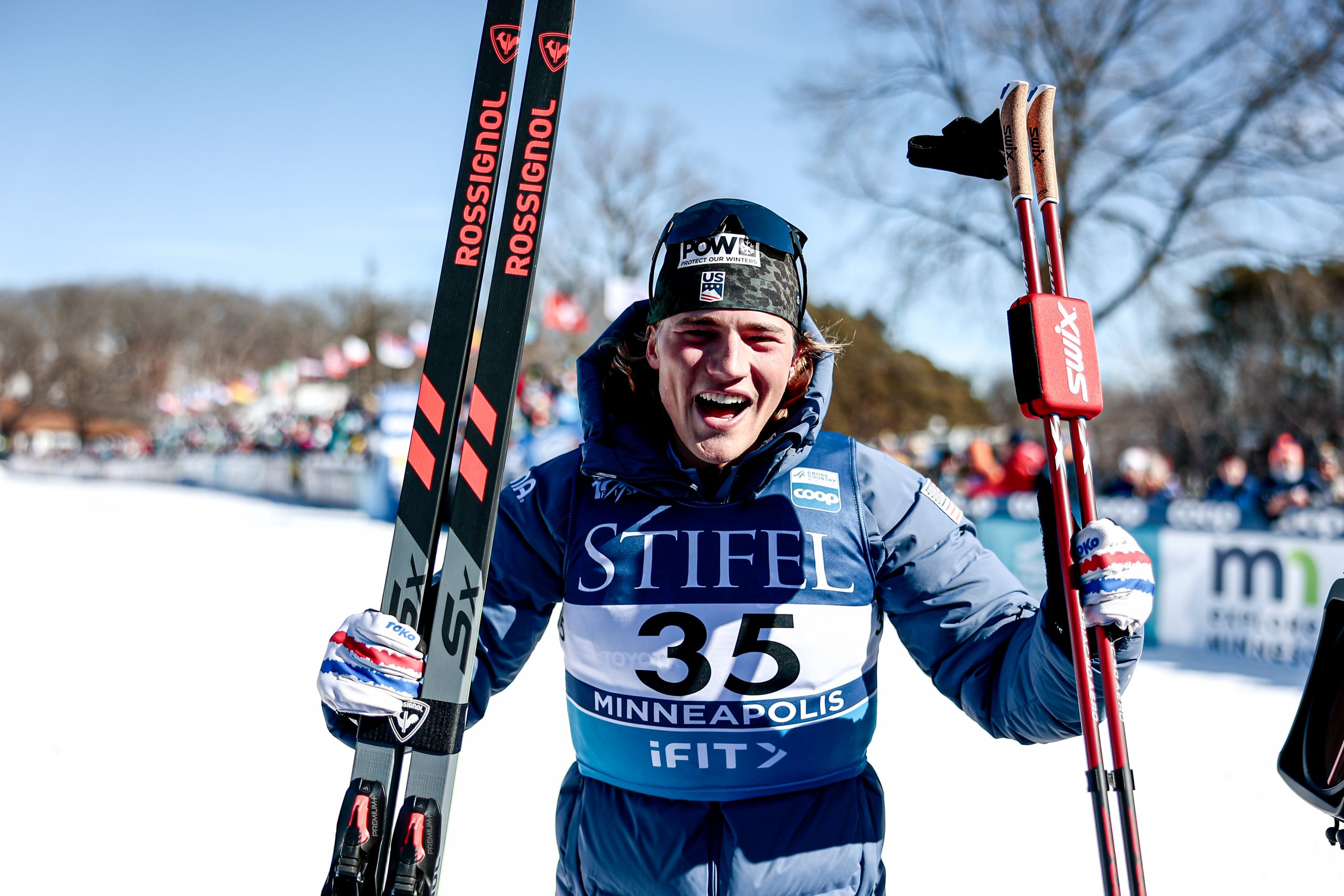
Jessie Diggins, Ben Ogden, and Gus Schumacher sat side by side Wednesday afternoon — the same trio that has turned the 2025-26 season into something U.S. cross-country skiing has never seen before. Between them: Olympic medals, historic podiums, a 50-year drought shattered, and one very good birthday cake.
But with three races left and Diggins’s retirement looming, the mood wasn’t heavy. It was loose, funny, and deeply human — exactly the way this team tends to do things.
“Probably Glitter”
Asked to define her legacy heading into her final World Cup weekend, Diggins did what Diggins does: she went somewhere unexpected.
“I think I define my legacy honestly, completely outside race results,” she said. “I am more proud of the things I have done off the course. I think my legacy is going to be in my advocacy and the way that I have spoken about mental health and eating disorders specifically, and the way I’ve tried to make really hard conversations less hard for people to have.”
She pointed to her work with Protect Our Winters and Share Winter, to the energy she’s poured into the team’s culture over the years. And then she landed the dismount.
“And probably glitter. I think there’s a lot more glitter in ski races now, and that’s always a great thing — as long as it’s biodegradable.”
Diggins has spent the season saying goodbye in pieces — a little cry leaving training camp in Bend, quiet moments at each World Cup stop. She knows what’s probably coming Sunday.
“I suspect it’s probably going to hit like a dump truck on Sunday, and there’s probably going to be a lot of tears.”
But she’s ready. And what she’s ready for is maybe the most Jessie Diggins thing of all: she sees ski racing as performance art, and she wants her final show to leave people wanting to go run up a mountain or sign their family up for ski lessons.
“I realized that I can do that moving forward, but just with my story and with my words, and I don’t have to push my body so hard, but I can still leave people inspired and motivated.”
In the meantime, she’s looking forward to being able to wash her clothes when they’re dirty, cook whatever she wants, and bake cookies on the weekend instead of training and racing all day.
Ben Ogden answering questions at the press conference before the World Cup in Lake Placid, New York. (Photo: Voisin/FasterSkier)
“Your Life Is Not Going to Be the Same”
Ben Ogden grew up in Landgrove, Vermont. American skiing legend Bill Koch lived close by in Peru, Vermont. Same zip code, as Ogden puts it — “not so different.”
Fifty years separated Koch’s 1976 Olympic medal from Ogden’s silver this season, and when Ogden finally got on the phone with his neighbor and mentor after breaking the drought, Koch didn’t mince words.
“Bill just sort of said, ‘Hey, congratulations, and your life is not going to be the same from this point forward.’ And that was kind of crazy to hear.”
Ogden hopes to see Koch at the races this weekend. And racing at Van Hoevenberg carries its own weight for him — not just because of Koch, but because of his father, who was deeply embedded in the New England ski racing community.
“I think it’s really hard for me to come race in the U.S. and look around and not just, like, constantly think about him, because this was his scene,” Ogden said, his voice softening. “He would have been in such paradise on the side of the trail here in Lake Placid. And I’ll be thinking about him a lot this weekend, for sure.”
This is technically Ogden’s first home World Cup — he was sick for Minneapolis — and it’s hitting him right. He grew up racing the NYSEF Festival series at Lake Placid, bringing crews of Vermont kids over for slushy late-season races.
“It’s not my home, but it feels like it.”
Gus Schumacher answering questions at the press conference before the World Cup in Lake Placid, New York. (Photo: Voisin/FasterSkier)
Aspirations, Not Goals
Gus Schumacher has been doing some linguistic rebranding.
“I’ve been calling them aspirations for a few years now,” he said of his season targets, “because I feel like the pressure of goals was kind of weird for me.”
The distinction matters to Schumacher. He sets plenty of small goals — the daily, tactical kind — but the big ones, like winning an Olympic medal or finishing in the top 10 of the overall World Cup standings, he holds more loosely. They’re aspirations: things he wants, things he’ll chase, but things he won’t let crush him if they don’t happen.
“Those are things I want to do, but if they don’t happen, it won’t be because I didn’t try.”
He accomplished the Olympic medal. He entered this final weekend ranked sixth in the world, with a top-10 finish still in play. And he’s approaching Lake Placid the same way he approached Minneapolis, where he won his first World Cup in front of a hometown crowd: just be happy to be racing, and feed off the energy.
“Already today, it was really cool to have people cheering us on in the race prep, which doesn’t really happen much on the World Cup ever.”
Schumacher also dropped maybe the best origin story of the press conference: the formative moment that lit a fire under his career was Luke Jaeger beating him at an Anchorage cup race.
“That kind of put a fire under my belly to really start training, because I didn’t want him beating me anymore.”
The Knitting Club, the Water Pump, and the Greenhouse
The press conference’s best stretch might have been when someone asked the athletes how they decompress.
Schumacher keeps it clean: headphones, 10 to 20 deep breaths — four seconds in, eight seconds out. Standard operating procedure.
Ogden? He knits. And he’s not shy about it.
“After races, I’ve been doing a lot of knitting and stuff like that. Helps me just relax really quick.” After the season, it’s bigger projects: car work. “You can feel like you’re the king of the world after a couple medals, but go and try and replace a water pump on a Forerunner, and that’ll make you feel completely incompetent.”
Diggins revealed there was a full-on knitting club on the team this winter. Her own reset button is simpler: she calls her husband.
“He’s my absolute center of my world. The race could have been amazing, and it could have been also completely horrible. And we’re just talking about what I want to do with the garden, and how I want to start a greenhouse. And he’s like, ‘Uh huh, yeah, sure, I’ll support you in that.’”
One More Thing
Almost as a throwaway, Ogden mentioned that Andy Newell — “the original Nordic ski backflip guy” — is in Lake Placid this weekend. And Ogden himself has had a backflip dialed since he was 17.
“I’m hoping on Sunday we can kick up a little ski jump. I’m looking to take another one Sunday afternoon. So stay tuned.”
Three races to go. A retirement to honor. A culture to celebrate. And maybe a backflip.
It’s going to be a weekend.
Love Stories Like This? Help Keep Them Coming.
Feature stories like this one take time, access, and care to produce. If you value thoughtful storytelling and independent ski journalism, please consider becoming a Voluntary Subscriber. Your support directly fuels the work we do to cover the people, places, and moments that make our sport special.
The Zoom room filled slowly, one journalist after another blinking into existence in a grid of small rectangles. Los Angeles, Minneapolis, Helsinki, Colorado, New York — not just the coordinates of U.S. skiing scattered across time zones, but also NPR, NBC, and European reporters, over 60 media outlets, all converging on a November morning. Jessie Diggins appeared in the largest box, glowing as she does all the way from Muonio, Finland, where she had arrived two nights earlier. The wooden panels on the wall behind her made it clear she sat in a Northern Scandinavian rental, probably one that has become quite recognizable to her each November. Diggin’s voice is steady and familiar, but beneath the surface, something is newly unbound.
“Hi, everyone,” she began, smiling with that practiced combination of approachability and poise that has made her — for more than a decade — the emotional center of American cross-country skiing.
It was the day after she announced her retirement.
Not an immediate farewell, but a season-long glide toward her final finish line — a full World Cup circuit, the Milano-Cortina Olympics, and a last race on home snow at the Stifel Lake Placid World Cup Finals. Her final year. Her final winter. A long goodbye in the only language she has ever known: motion.
But on this morning, she wasn’t moving at all. She was speaking — clearly, expansively — as though practicing for a stage much larger than a press conference. Which, in a way, she was.
When asked what comes next — “besides knitting,” she said, laughing — Diggins didn’t hesitate.
“I’m really excited… because I feel like when I ski race, it’s usually done with my body moving around as fast as it can, but everyone’s watching and you get this one moment to try to leave people feeling inspired,” she said. “And I want to do that — but through keynote speaking… it’s all about the storytelling and leaving people with this little piece.”
As she talked, I could see it already: a home office somewhere in Wakefield, Massachusetts, where she’ll finally get to spend time with her husband. A wooden desk, house plants, and a neatly stacked pile of notes for a TED-style talk on resilience. And above her desk, three matte-framed photographs from her career — not the ones you’d expect.
Not the historic PyeongChang team sprint.
Not the Crystal Globe.
Not the Tour de Ski.
Diggins has never defined herself by her medals. And in the conference, she explained why.
“To me, it’s not about the racing,” she said. “It’s not about medals, it’s not about results. It never has really been.”
Instead, she pointed to three moments — three stories — that she said she is most proud of. They form a different kind of highlight reel, one that reveals far more about how she sees herself, and how she hopes the sport will remember her when she’s gone.
These are the three frames above the desk.
Jessie Diggins (USA) embraced by teammate and close friend Julia Kern (USA) at the World Championships in Trondheim (NOR). (Photo: Modica/NordicFocus)
The First Frame: Advocacy — Where Her Legacy Lives
When she was asked about impact — real impact, the kind that doesn’t fit in a results database — Diggins leaned forward slightly, like someone stepping out of a doorway into more honest light.
“One of the legacy pieces that I’m leaving behind is how US Ski & Snowboard handles mental health and how they support people,” she said. “When someone says, ‘Hey, I’m struggling with an eating disorder,’ there is so much help available for athletes… and I know I was a part of that because I was so open and shared everything along the way.”
For over a decade, she has made vulnerability her strength — not a PR tactic, not a brand, but a form of leadership she learned the hard way.
She spoke about the younger version of herself with a mix of compassion and urgency:
“18-year-old Jessie needed that so bad… if I had felt less alone and isolated when I was 18, I think I would have hopefully asked for help sooner.”
So she built what she calls a “safety net,” a phrase that recurred throughout the hour:
“When you’re in a good place of recovery… every time you meet with your therapist or your eating disorder specialist, sport dietitian, or eating-disorder doctor, you’re stitching and weaving together more of a really robust and large safety net,” she said. “You have this awesome thing ready to catch you should you need it.”
The metaphor is striking — a net woven from professional expertise, honesty, repetition, andpermission.
She also made clear that part of protecting herself meant protecting her team from having to be responsible for her recovery:
“My coaches, the wax techs, my teammates… they get to help support me, and I get to help support them, but they don’t have to work on the eating disorder side of things,” she said. “That is not something that they have to tackle. They shouldn’t feel obligated.”
Her work with Protect Our Winters (POW) — from lobbying in Washington to serving on the board — is woven into that same mission: to leave the sport stronger, safer, and more sustainable for others. Her climate story has always been an extension of her mental-health story: both about protecting what is fragile, what is at risk of disappearing.
It’s no surprise this is the first frame above the desk. This is the part of her career she insists cannot fade.
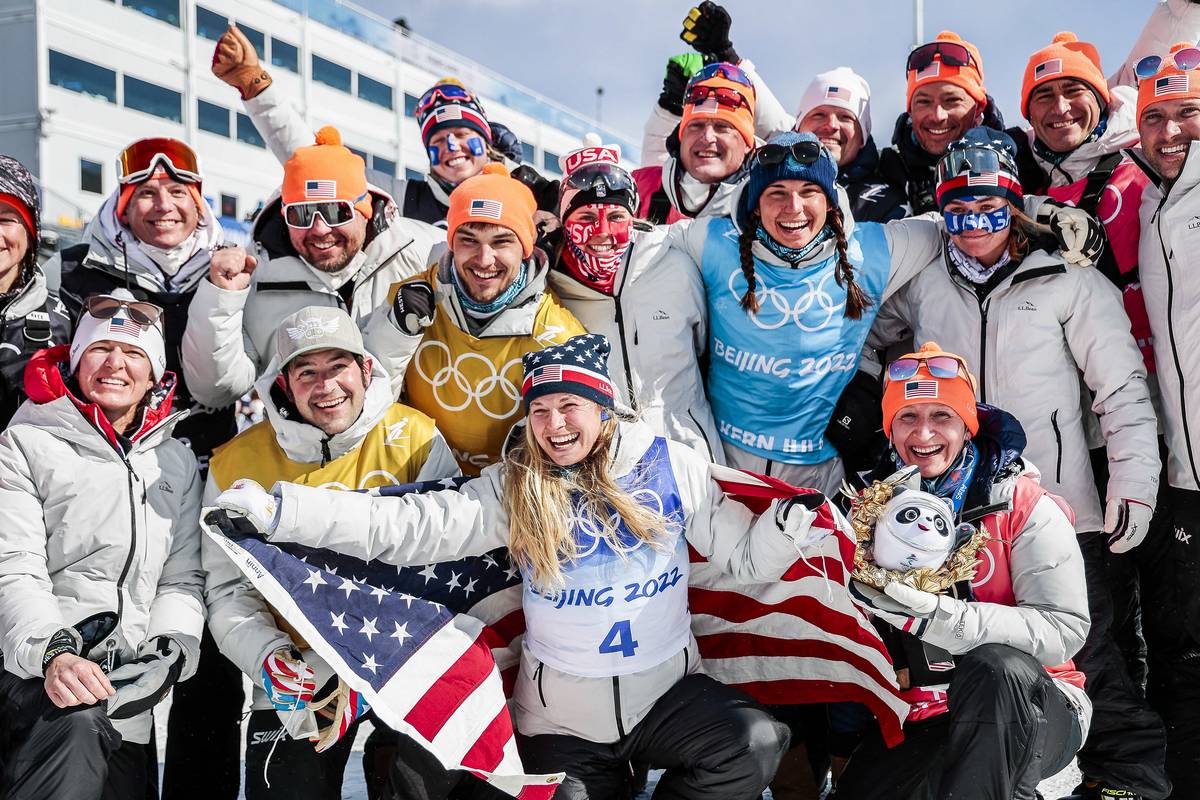
Jessie Diggins with teammates and staff after winning a historic silver medal in the 30K Freestyle at the 2022 Olympics in Beijing, China. (Photo: NordicFocus)
The Second Frame: The Beijing 30K — The Race She Calls Her Proudest
When asked about the moment she is most proud of as a competitor, she didn’t hesitate.
She didn’t say PyeongChang, though she acknowledged the magic of that day. She didn’t say her World Cup overall titles, though she earned those through years of relentless precision.
Instead, she chose a different story — one that most athletes would quietly bury.
“The proudest moment… was the 30K in Beijing,” she said. “Because it wasn’t about if I won or not… the fact that I had battled through food poisoning and chosen to start the race… one minute into the race I had [crashed] and got back on… everything had gone wrong… but I decided to go after it anyway.”
There is something primitive about that choice: to define greatness by suffering openly, to measure success by depth rather than placement.
She emphasized that she “had no business going in the breakaway,” no business skiing alone with a body that was “falling apart and cramping.” But she did it anyway. And she finished.
In a career built on composure and precision, this race was about something far less visible: the instinct to keep going when no one would blame you for stopping.
It is not the kind of image that hangs in a sports museum. But it belongs above her desk — the second frame — because it reminds her who she became, not merely what she achieved.
Jessie Diggins soaks in all the energy from the home crowd in Minneapolis. (Photo: Gretchen Powers, U.S. Ski & Snowboard )
The Third Frame: Minneapolis — The Moment That Surprised Even Her
Jessie Diggins’ favorite moment of her entire career was not a race, not a podium, and not a championship. It was a warm-up lap.
Not even the race itself — just the lap before it.
“It was the warm-up lap that I did in Minneapolis,” she said. “I cried like 12 times. It was the coolest moment of my entire career.”
The Minneapolis World Cup, held after years of planning and pandemic delays, drew more than 20,000 fans — kids in ski jackets, families, high school teams, masters racers, longtime volunteers, and the entire Nordic diaspora of America. She helped bring the race to Worth Park; she fought to keep it on the calendar; and then she skied into a stadium that felt like home.
“When you’re warming up, you can really see the crowd and be in it with them,” she explained. “Being a part of bringing together 20,000 plus fans… that was the coolest moment.”
This is the third frame above the desk. It captures the rarest kind of athlete achievement: the moment when an individual’s career transforms into a collective story.
This wasn’t symbolic. It was literal. She had helped create the environment in which the sport could grow.
She wasn’t skiing through fans; she was skiing through the future of U.S. skiing itself.
Staying, Leaving, Returning
If advocacy, suffering, and community are the three frames above her desk, there might be a fourth frame just below them: the one showing something from this final World Cup season or what comes next.
She says she will still support the team, “just not in a way that has to be quite so physically hard on my body.” She imagines herself as “team mom from the sidelines,” cheering but not chasing splits.
She will garden.
She will sleep in her own bed.
She will run a 100-mile race — “just for me… I don’t expect to run it quickly or competitively.”
She will finally come home.
The irony of this final season is that she wants to experience it with the full emotional force of closure — the opposite of detachment, the opposite of stoicism.
“It frees me to enjoy it even when it’s hard,” she said, describing the upcoming Olympics. “Even if it doesn’t go perfectly… my career is this entire body of work, and I just want to be there to be present… because it’s the last time I’m ever going to do this.”
Her retirement announcement wasn’t a curtain; it was an opening.
She’s letting people in.
She’s letting herself feel everything.
She’s letting the sport rush over her one last time.
The Press Conference Ends. The Story Begins.
When the final question was asked and the moderator thanked everyone for their time, Diggins’ Zoom square flickered and the screen returned to its familiar grid. Reporters signed off. Microphones muted. The call ended.
But her voice stayed in my head — not the athlete’s voice I’ve heard in mixed-zones for years, but the one she seems excited to use next.
The voice of someone shifting from performance to reflection, from competition to communication.
The voice of someone ready to tell stories for a living.
Back in Wakefield, someday soon, she’ll sit at her desk beneath those three frames. And as she maps out the arc of a keynote, or a book, or whatever comes after skiing, she’ll look up and see exactly what she spent her career building:
The people she helped.
The battles she fought.
The community she created.
Three frames.
One legacy.
And one last winter to live it fully.
Love Stories Like This? Help Keep Them Coming.
Feature interviews like this one take time, access, and care to produce. If you value thoughtful storytelling and independent ski journalism, please consider becoming a Voluntary Subscriber. Your support directly fuels the work we do to cover the people, places, and moments that make our sport special.
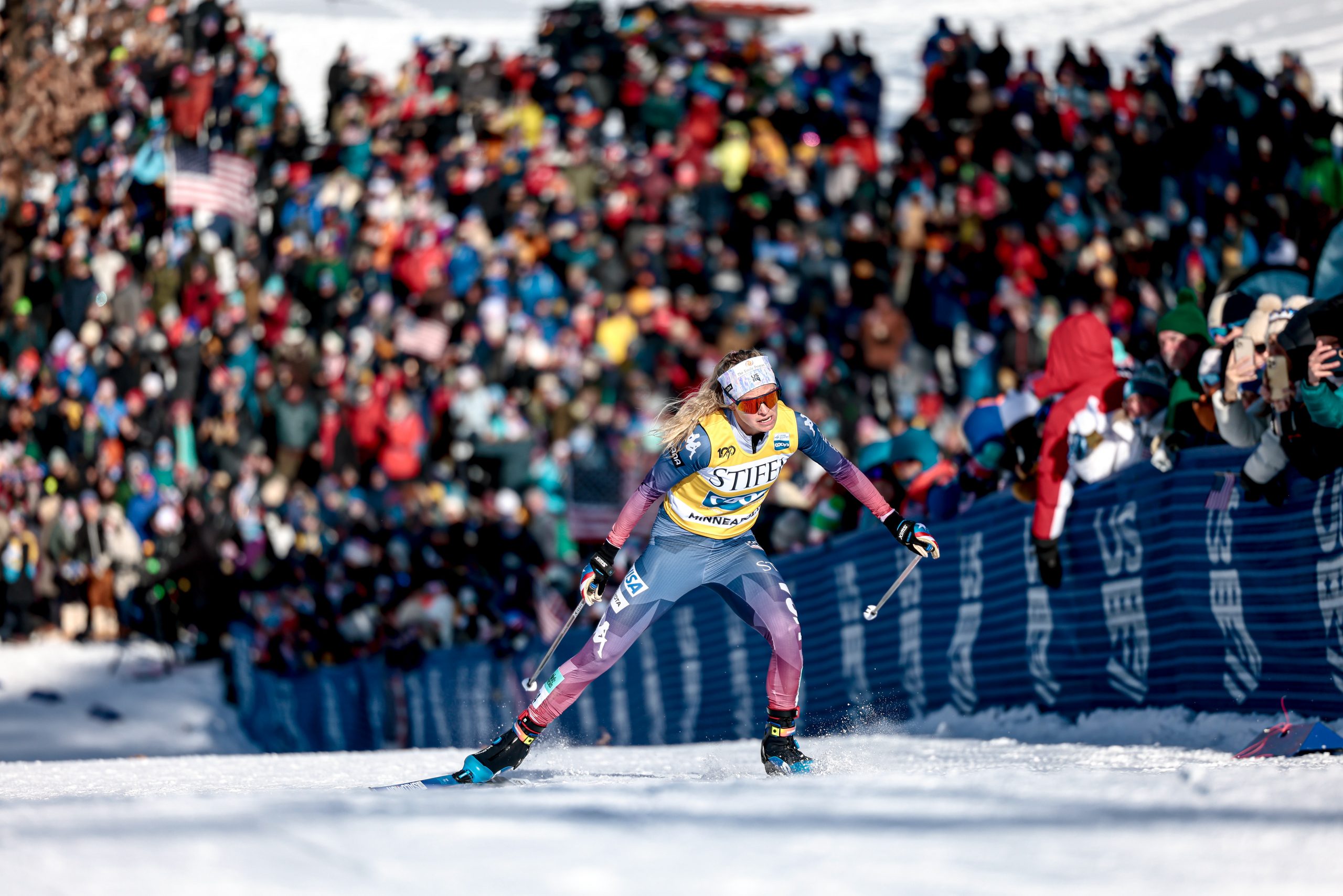
Jessie Diggins (USA) racing on home soil in Minneapolis and will do so again in Lake Placid as she concludes her storied World Cup career. (Photo: Modica/NordicFocus)
This article was made possible through the generous support of our voluntary subscribers. If you would like to see more articles like this one, please support FasterSkier with a voluntary subscription.
American cross-country skier Julia Kern spent time during this week’s World Championships negotiating a climate action agreement with an advocacy group. “I absolutely love ski racing. But to use that platform to make meaningful change, that is purpose,” she said. (Federico Modica/Nordic Focus)
TRONDHEIM, NORWAY — At 9 p.m. on the evening before she would vie for a relay medal at the cross-country skiing World Championships here, American Julia Kern was not sleeping.
Instead, she was sending phone messages — announcing that competitors had reached an agreement with climate campaigners to avert a race-disrupting protest.
The deal capped days of negotiations between the two sides over an issue that’s central to the snow-dependent sport of cross-country skiing.
The athletes had stepped in at the last minute, after the campaigners said they would persist with a protest due to event organizers’ rejection of their demands: removing the logo of Norwegian state-owned oil company Equinor, an event sponsor, from visible advertising, and playing a video about a fossil fuel non-proliferation treaty.
The final agreement between the athletes and advocates was immediately endorsed by some of the sport’s biggest stars, including Trondheim medal-winners Jessie Diggins of the U.S., Federico Pellegrino of Italy and Frida Karlsson of Sweden.
The pact calls for them to work with climate advocates on two proposals in advance of an International Ski Federation meeting in June — one to create new guidelines prioritizing event sponsors with a “genuine commitment to climate leadership,” and another calling on the ski federation to endorse the Fossil Fuel Non-Proliferation Treaty Initiative.
Negotiating the deal required multiple digital meetings and intense communication during the most important event of the athletes’ racing season — with Kern, at one point, having to break away to collect a medal from her silver-winning performance in the team sprint event with Diggins.
Nonetheless, Kern, who is one of two cross-country representatives on the ski federation’s athlete commission, said the distractions were worth it.
“I absolutely love ski racing. But to use that platform to make meaningful change, that is purpose,” Kern said in an interview after Friday’s women’s relay, where the U.S. placed sixth. She added: “My purpose in skiing isn’t the results. It’s a lot more than that. And I think it is really helpful to be reminded: We’re doing this for more than just ourselves.”
Gus Schumacher, another U.S. athlete who helped draft the agreement and has previously worked in climate advocacy, said he thinks the outcome could put “a little bit of oomph behind the suit.” The American team in Trondheim has been wearing new racing uniforms at the championships with imagery representing melting glaciers — though the squad’s announcement of the design was not accompanied by any specific climate policy proposal.
Gus Schumacher races Saturday in the U.S. Ski Team’s glacially-influenced suit. (Federico Modica/Nordic Focus)
“I’m feeling pretty proud of being able to give the activists the table they deserve — that they felt like they deserve,” Schumacher said. “I feel good about them not obstructing the race, which I think is a huge achievement for us and for them. And having some concrete stuff moving forward is really cool.”
Instead of demonstrating in the middle of the race course and risking violent intervention by competitors or spectators, members of Folk Mot Fossilmakta, or People Against Fossil Power, spent Saturday on the side of the trail. Reading from lists of names and numbers of athletes that signed the agreement, they cheered Schumacher and their others during the men’s 50-kilometer event.
Spokesman Callum Macintyre said he’s encouraged by what felt like a sincere commitment from the athletes to join in their advocacy.
“It was quite obvious, from the beginning, that they were authentic,” he said. “This wasn’t just them wanting to make some little statement about climate and then look like the heroes.”
Members and supporters of Folk Mot Fossilmakta gathered on the side of the World Championships trails in Trondheim on Saturday to cheer and to celebrate a climate advocacy agreement the group reached with competitors. (Courtesy Folk Mot Fossilmakta)
The athletes and advocates both acknowledged that their agreement is a first step — and that it’s likely to take much more work for the national ski associations that make up the International Ski Federation, or FIS, to be convinced to forsake sponsorship by oil and gas companies.
The athlete pledge has support from competitors from Sweden, Italy, Australia, America and France. But it has not yet been endorsed by any skiers from Finland or Norway.
Norway’s national ski associations has a long-term sponsorship deal with Equinor, though it ends after this season; Finland’s athletes are sponsored by ST1, which sells fuel at more than 1,000 gas stations across Scandinavia.
Kern’s own counterpart on the athlete commission, Jimmy Clugnet of Great Britain, races with a club team sponsored by Aker Solutions, which works in oilfield services. Clugnet, in spite of helping to negotiate the athlete pledge, didn’t sign on to it himself, saying he didn’t have time to clear it with his team.
While Norway’s athletes have been largely absent from the conversations so far, Johannes Høsflot Klæbo, a Norwegian who won gold in all six men’s events in Trondheim, said Saturday that he would “love to be part of the conversation.”
At a news conference after winning Saturday’s 50-kilometer race, he told reporters that he had not yet seen a copy of the agreement between the other athletes and the climate campaigners.
Norwegian athletes, including Johannes Høsflot Klæbo, have not endorsed the athlete statement released Friday. “We’ll see how things can change,” he said at a news conference Saturday.
“We’ll see how things can change,” he said. “I think that’s a theme we can dig into more deeply during the spring.”
The discussions between Folk Mot Fossilmakta and the athletes began through a pre-existing relationship between Clugnet and Macintyre.
The climate group wanted Clugnet to circulate a letter among elite skiers that endorsed their requests of the World Championships organizers.
Clugnet, according to Macintyre, said the athletes didn’t want to be associated with the planned disruptive protest but made, effectively, a counterproposal: The skiers would issue a statement on climate change, the demonstration would be canceled and the two sides would work together on a proposal to FIS.
“So, then we came together,” Macintyre said.
Last weekend, in the middle of the championships, the campaigners held an initial meeting on Zoom with Schumacher, Kern, Clugnet and Björn Sandström, a high-level Swedish skier and climate advocate who wasn’t competing in Trondheim but had previously been in conversations with Folk Mot Fossilmakta.
Kern said she was “quite nervous,” and was unsure about how the discussion would unfold. But it quickly became clear that the participants were aligned, she said.
“We realized we have a lot of shared, common values. And we just were disagreeing on the ways to go about it,” she said. “We started talking about: How can we make this change collectively and agree on the methods and ways of doing it?”
After the first meeting, Folk Mot Fossilmakta proposed specific language for an athlete statement. At a second discussion, the athletes brought in the leaders of another snow sports-focused climate advocacy group, Protect Our Winters, which Schumacher and Diggins both work with.
That meeting, with Diggins also on Zoom, was more intense, Macintyre said.
Callum Macintyre and Ragnhild Kvist Simonsen both work with Folk Mot Fossilmakta. (Nathaniel Herz/FasterSkier)
“They were talking quite a bit about how it’s hard for a lot of athletes to really speak out when there’s so much fossil fuels in the sport. They maybe have trouble with coaches and sponsorship deals, and things like that,” Macintyre said. “I told them that I have friends in prison in the U.K., right now, who have been in prison since July for doing climate protests. And that sacrifice, that’s a part of this.”
After the second meeting, participants hammered out the details of the athletes’ statement. The final version says that climate change is threatening “both the future of our sports and and the livelihoods of millions of people around the world,” and it specifically acknowledges activists’ concerns that “having fossil fuel sponsorship at one of the biggest events in our sport is contradictory.”
The statement was sent out to athletes late Thursday — less than 24 hours before it was released — and Kern said it’s not clear that it reached every competitor. The two channels she and Clugnet use to communicate with top-level skiers — a group with team captains and a group that athletes can join voluntarily — aren’t comprehensive.
“We just hope that people build trust in this coalition, and that as we gain momentum, more people will join in,” she said. “World Championships is a really hard time. There’s a lot of media. So, I understand if athletes don’t feel ready in a matter of 24 hours.”
Kern said she sees the unfolding advocacy effort as likely to be a “multi-year process.” But Macintyre, the campaign spokesman, said he expects the athletes to stick it out.
“We would have never done it if we weren’t 100% confident that they were going to be authentic in what they’re saying,” Macintyre said. He added: “I have a good feeling that it will continue, this kind of coalition.”
Gus Schumacher, the Anchorage cross-country skier, testifies at a Senate Budget Committee hearing Wednesday.
This story was first published by Northern Journal, Nat Herz’s news site and newsletter in Alaska. Subscribe here.
Gus Schumacher, the Anchorage Olympic cross-country skier, arrived at his first-ever congressional hearing in Washington, D.C., knowing he could be a target.
The Senate Budget Committee’s chairman, Rhode Island Democrat Sheldon Whitehouse, invited Schumacher to testify last week in one of a series of more than a dozen hearings about the harm climate change is inflicting on the nation’s economy.
Alongside a flyfishing outfitter and an official from an outdoor gear company, Schumacher was in the room to talk about the impact of global warming on the $1.1 trillion outdoor recreation industry.
And he’d been warned about the possibility of probing questions from the committee’s Republican members. One of them, Mitt Romney of Utah, had previously derided Whitehouse’s climate focus as “more Barbie than Oppenheimer,” and said that while the issue is important, the budget committee should be more focused on federal spending.
The hearing’s opening was perfunctory: Whitehouse began by describing climate change-related disruption to duck hunting and recreational fishing, and storm damage to infrastructure at Yellowstone National Park. He also took his GOP colleagues to task for “mocking the warnings” about the “climate emergency.”
The invited witnesses then shared their testimony, with Schumacher describing himself not just as a professional athlete, but as a “concerned citizen troubled by the effects of climate change on our environment and the activities we cherish.” His message: Climate change has dramatically changed winter sports and the environment itself, and society needs to invest in renewable energy, “sustainable land management practices” and reducing greenhouse gas emissions.
That’s when things went off the rails.
After three years working with an athlete-focused climate advocacy group called Protect Our Winters, Schumacher was prepared for the most likely knock against him from antagonistic senators: As a professional ski racer, he has a hefty carbon footprint from flying around the country for training camps, and across the Atlantic Ocean to Europe, where he competes on the elite-level World Cup circuit.
What he got, instead, was a full-on broadside from John Kennedy, the second-term Republican U.S. senator from Louisiana.
Kennedy did not ask Schumacher substantive questions about climate change’s impacts on cross-country skiing, nor did he ask about the challenges posed to Alaska’s oil-dependent economy by reducing the use of fossil fuels. Instead, he presented the Olympian with a deep excavation of his social media accounts, and a pop quiz on climate economics and science.
Gus Schumacher (USA) on his way to winning the men’s individual start 10km freestyle in Minneapolis (USA). (Photo: Modica/NordicFocus)
“In hindsight, the point was just to derail this hearing,” Schumacher said in a phone interview Friday. “I was kind of thrown off, obviously, which was his goal.”
Among the questions that Kennedy lobbed at Schumacher, a professional cross-country skier since he graduated Anchorage’s Service High School in 2018: Was he at the hearing on behalf of the Democrats or the Republicans? What is carbon dioxide? You want us to abolish it, right?
And: “On August 27 of 2020, you tweeted this, I’m going to quote: ‘Police are paid with taxpayer dollars. If they are not answerable to us, we can demand new service, and that’s what it is: Abolish the police in favor of that new service.’ You think we ought to abolish the police?’”
“But you’re here giving us advice,” Kennedy said. “And I’d just kind of like to know a little bit more about your points of view.”
“I’m here as an athlete, giving you my story and what I’ve seen,” Schumacher said.
Louisiana GOP U.S. Sen. John Kennedy questions Schumacher at Wednesday’s hearing.
Schumacher did flub one question: He told Kennedy that carbon dioxide is a “huge part” of our atmosphere when, in fact, it’s some .04% — a discrepancy that the senator quickly noted. But those facts were not part of his high school curriculum, nor were they covered in the preparation he did with Protect Our Winters before the hearing, Schumacher said.
“We were not briefed on the molecule of CO2,” Schumacher said. “And I was not briefed on the exact numbers of stopping climate change.”
After the hearing, Kennedy, who collected $343,000 in oil and gas industry-aligned contributions in the two years before his re-election in 2022, posted a video mocking Schumacher’s responses for the 1.5 million followers of his senatorial social media accounts.
Their exchange was then picked up by conservative news outlets and activists, including an Instagram account that posted a video snippet with the caption: “Senator John Kennedy DESTROYS Lib with simple question!”
Since Wednesday, Schumacher said, he’s received hundreds of “truly hateful” messages through his website, plus a torrent of negative comments on his Instagram account, where his outnumbered family and friends have sprung to his defense.
“Stick with skiing. Don’t open your mouth because there clearly isn’t much in your brain,” read one message. “One easy way to minimize CO2 on Earth is for you to STOP BREATHING! Will you do that for us?”
Two of the messages Schumacher received after the hearing.
Kennedy’s office did not respond to a request for comment. A spokeswoman for Whitehouse and the budget committee declined to comment.
Schumacher, who’s now back in Alaska, said the attacks will not dissuade him from climate advocacy — even if the onslaught of negativity has been a lot to deal with.
“They’re not going to get to me,” he said. “I’m happy to be able to talk about what I see at home and abroad. And I’m definitely motivated to continue it.”
After the hearing, the advocacy group Schumacher works with, Protect Our Winters, addressed Kennedy’s questioning in its own social media post, saying that its representatives, including Schumacher, traveled to Washington because last year was the hottest ever recorded.
Protect Our Winters said the group, including Schumacher, was generally well received by others on its trip to the Capitol — except for by “one senator,” a reference to Kennedy.
“Instead of focusing on the problem at hand, this senator attempted to discredit our athletes’ presence there, discussing irrelevant, dated social media posts to derail and delay the conversation,” the post said. “Our athletes don’t claim to be scientists. But they are experts in witnessing firsthand changes to the environments they have been recreating in their entire lives. And these stories matter.”
American cross-country skier Gus Schumacher, pictured competing in Germany, works with a climate advocacy group called Protect Our Winters, and races with their “POW” logo on his hat. (Photo: Nordic Focus)
MINNEAPOLIS — After Gus Schumacher’s upset win at an international cross-country ski race here last week, one of his first moves was not to celebrate at a bar, but instead, to stand in front of the crowd and talk about climate change.
With hundreds listening to the panel discussion from the grandstand, Schumacher, his teammate Jessie Diggins and activist and author Bill McKibben passed a microphone back and forth.
The subject, for Schumacher, is immediate and personal: Global warming poses an existential threat to his chosen sport, and not just over the long term.
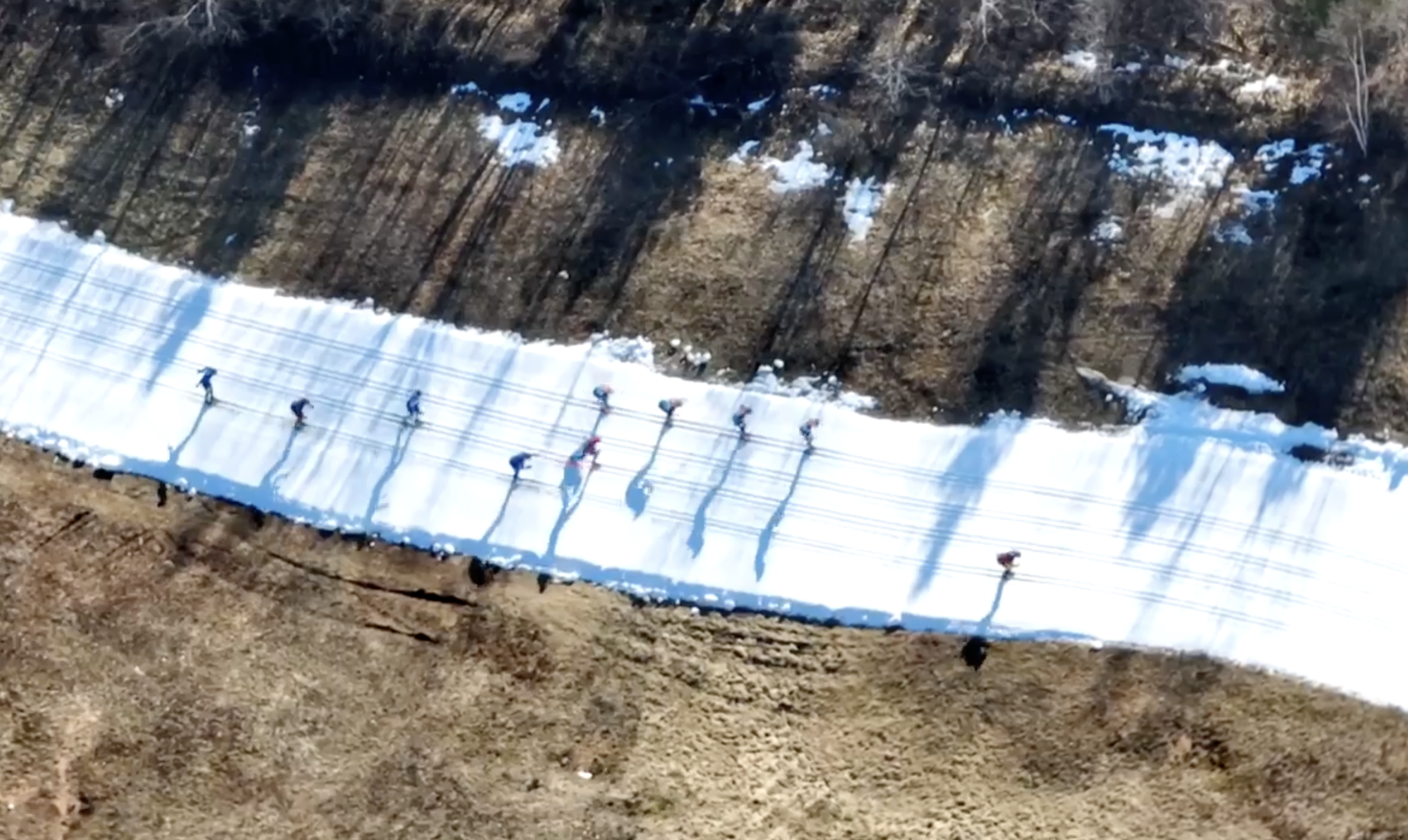
Minneapolis has had its warmest winter on record this year. Up until a storm dumped six inches of snow on the same day the international cross-country skiing circuit arrived in the city, organizers were expecting to hold the races on a ribbon of man-made snow snaking through an otherwise bare and brown golf course.
This year’s American Birkebeiner was held on a 10-kilometer loop of man-made snow. (Screen grab from American Birkebeiner live stream)
“We’re a sport that needs snow, and cold temperatures,” Schumacher said in an interview. “We can be a group of people that can make some change.”
Climate advocacy is at the center of Schumacher’s career: He’s part of a coalition of athletes and other outdoor professionals called Protect Our Winters, and wears the organization’s logo on his hat when he races. Five of his American cross-country ski teammates also work with the group, including Diggins, who’s on its board.
But some of Schumacher’s other teammates and rivals, meanwhile, have held back — in part based on their fears that speaking up could make them sound hypocritical, given the carbon-intensive nature of their careers.
“We’re the ones flying the most. We’re the ones traveling the most,” said Mika Vermeulen, a 24-year-old Austrian racer. “And then we are going to tell other people to cut down on stuff?”
Schumacher acknowledges that there’s some inherent awkwardness in his work, because of his background and occupation.
Austrian athlete Mika Vermeulen racing in Canada earlier this year. (Photo: NordicFocus)
“Most of us are upper class white kids that, when climate stuff is starting to hit the fan, we have somewhere to go,” he said. “Other people don’t have that liberty.”
But advocates familiar with Schumacher’s sport, however, say that athletes shouldn’t get too hung up on their own individual identities and lifestyles when the problem is systemic.
“We’re in much too deep a hole to climb out of it one Tesla at a time. That’s not how this is going to work,” said McKibben, a writer, activist and avid cross-country skier who wrote a groundbreaking book on climate change. “The most important thing an individual can do is be less of an individual, and join together with others to fight to change the basic political and economic ground rules.”
People can bring their own unique skills and experiences to that effort, McKibben said. Some can testify to the impacts of rising seas; others will bear witness to the disappearance of winter, he added.
“I think the only requirement, now, is that you actually be willing to just be plain-spoken about it,” McKibben said. “And by plain-spoken, I mean willing to actually take sides.”
‘Imperfect advocacy‘
Schumacher, 23, has done just that.
Raised in Alaska, where oil producers have long funded the state budget and commanded ample political and economic power, the Olympian and world junior champion has nonetheless been willing to publicly challenge the industry — which has been a longtime sponsor of Schumacher’s own club team and Anchorage’s cross-country ski association.
In 2022, when ConocoPhillips was seeking approval for its big Willow oil development on Alaska’s North Slope, Schumacher helped amplify Protect Our Winters’ opposition campaign on his own social media accounts.
Afterward, he found himself invited to a meeting with ConocoPhillips officials, who tried to convince him that the project was a “good thing,” Schumacher said. It was clear that he’d gotten the company’s attention, he added.
“That was, honestly, a cool thing to experience,” he said.
Gus Schumacher and Jessie Diggins traveled to Washington, D.C. on a lobbying trip with Protect Our Winters in 2022. (Courtesy Gus Schumacher)
Along with Diggins, Schumacher has also taken lobbying trips to Washington, D.C., where he’s spoken with one of his U.S. senators, Republican Lisa Murkowski, about the Willow project and about global warming’s impacts on a failing commercial salmon fishery that his family has participated in. And he’s started publishing a climate focused-newsletter for the Anchorage skiing association.
“You can move the needle pretty easily,” said Schumacher, adding that he’d like to see a little more advocacy from his colleagues on the World Cup circuit. “I’d think that the Norwegians could meet with the king and the prime minister tomorrow, if they wanted to.”
So far, though, most cross-country skiers from other nations have not because vocal advocates on the subject of climate change.
In Norway, the national ski federation is sponsored by Equinor, the state-owned oil and energy company, and recent World Cup races held in the country have drawn disruptive protests from climate activists.
In an interview after a World Cup race in Canada this month, Simen Hegstad Krüger, a Norwegian Olympic champion, said there’s no doubt that global warming is a “big issue,” particularly for athletes who depend on snow.
“It’s crucial that we have good winters,” Krüger said. “But I can’t say that I have the solution.”
Krüger noted that the International Ski Federation, which runs the World Cup circuit, has taken steps to reduce jet travel by teams — namely by clustering a few cross-country race weekends at a time at ski areas within driving distance.
But McKibben, the author and activist, cautioned athletes against focusing narrowly on the climate impacts of their own participation in the World Cup.
“The key task here is not reforming cross-country ski racing in order to make it less damaging. Because on any applicable scale, it’s irrelevant,” McKibben said. “On any applicable scale, almost everything is irrelevant that anyone’s doing — it’s the whole thing that has to shift.”
The power that professional skiers can wield most effectively, McKibben and others advocates said, is through their platforms. Tens of thousands of people follow athletes like Schumacher and Diggins on social media, and thousands more turned up in person to watch them compete in Minneapolis last week.
“The medium of sports, and the medium of storytelling that goes along with sports, is such a potent tool to use in order to drive change,” said Graham Zimmerman, a mountain climber who helps manage Protect Our Winters’ athlete coalition, and who participated in the panel discussion in Minneapolis.
Ben Ogden, a 24-year-old American ski racer who’s been ambivalent about participating in climate advocacy, said those arguments make sense to him — and that waiting to get involved makes him feel like he’s “making a bunch of excuses for not being more proactive.”
American cross-country skier Ben Ogden rests after a race in Norway. (Federico Modica/Nordic Focus)
“But I think I’m waiting for the thing that feels right for me,” Ogden said. “I need to figure out, personally, how I can use that voice without being hypocritical.”
Speaking out about climate change’s effects on his sport feels trivial, Ogden added, when considering the life-or-death impacts that global warming could inflict on more vulnerable people.
“There are a lot of horrible tragedies in the world that are at the hands of climate change,” Ogden said. The possible loss of cross-country skiing, and “nice snow,” he added, are “probably among the least compelling ones.”
Zimmerman, with Protect Our Winters, said that his group isn’t acting out of self interest — “so that we can go ski more” —as much as it’s asking coalition members to leverage their profiles to ensure worldwide access to clean air, clean water and clean energy.
The organization has also tried to tackle, head on, the guilt that some athletes feel about their own climate impacts: It recently funded a film, “The Hypocrite,” that follows a professional skier, Amie Engerbretson, as she tries to reconcile her fossil fuel-intensive career with her participation in environmental advocacy.
“The perceived hypocrisy about being a climate advocate who also travels for sports a lot is something that’s a stumbling block for a lot of people. But it’s something we have to get past,” said Zimmerman. “We live in an imperfect system. And to work within that system, to advocate within that system, to build a platform within that system requires burning fossil fuels. Imperfect advocacy is the only thing we’ve got.”
Diggins, at a news conference in Minneapolis, said she’s embraced that concept.
“Of course, there’s some hypocrisy there. We fly, for our jobs, like most people,” she said. But, she added: “If we have a chance to do something, or anything, to take a step in the right direction, that is better than sitting back and just watching the world burn.”
Jessie Diggins and Gus Schumacher join Protect Our Winters in Washington, D.C. to advocate for climate policy. (Photo: Instagram @jessiediggins)
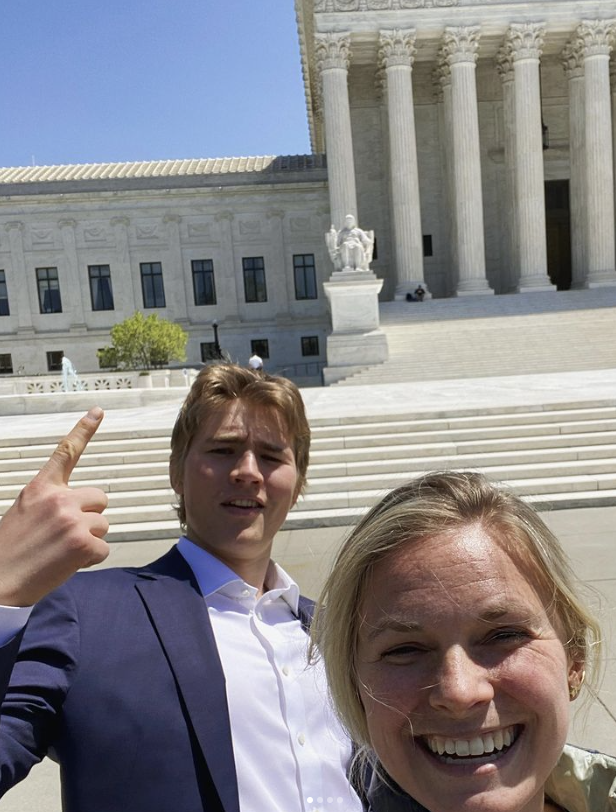
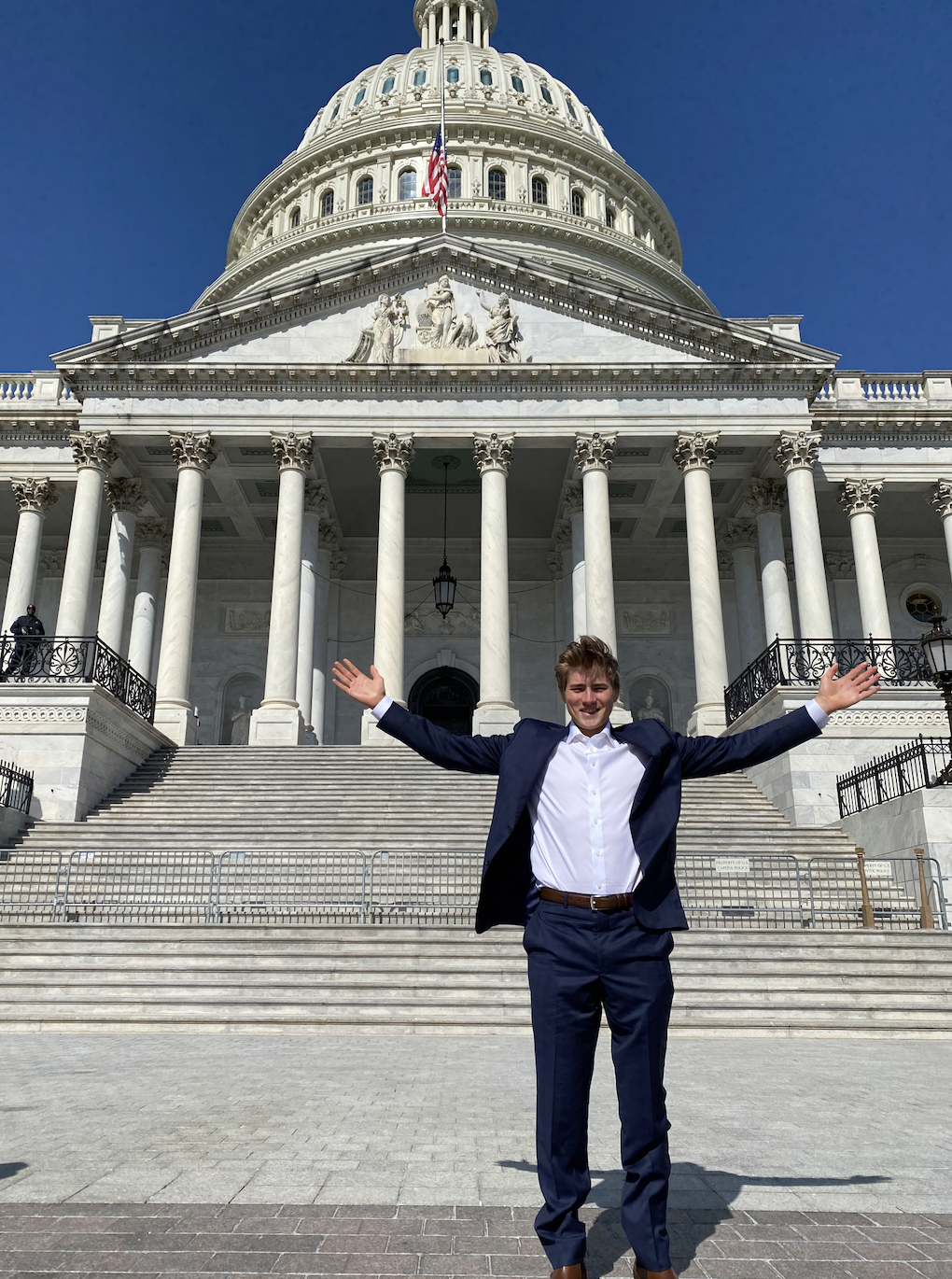
On April 27th, Gus Schumacher and Jessie Diggins headed to Washington, D.C. with six other winter Olympians and Paralympians as members of the Protect Our Winters (POW) athlete alliance to advocate for progressive changes in climate policy. While Diggins has been partnered with POW for several years, Schumacher only recently came on board, making the trip his first experience lobbying for climate activism; it was also his first trip to the nation’s capital.
While in D.C., the POW team met with members of the conservative climate caucus, led by Utah Congressman John Curtis, to advocate for the support of the following five “asks” in climate package negotiations:
Funding programs that focus on reducing emissions, like the Greenhouse Gas Reduction Fund and Climate Pollution Reduction Grants/
Investment in electric vehicle (EV) infrastructure.
Upgrade the grid to power a renewable energy future by funding projects that upgrade transmission lines and intertie incentives.
Assist communities in worker transitions with programs like energy community reinvestment financing.
Stop drilling in the Arctic, specifically stopping the Willow Project from moving forward in the National Petroleum Reserve Alaska.
Following a dinner with the Republican caucus where athletes shared the ways in which their sports and home communities have been affected by climate change, the group spent the day lobbying in congressional offices, discussing the importance of the asks with senators, congresspeople, and members of their staff.
Not knowing what to expect from his first lobbying experience, Schumacher noted he was happy to hear the agreement among the Republican and Democratic politicians with whom they spoke surrounding the need to reduce emissions and address the “big problem” of climate change head on.
“To a degree, everyone agrees we should reduce emissions and it’s figuring out how to do it where everyone is in a different place,” Schumacher said in a call. “So I learned a bit about how [different politicians are] approaching it, and how people generally care [about the issues], but I think it’s just hard for a lot of people to agree on a methodology.”
Gus Schumacher travels to Washington, D.C. to lobby for climate initiatives with Protect Our Winters. (Courtesy photo)
The conversation most engaging for Schumacher personally took place with Alaskan Senator Lisa Murkowski. In addition to discussing topics that were close to home, the conversation felt significant in that Murkowski is “on the fence” when it comes to supporting each of the asks.
Alaska’s economic dependence on oil is juxtaposed with the grave reality that the Arctic is warming at a faster rate than other parts of the world. Murkowski had just returned from a visit to the small city of Kotzebue in rural Northwest Alaska, roughly 30 miles above the Arctic circle. Despite its size and location, the city has adopted infrastructure, specifically wind and solar, that allows it to depend heavily on renewable energy sources when possible.
“They have one solar panel that works on both sides, so [it also captures energy as] the sun reflects off the snow, plus they have a couple of windmills. They were running 80% renewable that week, which is really big for those communities… So that was really cool that she’s at least interested in those kinds of advancements. She also mentioned electrifying our ferry system using hydropower in the area, which seems pretty sweet if you can make it work.”
At the same time, Murkowski recognizes Alaska’s dependence on oil, and therefore was unwilling to support the ask to stop drilling in the Arctic.
“That’s a huge source of income for Alaska and is going to positively impact in the short term Alaskans and rural Alaskan,” said of the complicated issue. “[Because of the impacts of climate change on the Arctic], rural Alaskans need carbon to not be emitted anymore, but they also need to be able to pay for the gas currently to heat their homes and for food that they can’t get from subsistence hunting. So you’re kind of falling on your own sword a little bit, and that’s something that I can appreciate as being a political problem. It’s hard to deal with because you can’t just like immediately switch to renewables – or in the contiguous United States – and then have all these people that don’t have any source of income.”
Jessie Diggins and Gus Schumacher join Protect Our Winters in Washington, D.C. to advocate for climate policy. (Photo: Instagram @jessiediggins)
Settled back in Alaska at the time of the call, Schumacher remained energized by the experience and expressed interest in continuing to participate in climate advocacy in the future.
“The advocacy really was cool because it makes it feel like [my voice has] more power than just voting, which is cool. And it’s exciting to realize that by skiing, I’ve gotten myself to that position. And yeah, I’m really proud of it and excited and hopeful to do some more and hopefully those asks can change and get stronger and stronger.”
Schumacher also enjoyed the opportunity to engage with the other members of POW’s athlete alliance and to learn more about the various experiences that led them to engage with climate advocacy.
“It was cool to hear everyone’s story and hear that they care about climate change, but come at it from a different way. Like [Olympic halfpipe skier] David Wise in Nevada where, obviously, it looks a lot different [than Alaska], but he has a creek that dries up near his house and he’s a farmer… so that was [interesting] to hear about. The POW organizers were really dialed and made it easy for us. Just getting involved with the whole scene of lobbying was eye opening. Definitely like nothing I could have learned from middle school history. I sort of knew how it all worked, but being able to actually go inside of those offices and just see the whole lobbying system was really neat.”
Schumacher’s interest in these topics extends beyond his partnership with POW into his academic studies. In choosing to major in civil engineering, Schumacher was interested in furthering technological innovation to support a more sustainable future.
“Especially civil engineering, which deals with large scale infrastructure – the more that can be dialed in and efficient, I think that’s a big source of moving towards the future of how we function as a society.”
While there is plenty of action needed to make significant progress in fighting climate change, Schumacher expressed that he left the experience feeling optimistic.
“Some people, I’m sure, will say that it’s naive. They’re politicians and they want to make you happy and, obviously, we come in with a big sign that says ‘we care about climate’, so know what to say to make us happy… but the Democratic members were leaning far forward on climate protection, which I was a little surprised with… And then the Republican senators that were plainly like, ‘Yeah, we need to reduce emissions and we didn’t need to do it quickly…’ And I think maybe they want to do it more in a natural gas route, which seems like a step to the side. But to at least have people saying, ‘yeah, we need to do this quickly,’ hopefully, that can be converted to action.”
He continued that he believed that the representatives with whom POW spoke genuinely listened to what they had to say, and expressed belief that the more individuals and groups who lean on those politicians to make those changes, the more likely they will be to take action.
“The message here would be to call your representatives and because I think they do listen to that. These offices aren’t that big, so if they get a ton of calls about updating the electric grid and developing renewable energy, I think that’s going to have some weight.”
Gus Schumacher races the third leg of the men’s 4 x 10 k Olympic relay. (Photo: NordicFocus)
Schumacher concluded by emphasizing the collective power that individuals in the “Outdoor State”, which includes the cross-country ski community, have in advocating for change. According to POW, outdoor recreation unifies 50 million people across the US, resulting in an nearly $670 billion dollar industry.
“That’s bigger than pharmaceuticals and oil and gas combined, which I don’t think people necessarily realize. And I think part of it is that’s a group that has a lot of little voices, generally, but it’s a powerful group and it’s bipartisan – POW itself is represented by roughly 40% Democrat, 30% Republican and 30% Independent. So it’s something that everyone cares about, and I think that’s a confidence boost.”
This op-ed comes from Pete Vordenberg, former fast skier and U.S. Ski Team Coach, and present dad, husband, photographer and climate activist.
Join POW, CCL, and a huge list from the outdoor industry and many of our outdoor and Olympic skiing heroes such as Jessie Diggins, Lowell Bailey, Alex Honnold, Angel Collinson and others in supporting the Energy Innovation and Carbon Dividend Act
A bipartisan bill that will help make the United States a leader in taking steps to combat climate change has been introduced to Congress. This bill was introduced by both Republicans and Democrats. It is called the Energy Innovation and Carbon Dividend Act.
It is the product of hard work over 8 years by thousands of individuals and many organizations. Like all things, it is the result of individual and collective work. It is impossible to overemphasize the importance of individuals and small groups working together, and that is what this letter is about.
The Energy Innovation and Carbon Dividend Act is endorsed by heroes like Kikkan Randall and Caitlin Gregg, and big organizations like the National Ski Areas Association, Trout Unlimited and Protect Our Winters as well as folks from outside our world of skiing such as General Wesley Clark (ret.). These voices make a big difference, but the biggest difference is the power of all our voices together. Yours and mine, small when alone are undefeatable when in unison.
Here are two great quotes from Protect Our Winter’s press release:
“Protect Our Winters strongly supports setting an economy-wide price on carbon, and therefore supports the new bipartisan Energy Innovation and Carbon Dividend Act. Carbon pricing is a comprehensive strategy to emission reductions, mitigating climate change. This legislation, in particular, will reduce climate-driving greenhouse gas emissions while also benefiting both people and the economy.”
“Given the majority of Americans believe Congress should do more to address our changing climate, Protect Our Winters is pleased to see Republicans and Democrats come together to sponsor this bill. Alongside the more than 75 percent of Americans that believe that carbon dioxide should be regulated as a pollutant, Protect Our Winters strongly supports the Energy Innovation and Carbon Dividend Act.”
There are five key points to this bill.
One, it is effective! The policy will reduce America’s emissions by at least 40% within the first 12 years.
Two, it is good for people. Poor air quality causes as many as 200,000 U.S. deaths per year. This bill will help clean the air. At the same time, it puts money back in the pockets of American households.
Three, it is good for the economy. The clean energy economy is estimated to create over 2.1 million additional jobs in just 10 years.
Four, it is Bipartisan. What America does best, it does together, and that is what this bill, cosponsored by Democrats and Republicans shows.
Finally, it is revenue neutral. The government will not keep any of the fees collected, rather the money goes to American households.
By writing your representatives in support of this bill you help push this bill into law. Just getting this bill to congress has taken years of work, and your voice is what remains to push it into law. Our representatives work for us and they must hear from us. This letter is especially for the kids. You might not be able to vote, but you have a voice. Reach out with respect and realize your power. The link is below, with tools to help you use your voice most effectively. Bookmaker 22bet pl takes care of customers players and offers them a lot of nice bonuses. Each new user receives a bonus on first deposit of $25 (equivalent in another currency). Periodically, the company draws valuable prizes (cars, game consoles, cell phones, home appliances, etc.) among players.
The most effective action we can all take is to read about the act (here), write our representatives and then pass this message along to everyone in your contact list – it doesn’t matter if they are conservative or liberal, if they work for the oil industry or for Green Peace. This is something we can all get behind. It is amazing to see what we can do when we are united toward betterment for all.
One of the keys to this bill making it to Congress and to succeeding on any meaningful level is communicating with respect. This is a key tenet to working together and moving in any positive direction. Treat others with dignity, respect and kindness. Not only is that how we succeed, but it is success in itself.
To get some guidance on writing your reps about the bill go here:
“The Energy Innovation and Carbon Dividend Act is a very important piece in the larger puzzle of solving climate change. NSAA wholeheartedly supports this bipartisan measure, as a market-based approach is critical to incentivizing the changes needed to swiftly and significantly reduce carbon emissions,” says Kelly Pawlak, NSAA President.
Conservation Hawks
Conservation Hawks, a group of hunters and anglers working to defend America’s sporting heritage, recognizes the serious and potentially catastrophic threat we face from human-caused climate change. Because of the certitude of the science, Conservation Hawks supports every reasonable effort, including carbon fee & dividend legislation, to limit greenhouse gas emissions and protect our American way of life. Conservation Hawks considers human-caused climate change to be the number one threat to our hunting & fishing, as well as to our children and to a prosperous American future.
We’re pleased to see members of both parties working together on a bill designed to curb dangerous climate change, and we are particularly thankful for renewed Republican leadership on this topic. Climate protection wasn’t always the partisan issue it has become. And it should not remain so going forward. Climate change threatens all Americans and is already causing real harm today in all parts of the country, red and blue. Given the threats we all face from climate change, we need political leadership from both sides of the aisle. We hope this bill marks the start of that process.
The cross-country ski community is a potentially powerful player in any movement. But that power is only latent until we as individuals and in small teams take action. Let’s throw our collective energy behind this. We owe it to our kids. We owe it to ourselves, our planet and our future.
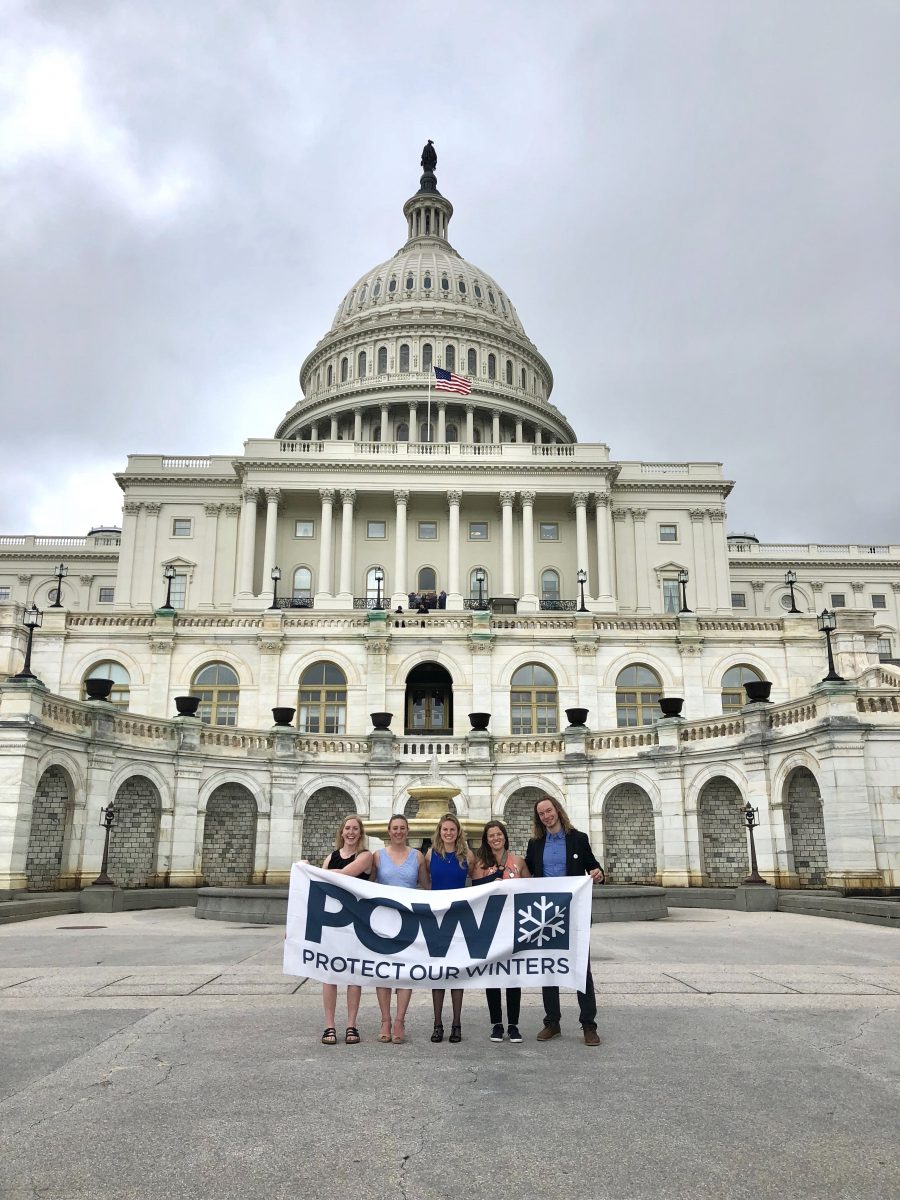
From left to right: Maddie Phaneuf, Arielle Gold, Jessie Diggins, Stacey Cook, and David Wise in front of the U.S. Capitol in late April in Washington, D.C. (Photo: Barbara Weber/Protect Our Winters)
Young and empowered. Twenty-three-old Maddie Phaneuf, a 2018 Olympic biathlete and member of the US Biathlon’s national team, has been finding her voice this short offseason as she lobbied members of the U.S. Senate and House of Representatives in Washington, D.C., on April 25. Phaneuf, along with 2018 U.S. Winter Olympians Jessie Diggins, Arielle Gold (snowboarding), David Wise (freestyle skiing), and Stacey Cook (alpine skiing), spoke in D.C. on behalf of the Citizens’ Climate Lobby and Protect Our Winters (POW).
“I have been working with POW for about a year now,” Phaneuf explained on the phone on April 24. “I have been helping them out as a winter-sports athlete giving presentations to schools and teaching kids about climate change and its impact.”
Phaneuf may have been destined for winter sports, but until the age of 8, her life was a snow-void. Phaneuf was born in Virginia and spent her early childhood in South Carolina. Her limited exposure to snow consisted of a single freak snowfall where the snow melted within a day. Fortunately for US Biathlon, Phaneuf said her father wanted his children to experience the full spectrum of the seasons and relocated the family to Old Forge, New York, in the Adirondack Mountains.
“The whole town is really into skiing, whether it be downhill or nordic,” Phaneuf said of Old Forge, where her parents still reside. “So my parents wanted us to get into that because it would be a great way to experience winter in the Adirondacks, and for us kids to stay active.”
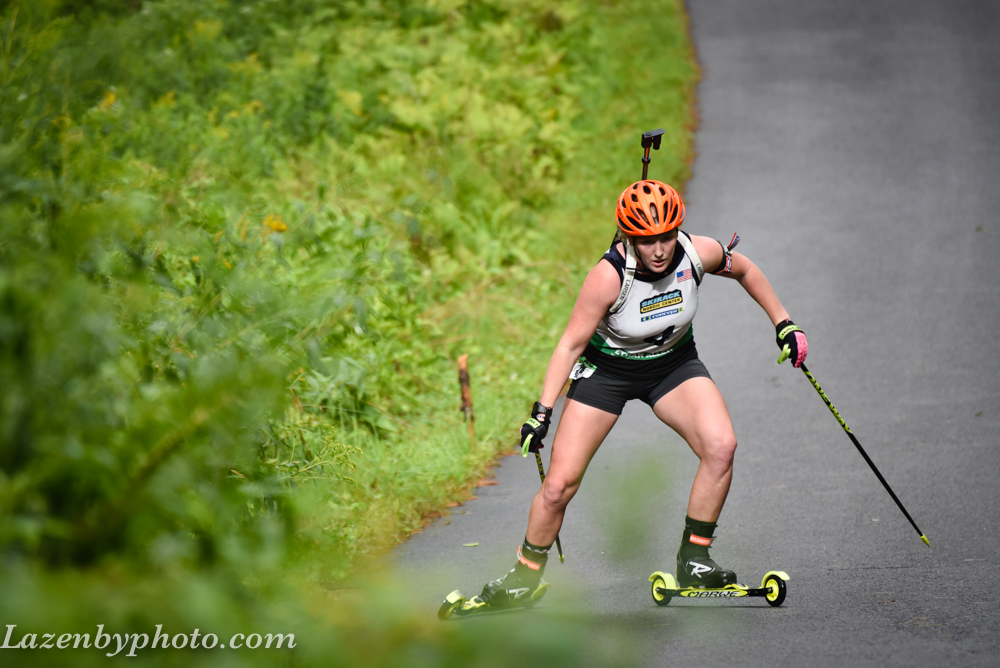
Maddie Phaneuf (USBA/PBSC) racing to fourth in the women’s mass start last August at 2017 US Biathlon Rollerski Championships in Jericho, Vt. (Photo: John Lazenby/Lazenbyphoto.com)
Nominated to US Biathlon’s X-Team in 2014, Phaneuf climbed the ranks and to reach A-team status last season. Last month, she was named to the B-team, part of the US Biathlon’s top-tier High Performance Team. While continuing to train and race with the national team, she planned to move from Lake Placid, N.Y., to her new training base in Boulder, Colorado, this summer.
New York’s North Country, where Old Forge is located, is a reliably conservative region. At least on electoral maps, the politics can skew towards an anti-climate-change perspective. However, Phaneuf said she has felt backed by Old Forge as she explains her point of view to others.
“My hometown is very supportive of me,” Phaneuf said. “I went into the local school and they were excited to learn about my climate-change presentation. But I am sure there are parents that don’t necessarily agree with what I am saying, but they are not going after me.”
Politics and athletics can be a non-starter for athletes. Being outspoken about a cause, in particular, one as divisive as climate change, can alienate an athlete — especially on social media. But Phaneuf has used the resilience she has developed in the fickle sport of biathlon to weather the storm and move forward with her activism.
Phaneuf admits she is still learning how to navigate the potential minefield of exercising her free speech. This past February, Phaneuf penned an op-ed piece for Syracuse.com, expressing her belief that change must be enacted to save winter, and by extension, our ability to sustain the winter sport economic engine and way of life in places like the North Country.
Phaneuf was eventually alerted to the many negative comments her piece received when she posted it on her personal Facebook page.
“I went to the article and 90% of the comments were bashing me,” Phaneuf explained. “Saying I am too young, I have never experienced anything — what am I talking about? Not even bashing climate change but bashing me personally … When I shared the climate-change article I wrote, one guy replied something like, ‘What’s up? You are not posting things about the Olympics. This is bullshit. I don’t want to read this. I want to follow you.’ I replied, ‘OK, the Olympics are over. It’s my offseason. I think it is irrelevant to post things about the Olympics right now because we aren’t there. And I want to show my followers what I do in my free time. Just because you are an athlete doesn’t mean you can only post about training and racing.”
Phaneuf recognizes that her Olympic-team nomination has given her more exposure. She said her Facebook page went from 1,000 to 4,000 likes during the 2018 Olympics in February. As she had matured, Phaneuf explained she’s become wiser when it comes to engaging detractors.
“I have been trying better than in the past,” Phaneuf said. “In the past, I would reply to all the comments kind of aggressively, like ‘what do you mean?’ But now I take a step back and simply read the comments. I understand everyone on the internet is human and all have their own opinion. I just try to not respond unless they are trying to put words in my mouth or saying other things about me, then I will respond and clarify the facts in a respectful way.”
The halls of Congress, on most days, are not the wild west of internet commenting. The tone is soberer. There is the understanding that change comes about from the steady persistence of advocacy, lobbying and voting at the ballot box.
Two weeks ago in D.C., the talking points for Phaneuf and the other athletes present were clear They were to speak about the following: What impacts have they witnessed regarding climate change? How is climate change impacting their sport? How might climate change impact future Winter Olympics?
The athletes also spoke of the regional economic boost snow availability brings certain regions across the U.S. (POW and Citizens’ Climate Lobby cite that in New York alone, the outdoor-recreation economy contributes $41.8 billion dollars and provides 313,000 jobs.)
US Biathlon’s Maddie Phaneuf outside the D.C. office of U.S. House Representative Elise Stefanik (New York). (Photo: Barbara Weber/Protect Our Winters)
The Congressional briefing was a bipartisan event sponsored by Senator Michael Bennet of Colorado and Senator Susan Collins of Maine. The athletes also met with Senator Tina Smith of Minnesota, Senator Dean Heller of Nevada, Congresswoman Elise Stefanik from Phaneuf’s district in New York, Congressman Scott Tipton of Colorado, and Congressman Mark Amodei of Nevada.
“It was good,” Phaneuf said on April 26, the day after her D.C. experience. “I was definitely nervous going into it. I had never been in the position of talking directly to congresspeople or senators. They definitely heard our message. It was definitely more chill than I expected it to be. I was afraid it was going to be judgmental and scary. … The biggest part of our day was simply talking about our own experiences with climate change. And not getting too much into the politics.”
Although Phaneuf has chosen to emulate a long line of athlete activist, her biathlon career remains a priority as she transitions from upstate New York and her residency at the Lake Placid Olympic Training Center to her new base in Boulder.
Phaneuf’s B-Team status comes on the heels of what she calls her “worst season ever”. Although qualifying for Olympics, Phaneuf said she struggled before the Olympics and spent her time in PyeongChang, South Korea, bedridden.
“I struggled a lot with fitness last summer and lost tons of training,” Phaneuf said of the start to her 2017/2018 racing season. “Then I didn’t make the World Cup team in the first period, and then I made the IBU Cup team, but was not performing well and barely made the Olympic team. [In PyeongChang] I got sick the day of my first race and got strep throat and a virus on top of that. I was totally out for two weeks. Being at the Olympics and being around that atmosphere and being so close to racing — having that stripped away from me, made we want to figure how to get better at training and do a lifestyle change. This is why I am moving to Boulder.”
A new training season has begun for Phaneuf. In the meantime, she’ll be juggling her sport with her more seasoned political voice.
“I don’t think I have ever voted in midterm elections,” Phaneuf said of the midterm elections set for this November. “I don’t think I ever thought of it as a big deal. So we are are trying to get the word out because it is a big deal. We want to elect people who will actually listen to us.”
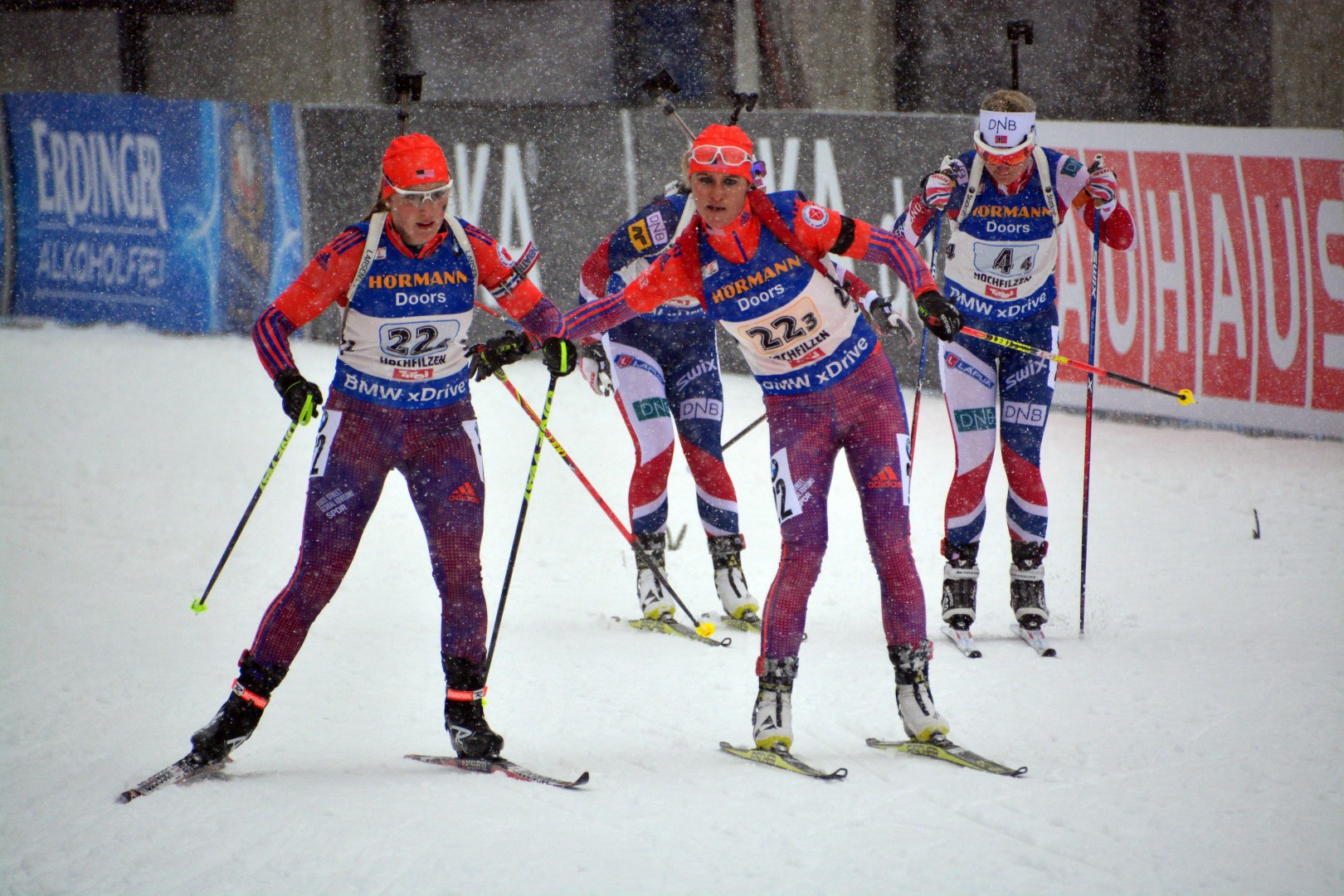
US Biathlon’s Maddie Phaneuf (l) gets tagged by teammate Joanne Reid during the final exchange of the women’s 4 x 6 k relay at 2017 IBU World Championships in Hochfilzen, Austria. The team finished 14th. (Photo: Glen Crawford)
Jessie Diggins (U.S. SKi Team) after placing fourth in the women’s 10 k classic mass start at Stage 6 of the 2018 Tour de Ski (TdS) in Val di Fiemme, Italy. She went on to finish the Tour in third overall to become the first non-European woman to finish in the top three of the TdS. (Photo: Salomon/NordicFocus)
Reflecting on her ski season, here’s the no-nonsense: Diggins simply crushed it. Lots of firsts. The Tour de Ski podium. The gold with Randall in the Olympic team sprint. Her second overall on the World Cup and third in the distance standings. More than $110,000 dollars in World Cup prize earnings alone. And all that face-time and the front-row seat as she led much of the Holmenkollen 30 k skate this year. You’ve got to love that midwestern chutzpah on the Oslo holy ground.
We reached Diggins on April 26 while she was sitting in a Boston park enjoying some spring sunshine. In this interview, we run the gamut of topics from how she’s using her new post-Olympic gold platform to her thoughts on an outstanding World Cup season.
In this episode, we’ve got 34-year-old Andy Newell for you. He’s a longtime staple of the U.S. Ski Team and another proud Vermonter. A few weeks ago we released our interview with climate-justice activist and Vermont resident Bill McKibben. After the interview, we received a few comments that spoke to the perceived large carbon footprint of World Cup skiing and possible changes that might be implemented to curb that environmental impact. With that in mind, we called up Andy Newell, who himself is a climate activist to address some of the questions. We spoke to Newell on Jan. 4 while he was in Seefeld, Austria, prepping for last weekend’s World Cups.
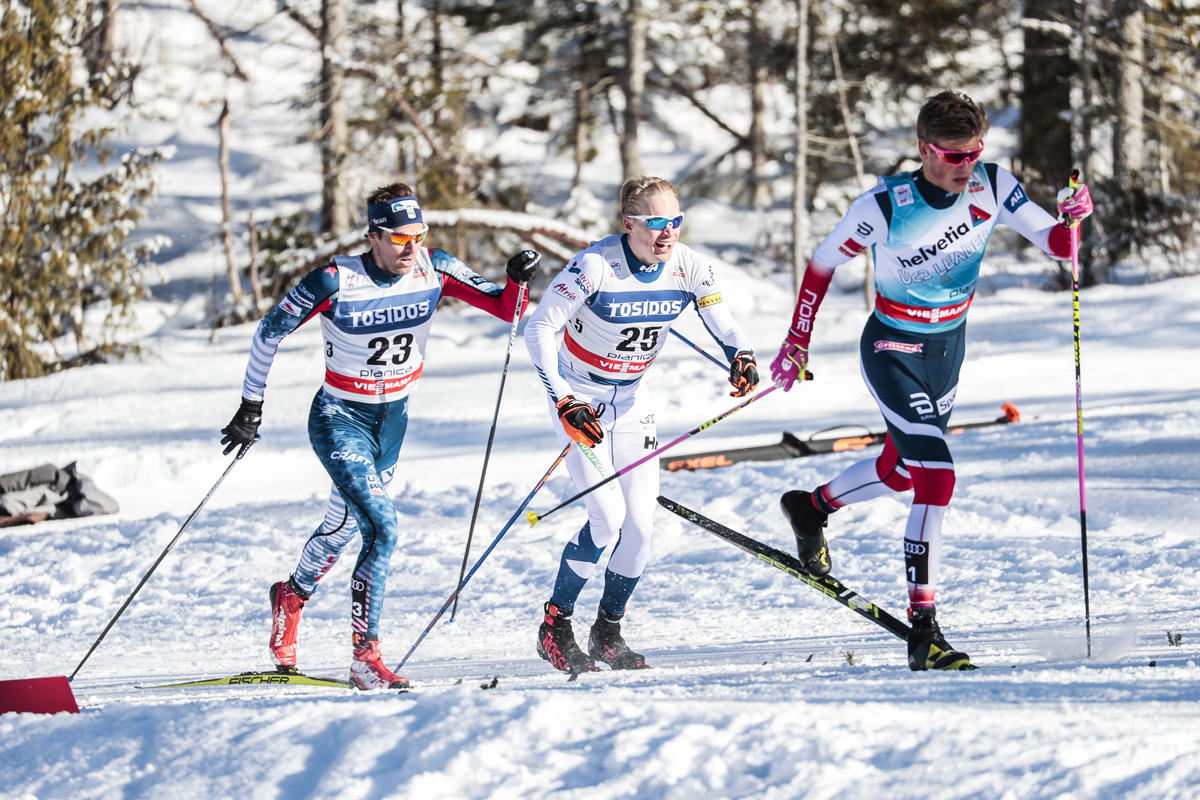
American Andy Newell (l) follows Norway’s Johannes Høsflot Klæbo (r) and Finland’s Iivo Niskanen (c) during their classic-sprint quarterfinal at the World Cup on Jan. 20 in Planica, Slovenia. Klæbo went on to win that heat, ahead of Niskanen in second and Newell in fourth. (Photo: Fischer/NordicFocus)
Newell will soon be in PyeongChang, South Korea, for his fourth Olympics. After traveling the globe for 14 years as a member of the U.S. Ski Team, Newell has had time to think about energy use and change on the World Cup.
Editor’s note: For the second-straight year, we’re presenting another 12-day holiday gift guide, brought to you by the one and only “FBD”, our gear-review guru. Kicking the series off, recommendations for recovery gifts to keep you and your ski buddies on the trails and injury free. See also: Day 1 | Day 2 | Day 3 | Day 4| Day 5
***
Day 6: Kick-Ass Gear
There is gear and then there is kick-ass gear. You know what I’m talking about — that backpack that you got in college, have taken all over the world, and is still going strong? Those skis that always seem to do well in testing despite getting “a little long in the tooth.” Your lucky “windies,” the wind briefs that have help guide you to many a race win? The list goes on and on. Part of what elevates gear to this elite status is literally years of high performance and reliability, but hey, ya gotta to start somewhere, so in today’s installment of this seemingly pointless, rambling series, I am highlighting some of my personal favorites that I think have the potential to “go the distance” and end up on the coveted FBD all-star gear list.
***
Under $30
While some of you lesser-informed readers may have pigeon-holed me (and please NOT in the Urban Dictionary fashion, as it is hard enough keeping my car clean as it is) as a high-maintenance, metrosexual pretty boy who wouldn’t dirty his hands with anything that’s not carbonfibre (yes, the snobby, arrogant Euro spelling is by design), made in Europe (preferably Switzerland for watches, Germany for cars and France for skis), or only available through my Skull-and-Bones-style network of elite illuminati, and quite frankly, in most instances you would be correct. What can I say, I like nice stuff.
But, did you know that there is also a hard-scrabble, man-of-the-people, street-smart side of FBD, capable of living for weeks at a time in a secluded cabin in remote Montana, living off the land, with only his acerbic wit and quick thinking to keep him alive? It’s true. This wily veteran of minimalist living can survive for minutes or perhaps even hours without concierge service, Whole Foods and his own private ski technician (well, maybe days in the case of the latter example, as my lanky ass was getting in “mad k’s,” as the kids say. For the uninformed, I’m not talking about losing your temper in K-Mart, I’m referring to skiing long distances in many consecutive sessions. Don’t worry, this confused me for the first few years that I heard it too.)
So with these caveats and conditions duly noted, it is with great pleasure that I offer today’s first suggestion, a sewing awl. No not an awl, as it, Awwww….SNAP, though that would be funny, (albeit hard to sell), no, rather an awl, as in a very utilitarian, gear-repair, ass-saving, sewing tool.
There is nothing fancy about the Speedy Stitcher sewing awl, but it is a life saver, certainly figuratively and perhaps even literally. While it is basically just a heavy gauge sewing needle, handle and thread, it is extremely well-designed, very heavy duty and very portable. If you are smart enough to bring it with you, it can tackle breakage problems that if not resolved, could be inconvenient in the best case and disastrous in the worst.
For example, I have used it to repair hiking boots way, way, way out in the middle of nowhere, a biathlon harness at 11 p.m. the night before a race in Granby, Colorado, a hard-case bike box strap that would have otherwise required replacing the entire case to the tune of $500, and a tent sidewall that my idiot friend kicked apart with his crampons after we SPECIFICALLY told him to not wear his crampons past the tent atrium? Why? Because kicking a hole in your tent in the middle of winter can have disastrous consequences, because it is cold in the mountains in the winter. (Why is it that every crew always has that stupid friend? Psychologists out there, please look into this and report back). And this is only a partial list.
Why is it that every adventure, team, or road trip always has “this guy?”
This amazing tool has been around since 1909 (with packaging that looks like it hasn’t changed since that time) and it can fix essentially any soft good, or in the very least give you a fighting chance of limping home. In some cases, in particular once you get good at sewing (and no, I’m not joking here), your field repair can last for years. I’ve been going strong on the bike-box strap repair that I made six years ago, with no end in sight. For this to apply to you though, take the time to read the instructions and properly learn how to sew.
I’m not kidding. It completely defeats the purpose of bringing this tool along (or any tool, for that matter), if you don’t know how to use it correctly. In fact, doing this make you an even bigger tool. So, with that said, buy it, learn how to use it, practice with it, and you’ll be amazed at how often it comes in handy. Seriously. I’ve probably make 2 – 5 repairs per year for the past 15 years on stuff that would otherwise have been ruined: winter gear, summer gear, dog gear, automotive gear, clothes, you name it. I absolutely love this thing.
$21.99 at Ace (the place with the helpful hardware man (sexist bastards))
This was on the list last year, it is in the list this year, and it will be on the list every year until the day I die, completely go off the deep end or am fired by FasterSkier in a blaze of glory (all of which could literally be moments away). This item is “a lock” on the list for the simple reason that it is an incredible cause. Yes, there are lots of great causes out there, nonprofits that benefit biomedical research, a wide variety of social programs, and even broader environmental concerns, but this is a ski publication, so while I certainly don’t want you to give any less to any of those other, very worthy issues, hopefully you can find it in your heart and your pocketbook to also support Protect Our Winters. You all know why, so no need to soapbox it any further here.
Do the right thing for as much as you can afford to give.
Or give it as a gift in the name of someone to stupid or stubborn to admit that climate change is a massive, massive problem. You know who you are.
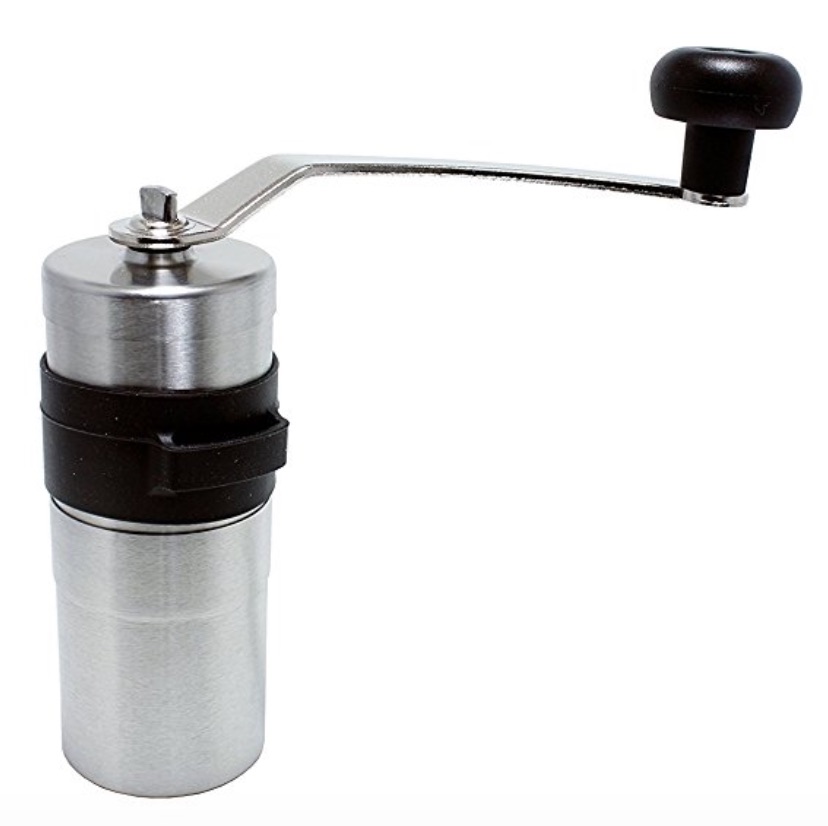
Ah, coffee, the elixir of the gods. None of these columns would even be remotely possible without caffeine and I know I’m not alone here. Some of you might think that the absence of these columns might be a good thing, but deep down you know that you secretly love each and every one of these carefully chosen words.
In addition to this miracle compound of caffeine helping to lessen my urges to kill every moron who can’t seem to grasp the RIDICULOUSLY SIMPLE process of loading and unloading an airplane, it also has documented ergogenic properties. Chances are you will ski longer, harder and faster with the pre-rip Peet’s infusion. But wait, there’s more — it’s a great gateway for actually interacting with real, live humans in person (as opposed to over your phone) for the socially awkward, which in the nordic community, is just about all of you.
So if the thought of asking out a an actual, living, breathing female (not an avatar, emoji or whatever other weird digital analog the kids today have for real girls) to dinner immediately triggers your Cliff Clavin “hysterical blindness,” easing into a potential sexual encounter with the vastly less threatening offer to sit with a girl for 20 minutes at 3 in the afternoon on a Tuesday in an alcove by the cash registers at the grocery store may be for you.
Be forewarned however, the lure of faster race splits and perhaps even the tacit acknowledgements of an attractive member of the opposite sex is a bit risky, as once you “take a ride on the brown pony,” (there’s nothing sexual in this one, so get your mind out of the gutter, you perverts), there’s no going back. I’m talking about having a cup of coffee before you go skiing, as opposed to a life of heroin addiction. Regardless, all of you will want and some of you will NEED coffee in the morning. Driving to Starbucks each day is for housewives in Mercedes SUVs in affluent suburbs, so man-up (or “woman-up”) and make your own coffee.
As you all know, no one is lazier than the FBD, so I have the most streamlined and efficient coffee-preparation operation known to man. It is configured and mostly completed the night before, so when the morning rolls around, I’m on my way to coffee-pound town (again, nothing sexual here, you monsters, but probably best if you don’t Google this one) in a matter of minutes, if not seconds. Sure, my coffee machine in Steamboat has slain many the accomplished skier, but guys like Jeremy Teela gained notoriety from their skiing, not their deductive reasoning skills. And no, Teela never did figure out how to correctly operate that machine, whereas I, on the other hand, was victoriously sipping from an expresso at his house within seconds after exposure to his substantially more complicated machine. Hold that though. More on this later.
For whatever reason, probably because I enjoy spending time with interesting people, I somehow seem to gravitate to “coffee snobs.” Don’t get me wrong, they’re all great people, but without fail, almost all of them are willing to invest 2 – 3 hours each morning for the perfect cup of Joe. I, on the other hand, have no problem stopping at the gas station, if necessary, for my morning beverage of choice. That, and a nice cold glass of water, ah, that’s some fine living, people.
Case in point, my good buddy Jordan Rapp. Jordan is a professional triathlete: six-time Ironman winner, ITU long-distance world champion, and one of the most driven, determined baristas that I have ever met. In our travels across Europe this past summer, he brought approximately 500 lbs of gear, 450 of which I am convinced was involved in coffee preparation in some way, shape or form.
Don’t get me wrong, I’m not complaining here, far from it, as I love this situation — he does all of the work and I get to drink great coffee. Everyone wins. All of I have to do is carry 3/4 of all of his heavy crap through all of the train stations. Since FBD is a big, powerful, man, this seems like a fair trade.
So how does Princeton-educated engineer, Mr. Rapp, start this ridiculously involved and intricate process? With the Porlex Mini bean grinder. I’m not even going to bother to go into the theory on why you need to grind your own beans, because you’re either in this camp or you’re not. If you’re, “one of THOSE people,” you’ve already drank the Kool-Aid and you’re only going to get mad at me because no matter how thorough my explanation, I will undoubtedly leave out some key detail that you perceive to be crucial in this analysis. And if you’re on the other side of the fence, we’ll call this group, oh, I don’t know, “normal people,” well then you’re not going to start grinding your own beans simply based on some long-winded diatribe (in particular one from a smart-aleck nordic skier). For all of you people, MY people, I’ll see you at the gas station. Please try to not backwash the dirty carafe of two-day old muck that they call coffee, either, as I have intervals later and DADDY NEEDS SOME JUICE and I hate germs.
Back to the nerd group: whatever formidable childhood experience that fostered your now firmly cemented coffee OCD, you’d sooner die than prepare coffee with pre-ground beans, but you’re in Norway, preparing to race: now what? Are you sentenced to a life of eternal damnation with pre-ground beans? Not so fast, it’s J-Rapp to the rescue. JR doesn’t leave home without not just a portable coffee grinder, but also what he is convinced is THE BEST portable coffee grinder, the Porlex Mini. I have to confess, it did work well and the coffee was delicious, and he’s not alone, for as he was extolling the virtues of this system in an extremely long-winded soliloquy, being a fellow scientist, he naturally also had reams of research and supporting data, not to mention social feeds from two different World Cup racers also using the very same grinder, so as much as I hate to admit it, Jordan’s probably correct.
Here’s the best part, though. When I hit up Jordan to see if he’d make a funny video for me about using the grinder, he sent one back in 30 seconds. Not because he’s that fast at making videos (which he often is), but due to the fact that he had already made one. You know you are really committed to your coffee preparation when you are walking around with a video of you making coffee on your phone. Man, I love that dude.
https://vimeo.com/188432750
I personally would have liked to see more footage of my boy JR, just because he’s a super smart and funny dude, but mainly because he believes that my Great Dane is his spirit animal, which makes me laugh every time of think of it. Please note, too, he measures his coffee on a digital scale, a goddamn DIGITAL SCALE. You can’t make this shit up.
For extensive reviews and much, much, more, you’re going to want to check out www.grindr.com, you’ll learn more about “grinding” than you ever thought possible.
Just as in the dog-eat-dog world of coffee preparation, there are two schools of thought for nordic eye protection: shades and shields. Most Nordorks would probably say that shades look cooler – there certainly are many more styles to choose from, but ask any athlete who’s had a race on a very snowy, rainy, or foggy day — in these conditions you simply cannot beat a shield.
The shield is often the weapon of choice for biathletes in all conditions, too, as it is substantially easier to flip up and out of the way for shooing. If you’re a biathlete, you’ve probably already figured that out by now, but maybe you suck and you haven’t, or you simply are fine with growing roots on the mat. Either scenario is fine by me: it’s your funeral.
Regardless if your nordic racing and training involves skiing around with a rifle or the vastly easier non-rifle version (I can’t recall if they have a name for this), you’ll want a shield if it is sloppy out — shields come in a bunch of different tints, sizes, styles and colors and most importantly, fog way less easily. My boy, and former U.S. Birkie winner Matt Liebsch (or “Leaper,” as he likes to be called), swears by the shield, as does the first family of U.S. Masters Biathlon, Marc, SJ and Thor Sheppard.
The family that can see what they are shooting, stays together, or something like that. Multiple World Masters medal winners (from left to right) Marc, Thor and SJ Sheppard rocking the shield — (I know, this sounds like a bad 70’s cop show, but trust me on this one).
Another reason why this day is another one of my favorite days (this column, not Friday), is I love being unshackled and let loose completely unrestrained. Even I can only write so much about base layers, wax, and gloves, but give me longer enough lever arm, a place to stand, and a green light to opine about all sorts of gear, and I will move the world. Or annoy it. It really could go either way. There point here is that there is a lot of other great gear out there that you need to hear about – somebody needs to put their foot down and that foot is me.
I get around (no, not in that manner you might be thinking, as most of the members of the fairer sex seem to find me repulsive). I “get around” in the sense that I both host and am hosted my many members of the nordic community. I love “paying it forward,” as I did more than my fair share of couch surfing in my elite rowing days and it is my pleasure to do my best to somehow attempt to replenish the karmic pool of good will.
With the exception of my good buddy Aaron Scott, (or A-A-Ron, as he is known around the biathlon range), who has earned the wonderful moniker as “America’s Guest,” due to his propensity for frequent and last-minute homestays, I crash in enough homes to rival Dr. Scott in my volume and frequency of spare bedroom time (though my track record of alienating my friends’ significant others is unmatched. Yes, my ability to agitate even the nicest people truly is a gift. I’m like the Michael Jordan of annoying house guests. And that’s even without the Great Dane. He takes that game to a whole new level. Together, we are a juggernaut. But after all, isn’t what life is all about, teamwork?)
I may have left a few dishes in the sink “back in the day” in my period of elite athletics, blissful unemployment, and lack of any permanent mailing address, but I am regaining good karma points at light speed with the U.S. Nordic Combined crew at my house right now.
The point to all of this is that in planning my early season racing calendar for this year, I was inquiring about the availability of my trusty post-West Yellowstone Ski Festival spare bed at my buddy’s house in Bozeman. Being perhaps one of the nicest people I know (and crackerjack smoothie chef), KJ immediate agreed and even offered to serve up perennial favorite FBD post-race meal of tacos, with the caveat that the house would be empty on my arrival, as the whole Jacobsen family was going camping.
This got me thinking (something I generally do my best to avoid, as is painfully evident by my generally very labored prose), that the nordic community does much more than just nordic ski. Almost every nordic skier I know also loves to go out and hit the alpine slopes, camp, hike, hunt, fish, bike, run, you name it. Probably one of the things that I enjoy most about my line of “work” (and yes, yes, I’m using this term very loosely, as I what I do can barely be considered work), is the camaraderie of the nordic community. This is a community that enjoys the great out-of-doors in many different capacities (better get out there fast too, as Trump is try to giving it all away to oil, gas and mining companies unless we ALL do something).
Sure, we all nordic ski, but the very nature of this sport seems to attract those that also just love being outside and doing cool stuff. So, if you’re outside all day doing cool stuff, you’re not going to last for very long if you’re not getting good sleep, which brings me to the issue at hand — winter sleeping bags.
I told you earlier we’d get back to busting on Jeremy Teela, and I would never let you down on a topic as important as this. Jeremy Teela is a three-time Olympic biathlete and up until Lowell Bailey’s very strong eighth place in Sochi, Teela had the top all-time Olympic finish of any U.S. biathlete. Teela is a great dude and a great friend, but well, he has some issues. For example, when you have breakfast his house and request coffee with cream and sugar, his reply is, “Ah, you want the full b*tch kit.” I made this “mistake” (insomuch as asking for cream and sugar in coffee can be considered a mistake) years ago and I’ve yet to live this down. I bring this up now because when I asked Big Agnes to send a winter sleeping bag for testing, I was pleasantly surprised to discover that I received the “full b*tch kit”: bag, pad, pillow, and magical inflation device.
“Full b*tch kit” being prepared for testing. And no, this photo was not staged, this is really how I live. Perhaps it is not just Teela who has issues.
The bag that the fine folks at Big Agnes sent was amazing in every way: light, warm, compressible and even when it’s wet (more on this later). It wasn’t just that bag that impressed me either, it was also all of the accoutrements.
Since contrary to what you may have heard or read, I am an AMAZING house guest, KJ and his lovely wife were very interested in all of the gear that I was reviewing for this year’s wonderful and what appears to be endless journey. She is from Alaska and he’s a touch Montana boy from way, back, so they are no strangers to hunting, fishing and winter camping in even the nastiest of conditions, so when I said that the Big Agnes (BA) bag was one of my favorites out of more than 200 pieces of gear that I reviewed for this series (Yup, you read that correctly, 200+, you’re welcome), not only were they intrigued, but they also offered up their own, unsolicited story about Big Agnes.
Apparently they had two sleeping pads that gave up the ghost when they were traveling around Europe last summer, and despite the fact that they had owned them for years and they had logged lots of miles, they said BA replaced them with brand-new versions, no questions asked. KJ and Robin were incredibly impressed, as was I.
I start testing products several months or even several years in advance, because I am a very, very lonely man, but also because I want to be thorough. Gear is expensive and due to the shifting and declining revenues for periodicals of all types, genuine, unbiased reviews are going the way of intelligence and civility in politics and our beloved snowpack — vanishing.
It is for this reason that despite my many wisecracks, I really do take this job seriously, as I consider myself the Obi Wan Kenobi of gear review. That’s right people, I am your only hope.
“Hurry Captain, shoot down whoever you need to, FBD needs CHEESE.”
Given the very nature of my role, however, one of the components of the overall process for which I always wish I had more insight is customer service. Since I am now a VERY big deal, almost all of the companies roll out the red carpet for me. Don’t get me wrong, I like getting my ass kissed as much (or probably more) as the next guy, but one downside of this VIP treatment is that I sometimes wonder if I don’t see what the average customers sees. If I have a problem, a fleeting of matching black Cobra attack helicopters immediately airdrops a new version of the product in question to my door, completely with a courtesy basket full of bonbons and an exotic assortment of artisan meats and cheeses. Exactly as it should be, too, btw, so keep those biking-clad heli pilots bearing gifts coming, that frickin’ cabin in Montana is cold and lonely and the freakin’ crappy grocery store is miles away, which gets old, fast, when you’re on foot patrol for three weeks. My point, however, is that it is extremely encouraging to hear unbiassed, objective feedback from “real people” who don’t have any skin in the game, other than the fact that they want to keep their skin. When people I know and trust tell me that customer service from a company is commendable, that absolutely merits me passing it along.
As for the bag itself, it also kicked ass. It was very comfortable in relatively cold Montana weather (low of minus 4), as well as VERY damp, nasty, typical East Coast winter weather (15 degrees, with about 200 percent humidity) and in the slightly more moderate, but very dry Colorado weather (a crisp 20 degrees). That is only part of the story, however, as while bag performance is key, part of what made the bag perform so well were its accessories.
For starters, the bag has a sleeve on the bottom that holds the sleeping pad in place perfectly. While this sounds minor, I can assure you that rolling off your sleeping pad onto the cold tent floor is a deal-breaker, so this innovation is ground-breaking, er, ground-warming, er, keeping-your-bag-off-the-ground-ing-which-makes-it-warmer-ing?
All the components of a Big Agnes System Sleeping Bag
Other clever touches are their combo dry bag/sleeping pad inflator, which allows those with meager lung capacity (like Smullin) to inflate the pad and pillow by merely waving around the bag to fill it with air, then squeezing the air into the pad and/or pillow. Sure, Josh’s bird-arms will likely give out quickly waving around a six-ounce bag, but with ample sets, combined with frequents and extensive rest periods, I am confident that even he could eventually accomplish this very simply task. For all of you in the studio audience that can curl anything more than 5 lbs two times, you’ll have this done in under a minute and will be fresh as a daisy to start grinding me coffee.
As much as I love Big Agnes, I feel duty bound to advise again their two-person bag, though, as while this might sound great idea for newlyweds or passionate young couples who haven’t grown to despise the sight of each other yet, word on the street is that this bag has been coined, “the relationship ender.” You’ve been warned.
In another, alternate universe, I create thoughtfully crafted, considerate, caring gear reviews for our colleagues across the aisle in the endurance sports community: triathletes.
I am of course kidding, as I harbor even more spite and resentment for this group of Type A nerds than I do for the nordic community, which is saying something. If there was one group of individuals more afraid of women, germs, and overall more adverse to following social norms and acceptable public behavior (all of you wearing your Speedos or bike kit in the grocery store have a place waiting for you in hell), it’s these guys. Spend even one hour in Kona in the week before the IM World Champs and you’ll immediately see my point.
The upside of being forced to deal with these kooks is that I get to test a lot of cool bikes, which is what we’re talking about now.
Bikes? In a FS gear review? What gives, FBD? Stick with me on this — my thinking here is that inherent in any nordic skier’s life is summer training, something that thanks to years of poor leadership and vision, combined with the current abysmal leadership and vision, is quickly turning into a major component of our year.
One can’t help but wonder if we are ever going to be able to undo the damage that we’ve already done to our planet and if reliable snowpack won’t be changed or perhaps even lost forever. The sad reality here is that our summer season is getting longer and our winter season is getting shorter. Hopefully everyone out there will get involved and demand change (remember, you get the government that you deserve) and we can at least stop any further damage. Regardless, the hard, cold truth (well, now moderate temperature truth), is that longer summers and shorter winters are here to stay. This all means more time on the bike.
One of my pet projects (as opposed to just one of my many pets) this past summer was testing gravel bikes. I’m not gonna lie, I entered this project with a healthy dose of skepticism, as this kinda seemed like one of the notorious bike industry “flavors of the month.” Given that fact that it is increasingly difficult to improve on the already extremely efficient design of the bicycle, this industry constantly grapples with ways to increase sales and drive demand. More often than not, these efforts are somewhat meaningless. So with this beautiful bias firmly cemented in my mind, I set out to test some gravel bikes. And they were awesome.
Taking the Open Upper out for a rip with the crew from Lupine lights. More on the latter shortly.
At the top of the heap (bike joke for all of you losers who don’t have the silky smooth bike handling skillz of the FBD), is a wonderful whip from a (kinda) new kid on the block, OPEN Cycle. Open was started by the big guys behind Cervelo, Gerard Vroomen and Andy Kessler. Their extensive experience and success in the bike industry was immediately evident as this bike is incredible. I had the good fortune to put it through its paces on all sorts of trails, road, and paths, and I struggle to find anything critical to write — this is really saying something, too, as I am one of those people with the gift of being able to find something critical to say about EVERYTHING.
The bike is light, responsive and incredible versatile. You can outfit it with slicks for road riding, 32’s for cross racing, 40’s for mixed gravel/single track cruising, or even go with full-blown mountain wheels if you are primarily riding dirt.
This fine steed made the cut for this column for many reasons, but in particular due to its versatility. The strength coach at the Steamboat Springs Winter Sports Club is an avid rider, a fat bike World Masters Champion and just an all-around speedy dude. He has an Open and he told me that due to its versatility, he has narrowed his fleet to just a few bikes, as he can easily swap wheels on the Open and have a perfect bike for almost any type of riding.
Being far more civilized than he and his barbaric attitude to thin the FBD bike herd, I have adopted the “if some is good, more is better,” truism that applies to all elements of endurance athletics, and have therefore chosen to get this bike, and all of the wheels, and keep all of my other bikes. Ha! Suck it, garage space.
Before any of you haters out there write in to criticism this strategy, let me preemptively explain what I like to call, the “FBD sailboat defense.” Being the key, influential member of the littératie that I am, I am often called upon to hobnob with my fellow cultural elites in places like Camelot, Kennebunkport and Cannes, so spending time on luxury watercraft it old hat to this cat. As most of you know, the purchase price and upkeep of any sort of boat is astronomical and absurd, so any time there is even the most subtle suggestion by any member of the FBD inner circle that I am wasting my money on all of these ridiculous and seemingly redundant (or is it superfluous, I REALLY NEED TO FACT CHECK MY WORK) bicycles, I immediate launch into the FBD sailboat defense, which goes something like this: “Would you rather I had a sailboat? Huh? Would you? That costs WAY more and is way worse for my health. Look how fit I am. Do you want me to have a heart attack? Is that it? Why would you wish that upon me, when I love you so much?” I do this all at an ever-increasing volume, then run to my room in tears and lock the door, barricading myself in with my fancy coffee grinder until everyone gives in and I get to buy my new saddle, or tyres, or whatever piece of gear upon which I have obsessed on that given day. Criticism me all you want, but that sh*t works. So go treat yourself to a new gravel bike, after all, who deserves it more than you do? (Well, me, but I already have one, so you’re up next.)
Fully functional Anschutz Fortner biathlon rifle: gold-plated and one of a kind. Given to Antje Misersky-Harvey by J.G. Anschütz GmbH (the world’s leading manufacture of biathlon rifles) in recognition of her gold medal in the women’s individual at the 1992 Albertville Olympic Games.
I’m going to finish this very special column with a very special story (and no, not that kind of “special” — this is actually an incredible account of perseverance, courage and strength)
Without a doubt, the United States is a great country. Having said that, it always annoys me when pandering politicians and nut-job, right-wing pundits go for the lowest common denominator and claim it to be “the greatest county in the entire world,” as there are lots of great places and people out there in the world, so to simply unilaterally and without fact claim us to be No. 1 across the board in all categories is inaccurate and arrogant (look no further than our global rankings for gun violence, health care, education, quality of living, and self-assessment of happiness, just to name a few). That notwithstanding, the US is most certainly a great place, as this remarkable series of events illustrates.
As noted in Wednesday’s masterpiece, like so many good stories, I was “just skiing along,” well, in this case, uh, “just standing along (does that even make sense?) in Altius Handcrafted Firearms in West Yellowstone, Montana, the nation’s premier biathlon shop, when in walked Ian and Antje Harvey with a biathlon rifle for consignment. The rifle is gold-plated and an amazing piece, but this rifle itself was just the tip of the iceberg, as the accompanying back-story is nothing short of incredible.
One of the many intriguing aspects of the story of the history of the rifle is that a doping controversy is at its core, making it perhaps more prescient than now than ever before, in particular given everything currently happening on this front.
This full story was published in Masters Skier and Cross Country Skier magazines several years ago, but sadly I was unable to find any versions online. With full respect and attribution to the fact that this was published previously, I will present a short summary, but I do encourage everyone to try to find the complete versions of these accounts, as they are simply amazing. In essence, this is a tale about overcoming long odds, stifling authoritarian government regimes and the strong moral authority to do the right thing.
Antje Misersky-Harvey grew up in East Germany in the 1970s and 1980s. A rising star in cross-country, she found herself in an extremely difficult and dangerous situation when she refused to acquiesce to pressure from the East German government to take performance enhancing drugs. Rather than administer what she believed to be dangerous, illegal and immoral chemicals, she instead opted to quit skiing. Just before the 1992 Olympic Games, however, East Germany was building a women’s biathlon squad for the first time, as 1992 was the first WOG to feature this discipline. Scrambling to build a team powerful enough to take on the strong West Germans, she was allowed to join without being forced to dope.
Antje Misersky (now Harvey) was awarded a gold-plated Anschutz Fortner biathlon rifle for her gold medal at the 1992 Olympics.
Fast-forward to the Games themselves, where she went on to win a gold medal. The story gets even more incredible here though, as this was just after the fall of the Berlin wall, so the now, greatly liberated German media was very anxious to hear her incredible and harrowing story. Not surprisingly, officials from the former East Germany were much less excited about these details getting out, so she and her family received numerous death threats. Given the very recent change in the political structure and the enormous, far-reaching power in the previous governments, these were threats that could not be taken lightly. Being a person of great courage, conviction and character, however, she went on TV for a full, one-hour interview exposé and was one of the first athletes to have a very vocal and outspoken role in the anti-doping crusade.
In appreciation of her gold medal, bravery and strong, moral conviction, Anschutz, the manufacture of the rifle she used to win her one gold and three silver Olympic medals, presented her with an extremely unique and stunning gold-plated rifle. Not only is this extremely rare, but the story behind it is nothing short of incredible as well. And this rifle is now for sale.
One of the things that I’ve learned in my few trips around the block is that it is very easy to fall in to “the grass is always greener” trap. Sure, our national team athletes (not to mention our development team and junior team athletes) may not have everything that their European counterparts do, but was Lowell Bailey’s father ever issued death threats by the US government? Given that fact that I highly doubt that Trump could even spell ‘biathlon,’ this seems quite unlikely. Yes, Noah Hoffman is currently paying for his wax tech and I think we all wish that this wasn’t the case, but has he ever been so knocked over by government officials as he approached the finish line, therein preventing a win, due to his political views? Have any of our female athletes been pressured into pregnancies (to later be terminated prior to competition), in order to get a more advantageous hormone profile? No. Never. Yet these are things that happened (and sadly, appear to still be happening in some places) at the behest of other federal governments. Let’s be very clear about this, too, these atrocities are not happening in isolated cases with a few random athletes, not is this a conspiracy of a few rogue coaches, but rather these are massive, nationally orchestrated programs run by the highest levels of government. Please allow that to sink in for a moment.
In the U.S., this is simply unfathomable. As citizens, we rightful become incensed if we even perceive a whiff of government intrusion in any aspect of our lives, yet not all that long ago, and maybe still even today, there are national-team athletes from other countries facing almost indescribable oppression, intimidation and abuse. So while I wish we had a wax truck for biathlon and nordic combined, and I wish both our health care and education systems were more efficacious and economical, but despite these shortcomings, I am still very proud to be an American, as this is most certainly one of the greatest countries in the world. Even with Trump.
Athletes on course in Rumford, Maine, at 2011 U.S. nationals, which were plagued by low-snow conditions. (Photo: flyingpointroad.com)
“I think if you’re a nordic skier in New England, you should definitely be alarmed.”
“That’s one of the main take-homes: skiing is not going to disappear completely, but it will generally be higher [in elevation].”
So says Cameron Wobus, a Bowdoin ski team alumnus and a researcher at Abt Associates, a global research firm. Wobus and colleagues based in Boulder, Colo., and Washington, D.C., recently published a study in Global Environmental Change assessing the impact of projected climate change on the ski industry. (The article is available free of charge here.)
Their results: by 2090, many cross-country ski areas across the U.S. are likely to see 50-100 percent reductions in season length. That could translate to more than a million fewer visits by skiers, and millions of dollars of losses in trail-pass revenue.
A lucky few ski areas could see only minor impacts, but a lot of that depends on greenhouse-gas emissions scenarios – basically, what the world does to curb the release of carbon dioxide and other greenhouse gases between now and then.
“I think a main finding is that elevation is your friend, which isn’t surprising,” Wobus said in a phone interview from Boulder last week. “If you’re a ski area in the Rockies and your base elevation is 10,000 feet, you’re obviously in better shape than if you’re a ski area in central Vermont and your base elevation is 500 feet.”
The Nerdy Part of Prediction
A previous report by Protect Our Winters and the Natural Resources Defense Council took a more detailed look at the economics of the winter sports industry under projected climate change.
Bob Rosso, Mike Sinnott, Gary Storey, Kate Barton, Kelly McClowskey, and Colin Rodgers shovel snow onto the SuperTour 10/15 k classic distance race course in Sun Valley, Idaho, in 2015.
What Wobus and his colleagues wanted to do rather than to get bogged down in predicting how interest and tourism for winter sports would change in a warmer world, was to make the best possible predictions of how snowpack and season length would be affected at ski areas.
“We wanted to do was a more detailed analysis of the physical snowpack modeling,” Wobus explained.
To get to their conclusions, the research team modeled snowpack at 247 alpine and nordic ski areas by combining historical datasets, climate change models, and greenhouse gas emissions scenarios. As a starting point, they used North American Land Data Assimilation System meteorological forcing data, which has been recorded at a fine scale since 1979.
They then put this meteorological data into the Utah Energy Balance model to derive snowpack at ski areas, based on what comes out of the sky and landscape factors that would determine how long snow stays on the ground.
When the researchers compared this derived snowpack estimate to actual measurements of winter season length collected for the Snow Data Assimilation System – a framework that combines satellite data, airborne measurements, and on-the-ground observations – the match was solid.
“We did a reasonably good job,” Wobus said. “Not surprisingly, it’s a little bit messy … but on a region-by-region basis, the only thing we need to get out of the physical model is the season length. So with the exception of the Pacific Southwest, we are generally capturing trends in season length from region to region.”
With that information about winter season length in different parts of the U.S. in hand, the researchers applied different climate change models to predict the magnitude of reduction in season length.
“We applied a simple delta from what all the climate models were telling us, to say, okay, we aren’t going to rely on the climate models to tell us what the weather is doing,” Wobus said. “We’re going to use a 30-year historical time series to look at natural month-to-month and year-to-year variation in weather. But then we’re going to superimpose on that weather, a climate change signal that is a change in monthly average temperature and monthly average precipitation, coming out of different climate models and different emissions scenarios.”
The climate models used, known as General Circulation Models, or GCMs, are mathematical representations of the physical processes happening on and around the earth.
“[GCMs], representing physical processes in the atmosphere, ocean, cryosphere and land surface, are the most advanced tools currently available for simulating the response of the global climate system to increasing greenhouse gas concentrations,” the Intergovernmental Panel on Climate Change writes on its website. “GCMs depict the climate using a three-dimensional grid over the globe, typically having a horizontal resolution of between 250 and 600 km, 10 to 20 vertical layers in the atmosphere and sometimes as many as 30 layers in the oceans.”
There are many different GCMs – and while they are pretty good at predicting temperature, their predictions about precipitation vary widely.
“The precipitation predictions tend to be all over the map,” Wobus said. “We tried to beat it down to the extent that we could by using as many different climate models as we could, given the constraints of our budget. And by modeling as many years as we would, again, given the constraints of how much time we have to do the modeling.”
In the end, that meant using five different GCMs. And additionally, the team put all of those models through two different greenhouse gas emissions scenarios.
The Bretton Woods Nordic Marathon. Climate-change researchers used the Bretton Woods cross-country ski center as an example to demonstrate predicted reductions in ski season length. (Photo: Mark Butterfield)
The Findings
Especially under the high-emissions scenario, a lot of the differences between predictions made from the different GCMs disappeared by 2090.
The authors demonstrated this in a graph of predicted season length for the Bretton Woods cross-country ski area in northern New Hampshire. They showed the predictions for all five GCMs under both emissions scenarios, compared to the baseline season length at present (68 days, with a range of up to 150 days).
By 2050 under a lower emissions scenario, mean season length dropped precipitously to roughly 12-33 days, but the range of possible season lengths is quite wide for some of the GCMs.
“All these different GCMs have different parameterizations of precipitation, and so they are all going to do slightly different things,” Wobus said.
By 2090 under a high-emissions scenario, though, the model predictions all converge between two and 13 days, and the current average season length is not even in the range of possible predictions for any of the models.
“By 2090, it’s pretty clear that your distribution of season lengths is very different from baseline to future,” Wobus explained. “That’s kind of regardless of which [emissions scenario] you pick, but RCP 8.5 [the higher emissions scenario] is worse.
“That’s one of the main takeaways from the paper,” he continued. “Climate change isn’t good for skiing in the future, but a greenhouse-gas mitigation scenario looks better than a no-mitigation scenario, pretty much across the board.”
Why is that? Despite the variability in the precipitation predicted by the models, temperature increases would be so great by 2090 that precipitation largely wouldn’t matter.
“You’re looking at close to 10 degrees Fahrenheit of warming,” Wobus said, discussing predictions for the Midwest. “It doesn’t necessarily protect you to be way up north or to be really frigid now. There’s obviously a latitudinal dependence on where things are worse, along with elevation. So maybe if you’re up in northern Michigan with [the higher-emissions scenario] you might still have half your ski season, but it’s certainly going to be shorter than you’re used to.”
Snowmaking equipment at the Rikert Touring Center in Ripton, Vt. Snowmaking is becoming increasingly necessary to maintain winter ski areas, but should the ski industry also be developing other strategies?
Part of this prediction arises from the fact that the team assumed that cross-country ski areas don’t use snowmaking. Wobus said that he knows some nordic areas are investing heavily into snowmaking (or snow storage), but in general, not enough currently use it to build into their projects as they did for alpine ski areas.
But even if ski areas were to rely on snowmaking, they might be in trouble. For instance, under a high low emissions scenario, just 23 percent of alpine ski areas would have accumulated enough hours of snowmaking in 2090 to open by Dec. 15. As most of the cross-country ski areas are restricted to lower-elevation areas at the bottom of mountains, they would not be in better shape.
Without snowmaking, a high-emissions scenario would lead to roughly 87,000 fewer visits to cross-country ski areas by 2050 and 1.1 million fewer visits in 2090 – equivalent, by that point, to $10.2 million less in trail passes sold.
Are We Listening?
The idea for this piece of research came while spitballing.
“We’ve been doing work for ten years around impact of climate change on various sectors of the economy,” Wobus said. “I’ve published papers on the impacts of ocean acidification and ocean warming on coral reefs and linking that to a recreational use model. I did one on inland flooding and monetary damages from flooding. We’ve done all these different sectoral analyses for different economic impacts of climate change.”
Living in Boulder and being skiers, the team thought – why not look at that?
“We were basically pitching ideas, and we were like, skiing is a pretty important industry in certain parts of the country and it probably has a serious economic impact … so we did it,” Wobus laughed.
But the findings have made a splash.
“People seem to have been noticing,” Wobus said. “I actually credit Global Environmental Change for having a Twitter feed, of all things. Protect Our Winters picked it up, and Powder Magazine picked it up. … Most times people don’t pay any attention to my research. So it’s kind of cool to have something that’s a little more out there.”
Pre-order partnership on Earth Day supports ski-focused climate change activism
We are lucky to have a business that allows us to pursue our passion as a job, and to earn a living doing what we love. We are lucky to have a client base that values our work and shares our values. We help our customers get the most out of their investment in a passion and a hobby, and we’re lucky to see the very best of the people we work with. We’re lucky to share our favorite lifestyle with a cool kid, who also loves skiing, and to travel the world as a family, and call it “work”. We have worked hard to make the life we’ve got, and we’re lucky that we work in an industry where everybody is willing to work hard and make sacrifices to ensure that we get to keep skiing. The question we are faced with is a big one; how long will our luck hold?
Climate change is happening, and the future of winter sport is uncertain. We believe in a future for winter sport. We’re not ready to throw in the towel and give up on winter, but we can’t continue to count on luck to ensure the future of our lifestyle and livelihood. Like most people that we know and work with, we’ve had our heads firmly buried in the sand. We’re not denying the scientific reality that confronts all of us, but we haven’t exactly been willing to face it head-on. It’s time to change that approach. We’re in a good position to call attention to a cause and to forge partnerships with our suppliers and our customers to make a difference. So here’s what we’re going to do:
On Earth Day, April 22nd, we will accept $100 deposits for new ski orders. Those deposits will be applied to the cost of a new pair of skis, and the $100 deposits will be donated in their entirety to Protect Our Winters. For specifics, and to place an order and a deposit, follow this link to our webstore.
Why Protect Our Winters? Well, we looked at them first because of their partnership with Andy Newell and Simi Hamilton. We reached out to those guys, and they both endorsed the plan. POW is a non-partisan organization with a goal of “mobilizing the outdoor sports community to lead the charge towards positive climate action”. They focus on political advocacy (that’s lobbying, where massive fossil fuel industry dollars are focused), education, and community action. They recognize the potential power and influence of the outdoor industry as a 650 billion dollar contributor to the economy. They’re a perfect fit, and a very well regarded organization.
We’ve approached our ski industry partners with this idea, and Fischer, Madshus and Salomon have all agreed to support this project. Fischer is especially connected, since Simi and Andy, along with Fischer athletes Kikkan Randall and Steve Nyman (USST Alpine) are part of POW’s Rider’s Alliance. We’re really pleased that all of our major ski brands have been quick to offer their support and will share the cost of this project.
What’s the bottom line?
We don’t really know what to expect from this. At a minimum, we hope that this causes our readers to pause and reflect. We hope that it provides an opportunity for our customers to contribute directly to a cause that concerns all of us. We hope that you recognize that participating in this project is a great way to leverage our commitment, and the commitment of our ski suppliers, to contribute to fighting climate change.
We don’t expect this to generate a huge amount of new business for us. That’s not the goal. But we hope it makes our commitment clear, and we hope that it generates a meaningful contribution to POW.
It’s also good timing, since we’re currently planning our ski selection trips for the season, and it’s time to be taking orders. So, think it over, and let us know if you have any questions.
Editor’s note: This is it. The final day of our spin on the holiday gift guide, brought to you by our gear-review guru, who, over the last 12 “business” days, compiled a 12-day list of gift ideas (in various price ranges) for all the nordies in your life. So if you see him, say thanks. And stop asking about his underwear-washing regimen. He’ll get to it when he gets to it.
***
It is with carpal tunnel-ridden wrists, a rapidly dwindling supply of thinly-veiled sexual references, and a heavy heart, that I must sadly inform you that this is the last installment of the 2016 edition of “12 Days of FBD.” I like to think that every day can be a day with FBD, as hopefully all of you have taken these amazing gift ideas to heart and bought every single thing on each and every one of these lists. To be clear, if you have followed all of my instructions carefully, you should have actually bought TWO of everything on all of the lists, as you’re going to give one away and keep one for yourself — nothing is more pro than that.
As you undoubtedly expect, we’re going to go out with a bang, as I really have saved some of the best for list. These aren’t just gift ideas, these are THE gift ideas.
Like skiing? Guess what you need to ski? Snow. Thanks to one of the strangest elections perhaps in the history of democracy, we have a president-elect who believes that despite overwhelming scientific evidence, climate change is a myth being perpetrated by the Chinese. This is a problem if you intend to venture out of your house for any reason at some point in the rest of your life. Instead of sitting around complaining about this travesty, DO SOMETHING about it. Most politicians are like sheep — they follow the flock, so make your voice heard and support one of the great organizations out there fighting for not just our winters, but the very survival of our planet. One very good organization leading the fight to save Earth is Protect Our Winters. I put this in the “Under $30” category, but you can most certainly donate any amount. Please also feel free to donate in the names of others, in particular if they also refuse to believe the near unanimous scientific consensus on climate change (Guess what you’re getting for X-mas, this year Rob Magee?). If you breathe air, don’t want your house destroyed by flood, or even remotely care that future generations won’t be able to walk outside for more than 30 seconds without their clothing burning off their bodies if we don’t address this problem right now, you’ll be glad you supported these folks. Donate at ProtectOurWinters.org.
Maybe you can’t ski like the Norwegian National Team, but you can share their approach to pharmacology and ethics. No asthma? No problem! Fly to Norway, find a “sympathetic” doctor, and boom, you’re TUE’d and on your way to better splits. Available at JustNebulizers.com.
What do watching races, retrieving your intransigent Great Dane and getting Christmas trees have in common? Cold feet — remember way back when we started this journey I told you we’d discuss both cold hand and cold feet? (No, not the marriage type of cold feet, you’re on your own with that one) — and while we’re on the topic of cold hands, for the love of God, NO, you DO NOT have Raynaud’s Syndrome, you simply have shitty gloves, so stop it with your hackneyed, amateur, self-diagnosis.
I don’t know if there is a more exciting sport anywhere in the world than biathlon: this amazing competition combines all of the coordination, fitness and discipline of cross-country skiing with the laser-like focus of precision shooting, therein adding a mental toughness and focus factor simply not found in most other sports. The extremely narrow margin of error involved in shooting golf ball-sized targets 50 meters away in wildly unpredictable weather at near-max heart rate means that you see frequent lead changes, action all the way down to the wire, and emotion and intensity in its rawest form.
It is for all of these reasons that biathlon is one of the few sports that I will actually watch. I’d much prefer to actually be out doing sports rather than sitting at home watching others do them. I have this crazy notion that controlling my own destiny (and activity) is somehow healthier than attempting to live vicariously through others. I’m not alone either, as there was a landmark study in 1972 by noted behavioral psychologist Martin Seligman, on a phenomena known as “learned helplessness”. The main finding of the study (and subsequent related studies) is that organisms are much happier if they are in environment they can control. This Sunday, you can go for a ski, or you can scream at the TV at the overpaid, steroid-abusing mercenaries, who, contrary to popular belief, DO NOT represent your city, state or personal values. And should your team win, please never forget your role in that whole process.
The choice is yours: watch other people do stuff or go make yourself better. Get out there and work on your technique. Learn how to classic ski. Learn how to classic wax. Then give up on classic waxing and buy these (Rossi skis from Day 3). Or, call Caldwell in hourly intervals if you even have the slightest inkling that your kick wasn’t perfect. Don’t just take my word for this though, test it yourself. See which strategy leads to happiness. I’m not your mother, so I’ll leave it up to you if you want to shape your own future or let your happiness be dictated by events over which you have literally no control. Seems like an easy choice to me, but hey, what do I know, I’m just that guy who only uses the passing lane for passing cars, then immediately returns to the correct driving lane in order to allow faster moving vehicles to safely pass.
Since after that little sermon, you are now no longer watching football, how are you going to spend your Sunday afternoons? Here’s an idea — let’s go back to what we talked about two paragraphs ago — why not try biathlon? Biathlon isn’t just for unkempt French dudes, it is for everyone. There are several excellent programs right here in the good ol’ US of A than can get you started safely, certified and really to rock (including Colorado Biathlon, Minnesota Biathlon, Ethan Allen Biathlon, Casper Mountain Biathlon, Bridger Biathlon, to name just a few).
FBD Pro Tip: If you are going to race in the greatest of all winter sports, biathlon, here’s a shocker, you’re going to need a rifle. As we have already clearly shown over the course of the past 12 days, if something is worth doing, it’s worth doing well, so if you’re going to race, you might as well outfit yourself with the best gear possible: the Custom Altius biathlon stock. Available at AltiusGuns.com.
I’m sure it’s not a secret by now that the FBD likes gear, nay, LOVES gear. And it loves him right back. Ask any good craftsman and they’ll tell you success is all about having the right tool for the job. Sure, you can use a screwdriver to pound a nail, but you know who does this? A certain guy by the name of Primative Pete. Following this metaphor, you certainly can wear a digital watch out to dinner, but you know who does this? A certain guy who’s not getting laid that night. Plain and simple, you’re not going to meet any girls (or boys) if you’re wearing a digital watch. Now don’t panic here fellas, the protocol regarding male fashion accessories is ridiculously simple and can be broken down into three simple rules:
1. No jewelry. Ever. (Wedding rings don’t count, as those are more anchors than they are ornamental). Why no jewelry? This should be quite self-explanatory, but in the off-chance that you still have questions, these photos pretty much say it all:
3. Have a nice watch. If you’re paying attention and following the above guidelines, you’ll realize that this protocol doesn’t leave a lot of wiggle room for dudes to accessorize. This is by design, as while women often excel in this arena, guys usually massively screw it up.
None of these items shown here should ever be on your body at any time, for any reason:
What should always be on your body? A nice watch. We already covered training watches in Day 5, but what about those two hours per day in which you are awake but not training? If you have somehow managed to cloak all of your glaring narcissistic tendencies enough to dupe an unsuspecting female into joining you at a local fine dining establishment, for heaven’s sake, show up with some game. We’ve been over the underwear protocol in excruciating detail, but trust me, underwear selection and hygiene level will not even come into play if you goof up the basic stuff, and having a nice watch is, well, basic stuff. Remember to guys, you only have to follow THREE frickin’ steps here and two of them are just things to NOT do, so everyone out there should be able to handle this.
Here’s what’s awesome about this code of conduct though, not only is it ridiculously simply for even the most fashion inept male to follow, but a nice watch can be a treasured heirloom for literally generations to come. On very special occasions, I still wear a watch my grandfather gave me and it means the world to me. Watches can also be used to mark special occasions, therein giving the gift lifelong significance. If you give (or are given) a good watch for graduation, a birthday, anniversary, etc., you will think about that event and that giver essentially every time it is worn, and isn’t that what holiday giving is really all about?
I am particular fortunate in that the lovely Mrs. FBD (yes, there really is a Mrs. FBD) will occasionally reward a good performance in the bedroom with a watch and I’m proud to say that I’m up to a collection of three beautiful time pieces. Far be it for me to be one to brag, but let’s just say that I can maybe even see another one being added in the next few years.
Now that we’ve proven our theorem on why you need a decent watch, the obvious next question is, “Which one?” As usual, we have you covered here too. FBD loves watches and while an easy pick may be a Rolex, Omega, Bell and Ross, Cartier, or Breitling, none of these brands may really be “you.” This is why one of my new favorite Mickey’s is this:
The Smokey Bear Watch, FBD pick for $250+
Made in Detroit at the Shinola Watch Factory, this watch is a very limited edition and celebrates the history of one of the most iconic and longstanding environmental movements, forest fire prevention. In a time when we need to be doing everything we can to help our environment, it is refreshing to see a company paying tribute to one of the most effective environmental public service campaigns ever and even donating a percentage of the sales to the US Forest Service.
I’ve saved this for the last day because this is honestly one of the best picks of the series. Yes, it is a bit spendy, but of the over 60 products suggested in the past 12 days, this one is the most “Chrismas-tree ready” (this is the Christmas equivalent of a construction project being “shovel ready”). Why? Well, this gift has pretty much everything. For starters, the watch comes packaged beautifully:
Next, included with the watch is a seven-page bound history of the Smokey Bear forest fire prevention campaign, which is quite interesting. Also included are very nice retro Smokey Bear cards, featuring classic iconography:
These elements all make the gift much more interesting and gives the whole thing a very luxurious feel. So while every nordic nerd would most assuredly appreciate unwrapping a double-pole machine that looks like it has been packaged by the loser of a drunken, monkey knife fight…
… with one simple phone call, you can not only have without a doubt one of the most impressive looking gifts, but also one that will carry significance for literally generations to come. So while the watch is indeed a bit pricey, trust me when I say that it is a wonderful gift.
And remember, you’re never going to meet a woman if you’re wearing a digital watch. Church. Available at Filson.com.
We’ve been on quite a journey together these last 12 days and I think we’ve learned a lot about each other along the way. You all have learned that I wear my underwear for 10 days at a stretch (no pun intended) without washings. I’ve learned that people love to read about gear, even if it requires digging through literally pages of weird, cryptic ramblings on a wide variety of often only loosely-related topics. And my editors have learned that it is easy to tell when I’m getting fired up. Like now. I’m getting fired up because everyone is writing in asking for more, so I’m going to miss you people.
As is the case in any good race, succeeding in this series has required excellent pacing. Since this isn’t my first day on the radio, I believe that, as usual, I have paced myself perfectly (this was drilled into my head doing rollerski TT’s at SoHo with the Loppet Nordic Racing Team. If you skied positive splits in the TT, you did the dishes), so I’m “negatively splitting” this mo-fo — not only am I not running out of energy, I seem to only be picking up speed. I’m not going to lie to you, this means that I am struggling a bit to say goodbye. This, combined with my perfectly timed taper and peaking energy levels, means I feel compelled to throw in a few more FBD Bonus Picks.
*FBD Super Bonus Pick: FBD Bonus Pick #2 is also a real peach, and oh golly, I’m hot today. What is it? Or should I say, WHERE is it? The answer to those questions, in order, is that it is a gift certificate to a training camp on Haig Glacier. Led by Matt Liebsch, one of the only two American men to win the U.S. Birkie in the past 15 years, this camp can lay the foundation for one of your best seasons ever.
There’s an old adage in ski racing, “A good winter is built in summer,” so get a head start on next year’s season now by giving the gift of getting the kooky nordic skier in your life the hell out of the house for a week in the summer. Everyone wins in this equation: Haig Glacier camp, approximately $1,500 (2017 pricing is not set yet). More information available by email; send Leaper in hourly intervals at matt@pioneermidwest.com.
**FBD Super Duper Bonus: A week at FBD fantasy camp. Even though you’re a nordic skier, hopefully you have enough of a life that you’ve never considered one of these events, Rock ‘n’ Roll Fantasy Camp, New York Yankees Fantasy Camp, or God forbid, Philadelphia Eagles Fantasy Camp, but what about FBD fantasy camp? Now we’re talking. For just $100,000, you can walk in my shoes for a week (not literally, as I’d never let any of you filthy people wear any of my beautiful footwear). You can experience firsthand the indignity of verbal abuse from East Coast motorists, having your precious belongings destroyed by an unruly and essentially untrainable Great Dane, and if you’re really lucky, perhaps we’ll even let you turn in a rambling, unhinged manifesto about dirty underwear, wax brushes and why you need to be matching your hat, gloves and buff. It’s a once in a lifetime experience that’s happening daily. FBD Fantasy Camp, $100,000. Available at Marketwatch.com (I’m somewhere down on the list with all of the other really expensive, dangerous ones, after all, it IS in Philly, where essentially anything can happen to you at any time).
Finally, thank you all for hanging in there with us to the very end. For many, this has been a crazy, tumultuous year and hopefully these columns have brought some pleasure to all of you in their own right and have also stimulated, encouraged or aided you in some way, shape to form to increase your enjoyment of one of the greatest sports, activities and lifetime pursuits one could ever find, nordic skiing. Have a great holiday everyone and hopefully I’ll see you out there. And please remember on that drive to the tracks, races, or gear store, the left lane is a PASSING lane.
Andy Newell (l) holds the Protect Our Winters banner as he joined 400,000 other protestors on the streets of New York City for the People’s Climate March on Sept. 21. (Photo: Protect Our Winters)
Four-hundred thousand demonstrators gathered on the streets of New York City for the People’s Climate March on Sunday, Sept. 21. Timed to occur just days before the United Nation’s climate summit, the event boasted high-profile attendees including former Vice President Al Gore, Leonardo DiCaprio, Jane Goodall, and U.N. Secretary-General Ban Ki-moon, who wished to demonstrate the world’s necessity to combat climate change.
Amongst the crowd was a lesser-known figure who has been diligently working in the environmental movement for several years — U.S. Ski Team member Andy Newell.
Newell wasn’t always an activist and says that he used to be indifferent to political action. However, as he began to witness environmental activists fighting to raise awareness about climate change, he realized that he had the power to make a difference.
Recognizing that the sport he loved was in jeopardy if major action didn’t take place, Newell began to get involved with environmental organizations like Bill McKibben’s 350.org.
As Newell worked with the movement, he saw a unique opening for him to create real change, and in 2013 he started Athletes for Action. Using his status as an Olympic athlete, he created the organization to ensure that he and other winter athletes’ voices were heard at the upcoming 2015 U.N. Framework Convention in Paris.
A group of activists with Protect Our Winters march in the 2014 People’s Climate March in New York City. Event organizers estimate that roughly 400,000 protestors attended the event. (Photo: Protect Our Winters)
Working together with McKibben, Newell drafted a letter for fellow athletes to sign that was addressed to world leaders, urging them to recognize climate change and take action.
“It sounds like a small step, but even getting governments to recognize the problem and take it seriously can be a big step,” Newell wrote in an email. “We are still working on that even here in the U.S.”
Athletes for Action received extensive attention during the Olympic year and as a result, Newell was asked to Washington D.C. to meet with Todd Stern, who is special envoy for climate change for the Obama administration and leads talks at the United Nations climate change conferences.
As Athletes for Action gained awareness, Newell partnered with an organization called Protect Our Winters, which was founded by snowboarder Jeremy Jones.
“Since they are an organization that has a pulse on the winter sports community they have been incredibly helpful in aiding me organize and get these projects off the ground,” Newell said.
He added that the partnership with Protect Our Winters has allowed him to continue to be involved with climate change activism, while being a full-time athlete.
As part of the the partnership, Newell marched alongside the Protect Our Winters contingency at the People’s Climate March.
Despite having completed the SMST2 100 k Ski-A-Thon only a day before, Newell boarded a train to New York at 6 a.m. and arrived at the largest-ever march on climate change. He said it was an experience he would never forget.
Andy Newell (l) participating in the People’s Climate March in New York City on Sunday Sept. 21. (Photo: Protect Our Winters)
“It was crazy to see the energy of that many people and also pretty interesting to see how many different organizations were involved in the march,” Newell wrote. “As a skier we can get caught up in the winter sports side of climate change, but there are so many other reasons to get involved and they were all represented on the streets of New York.”
After departing New York that evening, Newell said that the energy from the event further fueled his aspirations for his organization. In the next year he plans for Athletes for Action to make some noise around climate change while creating an environment where it’s easier for athletes to get involved.
“We as individuals can continue to recycle and conserve and work toward a more sustainable life, but the only way we can see big progress and change is if there is better legislation coming out of the U.S. and internationally to reign in big business and big oil,” he urged.
With his continued work with Athletes for Action and Protect Our Winters, Newell hopes to foster new growth of athlete participation.
“It’s funny because I used to be a person who could care less about politics and I feel like there are a lot of professional athletes out there who are in the same boat,” Newell said. “There are plenty of people out there who claim to be ‘green’ athletes but at the same time have no idea who represents them in congress or how most of these big environmental decision are made, which is something that needs to change.”
2011 U.S. Nationals was one of many races held with very little snow in the last few years. Here, one of the two main climbs on the Rumford, Maine, distance course before the races.
Twice now, Chris Steinkamp has gone to Washington.
And these weren’t just any old trips to Capitol Hill. Although Steinkamp, the Executive Director of Protect Our Winters (POW), met with myriad congressmen, his “coworkers” on the trips were also legendary: nine-time “Big Mountain Rider of the Year” Jeremy Jones, who founded the nonprofit. Olympic silver medalist and X Games champion snowboarder Gretchen Bleiler. Chris Davenport, the first big-mountain skier to conquer all 54 of Colorado’s 14,000-foot peaks. Jones’ brother Steve Jones, founder of the ski-film behemoth Teton Gravity Research.
The goal for the delegation was to encourage politicians to pass meaningful climate change legislation. Climate change is real, they said; humans are causing it, with the huge amounts of carbon dioxide and other greenhouse gases we emit into the atmosphere every year, far above natural levels. Over years of traveling the globe, the skiers and riders had watched firsthand as winters became less and less entertaining.
The interviews with congressmen didn’t go badly, but Steinkamp left knowing that the organization had to do more.
“Athletes give a very clear picture of how climate change has already begun to impact our sport, our industry, and the economies of the communities that depend on consistent winters and consistent snow for their economic survival,” Steinkamp said in a conference call with the Natural Resources Defense Council earlier this month. “But the response from senators on both sides was, ‘Great, thank you. But can you tell me what the effect is in my state when it doesn’t snow? I need to know this before I can think about climate legislation.’”
Like everything else in Washington, climate change legislation comes down to money – and which side can convince Senators and Representatives that the opposition will kill the economy. Unfortunately, while personal stories from the likes of Bleiler and Devenport were compelling, the POW crew “didn’t have an answer for them” about the money.
“We left with a clear mandate,” Steinkamp said in the conference call, which FasterSkier participated in. “If we were going to have any impact on climate change, the winter sports community needed to place a value on winter. We also heard that climate legislation was a jobs-killer.”
Steinkamp and the athletes knew that wasn’t true. The second trip came late in 2011, as the worst snow season in years was just getting started in all of its brown, rainy glory.
“We were hearing from our corporations, businesses, small resorts, and friends, that jobs were being lost, businesses closing, and resorts trimming staff,” Steinkamp said. “Lack of snow was having a direct economic impact on thousands, many of whom were friends and family.”
So POW – a handy acronym for a group of winter sports enthusiast who want just that – went out to get the data. They partnered with the Natural Resources Defense Council (NRDC) and the University of New Hampshire’s Natural Resources and Earth Systems Science program, whose PhD candidates Elizabeth Burakowski and Matthew Magnussson recently completed a wide-ranging report for the two organizations.
The numbers are in one sense staggering, but in another not altogether surprising to observant winter sport enthusiasts. In the last decade, employment typically declines by six to thirteen percent in a bad snow year compared to a good one, representing 13,000 to 27,000 jobs. In that decade, bad snow years have combined to cost the winter tourism industry over a billion dollars in lost revenue.
“The key thing to understand here is that snow is currency in the 38 states that benefit from the $12.2 billion winter tourism industry,” Burakowski said in the conference call. “If that currency is undermined by climate change then the industry, not just the manufacturers but the resorts, lodging, grocery stores, restaurants, and bars, is very much put at risk.”
By the Numbers: Scary
One thing that is inarguable is the warming that has already occurred in the United States. As the report – which you can download here from the NRDC – notes, average winter temperatures (December through February) have declined by 2.2 degrees Fahrenheit since 1970.
A separate report by the European Environment Agency earlier this year found that March and April snow cover across the Northern Hemisphere has decreased by seven to ten percent in the last forty years. Correspondingly, the National Ski Areas Association conducted a survey at the end of the 2012 season and reported that 50 percent of U.S. resorts had opened late that year and 48 percent had closed early.
The fourth-warmest winter on record in the United States and the third-lowest snow cover since 1966, when scientists began tracking it, 2012 resulted in nine million fewer tourist visits for the alpine ski industry compared to a typical good year. Snowmobile registrations have been on the decline since 2004. The researchers did not analyze economic or visitor data for nordic ski areas at the national level.
“It’s something we would have been interested in, but there isn’t really good data compared to the alpine skiing,” Magnusson told FasterSkier. “So that’s the primary reason that we weren’t able to come up with better information for that industry.”
Burakowski, however, has examined nordic skiing before. During her masters degree she completed an analysis of the effects of climate change in New Hampshire specifically, and found that nordic ticket sales decreased by 29 percent between 1984 and 2006, with an economic impact of over half a million dollars in that small state alone.
Sadly, the changes will only get worse. The study noted that temperatures will rise between four and ten degrees by the end of the century – or even worse in Alaska, as warming will be the most severe in the Arctic. That state will see an eight to thirteen degree rise in temperatures.
In some areas of the Rocky Mountains, snowfall could drop to zero by 2100. New York and New England can expect a 50 to 75 percent decrease in number of days with snow cover. The Pacific Northwest and the Sierra Nevada mountains could see 40 to 70 percent less snowpack in the next forty years alone.
Both the meteorological and economic forecasts vary significantly by region, and even at a finer scale.
“The lower elevation that your mountains are, the more likely that you’re going to be vulnerable to climate change and lose your snowpack,” Burakowski said. “At higher elevations, the snowline is likely to move up the mountain and you could retain some snow at the higher elevations. But overall the trend is for much more snowfall to come in the form of rain at lower elevations. And the further north you are, the more likely it is that you might have more snow in the future.”
Meanwhile, she predicted that big-ticket locations like the Rockies might be able to retain more of their tourist dollars.
“Colorado might be a little insulated because people book their vacations months in advance, and aren’t as tied to the snowfall,” Burakowski explained. “That’s different than a place like New Hampshire, where you get a lot of commuters coming up from the Boston area.”
Adaptation Isn’t Enough
Also on the conference call was Auden Schendler, the Vice President of Sustainability for the Aspen Skiing Company. While Schendler has been outspoken about climate change and what it means for his industry, Aspen is in the minority of resorts in terms of even having anyone with his job description.
“Auden Schendler at Aspen is the only high profile guy I know of who’s really taken the bit in his teeth–he’s a good guy,” climate activist and nordic ski enthusiast Bill McKibben wrote to FasterSkier in an e-mail last week. “We need it to spread. You know [Middlebury College coach] Andrew Gardner has been pushing hard in the nordic world.”
While Schendler’s credentials include a stint at the Rocky Mountain Institute, one of the nation’s most highly-respected environmental think tanks, he’s definitely in the minority among ski industry higher-ups. And as a result, his determination to address climate change is rare.
“The CEO of Hunter Mountain was recently asked about climate change,” he said. “And he said, yes, it’s absolutely happening. But then he said, I don’t know if this is a natural cycle or not. Well, the CEO of a ski resort is fiscally obligated to know if it’s human-caused or not, because the answer to that, which is pretty straightforward, enables you to solve the problem or not.”
So education is clearly lacking in the snow sports industry. Schendler said that he would love to see, for example, NASA meteorologist James Hansen invited to speak at the National Ski Areas Association annual convention. So far, that hasn’t happened.
But a large number of executives, Schendler said, know that climate change is real and perhaps even that it’s caused by humans. Unlike the Hunter CEO, they just choose not to take political action, instead tending towards adaptation, for instance installing more snowmaking or working to minimize their carbon footprint.
If the reasons are economic, then resorts are hiding from a false foe. Schendler used numbers to explain why legislation to reduce greenhouse gas emissions wouldn’t hurt a resort’s bottom line, even if the cost of electricity went up. Power represents roughly two to six percent of a resort’s budget; even if that increased by another point or two, the change could be erased by improving efficiency.
“Whereas climate change, if we see increased drought and big flooding events like the one that destroyed the base lodge at Killington [during Hurricane Irene], or the drought that cost Mammoth Mountain 20 million dollars last year, the impact is wildly disproportionate,” Schendler said.
Furthermore, adaptation is not a good strategy, according to Burakowski. As temperatures have climbed, nighttime minimums have increased more quickly than daytime average temperature. Snowmaking requires temperatures below 28 degrees, which are fewer and farther between on winter nights. So although alpine resorts and an increasing number of nordic areas (as recently featured in the New York Times) are extending their seasons by adding snowmaking, at some point it will be too warm to blow manmade snow.
Then there’s the issue of water. With less precipitation in the forecast, particularly in the mountain west, droughts will become more common and water rights an even bigger issue. Areas in the Rockies may struggle to find the larger and larger amount of water they need to cover their trails every year, or at least to justify using the water for such a recreational purpose.
Finally, Burakowski said, nordic ski areas as well as other industries such as snowmobiling will be hit harder than the opulent alpine ski world.
“I think it’s a pretty good guess that they will be hit a little bit harder than the alpine skiing industry, because they can’t compensate with extensive snowmaking,” she told FasterSkier. “It’s a trail system that is much more dispersed, and it’s not as concentrated on one mountain.”
Why No Action?
Across the board, conference call participants were puzzled as to why the snow sports industry hasn’t publicly called for climate change legislation.
“We know that if it doesn’t snow, we’re going to have less revenue,” Schendler said. “We will have less jobs for people. It’s harder for people in ski towns to feed their families. There’s less tax base for schools. There’s a monetized risk, and the solution should be for the ski industry leaders and trade group leaders to get off their asses and move as if this was an existential threat to their existence. Which it is.”
It’s true in the nordic world, too. While neither the United States Ski and Snowboard Association nor Cross Country Canada (CCC), for example, deny climate change – both mention it occasionally, even on their websites – neither organization appears to have made waves in trying to use their clout to address the problem.
“Global warming is a factor that will inevitably have an impact on cross-country skiing at different levels (e.g. accessibility and dependability of skiing conditions, duration of season),” CCC wrote in its strategic plan for 2018. “The exact nature and immediacy of these impacts is uncertain. As an immediate concern, short-notice cancellations and/or relocations of international competitions is becoming a significant expense for CCC, due to the related travel and accommodation costs.”
But the strategic plan made not reference to any strategy to minimize the future effects of global warming on the sport.
“I fear we’re at the point where structural change is required, which means politics, which means rocking the boat,” McKibben wrote. “Most industry types don’t like to do that–but you’d think the ski industry, above all others, would realize their backs are to the wall.”
For her part, Herzog of the NRDC called for the industry to “take its head out of the snow before it melts,” asking, “How long will people keep coming to the slopes after multiple bad snow years?”
One possible explanation for inaction is the fear of alienating potential customers. Burakowski cited research by fellow UNH investigator Larry Hamilton, which found that climate change was the most divisive issue in politics today – more divisive than abortion, gay marriage, or gun control.
Schendler cited a recent letter signed by over 100 ski resorts supporting a tax credit for wind power. Nowhere in the letter was climate change mentioned.
That doesn’t make much sense to Schendler, who feared that ski resorts would run themselves out of business, and destroy their communities in the process, if something didn’t change radically in the next few years.
“Unless these resorts start to explicitly talk about the issue instead of beating around the bush, it’s not going to be effective in driving change in Washington,” Schendler said, later describing what that would mean to his home in the Roaring Fork Valley. “It would essentially be sacrificing mountain communities throughout the West – that would be no fun and it doesn’t make any sense, especially when we can deal with this problem.”
If it wasn’t clear already, he’s disappointed in the ski industry.
“The response has been defensive, in large part, which has been to say that the ski industry isn’t responsible for a lot of emissions and we’re doing a lot on our own,” he said in the conference call. “Which is a puzzling response to a threat to the business which is increasing so fast…. this is business, this is industry. And if people say that we need action, we can make a significant difference.”
Athletes and Enthusiasts
As McKibben pointed out in his e-mail, industry can not only make a difference in reaching congressmen directly, but also in helping to educate the millions of people who travel to resorts every year.
“We could put a solar panel on every skilift tower on earth and it wouldn’t matter much–but a sign on every ski lift tower saying ‘pull our your cell phone and call your congressman to tell him to stop caving to the fossil fuel industry and do something about climate change before winter vanishes forever’ would be of great use,” McKibben wrote.
And that’s where POW, NRDC, and Schendler all see hope: if the industry itself continues to live in denial, at least there are millions of regular Americans out there that love snow and winter and could demand political action.
“Skiers and snowboarders are optimists,” Schendler said. “When we’re at the top of a steep slope with lots of hazards, we all think, I can do that. That’s the approach that we should take to climate. Here’s an opportunity for us to do what we do, which is to get in there, get active, and solve problems.”
As Steinkamp said, he wouldn’t tell the 50,000 people who support POW to work so hard or donate money if he didn’t think the fight could be won. POW and NRDC were part of a coalition that encouraging support of a recent EPA proposal to limit carbon pollution from power plants; the result was more than three million separate comments to the EPA, a record for the agency.
Next time around, Schendler, Steinkamp, and Herzog would like to see double that number. Or triple it.
“I’m hoping that this report will drive radical change,” Schendler said of Burakowski and Magunsson’s work. “[Change] in getting to Washington and making aggressive public speeches, writing op-eds, educating the industry as a whole, and using this incredibly passionate, 21-million person base of enthusiasts in the winter sports world to drive this critical policy change so that we can ski for the next 100 years.”
It might take some sacrifice. McKibben noted that he is taking the Presidents Day weekend off from skiing (“assuming we have any snow”) to go to Washington for a rally; he hopes to see some skiers there.
High profile athletes have also made time to be activists, although mostly in their off-seasons. And they’ve made time, too, to educate younger skiers. Through POW, elite snow sports athletes have visited classrooms and talked to over 15,000 students about climate change.
“Aspen Skiing Company is unique in the level of policy activism that we’ve done,” Schendler said. “But if you look at the athletes in snow sports, it’s very hard to pick one who isn’t mobilized and very concerned about climate change. All the big superheroes are.”
If that level of involvement spreads to more skier and riders, the NRDC believes that meaningful steps can be taken at the national level. Herzog called for constituents to contact not only their congressmen, but also President Obama, who “has the authority to do this” without Congress. Existing power plants, she said, should be the biggest target in terms of emissions reductions.
“It’s going to take a consolidated effort,” said Steinkamp, the POW Executive Director. “Doing the agreements is great, but having everybody sign one agreement would be the goal. That’s what will give us traction and make a difference.”


 This coverage is made possible through the generous support of Marty and Kathy Hall and A Hall Mark of Excellence Award. To learn more about A Hall Mark of Excellence Award, or to learn how you can support FasterSkier’s coverage, please contact info@fasterskier.com.