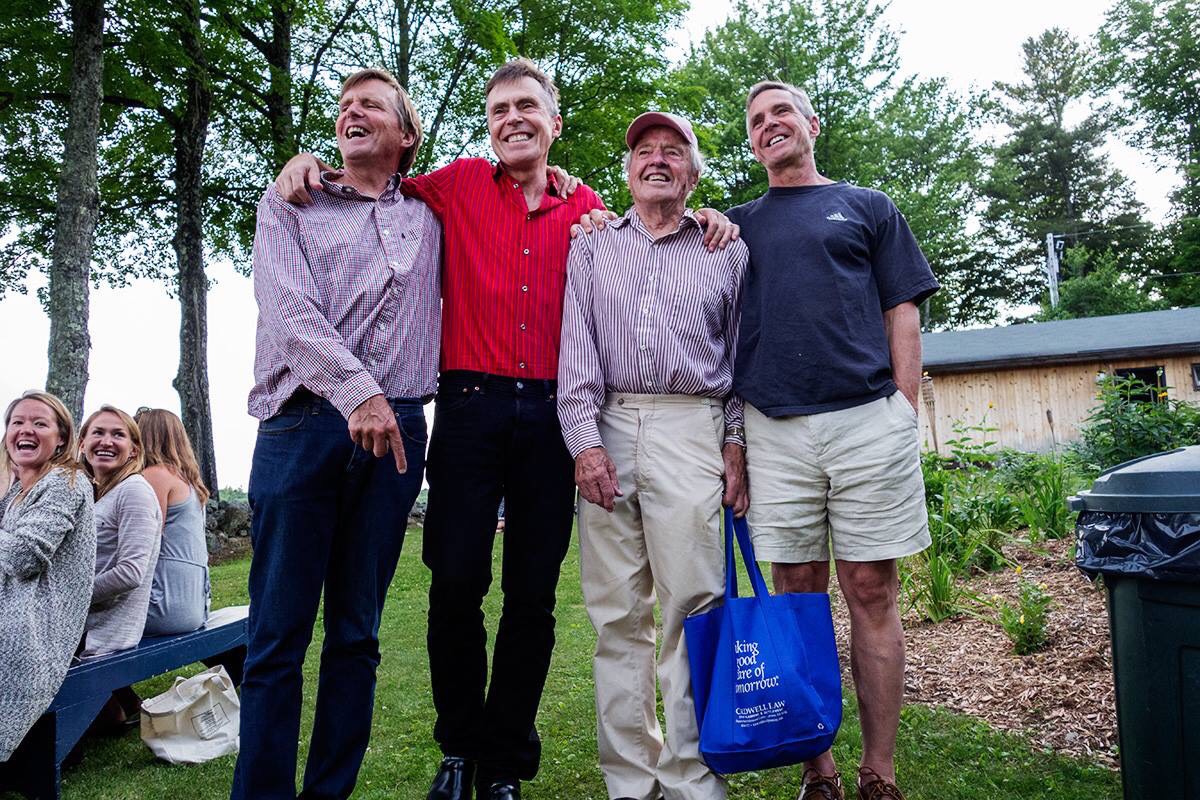
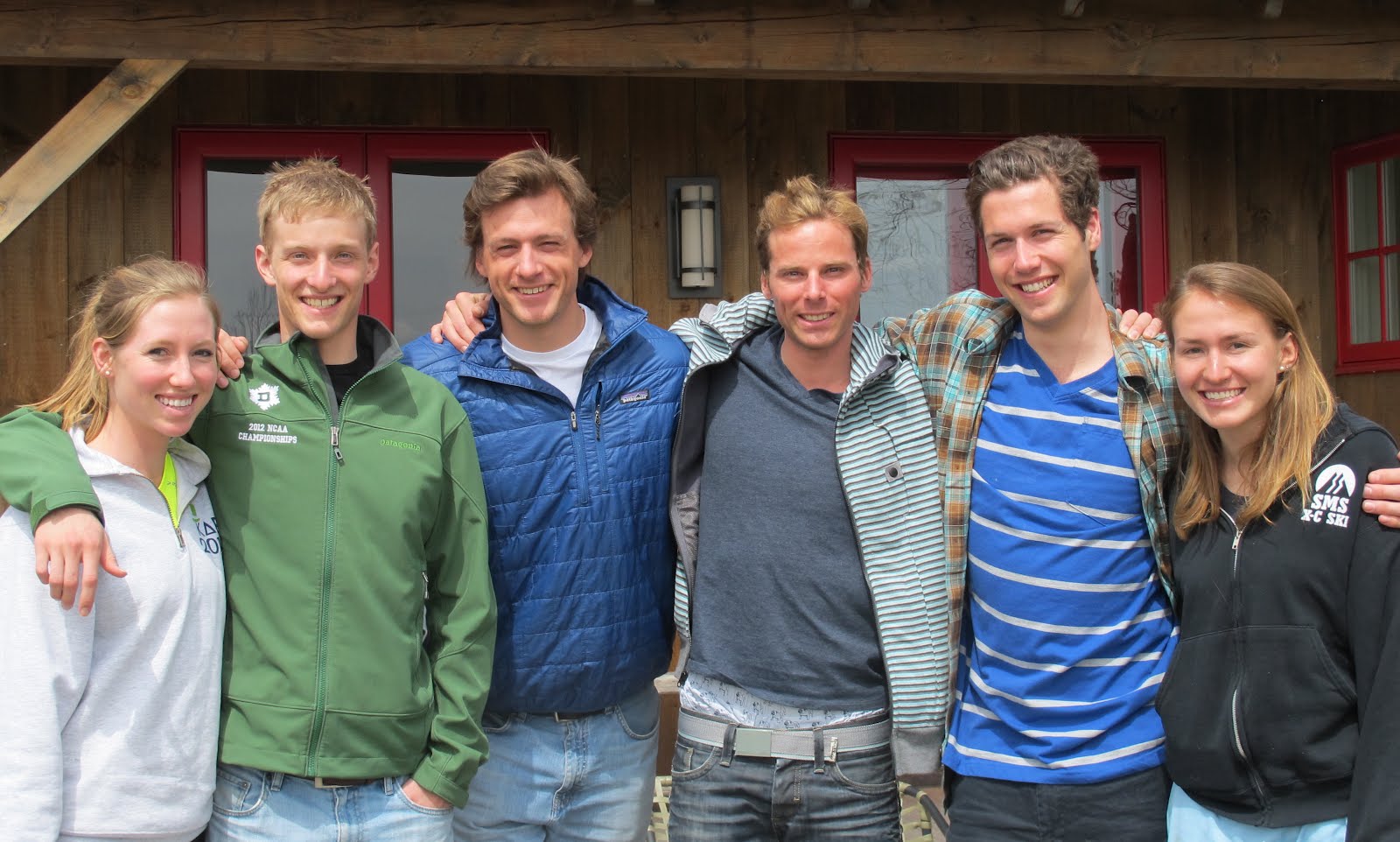
John Caldwell with his three sons. (From left to right) Sverre Caldwell, Tim Caldwell, John Caldwell, and Peter Caldwell. (Photo: Sophie Caldwell)
Flashback to 1964. That’s six years after the mega-fad of hula hooping, and five years before the psychedelic haze of Woodstock. A time when the country teetered towards war protest and Tricky Dick … (as in, “I am not a crook.” — Richard Nixon).
What could possibly supplant hula hoops and pending cultural disruption? You guessed it, cross-country skiing.
In 1964, John Caldwell wrote the first edition, of eight editions in total, what’s now considered a classic, The Cross-Country Ski Book.
While not quite on the scale of hula hooping, Caldwell’s book spawned a cross-country ski boom. The book popularized the sport that offered skiing as a path to enjoying the outdoors in silent-sport mode.
John Caldwell and the art of flexing skis. Here, he’s helping his granddaughter Sophie Caldwell, a U.S. Ski Team member, pick skis. (Photo: Sophie Caldwell)That’s not to say Caldwell doesn’t come with serious racing street cred. He was a 1952 Olympian and coached the U.S. Cross-Country Ski Team from 1965 to 1972 and was an Olympic coach in ’68, ’72, ’80, and ’84. He’s coached hallmark U.S. cross-country skiers like Martha Rockwell and Bill Koch.
At 88 years old, Caldwell lives in Putney, Vt., his hometown since 1941. He’s looked to for sage advice or a spicy quote on how the power brokers at the elite levels of U.S. skiing need to change and up their game.
One of Caldwell’s rules of engagement for the following “Nordic Nation” interview was no discussion of his grandkids. That brings us to the fact that his grandkids are still in the World Cup ski game. Granddaughter Sophie Caldwell and grandson Paddy Caldwell are current U.S. Ski Team members. (Note to listeners: Like any good grandparent, Caldwell did indeed mention his grandkids during the interview.)
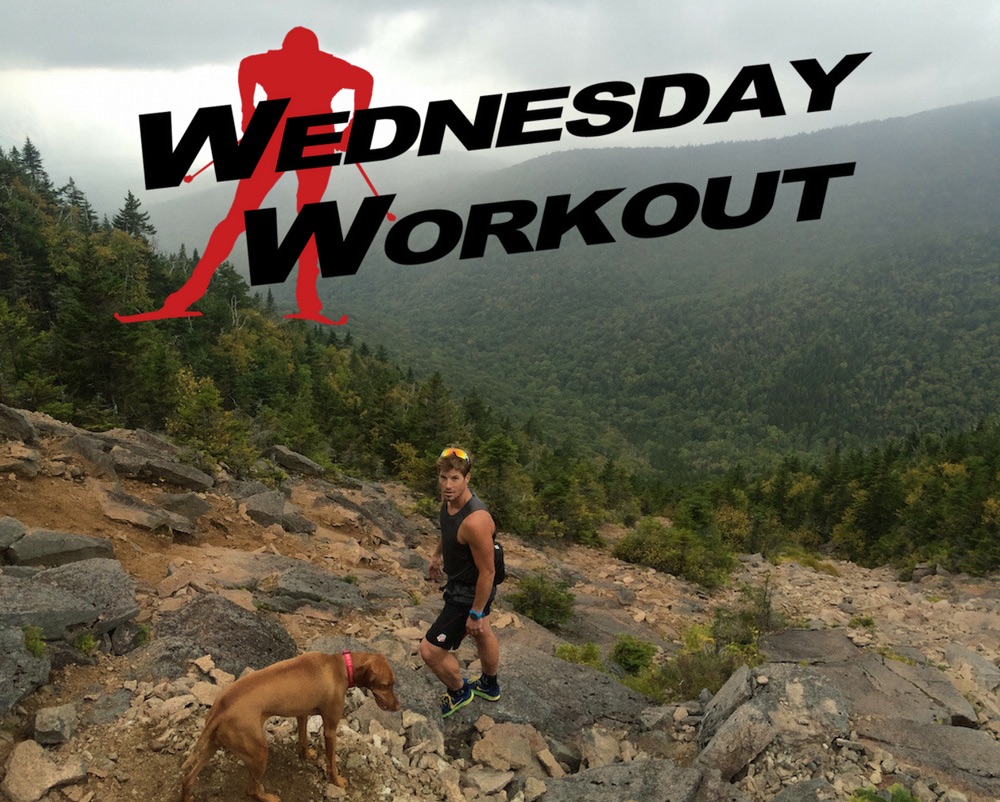
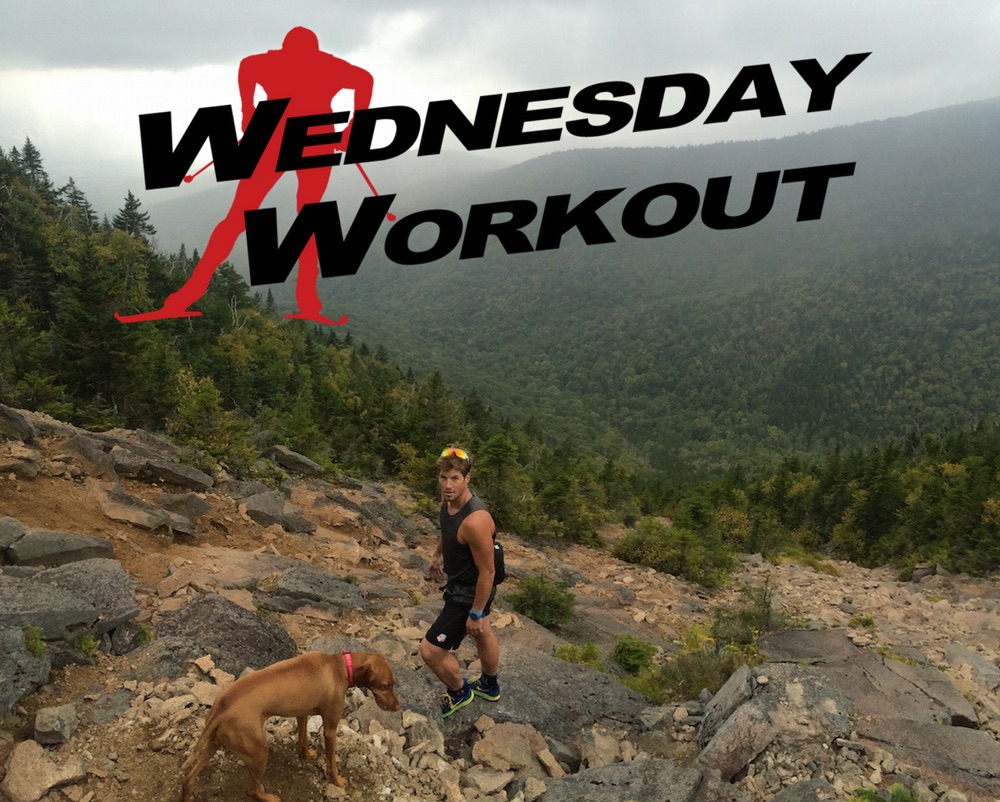
Kris Freeman and his dog She-Ra (along with Tad Elliott, not shown) racing the rain up to the top of North Slide on Mt. Tripyramid in Waterville Valley, N.H., on Sept. 14. (Photo: Tad Elliott)
This week’s workout tale comes from Tad Elliott, of Durango, Colo. Elliott, 28, has spent the last two and a half months in New England training with his coach Zach Caldwell. Elliott spent the better part of this month in New Hampshire with his former teammate on the U.S. Ski Team, Kris Freeman, who trains out of Waterville Valley, N.H. Caldwell lives in Putney, Vt., along with his uncle, John Caldwell. Here is an account of Elliott’s three-hour hike with Freeman, a.k.a. “Bird”, which they did last Wednesday.
***
I have been out East for 10 weeks training in Putney, Vt., getting ready for winter and Bird camp. Bird camp is held every September and is hard — really hard.
John Caldwell swings by Zach’s house every few days to have coffee and check in on how things are going. When he learned I was going up to Waterville to train with Kris, he said there was one workout that had to be done.
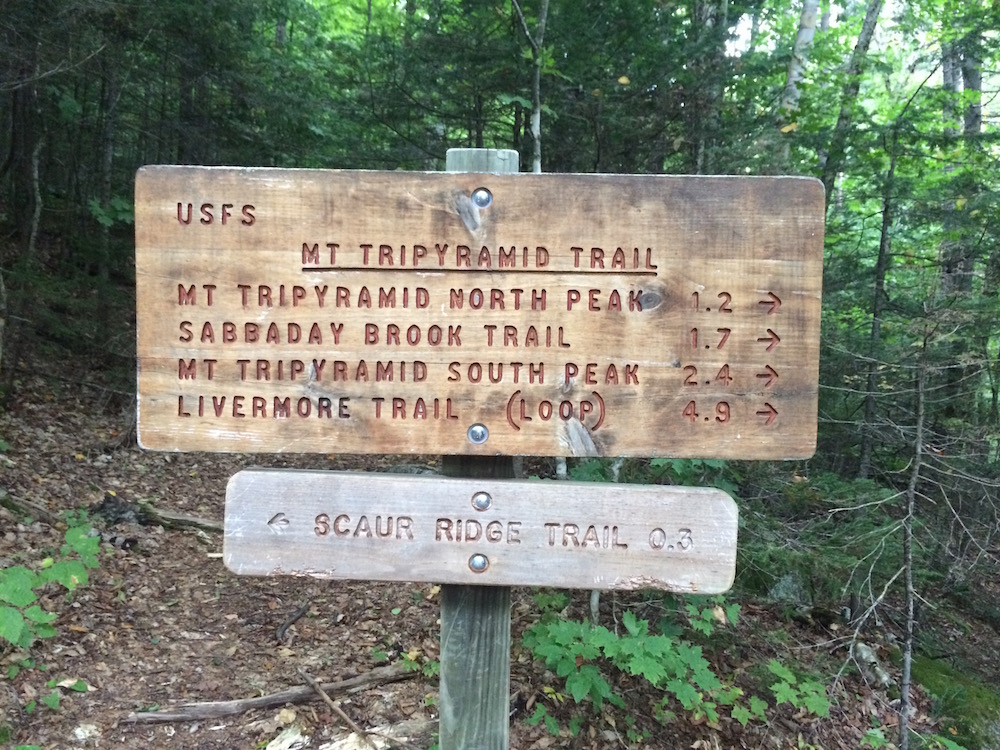
The Mt. Tripyramid trailhead: let the adventure begin (Photo: Tad Elliott)
The Workout: Tripyramids (or a Three-Hour Hike)
John Caldwell coached the U.S. Ski Team and they used to have training camps in Waterville Valley. JC told me that the best workout I could do is an OD hike going over Mount Tripyramid [a mountain with three distinct peaks along a mile-long summit ridge, some 4,160-feet tall in the White Mountains’ Sandwich Range]. The trailhead is a 20-minute drive from Kris’s front door. It’s an 11-mile hike going up the North Slide, to North Pyramid, over Middle Pyramid, up South Pyramid, and down South Slide.
On top of the hike, Kris needed some extra training. He double poled 20 miles up to the mountains. I loaded up She-Ra, Kris’s dog, and we met him at the trailhead. North Slide is a steep rock face, and rainstorms made the rocks slick and added to adventure of the Tripyramids. The rain, the scary trail that you aren’t sure is supposed to be a trail, is all part of climbing mountains in the East.
Just as we were starting up the North Slide, a hornet stung me. The rain, bugs and rocks are unique to the East and what make hiking mountains here so special. The views from the top were spectacular watching the thunder clouds roll in. The Caldwells got a kick out of this soft Colorado boy’s experience hiking some East Coast mountains.
The rain, the scary trail that you aren’t sure is supposed to be a trail, is all part of climbing mountains in the East.
The workout was a 2-hour, 50-minute run/hike, and a 4:20 workout for Kris. As John said there is plenty of time for beating yourself up rollerskiing and getting ready for the winter. Sometimes you need a good OD, have some fun with friends and enjoy hiking in the mountains. Also where else can you bag three peaks in three hours?
“Kris was making fun of me for how much I complained about my arm stinging and how red it got,” Elliott wrote of their 11-mile hike up Mt. Tripyramid in Waterville Valley, N.H. (Photo: Tad Elliott)
Kris Freeman halfway up North Slide on Mt. Tripyramid in Waterville Valley, N.H. (Photo: Tad Elliott)
***
In a follow-up up email, Elliott explained the focus of their OD hike turned into a bit of a scramble to reach the summit. “The goals hiking are always to make it to the top and enjoy the scenery,” he wrote. “The training benefit just comes from going uphill and doing something that is different and long. The pace was easy and manageable. We wanted to make sure the dog was OK and could make it up the steeper sections.”
How often does Elliott, also a former USA Cycling Team member, hike or trail run when he’s home? About once every two weeks. Hiking in the Rockies is an altogether different experience than hiking in the East, as he reiterated that Eastern trails are steeper, rockier and always seem to be damp and slick.
“Hiking in the Rockies is usually, you choose one mountain and go up that and it is a long hike into the base, then a huge hike up a massive peak. A lot more exposure, and you are going slow because the air is so thin,” Elliott wrote. “The experience out here was great. The views were awesome, and Kris was pointing out all the mountains nearby and future runs that we could go do.
“This was a easy day for us out here at Bird camp,” he continued. “Maybe it felt easy because we had fun. We wanted to give our hands and shoulders a break from the pounding on the pavement. Kris is one of the best at training in the world. A standard morning ski is now 40 miles. There is a run or strength every afternoon. I am feeling great. I have some boat time coming up in a week with my family in Annapolis. Recovery from Bird camp will be important.”
Elliott has been in New England since July 11 and plans to leave for Maryland on Sept. 26. Sidelined with Epstein–Barr virus two years ago, the former U.S. national-team distance skier explained that his health has been “pretty good” this summer, with some issues in the spring and mid-summer, “but it seems to keep getting better and better slowly.” He plans to compete in most of the U.S. SuperTour races this fall, including nationals.
Patrick O’Brien racing to third for the Craftsbury Green Racing Project in the 10 k skate at the University of Vermont Carnival at Trapp Family Lodge in Stowe, Vt., this past winter. After four years on the pro circuit, O’Brien, 26, is entering a new chapter of his ski career as head coach of the Stratton Mountain School T2 Team.
Patrick O’Brien was hired last Sunday and started on Monday. That’s the kind of turnover Sverre Caldwell, nordic director of the Stratton Mountain School (SMS) in southern Vermont, was looking for when he first sought a replacement for SMST2 Head Coach Gus Kaeding.
The transition from professional skier to coach happened quickly for O’Brien, who wasn’t sure what his future held — or what he wanted to do next — five weeks earlier. At the end of his 2013/2014 racing season in late March, the 26-year-old Vermont native packed up his skis and flew from Alaska to Moab, Utah, for some quality time in the desert with friends. He spent the next week mountain biking, regenerating and thinking about anything but skiing. Pretty sure he was ready to end his competitive career, O’Brien wasn’t set on leaving the sport.
A Dartmouth grad who majored in environmental studies, O’Brien had spent the last four years with the Craftsbury Green Racing Project, which he described as both rewarding and fun. When he wasn’t training as a professional nordic racer, he was fulfilling his obligations to the Craftsbury Outdoor Center in northern Vermont, working on sustainability and trail-maintenance projects.
Contemplating retirement, he wondered how he’d stay involved in the sport. Perhaps through the ski industry? Maybe even coaching? The latter evolved into a very real possibility when he applied for the position of head coach of the T2 Team about two weeks ago. Caldwell invited him over to talk more about the position.
Rewind about 10 years to when Caldwell coached O’Brien at Stratton (along with assistant coach Amy Caldwell, the wife of Sverre’s cousin). An avid Bill Koch League skier from his youngest days of racing, O’Brien started seriously pursuing the sport in high school. Growing up 45 minutes from Stratton in Putney, Vt., he enrolled as a junior and spent the next two years commuting to the ski academy and learning from the Caldwells.
A Stratton graduate, he went on to captain the Dartmouth nordic team. There, O’Brien became an NCAA All-American as a junior in 2009, two-time first-team All-East skier, and two-time Academic All-American.
He graduated Dartmouth in 2010 and dove into professional skiing with Craftsbury. In 2012, O’Brien qualified for his first World Cups in Quebec and Canmore, Canada, which he ranked high on his list of achievements. He spent two seasons, including this year, on the European OPA Cup circuit in March, and notched domestic SuperTour podiums over several seasons.
According to O’Brien, who spoke on the phone Wednesday while helping his dad, an arborist, in Putney, he gave skiing a four-year commitment. At the end of this winter, he was ready for a change.
“I just felt like last year was tough and I didn’t achieve my goals for the year,” he said.
He first spoke with his coach, Pepa Miloucheva, about his plans for next winter before leaving to race in Europe a few months ago.
“She, of course, offered me the option to come back and ski in Craftsbury again,” O’Brien recalled. “But we had a very honest conversation and the conclusion we came to is, I was ready to be done, ready to have a different stimulus … moving into coaching or the ski industry or anything else. I was gonna have to look or figure out where I wanted to go from there.”
“I decided that this position at Stratton was something I really wanted to do,” he said.
Kaeding, the man whom O’Brien was ultimately hired to replace, was completely behind him. Caldwell pointed out that he had a similar start to his coaching career. Kaeding was an athlete skiing for Central Cross Country (CXC) when the team’s coaches at the time, Jason Cork and Bryan Fish (now USST coaches) encouraged him to become an assistant coach.
“He did that for one year at CXC then he came here and no one questioned anything,” Caldwell said.
Kaeding was in Miami and Costa Rica during much of the interview process last month, but said O’Brien had been his “number-one choice right from the start.”
“When he told me he wasn’t going to ski next year we were in a bunker in Slovenia,” Kaeding recalled. “I emailed Sverre and said, how about this guy for next year?”
On Wednesday, Caldwell confirmed the decision, which he had made Saturday night. He called O’Brien, O’Brien accepted on Sunday, and Caldwell notified his athletes later that day.
“I wanted someone who would be there to coordinate things and be totally enthusiastic and organized,” Caldwell said, adding that he chose O’Brien out of about five top applicants. “He knew more about the program and the area and the [racing] circuit and he could start right away to work with Gus. He hadn’t coached, but in a way that was not a detriment because he was going to be totally open minded.”
Caldwell said he didn’t recruit anyone for the job. “I didn’t want to be kind of casing someone who’s already in a different program. If they come to me that’s fine. It’s a small community, but that’s weird,” he said with a laugh.
“Most of the responses were really early … so then I had to send out [more information] to people who had expressed interest who looked viable,” he explained. “… We were not able to pay a ton so that cut out some people.”
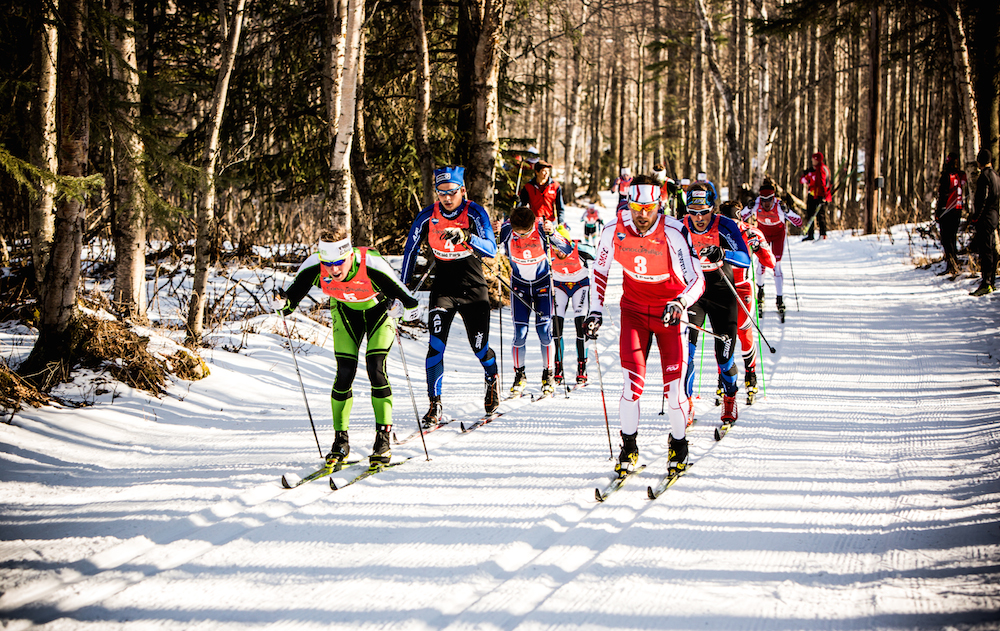
Craftsbury’s Patrick O’Brien (l) and Stratton’s Andy Newell (r) lead a pack in the mixed relay at U.S. Distance Nationals in Anchorage, Alaska. (Photo: Charlie Renfro)
For O’Brien, it was an enticing opportunity — even if he was inexperienced.
“I’m younger than Andy and Simi and I’m not gonna pretend that I have a whole bunch of coaching experience, but I think maybe it’s a good thing that I have skied with or been on trips with many of those athletes,” he said. “It’s not like somebody totally foreign coming in and trying to bring their own training philosophy. I feel that having worked with Sverre as a high school coach, I have a pretty good understanding where he’s at. I think Sverre, Gus and I are all on a very similar page.”
He was most apprehensive about being the make-or-break factor for his athletes when it came to waxing skis.
“The fear as a coach, who also would be a service-staff person, is the last thing I want to do is have athletes show up, do their training well, be rested and ready to go and then screw their race over,” he said with a laugh. “That’s something that an athlete thinks about as well. I think Gus did a good job keeping things low stress and making safe, sound decisions. If the athletes show up and if they have fair skis, they’re going to be the ones showing off their hard work … they don’t need anything magic.”
O’Brien will also have the assistance of other Stratton coaches, who will travel to many of the same domestic races as him. Nearly half of the SMST2 roster is on the national team, so he won’t have to worry about those athletes for early season races; they’ll be in Europe.
As head coach, O’Brien will be the one leading and overseeing the execution of workouts, not necessarily writing them. Stratton’s four U.S. Ski Team members — Andy Newell, Simi Hamilton, Jessie Diggins, and Sophie Caldwell — remain in touch with national-team coaches about their training. Newell works with USST head coach Chris Grover, Hamilton and Diggins receive plans from Cork, and Sophie Caldwell will continue to work with USST women’s coach Matt Whitcomb and Kaeding, even while he pursues a masters in business, according to Kaeding.
The other members of the SMST2 Team — Erika Flowers, Annie Pokorny, Annie Hart, Ben Saxton, and training partner Paddy Caldwell — have already started their yearly training plans, which Kaeding mostly wrote.
Gus Kaeding (third from l) with the original SMS T2 Team, including (from l to r) Erika Flowers, Eric Packer, Andy Newell, Skyler Davis, and Sophie Caldwell. (SMS courtesy photo)
(Eric Packer left the team to join Alaska Pacific University in his hometown of Anchorage. “This spring, I realized how much I like living and skiing in Alaska,” Packer wrote in an email. “That was the driving force behind the change. I do think I made a lot of gains while at Stratton – the opportunity to train with guys like Newell and Simi on a daily basis was really awesome — but for whatever reason I struggled to transfer those gains into results.” Caldwell recognized this and said he fully supported Packer’s decision to join APU at home.
A former USST D-team member, Skyler Davis left Stratton’s T2 Team in January to pursue a college degree, according to Caldwell. “That was a good move,” Caldwell said.)
This week, O’Brien planned to join four training sessions — Monday, Tuesday, Thursday, and Friday — to observe and shadow Kaeding, who will be in Stratton for another week.
Next Wednesday, Kaeding will leave for Park City, Utah, to represent Stratton at the U.S. Ski and Snowboard Association’s Spring Congress. After the weekend, he’ll return to Stratton and fly out again on May 30 for a family trip to Sweden: his dad and brother are running the Stockholm Marathon. Kaeding will return June 8 and leave for a GMAT study course in Salt Lake City on June 15.
He’ll be in Utah for at least a month, assisting Sophie Caldwell and other Stratton athletes from a strategic location a short drive from the USST headquarters in Park City. Should he stay in Salt Lake through October, Kaeding will be able to check in on certain athletes during the USST training camp there that month.
And if he passes the exam, Kaeding hopes to be accepted at a graduate school in Boston or California — somewhere in sharp contrast from a typical ski town or rural Vermont.
Caldwell said the short time frame in which Kaeding will be in Stratton made hiring O’Brien as soon as possible essential.
“We had this window where he could really work with Gus and it will hopefully be a seamless transition,” he said, adding that O’Brien will visit three or four days a week to observe and start learning more about each athlete on the team.
“He knows the athletes, but [we’ll] go over each athlete that he’ll be more responsible with for their training,” Caldwell said. “It’s gonna be just a natural progression.”
According to Caldwell, O’Brien will start in earnest July 1, when his one-year contract begins. A big part of the job will be communicating with USST coaches and making sure the national-team workouts line up with the rest of the T2 Team’s.
“He needs to set up the workouts [and eventually write] good solid training plans, which he’s going to get plenty of help with,” Caldwell said. “He’s doing well; he’s just taking it all in. … It’s good for him to throw it in the fire and then come back and digest everything.”
“It’s logistics, coordination, it’s planning, all that stuff,” O’Brien observed. “I see that as a real challenge and something to put all my energy [toward].”
“He’s definitely kind of the shell I was picturing,” Kaeding said. “He’s a really good skier, especially good technician who has grown up around skiing. He’s good at waxing; I’ve seen him have to take care of himself. As far as the coaching goes, he doesn’t know a whole lot and that’s kind of what we were after. We do things here a little bit differently than some programs, so I was hoping we’d find someone that could come carry that on, come observe and fill in the cracks with what the team needed.”
The athletes were onboard, too, Caldwell said.
As for whether it will be hard to drive the van, supply the feeds, and shoot video from the sidelines while his athletes — his peers — continue training, O’Brien said he’s ready.
He brought his rollerskis to his first day in Stratton on Monday. He had planned to ski with Flowers while Kaeding drove the van. He ended up in the passenger’s seat.
“It was a cold, rainy day and I was more than content to sit in the van,” O’Brien said. “You can often learn more from the coaching perspective [that way].”
The Cambridge Sports Union (CSU) waxing staff (Caldwell Sport photo)
This article is a paid advertisement by Caldwell Sport, a ski-grinding service and new-ski retail shop operated by Amy and Zach Caldwell in Putney, Vt. We ride the coattails of any successes that we can claim an association with. This week we’re taking credit for the astonishing successes enjoyed by the Cambridge Sports Union (CSU) in recent years.
Last spring, USSA named Rob Bradlee domestic coach of the year, recognizing the rapid ascent of the Cambridge Sports Union to the upper ranks of U.S. Junior clubs. Rob is quick to point out that the award may be in his name, but it recognizes the contributions of many coaches, volunteers and athletes. CSU has about 55 kids involved in the program, and 20 to 25 of them regularly attend Eastern Cup (Junior Olympic Qualifier) events. Six years ago they placed no skiers on the New England JO Team. Then, for a couple of years they got two kids onto the team. Then seven, and nine, until last year they claimed 12 spots on the perennially strong NE team. At JOs last year they had the top girls club, and second overall club score. They had three individual JO champions, and five all-americans.
CSU is the only major club in the greater Boston area. The skiers are the normal brand of bright stars that we see involved in Cross Country everywhere, multiplied by the intensity of a major urban environment. Skiing competes for attention with a huge number of scholastic sports and extra-curricular activities. They ski primarily on short loops of manmade snow at the Weston Ski Track. In a time when standard complaints and excuses from clubs all over the country are focused on bad snow and too many other commitments, CSU makes you wonder what most other clubs in the country are waiting for. How do they do it?
CSU head nordic coach Rob Bradlee (Caldwell Sport photo)
It’s the skis.
No, it’s not actually the skis. But the CSU approach to skis gives some insight into the way the club is organized and how they have formulated their recipe for success. And while skis may not be the key to success, CSU does a great job, week after week, of competing with various ski academies and eastern colleges. It’s notable these days when they don’t have among the best skis in the race. And they do it with a big team, using an army of volunteer parent-waxers. There is no top secret wax-guru mixing up fancy solutions in the background. There is, instead, a system.
This might be a good time to introduce Jim Stock. Jim is a quiet and intense guy with a brain that is wired to create order out of chaos. He is a Harvard professor of economics, and in his spare time he quietly shapes global macro-economic policy. No, really, he does. In his other spare time he coaches the Eastern Mass BKL group, otherwise known as the CSU farm-team. In the ski world he’s better known as Chris and Corey Stock’s dad.
I don’t actually know how the system was developed, but I’ve been involved picking and grinding skis for the club for the past four or five years. I imagine that Rob and Jim sat down and made a list of variables, assets and liabilities. The liabilities are what most clubs offer as excuses; we don’t have any waxing gurus, we don’t have great opportunities to test, we’ve got a ton of kids with a limited number of skis, we’ve got to get wax on all these skis really quickly. These liabilities got recast as limitations – the framework within which the club had to operate to produce good skis. And the most important thing they did was make a creative assessment of their assets. What do they have a lot of? Parents.
Normally, in junior ski racing, parents find themselves in the role of helpless bystander, and potential liability. I can’t count the number of times I’ve seen one or two coaches scramble to get kick wax on skis for a dozen kids while a dozen parents hover nearby hoping that everything works out. CSU parents are involved with their kids, and concerned for their success. In different circumstances we’d be talking about an epidemic of helicopter parents. But at CSU the parents find themselves in the “assets” column, and they have klister on their hands. How do you get 25 kids waxed for an Eastern Cup race? You deputize parents as waxers! The CSU waxing juggernaut can race-wax 25 pairs of skis in 40 minutes. And they’re loud and boisterous – quite obviously having a great time. In the noise contest it’s a toss-up between the Dartmouth girls and the CSU waxers.
Cambridge Sports Union (CSU) hard at work. (Caldwell Sport photo)
In order for relatively inexpert (at least at first) parents to do good work waxing skis, there have to be clear instructions. And this is where the CSU system really shines. Starting four or five years ago, Jim and Rob have clearly defined what they’re looking for in skis. When we started working together they were quick to point out that they often need to deal with klister, and that really soft classic skis were hard to work with. The majority of the CSU kids have one pair each, skate and classic, and so we worked together to define, specifically, what a single-pair CSU classic ski needed to be.
And then, with help from Chris Li at Bikeway Source in Bedford, Mass., we developed a way to quantify and mark the pockets. CSU was among the first clubs to identify, appreciate, and utilize residual camber as a characteristic in their classic ski. They developed a standardized system of marking skis so that they could give specific instructions to parents for precisely how to wax whichever pair of skis was on the bench in front of them. And it worked! The skis come from one source, they are selected to fit one system, they are measured and marked using one system, and chaos has been given a time-out.
It’s not just classic skis and kick waxing either. Rob has been a Toko guy for years, and had no desire to change to a completely different system. But he asked for suggestions on specific products that could broaden the range of wax possibilities for glide, and he introduced them, a couple at a time, to a contained testing process. He bought test skis, and a Finite Finish structure tool, and we discussed basic standard structure modifications. And then we standardized grinds for the whole club. As I type this we are processing final structure on some of the 154 pairs (including some for Masters) of CSU skis that we’re grinding this Fall. On any given race day the CSU waxers should be working with only one or two different structures, so testing hand structure and modifying skis is a controlled and sensible process.
In part, the CSU approach to skis and ski service is representative of a willingness to invest. As a rule, the kids going to Eastern Cup races all have top-of-the-line hand-picked skis that are up to date. This costs money, and parents are expected to support the system. But because there is a system, the investment in equipment isn’t a leap of faith – it’s an integrated part of the program. We do a huge amount of work with teams from all over the country, and often we’re grinding a mish-mash of skis that have been assembled from various brands and various sources over the past decade. When we work on these skis it’s no mystery to us why CSU might have more success than some of these clubs. CSU is one of our most satisfying partnerships because their systematic approach and willingness to invest makes our work look good.
Jennifer Caldwell in the Prouty Ride, a 100-mile century road ride through central New Hampshire to benefit cancer research. Photo courtesy of Anya Bean Caldwell.
She had come so far. Nearly 85 miles to be exact, yet in the larger scheme of things, Jennifer Caldwell’s progress in the 2011 Prouty century ride meant so much more.
A cancer patient since 1999, the former U.S. Ski Team member epitomized the body’s limits in its lowest moments. She was not weak; anyone who knew Caldwell, who died on Dec. 27 in Wolfeboro, N.H., could attest to that.
Participating in the July benefit ride through central New Hampshire with about 50 friends and family members, which called it “Jennifer’s Tour,” the 53-year-old rode for the sake of cancer research and raised thousands of dollars in the process.
Competitive by nature, it’s hard to imagine she wasn’t racing for herself as well. Suddenly at mile 85, she went down. Hard.
Her husband, Howie Bean, said she had been cruising at a vigorous speed of 25 miles per hour when another rider accidentally hooked her handlebars. The woman who wasn’t expected to make it through Thanksgiving the year before crashed hard onto the pavement. She broke her pelvis in three places.
Almost as soon as she discovered the severity of her injury, Jennifer decided her next move. She needed to be operated on sooner or later to remove malignant tumors caused by gastrointestinal cancer – a major surgery known as debulking. While she was out of commission with one injury, she figured she might as well add that to the healing process.
“Most normal people would think, ‘I need to get over this one thing at a time,’ ” Bean said in a phone conversation from Wolfeboro. “She was just like bring it on.”
Jennifer Caldwell (center) surrounded by daughter Anya and husband Howie Bean, and their dog Lizzie at the top of Mt. Chocorua the New Hampshire White Mountains in October.
Three weeks later, Bean found her down at the lake with friends, against the doctor’s orders. With a belt fastened to her waist, she swam with her arms.
By September, she and Bean were hiking with their only child, 22-year-old Anya, and the University of New Hampshire (UNH) ski team.
“She was as strong as any of the girls going up that hill,” Bean said. “She was in darn good shape. She just made it her life to do that.”
On New Year’s Eve day, hundreds of friends and family members gathered to remember Jennifer, the youngest child and only daughter of Hep and John Caldwell. While some knew her all her life, such as her three older brothers, Tim, Sverre and Peter, several were grateful to have befriended her later on.
“She didn’t try to make friends, she just made them,” Bean said. “That’s the thing about Jennifer … some people really loved her.”
The following is a compilation of thoughts and memories regarding Jennifer Caldwell. Aside from Bean, her husband of 23 years, most were written as emails. Tim Caldwell also provided a couple of eulogies from her memorial service on Dec. 31.
Jen’s Early Days
Jennifer Caldwell. Courtesy of Anya Caldwell Bean
“I think she was a bit of an icon from the beginning – the youngest and only girl in John and Hep’s active and powerfully achieving family.” – Marianne Lucy, Jennifer’s sister-in-law
“Jennifer was smart and quickly skipped a grade [at The Grammar School in Putney, Vt.] early on. She was two years younger than our youngest son and that meant the four kids were all lined up in consecutive grades. They used to study after dinner sitting around the kitchen table.” – John Caldwell, father
“Jennifer did everything we did – from skiing, hiking and the myriad of other physical activities we indulged in, to studying, reading and playing a musical instrument [starting with the flute].” – Tim Caldwell, brother
“[She started skiing] just as soon as she could walk. That is, if she wanted to be with the boys. I once told my mother-in-law I wanted to start the kids early – even on the living room rug – so they could avoid bad habits from starting to walk.” – John Caldwell
“Her father Johnny introduced my generation of Putney children to skiing. He imported equipment, coached us and introduced us to world-class racers, who also gave clinics and taught us skis. Probably from birth Jennifer was part of that Putney skiing scene.” – Mary Heller Osgood, childhood friend and training partner
“We had a lot of fun on skis – a favorite springtime activity was using the apple trees in nearby Green Mountain Orchards as a slalom course to practice our skate turns. … Moonlight skis were popular too, though I do remember skiing over to the Caldwells through the woods one evening and trying to rouse Jennifer out of bed for a moonlight tour. That time she decided that it was way too late … and went back to sleep.” – Mary Heller Osgood
Note: Jennifer graduated from The Putney School, where she was an orchestra member. Several of high-school friends spoke at her funeral. She went on to attend Middlebury College and transferred to the University of Vermont to pursue her musical ambitions. There, she developed as a flutist and vocalist, and achieved All-American status as a nordic skier in 1981. She graduated UVM with a Bachelor of Arts and later took up the piano.
A Nordic Prodigy
“When I was learning how to ski, back in the 1970’s, Jennifer was one of my role models. She remains one of the leading ladies of cross-country skiing in our country. Jennifer was the epitome of grace and beauty, both on and off skis.” – Nancy Ingersoll Fiddler, two-time Olympian in nordic skiing, Bates College graduate and national champion
“She was a phenom earlier, way more than me.” –Bean, who first met Jennifer when she was 16.
Note: She and Bean attended junior nationals together in 1974, when Bean said, “she was just another girl on the team.” They later reunited in 1982, after both missed making the World Cup team and began their Great American Ski Chase tour with five others. Bean estimated they were on the U.S. Ski Team together from 1979-1984.
Jennifer Caldwell and husband Howie Bean at a wedding in last summer. Photo courtesy of Anya Caldwell Bean
“I guess I was awestruck, and I’m kind of a shy guy. This girl, she kind of hit me over the head, but [I thought], ‘This girl’s kind of cool. This could be fun.’ … We were so different in so many ways, but we just seemed to get along.” – Bean
Jennifer won the American Birkebeiner in 1983, which contributed to her two-year reign as Great American Ski Chase champion. (Bean won the overall title as well). Both retired from professional skiing in 1984 to pursue other recreational passions, such hiking and cycling, in Bean’s hometown of Wolfeboro. There, he got Jennifer into canoeing and they were married in 1988. Two months before Jennifer gave birth to Anya in 1989, they won the Smith River Canoe Race in Wolfeboro.
Later Years
“She got so good [at canoeing] that she raced with some real hot people. … One of my friends said, and I can believe it, that she was the best woman stern paddler in North America. … She could handle a boat like you couldn’t believe. … She might’ve been a better canoer than she ever was a skier.” – Bean
“Jennifer and I won the C2 Open Women’s Championship (two women in a canoe) event at the United States Canoe Association (USCA) Marathon Nationals in 2001 and 2003, the only two times we raced together at Nationals. We also raced in the C1 event, the solo boat race. I had never been in a solo boat … Jennifer convinced me to give it a try.” – Christina Wilson, Wolfeboro friend and national champion in canoeing
“A few minutes into the race, I heard, ‘Yoohoo!’ from behind me. I looked around and I saw Jennifer just behind me, everyone else was behind her. We were in the lead! She was drafting me and we were pulling away. We took turns drafting each other for the rest of the race, sprinting and resting, giggling when I got thrown into a wave. … We came into the finish line together, dead even. She was the first placed Master’s boat, and I was the first placed Open boat. It was one of the most fun races I had. This epitomized Jennifer to me. She was a tough competitor – one of the toughest by far – but had fun doing it.” – Christina Wilson
Note: In addition to her athletic endeavors, Jennifer volunteered at several organizations, including the Huggins Hospital Meals on Wheels and the Clearlakes Chorale. She worked at the Tuftonboro Library and organized clinics through the New England Nordic Ski Association (NENSA).
“We always talked gardening, or bread-making, or freezing veggies, raising plants, deer damage, skiing, etc., and had a lot of laughs together.” – John Caldwell
“She would be outside as much as she possibly could, and when she wasn’t outside, she would be reading or resting so she could be outside as soon as possible.” –Bean
“She connected with people very individually. She sent many early morning emails that she had written before the sun came up – a morning ritual that is missed by many of us.” – Christina Wilson
“During the last four years, Howie and Jennifer have had the team over to the house where we have trained on their homemade trails (which are as good as any touring center.) … Jen on numerous occasions had homemade bread waiting for the team after training sessions. … You could tell Jen not only loved the competitive part of the team, trying to become faster, but enjoyed the interaction with team members. Jen loved not only competition, but the relationships she developed in all sports she was involved in.” – Cory Schwartz, UNH nordic head coach
In Sickness, a Bright Spot
“When she was diagnosed with GIST [gastrointestinal stromal tumor], the life expectancy was five years. She lived about 13 more years, thanks to her treatments at Dana-Farber Cancer Institute. She must have made 50 trips down there during that time and finally simply ran our of drugs to treat the disease.” – John Caldwell
“When Jennifer was diagnosed with cancer … everything changed – and not all for the worse. It was as if the diagnosis gave her a new lease on life. She became more expressive, clearer about what she wanted for herself and her family. … Her humor and wisdom, her emotional and physical toughness gave strength to us all.” – Tim Caldwell, brother
“What amazed me the most about Aunt Jennifer throughout our conversations was how selfless she was. She would make some comment about how miserable cancer was and then say something along the lines of, ‘Look at me complaining, I need to quit whining!’ … She hated people worrying about her of feeling bad for her and had the impressive ability to make light of almost any situation, including her cancer, right until the end.”– Sophie Caldwell, niece, senior and co-captain of Dartmouth College ski team
Jennifer Caldwell and her niece, Isabel Caldwell. Photo courtesy of Anya Bean Caldwell
“Jen was by far the strongest and toughest person, both physically and mentally, that I’ve ever known. I’ll always remember her massive muscles from canoeing and how she would always tease me because I’ve never been very muscular. I guess that’s what happens when you grow up with three big brothers! … If Jen wanted something, she’d go out and get it. I think that’s why she was able to fight off the cancer for so long, she wanted to live so she did.” – Isabel Caldwell, niece, Dartmouth ski team sophomore
“She had an inviting smile, and a mischievous grin. She could swear like a sailor, and give you a bear hug like no other. She had a terrible sense of direction, but was always ready for an adventure.” – Christina Wilson, friend
“Even in sickness, she uplifted others with her wry assessments, stoicism and endless courage.” – Marianne Lucy, sister-in-law
“Three days before she died, I sat with my head on her shoulder and whispered in her ear my love for her. Not wanting to exclude 15 other people in the room, she turned to them and said, ‘Darcy is giving me make-up tips.’ ” – Darcy Caldwell, sister-in-law
“[Three weeks ago] I thanked my mom for fighting her battle for so long, and she laughed and replied, ‘Well, yeah! Can you imagine Howie raising you as a teenager?!’ She was sassy until the end and continuously heckled nurses and teased Howie about his shortcomings.” – Anya Caldwell Bean, daughter, UNH senior
“Not many people knew just how sick she was because she remained so active and vibrant. She was the epitome of life and emanated her inability to sit still. She inspired so much love and connected well with so many people. She was tougher than anyone I have ever met.” – Anya
This article is a paid advertisement by Caldwell Sport, a ski grinding service and new ski retail shop operated by Zach and Amy Caldwell in Putney Vermont. Caldwell Sport has recently returned to Vermont after a four-year adventure pursuing coaching, ski service and business opportunities in British Columbia and Colorado.
Our recent return to Vermont has reacquainted us with many friends and customers from before our departure in 2007. It’s been quite a lot of fun to see skis that we selected and ground five or six years ago come back for a new grind. In part, it’s good to see that the skis we were picking back then were pretty good, and the grinds continue to serve people well for quite a number of years! It’s great to see how many of our customers love their skis, and take great care of them. It has also reminded us how much progress has been made in new ski design in the past four years. The bottom line is that skis have gotten better, and they’ve gotten better in tangible and specific ways. Since we’re in the business of selling skis, and we currently have a good inventory of hand-picked new skis, we figured it might be a good time to make a case for the excellence of the new materials!
Ski companies generally change their cosmetic appearance every two years, but most of the ski racing public is sophisticated enough to recognize that these are cosmetic changes – not new ski designs. Sometimes a tangible, visible change is made and a new product is launched. The hole ski; the new Madshus shape from two years ago; the Soft Ground ski from Salomon this year. But all of this misses the continual, ongoing incremental changes in ski design that add up to true progress.
To put it in perspective, Fischer has produced skis from their 610 mold for over two decades, yet the current skis bear almost no resemblance to the original 610. The process of refinement is ongoing, and remains highly significant. At a World Cup level it’s rare to see skis more than two or three years old getting used in races. There are notable exceptions – particularly on the classic side of things, but those exceptions are rare enough so that they serve to underline the general rule. It was striking to see Marit Bjoergen racing with an old RCS model skate ski in Gallivare last November, instead of a ski with a hole in the tip. And that’s because, in general, the new skis are better.
In the past four years it seems that all of the manufacturers have been working hard to develop better active skiing speed in their skate skis. The straight-ahead gliding speed of skis in 2006 and 2007 was quite good, and really hasn’t been surpassed. In fact, some of the skis from that era still have a more slippery feeling than many of the skis produced today. However, the newer skis help to produce speed in motion, and result in higher skiing speeds.
This phenomenon is well illustrated by the experience of my friend Mike Temkin, from Troy Michigan. Mike is a crazy Russian engineer who works for Chrysler on the proving grounds – designing tests for cars. I know he’s crazy because one year he decided to drive out to VT from Michigan to pick up his skis, and he spent a couple of days working in the shop with me. We had him visit in Boulder our first year there as well – another long drive to pick up some skis! Mike bought a pair of used demo Fischers from me in 2005, and we have struggled over the years to find skis to match that pair. We did pretty well with a pair of 610s in 2008, but that 2005 pair remained something of a standard. Last year I sent him a new pair of 610 hole skis, but this time I sent him some instructions as well. I told him not to make up his mind about the new skis until he compared his times between the new and old skis on a loop of several Ks. We even put the same grind on the new skis and the old skis so he would have a fair test. I was picking Gunnar up from school when I got the call on my cell phone – Mike was still out of breath from his test and I could hardly understand him between the Russian accent and all the huffing and puffing. “Zach! It’s Incredible! I felt for sure that the old skis were faster, but I made the test anyway. 10 kilometers, and I am skiing one minute faster with the new skis! How is this possible?”
How is it possible? Well, I think it’s mostly a question of balancing priorities. To build good energy return into the skis it’s necessary to emphasize the strength and elasticity of the materials under the foot, and to place the load higher on the camber. In 2006 we were normally mounting a pair of 192cm 610s at 870 to 880 mm from the tail of the ski. Now the 610s are being mounted at 890 to 900mms in order to take best advantage of the materials and the design. This puts a greater load on the forebody of the ski, and you can feel the difference. But the skis are fast by any measure, and faster than ever when you measure their average speed in a loop. All of the brands have a different design concept and a different feeling. Anybody who has been a Rossignol skier can tell you that the concept of an active ski is hardly new. I see the most successful brands converging on a certain common ground in terms of balancing speed and action with ever-increasing levels of refinement and excellence.
We have quite a lot of specific information on the brands that we carry on our website at http://www.caldwellsport.com/ and we invite you to read through that information, and pass along any questions you might have.