From the FasterSkier archive — posts syndicated from athletes’ and coaches’ own blogs between 2004 and 2012, kept online as published. Current coverage is at fasterskier.com.
The highs were high and the lows were low in the Olympic team sprint in Italy, with the Ogden-Schumacher men’s team claiming silver and the Diggins-Kern women’s pair finishing out of the medals. Devon and Nat break the whole thing down.
We’ll be back after Saturday’s men’s 50 k. Reach us at devon[at]fasterskier.com and nat[at]fasterskier.com. We’re really grateful for all the support during the Olympics — thanks for notes and encouragement.
A reminder: This is a homegrown podcast done by two guys working long hours and late nights. We’re also paying real money to be here in Italy. If you can, support the show and FasterSkier’s ongoing coverage with a voluntary membership. We’re also offering a bonus during the Olympics: a WhatsApp group with notes on Nat’s experiences in Italy, the food he’s eating, interview transcripts and more.
Send nat[at]northernjournal[dot]com a confirmation of your voluntary membership and the number he should use for WhatsApp and we’ll get you signed up. You can also Venmo him directly at @nat-herz if a membership isn’t for you. We’re suggesting a minimum of $10, but we also won’t turn anyone away who wants to join because of an inability to pay.
Help Support Our Olympic Coverage!
FasterSkier will have our own Nat Herz on the ground at the Olympics, which, to be honest, is a very big financial lift for us. If you value the thoughtful work and access FasterSkier provides at championships like this one, please consider becoming a Voluntary Subscriber. Your support directly fuels the work we do to cover the people, places, and moments that make our sport special.
This article was made possible through the generous support of our voluntary subscribers who have helped us put our Nat Herz on the ground reporting at the Olympics. If you value coverage like this, please support FasterSkier with a voluntary subscription.
Jonna Sundling (SWE) follows Jessie Diggins (USA) during the Olympic Women’s Team Sprint in Tesero, Italy. (Photo: Vanzetta/NordicFocus)
PREDAZZO, ITALY — Eight years ago, on a different continent, the words “Here Comes Diggins!” by Chad Salmela vaulted American cross-country skiing into a new era. On Wednesday in Val di Fiemme, the event that changed everything for the United States returned to the Olympic stage.
The Women’s Freestyle Team Sprint has long been one of the Americans’ signature races. In the PyeongChang 2018 Winter Olympics, Kikkan Randall and Jessie Diggins delivered the nation’s first Olympic gold medal in cross-country skiing. Last March in Trondheim, Diggins and Julia Kern claimed World Championship silver.
On Wednesday, Diggins started the race in the first leg, handing off to Kern for the anchor leg, as they had in their previous medal run. They hoped for one more shared championship moment.
It was not to be. The Americans finished fifth, in a race that required not just fitness but flawless execution. Sweden’s Jonna Sundling and Maja Dahlqvist took gold. Switzerland’s Nadja Kaelin and Nadine Faehndrich secured silver. Germany’s Laura Gimmler and Coletta Rydzek won bronze after a late-race crash by Finland opened the door in the final turn.
For the Americans, the margin was not dramatic. But close, at this level, does not bring home a medal.
Jessie Diggins (USA) and Jonna Sundling (SWE), (l-r) come through the stadium during the Olympic Women’s Team Sprint. (Photo: Vanzetta/NordicFocus)
“Honestly, left it all out there.”
The Team Sprint is one of the sport’s most punishing formats. Two skiers qualify individually; their times are combined to determine which 15 nations reach the final. In that final, the athletes alternate laps — three each — on a course that offers no reprieve.
Often, one skier brings distance strength, and the other sprint speed. For the United States, Diggins and Kern blur those categories. Both are capable of driving pace. Both can finish.
From the gun, Diggins did what she has done throughout her career: she went to the front.
She and Sundling stretched the field immediately, driving into the Zorzi Climb, the race’s defining ascent. The early order — Sweden, the United States, Norway, Canada — hinted at the nations prepared to dictate terms.
Jonna Sundling (SWE) stretches her lead. (Photo: Vanzetta/NordicFocus)
When Sundling surged later in the race, Diggins expected it.
“I knew she was probably going to do that,” Diggins said afterward. “And I was like, just do the best that you can do. You know, like, you can’t control anything except your effort and your heart. And I was like, skiing out of my body, and I just did everything that I could, and I’m proud of that.”
That theme — control what you can — carried through her reflections.
“Honestly, I almost passed out like four different times,” she said. Then, clarifying: “No, from going that hard, no regrets. Honestly, left it all out there. I feel like we did everything we could, and that is the only thing you can control at the end of the day.”
Julia Kern (USA) and Jessie Diggins (USA), (l-r) gather in the finish area after the race, Diggins racing in the US team’s relay socks for the final time. (Photo: Barbieri/NordicFocus)
One final lap with ‘Relay Socks’
By the last exchange, Sweden had carved out daylight. Switzerland began clawing into Finland’s hold on silver. Behind them, Germany, Norway, the United States, and Finland battled for bronze.
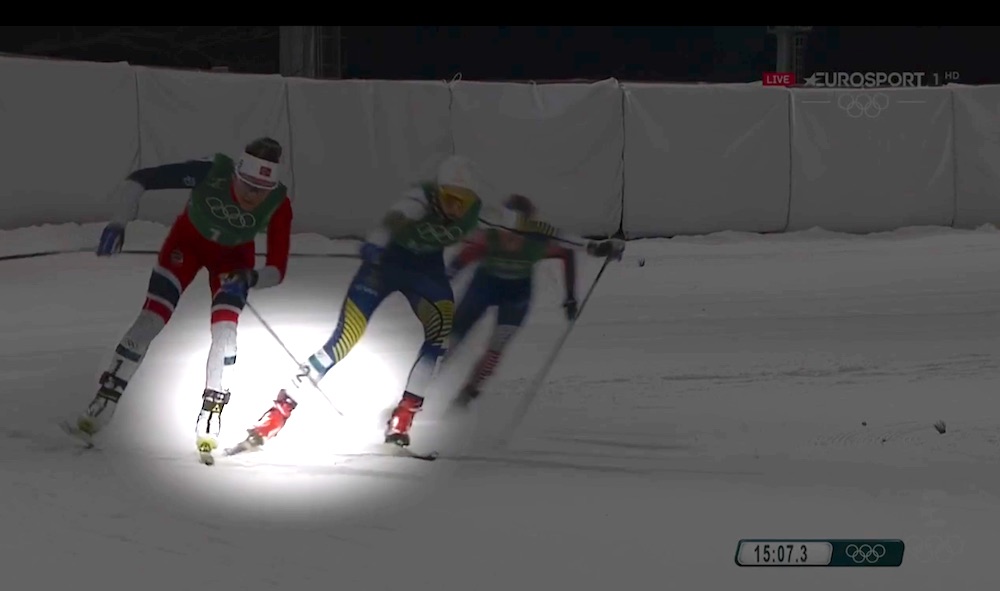
On the final descent, Finland’s anchor, Jasmin Kahara, lost her balance in the sweeping right-hand turn and fell, sliding out on her stomach. Germany and Norway slipped past in their tucks. Kern, just meters behind, fought to the line, but the podium had narrowed to two.
Coletta Rydzek (GER) brings home the bronze medal for Germany with Norway’s Julie Bjervig Drivenes just off camera. (Photo: Vanzetta/NordicFocus)
As they drove for the line side by side, aerodynamically no-pole skating with everything they had, it was clear this was going to be close. Germany claimed bronze while Norway left empty-handed in fourth. Just behind, Kern brought the United States to the finish in fifth.
For Diggins, the moment carried a different weight. It was, by her admission, her last Olympic relay leg.
“I love racing with this girl. I’m so, so proud of her,” she said of Kern. “And, yeah, it’s emotional to feel like I’m never gonna pull on those relay socks again.”
When asked whether there was a sense of handing the event forward, she reflected on the arc of her career — from her first team sprint world title in 2013 to the growth of youth programs back home.
“It’s just really cool to be part of the evolution of American skiing,” she said.
Julia Kern (USA) and Nadine Faehndrich (SUI), (l-r) find their lines around a tricky corner. (Photo: Vanzetta/NordicFocus)
Whitcomb knows they can win
For Head Coach Matt Whitcomb, the analysis was candid and clear-eyed.
“Yeah, it was a good race,” Whitcomb said. “Of course, this is an event that we know we can win, and we didn’t today.”
In a format this tight, small imperfections are decisive.
“For even a bronze medal to happen, both legs have to be firing exquisitely,” he said. “We swung as hard as we could. We did our best. We were prepared to win today, and we just didn’t.”
Of Kern’s anchor leg, Whitcomb offered both empathy and affirmation.
“Julia is an incredible performer, and one thing you can always trust from her is that you’re gonna get her absolute best,” he said. “We saw it on the final climb. I was happy with how she climbed. Just didn’t quite have the entire thing today, and that’s okay.”
Jessie Diggins tags Julia Kern (USA), while Jonna Sundling tags Maja Dahlqvist (SWE), (l-r) in the exchange zone between laps. (Photo: Vanzetta/NordicFocus)
Diggins in the best fitness of her life
Diggins has raced these Games managing injury concerns, including rib pain after a fall in the opening Skiathlon. But when asked whether her fitness was lacking, she pushed back.
“I feel like I’ve come into this with the best fitness in my life,” she said. “And that’s one of the only things I could control.”
There is comfort, perhaps, in that certainty — in knowing preparation was not the missing piece.
“I was skiing out of my body,” she said. “And I just did everything that I could.”
In Olympic-level team sprinting, that is sometimes enough. On Wednesday, it was not quite.
But the American women did what Diggins described as the only thing you can in cross-country skiing: you have to leave it all on the course without regret.
FasterSkier will have our own Nat Herz on the ground at the Olympics, which, to be honest, is a very big financial lift for us. If you value the thoughtful work and access FasterSkier provides at championships like this one, please consider becoming a Voluntary Subscriber. Your support directly fuels the work we do to cover the people, places, and moments that make our sport special.
Even in the way northern latitudes, there is no denying the earth’s 23.5-degree tilt on its axis and our relationship with the sun. Spring has sprung. In the spirit of holding onto winter just a little bit longer, we struck up a conversation with newly minted Olympian, Alaska Pacific University (APU) skier and Alaskan native, 27-year-old Tyler Kornfield.
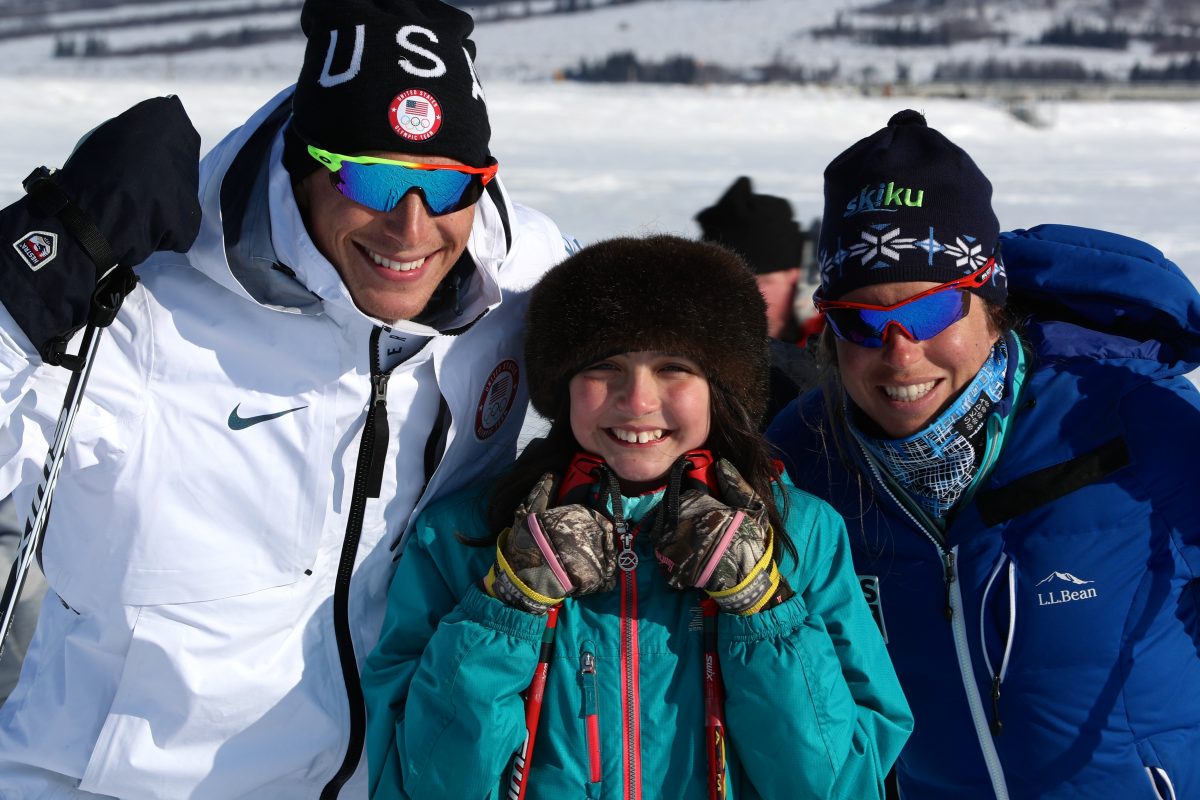
Tyler Kornfield (tall skier on left) and Rosie Brennan (adult to right of Kornfield) during a Skiku on-snow session this spring. (Courtesy photo)
On the competition side of things, Kornfield set the domestic scene abuzz back in 2012. At U.S. nationals that year in Rumford, Maine, he won the classic sprint and placed third in the freestyle sprint. This past January at 2018 nationals in Anchorage, Kornfield skied to seconding the classic sprint and third in the skate sprint. The experienced skier’s most He also won the 30 k classic to cap off a stellar championships week.
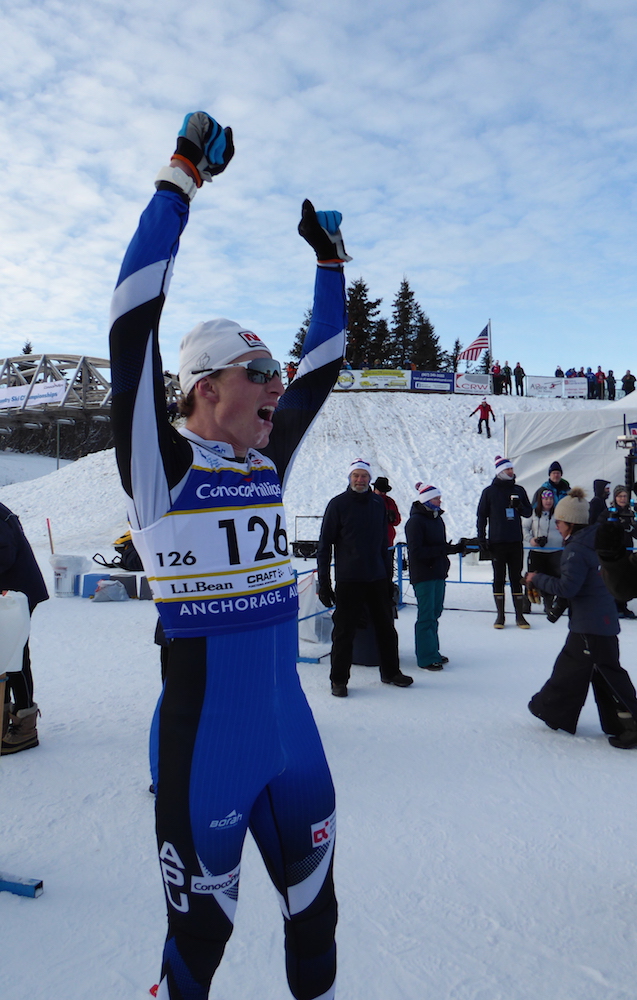
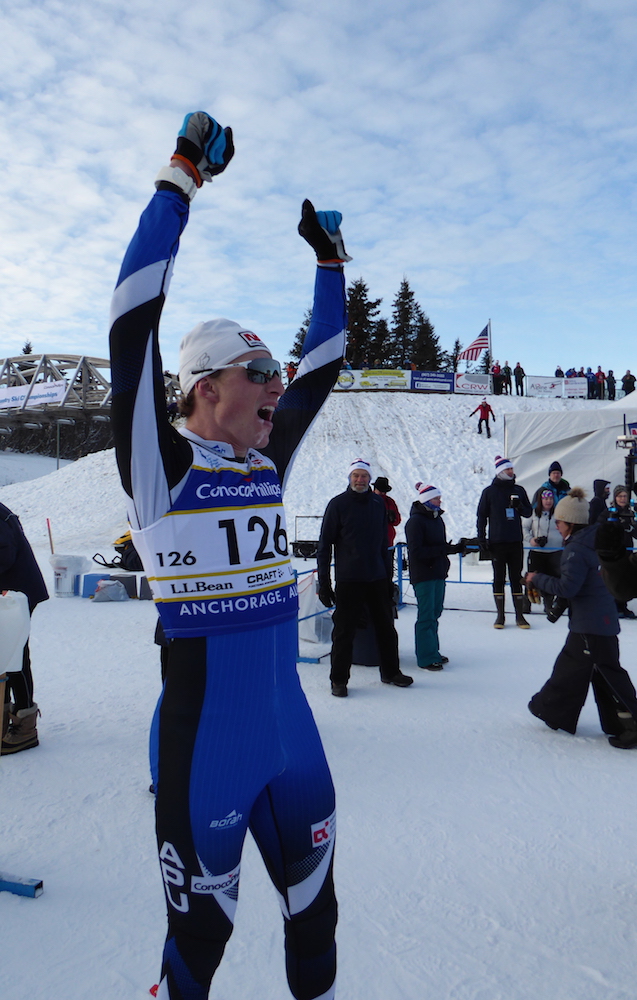
APU’s Tyler Kornfield celebrates after winning the men’s 30 k classic at U.S. nationals on Jan. 7 at Kincaid Park in Anchorage, Alaska.
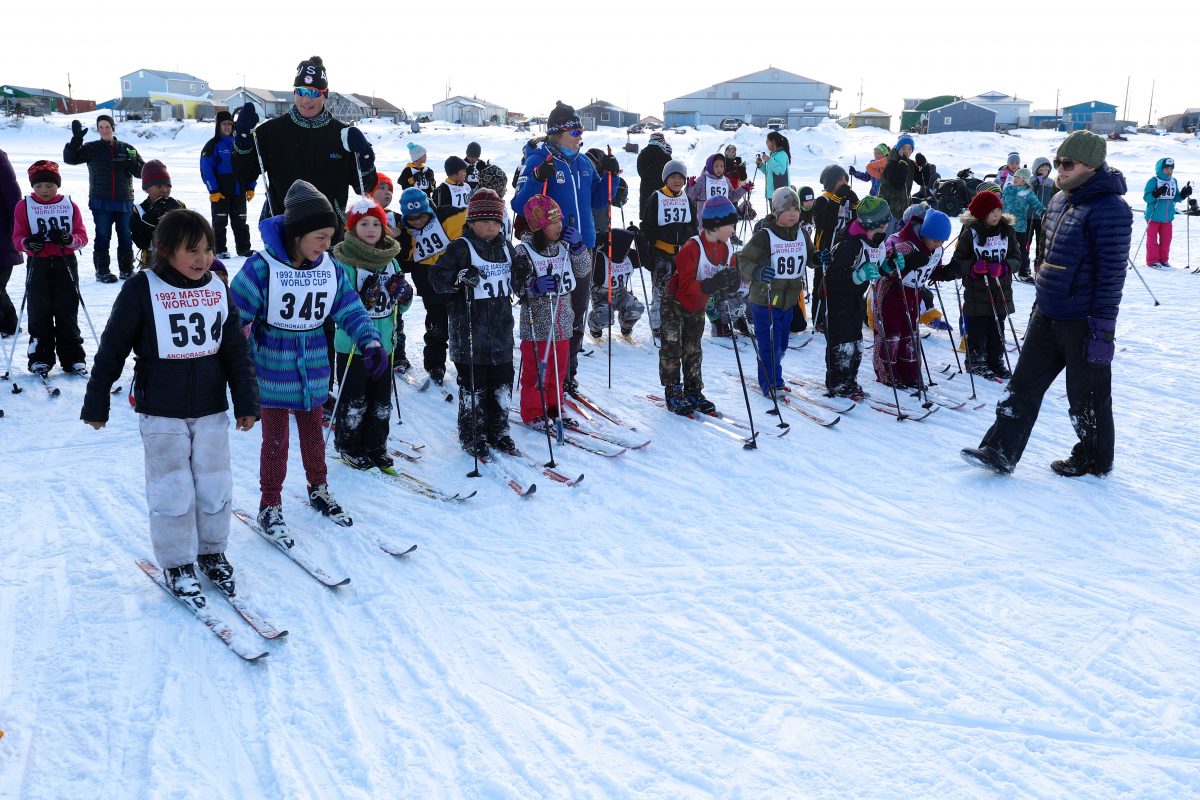
But maybe, more importantly, Kornfield has helped bring cross-country skiing to rural Alaskan villages through Skiku. Kornfield is not alone in this endeavor: many skiers and coaches have volunteered their time to “to foster the health and recreational benefits of skiing, biathlon and running through sustainable programs across Alaska”.
All smiles. Olympian Tyler Kornfield (l) and Rosie Brennan (r) with a young Skiku skier. (Courtesy photo)
We spoke to Kornfield on May 3 to learn more about his commitment to Skiku and get the rundown on his year.
In his own unique style, special guest Cosmo Catalano from Cyclocosm.com breaks down how Kikkan Randall and Jessie Diggins won Olympic gold in Pyeongchang, South Korea.
France’s Martin Fourcade defending his Olympic gold from four years ago on Monday in the men’s 12.5 k pursuit at the 2018 Olympics in PyeongChang, South Korea. (Photo: FlyingPointRoad)
Imagine for a moment, if you can, that you’re a two-time Olympic gold medalist from four years ago, and so far this winter, you’ve been on the podium in every biathlon World Cup you’ve raced but one (the first race, a single-mixed relay in November).
Your name is Martin Fourcade and you’re an 11-time world champion from France. You’re also a 29-year-old dad and you’ve spent the last four years since the last Olympics more or less preparing for gold in another race: the first race of the 2018 Olympics in PyeongChang, South Korea.
Now imagine that in that race, which you came into feeling more prepared than ever, you finished eighth after missing three targets in the first prone shooting stage.
Fourcade recalled in a press conference on Monday that his result in the men’s 10-kilometer sprint on Sunday wasn’t frustrating. It was disappointing.
“It was a really strange feeling,” Fourcade said after Monday’s 12.5 k pursuit. “… I was disappointed because yesterday I did not understand why I missed three, and I wanted this Olympic gold in the sprint more than any of the competitions. I worked really hard for this competition. I worked on my shooting for being good in the sprint, I worked on my skiing to be good in the sprint, and I think I was relaxed, I was in a good mood, I had good preparation. … And after the race [yesterday] I was really sad because I didn’t understand what I did bad.”
On Monday morning, he reviewed a photo of his missed shots in the sprint and figured out his error. The red flags that show the strength and direction of the wind in the range were waving more violently than he had remembered feeling during that prone bout.
“I realized it was not because I was unlucky … it was because I did a mistake, and from that time it was really much more easy to turn my anger into strength for the competition today,” Fourcade said. “It’s a bit masochist, but it works.”
Fourcade started the second race of the 2018 Games, the pursuit, 22 seconds behind Germany’s Arnd Peiffer (who won Sunday’s sprint) in eighth. Peiffer held his ground through the first loop and first prone shooting in first, hitting all of his targets and leaving the range in second, just 0.8 seconds behind Austria’s Julian Eberhard, who also cleaned and started the race in fourth.
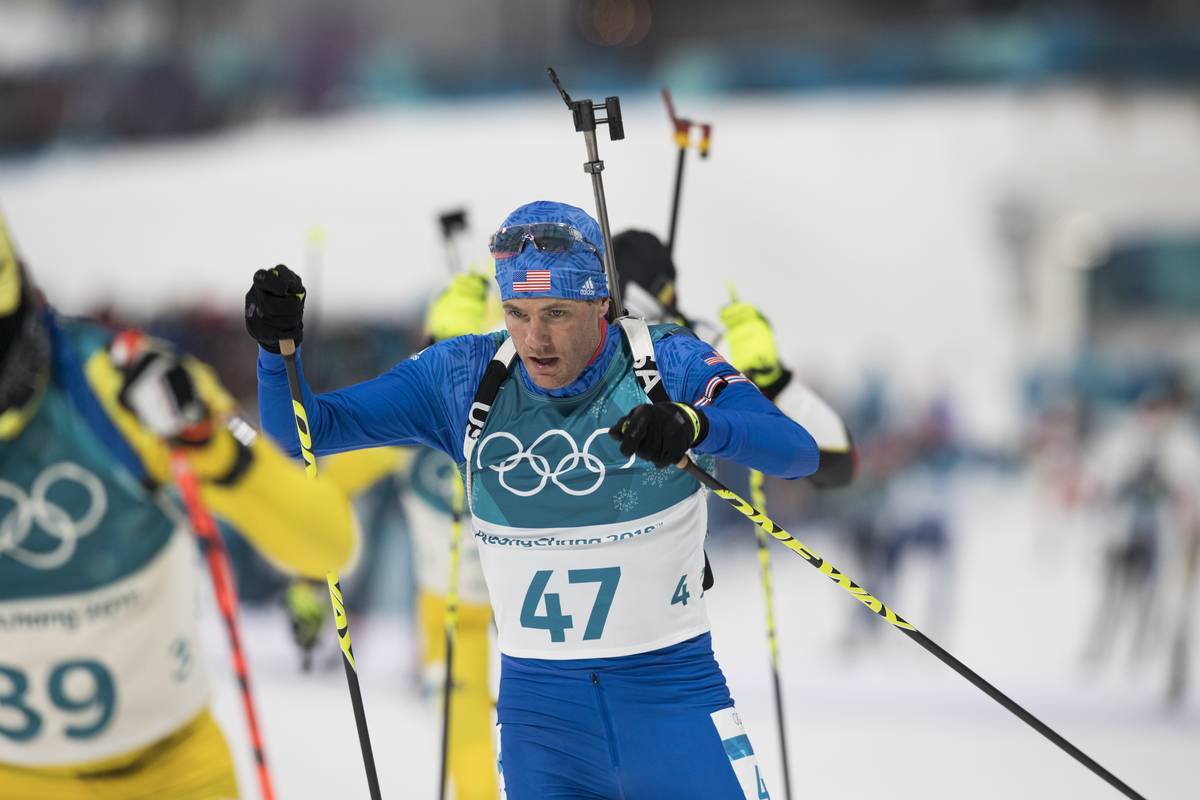
France’s Martin Fourcade (8) skiing in the pack en route a gold medal in the men’s biathlon pursuit on Monday at the 2018 Olympics in PyeongChang, South Korea. (Photo: FlyingPointRoad)
Fourcade missed his third shot and emerged from the penalty loop still in eighth, now 28 seconds out of first. He and Peiffer both cleaned the second prone, putting Peiffer back into first and Fourcade up to sixth, 21 seconds behind, while Eberhard missed one to drop to seventh.
All the while, the little red flags blew in various directions, twirling around their posts. Gusts kicked up flurries of snow into the air, under a pitch black sky past 9 p.m. Korea time — the start of the men’s pursuit.
It was once again frigid out there and only those who were shooting carefully enough and could feel their fingers (or were managing it regardless) were succeeding.
On the third loop, Fourcade hooked up with a chase group in an effort to catch Peiffer, and by the end of that 2.5 k loop, they did. Heading into the range for the first standing shooting, Fourcade put himself in second, just ahead of Germany’s Simon Schempp in third and behind Peiffer in first. Fourcade and Peiffer lined up in the second and first shooting positions, respectively, putting the pressure on Peiffer in particular.
Then, Peiffer missed his first shot. He hit the remaining four, but it wasn’t enough — Fourcade had knocked down all five and had taken his time to do so, posting the 28th-ranked shooting time. While Peiffer skied his first penalty lap of the day, Fourcade headed back to the course in first place. Peiffer slotted into second, 20.3 seconds behind.
“I think it was a key time of the competition because on the third shooting, the wind was really tricky, challenging, probably it was the most difficult shooting of today,” Fourcade recalled of that standing stage. “I took a bit more time then my opponents to shoot my first ammunition and then when I realized I was the only one who shot clean, I knew that I was the only one who could decide who would be the Olympic champion. I didn’t say that I was sure I would win, but the decision was in my hand.”
He rounded the fourth loop on his own and entered the range for the last time all alone. Then, Fourcade cleaned all five targets with the ninth-fastest shooting time, and turned to the stands behind him with a celebratory fist pump.
“My finish line was not the real finish line, it was the last ammunition of my last magazine on the fourth shooting,” Fourcade said. “I really put all my energy into this shooting and I think if I had to fight with any athlete on the tracks, I wasn’t able to do it because after this shooting I was totally empty.”
He didn’t need to fight with anyone on that last loop. Behind him, Germany’s Benedikt Doll had moved into second with a clean final stage, 36 seconds back, and Sweden’s Sebastien Samuelsson was up to third, another eight seconds behind.
On that final loop, Fourcade locked up gold, coming into the stadium with enough time to grab a large French flag from the stands, about 100 meters from the finish. Meanwhile, Doll and Samuelsson duked it out for second, with Samuelsson closing the gap to Doll then challenging him on the final climb.
“I saw Sebastien behind me and my legs felt weaker and weaker in the long uphill,” Doll, the 2017 sprint world champion, said at the press conference. “And he came closer and closer, and then he [caught] me so I was thinking, ‘OK, now I need to make a new tactic for sprinting for the finish.’ ”
The 20-year-old Samuelsson overtook Doll, 27, as they crested the last climb and led the downhill toward the stadium finish.
“I knew we had really good skis today and I knew that if I can catch him at the top, I had a really good chance,” Samuelsson reflected. “My plan was to go a little bit later because I wanted a wind shadow, but [my team’s] waxers were … yelling a lot and then I just had to go. I was helped a lot with my skis today.”
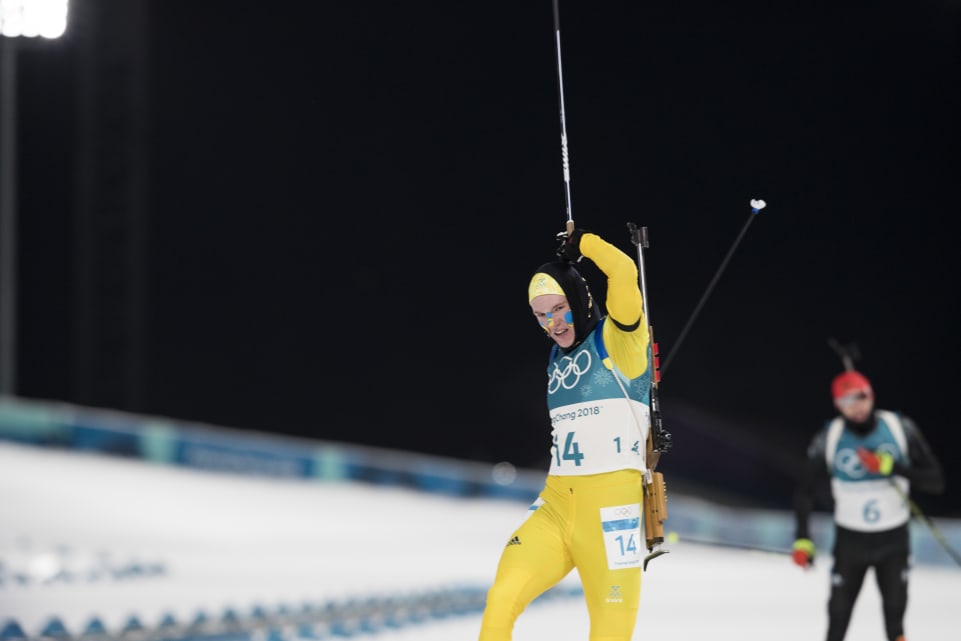
Sebastien Samuelsson of Sweden celebrating silver in the men’s 12.5 k pursuit at his first Olympics on Monday in PyeongChang, South Korea. It was also his first non-relay podium at the World Cup/World Championships level. (Photo: IBU/Biathlonworld)
In the end, Samuelsson got him by 3 seconds for silver, finishing 12 seconds after Fourcade claimed the win in 32:51.7 minutes. Doll, who had started the pursuit in sixth, settled for bronze, 15 seconds behind Fourcade, for his first medal in his first Olympics with a single penalty (0+1+0+0).
“I couldn’t follow [Samuelsson] and he had faster skis,” Doll concluded. “He was a little bit stronger, and so I think he’s the right holder for the silver medal.”
In addition to shooting 19-for-20 (0+0+1+0), Samuelsson, who started the race in 14th, raced the fastest overall course time of the day, 8.6 seconds faster than Fourcade, who was second fastest. The young Swede reportedly told the International Biathlon Union (IBU) on Periscope that he’d cut his hair if he won a medal at his first Olympics in PyeongChang.
“I think nobody was thinking I’d be able to cut my hair after these Olympics, but now I have to do it, I have said so,” Samuelsson said at the press conference. “But I heard that my teammate said maybe you should keep the hair until the relays because you never know what will happen if you cut it.”
Samuelsson’s previous individual World Cup best was 13th in a sprint last season. He won a relay with his four-man team this season in the 4 x 7.5 k in Oberhof, Germany. After Monday’s pursuit, Fourcade said he congratulated him.
“I told Sebastien in the changing room, it’s not a bad day to start his first Olympics with his first international podium. I know a guy who did that eight years ago in the Olympics in Vancouver,” Fourcade said, referring to his first Olympic medal (silver) in the mass start at the 2010 Games.
Fourcade went on to win the pursuit and 15 k individual race at the 2014 Olympics in Sochi, Russia, where he also took silver in the sprint.
“Martin is, I mean, the perfect biathlete,” Samuelsson said. “I knew when he finished eighth yesterday that today he would be really fighting for the gold medal. For me, it’s a big victory for me to just be on the podium and Martin is unbelievably good.”
“Martin was not happy [after the sprint],” Doll said when asked about Fourcade. “Of course three mistakes in the prone shooting, it’s horrible, so it was for sure that today that he will fight and give everything to win, and in the end his plan fulfilled. He was I think the fastest skier or maybe Sebastien was the fastest skier, I don’t know, but he was the best biathlete today.”
France’s Martin Fourcade after winning the men’s 12.5 k pursuit on Monday at the 2018 Olympics in PyeongChang, South Korea. He also won the pursuit at the 2014 Sochi Olympics. (Photo: FlyingPointRoad)
In his book, “Martin Fourcade: Mon rêve d’or et de neige” (My dream of gold and snow), which came out in November, Fourcade wrote about how nervous he was the night before his first gold medal in Sochi.
“Four years ago before the Olympics in Sochi, I was simply shaking because I had a lot of fears,” Fourcade said at Monday’s press conference when asked about that passage from the book. “Many things changed in my life since Sochi. When I came here in Korea, I knew that I will be a happy man even without any Olympic gold in this event, so I think it helped me to take it more easy and I was in a really good mood and really satisfied with how I prepared this competition.”
Asked now if that fear is gone, he said it was.
The men’s 12.5 k pursuit podium at the 2018 Olympics in PyeongChang, South Korea, with France’s Martin Fourcade (c) in first, Sweden’s Sebastien Samuelsson (l) in second and Germany’s Benedikt Doll (r) in third. (Photo: IBU/Biathlonworld)
Finishing 47.5 seconds after Doll was Norway’s Tarjei Bø in fourth (+1:02.6). Bø started 13th and posted the fourth-fastest course time to overcome three penalties (0+0+1+2). He held off three others in a sprint to the line, with Schempp following in fifth (+1:02.7), after starting seventh, Switzerland’s Benjamin Weger placing sixth (+1:03.1), up from 15th at the start, and France’s Simon Desthieux placing seventh (+1:03.7), up from 12th. Peiffer ended up eighth (+1:14.1) with three penalties (0+0+1+2), and Sunday’s silver medalist Michal Krčmář of the Czech Republic finished 30th (+3:49.9) with seven misses (2+0+3+2).
Norway’s Johannes Thingnes Bø finished the race in 21st (+2:51.0), up 10 places from starting 31st based on his sprint result, with six penalties on Monday (0+2+4+0).
“We both [knew] before the Olympics that it will not be only a fight between us because we know the shooting range [here] is challenging,” Fourcade said of Johannes Bø, his main rival this season. “I thought that at our best level, we could be difficult to beat, but the wind and the Olympic situation will bring many opportunities for outsiders to take [medals], yesterday Arnd did in a magnificent way. It’s not a competition about Johannes today. It’s biathlon.”
Burke Up to 17th
Tim Burke (US Biathlon) racing to 17th in the men’s 12.5 k pursuit at the 2018 Olympics in PyeongChang, South Korea, up from 47th at the start. (Photo: NordicFocus/US Biathlon)
Three Americans and one Canadian qualified for the pursuit in the sprint top 60, and US Biathlon’s Tim Burke raced all the way up to 17th (+2:19.6) after starting 47th, with two penalties (0+1+1+0) and the 15th-fastest overall course time.
“I am very happy with the race,” Burke said in a post-race interview with FasterSkier. “I really felt like I put it together for the opportunities I was given in the race today, but this is not normal biathlon. You saw that they moved the downhill [competition] to a different day; we can’t do that in biathlon we have too many events, so we have to go on these days when it’s honestly unfair conditions like today. I benefited a lot from having very little wind in my standing positions, and I was able to move up a lot. Others I know were not so lucky. Unfortunately that is part of an outdoor sport.”
Asked how he reset after the sprint the day before, Burke said he talked about it with his coach.
“I was disappointed in the result not the performance,” he recalled. “I felt like I executed well. I felt like I hit my cues on the course and on the range, and it just didn’t happen yesterday. The game plan going into today was nothing, there was nothing new, stick to the things that have been working well for me in the World Cup and that’s what I did.”
After Burke, Lowell Bailey was the next best American on Monday, finishing 32nd (+3:51.6) after starting 33rd. He cleaned the first two stages but missed five between the two standing bouts (0+0+3+2).
American Lowell Bailey (33) racing to 32nd in the men’s 12.5 k pursuit at the 2018 Olympics in PyeongChang, South Korea (Photo: NordicFocus/US Biathlon)
“Unfortunately today, the weather got involved and I had one stage that really just threw my race off,” Bailey told FasterSkier after. “Wind, I mean, that third stage was just absolutely ridiculous. … There was nothing longer than 20 seconds of those big gusts and that time it was like two minutes. I got through of about 40 seconds of standing there waiting, time bleeding off the clock at that point I just started pulling the trigger, I couldn’t hold on the target, you just got to do your best on that point.”
Then there was Leif Norgren, also of the U.S., who finished 50th (+5:48.7), up from 58th at the start, with five penalties (2+2+0+1).
“Physically I think it was improvement from yesterday,” Nordgren told FasterSkier. “I still struggled with the wind and shooting, and it makes it kind of frustrating because with windy conditions like these it’s a big opportunity to move up in the pursuit and I wasn’t able to capitalize on that today. So a little disappointed in that regard, but that’s just how it goes sometimes.”
Canada’s lone man in the pursuit, Nathan Smith crossed the line in 54th (+6:06.5), after starting 44th, with four misses (0+0+1+3).
While he raced up to 37th after the first three stages, Smith dropped to 51st with three misses in the last standing.
“Three penalties on the last standing was really a lot of time spent in the loop,” he reflected.
Physically, he said the race felt, “really, really hard.”
Biathlon at the Olympics continues with the women’s 15 k individual on Wednesday and men’s 20 k individual on Thursday.
The start of the women’s 15 k skiathlon on Saturday, Day 1 of the 2018 Winter Olympics, with (front row, from left to right) Austria’s Teresa Stadlober, Norway’s Ingvild Flugstad Østberg, Norway’s Heidi Weng, American Jessie Diggins, and Sweden’s Charlotte Kalla leading out of the stadium in PyeongChang, South Korea. (Photo: FlyingPointRoad)
The 2018 Winter Games kicked off Saturday with the women’s 15-kilometer skiathlon, which saw Sweden’s Charlotte Kalla take her second-career individual Olympic gold (third including relays) and first individual gold in eight years. Not far behind her, American Jessie Diggins achieved the best Olympic result for an American woman in cross-country skiing.
After Kalla established herself as a leader early in the opening 7.5 k classic leg, the Swede spent much of the race working with her teammate Ebba Andersson to counter any type of attack from the Norwegians, specifically Marit Bjørgen.
On rock-solid classic conditions in PyeongChang, Bjørgen led the second half of the classic leg up until the ski exchange, where she entered the “pit stop” first, just ahead of Kalla in second. Norway’s Heidi Weng was in third at the time and swapped into her skate gear fastest, leaving the exchange about 28 seconds later in first. Her Norwegian teammate Ingvild Flugstad Østberg followed her in second and Bjørgen emerged in third, just ahead of Kalla in fourth.
Meanwhile, Diggins skied consistently in the top 10 and within about four seconds of the lead throughout the classic leg, entering the exchange in 13th and leaving in ninth, 5.4 seconds after Weng.
While Kalla took the lead early in that first skate lap, Switzerland’s Nathalie von Siebenthal made a move into first on a climb just before 9.75 k, while Bjørgen kept her close. Andersson continued to keep herself in the mix, skiing in third, just ahead of Kalla in fourth and Finland’s Krista Pärmäkoski in fifth. Diggins slotted behind two Norwegians, Østberg and Weng, while Austria’s Teresa Stadlober followed. At 9.75 k, 11 women were within 6 seconds of first.
Bjørgen reclaimed the lead shortly thereafter, but Kalla made her game-changing move on a climb about 34 minutes into the race, just before the 12.5 k checkpoint. There, the Swede had begun to gap the pack and was 5.5 seconds ahead of Bjørgen in second. Andersson remained in third, 5.9 seconds back, just ahead of von Siebenthal, Pärmäkoski, and Stadlober. Diggins in seventh pushed to keep herself in the chase group and was able to with about 2.5 to go.
One kilometer later, Kalla was nearly 10 seconds clear of Bjørgen, as well as Andersson and Pärmäkoski. The Finn moved ahead of Andersson on one of the last climbs to put herself in third as they headed down and back toward the stadium.
Sweden’s Charlotte Kalla celebrates her victory in the women’s 15 k skiathlon on Saturday at the 2018 Olympics in PyeongChang, South Korea, and her first individual Olympic gold medal in eight years. She beat Norway’s Marit Bjørgen (behind) by nearly eight seconds. (Photo: FlyingPointRoad)
All alone, Kalla skied to the win in 40:44.9 minutes, what Bjørgen distanced herself from third place and claimed second, 7.8 seconds later. Pärmäkoski took the bronze medal in third (+10.1), less than a second ahead of Andersson in fourth (+10.9). Kalla’s previous Olympic gold medals came individually in the 10 k freestyle at the 2010 Games in Whistler, British Columbia, and with her team in 2014 in the women’s 4 x 5 k relay in Sochi, Russia.
Diggins finished fifth (+14.7) for a new all-time best for a female American cross-country skier at the Olympics (after Sophie Caldwell placed sixth in the sprint at the 2014 Games), about three seconds ahead of von Siebenthal in sixth (+17.6). Stadlober placed seventh (+26.6), Russia’s Natalia Nepryaeva was eighth (+33.0), Weng was ninth (+40.7), Sweden’s Stina Nilsson 10th (+48.9), and Østberg 11th (+58.3).
In her first Olympics, Canada’s Cendrine Browne (Canadian U25 Team) led her team in 33rd (+3:17.0), ahead of American Caitlin Patterson (also in her first Olympics) in 34th (+3:30.0).
U.S. Ski Team member Kikkan Randall placed 40th (+4:02.3), Canadian World Cup Team member Emily Nishikawa finished 44th (
+4:31.7), Canada’s Anne-Marie Comeau was 48th (+4:57.9), Australia’s Jessica Yeaton (who trains with Alaska Pacific University) was 50th (+4:59.9), Canada’s Dahria Beatty 52nd (+5:32.4), and American Rosie Brennan 58th (+6:51.1).
The men’s 30 k skiathlon is the next cross-country event on the schedule in PyeongChang, set for Sunday at 1:15 a.m. Eastern Standard Time.
Germany’s Laura Dahlmeier racing to her first Olympic gold (and first Olympic medal) on Saturday in the women’s 7.5 k sprint, the first biathlon race of the 2018 Winter Olympics in PyeongChang, South Korea. (Photo: FlyingPointRoad)
2018 Winter Olympics (PyeongChang, South Korea): Biathlon women’s 7.5 k sprint
While most others struggled on the range in the first biathlon race of the 2018 Olympics, Germany’s Laura Dahlmeier held steady and shot clean, then posted the winning time in the women’s 7.5 k sprint on a windy Saturday evening in PyeongChang.
The 23rd starter (out of 87 finishers), Dahlmeier had to wait a long time for her gold medal to be confirmed, but she had done it, winning with a time of 21:06.2 minutes for her first Olympic medal. She has seven gold medals from World Championships but this was her first at her second Olympics. And on Saturday, she was one of just two women in the top 20 to hit all 10 targets in the two-stage race. Russia’s Tatiana Akimova was the other and she finished 20th.
The 24-year-old Dahlmeier bested the time of Norway’s Marte Olsbu, who started 11th and had a single miss in prone (1+0), by 24.2 seconds. Olsbu’s time was good enough for second, just ahead of the Czech Republic’s Veronika Vítková, who started right behind her in bib 12, in third place (+25.8). Vítková also had to ski one penalty lap after a standing miss (0+1). For Olsbu, 27, this is her first Olympics. For Vítková, 29, it was her first individual medal in three Olympic Games.
France’s Marie Dorin Habert missed the podium by 7.3 seconds in fourth (+33.1), after one prone penalty (1+0). Germany had two in the top five with Vanessa Hinz in fifth (+40.3) with one miss, Italy’s Lisa Vittozzi was sixth (+40.5) with one miss, Sweden’s Hanna Öberg seventh (+40.8) with one miss, Switzerland’s Irene Cadurisch eighth (+45.5) with one miss, Belarus’s Darya Domracheva ninth (+46.2) with two penalties, and France’s Justine Braisaz 10th (+47.9) with two penalties as well.
Julia Ransom (Biathlon Canada) racing to 40th in the women’s 7.5 k sprint at her Olympic debut in PyeongChang, South Korea. (Photo: FlyingPointRoad)
Canada’s Julia Ransom was the top North American in 40th (+2:08.8) with one standing penalty (0+1). Canada had all four women finish in the top 60 (thus qualifying for Monday’s pursuit) with Rosanna Crawford in 53rd (+2:23.0) with three misses (1+2), Emma Lunder in 54th (+2:24.2) with two standing misses (0+2), and Megan Tandy in 57th (+2:36.6) with a penalty in each stage (1+1).
One American finished in the top 60 to qualify for the pursuit: Emily Dreissigacker, in her first Olympics, in 51st (+2:21.0), after shooting 9-for-10 (0+1). Clare Egan just missed the cutoff in 61st (+2:45.4) with three misses (1+2), Susan Dunklee fell out of contention with five misses (1+4) to finish 66th (+3:06.9), and Joanne Reid finished 86th (+5:12.6) with seven penalties (+3:06.9).
Estonia’s Johanna Talihärm, a Montana State University student who lives in Bozeman, finished 22nd (+1:20.8) with one miss (0+1) for her best individual result at her second Olympics.
The men’s 10 k sprint takes place Sunday in PyeongChang at 6:15 a.m. EST.
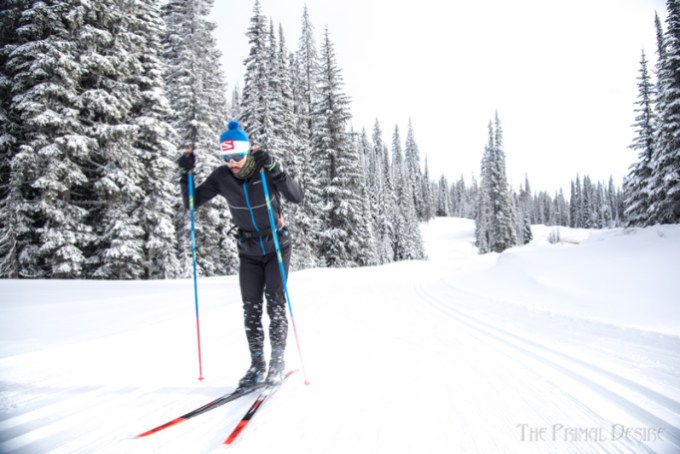
Kequyen Lam skiing at the Sovereign Lake Nordic Centre on Jan. 19, three days before he was officially named to the Portugal Olympic team. (Photo: Raj/theprimaldesire.com)
VERNON, B.C. — In May of 2015, a new skier turned up at the Sovereign Lake snow camp. He struggled to skate up small hills and fell down often. In the coming week, that same skier will represent Portugal at the 2018 Winter Olympics in PyeongChang, South Korea.
At first glance, Kequyen Lam seemed like a typical Canadian nordic newbie. Great lateral balance combined with regular falls forward and backward revealed his alpine background. Six months later, Lam turned up at the Sovereign Lake NorAm with intermediate technique, much-improved fitness and a total determination to recover from a bad cough in time for the distance race. Asked by FasterSkier to explain the shocking improvement over the summer, he said, “I used to be a snowboarder. And I worked hard.”
Fast-forward to 2018 and Lam, 38, has a FIS ranking that created an Olympic quota spot for Portugal. The journey was anything but simple, both as a skier and as a dual citizen.
FasterSkier caught up with Lam at the Sovereign Lake Nordic Centre on Jan. 21, one day before the official announcement of the 2018 Olympic quota allocation.
“I’m a united-nations individual. I would say that I’m proud to have the entire heritage that I do have, the history. I’m super proud that my parents are boat people, refugees.” — Kequyen Lam, 2018 Olympian
Becoming A Nordic Skier
A bit of Googling shows that Lam’s casual reference to snowboarding wasn’t the whole truth. He competed at the 2013 Sochi Snowboard World Cup and was on track to qualify for the 2014 Olympics in that sport. A season-ending crash in Austria resulted in a shoulder injury that stopped that dream and changed Lam’s path.
“Everything was going super well, but at this track, something mentally wasn’t right,” he recalled. “I was in a state of fear: fear of getting hurt, fear of injury. Physically, I believe I was ready, but mentally, it was tough.”
After the end of his snowboarding dream, Lam worked in Golden, B.C., as a pharmacist.
“I kind of moved on with my life, lived in Golden, did the whole career thing, did things for fun,” Lam explained. “I’m just the type of person where doing things for fun isn’t enough.”
Lam’s path into cross-country skiing started less than three years ago, at age 36, with Paralympic athlete and friend Tyler Mosher, who told Lam to “talk to Maria.”
“I talked to Maria Lundgren, and she forwarded me to Tony Chin,” he said of Lundgren, a British Columbia Ski Team coach, and Chin, one of the head coaches at the Nordic Racers Ski Club in Vancouver.
Through Chin, he met Ryan Olson, a masters skier.
“Ryan Olson is pretty hardcore guy when it comes to skiing,” Lam said. “He is dedicated and he gives ‘er hard. That was the reason I was able to learn the beginning steps of cross-country skiing.”
Olson connected Lam with Matt Liebsch, an American Birkebeiner champion and competitive American skier who organizes an annual camp at the Haig glacier near Canmore, Alberta. Lam spent three days there with Canadian Olympians Dasha Gaiazova and Ivan Babikov before training with Liebsch’s group on the glacier.
“I spent ten days total up at the Haig in 2015, and that’s when I learned how to ski, how to skate ski,” Lam explained.
His introduction to nordic skiing took him through a who’s who of Western Canadian skiing in just his first three months of the sport. From Mosher to Glenn Bond (Lam’s current coach), there was and is a large community of people who help skiers progress. For Lam and the Olympics, progress is measured in FIS points.
“The magic points! The first races happened in Finland,” Lam explained. “Last year, I went to Finland, I did a couple races there. I scored some good points there. And then there were some [rollerski] races in Columbia in December of this year where I got the majority of my points. It was actually those races that got me enough points to get under the 300-point standard to meet the Olympic qualification criteria.”
Representing Portugal
How does a Canadian come to have dual citizenship with Portugal? The story starts in Asia.
Lam’s grandparents immigrated to Vietnam from China before being driven out by the Indochina War (a 31-year Vietnamese civil war which bled over into Cambodia and Laos). When the war ended in 1975 with the defeat of the South Vietnamese government, Lam’s parents returned to their noodle business. The new Socialist Republic of Vietnam was not forgiving to groups that were believed to have supported the losing side. In 1978 and ’79, around 450,000 Vietnamese of Chinese ethnicity were expelled or escaped from Vietnam. Lam’s parents left as ‘boat people’, spending a month on an open boat before landing in Macao. Lam was conceived and born in a refugee camp in Macao in 1979, which was then a Portuguese colony, before being flown to Canada at the age of three months to live with a host family in Abbotsford, British Columbia.
“My grandfather on my mum’s side, they had made it to Abbotsford from Hong Kong,” Lam said. “The family split up entirely. [My grandparents] went to Hong Kong and they made their way to Abbotsford, and when they found out that we were coming over, they went to one of the churches in Abbotsford and found a family to take care of us when we got there. I mean, the Canadian government would have figured that out, but [my grandfather] wanted to make sure that the people that were going to take care of us were gonna be good people. That’s what he did. We were super, super fortunate.”
At 27, Lam started the process of connecting with his family history.
“I contacted the [Portuguese] consulate in Vancouver, they contacted the hospital that I was born in in Macao, and sure enough my name was there,” he said. “I get a letter in the mail, all in Portuguese, I had no idea what it meant.”
That all happened in 2006, the year he started pharmacy school.
“I took a year of Portuguese, I enrolled in two semesters, learning how to read and write, how to understand,” he said. “Then I spent two months in Portugal, travelling all over the coast, surfing. I did some volunteer work in a pharmacy in Faro, for a few days, just to see what it was all about.”
The Portuguese media has connected with Lam’s story and a part of Portugal’s colonial history. Their country has a second representative in PyeongChang, alpine skier Arthur Hanse, whose parents emigrated from Portugal to France. Lam was selected to be the flag bearer at Friday’s Opening Ceremony.
According to The Portugal News Online, the last time Portugal sent more than one athlete to the Winter Olympics was in 1988 when its four-man bobsled team qualified. That team competed against the famous Jamaican bobsled team and finished last in the final, while Jamaica did not finish.
“I’m a united-nations individual,” Lam said. “I would say that I’m proud to have the entire heritage that I do have, the history. I’m super proud that my parents are boat people, refugees.”
The Olympic Dream
Lam is one of many who dream of representing ‘small nations’ at the Olympics: athletes who work together to build a worldwide community and inspire others to chase their dreams.
“For two and a half years, nobody really knew what I was doing,” he said. “They knew that I was skiing, that I was passionate. That was 100 percent, but there was a purpose behind it, and that purpose was to make it to the Games in 2018. And tomorrow [Jan. 22] is judgment day.”
The ‘big nations’ in nordic skiing have big solutions. From dedicated wax teams in country-specific waxing rooms to physio staff to multiple coaches, the support is total. The ‘small nations’ live in a different world, sharing wax rooms among multiple countries and relying on the wax companies and ski companies for testing.
Team Portugal has Lam, supported by coach (and Atomic ambassador) Glenn Bond.
“What we’re going to do is we are going to see if Atomic will look at skis, wax skis and get everything dialed for training days and the race day,” Lam said. “I think that’s the best route to go. They’re testing skis every day, and they know what’s going to be fast.”
Like many of his peers, Lam has qualified for one event: the 15-kilometer freestyle individual start next Friday, Feb. 16. The people who have met him on his journey will be celebrating. You can follow Lam on his website or Instagram @kequyenlam.
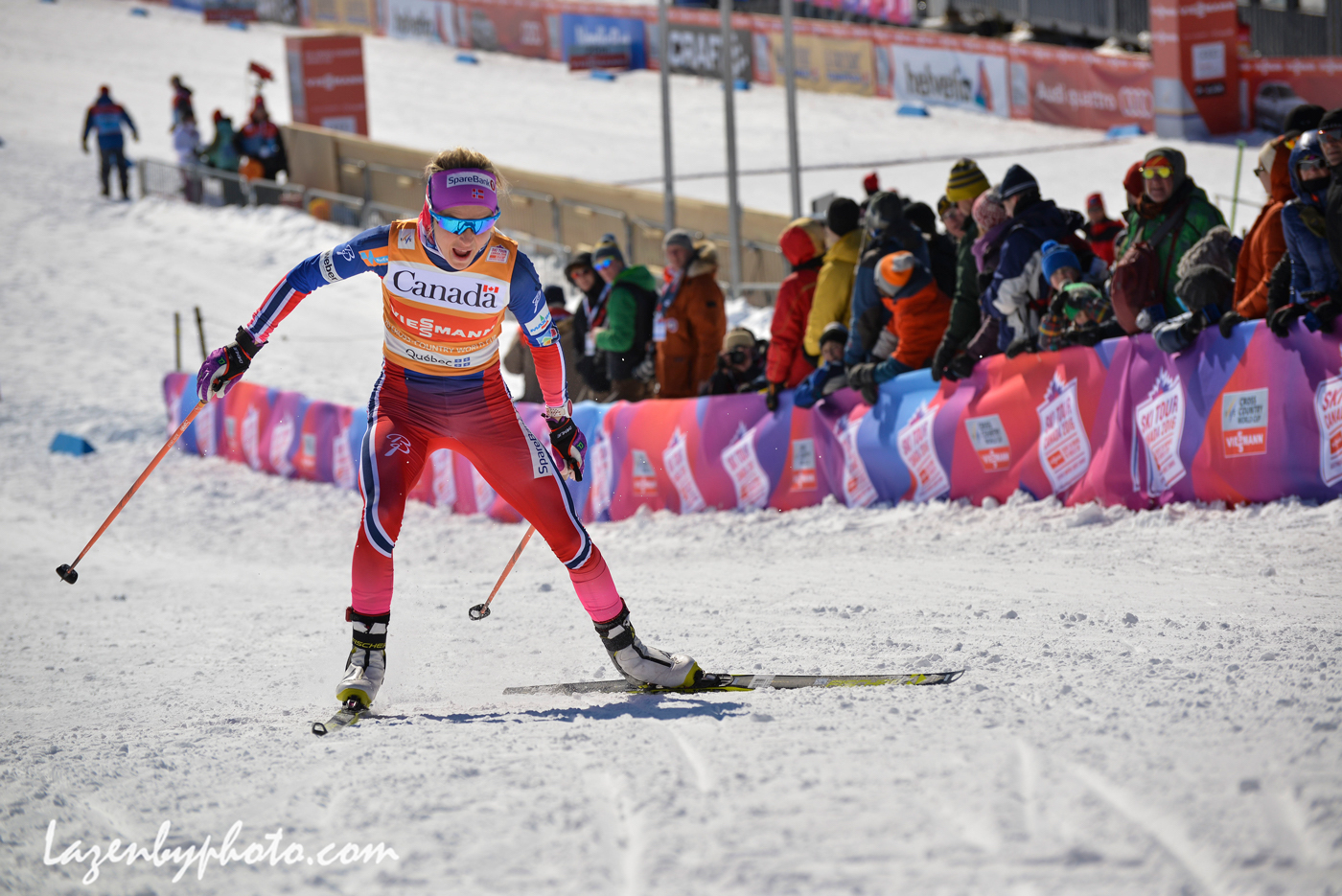
Norway’s Therese Johaug in the 2016 Ski Tour Canada leader’s bib after two stages of racing. She went on to win the overall Tour. (Photo: John Lazenby/Lazenbyphoto.com)
As previously reported on FasterSkier, Norwegian superstar Therese Johaug recently saw her suspension increased to 18 months following a ruling from the Court of Arbitration for Sport (CAS) that overturned the 13-month suspension previously imposed by Norwegian anti-doping authorities.
The math is obvious to any fan of the sport, if absent from the CAS decision: A suspension start date of October 2016 plus 18 months equals April 2018. Johaug will miss the next Winter Olympics in February 2018.
FasterSkier separately addressed the factual question of what happened that led to Johaug testing positive for the steroid clostebol. That article did not consider the question of why 18 months was the suspension chosen. This piece tries to fill in that gap, by exploring the legal analysis of the CAS decision and the principles that the court applied in reaching this decision.
This analysis begins by looking at how criminal sentencing usually works, then applies these general principles to Johaug’s case specifically.
(Wonkish aside: This approach necessarily elides somewhat the distinction between criminal sentencing and a period of ineligibility from sanctioned athletic performance, which is closer to a civil remedy. It is worth emphasizing that Johaug has not been charged with breaking the criminal laws of any country, and is extremely unlikely to face criminal charges. However, the use of the basic principles of criminal sentencing is helpful here by analogy, as a way to think about set ranges of punishment, degrees of fault, and mitigating and aggravating factors.)
Sentencing Law 101
Criminal sentencing in American courts follows a basic three-step process. First, what is the crime of which someone has been found culpable, following either a jury trial or (more frequently) the entry of a plea as part of a plea-bargain?
The chemical structure of clostebol, a synthetic anabolic androgenic steroid. (Photo: Wikimedia Commons)
Second, what is the sentencing range set for this crime? In state courts, this is a matter of state statute. In federal courts, the federal sentencing grid controls. In either sovereign, there is a gradation of offenses, and different sentencing ranges for more or less serious versions of each crime. For example, there may be a presumptive range of 3-6 years for first-degree assault, 1-3 years for second-degree assault, or 0-1 years for third-degree assault, with the ability to go much higher or lower depending on the specifics of each crime and a defendant’s criminal history.
And third, once the relevant sentencing range is known, what is the appropriate sentence within that range? And/or is there something so remarkably serious, or not-serious, about this offense that the sentence imposed should be above or below this range?
Presumptive sentencing ranges represent a compromise between uniformity and discretion. The elimination of unjustified disparity is a central goal of sentencing; within reason, the same people who commit the same type of crime should receive the same type of sentence. But it is also important that the system be able to adapt itself to any particular defendant, and the especially sympathetic or damning facts of a specific case. The law, as they say, is a human enterprise.
Turning to Johaug: What is the offense?
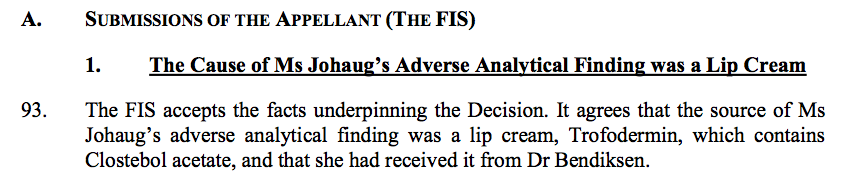
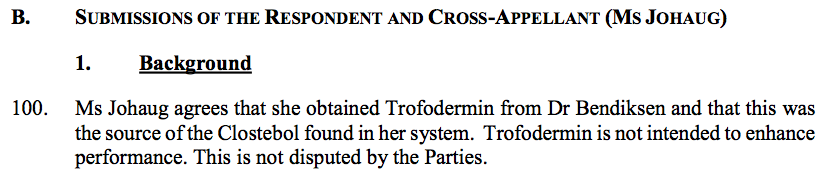
Applying these principles to Johaug’s case, Step 1 is easy. The relevant facts about what happened are effectively undisputed.
Here’s the CAS, in its recent written opinion, summarizing FIS’s view of the lower-court decision from the Adjudication Committee of Anti-Doping Norway:
Excerpt from CAS decision in Therese Johaug case.
And here’s Johaug’s view of the facts:
Excerpt from CAS decision in Therese Johaug case.
And here’s the court’s take:
Excerpt from CAS decision in Therese Johaug case.
Not much to argue about here – however much Johaug was at fault for what happened, everyone agrees that this is what happened. The often-tortured threshold question of how a prohibited substance entered an athlete’s body (think tainted meat, spiked supplements, the chimeric twin theory, etc.) was not an issue here. (See here for more on the facts.)
What is the appropriate suspension range for this offense?
Figuring out the baseline range for this offense immediately requires a resolution of the athlete’s mental state (or mens rea, to use the official Latin phrase that literally translates as “guilty mind”). This is because the presumptive suspension range depends on Johaug’s mental state.
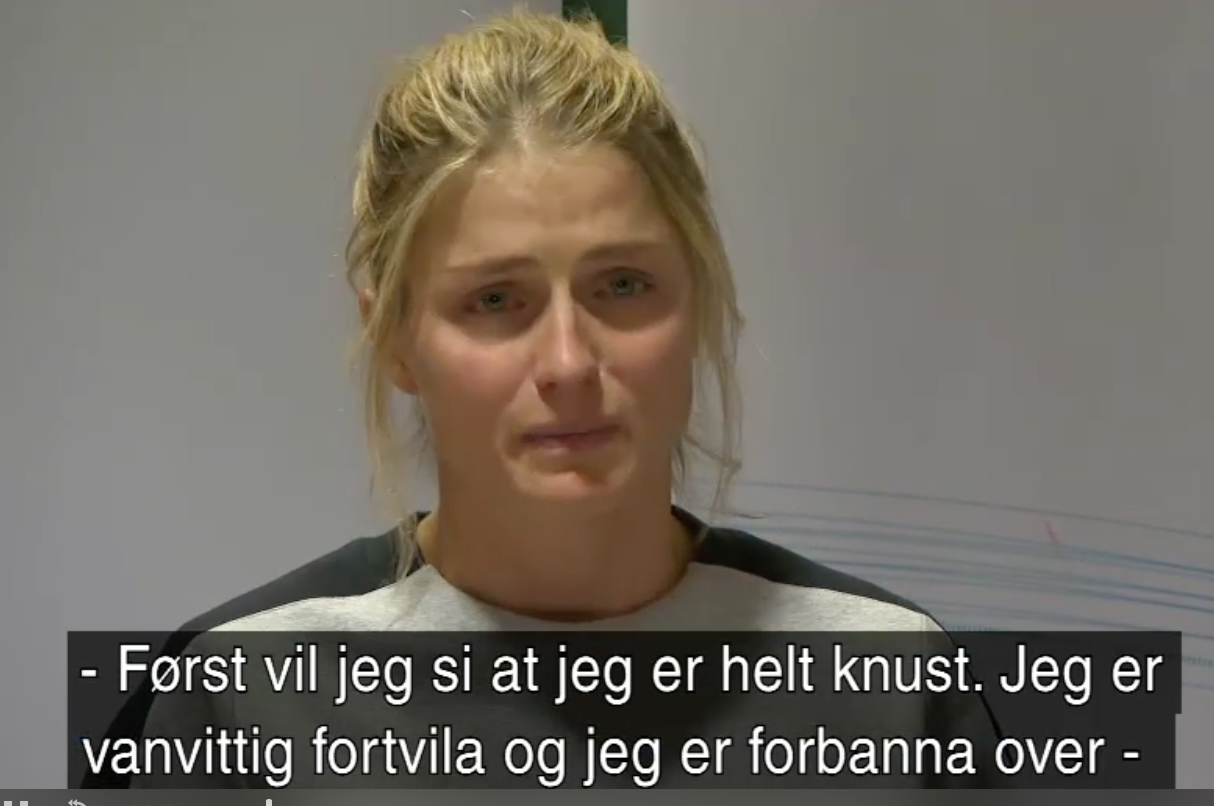
Therese Johaug during an Oct. 2016 press conference on Thursday announcing her positive doping test. (photo: screenshot)
The central legal question in this case was whether Johaug acted with “No Fault or Negligence” or whether she acted with “No Significant Fault or Negligence.” Johaug argued for the former; FIS argued for the latter. (Spoiler alert: the court agreed with FIS.)
Fault is defined by the World Anti-Doping Code (WADA Code or Code) as “any breach or duty or any lack of care appropriate to a particular situation.” This is very similar to the definition of this concept in American criminal and civil law.
No Fault or Negligence, meanwhile, requires the athlete to “establish[] that he or she did not know or suspect, and could not reasonably have known or suspected even with the exercise of utmost caution, that he or she had used or been administered the Prohibited Substance or Prohibited Method or otherwise violated an anti-doping rule.” (Capitalized phrases are defined elsewhere in the Code. The Prohibited Substance, in this case, was clostebol.)
Notably, the middle clause of that definition, about not being able to know this even after exercising utmost caution, means that “no fault” is another legal term of art. That is, the term has a specialized legal meaning beyond the plain meaning of the normal English words “no fault.”
In this case, the WADA Code definition of “No Fault or Negligence” is a more difficult standard for an athlete to meet than simply the general, non-legal concept of “no fault” — an athlete has to establish not only that she did not know or suspect something, but also that she could not reasonably have known or suspected this even if she exercised the utmost caution. This is a harder standard to meet than the normal meaning of “no fault.”
The commentary to Article 10.4 of the WADA Code shows how hard this really is: this article “will only apply in exceptional circumstances, for example, where an Athlete could prove that, despite all due care, he or she was sabotaged by a competitor.” By contrast, the Code notes by way of example, the No Fault standard would not apply in a situation involving “the Administration of a Prohibited Substance by the Athlete’s personal physician or trainer without disclosure to the Athlete.” As the commentary cautions, “Athletes are responsible for their choice of medical personnel and for advising medical personnel that they cannot be given any Prohibited Substance.”
And finally, No Significant Fault or Negligence adds some degree of culpability to the No Fault standard, but not a significant amount: “The athlete or other Person’s establishing that his or her fault or negligence, when viewed in the totality of the circumstances and taking into account the criteria for no fault or negligence, was not significant in relationship to the anti-doping rule violation.”
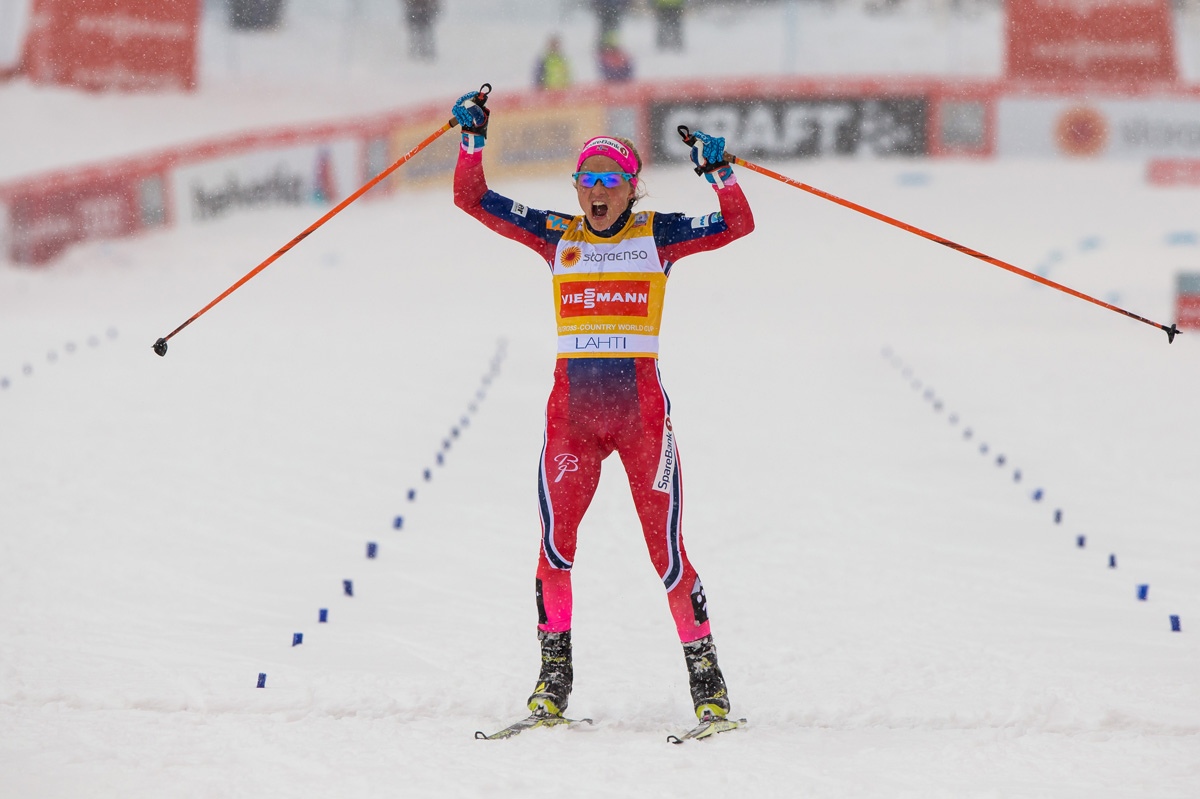
Norway’s Therese Johaug winning a 15 k skiathlon in Lahti, Finland, for her 15th World Cup victory during the 2015/2016 season. (Photo: Fischer/NordicFocus)
(“Totality of the circumstances” is a common legal phrase that means, well, exactly what those English words sound like. The emphasis is on everything going on in a case rather than on one thing in particular – a court is directed not to apply a single test to one part of a set of facts, but rather to consider everything that is going on when it makes its decision.)
Johaug’s arguments about her degree of fault
Johaug, through her lawyers, argued first that she had acted with no fault. (CAS opinion paragraphs 122-32.)
She argued, among other things, that she was contractually bound to follow her doctor’s advice, that she had suffered lip sores before and had no reason to suspect that treatment of the same issue would present any risk this time, and that it was very reasonable for her to believe that her doctor had done any necessary checks on the medicine’s legality in the ca. 24 hours that he had it in his possession before he passed it on to Johaug.
Johaug argued in the alternative that, even if she had acted with some degree of fault, it was so minimal that it should be classified as no significant fault rather than as anything more serious.
The difference between No Fault and No Significant Fault is hardly academic. The differing levels of culpability translate to vastly different potential suspension ranges.
If Johaug were able to establish that she bore no fault, then no suspension would be imposed. See WADA Code art. 10.4.
If, by contrast, she had even the relatively small amount of fault that rose to the level of no significant fault, then she faced a maximum suspension of two years, which could be reduced by no more than half, or down to one year. See WADA Code art. 10.2.1, 10.2.2, 10.5.2.
And this range (1-2 years) is down from a baseline suspension of four years, the presumptive range for an intentional anti-doping violation (everyone involved in this case agreed that this was not intentional). See WADA Code art. 10.2.1. As we all learned on the elementary school playground, intentions matter.
(And this will be visited later, but it’s also worth pointing out that the four-year baseline suspension was implemented in 2015; before then, intentional doping offenses earned a two-year suspension. Times change.)
FIS’s arguments about Johaug’s degree of fault
FIS had a different view of the significance of Johaug’s doctor’s involvement in this case, and of Johaug’s ability, or lack thereof, to delegate any portion of her anti-doping responsibilities to a third party. FIS highlighted several portions of Johaug’s contract with the Norwegian National Team that seemed to suggest that Johaug retained a personal duty to refrain from using substances that may violate WADA rules.
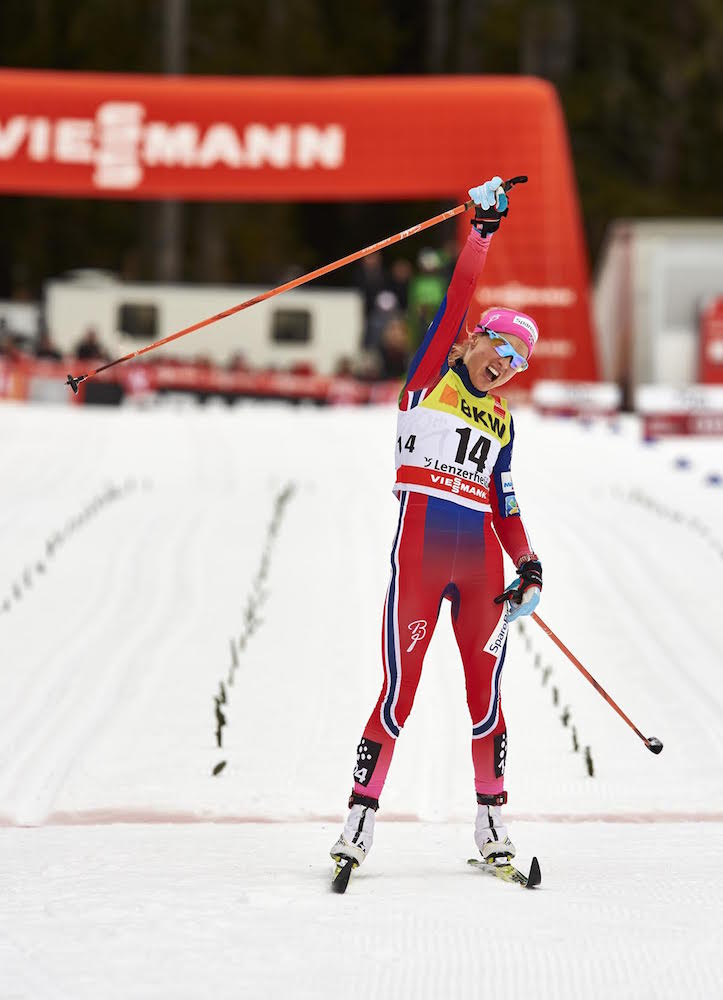
Norway’s Therese Johaug celebrates at the finish of the 15 k classic mass start in Lenzerheide, Switzerland. She won the race by nearly 38 seconds to take the lead in the 2016 Tour de Ski after the second stage. (Photo: Fischer/NordicFocus)
As FIS argued, “The duty of care to avoid doping is personal and remained with Ms Johaug at all times.” (para. 155) FIS continued, “The athlete’s personal duty of care may include asking a medically trained person about doping risks of a certain product, but that is only one of several precautions that must be observed. An athlete may not blindly rely on a doctor’s answer, especially when the doping risk is so obvious, as in the present case.” (para. 156)
FIS outlined several additional steps that it argued Johaug could have taken on her own, such as reviewing the patient information from the Trofodermin package, searching for information about this medicine online, or checking the active ingredients of Trofodermin against the WADA prohibited list. (para. 165) FIS also critiqued Johaug for not completing a required anti-doping education program until after this violation came to light. (para. 173)
FIS argued that Johaug’s culpability was in the middle range of No Significant Fault, meaning that a suspension of 16-20 months was appropriate. (para. 167-74)
The court’s decision about Johaug’s degree of fault
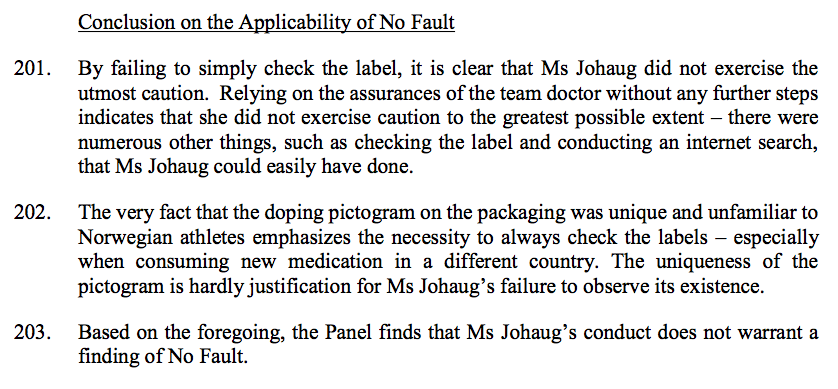
CAS ultimately found that Johaug had not acted with No Fault. In reference to the “utmost caution” standard in the WADA Code, discussed above, the court noted:
Excerpt from CAS decision in Therese Johaug case.
The court based this conclusion on several of its prior decisions, as applied to the facts of Johaug’s case.
For example, in one case, the athlete applied Trofodermin without checking its content; the CAS panel found that an athlete fails to fulfill his duty of diligence when he or she could have learned that a medicine contained a prohibited substance by reading its packaging or notice of use. In another case, the CAS underscored that an athlete has the personal responsibility to check assurances given by his or her doctor. And in many, many other cases, the court previously held that an athlete has a personal duty of care to comply with anti-doping regulations, and cannot delegate away those responsibilities to a third party such as a team doctor.
From a policy standpoint, the court observed: “The Panel remarks that if athletes were allowed to escape their personal duty by passing it on completely to an expert in anti-doping (such as a specifically qualified doctor), this could create a more advantageous position for wealthier athletes who have more resources to engage experts, leading to potentially unequal treatment in assessing compliance.” (para. 212)
What is the appropriate length of suspension within the established range?
The conclusion that Johaug had acted with no significant fault (or “NSF”) meant that the relevant suspension range was from 12 to 24 months. Within this range, the court made further distinctions as follows: “within the NSF category, a greater degree of fault may lead to a sanction of 20-24 months, a normal degree of fault may lead to a sanction of 16-20 months, and a light degree of fault may lead to 12-16 months.” (para. 208)
The court found that a normal degree of fault was present in this case, which made for a range of 16-20 months. The court ultimately imposed a suspension at the middle of this range, or 18 months. Johaug would not be going to the Olympics.
Tangent: About those Olympics, anyway
We’ll get to what the CAS considered in its decision in a second. But here’s something it officially did not consider: The fact that an 18-month suspension would keep Johaug out through the 2018 Winter Olympics, while a 13-month suspension would not. It begs credulity to suggest that the CAS panel was unaware of Johaug’s Olympic aspirations or the implications of this timing. But the 2018 Olympics appear nowhere in the court’s explanation of its reasoning, and were officially given no weight in its decision.
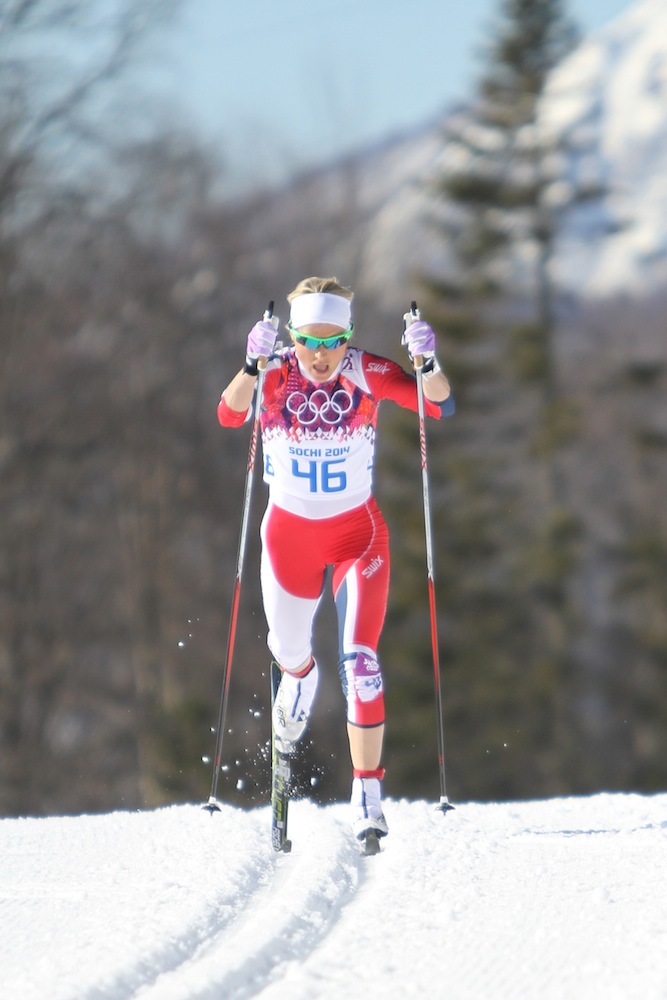
Norway’s Therese Johaug pushes for bronze in the women’s 10 k classic individual start at the 2014 Olympics in Sochi, Russia.
This is consonant with the WADA Code. The document makes clear that the determination of an appropriate suspension length should be an abstract one, free from considerations of the implications of a given suspension length: “the fact that the Athlete only has a short time left in his or her career, or the timing of the sporting calendar, would not be relevant factors to be considered in reducing the period of Ineligibility under Article 10.5.1 or 10.5.2.” (WADA Code App. 1)
Johaug’s attorneys were undeniably aware of issues surrounding the timing of the sporting calendar, and so understandably mentioned this in their appellate arguments. As the CAS summarized, Johaug argued in part that an extension of her suspension period past November 2017 “would negatively impact her chances [of] being selected for the Norwegian Olympic team due to the timing of the race season which starts in November. She explained the importance of the 2018 Olympics for her as she has never won a personal Olympic gold medal.” (para. 223)
But the CAS found that this was not a “relevant consideration[]” with respect to the appropriate sanction. (para. 224)
The court cited the WADA Code excerpt given three paragraphs above. It also noted a case from 2010 in which the CAS declined to consider the fact that a cyclist would have difficulty obtaining a contract with a professional cycling team during the 2011 season.
Back to the appropriate length of suspension
So what did the court consider? It adopted a suspension scheme from an earlier decision (a 2013 case involving Croatian tennis player Marin Čilić) suggesting that a “normal degree of fault” merited a sanction of 16-20 months. The panel, or at least a majority of it (that is, two out of three members), found that this range applied, “Given Ms Johaug’s overall circumstances.” (para. 208)
This conclusion was based in part on Johaug’s long experience as an international athlete subject to anti-doping protocols, including taking roughly 140 doping control tests. While the panel was sympathetic to Johaug’s lip injuries and training stress, the court found that she should have been aware of her personal requirements, and should not be allowed to completely delegate her duties to a team doctor.
Finally, the court considered, but ultimately rejected, Johaug’s argument that a longer suspension would be disproportionate. (The principle of proportionality, the notion that the punishment should fit the crime, is present in both “normal” criminal cases and in CAS cases involving suspensions from athletic competition.)
Specifically, the court noted Johaug’s claim that punishing her with a suspension of any length would be disproportionate to her fault in this instance, where she simply “did as all athletes are always told to do and as she was contractually obligated” by consulting with her doctor and following his advice.
But the court reiterated its conclusion that “athletes are required to perform their anti-doping obligations with utmost care, which in practice includes reading labels and packaging as a basic minimum. Further, delegation to a third-party, even to a highly qualified sports doctor, is not an acceptable justification.” (para. 220)
The court’s conclusion
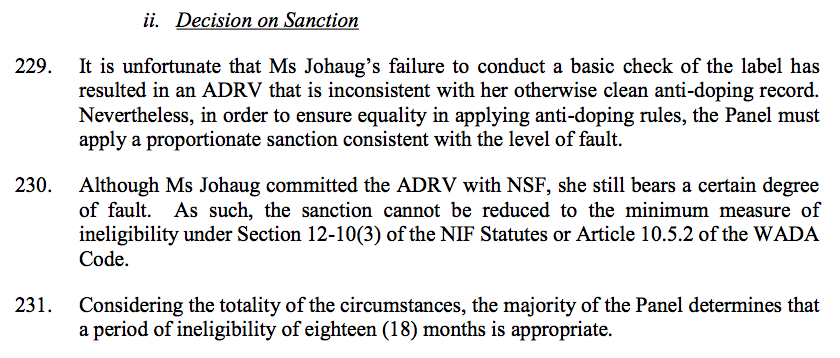
The final CAS decision reflects a direct application of the WADA Code and a concern for proportionality. As the court concluded:
Excerpt from CAS decision in Therese Johaug case.
(“ADRV” means “Anti-Doping Rule Violation.”)
The court’s conclusion analyzed
The most important determination in this case, legally speaking, was the conclusion that Johaug had acted with some fault, rather than with no fault. This took the no-suspension provisions of WADA Code Article 10.4 off the table, and meant that the best that Johaug and her lawyers could hope for was the one-half-reduction provisions of WADA Code Article 10.5.2.
Croatian tennis player Marin Čilić, shown here in 2012. (Photo: Wikimedia Commons)
Even within the 12- to 24-month range that was then applicable, the precedential value of the Čilić decision left Johaug’s lawyers with a tough row to hoe. As the Čilić opinion noted, with regard to objective elements of fault, an athlete should take particular care when it comes to the potential ingestion of substances that are prohibited at all times, as was the case here. The Čilić court also called for a higher duty of care when an athlete takes “a medicine designed for a therapeutic purpose,” on the ground that “medicines are known to have prohibited substances in them.” These facts obviously weigh against Johaug on the facts of her case.
The Čilić decision is potentially more helpful to Johaug when it comes to the subjective element of fault. It lists, for example, language or environmental problems and high levels of stress as mitigating factors, both of which seem favorably applicable to Johaug and her facts.
But the Čilić panel also noted that the objective element “should be foremost” in distinguishing between significant, normal, and light degrees of fault, with the subjective element then “used to move a particular athlete up or down within that category.” That is precisely what Johaug’s panel did; that took her to 16-20 months, and then to precisely the middle of that range, or 18 months, for a “standard” normal degree of fault.
Two final thoughts:
One, even with the exact same initial facts and subsequent legal conclusions, the outcome would have been different three years ago – the Čilić case actually discusses a “normal” fault range of 8-16 months, with a “standard” normal degree of fault meriting a suspension of 12 month. This is because, at the time, a possible sanction for someone in Johaug’s position was 0-24 months, not 12-24 months.
The increased lower end of the range reflects a revision to this part of the WADA Code effective January 1, 2015. Had all this occurred in the leadup to Sochi, a finding of no significant fault would have led to a suspension of not 18 months but rather 12 months, or obviously less than the 13 months that Anti-Doping Norway originally imposed in Johaug’s case. Revisions to laws (or, literally, to the World Anti-Doping Code) often mean that proportionality in sentencing exists synchronically, but not diachronically.
And two, everyone involved in this case – not only Johaug, but also the International Ski Federation that sought to see her suspension increased and the CAS panel that decided the case – agreed that the drugs in Johaug’s body were there inadvertently, that Johaug did not intend to cheat, and that she did not gain any competitive advantage from taking this substance. (para. 206)
And yet, once a finding of no fault was off the table, Johaug was subject to a suspension of at least 12 months, and as much as 24 months. Whether or not this seems like a fair and appropriate outcome, these facts and conclusion illustrate the implications of a strict liability scheme for doping violations.
* * *
Disclaimer: The analysis set forth in this article is intended as general news analysis rather than as specific legal advice. While the author is a licensed attorney and a member of the Bar of the State of Alaska, he gives legal advice only following an initial consultation and the formation of an attorney–client relationship. Anyone seeking legal advice specific to their situation is advised to consult with an attorney practicing in that field.
Norway’s Therese Johaug pushes for bronze in the women’s 10 k classic individual start at the 2014 Olympics in Sochi, Russia. Johaug will miss the 2018 Olympics because she used a prohibited substance in a lip cream.
The Court of Arbitration for Sport (CAS) has made its decision in the case of Norwegian cross-country skier Therese Johaug: “Ms Johaug is suspended for a period of 18 months commencing on 18 October 2016.”
That means that Johaug, a seven-time World Champion and a member of the Norwegian gold-medal relay team at the 2010 Olympics, will not be competing at the 2018 Olympics in PyeongChang, South Korea.
The decision comes after a long process. Johaug initially tested positive for the steroid clostebol in 2016. She said that she had used a lip cream, trofodermin, to treat a cold sore which was made worse by a sunburn sustained at a high-altitude training camp. A team doctor, Fredrik Bendiksen, had picked up the cream at an Italian pharmacy. Neither he nor Johaug apparently checked the list of ingredients against the World Anti-Doping Agency (WADA) Prohibited List, but Johaug trusted Bendiksen’s assertion that the cream did not contain any banned drugs.
That was a mistake: regardless of intent, the WADA Code mandates a zero-tolerance policy in which the athlete is responsible for any substance in their body, whether taken intentionally or not.
(In theory, this is designed with two applications: to prevent intentional dopers from getting away with cheating by claiming accidental ingestion of a substance, and also to cause athletes to carefully monitor every substance used to prevent unintentional but effective performance enhancement.)
The initial round of sanctions were delivered by the Norwegian Olympic Committee, which handed Johaug a 13-month suspension. The International Ski Federation (FIS) appealed the decision, seeking a longer suspension.
CAS agreed, noting in its decision that “Johaug used a cream (Trofodermin) purchased for her by a team doctor in Italy to treat acute sunburn on her lips. The active ingredients listed on the packaging included Clostebol acetate (0.5%), an anabolic agent listed on the World Anti-Doping Agency (WADA) Prohibited List and banned at all times, in and out of competition.”
CAS represents the final level, the Supreme Court if you will, of sports arbitration bodies, giving this decision a finality that the Norwegian Olympic Committee decision lacked.
The standard suspension for a first-time doping offense, according to WADA, is four years. CAS set Johaug’s suspension at 18 months due to “non-significant fault” by the athlete. The CAS panel of three arbiters agreed unanimously that Johaug must be suspended between 12 and 24 months, consistent with the type of fault, and also agreed that 18 months – the middle of that range – was the most appropriate length for a ban in this case.
“FIS is satisfied that an independent body had the opportunity to review all of the facts of this case and render an impartial verdict, which was the reason for FIS filing the appeal to CAS,” the ski federation said in a press release. “This ensured that a fair and just decision for all parties could be determined in this case.”
The CAS decision is already provoking strong reactions. The scandal was trending on Twitter in multiple nordic countries in the hours after the verdict was published.
A few observers saw the decision as harsh but fair. The World Anti-Doping Code contains very relevant provisions about the responsibilities of an athlete: “to take responsibility, in the context of anti-doping, for what they ingest and use,” and “to take responsibility to make sure that any medical treatment received does not violate anti-doping policies and rules adopted pursuant to the Code.”
Others saw it as patently unfair: a decision which lengthened and made worse an already unfair punishment for an honest mistake. That’s certainly the reaction Johaug had.
“I cannot understand the punishment I get,” Johaug said in a press conference Tuesday, according to a translation. “I think it is unfair.I am treated unfairly.”
“When the decision states that [the use of clostebol] is not a matter of cheating but an error, 18 months seems to be incomprehensible and disproportionate,” Johaug’s lawyer Christian Hjort said.
“I’m disheartened that Therese has to pay such a high price in a case where she [and her story] are believed in every respect,” Johaug’s teammate Marit Bjørgen told Norwegian media, according to a translation. “The length of the suspension is deeply unfair.”
And to yet other observers, it was seen as a correction to a 13-month ban that would have very conveniently let Johaug return to competition just before the Olympics. While one- or two-month suspensions are common for shorter bans, longer suspensions are most usually carved into divisions of six months or even a year. A 12-, 18-, or 24-month ban is common, but a 13-month ban would have been an odd-numbered anomaly.
Johaug has been training hard during her suspension, albeit away from the national team. Part of that effort was a major training camp in Aspen, Colorado.
https://www.instagram.com/p/BWxXkzdhWuv/
Johaug’s training was directed toward the 2018 Olympics, but now it looks like her comeback will be for the 2019 season and its World Championships in Seefeld, Austria.
“I have a dream of being on the starting line again,” she said.
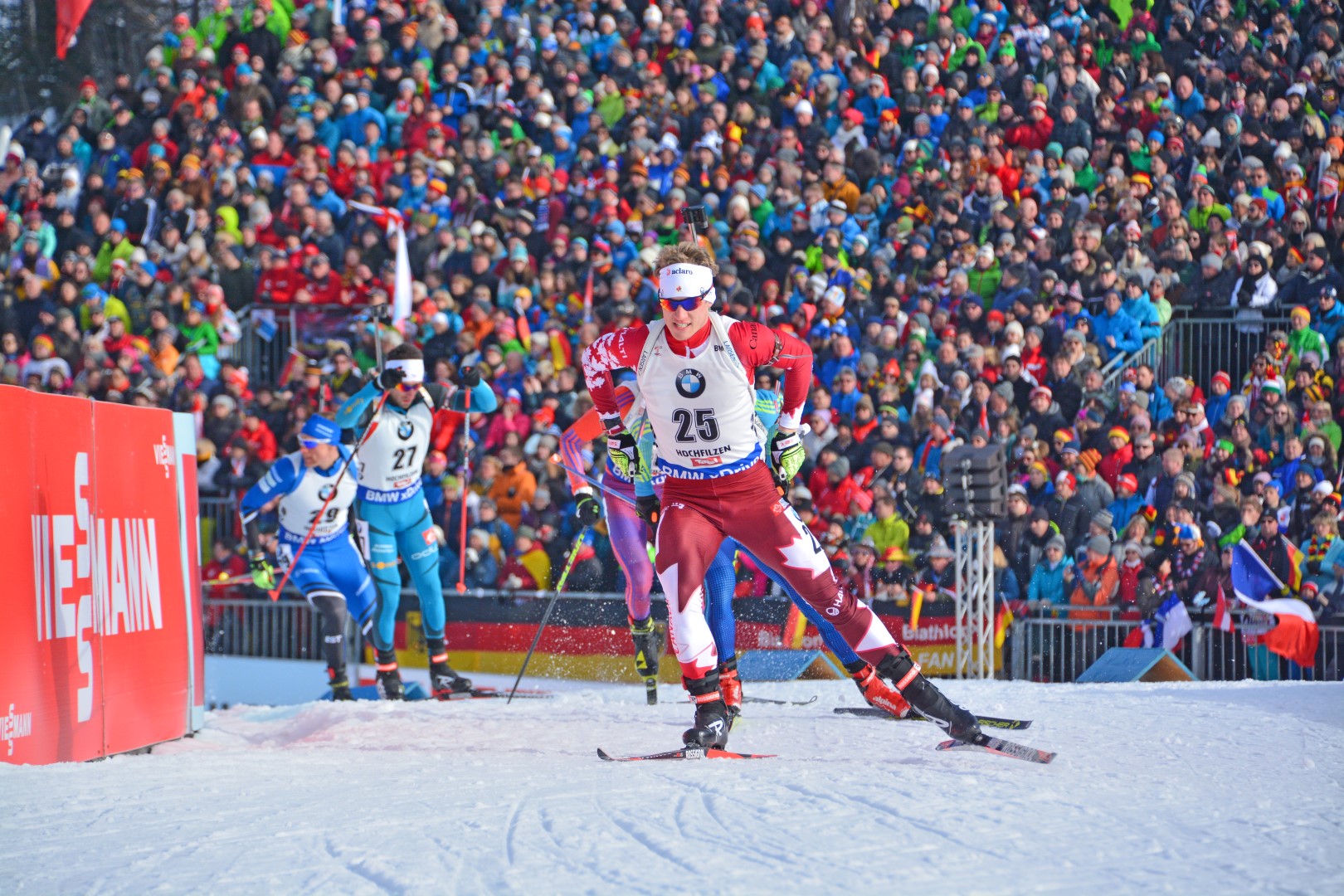
Biathlon Canada’s Scott Gow racing to 47th in the men’s 12.5 k pursuit at 2017 IBU World Championships in Hochfilzen, Austria. Biathlon Canada is facing a tightening of purse strings for the 2018 Olympic season as Own The Podium cut its base funding to zero. (Photo: Glen Crawford)
If you made it past the article’s title, then get ready to immerse yourself in the intricacies of Canadian high-performance sports funding.
OK, here it goes…money, money, money. Add this for effect, $.
Imagine for a moment you’re the CEO of a national sporting body and you’ve got high aspirations — things like championship and Olympic medals. There’s an infinite amount of puzzle pieces to organize and assemble. There are two critical pieces to even fathom success: the motivated athletes-coaches combo along with ample funding.
Biathlon Canada finds itself in a precarious position for the 2017/2018 season— a critical year considering that many athletes sharpied in the 2018 Winter Olympics in PyeongChang, South Korea, in mid-February as their performance peak just after the 2014 Sochi Olympiad.
The financial hammer fell in May when Own The Podium (OTP), a Canadian nonprofit focused on supporting Olympic medal contenders, cut its base funding to Biathlon Canada to zero dollars. ((Biathlon Canada is the National Sporting Organization (NSO) overseeing biathlon in Canada.))
Andy Holmwood, Biathlon Canada’s general manager (Photo: Pam Doyle)
During the final run-up to PyeongChang, Biathlon Canada must belt-tighten and evolve in a climate of continued funding scarcity. At the time of publication, the exact amount of Biathlon Canada’s budget was unclear despite a request to Biathlon Canada General Manager Andy Holmwood to confirm his organization’s 2017/2018 budget.
“I am not in a position to discuss any of our budget numbers,” Holmwood said in a phone interview on July 11th.
Biathlon Canada receives the majority of its funding from three major sources. There’s Sport Canada, a government agency providing funds to NSO’s through its Sport Support Program. Jon Schofield, a Sport Canada spokesperson and media-relations specialist, explained to FasterSkier in an email that Sport Support Funding is for a four-year cycle.
Then there are corporate and private donations made directly to Biathlon Canada.
Lastly, there’s funding from Own The Podium (OTP). According to Schofield, OTP makes the recommendations upon which other groups base their monetary support.
“Those sports that have athletes which have demonstrated the potential to achieve a podium result at the Olympics and Paralympics, are also eligible for enhanced excellence support,” Schofield wrote in an email. “The assessment of podium potential is done yearly by Own the Podium which provides funding recommendations to Sport Canada, the Canadian Olympic Committee and the Canadian Paralympic Committee – (the two latter) which in turn support the sports directly.”
It can be tricky and frustrating. Biathlon Canada is in a constant struggle to promote and financially support athletes who have already arrived while keeping promising athletes in the development pipeline.
The OTP Ask
Here’s how the basics work between OTP and Biathlon Canada. The NSO, or Biathlon Canada in this case, presents its supporting evidence — in both a formal proposal and in-person meeting — that its athletes have Olympic medal potential. OTP officials then recommend funding based on their assessment of the submitted evidence.
OTP funding is considered to be “top-up” funding, or monies for athletes at the very highest level of their respective sport. Amongst the high-performance scene in Canada, the philosophy of emphasizing those athletes already at the top is referred to “targeted excellence”. In total, OTP redistributes approximately $64 million annually. To put that in perspective, that $64 million is part of the larger $200 million the government invest in Canadian sport annually.
Anne Merklinger, Own The Podium chief executive officer (Photo: OTP)
“Our mandate, which is prescribed by the national funding partners, is to provide technical advice for National Sport Organizations and to provide investment recommendations for those sports organizations that have evidence of medal potential for the upcoming set of Games,” Anne Merklinger, OTP chief executive officer, said in a phone interview. “Secondly, we also provide investment recommendations for the subsequent set of Games, so in winter that would be for 2022. So those investment recommendations are being considered by the minister and they are not final yet.”
According to Holmwood, Biathlon Canada presented a portfolio highlighting the medal potential of its men’s relay team.
“I think we made a strong case for our men’s relay team as a medal hopeful,” Holmwood said. “I think it’s fair to say they didn’t agree with us completely. They didn’t share that perception. It is clear that OTP in an Olympic year, they refer to sharpening their pencils and really focusing the funding on strong medal contenders. In their eyes, we did not fit in that.”
Two seasons ago, the men’s relay team earned a historic bronze medal at 2016 International Biathlon Union (IBU) World Championships in Oslo, Norway. Last season, their best finish was seventh at the World Cup in PyeongChang, South Korea, where many nations did not start all of their top athletes. (More on last season’s results later.)
“Their base funding for ’17-’18 is zero,” Merklinger said about OTP’s funding for Biathlon Canada. “But they are receiving $50,000 for the coaching position … to support a coach through the Olympic Legacy Coaching Fund. So that is the extent of the funding recommendation for biathlon for the ’17-’18 fiscal year.”
Starting at the top of Canada’s biathlon pyramid, the collective gasp came at the depth of the cuts, not that OTP cuts were made.
“OTP takes a very actuarial approach,” Holmwood said. “It’s not subjective. And to their credit, they are very clear in their mandate. It’s not a big massive surprise. I think what surprised us was just how deep the cut went.”
Roddy Ward, Biathlon Canada high-performance director (Photo: Ric Rowan)
“In the end, it seems as though they believe we have some up-and-coming athletes but no medal prospect for 2018 Olympics,” Ward said. “By their mandate, it means we get cut out of the pot of money for the Olympic season. I don’t doubt they followed through with their mandate, but ultimately, decisions like that undermine growth towards consistent podiums in our sport.”
Ward has a point about diminished funding decreasing the odds of future podiums. But OTP’s mandate only looks to a two-Olympic cycle “event horizon”. At the moment, OTP is not obligated to look further than Beijing 2022.
OTP publishes what it calls a Winter Historical Comparison on it’s website. It outlines OTP funding recommendations for Olympic winter sports by quadrennial. For the Vancouver quadrennial, Biathlon Canada received $1,784,173. It received $1,324,623 for the Sochi quadrennial.
According to Merklinger, for the ’14-’15 fiscal year, Biathlon’s base funding from OTP was $250,000, $400,000 for ’15-’16 and $435,000 for the ’16-’17 fiscal year. Accounting for the ’17-’18 cuts, and adding the $50,000 from the coaching legacy fund, the PyeongChang quadrennial total for Biathlon amounts to $1,135,000.
(On OTP’s website, a figure of $1,200,000 is used for the first three years of the PyeongChang quadrennial. Using that figure, an amount of $1,250,000 would have been recommended for Biathlon during the PyeongChang quad.)
Although Merklinger was clear in explaining to FasterSkier that Biathlon Canada’s base funding was “zero”, Holmwood said this about OTP’s potential allocations: “Our OTP funding for this coming season is uncertain. It is fair to say, I would say that we have received a substantial cut, but just what we will be getting from OTP is not certain.”
OTP’s Merklinger said the funding door as it applies to the medal potential of Canada’s national biathlon team isn’t exactly slammed shut. OTP maintains the administrative flexibility to infuse money into a high-performance program on short term notice.
“We can do that from today until the start of the Olympic Games,” Merklinger said when asked if OTP could recognize medal potential with monetary support if an athlete or team proves they are on form in races scheduled a few months before the Games. “We are eager to work with biathlon as the season unfolds to assess the progress of their preparations and their performance for PyeongChang and would be delighted to be in a position where we could provide a very specific incremental funding recommendation that is focused and that responds to a positive side of the program and indicates that they indeed have evidence of medal potential.”
The Potential
Medal potential is exactly that — potential. There are no absolutes. Although actuarial means may be used to determine the likelihood for an Olympic medal, sport is fickle.
Take biathlon, for example. There’s the shooting range and wind conditions, the rifle and its complex moving parts, the wax, the skis, and of course the athlete. The number crunching for potential would have to consider the likelihood of all things aligning for a Canadian athlete and the likelihood a veritable podium lock, like France’s Martin Fourcade, has an unlikely off-day. No matter where the OTP assessment falls, OTP’s job is a tough one — determining the likelihood of an event before that event transpires and basing its funding decisions on that likelihood.
The Canadian men’s team (from left to right) Christian Gow, Nathan Smith, Scott Gow, and Brendan Green celebrating bronze in the men’s 4 x 7.5 k relay at 2016 World Championships in Oslo, Norway. (Photo: JoJo Baldus)
One wouldn’t need to be transported back far in time to underscore Biathlon Canada’s positive medal potential. For starters, the time machine’s date could be set to March 12, 2016. In the pressure cooker of Oslo’s Holmenkollen stadium, Canadian biathletes Christian Gow, Nathan Smith, Scott Gow, and Brendan Green claimed bronze in the World Championships relay.
The past season was a down year for Canadian biathlon. Smith, the team’s highest-profile male skier, was sidelined for much of the season while he battled a virus. Brendan Green, another veteran with multiple top 10’s to his name, scored a single top-30 World Cup result in 2016/2017. Meanwhile, Scott Gow raced to three top 30’s, earning 23rd, 18th, and 17th places on the World Cup.
On the women’s side, Rosanna Crawford had been the team’s rising star, earning fourth-, fifth- and seventh-place finishes on the World Cup during the 2014/2015 season; she also placed 15th at 2016 Oslo World Champs in the 12.5 k mass start. Individually, Crawford scored six World Cup top 30’s this past season with a best result of 19th at the PyeongChang test event. She placed 26th in this year’s World Championship sprint.
As has been written before about Biathlon Canada’s tenuous funding, OTP considers medal potential at World Championships and Olympics. It’s not obligated to consider stand alone results on the World Cup circuit when making those judgments. So performance on the big stage matters.
In recent years, it has been rumored that Biathlon Canada has run a deficit.
“Biathlon Canada has always kind of operated in the red,” Crawford said in a phone interview.
It’s possible that the prospect of programmatic cuts due to the NSO’s financial standing wasn’t unforeseen. According to a February 2015 article in The Crag and Canyon out of Canmore, Biathlon Canada will maintain the same annual expenditures through 2018. In that article, that reporter states that Biathlon Canada’s annual budget is $1.4 million. This number reflects the NSO’s total budget, not the portion set aside for funding the high-performance program.
With a lack of substantial OTP support this year, Biathlon Canada is implementing a high-performance austerity program during the training season.
“We must move on and do our best to deliver on our results despite the massive cuts,” Ward said. “We have virtually cut everywhere; no funded camps, reduced IST (physiologist, strength coach, nutrition, sport psych etc), less staff, athletes will pay to compete on the World Cup. We are doing our very best to build a solid program for our National Team with limited resources, this means an ‘all hands on deck’ approach by staff. I can tell you staff are extremely motivated so in some way, it’s very exciting to be a part of and could be the perfect storm for us.”
Canada’s high-performance biathletes are accustomed to traveling for training camps. Athletes have experienced on-snow training camps in New Zealand, Park City, Utah camps, dryland racing and training in Jericho, Vermont, Haig glacier camps in the Canadian Rockies, as well as a Jasper, Canada camp. Other camps have included a Dachstein glacier camp and training in Norway. This dryland season will be more restrictive. According to Crawford, the women’s team traveled and trained in Kelowna, British Columbia, where costs were minimized: Ransom’s parents housed the team, and a sponsor donated funds for groceries.
Rosanna Crawford (Biathlon Canada) racing to 26th in the women’s 7.5 k sprint at 2017 IBU World Championships in Hochfilzen, Austria. (Photo: Glen Crawford)
Crawford also wrote in an email that both the men’s and women’s team will be spending two to three nights on the Haig glacier outside of Canmore later this summer, and Christian and Scott Gow will be attending a self-funded Park City camp.
“The majority of the cuts we have seen have been in those extensive trips, or out of country trips, maybe more precisely,” Holmwood said. “We were thinking of going to Jericho in August, but we removed that simply because the cost is pretty high. Our dollar is not strong right now, also. The U.S. is not typically a place we need to go to.”
New terrain, opportunities to thwart dryland-season staleness, and exposure to different athletes are value added aspects of training camps. Crawford, who is based in Canmore, home of Biathlon Canada and a world-class biathlon training facility, said the lack of camps are a setback, but not a season-killer.
“In some ways, it’s fuel for the fire, like, ‘We’re gonna show you’,” she said. “We don’t have to travel, we can do really good recovery, everyone can be with their significant others, and the coaches get to spend more time with their families so maybe they’ll be less likely to get burnt out in the winter. So I think we’re all just trying to find the positives from this scenario.”
With an important competition year looming, Crawford explained the real compromise may come if the funding limitations impact service on the international competition circuit.
“Truly I don’t think this summer is going to be the hard part. I have complete faith in our coaches and Jess Kryski, who’s our physiologist, that they know exactly what to do with us to get us nice and strong,” she said. “It’s more the concerns around the wintertime of how many wax techs we’re going to have, whether we’ll have massage therapists, whether athletes will have to pay to go and race. I think those are some of my bigger concerns.”
Holmwood stated that when snow flies and athletes toe the line internationally, the financial gut-shot will not impact athlete support.
“The key theme is that we are tightening our belts primarily with regard to camps,” Holmwood continued. “But come World Cup season, IBU Cup season, we will be supporting teams to the extent that we have in the past, and we will give them the resources they need to succeed.”
The Financial Seesaw and Its Cost: Reforms Coming
In 2010, Biathlon Canada’s charitable status was called into question and ultimately rescinded by the Canada Revenue Agency. Prior to the ruling, Biathlon Canada could issue tax receipts for donations. That’s no longer the case. As a result, corporate and individual donors must be compelled to contribute funds based on Biathlon Canada’s marketing exposure or simply the gift of giving.
Without the possibility of issuing tax receipts as a nonprofit, Biathlon Canada finds itself with hands wide open without a tax deduction incentive to attract corporate sponsors.
It appears Biathlon Canada has come to rely on OTP funding for its elite level athletes, despite the fact that in the Canadian sports system this funding is supposed to be a “top-up”.
“OTP makes up the bulk of the funding for the National Team and our winter competitive tours so it hit our National Team budget hard,” Ward said.
Exposed with OTP’s lack of funding is the cost of relying on a single source to meet the financial demands of running a NSO of a niche sport. The money is hard to come by.
Yet high-performance athletes in Canada have direct support from Sport Canada through what is called the Athlete Assistance Program (AAP). The requirements for athlete support through Sport Canada are different than OTP’s medal-driven approach.
“Support is provided yearly to those athletes whose sport has identified them either being or having the potential for a top 16 result in the world,” wrote Schofield, of Sport Canada. “Each sport has a number of stipends that they have access to, based on previous results and future potential.”
AAP qualifying athletes are considered “carded” athletes. Carded athletes receive a monthly check from the government to help offset living expenses while they train with the end goal of representing Canada at the Olympics or international competitions. Since 2004, $1,500 was the maximum monthly stipend an athlete could receive. As of this March, the federal funding for the AAP was increased 18 percent — eligible athletes can now receive up to $1,770 per month.
Here’s the verbiage straight from the AAP website: “AAP support seeks to relieve some of the financial pressures associated with preparing for and participating in international sport and assists high-performance Canadian athletes to combine their sport and academic or working careers while training intensively in pursuit of world-class performances.”
It remains to be seen if carded biathletes must use their monthly check for training necessities and sport recovery rather than rent or mortgage and food.
“We’ll still get the same,” Crawford said when asked if the OTP cut would impact the team’s carded athletes. “Each individual athlete will still get the same amount of money they’ve been getting in the past years from the government. Of course, it’s great for us to have funding, but it would be better if Biathlon Canada could also have a big funding partner so that we could do training camps and stuff like that, and the money we that we get could go toward groceries and the high cost of living in Canmore.”
As with the government’s intent to increase the maximum allotment to its carded athletes to compensate for a long overdue adjustment for inflation, reform minded stakeholders in government and the NSO’s should see changes to how the OTP “targeted excellence” philosophy is implemented.
Almost exactly a month ago, a report titled “Review of Sport Canada’s Targeted Excellence Approach,” was released on June 22. Essentially, the 72-page report highlights the underlying success of OTP — it has helped produce more Canadian Olympic medals — but also reports on findings that call for systemic change.
One of the main concerns raised in the report was that OTP funding decisions are made annually. The negative consequence for NSO’s and athletes is that a climate of instability persists in some sports when funding remains questionable from year to year. When cuts occur, it can leave less financially nimble NSO’s too little time to pick up the funding slack. And potential corporate sponsors shy away from longer-term sports sponsorships when defunding or deep cuts from OTP remain an ongoing possibility.
The report does suggest a model premised on funding obligations longer than a single year.
And for those in nordic sport concerned about the development pipeline, the report makes requests for a greater emphasis on longer-term funding. A common critique of OTP, as featured in a Nordic Nation podcast, is that investments in what in Canada is referred to as the “NextGen”, or up and coming athletes, are lacking.
Here’s a major concern: The medal bounty OTP has helped Canada haul in since the 2010 Vancouver Games could be a well that’s drying up. Without investing in developing its younger athletes, medal famine may be the new norm.
The Government of Canada mentioned in its April 2015 budget that increased monies for athlete development — the so called “NextGen” — would be forthcoming. The report released on June 22 recommends the following strategy when it comes to emerging athletes and allocating funds: “The current targeted approach should not be used with younger athletes deep in the ‘pipeline’. Instead, an approach that favoured focusing on training groups and larger numbers was recommended.”
For now, the brutal funding cycle continues for Canada’s biathletes and high-performance support team as feast and famine remain the backdrop to a strict definition of high-performance success: medals. The return on investment in the near term for all the stakeholders might be a zero-sum game, and in that case, who wins?
US Biathlon’s Lowell Bailey and his daughter Ophelia getting her first biathlon training experience at one week old in Lake Placid, N.Y. (Photo: Erika Bailey)
After immersing himself in skiing for the last 25 years, Lowell Bailey, a US Biathlon team veteran, is well practiced in the art of mid-afternoon naps between training sessions. A little over a month ago, however, his naps have taken on a new meaning. Midday naps no longer mean he curls up under a blanket in bed or on the couch to watch television until he falls asleep. Instead, for the past six weeks, Bailey falls asleep while watching his one month-old daughter, Ophelia Jane Bailey, fall asleep on him.
“One of my favorite things is she really likes sleeping on either [my wife’s or my] chest and the feeling of having an infant just totally fall asleep on you, like completely passed out, there’s just nothing like it,” Bailey said recently on the phone.
Bailey and his wife, Erika, who have been friends since elementary school and were married a year ago, have already introduced Ophelia to the norms of nordic skiing, including outdoor adventures and the paved path of Lake Placid’s rollerski loop.
US Biathlon’s Lowell Bailey (c) his wife, Erika, daughter, Ophelia, and dog, Hazel (Photo: Erika Bailey)
“We took her out on the rollerski loop the other day and introduced her to the biathlon loop,” said Bailey, 35, who’s lived in Lake Placid since he was 10. “My wife Erika and I, we’ve tried to introduce her to as many Adirondack outdoors experiences as we can, so we’ve taken her out to the lake and on hiking trails.”
In terms of training this season, not much will change for Bailey other than his decision to stay closer to home. This year, Bailey opted to skip the US Biathlon’s annual European training camp, taking place in Ruhpolding and Oberhof, Germany from Aug. 21 to Sept. 11. Rather than travel abroad during those dates, Bailey will remain in Lake Placid and train at the local venues with the US Biathlon Development Team.
“We have great training venues and training opportunities [in Lake Placid], so it’s not really a sacrifice other than the fact that I don’t get to go to Europe and train on some of the other world-class venues out there,” Bailey explained.
While expressing his gratitude for his trainers, coaches and manager for helping him with the transition to parenthood while simultaneously remaining committed to his training, it’s the one closest to Bailey who has enabled him to continually pursue his athletic ambitions.
US Biathlon’s Lowell Bailey and his daughter Ophelia. (Photo: Erika Bailey)
“The biggest person that I can thank is my wife Erika because you know, as much as I’d like to think I’m doing a lot of the work, she’s really been there for Ophelia and for me and allowed me to do the training that I need to do,” Bailey said of his wife, who is currently on maternity leave from her job with a nature conservancy.
Bailey plans to stay on the (International Biathlon Union) IBU World Cup circuit all season long, and may have the opportunity to have his daughter on the sidelines watching him race.
“At this point, we anticipate that Erika and Ophelia will be able to come over to Europe for some of the world cups,” Bailey wrote in an email.
Part of his motivation to continue with his training and biathlon career involves the potential he sees for the U.S. at international levels of competition as well as the 2018 Olympic Games in PyeongChang, South Korea.
“I think US Biathlon is at an unprecedented level right now internationally,” Bailey said. “We’re more competitive than we’ve ever been and it’s so exciting to be a part of the National team right now. [Our] potential as a four-man relay team, I think everyone is pretty excited to get to the season and see what we can do. I mean, we were within seconds last year of the podium in the relays on multiple occasions. That’s a big goal and focus of mine looking forward to this season.”
On top of focusing on relay podiums this season, 2017 World Championships in Austria, and the 2018 Olympics — all while also remaining a dedicated dad to his baby daughter — this year, Bailey is an active member of the Bridger Biathlon Club (BBC) Board of Directors. Late this spring, a few members from the BBC, based in Bozeman, Mont., approached Bailey about joining their nonprofit and Bailey agreed.
“Seeing the US Biathlon Team, the success that I’ve witnessed from the men and women of the national team over the last ten years and the progression from really a no-name nation to one of the top nations in biathlon, as that has occurred I’ve become more and more interested in what the what happens after this current crop of national team athletes retires,” Bailey said. “Susan Dunklee, Tim Burke, you know these are people that have contributed a huge amount to the progress and success of US Biathlon. So the question for me has become, how do we maintain and build on that?”
“We’re more competitive than we’ve ever been and it’s so exciting to be a part of the National team right now. … I think everyone is pretty excited to get to the season and see what we can do.” — US Biathlon’s Lowell Bailey
US Biathlete Lowell Bailey and his daughter Ophelia. (Photo: Erika Bailey)
With a connection to US Biathlon’s staff and resources, Bailey hopes that his work with local clubs like the BBC will promote and empower youth into the sport and further build upon the success the program has had over the past few years. He plans to travel to Bozeman in August to meet with fellow board members for the first time and expects to return once or twice more this year.
“I’m trying to help with the communication between US biathlon and a local club like Bridger Biathlon,” he said. “The youth stage is one of the most important stages and I think it’s critical that kids get a balance, or that they witness a balance, of something that’s fun, but also hard work and challenging … Whether they go on to be Olympians or healthy empowered individuals in their communities, I don’t see any downside to it.”
Training for international levels of competition, the Olympics, alongside being a father and acting as a liaison between US Biathlon and local biathlon clubs like the BBC makes for a busy schedule, which begs the question, how does the new dad handle it all? According to Bailey, one word: balance.
“I think it’s all about balance and I think the key to it is I love everything that I’m doing,” he said. “I feel very fortunate to have all of these aspects of my life and all of these things in my life. So then it becomes less like work and more like fulfillment.”
L.L. Bean and Craft announced a multi-year partnership with the U.S. Cross Country and Nordic Combined teams on Tuesday, March 31. (Courtesy photo)
L.L.Bean and CRAFT to design and develop
new technical and active outerwear for the
U.S. Cross Country and Nordic Combined Ski Teams
FREEPORT, ME. and BEVERLY, MA (March 31, 2015) — L.L.Bean, a leading outdoor equipment and apparel designer and merchant and CRAFT Sportswear North America, renowned for its cutting edge technology in world class competition and training wear, today announced a multi-year partnership with the U.S. Cross Country Ski Team and U.S. Nordic Combined Ski Team.
(Photo: L.L. Bean/Craft)
As official supplier to the U.S. Ski Team, L.L.Bean will provide insulated outerwear and rainwear, as well as casual products and hats. CRAFT will develop customized World Cup and Olympic race suits and performance jackets and pants. Both companies will share responsibility for summer training products and base layers.
“We are absolutely thrilled and honored to be an official sponsor of the U.S. Ski Team,” says Eric Schenker, CEO of CRAFT Sportswear North America. “It fires me up to think that Team USA will now join Sweden and other top national teams in representing the CRAFT Sportswear brand on the World Cup and Olympic stage. This confirms that we are producing the world’s most technical and functional apparel and will continue to grow and reinforce this by working closely with these amazing athletes and L.L.Bean.”
The U.S Nordic Ski Team has historically posted strong performances on World Cup and World Championship circuits. Caitlin Gregg and Jessie Diggins took home silver and bronze medals in the 10K freestyle at this year’s FIS Nordic Ski World Championships in Falun, Sweden. Nordic combined skier Bryan Fletcher scored a personal best at Falun 2015, finishing fifth in the large hill event. Several of the athletes have multiple World Cup podiums, World Championship medals and Olympic medals, including Olympic Champion Billy Demong and 13-time World Cup winner Kikkan Randall.
(Photo: L.L. Bean/Craft)
L.L.Bean has been partnering with Randall, the most decorated cross country skier in U.S. history, for the past two years. “At the urging of Kikkan, the U.S. Ski Team reached out to L.L.Bean to further this partnership with the entire team,” said Steve Fuller, L.L.Bean Chief Marketing Officer. “This is great recognition of our quality outdoor products as well as our mission to get more kids and families outdoors and active.”
“It’s been great working with L.L.Bean and their development team,” said Randall. “They’ve been really responsive to feedback on products from athletes. Product performance and design is an important aspect of our sport, so we’re lucky to have such great products available through L.L.Bean.”
“When given the chance to partner on this sponsorship with L.L.Bean, the decision was easy,” Schenker said. “CRAFT and L.L.Bean have worked together for over a decade and this will only strengthen that bond. Cross country skiing is in the DNA of our brands and together we will be able to support the athletes with the best possible products from every category.”
The partnership between L.L.Bean, CRAFT and the U.S. Ski Team will continue through the 2018 Olympic season.
The combination of the two iconic companies is ideal for the cross country team,” said U.S. Ski Team head cross country coach Chris Grover. “An important part of the athletes’ success on the track depends on the performance of their uniform. With L.L.Bean and CRAFT, we get the experience, the know-how, and the high-end performance that we need to make sure the athletes can ski to their potential. We have big goals in place for Pyeongchang 2018 and L.L.Bean and CRAFT will be important partners in helping us achieve those goals.”
L.L. Bean and Craft announced a multi-year partnership with the U.S. Cross Country and Nordic Combined teams on Tuesday, March 31. (Courtesy photo)
About L.L.Bean, Inc.
L.L.Bean, Inc. is a leading multi-channel merchant of quality outdoor gear and apparel. Founded in 1912 by Leon Leonwood Bean, the company began as a one-room operation selling a single product, the Maine Hunting Shoe. While its business has grown substantially, the company remains committed to the same honest principles upon which it was built – a focus on the customer, continuous product improvement and innovation, respect for people, preservation of the natural environment and a 100% satisfaction guarantee. L.L.Bean products are rigorously tested, guaranteed to last and always shipped free. The 220,000 sq. ft. Flagship campus of stores in Freeport, Maine is open 24 hours a day, 365 days a year and welcomes more than three million visitors each year. L.L.Bean can be found worldwide at llbean.com. Join L.L.Bean on Facebook, Twitter and YouTube.
About CRAFT
CRAFT is the pioneer of functional apparel for serious athletes. Since 1977 CRAFT has devoted itself to developing innovative clothing built to withstand extreme weather in all conditions. CRAFT works closely with its many sponsored athletes and national teams, and focuses on designing the highest performance gear. The brand’s foundation is its authentic understanding and love for the sporting culture, reflected in its strong involvement in cross-country skiing, biking, running and alpine skiing. Constantly working on optimizing construction technologies and innovative materials, CRAFT sportswear is the ideal training and competition gear for all activities year-round. For more information on CRAFT in North America, visit www.craftsports.us.
About U.S. Ski Team
The U.S. Ski Team, as part of the U.S. Ski and Snowboard Association (USSA), develops and maintains teams of world-class athletes for national and international competition, including the Olympic Winter Games. The U.S. Ski Team selects teams in all sports for major events such as the Olympics and World Championships as well as annual teams in many Olympic disciplines. The U.S. Ski Team coordinates nationwide development and elite programs for all competitive skiing sports while maintaining a strong adherence to core values. For more information, visit http://usskiteam.com/nordic
The biathlon and cross country venues at the Alpensia Nordic center for the 2018 Olympic Games in PyeongChang. The photo is taken from the top of the ski jumps. Photo: Tom Holland (CCC).
With the experience of Sochi, Russia, seven months in the rearview mirror, the Canadian Olympic Committee recently sent the High Performance Directors of its winter-sports teams to check in on PyeongChang, South Korea, to scout out the 2018 Olympic venues.
“It’s a very beautiful area,” Cross Country Canada’s Tom Holland told FasterSkier. “It’s not, like, rock-type mountains, but it’s very hilly and very pretty… It’s a more simple Games. They won’t be spending $52 billion, but they will have to do a little work.”
The group visited the coastal and mountain clusters, and Holland said that one big difference he noticed immediately was how close everything in the mountain cluster was to its center. Transportation and logistics between venues, villages and ceremonies will be much easier than in other recent Games, he predicted.
“Here, you could walk to the village if you had to,” he said. “We haven’t had a Games like that where the opening and closing ceremonies are right up in the mountains in quite some time. I think that’s a real plus for them. And it’s not that far to the coast, but the coast will be coming up to the mountains instead of how it’s been, with the mountain people having to go down to the coast.”
In terms of venues themselves, some are close to completion, while others have farther to go. The biathlon trails, for instance, were used for a World Championships in 2009. There are small changes requested by the International Biathlon Union, but they are more or less good to go.
What Holland found on the cross-country ski side wasn’t so polished.
“The cross-country venue has a few challenges,” he laughed. “You have a stadium and timing buildings, and it looks good. But it was last used when it was designed in about 1999. Historically it’s not so far, but things have happened since then. Homologation wasn’t a thing then. If you go over the first hill out of the course, they’ve only been using the first two kilometers, and then there’s a golf course. That presents some challenges.”
Nevertheless, Holland said that he could see some of the lines that would probably become the future Olympic trails. And he liked what he saw.
“There’s a nice steady climb there up to the high point there [on the golf course],” he explained. “There’s a bit of work to do there, but it will all come in together… The profile won’t be as difficult as in Sochi – the Russians designed that to have some really hard steep climbs. I don’t think it will be that tough. Probably more like a Callaghan Valley type of profile … just trying to picture it on the golf course, there are some good climbs that will be really great for TV because you can see all the way across to the top.”
The experience was still an improvement over his first site visit to Sochi, Holland said.
“Sochi, I remember going to the alpine, and they were tearing things out of the bush and the mud, and carving into the wilderness,” he explained.
And along the cross-country trails, trees were down everywhere. This is established. Even if we have to go up this golf course, you can see where the lines are going to go.”
Besides trying to get a glimpse of the trails where his athletes will be racing in four years, Holland said that a big goal of the trip was to start sussing out logistics.
“You have to look at transport,” he said. “You have to look not just at the Olympics, but how are you going to get the pre-Games races in there, how are you going to get your technicians in there early before the Games, where are they going to stay. And will everyone stay in the village, what about people who don’t have accreditation, how can you look for housing. You have to start to see how that can be done or not done.”
For instance, Holland said, he found that there are very few ski trails besides the race trails, which could make training, warmup and cool down dull or perhaps even challenging — much like in Sochi. But a positive difference between the two Olympic venues is that in PyeongChang, he found many better opportunities for running, which could come in handy for his athletes.
While the town surrounding the Alpensia Nordic center is not a big one and much of the hotel infrastructure is not yet built, Holland is confident that things will go smoothly.
“I think it’s just an easier country to operate in,” he said. “People are very friendly and very open to us being there. They shared information and were happy to do it. We had some locals showing us around, and it’s a very interesting culture.”