
From the FasterSkier archive — posts syndicated from athletes’ and coaches’ own blogs between 2004 and 2012, kept online as published. Current coverage is at fasterskier.com.

Tag: PyeongChang 30 k skiathlon

  • FasterSkier’s International Performances of the Year: Simen Hegstad Krüger and Marit Bjørgen

    FasterSkier’s International Performances of the Year: Simen Hegstad Krüger and Marit Bjørgen

    Simen Hegstad Krüger’s Olympic skiathlon victory (l) and Marit Bjørgen’s Holmenkollen come-from-behind win (r) are FasterSkier’s 2018 International Performances of the Year. (Photos: FlyingPointRoad & Fischer/NordicFocus)

    With the 2017/2018 season officially in the rearview, FasterSkier is excited to unveil its annual award winners for this past winter. Votes stem from the FS staff, scattered across the U.S., Canada, and Europe, and while not scientific, they are intended to reflect a broader sense of the season in review. This set of honors goes to the International Performances of the Year.

    Previous categories: Junior Skiers of the Year | Collegiate Skiers of the Year | Biathletes of the Year | Para-Nordic Skiers of the Year | NoCo Skier of the Year | Canadian Breakthrough Skiers of the Year | U.S. Breakthrough Skiers of the Year | Coach of the Year | U.S. Continental Skiers of the Year| Canadian Continental Skiers of the Year

    ***

    Simen Hegstad Krüger (Norway), Olympic skiathlon

    Out of the start pyramid at the PyeongChang Olympics men’s 30-kilometer skiathlon, a mini-disaster struck 24-year-old Simen Hegstad Krüger of Norway. With the flying poles and striding skis, someone was bound to snap a pole. That someone was Krüger, who found himself at the base of the course’s first hill, calmly seeking the assistance of a coach with the gear in need. Time bled. The front pack cruised on. But he looked collected and unconcerned.

    In his first Olympics and first-career Olympic race, Krüger simply rolled with the get-your-pole-and-minimize-losses drill. With Finland’s Iivo Niskanen leading the stream of skiers ahead of him, Krüger kept it all in perspective. It’s was a 30 k race, and only a few hundred meters had been ticked off.

    It was a parade of possible medal winners capturing camera time during the skiathon’s classic leg. Niskanen (who later said, after winning the 50 k classic gold, that he approached the skiathlon’s classic leg as a training opportunity), Martin Johnsrud Sundby, Alex Harvey, and Dario Cologna looked golden.

    Norway’s Simen Hegstad Krüger after winning gold in his first Olympic race, the men’s 30 k skiathlon, at the 2018 Winter Games in PyeongChang, South Korea. (Photo: FlyingPointRoad)

    Never locking on, but stealthily lurking, Krüger gained ground as the race’s classic portion transpired. He came through the classic-to-skate ski exchange at 15 k in 14th place, about 15 seconds behind the leaders. Just over two kilometers later, Krüger had bridged the gap.

    With his legs fresh, Krüger said once he began the skate leg that “all possibilities are open again.”

    Anything did seem possible for a host of the world’s best distance skiers, just not necessarily for Krüger. After expending energy skiing up to the lead group early in the skate, Krüger played it coy. He didn’t lead or get exposed up front in the windy conditions. He simply kept pace and kept in the draft.

    An unwritten rule on the Norwegian team is that the first attack to stick by a Norwegian is a protected chance. In other words, once a Norwegian is in first and gaining time, his teammates won’t attempt to chase the attack down. Sundby was salivating at the chance for a career-first individual Olympic gold. Hans Christer Holund, also of Norway, was a pacesetter too. Either one of them could have seized the moment.

    But at 26.25 k, Krüger rolled the dice and surged. The surge morphed into an unchallenged attack that seemed a lock one kilometer later when Krüger was up by 22 seconds. Team rules are team rules — Sundby and Holund could only watch their teammate shake the front end of the race apart.

    Once they felt Krüger’s lead was insurmountable, Sundby and Holund set to work for themselves. The gap to Krüger closed significantly by the finish.

    Krüger won the race in 1:16:20 hours. Sundby settled for silver, finishing eight seconds back, while Holund was third, 9.9 seconds out of first.

    Was Krüger a real outsider for gold at the start of the race? Consider he was a member of the world’s most elite men’s team: Norway. Nations are also limited to four starters per race at the Olympics. Those in the know, like coaches and teammates, should have understood Krüger was on dual-discipline form.

    Yet, until his Olympic skiathlon win, Krüger had two individual World Cup podiums: one win and a third place. (He had finished third in the fifth stage of the 2017 Tour de Ski, the 10 k skate in Toblach, Italy, and won a 15 k skate in December 2017, also in Toblach.)

    A young Olympic rookie, Krüger showed he was the day’s master of tactics on the sport’s biggest stage. Krüger proved fit and certainly coyer than his Norwegian counterparts. Opportunity struck. Krüger seized it for our male International Performance of the Year.

    Marit Bjørgen (Norway), Holmenkollen 30 k freestyle mass start

    It has been a year to celebrate firsts. There was that first-ever U.S. Olympic gold. And from the North American perspective, the U.S. Ski Team’s (USST) women could fill a full scrapbook of standout performances. Let’s start with USST member Jessie Diggins. She finished second overall on the World Cup. Waking up on a Saturday or Sunday and finding Diggins on the podium was no longer a surprise.
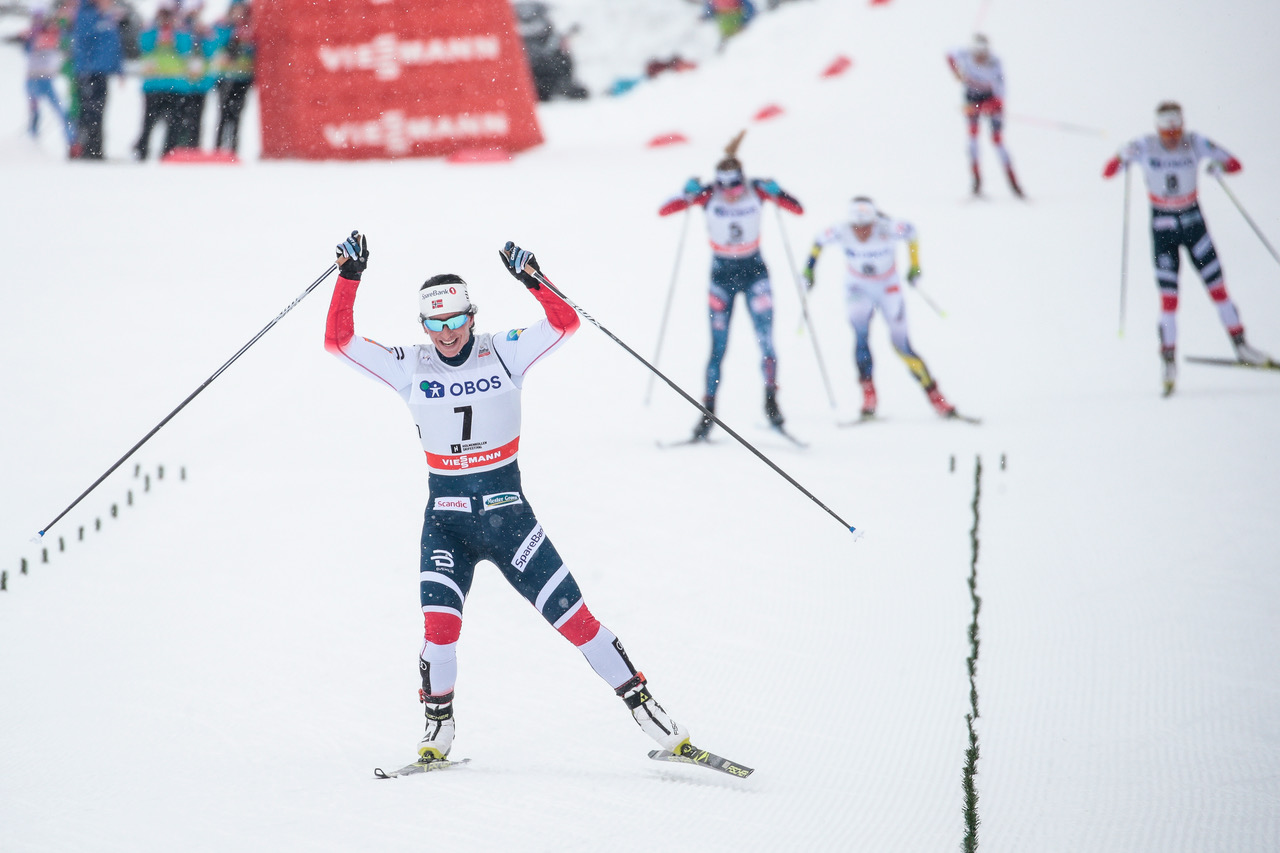
    Norway’s Marit Bjørgen celebrates her seventh Holmenkollen 30 k victory in Oslo, Norway, ahead of American Jessie Diggins, Norway’s Ragnhild Haga (not shown) and Sweden’s Charlotte Kalla. (Photo: Fischer/NordicFocus)

    So when Diggins was stealing the show at Oslo’s storied Holmenkollen venue in the women’s 30 k freestyle mass start this March, you’ve got to believe Norway and Sweden were there to see history; an American on the top step in the most famous of cross-country races.

    This Holmenkollen 30 k was a storied race. Just not storied for the precise narrative most watching the race expected. For much of the race, it appeared to be the Diggins show.

    Whatever you want to call her — queen, best-ever or simply Marit — the sport’s preeminent star, Marit Bjørgen of Norway, made her last Holmenkollen 30 k unforgettable.

    As FasterSkier’s venerable reporter Gabby Naranja noted, during the high profile 30 k events, Bjørgen likes to run away solo style. In last year’s Holmenkollen 30 k classic, Bjørgen was off the front and unchallenged for the win. Then, in PyeongChang during the 2018 Olympic 30 k classic, Bjørgen pulled away from any would-be chasers for a complimentary finishing-straight Norwegian flag wave and some golden hardware.

    This year’s Holmenkollen 30 k that followed was skate technique. When the trio of Diggins, Sweden’s Charlotte Kalla, and Norway’s Ragnhild Haga — all stellar skate skiers — pulled away from the field, the hopes of a Bjørgen revival seemed unlikely. Bjørgen had lost incremental time in the race’s early kilometers. The 37-year-old Bjørgen appeared gassed from a stellar Olympics and to be subtly relinquishing the stage to three younger go-getters.

    A little more than halfway through the race, Bjørgen was 36 seconds down on the lead group.

    Yet, Bjørgen was a wise one. She changed skis near the race’s midpoint. Diggins, Kalla and Haga stuck with their 15-k-old glide, skipped the ski swap and chugged on.

    The presumed podium placers slowed just enough, and Bjørgen sped up just enough to bring them closer and closer. But it was more like Bjørgen remained the massive sun with the heftiest gravity pulling the three off-the-front satellites towards her.

    With three kilometers to go, Bjørgen was six seconds back.

    In the closing kilometer, Bjørgen controlled the race, passed any top-step threats, and reaffirmed one last time that she is indeed the singular skier we all expect her to be. She won her seventh Holmenkollen for a record number of victories for a woman in the Holmenkollen 30 k. In her six prior Holmenkollen 30 k wins, Bjørgen won four times in classic technique, two times in skate.

    Diggins placed second (+3.6), Haga third (+4.3), while Kalla was a tenth of a second back in fourth.

    With the recent announcement of her retirement, perhaps the international field can rest easy knowing Bjørgen won’t be sending it off the front or seizing the win from behind.  

    Honorable Mention: Jessie Diggins and Kikkan Randall (U.S. Ski Team), Olympic Team Sprint

    Before anybody gets worked up over this, more awards are due. We at FasterSkier are spreading the award love and trying to be clinical. Are we splitting hairs between honoring Bjørgen for sentimental reasons and not choosing the Randall-Diggins gold for fear of pandering to our core audience? (Noise of clearing throat.) No.

    Americans Kikkan Randall and Jessie Diggins jumping for joy after placing first in the 2018 Olympic team sprint in PyeongChang, South Korea, ahead of Sweden’s Charlotte Kalla (l) and Stina Nilsson (second from l) in second place and Norway’s Marit Bjørgen (second from r) and Maiken Caspersen Falla (r) in third. (Photo: FlyingPointRoad)

    (And if you are hearing of the American Olympic team sprint win right here, right now, for the first time … then welcome to FasterSkier. We are glad to have you as a reader.)

    What more can be said of the Randall-Diggins win in the 2018 Olympic freestyle team sprint? It’s only been a bit over a month since the Americans skied the perfect race. Randall was the glue sticking with Bjørgen and Kalla. Diggins was the late boost who slingshot around Norway’s Maiken Caspersen Falla and outsprinted Sweden’s Stina Nilsson in the last 100 meters of the race.

    It is an Olympic medal after all. Gold, too. We can imagine every U.S. nordic skier for a generation will be asking “where were you when …?”

    Three cheers for Diggins-Randall. Three cheers for the wax crew. Three cheers for the coaches. And three cheers for all the women who have had the privilege of calling themselves members of the U.S. Ski Team, past and present.

    Honorable Mention: Iivo Niskanen (Finland), Olympic 50 k Classic Mass Start

    Finland’s Iivo Niskanen after winning the men’s 50 k classic mass start at the 2018 Winter Olympics in PyeongChang, South Korea. (Photo: FlyingPointRoad)

    Let’s jump to the post-race press conference in PyeongChang. Before the men’s 50 k classic mass start winner Iivo Niskanen of Finland entered the room, Russians Alexander Bolshunov and Andrey Larkov, who finished second and third respectively, made some excuses. Through an interpreter, both skiers spoke of their less-than-ideal skis.

    When Niskanen finally arrived, he was informed of the Russians’ sentiments that their striding and gliding may have been wax-compromised in the later stages of the race.

    No love lost. That could have been used to describe Niskanen’s tone and comments regarding his closest competitors’ and their espoused reasons for his dominance. Ski-wise, Niskanen changed skis twice during the race. (Racers are allowed two ski exchanges in the 50 k). Bolshunov and Larkov opted to change their skis once. The two Russians were the only skiers in the top-31 to not change skis out twice.

    The reason we bring the ski-excuse up is to highlight the point that Niskanen skied the race to win. He was taking no chances. He was decidedly strong, smart and had ski-swapping savvy. Niskanen had few tagalongs during his 50 k stomp. Kazakhstan’s Alexey Poltoranin skied with the Finn, looking like an equally worthy potential gold medal winner. But Poltoranin suffered a major fade. Niskanen also dropped the likes of Sundby, Harvey, and Holund.

    Bolshunov proved to be the only skier who seemed like he could mirror Niskanen. When Bolshunov skipped the ski swap at 40 k, Niskanen freshened up with some new classic boards and waited to make his move. That came on the final hill where Niskanen was simply stronger. Niskanen won the Olympic 50 k in 2:08:22.1. Bolshunov placed second, 18.7 seconds behind the winner.

    Niskanen’s win put on full display his marriage of physical prowess and strategic genius. A lovely win for the Finns and a first-career Olympic medal for the 26-year-old Niskanen.

  • Krüger Surprises with Skiathlon Gold; Harvey 8th; Patterson 18th

    Norway swept the medals in the first men’s cross-country race of the 2018 Olympics in PyeongChang, South Korea, with Simen Hegstad Krüger (c) taking gold, Martin Johnsrud Sundby (l) silver and Hans Christer Holund (r) bronze. (Photo: FlyingPointRoad)

    FasterSkier would like to thank Fischer Sport USA, Madshus USA, Concept2, Boulder Nordic Sport and Swix Sport US for their generous support, which made this coverage possible.

    PYEONGCHANG, South Korea — First a quick parable every skier has heard: never give up. From coaches, teachers and certainly parents, it’s always the same. Never give up. For those on the receiving end of the timeworn parable, it can sound like the annoying advice of elders; something that only applies in the later years. Easily brushed off words that might apply later, never now.

    Early in the men’s 30 k skiathlon at the 2018 Olympics in PyeongChang, South Korea. (Photo: FlyingPointRoad)

    During Sunday’s blustery and downright frigid 30-kilometer skiathlon, the first men’s cross-country race of the 2018 Olympic Games, that parable came into play not more than fifteen seconds after the start. Sixty-eight skiers shot off the line and merged into the classic ski tracks — the front-row athletes, the likes of Canada’s Alex Harvey, Norwegians Martin Johnsrud Sundby and Johannes Høsflot Klæbo, Switzerland’s Dario Cologna, and Finland’s Iivo Niskanen, skied clean up the first climb.

    Caught up in the striding, double poling and the tumbling was Norway’s 24-year-old Simen Hegstad Krüger, bib 7, waving his arm as he lay prone on the snow. Skier down — broken pole. There really didn’t seem much to it other than it was bib 7. Bib 7 slow to get up, slow to unstrap his mangled pole, slow to get into the tracks and single stick for tens of meters. Bib 7. Krüger.

    Then the coach arrives, the pole becomes functional, the game is on. By then, Niskanen, a renowned classic skier, had accelerated the pace. From the front, the pack was pulled apart like taffy. From the back of the mass of skiers, where Krüger now ventured, a sea of 67 other bib numbers waited to be picked off. Whatever the phrase “never give up” is in Norwegian, it most certainly rattled around in Krüger’s mind.

    “It’s my first-ever Olympic race and it started in the worst possible way,” Krüger said during the post-race press conference. “I just had to try to stay calm and use some time to catch up because I think if I had skied too fast there after my crash, I don’t think I would have any power when I caught up.”

    Let’s ascend from the bottom up on Krüger’s World Cup results pyramid. He has 28 World Cup top-30 results, 12 of which are top 10’s. Of those top 10’s, he has two podiums: a third place in the fifth stage of the 2017 Tour de Ski, the 10 k skate in Toblach, Italy, and another win in Toblach this past December in the 15 k skate.

    Surely this is no spoiler — bib 7 won the Olympic 30 k skiathlon on Sunday in 1:16:20 hours in burley conditions. On top of that, consider this: he’s a first-time Olympian, this was his first Olympic race and first championship gold.

    Let’s get back to Niskanen, who is a no-joke classic skier. Of all his major wins, including Finland’s National Junior Championships (with multiple titles in 2012 and 2013), you have to comb through to find a freestyle win. There are three skate wins, none on the World Cup. And here’s another striking piece of information, according to the International Ski Federation (FIS) database, Niskanen has never won off of Finnish soil except for the 15 k classic at 2014 U23 World Championships in Val di Fiemme, Italy.

    Finland’s Iivo Niskanen leads Switzerland’s Dario Cologna, Canada’s Alex Harvey and several Norwegians during the classic portion of the men’s 30 k skiathlon at the 2018 Olympics in PyeongChang, South Korea. (Photo: FlyingPointRoad)

    PyeongChang is in South Korea, seven time zones from Finland.

    Number crunching in sport is nothing new. Somebody in the Norwegian head-shed must have known Niskanen’s skewed geographic preference.

    Off the Finn went with the skiathlon favorites all in tow. By all accounts, Niskanen set a punchy pace. Nearly through 10 k, the 26 year old owned it. No doubt he knew his chances were slim if he didn’t break the pack and stretch out a solo lead before the transition to 15 k of skate technique. For a bit after 10 k, Sundby took some pulls up front. But in what became a familiar classic leg trend, the 13 skiers, separated by no more than five seconds, zipped down the banked corner before the 15 k mark gear exchange led by none other than Niskanen.

    The Finn had done the job of cutting the lead pack down to a manageable number, but he hadn’t built a gap from which he could nurse a cushion during the skate leg. In being the fox for at least 12 hounds, Niskanen had burned through his high-pace fuel. Fourth out of the transition, 1.3 seconds behind Klæbo in first, he was back in 18th just under 4 k later, 9 seconds out of first. He ultimately finished the skiathlon in 19th place, 1:14.2 minutes behind the winner.

    A quick swap of the skis and the poles and the 21-year-old young gun from Norway, Klæbo, was first through the 15 k time check. Harvey followed next with a tight grouping from first to 13th within 9.5 seconds, tightening pole straps on the run and readying for the skate leg throwdown.

    Norway’s Simen Hegstad Krüger (7) leads Germany’s Lucas Bögl during the skate leg of the men’s 30 k skiathlon on Sunday at the 2018 Olympics in PyeongChang, South Korea. (Photo: FlyingPointRoad)

    Here’s the thing: the 14th skier through the exchange, 15.2 seconds back was Krüger. This athlete was in 67th at 0.88 k, and improved to 57th 1.5 k later. Fast and steady, Krüger would reel in the front group. By 17.25 k, he was within a few seconds of lead.

    “As soon as I changed skis, then suddenly my legs felt great again,” Krüger said at the press conference. “I knew that now all possibilities are open again and just tried to start fresh.”

    The skate leg’s dynamics proved the opposite of the classic. There was no Niskanen-type breaking the wind. At moments it appeared Harvey would surge, or Cologna, or Sundby, or Holund, or Great Britain’s Andrew Musgrave.

    Krüger hung tight, never taking the leadership reins.

    “I knew that the skating part is my strongest part and I had to try to save some power the first two laps there and just stay with the group,” Krüger reflected.

    The plot thickened as the k’s ticked off. With the likes of Sundby in the pack, Krüger couldn’t risk a finish-line sprint. In his third Olympics, Sundby is still seeking his first Olympic gold (after taking bronze in the Sochi 30 k skiathlon and silver in the 2010 Vancouver 4 x 5 k relay).

    Before Sundby, 33, could dictate the closing chapter of Sunday’s race, Krüger stung the group with a power surge around 26.25 k and quickly gapped the chasers by 9.1 seconds. A little over a kilometer later, Krüger had opened up a 22.8-second lead.

    “I know that there’s some quite fast skiers in the group, so I knew that my chance was to get rid of them before the finish,” Krüger said of his tactics. “When I got some meters there I had to go for it and don’t look back.”

    Norway’s Simen Hegstad Krüger celebrates after winning gold in the men’s 30 k skiathlon on Sunday at the 2018 Olympics in PyeongChang, South Korea. (Photo: FlyingPointRoad)

    He never looked back. It was an exclamation-point Olympic gold medal win, and he beat Sundby in second by 8 seconds and another Norwegian teammate Hans Christer Holund in third by 9.9 seconds. 

    Although Krüger kept his eyes focused ahead, Sundby said during the press conference that he and Holund were looking around for potential chasers.

    “For sure, we have a really clear team tactics,” Sundby explained of why he and Holund did not attempt to close the gap on Krüger. “If one of us gets seconds from the rest of the pack, the others cannot try to catch him, so me and Hans Christer, I think we were waiting for Alex, Dario, Maurice [Manificat], everybody else to try to catch Simen. I think both of us were a bit surprised that nobody really tried.”

    Both Sundby and Holund acknowledged that when the gap grew to 20 seconds, they felt the team pact to not chase down a potential Norwegian gold medalist had been honored. On the final hill climb before the finish Sundby and Holund went.

    “I don’t think either me or Martin wanted to have Alex or Dario, we didn’t want to sprint with them in the last few hundred meters so when it was like 1 1/2 kilometers [to go], I think [Sundby] said or I said, ‘Now we just go,’ ” Holund said at the press conference. “And we did that in the hill.”

    Sundby settled for silver and Holund bronze, 2.8 seconds clear of Denis Spitsov, representing the Olympics Athletes of Russia, in fourth.

    “For sure, for us it was a bit frustrating, we also wanted to go for the gold for sure,” Sundby said. “But our team tactics was clear today and it’s just amazing that we really pulled this [podium sweep] off.”

    “… Simen is a really strong guy, not just physical but also mental,” said the 28-year-old Holund, also in his Olympic debut. “I think we should give credit to Simen that he was actually daring to break loose on the last lap there. I don’t think many people would have the confidence to do that and that’s why he deserves that gold medal.”

    Norway’s Simen Hegstad Krüger (7) gets a big hug from one of his teammates after he won gold in his first Olympic race, the men’s 30 k skiathlon, on Sunday at the 2018 Winter Games in PyeongChang, South Korea. (Photo: FlyingPointRoad)

    After the race, Krüger acknowledged that he owed some gratitude to his silver and bronze Norwegian teammates.  

    “I think both the guys there on both sides [of me] could’ve gone faster when I got some meters, but they let the others do the work,” noted Krüger. “So I think I owe them a big thanks for not catching up with me when I went for it.”

    Spitsov, 21, also in his first Olympics, finished fourth, ahead of France’s Maurice Manificat in fifth (+14.2), Cologna in sixth (+25.1), Musgrave in seventh (+25.7), and Harvey, who edged Martin Jaks of the Czech Republic, for eighth (+33.4 and +33.8, respectively). Klæbo, one of the pre-race favorites, finished 10th (+43.4).

    Harvey, who had been eyeing the skiathlon, said after the race the best skiers had won.

    Canada’s Alex Harvey (4) leading France’s Jean-Marc Gaillard (9) and Finland’s Iivo Niskanen (8) during the skate leg of the men’s 30 k skiathlon at the 2018 Olympics in PyeongChang, South Korea. Harvey went on to finish eighth. (Photo: FlyingPointRoad)

    “I think the three best guys won today,” Harvey told FasterSkier after. “It was a fair race and they were just stronger than anybody else in the world.”

    Asked about the race’s defining breakaways in the final kilometers, he said he just didn’t have the legs to react.

    “I was feeling good until Sundby and Holund went and then I just couldn’t go,” Harvey said.

    After Harvey’s top 10, the next Canadian across the line was Devon Kershaw in 36th (+3:35.3). Graeme Killick finished 45th (+5:19.6), and Knute Johnsgaard was lapped and did not finish.

    Kershaw noted the high pace during the classic leg curtailed his later-race efforts. 

    “I was really shocked that the classic went out as hard as it did,” Kershaw told FasterSkier. “And, after that, you’re in survival mode … It was really, really brutal today. “You know, it wasn’t the coldest day I’ve done, but it was for sure the windiest race I’ve ever competed in. When you’re having a bad day, that wind really tears at your mind, so I struggled.”

    For the U.S., Scott Patterson led the way in 18th (+1:07.5). In his first Olympics, Patterson’s moxy was palpable. The the 26-year-old, first-year U.S. Ski Team member began the skate leg in 27th position, 47.7 seconds behind the leaders.

    U.S. Ski Team member Scott Patterson (c) on his way to 18th place in his first Olympic race, the men’s 30 k skiathlon, at the 2018 Winter Games in PyeongChang, South Korea. (Photo: FlyingPointRoad)

    Immediately as Patterson skated away, his powerful strides were evidence he’d only be picking off spots in the final 15 k.

    “The last couple skiathlons I’ve done it’s been a little bit rough classic,” Patterson told FasterSkier after. “Then you switch to skating and it’s like, ‘OK, now I know what I’m doing’, and it definitely felt like that today.”

    A year ago at the pre-Olympic World Cup in PyeongChang, Patterson finished ninth in the 30 k skiathlon. Besides that result, his best individual World Cup finish was 27th in the 15 k freestyle mass start at the most recent World Cup on Jan. 28 in Seefeld, Austria.

    As he completed the third of four skate laps, Patterson could see Sundby’s lead group 34 seconds ahead of him.

    “Everyone was giving us splits off to that front group and it was like, ‘OK, maybe we can make it, maybe we can make it,’ ” Patterson reflected, smiling. “But then you’re also like, ‘They’re going to start charging real soon.’ So I was kind of optimistic, but also, when you’re leading that pack, it’s like, I want this pack to move up, but I don’t want to be the one making it move up because that’s a lot of work.”

    He credited France’s Jules Lapierre, who finished 15th, and Italy’s Francesco de Fabiani, who placed 20th, for helping to pull the group along.

    “I ended up leading the final sprint hill quite a few times, but [Lapierre] did a lot of work out on the course, which was super helpful…,” Patterson said. “We were able to kind of pull apart our group a bit and pick off a few of the guys struggling from the lead pack, like we got Iivo Niskanen right at the end, which I was pretty psyched about.”

    Erik Bjornsen (U.S. Ski Team) racing to 42nd in the men’s 30 k skiathlon at the 2018 Olympics in PyeongChang, South Korea. (Photo: FlyingPointRoad)

    Also for the U.S., Erik Bjornsen finished 42nd (+4:34.7), Paddy Caldwell 51st (+6:58.1), and Noah Hoffman 54th (+7:08.7).

    “I really enjoy both courses and I think the classic portion was maybe a little trickier with the wind today,” Caldwell said of his race. “I was just telling Reese [Hanneman] that I thought that things were pulling apart more in the classic side. You know, if you lose the group in front of you and then you catch the wind, it gets really tough. I think that the time gaps today are probably going to be quite, quite large because of that, but we had awesome skis on both sides [classic and skate]. I was trying to maintain position in classic and pick off people where I could in skate.”

    In his second Olympics, Hoffman also said the wind played a factor.

    “Honestly, it was gusty and there were sections where you’d come into the wind and just be brought to a dead stop,” Hoffman said. “But overall, it could have been a lot more of a grind because we had this warm spell the last couple days and the snow was quite fast out there. It was an uphill wind in terms of the general direction, and so for the most part the downhills were slower, but still tucking and then the uphills, you got a little bit of a boost … My body wasn’t there today.”

    Olympic cross-country racing continues Tuesday with the men’s and women’s classic sprints.

    Results