
From the FasterSkier archive — posts syndicated from athletes’ and coaches’ own blogs between 2004 and 2012, kept online as published. Current coverage is at fasterskier.com.

Tag: PyeongChang 50 k classic

  • FasterSkier’s International Performances of the Year: Simen Hegstad Krüger and Marit Bjørgen

    FasterSkier’s International Performances of the Year: Simen Hegstad Krüger and Marit Bjørgen

    Simen Hegstad Krüger’s Olympic skiathlon victory (l) and Marit Bjørgen’s Holmenkollen come-from-behind win (r) are FasterSkier’s 2018 International Performances of the Year. (Photos: FlyingPointRoad & Fischer/NordicFocus)

    With the 2017/2018 season officially in the rearview, FasterSkier is excited to unveil its annual award winners for this past winter. Votes stem from the FS staff, scattered across the U.S., Canada, and Europe, and while not scientific, they are intended to reflect a broader sense of the season in review. This set of honors goes to the International Performances of the Year.

    Previous categories: Junior Skiers of the Year | Collegiate Skiers of the Year | Biathletes of the Year | Para-Nordic Skiers of the Year | NoCo Skier of the Year | Canadian Breakthrough Skiers of the Year | U.S. Breakthrough Skiers of the Year | Coach of the Year | U.S. Continental Skiers of the Year| Canadian Continental Skiers of the Year

    ***

    Simen Hegstad Krüger (Norway), Olympic skiathlon

    Out of the start pyramid at the PyeongChang Olympics men’s 30-kilometer skiathlon, a mini-disaster struck 24-year-old Simen Hegstad Krüger of Norway. With the flying poles and striding skis, someone was bound to snap a pole. That someone was Krüger, who found himself at the base of the course’s first hill, calmly seeking the assistance of a coach with the gear in need. Time bled. The front pack cruised on. But he looked collected and unconcerned.

    In his first Olympics and first-career Olympic race, Krüger simply rolled with the get-your-pole-and-minimize-losses drill. With Finland’s Iivo Niskanen leading the stream of skiers ahead of him, Krüger kept it all in perspective. It’s was a 30 k race, and only a few hundred meters had been ticked off.

    It was a parade of possible medal winners capturing camera time during the skiathon’s classic leg. Niskanen (who later said, after winning the 50 k classic gold, that he approached the skiathlon’s classic leg as a training opportunity), Martin Johnsrud Sundby, Alex Harvey, and Dario Cologna looked golden.

    Norway’s Simen Hegstad Krüger after winning gold in his first Olympic race, the men’s 30 k skiathlon, at the 2018 Winter Games in PyeongChang, South Korea. (Photo: FlyingPointRoad)

    Never locking on, but stealthily lurking, Krüger gained ground as the race’s classic portion transpired. He came through the classic-to-skate ski exchange at 15 k in 14th place, about 15 seconds behind the leaders. Just over two kilometers later, Krüger had bridged the gap.

    With his legs fresh, Krüger said once he began the skate leg that “all possibilities are open again.”

    Anything did seem possible for a host of the world’s best distance skiers, just not necessarily for Krüger. After expending energy skiing up to the lead group early in the skate, Krüger played it coy. He didn’t lead or get exposed up front in the windy conditions. He simply kept pace and kept in the draft.

    An unwritten rule on the Norwegian team is that the first attack to stick by a Norwegian is a protected chance. In other words, once a Norwegian is in first and gaining time, his teammates won’t attempt to chase the attack down. Sundby was salivating at the chance for a career-first individual Olympic gold. Hans Christer Holund, also of Norway, was a pacesetter too. Either one of them could have seized the moment.

    But at 26.25 k, Krüger rolled the dice and surged. The surge morphed into an unchallenged attack that seemed a lock one kilometer later when Krüger was up by 22 seconds. Team rules are team rules — Sundby and Holund could only watch their teammate shake the front end of the race apart.

    Once they felt Krüger’s lead was insurmountable, Sundby and Holund set to work for themselves. The gap to Krüger closed significantly by the finish.

    Krüger won the race in 1:16:20 hours. Sundby settled for silver, finishing eight seconds back, while Holund was third, 9.9 seconds out of first.

    Was Krüger a real outsider for gold at the start of the race? Consider he was a member of the world’s most elite men’s team: Norway. Nations are also limited to four starters per race at the Olympics. Those in the know, like coaches and teammates, should have understood Krüger was on dual-discipline form.

    Yet, until his Olympic skiathlon win, Krüger had two individual World Cup podiums: one win and a third place. (He had finished third in the fifth stage of the 2017 Tour de Ski, the 10 k skate in Toblach, Italy, and won a 15 k skate in December 2017, also in Toblach.)

    A young Olympic rookie, Krüger showed he was the day’s master of tactics on the sport’s biggest stage. Krüger proved fit and certainly coyer than his Norwegian counterparts. Opportunity struck. Krüger seized it for our male International Performance of the Year.

    Marit Bjørgen (Norway), Holmenkollen 30 k freestyle mass start

    It has been a year to celebrate firsts. There was that first-ever U.S. Olympic gold. And from the North American perspective, the U.S. Ski Team’s (USST) women could fill a full scrapbook of standout performances. Let’s start with USST member Jessie Diggins. She finished second overall on the World Cup. Waking up on a Saturday or Sunday and finding Diggins on the podium was no longer a surprise.
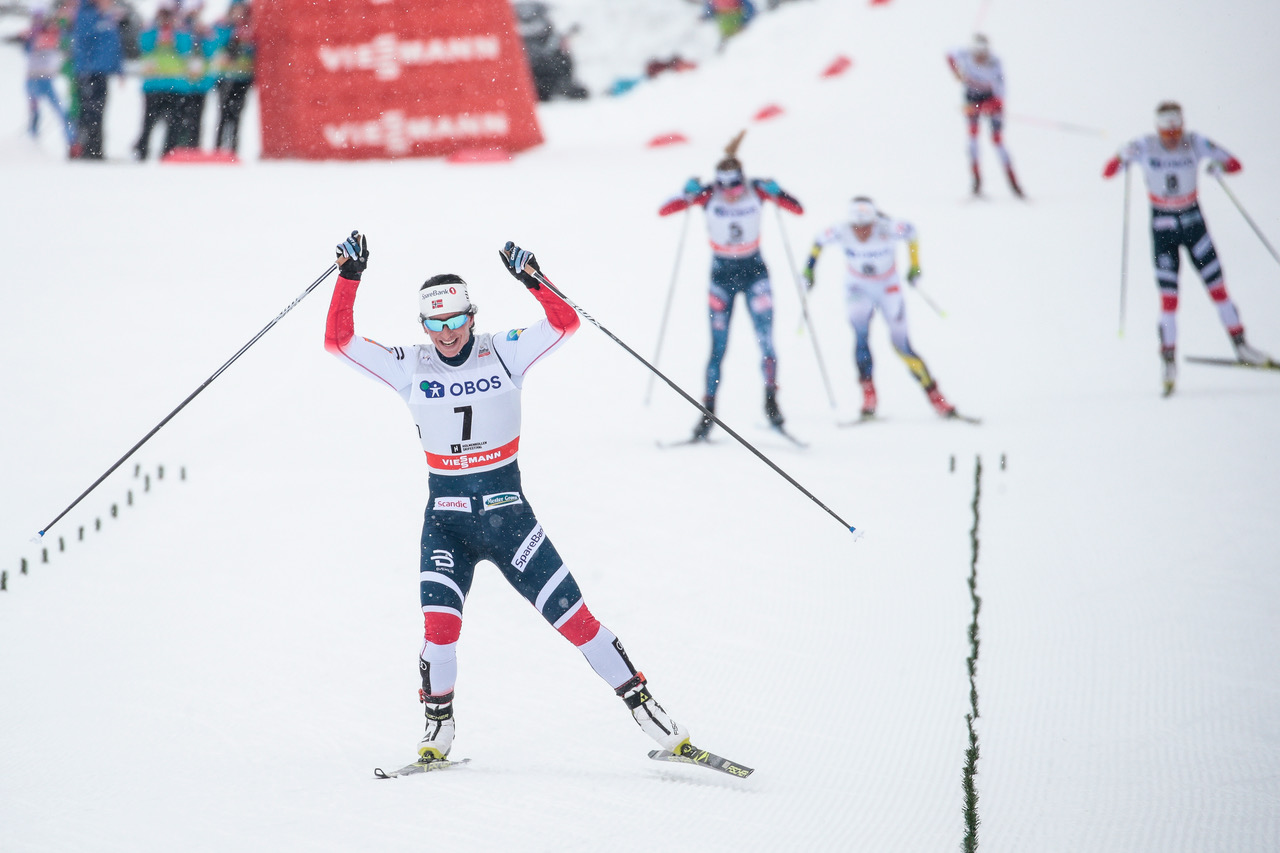
    Norway’s Marit Bjørgen celebrates her seventh Holmenkollen 30 k victory in Oslo, Norway, ahead of American Jessie Diggins, Norway’s Ragnhild Haga (not shown) and Sweden’s Charlotte Kalla. (Photo: Fischer/NordicFocus)

    So when Diggins was stealing the show at Oslo’s storied Holmenkollen venue in the women’s 30 k freestyle mass start this March, you’ve got to believe Norway and Sweden were there to see history; an American on the top step in the most famous of cross-country races.

    This Holmenkollen 30 k was a storied race. Just not storied for the precise narrative most watching the race expected. For much of the race, it appeared to be the Diggins show.

    Whatever you want to call her — queen, best-ever or simply Marit — the sport’s preeminent star, Marit Bjørgen of Norway, made her last Holmenkollen 30 k unforgettable.

    As FasterSkier’s venerable reporter Gabby Naranja noted, during the high profile 30 k events, Bjørgen likes to run away solo style. In last year’s Holmenkollen 30 k classic, Bjørgen was off the front and unchallenged for the win. Then, in PyeongChang during the 2018 Olympic 30 k classic, Bjørgen pulled away from any would-be chasers for a complimentary finishing-straight Norwegian flag wave and some golden hardware.

    This year’s Holmenkollen 30 k that followed was skate technique. When the trio of Diggins, Sweden’s Charlotte Kalla, and Norway’s Ragnhild Haga — all stellar skate skiers — pulled away from the field, the hopes of a Bjørgen revival seemed unlikely. Bjørgen had lost incremental time in the race’s early kilometers. The 37-year-old Bjørgen appeared gassed from a stellar Olympics and to be subtly relinquishing the stage to three younger go-getters.

    A little more than halfway through the race, Bjørgen was 36 seconds down on the lead group.

    Yet, Bjørgen was a wise one. She changed skis near the race’s midpoint. Diggins, Kalla and Haga stuck with their 15-k-old glide, skipped the ski swap and chugged on.

    The presumed podium placers slowed just enough, and Bjørgen sped up just enough to bring them closer and closer. But it was more like Bjørgen remained the massive sun with the heftiest gravity pulling the three off-the-front satellites towards her.

    With three kilometers to go, Bjørgen was six seconds back.

    In the closing kilometer, Bjørgen controlled the race, passed any top-step threats, and reaffirmed one last time that she is indeed the singular skier we all expect her to be. She won her seventh Holmenkollen for a record number of victories for a woman in the Holmenkollen 30 k. In her six prior Holmenkollen 30 k wins, Bjørgen won four times in classic technique, two times in skate.

    Diggins placed second (+3.6), Haga third (+4.3), while Kalla was a tenth of a second back in fourth.

    With the recent announcement of her retirement, perhaps the international field can rest easy knowing Bjørgen won’t be sending it off the front or seizing the win from behind.  

    Honorable Mention: Jessie Diggins and Kikkan Randall (U.S. Ski Team), Olympic Team Sprint

    Before anybody gets worked up over this, more awards are due. We at FasterSkier are spreading the award love and trying to be clinical. Are we splitting hairs between honoring Bjørgen for sentimental reasons and not choosing the Randall-Diggins gold for fear of pandering to our core audience? (Noise of clearing throat.) No.

    Americans Kikkan Randall and Jessie Diggins jumping for joy after placing first in the 2018 Olympic team sprint in PyeongChang, South Korea, ahead of Sweden’s Charlotte Kalla (l) and Stina Nilsson (second from l) in second place and Norway’s Marit Bjørgen (second from r) and Maiken Caspersen Falla (r) in third. (Photo: FlyingPointRoad)

    (And if you are hearing of the American Olympic team sprint win right here, right now, for the first time … then welcome to FasterSkier. We are glad to have you as a reader.)

    What more can be said of the Randall-Diggins win in the 2018 Olympic freestyle team sprint? It’s only been a bit over a month since the Americans skied the perfect race. Randall was the glue sticking with Bjørgen and Kalla. Diggins was the late boost who slingshot around Norway’s Maiken Caspersen Falla and outsprinted Sweden’s Stina Nilsson in the last 100 meters of the race.

    It is an Olympic medal after all. Gold, too. We can imagine every U.S. nordic skier for a generation will be asking “where were you when …?”

    Three cheers for Diggins-Randall. Three cheers for the wax crew. Three cheers for the coaches. And three cheers for all the women who have had the privilege of calling themselves members of the U.S. Ski Team, past and present.

    Honorable Mention: Iivo Niskanen (Finland), Olympic 50 k Classic Mass Start

    Finland’s Iivo Niskanen after winning the men’s 50 k classic mass start at the 2018 Winter Olympics in PyeongChang, South Korea. (Photo: FlyingPointRoad)

    Let’s jump to the post-race press conference in PyeongChang. Before the men’s 50 k classic mass start winner Iivo Niskanen of Finland entered the room, Russians Alexander Bolshunov and Andrey Larkov, who finished second and third respectively, made some excuses. Through an interpreter, both skiers spoke of their less-than-ideal skis.

    When Niskanen finally arrived, he was informed of the Russians’ sentiments that their striding and gliding may have been wax-compromised in the later stages of the race.

    No love lost. That could have been used to describe Niskanen’s tone and comments regarding his closest competitors’ and their espoused reasons for his dominance. Ski-wise, Niskanen changed skis twice during the race. (Racers are allowed two ski exchanges in the 50 k). Bolshunov and Larkov opted to change their skis once. The two Russians were the only skiers in the top-31 to not change skis out twice.

    The reason we bring the ski-excuse up is to highlight the point that Niskanen skied the race to win. He was taking no chances. He was decidedly strong, smart and had ski-swapping savvy. Niskanen had few tagalongs during his 50 k stomp. Kazakhstan’s Alexey Poltoranin skied with the Finn, looking like an equally worthy potential gold medal winner. But Poltoranin suffered a major fade. Niskanen also dropped the likes of Sundby, Harvey, and Holund.

    Bolshunov proved to be the only skier who seemed like he could mirror Niskanen. When Bolshunov skipped the ski swap at 40 k, Niskanen freshened up with some new classic boards and waited to make his move. That came on the final hill where Niskanen was simply stronger. Niskanen won the Olympic 50 k in 2:08:22.1. Bolshunov placed second, 18.7 seconds behind the winner.

    Niskanen’s win put on full display his marriage of physical prowess and strategic genius. A lovely win for the Finns and a first-career Olympic medal for the 26-year-old Niskanen.

  • Niskanen is a Closer, Wins 50 k Classic Mass Start in PyeongChang

    Finland’s Iivo Niskanen after winning the men’s 50 k classic mass start at the 2018 Winter Olympics in PyeongChang, South Korea. (Photo: FlyingPointRoad)

    FasterSkier would like to thank Fischer Sport USA, Madshus USA, Concept2, Boulder Nordic Sport, and Swix Sport US for their generous support, which made this coverage possible.

    PYEONGCHANG, South Korea — Sun, clouds, fog, and snow. At the Alpensia Cross-Country Skiing Center on Saturday, the men’s 50-kilometer classic mass start transpired like a 50 k should. There was the break-the-pack pace from the start. There was the hard-man up front trying for a solo break. Of course there were chasers: one of whom blew up and faded and another that latched on for a silver-medal ride. And eventually there was a group of four that closed in on a single medal that eventually left three athletes unsatisfied. This was solid Olympic 50 k racing.

    For Finland’s 26-year-old Iivo Niskanen, the plan worked. Burning through the 68 other starters began right away. As the 2 p.m. unfettered sun warmed the tracks, the kilometers ticked off with the favorites coalescing in the front. They included Martin Johnsrud Sundby of Norway, Kazakhstan’s Alexey Poltoranin, Alex Harvey of Canada, and the Olympic Athletes from Russia’s (we’ll just call them Russians) Alexander Bolshunov — a 21-year-old star of the Games, if you’re a medal counter (with two silvers and a bronze before Saturday’s race).

    This is the 50 k classic, a race usually suited for the well-established and the well-conditioned. This was Niskanen’s day.

    The switch flipped at 17.5 k when the Finn was set to fly. Sundby skied 1.4 seconds back, Poltoranin +2.3, Russia’s Alexey Chervotkin +3.4, Bolshunov +4.3, Russia’s Andrey Larkov +5.4, Norway’s Hans Christer Holund +5.7, and Harvey +6.0. These were the names that topped the course’s time checks.

    Bold. Daring. Tempting fate. All these words could describe the noticeable uptick in effort from Niskanen at 22.36 k that cracked the field. Unike the tale of the frog in boiling water unaware of it’s slow demise — Niskanen’s pacing shakedown was abrupt. Although not exactly a punch of effort, there was no subtlety to it.

    Passing through 27.2 k, Bolshunov trailed the Niskanen-Poltoranin duo by 20.9 seconds. Niskanen soldiered as the consummate soloist except Poltoranin was velcroed on. A look to the side here, another look to the side there from Niskanen could not convince Poltoranin to take a pull up front.

    Norway’s Niklas Dyrhaug leads a mass of skiers during the men’s 50 k classic mass start on Saturday at the 2018 Olympics in PyeongChang, Sourth Korea. (Photo: FlyingPointRoad)

    A second and third plot line developed behind. Bolshunov surged. Sundby, Holund and Harvey solidified into a core that would slowly bleed time to the leaders. In their own eventual fight for bronze, Harvey’s group fended off every racer except for Russians Larkov and Chervotkin.  

    Up ahead, Bolshunov flaunted his 21-year-old verve. There was no stage fright. He caught, passed, and gapped Poltoranin. At 33.32 k, only Bolshunov could muster the fight and locked in on Niskanen. As much as Bolshunov was the 50 k’s yin at this point, Poltoranin was its yang. His valiant chase of Niskanen early on smudged out by his crash and burn. Poltoranin was eventually caught by the Harvey group and finished 15th (+5:15.0).

    Late in the race, the temps had cooled below freezing and flurries fell. The sun-to-cloud swap also came with a fog bank reminiscent of March in Holmenkollen. Through the stadium at 37.5 k, neither Niskanen nor Bolshunov exchanged skis. Again, like with Poltoranin, Niskanen pulled up slightly. Bolshunov wouldn’t take the invite. He continued drafting the Finn.

    Finland’s Iivo Niskanen leads Alexander Bolshunov of the Olympic Athletes from Russia during the men’s 50 k classic mass start at the 2018 Olympics in PyeongChang, South Korea. (Photo: FlyingPointRoad)

    That dynamic changed as Bolshunov led down the sweeping turn into the stadium area around 40 k. With the Russian 0.6 seconds ahead, Niskanen changed into his third pair of skis for the day, taking advantage of his ability to swap skis twice during the race. (This is important and we’ll come back to this point: Bolshunov exchanged skis only once.)

    With Niskanen’s gear swap and Bolshinov’s power-double-pole, the Russian led out of the stadium.

    “I saw the gap appear,” Niskanen said in the post-race press conference. “There’s is no penalty loop like in a normal exchange area — often there is an extra meters when you are going to change skis. So of course, it’s a guess about the dirty snow, and here the snow is so dirty that it’s a big difference between fresh and old skis.”

    Niskanen gambled. So, too, did Bolshunov. Eleven seconds opened as they both rolled the dice. This was not, as it first appeared, a gold-medal move for Bolshunov. Less than two kilometers later, Niskanen was there to taunt Bolshunov with noticeably faster skis.  

    “I could catch him quite easily,” Niskanen recalled. “Then the only tactical plan was to wait and wait and use better skis when it is possible and the best place to use them.”

    The best place was the final headwall. The body worked. The skis flew. Niskanen won the 50 k in 2:08:22.1 as he pulled away from Bolshunov in the race’s closing moments. A dejected Bolshunov earned his fourth medal of the 2018 Games (after silver in the relay and team sprint, and bronze in the individual classic sprint) placing second, 18.7 seconds back.

    A medal still hung out there for Larkov, Harvey, Sundby, and Holund. Like Niskanen on the final climb, Larkov stung the group first while Harvey and Sundby punched too late. Larkov took bronze, 2:37.5 minutes behind Niskanen. Harvey shut down Sundby on the final stretch to secure fourth (+2:43.6). and Sundby placed fifth (+2:43.7).

    The Russians were first to the press conference. Through an interpreter, Bolshunov hinted at his frustration at being so close to gold.

    “Obviously I am a little bit disappointed because I could have won this race,” Bolshunov said. “There was a small problem that affected my result.”

    Norway’s Martin Johnsrud Sundby leads Finland’s Iivo Niskanen (8), Kazakhstan’s Alexey Poltoranin (behind Niskanen), and Canada’s Alex Harvey (2) early in the men’s 50 k classic mass start at the 2018 Olympics in PyeongChang, South Korea. (Photo: FlyingPointRoad)

    That small problem, Bolshunov clarified, were his skis. “Basically the small problem was with the fact that it got much colder and the skis were not as slippery as they should have been. So my result was affected,” he said.

    Larkov, too, said his skis were off. “Basically just like my teammate I am also a little bit disappointed,” Larkov, 28, said. “I had some problems with my skis because the weather got colder as we were racing and I had to change my skis. After I changed skis I thought I basically I had no chance but I managed to get to third place.”

    Bolshunov and Larkov were the only two skiers in the top 31 to swap skis once. Every other racer took the two allowed ski exchanges. (Four other skiers total among the finishers changed skis a single time.)

    Bolshunov entered the optional ski exchange area slightly ahead of Niskanen when the Finn swapped at 40 k. Asked by FasterSkier why he chose to ski on, Bolshunov claimed he wasn’t in position.

    “Basically I was on the right and I was not in the right position to change the skis,” Bolshunov said. “I would have changed them but I could not do it in time, so I had to go on like that.”

    During the press conference, neither Niskanen nor the Russians acknowledged each other. After learning that the Russians blamed skis as their demise and Niskanen’s gift, the gold-medal winner tried to set the record straight as he and Bolshunov share the same ski sponsor.

    “Skis were really really good,” Niskanen said of his own planks. “Maybe you can see the reason here in the result list. The Russian guys have changed skis only once, but that has been their tactic. Also my tactic was to use third and second best pair at the beginning of the race and leave the best pair at the end. It’s the same series skis for me and one of them. We have brother pairs.”

    Niskanen’s win was the first gold for Finland (across all sports) in PyeongChang. As the reigning 15 k classic world champion, Niskanen said that he has embraced a selective peaking strategy. For the last two years he has focused on two championship classic races: the 15 k in Lahti, and Saturday’s 50 k.  

    “Two years after Sochi, I trained so hard and tried to do too many things and have too much races and I got easily sick,” Niskanen said. “And then last two years I want to be the best shape at the right time. Maybe someday my main goal in the season is to win the World Cup overall, but last two years, the only goal has been one race because at the moment, I am so much better in classic. Everything, like the skiathlon [here], they have been preparation races for me to improve the shape.”

    If the skiathlon was a training run for Niskanen, as he claimed, it worked. Yet his fortunes were much better Saturday. During the skiathlon, Niskanen strung out the field during the classic leg. He faded to finish in 19th. His hot start in the 50 k, Niskanen acknowledged, made for an anxious Finnish coach.

    “Maybe my coach was a bit nervous to watch the race because I often start too hard too early,” Niskanen said. “This time I suffered well, but you just need to live the moment and play the game. If you don’t try you cannot win. This time I was the strongest man.”

    The men’s Olympic 50 k classic podium in PyeongChang, South Korea, with (from left to right) Alexander Bolshunov (l) of the Olympic Athletes from Russia (OAR) in second, Finland’s Iivo Niskanen (c) in first, and Andrey Larkov (OAR) in third. (Photo: FlyingPointRoad)

    The strongest man on Saturday was undeniably the strongest man. For the second consecutive Olympics, Russia has stepped onto the 50 k podium. With that comes the spectre of doping. Russia went 1-2-3 in the 50 k in Sochi amidst evidence later uncovered about state-sponsored doping. In PyeongChang the Olympic Athletes from Russia (OAR) went 2-3. With that, of course, comes questions. At the 2018 Winter Olympics, even with the increased scrutiny since Sochi, two Russian athletes have been flagged for doping: a curler and bobsledder.

    “I don’t know if I can answer this question because I’m only starting to compete on this level,” Bolshunov, who was invited to these Olympics as an OAR athlete because he was not associated with the Sochi debacle, said when asked if he and his 2018 Olympic teammates have any affiliation with Sochi’s taint. “I cannot really compare what happened four years ago with the athletes that are here. I am my own man and they were their own team. So we just do the best we can and we move ahead.”

    Click here for a separate report on Harvey and the rest of the North American men.

    Results