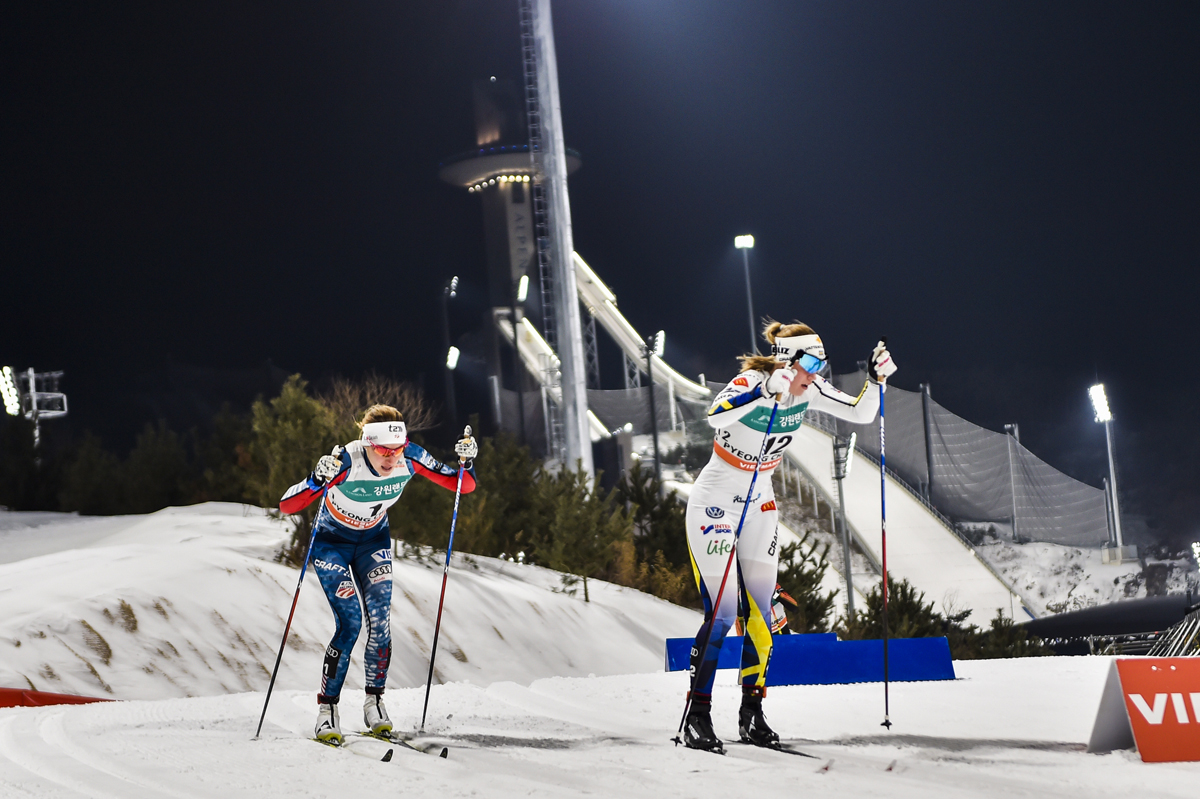
Tag: PyeongChang classic sprint

  • Valjas Finds His Form in Korea, Sprints to 7th Overall

    Canada’s Len Valjas after earning the first lucky loser spot for the semifinals in the men’s 1.4-kilometer classic sprint at the 2018 Olympics in PyeongChang, South Korea. (Photo: FlyingPointRoad)

    FasterSkier would like to thank Fischer Sport USA, Madshus USA, Concept2, Boulder Nordic Sport, and Swix Sport US for their generous support, which made this coverage possible.

    PYEONGCHANG, South Korea — Flashback to pre-Pyeongchang.

    In the weeks leading up to the 2017 World Championships in Lahti, Finland, Canadian Len Valjas sustained an injury to his back during a gym workout in Davos. He traveled to Finland, unsure if the incident would prevent him from racing at world champs. Eventually, he started both the men’s individual and team sprint for Canada.

    But his back, and subsequently his breathing, never quite fully recovered for the event.

    “It totally affects my breathing,” Valjas had said of the injury last year in Lahti. “The race starts well and I die immediately.”

    The Canadian continued to work at rehabilitating his back through the spring and summer. In the fall, however, he experienced relapse. For the most part, leading up to that point had been able to work through any discomfort. A tweak in November left him turning to various medical tests and MRIs to see what went wrong. Eventually, the issue boiled down to his thoracic spine.

    “[Doctors] found a herniated disk in T2-3 and below that a cracked vertebrae on T-4, which is the rib that is probably affecting my breathing,” Valjas said in January of this season, following the freestyle sprint in Seefeld, Austria.

    “It just feels like there is a rubber band around my chest,” Valjas added after the Seefeld sprint. “When it’s flared up and tight it just takes longer to take a deep breath. I honestly can’t go any higher than [Zone] 3 and my body can’t go on any slower breathing.”

    Canada’s Len Valjas (26) racing during the second semifinal of the men’s 1.4-kilometer classic sprint at the 2018 Olympics in PyeongChang, South Korea. (Photo: FlyingPointRoad)

    In the Seefeld sprint, Valjas ended the day in 40th. After a cooldown, he returned to the team’s hotel and began his two-week training countdown for the Pyeongchang individual classic sprint, one of his main targets at the 2018 Olympic Winter Games.

    When the morning of the men’s 1.4-kilometer classic sprint arrived on Tuesday, Valjas was still experiencing pain in his back.

    I woke up and I was having trouble breathing, the rib wasn’t moving well,” Valjas told FasterSkier in PyeongChang on Tuesday.

    “The last month leading up to this, I’d train a little bit, push it too far, then have a little setback,” he added.

    Then something popped. Literally. After a morning run on Tuesday prior to the qualification rounds, the Canadian took a moment to lay on a foam roller.

    “I don’t know what moved, popped, but I just lay there for five minutes, kind of arching my back and I stood up and I could breathe,” Valjas explained. “I try to not lie on my back like that because I could really piss it off — any time you’re lying on something kind of sharp with a broken back, it might not totally help — but it’s the only reason I was able to ski today.”

    While his Canadian teammate Alex Harvey did not advance past the qualifying round (finishing the day in 32nd, 0.26 seconds away from qualifying and 9.41 off of the fastest qualification time, which was set by Finland’s Ristomatti Hakola in 3:08.54), Valjas advanced to the heats in 26th (+8.57).

    Slotted in the fourth quarterfinal, the pressure was on for the 29-year-old Valjas if he wished to advance to the semifinal, either automatically or as a lucky loser. Italy’s Federico Pellegrino had set a fast pace in Quarterfinal 2 and incidentally, the second heat still held the lucky loser time as Valjas’s quarterfinal lined up at the start.

    Already qualified for the semis were the likes of Norway’s Johannes Høsflot Klæbo, Sweden’s Teodor Peterson, Norway’s Pål Golberg, Finland’s Hakola and Russia’s Alexander Bolshunov.

    Names to take note of at the start of Valjas’s heat included Norway’s Emil Iversen, Sweden’s Oskar Svensson and Russia’s Alexander Panzhinskiy.

    Off the gun, and out of the start tracks, Valjas was squeezed to the inside. Each V-board brought a cringe from the crowd; it appeared as if he nearly nicked each one as the six quarterfinalists made their way into the first climb. As they crested over the top, the looming 6-foot-5 figure of Valjas was last.

    Heading into the second climb, the order remained pretty close to the same: Iversen led, while Svensson chased milliseconds behind. Panzhinskiy, Germany’s Sebastien Eisenlauer and Slovakia’s Peter Mlynár comprised the middle. The last suit to crest the quarterfinal’s final climb, Canada.

    “On the hill, I wasn’t fastest to the top by any means, I was gapped, but I just made sure to push over the top,” Valjas said. “I knew the techs gave me the fastest skis out there … and I just let the skis roll.”

    As the skiers rounded into the descent back toward the stadium, Valjas began to move up. He slungshot around Eisenlauer and Mlynár and with 150-meters to go he was positioned in fourth. As Oskar and Svensson battled for first and second, Valjas and Panzhinskiy fought for third and fourth. The clock was ticking. Current lucky loser time posted at 3:11.95.

    In the final lunge to the line, Valjas bested Panzhinskiy by 0.28 seconds to take third in Quarterfinal 4 in a time of 3:10.87. One more heat to go to see if he would retain his coveted lucky loser position.

    Hamilton’s Quarterfinal

    In the fifth and final heat, it was Finland’s Martti Jylhä, Lauri Vuorinen, Germany’s Thomas Bing, France’s Baptiste Gros, Russia’s Alexey Vitsenko, and American Simi Hamilton.

    Hamilton had qualified in 19th (+7.59), and in the fifth quarterfinal, he held a good position heading into the first climb, sitting in fourth. Tag-teaming the front was Jylhä and Gros. As the group descended to corner into the second climb, however, Vuorinen’s skis clipped the back of Hamilton’s. Both the American and the Finn went down, taking out the Russian’s pole in the process.

    “Coming out of that corner everyone wants to go left, because that gives you the best line for getting up and over that second climb. So we were all kind of aiming for that lefthand track,” Hamilton said. “I figured that I could at least stay left of the track going into that corner. Then maybe run past people out of the track.

    American Simi Hamilton (19) racing in the fifth quarterfinal of the men’s 1.4-kilometer classic sprint at the 2018 Olympics in PyeongChang, South Korea. (Photo: FlyingPointRoad)

    “But it just squeezed way, way, way too tight on the left; we all came together at the wrong time,” he continued. “And I think my skis, my tips got skied over. My skis just kind of stopped dead and my body kept going.” 

    By the time Hamilton and Vuorinen were able to stand back up again, Gros and Jylhä were cresting the top of the course’s brutal climb. Vitsenko just received a new pole. Jylhä and Gros ultimately finished the quarterfinal in first and second, respectively. Hamilton was the fourth across the line in his heat, ending the day in 20th.

    “I’m bummed for sure,” Hamilton said. “But, you know, you got to look forward to the team sprint. I’m psyched about ski racing and psyched about this team. I know we have a lot of momentum, and so just look forward to the next race.”

    Onto the Semis

    With all five quarterfinals complete, Valjas earned the first lucky loser spot and advanced to Semifinal 2. Similar to his quarter, the Canadian skied toward the back of the pack through the first climb. As they swept through the first descent toward the second course climb, Valjas positioned himself into fourth. Cresting to the final down, Canada was in the mix.

    When the group returned to view for the final descent, however, Hakola had taken the lead. Sweden’s Svensson was close behind followed by a small gap and then Valjas. The Canadian pulled hard, but Hakola and Svensson finished 1-2 respectively and claimed the automatic advance spots. The high speed of the first semifinal, which Klæbo won, produced the final’s two lucky losers. Valjas was out, but not without giving spectators in the stands and at home a maple-leaf show. He ended the day in seventh for Canada’s best result in two Olympic cycles. 

    “Really proud to be chosen to represent Team Canada at my second Olympics!” Valjas posted on Instagram prior to the start of the 2018 Winter Games. “Thank you to my family, friends and supporters. I am so grateful to all the people that have helped me reach this point.”

    Bjornsen in the Mix

    The third and final North American man to qualify besides Valjas and Hamilton was American Erik Bjornsen, who snagged the last spot in 30th (+9.15). Bjornsen entered Quarterfinal 1, which featured Peterson, France’s Richard Jouve, Kazakhstan’s Alexey Poltoranin, Italy’s Maicol Rastelli and Tuesday’s eventual gold medal winner, Klæbo.

    Erik Bjornsen (U.S. Ski Team) racing to 42nd in the men’s 30 k skiathlon on Sunday at the 2018 Olympics in PyeongChang, South Korea. He went on to place 25th in the classic sprint on Tuesday.(Photo: FlyingPointRoad)

    “Whether it was Klaebo or someone else … I am just thinking how I can get to the front,” Bjornsen said.

    Bjornsen cornered into the final uphill to the far left, taking the inside track through the climb. As he strode the course’s last grueling up, he indicated his energy “felt great.” However, the opportunity to move to the front as he had hoped eluded him.

    “I was feeling pretty comfortable up this first hill and was hoping that I could find a hole out there somewhere, never really came, so had to lay it down the last 100 meters,” Bjornsen said.

    The final stretch saw Bjornsen pegged up against Jouve and Poltoranin. In the end, the three-way sprint finish for third — behind Klæbo in first and Peterson in second (+1.14) —  went to Jouve (+1.31), followed Poltoranin in fourth (+1.51) and Bjornsen in fifth (+1.63). That put Bjornsen 25th on the day.

    “I just don’t have the top speed for that,” Bjornsen said. “I am more of a distance guy, but I mean I am happy to be feeling good and I think that is a good sign for the races to come.”

    Two other Americans raced Tuesday’s classic sprint, with Andy Newell finishing outside the top 30 in 37th and Logan Hanneman 42nd. Following Valjas and Harvey’s performances, Jess Cockney finished in 35th, just 0.85 seconds outside of qualification.

    “I felt really good, I executed a really good plan,” Cockney said. “Just came up short.”

    Also competing in the sprint was Canada’s Russell Kennedy, who finished in 54th. Following the able-bodied Winter Games, Kennedy will attend the Paralympic Winter Games taking place this March in Pyeongchang as a guide for Canada’s legendary Paralympian, Brian McKeever.

    “It’s a strategy course,” Kennedy explained on Tuesday of the 1.4 k sprint track. “If you go too hard, you can lose a lot in the second half and for me that is what happened today.”

    Men’s cross-country returns on Friday for the Olympic 15 k freestyle event.

    Men’s Results: Qualifier | Final

  • PyeongChang Classic Sprint Extras: Notes & Quotes

    Russell Kennedy (46) with a Canadian wax tech before Tuesday’s classic sprint qualifier at the 2018 Olympics in PyeongChang, South Korea. (Photo: FlyingPointRoad)

    FasterSkier would like to thank Fischer Sport USA, Madshus USA, Concept2, Boulder Nordic Sport, and Swix Sport US for their generous support, which made this coverage possible.

    ***

    Top 30. It’s a tough mark to make at the World Cup level, let alone the Olympics. On Tuesday, the U.S. and Canadian teams each entered four men and four women in the classic-sprint qualifiers at the 2018 Olympic Games in PyeongChang, South Korea.

    American Logan Hanneman racing to 42nd in the men’s 1.4-kilometer classic sprint qualifier at the 2018 Olympics in PyeongChang, South Korea. It was his first Olympic race. (Photo: FlyingPointRoad)

    Three American women and two American men qualified, but Ida Sargent, Andy Newell and Logan Hanneman did not. Sargent finished the women’s 1.25-kilometer qualifier in 33rd, 1.78 seconds out of the top 30, Newell missed it by 1.67 seconds in 37th the men’s 1.4 k qualifier, and Hanneman finished 42nd.

    For Canada, one man qualified: Len Valjas. Alex Harvey tied for 32nd and missed the cutoff by just 0.26 seconds. Jess Cockney placed 35th, 0.85 seconds out of 30th, and Russell Kennedy was 54th. Three Canadian women started, but none qualified. Emily Nishikawa, best known as a distance skier, led them in 34th, 2.73 seconds out of 30th, for her career-best sprint result. Dahria Beatty placed 42nd and Cendrine Browne was 51st.

    Then there was Jessica Yeaton, who races for Australia but trains with Alaska Pacific University in Anchorage, Alaska. Yeaton finished the qualifier in 48th. Ahead of her, the Czech Republic’s Petra Hyncicova, the two-time defending 2017 NCAA champion who skis for the University of Colorado Boulder, finished 45th in her first Olympics.

    Here are some quotes from the North Americans who caught up with FasterSkier in the mixed zone after Tuesday’s qualifier:

    On race feelings:

    “I felt really good, I executed a really good plan, and yeah, just didn’t pan out.” — Jess Cockney (Canada), 35th

    “It wasn’t great. It was a really hard course, and it was quite windy today, and I just didn’t feel like I could get my body up to the speed I need to be going at on this course was working. I just felt a little of that distance-race pace today so that was too bad because I am always hoping to make the heats on a stage like this, but just didn’t have it today.” — Dahria Beatty (Canada), 42nd

    On strategy:

    “I knew this first climb was going to set everything else up, and you have to had already been in it. You can’t get to the top of the hill and think you’re going to ski yourself back into it — that’s half the course right there. I executed that really well and came up short.” — Cockney

    On PyeongChang’s sprint course:

    “There’s a monster climb in it and also dealing with the wind — it’s definitely a tough course, but it skis really nice and it’s a well-designed course, so it’s fun to ski.” — Emily Nishikawa (Canada), 34th

    “It’s a really hard course, lots of climbing and pretty steep, so I am really proud of my teammate Emily, who did her best-ever sprint result, so that is really inspiring. Hopefully I will get there one day, too, because she is a distance skier as well.” — Cendrine Browne (Canada), 51st

    “After shortening it from the course they had last year, they essentially took out the only downhill in the first half of the course. Especially with the wind today, you had to work half ay into the downhill, so there wasn’t any rest until the top of the course at about 2.5 minutes, so it was a real endurance course.” — Beatty

    “It’s really hard. I skied it last year and it was actually harder on the boys’ course, so this first hill was a little better ‘cuz it sort of cuts out the part where you start slipping, but at the same time it cuts out all that rest from your tuck down. This time you’re shooting straight into the second hill, which is really hard.” — Jessica Yeaton (Australia), 48th

    Canada’s Russell Kennedy racing to 54th in the men’s 1.4-kilometer classic sprint qualifier at the 2018 Olympics in PyeongChang, South Korea. (Photo: FlyingPointRoad)

    “I think it’s more than hard, it’s just a strategy course. If you go too hard, you can lose a lot in the second half, and for me that is what happened today.” — Russell Kennedy (Canada), 54th

    On the wind:

    “I feel like you get a huge gust every now and then … It’s definitely windy the whole time, but then sometimes you run into something crazy and it’ll be like, ‘Whoa,’ and it throws you back a little bit. But it’s sort of the same conditions for everyone. You can’t control when it’s going to have a big gust.” — Nishikawa

    “Definitely the conditions are tough and the wind doesn’t help when you get a head gust and then a tail wind and throw off your tempo and stuff, but it’s a very smart thinker’s course I think.” — Kennedy

    On looking forward:

    “It’s a long championships. You can’t dwell on a bad race too long, even a good race, like there’s always another one in a day or two so you have to take the time to learn from the race, or if you’re really pumped or really upset you can take a few minutes to process that, but not much longer than that really.” — Nishikawa

    “Today I wasn’t expecting much from the result, but I was more thinking about how well I wanted to ski the course, so I really wanted to ski well and push hard in preparation for the 10 k skate, which is my favorite race, so I am really looking forward to that. Today was more of an intensity to prepare myself for my favorite race.” — Browne 

    On the Olympic experience so far: 

    “It’s been awesome. It’s been the best 10 days ever so far. I’ve had so much fun. The racing’s been good, nothing amazing, nothing terrible though, so it’s just been a really good experience overall.” — Yeaton

    ***

    Qualifier results: Women | Men

  • Valjas 4th, Newell 6th in PyeongChang Sprint Final

    Valjas 4th, Newell 6th in PyeongChang Sprint Final

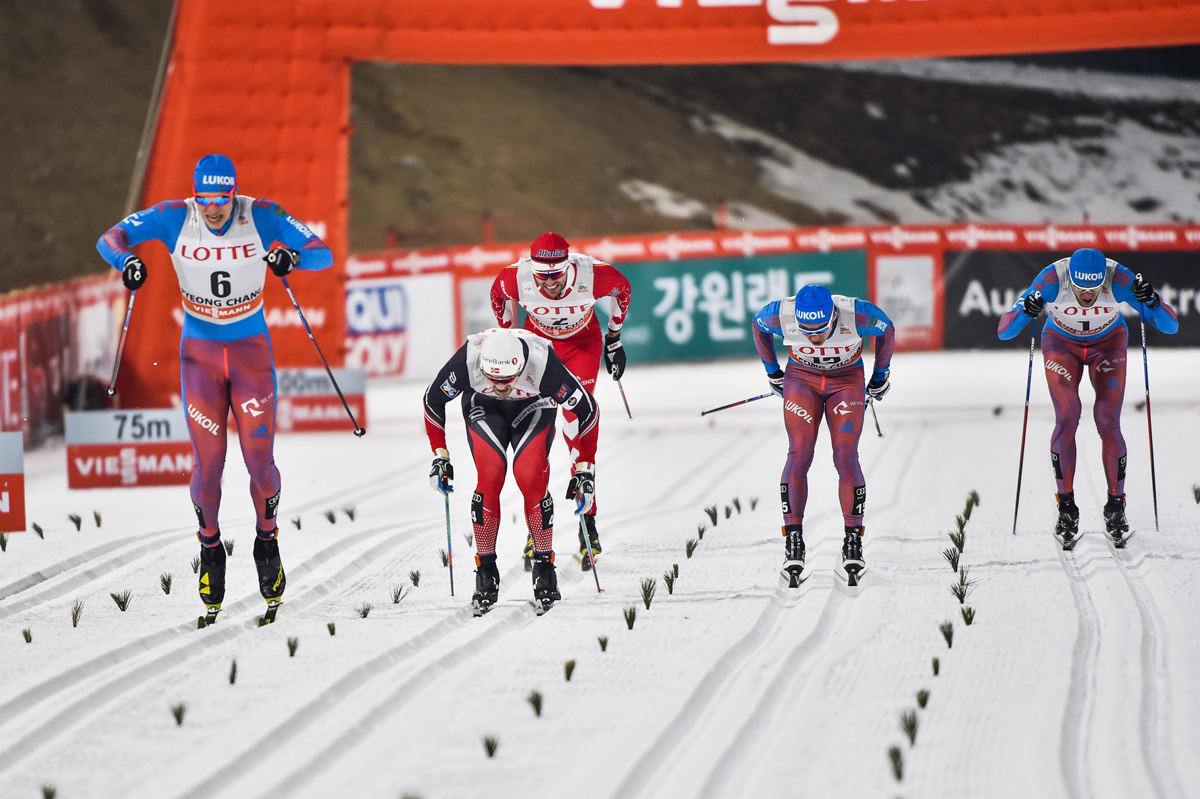
    Russia's Gleb Retivykh (l) racing to his first World Cup victory and podium on Friday in the World Cup classic sprint in PyeongChang, South Korea, ahead of Norway's Sondre Turvoll Fossli (second from l), Canada's Len Valjas (behind Fossli), and Russia's Andrey Parfenov and Alexander Panzhinskiy. (Photo: Fischer/NordicFocus)
    Russia’s Gleb Retivykh (l) racing to his first World Cup victory and podium on Friday in the World Cup classic sprint in PyeongChang, South Korea, ahead of Norway’s Sondre Turvoll Fossli (second from l), Canada’s Len Valjas (behind Fossli), and Russia’s Andrey Parfenov (second from r) and Alexander Panzhinskiy (r). (Photo: Fischer/NordicFocus)

    As a sphere, the Earth is a tidy shape and can be divided into equal segments. It takes roughly 24 hours for the planet to rotate on its axis once, constituting a single day. So there’s 24 time zones, one for each hour of rotation. On Friday, the tidiness was disrupted a bit for European-based World Cup skiers. PyeongChang, South Korea, host of the 2018 Winter Olympics, was site of the men’s World Cup 1.5-kilometer classic sprint.

    PyeongChang sits a full eight hours ahead of Central European Time, a time zone most World Cup skiers are adjusted to. To accommodate the time shift, the sprints were run at night, under the lights.

    “It’s been tough. We knew the races were going to be really late here in Korea so that the T.V. time works in Europe,” U.S. Ski Team (USST) member Andy Newell said on the phone. “But as far as adjusting, you go in and out and definitely feel pretty tired at times, like when you’re trying to fire it up and get ready to race. But once you’re racing, it seems like it’s OK. You don’t notice the jet lag once you’re out there on the track.”

    In a field of 55 skiers, Newell was one of two North Americans to make the men’s final; the other was Canada’s Lenny Valjas. Newell placed sixth in the final (+17.1), Valjas fourth (+0.74) in a photo finish with Russia’s Andrey Parfenov (+0.73), who skied to third overall.

    “It was really close between me and Lenny,” Parfenov told the International Ski Federation (FIS), according to a press release. “I know he was next to me. I was lucky have a better lunge. It was a good track for classic. There is not so much double poling sections, more uphills and that was good for me. I am really happy for my second podium of my career.”

    Russia’s 26-year-old Gleb Retivykh won the final in 3:30.79, ahead of Norway’s Sondre Turvoll Fossli in second (+0.30). It was Retivykh’s first career World Cup win and first time on the podium, despite finishing in the top 10 in World Cup sprints on 10 other occasions. And despite his comments to FIS, the Russian’s speediness may just have allowed him to momentarily outrun the jet lag.

    “I arrived here yesterday so I am still jet lagged,” Retivykh said. “I knew Sondre is very strong. I did not think I could win. I was hoping for a good result. I had to wait six years for my first victory and it is great.”

    Valjas Leads Canada in 4th

    Time zones and new food be damned. For seasoned athletes like Valjas and Newell, planes, shuttle buses, and exploratory cuisine are all part of the international skiing life. Despite the time-zone-shift-wormhole, both skiers delivered.

    For Valjas, of Canada’s World Cup A-team, the vagaries of food prep in South Korea flummoxed him.

    “Adjusting to the time change went fairly well, but I ran into some trouble with the food here,” Valjas wrote in an email. He is allergic to peanuts and fish; two ingredients in the form of peanut and fish oil that’s ubiquitous in Korean meals.

    “The last two dinners I have not been able to eat because I had reactions,” Valjas added. “Even the ‘safe’ boiled potatoes ended up having peanut oil dribbled all over them. The language barrier makes it very hard to understand which foods may or may not kill me. I could feel my energy getting lower and lower today, could have been my inability to eat well or the jet lag after flying here two days ago.”

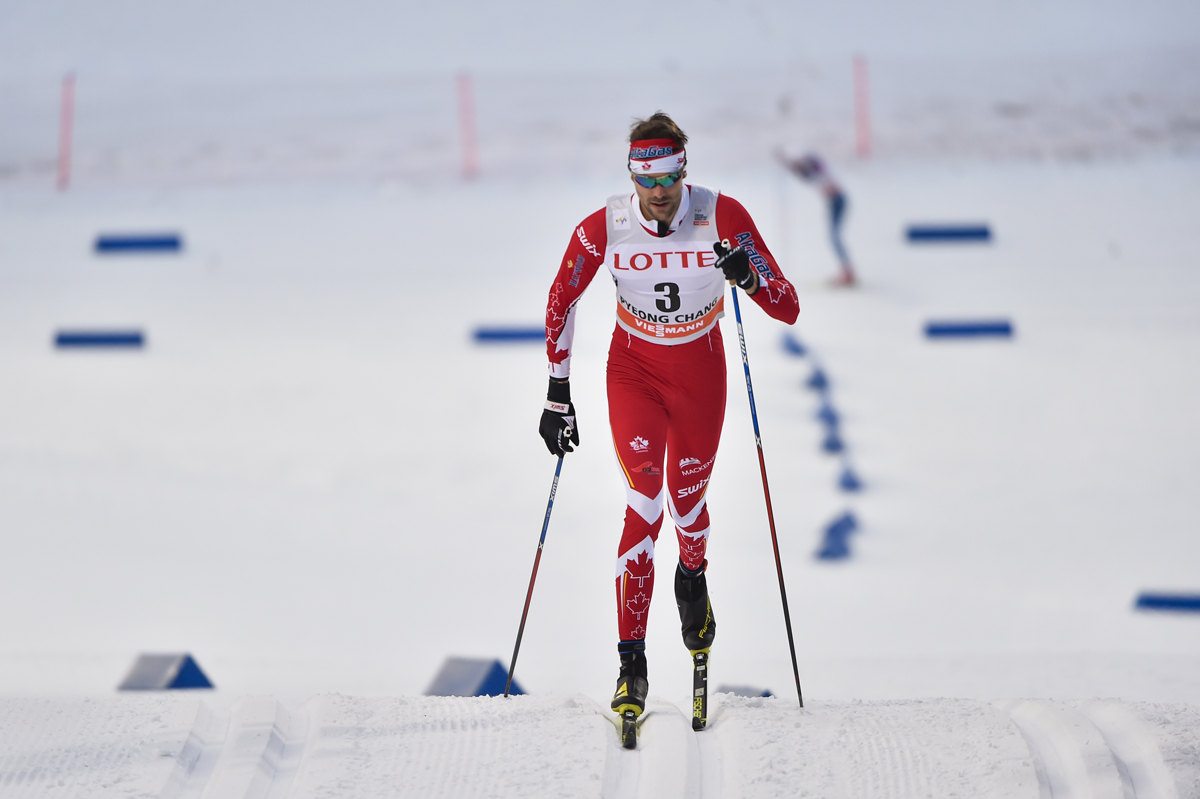
    Canada's Lenny Valjas racing to second in the men's classic sprint qualifier on Friday at the World Cup in PyeongChang, South Korea. (Photo: Fischer/Nordic Focus)
    Canada’s Lenny Valjas racing to second in the men’s classic sprint qualifier on Friday at the World Cup in PyeongChang, South Korea. (Photo: Fischer/Nordic Focus)

    Despite the lack of food intake, Valjas qualified in second place, 1.97 seconds back from fifth-place overall finisher and first-place qualifier Alexander Panzhinskiy of Russia.

    Valjas’s progression looked like this: second in his quarterfinal then advancing to the finals as the second lucky loser from the first semifinal. And ultimately his fourth place in the final — where he missed his eighth-career World Cup podium and his third of the season, by 0.01 seconds.

    “I have mixed feelings about today,” Valjas wrote about his PyeongChang classic sprint experience. “It’s tough to be that close and come up short.”

    Mindful that the day was also about gaining pre-Olympic beta, Valjas noted his time in South Korea was well spent.

    “On the bright side, I learned so much skiing the Olympic course today. It’s a very tough course, but it is built amazingly well,” he wrote. “The climbs are the perfect grade for striding, and racing at night with all the lights was really cool. … I hope I can use the valuable info I learned tonight to my advantage when I race here next winter in the Olympic sprint.”

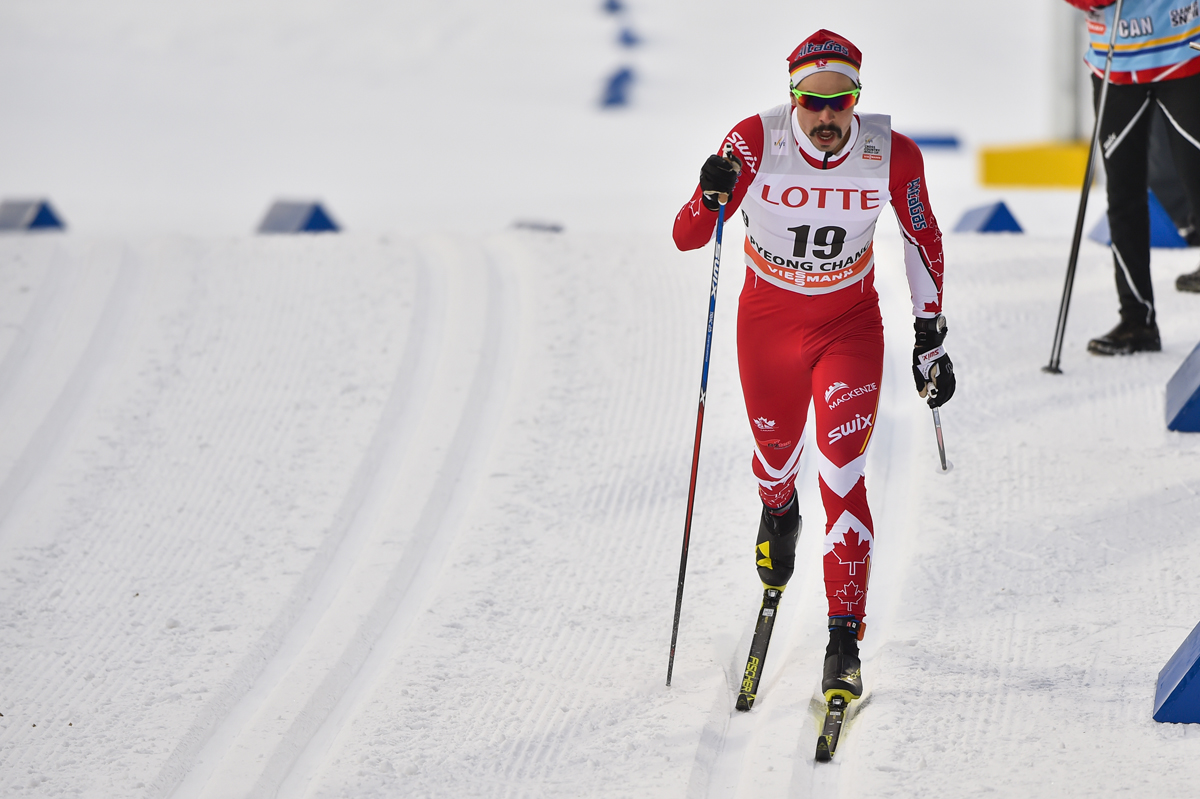
    Jess Cockney (Canadian World Cup B-team) racing to 16th in the men's classic sprint qualifier on Friday at the World Cup in PyeongChang, South Korea. He went on to place 10th overall for a season best. (Photo: Fischer/NordicFocus)
    Jess Cockney (Canadian World Cup B-team) racing to 16th in the men’s classic sprint qualifier on Friday at the World Cup in PyeongChang, South Korea. He went on to place 10th overall for a season best. (Photo: Fischer/NordicFocus)

    Jess Cockney, of Canada’s World Cup B-team, placed 10th after qualifying 16th. Cockney skied to first in his quarterfinal after avoiding several skiers involved in crashes, including one involving U.S. Ski Team member Simi Hamilton.

    “I felt that I could ski relaxed and work my way through some positions in the second half of the course and it ended up being really good to also avoid the crashes in my heat,” Cockney wrote in an email.

    In his semifinal, Cockney was on fumes and finished fifth.

    “He gave it all on the quarterfinal so he lost a lot of energy there, but still making it to the semi is very good,” Charles Castonguay, Canada’s lead coach in PyeongChang, said on the phone. “But at the end, I think he did really well, too. Top 10 for him is really really good and he is pretty confident that he can repeat that for Lahti in two weeks [at World Championships]. We had a little chat after and he said he was pretty happy; he said he gave it his all. … It’s his best result since [last] year in Quebec [where he placed 10th in the freestyle sprint]. So yeah, it’s promising for him for the Otepää World Cup and the Worlds at Lahti.”

    The next best Canadian was Simon Lapointe, of the Pierre-Harvey National Training Centre (CNEPH), who qualified 25th and finished 27th overall. Friday marked his first international World Cup and his previous personal best was 70th in a Ski Tour Canada stage last year.

    Bob Thompson (NTDC Thunder Bay) missed qualifying by one-hundredth of a second in 31st (for his best World Cup result by 21 places), and Julien Locke (Alberta World Cup Academy/Canadian National U25 Team), in his first World Cup, placed 36th.

    Newell Sixth in Final

    The 1.5 k men’s course was a no-rest affair. Thirty seconds of initial double poling brought skiers into a roller coaster of a course — two big ups, quick downs, and a straight away finish all under the brights lights. 

    Leading the U.S. was veteran USST skier Newell in sixth overall. He qualified seventh (+5.18).

    “For me in the qualifier, how I gauge a good or bad qualifier, usually it doesn’t even necessarily depend on what place I finish, a lot of it is seconds back and a lot of it is how I feel if I nailed the course or not,” Newell said on the phone Friday night.

    A thorough student of the classic-skiing sprint scene, Newell adjusted after sensing he hadn’t skied the second major hill effectively.

    “I know my strengths and weaknesses on a course like this,” Newell said. “I know I can be as good as anyone on those hills and so that was kind of the goal, was to make sure I was in a good position.”

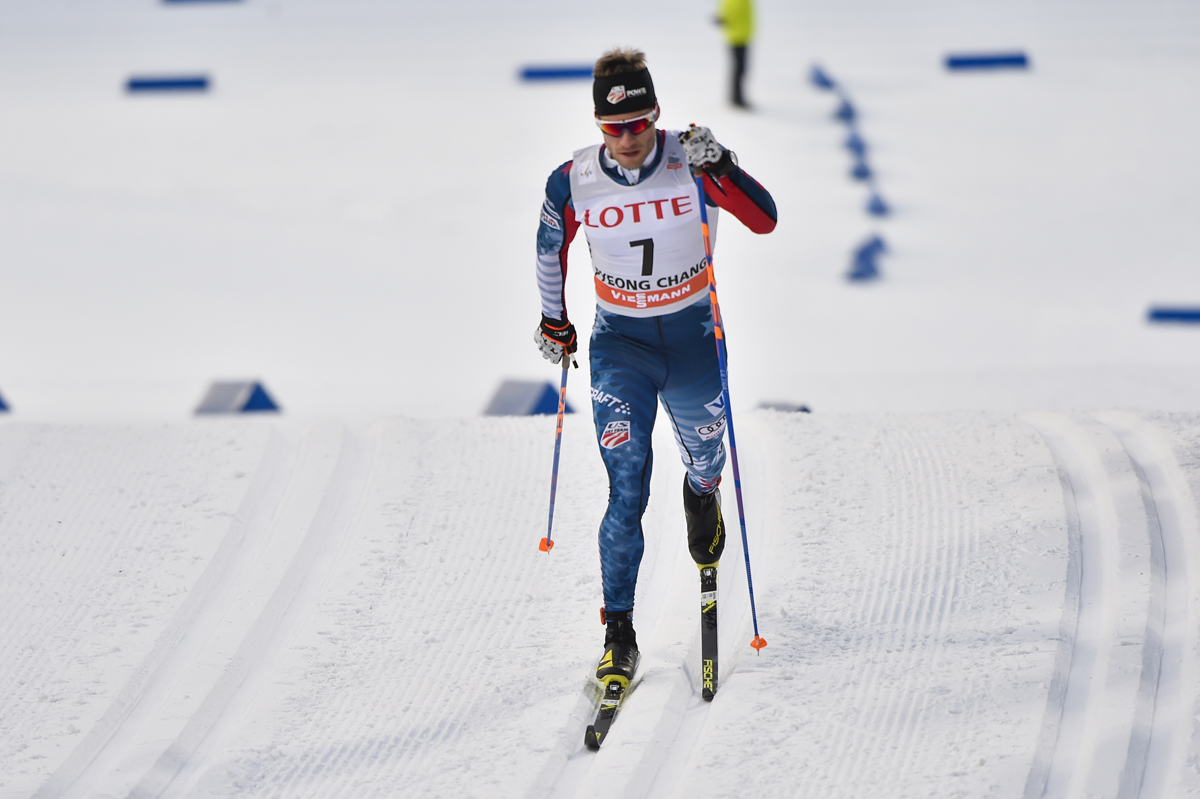
    American Andy Newell chasing Russia's Alexander Panzhinskiy during their quarterfinal of the men's classic sprint at the PyeongChang World Cup in South Korea. (Photo: Fischer/Nordic Focus)
    American Andy Newell (7) chasing Russia’s Alexander Panzhinskiy during their quarterfinal of the men’s classic sprint at the PyeongChang World Cup in South Korea. (Photo: Fischer/Nordic Focus)

    Newell was matched with top-qualifier Panzhinskiy in his quarter and semifinal. Panzhinskiy and Newell placed first and second in both, respectively, with Newell 0.63 seconds back in the quarter and 0.34 seconds back in the semi.

    “[Panzhinskiy] was the top qualifier so I knew he was going to be fast and so we were kind of really able to kind of get away from anyone in our heats in both the quarterfinal and the semifinal up that [second] hill,” Newell said.

    As a made-for-television production, the heats run on a tight schedule. And due to clearing the course after several crashes, organizers were running behind schedule. The time after the Newell’s semifinal to the final was reduced, hampering both Panzhinskiy’s and Newell’s normal pre-final recovery period.

    “Maybe we pushed each other a little too hard in the semifinal because I think we were both a little tired,” Newell reflected. “It just so happened that the schedule they were running behind with the heats today, which means the semifinal went off five to ten minutes late, but they have to keep the final on time. … That kind of took us by surprise because I think we both pushed each other pretty hard in that semi and then to have a short ten-minute recovery as opposed to one that’s fifteen or twenty, that was definitely a tough turnaround.”

    Newell skied from the back in the final. According to the Vermont-based skier, he changed skis in the final, and that decision compounded with his less-than-normal, pre-finals recovery period impacted his overall placing.

    “I swapped out for a different pair of skis and was using a different pair of skis in the final,” Newell said. “It was an easier-kicking pair of skis, which probably worked out great for the first few heats, but in the final I think one of the things that came to bite us was the fact that [my wax tech] Mark and I kept adding a layer of wax to make sure we had good grip up that big climb because it was such decisive part of the race. But by the final I think we were dragging a little bit too much wax, which really played a big role in me getting shelled off after about half way through because yeah, kick was dragging considerably in the final, but you know that’s all part of the game.”

    Newell ultimately finished 17.19 seconds back in sixth after realizing his efforts were in vain. But being present and racing well in PyeongChang remained important for Newell.

    “This race in particular was kind of one of the races I wanted to make sure I was at,” Newell said of how he planned out his current World Cup campaign. “My goals are really quite focused towards the Olympics next year. For me, the excitement was there today just because it’s a new venue and it’s the place where the Olympics are going to be taking place next year and I know I can be competitive in these classic sprints.”

    Newell will skip Saturday’s skiathlon to prep for Sunday’s freestyle team sprint. He’ll be racing the team sprint with Hamilton.

    “I was not feeling great all day, and it’s been kind of a tough week for me in general,” Hamilton wrote of his adjustment to South Korea. “I was definitely struggling with how my body was responding to big travel and a pretty significant time shift, but still, I think it is extremely valuable to be able to be here experiencing the courses and the layout of the land before 2018.”

    Simi Hamilton (U.S. Ski Team) racing to 12th in the men's classic sprint qualifier on Friday at the PyeongChang World Cup in South Korea. He went on to finish 17th overall after crashing in his quarterfinal and finishing fourth in that heat. (Photo: Fischer/NordicFocus)
    Simi Hamilton (U.S. Ski Team) racing to 12th in the men’s classic sprint qualifier on Friday at the PyeongChang World Cup in South Korea. He went on to finish 17th overall after crashing in his quarterfinal and finishing fourth in that heat. (Photo: Fischer/NordicFocus)

    Hamilton qualified 12th, which he was dissatisfied with.

    “I felt like I had a pretty weak qualifier, and was struggling to find big power and big glide on the two big climbs,” he wrote.

    Hamilton’s focus this year has been on skate sprinting: a traditionally strong technique for him.

    “But with so many skate sprints this year and the fact that the sprint in Lahti is skate, I haven’t really been thinking too much about classic sprinting or gearing my training towards classic sprinting,” he explained. “So I think with some focused training I’ll be able to dial in my preparations for this course specifically and hopefully feel much better in qualification the next time we are racing here.”

    In his quarterfinal, Hamilton was well positioned for the second climb — sitting back a few meters from the leaders.

    “Coming down the fast descent into the bottom of that hill, I made a slingshot move to the outside, open track on the far left, and was carrying some really good momentum past the two Norwegians in my heat,” he recalled.

    With his momentum carrying him up to the leaders, Norwegian Daniel Stock swerved into Hamilton’s tracks. (Stock was eventually relegated to 30th overall due to his obstructing Hamilton.)

    “I think he skied right over both of my bindings with his left ski as he was skating into that track. My feet were basically stopped dead in their tracks as the rest of my body was hurling up the hill.”

    A broken pole and stopped dead, Hamilton’s chances of advancing had been squelched.

    “As I got to my feet, the pack was already about 10 meters ahead of me and I realized that my night was over,” Hamilton added. He finished 17th overall.

    Another American, Matt Gelso (Sun Valley Ski Education Foundation) scored his first career World Cup points. Gelso had earned the World Cup starts as the Period 1 SuperTour leader.

    “It’s great to score my first ever World Cup points in my second-ever sprint,” Gelso wrote in an email. “Never thought my first points would come in a sprint. I skied the transitions well in my qualifier and accelerated through the course. I probably could have started harder but overall pacing was pretty good.”

    Gelso qualified 29th and placed 29th overall after finishing sixth in his heat.

    Also for the U.S., Scott Patterson (Alaska Pacific University) finished 44th and Noah Hoffman 48th in the qualifier.

    Results: Qualifier | Final

  • Sargent Seizes Opportunity, First Career Podium in PyeongChang Sprint

    Sargent Seizes Opportunity, First Career Podium in PyeongChang Sprint

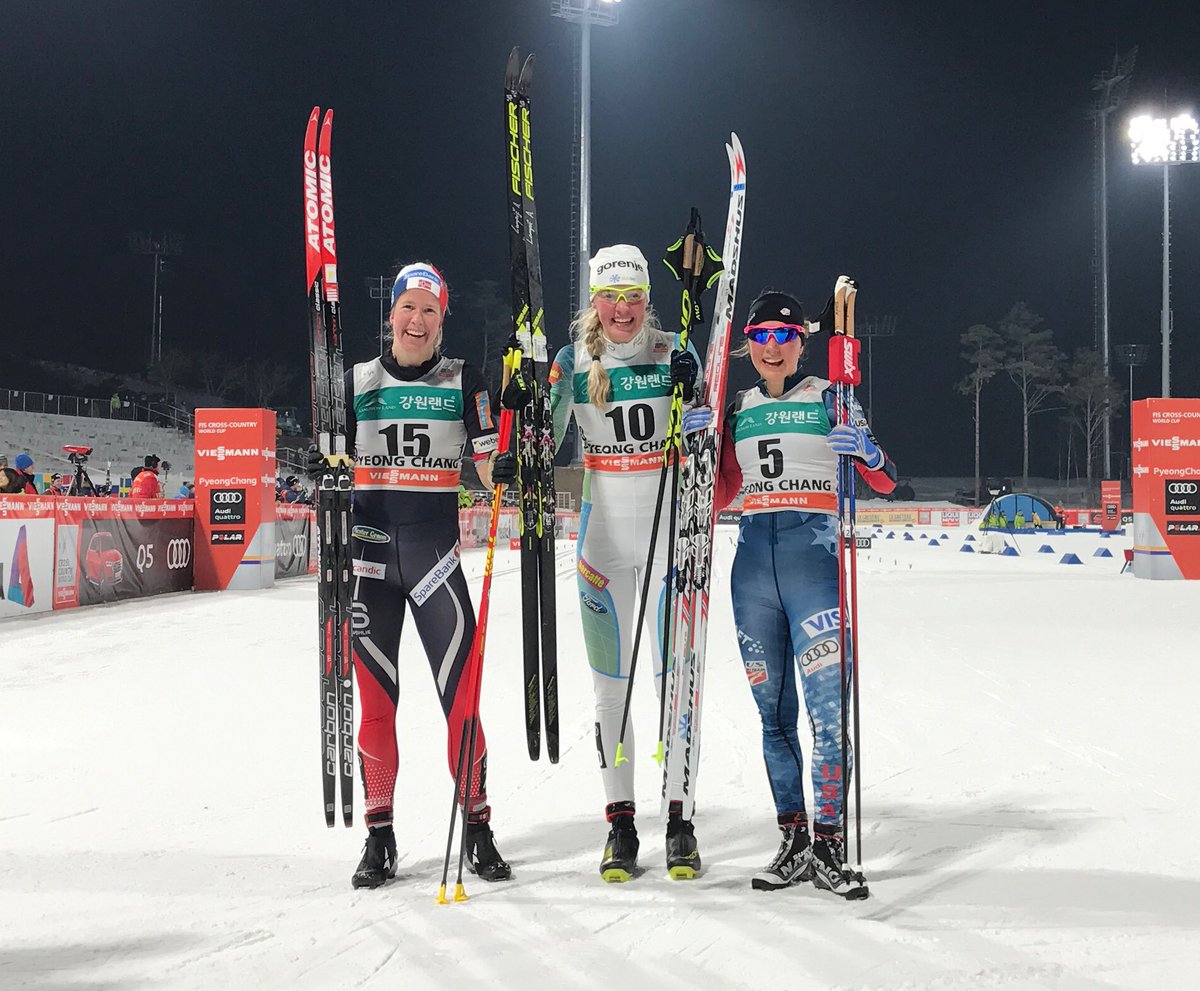
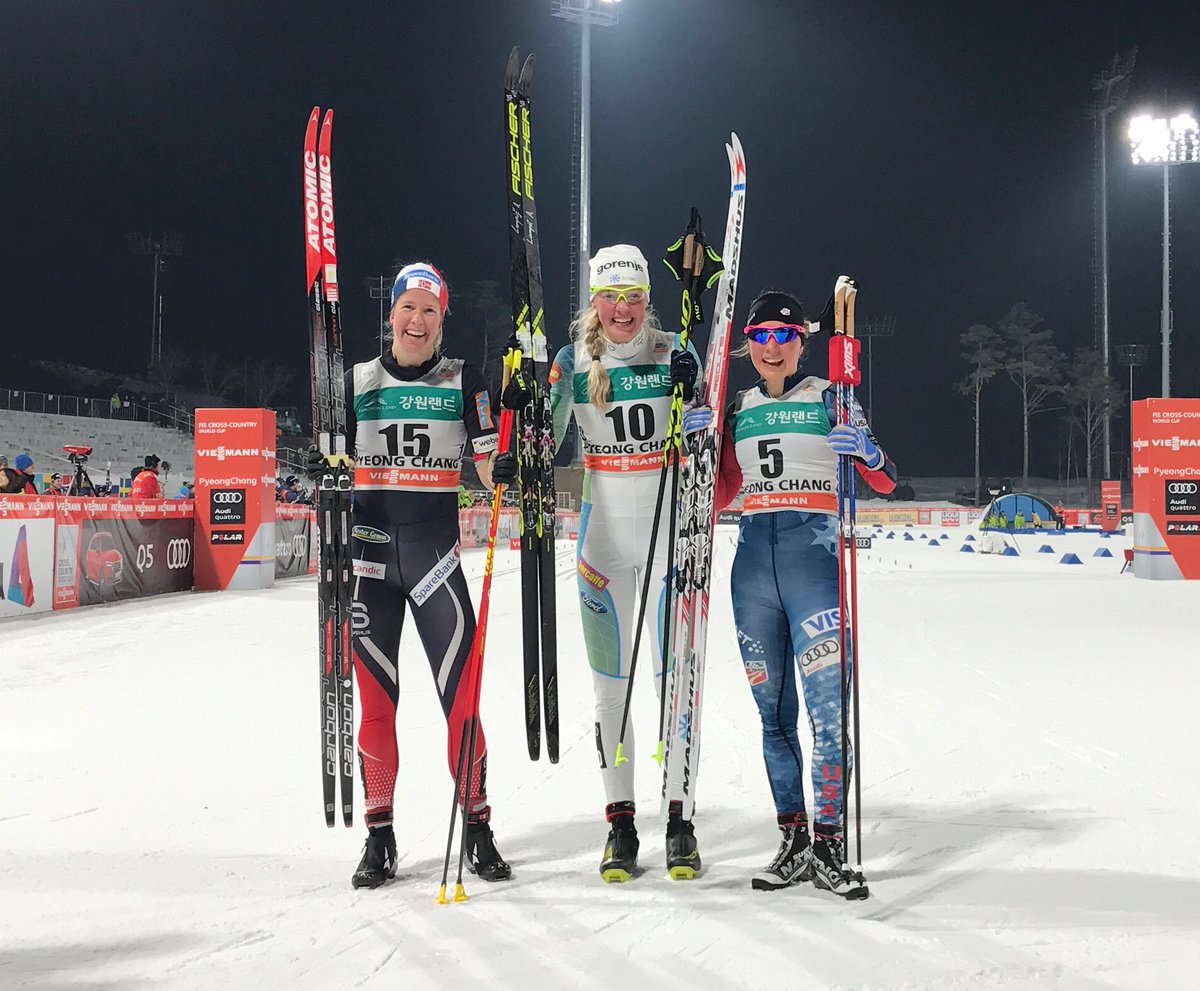
    The women's 1.4 k classic sprint podium on Friday at the pre-Olympic PyeongChang World Cup in South Korea, with Slovenia's Anamarija Lampič (c) in first, Norway’s Silje Øyre Slind (l) in second, and American Ida Sargent (r) in third. It was the first time on the World Cup podium for all three athletes. (Photo: FIS Cross-Country/Twitter)
    The women’s 1.4 k classic sprint podium on Friday at the pre-Olympic PyeongChang World Cup in South Korea, with Slovenia’s Anamarija Lampič (c) in first, Norway’s Silje Øyre Slind (l) in second, and American Ida Sargent (r) in third. It was the first time on the World Cup podium for all three athletes. (Photo: FIS Cross-Country/Twitter)

    (Note: This article has been updated to include comments from Liz Guiney, Caitlin Patterson and Jessica Yeaton.)

    Sometimes just being there is half the battle, as the saying goes.

    No Maiken Caspersen Falla. No Stina Nilsson. On Friday at the site of next year’s Olympic Winter Games in PyeongChang, South Korea, three athletes who had never made it to a World Cup podium before prevailed in the women’s 1.4-kilometer classic sprint.

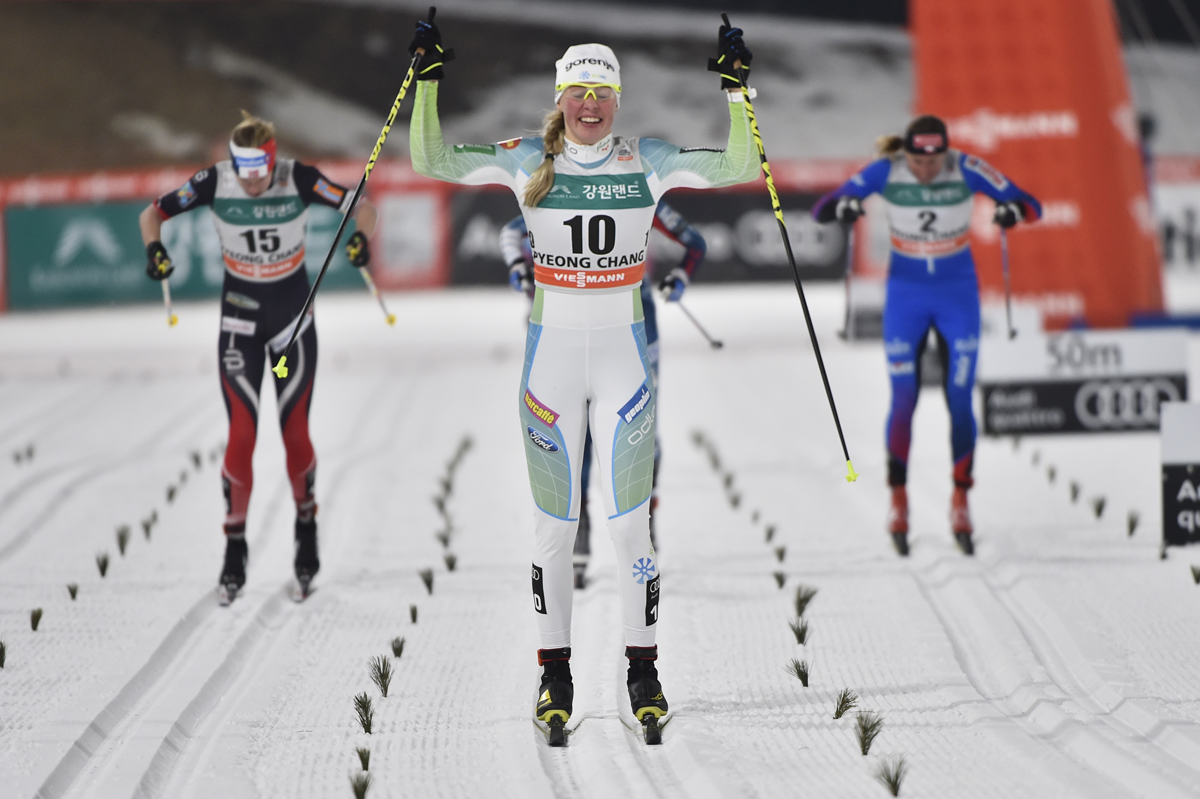
    And right there was Ida Sargent of the U.S. Ski Team (USST) in third place, smiling together with Slovenia’s Anamarija Lampič, who won her first sprint final in a time of 3:41.97 minutes (just 1.79 seconds ahead of Sargent), and Norway’s Silje Øyre Slind rounding out the picture in second place (+1.60).

    “I’m really excited about the podium and it hasn’t really set in yet,” Sargent commented on the best result of her career in an email to FasterSkier, instantly thinking of those who helped her get there. “I feel so grateful to have such an awesome team behind me both on the USST and at home in Craftsbury.”

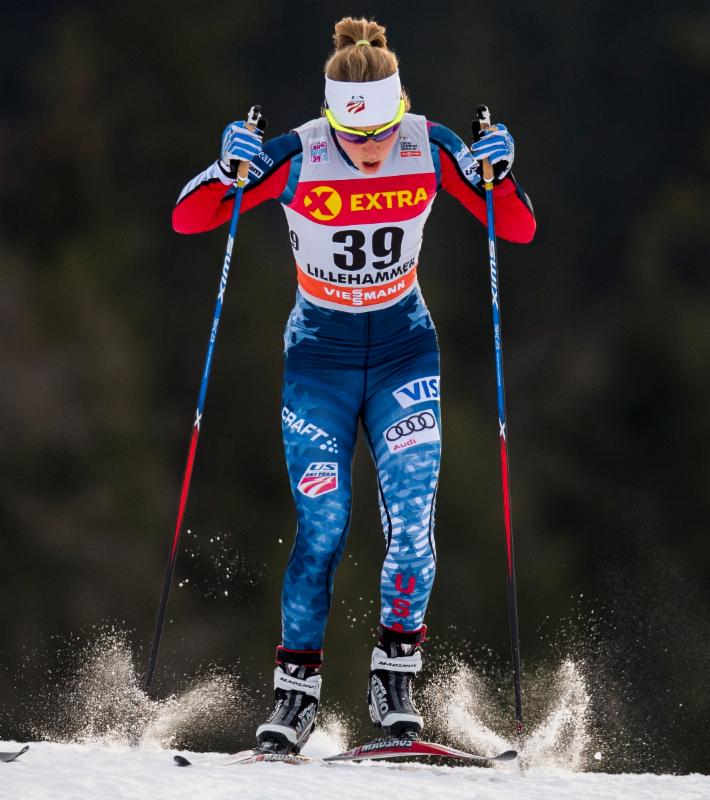
    Ida Sargent racing earlier this season at the World Cup in Lillehammer, Norway. (Photo: Toko/NordicFocus)
    Ida Sargent racing earlier this season at the World Cup in Lillehammer, Norway. (Photo: Toko/NordicFocus)

    Sargent has started in over 100 individual World Cup races, three International Ski Federation (FIS) World Championships, and the 2014 Winter Olympics. But this was the first podium finish for the 29-year-old Vermont native, and it had been a long time in the making.

    Sure, not all of the best skiers made the long trip to South Korea. In fact, while a number of the best sprinters still packed their ski bags, none of the top-25 ranked athletes in the women’s overall World Cup standings before this weekend did, including Norway’s Falla and Sweden’s Nilsson, who combined have also won 13 out of the last 15 sprint races.

    Those athletes opted to prepare for the upcoming World Championships in Lahti, Finland, by taking a training break or starting at the Norwegian and Swedish national championships also going on this week. But that was their choice, while the women smiling atop of the podium in PyeongChang had decided differently.

    As any professional in a regular job can relate to, “showing up is 80 percent of life” – a quote commonly attributed to filmmaker Woody Allen.

    And the shrunken field should not distract from the exciting heats and convincing fashion in which Sargent, along with her teammate Sophie Caldwell, qualified and advanced through the rounds in the night race under floodlights, in a beautiful and brand-new arena for the first cross-country World Cup event ever hosted by South Korea.

    Both have proven before that they can hang with the best, even when all World Cup regulars stand at the start line. Sargent has achieved five top-10 sprint finishes in her career, including a fifth place in Kuusamo, Finland, for the 2014 season opening. Caldwell won a classic sprint during the Tour de Ski last season in Oberstdorf, Germany. (The other athlete to break the streak of Falla and Nilsson was Norway’s Heidi Weng, who in December 2016 won the classic sprint in Lillehammer, Norway.)

    Earlier in the day, Caldwell had the fastest qualifying time around the 1.4 k course, which features a steady climb out of the arena soon followed by a tricky right downhill turn into the next steep climb that later gave a number of athletes problems during the heats, and another downhill back into the stadium with a sharp corner that caused some athletes to ski wide left out of the V-boards marking the course.

    “It’s probably the hardest sprint course for women that maybe we’ve ever encountered,” U.S. Ski Team (USST) Head Coach Chris Grover said in a phone interview from Korea with FasterSkier. “It almost has no flat on it except for some double poling out of the start and some double poling into the finish. You really just are spending all your time climbing. And such a small difference between the women’s course and the men’s course.”

    Sargent qualified in fifth, 4.76 seconds back from Caldwell. She had to put up a bit of a fight in her quarterfinal, coming onto the finishing stretch with three other athletes still close by and spreading out into the lanes. Sargent poled hard and prevailed to win the heat in a photo finish by 0.03 seconds against Russia’s Elena Soboleva, keeping Slind and Slovenia’s Katja Višnar at bay all within less than half a second.

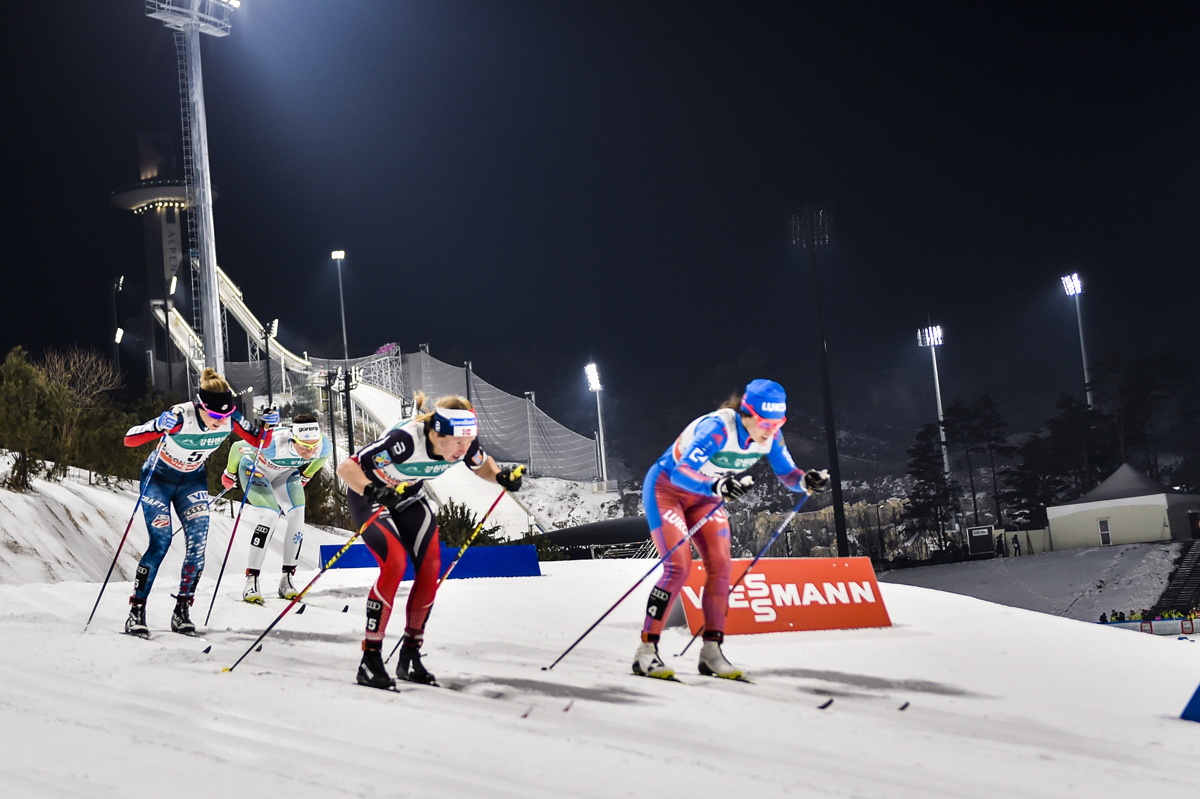
    Russia's Elena Soboleva leads Norway's Silje Øyre Slind (second from r), American Ida Sargent (second from l) and Slovenia's Katja Visnar during their quarterfinal of the women's classic sprint at the World Cup in PyeongChang, South Korea. (Photo: Fischer/NordicFocus)
    Russia’s Elena Soboleva leads Norway’s Silje Øyre Slind (second from r), American Ida Sargent (second from l) and Slovenia’s Katja Visnar during their quarterfinal of the women’s classic sprint at the World Cup in PyeongChang, South Korea. (Photo: Fischer/NordicFocus)

    Then, Sargent placed second in her semifinal behind Lampič, edging Russia’s Alisa Zhambalova in third with both timed at 0.5 seconds back, though the third place would also have been sufficient to advance.

    “Both of the lucky losers came out of my quarterfinal and then the semifinal so the heats were really fast from the start, but I was able to learn a little with each one and tweak my strategy,” Sargent wrote of her progression through the heats.

    “Ida just kept herself toward the front, and had some good double-pole finishes to keep advancing through the rounds,” Grover said. “And yeah, it was just the right course, the right day, good skis, great kick, great glide, it was just the right combo.”

    Caldwell had even fewer problems than Sargent in her quarterfinal, quickly gapping the rest of the pack with Sweden’s Maria Nordström up the first climb out of the arena and finishing the heat in first place.

    But then things did not fall her way in the semifinal.

    “I’m really frustrated with how I skied the last corner of my semi,” Caldwell wrote in an email. “I was determined to make the final and was pretty mad with myself for giving it up on that last corner.”

    Her main obstacle: Justyna Kowalczyk. The 34-year-old Polish ski star certainly carries a big name on the international scene with two Olympic gold medals, but due to persistent back problems, she has had to reduce her World Cup appearances in the last seasons, mostly focusing on a few classic races and ski marathons starting for the Norwegian professional team Santander.

    But on Friday she was at the start in PyeongChang, qualifying in second position just 1.84 seconds behind Caldwell before winning her quarterfinal. In the semifinal, the two raced head to head. Initially Caldwell skied with Kowalczyk, but then lost all momentum when Sweden’s Nordström in front of her stumbled a bit and the rest of the pack caught up to them.

    American Sophie Caldwell chasing Sweden's Maria Nordström in Friday's 1.4 k classic sprint at the PyeongChang World Cup in South Korea. Caldwell finished the day in eighth overall, behind Nordström in seventh. (Photo: Fischer/Nordic Focus)
    American Sophie Caldwell chasing Sweden’s Maria Nordström in Friday’s 1.4 k classic sprint at the PyeongChang World Cup in South Korea. Caldwell finished the day in eighth overall, behind Nordström in seventh. (Photo: Fischer/NordicFocus)

    “There was a moment of panic coming off the downhill into that second hill when the Swede and Kowalczyk almost fell and I was right behind them,” Caldwell explained. “I got bumped into a pretty far track on the outside and we had lost most of our speed at that point.”

    But Caldwell kept fighting and managed to catch back up to Kowalczyk on the final downhill into the arena with the best curve technique and good skis, but ran onto her when they both took the same lane into the finish, not able to speed up as much as she had wanted to. She got passed outside by Slind who advanced in second place as well as by Nordström, who like Caldwell also missed out on the best two lucky loser times.

    “I pushed well over the top and carried my speed through the corners, positioning myself exactly where I wanted to be in the inside track,” Caldwell wrote. “Going up and over the little bump in the stadium, I let Kowalczyk get just enough ahead of me so that she was able to cut in front of me before the finish lanes and then two other people whipped by. I wish I could do it again and realize that’s part of ski racing, but it’s a bummer to screw it up tactically on a day I was feeling good and skiing well.”

    “For Sophie to win the qualifier was cool,” Grover said. “I believe that was the first time she has won the qualifier.”

    The Final

    Lampič was already smiling broadly in the start gate of her quarterfinal and semifinal, where she advanced in second and first, respectively. But back then she couldn’t yet know that her day would turn out even better.

    Slovenia's Anamarija Lampic (10) celebrating her first World Cup victory and podium on Friday in the as she wins the women's 1.4 k classic sprint final in PyeongChang, South Korea. (Photo: Fischer/Nordic Focus)
    Slovenia’s Anamarija Lampic (10) celebrating her first World Cup victory and podium on Friday in the as she wins the women’s 1.4 k classic sprint final in PyeongChang, South Korea, while Ida Sargent (directly behind Lampic) races for a career-best third. (Photo: Fischer/Nordic Focus)

    In the final, initially the others let Sargent set the tempo out of the arena, but Lampič passed her by on the penultimate hill, with Slind and Kowalczyk also pushing hard to create a small gap.

    “She skied powerful over the top of the second big climb and set herself up for the downhill,” Grover said. “There’s a really tough downhill corner coming into the stadium, and she skied that great. She really carried her momentum well through that … Other people crashed, other people went outside the V-boards because they couldn’t control the corner there.”

    “I had figured out a good line on that last downhill and I also had very fast skis so I used it as a chance to move up each time,” Sargent wrote of the race situation. “I think I was behind Kowalczyk in the final at that part but I was hoping if I skied it well I could gain back some time.”

    Turning the last corner into the finishing stretch, Lampič was several meters ahead with none of her competitors able to challenge her anymore.

    “It is unbelievable I won today,” Lampič said, according to a FIS press release. “I hoped to make it to the final but to win, it’s a dream. I skied well in the downhill. I managed to get a gap on the other girls. After the curve in the stadium I knew I had a lead and I could enjoy the home stretch.”

    With her win, Lampič currently also leads the U23 standings in the World Cup.

    As they double poled hard the finish, Slind passed Sargent on the lane to her right on the last meters, but Sargent held off the final charge from Kowalczyk by half a second to claim the third place and her first World Cup podium.

    “It was tough today, the course was hard but it was hard for everybody,” the 28-year-old Slind, who is not a regular member of Norway’s senior national team on the World Cup, told FIS. “I got tired in the big climb but managed to ski the downhill well. I had some power left and was pushing hard on the homestretch.”

    Kowalczyk finished fourth (+2:35), Russia’s Alisa Zhambalova placed fifth (+4.24), and Lampic’s teammate Višnar was sixth (+17.10).

    A jubilant Sargent raised her arms as she crossed the finish line, and on the small victory lap of the podium finishers she skied to the side fence to hug with Caldwell and her other teammates, who had waited in the arena to watch her final heat.

    “It was pretty incredible to watch Ides get her first podium,” Caldwell wrote. “We were all lining the finish stretch cheering for her and of course I had to go congratulate her. Your first podium is something you remember forever and Ida is a hard worker who deserved that and I was happy I could be there to see it!”

    In recent years, the U.S. Ski Team has put a number of female athletes onto the podium. Kikkan Randall. Jessie Diggins. Sophie Caldwell. Liz Stephen posted some of the best hill-climb times in several editions of the Tour de Ski. And a month ago, Sadie Bjornsen also reached a third place. Now, Sargent joined their ranks.

    “It has been a goal of mine for a long time to be on the podium so it was a very special day!” Sargent wrote. “I’ve been inspired by so many fast teammates, so happy to follow in their footsteps!”

    All five U.S. women in the heats

    But it was not just a good race day for Sargent and Caldwell, with the U.S. team managing to put all of its starters into the heats.

    “It was a really small women’s field,” Grover noted, “so it was not a huge surprise that all of those five [women] made it in. But there were some massive spreads in times. You saw right away in the quarterfinals that they were getting pretty spaced out.”

    Sargent’s Craftsbury Green Racing Project teammate Liz Guiney qualified in 25th (+20.74 to Caldwell). She then went on to place fifth in her quarterfinal (+2:18), keeping Finland’s Mona Liisa Nousiainen behind her to finish the day in 24th place overall. It was the best individual result in her first season of World Cup races so far.

    “It’s really exciting to score World Cup points for the first time!” Guiney wrote in an email. “I recognize that this field is not the same as a normal World Cup field, but I guess you have to show up to score the points. … My season has been a bit up and down this year, so I’m hoping that this race was a good sign that things are headed in the up direction!”

    In terms of the sprint course, she described it as both fun and hard.

    “The climbs on the sprint course are pretty steep and sustained, which I think is great for a classic sprint, to discourage double poling without kick wax,” Guiney wrote. “The first downhill is fine since it’s banked, but conditions were fast on the second downhill and it definitely felt different (faster) than skiing it the previous days. I actually skidded, and a few people fell, but the most successful skiers in the rounds were picking a good line and stepping it to carry momentum.”

    Liz Stephen of the USST was the highest-ranked athlete in the overall World Cup standings, male or female, who made the trip to Korea (but with Slind’s second place, she surpassed Stephen).

    Stephen, a distance specialist, will focus on Saturday’s skiathlon, but took the opportunity for a sprint race on Friday and qualified in 29th (+23.59). It was the first time she managed to qualify for the heats in three seasons. Smiling and waving to the fans at the start of her fast quarterfinal heat together with the eventual finalists Sargent, Slind and Visnar, she quickly fell to the back of the pack and eventually finished fifth (+19.10) for the 25th place overall.

    The third Craftsbury member, Caitlin Patterson qualified in 20th (+17.90) and placed sixth in her quarterfinal (+21.81), which included the eventual winner Lampič as well as the finalist Zhambalova. With that, she achieved 27th place overall and the fourth top-30 result of her career, though her race day could have gone even better.


    “I am a notorious slow starter, and I was determined to start quickly, but I still ended up in 6th place by the bottom of the first hill,” Patterson wrote in an email. “I was frustrated near the top of that hill, as I was boxed in behind the 4th and 5th place women, who were moving a little slowly, as the top 3 gapped us. After taking a bad line on the first downhill, I got stuck behind the same two girls on the 2nd hill, then jumped to an outer track and moved around them, accelerating to the top of the course and building a gap behind me.

    “The 3 women leading the heat were a ways in front of me, but I was determined to do everything I could to close the gap, so I took the curvy downhill into the stadium really fast with no speed checking. I swung wide at the bottom, I think caught some grabby corduroy there, and before I knew it, crashed right at the bottom of the corner,” she continued. “I consider myself fairly good at downhills, but I think I was too focused on the women I was trying to catch, and not quite focused enough on the snow under my own feet. … It was a great experience to be in a heat on this level, but I was very frustrated with the fact that I took myself out, not to mention the poor positioning from earlier in the heat prior to the crash.”

    Her goal to start the day had been to qualify and make the most of an opportunity to race in World Cup heats.

    “I can’t say I expected that it would be easy to make the heats, even with the reduced field there are still lots of fast people here,” Patterson wrote. “I did believe that it would be possible though, and I met the goal of qualifying with a solid 22nd place.

    “It’s fun to be in the top 30, but I don’t think it means a whole lot here at this Korean World Cup,” she wrote of her overall result. “The field is undoubtedly weak, and just top 30 doesn’t really make a splash compared to the many fantastic results of the strong US women’s team right now.”

    Also racing in the heats was Jessica Yeaton of Alaska Pacific University, who internationally skis for Australia. She qualified in 30th (+26.29) and also finished 30th after placing sixth behind Stephen in the first quarterfinal (+20.1).

    “Going into the race it was my goal to make the heats once I saw that the start list was smaller than usual,” Yeaton wrote in an email. “I thought it would be an awesome opportunity to practice skiing heats, and thought I might actually have a shot at it given the size of the field.

    “My quarterfinal was fast, and I struggled to stay with the group over the top of the first hill,” she explained, “Although I am happy with my effort overall. Skiing head to head with some of the fastest qualifiers helped me realize my weaknesses with striding, and I am inspired to work on these as the Olympics approach.

    “This result is very special for me, as skiing in the heats has always been a goal of mine that I have worked hard towards achieving,” she added.

    Canada’s Annika Hicks (Alberta World Cup Academy) in 32nd (+32.96 to Caldwell’s time in the qualifier) and Sadie White (NTDC Thunder Bay) in 34th (+38.96) missed qualifying for the heats.

    Due to the time difference, the athletes aside from Sargent and Caldwell could not be reached for comment before press time.

    Racing continues on Saturday with the women’s and men’s 15/30 k skiathlons, followed by freestyle team sprints on Sunday.

    “I’m not racing tomorrow and will rest up to race the team sprint on Sunday with Sophie,” Sargent wrote regarding her plans for the weekend.

    — Jason Albert and Chelsea Little contributed

    Results: Qualifier | Final

  • Friday Rundown: PyeongChang, Soldier Hollow & Eastern Canadian Champs (Updated x3)

    Katharine Ogden (SMS/USST) finishing third for bronze in the women's 10 k skiathlon on Friday at 2017 Junior World Championships at Soldier Hollow in Midway, Utah. She is the first American to reach the podium in a Junior World Championships. (Photo: FlyingPointRoad.com)
    Katharine Ogden (SMS/USST) finishing third for bronze in the women’s 10 k skiathlon on Friday at 2017 Junior World Championships at Soldier Hollow in Midway, Utah. She is the first American to reach the podium in a Junior World Championships. (Photo: FlyingPointRoad.com)

    FIS Nordic Junior World Championships (Midway, Utah): 10/20 k skiathlon

    A Junior World Championships medal has been on Katharine Ogden’s mind for some time — two years, to be exact.

    “Every day in training, it’s kind of something that I think about. It’s the little thing that helps me push myself,” Ogden, a 19-year-old member of the Stratton Mountain School and U.S. Ski Team D-team, said in a post-race interview with the U.S. Ski Team on Friday. “Even in the middle of June, I’ll be like, ‘You know what I want to be? On the podium at World Juniors.’ ”

    She did just that on Friday, racing to third in the women’s 10-kilometer skiathlon at 2017 Junior World Championships at Soldier Hollow in Midway, Utah. In doing so, she became the most successful American at World Juniors, surpassing Lindsey Williams’s previous best of fourth place in 2003.

    Ogden finished 10.4 seconds behind the winner, Norway’s Marte Mæhlum Johansen, who finished first in 27:17.3 minutes. Sweden’s Ebba Andersson took second, 6.6 seconds back. Behind Ogden, Italy’s Anna Comarella placed fourth (+51.6) ahead of Finland’s Eveliina Piippo in fifth (+58.7).

    Hailey Swirbul (University of Alaska Anchorage) was the second U.S. woman in 24th (+2:21.0), while Natalie Hynes (Whitehorse) led Canada in 28th (+3:11.3).

    Also for Canada, India McIsaac (Rocky Mountain Racers) finished 30th (+3:13.8), Lisle Compton (NTDC Thunder Bay) was 33rd (+3:45.5) and Annika Richardson (NTDC Thunder Bay) 41st (+4:49.3).

    Also for the U.S., Lauren Jortberg (Dartmouth) finished 37th (+4:04.5) and Taeler McCrerey (University of Denver) 38th (+4:07.5).

    [UPDATED] In the men’s 20 k skiathlon that followed, Russia’s Vladislav Vechkanov notched his second gold of the week in 49:40.5, outlasting Norway’s Thomas Helland Larsen by 1.9 seconds. Norway had two on the podium with Harald Østberg Amundsen in third (+2.2).

    Canada’s Gareth Williams (Telemark Race Team) was the top North American in 11th (+1:24.0) for his best result at his first Junior Worlds.

    American Wyatt Gebhardt (Steamboat Springs WSC) followed in 12th (+1:42.7) for his second-straight top 20 and Hunter Wonders (Alaska Pacific University) also finished in the top 20 for the second-straight race in 18th (+1:57.9).

    Canada’s Philippe Boucher (CNEPH) was 22nd (+3:15.7), Ryan Jackson (Team Hardwood) 31st (+3:52.5), and Remi Drolet (Black Jack) 49th (+6:57.3).

    Also for the U.S., Kam Husain (SMS) placed 50th (+6:59), and Logan Diekmann (University of Utah) was 53rd (+7:47.3).

    Results: Women | Men 

    ***

    NorAm Eastern Canadian Championships (Cantley, Quebec): Classic sprint

    The NorAm series resumed at the Nakkertok Nordic Centre on Friday with Eastern Canadian Championships with classic technique sprints.

    Alberta World Cup Academy’s Maya MacIsaac-Jones returned from U23s in time to win the 1.3 k A-final in 3:42.06, after qualifying sixth. Top qualifier Sophie Carrier-Laforte was second for CNEPH at her home event, 0.66 seconds behind. SMS Elite’s Anne Hart rounded out the podium at 3.40 seconds back.

    On the men’s side, AWCA’s Dominique Moncion-Groulx qualified first before winning every heat on his way to victory in 3:14.84 on a slightly longer 1.4 k course. NTDC Thunder Bay’s Angus Foster was a close second, 0.09 seconds behind. Team R.A.D.’s Russell Kennedy was a comfortable third, 2.75 seconds back, on a day marked by some surprising eliminations.

    The elite field is slightly smaller than usual with some athletes away in Soldier Hollow and PyeongChang. As many younger racers were stuck in school for the day, there are only about 500 starters for what is usually the largest FIS event in Canada.

    Results: Qualifier | Heats

    ***

    FIS Cross-Country World Cup (PyeongChang, South Korea): Classic sprint

    The women's 1.4 k classic sprint podium on Friday at the pre-Olympic PyeongChang World Cup in South Korea, with Slovenia's Anamarija Lampič (c) in first, Norway’s Silje Øyre Slind (l) in second, and American Ida Sargent (r) in third. It was the first time on the World Cup podium for all three athletes. (Photo: FIS Cross-Country/Twitter)
    The women’s 1.4 k classic sprint podium on Friday at the pre-Olympic PyeongChang World Cup in South Korea, with Slovenia’s Anamarija Lampič (c) in first, Norway’s Silje Øyre Slind (l) in second, and American Ida Sargent (r) in third. It was the first time on the World Cup podium for all three athletes. (Photo: FIS Cross-Country/Twitter)

    In the last month, we’ve seen two U.S. Ski Team members — Jessie Diggins and Sadie Bjornsen — on the World Cup podium. Add Ida Sargent to that list.

    On Friday, the Vermont native raced to third in the women’s 1.4-kilometer classic sprint at the first-ever World Cup in PyeongChang, South Korea. It was the first of three days of racing in PyeongChang, which will host the 2018 Winter Olympics next season.

    Sargent qualified fifth (4.76 seconds behind her teammate Sophie Caldwell, who won the qualifier in 3:40.89 minutes) and went on to win her quarterfinal in a photo finish, then placed second her semifinal (also in a photo finish), edging Russia’s Alisa Zhambalova in third by less than 0.01 seconds.

    Both advanced to the final, where Sargent ultimately finished third, 1.79 seconds behind Slovenia’s Anamarija Lampič, who won in 3:41.97. Norway’s Silje Øyre Slind took second (+1.6), just 0.19 seconds ahead of Sargent. For all three women, it was their first time on a World Cup podium.

    Sargent beat out Poland’s Justyna Kowalczyk for third by 0.56 seconds. Zhambalova finished fifth and Slovenia’s Katja Visnar was sixth (+17.1).

    “I’m really excited about the podium and it hasn’t really set in yet,” Sargent wrote in an email on Friday. “It has been a goal of mine for a long time to be on the podium so it was a very special day! I’ve been inspired by so many fast teammates so happy to follow in their footsteps!”

    All five U.S. women racing on Friday finished in the top 30 to qualify for the heats. Caldwell won the qualifier by 1.84 seconds over Kowalczyk, Caitlin Patterson qualified 22nd, Liz Guiney 25th and Liz Stephen 29th (Stephen’s first time making the heats in three years).

    Jessica Yeaton, who races for Australia but trains with Alaska Pacific University, took the last qualifying spot in 30th (+26.29).

    Canada’s Annika Hicks and Sadie White missed qualifying in 32nd (+32.96) and 34th (+38.96), respectively, out of 36 women.

    Caldwell won her quarterfinal but finished fourth in her semifinal (behind Slind, Kowalczyk, and Sweden’s Maria Nordström, respectively) to miss advancing to the final. She placed eighth overall.

    Guiney placed 24th overall after finishing fifth in her quarterfinal, Stephen was 25th after taking fifth in the same quarterfinal as Sargent (where Yeaton finished sixth for 30th overall), and Patterson was 27th after finishing sixth in her quarterfinal.

    ***

    Both Canada’s Len Valjas and American Andy Newell reached the final in the men’s 1.5 k classic sprint on Friday, where they raced to fourth and sixth, respectively.

    Valjas started the day by qualifying in second, 1.97 seconds behind Russia’s Alexander Panzhinskiy, who topped the qualifier in 3:26.78. The Canadian went on to advance in second from his quarterfinal and fourth as a lucky loser from the first semifinal. In the final, he missed out on the podium in a photo finish with Russia’s Andrey Parfenov, who took third, 0.01 seconds ahead of him.

    Meanwhile, Newell qualified seventh (+5.18) and took second in both his quarterfinal and semifinal (finishing the second semifinal 0.34 seconds behind Panzhinskiy in first).

    In the final, Russia’s 25-year-old Gleb Retivykh pulled off his first World Cup victory and podium with a 0.3-second win over Norway’s Sondre Turvoll Fossli in 3:30.79. Retivykh qualified sixth (+4.53) then won his quarterfinal and placed third in the same semifinal as Valjas, advancing as the other lucky loser.

    “I had wait six years for my first victory and it is great,” Retivykh said, according to an International Ski Federation (FIS) press release.

    Russia had two on the podium with Parfenov in third (+0.73), just ahead of Valjas. The third Russian in the final, Panzhinsky ended up fifth (+1.49), ahead of Newell in sixth (+17.19)

    Three Canadian men qualified for the heats, with Jess Cockney in 16th (+10.24) and Simon Lapointe in 25th (+14.15). Bob Thompson missed 30th by one-hundredth of a second in 31st (+16.95), and Julien Locke was 36th (+17.9).

    Three Americans qualified as well, with Simi Hamilton in 12th (+8.26) and Matt Gelso in 29th (+16.66). Distance skiers Scott Patterson and Noah Hoffman finished 44th (+24.21) and 48th (+25.28) out of 55.

    Cockney reached the semifinals after winning his quarterfinal. In the second semifinal with Newell, he placed fifth, 5.44 seconds behind Panzhinskiy, for 10th overall.

    In Cockney’s quarterfinal, Hamilton crashed and finished fourth (+41.9) for 17th overall.

    Canada’s 23-year-old Lapointe finished sixth in his quarterfinal to place 27th, besting his previous World Cup best by 43 places. Gelso took 29th for his first-ever World Cup points after placing sixth in his quarterfinal.

    Results:

    Women’s qualifier | Women’s brackets

    Men’s qualifier | Men’s brackets