From the FasterSkier archive — posts syndicated from athletes’ and coaches’ own blogs between 2004 and 2012, kept online as published. Current coverage is at fasterskier.com.
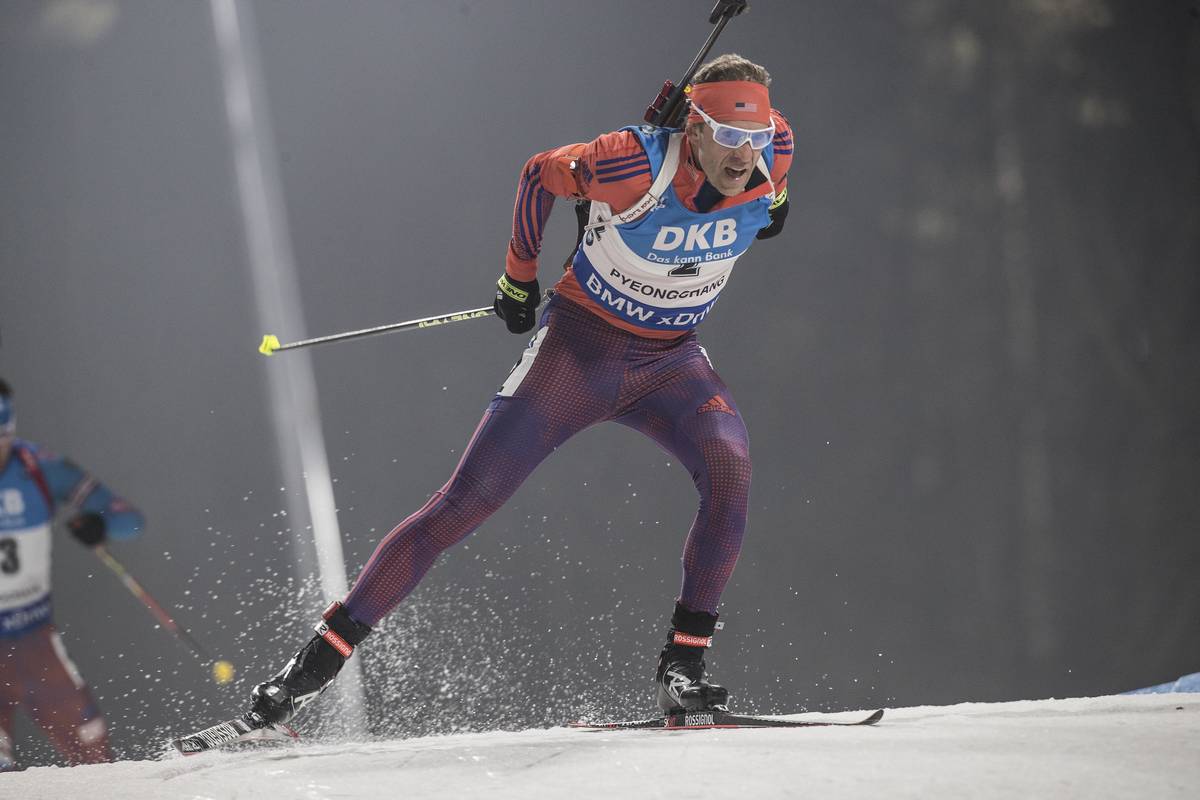
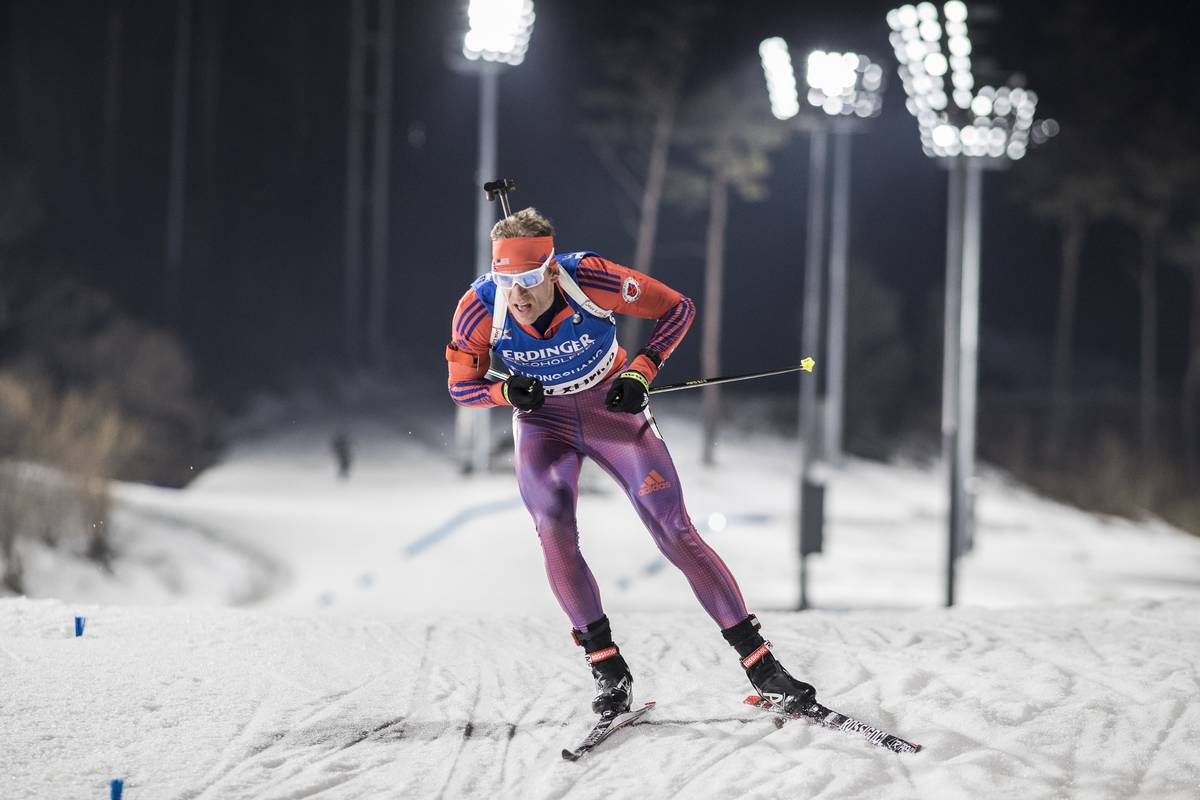
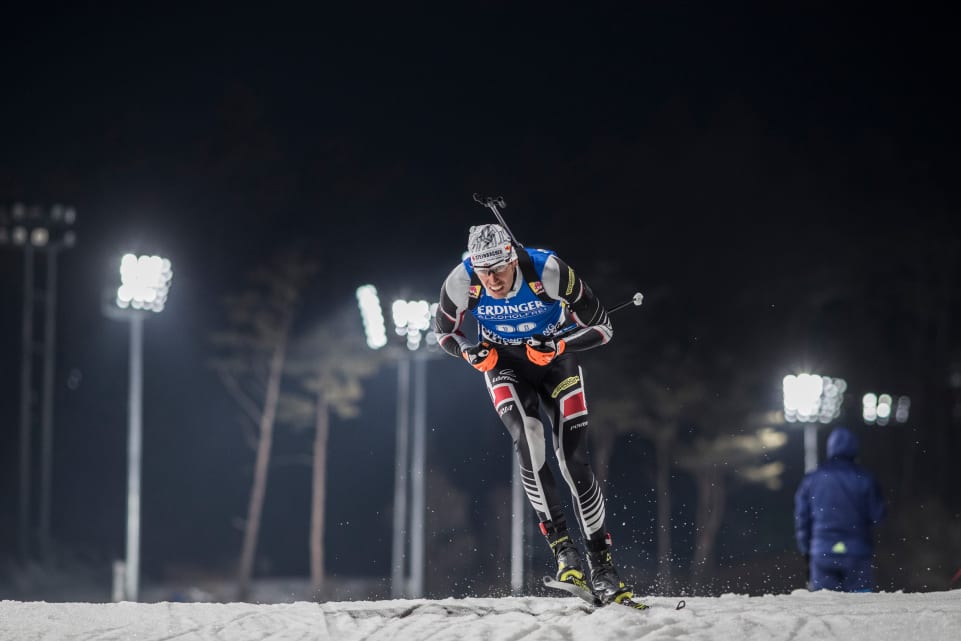
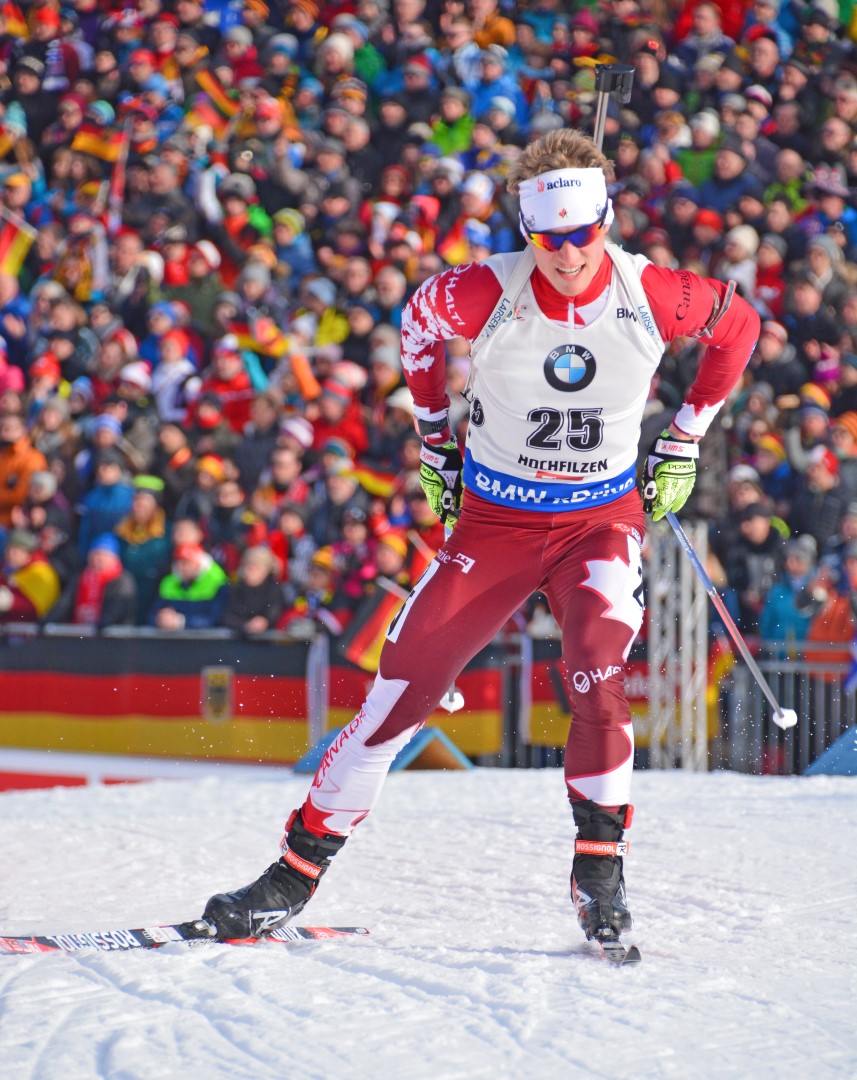
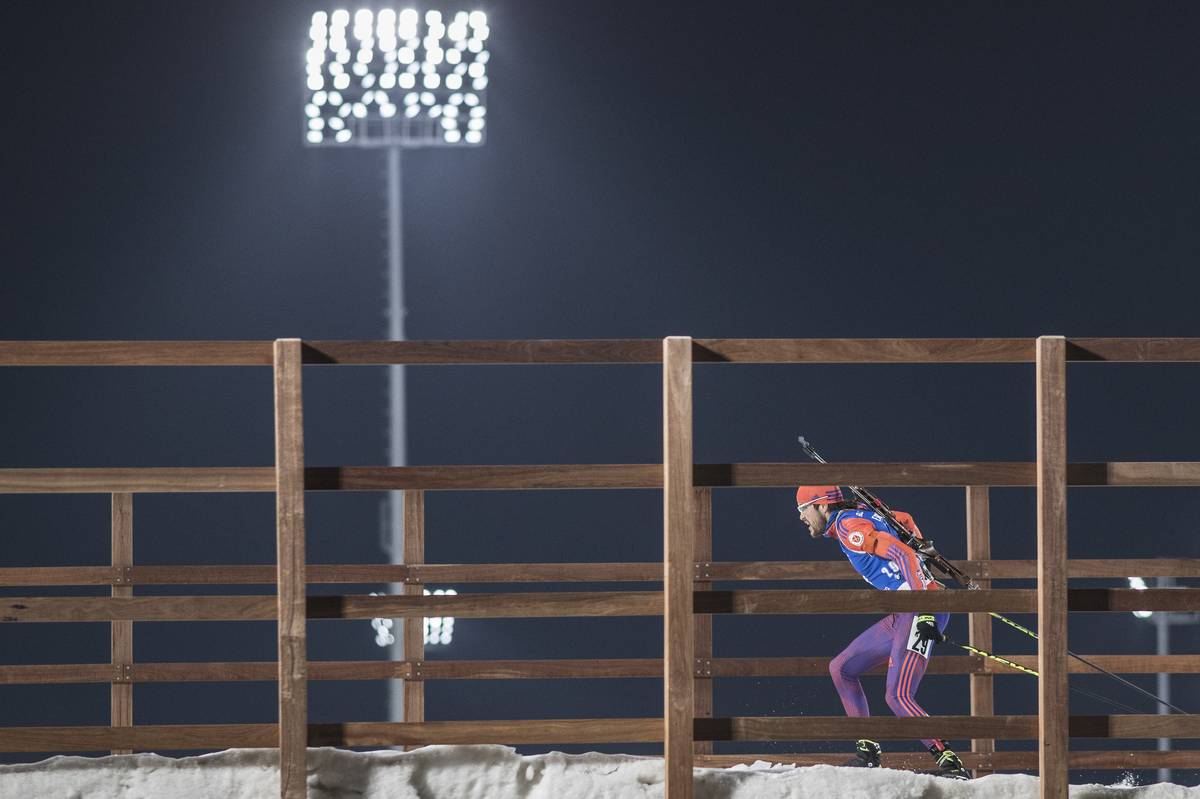
Lowell Bailey (US Biathlon) racing to ninth in the men’s 12.5 k pursuit on Saturday at the IBU World Cup in PyeongChang, South Korea. (Photo: USBA/NordicFocus)
The North Americans kept the momentum rolling two weeks after the International Biathlon Union (IBU) World Championships, with US Biathlon’s Lowell Bailey busting out a second place and Susan Dunklee placing fifth in back-to-back races over the last four days in PyeongChang, South Korea. On Sunday, the Canadians showed they’re rounding back into top form in team events, with its men’s team placing seventh and women’s team taking eighth for season bests in the relays. Here are the most interesting quotes that didn’t make it into the race reports (links below).
On the break after World Championships & the leadup to PyeongChang:
“After Worlds I went home to Canmore and enjoyed five days of R&R with some easy skiing. The ski conditions were very good and it was nice being able to relax in my own place and sleep in my own bed.”
– Scott Gow, Canada
“Rosanna [Crawford] and I traveled to France for five days to visit and train with Anais Bescond, who races for the French team. It was a nice break and was fun to ski and sightsee somewhere new. We also enjoyed some amazing wine and cheese!”
– Brendan Green, Canada
“It was really nice, there was great skiing, 30 kilometer loops in two different areas, we ate a lot of cheese and took part in a night race called ‘Nocturne de sleep’ where you ski 200m and then have to trade off giant underwear to each other in a team sprint style race, over your race suit of course! “
– Rosanna Crawford, Canada
“Over the past 10 or so days since World Champs I took a few days off to kind of rest, recover and just sort of try to step away from that high-intensity environment. Most of the team members went just outside of Ruhpolding [Germany] and we had a pretty relaxing training camp there. I didn’t shoot for the first couple days, and then just tried to get back into my normal routine…. we had pretty good travel from Ruhpolding, and we came here on the early side compared to a lot of other teams and I think that was an advantage.”
– Lowell Bailey, U.S.
“Last week I was home in Germany with my son, the best possible recharge for my heart and soul, but unfortunately my little guy got really sick towards the weekend which resulted in me coming down with a cold as soon as I arrived here in Korea. I simply cannot understand how it is that coming from a week of compromised training, with a cold and jet lag I am finally feeling good! I am definitely not complaining, although I clearly have some figuring out to do post-season.”
– Megan Tandy, Canada
On taking it day by day:
“Each race is a new opportunity and I try and do my best despite how I feel physically or mentally. I will spend time at the end of the season analyzing areas of my training where things went wrong for me. I am no doubt frustrated and disappointed after putting in so much hard work this year, but I am still motivated. There have been some really tough days this season, but I know I can challenge for the podium when I am in my best form and that’s what I will continue to chase next season.”
– Green
On sloppy snow in Sunday’s relay:
“Apparently the average high at this time of year is around 0ºC, so I guess we just ended up having unseasonably warm weather. Definitely not the easiest conditions, but the snow was managed well and late evening races allowed the snow to usually refreeze.”
– Nathan Smith, Canada
“That big puddle in the stadium was the only part of the course that was like that. I avoided it once or twice and went through it once or twice, I don’t remember exactly. I would say it didn’t seem to make too much of a difference for me, it seemed that that section was slow no matter where you went. Our skis were good today and actually went through the really wet stuff pretty easily.”
– Christian Gow, Canada
“The conditions have added to the difficulty both for us racers but also for the wax techs. Overall, the race organizers did a really good job preparing the course give the tough conditions.”
– Paul Schommer, U.S.
“It’s tough to ski when it’s 100% artificial snow and 40 degrees [Fahrenheit]. I was impressed that the snow actually held up for the entire week of racing. I’m hoping they have a deeper base next year, and handle the weather a bit better.”
– Maddie Phaneuf, U.S.
On the PyeongChang range:
“The range can be fairly windy, like tonight during the men’s race, and there isn’t much shelter if it happens to be a windy day, although I’d say it’s been 50/50 so far in terms of wind or no wind.”
– Scott Gow
On the PyeongChang trails:
“The course, in a sprint, has two hills, and my strategy was to push after the second climb, and push the downhills all the way into the stadium… , the two kilometer loop cuts out the second hill, so it’s a lot different from the sprint course. It’s just one giant climb that goes on forever, and then coming back into the range. It’s a couple of different pitches. There are a couple of short, flat downhill sections, but no longer than a couple seconds, and then you hit the really big part of the climb, about halfway through the loop. It’s a monster. Then it’s just downhill with lots of corners.”
– Susan Dunklee, U.S.
“I love this course! Uphills are my strength when I am in good shape and this is one of the hilliest 2.5 kilometer course I have ever raced on.”
– Tandy
“I really like this 2 kilometer loop, it’s hard off the start but you can really make up a lot of time on the top of the course and then the downhill back to the stadium.”
– Crawford
“The courses here are tough, but I like them. I preferred [the pursuit]’s 2.5 k course to the 3.3 k, but I think they are both good and challenging courses. I think that for next training season we will be focusing on getting ready for the climbs here and, with that preparation, I do think this could be a good venue for me.”
– Christian Gow
“We’ve timed how long the extended climb takes. You literally go from the low point to the high point in a single climb. That’s nearly unheard of on the World Cup. So we will be training for those long extended climbs, because you leave the starting gate, and you hit a one-kilometer steep climb, which is actually over the international limit, at times, for the grade… They’ve done a lot of work on the downhills, and improved them a lot. I’ve talked with the technical delegates, and I think they plan to bank some of the turns next year, that aren’t banked now, and that’ll make a difference. It’s a really challenging course.”
– Bailey
“In some ways this course is similar to Kontiolahti, with really steep hills. Historically I’ve done better with those grades instead of gradual 1-skate grinds. So I think if I’m in shape I could do some good performances here next year.”
– Smith
“I think in general our entire team (men’s and women’s) had great results at this course. It makes all of us excited to see what next year brings.”
– Phaneuf
On goals for the rest of the season:
“Because World Champs was a success, I feel like you still have a large part of the season left and I wanted to finish it out as best I can and really focus on these last three World Cups. So I spent the rest of the time [after World Champs] focusing on the races here and preparing of those, and just working on my skiing and shooting just like any other preparation for World Cup.”
– Bailey
“My goals are to maintain the ski shape I am in and bring my shooting back up to a higher level. I’m feeling quite good this week so I think the skiing aspect is definitely possible, and my shooting goal is achievable if I can get into the right head space.”
– Scott Gow
“It’s been nice to see the Olympic venue and test out the trails. I think it was the right decision to come here but I also think it’s the right decision to go home. These last 3 races have been just what I needed to motivate my self for one more season. Of course there is that little voice in the back of my head that’s saying the what if’s of finally skiing well to see what I can do, but there will be lots of opportunities for that next year.”
– Crawford (who is heading home instead of finishing out the World Cup season)
On cracking the top 30:
“Overall I am very happy with today’s result given how my season has been going. I think what made the difference for me today was being able to execute solid shooting in what were challenging conditions. The snow conditions were also quite difficult to race in tonight but I did my best and gave it my all.”
– Green, after the 10 k sprint
“This top 30 was an important part of me qualifying for some funding next year as well as a part of my Olympic qualification. Nothing is guaranteed until the end of the season of course, but squeaking into the top 30 today will open up some opportunities for next season.”
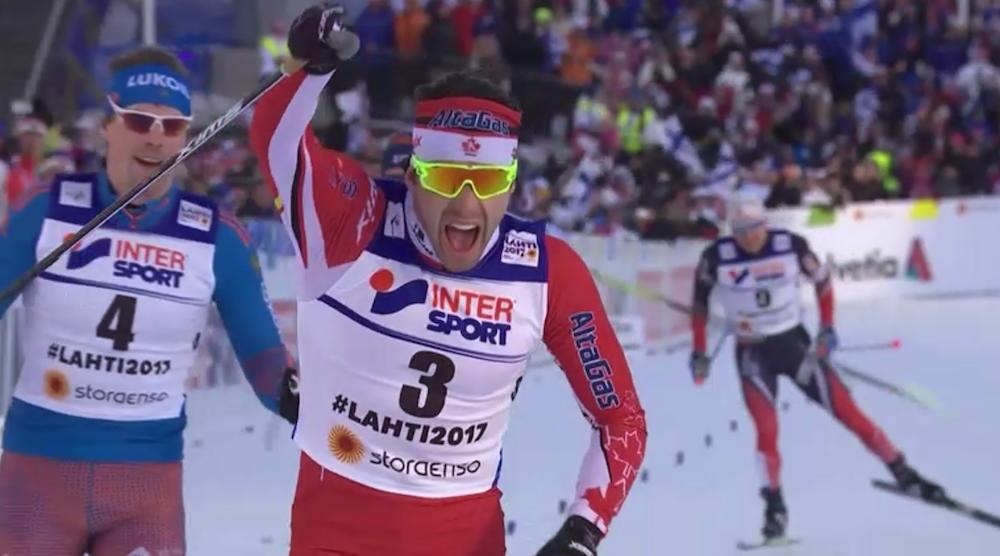
Canada’s Alex Harvey (3) celebrates his win in the men’s 50 k freestyle mass start, his first individual gold medal at a World Championships, on Sunday at 2017 Nordic World Championships in Lahti, Finland. He beat Russia’s Sergey Ustiugov (l) by 0.6 seconds while Norway’s Sjur Røthe (9) can be seen coming in for sixth place, behind (not pictured) Finland’s Matti Heikkinen, Great Britain’s Andrew Musgrave and Norway’s Martin Johnsurd Sundby, respectively. (Photo: NBC Sports screenshot)
FIS Nordic World Championships (Lahti, Finland): Men’s 50 k freestyle mass start
After a week of missing out on the medals at 2017 Nordic World Championships, Canada’s Alex Harvey, a four-time World Championships medalist from 2011, 2013 and 2015, achieved his first individual gold medal in the final race of this year’s World Championships in Lahti, Finland.
Harvey, 28, won the men’s 50-kilometer freestyle mass start in a drag race to the finish. Entering the final descent into the stadium with Norway’s Martin Johnsrud Sundby and Russia’s Sergey Ustiugov, Harvey rode his fast skis past both of them then had the most finishing kick in the final straightaway for a 0.6-second victory. He finished in 1:46.28.9 hours, while Ustiugov followed him across the line in second and Finland’s Matti Heikkinen from behind for third (+1.4), after passing Sundby around the outside of the last corner.
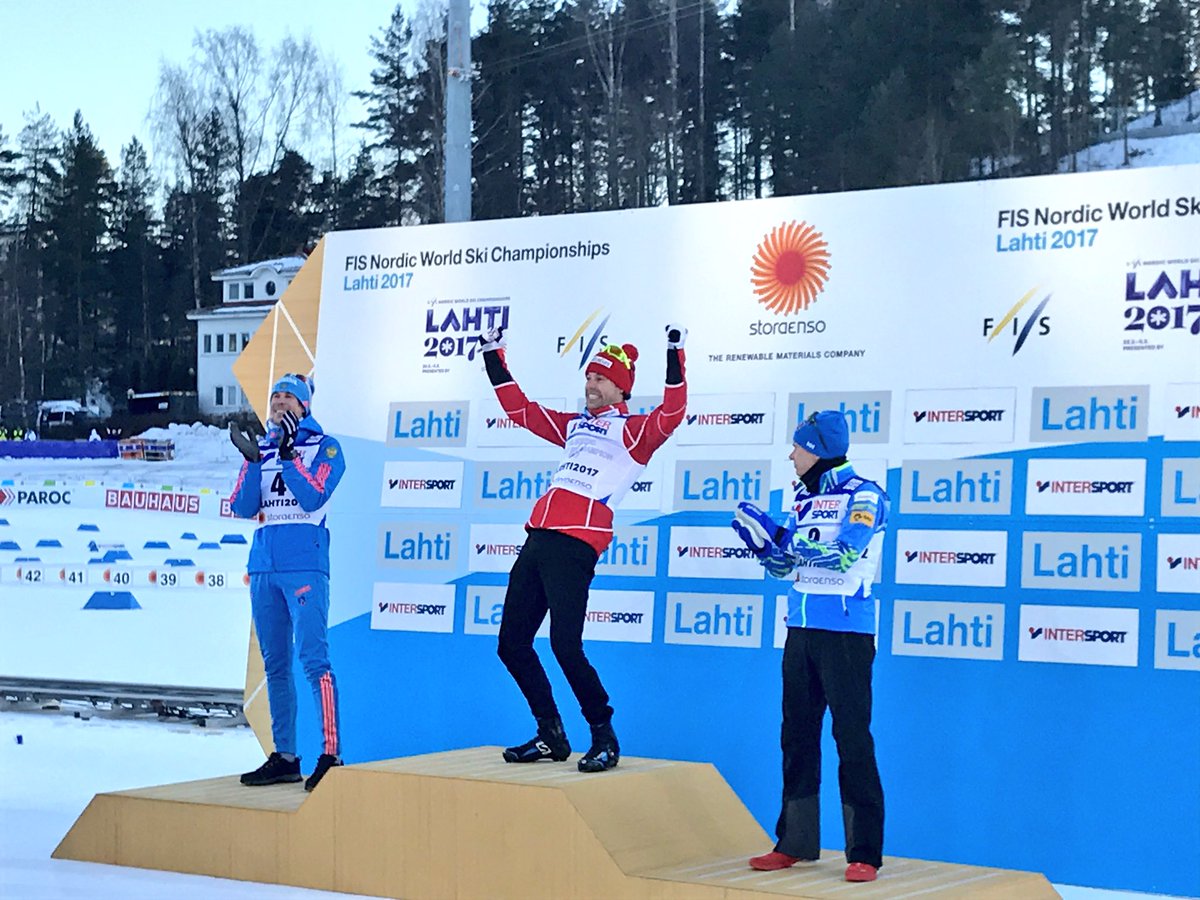
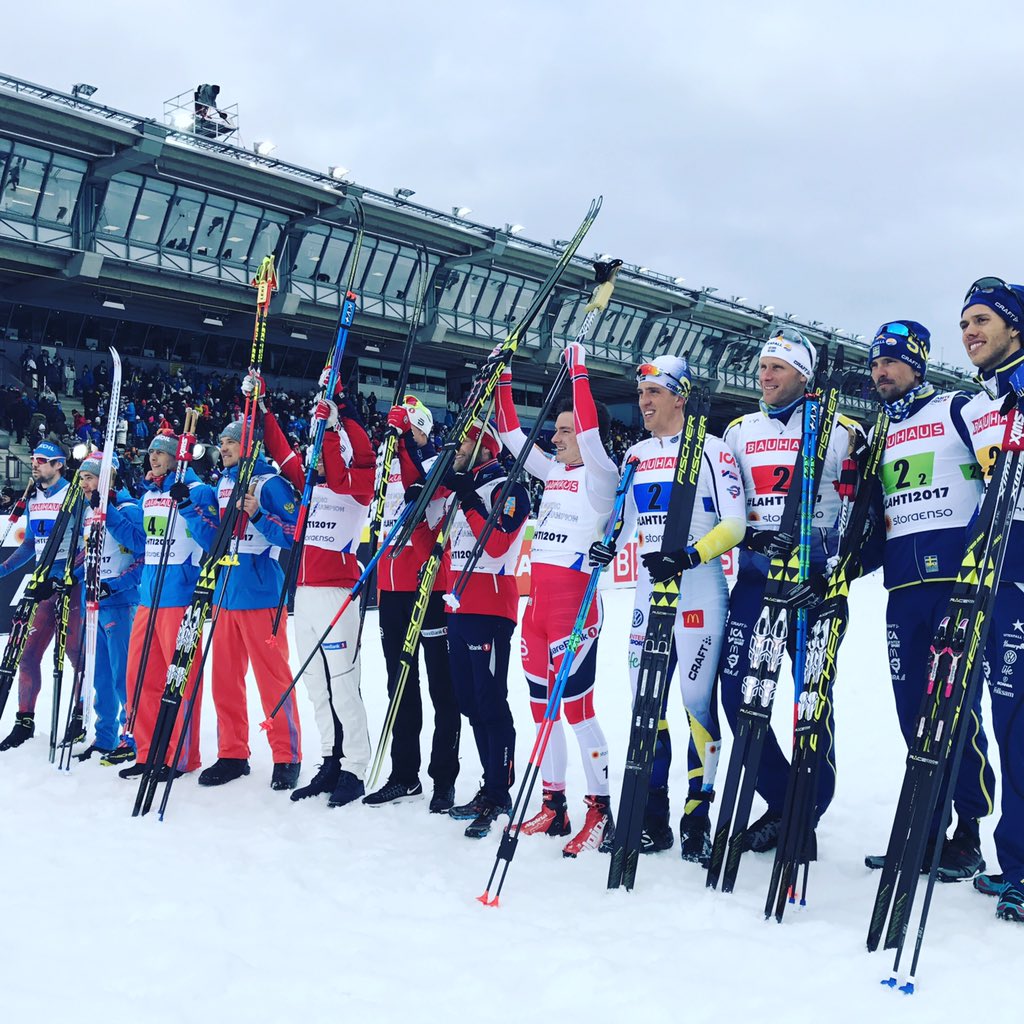
Canada’s Alex Harvey (c) celebrates gold in the men’s 50 k freestyle mass start on Sunday at 2017 Nordic World Championships in Lahti, Finland, with Russia’s Sergey Ustiugov (l) and Finland’ Matti Heikkinen (r) joining him on the podium in second and third, respectively. (Photo: Cross Country Canada/Twitter)
Sundby appeared to miss a pole plant soon after Heikkinen passed him and let off the pace a few meters before the finish. That’s where Great Britain’s Andrew Musgrave continued to accelerate and took fourth place, 2.9 seconds behind Harvey and 0.1 seconds ahead of Sundby in fifth. Norway’s Sjur Røthe followed another 0.4 seconds back in sixth, Switzerland’s Dario Cologna was seventh (+8.9), Norway’s Petter Northug eighth (+12.3), France’s Maurice Manificat ninth (+13.4), and Norway’s Hans Christer Holund 10th (+14.3).
“I had really good skis,” Harvey said in a post-race interview with FIS. “I knew if I came into the corner in second place, that was the optimal position. So I was able to fight hard and hit that last corner in second and slingshot by Martin along the flat and then that was good after that.”
“This is the best race of my life, for sure,” he added. “So I’m really happy.”
Tad Elliott (Ski Club Vail) led the Americans in 27th (+3:16.8). Noah Hoffman (U.S. Ski Team) finished 50th (+8:53.1) and Kyle Bratrud (CXC Team) did not finish.
Canada started four men, with Devon Kershaw finishing 38th (+5:45.5), Graeme Killick 43rd (+7:04), and Knute Johnsgaard in 55th (+12:03.3).
For Harvey, the medal is his fifth at three World Championships and his first individual gold after winning the classic team sprint with Kershaw in 2011.
IBU World Cup (PyeongChang, South Korea): Men’s and women’s relays
Between the men’s and women’s relays on Sunday at the International Biathlon Union (IBU) World Cup in PyeongChang, South Korea, Canada had two teams in the top eighth, with its men’s team finishing seventh in the 4 x 7.5 k and women’s team eighth in the 4 x 6 k. Behind them, the U.S. men finished 10th and U.S. women 14th.
France won the men’s relay by 33.8 seconds over Austria, using a total of 10 spare rounds but avoiding the penalty lap. Martin Fourcade anchored France to the win in 1:12:09.5 hours, after Jean-Guillaume Béatrix initially tagged them in first, his older brother Simon Fourcade raced them into second with near-perfect shooting (using just one spare to clean), and Simon Desthieux picked off one more place to give Fourcade a 16-second lead for the final leg.
Austria achieved second place with Lorenz Wäger, Simon Eder, Julian Eberhard, and Dominik Landertinger combining for zero penalties and nine spares.
Norway finished third (+45.4) with Vetle Sjåstad Christiansen, Ole Einar Bjørndalen, Vegard Gjermundshaug, and Henrik L’Abée-Lund. They had one penalty on Gjermundshaug’s third leg, and used a total of eight spares.
Canada’s Christian Gow, Scott Gow, Nathan Smith, and Brendan Green finished seventh (+3:03.1) with zero penalties and nine spares. After Christian tagged his older brother Scott in ninth, Scott raced them into sixth place before Smith slipped four places to 10th at the final exchange. On the final leg, Green raced them into seventh, requiring two spares to clean.
The Americans finished about nine seconds later in 10th (+3:12.8) with Lowell Bailey, Leif Nordgren, Paul Schommer, and Sean Doherty combining for zero penalties and nine spares, just like Canada. Bailey had originally put them in second at the first exchange, Nordgren dropped to seventh, then Schommer to 13th, before Doherty finally brought them back to 10th out of 24 teams.
In the women’s relay, Germany pulled off a 22.8-second win over Norway, with one penalty and eight spares. Nadine Horchler put Germany in third at the first exchange, then Maren Hammerschmidt raced them into first by the race’s halfway point. From there, Denise Herrmann, a former cross-country World Cup regular, had to ski a penalty lap and tagged off in second, 13.5 seconds out of first. With teammate Laura Dahlmeier sitting out the relay, Franziska Hildebrand anchored Germany to the win in 1:07:35.6 after she used just one spare to clean.
Norway placed second with Kaia Wøien Nicolaisen, Hilde Fenne, Tiril Eckhoff, and Marte Olsbu accumulating one penalty and 11 spares. Olsbu beat out the Czech Republic’s Gabriela Koukalová by one-tenth of a second at the finish, as the Czechs placed for third (+22.9), with Jessica Jislová, Eva Puskarčíková, Lucie Charvátová, and Koukalová (with a total of one penalty and nine spares).
Canada took eighth (+1:34) with Rosanna Crawford, Julia Ransom, Megan Tandy, and Emma Lunder. Crawford tagged in second at the first exchange, Ransom slipped one place to third, Tandy lost another place to tag in fourth, and Lunder ultimately anchored them to eighth.
The U.S., with Clare Egan, Susan Dunklee, Joanne Reid, and Maddie Phaneuf, finished 14th (+3:08.3) with one penalty and 10 spares. After Egan had a penalty on the first leg, Dunklee skied the fastest second leg to move the team from 19th to 14th, then Reid put them in 11th by the final exchange. Twenty-one teams competed in the women’s race.
Ski Classics 90 k Vasaloppet (Sälen to Mora, Sweden)
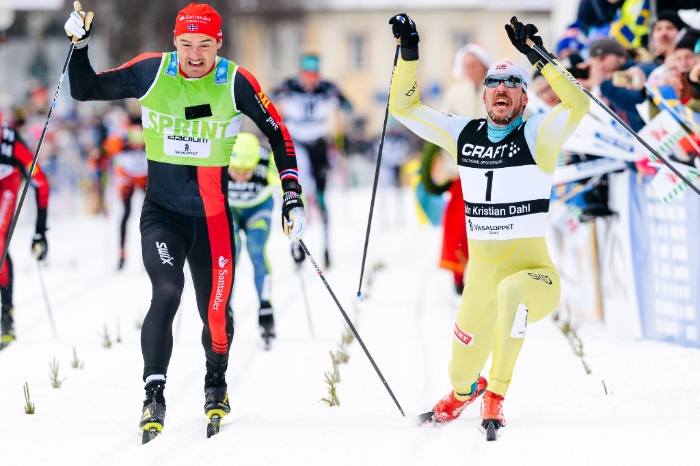
John Kristian Dahl (r) of Team United Bakeries outlunges Ski Classics sprint leader Andreas Nygaard (r) of Team Santander for the win in Sunday’s 90 k Vasaloppet in Mora, Sweden. (Photo: Visma Ski Classics)
[UPDATED] In Sunday’s 93rd annual 90-kilometer Vasaloppet from Sälen to Mora, Sweden, the ninth event of the Ski Classics series, John Kristian Dahl (Team United Bakeries) outlasted Andreas Nygaard (Team Santander) by one-tenth of a second for the win in 3:57:18.1 hours. The race came down to a five-way fight for first, with Stian Hoelgaard (Team Leaseplan) finishing 0.6 seconds back in third. The top 15 men were all within 21.7 seconds of the podium, and Brian McKeever, a member of Canada’s Para Nordic Ski Team, placed 20th (+2:31.1).
“It has been a fight all day,” Dahl said, according to a Ski Classics press release. Three days ago, he had been unsure about starting the Vasaloppet following a back injury. “I was tired already after 30 k and had to let go of the lead group, but I fought my way back taking it step by step and hill by hill.”
In the women’s race, Britta Johansson Norgren (Lager 157 Ski Team) broke away from the field to win by 1:37.9 minutes in 4:19.43.4.
Astrid Øyre Slind (Team United Bakeries) finished second, and Sara Lindborg (Team Serneke) placed third, 9 minutes and 4.2 seconds behind Norgren. Kateřina Smutná (Team Santander) dropped out of the race about halfway through.
“I am very tired but also so happy to win today,” Norgren said, according to the press release. “It felt pretty easy until Oxberg [Sweden] with 30 k to go, but then it got really tough and I had to fight all the way to the finish.”
It was Norgren’s first Vasaloppet win after placing second the last three years. She increased her lead in the overall Ski Classics to 215 points over Smutná, while Tord Asle Gjerdalen continues to lead the men’s overall standings ahead of his Santander teammate Nygaard, who is 349 points behind in second place. Gjerdalen did not race Sunday’s Vasaloppet.
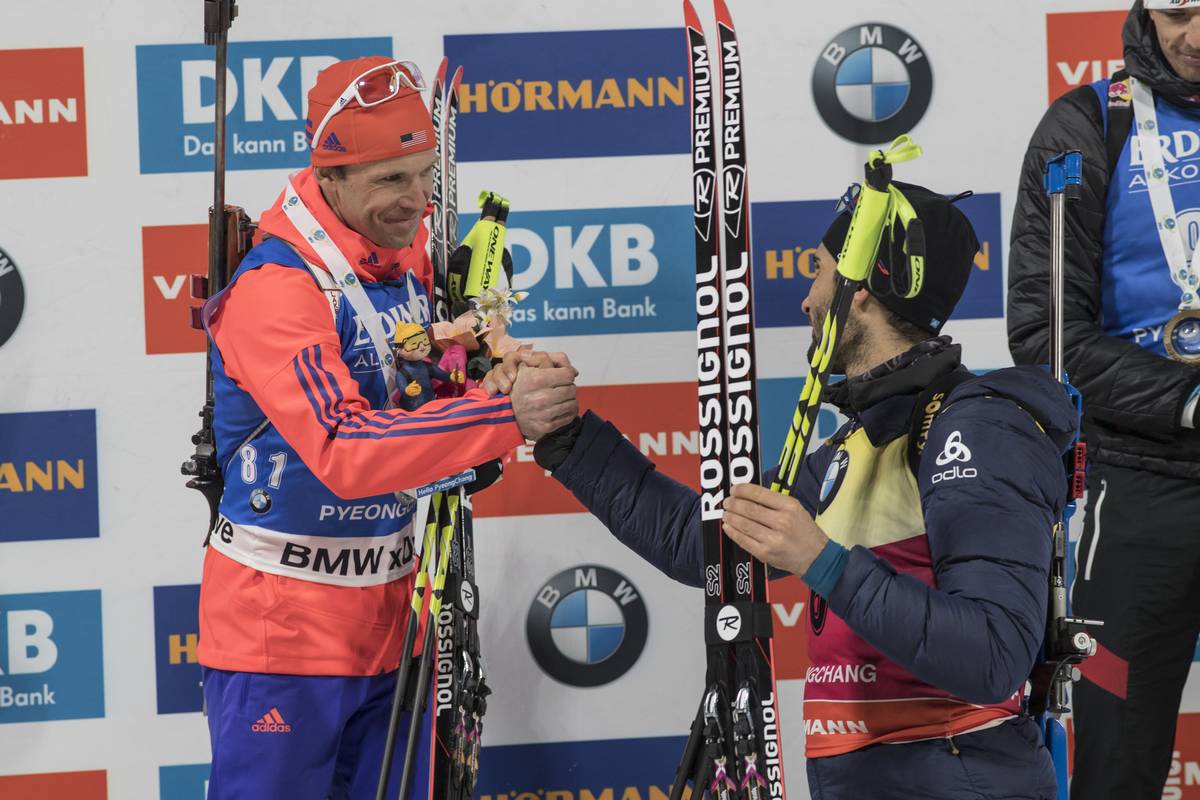
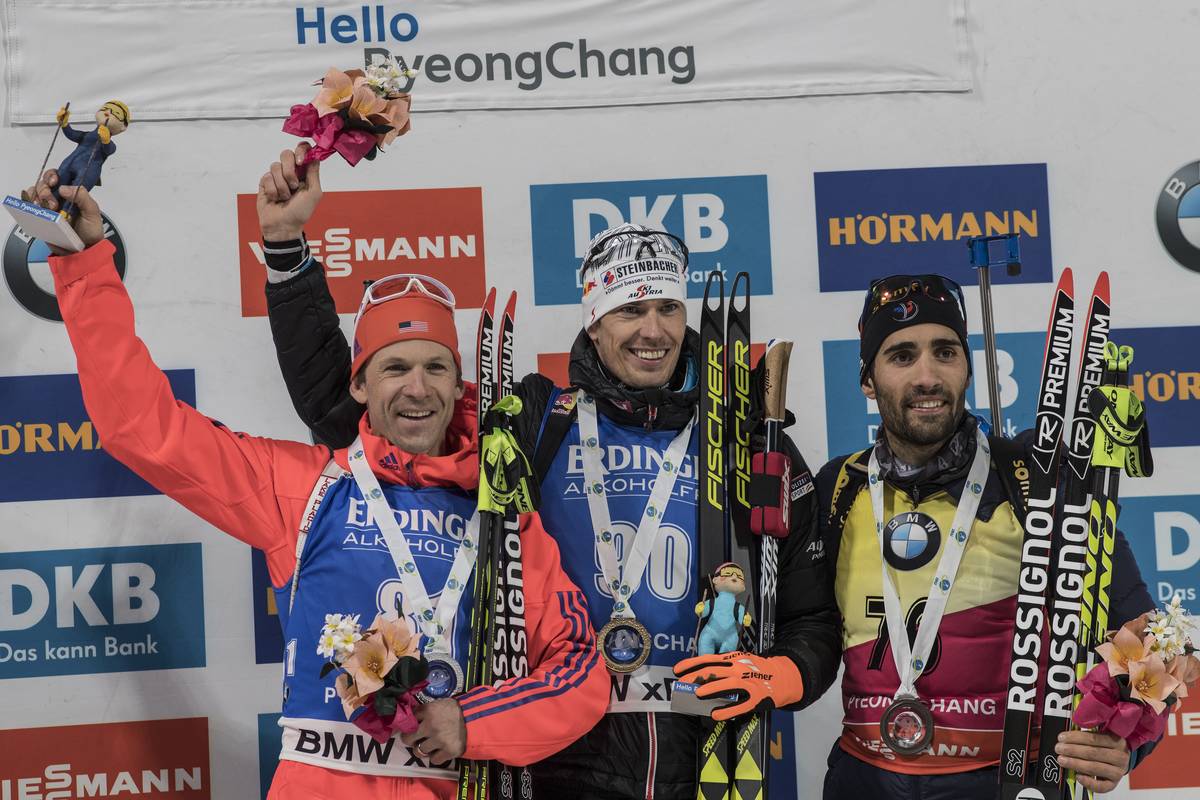
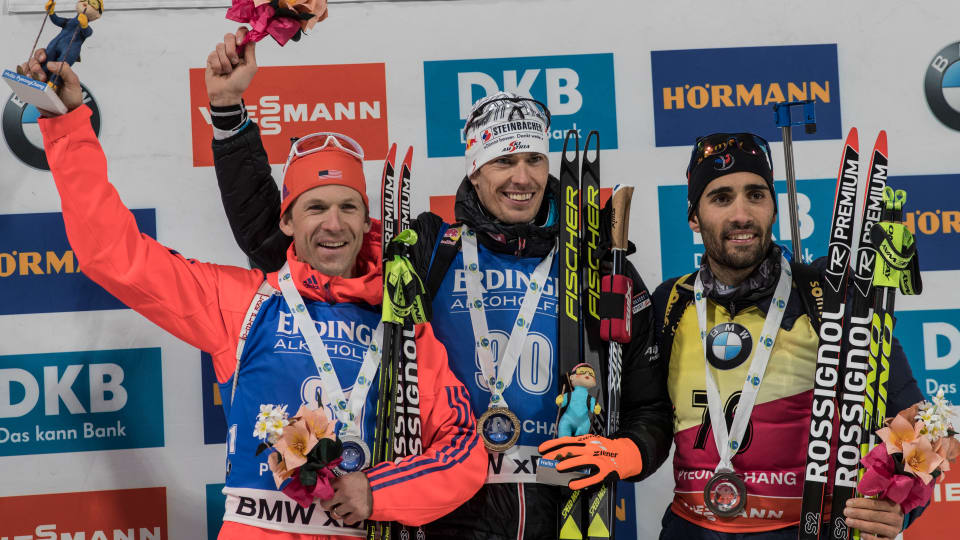
US Biathlon’s Lowell Bailey (l) is congratulated by France’s World Cup Total Score winner Martin Fourcade during the medal ceremony of the men’s 10-kilometer sprint at the 2017 IBU World Cup in PyeongChang, South Korea. Bailey finished second and Fourcade third behind Austria’s Julian Eberhard (r). (Photo: USBA/NordicFocus)
A screenwriter for a Hollywood thriller hardly could have written a more suspenseful albeit a little convoluted race dramaturgy: Whenever you thought, ‘All right, this has to be it,’ and ‘It’s over now,’ another corkscrew plot twist happened and a new hero emerged.
And one of those heroes was US Biathlon’s Lowell Bailey. But at the end of the day he wasn’t the last man standing at the top.
A year ahead of the 2018 Olympic Winter Games in PyeongChang, South Korea, the International Biathlon Union (IBU) World Cup is testing the redesigned venue, and on Friday the men’s 10-kilometer sprint was on the schedule.
With most of the favorites opting for late start groups, the athletes in contention after the two shooting stages and intermittently taking the lead in the finish kept on changing. First there was Italy’s Dominik Windisch. Then, starting only two positions later, Austria’s Dominik Landertinger immediately replaced the Italian. After a while Landertinger’s teammate Simon Eder became a challenger until he missed two shots in standing, and Ukraine’s Artem Pryma shot clean but skied slower. Then Germany’s Erik Lesser looked like a potential winner before missing his final shot, and came within seconds of Landertinger’s time with a fast last loop. Finally, France’s Martin Fourcade bested Landertinger’s time despite two penalties by skiing the fastest course time of the day overall and on the final loop.
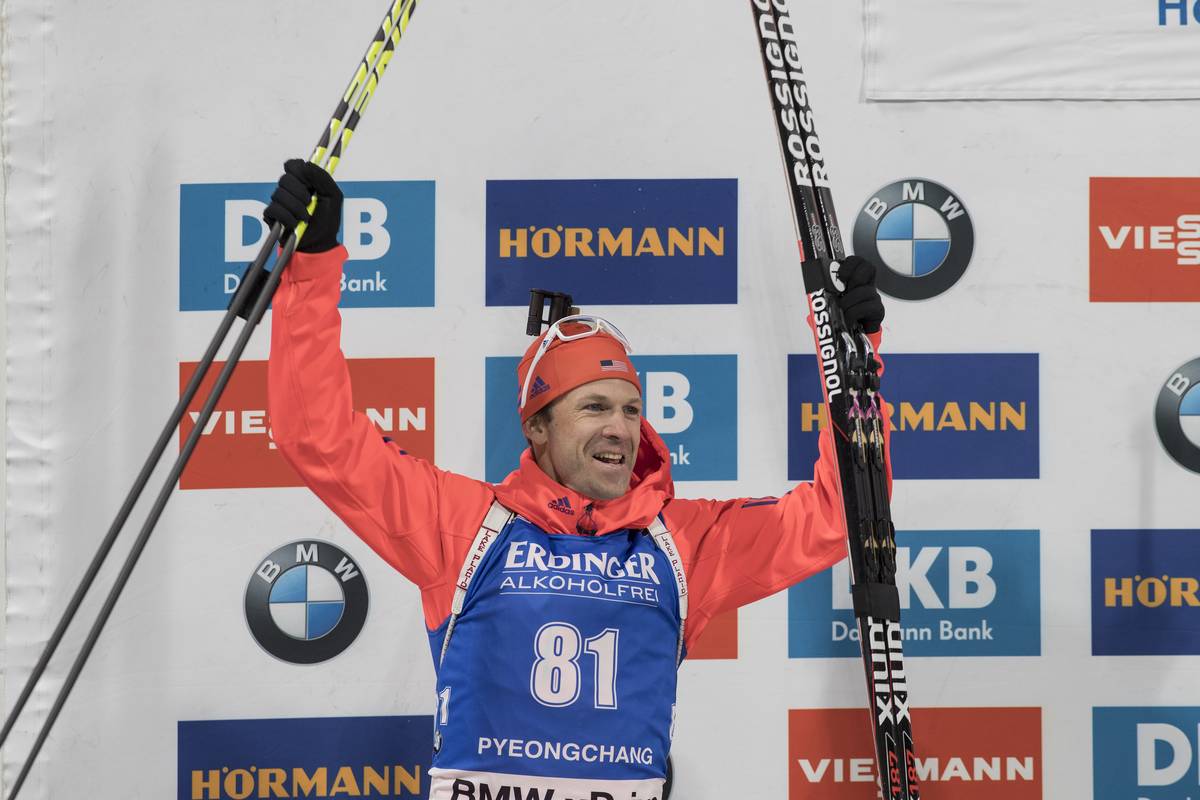
Lowell Bailey (US Biathlon) racing to second place in the men’s 10 k sprint at the IBU World Cup on Friday in PyeongChang, South Korea. (Photo: USBA/NordicFocus)
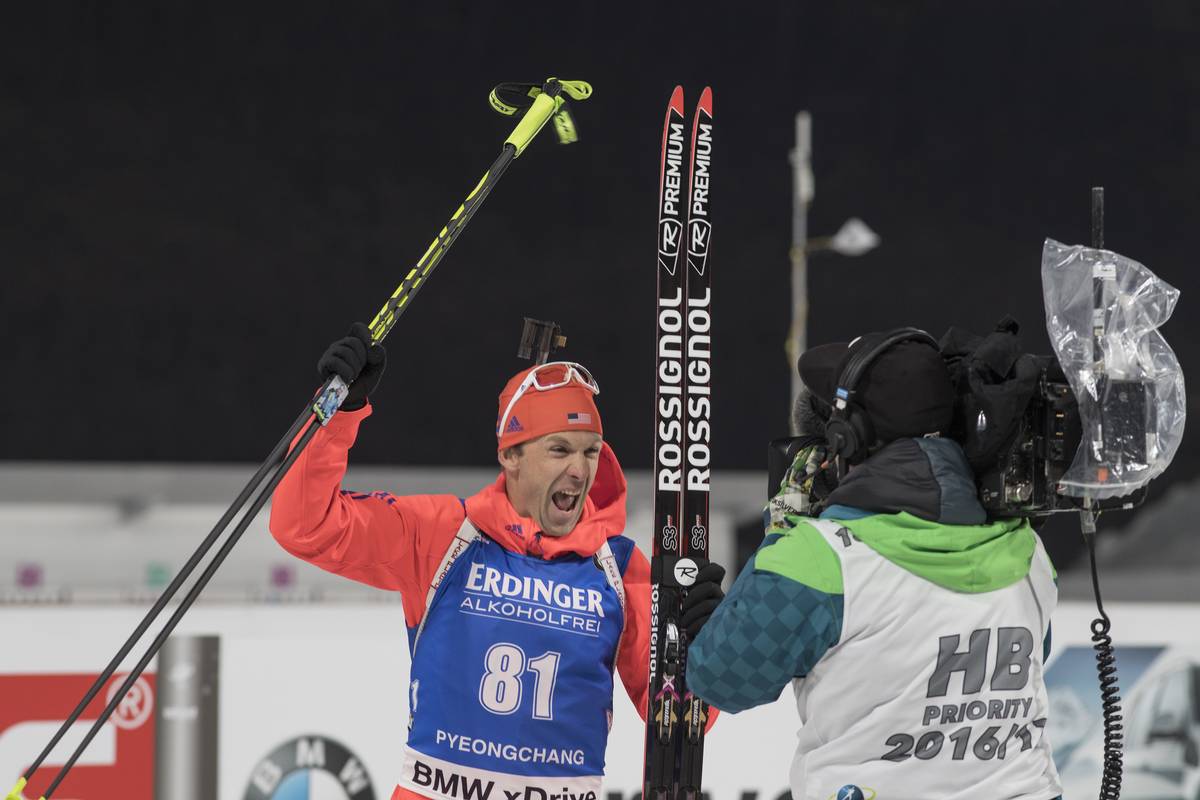
And then along came Bailey, starting five positions behind Fourcade in bib 81. Bailey kept his recent clean shooting streak alive and managed to take the lead, leaving the range for the last time with a 15-second lead, and 33 seconds to Fourcade who had come back on the course even farther behind.
On the last loop, Bailey’s lead began to shrink precariously but he preserved a few seconds, even increasing it again on the last few hundred meters to finish 4.7 seconds faster than Fourcade.
‘Ding-Dong! The witch is dead!’ viewers partial to Bailey and remembering the classic movie ‘The Wizard of Oz’ might have thought at this point. But was it undeniably and reliably dead? For a few minutes it seemed like another perfect, happy movie ending awaited Bailey. But this time maybe it rather was a slasher movie with a villain who just doesn’t seem to die.
If this race had been the movie ‘The Shining’, Bailey was coming to save the day like Scatman Crothers’s supernaturally-gifted character Hallorann driving through a snowstorm to save the little boy Danny, and only minutes after he arrives back in the ominous Overlook Hotel suddenly WHACK! Jack Nicholson’s character kills him with an axe.
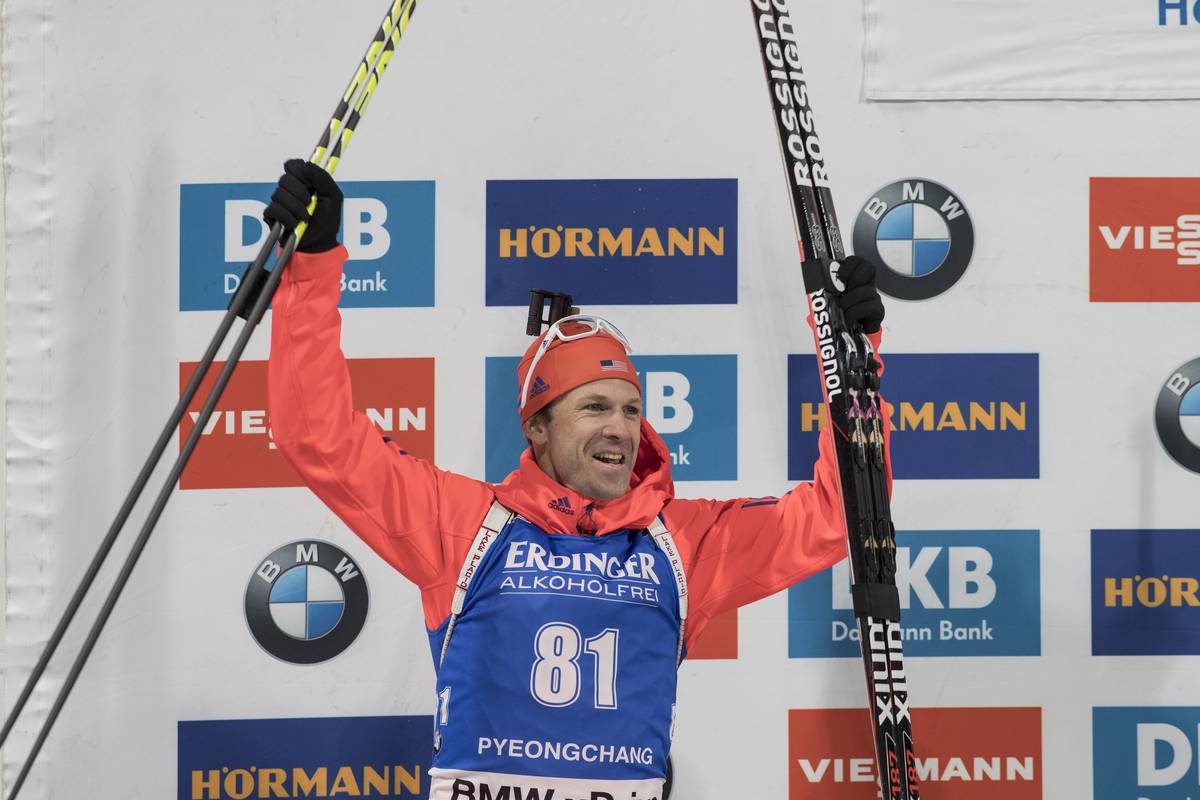
Lowell Bailey (US Biathlon) celebrating his third-career podium in the men’s 10 k sprint on Friday at the IBU World Cup in PyeongChang, South Korea. (Photo: USBA/NordicFocus)
That must be a little bit how Bailey felt when he had managed to stay ahead of the usually dominant Fourcade, mobilizing his last energy reserves, but then had to look on as Austria’s Julian Eberhard emerged as the next athlete to shoot clean and skied even faster. A lot faster. After the final standing shooting he had a 20.6-second lead, and on the last loop he increased that to 40.7 seconds when he crossed the line with a winning time of 23:11.1 minutes.
Bailey could be seen on the TV broadcast mouthing what looked like, “Wow,” when he saw the time difference.
“I’m happy with the way things went,” Bailey later told FasterSkier on the phone. “Eberhard had an incredible race and he’s just such an amazing skier that he’s pretty darn hard to beat when he shoots clean.”
With the second place, Bailey tied the best World Cup sprint result of his career, after also finishing on that position in Kontiolahti, Finland, during the 2013/2014 season. For Eberhard, it was the third World Cup victory of his career and his second one of the season, all in sprints.
“Conditions were very difficult today, and I already feared I had made a mistake with my start group pick,“ Eberhard said in an interview with Austrian TV broadcaster ORF. “But I just said to myself, ‘So what? Just go full throttle and make a good race.’ From the first meter to the finish, everything just worked out perfectly. … Of course I am very happy and overjoyed.”
Eberhard added at the post-race press conference that winning a medal in the men’s relay at the IBU World Championships at home in Hochfilzen, Austria, made things easier for him and his teammates.
Austria’s Julian Eberhard racing to a 40-second victory in the men’s 10 k sprint on Friday at the IBU World Cup in PyeongChang, South Korea. (Photo: IBU)
“The World Championships were much pressure for us, so when I came here I just thought, ‘I feel much more free than the last weeks,’… I am really satisfied with this competition today. I love these tracks, and even the shooting range.”
“Sometimes you have these waves as an athlete, sometimes you can have also the opposite,” Bailey said at the press conference. “I have been on this path since World Championships. I feel good physically and mentally, and confident on the shooting range and on the tracks. I am really happy with this race. I didn’t really know what to expect, and just told myself to go out and do the best that I can.”
Fourcade in third place, 45.4 seconds behind Eberhard, was the only athlete who managed to reach the podium despite a penalty, after incurring one in each shooting stage (1+1). He was also the only athlete in the top seven with two misses.
“My prone was quite good. But my standing is so disappointing,” Fourcade said at the press conference. “I did 99 percent of the job, and forgot to do the 1 percent left. It’s only my fault if I miss it, and I can only blame myself. But it will not change the result today. Julian was so fast and shot clean. When he has that kind of day, when you want to have a chance, you also have to shoot clean.”
Lord of the Globes
Yet third place was still good news for Fourcade. With that result, the French biathlon star secured his sixth-straight overall title for the World Cup Total Score. Russia’s Anton Shipulin as the closest contender is now 360 points behind after finishing 23rd on Friday (+1:30.3 with 3 penalties), as well as Germany’s Simon Schempp, currently in third who did not make the trip to South Korea following an illness, are both mathematically unable to catch up to Fourcade in the remaining races of the season. Bailey currently sits in ninth place in the Total Score ranking.
“That’s amazing. I even didn’t realize it at the finish, I was focused on what I can do better at next year’s Olympics, but then the [French] TV team told me that I won the globe [trophy],“ Fourcade said at the press conference. “I will always remember the first time in Khanty-Mansiysk when I won my first overall total globe. I said it was too difficult, I will never fight for that again. It’s like ‘Lord of the Rings’, it’s something you have to do. It’s why I love my sport, this big crystal globe. It’s what I fight for. It means so much for me to join [Norway’s] Ole Einar Bjørndalen in this ranking. He was a [role] model when I was young, and he still is. So I am proud to be on his level winning six globes.”
Bailey’s Race Day
After spending a quiet training block in Ruhpolding, Germany, Bailey said after Friday’s race that he and his U.S. team had come to South Korea with a good feeling.
Lowell Bailey (US Biathlon) celebrates his second place in the men’s 10 k sprint at the IBU World Cup in PyeongChang, South Korea. (Photo: USBA/NordicFocus)
“I think we just have a really positive energy within the whole staff right now. Everyone is feeling good coming out of world champs and I think motivated to continue onto these next three weeks,” he said.
Bailey explained he had been confident after staying healthy through World Championships, and “I have been able to rely on my shooting more consistently and I’ve had good ski speed throughout the year.”
But the conditions in PyeongChang were still difficult for the experienced biathlete for the sprint, with very different wind during the ‘zeroing’ target practice than during the race.
“Prone was really challenging today,” Bailey said of his shooting experience. “The wind progressively just got stronger and stronger, so it was challenging because I had to shade different and aim differently for every shot. So I’m really happy with the way the prone went. And then I think sometimes you have a little bit of luck, so when I came into standing the wind had died down quite a bit.”
When he left the range, Bailey was about 16 seconds ahead of Ukraine’s Pryma, who had shot clean but with a slower last loop would end the day only in 10th position (+1:07.7). Fourcade starting five bibs ahead of Bailey had left the range behind his split time, but with a furious last loop would soon set the time to beat in the finish.
“As I was leaving the stadium, the jumbotron monitor showed my split so I could see that I was in first…,” Bailey recalled of the start of his final loop. “On the first hill they [my team’s staff] told me that I had 13 seconds, I think, so I just did the best I could, and if I look at my race, my best lap was probably my first lap and then I was fighting for every meter. Thankfully we had good material today, good skis. I lost some seconds at the beginning of the course but then I was able to stay even toward the back end of the course.”
Bailey said in the press conference that he had no information from his coaching staff on Eberhard while he was on the final loop.
The men’s 10 k sprint podium at Friday’s IBU World Cup in PyeongChang, South Korea, with Austria’s Julian Eberhard (c) in first, American Lowell Bailey (l) in second, and France’s Martin Fourcade (r) in third. (Photo: USBA/NordicFocus)
“It’s probably a good thing they didn’t tell me about Julian. All information I got was that I was in first place [over Fourcade] and that was what I was fighting for,” he said. “I am pretty sure I didn’t have 40 seconds in me. So I didn’t know about Julian. He skied an incredible race today and he has a good lead tomorrow [for the pursuit].”
On a course with bumpy tracks that looked slightly improved from the women’s sprint a day before and with only a few hundred fans in attendance, mostly making a permanent background noise with drums and other instruments instead of the excited ‘Yay!’ or disappointed ‘Owww’ comments often heard from the stands during shooting stages at European World Cups, the venue in PyeongChang still leaves some room for improvement, or at least is a little unusual race experience.
However, Bailey was satisfied with how things look one year out from the Olympics, after a redesign of the courses since the last time PyeongChang hosted an international biathlon championship eight years ago.
“They made some significant changes since 2009 World Champs,” Bailey told FasterSkier. “They’re changes that I think play to my strengths, so I’m happy with the course and this is a really challenging range, so I was ecstatic to be able to shoot clean today.
“Biathlon it’s a tough sport because there’s so many factors that go into a successful result and I just feel very fortunate that I have not only one of the best support teams in the world but also the support of my family,” Bailey continued. “They’re behind me 100 percent. I know that I can go out there and be first or last, and they still support me through all of this so that’s a big calming presence.”
In the last five non-relay races, including four at World Championships, Bailey has not placed outside the top six. And in all of those races, he has only incurred one miss.
Behind Bailey, Austria nearly had a second athlete on the podium with Landertinger finishing fourth (+48.1) after shooting clean, just 2.7 seconds behind Fourcade in third.
“The shooting was super, I really pulled through twice,” Landertinger, who was just one place short of his first individual podium finish of the season, told ORF. “But on the course it didn’t work well for me. The first loops were extremely flaccid, maybe I still felt the time difference. The final loop was better, unfortunately it just wasn’t enough for the podium. That is really sad. Maybe it will work out tomorrow.“
Germany’s Lesser finished fifth (+50.3) after missing the last shot of his competition (0+1) and having to ski through the penalty lap.
“Missing the last shot is always annoying, but I can be happy about a fifth place with one penalty,” Lesser told German broadcaster ARD. “I’d have wished for that at world champs… I’m still struggling with the travel here. On the first day I woke up at 2:30 p.m. local time and ate rice and curry for breakfast, then I tried to adapt but fell asleep only at 4 or 5 a.m. when you’d want to make breakfast. So I screwed up that adaptation.”
Also within one minute back, Italy’s Windisch placed sixth (+54.1) with one penalty in prone (1+0).
“I am really happy, the perfect start for this stage,” Windisch told the IBU in an interview. “Also for the Olympics, I feel good for next year. It was not easy, because of the wind I had tears in my eyes so I had to shoot very slow, but I am happy that I hit them.”
Three Canadians, Two Americans Qualify for Pursuit
Three Canadians finished in the top 60 to qualify for Saturday’s pursuit, with Scott Gow leading them in 27th place (+1:40.3).
Scott Gow (Biathlon Canada) racing in the men’s 12.5 k pursuit at 2017 IBU World Championships in Hochfilzen, Austria. In Friday’s 10 k sprint at the IBU World Cup in PyeongChang, South Korea, he finished 27th. (Photo: Glen Crawford)
“I like PyeongChang,” Gow wrote in an email. “It’s very different being in Asia, but our accommodation is very nice and the food has been pretty good. The venue is also very good. There is a great variety of ski trails in the cross country area, but biathlon is limited to only the race trails. The race courses are very hilly and the downhills are somewhat technical, especially when it’s icy, but they are fun to race on and it’s a good challenge.”
“The shooting conditions were moderately tricky,” he reflected on his shooting stages after incurring one penalty in each (1+1). “The wind was quite high during zero and became more variable during the race. I had to correct my sights when I came into prone, and it’s hard to say if I missed because of wind or if it was because I pulled the shot. In standing I started thinking about wanting to clean and as soon as I did I threw myself off my rhythm. Frustrating mistake there, but otherwise I was pleased with how my shooting felt.”
“I really wish I had hit all my targets today, because my skiing was quite strong,” he concluded. “I was surprised to end up in the top 30, but I think a lot of poor shooting by a lot of athletes helped me.”
One position behind Gow, his teammate Brendan Green finished 28th (+1:42.1) with one miss (0+1) for his best result this season.
“My feeling so far here In Korea has been really up and down,” Green wrote in an email. “I came down with a cold just before we traveled to Korea and I think recovering from that combined with jet lag has been a bit tough on my body.
“Overall I am very happy with today’s result given how my season has been going,” he wrote of his first individual top 30 of the season. “I think what made the difference for me today was being able to execute solid shooting in what were challenging conditions. The snow conditions were also quite difficult to race in tonight but I did my best and gave it my all.”
Similar to Bailey, Green was happy to see some changes made to the course since he last raced in PyeongChang at the 2009 World Championships.
“It was my first season on the World Cup and I remember feeling really overwhelmed with the course and conditions back then,” Green wrote. “The track was terrifying and I remember a lot of wind. So far the weather and ski conditions have been similar to 2009, but they’ve made some really good changes to the tracks since then in making the course overall less aggressive and safer.
“It has been a very challenging year for me,” Green reflected on his season so far. “I am not exactly sure what went wrong, but it’s been a tough struggle since the first World Cup. It’s obvious my body did not respond well to one or more elements in my training this past year. At this point I am taking it race by race. I’ve had to stop thinking about where I typically should be performing … to only focusing on executing the best race I can on each given day, and then assessing that.”
Scott Gow’s brother Christian Gow also qualified for the pursuit in 56th (+2.33.6) with two prone penalties (2+0). Nathan Smith finished 88th (+3:32.5) with two standing misses (0+2) in his first World Cup race since early December following an illness that also kept him out of World Championships, and Macx Davies finished 98th (+4:20.2) with four penalties (3+1).
Leif Nordgren (US Biathlon) racing to 37th in the men’s 10 k sprint at the IBU World Cup in PyeongChang, South Korea. (Photo: USBA/NordicFocus)
For the U.S., Leif Nordgren placed 37th (+2:03.7) with two misses (1+1) to qualify for the pursuit, along with Bailey.
“For me, the race had some ups and some downs,” Nordgren said according to a US Biathlon press release. “I was pretty happy with the way I skied and I like the tracks here so far. The conditions tonight had a little bit of everything… some very dry windblown snow, some parts of very wet, slushy snow, and some hard-packed glaze. I’m disappointed in my shooting. I missed the last shot on both prone and standing, which is by far the most annoying one to miss. I’ll have to make some adjustments to make sure that doesn’t happen in tomorrow’s pursuit.”
“It’s really nice to have him performing well,“ Nordgren said of Bailey’s successes. “It’s a great inspiration and I hope we can both capitalize tomorrow in the pursuit.“
Their teammate Sean Doherty finished 80th (+3:13.3) with two penalties (1+1), and could be seen on the broadcast almost taking a wrong track on the course at one point, having to ski back a few meters.
The fourth U.S. starter Paul Schommer, in the second World Cup race of his career, finished 101st (+4:38.1) with five misses (3+2). Mostly racing the IBU Cup and Open European Championships this season, Schommer previously achieved 33rd place in the 20 k individual at the World Cup in Antholz, Italy, in January.
The men’s 10 k sprint podium at Friday’s IBU World Cup in PyeongChang, South Korea, with Austria’s Julian Eberhard (c) in first, American Lowell Bailey (l) in second, and France’s Martin Fourcade (r) in third. (Photo: IBU)
IBU World Cup (PyeongChang, South Korea): Men’s 10 k sprint
US Biathlon’s Lowell Bailey kept his clean-shooting streak alive with another one of his personal best results on Friday, racing to second in the men’s 10-kilometer sprint at the International Biathlon Union (IBU) World Cup in PyeongChang, South Korea.
Bailey started 81st and hit all 10 targets in the two-stage race to cross the finish line in first, 4.7 seconds ahead of France’s Martin Fourcade, who locked up the 2016/2017 overall World Cup title with an eventual third-place finish on Friday.
An even later starter in bib 90, Austria’s Julian Eberhard rocketed to his third-career World Cup victory (and second win this season), cleaning both stages and topping Bailey’s time by 40.7 seconds. That bumped Bailey to second place and Fourcade to third, for Bailey’s second World Cup podium this season (including his win in the 20 k individual at IBU World Championships).
In the last five non-relay races, including four at World Championships, Bailey has not placed outside the top six. And in all of those races, he’s only had one miss.
Bailey is up to ninth in the World Cup Total Score standings. Fourcade ran away with the season-long title in first, now that he’s 360 points ahead of Russia’s Anton Shipulin in second.
While Eberhard and Bailey shot clean on Friday, Fourcade missed two — one on each stage (1+1) — but made up for it with the fastest course time. Eberhard had the second-fastest course time and fastest shooting time of the 102-man field.
Austria nearly had two on the podium with Dominik Landertinger finishing fourth (+48.1), 2.7 seconds out of third, with clean shooting.
Three Canadians finished in the top 60 to qualify for Saturday’s pursuit, with Scott Gow in 27th (+1:40.3) with two penalties (1+1), Brendan Green following in 28th (+1:42.1) with one miss (0+1) for his first individual top 30 of the season, and Christian Gow in 56th (+2.33.6) with two prone penalties (2+0). Nathan Smith finished 88th (+3:32.5) with two standing misses (0+2) in his first World Cup race since early December, and Macx Davies finished 98th (+4:20.2) with four penalties (3+1).
For the U.S., Leif Nordgren placed 37th (+2:03.7) with two misses (1+1) to qualify for the pursuit, along with Bailey. Sean Doherty was 80th (+3:13.3) with two penalties (1+1) and Paul Schommer 101st (+4:38.1) with five misses (3+2).
FIS Nordic World Championships (Lahti, Finland): Nordic Combined 2 x 7.5 k team sprint
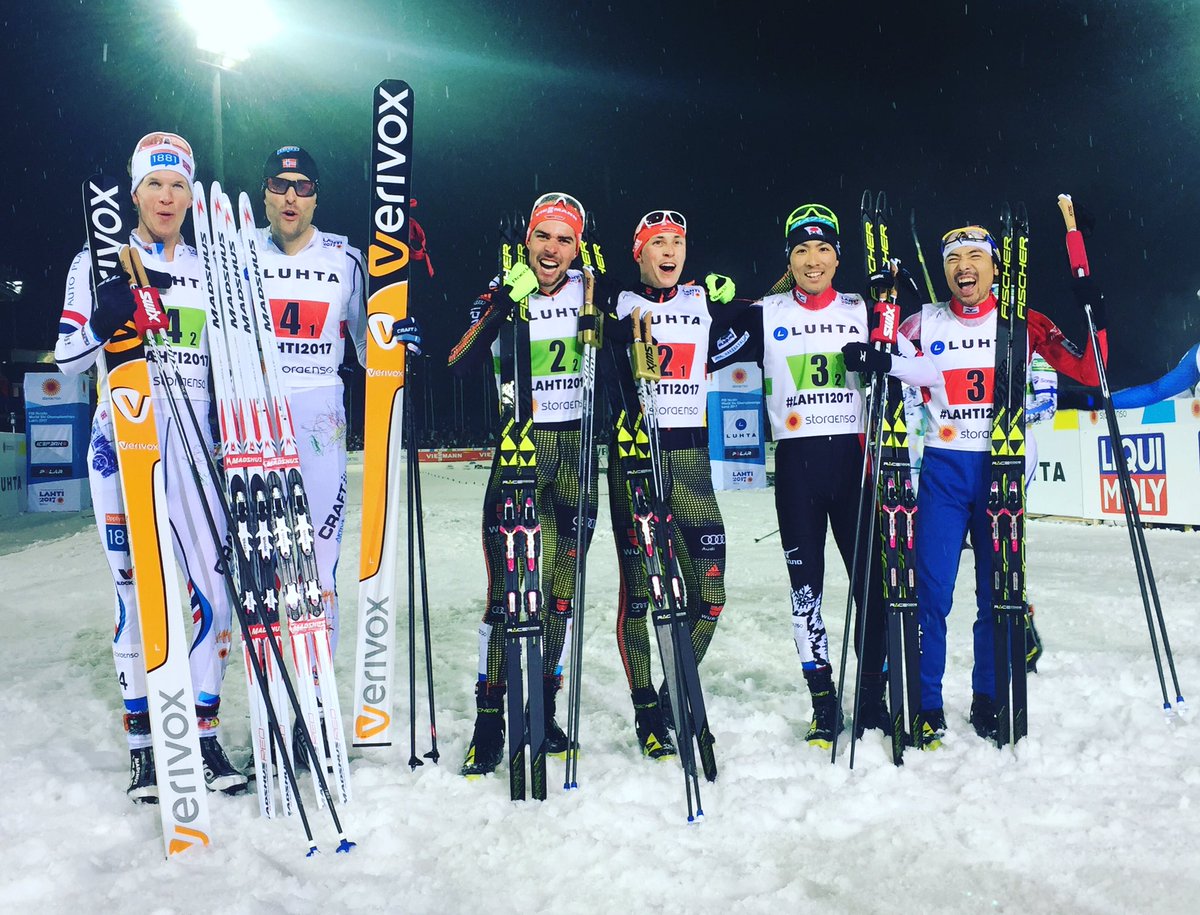
The nordic combined 2 x 7.5 k team sprint podium on Friday at 2017 Nordic World Championships in Lahti, Finland, with Germany’s Johannes Rydzek and Eric Frenzel in first (c), Norway’s Magnus Moan and Magnus Krog in second (l) and Japan’s Yoshito and Akito Watabe in third (r). (Photo: FIS Nordic Combined/Twitter)
[UPDATED] Johannes Rydzek and Team Germany completed the World Championships sweep on Friday, with Rydzek teaming up with Eric Frenzel to win the final nordic-combined competition of 2017 Nordic World Championships in Lahti, Finland: the 2 x 7.5-kilometer team sprint.
Rydzek won all four NoCo competitions over the past week, including two individual events and two team events.
On Friday, he and Frenzel, the defending World Cup champion, jumped to second and started the 2 x 7.5 k cross-country race 16 seconds behind France’s Maxime Laheurte and François Braud, who jumped to first. The Frenchmen both posted jumps of 125 meters for a total of 264.2 points. Frenzel and Rydzek, meanwhile, scored 256.1 points after jumps of 125.5 and 122 meters.
The Germans pulled off a 1-second win over Norway, finishing in 28:45.8 minutes, while Norway’s Magnus Moan and Magnus Krog claimed silver after starting the ski race in fourth, 24 seconds behind France. Together, the Norwegians posted the fastest course time, and Moan skied the fastest 7.5 k (13:53).
“It’s still unbelievable,” Rydzek told German broadcaster ARD. “The race today was so suspenseful again, down to the last curve with the lapped athlete [Russia]. I knew that I am very fast on the homestretch, and had explicitly looked at that section before the race. Eric did a great job today, and despite all circumstances pointing against us we managed to do it again today. Just cool to be back on the top of the podium with Eric.”
Just a couple hundred meters before the finish, Rydzek used the moment when they approached the lapped Russian athlete to slingshot between him and Krog and gained a decisive edge.
“I was scared of that situation with the lapped athlete, because that was really close,” Frenzel told ARD. “I thought, ‘What is he doing out there?’ But in the end you can rely on Johannes to solve that like a world champion, that was top.
“We knew ahead of time that Lahti suits us well, that we can be good here if the conditions work out,” he added. “So we are very happy to be able to go home with so many medals.”
Japan took the final spot on the podium after brothers Yoshito and Akito Watabe jumped to third, started 18 seconds after France, and held their position to finish for third place, 10.2 seconds after Germany.
Austria’s Wilhelm Denifl and Bernhard Gruber missed bronze by half a second in fourth (+10.7) after starting in fifth, and France ended up fifth (+11.5).
Nearly a minute later, Italy placed sixth (+1:10.6) and Finland seventh (+1:10.7). The Czech Republic followed in eighth (+1:26.4), and the U.S. was ninth (+1:48.1) with Bryan and Taylor Fletcher after starting 12th and 2:08 out of first. The Fletcher brothers recorded the second-fastest course time out of 14 teams.
“Taylor did a good job stepping up in competition and it gave me motivation to step up as well,” Bryan said, according to a U.S. Ski Team press release. “Unfortunately I wanted it a little too much and didn’t have the jump I am capable of.
“The races went well but we were just too far back,” he continued. “We had the second fastest time as a team overall, which is solid and continually shows our strength on that side of the sport.”
FIS Nordic World Championships (Lahti, Finland): Men’s 4 x 10 k relay
The men’s 4 x 10 k relay podium at 2017 Nordic World Championships, with Norway (c) in first, Russia (l) in second, and Sweden (r) in third. (Photo: FIS Cross-Country/Twitter)
The men’s 4 x 10-kilometer relay as the last team event of 2017 Nordic World Championships came down to a two-way battle for gold between none other than Norway and Russia on Friday in Lahti, Finland,
The two teams skied in either first or second throughout the four-leg race, with Russia’s Andrey Larkov tagging Alexander Bessmertnykh 2.9 seconds ahead of Norway’s first leg Didrik Tønseth, then Bessmertnykh coming through the second exchange just half a second ahead of Norway’s Niklas Dyrhaug.
Behind them, Finland skied alone in third place at the race’s halfway point, but was ultimately swallowed by the chase pack on the third leg.
On that third leg, Norway’s Martin Johnsrud Sundby worked hard to drop Russia’s Alexey Chervotkin, and eventually did so, coming through the final exchange 17.7 seconds ahead. That gave Norway’s anchor Finn Hågen Krogh just enough of a gap on Russia’s Sergey Ustiugov, and he was able to hold off Ustiugov by 4.6 seconds at the finish to give Norway the gold in 1:37:20.1 hours.
Russia claimed silver and Sweden outlasted Switzerland for bronze after Calle Halfvarsson attacked in the final kilometer to drop Finland’s Matti Heikkinen and Germany’s Lucas Bögl. Halfvarsson finished 2:31.8 minutes out of first, and just 0.2 seconds ahead of Switzerland’s Curdin Perl for third place for Sweden (which included teammates Daniel Rickardsson, Johan Olsson and Marcus Hellner).
Switzerland was fourth (+2:32) with Jason Rueesch, Jonas Baumann, Dario Cologna and Perl, Finland fifth (+2:42.4) with Sami Jauhojärvi, Niskanen, Lari Lehtonen, and Heikkinen, and Germany sixth (+2:42.8) with Thomas Bing, Jonas Dobler, Florian Notz, and Bögl.
France finished seventh (+3:52), Italy eighth (+5:29.8), Kazakhstan ninth (+5:30.6), and the U.S. 10th (+5:31.3). The U.S. team (Kyle Bratrud, Erik Bjornsen, Tad Elliott, Simi Hamilton) skied in 11th for most of the race before Hamilton moved them up to 10th with the sixth-fastest anchor leg.
Canada (Graeme Killick, Devon Kershaw, Alex Harvey, Len Valjas) ended up 12th after being lapped on the last leg. In 14th at the first exchange, Kershaw moved them up to 13th, then Harvey put them in 12th with one leg to go.
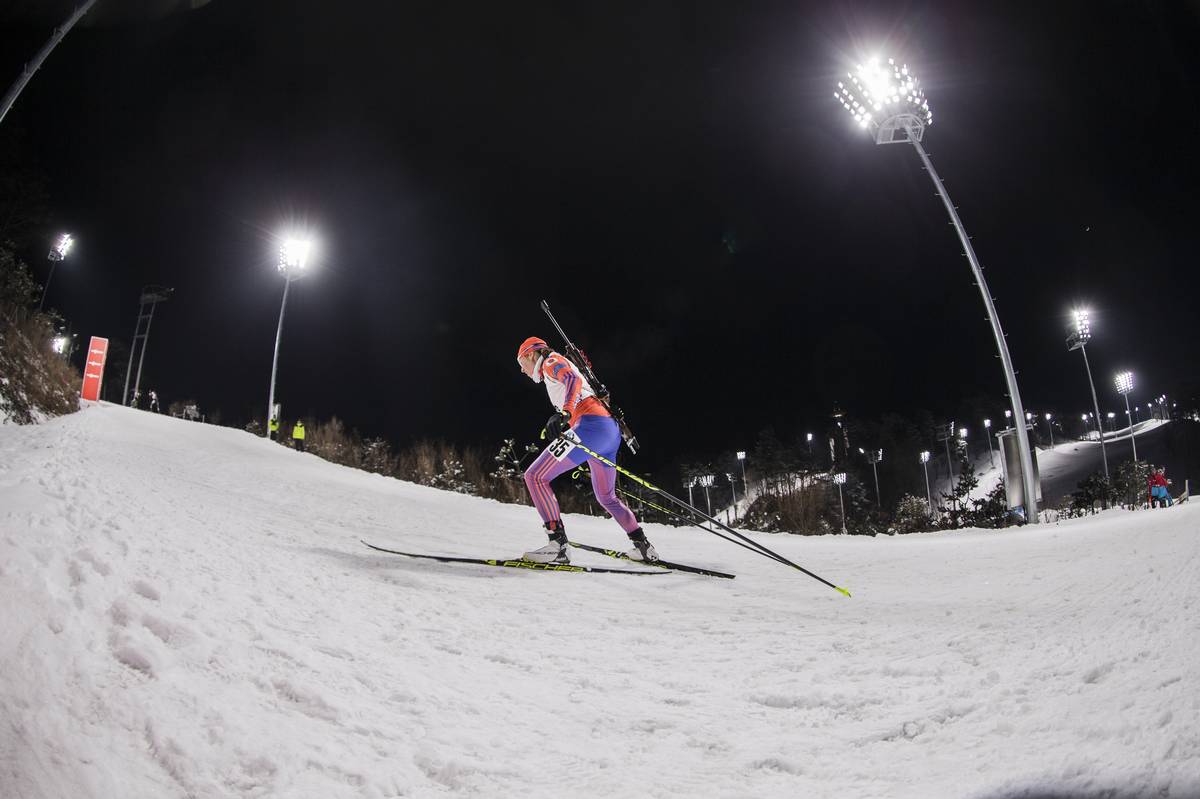
Susan Dunklee racing to fifth in the women’s 7.5 k sprint at the IBU World Cup in PyeongChang, South Korea, site of the upcoming 2018 Winter Olympics. (Photo: USBA/NordicFocus)
For a while in Thursday’s 7.5-kilometer sprint, the first International Biathlon Union (IBU) World Cup race since IBU World Championships two weeks earlier, it looked like Susan Dunklee was on track for another podium.
The 35th starter on Thursday in PyeongChang, South Korea, she crossed the finish line in third, 59.7 seconds behind Germany’s Laura Dahlmeier in first and 51.3 seconds behind Norway’s Tiril Eckhoff in second. Dunklee had cleaned the prone shooting stage then missed her second shot in standing to leave the range in fourth as she started her final loop.
Early in that 2.5 k loop, Dunklee’s time slipped slightly to fifth. She was racing the clock and for precious places, and she clawed her way into third at the finish.
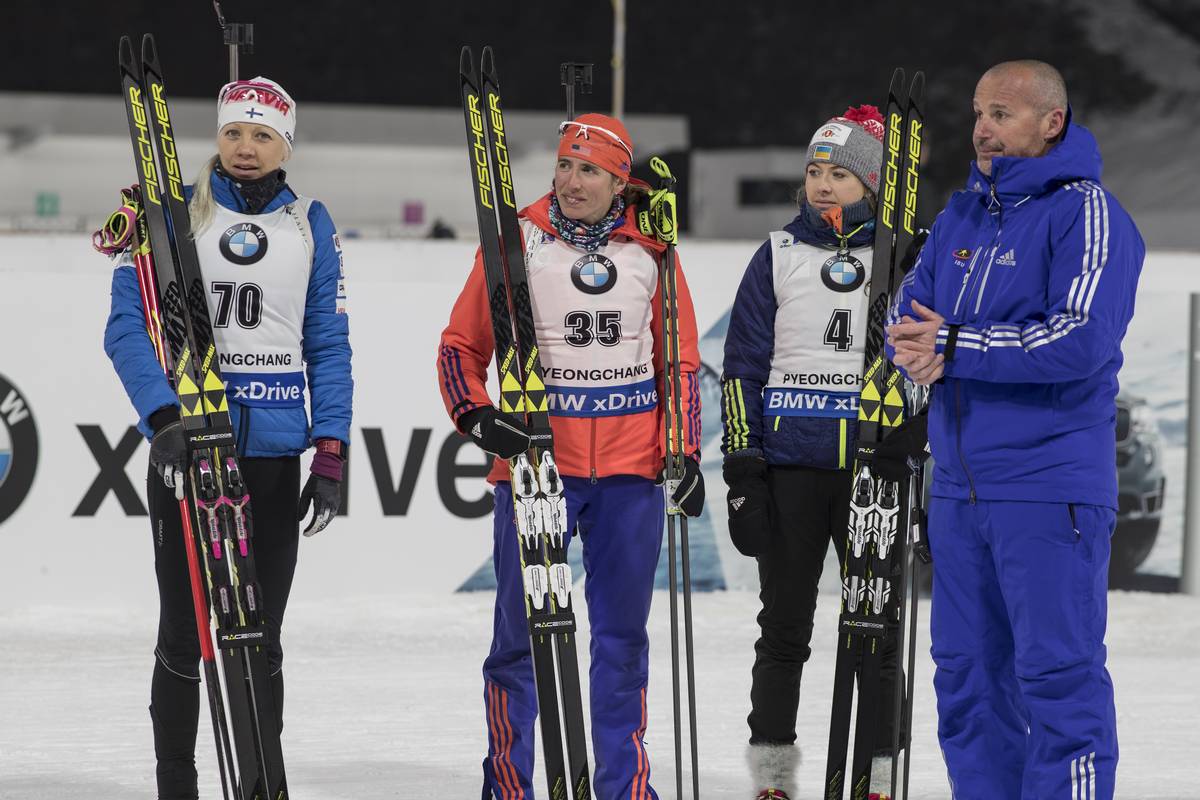
American Susan Dunklee (35) at the flower ceremony with Finland’s Kaisa Mäkäräinen (70), who placed fourth, and Ukraine’s Yuliia Dzhima (4), who finished sixth, in the IBU World Cup women’s 7.5 k sprint on Thursday in PyeongChang, South Korea. Dunklee placed fifth for her fifth top five of the season (including World Championships). (Photo: USBA/NordicFocus)
Ultimately, Dunklee was bumped off the podium to fifth — for her fifth top five of the season (say that five times fast).
Dahlmeier won it, as the 18th starter with clean shooting and a finishing time of 20:43.7 minutes. France’s Anaïs Chevalier in bib 51 raced to third with fast, clean shooting (posting the second-fastest range time and third-fastest shooting), ending up 41.6 seconds off Dahlmeier’s time.
Then there was Finland’s Kaisa Mäkäräinen, the 70th starter, who had to ski two penalty loops after standing (0+2) but skied the second-fastest overall course time to put herself in fourth at the finish (+58.7), just one second ahead of Dunklee.
Reflecting on her race, Dunklee explained in an email that she tried to be patient, especially on the final loop. Conditions in at the brand-new Olympic venue in PyeongChang weren’t easy with what Dunklee described in an email as “a patchwork of glazed, icy and slow patches.”
She explained that volunteers had been working with hand tools before the start to smooth out the course, which she felt helped “substantially.”
“I think the course is good for me: big climbs with technical descents,” Dunklee wrote. “I focused on pushing the last half km of the loop where I thought other people would be tired. And our techs made great skis for these challenging conditions.”
On that last loop, Dunklee received splits that she was seconds out of the top three.
“That helped me fight,” she wrote. “I also caught a good ride with Marie Dorin Habert my last loop…”
Dorin Habert, of France, who had started 67th and left the range for the last time in third with perfect shooting, did not finish her final loop. She reportedly withdrew after feeling nauseous.
Dunklee, who spent three days on a mini vacation in Barcelona before training in Ruhpolding, Germany, and arrived in South Korea last Sunday, will start Saturday’s 10 k pursuit in fifth, exactly one minute behind Dahlmeier in first and one second behind Mäkäräinen. Beyond that, she has 18 seconds to make up to third.
She wrote that she was looking forward to sticking with Mäkäräinen out of the start, “but I still plan to race my own race,” and “as always the key is to stay focused on the process of performing well.”
Asked how she was feeling at this point in the season, Dunklee wrote, “More relaxed and carrying a good dose of confidence after Hochfilzen.”
Germany’s Laura Dahlmeier racing to her fifth-straight win on Thursday in the IBU World Cup 7.5 k sprint in PyeongChang, South Korea. She shot clean and skied fastest for her eighth individual victory of the season. (Photo: IBU)
Dahlmeier raced to her fifth-straight win on Thursday, holding off Eckhoff (in bib 29) by 8.4 seconds after all three podium finishers (including Chevalier) shot a perfect 10-for-10 despite tricky wind. Dahlmeier posted the fastest overall course time and gradually sped up each loop for her eighth individual win this season. At World Championships, she took gold in five out of six races (two being relays).
“I try to keep the focus high, to give everything every time for the competitions,” the 23-year-old Dahlmeier told German broadcaster ARD. “That is not completely easy, there were a few days of distraction in between [World championships and now] where I tried to relax and do something very different away from biathlon. Then we had a long and arduous travel, but that’s true for everyone. Now the start times are also a bit weird, 8:15 p.m. local time. I just tried to take that as it is and managed to do that very well.”
She tried not to be overly critical of the course conditions, yet explained they weren’t ideal.
“To me it felt like ski-club championships. We used to have self-made loops there. That’s pretty much how the course was today,” she said. “… Conditions were really not easy. Very wavy, uneven, old snow with freshly fallen snow on top. In some parts also very dirty. So really changing conditions, in some parts a shaky track with icy patches. Not easy, but I think I got lucky with my first start group, conditions were probably still better for that. And in those conditions, the gaps on the course became a bit bigger today.”
Germany’s head coach Gerald Hönig told ARD he was “incredibly impressed” with Dahlmeier, who leads the World Cup Total Score by 86 points over Gabriela Koukalová, who finished 21st (+1:43.4) on Thursday with two penalties (1+1).
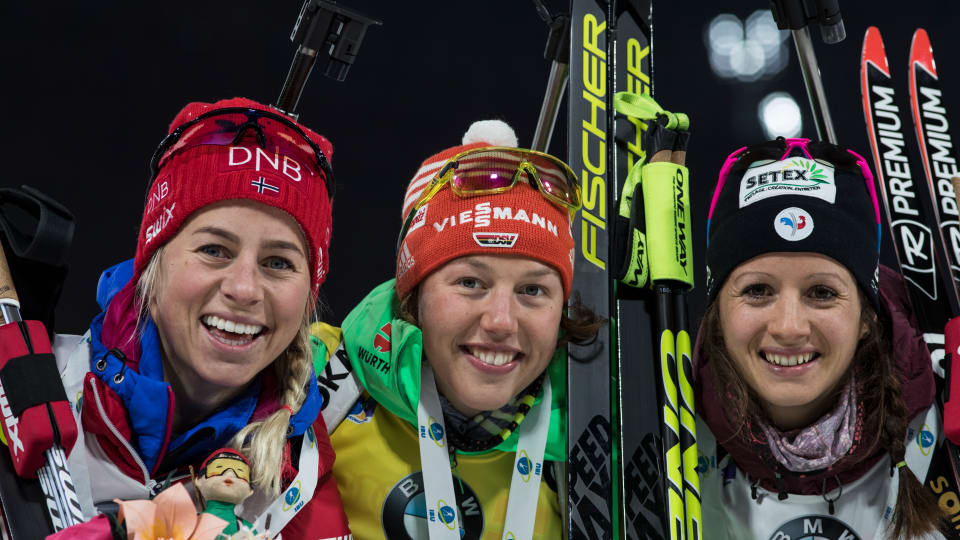
The women’s 7.5 k sprint podium at the IBU World Cup in PyeongChang, South Korea, with Germany’s Laura Dahlmeier (c) in first, Norway’s Tiril Eckhoff (l) in second and France’s Anaïs Chevalier (r) in third. (Photo: IBU)
“The Laura Dahlmeier success story is continuing here,” Hönig said. “She really confirmed her level of consistency, and the successes in Hochfilzen are a difficult baggage to carry into the next races. Really difficult days for her in the aftermath of the World Championships, respectively the trip here, though that is true for most of the athletes. But I can only say hats off to how Laura always manages to execute her goals.”
She’ll start the pursuit 8 seconds before Eckhoff. Asked how she’d spend her rest day on Friday, Dahlmeier said she didn’t have an exact plan.
“I probably won’t go on the range and the courses are not so inviting that I need to go cross-country skiing. Maybe some cross-running and coordination,” she said. “And if the timing works out then I’d like to visit some local temple.”
Three out of four U.S. women qualified for Saturday’s pursuit, and all four Canadian starters qualified with a top 60 in the sprint.
Rosanna Crawford led the Canadians in 30th (+1:54.9) with one prone miss (1+0). She was followed by teammates Megan Tandy in 39th (+2:14.8), Julia Ransom in 41st (+2:19.5) and Emma Lunder in 51st (+2:38.2), all of which had one standing penalty (0+1).
Americans Clare Egan and Joanne Reid finished 33rd (+1:59.5) and 35th (+2:07.6), respectively. Each had one standing miss as well (0+1). Maddie Phaneuf finished 68th (+3:07.7) with one standing penalty (0+1), missing the top 60 by 14.4 seconds.
The men’s 10 k sprint takes place Friday morning at 5 Eastern time, 7 p.m. Korea time.
The women’s 4 x 5 k relay podium at 2017 Nordic World Championships on Thursday in Lahti, Finland, with Norway (c) in first, Sweden (l) in second, and Finland (r) in third. (Photo: FIS Cross-Country/Twitter)
FIS Nordic World Championships (Lahti, Finland): Women’s 4 x 5 k relay
The Norwegian women’s team got a much-needed lift from Astrid Uhrenholdt Jacobsen, the third leg of its 4 x 5-kilometer relay, on Thursday, who tagged her teammate Marit Bjørgen nearly a minute ahead of anyone else. From there, Bjørgen anchored the Norwegians to a 1:01.6-minute victory for her third gold of 2017 Nordic World Championships in Lahti, Finland.
Meanwhile, Sweden and Finland battled for silver, with Sweden’s anchor Stina Nilsson overtaking Finland’s Krista Parmakoski coming out of the final downhill into the stadium then leading her down the finishing stretch. Nilsson finished half a second ahead of Parmakoski for second place, while Finland claimed bronze (+1:02.1).
The U.S. was next across the line, after Jessie Diggins worked to close a 21.5-second gap to third place at the final exchange. While Diggins came within roughly 16 seconds of Nilsson and Parmakoski, that was as close as she could get and she finished fourth (+1:33.8), 31.7 seconds out of the medals.
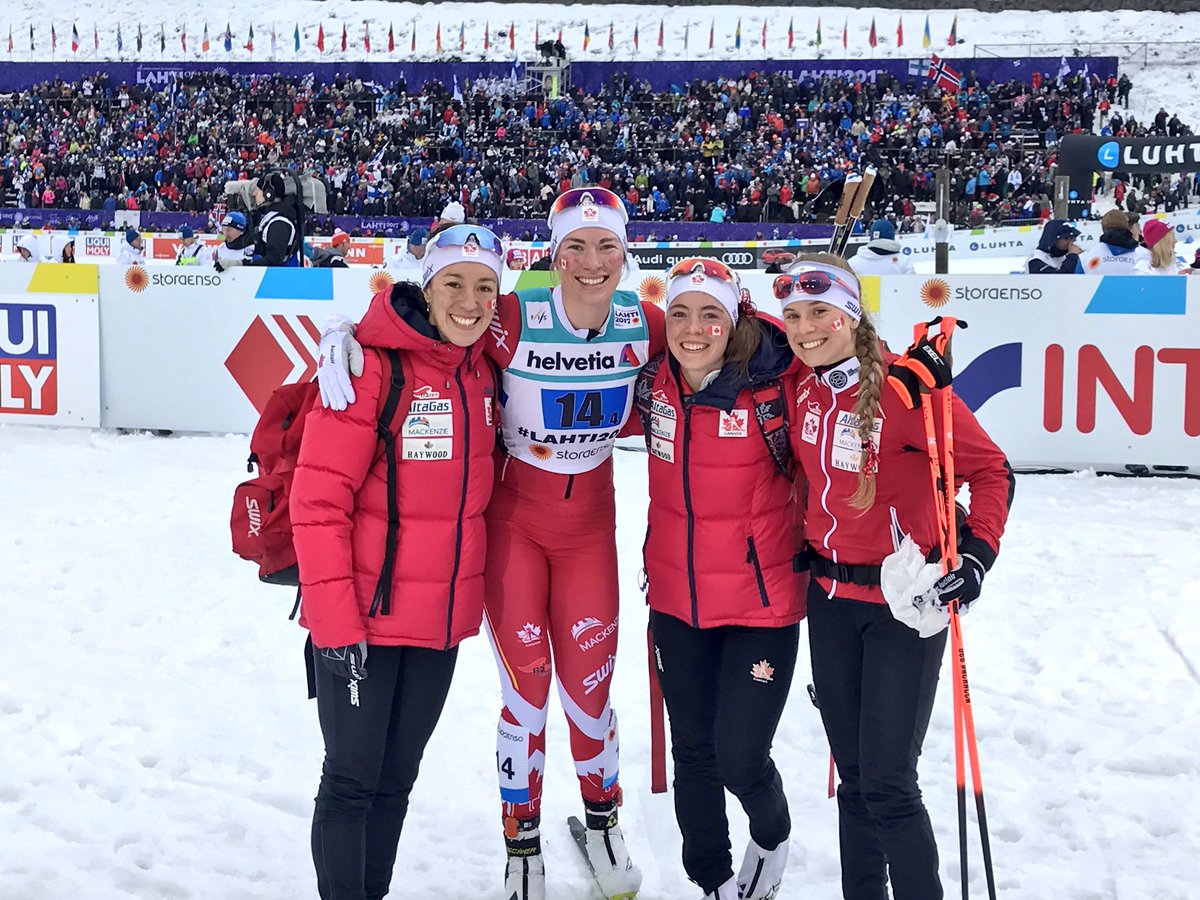
The Canadian women’s 4 x 5 k World Championships relay team, (from left to right) Emily Nishikawa, Dahria Beatty, Katherine Stewart-Jones, and Cendrine Browne, after tallying the third-best relay result for the Canadian women at a World Championships on Thursday in Lahti, Finland. (Photo: CCC/Twitter)
Canada placed 10th (+4:16.2) out of 16 teams in the women’s relay, for the best result for the Canadian women’s program since a sixth place in the 4 x 5 k relay at the 2001 World Championships (and third-best result ever), according to Cross Country Canada.
Norway took control during the first 5 k leg, where Maiken Caspersen Falla stuck with Poland’s Justyna Kowalczyk, who set a fast pace out of the start. Only three were able to remain with Kowalczyk: Falla, Finland’s Aino-Kaisa Saarinen and Sweden’s Anna Haag, while Kikkan Randall of the U.S. fell off the pace and skied alone in fifth. Randall came through the first exchange 24.5 seconds behind Falla in first and 16.4 seconds behind Haag in fourth.
On the second classic leg, Sweden’s Charlotte Kalla set a blistering tempo out of the start to catch Norway’s Heidi Weng 8 seconds ahead. Finland’s Kerttu Niskanen went with Kalla as the two bridged the gap to Norway. Later in that leg, Kalla began to fade while Niskanen took control and entered the exchange in first, just 0.4 seconds ahead of Weng. Kalla came through another 12.3 seconds later in third. American Sadie Bjornsen had worked hard to close the gap to third but tagged 23.5 seconds out of third in fourth (+36.2).
On the third leg, Jacobsen opened the race up for Norway, building a 56.7-second gap to second place during her skate leg, while Sweden’s 19-year-old Ebba Andersson pushed hard in the final kilometers to put her team in second. Finland’s Laura Mononen struggled with Jacobsen’s pace and dropped to third (+58.3). Meanwhile, Liz Stephen of the U.S. held onto fourth and tagged Diggins 21.5 seconds out of third at the final exchange.
From there, the Sweden/Finland fight for second place began. A minute ahead of them, Bjørgen skied comfortably in first, and behind them, Diggins skied alone in fourth.
Russia’s anchor Anastasia Sedova was tagged 45.5 seconds behind the U.S. in eighth (behind Germany, Poland and Switzerland), but passed those three teams to end up fifth (+2:28.6), 54.8 seconds behind the U.S.
Germany finished sixth, Switzerland seventh, Poland eighth, Italy ninth, and Canada 10th, with Katherine Stewart-Jones, Emily Nishikawa, Cendrine Browne, and Dahria Beatty racing for Canada. Stewart-Jones put them in eighth at the first exchange, Nishikawa slipped one spot to ninth, then Browne lost another spot for 10th, which Beatty held to the finish.
IBU World Cup (PyeongChang, South Korea): Women’s 7.5 k sprint
[UPDATED] The International Biathlon Union (IBU) World Cup circuit resumed on Thursday after nearly a two-week break coming off IBU World Championships, drawing competitors to PyeongChang, South Korea, the site of the upcoming 2018 Winter Olympics.
The women’s 7.5 k sprint podium at the IBU World Cup in PyeongChang, South Korea, with Germany’s Laura Dahlmeier (c) in first, Norway’s Tiril Eckhoff (l) in second and France’s Anaïs Chevalier (r) in third. (Photo: IBU)
Coming off five gold medals (in six races) at World Championships, Germany’s overall World Cup leader Laura Dahlmeier picked up where she left off, winning the women’s 7.5-kilometer sprint by 8.4 seconds with perfect shooting and a finishing time of 20:43.7 minutes.
Norway’s Tiril Eckhoff came closest to her in second, after also shooting clean, and France’s Anaïs Chevalier put herself in the mix with clean shooting as well to end up third (+41.6).
One second behind Finland’s Kaisa Mäkäräinen, who finished fourth (+58.7) despite two standing misses (0+2), was American Susan Dunklee in fifth (+59.7). The 35th starter, Dunklee initially finished third (before being bumped off the podium by Chevalier, then one more spot by Mäkäräinen).
Dunklee missed one shot during the standing stage (0+1) and posted the eighth-fastest course time for her fifth top five of the season (including her second place in the mass start at World Championships).
“I tried to be patient,” Dunklee wrote in an email after Thursday’s race. “I focused on pushing the last half km of the loop where I thought other people would be tired. And our techs made great skis for these challenging conditions.”
She passed two competitors on her last loop, one of which had passed her earlier in the final 2.5 k. Dunklee described the conditions as “a patchwork of glazed, icy and slow patches. A large number of volunteers were working on it with hand tools right before the start and I think that helped substantially,” she wrote. “I think the course is good for me: big climbs with technical descents.”
Rosanna Crawford led the Canadians in 30th (+1:54.9) with one prone miss (1+0), and Megan Tandy placed 39th (+2:14.8) with one standing penalty (0+1), just ahead of Julia Ransom in 41st (+2:19.5), who had one standing miss as well (0+1). All four Canadian women qualified for Saturday’s pursuit, with Emma Lunder placing 51st (+2:38.2) after one penalty (0+1).
For the U.S., Clare Egan and Joanne Reid finished 33rd (+1:59.5) and 35th (+2:07.6), respectively, both with one standing penalty (0+1). Maddie Phaneuf missed the top 60 to qualify for the pursuit in 68th (+3:07.7) with one miss (0+1).
After being in contention for a podium, France’s Marie Dorin Habert did not finish, reportedly because she felt nauseous.