From the FasterSkier archive — posts syndicated from athletes’ and coaches’ own blogs between 2004 and 2012, kept online as published. Current coverage is at fasterskier.com.

Tag: Pyeongchang

  • FasterSkier’s Coach of the Year: Eileen Carey; Runners-Up: Matt Whitcomb and Robin McKeever

    FasterSkier’s Coach of the Year: Eileen Carey; Runners-Up: Matt Whitcomb and Robin McKeever

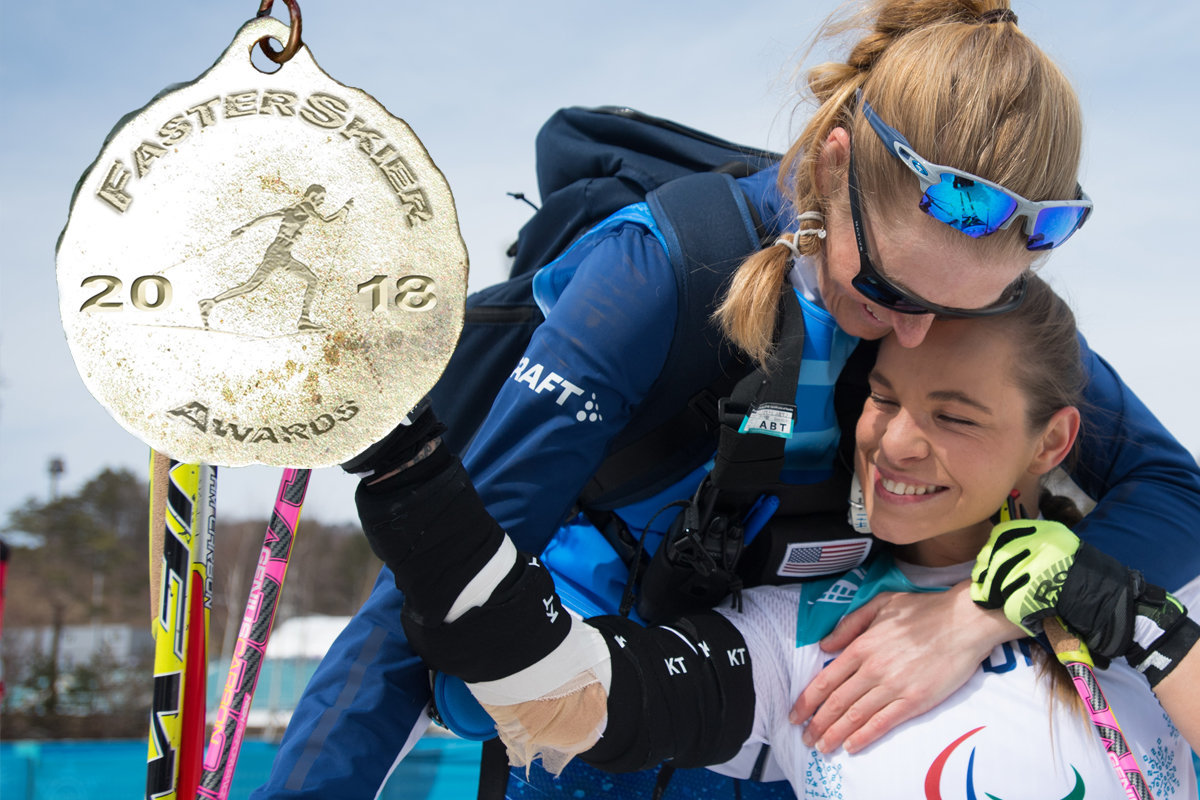
    Eileen Carey congratulating Oksana Masters after a gold medal at the Paralympic Games. (Photo: Mark Reis/U.S. Paralympics)

    With the 2017/2018 season officially in the rearview, FasterSkier is excited to unveil its annual award winners for this past winter. Votes stem from the FS staff, scattered across the U.S., Canada, and Europe, and while not scientific, they are intended to reflect a broader sense of the season in review. This set of honors goes to coaches of North American teams in any nordic discipline, at any level – although in an Olympic and Paralympic Games year, that’s what we focused on.

    Previous categories: Junior Skiers of the Year | Collegiate Skiers of the Year | Biathletes of the Year| Para-Nordic Skiers of the Year | NoCo Skier of the Year | Canadian Breakthrough Athletes of the Year | American Breakthrough Athletes of the Year

    ***

    Eileen Carey, U.S. Paralympics Nordic

    As we have already noted recently on the site, the U.S. Paralympics Nordic program made a huge jump between the 2014 and 2018 Games, winning three medals in Sochi but 16 – from five different athletes – in PyeongChang. That also included both men and women, and two types of para-nordic events: sitting and visually impaired.

    A big architect of the team’s success has been head coach Eileen Carey. It’s not an easy or simple job to coach athletes at all different levels of sport and different athletic backgrounds, and bring them all towards success.

    “The diversity in disciplines and levels of athlete in our program is one of the most interesting and motivating parts of my job,” Carey wrote in an email last week. “On one hand, I love getting into the details of what might make someone a fraction of a percent faster. I love the process of breaking down a performance into parts and working with athletes to problem solve how to make a small element better.  So much of that is about failure, modification, and trying again.  The potential gains are so small, but so are the gaps from 4th to 1st and every once in a while something sticks and that is incredibly motivating for me. Andy [Soule]’s sprint finish [for a gold medal] in PyeongChang is a great example of that.
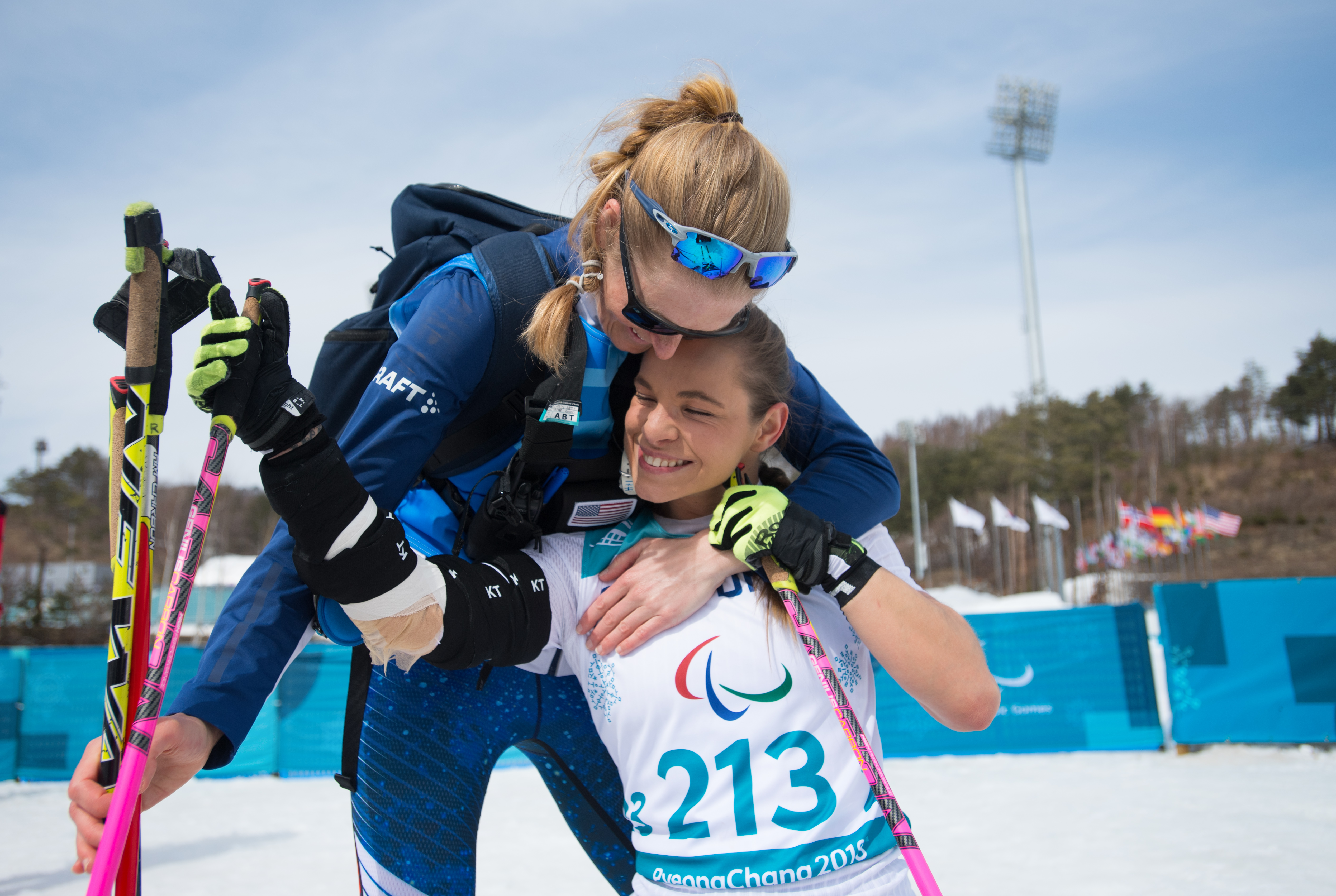
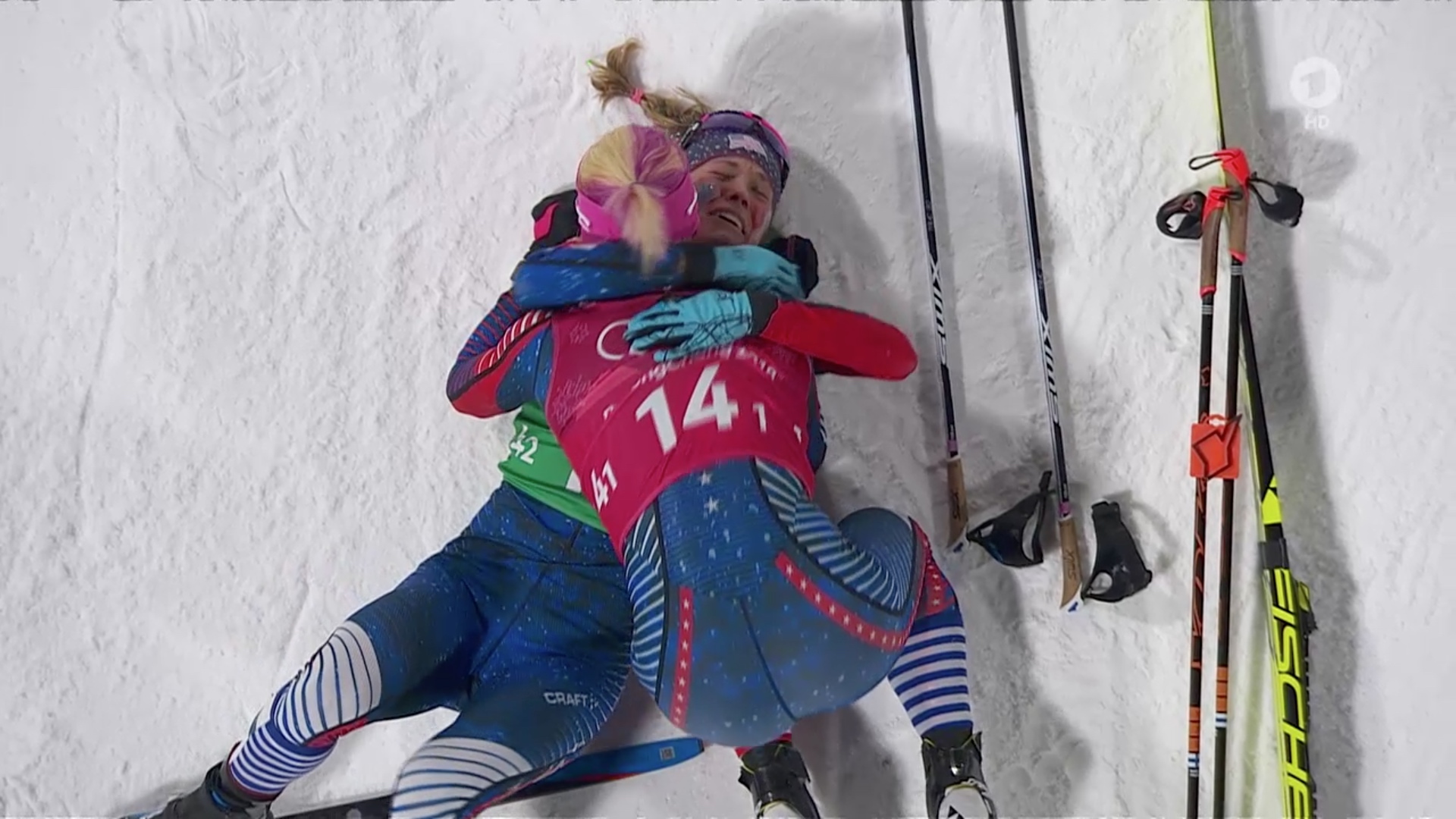
    Oksana Masters of U.S. Paralympics Nordic is hugged by head coach Eileen Carey after her gold-medal finish in the women’s sitting 5 k cross country race at the 2018 Winter Paralympic Games in PyeongChang, South Korea. (Photo: Mark Reis/U.S. Paralympics)

    “On the other hand we have some promising new athletes in our program who are at such a different level in what they need as athletes,” she continued. “For our program, our goal is always to provide best in the world service to our athletes. For our athletes who are aiming for the podium today, that involves every detail coming together, the execution of their plan. For Grace [Miller] and Mia [Zutter] and Ruslan [Reiter], our next generation of podium-potential athletes, providing best in the world service is more about making sure they see what their medal winning teammates and competitors are doing to achieve their performances and showing them a roadmap to get to that point.”

    Development coach BethAnn Chamberlain is a big piece of that effort. For the top-level athletes, Carey lives in Bozeman, Montana, where she works intensively with the sit-ski team,

    antabuse

    “They move to Bozeman in the winters,” Carey explained. “I am with them every day from November through March, in addition to training camps that we have most months from May-October. Most of them compete in summer sports, so in the off season, there is always an individualized balance of figuring out how to optimize their preparation for skiing, while working with their goals for other sports.”

    The standing and visually-impaired athletes have a different situation, and are primarily supported by clubs in their local areas. Carey works with both the athletes and their home coaches and teams to make sure they are getting the best development, but a big part of that can be training with an able-bodied ski team.

    “We can help with funding, or workout ideas that might be unique to Paralympic skiing,” Carey wrote. “But at the end of the day, Jake Adicoff and Sawyer Kesselheim’s success at the Games [where they took silver in the visually-impaired 10 k classic, the first visually-impaired medal by the U.S. in modern Paralympic history] is much more about Sun Valley SEF and Bowdoin (Jake’s club/school) and Bridger Ski Foundation and Montana State (Sawyer’s club/school)… We can help fill the gaps with funding and equipment and communication with their coaches, but their best path to the podium is the same as every skier who wants to be on an Olympic podium.”

    Carey and her colleagues, such as High Performance Director John Farra, have intentionally written their criteria so that standing and visually-impaired athletes can make the para-nordic national team without actually competing in para events – instead, they can make the C Team or Development team using USSA points from SuperTours, college races, or regional races. That means that they can spend more time with their home teams.

    “We are lucky in that we have incredible partners in the USSA community who are really the ones developing many of our athletes,” Carey wrote. “I hope the more that coaches and clubs around the country see our athletes competing in USSA and collegiate races, the more they see opportunities for providing a ski development pipeline to even more members of their communities. As much progress as we have made as a program over the last several years, we have at least that much again to improve, and this is the next big opportunity for us as a program, and also for ski clubs and communities around the country.”

    But while Carey is thinking about those big-picture goals and opportunities, she is also working one-on-one to help Americans become the best para-nordic skiers in the world.

    “The fall after Sochi, we started a technique modification process to target Andy [Soule]’s speed on flats, in particular finishing speed,” she explained. “In Sochi, he was moving quickly and had great hand speed but he was not going fast compared to the athletes he was competing against. We tried and failed at so many things in the past four years to improve that. Every once in a while, we would find a mental cue or some technical detail that seemed to make a difference and we would build on that and find ways to analyze it. It can be so frustrating, because there are inevitably times when progress stalls or reverts and there rarely is a clear answer why… When he turned it on during that finishing stretch of the sprint to take the gold, that was the epitome of a plan coming together at the right time.”

    A few minutes later, Oksana Masters won gold in the women’s sprint, overcoming an injury that had happened just weeks before the Paralympics. It was her first gold medal after collecting a silver and bronze earlier in the Games, to go with a silver and bronze from Sochi and a bronze from the 2012 summer Paralympics in rowing.

    “Both of those races, strictly from a sport performance standpoint, were just incredible,” Carey wrote. “In addition, those two athletes have really been the architects of our program’s rise over the last quad. The two of them were at every camp and World Cup, and their instincts as athletes drove the strategies of our program. That day could not have been a more meaningful culmination of the last four years for them as individuals, for us as a program, and for me as a coach.”

    Honorable Mention: Robin McKeever, Canadian Para-Nordic Skiing

    Also taking home 16 medals from PyeongChang? The Canadian Para-Nordic team, which like the Americans had a big jump in both the number of medals and the number of athletes winning them. Far from being just the Brian McKeever show – although the veteran went undefeated for the third Paralympics in a row – the team also picked up multiple medals from Mark Arendz, Natalie Wilkie, and Collin Cameron, plus an individual medal by Emily Young and two relay medals.
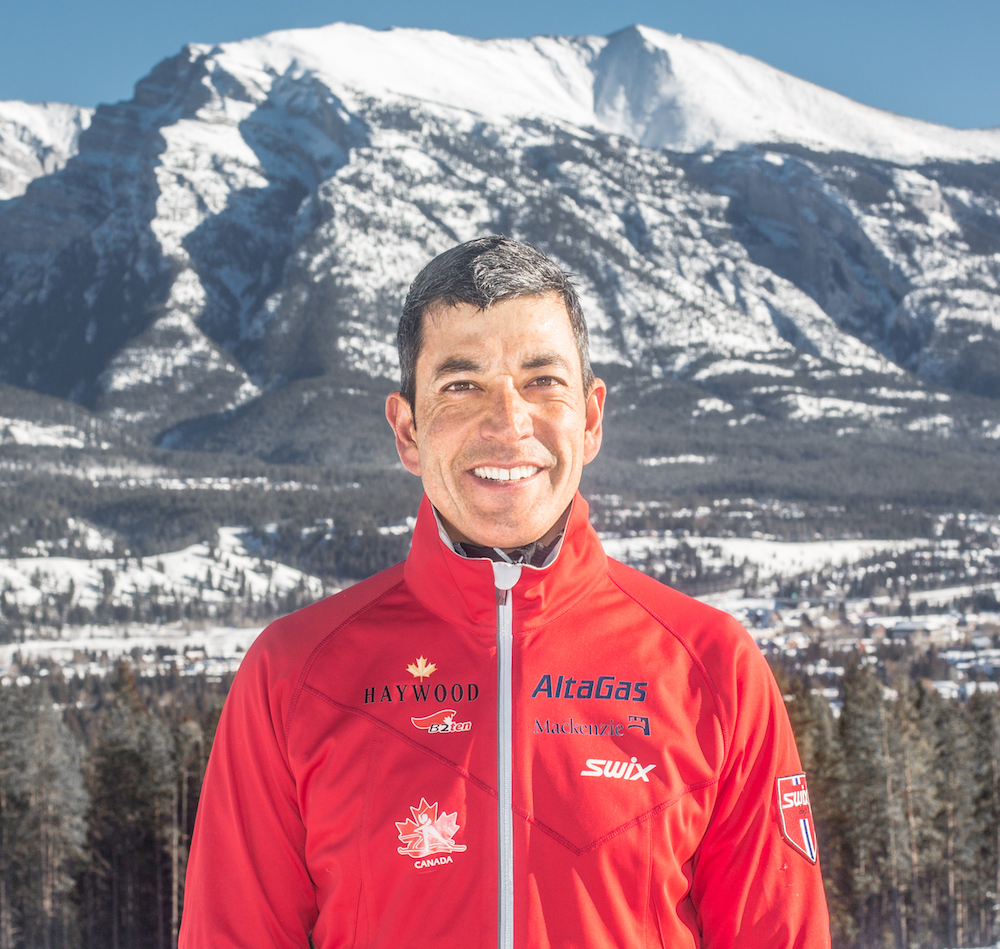
    Robin McKeever. (Photo: Noel Rogers/CCC)

    Carey’s counterpart up north is Robin McKeever, who incidentally said that he looked at what Carey was doing as an inspiration in being able to recruit summer-sports athletes and successfully transform them into winter gold medalists. The two gold medals by Kendall Gretch, an American triathlete who didn’t pick up cross-country skiing until 2015, were “eye-opening”.

    The para-sport landscape is slightly different in Canada, which also has a much smaller population to draw from (while at the same time having some of the same issues associated with far-flung geography). McKeever faces different development challenges, but has helmed the program towards depth and diversity in the last four years.

    “It started as an eight-year process in 2010,” McKeever said in an interview last week. “At that time, we only had funding for Brian. I was given the reins to rebuild, effectively. Now there are some next-generation funds we have the opportunity to access, and now that helps build the base. In the last few years we have had a development coach on board, Kate Boyd, and that has been huge.”

    There have been notable successes, such as the three medals Cameron took home; having picked up skiing just a few years ago after being involved with sledge hockey, Cameron was named one of our Breakout Athletes of the Year.
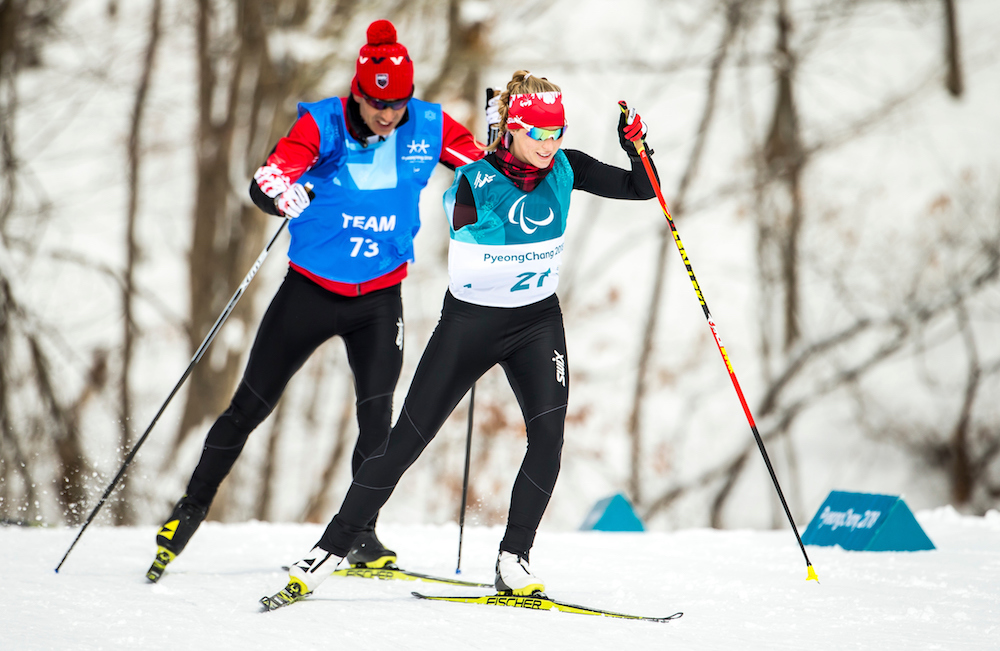
    Emily Young and coach Robin McKeever during a training session at the Alpensia Biathlon Centre during the 2018 Winter Paralympic Games in Pyeongchang, Korea. (Photo: Dave Holland/Canadian Paralympic Committee)

    Then there was Wilkie, a teenager who came to the program after losing four of her fingers in an accident.

    “We know where our pool of athletes comes from,” McKeever said. “It’s about the un-luck of athletes having trauma, which starts their Paralympic path. And it’s about luck in terms of recruiting athletes from summer sport.”

    Those newer athletes in the program have veterans to look up to, whether that is McKeever’s brother Brian, or now Mark Arendz, who took home a remarkable six medals between biathlon and cross-country skiing.

    “Mark was no surprise,” McKeever said. “Six medals was maybe a surprise, but he was a World Champion coming in.”

    Given the limitations on how the team can find new athletes, McKeever didn’t want to be too concrete about whether the program would see a big swell in numbers coming off its recent success.

    “It is still to be seen where that will go,” he said. “Some of it is a bit of luck, and some of it is really good management… A lot of staff has been around for eight years. They remain keen and excited. They stick around and are really integral to my support, and to the team’s support.”

    One of the biggest highlights for McKeever, and an illustration of how the program has changed in just a few years, was the mixed relay team of Arendz, Young, Wilkie, and Chris Klebl taking silver, the first ever relay medal for Canada.

    “The mixed relay is a real highlight,” he said. “Even if the full Russian contingent had been there, that would be a podium for us. I didn’t know eight years ago that the possibility was even there.”

    Honorable Mention: Matt Whitcomb, U.S. Ski Team

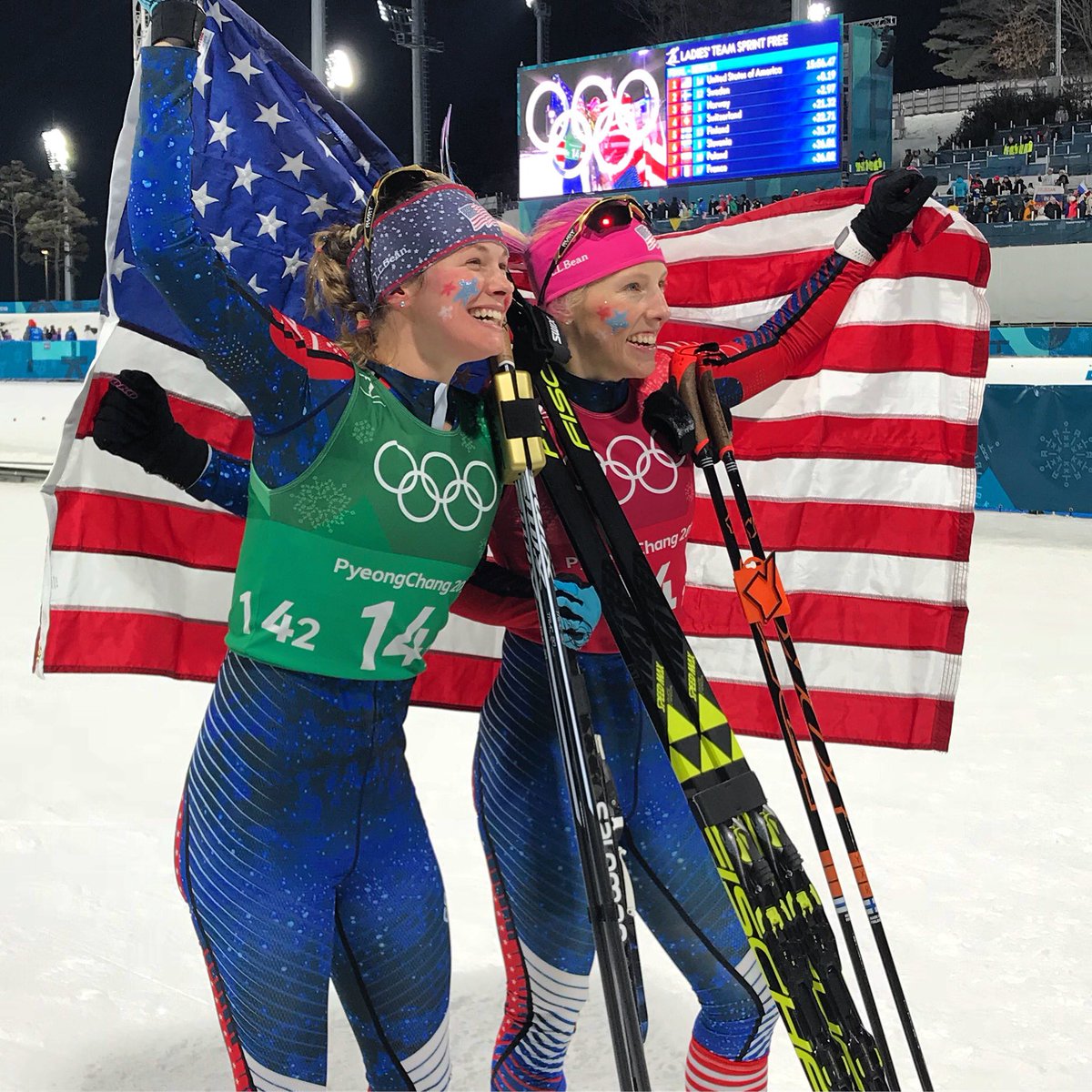
    Another team that had a huge jump this year? The U.S. Ski Team women. Jessie Diggins and Kikkan Randall took gold in the Olympic team sprint, the first-ever gold medal for the U.S. in the sport.

    But the Olympics weren’t the only thing that happened this season. Diggins also won a World Cup, was third in the Tour de Ski, and second in the overall World Cup standings. Randall picked up a World Cup podium; Sadie Bjornsen picked up several; and Sophie Caldwell had enough to earn third place int he Sprint Cup standings. The team had more days with many women in the sprint heats, and more good distance results, too.
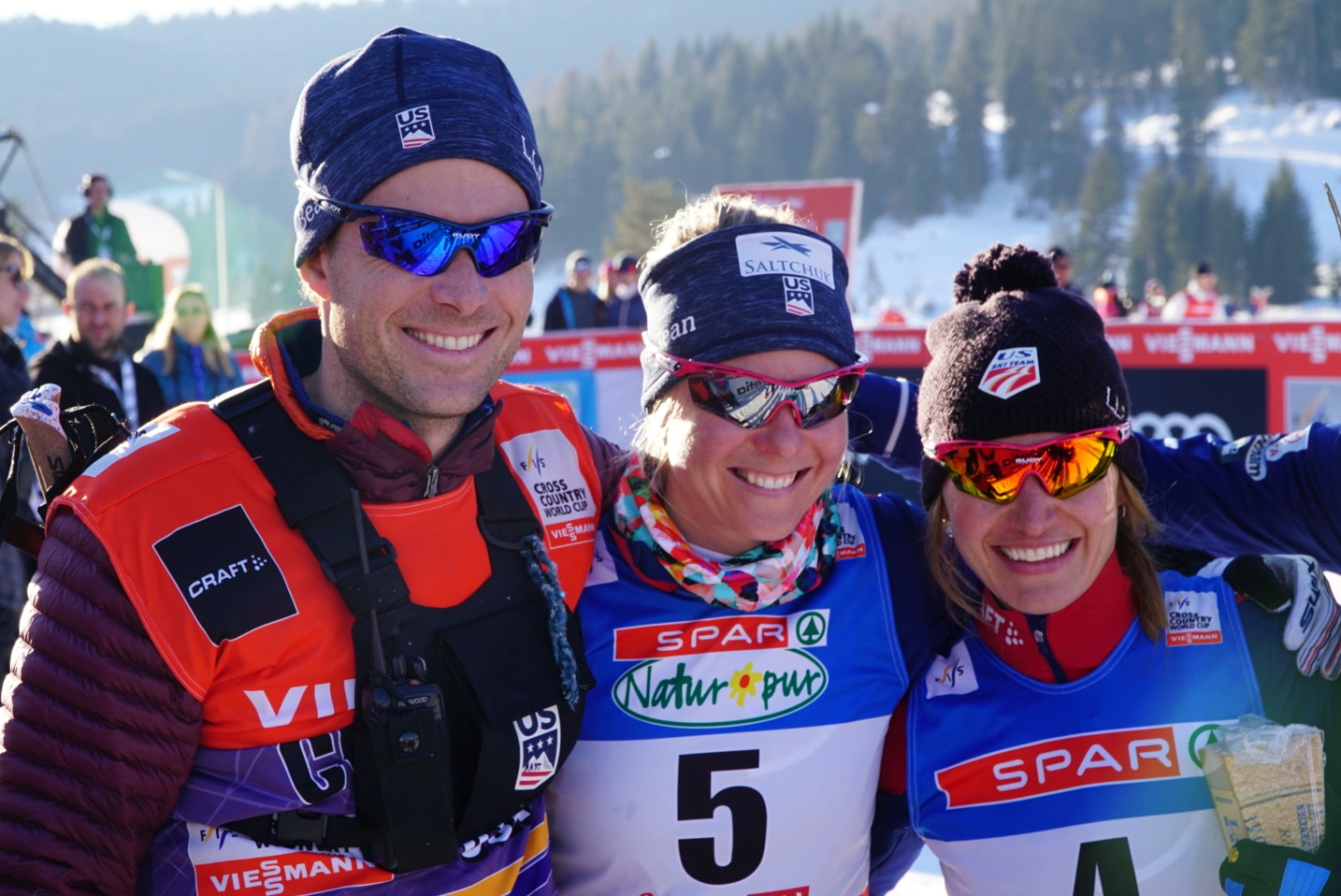
    Matt Whitcomb with Sadie Bjornsen and Sophie Caldwell in Seefeld, Austria, this winter. (Photo: Garrott Kuzzy / LumiExperiences.com)

    “It’s been a many-year goal of ours to be ranked in the top three for the women’s team and we secured that for the first time today,” U.S. Ski Team Women’s Coach Matt Whitcomb told FasterSkier of his team’s best-ever Nations Cup ranking after the final World Cup of the season in Sweden. “We’ve come into [past] finals, I believe, ranked third and then come out of finals ranked fourth. We’ve been fifth… It was really quite an achievement.”

    The U.S. women all spend large amounts of time with their club teams and coaches, including at APU and Stratton. But they come together to form a national team, the strength of whose relationships are a storied aspect of building their own success. And Whitcomb is a big ingredient there, facilitating not just training but atmosphere and long-range goals.

    When Caldwell secured third in the Sprint Cup, she thought back two years to a conversation she had with Whitcomb about race goals. Whitcomb wanted Caldwell to write down goal in particular: to be in the Sprint World Cup overall top three.

    “At the time I was like, ‘Eh, no, that seems pretty far off,’” Caldwell reflected in a post-race interview with FasterSkier.

    But it wasn’t, and the determination to work seriously on big goals, and believe you can get them, is a hallmark of the U.S. team.
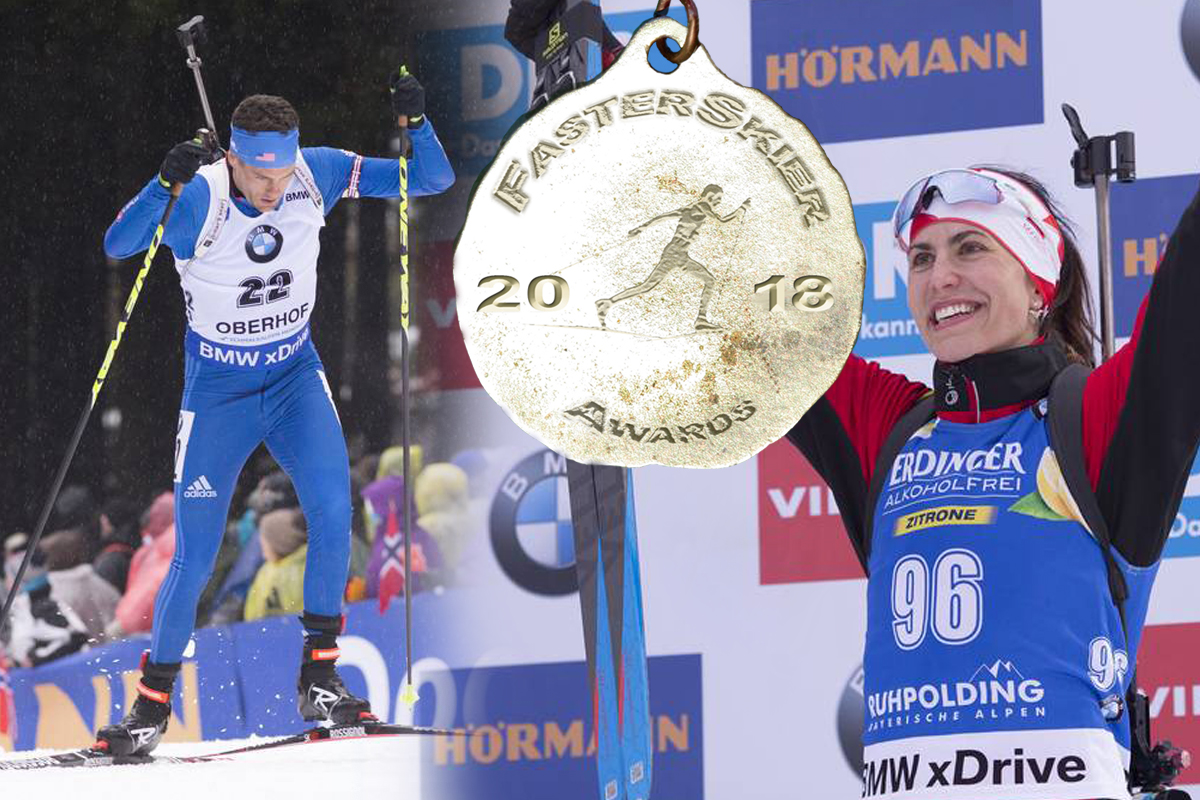
  • FasterSkier’s Biathletes of the Year: Tim Burke and Rosanna Crawford

    FasterSkier’s Biathletes of the Year: Tim Burke and Rosanna Crawford

    Tim Burke of US Biathlon (left) and Rosanna Crawford of Biathlon Canada (right) are FasterSkier’s 2018 Biathletes of the Year. (Photos: USBA/NordicFocus; Salomon/NordicFocus)

    With the 2017/2018 season officially in the rearview, FasterSkier is excited to unveil its annual award winners for this past winter. Votes stem from the FS staff, scattered across the U.S., Canada, and Europe, and while not scientific, they are intended to reflect a broader sense of the season in review. This set of honors goes to outstanding North American biathletes on the international circuit.

    ***

    Rosanna Crawford, Biathlon Canada

    Rosanna Crawford had been close to the podium before, coming into this season. Fourth place. Fifth place.

    But then she had a disastrous 2017 season that left her in tears after World Championships, wondering what had gone wrong. After that, she lost her brother, as the Crawford family endured heart-rending tragedy.

    Rosanna Crawford celebrates with her Biathlon Canada teammates Emma Lunder (l) and Julia Ransom (r) after placing third for her first-career IBU World Cup podium on Thursday in the women’s 15 k individual in Ruhpolding, Germany. (Photo: Salomon/NordicFocus)

    All of that might have stopped some people, but not Crawford. In Ruhpolding, Germany, she finally scored that podium – in a race so tough it’s only held a few times a season, the 15 k individual. She shot a perfect 20-for-20 to take third place, 21.2 seconds behind Dorothea Wierer of Italy.

    “There’s just so many lessons you learn over the years, and trying to bring it all together and to have it pay off on one day is exactly what we’re all hunting for out there,” Crawford said after her podium.

    Later that weekend she again shot 20-for-20, this time in the mass start. She left the range the final time in first place, but was passed by three other women on the final loop and had to settle for fourth.

    “I was really surprised to leave the range in 1st, these are the 30 best women in the world,” Crawford wrote in an email after the mass start. “I would have love to hold onto a podium, but was pretty dead on my last loop… I was pretty disappointed when I crossed the line in fourth, but as time went by I got more and more happy. To have hit another 20/20 is fantastic, especially in the high pressure situation of a Mass Start. With that race I went 50/50 in Ruhpolding!”

    It was an up-and-down season for Crawford, who finished no better than 39th in the first period of World Cup racing and was sent down to the second-tier IBU Cup. But she excelled there, and then came the races in Ruhpolding.

    From there she headed to the Olympics – her third – and had a poor sprint race, finishing 53rd with three penalties. It was devastating, but she came back and climbed all the way up to 19th in the pursuit, the biggest improvement in the whole field.

    “I had some really good chats with my sister Chandra,” Crawford said after the Olympic pursuit. “She’s a huge motivator for me and my biggest cheerleader now. She really just talked some sense into me to not be so down on myself after the sprint, so that was really helpful.”

    Immediately after the Olympics, Crawford finished 12th in the sprint and 11th in the mass start in Kontiolahti, Finland, before finishing the season off in Oslo. She has still not announced whether she will continue competing next year, or retire.

    buy skelaxin

    But crossing the finish line in third in Ruhpolding was an unforgettable highlight, either way.

    “[Teammates] Julia [Ransom], Emma [Lunder] and Sarah [Beaudry], they kind of pushed past the IBU guys, which I don’t think they were allowed to do, but Canada’s not on the podium every day so they let them sneak by to give me a hug so that was really special,” Crawford told FasterSkier. “I’ve been with these girls the past couple years now and so to be able to celebrate with them is amazing. Their results have been so inspiring for me … [My coach Roddy Ward] also jumped the fence, which I don’t think was allowed, so that was nice to be able to see him as well.”

    Tim Burke, US Biathlon 

    While Crawford was finally hitting that career mark, U.S. Biathlon’s Tim Burke was getting his mojo back. After a frustrating few seasons, Burke rallied for the 2018 Olympics, his fourth.

    Tim Burke (US Biathlon) racing to 14th in the men’s 12.5 k pursuit at the IBU World Cup in Oberhof, Germany. (Photo: US Biathlon/NordicFocus)

    Along the way, he amassed some strong results: tenth in the sprint in Annecy, fourth in the sprint in Oberhof. The Oberhof sprint was his best result since 2013.

    It came on a course with a personal connection, as his wife, Andrea (Henkel) Burke, had her home training base in Oberhof.

    “I have spent a lot of time training here over the last eight years,” Burke laughed. “It’s Andrea’s home town and I feel like the fans out there today were really behind me from the start, because of Andrea. So be able to have the best performance of my season and my best performance in a long time here was for sure special.”

    Burke didn’t set a best-ever U.S. mark for himself at the Olympics, with a top finish of 17th in the pursuit. Like Crawford, he made the best of things after a disappointing Olympic sprint, in his case having finished 47th in the opening competition.

    “I was disappointed in the result not the performance,” he said of the sprint, after improving in the pursuit. “I felt like I executed well. I felt like I hit my cues on the course and on the range, and it just didn’t happen yesterday. The game plan going into today, there was nothing new. Stick to the things that have been working well for me in the World Cup, and that’s what I did.”

    In PyeongChang, he contributed to a U.S. men’s relay team which finished sixth, tying the best ever team result at an Olympic Games.

    A few weeks later, in his final race before retiring, he went out and did some solid biathlon, helping the team to seventh in the World Cup relay in Oslo.

    Burke’s career has had many individual highs – six podiums including a World Championships silver medal in 2013, and a brief stint in the overall World Cup leader’s bib – but this season, it was his team efforts that were some of the best.

    “The Olympic relay, we were very happy with,” he said in Oslo. “The sixth place there [in PyeongChang, South Korea], we were right there. That was a great race for us, but this is solid as well… I’ve been here a long, long time, and an top eight today is very different than a top eight when I came on the World Cup 14 years ago. It’s so close now. There’s so many good teams. So it’s a solid result.”

    Honorable Mention: Susan Dunklee, US Biathlon

    Burke’s teammate Susan Dunklee saved the best for last this season, hitting the podium for the first time since winning silver in the mass start at last year’s World Championships.

    Susan Dunklee racing to 20th in the mass start in Annecy, France. (Photo: Glen Crawford)

    It was a tough start to the season for Dunklee, who tried to implement a new shooting strategy and saw it backfire, as she had a string of results no better than 53rd in the opening two weekends of racing.

    But then she had a solid weekend in Annecy, France, finishing tenth in the sprint and sixth in the pursuit. A lifeline.

    “After Thursday, I was just feeling relief, to be honest,” she said after the Annecy pursuit. “It’s so huge to get a top ten and then get a flower ceremony today.”

    Two months later, Dunklee had an athlete’s worst nightmare and got sick at the beginning of the Olympics, racing the opening sprint anyway but then finishing 66th and missing the pursuit. In the 15 k individual she placed 19th, and she led the women’s relay at one point.

    “I often start feeling stronger and stronger as the season goes on, and this season it took a little longer,” Dunklee explained. “I had a lot of sickness, and some frustrating shooting days early in the season that made it hard for me to keep going.”

    After the Games, she finished 36th in the sprint in Kontiolahti despite still getting over (another) illness, then came to Oslo and placed fourth in the sprint and third in the pursuit, in a podium that only appeared thanks to clean shooting in the final stage where others faltered.

    “It doesn’t really matter what everybody else is doing, you just have to try to put the best race you can,” she said of landing on the podium despite two penalties. “Sometimes you have a perfect race and five other people do too, and then you are sixth. But some days you don’t have a perfect race and you end up third.”

    Like Crawford, Dunklee hasn’t announced whether she will keep racing next season. If not, her last World Cup memory will be sharing the podium with Anastasiya Kuzmina and Darya Domracheva. Not bad.

    Honorable Mention: Scott Gow, Biathlon Canada

    Canada’s Scott Gow just keeps improving, and this season was no exception. Early on he had two career-best performances: 16th in the sprints in both Östersund and Annecy.

    Scott Gow (Biathlon Canada) after placing 16th in the IBU World Cup men’s sprint on Friday in Annecy, France. (Photo: Glen Crawford)

    But the biggest career-best also came on the biggest stage. At the Olympics, Gow shot 19-for-20 in the 20 k individual to finish 14th, the best performance by any North American in PyeongChang.

    He had started the Games with 61st in the sprint – maybe the worst place to finish, just one spot (in his case one tenth of a second) out of the pursuit.

    Gow re-tooled and started focusing on the 20 k.

    “When it’s this calm, relatively as calm, everyone can shoot well,” he said after that race. “So that puts a little extra pressure and emphasis on myself to shoot well. So going into today I knew that would be have to the focus, to hit targets, because even if my skiing is a little off I can make up for it with a really good shooting. And that was what was going through my head the last few days preparing for this.”

    Plan achieved, mission accomplished. Except that one shot.

    “I was very happy with it,” Gow said, noting that even a career-best at the Olympics wasn’t perfect. “A little disappointed to miss that one standing shot, especially when everything was going quite well in the range. Skiing was pretty good, and so overall I am very happy.”

  • Bye Bye Biathlon: Many Retirements After 2018 Olympic Season

    Bye Bye Biathlon: Many Retirements After 2018 Olympic Season

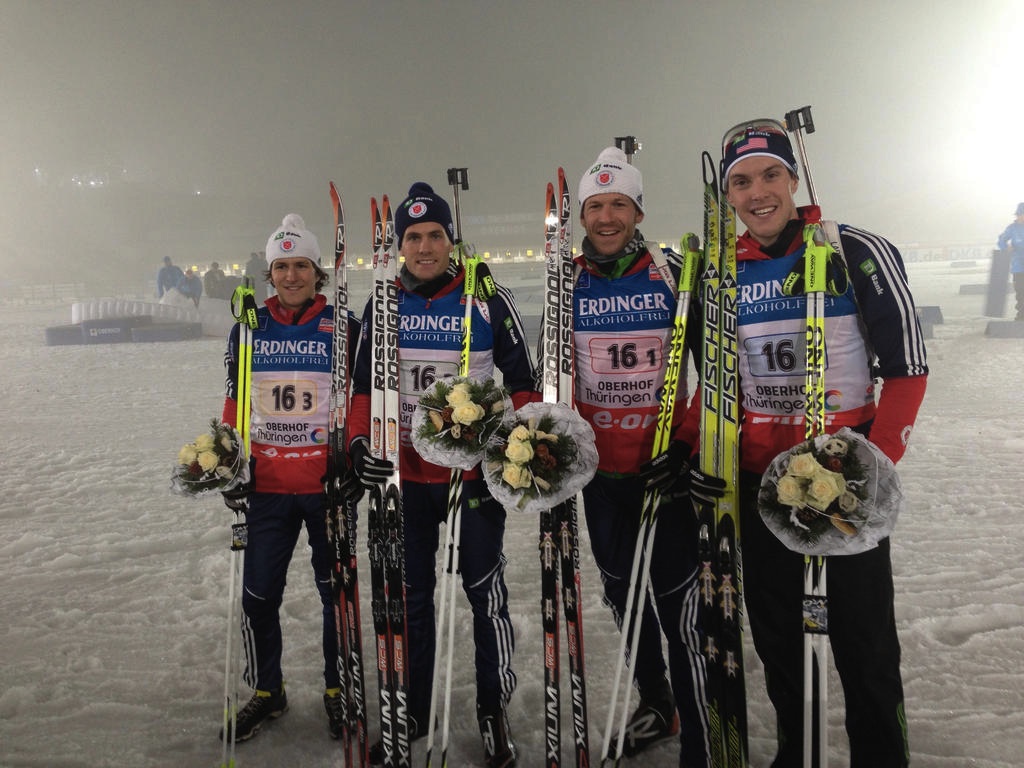
    Russell Currier, Tim Burke, Lowell Bailey, and Leif Nordgren after a fifth-place relay finish in the IBU World Cup relay in Oberhof, Germany, in 2013. Currier, Burke, and Bailey are all retiring. (Photo: USBA.)

    With the 2018 Olympics come and gone, many of biathlon’s athletes are calling it quits. Here’s a roundup of who you won’t see on the World Cup next season – and who’s still on the fence about their future.

    USA

    2017 Word Champion Lowell Bailey has long planned to retire after the 2018 season, and now that time has come. His first World Junior Championships was in 1999 and he got his first World Cup start in 2002. He raced 2003 World Championships before taking a break to go to the University of Vermont, before returning and competing in the 2006, 2010, 2014, and 2018 Olympics. His eighth-place finish in the 20 k individual at the 2014 Games are the best ever by an American biathlete. Bailey is the Executive Director of the Crosscut Mountain Sports Center in Bozeman.

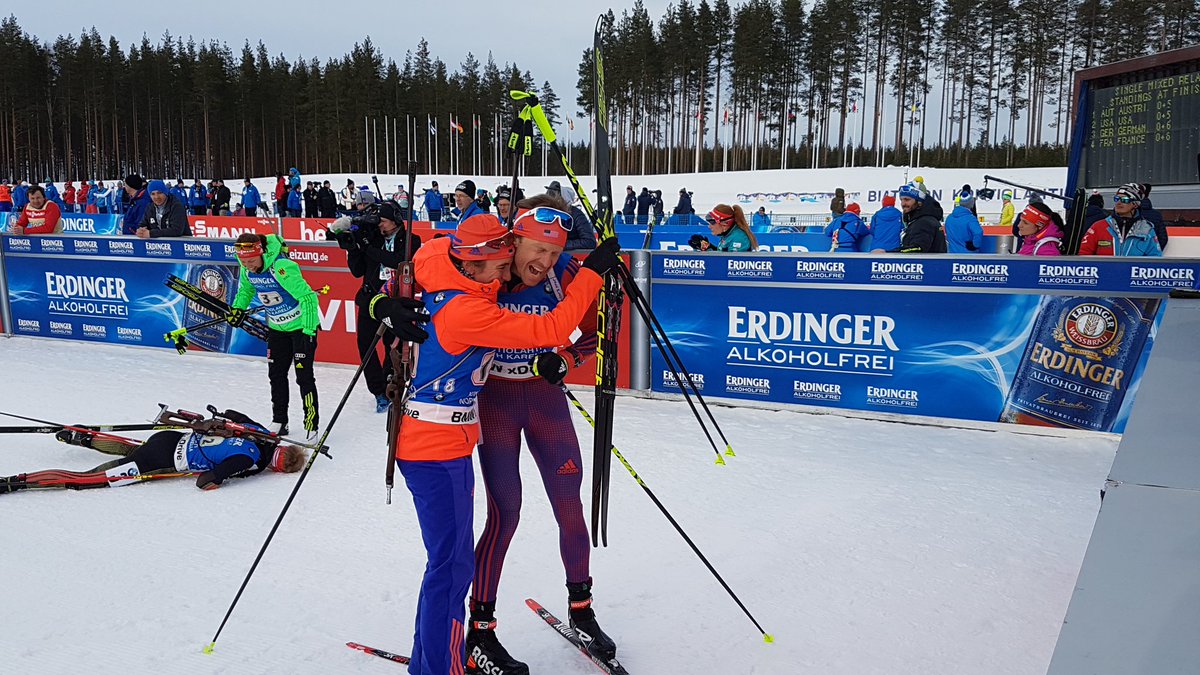
    Susan Dunklee and Lowell Bailey celebrate after finishing second in the World Cup single mixed relay in Kontiolahti, Finland, in 2017. Austria won the competition. Bailey is retiring and Dunklee is undecided as to whether she will continue racing. (Photo: IBU/Twitter)

    “I told myself this morning that I just wanted to go out on a high note,” he told FasterSkier in Oslo after leading off a U.S. relay team that finished seventh, in his last World Cup race. “I wanted to go out with a good result. And, I’m really happy to have shot clean in standing, clean from the clip in my last stage as a World Cup biathlete. That feels good. I’ll always remember that — that I went out with a clean stage.”

    Longtime teammate and 2013 World Championships silver medalist Tim Burke will also retire. Burke has six World Cup podiums to his name including that silver medal, and led the World Cup partway through the 2009-2010 season. Burke started racing internationally at 2000 Junior World Championships, and made his first senior World Championships in 2004. Like Bailey, he is a four-time Olympian.

    “It’s weird, I don’t honestly I don’t know if it’s truly hit me,” he said after the Oslo relay. “It might take weeks… I think it’s going to take a long time for all to settle in and for me to really reflect back on my career. Yeah, it’s a lot of emotion.” Burke says that his post-biathlon plans are not yet certain.

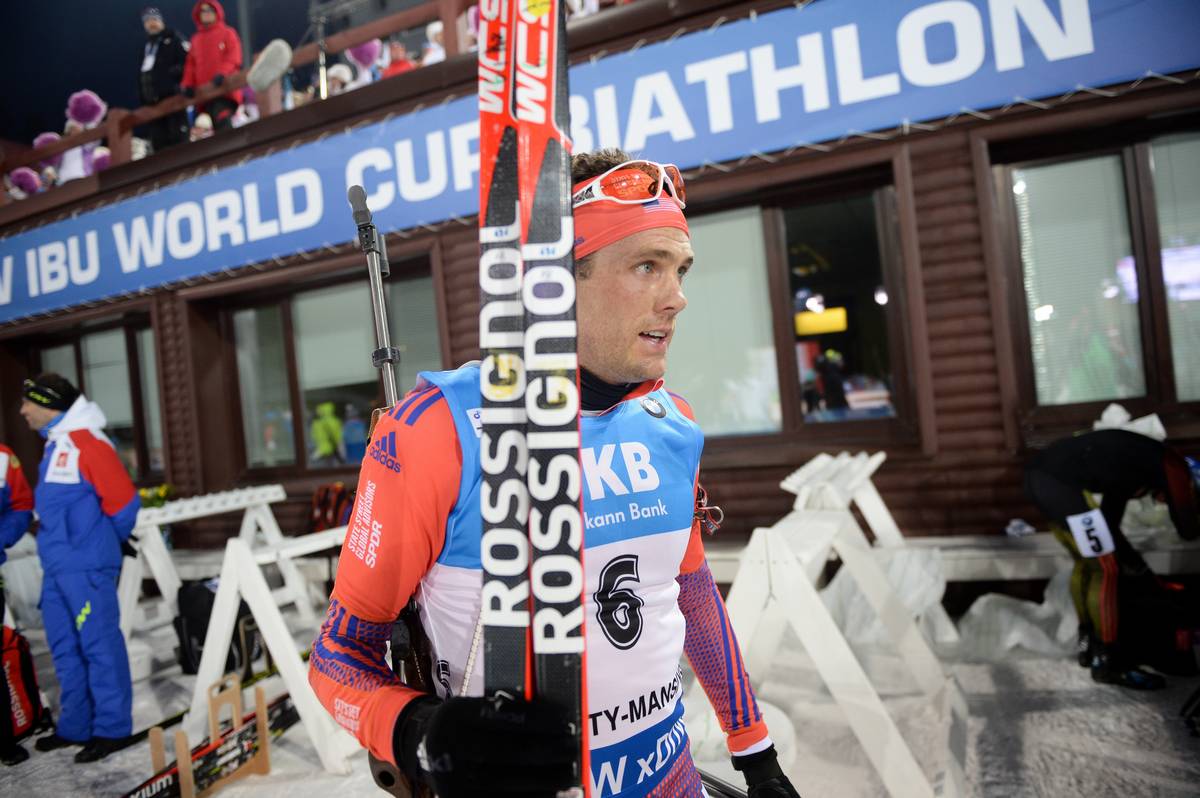
    Tim Burke after placing sixth in a World Cup pursuit in Khanty-Mansiysk, Russia, in 2016. (Photo: USBA/NordicFocus)

    Also retiring is Russell Currier, an off-and-on member of the national team and the Maine Winter Sports Center (now the Outdoor Sports Institute). Currier had two sixth-place World Cup results in 2012, and is a four-time World Championships team member. Since his World Cup debut in 2009, he has contributed to many U.S. relay efforts. He also competed at the 2014 Olympics, with a top finish of 49th, and was a member of the 2018 Olympic team though he did get any starts in PyeongChang.

    “USBA nationals will be officially be the last race of my biathlon career,” Currier wrote in an email to FasterSkier this week.

    The women’s team likely won’t see three retirements, and will thus have some more stability than the men’s crew, but there is more uncertainty regarding the women’s roster. Clare Egan wrote in an email this week that she was “Undecided!” about whether to continue racing. And in Oslo, after finishing third in the pursuit which was her last World Cup of the season, Susan Dunklee said the wasn’t sure if she would keep competing. “Ask me again in a month,” she said.

    Canada

    Julia Ransom retired in Oslo, as the 25-year-old is planning a career in dentistry and has many years of school ahead of her. “It’s just a good time for my partner and I to kind of move on,” she said after crossing the line in her final World Cup, the pursuit, hand in hand with teammate Rosanna Crawford.. “And it does feel right. It feels right.”

    The Canadian men’s team (l-r) Christian Gow, Nathan Smith, Scott Gow, and Brendan Green celebrate bronze in the men’s 4 x 7.5 k relay at 2016 World Championships in Oslo, Norway. Both Green and Smith are undecided on their future plans. (Photo: JoJo Baldus)

    Ransom scored two top-ten finishes at 2014 World Juniors, and made her first senior World Championships team in 2015. This season she had two top-ten World Cup finishes, and went to the Olympics in PyeongChang, where she finished 28th in the pursuit.

    She is the only one from the Canadian team who is definitely retiring, but quite a few of her teammates are on the fence and there could be huge turnover on the team depending on what they decide. That includes Rosanna Crawford and Brendan Green, even though Crawford finally bagged her first World Cup podium this season.

    “We’re not 100% sure yet,” Green said after the relay in Oslo. “Both Rosanna and I will sit on it a little bit over the spring. We will reevaluate a little bit and see what other opportunities arise. I think we both still love to race and train, and if we continue down that path I know we will still be motivated. But as of right now I’m not sure.”

    2015 World Championships silver medalist Nathan Smith – who was also, along with Green, Christian Gow, and Scott Gow, part of a bronze-medal relay at 2016 World Championships – is also unsure. He missed most of the 2016-2017 season with health issues and though he returned to the World Cup and the Olympics this year, did not perform up to his own expectations. 

    Rosanna Crawford, Megan Imrie, Megan Tandy, and Zina Kocher celebrate a fourth-place World Cup relay finish in Annecy, France, in 2014. Crawford and Tandy may not keep racing after this season; Imrie retired in 2014 and Kocher in 2016. (Photo: Matthias Ahrens)

    “I’m kind of waiting to see what happens with Biathlon Canada,” Smith wrote in an email this week. “I think some very difficult years are coming for the organization, unfortunately. That will play a big part in my, and I’m sure many other athletes’, decisions. Of course, I’m also not looking to have a continuation of the health problems over the last two seasons, which made competing at the highest level really difficult. So I will be keeping a close eye on how my body is reacting to training. If it’s still not coming around that would certainly not encourage me to continue either.”

    2010, 2014, and 2018 Olympian Megan Tandy also struggled with health issues this winter, and is likewise not sure what her future holds.

    “Originally it was my intention to retire after this season, however it was literally my worst season ever!” she wrote in an email. “I was sick more in the past 6 months than in the past two years. Anyways,  I have taken some time since the Olympics to followup about my health and to consider options for next season. I want to race a final season – one where I feel good and can put up a good fight (not necessarily results dependant, I just want to leave this sector of my life feeling like I gave it all I got), but a lot of things will need to fall into place for that to be realistic: sponsor support, coaching opportunities during the training season, and my health of course.”

    Poland

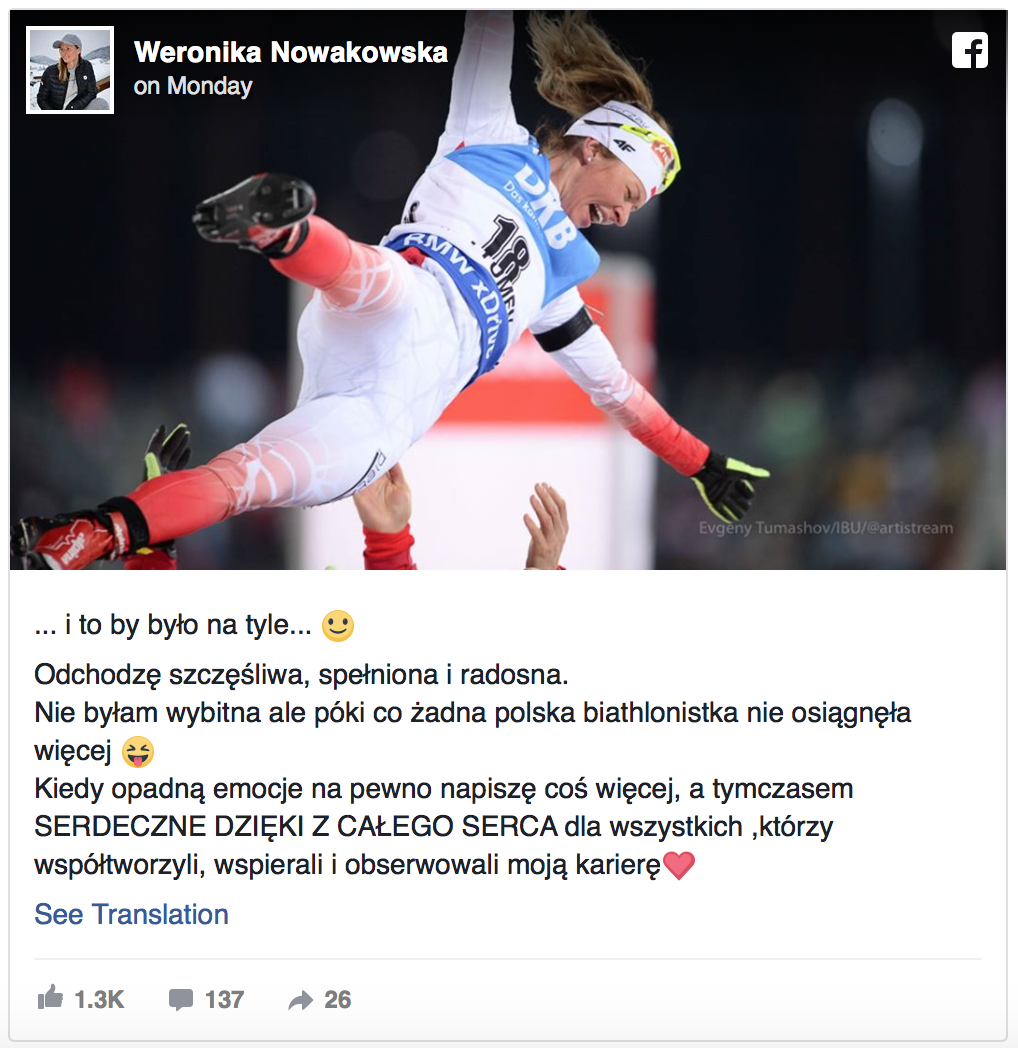
    Weronika Nowakowska is calling it a career. The 31-year-old picked up two World Cup podiums in the 2015 season before taking a break from competition to give birth to twins. She made a successful return this season and represented Poland in PyeongChang, with a top finish of 21st in the individual. She also had sixth- and fourth-place finishes on the World Cup this year and contributed to four different top-eight relay efforts, including one at the Olympics.
    “I leave happy, fulfilled and cheerful,” she wrote on her Facebook page, according to a translation. “I was not outstanding, but so far no Polish biathlete has done better”

    France

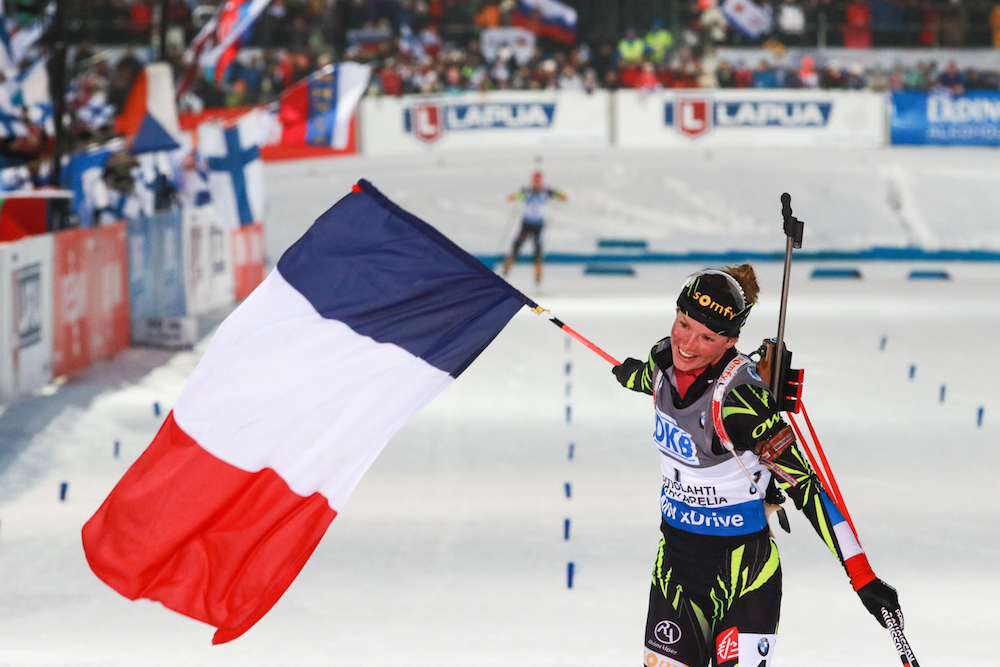
    Back in Oslo, French star Marie Dorin Habert ended her career. Dorin Habert – then simply Marie Dorin – competed in her first senior World Championships in PyeongChang in 2009, where she had a top individual finish of 18th and was part of the bronze-medal relay team. Fast forward and she had racked up a sprint bronze at the 2010 Olympics, seven World Cup wins, ten more World Championships relay medals, and four individual gold, one silver, and one bronze medal at World Championships, four of which were from the 2016 edition where she did not finish a single race without a medal.

    France’s Marie Dorin Habert celebrates her second win in as many races at 2015 IBU World Championships, after taking gold in the 10 k pursuit in Kontiolahti, Finland. (Photo: Kontiolahden Urheilijat/Jarno Artika)

    She found herself back in PyeongChang for the 2018 Olympics, where, despite a frustrating season until then, she was fourth in the sprint, bronze in the women’s relay, and gold in the mixed relay.

    “It’s so nice to end this way, to share it with all of the team, and the beautiful sun, and all the French people,” Dorin Habert said after winning the women’s relay in Oslo along with her teammates. “It’s a wonderful day for me. I would like to thank a lot, well, everyone, for being there in the biathlon family. I’m really happy to have this career, and I’m really happy for everything.”

    Jean Guillaume Beatrix he told is also retiring. Beatrix was a World Junior Champion in 2009, before going on to be a five-time World Championships team member and a 2014 Olympic bronze medalist in the pursuit. He was part of three silver- and one bronze-medal winning men’s relay teams at World Championships. But this season, he did not perform well enough to make a very competitive French team for the 2018 Olympics. His retirement was “a decision precipitated by my results”, L’Equipe, according to a translation.

    Czech

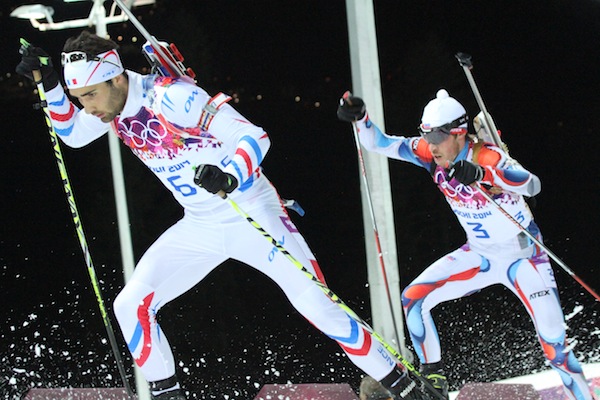
    France’s Martin Fourcade leading Jaroslav Soukup of the Czech Republic during the men’s Olympic 12.5 k pursuit at the 2014 Olympics.

    Jaroslav Soukup, the bronze medalist in the sprint at 2012 World Championships, where he was also part of the silver-medal mixed relay team, is retiring. Later in 2012, he suffered a horrendous accident while biking, including open fractures in his arm and neck and back injuries. By 2014, he made it back and won the same medals at the Olympics that he had at World Championships two years before: bronze in the sprint and silver in the mixed relay. Soukup qualified for the 2018 Olympics but only competed in the relay, which finished seventh. He had one World Cup top-30 this season.

    Norway

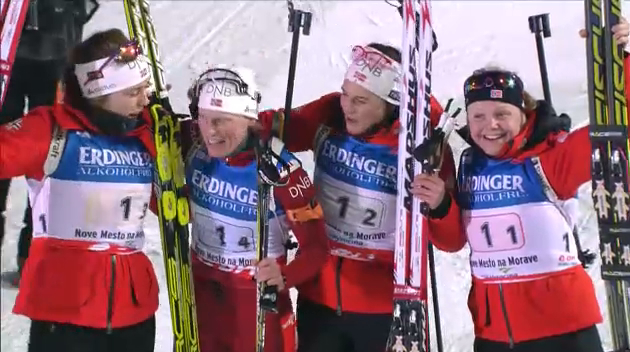
    Hilde Fenne, a staple of the Norwegian women’s team, retired after the last race of the season in Tyumen, Russia. Fenne never found breakout success as an individual; she had three top-15 finishes in her career. But she was an integral part of the women’s team and contributed to numerous World Cup relay podiums, as well as the gold-medal winning women’s relay at 2013 World Championships in Nove Mesto, Czech Republic.

    The Norwegian women’s relay celebrates its second-ever World Championships title after winning the 4 x 6 k event in Nove Mesto, Czech Republic. From left to right: Synnøve Solemdal, Tora Berger, Ann Kristin Flatland and Hilde Fenne.

    In that final race, her teammates wrote her name on their cheeks. “She has been a very important piece for me,” teammate Synnøve Solemdal told NRK, almost in tears. “We have stayed in a lot of hotel rooms together. I’m going to miss her very much.”

    On the men’s side, there is uncertainty as to whether some veterans will stick with racing or not. One is Ole Einar Bjørndalen, who was left off Norway’s Olympic team, who for the first time since 1992 this season. And yet, the 44-year-old has not stated that he will retire, and some who know him are speculating that he may try to stick it out one more year and go out with better results than he saw this season.

    Also with no stated plans is Emil Hegle Svendsen. Bjørndalen is the winningest athlete in World Cup history; Svendsen is number four. He won the World Cup overall title in 2010, and is a four-time Olympian. He won gold in the individual in 2010 and in the mass start in 2014, after which he suffered a total collapse anchoring the Norwegian men’s relay. In the past seasons he has been off and on, and he has only won two races since then. But this season he showed flashes of brilliance, and he was third in the mass start at the 2018 Olympics as well as anchoring the silver medal men’s relay and mixed relays.

    Emil Hegle Svendsen of Norway leaves the stadium in the 2016 Holmenkollen World Cup as thousands of his countrymen cheer him on. Svendsen has not officially announced his plans for next season. (Photo: JoJo Baldus)

    “What Emil has done is absolutely fantastic,” teammate Tarjei Bø – who won the overall World Cup the year after Svendsen – told NRK two weeks ago. “He has won everything, and in addition done it several times, and he has come back again and again after being down. He has had a fantastic career and I hope he continues.”

    Finland

    She just won the overall World Cup crystal globe, but Kaisa Makarainen is not sure whether she will continue racing. In several previous years she had already discussed potentially retiring, but now she is reportedly waiting to think it over more as well as to discuss with the new team staff. U.S. Biathlon Women’s Coach Jonne Kahkonen, himself a Finn, was just announced as the new Head Coach for Finland.

    Germany

    Florian Graf, an athlete who finished as high as fourth on the World Cup in 2013 but has more recently been racing on the IBU Cup, is calling it quits at age 29.

    Several other top athletes are suspected to be considering retiring, but there hasn’t been much on the record discussion by them. Stay tuned.

  • First Paralympic Golds for Soule and Masters; McKeever Wins Second Straight, 12th Total

    First Paralympic Golds for Soule and Masters; McKeever Wins Second Straight, 12th Total

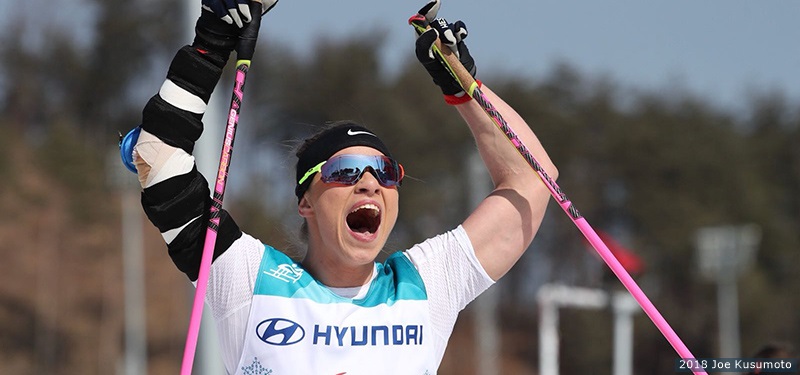
    American Oksana Masters reacting to her first gold medal in her third Paralympics, after winning the women’s 1.1 k sitting sprint on Wednesday in PyeongChang, South Korea. (Photo: U.S. Paralympics/Joe Kusumoto)

    2018 Winter Paralympics (PyeongChang, South Korea):  Cross-country sprints

    Hold onto your hats, this was a major day for both the American and Canadian teams at the 2018 Paralympics.

    In the cross-country sprints on Wednesday in PyeongChang, Andy Soule and Oksana Masters of the U.S. Paralympics Nordic Program both captured their first-career Paralympic golds in the women’s and men’s sitting events, while Dan Cnossen skied to his fourth medal in as many races with a bronze to add to his collection.

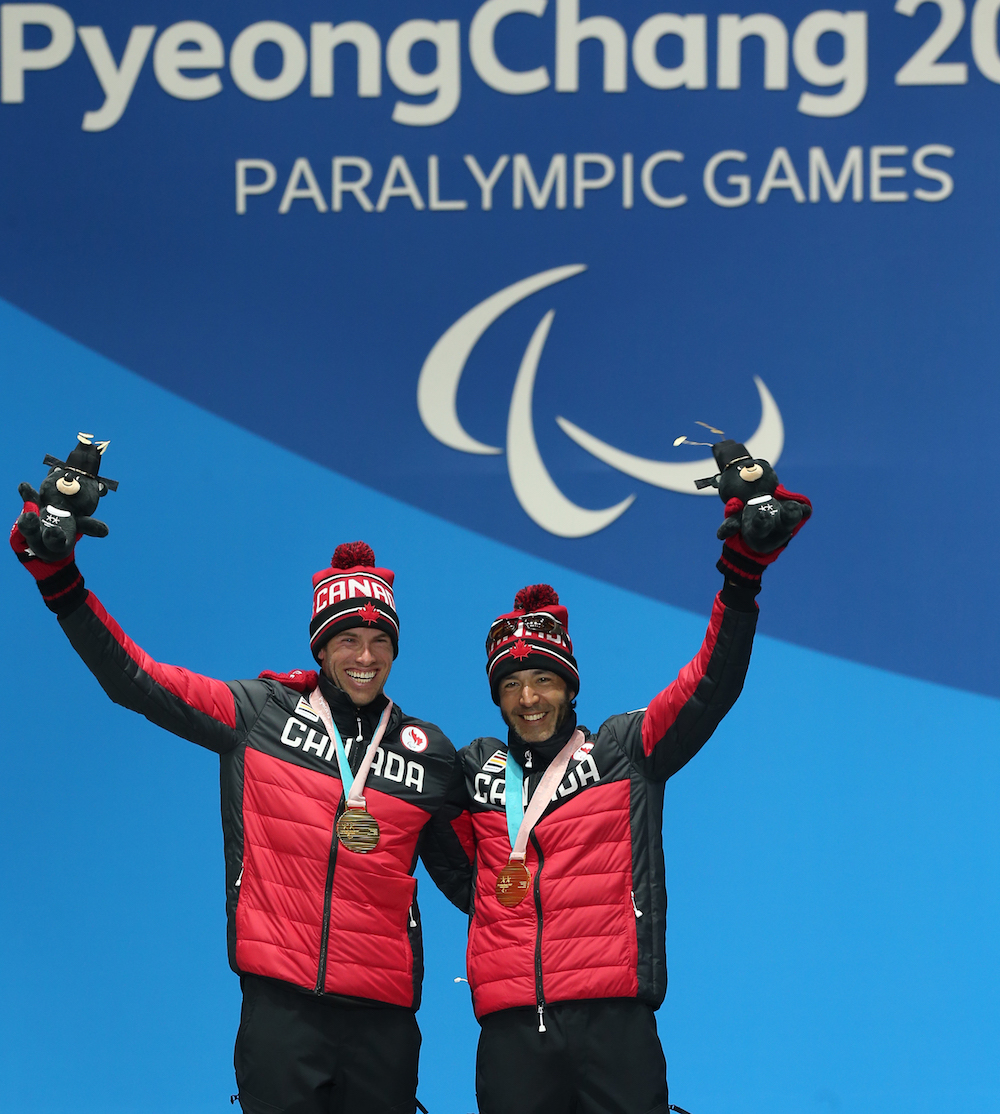
    Brian McKeever of the Canadian Para-Nordic Ski Team raced to his second-straight gold of the week in the men’s visually impaired sprint, with guide Russell Kennedy, and two of their teammates claimed bronze: Mark Arendz, in the men’s standing sprint for the first Paralympic cross-country medal of his career (following four biathlon medals) and Natalie Wilkie, the youngest member of the team at age 17, in the women’s standing sprint.

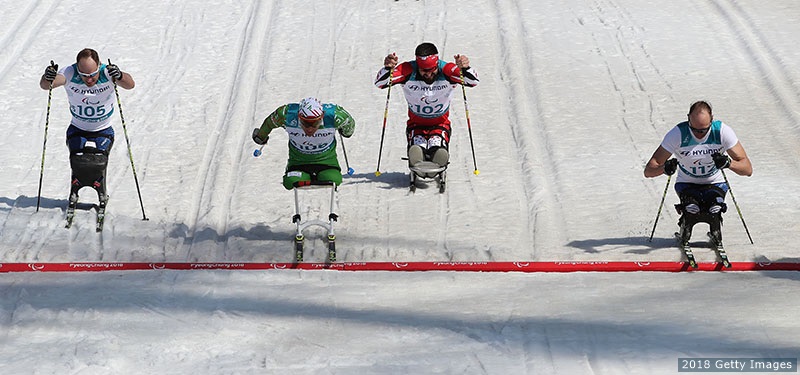
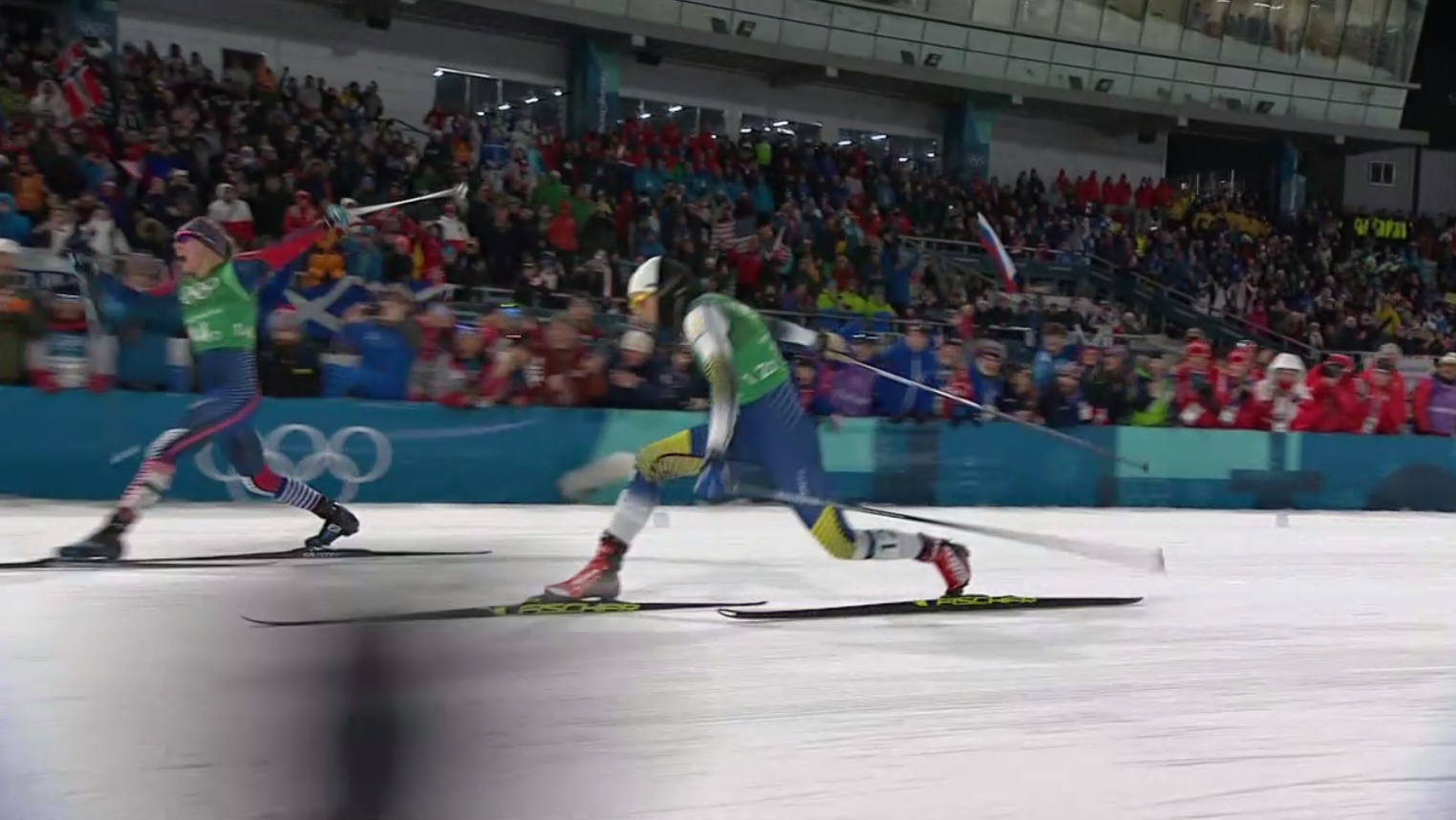
    Andy Soule (r) of U.S. taking first in a photo finish with Dzmitry Loban (second from l) of Belarus, while American Dan Cnossen (l) takes third and Canada’s Collin Cameron (second from r) fourth in the men’s 1.1 k sitting cross-country sprint at the 2018 Paralympics in PyeongChang, South Korea. (Photo: U.S. Paralympics/Chung Sung-Jun for Getty Images)

    In the men’s 1.1-kilometer sitting sprint final, Soule won a photo finish with Dzmitry Loban of Belarus, after both crossed the line in 3:31.4 minutes. Cnossen finished 0.4 seconds back in third and Canada’s Collin Cameron was just 0.3 seconds off the podium in fourth (+0.7).

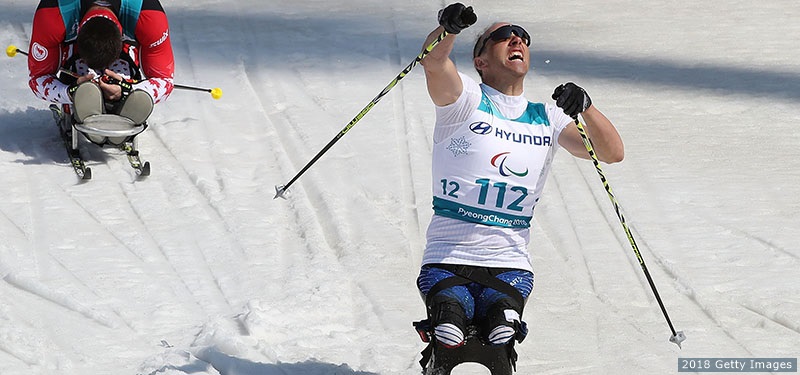
    After skiing the pack throughout the final, Soule took the lead as the four racers entered the stadium together. In the finishing stretch, Loban, Cnossen and Cameron challenged him for the gold, but with a powerful surge and lean at the line, Soule, 38, notched the first gold medal after nearly 13 years in the sport. The U.S. Army veteran had previously earned bronze at the 2010 Paralympics and bronze in Tuesday’s 12.5 k sitting biathlon race.

    In a U.S. Paralympics press release, Soule described the race as “interesting” and “tactical”.

    American Andy Soule celebrates gold in Wednesday’s 1.1 k sitting sprint final at the 2018 Paralympics in PyeongChang, South Korea. (Photo: U.S. Paralympics/Chung Sung-Jun for Getty Images)

    “I chased the whole way,” he said. “I don’t think it necessarily hurt me to chase that much, it actually helped with a little bit of wind break. I think a good, tight tuck coming down the final hill put me in a natural line, and I knew I had a shot at a good sprint out. This is an incredible group to compete with. That kind of a finish … that’s what sprinting is all about.”

    “I definitely lost a little gas in the final stretch,” Cnossen reflected, according to the press release. “My strategy was to tuck in behind the Belarus athlete in the beginning and then sprint over the bridge and try to hang on. Andy had such an awesome race. This is the second day in a row we’ve had two U.S. men on the podium which is just phenomenal.”

    For Soule, the gold was his first in his third Paralympics, and his first Paralympic medal in a cross-country race (rather than biathlon).

    “It means so much. It feels so incredible,” Soule said. “I couldn’t do it without incredible teammates pushing me all the time, and without incredible coaching and technical staff. I think it speaks to a great team effort that has really paid off for us.”

    Cameron came within fractions of a second of achieving his second medal in his first Paralympics.

    “I raced as hard as I could … it is what it is. I just came up a little short,” he said, according to a Cross Country Canada press release. “It is amazing that I got a medal this week in biathlon, I wasn’t expecting it, but that was behind me. I really wanted something here. This was the race I wanted a medal in. It was a close one.”

    Also for Canada, Chris Klebl and Derek Zaplotinsky missed advancing to the final after both finished sixth in their respective semifinals.

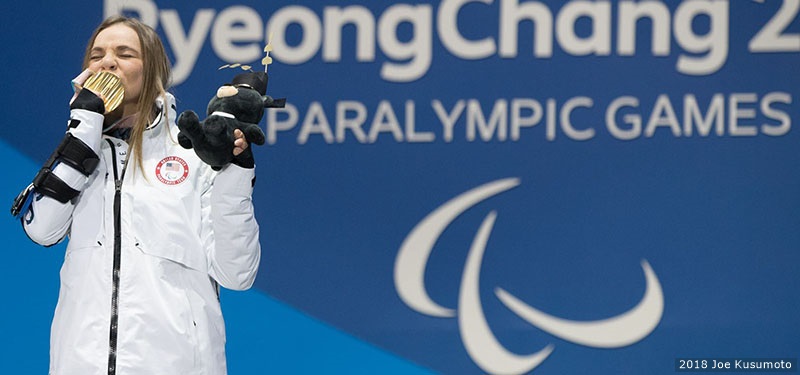
    American Oksana Masters kissing her first Paralympic gold at the medals ceremony on Wednesday night after she won the women’s 1.1 k sitting sprint at the 2018 Paralympics in PyeongChang, South Korea. (Photo: U.S. Paralympics/Joe Kusumoto)

    Masters, 28, won the women’s 1.1 k sitting sprint final by 2.1 seconds over Germany’s Andrea Eskau, crossing the line first in 4:06.7. The gold was Masters’s first in her third Paralympics, after she had previously collected five medals — two silver and three bronze — between the 2012 Summer Paralympics in London (where she placed third in a doubles rowing event), 2014 Winter Paralympic in Sochi, Russia (where she tallied one silver and two bronze in cross-country events), and PyeongChang (silver in the biathlon 6 k sprint).

    Masters has notably been racing with an injured elbow throughout these Games. On Tuesday, she did not finish the 10 k biathlon race.

    “I can’t believe it. I literally was starting to think this day would never happen,” she said of her win on Wednesday, according to the U.S. press release. “I knew that I wasn’t going to let yesterday be my last race. I couldn’t believe it, but at the same time, I knew I had it in me to dig deep a couple more times. I could not have done this without the USOC medical staff.”

    In the sitting semifinals, her teammates Kendall Gretsch, who won the first two races of the 2018 Paralympics, and Aaron Pike, were eliminated after both placed fourth in their respective heats.

    McKeever 2-for-2

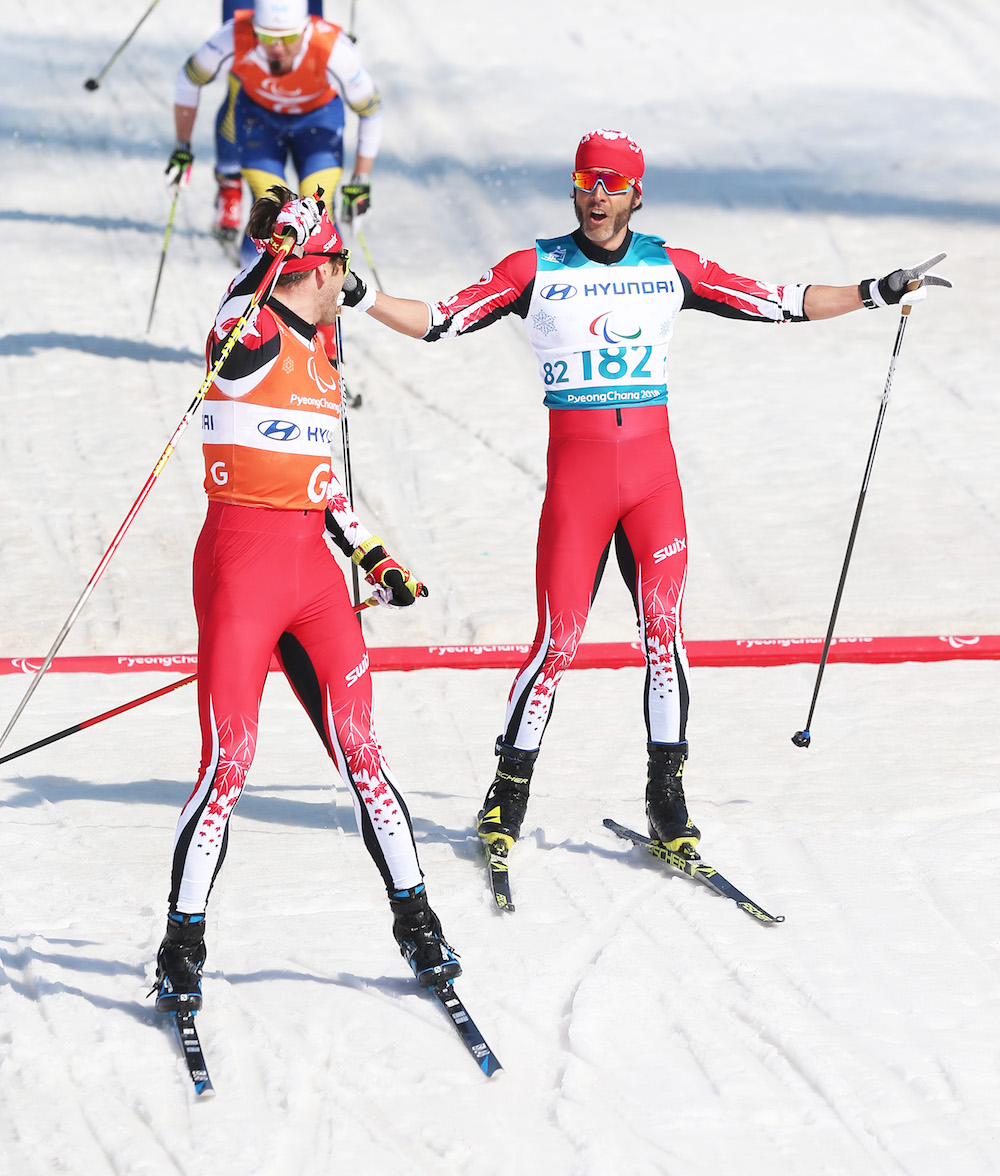
    Canada’s Brian McKeever (r) and his guide Russell Kennedy celebrate gold in the men’s 1.5 k visually impaired classic sprint at the 2018 Paralympics on Wednesday in PyeongChang, South Korea. (Photo: Scott Grant/Canadian Paralympic Committee)

    A five-time Paralympian, McKeever, 38, racked up his 12th Paralympic gold medal (15th total medal) in the men’s 1.5 k visually impaired classic sprint. He finished 2.5 seconds ahead of Sweden’s Zebastien Modin (with guide Robin Bryntesson) in second place, with a time of 4:03.2. Behind them in the final, Norway’s Eirik Bye (with guide Arvid Nelson) finished third (+29.5) and Jake Adicoff (with guide Sawyer Kesselheim) was relegated to last (fourth place) for a technique violation.

    McKeever has won all three Paralympic sprints since they were introduced in 2010. On Wednesday, he double poled the entire race.

    “These sprint races are miserable,” McKeever said, according to a team press release. “They are so hard. The young guys are fast, and have natural snap. There is so much stress in sprint racing, and it goes all day long. I’m much more comfortable with the longer distances, but it was a great day for us. Russell carried the load for us today, and just thrilled we were able to cross the line first.”

    Kennedy, 26, who competed at his first Olympics last month in PyeongChang, said it was tough battling it out in Wednesday’s soft conditions.

    “We played things a bit more strategic in the semis because we knew the final was going to be a tough fight, and it was,” Kennedy reflected. “That first hill hurt a lot. Once I got to the top I was able to settle down and said to myself ‘OK, you got this.’ ”

    While Kennedy guided McKeever to gold in the second half of Monday’s 20 k cross-country race, McKeever’s other guide, Graham Nishikawa (who skied the first half with him), joined McKeever on the podium. Wednesday was Kennedy’s turn at the medals ceremony.

    “This is a new experience for me — especially coming from the Olympics where the focus is all on yourself,” Kennedy said. “Brian is such a strong athlete and guiding him requires a lot more communication. Competing here at the Paralympics is really rewarding because you do this as a team. It is hard at times to know if I’m going too hard or if he needs me to go faster, but it has been a lot of fun for me.”

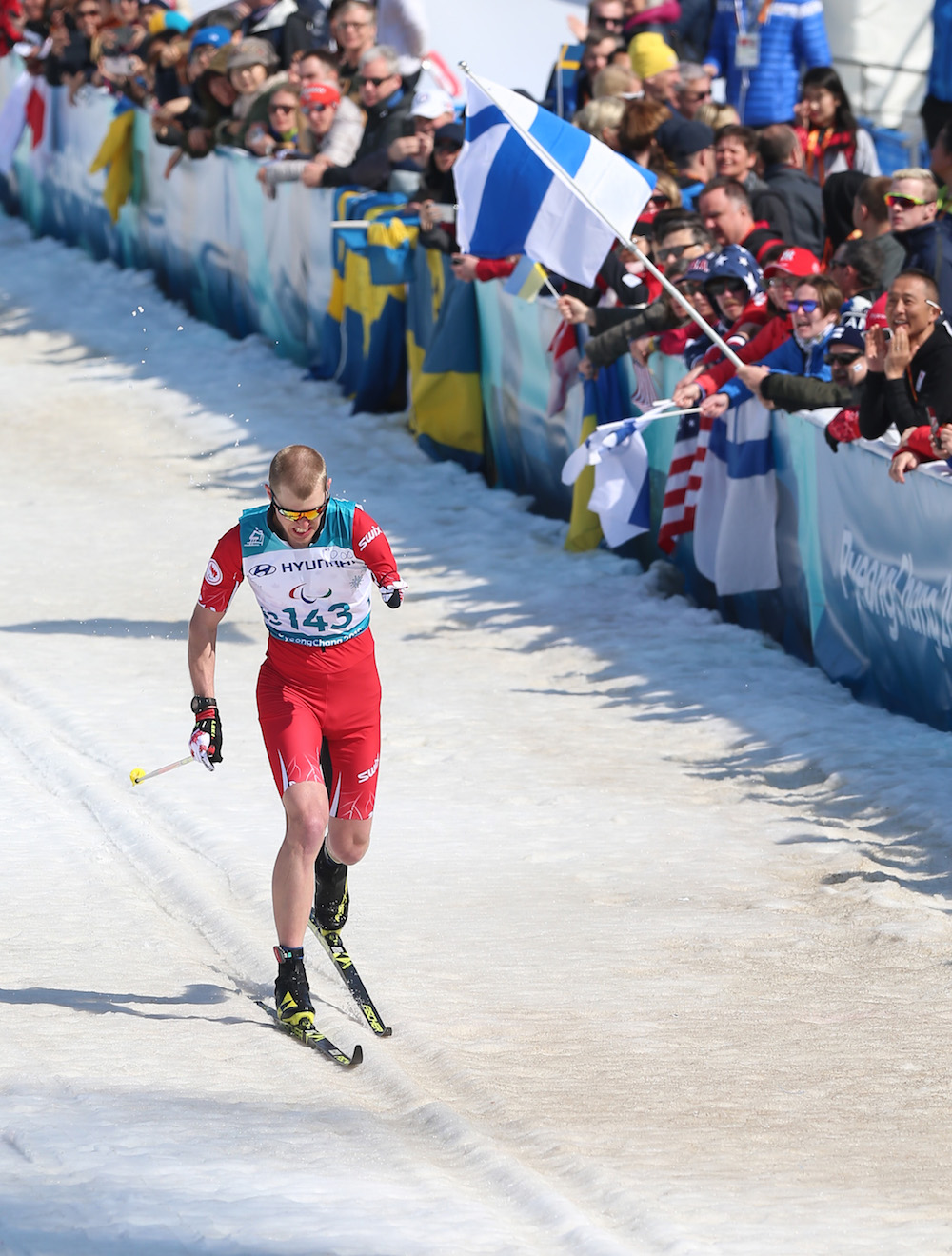
    Canada’s Mark Arendz en route to bronze in the men’s 1.5 k standing classic sprint at the 2018 Paralympics in PyeongChang, South Korea. It was his first cross-country medal (fifth total) in his second Paralympics. (Photo: Scott Grant/Canadian Paralympic Committee)

    In the men’s 1.5 k standing sprint final, Arendz tied Finland’s Ilkka Tuomisto for third place, and both were awarded bronze. They finished just 0.3 seconds behind Japan’s Yoshihiro Nitta in second, and 1.1 seconds behind Kazakhstan’s Alexandr Kolyadin, who won in 4:19.7.

    “Sitting there in the finish waiting for the results of the photo finish, I was just hoping for a tie,”  Arendz said, according to the team press release. “It was a really good race but I made a mistake down the finishing stretch switching to try and find a faster track and that may have cost me the whole race.”

    The Paralympic medal was the first in a cross-country race for the 28-year-old Arendz, who has two silver and two bronze in biathlon races between these Paralympics and the 2014 Sochi Games.

    “I came here for medals in biathlon and was hoping to get my first one in cross-country,” he said. “To come away with my first bronze in cross-country skiing means a lot. I couldn’t be happier.”

    In the women’s 1.5 k standing sprint final, Wilkie raced to third for her first medal in her first Paralympics. She finished just a tenth of a second behind Norway’s Vilde Nilsen, who took silver, and 3.2 seconds out of first, which went to Anna Milenina of the Neutral Paralympic Athletes (NPA) in 5:11.1.

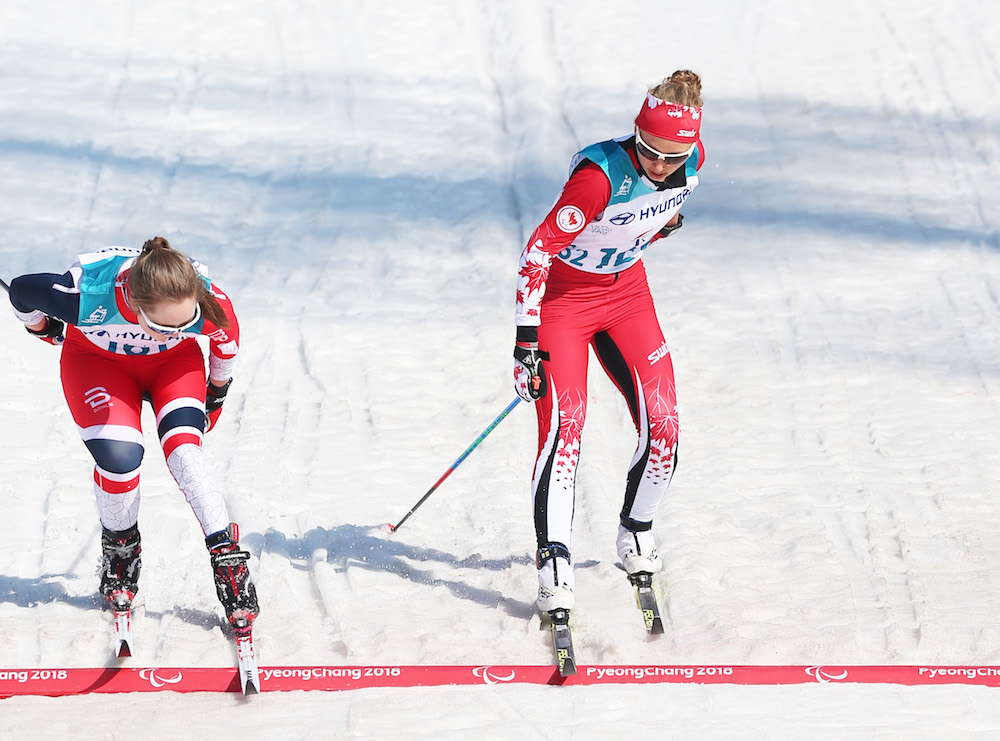
    Canada’s Natalie Wilkie (r) finishing third, just 0.1 seconds behind Norway’s Vilde Nilsen (l) in second, for her first Paralympic medal on Wednesday in the women’s 1.5 k standing classic sprint in PyeongChang, South Korea. (Photo: Scott Grant/Canadian Paralympic Committee)

    “It feels so awesome,” Wilkie said of her bronze medal. “This is my first Paralympics and I am just so happy to have won a medal.”

    Four seconds behind Wilkie, her teammate Emily Young placed fourth (+7.2). Canada made up half of the six-woman final with Brittany Hudak placing sixth (+49.2)

    “We are competing against each other, but we are also helping each other,” Wilkie said. “It was calming for me to have them there with me. We talked about strategy as a team before the final because the goal was for us to win a medal for Canada.”

    Paralympic nordic skiers and biathletes have a day off on Thursday before races resume Friday with men’s and women’s long-distance biathlon races, starting at 10 a.m. Korea time Friday (9 p.m. EDT Thursday).

    Complete results

    Canada’s Brian McKeever (r) and Russell Kennedy receiving their gold medals from the men’s visually impaired classic sprint at the 2018 Paralympic Games in PyeongChang, South Korea. (Photo: Scott Grant/Canadian Paralympic Committee)
  • Cnossen Tallies 3rd Medal of PyeongChang Paralympics; Soule and Arendz Take Bronze

    Cnossen Tallies 3rd Medal of PyeongChang Paralympics; Soule and Arendz Take Bronze

    American Dan Cnossen racing to silver in the men’s 12.5 k biathlon sitting on Tuesday and his third medal in as many races at the 2018 Paralympics in PyeongChang, South Korea. (Photo: U.S. Paralympics/Thomas Lovelock – OIS/IOC)

    2018 Winter Paralympics (PyeongChang, South Korea): 10/12.5 k biathlon races

    Amid soft and slow conditions at the Alpensia Biathlon Centre on Tuesday, American Dan Cnossen raced to his third-straight medal in as many races at the 2018 Paralympics, claiming silver in the men’s 12.5-kilometer sitting biathlon race just ahead of his U.S. Paralympics Nordic teammate and fellow military veteran Andy Soule, who earned bronze.

    Cnossen, a retired Navy SEAL, previously won gold in Saturday’s 7.5 k biathlon sprint and silver in Sunday’s 15 k cross-country race. Despite wind gusts up to 15 miles per hour on Tuesday, Cnossen hit all 20 of his targets and finished second, 1:01.7 minutes behind Ukraine’s Taras Rad, who won in 45:35.6 with clean shooting as well.

    “Personally, this was such an important breakthrough, to shoot 20 for 20, especially on the last shooting stage,” the 37-year-old Cnossen said, according to a U.S. Paralympics press release. “I’ve had some mental blocks in the past where I overthink things or get a little anxious, so I really took my time, especially on the last two shots. I wanted to get my heart rate down and make sure the wind wasn’t blowing. It feels really good to overcome this mental hurdle. I just wanted to see what I could do today, and have my own race, and not worry about what other people are doing.”

    Soule, a 38-year-old Army veteran, missed two on his third shooting stage (0+0+2+0) to finish third, 1:33.1 out of first. It was the second Paralympic medal of his career after Soule he earned bronze in the biathlon pursuit at the 2010 Games in Vancouver, British Columbia.

    “I was really skiing at an aggressive pace,” Soule told U.S. Paralympics on Tuesday. “I was struggling to hold it together at the range those last two shootings. When I missed those two, I also knew that I had seen other people missing. I knew a miss or two wasn’t going to necessarily put me out of it. I knew I just needed to get back up, set the same aggressive pace, and maybe back it off just a little earlier on the next lap to make sure I get the shots. It came together just fine.”

    It was another special moment for the U.S. Paralympics program with two of its leading men on the podium.

    “I’m really happy for our whole team, to see how much success we’re having,” Soule said. “I think it’s a testament to great coaching, great support, great staff. Lots of great work being done behind the scenes by so many people that you don’t even see who are out here long before we even arrive at the venue. It’s a great group of athletes. I’m so happy to be a teammate with these guys.”

    “This race feels especially good because I have my teammate, Andy, on the podium,” Cnossen said. “I knew he was going to have a good race. I’m really proud and happy to see him on the podium.”

    Also for the U.S., Aaron Pike placed seventh in that race (+5:38.1) with a single miss (0+0+0+1), Sean Halsted finished 14th (+10:35.7) with five penalties, and Bryan Price was 16th (+17:02.3) with 10 misses.

    Canada’s lone man in the 12.5 k sitting biathlon race, Derek Zaplotinsky finished 12th (+9:15.3) with five penalties.

    American Kendall Gretsch racing to fourth in the women’s 10 k sitting biathlon race on Tuesday at the 2018 Paralympics in PyeongChang, South Korea. (Photo: U.S. Paralympics/ Maddie Meyer – Getty Images)

    Coming off two medals in the women’s sitting biathlon and cross-country events last weekend, Kendall Gretsch placed fourth in the 10 k sitting biathlon race on Tuesday, 16.5 seconds out of third. According to a U.S. Paralympics press release, she fell three times and incurred three penalties (1+0+0+2), finishing 2:05.4 behind the winner, Germany’s Andrea Eskau.

    A four-time gold medalist in Paralympic cycling with two silver medals in cross-country skiing (from two Winter Paralympics), Eskau, 46, claimed her first gold of the PyeongChang Games in 42:36.6 with one miss (0+0+1+0). Marta Zainullina and Irina Guliaeva, of the Neutral Paralympic Athletes (NPA), took silver (+1:15.5) and bronze (+1:48.9), respectively, with Zainullina skiing just one penalty lap and Guliaeva having to ski three.

    Oksana Masters did not finish, pulling out after 8.64 k with six penalties (1+2+1+2).

    Second Medal for Arendz

    Canada’s Mark Arendz racing to bronze in the men’s 12.5 k standing biathlon race on Tuesday at the 2018 Paralympic Games in PyeongChang, South Korea. (Photo: Scott Grant/Canadian Paralympic Committee)

    Mark Arendz led Canada with his second medal in the second biathlon race, the men’s 12.5 k standing, racing to bronze, 30.9 seconds out of first. Arendz cleaned three stages before missing one on his last shooting (0+0+0+1), causing him to ski an additional 150 meters in the penalty lap.

    France’s Benjamin Daviet won that race in 38:55.5 with one late penalty as well (0+0+0+1), and Ukraine’s Ihor Reptyukh collected silver (+6.7) with one miss as well (0+0+1+0).

    “I knew there were some tired guys, so I went for it from the start and tried to put some pressure on,” Arendz, 28, said in a Cross Country Canada press release. “I decided in that last bout to go for it all, throw it down, and go for the win. Unfortunately, I had the one miss and it made it a tight and interesting race.”

    The men’s 12.5 k standing biathlon podium at the 2018 Paralympics in PyeongChang, South Korea, with France’s Benjamin Daviet (c) in first, Ukraine’s Ihor Reptyukh (l) in second, and Canada’s Mark Arendz (r) in third. (Photo: Scott Grant/Canadian Paralympic Committee)

    Arendz, who took silver in the opening biathlon sprint and also has two biathlon silver medals from the 2014 Paralympics, is seeking his first Paralympic gold.

    “It was a really tough battle all day. I handed it to them early and had a choice: to go for gold or settle for the podium. I went for the win and had that one miss that cost me today,” he said. “I ran out of energy at the end. I am really happy with my race and it is another medal for Canada. I know everything is going well. I just need that last little tweak to finally win one.”

    American Ruslan Reiter finished 11th in that race (+8:41.4) with three penalties (0+2+1+1).

    Brittany Hudak led the Canadian women in fifth in the 10 k standing biathlon race, 5:45.8 behind Ekaterina Rumyantseva (NPA) in first. Hudak cleaned the first three stages before missing one in the last bout (0+0+0+1).

    “The first lap I felt good,” Hudak recalled in the team press release. “The skis were running well in these conditions, but then it just got slower as we went on. The flat sections you really try put power to glide the ski but your weight is sinking you into the snow. It got harder to get some glide and as my legs got more tired I didn’t feel like I was moving fast.

    “I tried to keep calm in the range and take my time,” she added. “The wind today was gusting, so I took a bit longer on my setup than I usually would and tried to be consistent. For the most part it worked well until that last lap, and that last bout. Overall it was an OK race.”

    Paralympic racing continues Wednesday with men’s and women’s cross-country sprints, starting at 10 a.m. Korea time (7 p.m. EDT Tuesday).

    Complete results

  • McKeever Wins Record-Breaking 14th Paralympic Medal, 11th Gold

    McKeever Wins Record-Breaking 14th Paralympic Medal, 11th Gold

    Brian McKeever follows guide Graham Nishikawa during the men’s visually impaired 20 k freestyle on Monday at the 2018 Paralympics in PyeongChang, South Korea. Along with guide Russell Kennedy, they won the race by over a minute for McKeever’s 14th Paralympic medal and 11th gold. (Photo: Scott Grant/Canadian Paralympic Committee)

    2018 Winter Paralympics (PyeongChang, South Korea): 15/20 k visually impaired and standing races

    Make that record-breaking medal No. 14 for Brian McKeever. In his fifth Paralympics, the 38-year-old Canadian raced to the 11th gold medal of his career (and 14th medal total) on Monday at the 2018 Paralympics in PyeongChang, South Korea. He did so in the 20-kilometer visually impaired freestyle cross-country race with his guides Graham Nishikawa and Russell Kennedy, who traded guiding responsibilities during the four-lap race.

    Canada’s Brian McKeever (l) and one of his two guides on Monday, Graham Nishikawa, (Russell Kennedy was the other), at Monday night’s medal ceremony after they all teamed up for gold in the visually impaired 20 k freestyle cross-country race at the 2018 Paralympics in PyeongChang, South Korea. (Photo: Dave Holland/Canadian Paralympic Committee)

    McKeever finished in 46:02.4 minutes, more than a minute faster than silver medalist Yury Holub and his guide Dzmitry Budzilovich of Belarus, who finished 1:05 back in second. France’s Thomas Clarion (with guide Antoine Bollet) completed the podium in third (+1:33.3), Sweden’s Sebastian Modin (with guide Johannes Andersson) took fourth (+1:38.4) and American Jake Adicoff and his guide Sawyer Kesselheim placed fifth (+3:41.0).

    “It was super good today. Thanks to our wax techs and both of these guides. They all did an awesome job,” McKeever said, according to a Canadian Paralympic Committee press release. “It is super windy out there so to be able to tuck in behind these big boys is important for me. They pushed hard, skied well and towed me along the whole way.”

    Nishikawa led McKeever for the first half of the race before handing off to Kennedy.

    “The biggest thing about coming in mid-race is I have to remember that I’m fresh and Brian has already skied 10 kilometres so you have to be careful not to go out too hard or he could blow up,” Kennedy explained. “Brian is such an incredible athlete. He is so fit, so I knew it would not be a major problem. It worked out really well today.”

    After pushing hard in the middle of the race, McKeever changed skis at 14 k, then worked to hang on to the sizable lead he had built.

    “The plan was to ski comfortably into it and build towards the end, and I think I built a little too much during the middle and almost undid it because that last lap was very hard to keep the pace,” McKeever said with a laugh. “It was touch and go there for a bit, but we did enough in the middle to build a nice cushion, and we were able to manage it and hang on.”

    Brian McKeever leads the Canadian Paralympic team during the Opening Ceremony of the 2018 Paralympic Games in PyeongChang, South Korea. (Photo: Scott Grant/Canadian Paralympic Committee)

    The race was McKeever’s first of the 2018 Games and came three days after he served as Canada’s flag bearer at the Paralympics’ Opening Ceremony. With his 14th medal, he became Canada’s most decorated Winter Paralympian, surpassing the late Para-alpine skier Lana Spreeman, who amassed 13 medals in five Paralympics.

    “I wasn’t aware of this record, but it is pretty cool,” McKeever said. “I think for me more than anything is this is a testament to our entire program. We’ve had so many great skiers leading the way for me with my brother, Robin who is now coaching us, and Colette Bourgonje. Now it is awesome for me to be a part of a new generation that has arrived in Mark [Arendz], Colin Cameron, and the young women like Emily [Young], Brittany [Hudak] and Natalie [Wilkie], who are ready to carry the torch. I’m so excited to be around all of them this week and to be there cheering them on.”

    Canada’s Emily Young racing to fifth in the women’s standing 15 k freestyle on Monday at the 2018 Paralympic Games in PyeongChang, South Korea. (Photo: Scott Grant/Canadian Paralympic Committee)

    In the women’s standing 15 k freestyle race, his teammate Emily Young raced to fifth in slushy conditions, 2:21.3 behind Ekaterina Rumyantseva, a Russian designated as a Neutral Paralympic Athlete (NPA), in first. Anna Milenia, also an NPA, placed second (+1:21.0), and Ukraine’s Liudmyla Liashenko took bronze (+1:32.9).

    Canada’s 17-year-old Natalie Wilkie, the youngest member of her team in her first Paralympic race, raced to sixth (+2:41.9). Eighteen-year-old Grace Miller, of the U.S., placed 10th (+20:02) in that race.

    “That was really tough – a lot tougher than I thought it was going to be,” Wilkie said. “I’ve never raced over five kilometres before in these types of conditions. It wasn’t easy, but I’m happy I was able to push to the end.”

    In his second Paralympics, Adicoff, a 22-year-old Bowdoin College skier, led the U.S. team on Monday in fifth place in the visually impaired 20 k skate. The result bested his previous Paralympic mark of sixth place in the 20 k classic at the 2014 Games in Sochi, Russia.

    “First lap felt pretty good. We were right in it,” Adicoff recalled in a U.S. Paralympics press release. “I just got tired and started to slow down, ended up getting bumped from the podium.

    American Jake Adicoff leading Canada’s Graham Nishikawa and Brian McKeever in the men’s visually impaired 20 k freestyle on Monday at the Paralympic Winter Games in PyeongChang, South Korea. (Photo: US Paralympics/Mark Reis)

    “It’s pretty warm out, but the skiing stayed fast. It was awesome out there,” he added.

    In the women’s visually impaired 15 k on Monday, Americans Mia Zutter and her guide Kristina Trygstad-Saari raced to eighth place, 13:09.0 behind Belarusian winner Sviatlana Sakhanenka and her guide Raman Yashchanka. Ukraine’s Oksana Shyshkova (with guide Vitaliy Kazakov) placed second (+8.2) and Mikhalina Lysova (with guide Alexey Ivanov) of the NPA placed third (+3:20.1).

    “It was so much fun,” Zutter, 18, told U.S. Paralympics Nordic. “I competed here [in PyeongChang] last year, so I kind of had an idea of what to expect, but definitely the big ‘Games’ title made it a lot more nerve-wracking but also really fun.”

    Paralympic action continues Tuesday with men’s and women’s middle-distance biathlon races, starting at 10:00 a.m. Korea time (7 p.m. EDT on Monday).

    Complete results

  • Gretsch Scores Second Gold, Cnossen Silver, Masters Bronze in PyeongChang

    Gretsch Scores Second Gold, Cnossen Silver, Masters Bronze in PyeongChang

    Kendall Gretsch racing to her second gold medal of the 2018 Winter Paralympics on Sunday in the women’s 12 k sitting cross-country race in PyeongChang, South Korea. (Photo: US Paralympics/Joe Kusumoto)

    2018 Winter Paralympics (PyeongChang, South Korea): 12/15 k sitting cross-country races

    It was a gold, silver and bronze day for the U.S. Paralympics Nordic team on Sunday at the 2018 Paralympics in PyeongChang, as Kendall Gretsch raced to her second-straight victory in as many races, Dan Cnossen took silver and Oksana Masters claimed bronze in the cross-country distance events.

    A day after achieving a historic bronze for Canada in a biathlon sit-ski event, Collin Cameron led his country in fifth in Sunday’s 15-kilometer sitting cross-country race.

    Gretsch, a Paralympic rookie who won the sitting biathlon sprint to open the Paralympics, also won the women’s 12 k sitting cross-country race on Sunday in 38:15.9 minutes, 34.5 seconds clear of Germany’s Andrea Eskau in second, while Masters followed 49 seconds back in third.

    “For cross-country, I was pretty unsure going in here,” said the 25-year-old Gretsch, according to a U.S. Paralympics Nordic Skiing press release. “I knew that since our last World Cup I had improved a lot, but you never know until you race. Just happy with how things went today and I was able to put together another good race.”

    “It’s a very humbling experience being able to hear your anthem,” she said of her second gold medal. “Puts everything into perspective. Knowing that you’re here not just here for yourself but for your country, it’s amazing.”

    For Masters, who is recovering from an elbow injury, it was her second medal after taking silver in Saturday’s biathlon sprint.

    “I’m just so happy to be on the podium,” Masters told U.S. Paralympics. “I was a little worried on the long distance considering I haven’t done intensity in three weeks. It definitely is a very painful, rude awakening to how painful the sport is. I’m happy to be on the podium.”

    She described the pain in her elbow as “extremely excruciating. It feels like there’s just a saw going at your bone 24/7, especially hammering up the climbs,” Masters said. “I had a spill over there through the stadium, but mind over matter.”

    Ukraine’s Maksym Yarovyi won the men’s 15 k sitting in 41:37.0, and Cnossen, who had taken gold in the men’s sitting biathlon sprint, placed second, 43.1 seconds back. Sin Eui-hyun claimed South Korea’s first medal of the Games in third (+51.9) ahead of China’s Zheng Peng in fourth (+1:18.5) and Canada’s Cameron in fifth (+2:09.0).

    “I’ve already exceeded my expectations,” Cnossen, 37, said of his second Paralympic medal in as many days. “I’m very proud to represent the U.S. Today, I dug as deep as I could and went as hard as I could, and regardless of where I ended up on the result, it is my success to go as hard as I could.”

    Canada’s Colin Cameron racing to bronze in the mens 7.5 k sitting biathlon sprint on Saturday at the 2018 Paralympic Games in PyeongChang, South Korea. (Photo: Scott Grant/Canadian Paralympic Committee)

    “It was really soft out there, but the skis were still fast,” Cameron, 29, said, according to a Canadian team press release. “The skis have been awesome both days – the guys are working their butts off back in the wax room.”

    Cameron explained his goal for Sunday’s race was to “start steady and be comfortable, to get rid of the bugs from yesterday’s race because I was pretty tight.

    “I was able to loosen up as I went along, which allowed me to dig a little deeper today,” he continued. “It’s tough to go from biathlon to this event. It is a totally different mindset for pacing, a totally different game. I wasn’t event thinking about [yesterday’s medal] I just wanted to build off it and take that momentum with me the rest of the week. Today was a different day and I’m happy with how I was able to perform.”

    Also for Canada, Chris Klebl, who won gold in the 10 k sitting event at the 2014 Paralympics, finished eighth (+2:25.6), Derek Zaplotinsky followed in ninth (+2:42.6), Sebastien Fortier finished 18th (+5:01.0), Ethan Hess 24th (+10:37.1), and Yves Bourque 25th (+11:35.7)

    In the women’s sitting race, Canada’s Cindy Ouellet, a 29-year-old Paralympic wheelchair basketball player, placed 18th (+11:37.3).

    “This is my first race over five kilometres and it was tough,” Ouellet said, according to the press release. “Basketball is all stop and go, but endurance is much different. I just need more races.”

    For the U.S., Andy Soule placed 11th (+2:59.1) and Sean Halsted finished 22nd (+7:18.0).

    Paralympic racing continues Monday with the men’s and women’s standing and visually impaired cross-country long-distance events, starting at 10 a.m. Korea time on Monday (7 p.m. EDT on Sunday).

    Complete results

  • Gretsch, Cnossen Nab Historic Biathlon Golds at Paralympics

    Gretsch, Cnossen Nab Historic Biathlon Golds at Paralympics

    Kendall Gretsch takes aim during the women’s 6-kilometer sitting biathlon at the 2018 Paralympic Winter Games on Saturday in PyeongChang, South Korea. She won the race to become the first American woman to medal in a biathlon event at the Paralympics (or Olympics). (Photo: US Paralympics/Mark Reis)

    2018 Winter Paralympics (PyeongChang, South Korea): Biathlon sprints

    The 2018 Paralympic Winter Games in PyeongChang, South Korea, opened in a big way for the U.S. and Canadian Paralympic nordic and biathlon teams on Saturday, with Kendall Gretsch and Dan Cnossen winning the U.S.A.’s first-ever gold medals in biathlon, and Canada’s Mark Arendz racing to silver for his third Paralympic biathlon medal and Collin Cameron becoming the first Canadian man to medal in a Paralympic sit-ski race.

    In her first Paralympics, Gretsch, a 25-year-old three-time gold medalist in paratriathlon, led U.S. teammate Oksana Masters across the line in the women’s sitting biathlon 6 k sprint, finishing in 21:52.0 with a single miss (0+1). Masters shot clean (0+0) and finished 22.8 seconds back for silver, less than three weeks after injuring her elbow.

    “I’m just really excited to be here,” Gretsch said, according to a U.S. Paralympics Nordic Skiing press release. “It’s just a great way to kick off the week and hopefully [there’s] more to come. It was an awesome race.”

    Her gold medal was also the first for an American woman in Paralympic nordic skiing.

    “It’s incredible,” Gretsch said. “For the U.S., we’ve been watching the Olympics and [Kikkan Randall and Jessie Diggins] had their historical medal for the women’s cross-country and that definitely motivated us coming here, so if I was able to do that, that’s great.

    “Motivation to get a medal definitely heightened after seeing that and seeing how they pushed through all their races,” she continued. “They’re such a great team and we also have a really strong aspect of a really strong team all working together.”

    The women’s 6-kilometer sitting biathlon podium on Day 1 of the 2018 Paralympics in PyeongChang, South Korea, with Americans Kendall Gretsch (c) in first and Oksana Masters (l) in second, and Lidziya Hrafeyeva of Belarus (r) in third. (Photo: US Paralympics/Mark Reis)

    At the 2014 Paralympics in Sochi, Russia, Masters earned silver and bronze in cross-country skiing events. She also took a bronze medal in rowing at the 2012 Summer Paralympics.

    “I am so happy, I feel like I just won my gold medal, basically. I’m so happy to be on the podium,” Masters, 28, told U.S. Paralympics after her first Paralympic biathlon medal.

    “I was told I was not going to be able to race,” Masters said of her injury just before the Games. “I was basically fighting for a chance at the start line. I dug as deep as I could for my team and I’m happy to be standing on the podium next to Kendall.

    “It’s amazing to have team USA having not only its first female biathlon medal but the first female Paralympic gold, followed by a silver,” she added. “It gives me goosebumps. It could not have been a better feeling.”

    In his second Paralympics, Cnossen, a 37-year-old retired Navy SEAL, achieved his first medal — gold — in the men’s sitting biathlon 7.5 k sprint in 23:49.7. With a single miss (0+1), he skied in the top three throughout Saturday’s race before beating Belarus’s Dzmitry Loban, who also had a penalty (1+0), by 7.3 seconds for the win.

    American Dan Cnossen (l) celebrates gold on Day 1 of the 2018 Paralympics in PyeongChang, South Korea, next to Canadian bronze medalist Collin Cameron. (Photo: US Paralympics/Getty Images)

    Cnossen’s previous best in Sochi was sixth in the cross-country sprint and 10th in the biathlon individual race. He is also a world championships para-cyclist pursuing his second graduate degree from Harvard University.

    “I would say Andy Soule was the trailblazer,” Cnossen said of his teammate’s bronze medal from the 2010 Paralympics in Vancouver, British Columbia. “When I was new on the team, he was the inspiration, and I know he’s going to pop a good race here as well.

    “In the race, I just wanted to see what I can do, not worrying about anything else,” he explained. “In the last Games that I did in Sochi, I let the TV screens and the announcer get to me and today I just focused on what I can do and nothing else matters. I crossed the line and I wasn’t even going to look at the board and I was pleasantly surprised at the end.”

    American Andy Soule racing to eighth in he men’s 7.5 k sitting biathlon sprint at the 2018 Paralympics in PyeongChang, South Korea. (Photo: US Paralympics/Thomas Lovelock for OIS/IOC)

    With a total of nine Americans in the top 20 — Soule placed eighth, Aaron Pike 12th, Joy Rondeau 14th, Ruslan Reiter 16th, Jeremy Wagner 19th, and Bryan Price 20th — Cnossen said the best was yet to come. With the exception of Reiter, who competes in the standing division, all of those results came in Saturday’s sitting biathlon races.

    “We have such an amazing team,” Cnossen said. “The way they’ve recruited new athletes, developed the waxing protocol — it’s really showing. This is just the start and we have six more races including the relays to go. It’ll be exciting.”

    Silver + Bronze for Canada

    In his third Paralympics, Arendz, 28, opened with a silver medal in the men’s standing biathlon 7.5 k sprint, matching his result in that event in Sochi four years ago. He shot clean and finished in 18:25.9 on Saturday, 30.8 seconds behind France’s Benjamin Daviet, who also cleaned the two-stage race and won in 17:56.6.

    Canada’s Mark Arendz crossing the line for silver in the men’s standing biathlon 7.5 k sprint on Saturday at the 2018 Paralympics in PyeongChang, South Korea. (Screenshot: ZDF broadcast)

    “Coming across the line I thought I had it,” Arendz said, according to a Canadian team press release. “I’m really happy with the day. It was an awesome race for me, but someone was just a little faster.”

    Earlier in the day, Cameron, 29, raced to bronze in the men’s sitting sprint, missing one target (0+1) and finishing 9.7 seconds behind Cnossen in first.

    “I got to the venue and saw Collin’s name at the top of the standings in his final lap of the sit-ski race,” Arendz recalled. “I cheered him on up his final hill and I took a lot of energy from watching him win his first ever Paralympic medal this morning.”

    A former sledge hockey player, Cameron started skiing three years ago. In achieving his first Paralympic medal, he became the first Canadian male biathlete to reach the podium in sit skiing at the Paralympics.

    “This is crazy. I didn’t expect this today,” Cameron said according to the press release. “I felt really great getting down on the mat and was in position every time. It got me on the podium today, and it is absolutely crazy.

    “When I was coming into the range for the second time, I heard on [my coach John Jaques’s] radio when he bent down to give me my rifle that I was in third, and I missed that shot,” he added. “I took a breath and got the rest – then I just went for it. Coming up that final hill, the whole team was just screaming at me and I went as hard as I could.

    “Everything came together today, and I don’t know why,” Cameron continued. “I think just the build up through the season. I was progressively getting snappier and faster, and all the work John spent with me in Sudbury. We focused on race procedure and that paid dividends today. It is such a fun course here.”

    In the women’s 6 k standing biathlon sprint, Canada’s Emily Young placed seventh with a single miss (0+1), just ahead of teammate Brittany Hudak in eighth with two penalties (1+1).

    Racing in PyeongChang continued Sunday with men’s and women’s sitting cross-country long-distance events, starting at 10 a.m. Korea time (8 p.m. EST on Saturday).

    Complete results

  • More Olympic and World Championship Medalists Join Tyumen Biathlon Boycott

    More Olympic and World Championship Medalists Join Tyumen Biathlon Boycott

    Canada’s Christian Gow (12) chases Germany’s Erik Lesser during the men’s 4 x 7.5 k relay at the 2018 Olympics in PyeongChang, South Korea. Germany won bronze. Lesser lamented the situation and said of the IBU’s decision to hold World Cups in Tyumen, Russia, despite requests from him and other athletes to move the event: “If we don’t go, it’s wrong because it’s our sport we love. [But] if we go to Tyumen, we maybe send the wrong sign to IBU.” (Photo: FlyingPointRoad)
    In three weeks time, biathlon’s World Cup circuit will move to Russia.

    But a number of the sport’s stars won’t be there – and others plan to attend, but aren’t very happy about it.

    In an Executive Board session in PyeongChang, South Korea, a few weeks ago, the International Biathlon Union (IBU) decided to go on as planned with World Cup races in Tyumen, Russia, even though the Russian Anti-Doping Agency is still not compliant with the World Anti-Doping Code.

    Biathlon Canada had announced in December that it would boycott the event if it was kept in Russia, following revelations of systematic abuse of the anti-doping system by that country. In the intervening months, athletes appealed to the IBU through private channels to move the races to a country which complies with the WADA Code.

    After the IBU’s most recent announcement, the United States and Czech Republic have also gone public with boycotts of the event.

    Sebastien Samuelsson of Sweden celebrating silver in the men’s 12.5 k pursuit at his first Olympics on Monday in PyeongChang, South Korea. Samuelsson announced today that he is boycotting the World Cup Finals in Tyumen, Russia, because Russia is not in compliance with the World Anti-Doping Code. (Photo: IBU/Biathlonworld)

    Today, 2018 Olympic pursuit silver medalist (and relay gold medalist) Sebastian Samuelsson of Sweden announced on Twitter that he will not go to the races either.

    “Nations without a functioning anti-doping organization should not have competitions at the international level,” he wrote, according to a translation. “Also, worried about the safety of both myself and the doping tests in Russia.”

    Also not going is Klemen Bauer of Slovenia, a 2012 World Championships relay medalist who is a four-time Olympian.

    “I’m not planning to go to Russia at all,” he told FasterSkier in a Twitter exchange. “I was quite sure the IBU will replace the races, but despite all the effort we put into the clean/er biathlon, thanks to the president of the IBU that didn’t happen.”

    Both men are running for positions on the IBU’s Athletes Committee.

    “The idea is to improve the active role of the athletes and the voice of the athletes,” Bauer wrote of his candidacy. “We’ll see.”

    Another man running for a spot on the Committee is Germany’s Erik Lesser, 2014 Olympic silver medalist in the individual, 2015 World Champion in the pursuit, and several-time Olympic and World Championships relay medalist.

    Lesser will be attending the races in Tyumen, but he wasn’t happy about the IBU’s decision to hold them there.

    Klemen Bauer of Slovenia competing in the mass start at the 2018 Olympics in PyeongChang, South Korea. Bauer will not compete in the World Cup Finals in Tyumen, Russia. (Photo: FlyingPointRoad)

    “In my opinion the RUSADA and the Russian Federation have not done enough to light up this case,” he wrote in an email to FasterSkier. “During the last years, WADA and some commissions found a bunch of proof about a doping system in Russia. But RUSADA and [the Russian Biathlon Union] did nothing to fight against doping. The Anti-Doping-Laboratory in Moscow still does not have a license, and all the officials are in the same seats. It’s a wrong sign, after these problems, to go to Russia and celebrate World Cup Finals.”

    Lesser and teammate Arnd Peiffer, the 2011 World Champion in the sprint who then won gold at the 2018 Olympics, and who has even more World Championships and Olympic relay medals than Lesser, wrote a letter to the IBU explaining their position.

    Yet a few weeks ago, the IBU decided to go ahead and hold the World Cup in Tyumen anyway. They issued a press release explaining the decision.

    “I‘ve read the press release and I still don‘t understand why they decided this way,” Lesser wrote. “Because it‘s a threat to Russian biathlon fans and the Organizing Committee will take care of our safety? Wow, these are true reasons to keep the World Cup in Tyumen. So, I don‘t really think that reasons are valid.”

    Last season, there was also supposed to be a World Cup in Russia. But in 2017, several teams announced that they would boycott the event and IBU President Anders Besseberg had a contentious meeting with athletes, after which the IBU decided to move the event.

    This season, despite appeals by athletes like Lesser, Peiffer, and the others, that has not yet happened. And so in the end, Lesser says that he will compete in Tyumen, even though he wishes the races were somewhere else.

    “We argued with our federation and we decided to go to Tyumen,” he wrote. “The sport is the first [priority] and we want to compete. We hope that we can do a good job in Russia. We are there to stand as clean athletes.

    “It‘s bad that the IBU put us athletes in this position,” he wrote. “Actually it‘s not our job to be political. It‘s our job to be athletes and compete against other. If we don’t go, it’s wrong because it’s our sport we love. [But] if we go to Tyumen, we maybe send the wrong sign to IBU.”

  • Classic Bjørgen Closes Out Olympic Career with 30 k Gold; Diggins 7th

    Classic Bjørgen Closes Out Olympic Career with 30 k Gold; Diggins 7th

    Left to right: Finland’s Krista Pärmäkoski in second, Norway’s Marit Bjørgen in first and Sweden’s Stina Nilsson in third after the women’s 30-kilometer classic mass start at the 2018 PyeongChang Olympic Winter Games in South Korea. (Photo: Noah Hoffman)

    FasterSkier would like to thank Fischer Sport USA, Madshus USA, Concept2, Boulder Nordic Sport, and Swix Sport US for their generous support, which made this coverage possible.

    PYEONGCHANG, South Korea — In the final stretch, the familiar Marit Bjørgen ceremony went down with no other skiers in sight and the Norwegian flag in her hand. The 37-year-old five time Olympian and mom is leaving these Games as the winningest Winter Olympian in history.

    Prior to Bjørgen, Norwegian biathlete Ole Einar Bjørndalen was the most decorated Winter Olympian with 13 medals total. After earning a bronze in the Pyeongchang team sprint, Bjørgen surpassed Bjørndalen’s medal total by one. She added gold to her collection on Sunday after taking the win in the women’s 30-kilometer classic mass start. All told, Bjørgen now has 15 Olympic medals, eight of them gold.

    Norway’s Marit Bjørgen on her way to gold during in women’s 30 k classic mass start, the last race of the 2018 Olympics in PyeongChang, South Korea. (Photo: Scott Patterson)

    She claimed the win in the final race of the Olympics in 1:22:17.6 hours. Finland’s Krista Pärmäkoski claimed silver (+1:49.5) and Sweden’s Stina Nilsson earned bronze (+1:58.9).

    Finishing just 1.5 seconds behind Nilsson and out of the medals ceremony was Norway’s Ingvild Flugstad Østberg in fourth (+2:00.4), Swednen’s Charlotte Kalla placed fifth (+2:57.2), ahead of Finland’s Kerttu Niskanen in sixth (+3:01.6).

    American Jessie Diggins closed out her 2018 Winter Games in seventh (+3:37.2), while Norway’s Heidi Weng finished in eighth (+4:07.9). Austria’s Teresa Stadlober ended up ninth (+4:14.1), after skiing in second until a game-ending turn onto the wrong course, and Japan’s Masako Ishida claimed 10th (+4:20.8).

    The 30 k classic is Bjørgen’s race. She’s masterfully dominant in the technique and peerless in the distance. In the post-race press conference, Bjørgen words about the women’s ultimate distance race were succinct.

    “I think it’s easier to do a good 30 k when you are getting older,” Bjørgen said of her years of training load and its impact on distance preference. “You have lots of training behind you. I have ten years more training than Krista [Pärmäkoski], so then I think it’s a little bit different to do a 10 k than 30 k. I knew that this was my distance also. Today we can see.”

    Here’s what we saw: A powerfully rhythmic Bjørgen pull away from an already diminished field. Her force of nature skiing began around 8 k, and by 11.25 k, barring any mishap, her 15th gold was secured.

    “I wanted to try to be high speed from the beginning,” Bjørgen said. “I had perfect skis so I can do my technique very good, so I could relax on skis. After seven and a half kilometers, I looked behind me and see it was two, three girls behind me and I tried to push more. Also, after the longest downhill, I had five seconds. Then after one lap I had ten. I knew I had to speed up more, and I heard I had twenty and then thirty. Then I knew that this is my day. I have to ski well and then have all the speed ups. I had the good feeling in my body.”

    Marit Bjørgen on the shoulders of her Norwegian teammates after winning the women’s 30 k classic mass start for her eighth-career Olympic gold medal in the last race of the 2018 Olympics in PyeongChang, South Korea. (Photo: Noah Hoffman)

    Bjørgen made her Olympic debut at the Salt Lake Games in 2002. There, she won a single silver medal in the 4 x 5 k relay (with Bente Skari, Hilde Pedersen, and Anita Moen. She was 22 at the time). Bjørgen then went on to compete in the 2006 Torino Games, coming away once again with another silver — this time in the 10 k classic. Over the next three Olympics, Bjørgen amassed 13 more medals, eight of them in individual events.

    Recognizing the relatively young talent around her on the podium (Pärmäkoski is 27 years old and Nilsson is 24), Bjørgen understood that as she steps down, others are primed to take her place.

    “I had my best years from 30 to 37, and she is still not there so I think we will see lots of Krista in the future,” Bjørgen said.

    While Bjørgen’s Olympic career is through, she left the door open for competing in the 2019 World Championships this time next year in Seefeld, Austria. Before departing PyeongChang, Bjørgen was in the Olympic limelight one last time as the Norwegian flag bearer in Sunday’s Closing Ceremony.

    For more details on how Sunday’s 30 k transpired for silver and bronze, complete with quotes, check out our race rundown.

    North Americans Led by Diggins in 7th

    American Diggins has already proved a point in PyeongChang: the big stage is hers. She placed fifth in the 15 k skiathlon, fifth in the 10 k skate, sixth in the classic sprint, fifth in the 4 x 5 relay, and first in the team sprint. Bar none, she produced the most-consistent and high-placing run of results any U.S. cross-country skier to date.

    American Jessie Diggins racing to seventh in the women’s 30 k classic mass start on Sunday at the 2018 Olympics in PyeongChang, South Korea. (Photo: Scott Patterson)

    Coming into the stadium for the first time during Sunday’s 30 k classic, Diggins again was in the medal hunt. The American took a rare fall on the course’s hallmark technical downhill, setting her for a lung-burning chase back to the lead pack.

    “Not everything went according to plan. I rolled my boot in the slush in a nice little crash and had to sprint for a while to get back to the pack,” Diggins told FasterSkier after.

    She managed to regain her place at the front within the following lap at 7.5 k. Between 8.3 k and 11 k, a gap slowly opened up in front of Diggins that included Kalla, Niskanen, Pärmäkoski, and Stadlober.  

    “I spent the rest of the time in no man’s land chugging away,” she reflected. “I felt like I was just sprinting the entire time. I was proud of that. I didn’t give up. I didn’t say, ‘OK, I don’t have a chance to medal, I’ll just screw around out here.’ I really gave it everything I had, and I kept pushing myself.”

    The second American on Sunday was Sadie Bjornsen ten places after Diggins in 17th (+6:32.6). Bjornsen said her race was a mixed bag of what she called “good and bad.” 

    American Sadie Bjornsen on her way to 17th in the women’s 30 k classic mass start at the 2018 PyeongChang Olympics in South Korea. (Photo: Noah Hoffman)

    “I tried to stay with the group at the beginning and went on too slick of skis which just exploded myself,” Bjornsen reflected. “Took me a solid 7.5 k to get myself back to together. It was certainly very fun there the last 15 k. Nothing really felt good about it … But I definitely am really happy with the way that I finished that race and digging deep until the end. It was a fun 30 kilometers of suffer fest.”

    Like her race, Bjornsen’s second Olympics was a bit of a rollercoaster with a top individual result of 14th in the classic sprint (she also placed 15th in the 10 k freestyle).

    “A collection of feelings throughout the Games,” she said. “It was certainly really a bit of a heartbreak to not make the team sprint. Took a little bit of an emotional toll there for a few days. Then to have the medal, that definitely brought it back to nothing but positive vibes.

    “It’s a great feeling to walk away with,” Bjornsen continued. “Who knows if I’m coming to the next [Olympics], but if I am coming to the next one, I definitely have some higher goals and some higher hopes. I certainly learned something here.”

    Rosie Frankowski (l) leading her American teammate Caitlin Patterson during the women’s 30 k classic mass start on Sunday at the 2018 Olympics in PyeongChang, South Korea. In Frankowski’s first Olympic race, she placed 21st. (Photo: Scott Patterson)

    Following Bjornsen’s finish, American Rosie Frankowski finished 21st (+8:53.8). The Minneapolis, Minnesota, native found out three days ago that she would be starting Sunday. Beaming with an ear-to-ear grin after Sunday’s mass start, the 26-year-old Frankowski exuded energy and effervescence after her first Olympic race.

    “I was crazy. I didn’t expect, honestly, to feel that good and just keep jamming and going,” Frankowski reflected of her top-30 performance. “I told [my coach Erik] Flora that I was going to start easy, and he just nodded, because I say that every race and I never start easy.”

    Frankowski skis for Anchorage’s Alaska Pacific University (APU) under the guidance of head coach Erik Flora. Flora was in PyeongChang as a U.S. coach and provided Frankowski with sage advice as she headed into her first world-caliber race (Frankowski has never competed at the World Cup or World Championships level).

    “Honestly, Flora was like, ‘Win or lose, you’re racing in the Olympics,’ ” Frankowski reflected. “My one goal for the whole day was just to finish smiling. I honestly can’t tell you, when I came down that downhill on the last lap, it was so cool. That feeling, and when you’re hyped to have done a 30 k, and to know like you just raced in the Olympics and no matter what your result is, that’s just incredible. I can’t describe that feeling.”

    American Caitlin Patterson on her way to 27th in the 30 k classic mass start at the 2018 Olympics in PyeongChang, South Korea. (Photo: Noah Hoffman)

    American Caitlin Patterson placed 26th (+10:26).

    “It was solid. 30k is such a long race,” Patterson said. “There are ups and there are downs. I guess I’m still processing it a little bit. I’m pleased with the effort that I put out there, I felt like I was working really hard, especially in the middle and second half. I was a little frustrated that all that hard work wasn’t really catching anybody. But overall it was good. It’s still really cool to race here.”

    For Canada, Emily Nishikawa led the way in 30th (+12:14.1). She was followed by Cendrine Brown in 43rd (+19:06.3), as Anne-Marie Comeau did not finish.

    “It was really tough out there today. I had first good two laps, and then I started feeling low on energy and it was getting harder to kick my skis,” Browne said. “But it was really important for me to keep going no matter what. I’m at the Olympics right now so it wasn’t even a question for me if I wanted to stop or not. I just wanted to keep going.”


    The 30th place finish is Nishikawa’s best individual Olympic performance.


    Results

    — Alex Kochon, Harald Zimmer and Gerry Furseth contributed

    An emotional Marit Bjørgen after winning the last race of her Olympic career, the women’s 30 k classic mass start, on Sunday at the 2018 Olympics in PyeongChang, South Korea. (Photo: Noah Hoffman)
  • Sunday Olympic Rundown: Bjørgen Dominates 30 k Classic; Diggins 7th

    Sunday Olympic Rundown: Bjørgen Dominates 30 k Classic; Diggins 7th

    Marit Bjørgen approaches the line for her eighth-career Olympic gold (and 15th medal) with a win in the final race of the 2018 Olympics, the women’s 30 k classic mass start, on Sunday in PyeongChang, South Korea. (Photo: Noah Hoffman)

    FasterSkier would like to thank Fischer Sport USA, Madshus USA, Concept2, Boulder Nordic Sport, and Swix Sport US for their generous support, which made this coverage possible.

    ***

    2018 Olympics (PyeongChang, South Korea): Women’s 30 kilometer mass start classic

    Report

    Marit Bjørgen went out with a bang. Skiing in presumably the final Olympics race of her illustrious career, the most-decorated Winter Olympian in history simply skied away from a strong field less than 10 kilometers into Sunday’s 30 kilometer classic mass start, earning the 15th Olympic medal of her career (and eighth gold) in dominant fashion.

    From right to left: Norway’s Ingvild Flugstad Østberg leading Finland’s Kerttu Niskanen and Krista Pärmäkoski, Sweden’s Stina Nilsson, and Austria’s Teresa Stadlober (r), among others in the women’s 30 k classic mass start on the final day of the 2018 Olympics in PyeongChang, South Korea. (Photo: Noah Hoffman)

    Behind her, Finland’s Krista Pärmäkoski (+1:49.5) and Sweden’s Stina Nilsson (+1:58.9) rounded out the podium, with Nilsson breaking away from Norway’s Ingvild Flugstad Østberg (+2:00.4) within the stadium to edge her out for third.

    Fifth went to Charlotte Kalla of Sweden (+2:57.2), with Kerttu Niskanen of Finland sixth (+3:01.6). Jessie Diggins was seventh (+3:37.2), in an American performance that would have been lauded just a few years ago yet somehow represented her worst placing in all six races at these Olympics.

    Heidi Weng of Norway (+4:07.9) in eighth, Teresa Stadlober of Austria (+4:14.1) in ninth, and Masako Ishida of Japan (+4:20.8) rounded out the rest of the top ten. Stadlober’s ninth-place finish was particularly poignant; she was holding steady in silver-medal position through 20 k, before taking a wrong turn at an ill-marked course intersection and losing well over a minute returning to the correct track.

    Norway’s Marit Bjørgen (l) leading the pack during the women’s 30 k classic mass start at the 2018 Olympics in PyeongChang, South Korea. (Photo: Scott Patterson)

    But let’s go back to Bjørgen. Given those time gaps by the finish – nearly two minutes clear of second and third – this was clearly Bjørgen’s day. The 37-year-old Norwegian mother started in bib number 8, and was all of 1.1 seconds off the lead by the first checkpoint, less than one kilometer into the race. But after that… Bjørgen led by 2.3 k, midway through the first of four 7.5-k laps. Bjørgen led at 5 k. Bjørgen led at 7.5 k. Bjørgen led at 8.4 k. And so on. It was not literally a wire-to-wire victory, but it was pretty darn close.

    The race went from a mass start contest to a solo endeavor at roughly 9.5 kilometers in, midway through the second lap. Bjørgen simply surged ahead, and immediately opened up a small gap. By 9.8 k, the gap was 7 seconds. By 12.5 k, it was already up to 33 seconds. By 15 k, the advantage had swelled to 51 seconds. Bjørgen was putting nearly 10 seconds per kilometer on a chase group composed of Olympic medalists and World Championships podium finishers.

    With all due respect to Iivo Niskanen, the hero of Saturday’s courageous breakaway in the men’s 50 k classic, Bjørgen’s performance never felt in doubt the way Niskanen’s did. Bjørgen didn’t have any company, for one, and she had a shorter distance to cover, for another (“only” 20 k of solo skiing off the front). But mostly, well, she is Marit Bjørgen, the most dominant cross-country skier of all time.

    Bjørgen’s gap stretched to as great as 2:04 by the 27.5-k mark of the course. Finally, approaching the finish, she slowed slightly over the last few hundred meters, accepting a large Norwegian flag from a Viking helmet-clad fan and beaming as she carried it across the finish line. Her final time was 1:22:17.6. If they were the final 82 minutes of racing of a five-Olympics career, they were an exceptionally dominant 82 minutes.

    Behind her, a four-woman chase pack formed: Pärmäkoski, Kalla, Niskanen, and Stadlober. As late as 20 k, Kalla was still in seventh, nearly two minutes back of Bjørgen and roughly 35 seconds back of Stadlober in second.

    Soon after this, Stadlober took her wrong turn, skiing for some distance on the wrong course before having her error pointed out to her by a courseside coach or tech. She dropped from second to eighth within a kilometer.

    Reportedly, Austrian coach Markus Gandler was out on the course and the first to inform her of her mistake, yelling, “You are wrong!” She realized her mistake and turned around.

    “We were preparing the feed and noticed she didn’t come,” Gandler told Austrian broadcaster ORF, according to a translation. “I ran over but she didn’t hear me while skiing up. Only on the downhill I caught her.”

    “I don’t know if I should laugh or cry,” Stadlober told ORF after, according to a translation. “I can’t explain it to myself. I have been here for three weeks and if by now I don’t know the loop then I don’t know … I noticed skiing up that something wasn’t right because there was no more staff. When I looked over I just thought: Sh*t!”

    She said she had been feeling great up until that point and confident about her skis.

    “I would have had the power, but had-I-would-I [what could have been] is too late now,” Stadlober said of missing out on her first Olympic medal. “That’s life. It’s just bitter it happened in such a race and on a day when everything would have fit together.”

    Finland’s Krista Pärmäkoski celebrates her first individual silver medal which she claimed in the women’s 30 k classic mass start on Sunday at the 2018 Olympics in PyeongChang, South Korea. (Photo: Noah Hoffman)

    By 21 k, Pärmäkoski had a 13-second gap over Niskanen in the race for second, and Kalla had moved up to sixth. By 25 k, it was still Pärmäkoski in second, but now Østberg and Nilsson skiing lockstep in the fight for third.

    Pärmäkoski was never seriously threatened over the final lap, and crossed the finish line for silver.

    “I think that this 30 k was [the] hardest 30 k race [ever] for me,” Pärmäkoski reflected in a post-race press conference. “Of course I heard that Nilsson and Østberg come behind me and I also heard that now it’s 11 seconds, and then 14 seconds. And after this big downhill I heard that it’s a little bit more, but because I know that they are good in sprint, I just hoped that they can’t catch me. This was a crazy, crazy Olympics for me. Before I came here I wanted to win one individual medal and now I won three medals, so I am really happy.”

    In two Olympics, Pärmäkoski, 27, now has four medals — three of which came in PyeongChang (silver in the 30 k and bronze in the 15 k skiathlon and 10 k freestyle races).

    Behind her, Østberg and Nilsson dueled for the final podium spot. But while Østberg was aware of it, Nilsson hadn’t heard about Stadlober’s wrong turn ahead of them.

    Sweden’s Stina Nilsson (r) outlasts Norway’s Ingvild Flugstad Østberg (l) for bronze in the women’s 30 k classic mass start at the 2018 Olympics in PyeongChang, South Korea. (Photo: Noah Hoffman)

    At the finish, Nilsson looked surprised when Bjørgen told her she had won the bronze. Bjørgen then went immediately over to console her teammate, Østberg, who finished fourth, 1.5 seconds behind Nilsson in third.

    “I was quite sure that it was fourth. That I got the bronze was quite sick,” Nilsson told Norwegian broadcaster NRK, explaining that she thought the team staff was trying to give her false hope that a medal was within reach.

    “I did not realize that Stadlober had gone wrong. I thought she had moved away,” Nilsson said.

    But Østberg knew the bronze was between her and the Swede. “I definitely knew what I was fighting for. It’s amazing that she did not know, too,” Østberg told NRK.

    Diggins would finish roughly 90 seconds later in seventh, 36 seconds behind sixth and 30 seconds ahead of eighth. The result was emblematic of her day, in which she had skied for much of the race entirely by herself.

    Sadie Bjornsen was the next American, finishing in 17th (+6:32.6). The mid-teens result continued a trend at these Olympics; she was 14th in the classic sprint and 15th in the 10 k freestyle.

    The third American on the day was Rosie Frankowski in 21st (+8:53.8). Forget first Olympic start for the 26-year-old Alaskan and Alaska Pacific University athlete (which it was), Frankowski has zero World Cup starts to her name. She was the second American in the 20 k classic at last month’s U.S. Nationals, though, behind Caitlin Patterson.

    On Sunday Patterson was five spots behind in 26th (+10:26), after narrowly losing a sprint finish to Germany’s Victoria Carl.

    For Canada, Emily Nishikawa led the way in 30th (+12:14.1). She was followed by Cendrine Brown in 43rd (+19:06.3), as Anne-Marie Comeau did not finish.

    Also of note, Jessica Yeaton, who competes internationally for Australia but lives and trains in Anchorage with Alaska Pacific University, was 42nd (+18:37.2). And Petra Hyncicova, who skis in this country for the University of Colorado but races internationally for the Czech Republic, was 39th (+16:57.1).

    Results

    The women’s 30 k classic mass start medalists at the 2018 Olympics Closing Ceremony, with Norway’s Marit Bjørgen (c) in first, Finland’s Krista Pärmäkoski (l) in second, and Sweden’s Stina Nilsson (r) in third in PyeongChang, South Korea. (Screenshot: ARD broadcast)
  • Raising the Bar: Harvey Closes Out Olympics in Fourth in 50 k Classic; Patterson 11th

    Alex Harvey (2) follows Kazakhstan’s Alexey Poltoranin (5) at the front of the pack during the during the men’s 50 k classic mass start at the 2018 Pyeongchang Olympics in South Korea (Photo: Flyingpointroad)

    FasterSkier would like to thank Fischer Sport USA, Madshus USA, Concept2, Boulder Nordic Sport, and Swix Sport US for their generous support, which made this coverage possible.

    PYEONGCHANG, South Korea —Not even three kilometers into the men’s 50-kilometer classic mass start on Saturday, Canada’s Devon Kershaw was an S.O.S. skier. The Canadian’s ski pole had snapped and he singlesticked for almost a kilometer before he received another. By the time Kershaw was handed a spare, many of the bibs he started with were striding away; any hope he may have harbored for a podium dashed away with them.

    But in his fourth and final Olympics, the 35-year-old Kershaw will be the first to tell you there were other reasons he committed to four more years of Winter Games preparation following Sochi.

    “I really stuck around to see if I could push Alex [Harvey] — I do push Alex in training — and to see him get an Olympic medal,” Kershaw told FasterSkier in person after Saturday’s race.

    PyeongChang is also, allegedly, Canadian Alex Harvey’s final Olympics. He has stated his plans to retire after the 2019 World Cup Finals in Québec City.

    “I was just so motivated to be around to see the first Olympic medal for men get hung around a [Canadian] neck. That’s what drove me every day,” Kershaw reflected.

    Canadians Devon Kershaw (r) and Graeme Killick during the men’s 50 k at the 2018 Pyeongchang Olympics in South Korea (Photo: Flyingpointroad)

    Coming into the 2018 Winter Games, Harvey, 29, was the favorite for a country that has yet to claim an Olympic medal in men’s cross-country. Harvey’s closest finish until Saturday was seventh in the men’s 15 k freestyle, just 12.5 seconds away from bronze. Earlier in the PyeongChang Games, the Québec native placed eighth in the men’s 30 k skiathlon, and 32nd in the classic sprint. Last year at World Championships in Lahti, Finland, Harvey was crowned the 50 k freestyle mass start world champ. 

    On Saturday in PyeongChang, while Kershaw waved one half of his ski pole in search of a whole, Harvey hammered away up front in an attempt to earn hardware for Canada.

    Harvey, Russia’s Andrey Larkov, and Norwegians Martin Johnsrud Sundby and Hans Christer Holund, skied in a chase pack behind Finland’s Iivo Niskanen, Kazakhstan’s Alexey Poltoranin and Russia’s Alexander Bolshunov, the three of which had gapped the field around the race’s halfway point.

    For close to 20 k, Harvey, Larkov, Sundby, and Holund appeared to be racing for fourth through seventh place. With less than 8 k to go, the four men began gaining ground on Poltoranin skiing in third.

    “We knew that going with Niskanen is such a hard pace and some of these guys would pay the price later on,” Harvey told FasterSkier of the lead group’s fast pace.

    As Harvey, Larkov and Sundby exchanged leads, the time gap to third shrank from 1 minute and 15 seconds at the 30 k mark to 26 seconds by the 43 k mark. Around 45 k, Poltoranin had slowed to a shuffle and stepped aside to let Larkov, Sundby, Harvey, and Holund pass.

    With 5 k to go, Harvey was visibly working hard. Afterwards, he told reporters he was unabashed about the demands he put on his body.

    “The last laps, my quads were cramping, my biceps, my calves, my stomach, too,” Harvey said. “You just focus on the process, the present, on your technique. If there’s somebody ahead of you, you just focus on his skis; just stay on his tails.”

    Three Norwegians leading the pack, with Hans Christer Holund (3), Emil Iversen (12) and Martin Johnsrud Sundby (4) looking to see if anyone else wants to take a turn up front during the men’s 50 k classic mass start at the 2018 Olympics in PyeongChang, South Korea. Canada’s Alex Harvey is directly behind Iversen. (Photo: FlyingPointRoad)

    Harvey skied within centimeters of Sundby, Larkov and Holund until the final headwall climb. As the four strode up to the hill’s halfway point, Larkov made his move. The Russian put close to three seconds on the Canadian and the Norwegians by the crest of the hill. That gap widened by the time they made their final descent to the stadium.

    Larkov propelled himself into third, 2:37.5 minutes after Niskanen crossed the line first in 2:08:22.1 hours. Second went to Russia’s Bolshunov (+18.7). Harvey sprinted into the finishing stretch with Sundby at his side and outlunged the Norwegian for fourth. All said and done, the Canadian missed a medal by just 6.1 seconds.

    In his final Olympics, Harvey’s emotions were heavy as he approached the press. Given the dark cloud that surrounds the 2014 Games, Harvey weighed in tacitly about Saturday’s 50 k podium, which included two Russians.

    “You want to believe in the new generation of Russians, so you’ve got to give them the benefit of the doubt, for sure,” Harvey said. “It’s so hard to be fourth with two Russians in front. I do believe these younger guys are doing it clean, but with everything we’ve seen … in the back of your mind there’s a bit of doubt.”

    After reflecting on all three of his Winter Olympics, Harvey hoped he and his teammates are a harbinger for Canada’s future cross-country scene (Harvey and Kershaw have been a staple for more than a decade, bringing Canada its best Olympic team result after placing fourth in the 2010 Vancouver team sprint).

    Canada’s Alex Harvey after giving his all in the men’s 50 k classic mass start at the 2018 Olympics in PyeongChang, South Korea. He placed fourth for the best individual Olympic result for a male Canadian cross-country skier. (Photo: FlyingPointRoad)

    “I think with my teammates, Devon [Kershaw], Ivan [Babikov], George [Grey], we were able to raise the bar for men’s cross-country skiing in Canada,” Harvey said. “… To realistically have expectations set for ourselves of believing in the podium, that was never done before, so I think that’s good for the future generations. To believe that it’s possible, to fight for the top ten, top five, week in [and] week out in the World Cup, at the World Championships, at the Olympics. That’s something that I’m really proud of.”
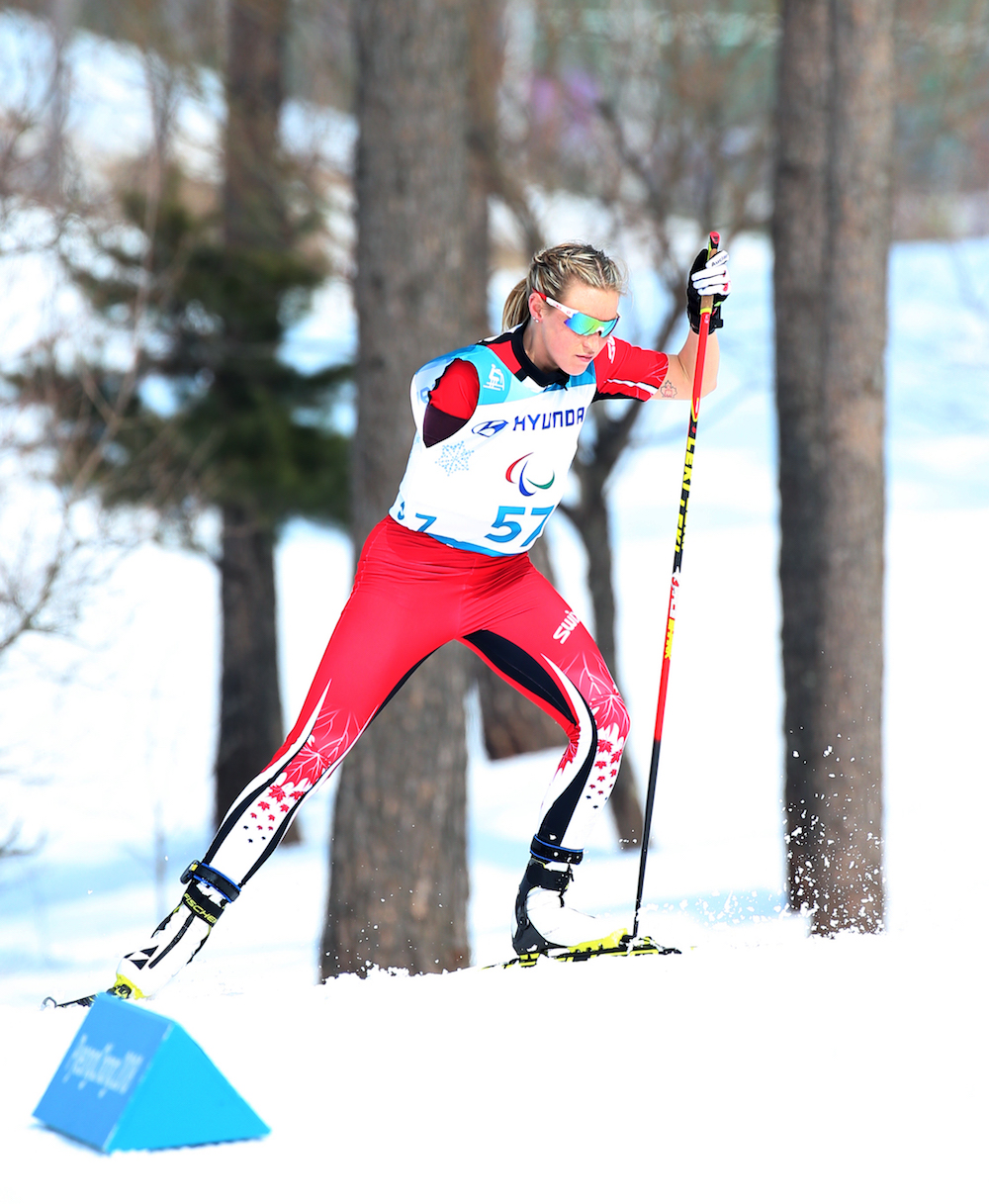
    Harvey’s fourth place now ranks as Canada’s best individual men’s cross-country performance at a Winter Games. The previous best individual result was Kershaw’s fifth in the Vancouver 50 k freestyle. On Saturday, Kershaw was the second Canadian across the line in 26th (+9:27.).

    As both close out their Olympic careers, they seem grounded. Not every Olympic dream has to end with medals. Rather, it’s about reaching the limits they push themselves to, once they are there. 

    “It’s a hard position to end up in,” Harvey said of his fourth place. “But it’s all I had today; there’s no regrets.”

    Patterson 11th for Best U.S. Men’s Result Since 1976

    Just as the U.S. women crushed a decades-old record earlier this week, American Scott Patterson raced to the best individual distance finish for a male U.S. cross-country skier since Bill Koch placed second and sixth at the 1976 Winter Olympics in Innsbruck, Austria. A first-time Olympian, Patterson placed 11th (+4:52.1), 15.2 seconds outside of the top 10 and 31 seconds back from Switzerland’s 15 k gold medalist Dario Cologna in ninth.

    “Early on, I was with that second chase pack just trying to ski relaxed, ski well,” the 26-year-old Patterson said.

    He had been skiing around 20th for the first 20 k, but moved up into 15th by the 23 k mark. In another 2 kilometers, Patterson was up to 13th. He pulled with Germany’s Andreas Katz and Russia’s Denis Spitsov — the 15 k freestyle bronze medalist — eventually dropping both.

    American Scott Patterson (29) racing to 11th in the men’s 50 k classic mass start at the 2018 PyeongChang Olympics in South Korea. In doing so, he tallied the best American men’s result in an individual Olympic cross-country race since Bill Koch placed second and sixth at the 1976 Olympics. (Photo: Flyingpointroad)

    Patterson worked his way past Norway’s Niklas Dyrhaug, Russia’s Alexey Chervotkin, and Poltoranin (who had been in contention for the bronze medal), before ultimately taking 11th.

    “It was exciting for the last 5 k when people were starting to dangle in front of me,” Patterson said. “Probably a couple of k out when I got Dyrhaug, and then coming by Poltoranin, too, who I think was skiing pretty far up there early on there in the race. I just wanted a few more k to get [Norway’s Emil] Iversen and get into the top 10, maybe Cologna, too.”

    The next American finisher on the day was Noah Hoffman in 33rd.

    “Every race has gotten better at these Olympics and I would have loved to have been top 30,” Hoffman, a two-time Olympian, said. “In Sochi I was looking for big results and here I haven’t been close to that and it’s disappointing, but I’ve processed all of that. It’s been four years since I’ve really skied the way that I’ve wanted to and I’m pretty just excited to be here. I’m living up these Games trying to take it all in.”

    American Noah Hoffman during the men’s 50 k classic mass start at the 2018 PyeongChang Olympics in South Korea (Photo: Flyingpointroad)

    Three more North Americans competed in Saturday’s race, with Canada’s Graeme Killick finishing 27th (+10:06.7), American Tyler Kornfield placing 48th (+16:14.4)  and Canada’s Russell Kennedy 49th (+16:54.5).

    Despite getting sick Friday, Killick entered the race and finished with his best performance of the Games.

    “My energy felt pretty decent and I’m really happy with that race,” Killick said. “I had to fight really hard for the last lap, because I had a group coming back on me and I was kind of in no man’s land. I’m really happy I was able to hold them off.”

    The 50 k start was Kornfied’s second race of his first Olympics. Just last month, the 26 year old made his World Cup debut. Reflecting on his recent experiences, Kornfield was perceptive of the idea that racing takes time.

    Canada’s Graeme Killick (48) leading his teammates Russell Kennedy (49) and Devon Kershaw in the men’s 50 k classic at the 2018 Olympics in PyeongChang, South Korea. They went on to place 27th, 49th and 26th, respectively. (Photo: FlyingPointRoad)

    “I didn’t get the opportunity to race the World Cup until this year and a lot of times that got me down, frustrated me and felt like I wasn’t progressing with a lot of the other athletes in the nation and internationally as well,” Kornfield said. “I just had to be patient and know that eventually it’s going to click.

    “It’s been a breakthrough season, but it hasn’t been above and beyond what I’ve done in the past,” he added. “So it’s just being patient and waiting your turn and knowing that it’s going to come, you just need to put your best race you can each day.”

    Kennedy will head to a training camp in Japan, before returning to PyeongChang for the 2018 Winter Paralympics March 9-18 as one of Brian McKeever’s guides for the visually impaired races.

    “I was feeling really good, I just didn’t have it in the end, the last two laps. I blew up pretty hard,” said Kennedy, a 26-year-old first-time Olympian. “It was still fun, and I, you always learn something from a 50 about what your body can do and where the limit is.”

    The final cross-country 2018 Olympic event, the women’s 30 k classic mass start, takes place Sunday.

    Results

  • Niskanen is a Closer, Wins 50 k Classic Mass Start in PyeongChang

    Finland’s Iivo Niskanen after winning the men’s 50 k classic mass start at the 2018 Winter Olympics in PyeongChang, South Korea. (Photo: FlyingPointRoad)

    FasterSkier would like to thank Fischer Sport USA, Madshus USA, Concept2, Boulder Nordic Sport, and Swix Sport US for their generous support, which made this coverage possible.

    PYEONGCHANG, South Korea — Sun, clouds, fog, and snow. At the Alpensia Cross-Country Skiing Center on Saturday, the men’s 50-kilometer classic mass start transpired like a 50 k should. There was the break-the-pack pace from the start. There was the hard-man up front trying for a solo break. Of course there were chasers: one of whom blew up and faded and another that latched on for a silver-medal ride. And eventually there was a group of four that closed in on a single medal that eventually left three athletes unsatisfied. This was solid Olympic 50 k racing.

    For Finland’s 26-year-old Iivo Niskanen, the plan worked. Burning through the 68 other starters began right away. As the 2 p.m. unfettered sun warmed the tracks, the kilometers ticked off with the favorites coalescing in the front. They included Martin Johnsrud Sundby of Norway, Kazakhstan’s Alexey Poltoranin, Alex Harvey of Canada, and the Olympic Athletes from Russia’s (we’ll just call them Russians) Alexander Bolshunov — a 21-year-old star of the Games, if you’re a medal counter (with two silvers and a bronze before Saturday’s race).

    This is the 50 k classic, a race usually suited for the well-established and the well-conditioned. This was Niskanen’s day.

    The switch flipped at 17.5 k when the Finn was set to fly. Sundby skied 1.4 seconds back, Poltoranin +2.3, Russia’s Alexey Chervotkin +3.4, Bolshunov +4.3, Russia’s Andrey Larkov +5.4, Norway’s Hans Christer Holund +5.7, and Harvey +6.0. These were the names that topped the course’s time checks.

    Bold. Daring. Tempting fate. All these words could describe the noticeable uptick in effort from Niskanen at 22.36 k that cracked the field. Unike the tale of the frog in boiling water unaware of it’s slow demise — Niskanen’s pacing shakedown was abrupt. Although not exactly a punch of effort, there was no subtlety to it.

    Passing through 27.2 k, Bolshunov trailed the Niskanen-Poltoranin duo by 20.9 seconds. Niskanen soldiered as the consummate soloist except Poltoranin was velcroed on. A look to the side here, another look to the side there from Niskanen could not convince Poltoranin to take a pull up front.

    Norway’s Niklas Dyrhaug leads a mass of skiers during the men’s 50 k classic mass start on Saturday at the 2018 Olympics in PyeongChang, Sourth Korea. (Photo: FlyingPointRoad)

    A second and third plot line developed behind. Bolshunov surged. Sundby, Holund and Harvey solidified into a core that would slowly bleed time to the leaders. In their own eventual fight for bronze, Harvey’s group fended off every racer except for Russians Larkov and Chervotkin.  

    Up ahead, Bolshunov flaunted his 21-year-old verve. There was no stage fright. He caught, passed, and gapped Poltoranin. At 33.32 k, only Bolshunov could muster the fight and locked in on Niskanen. As much as Bolshunov was the 50 k’s yin at this point, Poltoranin was its yang. His valiant chase of Niskanen early on smudged out by his crash and burn. Poltoranin was eventually caught by the Harvey group and finished 15th (+5:15.0).

    Late in the race, the temps had cooled below freezing and flurries fell. The sun-to-cloud swap also came with a fog bank reminiscent of March in Holmenkollen. Through the stadium at 37.5 k, neither Niskanen nor Bolshunov exchanged skis. Again, like with Poltoranin, Niskanen pulled up slightly. Bolshunov wouldn’t take the invite. He continued drafting the Finn.

    Finland’s Iivo Niskanen leads Alexander Bolshunov of the Olympic Athletes from Russia during the men’s 50 k classic mass start at the 2018 Olympics in PyeongChang, South Korea. (Photo: FlyingPointRoad)

    That dynamic changed as Bolshunov led down the sweeping turn into the stadium area around 40 k. With the Russian 0.6 seconds ahead, Niskanen changed into his third pair of skis for the day, taking advantage of his ability to swap skis twice during the race. (This is important and we’ll come back to this point: Bolshunov exchanged skis only once.)

    With Niskanen’s gear swap and Bolshinov’s power-double-pole, the Russian led out of the stadium.

    “I saw the gap appear,” Niskanen said in the post-race press conference. “There’s is no penalty loop like in a normal exchange area — often there is an extra meters when you are going to change skis. So of course, it’s a guess about the dirty snow, and here the snow is so dirty that it’s a big difference between fresh and old skis.”

    Niskanen gambled. So, too, did Bolshunov. Eleven seconds opened as they both rolled the dice. This was not, as it first appeared, a gold-medal move for Bolshunov. Less than two kilometers later, Niskanen was there to taunt Bolshunov with noticeably faster skis.  

    “I could catch him quite easily,” Niskanen recalled. “Then the only tactical plan was to wait and wait and use better skis when it is possible and the best place to use them.”

    The best place was the final headwall. The body worked. The skis flew. Niskanen won the 50 k in 2:08:22.1 as he pulled away from Bolshunov in the race’s closing moments. A dejected Bolshunov earned his fourth medal of the 2018 Games (after silver in the relay and team sprint, and bronze in the individual classic sprint) placing second, 18.7 seconds back.

    A medal still hung out there for Larkov, Harvey, Sundby, and Holund. Like Niskanen on the final climb, Larkov stung the group first while Harvey and Sundby punched too late. Larkov took bronze, 2:37.5 minutes behind Niskanen. Harvey shut down Sundby on the final stretch to secure fourth (+2:43.6). and Sundby placed fifth (+2:43.7).

    The Russians were first to the press conference. Through an interpreter, Bolshunov hinted at his frustration at being so close to gold.

    “Obviously I am a little bit disappointed because I could have won this race,” Bolshunov said. “There was a small problem that affected my result.”

    Norway’s Martin Johnsrud Sundby leads Finland’s Iivo Niskanen (8), Kazakhstan’s Alexey Poltoranin (behind Niskanen), and Canada’s Alex Harvey (2) early in the men’s 50 k classic mass start at the 2018 Olympics in PyeongChang, South Korea. (Photo: FlyingPointRoad)

    That small problem, Bolshunov clarified, were his skis. “Basically the small problem was with the fact that it got much colder and the skis were not as slippery as they should have been. So my result was affected,” he said.

    Larkov, too, said his skis were off. “Basically just like my teammate I am also a little bit disappointed,” Larkov, 28, said. “I had some problems with my skis because the weather got colder as we were racing and I had to change my skis. After I changed skis I thought I basically I had no chance but I managed to get to third place.”

    Bolshunov and Larkov were the only two skiers in the top 31 to swap skis once. Every other racer took the two allowed ski exchanges. (Four other skiers total among the finishers changed skis a single time.)

    Bolshunov entered the optional ski exchange area slightly ahead of Niskanen when the Finn swapped at 40 k. Asked by FasterSkier why he chose to ski on, Bolshunov claimed he wasn’t in position.

    “Basically I was on the right and I was not in the right position to change the skis,” Bolshunov said. “I would have changed them but I could not do it in time, so I had to go on like that.”

    During the press conference, neither Niskanen nor the Russians acknowledged each other. After learning that the Russians blamed skis as their demise and Niskanen’s gift, the gold-medal winner tried to set the record straight as he and Bolshunov share the same ski sponsor.

    “Skis were really really good,” Niskanen said of his own planks. “Maybe you can see the reason here in the result list. The Russian guys have changed skis only once, but that has been their tactic. Also my tactic was to use third and second best pair at the beginning of the race and leave the best pair at the end. It’s the same series skis for me and one of them. We have brother pairs.”

    Niskanen’s win was the first gold for Finland (across all sports) in PyeongChang. As the reigning 15 k classic world champion, Niskanen said that he has embraced a selective peaking strategy. For the last two years he has focused on two championship classic races: the 15 k in Lahti, and Saturday’s 50 k.  

    “Two years after Sochi, I trained so hard and tried to do too many things and have too much races and I got easily sick,” Niskanen said. “And then last two years I want to be the best shape at the right time. Maybe someday my main goal in the season is to win the World Cup overall, but last two years, the only goal has been one race because at the moment, I am so much better in classic. Everything, like the skiathlon [here], they have been preparation races for me to improve the shape.”

    If the skiathlon was a training run for Niskanen, as he claimed, it worked. Yet his fortunes were much better Saturday. During the skiathlon, Niskanen strung out the field during the classic leg. He faded to finish in 19th. His hot start in the 50 k, Niskanen acknowledged, made for an anxious Finnish coach.

    “Maybe my coach was a bit nervous to watch the race because I often start too hard too early,” Niskanen said. “This time I suffered well, but you just need to live the moment and play the game. If you don’t try you cannot win. This time I was the strongest man.”

    The men’s Olympic 50 k classic podium in PyeongChang, South Korea, with (from left to right) Alexander Bolshunov (l) of the Olympic Athletes from Russia (OAR) in second, Finland’s Iivo Niskanen (c) in first, and Andrey Larkov (OAR) in third. (Photo: FlyingPointRoad)

    The strongest man on Saturday was undeniably the strongest man. For the second consecutive Olympics, Russia has stepped onto the 50 k podium. With that comes the spectre of doping. Russia went 1-2-3 in the 50 k in Sochi amidst evidence later uncovered about state-sponsored doping. In PyeongChang the Olympic Athletes from Russia (OAR) went 2-3. With that, of course, comes questions. At the 2018 Winter Olympics, even with the increased scrutiny since Sochi, two Russian athletes have been flagged for doping: a curler and bobsledder.

    “I don’t know if I can answer this question because I’m only starting to compete on this level,” Bolshunov, who was invited to these Olympics as an OAR athlete because he was not associated with the Sochi debacle, said when asked if he and his 2018 Olympic teammates have any affiliation with Sochi’s taint. “I cannot really compare what happened four years ago with the athletes that are here. I am my own man and they were their own team. So we just do the best we can and we move ahead.”

    Click here for a separate report on Harvey and the rest of the North American men.

    Results

  • Saturday Olympic Rundown: Niskanen Takes 50 k in Gutsy Solo Effort, Harvey 4th, Patterson 11th

    Saturday Olympic Rundown: Niskanen Takes 50 k in Gutsy Solo Effort, Harvey 4th, Patterson 11th

    A very exhausted Iivo Niskanen celebrates his 50 k gold medal crossing the finish line at the 2018 Olympics. (Eurosport screencap)
    A very exhausted Iivo Niskanen of Finland celebrates his 50 k gold medal crossing the finish line at the 2018 Olympics. (Eurosport screencap)

    FasterSkier would like to thank Fischer Sport USA, Madshus USA, Concept2, Boulder Nordic Sport, and Swix Sport US for their generous support, which made this coverage possible.

    ***

    2018 Olympics (PyeongChang, South Korea): Men’s 50 kilometer mass start classic

    International report

    North American report

    Iivo Niskanen earned his gold medal.

    The 26-year-old Finn, skiing in his second Olympics, broke away from a well-credentialed chase pack at the 17-kilometer mark of Saturday’s Olympic 50-kilometer mass start classic race, then skied a courageous race from there to take the gold nearly 90 minutes of racing later.

    He had some company, as Olympic Athlete from Russia Alexander Bolshunov made an equally gutsy move to bridge the gap up to Niskanen by 36 k. But Niskanen used a well-timed surge on the final uphill to come round Bolshunov with 1.1 k to go, and take the convincing win by the finish. Behind him, Olympic Athlete from Russia Andrey Larkov made a similar move on the final hill 2 ½ minutes later to come clear of a chase group and take the bronze.

    But let’s back up. A field of 69 racers began the 50 k classic at 2 p.m. local time under cloudy skies, which ultimately gave way to heavy mist and light snow as the floodlights came on around 3:30 in the afternoon. It was the 23rd running of a race first held at the 1924 Olympics in Chamonix. Boldface names such as Bjørn Dæhlie, Gunde Svan, and Thomas Wassberg are among its historical champions. A Finn had not won this race since Kalevi Hämäläinen in 1960.

    Norwegian Martin Sundby led a 23-racer pack through the end of the second lap, roughly 17 k and 42 minutes into the race. Niskanen was in seventh at this point, 2.5 seconds off the lead.

    Less than a kilometer later, with nearly two-thirds of the race still ahead of him, Niskanen headed to the front. Moving quickly, he soon opened up a small gap over much of the rest of the field. Roughly five minutes later, around the 19-k mark, he began pushing the pace in earnest.

    The field began to spread out almost immediately. Niskanen was closely followed by Alexey Poltoranin of Kazakhstan.

    Niskanen and Poltoranin skied together throughout lap 3, their advantage soon growing to 20 seconds over the chase group. By 26 k, they had a gap of 25 seconds to Bolshunov in third.

    At 27 k, Bolshunov set off on a courageous solo effort to reel in the two athletes in front of him, leaving Sundby to lead the chase group. Seven minutes later, Bolshunov had made up 25 seconds over less than three kilometers; he moved around Poltoranin, and set out to track down Niskanen.

    Finally, at the 36 k mark, after roughly 10 k of solo work, Bolshunov had caught up to Niskanen. The two men skied together throughout the fifth and penultimate lap, Niskanen still in the lead until he finally moved aside, all but forcing Bolshunov to come round him and take the lead.

    Bolshunov led through the second half of lap five, and appeared to be pulling away while Niskanen seemed to be tiring from the solo effort as well as fighting slick skis. As the two came through the stadium for a final time, 42 k into the race, they were over a minute clear of a fading Poltoranin, and more than two minutes up on the Sundby/Alex Harvey/et al. chase group. The final order of the medals was still up in the air, but gold and silver, in some order, seemed very likely to go to the two men in the breakaway.

    Bolshunov led through the stadium the final time, where he did not avail himself of a final ski exchange. Behind him, Niskanen pulled over for new skis. Bolshunov, sensing the Finn’s absence, immediately put in a surge, and gapped Niskanen by roughly 11 seconds early in the final lap. But 8.3 k per lap is a long way, and Niskanen steadily worked to close the gap without panicking. By the 44 k mark, 2.3 k into the final lap and with a full 6 k yet to go, Niskanen had pulled back even with the Olympic Athlete from Russia.

    The two men skied together for the next 4+ kilometers. Bolshunov appeared stronger, and is the better sprinter of the two, but Niskanen had experience. And fresh skis.

    Suddenly, Niskanen went. With 1.1 k to go, going up the final hill for the final time, he surged hard, and immediately opened up a gap of several meters over his rival. Behind him, Bolshunov stood up as he crested the hill, nearly coming to a stop.

    An exultant Niskanen skied in unchallenged, crossing the finish line in a final time of 2:08:22.1. A deflated Bolshunov followed 18.7 seconds later for silver, slamming his pole to the ground as he crossed the finish line.

    Behind them, Poltoranin had been caught midway through the final lap, ultimately fading to finish 15th. Coming into the final uphill it was Sundby, fellow Norwegian Hans Christer Holund, Harvey, and Larkov, four men fighting for one final spot on the podium. Much as Niskanen had done 2 1/2 minutes earlier, Larkov pushed ahead on this hill, opening up a gap that he held all the way to the finish. He took third, 2:37.5 behind Niskanen.

    On the CBC broadcast, former Canadian coach Justin Wadsworth, who had publicly questioned the validity of the Russians’ performance in Sochi soon after the 50 k skate concluded, exclaimed of Larkov, “I’m not sure where he got the power to run up that hill like that.”

    A few seconds later, Harvey outlunged Sundby for fourth, +2:43.6 to +2:43.7. Holund was sixth (+2:50.1), Daniel Rickardsson of Sweden another minute back in seventh (+3:50.4), Czech Martin Jaks eighth (+4:10.5), Switzerland’s Dario Cologna ninth (+4:21.1), and Norwegian Emil Iversen tenth (+4:36.9).

    One spot later, Scott Patterson led the way for the Americans in eleventh (+4:52.1), after consistently skiing in the teens throughout much of the race. It is the best men’s Olympic distance result in generations.

    For the Americans, Noah Hoffman followed in 33rd (+10:42), and Tyler Kornfield was 48th (+16:14.4).

    Harvey’s fourth led the way for Canada. He was followed by Devon Kershaw in 26th (+9:27.3), Graeme Killick one spot back in 27th (+10:06.7), and Russell Kennedy in 49th (+16:54.5).

    The final race at this year’s Winter Olympics is the women’s 30 k classic mass start, tomorrow afternoon local time.

    Results

  • Swedish Biathlon Caps Best Olympics with Relay Gold; U.S. Men 6th to Tie 1972 Mark

    Fredrik Lindström crosses the line first to secure a gold medal for his Swedish teammates in the men’s 4 x 7.5 k relay on Friday to close out biathlon competitions at the 2018 Olympics in PyeongChang, South Korea. (Photo: FlyingPointRoad)

    FasterSkier would like to thank Fischer Sport USA, Madshus USA, Concept2, Boulder Nordic Sport, and Swix Sport US for their generous support, which made this coverage possible.

    Remember when it was a big deal when Sweden won a Biathlon World Cup? The team in bright yellow has made it a habit at the 2018 Winter Olympics, winning their first Olympic relay gold and fourth medal over the last two weeks on Friday — the last biathlon race of the PyeongChang Games.

    “It’s dreams coming true at that moment,” Fredrick Lindström, the Swedish men’s 4 x 7.5-kilometer relay anchor said in a post-race press conference on Friday. “It’s my third Olympics and to be on top with these guys feels great. I don’t know what to say.”

    Lindström had taken gold in perhaps the most ideal way for an athlete in his position, by heading out on the last 2.5 k loop in first place, almost 41 seconds ahead of anyone else. While he had missed his first shot in the final standing stage of the race, Lindström cleared it with the use of one spare bullet. Meanwhile, his closest challenger for the win — Norway’s Emil Hegle Svendsen, who had followed him into the range and lined up alongside him to shoot — missed his first two targets and went on to miss more, ending up with a penalty lap after using all three spares.

    That was the end of gold for Norway and for Svendsen, who was all too familiar with the penalty lane in the closing moments of an Olympic relay. Four years ago in the men’s relay in Sochi, Russia, Svendsen as Norway’s anchor had been in the medal hunt until the final shooting. There, he used all of his spares and still left a target standing, which sent him to the penalty lap. After leading by as much as 20 seconds in the middle of that race, Norway finished fourth.

    But as they say, that’s biathlon. And on Friday, it was Sweden’s day and Lindström skiing on his own for a 2.5 k victory loop around the course. But he didn’t slow down. As the 28 year old skated up the final climb, he was greeted by several members of his team bowing up and down in a unison to celebrate the history that was about to be made. Lindström descended down into the stadium, not looking back and still pushing toward the line, before skiing to the sidelines a few meters before the finish to grab a small Swedish flag.

    Fredrik Lindström crosses the line first to secure a gold medal for his Swedish teammates in the men’s 4 x 7.5 k relay on Friday to close out biathlon competitions at the 2018 Olympics in PyeongChang, South Korea. (Photo: FlyingPointRoad)

    It wasn’t like the oversized French flag Martin Fourcade had been seen waving earlier in the Games, in the pursuit and again in the mixed relay. It was understated, like Sweden’s biathlon team before these Olympics, but he waved it proudly as he crossed the line to a sea of swarming teammates.

    Sweden (with Peppe Femling, Jesper Nelin, Sebastian Samuelsson, and Lindström) finished first with a cumulative time of 1:15.16.5 hours and a total of seven spares and zero penalties. Skiing alone and finishing 55.5 seconds behind them,  Svendsen crossed the line in second for Norway (with teammates Lars Helge Birkeland, Tarjei Bø, and Johannes Thingnes Bø), after tallying 12 spares and one penalty.

    In stark contrast to Lindström’s wide-eyed smile as he finished, Svendsen, 32, who had previously earned bronze in the mass start and silver with Norway’s mixed relay in PyeongChang, hung his head. His teammates met him at the finish and tried to improve his mood, but he was down.

    “It was a good battle. We wished each other luck before the start and it was a good fight,” Lindström said of contending with Svendsen for two out of three loops.

    Norway’s third-leg skier Johannes Thingnes Bø (1) racing his team into fourth to first in the men’s 4 x 10 k relay at the 2018 Olympics in PyeongChang, South Korea. (Photo: FlyingPointRoad)

    Johannes Bø had tagged Svendsen in first at the last exchange, 0.4 seconds ahead of Sweden, with Samuelsson handing off to Lindström. In the prone stage that followed, both Lindström and Svendsen cleaned without a miss. They left the range together, more than a minute clear of Germany’s Simon Schempp in third (who had missed three but avoided a penalty three spares). Germany had been 13.7 seconds back at the last exchange.

    “Emil had to go first the first loop, I went first the second loop, and on the shooting we were equal until that standing,” Lindström reflected. “I don’t know, I was the lucky man today. I feel proud that I managed that situation and to bring the gold to Sweden.”

    Even without gold, Svendsen is the third-most medaled biathlete in Olympic history, according to the International Biathlon Union (IBU). A four-time Olympian, he has eight medals, four of which are gold.

    “I think that’s awesome,” Svendsen said when asked about his medal tally at the press conference. “It feels very good and yeah, what can I say? Thank you.”

    Finishing more than a minute after Norway and exactly 2:07.1 minutes behind Sweden, Germany (with Erik Lesser, Benedikt Doll, Arnd Peiffer, and Schempp) placed third after Schempp incurred a penalty in the final standing stage. While he was still far enough ahead of Austria’s Dominik Landertinger to hang onto bronze, that penalty put Schempp nearly a minute behind Svendsen at the start of his last loop.

    While he waved to the crowd as he finished, Schempp later said he wasn’t happy with his performance. The German team accrued 10 spares and three penalties (two of which came in Doll’s second leg).

    “I just was disappointed in my race,” Schempp told German broadcaster ARD of his finish-line body language, according to a translation. “But at the end of the day we won the medal. That is the most important thing, that’s what matters, but of course, I can’t be satisfied with my shooting bouts. It was so incredibly gusty … I waited crazily long with my spare shots today because I thought the gusts would be over soon and then I could shoot. But unfortunately that was not the case, so I was on the range forever, losing a lot of time and then still didn’t hit every target. It was like a vicious cycle.”

    Lesser and Canada’s Christian Gow Up Front 

    Sweden had positioned itself for a medal from the gun, with first-leg skier Femling tagging Nelin in fifth, 27.3 seconds back, at the first exchange. Germany’s Lesser had put his team in first on that leg with near-perfect shooting — cleaning prone and using one spare in standing (0+0, 0+1). Lesser tagged Doll 18 seconds ahead of Slovakia in second, which had put itself in contention with a flawless first leg from Matej Kazár. (Slovakia dropped to 15th on the second leg and was lapped on the third leg.)

    Canada’s first-leg skier Christian Gow (12) leading the field, including France’s Simon Desthieux and Germany’s Erik Lesser (far l), to the top of a climb in the men’s 4 x 7.5 k relay at the 2018 Olympics in PyeongChang, South Korea. (Photo: FlyingPointRoad)

    Canada attracted some serious TV time when Christian Gow took the lead on the first climb out of the stadium. He went on to hit five targets in a row in prone and left the range in second, 1.2 seconds behind Lesser in first. One loop later, Gow had slipped to eighth and about 20 seconds back when he needed three spares to clean. He ended up tagging his brother and teammate Scott Gow in ninth, about 48 seconds out of first.

    “It wasn’t planned, for sure,” Gow, 24, told FasterSkier after about his decision to lead on the first loop. “Right at the top of the first climb, everyone was kind of moving over to the right, staying in kind of two lines, and there’s quite a bit of space there, so I took the opportunity to move up just because I’ve done so many relays where you’re stuck in the middle of the pack. …  I saw an opportunity to get to the front — I didn’t think it would be the front — but that’s what ended up happening, and I just did my pace and no one wanted to pass me.

    “I’m really happy to have cleaned the prone for sure because it’s great if you can lead it, but if you can’t knock down the targets it doesn’t mean too much,” he continued. “In the standing I’m trying to be a bit easier on myself, just because it’s a new situation to be way up in the front like that and having a great day. I wish I would have held it together a bit better than I did. I think I let the nerves get to me a little bit more than I should of, but a lesson learned and I’m happy with the first two-thirds [of my race].”

    Sweden’s Steady Rise

    Nelin raced Sweden into second place, 16 seconds behind the Czech Republic in first by the second exchange. He cleaned prone with one spare and avoided a penalty with three spares in standing while Germany’s Doll, who had been skiing alone in first before the standing shooting, dropped to fifth and almost 38 seconds back with two costly penalties.

    The Czech Republic’s Michal Šlesingr cleaned standing without a miss to take the lead with one loop to go in the second leg, 6.8 seconds ahead of Austria’s Simon Eder in second. Nelin followed another 8 seconds back in third, and tagged just 0.2 seconds ahead of Austria in the exchange.

    The third leg saw Johannes Bø, who had been tagged 31 seconds back in fourth, put Norway in first with a clean prone and a single spare in standing. Samuelsson, who had previously taken silver in the 12.5 k pursuit and placed fourth in the 20 k individual race at these Olympics, put Sweden in a position to win gold, using just one spare to clean prone and shooting without a miss in standing. He latched onto Bø, leading the Norwegian on their final loop and handing off to Lindström just 0.4 seconds behind Norway.

    The Swedish men’s gold-medal relay team, with Peppe Femling, Jesper Nelin, Sebastian Samuelsson, and Fredrik Lindström, after winning the last biathlon race of the 2018 Olympics in PyeongChang, South Korea. (Photo: FlyingPointRoad)

    Earlier this season, Sweden won the men’s relay at the IBU World Cup in Oberhof, Germany. The order was the same, except Martin Ponsiluoma skied the first leg, rather than Femling. While the win was a big deal for Sweden, it was against a slightly watered-down field, with some of the top biathletes opting to skip the Oberhof World Cup at the start of the new year.

    Friday’s victory marked Sweden’s first Olympic relay gold in biathlon after it earned bronze in 1976 in Innsbruck, Austria, and again in 1992 in Albertville, France.

    “It means a lot. It’s the first medal for men’s relay team in biathlon for Swede,” Samuelsson said. “Of course we are really satisfied. We did four good races everyone today and we’re super happy.”

    U.S. Ties Olympic-Best 6th

    While Austria finished Friday’s relay in fourth (+2:52.5), and France placed fifth (+3:26.6), the U.S. men tied its country’s best Olympic relay result in sixth (+3:50.2) with Lowell Bailey, Sean Doherty, Tim Burke, and Leif Nordgren. They had been 10th after Bailey’s first leg, in which he used two spares in each stage, and improved to sixth, then fifth on Doherty’s and Burke’s legs.

    Doherty used just one spare in prone and cleaned standing without a miss, leaving the range in sixth and 42 seconds back with one loop to go. He then tagged Burke in sixth, about 54 seconds out of first, and Burke held that position with a flawless prone stage followed by three spares in standing. He picked off one place on his last loop to tag Nordgren in fifth, 1:38.8 minutes back.

    The second-leg skier in the U.S. men’s relay, Sean Doherty racing his team into sixth on Friday at the 2018 Olympics in PyeongChang, South Korea. They went on to finish sixth to tie the best U.S. Olympic relay result. (Photo: FlyingPointRoad)

    “I’m real happy about that,” Doherty, 22 and in his second Olympics, said of his shooting. “I feel like I struggled with the prone earlier on [at these Olympics] and I got that kind of dialed in today, which was nice. Standing was good. I had a little break in the wind and I took full advantage. I shot pretty fast, pretty aggressive, but I hit all five from the clip and that’s what really moved things up.

    “We had a few days after the individual [race] to go back to the drawing board, come back to some of the fundamentals of shooting,” Doherty explained. “It’s nice to kind of reinforce that I’m capable of hitting targets and fixing things. When you’re not shooting well, you don’t have to keep not shooting well, if that makes sense.”

    Nordgren incurred the team’s only two penalties on his prone stage, but because of the strung-out field, he hung onto sixth, losing time to those ahead of him. He used three more spares in standing but stayed out of the penalty lap, finishing about about 24 seconds behind France in fifth.

    “Honestly it is a little disappointing,” Nordgren said after. “I know we were gunning a lot more as a team. I had some mistakes there in prone, too. That hurt a lot since we were right there in contention with some top teams in the world…

    “I will say we had amazing skis today so I pushed really hard on the first loop and I think I got a couple seconds on [Austria’s] Landertinger,” Nordgren added. “And then just in prone … I was just getting thrown around by the wind. It is has given me trouble the whole couple weeks here I obviously never quite figured it out.”

    In addition to tying the best U.S. relay result at an Olympics (of sixth place in the men’s relay at the 1972 Olympics in Sapporo, Japan), sixth was a big improvement for this team, which placed 16th at the 2014 Sochi Olympics. It was also the best Olympic relay result for Bailey and Burke, after they placed eighth in the 2014 mixed relay and ninth in the 2006 Olympic men’s relay.

    Tim Burke (l) on the range during a difficult standing shooting with France’s Martin Fourcade. While Burke cleaned with three spares, Fourcade had to ski a penalty lap in the men’s 4 x 7.5 k relay at the 2018 Olympics in PyeongChang, South Korea. (Photo: FlyingPointRoad)

    Asked whether this was his last Olympic race, Burke said it was.

    “Today was a good for me so yeah, I would say yes,” the 36-year-old four-time Olympian said. “Biathlon is a crazy sport; it is so up and down from one race to the next. The emotional rollercoaster is amazing. I am done though.

    “It has been my life for so long. It is what I know. It is what I love,” he added. “But it is time for the young guns to step up and take my place.”

    Bailey told reporters while the race was still going on that he was glad to finish his Olympic career with a race that didn’t include any penalty laps.

    “On a day like today, you saw that France was in the loop, now Germany, so the top nations are in there,” he said. “I cannot tell you how challenging this range is. It is so much different than most of the other ranges we shoot on.

    “Every Olympics has been different,” Bailey, also 36 and a four-time Olympian as well as 2017 world champion, reflected of his career. “In Sochi I had my career best with eighth place in the individual, and I will always have that. I will always know what I am capable of. That said, I know what I am capable of and I didn’t reach the bar that I set for myself. But all four Olympics have been honestly an incredible honor to put on Team USA uniform and go out there and compete for my country.

    “I know that it’s time to make the next step, to make the next transition,” he continued. “I’m really excited for our future, my family’s future. And I’m really excited for the future of US Biathlon.”

    Canada 11th

    Canada’s Scott Gow leading American Sean Doherty on the second leg of the men’s 4 x 7.5 k relay at the 2018 Olympics in PyeongChang, South Korea. (Photo: FlyingPointRoad)

    Canada finished the race in 11th (+5:40.3). Scott Gow had brought them up to seventh with perfect shooting on both his stages (0+0, 0+0) and tagged Macx Davies about a minute out of first.

    “My race pan today was to really emphasize the wind flags, and if it changes direction don’t be afraid to correct for it,” Scott Gow said. “In standing when I came in, it was quite windy, so I just waited a extra couple of seconds and then started to shoot when I felt like it was calm. It is hard to remember that sometimes because you are in the race mode and you just want to get it over with so you can try and just get back on course, so I was happy with that execution.”

    Davies, in his first Olympic race, needed three spares to clean prone and slipped to 10th, then had a penalty in standing to leave the range in 12th with one loop to go. He tagged Canada’s anchor Brendan Green in 13th, 4:29 behind. Green went on to use one spare in each of his shooting stages (0+1, 0+1) to bring the team up to 11th at the finish.

    Macx Davies skiing the third leg for Canada’s 4 x 7.5 k men’s relay at the 2018 Olympics in PyeongChang, South Korea. (Photo: FlyingPointRoad)

    “It wasn’t a great race for me, but I fought through it and pushed myself so that’s all I can ever really do,” the 25-year-old Davies said. “Coming into this race I was kind of just excited to get an Olympic start. We didn’t know if I was in or not until yesterday morning. Then kind of sitting around today, slowing realizing that it was happening tonight and getting a little bit more nervous and a little bit more excited as it went on. That was exciting.

    “Being part of the team, being part of Team Canada, it’s such a great feeling, great atmosphere,” Davies added. “Everyday you see someone do something amazing and that just inspires you to keep pushing yourself and do everything in your power to succeed.”

    As for Green, he said it’s safe to say these were his last Olympics.

    “I’ve been to three Games now and they’ve all been very unique and special in their own way,” the 31-year-old Green said. “I think Korea did a great job hosting. Volunteers are spectacular and so friendly. It’s too bad the weather didn’t cooperate a little bit more, but we did our best We all fought hard and I think we’ll be going away motivated and looking forward to more.”

    What’s Next?

    While the IBU World Cup season resumes March 8-11 in Kontiolahti, Finland, then makes its next stop in Oslo, Norway, March 15-18, both the Canadian and U.S. teams have stated they will boycott the season-ending World Cup in Tyumen, Russia, March 22-25.

    “The latest decision by the IBU was to send the World Cup tour to Tyumen, Russia for our World Cup final,” Bailey said on Friday. “Team USA is boycotting. The Czech team is boycotting. Canada is boycotting. We are trying to rally more support. I know that as an [IBU] athletes’ rep, we had almost every country had athletes that wrote letters to the IBU saying that we do not want to go to Tyumen. We don’t think it’s the right thing for clean sport, and still, the executive board with Anders Besseberg at the helm decided that it was in their best interest to go to Tyumen. So it’s time for a change. IBU leadership needs to change. Besseberg needs to step down. He’s lost the trust of the athletes.”

    “We won’t go to Russia,” Green said. “Instead we’ll go back to Canada for nationals. … I think until Russia is compliant we’ll probably continue to take a hard stance until things change.”

    Results

  • Friday Olympic Rundown: Sweden Bests Norway in Men’s Biathlon Relay, U.S. Record-Setting 6th

    Fredrik Lindström of Sweden crosses the line after securing a gold medal for his Swedish teammates in the men’s relay to close out biathlon competitions at the 2018 Olympics in PyeongChang, South Korea. (Photo: FlyingPointRoad)

    FasterSkier would like to thank Fischer Sport USA, Madshus USA, Concept2, Boulder Nordic Sport, and Swix Sport US for their generous support, which made this coverage possible.

    ***

    2018 Olympics (PyeongChang, South Korea): Biathlon Men’s 4 x 7.5 k relay

    Full report

    Germany were the favorites coming into this men’s relay and Erik Lesser started them off with a near-perfect relay leg to sit in first place, but shooting collapses by Benedikt Doll and Simon Schempp left the team with bronze medals at the finish.

    On a windy, gusty day, the relay instead came down to a race between Norway and Sweden. Coming into the last shooting stage Fredrik Lindström of Sweden and Emil Hegle Svendsen of Norway were stride for stride. Each missed their first shot in standing, but Lindström pulled himself together and hit the next four shots, then hit the final target using a spare round. Svendsen, on the other hand, kept missing and ended up skiing a penalty loop – just as he had when anchoring the Norwegian team in the Olympics in Sochi four years ago.

    A strong leg from Tim Burke, who cleaned prone and then survived on spare rounds while chaser Martin Fourcade of France headed to the penalty loop, helped the U.S. secure a best-ever sixth-place finish in the Olympic men’s relay. (Photo: FlyingPointRoad)

    Then, that left Norway off the podium. This time, Norway still earned silver, as behind him Schempp had his own shooting woes.

    An exciting relay with multiple lead changes in the end turned into something of a blowout, with Lindström able to celebrate on his final loop before joining overjoyed teammates Peppe Femling, Jesper Nelin, and Sebastian Samuelsson at the finish. It was the first Olympic relay gold medal in the history of Swedish biathlon, and the team did it with phenomenal shooting – just seven spare rounds despite difficult conditions. They were the only team to avoid the penalty loop, which most teams visited more than once.

    The Norwegian squad of Lars Helge Birkeland, Tarjei Bø, Johannes Thingnes Bø, and Svendsen finished 55.5 seconds back. The Germans with Lesser, Doll, Arnd Peiffer, and Schempp crossed the line +2:07.1, and the Austrian squad of Tobias Eberhard, Simon Eder, Julian Eberhard, and Dominik Landertinger were the first ones out of the medals, +2:52.5.

    The American team of Lowell Bailey, Sean Doherty, Tim Burke, and Leif Nordgren finished sixth, +3:50.2, tying the best-ever men’s relay finish by an American team at the Olympics. They had 14 spare rounds and two penalty loops.
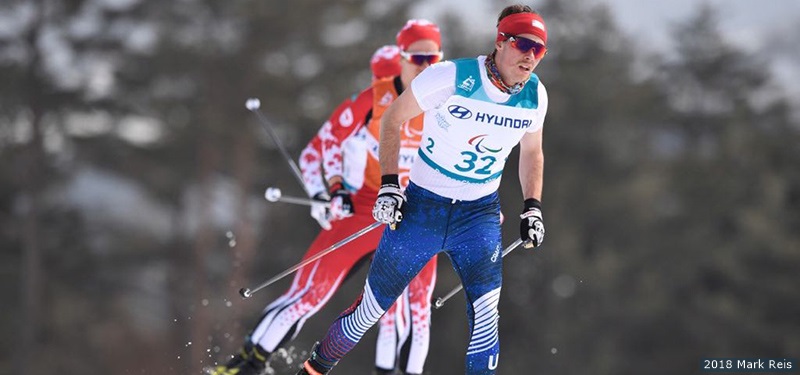
    The Canadian squad of Christian Gow, Scott Gow, Macx Davies, and Brendan Green finished 11th, +5:40.3, with 11 spare rounds and a penalty loop.

    Results

  • Thursday Olympic Rundown: Belarus Gold in Thrilling Women’s Biathlon Relay; US 10th Team in NoCo

    Thursday Olympic Rundown: Belarus Gold in Thrilling Women’s Biathlon Relay; US 10th Team in NoCo

    The Belarusian women’s biathlon team of Nadezhda Skardino, Irina Kryuko, Dzinara Alimbekava, and Darya Domracheva celebrates winning gold in the relay. They were ranked 10th coming into the day. (Photo: IBU/Biathlonworld.com)

    FasterSkier would like to thank Fischer Sport USA, Madshus USA, Concept2, Boulder Nordic Sport, and Swix Sport US for their generous support, which made this coverage possible.

    ***

    2018 Olympics (PyeongChang, South Korea): Biathlon Women’s 4 x 6 k relay

    Full report

    Ranked just 10th coming into today’s women’s relay, the team from Belarus stole the show with Darya Domracheva skating across the line to claim the fourth Olympic gold of her career after strong efforts from Nadezhda Skardino and Iryna Kryuko, both of whom have stood on the World Cup podium before, and newcomer Dzinara Alimbekava, a 22-year-old newcomer with just 11 World Cup starts to her name. It was the first relay medal ever won by Belarus at the Olympics.

    The setting was windy and snow-blown and the race was extremely tight, with seven teams with one penalty loop (or a few spare bullets) worth of time going into the final leg. The Belarusians’ nine spare rounds were the best shooting of the day; while that spare-round tally was matched by Slovakia, Kazakhstan, Bulgaria, and Japan, those teams had penalty loops as well.

    Sweden actually wasn’t one of them, but with perfect shooting and a fast ski time 15 k gold medalist Hanna Öberg brought the team to silver after starting the anchor leg in eighth, a minute back. She benefitted from many missed shots by the leaders, and then passed France’s Anais Bescond on the final loop to claim second, 10.7 seconds back, for her teammates (Linn Persson, Mona Brorsson, and Anna Magnusson) while France (Bescond, Anais Chevalier, Marie Dorin Habert, and Justine Braisaz) took bronze (17.6). These medal-winning teams used 12 and 14 spare rounds, respectively, an unusually high tally.

    Norway (Synnøve Solemdal, Tiril Eckhoff, Ingrid Tandrevold, and Marte Olsbu) finished fourth, +29.7, Slovakia fifth (+38.4), Switzerland sixth (+43.5) after winning a photo finish against Poland (+43.6), and Germany finished seventh (+53.9).

    The Canadian team of Sarah Beaudry, Julia Ransom, Emma Lunder, and Rosanna Crawford finished 10th, +1:33.4. Their shooting of eleven spare rounds and one penalty loop was among the better scores of the day.

    The United States had a strong start, with Susan Dunklee tagging off in second place, Clare Egan maintaining a good position in fourth, and Joanne Reid rebounding from one bad shooting stage to tag off in sixth. Anchor leg Emily Dreissigacker crossed the finish line in 13th, +2:01.9.

    Results

    ***

    2018 Olympics (PyeongChang, South Korea): Nordic Combined Team Competition

    After sweeping the medals in the large hill competition, perhaps it was not a surprise that Germany won the nordic combined team event. It was a blowout: ranked second after the jumping round but starting the cross-country ski relay just six seconds behind Austria, the Germans quickly took the lead and then just extended it. Their team of Vinzenz Geiger, Fabian Riessle, Eric Frenzel, and Johannes Rydzek won by 52.7 seconds over Norway’s Jan Schmid, Espen Andersen, Jarl Magnus Riiber, and Jørgen Gråbak. Austria hung on for third, +1:07.8, with Wilhelm Denifl, Lukas Klapfer, Bernhard Gruber, and Mario Seidl.

    The United States team of Taylor Fletcher, Ben Berend, Ben Loomis, and Bryan Fletcher lost out on a photo finish with Poland and finished 10th out of 10 teams, +5:16.7.

    Results

  • Clutch Klæbo Secures Another Norwegian Gold; U.S. Men 6th, Canada 8th in Team Sprint

    Norway’s Johannes Høsflot Klæbo celebrates his team-sprint win with Martin Johnsrud Sundby (not shown), while Alexander Bolshunov of the Olympic Athletes from Russia (l) pushes for silver on Wednesday at the 2018 Olympics in PyeongChang, South Korea. It was his third-straight gold of the week. (Photo: FlyingPointRoad)

    FasterSkier would like to thank Fischer Sport USA, Madshus USA, Concept2, Boulder Nordic Sport, and Swix Sport US for their generous support, which made this coverage possible.

    ***

    With a gold medal for their team already in the bag on Wednesday, Erik Bjornsen and Simi Hamilton put their heads down for the start of their own race at the 2018 Olympics. The men’s 6 x 1.4-kilometer freestyle team sprint final was scheduled to start just minutes after the women’s team sprint final ended, a race which saw Americans Kikkan Randall and Jessie Diggins capture the first Olympic gold for the U.S. in cross-country skiing.

    It was motivating and inspiring, even confidence-boosting, Bjornsen reflected after his race in an in-person interview with FasterSkier. But he and Hamilton had their own medal hopes to tend to.

    Like most of the men’s finalists, they weren’t able to watch the women’s race beforehand and came out onto the course shortly before the start of their final.

    “I was warming up and kind of focusing on my own race, but I saw that they took the win when I was running to the start,” Bjornsen explained. “ … We were ready to match them.”

    “I did not even see a second and I’m really bummed out that I didn’t,” Canada’s first-leg skier Len Valjas told FasterSkier after. “But so happy for the U.S., that’s amazing, like it actually gave us some positive energy before the race hearing who won. Our techs and coaches ran into our room, like, ‘Did you hear about the girls’ race?’ So it’s a win for North America. It just makes today even sweeter.”

    American Erik Bjornsen (6) skiing with Canada’s Len Valjas (7) during the men’s 6 x 1.4 k freestyle team sprint at the 2018 Olympics in PyeongChang, South Korea. (Photo: FlyingPointRoad)

    Both the American and Canadian men’s teams qualified for the 10-team final on Wednesday evening in PyeongChang, South Korea. Bjornsen and Hamilton had advanced with a fast-enough time after placing third in the second semifinal, while Valjas and his teammate Alex Harvey moved on as well (also as “lucky losers”) after finishing fifth in that semifinal.

    The U.S. had some confidence going into the final after a semifinal performance that saw Bjornsen take the lead on the second-to-last lap, ahead of Norway. Hamilton held onto first for most of the the final lap until Norway’s Johannes Høsflot Klæbo passed him shortly before the finish, and France’s Richard Jouve passed Hamilton in the finishing straight as well, putting the Americans in third.

    For the final, it was all about the medal hunt for Bjornsen and Hamilton, who placed fifth in last year’s World Championships classic team sprint in Lahti, Finland, just ahead of Canada in sixth, for the best U.S. men’s result in a team event.

    Russia had won that 2017 world-champs team sprint with two athletes who were banned from competing at these Olympics, Nikita Kriukov and Sergey Ustiugov, and Italy placed second with Dietmar Nöckler and Federico Pellegrino. After an infamous tangle coming out of the final downhill, Finland ended up third with Sami Jauhojärvi (who retired after last season) and Iivo Niskanen, and Norway finished fourth with Klæbo and Emil Iversen. Norway opted for Klæbo and Sundby for its Olympic team-sprint squad on Wednesday, and Sundby later proved that he was worthy of the pick.

    Ever since World Championships, it’s safe to say this is the race that had been primarily on Bjornsen’s and Hamilton’s minds for the better part of the last year.

    They came out with a mission on Wednesday, putting themselves in the mix early in the final, alongside Canada.

    Sweden’s first-leg skier Marcus Hellner leading during the men’s freestyle team sprint at the 2018 Olympics in PyeongChang, South Korea. (Photo: FlyingPointRoad)

    Sweden set the pace for the first two laps, with Marcus Hellner starting them off and Calle Halfvarsson holding their lead on the second leg. They tagged off in first through the first two exchanges, just ahead of Norway and the Olympic Athletes from Russia after the first lap, then ahead of France, Norway and Russia after Lap 2. By the end of Hellner’s second lap, Sweden was still in first, tagging off in front of Norway, France and Russia, all within 1.3 seconds of first. Germany followed in fourth, 2.9 seconds back, and Bjornsen tagged the U.S. in fifth (+3.2).

    The Americans had been hanging in fifth and sixth throughout the first half of the race, even after Bjornsen crashed at the beginning of his second leg. Heading into the first uphill after the exchange, Bjornsen skated over the tails of Nöckler’s skis ahead of him. He fell down and by the time he got back up, was in 10th — last place — starting back up the hill. Bjornsen recovered to put the U.S. in sixth, 3.2 seconds out of first, with three laps to go.

    “It was super disappointing when I went down, but I mean, it was only halfway through the race and I just got up, and that’s for sure not going to be the end of it for us today,” Bjornsen said. “Unfortunately, I kind felt like I let the team down there a bit. I think that was one mistake that may have made a huge impact on our race today, but you know, that’s ski racing, that’s the way it goes sometimes. Unfortunately it’s at the Olympics.”

    Hamilton was quick to respond to his teammate’s comments.

    “In absolutely no way did Erik let any of us down, especially me,” Hamilton said. “I watched that on the big screen, I have been at a lot of team sprints on the World Cup, World Champs, Olympics, that always happens to someone, and 99 percent of the time, that person, especially if it’s in the finals, just gives up, whether it’s the first leg, second leg, third leg, they just give up. And Erik, he never does that, no matter what happens to him, what happens to us, he just fights ’til the absolute very end.

    “It’s cliché to say that, but that’s what he does,” he continued. “That’s the only way he knows how to operate. … I am incredibly proud to be always be racing with Erik, to be training with him, to be rooming with him.”

    The two Americans, who are rooming together in the Olympic Village, went on to lose a few more seconds and two places during Hamilton’s second leg, after which he tagged Bjornsen in eighth, 8.3 seconds out of first.

    At the front of the pack, Klæbo had made a game-changing attack on the final climb of that leg, following Russia’s Alexander Bolshunov up it then making a few swift strides to get around him several meters from the top. As Klæbo jump-skated up and over and away from them, Bolshunov, Halfvarsson and France’s Jouve almost looked as if they were standing still, leaving them several seconds behind as they chased him toward the exchange.

    Klæbo tagged Sundby 1.7 seconds ahead of Russia in second, 2.2 seconds clear of Sweden in third, 3 seconds ahead of Italy in fourth, and 3.3 seconds ahead of France in fifth. A couple more seconds back, Germany followed in sixth (+5.7), Finland in seventh (+6.0), the U.S. in eighth (+8.3), and Canada in ninth (+11.0), ahead of the Czech Republic in 10th (+12.8).

    Sundby dug deep for his final 1.4 k lap to extend Norway’s lead to 5.1 seconds at the last exchange. For the first time all race, Klæbo took his hat off and prepared for his last time around the PyeongChang sprint course with Sweden, France and Russia about six seconds behind him.

    Simi Hamilton (6) racing with Italy’s Federico Pellegrino (3) and others out of the exchange of the men’s 6 x 1.4 k freestyle team sprint semifinal at the 2018 Olympics in PyeongChang, South Korea. (Photo: FlyingPointRoad)

    Bjornsen had skied the Americans back into sixth, 11.7 seconds back at the last exchange. Valjas tagged Harvey in eighth, 26.6 seconds out of first.

    While Hamilton chased Pellegrino, who started 0.3 seconds ahead of him out of the exchange, over the next lap, the two kept Halfvarsson, Jouve and Bolshunov in their sights. Ultimately, however, they were unable to close the gap to fight for the medals.

    The three-man chase group, led by Bolshunov, didn’t let off as they pursued Klæbo, who appeared untouchable as he rounded the course. As they sped down the final descent toward the finish, Klæbo pushed over the last little rise, looked back and appeared to exhale as he relaxed his shoulders. But it wasn’t over. Bolshunov was charging hard and Klæbo couldn’t let off just yet. The 21-year-old Norwegian took another breath then about a dozen or so more V2 pushes in the finishing straight. A full four seconds before the line, he let off and secured his third gold of his first Olympics in 15:56.26 minutes, 1.71 seconds ahead of Bolshunov (and Denis Spitsov of the Olympic Athletes of Russia) in second. Jouve outsprinted Halfvarsson to give France (with teammate Maurice Manificat) its second-straight bronze (+2.02), after France placed third in the men’s 4 x 10 k relay, and Sweden finished the race in fourth (+3.07).

    About 15 1/2 seconds later, Pellegrino crossed the line in fifth (+18.55) for Italy, 2.17 seconds ahead of Hamilton in sixth (+20.72). The Czech Republic came through in seventh (+28.57) with Martin Jaks and Ales Razym, Harvey anchored Canada to eighth (+35.6), Finland finished ninth (+36.04) with Martti Jylhä and Ristomatti Hakola, and Germany placed 10th (+45.94) with Sebastian Eisenlauer and Thomas Bing.

    “For our race tonight, we’re proud of what we accomplished,” Hamilton reflected. “Obviously, it’s always our goal to be on that podium. I think we both know that we can be up there and maybe someday we will. … If we are going to do that someday, there’s no way were going to do it without trying, so tonight was another one of those attempts, and it was a super-fun race, did everything we could, came up short, but we fought hard.”

    “I guess we will have keep skiing and fight for it,” Bjornsen said, later adding, “We’re coming back for a gold.”

    Canada’s Alex Harvey jets out of the exchange during the men’s 6 x 1.4 k team sprint semifinal at the 2018 Olympics in PyeongChang, South Korea. The Canadians went on to finish eighth. (Photo: FlyingPointRoad)

    For Valjas, who had slipped to 10th on his second leg but brought his team back to eighth after Harvey put them in ninth with two laps to go, a top 10 at the Olympics on any day was a good one. He previously raced on Canada’s 4 x 10 k relay that finished ninth.

    “I actually got a chest cold two days ago so it was kind of a game-time decision,” Valjas said after of Canada’s decision to start him with Harvey. “The team really wanted me to start this even if I’m not 100 percent, and honestly it felt pretty good. I think it was my legs that gave out before my lungs so I’m glad I did start because I felt horrible coming on the bus here. I was like, ‘How am I gonna race against these guys? Like, even healthy I’m gonna suffer.’

    He explained that the course didn’t exactly suit his strengths with its long climbs.

    “The first work section is a minute with no break,” Valjas said. “I was just trying to use the flats and the downhills like what I’m good at and the rest I was just surviving…

    “Honestly for me on this course, at the World Cup last year, I had a terrible team sprint,” he added, reflecting on his 13th-place result last year with teammate Jess Cockney at the pre-Olympic World Cup in PyeongChang. “And I was good shape then. Jess raced great, I was just getting dropped. For me, another top 10 in the Olympics and I’m thrilled how it went and so happy that Alex had some punch in the end there. The 50 k [on Saturday], I’ll be out here cheering. It’s looking great for [Alex] and I’m glad I could help him in his race prep.”

    Norway’s Johannes Høsflot Klæbo and Martin Johnsrud Sundby (1) embrace after Klæbo anchored the two-man team to first in the 6 x 1.4 k freestyle team sprint at the 2018 Olympics in PyeongChang, South Korea. (Photo: FlyingPointRoad)

    For Norway, the gold medal was its fourth in five men’s races so far at these Olympics. Klæbo has won three of them (individual classic sprint, relay and team sprint) and Sundby two (relay and team sprint).
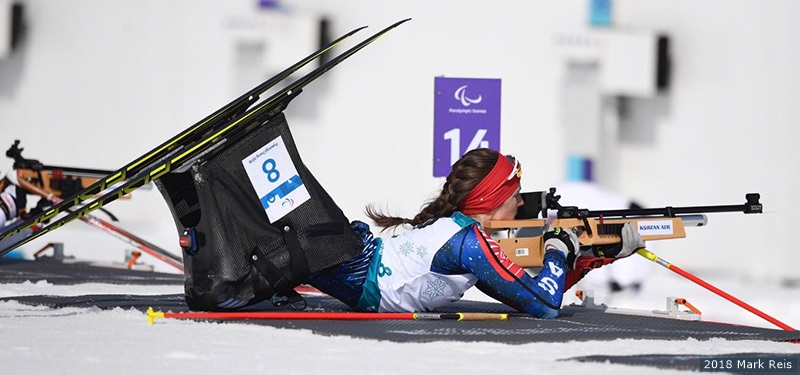
    In a post-race press conference, Sundby, 33, had nothing but praise for his young teammate.

    “I think the whole cross-country world at this point is looking on what Johannes does, how he does it, and why he is so fast,” Sundby said. “… We are close and are able to learn so much from this guy. He’s 21 years old. Today we were both extremely nervous for the competition. … Anything can happen, and these tracks are so tough, this sprint track. It’s a lot of uphill and a really tough downhill, and you don’t get any rest at any point, so we were not looking forward to it, but its really good to finish it.”

    While Russia’s Spitsov said they had been going for gold, he explained through a translator that they were “not very lucky.”

    “We had a small tactical mistake and we lost a few seconds through that when he was basically being blocked, lagging behind the French guy,” he said at the press conference. “We tried to catch up but we couldn’t. Johannes was stronger and faster.”

    France’s Maurice Manificat (r) with teammate Richard Jouve after they earned bronze in the men’s freestyle team sprint final at the 2018 Olympics in PyeongChang, South Korea. (Photo: FlyingPointRoad)

    For France, the bronze medal was a big deal. It was the first for the 23-year-old Jouve in his first Olympics. Manificat previously raced in France’s bronze-medal relay.
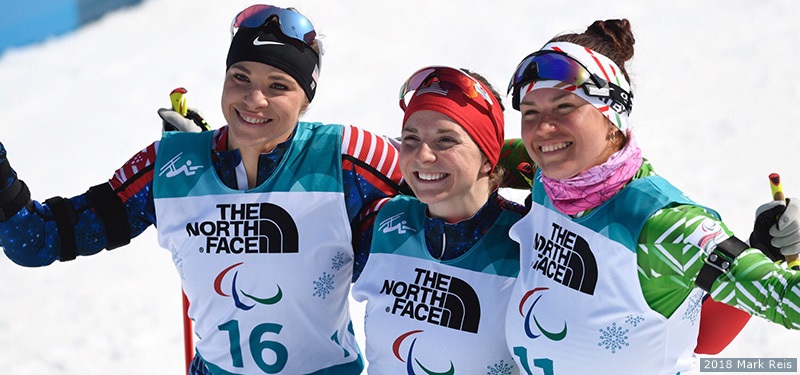
    “Second medal and also with Richard, it’s unbelievable,” Manificat said at the press conference. “Three days ago a medal in distance with my teammates on the distance team, and it was a hard choice the last day with our sprinter Lucas Chanavat; he was really sad to not be part of this relay, but I think with this medal, it was for all for the team … and we are so happy together as you could see in the [finish] and to share it with Richard. [He was] unbelievable in the final [lap], it was so crazy, so thanks to him and thanks to all team’s waxers, we had such good skis, so it was perfect.”

    Results

    — Jason Albert, Gabby Naranja, Ian Tovell, and Harald Zimmer contributed

    The men’s 6 x 1.4 k freestyle team sprint podium at the 2018 PyeongChang Olympics, with Norway’s Martin Johnsrud Sundby and Johannes Høsflot Klæbo (c) in first, the Olympic Athletes of Russia’s Denis Spitsov (l) and Alexander Bolshunov (second from l) in second, and France’s Maurice Manificat (second from r) and Richard Jouve (r) in third. (Photo: FlyingPointRoad)
  • Wednesday Olympic Rundown: Diggins, Randall Capture Gold in Olympic Team Sprint (Updated)

    Wednesday Olympic Rundown: Diggins, Randall Capture Gold in Olympic Team Sprint (Updated)

    Team USA after Kikkan Randall and Jessie Diggins (c) won gold in the women’s freestyle team sprint on Wednesday at the 2018 Olympics in PyeongChang, South Korea. (Photo: FlyingPointRoad)

    FasterSkier would like to thank Fischer Sport USA, Madshus USA, Concept2, Boulder Nordic Sport, and Swix Sport US for their generous support, which made this coverage possible.

    ***

    2018 Olympics (PyeongChang, South Korea): Freestyle team sprint

    Women’s report

    Men’s report

    (Note: This rundown has been updated to include comments from Canadians Emily Nishikawa and Dahria Beatty.)

    The medal hunt is over. In the final team event of the 2018 Winter Olympics, the U.S. women got the job done on Wednesday in PyeongChang, winning not just a medal, but the first Olympic gold in the history of U.S. cross-country skiing.

    Jessie Diggins (l) and Kikkan Randall soak up their win in the women’s freestyle team sprint on Wednesday at the 2018 Olympics in PyeongChang, South Korea. (Photo: FIS Cross Country/Twitter)

    Kikkan Randall and Jessie Diggins teamed up in the 6 x 1.25-kilometer event, with Randall tagging Diggins in third at the final exchange, just 0.7 seconds behind Norway’s Marit Bjørgen in first and 0.5 seconds behind Sweden’s Charlotte Kalla in second. With 1.25 k to go, Diggins charged ahead on the first climb, with Norway’s Maiken Caspersen Falla and Sweden’s Stina Nilsson chasing her in second and third, respectively. They were about 10 seconds clear of Switzerland in fourth at the final exchange.

    Falla moved into first at the bottom of the final grueling climb. Halfway up, Diggins and Nilsson jostled to position themselves in second, and over the top, Diggins slotted into third.

    Riding fast skis on the downhill toward the stadium, Diggins stayed out of trouble while Nilsson nearly rode up onto Falla’s skis. While Nilsson used the draft to get into first coming out of that downhill, Diggins eyed a specific line, saw the opening between the two and took it to move into second. As Nilsson entered the finishing straight, Diggins was right there with her, even pulling into first as they came within 50 meters of the line. The gold became a reality, as Diggins outlunged Nilsson by 0.2 seconds at the finish with a time of 15:56.4 minutes, and Falla crossed 3 seconds back in third.

    Jessie Diggins (l) lunging for gold in the women’s freestyle team sprint, 0.2 seconds ahead of Sweden’s Stina Nilsson at the 2018 Olympics in PyeongChang, South Korea. (Screenshot: NBC broadcast)

    Gold for the U.S., silver for Sweden, bronze for Norway. With her 14th Olympic medal, Bjørgen became the most decorated Winter Olympian of all time, while Randall and Diggins earned their country’s first Olympic gold.

    In the men’s 6 x 1.4 k team sprint final that followed, Johannes Høsflot Klæbo once again anchored another Norwegian victory, teaming up with Martin Johnsrud Sundby for Klæbo’s third medal of his first Olympics. With a strong second leg from Klæbo, the Norwegians gapped the field, and Sundby extended that gap to 5 seconds over Sweden by the final exchange. Klæbo rounded the final lap alone, still charging for the win and only letting up a few meters before the line to celebrate as he crossed in first with a time of 15:56.26.
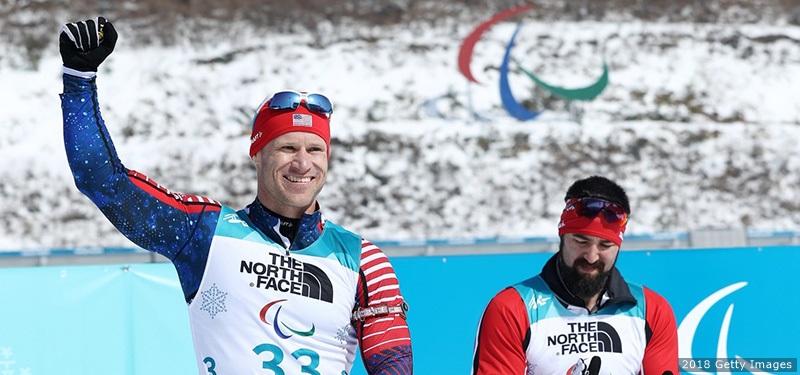
    Kikkan Randall (14) and Jessie Diggins embrace as they celebrate their freestyle team sprint gold on Wednesday at the 2018 Winter Olympics in PyeongChang, South Korea. It is the first U.S. cross-country skiing gold medal in Olympic history, besting Bill Koch’s individual silver medal in the 30 k at the 1976 Winter Olympics. (Screenshot: ARD broadcast)
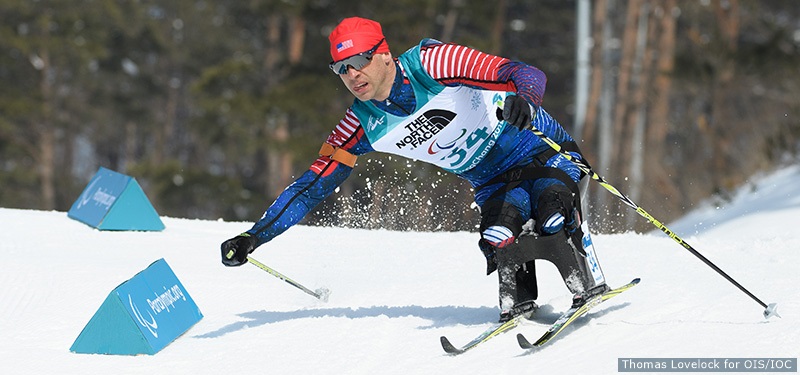
    Alexander Bolshunov of the Olympic Athletes from Russia pushed to catch Klæbo on the last lap and motored for silver, finishing 1.71 seconds back. He teamed up with Denis Spitsov for their second-straight silver medal of the Games (after placing second in the 4 x 10 k relay) and Spitsov’s third medal (after placing third in the 15 k freestyle).

    France (Maurice Manificat and Richard Jouve) placed third (+2.02) with Jouve edging Sweden’s Calle Halfvarsson by about a second for bronze, while Sweden placed fourth (+3.07) with Marcus Hellner and Halfvarsson. It was the French men’s second-straight bronze medal after placing third in the relay.

    Italy (Dietmar Nöckler and Federico Pellegrino) was next across the line in fifth place, 18.55 seconds out of first, while the U.S. men (Erik Bjornsen and Simi Hamilton) followed in sixth (+20.72). Bjornsen crashed shortly after the start of the third leg (his second leg) after skiing onto the tails of Nöckler’s skis up the first climb out of the stadium. That put the American in last place near the bottom of the hill, but Bjornsen rebounded to tag off in sixth, just 3.2 seconds out of first. Hamilton slipped to eighth and 8.3 seconds back on the next leg, and by the last lap, it was Hamilton chasing Pellegrino for fifth place, which Italy ultimately took about 2 seconds ahead of him at the finish.

    Canada’s Len Valjas and Alex Harvey finished eighth (+35.6), with Harvey holding off Finland in ninth by half a second at the line, after slipping as far back as 10th on Valjas’s second leg.

    Semifinals

    Earlier in the day, the Norwegian men and women, Russian men, and American women each won their semifinal heats as the field was narrowed to ten teams for each final.

    In the first women’s semifinal, Bjørgen and Falla posted an easy win by 6.6 seconds. Switzerland’s Nadine Fähndrich and Laurien van der Graaff bested Slovenia’s Alenka Cebasek and Anamarija Lampic for second place.

    In the second semifinal, Randall and Diggins claimed the win, with Kalla and Nilsson finishing second, just 0.7 seconds back; Diggins and Nilsson didn’t sprint for bragging rights, seemingly saving energy for the final. Russia’s Natalia Nepryaeva and Yulia Belorukova finished third (+2.1).

    Only the top two finishers from each semifinal automatically advance to the final, but Slovenia and Russia qualified as “lucky losers” based on their time. Also qualifying for the final were Finland (Mari Laukkanen and Krista Parmakoski), Poland (Justyna Kowalczyk and Sylvia Jasckowiec),  France (Aurore Jean and Coraline Hugue), and Germany (Nicole Fessel and Sandra Ringwald).

    The Canadian women’s team of Emily Nishikawa and Dahria Beatty finished seventh in the second semifinal, and were two spots out of making the final (the Czech Republic had a faster time than the Canadians but also did not advance).

    “The first four legs we were right in there with the group,” Nishikawa told FasterSkier after their semifinal. “I think our second heat was quite a strong heat, it stayed together until the fifth leg. That’s where I blew up a little bit, but I did everything I could. … Dahria skied amazingly well, she was able to still catch Italy again on the sixth leg.”

    “We knew that the first three, four teams would be quite strong: USA, Sweden, Russia and Finland,” Beatty said. “So we knew everyone else, we could ski with them in the group, so we were trying to stay with that kind of middle group ’cause we knew five or six would probably be qualifying from our heat. … I think we did a really good job of skiing a race where we were right in there. … I think we came something like 11 seconds short of what we needed…

    “Even though we didn’t qualify it was nice to be able to go catch one team on the last lap there and finish strong,” Beatty added. “Our coaches were cheering amazing out there, and had some cheering from the American coaches, too. So there was a lot of motivation on the course to really fight to the line.”

    In the men’s semifinals, Russia’s Spitsov and Bolshunov and Sweden’s Hellner and Halfvarsson at some points appeared to be running away with the first heat, but by the finish Germany (Sebastian Eisenlauer and Thomas Bing) and Finland (Martti Jylhä and Ristomatti Hakola) were within three seconds in third and fourth.

    For the U.S., Bjornsen took charge of the second semifinal on the fifth lap, and Hamilton kept the lead into the final downhill. Klæbo passed him late in the game and claimed the win along with teammate Sundby, and Hamilton appeared unconcerned as Jouve passed him in the finishing straight as well to put France (with Manificat) in second; based on time, the U.S. advanced as a lucky loser.

    Also in the men’s final were Italy (Nöckler and Pellegrino), Canada (Valjas and Alex Harvey) — who finished fifth in the second semifinal — and the Czech Republic (Martin Jaks and Ales Razym).

    Final results: Women | Men

  • France Golden in Biathlon Mixed Relay; Canada 12th, U.S. 15th

    Martin Fourcade waves the tricolore down the finishing straight as France claims gold in the biathlon mixed relay on Tuesday at the 2018 Olympics in PyeongChang, South Korea. (Photo: FlyingPointRoad)

    FasterSkier would like to thank Fischer Sport USA, Madshus USA, Concept2, Boulder Nordic Sport, and Swix Sport US for their generous support, which made this coverage possible.

    PYEONGCHANG, South Korea — In its four-card-deep deck, the French biathlon team had an ace. Anchoring France’s 2 x 6 + 2 x 7.5-kilometer mixed relay was Martin Fourcade. The 29 year old had already taken two individual gold medals at these Winter Games. The final leg of Tuesday’s race presented the opportunity for another.

    Coming through the last exchange, it was Germany’s Erik Lesser tagging off to Arnd Peiffer. Without Fourcade chasing them, Germany’s chances of a medal would have seemed certain.

    Peiffer, who learned around 1 p.m. that afternoon that he would start the relay in place of Simon Schempp, who reportedly was feeling under the weather, was first into the range after one loop for his round of prone shooting. There, Peiffer missed two shots, but using two spares, hit the remaining two targets and stayed out of the penalty lap.

    Then came Fourcade. The Frenchman shot clean. Skiing into the range with France was Norway’s Emil Hegle Svendsen and Italy’s Dominik Windisch. Svendsen and Windisch both used one spare each to clean and steer clear of the penalty lap as well.

    Out on course, Peiffer had a 6.1-second buffer between himself and Fourcade. Windisch was the third racer to depart the range, 16.3 seconds out of first, and just 0.1 seconds behind him was Svendssen.

    The 6.1 seconds separating the two frontrunners was soon down to zero. Fourcade attacked on the first uphill, passing the German and was the first into the range for the standing shooting — exactly the type of stage Fourcade craves. 

    Five days ago, Fourcade was in a similar situation. During the men’s 20 k individual race, he skied into the range for the final round of shooting with a comfortable lead. The almost-always clutch Frenchman missed the last two targets, losing the gold and finishing fifth on the day.

    Martin Fourcade cleaning his final five targets of the day to secure gold for France in the mixed relay at the 2018 Olympics in PyeongChang, South Korea. (Photo: FlyingPointRoad)

    During Tuesday’s mixed relay, Fourcade was on his A-game. Five pings heard throughout the stadium and five targets down. With his remaining 2.5 k to go, another medal for France and Fourcade was certain. Not long after, it became clear that medal would be gold.

    Back in the range, Peiffer struggled, using three spares and having to ski a penalty loop. Meanwhile, Svendsen used one spare to clean and Windisch two. Svendsen slid into second place, 34.3 seconds behind an already long-gone Fourcade.  

    Windisch left about 15 seconds after the Svendsen. After emerging from the penalty lap, Peiffer skied up behind Windisch. In a moment of déjà vu, Fourcade carrying France’s fluttering flag crossed the finish line first in a time of 1:08:34.3 for the gold medal. Svendsen held his own with the third-fastest anchor lap to secure silver for Norway, 20.9 seconds behind Fourcade.

    For Fourcade, it was his fifth gold medal in two Olympics and his first in a team event. France last won the mixed relay at the world-championships level at 2016 World Championships in Oslo, Norway.

    Asked what it was like capturing his fifth Olympic gold, Fourcade responded at the press conference, “Tonight it’s not about numbers, it’s not about personal, it’s a team adventure that began in 2009 in the world champs in [PyeongChang] Korea, and tonight it’s a really big emotion for the team and all the crew because we are individual athletes and the emotion of an individual Olympic gold medal is amazing, but when you can share it with your teammates it’s something really much more incredible.”

    “I think for the Norwegian team, we have a big priority on this relay,” Svendsen said at the press conference. “We really like it a lot, great to race both women and men together. You can see the best biathlon nations … so great event, it was very exciting.”

    Italy’s Dominik Windisch (r) celebrates bronze for his team in the mixed relay, which he took by 0.3 seconds over Germany’s Arnd Peiffer (l) at the 2018 Olympics in PyeongChang, South Korea. (Photo: IBU/Biathlonworld)

    The battle for third and fourth came down to a contentious last 100 meters.

    As they rounded into the finishing straight, Peiffer was skiing in the left lane and Windisch in the right. In one final push to the line, Windisch crossed over into the Peiffer’s lane and took third place and bronze medal by 0.3 seconds ahead of him, 26.9 seconds after Fourcade.

    Peiffer crossed in fourth place (+27.2) and Germany subsequently filed a protest that Windisch obstructed Peiffer. Ultimately, the protest was denied and the results stood.

    Speaking to German broadcaster ARD after the race, Peiffer initially said Windisch’s move was within the rules. However, after viewing the replay, he changed his mind.

    “I believe he [Windisch] would have beaten me if he’d just remained straight ahead in his corridor and not skied such a curve,” Peiffer later told ARD, according to a translation. “That’s what I also told him. I told him I congratulate him because I believe he was better today. I just did a poor job today, that’s how it even came to this situation…

    Germany’s mixed relay anchor Arnd Peiffer during his last shooting stage on Tuesday, where he incurred a penalty and slipped out of gold-medal contention and ultimately finished fourth in the event at the 2018 Olympics in PyeongChang, South Korea. (Photo: FlyingPointRoad)

    “I took another look at it now, and to me it’s a rule violation,” Peiffer added. “But from experience I know that the jury never makes any decision or generally denies appeals. Just because they don’t have the courage, I believe. I am sorry for the other three, because they did a great job. I don’t believe I would have deserved a medal today, but it’s always sad if rules get broken.”

    During a post-race press conference, the issue of Italy’s move was raised again. One reporter directed a question at Windisch, asking about his thoughts on the filed complaint.

    “It happened realy really fast because it come down from the downhill and I was convinced to do the right thing because I was in front of Peiffer,” Windisch said.“The jury had a long, long meeting to take this decision and they decided for us. I am really happy about this, so I think they had their reasons and I am happy for Italy.”

    The same reporter posed the question to Fourcade, stating that the move seemed like one the Frenchman has done in the past.

    “As Dominik Windisch told you it happened really fast in a situation we are not fully able to decide really quickly because we already have 7.5 kilometers in the legs,” Fourcade said. “When you are looking a the picture you can see it’s probably not the best decision Dominik took, but in the end it changes nothing because Dominik is stronger than Arnd in the sprint and he didn’t change anything with the final results. I think and I’m sure if it happened again he would choose another line.”

    Italy’s Strong Start

    Italy’s Lisa Vittozzi (2), alongside Germany’s Vanessa Heinz, leads the first leg of the 2 x 6 + 2 x 7.5 k mixed relay on Tuesday at the 2018 Olympics in PyeongChang, South Korea. She went on to hand off in first, and Italy ultimately earned bronze in the event. (Photo: FlyingPointRoad)

    In the first leg of the race, Italy’s Lisa Vittozzi and Germany’s Vanessa Heinz tagged off in first and second, respectively, with Germany 2.2 seconds back at the exchange after both skiers shot clean without any spares. Vittozzi hanged off to Dorothea Wierer, while Heinz tagged Germany’s strongest leg Laura Dahlmeier, who took gold in the sprint and pursuit to start the Games and placed third in the 15 k individual.

    Dahlmeier shot clean in the first prone and used one spare to clean standing, tagging Lesser in first, 29.9 seconds ahead of Italy, at the second exchange. 

    Norway’s Johannes Thingnes Bø racing the third leg of the mixed relay at the 2018 Olympics in PyeongChang, South Korea. After being tagged in 10th, he skied up to fourth at the last exchange, and Norway ultimately finished second. (Photo: FlyingPointRoad)

    Norway’s ascent to second place involved a strong third leg from Johannes Thingnes Bø. Using just a single spare to clean his two stages (0+0, 0+1), Bø overcame two less-than-stellar legs from teammates Marte Olsbu (0+2, 0+1) and Tiril Eckhoff, who had a penalty (0+2, 1+3). When Eckhoff tagged Bø, he was in 10th, 1:24.4 minutes behind Germany in first. With the fastest third-leg course time, Bø handed off to Svendsen in fourth place, 33.1 seconds behind the Germans and half a second behind Italy.

    Canada 12th, U.S. 15th

    Canada finished the relay in 12th (+2:36.7) after skiing three places up from their bib number.

    Rosanna Crawford skiing the first leg of Canada’s mixed relay at the 2018 Olympics in PyeongChang, South Korea. She tagged off in 11th and Canada went on to finish 12th. (Photo:FlyingPointRoad)

    Rosanna Crawford skied the opening leg, using two spares, one each in prone and standing, to avoid the penalty lap.

    “I tried to be super focused in prone,” she told FasterSkier after. “I went on to have one miss, that was just a bad trigger pull on my part. Skiing wasn’t great, but I just tried my best to stick with the women around me and give Julia the best chance I could.”

    Crawford tagged teammate Julia Ransom in 11th, 34.7 seconds out of first. Ransom shot without a miss in prone and used two spares to clean standing. She maintained 11th while tagging Brendan Green 1:44.7 minutes behind the leaders.

    After what Ransom considered a less-than-ideal personal start to the Olympics, she was pleased with how she felt racing on Tuesday.

    “Today I felt like I could actually push a little harder and have fun racing,” she said.

    Canada’s Brendan Green racing the third leg of the mixed relay at the 2018 Olympics in PyeongChang, South Korea. (Photo: FlyingPointRoad)

    Green used three spares in total (0+1, 0+2) but remained clear of the penalty lap. He came through the last exchange in 14th, 2:27.9 out of first.

    “I thought the wind would make it a little bit challenging today,” Green said after finishing his leg, with Canada’s fourth-leg skier, Christian Gow, still on course. “It was up a bit from the other days, [but] thankfully it was fairly consistent. This won’t be the result we are hoping for but it’s a good primer for the men’s and women’s relays later this week and so looking forward to that.”

    In his first mixed relay and first time anchoring a championship relay, Christian Gow headed out on the final leg to pick off some places.

    Canada’s Christian Gow racing to 26th in the men’s 20 k individual for his best non-relay result at his first Olympics in PyeongChang, South Korea. (Photo: FlyingPointRoad)

    “I knew there would be a bit more pressure depending on the position that we were in when I got tagged because all the teams were putting their strongest guys last,” Gow said after. “It’s some pretty big names when you’re looking at the list. You’re like, ‘OK, there are some of my idols,’ so there’s a bit more pressure there, but I have been feeling pretty good.”

    The 24-year-old Gow shot clean and then used two spares in standing, racing the ninth-fastest last leg to put Canada in 12th at the finish (+2:36.7).

    “I think Nathan [Smith] one time told me you can’t idolize your competition, which is very true,” Gow said of his teammate and fellow Olympian. “I think I get a little better at that every year, believing in myself a little more and not looking at the big names I’m racing as untouchable or anything like that. I am especially happy with how I have been doing that this year. You try to handle it just like any other race and it doesn’t matter who the guy is next to you, it’s what you do in the race to beat them.”

    Julia Ransom racing the second leg for Canada in the mixed relay at the 2018 Olympics. She kept the team in 11th and they went on to place 12th. (Photo: FlyingPointRoad)
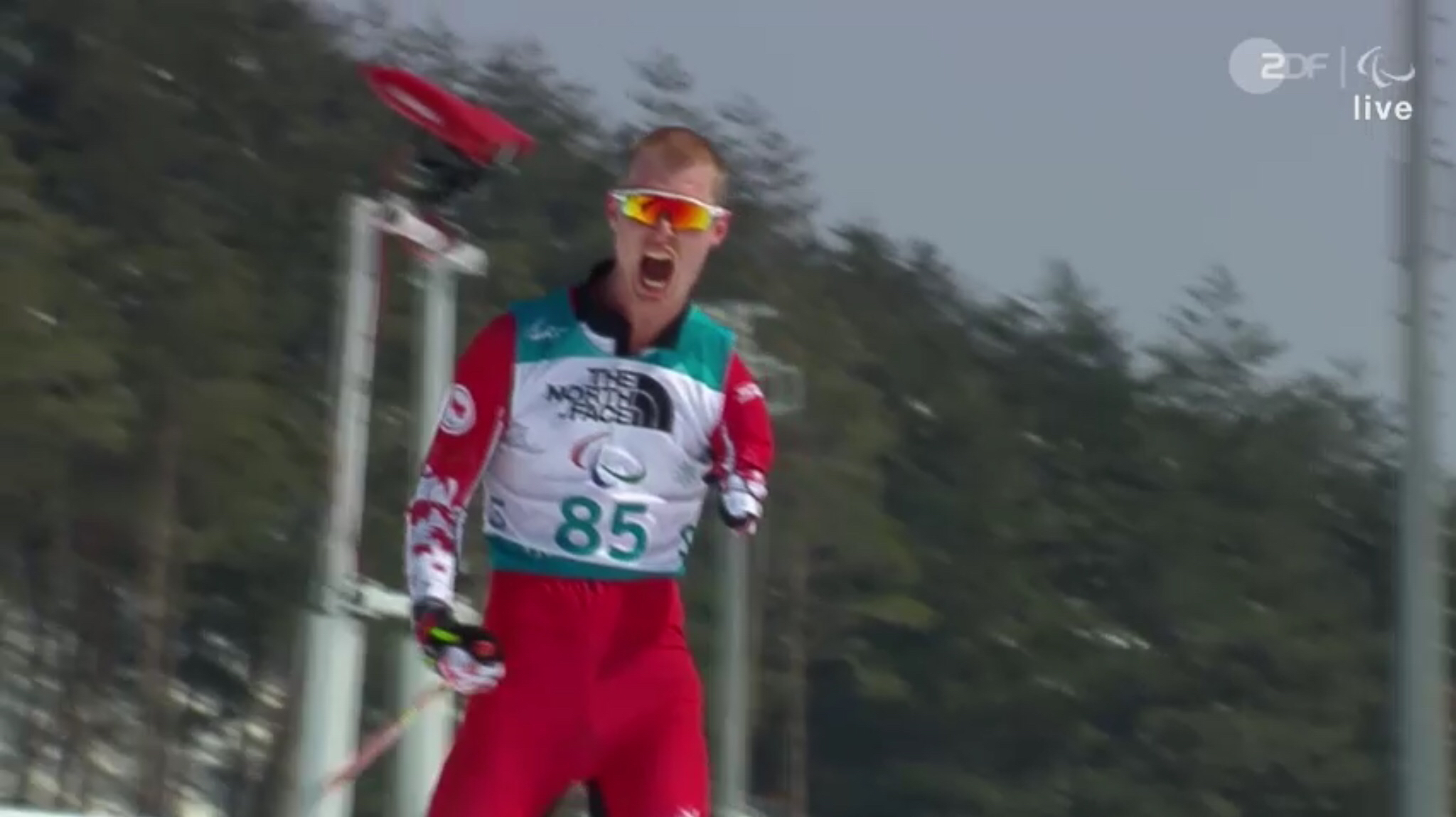
    Four years ago at the Olympics in Sochi, Russia, the Canadian mixed relay finished 11th. As the race was still going on Tuesday, Crawford said a top eight would be a good result and top six would be “the dream result.”

    Despite their goals, Ransom, a first-time Olympian, said they hadn’t felt any added pressure coming into the mixed relay.

    “… Everybody on the team knows that we’re all trying our best and are gonna bring our best to the day,” Ransom, 25, said of the team’s effort on any given relay day. “It’s an unsaid sort of encouragement, I guess.”

    For the U.S., Susan Dunklee skied a strong first leg, putting the team in fifth at the first exchange, 23.8 seconds out of first. She used two spares to clean prone and hit every target in standing (0+2, 0+0).

    Susan Dunklee (center, in all blue) leading out for the U.S team in the first leg of mixed relay at the 2018 Olympics in PyeongChang, South Korea. She handed off in fifth and the team ultimately finished 15th. (Photo: FlyingPointRoad)

    “I definitely felt better today than I did in the individual,” Dunklee said, referring to the 15 k race where she placed 19th. “I was closing on the lead group for the first kilometer or so and then by the top of the big hill, I kind of ran out of steam a little bit and was just trying to get into the finish.”

    After being tagged in fifth, right behind the Czech Republic* in fourth, Joanne Reid hung in contention in sixth after cleaning prone without any spares. But in standing, she missed all five targets and used all three spares, ultimately having to ski three penalty laps. She went on to tag Tim Burke in 18th, 3:10 minutes back.

    “It went poorly,” Ransom said after. “… The best I could do was just try and stick on and hand over with something they could work with, and that didn’t really work out for me today.”

    “I guess the strategy was once I got tagged try to make some time, try to get in contact with at least one other team so that Lowell could have someone to chase,” Burke said.

    Tim Burke racing the third leg of the U.S. mixed relay at the 2018 Olympics in PyeongChang, South Korea. After being tagged in 18th, he moved the team into 16th and they ultimately finished 15th. (Photo: FlyignPointRoad)

    Burke in fact caught two other teams, shooting without a miss in prone and using three spares to clean standing (0+0, 0+3), and tagging teammate Lowell Bailey in 16th (+3:24.4).

    The U.S. anchor leg, Bailey used one spare in prone and none in standing (0+1, 0+0). He skied the seventh-fastest anchor leg and finished the race in 15th (+3:31.1) out of 20 teams.

    “We actually had decent performances, it was really just one bad stage,” Bailey said. “Joanne had a good race otherwise and Susan had a great start, Tim had a solid race, I feel good about my race, so unfortunately, it’s eight stages not seven, but I think everyone gave everything they had and that’s the way biathlon goes. Some days go your way and some days don’t.”

    Olympic biathlon racing continues Thursday with the women’s 4 x 6 k relay.

    *Note: After her race, Dunklee told reporters about her collision with the Czech Republic’s Veronika Vítková as the two first-leg skiers came through the exchange with several others. The crash broke Vítková’s rifle right after she tagged off in fourth, just ahead of Dunklee.

    “I feel really bad,” Dunklee said. “I tangled with [Vítková] in the tag-off zone and she tripped and broke her rifle and that just puts a real damper on everything. So that’s sad. … It doesn’t affect her race today, but it certainly affects her races going forward. Stocks are highly customized pieces of equipment and you can spend months tinkering with them to get them to fit you just right, so it’s not easy to fix them when they break.”

    The Czech team went on to finish eighth (+1:39.3).

    Results