When reaching out to Sun Valley’s Annie Pokorny to learn more about her decision to become a technical delegate and her experience so far, it was also on the radar that Pokorny’s friend and former teammate Kelsey Phinney was also engaged in the process. As it turned out, Pokorny had been a leading influence in Phinney’s decision to become a TD herself.
Like Pokorny, Phinney is a 2016 graduate of Middlebury College, before continuing with her ski career, first with the SVSEF Gold Team and then the SMS T2 team until 2020. The 2019-2019 season was perhaps her peak year from a performance perspective; spending ample time in Europe racing World Cups, Phinney popped a top-20 during a skate sprint in Lahti, after having taken third at U.S. Nationals a month prior, behind Julia Kern and Hannah Halvorsen. At the end of the season, a crash during Spring Series left Phinney with a torn labrum in her shoulder, for which she underwent surgery later that year and rehabbed, before eventually stepping away from professional skiing.
Phinney is currently in her final semester of graduate school where she’d pursuing a Master’s Degree in Health Systems, Management, and Policy through the Colorado School of Public Health. She now lives in her hometown of Boulder, CO with her partner, fellow retired SMS T2 skier Kyle Bratrud.
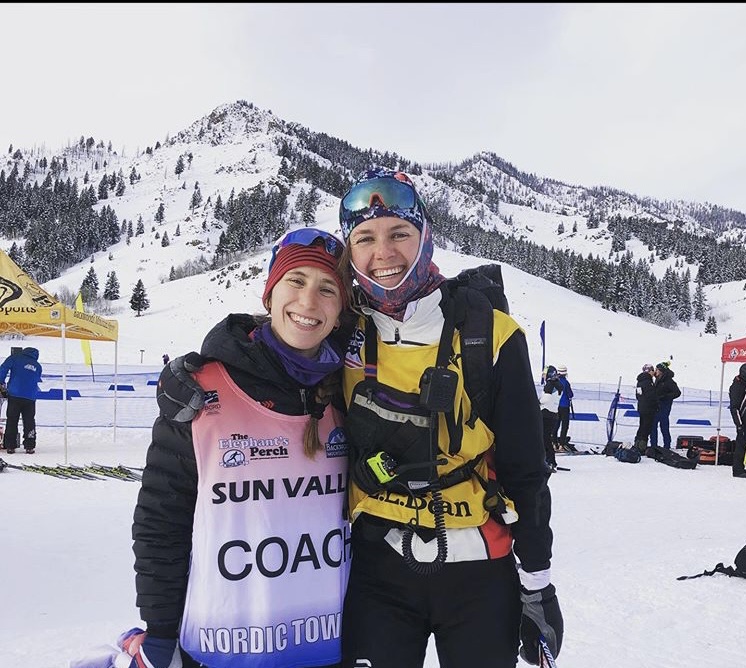
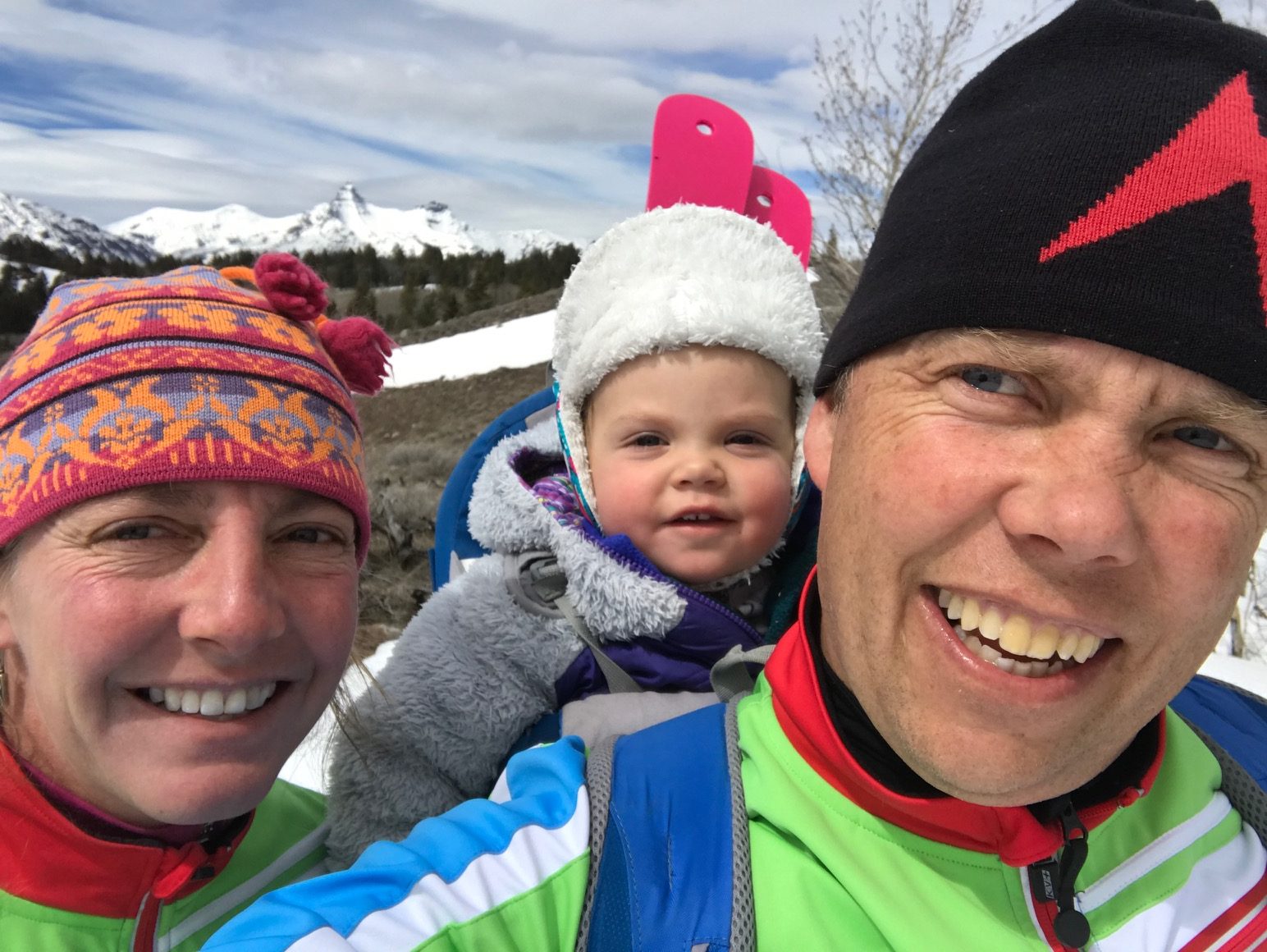
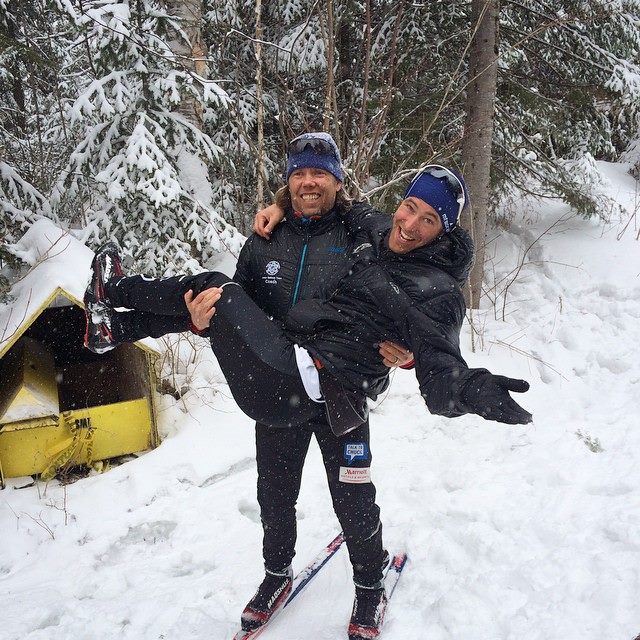
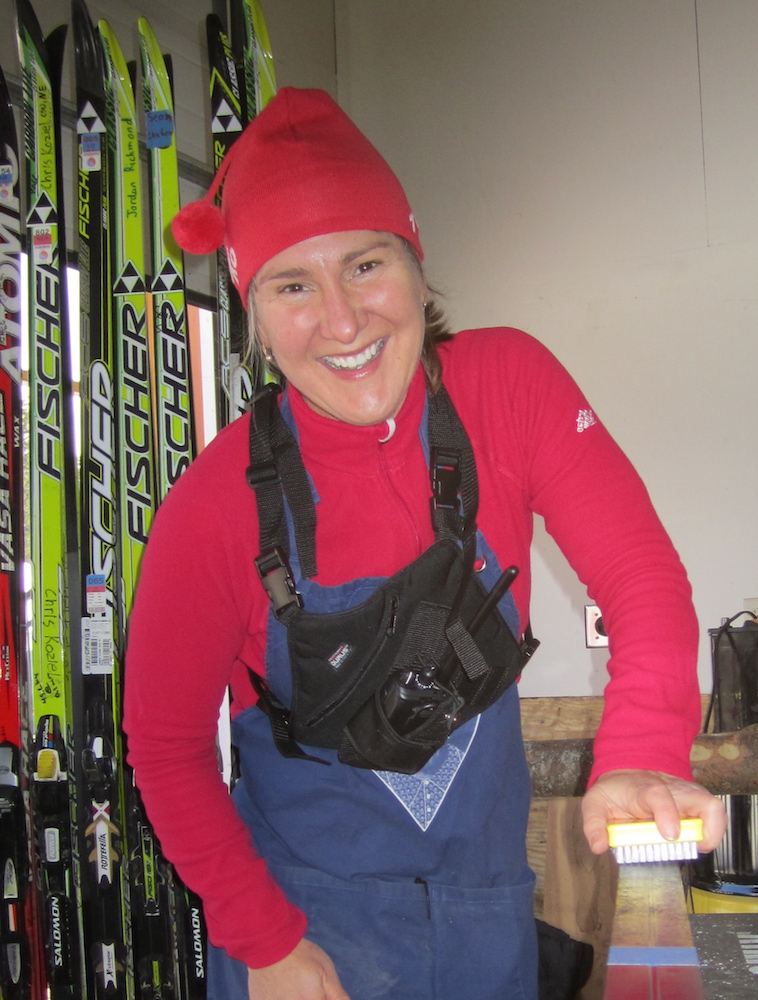
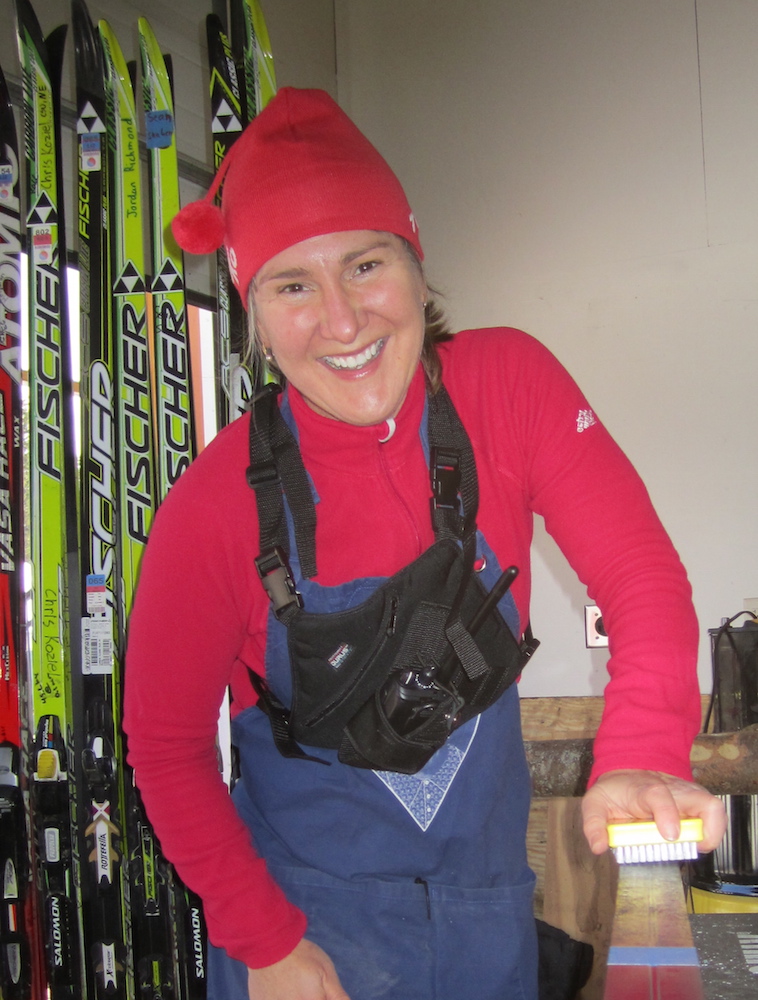
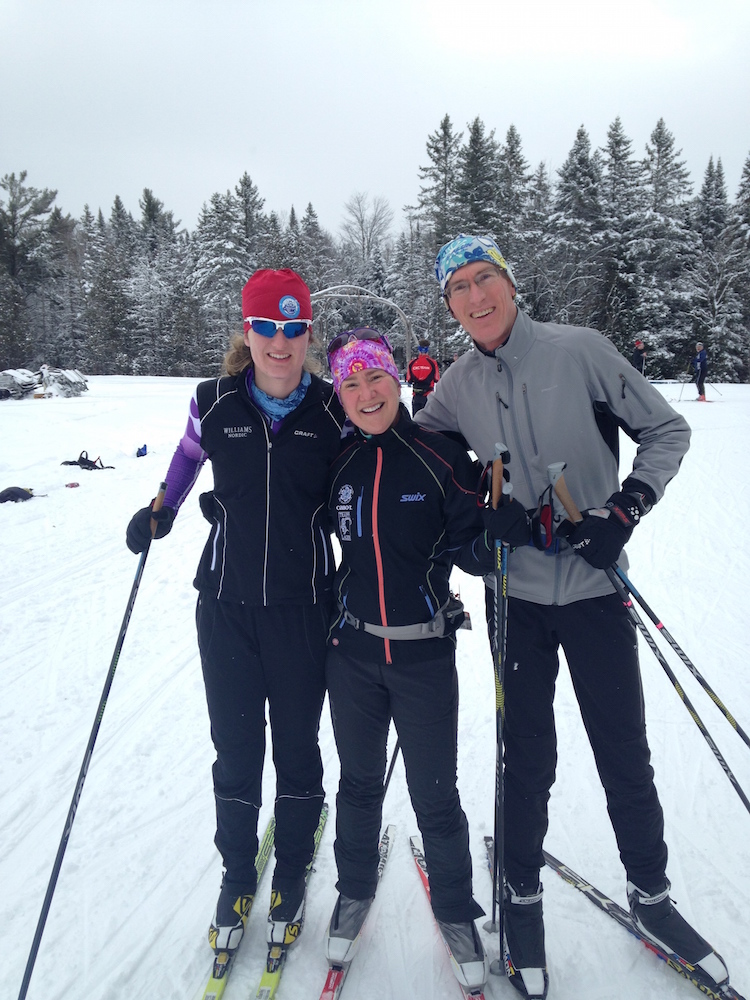
Kelsey Phinney and friend Annie Pokorny snap a picture at a 2019 SuperTour in Sun Valley, where Pokorny was working as a technical delegate and Phinney was assisting SMS T2 coach Pat O’Brien with waxing while rehabbing from shoulder surgery. (Courtesy photo)
FasterSkier (FS): When did you begin the process of becoming certified as a TD? What was your experience like with the certification process? Were you able to “fast-track” given your experience as an athlete and has your experience as a high level racer been an asset?
Kelsey Phinney (KP): I began the process of becoming a TD this past fall after a conversation with Annie Pokorny about ways to stay involved with the sport. My experience as a former racer has certainly been an asset. While I have learned much more about the specific rules than I knew when I was racing, I hope my ability to bring a racer’s perspective to decisions – like where to start and end turning zones in a classic race – helps make races safer and more fair.
FS: You mentioned Annie helped get you involved. Can you say more about what those conversations were like? What/who were some of the other factors/people that motivated you to become a TD?
KP: The primary reason I looked into becoming a TD was to give back to the sport within my current time constraints as a full-time graduate student. There is also a shortage of TDs in Colorado, which motivated me to follow through with the training and certification process following my conversation with Annie.
Since I’m currently living in Boulder, the races hosted in Colorado are all within driving distance for me. This year, I was the assistant TD at a junior race in Aspen the weekend after my fall semester wrapped up, as well as at a college race in Steamboat a couple of weeks ago.
FS: There is an overall need for TDs in the U.S., and while there are some noteworthy female TDs who have or will be jury members at the World Cup, World Championship, and Olympic level, there are few women in the role domestically. We ran an article about the need for TDs in 2017 and at the time, there were only 10 women listed in the U.S. Is this something that you considered prior to becoming a TD?
KP: To be honest, I didn’t think much about the lack of female representation of officials when I decided to work towards becoming a TD, but I do think representation matters and it is important to have diverse voices and perspectives included in the decision-making process. I’m happy to contribute to increased representation of women among the officials domestically. I think my racing experience and age are other important qualities I bring to the table.
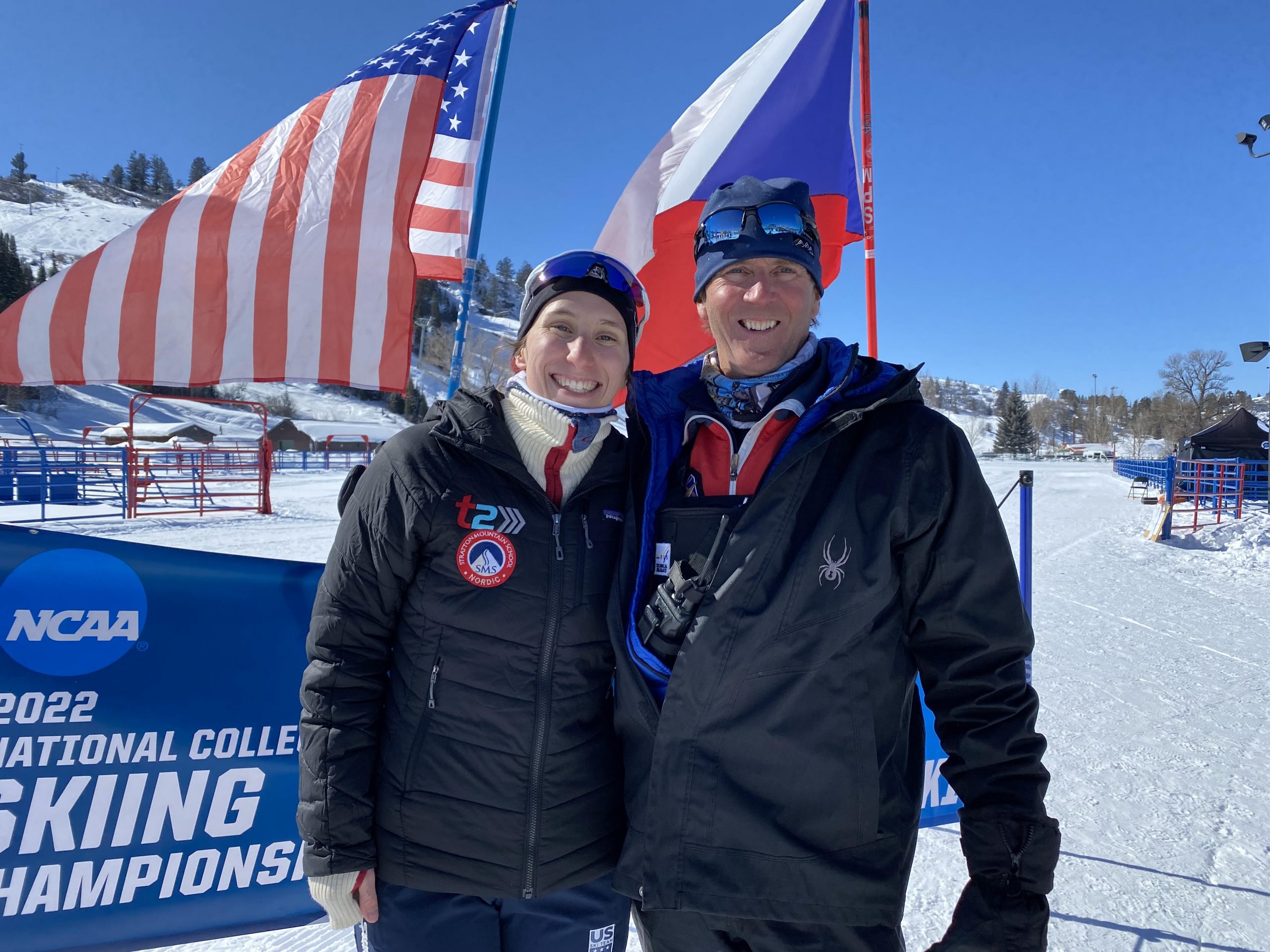
Kelsey Phinney and Al Pokorny (father of Annie) work as technical delegates at the RMISA Regionals race in Steamboat Springs, CO. (Courtesy photo)
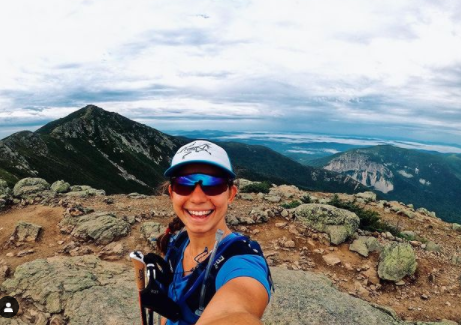
Titled “my happy place”, Julia Kern shares a scene from atop the Franconia Ridge in Northern NH. (Photo: Instagram @juliakernski)
If you follow Julia Kern on social media or her blog, you have probably gotten the sense that outdoor recreation is more than just part of her job as a professional cross country skier. A quick scroll highlights a multitude of activities that extend far beyond rollerskiing and World Cup travel. Kern seems to do it all: open water swimming, backcountry skiing, paddle boarding, camping, trail running, rock climbing, and mountain biking. And always with an inviting and contagious grin across her face.
This November, Kern shared that she has been assisting from behind the scenes with the launch of a new networking app for outdoor enthusiasts like herself, called Pastimes. In addition to contributing to its evolution, Kern is also a Pastimes athlete ambassador.
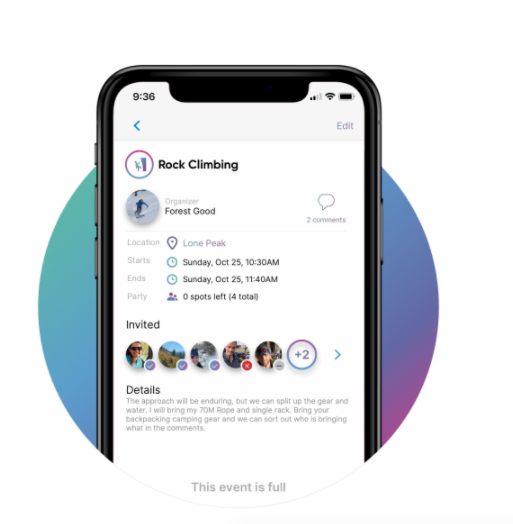
In a nutshell, the platform is designed to facilitate getting out in the outdoors with friends, new or old. Want some company on your long ski this weekend? Post it to the app to connect with others of similar ability levels. Moved to a new town and want to find some new adventure partners? Here’s your chance. Eyeing a new route but want some company to help you stay on course and safe? Find out who else might be heading that way.
“Do what you love. Share your Pastimes.” (Photo: Pastimes.io)
To learn more about the Pastimes App and Kerns role in the design process, FasterSkier reached out with a few questions to which she responded via email. You can find additional information on the Pastimes website and Instagram page, or try it out by downloading from the App Store or Google Play for android.
FasterSkier: Tell me about the origins of Pastimes. What was your role in the creation and design process?
Kern: Phil Belena (a cross country skier, fan, and a former digital consultant for Craftsbury Outdoor Center) reached out to me in August for user testing on their prototype. I have always been passionate about adventuring in the outdoors, so I was really excited to hear about the app and to give feedback. I also have a background in design work and worked for the DALI Lab at Dartmouth this fall as a designer so I wanted to help in any way I could, using both my passion for the outdoors and my design skills to give productive feedback. After rounds of user testing and exchanging ideas with Phil, I wanted to become more involved because I thought the app had a lot of potential (exactly the type of app I have been wanting) and Pastimes was looking to build an ambassador network so they brought me on board.
The idea for Pastimes came about amongst the founders who are passionate about community building and outdoor activities. On the whiteboard at the climbing gym they all climb at, they noticed people would write down their phone numbers so they could find climbing partners. This was a need that wasn’t specific to just climbing, but to the greater area as a whole. The Salt Lake City area is concentrated with people who love getting outside for adventures, yet when people move somewhere new, they find it very difficult to break into that community.
Julia Kern is an athlete ambassador for the Pastimes App in addition to providing feedback in its design process. (Photo: Instagram @juliakernski)
Forest Good, the Co-Founder and CEO of Pastimes moved to Salt Lake City about 6 years ago and found himself wanting to get into outdoor activities for the first time. He moved to Salt Lake as part of an acquisition of a company he co-founded called HackHands (acquired by Pluralsight in 2015). It was an online technology mentoring platform for computer programmers and coders. After successfully leveraging technology to connect a community of programmers, he saw an opportunity to connect people who share a passion for the outdoors. Co-founder and friend Rod Liberal shared his vision for how a dedicated app for finding outdoor partners could not only help people do the activities they love more, but make new connections and friendships.
The process for developing Pastimes evolved over the summer as we conducted interviews with potential users. We interviewed an extensive amount of potential users to understand what features would resonate. These initial interviews drove our feature set and helped guide our design and engineering. Once the app was in a prototype state, we went back to confirm that the features actually worked for this user group. This iterative process continues as Pastimes evolves. We use analytics to understand how our customers use the App, continually improving the user experience to align with their use.
How has the launch gone so far? Has the pandemic posed any hurdles in terms of creating something that fosters meet-ups and connecting with others?
The launch has gone well so far. We learned a lot from the initial launch, gathering a lot of user feedback for future updates. We just launched a big update with features that make it easier to connect with others in your local area. These include messaging and profile enhancements, along with the ability to make your availability for an activity discoverable and match with others in your local area. We have a lot more updates rolling out soon! What I love about working with the people working at Pastimes is that they are always looking for ways to improve and love to hear people’s feedback. They want the app to evolve based on the user’s needs, taking a human-centered design approach.
When Covid hit, it made the founders rethink their idea. They questioned whether a social app would be used by people to meet up during a pandemic, but then the outdoor industry exploded. Every single bike sold out, people were outside going on daily walks, hikes, and bike rides more than ever, finding ways to socially connect with people in a safe, socially distanced way. Getting outside became people’s only way to connect with people in person. Instead of the pandemic being the end to the idea, they designed Pastimes to thrive during this time. The app is designed to create smaller group size events for those doing an activity, removing any worry of having to reject others or manage the bulk coordination of large group events. Users can set party size limits so they have control over the group size. That being said, it is still extremely difficult to build a community, it takes time, especially in a time like right now. Our top priority is for people to stay safe and healthy, and to follow local guidelines so the pandemic has slowed the launch a little bit.
What are your goals for the app?
I have always felt there are so many incredible people out there who love to do the same things I like to do, but it is hard to connect with those people. I have randomly met new people out on the trails or in the mountains, but even then, it is hard to reconnect with them again. My goals for the app are to fill this big need I see in the outdoor community, helping people connect over shared passions in a non-exclusive, efficient, and easy way. I hope it not only connects people who already are into outdoors activities, but also to the people who are new to it and don’t know where or how to begin. I have found myself most happy playing in the mountains with people and I want everyone to be able to have access and to able to be experience that feeling. I also think this app could foster mentorship within sports that require a lot of technical knowledge such as climbing. A lot of sports have a steep barrier to entry, whether it is gear or experience, so finding people to link up with to either learn from or mentor is an incredible thing and is one of my goals for the app.
Pastimes helps connect users with adventure partners and activities to make it easier to get out and play outside. (Photo: Pastimes.io)
What excites you most about the app and concept? Do you envision yourself posting skis/rides/runs while you’re in the Northeast during the off-season? How does this fit into your training?
I am really excited to meet new people who share the same passions as me, I am always looking for new adventure buddies! We all have such busy schedules so I really like the matching features, which connect you with people who have a similar availability level, making it easy to coordinate schedules and connect with people in the real world.
I will definitely be using the app when I home in the off-season! Last year when Covid hit, this was exactly the app I was needing in my life. I would skin up a downhill area or mountain bike alone every day, and it wasn’t until I made a new friend skinning by coincidence and luck one day, that I had a partner to go into the backcountry with. I want to get out and ski, ride, climb and hike with people this spring.
Since I have been injured a lot over the years, I have had to modify my training plan to what I can do, which often results in training alone. This summer and fall I did a lot of mountain biking so I would link up with friends if they were around to ride. I see myself using the app on cross-training days to connect with friends or meet new people. This summer I was even using dating apps to find people to mountain bike with in a socially distanced way, which isn’t the actual goal of dating apps, but there was nothing out there that could help me discover people in my area to do things with so it was the next best thing. I know many people who use dating/friend apps to find people to do outdoor activities with, highlighting the need that is out there for Pastimes.
What else do you want people to know about Pastimes?
I have been in charge of building an ambassador community of people who are passionate about sharing their love for the outdoors with people. It has been really fun to meet incredible people who want to share Pastimes with others and help grow the app user base.
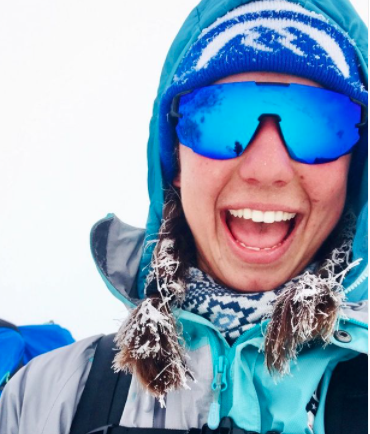
Julia Kern snaps a selfie while backcountry skiing on Mount Mansfield in Vermont. (Photo: Instagram @juliakernski)
I think Pastimes can be a great tool for the cross country skiing community. The ski community is filled with people who are passionate about being active outside and value community. Whether it is coordinating your family’s schedule with another family for your kids to go skiing together, or if you are looking for a training buddy for skiing, running, biking, etc., Pastimes can help you connect with others!
For example, there is a group of people who have been connecting in NYC for group rollerskis on the app. This group is Manhattan Nordic, a mix of elite Master Skiers, serious recreational skiers and curious newcomers who are interested in skiing on one of the most famous roller ski loops in the world – Central Park. The community and discoverability aspect of the Pastimes events has led to an increase in rollerskiers taking advantage of the training and welcoming ski community.
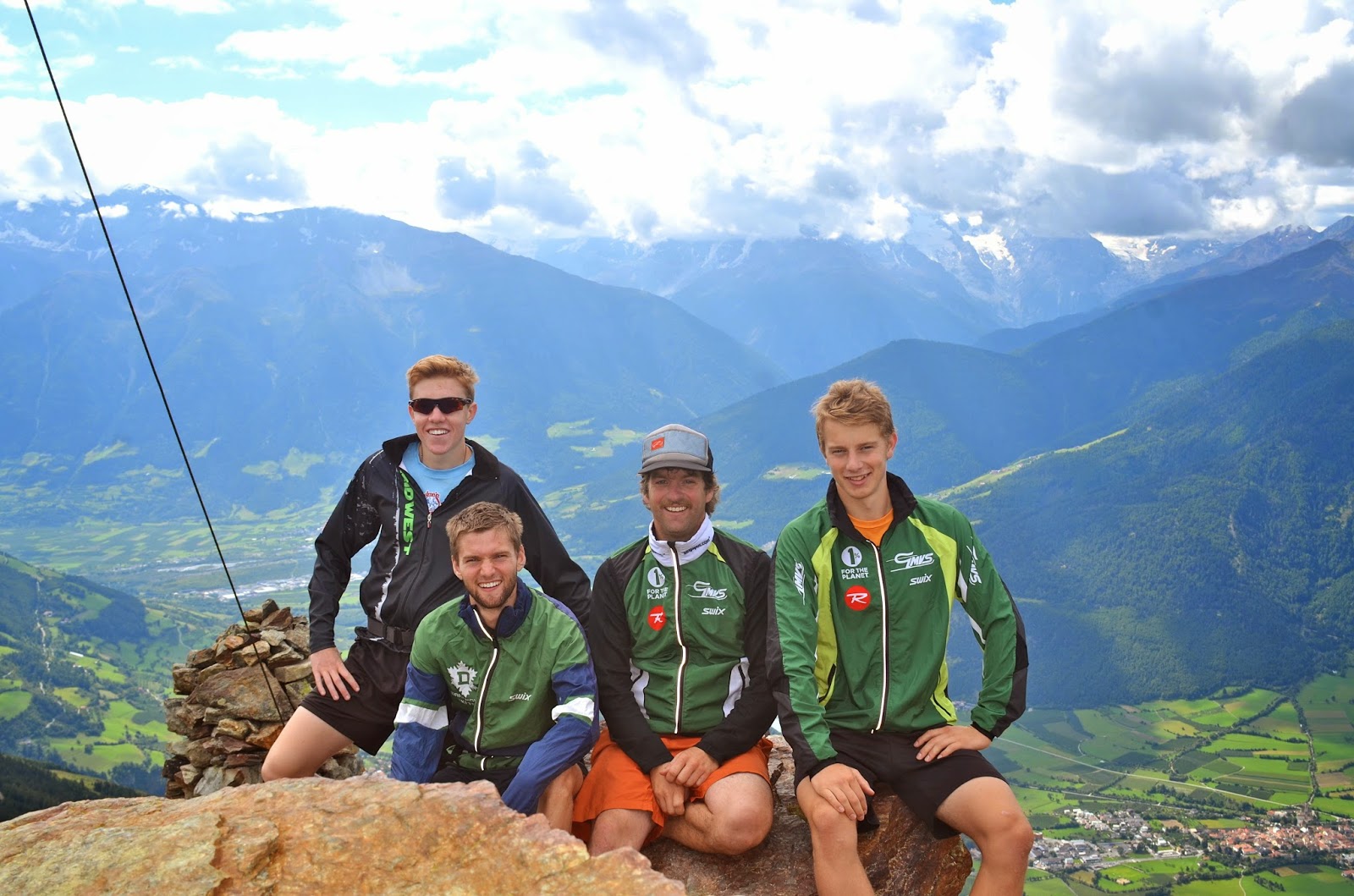
Justin Beckwith (second from r), as seen in 2014 when he was head coach of the Green Mountain Valley School (GMVS), with former GMVS elite and postgraduate athletes (from l to r) Nick Gardner, David Sinclair and Ian Moore during a fall trip to Italy. (Photo: GMVS)
The news came from NENSA early last month in an announcement that stated Beckwith would be filling in for Amie Smith, the association’s high-performance director for the last two years, who was promoted to executive director.
Justin Beckwith (l) and Gus Kaeding in the wax room at 2017 U23/Junior World Championships at Soldier Hollow in Midway, Utah. (Photo: Flyingpointroad.com)
Beckwith, of Warren, Vt., spent nine years from 2006 to 2015 building the GMVS program. When he left in the fall of 2015, he decided to go back to building houses, yet he remained involved with nordic as a wax tech for New England juniors and U.S. skiers at both national and international races, like last season’s OPA Cup Finals.
Right around that time, in late March when NENSA posted the job opening, Beckwith knew he was ready to return to a full-time position in skiing.
“It was just sort of, ‘OK, that’s it. That’s what I need to do,’ ” he told FasterSkier last month.
After graduating from Middlebury College, Beckwith, now 37, spent one year living out west before taking the job at GMVS in Waitsfield, Vt. During his tenure there, he was also a coach for the U.S. Ski Team’s U18 Trip and Junior World Championships as well as the head wax tech for Junior Nationals and Junior Worlds.
Stepping away from the sport as a coach allowed him to view it in a way he hadn’t before.
“I went back to Junior Nationals after not being there for a couple years, now being able to watch, coming from the outside and see how our coaches, athletes and organizers are acting and performing, and what a unique perspective it is,” he said. “It is so much different than when you have your own athletes in the race, or you’re supporting your division or whatever your job is. … I am really excited to start to using all my contacts and resources and just bring energy that I think coaches understand what I am all about.”
***
FasterSkier: What made you decide to return to skiing full time?
Justin Beckwith: When I left GMVS to be a carpenter, I knew I wanted to come back to skiing, but on my own terms and do the piece of the skiing that I absolutely love and am so passionate about. That allowed me to be open to do that, whether or not the bank account reflected that, I just needed to be a carpenter, but I also had the ability to start making relationships with international people, coaches from other nations that are so impressed with what we are doing now in the U.S., and that started happening three or four years ago. Coaches started saying, “Wow, you guys are doing really well down to the national level now.” Then I got to start working with some of our manufacturers and suppliers, like Start Ski Wax specifically, a bunch more this year. I went back to Junior Nationals after not being there for a couple years now being able to watch coming from the outside and see how our coaches, athletes and organizers are acting and performing, and what a unique perspective it is.
Justin Beckwith getting after it in Hemsedal, Norway. (Courtesy photo)
So bringing to the present day, I think this [NENSA] position came up one time while I was involved at a certain amount of professional level with skiing. Amie [Smith] took on the job a few years ago, but I was deeply immersed my GMVS culture at that time and I also think that probably was not the perfect fit for me. Just before my wife and I left for our trip to Norway [this year], the job was posted [again]. It was just sort of, ‘OK, that’s it, that’s what I need to do.’ I am really excited to start to working with my contacts and resources and just bring energy that I think coaches understand what I am all about. I have also been able to make that connection with a lot of the young athletes over these last few years.
FS: What drew you to the NENSA position?
JB: With this position with NENSA and also what I have been able to do the last couple years, I am not using the microscope anymore, I am using a telescope. It’s totally different, but at the same time, it’s the same. I am going to be able to support GMVS in a great way. I love working with [GMVS Nordic Director] Colin Rodgers. GMVS went through some transitions. I am staying in the Mad River Valley, which is amazing; another great part of the job is that I get to stay where I am and sort of create some of that vision and move it in a way. It’s a pretty cool job, it’s a very cool lifestyle, it’s something that I am so passionate about. I was just talking to [Dartmouth men’s nordic coach] Brayton Osgood, he said he’s so glad to have [me] officially back in skiing. That is the coolest thing, to have those relationships.
We are going through a transition within the U.S., there is a changing of the guard within our coaches and in our whole community, and we need to hold on to the history. That’s why people like Peter Graves are so interesting. We absolutely need to hold on to that history, but we have so many, because of all the awesome work that Dick Dreissigacker and Judy Geer at Craftsbury, or Sverre at Stratton, Rick Kapala at Sun Valley, or Gordon Lange in Park City, because of what all these people did, they inspired the next generation of not only athletes but coaches. It’s a really exciting time for U.S. skiing that we have such great venues, coaches and organizations. It’s a really cool time and a lot of energy is coming back into it right now.
FS: How is your role at NENSA going to be different than it was with GMVS?
JB: The biggest difference is what I tried to do at GMVS is essentially I wanted to be able to do what I am going to be able to do with NENSA. I am able to work with everybody now — and not that I am trying to spread myself too thin; I will obviously be working in a different capacity — I will be in personal contact with a lot of our athletes. … I will have more communication with coaches, whether it is with [U.S. Ski Team Development Coach] Bryan Fish or our club coaches in New England, and coaches throughout the nation, and figuring out that common goal, whether you’re part of a ski academy, or a club, or even a different region at JN’s, the goal is to make U.S. skiing better, and to create that culture and create those results, so that’s the goal.
FS: How was being at the OPA Cup Finals and what were your takeaways?
U.S. techs and coaches at 2017 U23/Junior World Championships (from left to right) Justin Beckwith, Andy Keller, Gus Kaeding, and Mike Matteson at Soldier Hollow in Midway, Utah. (Photo: flyingpointroad.com)
JB: Probably the coolest thing going into that was the fact we were able to pull Caitlin Gregg into that, so we had this mix where we had some of our best juniors were there, we didn’t have the biggest team we’ve had, but we had a great time. And right out of the gate in the OPA Cup Finals — these are big-deal racers — on Day 1, Caitlin won the thing and Hannah Halvorsen was second. World Juniors was of course groundbreaking, but that result showed another level of depth we have in the country, and that was really inspiring to see that and be a part of. It also showed that we are a little bit better at skate skiing than in the European contemporary classic condition, basically slush. We were racing in 10 degrees [Celsius, 50 degrees Fahrenheit], and that is something we are adjusting at the developmental-team level. … That’s something we are going to try address soon. The takeaway from OPA, it shows the depth of where U.S. skiing is now, it shows what happened at World Juniors isn’t a fluke, it shows that we still have work to do, but we very much have arrived, and we are lucky as a nation that the European Nations are recognizing what we are doing and they are interested in what we are doing. We are contemporary now, and it’s pretty cool.
FS: What are some of your key initiatives moving forward and what does your five-year plan at NENSA look like?
JB: One of the things is my big initiative to make NENSA a known support structure to our clubs and to our coaches and to our athletes. We are not just putting on races, I want to make coaches’ education cool again. I want to make it popular and fun, and I just sort of want to reinvigorate that a bit. I want to help increase the participation and make it a clear thing that when you ask any coach what NENSA is doing for them, I want them to be able to give a clear answer that we are providing really cool feedback and support for their program. We are helping them coach and inspire their kids, and we are not putting on camps or other events that compete, we are helping make those better. I want to reinvigorate rollerski races. I have one that I want to start with this summer and ideally that would transfer to each state, having an event that we were able to make better for them, whether through promotion or physically bringing athletes to them, bring sponsors and suppliers in there, all part of that goal. … That’s what I want to do with this job, create that that buzz, that energy.
Another thing I am going to work on is NENSA alumni, if you will, we need to keep them involved. When you’re a junior skier: you love your coach, you love your peer group, love going to Junior Nationals. You don’t necessarily remember that it was Janice Sibilia or Zach Caldwell or NENSA that created these camps and brought you all together two or three times a year. There are so many people that brought it to where it was now. It’s cool to come back and look at it with that perspective. Some of those people are coming back to it in different ways. Kris Seymour has taken a position at running Mount Van Hoevenberg in Lake Placid. Kris Seymour was Lowell Bailey and Tim Burke’s high-school coach; he inspired those guys, he helped to inspire me, now he is at a position where he can do wonderful things not only for his venue and his job, but he can do great things for cross-country skiing. So it’s really neat to meet somebody who cannot just juggle those balls, but bring those balls together.
FS: Are you still going to be a carpenter?
JB: I do have a passion for that and creating things especially with wood. I will still be hobby-ing and doing fun projects on the side, but only in a capacity like somebody would play the guitar, not as a business. I am diving right into this as a passion. People who are involved in the country and New England are coaching for the right reasons and I share the same vision.
The enthusiasm and the support and welcome I have gotten from the staff and board of NENSA, New England and the U.S. ski community is truly humbling. It’s going to be really fun, and I am looking forward to it. I am so fortunate to be a part of it and want to get more people in the sport.
Will Sweetser snaps a selfie with his wife Sarah Dominick and their 1-year-old daughter, Aesklyn, near their home in Cody, Wyo. Sweetser recently accepted a position as head coach of Burke Mountain Academy’s nordic program in East Burke, Vt. (Courtesy photo)
If you are from New England, you’ve probably heard of Will Sweetser. Originally from Auburn, Maine, Sweetser, 47, has been coaching nordic for the last 25 years. He skied for Dartmouth and coached at Bates College, the Jackson Hole Ski Club, Carrabassett Valley Academy, and Rangeley Lakes Ski Club before spending 15 years with Maine Winter Sports Center (MWSC) from 2000-2015. He started with MWSC as a cross-country coach and evolved into its competitive programs director, but in 2015, MWSC announced its Olympic Development Team was being restructured. It changed its name to the Outdoor Sports Institute and expanded its mission to four seasons of outdoor sports in Maine.
With a baby on the way, Sweetser and his wife, Sarah Dominick, a former assistant nordic coach at Bowdoin College, decided to leave their home in Stockholm, Maine, and move west to Cody, Wyo. There, the two started a post-grad, gap-year program called Mountain Endurance Sports, which also offered personalized coaching services and an online ski store. Last season in its second year, the program had two post-grads, Lance McKenney and Daniel Streinz. McKenney placed 20th in the classic sprint at 2017 Junior World Championships in Utah, and according to Sweetser, Streinz ended the season with the best International Ski Federation (FIS) point ranking of any junior man in the U.S.
In March, the Burke Mountain Academy in East Burke, Vt., announced Sweetser would be returning back to New England to serve as its new head nordic coach. He said he accepted the job in early March and with his wife Sarah and their one-and-a-half-year-old daughter, Aesklyn, the family of three planned to head East in June for the first training camp of the season at Burke.
FasterSkier caught up with Sweetser on the phone earlier this month from his current home in Cody.
***
FasterSkier: What drew you to Burke and back to New England?
Will Sweetser: My wife and I spent 20 years in Maine, and I grew up in Maine. I love the East, really, I’m a Mainer through and through, but certainly New England has been my home. My wife and I did something very similar to this 20 years ago, we moved out West after I had been coaching for a while in the East, in order to try to race, and we made it about a similar amount of time, about two years. I guess I would say my wife loves the trees, she misses them, that’s part of it.
Part of the move out here was to get a break after MWSC and to get a chance to be with family. I mean, I was constantly putting in 60 to 75 hour weeks at MWSC, so it was a good opportunity for me to change things up. I looked at jobs over those two years and had conversations with a number of different options, and Burke has been the best fit for us. Part of the attraction is that it is a very small rural town, it feels like a lot like where we just were in Maine, at the same time, I can drive an hour and 15 minutes and be in Hanover, where I could drive an hour fifteen in northern Maine and still be absolute nowhere.
It’s a good change for us, but it preserves a lot of the things we really loved about Maine, while offering us an opportunity. … We were looking for a place to raise our daughter, the opportunity to raise her somewhere the strive for excellence is real so that was a big draw. And last, it seems like a great fit for both of us to be able to work there when the time is right with our family. We felt really welcomed there.
FS:How difficult of a decision was that?
WS: Like I said, I had other job offers; I interviewed at other places the last two years. It was pretty easy for us to decide that those things weren’t right. … It wasn’t a difficult decision, every time you move it’s a big deal, so we wanted to make sure the fit was right. We spent quite a bit of time there looking things over, and we tried to do a good job making that decision with our eyes wide open, so we spent a better part of a week on campus, and I went back and visited again.
FS:When did the hiring process start and how long did it take?
WS: It was all pretty quick. I started having conversations with Burke in late February, and we went and visited the last couple days of February and first couple days of March and I accepted a position March 3 or 4. We knew that we were looking for something, I talked to groups in Canada, and I interviewed for two other positions while I was out East, but I was recruiting for Burke by the time JN’s [Junior Nationals] started [in March].
FS:What are your key priorities in your first year at Burke and what is the status of its nordic program?
WS: Priority number one is to recruit. I don’t know if you know the history of Burke, but it’s a longstanding nordic program, for over 30 years they’ve had a nordic program, and they produced some excellent skiers, from people like [U.S. Ski Team members] Liz Stephen and Ida Sargent, [and Ford Sayre’s] Sam Tarling a little after them. Heading into this with them having had no athletes and no coaches last year, essentially the program was dead. In name it was not dead, and they have always had a nordic skier on their school logo, and the board of directors seemed totally disinclined to let nordic die, so I feel like there is a tremendous support for nordic at the school.
My first priority is rekindling that core group. We do have interest. Two kids are committed to coming and I am in discussions with several others that I think we will start the year between four and six athletes for next year. My goal is to have enough athletes on campus to have a consistent group of somewhere between 18 to 24 athletes. I recognize that is going to take a while, but that will be a program that is several coaches, full-age cohort in both men’s and women’s high school ages. I am very optimistic about the potential. There are a lot of great things that Burke has to offer, such as skiing on campus, which I think is a big plus, so we are looking at homologating a couple of race courses right there. We are going to grow a fairly robust gap-year program, and we will have a pretty extensive camp schedule coming up. I will run one camp this summer and then see where that leads us.
Will Sweetser, former MWSC competitive programs director, holding Welly Ramsey, whom he coached for six years at the MWSC, during a season-ending team ski in April 2015 in Fort Kent, Maine. (Photo: Facebook/Welly Ramsey)
FS:How is the Burke position different than your position at Maine Winter Sports Center?
WS: Well, one, it’s vastly less travel. I am going to spend, I don’t even want to guess the number of fewer miles I am going to drive, but a significant amount. The proximity of other strong programs is just outstanding. One of the things that makes New England the strongest region in the nation is that we have such a strong club system, thanks in large part to NENSA [New England Nordic Ski Association], but the proximity to GMVS [Green Mountain Valley School] and Stratton and Craftsbury is just great. I think it is excellent that all those programs are in Vermont, not too far from one another and can bang heads, and for that matter, [NENSA Head Cross-Country Coach] Margaret [Maher’s] program over at Lake Placid, and then the rekindling of the Dublin School if you go a little further out. I think that if you drew a radius around [Vermont’s] upper valley, you really get to some super-strong programs.
Some of the other things that I think will really help Burke and that I did not have access to at MWSC is I got access to snowmaking both at Burke and at Craftsbury and I think I am going to be able to capitalize on that. And it will be different in that my duties are different. My role at MWSC was in no way shape or form confined to coaching junior racers. Almost the whole time I was there, I had extensive other duties: community building, facilities management. It’s not like those things are going to go away, but it’s all right there, which is really different from driving across the whole state of Maine trying to grow those things. It is much more ‘grow it at home’ and I will have a lot more contact hours with athletes than I have ever been able to have.
FS: Will Mountain Endurance Sports continue and if so in what capacity?
WS: It will happen in a modified iteration, the latest iteration. We are still working on the ins and outs of where to keep the business. It very well may change name, certainly we will continue to retail and do team sales for Maplus wax and Rex Ski Wax, we are working on details with how our arrangement with KV+ will move forward, and as far as the coaching goes, no, we are not going to do a gap-year program anymore — that’s going to be Burke — but I will continue a coaching relationship with some athletes who are older than high school. I am still talking with several athletes that I have worked with in the past about their athletic future. I am for sure working with Austin Huneck, who was with me for two gap years with MWSC then he was a standout freshman at the University of New Mexico two years ago, spent last year in Sweden not ski racing, but now he is coming back to ski racing. I am working with him as his coach, and somehow, he and a few other guys are going to be part of, I don’t know what to call it yet, maybe like a Burke Mountain training group, something like that. It’s not a full senior program yet, but give me a few years.
FS: What has kept you coaching and in the sport for the last 25 years?
WS: It was really at Dartmouth where I developed a passion for skiing and I coached first. I was a writing major. I was writing and coaching, and then I was teaching English and coaching, and then it turned out I could make a better living coaching. But more than that, I lost a brother to drugs in 1998 and since then I have been pretty motivated to help kids make better choices, and I have been doing that through skiing ever since then, so that’s a lot of what has kept me in it. That is my driving passion: working with kids and helping them make good decisions, and that was a big piece of MWSC. And the other piece is that my wife and I have done this for essentially all our adult lives, we really enjoy the lifestyle, the people we get to work with are fantastic. It’s a great way to travel and it’s a great way see other parts of the world. We really enjoy just being outdoors and being fit. Even two years ago, I wasn’t coaching essentially, we were out in the mountains hiking, skiing, doing all the things you do for ski training, just because we love them, so it’s a really easy fit for us, and we look forward to sharing more of those things with people who are passionate about those at Burke. The Burke community is really motivated.
FS: Do you know where you will be living yet when you move in June?
WS: We don’t know; we would like to know. I am hoping by the time I go to run this camp in June that I will know and I will be able to look at where we will live and then can pack appropriately. We are leaving a lot of our stuff here. Cody is not a ski town, but its a great place to train for skiing. The elevation is excellent, the climate is excellent, the mountain biking is growing in leaps and bounds, so the trail system is fantastic right in town. Cody sits at 5,000 feet and the mountains around it goes up to 12,000 feet. If everything goes as well as we think it’s going to go, I am sure we will have a permanent location at Burke in a few years. For now, I anticipate that we will live near or on campus.
We are looking forward to being back. It really does feel like our family. The New England ski family feels like our family. Even on the circuit the last two years, we have been astonished by the continued support we get from New England, even when we lived out here, so it really does feel like a homecoming for us.
Amie Smith, a Cambridge Sports Union volunteer and the new high-performance director at NENSA, in the wax room. (Courtesy photo)
The New England Nordic Ski Association (NENSA) is joining the high-performance bandwagon. In May, the association, based in New Gloucester, Maine, announced its competitive programs director of nine years, Janice Sibilia was stepping down “due to changes in essential functions” of her position. The next day, NENSA published a job posting for a high-performance director.
Amie Smith (c) on a ski with her daughter Rebecca (l) and her husband Tom. (Courtesy photo)
That’s where Amie Smith came in. Late last month, NENSA hired Smith, of Wellesley, Mass., to their team. As high-performance director (HPD), Smith will manage competitive cross-country ski programs throughout New England, much like Sibilia did, however, the position expands beyond the athletes and into the coaches’ side of skiing as well. The HPD also will manage race data and be responsible for keeping track of points throughout New England, from Zak Cup points to Junior National Qualifier points.
Smith enters the position with a lot of background within the New England ski community. Originally from Bennington, Vt., she grew up skiing and racing in the local youth ski league there, attended the University of Vermont and Columbia University, then settled down in Wellesley, a suburb about ten miles west of Boston. In 2007, she became involved with the Cambridge Sports Union (CSU), a ski club based out of Weston, Mass., along with her daughters who skied for the all-volunteer organization. For the past two years, Smith has also been the New England Junior National Championship trip leader, a position she plans to fulfill as HPD for years to come.
NENSA’s Executive Director Zach Stegeman told FasterSkier he is excited to have Smith onboard, as she brings a lot of enthusiasm and experience to the new job. Since the role spans throughout many facets of skiing, a person such as Smith — with experience in many aspects of the sport — is ideal, he explained.
“Amie is uniquely positioned for this role through her experience on every side of the sport: as a parent of competitive racers, as a coach, as an athlete herself, and in critical behind-the-scenes roles as a race director, a volunteer, a trip leader, and as board chair of a highly successful club,” Stegeman wrote in an email.
FasterSkier caught up with Smith earlier this month during her first week at NENSA. She started July 13.
FasterSkier: How has your first week been so far?
Amie Smith: Well, I have to say that we are in the throat of trying to finalize our Eastern Cup schedule for this coming year. Although I officially started [July 13], I have actually been working with the athletic development committee from NENSA the last couple weeks on finalizing what the schedule will be, what our venue options are. … I can tell you we have two SuperTours back to back this year, which is awesome for the East Coast. … Those weekends are going to be fantastic because were going to have so many great skiers from all over the country joining us in the midst of carnival and Eastern Cup weekends. But it also makes planning our eastern cup schedule this year a little different from previous years because we’ve already got two back-to-back weekends so were trying to spread out the other races and figure out the rest of the scheduling. So that’s my first week.
FS: You currently live outside of Boston; does this new position mean you have to move?
AS: No. The beauty of this job is I can work remotely. Obviously, I’ll have a lot of travel to all the Eastern Cup races, to Junior Nationals — I will be the trip leader again and organizing — a big part of my job is Junior Nationals. And then all the other things. We have a USSA Coaches Symposium in Lake Placid this September and all sorts of stuff. So I can stay in Boston and just travel to work when needed.
FS:Traveling around is something you are used to because you have daughters that have been nordic ski racers for a while, right?
AS: Yes. Rebecca will be a sophomore at Williams [College] next year and she skis for the Williams Ski Team, as did Hannah. When I looked at the schedule and between having daughters, who have been on the Eastern Cup and carnival circuit for the last eight years, and my previous work or my work with the CSU Junior Ski Team… Obviously I have more things like NENSA board meetings, and I represent NENSA for … the Olympic development committee, which are meetings out in Colorado every October. There are some other things, too, for travel that are a little bit more, but all to cool places, so it’s very familiar in a lot of ways.
FS: What was your role with the Cambridge Sports Union and what does becoming the high-performance director mean for your role within the club?
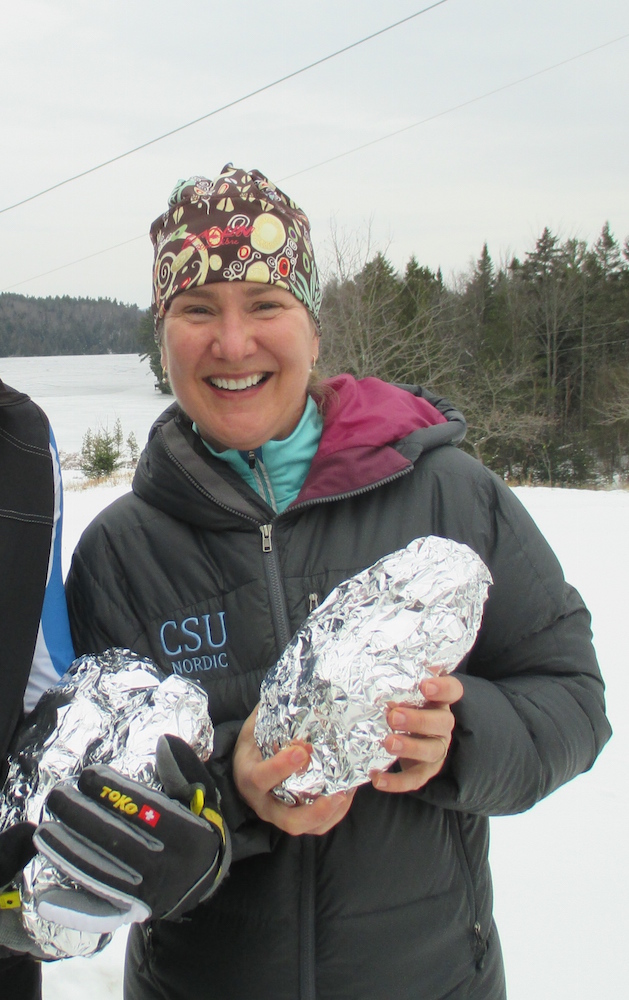
Amie Smith after “winning” a loaf of homemade bread at the 2014 Craftsbury Opener. (Courtesy photo)
AS: The last eight years I have been involved with CSU on a lot of different levels, as a parent volunteer, starting with that because it is an all-volunteer organization, and then in 2010 we created our first board: the CSU advisory board, which I have chaired since then. Also at that time, I moved from volunteer coordinator into the general manager position. So kind of helping oversee the day-to-day smooth running of the club along with Rob Bradlee, our head coach. I have also been, for the last three years, a coach for CSU. I started coaching, which I really love. So I am actually going to continue as a coach as I can, but I am giving up my general-manager volunteer position and my board-chair position although I am going to stay on as a board member. … Obviously I won’t be under the wax tent anymore. I was the wax-team leader for a couple years for CSU. So I wont be doing that because I will be running the Eastern Cups or helping the host venues with Eastern Cups.
FS: What did you see and contribute to during the rise of CSU as a program and why do you think it has become so successful?
AS: I think there are a couple of things that have contributed to that. One, the kids have a great time, the coaches have a great time, the parents have a great time. Our motto is having fun basically; it’s contagious. We have grown numbers-wise from, a handful of really active skiers — even if we had thirty on our roster, we might have only had eight kids at an Eastern Cup on a great weekend — to now this year we have 52, and the last number of years we’ve had 52 on our roster and we will consistently get 40 or more kids at each Eastern Cup race, which is crazy. I think it’s word of mouth, kids talk about it with each other … And the coaching, I think the fact that we are an all-volunteer club, I was thinking about this when we got the Club of the Year award just recently from NENSA; it’s been a really great model for us.
Here in the Boston area I think another part of our success is we have so many people to draw from since we are a large urban community. Our pool is huge. The fifty kids we have are from a very large population so you are going to end up with kind of the top skiers, and there are a lot of them. … I think part of our success is we have a large population pool to draw from, from both athletes, coaches and parents. And a lot of the parents were collegiate skiers and lifelong skiers themselves and we have our coaches the same way, you know, lifelong skiers, collegiate, and World Cup skiers. Without saying, Rob Bradlee is the glue and the base of our club and he is so passionate about CSU and about the kids — it’s great. So between Rob and our other group of fantastic coaches, I think that’s the key to our success, the people.
FS: What attracted you to the opening at NENSA?
AS: I have to say that the opportunity to work in the nordic ski community and have a job in the nordic ski community such as this is what attracted me to it. I have loved what I was doing for CSU over the years and that was in a volunteer position. I was thinking about going back to work … and I love the nordic community I’m super excited.
FS: What does the HPD job entail?
AS: A big thing I’m excited about actually is to delve into coaches’ education here in New England and really having the opportunity for our coaches to be well trained and up to date on the latest techniques and thoughts on skiing, as well as getting certified either on the NENSA level or the USSA level depending on where they want to go. Again to that, also we have the development and elite teams so I hope to be able to whenever possible hook up with them and get our competitive skiers, all our new England skiers jazzed up. Like Andy Newell showed up at an Eastern Cup last year, get that word out that, you know, Andy is going to be at this Eastern Cup and take advantage of it, or Sophie [Caldwell] is back so let’s take advantage of her being here and let people know about it, opportunities like that for the development and elite teams have a place to shine.
FS: Do you have any goals for NENSA or a long-term vision for the program?
AS: It’s still evolving. I’m still trying to get a handle on the job responsibilities and the to-do list … I would really like to not only continue with high-caliber Eastern Cup races and bringing the best New England Junior National Team to JNs each year, I mean that’s obviously a huge thing, but I really feel strongly about coach development and my hope is to work with the NENSA coaching committee to really ramp up coach education and make sure that opportunities are available to all of our coaches across New England to advance and tune up some stuff. But I’m still evolving on that one, you will have to give me a little bit of time. [There are] lots of great goals to accomplish.
FS: Is there anything else you would like to add?
AS: I’m really looking forward to this. In a way, it is a dream job, I mean you get to work in a community with people, athletes, coaches, parents, venues that you love and get to be a part of that. In a way it’s a dream job and what a great opportunity to be able to do this in New England. And I’m just really excited. I know it’s going to be hard, I know I’m going to make some mistakes … but I’m hoping by year two, OK, this all looks very familiar. You know, as you go on, it gets easier. … I think it is such a great community on so many levels to be involved with. I’m so happy my kids grew up in it, I’m so happy I’m still a part of it.
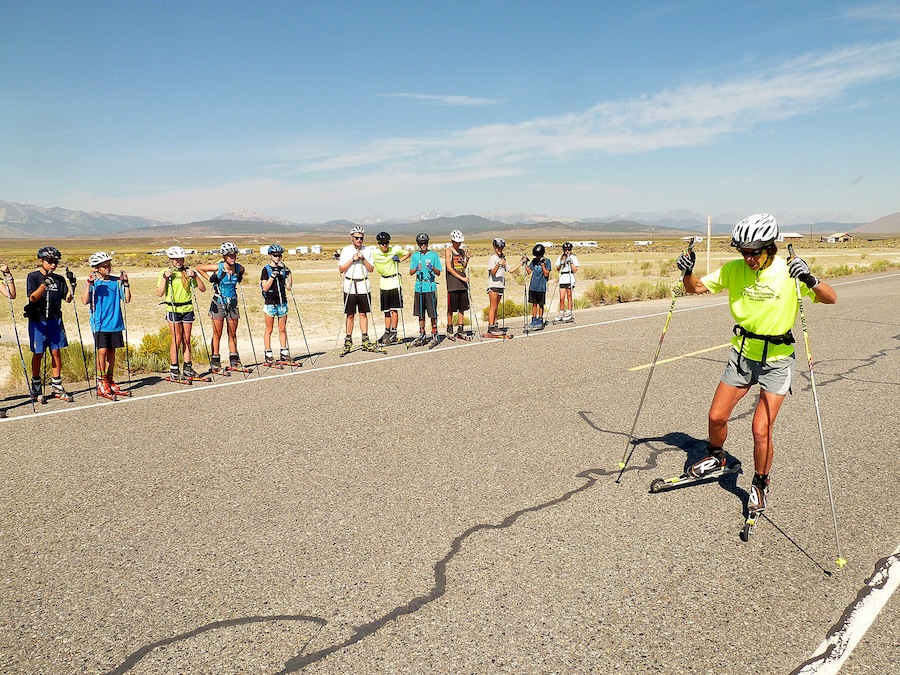
Nancy Fiddler leads rollerski skate drills during the recent Far West Nordic June Lake Camp in California. (Photo: Mark Nadell/macbethgraphics.com)
You asked, we answered! Welcome back to another installment of our Question and Answer (Q & A) series. This time around, FS contributor and former national-team member Nancy Fiddler gives some rollerski training tips. Got a question of your own? Email questions@fasterskier.com.
1. I only own skate rollerskis. For double-pole sessions, should I use classic length poles or skate? — Dan, south central Pennsylvania
This depends on what your skiing goals are. If you are training for classic skiing and racing, you will want to do double pole sessions on your classic-length poles. If you only skate, then these sessions would be most beneficial using skate poles.
You have a few options for these double-pole sessions. The first is to double pole for distance or over-distance. Using fast-rolling skate skis, it is possible to double pole some hills as well as flat terrain. Find rolling terrain, if possible, to get the most out of these sessions.
It is also possible to use your skate roller skis and classic poles to do a specific strength session. Find a sustained uphill and create a set of double pole repeats. The terrain will dictate the length of each effort. I like to mix sessions of shorter strength intervals on steeper terrain with sessions of longer intervals on more gradual terrain.
Examples of specific-strength, double-pole workouts:
8-10×30 seconds on a steep uphill with 1-minute recovery
6-8×60-90 seconds on a moderate uphill with 1-minute recovery
3-5×3 minutes on a gradual uphill with 2-minute recovery
You can also incorporate some single stick repeats into these strength sessions.
2. When I can’t get out on rollerskis, what would be the best option in the gym? I have access to a rowing machine, elliptical, stair climber, bike and treadmill.
I would choose the rowing machine and the treadmill. The rowing machine offers a full-body workout and you have some good options with the treadmill, including some uphill work.
Indoor distance sessions can be fairly tedious, even with good tunes. If you are trying to fit in over 30 minutes of distance, an option would be to mix some time doing some easy running or ski walking on the treadmill (keeping the grade fairly low) with some time on the rowing machine. You might switch modes every 15 minutes to make the workout more interesting and valuable.
Another option in the gym is to do some interval training. It is possible to get a great workout in under an hour, including a warm-up and cool-down. Again, mixing training modes can make a workout more fun.
Example:
15-minute warmup on the treadmill (run or ski walk).
Alternate 3-minute threshold intervals on the treadmill and rowing machine with 2 minutes easy in between. Go for 4-6 hard efforts.