Tag: qualification

  • Hanneman Bros. Headline National Skate Sprint: Logan Wins Qualifier, Reese Wins Final

    Hanneman Bros. Headline National Skate Sprint: Logan Wins Qualifier, Reese Wins Final

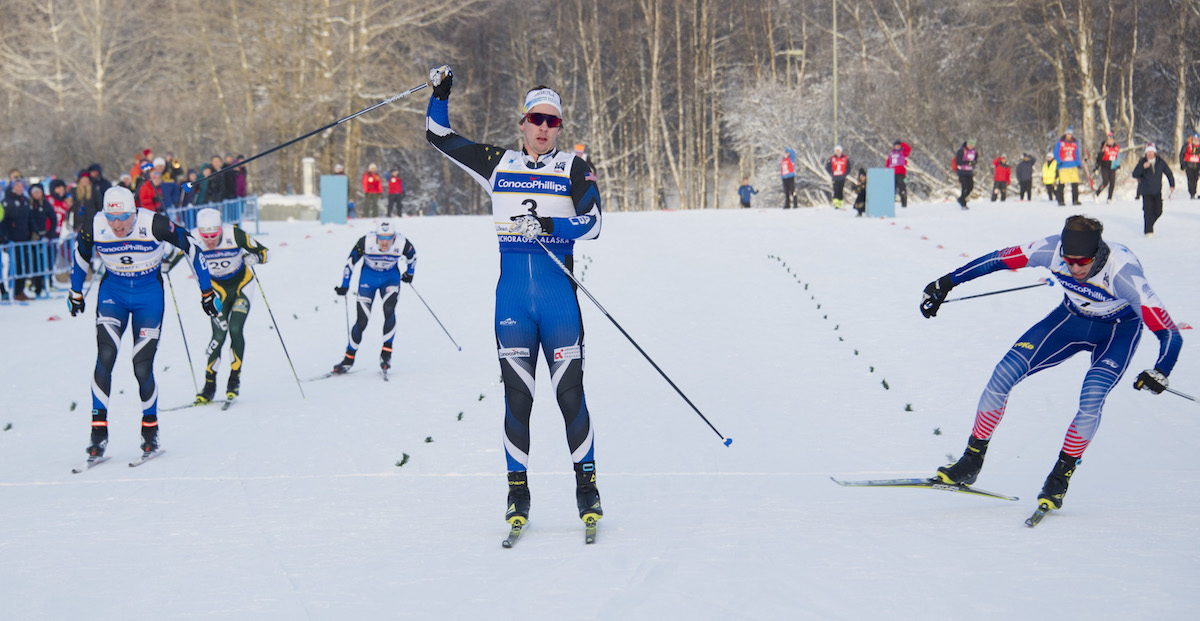
    Reese Hanneman (c) of Alaska Pacific University celebrates his win in the men’s freestyle sprint final on Friday at 2018 U.S. Cross Country Championships. He finished 0.08 seconds ahead of Kevin Bolger (r) of the Sun Valley Ski Education Foundation for the win at Kincaid Park in Anchorage, Alaska. (Photo: Michael Dinneen Photography)

    ANCHORAGE, Alaska — Friday was a good day for Team Hanneman and its friends. Younger brother Logan Hanneman won the qualifier, older brother Reese Hanneman won the final, and Alaska Pacific University (APU) put three skiers in the final and two on the podium in the men’s freestyle sprint on a bluebird day at Kincaid Park on Day 2 of racing at the 2018 U.S. Cross Country Championships.

    A long day of sprint racing got underway with the men’s qualifier at 10 a.m., precisely 10 minutes before the official sunrise. But it was already brighter then than at any point during the day on Wednesday, when a sodden snowfall blotted out most of the daylight and APU skier Rosie Frankowski openly mused about wearing a headlamp during her warmup.

    Friday, by contrast, brought light fog in the morning, burning off to reveal full sunshine during the heart of the day and bring actual warmth to the hundreds of fans lining the sprint course around Kincaid Stadium and up and down the Gong Hill. Temperatures had reached as low as 14 degrees Fahrenheit during the night before, and were never much above 19 degrees during the day Friday. The course of mostly manmade snow, with a mixture of natural snow from the roughly three inches that fell on Wednesday, was firm and fast. There was no wind. In stark contrast to the slush racers experienced on Wednesday, conditions were essentially perfect.

    Logan Hanneman Fastest in Qualifying

    Dakota Blackhorse-von Jess (Bend Endurance Academy) led out the field of 191 men with bib No. 1 for the qualifier. Less than an hour later, APU skier Logan Hanneman had proven fastest in the individual time-trial portion of the day.
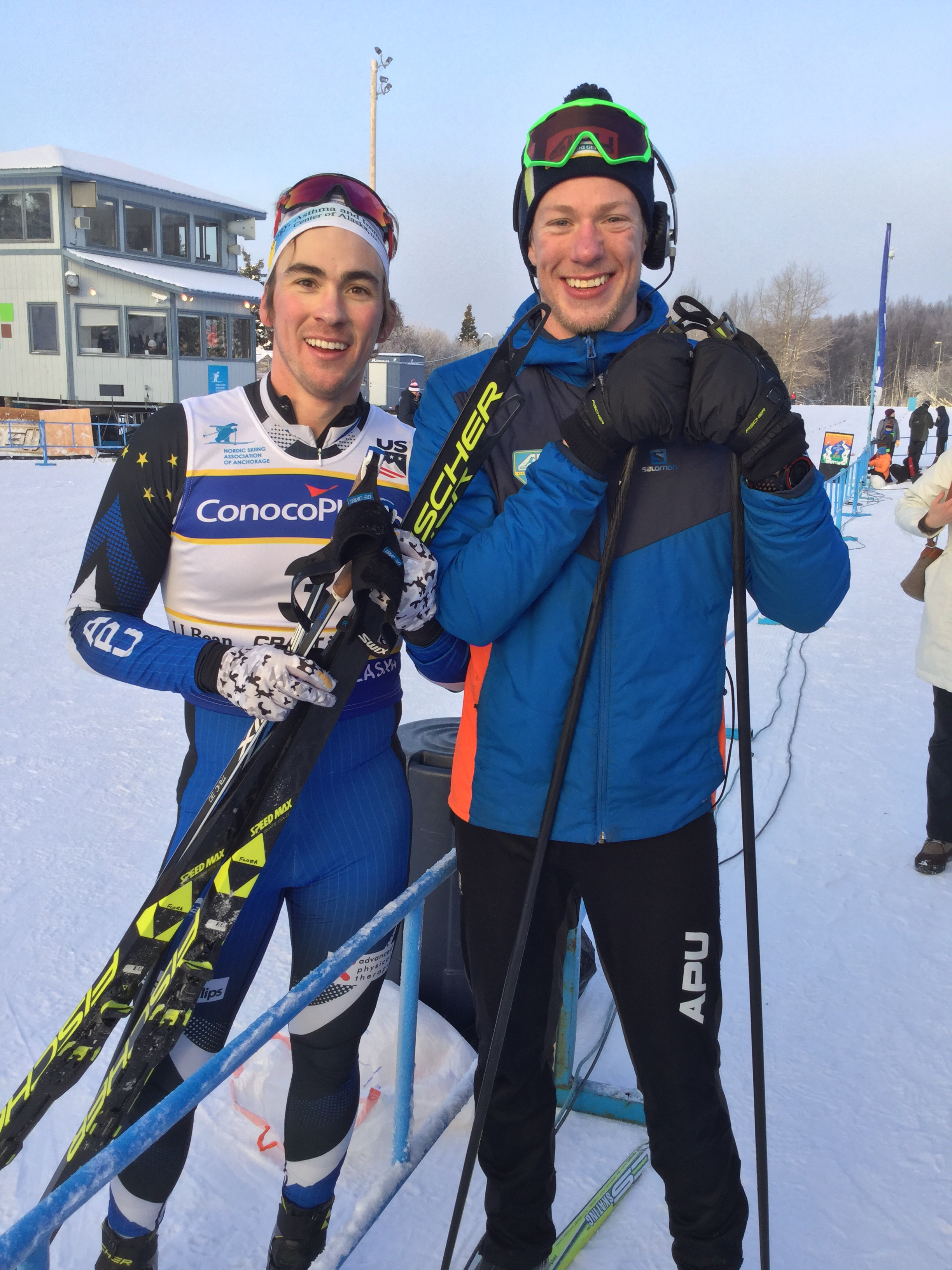
    The Hanneman brothers after Friday’s skate sprint at 2018 U.S. Cross Country Championships in Anchorage, where they live and train with Alaska Pacific University. Reese Hanneman (l) won the men’s final and younger brother Logan (r) won the men’s qualifier.

    Logan’s time on the 1.6-kilometer course was 3:07.40. The 24 year old was followed, on the imaginary but meaningful “qualifier podium,” by Kevin Bolger, of the Sun Valley Ski Education Foundation (SVSEF) in second, 0.48 seconds back, and Reese Hanneman in third, 1.13 seconds behind.

    The rest of the qualifying top 10 were Nick Michaud (Bridger Ski Foundation) in fourth, Martin Bergström (University of Utah) in fifth, Dag Frode Trollebø of the University of Denver (DU) in sixth, Cole Morgan (SVSEF) in seventh, Tyler Kornfield (APU) in eighth, Eivind Romberg Kvaale (DU) in ninth, and Gus Schumacher (Alaska Winter Stars), Wednesday’s top junior in the distance race, in 10th.

    Brian Gregg, representing Central Cross Country (CXC), Loppet Nordic Racing (LNR) and Team Gregg, took the coveted 30th and final qualifying spot, 8.82 seconds back from Logan. Nicholas Sweeney (DU) was another second-plus back in 31st.

    This laundry list of results is of more than academic interest if you are a male sprinter trying to make the U.S. Olympic team for next month’s Olympic Winter Games in PyeongChang. As FasterSkier recently explained, the points list for Olympic selection “will only consider qualification-round finish placing,” and not an athlete’s final position based on racing in the heats. Notably, while both Logan Hanneman (fifth in his semifinal) and the day’s fastest female qualifier, Anne Hart (third in her semifinal), did well, neither of them made their respective final.
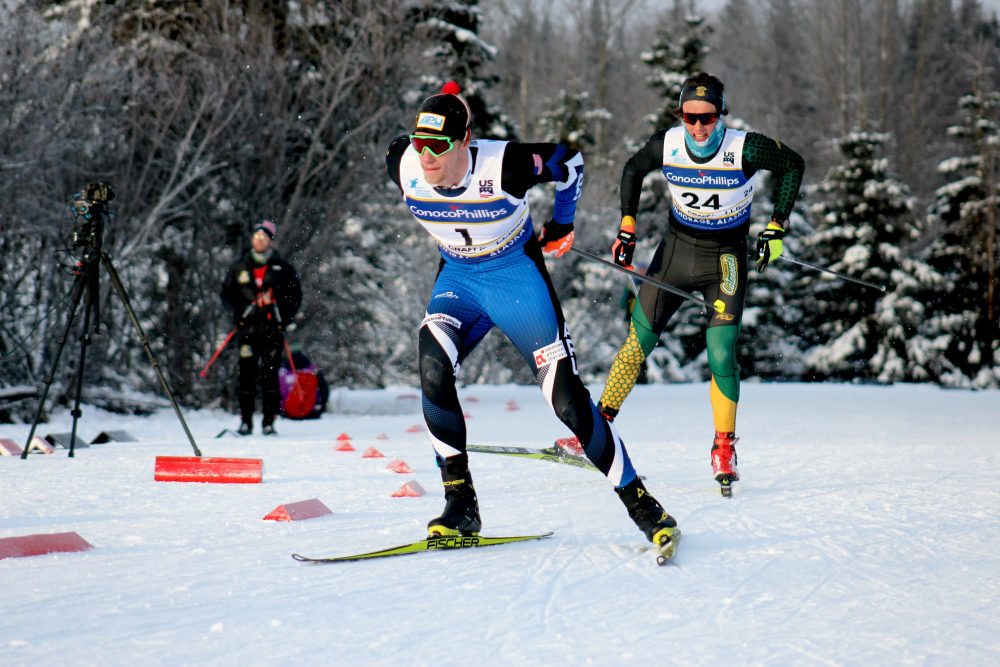
    APU’s Logan Hanneman (l) leading the University of Vermont’s Bill Harmeyer in the men’s 1.6-kilometer freestyle sprint quarterfinals on Friday at the 2018 U.S. Cross Country Championships in Anchorage, Alaska. After winning the qualifier, Hanneman was eliminated in the semifinals.

    If there was one person who had seen Logan Hanneman’s speedy qualifying time coming, it was his older brother.

    “He’s one of the best qualifiers,” Reese, 28, said of Logan before this season began. This was true on Friday even though Logan was racing with a dislocated rib, according to Kornfield.

    “So the fact that he won the qualifier is unbelievable,” Kornfield said after.

    The added significance of the qualifier result for U.S. Olympic selection purposes, coupled with the desire to still have enough energy left to ski well through three rounds of heats, was on the radar of all three eventual podium finishers.

    I would say all the top sprinting guys, everyone’s focusing kind of on the qualifier, more so than normal,”  Reese said on Friday. “There’s no margin for error, and you just have to ski it absolutely as fast as possible. It’s definitely different tactics than in the heats… but if you’re fast, you’re fast.”

    According to Bolger, who finished second in both qualifying and the final, the significance of the qualifier “absolutely” affected his approach to the day overall.

    Definitely wanted to go into the qualifier and have a strong result,” Bolger said. “I was happy with being second, just barely behind Logan, which I was bummed about but also super happy – there’s a lot weighing on it. So to be able to have a good qualifier, and then still be able to, I think, ski strong throughout the heats, and then into the final – I think that says just as much. So overall I’m really happy.”

    “All the pressure was on the qualifier,” echoed Kornfield, who finished third in the final after qualifying in eighth. “I’m normally not very good at qualifying, so the chance of me making that [No. 1 qualifying] spot would have been a moonshot, but I was happy with how I qualified. I know that if I qualify well, then my heats go well, so I was just, after qualifying well, trying to get back and focus on the heats.”

    Reese Takes First Throughout Heats

    Of the three podium finishers, Reese and Bolger had the smoother paths throughout the day. Reese was first in his quarterfinal and first in his semifinal to automatically advance to the final, winning each heat by less than 0.2 seconds. Similarly, Bolger won his quarterfinal, then was second to Reese in a fast semifinal, 0.17 seconds back.
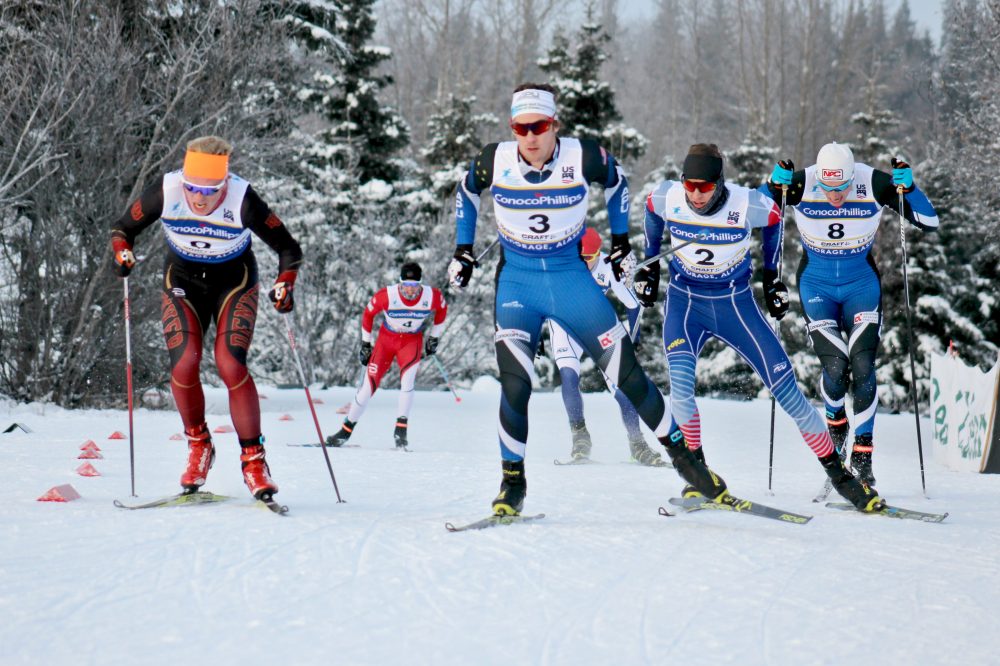
    Left to right: Eivind Romberg Kvaale (University of Denver), Nick Michaud (Bridger Ski Foundation), Reese Hanneman (APU), Kevin Bolger (SVSEF) and Tyler Kornfield (APU) during their men’s 1.6 k freestyle sprint semifinal on Friday at the 2018 U.S. Cross Country Championships in Anchorage, Alaska.

    Kornfield skied fast enough in his semifinal to earn a lucky loser bid for the final in fourth, after finishing second behind Reese in his quarterfinal. The top-four men in that second semifinal all finished within less than a second of Reese as the winner, and both lucky losers — Kvaale in third and Kornfield — came from that heat.

    Throughout the rounds, Reese skied fairly close to the front throughout the day. In his quarterfinal, the men’s fifth of the day, he was one of three skiers near the lead as the pack took a righthand turn heading up and out of the stadium. He was second coming off the course’s largest downhill back into the stadium, then turned on Beast Mode, approaching the final straightaway to pull into the lead and take the win in 3:10.62. Kornfield was second, 0.19 seconds back.

    In the semifinal, similarly, Reese skied in the top three throughout the race, ultimately leading the four-man group sprint to the line for first.

    Reese Hanneman Holds Off Bolger 

    Nearly four hours into the day, six men lined up for the final, now under bright sunshine. From skier’s right to left, it was Eric Packer (APU), Zak Ketterson (Northern Michigan University), Bolger, Reese, Kvaale, and Kornfield lined up across the south end of the capacious Kincaid Stadium.

    That’s three APU skiers with national titles to their name, last year’s classic sprint national champion in Bolger, one skier whose previous best at U.S. nationals was 15th (Kvaale), and a 20 year old whom the livestream announcers called a “surprise finalist” (Ketterson).

    The field had a clean start off the line, and into the slight-downhill straightaway through the Kincaid Stadium. After approximately 200 meters, the racers took a righthand turn up to the base of a gradual, all-V2, two-stage uphill. At this point it was Ketterson in the lead, with Kvaale and Reese tucked in immediately behind him, and the other three athletes following no more than a ski length further back.

    By the top of this climb, it was still Ketterson in front, with Reese following and Packer up into third position.

    Roughly one minute later, it was Ketterson in front coming down the waterfall downhill back into the stadium at high speeds. There was a gap of five meters back to Kornfield and Reese, who jostled slightly on the descent but did not fall, and Bolger and Packer immediately behind them. Ketterson was technically still in front, but five meters’ separation at those speeds meant little, and the lead pack was effectively still five athletes strong.

    By the time the racers had negotiated a broad 180-degree turn and climbed back up into the stadium, Hanneman was in the lead coming around the final curve. Bolger was second, with Ketterson and Kornfield just off to his left.
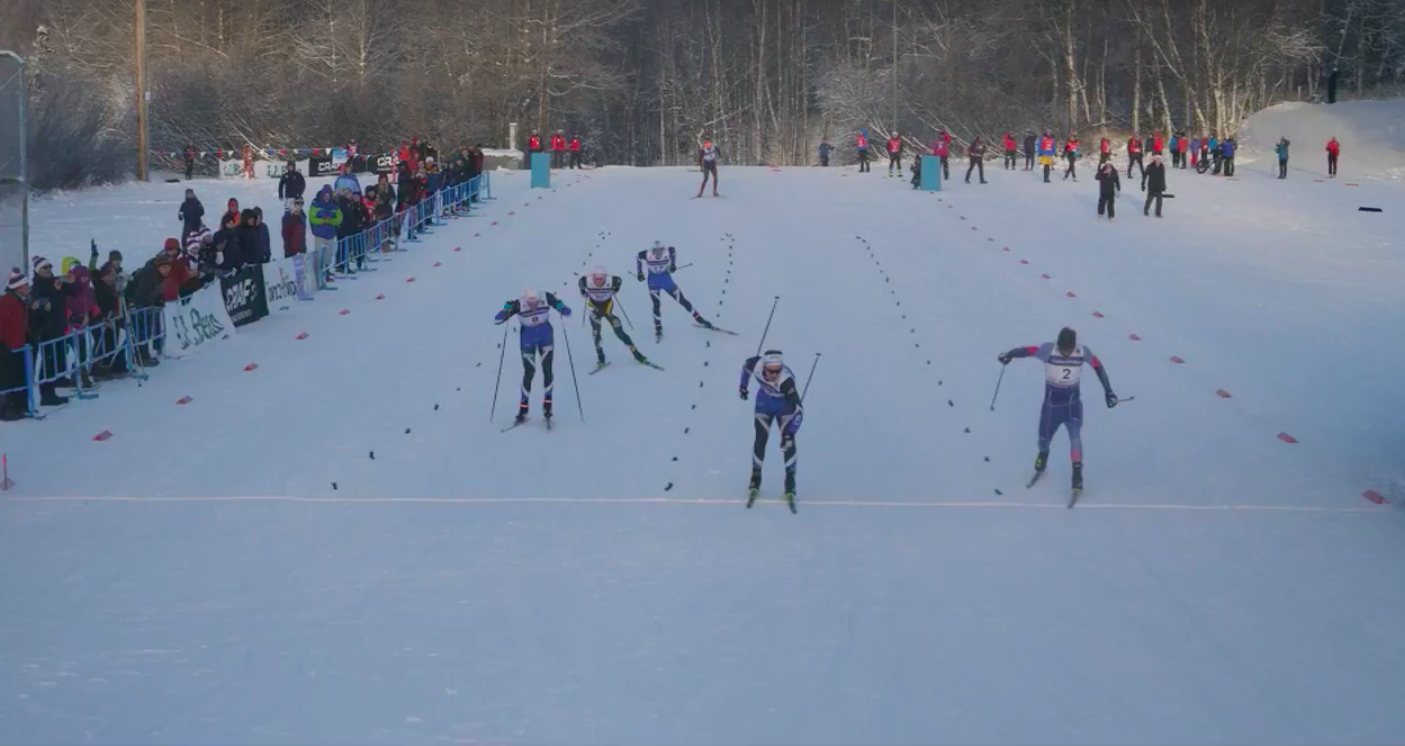
    Reese Hanneman (c) takes first, roughly half a ski length ahead of Kevin Bolger (r), with Tyler Kornfield (l) third. Zak Ketterson (second from l) and Eric Packer (third from l) are immediately behind Kornfield, with Eivind Romberg Kvaale farther back. (Screenshot: U.S. Ski & Snowboard live stream)

    Hanneman came into the final straightaway with a slight lead, and took the middle lane. He skied smoothly through the finish, but Bolger was coming on strong to his left in the outer lane.

    Reese kept his slight lead all the way to the finish. Bolger lunged better, but Reese skied faster. Bolger’s lunge got him to within less than half a ski-length of Reese by the finish, but Reese took the victory.

    To Reese’s right, Kornfield led Ketterson and Packer in the next lane to the inside. Kvaale skied in leisurely at the back after suffering an untimely broken pole.

    Reese’s winning time was 3:11.33 for the 1.6 k course. Bolger was 0.08 seconds back, with Kornfield another 0.8 seconds behind him for third. There was a gap of over a second to Ketterson and Packer, then another 12 seconds back to Kvaale.

    Reese aimed to continue his frontrunning ways in the final, he explained to FasterSkier in a post-race interview.

    “Everyone’s fighting for the front half because you know that’s kind of where you’ve got to be,” he said. “Everyone’s too fast; you know you’re not going to come from sixth. So I just fought really hard to stay kind of in the front half, throw down the move on the last hill coming into the finish, and it paid off.”
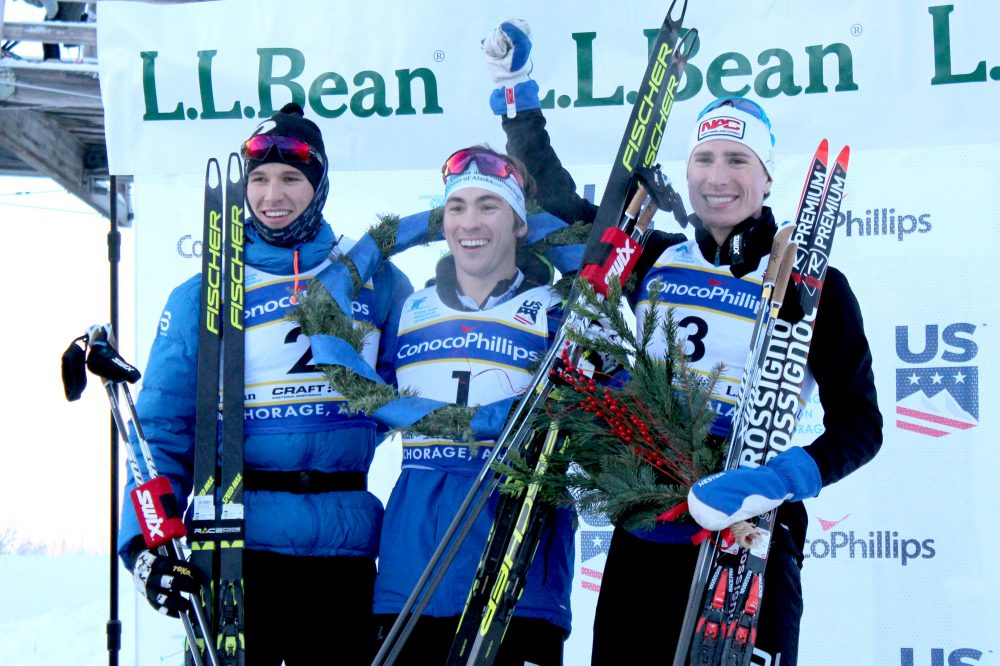
    The men’s freestyle sprint podium at 2018 U.S. Cross Country Championships, with Reese Hanneman (c) in first, Kevin Bolger (l) in second and Tyler Kornfield (r) in third on Friday in Anchorage, Alaska.The men’s freestyle sprint podium at 2018 U.S. Cross Country Championships, with Reese Hanneman (c) in first, Kevin Bolger (l) in second and Tyler Kornfield (r) in third on Friday in Anchorage, Alaska.

    Reese said he was thrilled by a day in which he won the national title — his third — and Logan won the qualifier.

    “He’s one of the best in the country,” Reese said of Logan, “and he and I have been going back and forth in the sprints for a while now. He’s the defending champion in this event from last season, so I knew he was a factor. He’s a powerful skier, and it’s awesome to see him do well. I think we’re both better because we’ve been fighting with each other for years.”

    Bolger explained he approached the final differently than his other heats.

    “Honestly, I just tried to stay relaxed,” the 24-year-old Wisconsin native said. “I tried to kind of keep an open mind and not put too much into it, overthink it. … I wanted to ski kind of my own race and let things unfold in front of me, and then take chances where I could.”

    In practice, this put Bolger in fourth coming off the big downhill back into the stadium. But he trusted his skis, and his finishing skills, and was able to move back into second within just a few hundred meters.

    “I kind of got, not pushed to the back a little bit, but kind of toward the back,” he recounted. “But coming toward those last few corners I was right in there. And I was confident in my skiing and I knew I was strong, I felt strong, so I was kind of able to push those corners hard.”

    Kornfield, similarly, said, “This is a hard course, so you just had to keep pushing to the finish.”

    “The way the course starts, it doesn’t start too hard, it’s pretty flat for the first part. And the uphill is so big that – for some reason you can’t break away on that,” Kornfield added of Kincaid’s brand-new sprint course. “You couldn’t gain that much time; I think people were just conserving until that last 200 meters. It always bunched up with about 200 meters to go, and it was only about who had the best kick and who got lucky with the hole shot. If you tried to get yourself in good position by the final, you would have a good go at the finish.”

    Reflecting on the vagaries of sprint racing, he noted, “This is an incredibly fair course. It’s incredibly wide, and it was a lot of fun, but we don’t race those kind of back-and-forth heats that often. So I was just pretty relieved to make the podium, because anything could have happened. You could have snapped a pole easily, you could have fallen. It was kind of a relief just to make it to the final in the first place, and then to make it on the podium was unbelievable.”

    Kornfield, 26, who was born and raised in Anchorage and has raced at Kincaid Park dozens of times, summoned the same adjective when asked if he had ever seen a crowd like this at Kincaid for a ski race before.

    “This is unbelievable,” Kornfield said. “I remember back [at U.S. nationals at Kincaid] in 2010, and I felt like it was just a wave of noise coming in. This is even more. It’s incredible that people were here and out here. I’m so excited that Reese and I could make the podium and make ’em proud.”

    (A sportswriter for the local Anchorage Daily News with 30 years’ experience called it “One of the biggest spectator crowds ever to gather at Kincaid Park.”)

    Kornfield likely has fond memories of 2010 for many reasons; he won his first national title then. Friday’s third-place finish marked his seventh time on a U.S. nationals podium, including two national titles. Reese, similarly, took home his third national title (after the 2014 classic sprint at Soldier Hollow in Utah and 2016 skate sprint in Houghton, Michigan), and recorded his eighth national podium. And Bolger notched his second-career podium finish at U.S. nationals, after winning the classic sprint at Soldier Hollow last year.

    New Sprint Course Meets with Rave Reviews

    As FasterSkier recently explained, Friday marked the debut of the new sprint course at Kincaid. And the athletes approved.

    “It was a great course,” Reese said. “Really hard – I would say probably the hardest sprint course we’ve had at nationals in a while. It rivals Fairbanks last year. But there’s a big hill, something you would see on a World Cup, or [World] Championships, so that made it hard. Super-fast downhills. … I think it’s one of the best courses we’ve had in a while. There’s some gradual terrain, there’s a hill, an A-climb, one of the biggest climbs I’ve seen on a sprint course in the U.S., probably ever. I think it’s a great course. It’s fair, everybody likes it, it’s fun. But it skis really well, it’s fast. You can’t get too much better than that.”

    “It’s a good course,” concurred Bolger. “It’s really fun. Good hills, good downhills, good cornering. I think it kind of gets at, you’ve kind of got to be a good all-around skier to kind of be able to go from the qualifier to the final.”

    “This is an incredibly fair course, it’s incredibly wide, and it was a lot of fun,” said Kornfield.

    Athletes will get another shot at it on the final race day of U.S. nationals, the classic sprint on Monday. Classic distance races (20/30 k mass starts) are the next races up, starting at 10 a.m. Sunday morning.

    Results: Final | HeatsQualifier

    –Gabby Naranja contributed

    Reese Hanneman video interview

    Highlights video by Max Romey Productions

  • Ask A Sports Psychologist: Making The Bigtime

    Ask A Sports Psychologist: Making The Bigtime

    Qualification for big races can take more than perfect physical preparation – it takes a mental edge, too. Whether it’s the Olympics, World Junior Championships, or making your region’s squad for junior nationals, many athletes face the pressure of having to perform when it counts, and coming into races with the wrong mindset can be a big detriment.

    We talked to Dartmouth College sports psychologist Dr. Mark Hiatt about what it takes to get your head in the game. For more background on Dr. Hiatt and sports psychology in general, as well as an introduction to some of the concepts and tools he advocates, check out our segment from last week, when we talked to him about team and interpersonal dynamics. As always, if his suggestions spark your interest, seek out a sports psychologist to work one-on-one through your own situation. Many universities offer appointments for students and sometimes also the public. The Association for Applied Sport Psychology also has a “find a consultant” online tool.

    As in that piece, the FasterSkier staff brainstormed some situations that skiers might find themselves in, and asked Dr. Hiatt to weigh in. Here’s what we came up with.

    Scenario 1: It’s trials time, for Olympics or maybe World Junior Championships. An athlete has a very outside chance of making it based on last year’s results, but thinks that he has improved a lot and has a shot. However, every time he thinks about it he gets a little hopped up because he has to have his best race ever. He’s afraid he will try to hard in the beginning of the race and blow it. What’s a good strategy to manage the pressure?

    Mark Hiatt: “I would recommend starting with relaxation/breathing techniques. Sometimes this is referred to as ‘energy management’ in the Sport Psychology literature. Athletes can also use visualization strategies to see themselves performing at a pace that is optimal for the race. It may be useful to incorporate cognitive strategies to manage any negative thoughts. These can include strategies to recognize negative thinking, dismiss the negative thoughts, or counter and challenge them.”

    Highlights: Visualization can be extremely helpful, but it also holds a danger: if you picture yourself racing perfectly, and things don’t get off to such a great start, you might lose a lot of confidence. Dr. Patrick Cohn of Peak Performance sports has a podcast you can listen to about what might be the most productive way to use visualization. The magazine Psychology Today offers a run-down of relaxation and breathing techniques; one is progressive muscle relaxation, a routine that is more of a long-term strategy to learn how to get, and stay, relaxed. You can find a script for progressive muscle relaxation here.

    Scenario 2: Two races into a four-race trials series, an athlete is ranked solidly within the team picked for these races. He still has to have one more good race to clinch his spot, but his success so far is making him relax – maybe too much. How does he stay focused through the whole trials series?

    Mark Hiatt: “The athlete may want to review his/her personal goals for the season to reinforce why the particular race is important. One question may be to see if there are ways to make the goals more challenging or interesting to the athlete (e.g., targeting a particular time). Again, we could work on visualization exercises and cognitive strategies to reinforce competitive thinking. Mindfulness breathing strategies have been found to be helpful for some athletes in improving attention and focus. Mindfulness breathing exercises train athletes to pay close attention to breathing while trying to let go of distractions such as thoughts, feelings, and physical sensations.”

    Scenario 3: A skier is widely expected to qualify for the Olympics, but still must go through the actual trials process. She has been building up for this since the last Olympics, where she just missed qualifying, and has attracted a lot of support from family, friends, even local businesses. It’s a little bit overwhelming to think how many people have bought into this dream and put their money on the line. She feels like if she doesn’t qualify, she’ll be letting them down, but she knows that these thoughts are not productive for racing. How does she put them out of her mind or turn them into something positive?

    Mark Hiatt: “It might be useful to spend some time exploring these thoughts and feelings with the athlete, as it sounds like she is putting a lot of pressure on herself to perform. I think that cognitive strategies, such as observing/dismissing negative thoughts, challenging them, or affirming more productive/competitive thoughts could be helpful for her. Having negative thoughts before, during, and after competition is normal and happens to all athletes (as well as everyone). There are a few options for managing negative/unproductive thoughts. In general, the first step is to distinguish between what is healthy and productive competitive thinking versus unproductive thinking for an athlete. I often have athletes think back to their top performances and go through them to help identify what all the thoughts and emotions were that contributed to that great performance.

    “Once there is a better sense of what the productive versus unproductive thoughts area, we can practice skills to dismiss the unproductive thoughts and focus on the more productive ones that we want for competition. One example is using mindfulness meditation based skills to dismiss negative thinking. Good competitive thinking may be more general or focused on a specific skill. Ideally we might have a combination of them to use at different times, general thoughts before the competition and skill-bases specific thoughts (e.g., “push off strong”) during competition.”

    Scenario 4: Congrats – you were picked for these big races in Europe that have been your goal for years! Several weeks into the trip, though, is your birthday. All of a sudden you realize how much you really miss your family. You just can’t focus because you’re imagining how comforting it would be to be at home celebrating together, but right now your only support on the road comes from teammates and coaches. How can you overcome this?

    Mark Hiatt: “I think the first step is to acknowledge these feelings and not try to fight them. These feelings are normal and natural to have in this type of situation and for many people the more you try to fight them the worse it gets. So I think the first step is accepting acknowledging these feelings and accepting them openly. It’s not something to overcome as much as it is to help athletes figure out how they want to act with them. On a practical level, I might ask if there are there some possible solutions in terms of reaching out and touching base with the athlete’s family? Is this something that would help the athlete? Are there ways for the athlete to communicate with coaches and teammates about how he or she is feeling? Again, I might revisit goals for competition and training and work on cognitive strategies, visualization, and relaxation techniques to help prepare for competition.”
  • Eleven U.S. Biathletes Picked for Pre-World Cup Camp in Sweden, Key in Olympic Qualifying

    Eleven U.S. Biathletes Picked for Pre-World Cup Camp in Sweden, Key in Olympic Qualifying

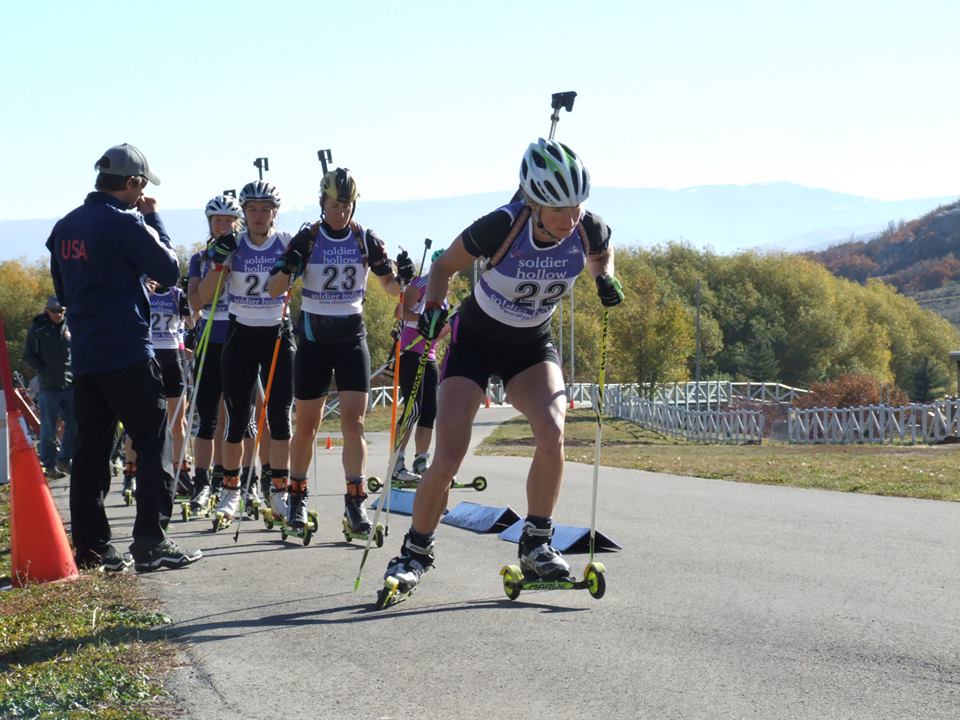
    Hannah Dreissigacker leaves the start in Tuesday's sprint at Soldier Hollow while Lanny Barnes and Sara Studebaker wait on deck. Photo: Gordon Vermeer.
    Hannah Dreissigacker leaves the start in Tuesday’s sprint at Soldier Hollow while Lanny Barnes and Sara Studebaker wait on deck. Photo: Gordon Vermeer.

    After four rollerski races’ worth of battling, eleven biathletes have been selected to attend U.S. Biathlon’s fall training camp in Östersund, Sweden, to prepare for the World Cup season. The camp is also an important step in the Olympic qualification pipeline, as early-season World Cup results are one way to snag a trip to Sochi.

    Six athletes – 2013 World Championships silver medalist Tim Burke, plus teammates Lowell Bailey, Leif Nordgen, Susan Dunklee, Annelies Cook, and Sara Studebaker – were prequalified for the Sweden camp. Hannah Dreissigacker and Jeremy Teela, both also members of the national team, were the trials winners after competing in Jericho, Vermont, this summer and then Soldier Hollow, Utah, last week.

    Lanny Barnes, an Olympian who underwent compartment syndrome surgery at the end of the 2013 season, was added as a discretionary pick. The Durango-based athlete who trains with her sister under the team name Twin Biathletes was the next-ranked woman in the trials standings.

    On the men’s side, national team veteran Jay Hakkinen earned a discretionary nod, with USBA High Performance Director Bernd Eisenbichler noting that the Alaskan was highly ranked in the trials and “actually beat Jeremy in three races.”

    Sean Doherty, the 18-year-old who won three medals including one gold at World Youth Championships last season, also got the nod as a discretionary pick. The New Hampshire native trains with Algis Shalna in Jericho, Vermont.

    How to Qualify: It’s Complicated

    These eleven athletes aren’t necessarily the ones headed to Sochi, but booking a ticket to Europe certainly gives them an advantage in a multi-step process which provides several ways to qualify.

    Importantly, the team’s top three racers – Burke, Bailey, and Dunklee – are already pre-qualified based on results from the last season of World Cup racing. They met criteria such as a top 30 ranking in the Total Score or two top-15 finishes in World Cup and World Championships racing.

    The U.S. has spots for five men and five women, although the team can only start four athletes in each competition. It’s unclear whether they will bring the full roster of five or not.

    The next way the U.S. will try to fill its team is based on the first period of World Cup racing. After the openers in  Östersund kick off on November 24, the IBU World Cup will move to Hochfilzen, Austria, and then to Annency, France. Rosters for those races will be determined by performance at the pre-race training camp, while athletes not picked for the World Cup will be sent to the second-tier IBU Cup circuit, with the opportunity to move back and forth based on current performance.

    In these early World Cups, a top-30 finish is good enough to be added to the Olympic team. Up to three men and three women can be selected to the team by the end of December, counting Burke, Bailey, and Dunklee – so one more man and two women can qualify this way. If more athletes have top-30’s, the ones with the best results will be picked. Conversely, if no athletes in a given gender reach the top-30, the athlete with the single best result will be added anyway.

    Of the athletes who will go to Sweden and haven’t pre-qaulified for Sochi, Nordgren, Cook, and Studebaker all had top-30 finishes last season.

    For the remaining spot or spots on the Sochi roster, athletes will have one last chance to fight their way onto the team in January. Importantly, it’s also possible for athletes who did not make it to the Sweden camp to step in on this part of the process: trials races held in December will select a few more racers to join the IBU Cup circuit, where they will join any non-qualified athletes from the fall World Cup and IBU Cup squads.

    In this final step, Americans will compete in Ridnaun, Italy, or Altenburg, Germany, and also potentially in time trials. The best athletes will be selected using a percent-back ranking from three of four races and time trials. USBA also allows one discretionary pick per gender for the Olympic team.

    Performance Notes: Women’s Team Looking Strong

    Eisenbichler said that he was very happy with the level of performance by his women’s team, and also that it was relatively easy to identify Dreissigacker and Barnes as the two women who should be added to the roster for Sweden. Dreissigacker won the sprint in Jericho this summer as well as the final sprint in Soldier Hollow; Barnes was second in the last Soldier Hollow sprint. Her sister Tracy had better performances in Jericho, but did not compete in Soldier Hollow.

    More importantly, Dreissigacker and Barnes turned their performances up a notch in the last competition, going 1-2 while both shooting clean. Barnes is a veteran and traditionally one of the best shooters on the circuit; Dreissigacker is a relative newcomer to the sport after coming in as a skier.

    “That was really important to see, that even with a fair amount of pressure in that last race they shot clean,” Eisenbichler said in an interview on Saturday. “This is the first time for Hannah.”

    Eisenbichler was also pleased with his pre-qualified athletes. Dunklee cleaned in a sprint win on Tuesday, where Cook was second and Studebaker third. Cook didn’t compete in the final race; she tweaked a nerve in her neck, and since she didn’t have to qualify through the races, Eisenbichler said it was “safer not to take any chances.” The problem has since been fixed and she is back to training.

    He called Studebaker’s two third-place finishes in Soldier Hollow “solid” and was gratified to see that the women’s team had improved considerably since Jericho.

    “Opposite of Jericho, the women really were shooting very well,” he told FasterSkier. “I don’t want to seem overoptimistic, but I’m really happy with where the team is right now.”

    Men Knocking at the Door

    Eisenbichler was also enthusiastic about the performances from Bailey, who has swept all four of the trials races, and from Burke and Nordgren, who were often close behind.

    “I think that once these three guys get to the World Cup, they will be able to be having some really good results right away,” he explained.

    After that, though, the committee’s job was considerably harder in making discretionary selections for the Sweden trip. Teela was the trials winner based almost entirely on a single exceptional performance where he cleaned his targets to place third in the first Soldier Hollow sprint.

    Hakkinen and Doherty were fourth and fifth in the final sprint, behind the three pre-qualified men. Hakkinen was consistent throughout the four trials races, but these strong performances late in the game and under pressure certainly helped the pair earn their discretionary nods.

    National team member Russell Currier and National Guard biathlete Wynn Roberts also had top-six finishes in Soldier Hollow; both also raced well in Jericho, where Currier was second in the sprint and Roberts seventh, but the fifth American. They found themselves just on the outside when the final rankings were tallied.

    “There were a lot of guys in the mix for that fourth spot on the trip, like five or six of them,” Eisenbichler said. “Even the ones that didn’t make it, I think will have good performances if they go to the IBU Cup in January. It’s going to be very competitive.”

    Doherty’s selection was probably the most surprising. He did not compete in Jericho due to illness, but had a stellar final sprint in Soldier Hollow.

    “Sean’s preparation this year has been great,” Eisenbichler said. “Compared to his progression in October last year, he has made huge improvements. We really thought that sending him to Sweden will be the best thing for his development as a biathlete.”

    Link to Trials reports and results:

    Soldier Hollow

    Jericho: menwomen

  • Photo Gallery: World Championships Freestyle Qualification

    Photo Gallery: World Championships Freestyle Qualification

    Romanian skier Viorel Andrei Palici takes over the leader's chair from Pavel Andreiv (Kyrgyzstan).
    Romanian skier Viorel Andrei Palici (l) takes over the leader’s chair from Pavel Andreiv (Kyrgyzstan) in the men’s 10 k qualifying race on Wednesday at World Championships. Palici won the event and was the first of ten men to move on to the distance medal races in Val di Fiemme.

    FasterSkier’s coverage of the 2013 FIS Nordic World Ski Championships in Val di Fiemme, Italy, is brought to you by the generous support of Fischer Sports.


    VAL DI FIEMME, Italy — The first race of the 2013 Nordic Ski World Championships was a 5 and 10 k individual freestyle on Wednesday that qualified the top ten men and women for distance races for the rest of the championships. Late-starting Romanian skier Viorel Andrei Palici posted the fastest time on the two-lap course to win the men’s race by 24 seconds over Pavel Andreiv (Kyrgyzstan).

    In the women’s 5 k Lithuania went one-two; Diana Rasimoviciute bested teammate Natalija Kocergina by 20 seconds. Great Britain’s Rosamund Musgrave took third.

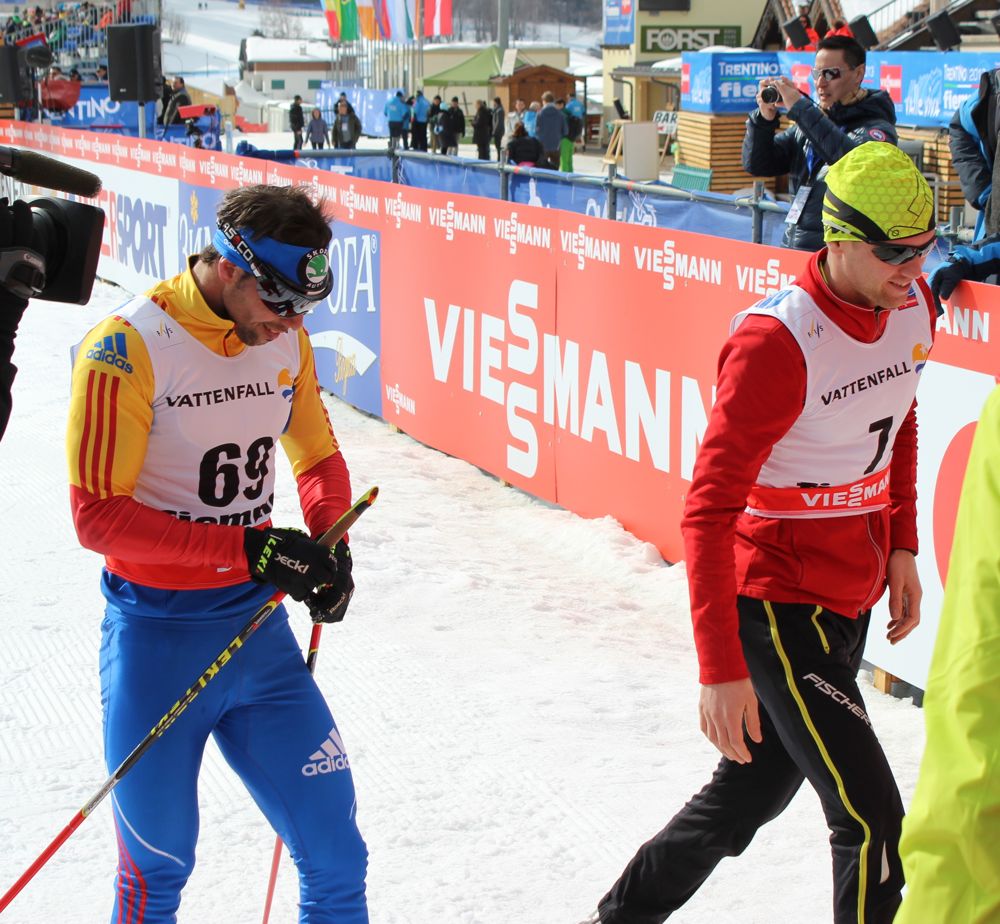
    You won’t be reading most of these names or nations on results for the rest of the next two weeks, but athletes in the qualifying races were the embodiment of sportsmanship and nordic camaraderie as they congratulated each other on races well-fought. Below are photos of the men’s event from the finish area.

    Men’s 10 k results

    Women’s 5 k results