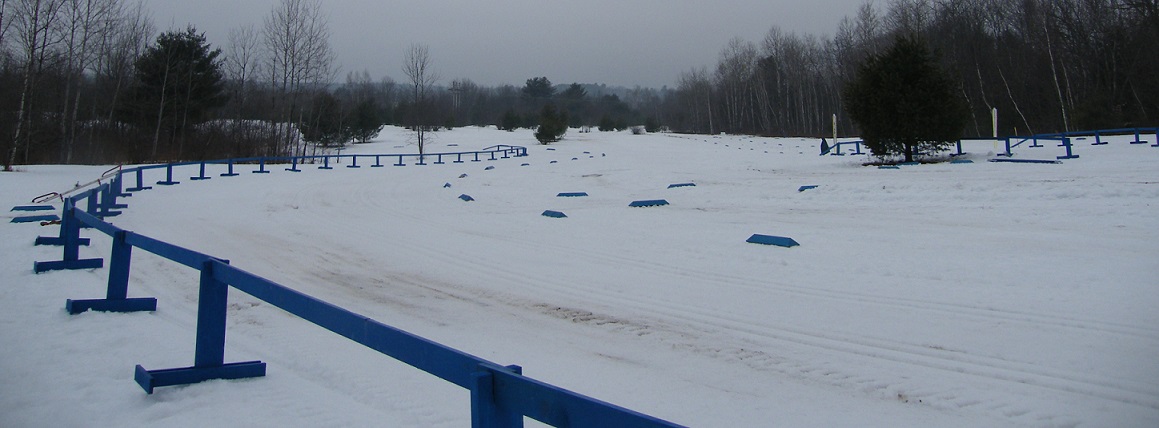
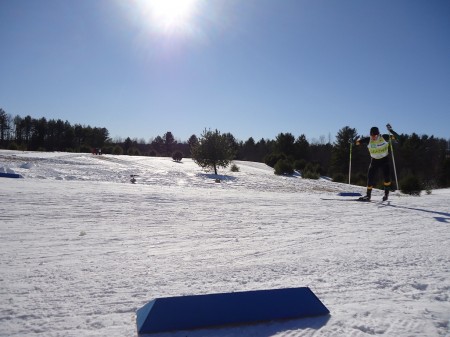
Warm temps and rain forced some alterations at the Quarry Road ski trails. This view of the makeshift stadium gives a glimpse of ski conditions
The Farmer’s Almanac predicted a bitter-cold winter for the 2013/2014 ski season. Whether or not you believe in the popular book’s fables and speculation, the forecast hadn’t been far off for much of the New England winter thus far.
All trails were open and freshly groomed a week and a half before the Colby Carnival, the opening event of the EISA Collegiate Nordic season. The Quarry Road Recreation Area in Waterville, Maine was looking to be in prime shape. After opening the previous Carnival season in Lake Placid on shovel-assisted trails and trucked-in snow, many EISA skiers were looking forward to getting the 2013/14 season off to a more wintry start.
Unfortunately, warm weather and rain began to spell trouble for Colby’s ski area with just over a week until the first race. With overnight temperatures too high for snowmaking, organizers waited and watched as the course gradually deteriorated. The most severe damage occurred in the stadium area, which ultimately led to a change of format: Saturday’s mass start freestyle races would need to be shortened and changed to the individual-start format.
Despite the disruptive weather, the trails at Quarry Road were surprisingly resilient. With some impressive planning and grooming, the races were held on a 2.5 kilometer loop that incorporated much of the original 5k homologated race course, including a long “A” climb and a tricky s-turn descent. Friday’s 5 and 10 kilometer classic races would be run as planned.
FRIDAY: 5/10k Classic
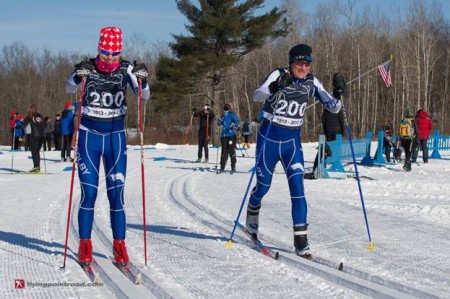
In weather and snow conditions more reminiscent of late-March spring skiing than January race season, rain and softening tracks made for a classic New England day of interesting klister and wax combinations. Intermittent burst of rain kept technicians and racers on their toes throughout the day, and the emergence of the sun near the end of the men’s race changed the course further.
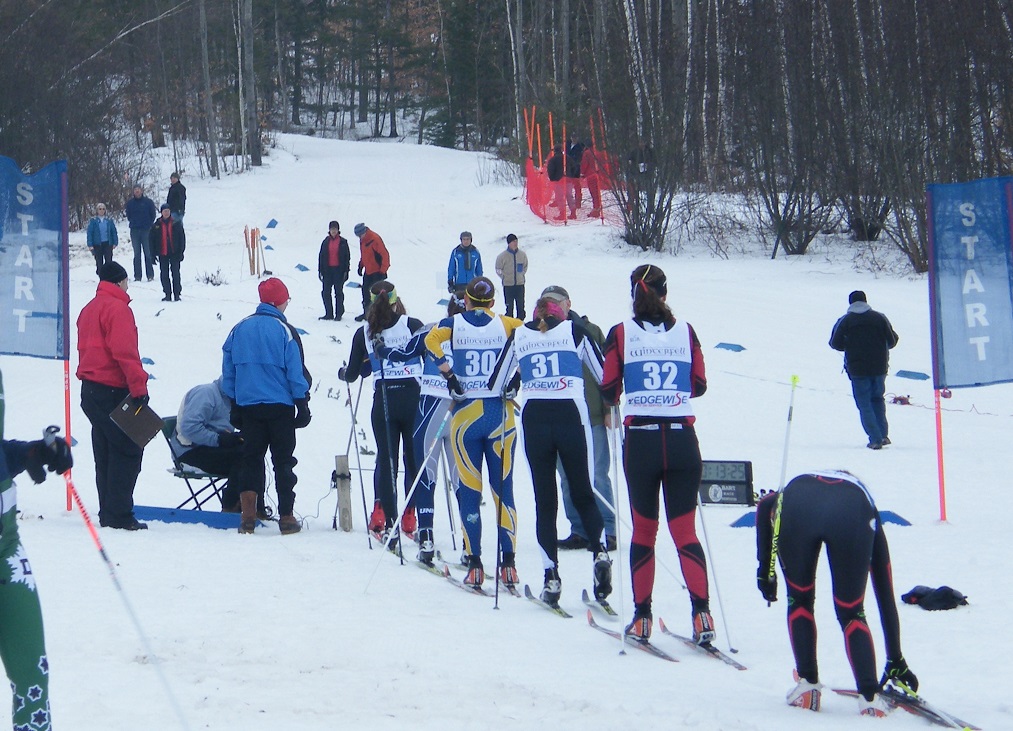
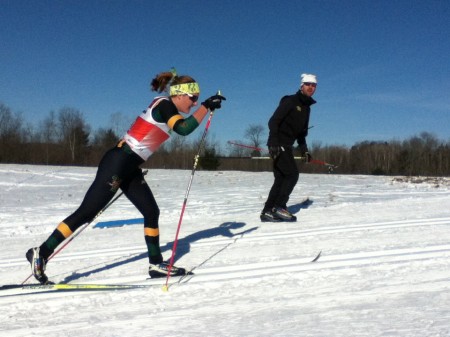
The EISA season gets underway for the women in Friday’s 5k classic
In the women’s race, Anja Gruber provided some consistency among the madness of the previous week’s weather changes and course alterations. The UVM skier, and 2013 NCAA Champion in this same event, picked up where she left off on Friday. Gruber took first place, nearly 20 seconds ahead of Dartmouth’s Annie Hart. Gruber’s teammate, UVM’s Stephanie Kirk, finished in third place.
The UVM women eked out a narrow 2-point victory in the team score over the Big Green. Thanks to some impressive skiing by newcomers Amy Bianco (7th) and Olivia Amber (11th), as well as veteran Lizzie Anderson (14th), the Colby women notched third place in the team score at their home carnival.
Conditions were softer and the corners a bit icier for the men’s race, though that clearly didn’t slow down Dartmouth’s Silas Talbot. Talbot finished over 34 seconds ahead of his nearest competitor, Middlebury’s Ben Lustgarten. Racing as a guest, Maine Winter Sports Center’s Welly Ramsey finished in third overall, though points for third in the collegiate race were awarded to Dartmouth’s David Sinclair.
Talbot and Sinclair, along with Jan Ketterson (11th), were able to put Dartmouth ahead of UVM in the team score, while UNH finished third.
SATURDAY: 10/15k Freestyle
Though colder temps moved in overnight, the effects of Friday’s races were evident on the course during Saturday’s skate event. During the classic races, 188 competitors raced a total of 558 laps of the 2.5k course. Corners were icy, with some patches of slick trail hidden by a faint layer of sugary snow. Volunteers and race organizers shoveled as best they could to keep conditions safe and fair for all competitors.
Women raced a total of four laps, and UVM’s Linda Dandvind-Malm gave the Catamounts another individual victory. Despite slowing down a bit with the third-fastest split on her last lap, Dandvind-Malm held on to win the race ahead of Dartmouth’s Annie Hart, who took home her second runner-up placing of the weekend. Friday’s winner, Anja Gruber, raced the fastest final lap to nab the last spot on the podium and help the Catamount women to their second team title in as many days.
The men’s race, at 6 laps total, meant there was often larger groups of skiers racing together in packs. As early seeds raced their middle laps, later seeds began their races, leading to a somewhat crowded course during the middle of the event.
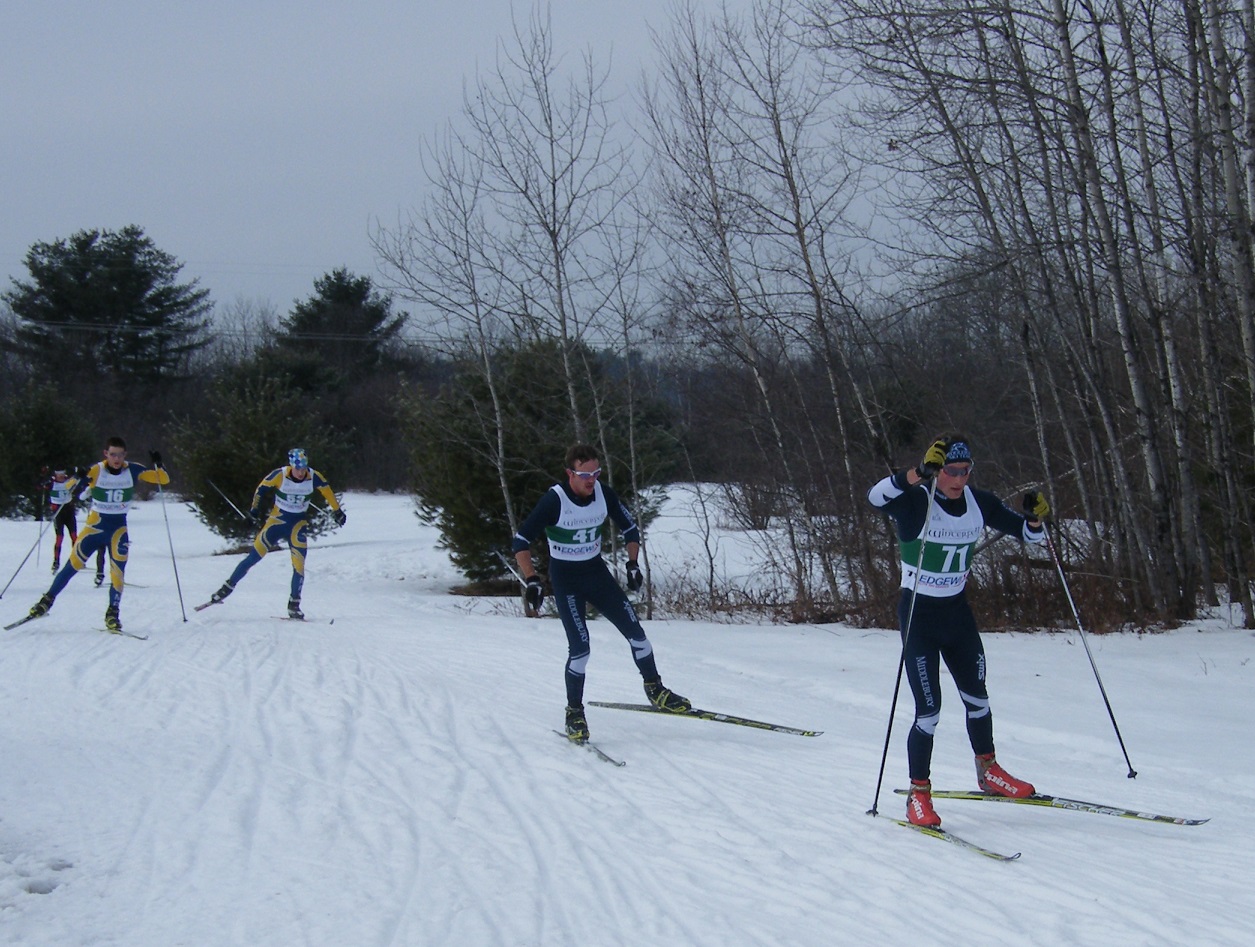
Multiple laps means multiple packs: Middlebury teammates Ben Lustgarten (71) and Patrick McElravey (41) ski together. UMPI teammates Zach Veayo (16) and Andrew Nesbitt (53) follow
Last season, UVM’s Scott Patterson made a show of every distance skate race, putting massive gaps on the field and skiing away solo for the win. The multiple laps and short course at Quarry Road didn’t allow Patterson to be as visually dominant as the last year, but it was evident from early on that little had changed in his strategy. Patterson went hard from the start and piled up time on his competitors, skiing to a commanding minute-plus victory over newcomer Patrick Caldwell of Dartmouth. Consistent in his form and in his technique versatility, Ben Lustgarten (Middlebury) again finished on the podium in third.
UVM took top honors in the team title on Saturday, followed closely by Dartmouth. Led by Akeo Maifeld-Carucci in 5th place, the Harvard men’s team placed their scoring trio (Maifeld-Carucci, Anthony Ryerson III and Chris Stock) in the top 24 to secure third place for the Crimson.
In a cruel but overall positive twist, snow moved into the East Coast on Sunday and Monday, bringing more traditional winter weather to the area. This should set up conditions well for the next stop on the EISA circuit. On Friday the UNH Wildcats will host individual-start classic races, as well as the first mass-start freestyle event of the season, in Jackson, NH.
Results from the event can be found at Bart Timing
The days of the local ski hill have returned to Colby College. EISA racing took place for the very first time this weekend at the Quarry Road Recreation Area in Waterville, Maine. A large-scale community project which will, upon completion, feature mountain biking trails, snowshoeing, snowboarding and sledding in addition to competition-level Nordic Ski trails, Quarry Road is located at the site of Colby College’s former ski hill just a few minutes from campus.
The Nordic racing trails weave through open fields and climb along a hillside adjacent to the former Colby ski slope. In fact, the T-bar used during the areas initial operation still stands, and sledding takes places on a lower part of the slope that is still clear of trees. The climbs are steep, and the descents are twisting, and the venue weaves in and around itself in creative ways only legendary trail designer John Morton could conceive.
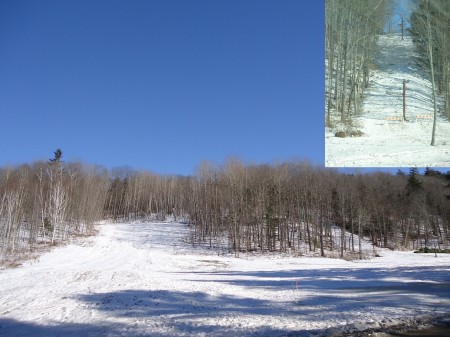
Just across the parking lot at the race venue, Colby’s former Ski Hill is still visible along the ridge. The insert shows the T-bar line for the hill.
The warm temperatures that affected the snow at last weekend’s St. Lawrence Carnival also took a toll on Central Maine’s conditions this week, but once again a combination of hard work, as well as the new snow-making system at Quarry Road, resulted in a network of about 4.5 kilometers of skiable trails.
“These races are the second major event to be held at this new facility,” chief of race Pat Cote remarked to a gathering of coaches, “the first major event being getting these trails ready for racing this week.”
Though the planned 5k competition loop could not be used, tracks were set for Saturday’s classic race on a technical 2-kilometer loop. The full 4.5k loop created for the weekend was used for Sunday’s mass-start freestyle races.
Saturday: 5/10k Classic
Cold temperatures made for solid tracks during Saturday’s classic race. The abrasive snow conditions, as well as multiple corners that necessitated a bit of skidding for many, meant that kick wax was hard to maintain for the duration of the longer men’s race. More than a few bases ended up a bit scratched and shredded from the nature of the course, but conditions were fair for every racer. The decision was made unanimously to send top-seeded skiers out on course first to limit crowding, and the podium had been settled before the first 30 of 93 racers crossed the line.
Ben Lustgarten had been tantalizingly close to the top-3 before, but on Saturday morning the Middlebury Junior made absolutely sure that his first trip to the podium would involve a climb to the very top: his winning margin was nearly half a minute ahead of second-place Scott Lacy, who picked up his second podium of the year. Silas Talbot of Dartmouth also picked up podium number two of his 2013 season in third place.
University of Vermont skiers Jorgen Grav and Scott Patterson finished in 4th and 5th place, respectively, though the Dartmouth men took the victory in the team standings thanks to David Sinclair’s 6th place finish.
See below for an interview with race winner Ben Lustgarten
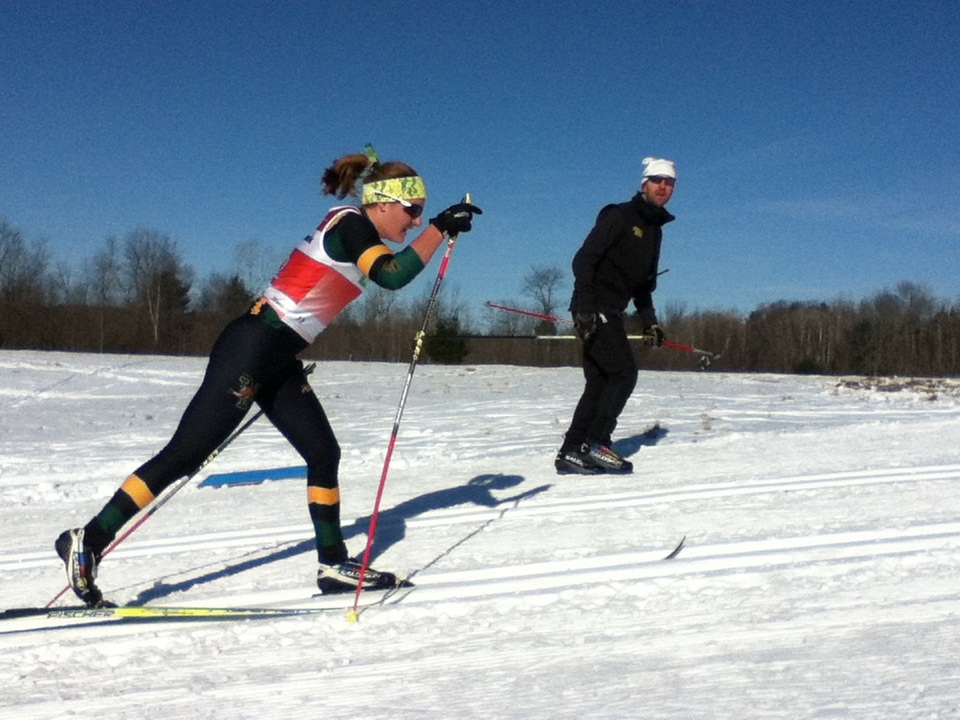
UVM’s Anja Gruber and coach Pat Weaver. A combo that is certainly working this season
The women’s race saw a few familiar names near the top of the results sheet, with EISA rankings-leader Anja Gruber taking the win for Vermont. Annika Taylor of UNH finished ten seconds behind Gruber for 2nd place.
A few other names near the front of the race might have been more surprising. The final podium place on Saturday went to Dartmouth’s Emily Blackmer, a Senior and relative unknown on the circuit who only raced in one Carnival for the Big Green last year. Blackmer made the most of her first EISA race this season, finishing fourteen seconds behind Taylor to claim 3rd place.
Bowdoin’s Kaitynn Miller continued her incredible Junior season, improving on her best-ever school finish of 5th last weekend by one place on Saturday. Her fourth-place finish was only 6 seconds off the podium, marking another historic day for the Polar Bears.
Isabel Caldwell of Dartmouth rounded out the top five. As the only school with 3 finishers in the top-10, the University of New Hampshire took a narrow victory over the Big Green in the women’s team score.
Sunday featured exciting mass-start racing, with a bit more carnage and destruction than usual. The snow stayed hard and fast on day 2, leading to a large number of crashes on numerous downhill sections. Orange alpine-style fencing was set up on one corner, and more than a few racers found themselves in the netting before the day was over. For the most part, however, the race favorites stayed out of trouble. On the women’s side, much like the previous weekend of EISA racing, it was UNH and UVM fighting near the top.
The women’s 15k freestyle featured the same three athletes on the podium as the week before in Lake Placid, albeit in a slightly different finishing order. UNH’s Annika Taylor led the way, finishing the mass start with 20 meters of clear snow behind her.
That snow behind was being churned furiously, however, as the fight for second place involved a sprint finish between the Anja and Anya…By a boot-length it was Anya Bean of UNH ahead of UVM’s Anja Gruber.
Taking 4th for the second straight day was Bowdoin’s Kaitlynn Miller, whose consistently fast skiing has made her a threat for the podium in either technique on any day. Dartmouth’s Carly Wynn finished 5th.
Scott Patterson skiing alone at the front of the Men’s 20k Freestyle
Scott Patterson, who again looked to be untouchable in the freestyle technique, took the win in the men’s race by over a minute. Patterson made his move early, skiing away from the pack solo before the first lap was even completed. Patterson described his race quite simply afterward. “I was just skiing on my own, having fun,” he laughed.
Second place went to Steve Mangan of Dartmouth, and in his second podium-performance in two days Ben Lustgarten (Middlebury) outsprinted Rogan Brown (UVM) for 3rd place. Silas Talbot took 5th.
Mangan’s 2nd place, as well as the string of Darmouth skiers in spots 5 through 8, still left the Big Green just shy of the UVM men in the team score for the race.
Overall the new trails at Quarry Road were received enthusiastically by racers, spectators and community members alike. “People in and around Waterville have been looking for a venue like this for a long time and are taking full advantage of it,” said Colby skier Jared Supple.
With top-notch organization, support and motivation, the area seems to have only begun to show its potential.
EISA racing continues next weekend with one of the largest Nordic events in New England, the combined UVM Carnival/Eastern Cup at Trapp Family Lodge in Stowe, VT.
Colby College President William D. “Bro” Adams skiing at the Quarry Road trail system on Saturday. Photo, flyingpointroad.com
Forget wrangling over curricula and departmental budgets—Colby College President William D. “Bro” Adams had some real problems to contend with this weekend.
Namely, his pair of Peltonen classic skis, which were not cooperating with some tricky snow conditions as Adams made his way around a 2-kilometer loop at the Quarry Road recreation area in Waterville, Maine.
“I think we missed the wax a little bit,” Adams said.
As the ceremonial forerunner for the first-ever collegiate competition at his school’s new home trail system on Saturday, Adams was a Colby White Mule without kick. But the spandex-clad 65-year-old didn’t let that—or a less-than-presidential pair of ski boots—diminish his enthusiasm for the event.
“We had a great time,” he said in phone interview Sunday night. “It was a big-time scene, and seeing all those skiers, and all that excellence, in this little place right nearby—it was really thrilling.”
Adams with Colby ski coach Tracey Cote. Photo, flyingpointroad.com
As for his athletic endeavors on Saturday, Adams’ plight was made somewhat more manageable by the fact that his forerunning companion—Colby ski coach Tracey Cote—was also grappling with some recalcitrant equipment.
She had grabbed the wrong pair of skis, and consequently had even less purchase on the climbs than Adams.
“Bro was just killing me on the uphills,” she said.
Adams, who raced cross-country at his New Hampshire high school, maintained that his pace was not testing Cote’s fitness. Nonetheless, he added, the crowd enjoyed watching.
“There seemed to be pleasure that I was out there—I know it meant a lot to the Colby team,” he said.
Despite the waxing problems, Adams said that the Colby coaching staff did not have to worry about its job security.
“If I was racing, I might have been upset, but I wasn’t racing,” he said.
One thing he would change, however, was his pair of ski boots, which broke as he was putting them on and had to be held together with duct tape.
Cote said that the event organizers also had learned a few lessons from the first set of races run on the new trail system—some snowmaking problems cropped up, as well as a few injuries, including one that left Colby’s top male skier with a broken finger.
“We’re kind of questioning some things, but until you run races, you don’t know where the issues are,” Cote said. “I think things will only get better from here.”
Adams’ performance, though, will be tough to top.
“To have a college president put on a full spandex suit and ski a course is just crazy,” Cote said. “He’s just an amazing guy—I’m really impressed.”
John Morton talks with contractors as the new trails are cut. Photo courtesy of Tracey Cote.
When John Koons was growing up in Waterville, Maine forty years ago, skiing was the thing to do.
“When I was a youngster we had a ski hill,” Koons told FasterSkier. “It was sponsored and run by Colby College. It was an alpine slope, and we had snowmaking and we had lights, and it was really a wonderful place for kids to go.”
But like so many small hills around New England and the rest of the country, the one in Waterville – which had originally opened in 1930 with a rope tow – eventually closed as costs increased and families became more willing to drive to larger, brand-name ski resorts farther away.
That’s a problem, says Koons.
“There hasn’t been anything around since,” he lamented. “And not everybody can afford to go to Sugarloaf, or any place, drive those miles with gas prices the way they are and pay fifty or ninety dollars for an alpine situation.”
As a lifelong nordic skier, Koons had a vision for the site of the city’s old alpine hill on Quarry Road. Even though he grew up alpine skiing on the hill, he didn’t think that reopening the lift was a viable option economically. Instead, he wanted to get kids outside in a different way.
“The reality of it is that operationally you can’t really run much of an alpine slope without a large amount of money and so on, Koons said. “But you could run a very decent nordic trail system with much much lower operational costs.”
He wasn’t the only one who thought that Quarry Road could house great nordic trails. Tracey Cote, the head coach of the nordic team at Colby College in Waterville, had been imagining a trail system down the road from her office for at least a decade.
“We would do our skiwalking out there, we’d also just go out there and run around a lot,” Cote said in an interview this week. “And so in the back of my mind and in the back of [my husband] Pat’s mind, we’ve always thought that this area had really great potential. We had talked about it probably ten years ago.”
When she first had the idea of cutting nordic trails at Quarry Road, Cote said that she had assumed that the project would never happen. But then Koons became interested and began working on the project four years ago. After talking to staff and owners at touring centers all over New England, he began to have an understanding of the economics of building a trail system. Once Koons began working, the project took off.
The college, which had owned the alpine hill, sold the land to the city of Waterville at a rock-bottom price with the requirement that it be developed for recreation; more land was bought later. In all the city now owns 120 acres around the old hill.
“There are so many things – I can’t even explain in words – there are so many things that happened that just seemed really lucky, in a lot of ways,” Cote said. “But it was also through a lot of hard work on John’s part, and the city being interested and wanting to work with this sport and wanting to work with John, and wanting to work with the college.”
Koons never had a doubt that the project would “go,” especially after a fundraising board was formed with other ski enthusiasts. The Friends of Quarry Road is headed by Koons, but includes Cote as well as the several parents of college racers and the city’s head of Parks and Recreation. His vision is of a four-season recreation area, and many of the pieces are already in place. In the winter, there will be both easy trails for recreational skiers and top-of-the line race trails for more serious athletes, as well as snowshoeing. In the summer, he anticipates starting a bike club. Since the venue is on a river, waterfront trails will be developed as well.
“I would say that one of the great appeals of this recreation area is that there is something for everybody,” Koons said.
While he had been optimistic from the start, Koons definitely faced challenges in getting the venue going. He described Waterville as a city that was once well-off, but has experienced a slowdown over the last few decades. The key to getting the cash-strapped municipality on board, he said, was to promise that the ski area would pay for itself once it was up and running.
“One of the first things you have to do is let them know that it’s not going to cost the taxpayers any money,” Koons explained. “You have to demonstrate that you have a viable club and that you could generate funds to put into this from outside city sources. I think that’s very important: this really is its own thing. The city is the overseer and our Parks and Recreation department will provide a couple of people for the winter, but beyond that we will have to supply that from club efforts. I’ve always said from day one that this should be a revenue neutral situation, meaning that we should be able to generate enough revenue to pay for our operations.”
Once Koons had assured city officials that he didn’t anticipate asking for continuing support, they took the unusual step of adding a $250,000 bond issue to the budget to fund the project. The measure passed, and Quarry Road was on its way to becoming a reality.
“[That] is really a tremendous commitment because that’s taxpayer money, no question about it,” Koons said. “So that’s a wonderful commitment.”
After the bond issue passed, the board stayed true to its word and raised almost $500,000 from a number of individual donors. Along with grants from the state Department of Conservation and the Harry Alfond Foundation and support from Colby, the project has received over a million dollars in funds.
“That’s what’s so incredible about this project,” said Cote. “It’s not a college project. Although Colby has supported it, it’s really a community project.”
As of this spring, the site already had five kilometers of ski trails which were well-suited to touring. It hosts a youth ski club started by Cote and her husband Patrick, the Executive Director of the New England Nordic Ski Association; in just a few years, the club has grown to include 82 young skiers.
“It’s really cool to see an area that hasn’t been exposed to skiing all of a sudden get really excited about skiing,” Cote said.
Janice Sibilia, the competitive programs director at the New England Nordic Ski Association, saw the club continuing to grow as the venue gets bigger.
“On a community level, these trails will offer opportunities to youth and recreational skiers, as well as the potential to develop a strong local club,” Sibilia wrote in an e-mail to FasterSkier.
Recently, events at Quarry Road have included a winter carnival, paintball biathlon, and snowshoe races. But next year, the site will have even more to offer. The group is in the process of cutting two new two and a half kilometer loops which will be homologated for FIS competitions.
“It was a total blank slate,” Cote said of the area before the trails were cut. “Imagine a sort of small, old alpine hill that has completely grown in, with a lift that was falling down… Somehow, early on we had enough money, or John Koons had raised enough money, that we brought John Morton in and said, here’s the parameters, what would you design?”
Work on the new trails began this fall. Cote said that as she has walked the area she has difficulty visualizing how the trails will ski, but that Morton has assured her that it’s a “really good course.”
Cote was enthusiastic about what the new trails would mean to her team. Although the Colby skiers have been practicing on campus for years, their home trails are not ski specific. Instead, they are running trails groomed by a snowmobile.
“I don’t know that it will revolutionize practice time, but the quality of what we’re going to be on is going to be completely different,” Cote explained. “Now we’ll literally go one minute down the road – you could walk there, but we’ll probably load all the equipment into the bus – and we’re going to be on pistenbully-groomed trails that are homologated to the highest standard so they’re three skate lanes wide .”
The trails will make hosting races easier, too. Until recently, Colby had hosted its Eastern Intercollegiate Ski Association races at Sugarloaf, an hour and half north of the school. But as the years went by, the ski area put less and less of an emphasis on racing, and hosting races there became more and more challenging. The last carnival race hosted by Colby was held 15 miles down the road at another new recreation area.
Among other things, Cote was excited that with the new venue so close to campus, more students would come watch college races.
“It’s close enough to our campus that kids can literally walk down from campus and watch,” she said.
Currently, Colby only hosts college races every two years, partly because Waterville is at the extreme Eastern side of the conference and teams don’t like to travel so far. But with homologation now a requirement for FIS races, Cote wondered whether having a certificate would make Waterville a more popular site for college races.
“I think a lot will probably depend on how good our events are when we put them on,” she said. “If we do a really good job then coaches will be more motivated to come here.”
With two separate loops homologated, Cote hoped to be able to host the first college pursuit race. But she also looked at the big picture, and hoped that Quarry Hill would be the site of a variety of elite races, not just those for college athletes. Eastern Cups and even Junior Olympics are in the board’s sights, she explained.
One big plus for the ski area is that it will have an extensive snowmaking system. Since it is situated on a river, there is plenty of water nearby, and Koons believed that it would be the best early-season venue in the East. And if that can bring racers to Waterville, he said, the city would benefit.
“I think it was a selling point when we talked to the city people,” Koons explained. “There’s no question that meets bring in revenue to the city. The numbers are there. And that’s real money for hotels, restaurants, et cetera. And it’s good publicity for the city, which is largely in a pretty depressed area compared to what it used to be.”
Not only would races be good for the city, Cote said, but that they would be good for teams, too.
“Waterville has a bunch of cheap hotels and cheap restaurants, so that’s really good for people coming here,” she said. ” Because it’s on Interstate 95 it’s really accessible.”
Sibilia agreed.
“Of course, having more people drawn to the venue will have a solid impact on the local economy. Situated within close proximity to stores, restaurants and hotels makes it a win win for all parties.”
She was confident that Quarry Road would soon be hosting high-level events, and said that having one more great venue would be a huge benefit for all of New England.
“Having a venue such as this in New England will be a great asset in terms of being able to hold high level races,” Sibilia wrote. “Part of my role as Director of Competition Programming for NENSA is overseeing regional events like our TD Bank Eastern Cup series. The series is designed to provide all levels of athletes with good competition. This is crucial for athlete development but in the global picture, we also need the ability to host National level events to ensure our juniors, U23’s and seniors have the fastest skiers to push them.
“These events also positively affect our coaches education and technical delegate programming by exposing everyone to the top level racers. The Quarry Road trails and nordic center will be able to manage all levels of events.”
For Koons, all of this is great – but he’s less worried about elite racers than he is about members of his own community.
“As far as motivating people, the very high end people such as the cross country teams, I mean, they’re already motivated,” Koons said. “They will go wherever they get the best deal or the best snow product. That’s just a fact of life. They’ll go to Canada, they’ll go to West Yellowstone. They will take care of themselves one way or the other.”
Cote noted that the new trails are very close to downtown and just a hop, skip, and a jump from Waterville’s Boys and Girls Club, which both she and Koons hoped would draw in more community members.
“Reaching out to kids who otherwise would not have this possibility or this experience at all, I think is a huge thing,” Koons said. “Especially with the various wellness programs with local hospitals… whatever you can do to encourage positive, active lifestyle changes for people who otherwise would not have that possibility, then you’ve done a huge service to the town and to the whole area.”
Soon, he hoped, kids would be heading down to Quarry road after school just like he had when he was growing up.
“I think that we’re a full four-season recreation area that happens to have a homologated FIS competition trail,” Koons said. “So I think that’s a pretty good thing.
“Hey, we have winter, it’s here, and not everybody can afford to go to Florida or Arizona for the winter. So you might as well have fun with it. It goes by a lot faster if you can enjoy it.”