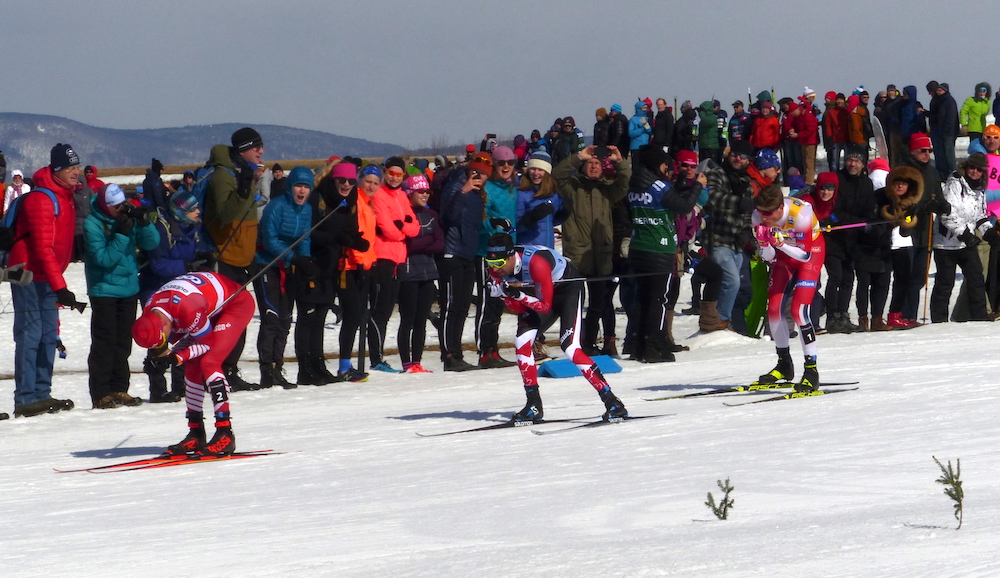
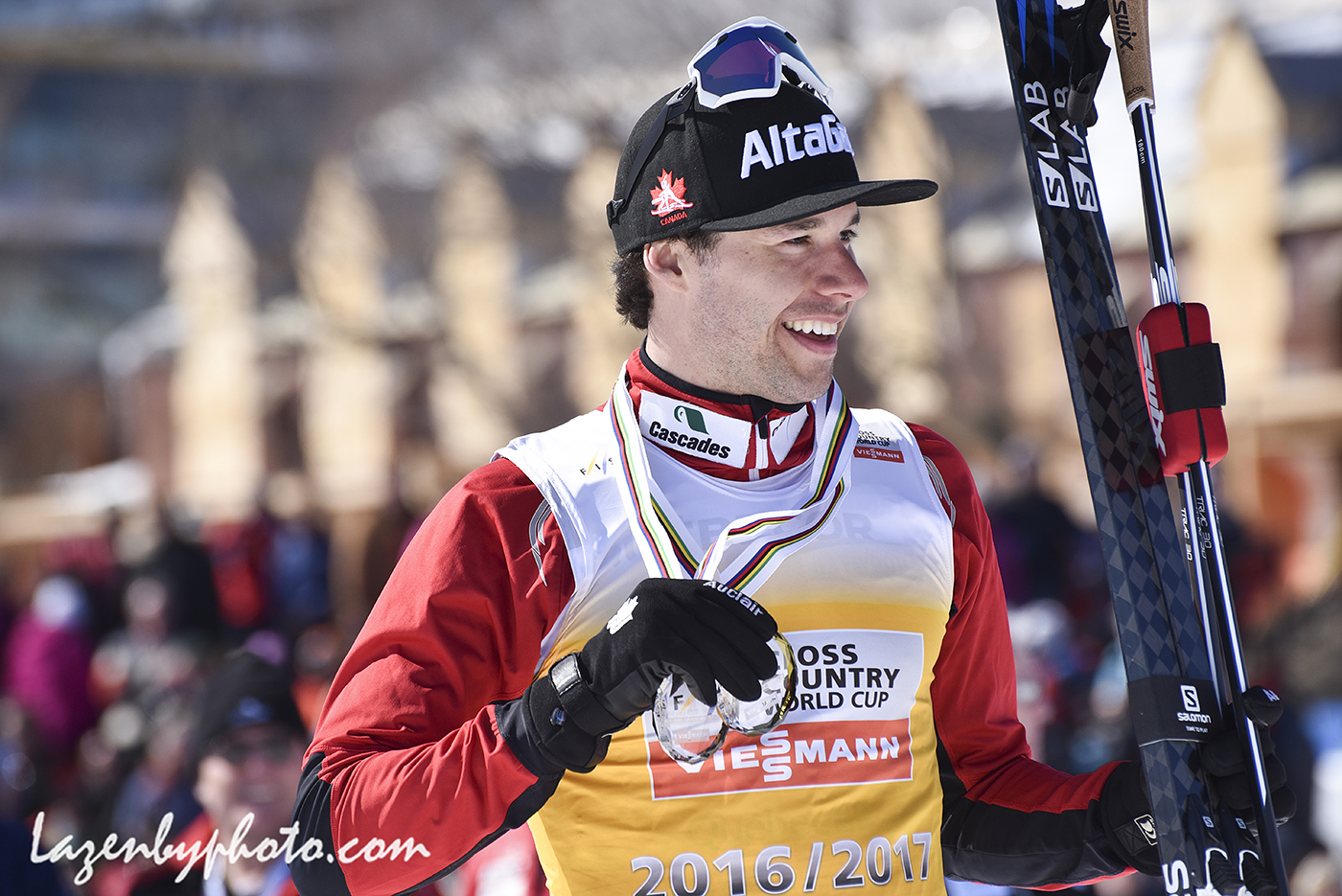
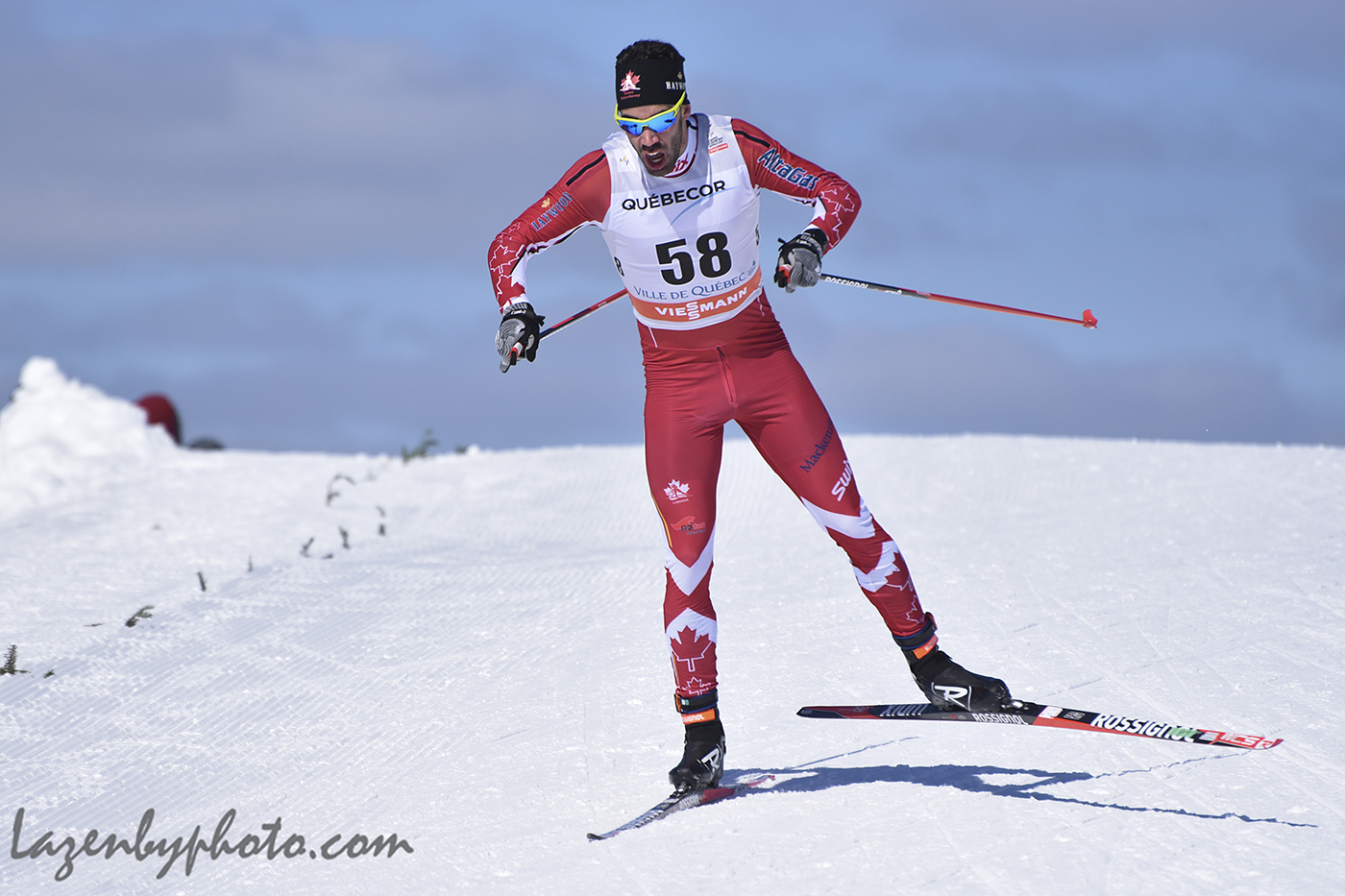
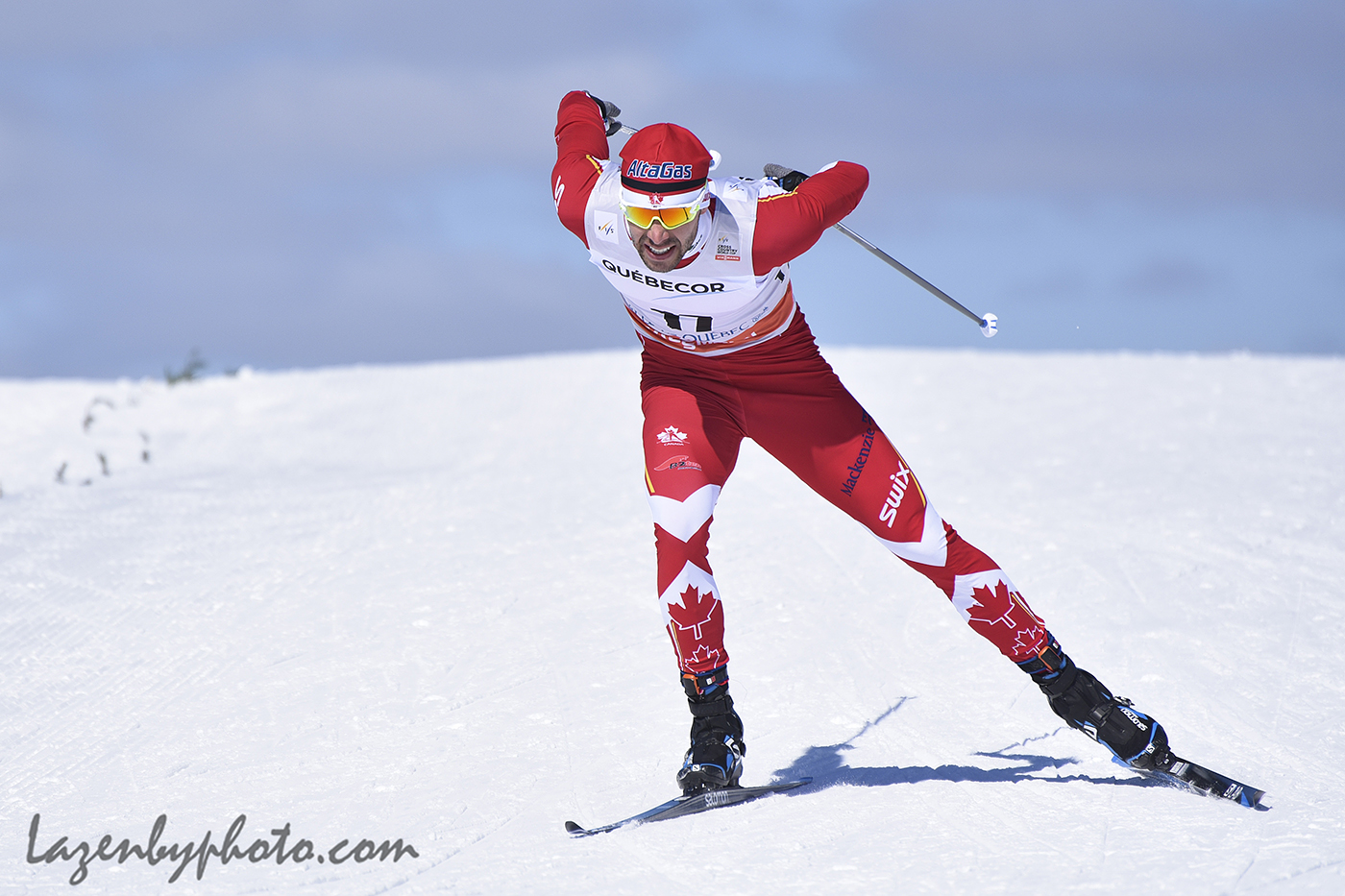
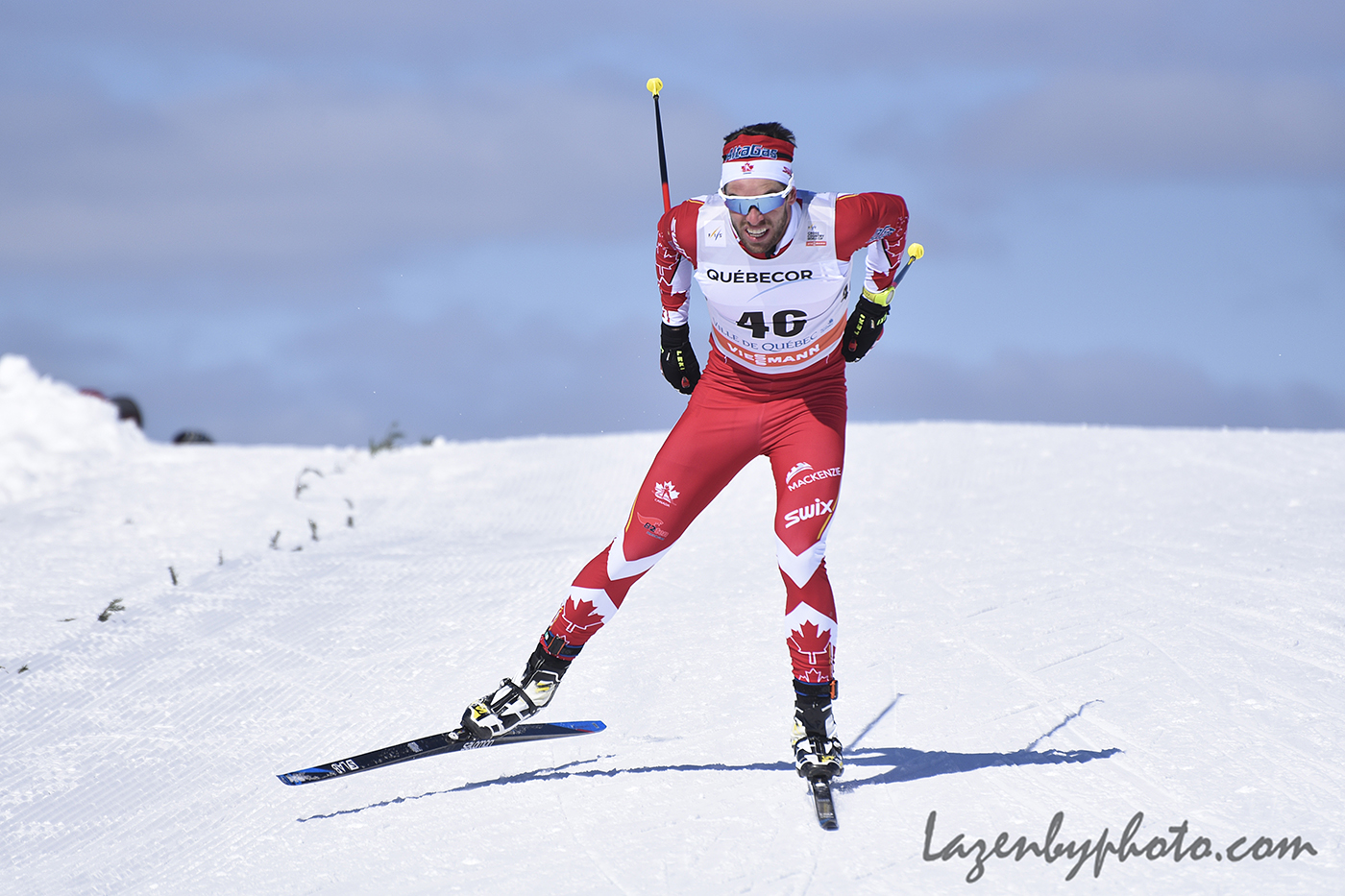
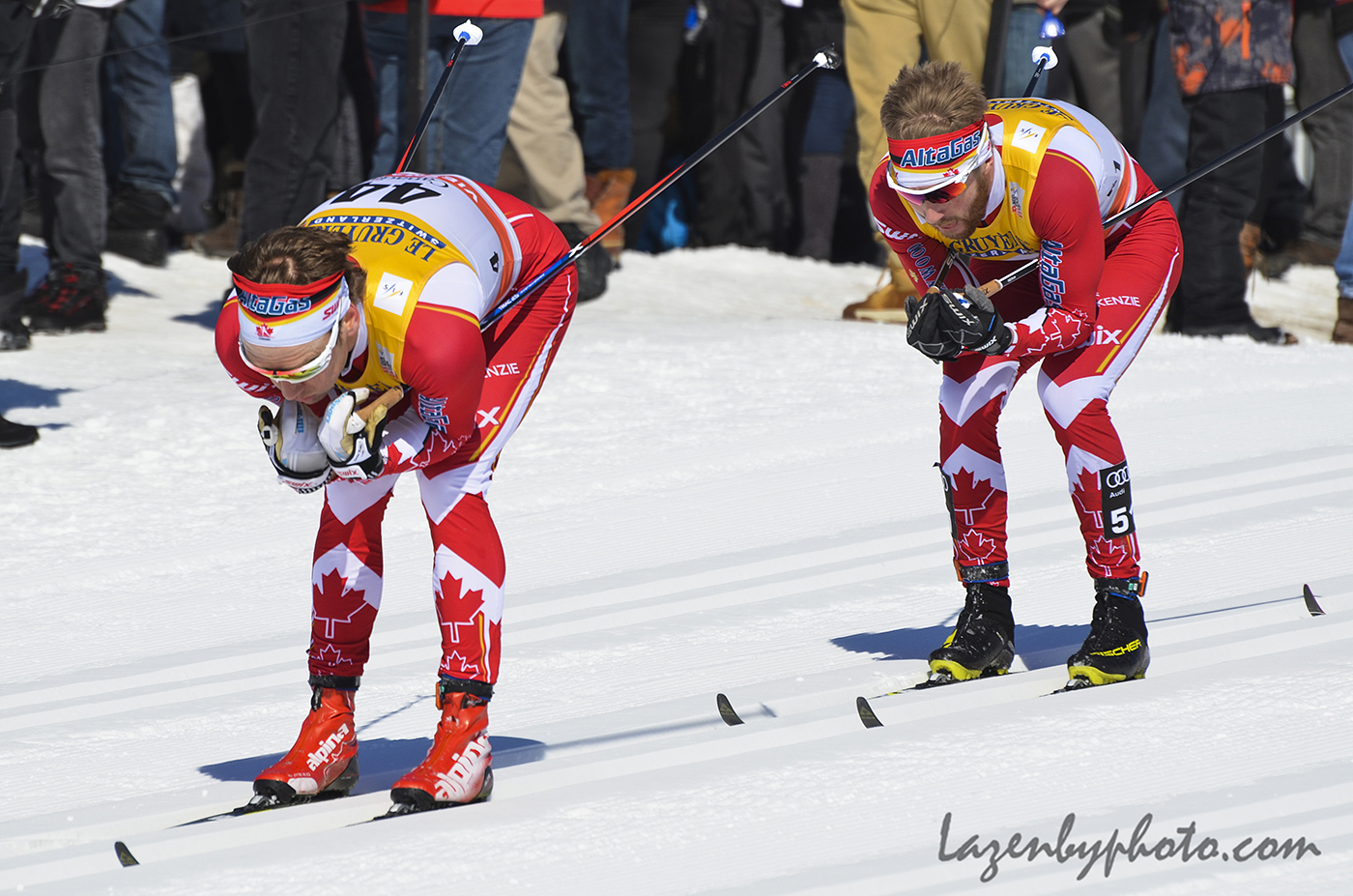
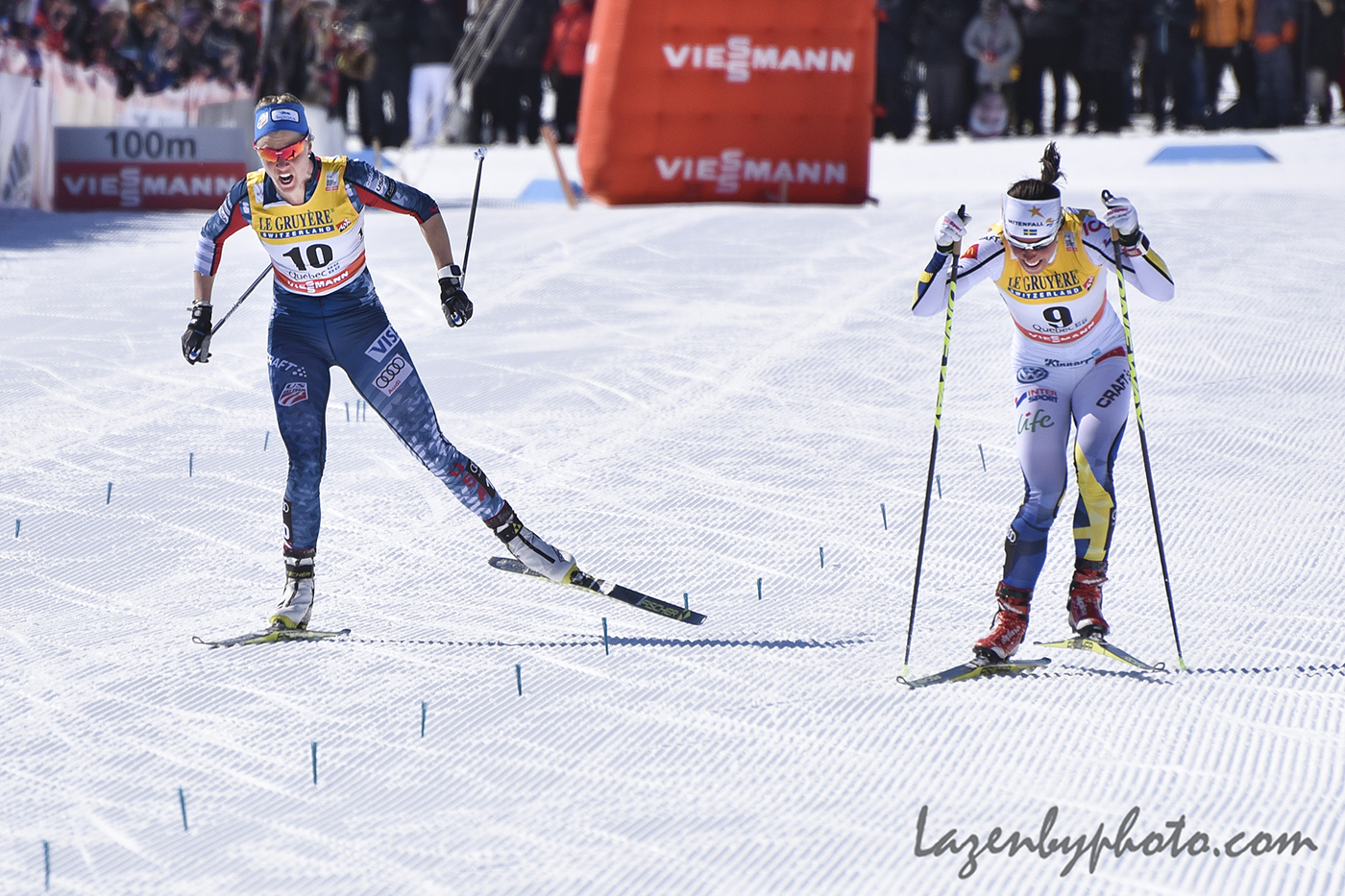
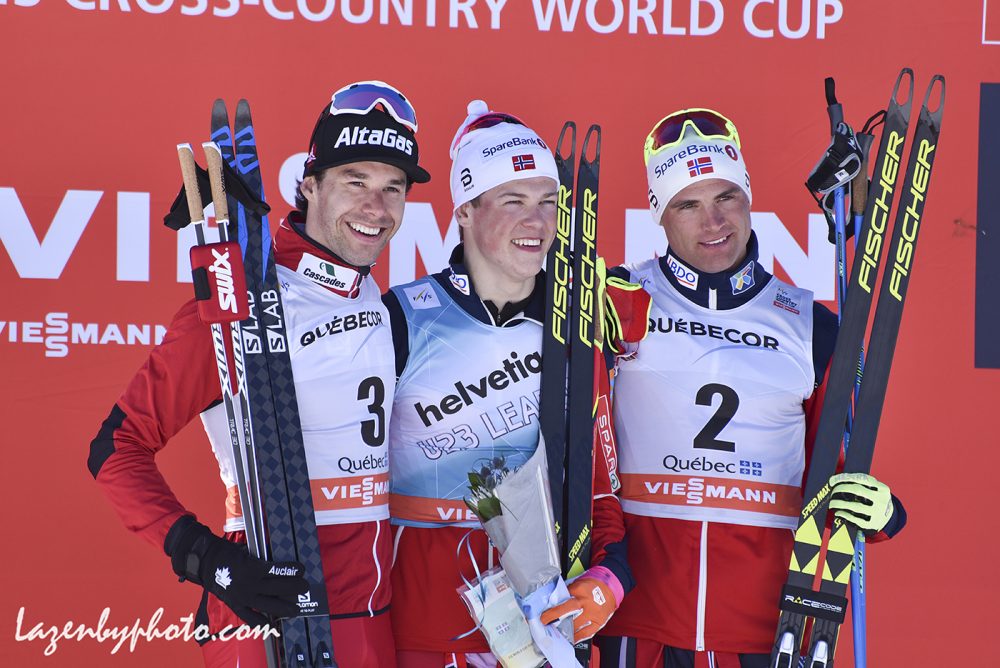
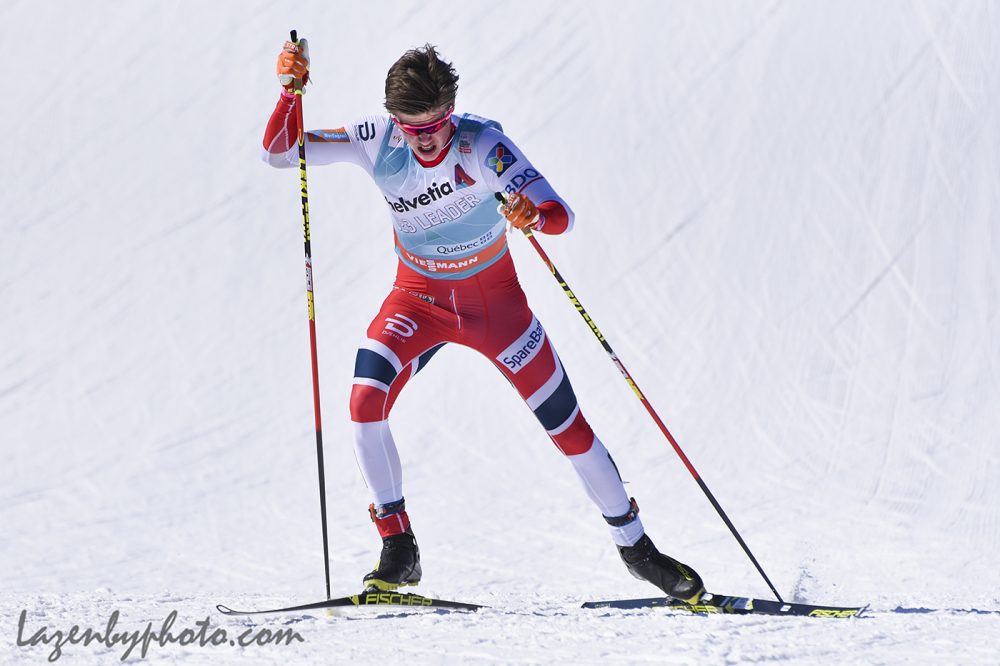
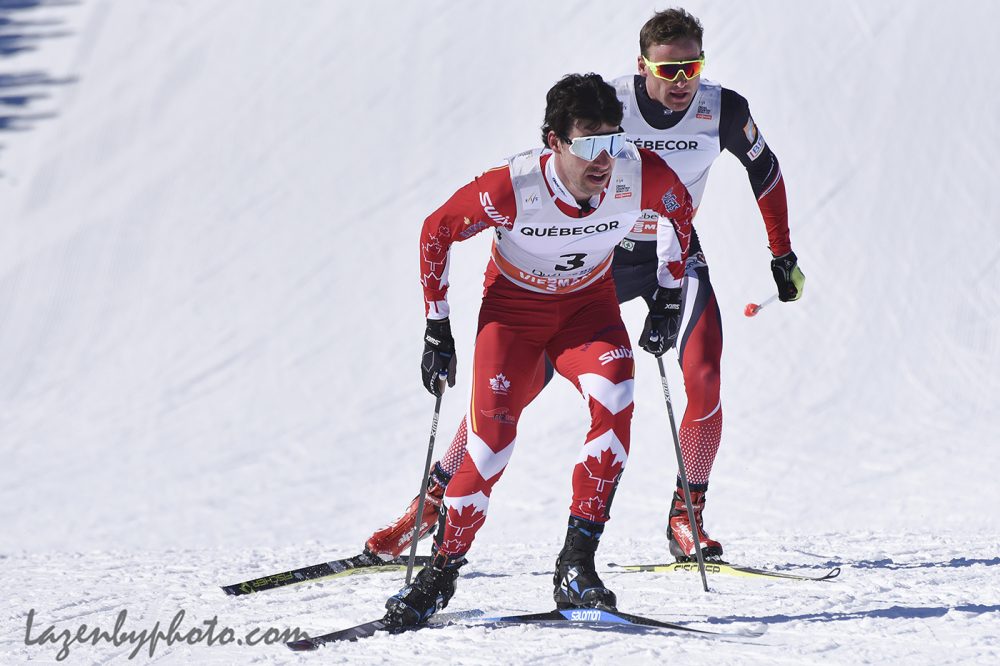
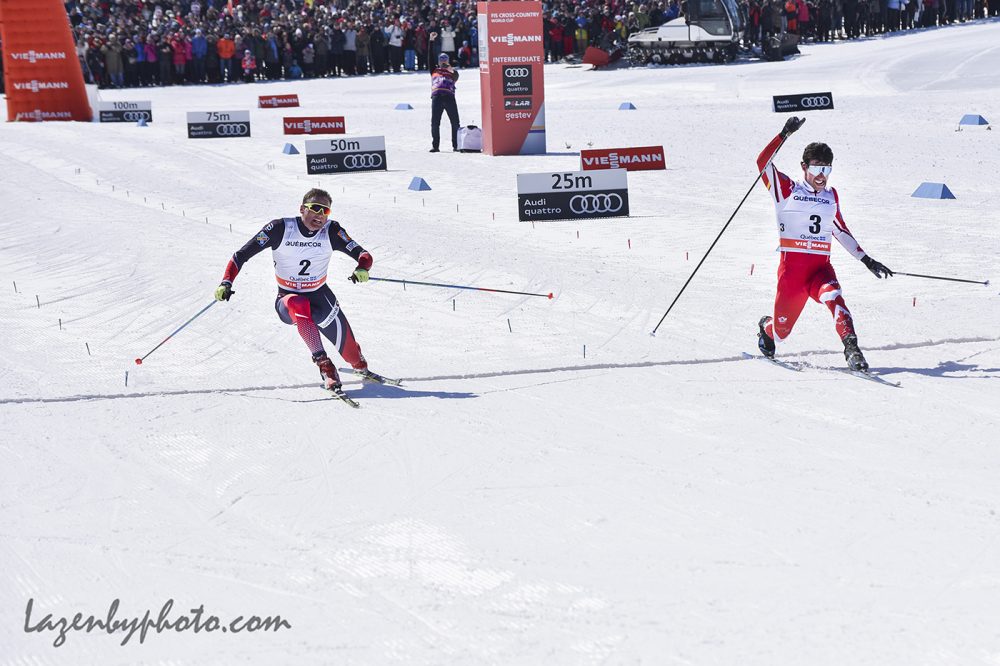
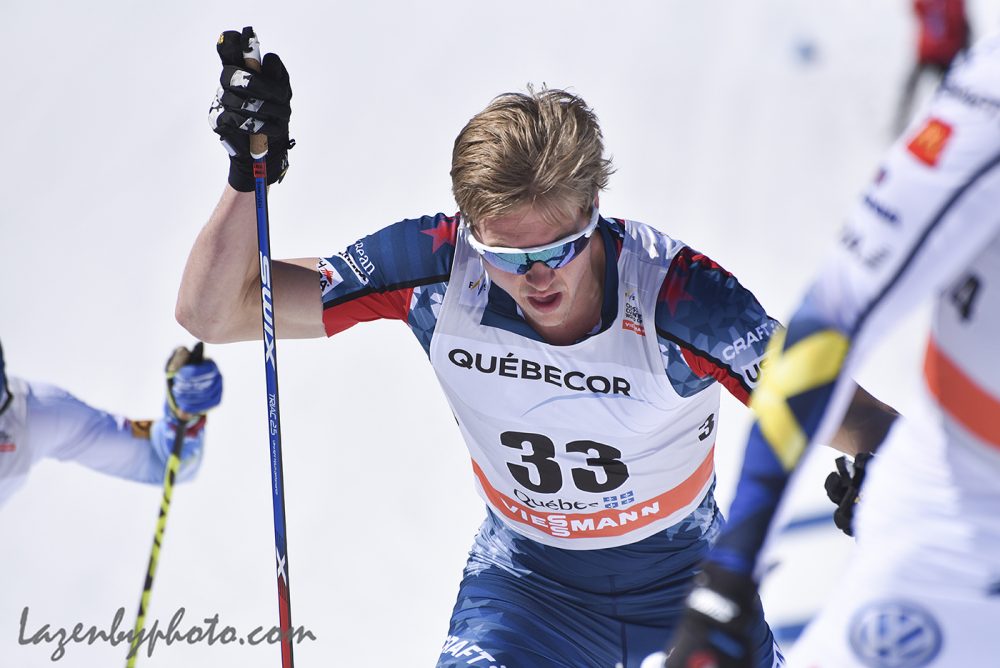
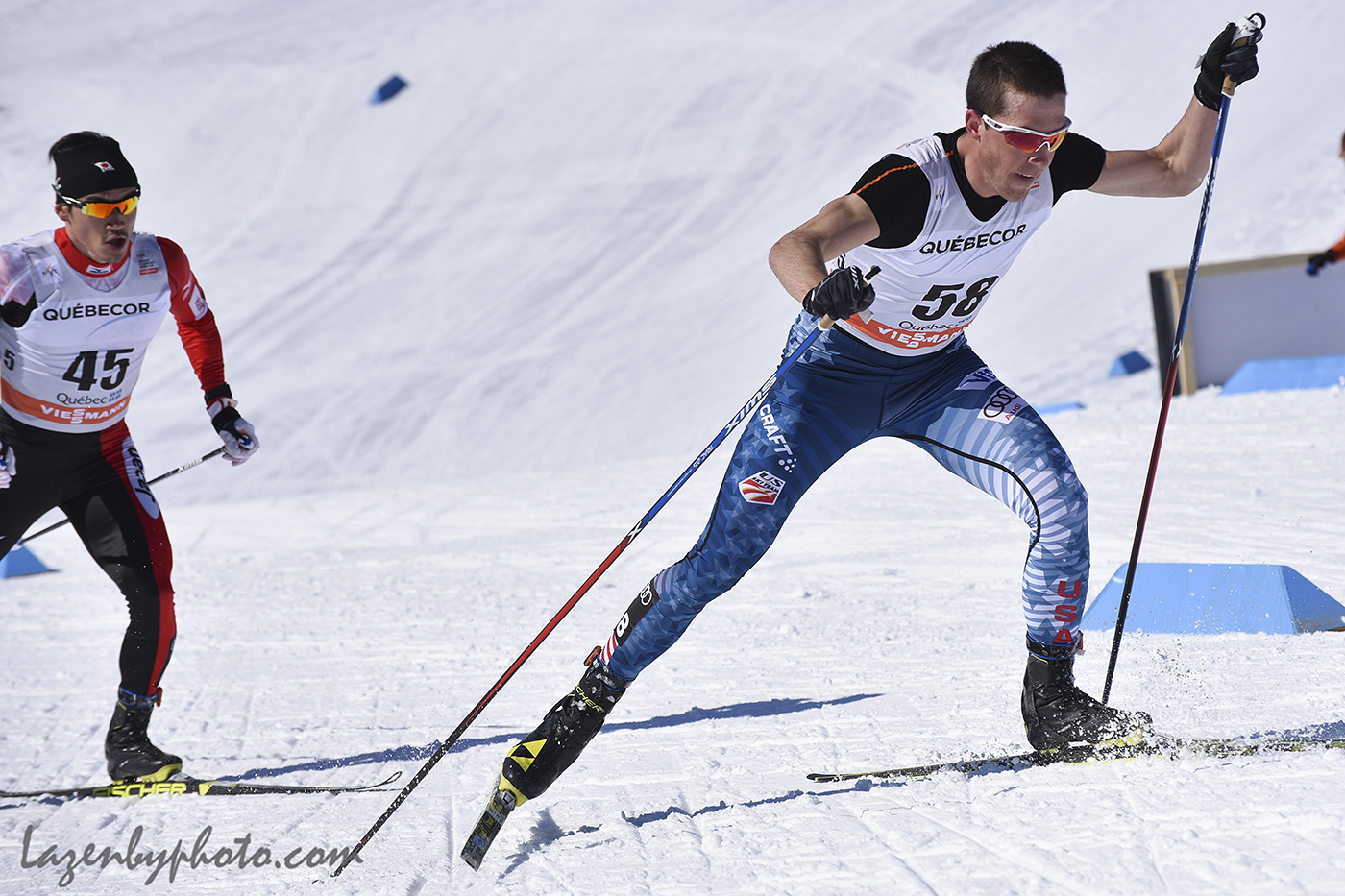
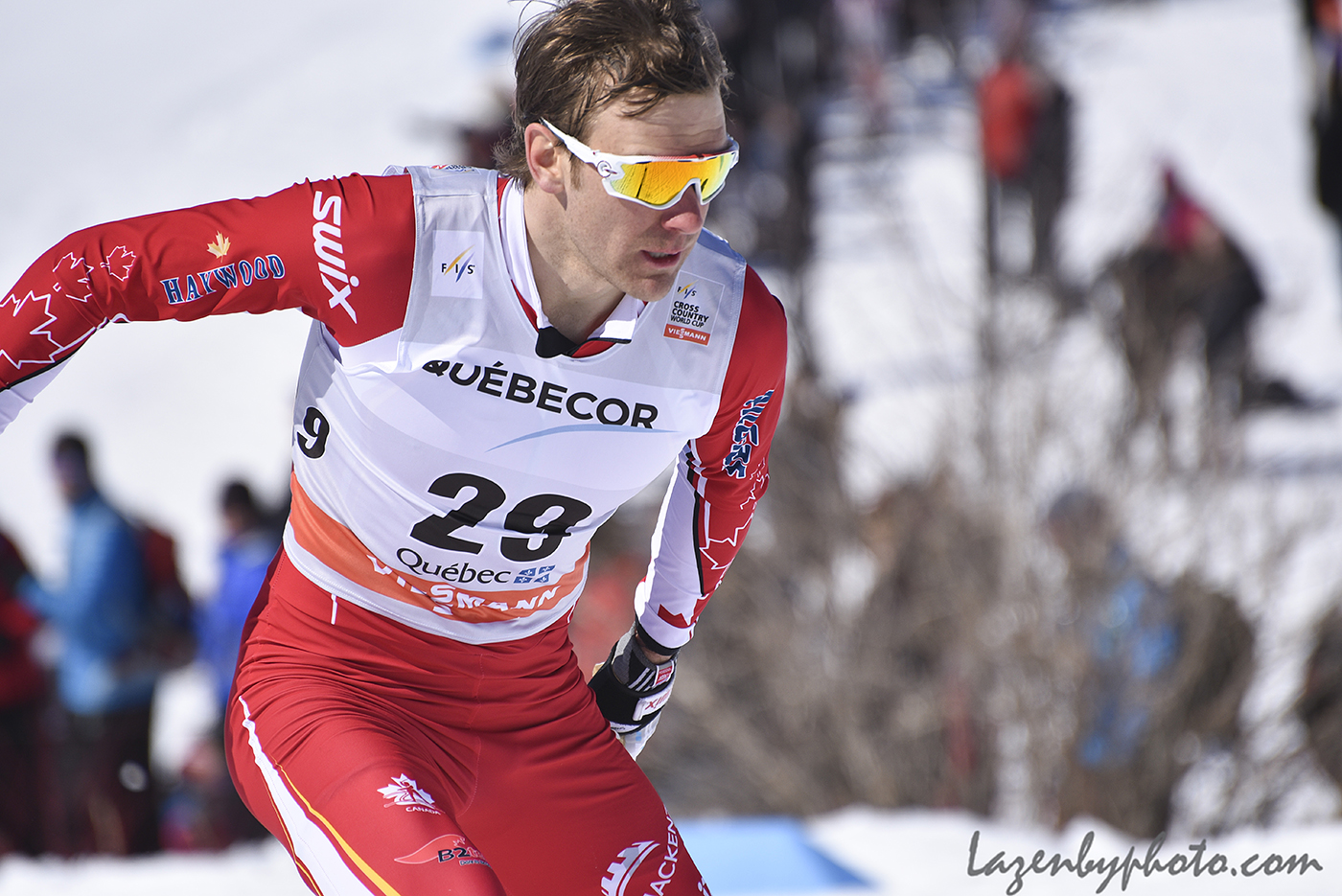
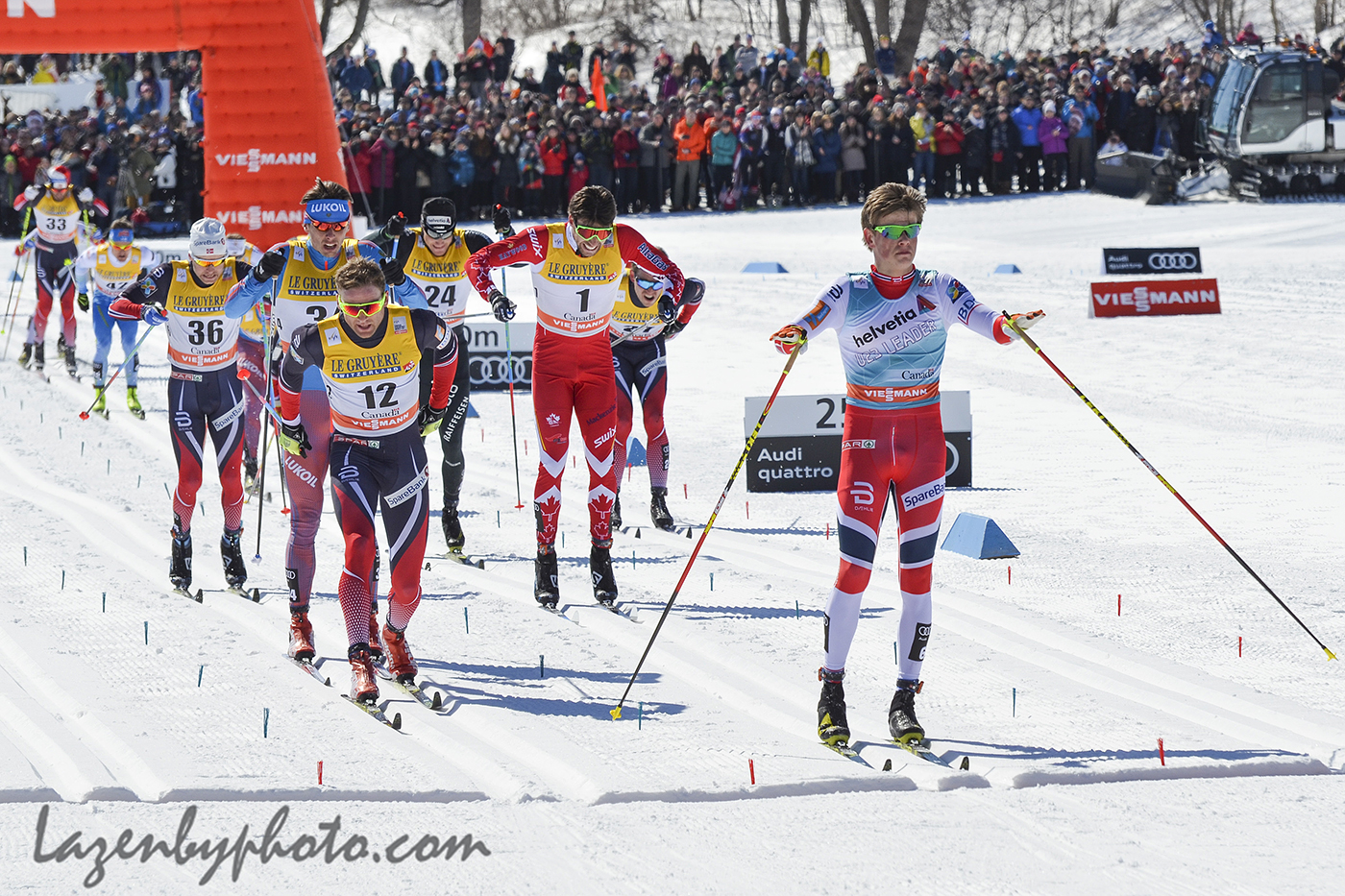
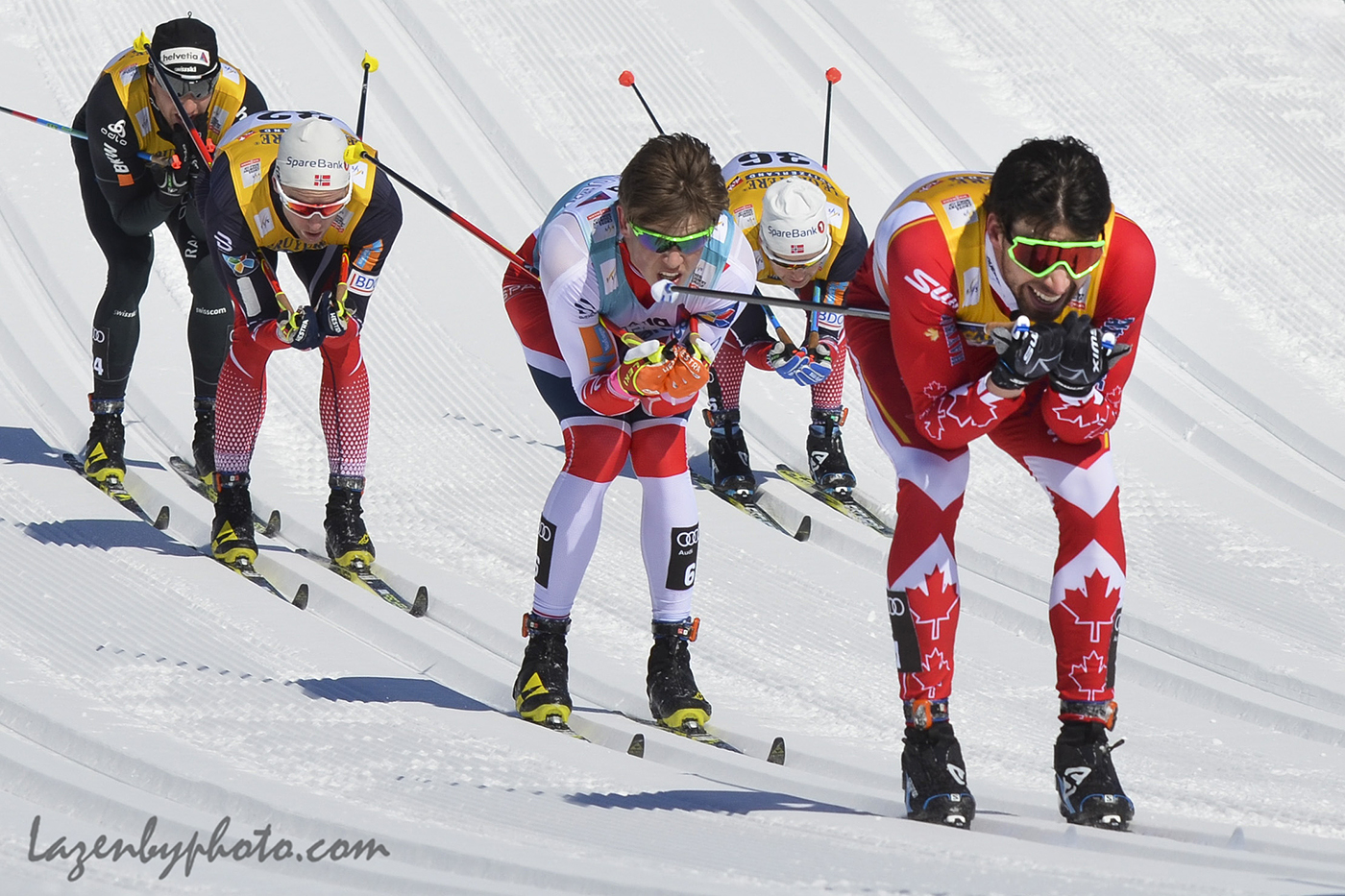
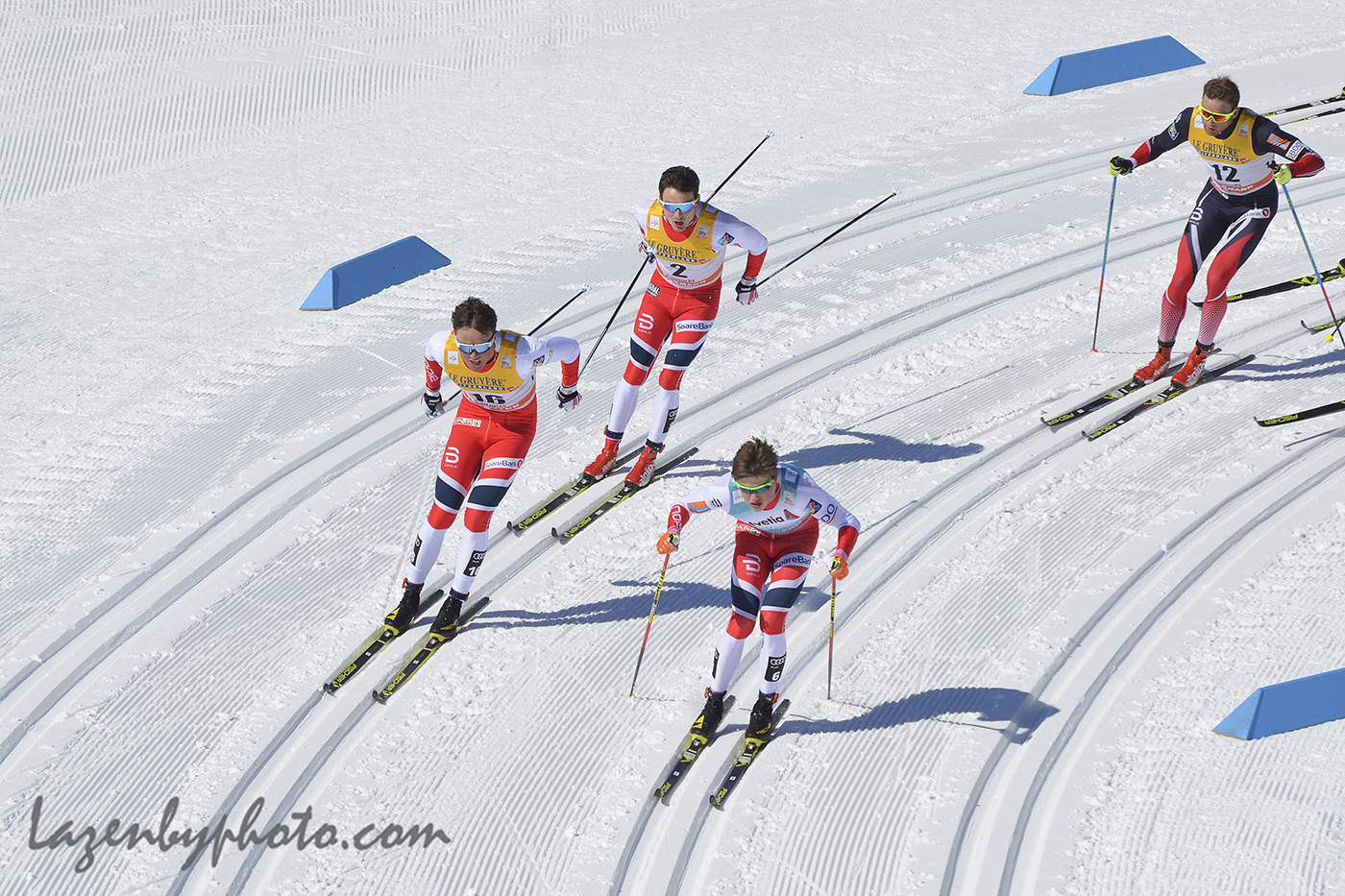
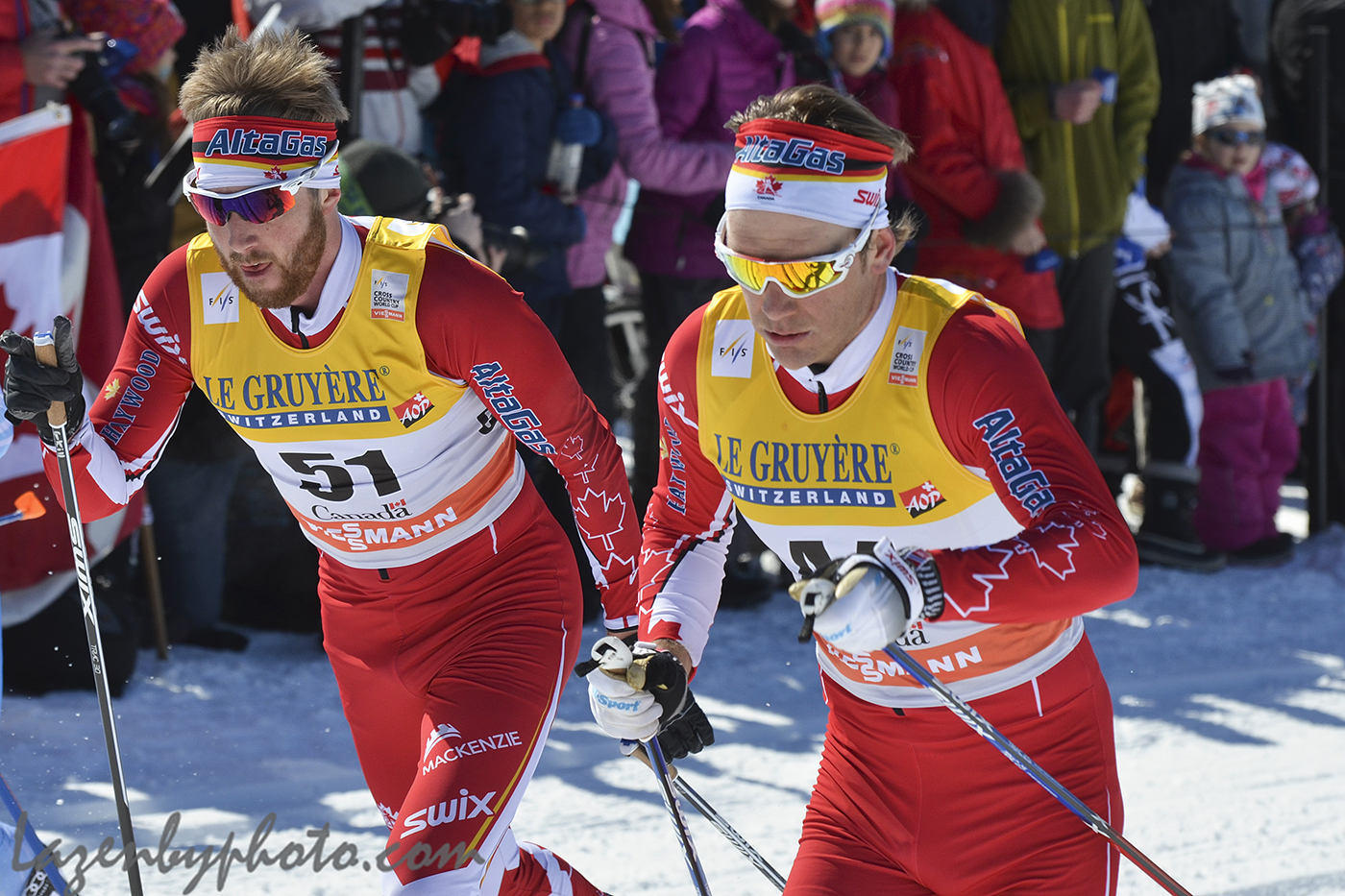
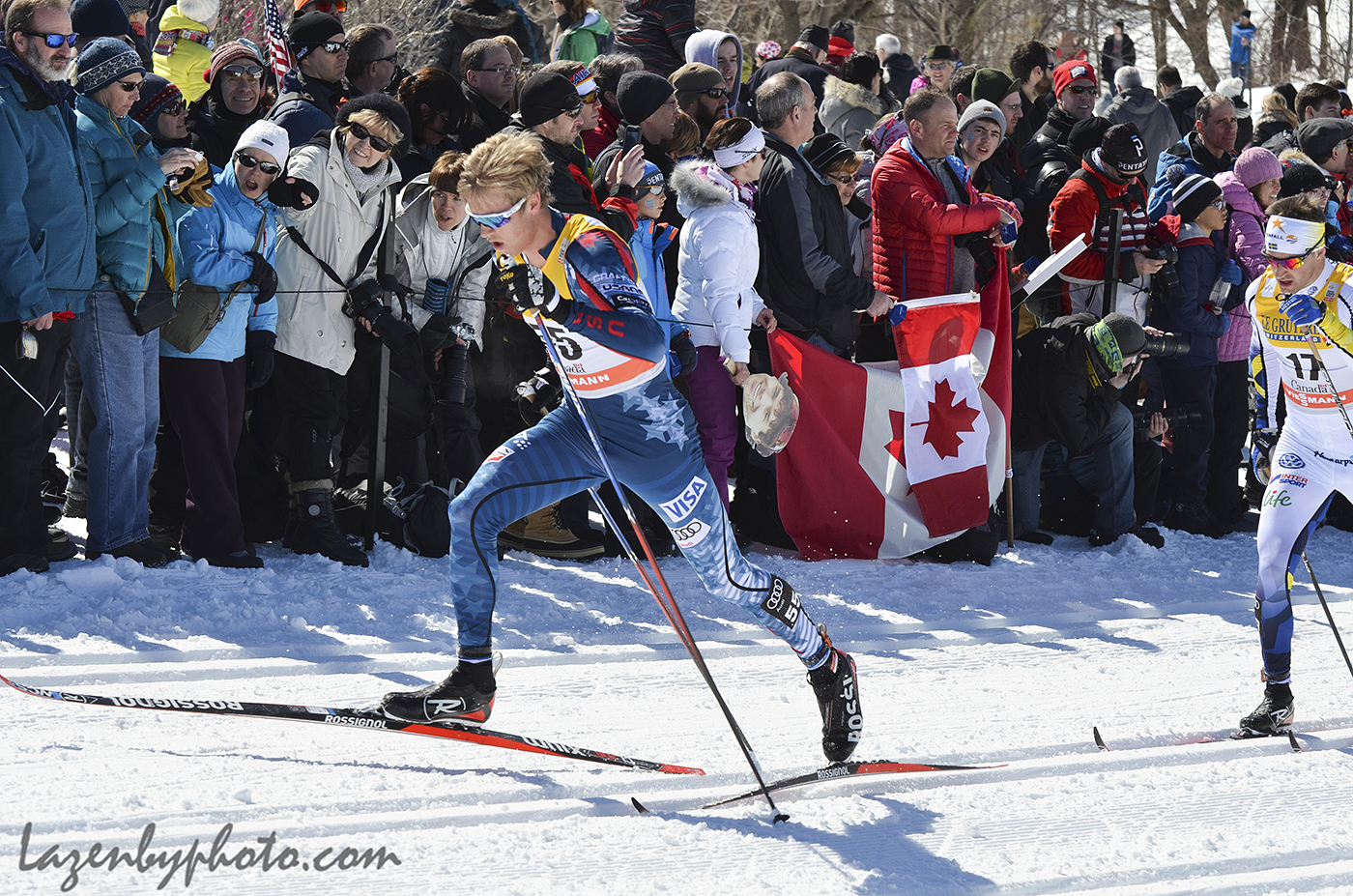
Alexander Bolshunov of Russia leading Canada’s Alex Harvey and Norway’s Johannes Høsflot Klæbo on the final lap of the men’s 15-k skate pursuit. (Photo: Peggy Hung)
FIS World Cup Québec City Men’s 15 k Freestyle Pursuit
Norway’s Johannes Høsflot Klæbo did not cede the win today as he moved to take the World Cup overall over Russia’s Alexander Bolshunov. The day’s first starter in the 15-kilometer freestyle pursuit, Klæbo won in 29:05.4. Klæbo began with a 52 second lead on second starter Bolshunov and a 53-second gap on Canada’s Alex Harvey. The trio eventually linked up with Klæbo pulsing with speed to take the win.
Harvey of Canada finished his career atop the podium with a second place. He took Bolshunov at the line. Harvey was 2.8 seconds back, Bolshunov 2.9.
Sweden’s Marcus Hellner leads Russia’s Andrey Larkov and others during the men’s 15 k freestyle pursuit at the 2017 World Cup Finals in Quebec City.
Here are the basic rules for this week’s World Cup finals in Québec. It’s a three race series: a sprint, a classic mass start, and freestyle pursuit for the final stage.
We’ll get to the import of the World Cup points on offer in a moment and why they add some tension to the weekend. This much is clear: the final standings for the men’s and women’s overall World Cup remain close as does the women’s sprint cup.
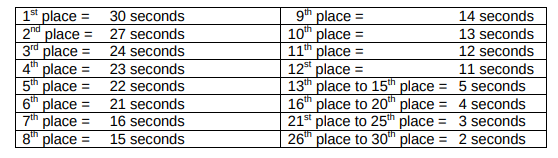
But first, let’s start with understanding time bonuses at Québec’s World Cup finals.
The top-30 ranked skiers in Friday’s sprint earn time bonuses. The bonuses are subtracted from the athlete’s “race” time. (Time bonuses are listed below for the sprint.)
A single intermediate time bonus for the women’s 10 k mass start classic will be awarded on Saturday. The men’s 15 k mass start classic features two intermediate time bonuses. The FIS rules state, “Bonus seconds will be 15, 12, 10, 8, 7, 6, 5, 4, 3, 2 and 1 seconds for the first ten athletes at a designated intermediate point.”
Again, those seconds, or time bonuses, are subtracted from an athlete’s race time and then the overall time is calculated. Sunday’s skate pursuit — for both men and women — is a straight up pursuit. Meaning, the athlete with the fastest overall time is the first racer off. No time bonuses are available.
World Cup points will be awarded for each race over the weekend. The points for the sprint and mass start are clear. Points go to the top-30 finishers. And the points earned go towards both the specific discipline category, sprint cup or distance cup, and towards the overall World Cup standings. For the final day’s pursuit, the points are allocated by elapsed race time — you might know this as fastest time of the day. The top-30 fastest racers, which again is determined by elapsed time on course, get the points. They go towards the distance cup and overall standings.
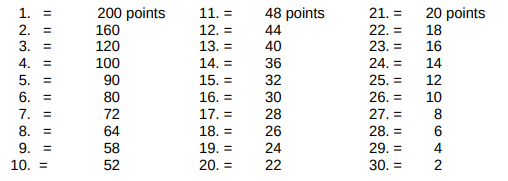
(Below are the points for 1st-30th place in the sprint, mass start, and fastest time of day in the pursuit.)
The World Cup final’s grand prize are the points earned for the overall standings determined after the last stage. It’s a pursuit, so the first skier across the line is the overall winner. The winner will be awarded 200 points, second place 180, and so on. (See overall points below.)
So what’s all the fuss? The final weekend, as Chad Salmela keenly tweeted, brings with it some crystal still up for grabs. Johannes Høsflot Klæbo leads Alexander Bolshunov of Russia by 14 points in the men’s overall standings.
Norway’s Maiken Caspersen Falla with her 2017/2018 Sprint World Cup Crystal Globe. (Photo: Fischer/NordicFocus)
For the women, Norway’s Ingvild Flugstad Østberg has gapped Russia’s Natalia Nepryaeva by 97 points for the overall. And the women’s standings for the sprint cup are tight too. Stina Nilsson of Sweden leads Norway’s Maiken Caspersen Falla by 33 points.
Photographer Dustin Satloff was in Québec City for 2017 World Cup Finals and he provided the following photos, which have never before appeared on FasterSkier. More on dustinsatloff.com.
Click on photos to enlarge.
Norway’s Johannes Høsflot Klæbo racing to first in the freestyle sprint qualifier on March 17 at 2017 World Cup Finals in Quebec City.
Norway’s Marit Bjørgen racing in the freestyle sprint on March 17 at World Cup Finals in Quebec City.
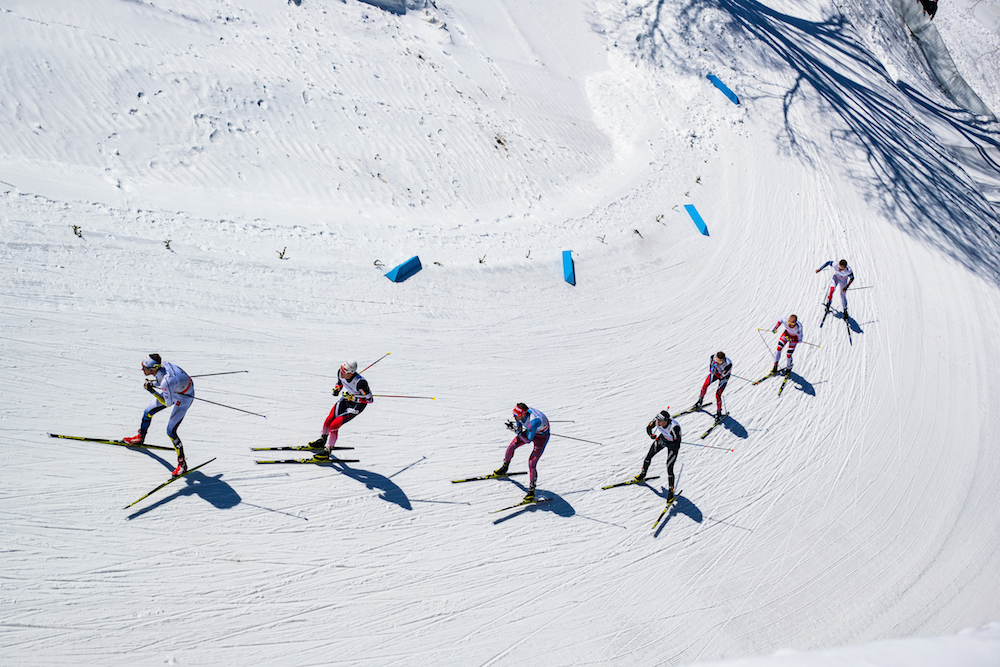
The last climb and descent at 2017 World Cup Finals during the freestyle sprint on March 17 in Quebec City.
Canada’s Alex Harvey celebrates his victory in the men’s freestyle sprint final on March 17 at World Cup Finals in Quebec City.
Canada’s Alex Harvey celebrates his victory in the men’s freestyle sprint final on March 17 at World Cup Finals in Quebec City.
Switzerland’s Dario Cologna on the ground at the finish of the men’s 15 k classic mass start at World Cup Finals on March 18 in Quebec City, while Finland’s Sami Jauhojärvi walks on. Also pictured: Norway’s Finn Hågen Krogh and Hans Christer Holund.
Norway’s Emil Iversen (16) leads Johannes Høsflot Klæbo (c) and Finn Hågen Krogh during the men’s 15 k classic mass start on March 18 at World Cup Finals in Quebec City. Klæbo went on to win.
Canada’s Alex Harvey leads Finland’s
Ristomatti Hakola and others during the men’s 15 k classic mass start on March 18 at World Cup Finals in Quebec City. Harvey went on to place fourth.
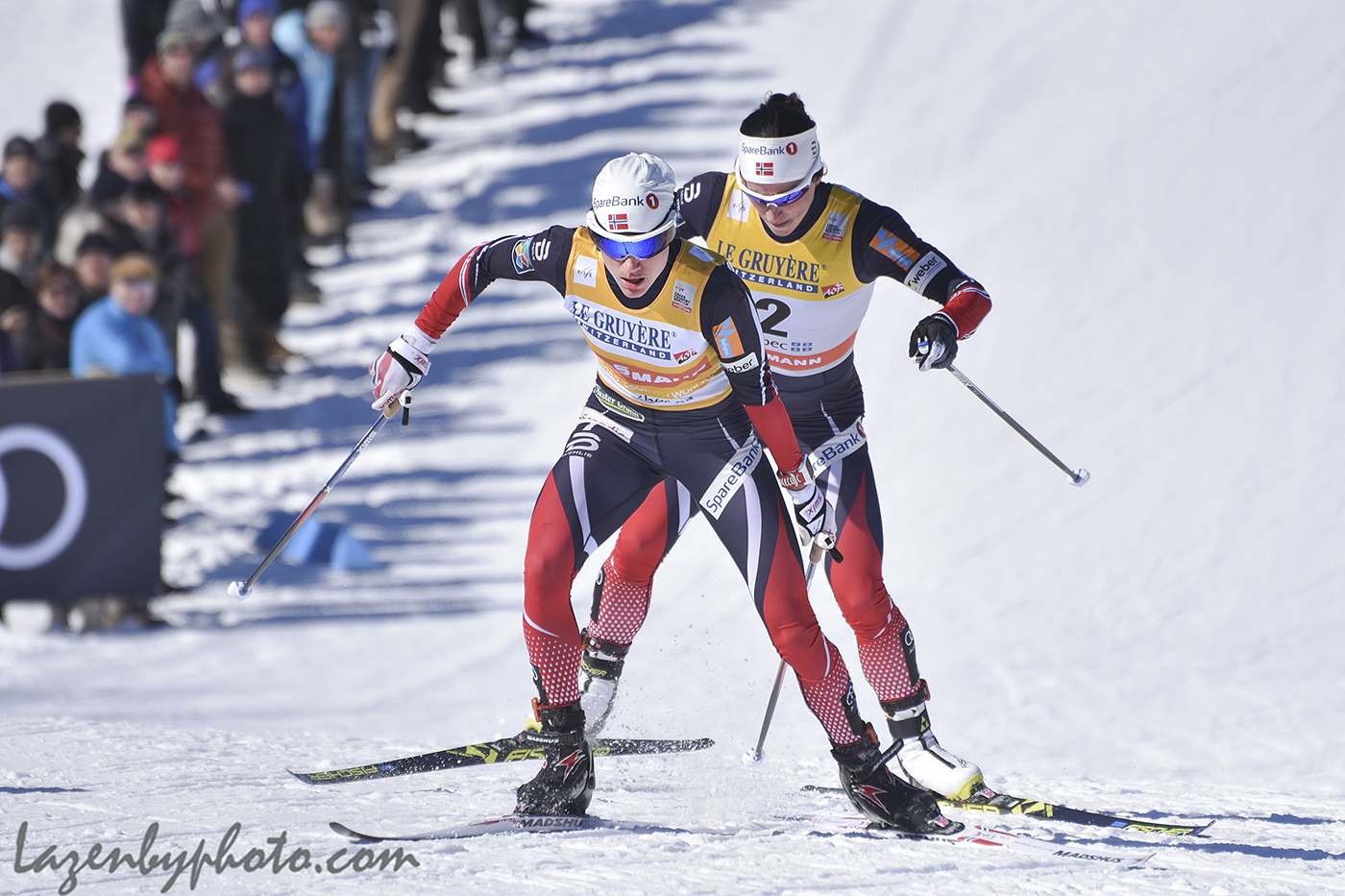
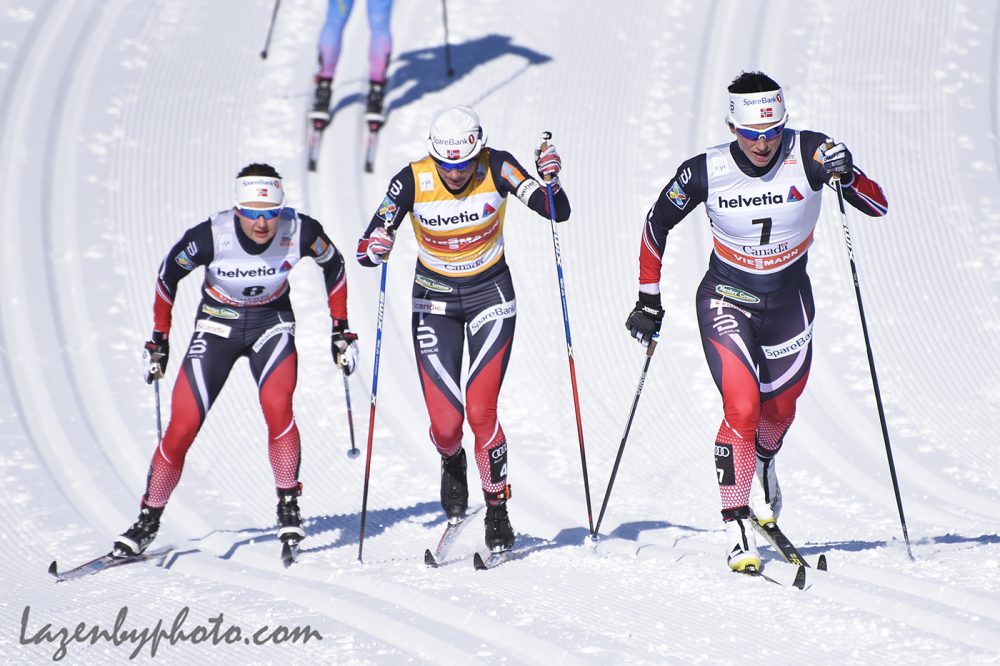
Norway’s Marit Bjørgen (2) and Heidi Weng en route to first and second, respectively, in the women’s 10 k freestyle pursuit on March 19 at World Cup Finals in Quebec City.
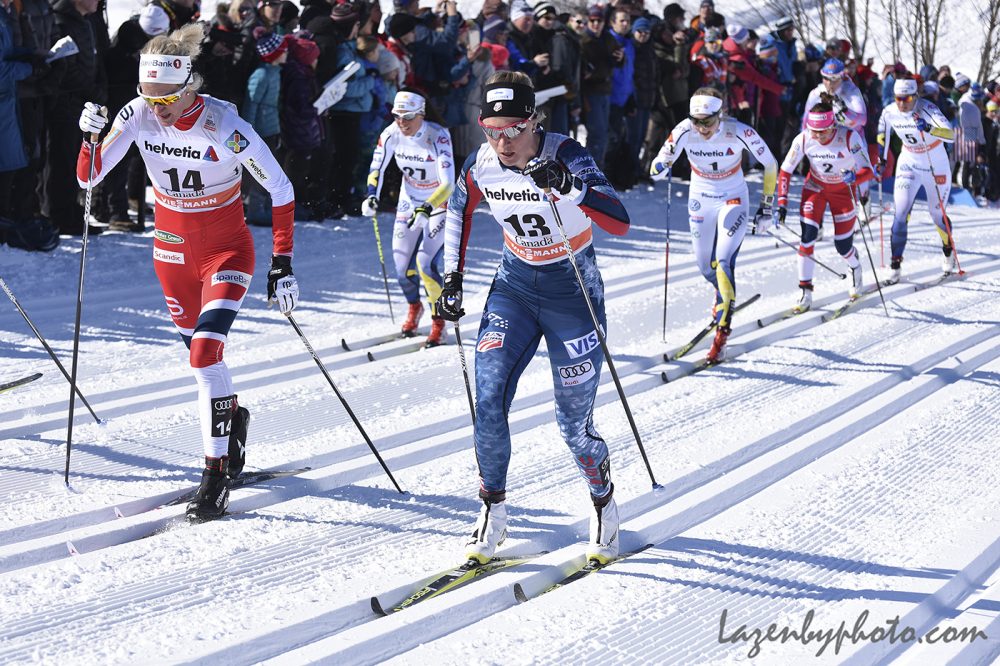
Sweden’s Charlotte Kalla leads teammate Anna Haag, Norway’s Kathrine Rolsted Harsem (l), American Sadie Bjornsen (r) and others during the women’s 10 k freestyle pursuit on March 19 at World Cup Finals in Quebec City.
American Jessie Diggins leads Germany’s Stefanie Böhler and others during the women’s 10 k freestyle pursuit on March 19 at World Cup Finals in Quebec City.
Russia’s Yulia Tchekaleva (27) chasing during the women’s 10 k freestyle pursuit on March 19 at World Cup Finals in Quebec City. She finished 23rd.
Germany’s Hanna Kolb chasing Americans Kaitlynn Miller, Erika Flowers and Liz Guiney during the women’s 10 k freestyle pursuit on March 19 at World Cup Finals in Quebec City.
Norway’s Heidi Weng follows her teammate Marit Bjørgen during the women’s 10 k freestyle on March 19 at World Cup Finals in Quebec City.
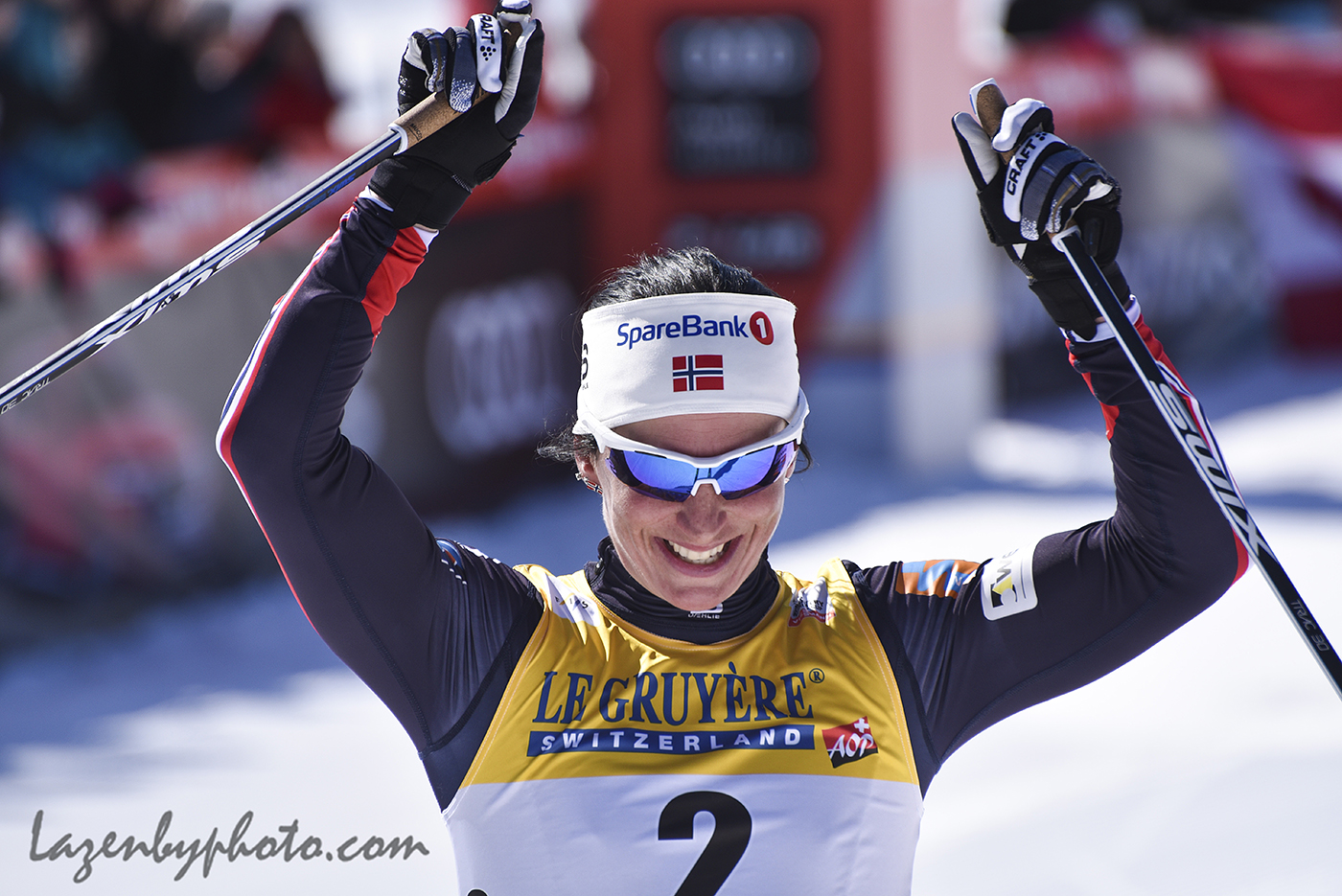
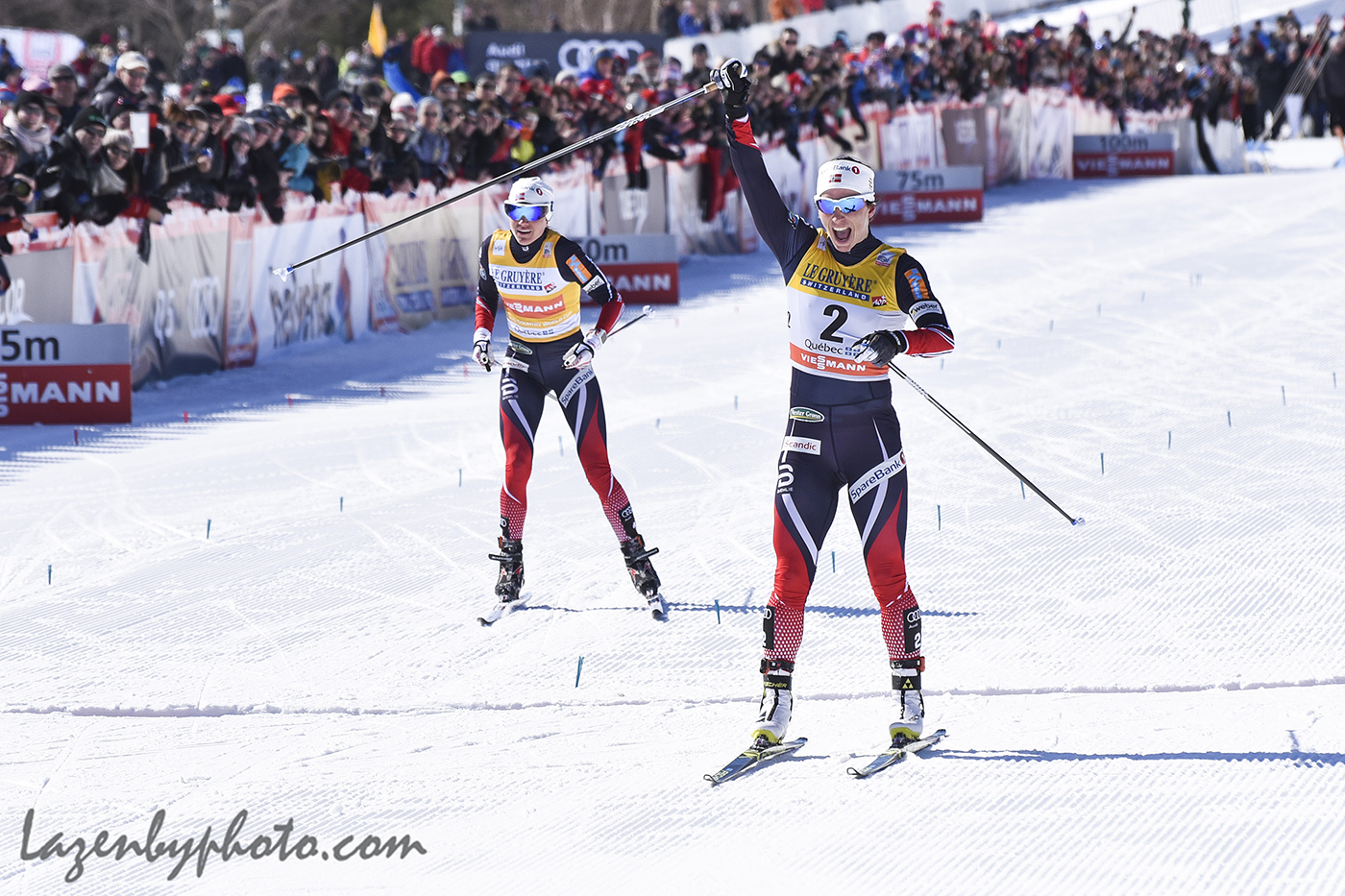
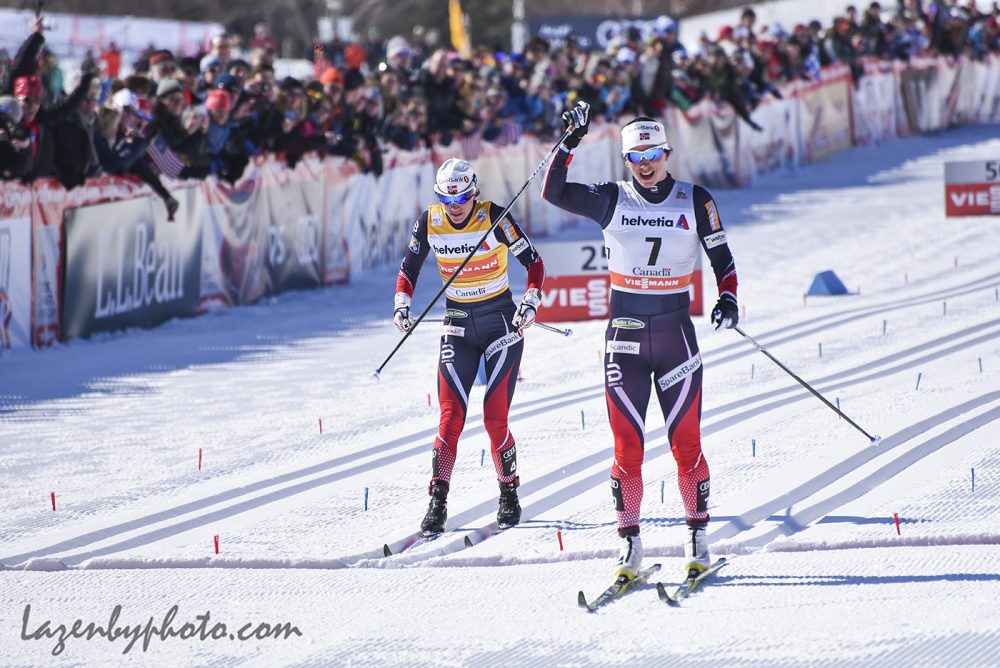
Norway’s Marit Bjørgen celebrates her win in the women’s 10 k freestyle pursuit, just ahead of teammate Heidi Weng on March 19 at World Cup Finals in Quebec City.
Sweden’s Marcus Hellner leads Russia’s Andrey Larkov and others during the men’s 15 k freestyle pursuit on March 19 at World Cup Finals in Quebec City.
Canada’s Alex Harvey leads Norway’s Johannes Høsflot Klæbo during the men’s 15 k freestyle pursuit on March 19 at World Cup Finals in Quebec City. Klæbo won and Harvey placed second.
Norwegians Niklas Dyrhaug (2) and Pål Golberg after finishing third and 12th, respectively, in the last race of World Cup Finals, the men’s 15 k freestyle pursuit on March 19 in Quebec City.
Spectators snap finish-line photos of Canada’s Alex Harvey and Norway’s Johannes Høsflot Klæbo after the men’s 15 k freestyle pursuit on March 19, the last day of World Cup Finals in Quebec City.
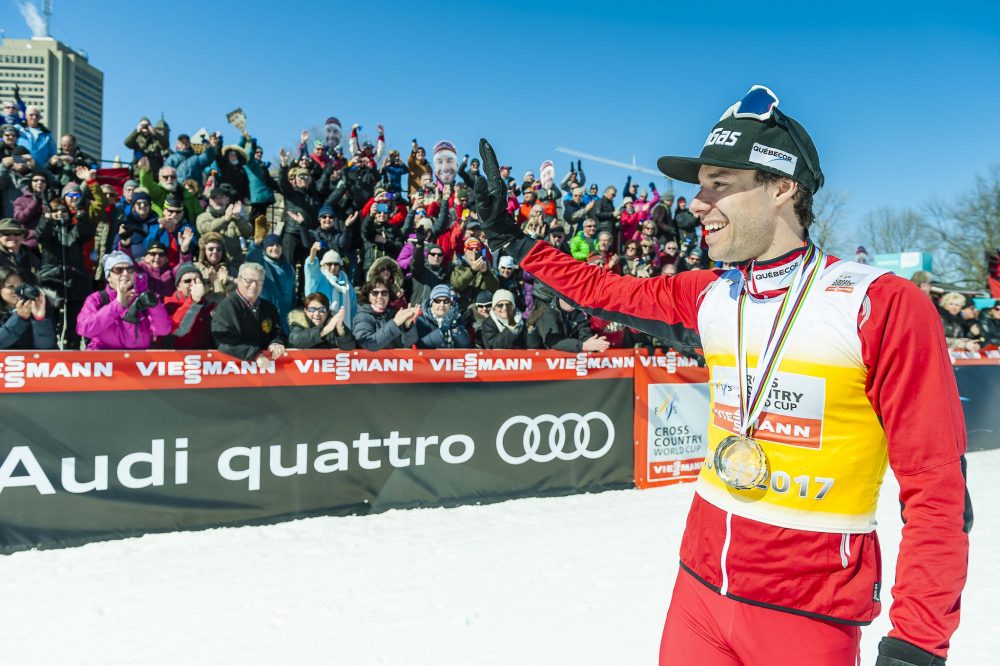
Alex Harvey greets his hometown crowd after placing second in the final race of World Cup Finals and locking up second place in the Distance World Cup and third in the Overall World Cup standings.
Canada’s Alex Harvey with his medals for placing second in the Distance World Cup and third in the Overall World Cup on the last day of World Cup Finals in Quebec City on Sunday, March 19. (Photo: John Lazenby/Lazenbyphoto.com)
After last weekend’s three-day World Cup Finals mini tour drew nearly 60 North American competitors and tens of thousands of spectators to Quebec City, it’s only fitting that we share the quotes from some of the athletes you haven’t heard from yet (and some you have). Here is a collection of some of the most interesting comments from the Canadian World Cup and Nation’s Group skiers at World Cup Finals. There were 30 in total. (Stay tuned for the U.S. notes & quotes version.)
And here are our race reports (with links to results at the bottom of each) from Friday though Sunday, March 17-19:
Canada’s 21-year-old Ricardo Izquierdo-Bernier, of the Pierre Harvey National Training Centre (CNEPH) racing his first World Cup during the men’s freestyle sprint qualifier at World Cup Finals on March 17 in Quebec City. (Photo: John Lazenby/Lazenbyphoto.com)
“I was surprised when I was selected, but I am very happy to be here.” — Ricardo Izquierdo-Bernier (CNEPH)
“I was stressing when they announced that, ‘The national group, maybe you will have the opportunity to qualify for your first World Cup.’ [My coach and I] just kind of put that to the back of our minds and decided that if it happened, it was going to be an incredible icing on the cake part of my race season, and it happened and it was super exciting. I was really just focusing on the process so I am super excited to be here, a little overwhelmed but really excited.” — Annika Richardson (Junior NST/NTDC Thunder Bay)
“I was just happy to be here. Last year I got my concussion in Montreal [during the Ski Tour Canada] so I didn’t actually get to race here so it’s a great place to come and race. I’ve raced here just a couple of times and it’s an incredible feeling to have the crowd behind you. … It’s really great because you don’t get that in Europe. You get lots of fans, but not people who know your name so it’s pretty cool.” — Andrea Dupont (Rocky Mountain Racers)
“I am really really excited to be here. I did the [Ski Tour Canada] last year and this is probably my favourite venue to race at in Canada, being in the city and it’s a beautiful day. Can’t really ask for anything more.” — Annika Hicks (AWCA)
“I didn’t reach my goal of qualifying for the World Championships, but to race at this level this weekend far exceeds all my expectations. I was a forerunner for the Tour of Ski last year, but now I’m actually racing. That makes me really happy!” — Laura Leclair (Junior NST/Chelsea Nordiq)
“It’s the cherry on the sundae. It’s good to go up against the best in the world, and it’s an opportunity to see what you have to work on for the next year, and try your hardest.” — Frédérique Vézina (CNEPH)
On racing in Canada:
“I thought last year was going to be my last chance to race internationally in Canada so I am really thrilled to be here.” — Devon Kershaw (Canadian World Cup Team)
“We are pretty lucky to have the end of the World Cup here in our own house, and it’s really exciting to be able to finish of the season here in Canada and it’s definitely convenient to be able to relax here after we are finished. We have Canadian nationals still, so I guess not complete relaxation … but it’s really fun to be back in Canada.” — Len Valjas (Canadian World Cup Team)
“It’s nice to be back here in Canada racing a World Cup. I think we are pretty lucky to have the opportunity as a group of Canadians, developing skiers, young guys, old guys like me just trying to get up there, but also seeing Alex skiing so well, world champion. I mean, what can you say? It’s awesome. It’s good for our sport right now.” — Brian McKeever (Canadian Para-Nordic Ski Team)
“The atmosphere here is really on par, today especially, with the races we do overseas, and especially being in a city center that we know so well like Quebec, it’s a really good energy.” — Jess Cockney (Canadian World Cup Team), after Saturday’s 15 k classic mass start
“It’s absolute incredible to come back to Quebec after last year and race something that’s familiar to us already, but slightly different because the race course, they change out the race course, which is always exciting. It’s amazing to race in front of Canadians and to have people cheering your name all around the course that actually personally know you, so it’s a pretty incredible experience to come out here and do that. “ — Alannah MacLean (NTDC Thunder Bay)
“It’s been great to finish the season at home. It’s been a really long season, though. I have been overseas way more than I ever have in my life so I think it’s taking a little bit of a toll on the energy, but I am just so excited to be able to race at home here and enjoy this amazing atmosphere.” — Dahria Beatty (National U25 Team/AWCA)
“I was pretty tired after such a long season, and I was really happy to be here and to able to finish the season on such a fun note, to ski a World Cup at home. It’s happened the last two years, but it doesn’t really happen that often, so it’s a unique opportunity. I gave it everything that was left in the tank, and I had a lot of fun.” — Katherine Stewart-Jones (NST U25 Team/NTDC Thunder Bay)
“This is huge for Canada, and I hope FIS can see that it’s really amazing to have races here, and I think the athletes like it, too, so I hope this becomes a staple even after our generation. There’s enough North American skiers that we should have this here every year. We’re winning medals too and Alex is up there in the overall, we deserve to make them travel a little bit. I’d love to see more races here.” — Valjas
On being cheered on by tens of thousands of fans:
“It started in warmup where you kind of would be skiing around and people recognized the National Development team jacket and yell, ‘Go Canada!’ and I was like, OK, just smile and keep going and trying to keep my focus, but it felt incredible to ski around and have everyone cheering for you and rooting for you because you’re Canadian. Definitely had to nail my focus today a bit more than usual because of that, but good practice.” — Richardson
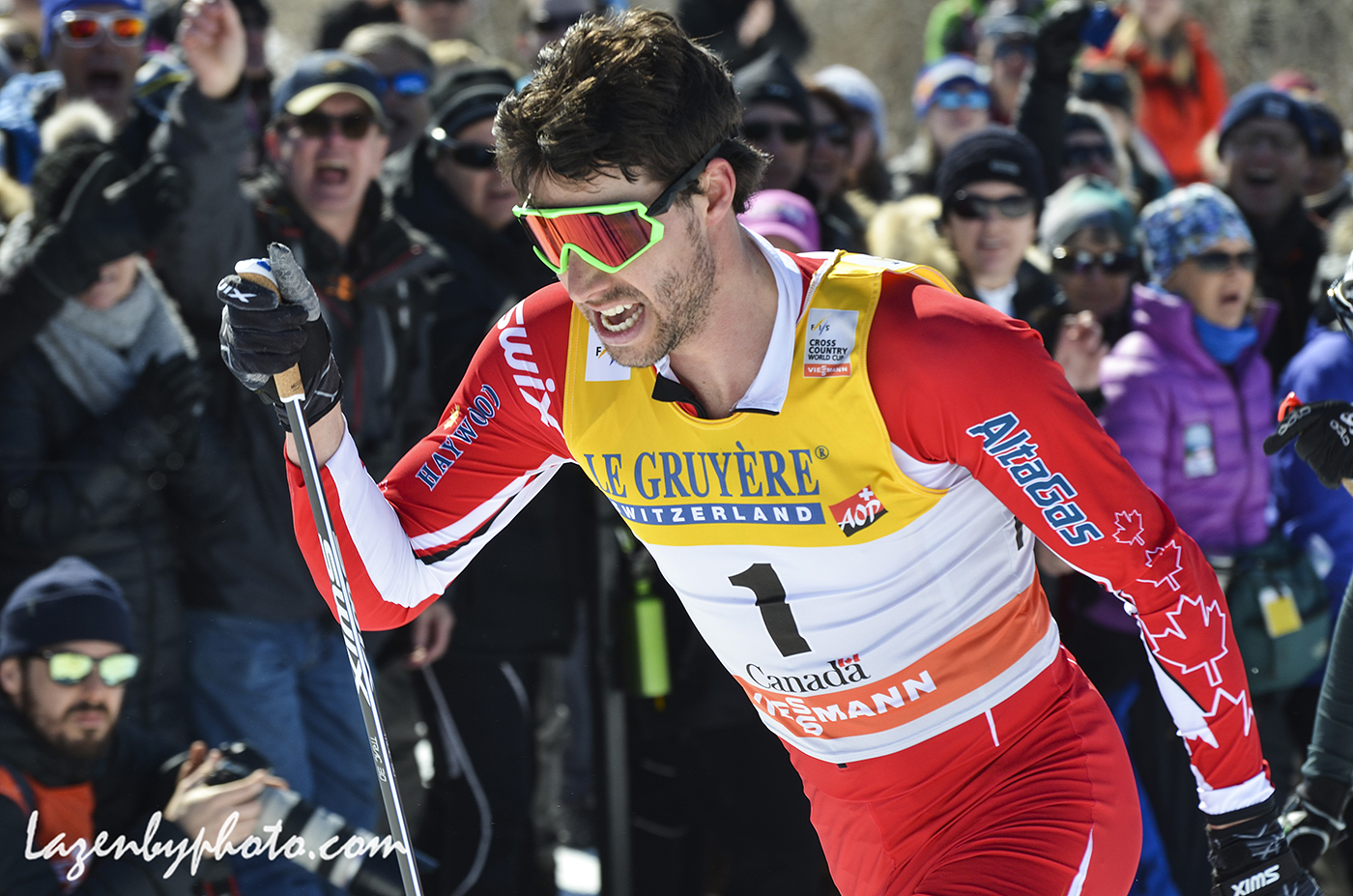
Alex Harvey (Canadian World Cup Team) racing to fourth in the men’s freestyle sprint qualifier on the first day of World Cup Finals, last Friday, March 17, in Quebec City. He went on to win the final. (Photo: John Lazenby/Lazenbyphoto.com)
“Sometimes they’re cheering really loud and you know it’s actually not for you, it’s just the commentator mentioned Alex but then you’re just like, I’ll take it. I’ll pretend they’re cheering for me.” — Valjas
“It’s a beautiful day in Quebec and the crowds are pretty amazing. It just kind of keeps the intensity high the whole time so it’s a fun place to race.” — Dupont, after Sunday’s 10 k freestyle pursuit
“It was another absolutely beautiful day out here, lots of home crowd cheering us on, so it was a really perfect day at the races.” — Knute Johnsgaard (NST U25 Team/AWCA), after Sunday’s 15 k freestyle pursuit
“Today was not the greatest day in my skiing career, however, it was pretty amazing because the crowd was cheering me on the whole way.” — Julien Locke (NST U25 Team/AWCA), after Saturday’s 15 k classic mass start
“It’s funny that people recognize me and know my name. It’s heart warming to have all the public support me and the Canadian team. … It was really an amazing weekend, the atmosphere, the crowd, the conditions, everything was on point. I couldn’t of hoped for a better way to end the season.” — Cendrine Browne (NST U25 Team/CNEPH)
On making the jump to the World Cup:
“It was amazing. The first day it was a lot to take in with the crowd and such a high-level race and having such high-level skiers around, but then Saturday I was more used to it and I was able to really focus on my race and put in a good effort.” — Katie Weaver (Junior NST/Hollyburn)
“You’ve got a lot of fast guys, and you’re kind of going from being one of the faster guys to obviously to one of the slowest guys around, and that’s a cool feeling, actually.” — Gareth Williams (Junior NST/Telemark)
“It’s always intimidating, but once you’re on the starting line, it’s mostly exciting. I’m not expecting to lead the pack anytime soon, so all I can do is try giving my max effort.” — Sophie Carrier-Laforte (CNEPH)
“This was my first. I qualified for a couple in the winter but because of U23 [World Championships] I wasn’t able to take advantage of it.” — Evan Palmer-Charrette (NTDC Thunder Bay)
“This was my fifth [World Cup race]. I still feel like there’s a lot of work I can do to be more competitive in this field, but I think I’m getting more and more comfortable with it in general.” — Sadie White (NTDC Thunder Bay)
“I don’t think I’m at this level of competition yet, but I think it’s so fun to be here and see how the fastest people in the world race.” — Mia Serratore (NTDC Thunder Bay), at the end of her first World Cup weekend
“I mean, they’re so fast out there, but I love it because I get to see what level I need to get to. Racing in Quebec, it’s so fun. The crowd’s just crazy. It’s so good.” — Joey Foster (Team Hardwood), at the end of his first World Cup weekend
Russell Kennedy (Canmore Nordic/Team R.A.D.) racing to 36th in the men’s skate sprint qualifier at World Cup Finals in Quebec City on March 17. (Photo: John Lazenby/Lazenbyphoto.com)
On five Canadian men qualifying for the sprint heats in the top 30 (a first for Canada in a World Cup):
“I am really pumped for everyone and I think it’s really good for the sport to see that many people up there. We have been sprinting really well in a lot of races and have a lot of good sprinters so it’s good to see everyone get up there and do well. Hopefully they can carry it out in the heats and get a couple of those closer to the podiums.” — Russell Kennedy (Canmore Nordic/Team R.A.D.)
On sprinting:
“It’s about 89.5 k too short for me these days.” — Brian McKeever (Canadian Para-Nordic Ski Team), who also specializes in marathons
On conditions:
“The snow is perfect conditions. The snow is cold, but the sun is warm, and the track is holding up great, so good Canadian conditions.” — Beatty, after Friday’s sprint
“I guess it’s pretty tricky to get grip with hard wax in this stuff, and I think klister would’ve been too slow so I had a lot of speed on my skis but my grip was definitely lacking a bit in the sun. In the shade it was pretty good, but it was a lot of upper body today, which I think was the way to go anyways.” — Andy Shields (Lappe Nordic), after Saturday’s 15 k classic mass start
“The skis showed good grip. The technicians delivered today. The issue was more the skier!” — Carrier-Laforte, after Saturday’s 10 k classic mass start
“The snow was fine. It didn’t really even get that mushy on the course and the downhills were pretty glazed actually. It stayed nice and firm. My skis were just amazing today. I was drafting people and shooting by them no problem. It was really good, really competitive skis.” — Foster, after Sunday’s 15 k freestyle pursuit
On the course:
“It’s tough because there’s a lot of flats, so you’re always working, whether it’s gradually downhill or gradually uphill. It’s good. It’s a challenging course in its own way. It’s not your typical World Cup where you have a huge climb and then a big rest after that, you’re just working stead, so it hurts. It’s a different kind of tough.” — Valjas
On sunscreen:
“Today is the first day that warranted the sunscreen, but I put the zinc on every day. Gotta protect yourself.” — Cockney
On goals for World Cup Finals:
“My goals were just to ski relaxed and push my body as hard as I can. I’ve really been injured this entire season so I haven’t done really that much racing at all. I was able to get enough racing in to qualify for this World Cup, which was something that I didn’t think was going to be possible at the beginning fo the season when I got injured, but to be here and not be 100 percent, but to be able to race in this environment is something that keeps me in the sport.” — MacLean (who herniated a disk)
“I really want to push as hard as I can for each race. I think that is something that sometimes it is difficult to do in Canada on the NorAm circuit because maybe if you’re not having a good race, you could pull back a little bit and save yourself for the next day and come in seventh instead of fifth, but here, I will still probably be in the back of the field, but I really want to push and feel good every time I cross the finish line that I gave it my all and kept pushing.” –– Richardson
Cendrine Browne, of the Canadian U25 Team and CNEPH, after finishing 41st in the women’s 10 k classic mass start on Saturday at World Cup Finals in Québec City. (Photo: John Lazenby/Lazenbyphoto.com)
On digging deep:
“Somehow I found a bit of fight. I didn’t really do much of a warmup today. I opted for a conserving energy strategy and I think it worked well. We’ve done so much racing that my body didn’t really need a warmup to get going so I did as little as possible before the racing to save everything I had for this last effort.” — Beatty
“It’s been a lot of racing this week. I was down in Lake Placid doing U.S. Junior Nationals and then I came here and now we’re off to Canadian Nationals for another three races. It’ll be a lot of racing, but that’s what I love to do.” — Weaver
“[After] yesterday’s race, I wasn’t going to start today and then the physio said, ‘If I’m treating you, you’re going to start.’ And I was like, ‘OK, Let’s do this!’ And she actually fixed me and today was much better.” — Valjas, on his upper-back injury, after Sunday’s 15 k freestyle pursuit
“I felt really really good, but I’m just having so many problems with my shins and my calves this season so it just makes it really difficult to ski properly.” — Serratore
On Quebec City:
“Quebec City, as far as Canada goes, is probably the closest thing to Europe, but it’s still the same country, same food.” — Palmer-Charrette
On their season overall:
Devon Kershaw leads Canadian teammate Graeme Killick in the men’s 15 k classic mass start at World Cup Finals on March 18 in Quebec City. (Photo: John Lazenby/Lazenbyphoto.com)
“It has been a really good season. It has been my most consistent season to date, so I have been really happy with it, have had some really good races and I just think especially in sprinting, my bad races are way better than they have been in the past. The fluctuation is smaller so I am showing good signs for next year.” — Beatty
“I think the season for me was a little disappointing. I had some signs of the training paying off, but I think overall I might have overdone it through the summer in sections and from that I struggled with some sickness through a lot of the season. I think some races were OK for me and I’ll take that and try to fix some things for next year over the summer and see what I can do. I mean, today was a good reminder that skate is not there and I really need to work on it for next year.” — Graeme Killick (Canadian World Cup Team), after 15 k skate pursuit
On season highlights:
“It’s got to be those two relay medals, especially the 4 x 7.5 k, that was so cool because my whole career we’ve tried to get a medal there and I was honored to be the anchor and that was a huge moment in my career to be able to pull that off and secure a medal for the men’s relay was just awesome. And of course, the first win for me with Alex was also just as special. It’s been a good year. Lots of highs, some lows, and I’m ready for next year.” — Valjas, on historic third-place finish with men’s relay at World Cup in Ulricehamn, Sweden, and World Cup freestyle team sprint win with teammate Alex Harvey in Toblach, Italy
Emily Nishikawa (Canadian World Cup Team) racing to 38th on the final day of 2017 World Cup Finals on Sunday in Quebec City, the women’s 10 k freestyle pursuit. (Photo: John Lazenby/Lazenbyphoto.com)
“I think the relay in Lahti for us, it was one of our best women’s results since 2001 or something like that, so 16 years.” — Emily Nishikawa (Canadian World Cup Team), on the Canadian women’s team’s 10th place in the 4 x 5 k relay at 2017 Nordic World Championships
“For me, it would be Davos. I was really happy with my form there, and I think I never felt that good in a skate race. I like altitude, too, so that course kind of suits me. That was my best individual start ever so it’s good to have one of those. I was really happy with that day.” — Killick, referring to his 21st place in the World Cup 30 k freestyle individual start on Dec. 10 in Davos, Switzerland
“That’s hard to call. Probably the highlight of my season was my 26th was La Clusaz, getting my first distance top 30. That was something I wasn’t really sure I’d be able to bridge this season and to be able to ski into the top 30 in distance as well as sprint this year wasp pretty amazing so that was a big step for me forward in coming years.” — Beatty, on her 26th place in the World Cup 10 k freestyle mass start on Dec. 17 in La Clusaz, France
“Maybe this, watching Harv do well. The Holmenkollen was an amazing experience. It was hard and not my best finish ever, but it was a really, really cool experience and I can’t say enough how awesome it was.” — Kennedy, who placed 47th in the 50 k classic mass start at Holmenkollen in Oslo, Norway, on March 11
On the upcoming training season:
“I’m pretty relieved that this season’s over and really excited to kind of get a fresh start on next year and just take some time to reflect on this past season and look at the things that went well and things that I could improve on and hopefully use those as building blocks for next year’s training.” — Johnsgaard
“This summer, I’ll put in practice what I learned from my World cup experience. I’ll really focus on technique and work on my tempo. The only way to improve is to keep racing against the best.” — Browne
Norway’s Marit Bjørgen celebrates her ninth-straight win in World Cup distance races (anything longer than a sprint) in the last race of the 2016/2017 season, the women’s 10 k freestyle pursuit on Sunday in Quebec City. (Photo: John Lazenby/Lazenbyphoto.com)
QUEBEC CITY — Generally speaking, most European-based World Cup skiers wouldn’t have picked Canada as their ideal place to end the season. It’s too far across the pond, too far from the beaches, too far from home.
Québec City organizers, headed by Gestev, had just under two months to prepare. Having hosted two stages of the Ski Tour Canada last season and a World Cup sprint weekend in 2012, they had the experience, but World Cup Finals — complete with three uninterrupted days of racing and season-ending awards — was another animal of its own entity.
Fortunately, the weather cooperated. Three days before World Cup Finals, Québec City and the eastern part of North America got its biggest snowstorm of the season and perhaps the last several winters. With three straight days of racing taking place on the open-aired Plains of Abraham, most familiar with the expansive downtown park expected bone-chilling wind. Yet with above freezing temperatures at race time, that wasn’t much of a factor, especially not on Saturday and Sunday.
Each day, spectators and athletes required fewer layers, and by Sunday, some of the athletes were down to bibs only. The sun was intense, there wasn’t a cloud in the sky, and the athletes were happy.
Norway’s Heidi Weng leads her teammate Marit Bjørgen during the women’s 10 k freestyle pursuit on the last day of World Cup Finals in Quebec City. Bjørgen went on to win while Weng was 1.2 seconds back in second. (Photo: John Lazenby/Lazenbyphoto.com)
“When I saw that we would race here, I thought, ‘Oh no. We’ll have to go so far from home,’ ” Norway’s Heidi Weng told FasterSkier on Sunday. “But when I come here, it’s more like winter, and I like the track here, and I’ve gone very fast here before. So I knew I could go do a very good race here, so now I hope we come here often. It’s very good, and many people, and the atmosphere, and good snow. It was very great to be here.”
Weng spoke to a horde of reporters with a large, silver briefcase by her side. In it was one of the Crystal Globes she had just received for winning the Overall and Distance World Cups (she won one globe for each season-long category). Between Friday, Saturday and Sunday, Weng finished sixth in the freestyle sprint, second in the 10-kilometer classic mass start, and second in the 10 k freestyle pursuit. Her Norwegian teammate and longtime idol, Marit Bjørgen beat her in both the distance races.
In all, Weng racked up about 20 individual World Cup podiums (including her Tour de Ski win, Lillehammer mini tour win, and World Championships silver in the 30 k freestyle mass start). She was the most consistent skier throughout the season, thus earning the Overall World Cup crown by 40 points over Finland’s Krista Pärmäkoski, and distance title by 97 points over Bjørgen.
“I’ve had many podiums this year,” Weng said. “In sprint I have taken huge steps, so I am very happy with the season. I have won a sprint race, and that’s the most important to me…
“Maybe I must have a little more confidence that I am good and a good skier, because I always think I am not so good as the others, but now I have a better head,” she added. “Maybe you can say in your head that you are very good and very strong, so next year I do a joke with my head.”
While Weng keeps telling herself that she can win, Bjørgen is fully aware that she’s back to her top form having won every distance race since the new year. That’s nine straight individual wins, including two from this past weekend.
After starting one second behind Weng in Sunday’s 10 k skate pursuit, she outlasted the overall and distance World Cup champion by 1.2 seconds at the finish after leading Weng for most of the three-lap race.
“It has been an incredible season for me after Christmas,” Bjørgen, who had a child in December 2015 and took last season off, told reporters on Sunday. “I won every long distance and four golds in the World Championships so this has been incredible and to win today also.”
On Sunday, Bjørgen caught Weng quickly and with the third starter, Norway’s Ingvild Flugstad Østberg, heading out 29 seconds back, the two skied off together and away from any threat to their top-two quest.
On the first lap, Østberg tried to close the gap, coming within 23 seconds of them at 1.3 k, but by the time she lapped through the stadium at 3.3 k, she was 33 seconds behind and just seven seconds ahead of a chase pack with her Norwegian teammate Maiken Caspersen Falla, Pärmäkoski, and Sweden’s Ida Ingemarsdotter and Stina Nilsson. Another 20 seconds behind them, American Sadie Bjornsen and Sweden’s Anna Haag were leading a pack of eight.
One lap later, Bjørgen and Weng cruised into and out of the stadium 46 seconds before Østberg, who was still 10 seconds ahead of the four-woman chase pack by the time she came through. The group, which was down to Nilsson, Ingemarsdotter and Parmakoski, eventually caught Østberg less than a kilometer before the finish, and Østberg finished at the back of that group in sixth, 1:06.8 behind Bjørgen. In a race for third, Nilsson took it by 1.9 seconds over Ingemarsdotter in fourth and 5.6 seconds ahead of Pärmäkoski in fifth.
“It was a mental struggle the whole way because they were 15 and 10 seconds behind me all the way, and that’s a difficult gap,” Østberg told FasterSkier. “They were three and four working together, and I was all by myself in front. I really tried to push as hard as I could, and stay in front of them, and I had 10 seconds, and it was less than 1 kilometer left, and I really believed that I could take it, but when they passed me, they had such high speed, I couldn’t keep up with them. So that was not so fun to see them pass me there, but I managed to take the third place overall [in the World Cup], so I have to be satisfied with that, I guess.”
“I think we worked well together,” Nilsson told FasterSkier. “Krista did the hardest work, I think, but I tried to help her as much as I could, and I was very excited that we could catch up to Ingvild. … I knew that when we started to be in the sprint course, I started to feel at home, then I just wanted to go as fast as I could.”
Norway’s Marit Bjørgen after outlasting her teammate Heidi Weng for the win in the women’s 10 k freestyle pursuit on Sunday at World Cup Finals in Quebec City. (Photo: John Lazenby/Lazenbyphoto.com)
Exactly a minute before Nilsson — a sprint specialist — finished third, Bjørgen had crossed the line first in 22:36.1 minutes after getting slightly ahead of Weng coming out of the downhill with 100 meters remaining. Leading up to that point, Weng had come from behind to attack on the second-to-last climb, a markedly steep one, but Bjørgen responded quickly.
“I thought that Marit was a little bit more tired than me, but when I attacked on the sprint uphill I hoped that I could get some meters to Marit, but she was there, and in the downhill she came from behind and take a better speed,” Weng said. “That sucks, but I was number two, and it’s not many who can be on the podium, so I am very happy.”
“I knew that it would be a sprint in the end with Heidi and to have her behind me is a very good feeling,” Bjørgen said. “I’m 10 years older and to be there is a good feeling to take with me into the Olympic [year next season].”
Bjørgen is 36. Weng will turn 26 in July. Nilsson is 23.
On Sunday, Bjørgen not only won the pursuit and with it, the World Cup Finals mini tour, but she was also the fastest for time of day in 25:35.1. Weng was second fastest, 2.2 seconds back, and Nilsson third (+11.9) after starting seventh and moving her way up to third.
On her 34th birthday, Germany’s Nicole Fessel was fourth fastest (+15.3), and Bjornsen of the U.S. tied Sweden’s Charlotte Kalla for fifth on the day, 17.8 seconds off Bjørgen’s time.
Sadie Bjornsen (U.S. Ski Team) soaking up her top-10 finish at 2017 World Cup Finals in Quebec City after placing 10th in the 10 k freestyle pursuit and fifth for time of day. (Photo: John Lazenby/Lazenbyphoto.com)
Overall Bjornsen placed 10th (+1:27.2) after starting 1:10 minutes back in 10th with Kalla in ninth and skiing with her and Fessel (the 13th starter) to the finish.
“Charlotte was going so hard from the start,” Bjornsen said after. “I actually did my warm up behind her, trying to get used to her speed because that was my main goal, to stay with her today. I knew it was going to be rippin’, and at one point some of the girls went in front of me, and I let her get away, and I was like, ‘No! I have to stay with her!’ So I had to do a full sprint in the middle to catch back on, which took a lot to recover from.”
At the finish, just 0.4 seconds separated Kalla, Fessel and Bjornsen, who placed eighth (+1:26.8), ninth (+1:26.9) and 10th, respectively. Ahead of them, Norway’s Falla placed seventh (+1:19.8).
“I really wanted to outsprint those girls in the finish for some redemption from the sprint race the other day,” Bjornsen said, referring to her 13th place in the World Cup Finals opening skate sprint. “I’m super happy with a top 10 in the tour. That’s some of the best general skiing I’ve done this year, and it’s good to end on a high note.”
The U.S. had two in the top 20 both overall and for time of day, with Jessie Diggins in 16th (+2:14.8) after skiing the 14th fastest time of day (+35.0). After placing ninth in the sprint and 27th in the classic mass start, she started Sunday in 20th and moved up four places by the finish.
“This weekend, in particular, was not what I wanted,” Diggins told reporters after. “To be honest, I was in tears before the race, because I was up all night coughing. I don’t know if I was getting sick or what, but I was getting nauseous, and I started to puke a little bit, and I was like, ‘I just want to race, and race in front of my family. I just want to go out there and be able to have a good day.’ ”
Diggins immediately got to work out of the gate and was up to 19th at the end of the first lap with Germany’s Stefanie Böhler. She skied with Böhler to the finish, before edging the German by two seconds for 16th.
“I decided I was going to go for it, and it was really working for me when Stefi came by,” Diggins said. “I was just hanging on in the uphills, and then on the downhills, if I was right in her draft, I could push or pull and help each other that way, and that was really cool. I really like skiing with Stefi, she’s awesome, and we were both working together to get the fastest time we could.”
Jessie Diggins (U.S. Ski Team) racing to 16th in the women’s 10 k freestyle pursuit (up from 20th at the start) with the 14th fastest course time on Sunday at World Cup Finals in Quebec City. (Photo: John Lazenby/Lazenbyphoto.com)
At the end of the season, Diggins ranked sixth in the overall World Cup and seventh in the distance standings.
“My biggest goal for today was to only say positive things to myself all day, no matter what anything felt like, no matter what the skis were doing, no matter what my body was doing, no matter how sick I felt, and the only thing was to push really hard and cross the finish line and be proud of pushing,” Diggins said. “You can’t control a lot of things in ski racing, but you can control, how much effort you put into it, and I can honestly say I’ve put 100 percent in this season, and I’m really proud of that.”
While 12 American woman completed the tour, 15 Canadians women did the same, with Emily Nishikawa (Canadian World Cup Team) leading them in 38th (+4:52.7) after starting 39th. Cendrine Browne, of Canada’s national U25 Team and Pierre Harvey Training Centre, finished just two seconds later in 40th (+4:54.7) after starting 41st.
“I was the last person to start before the wave,” Nishikawa explained. “And the wave, they’re working together as a mass start and moving pretty fast, so I got caught by them at the end of the first lap. I tucked in behind Rosie [Brennan of the U.S.] for the second lap and I actually had a big tangle with [Switzerland’s] Laurien van der Graaff on the fast downhill so I lost contact, lost all my speed. … and I did my best to come back.”
Browne started in the wave and described skiing in that group throughout the race.
“Unfortunately, I finished at the back of the group as I was losing energy,” she told FasterSkier. “I still managed to gain 30 seconds on the leader, which I’m happy about. I finished 41st again, behind my goal of moving towards the top 30, but it’s not dramatic. I think it’s a nice way to cap off the season.
“It was really an amazing weekend, the atmosphere, the crowd, the conditions, everything was on point,” Browne added in French. “I couldn’t have hoped for a better way to end the season.”
“We were so lucky to get [the World Cup Finals] here instead of Russia,” Nishikawa said. “We got to start 30 athletes, lots of people starting their very first World Cups, which is so exciting to see. It’s great for development for our country… We’ve got a really exciting group of women coming coming up in Canada now and to see this group of 15 women get starts this weekend is just great.”
Also for Canada, Dahria Beatty finished 50th, Annika Richardson 55th, Frédérique Vézina 57th, Katherine Stewart-Jones 58th, Andrea Dupont 59th, Annika Hicks 62nd, Sophie Carrier-Laforte 63rd, Sadie White 64th, Lisle Compton 65th, Katherine Weaver 66th, Laura Leclair 67th, and Mia Serratore 68th. Alannah MacLean did not finish.
American Sadie Bjornsen (10) racing to the line with Sweden’s Charlotte Kalla (9) and Germany’s Nicole Fessel (not shown) during the women’s 10 k freestyle pursuit on Sunday at World Cup Finals. Kalla placed eighth, Fessel ninth and Bjornsen 10th. (Photo: John Lazenby/Lazenbyphoto.com)
For the U.S., Sophie Caldwell placed 36th (+4:26.1), Rosie Brennan 42nd, Caitlin Patterson 43rd, Chelsea Holmes 45th, Julia Kern 46th, Kaitlynn Miller 52nd, Liz Guiney 53rd, Becca Rorabaugh 54th, Erika Flowers 56th, and Jennie Bender 60th.
“Sadie’s skating has reached a new level this season,” U.S. Ski Team Head Coach Chris Grover said, according to a team press release. “Jessie also had a measure of redemption leading a train of women and moving up four places in the standings today. Rookie Julia Kern continued to impress, staying in front of the chasing group for the entire race and winning the sprint at the end.
“We are very proud of the American effort this weekend — athletes, club coaches and U.S. Ski Team staff,” he continued. “We had some great races but, of course, were left wanting a bit more.”
The U.S. Ski Team will finish out its season in Fairbanks, Alaska, with the SuperTour Finals next week, March 27-April 2. Most Canadians are traveling to Canmore for Canadian Ski Nationals, which started Sunday and extend through this Saturday.
Left to right: Canada’s Alex Harvey alongside Norwegians Johannes Høsflot Klæbo and Niklas Dyrhaug on the men’s 15 k freestyle pursuit podium at World Cup Finals on Sunday in Quebec City. (Photo: John Lazenby/Lazenbyphoto.com)
Canada’s Alex Harvey has had one heck of a season.
In January, he reached the top of a World Cup podium for the first time in three years. The following weekend, he helped Canada to its first-ever relay podium and two weeks before that, won the men’s team sprint in Toblach, Italy, with his teammate Len Valjas. A little more than a month later, he earned his first individual World Championships gold.
The 28-year-old Harvey kept the ball rolling through the World Cup Finals in Quebec City this past Friday, winning the opening freestyle sprint before a roaring home crowd. The next day, he placed fourth in the 15-kilometer classic mass start.
To top it all off, he finished second in Sunday’s 15 k pursuit — less than one-hundredth of a second short of first after a photo finish with Norway’s Johannes Høsflot Klæbo — to secure not only another World Cup podium, but also third in the Overall World Cup standings and second in the Distance World Cup.
Norwegian Johannes Høsflot Klæbo leading the men’s 15 k freestyle pursuit at World Cup Finals on Sunday in Quebec City. (Photo: John Lazenby/Lazenbyphoto.com)
“It went more than perfectly,” Harvey said of his season to a group of reporters in French. “A gold at the Worlds, some World Cup victories, a second place overall all makes this by far the best season in my career.”
Harvey started the pursuit in third, 23 seconds behind the first starter, Klæbo, and one second behind another Norwegian, Niklas Dyrhaug. Though Harvey managed to catch Dyrhaug just before the 2 k mark, he admitted his real worry was not ahead of him, but behind. Norway’s Finn Hågen Krogh started 9 seconds after Harvey, and a kilometer after Harvey found Dyrhaug, Krogh was skiing three seconds behind.
“I didn’t know whether Finn Hågen would come back, which could of change entirely how the race played out, since he and Klæbo are sprint specialists,” Harvey said. “They could of worked together and bump me to fourth position, but I was glad the pace I was imposing in the beginning was enough for a spot on the podium.”
However, Harvey’s pace proved too fast for Krogh, who gave up the chase after the first lap at 3.75 k and let the chase group catch him on the first climb out of the stadium.
“I just blew up, so when there was no podium to race for, that was my only goal today,” Krogh told FasterSkier of his in-it-to-win-it mentality.
But more than let the chase pack absorb him, he skied the rest of the race just to finish and ended up 70th out of 73, and last place for time of day.
“I was tired at the end today,” he said. “I had a tough day. No power left today.”
Meanwhile, by 5 k, Harvey had pulled himself and Dyrhaug all the way up to Klæbo.
“From the start, I was closing on Klæbo, and I knew early on that a podium was in reach,” Harvey explained. “It’s a rare feeling of excitement to have during a race. Usually, only the last hundred metres will tell the story. After a lap and a half, when I realized Finn Hågen was dropped, I knew the podium was mine.”
That place on the podium, however, remained to be determined. With the Canadian doing all of the pulling up to Klæbo, he’d have to dig deep to find the speed for a sprint to the finish.
“I had my tactic, Johannes had his tactic, and I think Alex had his tactic,” Dyrhaug told FasterSkier. “It was a fair race, the only thing was, I couldn’t help Alex catch Johannes, that was Alex’s job as a Canadian. If I had gone on the front to help Alex catch Johannes, I would get in a lot of trouble with the Norwegian staff, but Alex was strong, and we caught up.”
Canada’s Alex Harvey leads Norwegian Niklas Dyrhaug during the men’s 15 k freestyle pursuit at World Cup Finals on Sunday in Quebec City. (Photo: John Lazenby/Lazenbyphoto.com)
The catch, from Klæbo’s perspective, was not unexpected. Realizing that the two had already put close to ten seconds into him by the 2 k mark and showed no signs of slowing down, Klæbo changed tactics.
“My first plan was to go from the start, but after Lap 1, I knew [Harvey and Dyrhaug] were coming pretty fast so I just had to focus on waiting for them and holding on to them,” Klæbo said.
With Klæbo now part of their train, the three began to take turns up front, Harvey going first, followed by Dyrhaug and Harvey again. The trio were met by no other competitors –only a loose dog as they headed into their fourth and final lap.
“I was looking towards the crowd for someone to pick him up.” Harvey said. “We all saw him. I think we were just hoping not to come across him in the final sprint.”
— NBC Olympics & Paralympics (@NBCOlympics) March 20, 2017
Luckily, the canine caused no problems for the racers and they all remained together during the final lap. At the top of a long descent into and out of the stadium, about a kilometer or so before the finish, all three racers suddenly backed off the pace and stood up. No one wanted to lead.
“Nobody wanted to stay first on the downhill because you can be attacked from behind,” Dyrhaug recalled. “We all knew the fight was about us three, and nobody wanted to go first.”
Finally, Klæbo accelerated in an attempt to catch the other two off guard. They shadowed him closely, and squared off for the second-to-last climb, where Dyrhaug made his move.
“Johannes made a sprint, and then we sat behind. and I tried it here again, so there were a lot of attacks in the last lap,” Dyrhaug said. “It was an exciting race to be a part of. It was a cool fight with Alex and Johannes.”
With 100 meters to go, Harvey cornered to the outside left, while Dyrhaug took the center and Klæbo the right. All three went pole for pole, lunging for the line with Klæbo emerging as the ultimate winner in a time of 32:44.5 minutes.
Harvey finished second, listed with the same time as Klæbo, and Dryhaug third, 0.1 seconds back.
“I lunged with everything I had,” Harvey told reporters in English. “I knew I was going to be second or first, but I had no idea.
“Klæbo is the best sprinter in the world,” he continued. “He has got the [Sprint] Crystal Globe at home already. He’s got a medal from world champs in the sprint.”
“It’s unbelievable to be able to win here in Quebec and to cross the finish line first,” Klæbo said. “My first plan was to go from the start, but after one lap, I knew they were coming pretty fast so I just had to focus on waiting on them and holding on to them because they were going pretty fast. …
“It is my first time in that situation,” he added of starting first in a pursuit. “And it is very easy to be go a little bit too fast, then it’s over, so I think I was tactically smart today so I am really happy to cross the finish line first.
“It’s a lot of people who cheered us forward in the tracks, so it’s amazing to go with Harvey and hear the voices and all the loud voice on the uphills there,” Klæbo continued.
“We have had many highlights [this season]” Harvey’s coach and Canadian co-World Cup coach Louis Bouchard told FasterSkier. “But … we are from Quebec so it’s normal for us to say the highlight is Quebec, because I am from here. I know everyone here. I know the spectators. I hope brings more younger athletes you know for the next generation.”
Canada’s Alex Harvey (r) lunging for first with Norway’s Johannes Høsflot Klæbo (not shown) and Niklas Dyrhaug (l). Harvey placed second and Dyrhaug third in the men’s 15 k freestyle pursuit at World Cup Finals on Sunday in Quebec City. (Photo: John Lazenby/Lazenbyphoto.com)
Led by Bjornsen in 11th, Four Americans in Top 30 for Time of Day
Also on Sunday, Erik Bjornsen of the U.S. Ski Team finished 25th (+2:19.1) and posted the 11th-fastest time of day, with 11th marking his best World Cup result to date.
“This is my first [mini] tour in the top 30, and that was my goal for this year was to finish one of the tours in the top 30, and I am really happy to knock that off.” Bjornsen said. “And I mean 11th on TOD [time of day], that is crazy. That is definitely my best result so I am psyched.”
U.S. Ski Team member Erik Bjornsen (33) racing to the 11th fastest time of day in the men’s 15 k freestyle pursuit at World Cup Finals on Sunday in Quebec City, for his career-best World Cup result. He finished 25th overall. (Photo: John Lazenby/Lazenbyphoto.com)
Bjornsen started 33rd and managed to catch and ski with Finland’s Matti Heikkinen, Canada’s Devon Kershaw, Germany’s Thomas Bing, France’s Jean-Marc Gaillard and Great Britain’s Andrew Young.
“It was hard, I was really worried I was working too hard to catch that group in the first 2 to 3 k,” Bjornsen said. “Luckily I just felt like I was recovering really well and sticking in the draft was really helpful. So it all worked out for me today.”
From Quebec, Bjornsen was bound for Anchorage, Alaska, where he trains with Alaska Pacific University (APU). Next week, he planned to compete at U.S. SuperTour Finals in Fairbanks.
“Excited to go home to sleep in my bed for the first time in four months,” he said.
Along with Bjornsen, four other Americans finished in the top 30 for time of day, with Paddy Caldwell in 25th, David Norris 27th, and Scott Patterson 30th.
Paddy Caldwell (U.S. Ski Team D-team/SMS) racing to 46th overall and 25th for time of day in the men’s 15 k freestyle pursuit at World Cup Finals in Quebec City. (Photo: John Lazenby/Lazenbyphoto.com)
Patterson was the first American across the line after Bjornsen, finishing in 41st (+3:45.6) after starting 46th. Norris was next, finishing 43rd (+4:15.9) after starting 55th. Caldwell came in 46th (+4:25.6) after starting 58th.
“That was one of the goals for the day so I am psyched about that,” Caldwell said of his time of day result. “I was working with David and Scott for most of the race and two other guys, so that was really fun, and fun to work as group and try to put down a fast time.”
Caldwell further explained that a great portion of his performance came from the way he approached the wave mass start.
“I was thankful I was sort of on the edge of the chevron right out of the gun. I just went hard as I could to try to get in front of that pack,” Caldwell said. “That actually ended up being a really good move to being towards the front of our chase pack and you know we just went from there.”
Also for the U.S., Andy Newell placed 44th overall (+4:23.0), Simi Hamilton 45th (+4:23.4), Matt Gelso 49th (+4:32.3), Noah Hoffman 52nd (+5:03.8), John Hegman 57th (+5:45.9), Brian Gregg 58th (+5:55.9), Ben Lustgarten 59th (+6:04.0) and Cole Morgan 65th (39:42.7).
“I started three people in front of the waves,” said Newell, who started 44th and finished in that position. “So I knew they were going to catch me, but that was fun because I got to ski with a lot of U.S. competitors. … Simi and I skied a lot together and Brian Gregg and you know it was fun to finish it off in the sun with some teammates.”
After Harvey, the next Canadian across the line was Devon Kershaw, who finished in 26th (+2:21.4) and posted the 19th-fastest time of day.
Canada’s Devon Kershaw racing to 26th in Sunday’s 15 k freestyle pursuit at World Cup Finals in Quebec City. He was 19th for time of day. (Photo: John Lazenby/Lazenbyphoto.com)
“It’s just kind of like a fitting ending to a kind of a tough season,” Kershaw said. “[I’ve been] just missing that top top gear a lot of the season and I think in all of the tours, I was [27th] in Lillehammer, 25th in Tour de Ski, and I think I was 26th [today]. I am constantly not amazing, but you know, at the same time it’s nice to make a few positions and [in] this beautiful atmosphere.”
Kershaw, who finished the 2011/2012 season in second in both the Overall and Distance World Cup, couldn’t have been more happy for his teammate and friend’s successful end to the season.
“He is one of my best friends and to see his development here and through the years, I have been saying this since he was a 1st year senior … I have never seen an athlete and work ethic like Alex,” Kershaw said. “To see the people of Quebec come out and support their hometown hero is couldn’t be happier for him.”
Among the Canadians, Graeme Killick finished 42nd (+3:45.9), Knute Johnsgaard 53rd (+5:09.6), Len Valjas 54th (+5:20.2), Evan Palmer-Charrette 60th (+6:11.4), Bob Thompson 61st (+6:12.8), Brian McKeever 62nd (+6:30.8), Joey Foster 64th (+6:39.9), Andy Shields 66th (+6:59.4), Russell Kennedy 67th (+7:06.0), Jess Cockney 68th (+7:17.2), Gareth Williams 71st (+9:21.6), Ricardo Izquierdo-Bernier 72nd (+10:22.7), and Julien Locke 73rd (+11:15.1).
–François Léger Dionne, Alex Kochon, Gerry Furseth, Ian Tovell, and Jake Ellis contributed
Canada’s Alex Harvey celebrates his second-place finish (and two overall World Cup medals, in the Distance World Cup and Overall World Cup) after the men’s 15 k freestyle pursuit at World Cup Finals on Sunday in Quebec City. (Photo: Gestev)
Norway’s Johannes Høsflot Klæbo (r) crossing the line first in the men’s 15 k classic mass start on Saturday at World Cup Finals in Quebec City, 0.5 seconds ahead of fellow Norwegian Niklas Dyrhaug (12), who placed second. Russia’s Alexander Bessmertnykh (behind Dyrhaug) followed in third, just ahead of Canada’s Alex Harvey (1) in fourth. (Photo: John Lazenby/Lazenbyphoto.com)
QUEBEC CITY — As 75 men jogged out into the center of the World Cup area assembled on the Plains of Abraham for the men’s 15-kilometer classic mass start on Saturday, one man in particular stood out. Alex Harvey, wearing the red suit of the Canadian national team, led the group out. He wore bib No. 1, but if you couldn’t see that from a distance, it didn’t matter. Essentially everyone knew who he was.
The official hashtag of World Cup Finals in Quebec City this Friday through Sunday has been #GOALEX2017. He is a celebrity in Quebec, a hero to its locals, and someone even non-skiers know quite a bit about.
And so far, the 28 year old appears to be soaking up every minute of his homecoming. One day after winning the freestyle sprint to start the finals, Harvey was seeded first in Saturday’s classic mass start. He led racers into the stadium, waved to spectators, started on the front line, and led the pack out of the stadium.
Canada’s Alex Harvey leading Norway’s Johannes Høsflot Klæbo and two other Norwegians and Switzerland’s Dario Cologna (far left) during the men’s 15 k classic mass start on Saturday at World Cup Finals in Quebec City. (Photo: John Lazenby/Lazenbyphoto.com)
Even when others took turns leading, with Norway’s Niklas Dyrhaug, Emil Iversen and Johannes Høsflot Klæbo setting the pace on the first of four laps, the possibility of Harvey winning never seemed in doubt. He consistently positioned himself within reach of the lead, skiing around sixth for much of the first lap.
On Lap 2, the lead group remained about 30 strong. Harvey skied within two seconds of the Norwegians up front, with Pål Golberg, Didrik Tønseth, Finn Hågen Krogh, Dyrhaug, and even Klæbo — the 20-year-old Sprint World Cup champion — all still in contention. By the end of Lap 3, Harvey was into second, right behind Tønseth.
With 3.75 k to go and the crowd’s ability to see the racers on most of the exposed course, the excitement among Harvey fans began to exceed its already high point from the start. Bells, horns, “Gooo Alex!”
Russia’s Alexander Bessmertnykh attacked on an uphill and Harvey stuck behind him in second. On the second to last climb, a short and steep pitch that ascends up from the Old City’s historic wall, Dyrhaug surged into first, Bessmertnykh followed him in second and Harvey in third.
Behind them, Klæbo was sizing them all up in fourth, waiting for the perfect time to strike. He did so by moving to the outside lane on the last long downhill and glided into second behind Dyrhaug. They ascended the final pitch together and rounded the final corner before the 100-meter stretch to the finish, where Klæbo continued to accelerate past Dyrhaug and double poled to his first World Cup distance win in 35:23.7 minutes. Dyrhaug finished 0.5 seconds later for second place, Bessmertnykh 0.8 seconds back in third, and Harvey 1.2 seconds behind Klæbo in fourth.
Canada’s Alex Harvey racing to fourth in the men’s 15 k classic mass start at World Cup Finals in Quebec City. With one race left, the 15 k freestyle pursuit, he is third in the mini tour and third in the Overall World Cup as well. (Photo: John Lazenby/Lazenbyphoto.com)
While it wasn’t a podium for Harvey, it was a result he was proud of.
“I’m very satisfied,” he told reporters afterward in French. “Making the top 10 is always a big deal. Today was another step towards securing a third spot in the overall [World Cup]. That was my big goal coming in. So I’m satisfied … You can’t make the podium every time. I felt very good physically.”
With one World Cup race remaining, Harvey, who’s ranked third in the world, extended his lead on Finland’s Matti Heikkinen in fourth to 92 points. Heikkinen finished 26th on Saturday, 1:04.9 minutes out of first, and will start Sunday’s 15 k freestyle pursuit 27th, 2:15 behind Klæbo as the World Cup Finals mini-tour leader. Dyrhaug will start 22 seconds back in second, followed by Harvey 1 second later in third, and Krogh another 11 seconds back in fourth.
“Every pursuit is a manhunt so I’ll be hunting the young Norwegian in front,” Harvey said. “It was Klæbo’s first victory in a distance event. We saw him come in second behind Sundby in this year’s first mini tour. So of course, he’s strong. I mean, the guy won five or six gold medals at the Junior Worlds. He’s a complete skier…”
Asked if he thought he could work with Dyrhaug to reel Klæbo in, Harvey wasn’t counting on one Norwegian helping him bridge the gap to another.
“I don’t think Dyrhaug will chase, but I will,” Harvey said.
Dyrhaug told reporters that might not be the case.
“Tomorrow is going to be an exciting day,” he said in English. “I saw that me and Alex are going out together, so it is in both of our interests to cooperate and do good teamwork, and hopefully we can catch Johannes and then we’ll have to see…
“We ought to talk together with team staff, hear what Johannes says, too,” he added. “But it is in both interests to have a big gap behind [us]. So if I’m strong, I’m thinking maybe I’m going to help Alex to … yeah, and we’re going to cooperate.”
In the last year that Klæbo’s been racing World Cups, the three-time 2016 junior world champion (in the freestyle sprint, 10 k classic and freestyle relay) has reached the podium six times in individual World Cups and claimed bronze in the freestyle sprint at this year’s World Championships. But before Saturday, all of his podiums (with the exception of one mini tour) had been in sprints.
“I hadn’t dreamed about doing a distance race in the World Cup … and cross the finish line in first,” Klæbo said after. “It’s unbelievable.”
Johannes Høsflot Klæbo leading three other Norwegians, Emil Iversen (l), Finn Hågen Krogh (second from l) and Niklas Dyrhaug (r) during the men’s 15 k classic mass start at World Cup Finals in Quebec City. Klæbo went on to win, Dyrhaug placed second, Krogh 16th, and Iversen 25th. (Photo: John Lazenby/Lazenbyphoto.com)
He was the most consistent race leader on Saturday, winning one of sprint preems and crossing in second behind his teammate Iversen for the other. In all, he accumulated 27 bonus seconds, which were deducted from his overall time in the mini tour — putting him first by 22 seconds over Dyrhaug.
“I just tried to be in the front for the bonus seconds to be able to get some seconds,” he explained of his race tactic. “So that was my plan.”
Despite trying to lead for most of it, he noticed others trying to do the same on the third and fourth laps. In the final stretch of the race, coming off the long downhill toward the finish, Klæbo focused on moving up from fourth.
“Niklas gapped our group in the last downhill there so we had push really hard on the last uphill to get to him,” he explained. “At the finish, it was just all out.”
Bessmertnykh, who will start the pursuit in 13th, 1:08 back, after placing 59th in Friday’s sprint, described Saturday’s mass start as “a fun race,” in a post-race interview with the International Ski Federation (FIS). “There was a lot of things happening all the time. I followed Niklas and Johannes on the last climb. We gained a small gap. I managed to ski well the last curve before the homestretch and carried in good speed.”
Dyrhaug was also satisfied with his race.
“The only thing was, I was one meter behind in the end,” he said. “I tried my best. I went all in for a long sprint, when it was one half k left, and it was almost.”
Under blue skies and a beating sun, Dyrhaug described Saturday afternoon in Quebec as “amazing.”
“We have been competing for like 40 races this year, but this is the most pretty day, and most pretty conditions for the whole year, so thank you, Quebec,” he said.
Waxing was a challenge, with temperatures warming quickly to about 2 degrees Celsius (mid-30s Fahrenheit) by midday.
Canada’s Devon Kershaw (r) and Graeme Killick (l) skied together for most of Saturday’s 15 k classic mass start after Kershaw broke a pole early. They went on to place 28th and 32nd, respectively. (Photo: John Lazenby/Lazenbyphoto.com)
Devon Kershaw was the second Canadian in the top 30, finishing 28th (+1:08.4) after breaking a pole early on.
“It was pretty chaotic and broke a pole there pretty early in the start and went all the way back into the 60’s, so made for a lot of work to try to get back in,” he said after. “I am proud of the fact that I was able to ski back into the points, but I had a better body than that today for sure and just had a bit of bad luck there.”
He finished 9.3 seconds ahead of his Canadian World Cup teammate Graeme Killick, who placed 32nd (+1:17.7), and the two essentially skied together from 5.25 k on.
While Kershaw said he thought the 3.7 k course would be better suited to skating, he was impressed with the atmosphere and the race organization.
“I think for a classic, there are a lot of corners and it’s pretty tight … [but] to bring the skiing to the people like they did and to use the terrain they have available, I tip my hat, its a great event,” he said. “It is the most crowds I have ever skied with in Canada, the sun is shining, the venue is fantastic, the organizers did a great job, the tracks are in perfect condition. What a great place to race.”
Erik Bjornsen led the U.S. men in 31st (+1:16.8) and two seconds behind Switzerland’s Roman Furger in 30th. After losing contact with the lead group of 29 on one of the bigger climbs at the end of the second lap, Bjornsen found himself skiing in “no-man’s land” with Sweden’s Teodor Peterson.
Erik Bjornsen (U.S. Ski Team) leads Sweden’s Teodor Peterson (r) up a climb during the men’s 15 k classic mass start at World Cup Finals in Quebec City. They went on to place 31st and 29th, respectively. (Photo: John Lazenby/Lazenbyphoto.com)
“It was a bummer to lose that front pack,” Bjornsen said. “I was struggling on the hills out there; I was a little light on kick. I think a lot of the guys were, but I wasn’t doing much striding. It was pretty much from double pole, to having to run outside the track. I felt pretty good, but I was losing time.”
While skiing with Peterson, Bjornsen said he led at times and wanted Peterson to help drive the chase as well. Peterson ended up just ahead of him in 29th (+1:14.3).
“I was like, ‘Come on, dude.’ I could see that there was a group behind, chasing us, and we were kind of right in that no-man’s land, which is always a bad spot to be,” he said. “But it was fun. It’s fun to be racing in North America, and have people cheering my name. It’s so unique, and I love it. I wish we could race over here more often.”
Matt Gelso was the second American in 37th (+1:32.6), Andy Newell finished 45th, Scott Patterson 46th, Noah Hoffman 48th, Ben Lustgarten 49th, David Norris 50th, Simi Hamilton 54th, Paddy Caldwell 59th, Jack Hegman 62nd, Cole Morgan 64th, and Brian Gregg 69th.
While the U.S. started 12 men, Canada had 15 in Saturday’s mass start with Bob Thompson finishing 55th, Knute Johnsgaard 57th, Len Valjas 61st, Russell Kennedy 63rd, Evan Palmer-Charrette 65th, Andy Shields 66th, Jess Cockney 67th, Brian McKeever 68th, Joey Foster 70th, Gareth Williams 72nd, Ricardo Izquierdo-Bernier 74th, and Julien Locke 75th.
— Gerry Furseth, François Léger Dionne, Jake Ellis, and Ian Tovell contributed
The men’s 15 k classic mass start podium on Day 2 of World Cup Finals in Quebec City, with Norway’s Johannes Høsflot Klæbo (c) in first, Norway’s Niklas Dyrhaug (l) in second and Russia’s Alexander Bessmertnykh (r) in third. (Photo: John Lazenby/Lazenbyphoto.com)
Marit Bjørgen (7) celebrates her victory over Norwegian teammate Heidi Weng during the women’s 10 k classic mass start on Saturday at World Cup Finals in Québec City. (Photo: John Lazenby/Lazenbyphoto.com)
When it comes to distance classic events, at least this season, Norway’s Marit Bjørgen is calling the shots. She completed her undefeated streak in 10-kilometer classic competitions (in both individual or mass starts), winning her fourth in a row on Saturday at World Cup Finals in Québec City.
Starting in bib No. 7, Saturday’s eventual mass-start winner was skiing just outside of the top 10 for the first kilometer, following two U.S. skiers, Sadie Bjornsen in eighth and Jessie Diggins in fifth. Setting the pace from the front were Norwegian teammates Heidi Weng and Ingvild Flugstad Østberg.
In another half a kilometer, Bjørgen moved to an outside lane and tucked past Sweden’s Ida Ingemarsdotter and Stina Nilsson. The maneuver moved her from 12th to fourth by the bottom of the third major downhill. And within the next climb, the classic queen had changed tracks and strode her way to the front, overtaking Weng.
Right to left: Norway’s Marit Bjørgen leads her teammates Heidi Weng and Ingvild Flugstad Østberg during the women’s 10 k classic mass start on Saturday at World Cup Finals in Québec City. (Photo: John Lazenby/Lazenbyphoto.com)
From there, the race for the win became one about Bjørgen.
While the Norwegian stayed put up front, Finland’s Krista Pärmäkoski, who started the day ranked 22nd in the mini tour, began gaining ground from the back. At 3.3 k the eventual third-place finisher, Pärmäkoski, who had crashed earlier in the race, was skiing 8.1 seconds back from the leader in 21st. In another kilometer, she had moved up ten places and was within 5.3 seconds of Bjørgen.
“I fell today after the start and I had to fight hard to ski back to the leading group,” Pärmäkoski said during an International Ski Federation (FIS) interview.
While Pärmäkoski managed to move up, Diggins, who had been within striking range of the podium, had slipped 19th. The American explained that, while her energy felt good throughout the race, the real struggle came from her lack of kick.
“I had many races when I had outstanding skis this year, arguably the best in the world,” Diggins said. “I guess at some point, it was natural to fall on the other side of that. You can’t nail it every time.”
Despite ideal conditions for spectators — clear, blue skies and a strong sun that sent temperatures soaring into the mid-30’s Fahrenheit (about 2 degrees Celsius) by midday — it was a tricky one for classic waxing.
“Our wax techs work so hard, they are under incredible pressure,” Diggins added. “We did the best we could, we tested as well as we could, and it was a huge struggle for me out there today. But I’m ready for tomorrow. I know at the end of the season, everyone is tired, I just want a good race to finish it off. In skating, you don’t have to worry about kick, so I’ll go out and fight.”
As Diggins dropped back, a trio of Norwegians spearheaded the front. Around the halfway point, Bjørgen, Weng and Østberg began their breakaway, foreshadowing an all-Norwegian podium.
But what they hadn’t counted on, least of all Østberg, was Pärmäkoski. The Finn had decreased her distance from the Norwegians within the next kilometer by another 4 seconds, now merely a meter away from the top three.
“I was really fighting and hoping for a podium,” Østberg told FasterSkier. “I actually felt strong and strong enough but there was three girls stronger than me so, fourth is also good.”
With less than four kilometers to go, Østberg took a pull at the front, but it wasn’t long before the lead was back to Bjørgen.
“I think Marit and I did an awesome job in the front,” Østberg said. “Marit for sure did most of the job, but I tried to help and tried to keep up the speed in the leading group because there was someone chasing behind and I knew that she had some power left at the end of the last lap.”
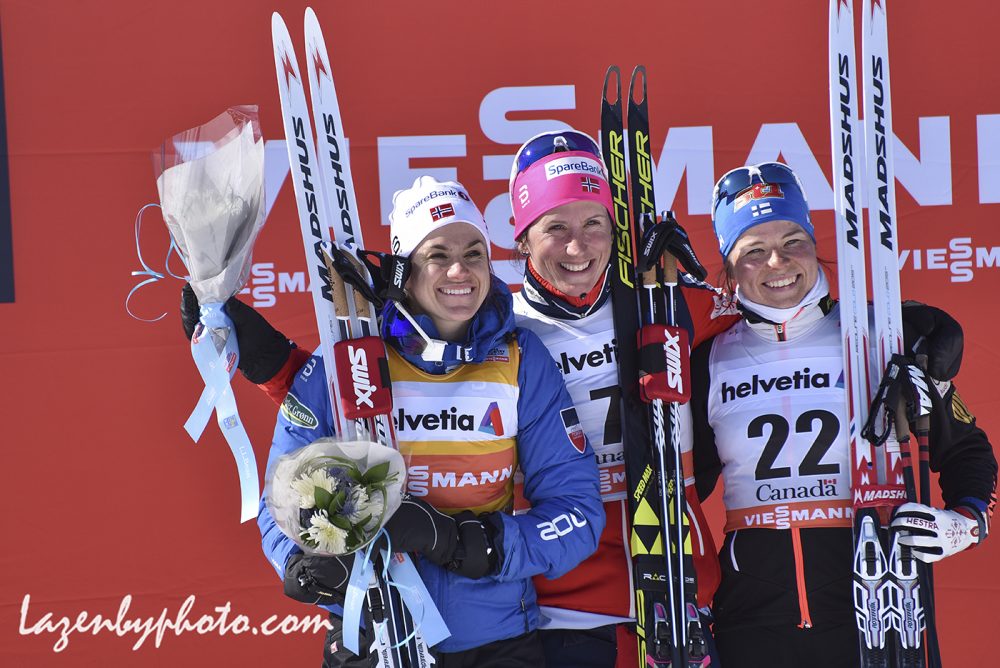
Left to right: Norwegians Heidi Weng and Marit Bjørgen and Finland’s Krista Pärmäkoski on the podium for the women’s 10-kilometer classic mass start on Saturday at World Cup Finals in Québec City. (Photo: John Lazenby/Lazenbyphoto.com)
As the four headed into their final kilometer, Bjørgen and Weng steamed off the front, while Pärmäkoski passed Østberg and locked into third. The two Norwegians cornered into the finishing stretch together, but Bjørgen’s double pole proved too strong for Weng and she crossed first in a time of 24:23.6.
Weng crossed 0.6 seconds later for second place, and Pärmäkoski finished 2.9 seconds back in third, while Østberg was 4.9 seconds off the podium in fourth.
“I have been winning all of the distance, so I’m happy with that,” Bjørgen said. “I was fighting for my position from the beginning, so I wasn’t in front before 2 kilometers, and then I wanted to speed up and then I saw the group was smaller and smaller. A good finish, so I am happy.”
A day after Weng locked up the Overall World Cup title, she clinched the Distance World Cup season-long title as well on Saturday. For Sunday’s pursuit, the last World Cup race of the season, Weng has a 1-second head start on Bjørgen in the 10 k freestyle pursuit.
Bjornsen Top American in 15th; Nishikawa Top Canadian in 37th
The top North American woman on Saturday was U.S. Ski Team (USST) member Sadie Bjornsen in 15th (+29.9).
Bjornsen and Diggins had been skiing with the top 10 for the first 3.3 k loop. As Diggins began to fall back, Bjornsen continued to race within and around the top 10. Bjornsen, like Diggins, also explained she had trouble slipping.
“I just couldn’t get up that hill,” Bjornsen said, referring to one of the course’s final climbs. “I started slipping so much, I was trying to keep it together. I made the mistake of wanting to go on the steep part of the climb, because I wanted to follow Kalla, but it was super hard to kick there, so it was a bit of a mistake … But I didn’t lose too much time on the group in front of me for tomorrow, so I’m excited.”
American Sadie Bjornsen (13) racing alongside Norway’s Kathrine Rolsted Harsem (14), ahead of Sweden’s Charlotte Kalla (27) and Stina Nilsson (1) and Norway’s Maiken Caspersen Falla (2), during the women’s 10 k classic mass start on Saturday at World Cup finals in Québec City. Bjornsen went on to place 15th. (Photo: John Lazenby/Lazenbyphoto.com)
Bjornsen will start Sunday’s pursuit 1:10.4 minutes after Weng. While she admitted that classic races used to be her favorite, Bjornsen has embraced the fact that she can perform well in either discipline and attributed part of that newfound confidence to the depth of the women’s team.
“In 2011, we knew that Kikkan was good, but we didn’t know that we could be good,” Bjornsen said. “Each year, a new person on the team is discovering that they have podium potential, and they belong here. Yesterday, for example, for Rosie to make it into the heats is just crazy, the lift it gives the team, or Julia making her first World Cup points.
“We talk a lot about what we can do to improve together, and that’s different from 2011, because we’re not like, ‘OK, we have to do what Kikkan is doing,’ ” she continued. “Now we can speak with each other, and have an idea of what we can do.”
Diggins finished Saturday’s mass start in 27th (+1:06.9) followed by her teammate Sophie Caldwell in 38th (+1:56.0).
“I felt pretty good. I haven’t done much distance racing this year so it was fun to hop in one,” Caldwell said.
Following Caldwell, was Caitlin Patterson crossing in 44th (+2:39.9), Liz Guiney 45th (+2:43.3), Kaitlynn Miller 47th (+2:46.5), Chelsea Holmes 48th (+2:48.4), Rosie Brennan 50th (+2:48.8), Julia Kern 52nd (+3:05.5), Erika Flowers 55th (+3:37.2), Becca Rorabaugh 57th (+3:39.5), and Jennie Bender 58th (+3:41.9).
“I was happy with the result,” Guiney said. “I got in a little bit of a pile out of the start. I didn’t expect it to stop, but other than that it was good. I had fast skis and good kick so I was happy.”
Brennan explained that she broke a pole on her first lap.
“I was fighting my skis a lot and fighting myself, then fell and broke a pole and then it was not a good race,” she said.
For Canada, Emily Nishikawa led the team in 37th (+1:51.7). She explained that while she once again finished outside the points (top 30), a result is not so much her ultimate goal as a feeling.
“I have just been out of the top 30 a lot this year … it has been really close” Nishikawa said. “Everyone always bases it on top 30 is good and anything other than that is not that good. But I just kind of focus on my own self and if I have been skiing well I am happy with that.”
Nishikawa further indicated that being able to race the final World Cup competitions in front of a home crowd is indescribable.
“I can’t wipe out the smile of my face, it’s hard to put into words just how special it is to race in your home country,” she said.
Cendrine Browne, of the Canadian U25 Team and CNEPH, after finishing 41st in the women’s 10 k classic mass start on Saturday at World Cup Finals in Québec City. (Photo: John Lazenby/Lazenbyphoto.com)
Following Nishikawa was Cendrine Browne in 41st (+2:28.2). Despite getting caught early on in the competition, Browne is satisfied with her position heading into tomorrow’s pursuit and hopes to move up into the top 30.
“Unfortunately, I got stuck behind on the first uphill, which prevented me from staying with the leading group,” Browne said. “I felt I could of stayed with them, I felt strong and relaxed. At the start of the last lap though, I was leading my pack, which made it harder for me. I still managed to distance myself from the skiers behind, but I was unable to catch those in front. I was caught up between two groups. Anyway, it’s good news for tomorrow.”
Also competing for Canada, Dahria Beatty finished 53rd (+3:15.4), Annika Richardson 54th (+3:36.3), Katherine Stewart-Jones 56th (+3:38.1), Frédérique Vézina 59th (+3:43.6), Annika Hicks 60th (+3:45.6), Sophie Carrier-Laforte 61st (+4:05.9), Andrea Dupont 62nd (+4:05.9), Katherine Weaver 63rd (+4:27.9), Alannah MacLean 64th (+4:29.4), Sadie White 66th (+5:31.1), Lisle Compton 67th (+5:34.3), Mia Serratore 68th (+5:58.6), and Laura Leclair 69th (+6:46.2).