From the FasterSkier archive — posts syndicated from athletes’ and coaches’ own blogs between 2004 and 2012, kept online as published. Current coverage is at fasterskier.com.
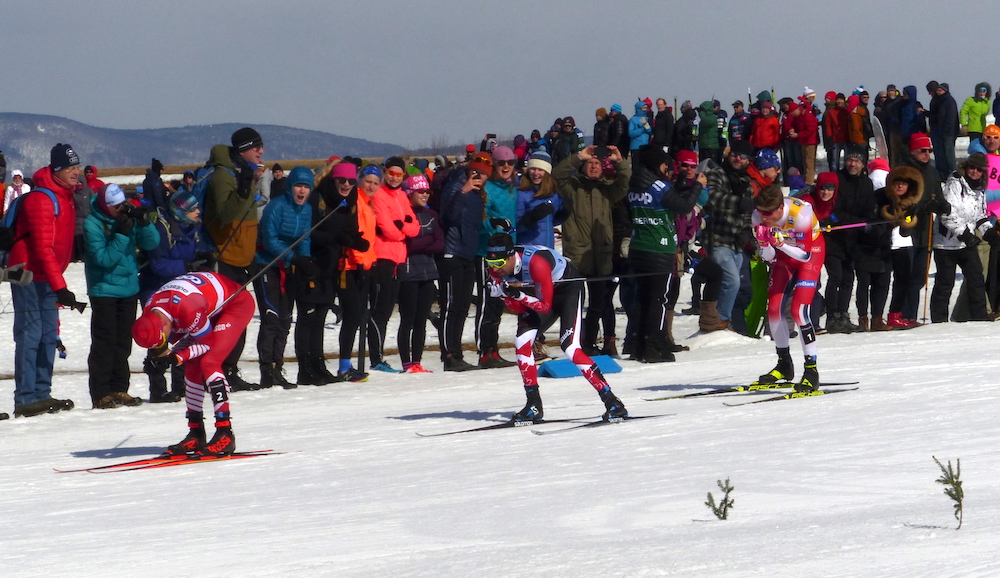
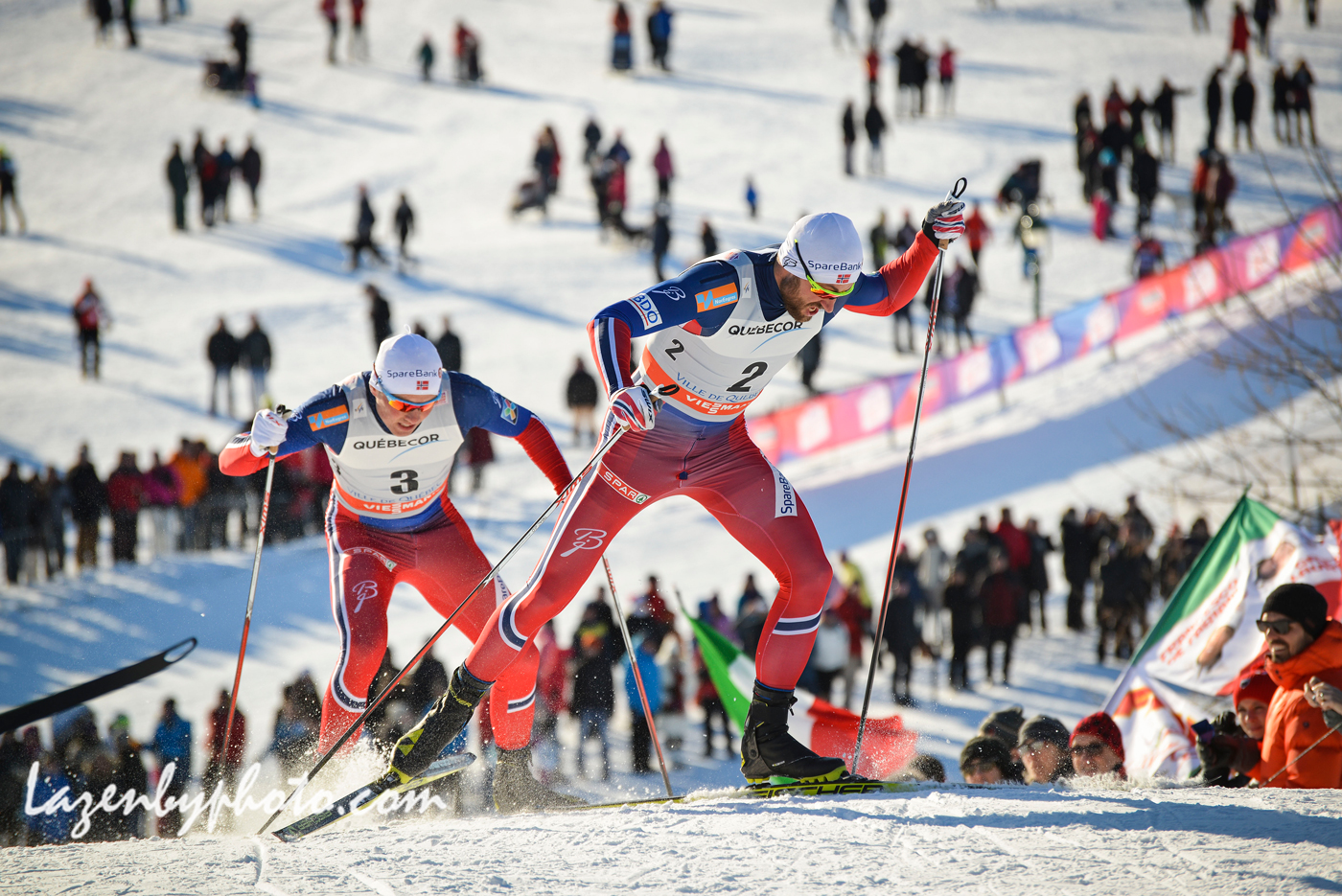
Alexander Bolshunov of Russia leading Canada’s Alex Harvey and Norway’s Johannes Høsflot Klæbo on the final lap of the men’s 15-k skate pursuit. (Photo: Peggy Hung)
FIS World Cup Québec City Men’s 15 k Freestyle Pursuit
Norway’s Johannes Høsflot Klæbo did not cede the win today as he moved to take the World Cup overall over Russia’s Alexander Bolshunov. The day’s first starter in the 15-kilometer freestyle pursuit, Klæbo won in 29:05.4. Klæbo began with a 52 second lead on second starter Bolshunov and a 53-second gap on Canada’s Alex Harvey. The trio eventually linked up with Klæbo pulsing with speed to take the win.
Harvey of Canada finished his career atop the podium with a second place. He took Bolshunov at the line. Harvey was 2.8 seconds back, Bolshunov 2.9.
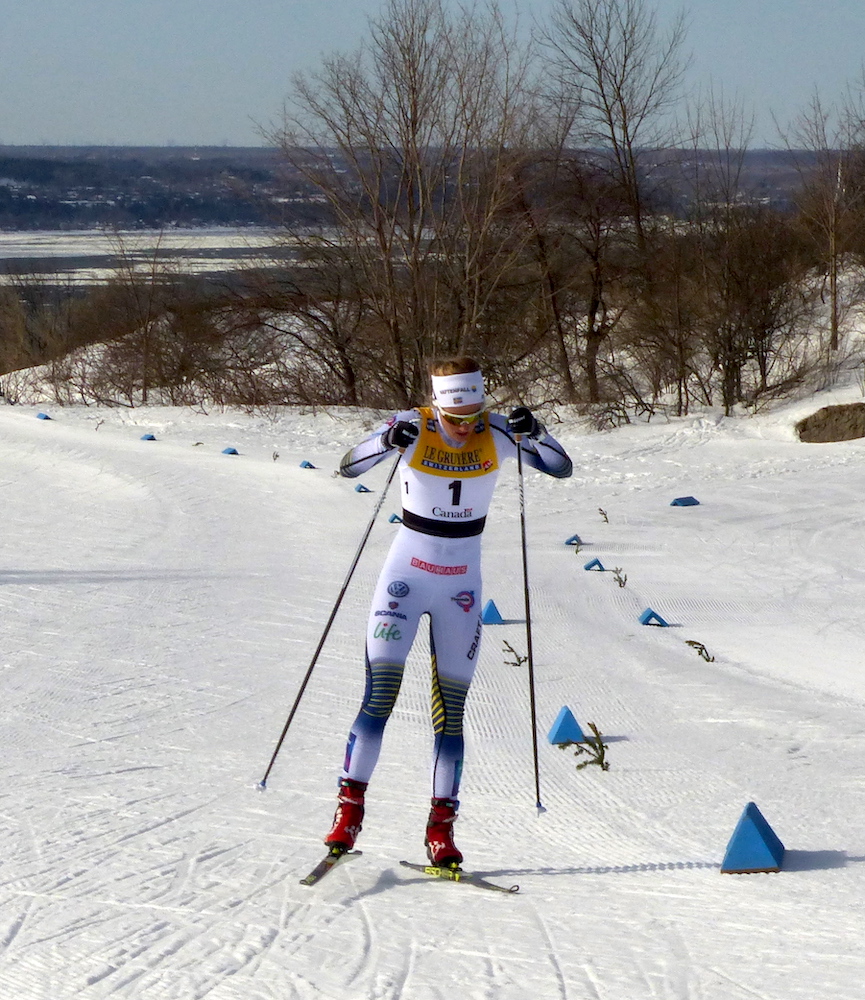
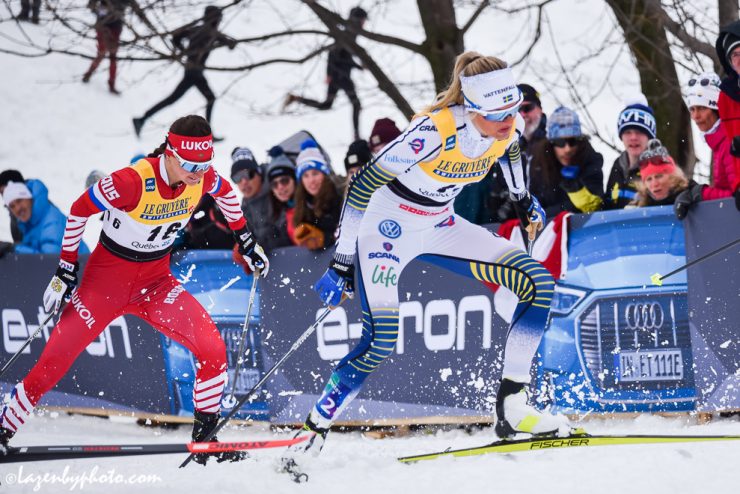
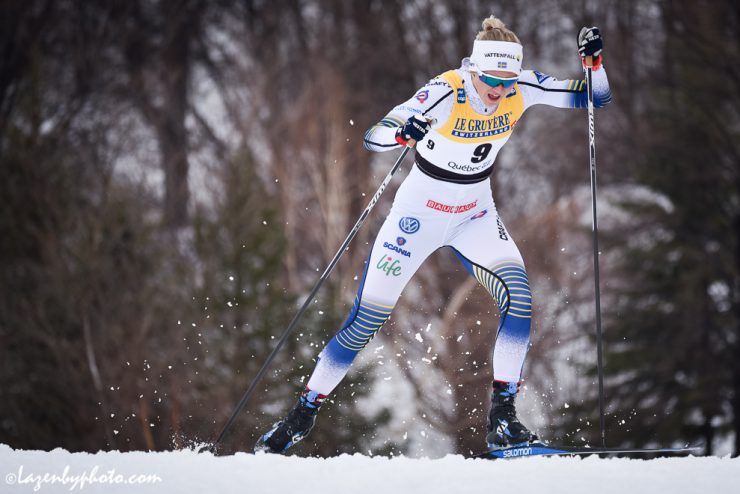
Stina Nilsson of Sweden during the women’s 10 k pursuit in Quebec. (Photo: Peggy Hung)
FIS World Cup Finals Québec Women’s 10 k Freestyle Pursuit
Day three in Québec City brought sunny skies and fast tracks. The first starter on the day for the 10 k freestyle pursuit, Sweden’s Stina Nilsson, took the win and with it the Québec City overall.
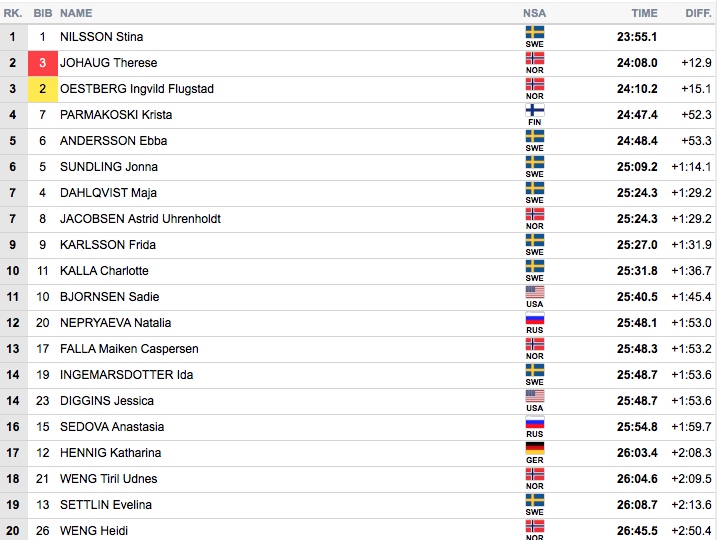
Nilsson began with a 33.2 second lead over Norway’s Ingvild Flugstad Østberg in second and a 49.4 second lead on third starter Therese Johaug, also of Norway. Nilsson won in a time of 23:55.1 with the chasing Johaug and Østberg running out of real estate on the Plains of Abraham.
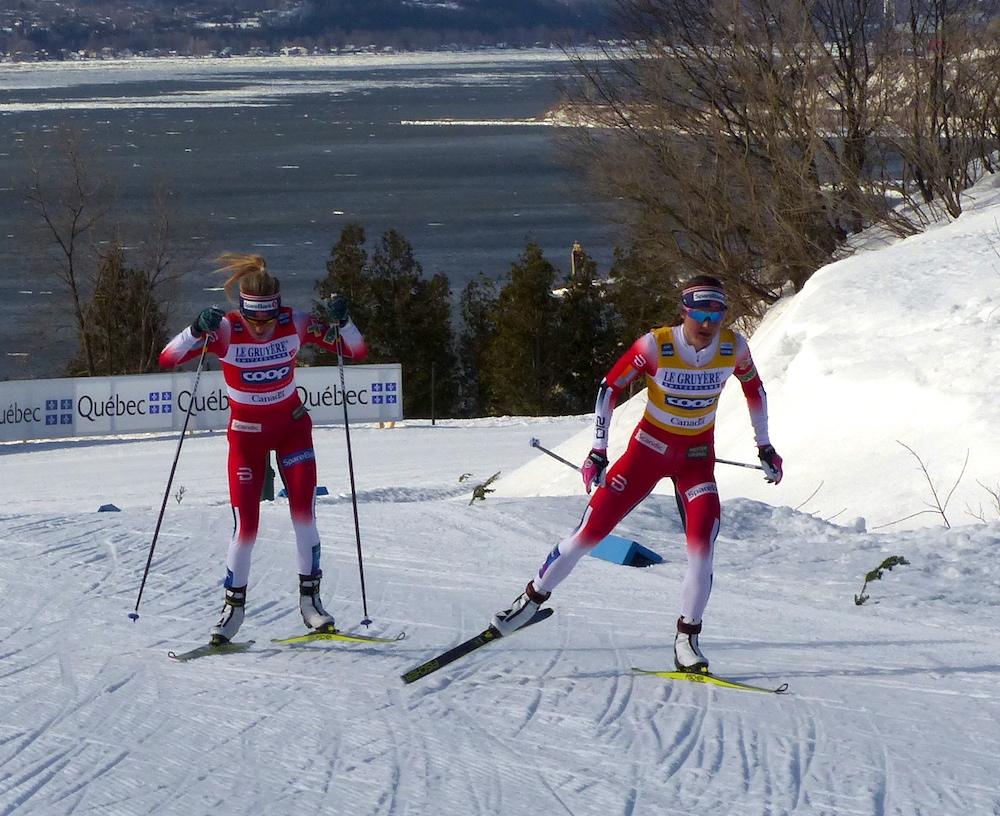
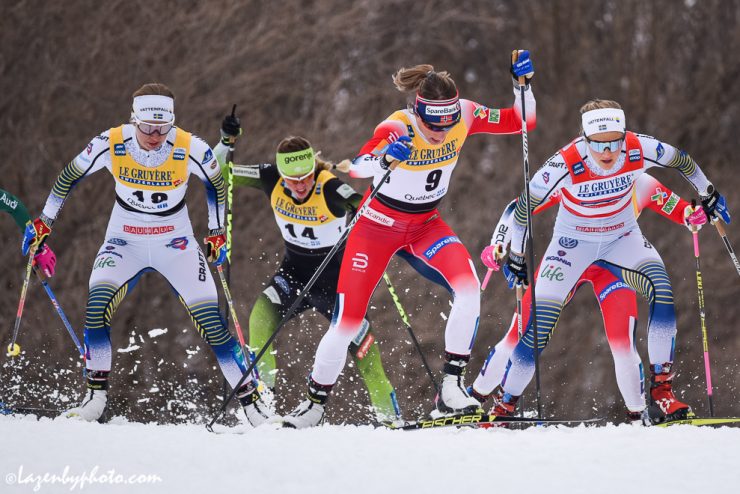
Chasers in third and second, Norway’s Norway’s Ingvild Flugstad Østberg (yellow bib) and Therese Johaug during the women’s 10 k pursuit in Quebec. (Photo: Peggy Hung)
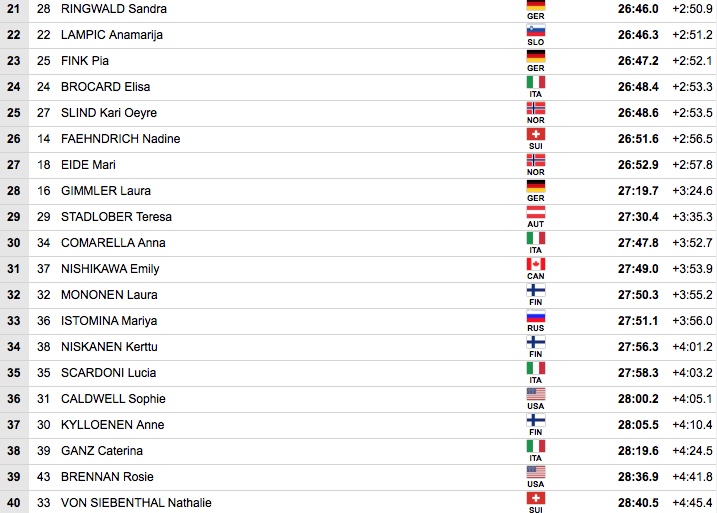
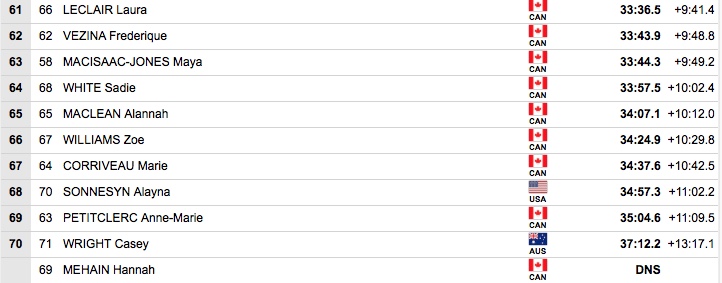
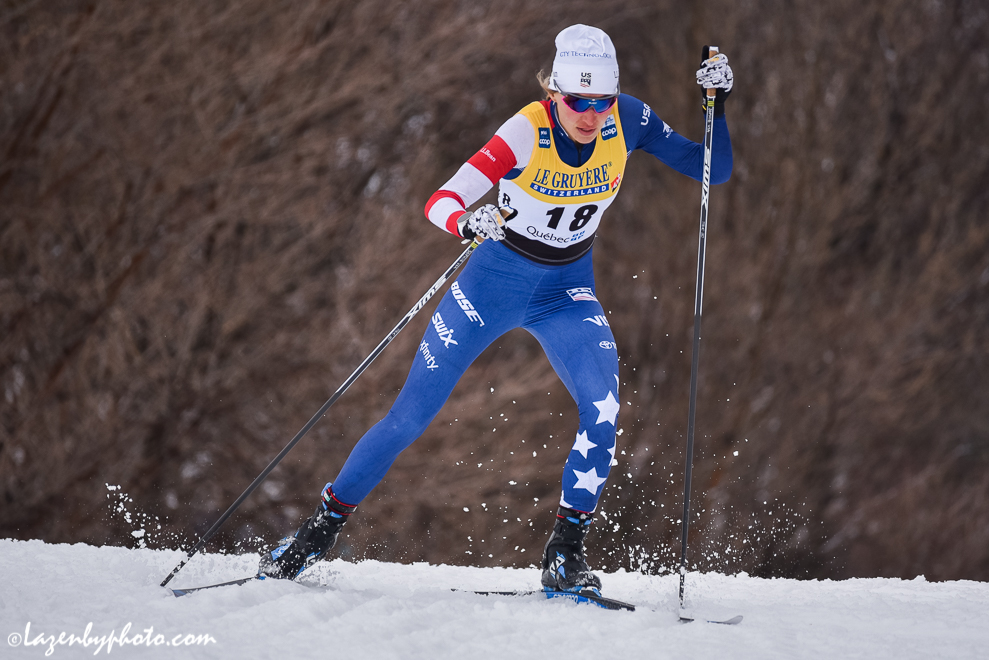
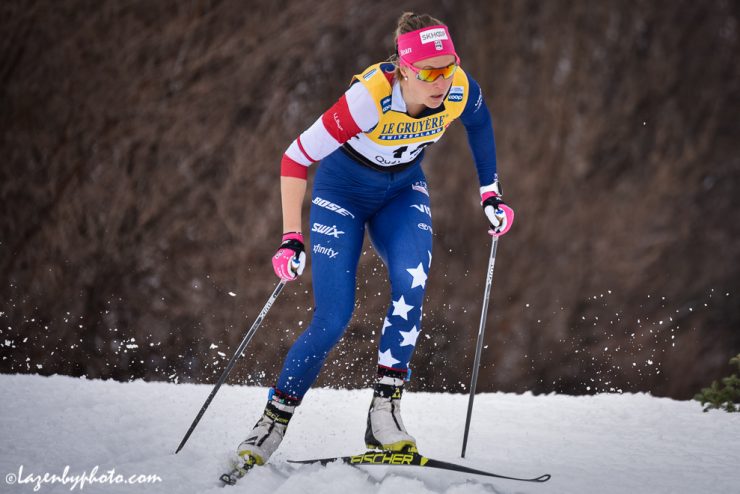
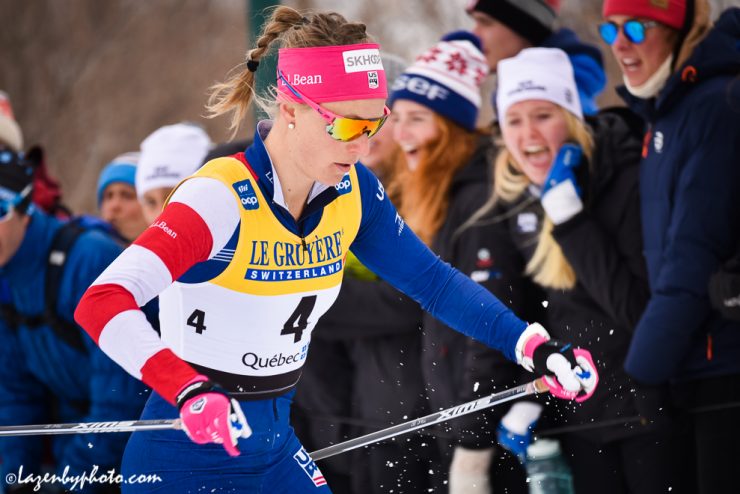
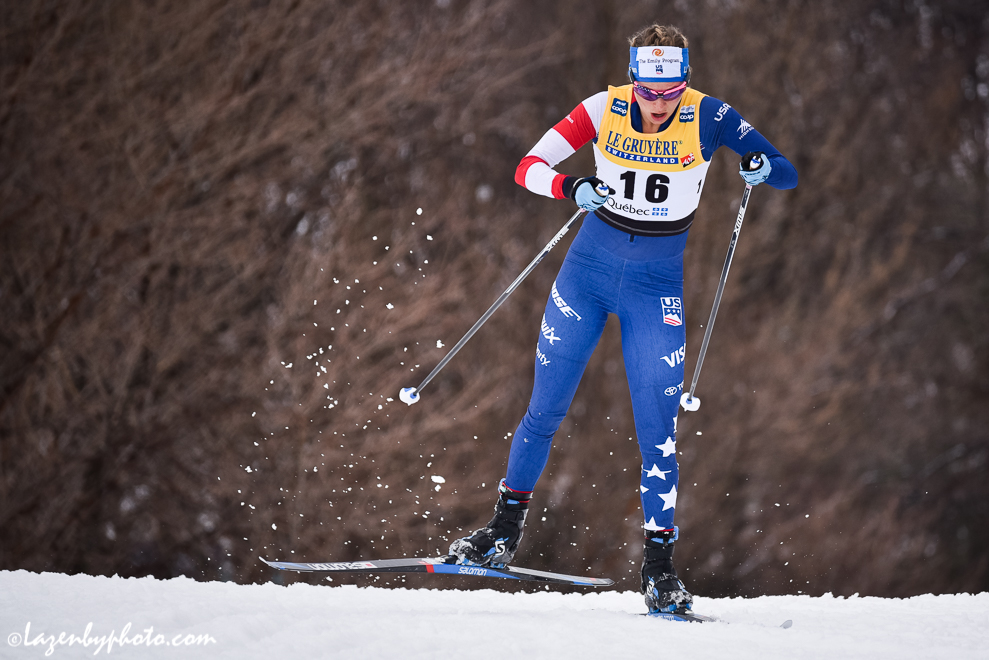
For the U.S., Sadie Bjornsen placed 11th (+1:45.4), Jessie Diggins moved up to 14th (+1:53.6). Canada’s Emily Nishikawa began as the 37th skier and placed 31st (+3:53.9).
The women’s sprint podium. L to R, Maja Dahlqvist, Stina Nilsson, Jonna Sundling. (Photo: John Lazenbylazenbyphoto.com)
There was wind. Some snow. And certainly 1.6-kilometers of soft leg-sapping snow during Friday’s freestyle sprint in Québec. This was no 2.5 minute in duration hard-pack speed fest. It was a grind. Take off too early and plenty of real estate remained for a decaying fade. Sit back, control the effort, ride the draft a bit on the skier train and the slow snow could, in fact, keep those more tempered athletes in the game.
This much was clear: it was a near four-minute sprint effort that blurred the lines of the sprint-endurance divide.
Sweden’s Stina Nilsson proved her endurance sprint cred with the win. After qualifying in second behind her teammate Jonna Sundling, Nilsson won her quarterfinal, her semi, and the final for her 18th career World Cup sprint victory. With the win, Nilsson could prep to fly the sprint crystal globe back to Sweden.
The three podium finishers approached the line. Stina Nilsson (red bib) defeated Maja Dahlqvist (#8) by 0.01 seconds with Jonna Sunding (#1). (Photo: John Lazenby)
Stina Nilsson wins the sprint with Jonna Sundling trailing in 3rd. Dahlqvist was 0.01 seconds behind Nilsson for second. (Photo: John Lazenbylazenbyphoto.com)
Nilsson came to Québec with a 33 point lead on Norway’s Maiken Caspersen Falla for the sprint cup. The math does not lie. Nilsson earned 50 points for the win, whereas Falla earned 40 points after placing fourth overall. As a result, Falla placed second in the sprint cup standings with a deficit of 43 points.
According to the International Ski Federation (FIS), Nilsson’s crystal globe win is a first for a female cross-country skier from Sweden. This excludes the globe for U23 standings on the World Cup.)
During Friday’s final that featured four Swedes including Nilsson, Sundling, Maja Dahlqvist, and Frida Karlsson, as well as Falla and American Sadie Bjornsen, the power in numbers proved true. With Nilsson in first, Dahlqvist placed second, and Sundling third.
1-2-3 the Swedes came into the finish straight. Nilsson and Dahlqvist separated themselves as they sped down the last one hundred meters. The toes did the work across the line as Nilsson and Dahlquist crossed for a photo finish. Nilsson won in 3:44.80 with Dahlqvist 0.01 seconds back.
“The conditions were really hard today,” Nilsson told FIS after the race. “It was hard to find a perfect tactic because the wind was so strong and not so good to be first on the last downhill but in the end, I wanted to go hard in the last uphill because that is my strongest part. So I went for it and I was so glad that it was my toe before Maja’s.”
Sophie Caldwell of the U.S. during her sprint qualifier in Quebec. (Photo: John Lazenby/lazenbyphoto.com)
The U.S. women were positioned well on the day. Bjornsen qualified in fourth, Sophie Caldwell in seventh, and Jessie Diggins 15th.
Caldwell moved to the semis after placing second in her heat. In the first semi, Caldwell placed third and did not advance. Yet, is was her twenty-ninth birthday and the cheers were loud for the native Vermonter.
“My parents, my sister, my brother, my cousins, my grandpa, friends, it’s awesome,” Caldwell rattled off when asked who was in Québec to support her. She placed seventh overall and ranked fourth in the final standings for the sprint cup.
Maja Dahlqvist leads Sadie Bjornsen in the fourth semifinal. (Photo: John/lazenbylazenbyphoto.com)
Bjornsen ultimately advanced to the semis after placing second in her heat. Diggins bumped to the semis as a lucky loser in the quarterfinals. (That quarterfinal proved to be the fastest by nearly nine seconds.)
Soft, slow, and somewhat slushy conditions were no deterrent for Bjornsen. “You know, believe it or not, I happen to love these conditions,” Bjornsen said in the mixed zone. “It’s what I train on all summer on the glacier, so I have a lot of practice, but it was very soft.”
Paired up in the Bjornsen-Diggins semi was Sweden’s Charlotte Kalla — a formidable distance skier who last made a World Cup sprint final in 2014. Rounding a tight left-handed corner, Diggins was positioned on the inside when Kalla moved towards the apex and collided with Diggins. Then Bjornsen, only feet behind, became tangled too.
“It looked like Jessie and Kalla collided,” Bjornsen said of the snafu. “But the problem was my skis were stuck underneath them. So I had to just stand there and really hope they got up fast, but they kept sliding on each other and stuff, and I was almost like ‘COME ON,’ and it was just like ‘wait,’ … I’m glad Jessie got up and we both were kind of fighting with each other, it was a huge surge to get back on the group, so it was a miracle I somehow still qualified.”
On a course with slower snow and times that looked epic compared to some shorter and faster sprint courses in Europe, Bjornsen and Diggins pulled off a miraculous chase. After the tangle with Kalla, the two looked way, way … way back. Diggins and Bjornsen charged. Meter by meter they made the catch to the leading trio of Dahlqvist, Falla, and Karlsson. But they were never comfortably locked on. Into the finish, Bjornsen and Diggins went head to head with Bjornsen ending up fourth and Diggins fifth. And with that semi’s speed, Bjornsen became a lucky loser.
In the final, Bjornsen placed sixth to end her day.
“I was definitely feeling the effort from the semi-final, I just barely had anything left, so it was definitely not the final I would have dreamed of, but given what happened in the semis I have to be happy,” Bjornsen explained. “You know, it’s been an interesting season, for the first time I put full emphasis on the World Championships, and those did not go as I dreamed, but no regrets, I’m stoked that I tried that. That being said, it was a bummer to not participate in all the races along the way, and so it’s nice to end and begin on great notes because I definitely had a lot of excitement, and I know I made an improvement this year, which is always important, leading into next year just feeling some encouragement, and also extra excitement for racing in Minneapolis next year.”
Sadie Bjornsen of the U.S. placed sixth overall on Friday’s skate sprint. (Photo: John Lazenby/lazenbyphoto.com)
Sadie Bjornsen of the U.S. placed sixth overall on Friday’s skate sprint. (Photo: John Lazenby/lazenbyphoto.com)
Diggins is known for her drive. That grit was evident as she chased in her semi after the Kalla roadblock.
“I was on the inside so I had nowhere else to go and she just came in a little too tight and yeah, it happened, it’s frustrating,” Diggins said in a phone call. “I had to work really, really hard to get back up and I was working so hard downhill skating through everything. And you fly over from Europe, picking skis you think you’re going to need for the weather and then the weather totally changes, it is what it is.”
Remaining positive, Diggins noted the cacophony of cheers as she began her day.
“I don’t think I have ever, in my life probably, had some many cheers on a qualifier for a sprint,” she said. “That was the most exciting, cool, fun experience. The wall of noise when I started was just inspiring, it was just one of those really cool things that you just gotta appreciate and soak up the atmosphere when you can.”
Despite the snafu on the course and the almost-advancing effort during her chase, Diggins said believes she is in a solid place for the two remaining races.
Jessie Diggins of the U.S. during her sprint qualifier in Quebec. (Photo: John Lazenby/lazenbyphoto.com)
“I am proud of how I worked every inch of the course and gave it my best effort,” she said. “I was actually really happy with how I was skiing and I know I’m in really good shape and I’ve known that from the last couple weekends of racing. So that was a really good confidence booster. Today it was definitely frustrating to have that mishap happen because it was kinda like ‘man I can’t catch a break here.’ We caught back up but it burned a couple of matches. I know I’m in good shape and I’m happy, I’m in a good place mentally. So I’m just finishing out the season with my best efforts every day.”
With the sprint races concluded for the season on the World Cup, the U.S. placed three skiers in the top-eight in the sprint rankings. Beyond Caldwell’s fourth overall, Diggins finished seventh in the standings, Bjornsen eighth.
-David Brown, Kelsey Dickinson, Gerry Furseth, and Gretchen Burkholder contributed.
Double click the images below to enlarge.
Frida Karlsson leads Yulia Belorukova in their quarterfinal. (Photo: John Lazenby/lazenbyphoto.com)
Maiken Caspersen Falla (#9) leads the third quarterfinal. Stina Nilsson (red bib) and Falla moved on to semis. (Photo: John Lazenby/lazenbyphoto.com)
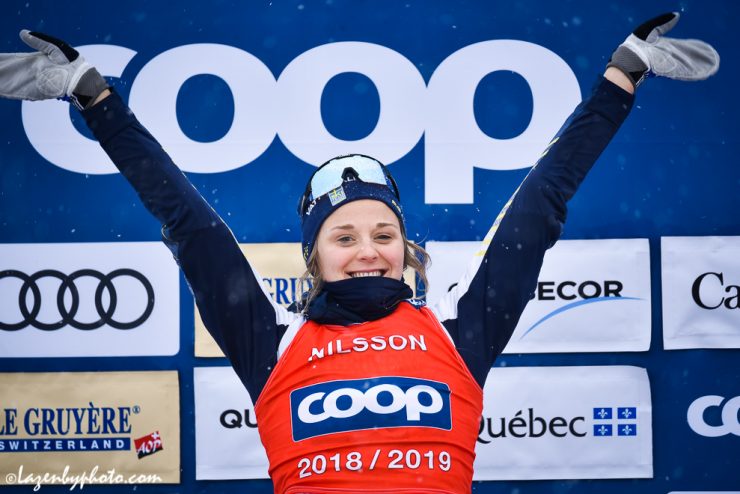
Stina Nilsson celebrating her sprint win. (Photo: John Lazenby/lazenbyphoto.com)
The sprint crystal globe was awarded to Stina Nilsson (centre) at the end of the day. Maiken Caspersen Falla (left) and Maja Dahlqvist were second and third. (Photo: John Lazenby)
Stina Nilsson winner of the skate sprint in Quebec. (Photo: John Lazenby/lazenbyphoto.com)
Maja Dahlqvist during the Quebec skate sprint. (Photo: John/lazenbylazenbyphoto.com)
QUEBEC CITY — With the first half of the Ski Tour Canada in the rearview, we wanted to recognize the dozens of North American athletes that didn’t make it into the main reports from the third and fourth stages in Quebec City. Check out our assortment of images above from the pursuit race on Friday, March 5, as well as additional post-race comments below.
Cendrine Browne after placing 49th (up from 51st) as the second-best Canadian in the women’s 10 k freestyle pursuit at Stage 4 of the Ski Tour Canada in Quebec City on March 5. (Photo: John Lazenby/Lazenbyphoto.com)
“The wave start I was in was pretty quick, so I was able to get in the front group with them, and they pulled me along to a really good time on the day. Pretty happy that I’m able to manage that pace.” – Andy Shields, 65th in Stage 4 freestyle pursuit with 30th fastest time of day (scoring points in his second distance World Cup and eighth-career World Cup start)
“The first couple k, my legs were pretty shot and the pace was pretty high. I was thinking, ‘Well, this could be a rough one,’ but once it broke up a bit and once I got warmed up and got into the race, my legs started to feel better and actually I ended up enjoying it. It was a super nice day and tons of people watching, so it was a lot of fun.” – Patrick Stewart-Jones (AWCA), after placing 66th in the Stage 4 freestyle pursuit
“It hasn’t been the start that I had hoped for. The first three [races] were all solid. If today had been better I would have been pretty happy going to Canmore, but yeah, just wasn’t able to capitalize on the skate today, which is my stronger discipline.” – Michael Somppi (NDC Thunder Bay) after placing 67th in the freestyle pursuit
“I’d say [I’ve had] the most positive experiences from all the races so far, and I’ve definitely got a bunch of things to take away to learn and try to do better. But overall it’s been really great so far.” – Bob Thompson (NDC Thunder Bay) after placing 74th in pursuit
“It’s just amazing to race here. The crowds were just so loud, especially on those climbs. It was really fun, and just so many people cheering my name. It’s such a great atmosphere here. It’s just awesome.” – Emily Nishikawa (Canadian Senior Development Team), after placing 45th in pursuit
“The pace was really hard off the start because everyone was a little worried about getting lapped. … I don’t like starting in packs so I stayed at the back at the start and was able to have a little more energy for the third lap … I am pretty pumped that I made it through to this point. I am excited for the races in Canmore.” – Katherine Stewart-Jones (NDC Thunder Bay) after placing 58th in pursuit
“I went into the race with the mindset of trying as hard as I could for the first two laps to make sure that I didn’t get lapped out, and then just hanging on. So that’s what I did, and then on the last lap I died a bit, but I still managed to come in pretty well placed within the Canadians, so, happy with that.” – Maya MacIsaac Jones (Rocky Mountain Racers) after placing 60th in pursuit
“It’s been a tough time since coming back from [Junior] World Champs so far. … I think trying to take it on was all reasonable until my health took a turn for the worse, and that’s kind of what has piled onto itself and made things are a lot more challenging. Opportunities are becoming just more, step by step. Trying to learn and take the positives from each one of them.” – Jenn Jackson (NDC Thunder Bay) after placing 63rd in pursuit
“If I take in consideration my condition right now, it’s the end of the Tour for me. I have a problem with [coughing]. I take this race for fun and just gave everything for my friends, my family. … I gave everything and I’m happy for that.” – Marie Corriveau (CNEPH/National Junior Team), after placing 63rd in Stage 3 freestyle sprint (she did not start the freestyle pursuit the next day)
Russia’s Sergey Ustiugov held strong for a 17.7-second win in the men’s 15 k freestyle pursuit on Saturday at the fourth stage of the Ski Tour Canada. He will keep the lead heading to the second half of the Tour in Canmore, Alberta. (Photo: FlyingPointRoad.com/NNF)
Sergey Ustiugov is getting used to skiing from the front. After winning the opening sprint of the Ski Tour Canada (STC), the 23-year-old Russian has yet to relinquish a spot on the podium through four stages.
Despite the best efforts of the Norweigian duo, Petter Northug Jr. and Emil Iversen, nipping at his heels in Saturday’s 15-kilometer freestyle pursuit in Quebec City, his streak continues.
Starting alone and with a 17-second advantage on second-place Northug, Ustiugov’s race was a solo effort. Behind him it was two pairs of chasers that provided the fuel for the crowd on Saturday. The first of Northug and Iversen, gritted their teeth and tried to track down Ustiugov. The second pair, with local celebrity Alex Harvey and overall World Cup leader Martin Johnsrud Sundby, started the day in fourth and fifth respectively. They both appeared energized, charging over the hills of the Plains of Abraham, intent on knocking some time out of their gap to third place.
Petter Northug (r) leads fellow Norwegian Emil Iversen during the men’s 15 k freestyle pursuit on Saturday at Stage 4 of the Ski Tour Canada in Quebec City. After starting second and third, respectively, they finished in that order, 17.7 seconds and 1:02 minutes behind the winner. (Photo: John Lazenby/Lazenbyphoto.com)
Opposite to the previous distance stop in Stage 2 in Montreal, racers enjoyed hard-packed snow conditions. The four-lap course, nestled on a steep bank overlooking the St. Lawrence Seaway, tested the toughness of racers by incorporating both the steep climbs of the third stage’s sprint course and several more drawn-out climbs. Combined with the time change, travel to Canada, a tough sprint the day prior, and the end of a long season of racing, many racers appeared weary.
“It was a very hard race today,” Ustiugov told reporters through a translator at a post-race press conference. “I was little bit afraid that Northug and Iversen are coming closer. I am happy I could keep the pace high and that I could go for victory.”
Northug echoed Ustiugov’s statements at the press conference, saying that although he is “starting to get the rhythm that I have back in Norway … Everyone is starting to get tired.” Although the racers will have a break from the action until a classic sprint on Tuesday, the next venue at the Canmore Nordic Centre in Canmore, Alberta is at an altitude of 4,600 feet. Saturday’s pursuit at sea level was all about making the last four races of the Tour a little easier by gaining valuable seconds.
Northug and Iversen planned to work together in their attack on Ustiugov’s lead. However, after two laps, the gap between Northug and Iversen went from two seconds at 8 k to nearly 18 seconds at 10.7 k.
Iversen explained after the race that he could not keep up on the third and fourth lap, and he struggled to get across the finish line.
“… My body wasn’t fresh enough today, so it was rough on lap three and four, and for me to get to the finish line,” he said.
Despite a tough day, he was excited to stay in third overall in the Tour.
“I am satisfied to sit here with the big number three, but it was a hard day today,” he said.
After dropping Iversen on lap 3, Northug stayed consistent and within reach of Ustiugov, but appeared to lack the gear necessary to reel in the Russian. Northug explained that he went into damage-control mode on the final lap.
“I felt good and tried to attack Ustiugov, but in the last lap it was just about not losing seconds on Ustiugov,” Northug said.
Canada’s Alex Harvey leads Norway’s Martin Johnsrud Sundby during the men’s 15 k freestyle pursuit at Stage 4 of the Ski Tour Canada in Quebec City. Harvey went on to place fourth, 1 second ahead of Sundby in fifth. (Photo: FlyingPointRoad.com/NNF)
Behind him, another race unfolded to determine the fourth and fifth positions.
As Iversen faded, he had to be aware of the two guys closing in on him. Even if he couldn’t see them, the roar of the crowd following Harvey and Sundby was deafening enough that Sundby gave the crowd a shout out in a pos- race interview: “I didn’t hear my coach one time today due to the home crowd. Kudos to the home crowd!” he said.
The reason the crowd followed Sundby was because his counterpart for the majority of the day was local favorite, Harvey. While Sundby started fifth, 17 seconds after Harvey in fourth, the Canadian’s strategy for the day would be to cling onto Sundby, the defending Tour de Ski and overall World Cup champion, when he inevitably made his way forward.
Canadian National Team Coach Justin Wadsworth said that this strategy worked to near perfection.
“For Alex, it was about as good as we could have hoped,” he said after the race. “The perfect strategy worked out. We were pretty sure Sundby was going to catch him, so having Sundby catch him and not Finn Hågen [Krogh in sixth], while also moving up to Iversen.”
Alex Harvey started fourth and held his position in the Ski Tour Canada on Saturday in the Stage 4 men’s 15 k freestyle pursuit in Quebec City. (Photo: FlyingPointRoad.com/NNF)
As the tour heads west, Harvey remains in fourth, 52.6 seconds away from Iversen in third and the podium with it. Harvey is 2:04.8 out of first.
Sundby told reporters he enjoyed skiing with Harvey.
“It was really cool for me to ski with him today,” the Norwegian said. “I tried to do my best and move us up the result list to take some seconds from the leaders.”
And take some seconds they did. Sundby, Harvey and Norway’ Krogh started the day in fourth (+1:57), fifth (+2:14), and sixth (+2:27), respectively, behind Ustiugov. By 4 k in, Sundby and Harvey paired up, and trailed by 2:02.5, followed by Krogh another 10 seconds later.
At 8 k, still skiing together, they cut their deficit to 1:58.5. It was only four seconds less than at 4 k, but at this point Iversen hit a wall and began to lose time, while Krogh exploded backwards, dropping nearly a minute behind Sundby at 10.7 k.
Up the final climb and down the finishing stretch, Harvey led Sundby to finish in fourth. Sundby, en route to laying down the fastest time of the day, led Harvey throughout the majority of the course. After the race, each commented on the other’s workload.
“He knew I’m a better sprinter than he is, but he also did most of the work today, “ Harvey said of Sundby. “He’s the one wearing the yellow overall leader’s bib and he’s [been] the best for three years, so it’s up to him to do the work. A good day for me is to be able to follow him.”
According to Sundby, a man who verified after the race that he trains up to 1,100 hours a year because he’s “not the biggest [natural] talent,” he did most of the pulling throughout the race.
“I asked him if he wanted to do some work on the last lap, but he said, ‘no man!’ ” Sundby recalled. “I reckon on the last uphill that I have to let him take the finish now because we are in Canada, in Quebec, and he is the prince of Quebec.”
“I reckon on the last uphill that I have to let him take the finish now because we are in Canada, in Quebec, and he is the prince of Quebec.” — Norway’s Martin Johnsrud Sundby on skiing with Quebec native Alex Harvey for most of the 15 k freestyle pursuit on Saturday
Either way, both took advantage of the tough days of Iversen and Krogh. While the top-two podium spots appear almost out of reach 2:04.8 and 2:05.8 back for Harvey and Sundby, both are within striking distance of third-place Iversen, who now sits a distant 1:12.2 back from Ustiugov.
When questioned about his slow start to the tour, Sundby blamed the sprint races and the tough conditions in Montreal.
“I had a really bad start for this tour, two bad sprints,” he said. “I am not the best sprinter so I reckoned to be some seconds behind after the three first races, but I lost too much in the classic mass start.”
To make up for his slow start, he plans on throwing everything he’s got at the final races in Canmore.
“At the moment we are too far behind [to win], but I think anything is possible,” Sundby said. “I will go to Canmore with that state of mind. I will go all-in in every distance; I have to. I’m not afraid of dying in the last couple races. I just have to go.”
Harvey, again following the same thinking as Sundby, said that now the podium on home soil is once again within his grasp, “Right now, I’m not thinking of Northug, I’m more focused on catching Iversen. The podium remains possible.”
As the tour heads West, Harvey and fellow Canadian World Cup Team member Devon Kershaw stand as the only two North American males in the top 30.
Catching up with Kershaw after the race, he expressed disappointment in Saturday effort despite only losing one place to finish in 21st (+4:22.8): “It was a bit frustrating with the wave starting so close to my little group,” he said. “That gave that giant pack a free 18 seconds.”
Finishing two spots behind Kershaw in 23rd and moving up from 31st place was Finnish skier, Matti Heikkinen, who blazed the second-fastest time of the day. Sweden’s Marcus Hellner rounded out the top three for time.
Erik Bjornsen leads fellow U.S. Ski Team member Noah Hoffman during the men’s 15 k freestyle pursuit at Stage 4 of the Ski Tour Canada in Quebec City. (Photo: FlyingPointRoad.com/NNF)
The top American, Erik Bjornsen, started 28th but fell outside the top 30, finishing in 32nd (+5:28.3). After the race he discussed his strategy as similar to a mass start pacing, trying to stick with a group and move up that way.
“It was all right. I’m not super happy with it. I made a surge on the third lap and paid for it,” he explained.
Despite the frustration, Bjornsen said he looks forward to racing in Canmore because his family is easily able to make the trip from their home in Washington’s Methow Valley to come watch.
Following Bjornsen was Canada’s Ivan Babikov in 35th place, not gaining or losing any spots on the day. Babikov aimed to “stay in the group and stay away from trouble,” however he said he crashed on lap two thus spoiling his strategy.
Other North American men in the top 50 included sprint specialist and second-place finisher from the first stage, Simi Hamilton (U.S. Ski Team) in 40th, followed by teammate Noah Hoffman in 44th, and Canada’s Graeme Killick in 49th.
The last stops on the tour all take place in Canmore at the Canmore Nordic Centre, home of the 1988 Olympic nordic events. The final sprint of the season will be the next event, a classic sprint on Tuesday.
After adding the five-second sprint bonus, which Ustiugov also won on Saturday, the overall tour top-five in the Tour are: 1. Ustiugov, 2. Northug (+22.7), 3. Iversen (+1:12.2), 4. Harvey (+2:04.8), and 5. Sundby (+2:05.8).
Looking toward the second half of the Tour, first and second place appear decided between Ustiugov and Northug; however, Sundby is not ruling himself out.
“I need some miracles in Canmore, but I believe in miracles, so anything can happen!” he said.
Other North American finishers include Scott Patterson (USA) in 53rd, Kevin Sandau (CAN) 57th, Len Valjas (CAN) 63rd, Andy Shields (CAN) 65th, Patrick Stewart-Jones (CAN) 66th, Michael Somppi (CAN) 67th, Eric Packer (USA) 68th, Jess Cockney (CAN) 69th, Knute Johnsgaard (CAN) 70th, Russell Kennedy (CAN) 71st, Reese Hanneman (USA) 72nd, Bob Thompson (CAN) 74th, Tad Elliott (USA) 75th, Dakota Blackhorse-von Jess (USA) 77th, Matt Liebsch (USA) 79th, Brian Gregg (USA) 80th, Andy Newell (USA) 81st, Simon Lapointe (CAN) 82nd.
— Gerry Furseth and François Léger Dionne contributed
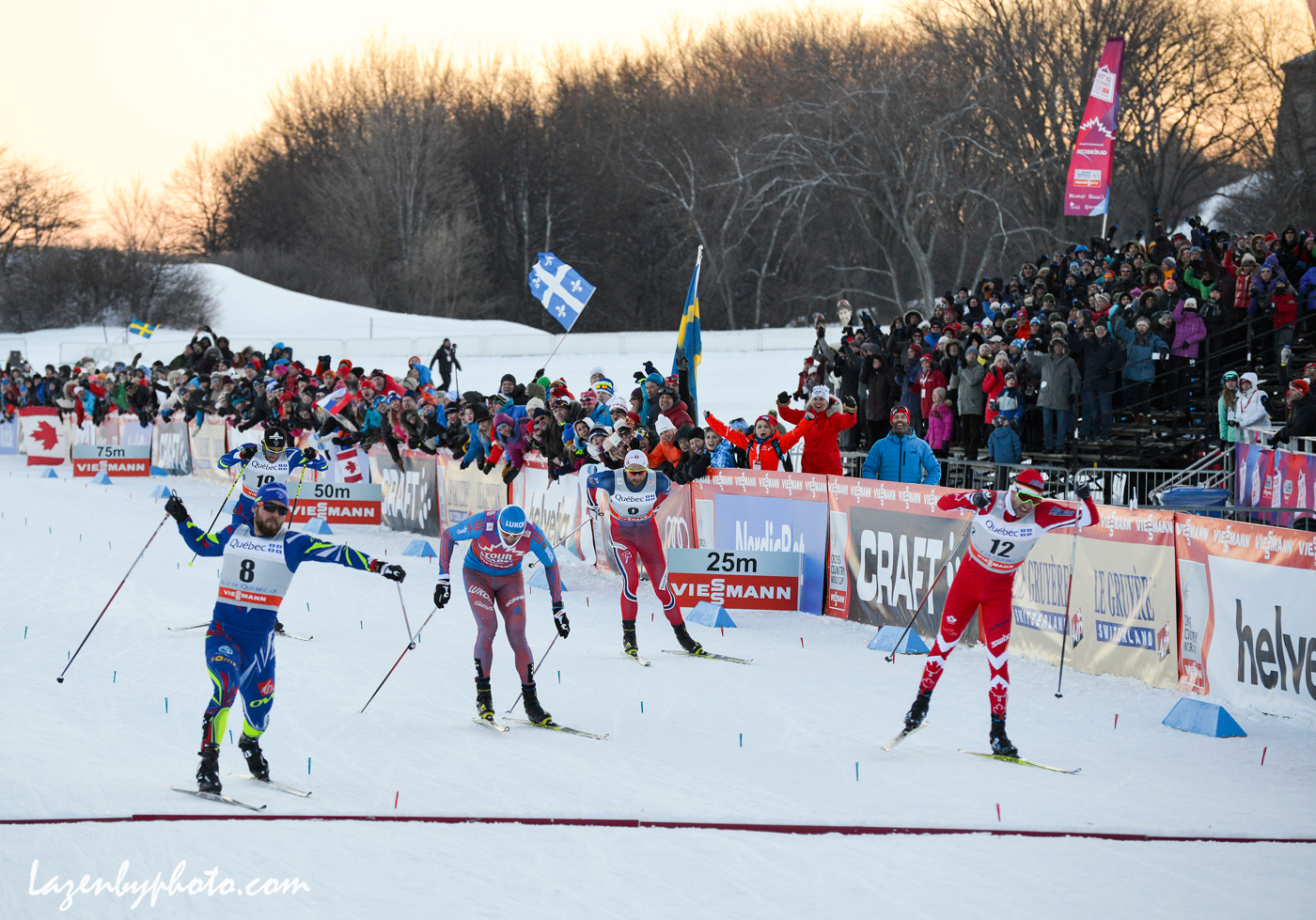
France’s Baptiste Gros (l) stretches across the line to edge Canada’s Alex Harvey (r) for the win in Stage 3 of the Ski Tour Canada, the men’s 1.7 k freestyle sprint In Quebec City. Russia’s Sergey Ustiugov (second from l) placed third after leading most of the race and Norway’s Petter Northug (second from r) placed fourth. (Photo: John Lazenby/Lazenbyphoto.com)
Ce fut une bonne journée pour accrocher votre chapeau.
Quick translation from French — “It was a good day to hold onto your hat.” On Friday, it was also a good day to understand French, as two native French speakers from countries thousands of miles apart, finished 1-2 in the 1.7-kilometer freestyle sprint at the third stage of the Ski Tour Canada in Quebec City.
France’s Baptiste Gros won the men’s final in 3:36.26. It was Gros’ first ever World Cup victory and his fourth career podium. The other French speaker, and local boy done good, was Canada’s Alex Harvey skiing to second (+0.55), for his fifth-career sprint podium. Overall Tour leader, Russia’s Sergey Ustiugov finished third, 0.79 seconds behind the winner.
The hat-holding reference made earlier wasn’t for the victorious Francophones or the hell-bent pace of the day, or any strong winds. It was for this: On Friday’s sprint course, outside the gates of Old Quebec City on historic ground called the Plains of Abraham, World Cup-level speeds were matched with racing rife with World Cup-level scuffling. During the quarterfinals, semifinals and finals, skiers had to endure cold-induced lung burn, but also a six-person deep scrum of skiers aggressively attempting to position themselves.
Here’s a few anecdotes of the carnage. The second men’s quarterfinal featured two North Americans: U.S. Ski Team sprinter Andy Newell, who qualified 23rd and Canadian Jess Cockney who qualified 29th. Add in Italy’s Federico Pellegrino, Andrew Musgrave of Great Britain, Sweden’s Teodor Peterson, and the day’s winner Gros and it became a perfect storm to start off the tumult.
At 2:54 in, Newell looked fresh as he slotted behind Gros in first. The two bumped boots and suddenly Newell was down. Pellegrino, a breath behind Newell, tripped and buckled over the American.
In the next heat, quarterfinal 3, Norway’s Finn Hågen Krogh, wearing bib number 1 as the day’s fastest qualifier, led for most of the heat. Out front, Krogh looked comfortable, even sublime.
At 3:04, still leading, but with the heat’s eventual winner Frenchman Richard Jouve seemingly riding his tails, just as he crested a hill from a furious V1, Krogh tripped.
And another image: Erik Bjornsen, also of the U.S. Ski Team (USST), moments after crossing the line in quarterfinal 5 (Bjornsen qualified 27th and placed fourth in the heat), got into a brief altercation with Great Britain’s Andrew Young, who placed third. Young was seen on TV cameras pushing Bjornsen first and Bjornsen pushed him back.
However, one skier able to navigate all this unscathed was second-place skier in the fifth quarterfinal, Harvey. It was his day to cash in his chips.
Bon Ski
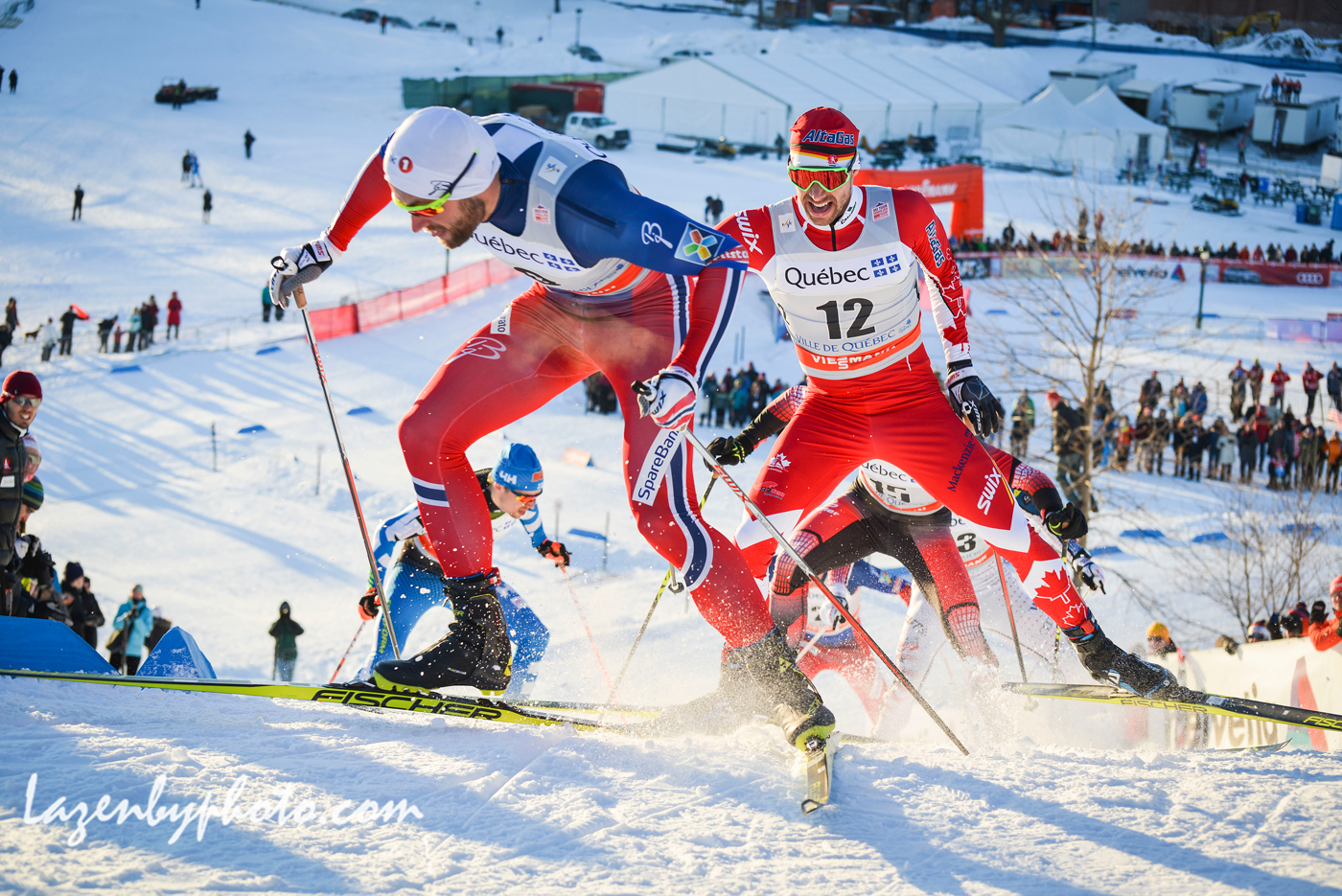
Norway’s Petter Northug leads Canada’s Alex Harvey during the second semifinal of the men’s 1.7 k freestyle sprint at the Ski Tour Canada in Quebec City. Harvey won that heat, by 0.14 seconds over Northug, and Harvey went on to place second in the final while Northug was fourth overall. (Photo: John Lazenby/Lazenbyphoto.com)
No doubt about it, Harvey is a local. He grew up about a 40-minute drive north of Quebec City in Saint-Ferréol-les-Neiges, Quebec. He’s part of Canada’s skiing royalty. His father Pierre was a Canadian Olympian in both cycling and cross-country skiing. There’s the family name to uphold and honoring the home crowd. But sometimes the pressure of performing in front of friends and family can get to athletes. That wasn’t the case for Harvey on Friday.
Instead of buckling under expectations, he rose to the occasion.
Although an all-around skier, Harvey has struggled this year to qualify in the sprints. Here’s his 2015/2016 sprinting rundown in terms of qualifying: Harvey has qualified in only four sprints this season; three of which were in classic technique. The first freestyle sprint he qualified for this season was earlier this week in the first stage of the STC in Gatineau, Quebec. Harvey last podiumed in a skate sprint in Szklarska Poreba, Poland, two seasons ago in January 2014.
Call today a breakthrough or a perfect alignment of timing and place. Either way, Harvey skied like he owned the course.
Friday, Harvey made it a personal two-peat. He began his day qualifying for his second-straight skate sprint. In Quebec, he was 12th in qualifying, 4.63 seconds off of Krogh’s best time of 3:33.14.
Then he finished second in his quarterfinal and first in his semi to cruise to the finals. As each round progressed Harvey noted he could sense the crowd’s energy.
“After each round, the crowd got louder and louder,” Harvey said after the race. “The fans were amazing, they gave me wings.”
Wings are a good way of describing the lightness one feels when a collective mass of people are willing the win. Harvey flew to a semifinal win in 3:40.68, besting Norway’s Petter Northug by 0.14 seconds.
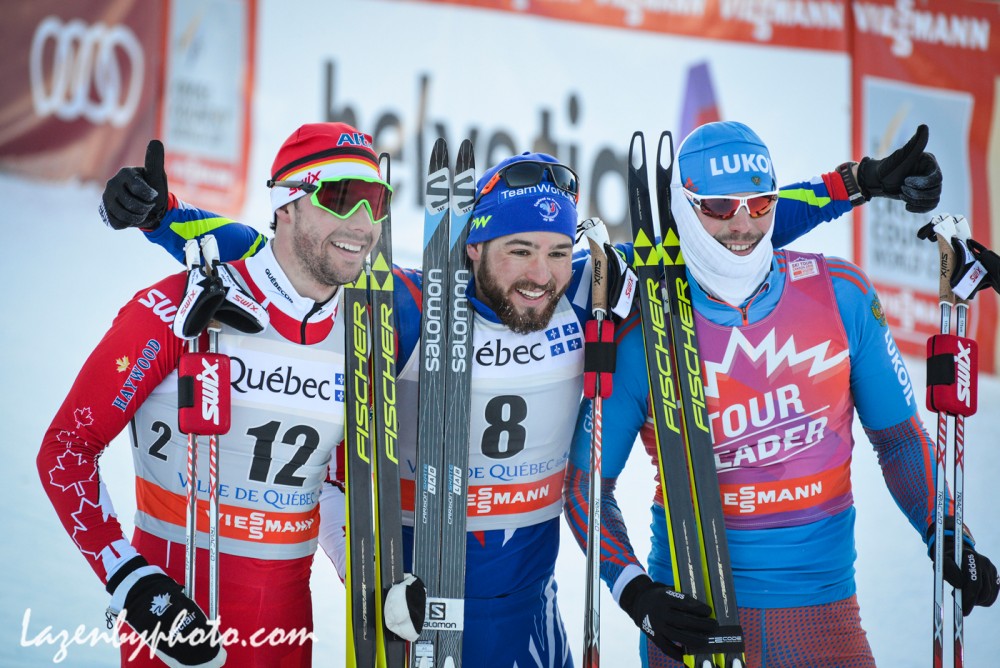
The men’s freestyle sprint podium at Stage 3 of the Ski Tour Canada in Quebec City, with (from left to right), runner-up Alex Harvey of Canada, winner Baptiste Gros of France, and Russia’s Sergey Ustiugov in third. (Photo: John Lazenby/Lazenbyphoto.com)
In the final, it was Gros, Ustiugov, Northug, Poland’s Maciej Starega, Jouve, and Harvey lined up as a northern sun kissed only the tallest buildings in Quebec City. By finals time, the course was shaded and looking cold.
Ustiugov started out hammering in front and Northug kept the tension high as he shadowed in the rear. A minute in, Harvey skied just to the side, in third, keeping a lane open for an acceleration. Thirty seconds later, he was nearly side-by-side with Ustiugov as they skied along the old city’s fortress-like walls.
By 2:30, there was no doubt, Harvey was on form. He matched a steamrolling Ustiugov up a decisive climb. Cresting the top, it looked for a moment that the Russian would run away with a sizable lead. But Harvey kept the finish in sight amongst the deafening crowd.
In the home stretch the Canadian slingshotted to the outside around Ustiugov who was on fumes as he faded to third. Elusively charging up on the inside was Gros, taking the win.
“At the top of the last uphill, I was right behind Ustiugov in the best position possible,” Harvey said about coming so close to the win. “I thought I could win this one, but then Baptiste passed me on my right and surprised everyone.”
Harvey even outclassed the master of outclassing on the final sprint, Northug. Evidently, Harvey winked at the Norwegian in the finishing pen.
“Few people can say they were faster than Northug in the last hundred meters of a sprint finish,” Harvey explained in a press conference. “He’s the best finisher since 2006, so it was my way of telling him I could hang with him!”
Harvey, winner of four World Championship medals, two of which came in individual classic sprints, could have been off some competitors’ radars this season. In Canada, during the final race series of the World Cup season, it’s Harvey making the statement.
“Right now, I’m in the best shape of this season,” Harvey said. “That was the goal.”
Historically, it has been a bit rough for the Canadians racing in Quebec. The last time the World Cup visited the city, back in 2012, Harvey had the best showing for the Canadians in the individual skate sprint in 21st place. Then a week later in a skate sprint in Canmore, Alberta, Harvey didn’t qualify in 52nd.
Fast-forward to 2016: Friday was a big day for the Canadians.
Harvey moved up two spots into fourth overall in the Tour standings — 1:56.8 back from Ustiugov, who continues to lead the Tour. Northug is second overall (+16.7), and Iversen is third (+24.3).
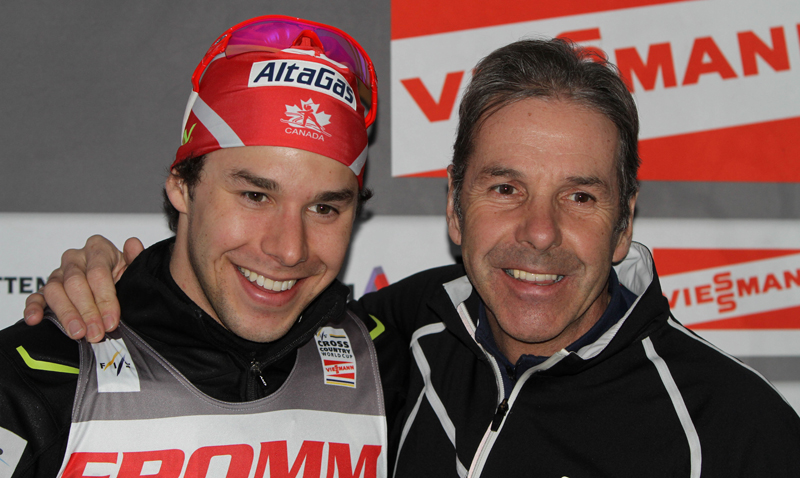
Alex Harvey and his father, Pierre (r), after Alex won the 3.3 k freestyle sprint prologue at 2012 World Cup Finals in Falun, Sweden.
One parent asked after the race if they were confident their son would make it to the finals was Alex’s father Pierre.
“No! He didn’t do it once this season, but you dream of that one time where you can do it in front of your friends and family,” Pierre Harvey told FasterSkier. “He’s on a cloud right now. … During the Tour de Ski, they were tough moments for Alex. At one point, I thought he would call saying he’s coming back home. With all the waxing setbacks, it’s hard when you’re training like crazy.”
Canadian Head Coach Justin Wadsworth, for one, wasn’t surprised with the result.
“Alex can podium in every day on the right day,” Wadsworth wrote in an email. “His skating has come up a notch, most likely due to the surgery he had last spring, but he’s always been solid in every aspect of WC [World Cup] racing.”
Last spring, Harvey had surgery on his iliac arteries in both legs to relieve pain that worsened in hilly skate races. He went on to start the season with a confirmation it was the right move: he placed second in the 10 k skate at the World Cup opener in Finland.
As for how he commanded Friday’s final on home turf, Wadsworth said, “He knew where he had to be and when he had to be there, and stuck to this perfectly. He is one of the best tactical skiers out there. This course had a couple choke points, and if you were back on those it was hard to move into the right position toward the finish.”
He stressed the importance of Harvey’s podium for the team, at home with its coaches, wax techs and a large number of athletes representing Canada as well “many whom have not had a chance to be part of a WC podium before,” Wadsworth wrote. “It’s been a really great working team of staff here that normally don’t work together, so having something to celebrate together is important.”
“He is one of the best tactical skiers out there.” — Canadian head coach Justin Wadsworth, on Alex Harvey’s second place in Friday’s freestyle sprint
Cross Country Canada’s new CEO, Pierre Lafontaine told FasterSkier that a strong program is built success by success.
“I think it’s a sum of things, you know,” Lafontaine said. “Like Alex’s position and he is getting better and better as the season goes on. It’s powerful. It’s powerful that it happened at home in front of Canadians. We got two guys in the top twelve that’s powerful. Two or three days ago we had three guys in the top 30, one girl scored [points] that had never scored before. So it’s by hosting at home, it empowers these kids to push themselves even more.”
The celebration for Harvey’s second place was noted by sprint winner Gros.
“It’s funny because it’s almost as if Alex won today!” Gros said after the race.“It’s a big deal for him, he didn’t perform well this season in sprints. He’s looking to do well on the overall rankings, while I’m primarily focused on freestyle sprints. So you could say, I’m a ‘casse-pieds’ [ translation: pain in the neck!]”
Having skied on the World Cup since 2014, this was Gros’ first World Cup win. He’s placed third once, and second on three occasions.
“It’s funny because it’s almost as if Alex won today … So you could say, I’m a ‘casse-pieds’ [pain in the neck!]” — France’s Baptiste Gros, 25, after winning his first World Cup on Friday in Quebec City
“In the past, I placed second in a World Cup, I kept finishing second, but I really wanted to win and I knew I had better chances in freestyle,” Gros said. “This morning, it was my last chance to win a freestyle sprint this season, so I told myself ‘I got to win today!’
“I find it magical! To do a course on the Plaines d’Abraham, with the crowd and the city laying in the background, it’s so surprising. We’re not used to that kind of crazy atmosphere.”
Other North Americans in the Heats and Beyond
Jess Cockney racing to 29th in the freestyle sprint qualifier at Stage 3 of the Ski Tour Canada in Quebec City. (Photo: John Lazenby/Lazenbyphoto.com)
Canada’s Cockney eked into the heats by qualifying 29th, 8.48 seconds out of first and 0.52 seconds ahead of 30th. Once in the heats, Cockney made the most of it.
He skied a stellar quarterfinal assuring himself a place in the semis by finishing second, 0.54 seconds back from Gros as the winner of that second quarterfinal. That was the heat where Newell tumbled out of contention.
Cockney raced in the second semifinal and finished in fifth (+2.49). Ustiugov won that semi in 3:37.42.
Post-race, Cockney, a 26-year-old National Senior Development Team skier, was elated with his 10th place on the day.
“Man, I have had a really hard go of it this year,” Cockney said. “Nothing was working at the start of the year … So this is a big lift. I’m really happy with that. Skiing a semifinal is always awesome. Nice to have a two heat day again.”
This was Cockney’s third time qualifying in a sprint and only his second time racing in a World Cup semifinal. His other semifinal came in 2012 at the skate sprint in Canmore, where he raced to ninth overall.
For American Simi Hamilton, who raced to second in Stage 1 sprint three days earlier, anything was possible. Hamilton qualified 13th. Again proving he’s no fluke, Hamilton won quarterfinal 4 in a photo finish with Finland’s Martti Jylhä.
In his semifinal, which Harvey won, Hamilton finished fourth (+0.86). Although Hamilton was a sliver from automatically advancing by placing first or second, his semifinal was just over three seconds slower than the first semifinal. As a result, no lucky losers advanced from Hamilton’s semi.
U.S. Ski Team sprinter Simi Hamilton (13) hanging with the pack on an uphill in his semifinal of the men’s 1.7 k freestyle sprint on Friday in Quebec City. He went on to finish fourth in the semifinal for eighth overall. (Photo: FlyingPointRoad.com/NNF)
The U.S. sprinter told FasterSkier that Friday’s rounds were difficult.
“It was crazy, it was really hard,” he said. “A minute-fifteen longer than pretty much anything.”
Hamilton also mentioned he felt better as the day progressed.
“It didn’t feel great qualifying, but felt better in my quarter and actually felt good in my semi,” he said. “But I really wanted to conserve energy early on so you know we had a really slow heat. I was happy just kind of tucked in towards the back, and focusing on relaxing.”
Hamilton also referenced a make-or-break move by Northug in his semifinal that he didn’t have an answer for. “Petter made a move at the top of the first climb,” Hamilton said. “I was little too far back and I didn’t react to it quick enough. So I when I tried to get back up and bridge that gap, when we got to the second climb here, I actually felt really good on the climb, and put a bit of a surge to see what would happen. But I couldn’t really go anywhere so I had to just hoped for the best coming into the finish.”
Hamilton finished the day eighth overall.
Another U.S. skier in the top 20, Bjornsen ended up 20th overall for a career-best in an individual World Cup sprint.
The skier from Washington’s Methow Valley, who lives and trains with Alaska Pacific University (APU) in Anchorage, qualified in 27th. Bjornsen was ultimately bumped from competition when he placed fourth in his quarterfinal, 2.56 seconds behind heat winner Emil Iversen of Norway.
In his interview with FasterSkier, Bjornsen mentioned the compact nature of the group in his quarterfinal.
“Like most of them, it was pretty tight,” Bjornsen said. “Hard to make passes. I kind of went for a fast start out of it so I felt like I was in a pretty good position. I was just not quite strong enough to have that surge to make to that semifinal.”
Asked about his brief finish-line scuffle with Young, who finished third, 0.18 seconds ahead of him, Bjornsen said, “There was just quite a bit of tangle the whole time. We were just stepping all over each other’s stuff, and we were both just disappointed at the end. It’s all fine. We talked right afterward in the pen so it’s all good.”
Team veteran Newell had a tough run in the quarters. He got there by qualifying 23rd. Yet in his heat, the second quarterfinal, he tripped up while skiing behind Gros.
“Disappointing crash, ’cause I felt this is actually kind of a fun course,” Newell told FasterSkier afterward. “I thought I skied a good heat, tactically well. I was feeling strong and ready to attack the last hill. So it’s too bad with the crash. Greatly disappointing, but what can you do?”
Newell described his tangle and nasty spill in more detail. “I was behind Baptiste [Gros], I came out of the draft, and we both started to skate at the same time. So we bumped boots, you know? I went down hard. Nobody’s fault. It’s what happens.”
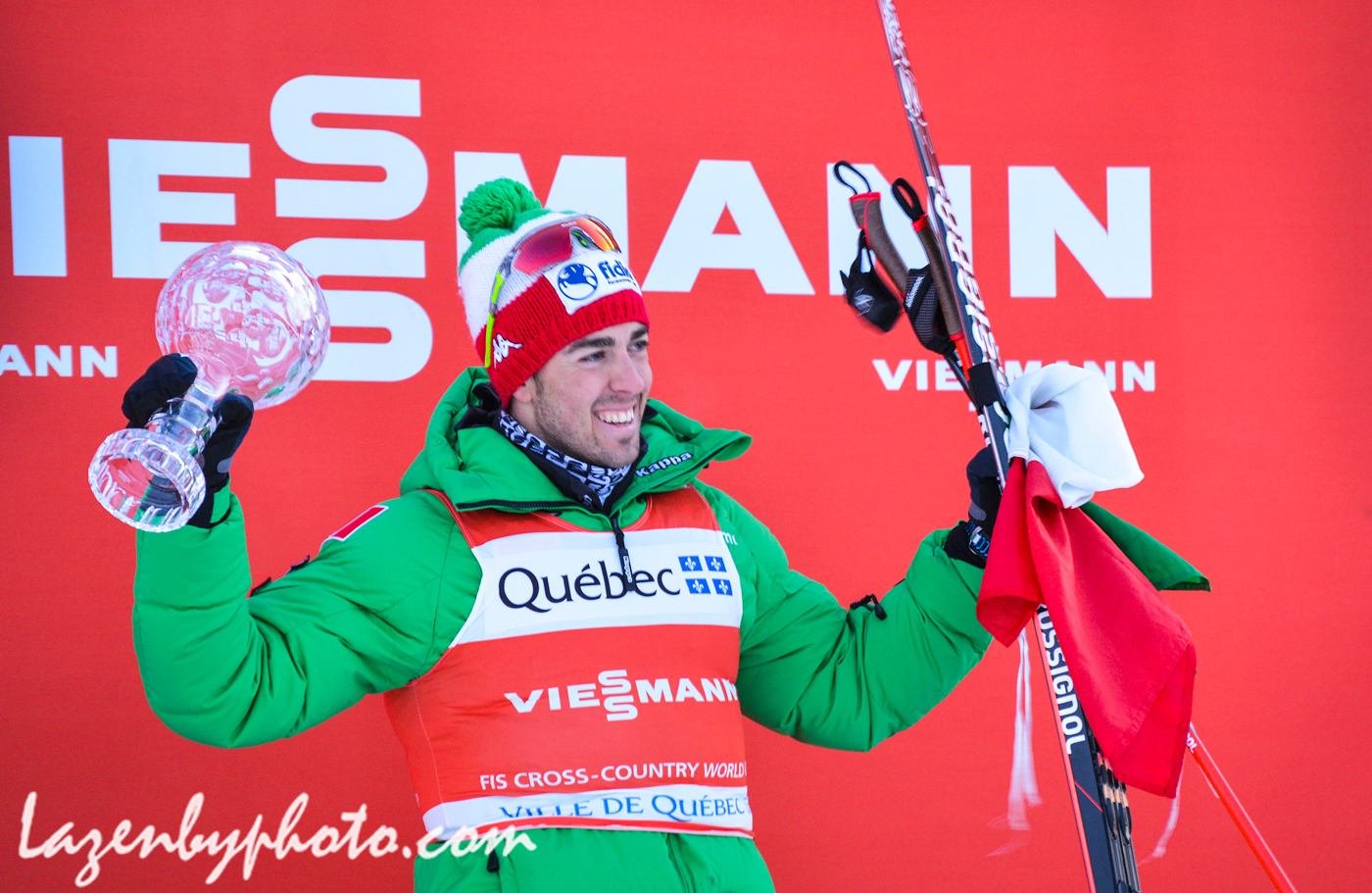
Italy’s Federico Pellegrino became the first non-Scandinavian male to win a Sprint World Cup Crystal Globe on Friday, placing 21st in the freestyle sprint in Quebec City. He needed to finish in the top 22 to lock up the title. (Photo: John Lazenby/Lazenbyphoto.com)
Newell sat stunned for a few moments and finished sixth in the heat, 52 seconds out of first. Pellegrino recovered quicker and ended up fifth, 2.73 seconds behind Gros as the winner.
That put Newell in 29th and Pellegrino in 21st overall; for Pellegrino, it was enough to secure his first Sprint World Cup Crystal Globe and he became the first non-Scandinavian male to win the season-long title. (He needed to finish in the top 22 to do so.)
As of late, Newell has tried to jump start what he has considered to have been a difficult season.
“Just trying to take it one day at a time,” Newell said. “I am obviously not in my best shape right now. I’m kind of suffering a little bit, and just trying to make it through the season. It hasn’t been a great last month for me. I haven’t been sick, I’ve just not been feeling very good. So that’s hard, at the end of a season, when you are not feeling well. It’s no fun to race when you are not at your best. It’s one of the hardest things for an athlete to do. So just trying to make it through some of these races. And then, yeah, take it one day at a time.”
Also for the U.S., Reese Hanneman (APU) placed 45th, Eric Packer (APU) was 48th, Dakota Blackhorse-von Jess (Bend Endurance Academy) 64th, Noah Hoffman (SSCV/USST) 65th, Scott Patterson (APU) 70th, Tad Elliott (SSCV) 76th, Brian Gregg (Team Gregg) 79th, Matt Liebsch (Gear West) 80th.
Also for Canada, Len Valjas (CNST) finished 38th, Devon Kershaw (CNST) 53rd, Knute Johnsgaard (AWCA/CNST) 54th, Andy Shields (NDC Thunder Bay) 56th, Michael Somppi (NDC Thunder Bay) 59th, Patrick Stewart-Jones (AWCA) 68th, Graeme Killick (CNST) 71st, Ivan Babikov (CNST) 72nd, (Russell Kennedy (Canmore Nordic) 73rd, Kevin Sandau (AWCA) 74th, Bob Thompson (NDC Thunder Bay) 78th, and Simon Lapointe (Skinouk) 81st.
The STC continues Saturday with Stage 4, the men’s 15 k and women’s 10 k freestyle pursuits in Quebec City.
— Gerry Furseth, François Léger Dionne, Harald Zimmer, and Alex Kochon contributed
Alex Harvey fans on sprint day in Quebec City. Harvey ultimately reached the final and the podium, placing second overall. (Photo: John Lazenby/Lazenbyphoto.com)
Alex Harvey looks to his girlfriend Sophie (right, in blue) after placing second in the men’s freestyle sprint at the third stage of the Ski Tour Canada in Quebec City. (Photo: John Lazenby/Lazenbyphoto.com)
Alex Harvey hugs his girlfriend Sophie shortly after racing to second in the men’s final of the freestyle sprint at the Ski Tour Canada Stage 3 in Quebec City. (Photo: John Lazenby/Lazenbyphoto.com)
A view from the steep hill on the sprint course with the stadium area in background, as seen during training on Thursday in Quebec City, one day before the third stage of the Ski Tour Canada. (Photo: John Lazenby/Lazenbyphoto.com)
(Photo: John Lazenby/Lazenbyphoto.com)
Part of the pursuit course in Quebec City, which will be used Saturday for Stage 4 of the Ski Tour Canada. (Photo: John Lazenby/Lazenbyphoto.com)
Testing during Thursday’s official training in Quebec City before the third stage of the Ski Tour Canada. (Photo: John Lazenby/Lazenbyphoto.com)
(Photo: John Lazenby/Lazenbyphoto.com)
QUEBEC CITY — The Plains of Abraham just outside the walls of Quebec City are best known for a major battle that changed the direction of North American history in 1759. On March 4 and 5, the Ski Tour Canada will reignite international rivalries on the same plains.
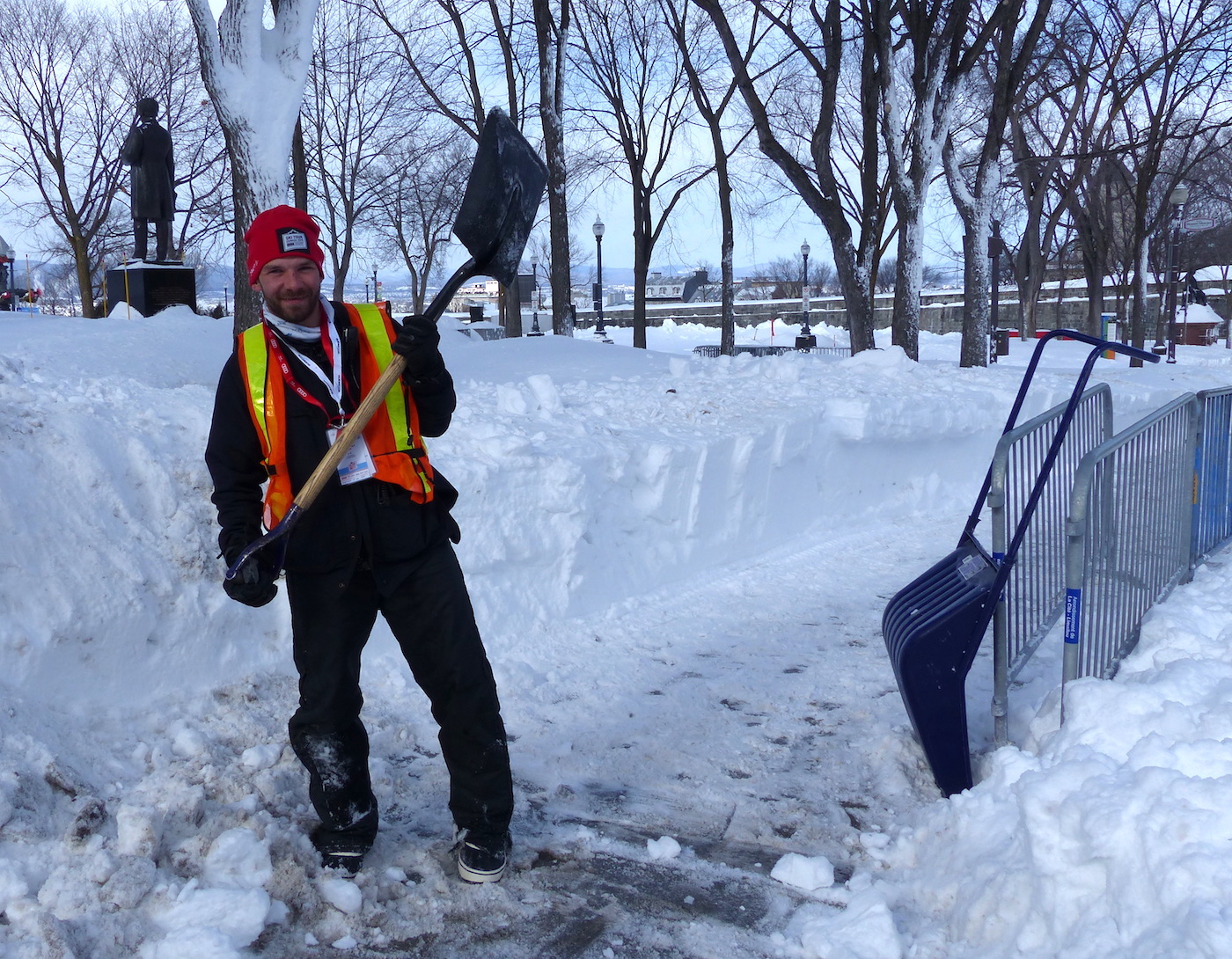
A recent 40 centimeters (16 inches) of snowfall means there is no shortage of snow. Race organizers are spending more effort digging out sidewalks and pathways than covering the course. Thursday’s training day was cold and windy, reaching -15 Celsius (5 Fahrenheit) in the afternoon, and only the Russians used the entire official training session. Temperatures are expected to warm up to -9 Celsius (16 Fahrenheit) for the freestyle sprint heats on Friday, which start at 3:30 p.m. Eastern time.
Digging out the downtown sidewalks on Thursday in Quebec City. (Photo: Peggy Hung)
Saturday will be the 10/15 k freestyle pursuits, with the tour leader starting first. As with the Gatineau sprint, there are very few trees and little protection from the wind. The feel of the course will change dramatically with wind direction.
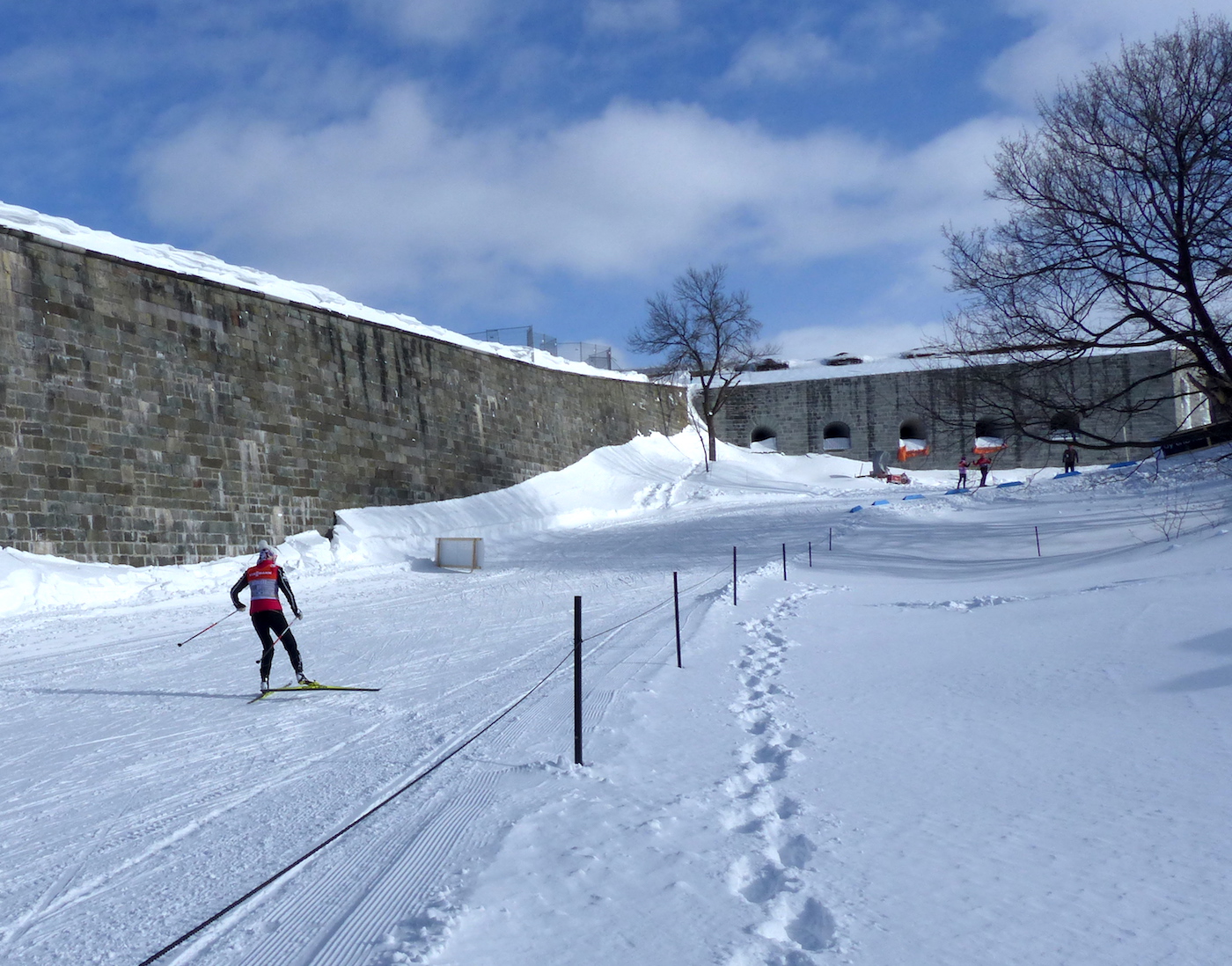
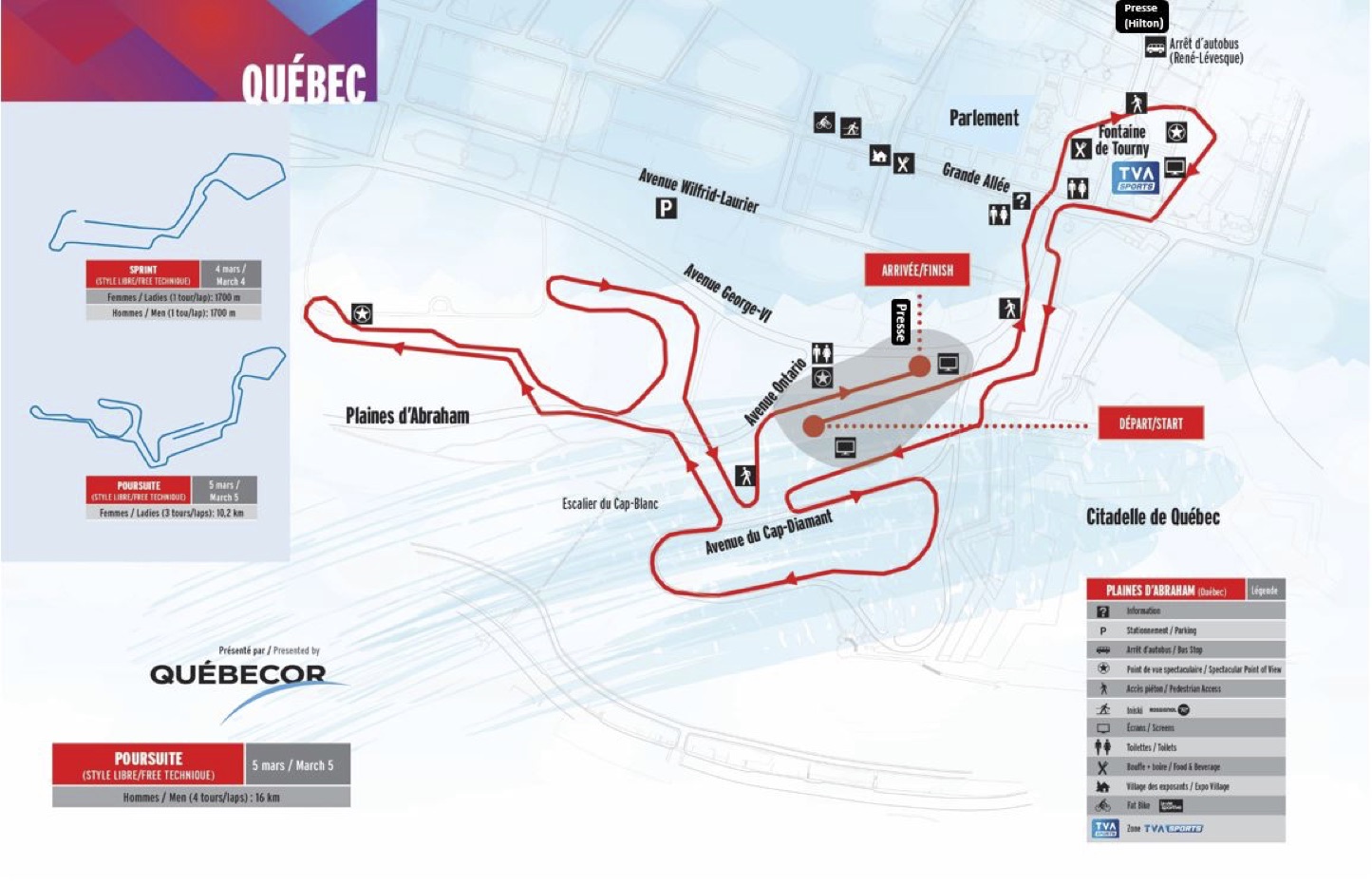
Despite the name, the plains are not entirely flat, with rolling hills on top of a cliff overlooking the St. Lawrence river. The sprint course (1.7 k for the men; 1.5 k for the women) is relatively flat, with a gentle climb out of the stadium, a long gentle descent to the city walls, and a gentle climb back before a steep-wall climb returns the racers to the stadium.
The women finish with a gentle descent followed by a wide-open corner into the finish straight. The men turn sharp left before the women’s final corner for a steep climb up and down a horseshoe, which will make the men’s race tactically very different.
“The last 500 meters of tomorrow’s sprint is going to be long and brutal,” Canadian World Cup Team and local racer Alex Harvey said at a press conference on Thursday. “As I get older, I’m a little slower in short sprints, but this is a longer sprint, so it should suit me better.”
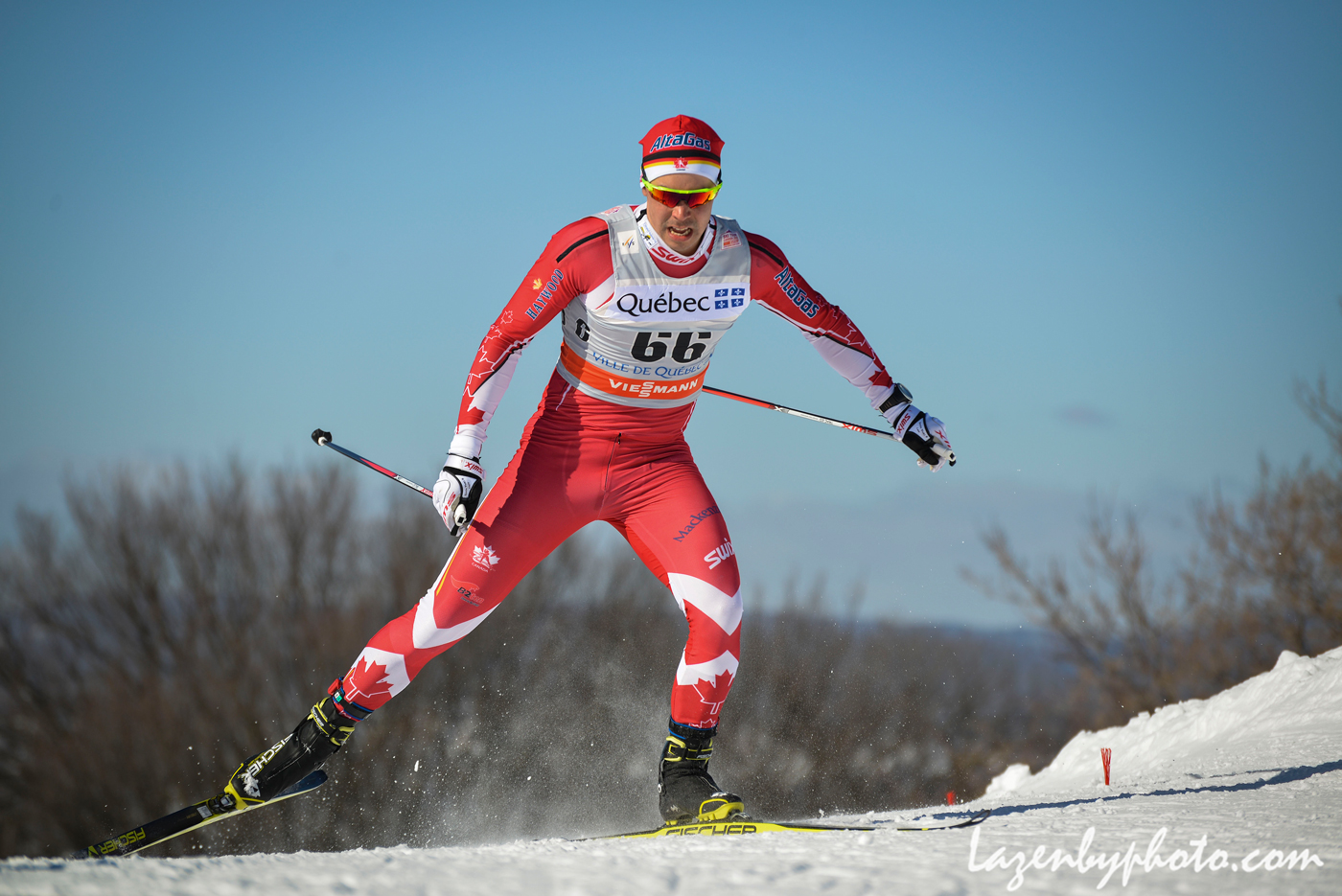
A skier navigates the sprint course just outside the city walls in Quebec City. (Photo: Peggy Hung)
The steep climbs stayed firm on training day, but could easily turn to sugar by the end of the race day. The turn at the bottom of the course is easy enough in Zone 1, but it will likely be far more exciting in at race pace in in a group.
The pursuit course spends more time on the top of the exposed ridge with moderate climbs and great views of the river. Where the sprint course was almost entirely untransformed (squeaky) snow, the more exposed sections of the distance track were heavily transformed and very fast.
By the end of official training, one of the climbs was a mix of polished transformed snow and windblown squeaky drifts, with the fast line snaking back and forth across the trail. The longest distance course descent combined particularly fast snow with a strong tailwind, making the crashpads on the trees seem justified. The one tricky turn from the sprint course will be a bigger factor with the entire pack arriving together.
“Quebec is such a great venue to host a World Cup,” Harvey said. “There’s so much snow here, we never see that in Europe. We have some races in downtown in Europe, but trucks bring the snow, it’s dirty snow. Here it’s white everywhere, the course is great with fun bridges here and there. The European find it really surprising. They keep pointing at the Fleuve [St. Lawrence River] and asking if it’s a lake, a river! For many of them, it’s their first trip here.”
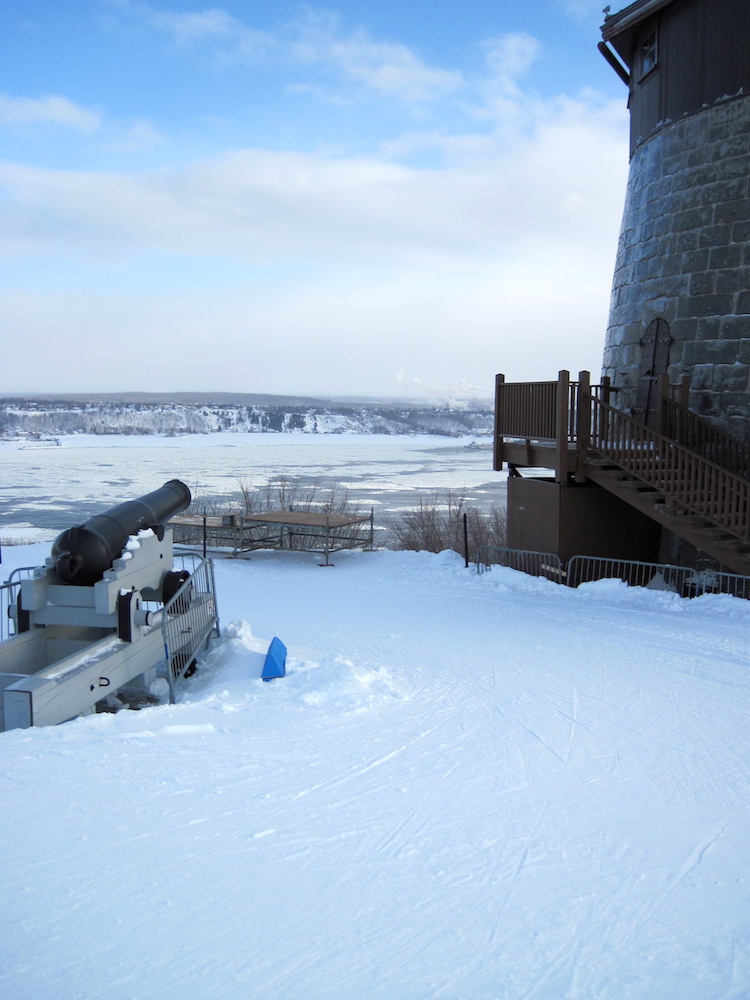
A hairpin turn around a cannon at the top of the freestyle pursuit course, which will be used on Saturday at the fourth stage of the Ski Tour Canada in Quebec City. (Photo: Gerry Furseth)
The old city of Quebec is one of the few remaining walled cities in North America and has a distinctly Quebecois culture. Greetings are uniformly in French, although most people will quickly switch to English.
The city is also known for its food. No visit is complete without a stop at the Chic Shack for their famous poutine, in the Musee du Fort, five minutes walk from the racecourse. Aux Anciens Canadiens, through the city gates and two blocks straight ahead, mixes traditional and modern food and encapsulates much of the local food history. As the weather is expected to remain cold, a good choice anywhere is the regional specialty soupe a l’oignon gratinee. Outsiders may know this as French onion soup.
On Thursday afternoon, the old city was filled with U.S.. family and friends, with nordic logos outnumbering the ‘normal’ tourists.
More from the press conference with Harvey (translated from French to English):
“This year’s sprints have been relatively shorter, at 1.3 to 1.4 kilometers, compared to [Friday’s] 1.7-kilometer sprint. Where the shorter sprints last a little over two minutes, this one will go over the three minutes mark. My endurance should enable me to keep pushing after the acid lactic build up, which usually kicks in at two minutes.”
(In English) “The natural terrain [on the plains of Abraham] is really hard, and then they added a little extra, little bridges, to make it harder. So this is going to be one of the toughest sprints of the whole circuit tomorrow, everyone agrees to that. It’s long, it’s hard, the last 500 meters is going to be just brutal.”
Canada’s Alex Harvey racing to ninth in the second stage of the Ski Tour Canada, the men’s 17.5 k classic mass start, on Wednesday in Montreal, Quebec. (Photo: John Lazenby/Lazenbyphoto.com)
“I spent ten days training at altitude in Canmore in preparation for the second half of Ski Tour Canada, missing the last World Cup weekend in Finland. I’m really anxious to see the rewards in Canmore next week. The first six days of that altitude training were really frustrating. I felt really tired and weak during intervals session, which pissed me off! Altitude training is tough for everybody. I bet some guys will explode during the skiathlon in Canmore.” [Note: Canmore is at an elevation of 1,400 meters above sea level. Quebec City is at 100 meters.]
“My goal for [Friday’s] sprint is to qualify for the semis, which would give me a 30-second bonus overall.
“A top-five placement overall is still realistic, even the podium is not out of reach.”
FasterSkier:What differences, if any, do you see between the European Tour de Ski and the Ski Tour Canada?
AH: “The traveling is a big distance. The distances are really small in Europe. You can go from Italy, to Germany, to Switzerland easily and in no time. Here, we have to take a plane to Canmore. The logistics of the Ski Tour Canada are much more complex. That was probably our biggest challenge up to that point. The jet lag is another factor. I did the trip from Montreal to Calgary several times in the past, so I’m used to it. Other Canadians did so as well, so it should play to our advantage.”
— François Léger Dionne contributed reporting
The freestyle sprint course in Quebec City. (Click to enlarge)