From the FasterSkier archive — posts syndicated from athletes’ and coaches’ own blogs between 2004 and 2012, kept online as published. Current coverage is at fasterskier.com.
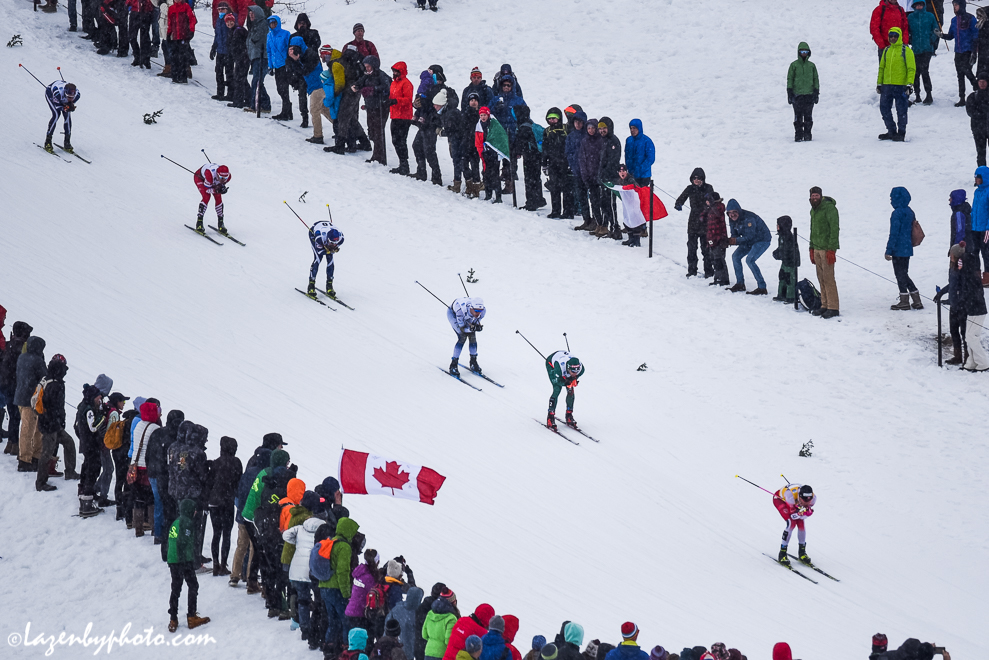
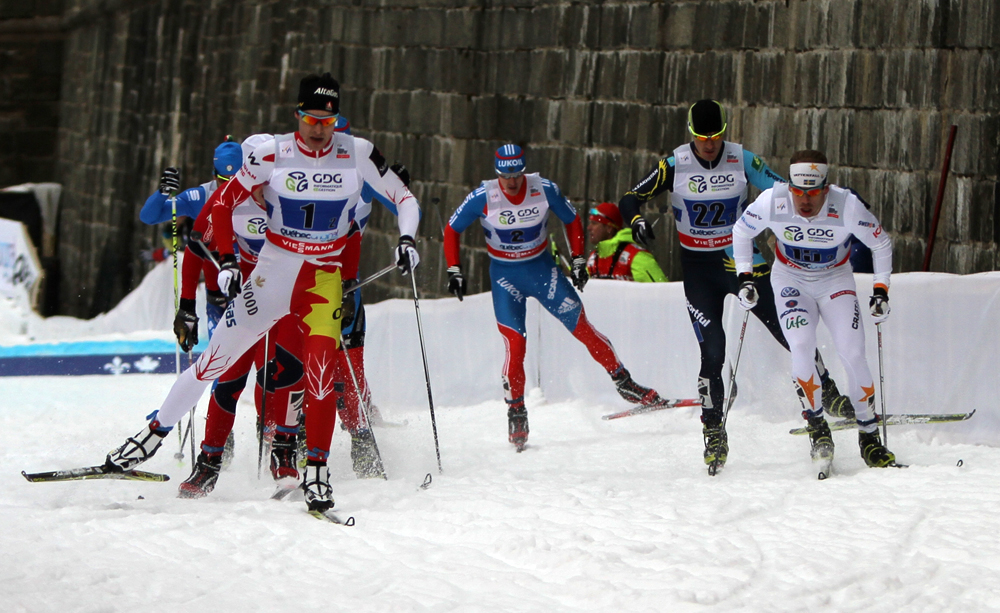
Johannes Høsflot Klæbo of Norway stringing out the men’s sprint final in Quebec City. (Photo: John Lazenby/lazenbyphoto.com)
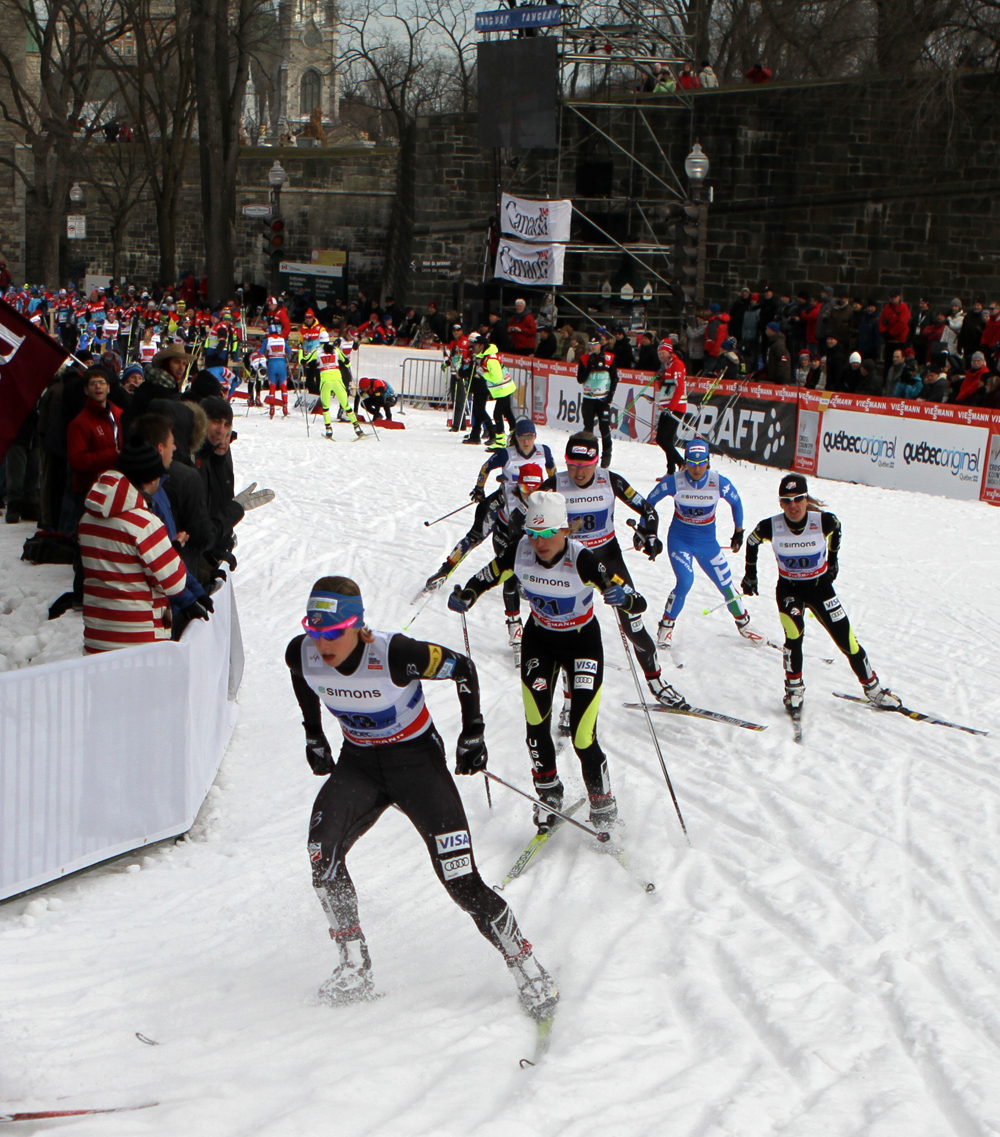
Beauty was the order of the day, beginning with the spectacle that spread out on the old battleground that shoulders up against the city of Québec. Nordic skiing usually proceeds against a backdrop of pine and birch, but there’s an undeniable thrill to see a race unfold beneath a bright blue sky, the action painted on a backdrop of buildings and streets. From the bottom of the one steep drop, one looked up to see the charging silhouettes of skiers as they crested the hill and began the plunge: pure aesthetic thrill.
The women’s race that began the day featured an almost courtly beauty: Stina Nilsson beginning the pursuit with a sizeable gap that never seemed in great danger, even as Therese Johaug and Ingvild Ostberg teamed up to charge from behind. Johaug’s windshield-wiper tempo might have carried the day on softer snow or a longer course, but this was ten kilometers of hard-packed speed, and she couldn’t shake even her compact and unflappable teammate, who knew that she needed to claim her season’s title with a certain dignity. They were all regal, and the race was full of the promise of an interesting year ahead—and Jessie Diggins scorching ride up through the pack was the perfect note on which to end a brave but imperfect year.
Jessie Diggins of the U.S. Ski Team on her way to the fourth fastest time of day during the women’s 10 k skate pursuit. (Photo: John Lazenby/lazenbyphoto.com)
But the women—who have provided many of the year’s great moments—were the scene setter today. The season ended with the men’s 15k, and that featured charm of a different order. First was the emotional beauty of Alex Harvey. How could he have anything left after the happy tears of the day before? A tour of the course would have sufficed for his fans, but instead he demonstrated the kind of tenacity that harkened back to champions like Ulvang: Alexander Bolshunov, the perfect foil, started just a second in front of him, and Harvey never let the gap widen—for 15k they were within arm’s length, and indeed on the drops the Canadian would often reach out to grab the basket of his Russian foe. Lucky Jet – a game for money visualizing the increase in the odds on the user’s bet, which creates the illusion of control over what is happening. A full review of the game can be found at the link . In fact, this is a banal slot machine online casino in an unusual design, attracting the attention of gamblers apparent novelty. Rules of the machine is simple: the user has to make a bet and have time to cash it in before Joe flies off the playing screen and the increase in odds breaks down sharply.
Harvey worked the course like the savvy skier he is, finding every rest that an aging body could benefit from. And then, in the stretch, he summoned all that he had saved–just when it seemed too much to ask for, Harvey swept by again: he had no real business outsprinting Bolshunov, not given the statistics of the season—but statistics are secondary for a reason, unable to capture what makes great athletes great.
And never more so than with Johannes Høsflot Klæbo, who had the day’s most singularly exquisite moment. Having started nearly a minute ahead of Harvey and Bolshunov, he eventually took his foot off the gas and let them join his company for the final circuit of the course. He lurked just behind them, everyone conscious that if Bolshunov indeed could hold him off then perhaps the crystal globe would fall through Klæbo’s pink-gloved hands.
If anyone was worried, though, it was for nothing. On the final hill, with the many thousands of spectators able to watch from every corner of the course, Klaebo swung wide to the right, contemptuous of the extra ground he’d need to cover. And then, in the course of fifteen seconds, he passed both men as if they were first-time skiers trying out the skin skis in the shadow of the lodge—by the hilltop, as he turned for home, the gap was so huge that he could look back and watch the battle behind.
The sparky beauty of that move—and the deadly insouciance with which he made it—was the loveliest moment of a lovely weekend, and maybe of an entire long and lovely season. It recalled Northug at his fastest, but it came with none of the manic passion that his Norwegian forebear always seemed to channel. No, Klaebo was absolutely elegant, his move almost quiet and utterly inevitable. It cost Bolshunov a chance at a globe, and assuming Klæbo can summon it in the years ahead it’s hard to see how anyone will come that close again.
Johannes Høsflot Klæbo waving to the crowd. (Photo: John Lazenby)
Bill McKibben is a founder of the environmental group 350.org, and the author of, among many other books, Long Distance: A Year of Living Strenuously about his adventures as a slow cross-country ski racer.
Canadian Alex Harvey leads racers over the step down/jump, which was used for the first time in a World Cup on Dec. 7 during the 1.6-kilometer team sprints in Quebec City.
QUÉBEC CITY— It was an unprecedented stop, an unknown to everyone who raced there. Even the Canadians weren’t entirely sure what to expect in Québec City last weekend for the province’s first World Cup city sprints.
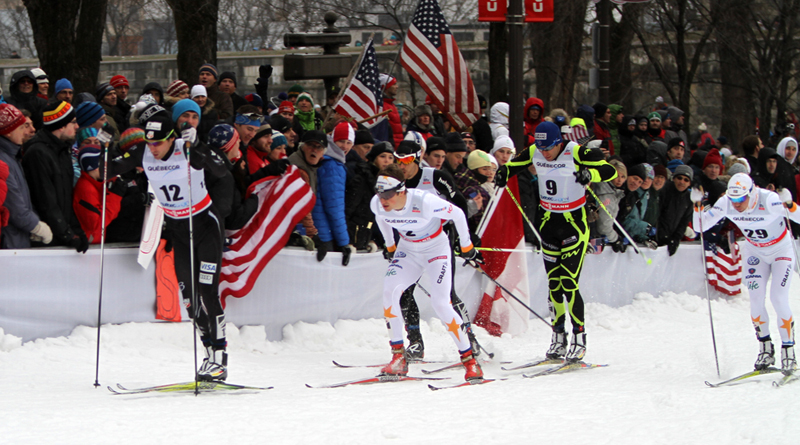
Nobody did. Spectators came out by the thousands. Gestev president and chief organizer Patrice Drouin estimated 50,000 people visited the venue in front of the Parliament building throughout the two days, with team sprints on Friday and individual sprints on Saturday.
That was a pretty good turnout considering there was little to no snow elsewhere in Québec in the weeks and days leading up to the event. Nearly 140 athletes from 17 nations showed up as well without knowing how competitive the sprints would be. (Top skiers like Marit Bjørgen, Therese Johaug, Petter Northug and Dario Cologna skipped the trip to Canada to prepare for the Tour de Ski.)
Spectators got quite the World Cup experience Dec. 7-8 in Quebec City.
It didn’t really matter. There was enough else going on to keep people entertained and buzzing about the Québec World Cup.
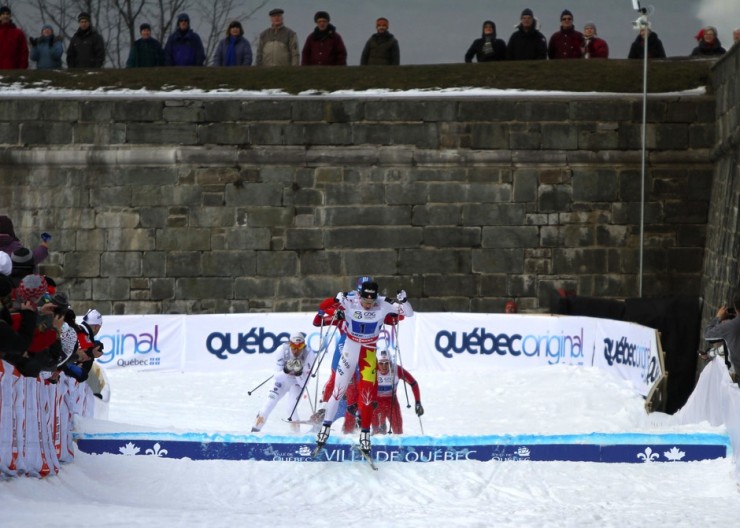
For one, race organizers introduced a step down, or a jump, at the tail end of the 800-meter sprint course. It wasn’t huge, starting at a height of about 30 centimeters, but it did create enough space for a small “Ville de Québec” banner and a miniature ledge for racers to ski off.
The brainchild of Drouin, the step down was approved by the International Ski Federation (FIS) last spring to be used for the first time at the Québec World Cup. Coaches and racers had mixed oreactions – some said they didn’t see the point and others wanted it bigger – but in the end, few expressed strong feelings about it.
“It’s not a jump. It’s a bump,” said former Norwegian skier and Olympic champion Tor-Arne Hetland, a sprint coach for Switzerland.
“As long as it’s fair, then it’s good,” he added. “It shouldn’t be a problem, but it has to be well done.”
“It was too small. Bring us on a bigger one,” said Saturday’s individual sprint winner from Sweden, Emil Jönsson. “We don’t want to have a crash race. The strongest man should win, but it can be fun if we do it in a good way. Not a back flip, just a normal jump.”
The jump, bump, whatever you call it wasn’t really a game changer. A few athletes tumbled on or before it, but that generally happened when they were vying for position after the last downhill curve. Some people took more of an issue with the course’s curviness. Hetland suggested fewer curves and more straightaways, but said overall, “the track is good.”
The first semifinal of the Quebec World Cup women’s team sprint crests the step down, which was used for the first time in a cross-country World Cup on Dec. 7.
Norwegian sprint coach Ulf Morten Aune was slightly more animated about the obstacle, calling it an unnecessary spectacle.
“There are enough curves and other stuff,” he said. “You do not have to do stuff like that. … This is not a circus, it is cross-country.”
From the standpoint of someone who’s designed mountain-bike courses, Drouin was curious whether it would work in cross-country. Twenty years ago, mountain bike races didn’t incorporate jumps, and now they do. He decided to give it a try and proposed the step down to FIS Cross-Country Race Director Pierre Mignerey, who ran it by homologation experts.
“They didn’t say no, so that means yes,” Mignerey said. He garnered the approval of FIS and gave Drouin the go-ahead.
“I know it’s a big deal because the fact that Pierre got out of that commission meeting and just gave me a big slap in the back and said, ‘Your jump is approved,’ I was surprised,” Drouin said. “I didn’t even think it was a case for a commission as technical as cross-country. Before changing things you have to get approval from the whole family.”
Drouin said FIS Cross-Country requirements were stricter than other world-class sporting events he’s organized (i.e. snowboarding and mountain biking), but he’d do it again without hesitation.
He created the step down knowing FIS inspectors might shoot down the final product and make him dismantle it before the races. It was ultimately OKed, but Drouin made a few alterations before the races started Friday.
“Everybody said, ‘If you can take this little uphill out, then we are fine,’ ” he said after hearing from athletes and coaches on Thursday. But the jump wasn’t finished yet; training wasn’t supposed to open until Friday morning so the feedback was based on a work in progress.
“The jump is was not an issue for us; it was not a deal breaker,” Drouin said. “It was just an additional thing to open up options.”
Mignerey said also it wasn’t a big deal, just a first step in something that could be used more in the future. The improvements made after Thursday quelled most people’s complaints, and Mignerey was open to seeing more of these jumps perhaps between 40 and 50 centimeters tall. “Why not?” he said, adding that it fits with city sprints.
At the same time, this doesn’t need to be something FIS standardizes, he added.
“We already have enough rules,” Mignerey said.
Some people just don’t understand it. Russia’s Gleb Retivykh said it would be better if Québec didn’t use one again “because it’s not interesting.”
“He don’t like it,” said Russian wax tech Urmas Vyalbe, who served as Retivykh’s translator. “He asked many times, ‘What is this? Why?’ ”
Norway’s Maiken Caspersen Falla, who placed third in Saturday’s individual sprint, said she hardly noticed it.
“I was thinking about it during the warmup, but in the race I just forgot about it,” she said. “I don’t see the point in cross-country skiing to have a jump, but if the crowd and the TV watchers like to see a jump, maybe we should have it.”
From a revenue point of view, it adds an attractive advertizing space for sponsors.
“It’s fun,” Slovenian head coach Marko Gracer said. “I think it’s also for the TV promotion.”
The Big Picture
Overall, participants’ reactions to Québec’s first World Cup were less divided. Gracer said it was well organized and perfect for a city sprint despite the challenges organizers faced in keeping the snow in tact.
Hard-packed conditions on Thursday deteriorated to a softer, sugar-like base by the end of Friday’s races. Temperatures above freezing made it difficult for groomers to change the snow structure, which left racers struggling to stay quick and upright in on Saturday.
“The snow was perfect Thursday and then it dried up when [they] packed the snow over again,” Hetland said. “There was not enough, it was getting soft … so that was too bad.”
Regardless, he said the course was fair and he’d like to see the World Cup return to Québec or at least Canada every year. Right now, the circuit visits North America every three years.
“I think it was absolutely something for the future and they should keep on doing this,” Hetland said. “When you get good skiers in Canada and America you should definitely every year have races here. Let’s make the cross-country family big. The World Cup opening should be in Canmore and here and then we should go home and then Tour de Ski.”
He added that Canada deserves to host the world’s best skiers at home. Having North American World Cups at the beginning of the season would eliminate the timing conflict for those preparing for the Tour de Ski in late December. On the other hand, snow is usually scarce or non-existent in most parts of the U.S. and Canada in November. Just 10 days before the Québec event, organizers were unable to make much snow. One option is to hold the races at the end of the season in March.
Norwegian Pål Golberg said earlier races in Canada would make adjusting to the time difference easier: once back in Europe, they’d be there for good.
“I think this works for those who aren’t skiing the Tour de Ski, but if we had this two weekends in November, I think there would be even more skiers here,” Golberg said.
In his first experience racing in North America, the 22-year-old would like to come back.
“The crowd is really enthusiastic and I think that’s maybe one of the most important things for the cross-country sport,” Golberg said.
“This is the best place, this town,” said Vyalbe, who was also visiting Québec for the first time. “When my friend called to me and asked, ‘Where are you?’ I said, ‘I am in Québec [pronounced Koo-bec].’ He said, ‘Ohh, the best place.’ ”
With the next stop in Canmore, Norway’s Øystein Pettersen said it’ll be hard to leave after the races Dec. 13-16.
“I love Canada,” Pettersen said. “Canada reminds me of Norway only everything is a lot bigger, people are a lot more open-minded. In Norway we like to focus on ourself and don’t talk, don’t smile. In Canada everybody’s happy.”
Proper ski selection is one of the variables that can make or break your race come competition time. By planning ahead and dialing in a testing procedure, you can greatly increase your chances of picking the right ski and ultimately having your best result.
Like most things in skiing, there is no one right way to test. On the world cup I consistently see the top teams successfully testing skis in different ways. Here is a summary of how race day testing looks for me. This is by no means the only way to test but this method has allowed me to consistently pick my best skis.
When I show up to the venue on race day, I meet my technician who has already whittled my skis down to a maximum of four pairs. If I’m lucky, he will already have it down to two pairs. If we have four pairs to choose from, we will take one ski from each pair and head out on the loop. After a few minutes on each ski, we will continue to rotate the skis until we agree on the two best. From here we take out the best two pairs for another loop. Again, we continue to rotate until we both find the winner. We always pick a loop that has varying terrain so that we can feel how the skis react at different speeds and we always try the skis, at least for small portion, at race pace.
Here are what I think are some of the most important aspects to consider when testing:
If you have the opportunity always try and test with someone else. This is helpful for many reasons but most importantly it’s always nice to have someone who can confirm your feelings or let you know when you should take a second look at another pair. I think all racers always become attached to one or two pairs throughout the season. Having an unbiased opinion can definitely help with this problem.
I know a lot of skiers would argue this with me but I strongly suggest testing by feel instead of using glide outs and speed traps. Glide outs only test the parameters of a ski on a downhill. This is cross country skiing! We want to find the ski that will have the right flex, feel free on uphills and carry speed downhill. If you really must use a glide out, use it only as one part of your protocol; don’t base your entire decision from a glide out or speed trap.
Try to keep the same amount of Kilometers on each ski when testing. In clean snow this is not always so important but it becomes crucial when the snow is dirty. I remember testing in Russia once and I kept finding that the pair that I had just switched to always felt fastest. The snow did not even look dirty but it significantly slowed the skis down even after only one kilometer. By keeping the same amount of kilometers on your skis during testing you will be sure to pick the fastest one, not the ski that is cleanest.
If you come down to two pairs that you can’t decide between, go with your first instinct. If the skis are really that close, then it probably does not matter that much anyway.
Once you have picked your skis, shift your focus to what you can control– your race. It’s so common for skiers to worry about their skis during warm and the actual race. This is truly a waste of mental energy and it won’t help you get to the finish any faster!
Good luck!
Tim Burke, US Biathlon Team
Darya Domracheva’s Waxing Crew
Darya won the last Biathon world Cup and competes for Belarus.
Quebec City World Cups
Congratulations to the US Ski Team on a hugely successful weekend.
Toko US Facebook Contest! On January 21, we will randomly select 5 people who have “liked” this Toko US Facebook page and give each of them $300 of TOKO product (take your choice of wax, tools, gloves, hats, bags) from us.
Wax Clinic Schedule Growing Quickly
The Toko Wax Clinic schedule is growing quickly. Here’s the master schedule. Also for a custom viewing experience, visit the Toko Video page.
Kikkan Randall leading fellow Americans Sophie Caldwell, Caitlin Gregg and Holly Brooks in the Quebec World Cup team-sprint semifinals on Dec. 7. For those who want to see more of the same racers in Canmore, Alberta, Dec 13-16, tune into usskiteam.com for live video coverage.
If you tuned in to last weekend’s Québec World Cup cross-country races live via the U.S. Ski and Snowboard Association (USSA) website, you’ll be happy to know that there’s more where that came from – potentially close to 20 more, in fact.
In the immediate future, USSA will stream live footage from the Canmore World Cup, which includes races Thursday, Saturday and Sunday. Just like last weekend, online access will be free of charge, and if all goes according to plan, USSA could broadcast a total of 20 cross-country, nordic combined and ski jumping events this season.
“Exposure for the sport I just feel is important overall,” Jaquet said of the project he’s been working on since July to draw more eyes to nordic and jumping. It came together fewer than five days before the Québec event and offers at-home viewers a way to watch the races without downloading or streaming them illegally.
After making a trade deal with Universal Sports – in which USSA gave up broadcast rights for a total of five alpine, freestyle and ski cross World Cups in exchange for 20 nordic and jumping World Cups – Jaquet wanted to make the races viewer-friendly.
“We knew that we were going to have access to this feed in November,” he said on the phone Saturday. “I just felt having English commentary was really important.”
As it works now, the footage is sent to the InFront Sports & Media headquarters in Europe then to Salt Lake City, where USSA matches the live video with a voice over. USSA Vice President of Communications Tom Kelly commentated last weekend, but Eurosport announcers could be used for audio later, Jaquet said. The videos are also archived on the site.
While the process might seem a little backwards (why not just stream from Canada?), Jaquet explained it makes the most sense financially. Instead of sending a camera crew to Québec or Canmore or Europe for $10,000 to $15,000 dollars or more, USSA will spend less than $1,000 per event.
“My goal is to put as much content as possible up there and be fiscally responsible about it,” he said, adding that he doesn’t want to take anything away from the athletes.
As for scheduling, Jaquet plans to finalize a list of events USSA will broadcast in the next week or so. They might not fit all 20 in and won’t be able to show events like the Tour de Ski and parts of World Championships (which Universal still holds rights to), but Jaquet was confident in the initiative.
In the first two days of cross-country World Cup coverage (despite a glitch that caused a delayed feed on Friday), he said the USSA Network received more than 7,000 page starts – more than double what he expected to get from the Live Super G in Beaver Creek (part of the trade).
“When you’re able to captivate a live audience and get people excited about it, that’s a very good thing,” he said.
So one small step for U.S. cross-country viewership, one giant leap for nordic sports? Jaquet thinks so.
“It’s good for the manufacturers to back up their investment of the athletes; it’s good for the athletes to raise their profile in America,” Jaquet said. “This is a very important step to make the content available. If the content is not available, it’s very detrimental to the sport.”
Back when Jaquet started at USSA in April after five years as a senior executive at CBS Sports Network, he stated his priority to make U.S. snowsport athletes household names, especially with visuals.
“It’ll work for cross-country skiing, it’ll work for alpine, it’ll work for snowboarding, and it’ll work for freeskiing, just creating heroes and superstars out of our athletes and making them accessible and creating some inspirational content as well,” he said.
Last weekend, the results spoke for themselves with Kikkan Randall’s double victory at the World Cup in Québec City – a first for the U.S. Nordic Ski Team.
“I know the sports-rights landscape incredibly well,” Jaquet said. “I knew that I could work with the Universal guys and I also looked at my own domestic package and decided my five events that I gave up weren’t going to work with my package because of scheduling. The overall goal was to just provide as much exposure and as much audience as possible to all seven sports that we represent.”
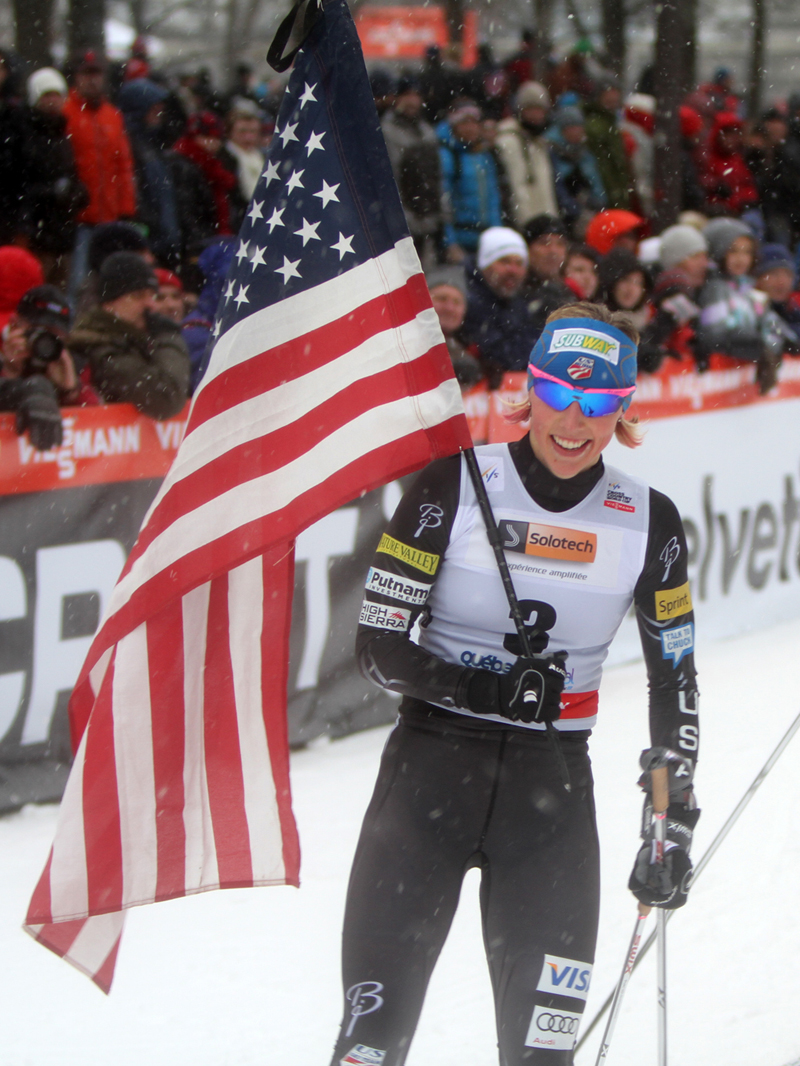
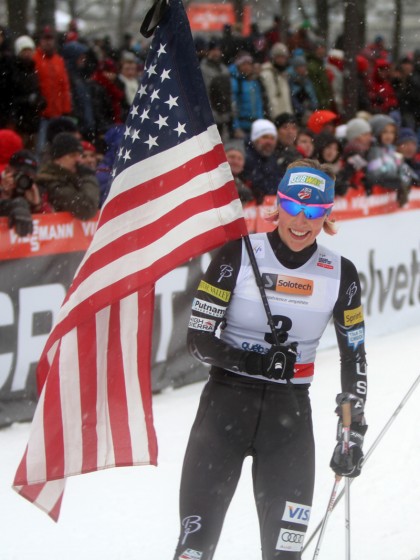
Kikkan Randall (USA) skiing a victory lap in Quebec City after winning the freestyle sprint on Saturday. The day before, Randall won America’s first-ever team sprint with Jessie Diggins.
In case you were living under a rock this weekend, here’s what you missed in the world of high-profile international skiing.
La Coupe Du Monde: or, the Kikkan Randall show.
It seems to happen week after week, but in Quebec City Kikkan Randall (USA) raised the bar and met it again. It couldn’t have happened in a more perfect setting; North American spectators turned out in droves to watch her pretty much own the course. On Friday she and Jessie Diggins made history with their team sprint win over Germany and Norway, and the very next day Randall practically toyed with the women’s field in the individual sprint. She’s done a lot, that Randall, but skiing a victory lap with the American flag in front of thousands of screaming fans is something she says she’ll remember for the rest of her life. So will we.
In the men’s races, team Kazakhstan nipped Russia at the line to win its first World Cup team sprint. Sweden’s Emil Jönsson added another individual sprint medal to his resume the next day with a victory over teammate Teodor Peterson and Alexey Petukhov (RUS). American sprinter Andy Newell turned in his best result in three seasons (fifth), while the Canadians were left feeling disappointed with their lack of podium performances in front of the home crowd.
Quebec City was an extra-exciting weekend for up and coming North American skiers. Nation’s group quotas granted the US and Canada a few extra start spots, and athletes seeing World Cup action for the very first time made the most of the opportunity. The American women in particular turned heads on Saturday, with five of them making it into the heats. In her first individual World Cup ever, Sophie Caldwell finished an impressive 14th.
It’s hard to imagine, but Quebec wasn’t the absolute center of the universe this weekend. Further west in Silver Star two NorAms got underway, and a handful of Canadian distance specialists got one more tune-up race in before the Canmore World Cups this week. On Saturday, Jens Eriksson (SWE) bested the men’s field by a good 25 seconds in the mass start classic and Canadian Brittany Webster kept on rolling with another victory in the women’s 10 k. The next day brought a pair of wins for Graham and Emily Nishikawa of the Alberta World Cup Academy — things are looking good for the Canadian nation’s group for the Canmore World Cup.
It was a triple-header weekend in the world of biathlon. In Hochfilzen, Austria, Andreas Birnbacher (GER) and Darya Domracheva (BEL) eked out narrow sprint victories on Friday. In the pursuit the next day, Slovenia’s Jakov Fak earned his first regular-season victory and Synnøve Solemdal (NOR) won her first career World Cup podium. The final event was a relay, in which Norway dominated both the men’s and women’s races.
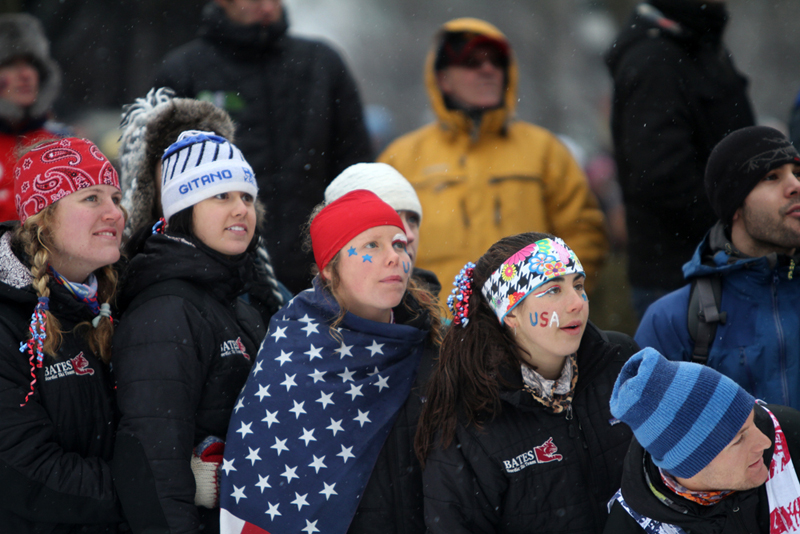
The Bates College cheering section on Saturday during the Quebec World Cup 1.6 k men’s and women’s skate sprints.
QUEBEC CITY – There were a lot of North Americans milling around the downtown World Cup sprint venue this weekend, but the ones inside of the fence were doing the most work.
That’s not to say cheering doesn’t take energy, too. It just taxes different muscles.
Either way, many racers found the support of thousands of spectators invaluable during the 1.6-kilometer individual sprint on Saturday – even if they didn’t make the top 30 to qualify.
“It was a tunnel of noise,” said Patrick O’Brien of Vermont’s Craftsbury Green Racing Project (CGRP) after placing 53rd in the prelim. “The closest thing I can think of for me was Dartmouth Carnival at home times one hundred. Everywhere out there people were screaming your name and that was just awesome to have everyone come out. It is good for nordic skiing in general. I think everyone would say that this event was a huge success.”
That positive feeling was echoed by most competitors regardless of their results.
“I can’t get over how awesome the crowd is,” said Sylvan Ellefson (Ski & Snowboard Club Vail/Team HomeGrown), after placing 57th. “The Bates [College] crew being out here again, my alma mater, that was just so loud so powerful going through there. We are in Canada, I’m from the United States, but it still feels like we are on home territory.”
Eighteen-year-old Corey Stock of the Cambridge Sports Union, who placed 47th in her first World Cup, had a feeling a lot of people would come out for the event, but she had no idea what it would be like.
“I just feel so lucky to have this be my first World Cup, a city sprint in Quebec with all these Americans cheering,” Stock said. “It was just really cool. My parents are here, my brother is here and the whole Dartmouth Ski Team is here so it is so awesome hearing them cheer on the side of the course. … I couldn’t have asked for a more exciting atmosphere.”
As for the snow conditions, many North Americans used words like “sugary,” “soft,” and “mushy” to describe them – at least for the qualifier (organizers firmed it up for the heats).
Jesse Cockney (AWCA) en route to placing 32nd in the Quebec World Cup individual sprint qualifier, 0.25 seconds outside the top 30.
“Your tips were just cutting through mounds of sugar on all the turns so you tried to keep [them] up on top,” said Reese Hanneman of Alaska Pacific University (APU), who was 61st. “You were trying to hammer, but you’re also doing preventative damage control.”
“I’m a bigger guy, but I’m a really bigger guy,” said Skyler Davis of the Stratton Mountain School T2 Team (SMS) and U.S. Ski Team (USST) after ranking 69th. “A big guy is like 180, and 25 pounds more … With this stuff, any little movement your legs die a little bit, it was just so squirrelly.”
Any experience on similar conditions mattered. Thomsen D’Hont of the Yellowknife Ski Club placed 65th in his first World Cup because of that.
“I train in these conditions all the time in Whistler [British Columbia] so like the harder the conditions are, the better I am,” he said. “It was hard, but for sure, pretty fun … You can’t just focus on going hard, you have to focus on skiing well.”
“I definitely went harder than I ever have before,” said APU skier Lauren Fritz, who was 55th in the qualifier. “My feet and shins were pretty tense, which I don’t think helped. … But the energy, oh my God, it’s so exciting. It’s easy to go harder.”
“It was really tough; I just tried to ski as smooth as possible,” Canadian National Team member Perianne Jones said after placing 38th in her first race since tying her personal-best of 12th in a World Cup sprint in Kuusamo, Finland.
“I know the course really well, but it’s never been as mushy as this,” she said.
In his first individual World Cup, Russell Kennedy of the Alberta World Cup Academy (AWCA) placed 45th.
“I like harder conditions,” he said. “I’m a bit bigger of a guy and the soft isn’t usually good for me, but I thought I skied it good all things considered. I don’t know, it was super fun.”
Ryan Scott (SSCV/Team HomeGrown) wasn’t so comfortable on the course.
“Just because we’ve been rollerskiing so much I haven’t had a lot of on-snow time, especially soft snow, not my thing so I’ll definitely be looking for a harder track in Canmore,” Scott said.
Several skiers would remember the highlights of their weekend, which ranged.
“I was really excited to race the team sprint,” said Andrea Dupont (Rocky Mountain Racers), who ranked 48th in the individual race after placing 20th in the team sprint with Kate Brennan (AWCA).
“I hadn’t had an opportunity to do that before on a World Cup so that was really a positive experience,” Dupont added. “The weekend before we got to race with some of the Swiss girls in Canmore and they were actually the team right in front of us and we got to play cat-and-mouse with them which was a lot of fun.”
While the two hail from different teams, Dupont and Brennan were really looking forward to the Canmore World Cup at home later this week.
“There’s a lot of tactics on it and I am itching,” Dupont said. “I really, really want to make the top 30 there. This is super fun though. This is an amazing atmosphere and I hope it does something good for North American and Canadian skiing.”
“I learned a lot just skiing in the different conditions,” said Brennan, who was 54th on Saturday. “Canmore’s been rock-solid this year so we haven’t had a chance to work in slush like this or just the deep pellets. It was cool, Quebec City put on quite a show.”
“There’s a lot to take away from it,” said Jesse Cockney (AWCA), who just missed qualifying in 32nd. “I mean, just being ready for everything and just being able to go with the flow. The events are so big that things go wrong with them and you’ve got to just roll with the punches and just be relaxed, that’s the big thing.”
He’s noticed how Canada’s top national-team racers Devon Kershaw and Alex Harvey usually adjust and tried to mimic them.
“They’re pros at adjusting to jet lag, traveling long days, eating weird food, sleeping in weird rooms,” Cockney said. “I’m getting to the at point but I’m not quite a professional yet. Training with them in the summer helped a lot to see how they live every day. Training is above and beyond everything else for them.”
That raises the question: what does it take to get to the next level? Holly Brooks (APU/USST), who was 36th said she didn’t have it.
“It was hard to push it so I was really hoping to come in with a better qualification than that,” Brooks said.
Ida Sargent (CGRP/USST) charges ahead in bib 1 to start things off in the 1.6 k Quebec World Cup individual freestyle sprints on Saturday. She was 44th in the qualifier. (Photo: FlyingPointRoad.com)
Ida Sargent (CGRP/USST) placed 44th after being the first starter out on the course and wasn’t satisfied, either.
“I just was, like, frantic, never found any flow out there and was just really rushed,” Sargent said. “It was tricky conditions. I couldn’t really go hard and get it going. I was struggling out there and I think skiing first I couldn’t focus. I felt like I was just being chased down.”
Simi Hamilton (Sun Valley Ski Education Foundation) was another USST member who finished short of his expectations in failing to make the rounds. He placed 33rd.
“I didn’t feel very good, but I just tried to stay light on my feet and just tried to stay upright,” he said after the qualifier. “It’s still early in the season and I never historically skied that fast early on. I was able to qualify in Kuusamo last weekend which is a good sign and hopefully I’ll just keep climbing throughout the whole season.”
Phil Widmer (AWCA), who was 55th, said he felt like he skied the qualifier “reasonably well,” yet he had to reflect back and figure out where he lost time.
“I’m not sure if my body was a little bit off or I didn’t technically execute,” Widmer said. “I might have been missing a little snap, but I need to be able to ski through those sorts of efforts. You train all year for it.”
Dakota Blackhorse-von Jess (Bend Endurance Academy), who ranked 38th, felt much differently with positive feelings throughout the day.
“This is the first time I felt good this season,” he said. “I’m a big up-and-down guy. When I’m high, I’m really jacked up. [Saturday] morning I wanted to race so everything was perfect. If I was the best in the world, that’s how I think I would feel. It just wasn’t enough today, I guess.”
Caitlin Gregg of Central Cross Country (CXC), who was 49th, reflected on her race and tried to pick up tips from others.
“It was tough to decide whether or not it was a high-tempo or a high-power day,” Gregg said. “I think somehow giving good powerful strokes, but obviously not bogging down, it’s a finessing of the ski. I could definitely tell some girls were pretty good at that.”
One of her highlights was watching Kikkan Randall, whom she placed sixth with in a team sprint at the 2010 Olympics, win the team sprint in Quebec City.
“That team is destined for big things,” she said. “That was sweet to watch.”
Personally, she said the experience was great and an affirmation that her training was working.
“This is why we do it weekend after weekend in the states to earn our berths over here,” she said. “Every time I come to these I’m reenergized for the next training or the next race cycle or whatnot. This is what you think back to when you’re training in the summer time and in the nasty fall weather. This is the best.”
“Oh my God, it’s like a dream,” said APU skier Kate Fitzgerald, who was 52nd. “Especially to watch Jessie and Kikkan win. I was like, ‘I just watched history and I got to be here in person, too.’ ”
“I went to bed last night and I was like, ‘Wow this is incredible what I’m getting to do,’ ” Kennedy said. “Especially downtown Quebec with all the spectators and stuff, it’s the first time I’ve been to a nordic race and felt like it’s a real sporting event, almost like a football game or something. It’s an unbelievable experience.”
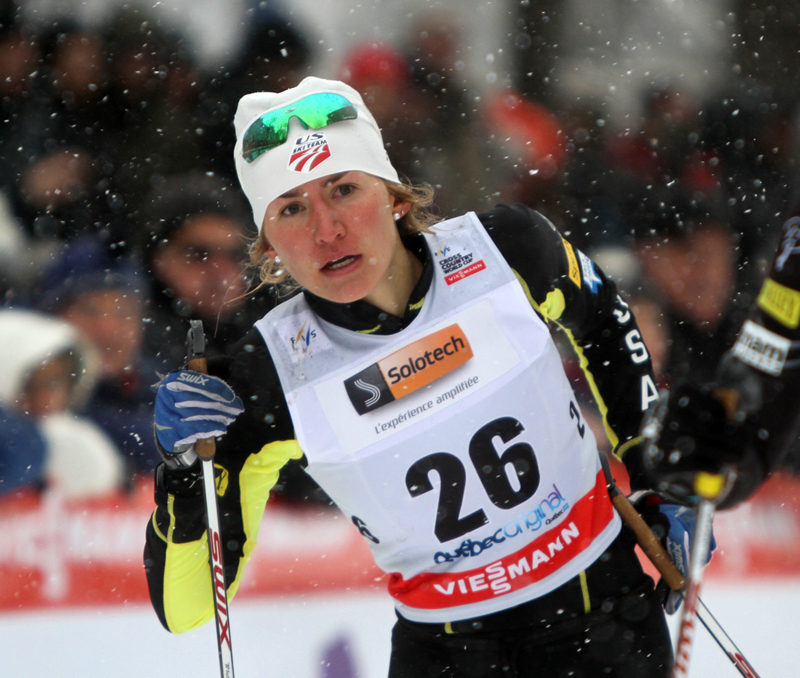
Sweden’s Ida Ingemarsdotter (6), Norway’s Ingvild Flugstad Oestberg (5) and American Sophie Caldwell (26) charging for the finish of the Quebec World Cup 1.6 k skate sprint quarterfinal on Saturday. Ingemarsdotter and Oestberg placed first and second to advance while Caldwell settled for third and a career-best 14th overall.
QUEBEC CITY – For someone who’s never raced a World Cup individual skate sprint before, Sophie Caldwell of the Stratton Mountain School T2 Team didn’t show it.
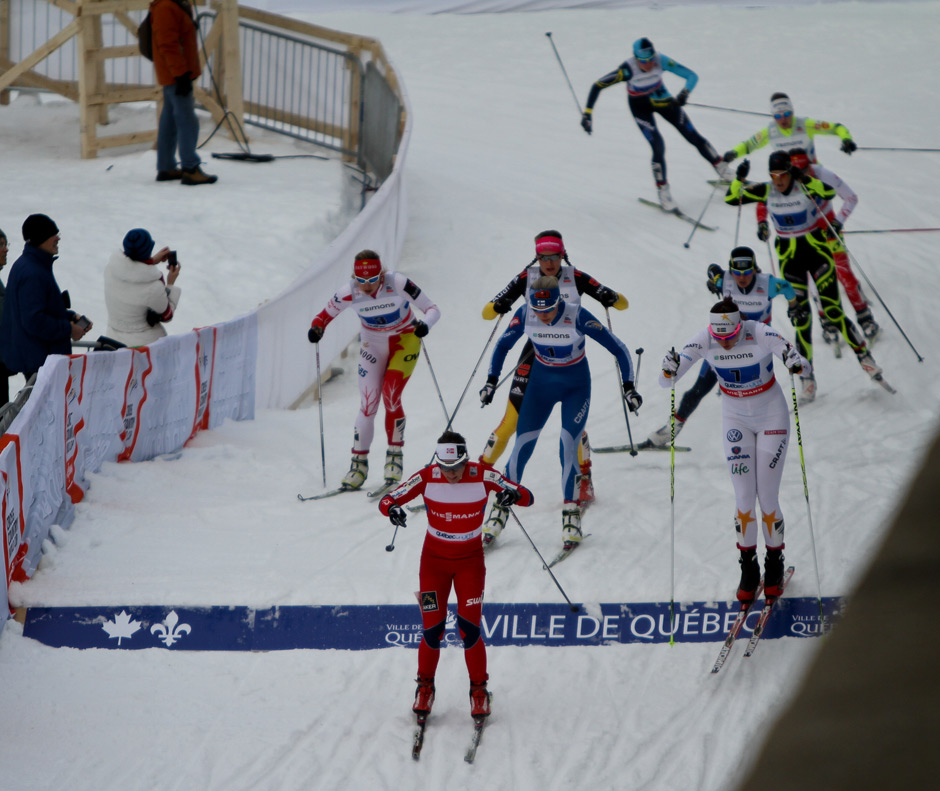
The 22-year-old from Peru, Vt., started off Saturday’s 1.6-kilometer sprint by making the top-30 qualifying standard in 26th (13.85 seconds behind winner Mona-Lisa Malvalehto of Finland). Caldwell later led her quarterfinal out of the start and settled into third position. As the group began its second loop, Caldwell closely trailed Swedish leader Ida Ingemarsdotter and Norwegian Ingvild Flugstad Oestberg, who would go on to place third and fourth, respectively, in the final behind U.S. winner Kikkan Randall.
Wearing the American race suit for the first time in her life, Caldwell ended up third in the heat ahead of Russian Anastasia Dotsekno, 0.6 seconds behind winner Ingemarsdotter. It wasn’t quite enough to advance to the semifinals and Caldwell ultimately placed 14th.
Sophie Caldwell of the Stratton Mountain School T2 Team after finishing third in her quarterfinal of the Quebec World Cup 1.6 k freestyle sprint on Saturday.
“It was really fun,” Caldwell said after the round. “I had a good start so I was lucky to get out in third.”
She quickly realized it was difficult to pass on the barricaded sprint course, an 800-meter loop on the grounds in front of Québec’s Parliament building. She tried to make her move on the finishing stretch, but couldn’t get the inside lane and held her own for third.
“No one got in front of me and that was the same order of finish, I think,” she said.
Pleased with her performance, she said the crowd helped pull her through.
“Especially in the beginning when they zoomin on each person,” she said of the TV coverage. “For Sadie [Bjornsen] and me, the crowd roared and for everyone else it was pretty quiet.”
Also in Caldwell’s quarterfinal, Bjornsen of Alaska Pacific University (APU) and the U.S. Ski Team (USST) finished sixth for 27th overall in her first World Cup race of the season while healing tendonitis in her foot. After qualifying in 15th, Bjornsen trailed her quarterfinal from the start, but held her own and remained in contention for most of the race.
“When you’re skiing in the back of the pack, you have to surge really hard and then snow plow … it’s funny back there,” Bjornsen said. “But it’s easy to get boxed out.”
Halfway through the second lap, she avoided colliding with Dotsenko, who nearly fell. Bjornsen treated the race as a learning experience in how to move around people.
“It was good practice for me,” she said.
As for her foot: “It’s actually doing really well,” Bjornsen said. “I got some new boots and that helped a lot.”
Hanna Kolb (GER), Becca Rorabaugh (USA) and Bettina Gruber (SUI) try to untangle themselves early in their quarterfinal of the Quebec World Cup individual skate sprint on Saturday.
Also representing APU, Becca Rorabaugh qualified in 22nd and placed fifth in her quarterfinal after a getting caught up with Germany’s Hanna Kolb and Switzerland’s Bettina Gruber on the first uphill corner. Locking ankles with Gruber, Rorabaugh spun around and spent several seconds trying to free her ski.
“I definitely got a pretty good start and then I got a little tangled up and then, like, super tangled up,” Rorabaugh said with a laugh. “I mean, that’s how it goes. Next time.”
Regardless, Rorabaugh placed 24th overall for her best individual World Cup result by 31 places.
“I am incredibly stoked,” she said. “I love this! I love the crowd. I love the course. I’m having the time of my life and this morning I may have had the race of my life so I’m pretty happy.”
After winning her first World Cup title with Randall in the team sprint Friday, Jessie Diggins (SMS/USST) qualified in 17th and went on to place 27th overall after falling on top of the bridge during the first lap of her quarterfinal.
“It was a little heartbreaking,” Diggins said. “It was really hard for me to balance, seeing as the snow was no longer a soft sandpit [compared to the qualifier]. I just wasn’t quite stable on my feet. … I didn’t give up, I worked as hard as I could to catch back up, but I just didn’t have enough left.”
She placed sixth in her heat, 6.1 seconds behind German winner Denise Herrmann.
“When your expectations are raised, not making it on is definitely, like, a let-down,” Diggins said. “[But Friday] was such a cool thing, and my teammates qualified so I’m super psyched, you know? The fall was my bad. It wasn’t the equipment or the skis or anything.”
In the end, it was the experience that she’ll remember.
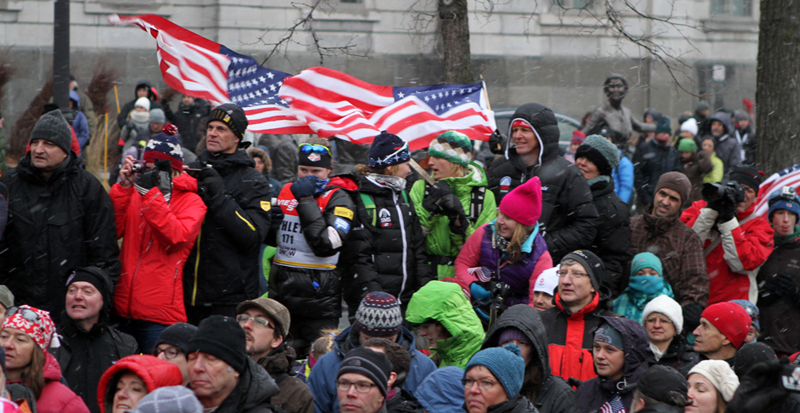
“The crowd is just fantastic,” Diggins said. “I don’t even know how many people are here; there’s a lot. It was so cool to have all these American flags waving out there and that was definitely really sweet.”
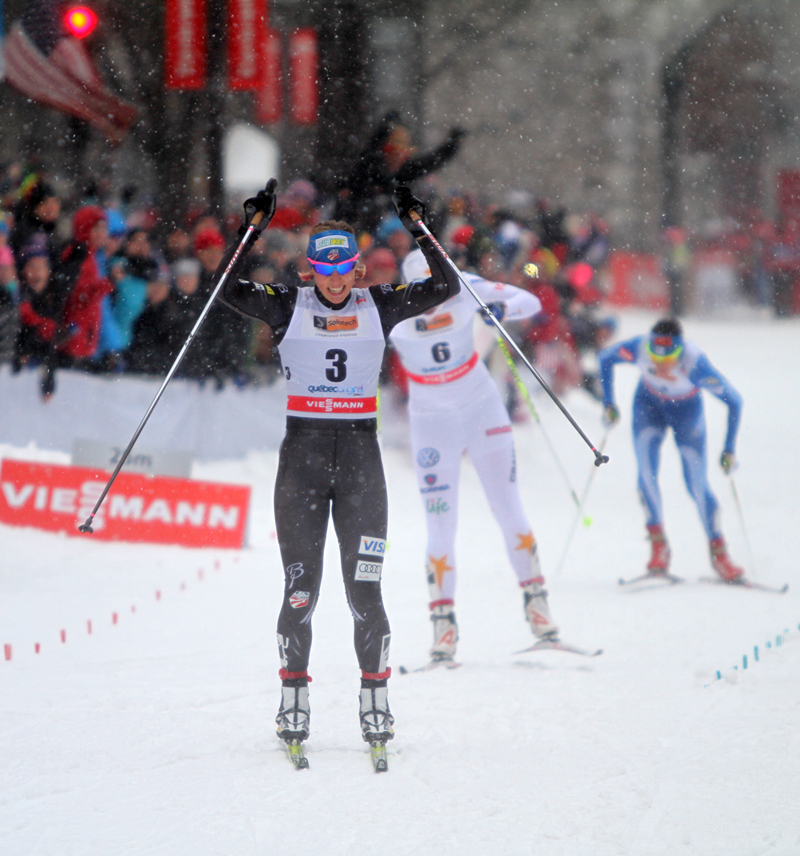
Kikkan Randall rushes past screaming fans ahead of Sweden’s Ida Ingemarsdotter (6) and Norway’s Maiken Caspersen Falla (not shown). Randall went on to win the Quebec World Cup 1.6 k freestyle sprint final on Saturday in Quebec City. It was her sixth individual World Cup gold and seventh including Friday’s team sprint.
QUEBEC CITY – When you’re as talented as Kikkan Randall, there are a lot of great moments to put in the memory bank. The soon-to-be 30-year-old’s silver medal from 2009 World Championships stands out, but so do the five World Cup wins she had before Saturday’s 1.6-kilometer World Cup freestyle sprint.
The sixth one in Quebec City turned out to be a real keeper. After the U.S. Ski Team veteran beat Norway’s Maiken Caspersen Falla and Sweden’s Ida Ingemarsdotter to the line of the women’s final, it wasn’t so much the race itself but what happened after that she’d never forget.
Thousands of fans lined the 800-meter course, several of which stood near the finish holding American and Canadian flags across the barriers in front of them. Randall was certainly focused on keeping Falla and Ingemarsdotter at bay just behind her throughout the final, but it wasn’t to say she didn’t see all that outside stuff.
Randall: two wins in two days.
She did.
Upon entering what was considered the stadium (actually a historic street called Grand Allée) for the last time, Randall picked up the pace in the final stretch, fulfilling the crowd’s excitement. She wasn’t Canadian, but this might as well have been a home race for the Anchorage native. Screams filled the air.
Randall continued to push toward the line as Falla and Ingemarsdotter struggled to remain close. She finished first in 3:42.25 and gave three little fist pumps as Falla came through 1.1 seconds later, followed by Ingemarsdotter in third (+1.4 seconds back).
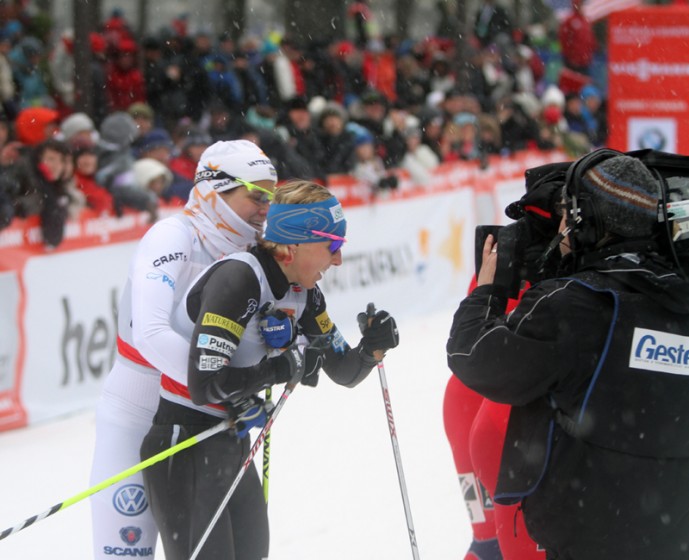
“I knew Kikkan would be really fast in the last lap like she was yesterday,” Falla said, referring to Randall’s team sprint win – a first for the Americans – with teammate Jessie Diggins. “When she was passing me I was just trying to hold on, but she was really good today. I think I did my best but she was better today.”
From the start, Falla vied for position with Randall and took the lead by the first uphill corner. Much like Randall’s semifinal (which she won as well as her quarterfinal), she sat tight in second – but not for long. By the start of the second lap, Randall accelerated up the outside and jetted to the front.
When it comes to sprint tactics, Randall said she prefers to lead in order to set the pace and pick the best lines. But she’s trying to get used to following, too.
She made her move on the last lap based on good feelings in her legs and decided, “Why not?”
“The strategy worked well yesterday, being in the lead for the first two laps, so when I saw that opportunity, I took it,” she said.
Meanwhile, the rest of the field, including Falla, Ingemarsdotter up front, tried to hang on.
“When I wentout of the second lap I felt something behind me was happening [and] it was Kikkan,” Ingemarsdotter said. “It was us three, but then I switched position and just worked the whole way.”
In her first individual World Cup sprint of the season, Ingemarsdotter said she was satisfied. “This is a good start to the sprint season for me,” she said.
Ida Ingemarsdotter (SWE) congratulates the winner Kikkan Randall.
Just off the podium, Norway’s Ingvild Flugstad Oestbergtook placed fourth (+2.2). Mona-Lisa Malvalehto of Finland was 2.9 seconds behind in fifth, and Russian Natalia Korosteleva took sixth (+3.2).
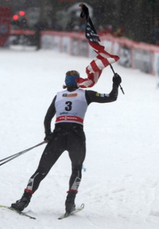
As the others caught their breaths, Randall looked over to the sideline to see her U.S. teammate Holly Brooks holding a large American stick flag out for her. Randall suddenly realized she got to lead the victory “lap” back down final stretch and took it from her.
“It was one of the coolest things I think I’ve ever done, definitely one of the sporting moments that’s going to stand out for me,” Randall said after notching her sixth individual World Cup gold and second victory in as many days (she and Jessie Diggins became the first Americans to win a World Cup team sprint on Friday). In total, she’s won seven World Cup titles, all in skate sprints.
“I had heard that would maybe get to ski up and down the finish stretch if you made the top three,” she said. “I was so focused on the race that I kind of forgot about that until Holly handed me the flag and was like, ‘Oh yeah, that’s right, we get to do this.’ It was totally fun.”
It was the first time she got to celebrate a win that way, and doing so in front of so many animated fans made it a more unique experience.
Randall: “To be able to do that victory lap afterwards was something I will definitely remember for the rest of my life.”
“I’ve never seen so much enthusiasm come together all at once,” she said. “I was getting comments from all the other European athletes going, ‘Wow, you guys really get fired up. In Sweden it’s a polite clap’… I’m proud that our fans came and put on a good show as well. We’re in Canada and yet the U.S. presence was so strong.”
That kind of outwardly motivation makes each win or personal best exciting for her, even if it wasn’t surprising. She put Saturday’s right up there with World Championships in Liberec, Czech Republic.
“All those experiences have their special places,” she said. “At World Championships that was kind of like a new level and that was incredible, but [this] was right up there. … It’s taken so much to get here and to be able to do it here at home, which is hopefully inspiring the next generation, it’s so cool. It just keeps me coming back for more.”
In the qualifier, Randall placed third, 6.3 seconds behind wMalvalehto, who was first in 3:35.89. (Russia’s Svetlana Nikolaeva ranked second, but didn’t advance to the finals and ended up 11th.) For Randall, that qualifier alone was a good sign of things to come, U.S. head coach Chris Grover said.
“If you ever see her in bib 10 or less, you know she’s probably going to go all the way to the podium,” he said. “To ski with such authority and control in each heat, you knew that she wasn’t on the edge of her fitness … and you knew she’d be able to dig deep when the time came in the final.”
Her consistency has worn the novelty pretty thin, but her biggest fans haven’t lost their excitement.
“I’ve definitely seen her win a few World Cups now … but it still feels incredibly good to have that kind of success,” Grover said.
“We’re super-excited. … All the hard work and dedication paid off,” Randall’s mom, Deborah, said. “Now we can really super-party.”
Andy Newell (USA) leading his quarterfinal out of the gate.
QUEBEC CITY – American sprinter Andy Newell on Saturday skied to his best result in two seasons, buoyed by the support of a huge cheering squad from south of the border.
After controlling his quarterfinal round, then advancing out of the semifinals as a lucky loser, Newell placed fifth in the individual sprint, at a venue that ranked among “the coolest” he’s visited in nearly a decade of racing.
“There were so many American fans,” Newell said. “It was pretty amazing to be in the start pen and have them call your name, and have your cheers be louder than any other skiers’ out there. It’s usually the opposite for us.”
On a day that saw some North American athletes get bogged down in Quebec City’s soggy, sloppy snow conditions, Newell excelled, which U.S. Head Coach Chris Grover attributed to the 29-year-old’s finesse on his skis—and his relatively light weight.
“He probably floats on those kind of snow conditions better than his competitors do,” Grover said. “It had the potential to be a really good day.”
After qualifying 12th, Newell bolted out of the gate in his quarterfinal round, giving him a vice grip on the heat and a berth in the semis.
Newell warming up on a stationary bike.
“I was able to get out front and kind of control the race,” he said. “It felt great, and the skis felt like they were running really fast all day.”
A more sluggish start and poor lane assignment in the semifinals left Newell out of the running for a guaranteed spot in the final round, which go to the top two finishers. But the times in his heat were fast enough that he advanced as a lucky loser.
The script was the same in the finals, as Newell wasn’t quick enough early in the round—or assertive enough later in the heat—to be in contention in the charge to the line, even though he said he “felt good enough to be on the podium.”
“It was just a matter of being a little bit more aggressive leading up to that final finishing stretch,” he said.
But Newell was still far from discouraged.
“Today is as good or better, probably, than I felt or finished in any sprint last year,” he said. “So I think that’s a good sign that things are building up.”
What accounts for the 2.5-second difference between Newell in fifth, and Swedish winner Emil Jönsson? Newell’s training plan is structured so that he’s not yet at his top fitness—instead, it’s designed to have him peak around February’s World Championships, Grover said.
“Looking forward to seeing how it unfolds over the next month, month and a half,” said Grover. “I have no idea what Emil Jönsson’s done for training, but I feel like given what we’ve done, there’s more to get out of Andy between now and the World Championships, just focusing on some specifics and training.”
Having skied more than 100 World Cup races in his career, Newell had high praise for the organizers of the Quebec City sprint, which he called “kickass.”
“You always worry when you go to a place that has never held a World Cup before,” Newell said. “But I mean, this place was dialed. They did their homework.”
Newell said he hoped the American turnout would help convince the International Ski Federation that it could someday hold a World Cup race in the U.S.
“Having everyone there cheering, it doesn’t add any pressure at all—it just makes it more fun,” he said.
Reid Pletcher (SVSEF) in the his first World Cup team sprint in Quebec City on Friday. Pletcher and Sylvan Ellefson (SSCV/Team HomeGrown) combined to finish 24th in their first team sprint since racing together as J1s.
QUÉBEC CITY – From an athlete’s point of view, it was easy to get nervous Friday. Never mind that thousands of spectators lined the manmade World Cup course in front of Québec’s Parliament Building; skiers had to go head-to-head right off the bat with 12 to 13 international racers per semifinal.
The best ones had their name printed across their bibs. That’s how newcomers could really tell whom they were up against. To fight the nerves and do their best to perform, most skiers in their first World Cup or team sprint simply looked around. They were part of history with the first cross-country World Cup in Québec and the first city sprint in eastern North America. Moreover, they had achieved the goal of most rising skiers and made it to the World Cup.
“It’s a dream come true,” Stratton Mountain Skier Sophie Caldwell said. “I’ve always wanted to ski a World Cup so it’s pretty exciting. The other day [Alaska Pacific University coach] Erik Flora said it’s just like any other race except it’s run better.”
She laughed. Caldwell and U.S. Ski Team member Sadie Bjornsen didn’t make it past the first round and finished 14th overall, but Caldwell kept it in perspective.
“[I was] going from being one of the fastest [on the U.S. SuperTour] to probably definitely the underdog here, but it was nice because there wasn’t a lot of pressure, no expectations really,” Caldwell said. “I was able to somehow turn nerves into excitement.”
With a sizable Vermont crew cheering from the sidelines, Caldwell said she saw people she knew all the way around the course. At points along the barriers, people stood three deep.
“I’ve never seen this many people at a ski race,” said 17-year-old Maya MacIsaac-Jones of Rocky Mountain Racers.
As she and teammate Zoe Roy walked the outskirts of the course in the heart of Québec City, several French Canadians told them “bonne chance,” good luck.
“It’s the biggest race I’ve done,” said Roy, who learned she would race Friday’s team sprint (in addition to Saturday’s individual sprint) on Thursday while boarding a flight out of Calgary, Alberta.
“I was a little nervous to start, but I took a deep breath,” the Ontario native said. “It’s just very sweet to have so many people lining the course and a lot of them knew our names, too. It was cool. Canada’s got a lot of support out there.”
Québecnative Alexis Turgeon, of the Pierre Harvey Training Centre at Mont Sainte-Anne 45 minutes north, was visibly brimming with excitement even after being eliminated with teammate Russell Kennedy (Alberta World Cup Academy). He had realistic expectations going in, but that didn’t keep him from studying the course almost daily on a printed map.
“I pretty much looked at it every day,” Turgeon said. He had been thinking about this since the announcement two summers ago that Québecwould host its first World Cup.
“It’s crazy, my whole family was around the track, my little brother was screaming and my mom was there on the sideline,” he said. “I was racing in front of my girlfriend, … friends from Ottawa, from everywhere came. It’s just a perfect spot to race. The city’s beautiful; the track is perfect. On the first lap you just hear everybody screaming. It just makes you faster and push through the pain more.”
Both Turgeon, 19, and Kennedy, 21, had never raced a World Cup before, yet were fast enough in the Canmore NorAm qualifiers last weekend to make one of four Canadian teams for Friday’s event. They will also compete individually on Saturday.
“It’s hard because we never get to race with those guys,” he said of World Cup skiers. “That’s the best preparation we could have for tomorrow’s sprints, I think, seeing what speed you need to have. It’s not what you’re able to do, it’s what you need to do.”
“It was just fun to be there,” said Kennedy, a dual-citizen who trained with Far West in Truckee, Calif., as a junior before moving to Canmore two years ago. “I was excited.”
More experienced skiers like Reid Pletcher of the Sun Valley Ski Education Foundation also tried to approach the races with an appreciation for getting there in the first place. A year and a half after suffering a life-threatening head injury in a climbing accident, Pletcher, 24, smiled as he looked out at the course while sitting on the plow of a parked snowcat.
“I think I’m still on the mend, but it’s been a long journey; I had a hard time believing myself ever since that happened,” he said after placing 24th in his first World Cup team sprint with Sylvan Ellefson (Ski & Snowboard Club Vail/Team HomeGrown).
“I think me just being here proves that I can come back and that I’m in the mix,” Pletcher added. “[This is] really meaningful. I’m glad I’m here.”
Hearing his name screamed from the sidelines helped, too, although it was hard to hear everything – or really anything at times.
“I would hear the occasional screaming my name, and the rest was head down, pain cave,” he said. “As loud as it is here, it’s not sound, it’s not loud, it’s just hard.”
Becca Rorabaugh of APU said the crowd was what helped her and teammate Caitlin Gregg (Central Cross Country) finish 18th in Rorabaugh’s first World Cup team sprint.
“Having people the whole time and knowing that you have a teammate, it takes away from you’re like inter-talk when you’re like, ‘Oh, wow this hurts,’ ” Rorabaugh said. “It just kind of erases all that so you just go.”
Alex Harvey (left) and Sweden’s Emil Jonsson (right) lead early in the men’s Quebec World Cup team sprint on Friday in Quebec City. Harvey and Canadian teammate Devon Kershaw ultimately placed fifth, and Sweden’s Teodor Peterson and Jonsson were seventh after a crash on the second-to-last lap.
QUEBEC CITY – With every passing lap that Alex Harvey led or was close to the front of the World Cup freestyle team-sprint final on Friday, fans lining the 800-meter course squealed with excitement. This was what they had bargained for; their 24-year-old Canadian National Team prodigy from nearby Saint-Ferréol-les-Neiges was going for the win.
It didn’t look like anything could stop him. But it’s what you don’t see that trips you up.
Canadians Devon Kershaw (center) and Jesse Cockney (l) and Italy’s Fabio Pasini ahead of Kazakhstan’s Denis Volotka (r) during the Quebec World Cup team sprint men’s final on Friday.
Throughout the races, with each competitor covering 1.6 kilometers at a time and alternating for three legs apiece, announcers served as the eyes for ground-level spectators scattered around the course. A not-so-hot exchange put Harvey’s teammate, Devon Kershaw, toward the back of the pack at the start of has last two laps, but Kershaw clawed back into contention by the final exchange.
Harvey shot out of the tag zone in fifth behind Russians Nikolay Morilov and Alexey Petukhov, Sweden’s Emil Jönsson and Norwegian Eirik Brandsdal. With two laps to go, the Canadian was going for first. The French announcer narrated excitedly as Harvey moved up behind Jönsson, but then something else happened, which initially confused those that didn’t speak Quebec’s native language.
The names Jönsson and Harvey stood out.
Within seconds, it became apparent that Harvey lost contact with the group as he started the final lap in seventh. Jönsson had tripped on the gradual uphill in the middle of the curving course and Harvey couldn’t avoid him as he rounded the turn close behind.
“I think he got tangled up with one of the Russian guys,” Harvey said. “I went around him on the right and then my ski got caught on the fence. I tried to come back as fast and efficiently as possible, not rush too much, but just ski fast and come back. … It’s frustrating to crash but it’s part of the city sprints, I guess.”
In the end, Harvey finished fifth. It wasn’t what he and Kershaw had hoped for and definitely not what they envisioned, but it was sprint racing.
“Especially city sprints like that, luck is a big part of it,” he said. “We got lucky in the semifinal and hopefully we’ll get lucky again tomorrow.”
Harvey and Kershaw won their semifinal ahead of Norway’s first and second teams in second and fourth, respectively. Russia’s second team with Morilov and Gleb Retivykh was third, and the second Canadian team with national-team member Lenny Valjas and Jesse Cockney of the Alberta World Cup Academy advanced in fifth.
Alex Harvey leading the way with Norwegians Eirik Brandsdal (l) and Paal Golberg (r) in the Quebec World Cup team sprint on Friday.
Canadian head coach Justin Wadsworth was glad to have this race out of the way for his athletes, referring to the pressure that might have come into play.
“Maybe it’ll take the pressure off for tomorrow a little bit,” Wadsworth said of Saturday’s individual freestyle sprint. “I think there was so much expectations, especially for Alex. To have something like this to happen, it just shows you can not win the race and still you live another day.”
Kershaw said it was a good sign that he felt better as the day wore on, but the pace was also slower in the final, he said. His last leg started a bit rough when a few racers stood up in front of Harvey as he entered the tag zone. The Canadians dropped four spots and were unable to completely recover. Their final exchange wasn’t great, either.
“We had such great exchanges in our semi and I’m like, ‘Oh, we’re so good at exchanges,’ and then we got cut off a little bit by a Russian team after my second lap and that really cost us,” Kershaw said. “It put Alex too far back and then what are the chances Emil Jönsson crashes? … We were right in the mix when [Alex] crashed, but you just can’t crash. To me, him, anybody, it’s hard to get back in it.”
Kershaw expected things to go much better for them Saturday.
“Frick, Alex is in ridiculous shape,” he said. “Do you know how pissed he’s gonna be? Especially getting taken down when it’s not his fault. Tomorrow I think he’ll be on the podium for sure. He’s skiing really well.
“There’s no hiding it,” he added. “Every team in that final wanted to win and we really wanted to win because this Alex’s hometown and he’s such a big deal here, but he’ll win tomorrow.”
Wadsworth isn’t worried, referring to World Championships as the ultimate goal. Also, Valjas, who’s coming off a broken hand, made the final with a teammate in his first World Cup team sprint. They finished 10th after Cockney made a big push to get in the mix after running between eighth and 10th, but ran out of steam and fell on his second-to-last lap.
“The first two laps felt relaxed and calm and then I thought, ‘Well, I might as well go now,’ because there weren’t many opportunities to make a move,” the 23-year-old Cockney said. “So I ended up making up ground on two or three people on the first 200 meters or so and then it kind of disintegrated over the last tour of the loop again.”
Just before the biggest bump on the course, he crashed alone and lost all his momentum.
“I had to ski up the jump and it was so slow,” Cockney said. “The video’s gonna be hilarious so I can’t wait to see that.”
With a top 10 behind them, Cockney and Valjas said they felt confident going into Saturday. The softening sugary conditions benefited Valjas, who said it was easier on his hand.
“I wasn’t sure how the jet lag would feel, but I felt great out there,” Valjas said after flying with the team from Finland on Monday. “Looks like everyone else was feeling OK, too. The pace was fast all day, but I wanted to make the final. So we gave it a good shot and I’m totally content with today.”
— Nat Herz contributed reporting
Canadian Devon Kershaw (1) tags off to teammate Alex Harvey in first with three legs to go in the Quebec World Cup team sprint final on Friday.
Kent Gordis, a freelance TV production director for Radio-Canada/CBC, inside his mobile office, a tractor trailer parked in downtown Québec City, on Thursday.
QUEBEC CITY — It’s not brain surgery, or so Kent Gordis says. With about 35 employees and 13 cameras working within a relatively small space in front of Québec’s Parliament building, covering the World Cup cross-country ski races Friday and Saturday won’t be any small feat, either.
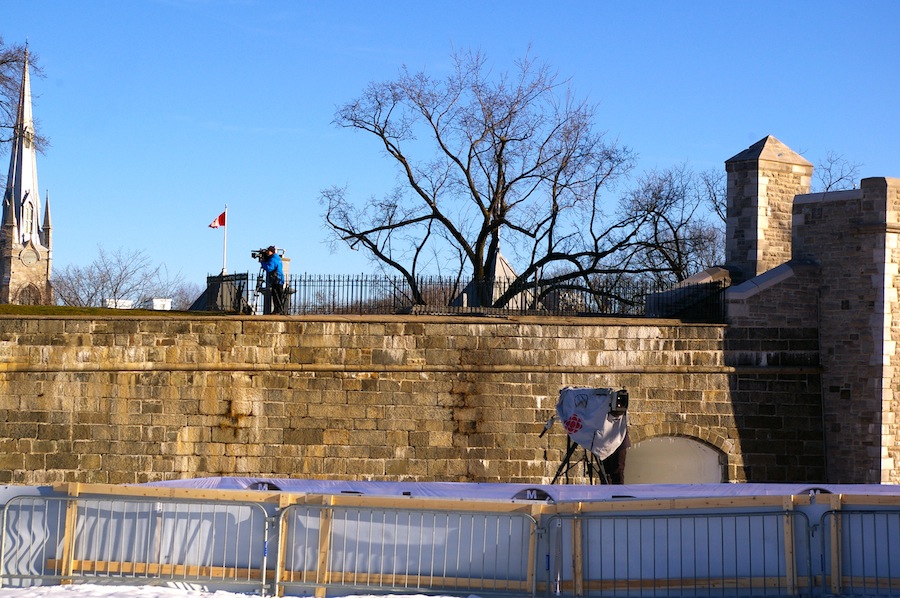
A Radio-Canada cameraman in position near the start and final curve of the 860-kilometer World Cup sprint course in Quebec City on Thursday.
That’s why Radio-Canada/Canadian Broadcast Company (CBC), the primary broadcasting service of the Québec World Cup sprints, hired Gordis, a freelance TV production director from Brooklyn. With nearly 25 years of experience in broadcasting nordic sports (mostly biathlon), Gordis knows how to tell a story while filming a ski race. At least that’s what he aims for.
A quick glance around the 860-meter course Thursday revealed cameras on every turn. Big cameras, many of which had operators behind them testing.
On Friday, all the preparation will give way to the main show with the two-person team freestyle sprints starting at noon. Saturday will begin with international skiers racing the qualifier in the individual freestyle sprint and progressing to the heats if they’re lucky (or especially talented).
If Gordis is lucky, his crew will be able to illustrate what’s happening solely through images they produce. Commentators from networks like CBC and Québec’s TVA will commentate remotely, according to Gordis. Meanwhile, it’s Radio-Canada’s job to provide an international feed.
Catering to a world audience leaves little room for bias. The exception is that the International Ski Federation (FIS) allows host nations to provide slightly more local content (i.e. Québec native and national-team member Alex Harvey).
“For example, Alex Harvey shows up and we’re all hoping that he wins, but if he doesn’t win, we’re still going to show shots of Alex Harvey,” Gordis said from inside Radio-Canada’s mobile headquarters, a suped-up tractor trailer parked on the side of the street. “But otherwise we’re really here servicing the world so we have to be neutral. The only exception to that is the Canadian content.”
Two cameramen fine-tune their equipment on the World Cup sprint course in downtown Quebec City on Thursday.
The bigger challenge is actually catching individuals action – and seeing them all at once. FIS essentially hands the host-broadcasting company a map of camera positions, and directors like Gordis slightly tweak it. Even though the best shot tends to be on the outside corner of each turn, he likes to put a few on the inside for closer profile images..
At the same time, he tries to balance close ups with wider-angle shots so as not to focus too much on one person.
“Especially in North America, the tendency is to get the good, sort of dramatic shot of the leader,” Gordis said. “It’s a good shot, but the problem is any race is a competition between the athletes so you don’t want to stay always tight because then you don’t see the rest of the race.”
Think about how hockey or football is televised, he said.
“When the play starts you show this wide shot of the whole field and the team because that’s what you’re showing. If you stay too tight then it’s as if you’re shooting hockey with only one team on the ice and there’s no competition.”
Gordis treats cross-country ski races the same way. Although this is the first time a sporting event of this caliber is being held in front of Quebec’s Parliament, it’s not overly complicated.
“The story ultimately is who’s likely to win, but it’s not always so obvious,” he said. “Sometimes it’s somebody who starts in fifth or sixth place and they get lucky or they’re just skiing faster or whatever it might be. We can’t predict the future, but we try to tell as many stories as possible.”
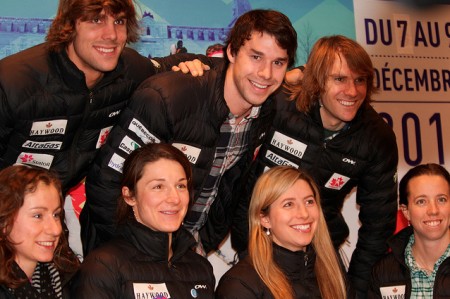
The Canadian World Cup Team, with Alex Harvey at top center.
So for the last nine months, that’s what Gordis has been working on, and Friday it will all come to fruition.
“It’s intense, that’s for sure,” he said of city sprints after covering some in Stuttgart, Germany. “The individual [race] is a little more challenging in a sense that it’s a lot of heats, but the team sprint is more challenging because it’s more people on the course, and also the [exchanges] come pretty quickly. Every other lap is quick.”
Asked about the anticipated Canadian viewership of these races, Gordis said the details were out of his realm. One thing he’s sure of: “Alex Harvey helps a lot.”
“[In the U.S.] for an emerging sport like bike racing or nordic skiing to break through is almost impossible because you’re competing with cable TV … you’re competing with video games, people have so many choices,” he said. “You really have to have an incredible story to really break through. Canada’s a little bit less like that.”
***
On Thursday afternoon, a six-winged drone hovered above parts of the course. Two independent operators from KoptR Image, Inc., brought it to the venue to test and pitch their flying robot (with a range of up to a mile) to Radio-Canada/CBC.
“The drone is something that has been proposed to us,” Gordis said. “I haven’t seen it yet. It sounds like a great idea but it wasn’t part of our original plan.”
Australian Esther Bottomley (second from left) at the Canmore NorAm freestyle sprint on Dec. 2 in Canmore, Alberta. Bottomley qualified for the heats in 12th and went on to place ninth. (Courtesy photo)
The idea struck Esther Bottomley in early October. If she wanted to break into the top 30 on the World Cup this season, why not start practicing at one of the venues she’ll compete at?
The 29-year-old Australian National Ski Team member called up Perianne Jones, who was training with the Canadian national team in Park City, Utah. Jones spoke to her friend Amanda Ammar, who races for the Canmore Nordic Ski Club in Alberta and had an extra room back home. A couple weeks later, Bottomley was on snow training in Canmore, living at altitude and soaking up her surroundings.
A month into her visit, Bottomley, who’s been on the Australian national team for the better part of a decade, talked to FasterSkier about what she’s been up to in Canmore and why she decided to train there in the first place. One of two women on her team and the only one competing in Canada this season, Bottomley opted to skip the early World Cup races in Europe to prepare for the Québec and Canmore sprints Dec. 8 and 15, respectively.
Esther Bottomley (AUS) in the Canmore NorAm 10 k classic on Dec. 2, where she finished 17th. (Courtesy photo)
FasterSkier: Why Canmore?
Esther Bottomley: They’ve got the World Cups over in Canada so that’s sort of why I was going to come here, but mostly it was to try and get a big group of girls that are at a really high level and be able to train with them. So far I’ve trained with three different training groups [the Canadian NST, Alberta World Cup Academy and Rocky Mountain Racers], and it’s been great, like, really good skiers and very motivated.
FS: How have you made it work with your training plan?
EB: I have my own plan and when I can get information from other teams in advance it’s really good, which they’ve sometimes been able to do. My coach can accommodate some of their intensity sessions so I’ve been trying to do as many sessions as I can with other people but also stick to some of my own things as well.
FS: How much time had you previously spent in Canada?
EB: I’ve been for the World Cups before and a wedding [teammate Chris Darlington married former Canadian skier Brooke Gosling last winter], but I’ve never spent more than like a week here. It’s the first time I’ve been able to do a bit more exploring, which has been fun.
(Note: Bottomley achieved her career-best World Cup result of 35th in a 2005 freestyle sprint in Vernon, British Columbia.)
FS: What are your goals for this season?
EB: This year, I guess the goal is to try to get into the top 30 in the sprints, focus on the sprints, and try and sort of cut back travel. I’d like to try and stay in one spot for a while, which has been really good here. I can train here the whole time then go to Quebec and back again. I’ll be in Europe for the rest of the season until March.
FS: Why the change in travel?
EB: I’d kind of like to be able to, if I can, sit in one spot for a little while and just cut back the amount of hours. I didn’t go to the early World Cups in Europe just so I could cut down the jet-lag time and the hours becausewe already have to do that big flight from Australia to get anywhere.
FS: How has your training been?
EB: Pretty good. … We did a sprint simulation on the World Cup track so that’s fantastic. You get to come here and they’ve opened up the sprint course like the last weekend so we can now get on it and see what we have to do to ski faster on it. I think that’s the really big advantage to be able to come somewhere and just be able to ski the course and know the course before you race it.
FS: What’s the sprint course in Canmore like?
EB: Canmore is a bit of a hill climb. It’ll be a hundred percent different I think than Québec, which is meant to be a long flat course to here, which is really just a big climb in the middle and flat into it and flat out of it and that’s it. It’s a tough course.
FS: What do you know about the Québec course?
EB: It’ll be interesting. I think it’s quite a long course for the women so it’ll be interesting to see how that goes. The NorAms will give us an idea of how things are going and then right straight into it.
(In a follow-up after Bottomley placed ninth in the Canmore NorAm freestyle sprint and 17th in the 10 k classic Dec. 1-2):
FS: How did the Canmore NorAm go?
EB: Last weekend was good fun but didn’t quite go as well as I was hoping for the races. Looking forward to going to Québec and racing on Saturday to see if I can ski a bit faster there.
FS: What kind of sprint course do you prefer?
EB: I kind of like in between [hilly and flat], sort of just an undulating where you can climb hard and recover a bit in between, but we’ll see. I’ve been training I think well during [the offseason]. It’s always hard to know at the start of the season. Hopefully I’m a little bit fitter and hills are all right.
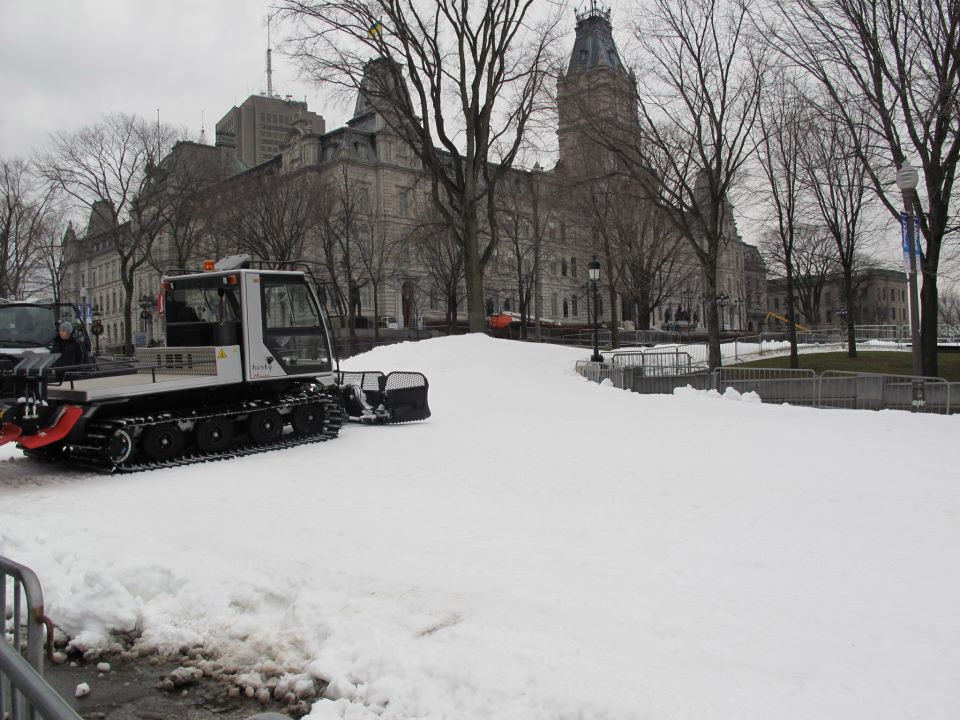
A groomer working in front of the Parliament Building in Québec City earlier this week. (FIS Cross Country photo: facebook.com/fiscrosscountry)
Québec’s seen pretty much everything when it comes to sporting events, from Mountain Bike World Championships to Red Bull Crashed Ice and a transoceanic sailing race known as the Transat Québec Saint-Malo. Gestev, an event-production company based in Québec City, hosted them all, but cross-country skiing city sprints? That was a new one.
So was the idea of spreading 10,000 cubic meters (353,000 cubic feet) of snow over some of the provincial capital’s busiest streets. Last weekend, that number was up to 12,000 cubic meters (nearly 424,000 cubic feet).
In a phone interview on his way back from a Crashed Ice event in Niagara Falls on Sunday, Gestev president Patrice Drouin was shifting gears from the full-contact hockey/downhill skating/boardercross competition, to what was waiting for him in Québec City.
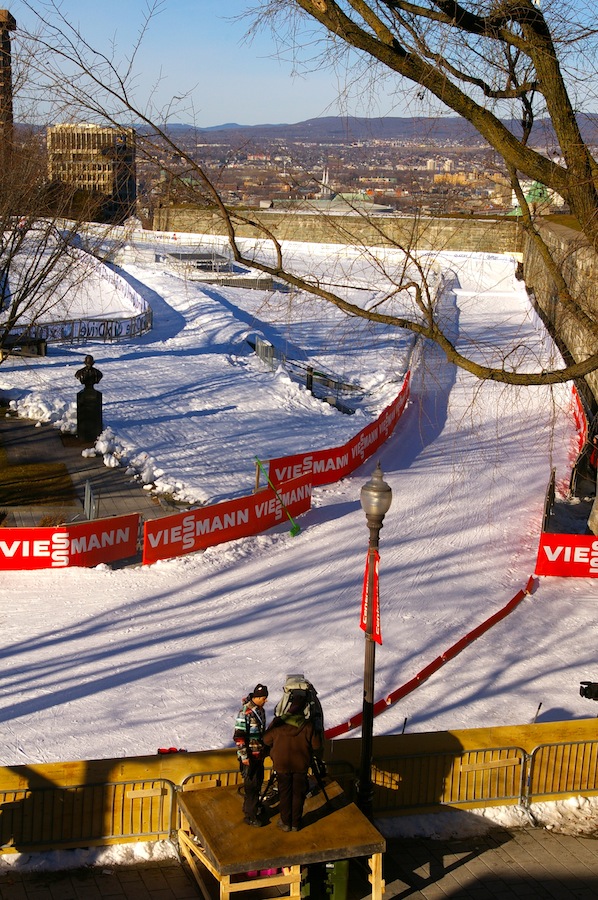
On Saturday, sixty employees and dozens more volunteers started laying down the 850-meter sprint course with extra snow to work with as a result of cold temperatures (racers will do two loops for 1.7 k). Two snow guns on the nearby Plains of Abraham and two more on Parliament hill had been churning out the white stuff since Nov. 6.
A snowmaking gun blows snow onto the Plains of Abraham behind the Parliament Building in downtown Quebec City. (Sprint Québec photo)
Organizers produced and stockpiled more (5,000 cubic meters) just in case at the Mont Sainte-Anne nordic area 45 minutes northeast of the city. As of Sunday, Drouin said they didn’t need it with more than 80 percent of the course sufficiently covered. With extra snow to work with, they made Parliament hill a little steeper.
“We could’ve done the track with less than that, 6,000 to 7,000 meters,” Drouin said. “But because the weather was good, we could produce snow in a matter of hours.”
They took that window and ran with it, and despite light rain falling on Sunday and above-freezing temperatures expected throughout the week, Drouin said they weren’t concerned.
“That doesn’t affect the snow at all,” he said. “The mechanical snow that we produce is so hard and so dense … [the rain] makes the snow more compact.
“I am very impressed to see the quality of the track,” he added. “I’ve been to Düsseldorf [Germany] and our snow compared to Düsseldorf is much better. It’s exactly I think what you want to get as far as snow quality.”
With three loaders transporting 90 truckloads onto the course and two snowcats grooming around the clock, Drouin said all but Grande Allée had been covered by Sunday. That was planned for late Tuesday night (for a webcam update, click here). From there on out, the main road in front of the Parliament Building would be closed, essentially shutting down the city centre adjacent to the Old City for the rest of the week.
Meanwhile, the province’s legislature would still be in session. Sprint Québec organizers agreed to adhere to noise restrictions on Friday morning during National Assembly meetings, but as of noon, all systems were on (the team freestyle sprints start at 2 p.m.).
“It’s a long process but when we presented the project to the city, they were really keen on doing it,” Drouin said. “When we had the first meeting with the city we got full support.”
Gestev’s reputation in its home city helped, he said. In past events, they’ve been respectful of permits, tried not to take up much space or make too much noise. But with heavy machinery and more than 50,000 spectators expected for the two-day International Ski Federation (FIS) Cross-Country World Cup on Friday and Saturday, this was going to be entirely unprecedented.
Never before has a World Cup city sprint been held in North America, and this marks the first nordic World Cup in the eastern part of the continent.
Drouin said the project, estimated at $2.5-million dollars, has been a challenge, but that’s what makes it exciting.
“Cross-country skiing at such a level with the best in the world at the sprint format, that will be amazing right downtown so we sold it that way,” he said. “It will be the first time that the [Québec] population will see cross country in that way, big, and the exchange and the action that sprints provide.”
Cross-country skiing is already popular in Québec, and the city has been making an effort to promote the lifestyle sport with trail-building projects and other initiatives. So when Drouin pitched the idea, the city jumped on board.
“It’s a healthy sport, attracts a lot of people in the Québec area and plus we have the Alex Harvey factor,” he said of Québec’s own national team member. “We have this young athlete that has done very well, but has a nice personality as well.”
His father, Pierre, is the honorary president of the event. Drouin said the location, with a chance to showcase historic Québec, and the challenge of hosting cross-country ski races in December made it appealing.
“We can officially say today that we will succeed in delivering the event,” Drouin said. “That was a challenge people were so worried [about] making snow. … That will make a difference and people will come.”
As of Tuesday, 136 athletes from 17 different nations were registered for the freestyle sprints. According to a press release, more 300 volunteers, 200 journalists and 160 paid workers are expected for the event.
Concept2 will be at the First FIS Cross Country World Cup in Quebec
Leading Manufacturer partners with Fast and Female
December 3, 2012 – Morrisville, VT – Concept2 is proud to be a Bronze sponsor of Fast and Female, an organization founded in 2005 by Olympic gold medalist Chandra Crawford and members of the Canadian National Cross-Country Ski team.
As part of the sponsorship, Concept2 will be exhibiting at the first World Cup in Quebec, Canada, on December 7 and 8, 2012, and is providing Concept2 SkiErgs for athletes’ use. They will also be holding SkiErg contests during the two days of racing. The SkiErgs will then be donated to Fast and Female for their post-race Breakfast of Champions fundraising raffle on Sunday, December 9.
Fast and Female is dedicated to the empowerment through sport of young women between 9 and 19. With an emphasis on cross-country skiing, biathlon and complimentary summer enduro-sports, Fast and Female hosts events led by athletic champions like Chandra Crawford and Kikkan Randall. These role models inspire girls to gain the confidence and leadership they need to reach their full potential in life and sports. In parallel, Fast and Female educates parents, coaches, and sports leaders to ensure they foster the most supportive environment for their young female athletes.
The start of the NorAm men’s 15 k freestyle mass start last December in Rossland, B.C.. It could be chaos this weekend at the NorAm opener in Canmore, Alberta, with hundreds of Canadians vying for World Cup starts.
Last weekend in West Yellowstone, Mont., the U.S. SuperTour opener drew a grand total of about two Canadians, which isn’t to say the races weren’t competitive. With nearly 300 entered in the distance race, including a couple Norwegians, Australians and even a Brazilian, they were.
So why no representation from the neighbors to the north? Well, up in Canada there’s a little thing called the World Cup that’s about to take place in 10 days, and its qualifiers start Saturday when the NorAm circuit kicks off in Canmore, Alberta.
While SuperTour skiers continue to seek World Cup starts at their qualifiers Thursday through Sunday in Bozeman, Mont. (U.S. quota spots are awarded based on SuperTour standings after West Yellowstone and Bozeman), the Canadians will be shooting to make their national quota in just two races this weekend.
The difference is Canada as the host nation of the Québec and Alberta World Cups (Dec. 7-8 and Dec. 13-16, respectively) can enter 14 athletes per gender per individual race. The U.S. gets nine. Of those, four will be World Cup team members from each country, leaving up to 10 openings for domestic skiers in Canada and five in the U.S. for each competition.
In Canada, nine skiers have already prequalified for certain races (after meeting national criteria last season), and most already accepted the starts. According to Cross Country Canada (CCC) High Performance Director Tom Holland, the rest can decide whether they’ll race the Canadian World Cups after this weekend’s qualifiers in Canmore.
Of the nine, national biathlete Rosanna Crawford turned down cross-country World Cup sprints in both Québec and Alberta to chase a chance to race at Biathlon World Championships this winter. National Senior Development Team/Alberta World Cup Academy (AWCA) member Kevin Sandau, who’s already in Europe taking advantage of World Cup starts he earned on the NorAm last year, qualified for every Canadian World Cup race (with the exception of Québec’s team sprint). Even so, he planned to skip the Québec sprints and fly directly home to Canmore to prepare for the World Cup distance races there.
In an email, Sandau wrote that he might do the Sovereign Lake NorAm, the second on the circuit Dec. 8-9 near Silver Star, British Columbia, instead. It all depends on his energy, he explained.
Last year’s overall NorAm winner, Brent McMurtry (AWCA/NST) also won starts in every Canadian World Cup (as did women’s leader Alysson Marshall and her AWCA/NST teammate, NorAm runner-up Emily Nishikawa). Despite McMurtry’s strengths in distance over sprints, he plans to race all the Canadian World Cups in an effort to notch a top 12 in one of them. Why the lofty goal? McMurtry, like so many other Canadian development skiers, wants to qualify for World Championships in late February/early March.
“That means that I’ll need to be racing really fast at the World Cups in Canmore,” McMurtry said. “Top twelve is a pretty big result, but a lot of it depends of the field of guys who are here. There’s lots of factors, but I think that’s within my reach.”
There’s a lot of pressure riding on these first races of the season, and even prequalified skiers like McMurtry are feeling it. He will race for the first time this season in Canmore this weekend, and less than a week later, will have to get the World Cup jitters out in Québec.
What someone would give to race at the Canadian World Cups in the first place. At most, they only come every two years with the last one taking place right before the 2010 Olympics in Canmore.
That’s where these first NorAms come in. While the favorites mostly come from national training centres, like the World Cup Academy (see also: Thunder Bay, Pierre-Harvey and Callaghan Valley), there are a few independent/other racers (think Amanda Ammar of the Canmore Nordic Centre and the Yukon elite skiers) who are also gunning to finish atop the NorAm sprint and distance races this weekend.
Here’s a brief breakdown of last year’s NorAm leaders and who to watch this year:
Top 6 Men
1. Brent McMurtry (AWCA/NST) Formerly of the Pierre-Harvey NTC (CNEPH) in Québec, he’s been training in Canmore since he was a kid and is now part of the Academy with perennial rival Kevin Sandau. This year, he and Sandau once again have the same goals: race internationally as much as possible.
2. Kevin Sandau (AWCA/NST) He didn’t exactly win last year’s NorAm title, but he essentially took the cake by leading pivotal periods and thus earning World Cup starts. He started and ended last season in Europe and finished with personal best results at World Cup Finals, so there’s no reason to think he’ll aim for anything else this winter.
3. Jesse Cockney (AWCA/NST) Another senior development skier, Cockney is known for his sprinting prowess, but he hung in for seventh at the Canadian Nationals 50 k classic mass start in March in Mont Sainte-Anne, Québec. And that was 10 laps.
4. Graeme Killick (AWCA/NST) Are we seeing a trend? Expect the Academy men to once again hog the NorAm podium throughout the season. Killick won two races last year: the West Yellowstone SuperTour 10 k classic and the Mont Orford NorAm 15 k freestyle. While he didn’t notch a victory at nationals last year (World Cup members Alex Harvey and Devon Kershaw took care of that), Killick has two national titles from 2010 and two silvers from 2011 in distance races.
5. Pate Neumann (Canmore Nordic Ski Club) Not on the Academy this year, Neumann’s a bit of an unknown. He’s been busy as the Haig Glacier coordinator in Canmore, but he’s also known to bust out NorAm podiums once the racing season starts. Last year was one of his best with two second-place results and a third in NorAm distance races.
6. Graham Nishikawa (AWCA/NST) You might recognize this guy from as a World Cup racer last year and several seasons before that. While he didn’t win last year’s NorAm to secure overseas starts in the first period of this season, he’s good to go in Canmore after prequalifying for the Alberta World Cup skiathlon. This is someone you shouldn’t rule out of any race: he’s won both NorAm sprints and 30+ k distance events.
Also:
Erik Carleton (Para-Nordic World Cup Team) Prequalified for Alberta World Cup 15 k classic mass start and 30 k skiathlon. Technically fifth on the 2011/2012 NorAm standings (behind Sandau, McMurtry, Cockney and Nishikawa) he was second to World Cup skier Ivan Babikov in the 10 k classic interval start at Canadian Nationals last year and seventh in the 15 k skate the next day. Won’t be racing many NorAms because of his international race schedule as a guide for Brian McKeever on the IPC World Cup (the two swept IPC World Cup Finals last year), but is someone to watch when he does find time to race in Canada.
Michael Somppi (AWCA/NST) Formerly of Thunder Bay, the ninth-place NorAm finisher last year is trying something new with the Academy and has ramped up the intensity in doing so. First, he’s shooting to qualify for the Canadian World Cups and if he does that, aiming for a top 30 there. This is another one that could pull out a stellar result in either a distance or sprint race; he’s been known to do both. Third in 10 k classic at nationals last year.
David Greer (YES) Previously raced for CNEPH, now with the newly formed Yukon Elite Squad (with Colin Abbot, Knute Johnsgaard, John Parry and Fabian Brook). Fourth in the 15 k skate at nationals last year.
Phil Widmer (AWCA) Prequalified for all the World Cup sprints after winning being a top qualifier at nationals last year. Also strong at the 10 to 15 k distances, with a fourth-place finish in the 15 k skate at nationals.
Alberta World Cup Academy women, including Alana Thomas (back left), Alysson Marshall (second from back left) and Emily Nishikawa (second from front right) during a summer hike up Centennial Ridge near Canmore, Alberta. (Alana Thomas courtesy photo)
Top 6 Women
1. Alysson Marshall (AWCA/NST) A World Cup racer who appeared on the circuit at the beginning and end of last season, Marshall made it into the points last year when she placed 28th at a World Cup classic sprint in Stockholm. The sprinter missed the first non-World Cup races this season due to a cold, but has otherwise been healthy this training season and has her sights set on qualifying for World Championships. In an email, she confirmed she planned to race all the Canadian World Cups she prequalified for.
2. Emily Nishikawa (AWCA/NST) Marshall’s teammate and main contender on the NorAm last year, Nishikawa joined her for training camps with the Canadian women’s World Cup team throughout the summer. This season, she’s looking to build on the momentum from last year, which included a national title in the 10 k skate and multiple NorAm distance wins.
3. Amanda Ammar (Canmore Nordic Ski Center) An independent skier last year, Ammar trained with World Cup members Chandra Crawford and Perianne Jones throughout the offseason. An Olympian who’s trying to make a go of it in World Championships year, expect big things out of Ammar, especially in classic distance races.
4. Kate Brennan (AWCA) Brennan notched her first NorAm victory last season in a 5 k classic race at Mont Orford and was seventh in the 5 k classic at nationals. If she’s healthy again this year, there’s no reason to expect her to reach the NorAm podium.
5. Andrea Dupont (Rocky Mountain Racers) Dupont’s got a new teammate in Zoe Roy (formerly of XC Oregon and Stella Racing), which could translate into continued success after some NorAm podiums and a pair of sprint-qualifier wins last season.
6. Andrea Lee (NDC Thunder Bay) Tenth in the 30 k at nationals last year, this U23 won the Mont Orford NorAm 15 k skate last year and placed fourth in a skate sprint in Whistler. The term “up-and-coming” doesn’t exactly do this racer justice.
Also:
Alana Thomas (AWCA) New to the Academy, this former Nakkertok skier has been gearing up for the World Cup skiathlon in Canmore, which she prequalified for by placing third at a NorAm 15 k skiathlon (a trials event) at Whistler last year. While it’s one of her favorite races, Thomas also wants to secure other World Cup starts, so look for her to come out firing this weekend.
Marlis Kromm (AWCA) The fourth Canadian in the skate sprint at nationals (seventh overall) with a couple of NorAm sprint podiums, she’s also finished in the top 10 of distance races.
Heidi Widmer (AWCA) At just 21, she’s one of the Canada’s best domestic skate sprinters with a podium or close to it in every NorAm freestyle sprint. Enough said.
Zoe Roy (RMR) A Canadian citizen who’s back from Oregon (and the University of Utah), Roy should be a staple on the NorAm circuit this year – if she doesn’t get over to World Championships first.
Canmore, Alberta: Dec. 1-2 (skate sprint & 15/20 k classic races = World Cup qualifiers for Québec and Alberta races the following two weekends)
Sovereign Lake in Vernon, British Columba: Dec. 8-9 (same weekend as the World Cup skate sprints in Québec City, but race organizers at Sovereign Lake are expecting higher numbers – between 300 and 500 – for the event, which also includes the B.C. Cup.) Includes 10/15 k classic mass start & 10/15 k freestyle
Thunder Bay, Ontario: Jan. 3-6 (first mini tour of the season with 15/20 k skiathlon, classic sprint & 10/15 k freestyle)
Highlands Nordic in Duntroon, Ontario: Jan. 26-27 (classic sprint & 10/15 k freestyle)
Eastern Championships hosted by Nakkertok at Mont Orford, Québec: Feb. 1-3 (mini tour: classic sprint, 10/15 k freestyle, 15/30 k pursuit)
Western Championships hosted by Wapiti Nordic at Grande Prairie, Alberta: Feb. 22-24 (mini tour: freestyle sprint, 10/15 k classic, 15/30 k skate pursuit)
Haywood Ski Nationals at Whistler, B.C.: March 23-30 (team sprint, 5/10 k freestyle, 10/15 k classic, classic sprint, 30/50 k freestyle mass start)
View of Quebec City and Parliament Building (at right), where World Cup sprints will take place for the first time Dec. 7-8, 2012. (Cross Country Canada photo)
This past spring, nine Canadians learned they prequalified for their nation’s World Cups in December. Most had an inkling they were in the mix; last season’s NorAm winners Kevin Sandau and Alysson Marshall automatically guaranteed themselves starts in every Québec and Alberta World Cup race, as did the second-place finishers Brent McMurtry and Emily Nishikawa.
Sisters Rosanna (l) and Chandra Crawford at the Canadian Ski Nationals freestyle sprint on March 22 in Mont Sainte-Anne, Quebec.
But then there were some wild cards, like Canadian national-team biathlete Rosanna Crawford. In March, Crawford jumped into a couple races at Canadian Ski Nationals. After sweeping biathlon nationals a few days before, she figured, what the heck? Might as well have fun with some straight-up cross-country.
In the skate sprint at Mont Sainte-Anne, Québec, Crawford posted the seventh-fastest qualifying time – the fourth best among Canadians. She went on to race her sister, 2006 Olympic gold medalist and national ski team member Chandra Crawford, in semifinal and later finished 10th overall (sixth Canadian) in the B-final.
In the end, her qualifier made the difference, prequalifying her for every Canadian World Cup sprint in December. Not long after nationals, her sister told her the good news.
“Chandra had just sort of mentioned that I prequalified and I didn’t really believe her,” Crawford said in a phone interview from Canmore, Alberta. “Then finally we had decided that we needed to make a decision and Roddy Ward, my coach, got in contact with [Cross Country Canada High Performance Director] Tom Holland and got all the details with him.”
Ultimately, she chose not to race the cross-country World Cups in Québec City and Canmore from Dec. 7-8 and 13-16, respectively.
“I really thought about it and talked about it with my coach whether or not we thought it would be a good idea to come home,” the Biathlon Canada B-team member said. “It doesn’t really work out. They’re going to pick our world champs team before Christmas so I kind of have to do all the biathlon races before Christmas.”
If she left Europe for the races, Crawford said she’d miss the second and third biathlon World Cups and third IBU Cup, which were critical in her quest to make Biathlon World Championships in February.
While she wished she could do both, she said the decision wasn’t hard.
“Biathlon’s my sport and it’s the one that I love and the one that I chose,” she said. “It’s something I’ve put so many hours and so much dedication [into] that switching isn’t anything that I’ve ever really wanted to do.”
If the opportunity came up again, say after the 2014 Sochi Olympics, Crawford wouldn’t think twice. “I would definitely skip a biathlon World Cup to be able to qualify for [another Canmore World Cup],” she said. “But with Sochi being so close I’ve got to put my focus into biathlon right now.”
***
2012 Canada World Cups:
Who’s racing: 4 World Cup skiers per team/race plus up to 10 additional Canadians for each race (for a total of 14). For the U.S., 5 additional skiers per race (for a total of 9).
Schedule: Quebec World Cup: team skate sprint (Dec. 7), individual skate sprint (Dec. 8)
Alberta World Cup (in Canmore): 10/15 k classic (Dec. 13), skate sprint (Dec. 15), 15/30 k skiathlon (Dec. 16)
On the flip side, Crawford’s gracious decline of World Cup starts opens up an opportunity for another Canadian woman to qualify for the sprints. Canada as the host nation of the Québec and Alberta World Cups can enter 14 competitors per race. Four of those starts come from the usual World Cup quota (i.e. national team members) and up to 10 more are allowed as national quota (the U.S. gets five additional entries for its nation’s group).
That’s a lot of racers, and Cross Country Canada (CCC) has every intention to fill those spots, according to Holland. “Giving developing athletes an opportunity to compete in World Cup events is one of the objectives having WCs in Canada,” he wrote in an email.
Athletes have to meet FIS standards to do so. For a breakdown of international-points requirements, refer to “World Cup Entry requirements” of 2012/13 Canadian NST Selection Criteria (page 4, figure 5.5).
To determine whom to award the remaining national-quota starts, CCC will use the Canmore NorAm (Dec. 1-2) as trials for the Québec and Alberta World Cups. Those races include a skate sprint and 15/20 k classic, and coaches will select racers based on top results and qualifying times.
Starting with the Sprints
At this point, close to eight openings for Canadian men and nine for the women remain for the individual sprints in Québec and Canmore. The top male and female qualifiers and finalists from the Canmore NorAm sprint will be selected to the final ranking list, which will be reviewed by Canadian National Ski Team Head coach Justin Wadsworth and the high-performance selection committee.
Essentially, the top eight males and nine females, with the exception of those who prequalified, should make the cut for the individual World Cup races, but Wadsworth can use discretion under unusual circumstances (i.e. a top-projected finisher gets sick).
Phil Widmer of the Alberta World Cup Academy (AWCA) prequalified for all the sprints as a leading qualifier and top-six finisher at nationals, and Sandau and McMurtry get dibs on every Canadian World Cup race.
Sandau explained in an email that he would not be racing the Québec World Cup sprints to cut down on travel and better prepare for distance races (men’s 15 k classic and 30 k skiathlon) in Canmore.
Canadian Senior Development Team member Kevin Sandau in the 15 k classic mass start on March 17 at the World Cup Finals in Falun, Sweden, where he finished 34th.
“The goal in Canmore is a top-12 in either of the distance races,” Sandau wrote before leaving for Europe for early season World Cups at the end of November. “Depending on how the energy is I may travel to Sovereign Lakes for that weekend of NorAm racing as a last primer before Canmore World Cups. I decided to skip Québec simply just because they’re sprint races.”
That could open up another spot for a sprinter at the Canmore NorAm trials at the end of the month. Holland wrote that any athlete has the right to turn down an entry after the NorAm events in Canmore. “At that time, they will be asked to accept or decline,” he said.
That makes a putting a concrete number on the amount of World Cup starts left for hopeful Canadian skiers slightly tricky. Among the prequalified athletes who probably aren’t concerned: Para-Nordic World Cup Team member Erik Carleton (made the 15 k classic and skiathlon), Graham Nishikawa (skiathlon) and Alana Thomas (skiathlon). And of course, the Canadian World Cup team (with four men and three women).
Then there’s the team sprint in Québec, in which Canada can have four teams (two per World Cup quota and two for national quota). Without a team-sprint trial beforehand, Wadsworth said picking the second, third and fourth teams could potentially be difficult.
“As soon as the races are over here in Canmore we’ll have a sprint list and we’ll start to talk about that with out high performance committee,” he said. “Myself and Tom Holland and [women’s World Cup coach] Eric [de Nys] will get together, we’ll put together a list, based on the criteria, of who should race. It goes to the high-performance committee for clearance. It’s worked well in the past; I think it’s pretty straightforward.”
According to Holland, here are the remaining spots in the national quota:
10/15 k classic (Canmore): 8 males and 9 females
Skiathlon (Canmore): 7 males and 8 females
Distance specialist Emily Nishikawa (Senior Development Team/AWCA) couldn’t confirm that she’d be doing all the races, but thought she would. Marshall planned to do all the events in Québec and Canmore.
“I love the atmosphere, people are always so excited to have World Cups in North America,” Marshall wrote in an email. “I think it will be a great opportunity for me to post some good results.”
McMurtry said in a phone interview that had his sights set on all the Canadian World Cups, even though he had to pay the bulk of his way to do so. The government’s carding system covers living expense for senior development skiers like him, but not travel and racing, he said.
“I work part-time and I should have some sponsors, but I’m not very good at chasing them down,” he said. “So it’s 100 percent me and my earnings that pays for what I do.”
Regardless, he’s excited to kick off his race season at the Canmore NorAm and follow up with the big efforts in Québec. By the time he gets to Canmore for the distance World Cup races, he’s hoping for a top-12 performance to make World Championships in March.
“If that doesn’t work out then there’s trials in Thunder Bay and Duntroon [Ontario] in January,” he added. “Goal is to be skiing really fast in Canmore and I really enjoy racing in Canmore. I think the 15 k classic mass start is a race I’m going to be looking forward to. I don’t know, top 12 is a pretty big result, but a lot of it depends of the field of guys who are here. There’s lots of factors, but I think that’s within my reach.”
Meanwhile, top skiers like Michael Somppi, a Senior Development Team member who recently joined the AWCA, will be shooting for qualifying results at the Canmore NorAm. To do so, Somppi wrote in an email that he needs to find good racing form early, which is why he bumped up his intensity work this summer.
“I don’t want to get stuck worrying about numbers though, I just want to focus on skiing to the best of my abilities and things should work out if I can do that,” he wrote. “My goal for the Canadian World Cups is to get in the points, a top 30 result. There’s lots of racing left after Christmas and of course I am aiming to be strong all the way through to Canadian National Championships, but for now, one step at a time.”
For skiers champing at the bit before the start of the season, Wadsworth gave a few words of advice.
“Fourteen deep is deep, if you can’t make that 14 then I don’t know what to say,” he said on the phone. “There’s lots of options so I don’t think there’s too much pressure for those athletes. If they can win the spot at Canadian Nationals last year, if they were even that good, 14 deep would not have been an issue for them.”
Less than 2 months before the Sprint Québec presented by Québecor
which will host the FIS Cross-Country World Cup presented by Viessmann
(Press release)
Québec City, Thursday, October 11, 2012 – December 6 to 9, winter will be on our doorstep and downtown Québec City will be dressed in its finest white for the Sprint Québec which will host the FIS Cross-Country World Cup. For the very first time in Québec City, the top cross-country skiers, among others the Canadian favorites Alex Harvey and Devon Kershaw, will be in town to tackle an 850 m track looping around Québec’s National Assembly.
It will be the first Cross-Country World Cup to be held in the heart of a city anywhere in the Americas, with thousands of fans gathering for the event! The atmosphere will have a distinctly urban feel as the team and individual sprint finals showcase the elite skiers at this third FIS World Cup of the 2012–2013 season.
Photo credits : Michel Arnautovitch/www.nordicfocus.com
Friday December 7 – Team Sprint
§ 10h00 – Opening of the Exhibitors Village and Family Venue at Parc Georges V
§ 12h00 – Qualifications Semi Finals Team Sprint
§ 14h00 – World Cup Team Sprint Finals
§ 15h00 – Award ceremony
Saturday December 8 – Individual sprint presented by Québecor
§ 10h00 – Opening of the Exhibitors Village and Family Venue at Parc Georges V
§ 11h15 – Individual Sprint Qualifications
§ 13h15 – World Cup Individual Sprint Finals
§ 14h45 – Award ceremony
Sunday December 9 – Sprint Québec Open / Amateur racefueled by le Lait au chocolat
§ 10h00 – Opening of the Exhibitors Village and Family Venue at Parc Georges V
§ 9h30 – Canadian National team public interaction
At the SportAccord Convention in Québec City on March 23, Canadian National Ski Team member Alex Harvey stands next to a course map of the 2012 Québec World Cup sprint, which will take place Dec. 7-8 in Quebec City. (Gestev courtesy photo)
Drenched in sweat, Alex Harvey stood surrounded by fans, media and children. He couldn’t have escaped the swarm at Mont Sainte-Anne if he wanted to. People wanted his autograph, answers and face in their photos.
Two months after the masses flocked to the Québec ski area to see their hometown World Cup skier win three straight races at Canadian Ski Nationals, life for Harvey had mellowed. On Tuesday afternoon, the 23-year-old was headed to Laval University in Québec City for a three-hour law class.
Harvey talks to schoolchildren before his first race at Canadian Ski Nationals on March 20 in Mont Sainte-Anne, Québec. He went on to win the 15 k freestyle, skate sprint and tied Devon Kershaw for first in the 50 k classic.
The calm was only temporary.
In December, Harvey will once again be in the limelight when the World Cup makes its first visit to Québec City. Freestyle individual and team sprints will take place Friday, Dec. 7, and Saturday, Dec. 8, before the World Cup makes its second Canadian stop in Canmore, Alberta, the following week.
“I’m really excited, and the people here are really excited,” Harvey said in a phone interview. “They started talking about it last summer because they announced it for December 2012. People kind of thought that it was December 2011, I guess. I’ve had people asking me about it for over a year now.”
That enthusiasm embodies Québec. Approximately 65 percent of recreational skiers in Canada live in the eastern provinces of Québec or Ontario, according Cross Country Canada (CCC) Director of Events Dave Dyer.
“Hence there is tremendous potential to tap into this resource and introduce the sport to youth in these areas,” he wrote in an email in July 2011.
A few months before, Québec City earned the right to host its first World Cup, as did Canmore, a veteran venue. Dyer explained that CCC submitted three bids, including Callaghan Valley in British Columbia, to ensure it met the International Ski Federation (FIS) requirement to host two weekends of World Cups outside Europe.
Québec and Canmore had been CCC’s top picks, Dyer wrote. Canmore hosted a World Cup as recently as 2010 and had snowmaking capabilities. Québec was new, but had potential, and met CCC’s goal of developing world-class racing in eastern North America.
“Québec City was a natural because the Québec City [Pierre-Harvey National] Training Centre is here,” Dyer said at Canadian nationals in March. “Obviously tremendous athletes are coming out of this region and we feel that it has the climate and some good, experienced people.”
That’s where Alex Harvey and his father, Pierre, came in.
While the two Québec sport celebrities weren’t at the heart of the planning process, they were on the city’s posters and press releases. When the Sprint Québec 2012 course was unveiled last week, the younger Harvey was shown standing next to an enlarged map of the city sprint wearing a blazer and sunglasses.
Harvey said he met with the event-production company, Gestev, several times to review the course layout. The Québec-based organizers, which will also manage media, hospitality and accommodation logistics, have hosted several international events, including Canada’s celebrated Crashed Ice – a mix of hockey, downhill skating and bordercross – as well as mountain bike World Cups and World Championships.
But cross-country skiing was a new one.
Québec World Cup sprint course map, which was unveiled in Québec City on May 23, with Parliament Building to the left. (Gestev courtesy photo)
“We believe our longtime experience with cross-country mountain bike brings us close to the endurance athletes’ needs,” Gestev President Patrice Drouin wrote in an email from the FIS Congress in South Korea. “Our experience with alternative-urban sports helps to approach the urban [cross-country] sprints with confidence. Local expertise also exists.”
Harvey was confident in Gestev’s ability to put on a nordic World Cup.
“They always try to partner with a local athlete who knows something about the sport,” he said. “I worked with [them] a little bit, walked the course and just had a couple meetings to do something exciting. I tried to do something that could suit me well.”
He laughed and continued, “In sprinting, it’s all about the finish.”
This course will start uphill and end on a straightaway incline, Harvey said. While it won’t require much offset, or V1 technique, a couple of bridges will change the momentum, but most of it will be one or two skate, V2 or V2 alternate.
From May 7-9, three FIS representatives, including cross-country event coordinator Sandra Spitz and race director Pierre Mignerey, toured Québec for a pre-site inspection. Two weeks later, Harvey joined FIS President Gian Franco Kasper and its secretary general, Sarah Lewis, in Québec to officially announce the course.
With two 800-meter loops in front of the Parliament Building and near the Old City, the course will be similar to Stockholm’s World Cup sprint, Drouin wrote. He explained the original plan, which included a 1.6-k loop around the Plains of Abraham and Grande Allée, changed “100 percent” after Drouin and Dyer watch the World Cup city sprints Düsseldorf, Germany.
There, Drouin decided it made more sense to do two loops from a spectator and snow-supply standpoint. With the cooperation of Québec’s mayor, he made sure the course could be wide enough. Sidewalk poles needed to be removed, the main road (Grande Allée) closed, and the city centre essentially shut down that Friday and Saturday.
View of Quebec City and Parliament Building (at right), where World Cup sprints will take place for the first time Dec. 7-8, 2012. (Cross Country Canada photo)
Dyer said the city gave World Cup organizers its blessing.
“A lot of times on city streets, you’re restricted to half the width of the street where the other half is still open [to traffic],” Dyer said. “You don’t want to shut the city down or the interior core of the city. At the same time, there’s an awful lot that goes into preparing the course. … Scheduling was one of the biggest concerns. The services to the athletes is also very important for the committee and good representation of FIS.”
After reviewing the course, the organizing committee and FIS delegates fine-tuned details to meet international criteria. After wrapping up the visit with two days in Canmore, FIS essentially gave both sites the go-ahead.
“We were pretty sure it [would] work, but the site inspection and homologation done in early May confirmed that we were going in the right direction,” Drouin wrote.
In the case of scarce snow, similar to what happened at nationals when organizers moved the individual sprints from the Plains of Abraham to Mont Sainte-Anne (MSA), Drouin said they would make snow on the adjacent plains. That’s also where athletes will warm up and team services will be. If needed, Dyer said they could transport snow from MSA or Stoneham Mountain Resort located 45 and 30 kilometers north, respectively. Regardless, the sprints won’t likely relocate.
“Unless there’s an absolute meltdown, as we experienced this year at Ski Nationals, we’ll be at the downtown site,” Dyer said, laughing. “I don’t think we get 25-degree temperatures that often in December.”
By the Numbers
Twelve days after the last World Cup race in Canmore, the Tour de Ski kicks off in Germany. (Canmore will hold 10- and 15-k classic mass starts, freestyle sprints and a skiathlon from Dec. 13-16.)
That leaves the number of skiers expected to come to Canada in question. While all the top sprinters will likely race at both sites, several of the European distance skiers may opt to stay home.
Dyer said all of the Canadian World Cup team members would be back, and Harvey confirmed he would do all of the Québec and Canmore races. He’ll use a family friend to manage media and fan inquiries and may fly to Canmore to train before Québec, but expected to compete on all cylinders.
“For me next year, world champs is the main goal,” Harvey said. “Last year it was the Tour just because there was no main championship. The Tour will not be a huge focus. Especially with the final climb, I have a lot of problems with blood flow in my arteries on a steady climb like that. … I can’t do really well in the Tour because of the climb so it’s not really a big deal to not be in great shape there.”
He said he wouldn’t be surprised if several distance skiers didn’t come to Canada.
“In Canmore, it’s two distance [races], but it’s only two distances,” Harvey said. “I think the sprinters will come because two sprint races, it’s 20 percent of the calendar.”
Personally, he was excited for the opportunity to race with teammate Devon Kershaw and defend their team sprint title from the 2011 World Championships. There was also a chance that another teammate, Lenny Valjas, could race with one of them.
Regardless, Dyer expected resounding attendance from the North American ski community. He estimated 10,000-30,000 people would watch the Québec sprints, and 80-100 men and 60-80 women would participate. At the Canmore World Cup in 2010, about 80 men and 65 women raced on Feb. 5-6.
“I think all the North American athletes are committed to supporting the races,” Dyer said.
Moving the Québec races up one day to Friday-Saturday rather than Saturday-Sunday allowed an extra day for travel. After the city sprints, racers could pack up, take a four-hour flight to Calgary and drive an hour west to Canmore. For those who haven’t made the trip before, the size of Canada might be a bit of a shock.
“I don’t think it’ll be a concern if we don’t have a three-hour wait in Montreal like we did last week,” said Dyer, who is based in Canmore. “We had a mechanical breakdown with one of our planes so we were on the tarmac for a little bit, but sure, we’re looking at all aspects in terms of getting equipment out to Canmore.
“Canada and North America, from one coast to another, is a pretty expansive area when you start talking about two or three times the size of Europe,” he added. “[Outsiders will] start appreciating the size of the country.”