From the FasterSkier archive — posts syndicated from athletes’ and coaches’ own blogs between 2004 and 2012, kept online as published. Current coverage is at fasterskier.com.
American Jessie Diggins leads Germany’s Sandra Ringwald and others during the women’s 10 k freestyle pursuit on March 19 at World Cup Finals in Québec City.
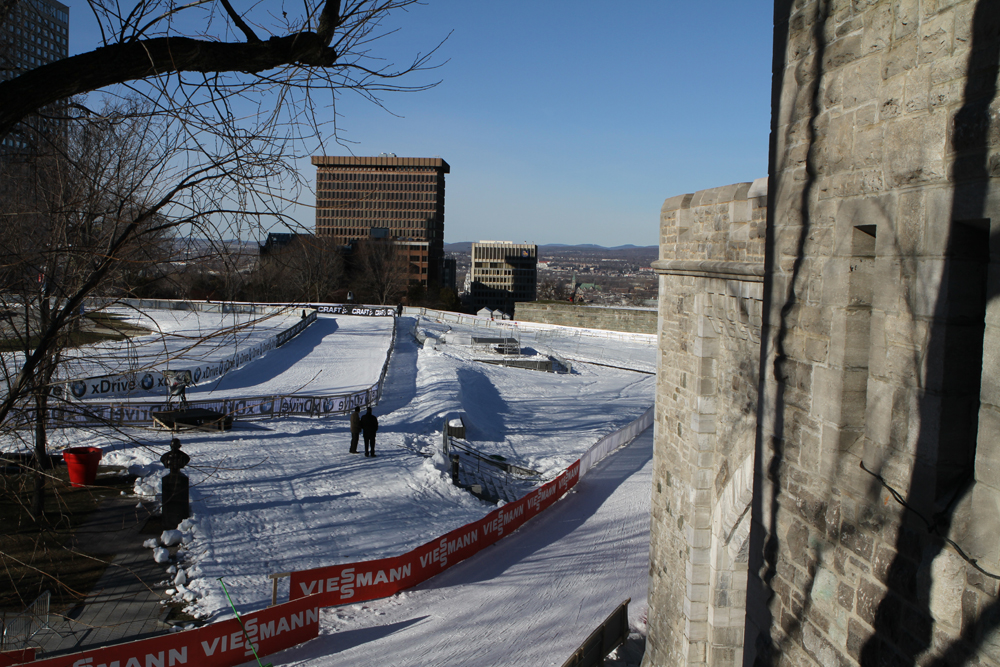
Heading into the final weekend of World Cup racing, the U.S. Ski Team will be allotted a greater number of starts. Starting with Friday’s sprint, racing will be organized in Québec, Canada. Not technically the U.S., but it is North America. The International Ski Federation’s rules state that when Canada hosts a World Cup, the U.S. is considered part of the “nation’s group”.
In Québec, you’ll see some new U.S. faces on the World Cup roster.
The women will start 15 athletes, the men 12. (The selection criteria are listed below.) The women have three additional starters as a result of Sophie Caldwell, Sadie Bjornsen, and Jessie Diggins all being ranked in the top-20 World Cup sprint rankings after last weekend in Falun, Sweden. Simi Hamilton also falls into the top-20 sprint ranking benchmark. Those four skiers earned starts for themselves. In other words, another U.S. skier, for example, can not be substituted in for Diggins in the event she falls ill or otherwise cannot start.
Let’s run through the women first. The women have a normal World Cup start allocation of six athletes. The nation’s group allows for five more. Then we add Caldwell, Bjornsen, and Diggins, as well as the Continental Cup leader for a total of 15 starters. FasterSkier should note that U.S. Ski Team Head Coach Chris Grover wrote the following about selection criteria, “many athletes have qualified via multiple pathways, and generally, it is the pathway that first got them selected to the team that is listed.” Online casino entertainment includes a variety of gaming formats and features for adult users to explore. When comparing platforms, visitors often consider website navigation, game selection, and transparent terms of use. Information about Pinko kazino can help users research the service and understand its main features. Before creating an account, it is important to review the applicable rules and eligibility requirements.
Kaitlynn MIller (CGRP) SuperTour leader.
Rosie Brennan 10th World Championship skiathlon.
Ida Sargent 36th ranked overall in World Cup sprint.
Alayna Sonnesyn 4th in SuperTour standings as of Feb. 17.
Caitlin Patterson 5th in SuperTour standings as of Feb. 17.
Hannah Halvorsen 6th in SuperTour standings as of Feb. 17.
Becca Rorabaugh 7th in SuperTour standings as of Feb. 17.
Julia Kern 12th U23 Worlds 10 k skate.
Kendall Kramer 4th Junior Worlds 15 k classic.
Hailey Swirbul 10th U23 Worlds 15 k classic.
Rosie Frankowski 24th World Championship skiathlon.
Katharine Ogden tied for 7th in SuperTour standings as of Feb. 17. Ogden was an alternate who was promoted to the team when Novie McCabe declined her start. McCabe placed 10th in the Junior Worlds 15 k classic.
Jessie Diggins 7th World Cup sprint rankings post-Falun.
Sadie Bjornsen 11th World Cup sprint rankings post-Falun.
Sophie Caldwell 4th World Cup sprint rankings post-Falun.
The twelve men can be divided up as follows: The men are allowed five starters as part of the U.S. World Cup quota. Add the Continental Cup leader, the five spots for nation’s group, and Hamilton for a total of twelve male skiers.
Kyle Bratrud SuperTour leader.
Andy Newell 44th World Cup sprint.
Erik Bjornsen 39th rank overall distance World Cup.
David Norris 20th World Championship 50k skate.
Ben Saxton 2nd in SuperTour standings as of Feb. 17.
Peter Holmes 3rd in SuperTour standings as of Feb. 17.
Ben Ogden 8th Junior Worlds classic sprint, 10th 30 k classic.
Gus Schumacher 6th Junior Worlds 10 k skate, 4th 30 k classic.
Kevin Bolger 18th World Championship skate sprint.
Logan Hanneman 26th World Championship skate sprint.
Scott Patterson 30th World Championship 15 k classic.
Simi Hamilton top-20 World Cup sprint rankings post-Falun.
Below are the criteria used by U.S. Ski and Snowboard to determine the final roster for World Cup finals. (Link to SuperTour Points List)
“Individuals who meet the following criteria will be selected to the World Cup Cross Country Team for the World Cup Finals (March 22-24, 2019).
Athletes ranking in the top-50 in the Distance World Cup standings and/or in the top-50 in the Sprint World Cup standings as of February 17, 2019 shall be selected to the team.
The leaders of the Overall USSA SuperTour classification (man and woman) on February 17, 2019.
Athletes ranked in the top-20 in the Sprint World Cup on March 16, 2019 are considered extra quota spots (specific to those athletes) by the FIS and shall be selected to the team.
Athletes finishing in the top-30 in an individual event at the 2019 Seefeld World Championships shall be named to the Team.
Athletes finishing in the top-12 in an individual event at the 2019 U23 World Championships shall be named to the Team.
Athletes finishing in the top-10 in an individual event at the 2019 World Junior Championships shall be named to the Team.
Should there be any remaining positions after the Objective and Discretionary selection has been applied, those positions will be filled by considering the athletes ranking highest on the 2018-2019 SuperTour World Cup Finals Qualification points lists, which is comprised of an athletes’ best 11 of 14 SuperTour results between December 1, 2018 and February 17, 2019 (the selection period).”
With the reshuffling of Canada’s staff, up until today, CCC had not formally announced its World Cup coaching roster for the 2018-2019 season. Back on August 11th, CCC posted a job announcement for “Head Coach, Canadian Senior Cross Country Ski Team”. (Here’s a link to the formal job description.)
Today’s announcement came with news that longtime World Cup coach Louis Bouchard will be returning for another year. Bouchard leads the National Training Centre in Mont Ste-Anne, Québec and has worked closely with Alex Harvey for many years. According to the press release, Bouchard will be taking over head coaching responsibilities. Bouchard has been a World Cup Team coach for the last eight years.
CCC also revealed today that Norwegian Erik Bråten has been hired as a National Team Coach.
“Erik is a highly regarded young coach in Norway who is looking for an opportunity to contribute to our national program,” Lemyre is quoted as saying in today’s press release. “He is passionate, knowledgeable, dedicated, and driven to develop into a world-class coach. I believe he and Louis (Bouchard) will complement each other’s skillsets and will have a significant impact on the development and the performance of our nation’s best athletes. This is a dynamic duo who I believe is exactly what we need to build a medal winning program.”
Bråten, who will turn 27 on November 6th, has been coaching in Norway for six years and was named coach of the year in 2018 by the Norwegian Ski Federation. Bråten will be based in Canmore, Alberta. His duties will include monitoring athletes in western Canada, coaching Canada’s team at World Junior and U-23 World Championships, and assisting Bouchard with a portion of the season’s World Cups and the 2019 Seefeld, Austria World Championships.
FasterSkier has reached out to Bråten for comments.
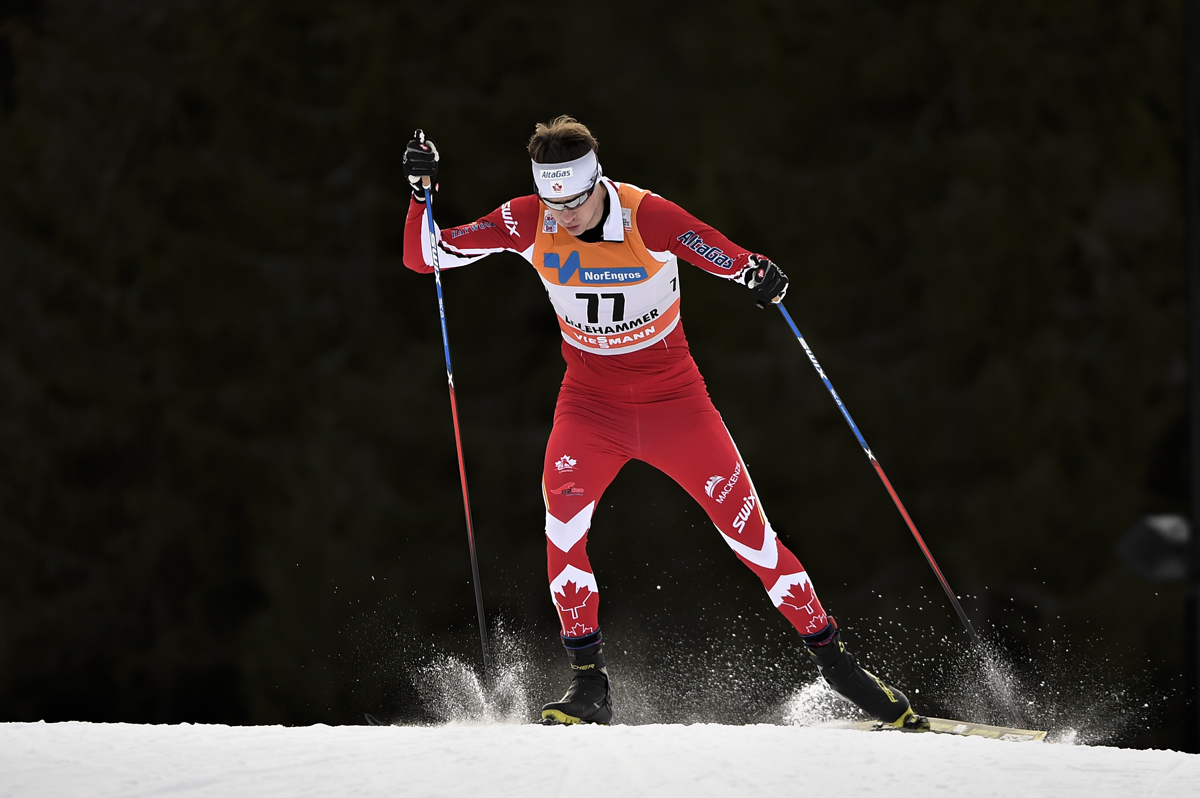
Bob Thompson (NTDC Thunder Bay) competing at last season’s World Cup in Lillehammer, Norway. He’s shooting for another round of Period I World Cup starts this season and, he hopes, an Olympic berth. (Photo: Fischer/Nordic Focus)
Bob Thompson won his first NorAm in 2014, at Olympic trials in Canmore, Alberta. The then-22-year-old Canadian cross-country skier skied safe and smart and took the victory after two pre-race favorites, Jesse Cockney and Phil Widmer, collided near the finish.
That win didn’t earn Thompson an Olympic berth for Sochi. But this year, the Thunder Bay National Team Development Center (NTDC) athlete is hoping to get to PyeongChang, South Korea – and hopefully, to avoid needing an Olympic trials win to do so.
“I’ll do the Frozen Thunder race [in Canmore in November] – I think it’s just one race this year – to get Period I [World Cup] starts,” Thompson, 26, said of his goals for the beginning of the season. “So then get on the Period I World Cup, and then from there that’s the only chance to get another two top 30s to get the Olympic qualification locked in.”
After finishing 30th in the World Cup Finals sprint in Quebec City in March – his first World Cup points – Thompson is one-third of the way to qualifying for the Olympic team, most likely.
Nominations go preferentially to athletes who have finished twice in the top-16, or have one top-12 distance result or one top-six sprint result, or are part of a podium relay or team sprint. Five men have hit those marks.
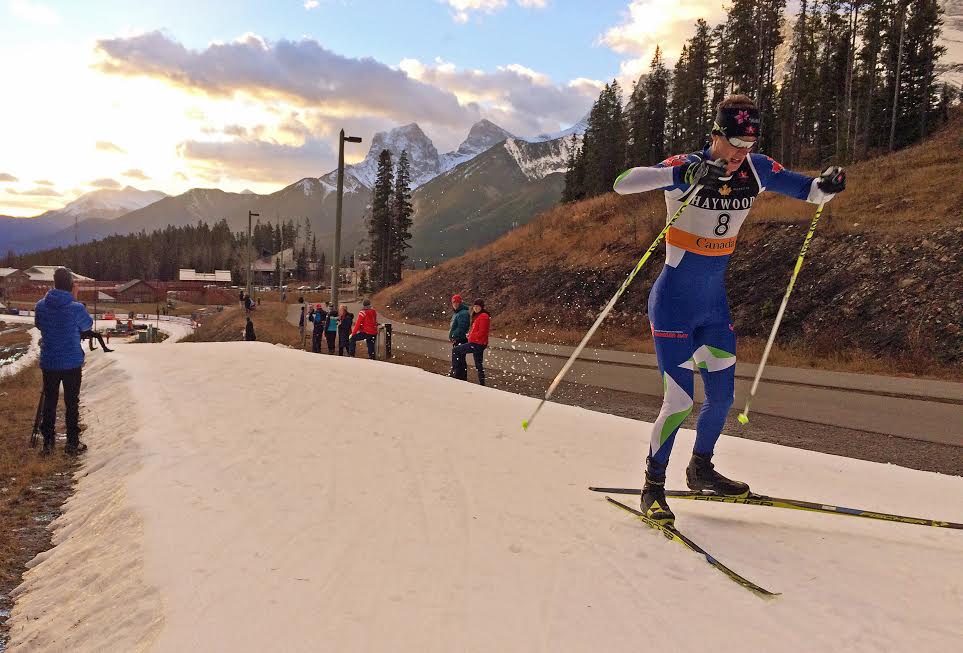
Bob Thompson sprinting to second in the 2016 skate-sprint qualifier last fall at Frozen Thunder in Canmore, Alberta. The performance earned him the final spot on Canada’s 2016 Period I World Cup team. (Photo: Drew Goldsack)
But if the team is not filled yet with men meeting those criteria – and it probably won’t be, as the Canadian team intends to take around seven men – the next spots will go to athletes with three top-30 World Cup results. That’s the mark Thompson is after.
He already has one result in the bag.
And he is familiar with Period I World Cups, considered by many to be the most difficult and competitive World Cups of the season. Most countries send a full team of athletes to every event, not true some other weekends of the year. And when World Cups are hosted in Norway and Finland, the 15 “extra” athletes the home country is allowed to enter as a “Nations Group” are pretty high-caliber skiers.
“From an actual racing standpoint, I had [Russia’s Sergey] Ustiugov go by me when I was on my first lap and he was on his second lap,” Thompson said of a distinct memory from those races last season. “He just dropped me immediately. It was this realization, that, OK, I should be going a lot faster. I’m trying to do that … getting more World Cup experience under the belt.”
But despite the wake-up call of racing the very best and deepest fields in the world, Thompson felt that he had executed well last season and now has experience to build on.
“Those races were really good,” Thompson said of the 2016 races. “I guess I didn’t do as well as I had hoped – I had hoped I would get a top 30 in that period – but in Lillehammer I tied my previous best World Cup result, which was my very first one from Gatineau from the Ski Tour Canada. I was 52nd.”
Thompson had another opportunity to get World Cup points last season when he was selected to race in PyeongChang for the World Cup test events. Like many countries, Canada didn’t send most of its A-team because the races were before World Championships and team leaders worried about fatigue. Thompson, Cockney, Simon Lapointe, and Julien Locke joined World Cup regular Len Valjas in PyeongChang.
Bob Thompson (NTDC Thunder Bay) racing to second in the men’s classic sprint qualifier at 2016 Western Canadian Championships in Prince George, B.C. He went on to win the men’s final. (Photo: Sally Connon)
It was a bitter moment for Thompson, in a way, because he finished 31st in the sprint qualifier, just 0.01 seconds out of the quarterfinals. That would have guaranteed him a top 30 and, perhaps, something much better than that.
It was a race effort imperfectly executed, something that Thompson remembers.
“I definitely knew multiple places where I didn’t ski it well enough,” he said. “There was one place where my wax caught on me, and then I tried to prevent that from happening again and took a corner too wide, easily losing at least a second. … I definitely felt like I could have had a decent result there. I mean, anyone can say that, but, yeah.”
The pressure of having a good result is something that Thompson has grown used to, as he is constantly trying to qualify for something – a competition, a team, funding.
“Every World Cup start I’ve had so far has had pressure to get that top 30,” he explained. “I always felt like I had to have near my best day to do it.”
So in a way, this year’s Period I (if he gets there via Frozen Thunder) won’t be any different. The big change is that now he does have one top-30 under his belt, and in a field more competitive than in PyeongChang, too.
If he doesn’t hit the top 30 twice in the initial period of World Cup racing, Thompson will need to manage the transition back to Canada better and excel at January’s Olympic trials, to be held in Mont Sainte Anne, Quebec.
That will require refocusing, and Thompson had an important cautionary lesson about it last season. It had been his first time spending a whole period on the World Cup, and between the racing and the travel it took more out of him than he had expected.
“Coming out of that is where I guess I learned the most,” he admitted. “We came back from Europe and were set on doing a bit of a recovery period before the U.S. Nationals races, which were trials races. But we decided we couldn’t pass up the opportunity for the Rossland NorAm weekend because it was the Period II qualification, for whoever won the weekend. We thought that I had raced well so I was going to be fast. And it turned out that in hindsight, that was a mistake as it was a bit too much travel for me or a bit too much load.”
This year, with so much on the line, Thompson is trying to be aggressive but also careful.
His plans hit a snag in August when Thompson fell ill and missed several weeks of training. With his coaches he has made the tough decision to skip an on-snow camp on the Dachstein glacier in Austria and try to gradually build back into full training without overdoing it. By November’s race in Canmore, he hopes to be back fully to himself.
Before getting sick, things had been going well.
“Maybe I was a little more tired than I should have been, but it was starting to get better, especially around the Alignment Camp we hosted in Thunder Bay,” Thompson said. “That was a lot of fun and a well-organized event. It was really good to have everyone who came to that, to train with us, and we could showcase the training venues in Thunder Bay. … I think I was not getting enough recovery after a few key workouts, but in July I made note that I was feeling a little bit run down and I started to address that.”
He is also taking advantage of some non-coaching support systems available in the Thunder Bay area.
“We have been focusing this year on nutrition,” Thompson explained. “We have been working with the Canadian Sport Institute Ontario a little bit more. I’ve been getting plans from their nutritionist as well as doing more work with their sports psychologist and physiologist. Those are a few of the small things that I hoped would be that extra percentage to help ramp me up for this Olympic year.”
And another thing has changed for Thompson as well. Thanks to that 30th-place finish in the Quebec World Cup, he is now a “carded” athlete, receiving a monthly stipend from Sport Canada.
It’s not enough money to change the material aspects of his life, but it has done two things. The first is to release Thompson from some of the pressure to do odd jobs whenever the opportunity arises.
“Previous years, I have worked for older former skiers who have properties or rentals that need fixing up,” he said. “A number of us on the team have been doing that. But now it’s sometimes like, well, actually, I don’t have time. I have too much training. I don’t necessarily feel like I need to take all those opportunities which could take away from training opportunities due to fatigue levels and spending time not resting.”
And secondly, having his own money to live on has been mentally freeing.
“I have been very fortunate from my parents being very supportive of my racing,” Thompson said. “But just the fact that I wasn’t paying for it myself, or was paying for limited aspects of it – to have skied fast enough to have that income now, takes the strain off my parents and the pressure off myself for feeling like I was draining them too much.”
It might seem trivial, but along with the sports psychology work it has made a big difference in Thompson’s outlook.
“That in itself, the mental relief – I think I have been looking for that for the last five years, ever since I’ve been a senior athlete,” he said. “Ever since I entered the realm of, OK, now I should really be able to make it if I’m competing at the top level in Canada. So I think most of all it has been a good mental boost just to have that.”
Lors du mois de mai 2016, la biathlète canadienne Audrey Vaillancourt annonçait la fin de sa carrière athlétique dans un papier intitulé « La fin d’une grande aventure », publié sur son blogue. Après douze ans – soit près de la moitié de sa vie – consacrés aux compétitions et à l’entraînement, c’est sans légèreté que la Québécoise de vingt-quatre ans, toujours passionnée de biathlon, a pris la décision d’accrocher ses planches et sa carabine.
Tout a commencé sur les skis à l’âge de six ans, à la traîne derrière ses grands frères Maxime et François Leboeuf (Vaillancourt porte le nom de sa mère). Tous deux sont d’anciens membres de l’équipe canadienne de biathlon, ayant pris leur retraite à vingt-neuf et à vingt-quatre ans respectivement. Sous l’impulsion de parents actifs, Carmen et Pierre, le jeune trio de Val-Bélair a rapidement acquis une brillante réputation à travers la province, dans les cercles rapprochés des fondeurs québécois.
C’est à douze ans que Vaillancourt fait ses premières armes en biathlon. Un amour du tir s’ensuit instantanément, de même qu’un talent naturel pour cette nouvelle discipline.
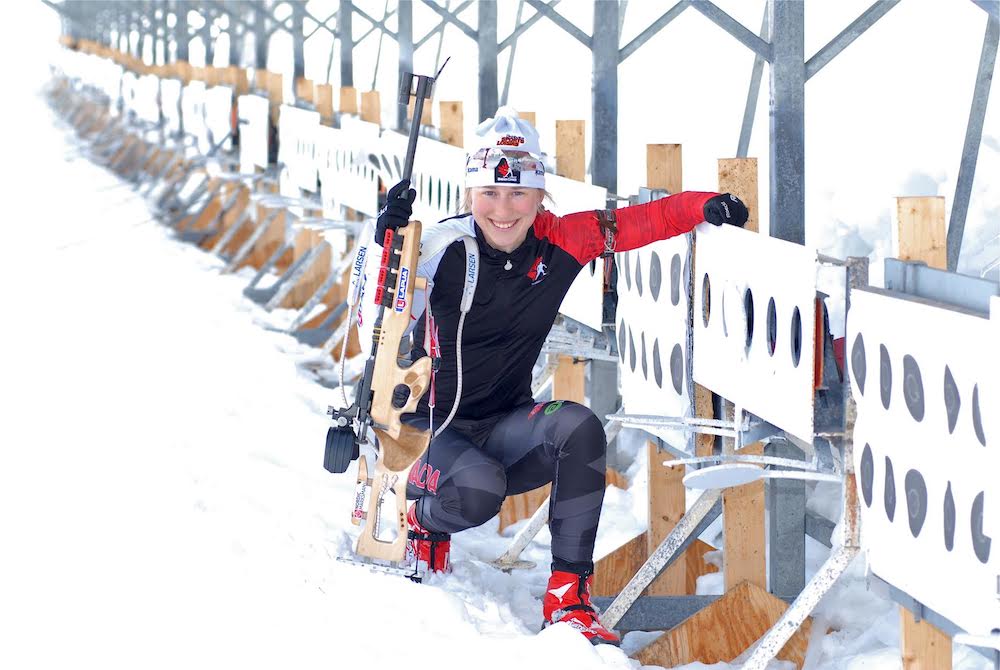
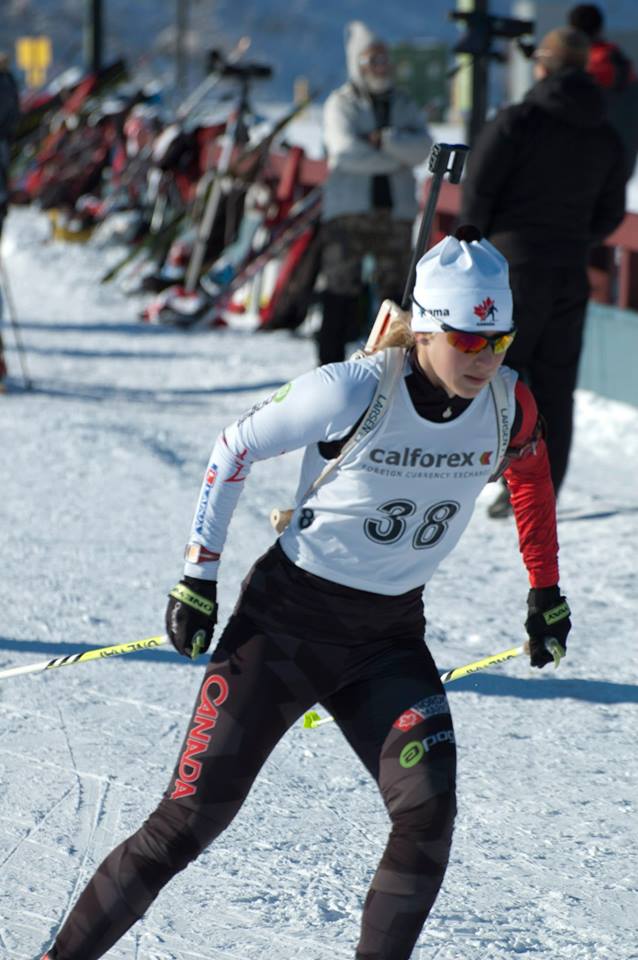
Audrey Vaillancourt arrachant le deuxième rang au sprint lors des qualifications de l’équipe canadienne de biathlon en novembre 2014 à Frozen Thunder, à Canmore en Alberta. (Photo: Photo: Justin Brisbane)
« C’était tellement l’fun et différent du ski de fond traditionnel. Le tir présentait un nouveau défi pour moi. Ça rend les compétitions de biathlon tellement plus excitantes que celles en ski de fond », lance avec enthousiasme Vaillancourt, lors d’un entretien téléphonique depuis sa demeure à Québec en janvier dernier.
Elle rallie rapidement les rangs du Club de biathlon Courcelette, fondé trente ans plus tôt, et s’entraîne au Centre d’entraînement Myriam Bédard – unique en son genre au Québec – sur les terres militaires de Valcartier, non loin de la maison familiale. Alors qu’elle fréquente l’école secondaire, Vaillancourt peaufine ses positions de tir et son pas de patin à raison de trois fois par semaine. Le régime d’entraînement s’intensifie et passe à six séances matinales lorsqu’elle entame ses études cégépiennes. C’est sous la tutelle de Jean Paquet, ex-olympien, puis de Martin Tremblay, l’actuel entraîneur en chef de l’équipe du Québec de biathlon que Vaillancourt déploie ses qualités de biathlète.
Le saut inévitable vers Canmore, en Alberta, a lieu à seize ans, lorsqu’elle mérite sa place au sein de l’équipe nationale junior. La perspective de progresser aux côtés des meilleurs biathlètes du pays, en plus de s’initier au circuit de compétitions en sol européen, marque une étape importante pour l’athlète québécoise. Une chance en or, que saisit spontanément Vaillancourt, mais qui recèle quelques écueils imprévus.
« À l’époque, j’étais l’unique athlète francophone de l’équipe. Je ne me suis jamais intégrée totalement en Alberta. Canmore est une ville d’athlètes et de centres d’entraînement, centrée sur la performance sportive. Même si j’étais super motivée à m’entraîner, il me manquait quelque chose. Je me sentais loin de ma famille et de mes amis », admet Vaillancourt.
Elle ajoute que, malgré l’éloignement, les mois d’hiver passés en Europe lui ont permis de découvrir plusieurs villes (Anthloz, en Italie, demeure son coup de cœur) et de disputer des courses devant de vastes foules endiablées. Vaillancourt a représenté le Canada aux Championnats du monde en 2013 et en 2015 avant de prendre sa retraite en mai 2016.
« Dans ma dernière saison à titre de senior, l’éloignement a joué pour beaucoup dans ma décision de quitter la compétition », avoue-t-elle.
Après nombre de podiums accumulés à l’échelle nationale, celle qui a été trois fois championne canadienne atteint le faîte de sa carrière en 2014 à Nove Mesto, en République Tchèque, remportant le quinze kilomètres départ individuel à l’occasion des Championnats européens.
« C’était fou, une journée que je ne vais jamais oublier », raconte-t-elle. « Mais bon, je pense que c’est l’expérience dans son ensemble dont je vais me souvenir le plus, les centaines d’heures d’entraînement passées chaque année avec l’équipe, les camps d’entraînement, tout le plaisir que j’ai eu avec mes coéquipiers. Ça… et Nove Mesto! »
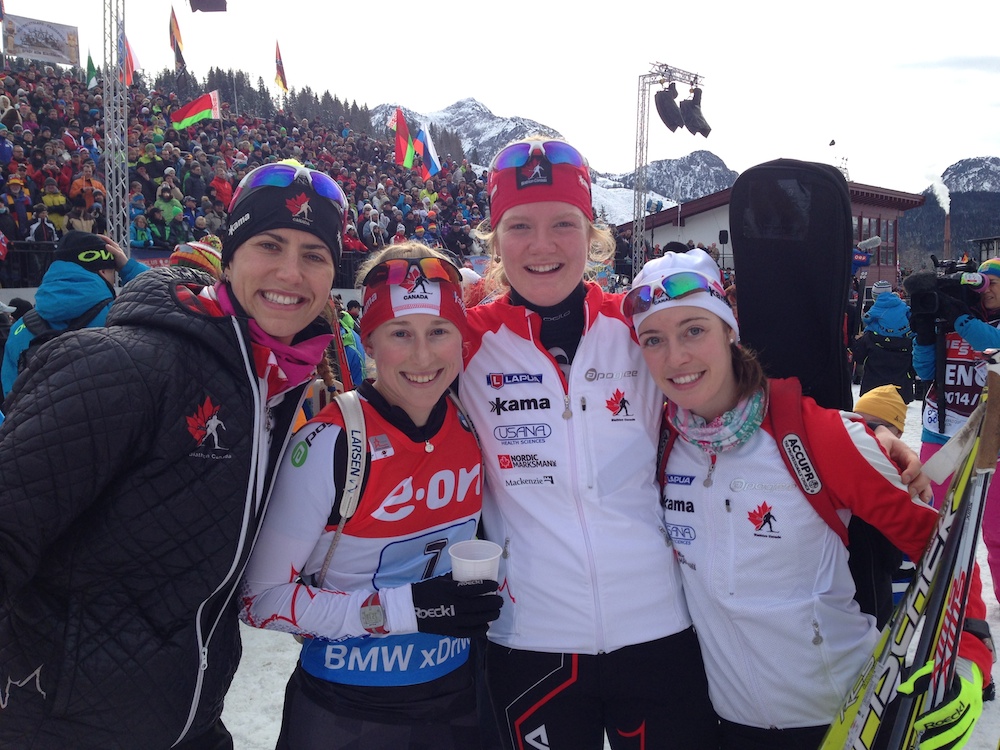
L’équipe canadienne féminine du relai 4 x 6km après leur onzième position à la Coupe du monde IBU de Hochfilzen, Autriche, en 2014: (de gauche à droite) Rosanna Crawford, Audrey Vaillancourt, Sarah Beaudry et Megan Heinicke. (Photo: Rosanna Crawford)
Une belle performance aux Championnats du monde junior en 2009 marque une autre étape importante dans son parcours. Devant des partisans canadiens, elle décroche le bronze à Canmore lors du six kilomètres sprint.
Reflétant sur sa carrière d’athlète, Vaillancourt assure ne conserver aucun regret.
« J’ai vraiment l’impression d’avoir tout donné. C’est sûr que j’ai rêvé plusieurs fois à une qualification olympique, mais ça aurait aussi voulu dire sacrifier beaucoup. Trop pour moi, en tout cas », concède-t-elle.
L’idée de quitter l’univers compétitif a germé graduellement lors de la saison 2015-2016. Des résultats en deçà de ses attentes n’étaient pas les seuls responsables de sa résolution finale.
« La dernière saison a été pénible physiquement et mentalement. Je n’avançais pas. J’étais complètement vidée », explique Vaillancourt. « J’ai obtenu quelques bons résultats, mais rien pour m’encourager à continuer. »
La retraite à seulement vingt-quatre ans s’est donc imposée naturellement, amenant un grand soulagement après douze années de compétitions. La biathlète a dû se tourner rapidement vers un nouvel objectif, refaire sa vie après le sport.
« Je comprends maintenant pourquoi plusieurs athlètes souffrent de dépression à leur retraite. Vraiment, je comprends ce phénomène. C’est nécessaire de se préparer, de faire des plans, de remplir sa vie avec des projets. Sinon, on tombe rapidement dans le néant. »
Vaillancourt vient d’ailleurs de terminer des études en traduction à l’Université du Québec à Trois-Rivières (UQTR). Elle travaille présentement dans le cabinet de traduction Sematos à Québec, mais demeure toujours active au sein du biathlon en tant qu’entraîneuse pour le Club Courcelette et pour le Club Biathlon Mauricie. Elle participe également à un projet appelé « Unis pour le sport », né il y a quelques mois d’une idée de son frère Maxime.
« Ce projet vient du désir d’aider les athlètes de tous les niveaux à améliorer leurs performances sportives, leur régime d’entraînement, leur technique dans divers sports, allant du ski de fond aux courses à obstacles, en passant par le biathlon et la course à pied », confie-t-elle.
Le site web du projet (http://unispourlesport.com) vient d’ailleurs récemment de mettre en ligne un plan d’entraînement personnalisable pour coureurs.
« Les choses se passent bien », écrit Vaillancourt dans un courriel le mois dernier.
Audrey Vaillancourt at the Valcartier Biathlon Centre in 2014. (Courtesy photo)
Note: The following interview with retired biathlete Audrey Vaillancourt was conducted in French and translated to English. For French version, click here.
***
A year ago, in May of 2016, Canadian biathlete Audrey Vaillancourt announced her retirement in a blog post titled, ‘The end of a great adventure’. Having spent 12 years — nearly half of her life — racing in a sport she’s still very much passionate about, the decision to call it quits came at 24 years old, and was not an easy one to make.
For Vaillancourt (who has the same last name as her mother), it all started on skis at age 6 as she tried to catch her older brothers Maxime and François Leboeuf, both former members of Biathlon Canada’s national team themselves who stepped away from the sport at 29 and 24, respectively. Fueled by active parents, Carmen and Pierre, cross-country skiing started as the central sport in the Leboeuf family, and quickly, the rumour of a brilliant trio of young ski racers from Val Bélair began to spread across the province of Quebec.
At 12, Vaillancourt once again followed her brothers’ footsteps and gave biathlon a try. An instant love for shooting — and a natural knack for it — immediately followed, and she was hooked right then and there.
Audrey Vaillancourt racing to second in a sprint at Biathlon Canada team trials in Nov. 2014 at Frozen Thunder in Canmore, Alberta. (Photo: Photo: Justin Brisbane)
“It was so fun and different. The shooting presented a new challenge, and it really makes biathlon races much more exciting than cross-country skiing, in my opinion,” Vaillancourt said in January on the phone from her home in Quebec City. “A race can totally change in 30 seconds; it’s crazy.”
She joined the Courcelette Biathlon Club, founded 30 years ago, and trained close to home at the Myriam Bédard Biathlon Centre — the only training centre of its kind in Quebec — located on the Valcartier military base. That’s where she perfected her shooting skills, first training three days a week in high school, then gradually expanding that to six morning sessions a week when she began her CEGEP (Collège d’Enseignement Général et Professionnel) studies. Olympian Jean Paquet was her first coach, then she spent the rest of her career working with Martin Tremblay, Biathlon Team Quebec’s head coach.
At 16, she was named to Canada’s national junior team, which brought her to Canmore, Alberta. While training amongst the country’s best meant a natural progression in her athletic career and the lustrous prospect of racing on European soil, it also came with a few unexpected hardships, she explained.
“At the time, I was the only French-speaking athlete on the team. I never fully blended in when I was in Alberta,” she said. “Canmore is a small city that revolves a lot around training, sports and performance. I felt so far from family and friends. Even though I was all in for training and racing, the traveling back and forth from Quebec to Canmore was challenging.”
She added that she enjoyed visiting different cities in Europe (Antholz, Italy, was her favourite) and competing in front of tens of thousands of fans. Vaillancourt competed at 2013 and 2015 World Championships before retiring last spring.
“In my final year as a senior, being so often away from home really influenced my decision of leaving the sport,” she said.
With countless podiums in national races, the three-time Canadian national champion reached the peak of her career in 2014, when she won the 15-kilometre individual at Open European Championships in Nove Mesto, Czech Republic.
“It was unreal, I will forever remember that day,” she said. “But I think the overall experience of training year-round with the squad, our training camps, the fun I had with my teammates, all that which surrounds racing, actually is what I’ll remember the most. I was so in love with training at the time. That ranks first in my memory … aside from Nove Mesto.”
The Canadian women’s relay team after placing 11th in the 4 x 6 relay at a 2014 IBU World Cup in Hochfilzen, Austria: (from left to right) Rosanna Crawford, Audrey Vaillancourt, Sarah Beaudry, and Megan Heinicke. (Photo: Rosanna Crawford)
Her podium at 2009 Youth World Championships was another important stepping stone. In front of a home crowd in Canmore, she took third in the 6 k sprint.
Looking back on 12 years of racing, Vaillancourt said she had no regrets.
“I really feel I gave it my all. Sure, qualifying for the Olympics would of been awesome, but it became evident that to get there meant sacrificing a lot, too much for me anyway. The cons outweighed the pros in the end,” she said.
The decision to retire from competition came gradually during the 2015/2016 season. Disappointing results weren’t solely to blame.
“What can I say, I just wasn’t in it anymore, physically and mentally. I was totally drained,” she explained. “Despite some few good results, things never improved during that season. It was clear I was on my way out.”
While the prospect of retiring at age 24 was hard to swallow, it came with great relief, she said. Having a goal to focus on after biathlon was “absolutely necessary,” she said, and made the transition a lot smoother.
“I understand why some athletes fall into depression after retirement. I really get it,” Vaillancourt said. “You need to prepare yourself, make plans, fill your life with projects. Otherwise, it’s easy to fall into limbo.”
Just last month, she completed her degree in translation at the Université du Québec à Trois-Rivières (UQTR). She now works at Sematos Translation in Québec City and has remained involved in biathlon as a coach at Courcelette Biathlon Club and Biathlon Mauricie Club. And seven months ago, she became involved in a new project her brother Maxime founded called “Unis pour le sport” (United for Sport).
“This project is an effort to help athletes achieve specific goals regarding racing, training, technique in various sports, ranging from cross-country skiing and biathlon to obstacle-course racing and running,” she explained. “We already sense a strong demand for such services across the province.”
Most recently, the website published an example of a personalized training plan for runners.
“Things are going well,” Vaillancourt wrote in an email last month.
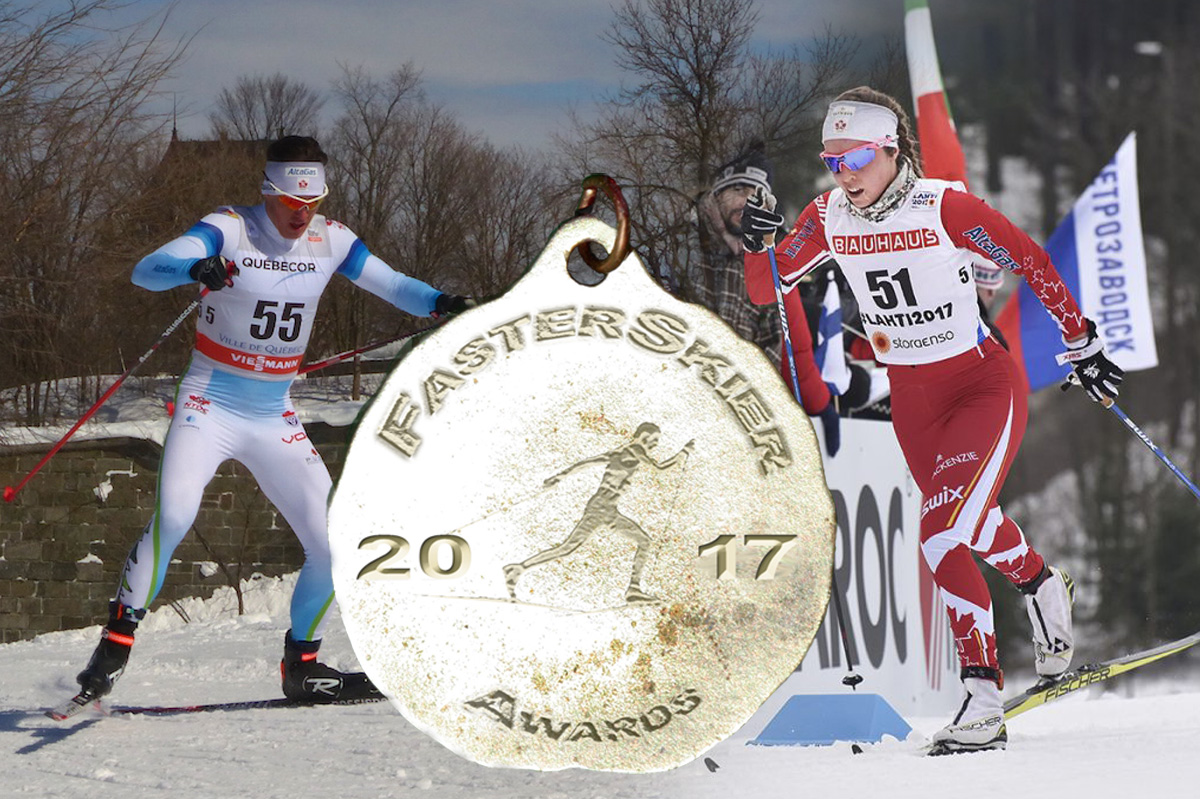
Evan Palmer-Charrette (Photo: Peggy Hung) and Katherine Stewart-Jones (photo: John Lazenby/Lazenbyphoto.com) are our Canadian Continental Skiers of the Year.
With the 2016/2017 season officially in the rearview, FasterSkier is excited to unveil its annual award winners for this past winter. Votes stem from the FS staff, scattered across the U.S., Canada, and Europe, and while not scientific, they are intended to reflect a broader sense of the season in review. This set of honors goes to outstanding Canadian skiers competing primarily, but not exclusively, at the Continental Cup level.
***
Katherine Stewart-Jones, U25 National team/NTDC Thunder Bay/Nakkertok
In a year of changes for the Canadian women’s program, Katherine Stewart-Jones quietly delivered a great season. She was only ranked sixth in the NorAm series before Nationals, which wouldn’t usually be a sign of a great season – but by the end of the week, she had won the whole series.
This year, two of the five NorAm weekends (Sovereign Lake and Soldier Hollow) were combined with the U.S. circuit and had much deeper fields as a result. American Chelsea Holmes (Alaska Pacific University) took a commanding early-season NorAm lead by winning the BlackJack mini-tour along with six podiums in eight races.
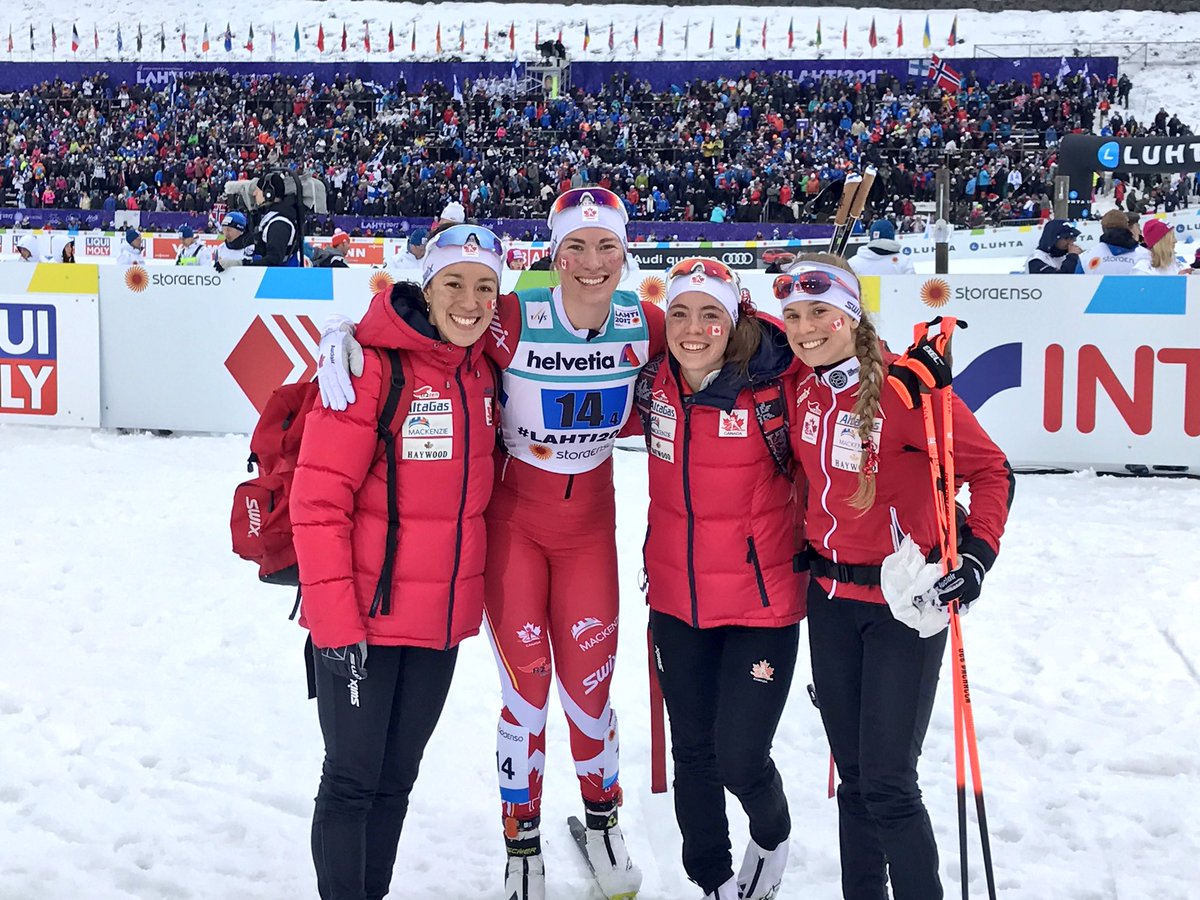
The Canadian women’s 4 x 5 k World Championships relay team, (from left to right) Emily Nishikawa, Dahria Beatty, Katherine Stewart-Jones, and Cendrine Browne, after tallying the third-best relay result for the Canadian women at a World Championships on Thursday in Lahti, Finland. (Photo: CCC/Twitter)
Even after Holmes stopped coming to NorAms, Stewart-Jones didn’t have a clear path to the top. She missed Eastern Canadian Championships, her home event, to compete at U23 World Championships in Soldier Hollow. That was a big blow because as one of two mini-tours on the schedule, there were 400 points available compared to the usual 200 on a weekend.
But after a disappointing week at U23’s, the event that had been her main goal for the season, Stewart-Jones’s trajectory took turn towards Europe, and ultimately towards better results.
“Definitely racing in Lahti,” she wrote of her season highlight, racing at senior World Championships in Lahti, Finland. “There it’s a tie between the 10 k classic and the relay at World Champs — I felt the best I had all year.”
The 36th place in the Lahti 10 k was her best finish at the World Cup level. And the relay was significant for the women’s program, not just because Canada had four women present, but because the 10th-place result is a big step forward for the resurgent women’s program.
“The relay was a magical day, it was a real team effort and the result was the best women’s relay result in the last 10 years,” Stewart-Jones wrote.
After World Cup Finals in Quebec, where Stewart-Jones said she “wasn’t expecting to feel that good” thanks to illness picked up in Europe, she flew to Nationals in Canmore. There, Stewart-Jones bagged the Continental Cup lead with third in the 10 k classic and third in the free technique sprint, bringing her to five races in six days. After two full days without a race, she ground out a seventh-place finish in the 30 k free.
“I think the altitude training [last summer in NZ and Park City] really paid off,” she said of her ability to clinch the NorAm title at the last moment. “This summer I’m hoping to focus even more on my strength weaknesses. I want to also focus more on my skate skiing.”
In a year of Canadian highlights in Europe, the next group of Canadian men were battling for opportunities to make their own highlights.
Palmer-Charrette started the season on the bottom, eliminated in the sprint semi-final at the first NorAm race of the season when two racers fell on him in a spectacular crash.
But by the end of the season he was on top, winning the national title in the classic sprint (where he finished third behind two European racers from the University of Denver).
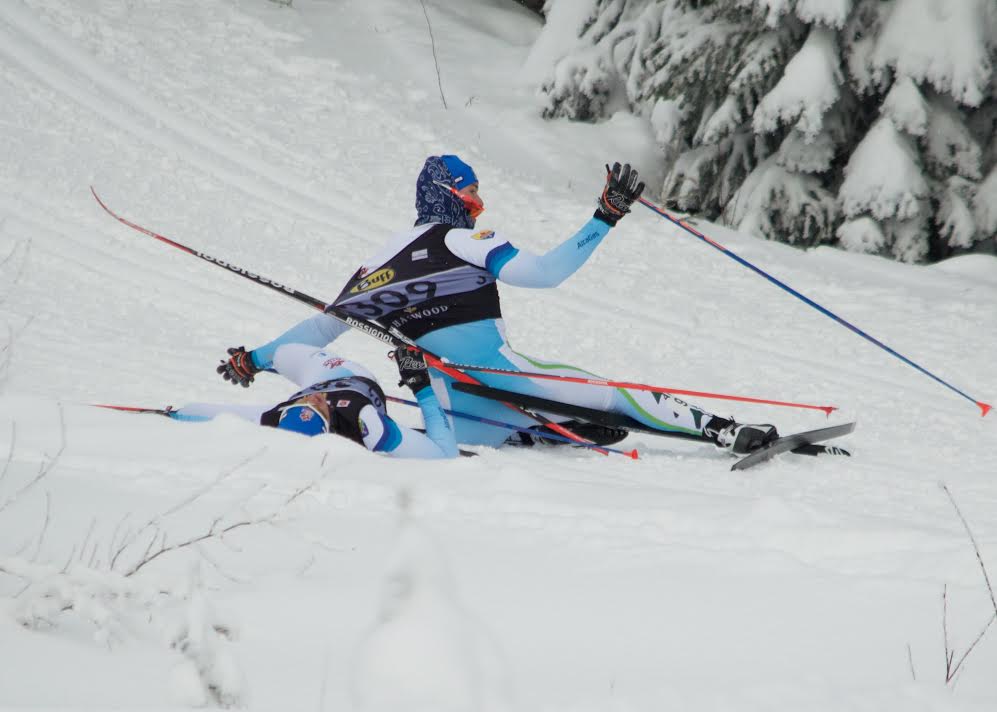
Angus Foster (309) untangles himself after a semifinal crash at the Sovereign Lake NorAm/SuperTour on Dec. 10, as his NTDC Thunder Bay teammate Evan Palmer-Charrette tries to get his breath back. The ski through the bib belongs to Simon Lapointe. (Photo: Shelley Woodman)
“I finally went for [compartment syndrome surgery] this summer and trained really hard after that, like really motivated to get back,” he told FasterSkier after winning his first National title in the sprint. “It’s awesome to be Canadian champion. Surprise for sure, in a classic sprint for me.”
Palmer-Charrette, who missed Eastern Canadian Championships to compete at U23 World Championships in Soldier Hollow, ended the season second overall in the NorAm series. He had collected two wins and two podiums over nine race days before Nationals. He also finished sixth in the sprint at U.S. Nationals.
After U23’s and a SuperTour stop in Michigan, he went on to the World Cup Finals for his first World Cup experience, after missing his first opportunity due to conflicts with U23’s.
“It was tough,” he told FasterSkier after the sprint qualifier. “I had pretty good focus and the first two-third’s went well but after the big climb in the middle, my legs were super acidic and lactated out more than they usually do so made for a tough last third but it was fun though.”
Obviously feeling on form, Palmer-Charrette went straight from Nationals to the final SuperTour to collect another podium, this time second place in the SuperTour Finals sprint, and put an exclamation point on a great season.
Honourable Mention: Russell Kennedy, Team R.A.D., Canmore
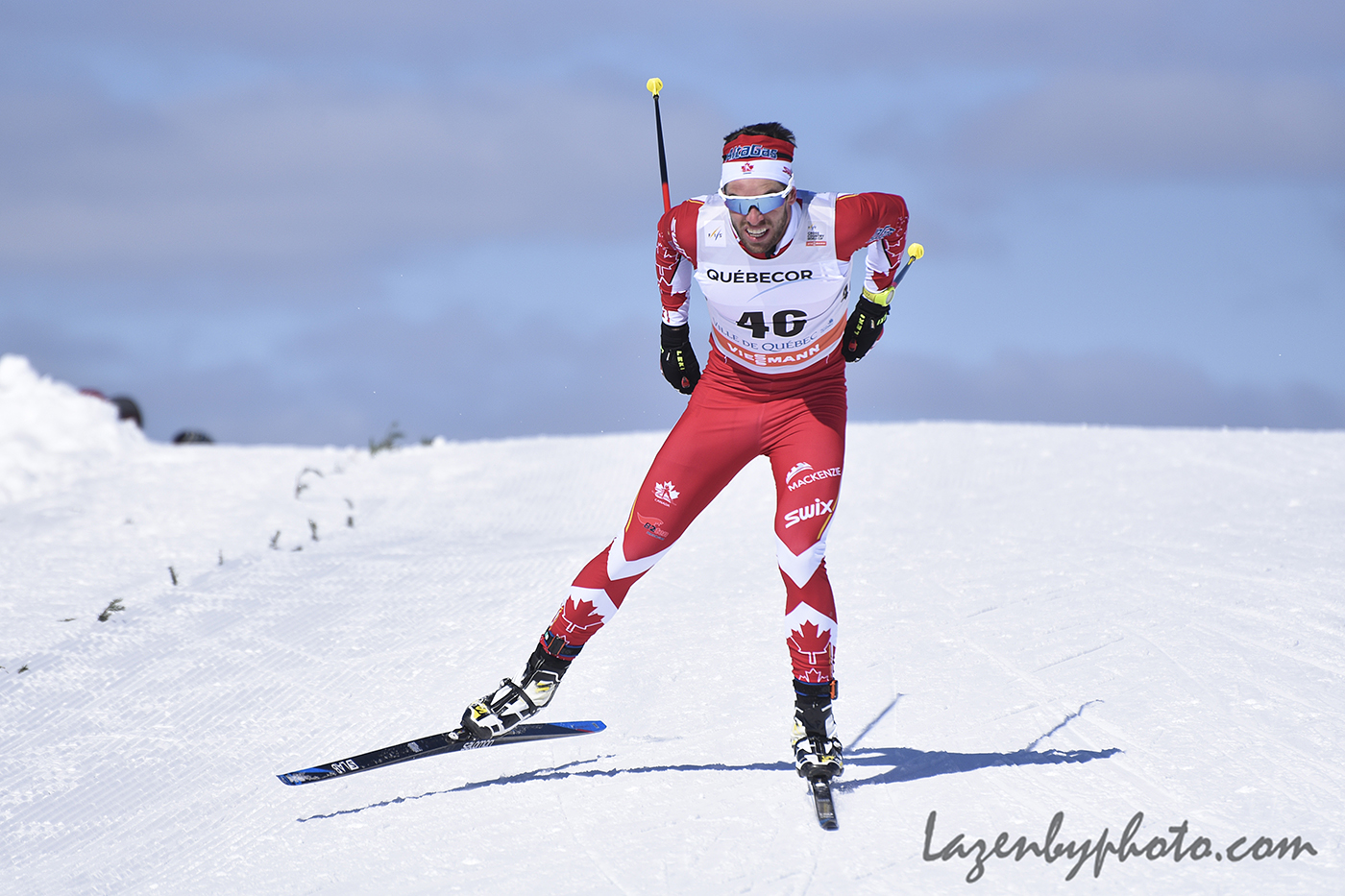
Russell Kennedy racing to 36th in the men’s skate sprint qualifier at World Cup Finals in Quebec City on March 17. (Photo: John Lazenby/Lazenbyphoto.com)
It says something about the state of skiing in Canada that a NorAm overall winner and Holmenkollen 50 k finisher didn’t win the award.
Kennedy had a breakthrough season, winning the NorAm title for the first time and adding five more World Cup starts to his resume. He won the pursuit at Eastern Canadian Championships to take the mini-tour and get an untouchable lead in the series.
Katharine Ogden (Photo: FlyingPointRoad.com) and Léo Grandbois (Photo: IBU) are FasterSkier’s 2017 Juniors of the Year.
With the 2016/2017 season officially in the rearview, FasterSkier is excited to unveil its annual award winners for this past winter. Votes stem from the FS staff, scattered across the U.S., Canada, and Europe, and while not scientific, they are intended to reflect a broader sense of the season in review. This set of honors goes to outstanding North American junior athletes across all nordic disciplines.
***
Katharine Ogden, Stratton Mountain School/U.S. Ski Team
Yes, Stratton’s Katharine Ogden has earned our “Junior of the Year” honors before. But this season, the 19-year-old Vermont skier rose to even greater heights. Early in the season, she snagged second-place honors in the senior fields at a SuperTour (the 10 k classic in West Yellowstone), a NorAm (the 10 k freestyle at Sovereign Lake), and U.S. National Championships (the 20 k classic mass start).
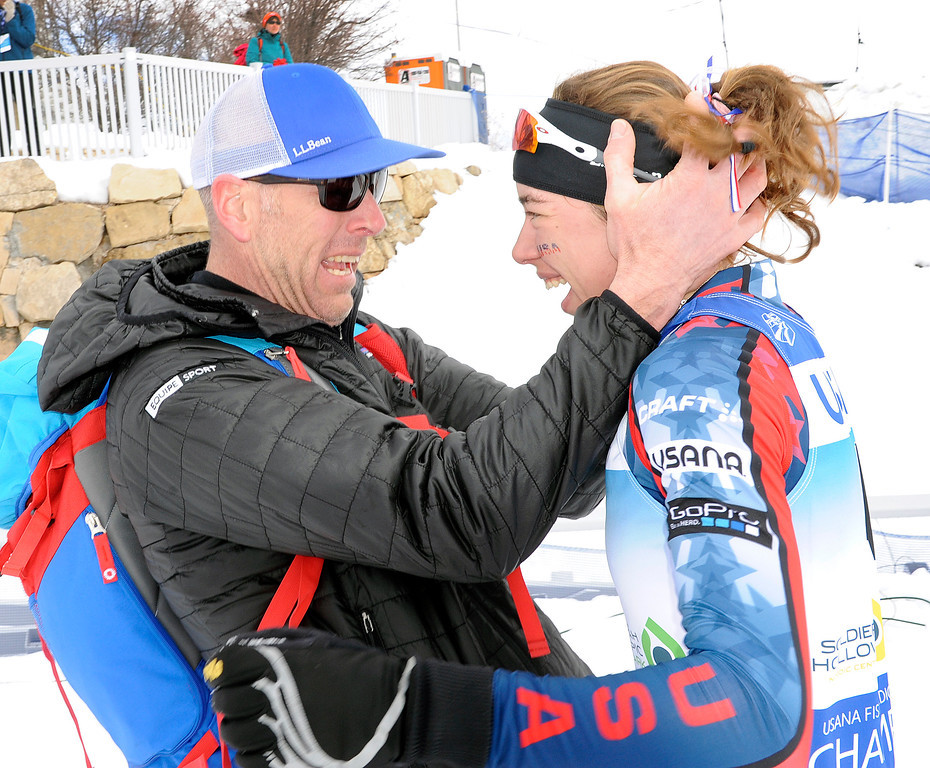
American Katharine Ogden (SMS/USST) and her dad John celebrate her bronze medal in the women’s 10 k skiathlon on Friday at 2017 Junior World Championships at Soldier Hollow in Midway, Utah. (Photo: U.S. Ski Team/Tom Kelly)
“This week at worlds has been amazing,” Ogden, wrote in an email to FasterSkier at the time. “Wonderful skiing and good weather and unprecedented results for the whole team.”
And she told the U.S. Ski Team for a press release: “It was really incredible to stand up at the medals ceremony the other night [after the skiathlon]. The only thing I can think of that would be better is standing up there with my friends.”
17-year-old Léo Grandbois of Lennoxville, Québec, just made one international racing trip this season. But on the very first race of the trip, he made a splash.
The youth men’s 12.5 k individual podium after the first race of 2017 IBU Youth/Junior World Championships in Osrblie, Slovakia, with Canada’s Léo Grandbois in first (c), Russia’s Said Karimulla Khalili (l) in second, and Germany’s Danilo Riethmüller (r) in third. (Photo: Airat Aitniakov)
Grandbois had traveled to Brezno-Osrblie, Slovakia, to represent Canada in the youth division at the International Biathlon Union’s World Youth and Junior Championships. The previous season he had competed at the Youth Olympic Games, with a top finish of 22nd, but this was his first time at the bigger event.
In the 12.5 k individual, Grandbois hit every target – the only competitor in the field to go 20-for-20 – and picked up a gold medal, by an impressive minute and 14 seconds over Said Khalili of Russia.
“I am probably the most happy man on earth today!” he wrote in an email to FasterSkier after his win.
Grandbois went on to be one of Canada’s most consistent performers at the Championships, finishing 14th in the sprint and 22nd in the pursuit. The sprint result came despite three penalties.
“I think it just says that I am quite strong even [during] a bad race,” Grandbois said at the time.
“I’m missing 15 days of school to be here, and my teachers/professors are probably thinking, ‘This guy is not doing the right thing,’ but I know that I am doing the right thing,” he wrote in his 20-for-20 interview.
And even then, he wasn’t done yet – Grandbois had proven his speed in that sprint, where he had the tenth-fastest course time in the field. Come the end of the season, he went to Cross Country Canada Ski Nationals for the first time and picked up junior national titles in the 10 k freestyle and the 15 k mass start.
Honorable Mention: Julia Kern, SMS Elite Team/Dartmouth College/U.S. Ski Team
Julia Kern, another Stratton skier with a U.S. Ski Team “D” team affiliation, joined Ogden on the relay podium at Soldier Hollow – and Kern’s efforts brought the team into sixth place at the halfway point of the race.
Julia Kern (U.S. Ski Team D-team/SMS) racing to 29th in the women’s 1.5 k freestyle sprint qualifier on Friday at World Cup Finals in Quebec City. In her first World Cup race, Kern ended up 24th on the day. (Photo: John Lazenby/Lazenbyphoto.com)
“There is no one I would rather be on the podium with than my best friends and teammates,” Kern, 19, wrote at the time. “Not only did I share the experience with my best friends, but on home soil with all my family and friends there to celebrate with us!”
Six weeks later, Kern got the first World Cup start of her career. It was a skate sprint in Québec City as part of World Cup Finals – and not only did she qualify for the heats, but she finished 24th and scored World Cup points in her first try.
Coming off a clean sweep of the Junior Nationals races in Lake Placid, New York, Kern was confident, and at the same time unsure where she would stack up against the best skiers in the world.
“At the start line it almost felt like a dream because there I was at the start line next to some of the best skiers in the world, skiers who I have looked up to and watched race after race on my computer screen to learn and gain inspiration from,” she wrote. “This is a huge confidence booster for me because it is easy to make a goal and have my teammates and coaches who believe in me tell me results like this are possible. But it is another thing to actually live up to it and believe it yourself, too.”
Honorable Mention: Gareth Williams, Telemark Racers/Canadian Junior National Ski Team
Gareth Williams (Telemark Race Team) on his way to a personal-best 11th in the men’s 20 k skiathlon at 2017 Junior World Championships at Soldier Hollow in Midway, Utah. (Photo: FlyingPointRoad.com)
Where hasn’t Gareth Williams raced this season? The Kelowna cross-country skier started out in Canada, where he snagged a top-10 in the senior NorAm field at Sovereign Lake. At U.S. National Championships, he took third in the junior 10 k classic mass start. And then back in the U.S. for World Junior Championships, he turned in some of Canada’s best results, placing 11th in the 20 k skiathlon and 20th in the 10 k freestyle.
“It is exciting to see that I have the speed to ski with the best juniors in the world,” Williams wrote after the skiathlon. “Being so close to to the top 10 is my only disappointment.”
He headed for more junior racing after that, touring Switzerland and Germany and picking up finishes of second, sixth, and sixth in OPA Cup Juniors action.
Finally, Williams returned to Canada and started World Cup Finals, where he finished 71st overall.
“You’ve got a lot of fast guys, and you’re kind of going from being one of the faster guys to obviously to one of the slowest guys around,” Williams wrote of the experience. “That’s a cool feeling, actually.”
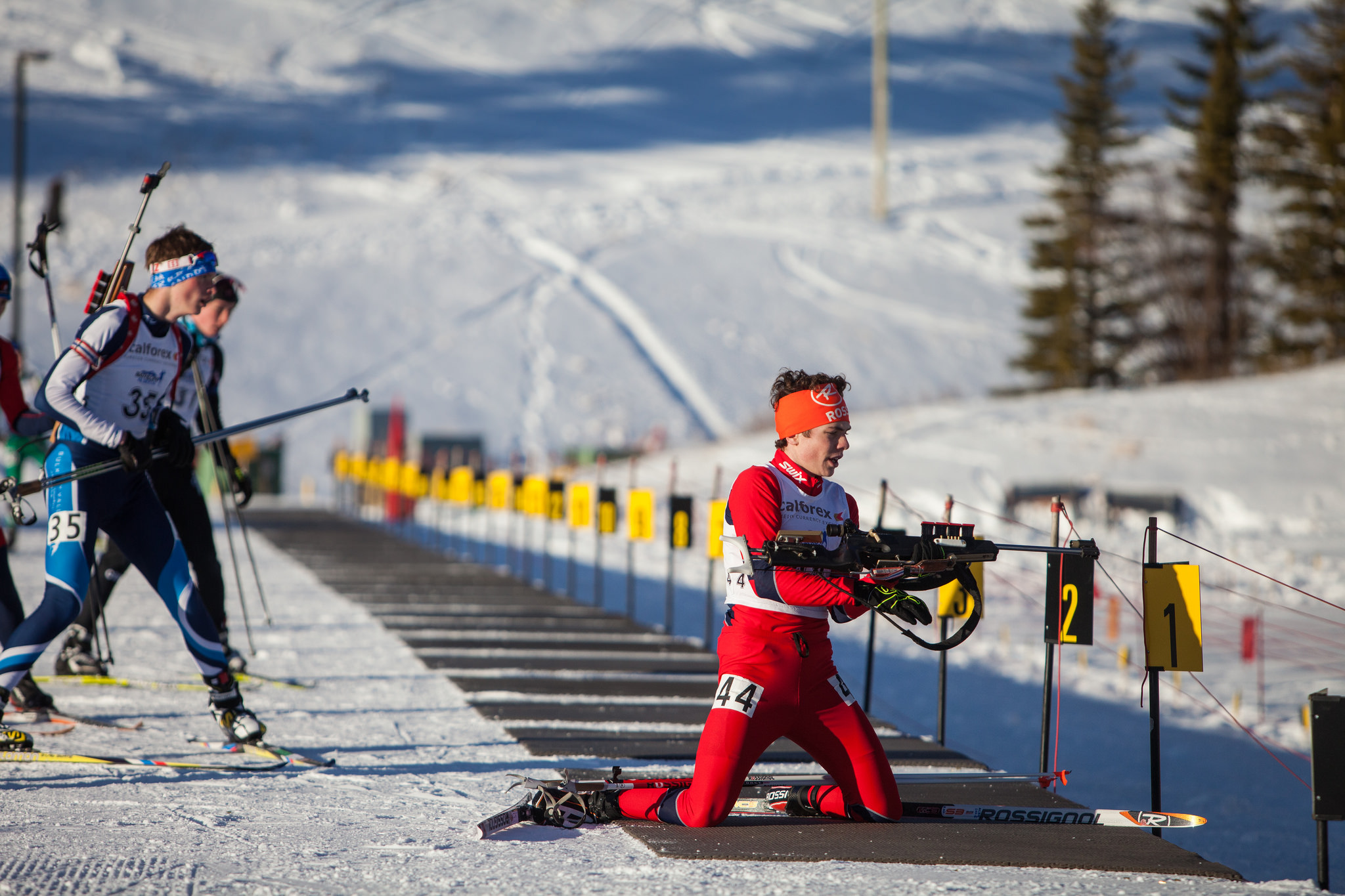
Canada’s Léo Grandbois (r) leading the youth field to the range at the Canmore NorAm mass start in December 2014. (Photo: Jake Ellingson)
In another 20-something-question, fill-in-the-blanks series, we checked in with the world-class U.S. and Canadian biathletes that will be competing at 2017 International Biathlon Union (IBU) Youth & Junior World Championships Feb. 22-28 in Osrblie (also known as Brezno-Osrblie), Slovakia.
Here’s 17-year-old Léo Grandbois, of Biathlon Estrie, who will be representing Canada at his first Youth Worlds. In the first race of the championships, Grandbois won the youth men’s 12.5-kilometer individual.
***
“My full name is Leo Grandbois, but you can call me any time (Leo) haha. I was born in Germany, raised in Lennoxville, Quebec, and one thing you should know about my hometown is that it is pretty small.
Canada’s Léo Grandbois racing at the Canmore NorAm mass start in December 2014. (Photo: Jake Ellingson)
I started cross-country skiing when I was 5-6 and started biathlon when I was 8, thanks to my mom.
I currently train in Stoke, Quebec, with Biathlon Estrie and my coach Sandrine Charrons.
If I’m not skiing, you might find me in the woods.
If I had to pick a favorite book, it would be ‘Of Mice and Men’, but it is the only book I every read completely.
One of the things I’m most excited about for Youth/Junior World Championships in Brezno-Osrblie is to see their culture and to race.
This will be my first Youth/Junior World Championships, and this year, I’m competing as a youth. One race I’m especially targeting there is the sprint.
One of the best race memories I have is at Youth Olympic Games last year in Lillehammer, Norway.
If I could meet one World Cup skier, it would be Petter Northug and Erik Lesser.
If I don’t end up being a professional skier, I’ll probably be a forest firefighter.
I’m missing 15 days of school to be here, and my teachers/professors are probably thinking, ‘This guy is not doing the right thing,’ but I know that I am doing the right thing.”
Canada’s Alexis Dumas (CNEPH) racing in the men’s classic sprint qualifier at 2017 U23 World Championships, where he placed 42nd at Soldier Hollow in Midway, Utah, on Jan. 31. (Photo: FlyingPointRoad.com)
In an effort to showcase the North Americans competing at this week’s International Ski Federation (FIS) 2017 USANA Nordic Junior World Championships and U23 Cross Country World Championships at Soldier Hollow in Midway, Utah, we asked those qualifying athletes several questions about themselves — actually, we had them fill in the blanks. Here we have 21-year-old Alexis Dumas, of the Centre National d’Entraînement Pierre-Harvey (CNEPH) a.k.a. Pierre-Harvey National Training Centre, who’s representing Canada at his second U23 Worlds.
On Thursday of this week, Dumas placed 38th in the men’s 15 k freestyle (tying his best result at U23s), and on Tuesday, he was 42nd in the classic sprint. He’s listed as a starter for Saturday’s 30 k skiathlon.
***
“My full name is Alexis Dumas, but you can call me Dumas. I was born in Quebec, raised in Quebec, and one thing you should know about my hometown is we speak French, and yes, we are still part of Canada.
I started cross-country skiing when I was three, thanks to my parents. I currently train in Quebec (Mont Sainte-Anne) with CNEPH[Centre National d’Entraînement Pierre-Harvey].
If I’m not skiing, you might find me in my bed. If I had to pick a favorite book, it would be any book with pictures and not too much text.
Canada’s Alexis Dumas (CNEPH) racing to 38th in the men’s 15 k freestyle at 2017 U23 World Championships at Soldier Hollow in Midway, Utah. (Photo: FlyingPointRoad.com)
One of the things I’m most excited about for U23/Junior Worlds at Soldier Hollow is that my parents will be there to cheer. One race I’m especially targeting there is both distance races.
The best advice anyone ever gave me about skiing or racing was the best way to climb a hill is to go straight up.
One of the best race memories I have is winning my first big race when I was junior at nationals in Mont Sainte-Anne.
If I could meet one World Cup skier, it would be Simon Lapointe. He is so handsome.
If I don’t end up being a professional skier, I’ll probably be a mechanical engineer trying to find a way to make ski poles even lighter.
I’m missing zero days of school to be here, and my professors are probably thinking, ‘Anyway, it’s an online class. He would be weird to show up at university.’ “
Canada’s Frédérique Vézina (CNEPH) training at Sovereign Lake near Vernon, B.C., last December. (Courtesy photo)
In an effort to showcase the North Americans competing at this week’s International Ski Federation (FIS) 2017 USANA Nordic Junior World Championships and U23 Cross Country World Championships at Soldier Hollow in Midway, Utah, we asked those qualifying athletes several questions about themselves — actually, we had them fill in the blanks. Here we have 22-year-old Frédérique Vézina, of the the Centre National d’Entraînement Pierre-Harvey (CNEPH), a.k.a. Pierre-Harvey National Training Centre, who’s representing Canada at her second U23 Worlds.
“My full name is Frédérique Vézina, but you can call me Fred or mom. I was born in Québec, raised in Saint-Ferréol-Les-Neiges, and one thing you should know about my hometown is yes, we do get a lot of snow in the winter time! As Saint-Ferréol-Les-Neiges might not sound familiar to you, it’s the city in which Mont-Sainte-Anne is.
Canada’s Frédérique Vézina racing to 39th in the women’s 10 k classic at 2016 U23 World Championships in Rasnov, Romania. (Courtesy photo)
I started cross-country skiing when I was two, thanks to my parents who decided to spend my energy overflow in the best way possible.
I currently train in Saint-Ferréol-Les-Neiges (or Mont-Sainte-Anne) with CNEPH.
If I’m not skiing, you might find me cooking and dancing in the kitchen, or studying in my robe, or volunteering for Nunavik’s cross country ski clubs!
If I had to pick a favorite book, it would be… I seriously don’t know, but my last reads were: Chris Hadfield’s ‘An Astronaut’s Guide to Life on Earth’, ‘Born to Run’, ‘Les 4 Accords Toltèques’, and ‘Un Avion Sans Elle’.
One of the things I’m most excited about for U23/Junior Worlds at Soldier Hollow is having my brother and my parents fly over to cheer for me. One race I’m especially targeting there is the skiathlon.
The best advice anyone ever gave me about skiing or racing was to race against the course.
One of the best race memories I have is my first win at Midget NorAms. I did not expect anything. The race was 3.5km long (it felt long at that time) and was held on a farm so the spectators could see most of it from the highest point of the course except for that one 400 meters in the woods. After the mass start, we were a group of 15 girls tight together. Then came the time when we went into the woods. I surprised myself by coming out of it first. I remember my parents surprised and cheering so happily seeing me up front. I kept pushing hard, doing my thing and concentrating on skiing well even though I was pretty excited inside. I finally crossed the finish line in first place! The hugs from my brother, family, friends and coaches at the finish made me realize what just happened. At that particular moment I knew I was going to be a skier for the years to come.
If I could meet one World Cup skier, it would be Marit Bjorgen.
If I don’t end up being a professional skier, I’ll probably be a doctor.
I’m missing 21 days of school to be here, and my professors are probably thinking, ‘How is she even able to do both at the same time?’ I even had a colleague in class asking what program I switched to. Well surprise, I’m still in your program, I’m just not going to school very often!
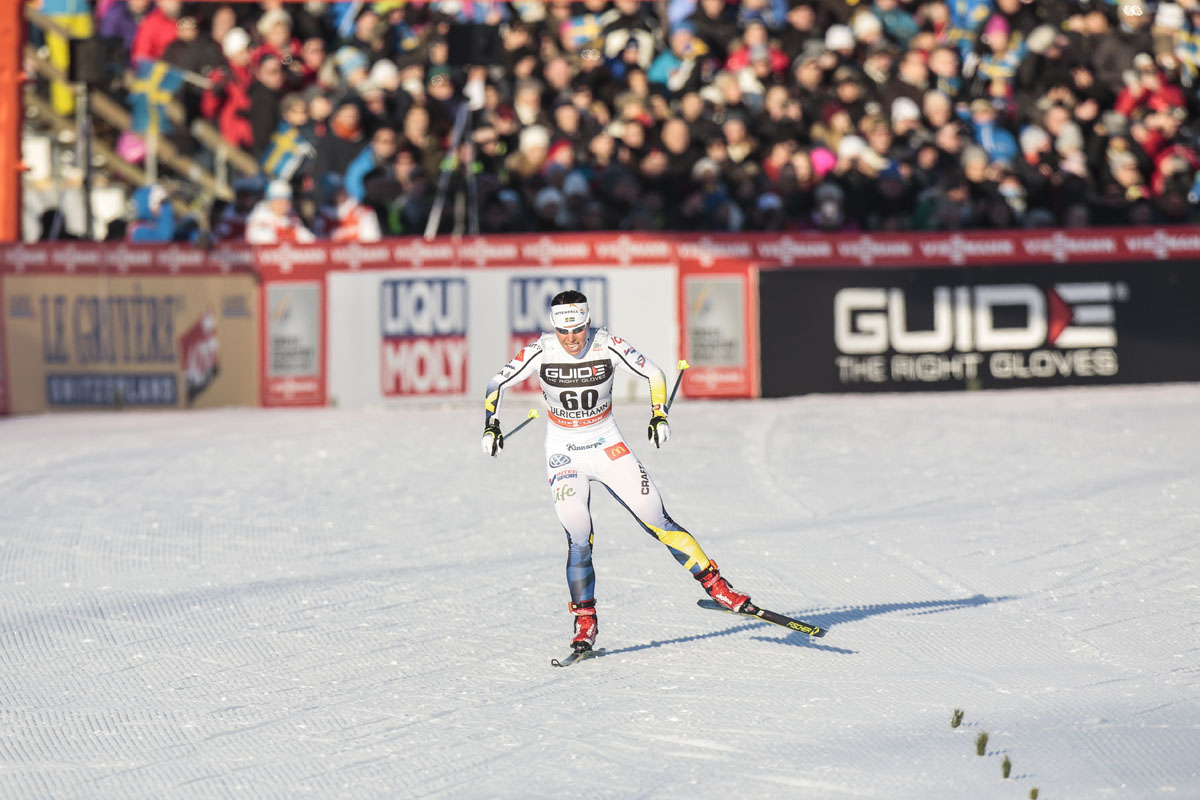
Charlotte Kalla racing to third place in the World Cup 10 k skate in front of a huge crowd in Ulricehamn, Sweden, on Saturday. (Photo: Fischer/NordicFocus)
Most of the time, the FIS Cross-Country World Cup visits towns and ski trails the racers already know well.
Some venues, like Norway’s Holmenkollen and Switzerland’s Davos, are visited every year. Others, like France’s La Clusaz, are on the schedule every few years but are still always popular.
“I’ve been on the World Cup for ten or eleven years, and we go to the same venues all the time,” the U.S. Ski Team’s Liz Stephen said.
But every once in a while, a new place is thrown into the mix. Last weekend it was Ulricehamn, a town of 10,000 people in southern Sweden.
The rave reviews from athletes, coaches and fans made it clear that Ulricehamn aced their World Cup hosting duties on the first try, giving other venues something to aspire to.
“This was the best World Cup venue of the year — by far,” Canadian skier Devon Kershaw wrote in an email. “The volunteers are so friendly and helpful and to have a five kilometer track with thousands and thousands of supporters lining the whole way was just so much fun. I’ve never raced in an atmosphere like this other than the legendary Holmenkollen.”
Teammate Alex Harvey – who won the 15 k and won bronze in the relay together with Kershaw, Knute Johnsgaard, and Len Valjas – put it this way: there were so many spectators that it was impossible to find a quite moment to oneself.
“On the warmup loop, there were people along the whole course,” Harvey said. “I couldn’t even take a piss in my warm up. Usually I take like six pisses in an hour, and I was like, ‘Man, I just can’t piss!’ There were people everywhere. It was fun. They were cheering my name the whole warmup, and the whole race too. In Scandinavia, they are always a well-educated crowd. This was like a championship crowd, like Falun or Oslo. It was awesome.”
The Ulricehamn organizing committee reported that there were about 30,000 people in attendance each day.
“If you go back and watch all the races (except maybe Lillehammer) this year, there have been like 1000-2000 spectators max,” Kershaw wrote. “Some venues had like 100 people, it seemed. So this was a big improvement… Bringing events to where people actually care and are passionate about the sport is always best, I feel. I mean, as an athlete to race in an atmosphere like this is really motivating. It looks way better on TV, and people are having a great time out there – which is what we want to promote as ski racing (I feel).”
King Carl XVI Gustaf even came to watch Sweden win bronze in the women’s relay and silver in the men’s relay.
“I watched the races on television yesterday and couldn’t help it [to come here],” he told the local newspaper. “I think I’ve had just as much fun as everyone else had here. It has been a fantastic day of skiing in Ulricehamn and extra fun to [hear] the athletes say they felt such powerful public support.”
Anchoring the women’s relay was Hanna Falk, who grew up in Ulricehamn. The King personally congratulated her.
https://www.instagram.com/p/BPkjYv8hUa0/
“It seems that all the skiers have been very pleased,” Falk told the Skövde Nyheter newspaper, according to a translation. “I’ve heard many good things from many different countries, so that makes me a bit extra proud.”
The venue’s success over the weekend is already being cited as a reason for other Swedish municipalities to invest into their ski infrastructure. For instance, some in Marcus Hellner’s hometown of Skövde, just over an hour north, would like to see a similar effort.
“It shows that hard work, persistence and courage pays off,” a commentator from Göteborg, the nearest major city, wrote. “That you do not have to be the biggest to be the best is also a nice reminder in these times of centralization … Among the city’s 10,000 residents, there were people who wanted to do something special, people who love their homeland, their sports and who love to show off their hidden treasure for the rest of the world. Talk about daring, talk about winning.”
Ulricehamn is already planning to host another World Cup weekend in 2019, and may continue getting awarded competitions if the success of their first event is any indication.
Meanwhile, the World Cup will return back to North America in March. World Cup Finals were awarded to Quebec after being moved from Tyumen, Russia, due to a doping scandal.
Some athletes felt that Canadian and U.S. ski fans could learn a thing or two about how to earn these rave reviews from athletes – the kinds of reviews that could eventually promote a venue to being a regular or semi-regular World Cup host.
“Of course the fans were wonderful in Quebec last year, but when you see the amount of people on the courses here in Sweden, it is an insane amount,” Stephen said. “I would like to put it our there as a challenge for fans who are close to Quebec to come out. Let’s try to be as big as Sweden there, because the more the athletes have fun… I heard everyone talking about the crowds, on every team, even the Norwegians. When that kind of talk happens, more World Cups are given to that city or host venue.
“All the fans who are thinking about maybe coming up, don’t think about it, just come,” she concluded. “It makes the atmosphere very appealing to the teams, and especially us athletes. It’s really fun.”
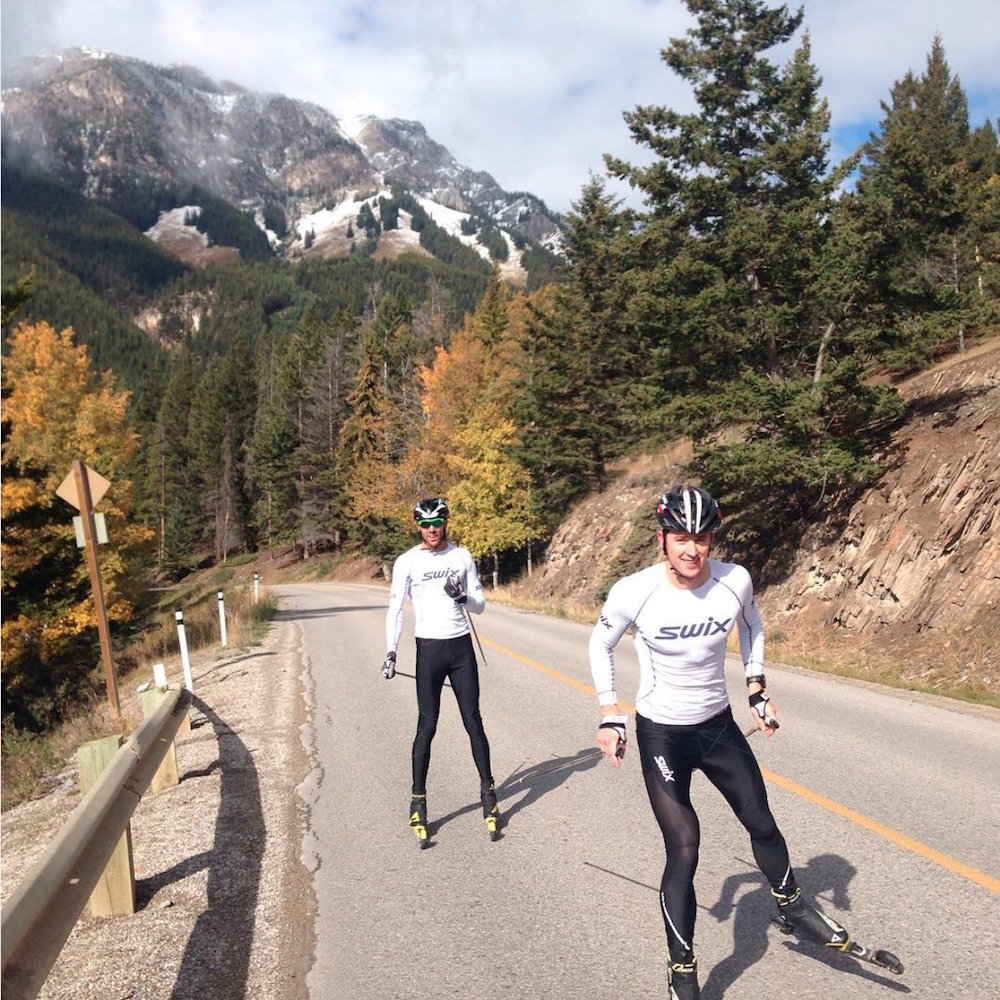
Julien Locke (right) rollerskiing up Mount Norquay in Banff, Alberta, with Canadian National Ski Team teammate Lenny Valjas. (Courtesy photo)
Welcome to “17 Questions for 2017″, where we are catching up with American and Canadian national-team members before the beginning of the winter season.
***
Julien Locke had an unusual distinction last year: he was the only athlete to podium at both Canadian and U.S. national championships, taking third in the skate sprints at both events.
The British Columbian also snagged NorAm wins and a 16th-place performance in the U23 World Championships sprint. Locke, now 23 years old, was named to Canada’s national team for the first time in May and has since relocated to Canmore, Alberta.
1. Biggest change in your life in the last five or so months since the ski season ended?
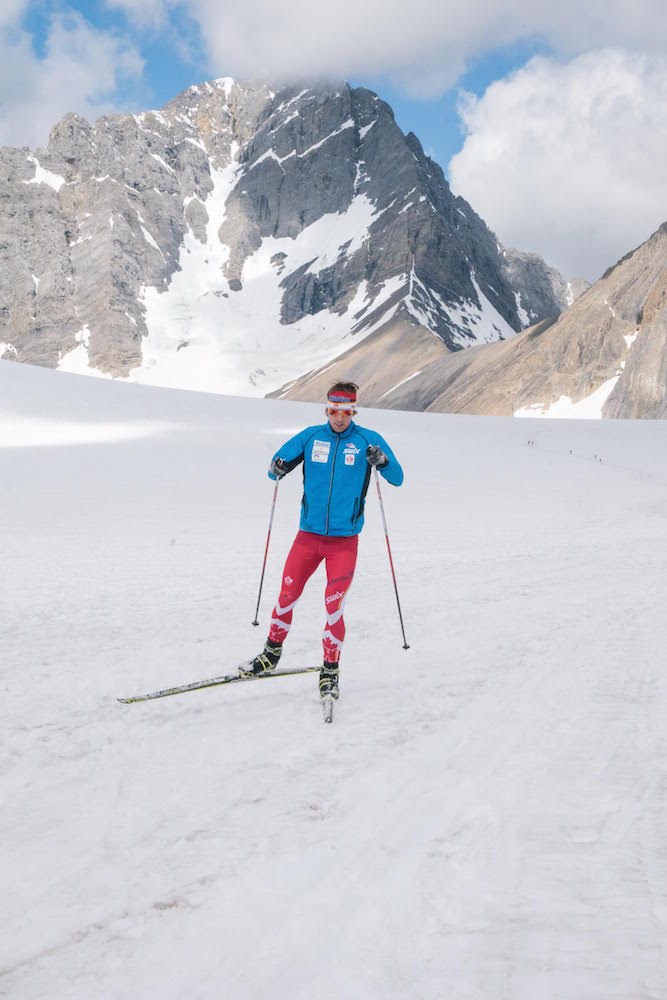
Locke getting some glacier time. (Courtesy photo)
This season is my first year on the Canadian National Ski Team. After 9 years skiing with the Black Jack Ski Team in Rossland, BC, I am now living in Canmore, AB.
2. Biggest change in your training?
Training this year has been quite consistent with what I’ve done previously with some small differences. There was a bit more travel this year with a NST camp in Quebec in late June. With World Cup sprint opportunities on the line on November 1/3, the training season has been adjusted in order to be in race shape a good month earlier than usual. Aside from that, not much has changed.
3. Major areas of improvement you’ve seen so far?
I am happy with where how my double pole has been this year. Last year I double poled nearly half of the classic races on the calendar and I feel quite solid as we get close to the upcoming season.
4. Whom you’ve been working closest with this offseason (coaches or training partners)?
I’ve been training a lot this year with the Canmore NST group of Len Valjas, Jess Cockney, Graeme Killick and Knute Johnsgaard.
5. Best trip in the last five months (and why)?
I just returned from a fantastic training camp in Park City. The NST guys all stayed up in Deer Valley at 2600m. Great roads for roller skiing, wonderful fall colours and nice weather (plus a few snowy days!) for training.
6. Favorite cross-training?
Julien Locke (r, Team Black Jack) challenges APU’s Eric Packer at around 400-meters to the finish of the semi-final for the men’s 1.5 k freestyle sprint at 2016 U.S. National Championships in Houghton, Mich. Locke went on to finish third overall.
I’m a big fan of everything we do for training: roller skiing, trail running, paddling and cycling.
7. Favorite non-athletic activity or pastime this summer?
I had a busy and productive summer with work (I am a web developer) and have recently launched a couple new sites. Check out the new Sovereign Lake Nordic website: www.sovereignlake.com
8. Song that was your jam this summer?
Josh Ritter’s Hello Starling album.
9. All time favorite race moment?
That is a difficult question! The highlight of last season was racing the Keski (Gatineau Loppet) and competing against Alex and Lenny in the Canadian Nationals sprint.
10. First thing you pack in your bag when you leave for Europe?
Race boots are the first priority when I am traveling. Everything else can be borrowed if needed, but it’s difficult to ski if you don’t have boots that fit. I always travel with either both my skate and classic, or just pursuit boots in my carry-on.
11. Venue/event you’re most excited to visit this season?
My main focus for the winter is the World Championships in Lahti, Finland. The pre-Olympic World Cups in Pyeongchang are the second priority.
12. Who will win the men’s and women’s World Cup titles this year?
Well… given the recent news from Norway, the start lists may look a bit different this year. I would bet on Sundby for the mens overall with Alex Harvey up there as well. For the women, Heidi Weng.
13. Biggest sacrifice you feel you’ve made choosing this career path?
I don’t feel that I have to make sacrifices in order to ski. I feel very fortunate to have the opportunity to train and compete full time.
14. If you could change one thing about your sport, what would it be?
It would be amazing for our sport in North America if we could bring skiing to the masses. Cross country skiing is such a great sport for all ages and the more excitement we can generate for young skiers, new recruits and the general public, the more we can grow our sport. It was fantastic to see the atmosphere at the Tour de Ski city sprints in Quebec last year and hopefully we can continue to have similar events in North America. Additionally, bring back the 50km Individual!
15. What did you have for breakfast this morning?
Bowl of oatmeal with yoghurt, fruit and honey and 2 poached eggs.
16. In 5 years, I’ll be ____?
… training hard at altitude for the last fall camp before the 2021/22 Olympic season begins.
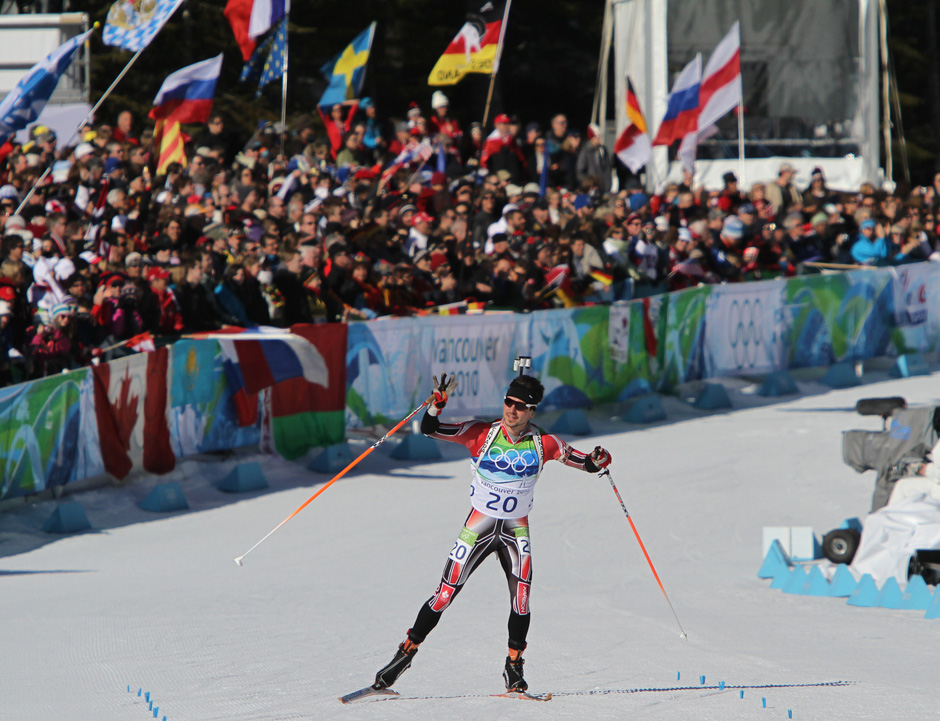
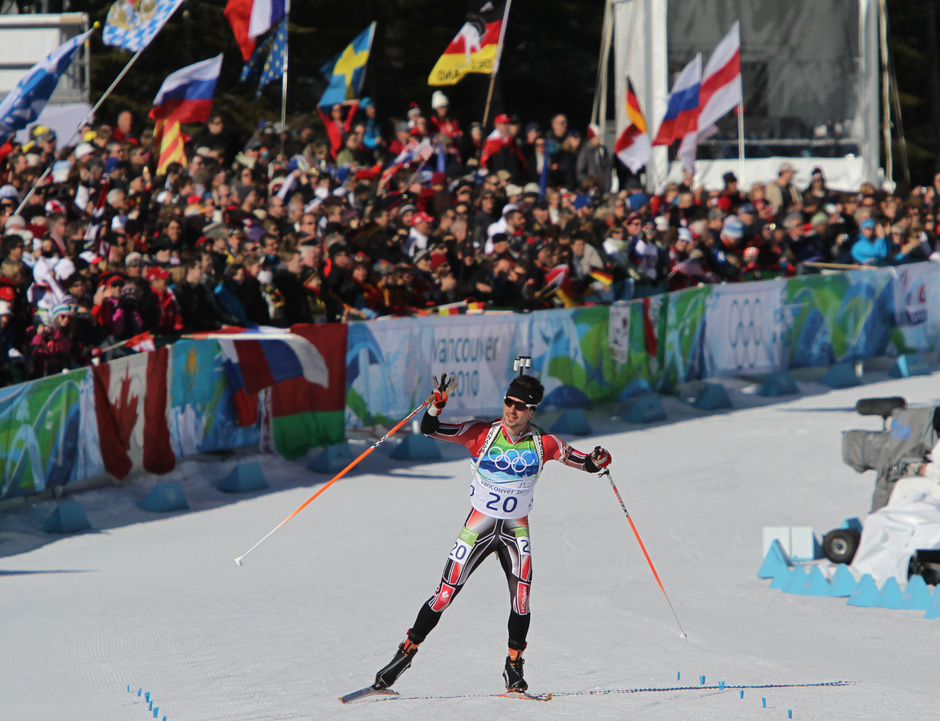
Jean Philippe Le Guellec waves to the fans as he finishes 30th in the Olympic mass start in Vancouver in 2010. In 2014, he broke his own record for a Canadian man, finishing 5th in the Olympic sprint. His longtime coach Jean Paquet has been let go by Biathlon Canada.
Note: After some miscommunications based on bad email addresses, we got in touch with Jean Paquet. We’ve apologized for the problems which prevented us from including his comments in our original story about the closure of Biathlon Canada’s Eastern National Team Center in Valcartier, which you can find here.
With Biathlon Canada’s closure of its national-team center in Valcartier, Québec, Jean Paquet’s position as a national-team coach was eliminated. The 1992 Olympian had worked with top biathlete Jean Philippe Le Guellec since 2007, but said that he saw the writing on the wall that his job wasn’t going to exist after the 2014 Olympics.
“They have been wanting to centralize in Canmore for quite a while,” Paquet said in an interview regarding Biathlon Canada. “Actually I can recall for at least five years they were working hard to centralize and bring Jean Philippe to Canmore. Every year from that time, I had to go a meeting in Calgary with Own the Podium [OTP] and Biathlon Canada to explain why it was good to keep Jean Philippe in Québec, because he didn’t want to move. I had to justify it every year.”
Much like Alex Harvey in cross-country skiing, Le Guellec was in more of a position to make those demands than others might have been. He turned in Canada’s best Olympic peformance by a male biathlete in 2010, finishing sixth in the sprint, and also became the first Canadian man to qualify for an Olympic mass start. In December 2012, he also became the first Canadian man to win a World Cup competition.
Le Guellec confirmed as much in an earlier email to FasterSkier, stating that he had insisted on staying in Québec, where he had bought a house with his (then-future) wife.
“So I knew that when Jean Philippe was done in 2014 that it would be impossible for me to justify it, even if Audrey Vaillancourt kept going I knew it would be impossible to keep the center, and to keep a coach here,” Paquet said.
A provincial team will still run out of Valcartier, coached by Martin Tremblay. Vaillancourt will train with that group when she is not in Canmore with the national team.
Paquet explained that he had still hoped to have a role with the organization, albeit in a different position. Le Guellec achieved finishes of fifth and 10th at the Games, which no doubt contributed to Paquet feeling that he was qualified.
“Chris [Lindsay, Biathlon Canada’s High Performance Director] told me at the Games that there could be a job opening in Canmore, for the second coach,” Paquet said. “I knew that they were going to keep only two coaches and that my position was eliminated. So I knew that. But I thought that there would be an opening in Canmore and that I could have the opportunity, if I wanted to, to apply for it.”
As of this spring, Biathlon Canada is only planning to have two coaches (Lindsay wrote in an email that OTP may grant them funding for a third coach; the OTP budget for biathlon will be revealed this summer). Current head coach Matthias Ahrens would retain his position. Paquet thought he could at least apply for the second position.
But in reality, current assistant coach Roddy Ward would be keeping that role.
“When I came back from the Games, a couple of days later Chris invited me to a year-end meeting in Canmore,” Paquet said. “I thought we were going to discuss something about the plans, but when I looked I realized that I was not in the plan. At all. So there was no future for me in the organization. That’s when I found out, when I realized, okay, what are the other options?”
Unemployment aside – Paquet said that after a grueling Olympic season, he needed a break and only just began looking for jobs – he is troubled by Biathlon Canada and OTP’s vision of centralization in Canmore. He thought it was a mistake to close the Valcartier national team center.
“If you don’t have that in the East, you know it takes a lot from the people from the East part to move to Canmore,” he said. “It takes a lot of money and a lot of effort. Québec is a great place for [finding talent]. It is a city of 750,000 people and it’s a great city to have training stuff there. I think that they are losing a big opportunity there…. Canmore, don’t get me wrong, it’s a good center and they have invested a lot in it. It’s a great center. But I think it would be good to have two centers.”
Paquet acknowledges that currently, Québec has few top senior biathletes. Only Vaillancourt met the national-team criteria this year, which was part of Biathlon Canada’s justification for closing the Valcartier training center: it didn’t make sense to have a training group of just one athlete.
“For sure, if you look now we are in a downturn,” Paquet said. “We only have Audrey and the other athletes are quite young. So there is a lot of time to go before we get a team or some other good athletes.”
But among other things, he said, having a national team coach to scout out talent is a big plus. And due to the cultural differences between Québec and English-speaking Canada, as well as the sheer distance between Valcartier and Canmore, retaining that talent might be more difficult in a fully centralized system.
“You know, Jean Philippe came from a program that went forward eight or nine years ago with Daniel LeFebvre, who went to recruit athletes,” Paquet said. “We got Jean Philippe from that initiative that was taken years ago. So you need to take some initiative, you need to turn some rocks … You are going to lose a lot of athletes along the way who would have been great potential. There won’t be the possibility to uncover them.”
However, Biathlon Canada has been pushing the centralization strategy for several years, as Paquet had previously explained. He described the interactions at the end of the season as not open to any possibility of maintaining the Québec center.
“It’s not, can we work something out, it’s not can we find some partnership,” he said. “For example when I was hired in the beginning, there was a partnership between Biathlon Québec and Biathlon Canada, they paid half and half and then we worked on the project with some other people. This is a thing that maybe could have been talked about. But there was absolutely no willingness to even talk about this.”
Although Biathlon Canada staff like Lindsay and Ahrens discussed the hope that Paquet might continue working with them on a contract basis for World Cup and IBU Cup tours this winter, Paquet seems to consider his relationship with the national team over. Looking back, he said he can be happy with the past, even if his future is uncertain.
“I’m really happy with the work these last few years,” he said. “I feel really blessed to be able to work with an athlete like Jean Philippe. He was honest, and faithful – he never looked anywhere else, he never questioned about the training. We always did it together. For me it was not a dictatorship, it was all about getting him on board and about discussion. I thought that was the only way to get him to buy into it, and it showed that it worked … I have no regrets.”
Jean Philippe Le Guellec of Canada headed in for fifth place in the 10 k sprint at the Olympic Games in Sochi, Russia, this winter. His longtime coach and training center have both been defunded by Biathlon Canada.
Biathlon Canada is closing its Eastern training center at Valcartier and has so far not renewed the contract of Jean Paquet, a coach with the team since 2007.
During the Sochi Olympics Paquet speculated that he might not have a job after this season. Biathlon Canada High Performance Director Chris Lindsay confirmed last week that the position Paquet formerly held has been eliminated, although Paquet did not respond to repeated requests for comment (Edit: he now has; see the interview here).
“Following our high performance plan, the program that we had been running under Jean Paquet will no longer continue,” Lindsay said. “With JP [Le Guellec]’s retirement, and with only one Québec athlete making any of our national team criteria, we do not feel that we can justify, unfortunately, having a full-time coaching position there.”
While Lindsay said that the board of directors and Executive Director Joanne Thompson had been involved in the decision, Thompson declined to comment, writing in an e-mail that decisions on staffing and training centres wouldn’t be finalized until after April 28th.
However, national team head coach Matthias Ahrens also confirmed the changes.
“It is correct that the Jean’s National Team Coach position was not renewed based on that we closed the National Training Centre in Quebec which was primarily based on Jean Phillipe LeGuellec who retired this season,” Ahrens wrote in an e-mail.
According to Lindsay, Biathlon Canada will at the moment function with two coaches, a reduction from the three-man staff of last season. Matthias Ahrens will remain head coach and Roddy Ward will stay as an assistant coach. As with all things Canada, funding relies on Own the Podium, a non-profit which allocates money based on its assessment of a sport’s medal potential.
“We find out our 2014-15 funding levels this summer, and we are hopeful that OTP will see the benefits of a third coach in the program,” Lindsay later wrote in an e-mail, although he did not elaborate on whether that would be Paquet.
Paquet’s Work
Paquet led the training group of senior Québec athletes out of the Centre d’Excellence Myriam Bédard, in Valcartier. The site also houses Québec’s provincial team of junior biathletes and seniors who are not part of the national team, coached by Martin Tremblay.
Paquet is perhaps best known for his role as the day-to-day coach of Jean Philippe Le Guellec, who owns Canada’s best Olympic finishes by a man with sixth place in Vancouver and fifth place in Sochi. Le Guellec was close to doing even better, but while leading the 2014 Olympic pursuit he crashed on a dangerous corner and broke a ski. He had long planned to retire after the Sochi Games.
“In the last two years, we covered immense ground to be able to achieve the best performances possible at the Games,” Le Guellec, who had not heard about Paquet’s contract, wrote in an email. “We literally worked on many aspects even up until the last day before the first race. With the way that I was able to ski along the fastest in the world and outshoot the field in many races, it felt like I was at the top of my game.”
Two other mainstays of Québec biathlon, 2010 Olympian Marc-Andre Bédard and Claude Godbout, did not meet national team criteria after this season. Their plans are not yet concrete, but Bédard told FasterSkier earlier this spring that “we still want to race and we plan on doing a different approach this year, we’ll both do what we want more then what we’re suppose to, so that might be interesting.”
That leaves Audrey Vaillancourt as the lone Québec athlete on the national team. The Open European Champion at 15 k this season, Vaillancourt wrote in an e-mail from Peru, where she’s spending her spring break from training, that she was unsure what was happening with the Québec center.
“I don’t know all that much about the ‘official’ status of the training center for next year, but I know for sure that it won’t affect the support I get since my provincial coach/team will still be training there, and I will also spend a lot of time in Canmore with the rest of the national team,” she wrote.
Vaillancourt and Le Guellec were recently honored as Biathlon Canada’s Athletes of the Year.
Meanwhile, Paquet – an eight-time World Championships competitor and 1992 Olympian – was nominated for Gala Sports Québec’s international coach of the year award, up against cross country ski coach Louis Bouchard and canoe/kayak coach Frédéric Jobin.
That underlies the respect he has earned for his athletes’ performances, which Le Guellec elaborated on.
“Jean retired from racing in 2005,” he explained. “I could imagine making the leap to coaching World Cup athletes is quite the learning curve when he took us up in 2007. He’s very reserved, so he never was one to speak from a first person point of view, or to impose his own point of view as being gospel truth, which I really respect. But I have no doubt a lot of his own experience and learning as an athlete was transferred to his teachings as a coach. I would say he definitely had a big role in my approach to training and psychology of training.”
Centralization Push
According to Lindsay, the loss of Paquet’s position is due at least in part to OTP.
“Jean’s position was funded by OTP for the sole purpose of coaching JP,” Lindsay wrote in an email. “With JP retiring the funding has ended.”
However, Lindsay also told FasterSkier that closing the Québec training center (and with it Paquet’s position) was not a financial decision.
“I would characterize this as a performance-based decision,” he said. “We have been over the past two seasons working at centralizing our training system as much as possible in order to provide the best opportunities for success for our athletes, and a significant part of that has been trying to get as many of the athletes centralized as we possibly can.”
One of the hallmarks of Lindsay’s tenure has been the push for centralization: having all of the country’s athletes together in one place, in this case Canmore, and on one training program. He says is the best ways to make a small group of geographically disparate athletes faster.
“We’re not dealing with a huge number of athletes period, so having all of our national team athletes together and able to train together on a daily basis, we feel is an important part of continuing to provide a challenging environment,” he said.
But for Le Guellec, Paquet may have provided some of that fire.
“He was always slightly more demanding towards me than I was with myself,” Le Guellec wrote. “Which simply showed he really believed in my ability. Being able to see that shared ambition year in and year out really helped me grow … He’s really helped me work even harder and harden up!”
Lindsay said he believes in the value of a daily group training sessions for athletes at the international competition level – and that group, he finds, may no longer exist in Québec.
Lindsay said that the organization’s high performance plans for the last two years have been moving in the direction of eliminating the Valcartier center. Some resources, like electronics and equipment, will be transferred to Tremblay’s provincial team, where Vaillancourt will train when she’s away from Canmore and which supports a strong junior community.
“If we were in a situation where we were in, say, central Europe, we would have the ability to meet up with other athletes on a regular basis, and unfortunately this just doesn’t happen,” Lindsay said. “Centralization can provide that. And the choice of Canmore as the place to do that is pretty easy.”
Le Guellec does not agrees that centralization is the right approach.
“Biathlon Canada approached me a few times to move out West,” Le Guellec wrote. “I had already bought a house with my -[future] wife at the time and I wasn’t going anywhere after making that commitment … Too many variables outside of training environment have to be also considered and [I feel] to not consider them is short sighted on the elements that create the big picture. Which is why I chose to train at home.”
However, there may yet be a role for Paquet with the organization next year. For instance, Paquet was a mainstay on the World Cup circuit, and may be able to gain a position as a coach there if not as a coach of a daily training group. Lindsay wrote that the goal was to have two coaches at each weekend of racing, but that Ahrens and Ward should not have to attend every race through the entire grueling World Cup season and that the organization would be looking for “relief” coaches.
“Since he was a valued staff member on our World Cup tours, we still hope to have him as a contracted coach on the IBU Cup and some World Cup tours,” Ahrens said of his longtime co-coach on the circuit.
Le Guellec, for one, also hopes that Paquet can find another meaningul role in the organization.
“That is really a shame to put someone like him aside,” Le Guellec wrote. “It’s not like we have tons of resources of his level in Canada. Although, this could also be of his own decision. In which case, I feel the same way, but I also respect his decision.”
Jean Philippe Le Guellec in the final individual competition of his long international career.
FasterSkier’s coverage is made possible through the generous support of Swix.
Note: This is another in our growing library of bilingual articles. For the English version, scroll down.
KRASNAYA POLYANA, Russie – Jean-Philippe Le Guellec a terminé au 10e rang de sa dernière course individuelle aux Jeux olympiques de Sotchi. Après avoir fini cinquième dans le sprint 10km en ouverture des Jeux, la malchance a frappé Le Guellec avec une chute dans la poursuite et une course en demi-teinte au 20 km individuel.
Malgré tout, ces résultats à Sotchi ont été assez bons pour lui permettre de gagner sa place dans l’épreuve de départ de masse de 15 km aujourd’hui, sa dernière course individuelle, pas seulement sa dernière aux Jeux olympiques, mais également au niveau international. En effet, Le Guellec prendra sa retraite après les JO et ne retournera pas sur le circuit de la Coupe du monde pour compléter la saison.
« Pour moi ça se termine ici les courses individuelles », a dit Le Guellec après la course. « La raison étant que je voulais vraiment finir à la maison pour les Championnats canadiens. Biathlon Canada a mis les Championnats canadiens en même temps que les Coupes du monde. Donc, ça ne valait pas la peine pour moi d’aller en Europe pour faire une Coupe du monde et revenir après ça dans l’Est. Je fini à la maison. »
Il espérait sortir un très bon résultat pour conclure sur une bonne note une carrière exceptionnelle. Dès les premiers tours de ce départ de masse, Le Guellec était sur la bonne voie pour réaliser une grande performance. À chacun des tirs couchés, il était le deuxième plus rapide. À la mi-course, il occupait toujours la deuxième place, en tête du peloton à la poursuite d’Emil Hegle Svendsen, le Norvégien qui a finalement triomphé quelques centimes devant le Français Martin Fourcade.
Il semblait en bonne position pour la bataille pour une médaille tout au long de la course. « Au niveau du ski je me sentais quand même en forme, ce n’était pas la grosse forme, mais ce n’était pas pire considérant les conditions, », a commenté Le Guellec.
Le Guellec trying to push it over the Sochi course’s high point.
C’était avant qu’une erreur d’inattention ne vienne lui compliquer la vie à son troisième passage au pas de tir. « Je ne fermais pas mes caches-neiges et avec la neige qui tombe présentement comme on le voit ça a fait glacer ma mire avant », a dit Le Guellec. « Quand je suis arrivé au premier debout, j’avais rentré mon chargeur, chargé une balle et je me suis rendu compte que je ne pouvais pas tirer parce que ma mire était obstruée par la glace. »
Il a dû sortir la balle, souffler dans sa mire pour corriger son erreur. Habituellement, Le Guellec prend 23-24 seconds pour abaisser les cinq cibles lors d’un tir debout. Aujourd’hui, ça lui a pris 42 secondes. Son entraineur Jean Paquet a dit à FasterSkier qu’une médaille était réalisable aujourd’hui, mais Le Guellec devait pour ce faire tirer « avec vitesse et sans erreurs. » Malheureusement, ce n’était pas « avec vitesse ».
« Après ça avec une cible de ratée au dernier pas de tir aussi avec la forme que j’ai aujourd’hui, c’est sûr que c’est coûteux », a expliqué Le Guellec.
Il n’avait pas d’amertume dans sa voix quand il a commenté l’excellent résultat de Brendan Green qui a terminé en 9e position tout juste devant lui. « Brendan avait l’avantage de voir où on était et il a poussé plus fort en haut de la montée. Ça fait qu’il est arrivé vraiment rapidement dans la descente, il avait plus de momentum finalement pour passer en avant. »
Terminer dans les dix premiers en compagnie d’un coéquipier en plus, ce n’est pas la pire des façons de terminer. Mais… « En tout et partout, c’est sûr que j’aurais préféré arrivé neuvième, mais de traverser la ligne avec Brendan » il a rigolé.
Le relais masculin samedi est la dernière épreuve de Le Guellec. Une fois les Jeux de Sotchi complété, il retournera au Canada pour terminer sa carrière. Il trouve important de boucler la boucle parmi les siens. « Ça l’a un petit côté émotionnel si on veut, mais je voulais finir à la maison parmi mes amis et la communauté canadienne de biathlon. Finir à la maison, Charlo [NB] c’est là que j’ai fait les Jeux du Canada et c’est l’année où je me suis joint à l’équipe nationale », a dit Le Guellec faisant référence à la tenue des Championnats canadiens à Charlo au Nouveau-Brunswick.
Questionné sur les conditions de neige particulières dans la station russe, il a admis ne pas avoir été trop surpris. « Ça, c’est vraiment Sotchi, la dernière semaine et demie ce n’était aucunement représentatif. C’est comme ça ici d’habitude et là on est dedans! », faisant éclater de rire les journalistes.
Le brouillard a davantage déjoué ses plans. «Ç’a tellement été une montagne russe les derniers jours parce qu’arrivé ici, tu t’attends à courser et tu ne courses pas et après ça c’est repoussé 5 heures plus tard. Tu arrives, non on course pas ça était ça 3-4 fois. »
* * *
Jean Philippe Le Guellec of Canada has finished 10th in his last individual race of the Olympic Games in Sochi. After having finished fifth in the 10 k sprint to open the Games, bad luck hit Le Guellec with a crash during the pursuit and a poor race in the 20 k individual.
Despite all of this, the results in Sochi were good enough to earn him a place in the 15 k mass start today, which is limited to 30 entrants. It would be his last individual race not only at the Olympics, but also at the international level. Le Guellec will retire after the Olympic Games and will not return to the World Cup to finish the season.
“For me this is the end of individual competition,” Le Guellec said after the race. “The reason is that I would really like to finish at home for Canadian Championships. Biathlon Canada is holding Canadian Championships at the same time as the World Cup. So it isn’t worth it for me to go to Europe to do the World Cup and then to come back after that. I will finish at home.”
He hoped to have a good result to finish his exceptional career on a good note. And for the first laps of the mass start, Le Guellec was on track to have a great performance. In each of his prone stages, he had the second-fastest shooting time. Halfway through the race he was in second place, at the head of a chase pack hunting down Emil Hegle Svendsen, the Norwegian who finally beat Martin Fourcade of France by a few centimeters for a gold medal.
It seemed like a good position in the fight for a medal. “With the level of my skiing I felt like I was in shape, it wasn’t the best shape, but it wasn’t the worst either considering the conditions,” Le Guellec said.
That was before an careless error complicated life on his third trip to the shooting mats.
“I didn’t close the cover on my sight and with all the snow that was falling like one saw, this froze over my sight,” Le Guellec explained. “When I arrived at the first standing stage, I put in the magazine, loaded a bullet, and then realized that I couldn’t shoot because my sight was totally blocked by the ice.”
He had to remove the bullet and blow on the sight to melt the ice and correct his error. Usually, Le Guellec takes 23 or 24 seconds to go through the shooting process in a standing stage. Today, it took him 42 seconds. His coach Jean Paquet told Fasterskier that amedal would have been possible today, but Le Guellec would have had to shoot “very fast and clean.” Unfortunately, this wasn’t very fast.
“After this, and with a missed target in the last stage too, and with the form that I have today, it was definitely costly,” Le Guellec admitted.
There was no hint of bitterness in his voice when he described the excellent result of his teammate Brendan Green, who finished in ninth position just ahead of him, after overtaking him on the final loop.
“Brendan had the advantage of seeing where everyone was and he pushed harder at the top of the hill,” Le Guellec said. “This meant that he was going very fast on the downhill, and he had more momentum at the end to pass the ones who were in front of him.”
With a teammate and in the top ten, that’s not a bad place to finish. Except… “all in all, I sure would have preferred to be ninth, but to cross the line with Brendan,” Le Guellec laughed.
The men’s relay on Saturday will be the last race for Le Guellec. Once the Olympics are over, he will return to Canada to finish his career. It’s important to him to complete the circle with his friends.
“This is maybe a little more emotional than you like, but I would like to finish at home among my friends and the Canadian biathlon community,” Le Guellec said. “To end at home, Charlo [New Brunswick] is where I did the Canada Games and it was the year when I joined the national team.”
Alex Harvey of Canada celebrates after winning the World Cup sprint in Szklarska Poreba, Poland, in January. Photo: Fischer/NordicFocus.
SOTCHI, Russie – Alex Harvey est maintenant le meilleur fondeur canadien, il est présentement classé huitième sur le circuit de Coupe du Monde et récent gagnant du sprint au Szklarska Poreba. Il est maintenant à Sotchi, avec l’équipe nationale s’entrainant pour les Jeux olympiques qui commenceront samedi. On lui a posé quelques questions lors d’une conférence de presse tenue aujourd’hui.
FasterSkier : Jean-Philippe Le Guellec et toi vous êtes peut-être les plus grands espoirs pour une médaille canadienne dans les sports nordiques. Que peut-on dire sur l’état des sports nordiques au Québec en ce moment?
Alex Harvey : Au Québec, c’est vraiment bon, les inscriptions pour les clubs augmentent chaque année. Les licences de compétition chez Ski de Fond Québec aussi augmentent chaque année. Depuis quelques années, c’est le Québec qui est la province gagnante au cumulatif des Championnats canadiens.
Quand j’étais jeune, le Québec était troisième ou quatrième parfois. Maintenant, le Québec est redevenu premier au pays. Je pense qu’à cause de Jean-Philippe et moi, et aussi de plusieurs autres facteurs, il y a un effet boule de neige. Les jeunes choisissent le ski de fond ou le biathlon de plus en plus, au lieu du hockey ou des autres sports comme ça.
FS : Oui, mais il n’y a pas beaucoup de Québécois sur les équipes nationales maintenant. Pourquoi? Comment peux-tu expliquer ça?
AH : Je pense qu’il y avait eu une certaine période morte, mais maintenant les jeunes juvéniles, juniors sont forts. Par exemple, cette année aux Championnats mondiaux juniors, sur neuf athlètes, je pense qu’il y avait six Québécois. Deux tiers de l’équipe étaient donc du Québec. C’est vraiment une vague de jeunes, il faut attendre un autre ou peut-être même deux cycles olympiques avant d’avoir des Québécois en ski de fond et en biathlon, mais je pense que ça va fonctionner.
FS : Après les Jeux olympiques, Jean-Philippe prendra sa retraite du sport. Est-ce que vous inquiétez de l’absence potentielle d’athlètes seniors, qui peuvent être des modèles?
AH : C’est certain que Jean-Philippe a fait une grosse différence au niveau du biathlon, mais moi je prévois faire un autre cycle olympique. Il y a plusieurs jeunes seniors au Québec en ski de fond qui s’en viennent sur l’équipe nationale – alors pour nous en ski de fond, ce n’est pas trop inquiétant.
FS : Si vous pouviez gagner une médaille, pour Québec – quels seraient vos sentiments personnels ?
AH : C’est une médaille c’est pour le Canada en premier ! Pour nous les hommes en ski de fond, on n’a jamais remporté une médaille. Pour le pays se serait bon, évidemment pour le Québec aussi ça serait exceptionnel.
* * *
Alex Harvey is currently the top Canadian cross-country skier, ranked eighth in the World Cup overall score and the winner of the sprint in Szklarska Poreba. He is now in Sochi with the national team, which is preparing for the Olympics which begin on Sunday. We asked him a few questions at the end of a press conference today.
FasterSkier: Together with Jean Philippe Le Guellec, you are the best hopes for a Canadian medal in nordic sports. What can you say about the state of nordic sports in Quebec today?
Alex Harvey: In Quebec, it’s truly great, sign-ups to clubs are increasing every year. And competition licenses in Ski de Fond Quebec are increasing every year as well. For the last several years the cumulative score at Canadian championships has been won by the province of Quebec. When I was young, Quebec was third and sometimes fourth. Now it has become again the best in the country. I think that with Jean Philippe and me, and some other factors as well, it has been a real snowball effect. Young kids choose cross country skiing more, or biathlon, rather than hockey or other sports.
FS: That’s true, but at the moment there aren’t so many Quebec skiers on the national team. What happened with that?
AH: I think there was a certain dead period, but now it’s all about the youths. Juveniles, juniors. Like this year at World Junior Championships I think it was nine athletes who were brought, of which six were Quebecois. That is two thirds of the team who were from Quebec. It’s truly a wave of juniors. So we have to wait one or maybe two Olympic cycles before we can have these Quebecois in skiing or biathlon, but I think it will work.
FS: Jean Philippe is retiring at the end of this season. Are you worried that there will not be so many senior athletes, who can be role models?
AH: It’s certainly true that Jean Philippe has made huge difference in the level of biathlon, but for me I think I can summit another Olympic cycle. And the older juniors from Quebec will soon be coming onto the national team – so for us in cross country skiing, I don’t think there’s much reason to worry.
FS: If you could win a medal for Quebec – what would your feelings be?
AH: A medal is for all of Canada, first! For us in cross country skiing, we have never brought home a medal. Thus for the country it would be great, and obviously for Quebec it would be exceptional.
The newest addition to Canada’s World Cup wax team, Simon Boisvert, shown previously assisting the Quebec-based Pierre-Harvey Training Centre. (Photo: Frederique Vezina)
(Scroll down for French version/Version française disponible au bas de la page.)
***
Simon Boisvert is the new guy on the Canadian National wax technician’s team. At 21, the young man from Mont-Sainte-Anne, Quebec, was selected at the beginning of the summer as an apprentice wax tech. Over the winter, he will have the great opportunity, throughout the World Cup circuit, to learn the job with some of the best.
Last spring, Cross Country Canada (CCC) posted a job notice on its website advertising for an apprentice wax technician. Boisvert’s sister saw the listing and told him he was a good candidate and should apply. Following her advice, he sent his résumé. A few weeks later, he received a call from CCC High-Performance Director Tom Holland, who delivered the good news.
“When I got the call, I was really happy,” Boisvert said last week on the phone from Canmore, Alberta. “It was one of my dreams that came true. I’ve never been to Europe and now I’ve got the opportunity to travel all winter around.”
His experience as a wax tech is limited and recent, which isn’t surprising considering his age. Nevertheless, he can count on a good background and knowledge of cross-country skiing. Boisvertwas a member of the Mont-Ste-Anne Nordic Ski Club (Club Nordique) and competed until age 17. He also lived in the same neighbourhood as World Cup skier Alex Harvey and senior national team member Frédérique Vézina, giving him the edge of knowing several top skiers from an early age.
First Steps
Two seasons ago at the 2012 Canadian Ski Nationals right in his backyard at Mont-Ste-Anne (M.S.A.), Boisvertfirst worked as a wax technician for his local club. He hasn’t stopped since. Boisvertspent last season as a wax tech for Club Nordique providing technical support at the Quebec Cups, some NorAms and nationals in Whistler, B.C.
His biggest challenge came at U.S. SuperTour Springs Series in California at the end of last season. For this set of races, he was responsible for several athletes from the Pierre-Harvey Training Centre (CNEPH) and NDC Thunder Bay. Everything went well and this spring, he was able to count on the help and recommendation of CNEPH head coach and national-team assistant, Louis Bouchard, when he applied.
It did not take Boisvertlong to find his vocation. “I really loved the job as a wax tech last year and I decided to do that for a living,” he said.
One could say the assistant position is a big promotion for Boisvert, who as been selected to complete Canada’s wax team.
“I do not have much experience, but I have the desire to learn and when I go for it,” he said. “I always put 100 percent of myself into it and I give 110 percent. I would have done the job anyway, even if I didn’t get paid this winter.”
His Winter Schedule
On Nov. 21, Boisvertwill leave for Scandinavia for the start of the World Cup season in Finland. He plans to stick around Europe for the Tour de Ski multi-stage race starting in late December, but won’t be around for the Olympics in Sochi, Russia. Instead, he was assigned to assist the Canadian B-team (including select skiers, U23 and older) on the Scandinavia trip in February.
Boisvertjoins an experienced team of technicians and expects to learn a lot, including the tricks and tips of waxing at this level, and ways to work within the team. He said he feels priviledged to work with Harvey, Bouchard and the rest of the World Cup team.
For now, he’s committed to a one-year contract, but at the end of the season, if his evaluations go well, he might sign on for a couple more years.
This season, Canada will also have a huge, brand-new waxing truck — putting the team on par support-wise with powerhouses like Norway and Sweden.
About Stéphanie Drolet:
A former competitive cyclist and cross-country skier on Canada’s National Junior Team, StéphanieDrolet is a Canadian contributor at FasterSkier. She was a forerunner at the 2010 Vancouver Olympics and competed at the 2008 World Junior Championships. A journalism student at Laval University in Quebec, Stéphanie still skis and rides for fun and to stay in shape. Don’t be surprised to find a few of her articles in French!
***
(En français)
Simon Boisvert est le nouveau venu dans l’équipe de technicien de fartage canadienne. À 21 ans, le jeune homme originaire du Mont-Ste-Anne a été sélectionné au début de l’été comme apprenti-farteur. Il aura donc la chance tout au long de la saison de Coupe du Monde d’apprendre le métier aux côtés des meilleurs.
Le printemps dernier, Ski de fond Canada affichait, sur son site internet, une offre d’emploi comme apprenti-farteur. La soeur de Boisvert a vu l’offre et lui a dit de tenter sa chance, suivant son conseil, il a envoyé son dossier. Quelques semaines plus tard, il a reçu un appel de Tom Holland, directeur de la haute performance de SFC lui annonçant la bonne nouvelle.
« Quand j’ai reçu l’appel, j’étais vraiment content, c’était un de mes rêves qui se réalisait, je n’ai encore jamais été en Europe et là je vais me promener tout l’hiver », a mentionné Boisvert en entrevue téléphonique de Canmore en Alberta.
Ses expériences comme farteur sont assez limitées et récentes, normal, compte tenu de son jeune âge. Néanmoins, il peut compter sur un bon bagage de connaissance du ski de fond. En effet, Boisvert a lui-même été membre du Club Nordique Mont-Ste-Anne (M.S.A.) et il a concouru jusqu’à l’âge de 17 ans. De plus, il côtoie, depuis qu’il est tout jeune, des skieurs élites comme Alex Harvey et Frédérique Vézina.
Ses débuts comme farteur
C’est lors des Championnats canadiens de 2012 au Mont-Ste-Anne, il y a deux ans, dans sa cour arrière, qu’il a fait ses premiers pas en étant technicien de fartage pour le club local et depuis il n’a jamais arrêté. Boisvert a passé la dernière saison comme farteur pour le Club Nordique M.S.A. assurant le support technique lors des Coupes Québec, certaines Coupe NorAm et les Championnats canadiens.
Son plus gros défi a été lors des Springs Serie au Lake Tahoe en fin de saison, alors qu’il avait plusieurs athlètes du CNEPH sous sa charge pour des courses d’importance. L’expérience californienne s’est bien déroulée et il a pu compter ce printemps sur l’appui et la recommandation de Louis Bouchard, entraîneur-chef du CNEPH et assistant-entraîneur de l’équipe nationale, auprès de la fédération.
Il n’a pas fallu longtemps à Boisvert pour trouvé sa vocation. « J’ai vraiment eu la piqure l’an passé et j’ai décidé de faire ça de ma vie », a-t-il affirmé.
Quelqu’un pourrait dire que c’est une grosse promotion que Boisvert a obtenue en étant choisi pour compléter l’équipe de techniciens de SFC.
« Je n’ai pas beaucoup d’expérience, mais j’ai le goût d’apprendre et quand je m’y mets, je m’y mets à 100 % et je me donne à 110 %. Je n’aurais pas été payé cet hiver et je l’aurais fait quand même »
Son horaire hivernal
Il a son billet d’avion en poche avec un départ pour la Scandinavie le 21 novembre pour le début de la saison de Coupe du monde en Finlande. Après une pause de deux semaines au Canada, il sera au Tour de ski – une course par étapes – qui commence à la fin du mois de décembre. Les Jeux olympiques ne sont cependant pas à son programme, il sera toutefois attitré au tour en Scandinavie avec une équipe canadienne B (qui reste à déterminer) au mois de février.
Boisvert se joint à une équipe de fartage d’expérience et il profitera de cette première année pour emmagasiner le maximum de connaissances, apprendre toutes les subtilités et trucs, de même que de s’intégrer au sein de l’équipe.
Pour l’instant, il a signé un contrat d’un an qui sera réévalué à la fin de la saison, mais si les dirigeants de l’équipe son satisfait de son travail, il est probable qu’il renouvelle pour quelques années supplémentaires.
Cette saison, le Canada pourra compter sur une nouveauté de taille, un immense camion de fartage, ainsi l’équipe sera en mesure de rivaliser à armes égales avec les grosses puissances norvégienne et suédoise.
J.P. LeGuellec finished 10th overall in the 20 k individual at 2013 World Championships. Photo: Nordic Focus/Biathlon Canada.
A lot of athletes, if you ask them how long they’ve been working towards the Olympics, might say their whole lives. Or, if they’re veterans or barely missed the cut last time around, they might say the last four years.
For Jean Philippe Le Guellec, 2014 will really be the culmination of something special: four years ago in Vancouver, where the Canadian biathlete placed sixth in the sprint, he decided that he would keep competing until Sochi, and that’s it.
More than three quarters of the way there, Le Guellec is still near the top of his sport – he won his first World Cup race last season – and is sticking to his plan even though his recent success could easily have enticed someone else to keep racing.
“I’ll be starting a family, for one, and then going back to studying for two, and then seeing how that develops,” he said in an interview last week. “I don’t have any concrete plans for now. I’m looking to study in business administration at university and hopefully a little background graphic designing as well. Hopefully a line of work within these two parameters.”
Having known for four years that this would be it does add a bit of motivation, and it’s making the upcoming season even more exciting and meaningful for the Quebec-based athlete.
“Knowing the end is approaching especially allows me to indulge and appreciate every aspect of the training/racing life I’ll be experiencing this year,” he later wrote in an e-mail. “I find pretty cool how much I’ve evolved as an athlete even over the last two years (definitely hugely since 2010).”
With all that in mind, Le Guellec has made major changes this year to improve himself as a biathlete. It began with a two-week camp in Canmore with Swedish skier and technical coach Peter Larsson.
“We were just looking at video from how I was skiing just a year ago at World Championships in the Czech Republic, and there’s a pretty drastic change,” Le Guellec reports. “We’ve pretty much tried to go here and there to better our preparation. It’s refreshing, and it’s motivating in general to be training this year with all these changes.”
He’s also shifted some aspects of his shooting and increased his focus on his strength program. And After the spring camp with Larsson, Le Guellec also headed to Canmore in July, where he came out on top in the team’s annual multi-discipline “testival” (Rosanna Crawford won the women’s rankings).
Right now, he’s in Ramsau, Austria, skiing on the glacier with the men’s “A” team: Brendan Green and Scott Gow. Scott Perras was supposed to attend as well, but as he recently wrote on his FasterSkier blog, he has been struggling with form and needs to rest and carefully manage his training.
“It’s the smallest team ever,” Le Guellec said.
But that doesn’t mean it’s not a good one. It’s not just Le Guellec who has made changes: the whole squad, he says, is faster and stronger than before and making significant changes. Look for a different Canada next season, not the one that seemed to fizzle as the 2013 season drew to a close.
“I’ll be really curious to see how it goes this year,” Le Guellec said. “Guys are getting really strong and it won’t be a one-man show this winter. With Brendan back on full throttle and Scott Gow, who shows a lot of potential and Scott Perras had some good results last year too, I think the men’s team will be doing really well this winter.”
On the Dachstein glacier, the three men mostly train separately, navigating the trains of hundreds of skiers. It’s tough enough to ski at the right level on your own, without having to match paces with a teammate.
“If you manage to squeeze in in between packs, then you can do your own thing,” Le Guellec explained. “But sometimes you get caught up and that gets annoying because you have to wait for the proper time to be able to pass. Everyone is going super slow and you can’t just outright sprint, because then you’ll blow up.”
Why might that be? The Dachstein sits at 2700 meters above sea level, or almost 9,000 feet. The town of Ramsau itself is at just 3,300 feet, so the team avails itself of a local biathlon facility for afternoon training. There, the trio of Canadians can actually train together, with a lot of attention from the coaching staff.
When the team arrived, the glacier was perfect, Le Guellec said. Sparking, sunny, with mid-January-like conditions. Then, the trademark fall rain set in. While it was never too soggy or foggy to head up the mountain, things got a little less enjoyable.
“Now the glacier is still white, which is fun, but the conditions are a lot softer and a lot slower,” Le Guellec said.
While Le Guellec is working on his improved technique on-snow, more motivated than ever, and enjoying the glacier time, this might be a good reminder of why he’s hanging up the skis. He has been a full-time senior athlete since 2005, which adds up to a lot of flights across the ocean and time away from family.
“It’s especially hard being from North America, I guess,” Le Guellec said. “Being European would be different.”
While Le Guellec makes a habit of being honest in his interviews, that doesn’t mean that he gets stuck dwelling on the downsides of his profession. This year he will go fast, have fun, and that will be that: one last hurrah.
“It’s pretty sweet to be able to think I’ll be able to retire on a high, a better athlete, and knowing my coach and I will have turned new stones to get better,” he wrote in an e-mail. “In the words of James Hetfield: ‘No remorse, no regrets!’”
QUEBEC CITY — The last time a Canadian World Cup race was held east of Thunder Bay, Gunde Svan (SWE) stood atop the podium, and Pierre Harvey (CAN) placed 4th.
Twenty-seven years later, the big show of ski racing has returned to the Atlantic coast of Canada and local star Alex Harvey, son of Pierre, will battle for the top-3.
Compared to the 15km classic race held in 1985, the weekend of racing kicking off Friday in Quebec City couldn’t be more different. The technique will be skating, and the formats are relatively new-fangled team sprint and sprint.
It is hard to believe Svan, Harvey or any of the other contestants in Labrador City in ’85 imagined a race held in the front yard of the Quebec Parliament building during active session, on a narrow twisting course, complete with steep bridges, head-to-head competition and a small “jump.”
With the 126-year-old Parliament looming above, and the copper roof of the famed Château Frontenac glistening in the afternoon sun, the world’s best cross-country skiers sped around an 860-meter ribbon of snow, testing lines through corners and scouting the best opportunities for passing.
“This is how ski racing is meant to be,” a smiling Erik Flora, head coach of Alaska Pacific University Nordic Ski Club (APUNSC), said as he made his way from the course to the waxing compound.
Flora, on-site to prepare skis for APU athletes selected to race as part of the nation’s group quota, pointed to the challenging, yet navigable corners and the flow as highlights of the course.
But after skiing roughly 100 laps while testing skis, the main attraction is the need to “be good at everything.”
Skiers must to be able to handle just about every type of terrain and course feature to succeed, according to Flora.
And the “jump,” actually an abrupt drop of 30-centimeters, something that has never appeared in a World Cup course?
“I favor it,” Flora said a sentiment echoed by American skiers Andy Newell and Sylvan Ellefson.
Newell, famed for his ability on skis, including a penchant for big air, sees such additions as a personal advantage while Ellefson thinks anything that makes the sport more exciting to watch is positive.
Finnish head coach Magnar Dalen feels differently, envisioning broken skis, crashes and the fact that the drop, and ensuing jolt, is not ideal for skiers with bad backs.
The brainchild of Patrice Drouin, President of Gestev, the firm organizing the event, the feature will appear in both Friday’s team sprint and Saturday’s individual event.
Like most city sprints, passing space is at a premium, but there is room to move. After each sweeping turn, the course opens up, albeit briefly, and Flora sees these stretches as the critical spots.
Skiers will race two laps, and in the team sprint, will alternate with a single teammate for a total of three legs each.
With limited width, Newell cautions that it isn’t good enough to be looking to advance through the field.
“You need to make sure you aren’t getting passed. No one is going to want to be at the back,” he explained, and predicted a constant fight for position.
The longest straight stretch is also the run to the finish, a gradual uphill that should provide plenty of drama at the end of each heat.
Success in such events does not necessarily come to the fastest or the fittest — sometimes it is the luckiest who takes the top prize. Staying out of trouble is not just important, it is essential for a shot at the podium.
American Kikkan Randall, who staged a dramatic comeback in both the Dusseldorf and Milan city sprints last year, will be racing her first skate sprint of the season.
Flora, her coach, sees the course as playing to the defending Sprint Cup Champion’s strengths.
“Kikkan is good in packs and on turns,” Flora said. He also pointed to her impressive power, necessary for accelerating out of the corners.
And the ledge will not faze her. After trying just about every technique possible to clear the small drop, Flora concluded that aggressiveness is the best approach, and he is confident that Randall will not hesitate.
After skiing with her during the morning training session, Flora sees the potential for big results from Randall over the next two days
“I usually know it’s a good sign if I can barely keep up, and I can barely keep up,” he said.
A total of 16 North American teams take to the track on Friday — four each of men and women from Canada and the US.
The lap comes out right in front of the start so the racers will power the gradual finish climb three times.
From the top of the wall.
The penultimate corner.
The view from the start.
With a uniquely European feel, Quebec City helps races from both sides of the Atlantic feel right at home.
Skiers navigate ‘the ledge’ on the backstretch of the 2012 World Cup course in Quebec City. The Canadian city will serve as the third and fourth stops of the Tour du Canada in 2016.
Jean Philippe Le Guellec, a Quebec native, became the first Canadian man to win a biathlon World Cup competition when he took an 18-second victory in a sprint in Ostersund, Sweden on Saturday.
As the FIS Cross Country World Cup descends on Quebec, there’s another Canadian governing body that is hoping that fans and sponsors will remember its’ athletes successes this weekend – Biathlon Canada. Quebec native Jean Philippe Le Guellec became the first Canadian man to stand on the IBU World Cup podium, much less at the top of it, on Saturday.
In fact, the success of Canada’s ski team, which is surely one reason that Quebec and Canmore were able to draw these World Cups, is one thing that inspired Le Guellec. He wanted to begin to match the success of the skiers, who have gained media attention, popularity, and funding from their exploits.
“We’ve been looking at the cross country guys – Devon Kershaw, Alex Harvey, and a lot of the team actually have cracked the podium in the last couple years,” Le Guellec said during a press conference after his 18-second sprint victory in Östersund, Sweden. “It’s really great to be able to do this on the biathlon side too, and I really hope that it carries out throughout the season and throughout the years.”
And while it is, frankly, beyond unlikely that biathlon’s top circuit will make a stop in the French-speaking province anytime soon, in some ways the sport in Canada owes a debt to Quebec more than any other province. Before Le Guellec, the last World Cup winner was Myriam Bédard, another Quebec native; of the three Canadians who have made it to the podium, only Zina Kocher is from outside the province, growing up in Alberta.
“Granted, we’re only talking about three individual athletes here – two out of three is not a pattern, necessarily,” Biathlon Canada High Performance Director Chris Lindsay told FasterSkier in a phone interview on Monday.
But pattern or no, Quebec is a unique place for sport in Canada, and nordic sports in particular. The current success of Le Guellec, Alex Harvey, and other Quebec natives comes as no surprise to Lindsay, who spent time in the province himself when he was training as an athlete.
“The values espoused by the Quebec culture are much more conducive to being supportive of small-town sport, regional sport, and provincial sport,” Lindsay said. “I see a lot of similarities with how a local community in the United States would be able to support their team, maybe a local football team, where they can go out and actually get tangible support from the community. There’s the sense that the community will take ownership of this, because it’s people in the community who are participating.”
Le Guellec picked up biathlon in 1999, the year that Bédard, a bronze medalist in the 1992 Olympics and then a double gold medalist in 1994, retired; he and the other Quebec biathletes work for much of the year at a venue bearing her name, the Myriam Bédard Training Centre at Valcartier, outside of Quebec City. Lindsay drew parallels between the support given to the two World Cup winners.
“Myriam’s success was partly because Myriam was Myriam, and she was an extraordinary athlete,” he said. “But also because there were mechanisms early on in her career which allowed her to be successful and to continue the sport and be well-supported. And I think you see the same thing with JP…. In Quebec you see an understanding that through participation in sport, and excellence in sport, we are promoting ourselves and we are reinforcing our understanding of who we are.”
A New Hero?
Lindsay hopes that Le Guellec can achieve something else that Bédard did, as well – inspiring a generation of athletes to consider biathlon, and to believe that success is possible.
“We are very hopeful that JP becomes one of the symbols that Myriam was,” Lindsay said. “One of the reasons that JP got into the sport was because of the success and notoriety of Myriam Bédard…. We got very close to having that sort of hero status for JP at the Vancouver Olympics in 2010 [where he finished sixth], but we weren’t quite there. So hopefully this is coming full circle.”
In Canada, Bédard’s fame has almost faded. Lindsay estimated that most athletes have a memory of one or two Olympic cycles; if they don’t make the national team, eight years is about the point where they leave the junior ranks and consider college, either leaving high-level sport completely or perhaps focusing on cross country skiing. In fact, many young biathletes weren’t even born yet when Bédard was winning her medals.
For Le Guellec, putting Canadian biathlon back on the world stage has been a major goal.
“The implications of yesterday, the consequences of that, I’m totally on board with,” Le Guellec told FasterSkier after Sunday’s pursuit in Östersund. “It’s what I’ve been working on all these years, essentially, to prove that Canadians can be up there. Tim [Burke] proved it [for the U.S.] two years ago being the leader before Christmas, and it was time for a Canadian to do that too. So North America can be up there.”
(Americans agreed: “That was an awesome day for North America,” U.S. biathlete Susan Dunklee said after her own sprint race on Saturday. “We know what it’s like, and that’s a huge step for [Canada], because I don’t know if that’s been done before. It’s really cool.”)
At the grassroots level of the sport, getting people involved – particularly kids – is something that Biathlon Canada actually excels at as a national body. Over 60 clubs are spread across the country, with several thousand athletes, coaches, and officials, and a “cadet” program that involves thousands more through the Royal Canadian Air, Army, and Sea Cadets program. In comparison, the U.S. Biathlon Association has just a few hundred members race each season.
But the governing body wants more, and the high performance director hopes that Le Guellec’s performance can help the sport snag some more participants. At the very least, it has garnered more exposure for a little-known sport in the country.
“We’ve enjoyed in the past weekend what I would call almost unprecedented media coverage,” Lindsay said. “We’ve been national news on each of our national sports networks and a lot of our regular broadcast networks have picked up the story. It has really been remarkable to see this level of support for any nordic sport, but especially biathlon, because we’re just not used to it.”
Realistically, though, Lindsay knows that the team is going to have to keep the strong performances coming if it wants to stay in the public eye. (To outside observers, for instance, the FIS World Cup racing in Quebec and Canmore will quickly take the spotlight away from the biathlon team’s success.) Luckily, success within a team can feed on itself, and the rest of the biathletes are ready to deliver.
“When someone is doing well on the team, it pumps everyone up, and I think that really motivates everyone to give everything they have on race day,” Kocher said on Saturday after placing 10th in her own race; she’s aiming to get back on the podium for the first time since 2006.
Money Troubles, But No Quick Fix
It’s not just fans and potential athletes that will be looking for another World Cup victory to inspire them, however. Biathlon Canada just this spring saw a budget cut from Own the Podium, a joint public-private partnership in Canada that targets funding towards the national teams most likely to win medals at World Championships and Olympic Games.
While having an actual World Cup winner should definitely help Biathlon Canada state its case for getting their funding back – and maybe more – it’s not so simple. Own the Podium looks primarily at World Championships and Olympic performances, for one thing. But for another, funding is doled out on a comparative basis, so if other sports have good seasons too, well, the biathletes might have to do much more to earn their salaries.
“The reality of the Own The Podium situation is that they have limited funding, and we have a number of winter sports,” Lindsay said, sounding weary. “The winter sports that are demonstrating that they are capable of reliably producing medals are the ones that are going to be at the head of the queue. We hope that this result helps to substantiate our claim that we have athletes who, given proper levels of support – not extraordinary, just proper – can make the jump from being a top-16 athlete to being a podium athlete.”
As Lindsay discussed this spring, it’s a constant source of frustration that biathlon – a “mature” sport, unlike, say, freestyle skiing or snowboarding, and also one where the shooting aspect creates much more variability in the number of winners compared to a pure endurance sport – doesn’t get much attention from funders. Last season, for instance, before the budget cut, Kocher, Le Guellec, and Brendan Green all achieved top-ten World Cup results. To any fan of the sport, that would indicate medal potential.
“Everyone in the nordic community recognized that JP’s multiple top-16 finishes [at the Vancouver Olympics] were remarkable, and cause for celebration, but they didn’t really match up against the snowboarders and the hockey team, the alpine skiers and curlers,” Lindsay said. “Without having someone on the podium, the reality is you’re in a different tier. Fourth place is not the same as third place.”
Canadian biathlete Megan Imrie agreed, saying that the team’s strong performances don’t always appear so impressive to spectators who are new to the sport.
“I know we’ve been really close to really good performances on a number of times, but nobody really cares about that unless you’re one, two, or three,” she told FasterSkier after the sprint on Saturday. “So having him as a World Cup winner at the first World Cup of the year is going to hopefully put biathlon up in the spotlight a little bit more.”
Lindsay said that he was “optimistic,” and that talks with Own the Podium would certainly continue. He has also been working hard trying to use Le Guellec’s win to help attract more sponsors, which the team desperately needs in the wake of the cuts.
“One of our big pitches, of course, is that we’re kind of a bargain,” he said. “The reality of our budget is that any little bit helps. And any little bit immediately has a massive effect on what we can do programming-wise in order to support even more success as we go on… but we are cognizant that it is going to take more than one weekend of results to make it really stick in people’s minds, that Biathlon Canada is an investment that could really pay off in partnership.”
For now, the team can just enjoy the spotlight for a little while longer.
“It’s been crazy,” Le Guellec told FasterSkier regarding the attention he received on Saturday. “My twitter followers doubled overnight. Definitely a lot of e-mails, a lot of facebook-posts. That was overwhelming, actually, more than any of the interviews themselves. But it was pretty cool to see all the support.”