From the FasterSkier archive — posts syndicated from athletes’ and coaches’ own blogs between 2004 and 2012, kept online as published. Current coverage is at fasterskier.com.
At the first biathlon World Cup races of the 2025/26 season, the biathlon stadium is perched above the small city of Östersund, which is set on a lake. Wind gusts off the lake, pulsing through the stadium. The races take place under the lights, at night – which isn’t saying much. Because in December in northern Sweden, ‘night’ begins at three in the afternoon, when what little sun there might’ve been throughout the day slips below the horizon. It’s in the evenings that the wind is usually at its strongest. The conditions the racers zero their rifles at before the race are rarely the same conditions they find when they come back to the range during the race. Athletes watch the small, red flags in the range, seeing which way they’re moving, deciding whether or not to shift their sights a few clicks, compensating for the changes that happened while the racers skied the course that serpentines up, down, around a 180-degree turn, and back into the stadium where the music plays and the home crowd cheers. Ayyy! As the Swedes hit their targets. A diluted Ney for each Swedish miss.
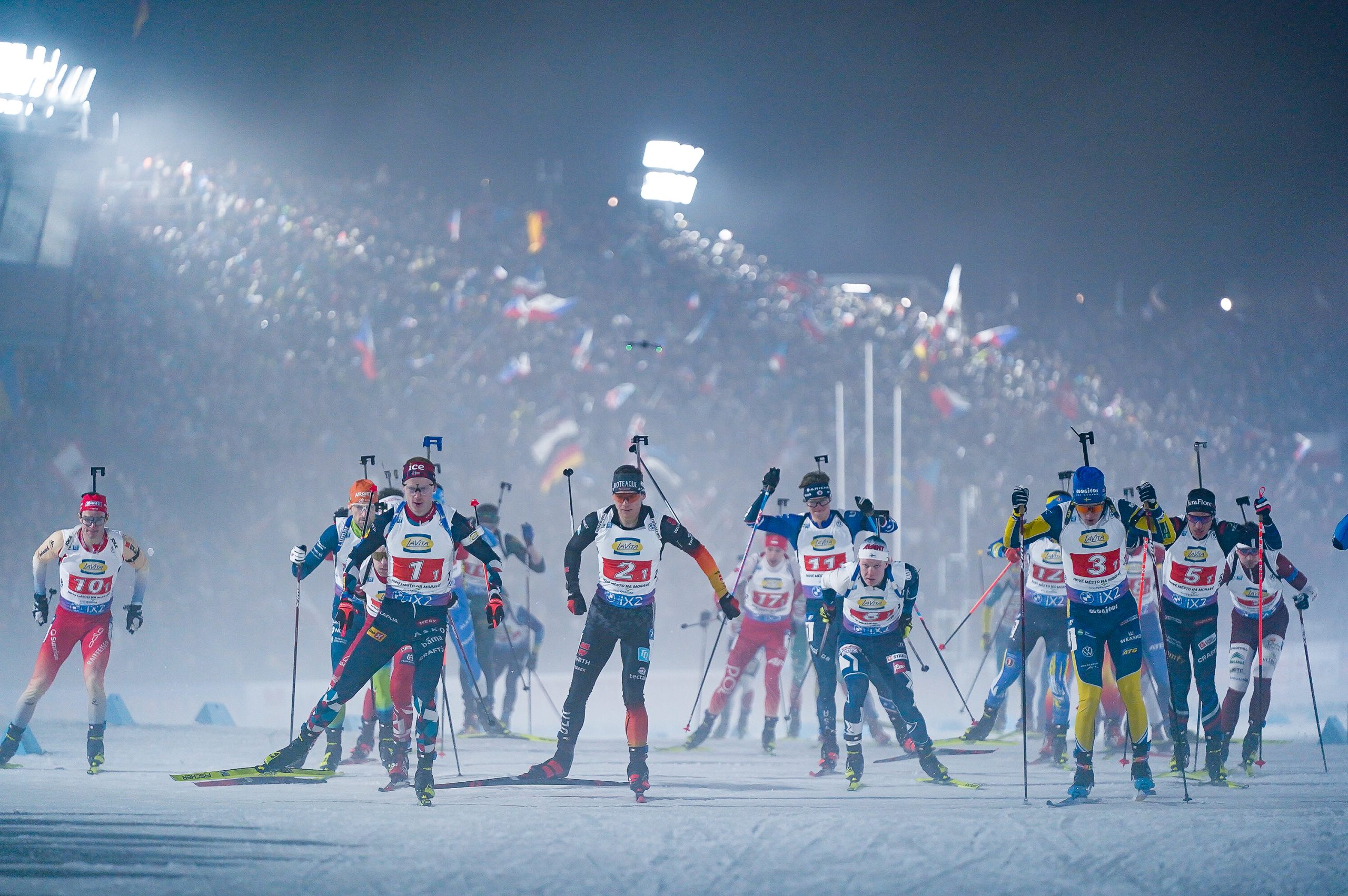
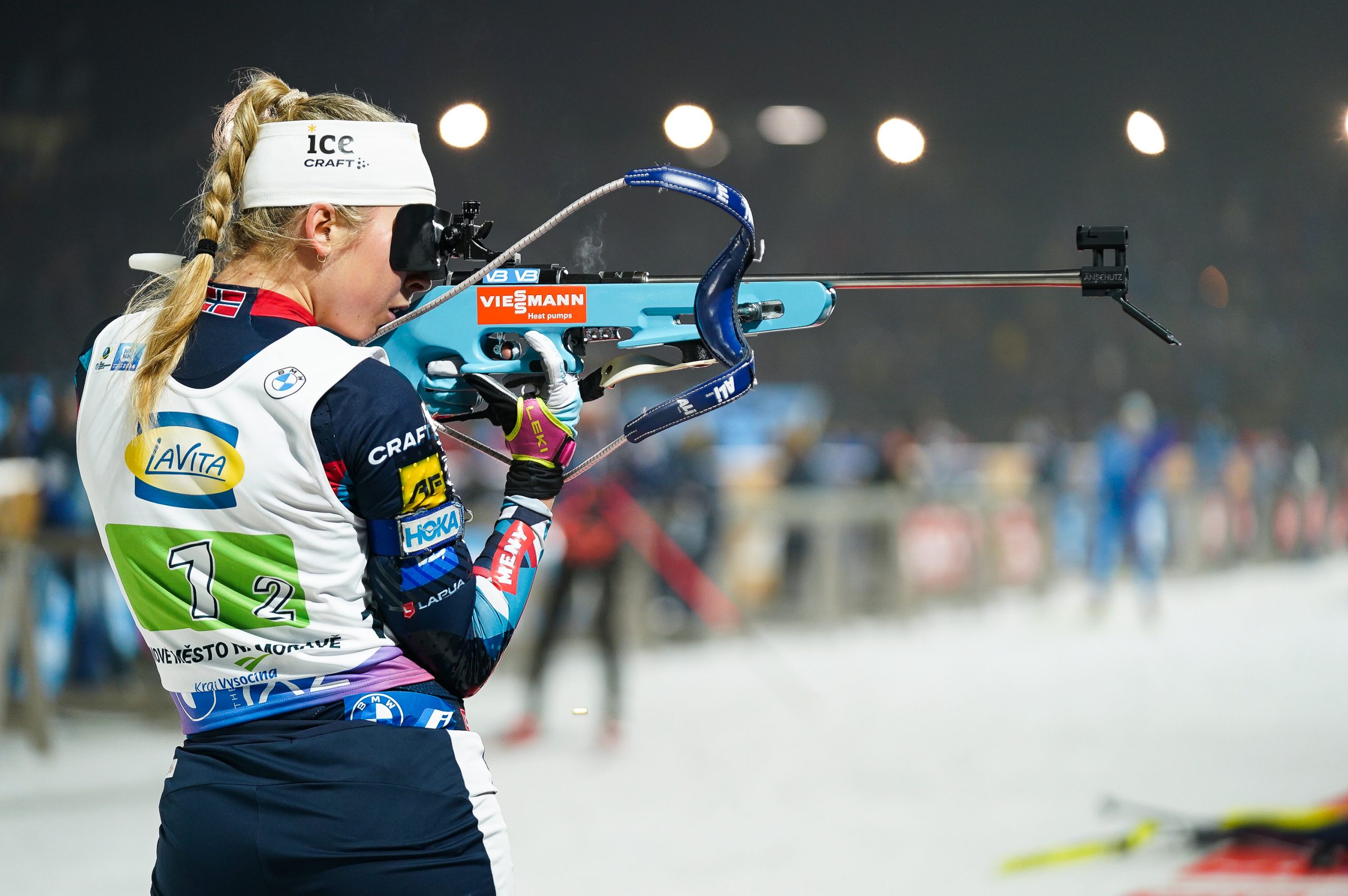
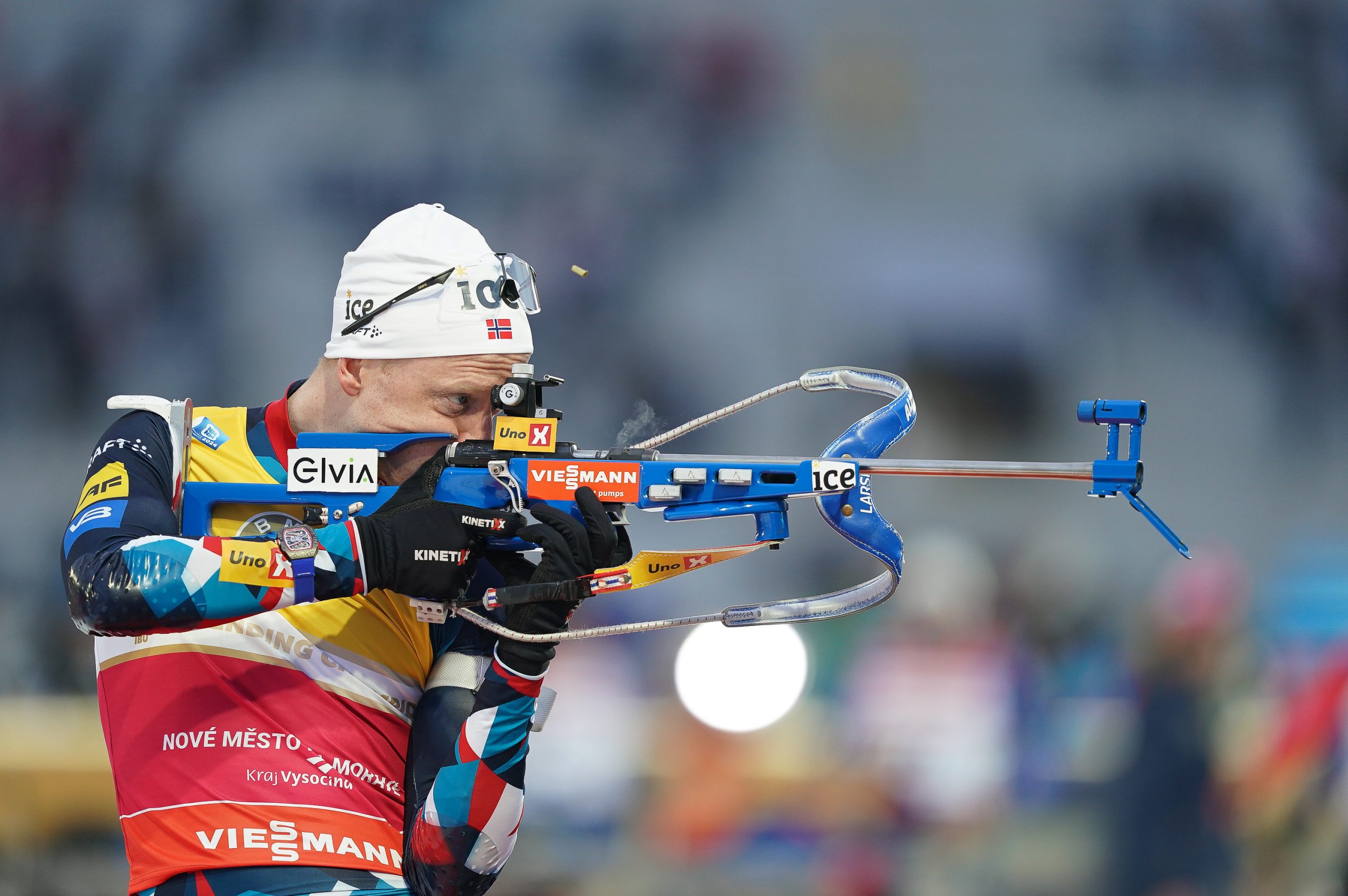
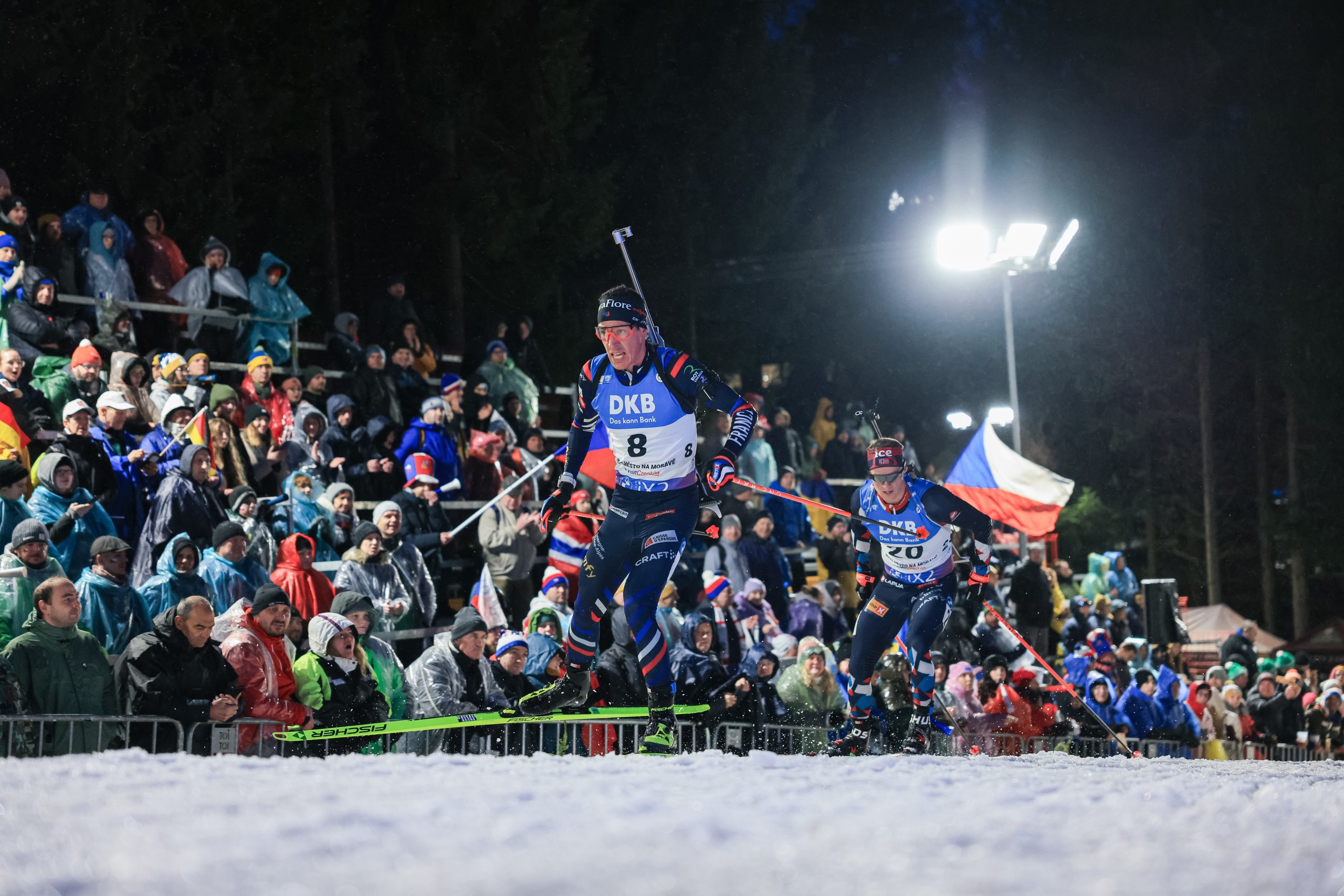
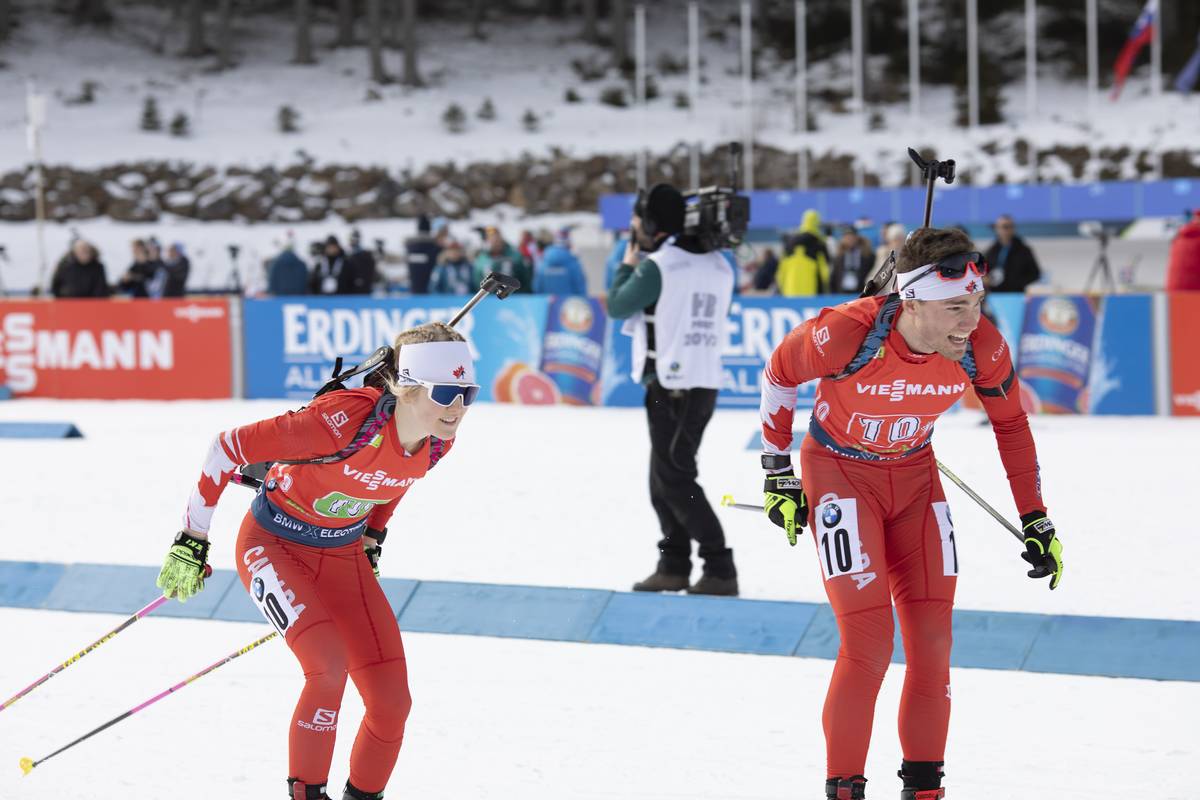
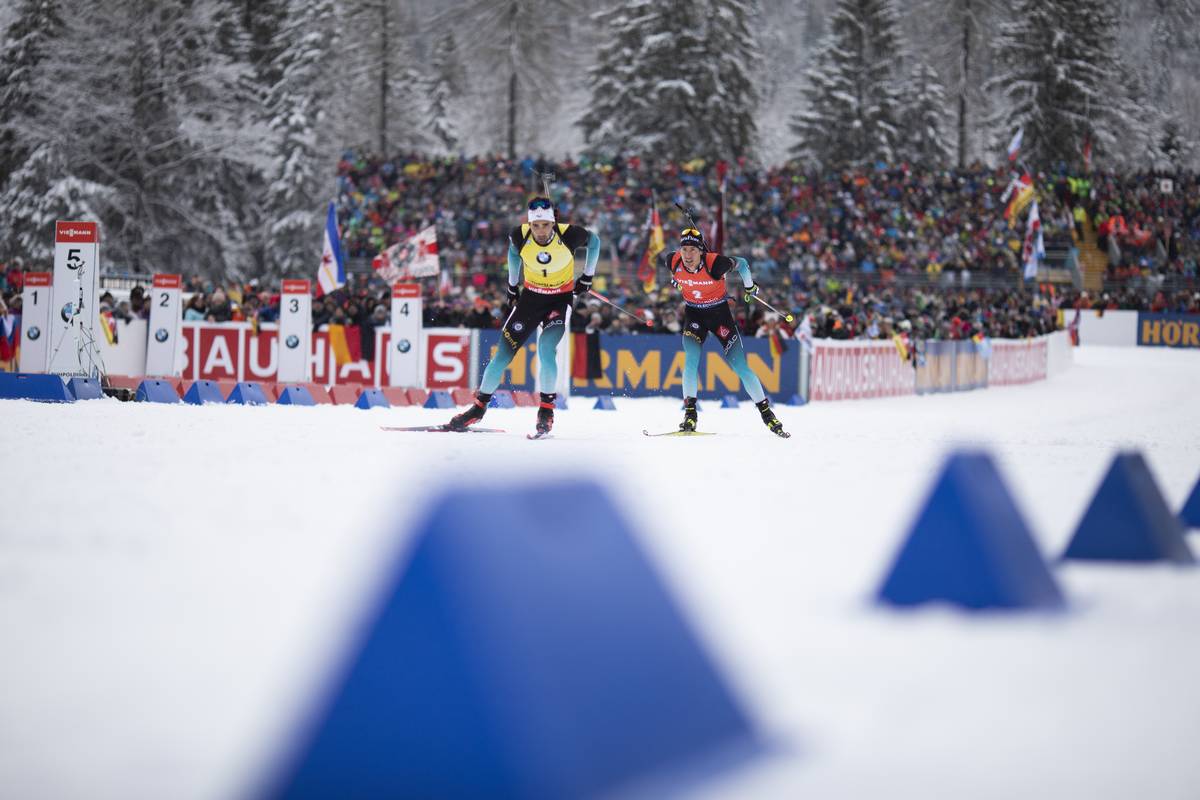
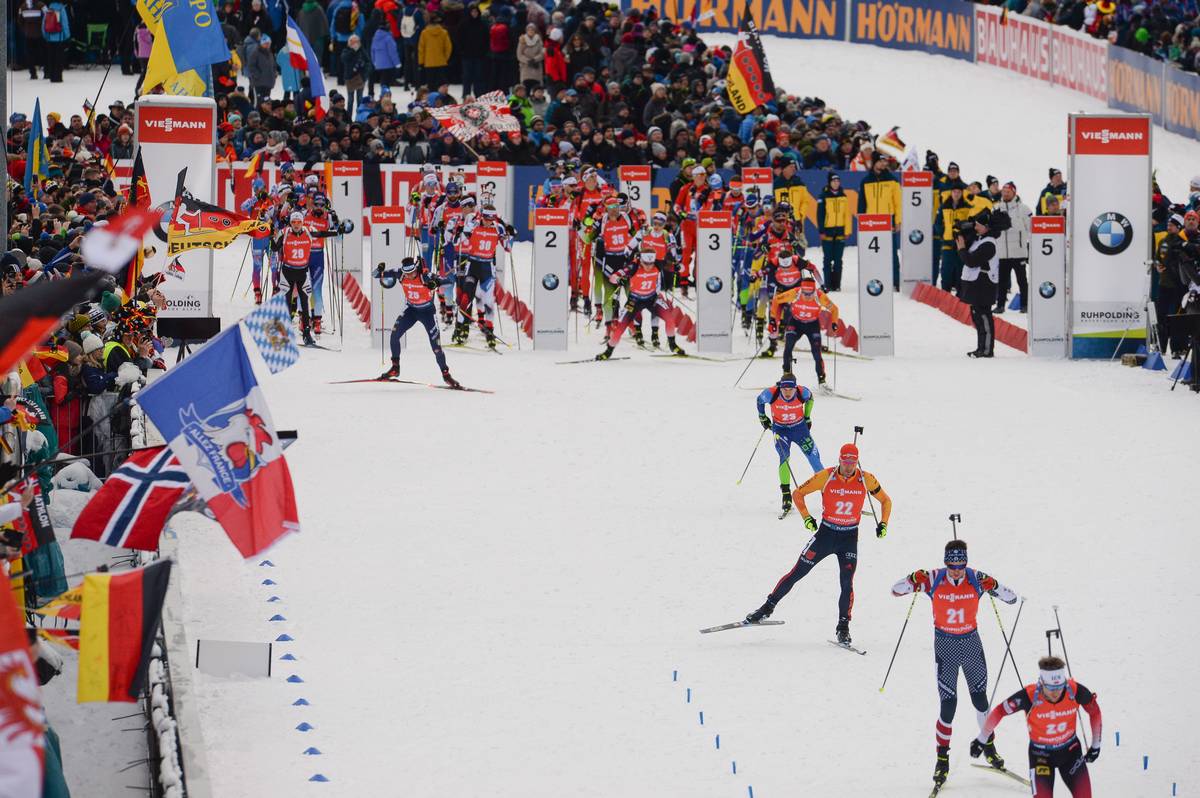
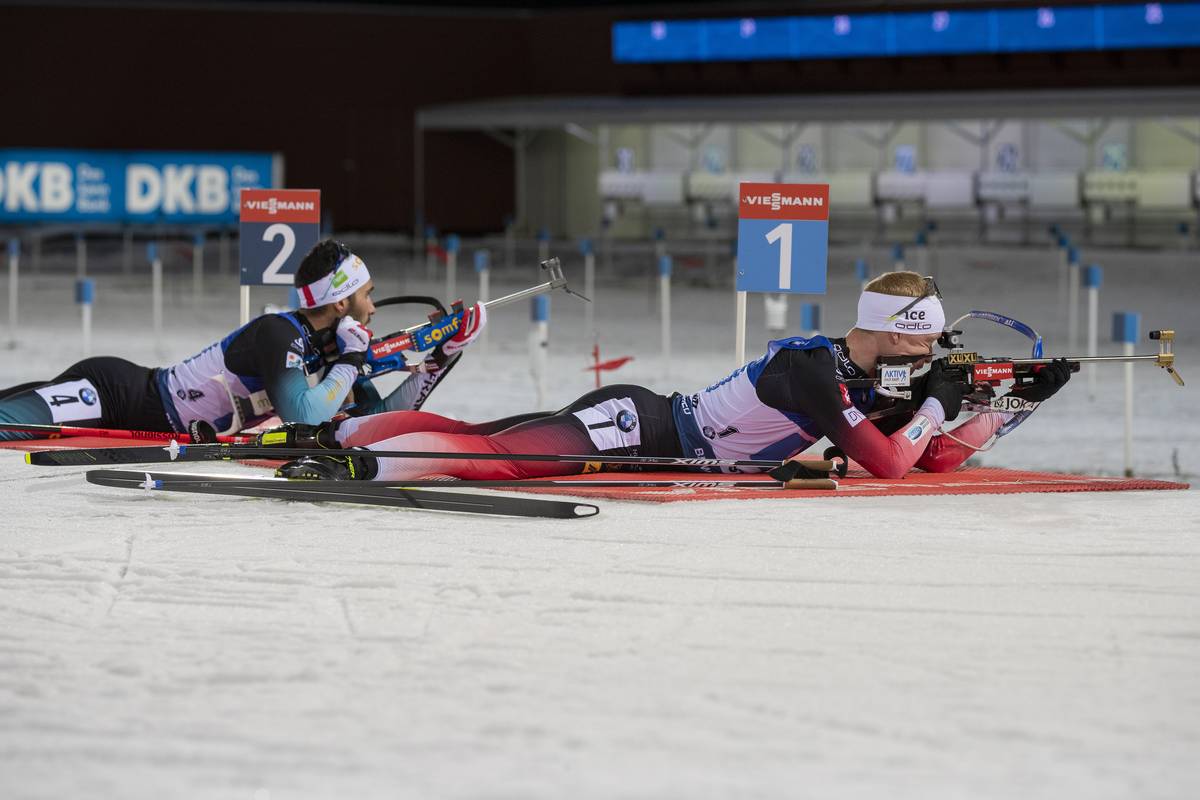
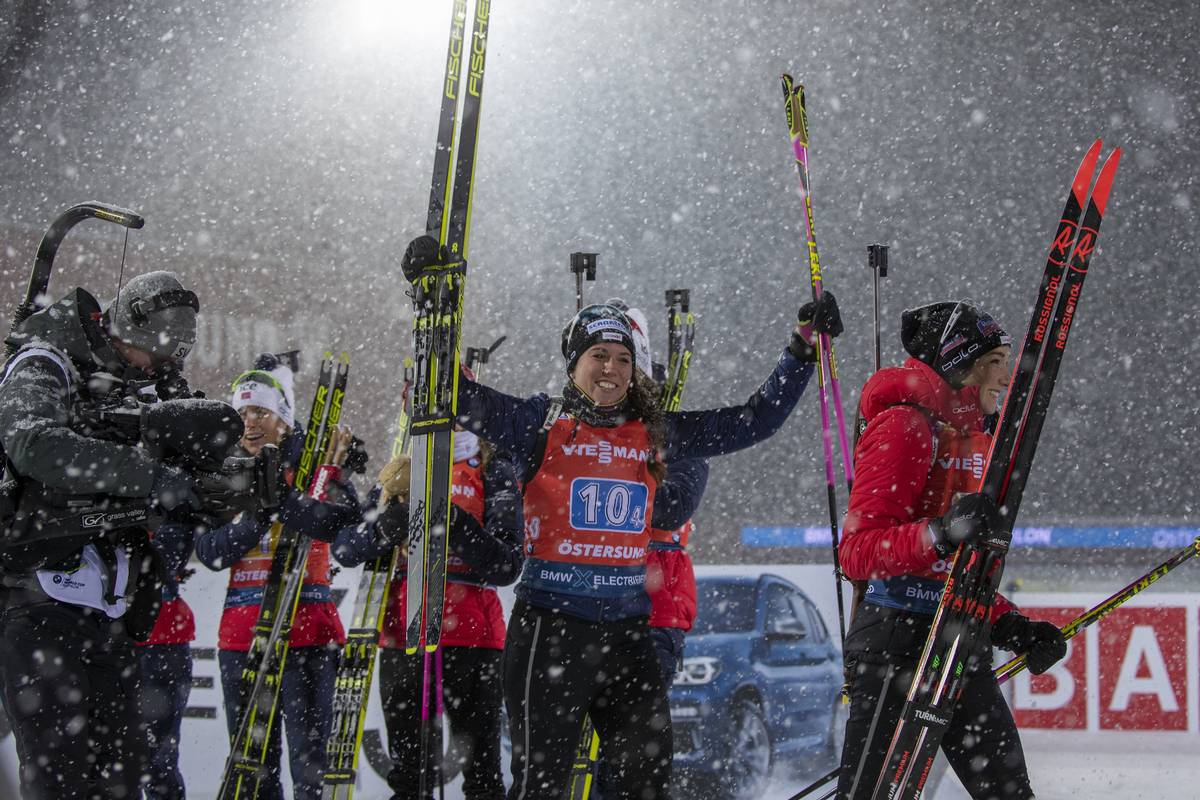
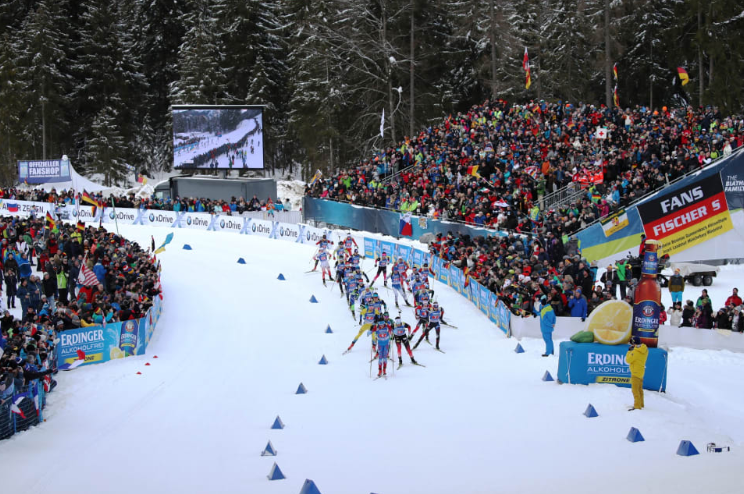
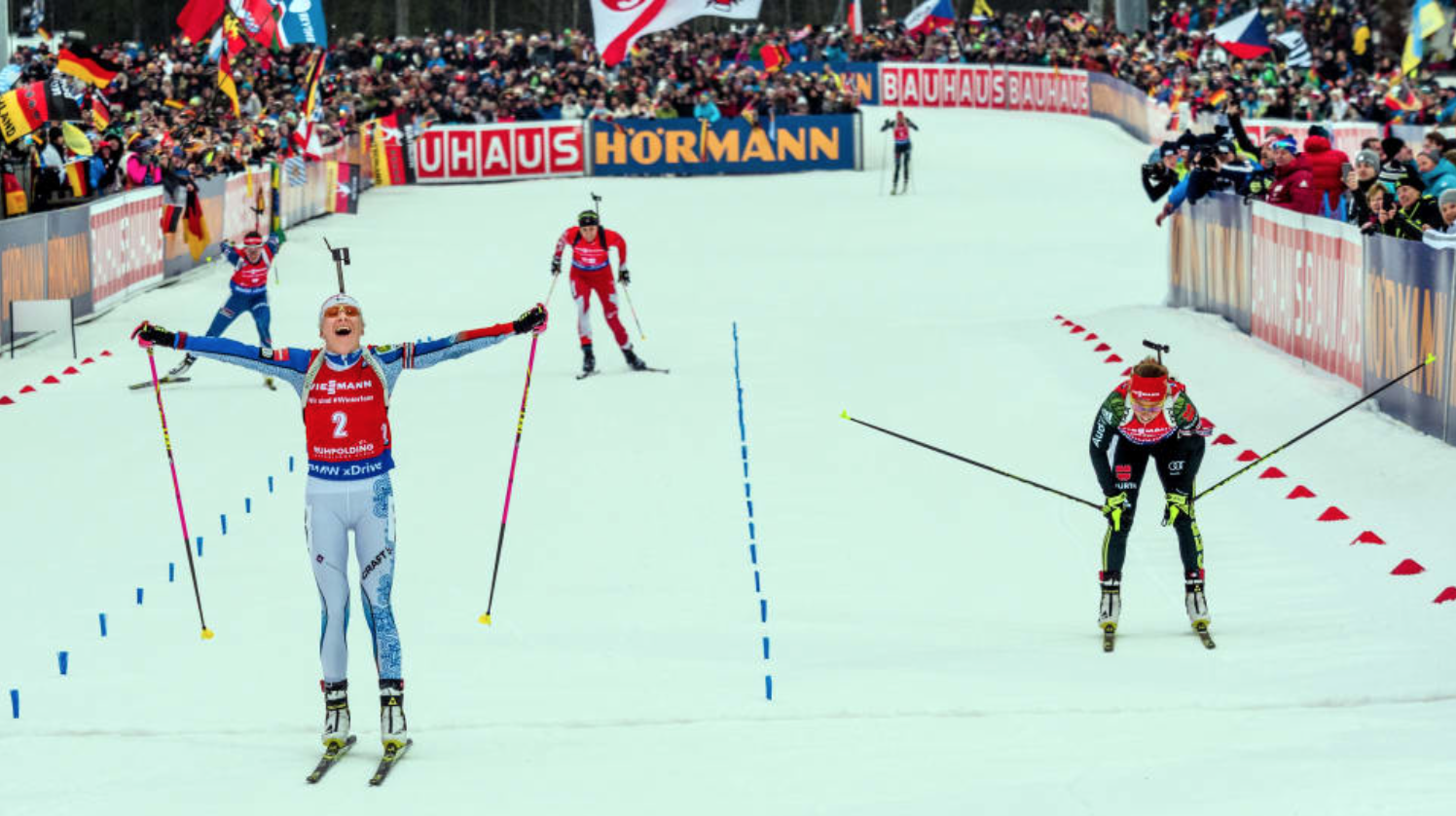
The mixed relay at the opening stop, Oestersund (SWE), of the 2025/26 IBU World Cup Biathlon season. (Photo: Manzoni/NordicFocus)
Over eight days, the best biathletes in the world raced 10 times. Maybe it was the arduous schedule, or the bit of sharpness that an Olympic year adds, but the Ostersund races didn’t feel like the first of the season. It felt like a break had never happened.
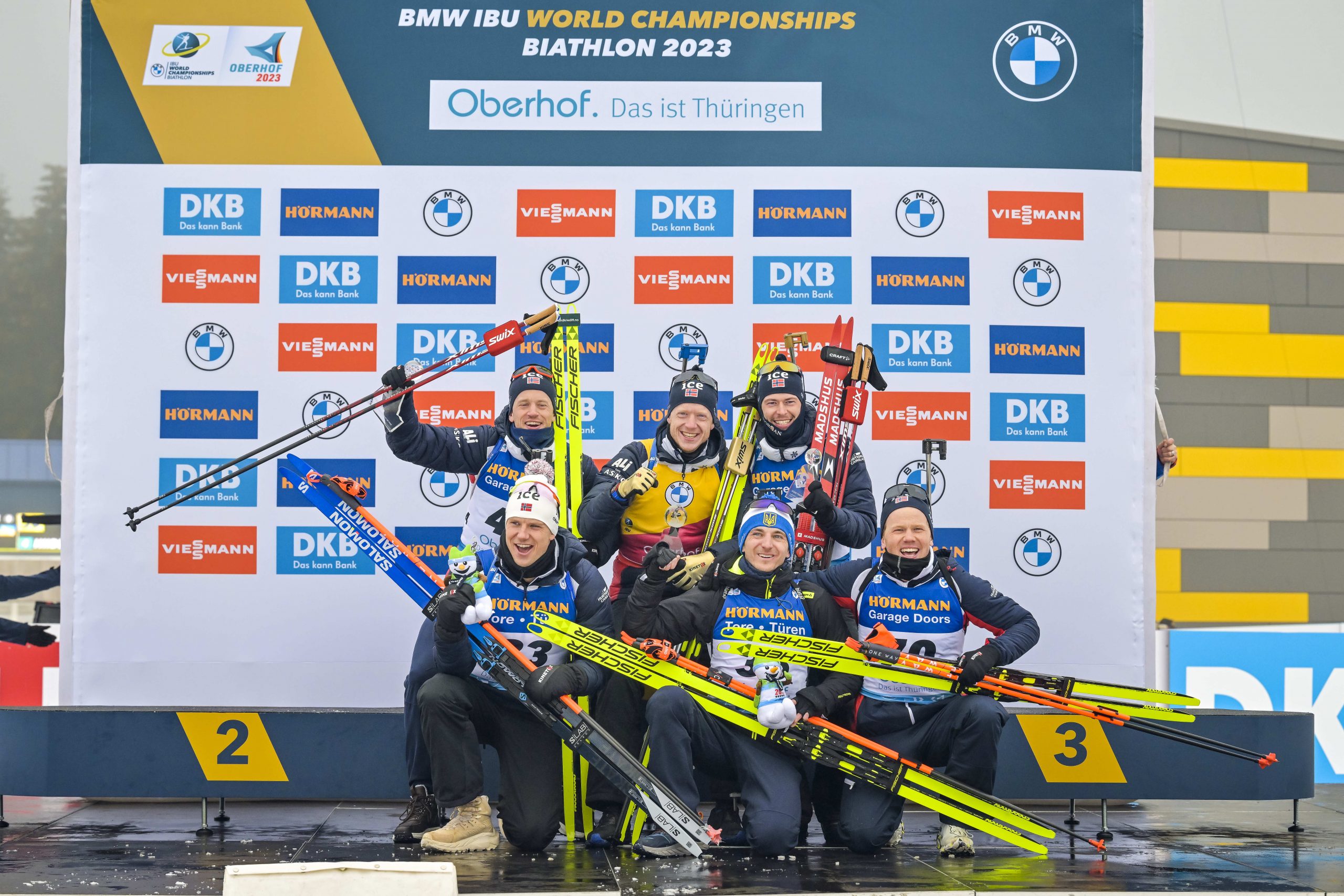
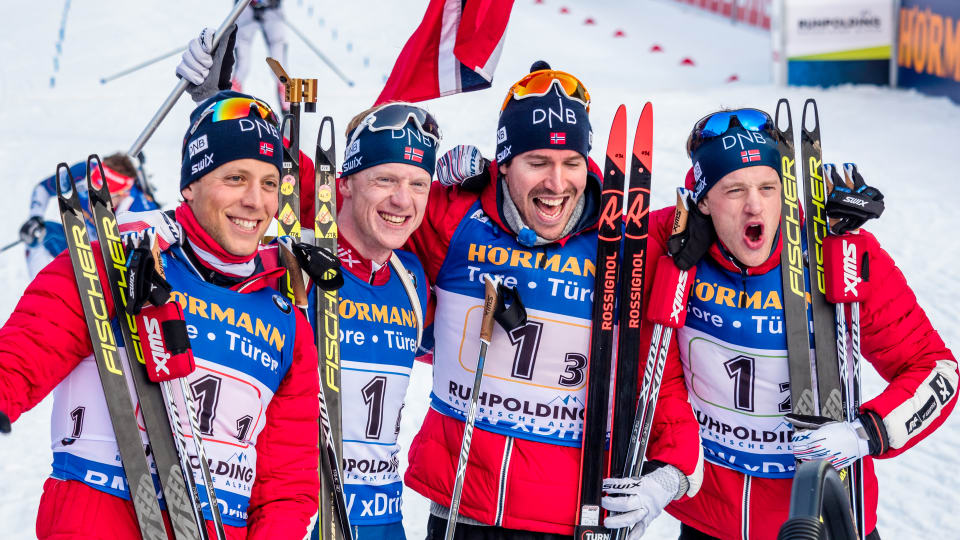
One question lingering from the off-season was answered quickly: What would Norwegian biathlon look like without the Boe Brothers? The dominant duo of Johannes Thingnes and Tarjei Boe – owners of eight Olympic medals – retired at the end of the 2024/25 season. Leaving what one would assume would be a major hole in the program. But when the Norwegian men came out and won the men’s 4 x 7.5km relay at Ostersund, the Norwegian’s roster depth became clear.
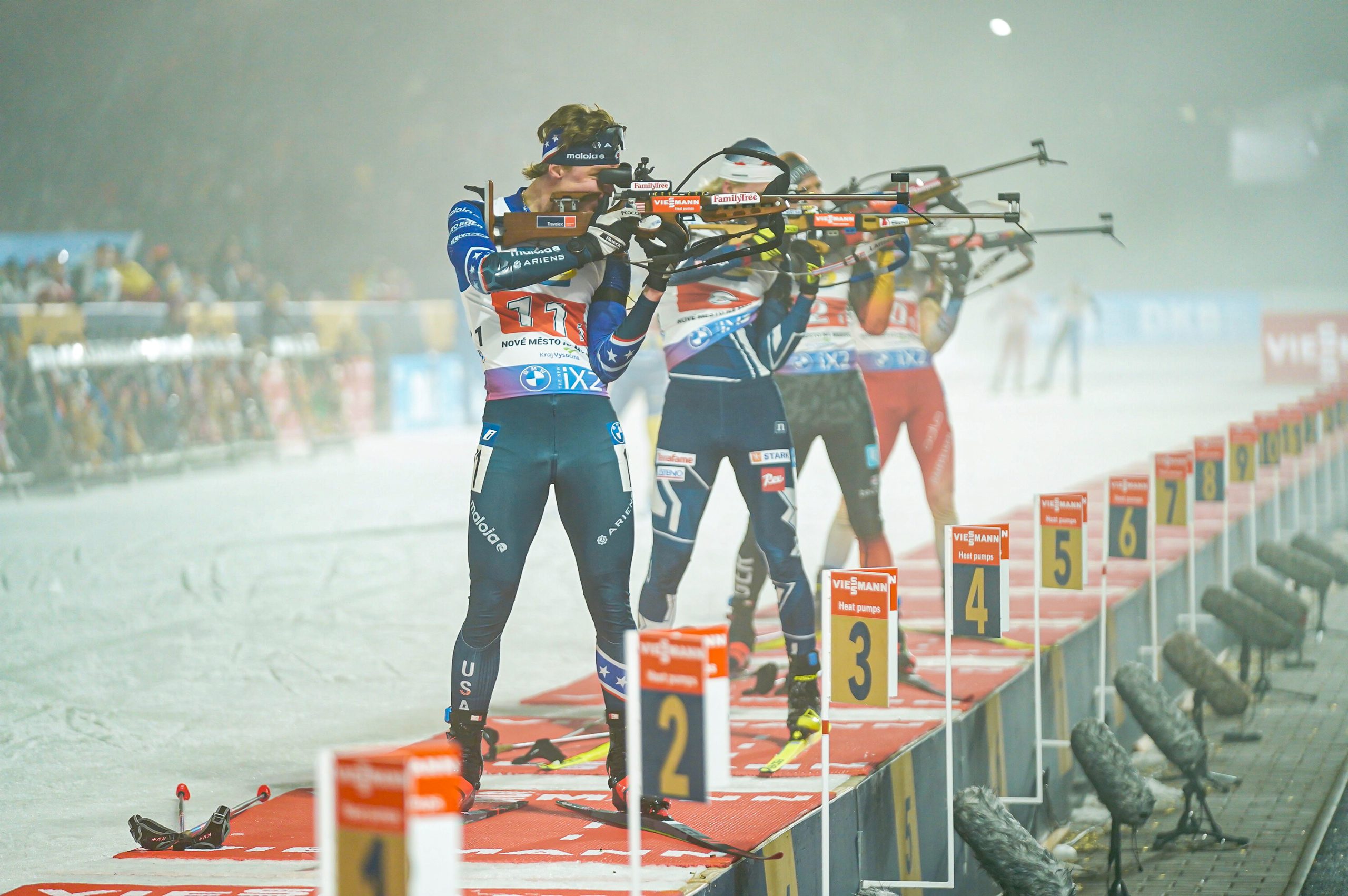
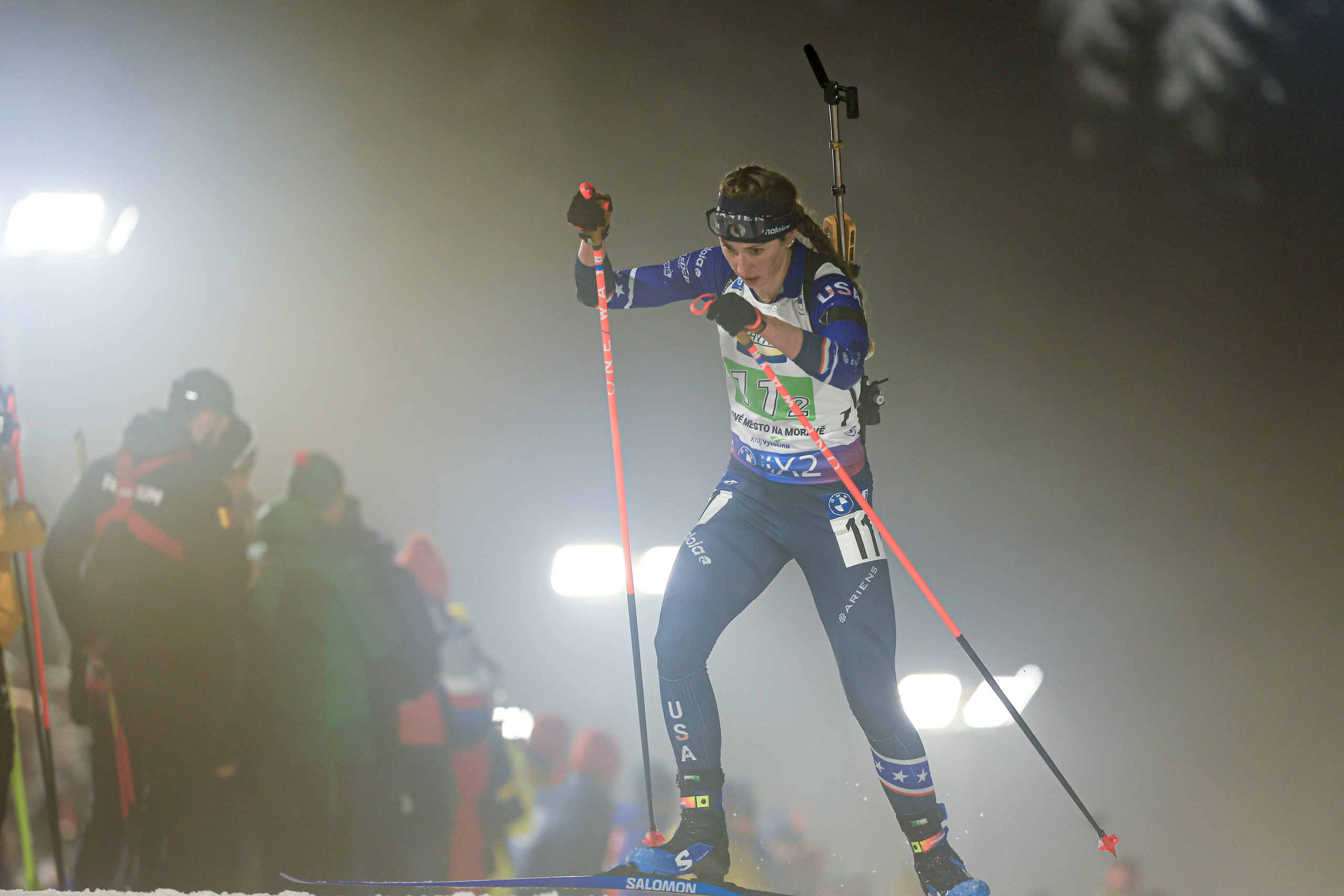
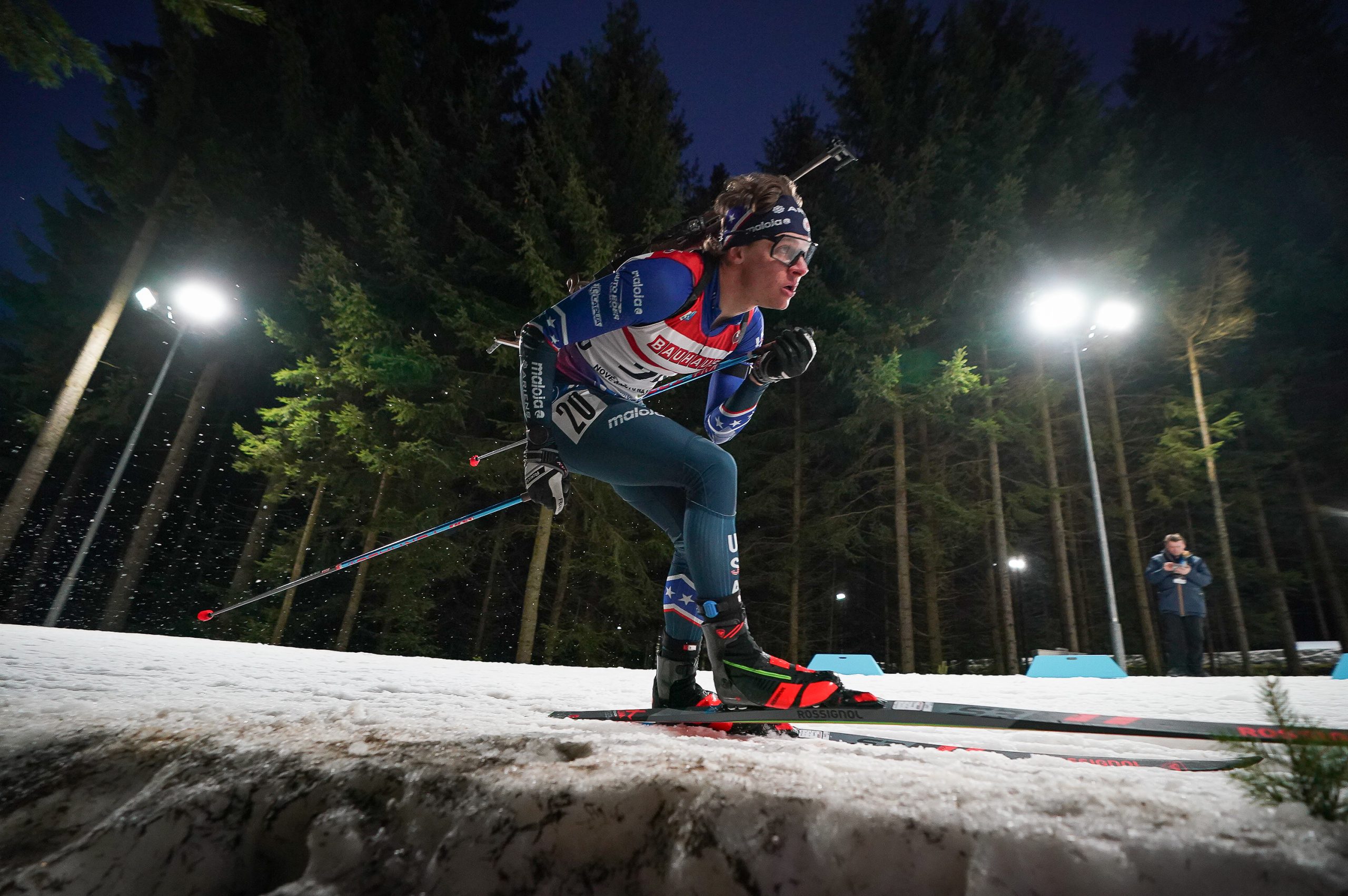
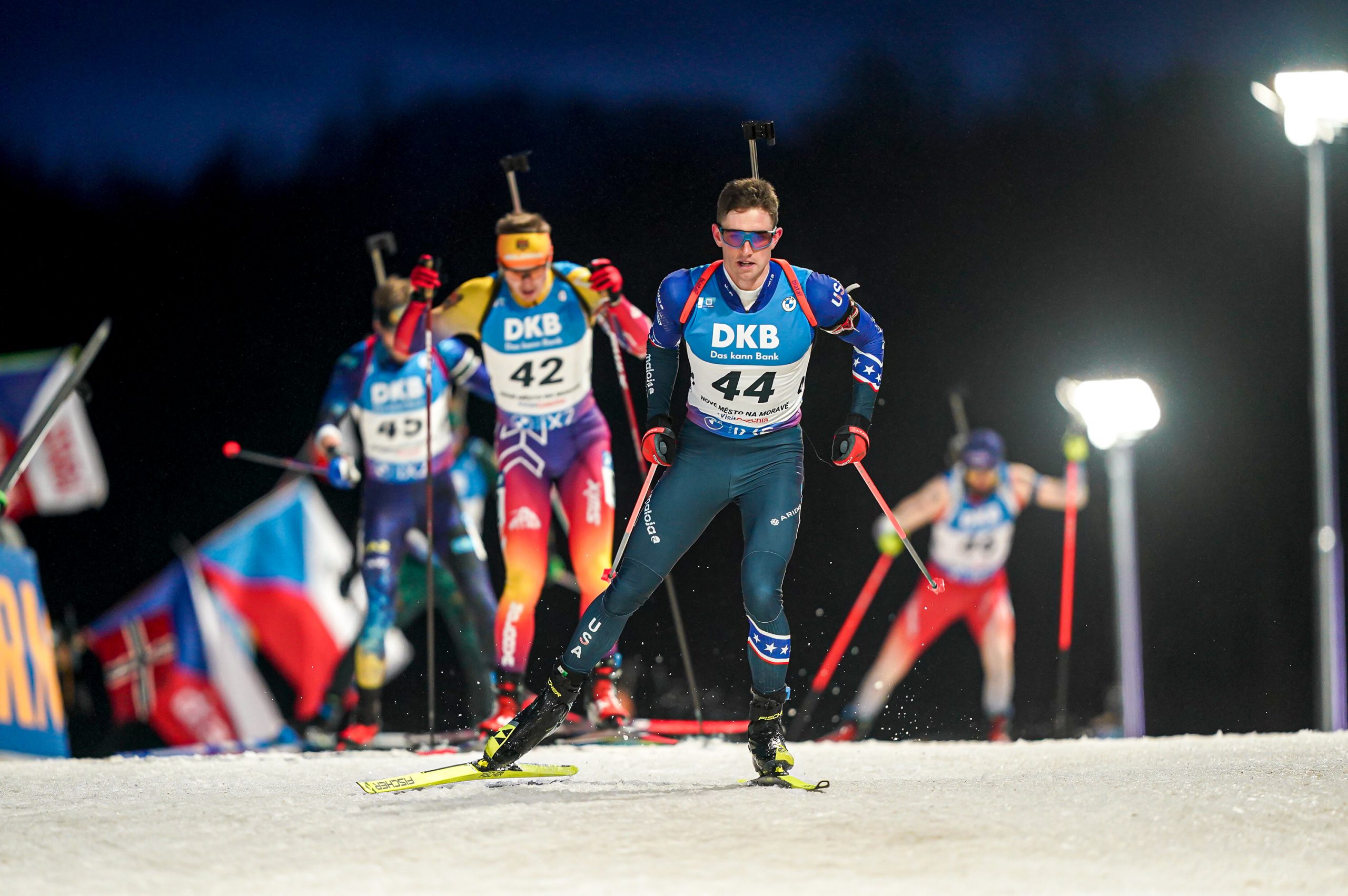
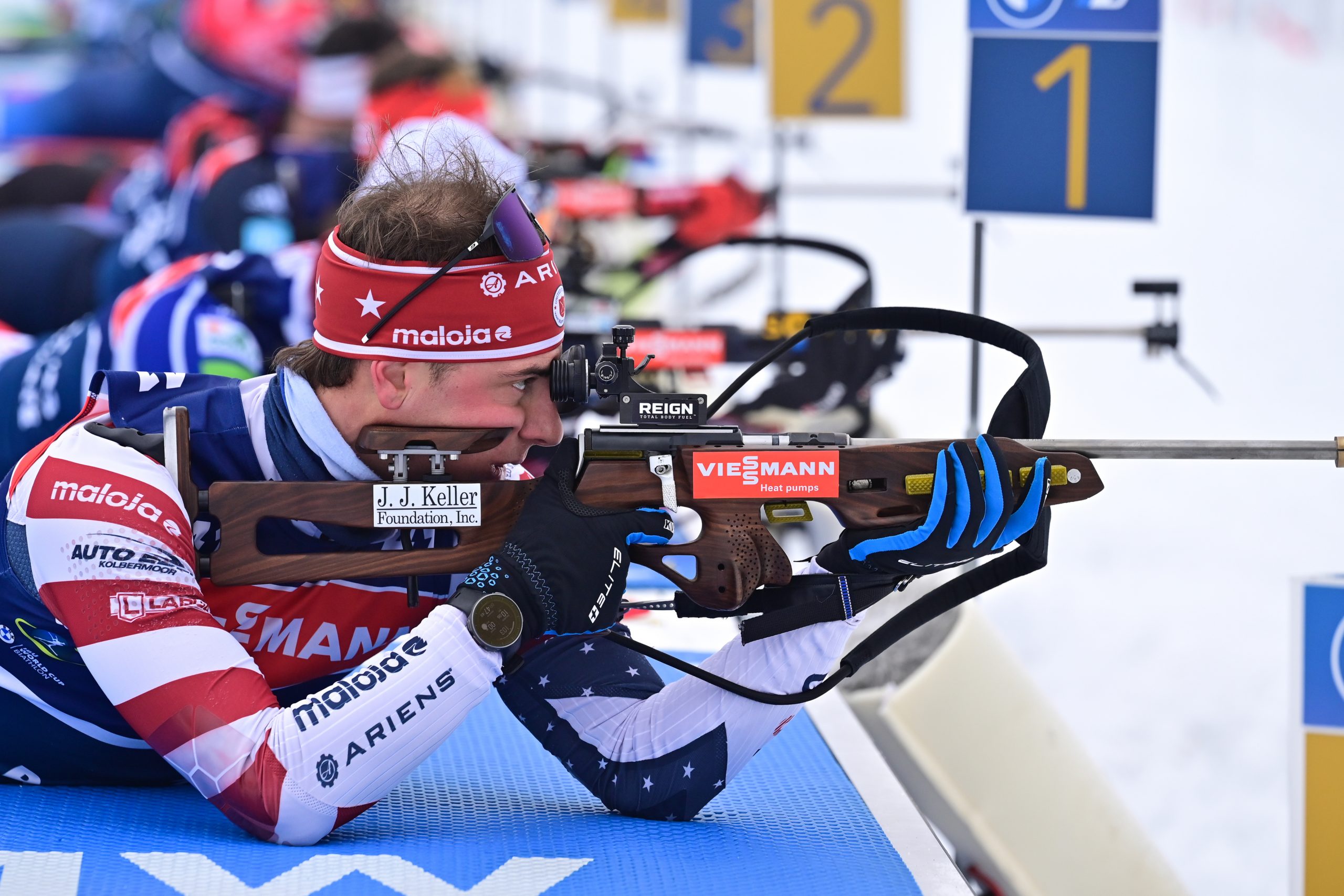
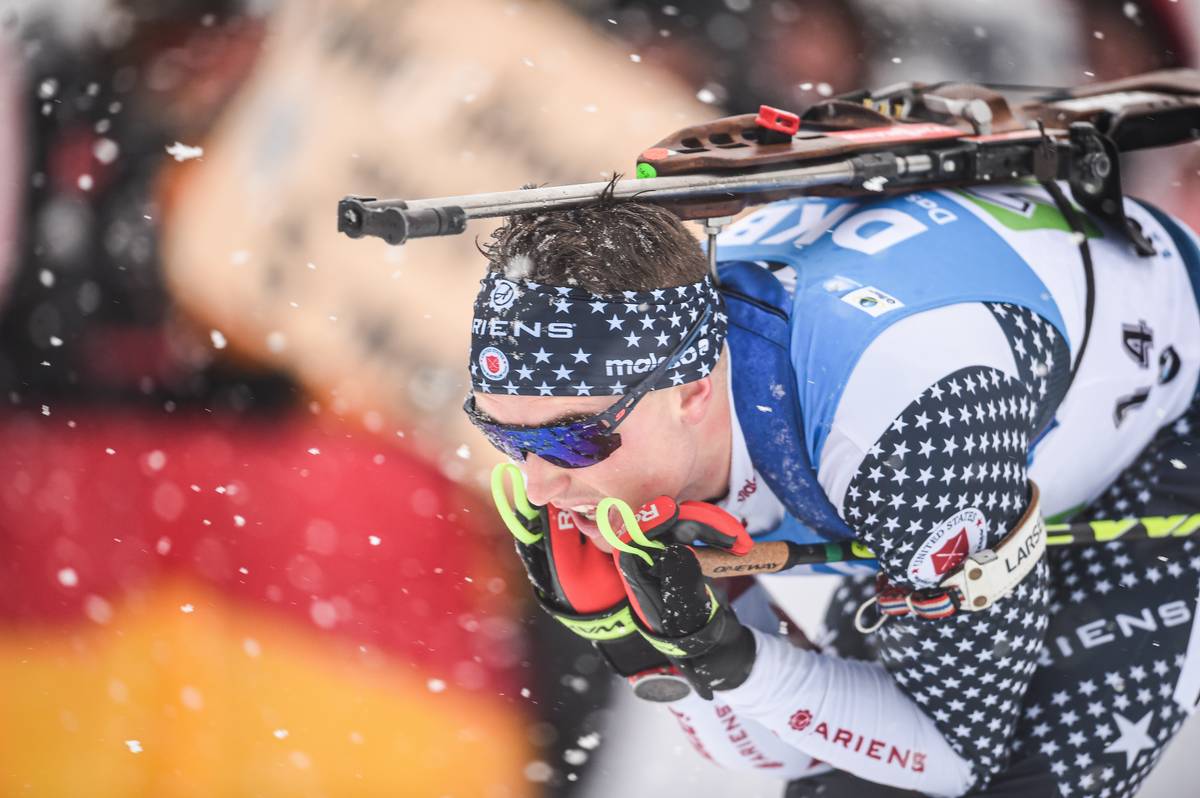
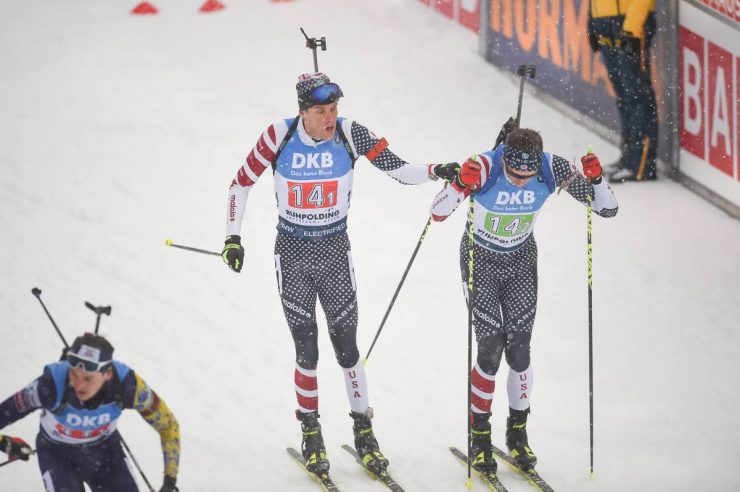
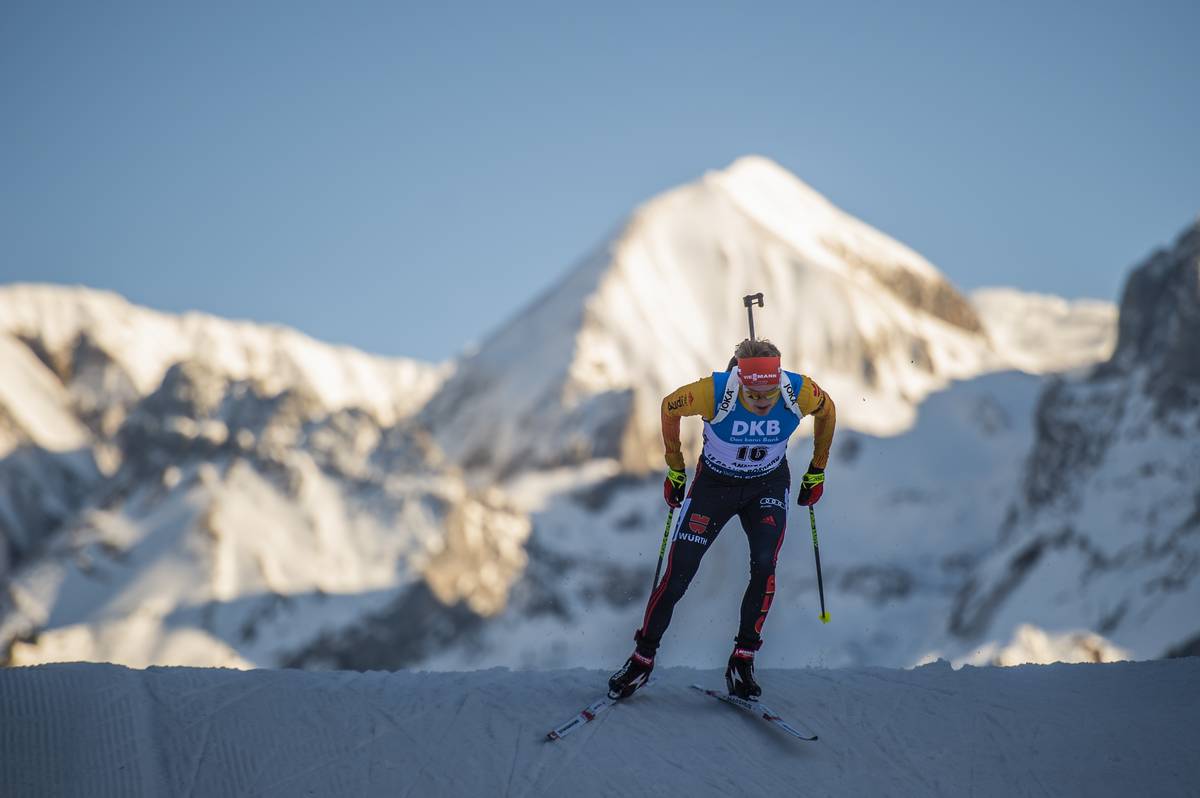
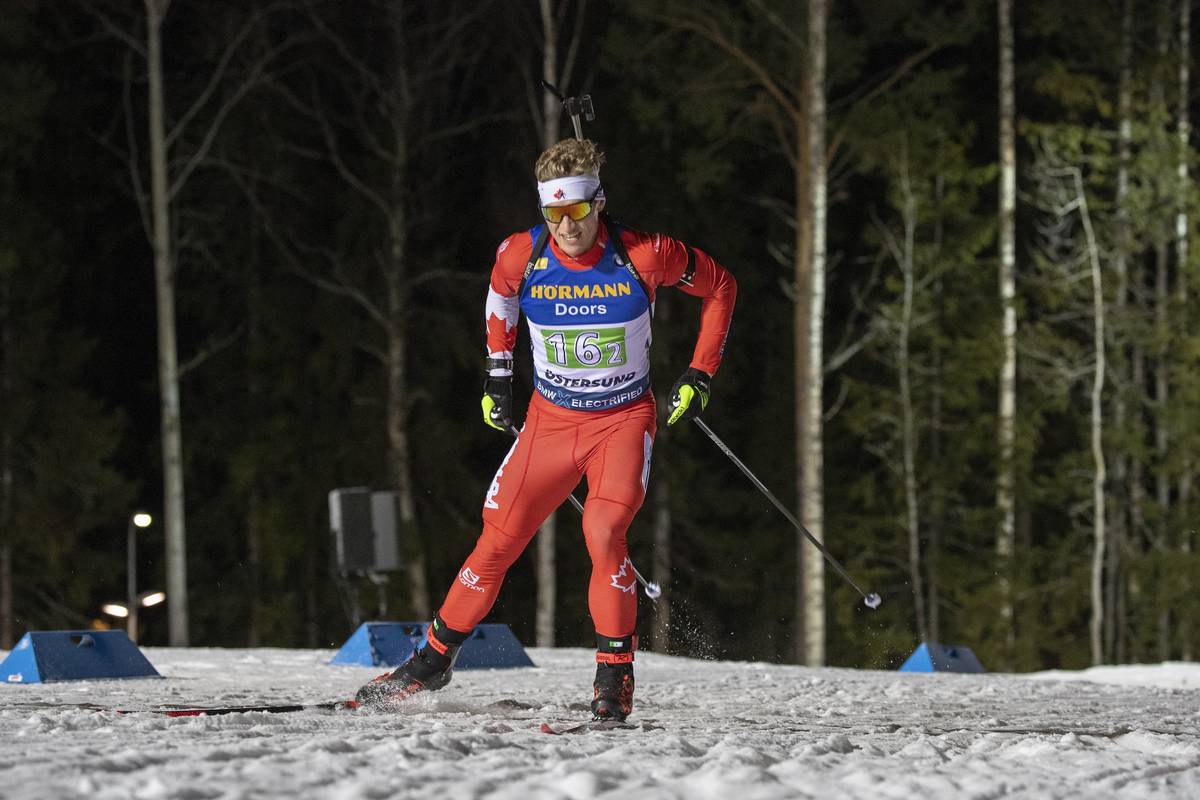
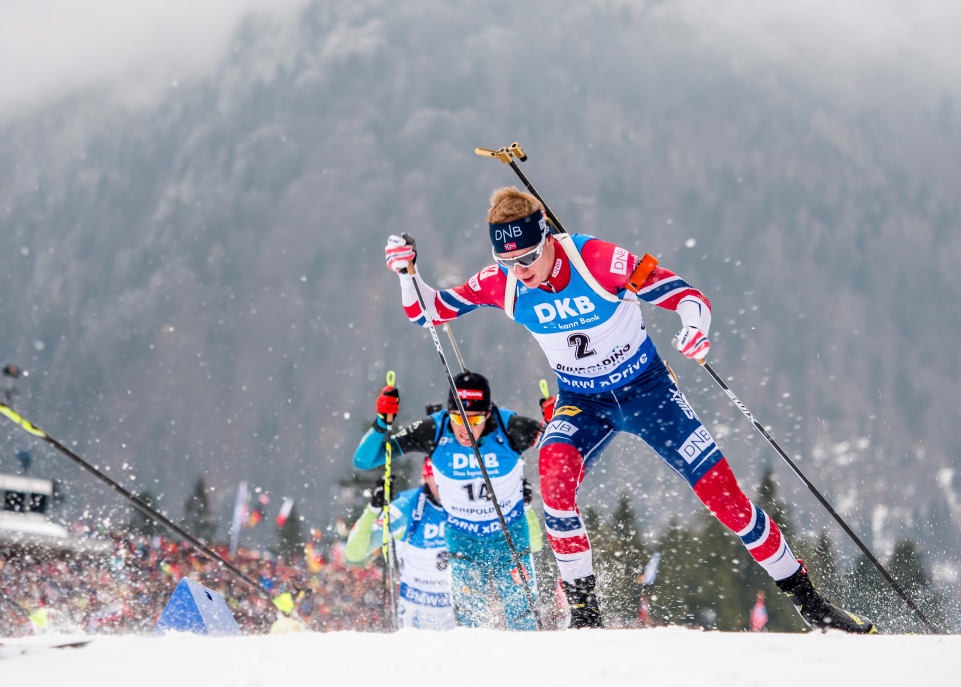
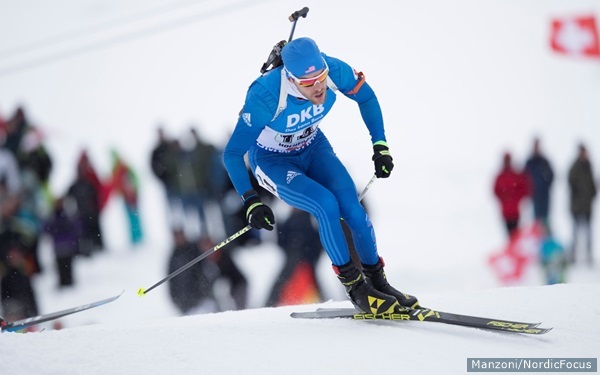
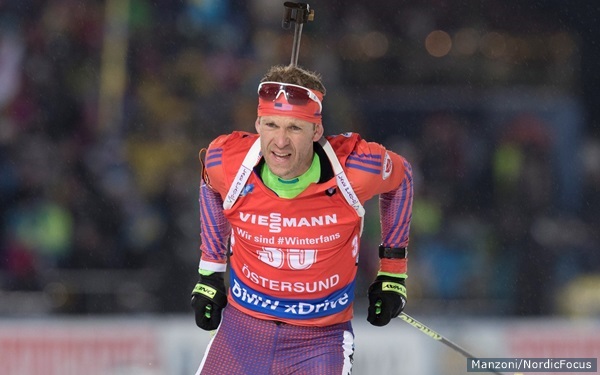
Campbell Wright (USA) during the IBU World Cup Biathlon Men’s Relay in Östersund (SWE). (Photo: Manzoni/NordicFocus)
The men’s relay saw a top result from the U.S. men, as well. Paul Schommer, Campbell Wright, Maxime Germain and Sean Doherty finished fifth, one of the best men’s relay finishes ever for Team USA. The next day, at the mixed relay, Germain, Wright, Chloe Levins and Deedra Irwin placed sixth – which is the best finish for a U.S. mixed relay since 2021.
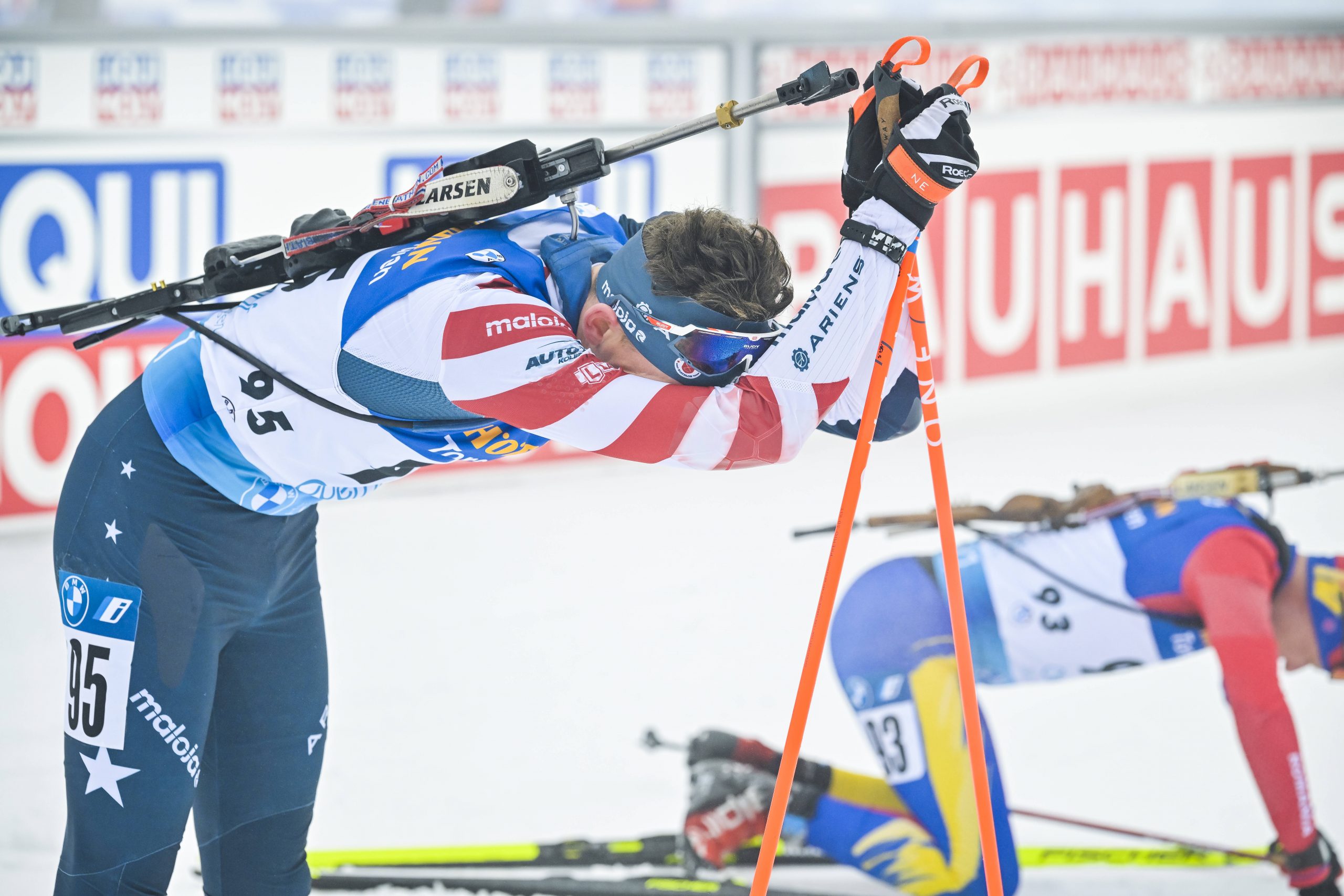
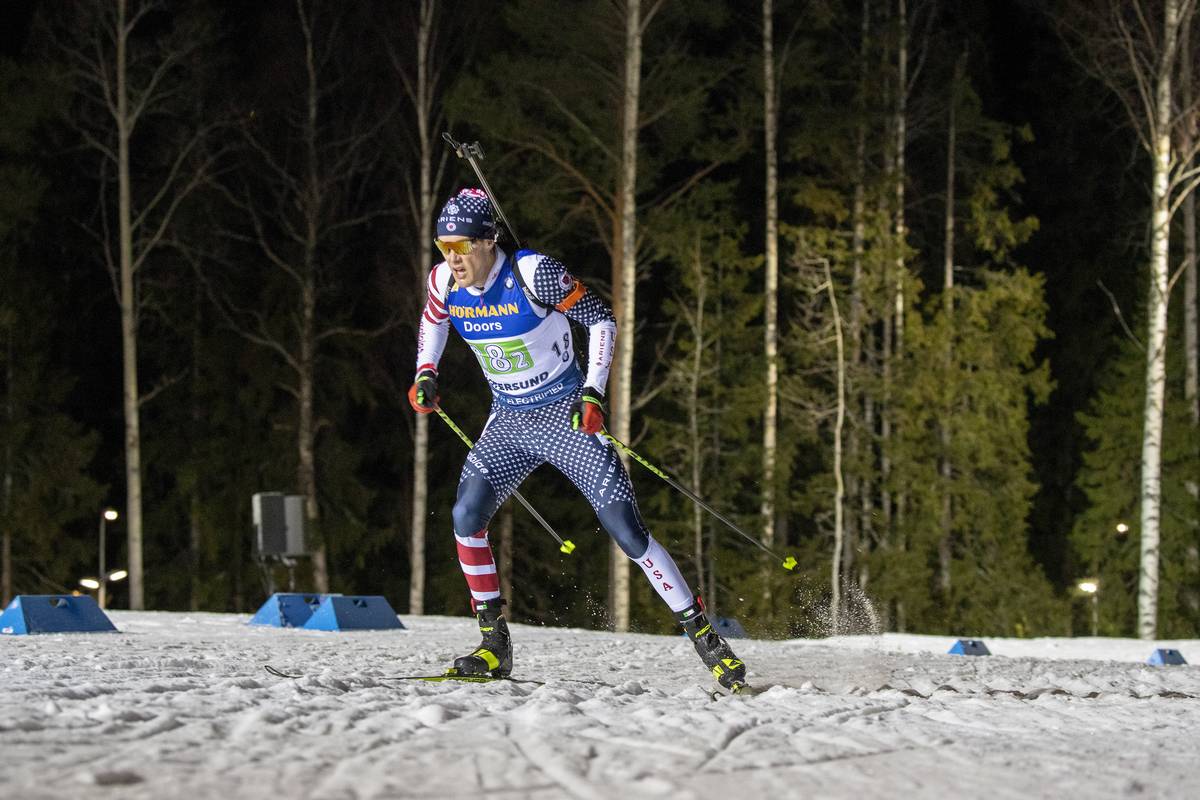
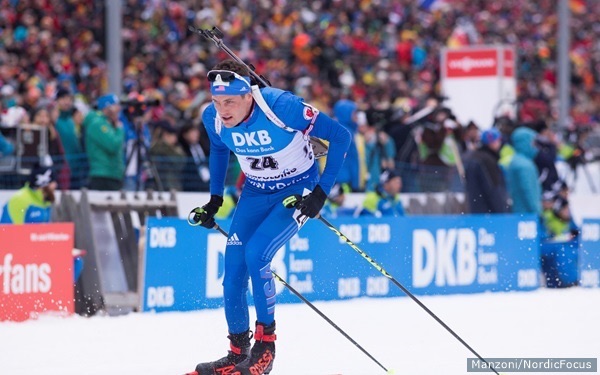
Artem Tyshchenko (UKR) and Paul Schommer (USA), (l-r) during the Men’s Relay in Oestersund (SWE). (Photo: Manzoni/NordicFocus)
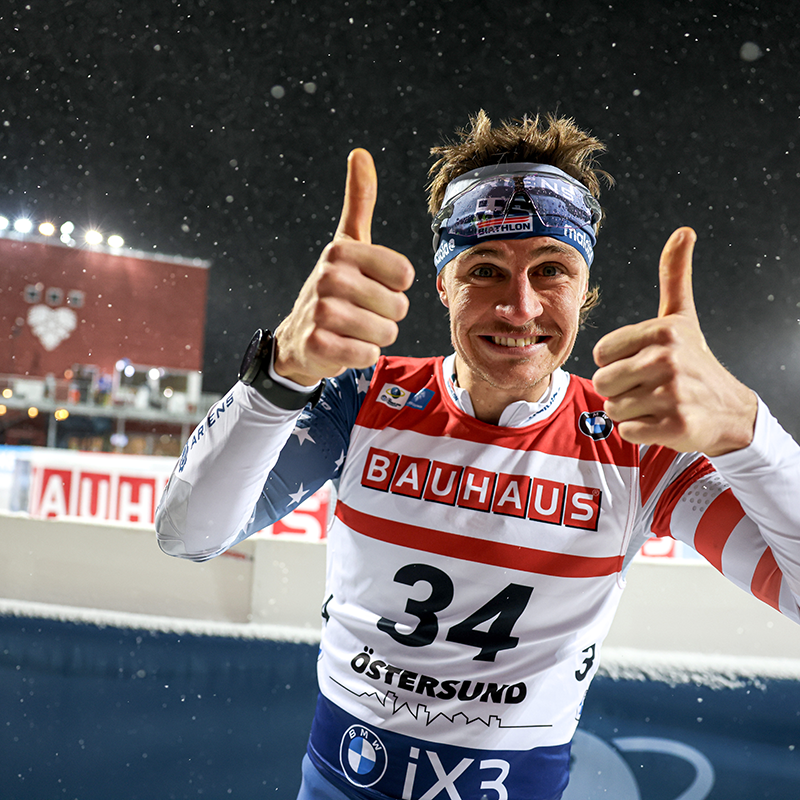
Germain and Wright continued to build on their early-week momentum, with Germain placing 11th in the sprint. In the pursuit, Wright hit all 20 targets for the first time in his career and moved up from 18th to 6th. Wright is coming off a stellar 2024/25 season, where he podiumed twice at World Championships, becoming the first American to do so.
Throughout the week, there were highs: Suvi Minkkinen of Finland won her first World Cup sprint. The Norwegian men placed four in the top five in the 20km individual, solidifying their capabilities as a team sans-Boes. And as always in biathlon, some lows: Eric Perrot of France missed his final shot in the pursuit, a devastating moment that cost him the lead. He finished fifth.
Racing wrapped up in Sweden, and teams flew to Austria. In Hochfilzen, a less rigorous racing schedule awaits: sprint, pursuit, and then a men’s and a women’s relay. A few more hours of daylight await, too.
FasterSkier’s Coverage of the Biathlon World Championships is made possible through the generous support of the Craftsbury Outdoor Center: New England’s finest snowmaking, world class race venues and touring trails, healthy food in abundance, comfortable accommodations at Craftsbury: Sports, Sustainability, Stewardship.
The start of the Single-Mixed Relay in the Vysocina Arena in Nove Mesto na Morave, Czech Republic. (Photo: NordicFocus)
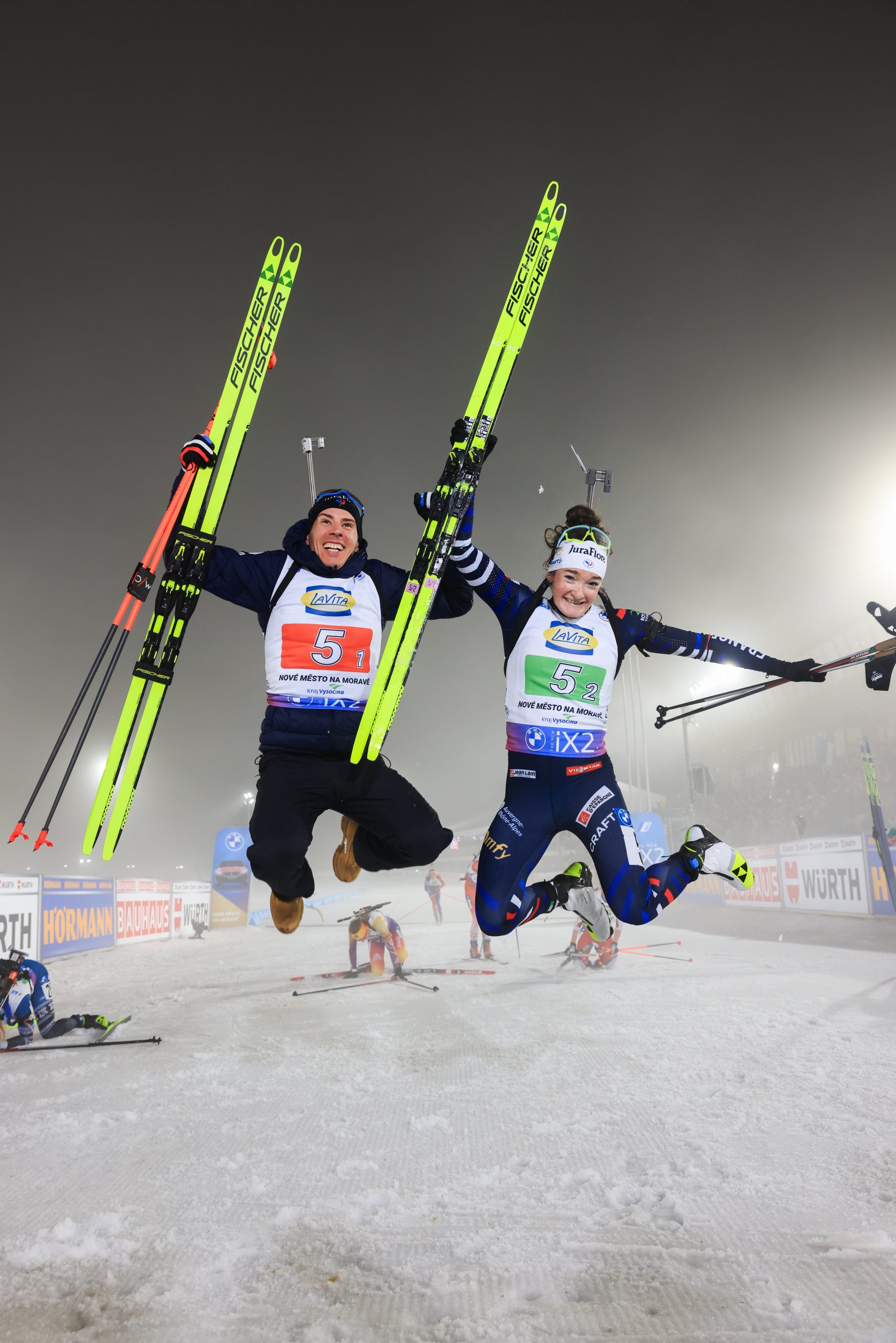
Twenty-eight nations started the Single-Mixed Relay on Thursday at Biathlon World Championships in Nove Mesto na Morave, Czech Republic. After just over 35 minutes of fast and furious racing, France claimed the gold, last year’s bronze medalists from Italy the silver, and the defending champions of Norway the bronze.
The Single-Mixed Relay combines the performances of one man and one woman who each ski two short biathlon races, tagging off in between. The importance of shooting speed and accuracy is magnified in this format because the ski loop is only 1.5 k; there is relatively little distance over which to recover lost time. As in all biathlon relays, athletes can use up to three spare rounds per stage to hit their five targets, but loading each spare takes precious time, and if targets remain un-hit, the penalty loop awaits. The event is a wildly unpredictable fan favorite.
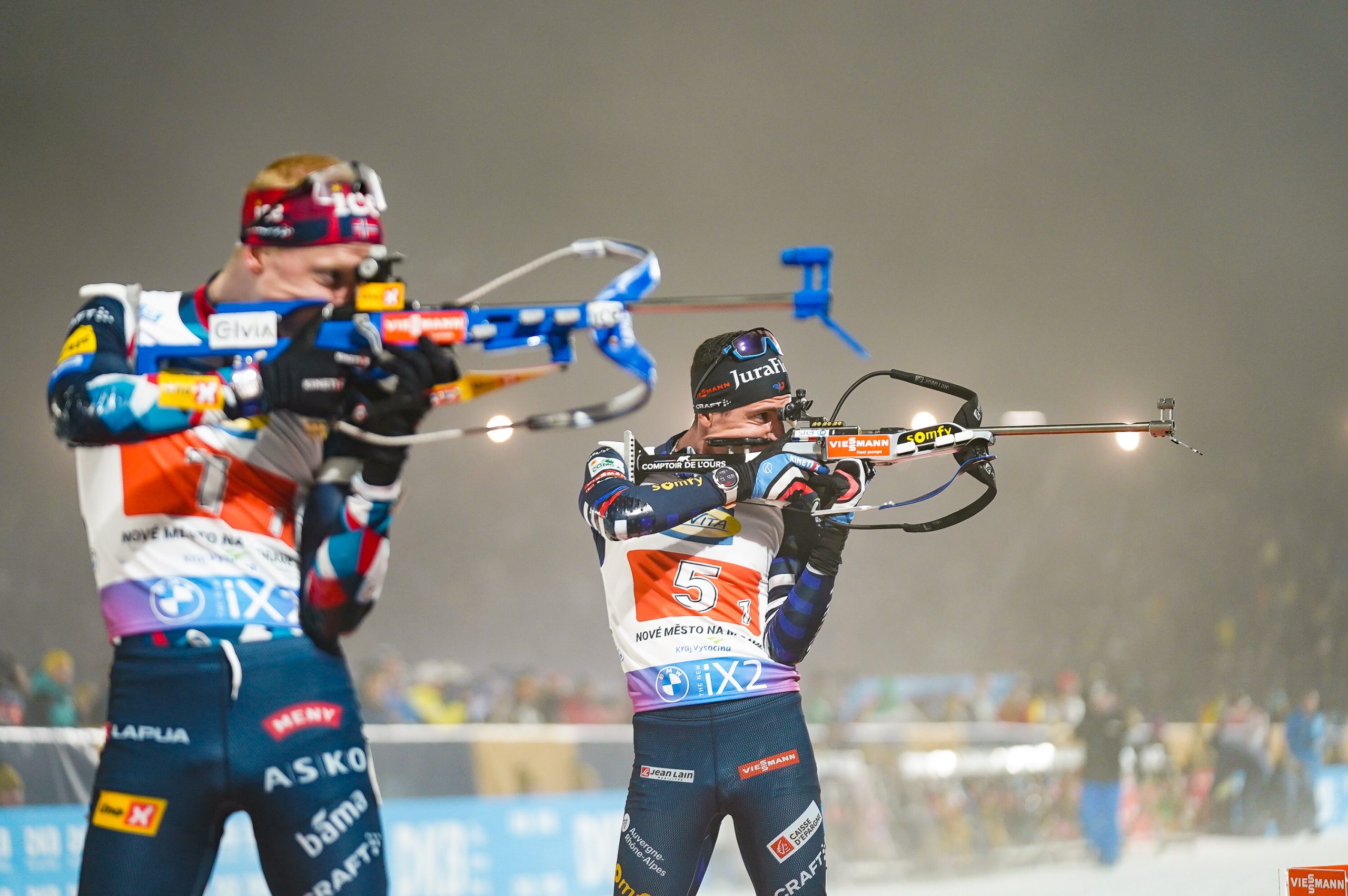
Johannes Thingnes Boe (NOR) and Quentin Fillon Maillet (FRA) (l-r) shoot on lanes one and two in the Single-Mixed Relay. (Photo: NordicFocus)
The field was stacked. Team Norway comprised the two current World Cup Overall leaders, Johannes Thinges Boe and Ingrid Tandrevold. But Tandrevold’s standing shooting has been hit or miss at World’s—more often miss than hit. For France, Lou Jeanmonnot got called up to race with Quentin Fillon Maillet. France’s top star, Julia Simon, decided to sit out and rest after winning three golds and a silver in the first four events of the Championships. But Jeanmonnot has been fantastic in her own right, finishing third, sixth, and seventh in the non-team competitions here in Nove Mesto. Italy put forward one of the strongest women in the field, Lisa Vittozzi, fresh off a victory in the 15 k Individual. Her partner, Tommaso Giacomel, has been 15th, 20th, and 45th in non-team competitions, combining reliable ski speed with less reliable shooting, but the same duo was a successful pairing in 2023 when they took bronze.
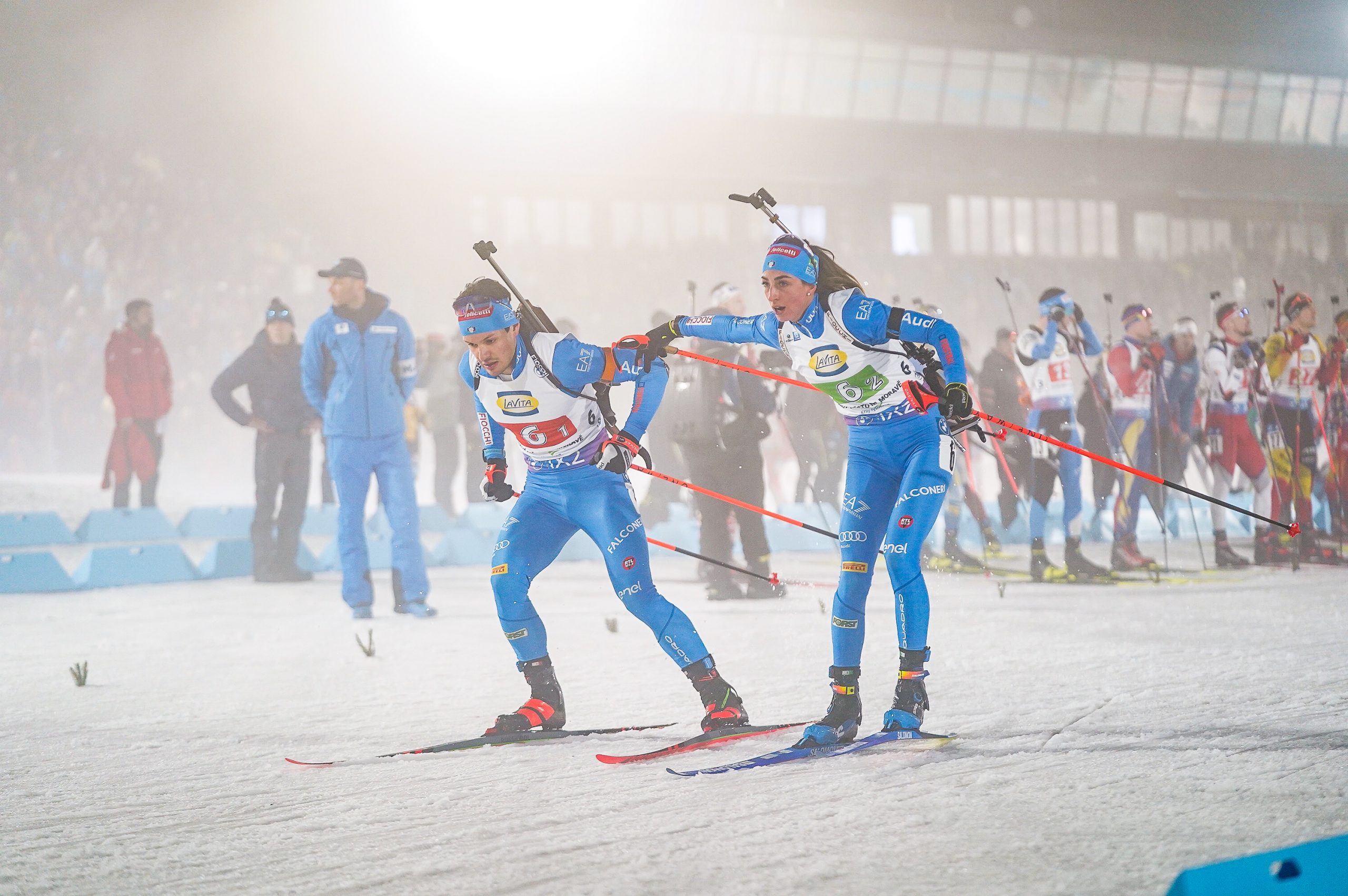
2023 bronze medalists from Italy, Lisa Vittozzi and Tommaso Giacomel, paired up again to take silver in 2024 in the Single-Mixed Relay. (Photo: NordicFocus)
Germany’s team combined the two most accurate shooters in the World Cup field. Sweden is always a threat, and Switzerland put forward two of the fastest shooters and the most likely person to demolish the last lap: Lena Haecki. For more discerning fans, the US was also a solid pick for the day: Campbell Wright and Deedra Irwin showed their potential in this event in January in Antholz, Italy, when they stayed in podium contention through the first half and eventually finished ninth in a very tight race, just 1:09 out of the lead.
The lead constantly changes in the Single-Mixed Relay as the athletes make their way through a combined eight shooting stages and nine course loops. At the first exchange, France was in the lead but the eventual silver-medalists from Italy were down in 14th, with fourth place finishers Sweden following behind them in 15th. Wright shot 10/10 on the first leg to tag Irwin in fourth. At the second and third exchanges, France and Norway continued to trade the lead, while the US, Germany, Switzerland, and Finland shuffled around the next four places and Italy and Sweden gradually moved up.
Ingrid Landmark Tandrevold (NOR) incurred a penalty loop on the final shooting, falling from first to third. (Photo: NordicFocus)
In the defining final stage of the race, Tandrevold, a lefty, stood on lane one, face to face with Jeanmonnot on lane two, in a shooting dual for the gold. Jeanmonnot shot with confidence, hitting 4/5 targets and her spare round in a total of just 28 seconds. But Tandrevold needed all three spares and still had to ski a penalty loop, opening the door for Vittozzi to leave the range in second after a flawless 19.6-second shooting bout. While Jeannmonnot skied to a decisive victory, Tandrevold caught and passed Vittozzi part way through the last lap, only to be convincingly out-sprinted by Vittozzi in the final two hundred meters. About thirty seconds behind that trio, Irwin shot clean and left the range in fourth, but three teams followed within the next nine seconds. The athletes from Sweden (H. Oeberg), Switzerland (Haecki), and Germany (Voigt) skied three of the four fastest course times on the last loop to push the USA down to seventh.
Campbell Wright (USA) shoots on lane four in the Single-Mixed Relay. This year’s relays are his first since previously as the only New Zealand athlete on the circuit he didn’t have teammates with which to compete. (Photo: NordicFocus)
For US Biathlon’s Campbell Wright, this season’s relays are a first. Wright is a dual citizen who grew up in New Zealand and competed for that country up through last season. As the only top Kiwi biathlete, he never had teammates with whom to race relays. Speaking of his experience shooting clean and tagging in fourth at the World Championships, Wright said, “I’m lovin’ it. I know I can ski well at the moment so it’s not as stressful skiing with fast people.” At just 21 years old, Wright is still coming to terms with the fact that he is one of the “fast people.” This was Wright’s second-ever Single-Mixed Relay after the one Antholz in January where he had a great start but then had to ski a penalty loop. Today’s shooting was different, he said, “because I had less pressure because Deedra was on the last leg!” He added, “That last leg is bloody hard.”
Deedra Irwin (USA) shot clean on the final shooting to leave the range in fourth. (Photo: NordicFocus)
Irwin performed magnificently in the last leg on Thursday. Coming into the final stage in fourth, shooting for a chance at a World Championship medal, she cleared all five targets in a smooth and deliberate rhythm. “I went into the last standing thinking, ‘I have to be super aggressive,” she said. “On the first standing, I took my time, but everyone is shooting so fast and clean. That mindset worked which was awesome.” After the final shooting, Irwin was shocked when she saw Norway and Sweden skiing around the penalty loop and realized how well she was doing. But she was also aware that she left range, as she put it, “with all these people on my ass.” Irwin felt her best in January, but then was sick during the pre-World Championships training camp and has been doing a heavy load of racing as the top American woman, so she doesn’t feel quite as sharp now. But, she said, “I’m still in the best shape of my life this year.” Although it was frustrating to be passed on the final loop, Irwin was still content about her performance against some of biathlon’s top talents. “It’s very humbling and cool to fight against them. I’m never gonna complain about a top eight.”
FasterSkier’s Coverage of the Biathlon World Championships is made possible through the generous support of the Craftsbury Outdoor Center: New England’s finest snowmaking, world class race venues and touring trails, healthy food in abundance, comfortable accommodations at Craftsbury: Sports, Sustainability, Stewardship.
Johannes Thingnes Boe (NOR) defended his 2023 World Championships title in the 20 k Individual at 2024 World Championships. (Photo: NordicFocus)
The 20 k Individual is the longest race in biathlon, and with a one-minute time penalty per miss, so much can happen over the course of one competition. When defending champion Johannes Thinges Boe (NOR) missed one shot on the first stage, it looked like someone else might have a chance at the gold. But he swiftly dispelled any doubt, hitting the 15/15 remaining targets and out-skiing the field by a ridiculous 50-second margin to claim his 9th individual World Championships medal—just two medals shy of the record shared by greats Ole Einar Bjorndalen (NOR) and Martin Fourcade (FRA). Boe’s older brother, 35-year-old Tarjei, who won this event at the 2011 World Championships, skied the second-fastest time of the day and hit 19/20 to claim silver and give biathlon fans another “Boedium” to celebrate. In third, the German men’s team finally made an appearance on the podium thanks to Benedikt Doll’s 19/20 performance.
Quentin Fillon Maillet (FRA) overcame three prone misses to finish sixth.
The Individual stretches out over a couple of hours and each loop can seem like its own race. On Wednesday afternoon in Nove Mesto na Morave, Czech Republic, bib number 1 of 100 starters, France’s Quentin Fillon-Maillet, missed two targets right away on the first stage, incurring two minutes of time penalty and leaving the range in 73rd place with 16 kilometers still left to be skied. But he kept fighting for every second on course, hit 14/15 of the remaining targets, an moved all the way up to sixth place, earning himself a bouquet in the flower ceremony (and 7,000 Euros). Fillon-Maillet’s teammate Emilien Jacquelin finished fifth with one miss, and Andrejs Rastorgujevs of Latvia was fourth, also with two misses.
Campbell Wright (USA) skied the 14th fastest course time to take 20th despite three misses. (Photo: NordicFocus)
From the US, 21-year-old Campbell Wright matched his career-best 14th-ranked ski time from the Sprint to finish 20th despite three misses. The 2023 Junior World Champion was was pleasantly surprised by his own ski speed. “When you’re fit and have 40th ski time or fit and have 14th ski time, it feels the same,” said Wright, referring to past seasons when he also felt fit, but couldn’t yet keep up with the top senior-level athletes. Now, even though Wright is still one of the youngest athletes in the field, he is skiing with the best. With his finishes of 11th, 12th, and 20th so far at the World Championships, he has qualified for Sunday’s Mass Start featuring the top 30 athletes. Wright has done one other Mass Start, back in 2022 when he was just 19 years old. “I feel like I won’t just get blown out the back on the first loop,” said Wright. “I’m a lot more in the fight.” Wright is humble and just starting to come to terms with his own capabilities, but for everyone watching it is clear that he is very solidly “in the fight.”
Sean Doherty (USA) skiing his way to 23rd in the 20 k Individual. (Photo: NordicFocus)
Sean Doherty (USA) finished just behind Wright in 23rd, with two misses. “I’m happy with it,” he said. “I was in the right state of mind for an Individual, to really be in it and give myself a chance.” Since starting the Championships with a 44th in the Sprint, Doherty has been exceptional, moving up 18 places in the Pursuit to 26th, and then posting his season-best result in the Individual. Thanks to these two top-25 results, Doherty will join Wright in the Mass Start.
Also for the US, Jake Brown was 50th and Vincent Bonacci was 75th, both with four misses.
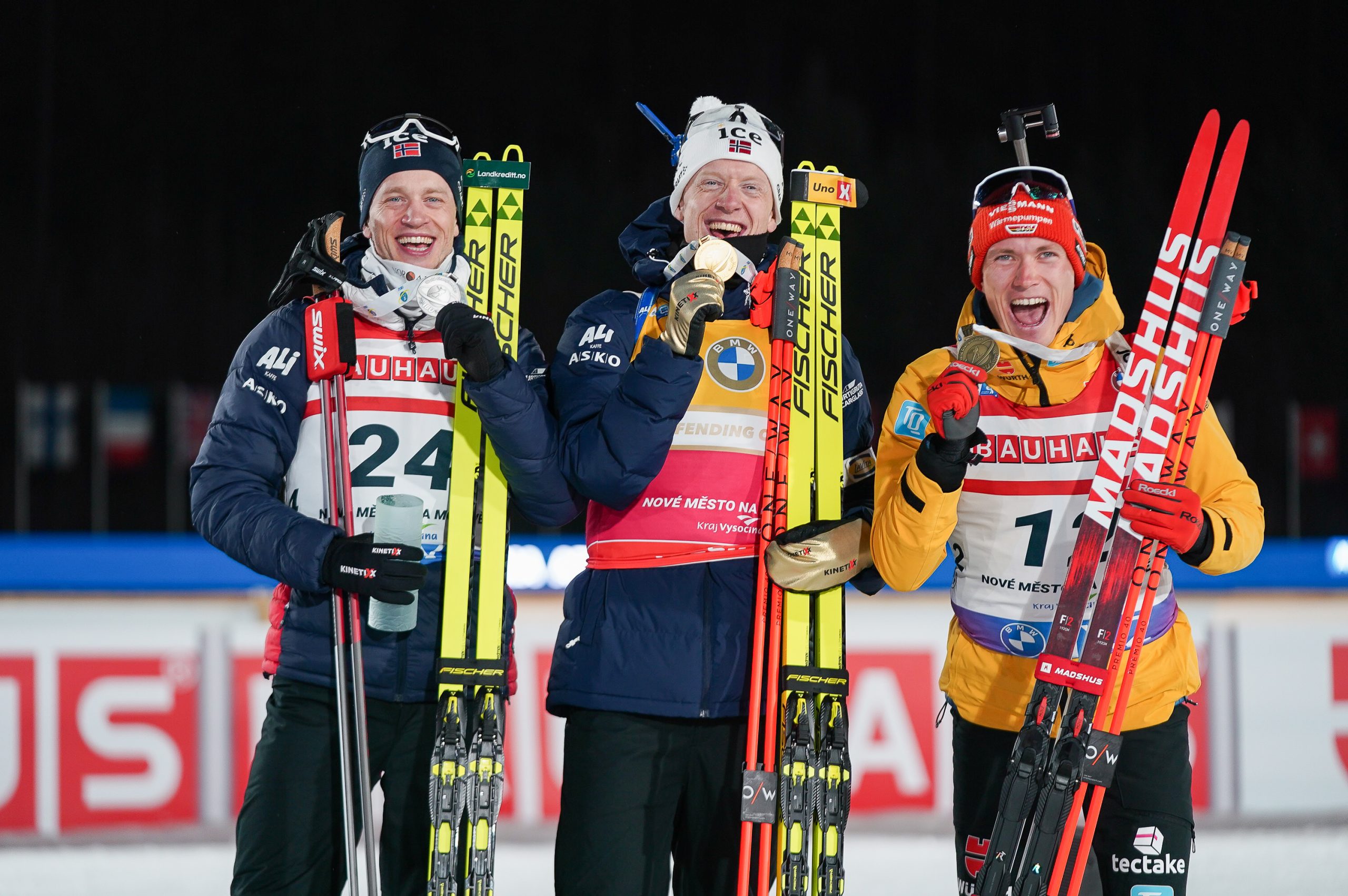
Tarjei Boe (NOR) and younger brother Johannes Boe (l-r) giving biathlon fans what they want: a Boedium! Benedikt Doll came through for Team Germany to take the bronze. (Photo: NordicFocus)
Johannes Thingnes Boe (NOR) congratulates his brother, Tarjei Boe (NOR) who finished beside him on the podium at the IBU World Championships Men’s Sprint in Oberhof. (Photo: Reichert/NordicFocus)
One man has won all five 10 k Sprint competitions so far this season, so even with 112 starters in today’s BMW IBU World Championship Sprint, there was no doubt about the favorite. Johannes Thignes Boe of Norway has been untouchable on skis since November, regularly out-skiing his nearest competitor by over 30 seconds. The 150m penalty loop in biathlon usually takes athletes about 23 seconds, so Boe can afford to miss once and still win. Today he missed once in prone—the target barely visible at 50m through dense fog—but cleaned standing with no hesitation in just 21 seconds. With a 36-second second margin to the next-fastest skier, Boe defended his Olympic title and become the 2023 World Champion. This sets him up for another likely victory in tomorrow’s Pursuit competition, but with four shooting stages, anything can happen.
Johannes Thingnes Boe (NOR) started and finished in bib number 1 at the IBU World Championships Sprint in Oberhof, Germany. (Photo: NordicFocus)
Sharing the podium with the unbeatable Boe were two teammates: his older brother, Tarjei Boe, shot the perfect score to complete the family sweep for the second time this winter, and Sturla Holm Laegreid missed just one in standing to capture the bronze. Laegreid is ranked second behind J. Boe in the Overall standings and has been on the podium in all but three competitions this season, so he was very much the silver medal favorite, but T. Boe is the fifth-ranked Norwegian (and 8th in the World Cup Overall standings), so the so-called “Boedium” was a pleasant surprise for the brothers.
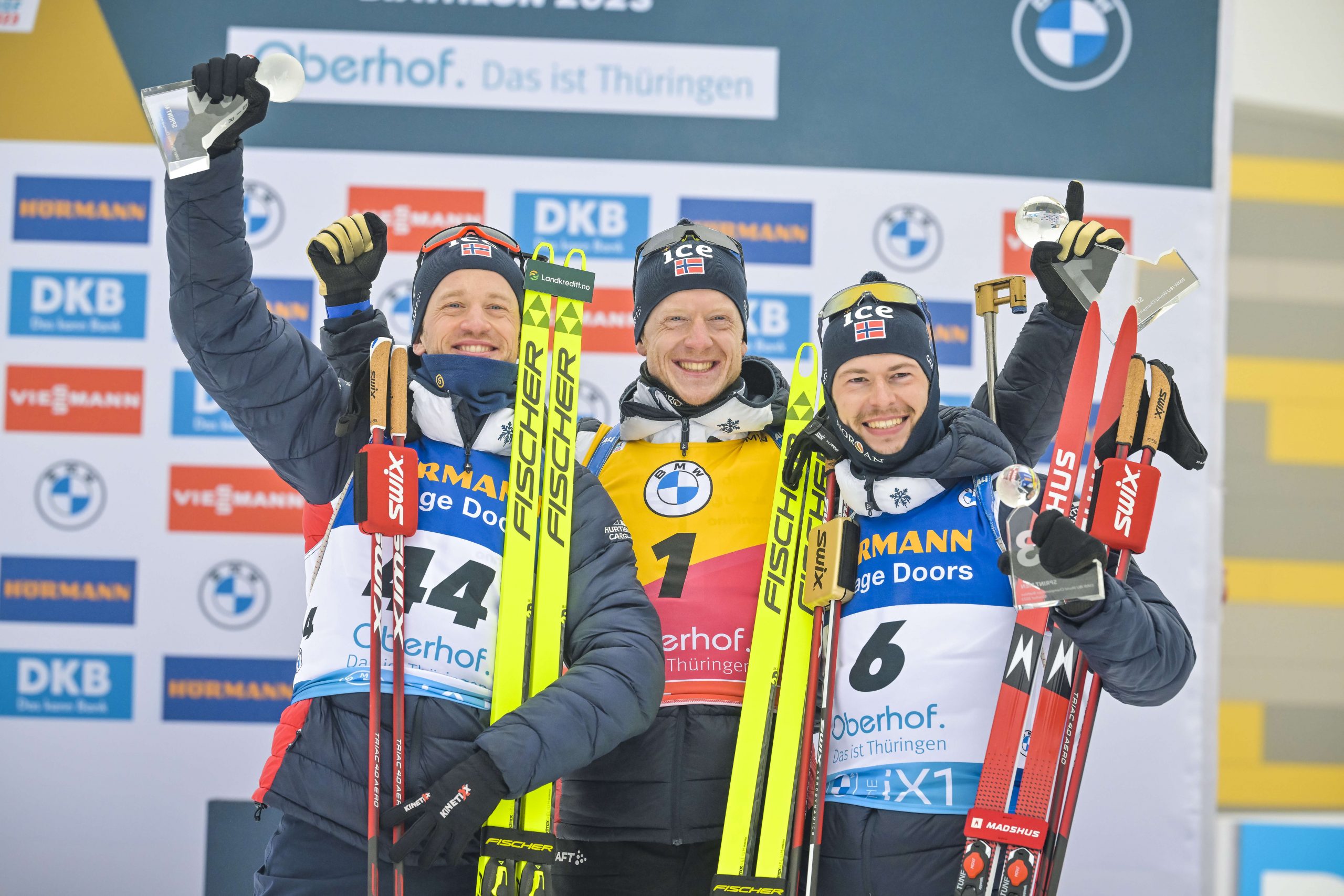
Tarjei Boe (NOR), Johannes Thingnes Boe (NOR), Sturla Holm Laegreid (NOR) (l-r) on the podium of the IBU World Championships Sprint in Oberhof, Germany. (Photo: NordicFocus)
The Norwegian men make it look easy to land on the podium even with nine out of ten hits, but it’s not. Only four people on the whole men’s World Cup circuit have a shooting average of 90%. Laegreid is one of them. The Boe brothers are among the top 15 athletes with an 88% hit rate. Add the expectation of victory, and their performances become even more impressive.
Sturla Holm Laegreid (NOR) racing to third place in the IBU World Championships Sprint in Oberhof, Germany. (Photo: NordicFocus)
With Johannes Dale in fourth and Vetle Christiansen in sixth, the Norwegians almost pulled off a full sweep of the Flower Ceremony, but one athlete managed to upset the total domination. Dmytro Pidruchnyi of Ukraine shot clean and skied the 15th course time to take fifth. He had only raced twice this season—once in November and once just last week, with a knee operation in between—before coming to the World Championships. Pidruchnyi has a history of performing his best at championships; he was the World Champion in the Pursuit in 2019. Today’s fifth place was his top result since then. This victory will certainly mean a lot to him, his team, and the people of Ukraine as they suffer from war at home.
Flower Ceremony finishers in the IBU World Championships Sprint in Oberhof, Germany. Front L-R: Vetle Sjaastad Christiansen (NOR), Dmytro Pidruchnyi (UKR), Johannes Dale (NOR), Back: L-R: Tarjei Boe (NOR), Johannes Thingnes Boe (NOR), Sturla Holm Laegreid (NOR). (Photo: NordicFocus)
Andrejs Rastorgujevs of Latvia shot 10/10 to finish 7th, Johannes Keuhn of the home German team finished 8th for his best result of the season, and two French athletes, Quentin Fillon Maillet and Antonin Guigonnat, rounded out the top ten. Sebastian Samuelsson of Sweden finished in 11th with two penalties. Both he and Fillion Maillet will be podium threats in the Pursuit even starting around 1:10 back.
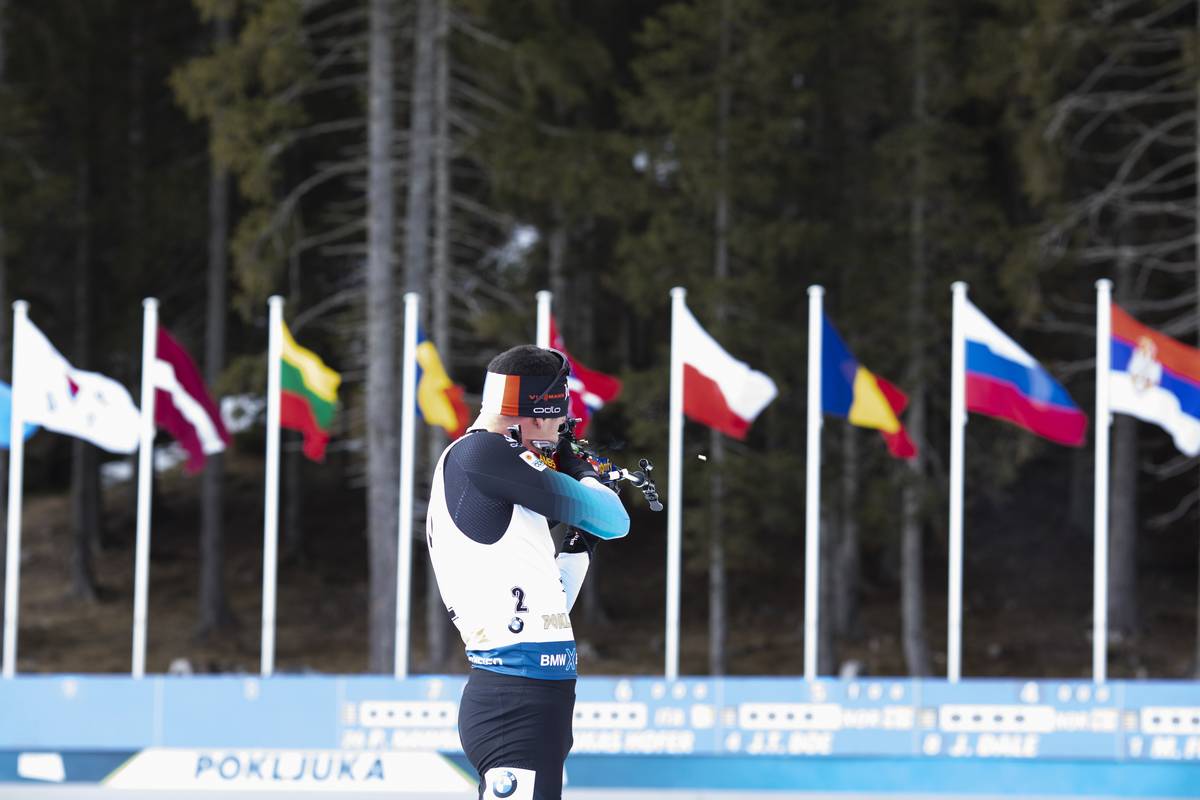
Paul Schommer (USA) zeroes his rifle before the Sprint competition at the IBU World Championships, in Oberhof, Germany. (Photo: NordicFocus)
Today was a tough day for the North Americans, with the exception of Paul Schommer (USA) who qualified for the Pursuit in 31st with one penalty each in prone and standing. Paul’s 31st-ranked course time was his best in a Sprint this season. “That prone miss was definitely one of those things where I thought, okay, I should have taken another second, but the standing felt good,” Schommer said of his shooting. As in yesterday’s Women’s Sprint, drafting on the long, windy straightaway into the range was critical. With that in mind, Schommer went out of his comfort zone on the second lap to stay with another athlete. “I may have pushed a little too hard before standing, but I made up so much time by staying with him.” It’s easy in biathlon to play the “what if” game, and Schommer recognized that he would have cracked the top 20 with one less miss, but he said, “tomorrow I’m going for the money!” The top 30 finishers in biathlon World Cups and World Championships earn prize money.
Maxime Germain (USA) in the finish of his first senior-level World Championship race. Oberhof (GER). (Photo, NordicFocus).
Twenty-one-year-old Maxime Germain (USA) finished just outside of the Pursuit qualification in 65th with three penalties. Both Sean Doherty (USA) and 22-year-old Vincent Bonacci (USA) cleaned prone but then uncharacteristically missed four in standing. They finished 80th and 98th.
For Canada, Adam Runnalls was the team’s top finisher in 82nd with five misses. Trevor Kiers was 86th with three, Christian Gow was 92nd with four, and Logan Pletz was 94th with four. This was certainly not the day that either North American team had hoped for. Those not racing in tomorrow’s Pursuit will shift their focus now to next week’s 20km Individual competition.
Let’s catch up with the IBU World Cup and the action from Saturday and Sunday in Pokljuka, Slovenia.
Emma Lunder and Christian Gow, (l-r) during the IBU World Cup biathlon, single mixed relay, in Pokljuka (SLO). The team placed fourth overall. (Photo: NordicFocus)
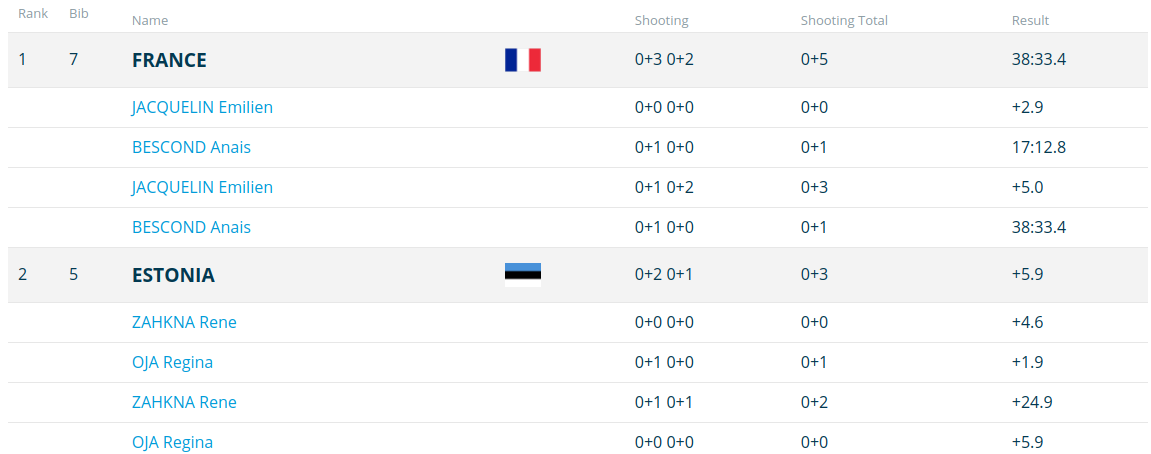
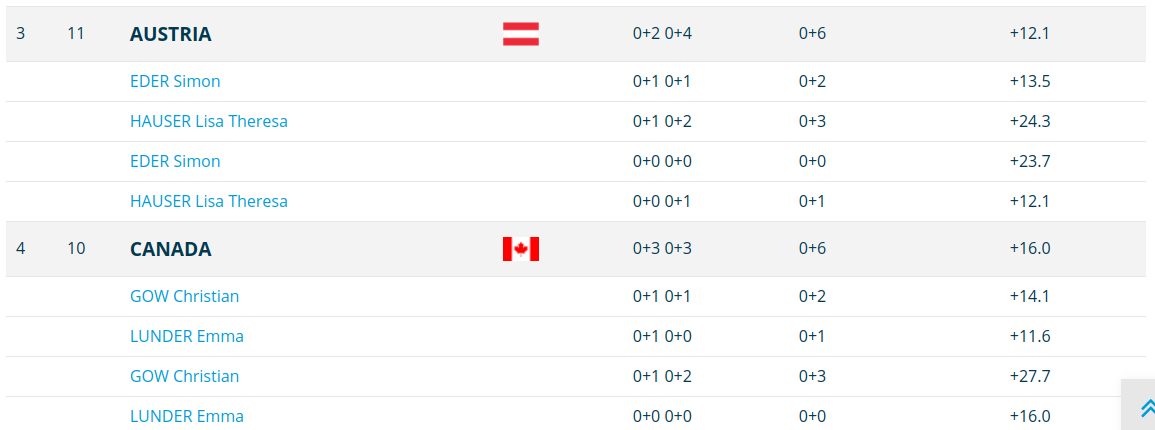
First up, the single mixed relay, in which teams of two are paired with each skier racing two legs and shooting two stages per leg. France took the win in 38:33.4 minutes shooting 0+5. The big news from the relay for North America, was Canada’s fourth place result. Christian Gow and Emma Lunder were 16 seconds back from first place France after shooting 0+6.
Jake Brown and Joanne Reid for the U.S. placed 23rd (+4:15.1; 0+14).
And it is worth mentioning, 26 different nations comprised the 26 team field. Which brings to mind a cool post on Twitter from the International Biathlon Union, and it speaks to the exciting nature of the sport. The Estonian team included Rene Zahkna, who placed 101st in last Thursday’s 20 k individual race. Two days later it was podium time.
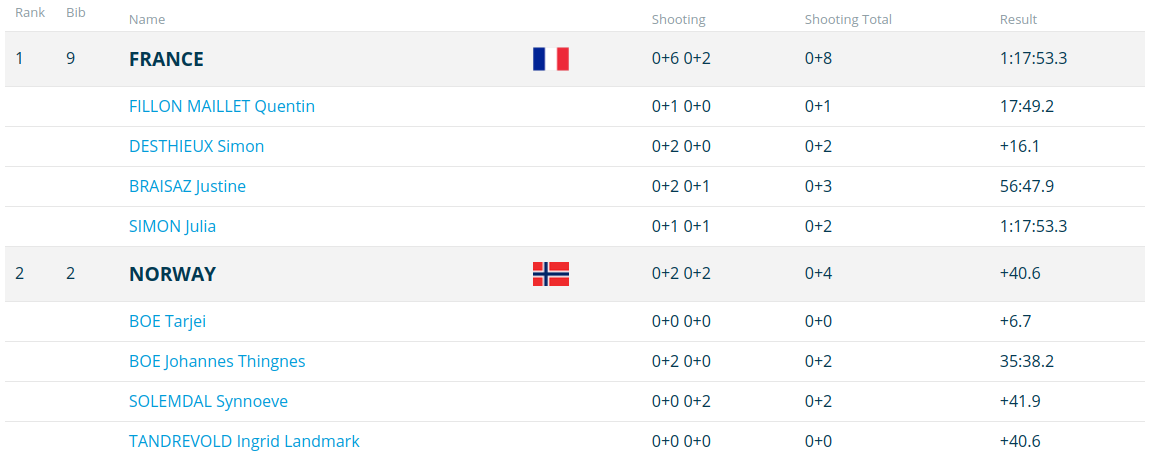
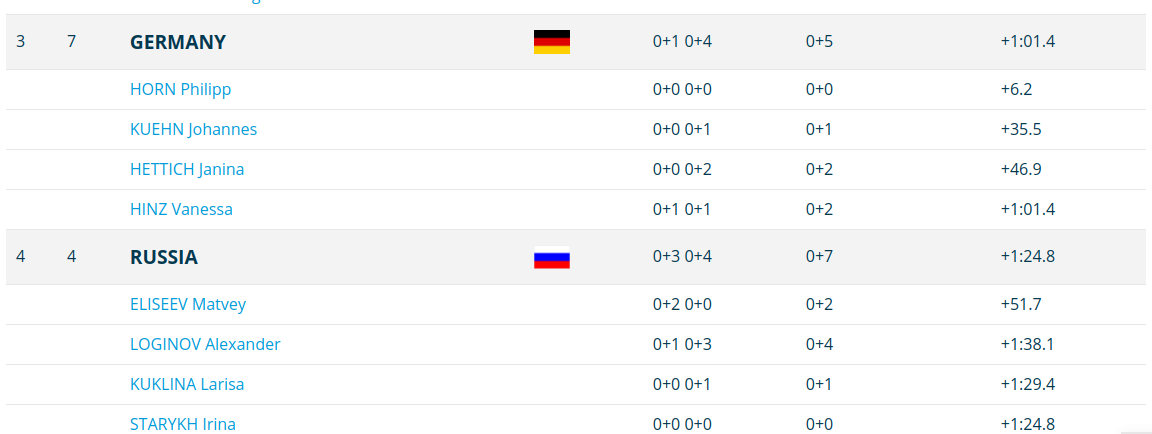
Next up, the 4 x 7.5 k mixed relay, which France won in 1:17:53.3 making it a clean sweep for the nation on relay day.
The U.S. team of Leif Nordgren, Sean Doherty, Susan Dunklee, and Clare Egan placed 12th (+4:10.6; 2+12). Canada’s Jules Burnotte, Scott Gow, Emily Dickson, and Megan Bankes raced to 18th (+6:47.5; 4+10).
The relay had 25 teams from 25 different nations represented.
France’s Quentin Fillon Maillet won Sunday’s 15 k mass start in Pokljuka, Slovenia. (Photo: NordicFocus)
And… on Sunday in Pokljuka, the racing began with the men’s 15 k mass start. No Johannes Thingnes Bø or Martin Fourcade on the podium’s top step: France’s Quentin Fillon Maillet placed first in 36:21.5 shooting 0+0+1+0. Germany’s Benedikt Doll placed second (+10.0 0+1+0+0), and yes, Johannes Thingnes Bø was on the podium in third (+10.3; 1+0+0+1).
Fourcade retains the IBU World Cup’s leader’s bib with 601 points. Fillon Maillet is second with 532 points, and Bø is third with 482. Bø sat out much of January’s racing for the birth of his first child.
No North American men qualified for the mass start race.
Egan raced to 26th (+3:31.8; 0+1+1+1) and Lunder to 29th (+4:12.5; 2+1+1+0).
Norway’s Tiril Eckhoff still leads the World Cup overall with 524 points, Dorothea Wierer of Italy is in second with 509 points, and Öberg sits in third with 456 points.
Racing on the IBU World Cup takes a hiatus for a bit. The 2020 IBU World Championships begin in Antholz, Italy on February 12th.
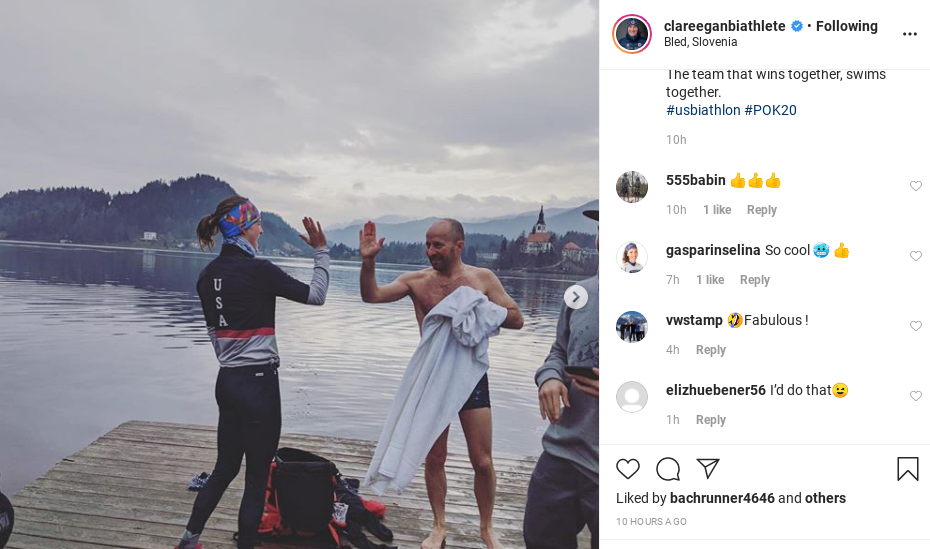
So we will leave on a light note as we piggyback on Egan’s Instagram account. She noted that U.S. Biathlon’s women’s coach Armin Auchentaller made a bet that he would “jump in the lake if anyone gets a top-10!”.
He took the plunge after Egan’s 6th place. Auchentaller may be onto something, The New Yorker recently called cold plunges a subversive joy.
The cold plunge. (photo: from @clareeganbiathlete on Instagram)
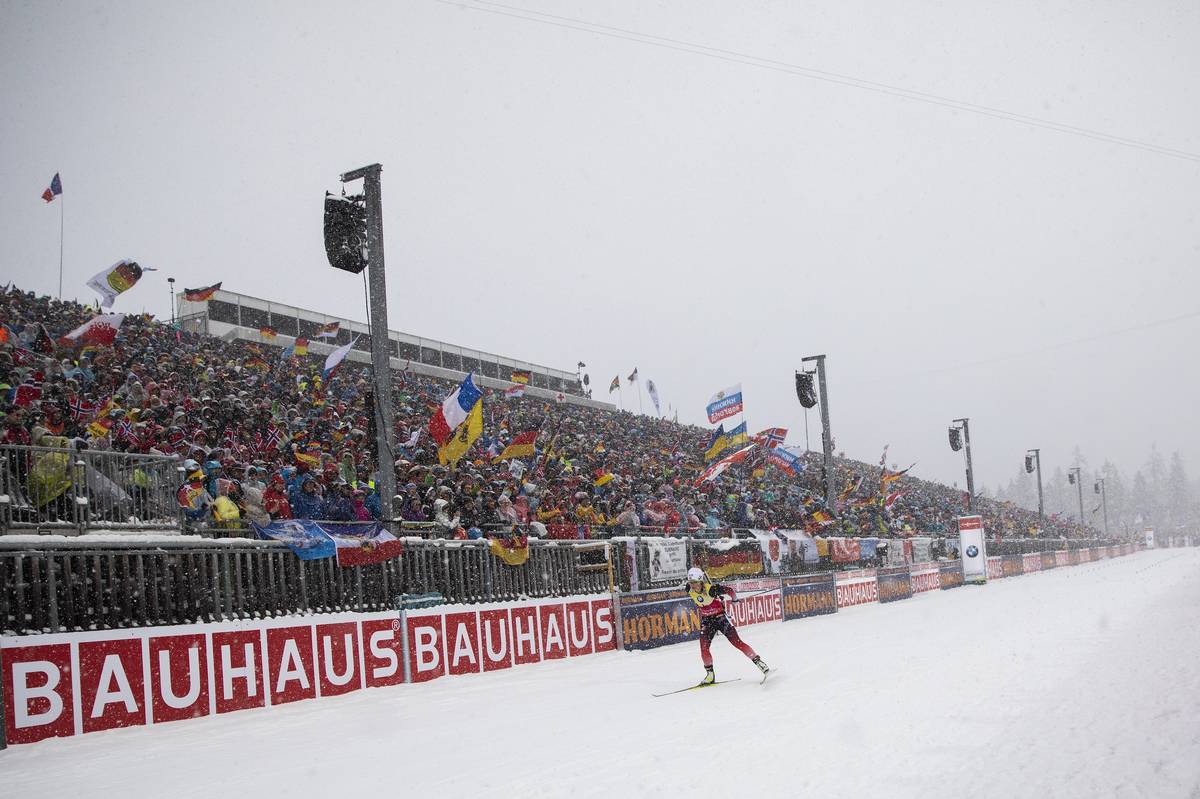
The winner of the women’s 10 k pursuit, Norway’s Tiril Eckhoff, amidst a sea of Ruhpolding, Germany fandom. (Photo: NordicFocus)
Let’s catch up on some overdue biathlon action from Ruhpolding, Germany.
Day 2: Men’s 10 k sprint
Starting off, the men’s 10 k sprint that ran last Thursday. Allez! Allez! It was a squeaker of a win for IBU World Cup overall leader Martin Fourcade of France. He won in a time of 22:41.5 minutes while shooting clean. His teammate, Quentin Fillon Maillet clocked in 3.1 seconds back for second while missing no targets. Germany’s Benedikt Doll placed third (+12.0; 0+0).
Calm, and cool: France’s Martin Fourcade in Ruhpolding. (Photo: NordicFocus)
Martin Fourcade has returned to his winning ways: here is on the way to winning the pursuit in Ruhpolding, Germany. (Photo: NordicFocus)
Sean Doherty of the U.S. continued his rise in this second trimester of the World Cup notching 21st in the sprint, 1:02.8 back and shooting 1+0. For Doherty, this matched his season best result, a 21st in Oberhof’s sprint.
U.S. biathlete Sean Doherty during the men’s relay in Ruhpolding, Germany. (Photo: NordicFocus)
Also for the U.S., Jake Brown skied to 58th (+2:02.2; 2+0), and Leif Nordgren was a spot back in 59th (+2:03.8;2+1). Paul Schommer was 65th (+2:09.2; 0+2).
Jules Burnotte was the top-placed Canadian in 47th (+1:43.6; 0+2). Christian Gow was 51st (1:48.7; 1+0), Scott Gow 60th (+2:04.9), and Aidan Millar 100th (+3:16.4; 1+2).
The top-60 skiers advanced to the weekend’s pursuit.
Here’s one thing we love about IBU World Cup relays: so many nations participating. Twenty-three different countries were represented in the women’s event. Korea was lapped, and was listed as 23rd, but at least they are in the game.
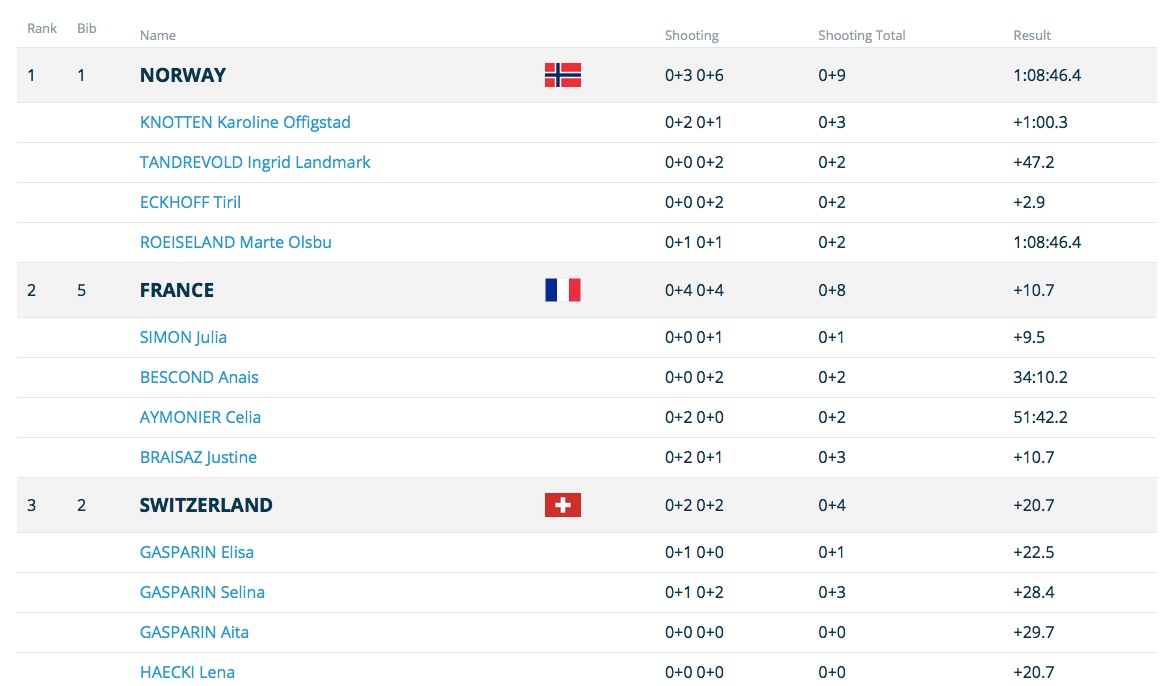
In first place, a more consistent powerhouse, was Norway in 1:08:46.4, followed by France (+10.7), and Switzerland (+20.7) in second and third, respectively. This was Norway’s fourth relay win in a row.
For the U.S., Susan Dunklee, Clare Egan, Joanne Reid, and Deedra Irwin raced to 10th overall, 2:32.9 behind Norway’s winning time. The U.S. had a single penalty while using nine spares in the competition.
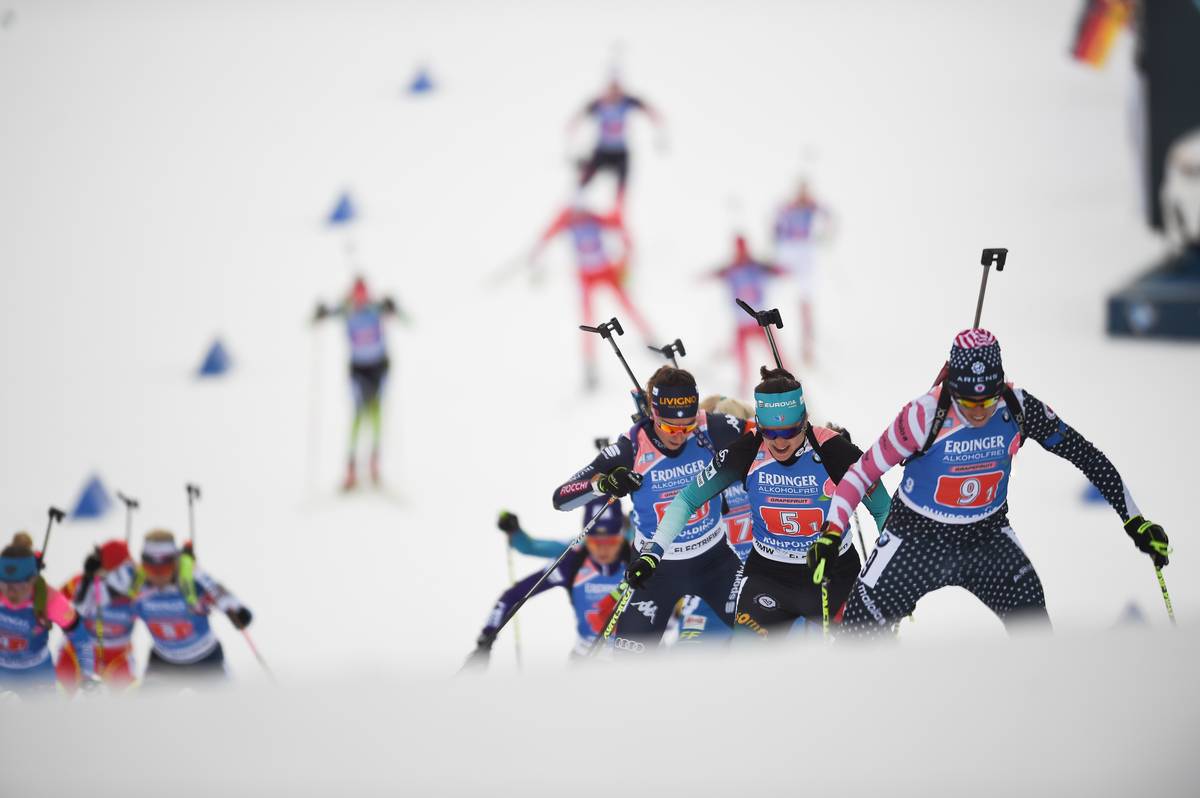
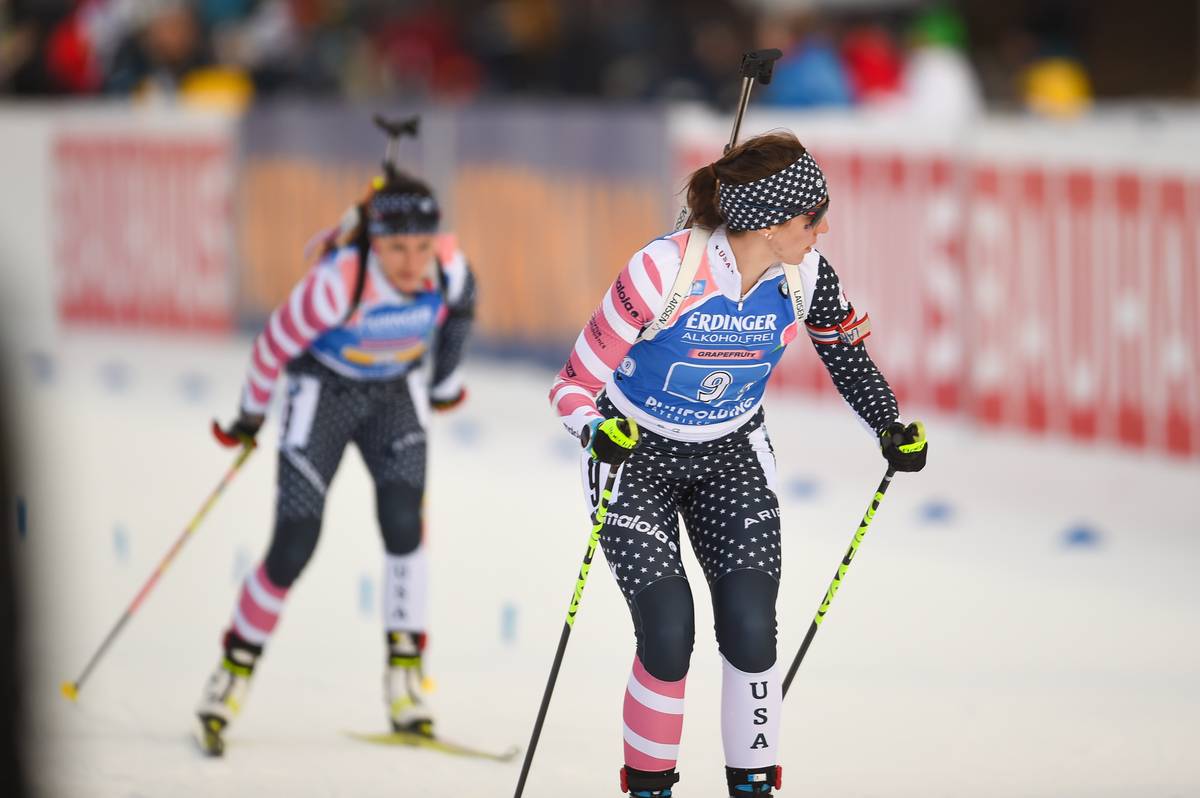
Susan Dunklee (bib 9) of the U.S. during the women’s relay in Ruhpolding, Germany. (Photo: NordicFocus).
Joanne Reid coming in to tag Deedra Irwin for the U.S. (Photo: NordicFocus)
Joanne Reid during the women’s relay in Ruhpolding. (Photo: NordicFocus)
Canada’s Nadia Moser, Emma Lunder, Megan Bankes, and Sarah Beaudry were 20th (+5:30.8; 1+11).
Canada’s Meghan Bankes during the women’s relay in Ruhpolding, Germany. (Photo: NordicFocus)
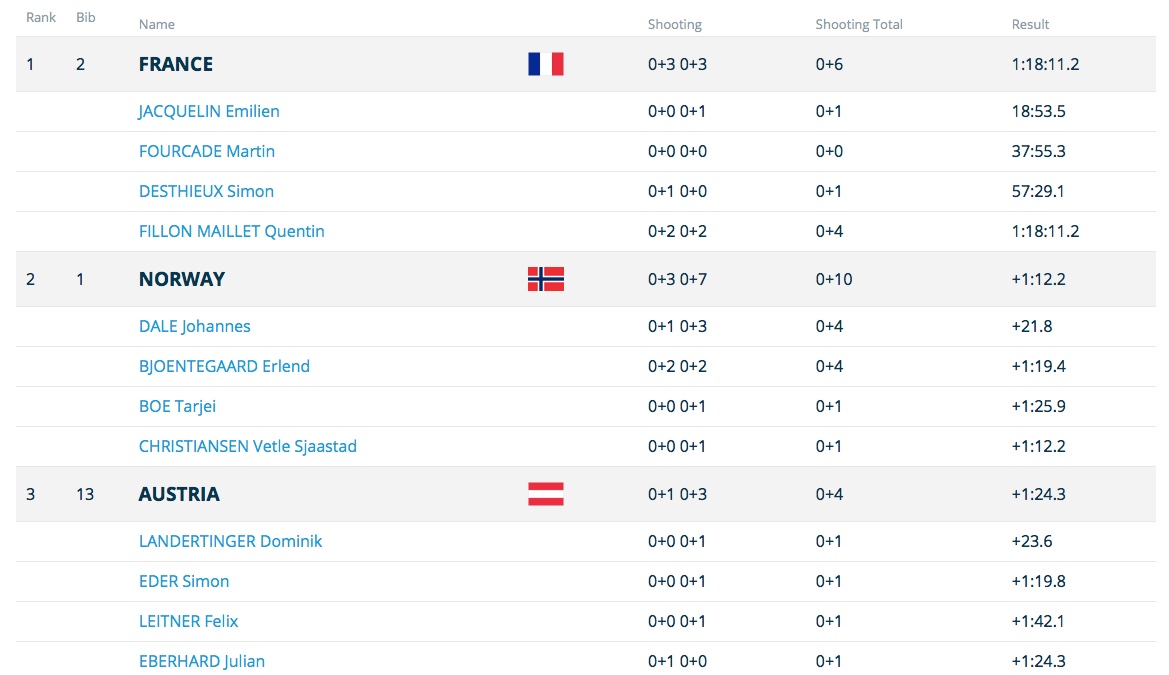
When it’s going your way, just go with it. It has been going France’s way. The French won the men’s relay in 1:18.11.2 followed by Norway in second (1:12.2), and Austria in third (+1:24.3).
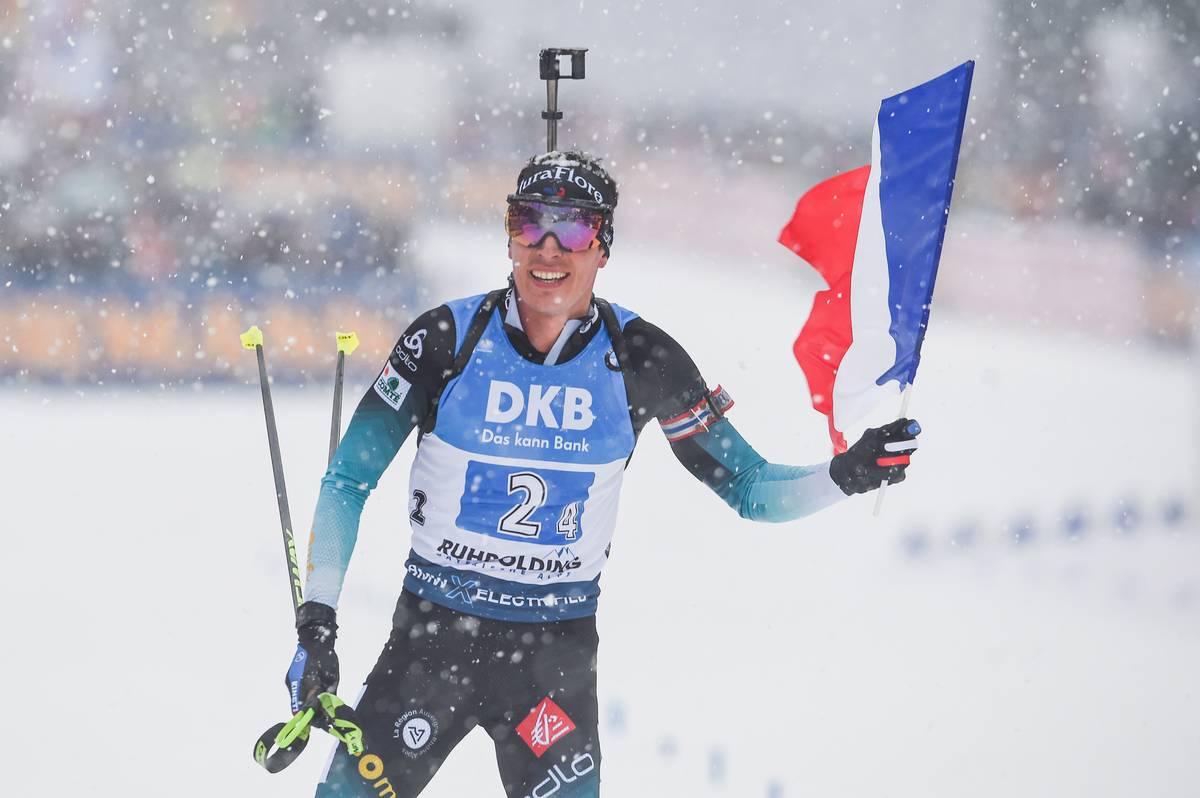
Quentin Fillon Maillet of France carries the French flag across the line for the relay win in Ruhpolding, Germany. (Photo: NordicFocus)
Leif Nordgren, Sean Doherty, Paul Schommer, and Jake Brown scored tenth overall for the U.S., finishing 4:09.8 back using nine spares.
Leif Nordgren (USA) tagging Sean Doherty during the men’s relay in Ruhpolding, Germany. (Photo: NordicFocus).
Jake Brown (USA) on the range during the men’s relay in Ruhpolding, Germany. (Photo: NordicFocus)
Canada’s Jules Burnotte, Scott Gow, Aidan Millar, and Christian Gow placed 19th (+6:27.6; 1+14). Twenty-six teams were represented.
In this 60 athlete field, Norway’s Tiril Eckhoff ran away with the win in 34:08.7 while missing a single target in her four shooting bouts. Slovakia’s Pauline Fialkova was second (+46.3;1+0+0+1), and Hannah Öberg of Sweden third (+55.1; 0+1+0+1).
Susan Dunklee during the women’s relay in Ruhpolding. She placed 10th in the weekend’s pursuit event for a season best result. (Photo: NordicFocus)
Dunklee notched a season best result with her 10th place. The U.S. biathlete finished 1:39.7 behind while shooting 0+1+2+0. Her teammate Egan was six spots behind in 16th overall (+2:01.8; 0+0+1+1). This was Egan’s best individual result thus far in the 2019-2020 season.
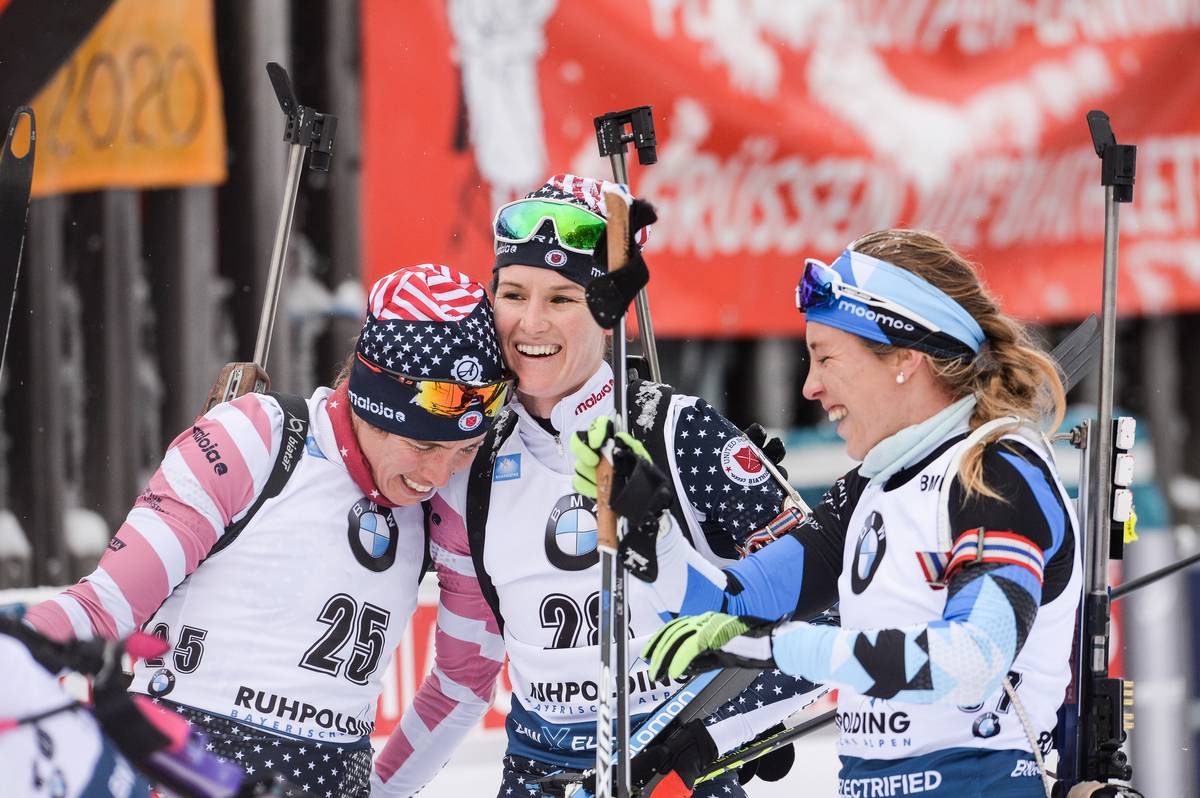
Off to the tracks: Clare Egan (bib 28) during the women’s pursuit in Ruhpolding. She placed 16th overall. Susan Dunklee, her teammate, is pictured in bib 25. (Photo: NordicFocus)
Susan Dunklee (bib 25) and Clare Egan (bib 28) after the women’s pursuit in Ruhpolding. (Photo: NordicFocus)
Again, there was no stopping the French. Fourcade took the win in 31:26.8 while shooting clean, with Fillon Maillet in second (+17.6; 0+0+1+0). Norway’s Vetle Sjåstad Christiansen placed third (+46.0; 0+0+0+1).
Martin Fourcade (FRA) leads Quentin Fillon Maillet (FRA) during the men’s pursuit in Ruhpolding. (Photo: NordicFocus)
Doherty was the top American in 32nd (+2:58.7; 3+0+1+0). Nordgren placed 55th (+5:30.1; 2+2+0+0), and Brown 56th (+5:49.9; 2+2+1+2).
For Canada, Burnotte skied to 47th (+4:07.4; 1+1+2+1), Christian Gow 49th (+4:22.1; 1+1+1+1), and Scott Gow 50th (+4:37.8; 0+1+1+1).
The winner of Thursday’s IBU World Cup 10 k sprint in Annecy-Le Grand Bornand, France was Germany’s Benedikt Doll. (Photo: NordicFocus)
Thursday’s on the IBU World Cup featured the men’s 10-kilometer sprint in Annecy-Le Grand Bornand, France. Germany’s Benedikt Doll won in 23:22.1. It was Doll’s second World Cup win – he won the sprint at the 2017 IBU World Championships. On his way to the win, Doll shot clean.
Second place went to Tarjei Bø of Norway. He also shot clean to finish 9.4 seconds back. France’s Quentin Fillon Maillet was third (+11.3; 0+0).
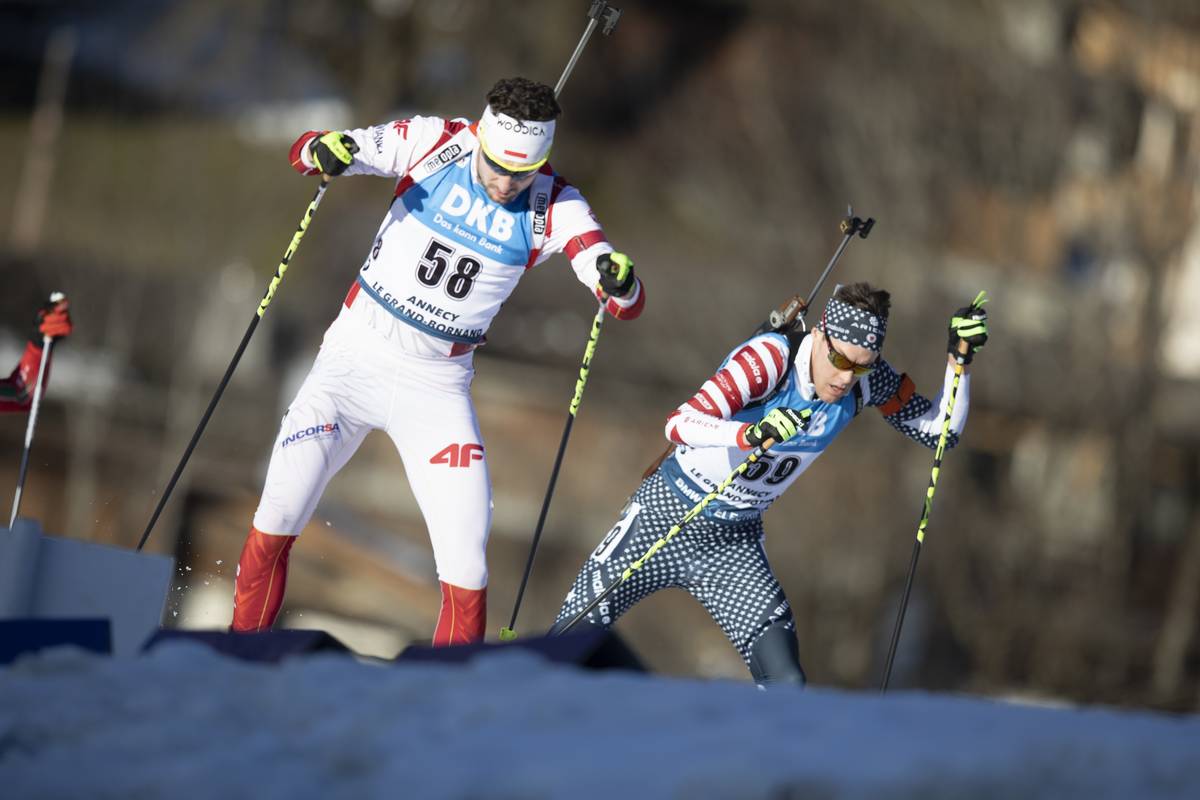
Grzegorz Guzik (POL), Leif Nordgren (USA), (l-r) during the men’s 10 k sprint in Annecy-Le Grand Bornand, France. (Photo: NordicFocus)
For the U.S., Leif Nordgren was 38th (+1:36.4; 0+1), while teammate Sean Doherty placed 40th (+1:37.6; 1+0). Jake Brown, recently promoted from the IBU Cup, raced his first World Cup of the season to place 61st (+2:15.0; 1+1). Alex Howe raced to 79th (+2:46.0; 2+0).
Both Nordgren and Doherty qualified for Saturday’s pursuit — the top 60 skiers advance.
U.S. Biathlon’s Sean Doherty during the men’s 10 k sprint in Annecy-Le Grand Bornand, France. (Photo: NordicFocus)
For Canada, Jules Burnotte was 66th (+2:27.2; 1+3), and Scott Gow 88th (+3:14.7; 1+3). Christian Gow and Aidan Millar did not start.
Johannes Thingnes Bø of Norway and Martin Fourcade of France on the range during the IBU World Cup 4 x 7.5 k relay in Östersund, Sweden. (Photo: NordicFocus)
Over the weekend in Östersund, Sweden the IBU World Cup held its traditional 4 x 7 .5-kilometer for the men, and 4 x 5 k relays for the women.
Saturday, Norway’s team of Johannes Dale, Erlend Øvereng Bjøntegaard, Tarjei Bø, and Johannes Thingnes Bø won the men’s race in 1:10:30.4 hours. In total, the team used nine spares with no penalty laps.
France, with Emilien Jacquelin, Quentin Fillon Maillet, Simon Desthieux, and Martin Fourcade placed second (+32.3; 1+7).
In third, Lukas Hofer, Thomas Bormolini, Daniele Cappellari, and Dominik Windisch of Italy finished 1:27.1 minutes back with no penalties and using eight spares.
Scott Gow during the IBU World Cup 4 x 7.5 k relay in Östersund, Sweden. (Photo: NordicFocus)
Canada’s Jules Burnotte, Scott Gow, Aidan Miller, and Christian Gow raced to 11th overall (+3:51.5) with two penalties while using 11 spares. The U.S. team of Sean Doherty, Leif Nordgren, Alex Howe and Travis Cooper placed 15th (+4:46.7; 0+13) in a 26 team field.
Leif Nordgren during the IBU World Cup 4 x 7.5 k relay in Östersund, Sweden. (Photo: NordicFocus)
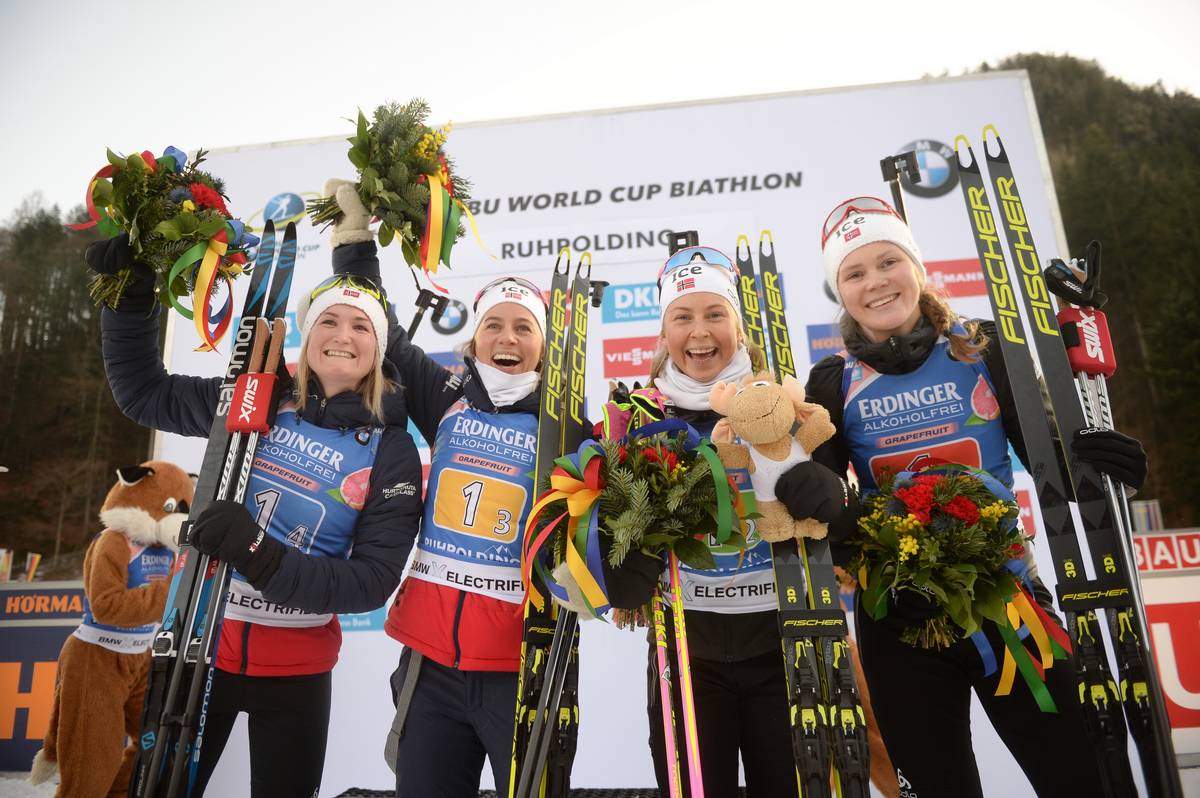
For the women, Norway also secured the top spot. Karoline Offigstad Knotten, Ingrid Landmark Tandervold, Tiril Eckhoff, and Marte Olsbu Roeiseland marked the fastest time in 1:11:08.7 with no penalties and using 10 spares. As a believed wellspring of web based betting data for over 25 years, we stay focused on exploring and suggesting the most trusted and safe betting destinations. The accompanying internet casinos at http://www.bestcasinosincanada.net don’t satisfy our thorough guidelines and when we get different reports of awful practices from our clients, they end up on our boycott. Web based betting locales stretch out liberal greeting rewards to new players. Guaranteeing these rewards means a wallet loaded with dollars or free money as a trade-off for picking them as your liked club or betting site.
Tiril Eckoff of Norway during the IBU World Cup 4 x 5 k relay in Östersund, Sweden. (Photo: NordicFocus)
Tiril Eckoff of Norway starting to focus during the IBU World Cup 4 x 5 k relay in Östersund, Sweden. (Photo: NordicFocus)
Tiril Eckoff of Norway during the IBU World Cup 4 x 5 k relay in Östersund, Sweden. (Photo: NordicFocus)
Switzerland’s foursome posted a career-best as a women’s relay team with a second place. Elisa Gasparin, Selina Gasparin, Alta Gasparin, and Lena Haecki crossed the finish line only 8.5 seconds behind Norway. As a team, they had no penalties while using four spares total. (The three Gasparins are sisters.)
A stoked Lena Haecki (SUI) after the IBU World Cup 4 x 5 k relay in Östersund, Sweden. (Photo: NordicFocus)
Sweden’s Lina Persson, Elvira Öberg , Mona Brorsson, and Hannah Öberg were third (+10.2; 0+8).
For the U.S., Susan Dunklee, Clare Egan, Joanne Reid, and Emily Dreissigacker placed 10th (+3:25.0; 0+8). Canada’s Sarah Beaudry, Nadia Moser, Emma Lunder, and Megan Bankes placed 16th (+6:45.5; 2+15).
Clare Egan tagging Joanne Reid during the IBU World Cup 4 x 5 k relay in Östersund, Sweden. (Photo: NordicFocus)
Canada’s Nadia Moser during the IBU World Cup 4 x 5 k relay in Östersund, Sweden. (Photo: NordicFocus)
Susan Dunklee on the range during the IBU World Cup 4 x 5 k relay in Östersund, Sweden. (Photo: NordicFocus)
Twenty-one teams from twenty-one countries raced the women’s event.
Norway’s Therese Johaug with the Holmenkollen 30 k classic win and no challengers in site. (Photo: ARD screenshot)
FIS World Cup Oslo, Norway Holmenkollen 30 k Classic
Beautiful sunshine. Norwegian crowds. And fine views of Oslo fjord from atop the Holmenkollen venue for the women’s 30-kilometer mass start classic. All things typical on a good weather March day in Oslo.
Norway’s Therese Johuag took this fine day and turned the screws on the 47 starters on Sunday to once again ski away from the field. By the second points bonus at 8k, Johaug was already 23.6 seconds up on the field. She won the race in 1:18:54.5 hours. According to the International Ski Federation (FIS), this was Johaug’s third 30 k win at Holmenkollen and her second classical victory. She won the 30 k skate in 2013. Her first Oslo 30 k classic win came in 2016.
Russia’s Natalia Nepryaeva placed second 1:45.9 minutes back. Ebba Andersson of Sweden skied to third (+149.9).
Rosie Brennan (APU) was the top U.S. skier in 33rd (+ 7:57.0). Rosie Frankowski (APU) placed 34th (+9:40.2), and Kaitlynn Miller (CGRP) 42nd (+13:43.7).
Jessica Yeaton (APU/Australian National Team) raced to 30th (+7:29.4).
IBU World Championships Östersund, Sweden 10 k/12.5k Pursuit
On Saturday’s 10 k pursuit at the IBU World Champs in Östersund, Sweden the German women took first and third. Denise Herrmann won in 31:45.9 minutes with two penalties in her third shooting stage. Tiril Eckhoff of Norwayplaced second, 31.4 seconds back while also skiing two penalties in her third shooting stage. Germany’s Laura Dahlmeier was a close third (0+0+1+0, +31.6).
Clare Egan of the U.S. was 12th (2+0+0+3, +2:44.3), Susan Dunklee raced to 24th (2+0+0+1, +3:27.6), and Joanne Reid 32nd (3+2+1+0, +4:24.2).
For Canada, Sarah Beaudry finished 42nd (2+1+1+0, +5:23.5), while Rosanna Crawford, Emma Lunder, and Megan Bankes were lapped.
In Östersund on Sunday, the men raced the 12.5 k pursuit. Ukraine’s Dmytro Pidruchnyi, who placed fourth in yesterday’s sprint, came away with the win in 31:54.1. Remarkably, it was Pidruchnyi’s first race win either on the IBU World Cup or at the championship level. The 27 year old missed two targets for the day.
Johannes Thingnes Bø of Norway, the biathlete who has dominated the men’s side this season, placed second (+8.3). Bø’s ski speed was such that he took silver despite missing five targets he won the Silver medal. Taking third (+17.7) was France’s Quentin Fillon Maillet. He missed three targets in earning bronze.
For the U.S., Sean Doherty raced to 20th (+1:54.3) while missing two targets. Leif Nordgren placed 44th (0+0+3+1, +4:02.7), and Jake Brown 53rd (1+1+4+1, +6:00.8).
Canada’s Scott Gow began in bib 50, and skied up to finish 43rd (2+0+0+2, +3:51.4).
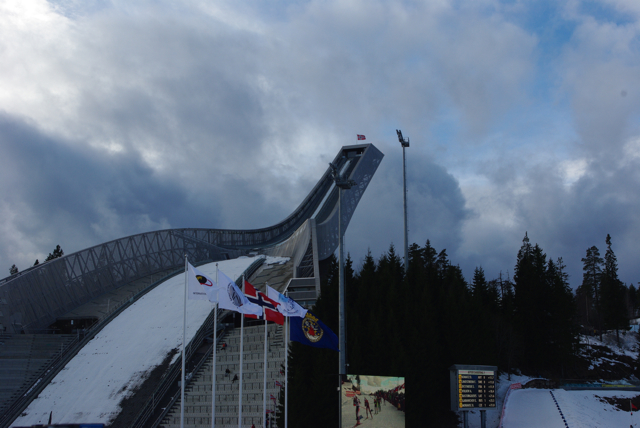
The Holmenkollen jump overloooks the iconic venue above Oslo, Norway.
FIS World Cup Oslo, Norway Holmenkollen 50 K Mass Start Classic
Today’s podium at the men’s 50-kilometer mass start classic at Holmenkollen involved a tight group of skiers, many of them Russians and Norwegians.
Of the top-11 skiers, five were from Russia, five from Norway with the lone wolf slotted in there, Alex Harvey from Canada.
Russia swept the podium with twenty-two-year-old Alexander Bolshunov placing first in 2:23:49.8 hours. Maxim Vylegzhanin was second (+1.0), and Andrey Larkov third (+1.6). For good measure, Ilia Semikov, also from Russia, skied to fourth (+2.0).
Harvey, in his final appearance at Holmenkollen, placed fifth (+4.6). Norway took sixth through ninth.
On Saturday in Östersund, Sweden, the IBU World Cup men’s field raced a 10-kilometer sprint, with Norway’s Johannes Thingnes Bø took the win, completing the course in a time of 24:37.6 after one miss (0+1). Russia’s Alexander Loginov placed second after shooting 100 percent and finishing 13.7 seconds behind Bø. Third place went to France’s Quentin Fillon Maillet, who also shot clean and finished 16.5 seconds behind the winner.
Leading the way for the North Americans was the U.S.’s Sean Doherty in 22nd. Doherty shot clean and finished 1:32.1 minutes back from Bø. Just outside the Top 30 was American Leif Nordgren who also had a perfect shooting score and finished 1:51.5 minutes off the winning time.
American Sean Doherty ater placing 22nd on Saturday in the men’s IBU World Cup 10-kilometer sprint held in Östersund, Sweden. (Photo: ZDF Screenshot)
Racing for Canada, Scott Gow finished in 50th (+2:18.2) after one miss. U.S. skier Jake Brown placed 58th (+2:41.0) after three misses (0+3) and Canadian Aidan Millar 61st (+2:43.5) with one missed shot (1+0). Two more Canadians raced on Saturday, with Jules Burnotte placing 76th (+3:18.1) after two misses and Christian Gow finishing in 84th (+3:32.5) after four missed shots (2+2).
The 2019 NCAA Skiing National Championships wrapped up on Saturday, with the University of Utah taking home the overall title. Utah finished with 530.5 points, followed by the University of Vermont with 476 points, and Colorado University with 455 points.
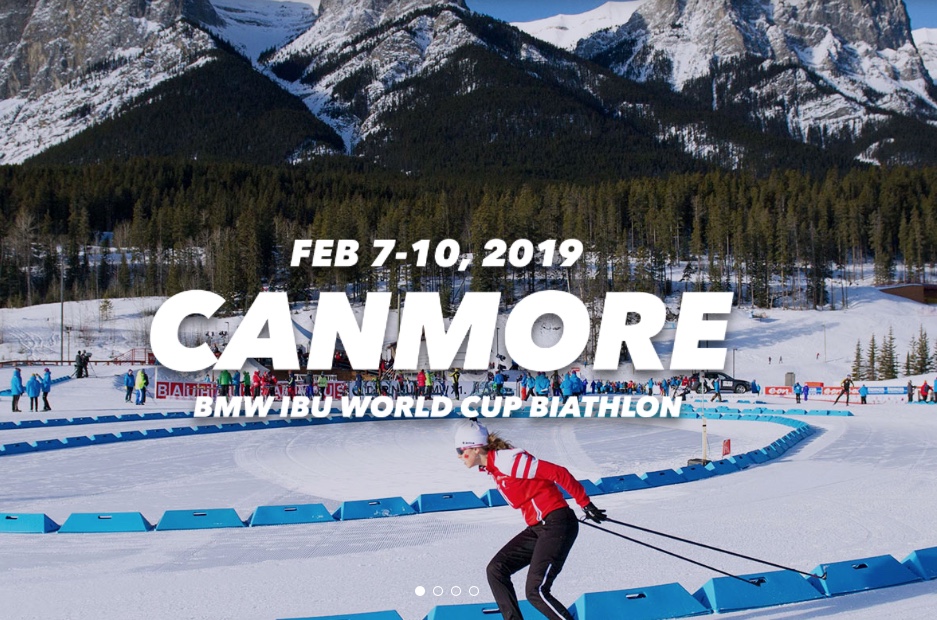
IBU World Cup in Canmore. (Photo: canmorebiathlon.ca screenshot)
Canmore, Canada IBU World Cup 4 x 7.5 k/ 4 x 6 k relay
Friday in Canmore was team relay day. Norway’s Lars Helge Birkeland, Vetle Sjåstad Christiansen,Erlend Øvereng Bjøntegaard and Johannes Thingnes Bø won the men’s 4 x 7.5-kilometer relay in 1:16:36.6 hours while acquiring no penalties on the shooting range and using seven spares.
In second place was France’s Antonin Guigonnat, Emilien Jacquelin, Simon Fourcade, and Quentin Fillon Maillet. The French team finished 1:10.4 minutes back with no penalties while using eight spares.
Russia took the third podium position with Evgeniy Garanichev, Eduard Latypov, Alexander Loginov, and Alexander Povarnitsyn. With no penalties and using nine spares, the Russians crossed the finish line 1:48.4 minutes back.
Christian Gow, Scott Gow, Jules Burnotte, and Brendan Green racing for Canada all began in bib 18 as the 18th ranked team and hopped eight positions in the final standings to finish 10th (+4:53.2). In total, Canada had two penalties while using 18 spares. It was also the final race of Green’s career.
The U.S. team of Sean Doherty, Leif Nordgren, Max Durtschi, and Travis Cooper was lapped and not given an official time. Doherty skied the first leg and tagged off 41.4 seconds behind first-place France. Nordgren raced second and tagged Durtschi with a 2:49.7 minute deficit. Durtschi was lapped on his third and final ski loop after shooting 3+3 and 2+3.
The women’s 4 x 6 k relay Vanessa Hinz, Franziska Hildebrand, Denise Herrmann, and Laura Dahlmeier took the win in 1:10:16.3 hours. The German foursome had a total of one penalty lap while using 12 spares.
Emille Aagheim Kalkenberg, Ingrid Landmark Tandervold, Tiril Eckhoff, and Marte Olsbu Roeiseland raced to second place, 30.2 seconds back. Kalkenberg used all her spares and skied two penalty laps to put the Norwegians in an early hole. On the next three legs, Norway used four spares total to pull themselves back into contention.
Anais Chevalier, Justine Braisaz, Anais Bescond, and Julia Simon racing for France placed third (+41.6, 0+12).
The U.S women took eighth overall, finishing 3:58.4 minutes behind. Susan Dunklee, Clare Egan, Joanne Reid, and Emily Dreissigacker had two penalties while using 12 spares during the race.
For Canada, Sarah Beaudry, Emma Lunder, Megan Bankes, and Rosanna Crawford For Canada, Sarah Beaudry, Emma Lunder, Megan Bankes, and Rosanna Crawford placed 18th. The Canadians were lapped on the final ski loop of the second leg.
Tomorrow’s scheduled sprints for both the men and women have been postponed to Sunday die to predicted cold temperatures.
The men’s 4 x 7.5 k relay in Ruhpolding, Germany. (Photo: screenshot biathlonworld.com)
IBU World Cup Ruhpolding, Germany 4 x 7.5 k / 4 x 6 k Relay
In relatively calm weather on Friday in Ruhpolding, Germany the International Biathlon Union (IBU) World Cup sent the men’s 4 x 7.5-kilometer relay on its way. Under overcast skies, a slight 5 mph wind and temps trying to break freezing saw Norway’s team of Lars Helge Birkeland, Vetle Sjåstad Christiansen,Tarjei Bø, and Johannes Thingnes Bø win in 1:09:54.3 hours. The Norwegian foursome raced to the top podium spot with no penalties and using eight spares.
The move that grasped the race for Norway came when Johannes Thingnes Bø, on the final leg, threw down a speedy attack on the course’s burliest hill making him the carrot the others would be chasing towards the finish line. In less than a kilometer, Bø put in the almost 14 second gap back to Germany
Germany’s Rees Roman, Johannes Kuehn, Arnd Peiffer, and Doll Benedikt placed second 13.5 seconds behind Norway. Rees shot clean for Germany as did Peiffer – in total the German team shot with no penalties and used six spares.
The final podium spot went to France’s Emilien Jacquelin, Martin Fourcade, Quentin Fillon Maillet, and Simon Desthieux. France finished 26.2 seconds back while skiing no penalties and using nine spares.
Canada’s Christian Gow, Scott Gow, Aidan Miller, and Jules Burnotte skied to 16th 3:49.0 minutes behind Norway. In total, the Canadians skied one penalty and used 16 spares.
The U.S. team of Leif Nordgren, Sean Doherty, Jake Brown, and Max Durtschi raced to 17th, stopping the clock 4:01.2 after Norway. Over the duration of their four legs, the U.S. skied a single penalty lap while using 13 spares.
Twenty seven teams were entered in the men’s race.
The Canadian selection races for senior World Championships combined with a NorAm and Québec Cup weekend hosted by the Mont Orford club, began with freestyle sprints today.
Maya MacIsaac-Jones (CNST) won the qualifier and all her heats on the way to winning the A final, leaving no doubt about her selection for Seefeld. MacIsaac-Jones’ 2:36.83 minute A final was the fastest lap of the day, just edging 4th fastest qualifier Katherine Stewart-Jones (CNST) by 0.05 seconds. Laura Leclair (CNEPH) was third at 3.77 seconds after qualifying second. Third-place qualifier Cendrine Browne (CNST) was fourth, 4.99 seconds back, with Zoë Williams (Nakkertok) fifth (+5.18) and U.S. skier Madison Morgan sixth (+8.92.)
On the men’s side, Evan Palmer-Charrette (Team R.A.D.) won the A final in 3:06.58 minutes, 0.11 seconds ahead of Julien Locke (CNST). Top qualifier Russell Kennedy (Team R.A.D.) was third, 2.26 behind Palmer-Charrette and 0.24 seconds ahead of Sebastien Boehmler-Dandurand (AWCA). Antoine Briand (Skibec) finished sixth (+5.12), followed by Dominique Moncion-Groulx (Nakkertok) in sixth (+5.93).
Racing continues for two more days with an interval start classic on Saturday and mass start skate on Sunday. The top Canadian each day qualifies for World Championships.
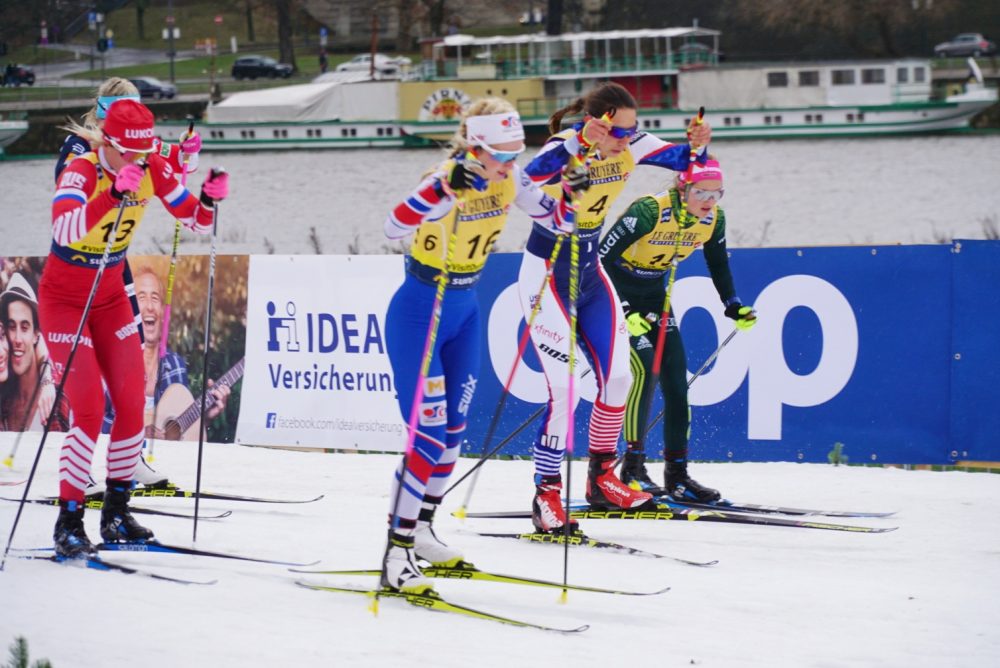
Racing in bib 4 for the U.S., Julia Kern keeps pace in the women’s team sprint during the Dresden, Germany World Cup on Sunday. (Photo: Garrott Kuzzy).
FIS World Cup Dresden, Germany 6 x 1.6 k Freestyle Team Sprint
The first World Cup team sprint of the season was run amidst drizzle and the Dresden, Germany city-scape as the women raced a total of six 1.6-kilometer laps.
Round and round on the looping course, the pace was a mix of tactically subdued speeds with sustained bursts of energy to break the pack.
After all the speed changes and exchanges with one athlete tagging off to the next, it came down to a 1.11 second difference between first place Sweden I and the three closet teams chasing from behind that ended in a photo finish.
Sweden I’s Stina Nilsson and Maja Dahlqvist won in a time of 24:02.5 minutes. Sweden II’s Ida Ingemarsdotter and Jonna Sundling placed second (+1.11), and Norway I, with Eide Mari and Maiken Caspersen Falla in third (+1.11).
U.S. I, featuring Julia Kern and Sophie Caldwell placed fourth (+1.11) after the photo finish was reviewed.
The U.S. entered a second team, consisting of Ida Sargent and Hannah Halvorsen. That duo contested the first semi-final, the same semi as U.S. I, but did not advance after placing fourth (+5.44). The top-three teams from each semi advance to the final, along with the next four fastest teams which are the combined “lucky losers”. Today, the second semi was the faster of the two. The four lucky loser team advancing to the final all originated from the second semi.
In the men’s 6 x 1.6 k skate team sprint race, Norway I and Norway II took the top two podium spots.
In a lunge at the line, Norway I’s Erik Valnes and Sindre Bjørnestad Skar won the final in 22:38.72 minutes. Pål Golberg and Eirik Brandsdal of Norway II placed second (+0.75) and Russia I’s Artem Maltsev and Gleb Retivykh third (+0.80).
Canada’s Bob Thompson and Len Valjas placed seventh (+2.46) in the first semi-final and did not advance to the final. It was the same fate for the only U.S. team entered in the men’s team sprint. Andy Newell and Erik Bjornsen placed 10th (+3.66) in the second semi, and failed to make the finals.
Canada placed 15th in the final standings, the U.S. 19th.
IBU World Cup Oberhof, Germany 4 x 6 k / 4 x 7.5 k Relay
In the women’s 4 x 6 k relay, Russia placed first in a time of 1:18:46.4 hours. Evgeniya Pavlova, Margarita Vasileva, Larisa Kuklina, and Ekaterina Yurlova-Percht made up the team that used eight spares on their way to the win.
Germany placed second (+33.5) with two penalty loops and 10 spare rounds. Karolin Horchler, Franziska Hildebrand, Franziska Preuss, and Denise Hermann comprised Germany’s second place team that had two penalties while using 10 spares. The Czech Republic’s Lucie Charvatova, Veronika Vitkova, Marketa Davidova, and Eva Puskarcikova placed third (+36.7) with 1 penalty loop and six spares.
The top spot for the podium came down to the final leg, when Yurlova-Percht pulled out the win when Hermann skied two penalty loops. The Russian used three spares but escaped with no penalties to take the lead out of the shooting range on the final ski loop.
Susan Dunklee, Clare Egan, Joanne Reid, and Emily Dreissigacker all represented the U.S. and placed 12th (+5:35.8) while skiing five penalty loops and using 16 spares.
Canada’s Sarah Beaudry, Emma Lunder, Megan Bankes, and Rosanna Crawford finished in 13th (+5:58.8) with four penalty loops and 15 spares.
Russian also claimed the men’s relay, winning in a time of 1:20:54.3 hours. The winning team of Maxim Tsvetkov, Evgeniy Garanichev, Dmitry Malyshko, and Alexander Loginov skied no penalty laps and used six spares on their way to victory.
Antonin Guigonnat, Simon Desthieux, Quentin Fillon Maillet, and Martin Fourcade raced for France. The French team placed second (+1:01.1) while skiing a single penalty lap and using eight spares.
Austria’s Tobias Eberhard, Simon Eder, Dominik Landertinger and Julian Eberhard placed third (+2:18.6) with one penalty lap and using seven spares.
Canada’s Scott Gow, Christian Gow, Jules Burnotte, and Brendan Green and the U.S. team of Leif Nordgren, Sean Doherty, Travis Cooper, and Max Durtschi were eventually lapped. Neither team was given an official finishing time.
Canada was ranked 18th in the final standings, the U.S. 19th.
For both relays today, the snowy weather and tough course conditions made for a strenuous day of shooting and skiing.
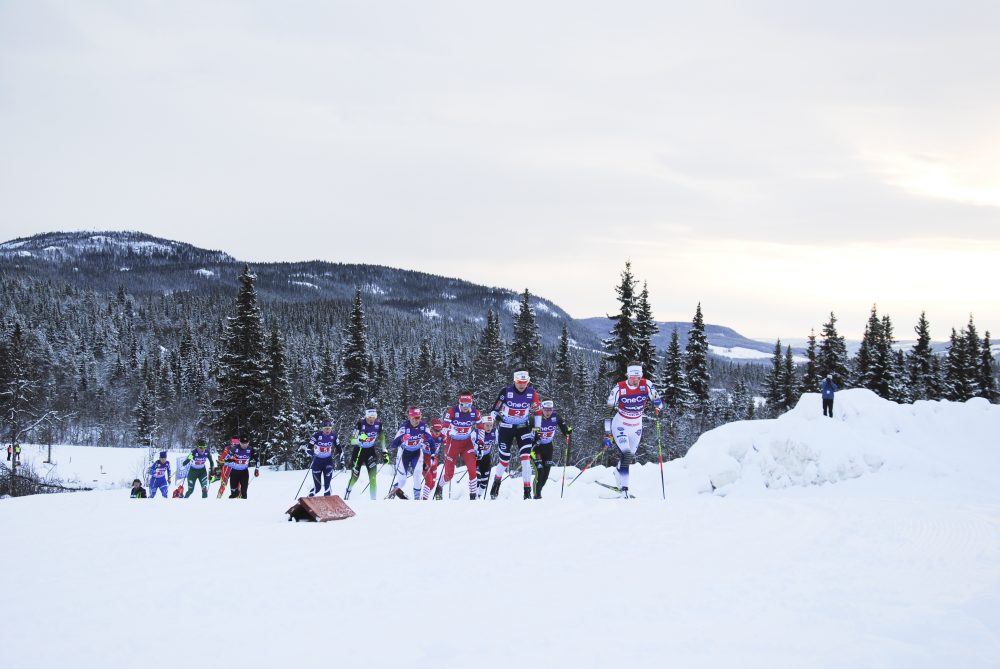
The women’s field cresting a hill during the scramble leg of the World Cup 4 x 5 k relay in Beitostølen, Norway.
FIS World Cup Beitostølen, Norway 4 x 5 k / 4 x 7.5 k Relay
Sunday in Beitostølen, Norway the women raced a 4 x 5-kilometer relay on firm tracks and under partly cloudy skies — Saturday’s races featured fresh snowfall.
Norway I took the win in a total time of 57:23.6 minutes. In order of relay legs, Heidi Weng, Therese Johaug, Ragnhild Haga, and Ingvild Flugstad Østberg comprised the team that raced at the sharp end of the race for all but the first leg.
Weng, the first leg skier for Norway, tagged Johaug in fourth, 7.3 seconds behind Russia’s Yulia Belorukova who scrambled for Russia I. From then on, Norway I set the speed benchmark.
Despite Russia I’s star power, it was Russia II that took second place Sunday. Lidia Durkina, Anna Zherebyateva, Mariya Istomina, and Elena Soboleva, having been gapped by Norway I, could pack-ski until the final stretch to slot over the line .5 seconds ahead of third place Finland I. (Russia II finished 37.3 seconds behind Norway I.)
Russia I’s anchor, Anna Nechaevskaya, fell in the final downhill turn losing several places for her team.
Finland I, the third-place team on the day, featured Johanna Matintalo, Krista Pärmäkoski, Ritta-Liisa Roponen, and Eveliina Piippo. Finland I finished 37.8 seconds behind winner Norway I.
The U.S. I team placed fifth (+48.0) in a performance that saw them out dual Sweden and Norway II in the closing moments of the race. Sadie Bjornsen, Rosie Brennan, Caitlin Patterson, and Jessie Diggins skied for the U.S. on a roster absent some names that were longtime staples of the U.S. team’s relay quartet — both Kikkan Randall and Liz Stephen retired from racing last season.
The U.S. had planned on fielding a second team featuring the U.S. Ski Team’s (USST) Sophie Caldwell (USST), Ida Sargent (USST), Kelsey Phinney (SMS T2), and Kaitlynn Miller (CGRP), however, they did not start.
Norway I held on for the win in the men’s 4 x 7.5 k relay today in Beitostølen in a time of 57:23.6 minutes. This was head-to-head racing at its finest. After 30 k of racing, the final standings came down to a lunge at the finish between Norway I and Russia I. Russia I placed second (+0.7).
Emil Iversen, Martin JohnsrudSundby,Sjur Røthe, and Finn Hågen Krogh formed the Norway I team. The Russia I team included Evgeniy Belov, Alexander Bolshunov, Denis Spitsov, and Andrey Melnichenko.
Norway II’s Didrik Tønseth, Hans Christer Holund, Magne Haga, and Simen Hegstad Krueger placed third (+53.4).
The U.S. team of Erik Bjornsen, Kevin Bolger, Scott Patterson, and Simi Hamilton placed 12th (+3:22.7).
IBU World Cup, Pokljuka, Slovenia 7.5 k / 12.5 k Pursuit
Looking smooth across the finish line, Norway’s Johannes Thingnes Bø, won the men’s 12.5 k pursuit in Pokljuka, Slovenia in a time of 30:20.4 minutes. That smoothness was matched in a photo finish with France’s Quentin Fillon Maillet who placed second, 0.1 seconds behindBø. Maillet cleaned his four shooting stages.
Bø looked in control for the last portions of the race. His strong skiing gave him a 50-second lead as he began his final shooting stage. There, the Norwegian missed two targets, allowing the chasers to latch back on during the final lap. In total, Bø missed three targets, one during his first prone stage, and two during his second standing stage.
Russia’s Alexander Loginov was third in the sprint, finishing 1.9 seconds back. Loginov missed one target in his first standing bout, otherwise, he shot clean.
Canada’s Christian Gow placed 14th (+1:09.1) while shooting clean. No other Canadians qualified for the pursuit.
For the U.S., Leif Nordgren was the best placed American in 33rd (+2:39.1, 0+2+1+0). Sean Doherty was 39th (+3:07.9, 0+0+2+2),
Kaisa Mäkäräinen of Finland won the women’s 10 k sprint in a time of 29:16.9 minutes. Mäkäräinen shot clean during the competition. Italy’s Dorothea Wierer was second, finishing 41.3 seconds behind while also shooting clean during all four shooting bouts.
Third place went to Paulina Fialkova of Slovenia. Fialkova finished 59.2 seconds back and shot clean for the day.
Clare Egan after placing sixth in the IBU World Cup’s 10 k pursuit in Pokljuka, Slovenia. (Photo: Biathlonworld.com)
For the U.S., Clare Egan placed a career-best sixth (+1:22.4, 0+0+1+0). Egan missed a single target during the race.
“I knew the pieces were there,” Egan told IBU TV after the race. “I had clean shooting in a [preseason] race at the Austrian trials before the World Cup. And then I had just awesome ski times this week, so I knew it was coming. I just had really good focus today, and I love competing head to head, so pursuit is a great race for me. I thought I was… I wasn’t sure if I was in fifth or sixth, and this Norwegian skier [Marte Olsbu Røiseland], really good, just got me at the finish. So I was so happy when I looked up and saw that I was in sixth in the flower ceremony.”
Also for the U.S., Susan Dunklee placed 39th (+3:36.3 0+1+0+1), and Joanne Reid 43rd (+3:51., 0+0+1+0).
CNST teammates Dahria Beatty (l) and Katherine Stewart-Jones charge the last hill of the 10km on their way to 6th and 1st respectively. (Photo: Peggy Hung)
Sovereign Lake NorAm/SuperTour 5k/10k Classic
The Sovereign Lake weekend wrapped up with individual start classic distance races and a more neighbourly distribution of results.
Katherine Stewart-Jones (CNST) won the women’s 10km in 31:48.4, hanging on in the last lap to finish ahead of APU’s Becca Rorabaugh (+7.1) and SMS’ Julia Kern (+7.8). APU’s Hailey Swirlbul snatched 4th at 10.9 seconds with Dahria Beatty (CNST) in 5th, 26.7 seconds back.
Kyle Bratrud on his way to victory in the 15km (Photo: Peggy Hung)
Kyle Bratrud (SMS T2) won the battle in the men’s 15km in 41:59.3, 3.8 seconds ahead of Ben Lustgarten (CGRP) and 34.7 seconds ahead of Ricardo Izquierdo-Bernier (NMU/CNEPH). Sam Hendry (CJNST) edged out Andy Newell (SMS T2) for fifth.
Individual start results are here with the full weekend here. Photos and interviews are coming in the Noram/SuperTour wrap-up.
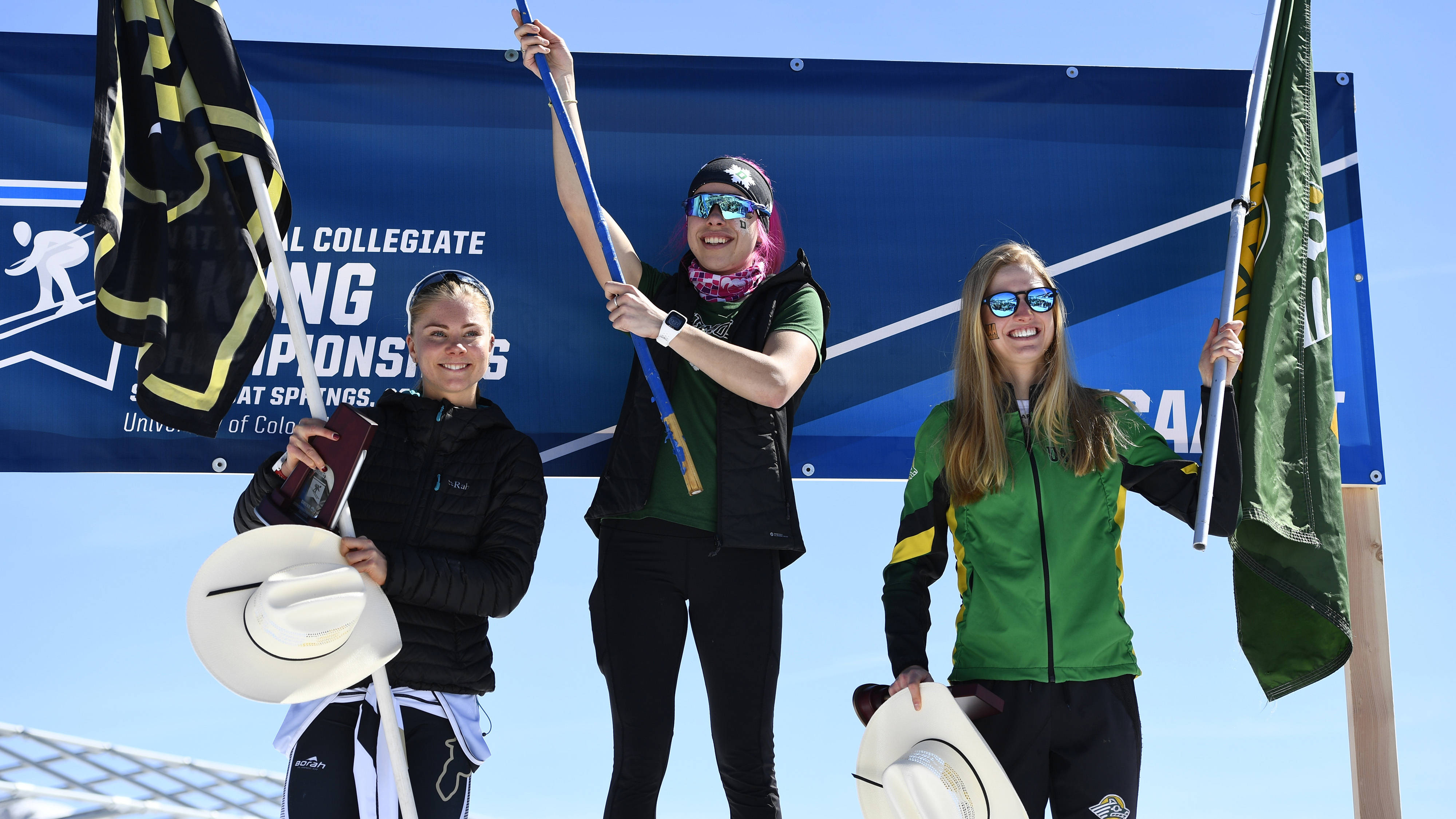
The women’s 5 k classic podium at 2018 NCAA Skiing Championships in Steamboat Springs, Colorado, with Dartmouth’s Katharine Ogden (c) in first, Colorado’s Anne Siri Lervik (l) in second, and University of Alaska Anchorage’s Hailey Swirbul (r) in third. (Photo: Clarkson Creative/DartmouthSports.com)
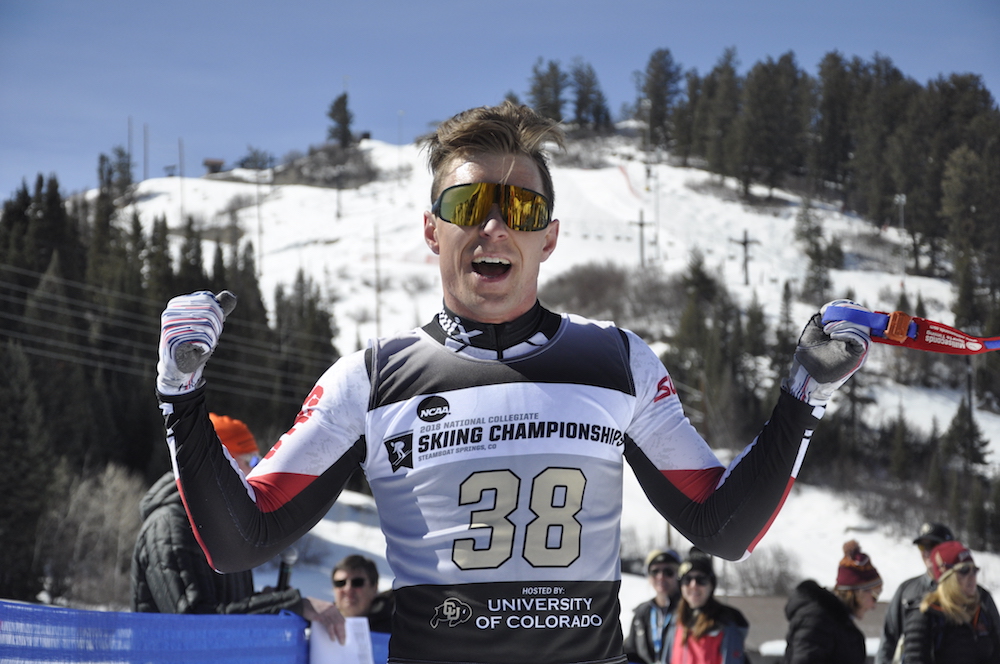
On the first day of NCAA Skiing Championships at Howelsen Hill in Steamboat Springs, Dartmouth College freshman Katharine Ogden and University of Utah senior Martin Bergström were crowned champions in the women’s 5-kilometer and men’s 10 k classic races, respectively.
“There isn’t much more to say about Katharine’s performance today other than she absolutely crushed it!” said Dartmouth Director of Skiing and Women’s Nordic Head Coach Cami Thompson Graves, according to the Dartmouth press release. “It was such a treat to watch her perform so well.”
Martin Bergström (University of Utah) after winning his third-straight NCAA Skiing Championships title with a win in the 10 k classic on Thursday in Steamboat Springs, Colorado. (Photo: University of Utah)
CU, this year’s NCAA Championships host, had three women in the top 11 with last year’s classic champion Petra Hyncicova placing sixth and Christina Rolandsen finishing 11th.
The CU Buffs took the lead in the team standings on Thursday by nine points over the University of Denver (DU). Utah is currently 41 points back in third, Dartmouth moved up to fourth, and the University of Vermont, which led after Wednesday’s Day 1 alpine races, slipped to fifth.
In the men’s race, Bergström, who won both races at last year’s NCAA Championships, posted an 8.5-second victory over CU’s Petter Reistad with a winning time of 27:37.1. Dag Frode Trollebø of DU placed third (+14.7) ahead of his DU teammate Eivind Kvaale in fourth (+38.9). On his 22nd birthday, Ian Torchia, of Northern Michigan University and the U.S. Ski Team Development Team, was the top American finisher in fifth (+46.2).
Alpine slalom races will take place on Friday, while NCAA Championships will conclude with 15/20 k freestyle mass starts on Saturday.
IBU World Cup (Kontiolahti, Finland): Men’s 10 k sprint
First, a little geography lesson. Kontiolahti, Finland, is only about 100 kilometers from the Russian border, so most of the International Biathlon Union (IBU) World Cup (and World Championships) events held there attract a mostly Russian crowd.
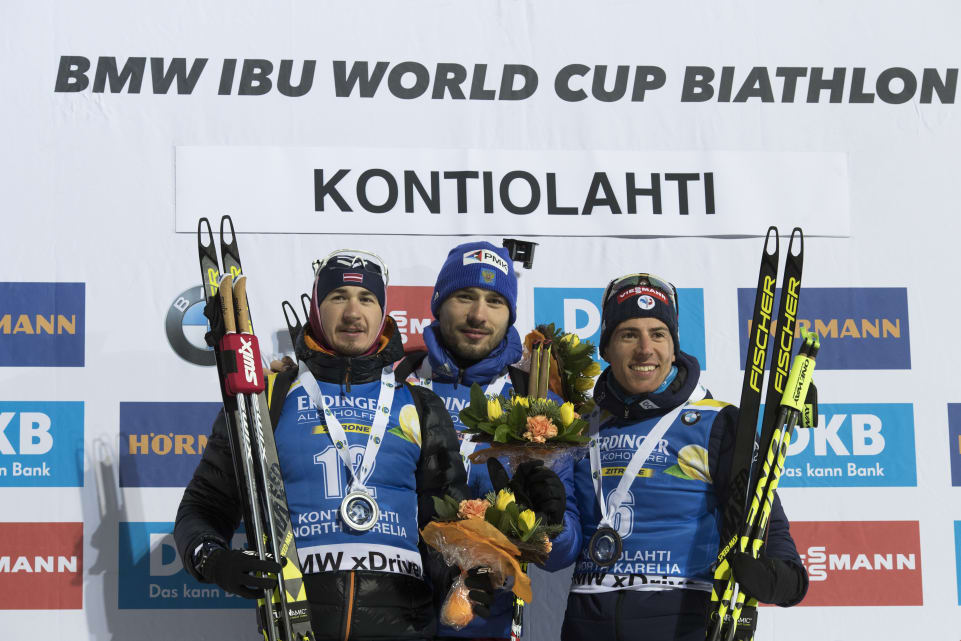
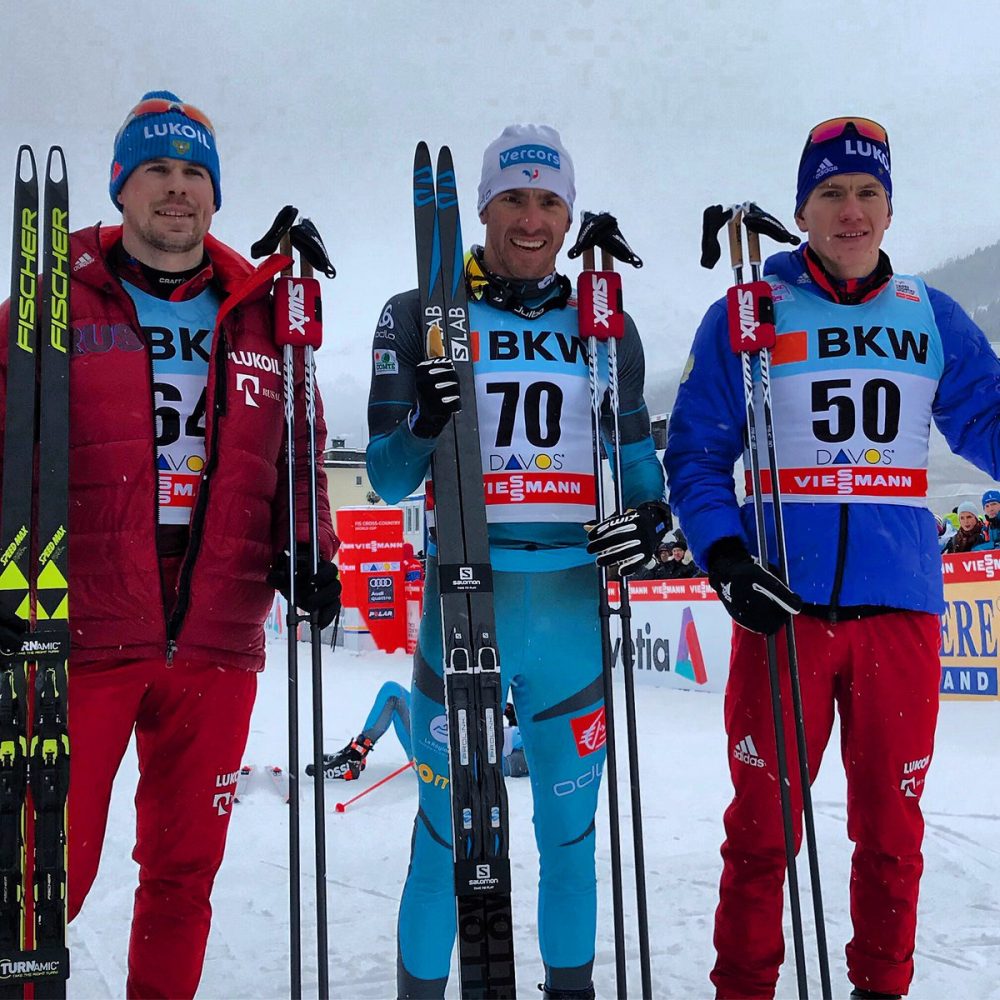
The men’s 10 k sprint podium at the IBU World Cup in Kontiolahti, Finland, with Russia’s Anton Shipulin (c) in first, Latvia’s Andrejs Rastorgujevs (l) in second, France’s Quentin Fillon Maillet (r) in third. (Photo: IBU/Biathlonworld)
And here’s a little more background: Russia’s Anton Shipulin showed up for Thursday’s IBU World Cup in Kontiolahti raring to go after having been barred from last month’s Winter Olympics in PyeongChang, South Korea.
So Shipulin hadn’t raced since Jan. 21 in Antholz, Italy. The International Olympic Committee’s decision to ban him from the 2018 Games went public on Jan. 23.
Back in action in Kontiolahti, in front of Russian fans, Shipulin delivered a 5.8-second win in the men’s 10-kilometer sprint, shooting clean and finishing in 23:51.6. It was the 31 year old’s third non-relay podium of the season and first World Cup win of 2017/2018, and he did so on a relatively moderate evening by Kontiolahti standards (at -6 degrees Celsius, or 21 Fahrenheit) with a “stiff breeze” on the range, according to an IBU press release.
“I felt very good on the tracks and shooting and today it was enough to win,” Shipulin told the IBU. “I am very happy about this … all of the Russian fans gave me a lot of support on the tracks.”
Latvia’s Andrejs Rastorgujevs tied his career best in second place, after shooting a perfect 10-for-10 as well. He acknowledged his mom and women in general after the race.
“This is very important for my team,” Rastorgujevs told the IBU. “I would also like to congratulate all of the ladies and especially my mom on International Women’s Day.”
France’s Quentin Fillon Maillet also shot clean to place third (+17.3) for his third non-relay World Cup podium of the season.
Fillon Maillet was one of the earliest starters in bib 6 yet held off Norway’s Johannes Thingnes Bø, the 30th starter, by 1.7 seconds for the last spot on the podium. Bø had been a race leader after cleaning prone but missed two standing targets (0+2) to slip out of contention and into fourth at the finish (+19.0).
Germany’s Olympic sprint champion, Arnd Peiffer placed fifth (+27.4) with one miss (0+1), and France’s Simon Desthieux finished sixth (+28.3) with one prone penalty (1+0), and Germany took seventh and eighth with Erik Lesser (+30.6; one penalty) and Simon Schempp (+32.0; two penalties), respectively. Italy had two in the top 10 with Lukas Hofer in ninth (+35.2; one penalty) and Dominik Windisch in 10th (+38.3; one penalty).
Lowell Bailey of the U.S. posted his best sprint result of the season in 16th (+48.4) after cleaning prone and missing one standing target (0+1). After starting 22nd, he recorded the 13th- and 14th-fastest overall shooting and range times, respectively, and 23rd-ranked course time.
After the Olympics, Bailey returned home to Lake Placid, N.Y., for a brief training block. Despite a hefty amount of travel over the last week and a half, he explained in an email that he felt good in his first race back.
“I felt better than I have for most of the season. Sometimes that can happen. I guess that’s the part of the unpredictability of biathlon,” Bailey wrote of Thursday’s race. “The conditions were great today; hard tracks and calm winds on the range. There was a bit of wind, but compared to the three weeks in South Korea, it seemed pretty tame.
“Shooting felt solid today,” he added. “That missed shot in standing was sooo close, but not close enough!”
Overall, Bailey stated that he was happy with his performance and looking forward to the rest of the races in Kontiolahti.
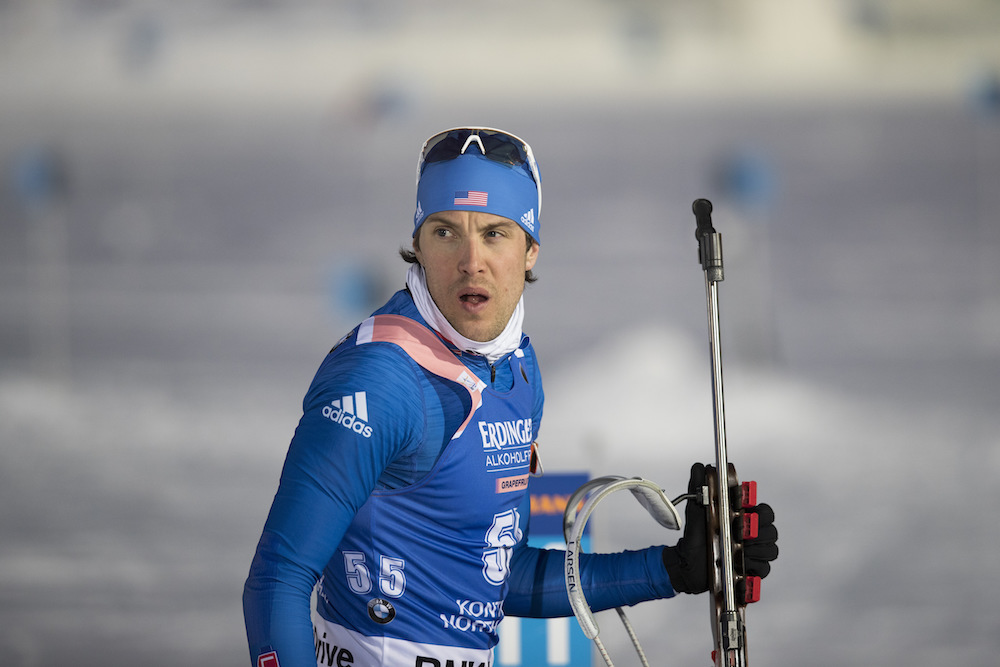
Leif Nordgren (US Biathlon) raced to 17th for his best result in three seasons on Thursday in the men’s 10 k sprint at the IBU World Cup in Kontiolahti, Finland. (Photo: USBA/NordicFocus)
His teammate Leif Nordgren finished just one place behind him in 17th (+49.9) for his best result in three years. A later starter in bib 55, Nordgren also cleaned prone and missed one standing (0+1) with the fifth-fastest shooting time and seventh-fastest range time. Overall, his course time ranked 28th out of 100 finishers. Nordgren’s individual career best on the World Cup is 16th in a sprint in February 2015. He has finished 17th three times; the last time was in a pursuit in March 2015.
Brendan Green shot clean to lead the Canadian team in 34th (+1:29.5). American Sean Doherty followed in 35th (+1:29.7) with three penalties (1+2), and Tim Burke placed 38th (+1:36.1) for the U.S., also with three misses (1+2).
In his World Cup debut, American Alex Howe finished 68th (+2:23.1) with two misses (1+1).
Canada’s Christian Gow finished 79th (+2:47.4) with two penalties (1+1), and Scott Gow was 86th (+3:01.7) with three misses (1+2).
This year’s Kontiolahti World Cup does not include a pursuit race. The women’s 7.5 k sprint is scheduled for Friday at 11:45 a.m. EST in Kontiolahti, and the single mixed relay and mixed relay will follow on Saturday. Racing in Kontiolahti will conclude with men’s and women’s mass starts.
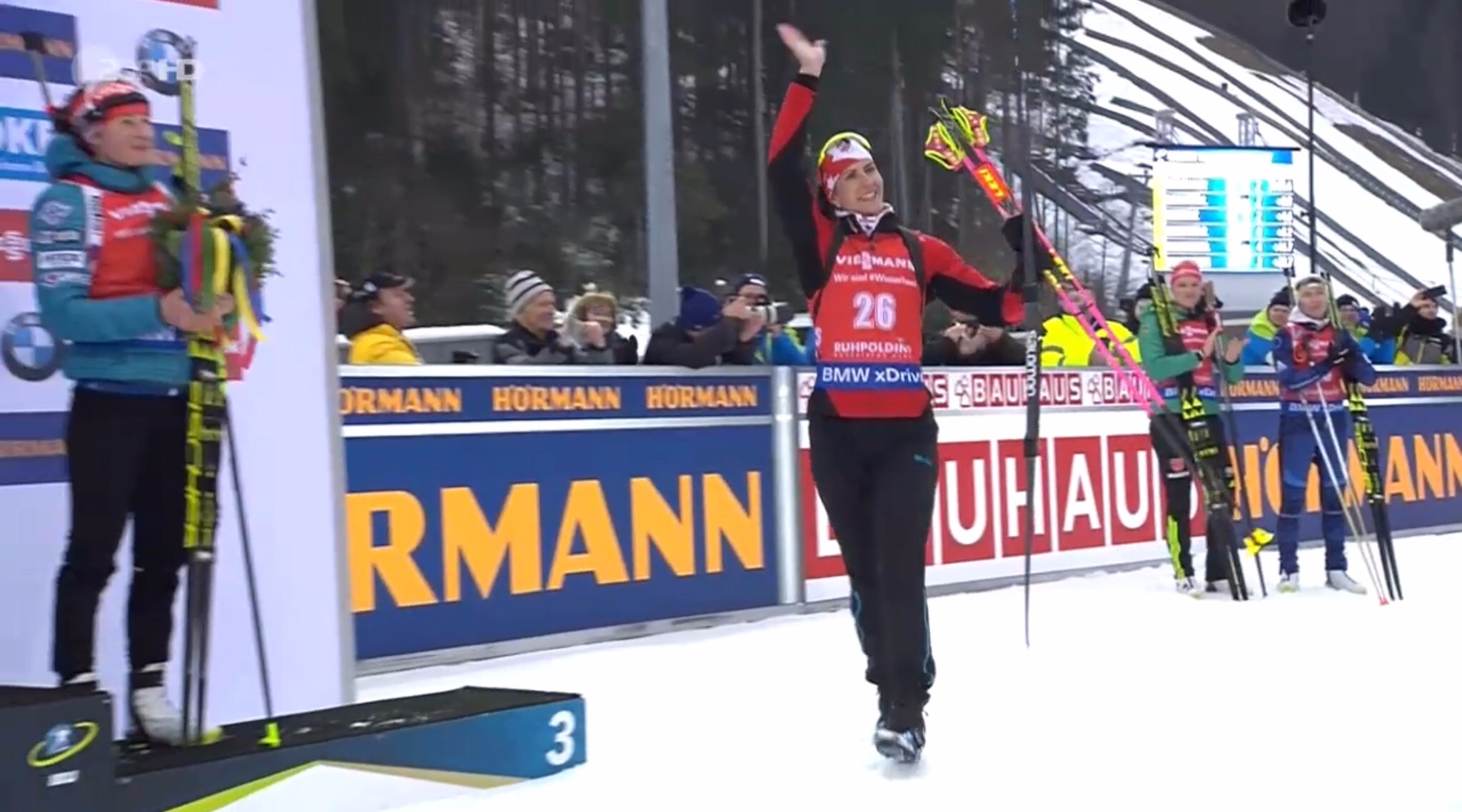
Biathlon Canada’s Rosanna Crawford (26) waves to some 20,000 spectators in the stands during the flower ceremony of the women’s 12.5 k mass start at the 2018 IBU World Cup in Ruhpolding, Germany, after finishing in fourth place. (Screenshot: ZDF broadcast)
Note: This article has been updated to include comments from Rosanna Crawford.
For a few minutes, it looked like Biathlon Canada’s Rosanna Crawford could clutch her second podium in her second-straight individual race in Ruhpolding, Germany, in the women’s 12.5-kilometer mass start on Sunday. Maybe it could even be the first World Cup victory of her career.
After cleaning also the 20th of 20 targets — as the only competitor to achieve that on Sunday in the elite mass start field of just 30 athletes — Crawford headed out on the final loop 16 seconds ahead of Czech Republic’s Veronika Vitkova, with Finland’s Kaisa Mäkäräinen and Germany’s Laura Dahlmeier a few additional seconds behind, all of them former World Cup winners and world champions.
“I was really surprised to leave the range in 1st, these are the 30 best women in the world,” Crawford wrote in an email.
On the prior loop, Crawford had lost just about ten seconds to those three and Darya Domracheva of Belarus, before passing them on the range with her flawless shooting. Mäkäräinen and Dahlmeier each incurred a penalty, having to ski 150 extra meters before they could return to the course to chase after her, while Vitkova had also remained clean in that stage.
But would the Canadian’s lead be large enough to reach the finish first, keeping some of the strongest skiers of the field at bay?
Anxiously looking behind several times, Crawford was overtaken by Dahlmeier and Mäkäräinen, but kept Vitkova behind her to stay in podium contention. Yet her lead was dwindling.
Kaisa Makarainen of Finland celebrates winning the women’s 12.5 k mass start in Ruhpolding, Germany, as Germany’s Laura Dahlmeier (r) takes second, Veronica Vitkova of the Czech Republic (far left) races to third, and Canada’s Rosanna Crawford (c) fourth. (Photo: IBU/Biathlonworld)
Out of the final downhill in a meandering section of turns, Mäkäräinen moved in front of Dahlmeier and held that ski-length lead into the finish. She crossed the line in a time of 34:05.6 minutes (with two penalties), with Dahlmeier just 0.8 seconds behind (also with two penalties) before collapsing to catch her breath.
Cheered on from the side of the track by coaches and teammates, Crawford remained in front right until the little tree branches marking the finishing lanes, but Vitkova was already on her tails.
“I really thought if I made it to the stadium in front of Vitkova I’d be able to hold her off, but she had the slip stream and I my legs just felt like concrete,” Crawford wrote.
Choosing the lane to her right, Vitkova pushed hard and managed to outsprint Crawford to the line for third (+4.6, with two penalties) while Crawford finished 0.6 seconds back in fourth (+5.2, with no penalties). For Crawford, the result was her career best in a mass start, and she received many congratulations from her peers and the ovations from thousands of spectators during the flower ceremony following the race.
“I would have love to hold onto a podium but was pretty dead on my last loop,” she continued, adding that she had woken up to a sore throat and congestion on Saturday, which persisted on Sunday. “In hindsight it was a mistake to be looking over my shoulder to see how close they were, I really should have just kept pushing, but this being a position I’ve never been in before I was pretty overwhelmed! Next time I will just keep fighting till I cross that red line in the snow! But having the two of the strongest women chasing me down was a bit scary! Kaisa is so fast and Laura I’m sure wanted to give the fans what they came for, a German podium!
“I was pretty disappointed when I crossed the line in 4th, but as time went by I got more and more happy,” she added. “To have hit another 20/20 is fantastic, especially in the high pressure situation of a Mass Start. With that race I went 50/50 in Ruhpolding!”
Germany’s Denise Herrmann followed in fifth (+16.7), almost making up for a penalty lap in each of the four stages by also skiing the fastest course time on each loop. Domracheva finished sixth (+23.7) after she had missed two more targets in the final standing stage (0+0+1+2).
For Vitkova it was the second podium of the season, after another third place in the sprint in Oberhof, Germany.
“I knew that Kaisa and Laura are behind me,“ Vitkova said of the exciting last loop in the post-race press conference. “My feeling on the skis was very good, and I believed that I can catch Rosanna. … It was very nice, now we have Olympic season and my results are better and better, so I am very happy.”
For Mäkäräinen, it was her first victory of the season and 22nd overall in her career. She also moved into the lead in the overall World Cup Total Score, 19 points ahead of Slovakia’s Anastasia Kuzmina in second.
“I appreciate silver and bronze a lot, too, since all podium places mean you had a good race, but victory is victory,” Mäkäräinen said in the press conference. “We were skiing quite fast all the last loop, I was on my limit all the time. … Happy that it ended this way.”
Dahlmeier, coming off a cold that forced her to forego the previous week of races in Oberhof, Germany, was satisfied with her result as well, despite narrowly missing out on another victory in front of her fans after anchoring her relay team to a win on Saturday.
“It was a lot of fun today, a really great race that had everything, suspense at the shooting range, a fight on the loop … and incredibly exciting with that finish sprint,” Dahlmeier told German broadcaster ZDF after the flower ceremony, according to a translation. “For me this was the perfect race to close out the week in Ruhpolding.”
“It was like Kaisa said, a really fast loop for us,” Dahlmeier later explained in the press conference. “We had really good equipment today, so for me it was a little bit easier on the downhill parts. We [caught] Rosanna Crawford, and I was in front on the last hill up the [shooting range climb]. Then we had the final sprint, and Kaisa was a little bit faster than me today. But I am very happy about this second place, and I think it is a really good sign that I am in good shape.”
As Crawford had told FasterSkier following her podium in the individual race, she considers Ruhpolding a “special place”, after she raced her first Junior World Championships there in 2008, her first World Cup in there in 2010, and on Thursday, her first World Cup podium (when she was third in the 15 k individual). She has followed that up with another one of her best results of her career.
“The crowd was amazing in Ruhpolding this whole week! I loved having my first podium at one of the most popular World Cup venues,” she wrote. “We had incredible skis all week and our techs worked so hard, a big shout out to them! I think none of them have voices this morning from cheering so hard in yesterday’s race!!”
And regardless of whether or not Crawford reached the podium on Sunday, multiple-time World Champion Dahlmeier pointed out, “There is no big difference even between a place in the 40s or a victory,” she said of the ups and downs of her weekend and the sport in general during the press conference. “With the shooting, you can have one or two [misses] more and you are somewhere out of the best 30. Then the next day you can win a race or be on the podium … That’s the difference between cross-country and biathlon, and that’s why we love it.”
J.T. Bø Wins Men’s Mass Start Ahead of Fourcade; Burke 21st
US Biathlon’s Tim Burke racing to 21st in the men’s 15-kilometer mass start at the 2018 IBU World Cup in Ruhpolding, Germany. (Photo: US Biathlon/NordicFocus)
Earlier on Sunday, US Biathlon’s Tim Burke successfully cleaned the first two stages in the men’s 15 k mass start to stay in contention for a top position. He left the range in 11th position and just 8 seconds behind the pace set by World Cup leader Martin Fourcade of France in first and his Norwegian rival Johannes Thingnes Bø in second.
“The atmosphere was great out on the course today with 25,000 fans,” Burke wrote in and email to FasterSkier. “No matter how many times I have done this, racing in that environment is always exciting.”
Then Burke missed the last shot in his first standing bout and had to ski a penalty lap. He came back on the course in 13th, just ahead of Fourcade who had incurred two penalties in that stage. Then Burke skied the fifth-fastest course time on the next loop, trying to again close a gap to the group ahead.
“I felt decent throughout the race but am definitely looking forward to racing on some different courses that better suit my strengths,” Burke wrote. “Ruhpolding is filled with short, steep climbs that are almost always followed by some type of recovery. Because of that, it ends up being an endless cycle of sprint then recover, which is definitely not my forte.”
After he missed two more targets in the final standing stage, Burke lost 10 positions and another 50 seconds to the leaders, leaving the range in 23rd. On the final loop he made up two places, passing Norway’s Lars Helge Birkeland and Bulgaria’s Krasimir Anev, to finish 21st (+1:30.2, with three penalties).
“Overall, I am happy with where I am at right now,” wrote Burke, who placed fourth in a 10 k sprint at the previous World Cup in Oberhof. “I just have to work on a few small details and then a top result should be possible.”
Ahead of Burke, the mass start was decided when Johannes Bø extended his lead on the fourth loop before the final shooting to almost 20 seconds, then returned to the course in first place despite a penalty in the last standing.
On the last loop he defended his lead ahead of three French athletes with Antonin Guigonnnat, Quentin Fillon Maillet and Fourcade chasing after him. Though Bø skied the second-fastest course time overall, he lost 14 seconds to Fourcade on the last loop and crossed the finish line 4.5 seconds ahead of Fourcade in 37:11.2 minutes (with one penalty).
Norway’s Johannes Thingnes Bø (2) racing to a win in the men’s 15-kilometer mass start at the 2018 IBU World Cup in Ruhpolding, Germany, with France’s Martin Fourcade behind him. (Photo: IBU/Biathlonworld)
At the press conference, Bø acknowledged that he was worried Fourcade would catch him.
“I was thinking about it when I saw him out on the tracks there, but I tried to just stay in my own lane for the tracks, and it was very good practice to stay on the lead on the last lap,” Bø said. “It’s very tough, mentally, and you just have to think forward and not so much about the people behind.
“When you fight for the win, you don’t want to be weak, you know?” Bø added when asked what gave him strength on that last loop. “So it’s just to be happy with the pain in the legs and ski as fast as you can.”
Fourcade — who temporarily dropped to 15th following two misses in the third stage — could not quite catch Bø and settled for second (+4.5), with two penalties (0+0+2+0).
“It was a really good fight at the front of the competition,” Fourcade said inatthe press conference. “I didn’t take enough time to be stable on my [first standing stage] and I missed two, but I think I could [have missed] three on that; it was a really bad one. … I knew that with two mistakes advantage, it would be really hard to come back on Johannes, and when I saw that he missed only one on the last shooting, I knew that it was already over for me.”
So he focused on at least catching his teammates Guigonnat and Fillon Maillet on the final loop, who had left the range in second and third, respectively.
“It was really special to fight with them because we know each other — our strong points and our weaknesses,” Fourcade said. “I knew that I had to be really faster than Antonin before the last finish [stretch], because he’s a really good sprinter.”
Fourcade’s 26-year-old teammate Guigonnat, who had been called up to the French World Cup team for the last three races, finished third place (+8.4, with no penalty). It was the second World Cup podium of his career, following up on another third place in the sprint in Annecy, France, earlier this season.
“I didn’t feel much pressure because I’m clearly an outsider, so nobody’s cheering for me, I think,” Guigonnat modestly said in the press conference. “And the other guys, they are fighting each other for maybe the yellow bib [of the World Cup leader] or things like this, and then I just do my job and that’s it.”
Fillon Maillet finished fourth (+12.6, with one penalty), and Bø’s older brother Tarjei Bø placed fifth (+14.2, with one penalty) after he made up by five positions on the final loop.
Burke learned Saturday that he could race the 30-man mass start, after being listed as the third alternate based on his current World Cup Total Score. After Sunday’s race, he’s up to 26th in the overall standings.
“A few athletes in front of me were sick so they decided to sit out,” Burke explained in his email. “This is very normal for a mass start, you can usually count on 1 to 3 athletes sitting out. I ended up doing that earlier this season [for the World Cup in Annecy] when I sat out the Mass Start because of a cold.“
Aside from Crawford and Burke, no other North Americans qualified for Sunday’s mass starts via the top-25 positions in the World Cup Total Scores, respectively the five best results of those outside those ranks in the individual race.
The IBU World Cup continues in Antholz, Italy, with sprints on Thursday, Jan. 18 for the women and Friday, Jan. 19 for the men.
“My fiancée will come down, so I’m looking forward to have her on her first World Cup outside Norway, so that will be fun,” Bø revealed when asked about Antholz at the press conference.
“That’s good news for me, because he will be really tired for competitions,” Fourcade quipped, as both laughed.
Fourcade continues to lead Bø in the Total Score standings, now just 44 points ahead with 666 points.
The Norwegian men’s relay after winning the 4 x 7.5 k on Friday at the IBU World Cup in Ruhpolding, Germany, with Lars Helge Birkeland (l), Tarjei Bø (far r), Emil Hegle Svendsen (second from r), and Johannes Thingnes Bø (second from l). It was their second win of the season (after winning with Ole Einar Bjørndalen, Henrik L’Abée-Lund, and Erlend Bjøntegaard, and Birkeland in the first men’s relay of the 2017/2018 season in Hochfilzen, Austria. (Photo: IBU/Biathlonworld)
IBU World Cup (Ruhpolding, Germany): Men’s 4 x 7.5 k relay
Less than a week after Sweden won the men’s 4 x 7.5-kilometer relay in Oberhof, Germany, with an up-and-coming group, Norway posted its second win (in three relays) this season, with an all-star lineup on Friday in Ruhpolding, Germany.
Lars Helge Birkeland, Tarjei Bø, Emil Hegle Svendsen, and Johannes Thingnes Bø took the lead during Johannes Bø’s anchor leg and ultimately the win in 1:13:11.1 hours, 24.9 seconds ahead of France in second and 53.4 seconds ahead of Russia in third.
On a bluebird day with no wind in the range, according to an International Biathlon Union (IBU) press release, the Norwegians avoided the penalty lap and used seven spares to clean. First-leg skier Birkeland put them in second with near-perfect shooting (0+0, 0+1), just 0.4 seconds behind Germany’s Erik Lesser, who cleaned without any spares, in first. (Birkeland was also on the Norwegian team that won the first relay of the season in Hochfilzen, Austria.)
Norway remained in second during Tarjei Bø’s second leg, in which he had to use three spares to clean prone (0+3, 0+0). He tagged Svendsen in second, 0.6 seconds behind Italy, which had risen to first thanks to Lukas Hofer’s fast skiing and solid shooting (0+0, 0+2).
Svendsen slipped slightly to third place by the final exchange despite only needing one spare to clean (0+0, 0+1), but was still just a second out of first at the tag. France had moved into first place with a predictably strong third leg from Martin Fourcade (0+0, 0+0), in which he brought the team from seventh to first place, just ahead of Italy’s Dominik Windisch and Norway’s Svendsen.
Johannes Bø skied the third-fastest anchor leg and cleaned prone and used two spares in standing (0+0, 0+2) to overtake France’s Antonin Guigonnat and Italy’s Thierry Chenal, who slipped to second and seventh, respectively, by the finish.
Guigonnat shot well, requiring just one spare (0+1, 0+0), but finished nearly 25 seconds after Bø for second place. Russia reached the podium with Anton Shipulin picking off two places, after being tagged in fifth.
In all, France had zero penalties and six spares, with Simon Desthieux, Quentin Fillon Maillet, Fourcade, and Guigonnat, and Russia used a total of just four spares and had no penalties with Alexey Volkov, Maxim Tsvetkov, Anton Babikov, and Shipulin.
Germany finished fourth (+1:26.5) with zero penalties and 10 spares, with Lesser, Benedikt Doll, Arnd Peiffer and Simon Schempp. After Doll dropped to fifth on the second leg, they skied in fourth on the last two legs.
Austria took fifth (+1:39.8) with zero penalties and six spares, with David Komatz, Simon Eder, Daniel Mesotitsch, and Dominik Landertinger. Sweden followed in sixth (+1:50.6) with zero penalties, six spares and three of the same men who won last Sunday’s relay (Sebastian Samuelsson, Martin Ponsiluoma and Fredrik Lindström) with new member Torstein Stenersen. Italy finished seventh (+1:58.5) with one penalty and 11 spares.
Of 26 teams in the relay, Canada placed 14th (+3:22.3) with one penalty and 10 spares, and the U.S. finished 24th (+16:21.6) with eight penalties (four of which stemmed from cross-firing) and 13 spares.
Notably, the U.S. had been fourth and just 3 seconds out of first after Lowell Bailey’s first leg, which he cleaned without any spares (0+0, 0+0). Leif Nordgren then dropped to 22nd with a penalty in each of his shooting stages (1+3, 1+3) and the 25th-ranked second-leg time. Tim Burke as the team’s third leg had to ski two penalty laps as well (0+2, 2+3), and anchor Sean Doherty was penalized for cross-firing in his last standing stage (0+1, 4+1), according to a US Biathlon press release, and the team was hit with four additional penalties.
“We have a solid team and I know we didn’t show our true potential today,” Bailey said, according to the release. “But the most important relay is still to come. We’ll just have to wait until then.”
“I was happy to put together a good race on the track and in the range,” he said. “The first lap was a bit of a roller derby with no easy way to get to the front. I was fortunate to clean without extra rounds because this allowed me to leapfrog up to the lead pack exiting the range. I tried to keep an even pace for loop two and I thought I would be able to hang in second or third, but no one wanted to pass so I had to lead for most of the loop.
“I had struggled in standing in the previous race so I wanted to get back to taking good shots in standing,” he added. “Although I didn’t shoot as quickly as some of the other guys, I felt good about the stage and the fact that I didn’t have to use extras. It was a fight to catch the lead group on the last loop, but fortunately I had some help from [Italy’s Thomas] Bormolini (of Italy) and we worked together to get back in contact with the lead group.”
Canada finished 14th with Christian Gow, Scott Gow, Macx Davies, and Brendan Green. On the opening leg, Christian Gow put them in 11th with clean prone shooting and just one spare needed to clean standing (0+0, 0+1), but they slipped one spot to 12th with a penalty on Scott Gow’s second leg (0+0, 1+3). Davies then dropped two more places to 14th despite avoiding the penalty lap (0+3, 0+1), and Green held that position to the finish (0+1, 0+1).
The women’s 4 x 6 k relay will be held Saturday in Ruhpolding, with Canada starting Emma Lunder, Julia Ransom, Sarah Beaudry, and Rosanna Crawford. For the U.S., it will be Susan Dunklee, Clare Egan, Emily Dreissigacker, and Joanne Reid. Watch it live on the Olympic Channel at 8:30 a.m. EST.
Leif Nordgren (US Biathlon) skiing the second leg of the IBU World Cup men’s 4 x 7.5 k relay on Sunday in Hochfilzen, Austria. The U.S. men ended up ninth overall out of 26 teams. (Photo: IBU/NordicFocus)
Strong gusts of wind on the range required strong nerves and a lot of luck in the women’s and men’s relay races that concluded the International Biathlon Union (IBU) World Cup in Hochfilzen, Austria, on Sunday afternoon.
While the relays concluded with teams on the podium one might expect there, tempestuous weather conditions that at times made it almost impossible to hit the targets also gave outsiders a good chance, and both the U.S. men and Canadian women remained in contention for a long time. The men’s 4 x 7-5-kilometer relay was particularly wild with more than 100 penalty laps, and it began with a big surprise.
Belgium’s starter Michael Rösch tagged off in first place for the first time in the history of that team, representing a country that until now, rarely had enough athletes for a relay and had thus far had a 24th place at the 2016 World Championships to its credit. And on his tails was Norway’s Ole Einar Bjørndalen, and shortly behind them US Biathlon’s Lowell Bailey in third.
The three aforementioned athletes all raced in the Olympic relay more than a decade ago at the 2006 Winter Games in Torino, Italy, but back then Rösch raced for Germany and won gold with his team.
“I wanted to tag off in first at all costs, to see the Belgian flag at the top,” Rösch told TV broadcaster ARD on Sunday while the race was still going on. “But Ole made it really hard for me. … I was on my last fumes, I tumbled into the finish, I was just seeing black, but it definitely was worth it.”
Just a turn behind, Bailey had gotten off to a strong start for the U.S. team, temporarily taking the lead out of the arena on the first lap before shooting clean in his prone stage to put himself in the lead group of seven. Facing strong wind in his standing stage, Bailey missed two targets but avoided the penalty lap with his last spare in that stage (0+0, 0+3), and tagged off to teammate Leif Nordgren in third position, 23.8 seconds out of first.
Nordgren ended up with a penalty in his first prone after missing two targets, and returned to the course in fifth. While his penalty had increased the gap to first by 50 seconds, Nordgren made up a few seconds with a clean standing bout, hitting all targets without requiring a spare (1+3, 0+0).
Italy and France passed him on the final loop, and Nordgren handed off in seventh, 1:34.2 minutes behind Norway setting the pace up front.
“The team came pretty close to a good result today in a relay with nasty weather,” Nordgren wrote on his Instagram account. “Personally I’m quite disappointed with my skiing, it’s been a struggle to find the top gears so far this season and I’m far from where I know I should be. It’s a long season though and there is still plenty of time to turn it around.”
US Biathlon’s Tim Burke loading a spare in his prone stage of the men’s relay at the 2017/2018 IBU World Cup in Hochfilzen, Austria. The team went on to finish 9th. (Screenshot: ARD broadcast)
Taking over next for the U.S. was Tim Burke, who pointed out this was one of the most challenging races in terms of wind that he’d experienced.
“This was definitely one [of the] windiest races that I have taken part in,” Burke wrote in an email to FasterSkier. “We knew it would be very challenging right from the start but our team tried to look at it as an opportunity for a top result. I feel like our team did a great job at avoiding any big disasters on the range and this allowed us to stay near the front for most of the race.”
After only needing one spare in his prone shooting to hit his last target, Burke incurred a penalty in his standing stage (0+1, 1+3), but kept his position on the final loop in a hard race against Switzerland’s Jeremy Finello to exchange still in seventh, now another minute back (+2:49.4).
“I was not surprised to see a mix of different teams near the front today,” Burke wrote. “It was one of those days that any team could find themselves with multiple penalty loops after a windy shooting stage.“
Taking over from Burke as the U.S. anchor leg was Sean Doherty, coming off two strong shooting performances in the sprint and pursuit earlier this week.
U.S. relay anchor Sean Doherty taking aim in difficult wind conditions during his standing stage of the men’s relay at the 2017/2018 IBU World Cup in Hochfilzen, Austria. His team finished ninth. (Screenshot: ARD broadcast)
In his prone stage, Doherty again shot clean and fast (with the second-fastest prone shooting time on his leg) and overtook Switzerland to move into sixth. He kept that position on the course, vying for a position in the top five with the teams from France, Italy, Ukraine, and Russia also in his vicinity.
“Today was a crazy one for sure,” Doherty wrote in an email. “The conditions on the course were decent, firm tracks and we had good skis. The wind was whipping, so that really just made some sections a lot harder than normal when you added in the head wind. I have done races in bad weather before but today was amongst the most windy.
In the standing stage, Doherty hit his first four shots in another fast sequence before missing the last one. It looked as if he had thought that final shot was also a hit as he dropped his rifle slightly, but then realized he had to load spares. Unable to clear the last target, Doherty ended up with the team’s third penalty.
“With the shooting you try to get a general idea of how far the wind is pushing the shots and do the best you can,” Doherty explained. “It’s a total toss up and the finish order is just a ranking of who battled the wind the best and had most to least luck along the way.”
He set out on his last loop in eighth place with Ukraine’s Dmytro Pidruchnyi and Switzerland’s Mario Dolder right ahead of him, and Russia’s Anton Shipulin ten seconds behind.
“The fight on the last lap is always tough,” Doherty wrote. “Although I felt better today I was not able to hang with the two guys I left the range with. I was able to ski a good lap but not enough to hold off Anton.”
After Shipulin passed him up the big last climb, Doherty came to the finish in ninth position, 3:38.3 minutes behind the winners with a team total of three penalties and 13 spares.
“We were not too excited with the end result because we saw the potential was there for a top 5,” Burke concluded for the team. “We are also all far from our best on the tracks right now, but are hopeful that will come with more racing.”
Norway Successful with Its ‘Second Unit’
Norway’s Lars Helge Birkeland, Erlend Bjøntegaard, Henrik L’Abée-Lund and Ole Einar Bjørndalen (left to right) following their victory in the men’s relay at the 2017/2018 IBU World Cup in Hochfilzen, Austria. (Photo: IBU/Biathlonworld)
Norway started the men’s relay race without Emil Hegle Svendsen, who was sidelined with a cold, and also rested brothers Johannes Thingnes Bø and Tarjei Bø, both of whom had already won races this season.
But shooting was more important than skiing in a relay decided by strong crosswinds on the range, and that’s where the Norwegians coped by far the best. While Norway also required nine spares, which usually is a rather average performance in a relay, on Sunday this was the top shooting performance of the men’s relay.
After veteran Bjørndalen, Henrik L’Abée-Lund and Erlend Bjøntegaard had created a fairly comfortable lead of almost a minute on the first three legs, Lars Helge Birkeland anchored them to the victory by shooting clean in prone and only needing one spare to hit every target in his final stage despite some widely spread shots.
“It is really nice; a good start for Norway and good self confidence for the the rest of the season,” L’Abée-Lund said at the post-race press conference.
“It’s always fun to compete on the highest level with the best guys,” Bjøntegaard said. “I think I did pretty good on my leg today. It was tough conditions as it was for everyone else. I am just happy to show what I am capable of.”
“It feels great, it was an amazing feeling on the last loop, and really satisfied with my own leg,” Birkeland said. “I just decided to be offensive and attack and don’t think about the others and just do my own race. … We have a really strong team with a lot of good guys, so we don’t need to have all the best at the start to have a chance to win.”
All hopes for Germany’s Simon Schempp to contend with Birkeland for first were dashed when Schempp required three spares to clear both his prone and standing stages, narrowly avoiding the penalty lap twice.
Due to the huge distances between the top-three teams, the final loop was more of a cool down for their anchors, with Norway taking the win in 1:21:21.8 hours, just under two minutes ahead of Germany, with Erik Lesser, Benedikt Doll, Arnd Peiffer and Schempp, in second (+1:54.9, with zero penalties and 17 spares).
“At least we avoided the penalty loop, for me it was definitely close in standing,” Peiffer told German broadcaster ARD. “There was so much wind that it was impossible to shoot calmly and controlled. … It was clear that today there would be some upsets, like Belgium being in the mix in front. You just had to somehow avoid the penalty lap.”
“The last years in Hochfilzen we have never been on the podium, so it’s the first time in like six years we are back again,” Peiffer said at the press conference. “So that’s a good start for us because normally we are struggling here and we don’t know why.”
France, which had rested its star Martin Fourcade and started Jean-Guillaume Beatrix, Simon Desthieux, Emilien Jacquelin, and anchor Quentin Fillon Maillet, finished another 40 seconds later in third (+2:34.0, with three penalties and 13 spares).
Another 20 seconds back, Sweden with Peppe Femling, Jesper Nelin, Sebastian Samuelsson, and Fredrik Lindström crossed the line in fourth (+2:54.8, with three penalties and 12 spares).
“Today was very hard, very strange result, because when we look at all the penalties on the result list it was just crazy,” Beatrix said at the press conference. “I am satisfied for the team, and I am also really satisfied for the newcomer Emilien because it’s his first two weeks on the World Cup and first relay, and he did a every good job and brought us to the podium.”
“Today I was a little bit stressed, because the French guys are so strong and I had to be at their level, so I am happy to do a good relay today,” the 22-year-old Jacquelin said.
And what happened to the brave team from Belgium? With three athletes who had just made an overnight trip from an IBU Cup race in Lenzerheide, Switzerland, they came through the second exchange in second place after Florent Claude only needed one spare in standing. On the last two legs, however, three penalties for both Tom Lahaye-Goffart and Thierry Langer put them in 16th at the finish (+6:24.9) , which was still a team-best relay result for Belgium.
Just ahead of them in a finishing sprint anchored by Brendan Green was Biathlon Canada, with a lineup that earned bronze at the 2016 World Championships in Oslo, Norway. On Sunday, however, the Canadians’ race began with difficulties for brothers Christian Gow (1+3, 2+3) and Scott Gow (1+3, 2+ 3), each having to ski three penalty laps and exchanging in 21st position already 4:45.7 minutes back. Then Nathan Smith (0+0, 0+2) and Green (0+3, 0+3) were able to move them up a bit again, with Smith putting them as high as 13th by the final exchange and Green anchoring them to 15th (+6:22.5, with six penalties and 20 spares).
Of 26 teams in the men’s relay, Norway and Germany were the only ones that succesfully avoided the penalty lap.
Hochfilzen World Champs Women’s Podium Repeats
Later on Sunday afternoon in the women’s 4 x 6 k relay in slightly better conditions than the men’s race, last season’s reoccurring winner Germany struck gold again.
Germany with (left to right) Vanessa Hinz, Franziska Hildebrand, Maren Hammerschmidt and anchor Laura Dahlmeier shows off their medals following their victory in the women’s relay at the 2017/2018 IBU World Cup in Hochfilzen, Austria. (Photo: IBU/Biathlonworld)
The victorious world-champion quartet of Vanessa Hinz, Franziska Hildebrand, Maren Hammerschmidt,and Laura Dahlmeier won with a large lead ahead of Ukraine (+44.9) and France (+1:04.5). The first-, second- and third-place teams were a repeat of last season’s World Championships relay in Hochfilzen this past February.
Fighting for position with Ukraine and Switzerland on the third leg, Hammerschmidt got her team on the road to victory when she cleaned every target within 24 seconds despite difficult conditions to reclaim the lead, erasing the gap she had been handed of almost 30 seconds to first.
“For me it was very important to have a good standing shooting today, because the last two days were not so good,” Hammerschmidt said at the press conference. “I thought it was one of my best standing shootings, and I was so happy to go on the last loop and fight for every second to give to Laura.”
Dahlmeier returned to the World Cup after missing last week’s opening races with a cold, then had no major problems defending the lead. Dahlmeier used just one spare in each of her shooting stages, while Switzerland’s Irene Cadurisch as the closest pursuer had to ski a penalty lap. Germany finished in a time of 1:14:36.4, with zero penalties and nine spares.
“It’s a really cool feeling to be here again,” Dahlmeier said at the press conference. “Especially with the team. We know we can make a good race, but it’s important for every person to be good on the range and on the tracks. Relays are special races.”
“From the last year we have good memories about Hochfilzen … and today it was a good place, too,” Hildebrand said “I was really impressed with [Ukraine’s] Yulia Dzhima’s standing shooting, because she took all targets out while I used two extra bullets and was happy I could go out on the track again.”
Ukraine’s Olena Pidhrushna anchored her team, with Vita Semerenko, Yulia Dzhima and Valj Semerenko, to second (+44.9), thanks to the best team shooting performance of zero penalties and five spares, and despite a fall on the first leg by Vita Semerenko.
“I think our team spirit is very strong, without that we wouldn’t be on the podium, so I am very thankful to all the girls and our staff for making this happen,” Valj Semerenko said at the press conference, via a translator.
“My start this season was not so good … Actually today I was so nervous ahead of the relay,” Pidrushna explained. “But I saw that we had a little bit of extra time at the last exchange, and I calmed down a little bit and it worked well in the end. … And I think my team believes in me [to anchor it successfully].”
Twenty seconds behind her, France with Marie Dorin Habert, Celia Aymonier, Justine Braisaz and the current women’s World Cup leader Anaïs Bescond, passed Russia’s Ekaterina Yurlova-Percht on the final loop to claim third place (+1:04.5, with two penalties and 13 spares).
“Honestly at the beginning when I started I didn’t think a podium was still possible, but loop after loop I thought maybe I can still catch a podium [position],“ said Bescond, who skied the fastest course time on the final leg amidst strong competition.
A few seconds behind, Russia with Victoria Slivko, Tatiana Akimova, Irina Starykh, and Ekaterina Yurlova-Percht finished fourth (+1:09.0, with no penalty and nine spares).
Another 16 seconds back, Switzerland, with Elisa Gasparin, her older sister Selina Gasparin, Lena Häcki and Cadurisch finished fifth (+1:25.7, with two penalties and 12 spares) for Switzerland’s best women’s relay result, which fulfilled its national qualification criteria for the Olympics.
Canada in Contention
For Biathlon Canada, Emma Lunder started off the race in the middle of the field, and managed hit all her targets with one spare in her prone stage to leave the range in 16th position.
Biathlon Canada’s starter Emma Lunder (r) exchanging to Rosanna Crawford in the women’s relay at the 2017/2018 IBU World Cup in Hochfilzen, Austria. Crawford temporarily moved up to fifth before the team finished in ninth position. (Screenshot: ARD broadcast)
While a number of competitors, including France’s Dorin Habert, incurred penalties, Lunder again needed just one spare to clean (0+1, 0+1) and moved Canada up to 1oth. After losing a few more seconds on her last loop to the leaders, with Germany’s Hinz up front, she tagged Rosanna Crawford in 12th position, 51.7 seconds back.
Crawford started out fast and also needed just one spare to hit all five prone targets, improving by three places to ninth.
“It was a tricky shooting day today, you really had to be aware of the wind, and be prepared to do a correction even part way through a bout of shooting,” Crawford wrote in an email. “In prone I made a correction of 5 left and 2 up and it was enough to keep me pretty centred.”
Then in her standing stage, she picked off four more positions with clean shooting and no spares to leave the range in fifth place, while most teams around her needed spares or even incurred a penalty in seemingly difficult wind conditions.
“I was really happy with my standing today,” Crawford explained. “I saw Brendan [Green] right before zero and he said that it’s worthwhile to take your time and make each shot a good one. So I really thought about that as I came into the shooting, there was a big gust right off the start, so I waited and could hear the women around me missing. Each shot was really precise. My shooting time was 33 seconds which is really slow for standing but still the 2nd fastest of my leg, which says a lot about the wind today!”
Biathlon Canada’s Megan Bankes shooting in her standing stage in the women’s relay at the 2017/2018 IBU World Cup in Hochfilzen, Austria. The team finished ninth overall. (Screenshot: ARD broadcast)
Crawford tagged Megan Bankes in fifth (+36.3), after having regained 15 seconds on the leaders and skiing the second-fastest course time on the final loop.
“It’s always fun to tag off in a high position but today was a bit of a lucky draw for what you got in the range,” Crawford concluded.
The 20-year-old Bankes as Biathlon Canada’s youngest team member started out just as fast, nearly maintaining that time gap on the first loop.
“I was super stoked to be tagged in such a good place, but I definitely still felt that I was able to ski my own race,” Bankes wrote in an email. “I wanted to ski my best, and not lose to much time on the tracks, but also be controlled on the range, because I knew it was going to be a tricky shooting day.”
She was able to get through the prone stage with two spares in a stage when all leading teams needed them, keeping her in fifth. Bankes followed that up with just one spare in her standing shooting, temporarily moving up to fourth after overtaking Sweden’s Mona Brorsson.
“Coming into the range I was focussed on my own shooting more than anything else,” Bankes wrote. “I knew that the wind was pretty variable, and that I needed to make sure I took good, smart shots, and correct appropriately for the wind. I was super happy with how I ended up doing on the range, and also with my speed on my first couple of laps.”
On the last loop, Brorsson and Russia’s Starykh passed her, and Bankes came through the final exchange in sixth place (+1:28.8).
“I died a bit at the end, but I still managed to tag Julia in a good position, so for me it was a pretty great race!” Bankes concluded.
Shown on television in the exchange zone, looking back at the final curve to see when Bankes would arrive, Ransom took over as the anchor and skied a very fast first loop, just 1 second off the fastest pace on that loop.
She then managed to still clean all five targets in a controlled fashion, leaving the range again in fifth position, with Switzerland in sight and Russia nearby as well.
After a slower second loop, Ransom struggled to clean all her targets in the final stage, but avoided the penalty lap with her last shot and left the range in ninth position. Sweden’s anchor Anna Magnusson was still in sight, 10 seconds ahead, but extended her lead on the final loop, while Japan’s anchor Rina Mitsuhashi was already more than a minute behind Ransom in 10th.
Ransom crossed the line in ninth place (+2:31.6) with zero penalties and nine spares for the team.
“A top 10 is a decent result for our team, it’s nice that we were fighting for a top 6 for most of the race,” Crawford wrote. “Our team has come a long way and I’m really proud to be a part of this team! Emma and Megan had a great leg and Julia an awesome prone and then it was quite windy for her standing, but most teams have their strongest women on the last leg, so it’s always a hard fight!”
In other good news for Biathlon Canada this weekend, the team finished eighth in an IBU Cup mixed relay and national team member Megan Tandy raced to 11th place in the sprint followed by ninth place in the pursuit this weekend in Lenzerheide, Switzerland.
“Another #perfect#shooting day! I was hoping for more, but you gotta work with what you got – in my case very heavy legs skiing. Nonetheless, a solid race,” Tandy wrote on Instagram after shooting clean in both the sprint and mixed relay.
The U.S. Women and Nation Cup Standings
US Biathlon could not start a women’s relay on Sunday because it only has three women currently on the World Cup circuit: Susan Dunklee, Clare Egan and Emily Dreissigacker. US Biathlon had hoped that its fourth woman Kelsey Dickinson, would qualify for the first trimester of World Cup racing by scoring necessary points at the IBU Cup opener in Sjusjøen, Norway. But unfortunately that did not work out.
In addition to Dickinson missing out on the World Cup starts because of that technicality, and her teammates now missing out on one of only three opportunities on the World Cup competition calendar to prepare for the relay in the upcoming Olympics, this also means they lost out on valuable points for the Nation Cup Score. That ranking is its own award category in the World Cup season (last year Germany won it for both the women and men), but more importantly for the North American teams, also determines the starting quota for the following season.
With a third of the races counting towards that already completed (unlike at World Championships the races at the Olympics don’t apply, neither do pursuits and mass starts), the U.S. is currently in 21st position for the women with 676 points and in danger of losing its fourth starting position for next year again, which would make team selections and travel planning even harder.
While certainly not impossible — last year the U.S. women also did not start a relay in Pokljuka, Slovenia — it will be a bit of an uphill battle to make that up the rest of the season, requiring a number of strong results. For instance, South Korea is currently 357 points ahead in 17th, the benchmark for a fourth quota spot.
The Canadian women are currently in 14th position with 1220 points. Last season they were 15th and the U.S. 14th. For the men’s teams, Canada is currently in 12th position with 1260 points, the U.S. is 13th with 1198.
The teams will now travel to Annecy-Le Grand Bornand, France, for the next World Cup from Thursday, Dec. 14, to Sunday, Dec. 17.
Caitlin Patterson (Craftsbury Green Racing Project) charging up the wall climb en route to the win in the women’s 10 k freestyle on Sunday at the Sovereign Lake NorAm/SuperTour near Vernon, B.C. (Photo: Peggy Hung)
NorAm/SuperTour (Sovereign Lake near Vernon, British Columbia): 10/15 k freestyle
VERNON, B.C. — The combined NorAm and SuperTour event at the Sovereign Lake Nordic Centre continued with individual-start distance races and continued with the theme of U.S. domination of the leaderboard.
Ian Torchia, of Northern Michigan University (NMU) and the U.S. Ski Team D-team, started the day with a big victory in the men’s 15 k freestyle, finishing in 36:29.7 minutes and on the heels of Canadian Para-Nordic guide Graham Nishikawa, who started 30 seconds ahead of him and ended up sixth. Jack Hegman of the Sun Valley Ski Education Foundation (SVSEF) placed second, 19.0 seconds back, to complete his good weekend. Canadian Para-Nordic superstar Brian McKeever rounded out the podium in third, 22.6 seconds back.
Graham Nishikawa (l) and Ian Torchia worked together after Torchia closed the 30-second gap en route to a victory in the men’s 15 k freestyle on Sunday at the Sovereign Lake NorAm near Vernon, B.C. (Photo: Peggy Hung)
The women were next to get some time in the sunshine with two laps for 10 k. Caitlin Patterson of the Craftsbury Green Racing Project (CRGRP) upgraded from Saturday’s silver to gold on Sunday with winning time of 27:13.0. Rosie Frankowski of Alaska Pacific University (APU) snatched second, 30.7 seconds back. Caitlin Gregg (Team Gregg) raced to third, 1 second behind Frankowski.
Former Canadian national-team biathlete Zina Kocher started her new cross-country career as the top Canadian in seventh (+1:31.2).
The weather was a repeat of Saturday: -2 degrees Celsius, windless and sunny. Smiles were evident everywhere, even for athletes who didn’t quite nail the pacing on an unforgiving course.
France’s Maurice Manificat (c) after winning the men’s 15-kilometer freestyle on Sunday in Davos, Switzerland. He finished ahead of Russians Sergey Ustiugov (l) and Alexander Bolshunov in second and third respectively. (Photo: FIS Cross-Country/Twitter)
FIS Cross Country World Cup (Davos, Switzerland): 10/15 k freestyle
After a day of sprinting, cross-country racers returned to the Davos World Cup venue on Sunday for the women’s 10-kilometer and men’s 15-kilometer freestyle individual start competitions.
For his first World Cup win in almost two years, France’s Maurice Manificat took the men’s 15 k race title in a time of 33:56.2. Exactly 4 seconds flat behind Manificat in second place was Russia’s Sergey Ustiugov. Ustiugov’s teammate Alexander Bolshunov, finished 10 seconds behind Ustiugov and 14.6 seconds behind Manificat for the men’s third and final podium spot.
The remainder of the men’s top ten included Norway’s Simen Hegstad Krüger in fourth (+21.3), Switzerland’s Dario Cologna in fifth (+26.5), Sweden’s Marcus Hellner in sixth (+35.4), Russia’s Denis Spitsov in seventh (+36.1), Hans Christer Holund of Norway in eighth (+36.9), Russian Alexey Chervotkin in ninth (+54.2), and Alex Harvey of Canada in 10th (+1:01.2).
The next best male North American finisher was American Patrick Caldwell in 41st (1:50.2).
Canada’s Devon Kershaw placed 44th (1:59.8), Graeme Killick 59th (+2:27.8), Russell Kennedy 68th (+2:43.4), and Julien Locke in 94th (4:27.5). Knute Johnsgaard did not start.
For the U.S., Noah Hoffman finished 48th (2:05.5) and Scott Patterson 88th (3:46.2). Simi Hamilton did not start and Andy Newell did not finish.
The women’s 10 k freestyle podium on Sunday at the Davos World Cup in Switzerland, with Norway’s Ingvild Flugstad Østberg (c) in first and Ragnhild Haga (l) in second, and Finland’s Krista Parmakoski (r) in third. (Photo: FIS Cross Country/Twitter)
In the women’s 10 k, 75 starters finished the 10 k course with Norway’s Ingvild Flugstad Østberg claiming first in a time of 25:28.5. Her Norwegian teammate, Ragnhild Haga finished 5.9 seconds behind her for second place. Krista Pärmäkoski of Finland raced to the third and final podium spot, 7.9 seconds back from Østberg’s winning time.
Rounding out the women’s top ten was Heidi Weng in fourth (+14.5), Austria’s Teresa Stadlober in fifth (+16.4), Switzerland’s Nathalie von Siebenthal in sixth (+16.4), Finland’s Kerttu Niskanen in seventh (+24.9), Sweden’s Charlotte Kalla in eighth (+26.8), Norwegian Marit Bjørgen in ninth (+35.9), and Astrid Uhrenholdt Jacobsen in tenth (+37.6).
Leading the U.S. women was Sadie Bjornsen in 12th (+44.6), seven seconds outside the top ten. The next two Americans finishers were within 3.1 seconds of each other, with Kikkan Randall finishing 14th (+56.8) and Jessie Diggins in 15th (+59.9).
Also scoring World Cup points for the Americans, Rosie Brennan finished in 17th (+1:11.2) and Chelsea Holmes in 29th (+1:32.9).
The U.S.’s Liz Stephen and Sophie Caldwell finishedin 40th (+1:58.5) and 52nd (+2:20.1), respectively.
For the Canadians, the team was led by Cendrine Browne in 45th (+2:05.9), followed by Emily Nishikawa in 50th (+2:18.4). Dahria Beatty placed 73rd (+2:53.0) and Katherine Stewart-Jones 79th (+3:44.6).
IBU World Cup (Hochfilzen, Austria): Men’s and women’s relays
Men’s and women’s relays took place on the final day of racing in Hochfilzen, with Norway winning the men’s 4 x 7.5 k and Germany topping the women’s 4 x 6 k by considerable margins.
Norway’s Ole Einar Bjørndalen, Henrik L’Abée-Lund, Erlend Bjøntegaard, and Lars Helge Birkeland raced to first in 1:21.21.8 hours, nearly two minutes clear of Germany in second, after taking the lead on L’Abée-Lund’s second leg. They avoided the penalty loop and used a total of nine spares, and never lost hold of first place for the rest of the race.
Germany raced to second (+1:54.9) with Erik Lesser, Benedikt Doll, Arnd Peiffer, and Simon Schempp, with zero penalties and 17 spares, after Peiffer lifted them from fourth to second on the third leg. Schempp held them there, despite using a maximum of three spares on each of his shooting stages, in the final leg.
France claimed third (+2:34.0) with Jean-Guillaume Béatrix, Simon Desthieux, Emilien Jacquelin, and Quentin Fillon Maillet, despite three penalties and 13 spares. Two of their penalties came on Beatrix’s first leg and another in Fillon Maillet’s final shooting. After being tagged in fifth, Jacquelin raced them up to third on the third leg and Fillon Maillet held onto that position for the last spot on the podium.
The U.S. men finished ninth (+3:38.3) with Lowell Bailey, Leif Nordgren, Tim Burke, and Sean Doherty, after they combined for three penalties and 13 spares. Bailey avoided the penalty lap and put them in third at the first exchange, while Nordgren slipped to seventh after a penalty, Burke remained in seventh with one penalty as well, and Doherty had one more penalty to anchor the team to ninth.
Canada placed 15th (+6:22.5) with six penalties and 20 spare rounds, with Christian Gow, Scott Gow, Nathan Smith, and Brendan Green. After being tagged in 21st, Smith raced them up to 13th, using just two spares to clean. Green anchored them to 15th after using six spares and skiing the 15th-ranked time on that last leg.
In the women’s relay that followed, Germany won by 44.9 seconds over Ukraine, with Vanessa Hinz, Franziska Hildebrand, Maren Hammerschmidt, and Laura Dahlmeier using nine spares while staying out of the penalty lap.
After Hinz raced them into first, Hildebrand slipped to fourth after using four spares on the second leg. Hammerschmidt raced the fastest third leg to put them back in first, and Dahlmeier held them there to the finish, crossing first in 1:14:36.4.
Ukraine (0 penalties, 5 spares) took the lead on the second leg but ultimately settled for second with Vita Semerenko, Yuliia Dzhima, Valj Semerenko, and Olena Pidhrushna. Dzhima put them in second heading into the race’s halfway point, but Valj Semerenko lost two places to tag Pidhrushna in third. Pidhrushna used just two spares on the final leg to bring them to second, about 20 seconds ahead of France in third.
Despite a tough first leg for Marie Dorin Habert, in which she had two penalties and tagged off in 14th, France rose to third place at the finish (+1:04.5) thanks to strong skiing and shooting from anchor Anaïs Bescond.
The team had a total of two penalties and 13 spares. Celia Aymonier used four spares to put them in ninth after the second leg, and third-leg Justine Braisaz lifted them one more place to seventh before Bescond skied the fastest last leg to pick off four more places.
Canada placed ninth (+2:31.6) with Emma Lunder, Rosanna Crawford, Megan Bankes, and Julia Ransom, with no penalties and nine spares. Crawford put them in fifth after the second leg, Bankes lost one place on the third leg, and Ransom slipped three more with three spares on her final shooting to finish ninth.
France’s Martin Fourcade celebrating his first IBU World Cup win of the 2017/2018 season in the men’s 12.5 k pursuit on Sunday in Östersund, Sweden. (Photo: IBU/biathlonworld)
If you were to ask France’s Martin Fourcade what’s wrong with a second and third place, and even two fourth place finishes in the first four races of the International Biathlon Union (IBU) World Cup season, he’d likely politely tell you nothing — it just wasn’t up to his usual standards.
“Despite my two podiums here, I felt that if I had not won here, it would have been my worst season opener since, for seven years in a row, I won here,” the 29-year-old defending World Cup champion told the IBU after Sunday’s pursuit in Östersund, Sweden. “Now I can be very calm and relaxed for the next competitions.”
He got down to business out of the start of the men’s 12.5-kilometer pursuit, starting second, just 1 second behind Norway’s Tarjei Bø, who won the sprint to start the pursuit first. Early in the first of five 2.5 k loops, Fourcade set the pace with Bø and Germany’s Erik Lesser in bib 3 slotting in behind him. Fourcade entered the range first to take Lane 1 for the first prone stage, where he and Bø both missed a shot to slip to fifth and sixth, respectively, after each skiing a penalty lap. Meanwhile, Lesser missed four to drop out of the top 30 and nearly a minute and 20 seconds out of first.
While Fourcade left the range 10 seconds behind Norway’s Emil Hegle Svendsen, who had moved into first with clean shooting, he was back into first 2.5 k later. On the second prone, Fourcade and Bø both cleaned to leave the range just 3.8 seconds apart in first and second, respectively. Svendsen missed one to slip 18 seconds back to third.
On Loop 3, Fourcade switched into high gear. Bø kept pace, but by the time they lined up together for the first standing stage, Fourcade had the edge. The Frenchmen once again cleaned while Bø missed three to fall to 18th and nearly a minute and a half out of contention by the time he finished his penalty laps.
Game over. Fourcade spent the next two loops and final shooting going through the motions to secure his victory, cleaning the last standing stage with the 25th-fastest shooting time, then slowly turning to look up at the crowd. He appeared relaxed with his two closest challengers, his French teammate Quentin Fillon Maillet and Slovenia’s Jakov Fak, who started 2 seconds apart in 12th and 10th, respectively, and shot identically (1+0+0+1), skiing together more than a minute back in second and third.
Fourcade’s final loop time ranked 51st out of 58 yet he still finished first, 40.8 seconds clear of Fak, who dropped Maillet on the final climbs before the stadium. Fourcade claimed his first win of the season in 30:12.2, Fak placed second for his first podium since 2015, and Fillon Maillet took third (+42.1).
“I must say that I was very surprised because after the third shooting it was more a fight against myself,” Fourcade said. “I am very satisfied about the biathlon I showed.”
“I think Quentin and I worked well together, half the loop each pushing to keep on the podium,” Fak told the IBU. “Both can be very satisfied about finishing on the podium and leaving Sweden with this result.”
On a day with variable wind conditions and soft, slow snow, no one in the men’s race shot clean. Six hit 19 of 20 targets, including Fourcade and his brother Simon Fourcade (ninth place) and Norway’s Lars Helge Birkeland (sixth place) in the top 10.
Christian Gow (Biathlon Canada) racing to his previous career best of 23rd in the men’s 12.5 k pursuit at 2017 IBU World Championships in Hochfilzen, Austria. On Sunday, he placed 21st in the Östersund World Cup pursuit. (Photo: Glen Crawford)
Biathlon Canada’s Christian Gow also finished with a single penalty (0+0+1+0) in 21st for his best World Cup result. Gow had started the pursuit 26th and 58 seconds back, and picked off five places to finish 2:04.6 behind Fourcade.
“[Saturday] was my best sprint placing ever, so I knew I was in a good position for the pursuit,” Gow wrote in an email to FasterSkier. “I knew a top 20 was possible, and maybe more if my skiing was on form. Unfortunately, I had some shin issues skiing today so I wasn’t able to ski as well as I would have liked. But I did my job on the range and am happy with how the race turned out.”
The shin pain he referred to wasn’t anything serious, “just bothered me today for some reason,” he elaborated. “I’m not too concerned though, I’m sure they’ll be fine in a couple days.”
His shooting time ranked 22nd overall compared to his overall course time in 49th.
“The shooting conditions were challenging today, but I knew that I could still shoot well if I stayed focused in the range,” Gow wrote. “I shot confidently today and I think that helped a lot.”
He consistently left the range within striking distance of the top 20: first in 22nd, then in 21st, then 26th, and finally 20th.
“The course was pretty soft today. That added an extra challenge skiing,” he continued. “I made up all of my time in the range today, but am quite happy with my last loop. I am proud of how hard I was able to push myself on that lap to keep my placing.”
Leaving Östersund, where he and his older brother Scott Gow and another teammate Julia Ransom all achieved career bests to start their season, Gow said the team mood was positive.
“Almost everyone had at least one result that they can be proud of and we really performed well as a team which boosts everyone’s confidence I think,” he wrote.
Four Canadians qualified for the men’s pursuit, withNathan Smith finishing 42nd (+3:19.2) after starting 24th and missing three shots (1+0+0+2). Scott Gow placed 50th (+4:10.9) after starting 16th and incurring six penalties (1+2+1+2), and Brendan Green followed in 51st (+4:18.6) with five penalties (0+2+2+1).
Bailey Gets First Top 20 of Season
Lowell Bailey (US Biathlon) racing to 17th in the IBU World Cup men’s 12.5 k pursuit on Sunday in Östersund, Sweden. (Photo: USBA/NordicFocus)
Lowell Bailey led two Americans in the pursuit, starting 22nd and 50 seconds back and rising to 17th (+1:40.2) with two penalties (0+1+0+1). After cleaning the first prone stage, where several of the top competitors incurred penalties, Bailey moved up to 12th and 39 seconds out of first.
One loop later, he found himself nearly a minute back in 19th after a penalty on his second prone. Bailey worked his way back to 11th after cleaning his third stage, but slipped to 15th with a miss in the final standing stage.
“The range was tricky today. The wind was very shifty and constantly changing,” Bailey explained in an email. “I only tried to focus on the fundamental parts of my shooting (e.g. trigger squeeze, breathing, etc.) and make sure that I was taking good shots. My groups did move around from one prone to the next, but fortunately, most of the shots stayed in the hit zone.
“I’m happy with the shooting today,” he continued. “I tried to execute the type of shooting that I’ve worked on all summer. Although I was happy with the shooting result in the Sprint, I know that I could have shot faster. It’s a delicate balance; when to go for speed and when to hold back for accuracy.”
His shooting time in the pursuit ranked third overall, while his course time was 42nd.
“I definitely don’t feel in my best shape yet,” he wrote. “We deliberately approached the season conservatively, with the mindset that the Olympics are months away and I want to be in my best shape when I hit the tracks in Pyeongchang.”
Leaving Östersund, where he finished 22nd in the sprint and 67th in the 20 k individual, Bailey wrote that he was satisfied with his first week of racing considering that he came down with a cold a week earlier.
“All things considered, I feel very fortunate to have come away with some WC points in a field which seems to be one of the strongest international biathlon fields yet,” he wrote.
Also for US Biathlon, Tim Burke finishing 48th (+3:52.7) after starting 52nd and missing four shots (2+0+1+1).
With the conclusion of the first IBU World Cup in Östersund, the circuit moves to Hochfilzen, Austria, where racing kicks off again Friday, Dec. 8, with men’s and women’s sprints.