From the FasterSkier archive — posts syndicated from athletes’ and coaches’ own blogs between 2004 and 2012, kept online as published. Current coverage is at fasterskier.com.

Tag: Question and Answer

  • Q & A: Rollerski Training Tips

    Q & A: Rollerski Training Tips

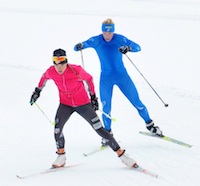
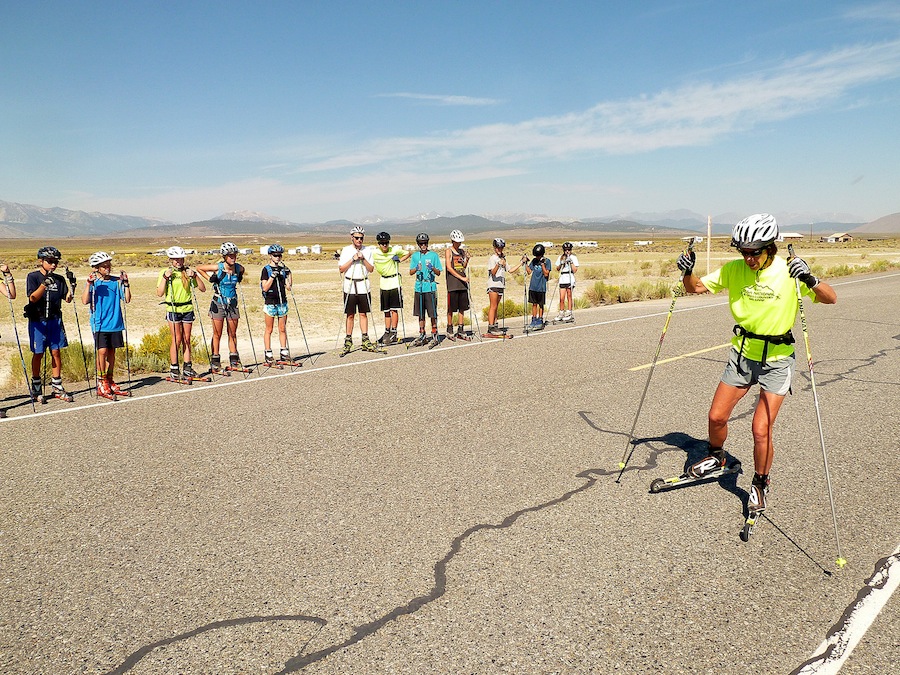
    Nancy Fiddler leads rollerski skate drills during the recent  Far West Nordic June Lake Camp in California. (Photo: Mark Nadell/macbethgraphics.com)
    Nancy Fiddler leads rollerski skate drills during the recent Far West Nordic June Lake Camp in California. (Photo: Mark Nadell/macbethgraphics.com)

    You asked, we answered! Welcome back to another installment of our Question and Answer (Q & A) series. This time around, FS contributor and former national-team member Nancy Fiddler gives some rollerski training tips. Got a question of your own? Email questions@fasterskier.com.

    1. I only own skate rollerskis. For double-pole sessions, should I use classic length poles or skate? — Dan, south central Pennsylvania 

    This depends on what your skiing goals are. If you are training for classic skiing and racing, you will want to do double pole sessions on your classic-length poles. If you only skate, then these sessions would be most beneficial using skate poles.

    You have a few options for these double-pole sessions. The first is to double pole for distance or over-distance. Using fast-rolling skate skis, it is possible to double pole some hills as well as flat terrain. Find rolling terrain, if possible, to get the most out of these sessions.

    It is also possible to use your skate roller skis and classic poles to do a specific strength session. Find a sustained uphill and create a set of double pole repeats. The terrain will dictate the length of each effort. I like to mix sessions of shorter strength intervals on steeper terrain with sessions of longer intervals on more gradual terrain.

    Examples of specific-strength, double-pole workouts:

    8-10×30 seconds on a steep uphill with 1-minute recovery

    6-8×60-90 seconds on a moderate uphill with 1-minute recovery

    3-5×3 minutes on a gradual uphill with 2-minute recovery

    You can also incorporate some single stick repeats into these strength sessions.


    2. When I can’t get out on rollerskis, what would be the best option in the gym? I have access to a rowing machine, elliptical, stair climber, bike and treadmill.

    I would choose the rowing machine and the treadmill. The rowing machine offers a full-body workout and you have some good options with the treadmill, including some uphill work.

    Indoor distance sessions can be fairly tedious, even with good tunes. If you are trying to fit in over 30 minutes of distance, an option would be to mix some time doing some easy running or ski walking on the treadmill (keeping the grade fairly low) with some time on the rowing machine. You might switch modes every 15 minutes to make the workout more interesting and valuable.

    Another option in the gym is to do some interval training. It is possible to get a great workout in under an hour, including a warm-up and cool-down. Again, mixing training modes can make a workout more fun.

    Example:

    15-minute warmup on the treadmill (run or ski walk).

    Alternate 3-minute threshold intervals on the treadmill and rowing machine with 2 minutes easy in between. Go for 4-6 hard efforts.

    15-minute cooldown
  • Q&A: Efficient Interval Training and Boot Width

    Q&A: Efficient Interval Training and Boot Width

    Welcome to another installment of FasterSkier’s Question and Answer series. In this edition we offer advice on interval training for skiers short on time, and Nathan Schultz of Boulder Nordic Sport provides information on boot width.

    What type, and how to do intervals for the time crunched skier?

    — Dave

    It is easy to get a robust intensity workout in 45 minutes (or even less) with some focus. It matters less what specific interval session you do, and more how you approach it.

    They key is to be efficient. Warm up as little as you can get away with safely. Often, treating the first part of the first interval as a part of the warm-up is a good idea. Work into the interval, increasing intensity as your body gets going.

    Stephen Randall thumb
    Liz Stephen and Kikkan Randall banging out some intervals

    Don’t waste time fussing with equipment or clothing. If you know you will have a short window, prepare the evening before. Have your gear ready to go, know what you are going to do, and get after it.

    One great option is the oft-used 4×4 level 4 workout. Four intervals, four minutes in duration with three or four minutes rest. Ten minute warm-up, 24 minutes of intervals (with rest) and five minute warm down = 39 minutes.

    In a more relaxed situation, you might do some speed or strength as part of warm-up, but when you are pressed for time, you need to keep your eye on the prize – cranking the engine. So don’t bother with any bells and whistles.

    It may not be a perfect workout, but it is much better to get out and do something.

    Another option is to do a single interval — a 30 minute pace, gradually increasing effort is a good choice. This way you eliminate rest and maximize active time.

    Again, the exact combination of minutes on and minutes of doesn’t matter much. Get out quickly, go hard, and wrap it up.

    — Topher Sabot, FasterSkier

    ***

    Do any of the boot manufactures produce a high performance boot in widths? Wide feet and bunions come with master skiers. If not, which boot has the widest toe box?

    — Bigfoot

    All of the companies offer different lasts that vary the width/volume, they just do it in different ways.  Most companies’ 2nd or 3rd tier boots will be wider and have more of a “comfort” fit than the top of the line boots which tend toward a narrower/lower volume last for the “performance” fit.  Rossignol actually offers their top-end X-ium World Cup boot in a Low-Volume Fit (LVF) and regular fit.  All other companies only change the last per model.

  • FasterSkier Q & A: Kikkan talks Injury Training

    FasterSkier Q & A: Kikkan talks Injury Training

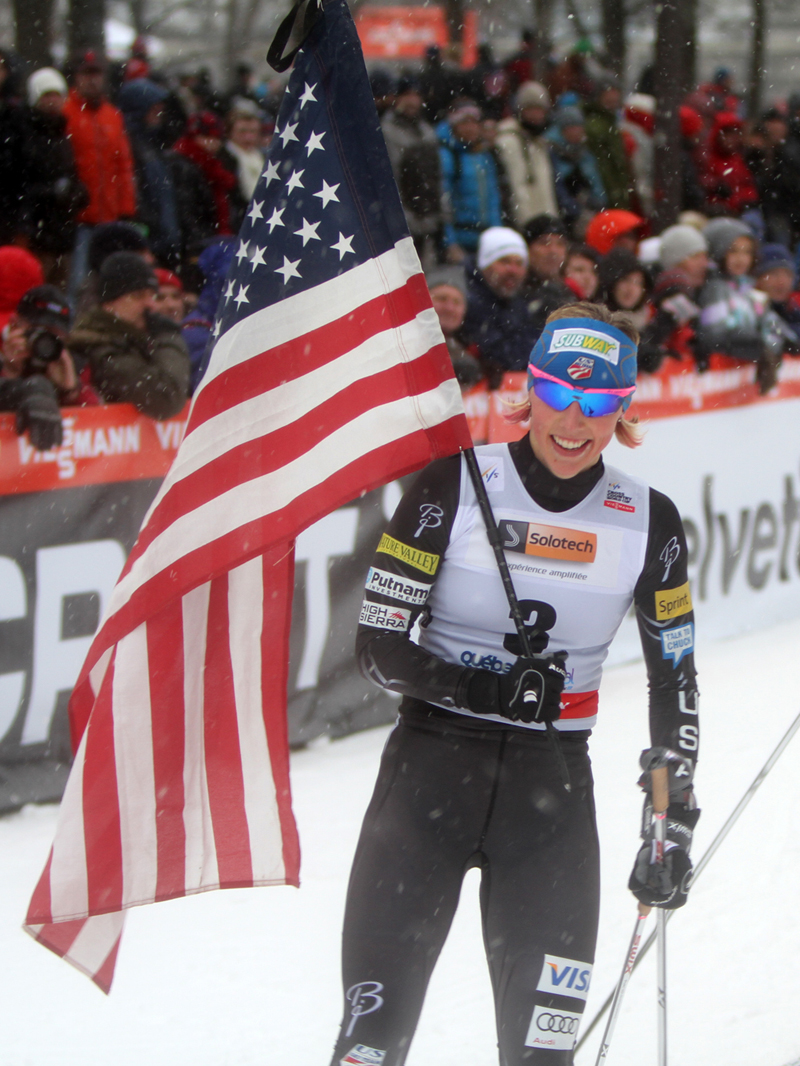
    Randall: “To be able to do that victory lap afterwards was something I will definitely remember for the rest of my life.”

    In this edition of our Q & A series, American star Kikkan Randall discusses specific workouts performed during her recovery from a stress fracture, and we break down the different race series, and how they relate.

    If you have questions you would like us to answer, email us at questions@fasterskier.com.

    I’m an older Master skier but would love to learn what kind of speed strength and other workouts Kikkan did while healing from her issues this fall. It sure seems to have worked for her and could be enlightening for all of us.

    — Kim from Wyoming


    Here are a couple of the workouts I did while healing my foot injury:

    – Pool running intervals: 15 min warm-up, 20-30 min of 30 secs sprinting, 30 secs recovery, cool down.

    – Upper Body distance: 30 min at solid distance pace on the Exer-Genie followed by 30 min at solid distance pace on the SkiErg.

    – Double-pole intervals: warm-up, 4×10 min at threshold on rolling terrain, cool-down.

    – Climbing on a mountain bike while staying seated, 90-120 mins at 75-85% of max heart rate.

    – Upper body and core specific circuits in the weight room.

    Recovering from an injury can be a great opportunity to work on your weaknesses and focus on improving specific skills. Stay positive and focus on what you CAN do!

    Best of luck!

    Cheers,

    Kikkan

    ___________________

    Can you explain the organization of race series across the country, continent, and World? Continental Cup, NorAm, SuperTour – define each of these and how they relate to each other and regional series like the Eastern Cup, as well as the World Cup and other European series. 

    — Zack in California


    It would take more space than I have here to discuss every race series but this is a timely question with the 2013 still in the early stages.

    We can begin at the top. The World Cup is the highest level of racing in the world – the major leagues as it were. The NorAm series and the SuperTour are Canada’s and USA’s entries in the Continental Cup.

    So while the World Cup is a series, the Continental Cup is actually a classification of series. In addition to North America’s two circuits, there is a Scandinavian Cup and a Balkan Cup among others.

    These represent the highest level of the minor leagues, and skiers racing in these events usually aspire to the World Cup. And that aspiration can be fulfilled in a practical way. At various points in the season, the leaders of Continental Cups are granted World Cup start spots in addition to national quotas. This is how Holly Brooks started the season on the World Cup last year and provides a clear path to the big show.

    After this, however, things start to get less defined, with no real relation or hierarchy.

    The main delineator is FIS points. A race is either scored for such points or not. All World Cup and Continental Cup races are by default. FIS points are the currency of the professional and aspiring skier, impacting team selections, start seeding, and ranking lists.

    Such races generally must be held on homologated courses and often attract strong fields.

    In the US, some collegiate races have been FIS sanctioned for points, and certain marathons are as well.

    There is the elite marathon series in Europe – the Ski Classics, as well as the FIS Marathon Cup, and the World Loppet. Many of the events overlap, and participants include everyone from recreational skiers to Olympians.

    The Eastern Cup is the New England Nordic Ski Association’s regional race series and act primarily as qualifiers for Junior Nationals. All regions that participate in Junior Nationals hold qualifying races, but they may not be presented as a “series.”

    Ultimately only the Continental Cup and World Cup have a truly direct relationship. The rest may be tied together by FIS points or qualification criteria but are mainly separate entities.

    Topher Sabot, FasterSkier

  • First Edition of FasterSkier’s New Question and Answer

    First Edition of FasterSkier’s New Question and Answer

    This is the debut article for our new section: a classic Question and Answer. In every biweekly issue of The Start List we will pick a few questions, answer them ourselves, or solicit responses from experts in the ski community. Please submit your own to questions@fasterskier.com.

    We will look to present a variety material – from skiing basics – “Skiing 101,” to more complicated technical issues, and everything in between. This week ski technician extraordinaire Zach Caldwell addresses the idea of kick waxing a zero ski and Gear West staff give an illustrated lesson on keeping road ferrules sharp (some of us will be rollerskiing for some time still).

    Question and Answer:

    I wonder why the relatively new zero skis can’t be effectively kick waxed? It seems to me that the rubbery, corky, whatevery kick zone, when sanded would hold wax well. When starting long events on blue klister, for example, wouldn’t the hairy section kick in as the snow warmed toward freezing and the klister wore off? I haven’t tried this but I bet somebody has.

    — Thor in West Yellowstone

    A pair of Kris Freeman’s (USST) Fischer Zero skis.

    Zero skis certainly can be kick waxed. There is nothing about the inlay material that prevents the base from holding kick wax, and usually the shape and action of the pocket is suitable for use with kick wax.

    Zero skis are purpose-built “hairies”. The inlay material in most zeros contains rubbery stuff that enables the user to quickly and easily create the fuzzy surface that is required for kick in hairies conditions. The inlay material also provides outstanding durability for the hairy texture the facilitates kick.

    When you wax over the inlay material you will effectively “mat-down” the fuzzy little hairs that provide kick in “hairies” snow. To make them work well after waxing you should clean them thoroughly with a wax remover, make sure they’re dry, and then re-sand them using 100grit paper and tight circular motions. A small electric sander works very well, and makes short-work of the process.

    Because the zeros depend on the fuzzy “hairies” texture for kick, it’s not going to work satisfactorily to expect a wax application to wear-off, exposing functional hairies underneath. You’ll need to decide, before you start skiing, whether you’re going on wax or hairies for the day’s event!

    — Zach Caldwell, Caldwell Sport


    What is the best way to sharpen rollerski pole tips?

    — Dave

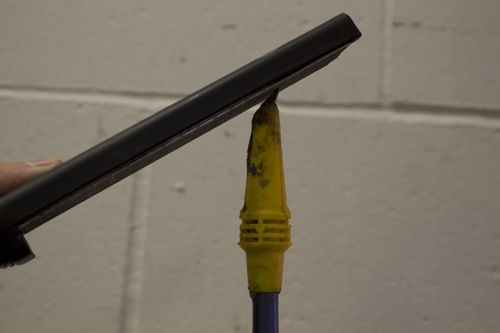
    Sharp rollerski ferrules are essential to keep you training longer and prevent injury. At Gear West we recommend the Edgecrafter Diamond Sharpener. The tool is substantial enough to give your ferrules a great sharp tip, but also small enough to take with you on workouts. The sharpener comes with three 100% diamond abrasive pads – coarse, medium, and ultrafine. For best results we use the medium pad on roller ferrules.

    How to sharpen your tips:

    Place the sharpener against the angled side of the ferrule tip. Move sharpener parallel to the ferrule, back & forth until the tip is sharp with a polished look.

    Next, sharpen the other half of the ferrule tip. Turn the sharpener and use the same back & forth motion to give your tips a nice sharp point.

    — Andrew ‘Sven’ Kroese, Gear West