From the FasterSkier archive — posts syndicated from athletes’ and coaches’ own blogs between 2004 and 2012, kept online as published. Current coverage is at fasterskier.com.

Tag: race skis

  • Finding the Best Ski with Gear West

    Gear West ski selection map

    You are looking for the best possible pair of skis.
    You want one of those hard to find top quality skis with a perfect smooth and lively camber. A ski that is fast and fun to ski. At Gear West we will use our expertise and leverage all relationships with ski manufacturers to match you with your next favorite ski.

    All race skis are not created equal
    Within a brand and model  (like Fischer RCS Carbonlite) There can be a meaningful difference in quality of flex from one ski to the next.  Manufacturers would like consumers to believe that one race ski is equal to another ski of same brand and model. Unfortunately this is not the case and each ski has to be tested by a race ski expert. These variables are caused by manufacturing variations in temperature, humidity, press settings and differences in the curing process. The difference of a ski with high quality flex to an average ski is not just a preference – a really good ski is easier to ski on and goes faster. We spend considerable time and money searching and maintaining the largest high quality ski selection in North America. Our goal is to get you on the best possible ski.
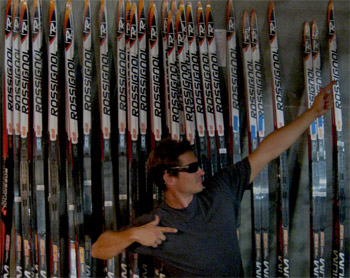
    Matt at Gear West

    How Gear West finds you the best ski
    Because we buy more skis, manufacturers help us secure the best skis. We work closely with European ski selection experts for each brand. These experts understand the nuances of quality race skis. They have tested thousands of skis and, in their hands, can feel what we are seeking in a quality race ski, a soft smooth initial camber with a firm and lively secondary camber. Sighting down the edge of the ski they look for a camber with a fluid curve without hinges. From years of on-snow testing they know these characteristics translate to fast skis.

    These hand selected race skis are shipped under Gear West’s name to the manufacturers U.S. warehouses. Gear West ski selection experts travel to these warehouses to select skis for our Race Ski Selection customers and for our Race Ski inventory. Last year Matt and Sven spent days sifting through skis at FischerUSA, AtomicUSA, SalomonUSA and RossignolUSA using the same criteria as their European counterparts to select the smoothest and liveliest skis, matching the weight and skills of each customers. Matt and Gear West are committed to finding each customer’s new favorite ski.

    Get your new favorite skis
    Now that you know how we locate the best skis possible you can sign up for your own. Fill out our ski request form, below, and we will track down your next favorite skis. Skis can be shipped to customers or, Race Ski Selection customers can come to Gear West to get fitted on the flex bench and even bring in their other race skis to check their flex/fit and get help determining best race conditions for each.


    Ski Request Form

    Link to http://www.gearwest.com/ski-request

  • How to Choose the Right Skate Ski on Race Day

    The Gear West wax room at the Alberta World Cup in Canmore in mid-December.
    The Gear West wax room at the Alberta World Cup in Canmore in mid-December.

    How to choose the right skate ski on race day

    One of the biggest questions I hear from racers with multiple skis is the decision of “what pair should I use on race day?”  I get this question very frequently along with “how many skis do you have?”   (The answer to question #2 is more than a dozen and less than 100)

    Gear West

    For most racers, I like to see 2-3 “high quality” skis per technique (see article on quality http://fasterskier.com/article/ski-fit-at-gear-west-get-your-requests-in-now/).  If you have more pairs than that, it is likely time to remove the sub quality skis from your race bag and focus attention on the higher quality skis.  We can help with this at Gear West… (http://gearwestxcskiing.blogspot.com/2011/06/gear-west-ski-flex-tester.html)

    For the skate pair breakdown I like to see a…

    • Softer/colder: This pair is ideal for soft to medium track conditions.  Think over night snow or snow in the past week and below freezing temperatures without any freeze thaw cycles (think Birkie in the purest form) and a lack of moisture in the snow.  The track is likely to be soft and the snow crystals will still sharp.  A softer ski with flexible tips and tails will have some flotation and won’t interact too aggressively with the cold snow.  Grind choice on this type of ski is on the colder side; Finer, more linear structure.   Using this ski in hard pack conditions will result in a squirrely ride.
    • Stiffer uni:  This is the go to ski when the temperature drops out and the skate deck is hard as concrete.  This condition can happen due to super chilly temps or freeze thaw cycles without proper renovation from a tiller or skiing at night once the track has been skied in… icy conditions.   It is possible to find a firm track ski with softer tips and tails that will allow it to run into the medium track conditions for a more universal solution.  Firm track skis have a longer wheelbase which gives a more stable ride… the peak pressure points are wider so track is better.  When skiing in difficult balance conditions, most skiers will benefit greatly from a more stable ride provided by a slightly stiffer ski.
    • Medium uni/warm:  I like to think of this pair as a universal ski that could handle full saturation if hand structure is added.  Temp range would be 15F and warmer on older snow and 20F and warmer on new snow.  This pair would have moderate tip and tail splay which will help with moisture and a stiff enough camber to keep a mix of stability, limited base interaction in moist snow and flotation for soft moist snow.

    When choosing a pair of skis for racing, it is important to think about the temperature, snow conditions and the course.  If possible, wax up 2 pairs and test the day before the event and the morning before if possible.  For marathon races, think about a softer/warmer ski if you are in a later wave.  The snow will be churned up and a softer ski will ride over the deep snow more easily… the down side is if you encounter ice from snow plowing a stiffer ski will allow better control.

    If you are racing toward the front of a marathon, don’t forget about the later parts of the race.  If the start is cold but temps are expected to rise… maybe think about what ski will run best in the last 10-15km.  Fast skis in the last 1/3 of a marathon distance race can make a huge difference.  Sometimes that means giving up a tiny bit of ski speed in the first half of the race.

    For courses with lots of climbing, a softer ski will require a little bit less effort to push and glide on the hills, but some of the new skis from manufactures are able to maintain relatively easy release at static speeds while climbing, and still have a stiff secondary chamber that allows good stability and top end speed.

    If the snow is newer, look at softer skis and if you encounter transformed snow, look at stiffer pairs.    If the race is shorter, stiffer skis may be the call; conversely no one wants to push a ski that is too stiff for 50km.

    Special considerations:

    If you are only a one pair racer, try to own a ski that has a stiff secondary chamber, tip and tail splay and put a cold to universal-cold grind on them.  With these attributes, the ski will run in a multitude of conditions and you can always add hand structure for warmer snow.

    At Gear West, we have helped many racers figure out their quiver of skis.  The goal for weekend warrior to elite racer is the same… keep things simple and put your best ski on snow for race day.  We are here to help you!  Gear West Ski Fit Team

    Gear West wax room Canmore