From the FasterSkier archive — posts syndicated from athletes’ and coaches’ own blogs between 2004 and 2012, kept online as published. Current coverage is at fasterskier.com.

Tag: Race to the Outhouse

  • Race to the Outhouse #2 Ushers in Spring Skiing Season

    Race to the Outhouse #2 Ushers in Spring Skiing Season

    The eponymous outhouse of the Race to the Outhouse #2, Archangel Road, Talkeetna Mountains, Alaska, in April 2018. (photo: Gavin Kentch)
    The eponymous outhouse of the Race to the Outhouse #2, Archangel Road, Talkeetna Mountains, Alaska, in April 2018. (photo: Gavin Kentch)

    ARCHANGEL ROAD, above Palmer, Alaska — The tenth annual Race to the Outhouse #2, held amidst the Talkeetna Mountains on April 6, marked a neat bookend to the 2018/2019 race season in southcentral Alaska, and possibly in North America.

    While this season’s Race to the Outhouse #1 was held in early December 2018, roughly one month later than normal, it still marked the season’s first race in southcentral Alaska, and, behind perhaps only Frozen Thunder and a handful of races in Fairbanks, one of the first nordic ski races in the entire continent. Four months later, the SuperTour had come and gone, Senior Nationals had been completed, Junior Nationals had crowned champions just down the road in Anchorage, and it was time to hold the Race to the Outhouse #2. The course goes from a roadside trailhead to an eponymous outhouse some distance uphill, with mountains towering all around.

    A post on the local trail conditions forum from race director Ed Strabel last Thursday helps set the stage and introduce the course profile, as well as reveal the general level of informality that characterizes this contest:

    “Forgot to add that the Race to the Out House, (Number 2) will be held at Archangel Rd Saturday AM. Registration at 9:30 AM (FREE). 7 KM, but skis like a 10 K because of the 750 [foot] climb to the finish line at the outhouse. Skate division starts at 10:30. Classic division starts at 10:31. Go crust skiing after the race back down to your car.”

    That’s a 750-foot climb over roughly the last three kilometers of the course, or a healthy 250 feet (76 meters) of climb per kilometer. That said, using one figure for the total climb of 927 feet over all seven kilometers suggests that the race course as a whole falls at the far upper limit of FIS-legality for a course certified by the International Ski Federation, as 927 feet of climbing over 7 kilometers is “only” 40.4 meters of climbing per kilometer. The comparison should deepen any armchair ski fan’s appreciation for World Cup skiers’ performance at Holmenkollen (39.1 meters of climbing per kilometer, although of course they have to go downhill there, too) or other hilly venues.

    Tamra Kornfield, women's winner of the Race to the Outhouse #2, Archangel Road, Talkeetna Mountains, Alaska, in April 2018. (photo: Gavin Kentch)
    Tamra Kornfield, women’s winner of the Race to the Outhouse #2, Archangel Road, Talkeetna Mountains, Alaska, in April 2018. (photo: Gavin Kentch)

    That said, the Race to the Outhouse’s maximum climb of 229 meters is well above the FIS limit of 80 meters for a single A Climb, if barely half that of the Tour de Ski final climb (405 meters over 3.5 kilometers).

    FIS-legal or not, registration occurred via clipboard left atop a snowmachine trailer from 9:30 to 10:28 a.m., with racers collecting the appropriate bib number from a cardboard box after signing their name. At 10:29 a.m. Strabel gave instructions, and at 10:30 a.m. a field of 19 freestyle racers set off. (The morning’s only classic racer had started 30 minutes early. An additional two late-arriving skate entrants started a few minutes later.) At roughly 10:40 a.m., Strabel slowly passed the entire field on his snowmachine, motoring up to the outhouse so that he could record finishing times.

    First place overall was claimed by this reporter, who had agreed to write an article about the race before he knew he would win, in 23:08. (Of note, the reporter’s quick trip to the outhouse was facilitated by a speedy pair of skis purchased from Holly Brooks.) Local skier and trail groomer Jeff Kase was second, 1:17 back in 24:25.

    Both times were considerably faster than the winning time on this same course in 2016, 26:05, reflecting a recent freeze spring-thaw cycle that left much of the top layer of Saturday’s course as ground-up ice. Or, as the results put it, “WEATHER CONDITIONS: -1 C, FLAT LIGHT. Norwegian snow taxonomy: VIII,F,5,e,2.”

    In the day’s closest finish, youth and experience went head to head for the final spot on the men’s podium. Experience (Randy Bladel, an M7 racer) led youth (Noah Hanestad, a U16 racer in ninth grade at local Colony High School) by a few strides coming up the final pitch to the finish, only to see youth pull around him and unleash a credible jumpskate over the final few meters, to which experience was unable to respond. Hanestad ultimately took third in 25:50, with Bladel two seconds back.

    Following their tight finish, one of them collapsed on the ground just past the finish line, while the other sprinted to the conveniently located nearby outhouse to use the facilities.

    The first woman in the co-ed mass start was Tamra Kornfield, who finished in 29:03. She was followed by Cindy Decker (31:02), who just held off Dorothy Childers (31:06) for third.

    Deborah Rix made up the entirety of the classic division.

    Kase, the second-place finisher, Mat-Su Ski Club board member, and volunteer trail groomer, wrote of his race:

    The Mat Su Ski Club’s (MSSC) Outhouse series is a unique event mainly because these ski races are conducted early and late season.  As a MSSC member I feel thankful to have access to an alpine elevation trail system and grooming that lets me start my ski season early and extend on ski season well into the spring.  Saturday’s Race to the Outhouse 2 was a good reminder that this year is not over and that training for next year starts now.

    In preparation for the race I woke up early and groomed the trail at Archangel Rd in Hatcher Pass State Park. The freeze thaw cycle requires early morning grooming when the snow is frozen. As the day progresses and the sun warms the snow, there is a “sweet spot” for skiing when the conditions on and off trail are firm enough to ski and soft enough to edge. So as I was wrapping up the groom and headed back to the start area I could see a bunch of skiers and racers getting ready and starting their warm up.  You never know who is going to show up for the Outhouse Race but as the start time approached several familiar ski racers were present including an APU master skier, Gavin Kentch, who would likely be my biggest competition and eventually won the race.

    I regularly see Gavin’s name in race results from around the state and sometimes national and international competitions; so what I inevitably do next is scroll down the results one or two places, insert my name, and get a little bit of satisfaction as I convince myself that I would have placed about here if I would have race.  (Based on this method I have done quite well in several events that I actually didn’t participate in.)

    My strategy for today was to hang with Gavin until the bottom of the big climb and then see if I could make him hurt on the long hill. Inevitably I knew a win was unlikely but if I could be on his tails then I could justify all my faux results based on his performances.  

    Turns out I did get second place but not as close as I think I can be. Basically, I realized if I want to stay relevant in the nordic scene, I need to do intervals next year.  

    The most exciting part of the day was watching the uphill sprint finish for 3rd and 4th.  I also liked the way that the classic technique racer started 30min early and finished a minute or two after the skaters which means pretty much all the participants were at the finish line at the same time.

    Men's podium for the 2018 Race to the Outhouse #2: Gavin Kentch (c), Jeff Kase (r), and Noah Hanestad (l), Archangel Road, Talkeetna Mountains, Alaska, in April 2018. (photo: courtesy Gavin Kentch)
    Men’s podium for the 2018 Race to the Outhouse #2: Gavin Kentch (c), Jeff Kase (r), and Noah Hanestad (l), Archangel Road, Talkeetna Mountains, Alaska, in April 2018. (photo: courtesy Gavin Kentch)

    16 minutes behind Kase, Anchorage skier Liam Cleary, 10, finished higher than his age when he crossed the finish line in ninth place in the men’s division. Tenth place went to his father, Steve Cleary, three seconds back.

    Saturday marked his first time ever doing this race, the younger Cleary told FasterSkier after the finish. “It was fun,” he said, “because there’s a lot of uphills, and I like uphills.” He hopes to race again next year.

    Liam’s results goal coming into the race had been to finish in under one hour. He was thrilled to stop the clock in 40:53, with over 19 minutes to spare.

    Liam attends Winterberry Charter School in Anchorage. The school has a ski team that competes in Anchorage School District middle-school ski racing, but Liam is not a member. “I can’t yet,” he explained. “I’m a fifth-grader.”

    Cleary fils had skied with Cleary père for most of the race, Liam explained, “except for the last part.”

    And then what happened? he was asked. “I ditched him.”

    And how did that make Liam feel? “Good.”

    What comes next

    April is a curious time for the nordic ski world. Many skiers are done skiing by this point, out of necessity, for the simple reason that there is no more snow. For those skiers who still have access to snow, additional formal training may seem undesirable following a long race season. And then there’s the siren song of crust skiing. If you follow professional skiers on Instagram in April, you may see them crust skiing, or backcountry skiing, or surfing, or sitting at the beach, or occasionally even sharing candid thoughts about how tired they are… but you probably don’t see many of them doing much serious racing.

    Duncan Wright (r) and Julia Ditto crust skiing in Hatcher Pass, Talkeetna Mountains, Alaska, April 2018. (photo: Gavin Kentch)
    Duncan Wright (r) and Julia Ditto crust skiing in Hatcher Pass, Talkeetna Mountains, Alaska, April 2018. (photo: Gavin Kentch)

    Put another way, past winners of the Race to the Outhouse #1, held in November or December and thereby providing a valuable early-season race stimulus, include APU skier Scott Patterson, who was 11th in the 50k at the 2018 Winter Olympics, and Alaska Winter Stars skier Gus Schumacher, who anchored the gold-medal relay team at 2019 World Juniors. Past winners of the Race to the Outhouse #2, held in April at a time when race stimulus is the last thing that most people want or need, include, well, this reporter. All the real skiers are sick of racing by this point.

    So what does that leave for the April racing calendar? Not much, and heavy on the whimsy. There was the Nordic X race at Cochran’s Ski Area in Richmond, Vermont, on Sunday morning. Craftsbury stopped grooming for the year on Monday, but will hold its Mud n’ Ice Quadrathlon, including a ca. 10 k skate leg, on April 20. Alyeska Resort, in Girdwood, Alaska, had scheduled its annual Alaska Skimeister race (alpine skiing, nordic skiing, and fat biking) for the same day, but has already had to cancel this year’s event due to a lack of snow near the base of the ski area, which may have the lowest elevation of any alpine resort in the world at 250 feet. It’s dumping at Mt. Bachelor, and there’s still good skiing in the UP, and the skiing in New Hampshire looks pretty darn good right now… but the will or desire to hold a nordic ski race in April may be limited.

    Becca Rorabaugh (APU) races in a season-ending ski cross race at Cochran's Ski Area, Richmond, Vt., in April 2019. (photo: Becca Rorabaugh Instagram screenshot / https://www.instagram.com/p/Bv-aVpyHrJ7/)
    Becca Rorabaugh (APU) races in a season-ending ski cross race at Cochran’s Ski Area, Richmond, Vt., in April 2019. (photo: Becca Rorabaugh Instagram screenshot)

    (Possible honorable mention: There is a spring storm currently affecting roughly half of the Lower 48, and the homepage for SkinnySki.com has gone from talking about the season being over and surveying running races – the season’s results list includes a “Last Chance Ski Race” from March 23 – to discussing “significant snowfall” and the possibility of up to 20 inches’ accumulation by the end of this week. The Midwest blizzard of April 2018 brought at least one short-notice pop-up ski race at Wirth Park in Minneapolis; this may do the same.)

    Internationally, meanwhile, the FIS calendar for upcoming races in April reads like a survey of exotic northern destinations: Bruksvallarna, Sweden; Ylläs–Levi, Finland; Taivalvaara, Finland; Kirovsk, Russia; Petropavlovsk–Kamchatskiy, Russia; and so on. If you want to race a marathon on the last weekend in April, Norway (either Geilo or Svalbard) is the place to be.

    And let’s not forget May, as May 4 of this year brings the remarkable sight of an on-snow FIS race held three days after the official training year has begun. The Fossavatnsgangan ski marathon will be held in Ísafjörður, in northwestern Iceland, the latest running of a race first held in 1935. Last race of 2018/2019 or first race of 2019/2020? As the early-May truism goes, next season starts now.
    Results

  • Alaska Racing Returns with Scenic Race to the Outhouse

    Alaska Racing Returns with Scenic Race to the Outhouse

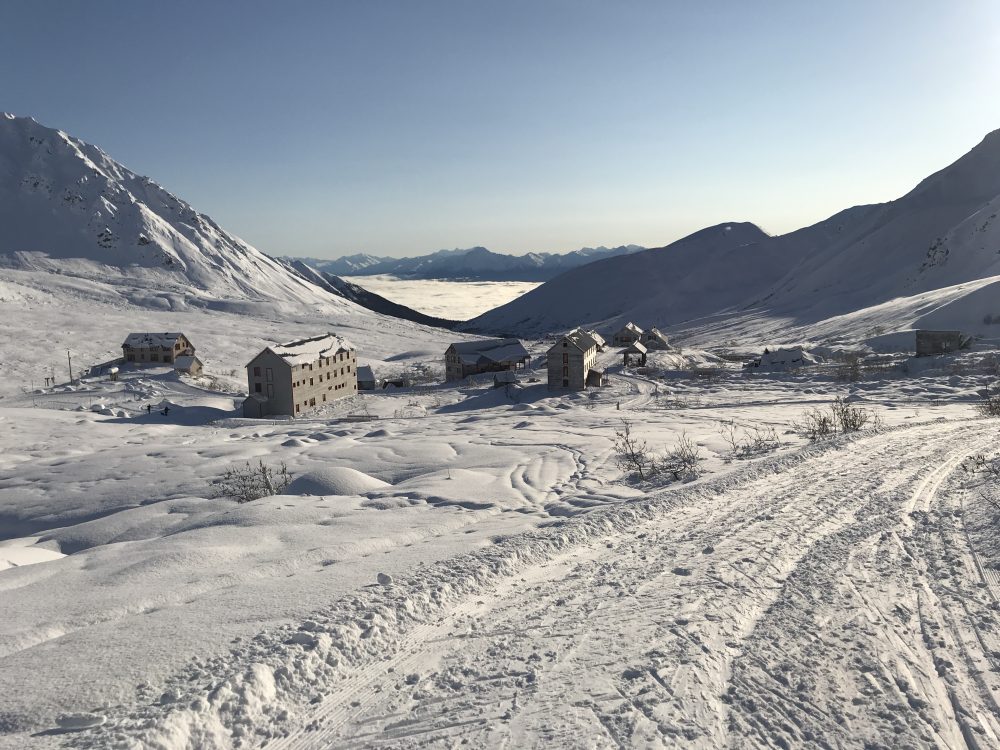
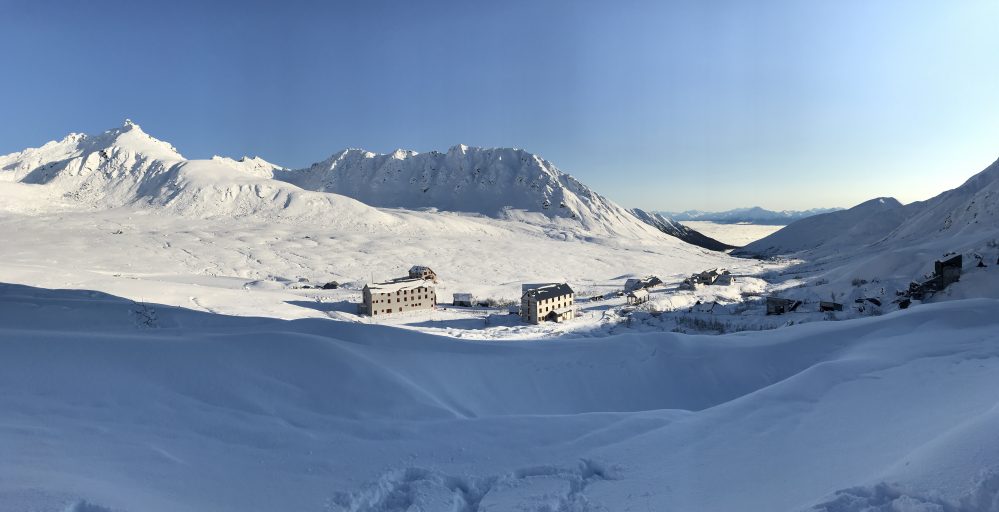
    The historic mine buildings and valley are blanketed in 3-4 feet of early-season snow up at Hatcher Pass above Palmer, Alaska. (Photo: Ed O’Connor)

    HATCHER PASS, above Palmer, Alaska — Thank you Ullr for the early-season weather and snow!

    The 2017/2018 ski season started for me on Sept. 30 with an overnight trip to the Snowbird Glacier in the Talkeetna Mountains above Palmer. The Mat-Su Ski Club (MSSC) started grooming the trails around Independence Mine in Hatcher Pass State Park in mid-October.

    The current Hatcher Pass scene

    Since then there have been two distinct categories of weather and skiers. The weather at the mine has been either dumping snow (there is presently one to three feet of base in the mine area) or out of the fog and into the sun temperature inversion (I can see Russia from here). The skiers up there show up in sticker-clad rocket boxes and matching uniforms, or have a decade’s worth of state park parking passes on their cracked windshield and dog hair matted to their ski jackets. Early season in Hatcher Pass is the story of two drastically different worlds, depending on if you go there midweek or on the weekend.

    On a typical early season weekend in Hatcher Pass, the approximately 75-car parking lot will be overflowing with a confirmed 90-plus vehicles. Team vans, Suburbans and an impressive display of rocket box-topped Subarus with ski-themed vanity license plates all compete for spots to park.

    Once on the trail, the distinctive colors of the team uniforms are seen in the blues of APU (Alaska Pacific University), the green and gold of UAA (University of Alaska Anchorage), the red of AWS (Alaska Winter Stars), yellow of ANR (Alaska Nordic Racing), and the light purple of the USST (U.S. Ski Team).

    If you want a free lesson on how to be a better skier, just look around. You will see the best technique, the hardest training, and some of the finer nuances of being a skier. Lines of no-poled skiers are doing drills. Elite racers are zipping past you doing intervals.  Elite racers are zipping past you doing over-distance. Junior club skiers are building jumps. Sometimes the weather up there on the weekend requires you to shed layers and think about UV protection in November in Alaska. Sometimes the weather up there on the weekend requires emergency midday grooming and specialized vision enhancers to let you see the trail. Let it be known that the who’s who of competitive skiing commutes from Anchorage to Hatcher Pass on the weekend for good early-season skiing. The vibe on the trails at Independence Mine is that you are part of a rich ski community and leaves no doubt that you are in the right place at the right time.

    Looking down from near the high point of Saturday’s Race to the Outhouse at Hatcher Pass, Alaska. (Photo: Ed O’Connor)

    On a typical early season weekday in Hatcher Pass I can show up at a leisurely mid-morning time and likely get the best and closest parking spot just a few meters away from where I can put my skis on. The only other person out there drives an older minivan that surprisingly made the climb up the mountain. This guy wears jeans when he skis, which are a good match to his equipment. The flashiest part of anyone’s uniform is the brightly colored cotton bandana tied loosely around his wrist.

    If you want a free lesson in what it means to be a skier, just look around. The vacancy of the mountain allows you to internalize your motivations and identify your biomechanics. Making another trip to the high point of the trail makes you feel as mighty as the mountain peaks that surround you.

    On a midweek day in Hatcher Pass, you may find yourself talking out loud to the dog about kick wax and then laughing when you agree with her that it’s not the wax but the operator. Oftentimes over the last week or two the lower elevations have been entombed in a dense fog that you can drive up and out of into a sunny winter wonderland and think, “WOW!  Does anybody else know how nice it is up here?” Almost as often the drive up has been so perilous due to fresh snowfall you have genuine concern if you will be able to make it back down the hill safely.

    The midweek vibe on the trails is that you are grateful and lucky to be in the right place at the right time.  

    The 2017/2018 American race season begins

    The Race to the Outhouse #1 was held at Independence Mine State Historical Park this past Saturday morning, Nov. 4. Once again, it is believed to be the first cross-country ski race in the U.S. this winter, and the first ski race on natural snow anywhere on the continent.

    The race was held under partly cloudy skis and temperatures in the mid-20 degrees Fahrenheit. The one-lap, 5-kilometer mass start course featured an excellent base of natural snow, with nearly 200 meters of elevation gain through the scenic and historic gold mine area now overseen by the Alaska State Parks system.

    Of the estimated 150-200 skiers enjoying the trail Saturday morning, it was the Mat-Su Valley residents who made up the bulk of the start list.  A total of 13 people participated in the Race to the Outhouse #1 in a mass start skate event followed by a mass start classic event.

    Peter Brewer, 25, of Chugiak, Alaska, won the skate race in a time of 13:08. Aubrey LeClair, a student at West Anchorage High School who skis with APU, was the fastest overall woman despite competing in classic technique, with a time of 17:54. My ego was boosted by placing third overall, but I very easily could have gotten 23rd had some of the competitive spectators entered the event.

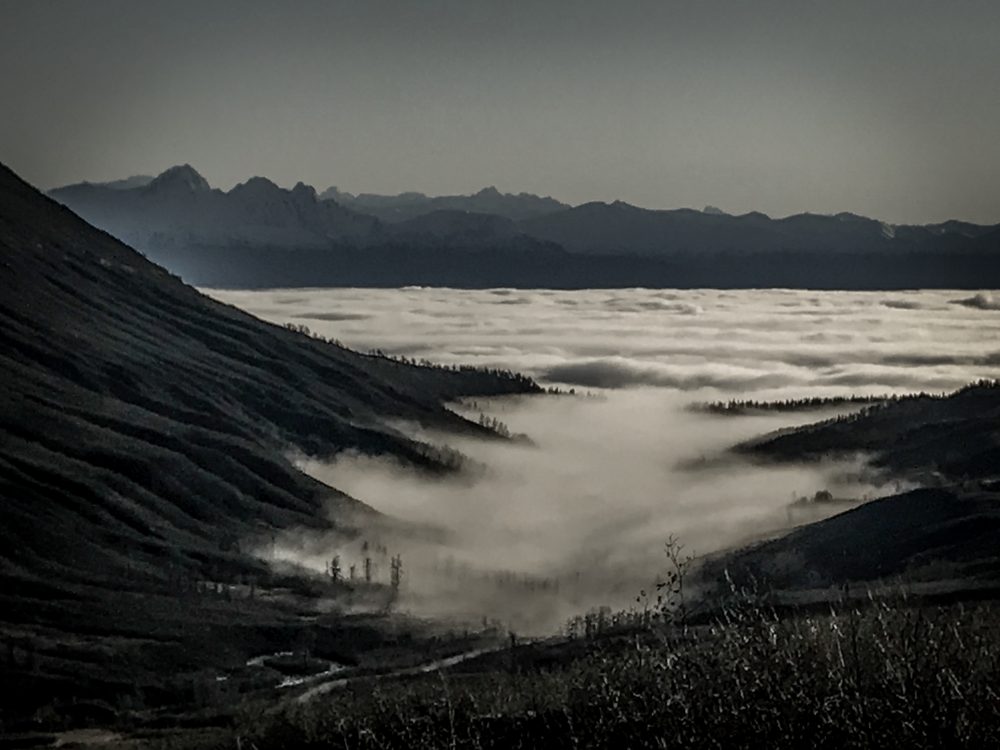
    Looking down at the fog below. (Photo: Ed O’Connor)

    Scott Horn, a recently retired Jackson Hole Resort employee,  traveled all the way from Jackson Hole, Wyoming, and raced in the event, “chasing early season snow to Alaska,” he said.

    Brewer, the race winner, was asked about his favorite trail, about the contrast between Hatcher Pass midweek and on the weekends, and about what he wants to do next month. He said his favorite trail is “Beach Lake Trails at Chugiak because that is where I went to high school.” As for midweek versus weekends, he observed, “For now I am a weekend warrior and only get to ski Hatcher Pass on the weekend.” And looking ahead, Brewer said, “Next month my twin brother Kenny and I are going to focus on speed by doing three- to four-minute Level 4 workouts in preparation for Besh Cups.”

    LeClair, meanwhile, says that her “favorite trails are Independence Mine because this place is so pretty, and Eagle Glacier because I can ski in the summer.” And, “I remember the last two weekends being very sunny and pretty up here, but when I came up here on a Wednesday it was a blizzard.” And finally, “Next month I want to be able to ski in Anchorage.” (Less than 24 hours after LeClair’s comment, Anchorage saw four inches of snow at Kincaid Park on the western edge of town.)

    If you are in the figurative or literal ice fog of the lowlands, go up.  What you find when you get there could be a ski race, might be a community of nordic ski racers, or perhaps a private ski resort.  One thing for certain is that if you go Hatcher Pass during the early season, you will know what day of the week it is.  

    — Gavin Kentch contributed

    Results

    * * *

    Author Jeff Kase is a devoted volunteer member of the Mat-Su Ski Club and a frequent groomer. He was up late Friday night grooming the trails for Saturday morning’s race. Ski racing in the Mat-Su Valley continues later this month with the Alaska Nordic Cup series between UAA and University of Alaska Fairbanks, and next month with the Mat-Su Ski Club’s flagship event, the Icicle Double on Dec. 30-31.

  • Racing Resumes in America with the Race to the Outhouse #1

    Racing Resumes in America with the Race to the Outhouse #1

    Overall winner Scott Patterson (APU) distances himself from the field on a snowy day on Archangel Road, near Hatcher Pass, Alaska, in the Race to the Outhouse #1. (Photo: Sam Sterling)By Jeff Kase

    There was an Alaska State Parks ranger with his lights on parked at the bottom of the switchback that leads up the hill to the trailhead and parking lot. The ranger had been turning cars around since the early morning because of a crime that was being investigated. The usual mischief of graffiti, shooting signs, or motorized vehicles in a non-motorized use area would not normally close the road, so I suspected something was afoot.

    A few days later, the Alaska Dispatch News published an article titled, “Brothers Kidnapped, Shot, Left for Dead in Hatcher Pass; Anchorage Man Charged.” (Both brothers survived.) It is scary to think about this kind of violence happening in a place where healthy, peaceful people congregate to recreate, but what was really on my mind was the fact that the Mat-Su Ski Club had groomed the night before, and since the ranger had been turning people away all morning, there was untouched corduroy just waiting for the road to open and people to go ski it.  

    The corduroy was the result of a late-October snowstorm that blanketed southcentral Alaska with 4 to 24 inches of fresh snow. The skiers rejoiced as nearly every trail across the land was groomed and skiable. While most people were thoroughly enjoying this early season dump, some mountain travelers were caught unexpectedly on the far side of the mountain.

    A distress call came from one such group of multi-fortunate mountaineers. Fortunate because of the improved glacier skiing they encountered, but unfortunate because of the extreme difficulty in traveling back home through snow-covered boulders, steep terrain, intermittent visibility, and the unexpected return of a long-dormant medical problem. The request for assistance was the excuse I needed to drop everything, call my most trusted, prepared, and physically fit friends, and hit the trail on skis at 1 a.m. By 5 a.m. we found them surviving but miserable in a snow cave. After some dry clothes and hot drinks we were all in much better spirits.  

    Snow in October is good, but how good? In Canada, Frozen Thunder officially opened Saturday, Oct. 22, after an estimated 400 truckloads of snow were distributed onto a 1.3-kilometer loop at the Canmore Nordic Centre in Alberta. The U.S. Ski Team wrapped up its final dryland training camp of the season in Park City, Utah, on Oct. 31.

    On Oct. 22, a skier had posted about Anchorage on a local trails forum, “Good snow cover on all Hillside trails” and “Quite a few people out there breaking in the season.” While here in the Mat-Su Valley a post on the same website from a day earlier accurately depicted the situation: “The road up to Independence Mine has not been plowed – not passable. When DOT plows, we will move equipment up there and groom.” The grooming report posted the morning of Nov. 5, the day of my first race of the year, read as follows: “Better than expected. I scratched the ice in the skate lanes. My prediction is moderate to good skiing for the first 100 people.”

    Women’s winner Maggie Meeds (APU) skis away from author Jeff Kase in the Race to the Outhouse #1. (Photo: screenshot from Sam Sterling video)Saturday, Nov. 5, saw the Race to the Outhouse #1, hosted by the Mat-Su Ski Club. It is believed to be the first ski race of the 2016/2017 winter in this country, and the season’s first ski race on natural snow anywhere in North America.

    The morning of race day was cold enough for me to want to wear long underwear. (In the official results, Race Director Ed Strabel described conditions as “18 Degrees, light snowfall on packed powder/ice.”) The trailhead parking lot was nearly full of Subarus and vans topped with Rocket Boxes. I recognized many faces, and there was no mistaking the sea of blue uniforms from the Alaska Pacific University (APU) ski team.

    I signed the entry form with a lobster-mitted hand and received bib #9. The 6-7 k race course is an out-and-back loop on an old mining road that is wide enough for tracks on both sides and skaters to pass in between without inconvenience. There is a bit of an extended incline near the turnaround area that allows skiers to get their heart rates up, but most of the trail is fairly flat and good for gliding.

    Scott Patterson and Maggie Meeds won the skate race. Ryan Brickford and Elizabeth Mars won the classic race.

    Despite what the results show, I may have been the biggest winner of the day. I stood on the start line with World Cup contender Scott Patterson (APU), who incorporated this race into his three-hour workout and afterwards wrote that he “felt like [the race was] a good way to shake out some faster muscles and lay down the law on some juniors and masters.”

    In an email to FasterSkier, Patterson explained that the low-key race was a spontaneous addition to his training schedule, and a welcome intermezzo to his scheduled OD. “Although it wasn’t on my training plan, the race up Archangel [Road] provided a fun opportunity to mix in some variety to a somewhat monotonous overdistance workout,” Patterson wrote. “I tried to convince a few of the other APU Elite Team guys to jump in with me, but lingering effects from a hard bounding interval set the day before kept them all away. … I took things relatively chill after pulling away as I enjoyed the time on snow with a little more pop in my skate then might otherwise be found in a 3-hour workout. It was nice to get some more early-season skiing after Anchorage’s snow had melted into ice.”

    Patterson expressed confidence in his training and looked forward to the race season ahead.

    “With regards to training and the upcoming season, I think my fall and summer have gone quite well. I put in large volume while having fun, avoiding injury, managing to stay healthy, and racing quite a few running races. Right now I am looking to sharpen up a bit and then move right into the SuperTours. I will be starting the year domestically but will be looking to try and get a SuperTour overall spot and a world championship berth with the idea to be racing world cups and world championships from nationals through Spring Series.”

    I may be the biggest winner today because I only got beat by one girl (and a high-school girl at that). I often measure the success of my race by how many women ski faster than me, and one is a better than normal result.

    When FasterSkier asked Maggie Meeds, 17, who attends South Anchorage High School and trains with APU, about her race, she responded, “It was really fun. I went out hard in the beginning, and I V2-ed basically the whole thing up to the top, and then the downhill was pretty easy; I just glided the whole way down. It was really fun.”

    APU and U.S. Ski Team members (l to r) Sadie Bjornsen, Rosie Brennan and Kikkan Randall cheer for skier Gavin Kentch (APU) in the Race to the Outhouse #1. (Photo: Sam Sterling)Meeds added that she had won running races before, but not a ski race, and that her big goals for the winter include winning a ski race in the Anchorage high-school race season.

    All doubt was removed about my “winning it” status as I skied a cooldown lap first in front of and then behind the APU Women’s Elite Team, including Kikkan Randall, Sadie Bjornsen, Chelsea Holmes, and Becca Rorabaugh.

    Depending on where you are when you read this article, Winter is coming? Or Winter is Here!

    Racing continues in the Mat-Su Valley with the Icicle Double, a two-day ski race at Government Peak Recreation Area on Dec. 31, 2016, and Jan. 1, 2017. Cash prizes for the top three finishers in each gender from the two-day 30 k race (30 k classic and then 30 k skate, lowest combined time wins) will be $300, $200, and $100 for first through third places. Shorter distances are also available.

    Results