From the FasterSkier archive — posts syndicated from athletes’ and coaches’ own blogs between 2004 and 2012, kept online as published. Current coverage is at fasterskier.com.
(Holly Brooks, a former U.S. Ski Team member, two-time Olympian and Anchorage local, sent FasterSkier a copy of the following letter of support, addressed to the University of Alaska President Jim Johnsen, and granted permission to post.)
***
Dear President Johnsen,
My name is Holly Brooks and I am one of Alaska’s Olympic Cross Country skiers. I am writing this on behalf of several of our local Olympians, who have agreed to sign their names below, and encourage you to take the time to read this letter and gain an understanding of how much we care about the health of our ski community. We are aware that the fiscal situation facing the University is challenging and that difficult and unpopular decisions will have to be made, but we urge you to continue funding the most “Alaskan” sport UA has, ski racing. From what we understand, men’s and women’s skiing seem to be one of the few “unprotected sports” under your leadership. Thus, the purpose of this letter is to “raise our hand” in support of the University of Alaska ski team.
Alaska has a strong skiing background. UAA’s NCAA program is an integral part of the heart and soul of a sport that is a natural fit for our great state. Nordic and alpine skiing are wildly popular recreational sports in Anchorage and the collegiate teams serve as examples or “pedestals” of what many Anchorage citizens aspire to in their own athletics. Anchorage hosts the largest high school ski race in the entire country, the Lynx Loppet. Many youth in Anchorage including the Junior Nordic Program and the ASD high school programs look forward to seeing UAA skiers zip by them on the trails, serving as a “real-life” example of fitness and/or technique. What other sports can recreational or developing athletes literally jump in behind collegiate athletes and hang on for the ride?
The UAA ski team also has a long history of community service and activism. Last spring the UAA Ski Team hosted the Turnagain Arm trail race, a perennial favorite for Anchorage Trail runners. This spring the athletes and coaches volunteered their time for a program called Skiku teaching nordic skiing in remote Alaskan villages one week at a time with the goal of instilling healthy, active lifestyles. Every fall, UAA skiing athletes have volunteered for a program Sadie, Kikkan and I help host called Fast and Female – a youth empowerment through sport program that attracts 300 of Anchorage’s girls ages 9-17. At this event, adolescent girls get to meet their athletic role models including your UAA college skiers!
Skiing in particular is an amazing sport because once athletes “retire” from competing at a high level they keep skiing 9 times out of 10. Skiing is a lifelong sport. For this community it means those people are giving back as coaches and role models. I sincerely believe that a community is only as strong as it’s members and a community of people who give back are what creates economic, social & emotional stability. In these pressing times our community is our most valuable asset.
Last but not least, skiing is a sport occurring in the winter. While we haven’t had great snow lately, winter is historically a time when Alaskans opt to stay indoors. Drinking, domestic violence, and levels of depression are elevated. Because of these reasons and SAAD (Seasonal affective disorder) we believe it is imperative to support activities that promote health and wellness during our coldest and darkest months. Skiing does that and the UAA’s ski teams serve as a vehicle. Your team provides healthy heroes and role models and without that, I believe Alaskan skiing would take a large hit.
So please, I know we’re in a budget crisis but I hope that you decide to retain skiing as a UAA NCAA Division II sport. If you have any further questions or would like to speak with me, I’m all ears. Thanks for your time.
Sincerely,
Holly Brooks
2010 Vancouver & 2014 Sochi Cross Country Skiing Olympian
Kikkan Randall
2002 Salt Lake City, 2006 Torino, 2010 Vancouver, and 2014 Sochi Cross Country Skiing Olympian
Tommy Moe
1992 Albertville, 1994 Lillehammer, and 1998 Nagano Alpine Skiing Olympian
Megan Gerety
1994 Lillehammer Alpine Skiing Olympian
Lars Flora
2002 Salt Lake City, and 2006 Torino Cross Country Skiing Olympian (member of 98/99 UAA Ski Team)
Sadie Bjornsen
2014 Sochi Cross Country Skiing Olympian (member of 2008/9 UAA Ski Team)
Erik Bjornsen
2014 Sochi Cross Country Skiing Olympian (member of 2010/11 UAA Ski Team)
James Southam
2006 Torino, and 2010 Vancouver Cross Country Skiing Olympian
Adam Verrier
1994 Lillehammer Cross Country Skiing Olympian, UAA Volunteer Coach since 2009
Sara Studebaker-Hall
2010 Vancouver, and 2014 Sochi Biathlon Olympian
Anna Berecz
2010 Vancouver and 2014 Sochi Alpine Olympian for Hungary (Graduated UAA in 2015)
Rachel Steer
2002 Salt Lake City, and 2006 Torino Biathlon Olympian (Graduated UAA in 2007)
Alex Wilson
1998 Nagano Freestyle Olympian (Teaching Certificate from UAA in 2013)
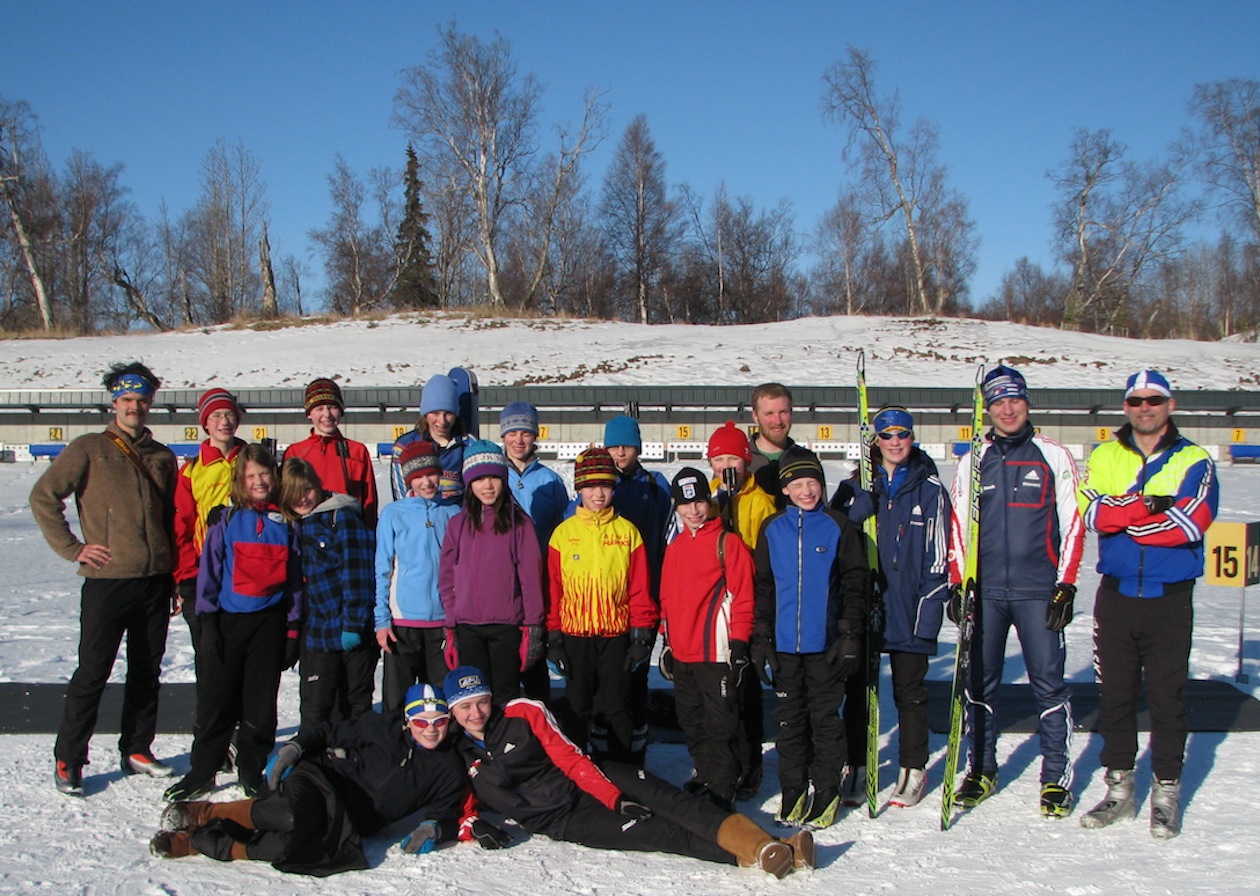
Participants in the first-ever "Eagle Eyes" camp last March in Anchorage, Alaska. Courtesy photo.
Anchorage has long been home to many of the country’s best nordic skiers. With elite teams like APU, Alaska Winter Stars, the University of Alaska Anchorage, several strong high school programs, and a thriving recreational and masters race scene, skiers couldn’t ask for a more supportive community.
But biathletes? That was another story.
“I started biathlon in 2003, back when the Kincaid [shooting] range was at its old location,” 2011 World Junior Championships team member Sam Dougherty wrote in an e-mail to FasterSkier.
“The old range was equivalent to many of the ranges across the country at the time, with metal pull-string targets and carpet mats for prone shooting. [It] was built into a hill, so wind was a major factor in shooting accurately. The range had the usual problems: rusty paddles, broken prone targets, and so on. There were no lead traps, and all shots fired would inevitably land into the side of the hill.”
While Dougherty said that the old range was good to learn on, it certainly wasn’t perfect.
But all of that began to change in 2007, when the range was upgraded and moved to a new location as part of an $11 million project to support a variety of sports at Kincaid Park, the site of the 2009 and 2010 cross country national championships.
“When I trained there, I regularly had to deal with target paddles that broke off in the middle of practice,” two-time Olympian Rachel Steer told FasterSkier. “The new biathlon range, built to World Cup standards including a 30-point Hora target system, is located in an area that is less windy and offers many more trail options.”
The range is still awaiting its finishing touches, including a range house and paved loops connecting to the ski trails for summer training. But already, it has made a difference for Anchorage’s biathlon community.
“We’re growing, and the new range has been a big spark for us,” said Tom Grenier, the biathlon committee chair of the Nordic Skiing Association of Anchorage (NSAA).
Olympic Support, Olympic Standards
Steer is only one of many biathletes to have trained in Anchorage: for fifteen years spanning the late 50’s, 60’s, and early 70’s, the city hosted the U.S. national team at Fort Richardson.
Among the dozens of young men who trained there was Dick Mize, who represented the U.S. in two World Championships as well as the 1960 Olympics. According to Mize, Anchorage hasn’t always been the ski paradise that it is now.
“Back in 1958 is when they established the biathlon training center out at Fort Richardson,” he told FasterSkier. “I was in the army with several other skiers from Western State College, and we were transferred to Anchorage to be part of that unit. We were skiing on the golf course and then started designing the Arctic Valley biathlon range.”
After finishing his career as a biathlete, Mize moved to Anchorage permanently to teach in the local school system and coach skiing. Once again, he was faced with only one real set of ski trails: the golf course.
Since then, Mize has been relentless in his quest to develop more and better ski trails in the city. He listed Russian Jack Springs, Kincaid Park, and the Service High School systems as several of the many projects he had contributed to; he also helped Kincaid become one of the first ski areas in the country to go through the FIS homologation process. This year the Alaska School Activities Association inducted Mize into their hall of fame, noting that “there are few individuals that have contributed more to Nordic skiing than Dick Mize.”
So it’s not surprising that Mize eventually set his sights on a new biathlon range for Anchorage.
“In 2003, Dwayne Adams met with a small group of us out at Kincaid… we were talking about [soccer and snowmaking], and I felt that if we were going to do some major construction out at Kincaid, that the biathlon range really needed to be upgraded,” he said.
Adams eventually created the Kincaid Project Group (KPG), a nonprofit organization with a mission to “create world-class, year-round recreational opportunities at Kincaid Park for the benefit of Anchorage and the greater Alaskan community.” Both Mize and Steer joined the board.
“As more enthusiastic and motivated people got involved, the project gained momentum and increased its scope to relocating the old biathlon range, building seven natural turf fields and one stadium-style artificial turf field, a new disc golf course and an in-ground snowmaking/irrigation system,” Steer wrote. “While I have been on the board of directors for many years, it has truly been a collaborative effort to make this vision a reality.”
Although then-governor Sarah Palin vetoed a legislative funding request in 2007 and cut a million dollars out of the 2008 request, KPG has come up with nearly all of the money to fund its projects. The old biathlon range was scrapped, resurfaced, and included in an area devoted to soccer fields; nearby, a brand-new, state-of-the-art range was constructed.
(The soccer fields on the site of the old range are facing legal issues due to lead contamination, a topic that FasterSkier will examine in a later article.)
“Since this project includes so many stakeholders, we have had broad support from community organizations, private businesses and the public sector,” Steer said. “Even U.S. Biathlon Association [President] Max Cobb made a last-minute trip up to Alaska a couple of years ago to offer guidance on layout and design when we were looking at the new biathlon range location.”
The range in winter.
While fundraising is still in progress for projects such as the range house and paved connector loops linking the range to other ski trails, the core of the range is complete, and it’s one of the best in the country. Out of the handful of venues which have a full 30 points, many still rely on hand-pulled targets. In Anchorage, that isn’t necessary; there’s a Hora electronic target system instead.
“We have pretty much the same equipment they’d be looking at on the World Cup circuit as far as the electronic targets and the resets and the look of the range,” Grenier said. “So once you’re on the firing line looking down you’re essentially looking down at a World Cup-level facility.”
The venue will host the U.S. World Junior Championship Trials in December, and Grenier hoped that a successful race series would position Anchorage as a potential host for other big events.
“We’re trying to build up a reputation of being capable for that stuff,” he said. “We’re doing that by hosting our second World Junior Championship Trials this December. We did that two years ago and the races were really well-received. So we’re hoping that we’ll have that quality event again, and hopefully build on that to get a nationals bid, and take it one step at a time from there.”
Mize was more upfront about his hopes for the venue.
“We could easily host our national competitions,” he told FasterSkier. “I’d say that once we have our range building completely finished up and have everything out there including a small snowmaking system, we can host regional and World Cup races as well as Nationals. We’re set up so that we can host almost any type of race.”
It’s quite a change from when Mize first arrived in Anchorage, and the improvements are symbolic of a resurgent biathlon community in the city.
Eagle Eyes
Biathlon in Anchorage is a division of the NSAA, and it’s run with an almost entirely volunteer coaching staff. While the club has produced excellent juniors, it’s surprisingly small for such a ski-crazed town.
“We aren’t the largest biathlon community, but we have a ton of dedicated volunteers and athletes,” said Dougherty, who is now at Montana State University.
The key to growing the club, according to Grenier, is to get a greater number of young skiers involved in the sport early. With that in mind he launched a new entry-level biathlon program last March.
Eagle Eyes participants. Courtesy photo.
“Eagle Eyes”, as the program is called, began as a day camp during winter vacation. Grenier decided to keep running practices through the summer, and was surprised at the turnout; he had eight to twelve young athletes coming to almost every practice, with a few more attending less regularly.
“I thought it would die off when the snow went away, but we’ve pretty much had a consistent turnout throughout the summer, and now with the snow coming back, turnout is starting to climb up again,” Grenier said.
This fall, the NSAA added a button to their online ski registration form that parents could check to receive information about biathlon. So far, Grenier has received 70 requests.
“My limiting factor is being able to find coaches,” he said. “The guys I want to use are all our older juniors, and they’re all college-age, so they’re not in town or frequently they are taking night classes. [I want to have] a good coaching ratio for everybody.
“And then my other limiting factor is just having enough rifles.”
Dougherty, who was once a junior just like the Eagle Eyes participants, credited the surge of awareness about the sport to the new range.
A young shooter uses a wooden block to steady his rifle. Courtesy photo.
“The range has also drummed up people’s interest in biathlon,” he said. “I am excited to see our biathlon community start to grow again.”
Even though he’s having trouble finding enough coaches and equipment, Grenier hopes to develop the Eagle Eyes program even more.
“I’m hoping to expand it from a one weeknight program to a two weeknight program, and have a second opening on weekends for kids to get together,” he said. “So far it’s growing nicely and interest is really solid. Hopefully I should be able to have 20 or 30 kids training consistently for biathlon in a year or two, which would be wonderful… We’re hoping to build a base of kids who will stick with the sport and become leaders for more high-end juniors.”
Catering to the Elite
While Grenier is working on entry-level programs at the moment, improving the club’s service for elite biathletes is also in the plans. One of the biggest changes will come when the group can finally hire a full-time biathlon coach.
“If we have a good facility like we have now, hopefully we’ll be able to hire a coach whose primary job would be developing and working with biathletes,” Mize said.
While that goal is still unmet, the new range has already made a huge difference for the area’s athletes.
Sam Dougherty (USA) shooting in the youth men's individual race at 2011 World Junior Championships. Photo: Judy Geer.
“I believe that training at the Kincaid range has definitely helped me become a better biathlete, not only because it is such a nice facility, but because I feel like I have to live up to its impressiveness,” Dougherty said. “The new range helped motivate me to become a better shooter and the best biathlete I can be. I think every biathlete in Anchorage feels that way.”
Mize hopes so, and also hopes that the facility – and the future full-time coach – would lure some athletes away from skiing.
“I think we are competing for athletes with just the regular cross country,” he said. “Each coach wants to keep their skiers on their schedule. But when we finally have a coach in place, I think the coaches from the high schools and also the universities and other areas can work together so that the individuals who are really interested in biathlon can do biathlon as well as their regular cross country program. Hopefully there can be some coordination there that will help.”
Once skiers become interested in biathlon, Dougherty was confident that the shiny new range would keep them coming back. Even after a few years of training there, he is still awestruck by the new facility.
“The new range has it all,” he said. “Sheltered electronic HoRa targets from Germany, a concrete barrier behind the targets, shooting specific shooting mats, a paved firing line, and a new stadium and lighting for night races, just to list a few. In all of my travels as a biathlete, I have never shot at a nicer range than the one in my hometown.
“When I went to Biathlon World Juniors this past year, I felt confident racing on the world stage. This confidence came in part from my experience with training at a world-class facility.”
Hometown heroes are certainly benefitting from the upgrades at Kincaid Park, but biathletes from further afield are taking advantage of the new range as well. U.S. national team members Jay Hakkinen and Sara Studebaker stopped by while they were passing through Alaska, and Olympians Tracy and Lanny Barnes, originally from Durango, Colorado, stayed for nearly a month this summer.
2006 Olympian Tracy Barnes supervises young biathletes in Anchorage this summer. Courtesy photo.
“We went to Alaska because our parents have a cabin in Homer and they will eventually retire there, and we wanted to see their place,” the sisters explained in an e-mail. “The Kincaid facility is awesome… the range is world class, with 30 targets and paved shooting points. Anchorage was a great place to train.”
Unlike Studebaker and Hakkinen, the twins settled into Anchorage and helped with the club’s junior program.
“It ended up working out wonderfully,” Grenier said. “For June we had this really great situation of high-end biathletes using the range and then taking an hour or so after their training sessions to do mini-clinics with all of our juniors, from middle-school aged beginners and younger up to our folks who made the Junior World Championships team last year. You couldn’t ask for anything better.”
While the Barnes sisters raved about the training opportunities in Anchorage, they were also impressed with the club itself, and said that they enjoyed their stay.
“It was a blast, the kids were so great!” the sisters gushed. “It was a really great group to train with. The kids were really motivated and super nice. We had quite the range of ages and abilities for the clinics. The kids from Anchorage are super talented and great skiers and shooters- some of them have previously made junior and youth world teams. The coaches and parents were really helpful and made working and training at Kincaid biathlon range really easy.”
Grenier said that he would like to have more elite athletes come to use the range, especially in the summer when the days are long and the training conditions are perfect.
“That’s something we’re thinking about, is especially in the summer months, when people are doing volume, opening our doors and inviting as many high-end athletes up for summer training as we can,” he said. “So hopefully we can get that kind of buzz going.”
While he was incredibly enthusiastic about what the Barnes had done to help the program, he said that he wouldn’t require other athletes to be so involved if they were too busy.
“The last couple folks who came through just worked the range and passed on through and we have no problem with that,” Grenier explained. “When a national team member contacts us, we ask them for their schedule and we set them up with Range Safety Officers so they can just drop in on the range and train and not have to worry about opening it or closing it.”
The Barnes didn’t see any reason why their teammates and competitors shouldn’t head north and take advantage of the new range.
“Alaska may be one of the best places to train for nordic,” they wrote. “You have snow in the summer, you can get altitude training if you need it, and also be in the mountains, but get the benefits of low altitude training. The weather during the summer is typically cooler too, so it suits nordic skiers better than those super hot places. There is great rollerskiing, and tons of great trails, too.”
The takeaway message about the range, Dougherty said, is that it draws you in.
“The Kincaid Range has the potential to host National and International events, and it is my dream to see that become a reality,” he wrote. “I can’t wait to get home from college at winter break to shoot on my home range. I miss it.”
If the range has a similar effect on other biathletes, then it could have a huge effect on the geography of U.S. biathlon – and make Anchorage once again a center of excellence for the sport.