From the FasterSkier archive — posts syndicated from athletes’ and coaches’ own blogs between 2004 and 2012, kept online as published. Current coverage is at fasterskier.com.
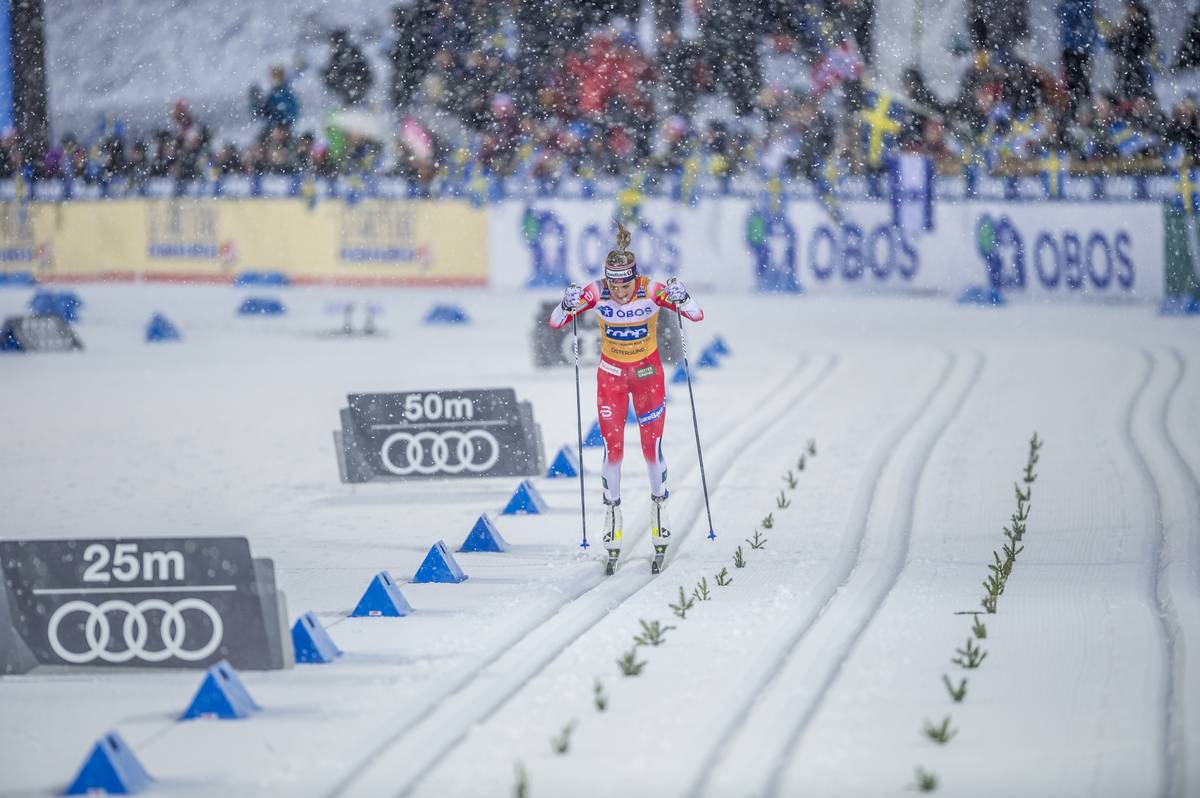
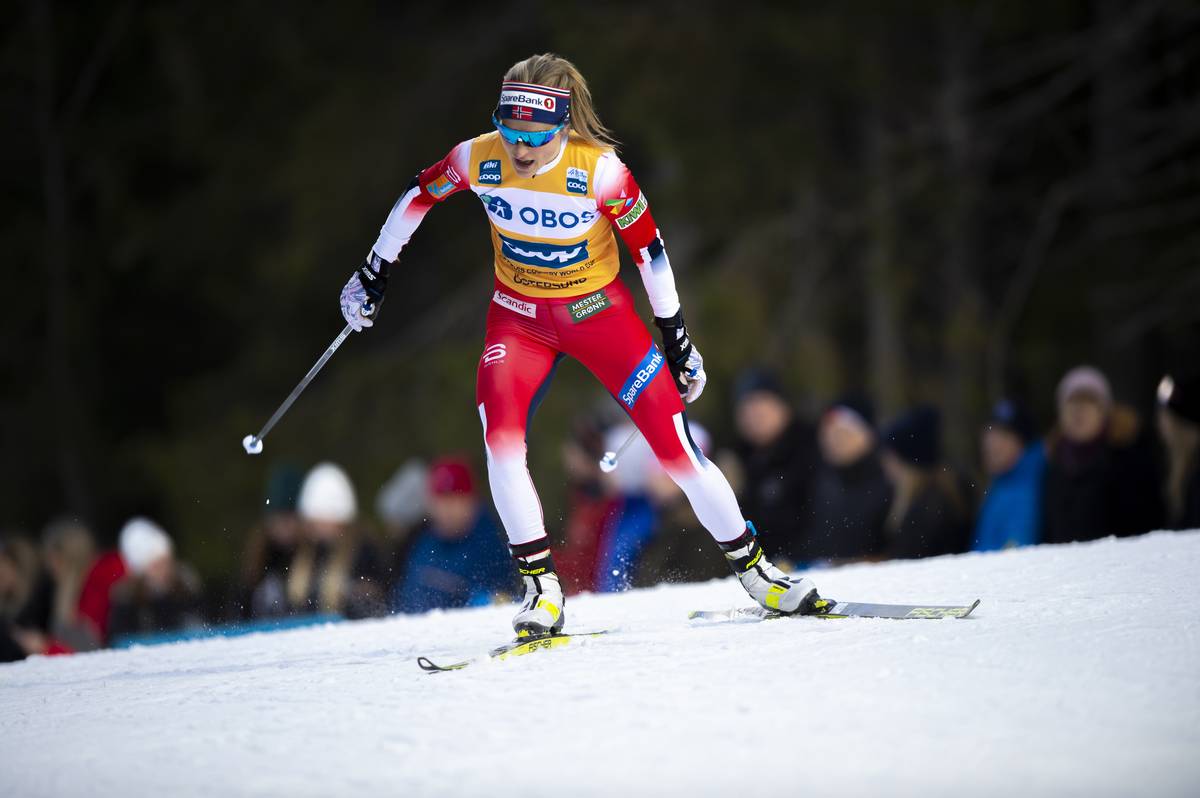
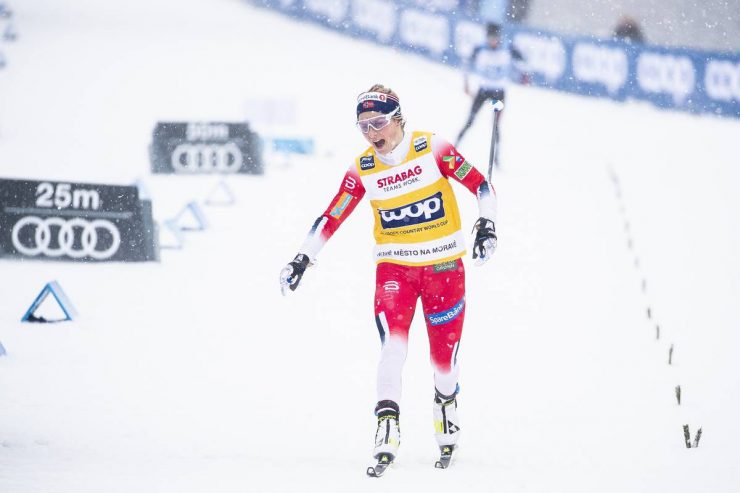
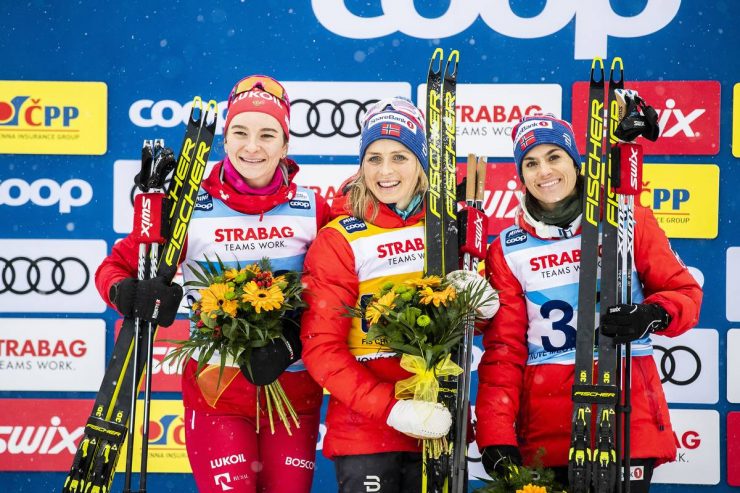
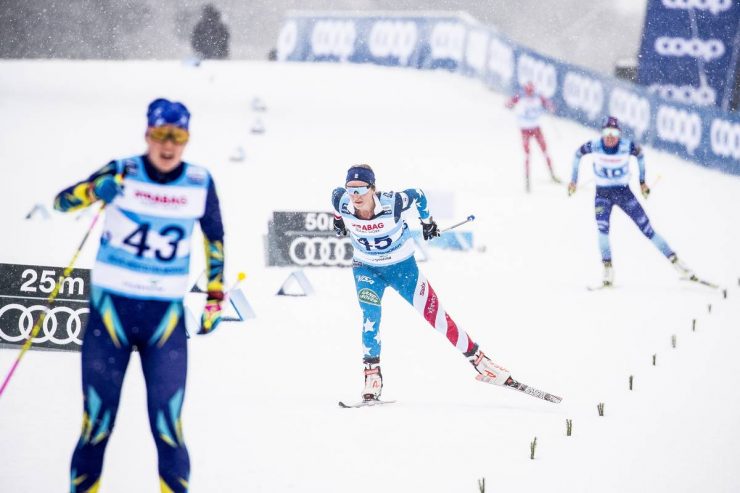
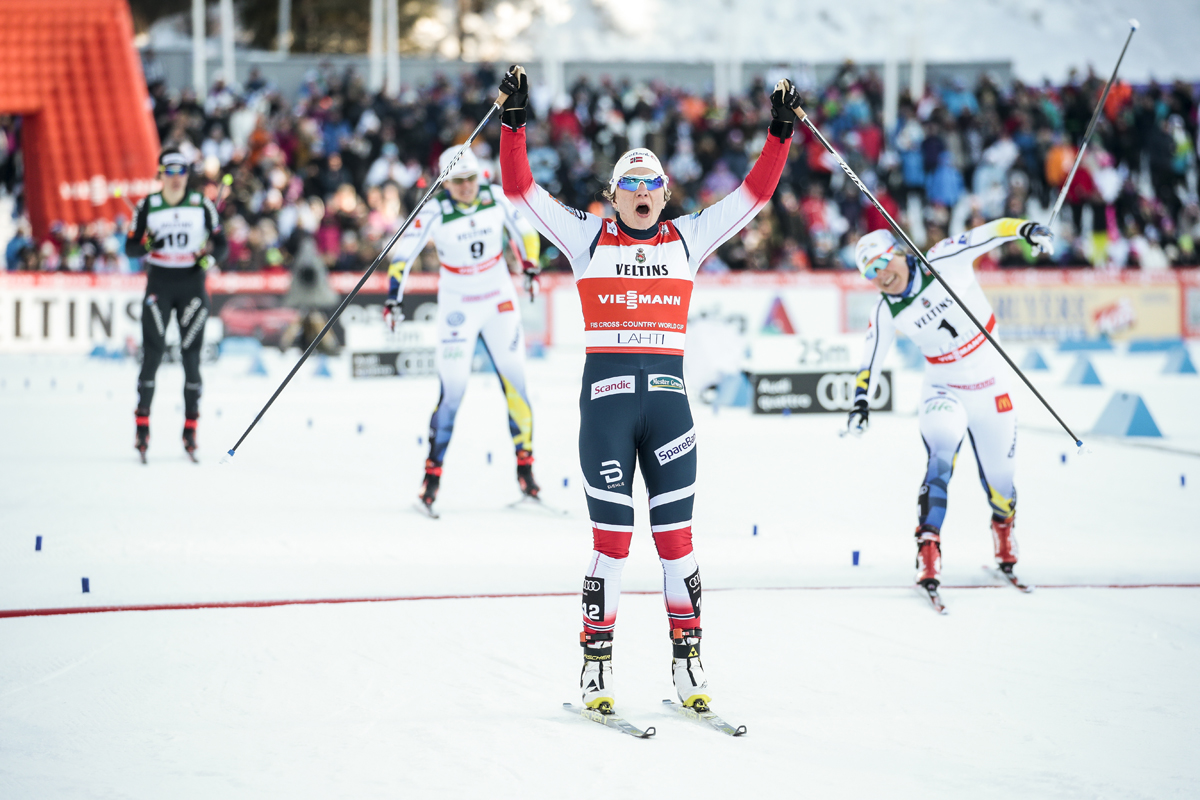
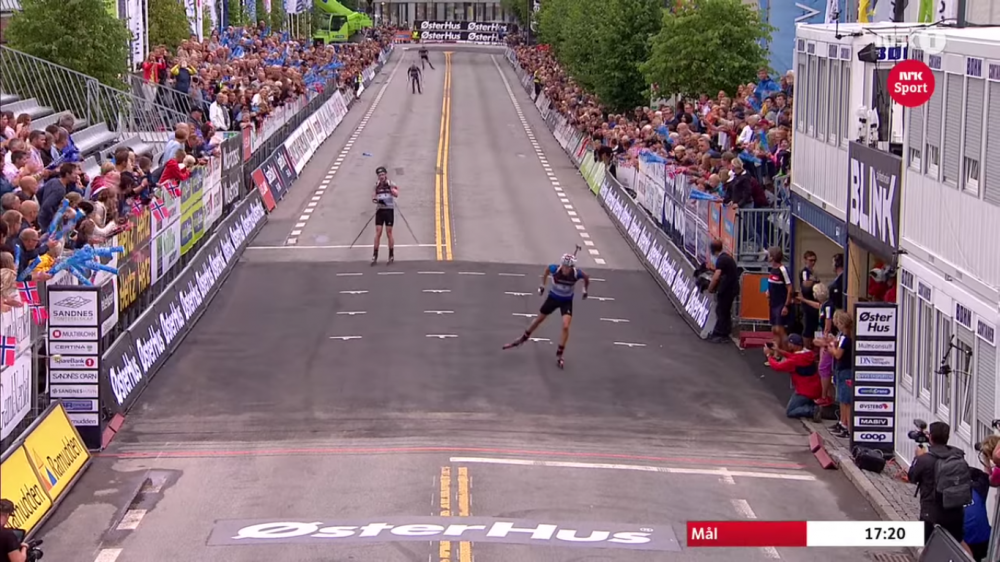
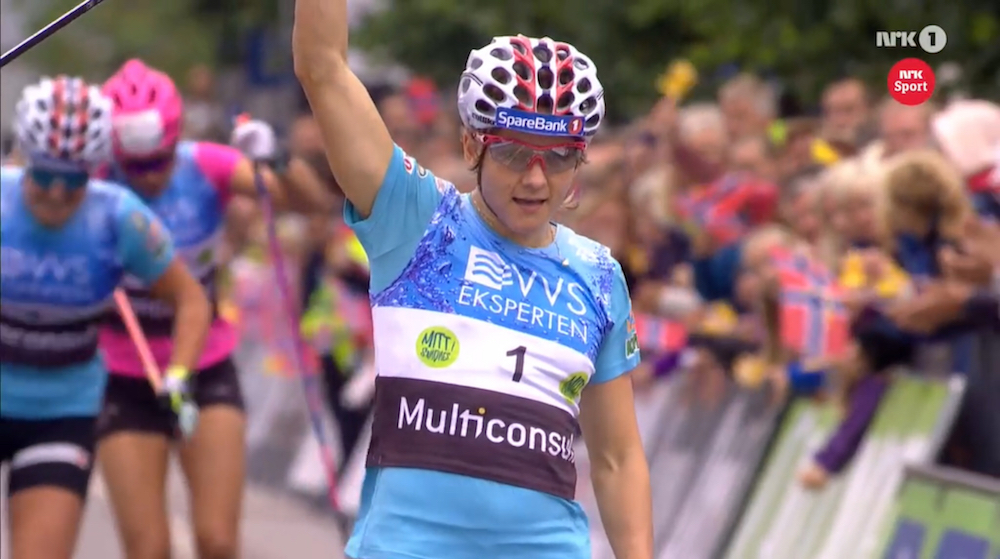
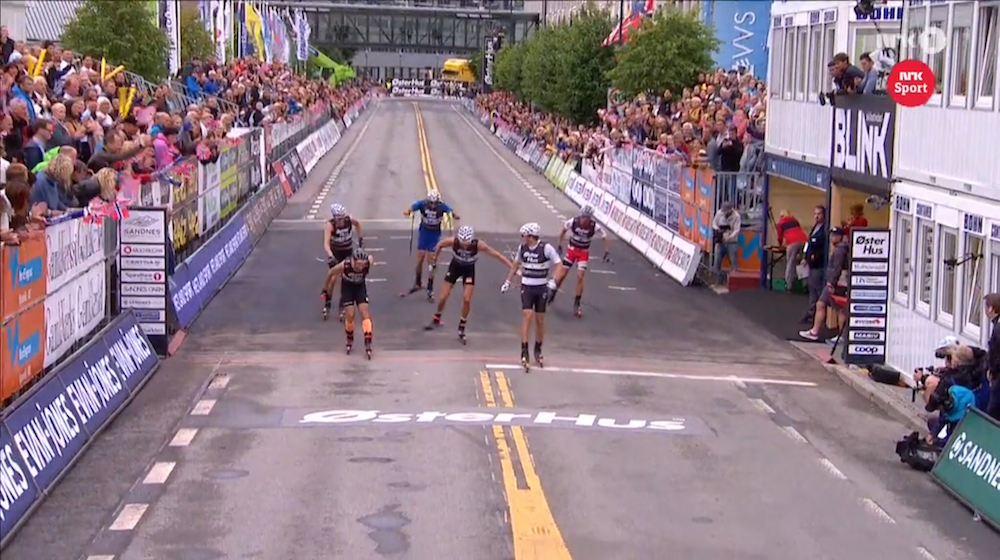
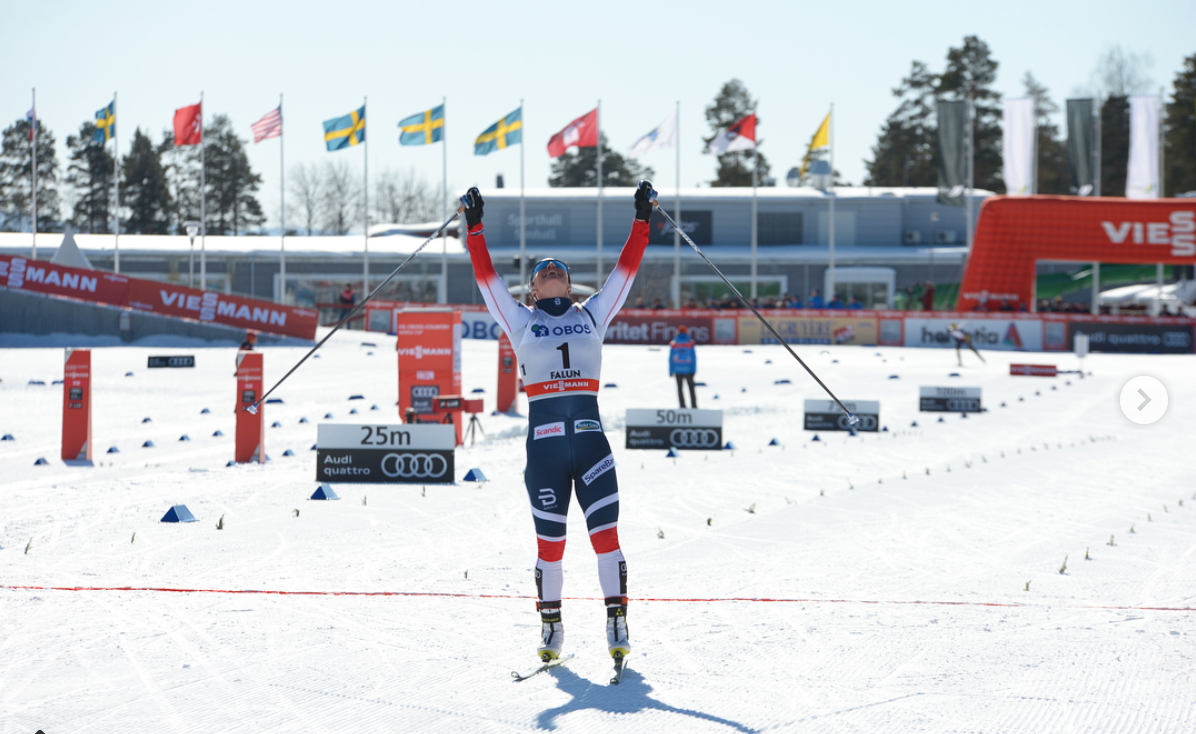
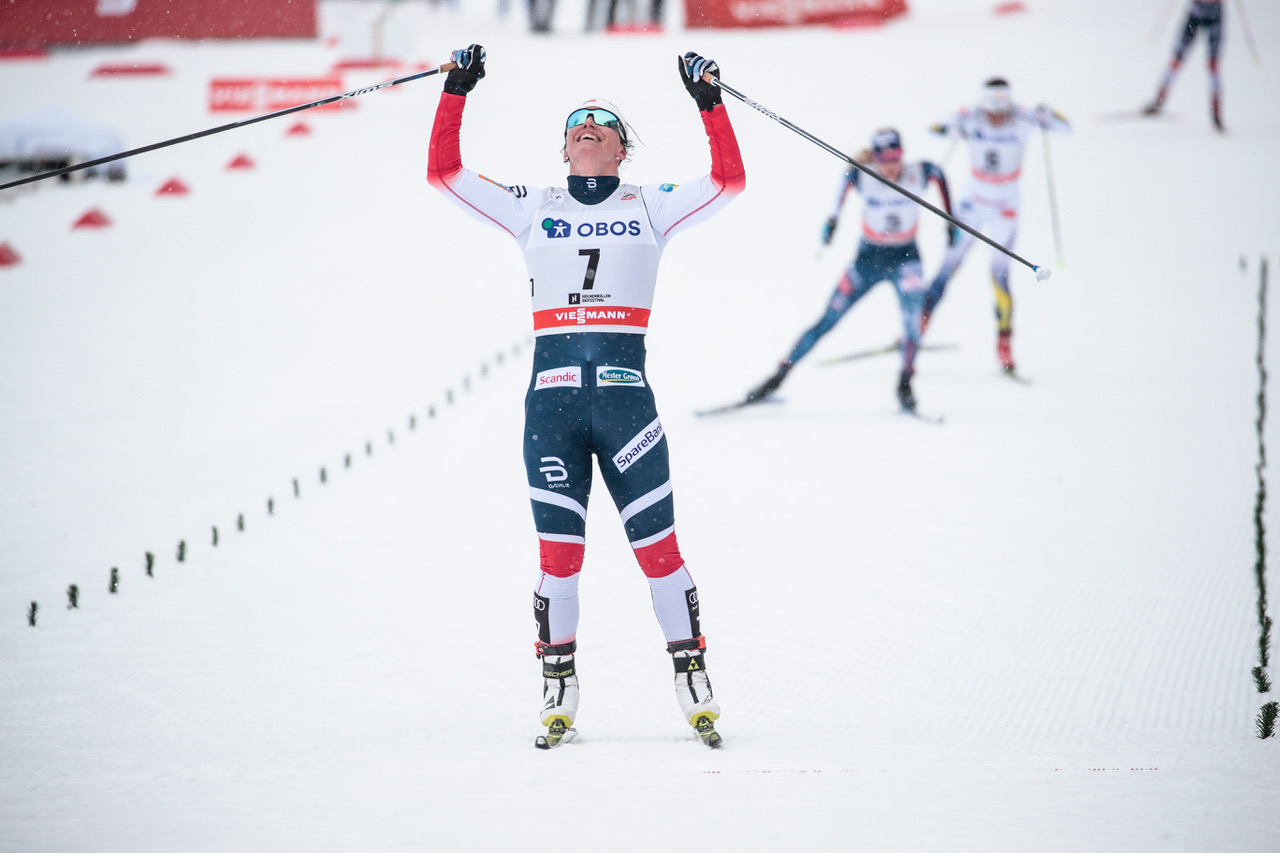
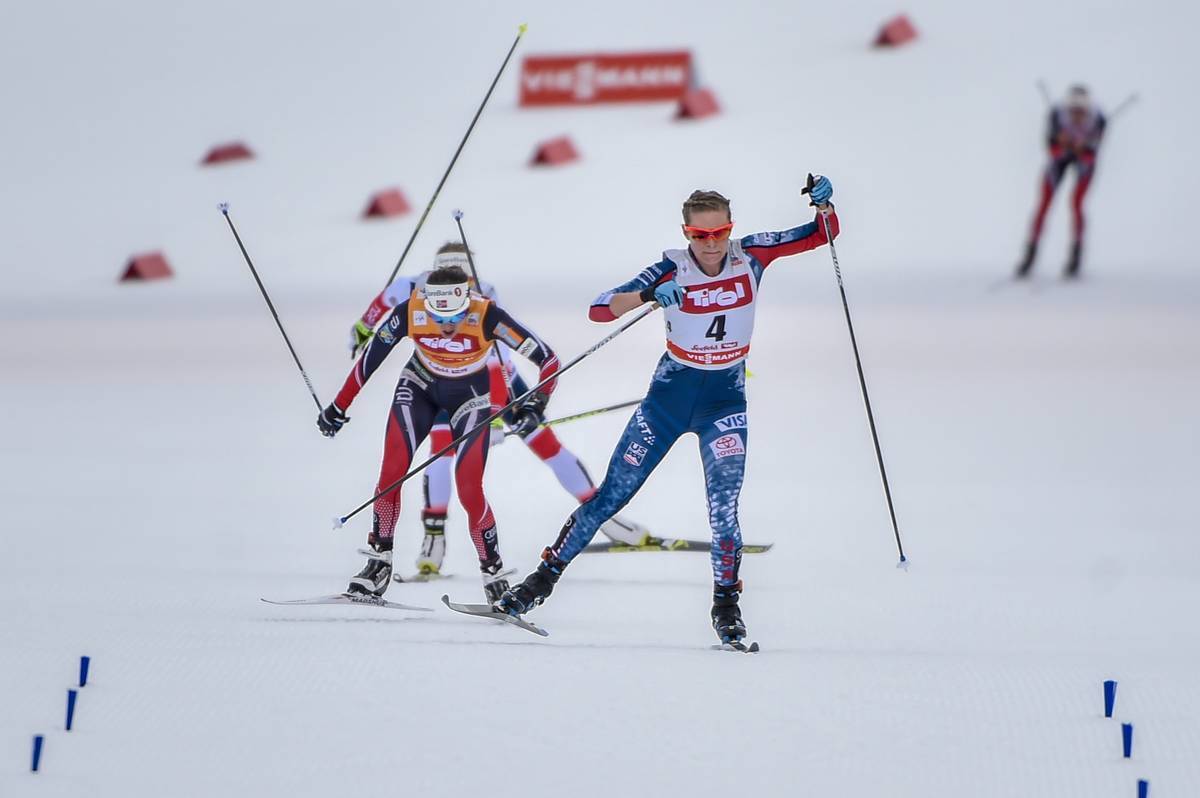
Therese Johaug (yellow bib) with enough time at the finish to gather skis and watch 2nd, 3rd, and 4th come across the line. (NordicFocus)
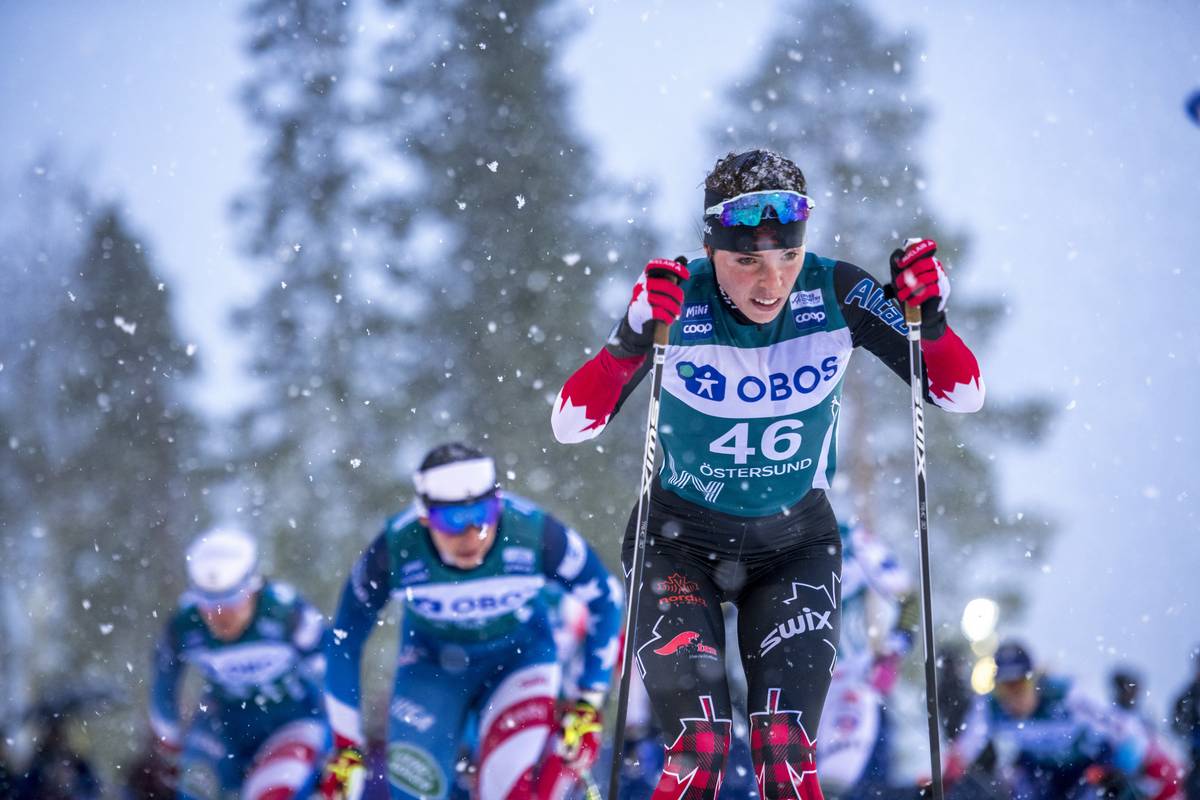
The early evening show, under the lights of Östersund, Sweden’s ski stadium, Stage 2 of the Ski Tour 2020 – a 10-kilometer classic pursuit – got underway as the plentiful moisture falling from the sky transitioned from steady rain to big snowflakes.
This was a 10 k race with three discrete tales. First, the story with the least tension.
That would be Norway’s Therese Johuag’s 10 k effort. Which, despite the pursuit format, was a solo time trial affair. She set herself up for that narrative by winning Stage 1’s 10 k individual skate by 45.6 seconds. No skier on the World Cup could fathom closing that gap to a generational distance skier.
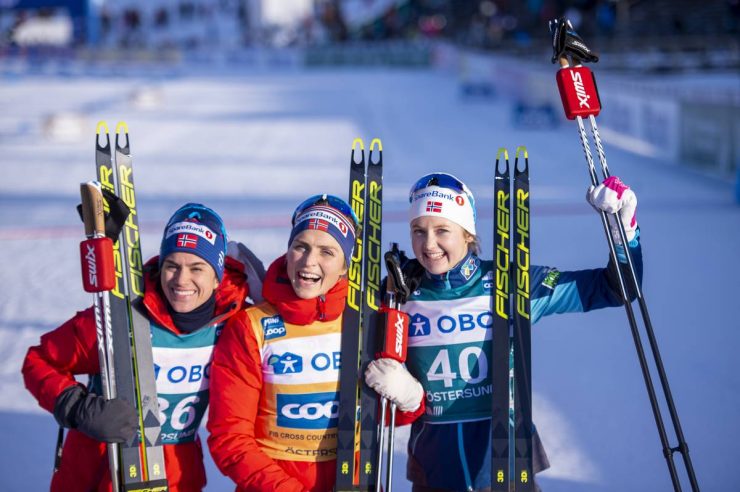
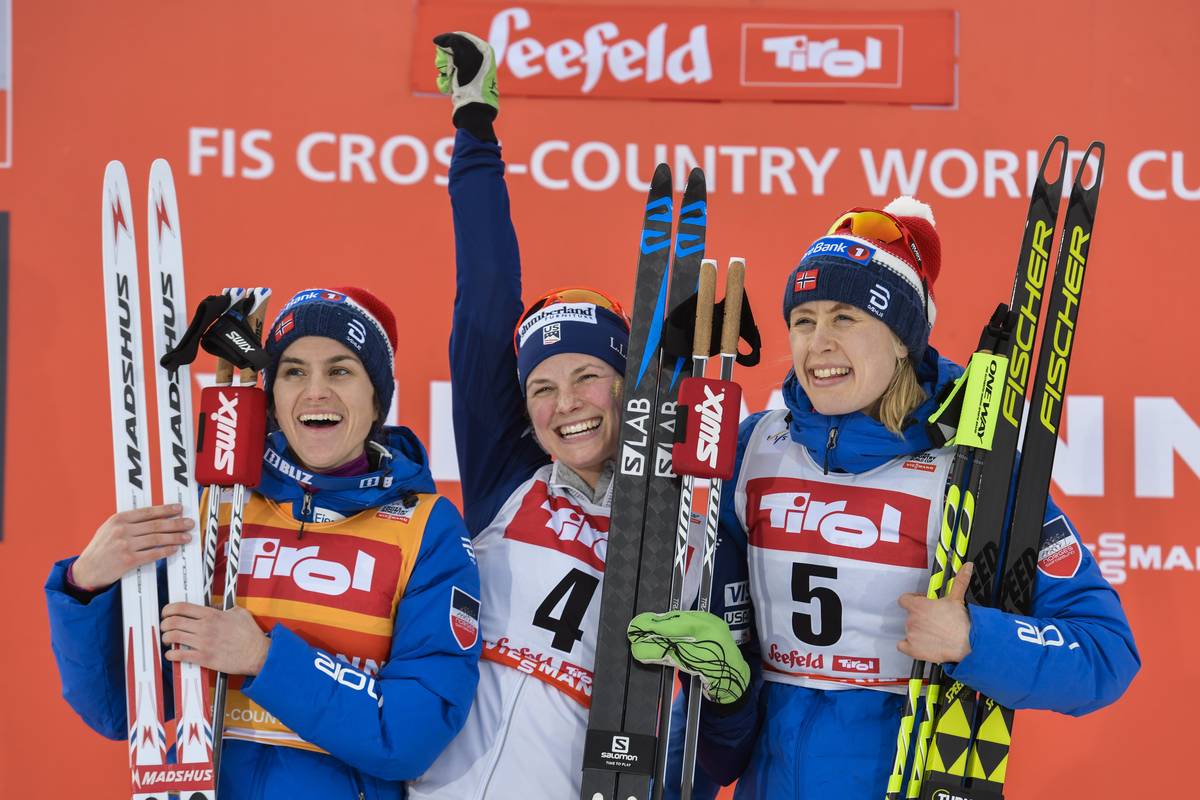
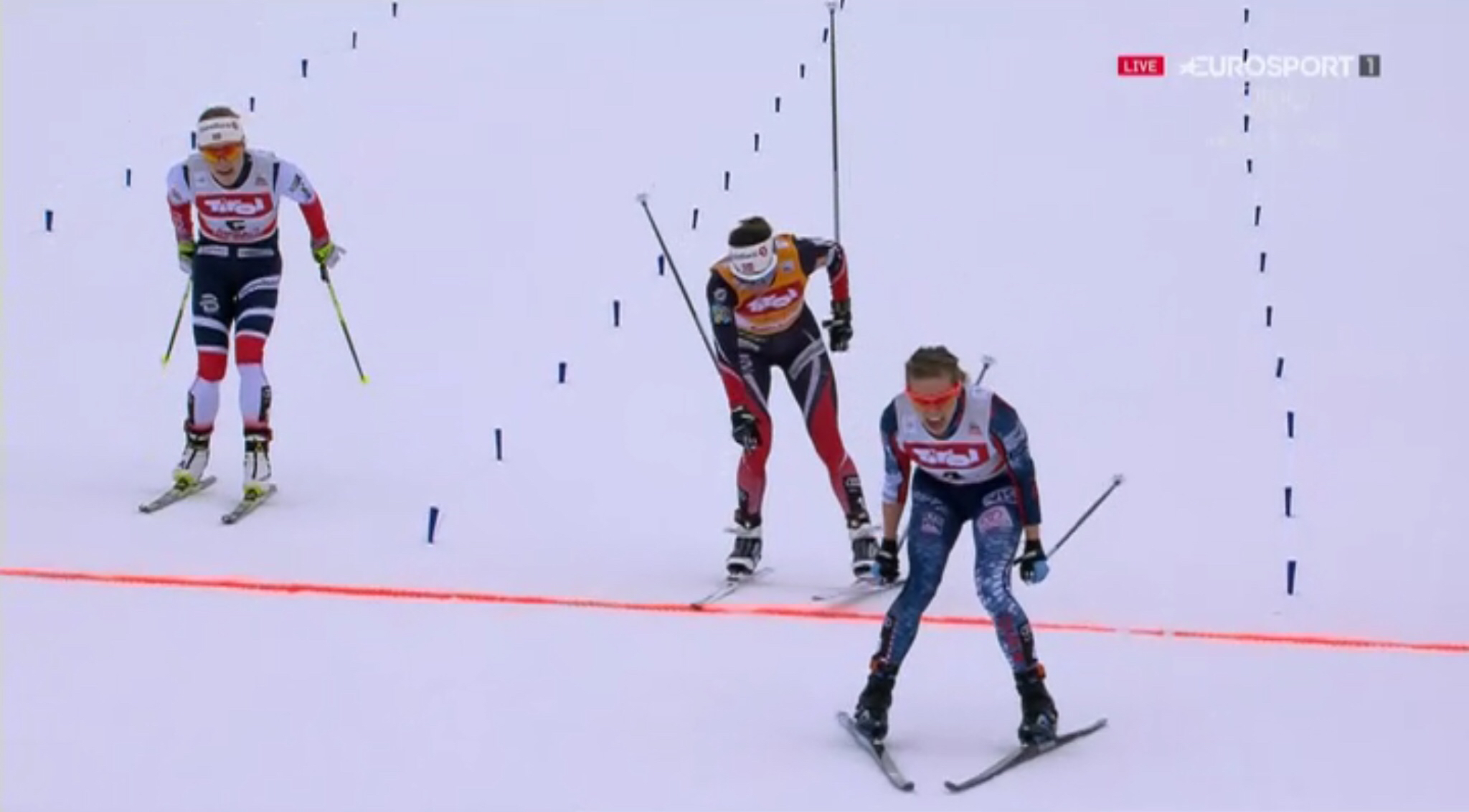
Johaug won in 27:29.0 minutes. Her effort gained her even more time in the Ski Tour overall as teammates Heidi Weng placed second (+57.4), and Ingvild Flugstad Østberg third (+57.8). Sweden’s Ebba Andersson lost out on third in the closing meters, as she placed fourth (+58.6).
Therese Johaug for a clean no-one-in-site win. (NordicFocus)
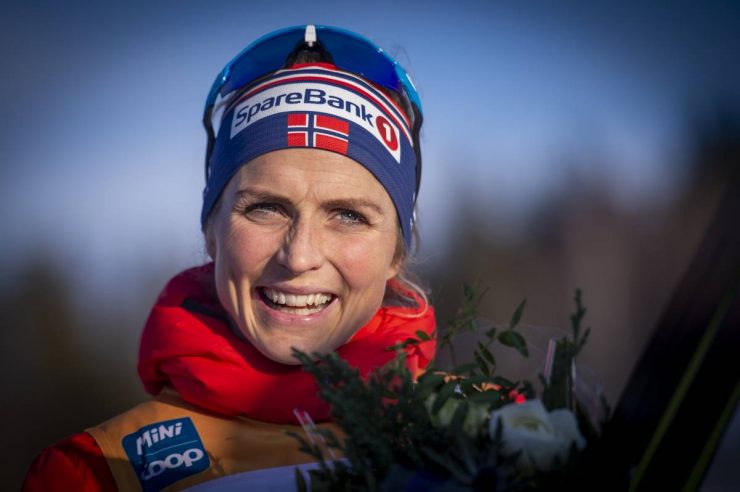
This was Joahug’s 13th World Cup distance win of the season and according to FIS, this brings her closer to a hallowed record. Marit Bjørgen, a legend from Norway holds the World Cup distance win record with 62 victories. Sunday’s win brings Johaug’s total to 59.
Let’s be frank: with a 45.6 second lead on the second starter Weng, 47.3 seconds on Østberg in bib 3, and 53.1 ticks ahead of Andersson in bib 4, this was as much a sure thing as sunrise and sunset.
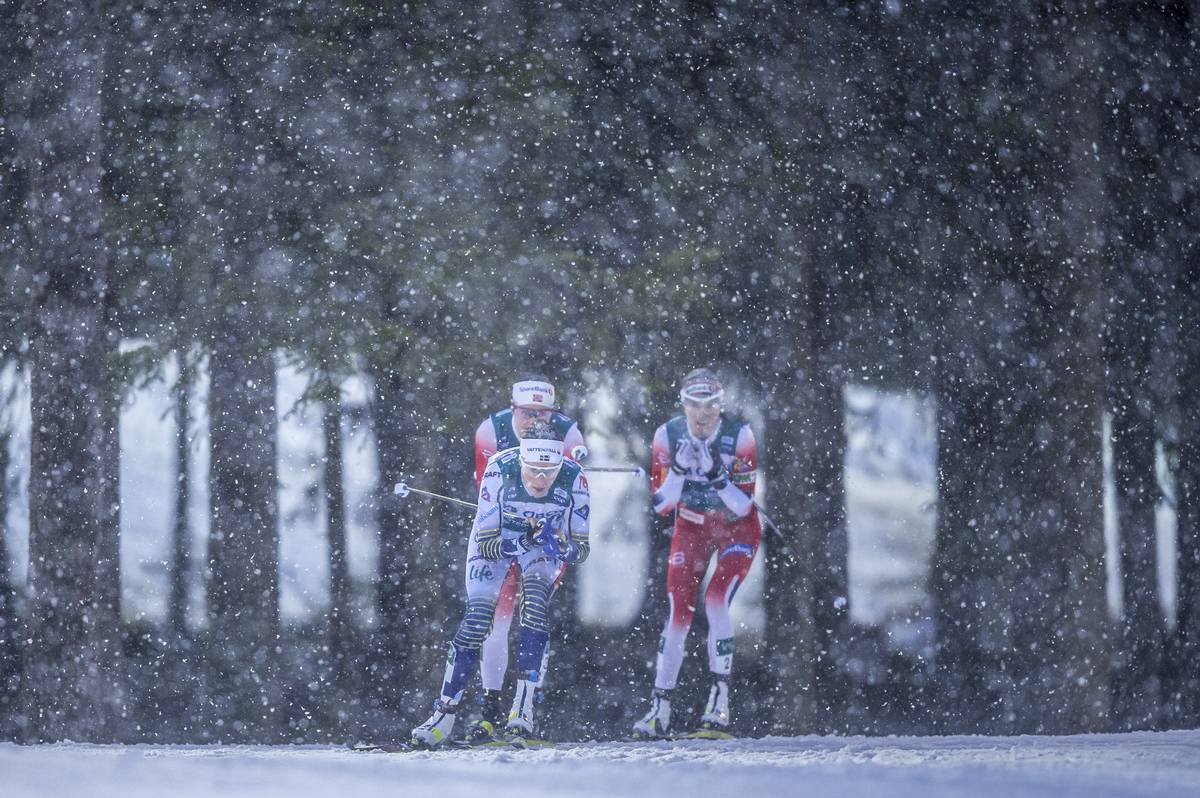
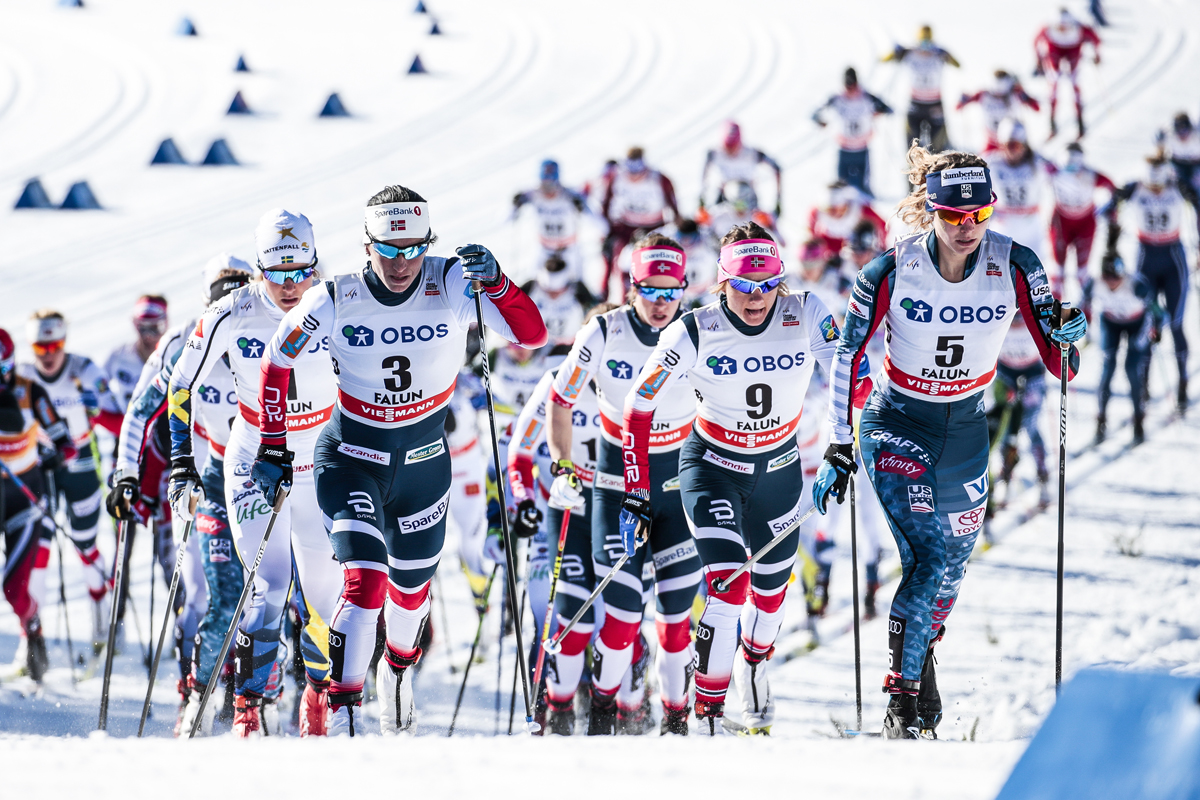
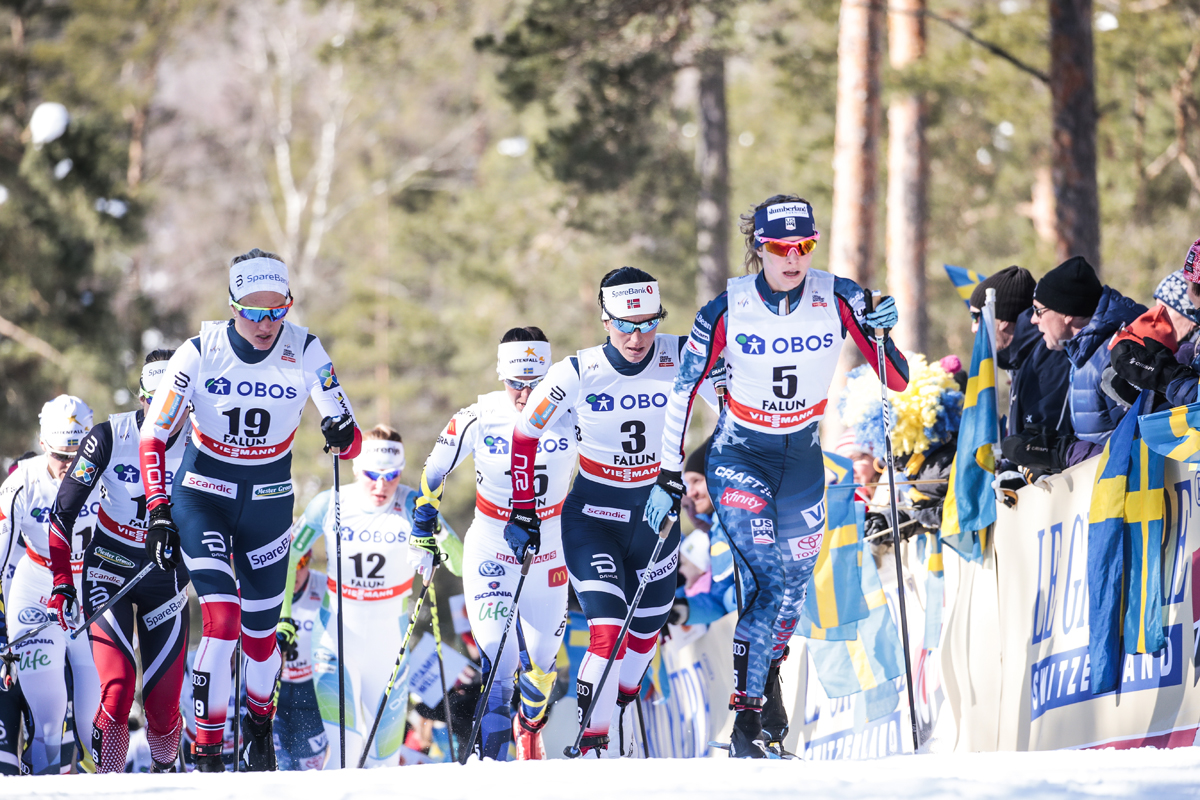
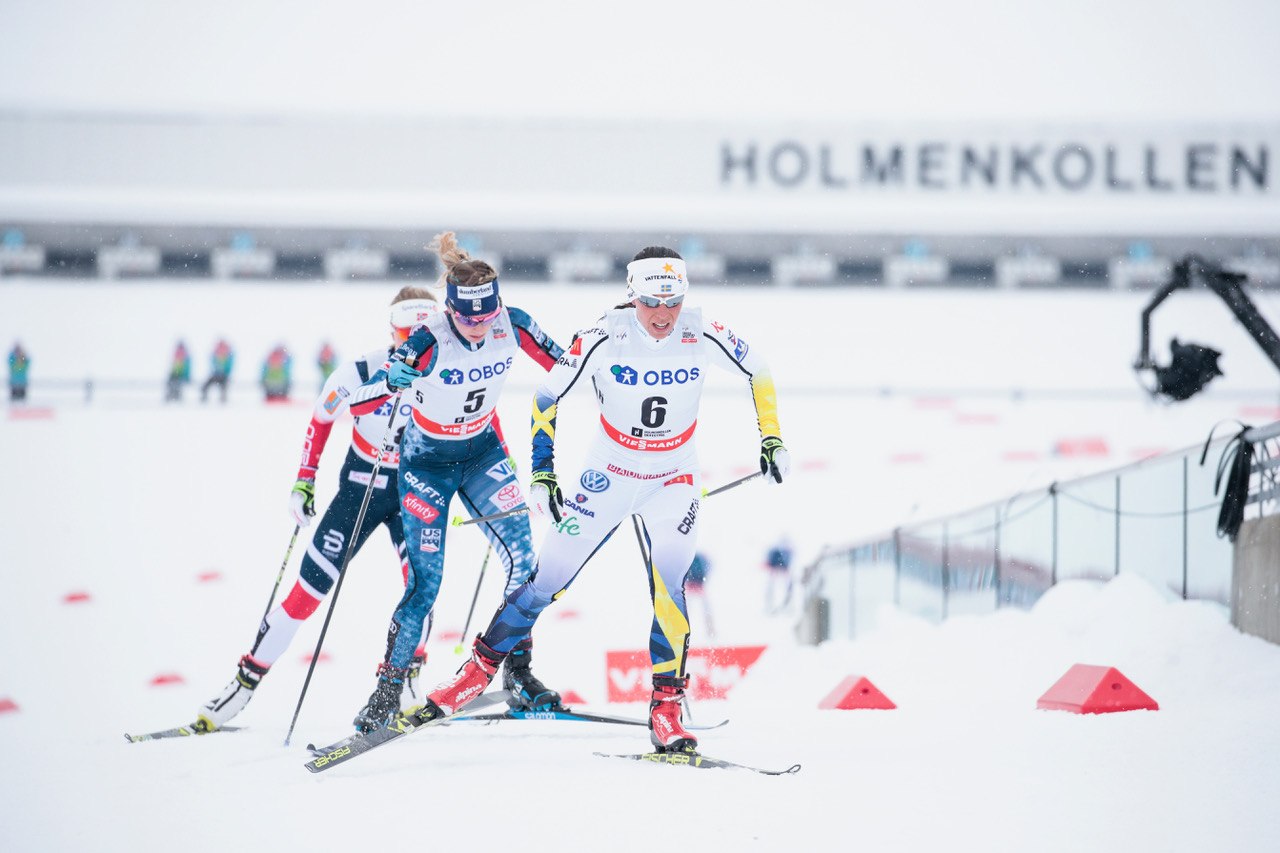
Ebba Andersson leads Heidi Weng and Ingvild Flugstad Østberg during the Stage 2 10 k classic pursuit. (Photo: NordicFocus)
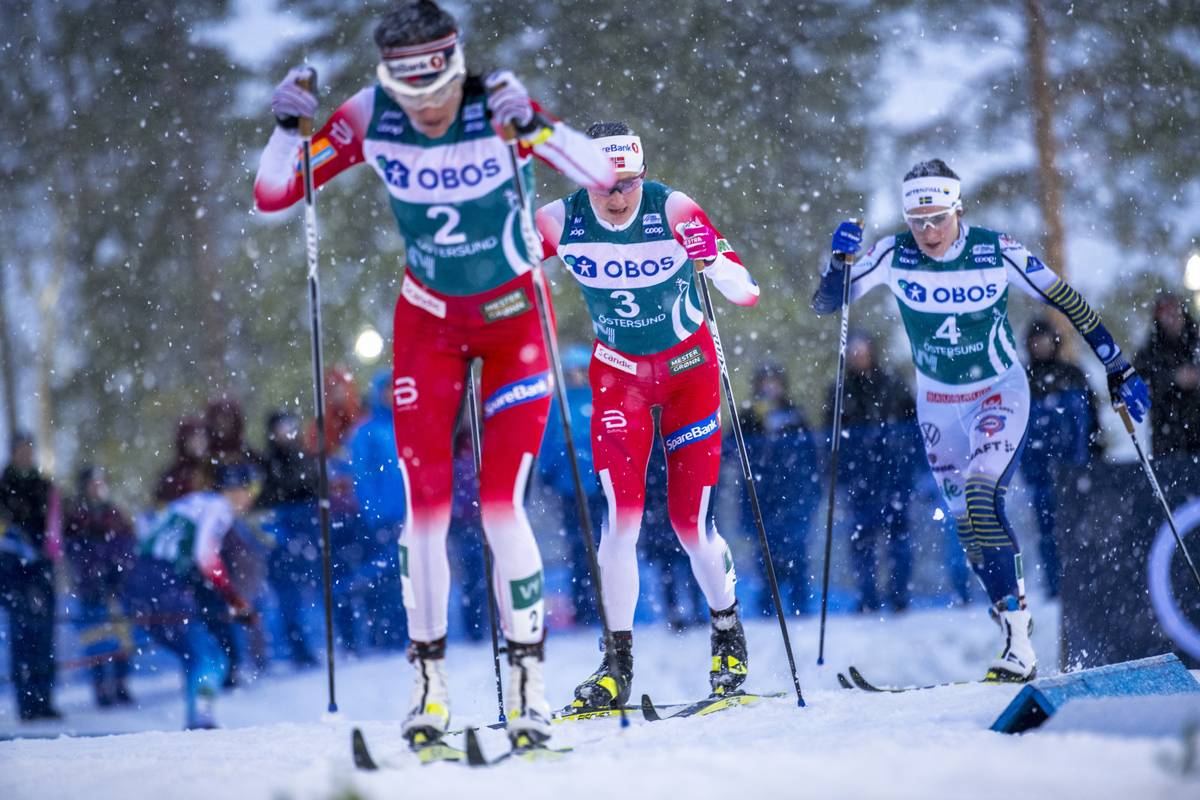
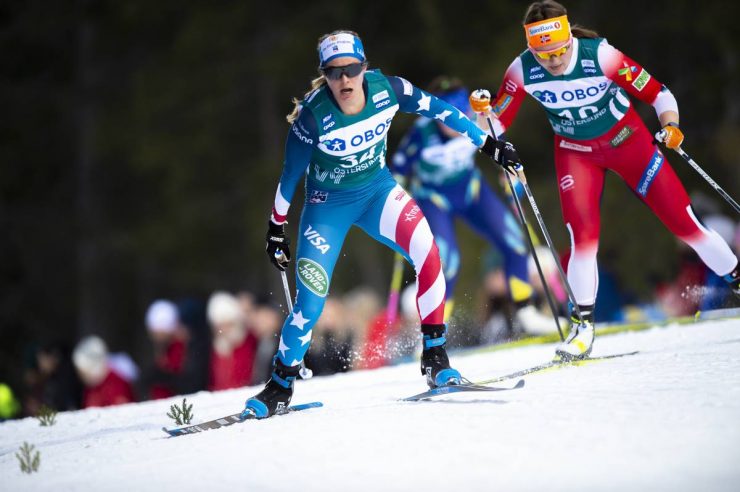
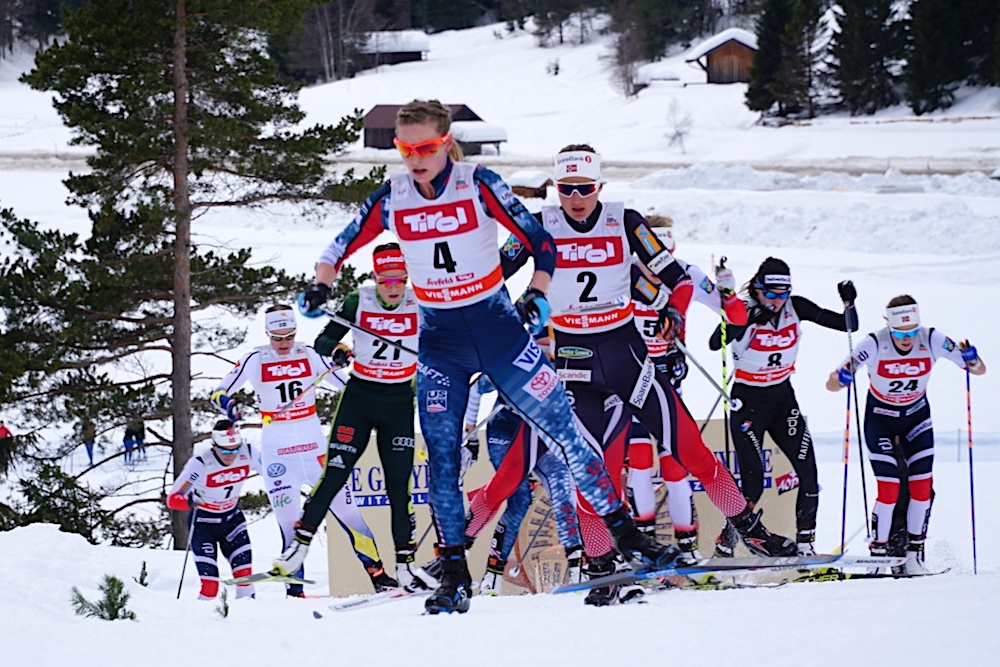
Behind Johaug, the tactic for the three closest chasers — Weng, Østberg, and Andersson was clear: cede no ground to the All-Star list of skiers starting roughly 20 seconds further back. For much of the race, the threesome kept a tidy buffer of 30 seconds on those in fifth to 16th place. At times Andersson took pulls up front, motivated by chants of “Ebba” from the home-nation fans. Østberg and Weng too remained motivated to secure a potential podium as they burned their matches prudently but with enough gusto to keep the masses at bay.
Taking her turn pacing the premier chase group, Heidi Weng (bib 2), followed by Ingvild Flugstad Østberg and Ebba Andersson. (Photo: NordicFocus)
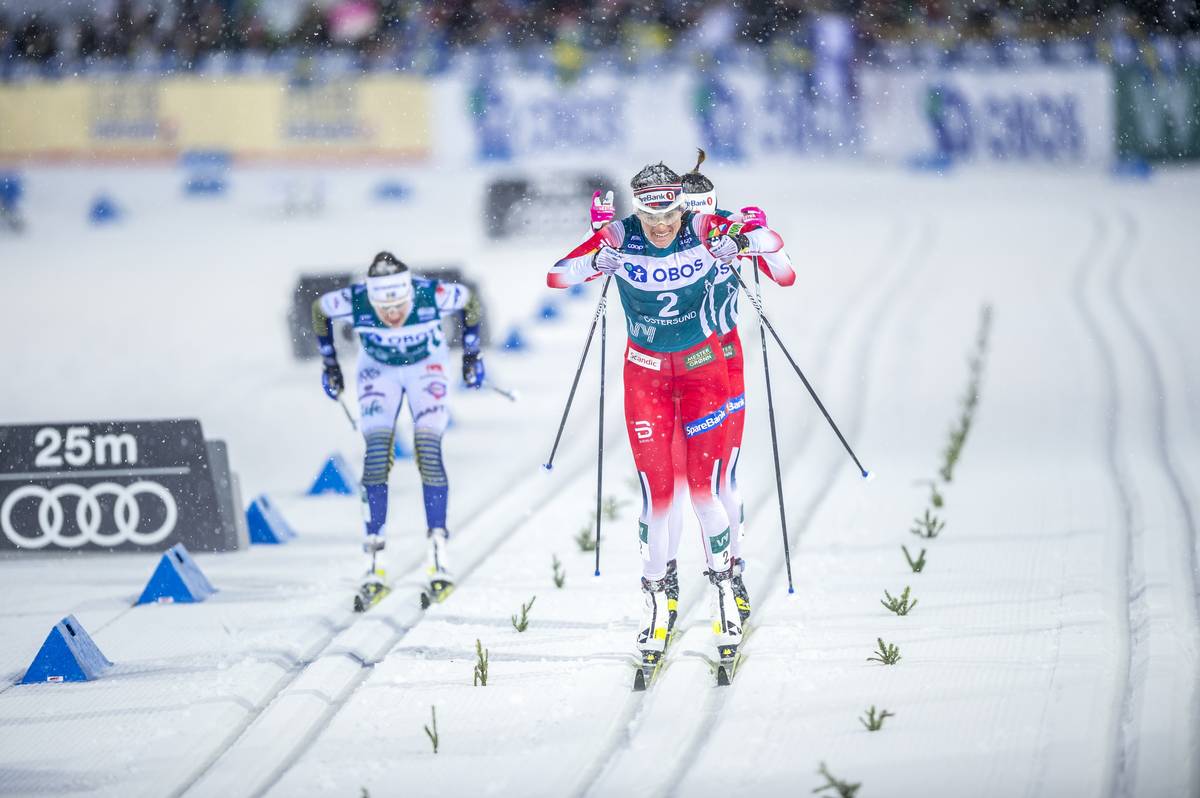
Heidi Weng (bib) taking second in Stage 2 of the Ski Tour 2020. (Photo: NordicFocus)
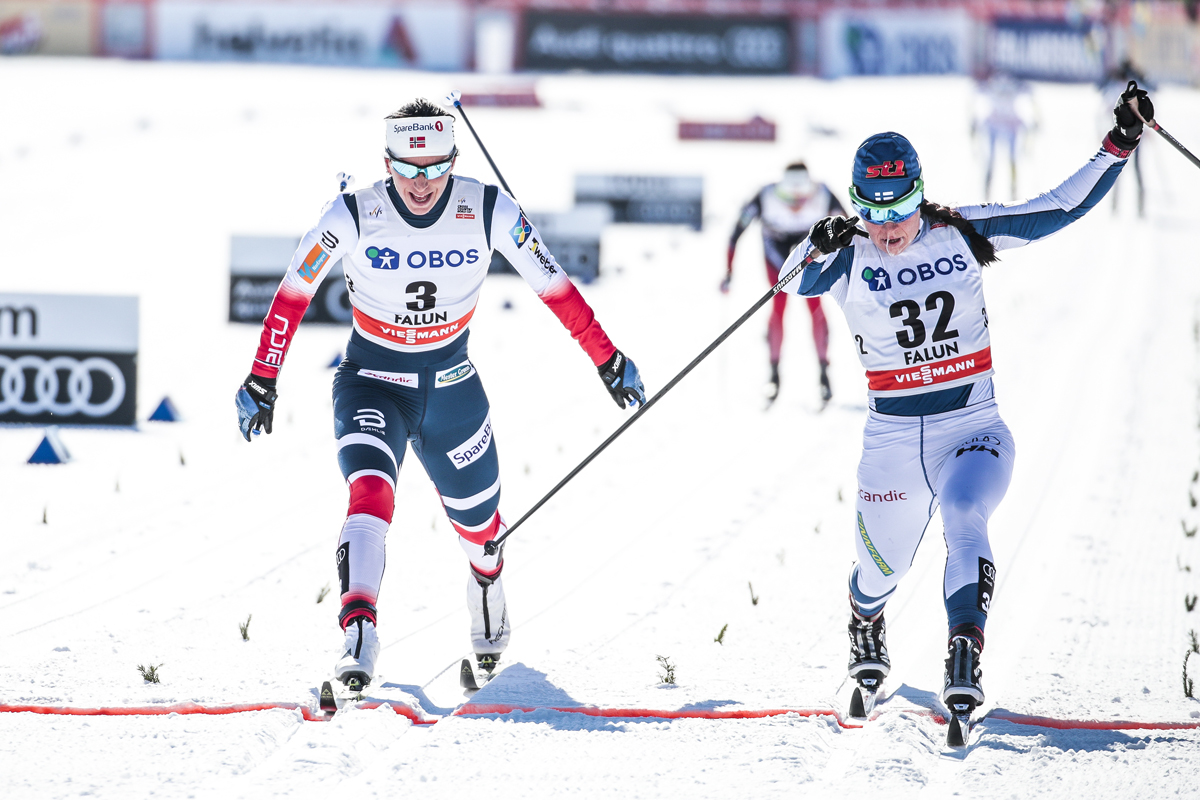
Weng led the charge into the final straight. Østberg slotted in behind Weng using her as a double-poling pace machine. Weng and Østberg gained a precious few meters on Andersson to take second and third, respectively.
Johaug leads the Ski Tour 2020 after two stages with a total time of 49:18. Weng is second at 0:57, and Østberg is third overall with the same time back. Andersson sits one second further back in fourth overall.
The race behind the top-four had a different vibe. It was less about fending off a potential chase, and more about how a large group of skiers would coalesce, who would lead, and who would sit back and take advantage of the more skied in tracks.
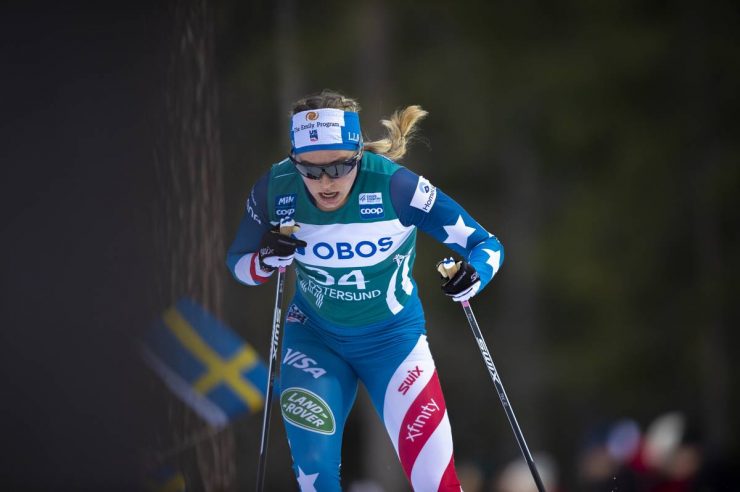
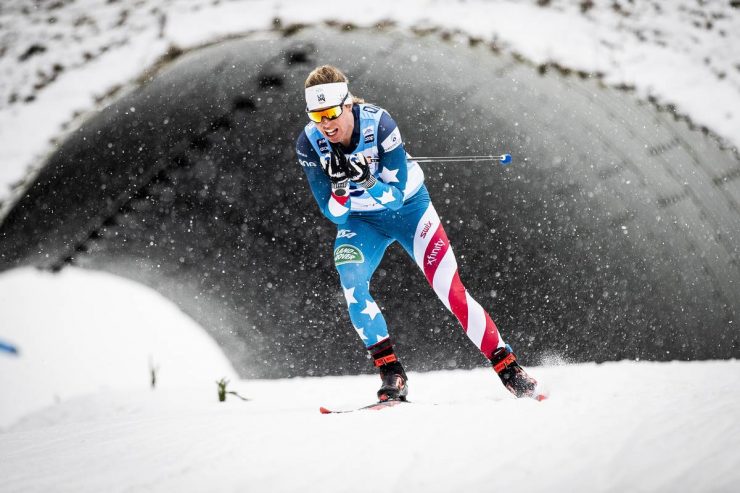
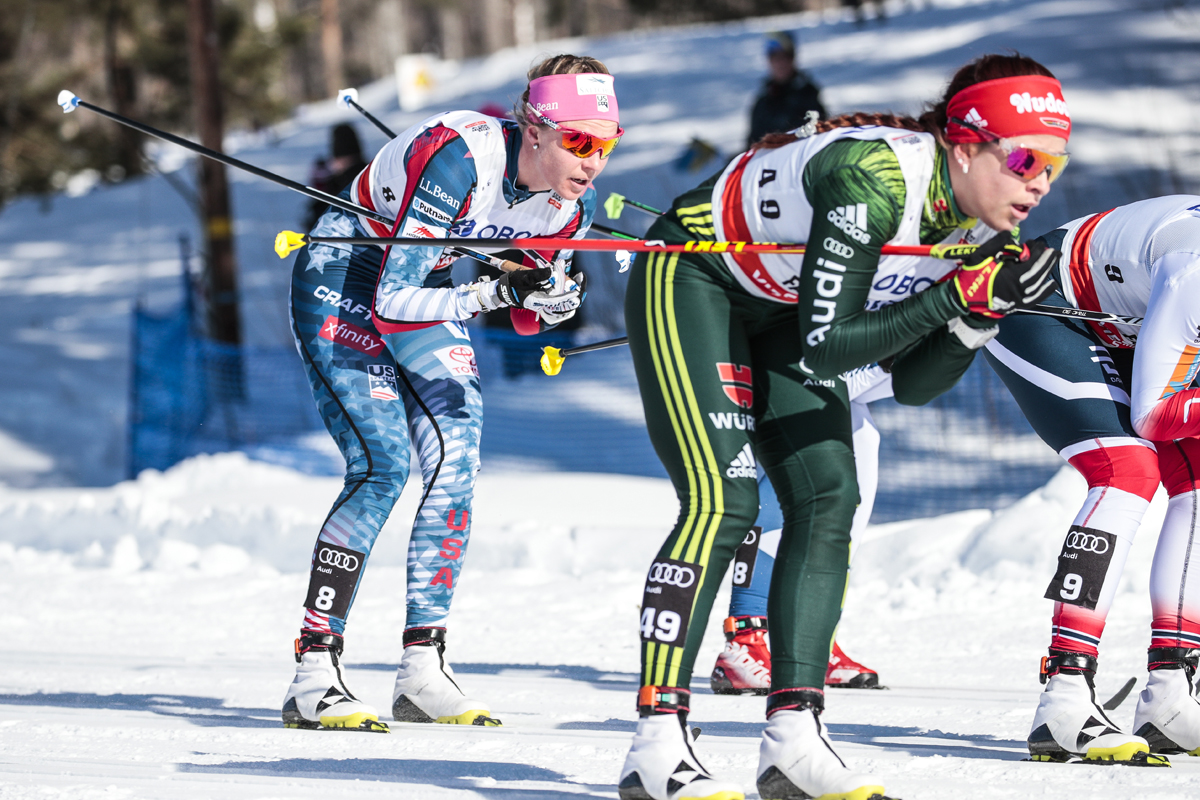
Jessie Diggins skiing to 11th overall during the Ski Tour 2020 Stage 2 10 k classic pursuit. (Photo: NordicFocus)
American Jessie Diggins, in bib 8, pulled the group through the 3.3 k mark 1:25.2 behind Johaug. In contact with Diggins, and coming through in this order were Astrid Uhrenholdt Jacobsen, Ragnhild Haga, Rosie Brennan, Krista Pärmäkoski, Frida Karlsson, and Natalia Nepryaeva. The group from fifth to Austria’s Therese Stadlober in 16th place was separated by 11 seconds.
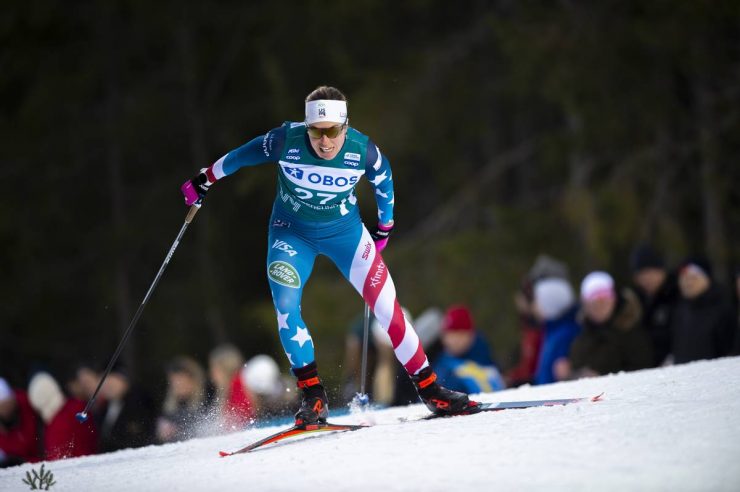
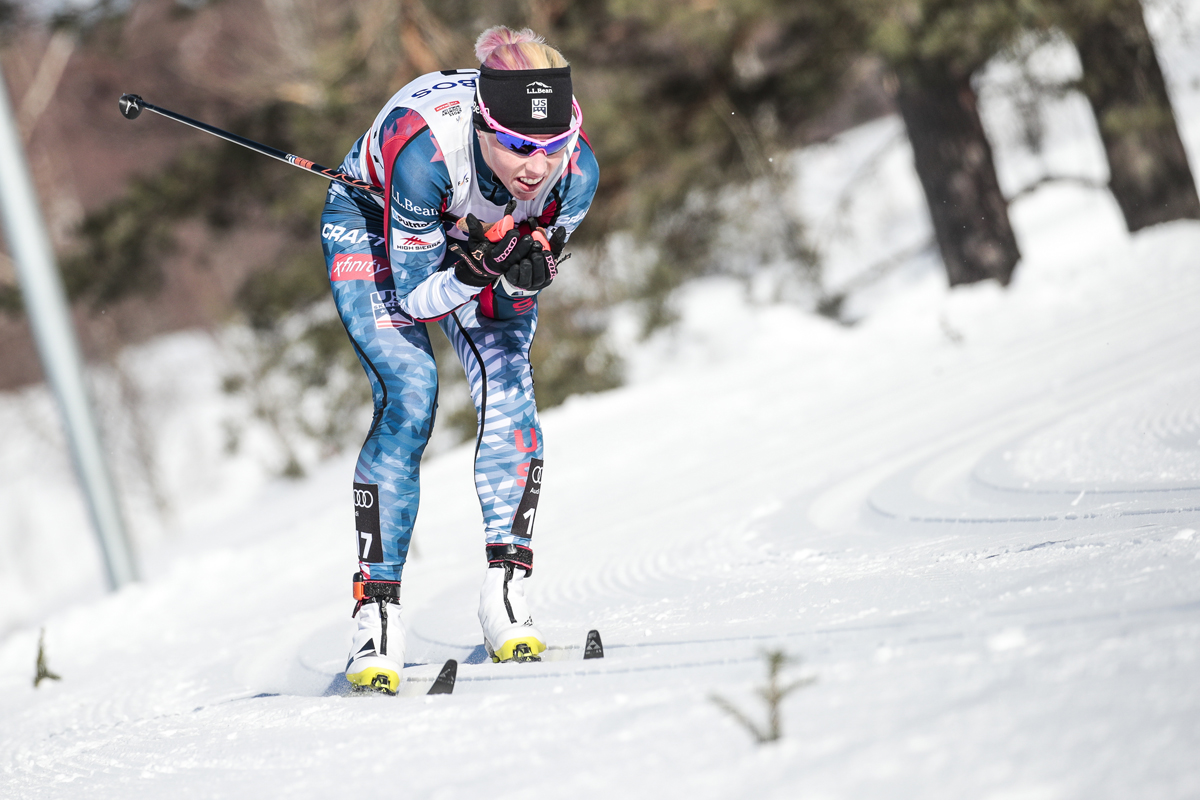
Brennan took her turn up front though the 4.9 k mark, as did Karlsson later in the race. By the finish, the collective group did not gain time on those ahead, they ceded a few more seconds to the top four. But we would be remiss to make note of Brennan’s determination. You could see it in yesterday’s 10 k skate, and it was evident today; she’s got moxie and now the confidence to take pulls, as she did with Karlsson today, and try to break the pack. In a post-race interview (audio posted below), Brennan noted she had in fact been keen on making a move during the pursuit.
Grit: Rosie Brennan during Stage 2 of the Ski Tour 2020. (Photo: NordicFocus)
Post-race interview with Rosie Brennan
Slovenia’s Anamarija Lampic ended up fifth overall (+1:38.7), as the first finisher of the third group out on course. Brennan ended her day in 10th (+1:43.3), and Diggins in 11th (+1:43.6).
“It was a pretty crazy day out there!” Diggins wrote. “I was actually super stoked about the rain while warming up because klister skiing in the rain is such amazing kick and really fun getting up all the hills on. The snow right before the start made it a really strange race because the one track became exponentially faster as it got skied in, which led to massive packs (for a girls race, anyway) forming. Huge thanks to the tech team because my skis stayed competitive and were kicking well even in the rapidly changing conditions!
“I’m excited for the rest of the tour – the next two races are formats we’ve never done before, so I’m ready to go give it my very best shot!”
Sadie Maubet Bjornsen, who began in bib 22, 1:51.4 behind the first starter Johaug, placed 19th (+2:12.5).
“After recovering from a mild tummy bug or a form of food poisoning that visited the night before the start of this tour, I am feeling thankful and hopeful after the second stage of the tour today,” Maubet Bjornsen emailed. “With a snow/rain downpour, I was feeling right at home strapping classic skis on my feet and heading out in the misery. I have spent plenty of days in this exact condition during summer training up on Eagle Glacier, so I was trying to channel every bit of internal strength I could find. The fact that I was able to work my way up to 19th today, and had encouraging feelings in a somewhat depleted version of myself is something I will take and run with!
“I am excited to have a day to recover and fill up my tank, and take on this tour in the same way I did the last. An imperfect start will just fuel me with the extra fight for the days to come!
“Thanks to the tech team for putting wonderful skis together given the absolute craziness coming out of the sky!”
In speaking to U.S. World Cup Head Coach Matt Whitcomb after the race, he explained that skiers in the back of the field were able to take advantage of the considerably faster skied in tracks. Again, heavy wet snow fell during the race.
Post-race interview with Matt Whitcomb
U.S. skier Hailey Swirbul in bib 36 moved into the points on Sunday to place 24th (+2:20.2). Her trajectory in the standings aligned with her 13th fastest time of day. Along those lines, Julia Kern of the U.S. Ski Team skied from 50th to finish 36th (+2:43.8). Her on course time was the sixth-fastest of the day.
Also for the U.S., Caitlin Patterson was 41st (+2:54.1), Sophie Caldwell 51st (+3:07.0), Alayna Sonnesyn 54th (+3:55.7), Katharine Ogden 55th (+4:03.8), and Rosie Frankowski 62nd (+4:59.7).
For Canada, Katherine Stewart-Jones placed 32nd (+2:37.5) and skied the ninth fastest time of day. Cendrine Browne was 39th (+2:45.9), and Emily Nishikawa 44th (+2:59.8).
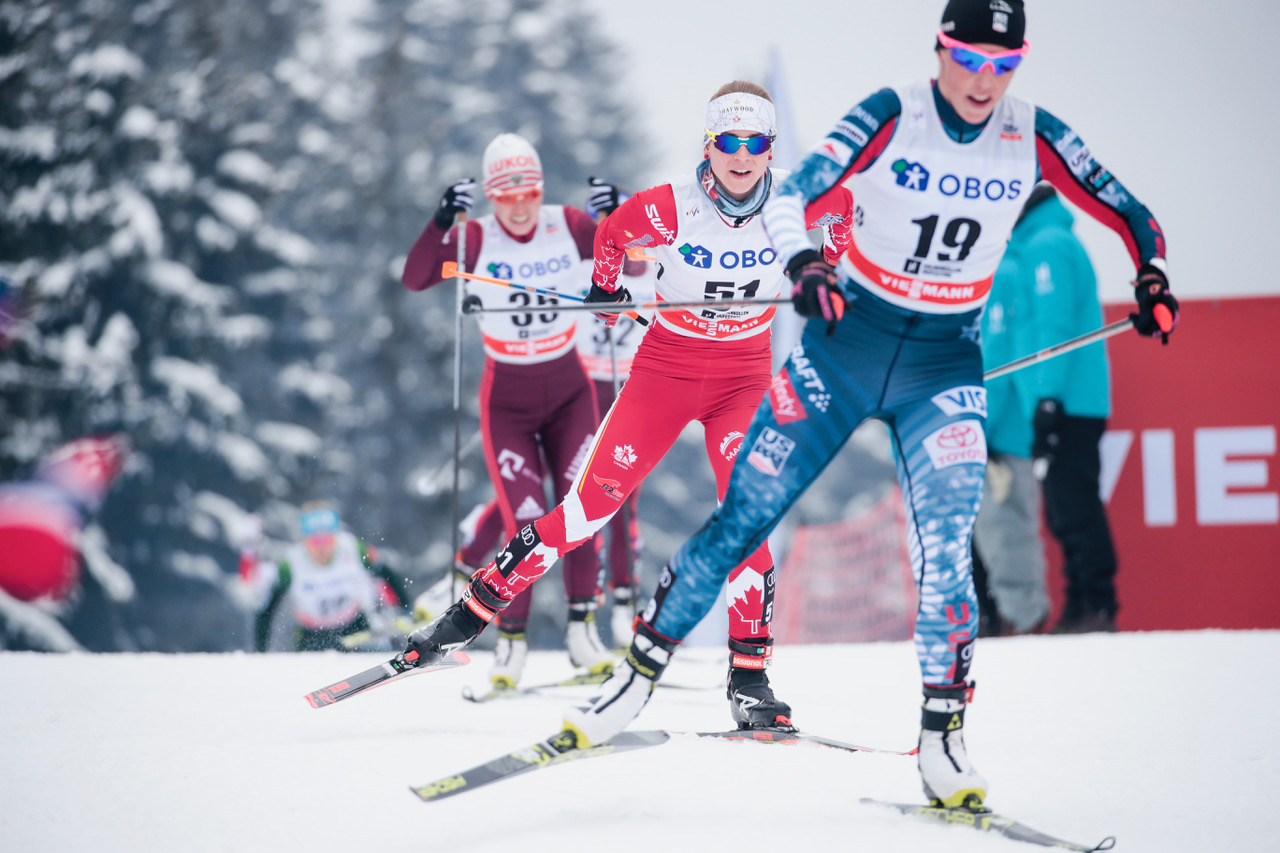
Katherine Stewart-Jones (CAN) during Stage 2 of the Ski Tour 2020. (Photo: NordicFocus)
As far as the overall standings and how times are calculated, time of day is used to determine a skier’s time for Stage 2.
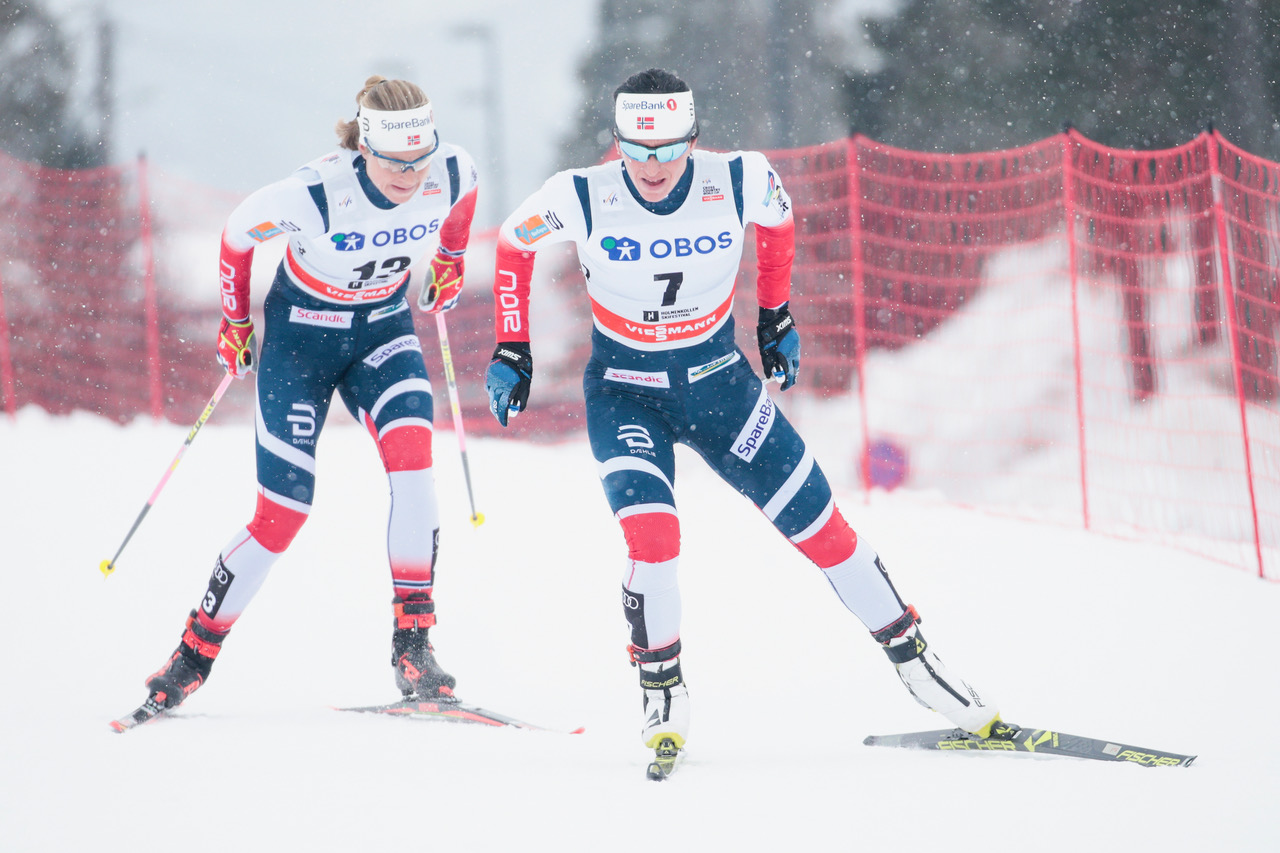
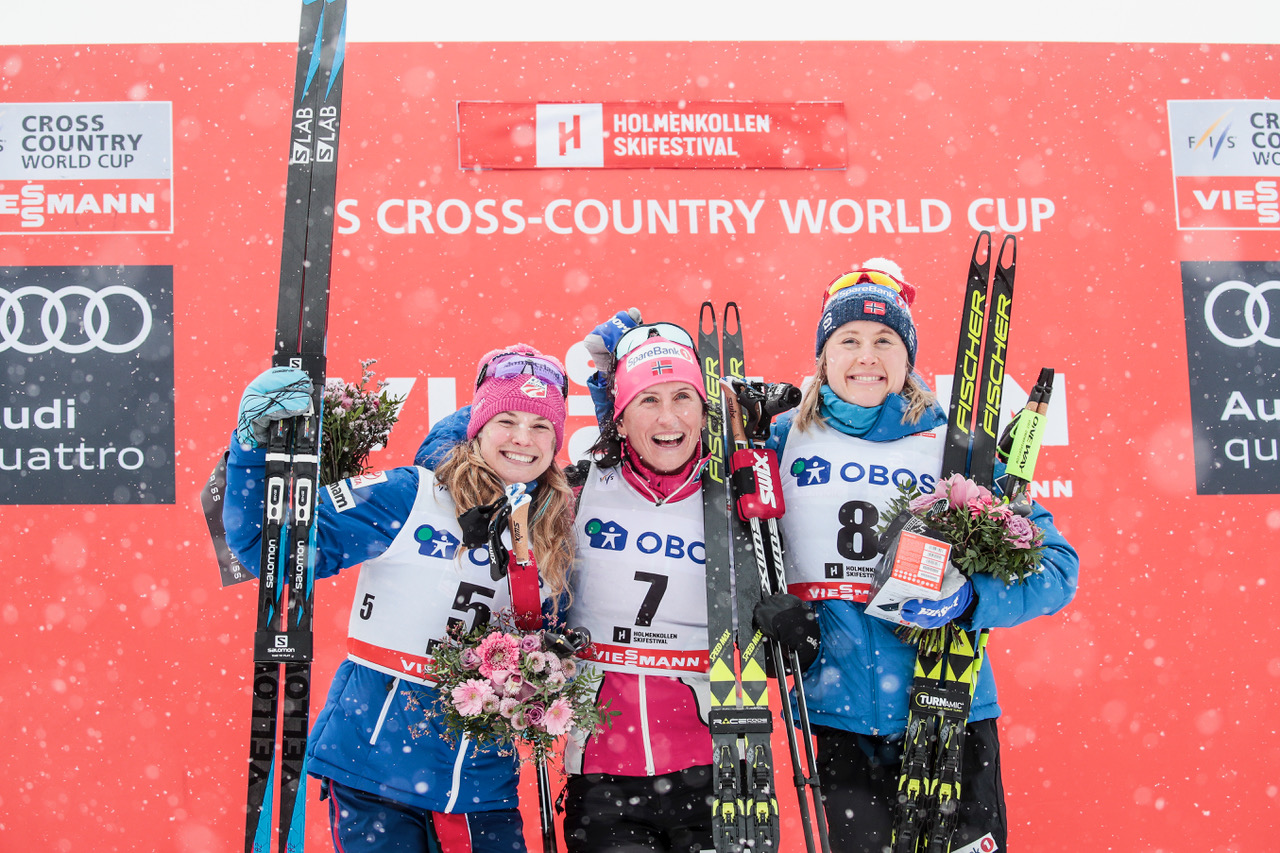
An all-Norwegian podium in Östersund, Sweden. Therese Johaug won the day ahead of Heidi Weng and Ingvold Flugstad Østberg. (Photo: NordicFocus)
Here we go again. A new Scandinavian Ski Tour takes the spot of a World Championship or Olympic Games during this off-cycle year. Six stages working east from Östersund, Sweden to Trondheim, Norway, beginning with today’s 10-kilometer individual start freestyle event.
Under clear skies, light fading and shadows lengthening as the sunset looms just a few hours away, the women time trialed through the tall conifers to set the tone of the overall tour standings. Crowds arrived in droves to line the course and fill the stadium, a cacophony of cheers creating the soundtrack to the stage.
Today’s format suits the Tour favorite, Therese Johaug, who has expressed that mass start events do not suit her as well. This season, Johaug won the Tour de Ski and has taken the top spot in each of the last ten individual start distance skate events.
Her story today essentially wrote itself. In Devon Kershaw’s words: “Gun to tape annihilate.”
Therese Johaug (NOR) dominates the first stage of the FIS Ski Tour 2020. (Photo: NordicFocus)
Johaug hammered out of the start gate and did not slow down until she crossed the line, her grimacing face making clear the unmatchable power and tempo she was forcing herself to maintain. Stopping the clock at 21:49.7 and raising her arms briefly in the air before collapsing over her poles, Johaug sealed the deal on best in show.
Her time gap on her competitors increased in an almost alarmingly linear fashion throughout the stage. 12.8 seconds at 2.6 k increased to 20 at the halfway mark, growing to 45.6 seconds at the finish.
Victorious in Östersund, Therese Johaug has a strong start to the FIS Ski Tour 2020. (Photo: NordicFocus)
“Oh yes, I could never get a better start than this,” a glowing Johaug told FIS at the finish. “I feel that it was my best skating distance in my career, so I am really happy with the skis and with the shape. It was an amazing race today… It’s good to start the Tour and I’m looking forward to the next races.”
Here’s what else went down.
Racing in bib 27 amongst the first wave of 30 skiers, Rosie Brennan set the bar high for the seeded group of top-ranked skiers who followed in bibs 32 – 60, posting some of the fastest time through each checkpoint. Although she faded into the results as the seeded group came through, it was still a noteworthy performance, placing her 9th for the day (+1:25.7) and second American.
Rosie Brennan sets the bar, racing to 9th in the first stage of the FIS Ski Tour 2020. (Photo: NordicFocus)
Of other skiers in her group, Brennan was only challenged by Norway’s Ragnhild Haga and Sweden’s Frida Karlsson, who was recently cleared to return to World Cup competition. Karlsson sat out the majority of the season after failing to meet team health standards for body composition and bone density.
Karlsson took the pace out hot, clearly gunning for the win, or at least for the bonus points available at the 2.6k checkpoint. She had the second fastest overall time there, then she attacked the steady climb with high tempo. But she was unable to hold the effort, fading back into the ranks as the race went on. She ended her day in 19th (+1:46.0).
After a fast start, Frida Karlsson falls to 19th in the 10 k skate. (Photo: NordicFocus)
Among the first starters of the seeded group in bib 36, Heidi Weng (NOR) went hunting. From 4.2 k onward, she knocked down the previous best time, setting a new and short-lived time to beat, as Johaug chased from two bibs behind. Weng, the 2017 and 2018 Tour de Ski winner who is currently ranked third in the overall World Cup standings hung on to take the second podium spot.
Next over the line was Ingvild Flugstad Østberg in third (+47.3), who hovered a few seconds behind Weng at each checkpoint. The trio sealed the deal on an all-Norwegian podium.
Ebba Andersson of Sweden interrupted the string of Norwegians in fourth (+53.1), followed by Haga (+1:04.3) and Astrid Urenholdt Jacobsen (+1:05.0).
Leading the Tour for North America, Jessie Diggins skied to 8th (+1:18.1). Diggins currently sits 5th in both the distance and overall World Cup standings.
Jessie Diggins skates to 8th in the first stage of the FIS Ski Tour 2020. (Photo: NordicFocus)
In a post-race call, Diggins described the track in Östersund as a “thinking course”, full of swooping turns that kept athletes focused and on their toes. Diggins explained that she has been experiencing an abnormal amount of fatigue over the last few weeks, but felt some encouraging sensations in today’s event and has a plan in place to optimize her recovery between stages so she can keep going hard.
She also shares insight about some of Tour’s sustainability initiatives to decrease the environmental impact of such an event, and weighs in on the energy generated from a large American team.
Post-race interview with Jessie Diggins.
Jessie Diggins leads the way for Team USA after the first stage of the FIS Ski Tour 2020. (Photo: NordicFocus)
Just behind Diggins, Brennan was the next American. It was the APU/USST athlete’s third top-10 result of the season. Her last two were also earned in stage events; she was 9th in the 10 k skate during the third stage of the Tour de Ski in Toblach, Italy and 6th in the 10 k classic in Ruka. She also skied the 7th fastest time of day up the Alpe Cermis in the final TdS stage.
“It was a good opening day of the Ski Tour 2020 for me,” Brennan wrote in an email to several news outlets. “After a frustrating weekend last week, I was ready to try to turn things around. The course here is hard and has lots of climbing so I felt it suited my strengths. It was fast conditions but there was also little rest so it was a tricky pacing game. I didn’t perfectly pace it and lost a little in the closing kilometers but I had much improved race feelings so I am very satisfied and hope I can continue this way throughout the tour.”
Sophie Caldwell on course in Östersund, Sweden. (Photo: NordicFocus)
Back on the World Cup, Rosie Frankowski races the first stage of the FIS Ski Tour 2020. (Photo: NordicFocus)
Sadie Maubet Bjornen was the next American in 22nd (+1:51.4), followed by her APU teammate Hailey Swirbul in 36th (+2:09.3). Caitlin Patterson was next for the U.S. in 40th (+2:19.1), Alayna Sonnesyn 43rd (+2:27.3), Julia Kern 50th (+2:38.0), Sophie Caldwell 51st (+2:39.3), Katherine Ogden 53rd (+2:48.0), and Rosie Frankowski 56th (+2:50.0).
In a post-race call, Matt Whitcomb sheds light on how the team is approaching the Tour in comparison to the Tour de Ski or a ski tour at the end of the season. Whitcomb explains that a major focus leading into the week was recovery and mental preparation.
“We didn’t focus to much on performance — that’s never a great way to go. We work on the process and getting people psyched by giving them the confidence to know that they’re recovered. Whether or not they’re sharp on the first day or two, they should be sharp by the end. Whether that ends up happening or not, we’ll see. But believing in it is the key.”
Whitcomb explains further how he gages how tired or recovered his athletes are and provides further insight into the women’s performance. Lastly, Whitcomb comments on Swirbul’s noteworthy rise in the ranks this year, attributing it to her fun but focused mental approach and the effect of the strong APU women’s training group.
Post-race interview with Matt Whitcomb.
On the Canadian side, Emily Nishikawa was the top finisher just outside the FIS points in 32nd (+2:05.0). She started one bib ahead of Sweden’s Charlotte Kalla, who she marked and followed to the finish once caught.
Emily Nishikawa leads the Canadian team in 32nd in Östersund, Sweden. (Photo: NordicFocus)
Next up was Cendrine Browne in 35th (+2:09.0), followed by Katherine Stewart-Jones in 46th (+2:29.8).
The tour is young. Racing continues tomorrow with a 10 k pursuit start classic on the tracks in Östersund.
The women’s podium inNové Město. Therese Johaug (NOR) took the win ahead of Natalia Nepryaeva (RUS) and Heidi Weng (NOR). (Photo: NordicFocus)
“It has everything,” Sweden’s Charlotte Kalla told FIS before the start of the 10-kilometer interval start skate in Nové Město, Czech Republic. Though she was describing the steep uphills and working downhills, found along the 5 k track, it might have also been an apt description for what the weather had in store. As athletes headed out on course, the light icy precipitation transitioned into chunky white flakes accumulating on the deteriorating ribbon of man made and farmed snow.
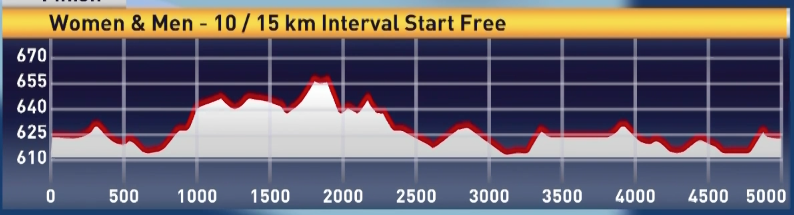
The course profile of the 5-kilometer lap in Nové Město, Czech Republic. (Photo: Screenshot FIS broadcast)
The two distance stages in Nové Město mark the start of Period III and the midpoint of the World Cup season, the tenth and eleventh of twenty one races. It also marks the return of the the squads of distance athletes who sat out last weekend’s city sprints in Dresden, Germany to recover from the compounding effect of their efforts in the Tour de Ski (TDS). Who made it through unscathed and who begins the second half of the season with lingering fatigue? Nothing like a two-day pursuit to find out.
By 3 k, it was evident that Norway’s Therese Johaug, Tour de Ski winner and leader of both the World Cup overall and distance standings, was feeling on form. From the start, she unleashed her usual high tempo attack, clocking the fastest splits at each checkpoint. She stopped the clock at 23:31.1, over 30 seconds ahead of the next fastest time.
Therese Johaug (NOR) takes the win in snowy Nové Město, Czech Republic. (Photo: NordicFocus)
Therese Johaug takes the lead after Day 1 of the distance pursuit in Nové Město, Czech Republic. (Photo: NordicFocus)
“It was an amazing race today,” Johaug told FIS at the finish. “My shape and my body was really good. I have been a little bit tired after the Tour de Ski and I had some good sensation and bad sensations, but today it was a good day. Of course, the tracks out here and the snow was perfect for me, so I am really happy.”
Johaug was chasing the ghost of her teammate, Heidi Weng, who started two bibs prior at the front of the seeded group. Leading the race for second place, Weng time-trialed through the wooded course, setting splits that were just faster than her peers’. At the half, she trailed Johaug by 17 seconds with four women within ten seconds of her: Natalia Nepryaeva of Russia, Moa Lundgren of Sweden, Jessie Diggins, and Ingvild Flugstad Østberg of Norway.
Soaring, Natalia Nepryaeva (RUS) powers to a second place finish in the 10-kilometer individual start skate inNové Město, Czech Republic. (Photo: NordicFocus)
During the second lap, Nepryaeva closed the gap to Weng’s times, matching her with roughly two K’s to go, then pulling ahead by a few seconds. Throwing her boot for the second fastest time of the day, she knocked Weng back to third on the podium. Nepryaeva finished 32.7 seconds behind Johaug, and Weng was 40.3 seconds back.
Weng is now batting 70 percent for podium finishes; she has only missed the top-3 in three of the ten stages, with her lowest rank of 8th occurring in the final stage of the Tour de Ski.
Eyes locked on the task at hand, Heidi Weng skis to third during the 10-kilometer skate in Nové Město, Czech Republic. (Photo: NordicFocus)
Diggins started third in the seeded group behind Johaug and Weng. After hovering in the top 5 throughout the race, she was next across the line in fourth (+48.5), with Ragnhild Haga of Norway just behind (+48.8). Østberg rounded out the final spot in the top five (+49.7).
Jessie Diggins climbs to 4th in Nové Město. (Photo: NordicFocus)
Jessie Diggins gasps for air after taking 4th in the first stage of the distance pursuit Nové Město. (Photo: NordicFocus)
When asked for a preview of tomorrow’s pursuit, Johaug commented on this strong group of women who would be chasing her.
“Of course, I’m really happy that I have 30 seconds, but I know that it’s a big group behind me and they can do work together and I’m going to be in the front alone,” Johaug said. “I have to work hard to have the first position in the finish, but I will do my best and we will see tomorrow how it ends.”
The women of Nové Město. Therese Johaug (NOR) led the day, followed by Natalia Nepryaeva (RUS) and Heidi Weng (NOR). (Photo: NordicFocus)
Due to poor WiFi connection, Diggins chose to share her post-race comments via email.
“Today was a good race for me, although it was kind of funny because with the super deep, sugary snow, it never felt like I was moving very fast, especially stepping through the sugar on the uphills! But overall I’m happy with where my body is after the Tour de Ski, and I’m working on training as smart as I can to find that balance between racing and training hard and finding good recovery after such a big effort.”
After today’s result, Diggins is ranked third in the World Cup distance standings behind Johaug and Weng. She is ranked 5th in the overall standings. Diggins commented on how this plays into her tactics in the second half of the season.
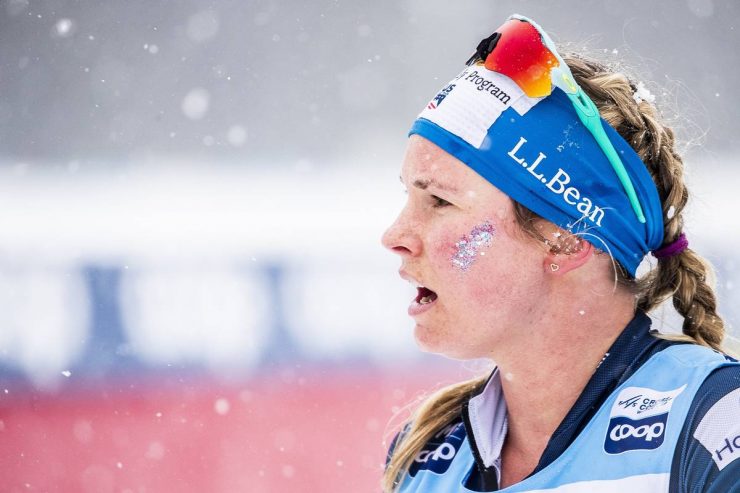
Glitter, snow. and grit. Jessie Diggins takes 4th in Nové Město. (Photo: NordicFocus)
“In terms of overall ranking, there isn’t really a plan because it’s out of my control – as we saw during the TDS, a few tough waxing days can make a huge difference, and you obviously have no control over how other athletes are performing. With that in mind, I don’t worry about the overall and instead focus on making every race I do a complete effort, training and racing it to the best of my ability, only worrying about the things I can control like my race effort, technique and pacing. If I can do that well, then it sets me up as best I can for the overall.”
After the Tour, Diggins headed to the Dachstein glacier in Austria, where she was joined by her boyfriend, Wade, for a block of recovery and training.
“My post-TDS training camp was really awesome, and I felt so lucky to have my boyfriend there with me! It’s very important to me to find a healthy life/skiing balance, in order to be happy and want to continue racing on the road for years to come. So my main focus during that time was simply happiness, as well as quality rest and recovery after the huge effort of the Tour.”
Diggins closed with optimistic remarks heading into tomorrow’s classic pursuit.
“I had great skis today and I’m very thankful to our hardworking staff! Tomorrow should be an exciting pursuit start and I’m excited to ski with so many speedy ladies.”
Rosie Brennan (USA) during the women’s 10 k skate in Nové Město. (Photo:NordicFocus)
Following Diggins, Rosie Brennan was the second fastest American, finishing 17th (+1:35.3), followed by Sadie Maubet Bjornsen in 26th (+1:51.1), and Julia Kern in 30th (+2:03.3).
“We faced some challenging conditions today,” Brennan emailed to several news outlets. “With no [natural] snow on the ground, the course was made up of all man made or saved snow, which didn’t adhere well to itself so it was deep, sugary, and dirty. The course was challenging in the sense of the amount of transitional skiing. I wasn’t sure how I would feel after the Tour de Ski but tried to stay optimistic that my break was good and I would be back where I left off. I started well and was happy with my first lap. I faded much more than I had hoped in the end and think I am still feeling a bit of fatigue from the Tour. Overall, it was a solid day and I hope I can find another gear tomorrow.”
Alayna Sonnesyn skis to 46th in Nové Město. (Photo: NordicFocus)
Fresh off of U.S. Nationals in Houghton, Mich., Caitlin Patterson finished 39th (+2:17.7), and UVM graduate Alayna Sonnesyn (SMST2) rounded out the American squad in 46th (+2:38.1).
“I’m really happy with my race today,” Sonnesyn emailed about her race. “I feel like I skied well and was consistent through the whole thing. I think I will learn a lot each day and hope to keep improving in the next few weeks!”
New to this level, Sonnesyn begins her second set of World Cup starts, which she earned from her position as SuperTour points leader. Her first World Cup starts took place at the World Cup finals last spring in Quebec City, where a string of bad luck kept her from performing at her potential: illness, followed by three crashes and two broken poles, resulting in a DFL — “dead freaking last.”
“I was really excited about those starts [in Quebec City], but by mid-March I had traveled around the world (literally, I went from the Birkie to China to Germany and back to the US) all in about 2 weeks and I was totally wiped,” Sonnesyn explained. “I knew I didn’t have the kind of energy to have races that I was truly capable of but I still wanted to start them to gain that experience.
“This year, I was slightly more comfortable showing up at a World Cup race and didn’t have to waste a ton of energy fan girling (too hard),” she wrote with a wink. “That being said, the field is so deep here and going into the race I wanted to focus on my own skiing, without worrying about results. That’s the really nice thing about being SuperTour leader right now; I didn’t need to “prove myself” in this first race. I have six races over 4 weeks to grow accustomed to racing at this high level and hopefully keep building on a race like today.
In a post-race call, Chris Grover shared additional insights into the womens’ performances, including how Maubet Bjornsen is feeling after the Tour de Ski, and Patterson and Sonnesyn’s results fresh off the plane.
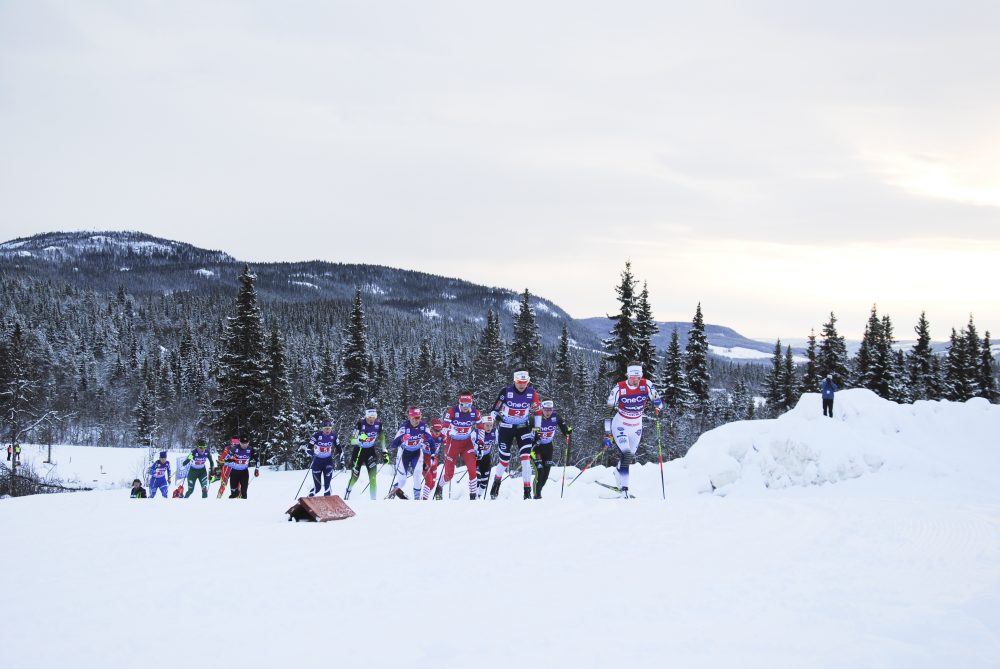
The women’s field cresting a hill during the scramble leg of the World Cup 4 x 5 k relay in Beitostølen, Norway.
FIS World Cup Beitostølen, Norway 4 x 5 k / 4 x 7.5 k Relay
Sunday in Beitostølen, Norway the women raced a 4 x 5-kilometer relay on firm tracks and under partly cloudy skies — Saturday’s races featured fresh snowfall.
Norway I took the win in a total time of 57:23.6 minutes. In order of relay legs, Heidi Weng, Therese Johaug, Ragnhild Haga, and Ingvild Flugstad Østberg comprised the team that raced at the sharp end of the race for all but the first leg.
Weng, the first leg skier for Norway, tagged Johaug in fourth, 7.3 seconds behind Russia’s Yulia Belorukova who scrambled for Russia I. From then on, Norway I set the speed benchmark.
Despite Russia I’s star power, it was Russia II that took second place Sunday. Lidia Durkina, Anna Zherebyateva, Mariya Istomina, and Elena Soboleva, having been gapped by Norway I, could pack-ski until the final stretch to slot over the line .5 seconds ahead of third place Finland I. (Russia II finished 37.3 seconds behind Norway I.)
Russia I’s anchor, Anna Nechaevskaya, fell in the final downhill turn losing several places for her team.
Finland I, the third-place team on the day, featured Johanna Matintalo, Krista Pärmäkoski, Ritta-Liisa Roponen, and Eveliina Piippo. Finland I finished 37.8 seconds behind winner Norway I.
The U.S. I team placed fifth (+48.0) in a performance that saw them out dual Sweden and Norway II in the closing moments of the race. Sadie Bjornsen, Rosie Brennan, Caitlin Patterson, and Jessie Diggins skied for the U.S. on a roster absent some names that were longtime staples of the U.S. team’s relay quartet — both Kikkan Randall and Liz Stephen retired from racing last season.
The U.S. had planned on fielding a second team featuring the U.S. Ski Team’s (USST) Sophie Caldwell (USST), Ida Sargent (USST), Kelsey Phinney (SMS T2), and Kaitlynn Miller (CGRP), however, they did not start.
Norway I held on for the win in the men’s 4 x 7.5 k relay today in Beitostølen in a time of 57:23.6 minutes. This was head-to-head racing at its finest. After 30 k of racing, the final standings came down to a lunge at the finish between Norway I and Russia I. Russia I placed second (+0.7).
Emil Iversen, Martin JohnsrudSundby,Sjur Røthe, and Finn Hågen Krogh formed the Norway I team. The Russia I team included Evgeniy Belov, Alexander Bolshunov, Denis Spitsov, and Andrey Melnichenko.
Norway II’s Didrik Tønseth, Hans Christer Holund, Magne Haga, and Simen Hegstad Krueger placed third (+53.4).
The U.S. team of Erik Bjornsen, Kevin Bolger, Scott Patterson, and Simi Hamilton placed 12th (+3:22.7).
IBU World Cup, Pokljuka, Slovenia 7.5 k / 12.5 k Pursuit
Looking smooth across the finish line, Norway’s Johannes Thingnes Bø, won the men’s 12.5 k pursuit in Pokljuka, Slovenia in a time of 30:20.4 minutes. That smoothness was matched in a photo finish with France’s Quentin Fillon Maillet who placed second, 0.1 seconds behindBø. Maillet cleaned his four shooting stages.
Bø looked in control for the last portions of the race. His strong skiing gave him a 50-second lead as he began his final shooting stage. There, the Norwegian missed two targets, allowing the chasers to latch back on during the final lap. In total, Bø missed three targets, one during his first prone stage, and two during his second standing stage.
Russia’s Alexander Loginov was third in the sprint, finishing 1.9 seconds back. Loginov missed one target in his first standing bout, otherwise, he shot clean.
Canada’s Christian Gow placed 14th (+1:09.1) while shooting clean. No other Canadians qualified for the pursuit.
For the U.S., Leif Nordgren was the best placed American in 33rd (+2:39.1, 0+2+1+0). Sean Doherty was 39th (+3:07.9, 0+0+2+2),
Kaisa Mäkäräinen of Finland won the women’s 10 k sprint in a time of 29:16.9 minutes. Mäkäräinen shot clean during the competition. Italy’s Dorothea Wierer was second, finishing 41.3 seconds behind while also shooting clean during all four shooting bouts.
Third place went to Paulina Fialkova of Slovenia. Fialkova finished 59.2 seconds back and shot clean for the day.
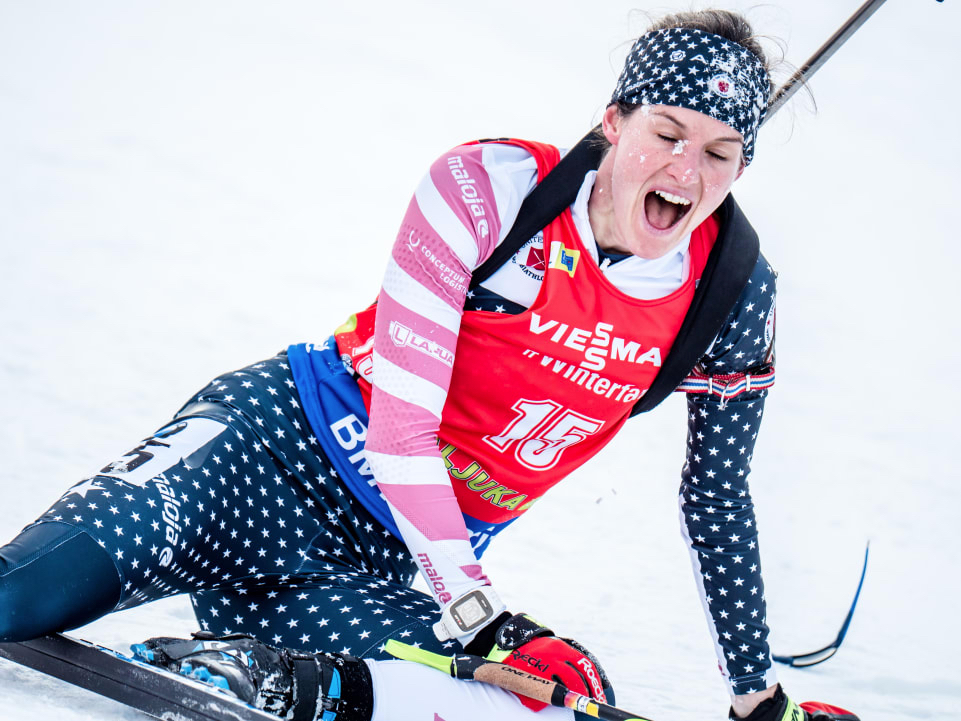
Clare Egan after placing sixth in the IBU World Cup’s 10 k pursuit in Pokljuka, Slovenia. (Photo: Biathlonworld.com)
For the U.S., Clare Egan placed a career-best sixth (+1:22.4, 0+0+1+0). Egan missed a single target during the race.
“I knew the pieces were there,” Egan told IBU TV after the race. “I had clean shooting in a [preseason] race at the Austrian trials before the World Cup. And then I had just awesome ski times this week, so I knew it was coming. I just had really good focus today, and I love competing head to head, so pursuit is a great race for me. I thought I was… I wasn’t sure if I was in fifth or sixth, and this Norwegian skier [Marte Olsbu Røiseland], really good, just got me at the finish. So I was so happy when I looked up and saw that I was in sixth in the flower ceremony.”
Also for the U.S., Susan Dunklee placed 39th (+3:36.3 0+1+0+1), and Joanne Reid 43rd (+3:51., 0+0+1+0).
CNST teammates Dahria Beatty (l) and Katherine Stewart-Jones charge the last hill of the 10km on their way to 6th and 1st respectively. (Photo: Peggy Hung)
Sovereign Lake NorAm/SuperTour 5k/10k Classic
The Sovereign Lake weekend wrapped up with individual start classic distance races and a more neighbourly distribution of results.
Katherine Stewart-Jones (CNST) won the women’s 10km in 31:48.4, hanging on in the last lap to finish ahead of APU’s Becca Rorabaugh (+7.1) and SMS’ Julia Kern (+7.8). APU’s Hailey Swirlbul snatched 4th at 10.9 seconds with Dahria Beatty (CNST) in 5th, 26.7 seconds back.
Kyle Bratrud on his way to victory in the 15km (Photo: Peggy Hung)
Kyle Bratrud (SMS T2) won the battle in the men’s 15km in 41:59.3, 3.8 seconds ahead of Ben Lustgarten (CGRP) and 34.7 seconds ahead of Ricardo Izquierdo-Bernier (NMU/CNEPH). Sam Hendry (CJNST) edged out Andy Newell (SMS T2) for fifth.
Individual start results are here with the full weekend here. Photos and interviews are coming in the Noram/SuperTour wrap-up.
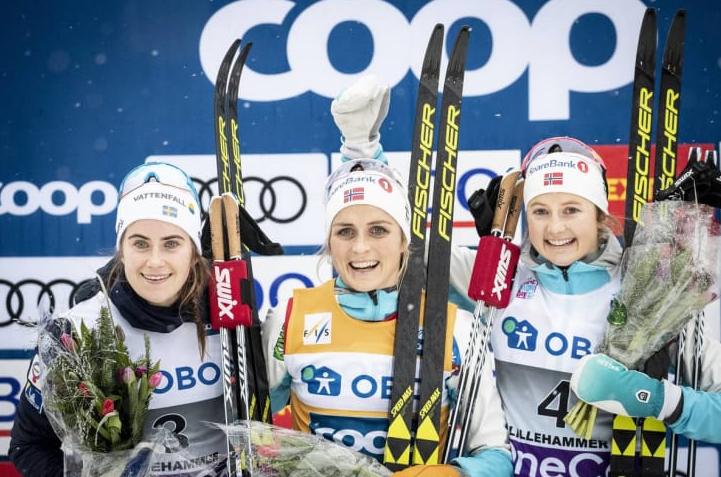
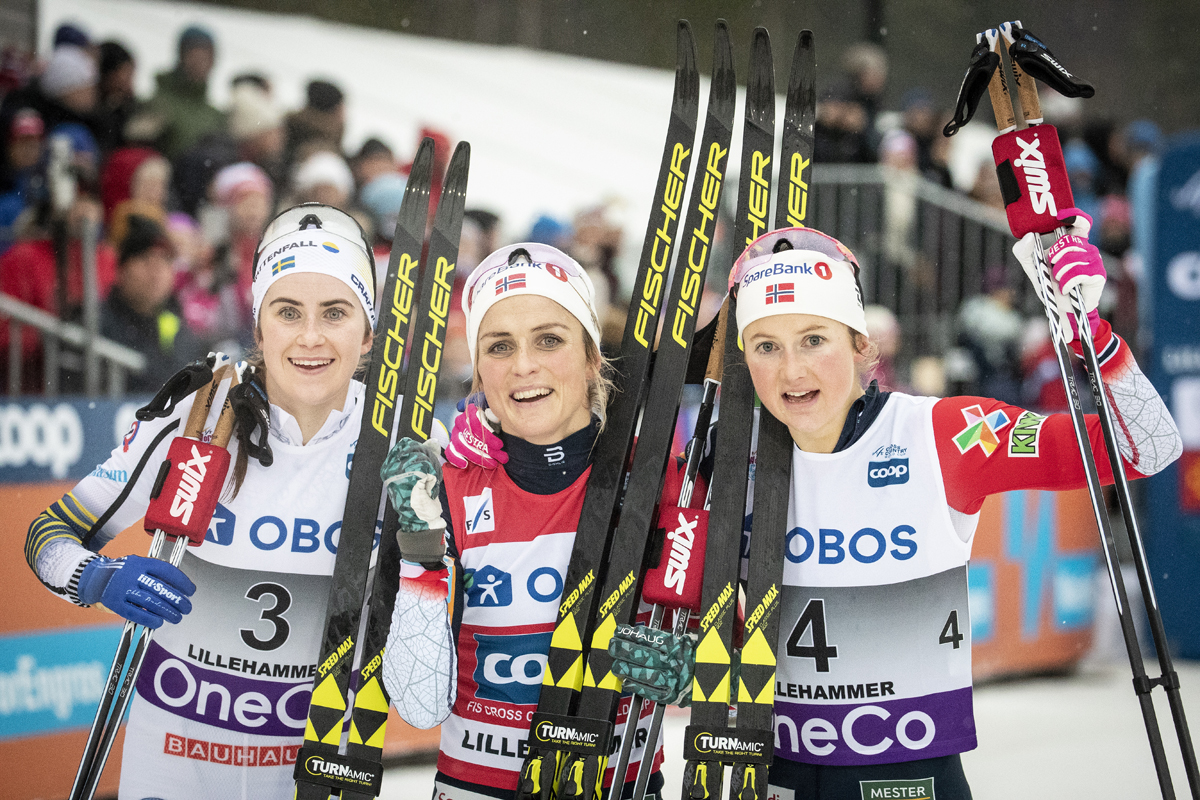
The women’s podium after the women’s 10 k classic pursuit in Lillehammer, Norway. Therese Johaug of Norway (center) won, Ebba Anderson from Sweden (left) placed second, and Ingvild Flugstad Østberg of Norway was third. (Photo: Fischer/Nordic Focus)
Here’s a sentence we might see routinely this season as the World Cup distance races transpire. Norway’s Therese Johaug wins again!
In Sunday’s 10-kilometer classic pursuit race in Lillehammer, Norway, Johaug set an unmatched pace to win her second race of the weekend and the overall in Lillehammer’s three-race series.
Sweden’s Charlotte Kalla lead off the race, starting a spartan two and a half seconds ahead of Johaug. Kalla led the first lap, with Johaug tight on her heels.
On the first major climb, which kicks about 3 k into the 5 k loop, it appeared Johaug was struggling with her kick wax. With slight micro-adjustments when firing the muscles, if there was any kick-wax deficit, it did not slow her down. Kalla and Johaug skied through the first lap mark together. Soon thereafter, Johaug tightened her grip on the win by stretching the time back to a just-hanging-on Kalla. By 7.2 k, Kalla had bled 15.7 seconds to Johaug.
Johaug continued her unrelenting pace throughout the second lap. Kalla continued to lose time whereas Kalla’s teammate, Ebba Andersson, who began the race 14 seconds back, began to make ground on Kalla.
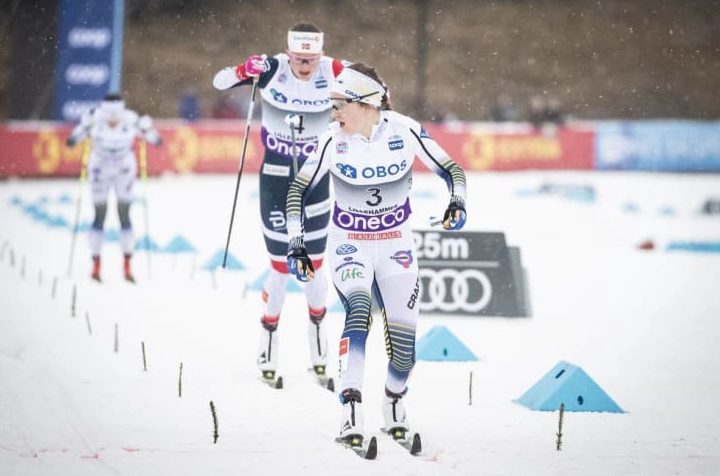
Sweden’s Ebba Andersson takes second place over a charging Ingvild Flugstad Østberg from Norway in Sunday’s 10 k classic pursuit in Lillehammer, Norway. (Photo: Screenshot from FIS-Ski.com)
Andersson was able to close the gap between Kalla and herself between the 7.3 k and 8.3 k mark. By 8.3 k, Andersson had put a 6.4 seconds buffer between herself and Kalla. Behind Kalla, Norway’s Ingvild Flugstad Østberg kept the third podium step within her sights. On the last climb before the finish, Østberg caught and passed Kalla and began gaining time on Andersson.
Johaug won in a time of 29:25.5 minutes. Andersson and Østberg finished neck-and-neck, with the Swede taking second (+16.8), and Østberg third, only 1.1 seconds back. Kalla finished fourth (+23.1).
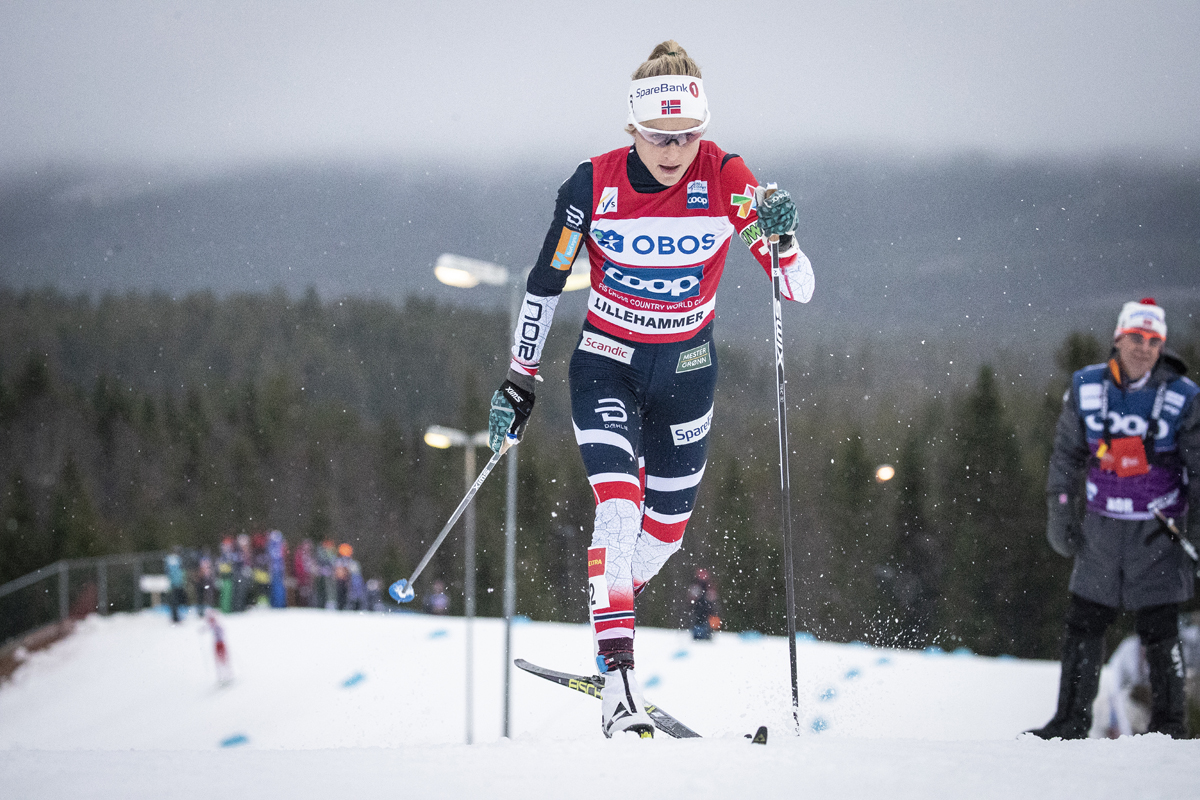
Norway’s Therese Johaug on her way to claiming her third World Cup distance win of the season. Here she steamrolls up a hill in the women’s 10 k classic pursuit in Lillehammer, Norway. (Photo: Fischer/Nordic Focus)
Sadie Bjornsen of the U.S. Ski Team, after a strong start to the season, is eighth overall on the World Cup. On Sunday, Bjornsen was one of three U.S. women in the top-15. Bjornsen started Sunday’s pursuit in 7th and finished in 10th with a time of 31:57.2 minutes.
Staring 50 seconds back, Bjornsen lost time on course to the leaders. She ultimately finished 2:21.7 minutes behind the winner, Johaug.
“It was definitely a tough race out there, I had pretty slick skis, so it was just a matter of trying to stay positive and herringbone as much as I could and it was definitely a difficult course to be struggling on,” Bjornsen told FasterSkier in the Lillehammer mixed zone.
Bjornsen had intended to link up with the skiers beginning ahead of her. But the tough conditions foiled her strategy.
Sadie Bjornsen during Saturday’s 10 k freestyle in Lillehammer, Norway. Sunday’s race was a 10 k classic pursuit. (Photo: Fischer/Nordic Focus)
“My plan was to try to catch Krista Pärmäkoski and Ragnhild Haga in front of me and try to ski with them and I kind of yo-yo’d with Haga the entire time, so that was definitely really hard,” Bjornsen said. “I was kind of in No Man’s Land, not skiing with anyone, and when Stina Nilsson went by I was not able to stay with her pace. It was going uphill and I was having to herringbone, so it was kind of sad to not catch on to that chain. But I tried to just keep fighting the whole way.”
U.S. Ski Team World Cup Coach Matt Whitcomb confirmed Bjornsen was thin on kick. “I mentioned I thought our team did better than most today with regards to wax and skis. Whitcomb said. “I do think Sadie was a little bit lean on kick, and think she was on form. She was ready to climb up today and I just don’t think we gave her what she needed to to make it happen.”
Rosie Brennan (APU) and Jessie Diggins (USST) began Sunday’s race in 13th and 14th respectively, 1:25 minutes behind Kalla. The U.S. pair was able to ski together for the majority of the race in a pack with Norway’s Heidi Weng, and Russia’s Yulia Belorukova.
By the finish, Diggins was able to gain one place to end up 13th (+2:42.4). Brennan lost three places in the finishing stretch to take 15th (+2:46.0).
“I struggled to compose myself on that last climb, and don’t have much of a sprint finish, so lost a place or two there,” Brennan told FasterSkier after the race,
“It was a good race, not a great race, but yeah I’m happy that I had a good group to skate with and I was able to hang in there”, Brennan told FasterSkier. “[I was] able to ski comfortably in a group and feel comfortable with some pretty strong girls and it was super nice to be able to ski with Jessie [Diggins] for a lot of it. “When it’s someone you train with more often it’s a little bit more comfortable, and her strength is on the downhill and that’s my weakness, so it’s nice to be able to follow someone.”
Whitcomb noted Brennan’s marked improvement and return to form after her struggles with an illness last season.
“It’s really fun to watch from the side of the trail, an athlete that has had to deal with, and sort of had to harness so much patience,” Whitcomb reflected. “She spent so much of last season, the better half of the second part ill, and so she’s really had to settle down, recover and then get herself back in shape. These things happen over the course of months, and she had that patience, and she put in the work after she recovered and now she’s being rewarded for it, and it’s really fun to sit back and just watch an athlete be so stoked with how they’re feeling out there.”
Caitlin Patterson during Saturday’s 10 k freestyle in Lillehammer, Norway. Sunday’s race was a 10 k classic pursuit. (Photo: Fischer/Nordic Focus)
Caitlin Patterson (Craftsbury Green Racing Project) started in 31st, 2:37 minutes behind Kalla and finished 35th, five and a half minutes behind Johaug. Throughout the race, she hovered between 27th and 32nd place, but she crashed on a downhill during her second lap and lost places.
“I was crushing it on the downhills until then and I consider myself pretty good at cornering, but I just momentarily caught a glimpse of a two girl in front of me, got too excited, lost focus, and stepped in some slush that I wasn’t expecting or something,” Patterson told FasterSkier after the race.
Racing continues on the World Cup next weekend with events in Beitostolen, Norway.
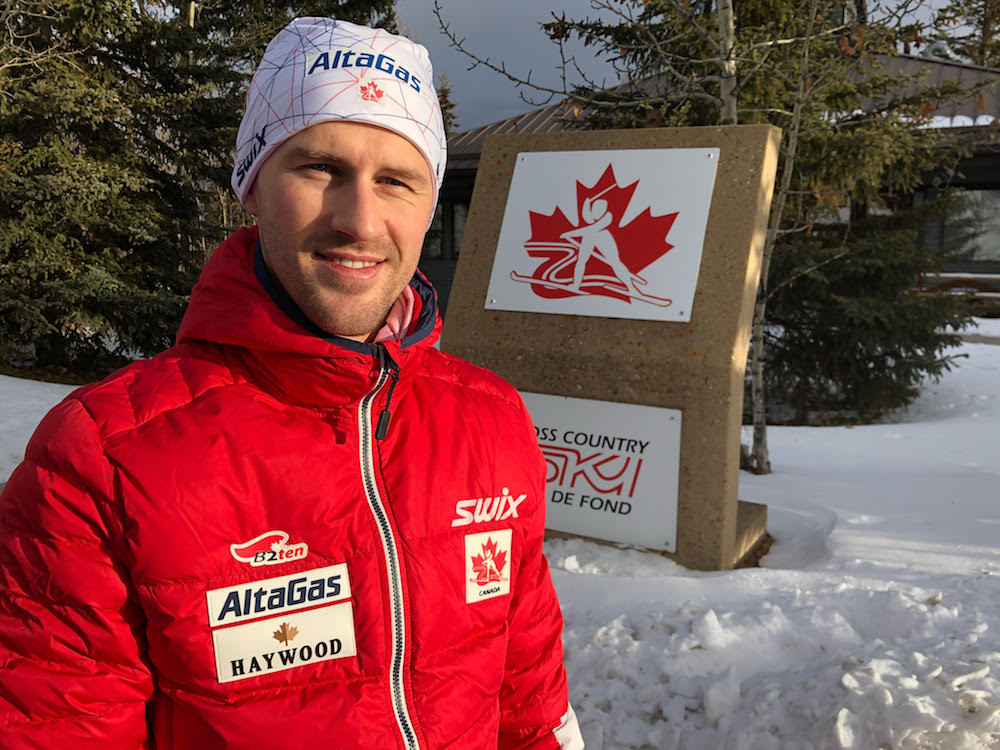
Erik Bråten, at the end of his first week in Canada. (Courtesy photo)
Cross Country Canada hired Erik Bråten as the new national team coach on November 1st, joining Louis Bouchard. After a short delay to get a work permit, Bråten arrived in Canada on November 15th.
Regular readers will know the highlights of his resume:
Graduate of the Norwegian School of Sports Science.
Previously Head Coach at Team Kollen, the junior team constituted from clubs based at Holmenkollen in Oslo.
Nic Lemyre, High Performance Consultant to CCC, described the initial division of national team roles this way.
“Louis Bouchard is the head World Cup coach, and he’s calling the shots for all the World Cup athletes, taking responsibility for their performances,” Lemyre told FasterSkier. “Erik has a support role at the World Cup level, and he’s going to have his main focus on our U23 group and junior group. Erik will have a very important role in connecting with the younger athletes, and making sure that they are going in the direction with the philosophy we want to have with the World Cup team.”
There will also be an east/west division of athlete responsibilities, with Bouchard based in Quebec City and Bråten based in Canmore.
While some may be concerned that doesn’t speak French yet, Lemyre doesn’t see that as a problem.
“[Erik] speaks cross country skiing better than anybody in our system, so I think he’s going to be fine.”
Given that Bouchard and Lemyre both have French as a first language, communication with athletes shouldn’t be an issue.
***
FasterSkier conducted an initial interview with Bråten over the phone while he was in Oslo on November 1st. The second set of questions were answered by email, when Bråten had begun settling in Canmore on November 21st.
How much time have you spent in Canada?
None. Never been there. It will be a first for me. A tourist in the U.S., that’s the closest. So it will be a totally new experience for me, and a long move.
What are you most excited about?
Well, I really love to build up a system. The opportunity to go in and help out actually building that system, that is already there, but at least Nic has talked about a few changes that he wants to make. Good ideas to develop further, which is based on how the coaches, the national coaches communicate with every athlete on the team, how we communicate with the club coaches, and how we can maybe have some gatherings or some knowledge development for the coaches, and maybe make a little clearer what the Canadian philosophy is.
What will you contribute this season?
I’m coming in at a special time of the season. It’s like races in a few weeks, and I’m coming in as a new coach. Of course, even if I had issues with anything, I can’t come in and change it. It’s another opportunity to come and contribute right away, but at the same time, just use some of the season to see what’s going on, see the training diaries, talk to the leaders, and really know the whole picture of what is the Canadian model.
I’m not coming over there and having to make a season plan in a week. I have some time to get to know information, because training is almost done. I think it’s a great opportunity to learn, to observe, and put some small things in my philosophy. We [will] start planning for next season, which starts quite soon, but the details of course come after Christmas. I hopefully have something to contribute.
How did you come to win the coaching award?
There were both coaches and athletes that nominated me separately, and the club has been doing really well for the last, well for a long time. But especially the last two or three years has been really, really good. They put a lot of weight on the Norwegian cup for juniors, because we have dominated quite extreme there for the last couple of years. That several athletes and some coaches also separately nominated me was put into consideration, because that wasn’t that usual.
Did you know Nic Lemyre in Oslo?
Well, not really. He is working at the Norwegian school of sport science and I took my education there, and had a little lab assistant role after I was done my education. Even though we have been at the same school for a long time, he as a worker and me as a student, we haven’t really known each other. We know the same people, so he had a lot of references on me that I didn’t know.
How is your French?
My French is terrible, it’s nothing. I have German in school, and Norwegian and English of course, not that my German is anything either. I really don’t know any French. Nic told me I should buckle up and learn, try to learn, some basics.
Questions by email:
Who have you met during your first week in Canada?
Over the last week I have met most people in the Canmore office, a few local athletes who are not, the National Team and some club coaches. Louis and I have established regular contact on mail and phone, the same goes for Joel Jaques [CCC’s Technical Services Coordinator] so we have a good system in place built on trust and professionalism. I met all of the female athletes in person except Cendrine [Browne], and I have met a couple of the guys. With Lillehammer next week and then Sovereign Lake and Whistler coming up I am happy to say I [will] have met most people in the system before Christmas.
Why did you choose to coach instead of race?
I was better at it and I have always liked to help others reach their potential. But I am glad I did competitive skiing as long as I did, I think I learned a lot I can use as a coach from that experience.
What makes you a good coach?
I think I am good at seeing the whole picture. It allows me to understand if the training is right, is the motivation right, are all social factors in place etc. And all these factors are important to be in place for an athlete to have the desired progression. I also think I am good at seeing my own limitations, and getting help from experts when I don’t have the knowledge in a particular area.
How will you measure your success in Canada?
I am coming in very late this season, so for the first few months the most important task for me is to get to know everybody and learn the system. But over time it’s kind of simple, better Canadian results in the World Cup, championships and most importantly Olympics.
What was your first culture shock moment in Canada?
I have not really had any big culture shock so far. It really is not that different from Norway. But the average person is much nicer here, at least the first time I meet them. Everyone thinks it’s cool I am here, and are excited to work with me so that is a big motivational boost for me.
Name one person who has helped you to be a better coach? And how?
A lot of people have been important to me of course, but I want to specifically mention two people.
The first is my mentor from my time on the Norwegian School of Sports Sciences, Thomas Losnegard. He is a professor there, and I have spent endless hours in the lab with him. He has a unique way of being so knowledgeable on all theory, but at the same time being able to translate it in to practical use for coaches and athletes.
The second person is Kristian Bjune Sveen who is Head Coach for the China National CC Skiing Xinjiang Team. We coached Kjelsås together for four years and learned a lot from each other.
What was your favourite moment on snow?
There are a lot of them, but if I can pick two …
Haga visited Canada long before Bråten did, seen here in 2012: Chandra Crawford (l) leads with Norwegian Britt Ingunn Nydal (far right) on the fourth of six loops in the 30 k classic mass start at Canadian Ski Nationals on Saturday. Dasha Gaiazova (second from right) and Norway’s Ragnhild Haga (second from left) stay close behind.
The first would be as a coach. 14.jan.2017 in the Norwegian Cup for juniors for the K17, it was a sprint race. I had two athletes in the final, and they finished one and two. Right after they crossed the finish line the rest of the girls from the club stormed the finish area and celebrated together. That moment was special.
The second one would be when my good friend Ragnhild Haga won the 10k in the Olympics last season.
What does an athlete need mentally to succeed? Personalities vary widely, but what can you say about what is needed?
As you point out, personalities vary, but I think wanting to do the work that is necessary and just having fun is important. Being critical of your own training, and always wanting to do things even better, and not just copying yourself from season-to-season. And, you have to like the lifestyle. It is a lot of training, and when you are not training, you need to rest a lot, and there is a lot of traveling.
What are the different training groups you worked with?
Kjelsås is the club I coached, Team Kollen is the regional team for juniors in Oslo. Team Obos is the regional team for the seniors in Oslo.
How do you form a team from multiple clubs in Norway? How well do the clubs work together?
Clubs in Norway have widely different opinions on how to do things. But I think what is important is to find common ground, and find the things we agree that we can do better together then apart. And if we can agree on what that is, we can meet up and do that together, and do different training separately.
One of the repeated ideas from HP in Canada is that different athletes need different environments to succeed. Do they need different training philosophies as well?
A training philosophy should include that we are different and need different things. The demands you need to ski fast is the same for everyone, but which demands you are good at varies greatly. A lot of training should be done by everyone, but how much focus on different task for each individual is the big question that is different from athlete to athlete. As a coach, I therefore think that you need find what everyone should do, and put that in to camps and trainings we set up together, and then find out what each individual athlete should focus extra on in the training on their own.
When it comes to environments, I think athletes need to be good at finding the right balance for them in terms of who they spend time with when they are not with their team. And teams should use time to figure out together how they want the culture in the team to be.
Norway’s Maiken Caspersen Falla celebrates her win in the women’s 1.4 k freestyle sprint at the 2018 World Cup in Lahti, Finland. (Photo: Fischer/NordicFocus)
Welcome to FasterSkier’s World Cup Preview, where we check in with the top-10 teams from last year’s FIS Cross Country World Cup tour before the season starts. The World Cup begins with a classic sprint in Ruka, Finland on Nov. 24th
***
Norway
Overall in Nations Cup Last Year:1
Women’s Ranking 2017/2018:1
Men’s Ranking 2017/2018:1
Norwegians to Watch:
Norway won last year’s Nation’s Cup by more than twice as many points as second place Sweden. The question remains, in the aftermath of Marit Bjørgen’s retirement can that accomplishment be repeated?
Chances are, yes.
The Norwegian women’s team boast names such as Heidi Weng, winner of the World Cup the two previous seasons, Ingvild Flugstad Østberg, 3rd place overall in the World Cup in the two previous seasons and gold medal winner in the 4×5 kilometer relay in the PyeongChang Olympics , Maiken Caspersen Falla, winner of the sprint World Cup the three previous seasons and silver medalist in the Olympic classic sprint, and Ragnhild Haga, gold medalist in the Olympic 10 k skate and 4×5 k relay.
The women’s 10 k freestyle podium at Stage 3 of the 2018 Tour de Ski on Monday in Lenzerheide, Switzerland, with Norway’s Ingvild Flugstad Østberg (c) in first and Heidi Weng (l) in second, and American Jessie Diggins (r) in third. (Photo: Salomon/NordicFocus)
There appears to be no dynastic decline on the immediate horizon. All of these athletes are on track to perform at a similar level this coming season.
In addition to these four podium-capable skiers, Therese Johaug will return to the Word Cup after having finished her 18-month ban for testing positive for the banned substance clostebol. (Johaug tested positive after applying the ointment Trofodermin to her sunburned lips.)
Johaug won the Lysebotn opp rollerski race in August 1:47.5 minutes in front of Sweden’s Charlotte Kalla in second, and out performed all the male skiers on the national team but Didrik Tønseth during an Oslo hill run this Spring. She is reported to be in better shape physically than in the past. Yet, it remains to be seen if she can transfer that into competitive cross-country skiing against a full World Cup field.
In the days before the Norwegian season opener in Beitostølen, Johaug asked during a press conference that people lower their expectations because of her experience in the last two years. Expectations aside, Johaug won the two races she competed in during the season opener in Beitostølen. In the 10 k classic, as described by FasterSkier, Johaug never let off the throttle. In the 10 k skate, she distanced second place Østberg by 26 seconds and U.S. skier Sadie Bjornsen by 1:45.9 minutes in third. With those two wins in Beito, this much is true: she’s in early season Johaug-form.
The Norwegian men
2018 Olympic individual gold, silver and bronze medal winners, team sprint and 4 x 10 k relay winners return to the Norwegian men’s team this season. Tønseth, Martin Johnsrud Sundby, Simen Hegstad Krüger and Johannes Høsflot Klæbo are all returning. No athlete reported any major challenges this pre-season.
Overall sprint and World Cup winner, Johannes Hoesflot Klaebo at the 2018 Seefeld, Austria World Cup sprint. (Photo: Fischer/NordicFocus)
After his dominant season last year, Klæbo has tempered expectations. He stated in an interview with Bergens Tidene in October, “realistically, a lot of things need to happen for me to copy what I did last year.”
We’ll know in days, the World Cup begins this Saturday, if this was all a Klæbo bluff.
The overall winner of the World Cup, and sprint cup winner the past two seasons, Klæbo explained that last season many things worked well right away but there are several fast skiers competing. Just within Norway’s domestic ranks, Tønseth, Emil Iversen,Sjur Røthe, Sundby, and Hans Christer Holund all outperformed Klæbo recently in Beitostølen’s 15 k classic.
One athlete who fans should see on the World Cup again this season for Norway is thirty-two-year-old Petter Northug.
After separating from the Norwegian national team in 2013, the man who needs no further introduction if you have followed xc skiing over the past 10 years, returns to the Norwegian sprint team. His last performances are not what they used to be and therefore Northug returns to national team with confined expectations. Northug noted he probably won’t ski World Cup races until 2019 and that he might not make the cut for the World Championship in Seefeld.
His results recently in Beitostølen were lackluster, he was disqualified from the 15 k and didn’t qualify for the sprint heats.
He raced a single World Cup last season, placing 32nd in Lillehammer, Norway’s classic sprint. Northug did not qualify for the 2018 Olympics.
Northug claims the reason for lowering expectations are his difficulty in adapting to training. Last season was hindered by illness and this pre-season has shown similar signs — Northug has twice dropped out of a training camp due to illness. Headlines across Norwegian tabloids read, in essence, “Northug may retire”, a reference to him saying in a press conference before the season opener in Beitostølen that the odds of him being on the starting line there next year is 100-1. Before being disqualified for skating during the 15 k classic in Beitostølen, Northug did show signs of improvement, finishing the race in 38:26.2 minutes (+2:17.6 behind winner Tønseth).
Norway’s Maiken Caspersen Falla (1) winning Saturday’s women’s cross-country sprint final on the last day of the 2018 Blink Ski Festival in Sandnes, Norway. (Photo: Blink Ski Festival/Axelar/Arild Aarnes)
The 2018 Blink Ski Festival continued in full force on Friday and Saturday, with cross-country and biathlon prologues, 10- and 15-kilometer cross-country races and biathlon mass starts all taking place on Friday, followed by sprints on Saturday.
Elite racing began in the afternoon with the men’s prologue (no prologue was held for the women), Norway’s Gjøran Holstad Tefre posted the fastest time of 3:12.21. Finishing 1.89 seconds back was another Norwegian, Aleksander Dyrberg Ek, and Great Britain’s Andrew Young claimed the prologue’s final podium spot, finishing 2.27 seconds off the winning time.
Also in the top 10 were Norway’s Morten Eide Pedersen in fourth (+4.7), Britain’s James Clugnet in fifth (+4.76), France’s Lucas Chanavat in sixth (+5.09), Norway’s Stian Grastveit in seventh (+5.70), France’s Renaud Jay in eighth (+5.75), and Norway’s Sindre Folkvord and Harald Østberg Amundsen in ninth (+6.00) and 10th (+6.03), respectively.
Canada’s Evan Palmer-Charrette finished 34th (+16.68), Scott Hill placed 39th (+19.37) and Bob Thompson was 40th (+19.54) out of 47 finishers.
After the elite men’s prologue, athletes geared up for a men’s and women’s biathlon prologues.
Norway’s Johannes Thingnes Bø took the men’s biathlon prologue win in a time of 10:30.2 after two misses (1+1). One second back, it was a tie for second place between another Norwegian, Lars Aasheim Svaland, who had one penalty (0+1), and France’s Antonin Guigonnat, with one miss as well (1+0).
Slovenia’s Anastasiya Kuzmina, who took one gold and two silver medals at the 2018 Olympics, won Friday’s women’s prologue with clean shooting and a time of 11:34.6. Just 0.6 seconds behind was Norway’s Emilie Ågheim Kalkenberg, who placed second with perfect 10-for-10 shooting as well. France’s Justine Braisaz claimed third, 10.7 seconds out of first, after missing two targets (0+2).
The next event on Friday’s program was the women’s 10 k cross-country mass start, which Norwegian sprint specialist Maiken Caspersen Falla won in 20:39.4. She bested fellow Norwegian Mari Eide by 1.9 seconds, and Sweden’s Charlotte Kalla and Norway’s Kari Øyre Slind followed in third (+3.9) and fourth (+3.9), respectively, with the same time.
Working their way into the top 10 were Russia’s Elena Soboleva in fifth (+4.9), Finland’s Krista Pärmäkoski in sixth (+5.0), Norway’s Ingvild Flugstad Østberg and Ragnhild Haga in seventh (+5.1) and eighth (+5.2), respectively, Austria’s Teresa Stadlober in ninth (+6.6), and Russia’s Natalia Matveeva in 10th (+8.7). Out of 31 women, Nichole Bathe, racing for Great Britain, finished in 23rd (+1:09).
Sweden’s Hanna Öberg (front) racing to first in the women’s biathlon mass start on Friday the 2018 Blink Ski Festival in Sandnes, Norway. (Screenshot: NRK broadcast)
Friday’s program then moved on to the women’s biathlon mass start. Sweden’s Hanna Öberg won the event in a time of 13:19.4 despite three misses (0+1+2+0). Kuzmina finished second, crossing 2.1 seconds behind the Swede after a penalty in each stage (1+1+1+1). Third place went to another Swede, Mona Brorsson, who crossed 5.9 seconds after Öberg and shot four penalties (2+1+1+0).
Norway’s Henrik L’abeé-Lund (r) winning the men’s biathlon mass start on Friday at the 2018 Blink rollerski festival, ahead of his teammate Johannes Thingnes Bø in second in Sandnes, Norway. (Screenshot: NRK broadcast)
Following the women’s biathlon race, the men’s biathlon mass start got underway. Norway’s Henrik L’abeé-Lund emerged as the winner, crossing the line in 17:21.3 after shooting four penalties (1+1+2+0). Exactly three seconds behind him was J.T. Bø in second place with two misses (1+0+1+0). Sealing the all-Norwegian podium was Vetle Sjåstad Christiansen, who missed six targets (1+1+2+2) and finished 12.1 seconds after L’abeé-Lund for third.
Russia’s Sergey Ustiugov leading the pack of the elite men’s 15-kilometer freestyle cross-country mass start on Friday at the 2018 Blink Ski Festival in Sandnes, Norway. (Screenshot: NRK broadcast)
Friday’s final race turned back to cross-country for the elite men’s 15 k freestyle mass start. Russian skier, Sergey Ustiugov, who was banned from competing at the 2018 Winter Olympics, won it in 29:26.0, 2.1 seconds ahead of Norway’s Aleksander Ek, (who had placed second in the prologue to start the day). Italy’s Federico Pellegrino was just another 0.6 seconds back in third (+2.7).
“I was a little nervous today because I won it last year and I wanted to repeat my success here again today,” Ustiugov told NRK through a translator. “It didn’t go easy, but I did manage to do what I wanted to do, and I would like to thank all my team, Markus [Cramer], and the rest of the team. That was great.”
The remaining top ten included Norway’s Vebjørn Turtveit in fourth (+2.9), Sindre Bjørnestad Skar in fifth (+3.9), Øystein Pettersen in sixth (+5.4), and Torstein Bu in seventh (+5.8). France’s Adrien Backscheider and Clement Parisse placed eighth (+5.9) and ninth (+6.2) respectively, followed by Norway’s Eirik Brandsdal in tenth (+6.2).
Racing for Canada, Alex Harvey finished 14th (+7.5).
Norway’s Maiken Caspersen Falla winning the women’s cross-country sprint on Saturday at the Blink Ski Festival in Sandnes, Norway. It was her second-straight victory after topping Friday’s 10 k freestyle mass start as well. (Screenshot: NRK broadcast)
Saturday marked the final day of the Blink rollerski festival and included cross-country and biathlon sprints. In the women’s cross-country final, Norway’s Falla picked up her second-straight win, ahead of Russia’s Matveeva in second (+1.6) and Sweden’s Ida Ingemarsdotter in third (+2.4). Norway’s Eide was just off the podium in fourth (+2.9), Norway’s Barbro Kvåle Trømborg placed fifth (+3.7), and another Norwegian, Linn Ravndal, finished 8 seconds back in sixth.
Falla’s won the final in 3:40.8 after topping her quarterfinal and semifinal as well.
The men’s cross-country racing began with a prologue, which Norway’s Vetle Christiansen won in 1:31.92, just three-hundredths of a second ahead of his fellow countryman, Ek. France’s Baptiste Noel placed third in the prologue, 1.76 seconds out of first.
Russia’s Gleb Retivykh (second from r) winning the men’s cross-country sprint final on Saturday at the Blink Ski Festival in Sandnes, Norway. (Screenshot: NRK broadcast)
In the heats later in the day, Russia’s Gleb Retivykh came out on top of the final, getting there by placing second in both his quarterfinal and semifinal, then winning the last round by 0.2 seconds over Pellegrino in a time of 3:15.5. Pellegrino had won his quarterfinal but advanced as a lucky loser in fourth out of the second semifinal. The 25-year-old Ek capped off his successful series with another podium, placing third in the final, just 0.3 seconds out of first.
In a post-race interview with NRK, Retivykh explained this was his first time at Blink.
“I am very happy,” he said in English. “Today is my first win at Blink, and [it was my] first time here.”
In a close final, Norway’s Gjøran Tefre and Brandsdal followed in fourth (+0.5) and fifth (+0.7), respectively, Italy’s Francesco De Fabiani was just behind in sixth (+0.8).
France’s Justine Braisaz celebrating across the line as she wins the women’s biathlon super sprint on the last day of 2018 Blink Ski Festival on Saturday in Sandnes, Norway. (Screenshot: NRK broadcast)
Biathletes were able to experience head-to-head sprint racing as well (a deviation from the typical biathlon World Cup sprint format, which is individual), in the women’s and men’s biathlon supersprints, which included one prone and one standing shooting stage per heat.
France’s Braisaz won the women’s final in 7:45.3. She had previously won her quarterfinal (which was a longer distance), then placed seventh in the first semifinal (same distance as final). Norway’s Marte Olsbu placed second in the final (+0.4), and Sweden’s Brorsson returned to the podium in third (+0.9).
“It was really close at the end, but I am very happy about the weekend here,” Braisaz told NRK on English after. “Everything is perfect, even though the weather is a little bit — how do you say — moody. But it’s OK. And I am really happy to be in Norway and I will make my stay longer after the festival weekend.”
Norway’s Vetle Sjåstad Christiansen winning the men’s biathlon supersprint on Saturday, the last day of the Blink Ski Festival, in Sandnes, Norway. (Screenshot: NRK broadcast)
In the men’s biathlon super sprint, Norway’s Christiansen dominated the day, winning his quarterfinal and semifinal before beating J.T.Bø by 2.2 seconds in the men’s final with a time of 12:01.8. France’s Guigonnat completed the podium in third, 8.5 seconds behind Christiansen.
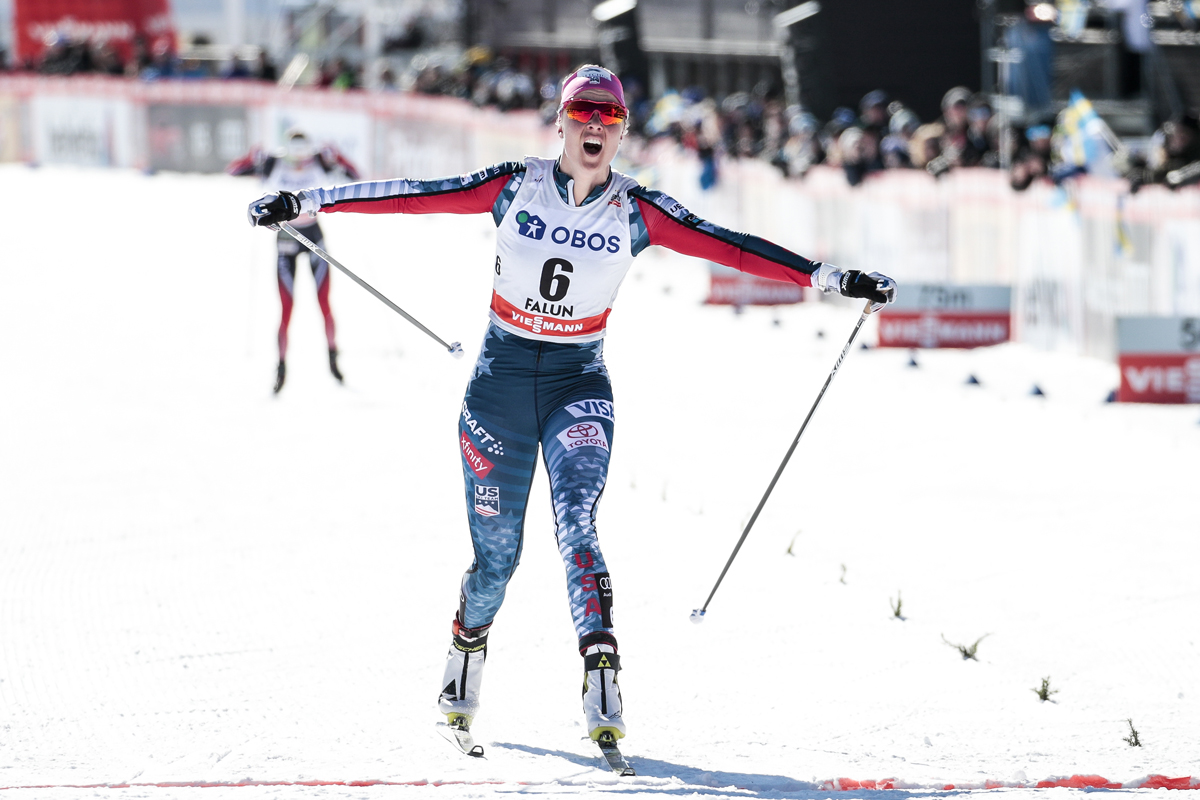
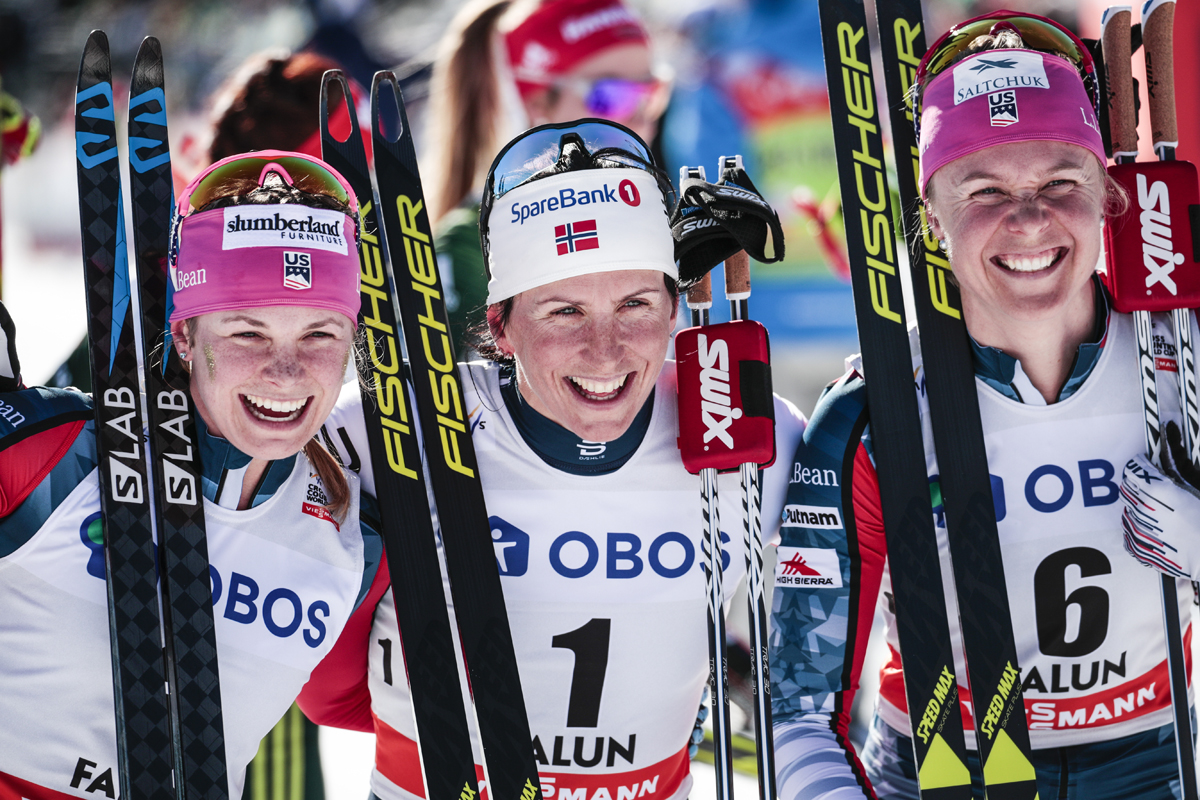
The women’s 10 k freestyle pursuit podium on the last day of 2018 World Cup Finals in Falun, Sweden, with Norway’s Marit Bjørgen (c) in first, and Americans Jessie Diggins (l) and Sadie Bjornsen (r) in second and third, respectively. (Photo: Fischer/NordicFocus)
FALUN, Sweden — NOR. USA. USA.
Looking at the results monitor, those were the tri-letter country codes that popped into the top three at the end of the women’s 10-kilometer freestyle pursuit at World Cup Finals on Sunday.
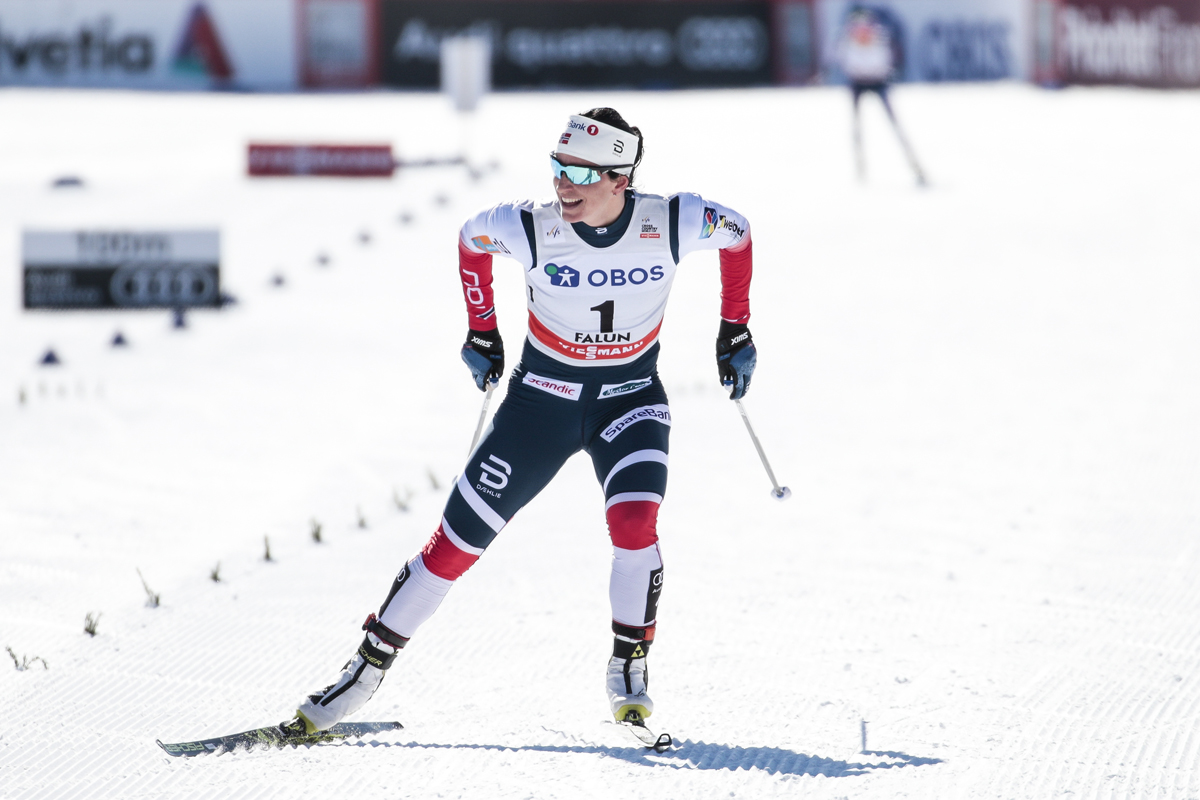
The “NOR” belonged to Marit Bjørgen of Norway, who ended her 2017/2018 World Cup season with yet another win. In Sunday’s pursuit, the 37 year old led from start to finish and ended where she started, in first after covering the course in a time of 24:18.9 minutes.
For many who follow the World Cup, a Norwegian name — like Bjørgen, who has won more than 110 individual World Cup races — at the top of the results is nothing new. All due respect.
But the pressure for Scandinavia to hold off an American entourage is mounting; Sunday’s race presenting itself as a prime example.
A 41-second gap separated American Jessie Diggins from Bjørgen by the time she flipped past the start wand, her characteristic cheek sparkles visible from the stands. As the third starter on course, Diggins had sewn shut the 5 seconds that the day’s second starter, Ingvild Flugstad Østberg of Norway, had on the American and within the first kilometer, was establishing herself as Bjørgen’s main threat.
“I had 45 seconds in the total time at Mördarbacken the first time,” Bjørgen reflected in a post-race interview with FasterSkier. “And then it was 30 and then 20, then I was a little bit stressed. I thought, ‘Aha, I have to work harder a little bit.’ I feel like on the uphill I was the same speed as Jessica, but she was better than me on the easier part of the tracks. And I’m really happy to make it. I had to push hard in the end.”
Norway’s Marit Bjørgen leading off the front during the women’s 10-kilometer freestyle pursuit on Sunday at World Cup Finals in Falun, Sweden. (Photo: Fischer/NordicFocus) (Photo: Fischer/Nordic Focus)
After catching Østberg, Diggins led the Norwegian and eventually dropped her by 17 seconds at 3.75 k. On Bjørgen, she had gained just over five seconds in time. By the 5 k mark, Diggins was a little less than 30 seconds back, and had put 13.4 more seconds into the race leader.
“I was grateful to feel so good today,” Diggins told FasterSkier. “We had amazing skis and that was really important. Especially on a course with so much gradual climbing and gradual working downhills, you needed to have good skis, and our techs delivered. And they gave us the tools we needed to have a good day.”
At the 7.5 k mark, 20 seconds separated the American from the win. By the time Diggins crossed the finish line in second, she was 16.7 seconds behind Bjørgen. The effort from Diggins gave her the fastest time of day in 23:54.4 minutes, which was 24.5 seconds faster than Bjørgen’s time.
“It’s a sport of patience,” Diggins said. “I feel like I’ve been coming into my own with the confidence to know that any race I start, I can be trying to fight for the podium and racing like I can win. Instead of racing like, ‘Oh, I’m going to try to just see what I can do,’ it’s like, ‘No, I’m going to try to win.’ ”
But Diggins was not the only American hunting and holding off Norwegians. Her U.S. teammate Sadie Bjornsen, who had gone out hot in Saturday’s race in hopes of a podium, earned it on Sunday in a sprint finish for third (+1:11.5) between herself and Norway’s Ragnild Haga and Astrid Uhrenholdt Jacobsen.
In the finishing stretch, Bjornsen, Haga and Jacobsen had gone head to head, with the American outlunging Haga — the gold medalist from this year’s Olympic 10 k state — by exactly half a second and beating Jacobsen by 1.3 seconds for the final spot on the podium.
American Sadie Bjornsen earning third in the women’s 10-kilometer freestyle pursuit on Sunday at 2018 World Cup Finals in Falun, Sweden. (Photo: Fischer/NordicFocus)
“Coming into the final stretch I was like, ‘OK, that is the last time you get to do the final stretch this year and make it count,’ ” Bjornsen told FasterSkier. “It ended up working out for me, and that turned into quite the dream day.
“I think the step I made this year is one step closer to being in a place where Jessie is racing right now,” Bjornsen continued. “To have a teammate who is just pushing the bar just every single day and making me believe that in order to be the best racer in the world, you have to have no fear. Jessie is a great example of that and it is certainly contagious.”
On Sunday, Bjornsen had started 21 seconds behind Østberg and 29 seconds ahead of Haga. By 7.5 k Haga had caught the group battling for third, which included Bjornsen, Finland’s Krista Pärmäkoski, Østberg, Sweden’s Charlotte Kalla, and Jacobsen. The group stayed together until the downhill back toward the stadium.
“I was like, ‘OK, I have to be smart here and keep pushing the pace hard enough that we do not get caught from behind, but conserve for that final sprint and then when I came into the sprint lap,’ ” Bjornsen reflected.
Along with being a podium threat in Sunday’s race, the Americans are also gunning full-speed ahead toward the top three in the overall, sprint or distance World Cup standings. On Friday, Sophie Caldwell of the U.S. claimed third in the season-long Sprint World Cup. On Sunday, Diggins stood on the podium in second in the Overall World Cup and third in the Distance World Cup.
“We are really showing that we are a skiing nation, and it’s taken so many years and so much hard work from a lot of people, but I think it’s so cool to show that we can be in the fight,” Diggins said.
The women’s 10 k freestyle pursuit podium on the last day of 2018 World Cup Finals in Falun, Sweden, with Norway’s Marit Bjørgen (c) in first, and Americans Jessie Diggins (l) and Sadie Bjornsen (r) in second and third, respectively. (Photo: Fischer/NordicFocus)
“It’s been a many year goal of ours to be ranked in the top three for the women’s team and we secured that for the first time today,” U.S. Ski Team Women’s Coach Matt Whitcomb told FasterSkier of his team’s best-ever Nations Cup ranking. “We’ve come into [past] finals, I believe, ranked third and then come out of finals ranked fourth. We’ve been fifth. And I think as an entire team, men and women combined, … I think we’ve finished fifth, which would be exceptional. It was really quite an achievement for both our men’s and women’s teams.”
In the decade leading up to the past two World Cup seasons, podiums from American women peppered the circuit, but predominantly in sprints. Kikkan Randall holds most of those, having recorded 28 individual podiums before 2016, only five being in a distance greater than 2 k. Sophie Caldwell broke through with a third-place sprint finish in 2014.
American Liz Stephen had also reached the World Cup podium four times in distance races prior to 2016 — twice outright and twice for time of day.
From 2016 on, the number of podiums that have gone to U.S. women has only increased. Caldwell earned three podiums this season alone. Diggins has racked up a total of 14 individual World Cup podiums since her first (which was also a first place) in 5 k freestyle in Toblach, Italy, in 2016. Bjornsen now has a total of five podiums over the course of two seasons. Stephen added two more to her name, one time of day and one outright, and Randall another top three in this past December’s Davos sprint.
Whitcomb was quick to point out that much of this success, started with U.S. Ski Team veterans Randall and Stephen, who skied the last World Cup races of their careers on Sunday. Randall finished the race in 43rd (+4:33.3) with the 29th-fastest time of day, and Stephen 50th (+4:57.2).
“Honestly I start crying every time I think about it,” Whitcomb said, referring to the fact that Randall and Stephen will be retiring after this season. “It’s been a day that I have feared for my whole career, basically since I started working with Kikkan and Liz, really since they started working with us.
“I know we are not saying goodbye forever, but definitely we are saying goodbye in a certain capacity to two of the most important people that have ever set foot on the U.S. Ski Team,” he added.
The two spoke with Fasterskier after their last race together, perhaps fitting as Stephen joined the team in 2006, only a year after Randall. The pair have worked with Whitcomb for the past 12 years.
“As your whole career flashes before your eyes, it’s the people that are the best part,” Randall, 35, said.
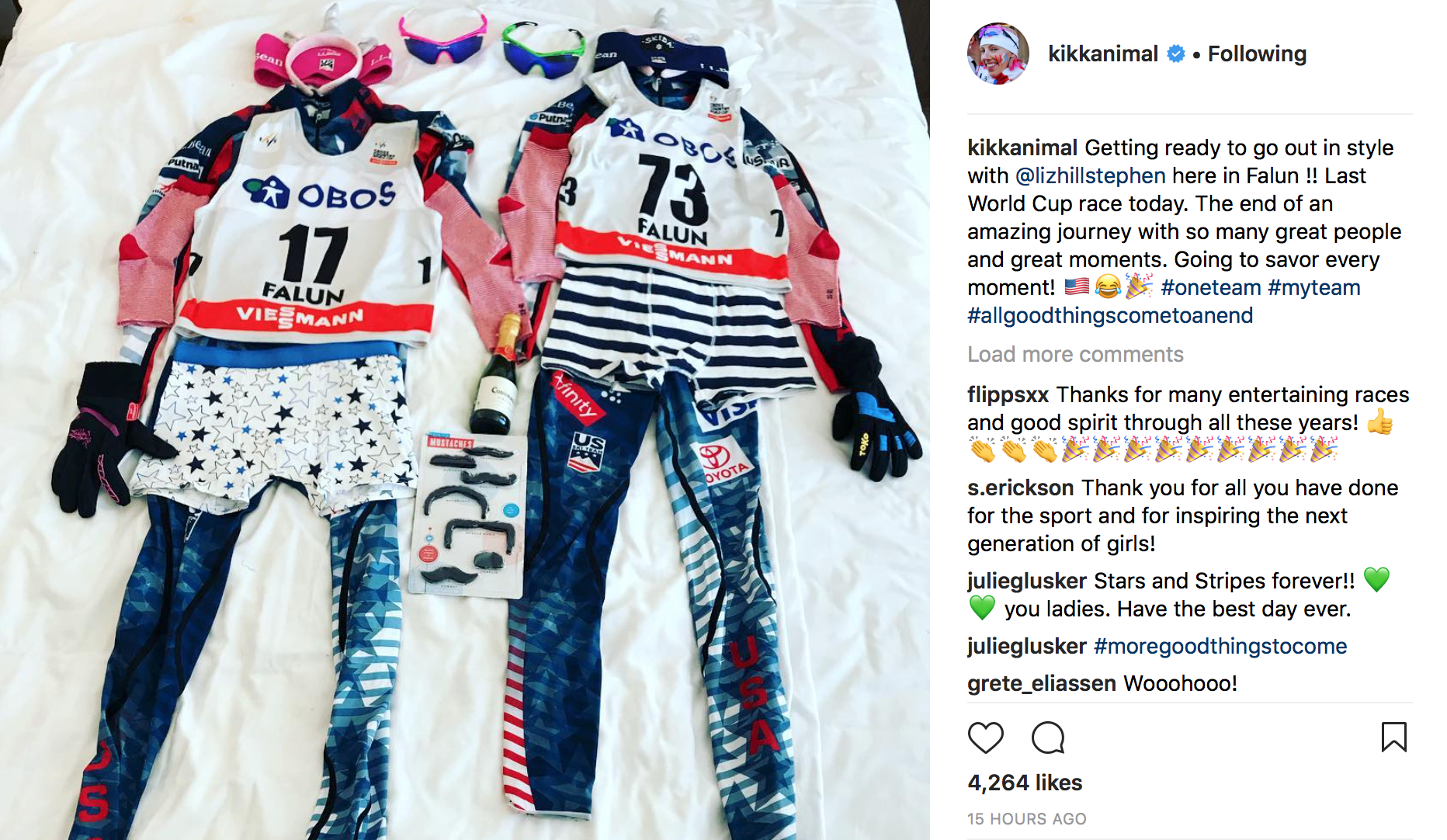
In their career final World Cup race on Sunday, both Randall and Stephen donned unicorn headbands, pink arm warmers and spandex boyshorts inscribed with the words “Thank You!!” across the backend. During their pre-race morning run, they felt something was missing and made a spur-of-the-moment stop at a store to purchase a few “costume pieces” for the race. Their outfits sparked smiles as they completed the race, and there was no denying the message they hoped to send off as they departed the ski-racing world: the energy and enthusiasm of a strong team.
(Article continues below)
The last-race outfits worn by Kikkan Randall and Liz Stephen for Sunday’s World Cup Finals pursuit. (Photo: Kikkan Randall/Instagram)
“We are all most proud of the team we built,” Randall said. “To see it at such a good point and to know just because we are leaving the scene doesn’t mean it’s going away; these girls are going to continue to carry the torch, the young girls coming in.”
“I would second that,” Stephen, 31, said. “One of the main things was that we wanted to leave a program that sustain itself, and I think that we both feel very happy and confident that that is going to happen. Like Kikkan said, Jessiewon more points this year alone than we used ever see in an entire season men and women combined, you know, 10 years ago, and so I think that is a testament of the success that we have been able to create for one another.”
Both Randall and Stephen were also given the opportunity to take a victory lap after the race, alongside Finland’s Aino-Kaisa Saarinen and Sweden’s Anna Haag, who sported a Disney Princess bath towel as a superhero cap, as well as a bejeweled crown (in an interview with FasterSkier, Haag explained the outfit had not been coordinated with the Americans, but was rather a coincindence. The Americans and Swedish skier are longtime friends and shared a nonalcoholic-champagne beverage in the finish area after the race).
“I certainly wasn’t expecting a send-off like that,” Stephen said. “That was really special, that the four of us were able to do that together.”
“I have done this 20 years … and I have raced my goals and even more,” Saarinen told FasterSkier. “Actually this skiing family is the thing what I’m going to miss the most.”
Also racing for the U.S. on Sunday, Caitlin Patterson finished the pursuit in 35th (+3:58.4) with the 22nd-fastest time of day, Caldwell finished in 36th (+4:00.7), Rosie Frankowski 46th (+4:41.3), Kaitlynn Miller 56th (+6:13.8), and Ida Sargent 57th (+7:06.4).
“It’s been a really unexpected good season, and I am really happy with it,” Miller said. “Today was awesome seeing Sadie and Jessie finish out the World Cup season like that.”
The Canadians were led by Cendrine Browne, who finished 39th (+4:14.4) with the 27th-fastest course time, followed by Emily Nishikawa in 48th (+4:43.7), Dahria Beatty in 54th (+6:04.3) and Zina Kocher in 60th (+9:28.4).
“I love the course, it is perfect for me,” Browne wrote in an email to FasterSkier. “Steep up hills and one skate sections are what I prefer best! I was suprised yes!!! All season I was trying so hard to get into the top 30. Maybe I was trying to hard and putting to much pressure on myself. Today, I decided to have fun and to forget everything and it just happened!”
“I am really happy about my season even if it was filled with so many emotions,” Browne continued. “Going to the Olympics and placing 33rd at my first Olympic race is definitely a highlight. Also, my 36th place in Holmenkollen is a huge accomplishment for me. Even if I fell twice and should have been in the top 30, it was an awesome race. And today’s 27th place is definitely the best thing that happened this season. Finishing the season like this fills my heart with joy and hope for next season.”
***
Norway’s Marit Bjørgen finishing first in the women’s 10 k freestyle pursuit at 2018 World Cup Finals in Falun, Sweden, while American Jessie Diggins (in background) chases for second place. (Photo: Fischer/NordicFocus)
Notes: While there has been a lot of discussion about retirements, Bjørgen isn’t saying it’s over.
“I want to finish [the season] in a good way, but I think I’ve been at my very best. I’ve passed it [my peak],” Bjørgen said in a loosely translated interview with NRK on Friday.
So will she race next winter? Bjørgen estimated she would need to train at least 850 hours if she wanted to compete with her teammate Therese Johaug, who will be returning to the World Cup next season.
“It’s going to be a lot of training, and you have to prioritize a lot. That’s the toughest thing,” Bjørgen said. “But when I’m at work, it’s no problem. I’m here to do the job. Should I do one more year, I will not do it halfway [half-hearted].”
Norway’s Marit Bjørgen celebrates her overall win in the last race of 2018 World Cup Finals, the 10 k freestyle pursuit, on Sunday in Falun, Sweden. (Photo: Svenska Skidspelen/Instagram)
FIS Cross Country World Cup Finals (Falun, Sweden): 10/15 k freestyle pursuits
In the last women’s race of the World Cup season, U.S. Ski Team members Jessie Diggins and Sadie Bjornsen made it one they’ll remember for a long, long time as Diggins raced to second in the 10-kilometer freestyle pursuit and Bjornsen outlasted two Norwegians for third. The two finished the World Cup Finals mini tour in second and third, respectively, behind Norway’s Marit Bjørgen who won it in 24:18.9 minutes.
Bjørgen started with a 36-second cushion to her Norwegian teammate Ingvild Flugstad Østberg in second. Diggins started third, 41 seconds back, just ahead of Finland’s Krista Pärmäkoski in fourth (+43.0), based on their cumulative performances over the last two days of the mini tour (skate sprint and 10 k classic mass start).
While Østberg, Diggins and Pärmäkoski formed a chase pack, Diggins dropped them in pursuit of Bjørgen on the first lap. The American continued to push the pace throughout the three-lap race, coming within 16.7 seconds of Bjørgen at the finish.
Meanwhile, during the pursuit, a chase group of five, which included Bjornsen, caught Østberg and Pärmäkoski. The group of seven dwindled to three on the last two climbs, where Bjornsen and Norway’s Astrid Uhrenholdt Jacobsen and Ragnhild Haga broke away in a race for third.
The three were even entering the finishing stretch, where Bjornsen then beat them in a final 100-meter push to the line. Bjornsen claimed third (+1:11.5) for her fourth podium of the season and first in a distance skate race. Haga followed in fourth (+1:12.0) and Jacobsen fifth (+1:12.8), while Pärmäkoski placed sixth (+1:16.2), Sweden’s Charlotte Kalla seventh (+1:17.9), Østberg eighth (+1:19.0), Sweden’s Jonna Sundling ninth (+1:30.5) and Ebba Andersson 10th (+1:44.7).
Bjornsen now has five-career individual World Cup podiums to her name, and this is the first in a skate race longer than 5 k.
Diggins clocked the fastest time of day in 23:54.4, while Haga was second-fastest (+10.7) after starting the race in 17th. Bjørgen’s time ranked third, Jacobsen was fourth-fastest and Bjornsen fifth-fastest.
Diggins’s performance elevated her to second in the Overall World Cup standings, just 40 points behind Norway’s Heidi Weng (who placed 18th in the pursuit) in first for the second-straight year. Østberg slipped to third overall, 22 points behind Diggins. In the Distance World Cup, Weng took the title by 63 points over Østberg in second, while Diggins was another 32 points back in third.
Bjornsen ended up sixth in the Overall World Cup and 10th in the distance standings.
Also for the U.S., Caitlin Patterson raced from 46th at the start to 35th (+3:58.4) with the 22nd-fastest time of day, Sophie Caldwell placed 36th (+4:00.7), Kikkan Randall finished her last World Cup race in 43rd (+4:33.3) with the 29th-fastest time, Rosie Frankowski placed 46th (+4:41.3), Liz Stephen 50th (+4:57.2) in her final World Cup race, Kaitlynn Miller 56th (+6:13.8), and Ida Sargent 57th (+7:06.4).
For Canada, Cendrine Browne picked off 10 places to finish 39th (+4:14.4) with 27th-fastest time of day, Emily Nishikawa finished 48th (+4:43.7), Dahria Beatty 54th (+6:04.3), and Zina Kocher 60th (+9:28.4).
The men’s 15 k freestyle and 2018 World Cup Finals podium, with Russia’s Alexander Bolshunov (c) in first, Canada’s Alex Harvey (l) in second and Switzerland’s Dario Cologna (r) in third. (Photo: Svenska Skidspelen/Instagram)
In the men’s 15 k freestyle pursuit that followed, Russia’s Alexander Bolshunov started 38 seconds clear of Norway’s Johannes Høsflot Klæbo in second, and Sweden’s Calle Halfvarsson and Italy’s Federico Pellegrino headed out together another second later in third and fourth, respectively.
Norway’s Martin Johnsrud Sundby started the race in seventh (+53.0), and Switzerland’s Dario Cologna followed in ninth (+56.0), while Canada’s Alex Harvey started 1:16 back in 18th.
While Bolshunov skied the entire race on his own and won the weekend mini tour in 35:03.3, a number of racers battled for second, with Sundby moving into second in the chase pack, ahead of seven others, less than 2 k in. Several skiers found themselves at the front of that group, including Cologna, Halfvarsson, and even Harvey (with Harvey leading the chase at 9.3 k), while the time gap to Bolshunov grew.
With about 2 k to go, the group was down to six. Harvey attempted an attack, but Cologna matched him. Then, on one of the course’s final climbs, Cologna made his move to get a slight gap, but lost his balance slightly on the downhill, allowing Harvey to catch back up.
With one last uphill to go, Harvey was in the driver’s seat in second, Cologna in third and Sundby in fourth. That order held to the finish, with Harvey claiming second, 47.1 seconds behind Bolshunov, Cologna placing third (+47.5) and Sundby fourth (+48.7). Just behind them, Russia’s Maxim Vylegzhanin crossed in fifth (+50.3), ahead of Norway’s Hans Christer Holund in sixth (+51.7), Halfvarsson in seventh (+54.1), and Norway’s Sjur Røthe in eighth (+54.9). Nearly 10 seconds later, Norway’s Niklas Dyrhaug outlunged two Russians for ninth (+1:04.1): Denis Spitsov in 10th (+1:04.2) and Andrey Larkov in 11th (+1:04.3).
Harvey, who finished the season in fourth in both the Overall and Distance World Cup standings, won the time of day in 34:34.3. Holund had the second-fastest course time, 1 second off Harvey’s time, after starting the race in 22nd.
Harvey’s Canadian teammate Devon Kershaw tallied his fifth-straight distance top 30 in 28th (+2:21.9), after starting 27th, and Graeme Killick finished 56th (+4:33). Julien Locke did not start.
For the U.S., Erik Bjornsen clocked the 22nd-fastest time en route to 38th (+3:10.4), after he started 51st. Simi Hamilton improved 10 places to finish 49th (+4:07.8), Scott Patterson and Paddy Caldwell worked together to move up from 72nd and 73rd, respectively, to 58th (+4:41.5) and 59th (+4:41.6), respectively, at the finish. Kevin Bolger placed 60th (+4:43.5) and David Norris 64th (+5:09.8).
While Klæbo slipped from second to 25th in the pursuit (+1:45.8), the Norwegian still won his first Overall World Cup by 119 points over Cologna in second. Sundby placed third, 29 points out of second and 82 points ahead of Harvey.
Cologna claimed the Distance World Cup Crystal Globe by 41 points over Sundby, and Holund reached the Distance World Cup podium in third, 58 points out of second and just 5 points ahead of Harvey in third. France’s Maurice Manificat had been third heading into the final day of racing, but finished the pursuit in 26th (+2:11.9) and dropped to fifth in the final distance rankings.
In her last race of the season, Susan Dunklee returned to the podium. The American started fourth in Sunday’s 10-kilometer pursuit at the International Biathlon Union (IBU) World Cup in Oslo, then made her way into third by the final shooting stage. Dunklee shot 18-for-20 (1+0+1+0) and finished 29.5 seconds behind the winner, Darya Domracheva of Belarus, who missed two targets as well (1+0+1+0) and finished first in 30:37.4. Slovakia’s Anastasiya Kuzmina started the race in first (ahead of Domracheva in second) and ended up second (+9.2) with four penalties (0+2+2+0).
Canada’s Julia Ransom and Rosanna Crawford finished together in 51st and 52nd, respectively, both 4:52.4 out of first. Ransom had four penalties (0+1+1+2) while Crawford missed five (1+3+1+0). Emma Lunder did not finish.
In the men’s 4 x 7.5 k relay on Sunday, Norway’s team of Lars Helge Birkeland, Henrik L’Abee-Lund, Tarjei Bø, and Johannes Thingnes Bø used just three spare rounds to clean eight shooting stages and took the win in 1:13:13.7 hours. Austria finished 50.3 seconds back in second place, with Dominik Landertinger, Felix Leitner, Simon Eder, and Julian Eberhard, with a total of five spares. Russia’s Maxim Tsvetkov, Anton Babikov, DmitryMalyshko, and Anton Shipulin raced to third (+56.9) with just four total spares.
The U.S. men placed seventh (+2:01.5) with eighth spares, after Lowell Bailey put the team in seventh on the first leg. Sean Doherty skied them up to sixth on the second leg, Tim Burke slipped to 10th on the third leg, and Leif Nordgren posted the seventh-fastest anchor leg to put them in seventh at the finish.
Canada placed 16th (+5:42.4) with Christian Gow, Scott Gow, Brendan Green, and Macx Davies. The team had been in 19th at the final exchange, but Davies skied them up to 16th with the 14th-fastest anchor leg. In all, they used 10 spares.
American Jessie Diggins (5) and Norway’s Marit Bjørgen (3) and Maiken Caspersen Falla lead early in the women’s 10 k classic mass start at World Cup Finals in Falun, Sweden. (Photo: Fischer/NordicFocus)
FALUN, Sweden — To those watching, even to those racing, the winner was the woman who had led most of Saturday’s 10-kilometer classic mass start: Norway’s Marit Bjørgen.
“Marit and Tiril [Udnes Weng], another Norwegian young girl, they were skiing really fast and I thought that they would be first and second,” Norway’s Ingvild Flugstad Østberg told FasterSkier after the race.
Seven minutes after the start gun, Bjørgen had moved to the apex of the field and there she seemed intent to stay.
No doubt, the 37-year-old Norwegian holds a close relationship with the 10 k classic event. Over the course of her World Cup career, she has amassed 31 podiums in the distance/discipline, 16 of those being in first place.
Last year in Lahti, Finland, Bjørgen was crowned the 10 k classic world champion, and she also holds the 10 k classic World Championships title from 2011. At the 2006 Olympics in Turin, Italy, she earned silver in the 10 k classic event. The next time a 10 k classic was featured at the Olympics, in 2014 in Sochi, Russia, she finished fifth.
With substantial backing, Bjørgen seemed well on her way to another 10 k classic win at 2018 World Cup Finals on Saturday in Falun. Finland’s Krista Pärmäkoski may have not looked like a real threat — until the finishing stretch.
In the corner before the final 100 meters, Pärmäkoski pulled up just behind Bjørgen. Just two kilometers earlier, the Finn had been skiing two seconds off of the Norwegian’s pace.
Backtracking to the race’s halfway mark, Pärmäkoski had been even farther behind Bjørgen. Three seconds had separated the chase pack from Bjørgen and Tiril Udnes Weng, who led the race at 5 k. At that point, Sweden’s Charlotte Kalla had been spearheading the charge to close down the gap, while Pärmäkoski skied in fifth, almost one second back from Kalla and four seconds back from Bjørgen.
Even earlier in the race, when Bjørgen made her move to the front at 3.75 k, Pärmäkoski, who had started in bib 32, was 19 places out of first.
“I had to start so much behind the others,” Pärmäkoski told FasterSkier, referring to her bib number, which was based on her finish in the opening race of the World Cup Finals, Friday’s freestyle sprint.
“But my body worked very well today … and I had really good grip and glide [with] my skis,” Pärmäkoski continued. “I passed the other athletes when we got to the downhill, the long downhill.”
By the descent heading back toward the stadium, Pärmäkoski had passed Tiril Udnes Weng and moved around Kalla. Close to two seconds stood between her Bjørgen and Østberg, the latter of which had moved into second at the 7.5 k mark.
“I didn’t dare to look back and see how many girls were keeping up with [us] in front,” Østberg said.
If she had looked back, she would have seen the Finn firing on all cylinders.
By the descent back toward the stadium, Pärmäkoski had caught Østberg and hunted her next Norwegian. She closed in on Bjørgen in the corner just before the finishing stretch. Fifty meters to go and Pärmäkoski pulled up just alongside Bjørgen.
Finland’s Krista Pärmäkoski (32) edges Norway’s Marit Bjørgen for the win in the women’s 10 k classic mass start at 2018 World Cup Finals in Falun, Sweden. (Photo: Fischer/NordicFocus)
The two approached the finish line in tandem. Pärmäkoski, however, was stronger in the final double-pole push and nabbed the win by just 0.2 seconds over Bjørgen in a time of 26:00.5 minutes. Bjørgen took second behind the Finn in a time of 26:00.7.
“I thought that maybe I was stronger than her and I feel that I was doing a good finish, but she was stronger than me,” Bjørgen told FasterSkier, referring to the sprint finish between Pärmäkoski and herself.
“I thought Marit was gonna take it on the last 100 meters, but Krista was too strong,” said Østberg, who finished 5.1 seconds back in third.
The win is Pärmäkoski’s third 10 k classic title in a row this season. Her first came in Planica, Slovenia –which was also her first World Cup win — and her second came two weekends ago in front of a home crowd in Lahti.
For Østberg, the World Cup podium was her first since January.
“It’s been a while since I’ve been on the podium individually, in an individual race, so I was just so happy that I managed to finish in third place,” Østberg said.
Less than 10 seconds behind her, a pack of five surged to the finish line, with Sweden’s Ebba Andersson crossing in fourth (+14.5), Japan’s Masako Ishida fifth (+14.8), Kalla in sixth (+15.2), Austria’s Teresa Stadlober in seventh (+15.4) and American Jessie Diggins in eighth (+15.5). Exactly 1 second separated the five-skier spread, with Diggins bookmarking the tail end.
American Jessie Diggins leading the pack up an early climb with Norway’s Kathrine Rolsted Harsem and Marit Bjørgen just behind during the women’s 10 k classic mass start at World Cup Finals in Falun, Sweden. (Photo: Fischer/NordicFocus)
“I was a little bit bummed I didn’t quite have the same feelings in my body that I’ve been having,” Diggins told FasterSkier. “It wasn’t a bad race at all … I just was struggling to find that last gear. I know it’s there because it was there in the sprint yesterday. So I am just going to go hard tomorrow and see what I can do.”
Bjørgen currently leads the World Cup Finals mini tour and will be the first skier on course in Sunday’s 10 k freestyle pursuit. Starting 36 seconds after her will be Østberg in second, then Diggins, 41 seconds back in third.
In the Overall World Cup standings as well, Diggins ranks third with 1226 points. The American is 106 points behind Østberg in second and 213 points behind Norway’s Heidi Weng in first. At most, with a win, Diggins could score 200 points on Sunday. Behind her, Pärmäkoski is 112 points back in fourth.
“I am just excited to keep pushing hard and see if I can break through and get some new firsts for me,” Diggins told FasterSkier. “I am fighting for a good spot in the overall [World Cup] and in the overall distance [ranking] as well … it’s fun to try to do something new and definitely motivates me to keep fighting really hard. It kept me pushing for every second today.”
Diggins is also third in the Distance World Cup standings, 64 points behind Østberg in second and 43 points ahead of Pärmäkoski in fourth.
Rounding out the remainder of Saturday’s top 10 was Norway’s Astrid Uhrenholdt Jacobsen in ninth (+24.8) and Finland’s Kerttu Niskanen in 10 (+26.2). Just 0.1 seconds outside of the top 10 was American Sadie Bjornsen in 11th (+26.3).
American Sadie Bjornsen skiing just behind Germany’s Katharina Hennig during the women’s 10 k classic mass start at 2018 World Cup Finals in Falun, Sweden. (Photo: Fischer/NordicFocus)
This World Cup season has marked somewhat of a breakthrough season for Bjornsen, with the 28 year old earning her first distance podium and two classic sprint podiums.
On Friday, she appeared to be pulling for a podium again. Bjornsen charged hard to the front of the pack in bib 8, three bibs back from Diggins, who led the first 2 k of the race before Bjørgen took over.
When asked about the risk involved with taking such a race tactic and why she chose to do so, Bjornsen was thoughtful. Reflecting on her recent strong results in sprint qualifiers, she explained that she was testing “what can happen if I have no fear, if I have no fear of failing.”
“I keep trying to tell myself that in the distance races … any amount of fear really pulls you back from that podium potential. So this last week I made it a goal of mine to try to race from the gun and see if I can hang on,” Bjornsen said.
With this being the final weekend of World Cup racing until next season, Bjornsen also saw it as an opportune time for her to try going out harder at the start. In a sense, test her pacing in an insular way.
“It’s the best time of the year [for that],” Bjornsen said of a hot start. “You have nothing to lose. I definitely am fighting in the overall [World Cup] for places, too, but at the same time it’s not fighting for a podium. So if I absolutely explode, like I did today in the middle of the race, there is just no failing with that.
“I am learning how to [ski in the front] this year and next year I’m ready to come back and take that risk more often,” she added.
Bjornsen is currently ranked eighth in the Overall World Cup standings with 799 points. Ahead of her is Kalla in seventh (828), Bjørgen in sixth (835), and Stadlober fifth (836). In the distance standings, Bjornsen is 10th. She will start Sunday’s pursuit in sixth, 57.3 seconds after Bjørgen.
American Kikkan Randall tucking during the women’s 10 k classic mass start at 2018 World Cup Finals in Falun, Sweden. (Photo: Fischer/NordicFocus)
Also competing for the U.S. on Saturday was Sophie Caldwell, who placed 41st (+1:36.1), Rosie Frankowski in 44th (+1:43.7), Caitlin Patterson in 47th (+1:54.8), Kikkan Randall in 57th (+2:34.1), Kaitlynn Miller in 64th (+2:50.7).
In her final weekend of World Cup racing, Randall explained Saturday’s result was not quite where she hoped to be, partly as her body still felt the effects of Friday’s sprint effort.
“I always just like to end on a good note feeling like I just really raced hard and [with] regards to the results, feel competitive,” she said. “Yesterday was more along those lines, today was just hard, but it’s still good to be up here. Such a beautiful day for racing, perfect temperature, good tracks, good skis.”
Emily Nishikawa led Canada in 36th (+1:31.1), followed by Cendrine Browne in 50th (+2:05.7), Dahria Beatty in 61st (+2:46.6), and Zina Kocher in 69th (+6:12.0).
Norway’s Marit Bjørgen celebrates her seventh Holmenkollen 30 k victory on Sunday in Oslo, Norway, ahead of American Jessie Diggins, Norway’s Ragnhild Haga (not shown) and Sweden’s Charlotte Kalla. (Photo: Fischer/NordicFocus)
*Update: This article previously stated that Jessie Diggins was the first American woman to reach a podium at the Holmenkollen. Diggins is actually the first American woman to reach the Holmenkollen podium in the 30 k distance, second woman to podium at a Holmenkollen in history. In 1980, American Allison Owen reached the podium in the 10 k distance.
OSLO, Norway — Some pointed to the broadcast screen in disbelief. Others began waving their Norwegian flags with revitalized vigor. Twenty minutes earlier, Norway’s Marit Bjørgen appeared to be out of the running for another win in the women’s 30-kilometer mass start at Holmenkollen.
She had lost nine seconds to the leaders by the 11 k mark and another 17.9 seconds had dissipated between her and the the leaders as they passed 13.3 k. A little over the halfway point, at 16.3 k, the 37-year-old Bjørgen was down 36 seconds.
For any spectator familiar with Bjørgen’s race tactics, she does not favor come-from-behind style skiing. In this year’s Olympic 30 k classic mass start, she pulled away from the field in the first 8 k and went on to claim gold by a close to a two-minute gap.
Exactly one year ago, in the 2017 Holmenkollen 30 k classic, she had put 33 seconds into the field by 8 k, tripling that in the following 10 k, before crossing the finish line more than two minutes ahead of the rest of the field. If racing to win, Bjørgen usually starts by burying the competition.
Sweden’s Charlotte Kalla leads American Jessie Diggins and Norway’s Ragnhild Haga during the Holmenkollen women’s 30 k freestyle mass start at the World Cup in Oslo, Norway. (Photo: Fischer/NordicFocus)
So when Sunday’s top three — Sweden’s Charlotte Kalla, Norway’s Ragnhild Haga and American Jessie Diggins — broke free, the predictions for the podium went with them.
“I thought I was fighting for the fourth place,” Bjørgen said at a post-race press conference.
With Bjørgen out of the driver’s seat, the attention from the teleprompter and crowd turned to Diggins, Kalla and Haga. For the most part, the three skied in a line, with Kalla and Diggins exchanging leads.
Still anytime the Swede pulled at the front, her effort appeared to be a byproduct of Diggins. Every uphill churn from the Swede seemed like an attempt to stave off the American. Diggins continually reinstated herself ahead of Kalla in first: stars and stripes unmistakably spearheading the way.
On a course that is fabled for Norway, in a sport that is historically Scandinavian, the U.S. skier repeatedly put the iconic suits of Sweden and Norway behind her. But this seemed to be more than just the dogged-skiing characteristic of Diggins’s race style. The 26-year-old Minnesota native was not just being gutsy. She was making a point.
“I think there has been this myth that Americans, OK, maybe they can win short distances, and maybe Jessie can win a 5 k but there is no way she can hang in a 30 k,” Diggins told FasterSkier during an in-person interview after. “I was setting out to debunk some myths today.”
For the first 8 k, Diggins charged the field of 54 skiers. Along with Kalla, she spurred the lead group’s gap that formed at the 13 k mark. In another 5 k from there, she had broken free of Bjørgen. Without looking back, Diggins was chasing down a Holmenkollen master head on.
“Maybe it wasn’t smart to be leading so much, but I was thinking this is my only shot and so I got to go for it,” Diggins said. “It was an incredible feeling to be leading the Holmenkollen … for me, trying to be competitive in every race that I enter has been a goal for a long time. I don’t want to be a specialist, I want to be a medal threat in every race that I do.”
As Diggins continued to pose a threat in the front, danger lurked behind. Bjørgen cut through the course, the dreaded dorsal fin gradually on the rise.
At 18.3 k, the gap from Bjørgen to the leaders was 32 seconds. In two kilometers, that was reduced to 26 seconds. Another 2 k and Bjørgen was four seconds closer. Over the course of 5 k, Bjørgen had cut her time back from the leaders in half; another 5 k still remained and 15 seconds separated her from the top three.
A wave of surprise and simultaneous excitement rolled over the spectators. Six seconds separated her from the lead group at 27 k. The Norwegian pushed closer and closer, and with 1.5 k left in the race, she was back in contact with the front pack.
“It was amazing that I did it,” Bjørgen said. “I haven’t thought it was possible … but when we passed the stadium, the last time, before we go off Gratishaugen … I thought … I wonder if they want to change skis and they didn’t.
Norway’s Marit Bjørgen leading teammate Astrid Uhrenholdt Jacobsen in the Holmenkollen 30 k freestyle mass start at the World Cup in Oslo, Norway. (Photo: Fischer/Nordic Focus)
At 13.3 k Bjørgen stopped to switch skis, as did her Norwegian teammate Astrid Uhrenholdt Jacobsen. Kalla, Diggins and Haga did not. After the top three bypassed the ski exchange, one thing was on the Bjørgen’s mind.
“I thought I had to push hard,” Bjørgen said.
Fueled by the energy of her home crowd, Bjørgen went on to pass Haga, Diggins and Kalla in the final kilometer. Alone, she raced toward the final stretch and crossed the finish line first in a time of 1:18:12.4 hours, earning her seventh Holmenkollen title in historic fashion. She now also holds the record for most Holmenkollen victories of any woman.
“I haven’t won a competition like this, so it’s all so very special,” Bjørgen said. “To win at Hollmenkollen … for sure it’s the biggest you can do after the World [Championships] and the Olympics.”
Crossing 3.6 seconds behind Bjørgen was Diggins in second place. She became the first American woman to reach the podium at Holmenkollen in the 30 k distance. 1980, American Allison Owen reached the podium in the Holmenkollen, which was raced as a 10 k.
“I didn’t know who it was [chasing the top three] I just heard that the gap was shrinking,” Diggins said. “I felt I was just sprinting the last 4 k. That was my only shot. We didn’t change skis which maybe was a mistake, but also you make the best call that you can at the time.”
The Holmenkollen women’s 30 k freestyle mass start podium on Sunday in Oslo, Norway, with Jessie Diggins (l) in second, and Norway’s Marit Bjørgen (c) in first and Ragnhild Haga (r) in third. (Photo: Fischer/Nordic Focus)
While she held off Haga and Kalla, those two battled for third. Haga outlunged Kalla by a just one-tenth of a second for the final spot on the podium (+4.3).
“I am very happy with my sprint, my finish against Charlotte,” Haga said. “I regretted that we didn’t switch skis when I heard that Marit caught many seconds there, but suddenly she just came up and, yeah, she is always there when it matters. So Marit is amazing today as well.”
Rounding out the women’s top 10 was Kalla in fourth (+4.4), Jacobsen in fifth (+11.6), Ingvild Flugstad Østberg in sixth (+1:39.5), Finland’s Krista Pärmäkoski in seventh (+1:51.7), Germany’s Stefanie Böhler in eighth (+2:10.2), Austria’s Teresa Stadlober in ninth (+2:11.6) and Sweden’s Ebba Andersson in 10th (+2:11.9).
U.S. skier Sadie Bjornsen finished 11.5 seconds outside the top 10 in 12th (+2:23.4) in what she described as her “best Holmenkollen finish.”
“I was really looking forward to today. I had not too many awesome feelings lately,” Bjornsen told FasterSkier after. “I was just looking forward to the simplicity of a skate race. I had a ton of fun out there.”
American Kikkan Randall (19) leading Canada’s Cendrine Browne and Russia’s Alisa Zhambalova during the Holmenkollen women’s 30 k freestyle mass start on Sunday in Oslo, Norway. (Photo: Fischer/NordicFocus)
Following Bjornsen, U.S. skier Kikkan Randall placed 19th (+3:21.9) in what will be her final Holmenkollen race. The first time Randall raced at Holmenkollen was in 2007. As she reflected on her years of racing there, the 35-year-old Olympic gold medalist remained humble of the time she had spent on the historically challenging trail.
“This is probably one of the coolest places to race, with the atmosphere and the spectators,” Randall said. “It was definitely hard, but I really enjoyed it … there’s something that’s hard to put into words about pushing yourself over the course of an hour and twenty minutes. It just kind of feels good to finish a little bit empty.”
After a photo finish with French skier, Anouk Faivre-Picon, American Caitlin Patterson finished 28th (+4:13.1), just behind Faivre-Picon in 27th. Sunday’s race was Patterson’s second Holmenkollen freestyle race, and the 27-year-old Craftsbury Green Racing Project member was happy to spend the first two-thirds of it with a large group of racers that included Randall.
“This one was way better because I was actually in it. That other year I was just blown out,” Patterson said, referring to her previous Holmenkollen skate race, in 2015, when she placed 53rd. In last year’s Holmenkollen 30 k classic, she finished 36th.
“Today my goal was to stay more relaxed and as much as I wanted to stay with the lead pack, but not burn all the matches right at the start,” Patterson added.
“I switched my skis the last lap, with the snow starting to come down … and for better or worse, it did mean I lost the pack,” she continued. “But then I was able to ski with Anouk for the last lap and we reeled in that Norwegian and a Russian. … I always feel a lot better about races if I finish strong, whatever the place is.”
Also for the U.S., Rosie Frankowski, of Alaska Pacific University, finished in 31st (+4:45.4), 28.3 seconds outside the top 30.
Canada’s Cendrine Browne finished 36th (+6:16.1) followed by Emily Nishikawa in 44th (+7:36.1) and Dahria Beatty in 49th (+9:45.1).
For the U.S., Liz Stephen finished 51st (+10:01.7) and Kaitlynn Miller 53rd (+16:05.0).
Along with Randall, Stephen also completed her final Holmenkollen on Sunday. Stephen had her parents cheering her on after they made the trek to Norway to watch her race in person. Her closing words on her final time around the historic course were full of emotion, both happy and sad.
“I think this is actually the first race that I have ever looked at Matt [Whitcomb] in the eye during the race and thanked him for the feed and kept going,” Stephen, 31, said. “It’s bittersweet. It’s certainly not the way I was hoping to end it but … it was really special watching Noah [Hoffman] hug his dad yesterday.
“I mean this sport has been our life and it is hard to leave, but it is time,” she added, referring to her retirement at the end of the season. “And I am really lucky to have had such a good run with it. And to have an amazing team to let go forward.”
The Holmenkollen women’s 30 k freestyle mass start podium on Sunday in Oslo, Norway, with Jessie Diggins (l) in second, and Norway’s Marit Bjørgen (c) in first and Ragnhild Haga (r) in third. (Photo: FIS Cross Country/Twitter)
FIS Cross Country World Cup (Oslo, Norway): Women’s 30 k freestyle mass start
Marit Bjørgen, the Norwegian queen of distance cross-country events, racked up another victory at Holmenkollen in the women’s 30-kilometer freestyle mass start on Sunday for her seventh win in the World Cup’s ultimate distance event at the famed Norwegian venue. (She had previously won in 2005, 2010, 2012, 2014, 2015 and 2017).
But she did so in not-so-typical fashion. Instead of breaking the field mid-race and skiing to a comfortable win, like she did in the last race of the 2018 Olympics in PyeongChang, South Korea (a 30 k classic mass start), Bjørgen came from behind to win Sunday’s Holmenkollen 30 k and wasn’t able to let off too much before finish. She didn’t take the lead until less than a kilometer to go and put just enough time into her competition to take the win in 1:18:12.4 hours, while American Jessie Diggins outlasted the chase group of three to place second (becoming the first American woman to reach the Holmenkollen podium), 3.6 seconds behind Bjørgen. Norway’s Ragnhild Haga edged Sweden’s Charlotte Kalla by 0.1 seconds for third place (+4.3), while Kalla settled for fourth (+4.4).
The rest of the field was strung out, with Norway’s Astrid Uhrenholdt Jacobsen finishing fourth (+11.5) and Ingvild Flugstad Østberg nearly another 1 1/2 minutes back in fifth (+1:39.5). Finland’s Krista Pärmäkoski placed seventh (+1:51.7), Germany’s Stefani Böhler notched eighth (+2:10.2), Austria’s Teresa Stadlober ninth (+2:10.2), and Sweden’s Ebba Andersson 10th (+2:11.9). Less than a second behind Sweden’s Ida Ingemarsdotter in 11th (+2:22.8) was American Sadie Bjornsen in 12th (+2:23.4).
In the Distance World Cup standings, Diggins gained some valuable points to keep herself in third, now 63 points ahead of Pärmäkoski in fourth. Heidi Weng, who finished 18th on Sunday, still leads the distance standings by 104 points and Østberg is second, 51 points ahead of Diggins.
In the Overall World Cup, Weng leads by 153 points over Østberg. Diggins is another 104 points back in third, 100 points ahead of Pärmäkoski in fourth. At World Cup Finals next week in Falun, Sweden, a total of 300 points is up for grabs for the winners (50 for freestyle sprint, 50 for classic individual start, and 200 for freestyle pursuit).
The U.S. had three in the top 20 and four in the points (top 30) in Sunday’s 30 k, with Kikkan Randall in 19th (+3:21.9) and Caitlin Patterson in 28th (+4:13.1). Rosie Frankowski (Alaska Pacific University) missed the top 30 by about 28 seconds in 31st (+4:45.4), Liz Stephen placed 51st (+10:01.7) and Kaitlynn Miller (Craftsbury Green Racing Project) finished 53rd (+16:05.0).
Cendrine Browne led four Canadian women in 36th (+6:16.1), Emily Nishikawa was 44th (+7:36.1), Zina Kocher (Foothills Nordic) finished 47th (+8:52.0), and Dahria Beatty placed 49th (+9:45.1).
Germany’s Vanessa Hinz celebrates her first IBU World Cup win and podium in the women’s 12.5 k mass start on Sunday in Kontiolahti, Finland. (Photo: IBU/Biathlonworld)
IBU World Cup (Kontiolahti, Finland): Men’s and women’s mass starts
(Note: This rundown has been updated to include comments from Lowell Bailey and Rosanna Crawford.)
Germany’s Vanessa Hinz won her first International Biathlon Union (IBU) World Cup race (and achieved her first World Cup podium) and Austria’s Julian Eberhard won his first race of the season (and first mass start of his career) in the women’s 12.5 k and men’s 15 k mass starts on Sunday in Kontiolahti.
Germany’s Vanessa Hinz celebrates her first IBU World Cup win and podium in the women’s 12.5 k mass start on Sunday in Kontiolahti, Finland. (Photo: IBU/Biathlonworld)
Hinz shot an impressive 20-for-20 with the third-fastest range time and fifth-fastest shooting time to take the win in 35:47.9 minutes. Third after the first prone stage, she moved into second, then third after cleaning the next two stages. After knocking down her final five targets in the last standing, Hinz left the range almost 24 seconds ahead of France’s Anaïs Chevalier in second and 26 seconds ahead of Italy’s Lisa Vittozzi in third. Hinz stayed ahead of her challengers on the final loop, finishing 13.5 seconds clear of Vittozzi, who claimed second. Chevalier finished third, 16.8 seconds back, while Finland’s Kaisa Mäkäräinen was next across the line in fourth (+43.4) with a gap to Sweden’s Hanna Öberg in fifth (+1:02.1).
Vittozzi and Chevalier both cleaned the first three stages then had to ski a penalty lap after the last standing bout (0+0+0+1). Mäkäräinen missed three (1+0+1+1) yet skied the second-fastest course time on her home course, and Öberg missed two (0+0+2+0). The fastest course time of the day was clocked by Darya Domracheva of Belarus, who had to ski five penalty laps (0+1+1+3) and ended up 10th (+1:18.2).
“I always dreamed of shooting four times clean and today I did it,” Hinz, 25, said, according to an IBU press release. “I was so often close to the podium. I knew I could do it. Today, I said, ‘OK, let’s try it and if it works, it is OK … and if not there is another season waiting and other races.’ Now I am on top of the podium and it is crazy.”
Vittozzi, who placed fourth in the mass start at the 2018 Olympics, was glad to improve on a third-place finish in Friday’s sprint by placing second on Sunday.
“I have been third so many times and that was not satisfying for me,” Vittozzi said, one day after she won the mixed relay with her team in Kontiolahti. “Today I am very happy about my second place.”
For Chevalier, it was her first individual podium of the season and it came a day after she and Antonin Guigonnat won the single mixed relay. Chevalier, 25, was severely injured when she was hit by a car last spring, according to an IBU press release.
“I am very happy to be here today, because it was a very hard season,” she told the IBU. “I forgot how nice it is to be on the podium … I forgot that it was not easy, so I am very happy … I did my best on the last lap; [Vittozzi] was faster, but I am third and happy with that!”
Canada’s Rosanna Crawford shot 19-for-20 to place 13th (+1:25.9) with her only miss coming in the second prone stage (0+1+0+0). Her overall shooting and range times were 10th fastest of the 30-woman field, compared to her 26th-ranked ski time. Crawford had been in 11th after cleaning the final standing stage, then slipped two spots to finish 13th in her second mass start of the season.
“Since the skiing wasn’t feeling great today I made sure I was super focused in the range,” Crawford wrote in an email to FasterSkier. “I knew that was my only chance to get a good result today. My one prone miss was a bad trigger pull, but the rest were nice solid hits. I made sure to have a solid set up and then just trusted my rhythm and shooting.
“I knew that I wanted that top 15, so I just kept fighting and trying to stick with the women when they caught me,” she wrote of her last loop. “The last time up the wall I managed to stay close to [France’s] Anais Bescond, and hold off the two people behind me. Really happy to be in the top 15 again.”
Clare Egan was the lone American woman to qualify for Sunday’s mass start, and it was the second mass start of her career. She was on track for a top-15 result after missing just one target in the first three stages, but she had to ski three penalty laps on the last standing (0+1+0+3), which put her in 23rd by the finish (+2:05.6). Notably, she skied the 14th-fastest overall course time.
“I didn’t have quite the same energy level tonight as the last two days, but I still had the 14th rank course time and that means anything is possible in the race,” Egan wrote in an email to FasterSkier. “To put it in perspective, the winner of the race, Hinz, had the 13th rank, just 2 seconds faster than me. This is the first time I’ve felt totally comfortable skiing with the fastest women, and I certainly hope I can maintain this speed for one more week of World Cup racing.”
Egan was pleased with her 9-for-10 prone shooting and her clean standing stage (“which is the first time I’ve cleaned a standing stage in an individual race this entire year, believe it our not,” Egan wrote).
“But when I missed my second shot on the final stage, I let that throw me off my game, and really blew the rest of the stage,” she explained. “It’s so hard to keep 100% focus in every scenario, and I find it gets harder and harder towards the end of the race when I’m not necessarily the most lucid. I know that I have to work on so I have a goal to manage the final stage better next week and in the future.”
Her 23rd-place finish was one better than her previous World Cup mass start finish, which was 24th last season in Hochfilzen, Austria.
“In my only other mass start, which was last year at World Championships, I felt like an imposter,” Egan reflected. “Maybe because I was the first ‘reserve’ to get called up when one of the top women [did not start]. But this was totally different. I knew I deserved to be there today and was confident about competing with the other top women.”
“In my only other mass start, which was last year at World Championships, I felt like an imposter … This was totally different. I knew I deserved to be there today and was confident about competing with the other top women.” — Clare Egan (US Biathlon) on Sunday’s mass start
While the women raced Sunday night, the men’s 15 k mass start took place in the afternoon, when Eberhard passed the likes of France’s Martin Fourcade and Russia’s Anton Shipulin after a tangle late in the race to take the win.
The Austrian team celebrating Julian Eberhard’s fourth career victory, his first this season and his first in a mass start on Sunday after the IBU World Cup men’s 15 k mass start in Kontiolahti, Finland. (Photo: IBU/Biathlonworld)
The Austrian had cleaned the first two prone stages to move into third by the race’s halfway point, behind Germany’s Benedikt Doll and Arnd Peiffer in first and second, respectively. Eberhard missed one in the next standing stage, yet left the range in second, 15 seconds behind Peiffer (who cleaned) in first, while Doll missed one as well to slip into third, 19 seconds back.
With two loops to go, Fourcade was coming back from two early prone penalties and found himself in fifth after a clean standing stage, less than a second behind Shipulin in fourth. On the next standing stage, Fourcade cleaned to take the lead and left the range about five seconds ahead of Shipulin (who also cleaned) in second.
Eberhard missed one yet remained in contention in third, 17 seconds behind Fourcade. On the last loop, Shipulin caught Fourcade before the course’s notorious climb known as “The Wall”, and Eberhard closed on the two frontrunners as they ascended it. Still several seconds behind over the top, he caught Shipulin on the bridge before the stadium, but the two tangled skis and Shipulin fell. Eberhard stayed upright and pulled even with Fourcade, passing him to take the win in 38:04.8. Fourcade finished second (+6.9) and Shipulin third (+19.3).
Austria’s Julian Eberhard (l) and Russia’s Anton Shipulin after the finish of the men’s 15 k mass start the IBU World Cup in Kontiolahti, Finland. Shipulin fell when his skis tangled with Eberhard’s. While Eberhard raced to the win, Shipulin placed third. (Photo: IBU/Biathlonworld)
“I wanted to be in a sprint with all three, but the bridge is too small for this,” Eberhard said, according to an IBU press release. “I came up the bridge with too much speed. Anton and I were in the same track and there was an accident. I apologized to Anton at the finish but he said these things can happen and it was OK with him.”
“I hold no grudge against Julian,” Shipulin told the IBU. “This can happen in sports and is all fair … I am in good shape and want to preserve this and perform my best in the last World Cups.”
Fourcade explained that illness caused him to sit out Thursday’s sprint, and he was only able to train three hours this week.
“It is really difficult to race in this situation without any feeling or training,” Fourcade told the IBU. “I did not know what to expect today but I am quite satisfied. I would have liked to win, but I used too much energy trying to come back in the early laps and had no energy when it was time to attack.”
Behind them, Doll picked off one place on the final loop to finish fourth (+21.9), passing his German teammate Erik Lesser, who finished fifth (+23.9). Peiffer followed in sixth (+27.1) as Germany had three in the top six.
American Lowell Bailey raced to 14th (+1:06.3) with two penalties, both of which came in the standing stages (0+0+1+1). Bailey had been fourth after cleaning the second prone, 16 seconds behind Doll in first, but slipped to 10th after missing one on the next bout. He had to ski another penalty lap on the last stage, and left the range in 14th.
Overall, Bailey posted the 10th-fastest shooting time, 15th-fastest range time and 18th-fastest course time.
“I finally felt like I was back in the spot that I ended last season,” Bailey wrote in an email when asked about his consistency. “I felt controlled and able to keep the pace with the top of the field throughout the race. It was nice to be back in the mix.
“Although I would have liked to see this ski speed a few weeks ago, better late than never!” he continued.
Next week’s World Cup in Oslo, Norway, will be his last of the season and his career.
“After nearly two decades of international racing, Oslo will be my final World Cup as a U.S. Biathlete,” Bailey wrote. “I’m sure it will be emotional but I hope to end my World Cup career on a high note!”
Left to right: Finland’s Krista Pärmäkoski in second, Norway’s Marit Bjørgen in first and Sweden’s Stina Nilsson in third after the women’s 30-kilometer classic mass start at the 2018 PyeongChang Olympic Winter Games in South Korea. (Photo: Noah Hoffman)
PYEONGCHANG, South Korea — In the final stretch, the familiar Marit Bjørgen ceremony went down with no other skiers in sight and the Norwegian flag in her hand. The 37-year-old five time Olympian and mom is leaving these Games as the winningest Winter Olympian in history.
Prior to Bjørgen, Norwegian biathlete Ole Einar Bjørndalen was the most decorated Winter Olympian with 13 medals total. After earning a bronze in the Pyeongchang team sprint, Bjørgen surpassed Bjørndalen’s medal total by one. She added gold to her collection on Sunday after taking the win in the women’s 30-kilometer classic mass start. All told, Bjørgen now has 15 Olympic medals, eight of them gold.
Norway’s Marit Bjørgen on her way to gold during in women’s 30 k classic mass start, the last race of the 2018 Olympics in PyeongChang, South Korea. (Photo: Scott Patterson)
She claimed the win in the final race of the Olympics in 1:22:17.6 hours. Finland’s Krista Pärmäkoski claimed silver (+1:49.5) and Sweden’s Stina Nilsson earned bronze (+1:58.9).
Finishing just 1.5 seconds behind Nilsson and out of the medals ceremony was Norway’s Ingvild Flugstad Østberg in fourth (+2:00.4), Swednen’s Charlotte Kalla placed fifth (+2:57.2), ahead of Finland’s Kerttu Niskanen in sixth (+3:01.6).
American Jessie Diggins closed out her 2018 Winter Games in seventh (+3:37.2), while Norway’s Heidi Weng finished in eighth (+4:07.9). Austria’s Teresa Stadlober ended up ninth (+4:14.1), after skiing in second until a game-ending turn onto the wrong course, and Japan’s Masako Ishida claimed 10th (+4:20.8).
The 30 k classic is Bjørgen’s race. She’s masterfully dominant in the technique and peerless in the distance. In the post-race press conference, Bjørgen words about the women’s ultimate distance race were succinct.
“I think it’s easier to do a good 30 k when you are getting older,” Bjørgen said of her years of training load and its impact on distance preference. “You have lots of training behind you. I have ten years more training than Krista [Pärmäkoski], so then I think it’s a little bit different to do a 10 k than 30 k. I knew that this was my distance also. Today we can see.”
Here’s what we saw: A powerfully rhythmic Bjørgen pull away from an already diminished field. Her force of nature skiing began around 8 k, and by 11.25 k, barring any mishap, her 15th gold was secured.
“I wanted to try to be high speed from the beginning,” Bjørgen said. “I had perfect skis so I can do my technique very good, so I could relax on skis. After seven and a half kilometers, I looked behind me and see it was two, three girls behind me and I tried to push more. Also, after the longest downhill, I had five seconds. Then after one lap I had ten. I knew I had to speed up more, and I heard I had twenty and then thirty. Then I knew that this is my day. I have to ski well and then have all the speed ups. I had the good feeling in my body.”
Marit Bjørgen on the shoulders of her Norwegian teammates after winning the women’s 30 k classic mass start for her eighth-career Olympic gold medal in the last race of the 2018 Olympics in PyeongChang, South Korea. (Photo: Noah Hoffman)
Bjørgen made her Olympic debut at the Salt Lake Games in 2002. There, she won a single silver medal in the 4 x 5 k relay (with Bente Skari, Hilde Pedersen, and Anita Moen. She was 22 at the time). Bjørgen then went on to compete in the 2006 Torino Games, coming away once again with another silver — this time in the 10 k classic. Over the next three Olympics, Bjørgen amassed 13 more medals, eight of them in individual events.
Recognizing the relatively young talent around her on the podium (Pärmäkoski is 27 years old and Nilsson is 24), Bjørgen understood that as she steps down, others are primed to take her place.
“I had my best years from 30 to 37, and she is still not there so I think we will see lots of Krista in the future,” Bjørgen said.
While Bjørgen’s Olympic career is through, she left the door open for competing in the 2019 World Championships this time next year in Seefeld, Austria. Before departing PyeongChang, Bjørgen was in the Olympic limelight one last time as the Norwegian flag bearer in Sunday’s Closing Ceremony.
For more details on how Sunday’s 30 k transpired for silver and bronze, complete with quotes, check out our race rundown.
North Americans Led by Diggins in 7th
American Diggins has already proved a point in PyeongChang: the big stage is hers. She placed fifth in the 15 k skiathlon, fifth in the 10 k skate, sixth in the classic sprint, fifth in the 4 x 5 relay, and first in the team sprint. Bar none, she produced the most-consistent and high-placing run of results any U.S. cross-country skier to date.
American Jessie Diggins racing to seventh in the women’s 30 k classic mass start on Sunday at the 2018 Olympics in PyeongChang, South Korea. (Photo: Scott Patterson)
Coming into the stadium for the first time during Sunday’s 30 k classic, Diggins again was in the medal hunt. The American took a rare fall on the course’s hallmark technical downhill, setting her for a lung-burning chase back to the lead pack.
“Not everything went according to plan. I rolled my boot in the slush in a nice little crash and had to sprint for a while to get back to the pack,” Diggins told FasterSkier after.
She managed to regain her place at the front within the following lap at 7.5 k. Between 8.3 k and 11 k, a gap slowly opened up in front of Diggins that included Kalla, Niskanen, Pärmäkoski, and Stadlober.
“I spent the rest of the time in no man’s land chugging away,” she reflected. “I felt like I was just sprinting the entire time. I was proud of that. I didn’t give up. I didn’t say, ‘OK, I don’t have a chance to medal, I’ll just screw around out here.’ I really gave it everything I had, and I kept pushing myself.”
The second American on Sunday was Sadie Bjornsen ten places after Diggins in 17th (+6:32.6). Bjornsen said her race was a mixed bag of what she called “good and bad.”
American Sadie Bjornsen on her way to 17th in the women’s 30 k classic mass start at the 2018 PyeongChang Olympics in South Korea. (Photo: Noah Hoffman)
“I tried to stay with the group at the beginning and went on too slick of skis which just exploded myself,” Bjornsen reflected. “Took me a solid 7.5 k to get myself back to together. It was certainly very fun there the last 15 k. Nothing really felt good about it … But I definitely am really happy with the way that I finished that race and digging deep until the end. It was a fun 30 kilometers of suffer fest.”
Like her race, Bjornsen’s second Olympics was a bit of a rollercoaster with a top individual result of 14th in the classic sprint (she also placed 15th in the 10 k freestyle).
“A collection of feelings throughout the Games,” she said. “It was certainly really a bit of a heartbreak to not make the team sprint. Took a little bit of an emotional toll there for a few days. Then to have the medal, that definitely brought it back to nothing but positive vibes.
“It’s a great feeling to walk away with,” Bjornsen continued. “Who knows if I’m coming to the next [Olympics], but if I am coming to the next one, I definitely have some higher goals and some higher hopes. I certainly learned something here.”
Rosie Frankowski (l) leading her American teammate Caitlin Patterson during the women’s 30 k classic mass start on Sunday at the 2018 Olympics in PyeongChang, South Korea. In Frankowski’s first Olympic race, she placed 21st. (Photo: Scott Patterson)
Following Bjornsen’s finish, American Rosie Frankowski finished 21st (+8:53.8). The Minneapolis, Minnesota, native found out three days ago that she would be starting Sunday. Beaming with an ear-to-ear grin after Sunday’s mass start, the 26-year-old Frankowski exuded energy and effervescence after her first Olympic race.
“I was crazy. I didn’t expect, honestly, to feel that good and just keep jamming and going,” Frankowski reflected of her top-30 performance. “I told [my coach Erik] Flora that I was going to start easy, and he just nodded, because I say that every race and I never start easy.”
Frankowski skis for Anchorage’s Alaska Pacific University (APU) under the guidance of head coach Erik Flora. Flora was in PyeongChang as a U.S. coach and provided Frankowski with sage advice as she headed into her first world-caliber race (Frankowski has never competed at the World Cup or World Championships level).
“Honestly, Flora was like, ‘Win or lose, you’re racing in the Olympics,’ ” Frankowski reflected. “My one goal for the whole day was just to finish smiling. I honestly can’t tell you, when I came down that downhill on the last lap, it was so cool. That feeling, and when you’re hyped to have done a 30 k, and to know like you just raced in the Olympics and no matter what your result is, that’s just incredible. I can’t describe that feeling.”
American Caitlin Patterson on her way to 27th in the 30 k classic mass start at the 2018 Olympics in PyeongChang, South Korea. (Photo: Noah Hoffman)
American Caitlin Patterson placed 26th (+10:26).
“It was solid. 30k is such a long race,” Patterson said. “There are ups and there are downs. I guess I’m still processing it a little bit. I’m pleased with the effort that I put out there, I felt like I was working really hard, especially in the middle and second half. I was a little frustrated that all that hard work wasn’t really catching anybody. But overall it was good. It’s still really cool to race here.”
For Canada, Emily Nishikawa led the way in 30th (+12:14.1). She was followed by Cendrine Brown in 43rd (+19:06.3), as Anne-Marie Comeau did not finish.
“It was really tough out there today. I had first good two laps, and then I started feeling low on energy and it was getting harder to kick my skis,” Browne said. “But it was really important for me to keep going no matter what. I’m at the Olympics right now so it wasn’t even a question for me if I wanted to stop or not. I just wanted to keep going.”
The 30th place finish is Nishikawa’s best individual Olympic performance.
— Alex Kochon, Harald Zimmer and Gerry Furseth contributed
An emotional Marit Bjørgen after winning the last race of her Olympic career, the women’s 30 k classic mass start, on Sunday at the 2018 Olympics in PyeongChang, South Korea. (Photo: Noah Hoffman)
Norway’s Ragnhild Haga leads Switzerland’s Nathalie von Siebenthal during the 4 x 5-kilometer team sprint on Saturday at the 2018 Olympics in PyeongChang, South Korea. (Photo: FlyingPointRoad)
PYEONGCHANG, South Korea — Three days before the 4 x 5-kilometer women’s relay event, Norway’s Marit Bjørgen sat in the PyeongChang Olympic press-conference room. A table and a black mic served as the only separation between the five-time Olympian, and a group of reporters eagerly awaiting to pick her brain.
She had just tied for third in the women’s 10 k freestyle and had been fielding questions about her bronze-medal performance when the conversation took a momentary turn.
The inquiry on the table prodded Bjørgen for her thoughts about the upcoming team relay. The Norwegian’s response seemed simple, yet seasoned with wisdom: “The relay is the relay,” she said with a laugh.
Going into Saturday’s team competition, many may have assumed that the relay was Norway’s race to lose. But Bjørgen’s remark hinted at the broader felicitousness of predictability on the stage of events like the Winter Games. In the last five Olympic cycles, Norway has taken first only once. That gold came at the Vancouver Games in 2010.
All but two of those Olympic relay teams have featured Bjørgen. Her comment in the PyeongChang press conference may be a tacit reminder that a relay podium, even for a powerhouse cross-country nation like Norway, is never secure until every racer crosses the line.
On Saturday it seemed she and her team would relive their more frequent results of the past. Racing the first leg, Norwegian Ingvild Flugstad Østberg kept the team in the mix. She chased down Russia’s Natalia Nepryaeva throughout the blistering first-classic leg pace and the two came into the exchange together along with Slovenia’s Anamarija Lampic.
Almost 20 seconds behind the lead group was Finland’s Aino-Kaisa Saarinen and another 5 seconds behind the Finn was Sweden’s Anna Haag. In the lead group’s exchange, Østberg tagged off to Astrid Uhrenholdt Jacobsen, Nepryaeva to Yulia Belorukova, and Lampic to Katja Visnar for the second classic leg.
As the those three began striding the initial climb, Saarinen came into the exchange to tag off to Finland’s Kerttu Niskanen, while Haag handed off to Sweden’s Charlotte Kalla.
“I did what I could to keep up with them, just trying to not lose that [many] seconds,” Haag said during a press conference. “I really did what I could, but then I was so tired on the top of the last uphill that I could barely ski downhill.”
Sweden’s Charlotte Kalla racing the second leg of the 4 x 5-kilometer team sprint on Saturday at the 2018 Olympics in PyeongChang, South Korea. (Photo: FlyingPointRoad)
If Kalla wanted to put Sweden in the mix for a medal, she would need to make up 25.5 seconds over the course of 5 k.
It didn’t take long for the Swede to silence any doubt as to whether she could. She raced the fastest second classic leg, catching not only Niskanen in her first 2.5 k lap, but later swallowing Jacobsen and Visnar during her second lap. The Swede found even more seconds in the final climb and Team Sweden was in second by the time Kalla rounded the course’s final turn back toward the stadium.
“It was a very inspiring position to go out hunting,” Kalla said at Saturday’s post-race press conference. “And I know that it’s important for me to take some time to get in the right mode and not stress too much. I had really good skis, so it was just to relax in my shoulders and try to have a good position in the double poling. I knew that every second that I could catch up for Ebba and Stina would be important.”
Team Russia was number one through the second exchange, with Belorukova tagging off to Anastasia Sedova for the first freestyle leg. Hot on the Russian’s heels was Sweden’s Ebba Andersson, spurred by Kalla’s strong classic leg.
Yulia Belorukova (5) skiing the second leg for the Olympic Athletes from Russia in the women’s 4 x 5-kilometer team sprint on Saturday at the 2018 Olympics in PyeongChang, South Korea. (Photo: FlyingPointRoad)
Niskanen was the next skier through in third, skiing just 8.4 seconds away from the silver medal. She tagged off to Riitta-Liisa Roponen for Finland’s first skate leg.
After having bled even more time, Jacobsen came through the exchange in fourth. Almost 30 seconds now separated Norway from the win and even a shot at the bronze was 19.7 seconds away.
Jacobsen tagged off to Norwegian Ragnhild Haga, a good pick if Norway wanted to return to the top three. Haga earned her first Olympic gold medal in Thursday’s 10 k freestyle, and on Saturday she appeared to be searching to add one more.
Within the first 2.5 k, Haga reeled Roponen in and left her in the dust as she headed out for her second lap. She continued to push the pace and by the end of her 5 k leg, Haga put her team back into contention for gold. As Team Norway came through the exchange, their time back from Sweden and Russia was no longer 30 seconds, but down to three.
Andersson tagged off to Sweden’s Stina Nilsson, while Sedova handed off to Russia’s Anna Nechaevskaya. Taking the anchor leg for Norway was Bjørgen.
The Norwegian quickly chased down the three second gap to Nilsson. Their red and white Scandinavian suits soon broke free of Russia in maroon.
At this point, the safest way for Bjørgen to secure gold would be to avoid a sprint between herself and the Swede. However, the two raced in tandem throughout the first 2.5 k, Nilsson shadowing the Norwegian’s every move. As they started their second lap, Bjørgen still couldn’t shake her from the back of her skis. Heading into the final climb it was Norway and Sweden together, Bjørgen leading by just half an inch.
The Norwegian women’s celebrates after taking gold in the 4 x 5-kilometer relay on Saturday at the 2018 Olympics in PyeongChang, South Korea. (Photo: FlyingPointRoad)
Halfway through, Bjørgen put in a surge. The gap was not much, but perhaps just enough. She crested the hill ahead of the Swede and led the final descent. The two cornered to the final 100 meters, Bjørgen barely poling ahead. The Norwegian managed to hold off any attack from the Swede and crossed first with a team time of 51:24.3 for gold.
“Stina looked really strong. We all know how strong she is in the last 100 meters,” Østberg said during a press conference. “But Marit, she is one hell of a skier … I was so nervous and extremely happy when she managed to beat [Nilsson] in the last 100 meters.”
Nilsson crossed 2 seconds later bring Sweden silver, and Nechaevskaya crossed third (+43.3) to earn Russia bronze.
“First of all I am extremely happy I must say, that’s number one. And secondly it’s true that we are going exactly in the right direction,” Belorukova said at the press conference. “We are getting stronger year on year and more powerful, and I should say given the current situation maybe we are also getting more [tough] as we fight our way along. And this is not going to be the last medal.”
Just outside the medals, Finland placed fourth (+1:02.6) and the U.S. finished fifth (+1:20.5) for its best Olympic result. Germany was sixth (+1:49.4), Switzerland seventh (+1:51.5), Slovenia eighth (+2:31.4), Italy ninth (+2:57.7), and Poland 10th (+3:06.6). Canada finished 13th (+4:50.3) of 14 teams.
— Jason Albert, Harald Zimmer and Alex Kochon contributed
The Norwegian women’s celebrates after taking gold in the 4 x 5-kilometer relay on Saturday at the 2018 Olympics in PyeongChang, South Korea. (Photo: FlyingPointRoad)
It wasn’t the wire-to-wire triumph that Norway sometimes achieves, but the pre-race favorites got the job done despite a scare midway through, thanks to dominant skiing by Ragnhild Haga and smooth strength from anchor Marit Bjørgen.
Norway took gold in the 4 x 5 k relay by two seconds over Sweden in 51:24.3 minutes. Olympic Athletes from Russia took bronze (+43.3), Finland fourth (+1:02.6), and the United States fifth (+1:20.5).
The first leg went out with Natalia Nepryaeva of Russia setting a blistering pace, fracturing the field almost immediately. A number of racers tried to stay with her only to get shot off the back of the pack. Taking a different pacing strategy, Slovenia’s Anamarija Lampic made up ground in the final section of the first leg to tag off in second, with Norways’ Ingvild Flugstad Østeberg third, all within a few seconds of each other.
Part of Nepryaeva’s fracturing of the field led to U.S. lead skier Sophie Caldwell getting dropped, to tag off 1:01.5 minutes back in 11th place.
In the second leg, Charlotte Kalla of Sweden and Kerttu Niskanen of Finland clocked the fastest times, making up 24.4 and 9.9 seconds that had been lost to Russia and Norway by their teammates Anna Haag and Aino Kaisa Saarinen, respectively. In the meantime, Astrid Uhrenholdt Jacobsen of Norway had a disastrous relay leg and notched just the eighth-fastest split time, falling to fourth.
Yulia Belorukova of Russia continued to lead the race on that second leg, but Kalla tagged off at the end of the classic portion just 1.4 seconds back, and Niskanen in third (+10.1). Sadie Bjornsen made up three places to tag off in eighth (+1:05.2).
Jacobsen tagged Haga 29.8 seconds out of first. From that point, Haga gradually reeled in the leaders over the course of the 5 k skate leg. It was an absolutely dominant performance, with the fastest split time by 24.7 seconds in a less than 12-minute race.
Sweden’s Ebba Andersson led Russia’s Anastasia Sedova for the whole leg and stayed clear of the field, but Haga — the gold medalist in the 10 k skate — made up enough ground to finish her effort in third, 3.4 seconds back.
That was more than enough for Bjørgen to work with, and she and Swedish anchor Stina Nilsson quickly dropped Anna Nechaevskaya of Russia and set off on their personal duel for gold. Bjørgen led the whole way, but could not make any decisive move to drop the Swede. Instead, over the top of the climb she had about a second, which Nilsson could not close on the downhill or the final flats into the finishing straight: gradually, Bjørgen just added a meter and another to her lead and crossed the line with gold.
Nechaevskaya continued to lose time on the leaders, but still held on to bronze. Krista Pärmäkoski skied an aggressive effort for Finland to pass the team from Switzerland, which had been in fourth after strong legs from Laurien van der Graaff, Nadine Fähndrich, and Nathalie von Siebenthal. But 21-year-old Lydia Hiernickel was unable to keep the pace and Switzerland dropped to seventh by the finish, getting passed by not only Parmakoski and Jessie Diggins, but also Sandra Ringwald of Germany. The Germans finished sixth (+1:49.4) and Switzerland seventh (+1:51.5).
Kikkan Randall had skied the third-fastest split of the field (behind Haga and Andersson) in the third leg to bring the U.S. into sixth, and Diggins also skied the third-fastest split (behind Bjørgen and Nilsson) for her leg to bring the team up to fifth at the finish.
The Canadian team of Dahria Beatty, Emily Nishikawa, Cendrine Browne, and Anne-Marie Comeau placed 13th (+4:50.3) of 14 teams.
The women’s biathlon 12.5 k mass start medalists at the 2018 Olympics in PyeongChang, South Korea, with Slovakia’s Anastasiya Kuzmina (c) in first, Belarus’s Darya Domracheva (l) in second, and Norway’s Tiril Eckhoff (r) in third. (Photo: IBU/Biathlonworld)
Not even a miss in the final stage could keep Slovakia’s Anastasiya Kuzmina from her third medal of the 2018 Olympics, this time gold, in the women’s 12.5-kilometer mass start on Saturday at the Alpensia Biathlon Center.
Kuzmina took charge early in the five-loop race, leading Germany’s Laura Dahlmeier into the range for the first prone shooting stage. There, Kuzmina cleaned all five targets quickly to get back out on course in first, while Dahlmeier missed one to slip out of the top 20, while several other athletes cleaned.
Kuzmina went on to hit every target over the next two shooting stages to distance herself from second place, and even with a miss on the last standing stage, she left the range 24.7 seconds clear of Darya Domracheva of Belarus in second.
Domracheva had put herself in second with clean shooting in the first two stages, then dropped to fifth with a miss on the third stage. Italy’s Dorothea Wierer was up to second by the fourth shooting after three clean stages, then fell back to seventh with a miss on the last standing.
There, Domracheva cleaned to get back into silver-medal contention, 9.3 seconds ahead of Norway’s Tiril Eckhoff in third.
Heading into the final downhill into the stadium, Kuzmina had enough time to grab a flag from one of her team’s staff members running alongside the trail. She crossed the finish line first in 35:23.0 minutes without anyone close for her third-career Olympic gold (after winning the sprint at the 2010 and 2014 Games).
Domracheva skied on her own to second, 18.8 seconds behind, for her first medal of the 2018 Games (and fifth of her career after winning three races at the 2014 Olympics).
Eckhoff, who had skied two penalty laps, took third, 27.7 seconds behind Kuzmina, while Italy’s Lisa Vittozzi held off Sweden’s Hanna Öberg, Wierer and Belarus’s Nadezhda Skardino for fourth place (+45.6). Öberg placed fifth (+46.5), Wierer was sixth (+47.3), and Skardino seventh (+47.9), ahead of Norway’s Marte Olsbu in eighth (+51.6), France’s Marie Dorin Habert in ninth (+57.9) and Finland’s Kaisa Mäkäräinen in 10th (+1:00.9). Dahlmeier, who had won two races and placed third in another at these Olympics, finished 16th (+1:47.1) with two penalties (1+1+0+0).
Norway’s 27-year-old Ragnhild Haga racing to gold, her first Olympic medal, in the 10 k skate at the 2018 Olympics in PyeongChang, South Korea. (Photo: FlyingPointRoad)
FasterSkier would like to thank Fischer Sport USA, Madshus USA, Concept2, Boulder Nordic Sport, and Swix Sport US for their generous support, which made this coverage possible. PYEONGCHANG, South Korea —Be honest. Who chose Norway’s Ragnhild Haga as Thursday’s gold medal favorite?
In pre-race hearsay, the 26 year old seemed an outside shot for the win. On the Olympic stage, other names openly circulated the 10-kilometer freestyle race. Sweden’s Charlotte Kalla was one.
The 30-year-old Swede had already proven her form — and Olympic intent — by opening the 2018 Pyeongchang Winter Games with a skiathlon win. Even with that hardware tucked away, Kalla was by no means overzealous to have her sights set on another distance gold medal. She’s well known on the World Cup for her 10 k podium performances. Two Olympic cycles ago, she collected gold in the Vancouver 10 k skate race.
If not Kalla, then the Norwegian name ‘Marit Bjørgen’ was certainly heard. Haga’s teammate, Bjørgen, has been first or second in all but five World Cup 10 k skate races she’s entered over the past decade. At the Vancouver 2010 Winter Olympiad, the Norwegian finished two places behind Kalla to take the 10 k freestyle bronze.
Sweden’s Charlotte Kalla racing to second at the 2018 Olympics in PyeongChang, South Korea. (Photo: FlyingPointRoad)
After Kalla and Bjørgen, another name to consider was Norway’s Ingvild Flugstad Østberg. At one time perhaps considered a sprint specialist, Østberg is more a cross-country all-arounder. She has three 10 k freestyle World Cup wis, one from 2016 and two from this season.
Add to the medley Finland’s Krista Pärmäkoski, who, with numerous second and third place 10 k World Cup podiums, was plenty hungry to take a freestyle win (she earned her first 10 k classic victory earlier this year in Planica, Slovenia). Another name tossed around in the stands and over the loudspeaker was Jessie Diggins of the U.S.A.
Prior to PyeongChang, Diggins made it palpably clear twice, if not more, that striving for a medal is a goal of hers at these Winter Games. Her gutsy win the Seefeld 10 k freestyle mass start — the final World Cup event before the 2018 Olympics — was the first performance nod to the direction she hoped to head in South Korea.
Her second sign off came in a Jan. 29 blog post titled “Brave Enough”.
Jessie Diggins after placing fifth in the women’s 10 k freestyle at the 2018 Olympics in PyeongChang, South Korea. It was her second top-five and her third top-six of the Games. (Photo: FlyingPointRoad)
In that post, Diggins makes it clear that it is not necessarily whether the suitcase she packs at the end of the games includes a gold, silver, or bronze disc strung with blue-ribbon. It is the idea that as she watches the smoke clear from the closing ceremony’s firework display and stands to depart the 2018 Olympic venue, she leaves knowing that she went after that prize the best that she could.
“I want to know that I was brave enough to want it,” she writes, of achieving the first women’s cross-country Olympic medal.
In the line just before, she writes, “I know it’s not impossible, after all.”
A 2015 World Championships silver medalist in the 10 k freestyle and known for her ability to grind through grueling uphills in skating events to the top of the field, it would be imprudent to say that Diggins was not a medal contender. By the start of Thursday’s 10 k, the 26-year-old Afton, Minnesota, native had securely nailed a spot in the polls. No one was pulling your ear.
Not necessarily in the predictions was Haga — until the Norwegian’s stats were pulled up on paper. In 10 k freestyle events, Haga has had seven top-five World Cup performances. Three of those were podiums (second or third place) that came in the past two months.
Still, while Haga has been racing the World Cup since 2010, none of those eight years produced an outright win. The Norwegian’s best performance to date was in this year’s Ruka 10 k pursuit, where she finished with the top time of day. The PyeongChang Games mark Haga’s Olympic debut and Thursday’s 10 k skate is her second only Olympic race. Last Sturday she crossed 15th in the skiathlon, which she personally described as “just a bad day.”
“It is easy to get a little bit uncertain about my shape and skis and everything,” Haga said during a press conference after Thursday’s 10 k. “We didn’t know exactly what happened, but I just tried to put it behind me.”
Norway’s Marit Bjørgen racing to a tie for third with Finland’s Kris Parmakoski (not shown) in the women’s 10 k skate in the PyeongChang Games. (Photo: FlyingPointRoad)
Redemption came knocking. Haga covered Thursday’s 10 k course in a time of 25:00.5, which put her in the leaders chair, and later, the top of the podium with gold.
Haga didn’t start the day as number 1, but in bib 50, exactly two minutes ahead of Kalla.
At first, Kalla had the fastest splits, besting Bjørgen, who had started earlier in bib 32, by almost five seconds and Pärmäkoski (bib 48) by six seconds at the 1.4 k checkpoint. At the 5 k mark, Kalla had doubled her lead on both the Finn and the Norwegian.
“I tried to ski very offensive from the first lap,” Kalla said at the press conference. “I knew that it will be very tough today. When you are on the bottom of the long downhill you will work very hard until you are there the next time. It was hard to keep up a good technique today, because I became very tired. It was hard to get recovery.”
Østberg in bib 58 was skiing in third by the halfway point. Diggins, who started in bib 56, had moved from seventh to fifth by 5 k, 13.5 seconds away from the win and 4.5 seconds away from third.
Jessie Diggins racing to fifth at the 2018 Olympics in PyeongChang, South Korea. (Photo: FlyingPointRoad)
Backtracking to the first 1.4 k, Haga had the fourth-fastest time, before moving into second behind Kalla at the halfway mark.
In another kilometer, everything shuffled. Kalla’s pace dropped in rank and she moved back into second. Haga’s pace came out 1.7 seconds faster than the Swede’s to take the lead. Diggins was now in third, skiing 17.9 seconds out from the win and 0.7 seconds ahead of Bjørgen in fourth. At 6.2 k, Pärmäkoski lingered in fifth, 2.6 seconds away from Diggins.
All five skiers held their positions over the next 2.2 k.
“I wanted to start first in the group because, I thought that maybe after the first lap I could go out with Ingvild Flugstad Østberg or Heidi Weng,” Bjørgen explained at the press conference.
While she waited in the finishing pen, Diggins, Kalla, Haga and Pärmäkoski were still on course.
“I heard after 5 k that I was close up to the medals,” Bjørgen continued. “The problem for me was that I was losing in the middle of the race, like I have done this winter.”
With less than two kilometers left in the race, Haga buried her competition. With legs that looked fresh, the Norwegian headed up the final climb and finished 31.9 seconds faster than Bjørgen.
“I think I had a better start than usual,” Haga said at the press conference. “I felt very good and got good messages from the coaches, that I was only a few seconds behind. On the last lap I was very afraid that some of the others were going to speed up. So I increased my speed and got some more seconds. I just focused on staying on my feet on the last downhill and to give it all to the finish line.”
Jessie Diggins pushing toward the finish in the Olympic 10 k skate. (Photo: FlyingPointRoad)
Back out on course, the American was visibly working every turn, every hill, to her max.
“Of course you want a medal, you always want a medal, that’s why we are here, that’s like the point of the Olympics,” Diggins told FasterSkier after the 10 k. “But there are other things that are also really important besides the actual hardware. I think it’s important to not put other people’s expectations on me. To be that close and to be skiing with the best in the world. I have looked up to Marit my entire life.”
To take a quick tick back in history, Diggins was born eight years before Bjørgen’s World Cup debut in 1999. The American came onto the World Cup circuit in 2011. When Bjørgen competed in her first Olympics at the Salt Lake City 2002 winter games, Diggins was 11 years old.
Bjørgen would go on to compete at four more Winter Games and take home six Olympic gold medals before tallying her 12th Olympic medal on Thursday. The 37-year-old Norwegian is a nordic-powerhouse presence, one that Diggins, and many others, idolized growing up. The only difference is now Diggins finds herself vying for the same Olympic step.
On Thursday, she tied that result, placing fifth (+35.2) in the 10 k. This time around, she was 3.3 seconds away from third (shared by Bjørgen and Pärmäkoski) and 3.3 seconds away from the bronze medal.
“I could not have gone any harder,” Diggins reflected. “I can honestly look back and say, I don’t know where I would have found those seconds. I pushed my body way past its limit, I killed myself out there, and I thought I was gonna pass out on that last climb. I was completely locked up. That’s a really good feeling to know you gave it everything that you had and more than you thought you could give. I’m really proud of today.”
The women’s 10 k freestyle podium on Thursday at the 2018 Olympics in PyeongChang, South Korea, with (from left to right) Sweden’s Charlotte Kalla in second, Norway’s Ragnhild Haga in first, and Norway’s Marit Bjørgen and Finland’s Krista Parmakoski tied for third. (Photo: FlyingPointRoad)
Diggins was bumped into fifth due to a tie finish between Bjørgen and Pärmäkoski. The Finn and the Norwegian were each awarded an Olympic bronze medal.
“I think that it’s better that both of us stand on the place today,” Pärmäkoski said at the press conference. “Of course Marit is one of my idols when I was younger. It’s really nice to stand on the same podium today.”
The Olympic medal is the 27-year-old Pärmäkoski’s third, after she placed third in the skiathlon last Saturday and second in the relay at the 2014 Olympics in Sochi, Russia. .
“I am really happy for a bronze today,” Bjørgen said at the press conference. “I can still sit there and think about that I could do something better there, but I have no chance to do it again, so I’m really happy to sit there and share it with Krista.”
In second with silver and her second medal of the 2018 Games was Kalla.
“It was for sure a different feeling from the mass start. In the mass start you know exactly what position you have. Today you have to work hard all the time,” Kalla said. “I fight the hardest that I could, and I’m satisfied with my performance.”
Haga retained the top time through them all, earning her first Olympic medal at her first Olympics in the color of gold.
“It was just a perfect day,” Haga said, adding with a laugh, “My uncle was in the Olympics and I think he finished eighth once. I wanted to beat his result.” Her uncle, Anders Bakken, raced in the 1980 Olympic Winter Games in Lake Placid, New York, according to her Olympic bio. “So now maybe I’m best in the family, too.”
Three Americans in Top 20
Following Diggin’s fifth place, her fellow U.S. Ski Team members Sadie Bjornsen placed 15th (+1:42.1) and Kikkan Randall finished 16th (+1:49.9).
Sadie Bjornsen racing to 15th in the women’s 10 k freestyle at the 2018 Olympics in PyeongChang, South Korea. (Photo: FlyingPointRoad)
“I decided I was not gooing to pace, just go on sending mode and see what I could do, see if I could hold it,” Bjornsen told FasterSkier. “I guess I wasn’t able to hold it as much as I would have liked, but I still am really happy. I think that’s my best Olympics result yet, and I think there is more yet to come, some awesome races still around the corner.”
Bjornsen actually finished one place better in Tuesday’s classic sprint, where she was 14th overall.
The third-best American on Thursday, Randall may have earned her spot in the U.S. women’s relay on Saturday.
Kikkan Randall racing to 16th in the women’s 10 k freestyle at the 2018 Olympics in PyeongChang, South Korea. (Photo: FlyingPointRoad)
“I was looking at pictures of Breck on the way up [to the race venue] and just knowing that if I skied happy and skied my own race I would perform well and I think it worked,” she told FasterSkier after Thursday’s 10 k. “I know my skate shape has been good all year, so just was happy to be able to lay it down after kind of a frustrating end to the skiathlon. The team events are the ones I look forward to the most over the last four years and would love to be in a position to go for it.”
Liz Stephen was the fourth American finisher on Thursday, finishing in 30th (+2:35.4).
“I think you did something wrong if you get to this point and your not smiling at least. I mean it’s the Olympics,” Stephen said to FasterSkier while smiling in the mixed zone. “I definitely didn’t have the best race I was hoping for, but I mean, our team has so much good to focus on, and that’s what I plan on doing.”
Liz Stephen racing to 30th in the women’s 10 k freestyle at the 2018 Olympics in PyeongChang, South Korea. (Photo: FlyingPointRoad)
PyeongChang marks Stephen’s third Olympics. For a moment after the race, the 31 year old reflected on the fact that it is most likely her last.
“It is a little emotional for sure,” Stephen said of the significance of the moment. “I definitely had thoughts out there like, ‘Hey, this could be your last race, this could be your last ever Olympic race, don’t leave anything out there,’ so that’s motivational in a good way. It wasn’t ever a negative, like, ‘Oh, this is going to be my last race. I don’t want to end this way.’ It was like, ‘This is maybe my last race, let’s go get it.’ So we will see, maybe I will get another one, but if I didn’t, goddamn, this has been fun.”
Emily Nishikawa racing to 32nd in the women’s 10 k freestyle at the 2018 Olympics in PyeongChang, South Korea. (Photo: FlyingPointRoad)
Competing for Canada, Emily Nishikawa (+2:41.) led the way in 32nd. Dahria Beatty (+2:48.4) was 37th, Cendrine Brown (+3:11.9) 43rd, and Anne-Marie Comeau (+4:10.8) 62nd.
“I had all these little process goals just to ski each section of the course the best I could,” Nishikawa told FasterSkier. “I think I really did that. I just focused on technical aspects and just little things like pushing over the tops and working the corners well, and I think I did a really good job of that so I am really, really happy with my race today.”
For more quotes and photos from Thursday’s 10 k, click here.
Women return to the race venue for the 4 x 5-kilometer relay Saturday.
— Jason Albert, Ian Tovell, Chelsea Little, Harald Zimmer, and Alex Kochon contributed
Norway’s Marit Bjørgen congratulates her teammate Ragnhild Haga on Haga’s win in the women’s 10 k freestyle on Thursday at the 2018 Olympics in PyeongChang, South Korea. (Photo: FlyingPointRoad)
The women’s 10 k freestyle podium on Thursday at the 2018 Olympics in PyeongChang, South Korea, with (from left to right) Sweden’s Charlotte Kalla in second, Norway’s Ragnhild Haga in first, and Norway’s Marit Bjørgen and Finland’s Krista Parmakoski tied to third. (All photos: FlyingPointRoad)
PYEONGCHANG, South Korea — Ragnhild Haga put herself front and center stage on Thursday in the women’s 10-kilometer freestyle individual start, winning by 20.3 seconds over Sweden’s Charlotte Kalla and establishing herself as the latest Norwegian gold medalist on the Olympic scene. Behind them, Norway’s longtime powerhouse Marit Bjørgen tied Finland’s Krista Pärmäkoski for third. That’s right, there were four women on the podium on Thursday in PyeongChang. And American Jessie Diggins was next in line in fifth for her second-straight fifth place and third top six at these 2018 Games.
While we’re working on a report that will bring you the full details of that cross-country race, here are some quotes and FlyingPointRoad.com photos to hold you over:
Ragnhild Haga (Norway), 1st:
“I am not sure if I have dreamt of the gold medal, but I managed to take it today so I’m very happy.”
“I think I had a better start than usually. I felt very good and got good messages from the coaches, that I was only a few seconds behind. On the last lap I was very afraid that some of the others were going to speed up so I increased my speed and got some more seconds. I just focused on staying on my feet on the last downhill, and to give it all to the finish line. It was just a perfect day.”
Charlotte Kalla (Sweden), 2nd:
“I tried to ski very offensive from the first lap. I knew that it will be very tough today. When you are on the bottom of the long downhill, you will work very hard until you are there the next time. It was hard to keep up a good technique today because I became very tired. It was hard to get recovery. I fight the hardest that I could, and I’m satisfied with my performance.”
Krista Pärmäkoski (Finland), 3rd:
“I think that it’s better that both of us stand on the place today. Of course Marit is one of my idols when I was younger. It’s really nice to stand on the same podium today.”
Marit Bjørgen (Norway), 3rd:
“Today I’m happy to take a medal. I thought that I was out of the podium in the 8 km, but we had a good finish, both me and Krista, I can see that we were racing the same, actually, all the way. So I’m really happy. To share it with Krista, it’s good for me.”
Jessie Diggins (USA), 5th:
“To have three top-six finishes at the Games, in totally different events, is like a dream come true for me. And yeah, of course you want a medal, you always want a medal, that’s why we are here, that’s like the point of the Olympics. But there are other things that are also really important besides the actual hardware. And I think it’s important to not put other people’s expectations on me.”
“To be that close and to be skiing with the best in the world — I have looked up to Marit my entire life, and to be, I don’t know how many seconds I was from her, like four or five … it’s so awesome, and I could not have gone any harder. I can honestly look back and say: I don’t know where I would have found those seconds. I pushed my body way past its limit, I killed myself out there, and I thought I was gonna pass out on that last climb. I was completely locked up. That’s a really good feeling to know you gave it everything that you had and more than you thought you could give, and I’m really proud of today.”
Sadie Bjornsen (USA), 15th:
“It was definitely a fun day out there today. It’s pretty much the most perfect conditions that South Korea has delivered yet so it was really fun skiing. Certainly a tough course. I went out there and just tried, you know, no pressure, no expectations, see what I could do. It was fun. Definitely I wouldn’t say it’s the greatest moment ever, but the greatest moment is yet to come in these Games.”
Kikkan Randall (USA), 16th:
“I was really happy today to be able to focus on my own pacing. I think what got me at the skiathlon the other day was exploding with that fast pace of the start so I wanted to just ski it in four sections, kind of pick up speed as I went. I think I started nice and controlled but maybe started a little fast so that middle section was kind of tough to keep it together, and Haga passed me and tried to stay with her, but she was clearly skiing on another level. I am just happy that it felt like I paced it well, I skied it ’til the end where I had not much left in my legs, and that was the feeling I was going for today.”
“It’s certainly been heartbreaking for Jessie because she’s clearly skiing at the top level and just skiing her heart out every single race … I know she has been laying all out there. She has had such a great happy demeanor that we are all feeding off of so it’s tough to see her … not quite get there, but I know all of us seem to rise to an occasion when the relays come around, and it’s what we’ve all been looking forward to. I think it would be pretty special to be able to do it [get a medal] in the relay, but there is obviously going to be some tough competition out there, a lot of countries are putting a lot of people in the top 10 there. It’s going to be challenge, but I think we can ski right in there if we have the right day.”
Liz Stephen (USA), 30th:
“I definitely didn’t have the best race I was hoping for, but I mean our team has so much good to focus on, and that’s what I plan on doing.”
“I think of this [10 k skate individual start] as maybe my strong suit because I do so much training by myself, so I went out with the focus of pacing it and not ever like completely blowing up, because when I blow up its like seconds on seconds I lose, so I tried to pace it really conservatively in the beginning and then work into it a little bit. I didn’t blow up until maybe like the second-to-last hill, but I think I skied the best that I could ski it so I am happy with the performance. You always want the result to be just like a ‘1’ or something, but yeah, it’s not, only one person gets that.”
Emily Nishikawa (Canada), 32nd:
“I had all these little process goals just to ski each section of the course the best I could. I think I really did that. I just focused on technical aspects and just little things like pushing over the tops and working the corners well, and I think I did a really good job of that so I am really, really happy with my race today.”
Dahria Beatty (Canada), 37th:
“I was really happy with today’s race. I just really tried to focus on pushing hard and getting into that hurt locker today and skiing smoothly there. It was defintley the best race so far for me, the first 5 k felt really good and in control, lost a little bit of time in the end, but I was still pushing really hard and I was really satisfied to have a top 40 and feel like I gave everything I had when I crossed the finish line.”
Cendrine Browne (Canada), 43rd:
“… First 5 k was really good, I felt good, I was top 20 for the first 5 k, so I was like, ‘Yes, this will be a great race,’ but then I died unfortunately, so I lost 20 places in 5 k so I am a little bummed right now, but I gave everything I had. I pushed really hard so there’s some days that are just like that. Your body doesn’t respond like you want it to, but I still did my best.”
Anne-Marie Comeau (Canada), 62nd:
“I’m happy about just starting the race, like, I am happy about skiing with all the other skiers and to see how fast it is and to get experience each time, so I am not happy with the result, but I am just excited for the next one and happy to be here and compete with all the other skiers.”
It was a disappointing opening to the Olympics for Johannes Thingnes Bø of Norway, who despite winning eight World Cup races this season started the Games with finishes of 31st and 21st in the sprint and pursuit. But on Thursday he showed why he was a medal favorite and won the 20 k individual race – only by 5.5 seconds, but that margin becomes impressive when you consider that he had two penalties, and thus two minutes of penalty time, while silver and bronze medalists Jakov Fak of Slovenia and Dominik Landertinger of Austria (+14.2) shot clean.
Johannes Thinges Bø celebrates with Norwegian team staff after winning Olympic gold in the 20 k individual despite two missed shots. (Photo: IBU/Biathlonworld.com)
Sweden’s Sebastian Samuelsson followed up a silver medal in the pursuit with fourth place in the individual, missing one shot and notching a time 29.1 seconds behind Bø. France’s Martin Fourcade, gold medalist in the pursuit, missed two shots like Bø but finished in fifth (+42.4). Switzerland’s Benjamin Weger placed sixth (+48.6) with one penalty.
It was a good day for Canada on the back of strong shooting: Scott Gow placed 14th (+2:02.5) with one penalty for a career-best result result; he had previously had two 16th-place finishes on the World Cup this season. With the same shooting, Brendan Green placed 22nd (+2:26.6). Christian Gow had two penalties to finish 26th (+2:57.2). Canada’s fourth man, Nathan Smith, missed five shots and placed 81st (+8:11.9).
For the United States, shooting was not as successful and Tim Burke led the way in 41st (+4:01.9) with four penalties. With one less penalty Sean Doherty was close behind in 44th (+4:21.8). Lowell Bailey placed 51st with four penalties (+4:53.0) and Leif Nordgren missed five shots to finish 66th (+6:27.3).
Sweden’s Hanna Oeberg (center) won gold in the biathlon women’s 15 k pursuit, followed by Slovakia’s Anastasiya Kuzmina (left) in silver and Germany’s Laura Dahlmeier in bronze. (Photo: IBU/Biathlonworld.com)
A few days after teammate Samuelson scored a career-best result to earn silver in the pursuit, Hanna Öberg of Sweden used perfect 20-for-20 shooting to capture gold in the women’s 15 k individual. The 22-year-old’s previous best results were fifth place in both Monday’s pursuit, and in a World Cup race last season.
She bested the two pre-race favorites: Anastasiya Kuzmina of Slovakia had two penalties but still managed a silver medal, her second of the games, finishing +24.7. And double gold medalist Laura Dahlmeier of Germany had one penalty and earned bronze (+41.2).
It was a good day for both of those teams as Franziska Preuss of Germany finished fourth, +59.0 with clean shooting, and Paulina Fialkova of Slovakia placed sixth (+1:02.3) with one missed shot. Poland’s Monika Hojnicz finished sixth (+1:54.8) with one missed shot as well.
The United States was led by Susan Dunklee in 19th, with two penalties (+3:26.3). Her teammate Joanne Reid finished 22nd (+3:34.1), her best-ever result in top-level international competition, with just one missed shot. Clare Egan finished 62nd (+6:53.6) and Emily Dreissigacker 67th (+7:09.2) with four penalties apiece.
For Canada, Rosanna Crawford led the way in 26th (+3:48.7) with two penalties and Sarah Beaudry was close behind in 29th (+3:58.4) with one missed shot. Emma Lunder finished 54th (+5:49.4) with three penalties and Julia Ransom was 74th (+8:31.4) with five missed shots.
Montana State University student Johanna Talihärm of Estonia finished 50th (+5:36.8) with three penalties.
Thursday afternoon saw more of the same for the women’s cross-country ski events at this year’s Winter Olympics: Scandinavia filling up the podium, with American Jessie Diggins tantalizingly close to that breakthrough American podium in fifth. This time it was Norwegian Ragnhild Haga in first in the 10 kilometer freestyle individual start, Charlotte Kalla of Sweden in second (+20.3), and Finland’s Krista Pärmäkoski and Norway’s Marit Bjørgen tied for third (+31.9).
The bronze is Bjørgen’s 12th lifetime Olympic medal, moving her into a tie with fellow Norwegian Bjørn Dæhlie for the most Olympic medals won by a cross-country skier. Countryman Ole Einar Bjørndalen, a biathlete, holds the overall Winter Olympics record with 13.
Diggins was 35.2 seconds back of Haga in fifth. She was in seventh place through 1.6 k, up to fifth at 5 k, up to third at 6.2 k, and still in third at the 8.4-k time checkpoint, 1.9 seconds up on Bjørgen and five seconds up on Pärmäkoski. But her form seemed to break down over the final uphill, and Diggins lost just enough time on Bjørgen and Pärmäkoski over the final 1.6 k to slip off the podium.
Between a 4.6-second deficit to third in Saturday’s skiathlon and a 3.3-second gap here, Diggins has now missed two bronze medals by a combined 7.9 seconds over 25 kilometers of racing.
Jessie Diggins pushing to the finish in the Olympic 10 k skate. The American finished fifth. (Photo: FlyingPointRoad)
Sixth place went to Swiss skier Nathalie von Siebenthal (+49.8), who slowed slightly after a fast start that saw her with the second-ranked time through 1.6 k. Ingvild Flugstad Østberg (+1:05.5), in seventh, was the third Norwegian in the top seven.
Olympic Athlete from Russia Anastasia Sedova (+1:07.3), Austrian Teresa Stadlober (+1:15.6), and Olympic Athlete from Russia Anna Nechaevskaya (+1:24.3) rounded out the top ten.
Sadie Bjornsen (+1:42.1) in 15th and Kikkan Randall (+1:49.9) in 16th were the next two Americans. Randall started relatively early with bib number 23, and was the leader in the clubhouse when she crossed the finish line. Liz Stephen (+2:35.4) was 30th.
For the Canadians, Emily Nishikawa (+2:41.) led the way in 32nd. Dahria Beatty (+2:48.4) was 37th, Cendrine Brown (+3:11.9) 43rd, and Anne-Marie Comeau (+4:10.8) 62nd.
Also of note, Australia’s Jessica Yeaton, who lives and trains in Anchorage with Alaska Pacific University, recorded an Olympics personal best finish of 41st (+3:09.1). University of Alaska Anchorage student Casey Wright, also competing for Australia, finished 81st (+6:55.8).
University of Colorado skier and NCAA champion Petra Hyncicova of the Czech Republic finished 60th (+4:09.4). University of New Hampshire alum Annika Taylor of Great Britain finished 75th (+5:52.4).
And Jaqueline Mourau of Brazil, who lives and trains in Quebec, was 74th (+5:49.8).
American Jessie Diggins (c) celebrates her fourth-career individual World Cup win, and her first in a distance longer than 5 k, after winning the women’s 10 k freestyle mass start at Sunday’s World Cup in Seefeld, Austria. Norway’s Heidi Weng (l) placed second and Ragnhild Haga (r) was third. (Photo: Salomon/NordicFocus)
About seven minutes into the women’s 10-kilometer freestyle mass start on Sunday at the World Cup in Seefeld, Austria, Jessie Diggins made her intentions clear. She wasn’t in it for a free ride — she was willing to pull, and not just take her turn up front, but actually try to string out the field and win this thing.
As she led a group of 31 within 15 seconds of her at 3.3 k, Diggins, a 26-year-old U.S. Ski Team member who’s on a mission for medals at the upcoming Olympics in two weeks, never looked back. She didn’t ask for help from the Norwegians behind her; she just hammered.
American Jessie Diggins (4) leading Norway’s Ingvild Flugstad Østberg (2) and the rest of the women’s field in the 10 k freestyle mass start at the World Cup in Seefeld, Austria. (Photo: Garrott Kuzzy / LumiExperiences.com)
Meanwhile, Norwegian teammates Heidi Weng and Ingvild Flugstad Østberg kept her close, and at 4.6 k, Østberg moved into first. The group was down to 12, with another American hanging in there as well, as Sadie Bjornsen skied in 12th, 4.6 seconds back.
Two kilometers later, it appeared the Norwegians were working together, not just to keep themselves through the race, but to prevent Diggins from getting too close to the front. Diggins remained in third, less than a second behind Østberg and Weng, while a third Norwegian Ragnhild Haga skied just behind her. Switzerland’s Nathalie von Siebenthal and Germany’s Katharina Hennig remained in the mix in fifth and sixth, about two seconds back, as did Norway’s Kari Øyre Slind and Bjornsen another second behind.
With just over 2 k to go, Diggins attacked in earnest near the bottom of the last grueling (nearly 500-meter-long), multi-tiered climb on the women’s 3.3 k course. No one was able to match her pace, not Østberg, not Weng, not Haga, as she raced up the rest of the hill and over the top completely alone.
Behind her, the chase group split in two, with the three aforementioned Norwegians then approximately eight others skiing several meters behind. Bjornsen was in that second group, which continued to drop in numbers as they continued up the climb.
On the winding descent back toward the stadium, with just under a kilometer to go, Diggins put all of her faith into her skis.
“I felt awesome, my skis were amazing, the techs worked so hard,” she told FasterSkier in person after. “These Salomon skis I was on were just ripping down that corner.”
American Jessie Diggins (4) leads Norwegians Heidi Weng and Ragnhild Haga in the finishing stretch of the women’s 10 k freestyle mass start at the World Cup in Seefeld, Austria. (Photo: Salomon/NordicFocus)
But before the final hill, a relatively small rise about 200 meters before the finish, Weng and Haga were close, just a few strides and about a second behind. Again, Diggins didn’t look back; she simply used every ounce of everything she had left — energy and technique-wise — to get the maximum number of pushes in before the finish.
And she did it. Diggins held off the two Norwegians, crossing the line first in 23:08.5 and throwing her fists down in elation. Seven-tenths of a second behind her, Weng free-skated to second place, just 0.3 seconds ahead of Haga in third. Østberg finished 7.7 seconds later in fourth (+8.7), and the fourth Norwegian in the top five, Marit Bjørgen placed fifth (+16.7) just ahead of Austria’s Teresa Stadlober in sixth (+16.9), Slind in seventh (+19.1), and Bjornsen in eighth (+20.5). Von Siebenthal followed in ninth (+30.3) and Finland’s Kerttu Niskanen placed 10th (+31.8).
Notably, it was Bjørgen’s first World Cup race since mid-December. But even more notably, for the second-straight race in Seefeld — the site of next year’s 2019 World Championships — an American woman won. Sophie Caldwell tied for first in Saturday’s freestyle sprint, and on Sunday, it was all about Diggins.
For Diggins, the win was her first in over a year and her fourth-career individual World Cup victory. And she did so in the last race before the Winter Olympics start on Feb. 10 in PyeongChang, South Korea.
“It’s a really good time to figure out how to ski a 10 k race,” Diggins told FasterSkier after. “I am really excited. I’m so pumped for the Games, I’m feeling well, the peaking plan is working, and I’m just excited to get there and see what I can do.”
She apparently took mental notes on the men’s 15 k mass start that took place earlier on Sunday, as Switzerland’s Dario Cologna attacked on the same climb to secure the win ahead of Canada’s Alex Harvey and Norway’s Martin Johnsrud Sundby.
“I saw how well it worked for Dario, and I thought, ‘OK, I’m gonna go for it! I just have to ski gutsy and if they reel me in they reel me in, but maybe I can hold them off,’ ” she reflected.
“I just put my head down and it wasn’t pretty, but I just hammered,” she said in a post-race interview with the International Ski Federation (FIS).
Before that, Diggins said she had been trying to figure out where to ski in the pack.
“ ‘OK, if I’m in the front, how hard am I working? If I’m in the middle…’ You don’t want your poles to get stepped on so it’s easier for me to just be near the front the whole time,” she told FasterSkier.
Diggins’s three other wins have come in 5 k freestyle individual starts — all of which were stage World Cups. Sunday marked her first time getting 100 points, rather than 50, for the win, which counts toward overall World Cup standings. Heading into the Olympics, she ranks third in the Overall World Cup (379 points behind Weng in first and 180 behind Østberg in second) and third in the Distance World Cup (225 points behind Weng in first and 108 behind Østberg in second). Bjornsen is seventh in the overall standings and 11th in distance.
“I’m happy with how I raced,” Weng said after Sunday’s race, according to a FIS press release. “I made a mistake up the final climb and then couldn’t go with Diggins, but I pushed hard all the way to the finish, but Diggins was the better skier today.”
Bjornsen is seventh in the overall standings and 11th in distance.
“It was an exciting, and super fun final race before the Olympic Games!” Bjornsen wrote in an email to media outlets. “Today’s 10k skate was hot from the start, on a really fun course here in Seefeld. I think the nature of the course kind of held the pack together a bit more, which always makes for a fun race! I felt really good out there, and was super happy with the day.
“I feel like I made a bit of a tactical error being stuck behind some skiers that were dying a bit on the far part of that last lap, but it is one new step for me,” she continued. “I learned something out there, and I challenged myself, and I am feeling really good about the feelings I have in my legs leading into the games! It will be great to have two more weeks to rest, recover, and come in sharp for these exciting races to come. I am so excited to see our team on fire right now too. The vibe is great, the spirit is high, and we are so excited to take on the world in a few weeks here! Win or lose, I think this team is going to do something great!”
Eighth place is Bjornsen’s best result in distance skate race longer than 5 k, not counting pursuits. Earlier in the day, her brother Erik finished ninth in the men’s 15 k.
“ … I got my brother by one spot, which is a daily competition for the two of us,” Bjornsen wrote. “He set the bar high this morning. I am just so excited to see how well he did, and Simi [Hamilton, who placed 12th] as well. Those two have a bright future for the team sprint, I can’t even wait to watch!”
Three American women landed in the top 15 and five were in the top 30 on Sunday. Kikkan Randall finished 14th, 48.5 seconds behind Diggins and just over eight seconds outside of the top 10.
“I think it was a good race, I don’t think it was a great race,” Randall told FasterSkier on Sunday. “I made a bad tactical move on the first lap and missed that first group when they went, so then I spent some time chasing and I had a good energy left at the end so that was fun. … I think every race is going to get better and better so I am pretty happy with today.”
The result tied her previous best distance finish this season (a 10 k freestyle in Davos, Switzerland). Randall has been dealing with a stress reaction and tendonitis in her foot since that Davos World Cup in mid-December.
“Foot is hanging in there, its not great, but it’s good enough to race,” she said. “To make it through two skate races here and still holding together I am optimistic, so now we kind of just go to single races [at the Olympics], so I think I will be able to make it through the season. I also made it in the stadium today just in time to see Jessie win.”
Caitlin Patterson of the Craftsbury Green Racing Project (CGRP) finished 23rd (+1:00.7) for her second time in the World Cup points (top 30) in as many distance races she’s competed in this season. The U.S. SuperTour leader after Period 1, Patterson earned World Cup starts for Period 2 in January and is also headed to the PyeongChang Olympics.
On Sunday, she said she had to adjust to the stop-and-go pace near the back of the pack.
“I think I was still getting used to the pace swings, the way you go up and down and … accordion and stuff, but it was a good fun race,” Patterson said. “I think I had a few struggle moments on some of the bigger climbs … but I held it together, and the downhills were good and I was pretty happy with the finish, passing at least one person, catching up to the tail end of a pack in front of me. … Some good fun over here.”
Liz Stephen also finished in the top 30 in 29th (+1:18.2) after working her way up in the pack from 44th at 3.9 k. It was her sixth top 30 of the season. Also for the U.S., Rosie Brennan finished 53rd (+2:26.9).
Emily Nishikawa of the Canadian World Cup Team led three Canadian women in 35th (+1:36.5). Just one-tenth of a second later, Cendrine Browne (Canadian U25 Team) followed her across the line and placed 37th (+1:36.6) in a photo finish with France’s Coralie Bentz for 36th. Dahria Beatty (Canadian World Cup Team) finished about 22 seconds later in 45th (+1:58.9).
For the Canadian women, this weekend marked their first World Cup races in a month. While Nishikawa stayed in Europe to train during the Tour de Ski, Browne and Beatty returned to Canada for NorAm Olympic trials in early January. After that, they met up with Nishikawa and the rest of the team for a training block in Livigno, Italy.
“I think us three girls did really well today, considering we are just coming back from a training camp, so it’s really looking good for the Olympics,” Browne said.
“Just echoing what Cendrine said, coming off a training camp, you never really know what to expect for this weekend, but the goal is to be good at the Olympics,” Nishikawa said. “I was happy with the way I felt and the second half of the race. I need to work at starting a bit faster on the mass starts — somehow I end up at the back of the field and just work my way through it.”
“It was lots of fun,” Beatty said of her race. “I had a good start and then died a little bit in the middle, but it was nice to see some of [my teammates] up ahead and try to keep going. I actually had a really good last kilometer, I was able to finish strong and pick off some girls … I think it was one of my better distance races so far this year.”
While Beatty placed 20th in Saturday’s sprint for a season best, 45th marked her second best result of the World Cup season so far.
— Gabby Naranja, Ian Tovell and Harald Zimmer contributed
American Jessie Diggins (r) celebrates her win on Sunday in the World Cup women’s 10 k freestyle mass start in Seefeld, Austria, ahead of Norway’s Heidi Weng (c) in second and Ragnhild Haga (l) in third. (Screenshot: Eurosport broadcast)