Tag: Ramsau

  • Packing Ski-Speed Punch, Fletcher Brothers Aim to Lock Up PyeongChang

    Packing Ski-Speed Punch, Fletcher Brothers Aim to Lock Up PyeongChang

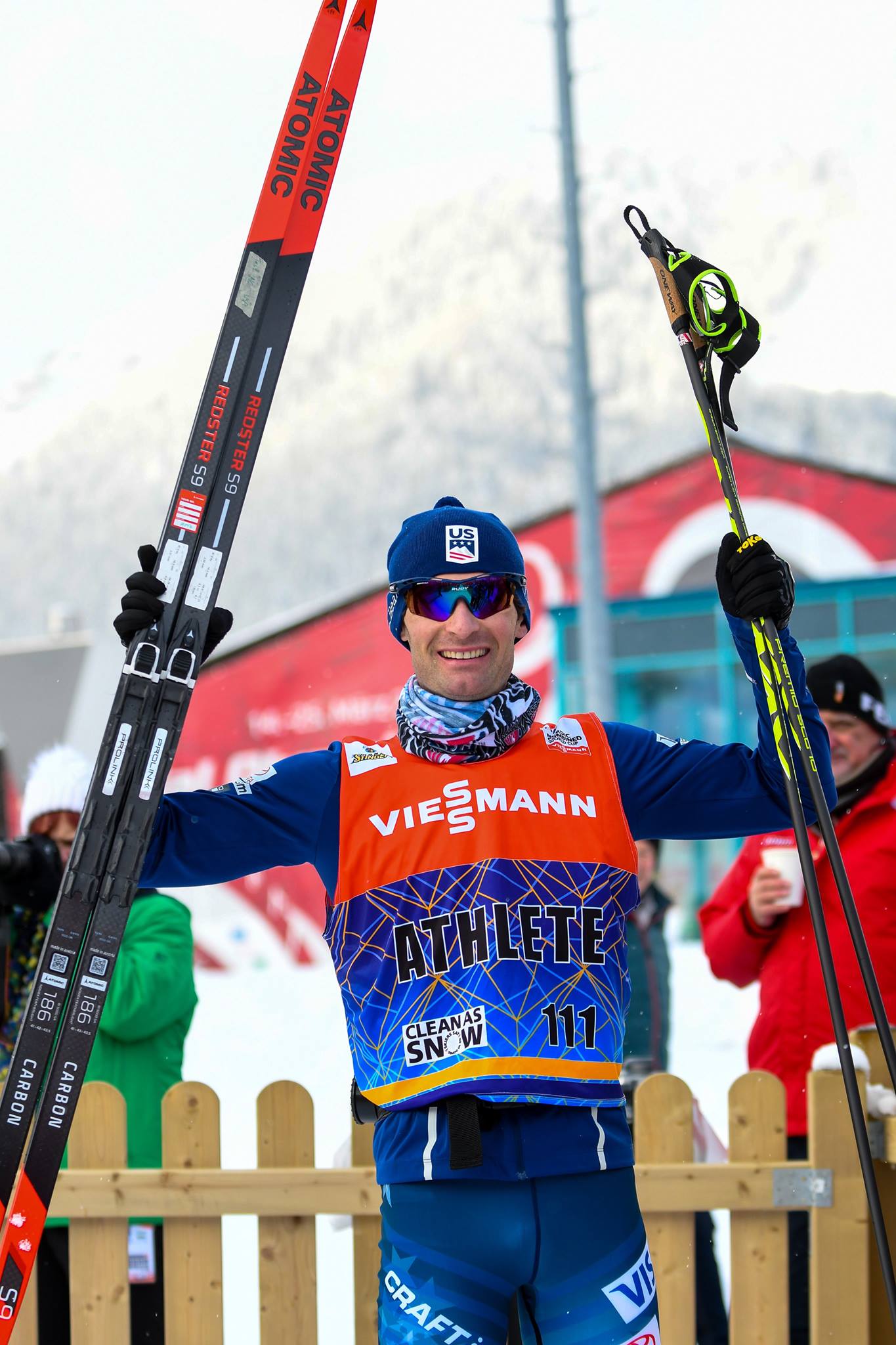
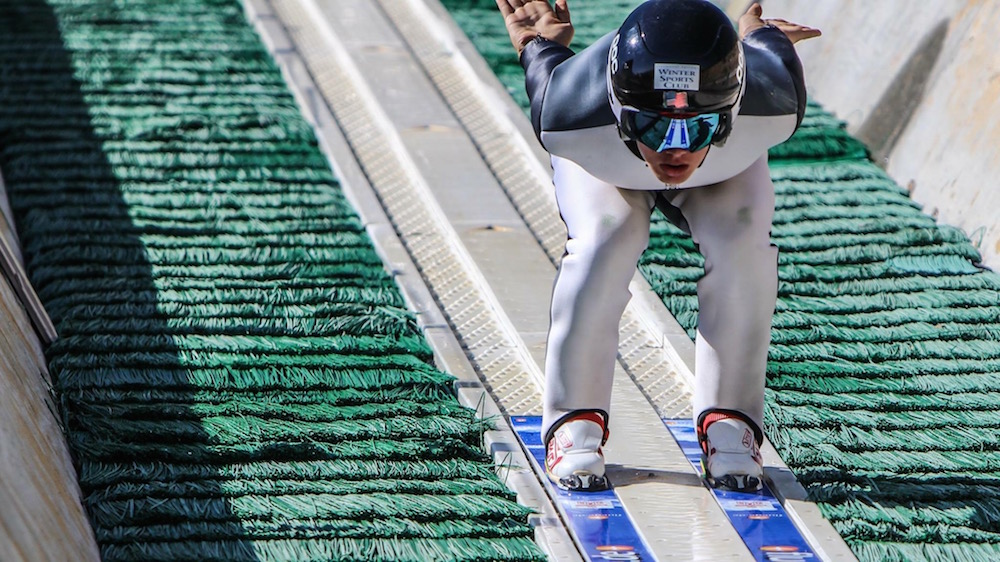
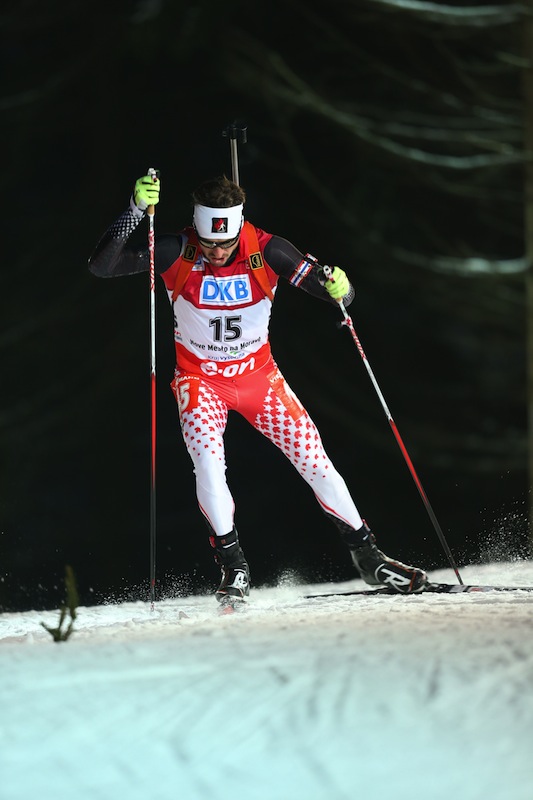
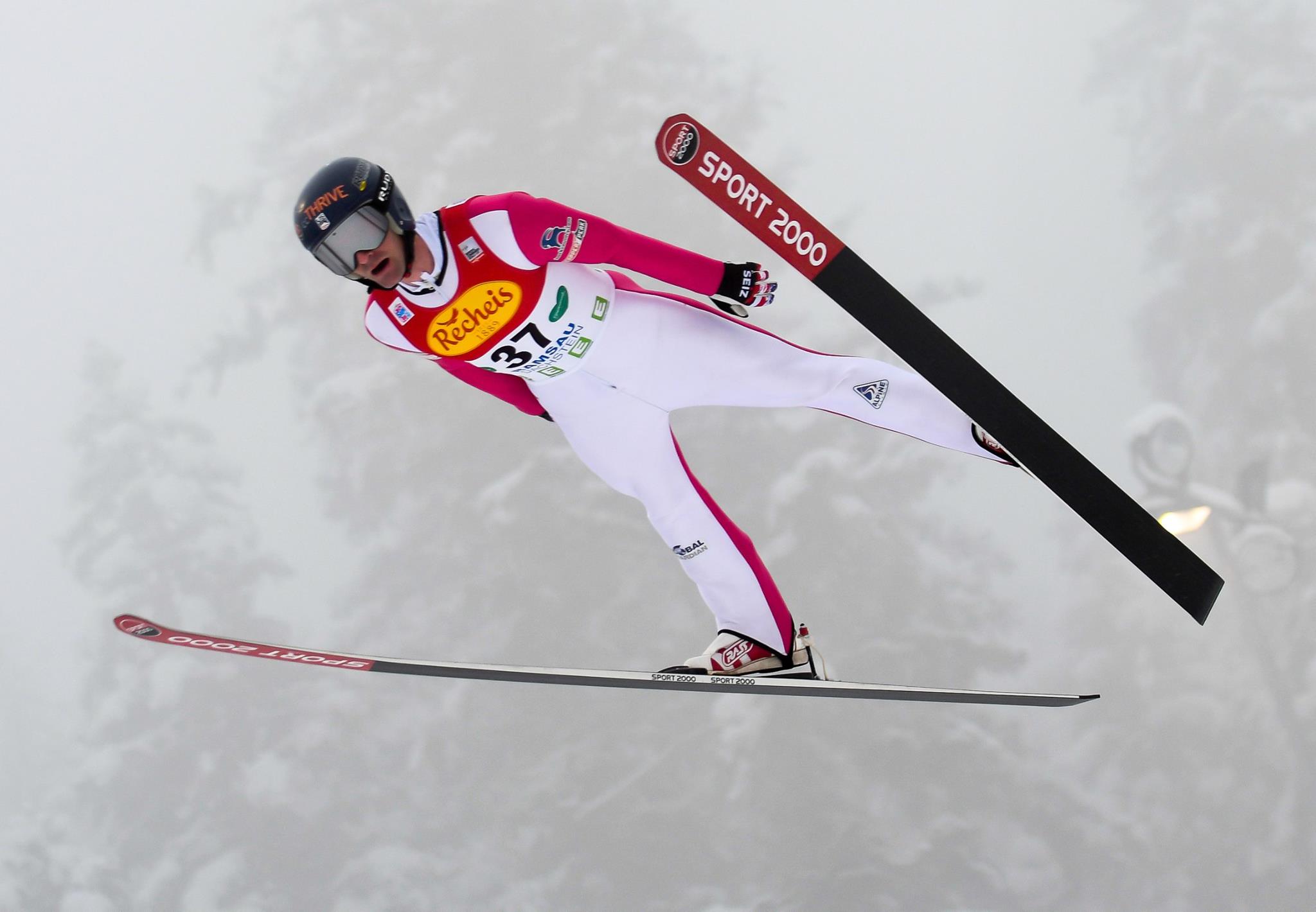
    Bryan Fletcher (USA Nordic) jumping at the Nordic Combined World Cup last Sunday, Dec. 17, in Ramsau, Austria. After jumping to 45th in the provisional round on Friday (Sunday’s competition round was cancelled midway through), he skied the third-fastest time in Sunday’s 10 k to finish 14th overall. (Photo: Romina Eggert/USA Nordic Facebook)

    On Dec. 30, the nordic-combined community will gather in Park City for the U.S. Olympic Team Trials, a one-and-done event which will dole out an Olympic berth for the race winner. As they have for much of their professional-sport careers, brothers Bryan and Tyler Fletcher are eying the same prize.

    Bryan Fletcher was ranked 34th on the World Cup last season. His best individual results during the 2016/2017 World Cup calendar were an 11th and 18th place.

    This past weekend in Ramsau, Austria, Bryan, the older of the Fletcher brothers, came through with a seventh place on Saturday, Dec. 16, for his best individual result in nearly two years.

    “The opportunity was there,” Bryan, 31, said on the phone from Utah this week. He explained that the jumping hill in Ramsau is smaller than the hill used for the opening weekend in Ruka, Finland.

    “Ramsau is one of those hills where everybody tends to jump a little bit closer. That was the first thing that was really helpful there,” he said. “The second thing was definitely that I jumped on a little bit higher level than the previous weekends. … I was able to put together a little bit better jumps and on a more consistent basis. As a result I was able to put myself in the fight in the race.”

    Bryan jumped to 28th, yet scored 110.5 points, while the best jumper, Taihei Kato of Japan, scored 125.9 points — not a massive gap when considering the Fletchers’ skiing speed. That 15.4-point differential put Bryan 1:02 minutes behind Kato at the start of the 10 k Gundersen. When in position after a solid jump, both of the Fletchers can close out a top 20 or a top 10 in the ski.

    But moving through a field of World Cup skiers — Bryan moved up 21 spots in Saturday’s race — is part-art and part-sufferfest.
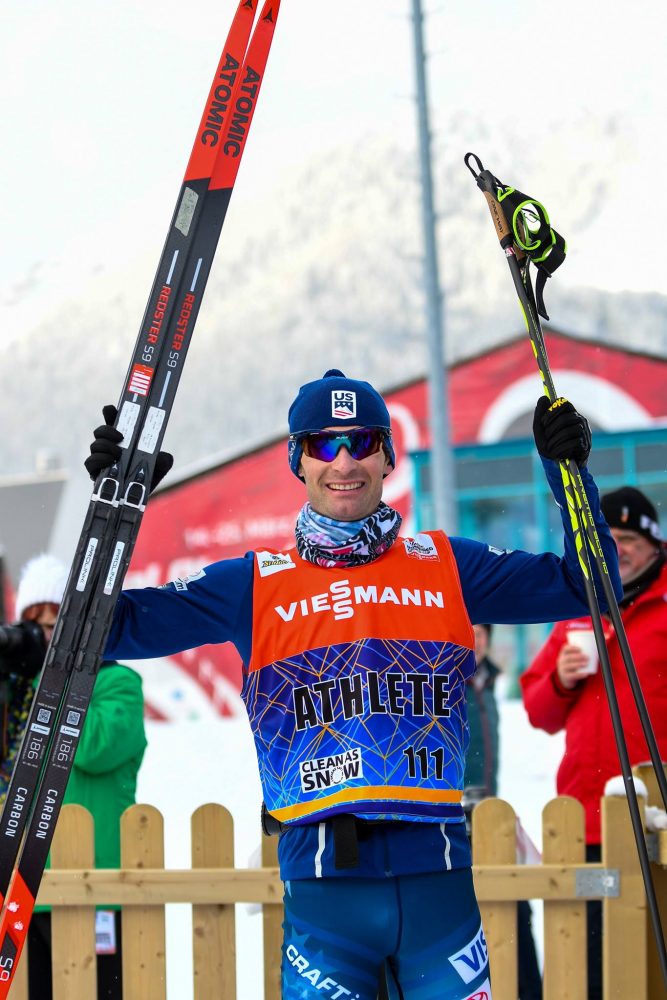
    Bryan Fletcher (USA Nordic) notched seventh in the Nordic Combined World Cup this weekend in Ramsau, Austria, for his best result since January 2016. (Photo: USA Nordic/Facebook)

    “More these days, the old-school laws of track don’t really apply for us,” Bryan said about passing skiers during the ski portion. “Especially in nordic combined where every place is so crucial and those points are so valuable people don’t want to move over. They know if they move over for you that opens a hole for potentially five to 10 skiers that are in that train to get by.”

    Ramsau’s course remains a link to the past with skinny trails placing a premium on high-risk, high-reward aggressive skiing. Moving to the front when a gap opens or sitting in and sucking a draft can make or break a result.

    “That opportunity pays itself off in the end, that is exactly what happened to me,” Bryan said of his high-octane skiing and thread-the-needle gap finding. “There were several times coming over the top of a hill where I really could have taken the opportunity to tuck into the group and get some rest, but I knew I was going to be log-jammed later down on the course. I would take the risk and get to the front of the group and that would get me a clean opportunity to get up the next hill or through the choke point unscathed. There were definitely times where I was going up the hill and it was two skiers wide and I was stuck and sitting behind everybody and you just have to wait for a hole to open up and just be patient and take that rest as it comes. Of course, when it opens you just have to go and don’t look back and move on up.”

    Germany’s Eric Frenzel started the 10 k race in third and took the win in 24:17.8, while Bryan finished 32.6 seconds back in seventh after skiing the second-fastest time of the day.

    On Sunday, another German, Fabian Rießle, stood on top of the podium after jumping to ninth and rising to first in the 10 k, finishing in 26:12.5. The weather conditions were unsettled for Sunday’s jump competition, yet both Fletcher brothers posted solid results on the hill before the competition round was halted and ultimately cancelled. As a result, competition results did not count, and jumps from Friday’s provisional round were used instead to determine time back for the ski.

    Bryan began the ski 1:30 minute back with the 45th-ranked provisional jump, while Taylor bagan the ski 2:53 minutes back after jumping to 58th, just ahead of teammate Adam Loomis in 59th.
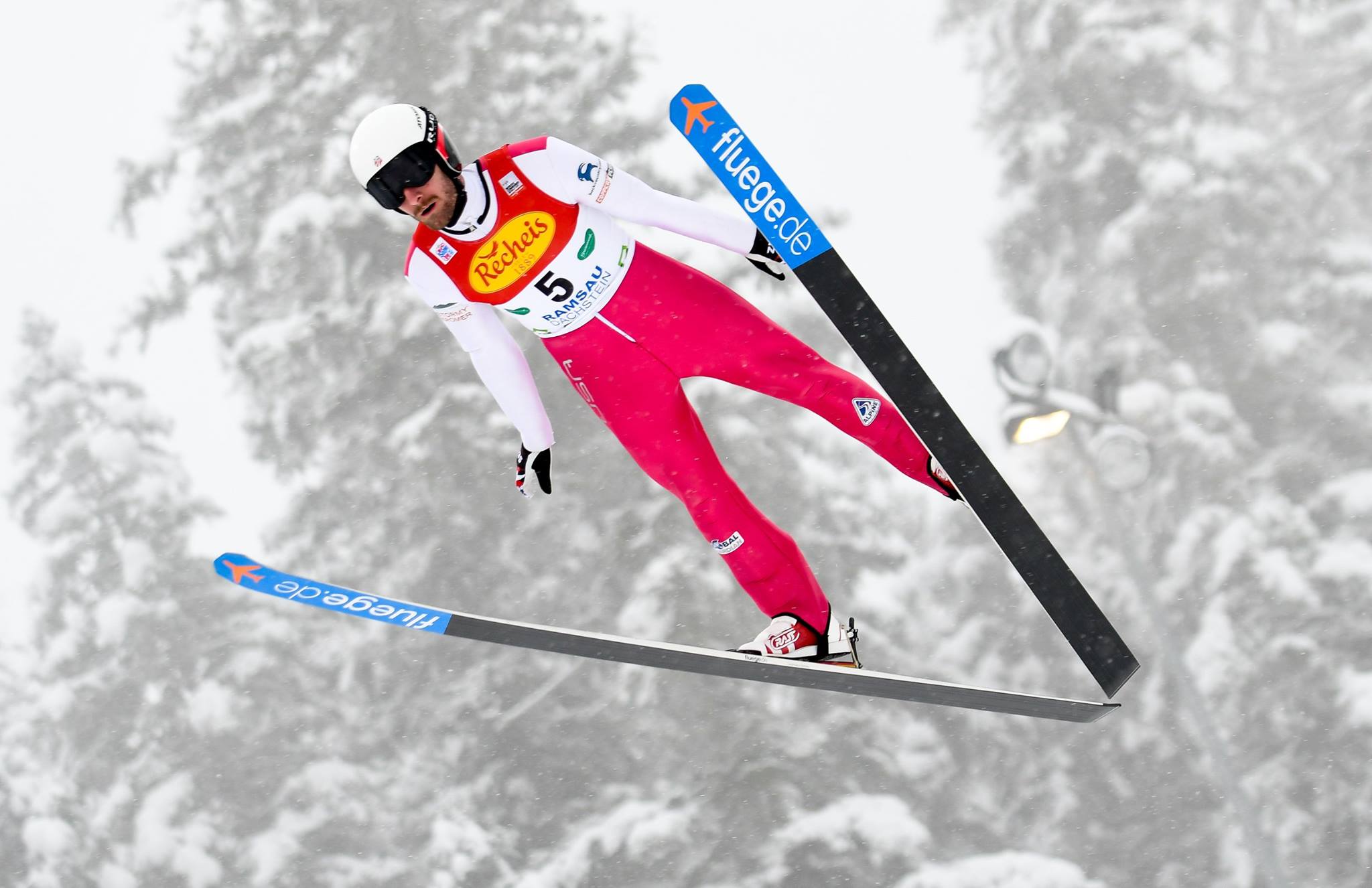
    Taylor Fletcher (USA Nordic) jumping at the Dec. 17 World Cup in Ramsau, Austria. After ranking 58th in the provisional jump on Friday, he picked off 24 places to finish 34th in the 10 k on Sunday. (Photo: Romina Eggert/USA Nordic Facebook)

    Fast skiing by the Fletchers was once again on display on Sunday. Bryan raced up to 14th (+43.7) with the third-fastest time of the day while Taylor improved a whopping 24 positions to finish 34th (+2:01.6) with the second-fastest time of the day. Loomis moved up seven places to place 52nd (+4:38.6) out of 55 finishers.

    “Those major ski efforts begin in May, with the intensity over the summer — that all gets you to a place where you are able to sustain efforts like that,” Taylor Fletcher said on the phone. “I love pushing myself. Every year when we do a VO2max I am excited about it. Because I want to go until I absolutely cannot go. It is the same with racing. Our races should be slightly faster than our threshold-plus intervals that we do. We have done a good job with that. And this past weekend it was snowing and I love racing when it is dumping snow. You have to be a strong skier for sure.”

    When the jumping round was cancelled on Sunday, Taylor had to refocus as the jump that wouldn’t count for his ski seeding would have positioned him for a top-20 strike. Instead, his preliminary jump from Friday put him at the back of the field.

    “My position drastically changed over the course of the 30 minutes that they decided to cancel the competition round,” Taylor Fletcher explained. “I wanted to try to get points no matter what. I went as hard as I possibly could for the entire race. There was not a spot where I could really settle and say I could have made up 20 seconds there and finished in the points. It’s hard to go through the field like that. When you are racing from 58th to try to get into the top 30, you are passing 28 guys, and Ramsau is a very narrow course … maybe if I could get around them quicker, then maybe they would have blown up earlier and fallen back even more. It takes a little bit of strategy and a lot of nerve and a lot of commitment to be able to push through and catch those guys and pass them and drop them.”
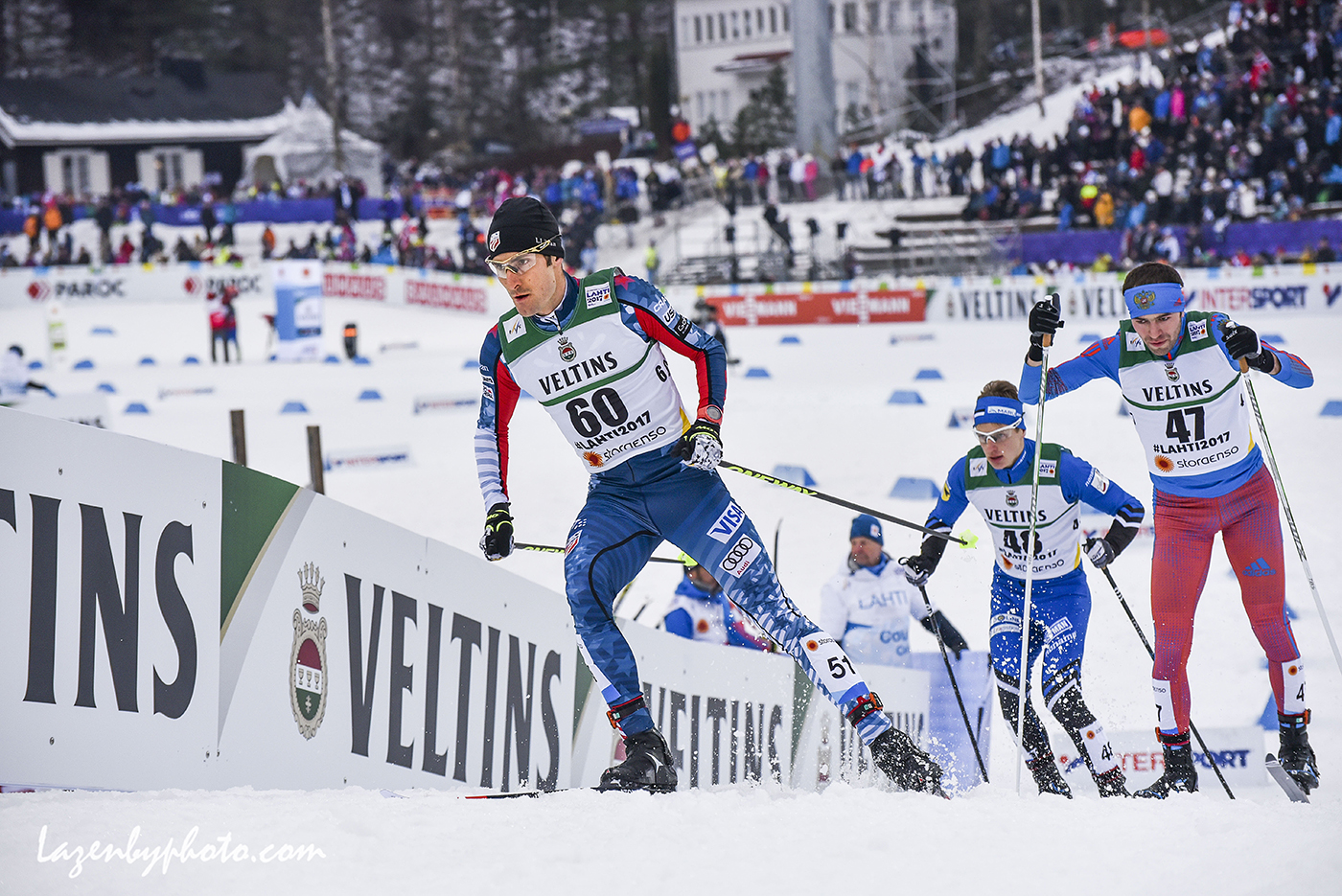
    American Taylor Fletcher (60) racing to 36th last March after starting 51st in the individual large hill/10 k Gundersen race at 2017 World Championships in Lahti, Finland. (Photo: John Lazenby/Lazenbyphoto.com)

    Let’s put this out there as it’s no mystery to any fan of the sport or any World Cup nordic-combined athlete: having a Fletcher chasing from behind can be a gamble if you don’t gun it. As the Olympic trials approach both Bryan and Taylor know their ski shape is good.

    However, when asked to summarize his World Cup Period 1, Taylor was straight to the point.

    “Pretty bad to be honest,” Taylor said. “Looking back after the summer and all the work, I was confident I could get off to a decent start in points and fight for points. I wasn’t worried about qualifications or anything but I was definitely bummed when I found myself struggling pretty badly with the jumping. But that being said, it was only one aspect. I mean everything else was good. Cross-country is obviously solid. My strength and power and speed in terms of the jumping is there, it’s just more mental — the mental approach I was taking to the jumping. I was trying to be almost be too perfect and trying to really get these good jumps in and really focus so much on certain aspects of the jump, I was forgetting about the whole bigger picture in a sense.”

    In the short term, Taylor is focused on winning the lone competition at Olympic trials on Dec. 30 and improving his results in the new year.

    “My goal right now is to win on the 30th, win the Olympic trials here and that way I can completely forget about a qualification spot and I can go out there and focus on my training and focus on the individual competitions,” Taylor said. “And then move forward and focus on the next step as we get towards the Olympics. Honestly, I think I am all right. … And hopefully the team can also step up and we can guarantee that we have four spots on the Olympic team so we can have a team event, hope for sure that we have four so we can represent the U.S. at the Olympics.”

    Bryan, along with the entire who’s who in U.S. NoCo, will be honing for the shoe-in Olympic spot on the 30th. According to USA Nordic’s selection document, after the lone spot is secured at the trials, any remaining spots can be nominated using discretion with the potential for Olympic success as the guiding principle. In total, the U.S. is allotted a maximum of four spots for the PyeongChang Games. If discretion does not fill the quota, then the first step on the selection hierarchy are top-10 results from the World Cup between Nov. 15, 2017 and Jan. 22, 2018.

    Currently, only Bryan meets that standard thanks to his seventh place in Ramsau.

    “I think I have made the objective criteria to go, but nothing is set in stone until the qualification ends or Olympic trials are won,” Bryan said. “That will be the first guaranteed spot on the team; Olympic trials. There are a lot of eyeballs on that. A lot of guys on the team are going to be vying for that spot.”

    Ramsau results: Day 1 | Day 2

  • Sunday Rundown: Ramsau, Toblach, Annecy, St. Ulrich, Rossland (Updated)

    Sunday Rundown: Ramsau, Toblach, Annecy, St. Ulrich, Rossland (Updated)

    Bryan Fletcher (USA Nordic) jumping to 45th in the Nordic Combined World Cup on Sunday in Ramsau, Austria. In the 10 k that followed, he skied the third-fastest time to finish 14th overall. (Photo: Romina Eggert/USA Nordic Facebook)

    NorAm mini tour (Rossland, B.C.): 10/15 k freestyle pursuits

    Team Gregg ended the Rossland NorAm mini tour with another double win, with American Caitlin Gregg and her husband Brian Gregg winning the 10- and 15-kilometer freestyle pursuits, respectively, at the Black Jack Ski Club trails.

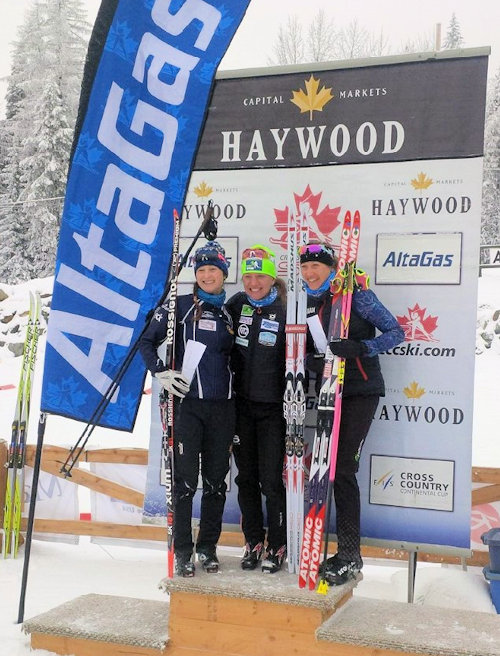
    The women’s 10 k freestyle pursuit podium at the NorAm in Rossland, B.C., with American Caitlin Gregg (c) in first, and Canadians Zina Kocher (l) and Andrea Dupont (r), in second and third, respectively. (Photo: Cross Country Canada)

    Caitlin capped the long weekend with her third-straight win, a 48.28-second victory over former Canadian biathlete Zina Kocher (Foothills Nordic). Caitlin started first and was first across the finish in 29:02.86, while Kocher started ninth and rose to second place for her second-consecutive podium (after placing third in Saturday’s skate sprint). Andrea Dupont (Rocky Mountain Racers) started fourth and finished third (+1:58.35) for her second-straight podium as well (she was second in the skate sprint behind Gregg).

    Lisle Compton of the National Team Development Centre (NTDC) Thunder Bay and Canadian National Junior Team finished fourth overall (+2:07.03), Frederique Vezina of the Pierre-Harvey National Training Centre (CNEPH) was fifth (+2:16.10), and Annika Hicks of the Alberta World Cup Academy (AWCA) sixth (+2:16.51). Laura Leclair (CNEPH) placed seventh, Kaia Andal (Caledonia Nordic) was the top junior in eighth overall, Jaqueline Mourao (Brazil Ski Team) ninth, and Sophie Carrier-Laforte (Skinouk) 10th.

    Brian, who won the Rossland men’s 10 k classic on Friday, also started Sunday’s 15 k freestyle pursuit first and finished in that position in 38:43.93. Andy Shields (Lappe Nordic) raced to second overall, 7.65 seconds back, after starting fourth, and Jack Carlyle (AWCA) reached the podium in third (+8.75) after starting 10th.

    Evan Palmer-Charrette (NTDC Thunder Bay) ended the weekend in fourth (+17.68), Philippe Boucher (CNEPH) was fifth (+19.02), Brian McKeever (Canadian Para-Nordic Ski Team) sixth (+22.16), Michael Somppi (AWCA) seventh (+34.62), Alexis Dumas (CNEPH) eighth (+52.78), Bob Thompson (NTDC Thunder Bay) ninth (+54.76), and Julien Locke (Black Jack/Canadian U25 Team) 10th (+1:04.46).

    Results

    ***

    FIS Nordic Combined World Cup (Ramsau, Austria): Saturday & Sunday individual competitions

    Bryan Fletcher (USA Nordic) notched seventh in the Nordic Combined World Cup this weekend in Ramsau, Austria, for his best result since January 2016. (Photo: USA Nordic/Facebook)

    After a bye week, the Nordic Combined World Cup resumed in Ramsau am Dachstein, Austria, with back-to-back individual normal hill/10-kilometer Gundersen starts on Saturday and Sunday.

    On Saturday, American Bryan Fletcher posted his best individual result in nearly two years in seventh place, 32.6 seconds behind German winner Eric Frenzel.

    Saturday’s individual competition on Ramsau’s 98-meter hill started out with Japan’s Taihei Kato going farthest in the jump portion, the Czech Republic’s Tomas Portyk jumping to second, and Frenzel jumping to third. Fletcher tied Japan’s Yoshito Watabe for 28th and the two started the 10 k race 1:02 minutes back accordingly.

    While Frenzel picked off two places to finish first in 24:05.8 minutes, Fletcher moved up 21 spots to seventh place with the second-fastest course time of 23:48.4.

    Germany had two on the podium with Fabian Rießle just 0.7 seconds back in second place, and Norway’s Jan Schmid finished third, 8.1 seconds behind Frenzel.

    On Sunday, Rießle climbed to the top step on the podium, winning the weekend’s second normal hill/10 k in 26:12.5.

    Norway’s Jørgen Graabak led after the jump portion, yet ultimately finished sixth, 9.8 seconds behind Rießle.

    Rießle jumped to ninth and started 18 seconds out of first, then took the win on the four-lap course by just 0.3 seconds over Italy’s Alessandro Pittin. The Italian notched second place after starting 36th based on his jump and racing the fastest 10 k time in 25:00.8.

    Finland’s Eero Hirvonen finished third (+1.5) after starting 10th, and Schmid was another 2 seconds back in fourth (+3.5) after jumping to seventh. Frenzel did not start.

    Three Americans qualified for Sunday’s competition. Fletcher jumped to 45th and started 1:30 back, yet rose to 14th (+43.7) with the third-fastest course time. His younger brother Taylor Fletcher skied the second-fastest course time to finish 34th (+2:01.6), up 24 places after jumping to 58th. Adam Loomis finished 52nd (+4:38.6) after jumping to 59th.

    The U.S. Nordic Combined team is headed back to the states to prepare for U.S. Olympic trials later this month, according to the USA Nordic Facebook page.

    Results: Saturday | Sunday

    ***

    FIS Cross Country World Cup (Toblach, Italy): 10/15 k classic pursuits

    Norway’s Johannes Høsflot Klæbo after winning the men’s 15 k classic pursuit for his seventh World Cup win of the season on Sunday in Toblach, Italy. With win No. 7, he has the most wins before the new year in FIS Cross Country World Cup history. (Photo: FIS Cross Country/Twitter)

    Women’s report

    Men’s report

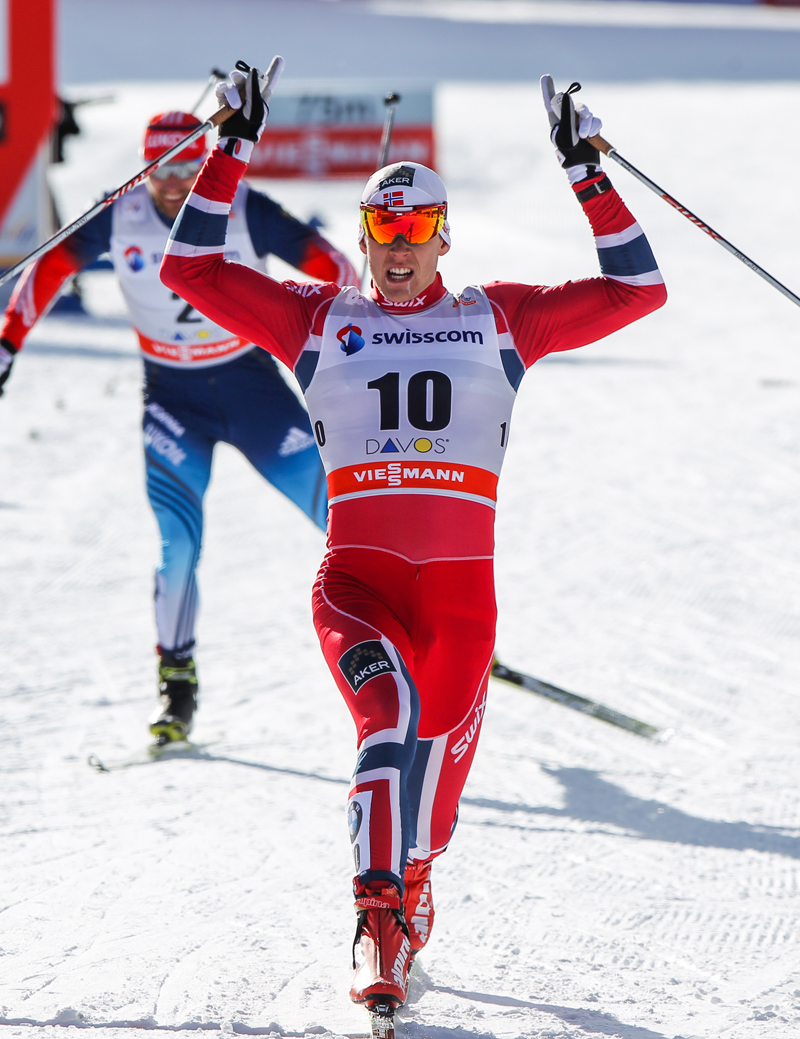
    If you thought Johannes Høsflot Klæbo was out, think again. After placing 10th in the men’s 15-kilometer freestyle on Saturday in Toblach, the 21-year-old Norwegian raced to his seventh victory of the season in the men’s 15 k pursuit on Sunday.

    In doing so, Klæbo broke the record for the most World Cup wins before the New Year: he’s tallied seven in the last eight races he’s contested.

    On Sunday, he started 10th, 36 seconds behind his Norwegian teammate Simen Hegstad Krüger, who won the 15 k freestyle and started first. Klæbo had worked his way up to third by 11.4 k, and at the finish, he edged Russia’s Sergey Ustiugov by 1.9 seconds for the win in 33:31.1 minutes.

    Ustiugov, who started fifth, claimed second, and Kazakhstan’s Alexey Poltoranin rose from 14th to third place (+4.5), ahead of Russia’s Alexander Bessmertnykh in fourth (+9.7), Finland’s Matti Heikkinen in fifth (+9.8), France’s Maurice Manificat in sixth (+10.7), Norway’s Hans Christer Holund in seventh (+11.1), Switzerland’s Dario Cologna in eighth (+11.8), Canada’s Alex Harvey in ninth (+16.3), and Krüger in 10th (+24.0). Norway’s defending Overall and Distance World Cup champion, Martin Johnsrud Sundby placed 11th (+34.4) after starting 20th based on his result on Saturday.

    Erik Bjornsen once again led the U.S. men, racing from 29th at the start to 26th (+1:43.1). Scott Patterson improved from 42nd to 39th (+2:37.2), Paddy Caldwell moved up from 52nd to 44th (+2:57.7), and Noah Hoffman slipped to 49th (+3:01.7) after starting 40th.

    Canada’s Devon Kershaw moved up five places to 33rd (+2:02.8), Graeme Killick finished 50th (+3:42.0), Russell Kennedy 66th (+5:05.8), and Knute Johnsgaard moved up six places to finish 76th (+6:20.8).

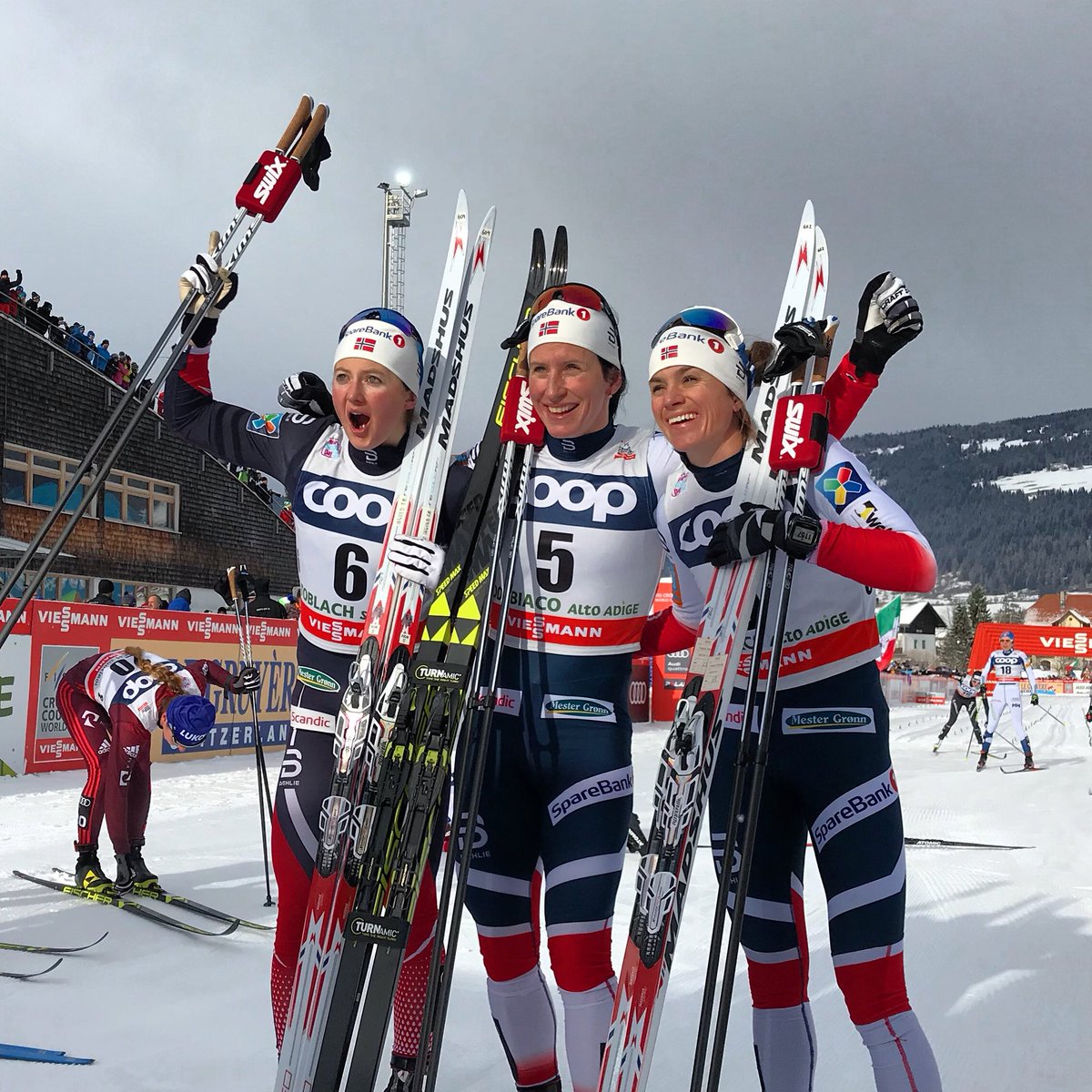
    The all-Norwegian women’s 10 k classic pursuit podium on Sunday at the World Cup in Toblach, Italy, with Marit Bjørgen (c) in first, Ingvild Flugstad Østberg (l) in second and Heidi Weng (r) in third. (Photo: FIS Cross Country/Twitter)

    In the women’s 10 k classic pursuit earlier in the day in Toblach, Norway’s Marit Bjørgen overcame a 22-second starting deficit to take the win by just 0.3 seconds over her teammates Ingvild Flugstad Østberg in second. It was an all-Norwegian podium with Heidi Weng in third (+0.8).

    Bjørgen started fifth, 22 seconds behind Swedish race leader Charlotte Kalla, based on their results in Saturday’s 10 k freestyle individual start. By the 6.4 k checkpoint, Bjørgen led a pack of four other Norwegians and Kalla — all within 1.4 seconds of first. At 8.5 k, Bjørgen led Østberg in second and Weng in third, while another Norwegian Astrid Uhrenholdt Jacobsen skied another eight seconds back with teammate Ragnhild Haga in fourth and fifth, respectively. By that point, Kalla was skiing alone, another 11.7 seconds in sixth, while American Jessie Diggins led a group 25 seconds behind Kalla in sixth.

    Ultimately, Bjørgen finished first in 25:19.3 and formed an all-Norwegian podium with Østberg and Weng, Jacobsen placed fourth, 21.5 seconds out of first and 20.7 seconds behind Weng in third.

    Haga was fifth (+31.8), Kalla sixth (+41.9), Diggins seventh (+53.7), Russia’s Natalia Nepryaeva eighth (+54.2), American Sadie Bjornsen ninth (+55.2), and Austria’s Teresa Stadlober 10th (+55.6) in a photo finish with Finland’s Kerttu Niskanen, who placed 11th (+55.6).

    For the U.S. Ski Team, Diggins and Bjornsen retained their starting positions of seventh and ninth, respectively, while Rosie Brennan started 19th and finished 25th (+2:14.6). Chelsea Holmes (Alaska Pacific University) finished 39th (+3:03.8) and Liz Stephen (USST) finished 48th (+4:05.2).

    Canada’s Emily Nishikawa placed 53rd (+4:14.5), Dahria Beatty finished 63rd (+5:44.7), Cendrine Browne 66th (+5:57.7), and Katherine Stewart-Jones 70th (+7:31.5).

    Results: Women Men

    ***

    IBU World Cup (Annecy, France): Women’s and men’s mass starts

    Women’s report

    Men’s report

    France’s Justine Braisaz won her first International Biathlon Union (IBU) World Cup race of the season on Sunday at home in Annecy, France, topping the women’s 12.5 k mass start by 11.2 seconds in 37:19.4.

    While Braisaz shot 19-for-20 (0+0+1+0), Iryna Kryuko of Belarus cleaned the four-stage race for second place, her first World Cup podium. Germany’s Laura Dahlmeier, who won Saturday’s 10 k pursuit, placed third (+19.9) with two penalties (0+1+0+1).

    Two North Americans qualified for the selective mass start, with Susan Dunklee (US Biathlon) racing to 20th (+1:16.3) with three misses (1+0+1+1), and Emma Lunder (Biathlon Canada) placing 28th (+2:21.4) with a single penalty (1+0+0+0).

    In the men’s 15 k mass start that followed, France’s Martin Fourcade finally got the win he was looking for, shooting clean and beating his main rival Johannes Thingnes Bø of Norway by 3.9 seconds. Fourcade crossed the finish line first in 36:30.3, Bø settled for second after skiing two early penalty loops (2+0+0+0) and Germany’s Erik Lesser tallied his second podium in Annecy (after placing third in the sprint) in third place again (+6.2) with clean shooting.

    Two Americans and a Canadian qualified for the mass start, with US Biathlon’s Lowell Bailey leading them in 23rd (+2:22.4) with three penalties, Sean Doherty following in 24th (+2:52.5) with four misses, and Biathlon Canada’s Scott Gow finishing 26th (+4:05.4) with five penalties.

    Results: Women| Men

    ***

    OPA Cup (St. Ulrich, Austria): 10/15 k freestyle pursuits

    On the final day of Alpen Cup (a.k.a. OPA Cup) racing in St. Ulrich, Ida Sargent of the U.S. Ski Team (USST) scored her third-straight top five with a fifth place in the women’s 10 k freestyle mass start. She previously placed third in the skate sprint and 5 k classic on Friday and Saturday.

    Germany’s Julia Belger won the women’s mass start on Sunday in 28:33.6, while Saturday’s 5 k winner, Elena Soboleva of Russia placed second (+0.7). Russia had two on the podium with Mariya Istomina in third (+6.4). Germany’s Elisabeth Schicho finished fourth (+15.8), just ahead of Sargent in fifth (+15.9).

    Germany’s Antonia Fräbel placed sixth (+17.1), followed by American Sophie Caldwell in seventh (+17.9). The USST had three in the top 10 with Julia Kern in 10th (+41.9), out of 60 finishers.

    In the men’s 15 k freestyle mass start, Beda Klee of Switzerland took the win in 37:14.6, 2.4 seconds ahead of Germany’s Thomas Bing in second. Six-time Olympian Sergey Dolidovich of Belarus reached the podium in third (+4.5).

    The U.S. had two men in the race, with Simi Hamilton finishing 14th, 16 seconds out of first, and Andy Newell finishing 71st (+2:25.2) out of 118.

    Results: WomenMen

  • Sunday Rundown: La Clusaz, Nove Mesto, Ramsau, Klingenthal, Obertilliach, & Rossland (Updated x4)

    Sunday Rundown: La Clusaz, Nove Mesto, Ramsau, Klingenthal, Obertilliach, & Rossland (Updated x4)

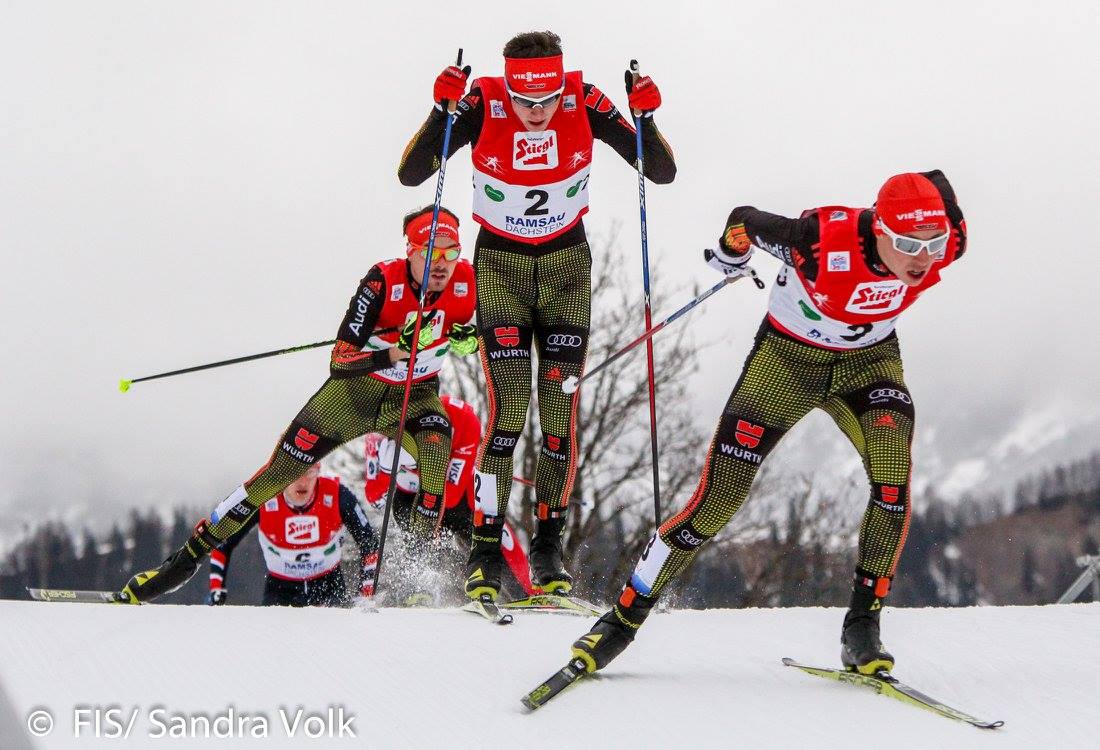
    Eric Frenzel (r) leads German teammates Vinzenz Geiger (c) and Fabian Rießle (l) toward a sweep of the podium in the Nordic Combined World Cup individual normal hill/10 k on Sunday in Ramsau, Austria. (Photo: FIS Nordic Combined/Facebook)
    Eric Frenzel (r) leads German teammates Vinzenz Geiger (c) and Fabian Rießle (l) toward a sweep of the podium in the Nordic Combined World Cup individual normal hill/10 k on Sunday in Ramsau, Austria. (Photo: FIS Nordic Combined/Facebook)

    Welcome to The Rundown, your quick primer of need-to-know information about the day’s racing. We’ll be updating this digest as the day goes on with additional results, photos and quotes. The Rundown is NOT a race report; stay tuned for complete race reports later today with interviews from the day’s top racers.

    ***

    FIS Nordic Combined Continental Cup in Klingenthal

    [UPDATE] Ben Loomis tallied two top 10’s and his U.S. Nordic Combined teammate Ben Berend notched eighth place this past weekend at the Continental Cup in Klingenthal, Germany.

    Loomis ended the three-day series on Sunday by placing fifth in the large hill/10 k for his second-best result at the Continental Cup level (he finished fourth last year in the normal hill/10 k competition in Park City, Utah). Loomis put himself in position by jumping to sixth then racing to fifth, 49.9 seconds behind Japan’s winner Go Yamamoto, who finished in 24:06.4.

    Florian Dagn of Austria placed second (+6.0) after jumping to first. Yamamoto jumped to second and headed out on the course seven seconds behind him.

    Norway’s Sindre Ure Soetvik placed third (+28.8), after starting the 10 k in third. Germany’s David Welde finished fourth (+36.0), moving up after jumping to eighth.

    Also on Sunday, Berend placed 15th (+2:25.3) and Jasper Good was 35th (+3:07).

    Berend started the long weekend out with an eighth-place finish in the large hill/5 k on Friday. He jumped to fourth and finished the ski race in eighth, 1:09.2 minutes behind Germany’s Maximilian Pfordte, who won in 10:58.9.

    Pfordte posted the best jump to start the 5 k first, then held his lead for a 16.4-second victory over Yamamoto in second. Dagn placed third (+18.3) after jumping to second, and Yamamoto’s jump ranked third.

    Also for the U.S., Good finished 21st (+2:05.8) for his best result of the weekend, Loomis was 28th (+2:50.5) and Stephen Schumann 29th (+2:52.1).

    On Saturday, it was Loomis who tallied another eighth place for the U.S. in the large hill/10 k. He jumped to 10th then improved to eighth, finishing 58 seconds behind German winner Tobias Simon. While Simon dominated the jump as well as the race, winning by 10.1 seconds, Yamamoto repeated in second place and Austria’s Thomas Joebstl reached the podium in third (+38.3).

    Berend finished 25th (+1:45.9) and Good 45th (+3:24.9) on Day 2.

    Results: Day 1 | Day 2 | Day 3

    ***

    FIS Nordic Combined World Cup in Ramsau

    The Nordic Combined World Cup resumed this weekend in Ramsau, Austria, with Germany not only topping but sweeping the podium in both individual normal hill/10 k competitions.
    On Saturday, Team Germany swept the top four, with Johannes Rydzek notching his third individual win of the season, ahead of teammates Fabian Rießle (+1.5) and Eric Frenzel (+8.7). Vinzenz Geiger completed the sweep in fourth (+15.0), a career best for the 19 year old after placing seventh earlier this month in Lillehammer, Norway.
    Frenzel led after the jump on the 98-meter hill, which put him 2 seconds ahead of the second-best jumper, Austria’s Mario Seidl, in the 10 k Gundersen start. (Seidl went on to place seventh.)
    Rydzek posted the third-best jump and started 10 seconds back, while Rießle started another 10 seconds later in seventh. Rydzek went on to ski the fifth-fastest course time and Rießle was third fastest en route to first and second at the finish.
    Americans Taylor Fletcher and Bryan Fletcher finished 27th (+1:17.6) and 29th (+1:18.4), respectively, and Adam Loomis was 47th (+3:16.2).
    Taylor started 41st, 1:18 back, and Bryan started five seconds later in 43rd. Bryan posted the seventh-fastest course time and ended with a photo finish with Finland’s Arttu Maekiaho, which Maekiaho took by 0.1 seconds for 28th. Loomis started 50th.
    Day 2 in Ramsau went to Frenzel, who won the normal hill/10 k in 22:49.4. Rießle repeated in second (+0.8) and Geiger improved on his career best for his first podium in third (+23.4). Seidl again jumped to first and this time ended up fourth (+24.3).
    Frenzel started third and raced to first, Rießle moved up from fourth in the jump to second, and Geiger made the most of his second-best jump.
    Taylor Fletcher skied the third-fastest course time to move up from 46th after the jump to 22nd at the finish (+1:20.2). Bryan Fletcher finished 32nd (+1:33.5), losing one place after starting 31st.
    The Nordic Combined World Cup goes on holiday break until resuming Jan. 7-8 in Lahti, Finland.
    Results: Saturday | Sunday 
    ***

    NorAm Mini Tour in Rossland: Classic pursuits

    The NorAm mini tour in Rossland, British Columbia, wrapped up with a classic pursuit race on Sunday.

    In the women’s 10 k classic, APU’s Chelsea Holmes continued her strong form, winning the mini tour with an aggregate time of 1:08:04.4. Holmes finished the 10 k in 35:35.4 minutes, 6.2 seconds behind fastest woman of the day, Katherine Stewart-Jones (NTDC Thunder Bay).

    SMS Elite’s Erika Flowers continued her podium-filled visit to Canada with the third-fastest ski of the day, 48.1 seconds behind Stewart-Jones, to take second overall, 2:23.9 behind Holmes. AWCA’s Olivia Bouffard-Nesbitt was the fifth fastest in the 10 k to hold on to third overall (+3:25.2), while Stewart-Jones was just 0.5 seconds back in fourth overall.

    NTDC Thunder Bay’s Evan Palmer-Charrette used a fourth-fastest ski in the 15 k to keep the overall title, with an aggregate time of 1:28:54.0. Alexis Dumas (CNEPH) skied 1:14.7 faster than Palmer-Charrette to climb from sixth at the start to second overall (+52.2). AWCA’s Jack Carlyle had the second-fastest time of the day, 29.9 seconds behind Dumas, to climb into third overall (+1:10.1).

    National Para-Nordic guide Erik Carleton had the third-fastest 15 k time, 1:01.3 back, but it wasn’t enough to catch Team R.A.D.’s Russell Kennedy, who placed fourth overall (+1:20.8).

    Full results (with tabs for the overall and time of the day)

    ***

    FIS Cross-Country World Cup in La Clusaz: Men’s and women’s relays

    Team Norway I emerged victorious in Sunday’s men’s 4 x 8 k mixed relay event in La Clusaz, France, with Didrik Tønseth leading the winning group’s first classic leg.

    After crossing in seventh, Tønseth handed off to Martin Johnsrud Sundby for a second classic leg. Sundby dropped a spot, finishing his classic leg in eighth. Sundby tagged off to Anders Gløersen for the first freestyle leg.

    Gløersen rocketed the team to first, and held the position straight through his 7.5 k. The final leg for Norway’s winning team went to Finn Hågen Krogh. The Norwegian men’s team completed the relay event in a total time of 1:11:25.7

    Second place overall, two-tenths of a second behind, was team Russia, led by Evgeniy Belov for the first classic leg. Belov handed off to Alexander Legkov for the second classic leg, with Legkov putting down the third fastest time by the time he returned to the exchange zone.

    The third and first freestyle leg for Russia went to Alexey Chervotkin, who maintained the team’s third place position. Anchoring the team was  Sergey Ustiugov, who managed to maneuver the team from third place to second during his final freestyle leg.

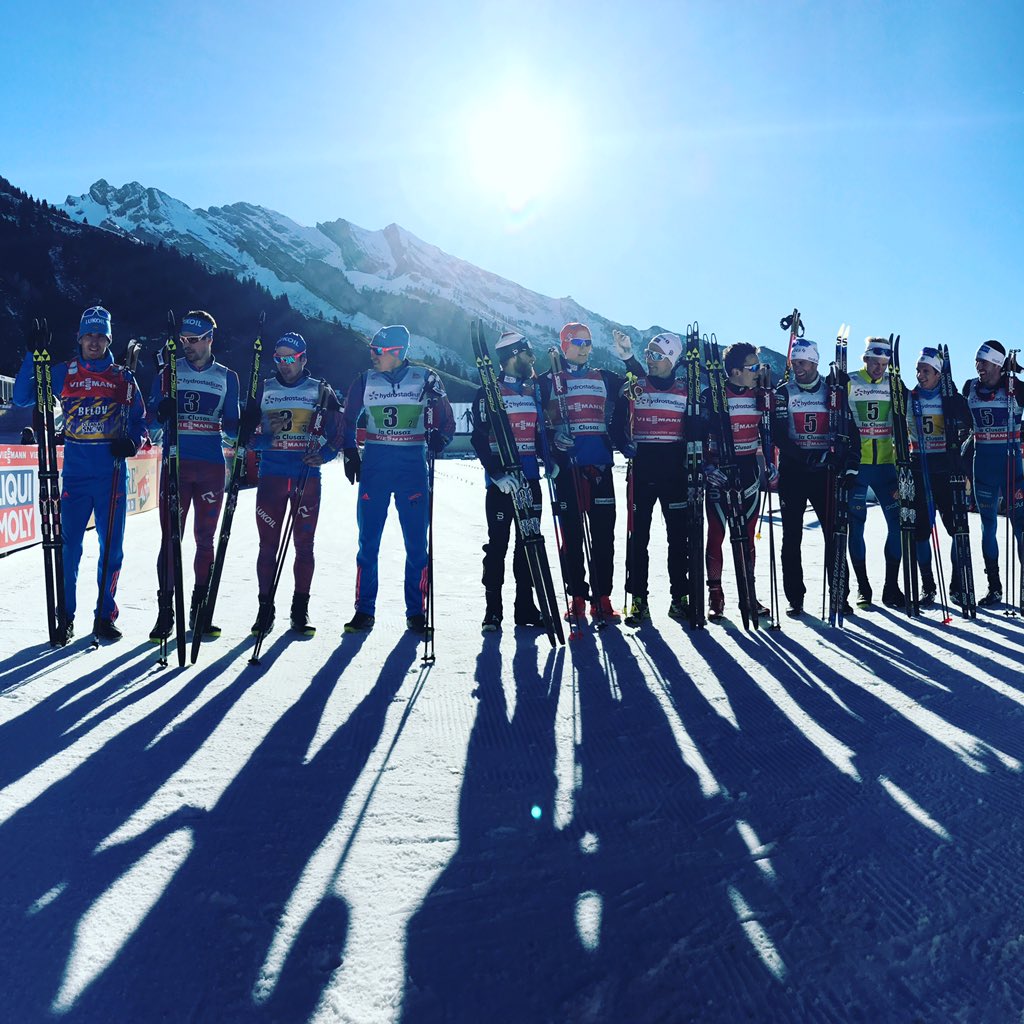
    The men's 4 x 7.5k relay podium on Sunday in La Clusaz, France with Russia in second (left four) Norway first (center four) and France third overall. (Photo: FIS Cross-Country twitter)
    The men’s 4 x 8 k relay podium on Sunday in La Clusaz, France, with Russia in second (left four) Norway first (center four) and France third overall. (Photo: FIS Cross-Country/twitter)

    Rounding out the men’s mixed relay podium on Sunday was France I (+7.7).

    Jean-Marc Gaillard led team France’s first classic leg, racing in a sixth position into the exchange zone. Gaillard handed off to Alexis Jeannerod, who moved up to fifth place by the end of his classic leg.

    Skiing the third and first freestyle leg was Clement Parisse who held onto fifth place and tagged off to Maurice Manificat for the final freestyle leg. Manificat managed to move around Sweden’s Axel Ekstrløm and Germany’s Lucas Bøgl for third place overall.

    Neither Canada or the U.S. entered a men’s relay team due to illness.

    In the women’s 4 x 4 k relay event, it was another Norwegian team who stood atop the podium.

    Ingvild Flugstad Østberg led the women’s first classic leg, skiing in first place until her hand-off to Marit Bjørgen. Bjørgen maintained the first place position during her classic leg, tagging off to Ragnhild Haga.

    Haga completed the first freestyle leg for Norway, handing off to Heidi Weng, who anchored the team’s last freestyle leg. The Norwegian women finished in a total time of 39:23.3.

    In second was team Finland, 50.2 seconds behind Norway’s winning time. Aino-Kaisa Saarinen started the first classic leg for Finland, passing off to Anne Kyllønen.

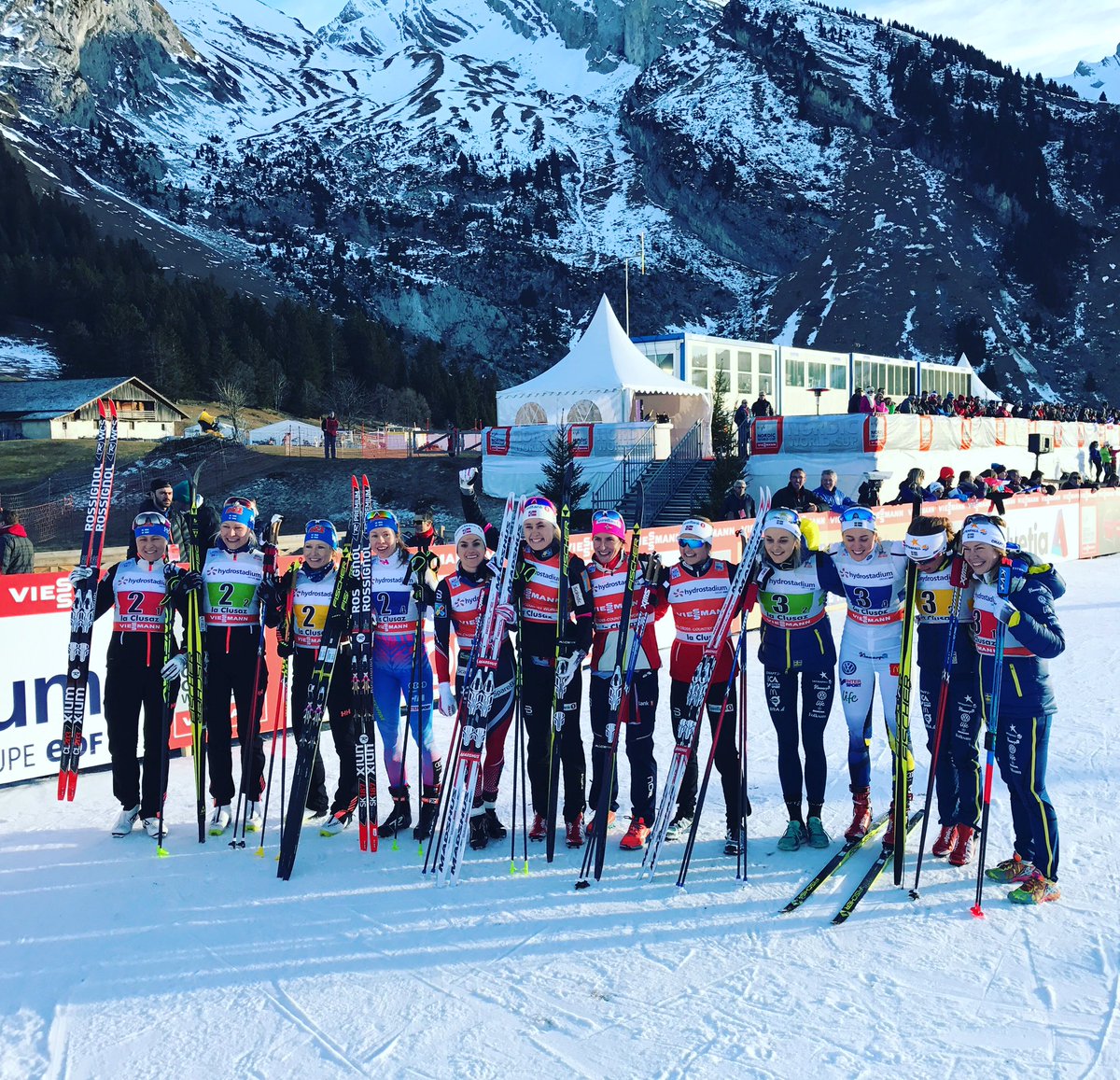
    The women's 4 x 4 k mixed relay podium on Sunday in La Clusaz, France. Norway (c) took the win ahead of team Finland in second (l) and Sweden in third. (Photo: FIC Cross-Country/Twitter)
    The women’s 4 x 4 k mixed relay podium on Sunday in La Clusaz, France. Norway (c) took the win ahead of team Finland in second (l) and Sweden in third. (Photo: FIC Cross-Country/Twitter)

    Taking on the first freestyle leg for Finland was Riitta-Liisa Roponen, who tagged off to Laura Mononen for the final freestyle leg.

    Rounding out the relay podium in third overall was team Sweden (+1:08.9). Emma Wiken raced the first classic leg, who tagged off to Stina Nilsson for the second classic leg. Maria Rydqvist raced the first freestyle leg and handed off to Anna Dyvik, who anchored the team to third.

    Only one U.S. women’s relay team was entered on Sunday, with both Jessie Diggins and Sadie Bjornsen out due to illness. Sophie Caldwell led the U.S.’s first classic leg, followed by Rosie Brennan. Liz Stephen followed Brennan, taking on the first freestyle leg. Anchoring the team was Kikkan Randall in the final freestyle leg. The Americans finished in seventh overall (+2:26.0).

    Canada also entered a women’s team in Sunday’s relay. Emily Nishikawa led the first classic leg, and handed off to Cendrine Browne for the second classic leg. Dahria Beatty raced the first freestyle leg and tagged off to Sophie Carrier-Laforte, who anchored the team to 12th overall (+4:07.9).

    Results: Men | Women

    ***

    IBU World Cup in Nove Mesto: Men’s and women’s mass starts

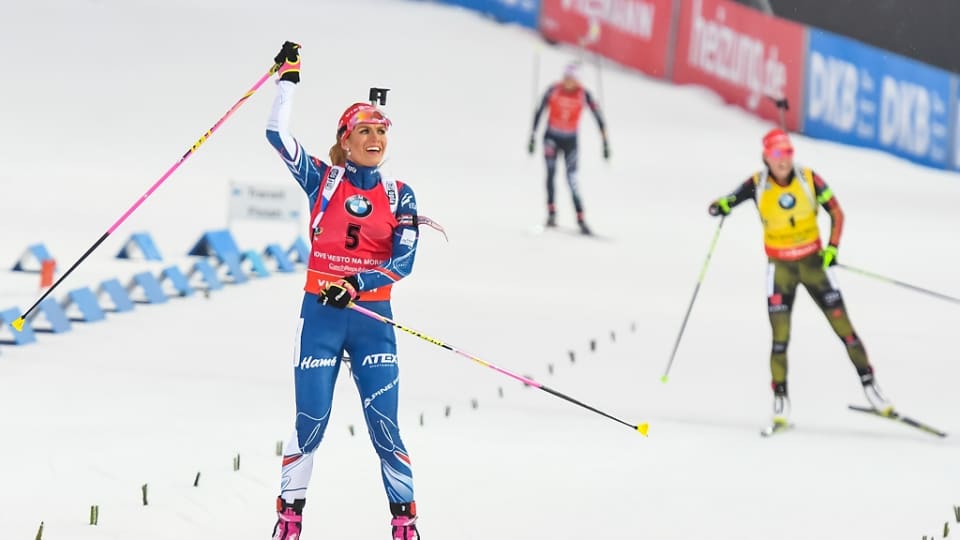
    Gabriela Koukalová of the Czech Republic looks to her home crowd as she wins the women's 12.5 k mass start on Sunday at the IBU World Cup in Nove Mesto, Czech Republic. She fended off Germany's Laura Dahlmeier (r), who took second. (Photo: IBU)
    Gabriela Koukalová of the Czech Republic looks to her home crowd as she wins the women’s 12.5 k mass start on Sunday at the IBU World Cup in Nove Mesto, Czech Republic. She fended off Germany’s Laura Dahlmeier (r), who took second. (Photo: IBU)

    Despite skiing in 14th at one point in the men’s 15 k mass start on Sunday, France’s Martin Fourcade came back to win the International Biathlon Union (IBU) World Cup in Nove Mesto, Czech Republic.

    That makes him seven for eight in individual races so far this season.

    Fourcade started with bib 1 as the overall World Cup leader and finished first in 36:18.9 minutes, despite a penalty on his second prone that put him in 14th and 22 seconds back heading out on his third loop.

    He rebounded with a clean third shooting to move into third, 2.5 seconds behind Ukraine’s Dmytro Pidruchnyi in first and 1.3 seconds behind Russia’s Anton Babikov in second.

    By the final shooting stage, Fourcade was back in first with clean shooting (0+1+0+0), 28 seconds clear of Babikov in second. Babikov had his first penalty of the day on the final stage (0+0+0+1) to drop out of contention.

    Germany’s Simon Schempp (1+1+0+0) came out on top of an eight-way battle for second place on the final loop. Schempp took it, 8.3 seconds after Fourcade and 1.1 seconds ahead of Babikov in third (+9.4).

    The Czech Republic’s Ondrej Moravec was 0.3 seconds off the podium in fourth (+9.7), Pidruchnyi placed fifth (+10.2), Russia’s Matvey Eliseev finished sixth (+11.0), Norway’s Ole Einar Bjørndalen was back in the top 10 in seventh (+11.3), France’s Quentin Fillon Maillet notched his second-straight top 10 in eighth (+13.7), and Norway’s Johannes Thingnes Bø finished at the back of that pack in ninth (+19.8).

    American Lowell Bailey missed the top 20 by 10 seconds in 21st (+1:17.1). He had three penalties, two of which came on the last stage (0+1+0+2) to drop him from ninth to 20th at the start of the final loop.

    Bailey retained his spot in ninth in the overall World Cup standings, while Fourcade continues to lead, 158 points ahead of Shipulin in second.

    In the women’s 12.5 k mass start, Gabriela Koukalová delivered to her home fans in Nove Mesto, Czech Republic, racing to her second win of the season in 34:42.1.

    “I was so nervous before the race so it was amazing,”  Koukalová said, according to an IBU press release. “I have so many emotions; it’s even more emotional than at the Olympics. I would like to say thanks to all the spectators and I hope I was able to make a nice Christmas present to all of them.”

    The defending World Cup champion beat the current World Cup leader, Germany’s Laura Dahlmeier, by 3.1 seconds after shooting a single penalty and cleaning the last two stages (0+1+0+0) to move into first. Dahlmeier missed two on the first stage to drop 23rd, but cleaned her last three stages (2+0+0+0) to capture second at the finish. She passed three athletes on the last lap, including Italy’s Dorothea Wierer, who ended up third (+9.7) with one miss (1+0+0+0).

    “I don’t really know what happened with those two misses,” she told German broadcaster ARD. “But in terms of skiing I had a great day on the course, and I had skis that were the bomb. It’s just a lot of fun when you can make the podium reaching the second place despite a large deficit in the beginning. I am overjoyed.”

    Germany’s Vanessa Hinz rebounded from Friday’s sprint (where she placed 73rd) to end up fourth (+15.5) with a single penalty (0+0+1+0). None of the 29 finishers hit every target, and American Susan Dunklee did not start.

    Dahlmeier leads the overall World Cup standings by 98 points over Finland’s Kaisa Mäkäräinen, and Koukalova is third, just seven points behind Mäkäräinen. Dunklee is 11th.

    The IBU World Cup now goes on holiday break until resuming Jan. 5 in Oberhof, Germany.

    Results: Men | Women

    ***

    IBU Cup in Obertilliach

    The third IBU Cup was held on Dec. 16-17 in Obertilliach, Austria. In the men’s 20 k individual on Friday, the top three finishers were France’s Antonin Guigonnat, with a winning time of 49:58.6, Russia’s Yury Shopin in second (+32.2), and Germany’s Florian Graf in third (+35.6). Each of the top three had one miss, and Canada’s Matthew Hudec was the top North American in 34th (+4:11.3) with two penalties (0+2+0+0). Also for Canada, Carsen Campbell finished 38th with three penalties (1+2+0+0), Matthew Neumann was 53rd with three penalties (0+2+0+1) out of 118 finishers.

    In the women’s 15 k individual on Friday, Germany’s Karolin Horchler took the win with clean shooting (0+0+0+0) in 44:54.7. France’s Coline Varcin was 1.1 seconds back in second with one penalty (1+0+0+0), and third went to Russia’s Daria Virolaynen (+30.2), who had one miss as well (0+1+0+0). Canada’s Nadia Moser was the top North American in 35th (+5:10.8) with two penalties (0+1+1+0). Also for Canada, Erin Yungblut placed 66th with five penalties (0+3+0+2).

    In the men’s 10 k sprint on Saturday, two Norwegians took first and second with Henrik L’Abee-Lund winning in 23:29.9, and Vetle Sjastad Christiansen 13.9 seconds back in second. Third was claimed by Germany’s Phillipp Nawrath (+29.5) and all of the top three shot clean. Neumann led Canada in 47th (+2:20) with one miss (1+0). Campbell missed two (1+1) and finished 59th (+2:47.4), and Hudec was 64th (+2:58.9) with two penalties as well (1+1). Canada’s Pearce Hanna finished 87th, with two misses (2+0), out of 125 finishers.

    In the women’s 7.5 k sprint, Russia swept the podium with Virolaynen winning in 20:31.5, followed closely by Uliana Kaisheva (+3.7), and then Anna Nikulina (+23.1). Virolaynen missed one (0+1), Kaisheva cleaned (0+0) and Nikulina had a standing miss as well (0+1).  The top North American was Canada’s Megan Bankes in 30th (+2:08.1), with one prone penalty (1+0). Also for Canada, Sarah Beaudry finished 34th (+2:18.1), with two standing misses (0+2), Yungblut was 45th (+2:40.6) with clean shooting (0+0), and Moser finished 49th (+2:45.5) with two misses (1+1), out of 85 women.

    Results: Men’s individual | Women’s individual | Men’s sprint | Women’s sprint


  • 17 Questions for 2017: Jasper Good

    17 Questions for 2017: Jasper Good

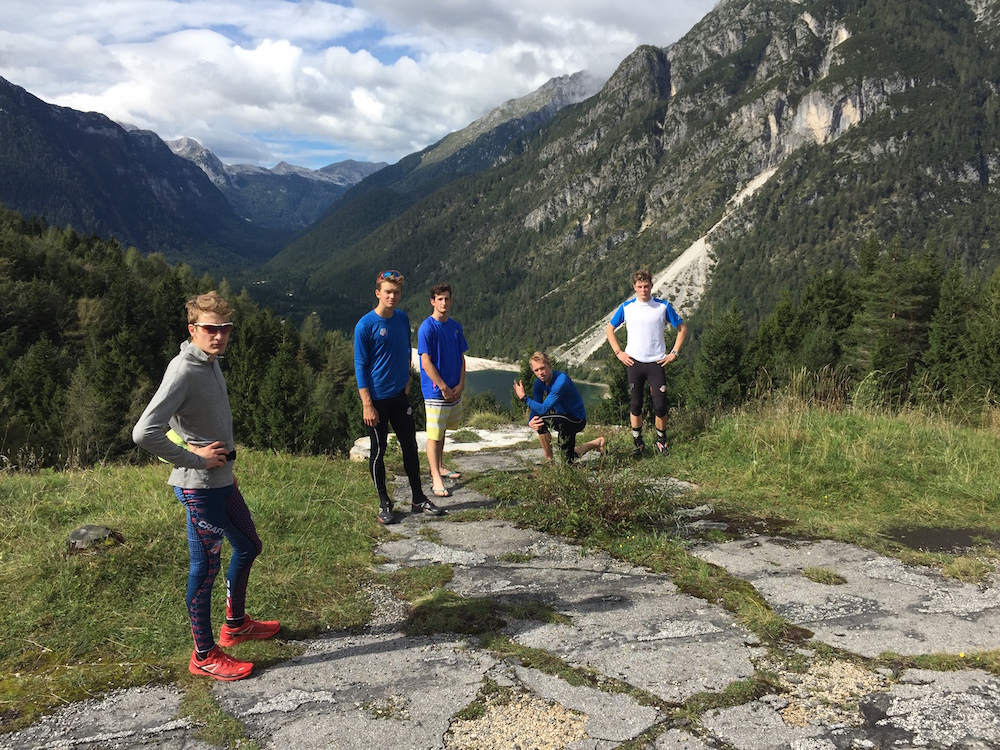
    The U.S. Nordic Combined juniors after a rollerski workout in Slovenia this summer. (Photo: Martin Bayer)
    The U.S. Nordic Combined juniors after a rollerski workout in Slovenia this summer. (Photo: Martin Bayer)
    Welcome to “17 Questions for 2017″, where we are catching up with American and Canadian national-team members before the beginning of the winter season. 

    ***

    One of U.S. Nordic Combined’s young guns, Jasper Good spent last season bouncing between the Continental Cup and World Cup, with a brief jaunt to World Junior Championships where he notched finishes of 11th and 12th.

    The Steamboat Springs native just turned 20 and is gearing up for his first season outside the junior ranks.

    1. Biggest change in your life in the last five or so months since the ski season ended? 

    I started taking classes at the University of Utah, got to start sometime!

    2. Biggest change in your training? 

    I have chosen to have more of a focus on the ski jumping side of my training plan than I have in the past.

    3. Major areas of improvement you’ve seen so far?

    Jasper Good (U.S. Nordic Combined) racing to 11th in the normal hill/10 k individual competition at 2016 Junior World Championships in Rasnov, Romania. (Courtesy photo)
    Jasper Good (U.S. Nordic Combined) racing to 11th in the normal hill/10 k individual competition at 2016 Junior World Championships in Rasnov, Romania. (Courtesy photo)

    In the last couple months my jumping has made great strides along with my overall XC performance!

    4. Whom you’ve been working closest with this offseason (coaches or training partners)?

    The last couple months I was in Europe with Adam Loomis, Ben Berend, Grant Andrews, Koby Vargas and Taylor Fletcher for a short stint. We were coached by Martin Bayer and Nik Huber.

    5. Best trip in the last five months (and why)? 

    The trip I just returned from in Central Europe. We rented an apartment in Slovenia for about two months and made short trips to Ramsau, AUT and Oberstdorf, GER.

    6. Favorite cross-training? 

    Mountain Biking hands down. I may not be as good as I would like but I love it!

    7. Favorite non-athletic activity or pastime this summer? 

    Hanging with family or friends, whether its at a concert or on a fun adventure ‘vacation’!

    8. Song that was your jam this summer?

    Left Hand Free – alt J / also our EU camp jam this fall was Aquarius Apocalyptic by Stop Light Observations.

    9. All-time favorite race moment? 

    Jasper Good at jumps training in Park City, Utah. (Photo: Clint Jones)
    Jasper Good at jumps training in Park City, Utah. (Photo: Clint Jones)

    Last year in the Seefeld Triple WC I skied with one of the fastest guys on the circuit for longer than I ever had and logged my best race time!

    10. First thing you pack in your bag when you leave for Europe? 

    Peanut Butter and Cholula

    11. Venue/event you’re most excited to visit this season? 

    Ramsau, AUT. It’s one of my favorite places to go anytime of the year for training and competitions. Amazing place.

    12. Who will win the World Cup title this year? 

    I would have to put my money on a repeat title for Eric Frenzel, but I’m seeing a strong performance from Bryan Fletcher with his new ‘baby boost’.

    13. Biggest sacrifice you feel you’ve made choosing this career path?

    I’m sure you hear this a lot but the social aspect of someone my age. The Nordic Combined world is a small world so we may not have as many opportunities to make lots of friends but our NC community are great friends!!

    14. If you could change one thing about your sport, what would it be?

    I would add some more technical features to the downhill of our cross-country races, just to keep things exciting. Oh and have competitions in the US!!!

    15. What did you have for breakfast this morning? 

    A sunny side up egg with smoked salmon, and a banana with Peanut Butter!

    16. In 5 years, I’ll be ____? 

    I will just have turned 25 so I will have to go rent my first car from Hertz.

    17. In 50 years, I’ll be ____?

    Tele skiing daily.

  • Weekly Roundup: Good Vibes Before the Holidays

    Weekly Roundup: Good Vibes Before the Holidays

    Crawford at the flower ceremony. Photo: Christian Manzoni/NordicFocus.com.
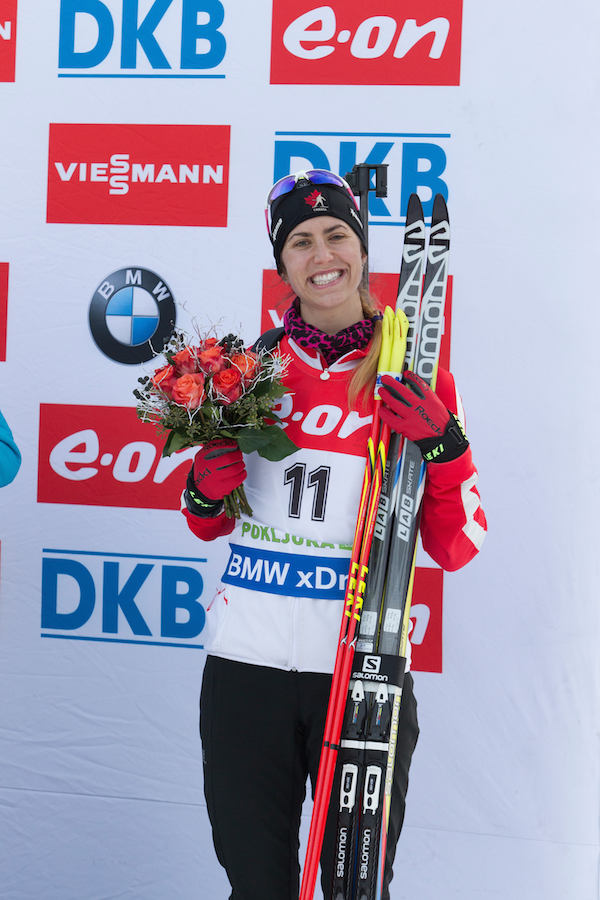
    Rosanna Crawford at the flower ceremony after achieving a career-best fourth in the Pokljuka IBU World Cup sprint last week. (Photo: Christian Manzoni/NordicFocus)

    Some of the U.S. Ski Team members are starting to feel like themselves again, even after a couple crashes took Kikkan Randall and Sophie Caldwell out of contention in Sunday’s freestyle-sprint semifinals at the World Cup in Davos, Switzerland.

    “It was a bummer to fall because the feelings were a lot stronger today,” Randall said after placing ninth. “I was just really happy that I felt more like myself today. You don’t realize how bad you were feeling until you start to feel good again.”

    “I was just thinking, ‘Oh God, am I ever going to get back there this year, and how long is it going to take?’ ” Caldwell said after ending up 11th. “I’ve just taken big steps the last two weekends, and that helps a ton with my confidence.”

    Liz Stephen placed 12th on Saturday in the 10 k freestyle in Davos, 4.9 seconds out of the top 10.

    “Each weekend is a little bit of a step forward for me and that’s a fun way to go about it,” Stephen said. “I didn’t race as well as I possibly could have to get a top ten, so I’m happy with the way it ended up.”

    Two Canadians made it into the heats on Sunday — Lenny Valjas and Jesse Cockney — and ended up 18th and 29th, respectively, which coach Tor-Arne Hetland found both promising and disappointing.

    “When you’re starting in the heats, you want to be in the final,” he said.

    “It feels awesome to finally get into the heats again,” Cockney stated after his first time in the World Cup top-30 since two seasons ago in Canmore, Alberta.

    Then there was Rosanna Crawford, a Canadian biathlete who racked up four of her best IBU World Cup results over the last week. Following her fifth-place finish in the pursuit in Hochfilzen, Austria, two weekends ago, she placed fourth in the next race: the 7.5 k sprint in Pokljuka, Slovenia. The next day, on Saturday, Crawford was seventh in the pursuit, then capped the weekend with 12th in the mass start to put herself a best-ever eighth in the overall World Cup.

    “I am really happy with where I am heading into the Christmas break, only one race that wasn’t in the top 16,” she wrote in an email.

    Her Biathlon Canada teammate Nathan Smith, also made the top-30 overall World Cup cutoff for the mass start, and in his second-ever time racing that format, he placed ninth.

    “Mass starts are a lot different than pursuits. It’s nice to get one under my belt now and I hope to do a few more this season, too,” Smith reflected. “I’m very happy … and it’s a perfect way to cap off a strong trimester. It gives me extra motivation to rest up and train over the Christmas break.”

    On Saturday, Canada’s Megan Heinicke rose from 41st to 14th in the pursuit.

    “I kept that little voice in my head that was telling me this was an awesome race pretty quiet because I know how fast everything can change,” Heinicke explained. “I didn’t really believe it until after the last standing.”

    Hannah Dreissigacker en route to 17th place in the World Cup sprint in Pokljuka, Slovenia, today. Photo: USBA/NordicFocus.com.
    Hannah Dreissigacker en route to her best IBU World Cup result in 17th in last Thursday’s sprint in Pokljuka, Slovenia. Photo: USBA/NordicFocus.com.

    US Biathlon’s Hannah Dreissigacker tallied a career-best 17th in the Pokljuka sprint, just ahead of teammate Susan Dunklee in 19th.

    “Biathlon is so weird,” Dreissigacker said. “When things go badly, it’s so hard, and it’s hard to imagine that they would ever be good. And then a week later, somehow everything just goes much better. It’s such a roller coaster like that.”

    At the IBU Cup in Obertilliach, Austria, Canada’s Scott Gow found his way onto the podium in the 10 k sprint last Friday, Audrey Vaillancourt was seventh in the women’s sprint that day, and Julia Ransom recorded a career-best seventh in the sprint last Wednesday. That same day, Gow’s younger brother Christian was “ecstatic” after placing eighth in the men’s sprint. To start the series off, Emma Lunder placed 10th in the 15 k individual last Tuesday, followed by Ransom in 11th.

    “The whole Canadian team is only going to build on this momentum,” Ransom predicted in an email that day.

    At the Nordic Combined World Cup in Ramsau, Austria, the U.S. placed fifth in the 4 x 5 k team event, and Billy Demong as the sole American to qualify for Sunday’s individual competition finished 32nd.

    The NorAm made its second stop in Sovereign Lake, British Columbia, where 20-year-old Dahria Beatty of the Alberta World Cup Academy (AWCA) and Canadian U23 team won the women’s 15 k freestyle interval start and American Kris Freeman won the men’s 30 k by more than 1 1/2 minutes over Brian Gregg.

    The day before, on Friday, Olivia Bouffard-Nesbitt (Rocky Mountain Racers) edged Alysson Marshall in the women’s classic sprint, and Patrick Stewart-Jones (AWCA) dominated the men’s sprint.

    “I’m racing among a group of super strong and talented girls who I respect a lot, so I try to learn from them during the races, but I also try not to be intimated,” Bouffard-Nesbitt wrote in an email. “I didn’t leave anything out there today, I just went for it!”

    FIS Cross-Country World Cup, Davos, Switzerland

    Saturday: 10/15 k freestyle individual starts men’s report | women’s report | U.S. report | Canadian report

    Sunday: 1.3 k freestyle sprints women’s report | men’s report | U.S. report | Canadian report

    Notes & Quotes

    IBU World Cup, Pokljuka, Slovenia

    Thursday: women’s 7.5 k sprint report | U.S. report

    Friday: men’s 10 k sprint report

    Saturday: 10/12.5 k pursuits women’s report | men’s report

    Sunday: 12.5/15 k mass starts men’s report | women’s report

    IBU Cup, Obertilliach, Austria

    Dec. 16: 15/20 k individual report

    Dec. 17:  7.5/10 k sprints report

    Friday: 7.5/10 k sprints report

    Saturday: mixed relay recap

    Nordic Combined World Cup, Ramsau, Austria

    Saturday’s team event & Sunday’s individual recap

    NorAm #2: Sovereign Lake, Vernon, British Columbia

    Friday: 1.2/1.4 k classic sprints report

    Saturday: 15/30 k freestyle interval start report

  • Weekend Roundup: High Expectations

    Weekend Roundup: High Expectations

    Kikkan Randall and Marit Bjørgen's photo finish (Photo: Fischer/Nordic Focus)
    Kikkan Randall and Marit Bjørgen’s photo finish in Sunday’s Sprint in Davos, Switzerland. Bjørgen won it by a hair. (Photo: Fischer/Nordic Focus)

    Extraordinary performances are becoming ordinary for the North American contingent this year as new stars emerge, historic results accumulate, and expectations continue to grow.

    FasterSkier was on site in Davos, Switzerland, where five USST members raced to the top 30 in Saturday’s distance races. Kikkan Randall placed 18th in the women’s 15 k, followed by Liz Stephen in 20th, Holly Brooks in 25th, and Jessie Diggins in 30th. Noah Hoffman was 25th in the men’s 30 k.

    Sunday’s Skate sprints brought even more excitement for the U.S. team with Randall skiing to a hard fought second place against powerhouse Marit Bjørgen. Sophie Caldwell, in a breakout performance, reached the World Cup semifinals and cracked the top ten with her ninth place finish. Diggins and Sadie Bjornsen, who both suffered falls, were 12th and 27th.

    On the men’s side Simi Hamilton and Andy Newel advanced to the quarterfinals and finished in 14th and 17th.

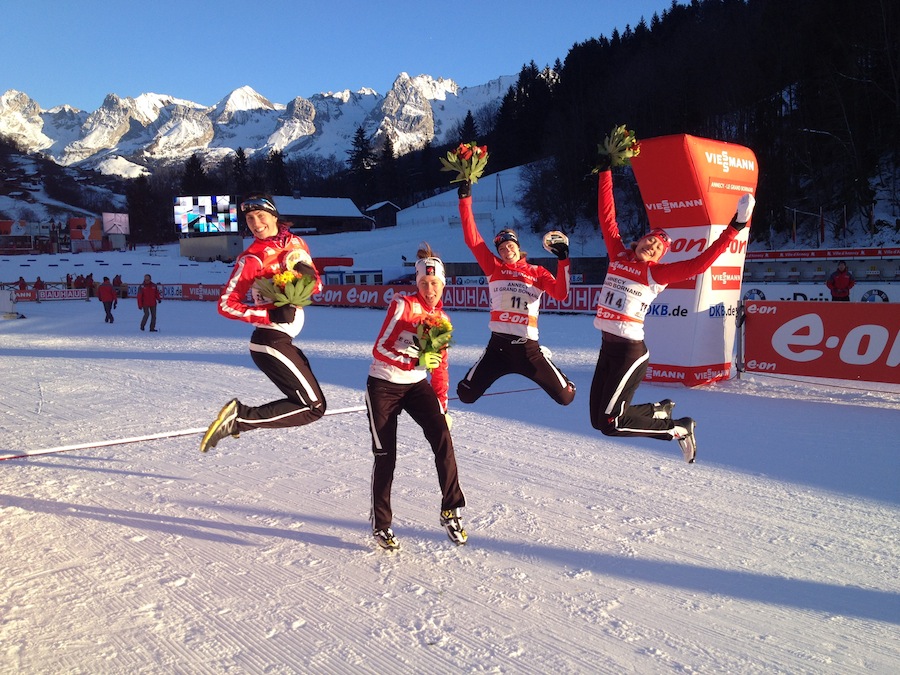
    The Canadian women jumping for joy after notching Biathlon Canada's best-ever finish in a relay. (Photo: Biathlon Canada/Matthias Ahrens)
    The Canadian women jumping for joy after notching Biathlon Canada’s best-ever relay result of fourth. (Photo: Biathlon Canada/Matthias Ahrens)

    North America shined in the IBU World Cup with the Canadian women’s relay team taking a historic fourth-place finish in the 4 x 6 k relay. The success continued throughout the weekend with four Canadian women qualifying for the pursuit, and Rosanna Crawford ultimately finishing 19th.

    On the men’s side Canadian Nathan Smith finished 16th in the 10 k sprint and was followed by Americans Tim Burke in 28th and Lowell Bailey in 35th.  In the 12.5 k pursuit Smith impressed again with an eighth-place finish. He was followed by Bailey and Burke in 15th and 16th.

    The action didn’t stop there with historic results from U.S. Nordic Combined. In Ramsau, Austria, Bryan Fletcher and Todd Lodwick skied the fastest combined time in the 2 x 7.5 k team sprint to place fourth, the best-ever result for the U.S. in the two-man event.

    In Sunday’s individual 10 k competition, Fletcher and Billy Demong cracked the top ten by placing seventh and ninth.

    With all the success happening across the pond it’s easy to forget that North America had some races of its own this weekend. Rossland, B.C. hosted the second set of NorAm races where Erik Bjornsen and Emily Nishikawa triumphed in the sprint, and Kate Fitzgerald and Kevin Sandau won Sunday’s 10 and 15 k.

    The IPC World Cup also took place in Canmore, Alberta, with several North American standouts. Canadian Brian McKeever won the 10 k on the opening day and churned out another winning performance in the 20 k classic race. American Oksana Masters placed third in the women’s sit-ski 5 k and fourth in the 0.75 k sprint.

    Norway’s Anders Gløersen celebrates his win as he crosses the finish line (Photo: Fischer/Nordic Focus)
    Norway’s Anders Gløersen celebrates his sprint win as he crosses the finish line in Davos. (Photo: Fischer/Nordic Focus)

    Cross-Country World Cup, Davos, Switzerland (Results)

    Saturday’s 15/30 k skate individual start: Women’s report | Men’s report | U.S. women’s report | Hoffman Happy with Performance

    Sunday’s 1.5 k skate sprint: Women’s report | Men’s report | Canadian report | One of USST’s ‘Best Days Ever’ | Randall’s Lesson for SochiUSSA CEO Shaw Spectates in Davos

    Nordic Combined World Cup, Ramsau, Austria (Results)

    Saturday’s 2 x 7.5 team sprint: Report

    Sunday’s NH/10 k: Recap

    IBU World Cup, Annecy, France (Results) 

    Thursday’s 4 x 6 k relay:  Women’s report

    Friday’s 4 x 7.5 k relay:  Men’s report

    Saturday’s 7.5/10 k sprint: Women’s report | Men’s report

    Sunday’s 10/12.5 k pursuit: Women’s report | Men’s report 

    Black Jack NorAm, Rossland, B.C. (Results)

    Saturday’s skate sprint: Report

    Sunday’s classic 10/15 k: Report

    IPC World Cup, Canmore, Alberta (Results)

  • Before the Last Hurrah, Le Guellec Finds Motivation in Change

    Before the Last Hurrah, Le Guellec Finds Motivation in Change

    J.P. LeGuellec finished 10th overall in the 20 k individual at 2013 World Championships. Photo: Nordic Focus/Biathlon Canada.
    J.P. LeGuellec finished 10th overall in the 20 k individual at 2013 World Championships. Photo: Nordic Focus/Biathlon Canada.

    A lot of athletes, if you ask them how long they’ve been working towards the Olympics, might say their whole lives. Or, if they’re veterans or barely missed the cut last time around, they might say the last four years.

    For Jean Philippe Le Guellec, 2014 will really be the culmination of something special: four years ago in Vancouver, where the Canadian biathlete placed sixth in the sprint, he decided that he would keep competing until Sochi, and that’s it.

    More than three quarters of the way there, Le Guellec is still near the top of his sport – he won his first World Cup race last season – and is sticking to his plan even though his recent success could easily have enticed someone else to keep racing.

    “I’ll be starting a family, for one, and then going back to studying for two, and then seeing how that develops,” he said in an interview last week. “I don’t have any concrete plans for now. I’m looking to study in business administration at university and hopefully a little background graphic designing as well. Hopefully a line of work within these two parameters.”

    Having known for four years that this would be it does add a bit of motivation, and it’s making the upcoming season even more exciting and meaningful for the Quebec-based athlete.

    “Knowing the end is approaching especially allows me to indulge and appreciate every aspect of the training/racing life I’ll be experiencing this year,” he later wrote in an e-mail. “I find pretty cool how much I’ve evolved as an athlete even over the last two years (definitely hugely since 2010).”

    With all that in mind, Le Guellec has made major changes this year to improve himself as a biathlete. It began with a two-week camp in Canmore with Swedish skier and technical coach Peter Larsson.

    “We were just looking at video from how I was skiing just a year ago at World Championships in the Czech Republic, and there’s a pretty drastic change,” Le Guellec reports. “We’ve pretty much tried to go here and there to better our preparation. It’s refreshing, and it’s motivating in general to be training this year with all these changes.”

    He’s also shifted some aspects of his shooting and increased his focus on his strength program. And After the spring camp with Larsson, Le Guellec also headed to Canmore in July, where he came out on top in the team’s annual multi-discipline “testival” (Rosanna Crawford won the women’s rankings).

    Right now, he’s in Ramsau, Austria, skiing on the glacier with the men’s “A” team: Brendan Green and Scott Gow. Scott Perras was supposed to attend as well, but as he recently wrote on his FasterSkier blog, he has been struggling with form and needs to rest and carefully manage his training.

    “It’s the smallest team ever,” Le Guellec said.

    But that doesn’t mean it’s not a good one. It’s not just Le Guellec who has made changes: the whole squad, he says, is faster and stronger than before and making significant changes. Look for a different Canada next season, not the one that seemed to fizzle as the 2013 season drew to a close.

    “I’ll be really curious to see how it goes this year,” Le Guellec said. “Guys are getting really strong and it won’t be a one-man show this winter. With Brendan back on full throttle and Scott Gow, who shows a lot of potential and Scott Perras had some good results last year too, I think the men’s team will be doing really well this winter.”

    On the Dachstein glacier, the three men mostly train separately, navigating the trains of hundreds of skiers. It’s tough enough to ski at the right level on your own, without having to match paces with a teammate.

    “If you manage to squeeze in in between packs, then you can do your own thing,” Le Guellec explained. “But sometimes you get caught up and that gets annoying because you have to wait for the proper time to be able to pass. Everyone is going super slow and you can’t just outright sprint, because then you’ll blow up.”

    Why might that be? The Dachstein sits at 2700 meters above sea level, or almost 9,000 feet. The town of Ramsau itself is at just 3,300 feet, so the team avails itself of a local biathlon facility for afternoon training. There, the trio of Canadians can actually train together, with a lot of attention from the coaching staff.

    When the team arrived, the glacier was perfect, Le Guellec said. Sparking, sunny, with mid-January-like conditions. Then, the trademark fall rain set in. While it was never too soggy or foggy to head up the mountain, things got a little less enjoyable.

    “Now the glacier is still white, which is fun, but the conditions are a lot softer and a lot slower,” Le Guellec said.

    While Le Guellec is working on his improved technique on-snow, more motivated than ever, and enjoying the glacier time, this might be a good reminder of why he’s hanging up the skis. He has been a full-time senior athlete since 2005, which adds up to a lot of flights across the ocean and time away from family.

    “It’s especially hard being from North America, I guess,” Le Guellec said. “Being European would be different.”

    While Le Guellec makes a habit of being honest in his interviews, that doesn’t mean that he gets stuck dwelling on the downsides of his profession. This year he will go fast, have fun, and that will be that: one last hurrah.

    “It’s pretty sweet to be able to think I’ll be able to retire on a high, a better athlete, and knowing my coach and I will have turned new stones to get better,” he wrote in an e-mail. “In the words of James Hetfield: ‘No remorse, no regrets!’”


  • US NoCo: Lodwick 4th at Thriller World Cup Race

    At 34, Todd Lodwick may be the old man of the U.S. nordic combined squad. But he hasn’t lost a step.

    In his first World Cup event of the season, in Ramsau, Austria on Saturday, he started off with a bang by finishing fourth, just a tenth of a second off the podium.

    “I’m happy to be up there where I was,” Lodwick said in a press release after the race.

    Lodwick, who started 16 seconds behind the leaders after the jumps, moved quickly on the course, and in the end maintained the fourth-place position he held at the start of the cross-country. However, he was only narrowly shut out of the podium, with mere seconds separating the top finishers overall.

    “It was a typical comp, where a lot of different factors play into the results. My objective today was to go out and ski my own race and see what the speed was on the World Cup,” said Lodwick.

    Local favorite Mario Stecher (AUT), who was sixth after the jumping, made up 29 seconds on the course and won narrowly over Germany’s Bjoern Kircheisen. Lodwick was part of a pack that was going back and forth for the lead throughout the race, and he was in a good position coming into the final kilometer. Lodwick nearly beat Johannes Rydzek (GER), but was short by 0.1 seconds at the finish line.

    Jason Lamy-Chappuis (FRA) was fifth, a full second behind Lodwick.

    “It was bad tactics on my part to head into the finish stretch in fourth, but I’m still happy with my result,” Lodwick said.

    Fletcher content in 23rd

    Bryan Fletcher, who was 32nd after the jumping and started 1:29 behind, skied as fast as any on the tough course and finished in 27:06.9 to a strong 23rd place overall. Fletcher’s goal for the season is to establish himself solidly in the top 30, and so far he is delivering to his promise. Conditions taken into account, Bryan Fletcher is satisfied with the race and his results.

    “I am happy with my result. I felt I had a much better race than the last two weekends. Today was a bit windy, just like predicted. I didn’t have as good of a comp jump as my trial jump. However just like I thought, it was a tight race, and even with a little bit worse jump I was only a minute and 29 seconds out of the lead. I was right in the pack of skiers, and knew I could move up into the points from where I was,” Bryan Fletcher told FasterSkier.

    “Tomorrow I will go out with the same mentality and try to repeat my performance today, with hopefully a little better jumping,” Fletcher said.

    Decent all around

    US Nordic Combined Coach Dave Jarrett is also satisfied with the crew and its performances.

    “Todd and Bryan did their jobs on the hill, although Bryan has been better in training than his comp jump today. But both guys skied well, and we are happy with the race,” Jarrett told FasterSkier.

    Changing winds, starting gates and jury decisions made for a challenging day for both coaches and athletes, and Jarrett added that the younger racers also delivered solid performances.

    “Taylor [Fletcher] and Nick [Hendrickson] both had better races [Saturday], but were at the wrong part of the start list and became victims of the wind gods and the jury. Nick’s trial jumps was good and he knows he can do it on the World Cip.  We will keep working and are looking forward to tomorrow,” Jarrett said.

    Taylor Fletcher moved up to 42nd place after jumping in 59th, and Hendrickson also moved up handily, from 60th to 47th, and Eric Camerota was 59th overall. Complete results here.

  • NoCo: Taylor Fletcher Podiums at COC, Secures Extra WC Spot

    Park City, UTAH – “It was definitely a hard day on the jumping hill with tail winds and soft conditions,” Taylor Fletcher said, admitting that this was not his best jump ever.

    But once on the course, Fletcher was in control.

    “I’ve skied well on this course before and I knew I could do it again,” Fletcher said, explaining that going balls to the wall was not an option. He had to ski smart. “It was almost 50 degrees so we were skiing in about a foot of slush, It was very important to go out at a very moderate tempo and not too hard, If you were to go too hard you would certainly blow up in the second lap out of five laps,” Fletcher said.

    “I didn’t pull too hard to start with, just followed them. Then I started picking off people, and by the third lap I was in fifth place. I followed the Norwegian guy who was in second place pretty well, but when we came up to the finish I just couldn’t outsprint him, and I had to settle for third place,” Fletcher said.

    Geoffrey Lafarge of France won, clocking in at 26:52.9, with Joergen Graabak (NOR) in second place (27:23.9) and Taylor Fletcher in third (27:30.4).

    Looking back, Fletcher thinks he could have placed higher had he made his move earlier.  “Maybe I could have stayed ahead of the French skier and dropped the Norwegian,” he theorized.

    Regardless, Fletcher is satisfied with the day and considers it mission accomplished.

    “It was a big confidence booster. This helped secure another World Cup spot for us, and that was the goal of the competition today,” Fletcher said. By shutting the top Austrian and German racers out of the podium, Fletcher secured an extra spot for the next two rounds of the World Cup.

    While Taylor Fletcher landed a podium finish, US Nordic Combined Head Coach Dave Jarrett said there were plenty of highlights for the US team Sunday. He is particularly happy to see Brett Camerota both jump and ski well.

    “Brett Camerota won the jumping and had a good race until the last lap when the pack containing the eventual podium winners caught him. Fortunately, Taylor Fletcher was in that pack,” Jarrett said, noting that Camerota managed to stay in the top ten overall.

    Additionally, Jarrett was happy to see the developing skiers deliver solid races.

    “Brett Denney had a good race and moved up to 23rd, while Nick Hendrickson was a bit tired today and didn’t have it for the race,” Jarrett said, adding that Hendrickson did a good race Saturday when he was 15th.

    “The young guys had a great period. Cliff Field scored points in three out four completions. Erik Lynch scored his first points in Steamboat and Michael Ward scored his first points today,” Jarrett said.

    Fletcher and the rest of the US team left for Austria on December 13. They will arrive on the 14th, then do an easy day on at the venue, hammer out some intervals on Wednesday, take Thursday off to prepare for the official training Friday, and then let it rip for the races starting Saturday. The group defending the Stars and Stripes for the World Cup in Ramsau, Austria, consists of Todd Lodwick, Eric Camerota, Nick Hendrickson, Bryan Fletcher and Taylor Fletcher.

    Complete results from Sunday.

    FIS Cup standings.

  • Södergren (SWE) Pushed and Injured by Cop

    “This could have ended really awful. I am shocked and scared,” Anders Södergren told the Swedish newspaper Sportbladet.

    The cop, who was not in uniform and not on duty, argued that the Swedes were violating the Austrian traffic codes that outlaw roller skiing on public roads.

    Sportbladet’s reporter on location said that the team had completed about half of their workout when the incident occurred. Suddenly, Marcus Hellner and Johan Olsson, who were leading the group, made a sharp turn to find out why their teammates were slowing down. They had done so because a man had entered into the busy road and started yelling at them. Södergren was right behind his teammate Jens Eriksson.

    “You can’t stop in 15 feet; we were doing at least 30 kilometers per hour. So when we got close, the guy pushed Jens in the side. Jens fell into me and I fell into the guy’s car, which he had parked in the middle of the walking trail. No sane person would push another person like that,” Södergren told Sportbladet.

    Demanded an Explanation
    The Swedish skiers were angry at the off-duty officer. Hellner yelled at him, and the cop yelled back.

    “The worst part is that he lied. He said we ran into him,” Södergren said, after he had collected himself from the initial shock.

    Sportbladet’s reporter attempted to speak with the officer, who refused to give his name.

    “I was just defending myself. They came straight at me, I was simply shielding myself. The pedestrian path is for foot traffic. I am not here on duty, but as a private person, and I was just parked to talk with a coworker,” said the man, who was very agitated. Apparently, roller skiers must have irritated the officer for a long time. He said they’ve had problems with roller skiers for 30 years, and he emphasized that roller skiing on public roads is illegal in Ramsau.

    Rarely Enforced
    The Swedish national team is well aware of the law that outlaws roller skiing on public roads, but nearly all the athletes in Ramsau roller ski on the roads. According to Swedish national team coach Joakim Abrahamsson, the cops rarely enforce the rule. “We all know it’s not allowed, but this kind of behavior is ridiculous, regardless,” Södergren told Sportbladet.

    Södergren dislocated his shoulder in the incident, and Eriksson suffered some scrapes. However, the entire team was shaken up from the episode.

    From Langd.se, October 16, 2010. By Kjell Erik Kristiansen, translation by Inge Scheve