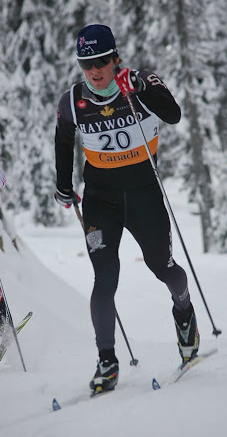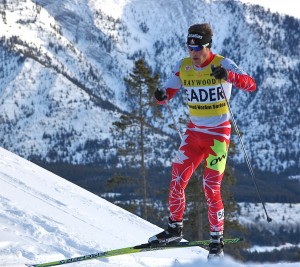
Tag: Raphaël Couturier

  • Three Americans Land Top 20s in U23 Worlds 15 k: Patterson 13th, Caldwell 15th and Bratrud 19th

    Three Americans Land Top 20s in U23 Worlds 15 k: Patterson 13th, Caldwell 15th and Bratrud 19th

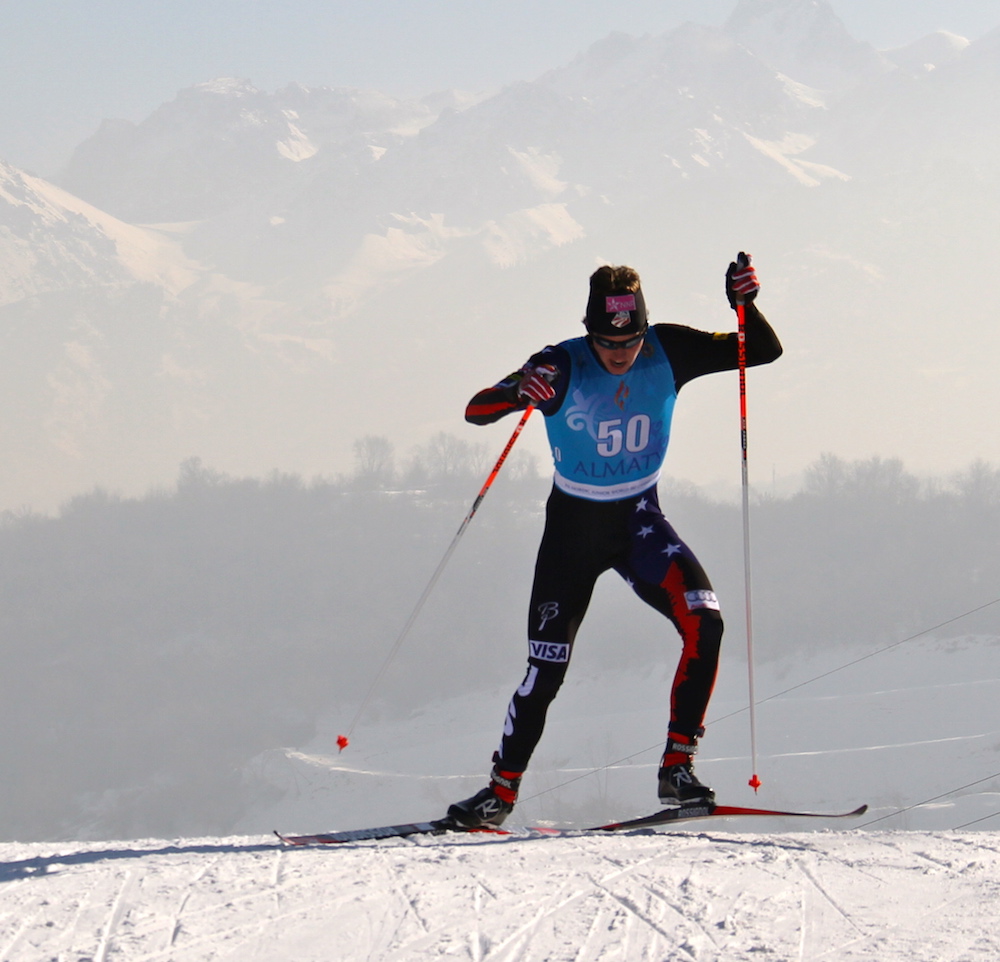
    Scott Patterson (APU) racing to a career-best 13th  in the 15 k freestyle on Thursday at U23 World Championships in Almaty, Kazakhstan. (Photo: Bryan Fish/USSA)
    Scott Patterson (APU) racing to a career-best 13th in the 15 k freestyle on Thursday at U23 World Championships in Almaty, Kazakhstan. (Photo: Bryan Fish/USSA)

    A career-best 13th sounds great until you realize that you were skiing as high as third at one point in the race, which is how Scott Patterson of Alaska Pacific University (APU) felt on Thursday after the men’s 15-kilometer freestyle at U23 World Championships in Almaty, Kazakhstan.

    Patterson, who turned 23 on Jan. 28, started 50th of nearly 60 men and was tied for third at 1.7 k with Russia’s Andrey Melnichenko, 2.2 seconds behind another Russian, Roman Tarasov, and 1.2 seconds behind France’s Mickael Philipot.

    By 6.7 k, Patterson remained in the top 10 with the ninth-fastest time, while Melnichenko had improved to fifth and Tarasov’s time ranked fourth. However, the last of three laps proved particularly challenging for several competitors, as Patterson slipped from ninth to 13th in the last three kilometers. Earlier in the final 5 k lap at 11.7 k, Melnichenko dropped to 12th and Tarasov fell to 17th, while Philipot ranked 22nd.

    Patterson ended up 13th, 1.27.8 behind winner Florian Notz of Germany, who improved from 11th early in the race to second at the 11.7 k checkpoint and finally, first at the finish in 35:55.3. Melnichenko finished 14th, Tarasov was 20th, and Philipot 23rd.

    “Honestly, I am a little disappointed with the result,” Patterson wrote in an email after his career-best performance at U23 World Championships. He had previously finished 18th in two races at 2014 U23 worlds (the 30 k skiathlon and 15 k classic), and 17th in the 10 k classic at 2010 Junior World Championships.

    “For most of the race I was fighting for a top 10,” he explained. “However, I faded as the race progressed while some of my competitors maintained the pace or got stronger.  At the finish I had heard I was in 8th so dropping to 13th in the end was a bit of a bummer. Luckily I still have one more race to improve on my finish. Coming into these championships, I had definitely been aiming for a top 10 with hopes even higher than that so I will continue that in the pursuit [skiathlon].”
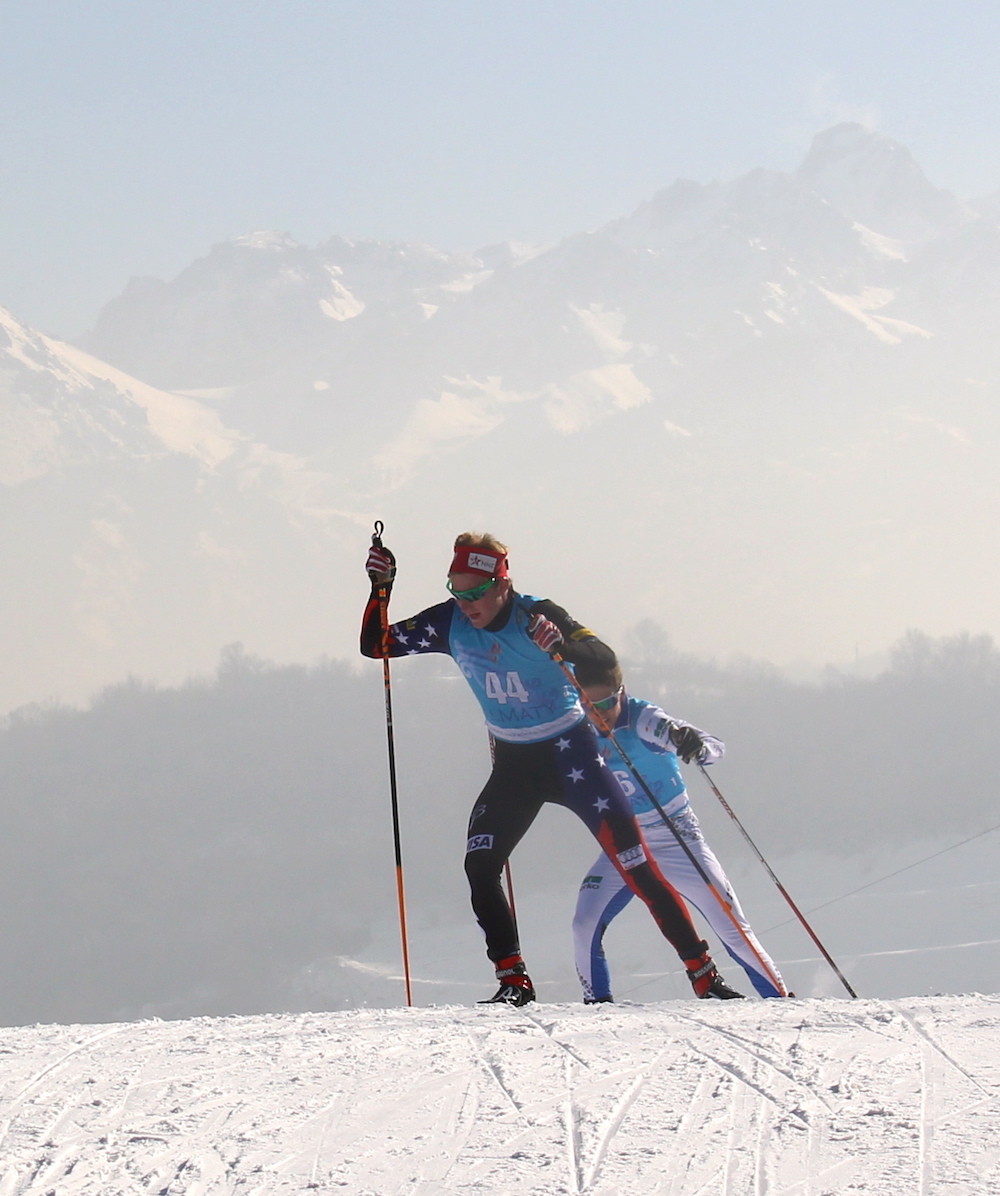
    Kyle Bratrud racing to 19th in his first race of U23 World Championships, the 15 k freestyle in Almaty, Kazakhstan. (Photo: Bryan Fish/USSA)
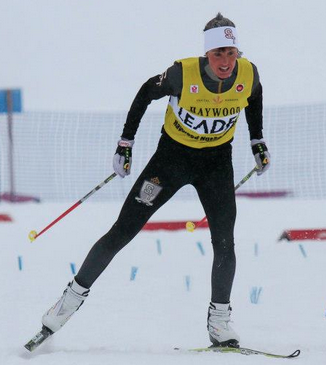
    Kyle Bratrud racing to 19th in his first race of U23 World Championships, the 15 k freestyle in Almaty, Kazakhstan. (Photo: Bryan Fish/USSA)

    Patterson led three American men in the top 20, with Patrick Caldwell (Dartmouth College/U.S. Ski Team) placing 15th (+1:40.1), and Kyle Bratrud finishing 19th (+1:49.1).

    “This was definitely one of my target races,” Patterson explained. “U23s is always an important part of the season and 15k skate races have historically been pretty successful for me, but the 30k pursuit is just as much of a target race.”

    While a top result at U23 worlds could draw the attention of the U.S. Ski Team and make a case for being considered for the U.S. Senior World Championships team, which will compete in Falun, Sweden, later this month, Patterson explained he wasn’t thinking about that.

    “Senior world championships would be awesome, but really I am here to race this week not race for a couple weeks later,” he wrote, adding that OPA Cup Finals in Chamonix, France, will likely be his next focus.

    Thursday’s course was tough, with “mostly relentless gradual uphills and working downhills with a few steep kickers and technical descents thrown in to keep it interesting,” he added. “Conditions were also quite interesting today with significantly faster almost icy section in the shade but almost slush in some spots. I think overall I skied it quite well but there were parts that could have gone better. By the third lap, I wasn’t working the transitions as hard as I should have been.”

    He paced his race aggressively, but found himself losing positions as the race continued.

    “I went out pretty hard with the idea that I was not going to be timid at U23s,” Patterson wrote. “Even in the first lap I could feel that this might cost me, later in the race. Although I hung close, I was gradually fading and transitioned into survival mode for the final few hills. Maybe it would have been better to go out a bit more conservative and ski into it, but I chose the opposite and it kind of worked out.”

    Just over three months ago, Patterson suffered a pulmonary embolism after a freak skiing accident with a teammate. He was limited to short walks for about a month, and it seemed the University of Vermont graduate’s first season as a professional skier was over before it had begun.

    “While I was injured there were definitely moments where I was questioning whether I would be able to qualify for this trip or even be able to race at nationals,” he reflected.

    He went on to win his first race back in December, a 15 k freestyle at home in Anchorage, Alaska, and placed eighth in the 30 k classic mass start at U.S. nationals last month.

    “The hardest part has been to keep everything balanced between the perspective of being injured and the perspective of it being a normal season,” he wrote. “On one hand everyone keeps telling me how amazing I am doing for where I was in November, but then there is the other side of me always wanting more and being quite close to where I actually want to be. Sometimes the injury just feels like it’s an excuse holding me back.”

    “Everyone keeps telling me how amazing I am doing for where I was in November, but then there is the other side of me always wanting more and being quite close to where I actually want to be.” — Scott Patterson, 13th in 15 k freestyle at U23 World Championships

    Heading into these championships, Caldwell explained in his email that his goals were to “race hard and stay healthy.” On Thursday, he was specifically aiming for a top 15 and was relieved he lunged at the line to do so.

    The 20-year-old Dartmouth ski team member finished 0.1 seconds ahead of Great Britain’s Andrew Young in 16th and edged Russia’s Krill Vichuzhanin in 17th by 0.3 seconds. In 15th, Caldwell was 11.4 seconds back from Melnichenko in 14th.

    “I’m really psyched with how things went today. It is a pretty tough course: lots of steep uphills, long gradual grinds and not much rest,” Caldwell wrote, adding that he focused on “staying relaxed on the climbs and really pushing it on the flats and gradual ups.”

    In his first race at a U23 World Championships, 15th marked his second-best result at a world championships since placing 10th in the 20 k skiathlon at junior worlds last year.

    “Many aspects of the competition are very similar so far,” he explained. “The biggest difference is that the top end for U23s are also competitive on the World Cup. Its pretty cool to be out there with some really successful World Cup skiers. … I think everyone is particularly fired up with the World Championships coming up soon. The upcoming races in Falun haven’t changed my approach to these races but have definitely added to the overall excitement at this event.”

    Bratrud placed 19th in his U23 worlds debut, after having competed at the 2013 junior worlds in Liberec, Czech Republic.

    “My goal going into today was to be in the top 15 or even top 10 so I am disappointed about that,” Bratrud wrote in an email. “I was in the hunt for the first two laps, but faded and leaked quite a bit of time on the last lap. That being said, it is hard not to be excited about a first top 20 and seeing two teammates in the top 15. This male U23 group is the future of US Skiing and it is a blessing just to be a part of it.”

    “This male U23 group is the future of US Skiing and it is a blessing just to be a part of it.” — Kyle Bratrud, 19th in 15 k freestyle at U23 World Championships

    Bratrud, who turns 22 on Feb. 9, started 44th — right behind Caldwell in bib 43 — and improved from the 25th-ranked time at 1.7 k to 12th at 6.7 k. He slipped to 16th with just over three kilometers remaining and ultimately finished 2.2 seconds within the top 20.

    “Anyone who knows me knows I put a lot of pressure on myself, so following a very successful US Nationals [where he won the 15 k freestyle and placed third in the 30 k classic] I certainly have new expectations for myself,” Bratrud said.

    Last week, he was named to the U.S. Senior World Championships team.

    “I constantly feel I need to justify my naming,” he added. “But at the end of the day I am on this trip with some of the best skiers in the US and if you are slightly off one day than a lot can happen. I went for it and came up short, but I am happy that I tried and excited for what lies ahead. This is certainly a new level. There are regular World Cup skiers racing with us and it’s fun to see where you compare.”
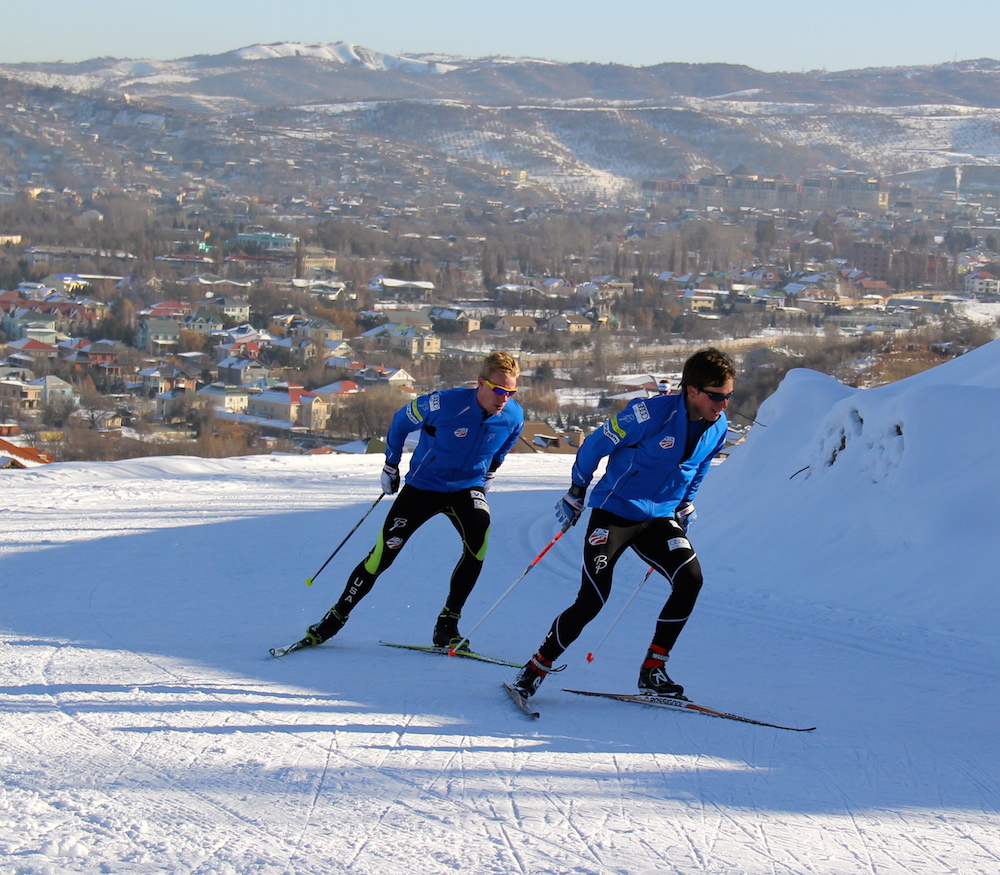
    Scott Patterson leads APU and U.S. U23 World Championships teammate Logan Hanneman during training last Friday in Almaty, Kazakhstan. (Photo: Bryan Fish/USSA)
    Scott Patterson leads APU and U.S. U23 World Championships teammate Logan Hanneman during training last Friday in Almaty, Kazakhstan. (Photo: Bryan Fish/USSA)

    Also for the U.S., Logan Hanneman (University of Alaska Fairbanks) placed 40th, 2:54.1 behind the winner.

    Germany’s Notz kicked it into high gear on the last of three laps for his first podium at a U23 or junior worlds, beating Norway’s Simen Hegstad Krueger by 9.5 seconds and French bronze medalist Adrien Backscheider by 26.7 seconds.

    Notz started last in bib 58 and paced himself accordingly to beat the times of both Krueger and Backscheider in bibs 56 and 57, respectively. Italy’s Giandomenico Salvadori held on for fourth (+34.7) and Norway’s Magne Haga, brother of women’s World Cup skier Ragnhild Haga, placed fifth (+40.2).

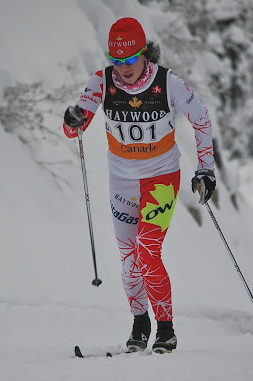
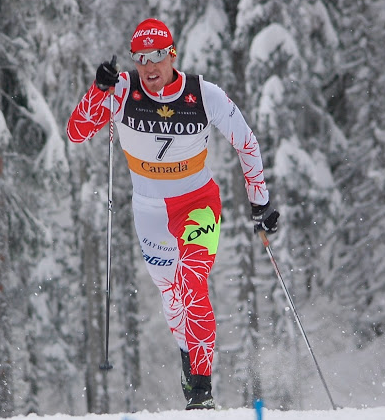
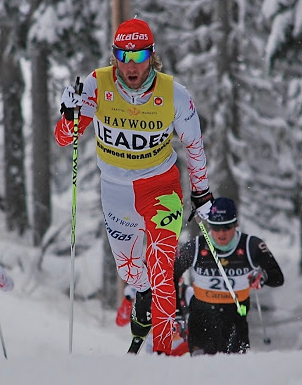
    Raphaël Couturier of the Pierre-Harvey Training Centre (CNEPH) and national U23 team placed 41st (+2:56.4) to lead the Canadian men, while teammates Knute Johnsgaard (Whitehorse/Yukon Elite Squad) finished 47th (+3:51.1), Scott James Hill (Thunder Bay NDC) took 48th (+3:54.3), and Colin Ferrie (Black Jack) placed 50th (+4:06.8).

    The U23 World Championships wrap up with the women’s and men’s 15/30 k skiathlons on Saturday.

    — Chelsea Little contributed reporting
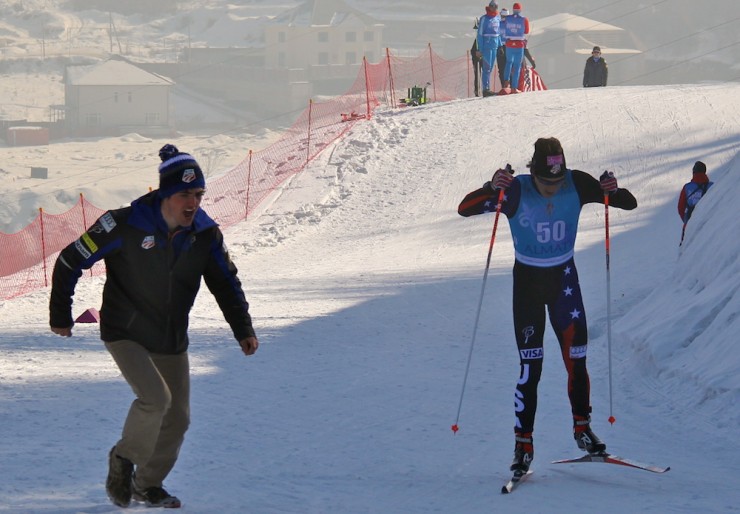
    Results: Men | Women

  • Let It Snow: Despite Weather Woes, First Two NorAms in the Bag

    Let It Snow: Despite Weather Woes, First Two NorAms in the Bag

    Kris Freeman on his way to winning the 30 k freestyle interval start by more than a minute and a half on Dec. 20 at the Sovereign Lake NorAm in Vernon, B.C. (Photo: Frances Weeks)
    Kris Freeman on his way to winning the 30 k freestyle interval start by more than a minute and a half on Dec. 20 at the Sovereign Lake NorAm in Vernon, B.C. (Photo: Frances Weeks)

    Canada’s NorAm circuit is what the International Ski Federation (FIS) calls a Continental Cup series, similar to the U.S. SuperTour.  The name NorAm is short for North American, a hold-over from when Canada and the U.S. had a combined race series.  These races are critical to the elite racers, with guaranteed World Cup starts, national-team positions, and trips to Junior/U23 World Championships in Almaty, Kazakhstan, on the line.

    Or to put it another way, it would take a major event to cancel a NorAm race — like perhaps a record-breaking storm in a unusually snowless early season.

    As organizing committees secured the final details for the first two NorAm weekends, a major storm was expected to bring heavy rain to most of southern British Columbia.

    By the end of the four-day storm, a Vancouver suburb had declared a state of emergency, heavy rain at 12-degree Celsius (54 Fahrenheit) had closed numerous ski resorts across B.C. (including Whistler Blackcomb). Seattle set weather records, and 220,000 people were without power in California.

    While all this was going on, organizers in La Clusaz, France, canceled their World Cup and later moved it to Davos, Switzerland, a venue which had previously avoided canceling its original race weekend because of a huge snow-moving effort largely funded by a retired alpine skier.

    Black Jack Ski Club

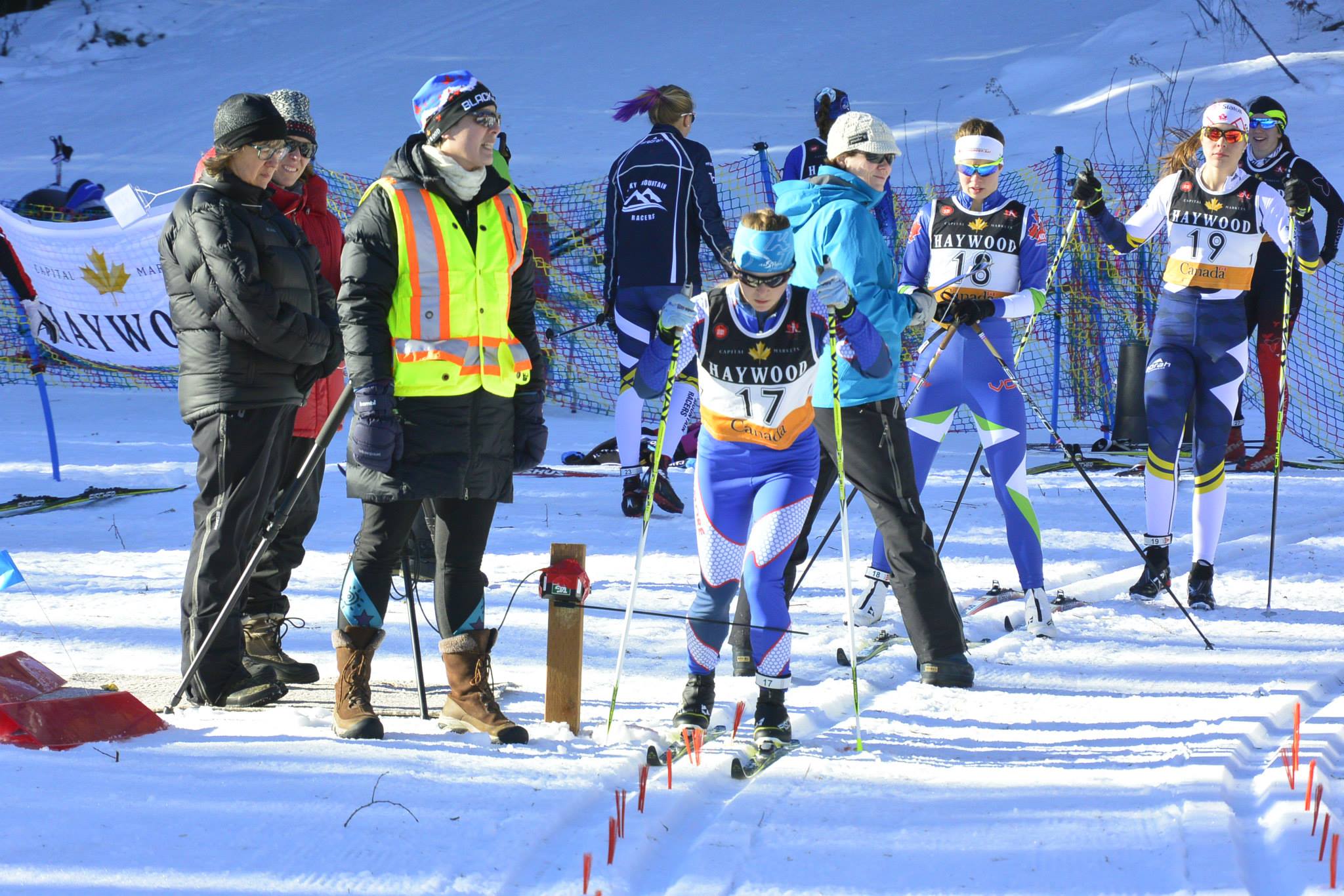
    The start of the women's 7.5 k classic at the Black Jack NorAm on Dec. 13 in Rossland, B.C. ( Saturday’s 11 k classic individual start at the NorAm opener in Rossland, B.C. (Photo: Fresh Cafe & apres/Facebook)
    The start of the women’s 7.5 k classic interval start at the Black Jack NorAm opener on Dec. 13 in Rossland, B.C. (Photo: Fresh Cafe & apres/Facebook)

    The first NorAm weekend this year was scheduled for Dec. 13-14, hosted by the Black Jack Ski Club in Rossland, B.C. Outside the province, Black Jack is best known as the club that produced George Grey (top-10 finisher at the 2010 Olympics) and the current home of long-time national team coach Dave Wood.

    When low snow, warm weather and predicted rain made the club’s homologated courses unsuitable for skiing, the club decided to move the opening races up to the biathlon trails, more than 200 meters (650 feet) higher in elevation. As the four-day storm progressed, the freezing level was up to 2,000 meters (6,500 feet) in the area, well above the 1400-meter(4,590-foot) elevation of the biathlon trails.

    When rain made the sprint loop unskiable two days before the race, the organizing committee didn’t give up. Club members, neighbours and team coaches spent hours shoveling snow onto the course. When another wave of rain destroyed the sprint course overnight, the organizing committee switched to two individual-start classic distance races and volunteers headed out again to shovel more snow onto the distance course.

    After four days of rain and a move to a higher venue without electricity or a timing building, the races were held. Generators provided power, live results were available on the internet and the event was generally agreed to be up to the Continental Cup standard.  Some 140 official volunteers plus an unknown number of shovelers made this possible.

    “We estimate we did about 130 man-hours of shovelling this week,” Chief of Competition Ian Sibbald wrote in an email.

    Unsolicited athlete quotes from the Black Jack NorAm

    “The volunteer base is incredible.  That is an astounding number [of volunteers] since only 3,500 people live in Rossland. Given the lack of snow, the conditions were great.” — Kris Freeman (Team Freebird)

    “Conditions were good! A few twigs poking through here and there, but tracks were fast and hard. Big thanks to the volunteers and organizing committee for working hard to run these races!” — Michael Somppi (Alberta World Cup Academy/Canadian Development Team)

    “Conditions were remarkable, especially considering the challenging weather the Black Jack Ski Club has been dealt. One would hardly know that though skiing the course, unless you look closely and notice all the shoveling marks on the side of the trail.” — Brian Gregg (Team Gregg/Madshus)

    “Conditions were much better than I expected, the organizers and groomers did an amazing job making the race happen with tough conditions and the tracks today were great!” — Alysson Marshall (AWCA/National Development Team)

    “Conditions today were amazing considering the weather … The race organizers and many volunteers from the town have worked hard to get a good track to make these races happen.” — Andrea Dupont (Rocky Mountain Racers)

    “The crew at Black Jack did an amazing job on the course, it was close to perfect considering what they had to work with. The tracks were great, I was very impressed.” — Dahria Beatty (AWCA/National U23 Team)

    “The course held together exceptionally well, due to the work of the volunteers and the slightly colder weather that appeared day of.” — Jennie Bender (Bridger Ski Foundation)

    Callaghan Valley Cross-Country

    Callaghan Valley Cross-Country (CVXC), the host of the second NorAm weekend, isn’t so much a ski club as it is a consortium of four clubs based in the Vancouver/Whistler area: Nordic Racers, Whistler Nordics, Hollyburn Jackrabbits, and Spud Valley Nordic. Squamish Nordic contributes, as do a number of other clubs from the province. For higher-level events, volunteers from other clubs commonly join in, either to add expertise to help the host club earn the event, or gain experience and knowledge so their own club can host similar events in the future.

    Scheduled the weekend before the holiday break, CVXC was on track with 85 volunteers with two weeks to go. Snow is rarely a problem at Whistler Olympic Park. In 2010, no provision for snow making was made and the Olympics were held on natural snow despite a seven-week block of rain that ended a week before the Olympics started.

    With very little snow and the forecast of the storm earlier this month, the organizing committee had to make a decision to commit, cancel or move the NorAm races with 12 days to go. On decision day, 100 millimetres (4 inches) of rain was forecast for the race venue.

    At this point, much of the sponsorship money had been spent, hundreds of volunteer hours had been invested, and teams had booked lodging and flights well in advance.

    With heavy rain falling at the venue, few people were surprised when organizers announced they were moving the races to Sovereign Lake in Vernon, B.C.

    Once the decision was made, the logistical headache began. The new venue is more than 400-kilometers away, which meant the existing volunteers wouldn’t be sleeping at home. Many of the teams had booked flights leaving Vancouver on Sunday night.  With two mountain passes and six-driving hours separating Sovereign from the airport, there wouldn’t be time to hold the planned events on Sunday.  Moving the races to Friday and Saturday solved the travel problem, but made the volunteer issue more difficult.

    At this level of competition, there are strict rules about roles and responsibilities. The assistant technical delegate, Sharon Clarke, was no longer eligible, as the new host was her home club. Clarke and the chief of competition, Sherryl Yeager, swapped roles before tackling the rest of the changes.

    “Having to change the event at such a late date due to weather is heartbreaking,” Yeager, also the CVXC vice chair, explained in an email. “All the work that went into planning, arranging sponsors, maps, courses, setting up run sheets, the race notice, registration, accommodation, food, the website and more is largely of no use.”

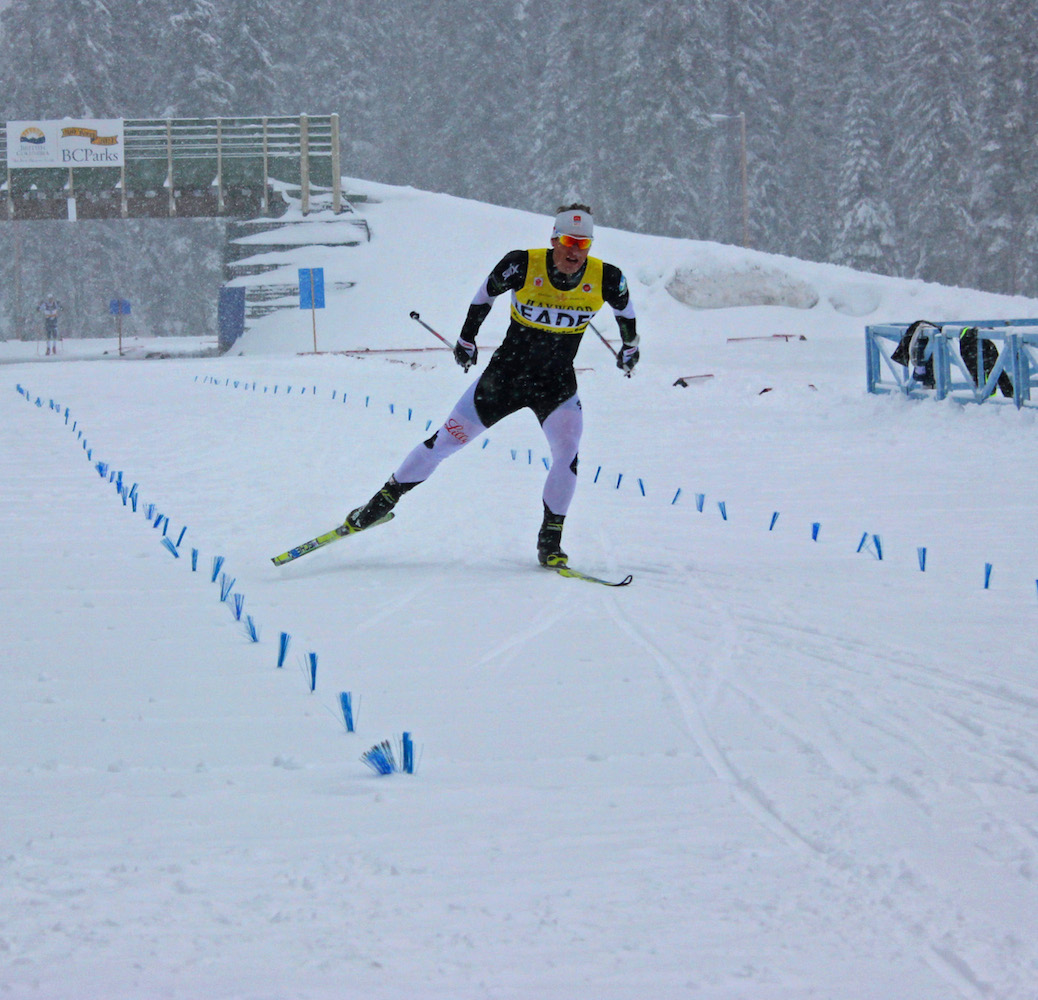
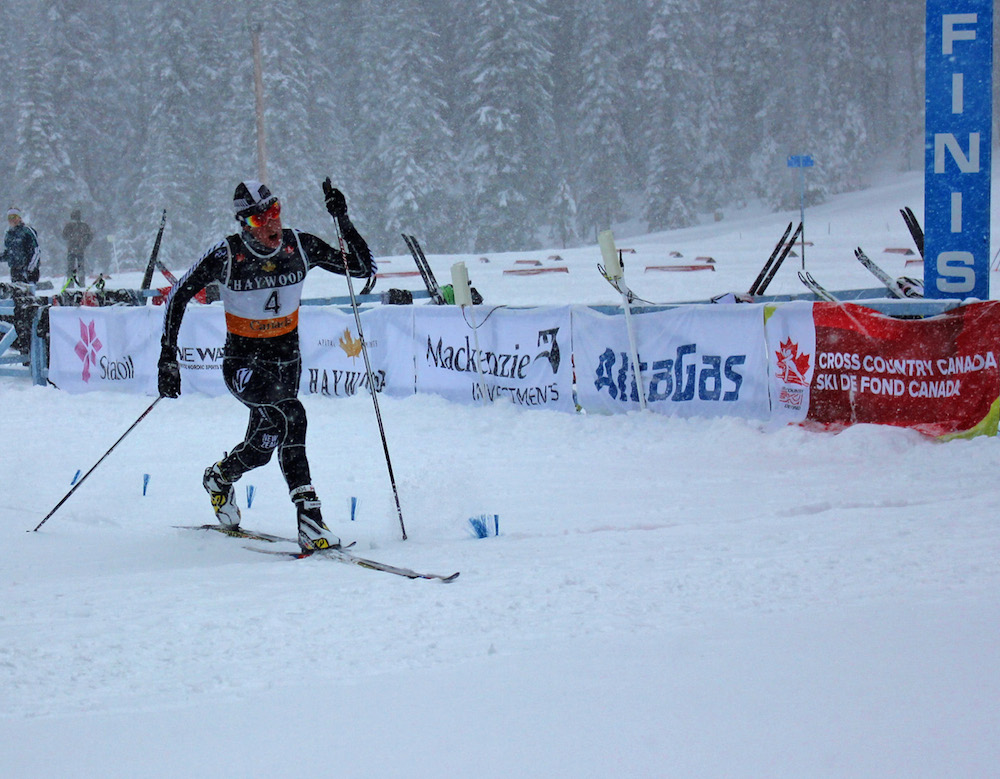
    Andrew Pohl of the New Zealand Ski Team crossing the line in 15th in the men's  NorAm 30 k freestyle interval start on Dec. 20 at Sovereign Lake, B.C. (Photo: Frances Weeks)
    Andrew Pohl of the New Zealand Ski Team crossing the line in 15th in the men’s NorAm 30 k freestyle interval start on Dec. 20 at Sovereign Lake, B.C. (Photo: Frances Weeks)

    Sovereign Lake Nordic Club

    Sovereign Lake is a perennial NorAm host, using trails built for a World Cup event in 2005. The trail system is interconnected with Silver Star Mountain Resort, which leaves most visitors a bit confused. In recent years, the division is simple: race at Sovereign, sleep at Silver Star, ski at both.

    Sovereign was hosting a CPL race (one level below Continental Cup) when the possibility of moving the NorAm was raised. With 80 volunteers on site, it was easy for the organizers to quickly find out how many might be available for a potential NorAm and make the commitment to offer the venue.

    The shift from Saturday/Sunday to Friday/Saturday was essential for the teams, but difficult for the organizers. More of the CVXC volunteers were unable to help and many of the Sovereign volunteers were unable to get a day off work at short notice.

    Without a sprint in the first NorAm weekend of racing, Sovereign’s first day became a classic sprint, requiring another rewrite of the race notice. Ultimately, the merged organizing committee was able to get about 100 volunteers over the two days, including some from neighboring clubs.

    Several racers generally viewed the event as a typical NorAm, with more comments on the challenges of heavily falling snow than the logistical obstacles of the event move.

    While athletes, coaches, families, and race-day volunteers have moved on, the two organizing committees are sorting out how to share the entry fees and sponsorship money to cover their extra expenses.

    The Result

    After two weekends and four races, more individuals volunteered than raced.  Athletes got crucial early season race time into their legs.  Several athletes have positioned themselves to race in Europe later this season.

    Was it all worth it? Dahria Beatty, Raphaël Couturier, Annah Hanthorn, and Philippe Boucher pre-qualified for Junior/U23 World Championships in early February in Almaty, and based on his NorAm results, Patrick Stewart-Jones earned his spot at the World Cup sprint in Otepää, Estonia, from Jan. 17-18.

  • NorAm Preview: All About Racing the Best in Canada, and the U.S.

    NorAm Preview: All About Racing the Best in Canada, and the U.S.

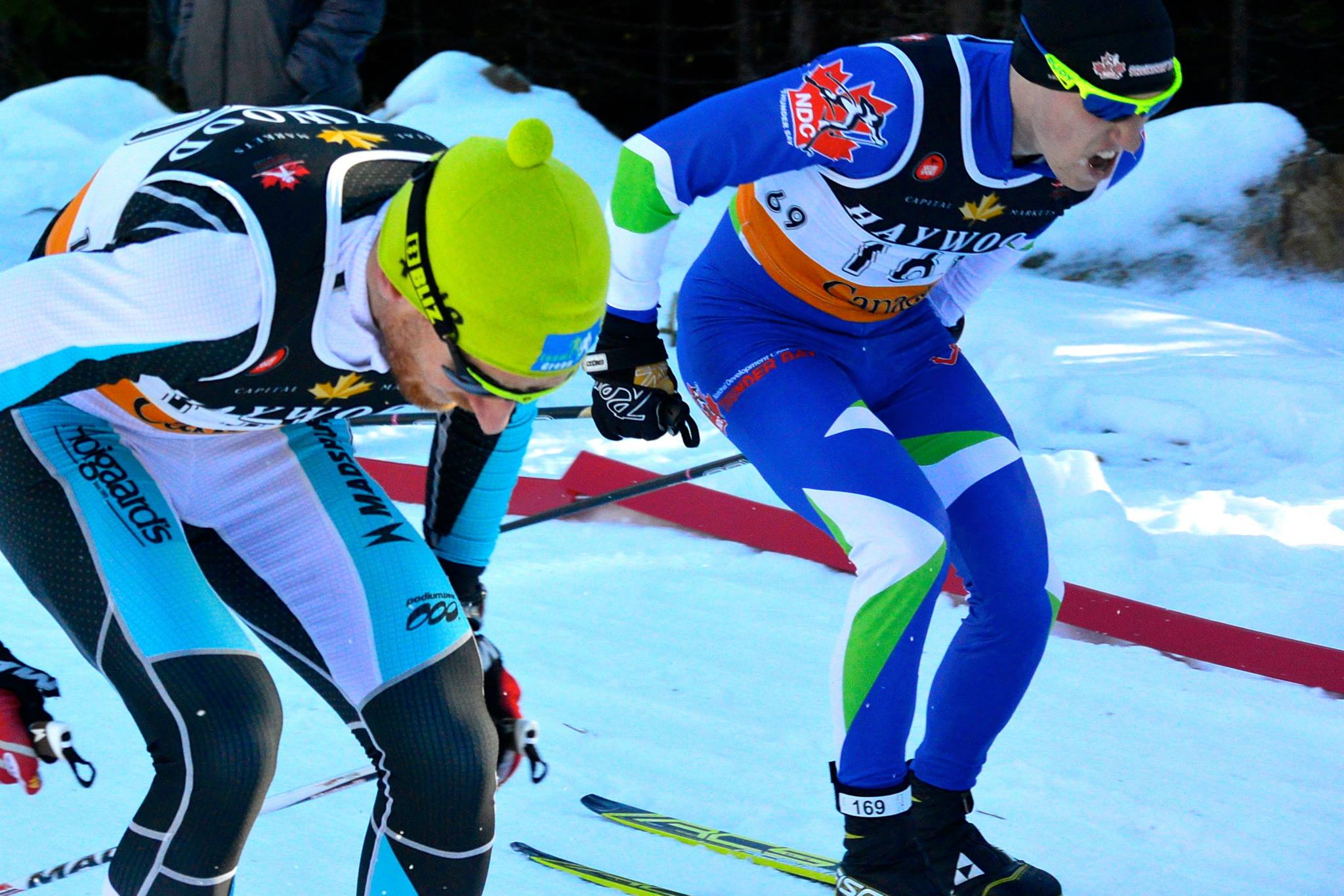
    American Brian Gregg (l) and Canadian Andy Shields of the Thunder Bay National Development Centre ski alongside each other in the 11 k classic individual start last weekend at the NorAm opener in Rossland, B.C. Gregg went on to place fifth and Shields was 12th. (Photo: FRESH cafe & apres/Facebook)
    American Brian Gregg (l) and Canadian Andy Shields of the Thunder Bay National Development Centre ski alongside each other in the 11 k classic individual start last weekend at the NorAm opener in Rossland, B.C. Gregg went on to place fifth and Shields was 12th. (Photo: FRESH cafe & apres/Facebook)

    While the opening weekend of the U.S. Super Tour marked the start of the North American race season in late November, Canada’s NorAm circuit kicked off last weekend in Rossland with two classic distance races, held despite challenging conditions and a lack of snow.

    The second stop of the NorAm circuit was originally scheduled for Whistler this Friday and Saturday, but once again, warm weather and insufficient snow led the races to be moved further inland to Sovereign Lake in Vernon, British Columbia, better known as Silver Star.

    This season, the NorAm will visit six venues, wrapping up at the Lappe Nordic Centre in Thunder Bay, Ontario, for Canadian Ski Nationals. The circuit attracts many of the most competitive Canadian and American domestic cross-country skiers, juniors and seniors alike, all trying to earn their stripes and log top results in an effort to get to Europe.

    Canadians Alysson Marshall and Heidi Widmer, teammates at the Alberta World Cup Academy (AWCA) in Canmore, Alberta, and on the national development team — also based in Canmore, started the winter off with strong results at the SuperTour opener in West Yellowstone, Mont. Marshall won the first sprint of the season, and Widmer placed second.

    In the 10 k freestyle the next day, Widmer again broke into the top 10 with a ninth-place finish, and Marshall finished 17th.

    Patrick Stewart-Jones (AWCA), Bob Thompson (Thunder Bay NDC), Michael Somppi (AWCA/NST D-team), and Andy Shields (AWCA) were among several Canadians racing in West Yellowstone. There, Shields made the sprint A-final, but finished sixth after breaking a pole. In the 15 k, Stewart-Jones led the Canadians in 17th. 

    One week later, Stewart-Jones emerged as the winner of the classic sprint in Bozeman — the second SuperTour stop in Montana. Marshall placed fifth in the women’s A-final, and the next day in the 10 k classic mass start, she finished 14th, just ahead teammate Dahria Beatty (AWCA/NST U23) in 15th. In the men’s 15 k classic mass start, Somppi was the top Canadian man 13th.

    Rossland’s opening NorAm races challenged organizers with difficult conditions, but quality racing still took place thanks to the hard work of the staff and volunteers. Warm weather and rain previously wreaked havoc on the snow, but below-freezing temperatures last weekend made for hard-packed, icy conditions for the two distance races. Leading up to the races, organizers ruled the course unsafe for a sprint and added another classic distance race to the schedule instead.

    Yukon's Annah Hanthorn racing to third on the opening day of the 2014/2015 NorAm season, in the women's 7.5 k classic in Rossland, B.C.  (Photo: FRESH cafe & apres/Facebook)
    Yukon’s Annah Hanthorn racing to third on the opening day of the 2014/2015 NorAm season, in the women’s 7.5 k classic in Rossland, B.C. (Photo: FRESH cafe & apres/Facebook)

    Marshall swept both races, as did American Kris Freeman. Somppi hit the podium in third in last Saturday’s 11 k classic, and was again the top Canadian in fourth in the following 15 k classic. Andrea Dupont (Rocky Mountain Racers) placed second to Marshall in the 7.5 k sprint on Day 1, and junior Annah Hanthorn (Yukon Territory Ski Team) placed third, then second in the women’s 11 k on Day 2.

    Following an Olympic year, there have been some shifts in the key Canadian players: Dasha Gaiazova, Amanda Ammar and Zoe Roy were three of the nation’s top women last season and retired this spring. Graham Nishikawa, the reigning overall men’s NorAm leader, has re-committed his focus to guiding Canadian Para-Nordic teammate Brian McKeever at International Paralympic Committee (IPC) World Cups and 2015 World Championships.

    Many of the top athletes are aiming for top results in order to qualify for later World Cups, U23 and Junior World Championships, and potentially senior World Championships in Falun, Sweden.

    “Making the transition from domestic to World Cup racing is what everyone on the development team is trying to achieve, me included,” Somppi wrote in an email. “Experience is certainly helpful. The more international racing you do, the more comfortable you get with it and the better you perform.”

    Women to Watch 

    Alysson Marshall at the 2014 Canadian Eastern Championships in Cantley, Quebec. (Photo http://shootstories.smugmug.com/Canadian-Eastern-Championships/i-TdxGVQW
    Alysson Marshall at the last season’s Canadian Eastern Championships in Cantley, Quebec. (Photo: Canadian Eastern Championships)

    Heidi Widmer (AWCA/NST D-team) – With last year’s overall NorAm cup winner Emily Nishikawa starting her season in Europe on the World Cup, Widmer is one favorite in the running for an overall NorAm title this season.

    The 23-year-old Sochi Olympian already has a podium under her belt from West Yellowstone, where she also posted the fastest women’s qualifying time in the sprint. In late October before the season officially started, she qualified fourth in the Frozen Thunder classic sprint among U.S. Ski Team members and other top Canadians, and then edged Nishikawa in the distance skate to finish ninth.

    Alysson Marshall (AWCA/NST D-team) — In six races so far this season, Marshall, 26, has won half of them. Marshall and Widmer have already been battling back and forth; neither has beaten the other in consecutive races this season (although Widmer did not race in Bozeman or Rossland). Marshall, 26, has been consistent in distance and sprinting, a critical asset in the run the overall NorAm title. Last season, she finished third in the NorAm standings behind Nishikawa and Widmer, respectively.

    Dahria Beatty (AWCA/NST U23 team) – One of the youngest threats on the circuit, Beatty, 20, is a first-year senior who proved as early as the Frozen Thunder classic sprint that she’s able to ski with the best. There in October in Canmore, she qualified second behind former Olympian Perianne Jones.

    Andrea Dupont (Rocky Mountain Racers) – After finishing fifth overall in the 2013/2014 NorAm (behind Ammar in fourth), this 34-year-old distance veteran is looking to lift herself to World Cup starts.

    A sprint specialist, Dupont stressed in an email the importance of dominant qualifiers, while adding that racing well in the heats and advancing throughout each round is important as well. But more than anything else, she wants better qualifiers than last season.

    “It isn’t enough to just get into the heats in Canada; you have to win the qualifier here if you want to have a chance of qualifying in Europe,” she explained.

    Despite her sprinting preference and sickness early in the season, Dupont claimed second place in Rossland’s 7.5 k classic race.

    Cendrine Brown (CNEPH/U23) – This 21-year-old member of the Pierre-Harvey Training Centre (CNEPH) in Quebec, made the junior-national team last season and competed at U23 World Championships in Val di Fiemme, Italy.

    This year, after focusing on speed to improve her sprinting, Brown has already recorded fourth- and sixth-place finishes in Rossland, and will continue to shoot for another U23 World Championships in Almaty, Kazakhstan. The first three NorAm weekends serve as trials for Canada’s U23 and World Junior teams.

    Brittany Webster (AWCA) — A two-time Olympian and veteran to high-level racing, Webster, 27, started her season off in 15th in the Bozeman classic sprint. She didn’t race in Rossland, but Webster has been busy this offseason; competing in her first off-road triathlon World Championships, where she won the amateur division.

    Also this fall, she launched a pursu.it crowd-funding campaign in September and has raised over $19,500 to help cover the cost of what she anticipates to be an expensive international race season.

    Men to Watch

    Michael Somppi (AWCA/NST D-team) racing in the Frozen Thunder classic sprint on Oct. 24. (Photo: Angus Cockney)
    Michael Somppi (AWCA/NST D-team) racing in the Frozen Thunder classic sprint on Oct. 24. (Photo: Angus Cockney)

    Michael Somppi (AWCA/NST D-team) – Third overall in the NorAm last season; Somppi, 26, is eager to build on his past performances. For now, he’s focused on superb racing before the end of December.

    At this point in my ski career, I’m 26 and if I want a shot at being a World Cup competitor I need to be able to podium at home,” Somppi wrote in an email. “So every time I step on the start line I’m looking to finish on the podium.”

    He was the top Canadian in both classic distance races in Rossland last weekend, claiming a bronze medal in the 11 k classic and finishing fourth in the 15 k.

    Raphaël Couturier (CNEPH/U23) – In August, Couturier, 21, was the only Canadian not part of the World Cup Team invited to come down from Quebec to train with the team at a dryland camp in Stratton, Vt. He ranked fifth overall in the NorAm last year, and has started the season in seventh and 10th in Rossland.

    Patrick Stewart-Jones (AWCA) – Wrapping up the 2013/2014 NorAm season in sixth overall, Stewart-Jones, 23, will be looking to improve his placing. Last winter, he posted some of his best results of the season at Canadian Olympic Team trials in Janaury (where he was third in the freestyle sprint and sixth in the 15 k classic), and was able to race at U23 World Championships as well as Scandinavian Cups in Latvia and Estonia.

    In six races, he has two top 10’s: one win and an eighth-place finish in the 11 k classic last weekend.

    Knute Johnsgaard (Independent) – Likely one of the biggest dark horses at the beginning of this season, Johnsgaard spends most of his training hours without company in the Yukon.

    Despite his training partner leaving for school, having limited time with his coach, and developing his own training plan with the help of Graham Nishikawa, Johnsgaard is confident in his training, the work he has done and how it will translate on the tracks.

    “I’m always really focused and motived to just get out and go by myself,” he explained. “It’s a little lonely sometimes but I don’t need anybody to ‘push’ me.”

    Johnsgaard, 22, added he likes being off the radar and not having anyone knowing how his training is going. To that end, he joked that he’s won every single time trial he’s done this year. He’s hoping to continue this streak and claim victories at NorAm races.

    Andy Shields (Thunder Bay NDC) – Last season, Shields finished ninth overall on the NorAm, yet his early season results indicate he’s had a successful summer of training that could put him closer to the top overall this time around. So far, the 23 year old has posted two sixth-place results: first in the West Yellowstone sprint and also in the 15 k classic last weekend.

    Wild Cards

    World Cup Academy teammates Kevin Sandau (NST D-team), Jesse Cockney (B-team), and Graeme Killick (B-team) were among the most competitive on the NorAm circuit last season, finishing second, fourth and seventh overall, respectively. Cockney and Killick earned Olympic spots for Sochi based on the mid-season NorAm races and all three have started their seasons on the World Cup in Europe.

    In an email, Sandau described his excitement to race on the World Cup and some of his expectations: “Davos is a very unique race and I think it plays well with my strengths with it being a longer distance and a course with longer climbs than most other world cups,” the 26 year old wrote. After some tuneup FIS races in Switzerland earlier this month, he placed 70th in the 15 k classic last weekend in Davos.

    “At the end of the day it really is the final result that counts, but more than anything I want to cross that line and just have that feeling of it being the perfect race,” he wrote.

    Multiple-time Paralympic gold medalist, Brian McKeever races to 13th in the Rossland NorAm 11 k classic on Dec. 13. (Photo: FRESH cafe & apres/Facebook)
    Multiple-time Paralympic gold medalist, Brian McKeever races to 13th in the Rossland NorAm 11 k classic on Dec. 13. (Photo: FRESH cafe & apres/Facebook)

    Last year’s overall NorAm leader, Graham Nishikawa is backing away from domestic racing to fulfill his commitments to the Para-Nordic Tea, although he confirmed he would take part in one or two NorAms to prepare for IPC World Cups. Despite the races not being his focus, Nishikawa, 31, is a potential treat if he makes it to the start line.

    His younger sister Emily matched him as the women’s overall NorAm winner last season. She is currently racing on the World Cup, where she posted a career-best 29th last weekend in Davos.

    “The major difference between racing on the World Cup and domestically is the depth of the field,” Emily Nishikawa explained in an email. “If you lose a few seconds, you will lose a few places as well. This probably won’t happen when racing domestically because the field is just that much smaller.”

    Annah Hanthorn and Maya MacIsaac-Jones, both 19-year-old juniors, finished third and fifth respectively in last weekend’s 7.5 k classic (and Hanthorn was second in the following 11 k classic). Then there’s always Perianne Jones, a perennial World Cup staple, who could make NorAm waves should she return to Canada.

    Already, it’s shaping up to be another exciting year of racing. Some athletes are most competitive in distance races, others sprinting, and a myriad of possible contenders can take the victory on any given day. Stay tuned for NorAm updates via the Continental Cup blog: http://blogs.fasterskier.com/continentalcup

    2014/2015 NorAm Schedule 

    • Dec. 13-14: Rossland NorAm opener (and U23/Junior World Trials 1): 7.5/11 k classic & 11/15 k classic
    • Dec. 19-20: Vernon freestyle interval start & classic sprint at Sovereign Lake (U23/Junior World Trials 2)
    • Jan. 8-11: Duntroon 15/30 k skiathlon, classic sprint, 10/15 k freestyle (U23/Junior World Trials 3)
    • Jan. 15-18: Western Canadian Championships in Canmore: 10/10 k classic, freestyle sprint, classic mass start
    • Jan. 30-Feb. 1: Eastern Canadian Championships in Cantley: freestyle sprint/prologue, 10/15 k freestyle, 15/20 k classic mass start
    • March 14-21: Canadian Ski Nationals in Thunder Bay: freestyle team sprint, 5/10 k freestyle, 10/15 k classic, 30/50 k freestyle mass start

    — Alex Kochon contributed reporting
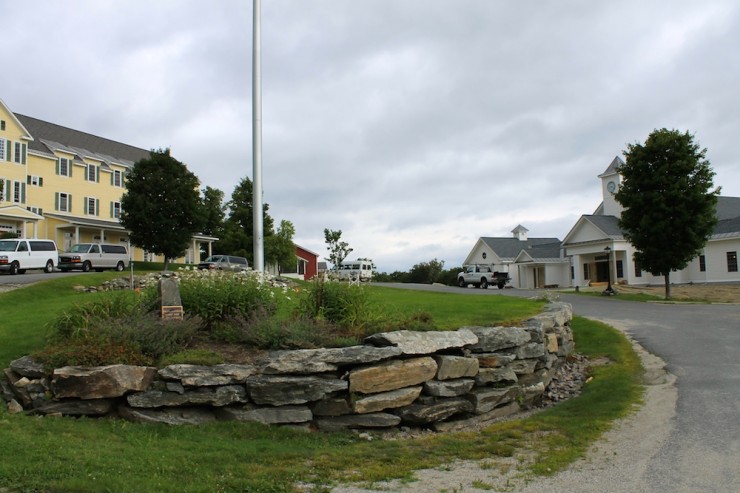
  • Canadians Head South to Stratton for New Camp, Combine with SMST2 (with Photo Gallery)

    Canadians Head South to Stratton for New Camp, Combine with SMST2 (with Photo Gallery)

    Canadians Alex Harvey (r), Devon Kershaw (front left) lead six others, including Ivan Babikov (third from l), Kris Freeman (second from l) and Andy Newell (l), during a combi over-distance rollerski near Stratton, Vt.
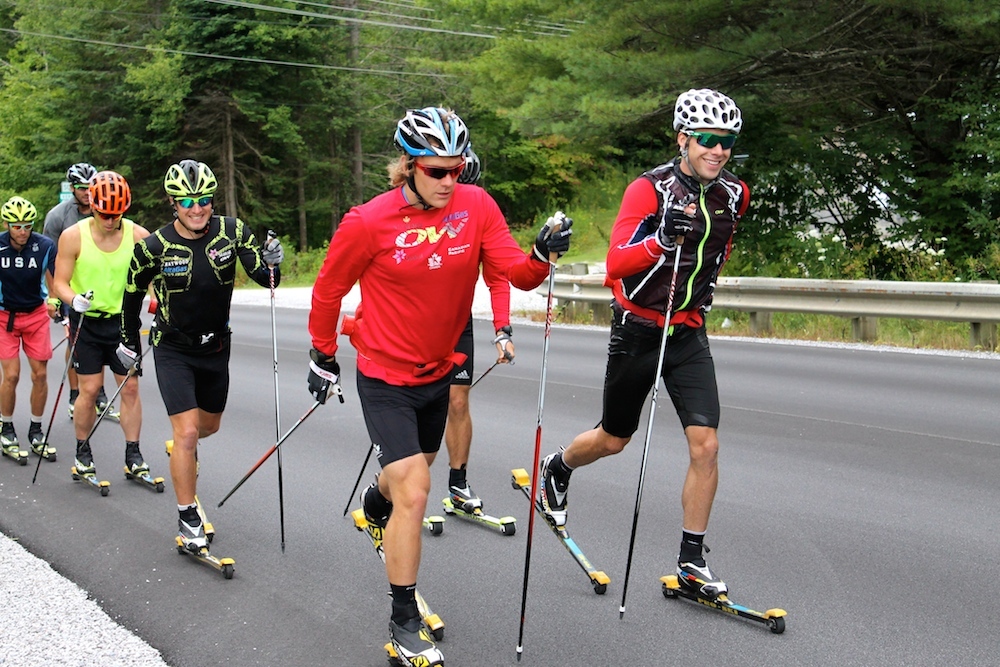
    Canadians Alex Harvey (r), Devon Kershaw (front left) lead six others, including Ivan Babikov (third from l), Kris Freeman (second from l) and Andy Newell (l), during a combo over-distance rollerski on Aug. 15 near Stratton, Vt.

    STRATTON, Vt. — When Tor-Arne Hetland thought of the U.S., his mind went to places he had been before, like New York City and Park City, Utah.

    Stratton — a small town in southern Vermont with roughly 200 year-round residents (not including the private ski school near the height of the land) — was a surprise, but Hetland figured if Andy Newell grew up training there, it had to be worth visiting.

    Canada’s newest World Cup coach and his four-man team of Ivan Babikov, Devon Kershaw, Alex Harvey, and Lenny Valjas ventured to the land unknown in early August for a sea-level, dryland intensity camp with the Stratton Mountain School (SMS) T2 Team. They rented a house in Stratton and brought a physical therapist along, and let Newell, an SMST2 skier and longtime U.S. Ski Team (USST) member, show them around.

    Newell, of nearby Shaftsbury, Vt., picked the rollerski routes and joined the Canadians for about half of their workouts during their two-week stay, as did fellow USST and SMST2 skier Simi Hamilton.

    APU's Rosie Brennan leads Stratton skiers during a over-distance, combi rollerski in Stratton, Vt.
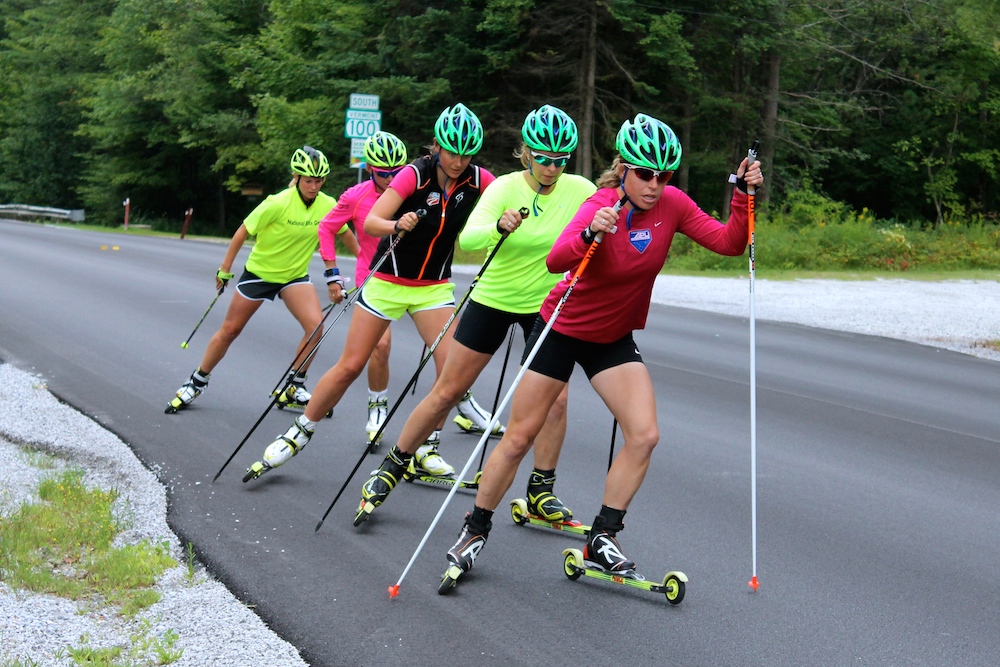
    APU’s Rosie Brennan leads Stratton skiers Anne Hart (second from r), Annie Pokorny (c), Sophie Caldwell (second from l), and Jessie Diggins (l), during a combo over-distance rollerski in Stratton, Vt.

    Stratton’s new head coach in his third month with the team, Patrick O’Brien said the Canadians were a welcome addition while most of his team was training together, two weeks before the USST training camp in Lake Placid, N.Y.

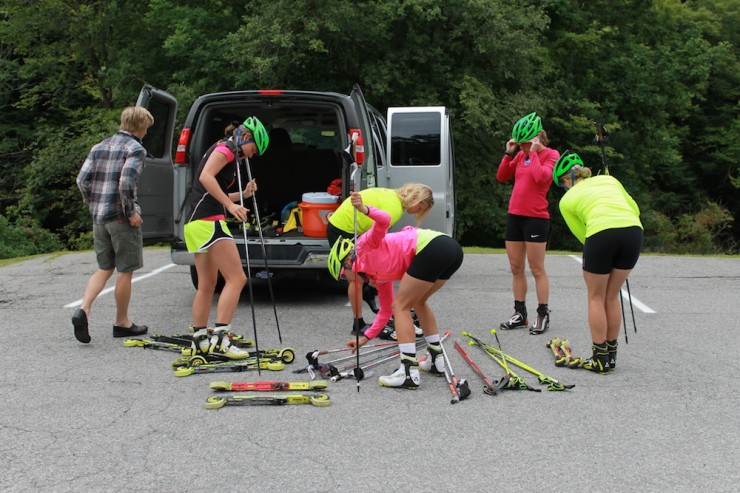
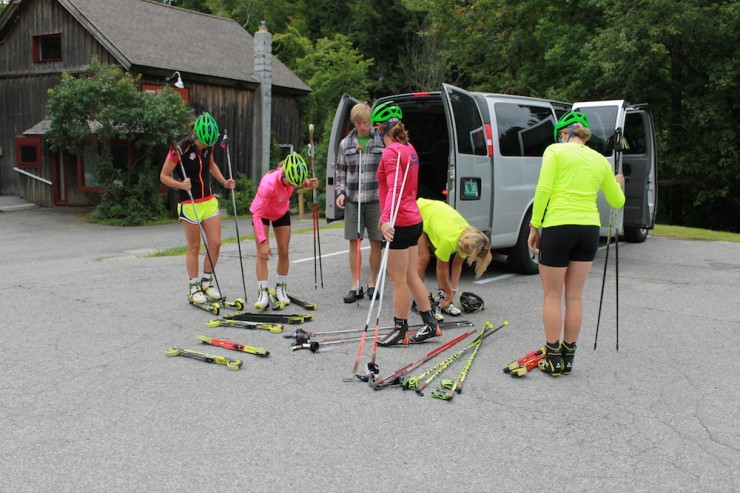
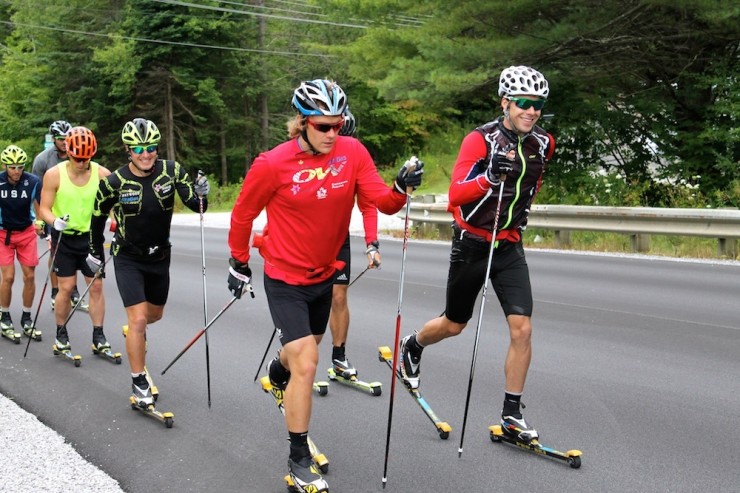
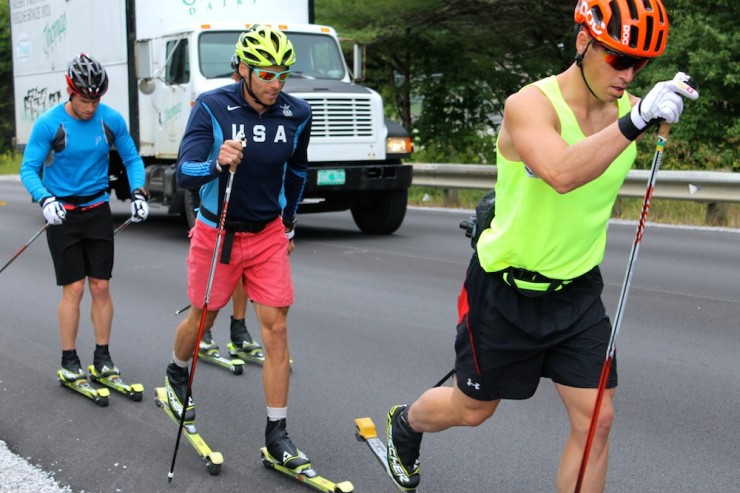
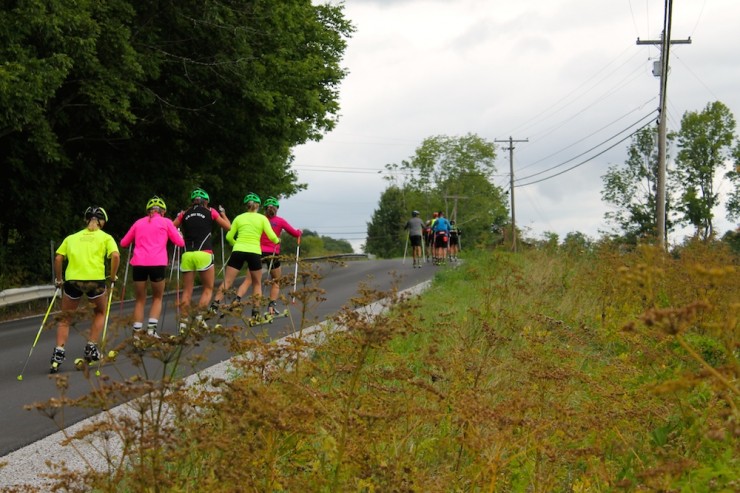
    Hetland and Canada’s World Cup assistant coach Louis Bouchard, who drove five hours down from Quebec City, came with two vans — making logistics somewhat easier for supporting eight men during a given workout. On Aug. 15, they did a three-hour, combo over-distance rollerski (mimicking a skiathlon), looping around hilly backroads.

    “It’s been really cool working with Tor-Arne and Louis,” O’Brien said. “As a young coach, I’ve been picking their brains … They’ve been really accommodating.”

    Not all the workouts lined up. The Canadians, with a fifth athlete in Raphaël Couturier of the Pierre-Harvey Training Centre (where Bouchard is head coach), generally focused on high-intensity (Level 4-5) rollerskiing during the camp. The amount of hours they wanted to put in didn’t always match those of Newell, Hamilton and Ben Saxton on the T2 Team, O’Brien explained.

    “Kind of our go-to is threshold and speeds with some L4,” O’Brien said.

    Newell had been scaling back the amount of L4 workouts this summer and doing longer workouts to increase volume, he added. Plus, Newell and Hamilton recently returned from the USST camp in Alaska.

    During the Canadians’ camp in Stratton, O’Brien also had five female athletes to coordinate workouts for: Jessie Diggins, Sophie Caldwell, Erika Flowers, Anne Hart, and Annie Pokorny.

    The crew from north of the border originally wanted to hold their own camp in Lake Placid at the recommendation of U.S. head coach Chris Grover. When they couldn’t find a house to rent in August, they turned their attention to Vermont at the suggestion of Grover and Justin Wadsworth, Canada’s other World Cup and National Team head coach.

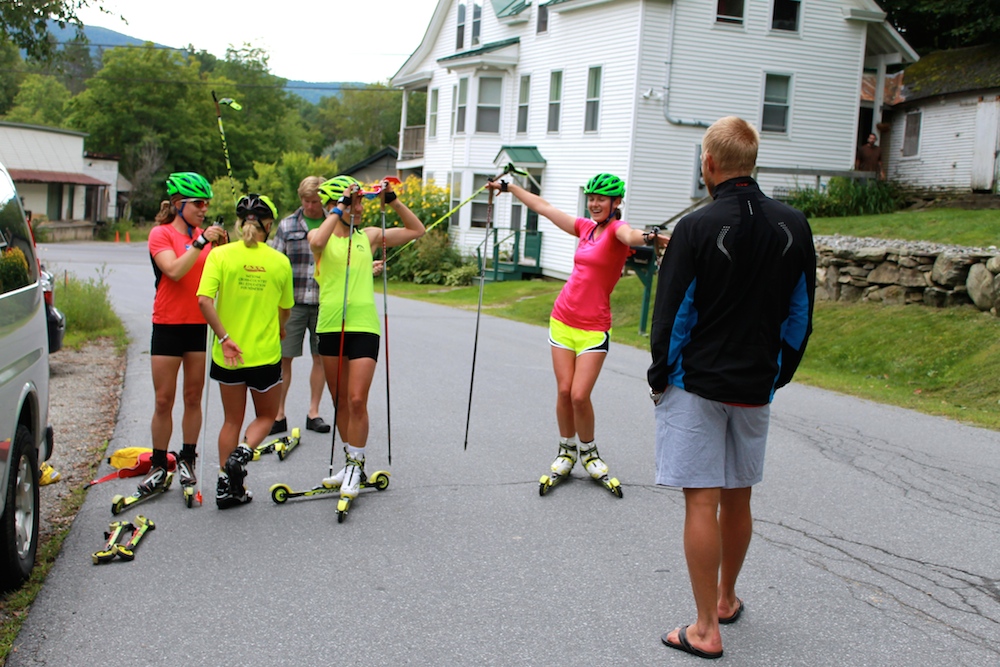
    Canadian World Cup Team coach Tor-Arne Hetland (r) talks with the SMST2 Team during a water stop on its over-distance rollerski session on Aug. 15 near Stratton, Vt.
    Canadian World Cup Team coach Tor-Arne Hetland (r) talks with the SMST2 Team during a water stop on an over-distance rollerski session on Aug. 15 near Stratton, Vt.

    “Londonderry, Brattleboro,” Hetland read out loud from street signs along the rollerski route. Not much imagination those English settlers had, he chuckled.

    No, not in New England, but weren’t these 18th-century buildings neat? More like cute by his standards, considering Norway was 900 years older.

    Regardless, Stratton had something he wanted to see in person.

    “I was thinking, Andy Newell can train here for many years so … that’s the reason we are here,” said Hetland, an Olympic gold medalist who coached the Swiss national team with his wife from 2010-2014. He and his wife, Guri Hetland, currently live in Davos, Switzerland.

    Another plus: Stratton’s near-sea-level altitude with a low point around 1,900 feet (580 meters). The Canadians wanted to train a lot and test their limits, so recovery times needed to be shorter, Hetland explained. In mid-October, they’ll head to Park City for their annual altitude camp with less intensity, and they previously got together as a group in Canmore, Alberta, and also in Bend, Ore.

    Back when they were planning their late-summer camp, they ruled a few locations out. Their regular stop in New Zealand for actual skiing at the Snow Farm couldn’t happen because of Cross Country Canada’s budget cuts. Whistler, British Columbia, was a possibility, but it wasn’t great for rollerskiing, Hetland said. Then they couldn’t find a place to stay in Lake Placid.

    But Newell, Hamilton and their SMST2 teammates: “We can use [them],” Hetland said.

    “The U.S. and Canada have great skiers, but they’re alone,” he explained. “[That’s the] biggest difference to Russia and Norway.”

    “Anytime you can make the group larger without sacrificing quality, it’s great,” O’Brien began, noting the high-caliber of the Canadians. “These guys are really fast.”

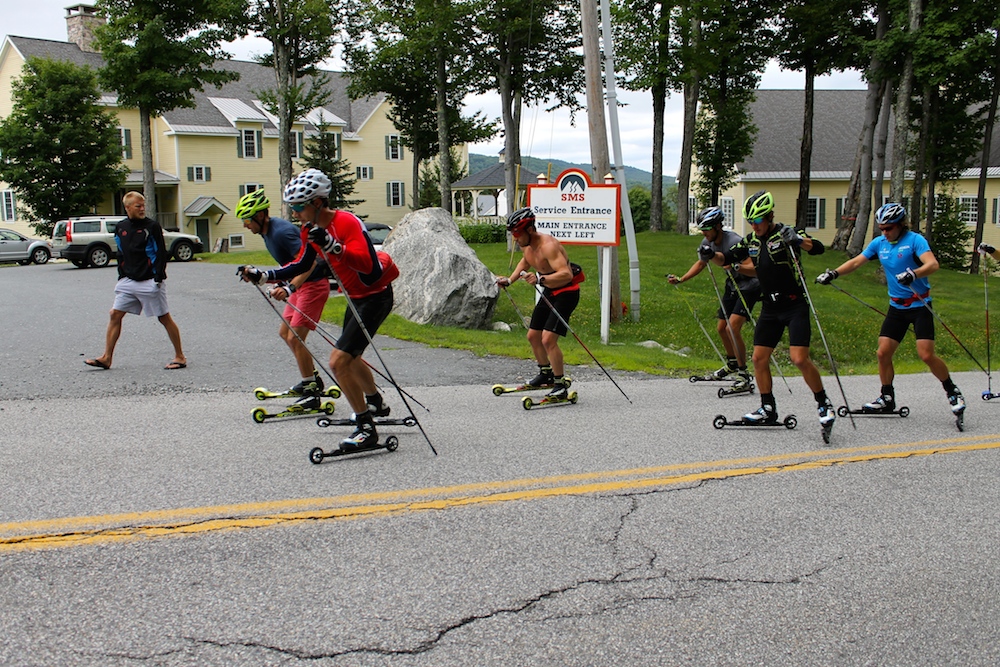
    An hour and 30 minutes in, eight men — Newell, Hamilton, Babikov, Kershaw, Harvey, Valjas, Couturier, and Kris Freeman of Waterville, N.H. — clicked out of their bindings and switched from classic to skate. Hetland and Bouchard had parked their two vans on the side of the road and carefully laid out each athletes’ equipment a few minutes before.

    Four months into his new role with the team, Hetland was still getting to know them. He remembers his parents’ first impression of the Canadians, having only seen them on TV.

    “My parents, who never met them, said that will be good,” Hetland said.

    Simply put, they seemed like they liked each other, and having worked with them for the last few months, Hetland could attest to that.

    The key to their chemistry over the years hasn’t been a fluke: consistency in training partners and coaches has been a major factor, Hetland said. For instance, he linked Harvey’s success to his longtime coach, Bouchard.

    As for the changes he’s instilled within the team, Hetland said there’s no one secret.

    “The work over a long time is important, and also for the athletes to hear the same ideas about technique,” he said. “I’m saying it a different way … something old, but in a new way.”

    Andy Newell (l) and Alex Harvey (r) lead an over-distance rollerski past the Stratton Mountain School while Canadian coach Tor-Arne Hetland (l) checks in.
    Andy Newell (second from l) and Alex Harvey (r) lead an over-distance rollerski past the Stratton Mountain School while Canadian coach Tor-Arne Hetland (l) checks in.

    Just a few minutes earlier, five women — Alaska Pacific University’s Rosie Brennan in place of Flowers — transitioned from skate to classic (Flowers helped at the Stratton junior camp that morning). Three of them — Caldwell, Hart and Pokorny — logged three hours for their longest rollerski of the season.

    After picking their way through the woods to bypass a culvert-construction site on their go-to rollerski road, appropriately called Mountain Road, they ended in Stratton’s town center, a quiet intersection with a couple municipal buildings.

    “26.25 miles,” Caldwell read off her GPS watch. “We just rollerskied a marathon!”

    Later this month, after the USST camp in Lake Placid, the SMST2 Team plans to do its annual 100-kilometer (62-mile) rollerski to raise money for travel expenses for the upcoming season.

    “I really enjoy watching and supporting these guys in training sessions,” said O’Brien, a Stratton alumnus who raced for the Craftsbury Green Racing Project until this spring.

    Now he’s writing training plans for Hart, Pokorny, Flowers, and Saxton. The rest of the T2 skiers are on the USST, and O’Brien collaborates with their coaches to make sure they’re on target.

    “I’m as much a facilitator as I am a club coach,” O’Brien said. “It’s kind of like putting pieces of a puzzle together.”

  • SuperTour Resumes in Craftsbury; Caitlin Gregg, Scott Patterson Top Podium

    SuperTour Resumes in Craftsbury; Caitlin Gregg, Scott Patterson Top Podium

    Patrick Caldwell leads a group of skier's in Friday's 10-kilometer freestyle race in Craftsbury, Vermont, as part of the USSA SuperTour. Photo courtesy John Lazenby.
    Patrick Caldwell leads a group of skier’s in Friday’s 10-kilometer freestyle race in Craftsbury, Vermont, as part of the USSA SuperTour. Photo courtesy John Lazenby / lazenbyphoto.com

    Craftsbury, Vermont hosted the USSA SuperTour this weekend under blue skies and on top of firm tracks, with racers calling it “the best conditions of the year.” The three days of racing comprised women’s and men’s 5 and 10-kilometer freestyle races (respectively) on Friday, a 15/20 k classic on Saturday, and Sunday Sprints.

    Friday’s Interval-Start Skate

    On Friday Caitlin Gregg showed that she is a dominant skate skier, starting hard and holding it through to the finish in the 5 k, finishing first in 13:50.8. Caitlin Patterson (+42.9) found herself in a race for second with Erika Flowers, who took third just 1.6 seconds behind Patterson (+44.5).

    “I haven’t felt quite as good this weekend as I had hoped to going into it,” Patterson wrote in an email. “Caitlin Gregg started only 15 seconds behind me and caught me within 1.5 k, proceeding to drop me by about 2 k into the race. She was skiing with very high tempo and extremely well.  Her final time was 43 seconds faster than mine, which is a painfully large margin for a 5 k.  I struggled to hang on and make it to the finish, and I consider myself pretty lucky that I found just enough energy to hold off the other girls who were just seconds behind in the final results.”

    Flowers was happy with her race, and was excited by the extra competition offered by Gregg’s presence on the course.

    “I just tried to focus on really accelerating throughout the 5 k loop, skiing smooth and then hammering the tops of the bigger climbs. I had no idea how my time was when I finished since most of the faster girls were behind me, but I felt good and was excited to be on the podium! Caitlin Gregg still had a runaway win but its great for the rest of us to have someone challenging us and helping us get to that next level.”

    Scott Patterson (Caitlin Patterson’s brother) took first in the men’s 10 k, leveraging his familiarity with the course for all it was worth.

    “Sections out in the depths of the course determine the placing, and I know exactly which parts and how to ski them to win the race” he wrote in an email. “I was also focusing a bit on some of the things that I recognized as potential areas for improvement during [the U23 World Championships in Italy].  By combining all of that on a course that I like and know how to ski well, I think I made it pretty tough to post better splits than I did.”

    Indeed, it proved too tough for any of the other racers to post faster splits him, and he won the race with a time of 24:54.2. Raphael Couturier skied his way into second 27.2 seconds later, and Dartmouth College freshman Patrick Caldwell took third (+49.6).

    Caldwell said that this weekend was about “being with the team and getting [his] feet back under [him] after travel.” Indeed, it was his only race of the weekend, as he wanted to focus on recovery.

    A skier pauses for a memorial to Torin Tucker, a Dartmouth College skier who died suddenly on February 1st during the Craftsbury Marathon.
    A skier pauses for a memorial to Torin Tucker, a Dartmouth College skier who died suddenly on February 1st during the Craftsbury Marathon. Photo courtesy John Lazenby / lazenbyphoto.com

    Saturday’s Interval-Start Classic

    Gregg and Scott Patterson were asked on Friday to make a prediction for Saturday’s interval-start classic race; Gregg picked Anya Gruber as the winner, singling her out as an “amazing classic skier.” Patterson, on the other hand, picked himself.

    “I don’t like publically predicting places of races that I am in, but I am feeling pretty confident,” he wrote in an email.

    His confidence was well placed, as he handily won his second-straight race. Gregg, for her part, ended-up besting Gruber, but she could not out ski Rosie Brennan, who won the 15 k race in 47:55.8. Gregg was 19.2 seconds back, while Gruber took third (+58.2).

    Gregg was graceful about her missed prediction, however, writing that “I felt like I skied one of my best classic races ever today, my skis were great again, my energy was great and I even felt strong double poling! Rosie skied a fantastic race and I am very impressed! She is tough and talented!”

    Brennan was uncertain about her pacing for the race, but she seemed to make it work.

    “I wasn’t sure how to pace given that we don’t do individual 15km very often, if ever. But the skiing in Craftsbury is amazing right now, perfect, soft, cold snow so I figured that if I just enjoyed the skiing and kept moving things would work themselves out. After the first lap, I was getting splits off of Caitlin Gregg that we were tied and throughout the 2nd lap my splits were varying between being up a little, down a little, and tied. I knew it was going to come down to the end, so I just went for it the last lap and things turned out well. I was excited with how I skied because I have not been pacing myself well this season and I finally felt like I nailed it. I have also struggled in classic, but with the tracks as they were today, it was impossible to not just love classic skiing.”

    Scott Patterson’s time-to-beat in the 20 k was 55:21.9, while Reese Hanneman battled his way to second (+22.9) and Welly Ramsey was third (+55.5).

    Hanneman’s Saturday performance was redemption from a disastrous ski on Friday, where he finished 78th.

    “I’ve been at home in Alaska since Nationals, training quite a bit, and I am feeling super tired,” he wrote in an email on Saturday. “I figured I would be pretty flat yesterday, but did not anticipate it would be that bad.”

    But that wasn’t all:

    “I also realized today that I raced yesterday’s skate race with my classic poles, which would explain why my back was killing me, and why I had multiple coaches tell me my technique looked horrible.”

    He was able to pull himself together for Saturday’s race, though.

    “I just tried not to think about yesterday too much, and just went out and […] just tried to do my thing. It was nice to have the right poles today too!”

    Sunday’s Sprints

    On Sunday racing wrapped up with sprinting, bringing exciting spectator action, in spite of reduced competition – the sprints were not an NCAA event, so many of the collegiate skiers did not participate. Third-place Caitlin Patterson summed up Sunday’s racing:

    “Today was an exciting day of racing in Craftsbury,” she said in an email on Sunday, “after two individual start races, it was certainly fun to have a sprint and give the spectators head-to-head racing to watch.  I think many of the competitors, myself included, were starting to feel the physical toll of the past few days of racing, but there was some pretty high speed skiing out there anyway.”

    Caitlin Gregg returned to the top of the podium, followed by Jennie Bender and Caitlin Patterson. A surprise entrant into the top six was 18-year old Gatineau, Quebec native Sophie Carrier-Laforte, who finished 5th after making it into the finals.

    “I don’t think I knew who she was before this weekend,” Caitlin Patterson said of her young rival, “but she certainly has some impressive sprint speed. It was great to have someone unexpected to challenge the rest of us US SuperTour skiers.  The men had even more challengers, with quite a few fast Canadians down here for the weekend.”

    None of those Canadians were able to get on the podium, however, as Sam Naney took the top spot in the sprint in a big victory for him, Dakota Blackhorse-Von Jess took second, and Reese Hanneman took third.

    “I was pretty tired from the previous hard training and two consecutive distance races,” Hanneman wrote in an email. “But I was content with the qualifier, and then felt okay in the heats. I tried to break away in the final on the big climb, but couldn’t get enough of a gap and then Sam and Dak took it into the line a little faster than me.”

    Looking Forward

    Many of the racers said that these races were an exciting way to continue their preparation for the remainder of the spring racing season, particularly the remainder of the SuperTour races.

    The SuperTour circuit continues next weekend in St. Paul, Minnesota.

    Complete Results:

    Friday Men’s | Women’s

    Saturday Men’s | Women’s

    Sunday Men’s | Women’s

  • Graham Nishikawa, Marshall Win Two of Three Races at Canadian Eastern Championships

    Graham Nishikawa, Marshall Win Two of Three Races at Canadian Eastern Championships

    The men's 20 k classic mass start on Sunday at the 2014 Canadian Eastern Championships in Cantley, Quebec. (Photo: Cross Country Canada)
    The men’s 20 k classic mass start on Sunday at the 2014 Canadian Eastern Championships in Cantley, Quebec. (Photo: Cross Country Canada)

    As all eyes shift to the fast-approaching Olympics in Sochi, Russia, the domestic-racing show resumed in Cantley, Québec, where nearly 700 skiers competed at the three-day Canadian Eastern Championships last weekend. The NorAm was back in full swing after a short break, which gave time to those who didn’t qualify for the Olympics to regroup and return stronger and faster.

    ***

    The championships started with freestyle sprints on Friday. Raphaël Couturier of the Pierre-Harvey National Training Centre (CNEPH) topped the field in the men’s 1.5-kilometere qualifier in 3:20.35, 5.7 seconds ahead of Graham Nishikawa (Canadian Senior Development/Para-Nordic Team) and another 0.09 seconds ahead of Michael Somppi (Alberta World Cup Academy), who advanced in third. In the final, it was the same trio who took the podium spots in the same order.

    “I had great skis prepared by [Skinouk coach Pierre-Olivier] Dorego and I felt that I had a lot of energy to give, especially in the sprint where I gave everything from the start, opening a gap over the rest of the guys,” Couturier wrote in an email.

    Despite the absence of some of the best Canadian skiers, who were racing the World Cup in Italy, Couturier was “very happy to be back in good shape. I did a lot of volume in the last two weeks and it seems to have worked well. It is a relief and it gives me confidence for the races to come!”

    In his first year as a senior, the victory was his first in a senior NorAm competition.

    Alysson Marshall at the 2014 Canadian Eastern Championships in Cantley, Quebec. (Photo http://shootstories.smugmug.com/Canadian-Eastern-Championships/i-TdxGVQW
    Alysson Marshall at the 2014 Canadian Eastern Championships in Cantley, Quebec. (Photo: Canadian Eastern Championships photo gallery)

    In the 1.4 k women’s sprint, Andrea Dupont (Rocky Mountain Racers) set the fastest qualification time in 3:45.63, 1 second ahead of Alysson Marshall (AWCA/NST). A junior, Jennifer Jackson (NDC Thunder Bay) was third, another 1.52 seconds behind, in the qualifier.

    At the end of the day Marshall took the victory, Dupont finished second and Erin Tribe (NDC Thunder Bay) took the last spot of the podium for her best result of the season.

    “The weekend was good. I love racing out east,” Dupont wrote in an email. “It is fun coming back and racing in some of the places I did when I was younger. The east has great snow this year and trails were in amazing condition. Nakkertok always puts on a good race and I always look forward to the Montreal style bagels at the end :)”

    Saturday was middle-distance day with individual starts. In the women’s 10 k freestyle, Dupont started fast then hung on with the third-fastest second lap to beat Zoe Roy (Team Ninja) by 17.8 seconds in 28:37.3. Tribe outsprinted teammate Alannah Maclean (NDC Thunder Bay) by 0.3 seconds for third, 38.2 seconds behind Dupont. Marshall, who skied the fastest second lap, placed fifth (+45.5).

    In the men’s 15 k freestyle, Nishikawa led from start to finish to top Couturier by 13.4 seconds in 36:28.5. Somppi once again took bronze, 31.1 seconds after Nishikawa. Kevin Sandau (AWCA/NST) was nearly another minute behind in fourth (+1:29.0).

    “I felt great last weekend at Easterns — lots of energy,” Nishikawa, who’s headed to the Sochi Paralympics in March, wrote in an email. “It was nice to feel good racing again. Pretty cool to see how many skiers participated.”

    “The 15K skate was again a great race,” Couturier wrote. “I had a fast start and I managed to keep up the speed.”

    Fifteen to 20 centimetres of fresh fell overnight before Sunday’s classic mass starts. In the men’s 20 k, Nishikawa outlasted Somppi by nearly 30 seconds for the win in 58:52.1. Somppi held off Christopher Hamilton (AWCA) by a toe in a photo finish for second (+29.3). Hamilton took third, and Sandau placed fourth, another 17.4 seconds back.

    Marshall picked up where she had left off on Friday to capture her second win of the mini tour in 52:33.6. Dupont placed second, 6.7 seconds back, and Roy was third, 9 seconds after Marshall. Another 1:03.5 behind, Tribe and Maclean tied for fourth.

    “I was super happy with my distance results this weekend,” Dupont wrote. “I haven’t had much chance to race distance this year, so it was fun to take my focus off of sprinting for the weekend.

    “My weekend went very well,” Somppi wrote. “I am happy to have been able to hit the podium in every race. I was really hoping for a victory, but hats off to Graham and Raphael, they were both really strong this weekend. My racing shape is continuing to improve and I feel my best is not far away now.”

    Next Stop: Europe

    Cross Country Canada is organizing a European racing tour mid-February, and while no official announcements have been made yet, some athletes will head over the pond to gain international experience. For those that don’t make it overseas, the next NorAm races will be the Western Canadian Championships Feb. 13-16 at Caledonia Nordic in Prince George, B.C.

    “I had decided of regardless what happened this weekend I was going to head over to Europe and race some OPA’s,” Dupont wrote. “Now, there might be some other opportunities for me. I am waiting to hear about the CCC OPA trip and maybe some World Cup starts in March.”

    “I will be departing next week to Europe for Scandinavian cup races and hopefully the Lahti World Cup,” Somppi explained. “I’m really looking forward to racing in Europe and hopefully having my best races of the season while I’m there.”

    — Alex Matthews contributed reporting
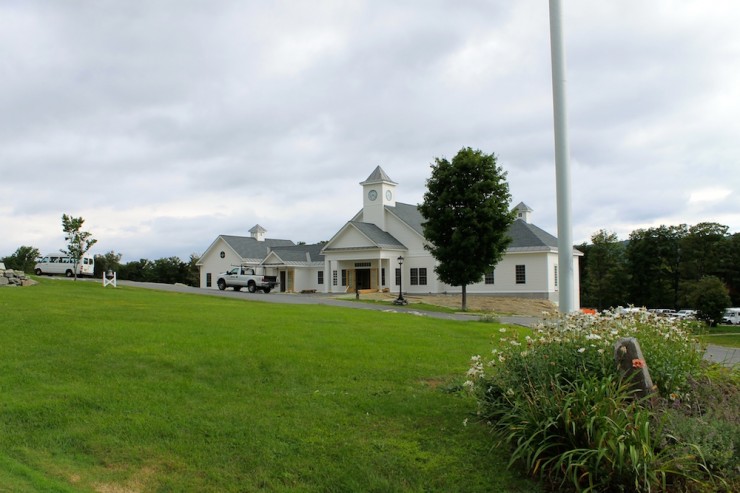
    Results:

    Friday’s freestyle sprints: Men | Women

    Saturday’s 10/15 k freestyle individual starts: Men | Women

    Sunday’s 15/20 k classic mass starts: Men | Women

  • Sovereign Lake NorAm: Photo Gallery

    Sovereign Lake NorAm: Photo Gallery

    VERNON, B.C. — Photos from the season-opening NorAm at the Sovereign Lake Nordic Centre, with 10/15 k freestyle followed by classic-sprint races in temperatures near -18 degrees Celsius on Saturday and Sunday, respectively. All photos by Gerry Furseth and Peggy Hung.

    Dec. 7: Women’s 10 k and men’s 15 k freestyle individual starts (Race reportresults)

    Dec. 8: Women’s 1.2 k and men’s 1.4 k classic sprints (Race reportresults)

  • The Four: Pierre-Harvey Training Centre

    The Four: Pierre-Harvey Training Centre

    The 2013/2014 Pierre-Harvey National Training Centre team. (Courtesy photo)
    The 2013/2014 Pierre-Harvey National Training Centre team. (Courtesy photo)

    Note: This is the second of four previews providing an inside look at Canada’s national training centres and their respective senior teams this season. We asked coaches to tell us what’s new, whom to look out for, and the outlook on the winter ahead. Teams are presented in no particular order.

    Team: Centre National d’Entraînement Pierre-Harvey (CNEPH), a.k.a. Pierre-Harvey National Training Centre

    Coaches: Louis Bouchard (head coach), Francois Pepin (assistant coach), Charles Castonguay (assistant coach), Lee Churchill (assistant coach/wax tech), Sacha Bergeron (World Cup wax tech,  Andre Renart (wax tech) 

    Senior roster: Alex Harvey (World Cup Team), Raphaël Couturier, Simon Lapointe, Alexis Turgeon;

    Dasha Gaiazova (World Cup Team), Cendrine Browne, Anne-Marie Comeau, Maya MacIssac-Jones, Frédérique Vézina

    Who’s new: The entire women’s team, minus Gaiazova, moved up from CNEPH’s junior ranks to the big leagues, including Browne, Comeau and Vézina. Formerly with Rocky Mountain Racers in Canmore, Alberta, MacIssac-Jones made the Quebec training centre this season.

    Who’s missing: According to head coach Louis Bouchard, three of the team’s senior men (Frédéric Touchette, Aidan Lennie, Steffan Lloyd) went back to school. World Cup skier Lenny Valjas moved to Canmore to train with the national team.

    Touchette joined the Laval University ski program, Lennie is coaching for Skibec in Mont-Sainte Anne and Llyod is in Ottawa.

    Top results last season: The Canadians were out for medals at World Championships in Val di Fiemme, Italy, and Alex Harvey (the son of Pierre Harvey, whom CNEPH is named after) delivered with a bronze in the classic sprint. Earlier in the season in Val di Fiemme, Valjas and Harvey, now 25, placed second and third, respectively in the Tour de Ski 15-kilometer classic mass start.

    Gaiazova, 29, tallied bronze in the February pre-Olympic team sprint with teammate Perianne Jones in Sochi, Russia. In January, she placed fourth in a World Cup classic sprint in Liberec, Czech Republic.

    Also in Liberec, Browne, who turned 20 last month, notched 15th in the 5 k skate race at Junior World Championships. In turn, she earned a spot on Canada’s senior development team.

    Couturier, 20, also made the national senior team this year, after placing 17th in the 20 k skiathlon at Junior Worlds.

    Coach’s comments:

    Bouchard is a pretty busy guy between heading CNEPH in Quebec City/Mont-Sainte Anne and working with the World Cup team as an assistant men’s coach. This season, he explained in an email that he’ll be in Europe with the World Cup team all winter starting Nov. 10, when he flies with Harvey to Davos, Switzerland. As a result, Pepin, Castonguay and Churchill will be more responsible for the NorAm team.

    When it comes to training camps, CNEPH goes big. This year, the staff brought its team to Montreal for testing in June and France in July to learn about altitude training and coping with jet lag. Earlier this month, they wrapped up another altitude camp in Canmore. Browne and Couturier were invited to the national-team training camps in Bend, Oregon, in June and New Zealand for on-snow training in late August.
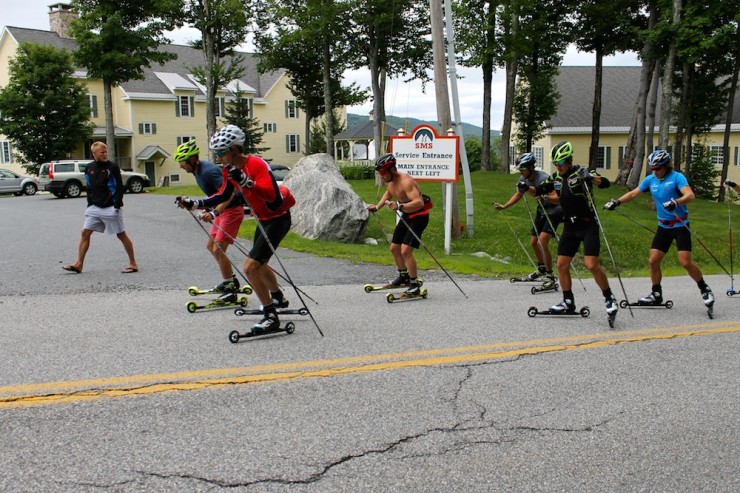
    In terms of goals, Bouchard laid them out pretty clearly: one Olympic podium, one top 20 at Junior Worlds, and one top 20 at U23 World Championships.

    One good starting point: most everyone on the young team has already made it to Junior Worlds.
    See also: Callaghan Valley

  • International Couple Top Canadian Nationals Mass Starts; McMurtry Ends Career with Gold (Updated)

    International Couple Top Canadian Nationals Mass Starts; McMurtry Ends Career with Gold (Updated)

    Former US Ski Team member Torin Koos (Bridger Ski Foundation/Rossignol) leading Saturday's 50 k freestyle mass start at 2013 Canadian Nationals in Whistler, B.C. Koos won the race by 0.4 seconds over Brent McMurtry (AWCA). (Photo: Martin Kaiser)
    Former U.S. Ski Team member Torin Koos (Bridger Ski Foundation/Rossignol) leading Saturday’s 50 k freestyle mass start at 2013 Canadian Nationals in Whistler, B.C. Koos won the race by 0.4 seconds over Brent McMurtry (AWCA). (Photo: Martin Kaiser)

    WHISTLER, B.C. – Canadian Cross Country Nationals ended the way it started at Whistler Olympic Park, with exciting racing and sunshine on a freestyle-technique day.
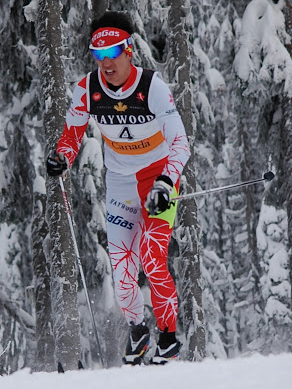
    In the men’s 50-kilometre race, American Torin Koos (Bridger Ski Foundation/Rossignol) attacked on the final hill and held on to edge Brent McMurtry of the Alberta World Cup Academy (AWCA) by just 0.4 seconds in 2 hours, 4:55.2 minutes. His girlfriend, Bettina Gruber of Switzerland, later won the women’s 30 k.

    Brent McMurtry of the Alberta World Cup Academy (AWCA) checks back during the men's 50 k freestyle mass start at 2013 Canadian Nationals on Saturday in Whistler, B.C. McMurtry went on to place second to American Torin Koos for his second Canadian title of the week. (Photo: Martin Kaiser)
    Brent McMurtry of the Alberta World Cup Academy (AWCA) checks back during the men’s 50 k freestyle mass start at 2013 Canadian Nationals on Saturday in Whistler, B.C. McMurtry went on to place second to American Torin Koos for his second Canadian title of the week. (Photo: Martin Kaiser)
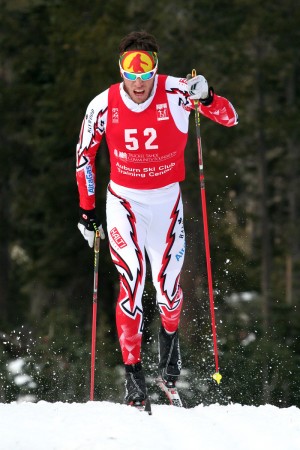
    The men’s runner-up by a ski length, McMurtry, 26, ended his season and career as a National Senior Development Team athlete with one last Canadian title (he won the 15 k classic earlier in the week).

    His teammate, Kevin Sandau was third, 1.8 seconds behind Koos, and Brian McKeever of the Para-Nordic Ski Team took fourth and the Canadian bronze (+2.2).

    The race started at 9 a.m. Saturday at -2 degrees Celsius with the sun starting to rise over the mountains to warm the stadium. The first hour featured hard, crusty snow, with fertilizer making a few climbs hard enough to be difficult for skating.  The first lap was the blue 5 k (Olympic skating) loop, then the men settled in for six 7.5-k laps, featuring the first 4 k of the red loop (Olympic class) then the last 3.5 k of the blue.

    This was the fifth event and eighth day of cross-country nationals and tired bodies contributed to a relaxed pace on very fast snow (the opening 5 k, with a total climb of 170 meters, was completed by the leader at the time – McMurtry – in just over 11 minutes).  The next four 7.5-k laps were completed in about 19 minutes each, with slightly softening snow and increasing intensity resulting in an even pace.  An all-Academy pack with McMurtry, Michael Somppi and Chris Hamilton led much of the opening 35 k, while Graham Nishikawa (AWCA) and Koos skied relaxed in the group.

    On a slower-starting sixth lap, Somppi tried a push before Sandau made a real attack, but Koos ultimately closed on Sandau.

    “I was a little worried; that was the first time I thought maybe I’m not going to have it today,” Koos said. “Two k’s later I felt good again, and I was like, ‘Okay, all right, I know how to win this race.”

    Fifteen men were still together at the start of the final lap.

    “With 5k or one lap to go, I thought Torin was the guy to mark,” McMurtry said. “I was trying to stay on him, watch him.”

    Koos went to the front with about 1.5 k to go and “just slowed the pace to his speed,” Sandau said. “He was definitely one of the guys you didn’t want to bring to the finish line, but he had some good endurance today.”

    “I am a little disappointed,” McMurtry said of his second place. “I had the gas at the top of the hill, but I was behind Brian [McKeever] and I didn’t push to get on Koos. He opened up a bit of a gap. Coming into the stadium, I used some gas to catch up to him. In the final stretch, I just didn’t have the legs to get around him.“

    “I felt really strong and had perfect skis,” McMurtry said, “I enjoyed the final race of my career.”

    McMurtry’s first Nationals win, as a juvenile boy in 2001, was in the sprint where he was beaten by an American, so it was “a fitting way to end my career with a title but also getting beat by an American.”

    The men had similar views on the course conditions:

    Koos: “It was awesome!”

    Somppi: “Conditions were awesome.”

    McMurtry: “It was amazing. A perfect day for ski racing in March, or almost April. You can’t really ask for anything more. Sunny, super fast at the beginning, and still held up really well. A perfect way to go out, a super, super day.”

    In the junior men’s 30 k, starting just after the open men, national-junior team member Raphaël Couturier of the Pierre-Harvey National Training Centre (CNEPH) attacked with more than a kilometre remaining to take the gold by 8.3 seconds in 1:18.15.4. Matthew Vrielink of Rocky Mountain Racers (RMR) placed second, and Sebastien Dandurand (Callaghan Valley TC) outsprinted four others to take the bronze medal, 18.8 seconds after Couturier.

    Gruber Dominates Women’s 30 k

    Japan's Chisa Obayashi (second from r) leads a group after crashing early in Saturday's 30 k freestyle mass start at Canadian Nationals in Whistler, B.C. Eventual winner, Bettina Gruber of Switzerland (r), runner-up Zina Kocher (l) and Heidi Widmer (second from l) follow. (Photo: Martin Kaiser)
    Japan’s Chisa Obayashi (second from r) leads a group after crashing early in Saturday’s 30 k freestyle mass start at Canadian Nationals in Whistler, B.C. Eventual winner, Bettina Gruber of Switzerland (r), runner-up Zina Kocher (l) and Heidi Widmer (second from l) follow. (Photo: Martin Kaiser)

    The women’s freestyle mass start began just before noon with the temperatures already up to 9 degrees Celsius and sun on most of the course.  Organizers previously fertilized the entire stadium, plus the climbs and corners, to preserve the course and it held up well for the women, with a thin layer of slush over a frozen base for most of the blue 5 k course.

    The action started on the first climb out of the stadium with Japan’s Chisa Obayashi (Madshus/Black Jack) taking a hard fall, breaking her pole across both knees, and losing about 40 places.  Obayashi quickly rejoined the leaders, finishing the first lap in the top 10.

    Bettina Gruber of Switzerland's National Ski Team en route to her first victory at 2013 Canadian Nationals in Whistler, B.C. Gruber won the women's 30 k freestyle mass start by over 40 seconds. (Photo: Martin Kaiser)
    Bettina Gruber of Switzerland’s National Ski Team en route to her first victory at 2013 Canadian Nationals in Whistler, B.C. Gruber won the women’s 30 k freestyle mass start by over 40 seconds. (Photo: Martin Kaiser)

    The second lap quickly separated with a group of four who would ski most of the race together at the front.  Heidi Widmer (AWCA), Zina Kocher (Biathlon Canada), Bettina Gruber (Swiss National Team) and Obayashi slowly grew their lead through three laps.

    On the fourth lap, Obayashi dropped back, with the combination of a tired body from chasing back to the group on the first lap and swelling knees slowing her down.

    On the final lap, Kocher made a hard attack up the first hill out of the stadium and only Gruber followed.  By the staircase climb, Gruber was comfortable again.

    When Kocher faltered, Gruber was able to ski away for the victory in1:18:41.1, 40.2 seconds ahead of Kocher, the top Canadian, in second.  Widmer wasn’t able to close on Kocher, finishing another 19 seconds back in third.

    Resurgent Brittany Webster (Highlands Trailblazers) skied two fast final laps and outsprinted Obayashi for fourth place and the Canadian bronze.  Eliska Hajkova (University of Colorado-Boulder), who struggled with ski speed as the snow softened, took sixth.

    “Until about 15 k, it was four girls together, it was solid speed, a good pace,” Gruber said. “Then it went a little bit faster, and we dropped Chisa.”

    “We kept it pretty easy until that final lap and then we really tried to put on the moves,” Kocher said. “The first one I did and dropped Bettina a bit, but she caught me after the downhill and then she made a move on me on the second uphill in the woods and I could go for half of it, and then I was done.”

    Zina Kocher attacks during Saturday's 30 k freestyle mass start at Canadian Nationals. Kocher was the first Canadian and second overall behind Switzerland's Bettina Gruber.
    Zina Kocher (Biathlon Canada) attacks at the start of the last lap of Saturday’s 30 k freestyle mass start at Canadian Nationals. Kocher was the first Canadian and second overall behind Switzerland’s Bettina Gruber (second from l).

    “It was a lot of fun,” Widmer said. “I definitely exceeded my expectations as far as 30 k’s go. Really strong girls to ski with; Zina, Bettina, Chisa Obayashi and I skied the first four laps together and then on the fifth lap Chisa dropped off.

    “At the end, coming out of the stadium for the sixth lap, Zina and Bettina attacked and I didn’t have the gas to go with them,” she added.

    “That race was really fun,” Webster said, despite struggling with the pace from the start. “I was yoyo-ing off the back, got swallowed up by the girls behind and then kind of accelerated again.

    “I had the best skis ever, so that was definitely a bonus,” Webster added. “Foothills Nordic did my skis, and yeah, they were phenomenal.”

    “After start, I crashed, my pole is broken and I scratched my knees,” Obayashi said. “First lap, I used too much energy, so fourth, fifth, sixth laps, I lost energy.”

    Gruber said the conditions were “pretty good. I was surprised, I thought it would be slower and more sluggish, but the track held up pretty well.”

    In the junior women’s 20 k, Cendrine Browne (CNEPH) skied away from teammate Anne-Marie Comeau to take the gold by 3.7 seconds in 54:47.6.  Biathlete Julia Ransom (Canmore) finished third, 49 seconds after Browne.

    While the fertilizer gave the men an extremely fast course and the women a fairly fast course, the sheer volume of younger skiers and a high of 15 C created slushy skiing by the end of the day.

    At the end of a long week and a long season, the start list was shorter.  There were 79 open men, 45 junior men, 53 open women, 22 junior women, 73 juvenile boys, 82 junior boys, 59 junior girls, 74 juvenile girls, and 14 para-nordic skiers.

    More than 150 volunteers made this event possible.

    ***

    Full results and splits are at zone4.ca, with photo galleries coming at the event website.

    Results by race:

    Men’s 50 k

    Junior men’s 30 k

    Women’s 30 k

    Junior women’s 20 k

  • Couturier Notches 17th in World Juniors Skiathlon

    On the final individual race of the Junior World Championships in Liberec, Czech Republic, Raphaël Couturier (CNEPH) finally grabbed the spotlight away from the Canadian women. He finished the 20 k skiathlon in 49:25.0 for 17th place in a race where Russia owned the podium, lead by Dmitriy Rostovtsev in 47:40.2.

    Couturier was happy, writing “17th is great to me, my best result this week and I’m for sure really satisfied.” He planned to ski the classic leg efficiently and stay out of trouble.

    “I felt great,” he said. “I was really smooth in the classic which allowed me to save up a lot of energy for the skate part.

    “My plan was to start the skate section with a lot of energy left in the tank, and it’s pretty much what happened so I caught up seven places on the second half which allowed [me] to be in the top 20.”

    David Palmer (Black Jack) was second Canadian to come through in 51:35.4, good for 46th place.

    Alexis Turgeon (CNEPH), the third Canadian, was not happy with his 56th place.  “I was about 30 positions better last year on the same race,” he wrote.

    Where Couturier executed on his plan, Turgeon’s didn’t come through.

    “I felt really bad in the classic leg,” Turgeon wrote. “I didn’t do a proper warm-up and as I was starting [well] back I had to fight my way through.”

    Though frustrated with the first half of his race, Turgeon picked it up in the second half. “As soon as I put the skate skis on it felt better and I had energy to ski relaxed, smooth and powerful,” he said.

    Zeke Williams (Nakkertok) was the fourth Canadian in 59th with a finish time of 52:46.8.

    “I didn’t have a personal best — and to post a decent result at Worlds a personal best is mandatory,” he said. “After the chaos of the start, I felt good striding up some of the climbs.”

    On the fourth lap, Williams tripped on the big climb. “I took a bit longer than I’d have liked to get back on my feet since it was a herring-bone section and people kept stepping on my skis,” he said. Despite starting the skate portion tired, Williams was able to gain a few places back.

    Men’s 20 k skiathlon results.


    Women’s race

    In the women’s race, Frédérique Vezina (CNEPH) notched her best result of the trip in the women’s 10 k skiathlon, placing 29th in 29:35.0, two minutes and twelve seconds behind race-winner Teresa Stadlober (AUT).  She was pleased with the result, writing, “I am really happy to be in the top 30 even after a crash 200 m before the finish line!”

    Vezina, who prefers the longer races, said she “felt way better than on the 5 k two days ago.”

    “I wanted to start fast and build up my speed throughout the race,” she wrote of her race plan. “That’s what I did and I was able to pass a group of girls on the last uphill. That was such a great feeling!”

    Anne-Marie Comeau (CNEPH) was the second Canadian to finish in 29:41.3 for 34th place. A fall in classic section got her race off to a rough start but the skate leg went more smoothly.

    Cendrine Browne (CNEPH) and Katherine Stewart-Jones (Nakkertok) finished together in a group for 43rd in 30:12.1 and 45th in 30:13.0. Like the other Canadian women, they enjoyed the skate leg more than the classic.

    “Cendrine and I skied together and took turns leading, we helped push each other, it was a lot of fun!” Stewart-Jones said.

    Several of the junior women struggled in the mass start with a large, highly competitive group of 71 starters.

    “Everybody at the start was aggressive so I fell a few times and so did a few others,” Stewart-Jones wrote. “My tactic was to be relaxed and stay out of trouble but unfortunately I ended up breaking a pole anyway!”

    Women’s 10 k skiathlon results.

  • Canada’s Browne Ecstatic About 15th in Junior Worlds 5 k

    Canada’s Browne Ecstatic About 15th in Junior Worlds 5 k

    Cendrine Browne (CNEPH) racing to a personal-best 15th in the 5 k freestyle individual start Wednesday at Junior World Championships in Liberec, Czech Republic. (Courtesy photo)
    Cendrine Browne (CNEPH) racing to a personal-best 15th in the 5 k freestyle individual start Wednesday at Junior World Championships in Liberec, Czech Republic. (Courtesy photo)

    Cendrine Browne of the Pierre-Harvey Training Centre (CNEPH) is celebrating a lot of firsts this season. First year on the Canadian National Junior Ski Team, first race trip to Europe, first age category win in a NorAm race. On Wednesday, she added her first top 15 at the Junior World Championships in Liberec, Czech Republic, to the list.

    Racers came to Liberec with different goals. Not many will do a better job of reaching them than Browne. “When I crossed the finish line, I was exhausted but really proud of myself,” she wrote in an email.

    Browne, who is a relative newcomer at this level, is in her fourth season as a ski racer, having come into the sport from swimming by way of triathlon. The achievement had begun to sink in a few hours after the race.

    “I was so excited!!!” she wrote. “It’s the first time I have accomplished something this big! 15th at Worlds! What an accomplishment for me!”

    For the juniors, these races are often about gaining experience. “At my first race here (sprints), I was so nervous! I was a little too impressed by the others and by the event, so my race didn’t go that well,” Browne wrote. “But today, I was more confident and I felt more relaxed. I told myself that this race was a race like any other.”

    With one more day’s experience, Browne had a better approach to the race. “I had a clear mind and I stayed focused, which really helped me throughout the race,” she wrote.

    As tiredness set in on the final climb, she held that focus, saying to herself, “Everyone has tired legs here, so you better push as hard as you can till the finish line!”

    Her finish time of 13:15.6 for the 5 k freestyle individual start was 40 seconds behind the winner, Victoria Carl, who represented Germany in the Tour de Ski.

    Canadian junior women at Junior World Championships in Liberec, Czech Republic. (Photo: Katherine Stewart-Jones)
    Canadian junior women at Junior World Championships in Liberec, Czech Republic. (Photo: Katherine Stewart-Jones)

    Frédérique Vézina (CNEPH) was the second Canadian woman in 50th in 13:59.2. A distance specialist, she has one more year of JW eligibility.

    Anne-Marie Comeau (CNEPH) placed 53rd, five seconds behind Vezina. Comeau wrote in an email that she prefers distance as well. While she wasn’t pleased with her race, her focus is on the future.

    “I will try to forget this one and focus on Friday’s [skiathlon] race,” she wrote.

    Comeau has a lot of future to focus on; she has three more years of eligibility for Junior Worlds.

    Katherine Stewart-Jones (Nakkertok) was 58th of 76 finishers, a five more seconds back.

    “It is my first time at world juniors so I shouldn’t be too hard on myself but I was definitely a bit disappointed,” she wrote, before finding the positive. “I still have tons of chances to make it up!”

    She also commented on the experience, saying, “It is actually a lot like skiing at home except there is way more competition so the times are extremely close.”

    For the men, a familiar name topped the list of Canadians, with Raphaël Couturier (CNEPH) placing 24th in 24:57.7, just 21 seconds out of the top 15.

    “The course was really hard on the legs, but it was a great day,” Couturier told Cross Country Canada. “I had high expectations coming into these Championships so I’m satisfied with today. I’m looking forward to the pursuit.”

    David Palmer (Black Jack) got his first start at Junior Worlds, finishing 32nd in 25:10.9.

    “I had a decent race today, felt good, and conditions were great for skiing,” Palmer wrote.  “I found that the race course is one of the most challenging ones I’ve done with some very sharp and icy corners, steep hills and fast downhills.”

    The experience wasn’t what he was expecting. “At first I was gearing up for things to be different than racing at home,” he explained. “But I’ve actually found that everything including the start procedure is very easy and much the same as any other race. … On the result list I was down at 32nd, but being 1:40 off the lead is encouraging. I feel optimistic about tomorrow now that I’m more familiar with the competition and the set up here.”

    Zeke Williams (Nakkertok) was a 38 seconds farther back in 53rd.

    “I felt like I pushed hard, which is nice, but I went out harder than I should’ve,” he wrote. “I’m really disappointed with the result. I’m sure if I had been able to pace things better I could’ve ended up in the top 30, which was my goal.”

    Williams may not be happy with the result, but he is happy with the experience. “Racing here at World Champs is cool since the competition isn’t too far below that of a world cup race,” he wrote. “It’s really awesome, and really motivational, to get to compete against the top Juniors in the world.”

    Scott Hill (NDC-Thunder Bay), in his second Junior World start, rounded out the Canadian effort in 62nd (26:05.8) of 98 finishers.  Hill was less than a second ahead of the next three finishers from Belarus, Ukraine and Japan.

    Women’s resultsMen’s results

    International report


  • At Home in Canmore: The Canadian Up-And-Comers

    At Home in Canmore: The Canadian Up-And-Comers

    Coverage of the Canmore World Cups was made possible through the generous support of Travel Alberta and Tourism Canmore.

    Thirty Canadian men and women will be putting on World Cup bibs in Canmore this weekend. Some are old pros and some are competing in the first World Cups of their lives. (Photo: Angus Cockney)

    With the start of the mass start classic in Canmore, Alberta, less than 24 hours away, nerves are running high at the World Cup venue. With two distance races and one sprint on the schedule, there will be both returning and new nation’s group faces lining up over the next few days.

    Chances are you know exactly who Alex Harvey and Devon Kershaw are, but as the host nation Canada has a large number of quota spots this weekend (15 men and 15 women). Every single one of them, when they pull on that bib, are looking to honorably represent their country in front of a home crowd. Here are a few names to watch out for.


    Photo: Angus Cockney.

    Emily Nishikawa (CNST/AWCA)

    The 23-year-old has a few World Cup starts to her name already, but hasn’t contested one in Canada since 2008. After a win at Sovereign Lake on Sunday, she’s looking forward to testing her fitness against the world-class field.

    “My shape is coming along now so I’m happy to get a good race under my belt before Canmore; get a little confidence going into it,” she said. “It’s super exciting to race in a hometown and on trails you know so well.”

    Her goals for the weekend are to “perform to the absolute best of abilities. My family will be here watching, so I’m really looking forward to that!”


    Photo: Cross Country Canada.

    Brittany Webster (Highlands Trailblazers)

    The former national team member is making a bit of a comeback this year with three NorAm distance podiums (two of them wins) under her belt already. It’s been four years since she was on the World Cup circuit, so in Canmore she’s entering the gate without any expectations other than to enjoy the opportunity.

    “I know that, myself included, there are lots of Canadians out there who are a bit apprehensive about what it will like,” she said. “I think — and hopefully this is some advice for the younger girls out there — that it’s really important to remember that it’s simply just a great opportunity to race against the best. This is what we work towards, and you have to be really happy when you set foot on the start line to do it.”


    Photo: Angus Cockney

    Michael Somppi (CNST/AWCA)

    With a second and fourth place at Sovereign Lake, Somppi is feeling confident in his fitness for Canmore. He first competed on the World Cup at this venue in 2010, but this year is the first time he’ll have the chance to compete in three back-to-back races.

    “The mass starts are more nerve-wracking than the individual, but I feel like I’m in pretty good shape right now so it should be fun,” Somppi said.

    “I’m looking forward to it. I’ve been improving every race so I hope the trend continues.”


    Erik Carleton (PNST/RMR)

    Carleton competed in his first World Cup for Canada in 2005 when the circuit stopped in Vernon, BC. He is also a guide for national Para Nordic team member Brian McKeever, but was fast enough to prequalify for Canmore based on his results from last season.

    “It was a good feeling since it was the first time in my career I had been selected based on the previous season,” Carleton said. “I knew I could focus my training program towards the World Cup races, have to worry about the trial races.”

    His goals for Canmore are reasonable: “to ski relaxed, trust myself and feed off the energy of the fans.”

    Mostly, Carleton is looking forward to comparing himself against the international field.

    “When you do not have the opportunity to race in many World Cups, the rewards are great if you can have one of your best-ever races,” he said.


    Photo: Angus Cockney

    Graeme Killick (CNST/AWCA)

    The senior development team member has been a part of the whole World Cup production before, in Estonia in 2011. As the winner of the NorAm opener in Canmore and third-place finisher in the classic race the following weekend, Killick will be one of the top Canadians to watch for on the big stage.

    He’s feeling particularly confident after his recent podium finishes: “It was a good start for me.  Normally it takes me a few races to get in race shape, but I was able to win last week so that is a good sign,” Killick said.


    Photo: Angus Cockney.

    Patrick Stewart-Jones (AWCA): He had “the best race of my life so far” in the mass start classic NorAm at Sovereign Lake, so the 21-year-old is feeling pretty good heading into Canmore. Stewart-Jones also qualified for the sprints in Quebec, but turned down the opportunity in order to save his top gear for the distance events.

    “It wasn’t easy at all,” he said of the choice to skip Quebec. “I was sort of on the fence, but told myself if I qualified for the distance races then I’d focus on that.”

    The 15 k mass start classic in Canmore will be Stewart-Jones’ first World Cup appearance.


    Jesse Cockney (AWCA)

    In Quebec City Cockney missed out on qualifying for the heats by a mere 0.25 seconds in 32nd place. He said afterwards that he already learned a lot from the experience, like how to roll with the punces on race day and ski relaxed.

    Luckily, he’s got another shot at the heats in Canmore with the freestyle sprint scheduled for Saturday. On truly home terrain and against essentially the same field, he could be ready to crack the top 30.


    Raphaël Couturier (CNST/Pierre Harvey NTC)

    Couturier made his World Cup debut in Quebec last weekend, where he placed 51st in the freestyle sprint.

    “I was super excited to race my first World Cup at home and I had a great time with my friends and family,” he said of the experience. “Everyone around the event did a great job and I’m pretty sure we all agree on saying it was one of the most epic city-sprint ever and I feel privileged to have been part of the event. I was just looking forward to break the ice and step up the game.”

    The 19-year-old was pretty excited when he first learned he qualified back in November, and is mostly focused on gaining international experience in sprint and distance in Canmore.

    “It would be amazing to get to race some heats with the big boys, but I don’t want to put any pressure on myself. I’ll deal with the results I’ll get and build on from there,” Couturier said.


    Canmore, Western Canadian Championships
    Photo: Angus Cockney.

    Brent McMurtry (CNST/AWCA)

    With numerous World Cup starts under his belt, McMurtry is no stranger to the scene. He says he’s most looking forward to the 15 k mass start classic.

    “I have raced a lot of places, and for classic Canmore is my favourite course: steep climbs with firm tracks,” he said. “As far as goals, I am hoping to execute my race plan and ski smooth throughout. It is hard to put a number of what I am aiming for but I would like to be in the points.”

    Like most of his countreymen, McMurtry is most looking forward to competing in front of friends and family on familiar terrain.

    “It is great to race at home where I have family and friends cheering me on and I know most of the volunteers who are running the race. It is just an amazing atmosphere,” he said.


    NorAm Sovereign Lake
    Photo: Jesse Winter

    David Greer (Yukon Elite Squad)

    The 23-year-old will be making his first World Cup appearance on Thursday and is hoping to continue the upward trend in his recent NorAm results when he goes up against the best in the world. In Sovereign Lake this weekend he was sixth in the mass start classic and third in the 15 k freestyle.

    “Each race seems to be getting better, so I’m looking forward to [Canmore],” Greer said. “It should be fun.”


    Photo: Angus Cockney.

    Graham Nishikawa (CNST/AWCA)

    The senior development team member is an old standby on the World Cup scene; he was recently 34th in the 30 k freestyle in Davos, Switzerland.

    “I’m always honored to race for Canada, especially at home in Canmore,” he said.

    Coming off a win in the 15 k freestyle last weekend, Nishikawa appears to be in top form for this weekend.

    “I just want to thrown down a great race and see what happens,” he said. “Having my family and friends around to watch will be great.”


    Phil Widmer (AWCA)

    Widmer has numerous World Cup starts to his name and is looking forward to the opportunity to represent Canada in front of a home crowd.

    “The goal for me though is putting together a solid World Cup race,” he said. “My team mates and I have been pushing each other hard all year in preparation for these races and the rest of the season.”

    He was 55th in the individual sprint in Quebec City last weekend. A personal best for the sprinter would be to make it into the semifinals, which is just what he’s shooting for this Saturday on the home track.

    “Competing against the best skiers in the world on the home track is special,” Widmer said. “I’d say that has to be the most exciting part of the world cup coming to Canada. It doesn’t happen every day, so it’s special when it does happen.”


    Kevin Sandau (CNST/AWCA)

    Sandau, of recent Movember fame, has been on the World Cup circuit all season as last year’s Continental Cup leader. Still, he hasn’t competed in a World Cup on home soil since 2008 and is looking forward to competing on the trails he trains on every day.

    “I know what [the trails] are like and how they ski,” he said. “I’d like to have some personal bests in the distance races and cap off 2012 with some really good results.”

    “The Alberta World Cup Society definitely has organized this on a much grander scale since 2008, with the town fully backing the event and a lot of smaller and distinct details added. This is for sure going to be one hell of a week!”


    Matt Wylie (AWCA)

    Wylie earned starts both in Quebec and Canmore, but skipped out on the sprints in order to save energy.

    “Ideally preparing for Canmore would set me up for a top result rather than travelling back and forth across the country,” he said. “It was one of the hardest choices I have had to make, turning down that kind of opportunity.”

    This will be Wylie’s first international racing experience.


    Photo: Mark Nadell.

    Russell Kennedy (AWCA)

    The Truckee, Calif., native is a dual citizen of the US and Canada and has been training with the AWCA for the past few years. When he learned he’d won his fist career World Cup starts while cooling down from the Canmore NorAm prologue, he was “over the moon.”

    “I’m generally a happy guy but it was pretty hard for me to stop smiling,” Kennedy said.

    Kennedy’s main focus this year was to qualify for U23s, but now that he’s in a position to race well on the World Cup, he’s aiming to make the sprint heats (he was 45th last weekend in Quebec).

    “When a dream comes true it is hard to pick your favorite part of the dream,” Kennedy said. “However, I’m looking forward to racing the top guys, seeing all my friends and family that are coming to watch and just having a hard summer of training start to pay off.”


    More Canadians to look for in Canmore: Brian McKeever (PNST), Frederick Touchette (CNST/CNEPH), Heidi Widmer (AWCA), Amanda Ammar (Canmore), Annika Hicks (AWCA), Rebecca Reid (AWCA), Dahria Beatty (AWCA), Zoe Roy (RMR), Kate Brennan (AWCA), Alana Thomas (AWCA), Anne Marie Comeau (CNEPH), Maya MacIsaac-Jones (RMR), Erin Tribe (Team Hardwood), Frederique Vezina (CNEPH), Andrea Dupont (RMR)