Tag: Raubichi

  • Notes, Quotes and Photos: Pursuit Day at IBU World Youth & Junior Championships

    Notes, Quotes and Photos: Pursuit Day at IBU World Youth & Junior Championships

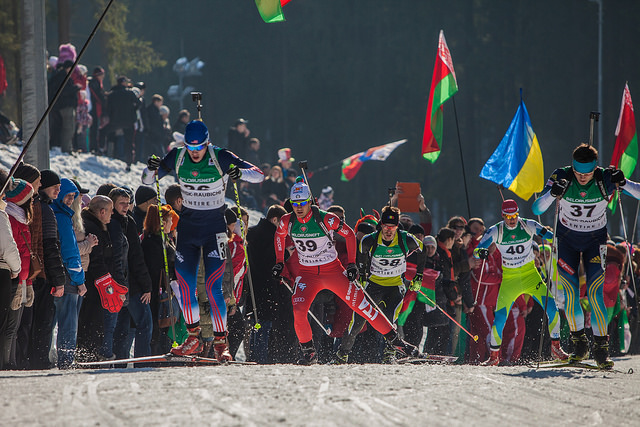
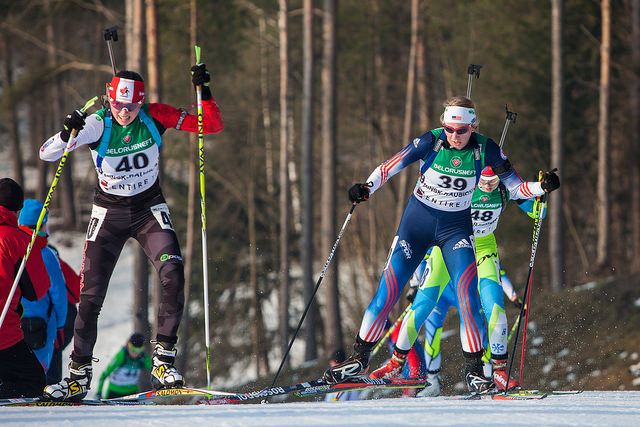
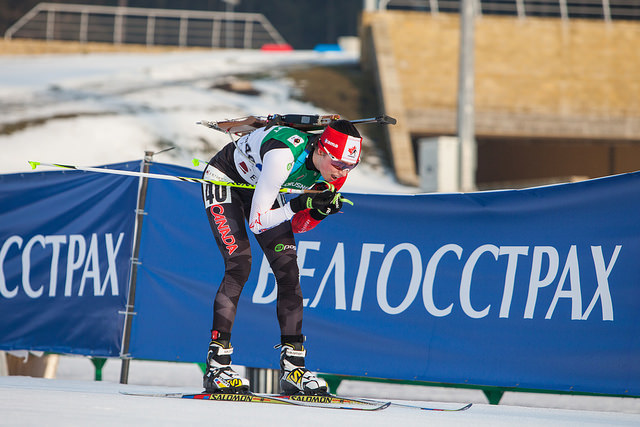
    Canada's Bryn Robertson (bib 40) and USA's Amanda Kautzer (bib 39) on course in the youth women's 7.5 k pursuit in Belarus on Sunday. (Photo: Jake Ellingson)
    Canada’s Bryn Robertson (bib 40) and USA’s Amanda Kautzer (bib 39) on course in the youth women’s 7.5 k pursuit in Belarus on Sunday. (Photo: Jake Ellingson)

    Sunday was a big day at the Raubichi biathlon venue outside of Minsk, Belarus. With four days of racing at IBU World Youth and Junior Championships, it was time for the pursuits: four on one day. Competitors completed four shooting stages, two prone and two standing, and skied 7.5 (youth women), 10 (junior women, youth men), or 12.5 kilometers (junior men).

    With a pursuit format based on results from the previous days’ sprint competitions, there was plenty of excitement and finally, the first head-to-head racing of the Championships.

    The youth women’s pursuit, Norway’s Ingrid Landmark Tandrevold cleaned both prone stages and by the second, had moved from third place up to first. She never relinquished her lead despite a penalty in each standing stage. Behind her was the drama: Darya Blashko, the Belorussian winner of the sprint, cross-fired onto Julia Schwaiger’s targets. The Austrian thus couldn’t shoot her own targets in a timely fashion, but was given a time credit that moved her into second place. Blashko was penalized ten minutes. Another Austrian, Simone Kupfner, finished third.

    That may have been the most dramatic incidence in any of the races, but there was plenty of good, catastrophe-free racing. In the junior women’s pursuit, two women managed to shoot a perfect 20 for 20: Marie Heinrich of Germany, who moved from fourth after the sprint up through the leaders and won by 15.4 seconds over Galina Vishnevskaya of Russia, and Yuliya Zhuravok of Ukraine, who moved from eighth up to third. Maddie Phaneuf of the United States had three clean stages and one with two penalties, and moved from 33rd up to 22nd.

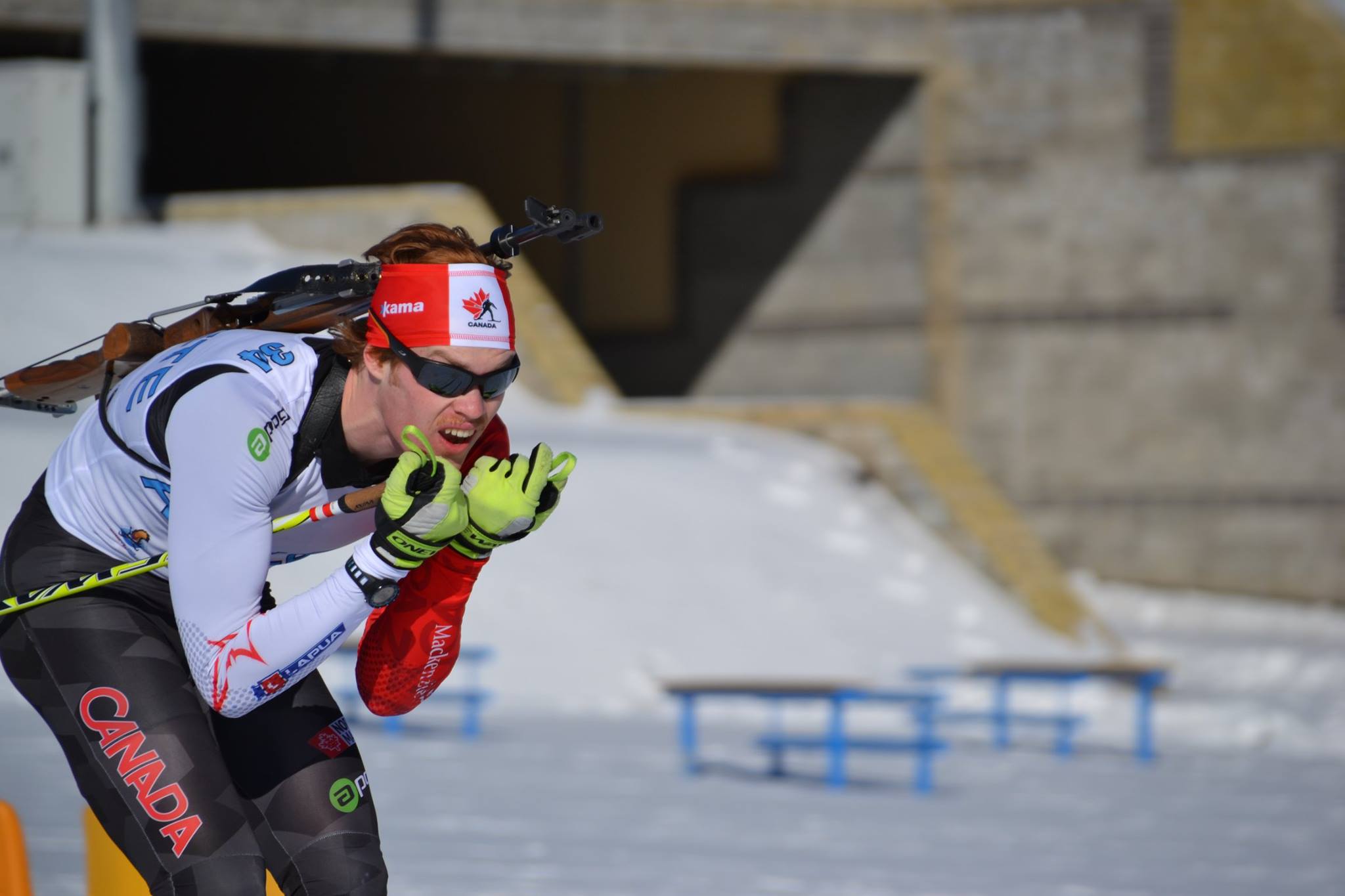
    In the junior men’s competition, Eduard Latypov of Russia took the win by 24.4 seconds over Vermund Gurigard of Norway. Alexander Povarnitsyn, also of Russia, finished third. There were great hopes on North American competitors, but Sean Doherty and Aidan Millar both struggled on the range. Doherty had placed third in the sprint and Millar had placed eighth, but the pair finished 11th and 14th after seven and six penalties, respectively.

    Finally, in the youth men’s pursuit, Felix Leitner of Austria won an exciting sprint finish against Kirill Streltsov of Russia. Streltsov had left the range for the final time 23 seconds behind Leitner, but made up 20 seconds on the trails and almost caught him by the finish. Mattias Haug of Norway finished third; all three hit 18 of their 20 shots. Pearce Hanna of Canada shot an impressive race, collecting only three penalties as he moved from 34th after the sprint all the way up to 13th place.

    Here’s a photo gallery of the day; below the jump, find notes and quotes from the North American competitors.

    The Top Finishers

    “I am a little disappointed, definitely wanted to hit a few more targets but felt great on the skis again,” wrote Millar of his 14th-place finish. “The range was really calm so I’m not really sure why the shooting was so poor. Coming out of the range and up the first hill was very deep slush so I just tried to keep a half decent pace through there then make up ground on the firmer snow.”

    “I was really happy with my shooting, I think that’s the best percentage (90% hits) I’ve had in a four stage shooting race before,” explained Phaneuf, who is in her first year of junior racing after competing as a youth last season. “Going into the pursuit I was mostly just getting really excited to race, because pursuits always seem to be more chaotic and fun. I told myself before the race that a lot of time can be made up on the range, and if I shot well I could move up quite a bit…which was true! It was nice to see myself getting a top 25, and only being 8 seconds out of the top 20.”

    On Gaining Experience

    Phaneuf has been bouncing all over Europe so far this season, competing at Open European Championships as well as on the World Cup, where she competed in a sprint and a relay.

    “I think being over here in Europe for over a month before these World Junior races really helped me get ready,” she wrote. “This season I raced more international races than I ever have before, and now I see myself being much more comfortable in this type of higher competition… I think being slowly introduced to the highest level has helped me as an athlete. It also has given me an idea of what I need to do to stay on that level of competition. I know I am not ready to make the full jump into the World Cup level, but in the next couple of years I hope to see myself becoming competitive on that circuit.”

    “I have definitely felt more prepared this time round, because I knew, more or less, what to expect,” wrote Canada’s Megan Bankes, who raced from 45th up to 27th in the youth women’s pursuit. “Last year was mainly about the experience, and this year I was more focused on results.”

    “I am a first year junior this year, so I have one more year to prove myself at the World Champs, next year being in Romania,” wrote Canada’s Matt Strum, who placed 49th in the junior pursuit. “Compared to my trip in 2013 to Obertilliach, I feel like a stronger athlete, more capable, and generally more prepared for what was to come, as the Champs are probably the biggest events I have attended.  In Austria, it was a bit of a shock to the system, and I was more in awe of my accomplishment of making the team, so my performance probably wasn’t at the peak for that season.  This year however, I have more experience racing internationally, so I have expected to and succeeded at performing at a higher level.”

    Or, On Being a Newbie

    “This being my first international competition has been quite the eye opener,” wrote Canada’s Bryn Robertson, who finished 40th in both the sprint and the pursuit. “When you come here you realize how big the sport is in Belarus, and Europe for that fact. It is amazing to see hundreds of spectators at the range and lining the course during the races with flags waving and horns honking as the competitors ski by. Talking to some of the other competitors here is very inspiring because of how energized they are about the sport and how hard they work to improve themselves. This made me realize how important it is to have a dream and to set goals to get to that dream because otherwise you will never get where you want to be racing if the heart isn’t there. And in Europe, the heart is really there.”

    “The level of competition is insane,” agreed fellow youth competitor Amanda Kautzer of the U.S. “I found myself saying over and over ‘wow, those (insert country name here) are so fast/strong/ good shooters.’  I am glad for the opportunity to be here as it is definitely making me a better athlete. I’m just trying to absorb and learn as much as I can from all the amazing athletes around me.”

    On Shooting Well

    “Today in the pursuit, I knew that my skiing would be pretty strong, so I really focused on making each shot count, and not going to the penalty loop,” wrote Canada’s Bankes. “After missing 2 in the first prone, I was a little disheartened, but got a correction, and then only had one other miss in my first standing. I was particularly happy with my second standing shooting because I cleaned, and had the 4th fastest shooting time for the bout.

    When I came into the second standing, I didn’t take time to really set my position and focus my attention on the targets before I started shooting and missed 3 which set me back a little,” wrote teammate Robertson. “The range was very busy! It is very different from racing in Canada because there are so many people rushing into the range at once. It can be very distracting! You don’t realize how ten other people entering the range at the same time as you can influence your mind space!”

    “To be honest, I think I got a little too excited,” wrote Kautzer of a stage where she missed four shots. After placing 39th in the sprint, she finished 46th in the pursuit. “I zeroed for no wind, and there was a slight wind coming into the range the first stage so I took 2 clicks. At home I mostly shoot at a small 10 point range in the middle of the woods virtually wind free, so was very nervous about the wind and how to take clicks. By the time I got to standing I was relieved I didn’t have to worry about clicks and since the prone had gone so well (usually I miss more prone) I thought standing would go better. I rushed it and took shots that I should have waited out and taken another breath for.”

    On Last-Lap Heroics

    The last lap was very hard but also a lot of fun,” wrote Canada’s Millar, who had to defend his 14th-place position from several challengers and held off Germany’s Johannes Werner Donhauser by just 0.4 seconds. “I had a good battle with one of Germans and tried to drop him on the last hill before you come down in to the finish. He was able to stay with me but the great skis we’ve had all week helped me get the few meters I needed.”

    On Disappointment

    “Overall I’m indifferent with my results,” wrote Mikaela Paluszek of the U.S., who finished 55th in the pursuit. “Of course I wanted to do better than the paper showed, but I’m still learning. Being able to go to Open European Champs I do believe helped me a little bit as well. Without Open European Champs,  Junior Worlds would only have been my second set of biathlon races this year. Despite getting sick for the last race in Estonia it was great to get a few more competitions done before Belarus.”

    ”I believe that I was focusing too much on keeping up with the field and was not aware of the speed coming into the range,” wrote Chloe Levins, an American who finished 18th in the youth women’s sprint but slipped to 42nd in the pursuit with nine penalties. “I am happier with my ski speed and believe that I maintained a good present focus throughout the race. I stayed relaxed, despite many misses, and accepted the challenge to make up some time on the track. I am disappointed in the outcome, but there are many things to learn from this race that will be useful going into another head-to-head competition tomorrow. I will focus on being smooth on the range without hesitation.”

    “I was very disappointed with my result in the sprint,” wrote Jakob Ellingson, an American who placed 65th in the junior men’s sprint and missed the cutoff for the pursuit by 17 seconds. “I am not a fast enough skier to get away with missing 5, and I knew that ahead of time. I did ski as fast I had hoped I was going to, and if (biathlon is full of these ifs) I had held it together prone I could have had a good result. I know that on a better day I should be able hit more than I did. I am pretty sad that I wont have another chance to do what I know I’m capable of doing in an individual race here.”

    On Crazy Crowds

    The number of spectators and the atmosphere here is crazy!” wrote Ellingson. “It has really been building up since the first race, not so many were here for the individual, but still more than I’ve ever had cheering for me in any race. Quite a few more for the sprint, and then so far the biggest day was the pursuit. I’m not sure if people will still be here for the relays today and tomorrow. It isn’t the weekend here anymore…

    “But yes, the spectators did cheer for Americans as well,” he continued. “There are so many people and its like a party for them on the side of the trail, every body is really excited and when they see somebody skiing up the trail they start making noise. Even if its not a racer, in between races yesterday there were a few officials skiing the course, i think to make sure everything was still good to go, and even they were cheered all the way up the hills!”

    On Motivation

    “My goal for this competition was to place top 30, but I am not unhappy with my results because, in making that goal, I did not put into account all of the unexpected obstacles and distractions that I have faced,” wrote first-time youth competitor Robertson of Canada. “There has been huge value in what I have learned this week, despite the fact that my performance was probably lower than my typical performance in Canadian races. I have learned so much about international racing that I would never have discovered if I hadn’t had this opportunity. I have been inspired by my team, the crowds, and my competitors – and this will motivate me to train to the top of my abilities in time to come. This trip has given me something to work toward outside our small pool of Canadian athletes.”

    Results:

    youth men / women

    junior men / women

  • Doherty Makes The Jump, Earns World Juniors Bronze in Belarus

    Doherty Makes The Jump, Earns World Juniors Bronze in Belarus

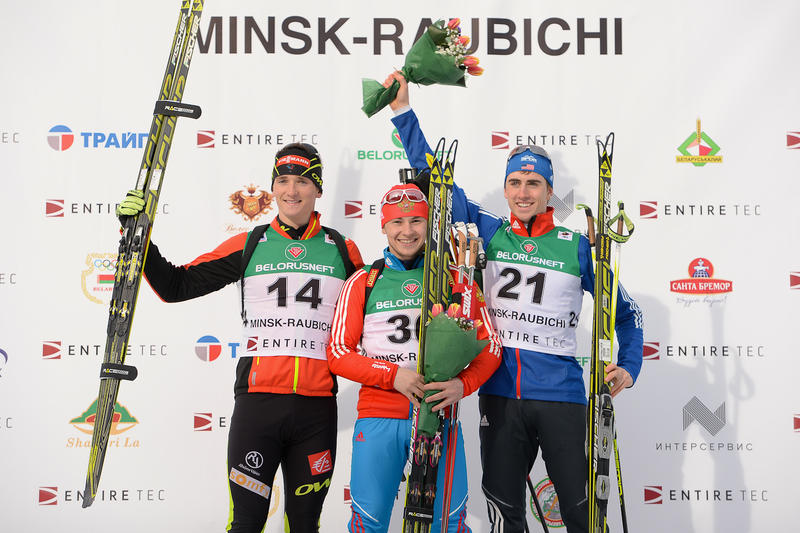
    The podium for the 10 k sprint at biathlon World Junior Championships: Aleksandr Dediukhin of Russia (center) took the win, followed by Fabien Claude of France (left). Sean Doherty (USA) earned bronze, his first international medal at the junior level. (Photo: IBU/Evgeny Tumashov)
    The podium for the 10 k sprint at biathlon World Junior Championships: Aleksandr Dediukhin of Russia (center) took the win, followed by Fabien Claude of France (left). Sean Doherty (USA) earned bronze, his first international medal at the junior level. (Photo: IBU/Evgeny Tumashov)

    A lot has changed since Sean Doherty won two golds and a silver at last year’s World Youth and Junior Championships for biathlon in Presque Isle, Maine.

    The New Hampshire native went to Sochi, Russia, and competed in the Olympic Games – and at 18 years old was one of the youngest starters in the relay, helping the U.S. to a 16th-place finish.

    He’s started in World Cup races at four different venues so far this season, contributing relay performances including an eighth-place team finish in Antholz, Italy. In individual racing, he made the 60-man pursuit cutoff in Nove Mesto, Czech Republic, and finished 45th.

    And, in regards to World Youth and Junior Championships, Doherty made the big step up to the junior age division. He competed in four different Championships as a youth, starting at age 14, and won three gold medals, making him the winningest Championship biathlete in U.S. history.

    So in one sense, it wasn’t surprising at all that Doherty won bronze in Saturday’s junior 10 kilometers sprint at this year’s Championships, held outside of Minsk, Belarus.

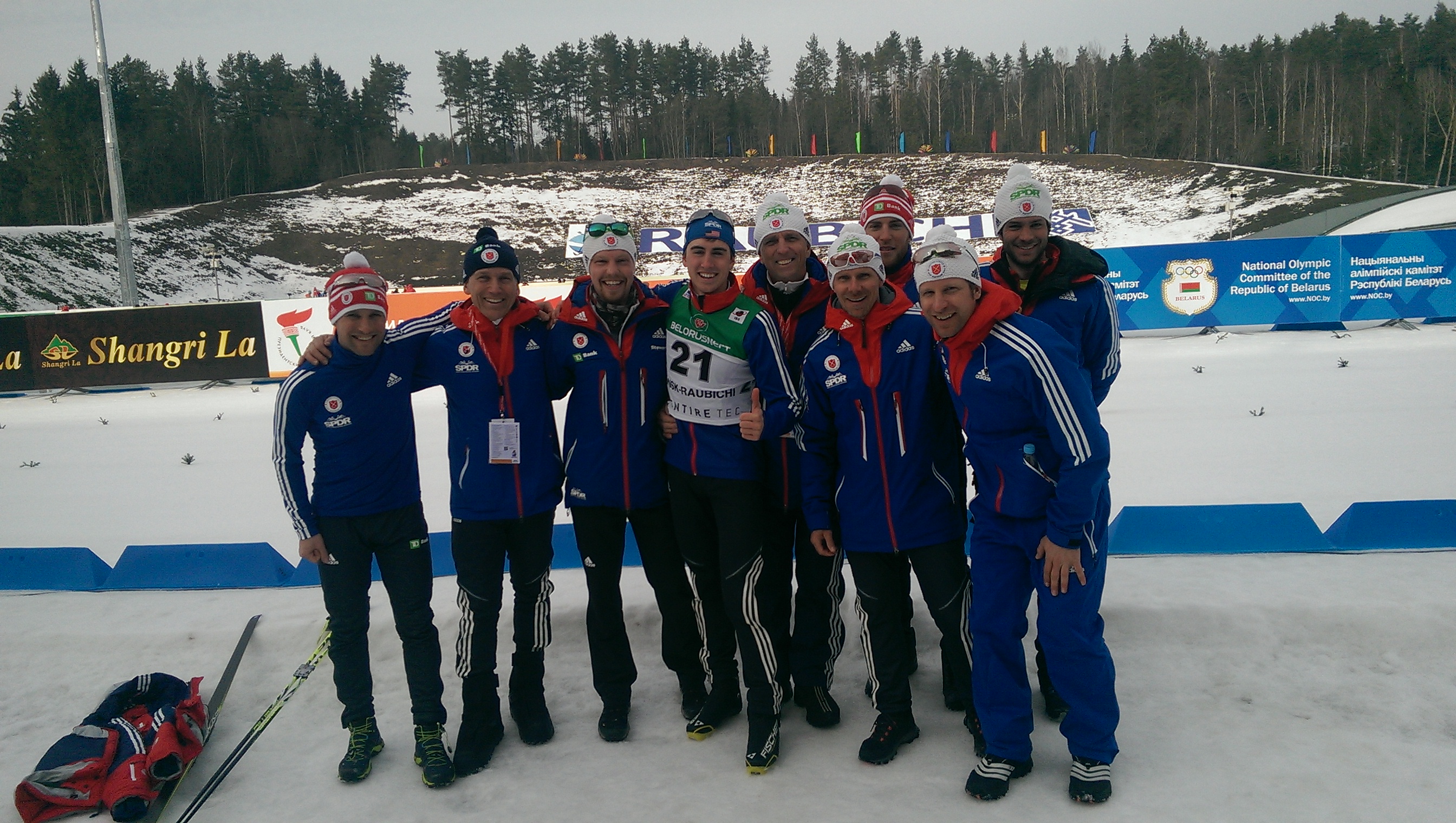
    Sean Doherty (center, in bib 21) celebrates with U.S. Biathlon Association staff after winning the bronze medal in the 10 k sprint at World Junior Championships. (Photo: Jim Levins)
    Sean Doherty (center, in bib 21) celebrates with U.S. Biathlon Association staff after winning the bronze medal in the 10 k sprint at World Junior Championships. (Photo: Jim Levins)

    In another sense, it was a different accomplishment entirely. Junior athletes, aged 19 to 20 years old, are bigger and stronger than youths, and the competition is at a different level. Instead of being the best young biathletes, winners at the junior level are often on their way to being the best biathletes, period.

    With one penalty, Doherty was able to ski aggressively and notch a time just 10.2 seconds slower than clean-shooting Alexsandr Dediukhin of Russia, who took the first championship title of his career.

    “That Sean was able to win the Junior World Championship bronze medal with one penalty as a first year junior in Minsk speaks volumes for his dedication to excellence and the great support of the coaches and team around him,” U.S. Biathlon Association CEO Max Cobb told FasterSkier in an email. “It’s a huge accomplishment to succeed like this as an American in Europe’s favorite winter sport.”

    Even when Doherty left the shooting mats for the final time, it wasn’t at all certain that he would end up on the podium. He sat in second place, 6.4 seconds behind the time set by Fabien Claude of France, an earlier starter who was the Junior World Champion in the pursuit last season.

    Quickly, two other racers posted times in between: Niklas Homberg, of Germany, and Dediukhin. With the top four racers separated by just under 7 seconds and 3.3 kilometers to go, it was going to be a test of grit and ski speed.

    In the end it was Homberg who fell by the wayside. Dediukhin pushed the hardest, putting seconds into Claude and winning by 4.6 seconds. Doherty’s efforts on the trails couldn’t match their speed, but far outpaced Homberg and left him securely in third place.

    “I am very happy with the race today,” Doherty said in a USBA press release. “I felt good on the skis and I was able to keep that momentum all the way through the race. On the range, the last shot got me, but I am very excited for tomorrow.”

    Tomorrow: Sunday’s 12.5 k pursuit, where the top finishers will have another shot at medals. It’s the event where Doherty won his first gold in 2013, after having set it up with a silver in that year’s sprint.

    And there’s history, too. In that race where Doherty first found out what winning felt like, Homberg was fifth, Deiukhin sixth, and Claude tenth. The four men have been competing against each other for years.

    USBA High Performance Director Bernd Eisenbichler believes that there’s potential for another medal in the pursuit.

    “[Doherty] went into the race today very aggressive and confident and was in the medal mix from the first meter on,” he wrote in an email. “The last shot [in standing, a miss] was close, but that’s biathlon. He went out 4th and did a great last loop and with 3rd running time overall and 9 out of 10 hits, really deserves this medal. The wax crew did a great job with his skis and we all are looking forward to tomorrow now!”

    And after that? Doherty has earned a nod for senior World Championships, to be held in March in Kontiolahti, Finland.

    Doherty’s U.S. teammates will not be joining him in the pursuit. Jake Ellingson finished 65th with five penalties, and Brian Halligan 67th with three penalties.

    In the junior women’s 7.5 k sprint, Maddie Phaneuf placed 33rd with two missed shots, and will start the 10 k pursuit on Sunday two minutes and five seconds behind Lena Arnaud of France, who posted a 2.4 second win. Mikaela Paluszek finished 54th with four penalties.

    Results: men / women

  • Aidan Millar Posts Career-Best with Eighth in World Juniors Sprint; First Canadian Top-10

    Aidan Millar Posts Career-Best with Eighth in World Juniors Sprint; First Canadian Top-10

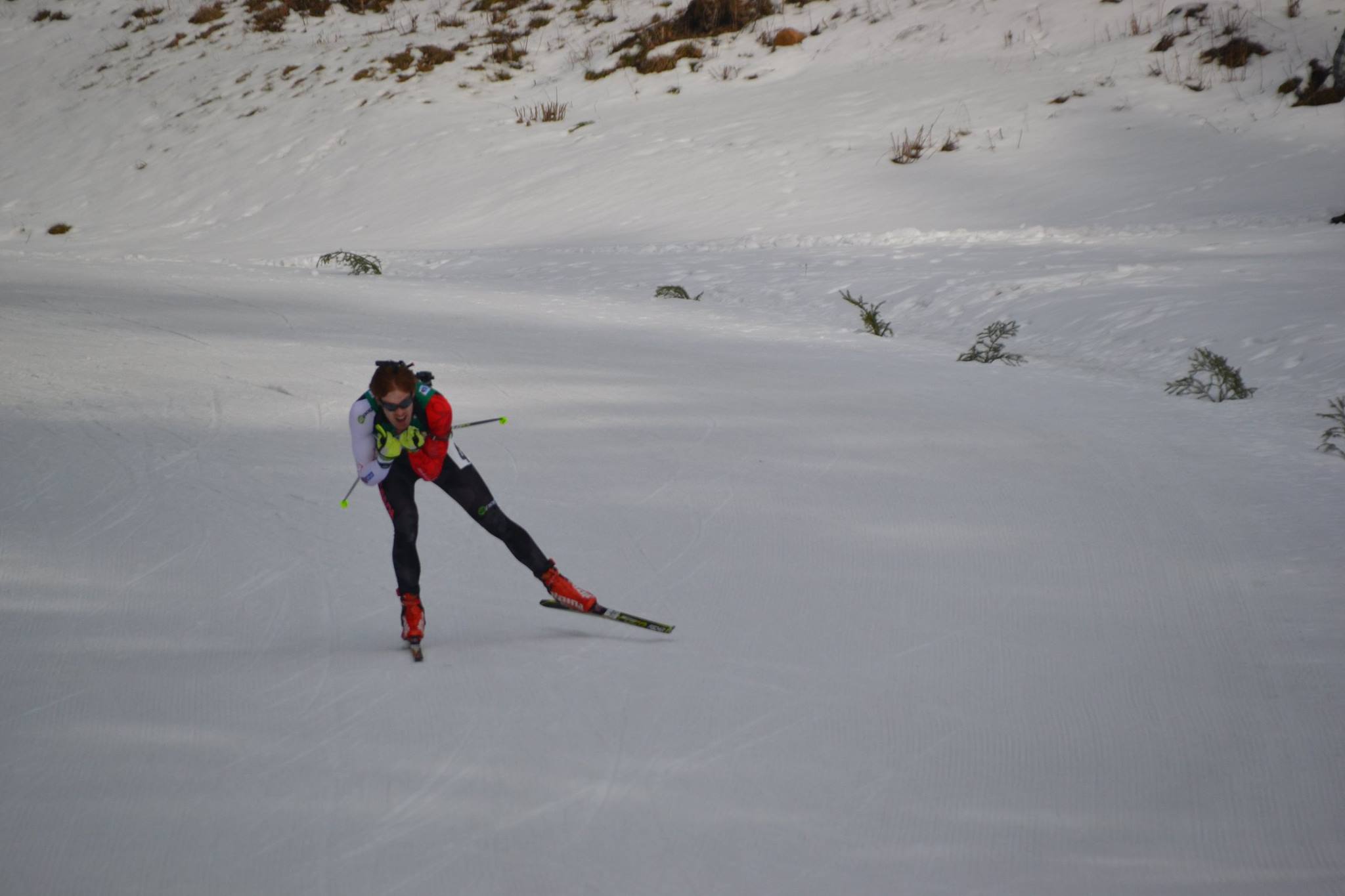
    Aidan Millar (Canada/Biathlon Alberta Training Center) racing to eighth place in the 10 k sprint at biathlon World Junior Championships in Raubichi, Belarus. (Photo: Jane Robertson)
    Aidan Millar (Canada/Biathlon Alberta Training Center) racing to eighth place in the 10 k sprint at biathlon World Junior Championships in Raubichi, Belarus. (Photo: Jane Robertson)

    Canmore, Alberta’s Aidan Millar was the third man onto the course in Saturday’s individual-start 10 k sprint at World Junior Championships for biathlon in Raubichi, Belarus.

    With little information about his competitors, Millar had to just ski his own best race. He had a penalty in prone but then cleaned in standing, and was unsurprisingly the race leader when he crossed the line. The thing was waiting for the other 90+ racers to finish as well.

    “As soon as I had gotten my stuff I left the finish area and went and cooled down away from the TVs and the stadium,” he wrote in an email. “I knew I would probably stay in the top 10 but it was way too hard to watch the results.”

    As his team had predicted, it was a top-10 finish when all was said and done. Millar’s time put him in eighth, 44.9 seconds behind Russia’s Aleksandr Dediukhin, who won with a time of 24:49.0.

    Millar’s split after the last shooting had him in fifth place, but he was unable to hold onto that position, and lost about 20 seconds to the leaders over the final 3.3 k.

    Canada's Aidan Millar racing in the individual competition earlier this week at World Junior Championships. (Photo: Jane Robertson)
    Canada’s Aidan Millar racing in the individual competition earlier this week at World Junior Championships. (Photo: Jane Robertson)

    Still, the result was a major recovery after the individual competition, where Millar missed nine shots. He was frustrated with himself and vowed to do better.

    “The individual was pretty disappointing shooting-wise,” he explained. “So for the sprint I tried to shoot more in control and not get caught up in shooting fast.”

    Despite those goals, Millar actually had the eighth-fastest shooting time in the field. That speed and accuracy helped him to his best-ever result in an international competition. It was also the best result for Canada so far at the Championships, including in the youth competitions which are held on alternating days with the junior races.

    At last year’s World Youth Championships in Presque Isle, Maine, he placed ninth in the sprint. But this year is completely different, and not just because the junior field is older and more experienced than the youths, Millar explained.

    “I would say it’s definitely a huge step up,” Millar wrote. “With last [Championships] being in North America some of the better countries didn’t send full teams so the field wasn’t as strong. So with the jump from Youth to Junior already making it more competitive the fact that it was in Europe made even that much more competitive than last year. With those things in mind, I’m finding it hard to believe that I was actually able to get that result.”

    Millar’s coach at the Biathlon Alberta Training Center, Richard Boruta, is the leader of Canada’s team on the trip and expounded a bit more on the jump Millar has made.

    “While in the Youth category lots depends on biological age and other factors, in the Junior category the results are much more representing the quality of training and future potential of the athlete,” he wrote in an email. “By staying in (or at least being capable of) the top ten at [Junior Worlds], athletes are showing that they are on the progression curve necessary for future good performance in the World Cup.”

    The age category is not the only change Millar has made this year. He also transitioned from the Canmore Nordic Ski Club to training with Boruta’s training center.

    “He has the benefit of training with strong juniors on our team and after his recovery [from a concussion in the fall] his ski speed kept improving during all of our tests and early season races,” Boruta wrote.

    He hopes for even more from Millar in the future, but is also content to have eighth place as a standout result.

    “Aidan is a prototype of modern high performance biathlete (tall and strong), and I am sure we will hear about him in the future again,” Boruta wrote. “I am really happy for his result today and his goal for Pursuit is to learn how it feels to compete head-to-head with the best in the world. I would like to think that another top ten is possibility, but the field is very competitive, so it will likely come down to shooting performance during the entire race.”

    As for Millar, he professed to have no results-based goals for the pursuit, which will be held on Sunday.

    “Try and stay calm, shoot in control and see what happens,” he wrote.

    But regardless, the top-ten is a confidence boost that still leaves him marveling.

    “I’m super happy with the result,” he wrote. “I didn’t really have a results goal coming in to the Championships but 8th was beyond my expectations.”

    Also in the junior men’s sprint, Matthew Strum finished 46th with one penalty, and Carsen Campbell 55th with three. Both made it inside the 60-man cutoff to compete in Sunday’s pursuit.

    Stuart Harden, one of Canada’s top young biathletes, did not start the race. He explained in a facebook post that he woke up with a cold and is trying to recover in time for the relay early next week.

    In the junior women’s 7.5 k sprint, Sarah Beaudry placed 38th with three penalties.

    Results: men / women

  • Vermont’s Levins 18th in World Youth Champs Sprint, In Second International Race of Career

    Vermont’s Levins 18th in World Youth Champs Sprint, In Second International Race of Career

    Chloe Levins of Rutland, Vermont, used clean shooting to skate her way to 18th place in the 6 k sprint at World Youth Championships in Raubichi, Belarus, on Friday. (Photo: U.S. Biathlon)
    Chloe Levins of Rutland, Vermont, used clean shooting to skate her way to 18th place in the 6 k sprint at World Youth Championships in Raubichi, Belarus, on Friday. (Photo: U.S. Biathlon)

    When 16-year-old Chloe Levins of Rutland, Vermont, arrived in Belarus for the International Biathlon Union’s World Youth Championships, it wasn’t under the best of circumstances.

    Levins had won the U.S. Biathlon Association’s trials race series in Mount Itasca, Minnesota, at the end of December and was thus the top pick for the U.S. team to the Championships. But since then, she competed in some high school ski races but got sick and missed a block of training.

    In the opening competition of the Championships, a 10 k individual race, Levins missed eight of 20 shots and finished 55th.

    “The individual competition was a very challenging race for me mentally and physically,” she wrote in an e-mail. “It was difficult to expect myself to be fast on the skis and sharp on the shooting range because of the lack of ideal preparation. I was not intimidated by the competition, but more internally hesitant. I missed 8 targets and did not ski up to par.”

    But Levins is a fierce competitor: besides being a winning cross country skier and biathlete, she is also a state champion golfer. She mentally reset for the sprint competition scheduled for Friday.

    “My goal was to stay focused on the process as much as possible,” she wrote.

    The result was a success: Levins knocked down all ten targets and finished the 6 k sprint 18th, one minute and 35 seconds behind race winner Darya Blashko of Belarus and the top North American.

    “It was surreal to clean today!” she wrote. “It was my first time shooting clean in a race! I wasn’t very surprised to clean-maybe because I imagined myself hitting all of the targets last night. Also, I have shot well in previous sprint competitions, so it was a reasonable possibility.”

    She was one of only six women to clean the competition, despite describing that conditions on the range were calmer than in the individual competition.

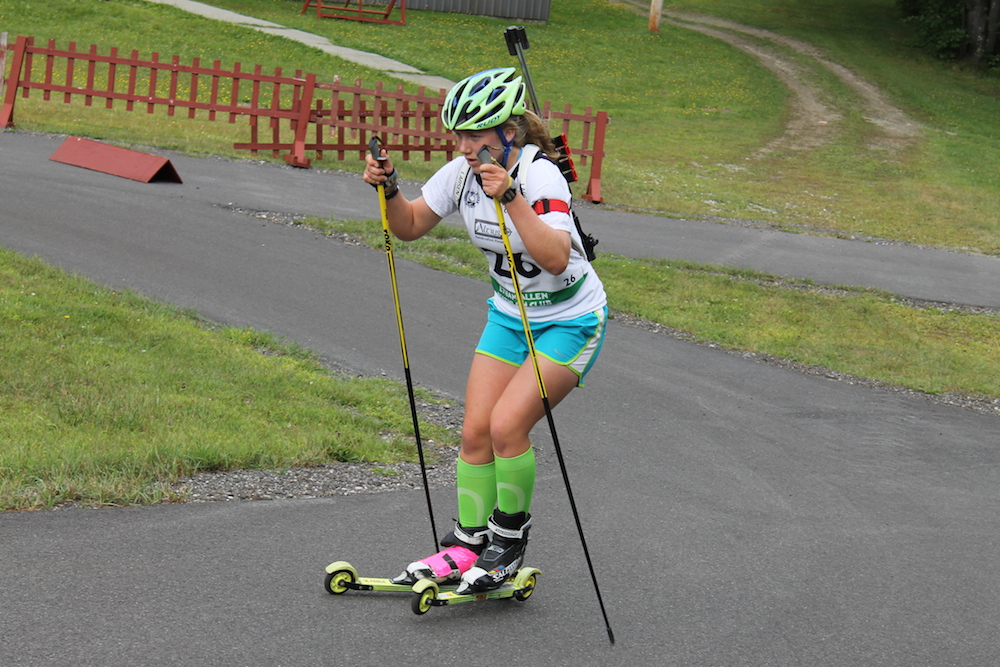
    Levins competing in the 2014 North American Rollerski Championships 7.5 k sprint at Ethan Allen Firing Range in Jericho, Vt.
    Levins competing in the 2014 North American Rollerski Championships 7.5 k sprint at Ethan Allen Firing Range in Jericho, Vt.

    Levins skis for Mountain Top Nordic Ski Club and her high school in Rutland. Her brother built her a one-point range in their backyard, but for the rest of her biathlon training she has to travel over an hour and a half – each way – to Jericho, Vermont, the home of the Ethan Allen Firing Range.

    “I train at Ethan Allen, but I am not a part of Ethan Allen Biathlon Club,” Levins explained. “Algis Shalna is my shooting and skiing coach. This is my third year training with Algis. I meet him in Jericho about 2 times a week during the winter. It is a lot of travel, but I learn at least one new thing every time I train with Algis, so it is worth the car ride. For the days that my mom and I aren’t in Jericho, I follow Algis’s training plan.”

    Shalna has a history of taking athletes with no strong biathlon club in their hometown and teaching them towards international success; he also coached New Hampshire native Sean Doherty, who finished 14th in the junior men’s individual race on Thursday.

    Doherty is a multiple gold medalist from previous seasons when he was a youth competitor, has the most World Championship medals of any U.S. biathlete in history, and competed at the 2014 Olympics. He’s also headed to his first senior World Championships in Finland in March.

    So it was the process-based focus preached by Shalna and the rest of the U.S. staff that led Levins to her clean shooting in the sprint.

    “I controlled the things that I could control very well, and the things out of my control cooperated nicely,” Levins explained. “It was the best I could do today, but not the culmination of my skiing potential.”

    In Sunday’s 7.5 k pursuit, Levins will be in a good position to move up the results sheet if she can continue her clean-shooting ways.

    “It will be a 1.5k loop that we will complete 5 times, so shooting well will be very important,” she wrote. “It is difficult to make up skiing time on such a short loop. Beyond that, I am going to stay dedicated to my process and have some fun!”

    Levins’ teammates Amanda Kautzer (Loppet Nordic Racing/Minnesota Biathlon) and Siena Ellingson (Mount Itasca/Minnesota Biathlon) finished 39th and 41st, with two and three penalties, respectively, and Hannah Streinz (Maine Winter Sports Center) finished 54th. All four will appear in the pursuit.

    Bryn Robertson led the Canadian youth women in 40th place, accruing two penalties and finishing 2:45.1 behind Blashko. Megan Bankes was close behind in 45th. Both athletes compete for Foothills Nordic.

    In the youth men’s 7.5 k sprint, Jonas Uglem Mobakken picked up a ten-second win. The top North American finish belonged to Canada’s Pearce Hanna (Rocky Mountain Racers), who placed 34th, two minutes and 19 seconds back with two penalties. He was the only Canadian entered in the event; with Canada Games running concurrently in Prince George, British Columbia, only a skeleton team was sent to Belarus.

    For the U.S., Paul Everett (Methow Valley) led the way in 36th, four seconds behind Hanna.

    The rest of the American team will miss the top-60 pursuit cutoff. Sam Zabell (Auburn Ski Club) placed 69th, and Cam Christiansen (Nisswa NW) 81st and Alexander Kilby (Skiku Biathlon) 82nd.

    Racing continues on Saturday with junior men’s and women’s sprint competitions.

    Results: women / men