Tag: Rebecca Dussault

  • Masters Minds: The Other Thanksgiving Camp in Crested Butte

    Masters Minds: The Other Thanksgiving Camp in Crested Butte

    Are you a masters skier who loves your club? Submit camp or training recaps or announcements to info@fasterskier.com with the subject line: “Masters Minds”. Articles can be first-person accounts, like below, or written from an observatory standpoint with thoughts from others. Not a master? That’s OK, too! Email your camp recaps and photos with the subject line: “Camp Recap”.

    ***

    While seemingly the rest of the North American nordic-ski community converges on West Yellowstone during the week of Thanksgiving, several other places also offer great opportunities for early-season nordic camps and skiing.  One of the most unheralded nordic ski communities that can almost guarantee great XC skiing with top-level camp clinics and other fun nordic-related activities is Crested Butte, Colorado.

    Although the Crested Butte Nordic Council was founded only as recently as 1987, the history of skiing in the area goes back as far back as anyone can dig up in recorded history.  The pioneers of the area pretty much had to adapt to skiing just to get around at all, due to the incredible amounts of snow that the area receives every year.

    The tradition of nordic skiing, Rocky Mountain style, runs rich throughout the Gunnison Valley and the West Elk Range of Colorado. The local museums and taverns have all sorts of historical photos, written accounts, and memorabilia that illustrate how the culture was born, imported by European settlers, and thrived as a means of survival and recreation.  Any visitor to the area interested in the history of skiing should take some time to learn more about the rich traditions and colorful characters that laid the foundation for what is now one of the most unique and genuine nordic towns in America.
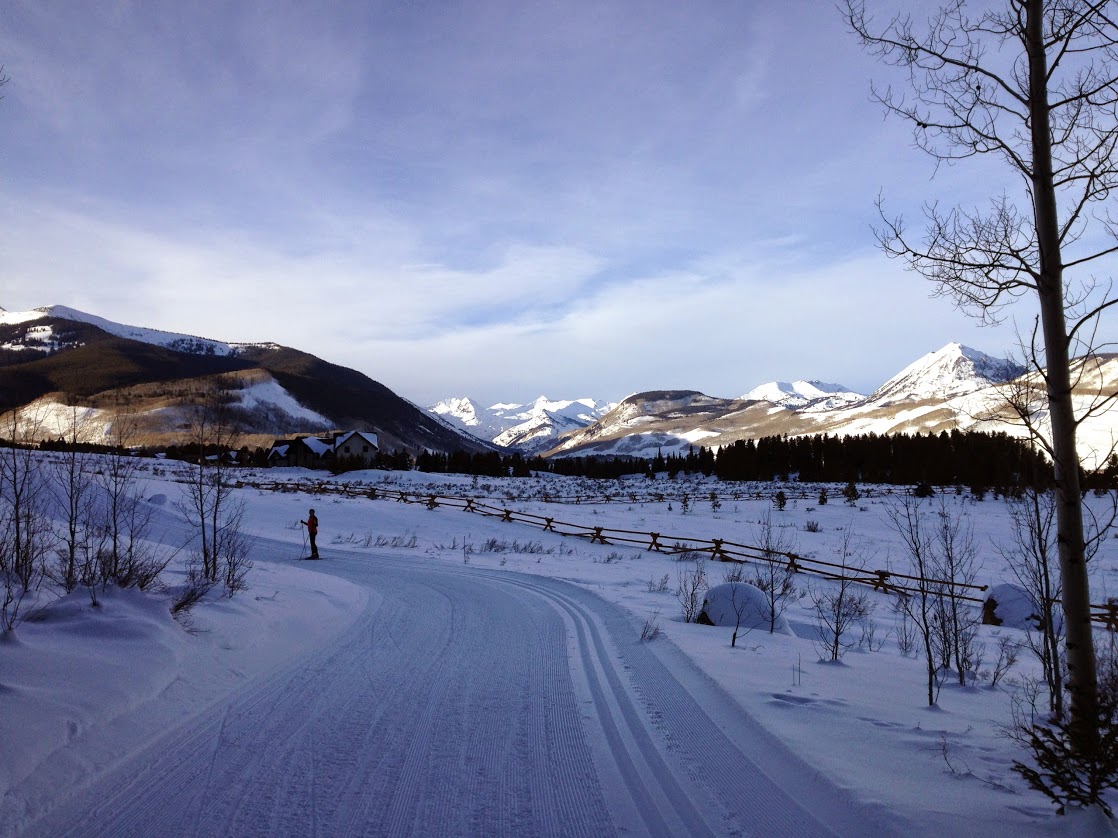
    Ruthie’s Run: Crested Butte Nordic’s FIS-homologated 5k course right on the edge of town (Photo: Clay Moseley)
    Ruthie’s Run: Crested Butte Nordic’s FIS-homologated 5 k course right on the edge of town.

    More recently, the Crested Butte Nordic Council has held the torch in keeping all things nordic alive and well in the valley.  The real credit should go to the very dedicated people of Crested Butte and the nordic center staff, led by its director, Keith Bauer — a Midwesterner transplant that knows a thing or two about running a nordic center.

    But, the most obvious asset is the network of trails that all start right on the edges of town within short walking distance, including from the nordic center, which serves as the epicenter of nordic activities. It also includes the regulation ice rink, a pretty serious (and fun for all ages) sledding hill, and the most incredibly beautiful and challenging International Ski Federation (FIS)-homologated 5-kilometer race course, in addition to the other connecting ski trails on the breathtaking, open-space lands that abound around the village.

    The grooming is also something to rave about. CB Nordic has continually sought to improve the quality of its grooming, with new and improved equipment, more groomers, a more robust schedule and more interaction with staff and skiers.  Another aspect is that they have actual nordic skiers doing the grooming, and know what a finished product should be. There has been a lot of energy and effort put into this area of the operation, and it really shows.

    Despite the already-great conditions for a Thanksgiving camp, I witnessed the grooming team going out and shoveling every little area that wasn’t just right in terms of grooming depth.  I don’t know that I’ve seen that very often, except right before big events.

    Since 2002, the Nordic Council has played host to the annual Crested Butte Thanksgiving camp. While not as well-known, nor as vast in scope as the camp at West Yellowstone, the CB camp is nevertheless an extremely good alternative. For one, the snow is almost always in abundance for November.

    While not as well-known, nor as vast in scope as the camp at West Yellowstone, the CB camp is nevertheless an extremely good alternative. For one, the snow is almost always in abundance for November. 

    If it isn’t up to par in town, there is a pretty amazing alternative just a little ways up the old Kebler Pass road (used in the USA Pro Cycling Challenge) at a place called “Lily Lake” that is more than an adequate alternative, with some fun and interesting trails.  It’s up a little higher in elevation, and tucked in a hidden high plateau among towering peaks that receive those beautiful Rocky Mountain early season dumps of snow, quite often providing skiing as early as mid-September, and most certainly by October.
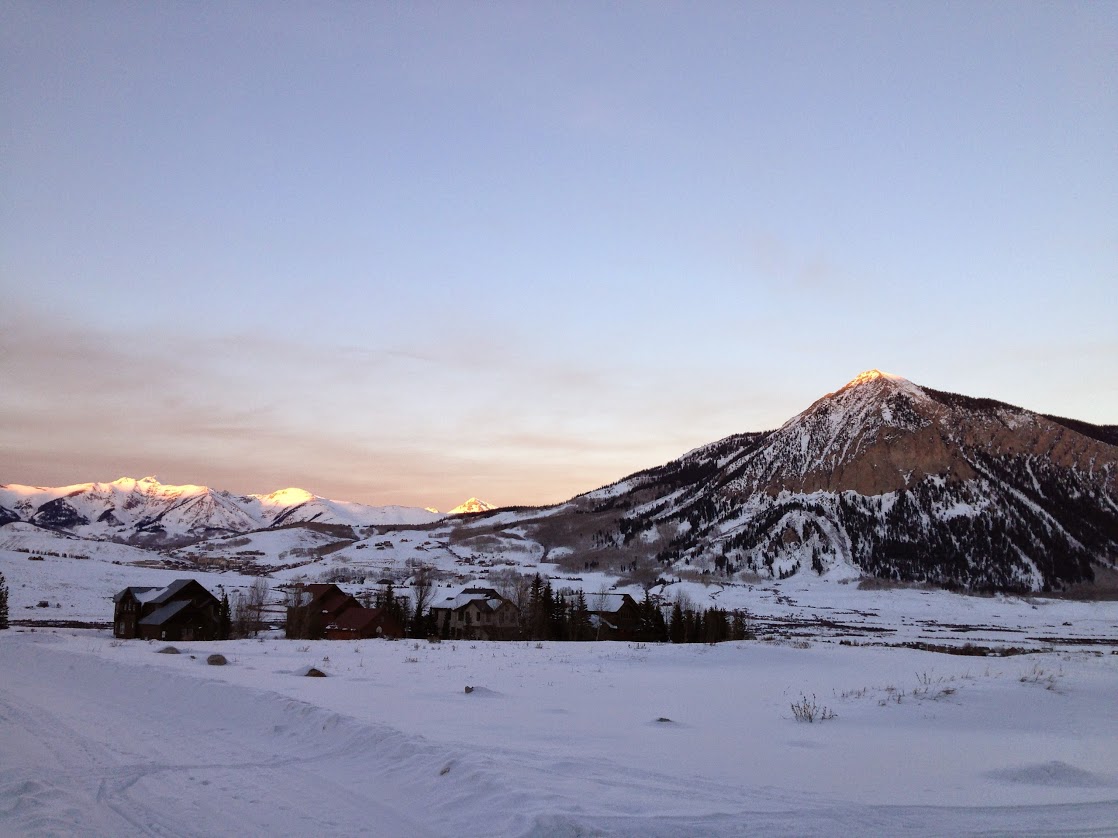
    Sunset over the West Elk Range, and Mt. Crested Butte (Photo: Clay Moseley)
    Sunset over the West Elk Range and Mt. Crested Butte


    But, usually there is good snow down in the valley for some great early season skiing, and this year was no exception.  Conditions were simply fabulous with a good base and abundant sunshine.  Nighttime temperatures plummet in this high-mountain valley, so the snow remained cold and mostly untransformed, despite the comfortable afternoon conditions.  Most days saw glide and kick wax in the “blue” ranges, with only a little violet mixed in for sunny spots.

    The camp itself has evolved over the years, but what has been a mainstay from the beginning is the high level of instruction in the various technique clinics.   The instructors that the CB Nordic Center gets for these clinics are the real heroes, donating their time and expertise to the center for a charitable cause.  Where else can you get local Olympians to teach clinics?  And PSIA and master’s instructors with deserved celebrity status?  Crested Butte has it all.  The most notable instructors I’ve had over the past few years include Ingrid Butts, Rebecca Dussault, Ross Matlock, Murray Banks, Jeff Banks, and Steve Hindman.

    Responses to the level of instruction has always been at the top, and many of us have made personal friendships over the years with the various instructors.  They’ve made the sport fun in terms of a life-long learning adventure, and I have most certainly improved thanks to them.
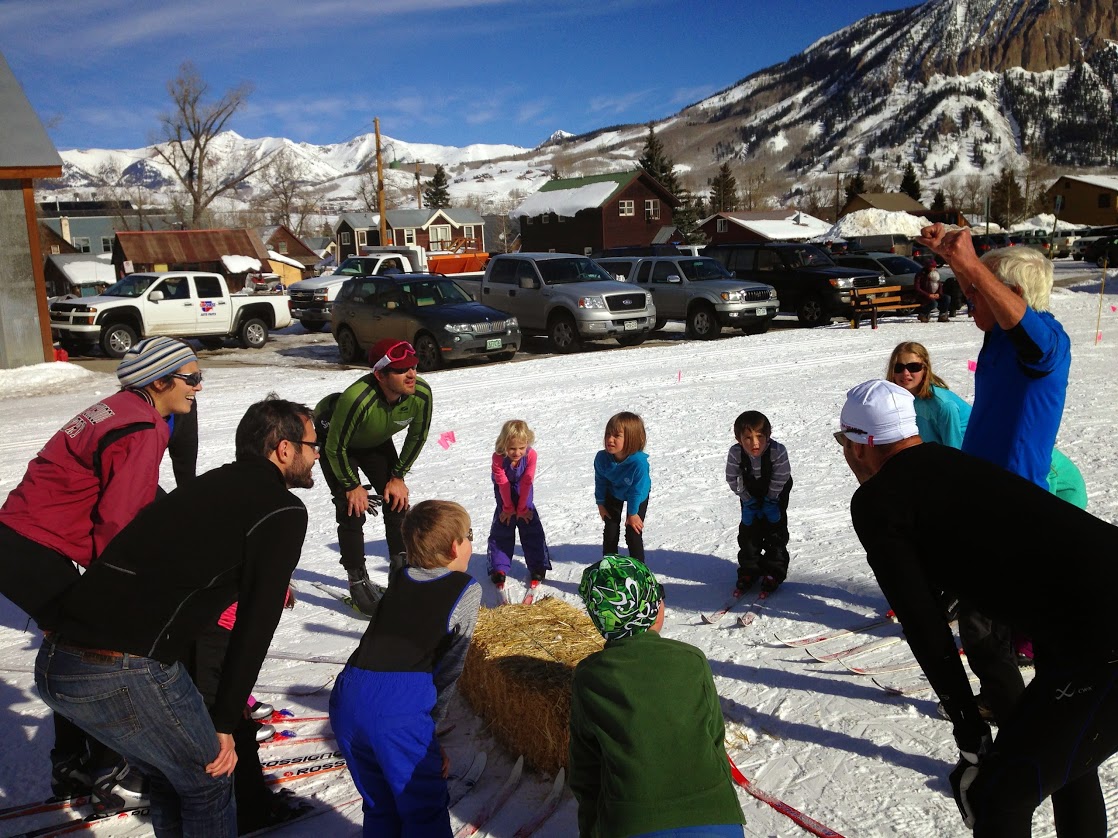
    Murray Banks teaching and entertaining kids of all ages at the Crested Butte Thanksgiving Camp late last month in Colorado. (Photo: Clay Moseley)
    Murray Banks teaching and entertaining kids of all ages at the Crested Butte Thanksgiving Camp late last month in Colorado. (Photo: Clay Moseley)


    The Crested Butte Camp instructors have always been high-quality people who are passionate about sharing their love and knowledge of cross-country skiing, whether it be for junior to master’s level racing, or just for weekend warriors looking to find a little more efficiency and enjoyment in their workouts.  The clinics are not merely stand-around and listen clinics either, they’re fast paced and require a lot of energy input from everyone, which makes them more fun than other clinics I’ve participated in.

    Camp clinics that are offered range from “novice” level (not first-timers), to fully advanced and racing-specific classes.  Schedules include both techniques at all levels from Thursday (Thanksgiving Day) through Saturday, with some bonus activity on Sunday, like a fun group ski.

    In years previous when Western State in Gunnison still had a Division-1 ski team, Sunday was reserved for an intramural scrimmage race of collegiate racers, local former racers, masters like myself, and everyone in between.  It was always fun to break out the fancy wax and good skis and see if we could employ what we’d learned over the previous days’ clinics.  But with the ski program at Western State being dropped, interest in a Sunday race sort of dropped as well because everyone is usually quite exhausted after all the high-energy clinics.

    As many times as I’ve attended the CB Thanksgiving camp clinics, one would think it would get repetitious, but with cross-country skiing being such a life-long learning activity and all, even the well-seasoned instructors seem to have learning revelations during their time skiing and coaching.  I’m always impressed that something new, or a new angle on an age-old challenge, can be added to the wealth of information the CB camp instructors always present.

    “As many times as I’ve attended the CB Thanksgiving camp clinics, one would think it would get repetitious, but … even the well-seasoned instructors seem to have learning revelations during their time skiing and coaching.”

    Additionally, they’ve always spent a lot of time and energy collecting very detailed video analysis of each and every clinic participant in a variety of techniques and terrain.  There have been times that Ingrid Butts needed to be done to get to something else, but got so into her instruction, that it got well past dark by the time she was done with us.  I’ve also held Murray Banks and Ross Matlock hostage a couple of times to help work out some issues that arose during the clinics, and they were not just being polite, but really enthusiastic about spending the extra time to go over not only my, but others’ cases as well.  The individual attention is probably what is best about this Thanksgiving camp.
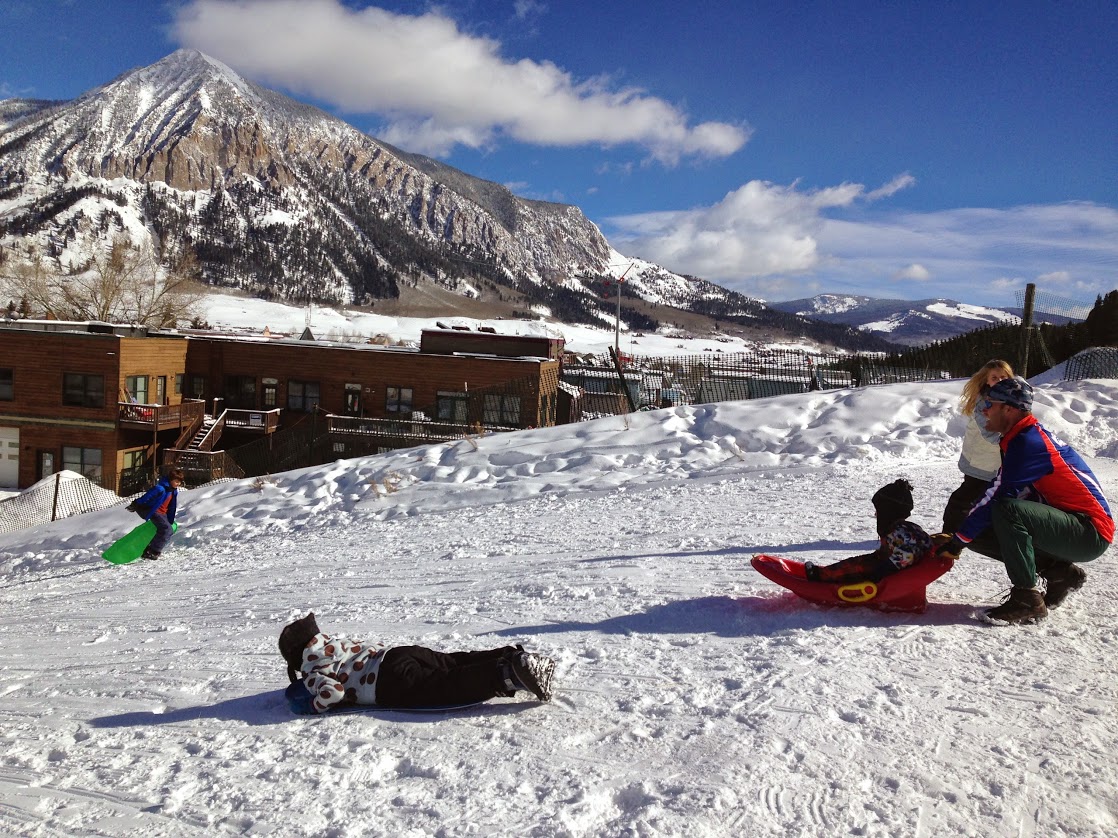
    Serious sledding at the Crested Butte Nordic Center (Photo: Clay Moseley)
    Serious sledding at the Crested Butte Nordic Center (Photo: Clay Moseley)

    This year, my local ski club, the Southwest Nordic Ski Club of Northern New Mexico, sort of ad-hoc partnered with the Crested Butte Nordic Council to add in a kids’ fun clinic for an entire morning of games, obstacles, relays and short races.  It was a lot of fun for the kids and parents alike.

    Murray Banks, who is recovering from surgery to repair an injury sustained during a backcountry ski adventure last May, stepped up and led us parents to help him with all the many kids who joined in the morning clinic.  The kids really got into it and learned a lot without ever getting bored or having to sit and listen for more than just a few seconds.  It was so much fun and if you ever get an opportunity to take a class from Murray Banks, take it.  He’s so entertaining, on top of being a very good teacher.  The kids just love him (as do the adults!).  He may be an old-school Vermonter, but he really breathes a lot of life into everything he does, especially cross-country skiing.

    Finally, the Crested Butte Thanksgiving Camp also serves as a fundraiser for the CB Nordic Council.  They host a couple of other apres-ski activities, like an evening film festival with interesting ski-related Indie films, and a very fun dinner party with a silent auction and often an impromptu dance party.  It’s always been a fun week of Nordic celebration that welcomes everyone.

    Other notable Crested Butte information:

    • Crested Butte is also home to one of the most famous alpine areas and always has some good deals this time of the year.
    • Great restaurants (of all kinds) and coffee shops abound, and all are open and welcoming to visitors.
    • Lodging deals are also easy to find, since it’s still considered “low season.”
    • The Crested Butte Nordic website is:  www.cbnordic.org
    • More camp photos: CB Nordic Facebook
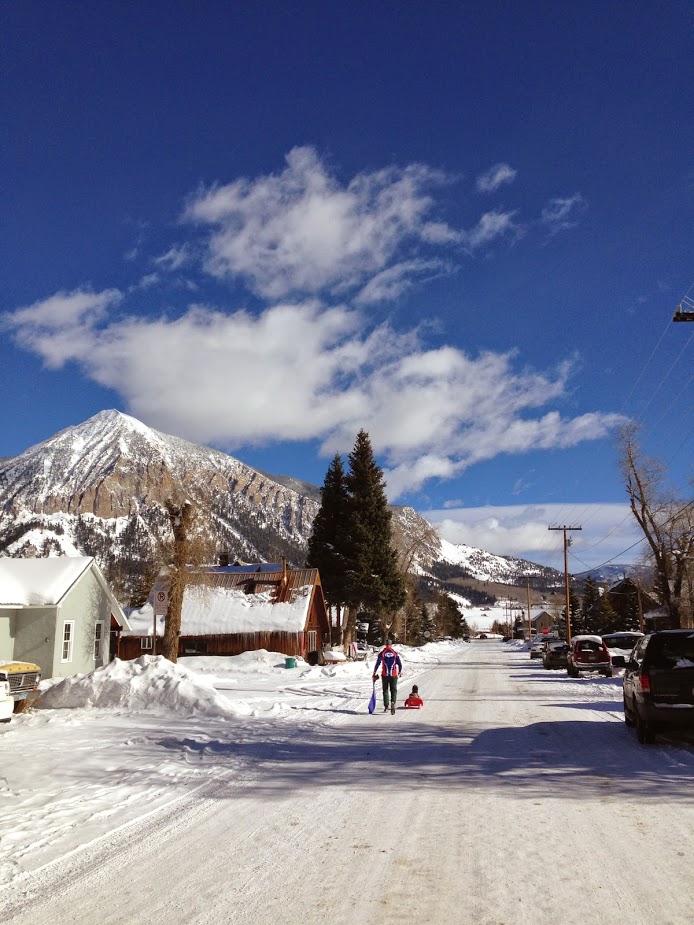
    It’s easy for kids to get around Crested Butte! (Photo: Clay Moseley)
    It’s easy for kids to get around Crested Butte!
    About the Author: Originally a bike racer, Clay Moseley picked up nordic skiing in college (thanks to his Norwegian roommate, also on the University of New Mexico ski team). As president of the Southwest Nordic Ski Club, based in Los Alamos, N.M., for the last 12 years, he’s worked to develop relationships with several of the southern/central Colorado Nordic organizations (plus New Mexico organizations) for increasing involvement in nordic skiing at all levels.  These organizations include Crested Butte Nordic Council, Pagosa Springs Nordic Club, San Juan Nordic Club, Chama Outdoor Club, Enchanted Forest Cross Country Ski Area, and the Sandia Nordic Club (Albuquerque). When he’s not out skiing with his family, Clay dabbles in masters racing.
  • After Skiing Across America, Ocarizes Take Next Step

    After Skiing Across America, Ocarizes Take Next Step

    Carolyn and Santi Ocariz complete their two-month rollerski across the U.S., called Ski Across America, by rolling into the Pacific Ocean on Friday, May 11. (Courtesy photo/SkiAcrossAmerica.com)

    When Carolyn and Santi Ocariz clicked into their rollerskis slightly more than two months ago, neither really knew what they were in for.

    The Wisconsin couple heard plenty of stories about the places they’d travel through. They took to heart the warnings about crazy drivers, snakes and treacherous temperatures while crossing America’s heartland. It might not be hot when they left, but it could get brutal, and the elements could change 180 degrees by the time they reached Utah.

    Husband and wife, Santi and Carolyn Ocariz celebrate the end of their Ski Across America journey, in which they spent two months and five days rollerskiing from Charleston, S.C., to San Francisco to raise money for Food for the Poor. (Courtesy photo/SkiAcrossAmerica.com)

    Carolyn, 23, and Santi, 25, prepared as best they could. As they ticked off the states and thousands of miles, the two couldn’t have been more surprised.

    Drivers frequently slowed down beside them and asked what they were doing. Rather than threaten to run them off the road, they were genuinely interested.

    “It was unbelievable,” Santi said on the phone from San Francisco, where they finished their journey last Friday. “I think we were better accepted on the roads in the south than we were back in Wisconsin.”

    The hospitality they encountered throughout their trip, Ski Across America, had been overwhelming, he said. Once people heard they were rollerskiing more than 3,000 miles across the U.S. to raise money for a charity called Food for the Poor, many strangers opened their homes to them.

    In all, the Ocarizes raised an estimated $17,000 to $18,000 dollars to help feed children in impoverished nations. They visited at least 400 churches along the way to deliver packets with their message, which they asked pastors to read to their congregation for donations. With their trip’s website still up and running, Santi hoped more money would continue to roll in.

    The newlyweds from the Midwest had come a long way since early March when they first started their journey at the Atlantic coast in Charleston, S.C. In two months and five days, they raised some $12,000, crossed more than a dozen states and visited friends and relatives along the way.

    Spending about seven hours a day on the road – sometimes longer – the two often chewed off more than a 100 miles at a time. While traveling through Yosemite National Park on the last leg of their trip, a park ranger informed them 10 miles in that they couldn’t rollerski through it.

    They popped out of their rollerskis and ran. After logging a total of six hours on foot, most of which was downhill and would have been much more pleasant on wheels, the Ocarizes arrived on the other side of the park the next day.

    “The legs took a beating,” Santi said. “When we’re in shape for running, it wouldn’t be any big deal, but when you’ve been rollerskiing for the past two months, not really running, it was kind of a shock to the system.”

    He said they were lucky to have even been able to use the road; it opened the day before. Avoiding the 750,000-acre park altogether would have added an estimated three days of rollerskiing.

    They camped overnight in Yosemite and woke up the next morning to find chocolate missing out of Santi’s backpack along with his cellphone. Apparently, a raccoon dug both out and dragged the latter to an obscure place at the campsite. Someone later found his phone and planned to mail it to him.

    “It actually ran off with my phone,” Santi said with a laugh. “It couldn’t have been anything else.”

    Before Yosemite, the Ocarizes encountered a similar “blessing” at Lake Powell in southern Utah. When they arrived at the second largest manmade reservoir in the U.S. nearly 200 miles long, they learned the ferry across opened for the season that day.

    “Otherwise we would have had to go who knows how far around,” Santi said.

    After climbing to around 10,500 feet on rollerskis, Carolyn and Santi Ocariz realized a mountain pass to Cedar City in southern Utah was closed. They had to backtrack to Duckville, Utah, then farther back the next day. (Courtesy photo/SkiAcrossAmerica.com)

    They would always remember the good fortune they encountered on routes like those, he said. At the same time, they’d probably never forget when they skied more than 30 miles out of the way to the top of a closed mountain pass.

    To get to southern Utah’s Cedar City, Carolyn and Santi picked a road that looked pretty doable: 60-65 miles of not-so-tough terrain. On the way, they realized they misinterpreted the map.

    “It turned into like a ten-hour skiing day,” Santi said. “The whole afternoon we were climbing, and as we climbed, it got colder and rain turned to sleet and snow and the wind was blowing in our face.”

    Alternating between rollerskiing and driving their Subaru, the two arrived at the top of the pass nearly 10,500 feet above sea level. There, they saw a gate across the road indicating the pass was closed.

    “That was a demoralizing moment,” Santi said, jovially.

    It was already getting dark and they had to backtrack to the next town. There, a landslide had closed an alternate route. They called it a night and drove farther back to an open road the next day.

    Looking back, Santi recalled some of the most beautiful places they rolled through: Yosemite, Taos in New Mexico, the redwood trees and mountains near the California coast, and even the south despite its 88-degree days with 90 percent humidity.

    “Sometimes the outlook of the south is, oh, it’s dangerous and weird people, but it was completely the opposite,” he said. “You won’t find any nicer places or communities, I don’t think, than down there.”

    He and Carolyn bathed in mountain streams, at truck stops and campgrounds, but at the end of their trip — about 3,500 miles total — they soaked up the Pacific. With Santi’s cousin Alec biking alongside them for the last 30 miles while their friend Judy Krueger drove the car, Santi and Carolyn arrived at the West Coast and rollerskied right into the ocean.

    Santi and Carolyn Ocariz complete their two-month Ski Across America by rollerskiing into the Pacific Ocean near San Francisco on Friday, May 11. (Courtesy photo/SkiAcrossAmerica.com)

    “It was pretty awesome,” Santi said. “We had both been looking forward to completing the trip but at the same time it was like, what now? The last two months had been just all rollerskiing and suddenly it came to an end.”

    They had memories to hold onto, friends like Rebecca Dussault and her husband Sharbel to thank for joining them for a day and a night.

    They met a man running across the country for the American Heart Association (willpoweredrun.org) and even watched Tad Elliott mountain bike race. The spoke at churches on weekends and had plenty of people to inform that they finished.

    Finishing up some computer stuff at his relative’s home in San Francisco, Santi said they were preparing for the next step. A member of the Central Cross Country (CXC) Elite Team for the last two years, he decided months ago to join XC Oregon in Bend.

    Also a former CXC member, Carolyn would move there to train with the team as well. She was flying home to Wisconsin on Wednesday to spend time with family and gather their belongings before driving west once more. In June, the two will celebrate their one year anniversary.

    Santi said Bend was a destination that had been on their minds for years. He spent several summers training there while in college at the University of Wisconsin-Green Bay. Both born in the Midwest, he and Carolyn viewed their cross-country trip as the best way to get there.

    “Bend is amazing. It’s a training mecca,” Santi said. “I think they still have ten feet of base snow so they’re gonna have snow until who knows when in July. So we’re going to be ditching our rollerskis and getting back on snow for a while.”

    More appealing was the amount of people they could train with, which included elite runners as well as skiers.

    “There’s just a very good crowd of fit and enthusiastic people,” Santi said. “Even though the team is smaller we have many more people to train with than Hayward.”

    Part of the reason they finished their anticipated three-month trip earlier than expected was so that Santi could get to Bend sooner and Carolyn could spend more time at home. She would be meet him in Bend in a few weeks, he said.

    On Saturday, Santi planned on racing the Pole Pedal Paddle in Bend with his brother Javier. After that, he’ll jump into training with old friends at the U.S./Canadian ski team camp there.

    “I feel great, honestly; I have a ton of energy,” he said. “The body adapts. It gets stronger and I definitely feel very strong right now.”

    For some, two months of nonstop rollerskiing might be draining. In his case, so many easy-distance days in a row gave him the rest he needed.

    “In a way this trip was training, but I guess we didn’t consider it training,” Santi said. “We were just kind of doing it for the fundraising aspect of it.”

    For more details on the trip, visit SkiAcrossAmerica.com and check out this FasterSkier interview from before they left.

  • Brooks: Aiming for Worlds, Officially Part Time

    Brooks: Aiming for Worlds, Officially Part Time

    ANCHORAGE, ALASKA – “It’s been really cold lately, which is good. We have a good amount of frost, and if it were to snow right now, it would definitely stick,” said Holly Brooks. “We’ll be skiing before we know it!”

    Holly Brooks at the 2010 Olympics in Whistler. (Photo: Kent Murdoch)

    After making the U.S. Ski Team for the 2010 Olympics in Whistler, the 28-year-old from Anchorage officially cut her work hours to part-time this summer. Brooks still coaches at Alaska Pacific University, but with hopes to make the US team for the 2011 World Championships in Oslo, her own fitness is no longer an afterthought.

    “Training is going really well. I am definitely on track now,” said Brooks, who is looking forward to the competition season.

    Packed Schedule

    On-snow time can’t come soon enough for Brooks. Her racing schedule is already set.

    “I plan on doing the domestic circuit starting with West Yellowstone, then Silverstar, the mini-tour in Rossland, B.C. – I’m really excited for that – and then head out for U.S. Nationals in January,” Brooks said.

    As of October, Brooks is ranked fourth in the U.S. While she is unsure of how many female skiers the U.S. Ski Team will field Oslo, she is hopeful that she will make the cut. “Oslo is the plan and the hope. Rebecca Dussault is pregnant and due on January 19th, so she won’t be competing in Oslo,” Brooks said. “But knowing her, I never rule it out that she’ll come out and post some amazing result even if she’s pregnant,” Brooks added with a laugh.

    Well-prepared Homebody

    Brooks explained that there really is no need to leave Alaska to get premium training, but she did change a few things after going part-time with work. This summer, for the first time, Brooks completed two on-snow camps on the Eagle Glacier in Alaska.

    “I’ve never done a training camp there myself, but it’s an amazing facility. We’ve had a lot of athletes up there, but I’ve always been the one left at home to take care of things here when everyone else left,” Brooks said.

    However, Brooks added that her part-time status is no cakewalk.

    “Since I’m not on the U.S. Ski Team, I still have to support myself. In a typical day, I will train in the morning, then coach at noon and again in the afternoon, and then I will get in another of my own workouts in the evening,” Brooks said, explaining that while she’s coaching, she might not be training and doing all the drills, but she’s still on her feet.

    Although Brooks has increased her training emphasis this summer, she is still prefers the home scene over travel camps.

    “I’m kind of lazy that way. I don’t really see a need to leave Alaska. While it would be super-fun to be in Lake Placid and train with the U.S. Ski Team, I have great training partners, a really good coach, and there will be lots of travel later,” Brooks said.

  • Dussault Turns Focus to Family and Farm

    Dussault Turns Focus to Family and Farm

    Following her Olympic debut in Turin, Italy in 2006, Rebecca Dussault planned to take a break, to include the birth of her second child, before returning to racing.  The short break lasted a year and a half longer than planned when her husband Sharbel contracted a serious auto-immune disease.  The long delay meant that her points coming into the 2010 season were far less than optimal and despite numerous fantastic results and a SuperTour championship, she didn’t gather quite enough points due to her limited presence at other SuperTour races.

    “What athlete doesn’t have Olympic dreams? That’s the pinnacle of our sport,” said Dussault in an interview with FasterSkier, addressing the timing of her full return to racing in 2010, just in time for the Vancouver Olympics.  By points rankings, Dussault was the fastest American woman not to go to the Olympics this year, but her Olympic aspirations are certainly not at an end: “I hope to return.  I love skiing.  It’s something that I enjoy doing and it is a career that has benefited me and my family in many ways.”

    Dussault in the milking parlor. Photo: Rebecca Dussault

    For the moment, however, Dussault’s skiing career is taking a backseat to her family and to another passion.  The Dussaults (Rebecca, Sharbel, two sons ages eight and three, and a third child due in January) have taken an internship position at an organic farm in Colorado.

    Working on the farm takes the same hard work, motivation, and dedication that ski training does, but instead of biking, running, and rollerskiing, Dussault is currently spending her days running after pigs, milking cows and goats, collecting eggs, raising meat birds and building sheep fence. “I’m getting more strength training than ever,” she laughs, “and the animals never take an off-day like we do in skiing.  You can’t tell a cow ‘I’ll milk you tomorrow.’ ”

    Dussault and son. Photo: Rebecca Dussault

    Getting involved in sustainable organic farming movement is something that the Dussaults have been interested in for several years.  Speaking to me from the milking parlor and wearing overalls and muck boots, Dussault explained the new Beyond Organic movement which is really a return to the past, differentiated from the industrial organic movement which has essentially sold out for profit and big corporations.

    The Beyond Organic farmer is interested in sustaining local community, building the soil, producing healthy and naturally-raised animals, and ultimately providing their children and grandchildren with better soil and resources than they themselves have now.  Dussault loves the organic farming lifestyle because in addition to being good for both body and earth, it keeps the family together, the father at home, and the children involved.

    The family hopes to someday have a farm of their own.  As Dussault astutely put it, “It was like, why not get involved? It’s not rocket science.  It just takes passion.  We need more ‘new farmers’ on the land!”

    The Dussault family. Photo: Rebecca Dussault
  • CXC Gears up for 2011

    Big changes to the team roster and the coaching staff are this spring’s news for the Central Cross-Country Ski Association (CXC). 18 athletes and three coaches will comprise the 2011 team for one of North America’s largest and fastest-growing clubs.

    Vacating the post of head coach that he held since the formation of CXC in 2006, Bryan Fish has accepted a position with the US Ski Team (USST) as Continental Cup coach. Jason Cork will be stepping in to fill this void, bringing his experience with Durango Nordic Ski Club, Michigan Tech University, and recent J1 and World Junior Championships coaching staffs to the job. Gus Kaeding, a former CXC athlete, will be stepping up as the team’s elite development coach this season.

    Under Bryan Fish, CXC sent its first athlete to the Olympics in Garrott Kuzzy

    Olympian and CXC athlete Garrott Kuzzy is optimistic about the changes in coaching staff, saying “I see the changes as positive, all the way around; we’ve now got three great coaches, four if you include Igor Badamshin, instead of just one.”

    Turnover among athletes is similarly high. A notable loss to the team comes with the departure of Rebecca Dussault, who along with her husband has taken an internship position at an organic farm in Colorado for the year and is pregnant with her third child, due January 19. Also leaving the team are decorated skiers Kristina Owen, Kelly Chaudoin and Audrey Weber.

    The men’s team will be headed by Kuzzy, who will continue to work with CXC after a parallel stint with the USST. Notable newcomers include Santiago Octariz, who represented University of Wisconsin-Green Bay last year as the lone NCAA All-American from the central region, and Tad Elliott, a National Champion and U23 World Championships team member. (Elliott raced for CXC’s marathon squad last year; this year he will be a full member.)

    Filling out the remaining spots on the men’s team are Brian Gregg, Karl Nygren, Eric Wolcott, Matt Liebsch, Bryan Cook, Andre Watt, Ben Lannin, and Doug DeBold.

    Caitlin Compton and Bryan Cook do a strength workout Photo: CXC

    There is an Olympian among the CXC women as well, as Minneapolis resident Caitlin Compton joins the roster. Other new additions are former University of Vermont standout Jennie Bender and Canadian Brooke Gosling. Maria Stuber, who had six top-5 SuperTour results in 2010, returns for another year with the squad, as will JoJo Winters and Melissa Schwartz. Jessie Diggins will be joining the squad full-time this year following her high school graduation.

    The roster is an impressive hybridization of veteran and newcomer. “It’s going to be an ideal mix of skiers. I can’t wait to start working with our ‘new additions’—some of the strongest skiers on the circuit,” says Kuzzy, “The vets will have more to learn from them than they will from us!”

    The CXC association has enjoyed rapid growth and huge success since it was founded only four short years ago. The program now encompasses not only the elite Vertical Limit team but juniors, masters, and educational opportunities.

    The team’s schedule is structured such that athletes participate in a ten- to fourteen-day camp every few weeks and train at home over the weeks between camps. CXC is currently in the midst of their first summer training camp of the season, located in the Saint Croix Valley of Minnesota.

  • Gaiazova and McMurtry Lead Canadian Sweep as FasterSkier Continental Cup Skiers of the Year

    Gaiazova and McMurtry Lead Canadian Sweep as FasterSkier Continental Cup Skiers of the Year

    Continental Cup Skier of the Year

    The Continental Cup Skier of the Year presented one of the biggest challenges of the 2010 FasterSkier Awards.  Strong contenders from both the US and Canada entered the mix, with few head-to-head races to clarify the situation.  Also complicating matters is the fact that the 2010 Canadian NorAm schedule featured many fewer races than the US SuperTour in 2010.

    Continental Cup Skier of the Year (women):

    Dasha Gaiazova (CAN).  Gaiazova absolutely dominated the Contintal Cup scene when she raced, amassing seven wins in eleven starts, and never finishing off the podium.  She won the NorAm overall title by 60 points over Madeleine Williams, and took 1st, 2nd, and 33rd in her three SuperTour starts.

    She raced the full NorAm schedule, but did not participate in Canadian Nationals.  This opened the door for Rebecca Dussault (USA) to make a run for the honor.  Dussault amassed 19 Continental Cup starts, winning seven, and placing in the top-3 12 times.  She easily one the overall SuperTour title, was 1st in the distance standings and 2nd in the sprint.

    Ultimately, Gaiazova got the nod based on three wins in head-to-head competitions, and the fact that she raced the entire NorAm Cup series.  She is clearly the faster skier, and her dominance made up for the lack of volume.

    Gaiazova (CAN) racing at the Cnamore World Cup

    Honorable Mention

    Rebecca Dussault (USA).  See above for results.  Dussault made a great case for herself, and was easily the best US Continental Cup skier this year, crisscrossing the country to start an impressive number of races.

    Dussault on the top of the podium at the Telemark, WI SuperTour (Photo: CXC)

    [poll id=”41″]

    Continental Cup Skier of the Year (men):

    Like the women’s award, the choice came down to a Canadian versus an American – the overall winners of NorAm series and the US SuperTour.  The question again came down to how much quantity should count.

    Brent McMurtry (CAN).  Staying consistent, McMurtry got the nod over Chris Cook (USA), despite starting significantly fewer races.  McMurtry still made 15 Continental Cup starts, winning one and placing on the podium eight times.  He won the overall NorAm title by 131 points, and bested Cook in five of six head-to-head encounters.

    Brent McMurtry (#14) sets the pace at the SuperTour finals.

    Honorable Mention

    Chris Cook (USA).  Cook started an impressive 25 Continental Cup races – 18 SuperTours, 3 NorAms, and 4 US Nationals events.  He did not win a race, but placed on the podium six times.  He ranked in the top-10 in all four Nationals races.  He won the overall SuperTour title, edging out Brian Gregg by just 16 points.  Gregg took the distance title and Cook the sprint honors.

    Chris Cook in the Bozeman Super Tour, (Photo: Stuart Jennings).

    [poll id=”40″]

    Previous Winners

    2009
    Kristina Strandberg (SWE)
    Lars Flora (USA)/Graham Nishikawa (CAN)

    2008
    Kristina Strandberg (SWE)
    Ivan Babikov (CAN)

    Award Schedule:

    Thursday, April 15 – Rookie of the Year
    Friday, April 16 – Collegiate Skier of the Year
    Monday, April 19 – Adaptive Skier of the Year
    Tuesday, April 20 – Continental Skier of the Year
    Wednesday, April 21 – Biathlete of the Year
    Thursday, April 22 – Nordic Combined Skier of the Year
    Friday, April 23 – Performance of the Year (cross-country, biathlon, nordic combined)
    Monday, April 26th – Cross-Country Skier of the Year

    FasterSkier Awards 2010
  • Randall Keeps on Rolling; Wins Mini-Tour Finale

    Randall Keeps on Rolling; Wins Mini-Tour Finale

    Kikkan Randall on the climb

    Since Kikkan Randall began Sunday’s 5 k hill climb with a 1:30 advantage over CXC’s Rebecca Dussault, the biggest question was not who would win. Rather, it was why Randall was racing in the German national team’s suit.

    Turns out she traded for it after the Olympics were over. But regardless of the reason, it didn’t get in the way of her skiing, as Randall rolled to another victory in the mini-tour in Fort Kent.

    “I had to pull it out just once,” she said of the suit, which she got from Nicole Fessel.

    After all the hype about the hill, Randall looked crestfallen that it wasn’t a little longer.

    “I thought I would be dying,” she said, “but it felt really good! It felt a little too good.”

    She started the climb a half hour after more than 100 men had made their way up, making for tougher going.

    “It took me a little bit to find a rhythm,” she said.

    Once she did, though, Randall was rolling, and nobody else was able to make up much ground. Dussault did make up a few seconds by the finish, to set the fastest time of the day, but that wasn’t nearly enough.

    Like men’s overall winner Andy Newell, Randall said that she had a blast in the mini-tour this week.

    The scene on the climb

    “I think it’s fantastic—I mean, what a fun way to end the year,” she said. “Lots of different types of races, finish with the hill climb here, the sprints and primes.”

    She had high praise for the officials and volunteers here–and they certainly did work for it.

    Race organizer Eileen Carey said that she’s been working 16-hour days for the entire month of March, with her club also hosting Junior Olympics two weeks ago. She said her crew was challenged to nail down all the details of the new format, since there aren’t official rules for this type of event, and the three straight days of racing between two different venues was another stress.

    She still said it was worth it, though, especially after seeing most of the men’s field head back out on course to watch the women.

    “It was totally electric on the hill climb today,” she said. “People were pumped.”

    Dussault and Randall had the fastest pair of times on the day, respectively, with Brooke Gosling (Alberta World Cup Academy) in third.

    Holly Brooks (APU) was the third woman across the line, after Randall and Dussault, to take the final overall podium position.

  • Randall Cruises to Dominating Win in Mini-Tour Opener

    Randall Cruises to Dominating Win in Mini-Tour Opener

    Kikkan Randall (USST) leading on the first lap

    It’s a difficult prospect after a half-dozen personal bests, a World Cup podium, and a front-page article in the New York Times sports section, but Kikkan Randall just keeps finding ways to impress this winter.

    After grinding out a victory in Wednesday’s 30 k just three days removed from competing in Europe, a better-rested Randall delivered an Alaska-sized beatdown to her competitors in Friday’s 7 k classic mass start race, the opening event of the 2010 SuperTour Finals.

    Scrambling to an early lead to capture the $250 bonus awarded at the one kilometer mark, Randall stuck it in cruise control and never looked back, skiing away to a convincing 30-second win over a supporting cast of domestic racers. Craftsbury Green Racing Project’s Ida Sargent was second in a breakthrough race, and CXC’s Rebecca Dussault was third.

    With the course groomed into a slick slab of ice chunks, Randall went out hard from the gun trying to stay out of trouble.

    She said she wanted to be in position to contest the sprint at one kilometer, but there was no contest: two-thirds of the way there, Randall already had a ten meters gap to the field.

    “I had a good start, and actually expected to be a little more in the mix on that first one,” she said. “Once I went through that, I didn’t feel like a huge blast…so I just decided to keep it going.”

    Randall at the line, continuing her amazing run this winter

    Like that, Randall was gone. By the time she flew through the stadium to start her second lap, the pack was out of sight—her only competition was the World Cup field she said she imagined alongside her.

    With 45 seconds worth of bonus sprints she picked up along the way, Randall now leads the overall by nearly a minute over Dussault, and barring a huge upset, she’ll only pad to that lead in tomorrow’s sprint. With her efforts today, she garnered all three leaders’ bibs for the overall, the best climber, and the best sprinter.

    Meanwhile Sargent, Dussault, Kristina Strandberg (XC Oregon) and APU’s Holly Brooks were duking it out for the final podium positions.

    After fighting tooth and nail for second place in the 30 k, Brooks and Dussault had another battle today, this time for the next position behind Randall in the sprint at one kilometer. Brooks took it in a lunge, which made for an interesting sight when both had to keep on going.

    While she still pulled off third place, Dussault said that all that sprinting threw her for a loop.

    “I think it messed with my pacing somewhat,” she said. “It made me go really hard.”

    Rebecca Dussault (CXC), Ida Sargent (CGRP), and Kristina Strandberg (XC Oregon)

    Even though she said she tried to ski her own race, Dussault said, “you get wrapped up in grabbing those time bonuses.”

    Sargent can’t collect prize money as a student at Dartmouth, and she’s not competing in Sunday’s hill climb, so she had no interest in any of the sprints. That clearly helped her, as she was able to ignore the frenzy at the start and ease into the race.

    “Some people were definitely going out pretty hard, and I was able to ski my way up,” she said.

    Sargent worked with Dussault and Strandberg up the main climb on their last lap, attacked them over the top, and held the gap to the finish. Dussault had lost ground to Strandberg with some lower back cramping, but passed her on the downhill and won the sprint.

    Dussault and Strandberg are the closest to Randall in the overall (given that Sargent isn’t contesting Sunday’s uphill climb), but it will be tough for any of the women to come close to her over the next two days.

    “I’m not really sure if Kikkan raced with us, because I never saw her the whole way,” Dussault said. “She might have been in a race of her own.”

    SuperTour Finals Women’s Overall Standings:

    1. Kikkan Randall (USST): 20:16.4

    2. Rebecca Dussault (CXC): +56.3

    3. Ida Sargent (CGRP): +1:04.8

    4. Kristina Strandberg (XC Oregon): +1:11.7

    5. Holly Brooks (APU): +1:27.6

  • SuperTour Finals Preview and Predictions

    Kikkan Randall leads up the last rise during yesterday's 30km at US Distance Nationals.

    The SuperTour Finals fits into a relatively new genre of competition – that of “mini-tour.”  The term derives from the Tour De Ski, the multi-stage World Cup event featuring eight races in ten days.  And while World Cup points are awarded for each individual race (half points actually), the big prize is the overall title.

    The success of the Tour on the global stage has led to the concept of the mini-tour, a similar format usually consisting of three races in three days.  The recently concluded World Cup Finals is an example of just such an event, and the OPA Cup Finals in Slovenia, another iteration.

    Read more about the importance of this new format here.

    Skiers must complete all three events to be eligible for the overall.  In a break from the standard Tour format, skiers will be allowed to enter one or two races if they choose.

    Breaking News:  Ivan Babikov has reported that he is feeling sick.  If Babikov is not in top form, or does not race, it will have a major impact on the results.  Of course he is known for his toughness, and won the Final Climb at the Tour de Ski a year ago when sick.

    Mass Start

    The US version starts Friday with a classic mass start event 7.6km for women and 10.9km for men.  As is standard practice in the mini-tour format, bonus seconds will be awarded at various intermediate points throughout the race.

    The mass start races are very short for that format, so it is likely that the field will stay tight at the front and the bonus seconds will be critical in the overall standings.

    The 4.3km main loop features one large extended climb nearly 1.5km in length, and one of the bonus preems will be awarded at the top of this hill.  The men’s race features three preems, at 3km, 6.3km and 9.6km.  The women’s race has two bonus sprints, at 3km and 6.3km.

    15,10 and 5 seconds will be subtracted from the overall time for the top-3 at each preem.

    It will be interesting to see how the bonus seconds will impact race strategy.  On the World Cup, they have generally led to more exciting races with more attacks and counters.  It is likely we will see similar action tomorrow, and given the short race distances, an attack for the preem could turn into a full break away.

    Ivan Babikov (CAN) is the heavy favorite to win overall honors this weekend.

    The fields are large and highly competitive.  World Cup skiers Ivan Babikov, Andy Newell and Torin Koos headline the men’s field, but will be pushed hard by a number of domestic racers.

    Koos has been sick this spring, and did not travel to Europe, so his form is unknown.  Newell and Babikov have been racing a ton and fatigue could be an issue.

    Babikov won yesterday’s 50km US National Championship event, while Newell did not start.  The two skiers are polar opposites, with Newell a world-class sprinter, and Babikov a top-10 World Cup distance skier.

    Newell’s distance racing has vastly improved this season, and he will be looking to stay with the leaders in preparation for the sprint on Saturday, while Babikov needs to get as much cushion as possible as is sprinting is weak to say the least.

    Tad Elliot, the Naitonal Champion in the 50k is coming off a very successful season and will be in the mix.  The list goes on form there – James Southam, Lars Flora, Gord Jewett, Simi Hamilton, Brian Gregg, Garrott Kuzzy, Frederic Touchette, Brent McMurtry, and Len Valjas to name just a few.  Patrick Weaver, former Olympian, and current UVM assistant coach will join the fray, as will former UVM standout Juergen Uhl.  It will be interesting to see how they fare against the current crème de la crème of North American ski racing.

    Young David Norris, who leapt into the national spotlight with his performance in Anchorage in the 30k, is also worth keeping an eye on.

    This is the most elite field for a US race of the season, and it is hard to pick favorites.  Gregg has been racing in Europe, and should be confident.  But Kuzzy and Hamilton are more rested…

    And again, the short distance does create even more uncertainty.

    The one thing that you can count on is that if he is recovered, Babikov will attack on the big climb and try to get away.  Whether or not he succeeds is another question.  The rest of the field should stay tight and battle for the bonus seconds.

    The women’s field is just as impressive.  Kikkan Randall, Rebeccas Dussault, Holly Brooks, Caitlin Compton, Brooke Gossling and Kristina Strandberg will do battle in Madawaska.

    Randall is definitely the favorite.  She is a top-20 World Cup skier in distance events, and is skiing very well right now.

    She has also been racing a ton and just arrived from Europe to boot.  She won the 30km and is stronger as the distance gets shorter.  Look for her to ski at the front and use her superior sprinting speed to collect bonus seconds and the overall win.

    It won’t come easily, however, and it is unlikely that she will be able to break away completely.  Many of the women have unfinished business after a very hard 30k where things got rough as the finish approached.  No one will be settling for second.

    As with the men’s event, the short distance and bonus sprints will make for an exciting and close race.

    On top of that, this should be an excellent opportunity for good FIS points.  The times will be close, and the presence of the World Cup skiers, as long as they are at the top of the result sheet, will make for a good base.

    In addition to the bonus seconds, there is a preem of $250 at the 1km mark, ensuring there will be no relaxed skiing out of the start.  1st, 2nd and 3rd receive $250, $150, 1n2 $100 respectively.

    Sprint

    Andy Newell recently took home 4th place in the overall Sprint Cup (Photo: Kikkan Randall)

    The classic sprint is a little more straightforward.  There is no question that Newell and Randall or the favorites.

    Newell is coming off his first World Cup podium in the event, and is fit and fast.  Koos would normally be considered a challenger, but his health raises questions.

    The biggest threat to Newell is most likely Hamilton, who raced very well at both the Olympics and in the Oslo World Cup in the classic sprint, and should be in the final.

    After that it is another crapshoot.  Kuzzy is always a force in a US sprint, and based on the results at US Nationals in Anchorage, where the final was made up of young, relatively (and relative is the operative word here) unknown skiers, there could be many surprises.

    Look for Len Valjas of Canada to be in the mix.  He has been skiing very well and has the speed to reach the final.

    Randall set a career-best in the Olympics, finishing 8th in the classic sprint, and followed up with a 2nd in the skate sprint in Oslo.  She is rolling now, and the women’s sprinting field in the US is not as strong as the distance racers, so it is unlikely anyone will be able to hang with Kikkan.

    The usual suspects of Brooks, Dussault, Gosling and Compton should be contending for the podium, but don’t count out Ida Sargent, a ripping fast sprinter who skied very well at U23 Championships.

    Sargent could easily take the 2nd spot behind Randall.

    Like the European tours, bonus points are awarded to all sprinters qualifying for the heats.  The race winner receives 60, down to 1 for 30th place.

    With just three events, and both distance races quite short, these bonuses will be huge.

    The big question in the men’s race will be whether or no Babikov can qualify.  He needs to have a good race to keep his chances in the overall alive.

    In an interesting and fun variation, the top qualifier in both races receives a $250 bonus.  Race winners will get the same prize money as in the mass start.

    Hill Climb

    Tad Elliot (USA) racing earlier this year at the U23 Championships, Hinterzarten, Germany – 15km Classic.

    Sunday marks the final day of racing, and as in the Tour de Ski, racers get to tackle a major climb.  The Maine version is a bit easier, but should provide plenty of suffering.

    The men race 7.5km, the women 5.3.

    Both courses feature rolling terrain over the first portion of the race.  The women ski roughly 2k before hitting the climb, while the men do nearly 4.5.  There is a rolling gradual descent over the kilometer approaching the hill.

    The climb itself is not long, just over 1 kilometer long, but gains 125 meters of elevation in that time.

    In an interesting adaptation, the race does not end at the top.  Another 2 kilometers of rolling terrain awaits skiers at the summit.  This will  definitely impact race strategy, as simply hammering the climb may not be the wisest of choices.

    The race is a handicap start meaning racers will start in order of the current overall standings.  The shorter climb and rolling terrain on the rest of the course will make it more likely that sizable leads will hold up, but there should be plenty of action where the field is compressed.

    Babikov is the clear favorite in the men’s event.  He won the Final Climb in the Tour de Ski last season, and was 5th this year.  He is one of the best pure climbers in the world.  The big question will be if there is enough climb for him to come back after the sprint., but the “man of the day” should go to him (skier with the fastest time).

    Newell should like the short distance, and the somewhat individual nature of the race, and Elliot, if continues to ski well, could make the podium for the day.  But again, any of a dozen or more men should be in the mix.

    Randall is an obvious pick on the women’s side.  The 5.3km distance will suit her well, and her fitness is a step above the rest.  Her body just needs to hold on for one last race after a grueling month.

    Compton will also be very strong – she is a better skater, and had an impressive 14th on the notoriously hilly Canmore World Cup course.

    An unknown is Japanese World Cup skier Chisa Obayashi.  The veteran of the 2005 World Championships, Obayashi’s results have been on par with the likes of Brooks and Dussault.  She has never cracked the top-30 on the World Cup, so it is unlikely she will challenge Randall.

    Overall

    As this is the first time most of these skiers have raced a mini-tour event, predictions are tough.  If Babikov can stay close enough in the sprint, he should be in position to take the lead on the last day.  He will be gunning for every second in the mass start, and no one is tougher.

    Newell should make some time on the sprint, and will be in position for the podium.  After that it is wide open, but given the short formats, I believe the sprint will hold extra importance.  The difference between any two places is not significant, but a skier in the top-5 of that event will gain big time on the back of the top-30 and those who do not qualify.  For that reason, Simi Hamilton is my pick for 3rd.

    Brent McMurtry has not received any hype so far here, but the Canadian is an excellent all-rounder, and could be in the top-5 in any event, putting him in position for the overall podium.

    For the women, it is all Kikkan.  She is the best in each event, so the only thing that will derail her is fatigue or illness.

    Compton is a stronger skater, so the first two classic races will be a challenge, but she will love the last day and could make up big ground.

    Finally, Brooks has shown she can compete with anyone other than Randall in any distance and technique in the US.  This versatility will put her on the podium.

    Prize money for the overall is as follows: 1st – $1,500, 2nd – $1,000, 3rd – $500, 4th – $400, 5th – $300, 6th – $200.

    Predictions

    Here are my predictions, but what do I know?  FasterSkier is running a “Pick the Podium” contest for the SuperTour Finals.  You pick the podiums for each race as well as the overall.  Prizes to the winners.  You can enter the contest here.

    Mass Start

    Men:

    1. Babikov – he will charge hard early and try for every second.
    2. Hamilton – has the speed to sprint for the podium.
    3. Kuzzy – he was the fastest Continental Cup skier in North America in the fall.  He rallies here
    4. Chris Cook – a great classic skier and fast finisher
    5. Southam – has been the 2nd best distance racer in the US behind Kris Freeman.
    6. Newell – I think he has the distance chops.
    7. McMurtry – could be on the podium.  Talented and fast, he has gained valuable international experience.
    8. Elliot – smoking fast, a great talent.
    9. Gord Jewett – experienced, fit and fast.
    10. Koos – he could easily be further up, or way down.  Depends entirely on health and fitness

    Women:

    1. Randall – she is the best in North America.
    2. Brooks – More experienced with every race, she didn’t have the Olympics she was hoping for.  She will be hungry.
    3. Dussault – An excellent season on the SuperTour circuit.  She will not back down.
    4. Gosling – will just miss the podium again, but will be in the mix.
    5. Kristina Strandberg – a great classic skier, she could sneak onto the podium.
    6. Compton – classic is not her forte, but the distance and mass start format will keep her in the mix.  Her fitness is excellent.
    7. Nicole DeYong – showed good stuff in the 30k, and skied very well on the OPA circuit this spring.
    8. Tazlina Mannix – has been quiet this year, but has plenty of speed.
    9. Ida Sargent – Has been a little inconsistent in the distance races this season.
    10. Katie Ronsse – Fast Alaskan should be looking for the top-10 in every race.

    Sprint

    Men:

    1. Newell – World Cup podium, need I say more.
    2. Hamilton – top-30 at the Olympics, and more impressively, 34th in Oslo.  Legit.
    3. Koos – When he is on, he can sprint with anyone, will he have the endurance in the heats?
    4. Cook – the classic sprint is his best event.
    5. Kuzzy – I am predicting a good weekend from him, but he is not a sure thing.
    6. McMurtry – Will lead the Canadians.

    Women:

    1. Randall – the best.  By a long shot.
    2. Sargent – one of the best sprinters in the country.
    3. Brooks – a finals appearance for sure.
    4. Dussault – will just miss the podium in a tight finish.
    5. Strandberg – Dominated the SuperTour a year ago.  Anything classic is good for her.
    6. Compton – classic sprinting is not her thing, but she has the fitness to make it to the finals.

    Final Climb (best time of the day)

    Men:

    1. Babikov – no one should be close.
    2. Elliot – has the legs for the climb.
    3. Noah Hoffman – Surprise of the weekend, Hoffman is light and quick on the climbs.
    4. Newell – Will be working for the overall podium.
    5. Hamilton – like Newell, will be pushing for the overall.

    Women:

    1. Randall – she could end up further down if she has a big lead.
    2. Compton – skating + climbing = good race.
    3. Dussault – Will like the tough course.
    4. Ronsse – Will move up in the overall.
    5. Gosling – finishes strong.

    Overall

    Men:

    1. Babikov – he will make up some big time.
    2. Newell – Starts with a lead, but can’t hold Babikov on the hill.
    3. Hamilton – Can do it all, and the sprint will be big.
    4. McMurtry – consistency will pay off.
    5. Kuzzy – ends the season the way he started it.

    Women:

    1. Randall – The best.
    2. Compton – a great final 3 k.
    3. Brooks – toughness pays off on the hill.
    4. Dussault – gets Gosling at the end.
    5. Gosling – solid racing in every race.
  • Randall Overcomes Travel, Tight Trails to Take 30 K

    Randall Overcomes Travel, Tight Trails to Take 30 K

    Kikkan Randall leads up the last rise

    After four races and flying across half a dozen different time zones in the last week, Kikkan Randall probably had a tough time telling up from down and left from right on Wednesday. But in the U.S. 30 k National Championship, she could still do the one thing she does best: ski fast, and win.

    “My body really doesn’t know what to think,” she said. “But it’s in good shape, so we’ll just keep rolling.”

    After an hour and a half of tight pack racing, Randall won the sprint over CXC’s Rebecca Dussault and APU’s Holly Brooks, with Caitlin Compton (CXC) and Canadian Brooke Gosling just behind.

    With narrow trails and only one track skied in, there was little chance for Randall’s rivals to mount a challenge once she took the lead on the last of three ten-kilometer laps.

    “There wasn’t room,” Dussault said. “I made a move to try to get by Kikkan, and it…got shut down, because it was just so easy to block each other.”

    While eight inches of snow and a big dose of rain fell overnight, the precipitation had mostly tapered off by the time racing got underway at nine. But there was still enough new snow on the course to keep the women single-file.

    Holly Brooks leading a big group in the field early in the race

    Randall led the race from the gun, stringing things out to stay out of trouble in the first few kilometers. With Brooks’s help, the lead pack was already down to six by the end of the first lap: Randall, Brooks, Compton, Dussault, Gosling, and SVSEF’s Nicole DeYong.

    Taz Mannix (APU/USST) had been left behind in an early split, when she’d been passed by some skiers who couldn’t respond to a pace increase. Mannix managed to chase back to the leaders with Kristina Strandberg (XC Oregon), but the pair couldn’t hold on for long.

    For the next 15 kilometers, all six women did their time at the front.

    “We…all took one, some maybe took two longer leads,” said Dussault. She said she tried to ratchet the pace up at one point to see who could hang, “and everyone hung.”

    Through the end of the second lap, the composition of the lead pack was static. Then, at 25 k, the pace finally ramped up as the women got a whiff of the finish line, and DeYong got popped.

    As they dropped down onto the open field that precedes the long, grinding, two-kilometer climb to the finish, Randall was at the front, and from that point, her win seemed inevitable.

    “I kind of knew I was going to be stuck out there—I didn’t think a lot of people were going to want to take the lead,” she said. But, she added, she also knew that “with it being such a narrow trail, if I could control the pace on the way up, then I’d have a good shot for the end.”

    Randall’s decision proved to be a wise one, as behind her the remaining women did everything but drop their poles and bare-knuckle box for position for the downhill sprint into the finish.

    “There’s really no opportunity to pass,” Brooks said. “If someone’s trying to make a move, they just get off in this soft stuff on the side…People were trying all kinds of things—that was more contact than I’ve had in a ski race in a long time, sprints included.”

    Brooks made a desperate bid to pass Dussault before the sprint, but couldn’t get by, while Compton elected to stay out of the fray.

    “There were some definite fist throws, and poles, and things going on skis everywhere,” said Compton. “I was like ‘oh my gosh, I’m staying out of this one!’”

    No one could challenge Randall, though, and with a downhill sprint to the line, she was on overdrive, cruising to the line to beat Dussault by just over a second. Brooks, Compton, and Gosling followed.

    Randall crossed the line at about 4:30 PM Swedish time, where just she wrapped up her fourth race in five days on Sunday.

    Randall at the line

    She said she couldn’t miss partying with the her friends from the World Cup, so she only got about two hours of sleep before catching a four AM shuttle to the airport.

    She arrived in Maine at about 11 PM , then slept for seven more hours before heading out for an easy ski on Tuesday. With the coach’s meeting wrapping up late in the evening, she still didn’t get much rest before Wednesday’s race.

    A 30 k on top of so much travel probably would have put most skiers in a coma, but “Kikkan’s really, really, really tough, and really good at managing her recovery,” said Erik Flora, her coach at APU.

    There was some concern over Randall opening herself to illness, but the two discussed it on Tuesday, and she felt more than good enough to pull the trigger.

    It was Randall’s first-ever U.S. Championship in the 30 k, and her success after such a brutal schedule could be a harbinger of things to come next year.

    “It kind of gives her a little bit of a look at racing the Tour de Ski,” Flora said.

    Link to full results

  • Champion Rebecca Dussault on her Birkie Experience

    Champion Rebecca Dussault on her Birkie Experience

    Rebecca Dussault, a member of CXC Team Vertical Limit, won her second American Birkebeiner on Saturday. Her victory was perhaps all the more impressive considering that she came down with an upper respiratory infection 5 days before the race, and she was unsure if she would be able to race until Friday afternoon. Check out FasterSkier’s interview with Rebecca from November for more background on the Gunnison, CO native.

    Rebecca Dussault, Maria Stuber, Jojo Winters, and Taz Mannix
    Dussault (far right) skiing the first few kilometers with (l-r) Taz Mannix, JoJo Winters, and Maria Stuber. Photo: Kelly Randolph.

    FS: You won the Birkie last year. How many times have you skied the Birkie? The atmosphere of the race is amazing – besides the fact that it’s one of the most prestigious races in the country, what keeps you coming back?

    RD: Ever since I was a teenager looking at the photos in the “HALL OF FRAMES,” I wanted to win this race and be forever immortalized along with some of the greatest skiers of all time.  I couldn’t believe when I did it once and now that I’ve done it twice I’m rather speechless.

    This was my third Birkie and my first one was in 2004 was against a very strong international field of skiers.  I had a terrible race because my orthotic melted the night before the race and caused severe cramping in my foot starting at 7km.  I ended up skiing alone and finished 7th.

    Last year’s win was perhaps one of the most special victories of my fourteen years of ski racing.  I had only done one other Birkie before that and I remembered the race being mainly uphill.  I was glad at the finish of last year’s race to know just how much is actually downhill.  That race is of course branded into all of our minds because of the spectacular photo finish.  I really hoped the race this year wouldn’t come down to that.  I love sprinting, but not necessarily after racing 50km.

    I came back this year for a couple reasons.  This is a race that really suits my strengths.  As a ‘poor-fessional skier” I am also motivated by the large prize purse. I also really enjoyed the Birkie and all of the festivities leading up to it this year.  It was fun to have my family there this time and involved in races of their own.  I was really proud of our 3 year old who did his first race in the Barnebirkie.  Our 8 year old son Tabor won the Barnie 2km which was exciting for him.

    FS: How do you prepare for this race – do you think a few years of experience help you with the Birkie? Do you have more confidence going into the race after having won it before?

    RD: Having done the race a couple times before is the best preparation.  Knowing what that course consists of is a huge advantage.

    This year I didn’t do anything special to prepare other than lots of racing. Last year I had skied a lot of marathons heading into the Birkie and was riding off the confidence of recent wins, but this year I was coming off a lot of 5, 10 and 15km races with mediocre results.  These distances certainly helped my speed and strength.  Perhaps I was still floating on my long distance fitness from a summer of 2.5 hour triathlons.  I also did some winter triathlon racing in Norway in mid-February to try and lengthen out my race fitness.  I think it helped.  I feed effectively during marathon distance events, so provided I hit every feed, I usually feel energized the whole way.  I have a love affair with marathon racing and am always really confident knowing my own mental toughness and tactics.

    FS: Tell me how the race unfolded. You won by about thirty seconds – much more than last year – how did the top women work together during the race? When did you break away from the others?

    RD: The top women were sorted out after about 10kms.  I took a couple aggressive pulls at the front as we climbed toward the high point hoping we could string out the field and sort out the top ladies.  This worked and for the next 30kms there were 4 of us.  We worked together very efficiently.  Each person gave a pretty much equal effort.  I was guessing that given my recent illness that I was definitely the weakest in the group, but having done other Birkies, I also knew how slowly we were going and how much harder I could go.  Coming into the 45km point where you cross hwy 77, I just decided to lift the pace a bit again.  I was really surprised and relieved when I gapped the pack.  I had excellent, fast Salomon skis and was able to pull away more as I glided through Duffy’s Field on my superior Toko wax job.  I put down the hammer. I was certainly a little nervous to cross the windy Lake Hayward alone, but I had to do it.  I came across the line in tears.  I went from being not sure if I could race to winning the BIrkie.  I was so glad to have this victory to share with my many friends and family who lined Main Street to cheer and watch.  I was just  repeating, “thank you Jesus, thank you Jesus!”  I was really grateful to have had the strength and grace to pull that off.

    Dussault skiing in the pack with Kristina Trygstad-Saari and other top women. Photo: Sharbel Dussault.

    FS: The men’s field included some excellent European skiers. What do you think attracted them? Were you disappointed or relieved that the women’s field didn’t have any Europeans? Not to disparage the many excellent American and Canadian women who raced, but the women’s field lacks the depth of the men’s field in domestic racing – for example, the Madison SuperTours featured only 6 women – what do you think the underlying reasons are for this?

    RD: I was glad to see the European presence again this year.  They have always helped to raise the level of racing in the Birkie.  I am just sorry for the men who, lately seem to be having a tougher go at it.  In this instance I was glad to not have any stronger competitors that I already had to deal with.  At one point I looked back and said to myself, “Yep, there’s all the usual suspects,” referring to the 8 or so women trailing me.  The gals who showed up have been consistently strong domestically and they contributed to an exciting race.

    I am not sure why the Madison Sprints and the Birkie had lower numbers for women. It costs a lot of money to travel these days and unless you are fully funded or are in the money it may not be worth it for some women. I know that I don’t ever miss a big money race.  Not when I’m the one putting the bread on my family’s table.

    FS: What are your plans for the rest of the season? Next year? Will you be contesting the 2011 Birkie?
    RD: My plans are to go home and rest for a couple weeks before Short Distance Nationals.  I am really psyched to race the 30km skate against the returning Olympians.  I will take part in a couple local fun events.  One is a backcountry race called, of all things, the Super Tour.  The other is an uphill-downhill telemark race which I really revel in winning.  It is such a good time and a good test of the body.  We’ll see what happens for next year.  I am not in a position to commit to anything.  If I am racing, you can be sure I’ll be at Birkie. I wouldn’t miss it for anything.

    Thanks to all the many volunteers and organizers.  They put on an unforgettably successful Birkie.

  • Santus and Dussault Take the 2010 American Birkebeiner Titles

    Santus and Dussault Take the 2010 American Birkebeiner Titles

    2010 American Birkie Start. Photo: Brett Morgan.

    Hayward, Wisconsin – Italian skier Fabio Santus broke the 50K Birkie Skate presented by Becker Law course record with a time of 1:56:58.6 in the 37th annual American Birkebeiner held Saturday, February 27th. Rebecca Dussault the returning champion defended her title by winning the Women’s Skate division with a time of 2:18:18.1.

    Santus of Milano, Italy, skied his first Birkie saying, “I am very, very happy. It was a great track with very good people.”

    Tad Elliot, Durango, Colorado, skied to a second-place finish in 1:57:06.7 followed by Christopher Cook, Rhinelander, Wisconsin, with a third-place time of 1:58:41.

    First time Birkie skiers Tazlina Mannix and Brooke Gosling battled for their positions with Mannix of Anchorage, Alaska, capturing the second place finish with a time of 2:18:49.2 and Gosling of Canmore, Alberta, Canada, taking third with a time of 2:18:57.

    In its third year the Birkie Classic presented by Subaru showed course records for both the men’s and women’s races. The 54K Classic Champion is Juergen Uhl of South Burlington, Vermont, with a time of 2:28:39.4. Audrey Weber of St. Louis Park, Minnesota, captured the women’s title in a time of 2:51:34.

    The second place time in the men’s classic of 2:32:30.7 was skied by Jesse Smith of Traverse City, Michigan. In third place was Shawn Miller, Duluth, Minnesota finishing in 2:33:16.3.

    Repeating her second place finish from 2009, Hilary Patzer, St. Paul, Minnesota, finished in 2:53:07.4, while Kerrie Fabius, Thunder Bay, Ontario, Canada skiing in her first Birkie finished in 2:53:31.3.

    Ned Zuelsdorff, Executive Director of the American Birkebeiner Ski Foundation, said skiers from 19 foreign nations, including Andora, Estonia and Russia, and 47 U.S states, including Hawaii, North Carolina and Alaska, had great conditions for the 37th anniversary event.

    Honorary Starter, Wisconsin Governor James Doyle, welcomed the largest field of skiers ever in the American Birkebeiner’s 37-year history. He sent over 8,055 skiers on their way beginning at 8:00 a.m.

    Temps hovered just below 0 degrees at the start, then climbed as 21 waves of skiers left the starting gates.

    The American Birkebeiner is modeled after the Norwegian Birkebeiner Rennet, which in turn was inspired by the historic rescue of the infant who would become a celebrated king, Haakon Haakonsson IV. The race symbolically re-creates the flight of the prince, carried on skis by warriors called birkebeiners for their protective birch bark leggings.

    Brothers David and Grant Nelson assumed the roles Torstein and Skervald, the Birkebeiner warriors who rescued the infant Prince Haakon (Hō-ken). The brothers made their own wooden skis for the event. Grant, a dentist in Duluth, Minnesota, has skied 15 Birkies. David, a circuit designer for satellite components lives in Medicine Lake, Minnesota, has skied 16 Birkies.

    David’s wife Josie portrayed Inga the mother of Prince Haakon. Josie, worked as a physical therapist until becoming a stay at home mom after the birth of Karl; she has skied 11 Birkies and one Kortelopet. Karl served as Prince Haakon in the re-encactment.

    The brothers dressed in full Birkebeiner regalia including helmets, shields and their wooden skis while carrying 13-month-old Karl Nelson to the finish line to the clang of cowbells from the thousands of spectators who lined Hayward’s Main Street. Karl’s mother, Josie skied the full 54 kilometers dressed in a traditional Norwegian dress and cloak, on wooden skis.

    “The historic re-enactment, fast race course and the largest field ever made the Birkie’s 37th anniversary one for the books,” Zuelsdorff said. “We couldn’t be more pleased.”

    For race day results, log on to www.birkie.com.

  • Birkie Fever Preview #4: 2009 Women’s winner Rebecca Dussault

    Rebecca Dussault
    Rebecca Dussault (CXC Team Vertical Limit)

    Rebecca Dussault won both the Elite Sprints and the American Birkebeiner Worldloppet last year.  She ended last year’s race in a sprint to the finish with Holly Brooks for a fantastic lunge across the line which she won by a toe in a photo finish.  Dussault is riding a wave of impressive victories, and is a heavy favorite for  the 2010 Birkie title this weekend. Coming off an amazing string of 7 wins in the past 7 SuperTour races she has entered, Dussault was also crowned champion of the 2010 Winter Triathlon World Championships in Eidsvoll, Norway earlier this month.

    How many times have you raced the Birkie?

    2 times.

    What are your best finishes (besides last year’s win):

    7th in 2004.

    What are the most important things you’ve learned about marathon racing which helped you to win last year’s Birkie?

    I have learned that the race is very long and there is ample time for strategies to play out.  I also know that the race pace gets lifted from time to time and you just have to grit and hang on because usually it dies back down and you can settle back in.

    What are the most important things you’ve learned specifically from your past birkie races?

    I have learned to dress warm cause it is always so cold at the start!  Actually, as true as that is, I have learned a lot just in doing two Birkies.  My first Birkie is marked in my memory as being mainly uphill and last year’s race is marked as being downhill.  I just know that the start is often intimidating with the amount of climbing, but the course mellows out as you tick off the kilometers.  Racers need to keep the faith and hold the pace.  Somewhere way down that trail is Hayward!

    Will you compete in the sprint?

    I plan to take part in the elite sprints.  These are a great way to get the legs moving at this low altitude.

    Which of your teammates are entered in the Birkie this year?  Who else do you think will be the main competition in this year’s race?

    I think that all of the women on the CXC team will be taking part in this year’s race.  The main competition will come from anyone entered who is serious about winning one of the hardest ski races in North America.

    Your favorite thing about the Birkie:

    My favorite thing is finishing downtown through a tunnel of screaming spectators.  It is the most Alp d’ Huez feeling you can get on nordic skis.  I hope all of you who read this will either be racing or there screaming for us.

    Anything else:

    I am psyched to have my family here this year rooting me all the way to another victory!

  • Dussault, Widmer take Madison SuperTour Criteriums

    Dussault, Widmer take Madison SuperTour Criteriums

    Men's podium: Canadians Sean Crooks and Phil Widmer took the top two places, with CXC's Brian Cook in third

    An international field and a creative new format marked today’s SuperTour in Madison, Wisconsin.  Held in conjunction with Madison’s Winter-Fest celebration, today’s race was held in the criterium format.  Men raced 12 laps of an L-shaped .75k course for a total 9k, while the women did 8 laps for 6k.  Prior to their 9k, however, the men were split into two 3k qualifying heats.  The top 10 men from each 4-lap heat advanced on to the 20 man final.

    The international flavor came thanks to the large contingent of Canadian men who came down for the weekend, including 2006 Olympians Sean Crooks and Phil Widmer and senior development team member Julien Nury.  Members of Canada’s National Development Training Center in Thunder Bay, Ontario also toed the line.  While Canada was well represented, so was the United States.  SuperTour leader (and 2006 Olympian) Chris Cook was on the start list, as was the entire CXC Team Vertical Limit contingent (minus Garrott Kuzzy), and a score of other top level racers.  The women’s field, while smaller, was made up by a strong CXC contingent, as well as two racers from Craftsbury’s Green Racing Project and Maine Winter Sports Center biathlete Beth Ann Chamberlain.

    After the men’s prologue heats the field was down a strong competitor in 2009 Birkie champ Matt Liebsch.  Liebsch grabbed his warm-up skis instead of his race skis and paid the price in the slushy, deep snow surrounding the capital.  MWSC biathlete Bill Bowler was caught in a tangle on the first lap of his prologue and was unable to advance.

    The women's podium: Maria Stuber, Rebecca Dussault, and
    CXC sweeps women's podium: Maria Stuber, Rebecca Dussault, Audrey Weber

    In the women’s 6k, former Olympian and current CXC Marathon Team member Rebecca Dussault took a commanding victory.  CXC Team Vertical Limit’s Maria Stuber was second, followed by teammate Audrey Weber in 3rd.  Hannah Dreissigacker (Craftsbury Green Racing Project) was fourth and Beth Ann Chamberlain (MWSC) was fifth.

    The men’s final divided neatly in half on country lines, with all the Canadians advancing.  The United States was represented well by the CXC contingent of Bryan Gregg, Brian Cook, and Gus Kaeding, the Craftsbury GRP team of Matt Briggs, Ollie Burruss, and Tim Reynolds, Steinbock’s Chris Cook, Salomon/Far West’s Ian Case, XC Oregon’s Marshall Greene, MWSC’s Dave Chamberlain and Pavel Sotskov, APU skier Mark Iverson, and Stratton Mountain School’s Skyler Davis.

    The Canadians made up the majority of the lead pack right from the beginning.  Tangles and crashes dealt blows to Chris Cook, Dave Chamberlain, Marshall Greene, and Ian Case.  Case and Greene wound up tangled in course fencing and found themselves fighting to keep from being lapped.  In the front CXC’s Bryan Gregg and Brian Cook shared leads with the Canadians.  Tim Reynolds (Craftsbury GRP) stuck to the lead pack, fighting for position with some of the best skiers in North America.  Cook the younger took the first of the preem sprints, netting himself $120, while Julien Nury took the $50 preem on the 10th lap.

    Things began to open up on the final lap and Canadian sprint specialist Phil Widmer opened up a gap heading into the finish.  Behind Widmer a furious sprint for second between Crooks, Reynolds, and Brian Cook came down to a toe slide.  Crooks took second and Cook rounded out the podium.

    Racing continues in Madison tomorrow with a classic sprint for both men and women.

    Complete Results

    Brian Cook leads a line of CXC and Canadian suits on his way to winning the preem and taking third overall
    Men's winner Phil Widmer shares his comments
    Men's winner Phil Widmer shares his comments
  • Dussault Wins Winter Triathlon World Championship

    Rebecca Dussault (CXC)
    Rebecca Dussault

    Rebecca Dussault has captured first place at the 2010 Winter Triathlon World Championships in Eidsvoll, Norway. Dussault, a 2006 Olympian, took the win in 1:19:47, nearly two minutes over second place Tatiana Charochkina of Russia (1:21:34), with Hanne Tronnes of Norway another six seconds back in third place (1:21:40). Dussault is the first non-European athlete to win the Winter Triathlon World Championships since it was first contested 14 years ago.

    The 29-year-old American from Gunnison, Colorado raced with the lead pack during the run and bike legs of the competition and broke away in the final lap of the bike and used a quick transition to her skis to build her lead, which she carried all the way to the finish.   Dussault was second after the run, five seconds back on fellow American Emma Garrard, but pulled ahead on the bike, clocking the fastest time of the entire field.  Garrard, originally from Anchorage, AK, was slowed by a flat tire during the bike, putting her out of contention for a top result.  Dussault built her lead during the bike over the rest of the field, but second place finisher Charochkina clocked the fastest ski time (27:06 to Dussault’s 27:45), cutting into Dussault’s overall lead.

    Dussault has steadily improved her results at the Winter Triathlon World Championships over the past three years. After placing sixth in 2008 at the Championships in Italy, Dussault took third place in the 2009 Championships in Austria.

    “I was really happy with today as I’ve come over a couple times and seemed to be plagued with bad luck,” said Dussault following her win.  “Last week I had a flat tire and last year at [the World Championships] I had a problem with my skis, but today I put it all together and I finally have the win.  It’s wonderful.”

    Click here for a press release from the International Triathlon Union.

    Complete Results

  • Dussault and Cook top podium in Telemark SuperTour classic

    Dussault and Cook top podium in Telemark SuperTour classic

    Rebecca Dussault (CXC)
    Rebecca Dussault (CXC)

    Telemark, WI

    Team CXC dominated their home turf yesterday by taking 5 out of the 6 podium places in the 5/10km classic races of the Telemark SuperTour.

    In the women’s 5km race Rebecca Dussault won by a commanding 31 seconds over teammate Maria Stuber, mimicking their 1-2 placements in both of last weekend’s SuperTour races in Minneapolis.

    Third place went to Melissa Schwartz, who finished another 13 seconds behind Stuber, both previous teammates at NMU.

    A current NMU skier, Laura Dewitt, took 4th, and UWGB skier Carolyn Freeman rounded out the top five.

    Kevin Bolger with a train of CXC racers at his heels (photo: CXC)
    Kevin Bolger with a train of CXC racers at his heels (photo: CXC)

    In the men’s 10km race, Bryan Cook, who had placed third in both of last weekend’s races,  took the top of the podium this time, edging out CXC teammate Matt Liebsch by a slim 1.8 second margin. Liebsch, who won last weekend’s skate race, is usually a stronger skater.

    “I felt like I had a chance to do very well but I was a little surprised to be battling for the win in a classic race,” said Liebsch. “I have worked very hard this past season on improving my classic skiing and I felt very good striding today.”

    Brian Gregg, also skiing for CXC, finished in third place, 19 seconds off Cook’s pace.

    Chris Cook (Steinbock Racing) placed fourth and Oskar Lund (MTU) was fifth.

    Full Results

    CXC's Bryan Cook
    CXC's Bryan Cook
  • Gregg and Dussault Enjoy Wet SuperTour Wins

    Brian Gregg and Rebecca Dussault, both of CXC Team Vertical Limit, pulled away from the field during yesterday’s SuperTour in Minneapolis, Minnesota.  FasterSkier caught up with them to ask them about their wins and what’s next.

    Some racers indicated yesterday that the weather was starting to make the course challenging and there were nearly 500 racers on course, so even the firmest of snow can deteriorate in such situations. How were things out there today?

    Brian Gregg: It didn’t freeze last night and it was raining early in the morning and everything was pretty wet. Some sections were completely saturated so you had to pay attention to avoid the really wet sections. I work with Mark from Nordic Ultratune and he has a really great warm klister grind called the M1D, which really worked well today. The corners and downhills certainly were soft, but the tracks held up great on the climbs and overall the course was in great condition. Our CXC wax team did a great job this weekend, fast glide and great kick. They certainly earned their 10%.

    Rebecca Dussault: Today was another amazing effort by the organizing committee.  These strange conditions test not only the athletes and coaches but also the organizers and I think that they made some great choices for the course today.  It skied will despite some “splash down zones.”  I had excellent kick and went on a brand new pair of Salomons.  I was grateful that at least it wasn’t raining for this races.

    Being a mass start, how did things shake out tactically. Were the top skiers in a pack for a while?  When did you make your move?

    BG: There are two 180 degree corners in the first 500m so it was an exciting start. Thankfully the group skied relaxed and there were no big crashes. The first lap was certainly the fastest and we more or less formed a big train. The entire course is double tracked and there were plenty of opportunities to pass. We all led for a bit, but Chris Cook did the majority of the pace setting and brought the lead pack to five. At 9 km, Martin Banerud, a Norwegian red-shirt from NMU broke away and put a 20-30m gap on the field. My teammate Bryan Cook led the chase pack and with 1km to go I surged to bridge up to Martin. We skied together into the finish and I just went as hard as I could.

    RD: I led this race from wire to wire which was my strategy.  Maria Stuber kept me honest out there the whole time.  I tried to conserve some energy on the second lap but overall the top girls contested a great race.  There were so many fans which was really a treat.

    You were very positive about your how you were feeling out there after yesterday. How did you feel out there today?

    BG: I felt great today. I have really enjoyed spending a lot of time with my family and friends the past few weeks. A skier needs to be happy in order to ski fast. After a strong fall, and by far my best US Nationals I am pleased to carry the momentum into each race. I have worked a lot with Bryan and Igor on my classic technique this year. Additionally I made the investment to get on snow at the Haig Glacier this summer to focus on my striding. I never thought my first individual Super Tour win would be in a classic race.

    RD: I felt good.  I certainly didn’t feel “normal” though because I don’t get many opportunities to race in slush and therefore I feel like I’m going a lot slower than I am.

    It seems like there were some good results from many of the CCSA skiers out there today. Was it fun to rub shoulders with the college racers?

    BG: Combining the SuperTour and College race makes for a larger and more competitive field which really makes mass start races fun. There was a long train out there and many battles between different skiers. I have had the privileged of skiing with Martin in several mass start races. He is a good person to ski near because he is very smooth and helps me to ski relaxed myself. I am also impressed with Santi (UWGB) who will certainly be a contender for an NCAA title this year.

    RD: It was fun to be at a race with so many skiers in attendance.  It has been years since I had the privilege of starting at the front point of the chevron.  It made me think of great racing from my past.

    It seems like you have been racing quite well for yourself so far this season. Are you happy with where you are?

    BG: Qualifying for the Olympic Team has been a big goal for me, so in holding myself accountable I am disappointed about that. Still this is by far my best season ever and I have achieved many of my smaller goals. I love the process and have no regrets. I have many supporters and am very thankful for the opportunity to ski race.

    RD: Well, that question could have a very lengthy effort.  In general I feel this season has been solid, but I haven’t really lit it up like in the past.  I have faced a lot of life challenges since the last Olympics and I am just excited to be skiing at this level.

    You mentioned that this will be a solid week of training before a recovery week next week as you head into the Canmore World Cups. Can you give us an example of some of your favorite workouts when you are tapering?

    BG: I just got back to my cabin here at Cresthill Resort in Hayward, WI after 2.5 months on the road. I am looking forward to some adventures on the birkie trail. My body responds well to long easy skis and I am looking forward to some good tours on the Birkie trail. For me this is sometimes the best recovery. I think my favorite workout is uphill skate intervals 6*4m minutes, during a tapper I will likely do 4-5*4m.

    After the World Cups in Canmore you will be heading home to prepare for the Birkie. What are your predictions for the Birkie (top three men and women)? Any skiers that you think are wild cards that could surprise people with a Birkie victory?

    BG: $7,500 for the win should help bring over some fast Europeans. I think the Americans will provide strong competition this year. CXC Team Vertical Limit will be strong with last years winners Matt Liebsch and Rebecca Dussault. There are many other fast Americans to look out for. I think it will depend on who fills any additional Olympic quota spots if there are any. Personally I would like to see someone from Hayward win.

    How does this race fit into your preparation for Canmore? Are you working on anything specific in your training to get ready for the WC?

    RD: These races don’t necessarily fit into any plan except the one to make a little bit of money and earn SuperTour points. These races are nice and short which will continue to help me get in shape for short races. My summer was spent doing 2.5 hour triathlons, so I have known that it would take me some time to ski into speedy shape.

    What are your goals for the Canmore WC? What are your goals for the rest of the season?

    RD: I hope to have a much better 10km skate than at Nationals were everything kind of crumbled for me. I have raced both a 10km skate and a classic sprint in a Canmore World Cup in 2006, so this will be a familiar experience which is exciting.

    Thanks for your time Rebecca and Brian and good luck the rest of the season.

    Brian Gregg (CXC Team Vertical Limit) - 8th place.
    Brian Gregg (CXC Team Vertical Limit) racing at the Bozeman SuperTour last month.
    Rebecca Dussault (CXC Team Vertical Limit)
    Rebecca Dussault (CXC Team Vertical Limit) racing at the 2010 US National Championship.
  • Gregg, Dussault Keep Rolling in Minnesota

    Gregg, Dussault Keep Rolling in Minnesota

    Women's Podium
    Women's Podium

    Minneapolis, Minnesota – Brian Gregg and Rebecca Dussault gave CXC Team Vertical Limit a second consecutive day on top of the podium.  Dussault repeated continued her winning ways, skiing to a convincing 17 second win in the women’s 10km classic.

    Gregg, 2nd in yesterday’s freestyle race,  took the victory in the 15km classic, edging Martin Banerud by five seconds.  Bryan Cook (CXC Team Vertical Limit) matched his place from yesterday, taking the final podium spot, edging out Sylvan Ellefson (Fischer/Team HomeGrown) by two seconds.

    Yesterday’s winner, Matt Liebsch, also of CXC, was 5th, 26 seconds in back of Gregg.

    The event doubled as a CCSA collegiate race.  Santiago Ocariz (UWGB), 9th overall, was the top collegiate finisher.

    The women’s podium wsa identical to yesterday’s, with Maria Stuber (CXC Team Vertical Limit) and Aurelia Korthaur (UAF) following Dussault.

    A significant 48 seconds separated 2nd and 3rd in the mass start race.

    Overall CXC took 4 of the top five places in the women’s race.

    The SuperTour stays in the Midwest, heading to Cable, WI for two races on the World Cup and Birkie trails at the Telemark Resort.

    10/15km Classic Mass Start SuperTour – Complete Results in PDF form

    Men's Podium
    Men's Podium
  • Randall Wins Again; Brooks Second–UPDATED

    Randall Wins Again; Brooks Second–UPDATED

    Liz Stephen (USST) leading the women's 20k at U.S. Nationals.
    Liz Stephen (USST) leading the women's 20k at U.S. Nationals.

    For four days, the big story here in Anchorage has been Kikkan Randall, who won both races held here on Saturday and Monday. But beneath Randall on the result sheet is where the drama has been unfolding, as a handful of women are fighting tooth and nail for coveted spots on the 2010 Olympic team.

    The narrative was no different today. In the 20k mass start classic race, Randall again skied her way to victory. But the real action was behind her. After a disappointing race her Monday left her Olympic hopes hanging by a thread, Holly Brooks skied to second place, taking full advantage of one of the her final opportunities to prove she deserves a place on the team traveling to Whistler in February. Working together with Randall over the final seven-kilometer lap, Brooks built up a 35 second gap over her rivals, though she could not quite match her APU teammate’s skiing towards the finish.

    With freshly falling snow, coaches were being encouraged to ski in the classic tracks just ahead of the field, making the going a little easier for the athletes. Liz Stephen led the race early on, but according to Brooks, the pace was fairly conservative. Randall sat in the second or third row, looking relaxed.

    At 10 kilometers, though, the Alaskan put in a surge that broke open the lead group, which consisted at that point of Caitlin Compton, Rebecca Dussault, and Laura Valaas in addition to the other three.

    “I felt like the pace needed a little boost,” Randall said, “and I tried to be pretty decisive.”

    To that point, Compton said, the racing had been very tight and tactical. Gaps were opening and closing, and the women would accordion at transition points. But when Randall turned the screws at the halfway point, there was no doubt about it, Compton said.

    “When they made their move, they definitely went, which was the way to do it, I think,” said Compton. “It just felt like we ramped up there.”

    Brooks was the only one who could match Randall’s acceleration, and two thirds of the way through the race, she came around her teammate to do some of the work herself. The two worked together on the final lap to distance the rest of the field, but Randall ultimately proved to be too much for Brooks, slowly pulling away over the last kilometers.

    “She just had a little more pep to her step,” Brooks said. “My technique was starting to get a little sloppy, and then I slipped a few times, and that takes a lot of energy.”

    Randall ended up with some ten seconds over Brooks at the finish to take her thirteenth national title. Half a minute later, Compton took a painful sprint over Dussault and Stephen, in that order. It was Compton’s first podium finish in the classic discipline.

    After five inches of snow in the morning left wax techs and coaches in a frenzy to make adjustments, a number of teams were left clearly struggling with the kick, making for a brutal slog around a hilly course. But in the end, the elite women didn’t have any trouble, and it was fitness that decided the podium, not klister or fluoros.

    “The top girls, we all had good skis,” Compton said.

    While the wax may have worked, the fresh powder and fluffy snow still made for some slow skiing. Randall’s winning time was just under an hour and a quarter.

    For Brooks, the result will definitely help her case for the Olympic team. But with one race to go, she said that she is just trying to ski fast.

    “I try not to get too preoccupied with numbers right now,” Brooks said. “I can only control what I do–I can’t control what Caitlin [Compton] or Rebecca [Dussault] or Laura [Valaas] or Liz [Stephen] or…other people do.”

    Unofficial results.

  • Toko Advises on Wax, Pacing and Transitions from US Nationals

    Toko Advises on Wax, Pacing and Transitions from US Nationals

    Tad Elliott (CXC Team Vertical Limit) - 2nd place.
    Tad Elliott (CXC Team Vertical Limit) – 2nd place.

    The wax today was LF Moly followed by HF Blue/Red mix followed by JetStream Blue/Red mix. Mixing the two JetStreams is uncomplicated. Either rub one block on and then the other block and rotocork them in together or sprinkle one powder on and sprinkle the other powder on and iron them in together quickly followed by rotocorking them. JetStream Moly was also really good.

    Kris Freeman (USST) - 1st place.
    Kris Freeman (USST) – 1st place.

    Notice that the winners of both races were in third place after 5kms. There’s a lot to be said for skiing into a race, settling in, and finishing fast. This way a skier is more likely to ski well. If a skier starts really fast with the idea of “ripping everybodys’ legs off” more than likely the skiing will be subpar and the skier will be relying purely on fitness. There are some very successful slow starters out there who always start in a measured fashion and finish super fast. Matti Heikkinen and Thomas Alsgaard come to mind, but nobody does this as much as Axel Teichmann. It clearly works well for them though and yields consistency.

    Matt Liebsch (CXC Team Vertical Limit) - 4th Place.
    Matt Liebsch (CXC Team Vertical Limit) – 4th Place.

    Otherwise, I was watching the races today from a “sprinters hill”. This is a short hill (10 seconds) that is preceeded by recovery, is approached with momentum (after a downhill for example), and is followed by recovery. Most everybody skied the transition into the hill very well, keeping the ski bases gliding and using a high speed technique. Also, most everyone crested the hill and immediately put the gas on to build maximum speed for the coming downhill. Many of the men used a V2 on the climb which yielded a minimal loss of momentum. In the women’s race though, all of the racers climbed using a V1 technique. There were huge differences in speed on this little hill between the women.

    Caitlin Compton (Go! Training) - 2nd place.
    Caitlin Compton (Go! Training) – 2nd place.

    There were three types of skiers in the women’s field on this hill.

    The first type approached the hill and when momentum was lost, adopted a V1 technique at the same climbing rhythm that was used elsewhere on the extended climbs on the course. These skiers lost the most time. They inevitably bogged down and lost all momentum. Their tempo was significantly too slow and they looked like they could have skied at that pace for quite a while. They simply shifted into “climb mode” without trying to maintain momentum.

    The second type approached the hill and when momentum was lost, bent over at the waist, stuck the butt out, put their weight on the inside of the skis, and tried to power their way up the hill using their glutes, not the muscles in the front of the legs which are more effectively used when skating.. Unfortunately, these skiers ended up skiing purely on the inside of their ski edges and rather than skating up the hill, ended up stepping up the hill on their inside edges. As their skis landed on the snow, they stopped as skis don’t like to glide on edge especially when under load. They did use a higher tempo which was good, but the technique was such that despite being strong and increasing tempo, they lost time on the skiers who actually skated the climb cleanly.

    Liz Stephen (USST/BMA) - 3rd place.
    Liz Stephen (USST/BMA) – 3rd place.

    The fastest type were obviously less common. Kikkan Randall was the best example of this. She approached the hill with speed as the others did. As she started to lose her speed, she switched to a V1 technique while keeping her hips high and forward. Her tempo was high and her feet stayed light. Despite skating up a hill and losing a bit of momentum, her hips did not drop back nor did she compress much at the waist. Instead she danced up the hill using seemingly little effort and then powered down again as soon as the grade decreased again. She skied with wonderful technique and finess and not her sprinters power. The key to this is keeping the hips high and forward while continuing to skate with “light” feet. The arms come forward fairly quickly and give the skier momentum somewhat like they do when doing a standing broad jump, but with the hips high and forward.

    Rebecca Dussault (CXC Team Vertical Limit) - 6th place.
    Rebecca Dussault (CXC Team Vertical Limit) – 6th place.

    The easiest way to learn how to do this is to lead with the poles – have the poles hit first on the strong side (poling side) before the ski on that side hits the snow. Then keep skiing. It is basically what was referred to as the Alsgaard Skate a while ago. It is critical to do this though while standing up – keep the hips forward and high and don’t bend over much at the waist. The body position fits the technique. It is efficient and fast. Peter Northug also skis this way when he does his famous V1 sprint attacks on a climb at the end of a race. He bends over some at the waist to get more power, but does the rhythm as described above with the poling.