As always, thanks to Jan at worldofxc.com for the heat time data…
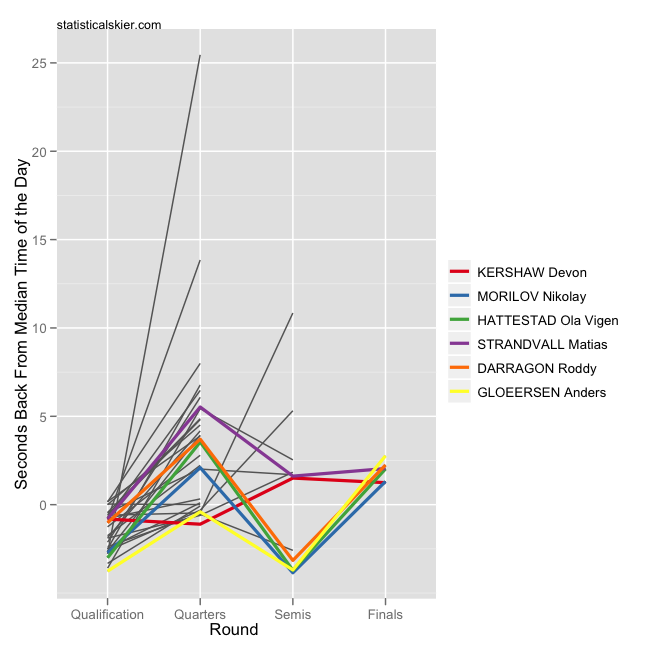
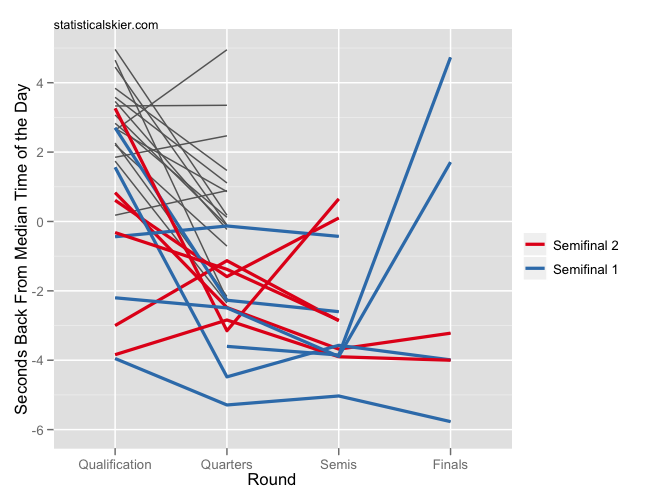
I’m beginning to get a feel for the relationship between heat times and sprint courses. It’s hard, cause I’m not actually there skiing on the courses, so I do the best I can reading about them. But it seems this course was pretty fast and mostly flat until the very end. That led me to guess that we’d see fast qualifying times, and then the heats would get progressively slower as folks get more tactical. Sure enough, the men’s finals:
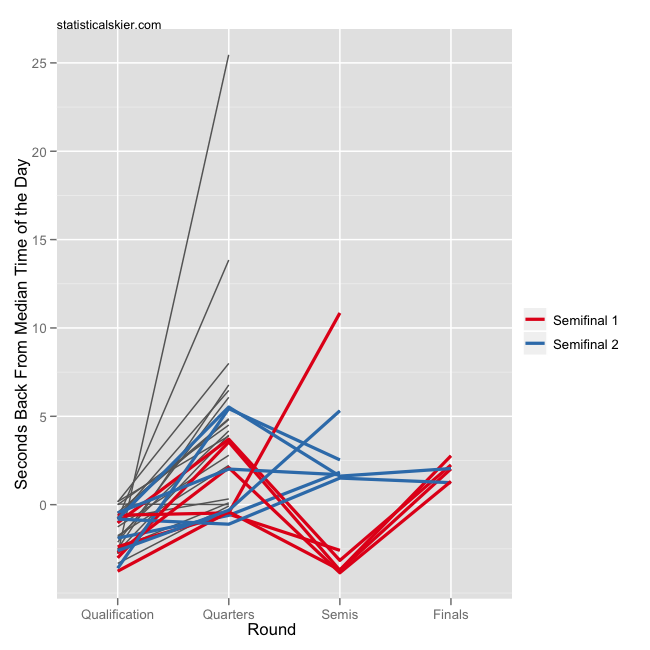
Fast qualification, slower quarterfinals. Then one semifinal was quite fast, the other was slower, and the final was back to the quarterfinal pace. The men’s first semi really was considerably faster, as well:
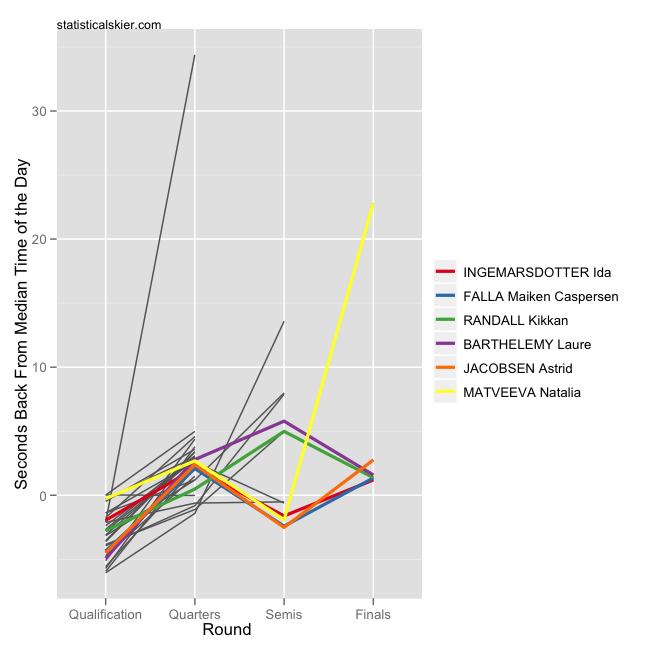
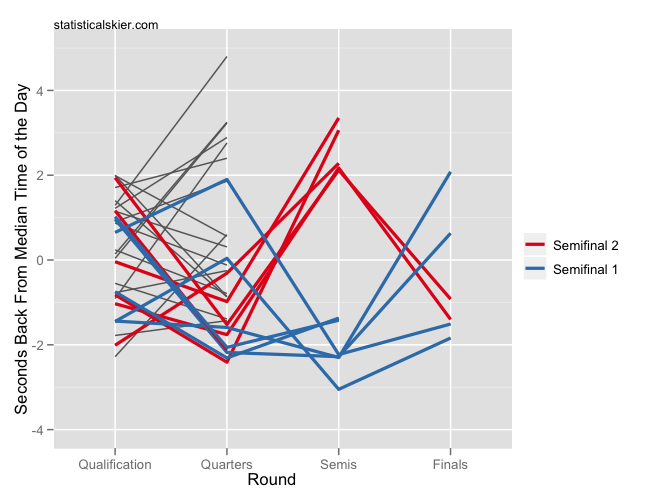
As for the women’s finalists:
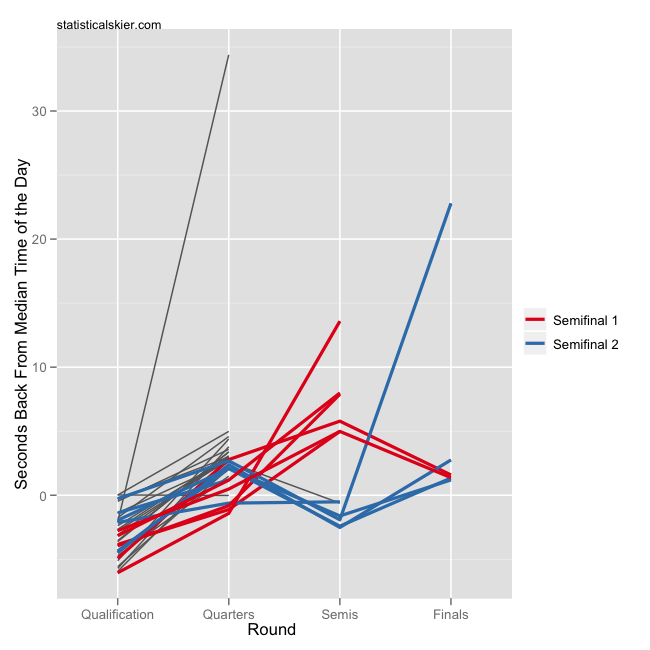
Once again, same exact pattern! Fast qualification, slower quarterfinal. Then an obvious split in speeds between the two semifinals. And again a significant difference between the two semifinals:
I didn’t do nearly as much writing about the Tour as I would have liked, but here are some graphs summarizing the way things shook out.
Men
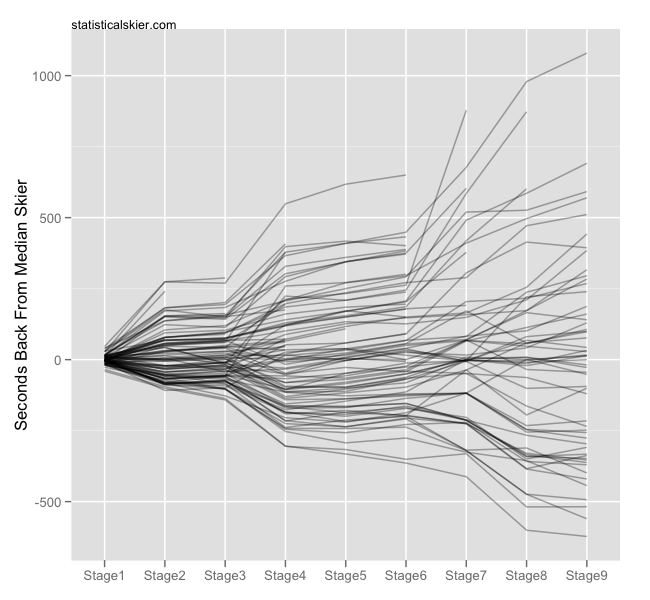
Here’s a bird’s eye view of the men’s Tour, measured using seconds behind the median skier:
These sorts of bump charts are nice, as they can allow you to see at a glance some overall trends regarding how much movement there was in different stages. So clearly stages 4, 7 and 8 saw some of the biggest movement. Most of the movement in the final stage, a long grueling hill climb, happened at the back of the field, which sort of makes sense.
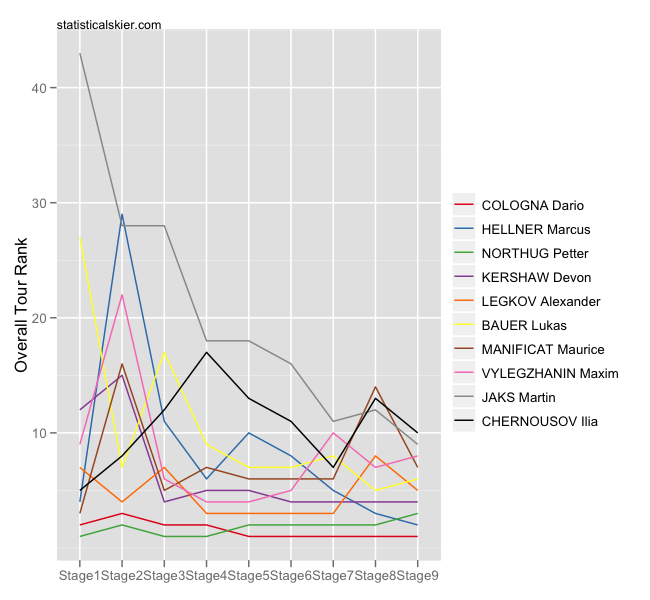
Here’s a look at how the Tour played out for the eventual top ten men:
Given my schedule lately, I was only really following the very front of the Tour, and the Canadians, so I missed the Martin Jaks story. That was an impressive comeback. Slightly less dramatic was Hellner’s steady climb up the ranking after Stage 5.
Women
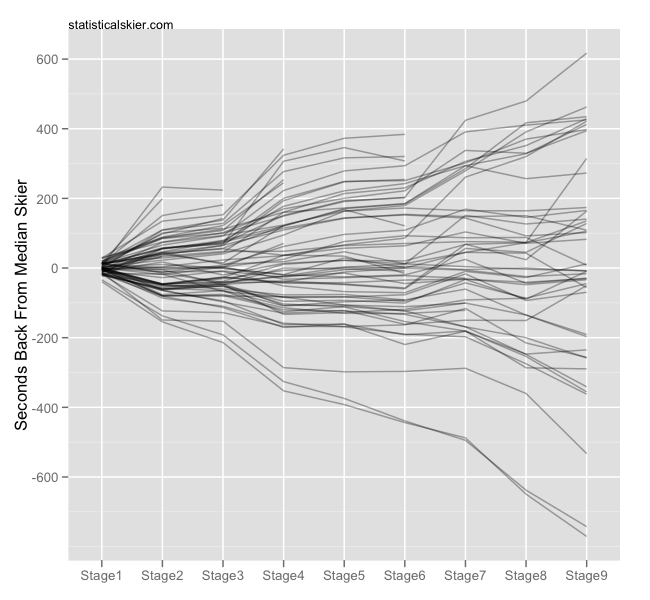
Similarly, here’s the general picture of the women’s Tour:
Two of these skiers are not like the others. Two of these skiers just aren’t the same. (And then there’s Johaug, stuck in no-woman’s land there.) At the very least there were two women off the front, rather than just one, which is just boring. Notice that Bjørgen and Kowalczyk basically put time on the field in every single stage. Stages 4 and 7 saw major shake-ups, and the final stage probably saw more movement than for the men.
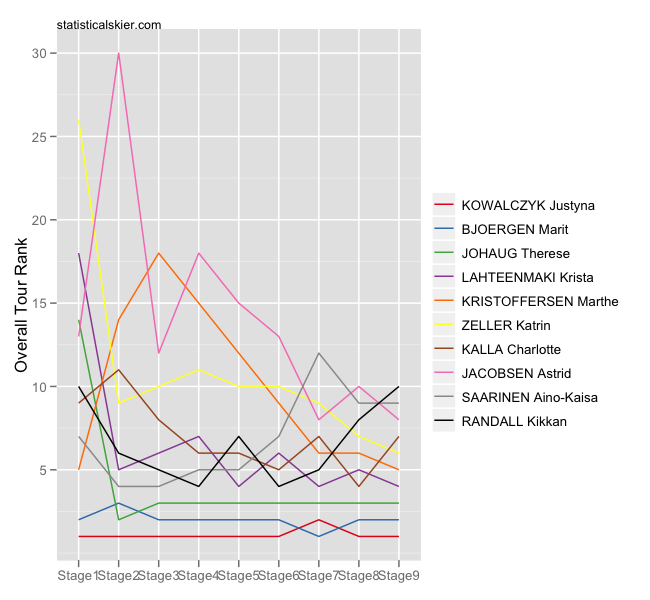
Here’s how the Tour played out for the eventual top ten women:
Kikkan definitely faded the last two stages, but still, that was an impressive set of races for her. Note the steady gains made by Jacobsen, Zeller and Kristoffersen during the last half of the Tour.
I’ll be back on Wednesday with some analysis of how to assess performance in those tricky Tour pursuit (i.e. handicap start) stages, where you often get “weird” results.
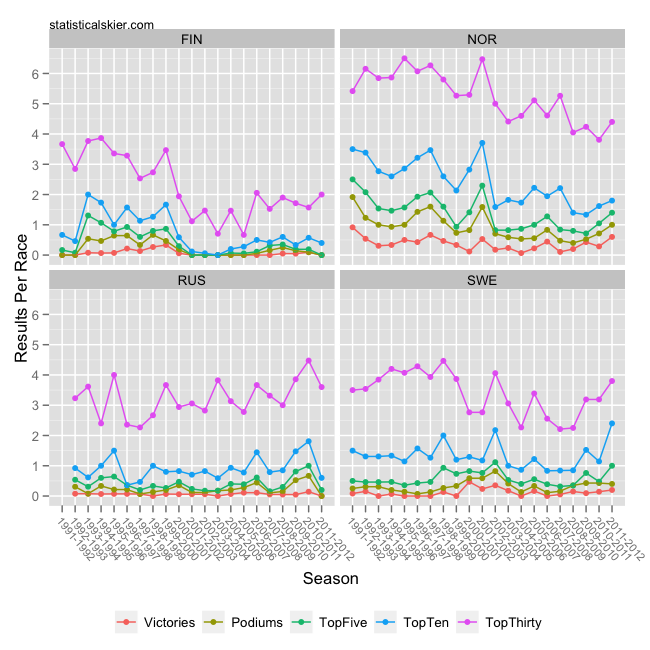
This will just be a short note with similar graphs as last time, only for a few of the major European nations.
Men’s Distance
Sweden continues to generally improve. Note that in terms of top thirty performances, Norway has steadily declined over the years, but not among the top ten or better level. So they’ve become somewhat less deep of a team, but they still manage to crank out top results. Indeed, if anything they’ve been improving. After a couple stronger seasons, the Russian men aren’t off to a great start so far this season.
Women’s Distance
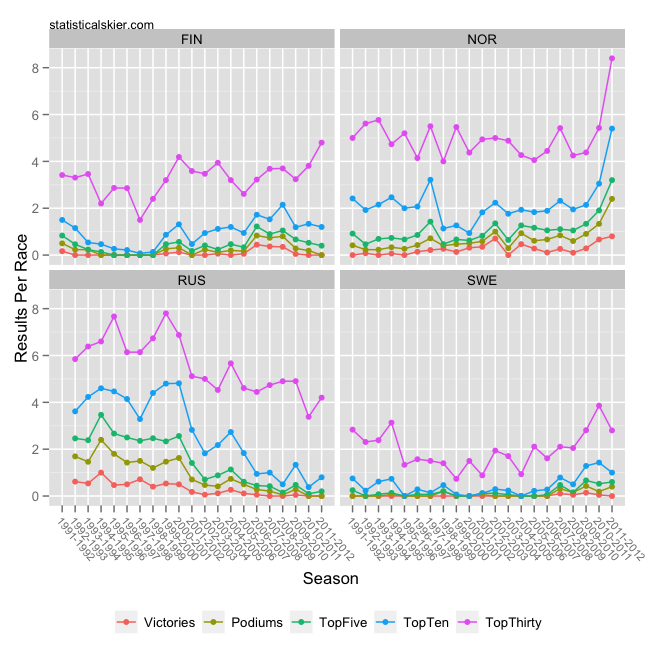
Some more dramatic trends are at play for the women’s distance events. Recall that a while back I was asked about whether the Norwegian women’s dominant performance so far this season is unprecedented and I answered “No”. I had sort of misunderstood the question to mean unprecedented compared to any other nation, but relative to Norway’s history it did appear fairly unusual. This would seem to suggest that the Norwegian women are indeed doing something they have never done before.
Men’s Sprint
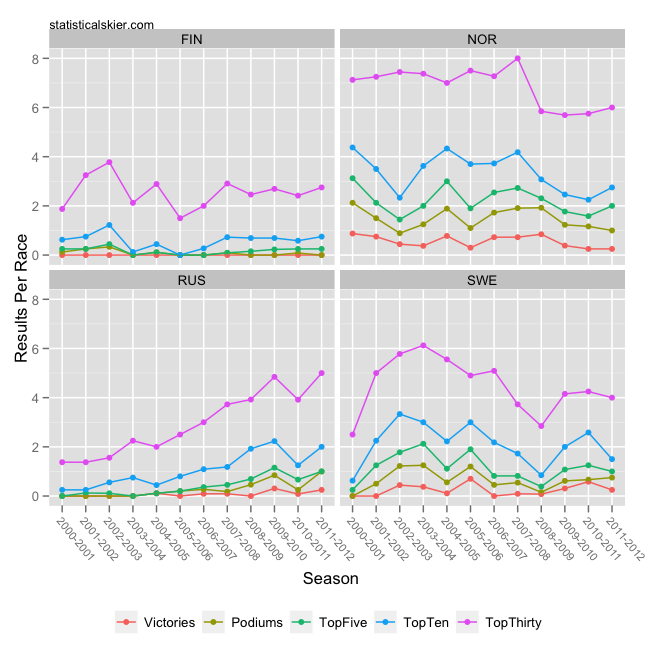
After a bit of an off year last year, the Russian men seem to be sprinting a bit better again. Otherwise, things seem fairly stable, with the exception of the Swedish men, perhaps.
Women’s Sprint
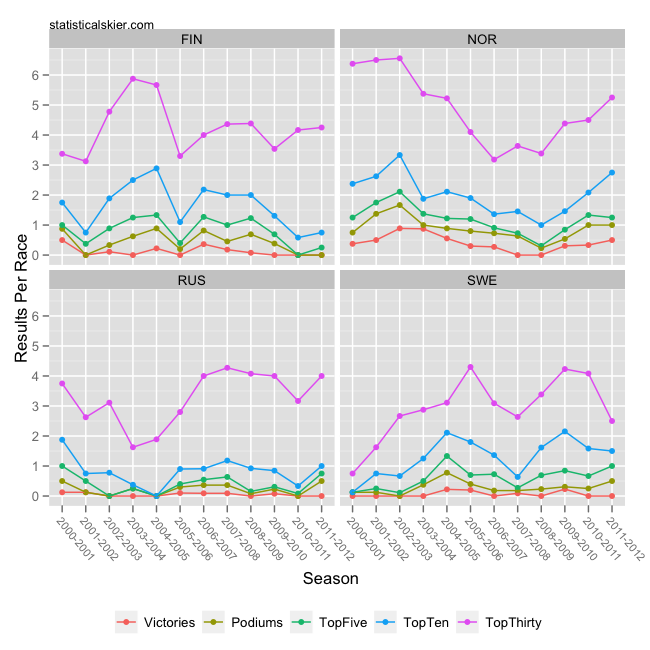
More evidence of a strong resurgence for the Norweigan women women here, and a fairly large drop off in top 30 results among the Swedish women.
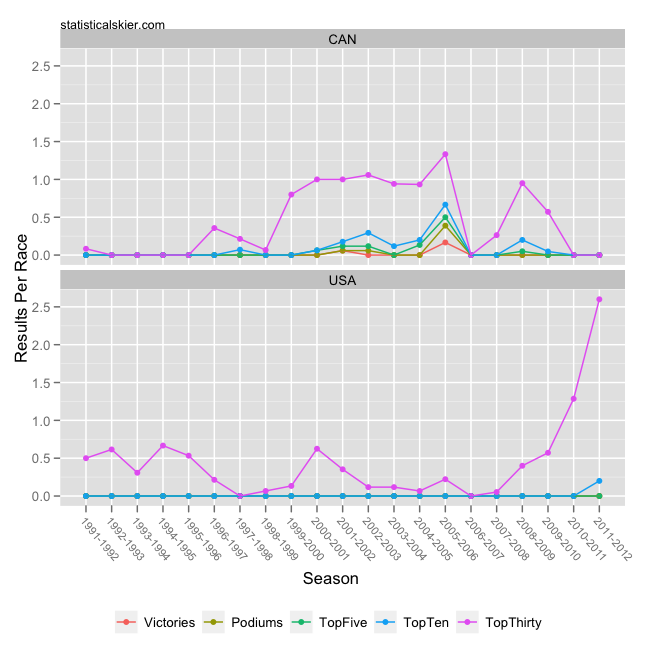
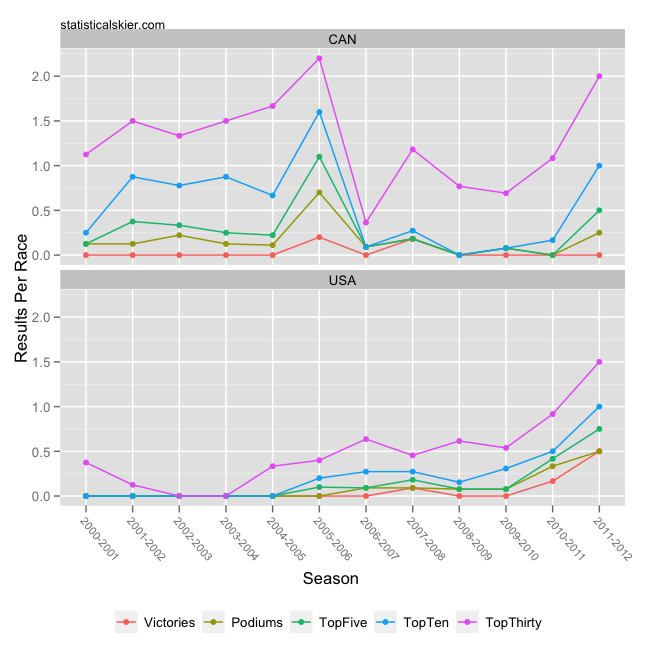
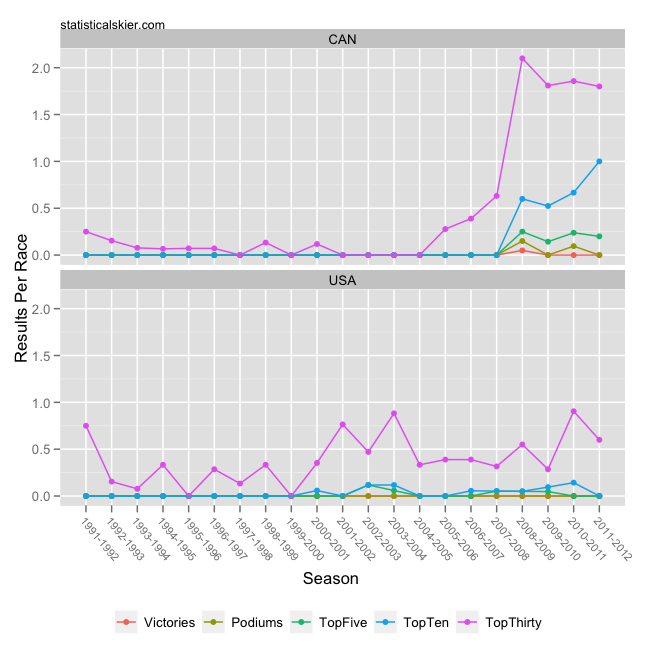
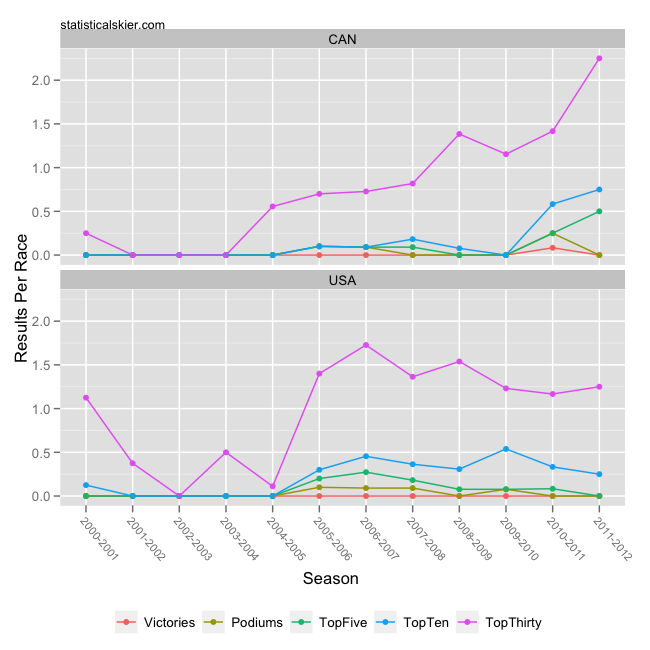
During this lull before the Tour de Ski, I thought I’d show some graphs quickly summarizing how the US and Canada have fared thus far with some historical context. I think we all have a good sense of what’s going well (American women), what’s going not so well (American men) and what’s going OK (Canadian men, given their expectations). But it’s always nice to have some numbers.
Women’s Distance
Keep in mind that the number of results per race thus far this season is based on a smaller set of races since the season isn’t complete.
As we all know, the American women are having a banner year. In two seasons they’ve gone from landing someone in the top 30 around around half the time to consistently putting two women in the top thirty, often three.
Women’s Sprint
On the American side, this steady improvement at all levels is of course all Kikkan Randall. And we’re finally seeing some recovery by the Canadian women after the departure of Beckie Scott and Sara Renner. Could we see a sprint final this season with three North American women in it?
Men’s Distance
The American men haven’t seen a dramatic fall-off in top 30 results (though they have gone down) but with Kris Freeman struggling, the small number of top ten results they’ve had just haven’t materialized. The Canadian men (Kerhsaw and Harvey mainly, in the distance races) have mostly been holding steady, but they are on pace for somewhat more top ten results than last season.
Men’s Sprint
That’s a stronger looking start for the Canadian men than I would have guessed, thanks in part I suppose to the addition of Len Valjas. As for the Americans, things haven’t changed dramatically, though they do appear to be slowly heading in the wrong direction.
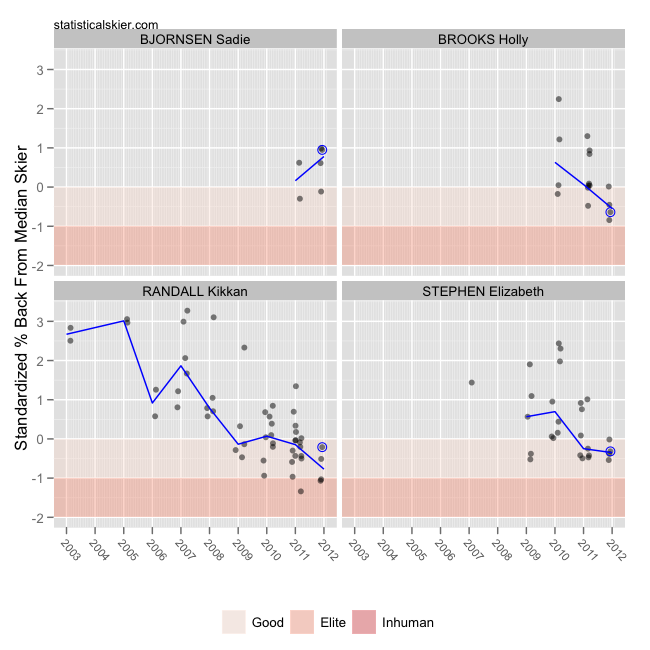
Each weekend seems to be an interesting mix of results for the North Americans. Starting with the women (Davos result circled in blue):
Compared to this season, that was an off day for Kikkan, but compared to last season that was pretty typical. Part of me wonders if she dialed it back a bit late in the race when she knew she wasn’t feeling strong to save some energy for the sprint. But as you can see from her graph, if that’s going to be her “bad” race this season, she’s going have a strong set of results this year.
I’m very cautious about jumping on bandwagons when someone pops a good race or two, but Holly Brooks is beginning to convince me. That’s three good (and one OK) distance results in a row now. More importantly, I like the direction her trend is heading. It’s still early, so it’ll only take a few mediocre races to flatten that trend out, but so far it looks promising.
You can’t deny that Liz Stephen has had some strong results so far this season. My only concern is that they have all been roughly where we’ve seen her topping out before. Can her good days inch up towards the top ten?
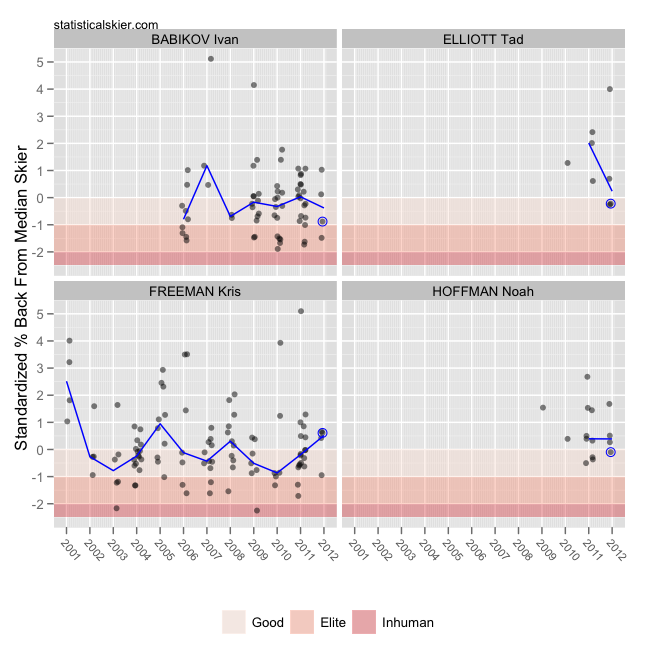
As for the men:
Kris Freeman still hasn’t sorted out whatever’s going on with him, obviously. It’s always painful to read his blog posts and quotes after bad races; he’s so unfailingly harsh on himself.
Ivan Babikov turned in a stellar race, of course, but as you can see it was well within his normal range. The youngsters Elliott and Hoffman both had solid days, certainly compared to their results so far this season. I’d really like to see Hoffman’s results creep a bit further down into the pink, though.
Sprint Recap
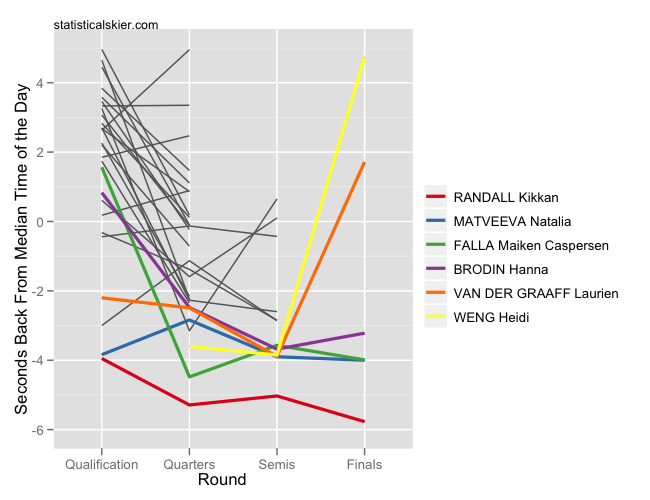
Oh, and there was a sprint race, too! You may have heard who won the women’s race…
Randall was just plain skiing faster than everyone, start to finish. (Apologies for cutting off Heidi Weng’s prelim result; I cutoff the y axis to remove some outlying times and just realized hers got cut too.) It’s interesting how slow the qualification times were. Most people managed to go faster in the quarters, but as you can see, the women who made it to the final were just on a different level, speed-wise.
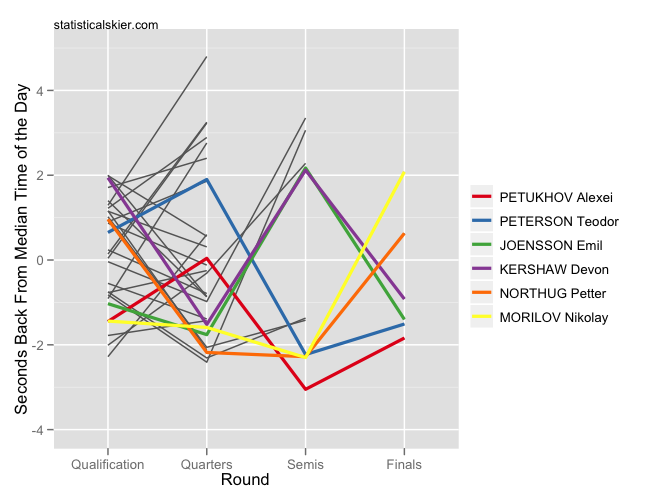
The men’s final wasn’t quite as clear cut:
These times are all a bit closer together, compared to the women. (Again, except for 1-2 large outlying times that I’ve omitted.)
One thing I saw some commentary on was the fact that Bjørgen missed the finals in part due to the higher speed of Kikkan’s semi:
And yeah, Kikkan did stretch out that semi a bit. But compare that to the dramatic separation between the men’s semifinals:
Interestingly, being in the slower semi may not have helped all that much in this case.
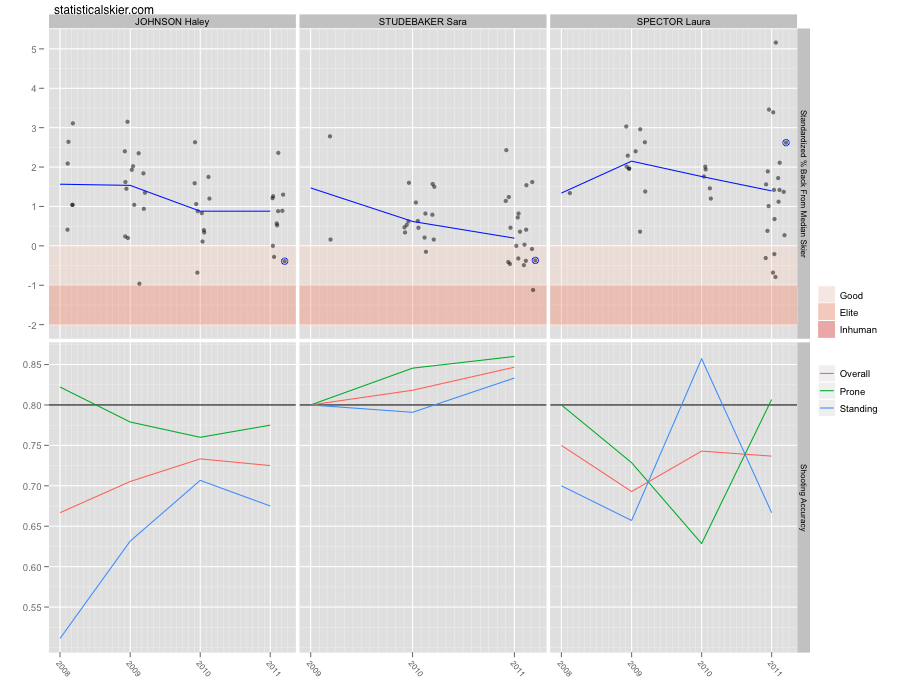
Yesterday’s biathlon WC sprint saw a mix of results for the Americans. First, things seem to have sort of reversed themselves from early in the season with Laura Spector struggling and the other ladies skiing quite well:
An excellent race from Haley Johnson and Sara Studebaker, but a pretty dismal one for Spector, who shot rather poorly. From the looks of things, shooting should for sure be a priority for these ladies going into next season.
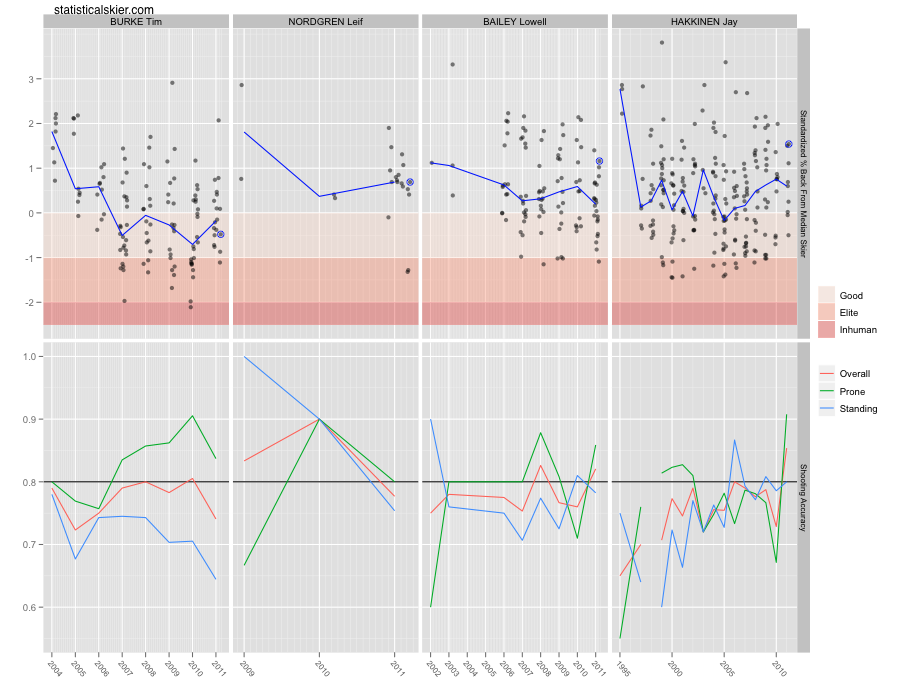
Tim Burke almost had a great race yesterday, but with two misses it ended up being just pretty good:
Burke has clearly struggled with his shooting this year. I have almost no personal experience with biathlon (not none, just almost none) but I’m always tempted to think about shooting as analogous to pitching in American baseball. Pitching can be fairly fickle, even for the best of them. Excellent pitchers will suddenly suck one year for no apparent reason.
The 2008-2009 World Cup season came to an end a little over a week ago in Falun, Sweden, and while the 2009-2010 World Cup opener is less than 240 days away, there is a little time to take a look back at an eventful season.
FIS made the decision to get going a little later this year, abandoning the late October city sprint in Germany, and kicking things off in Gaellivare, Sweden at a much more reasonable November 22nd. A grueling schedule of 43 races over the next four months followed. This total includes World Championships (which do not score World Cup points), and does not count the pursuit in Rybinsk, Russia, which was canceled due to cold weather.
The season featured plenty of excitement and notable performances. Both the US and Canadian teams had excellent years.
The major highlights of the World Cup season:
Ola Vigen Hattestad (NOR) and Petra Majdic (SLO) dominating the Sprint Cup
Hattestad was almost unbeatable, winning 5 sprint events, finishing 2nd in two others, and “slipping” all the way to 7th in his one other start. He also won World Championship Gold in both the individual sprint and the team sprint event.
Hattestad bringing it home in Whistler (Photo: Win Goodbody)
Majdic was even more impressive. She won eight World Cup Sprints, had both a 2nd and 3rd, and a 7th. She had more starts than Hattestad as she raced the Tour de Ski and in Rybinsk. Hattestad also sat out in Rybinsk, along with his teammates, in protest of the race being held in frigid temperatures. Majdic did have a disappointing finish at World Championships, posting a 13th place in the individual sprint, and leaving Liberec without a medal. Unlike Hattestad however, she is also a strong distance skier, posting consistent top-10 finishes, and nearly winning the overall World Cup title, ultimately taking 2nd.
Petra Majdic (yellow bib) on her way to victory in Trondheim
Dario Cologna (SUI) and Virpi Kuitunen (FIN) Winning the Tour de Ski
Cologna came into his own this season, and the Tour de Ski was his coming out party. He showed his impressive versatility, posting excellent results in all distances and disciplines on his way to a convincing Tour victory. He had places of 1,2,4,5,8,15 and 23 in the Tour. The 23rd came on the Final Climb as he easily maintained his lead en route to victory.
Dario Cologna
Kuitunen avoided a reprise of last year when Charlotte Kalla (SWE) overtook her on the Final Climb to claim the win. This year Kuitunen overcame a strong attack by her teammate Aino Kaisa Saarinen. Saarinen actually took over the lead and opened a gap on the Final Climb, but Kuitunen responded and came back for the win in a very exciting race.
Dario Cologna and Justyna Kowalczyk (POL) Win Overall World Cup
Cologna took over the World Cup lead with his Tour de Ski victory, and held it until the 50km in Trondheim, where Petter Northug (NOR) overtook him. The 23-year old Swiss skier showed his mettle by responding with his best performances since the Tour in the World Cup Final, stepping up his game to retake the yellow bib from Northug and lay claim to the first ever overall World Cup title for Switzerland.
Justyna Kowalczyk (Photo: Win Goodbody)
Kowalczyk also won the first World Cup title for her country. Poland is hardly known as a hotbed of cross-country skiing, but Kowalczyk, rumored to train 1200 hours per year, showed remarkable stamina, racing in every single World Cup event except one, and scoring World Cup points in every one of those starts. She had five victories and nine podium finishes. She also won two World Championship Gold Medals, and competed in four of six World Championship races, skipping the two sprint events. She also finished 4th in the Tour de Ski.
Kowalczyk also had the distinction of winning the overall title without leading until the final day of the season.
The battle for both the men’s and women’s overall titles came down the last days of the season. You can’t ask for more excitement.
Petter Northug (NOR) Dominates World Championships
Northug (Photo: Swix Sport)
Northug put on a clinic at the World Championships in Liberec. He won three Golds – two individual, and one relay, staging his trademark closing move in the last 500 meters of each race to lock up the victory. He also was part of two of the most exciting races of the season, the Tour de Ski Final Climb, and the 50km classic in Trondheim.
In the Tour, Northug, skied up from fifth to catch nemesis Axel Teichmann (GER) before blowing the German out of the water with a ridiculous charge to the finish and a second place finish.
In Trondheim, Northug took advantage of the intermediate sprint World Cup points, and took over the overall World Cup lead. His climb to the top of the standings included a string of dominating performance starting with World Championships. Northug posted top results in all events, beating Hattestad in a sprint, finishing 5th in the aforementioned 50km classic, and placing 4th in the World Cup Final. Ultimately, he fell just short of the overall title, as he tired in the last weekend of races, and Cologna took back the top spot.
Mass Start Success in Trondheim
The 30 and 50km mass start classic in races rank at the top of the scale for World Cup excitement. Defying the norm of elite mass start events, the race featured a strung out field, many attacks and responses, lead changes, and stunning comebacks. Hopefully FIS can fins away to replicate this type of race. You can read a full report here.
And now onto the North American focused highlights…
Kikkan Randall (USA) Wins World Championship Silver
Randall won the first ever Championship medal (including Olympics) by a US woman. The only other World Champs medal was a bronze by Bill Koch. Randall was second in the freestyle sprint in Liberec and overall, had an excellent second half to the season. She started slowly, but rounded into top form at the perfect time.
Randall also showed continued improvement in her distance racing, turning in a career-best 22nd, and along with Liz Stephen and Morgan Arritola, give the US Women three athletes who can crack the points in the longer events.
Kikkan Randall on the podium at World championships – as seen on the stadium video board (Photo: James Southam)
Todd Lodwick (USA) Wins Two Golds at World Championships
Todd Lodwick completed an impressive return to the Nordic Combined World Cup, winning two Gold Medals in Liberec. He also finished 24th in the overall World Cup and had two podium finishes in addition to his medals.
Billy Demong (USA) Wins Two Medals at World Championships, 3rd in Overall World Cup
Demong cemented his position as on of the top Nordic Combined skiers in the world, winning a Gold and a Bronze in Liberc, and finishing third in the overall World Cup standings. He also had five World Cup victories, and a total of ten podium finishes.
Billy Demong (Photo: Swix Sport)
Lindsey Van (USA) Wins World Championship Ski Jumping Gold
Van won the first World Championship Gold medal ever awarded in Women’s ski jumping, and finished 4th overall on the World Cup. She had a total of eight podium finishes during the year. Van and her fellow competitors are in the midst of an effort, including a lawsuit, to bring women’s ski jumping to the Olympics in Vancouver.
Alex Harvey (CAN) Third in Trondheim 50km
Harvey, the 20 year old Canadian phenom, took part in the most exciting race of the season, leading for a good portion, before finishing an impressive 3rd. He finished off the season with a run six points scoring races, including four top tens and a 6th in the World Cup Final. He climbed into the Red Group, and has arrived as one of the top skiers in the world.
Alex Harvey on the podium in Trondheim
Kris Freeman (USA) 4th in World Championship 15km Classic
Freeman, battling compartment syndrome, missed a World Championship medal by under two seconds, and showed the World he is still very much a medal threat. Matching his place from the 2003 Championships, Freeman closed out an up and down season with his best results.
Kris Freeman (Photo: Win Goodbody)
Canadian Men 5th in World Championship Relay
The Canadian men’s team battled for 4th, and were within striking distance of third, demonstrating that they can compete for a medal in the Vancouver Olympics. With three Red Group skiers (Harvey, Ivan Babikov, Devon Kershaw) and another capable of solid top 30’s and better (George Grey), the team should be able to ski with anyone on a good day.
The Emergence of Liz Stephen (USA) and Morgan Arritola (USA)
It may be unfair to group these two together, as they both are deserving of their own listing, but the two are on a similar development track and often appear very close on the result sheet. Stephen teamed with Kikkan Randall to finish 4th in the team sprint in Whistler, and turned in a 15th and 17th at her first World Championships. She also had a 4th and 7th at the U23 Championships, won two National Titles, and scored her first World Cup points.
Arritola had a 22nd and 32nd in the World Championships, a 25th at the Whistler World Cup, and a 5th and 8th at U23’s.
Along with an improving Kikkan Randall, the two young women are on track to give the US women legitimate distance threats at the World Cup level.
Arritola, Stephen and Randall (Photo: Lance Parrish)
Devon Kershaw (CAN) Battles For Top Tour de Ski Finish
With a second straight strong season, Kershaw has solidified his spot as one of the top 30 skiers in the World. Due to illness, he faded to a still impressive 21st in the Tour de Ski, but was in position for a top-10 or better before the flu struck. He finished 18th overall on the World Cup, scoring points in 20 races, including 6 top-10 results, and his first-ever World Cup distance podium result. Kershaw has shown excellent versatility, scoring points in all distances and disciplines.
Devon Kershaw (Photo: Win Goodbody)
Ivan Babikov (CAN) Wins Tour De Ski Final Climb
Known for his hill-climbing ability, and fierce tenacity, Babikov put it all together, posting the fastest time on the Tour de Ski Final Climb, despite battling a nasty flu. He had eight points scoring races, and finished in the Distance Red Group.
Ivan Babikov (Photo: Win Goodbody)
Jeremy Teela (USA) Finishes Third in Biathlon World Cup
Teela turned in a career-best third place finish at the pre-Olympic World Cup in Whistler. This was the best US result since 1992.
Jeremy Teela (right) on the podium
Andy Newell and Torin Koos Lead US Sprinters
Newell finished 15th in the World Cup Sprint Cup, posting eight top-30 results, including two top-10s. It is a sign of how expectations have risen when these results are considered disappointing. Newell struggled to reach the A-Final, but still demonstrated that he is as fast as anyone in the world when it comes to pure speed. He gave US ski fans a reason to check the World Cup results every weekend, and proved that he can compete with the best with his 5th place finish late in the season.
Koos climbed into the Sprint Red Group with a strong second half of the season. He was 24th in the World Cup sprint rankings, and scored points in six of the last seven World Cup sprints after not scoring any in the first five. His best result was an 8th, and improved skating made him a threat in both disciplines. He and Newell also teamed up for a 4th place finish in the team sprint in Germany just before Christmas.
Torin Koos and Andy Newell (both in red) pair up in the team sprint in Whistler (Photo : Win Goodbody)
Alex Harvey (CAN) and George Grey (CAN) Finish 3rd in Whistler Team Sprint
Harvey and Grey teamed up to reach the World Cup podium on home soil during the pre-Olympic World Cups in Whistler. The exciting day was capped with lunge to the line by Harvey, to take the final podium spot.
George Grey and Alex Harvey celebrate their 3rd place finish in Whistler.
Sara Renner (CAN) Completes Comeback
Renner, in her first full season back after a year off to have a child, showed she is back in the upper echelon. She finished 21st in the overall World Cup, scoring points in 15 races, including a 5th, 6th and 9th. She was also 15th in the Tour de Ski.
Sarah Renner signs autographs in Whistler
US and Canada Have Combined Seven Skiers in the Red Group
Andy Newell, Torin Koos, Kikkan Randall, Devon Kershaw, Alex Harvey, Ivan Babikov, and Sara Renner all ended the season in the Red Group.
Tim Burke (USA) Finishes Strong in World Cup Biathlon
Burke overcame a slow start to the season to climb back into the top-30 in the world, including a season-best 8th place in the second-to-last race of the year.
—
In addition to these highlights, there were many other exciting individual performaces throughout the year in cross-country. If you feel we missed anything, please add it to the comments below.
Today’s Stage was one of the key Stages of this third Tour de Ski. Beyond the fight for a Stage victory, it was particularly important not to lose too much time in the overall standing. This individual event was also an opportunity for the best specialists of the classic style to lay down their best game.
Not only Teichmann and Kuitunen but also all other classic style specialists did not miss this opportunity. Tonight we can find many of them in the top 10, for the men as well as for the women. Besides today’s two winners, Pietro Piller Cottrer carried out perhaps the most successful transaction of the day. Ranking 10th of the Stage with only 24″ from the best time, he is now 6th in the overall ranking. If tomorrow the sprint goes as well for him as it did in Prague, then he will be a very serious candidate for the final victory.
Although Jean-Marc Gaillard started his race well, he had more difficulty in the second half. He lost some valuable seconds, but was nevertheless able to do some damage control. 12th of the overall ranking, 1’10” from the lead, everything is still possible for him on this Tour.
Tomorrow’s sprint could again bring about many surprises and turn once more the overall rankings upside down before the final two Stages in Val di Fiemme. Everyone is getting more and more worn out and it seems difficult to make predictions concerning tomorrow’s races. It will be the last opportunity for sprint specialists to shine on this year’s Tour. Most other racers will try not to lose too much time to their opponents.
The upcoming four days will be very busy with 3 races and a long transfer to Val di Fiemme. Therefore, New Year’s Eve festivities will be quite short for most of us. Have a drink to our health and Happy New Year!