From the FasterSkier archive — posts syndicated from athletes’ and coaches’ own blogs between 2004 and 2012, kept online as published. Current coverage is at fasterskier.com.

Tag: recombinant erythropoetin

  • Starykh and Loginov Return to International Competition

    Starykh and Loginov Return to International Competition

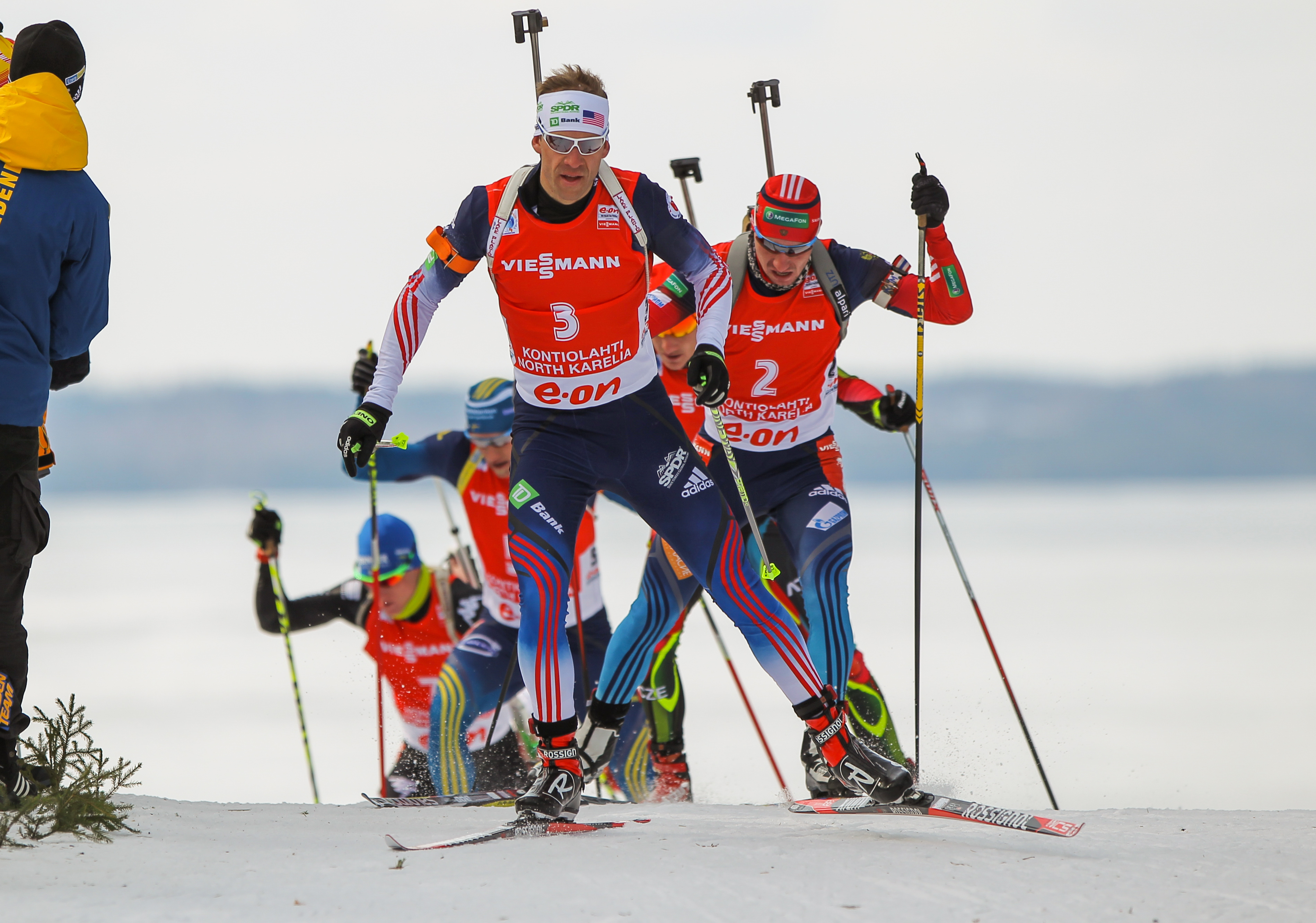
    Lowell Bailey (USA) leads Alexander Loginov in a World Cup competition in Kontiolahti, Finland, in 2013. Loginov was later suspended for doping, bumping Bailey’s results and prize money up higher from the weekend of racing. (Photo: NordicFocus.com/USBA)

    The Russian rosters for January competition will include two names not seen in a while: Irina Starykh and Alexander Loginov. Both are returning to international competition after serving suspensions for using the blood-doping drug erythropoietin (EPO).

    Irina Starykh Makes a Fast Return

    Starykh has been named to the IBU Cup team. The next stage of competitions are in Martell, Italy, starting on January 5, 2017.

    Starykh was initially suspended in January, 2014, in the run-up to the 2014 Olympics. At the time, she was the top Russian woman on the World Cup and had just notched an individual podium. She was also a key member of the Russian relay team. Starykh failed an out-of-competition test in December 2013 month along with teammate Ekaterina Iourieva.

    2013-2014 had been a breakout season for her so far. When asked how she had improved so much by a Russian news service, Sports.ru, she replied in December 2013, “When I found out that I was [named to train] in [Vladimir] Korolkevich’s group- I decided to fully trust the coach… he was building my training and I believed that I would approach the winter season in good condition.”

    Korolkevich coached several other athletes who have been implicated in doping. That includes Iourieva – who has now been caught three different times and is banned until 2021 – and Olga Vilukhina, expected to be one of the two athletes under investigation by the International Olympic Committee for doping violations in Sochi.

    Starykh initially received a two-year ban. When the International Biathlon Union (IBU) re-tested some old samples a few months later, however, they found additional evidence of EPO use. The IBU extended her ban to three years.

    Starykh returned to national-level competitions in December, finishing fifth and sixth in Russian Cup races. A Russian sports website noted, however, that these results did not actually qualify her for the IBU Cup team according to objective criteria.

    Loginov Immediately Back to Top Results

    Loginov competed in the IBU Cup competitions in Obertilliach, Austria, in December, finishing fourth in the 20 k individual. That’s the same venue where he won the individual race at World Junior Championships in 2013.

    Loginov was caught in the same re-testing scheme that earned Starykh her extra year of suspension. His sample from November, 2013, tested positive for EPO when a new method was used several months later. The suspension was announced in November, 2014, and was for two years, plus retroactive disqualification of results between November 2013 and 2014.

    Loginov said at his anti-doping hearing that the drug had been included in a medication he took to treat prostatitis. But the IBU’s hearing panel rejected this claim on multiple grounds.

    The press release from the Russian Biathlon Union announcing the men’s team for international competition in January did not specify whether he would compete on the World Cup or the IBU Cup.

  • Starykh Banned for Two Years; Claims EPO Was in Cosmetic Injections of Human Placenta

    Starykh Banned for Two Years; Claims EPO Was in Cosmetic Injections of Human Placenta

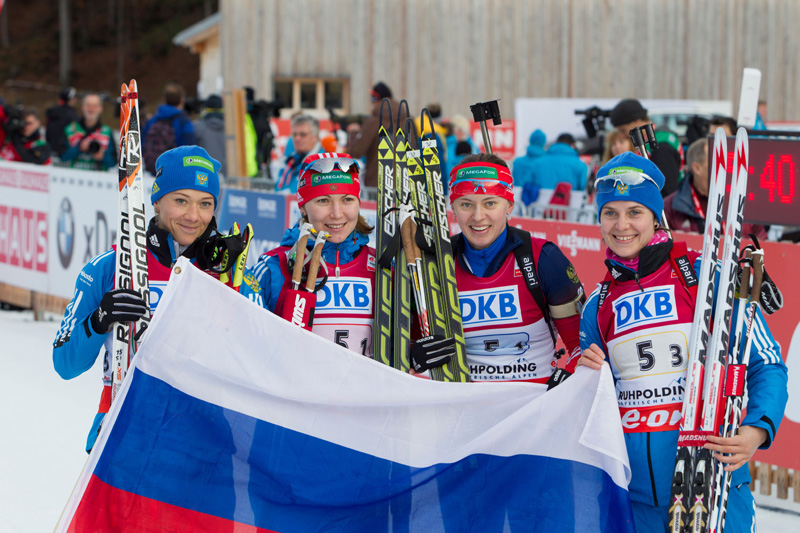
    Irina Starykh (far right) celebrates with the Russian team after their IBU World Cup biathlon relay victory in Ruhpolding, Germany, in January. The result is among those which will be voided with Starykh's doping ban, from a sample collected in December. Photo: Fischer / Nordic Focus.
    Irina Starykh (far right) celebrates with the Russian team after their IBU World Cup biathlon relay victory in Ruhpolding, Germany, in January. The result is among those which will be voided with Starykh’s doping ban, from a sample collected in December. Photo: Fischer / Nordic Focus.

    On Wednesday, the International Biathlon Union (IBU) announced that it was banning Russian biathlete Irina Starykh for two years for use of recombinant erythropoietin (EPO), a blood-boosting drug commonly used in doping in endurance sports.

    Many in the biathlon world have been awaiting the verdict for months: the positive “A” samples of Starykh, teammate Ekaterina Iourieva, and Lithuanian Karolis Zlatkauskas were announced on January 28 after Starykh’s sample was collected on December 23 in Pokljuka, Slovenia, in an out-of-competition test.

    Today, the IBU announced that Iourieva will be banned for eight years. It is her second doping offense for EPO. A world champion in 2008, Iourieva announced her retirement earlier this year, after the samples were initially analyzed.

    Zlatkauskas admitted to doping in February and said he would not fight a ban.

    The IBU Anti-Doping Hearing Panel, chaired by Edward Williams, a 1964 graduate of Dartmouth College who was a national champion in cross country skiing, NCAA All-American before competing in the 1968 Olympics in biathlon. He is now an attorney in sports law and arbitration in New York City.

    The panel also included Dr. Walter Frey of Switzerland and Juha Viertola of Finland. The group met on March 21 to hear the case. Their decision was dated July 14; it’s unclear why the decision took so long as no new evidence appeared to be entered following the March hearing.

    The hearing panel’s detailed decision (available here) shows that Starykh did not fight the ban. She initially requested that the opening of the “B” sample be delayed from early February until after the finish of the Sochi Olympics on February 26. Russia’s top-ranked female biathlete, Starykh had stood on the World Cup podium earlier in the season and had been expected to compete in Sochi. After the “A” sample was analyzed she faced a provisional suspension from competition, yet still delayed the opening of her “B” sample.

    The Russian Biathlon Union was initially extremely defensive surrounding the Starykh case.

    The “B” sample was opened on March 3, and Starykh was present along with three of her own representatives. On March 6, the sample analysis was finished and it was also positive for recombinant EPO.

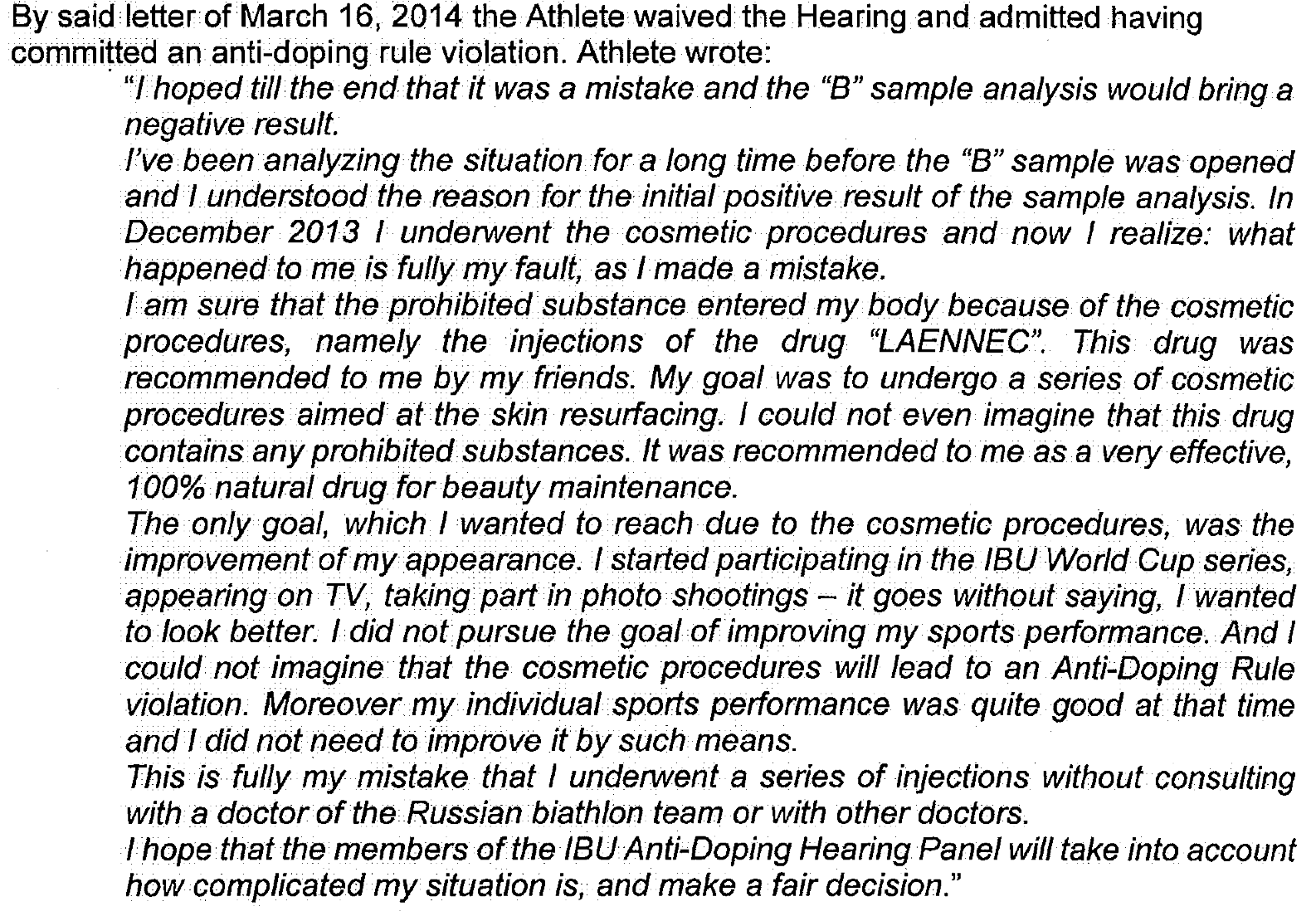
    Starykh waived her right to a provisional hearing in a letter stating that “[I] acknowledge the Anti-Doping Rule violation and the consequences of this violation in the form of disqualification.”

    In the letter, Starykh claimed that the EPO must have entered her body from an injectable skin treatment called Laennec which she began using on the recommendation from friends for skin resurfacing in order to improve her appearance. With her growing success as a biathlete, Starykh explained, she began being interviewed on television and wanted to look better.

    Screen Shot 2014-07-18 at 11.29.39 AM

    The active ingredient in Laennec is a “water-soluble substance of a product of enzymatic human placenta”. The drug is manufactured by Japan Bio Products Co., Ltd. The product website lists hepatocyte growth factor as one example of an extracted growth factor; this factor helps recovery from liver damage. The main function of the drug is “improvement of hepatic function in chronic hepatic disease.”

    Other distributors have marketed the drug as a skin smoother and whitener.

    EPO is a naturally produced hormone. There is evidence that maternal EPO is expressed strongly in trophoblast cells, which initially form the outside of the blastocyst surrounding a human embryo and which then are incorporated into the placenta.

    Thus it is not impossible that if Starykh injected Laennec some EPO from the placenta would also enter her system.

    However, the lab test specifically found recombinant erythropoietin, which differs in structure from EPO produced by the human body. The recombinant, or manufactured, form contains the same protein but has different polysaccharides attached, resulting in a different electrical charge at the molecule level. This difference in charge is used to separate recombinant and natural EPO in the laboratory test.

    Thus, unless Laennec also contains recombinant EPO, not only any extra maternal EPO expressed in the placenta, it is not possible that the substance entered Starykh’s body from her cosmetic injections.

    Earlier in the winter Alexander Tikhonov, a four-time Olympic champion and one of the best biathletes ever produced by the Soviet Union, alleged that two doctor brothers named Dimitriev were responsible for doping both Starykh and Iourieva. The two were present in Hochfilzen, Austria, for World Cups in December.

    The panel minutes write that they did not find any “exceptional” circumstances and so handed down the standard prescribed 2-year ban for Starykh, starting from the date the sample was collected. All of her results accrued between December 23 and the “A” sample analysis have been voided as well.

    The Rossiiskaya Gazeta newspaper reports that Starykh will not fight the decision.

    There do not appear to have been any additional fines or sanctions for the Russian Biathlon Union.