From the FasterSkier archive — posts syndicated from athletes’ and coaches’ own blogs between 2004 and 2012, kept online as published. Current coverage is at fasterskier.com.

Tag: Reese Brown

  • Ahead of the Game Before Winter Comes

    Ahead of the Game Before Winter Comes

    An athlete training in Lillehammer, Norway. (Photo: NordicFocus)

    With the summer solstice long and gone in the Northern Hemisphere, it’s true, the amount of available daylight wanes. Some are rollerskiing. Some stay fit through trail running or mountain biking. Behind the scenes, cross-country ski area operators are reimagining business practices during the pandemic as they prepare f0r the moment snow flies. 

    “Chances are we are not having anything quick-fix,” said Reese Brown of the Cross Country Ski Areas Association (CCSAA). “The new world is we need to learn to live with it. That is where we are now. And people are figuring it out.”

    It is a world, as Brown mentioned, where new Covid-19 prevention measures have become the status-quo: Maintain proper social distance, wear a mask in indoor public places, and wash hands regularly. With the steep increase in U.S. cases, some states are reverting to even stricter regulations. (As of July 15th, the use of a mask outdoors in Oregon will be required where people cannot maintain six feet apart from non-family members.)

    We have become accustomed to mask-wearing in the supermarket. We don’t dawdle and socialize as we may have just months ago. You go, you shop, you leave. Dare we say it feels strangely normal? By the time the ski season is near, many people will be well-versed in COVID avoidance.    

    As entities requiring cashflow to operate, cross-country ski area operators are envisioning what “normal” business might resemble. Brown explained that some cross-country ski areas are open nearly year-round serving a variety of outdoor-related functions. Those facilities open in the non-winter months, Brown said, are learning and adapting before the onset of winter and a potential crush of skiers.  

    “I have been calling our ski areas and they were initially saying there was a big fear about opening, the big fear was what are we going to do? What is it going to be like? Is anyone going to show up?” said Brown. “Everyone who opened said it was anticlimactic, people were psyched you were open, they were appreciative of anything that you were doing for them.”

    For the nordic centers operating mountain bike trails and rentals, some have adopted on-line reservation and payment systems to minimize physical contact or proximity between the customer and employees. Brown explained that some businesses have a system where the bike is set outside at a specified time and is returned later to an outdoor rack where the gear is then sanitized.

    But operating outdoors during the summer months is more manageable than renting cross-country ski gear when it’s frigid. Brown noted that ski areas with larger operating budgets are thinking of novel ways to build semi-permanent infrastructure to make the rental process more streamlined. In other words, minimizing the number of users who must enter a brick and mortar ski center to rent gear, purchase a ticket, and get out on the trails. One ski area in Utah has considered purchasing a yurt to house its rental fleet and reduce the flow of visitors inside the main day lodge. 

    Proprietors will have to balance what services customers can do without, and what should and will remain. That can be tricky. The bottom line for many cross-country centers relies on the financial padding from retail and food sales. Just how contactless retail and food sales are will determine how some centers navigate the Covid-19 business climate this ski season. We’ll likely see more masks, gloves, plexiglass shields, sneeze guards, and possibly a cap on the number of consumers in the lodge at one single time. 

    On a June 17 CCSAA round table discussion titled “Learnings from Recently Opened Summer Operations at Cross Country Ski Areas” Matt Sabasteanski, the outdoor recreation director at Pineland Farms in Fort Kent, Maine, was relatively bullish.        

    “I would think nordic is going to have a huge advantage because there are a lot less special issues, touchpoint issues than alpine,” Sabasteanski said. “You don’t have to ride a lift with anybody if you can come up with a common-sense way to get people paid and out on the trails without having to come into your nordic center. … People do not want to go into the store to buy. People want to get out and recreate, we have seen that with all of our season pass holders – they buy a season pass and they go. The catch point for us is rentals.”
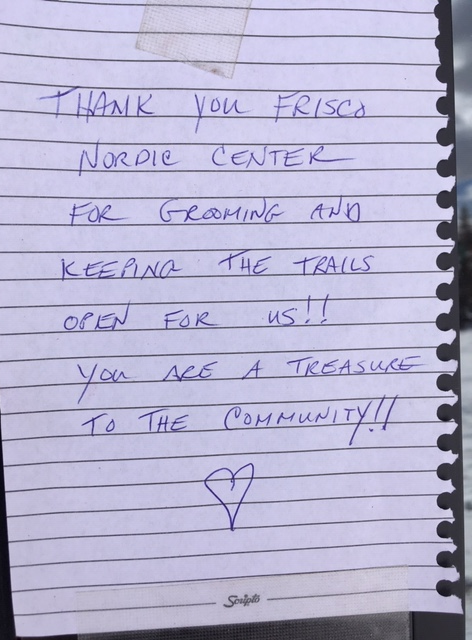
    A sign left on the door of the Frisco Nordic Center this spring. (Photo: Frisco Nordic Center Facebook)

    On that same round table discussion was Pete Swenson, the Frisco Nordic Center and Trails Manager based in Frisco, Colorado. The Frisco Nordic Center is owned and operated by the town, so it is able to utilize community health resources as it evolves to meet the guidelines for virus prevention. One aspect of experimentation that Swenson noted are virtual solo Strava races. The Town of Frisco is promoting a virtual solo trail running series balancing the need for social distancing with those looking for a taste of competition. In this case, registrants have a 48-hour window to run the specified course and upload the segment to Strava.  

    Swenson explained during the round table that the race format made him realize this might be a useful way, COVID or not, to bring more masters skiers onboard. With scheduling conflicts and life, oftentimes even a half-day commitment to race is untenable. A solo Strava option or category, Swenson said, would make sense for those skiers with less flexible schedules.

    Swenson also offered advice to those seeking to hold race events next winter. As he worked through the protocols for the virtual solo series Swenson said he learned it is best to be proactive. 

    “I would advise anybody if you want to do events, the more protocols that you bring to the table, with your entities, [the better],” Swenson said. “Because I have to do, I have three layers if I want to do anything. I need a permit from the town even though we are the town, the county, as well as the Forest Service. What we have learned is that if you wait for them to tell you how to put the event on, it will never happen.”

    What normal looks like come winter will most certainly bend the concepts of the show-up-and-ski many have become accustomed to. But that does not necessarily mean a poorer experience given the context of a global pandemic. Cross-country ski centers are focused on defining a normal that meets health guidelines while also keeping the ski experience the least disruptive as possible. 

    The new winter season holds promise. One anticipated dynamic is whether or not the sport can attract new skiers, much as the biking segment experienced significant growth since the pandemic’s onset. Much of that growth, according to a June 16th piece in Bicycle Retailer, was in the “beginner” category.

    One certainty remains for ski centers and those responsible for welcoming skiers and deriving the template for operating safely come winter: The customer brings their own level of what Swenson calls COVID-anxiety. It’s one thing if locals are conditioned in the same environment to accept limits on their ski experience. That can be tricky in tourist towns. Cross-country ski center operators will most likely be dealing with visitors from outside their immediate region. 

    “Something we have learned to live with here [in Summit County], you cannot predict the level of COVID-anxiety of the consumer, you just don’t know,” Swenson said of the climate in and around Frisco which includes the recreation mecca of Breckenridge. “It is all over the map from ‘I don’t care’ to ‘I have had it’ to ‘this is very dangerous’, so it is a huge spread.”
     

  • Mt. Van Hoevenberg’s Snow Factory a ‘Game Changer’

    Mt. Van Hoevenberg’s Snow Factory a ‘Game Changer’

    The stadium at Mount Van Hoevenberg as seen on April 1, no joke, thanks to the TechnoAlpin Snow Factory. (All photos: Peter Minde)

    When it came to investing in snowmaking, New York State’s Olympic Regional Development Authority (ORDA) went with the go-big mentality, leasing a TechnoAlpin Snow Factory for the Mount Van Hoevenberg nordic center and using the technology throughout the 2016/2017 winter season.

    Following the previous 2015/2016 season, in which Mt. Van Hoevenberg, “Van Ho” for short, was open 37 days, according to ORDA’s annual report, the authority acquired and installed a self-contained snowmaking system at Van Ho, the 1980 Winter Olympic venue in Lake Placid, N.Y.

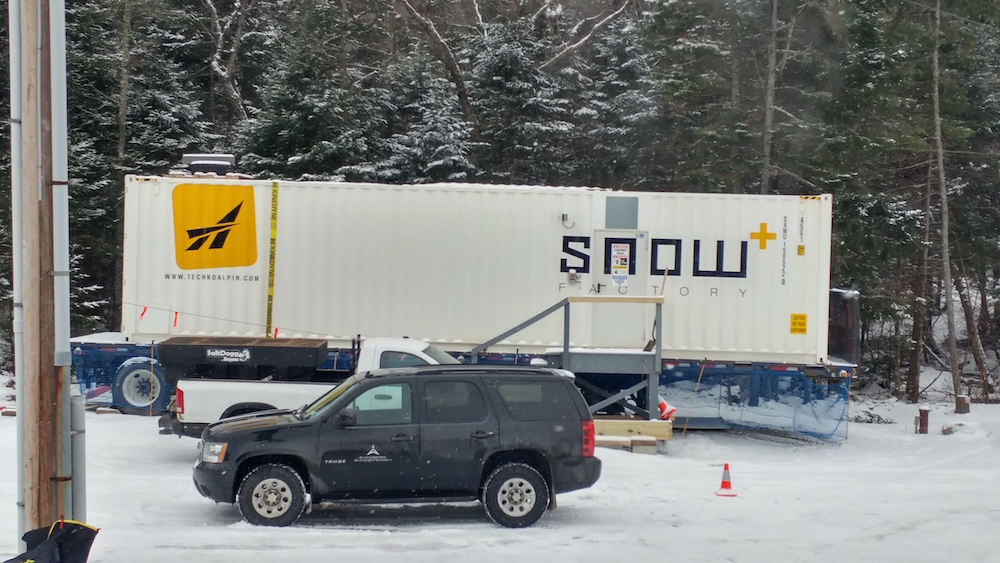
    The Snow Factory at its current home at the Mount Van Hoevenberg nordic center in Lake Placid, N.Y. (Photo: Peter Minde)

    The Snow Factory was put in place, just behind the cross-country lodge, just before Thanksgiving.

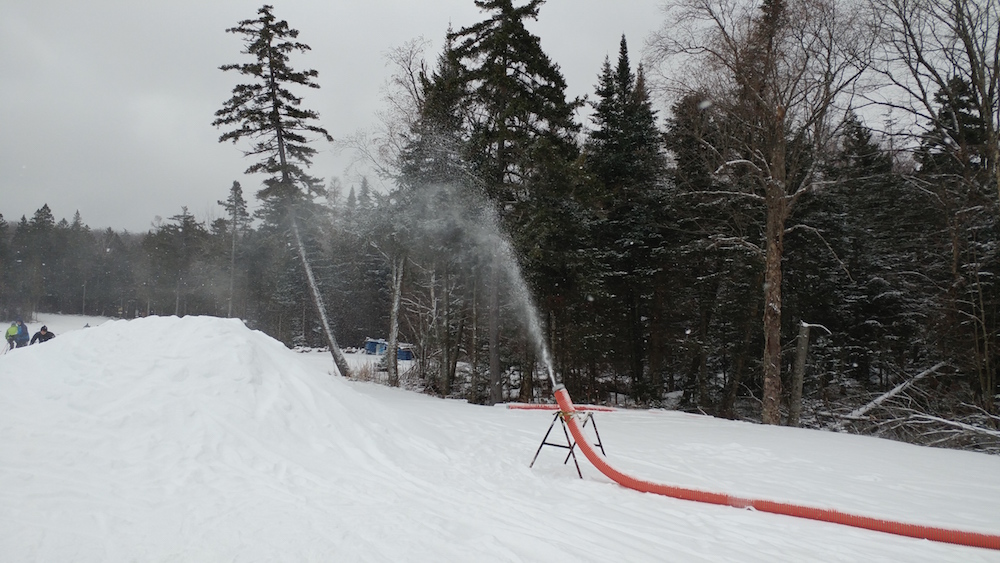
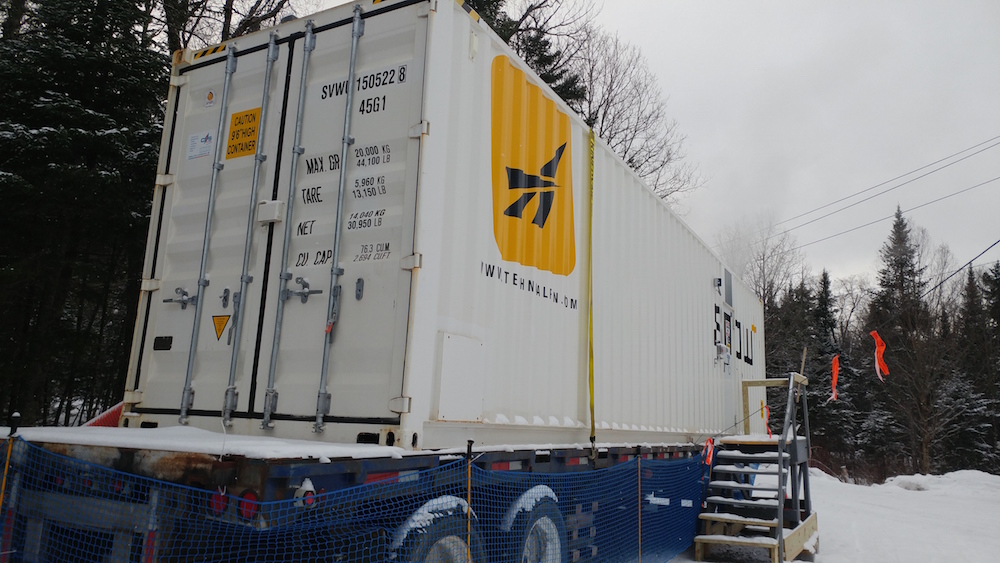
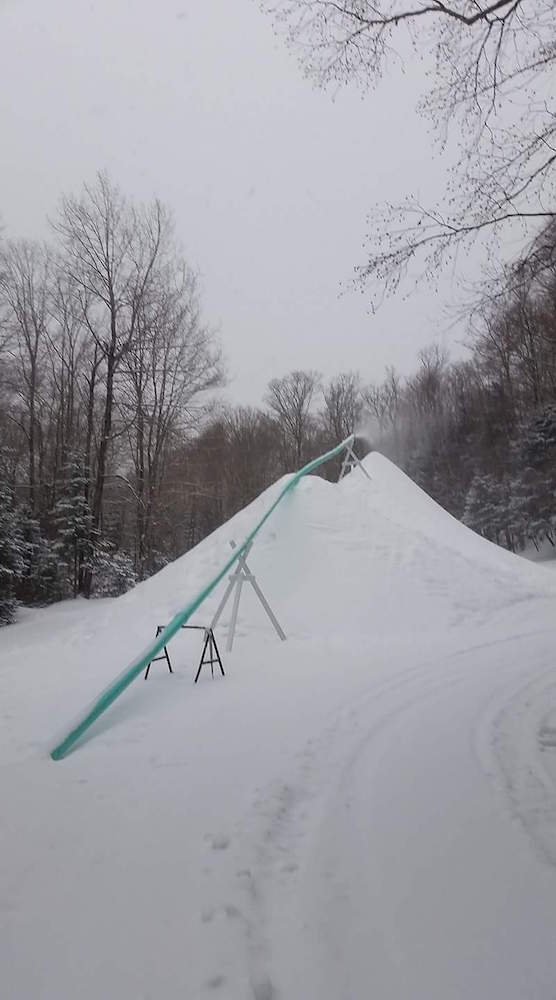
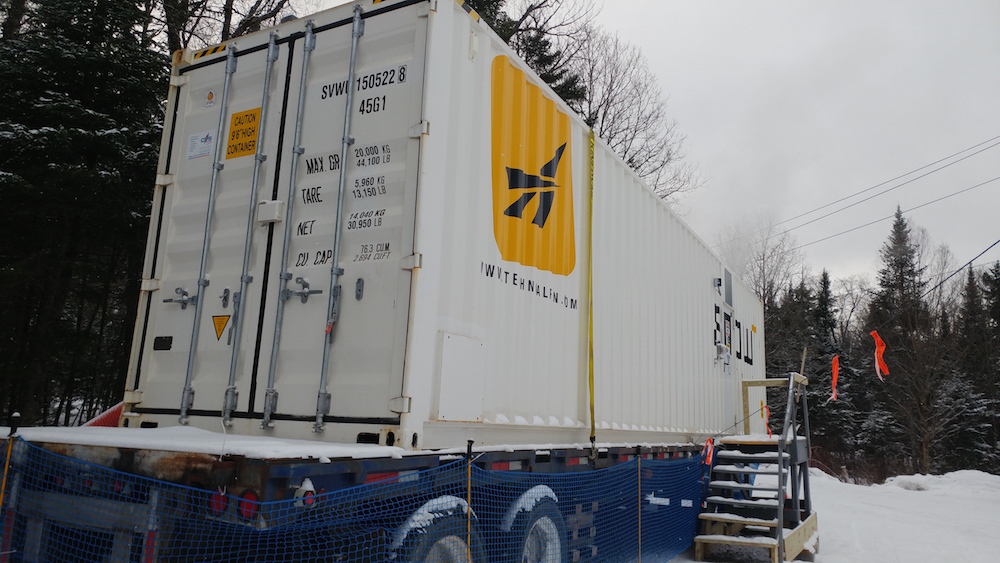
    This machine isn’t your grandfather’s snowmaking setup, where snow guns are positioned strategically along trails. Mounted on a flatbed trailer, a 40-foot ocean shipping container holds compressors and ice-making equipment. A blower sends crystals through a segmented orange hose up to 600 feet in length.

    The Snow Factory hasn’t budged from its original position near a parking lot, yet the snow it has produced has been spread throughout the stadium and on trails up to 1.5 k away from its starting point.

    According to Robin Smith, TechnoAlpin’s Colorado-based business manager, the Snow Factory has been in production for the last four years, but its technology isn’t brand new. IDE, an Israeli company that specializes in water desalination, developed a warm-weather snowmaking unit with different technology than the Snow Factory uses.

    Smith explained that the Snow Factory at Van Ho is the only one in the U.S. and one of only 19 in the world. The best part? The Snow Factory will make snow in temperatures up to 80 degrees Fahrenheit.

    Blowing snow into the stadium, made by the Snow Factory, at Mt. Van Hoevenberg in late December. (Photo: Peter Minde)

    Both Whiteface and Gore mountains, two of the alpine ski resorts that ORDA manages, use TechnoAlpin snow guns.

    “Probably a year ago, we began a conversation with the success they [TechnoAlpin] were having in northern California with the machine that we ended up leasing,” explained Kris Cheney Seymour, Mt. Van Hoevenberg’s manager. “ORDA has its full attention and interest in the future of nordic sports at Mount Van Hoevenberg.”

    When Seymour first spoke with FasterSkier on the phone in late January, the nordic center was dealing with changeable weather.

    “Lake Placid has had a fairly light snow year and a fair amount of very heavy rain,” Seymour explained. “Traditionally, the stadium gets blasted in poor weather. This winter, we would have had a similar winter to what we had last year: no snow, ice conditions in the stadium. We’ve pretty much been open all but one day since Thanksgiving. The reason is the Snow Factory.”

    Without the Snow Factory, Van Ho wouldn’t have been able to host St. Lawrence University’s Winter Carnival, Junior National qualifier races and other events, he said.

    ORDA acquired the Snow Factory from TechnoAlpin after an alpine resort in California used it for a year. Arriving by truck the day before Thanksgiving, it took five days to haul from California at a cost of $7,000 dollars. According to ORDA’s Communication Director Jon Lundin, ORDA is leasing the Snow Factory for one year for $90,000 dollars.

    In an email, Lundin explained that if ORDA decides to purchase the Snow Factory, it will pay a total of $500,000 dollars: $410,000 plus the amount already paid this season.

    “We’ll make the decision later this spring as to whether or not we purchase the Snow Factory,” he wrote. “We’ll look at how it performed and how the cross-country venue benefited from its use.”

    The Snow Factory in place at the Mt. Van Hoevenberg nordic center in Lake Placid, N.Y. (Photo: Peter Minde)

    So how does this thing work?

    Inside the shipping container are three icemakers, refrigeration equipment, a cooling tower, and a blowing system. The blowers move snow through a segmented orange hose. One can add segments to blow snow up to 600 feet away from the Factory.

    “Other [traditional] snowmaking systems require a temperature and humidity component,” Reese Brown, executive director of the Cross Country Ski Areas Association, said on the phone. “Generally, 22 to 27 degrees and below is good snowmaking weather. The Snow Factory doesn’t require any conditions to make snow, because snow is generated inside the container and then spit out the hose. With the others, snow is made when it hits air temperature.”

    “Snow is created within the shipping container,” Seymour said. “You can effectively make snow with 100-percent efficiency up to 60 degrees Fahrenheit. You’ll have diminished productivity, but you can make snow up to 80 degrees.”

    Running on electricity, the Snow Factory draws from the ski lodge’s well, using 11 gallons of water a minute. The icemakers can be optimized for various climates. Seymour pointed out that northern California has a much drier climate than Lake Placid.

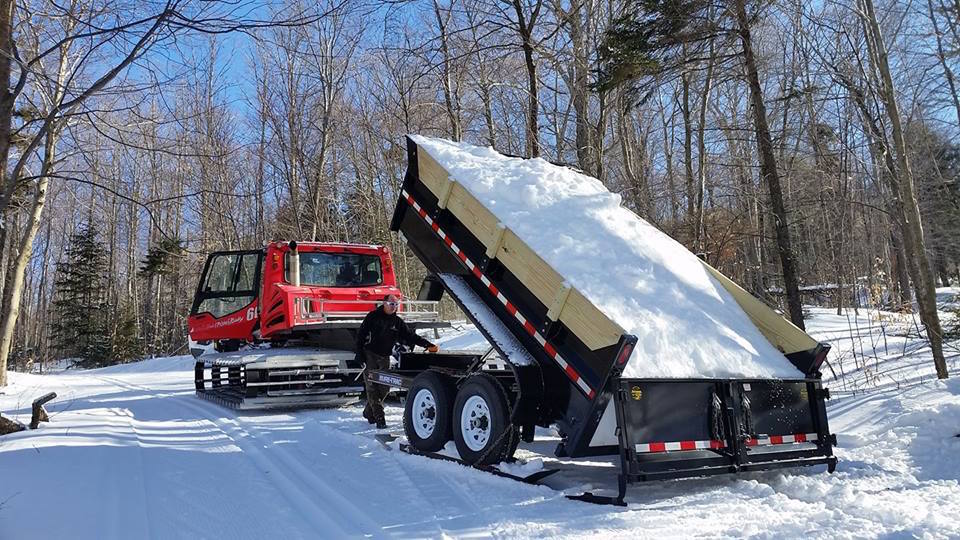
    Dumping snow onto the trails at Mount Van Hoevenberg this winter. (Photo: Mt. Van Hoevenberg/Facebook)

    Leading up to U.S. Junior Nationals, held in Lake Placid from March 3-11, FasterSkier asked Seymour about the Factory’s capability to cover a 5-kilometer loop if the ground was bare. With snow already on the ground, Seymour reframed the question.

    “It works differently than a traditional snow system, and you need to use it and plan for it in a different way,” he said. “The Snow Factory makes a known quantity of snow: two tons per hour. Depending on what our needs are for snow coverage and where we want to go with it, we need to work backwards and give ourselves enough time to blow that amount of snow.”

    While the Factory is mounted on a trailer, the trailer hasn’t moved from its home behind the lodge. The primary locations for its manmade snow have been the stadium, the Innerloopen 3.3 k homologated ski loop, and the beginner trails close to the lodge.

    Days before Junior Nationals, ORDA decided to move the weeklong event to the 2.5 k loop at the Olympic Jumping Complex, also known as the MacKenzie Intervale Ski Jumping Complex, closer to downtown Lake Placid.

    “Six weeks out, we were aware that the long-term forecast had two almost weeklong periods that we were going to have very warm weather,” Seymour said in a follow-up interview after Junior Nationals (JNs).

    Leading up to the championships, the Factory had been cranking almost around the clock. Seymour estimated that once a week, ORDA would shut it down for maintenance. Otherwise, it ran 24/7.

    A large pile of snow produced by the Snow Factory this winter at Mt. Van Hoevenberg in Lake Placid, N.Y. (Photo: Bob Maswick)

    The stadium was covered a mix of natural and manmade crystals, 2 1/2 feet deep. The next focus was the sprint loop and the 3.3 k loop.

    “We were moving snow 10 to 14 hours a day,” Seymour said. A PistenBully hauled snow in a 16-foot dump trailer to where they needed it. ORDA bought the trailer specifically for Van Ho.

    Two weeks before JNs, groomers had buffed the 3.3 k loop to a 28-inch average depth with a mix of natural and manmade snow. Then, “We had really warm weather,” Seymour said. A warm three-day period with high winds and heavy rains reduced the base depth to 12-18 inches.

    Then, starting Feb. 24, another three-day thaw cost precious base depth. A week before the championships, the race courses were down to an average depth of 4 to 8 inches.

    The death blow came one night later. Driving rain and 50 mile per hour winds wiped out weeks of intense work. Wednesday morning, they inspected the courses. Not only was snow melting, but water was “flowing all over the place,” Seymour said. “We had large portions of the race trail that were totally washed out. There were sections of the trail that were lovely and totally groomable. But we also had a 100-meter section of the trail that was totally gone, like, 100 percent gone from pouring water.”

    That morning, Van Ho still had snow stockpiled in the stadium out near the 3.3 k loop. But the forecast for Sunday through Wednesday of championship week called for temperatures in the mid 40s.

    The forecast was accurate.

    “We could have rebuilt the course so that it had four to six inches of snow everywhere,” Seymour said. “We knew that Mount Van Hoevenberg couldn’t survive a third major thaw in a four-week period.

    “We had a course that was mostly built at the jumps,” he explained.

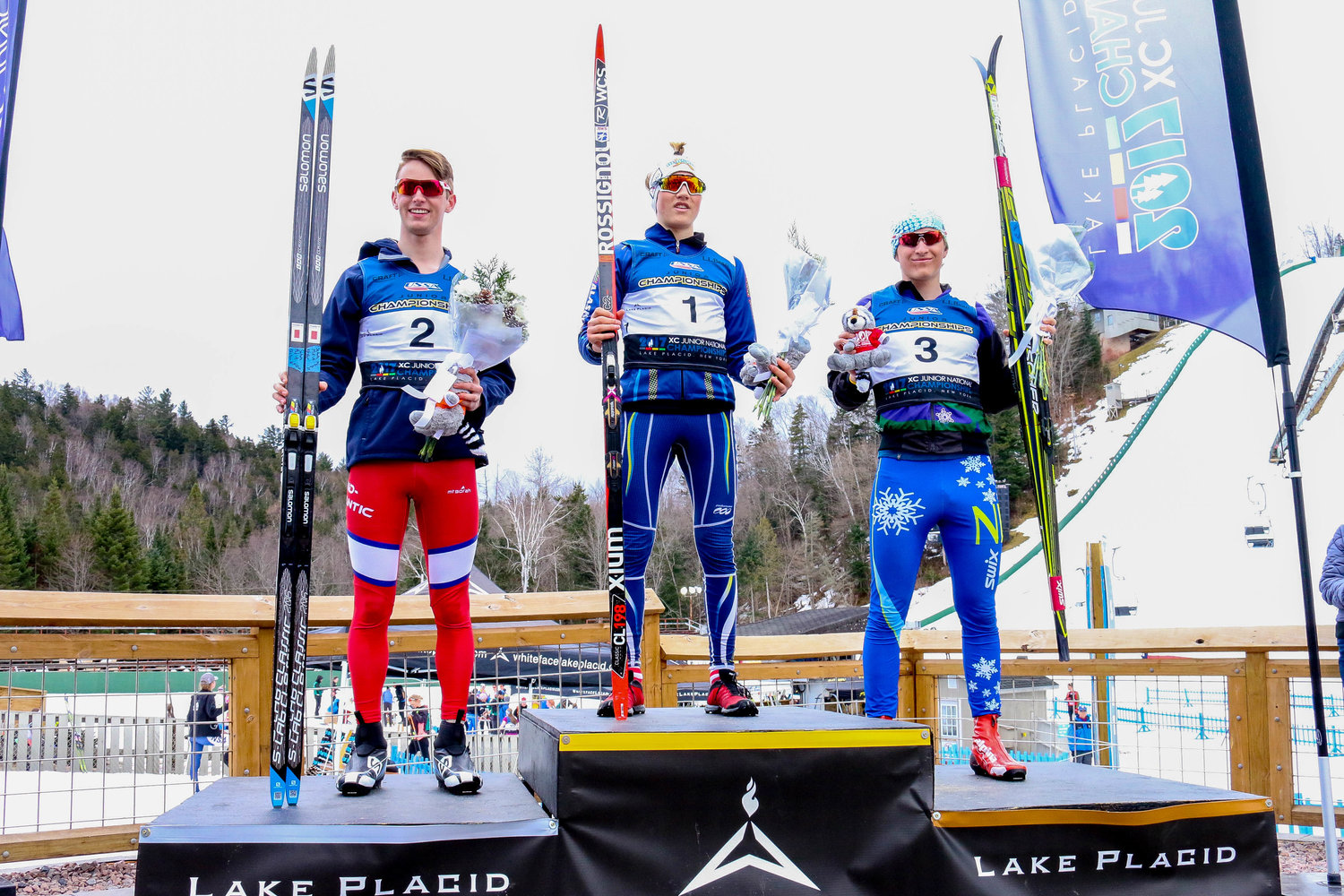
    The U18 boys’ classic sprint podium at U.S. Junior Nationals, held at the Olympic Jumping Complex in Lake Placid, N.Y., with Gus Schumacher (c) of Alaska Winter Stars in first, Scott Schulz (l) of the New York Ski Educational Foundation in second, and Adam Glueck (r) of Ford Sayre in third. (Photo: XCJuniorNationals2017.com)

    Blowing snow on site for 30 hours and working around the clock, ORDA employees also moved all the snow from the in-run of the ski jumps and the in-run and landing areas of the freestyle training area, which had a depth of eight feet. With that and the snow made on site, the Intervale loop was covered to an average depth of 2 1/2 feet for a successful Junior Nationals.

    As a result of the venue change, there was only one adjustment to the schedule. Coaches, jurors and organizers agreed to switch the classic mass start to an individual start because of a narrow spot for two-way traffic midway through the loop.

    While the Snow Factory ultimately didn’t play a part in JNs, it continued to blow snow at Van Ho, which remained open while the races happened took place at the jumps. Teams arrived early and trained on the trails, some choosing to cool down or train on off days at Van Ho.

    “That was 100-percent Snow Factory,” Seymour said.

    Besides the Factory, there have been other significant improvements to Van Ho. According to Allan Serrano, the FIS technical delegate who worked with ORDA to homologate Van Ho’s race trails, the stadium exit, along with much of the Interloopen portion of the Ladies’ 5 k loop, was widened.

    “Most importantly they have been able to do rehabilitation work on the Ladies 5k, leveling and improving the water management so that it skis and grooms much better,” Serrano wrote. “They are able to have a high quality ski surface with lower snow.”

    He added that Van Ho’s grooming capacity has also improved since its courses were certified in 2012.

    “At that time the venue did not have a dedicated snowcat with track setters and now they have a machine with double track setters,” he wrote.

    As race season winds down, what’s next? With the ability to make snow in warm temperatures, Seymour was intrigued by the opportunity to provide skiing on short loops in the offseason. He’s got the attention of John Farra, the high-performance director for U.S. Paralympics Nordic Skiing.

    “We have found that it is most valuable for sit skiers especially to have access to snow in the ‘off season,’ ” Farra wrote in an email. “The nature of maneuvering a nordic sit ski on turns, downhills and out of the track is not something that can be duplicated on roller skis, so we have found [snow] much more valuable for sit skiers in advancing their technical skills. We are very interested in the Snow Factory project that ORDA has invested in and have been in touch with Kris about the possibility of getting our National Team to Lake Placid to take advantage of their new Snow Factory snow in this coming Games season.”

    “Part of skiing currently is having a viable snowmaking option,” Seymour said. “The Snow Factory will guarantee the ability to open the venue when we want to and hold races as they’re scheduled; we can be counted on as a world-class venue. It’s a game changer.”