From the FasterSkier archive — posts syndicated from athletes’ and coaches’ own blogs between 2004 and 2012, kept online as published. Current coverage is at fasterskier.com.
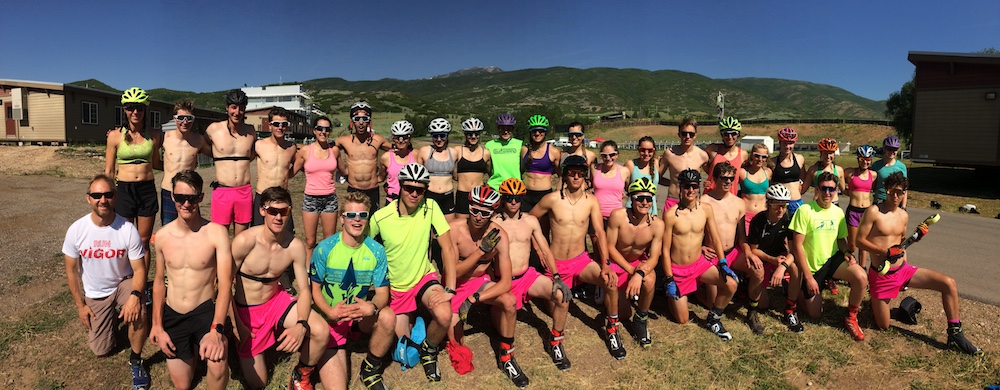
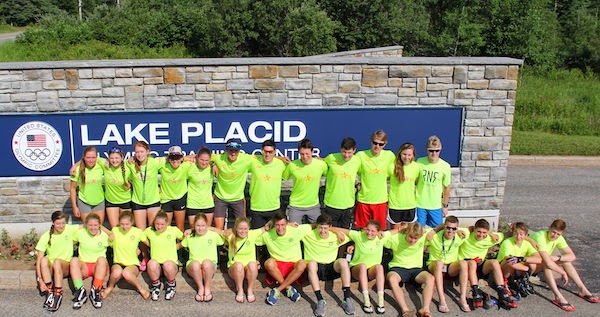
All 34 Western REG participants and U.S. Ski Team Development Coach Bryan Fish after L3 intervals at Soldier Hollow in Midway, Utah. (All photos: Mike Elliott)
The following recap was written with the help of Mike Elliott, director for the Western Regional Elite Group (REG) camp, which took place June 17-24 in Park City, Utah. FasterSkier encourages coaches and athletes from any regional offseason camps (dryland or on-snow, in the U.S., Canada or abroad) to submit their own recaps and photos to info@fasterskier.com.
***
For seven days in June, 34 athletes (17 women and 17 men) from five western U.S. divisions (Rocky Mountain, Intermountain, Far West, Pacific Northwest, and High Plains) came together in Park City, Utah, for the annual Western REG (Regional Elite Group) camp in Park City, Utah.
With the help of U.S. Ski Team coaches Matt Whitcomb and Bryan Fish, a staff of nine led the camp, including Gus Johnson (Auburn Ski Club), Dan Weiland (Ski and Snowboard Club Vail), Greta Anderson (Steamboat Springs Winter Sports Club), Paul Smith (Sun Valley Ski Educational Foundation), Molly Susla (Crested Butte Nordic Team), Pierre Niess (Leavenworth Winter Sports Club), Bill Hokanson (Wasatch Nordic Ski Academy), Mike Elliott (Rocky Mountain Nordic), and camp chef Nancy Elliott (Durango Nordic Ski Club).
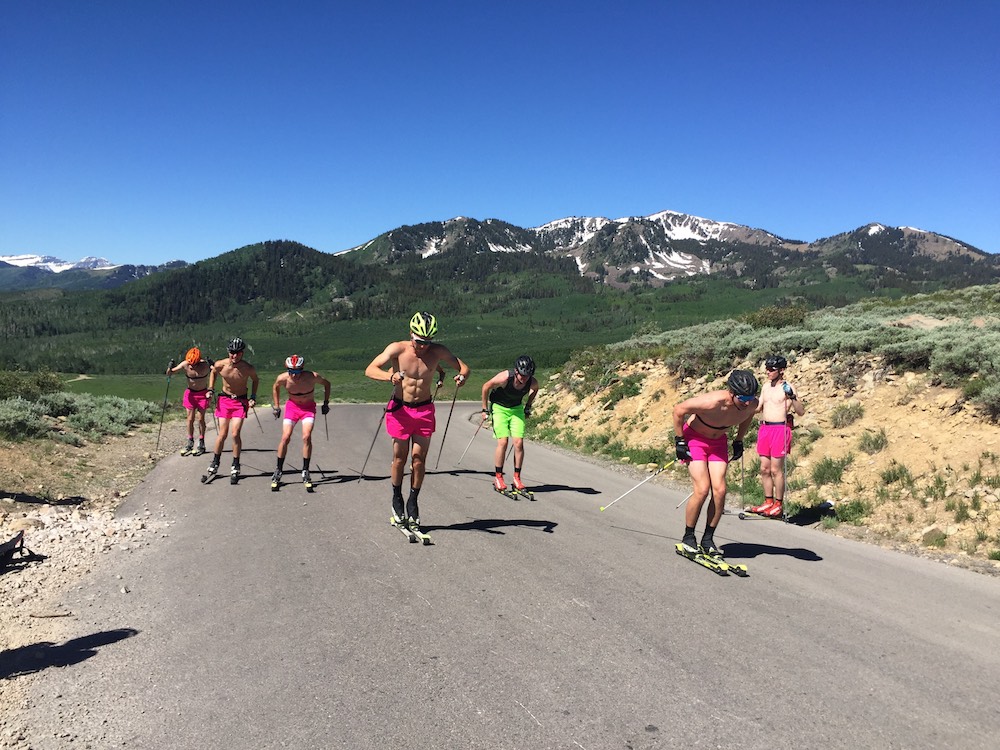
An over-distance classic ski from Pine Canyon to Empire Pass out of Midway, Utah. Inspired by the U.S. Ski Team women who wear matching socks for relays, the camp’s male athletes bought pink shorts at the outlets in Kimball Junction to show their unity. “Coaches, however, did not make the purchase of pink shorts,” camp director Mike Elliott explained. (Courtesy photo)
According to camp director Mike Elliott, athletes were selected based on two factors which were weighed equally, 50/50: their final USSA points at the end of last season and their best two out of three races at 2017 Junior Nationals.
The first training session of the week was held at the infamous Agony Hill next to the University of Utah Hospital in Salt Lake City. Peter Wolter of Sun Valley posted the winning time for the men and Novie McCabe (Methow Valley Nordic Ski Club) was the fastest woman to the top.
In the agility sprint, Sarah Morgan, of Park City’s Wasatch Nordic Ski Academy, claimed first for the women and James Schoonmaker (Auburn Ski Club) was the fastest man. Another Wasatch skier, Madison “Maddie” Morgan won the double-pole time trial, along with Evan Barbier of Steamboat Springs.
“Working with such talented young skiers is so much fun and rewarding,” Elliott wrote in an email. “We often left the lodging facility at 6:30am or 7am to beat the heat. The athletes were always on time and motivated and organized with the proper training equipment. There was a high degree of Esprit de Corps among all the participants. They competed in the three events that were timed, and they supported each other in the other training sessions. Some of the skiers had a goal to qualify for the National Elite Group training camp scheduled later in Park City.”
Of the skiers that attended this year’s camp, several were Junior National medalists, including Wolter, McCabe, Maddie Morgan, Haydn Halvorsen, Sydney Palmer-Leger, Sofia Shomento, and Marin Coletta. Another multiple medalist, Johnny Hagenbuch was scheduled to attend this year’s Western REG, but broke his leg the weekend before the camp, Elliott explained.
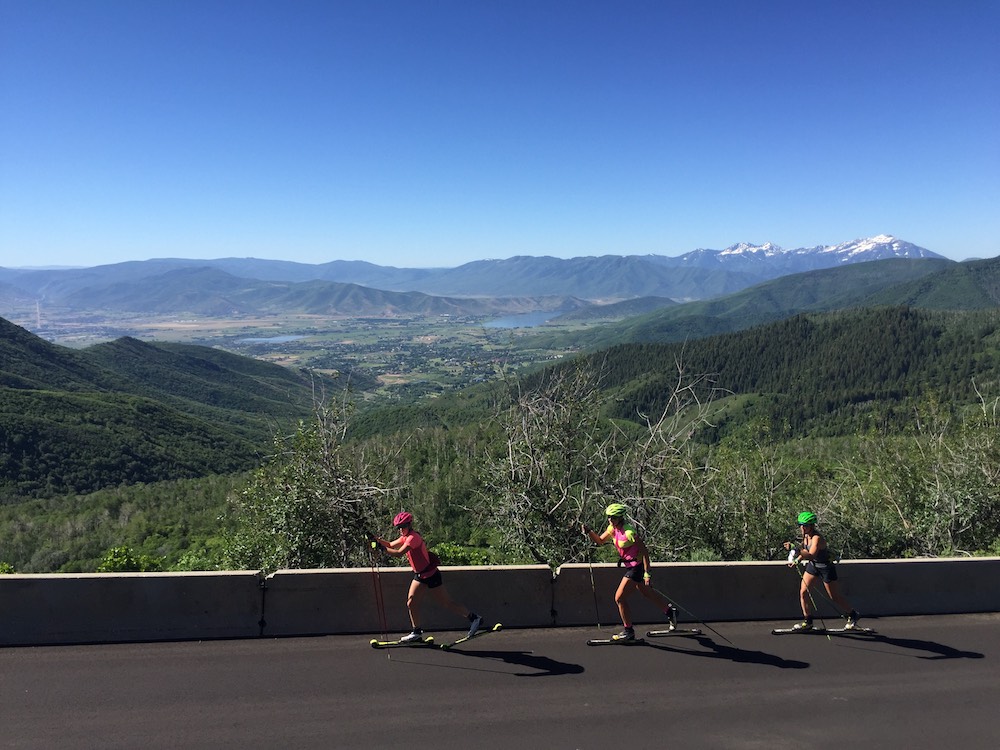
An over-distance classic ski from Pine Canyon to Empire Pass out of Midway, Utah, at the 2017 Western REG camp in June. (Photo: Mike Elliott)
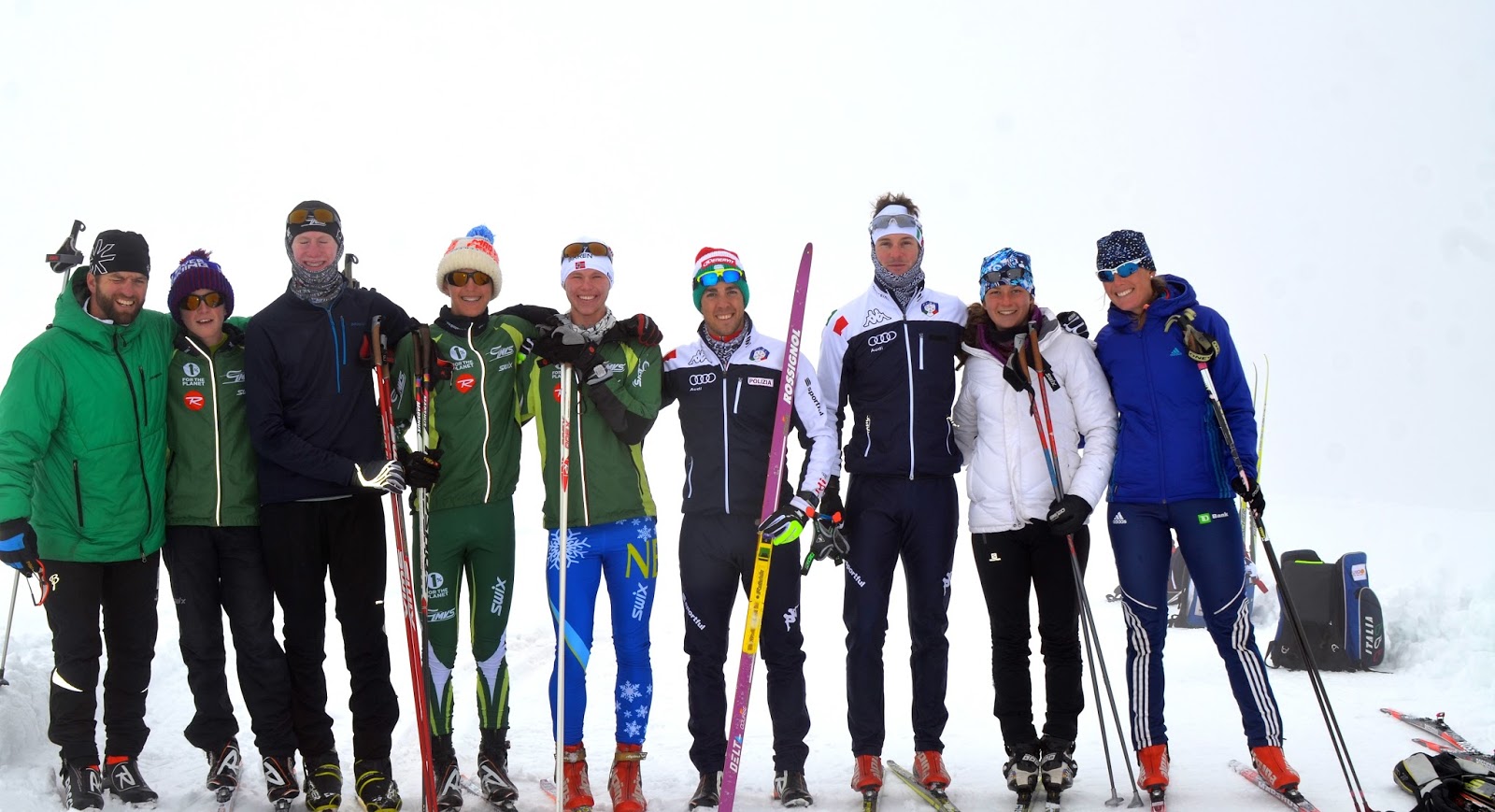
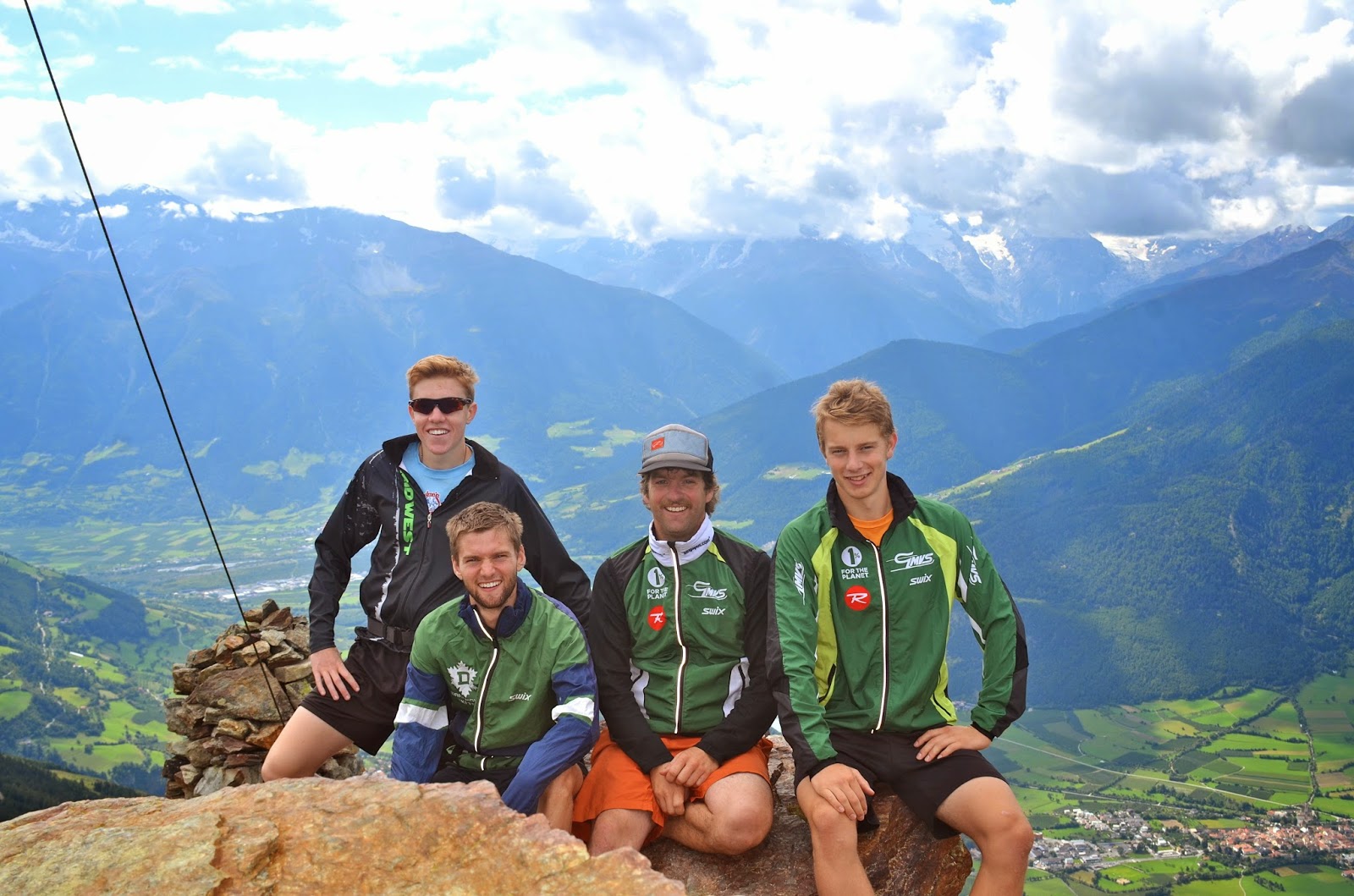
A group shot of the Green Mountain Valley School (GMVS) Nordic Team with Italian national-team members Federico Pellegrino and Simone Urbani. Pellegrino has won three individual World Cups. The GMVS team traveled to Italy in early September for two weeks of training around Mals and on the Stelvio Glacier. Longtime nordic director Justin Beckwith is pictured at far left, and new coach Katrina Howe at far right. (Photo: gmvsxc.blogspot.com)
Over the last nine years, Justin Beckwith’s name has become synonymous with the Green Mountain Valley School (GMVS) in Waitsfield, Vt. Now, with the hiring of 2010 Olympian Garrott Kuzzy as nordic director and biathlete Katrina Howe as nordic coach, two other well-known individuals in the ski community have become the new faces of the program, and Beckwith has vowed to help with the transition.
But before Beckwith — a former Middlebury College skier, Junior World Championships coach and wax technician, J1 Scando Trip leader, and the New England Nordic Ski Association’s 2012 coach of the year — started as an assistant coach at GMVS, he built houses.
That’s one of the trades he’s returning to.
In August, Beckwith, 36, decided to step down as Green Mountain’s nordic director, ushering in a new era for the program, which started in 1981 under Jim Fredericks. Muffy Ritz took over as nordic director from 1986 to ’89, after which GMVS Nordic went by the wayside at the ski academy until Norwegian Jon Arne Enevoldsen started a biathlon program in 2002, according to the Vermont Ski and Snowboard Museum.
Former GMVS head coach and nordic director Justin Beckwith (second from r) with Green Mountain’s former elite and postgraduate athletes (from left to right) Nick Gardner, David Sinclair and Ian Moore (l-r) during last year’s fall trip to Italy. (Photo: GMVS)
A few years later, Beckwith came into the picture. In a phone interview on Monday, he recalled how the current GMVS nordic program started with a Norwegian coach and core group of families. Through grassroots efforts, targeting local Bill Koch programs and creating a “viable option for kids from the [Mad River] valley to start taking up cross-country,” the private school’s nordic team began to attract more homegrown skiers from central Vermont. In turn, that spawned interest well beyond the state’s borders.
During Beckwith’s tenure, in which he led the program for the last seven years, he also united with local clubs to develop the Central Vermont Co-Op Race Series to elevate the level of nordic competition. His largest team size was 15. This year, its has seven nordic athletes, including one post grad.
“Over the years, I’ve been able to support some really awesome athletes in the program,” Beckwith said. “To be able to offer that opportunity, helping foster a passion for skiing and then to get to see them become young adults and continue to do amazing things.”
Sometimes, he had to dig into his own pockets to do so. And while he said it was a personal decision to step down, he felt the time was right to put the program into new hands for strategic planning and new energy.
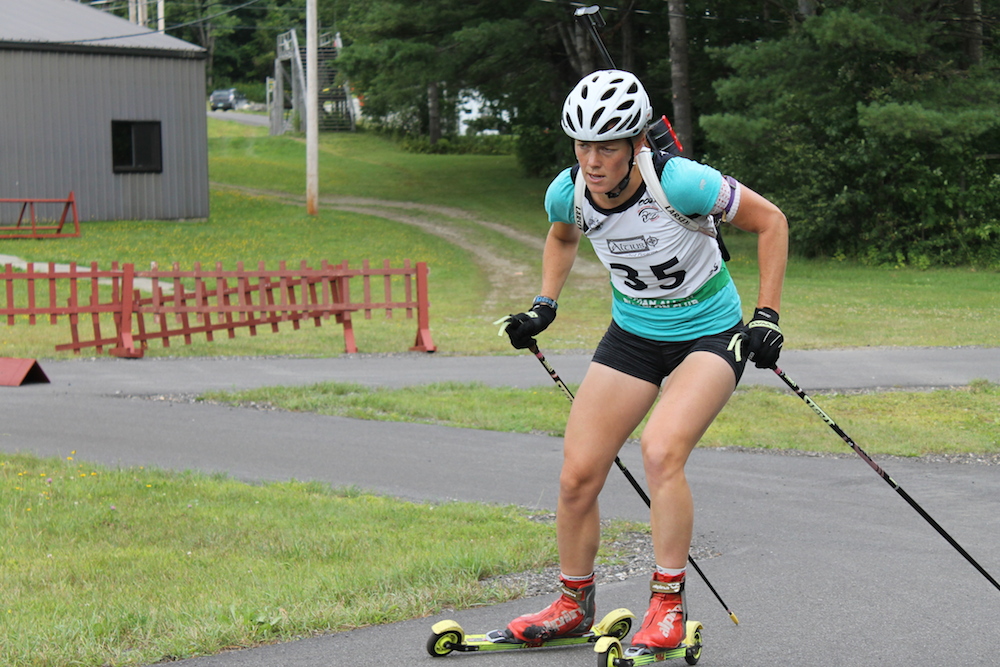
Katrina Howe, a former biathlete with the Maine Winter Sports Center Olympic Development Team, competing at last year’s 2014 North American Rollerski Championships in Jericho, Vt.
That’s where Kuzzy and Howe came in.
Howe, a former national-development team biathlete who spent the last five years training with the Maine Winter Sports Center (MWSC) Olympic Development Team, joined Beckwith as an assistant coach in July. At 29, she had retired from racing this spring — her decision prompted by a loss of funding at MWSC — but she wasn’t ready to leave the sport.
“I knew I wanted to stay involved and I always knew I wanted to be a coach,” Howe said on the phone last week. “I contacted Justin and it turns out he needed an assistant coach.”
He hired her and the two went ahead planning the summer, including a fall training camp in Italy. Before she started, Beckwith and his then-assistant coach Shane MacDowell hosted an Eastern Regional Elite Group (REG) in June. MacDowell left GMVS to join Northern Michigan University as an assistant coach in July.
“There’s been a lot of change in the program [recently],” Beckwith said.
For the REG camp, Beckwith’s long-term goal had been to boost enrollment. New England has so many summer training options that it’s often difficult to unite the best juniors at a single venue, he explained. The REG camp attracted New England’s entire J1 and J2 teams, he said.
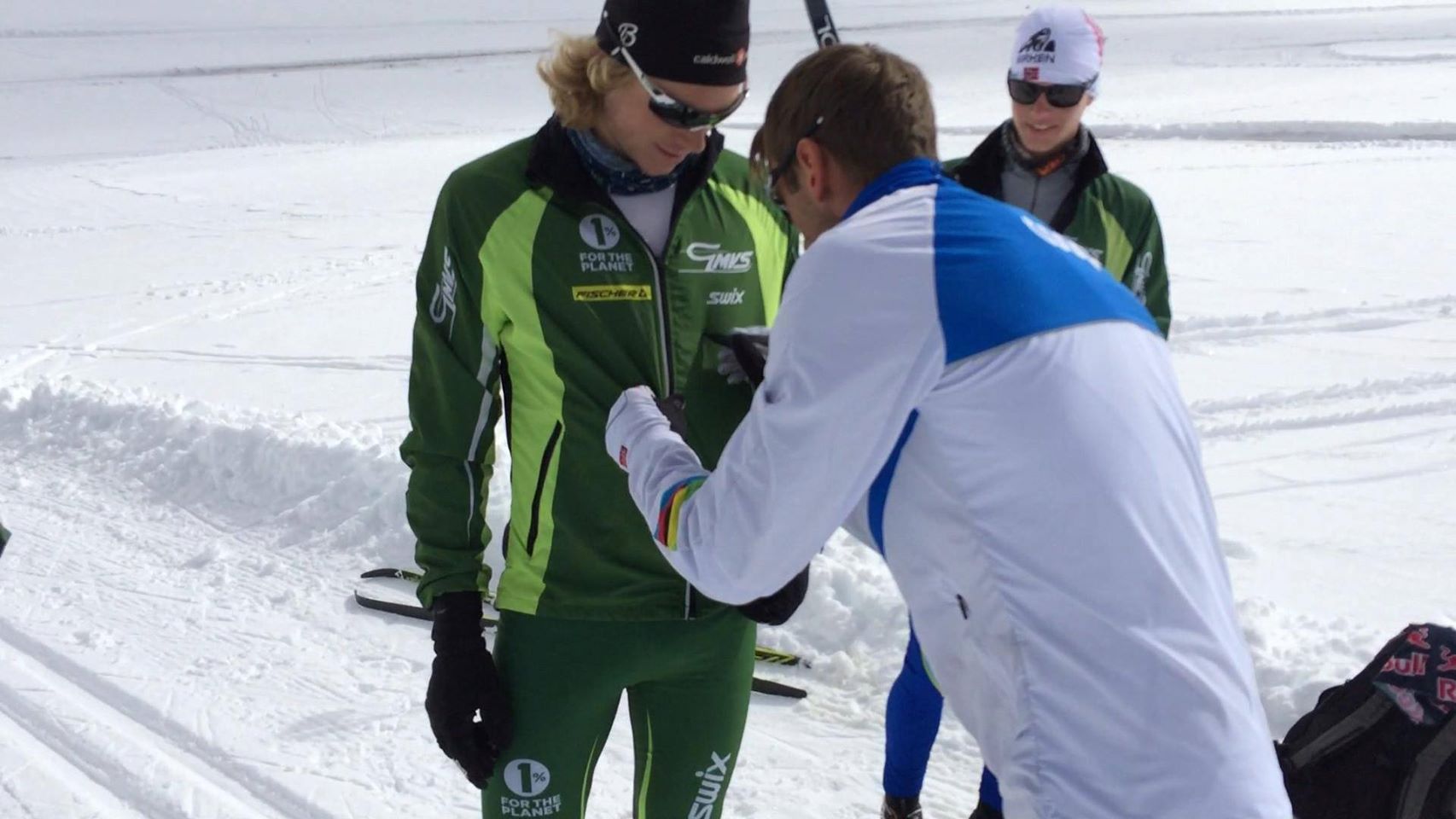
Norwegian Petter Northug posted a photo of himself on Facebook signing a GMVS nordic skier Forrest Hamilton’s jacket during a recent trip to Italy for skiing on the Stelvio Glacier. He captioned it, “Big in the US!” (Photo: Petter Northug/Facebook)
“It was a great success … I think we were missing two to three kids from the junior national team,” he said, adding that there were 38 participants. “I would say we had 95 percent of the best kids in New England together.”
That was a capstone on the previous open training camps GMVS hosted for the last eight summers.
“I just wanted to make sure I was handing it off [to the right people],” Beckwith said of the nordic program. “Katrina was awesome. … I’m really happy that Garrott stepped up,” he added. “We have had some great conversations.”
Howe started working for GMVS when school started, Aug. 17. The day before, she learned Beckwith wasn’t returning as head coach.
“It was a pretty sudden transition,” she said. “We had about two-and-a-half weeks of school and Justin was around so he definitely helped me with a basic knowledge and lay of the land.”
After that in early September, Beckwith, Howe, staff member Jere Brophy, and their athletes traveled to Mals in northern Italy for two weeks of dryland training — including hiking and rollerskiing — and on-snow skiing at the Stelvio Glacier.
New GMVS nordic director Garrott Kuzzy (Photo: GMVS)
When they returned in late September, Kuzzy had been hired as nordic director. In the time since — the last two weeks — he’s been working with Howe.
“This August, when Justin decided he was going to move on, the Green Mountain Valley School reached out to me and I decided it was a great opportunity to get back into the ski world and work with high-school age level kids,” Kuzzy said. “… It’s not a huge life transition. It’s just an opportunity to be more involved in skiing. I think they’ve got a lot of resources and are very dedicated to the nordic program.”
Kuzzy, 32, a Middlebury grad who spent the last several years in Middlebury and will continue to live there, previously served as product director of VBT Bicycling and Walking Vacations. While he explained it was a “very challenging decision to leave” VBT after four years, he always wanted to stay involved in nordic skiing. He did so by launching VBT’s cross-country ski tours and assisting local clubs, including Mansfield Nordic and Frost Mountain Nordic, at their annual camps.
“The experience I gained with VBT is an asset and something I can apply to my role as Nordic Director at GMVS,” Kuzzy wrote in an email. “My role consists of a balance between strategic planning, execution and ski coaching. As Nordic Coach, Kat Howe spends much of her time writing the training plan and training with the team.”
While he and Howe plan to discuss and determine the program’s overarching goals this month, Kuzzy said on the phone last week that they want to further integrate nordic within the GMVS community.
“Traditionally it’s been an alpine-heavy school,” Kuzzy said, explaining that of roughly 120 skiers at the academy, seven are nordic athletes.
Howe pointed out that a couple of alpine students had already shown interest in nordic. “The number may grow before too long!” she wrote in an email.
“At this point, my goal is to provide as much opportunity as possible for skiers who really want to see what they can do with nordic skiing,” Kuzzy explained. “One thing I really like about GMVS is the academic focus; it was recently rated the top academic private high school in Vermont [by the 2015 Niche Rankings]. … And this motto of, skiing is a metaphor for life. My goal is to extend the opportunity, to learn more about life through ski racing.”
Howe said she felt similarly.
“If I didn’t have the interest or the academic [background], I don’t think I’d totally appreciate the experiences I’ve had as a skier,” the four-year University of Vermont skier said. “The trips weren’t always necessarily about the racing. I think that carried over well for me.”
Already, Kuzzy said he’s been having a lot of fun with the athletes.
“That’s been the highlight, the workouts with the kids,” he said. “They’ve been fantastic.”
“They’re just all awesome, hugely motivated [athletes],” Howe said. “They have a huge world sense of adventure. That’s why I fell in love with nordic, and these kids just love that and want to get out there and do new things. It’s not just about specific training for them, and that’s definitely come from Justin.”
“They have a huge world sense of adventure. That’s why I fell in love with nordic. … It’s not just about specific training for them, and that’s definitely come from Justin.” — GMVS Nordic Coach Katrina Howe, on the team’s current athletes
While Beckwith was unsure what his exact role with the program would be this winter, he knew he’d be offering race support. So far, he’s filled an advisory role to help with the transition and was part of the recruiting process for a new director, he said.
Beckwith has also been the lead kickwax technician for New England at Junior Nationals for the last six or seven years, and he plans on doing that again this season.
“It’s definitely open ended and I want it to be a positive vibe,” he said. “It was hard to leave my current kids… [but] I’m not leaving, I’m still here, part of their lives, but it’s definitely a hard transition for sure.”
He’ll continue to live in Warren, near the school, where he can show Kuzzy and Howe the traditional time trial spots, and their starting and ending points.
“I definitely envision doing some workouts with them,” he said.
Meanwhile, he said he’ll be able to spend more time with his new wife, Brie Beckwith, a physical trainer for U.S. alpine skier Mikaela Shiffrin and the U.S. women’s alpine team, whom he married in April. He’ll also continue building with friends.
“It’s pretty fun to get back to that,” he said.
This winter, Beckwith said he’ll groom the Sugarbush golf course and help “the community in areas I was not able to before. … It’s exiting to not have the narrow focus of helping one program, but helping all programs out, and I definitely plan on being a part of the New England waxing staff.
“The last two years I’ve been with the World Junior kickwax staff so I’m leaving all doors open,” he added. “I plan on staying involved as a ski tech.”
The following comes from a National Nordic Foundation (NNF) press release, in which U.S. Ski Team Development Coach, Bryan Fish answers questions on the Regional Elite Group Camps:
NNF: What is the REG? What should people know about it?
BF: The Regional Elite Group (REG) includes four camps – one in each region: East, Central, West, and Alaska. These camps take place between the June and July each year. The Western and Eastern REG camps are now complete. Central REG starts July 5th in Cable, Wisconsin and Alaska REG kicks off on July 14th in Anchorage.
Each region sets their own qualification criteria with the target of bringing together their best 16-19 year old athletes to train together. REG is arguably the best opportunity for the U.S. Ski Team staff to collaborate with junior development coaches in each region.
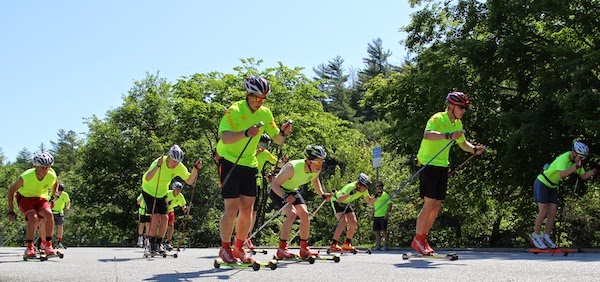
Rollerskiing at an REG camp (Photo: NNF)
NNF: What goes on at these camps? What do you try to make happen here?
BF: There are two major goals of REG. First and foremost, we try to provide a high quality-training environment. The goal is to build a team atmosphere where we live together, train together, appropriately push one another, and learn from each other.
REG embodies one of our key national team focal points: collaboration – both athletes and coaches. Our intent is to provide ski specific technique support as well as outlining essential factors on what it takes for developing athletes to make it to the next level. We direct much of this emphasis toward the international development pillar projects that NNF supports, since the next level for many of these athletes are the trips like the U18 trip and Junior World Ski Championships.
Secondly, the REG camps name athletes to the National Elite Group (NEG) through head-to-head competition of general athletic traits as well as overall ski performance from the last winter. NEG is a second opportunity for juniors of this age group to qualify for a National Development Camp. To clarify, National Training Group (NTG) is named solely based off of top domestic and international ski results. The goal of the national camps is to then bring the top regional athletes together for national projects.
NNF: What role do regional coaches play in REG?
BF: The local and regional coaches lead and coach alongside the U.S. Ski Team staff. Theses coaches carry out most of the work including selection of camp location, organization (lodging, meals, transportation), communications, and most of the hands-on coaching. The regional coordinators (Mike Elliott-West, Janice Sibilia-East, Yuriy Gusev-Central and Pete Leonard-Alaska) collaborate with the U.S. Ski Team staff to create the camp schedule.
Thanks to all the efforts and hard work of the coaches and coordinators within the regions, the REG projects have been a vibrant, valuable and vital step in our Cross Country National Development Pipeline.
NNF: Where does the REG fit into an overall development plan?
BF: The Under-16 National Training camp fits directly under the Regional Elite Group camps. The U16 National camp invites approximately 50 athletes aged 14-15 years old. The REG camps invite approximately 90 athletes total. The next step up the rung is the NEG and NTG projects. These national projects are smaller in size naming approximately 40 athletes total.
There is a small overlap between each rung of the ladder to allow multiple opportunities as well as to try to ensure athletes don’t “slip through the cracks.” The goal of U16 National camp as well as REG is to have a relatively large group size to expose and retain more junior athletes in cross country skiing.
Top regional junior skiers participate each year in one of four Regional Elite Group (REG) summer camps. The camps include general and ski-specific assessments, ski technique support as well as athlete and coaches education. Each camp includes U.S. Ski Team coaching staff which observe, interact and coach.
With the help of regional coaches attending the camps, the U.S. Ski Team coaching staff selects the top athletes from all four REG camps (East, Central, West and Alaska) and names these athletes to the National Elite Group (NEG). These athletes are offered the opportunity to train alongside the U.S. Ski Team athletes at the Lake Placid Olympic Training Center October 9-17, 2010. Attributes such as motivation, dedication, general physical fitness and ski-specific performance are taken into consideration to select these athletes.
Congratulations to all of the athletes who participated in REG camps this summer. We are excited to announce the National Elite Group for 2010:
Men
Skyler Davis (Stratton Mountain School/ Sverre Caldwell)
David Sinclair (GMVS/ Justin Beckwith & Dartmouth College/ Ruff Patterson)
Andy Dodds (Minnesota Valley/ Reid Lutter & CXC Jr Development Program/ Igor Badamshin)
Scott Patterson (Alaska Winter Stars/ Jan Buron)
David Norris (Fairbanks Alaska Ski Team (FAST)/Bill McDonnell)
Tyler Kornfield (Alaska Winter Stars/ Jan Buron & UAF/ Scott Jerome)
Erik Fagerstrom (Sun Valley Ski Education Foundation / Chris Mallory)
Women
Isabel Caldwell (SMS/ Sverre Caldwell & Dartmouth College/ Cami Thompson)
Heather Mooney (Stratton Mountain School/ Sverre Caldwell)
Jessie Diggins (CXC Team Vertical Limit/ Jason Cork & Gus Kaeding)
Annie Pokorny (Sun Valley Ski Education Foundation/ Chris Mallory)
Michaela Frias (Steamboat Springs Winter Sports Club/Josh Smullin & Brian Tate)
Caitlin Patterson (Alaska Winter Stars/ Jan Buron & UVM/ Patrick Weaver)
Annie Hart (Minneapolis Ski Club/ Kevin Brochman)
This summer’s Alaska Regional Elite Group (REG) camp, held in Anchorage, proved to be a challenging and valuable week of training for all involved. Just like the Eastern, Central, and Western REG camps held earlier, the Alaska camp included a variety of distance, strength, technique, and intensity workouts as well as two time trials.
The Alaskan REG crew. (Photo: Pete Leonard)
“I think the main objective and goal of the week was to give the REG athletes an opportunity to bang heads with each other and some of the top senior level athletes in the region,” said coach Pete Leonard in an email to FasterSkier.
Video taken of nearly every rollerski session was reviewed every evening, affording athletes a chance to perfect their technique with top coaches including the US Ski Team’s Chris Grover.
Striding it up the hill. (Photo: Pete Leonard)
Thursday morning heralded an event not seen at any of the other REG camps: a sprint time trial on skate rollerskis, followed by speed work. On Friday morning, athletes competed in a classic rollerski time trial where they were joined by several elite athletes including Olympian and Alaska native Kikkan Randall.
“I think having senior athletes at the time trial is good because it allows the junior to know where they stack up in the grander scheme of things,” Leonard remarked. “Nothing worse for an athlete than getting complacent.”
Randall was around earlier in the week as well, as she worked with the women on double-pole technique during Thursday’s easy distance rollerski. “I don’t think I’ve ever seen a group of 15 junior females all as attentive and ready to soak up every detail,” said Leonard of the technique session.
Kikkan Randall discusses double-pole technique with the girls. (Photo: Pete Leonard)
The camp ended with a mixed OD on Saturday morning, the toughest part of the week for many participants. The last and hottest workout of the week began with a steep and slippery uphill run and continued with a long classic rollerski which included the grueling classic time trial climb.
Many of the athletes also jumped in to the Cuddy Roller Ski Race on Sunday morning. An optional workout that was not officially part of the camp, the 2x3x700 meter relay sprint was a fun conclusion to a demanding week.
High-caliber junior athletes flocked to Craftsbury Outdoor Center in Vermont on June 25 for the five-day Regional Elite Group (REG) camp. The week provided attending skiers with a chance to train with and learn from some of the country’s best coaches.
Eastern REG athletes out for a rollerski (Photo: NENSA)
This year saw some changes to the general REG plan, including more time trials and the requirement that athletes wear numbered bibs for all workouts, fostering a greater spirit of competition and professionalism. “I think the camps really took a turn for the better,” Matt Whitcomb, US Ski Team Development Coach, told FasterSkier in an interview. “I’m really encouraged. The coaches and clubs are educating these athletes, and they hit the ground running,”
The camp featured two time trials, including the always-painful uphill running time trial, a fantastic measurement of vo2max and pure fitness. “It’s a hell of a mental training test as well,” Whitcomb acknowledged.
A number of senior athletes jumped in for many of the workouts, including the running time trial, in which Ida Sargent took home the win for women while teammates Tim Reynolds and Dylan McGuffin tied for the men’s trophy.
Athletes work on their double-pole. (Photo: NENSA)
A highlight of the week was the OD rollerski on rolling country roads and smooth pavement. “It was one of the better workouts in my opinion,” Whitcomb reported. “There was very little chitter-chatter, very little waste of time.”
The overall feeling was one of improvement and success, both coming into the camp and leaving. Coaches were pleased by the level of professionalism the athletes brought to the week and saw a group that was technically proficient, good on their rollerskis, and prepared to work hard.
Video by David Loney:
2010 Camp Roster:
Rachel Hall, SMS
Elizabeth Anderson, Ford Sayre
Skyler Davis, SMS
Briger Tyler, SMS
Gage Fichter, SMS
Isabel Caldwell, SMS
David Sinclair, GMVS
Welley Ramsey, MWSC
Ben Lustgarten
Hans Halvorsen, GMVS
Chris Stock, CSU
Austin Caldwell, SMS
Magnus Bigelow, SMS
Patrick Caldwell, Ford Sayre
Charlie Bencze, Mid A
Austin Cobb, SMS
Reed Likly, Mid A
Mitch Prevot, Burke
Heather Mooney, SMS
Heidi Halvorsen, GMVS
Megan Killigrew, Dartmouth
Keely Levins, Middlebury
Hannah Smith, CSU
Elizabeth Izzo, NYSEF Green Racing Project Athletes:
Chelsea Little
Ollie Buress
Dylan McGuffin
Lauren Jacobs
Matt Briggs
Hannah Dreissigacker
Ida Sargent
Pat Obrien
Coaches: Matt Whitcomb, USST; Janice Sibilia, NENSA; Cami Thompson, Dartmouth; Jason Hettenbaugh, Rochester Nordic; Eileen Carey, MWSC; Pepa Milocheva, Craftsbury/GRP, Nick Brown, and David Loney
Midsummer is upon us, and that means it is time for the annual Regional Elite Group (REG) camps.
The annual Western REG camp recently concluded in Park City, where 30 athletes took advantage of excellent training opportunities to log 18 hours for the week. The schedule also included Medals Testing (a set of exercises including pushups, pullups and situps, performed in a controlled environment) the famous Agony Hill Time Trial, as well as talks from the likes of US sprinter Andy Newell.
USST Coach Pete Vordenberg viewed the camp as a success, continuing a positive trend since the REG camps were launched in 2002. Vordenberg told FasterSkier that he has seen good improvement in the level of athletes attending the camps – in both in technique and fitness.
As the name implies, REG camps include the top young skiers from a geographic region and are an integral part of US Ski Team (USST) talent identification.
The top athletes from each REG camp will be invited to attend the National Elite Group (NEG) camp this fall in Lake Placid. The NEG camp is run by top national club coaches alongside the final USST dryland camp of the year.
Athletes wear numbered bibs during the camp, and coaches rank athletes based on various criteria throughout the week, all in an effort to pick out the most talented skiers.
Finding the right position for V1. (Photo: Pete Vordenberg, NCCSEF)
Agony Time Trial
Russell Kennedy claimed victory in the Agony time trial, posting a time of 15:55 while edging Will WIcherski by one second and Erik Fagerstrom by two. Kennedy’s winning time was 55 secdons slower than Scott Patterson’s mark at the National Training Group camp of several weeks ago.
Annie Pokorny led the women, besting Jessica Jortberg by four seconds with a time of 19:34.
Vordenberg sees time trials like the Agony hill climb as an important part of measuring fitness and progress, and encourages athletes to create tests that they can perform at regular intervals during the training season. If improvements are not evident, athletes need to make adjustments to their training.
“I really like the uphill running test or double pole test,” Vordenberg said in an interview. “It is something the kids can do on their own, and is not really any different form what we (the USST) would be doing.”
Newell Speaks
Vordenberg picked the talk by Newell as one of the high points of the week. One of the top sprinters in the world, Newell presented detailed information on preparing for sprints, but Vordenberg saw the greatest value in Newell’s general approach.
“People see Andy, and he is a cool kid with a skateboard. They don’t usually see how dialed in he is.”
Vordenberg pointed to Newell’s professionalism and commitment as demonstrated by his preparation. Some athletes might find it a bit of a turn-off, but, said Vordenberg, for those who are motivated, it is an inspiration.
Classic Skiing (Photo: Pete Vordenberg, NCCSEF)
Not Just for Athletes
The REG camps are not solely about the athletes – though that is the focus. The camps also provide an opportunity for top regional coaches to work together and with USST staff.
“Beyond the benefits for the athletes right then and there, the REGs have been successful getting coaches working on the same stuff, and focused on international level success,” said Vordenberg.
He was pleased with how the coaches worked together and the consistency of message. Coaches were on the same page, using similar language, and extensive pre-workout discussion was not needed.
“This year I was really happy with the other coaches, how we work together – how organized it has become, and how focused the workouts have become. There are good fun times, but within the workouts people are extremely focused.”
And while it can be more difficult to measure the benefits of the REG camps on coaching, in part because the same people often attend, and are clearly highly motivated, Vordenberg has been encouraged to see a steady stream of new faces.
More Work Ahead
Ultimately, while the Western REG camp was highly successful and the overall level has been on a steady trend upward, there is still much to do.
Said Vordenberg, “I am encouraged by the improvements, but I think in terms of general fitness we have some progress to be made. There is another level that these athletes need to reach – they just need to get to a higher fitness level.”
And that is one of the reasons for time trials and testing. Vordenberg notes that overall fitness can be easily measured with such tests, and the Agony time trial this summer reveals the steps that must still be taken to compete at the international level.
The Eastern REG camp also wrapped up last week, and the Midwest version is currently underway.
More photos, comments from Pete Vordenberg and top-5 results of the strength test can all be found on the NCCSEF website.