From the FasterSkier archive — posts syndicated from athletes’ and coaches’ own blogs between 2004 and 2012, kept online as published. Current coverage is at fasterskier.com.
This article was made possible through the generous support of our voluntary subscribers who have helped put our Nat Herz on the ground at the Olympics. If you value coverage like this, please support FasterSkier with a voluntary subscription.
Astrid Øyre Slind races in Norway earlier this season (Federico Modica/NordicFocus)
PREDAZZO, ITALY — When Astrid Øyre Slind was 26, she almost retired from cross-country skiing.
She was a good skier, just not quite good enough to break into the international circuit from her home country of Norway, where competition in cross-country is cutthroat. She was, in her own words, “stuck,” feeling like being an athlete wasn’t worth it any more.
“If you try for the same thing for 10 years, you get disappointed in yourself that you’re not getting better,” she said. “You’re working your ass off, and you’re still not there.”
But Slind didn’t retire. Instead, she mixed up her training plan, found a new coach and spent years racing on a lower-level long-distance circuit — the minor league baseball of cross-country skiing.
Nearly a decade later, in 2022, she returned to the international stage, and soon after made her first-ever World Cup podium, against Olympic-caliber competition.
This season, she finally qualified to race at her first Olympics, at age 38.
In Thursday’s 10-kilometer freestyle race, Slind finished a painful fourth place, just seconds from a medal. But on Saturday, she led the Norwegian women’s relay team to gold — punctuating a career arc that few novelists could have scripted.
“Her story, I think it’s really important to tell,” said Pål Golberg, another Norwegian skier who found success late in his career.
Slind, he said, was not an athlete with exceptional physical talent, nor especially good technique, and at times she was “struggling to find her way.”
But there’s still a message embedded in her success.
“You can get really far just by hard working,” Golberg said. “And she’s a perfect example.”
At a news conference after Saturday’s relay, Slind said she’d accomplished something she’d been working toward since childhood.
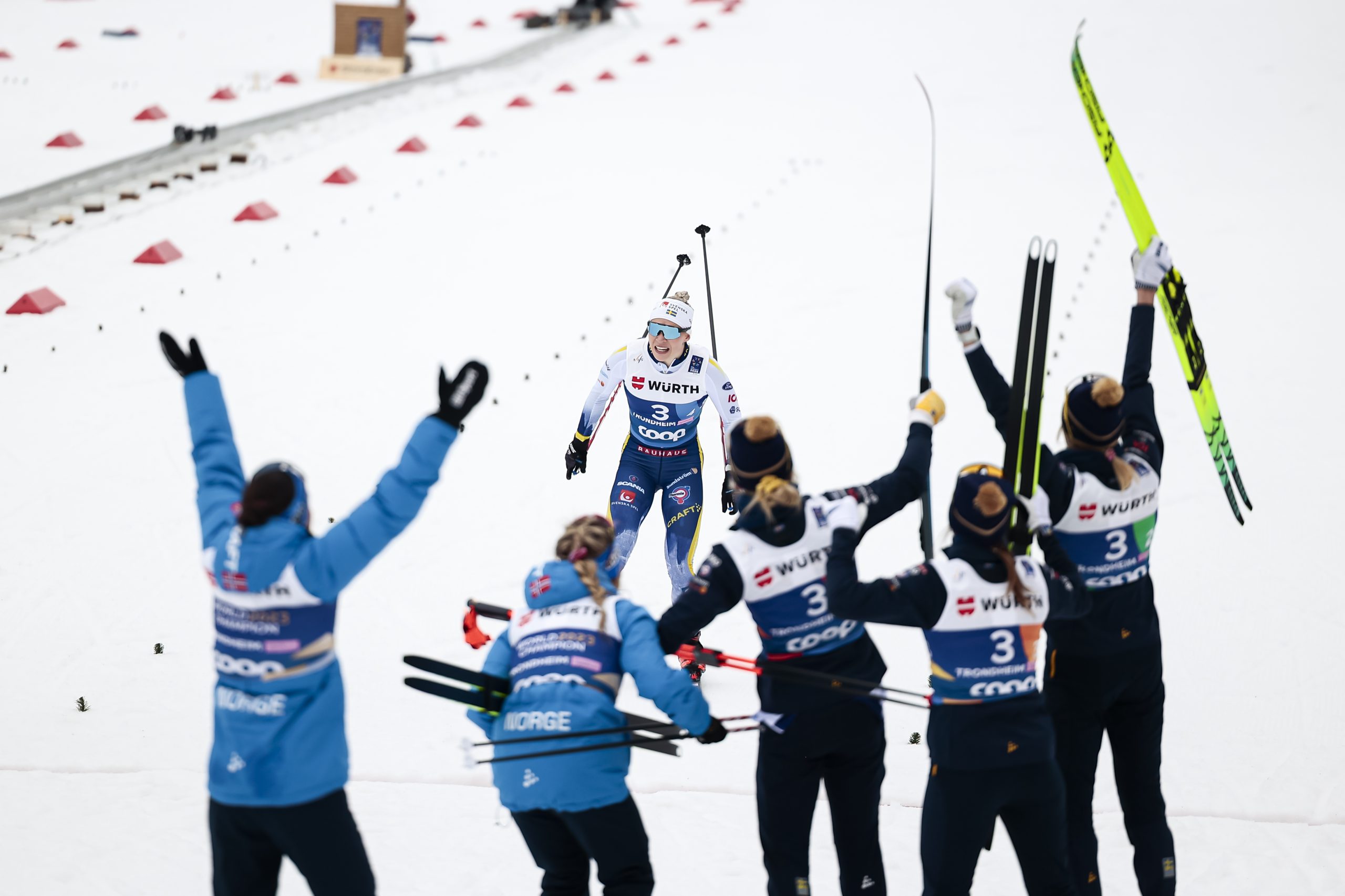
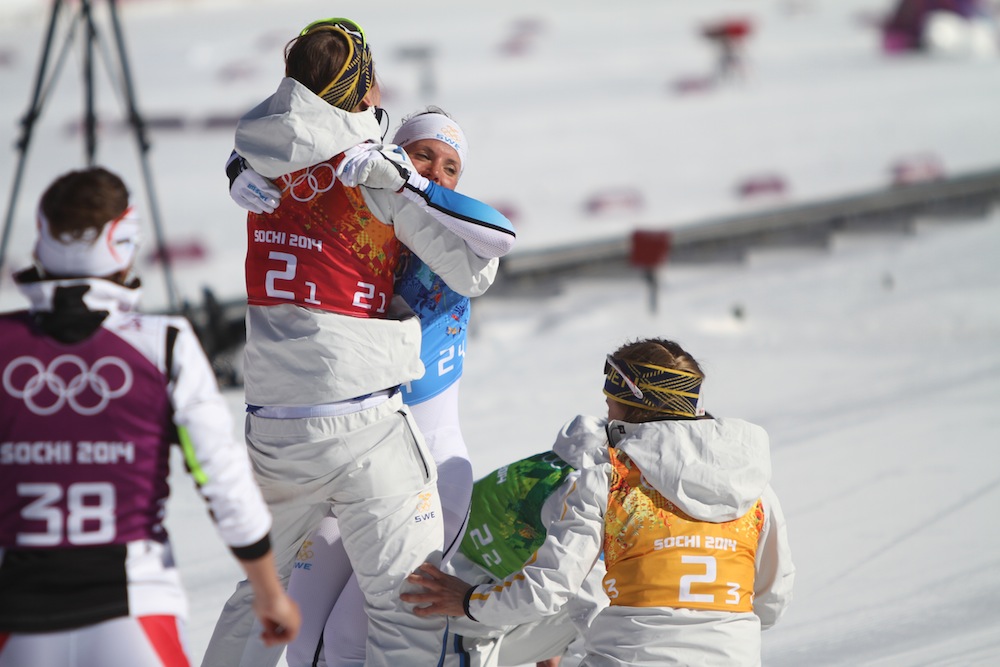
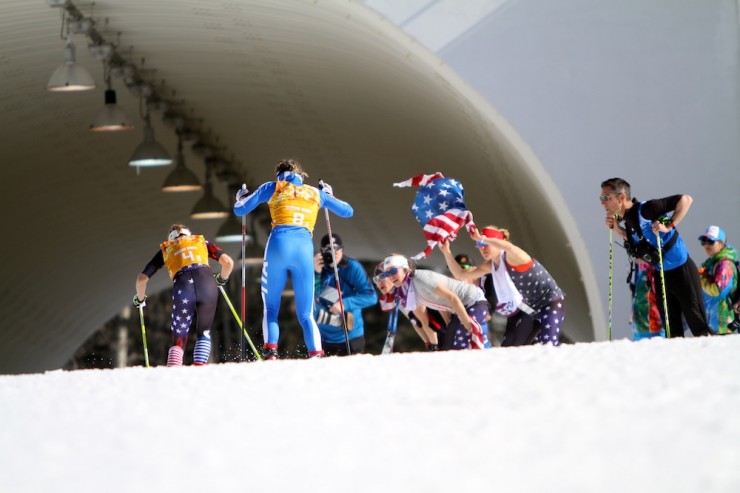
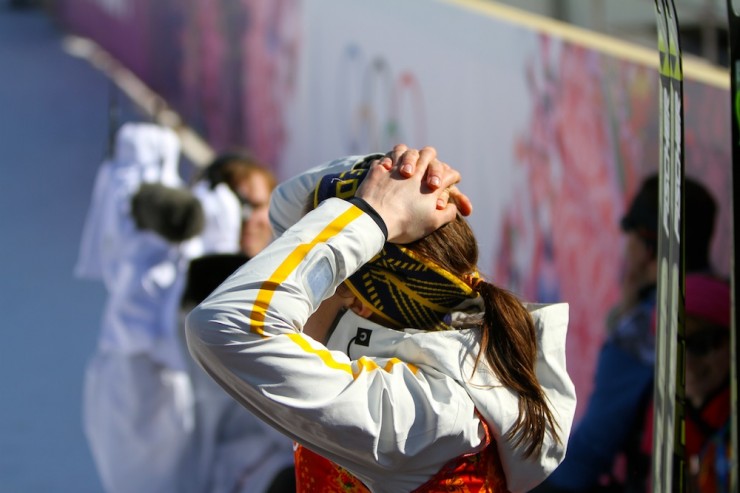
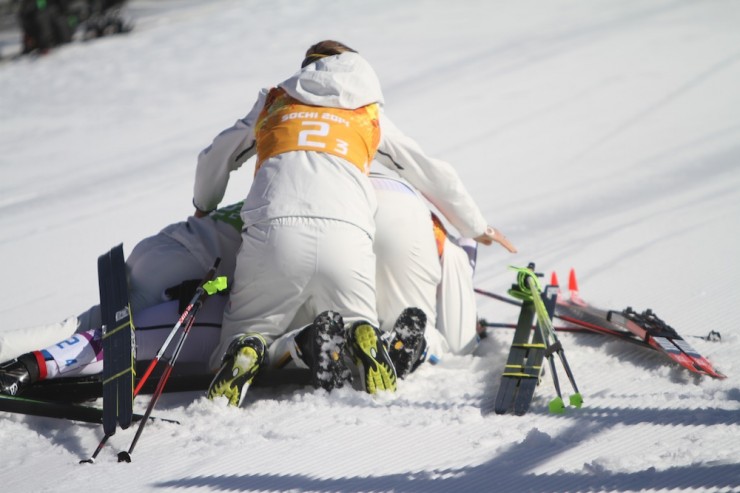
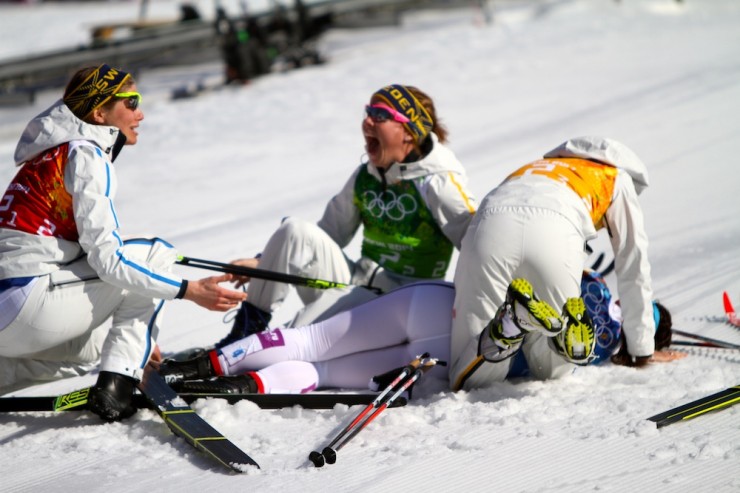
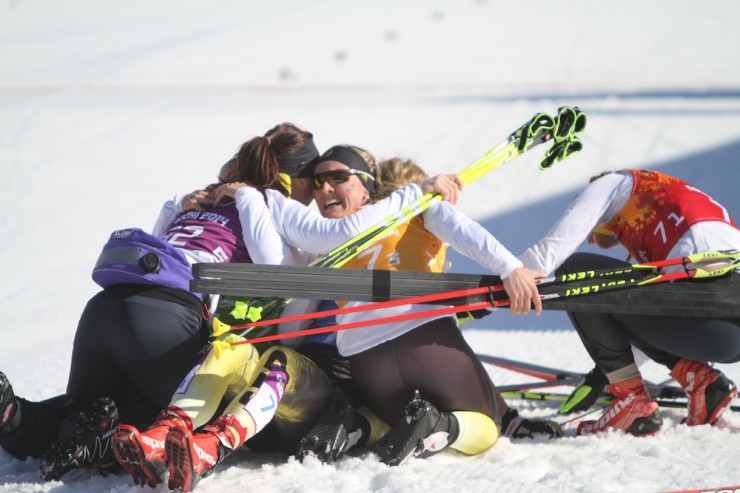
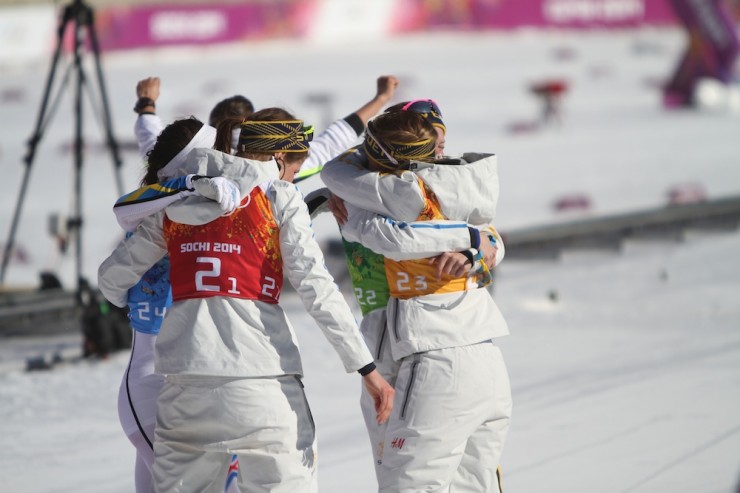
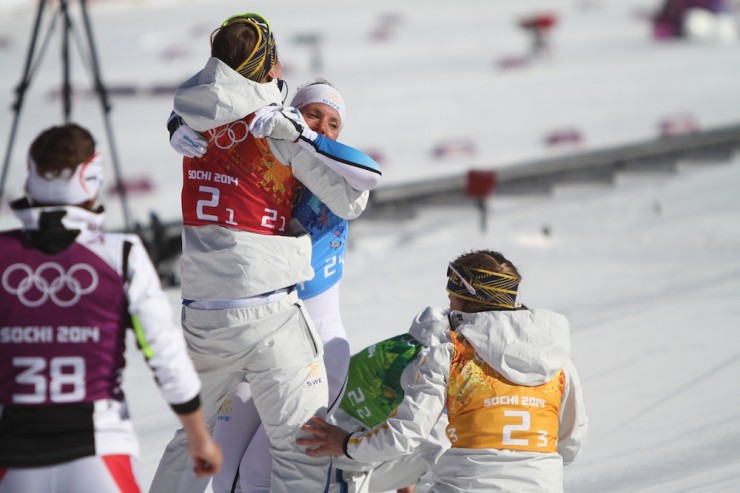
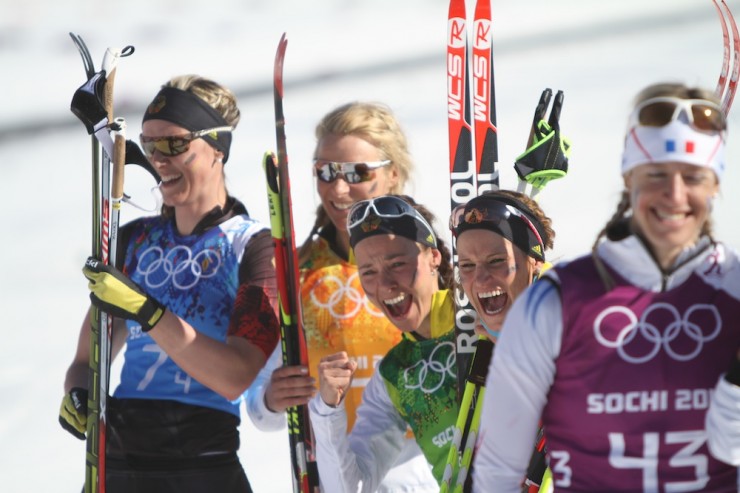
Slind, at lower left, celebrates her Olympic relay medal with, in clockwise order, Heidi Weng, Karoline Simpson-Larsen and Kristin Austgulen Fosnaes. (Federica Vanzetta/NordicFocus)
“It’s kind of crazy to say, but it’s actually been a dream for 30 years,” she said. “And it’s something I’ve given up on during the way there — and then started to believe again.”
She added: “It’s nice to finally make it.”
Not a top prospect
Cross-country skiers can be competitive into their late 30s, but few of them stay in the sport that long. In Thursday’s freestyle race, Slind was the oldest competitor, and one of just two of the 111 athletes who was born in the 1980s.
Slind grew up in the village of Oppdal in Central Norway, in a family of skiers. Her father, Peder Einar Slind, is a ski coach who once spent a year in Western Massachusetts on an exchange with a collegiate cross-country ski coach there.
Astrid also has two ski racing sisters: a younger one, Kari, and a twin, Silje.
Both still compete at a high level on European circuits. Kari, in fact, had the first breakthrough at the international level, nearly landing on the World Cup podium in her mid-20s. Experts thought she would be “the biggest of them,” said Birger Lofaldli, a reporter at Adresseavisen, the Slinds’ local newspaper.
In this archival photo, Kari Øyre Slind, center, poses with American skier Jessie Diggins and Slind’s friend Ragnhild Haga after a strength training session in Norway years ago. (Roar Hjelmeset)
“But Astrid came back,” Lofaldli said. “And now she’s greater than ever.”
Astrid did not grow up as a top prospect.
Unlike Kari, she never qualified to represent Norway at the World Championships for juniors, a proving ground for young athletes.
But Astrid was always skiing, she said in an interview in November. Her father would take the sisters out to play on skis; the twins were always pushing each other, with Kari “chasing us behind,” Astrid said.
At three years old, she added, the twins were “crying ourselves in” to local club races in Oppdal, where their parents initially didn’t want them to compete.
“Silje and I really wanted to go,” Astrid said. “From that day, we’ve just been skiing as long as the snow is out, and loving it.”
‘Crazy training’ with a new coach
After failing to break into Norway’s national team and the top-level World Cup circuit in her 20s, Slind spent years racing on a tour called the Ski Classics. The circuit features distance races as long as 90 kilometers, or 56 miles.
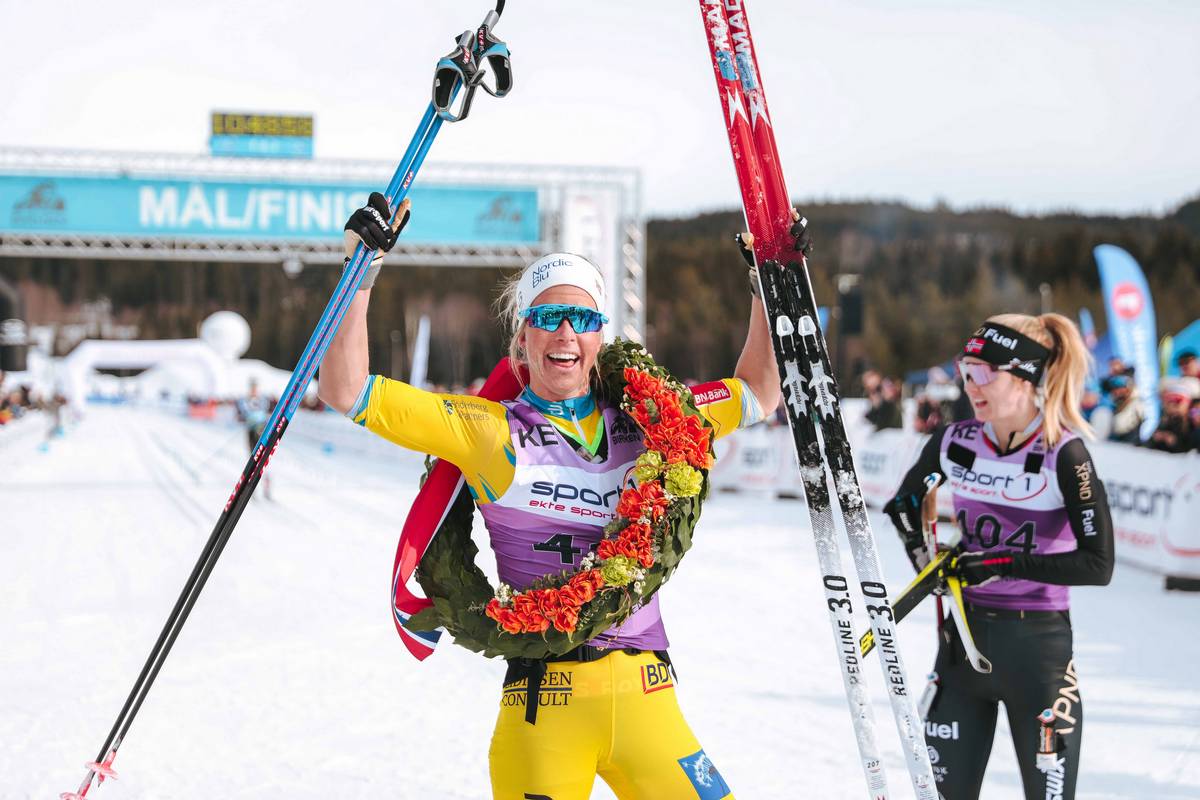
Slind celebrates winning the Birkebeiner, a long-distance race that finishes in Lillehammer, Norway. (Federico Modica/NordicFocus)
She had her ups and downs there, too. In one especially tough year, Slind said, she had trained too much — so much, that she could barely race — and was again thinking about quitting the sport.
Instead, she started talking about her problems with a teammate, Chris Jespersen, another Norwegian who was a few years older and had also struggled to stay at the highest level of the sport.
“He was like, ‘You know what? I really think I can make a good skier out of you — I’ve made all the mistakes myself. I can see what you’re doing. Let’s try to figure it out together,’” Slind said.
Jespersen, at the time, was not a coach, just an “athlete who had ideas,” Slind said.
But at that point, Slind said, she had nothing to lose, so the two started working together. They made a deal: When they disagreed — if Slind, for example, wanted to push herself to do more training but Jespersen thought it was too much — Jespersen would get the last word.
It turned out that Jespersen had a knack for explaining what Slind needed to do differently with her ski technique, in a way that she could understand. He was also a good check on what Slind describes as her impulse to do “crazy training” — things like a six-hour session of skiing with the arms-only double pole technique, with hard intervals in the middle of it, or workouts where she’d try to keep up with her team’s strongest men.
Slind had done more of those kinds of sessions as she moved into the Ski Classics circuit, where she discovered that she “needs a lot of training to be at a good enough level.”
“I think it was what put a spark in my skiing again,” she said.
But Jespersen, she added, helped rein her in when the crazy training got a little too crazy.
“He wasn’t too eager, and he wasn’t too defensive,” she said. “It was kind of the perfect balance for me.”
A breakthrough, and medals
Slind’s breakthrough came in the winter of 2022-2023, when she finally qualified to return to the World Cup circuit after a nearly nine-year absence.
Two months into the season, after nine races, Slind stood on the podium for the first time. Later that season, she won a bronze medal at the World Championships in the skiathlon, and a gold medal with Norway’s relay team.
Still, it hasn’t always been easy since then.
Last season, she raced at what was effectively a home World Championships, in the city of Trondheim just a two-hour drive from her hometown. Amid challenging snow conditions and constant rain, her results were disastrous, including a mishap with a ski during the skiathlon, and she finished with no individual medals — just a silver from the relay.
Then, at the Olympics this year, she was oh-so-close to a medal in the 10-kilometer freestyle race in fourth, just 3.3 seconds behind bronze medal-winner Jessie Diggins of the U.S.
Slind was also painfully close in her first Olympic race, the skiathlon, where she was skiing in medal position before being overtaken by a teammate and ultimately fading to eighth.
“I completely died out there,” Slind said in an interview afterward. “I’m not a good enough skier today.”
In Sunday’s relay, though, Slind was one of the strongest athletes in the race, putting pressure on the Swedish star Ebba Andersson, who ultimately crashed twice and cost her team the gold medal.
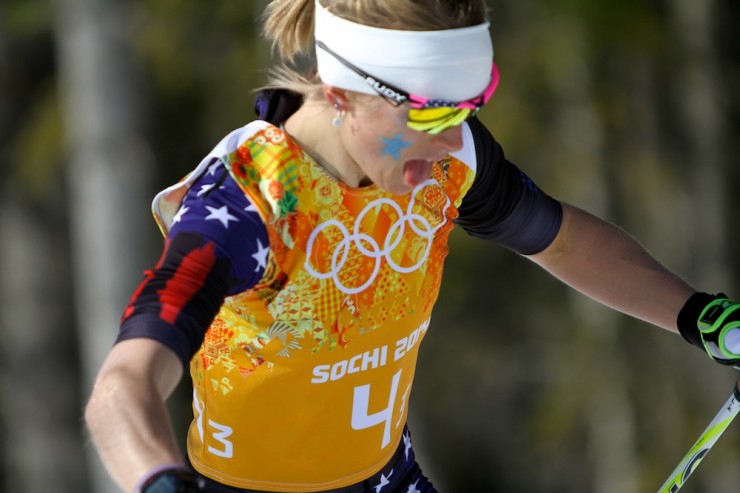
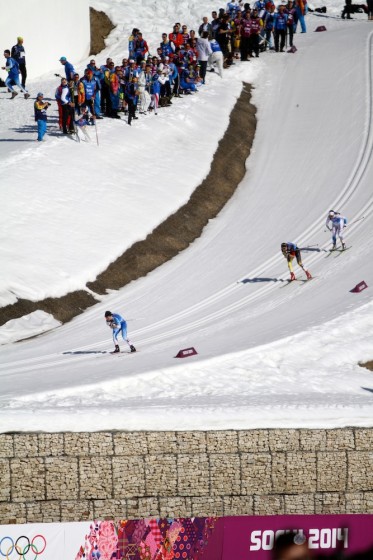
Slind leads the Olympic relay on Saturday. (Nathaniel Herz/FasterSkier)
The performance caps a storybook turnaround — one so improbable that Slind probably wouldn’t have believed it herself, said Jostein Vinjerui, a Norwegian coach who works with Slind’s club team, Aker Dæhlie.
“If you’d have asked her during the Beijing Olympics, four years ago, if she’d be able to do the Olympics in four years time, I think she would have laughed, I’m pretty sure,” Vinjerui said. “It’s just an amazing story, being 38 years old now and winning a first gold medal.”
More Olympic medals are possible for Slind: The Norwegian coaches have named her to the two-person team sprint squad, and she and Julie Bjervig Drivenes will be podium contenders in the event Wednesday. Slind is also expected to vie for medals Sunday in the longest race of the Games, the 50-kilometer competition in the classical technique.
After the relay gold, Slind said at the news conference that she’s good at turning depressing results into motivation for the next event.
“Maybe the two other races just made me more on fire for today, and really wanting to show what I’m good for,” she said. “And I will take that with me into the 50 k.”
Help Support Our Olympic Coverage!
FasterSkier will have our own Nat Herz on the ground at the Olympics, which, to be honest, is a very big financial lift for us. If you value the thoughtful work and access FasterSkier provides at championships like this one, please consider becoming a Voluntary Subscriber. Your support directly fuels the work we do to cover the people, places, and moments that make our sport special.
Devon and Nat return to recap a surprisingly lively women’s relay as the weather continues cooperating. And we preview Saturday’s men’s 50-kilometer race.
A full week into World Championships and we’re starting to get a little punchy, but keep the emails coming. We’ll be back tomorrow. We’re at devon@fasterskier.com and nat@fasterskier.com.
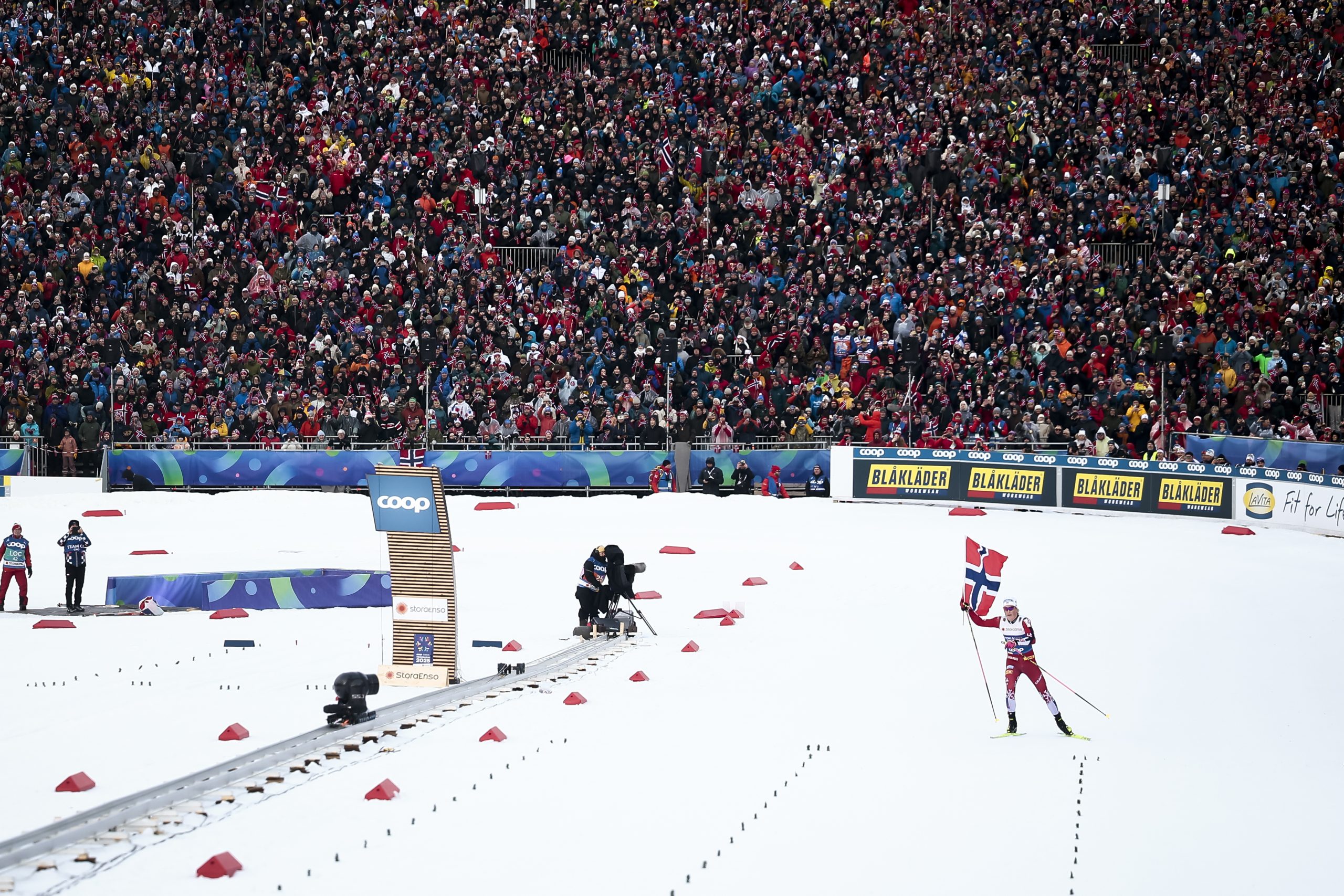
The Norwegian and Swedish teams cheer their anchor legs into the homestretch. (Federico Modica/Nordic Focus)
Phew. Trondheim finally got a break from the relentless precipitation that’s afflicted us for the past week, and take our word for it: We’re grateful.
Devon and Nat are back from the hotel to recap Thursday’s men’s relay and preview the women’s race. Nat says he’s sorry for snacking on the air, but not that sorry, because a guy’s gotta eat. Send complaints to devon@fasterskier.com. We’ll be back tomorrow.
Canada threw down an impressive fifth place finish in Friday’s men’s 4×10 k relay, finishing just seconds from the medals. We caught up with the team afterwards in the mixed zone — here are our interviews with, in order, Tony Cyr, Graham Ritchie and Olivier Leveille. (We interviewed scramble leg skier Xavier McKeever earlier in the day, which is why he’s not featured in this clip.)
We’ll be back tonight with a recap of the women’s 30 k. Stay with us. You can reach us at devon@fasterskier.com and nat@fasterskier.com.
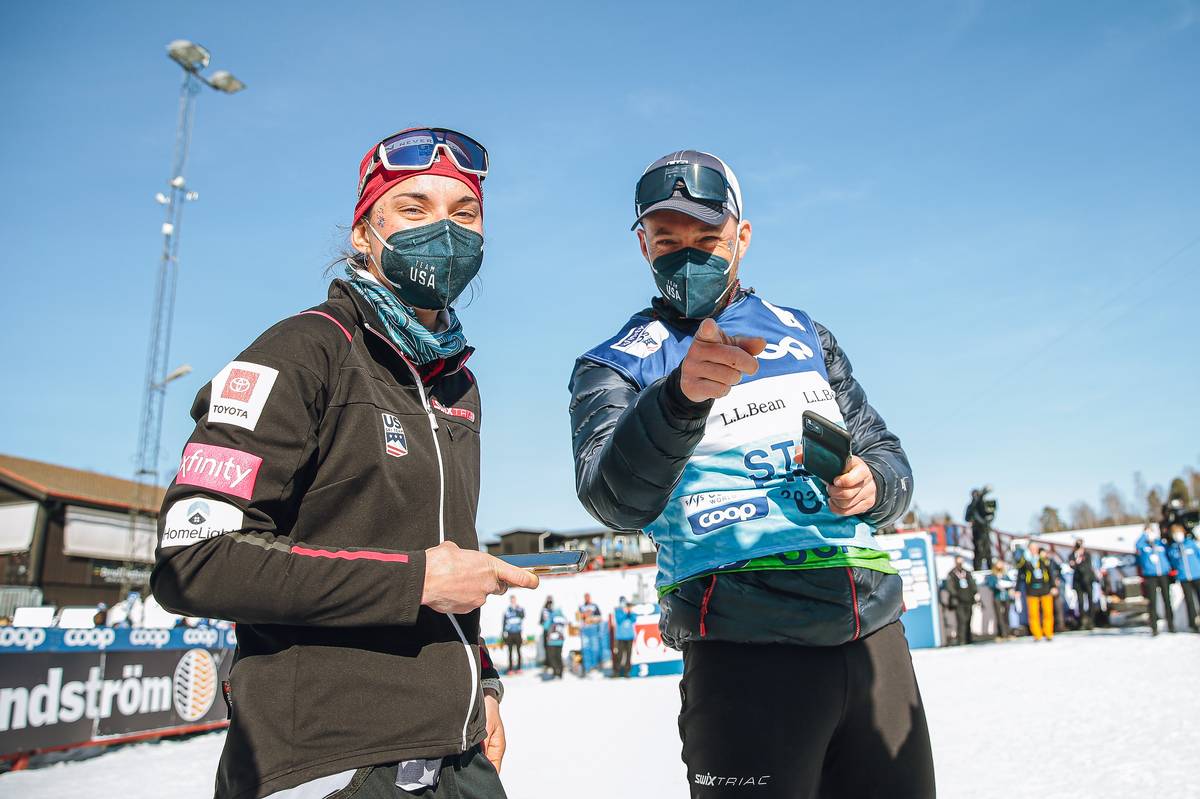
Julia Kern and US Ski Team head coach Matt Whitcomb watch the 4 x 5 k relay from the stadium. (Photo: NordicFocus)
This World Cup coverage is made possible through the generous support of Marty and Kathy Hall and the A Hall Mark of Excellence Award. To learn more about A Hall Mark of Excellence Award or to learn how you can support FasterSkier’s coverage pleasecontact info@fasterskier.com.
While it was perhaps not the final event originally planned for the season, today’s 4 x 5-kilometer freestyle mixed relay in Falun, Sweden shaped up to be quite a way to go out. Particularly for Team USA, who broke away in the final lap to take the win in 42:01.8.
With Rosie Brennan scrambling to tag Zak Ketterson for the second leg, Scott Patterson skating third, and Jessie Diggins anchor, it was a team composed of four skiers who had all raced into the top-15 in yesterday’s 10/15 k skate, three within the top-eight. Perhaps the only team more loaded was Norway 1, which featured Heidi Weng, Hans Christer Holund, Didrik Tønseth, and Therese Johaug, all of whom placed in the top-five yesterday, including both of the day’s winners in the final two relay spots. Also a force, Finland I consisted of three Olympic medalists, one of whom is the 2022 men’s World Cup distance champion with the lineup: Kerttu Niskanen, Perttu Hyvarinen, Iivo Niskanen, and Krista Pärmäkoski.
Each nation was allowed two teams, allowing the US to start a second lineup of Julia Kern, Logan Hanneman, Adam Martin, and Caitlin Patterson. Canada raced one team, which included Katherine Stewart-Jones, Antoine Cyr, Philippe Boucher, and Jasmine Drolet, racing in that order.
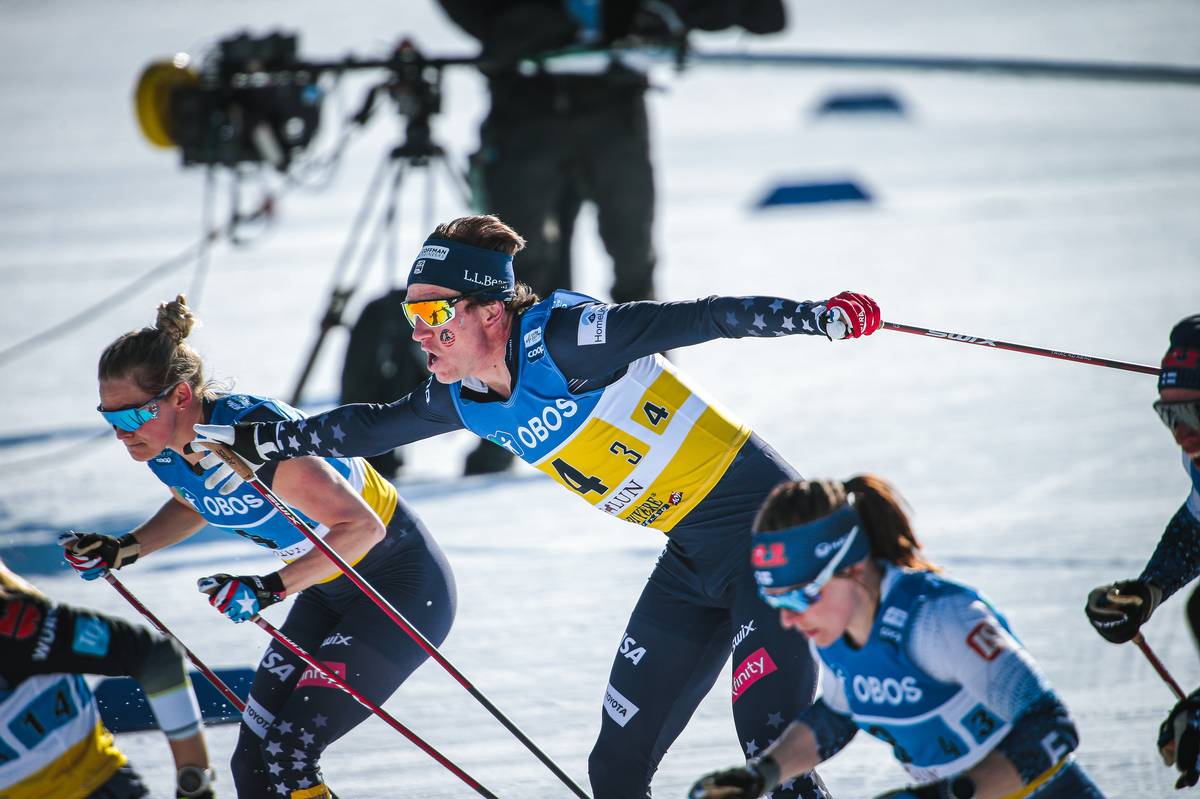
Stars and stripes at the front, as Julia Kern scrambles for USA II in Falun’s mixed relay. (Photo: NordicFocus)
New to the World Cup, the mixed relay is modeled after the biathlon competition format, which debuted in 2005. It had originally been slotted onto the calendar for the Canmore World Cup events in March 2020, which were canceled as COVID-19 began to spread around the globe. It had been tested on the tracks in Falun during the 2021 Swedish senior national championships, with local club leader Johan Eriksson saying afterward, “Team cohesion was strengthened when ladies and gentlemen fought against the same goal line. At the same time, the entertainment was great with reversals in the result lists and tactical moves in team line-ups.”
The entertainment value was certainly high today, particularly for American ski fans. Racing a distance now only seen in relays, it would be a painful blend of sprinting and distance. And the Americans would be lucky to have a woman anchoring the team who has previously been described as the “Queen of the 5 k skate”.
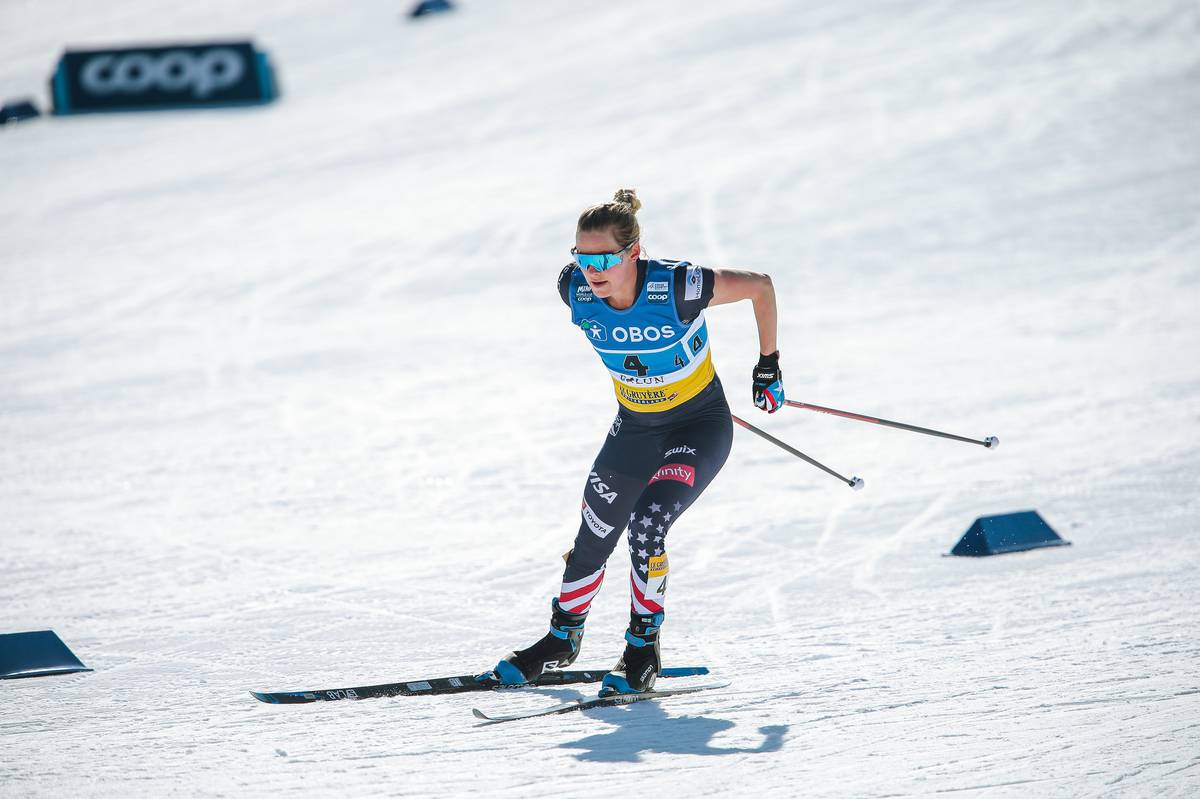
Rosie Brennan scrambles for USA I during the inaugural World Cup 4 x 5 k mixed relay in Falun. (Photo: NordicFocus)
As expected, the pace was high from the start, as the Star Wars theme blared through the stadium loud-speakers. Up for the task at hand, Brennan went toe-to-toe with the other women at the front through two 2.5 k laps. Later describing the event as “fast and furious”, Brennan kept USA I within the lead group, Kern duking it out on USA II alongside through the first lap.
“I think our goal today was to stay out of trouble and stay in the pack, and then let Diggy do her thing that she does best,” Rosie told FIS post-race with a laugh. “And that worked out really well.”
Brennan handed off to Ketterson at the first exchange, in line with Germany I, Norway I, and Sweden I, Finland I just behind.
Though new to the World Cup this season, Team Birkie’s Ketterson has consistently shown his range. Domestically, he won three SuperTour sprints, and stood on the podium in four distance races, one of which was also a win. He chiseled away at the World Cup puzzle, finishing just outside the top-30 during the Tour de Ski, and returning following the Olympic break to place 41st in Lahti’s distance classic race and at the 50 k classic at Holmenkollen. Smashing a 15th place finish in yesterday’s 15 k free, Falun has been a breakthrough weekend.
Though 5 k is not a distance men traditionally race on the World Cup, Ketterson emailed post-race that the event felt familiar and reminiscent of his early days in the sport.
“I am a huge fan of the 5 k race distance as I spent four years in Minnesota high school races doing that distance multiple times a week in the winter. Today brought me back to those days! It was super chaotic pack skiing but I felt really strong the whole time and did my best to keep up with the leaders. Honestly, when Jessie is your anchor, you don’t really have to worry too much about the rest!”
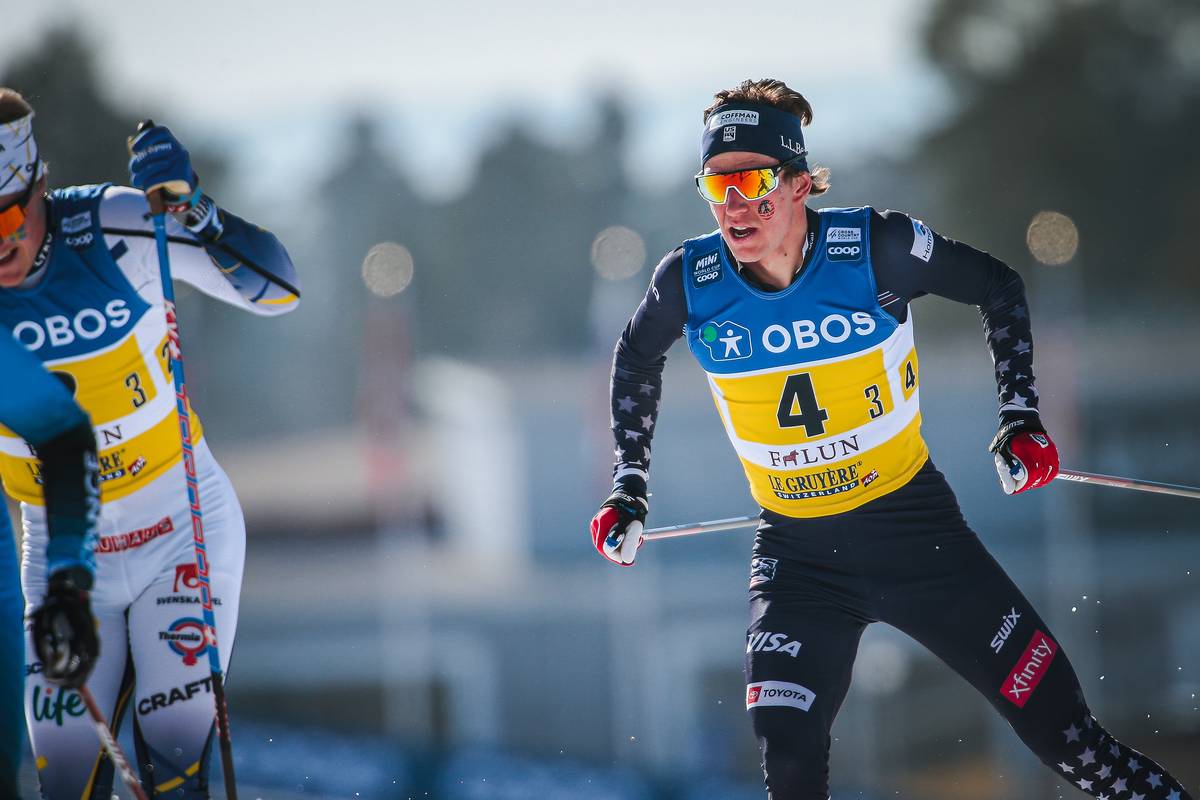
Zak Ketterson tags Scott Patterson during the 4 x 5 k mixed relay in Falun. (Photo: NordicFocus)
On lightning fast tracks with matching skis, Ketterson skied smoothly within the large lead group, keeping USA I within contact of the leaders, while Sjur Røthe tried to crack open pack for Norway II. Tagging Patterson roughly four seconds back, USA I sat in 10th, alongside Canada, at the second exchange. USA II tagged in 14th, +34 seconds back.
Still a large and dense group of front runners, Patterson worked at the back of the lead group to minimize further time losses, keeping his team within reach of the podium. With both Norwegian teams at the front in the second lap, Patterson whittled down the American’s time back, tagging Diggins 2.2 seconds behind the leaders to “do her thing” over two 2.5 k laps. Canada had lost contact with the front group, sitting in 11th (+17.9), while USA II tagged following a gap in 15th (+1:14.5).
“My goal was to hang on with the pack early and get in the groove, then try to match accelerations later,” Patterson wrote after the race. “I knew I wasn’t going to be the one with super accelerations but could sprint the whole way. During the race I was thinking ‘Just hold on’, so Jessie could work her magic relay anchoring skills. There were a few moments where some gaps formed but I barely managed to cling on.”
Scott Patterson races the third leg for USA I in Falun. (Photo: NordicFocus)Scott Patterson makes the final tag to Jessie Diggins during the 4 x 5 k mixed relay in Falun. (Photo: NordicFocus)
Diggins quickly got to work. Halfway through the first lap, it was Diggins marking Johaug at the front, with Krista Pärmäkoski for Finland I and Victoria Carl for Germany I tucked into their wake. Recall that Carl had anchored the German relay team for an Olympic silver medal in Zhangjiakou just a few weeks ago.
Skis ripping on the downhill, Diggins moved to the front to lap through the stadium 1.4 seconds ahead of Finland I and Norway I, Frida Karlsson for Sweden I challenging Germany’s Carl just behind.
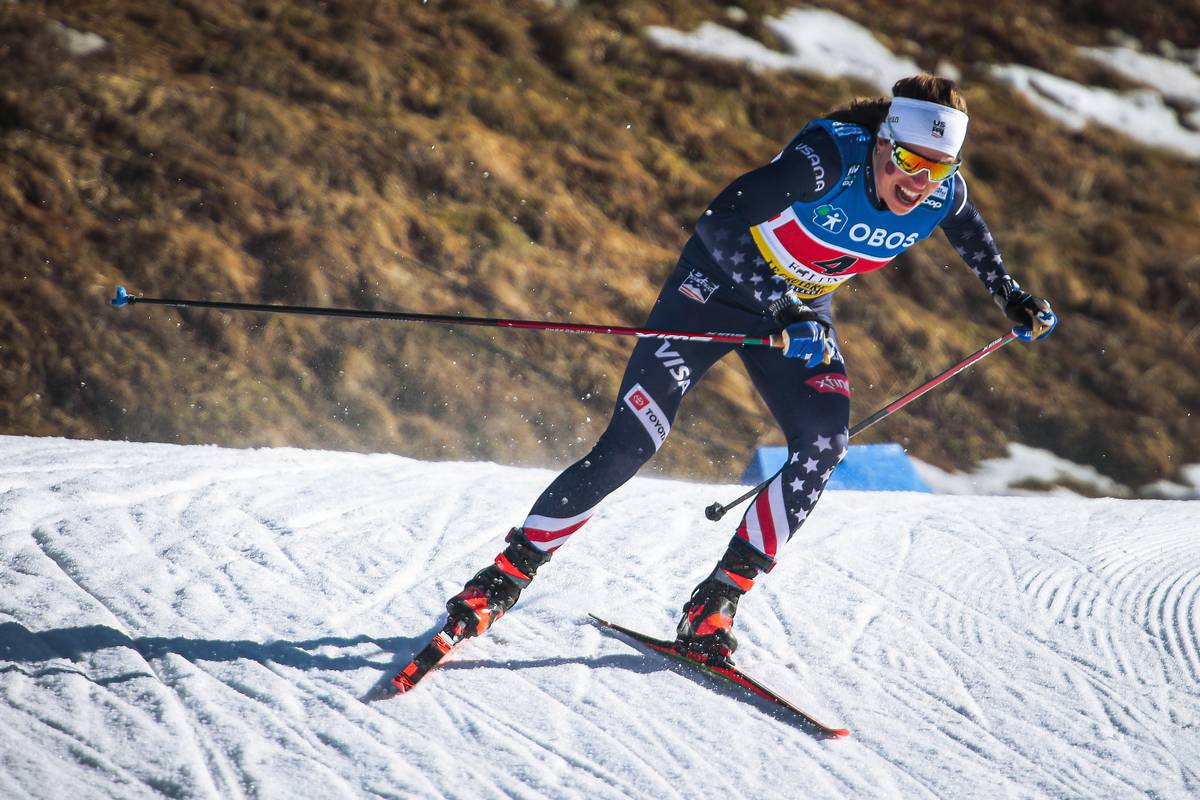
Jessie Diggins brings USA 1 through the stadium in the lead after her first lap. (Photo: NordicFocus)
Diggins worked patiently up the climb, once more tucking behind the rapid fire tempo of Johaug on the uphill, and tucking calmly into the draft of the Norwegian and Finn heading into the descent. Diggins hit the second climb hard as the three women hop-skated up and over. Among the best descenders on the World Cup, Diggins skis were only fueling the fire, allowing her to maintain her lead in the rolling last kilometer and into the stadium which erupted with noise from the packed sidelines.
Rounding the final bend with a clear shot to victory, Diggins took a few tuck skate pushes before powering in V2 across the line with a fist pump and loud cheer, and maybe an expletive, before collapsing onto all fours surrounded by her ecstatic teammates.
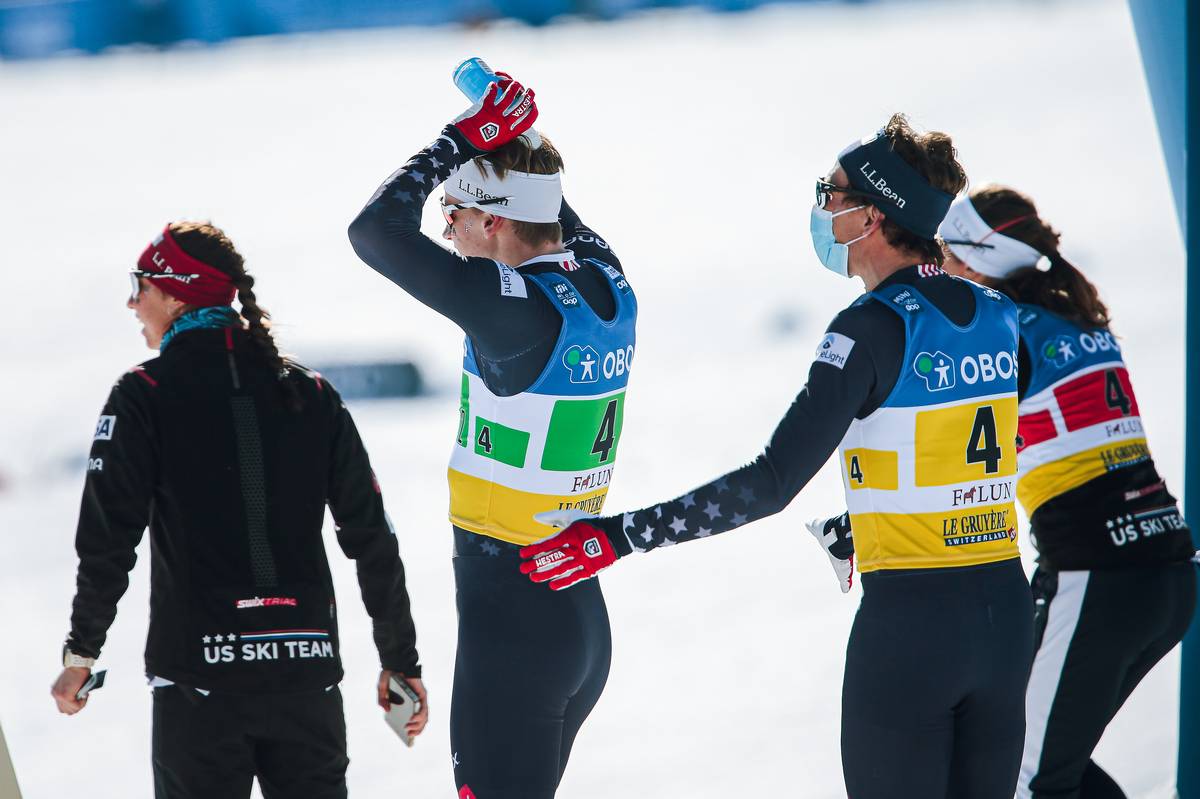
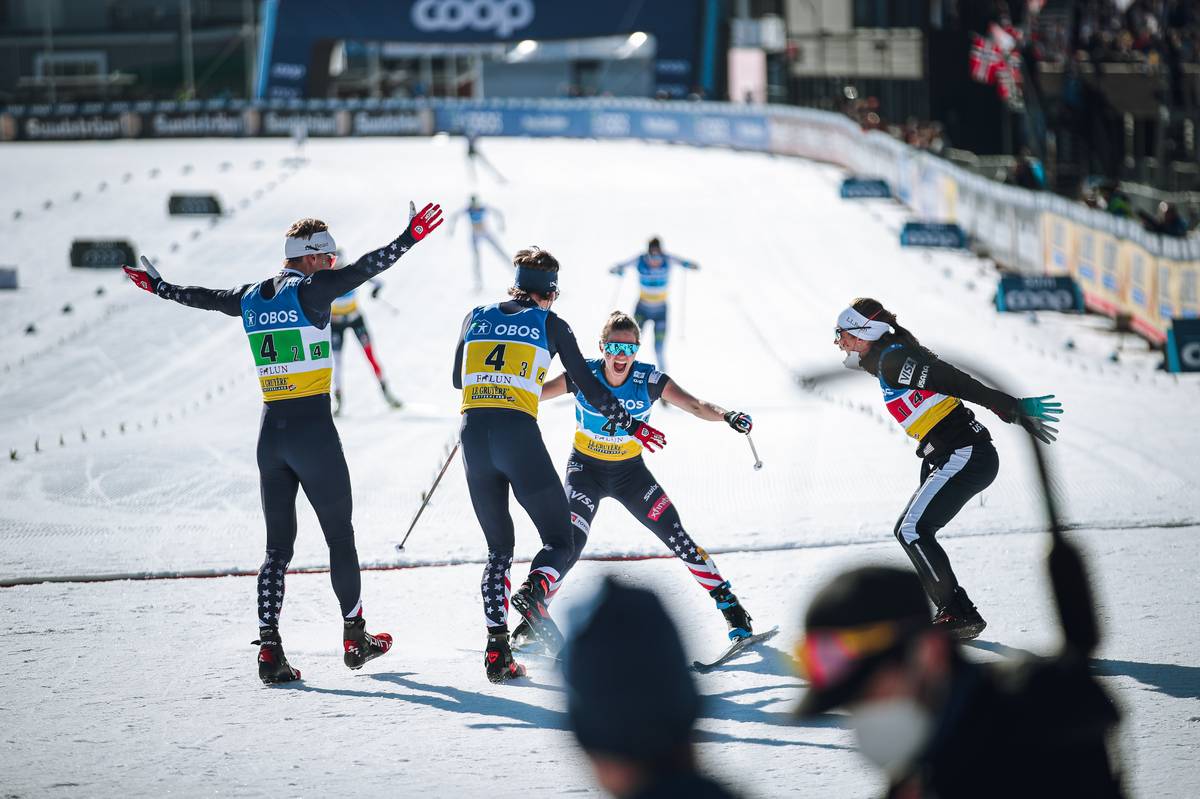
Nerves run high as the American team waits for Jessie Diggins at the finish of the 4 x 5 k mixed relay in Falun. (Photo: NordicFocus)USA I celebrates victory as Jessie Diggins crosses the finish of the 4 x 5 k mixed relay. (Photo: NordicFocus)
Outsprinting the World Cup distance champion, Pärmäkoski edged out Johaug to bring Finland I to the line in second (+3.8), leaving Norway I just 0.5 seconds behind in third. Having strung out over the last lap, Sweden I took fourth (+9.1), with Germany I fifth following another gap (+16.2).
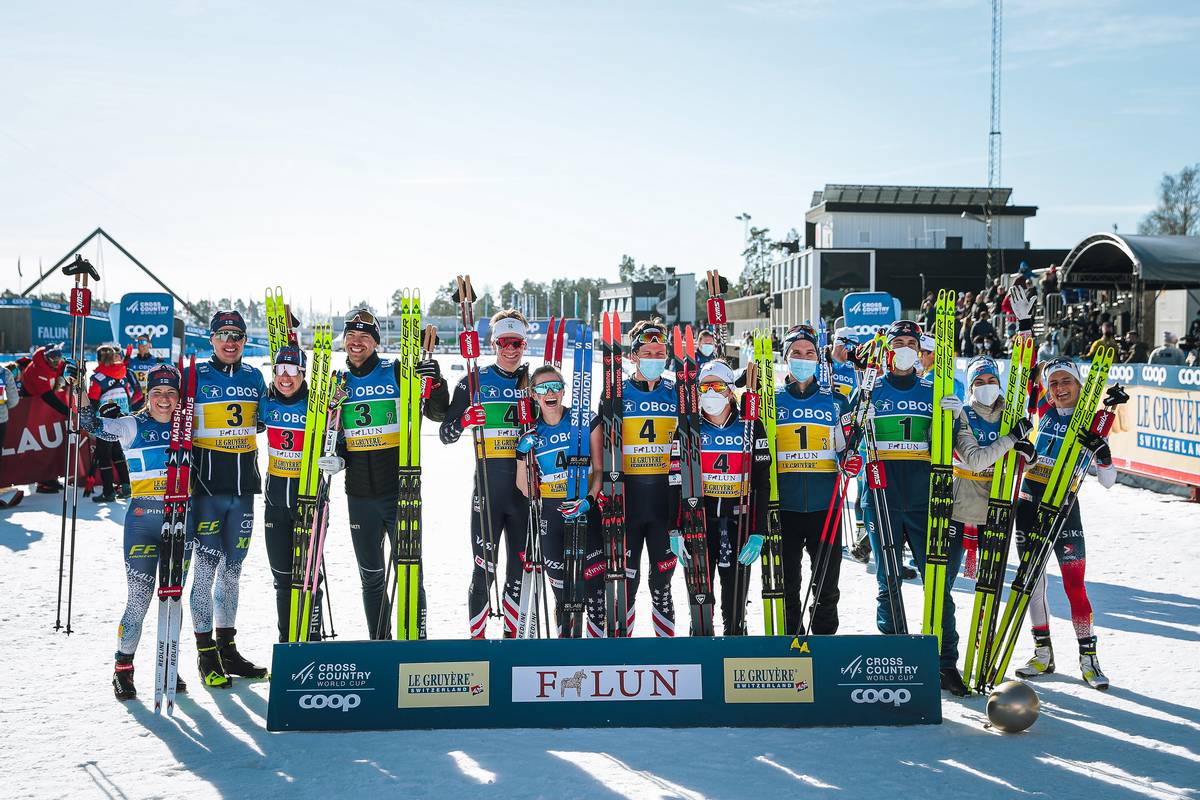
A packed podium for the 4 x 5 k mixed relay in Falun. USA I took the win ahead of Finland I and Norway I. (Photo: NordicFocus)
Describing the experience of winning the mixed relay on the final day of World Cup racing, Diggins told FIS with a laugh, “[It] feels like champagne getting sprayed on you.”
Surrounded by her teammates, she continued, “That was so, so fun. We really pulled together as a team. We live together as a team for four months on the road, so it’s pretty cool to get to end the season racing for each other. I’m so proud of these guys, so I was feeling pretty inspired.”
Jessie Diggins helps USA I to the mixed relay win in Falun. (Photo: NordicFocus)
Later sharing her strategy in a post-race audio clip as the remainder of the team packed their bags to begin travel home tomorrow, Diggins discussed her strategy as anchor, adding how the rockets under her feet allowed the race to unfold somewhat differently than she anticipated.
“I knew that those downhill working corners were one of my strengths, so I knew that if I got to the top of that big sprint climb first, then I could ski all the other downhills how I want and have a good shot at setting up a finishing sprint. As it turned out, we had such great skis that I didn’t need that finishing sprint, but it was so fun to go ski that as hard as I could. Again, I’m just so proud of the team. It was so special and fun to share that with everyone, and I can’t think of a more perfect way to end a really awesome year.”
Full post-race audio clip from Jessie Diggins:
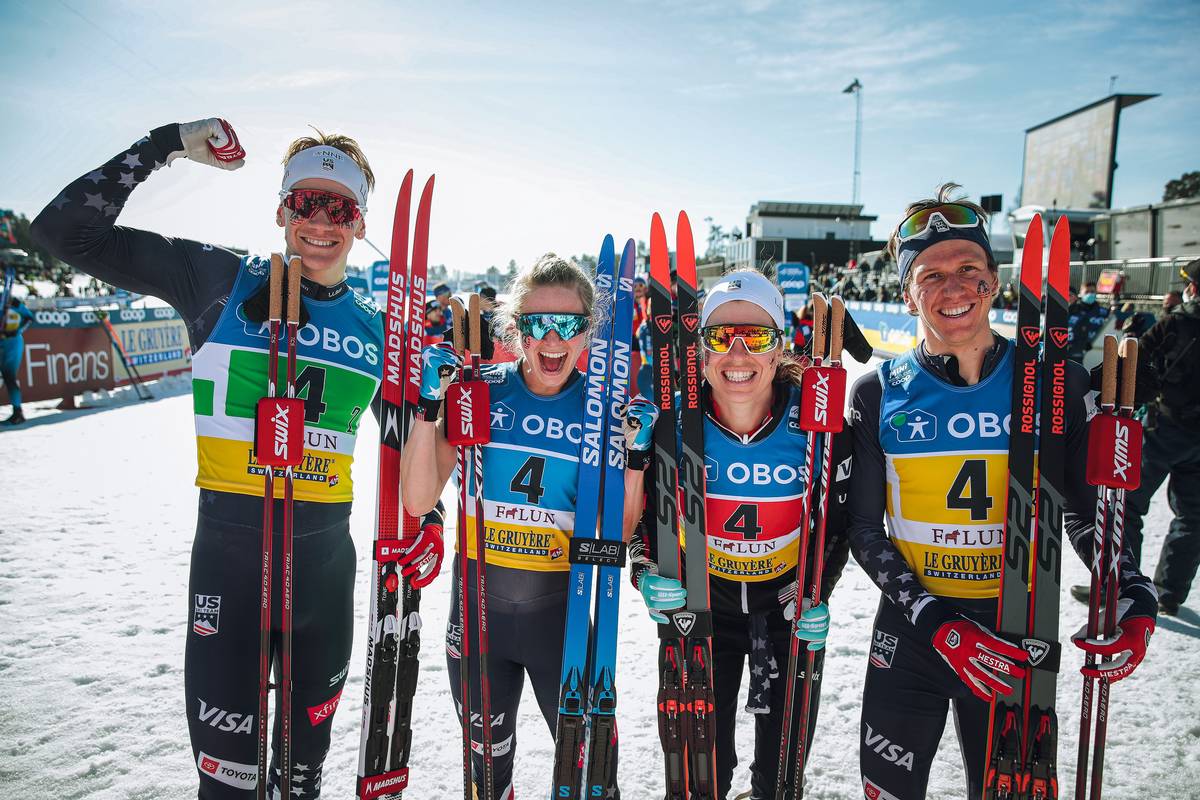
USA I ends the season on top in the 4 x 5 k relay. From left to right, Zak Ketterson, Jessie Diggins, Rosie Brennan, and Scott Patterson. (Photo: NordicFocus)
“What a way to close out the World Cup season!!!!!” Brennan emphasized in an email. “After Scott and Zak had great days yesterday, I felt that we definitely had a chance, but I was not expecting a victory like that! It was fast and tactical racing out there and in the scramble leg, I wanted to stay near the front of the pack and stay out of trouble. I found myself further back in the pack than I wanted on the 2nd lap, but also knew a fall or broken pole would cost us so I tried to be patient, calm and tag off in the pack. Zak, Scott and I had the same strategy and Scott made a great move to get ahead of a split in the pack to tag Jessie in a great place. Jessie skied an insane leg and I feel lucky to have her as a teammate!”
Echoing her sentiments to conclude his post-race email from the road, Patterson added, “It’s really cool to win the last World Cup and especially awesome to be part of the team. The mixed gender event was extra special as the guys were finally able to tap into the relay energy the women have cultivated over many years.”
Canada’s anchor Jasmine Drolet receives a tag from Philippe Boucher during Falun’s mixed relay. (Photo: NordicFocus)Adam Martin tags his Craftsbury teammate Caitlin Patterson, who raced the anchor leg for USA II. (Photo: NordicFocus)
Losing contact over the third and fourth legs, consequently racing alone, Canada ended the day in 12th (+1:45.2), while USA II pushed alongside Finland II through its final lap. Edged out in the final sprint, Katri Lylynpera (FIN) snuck her boot over the line ahead of Caitlin Patterson’s, leaving USA II in 14th (+2:10.9).
Celebrations fed by cheering crowds, energy was high throughout the stadium. Regardless of finish order, acts of camaraderie and sportsmanship could be seen and heard as cameras meandered through the groups of athletes waiting for their relay teammates. We could hear a Frenchman congratulate Norway’s Tønseth on ending his season with an individual win, Ketterson and Kern anxiously trying to predict what might happen in the American’s final legs, along with a host of supportive cheers as teammates and coaches egged on the racers.
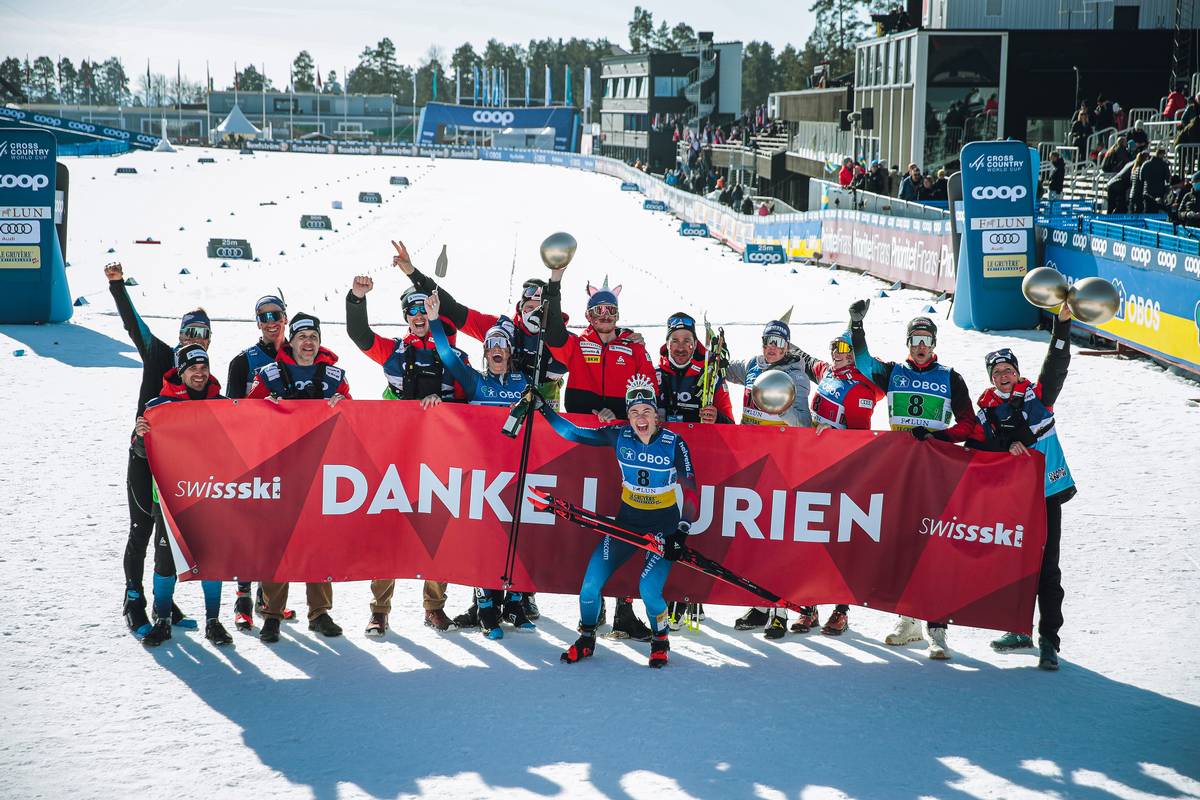
Awaiting the Swiss anchor Laurien Van der Graaff was a princess tiara, teammates in golden unicorn horns, and a large banner that read “Danke Laurien”, in celebration of her retirement. The 34-year-old has long been a presence on the World Cup, collecting a slew of podiums and a World Championship team sprint silver medal along the way.
The Swiss program celebrates the retirement of Laurien Van der Graaff at the finish of the 4 x 5 k mixed relay in Falun. (Photo: NordicFocus)
With revelry and thrill in the air, only the mixed team sprint remained on deck as the 2021/22 World Cup season drew to a close in Falun. The American program did not enter the team sprint competition, and will next compete as a team at the Whistler Olympic Park in British Columbia March 20th – 27th. The event will serve as both the Canadian National Championship and SuperTour Finals.
Sydney Palmer-Leger skiing the scramble leg for the American women’s relay team. (Photo: Doug Stephen)
Editor’s note: FasterSkier’s initial coverage of the women’s relay at this year’s FIS Nordic Junior World Championships in Oberwiesenthal, Germany, gave just the facts: The American women, fourth in this event a year before, skied their way up to second this year. This was entirely true, but didn’t get at the whole story. FasterSkier analyst Devon Kershaw, in a podcast shared later that day, hinted at some of the madness behind these facts, proclaiming early in the podcast, “This was a hell of a day. … You had so much weird stuff happening.” (Kershaw’s podcast speaks at some length about what appears to have happened on course.) Now, longtime American race official John Estle, who was on-site for the relay, provides a postmortem of the relay, focusing on lessons to be learned by organizers, officials, coaches, and skiers moving forward.
What follows is a postmortem of the women’s 4 x 3.3 k relay at Junior World Championships in Oberwiesenthal. Several mistakes were made as it relates to the race. The worst outcome was that two of the leading teams were disqualified for skiing off course. There’s an oft- but incorrectly-quoted rule that goes something like this: “It’s the skier’s responsibility to know the course.” In some ways this is true. Sport should promote self-responsibility and independence. Yet, those involved with race organization should also be setting athletes up for success. That can mean many things. At its most fundamental, it means setting courses that minimize the possibility for skier error while racing. We’ll circle back to these thoughts in the summary, but for now, let’s explore what transpired.
To be a spectator standing trailside at the one-kilometer mark of the third and fourth legs of the women’s 4 x 3.3 k relay earlier this winter was to be thrown a crazy curveball that made one wonder what in the world had just happened to cause the U.S. and Swedish teams to lose 40 seconds to the Germans in a kilometer that was mostly downhill and gently rolling – a fast kilometer with a net elevation loss.
The Third Leg Confusion:
At the beginning of the third leg, the U.S. and Sweden were in third and fourth places, respectively, 15 seconds off the leading Swiss (with Poland right behind the Swiss in second place), and 24 or 25 seconds ahead of the Germans in fifth. One hundred and fifty seconds later (2:30), the German skier had gained 40 seconds on the field and was now 15 seconds in front of the U.S. and Sweden. What?
Drawing by FasterSkier
Spectators were wracking their brains trying to figure out what could have happened? A major fall? Incredibly bad skis? There was no evidence on the skiers’ suits of a fall, nor did their skis look that bad. The U.S. and Sweden remained about 15 seconds behind the Germans for the remainder of the leg. The Swiss and Poles were still off the front. Very puzzling.
The Fourth Leg Confusion:
On the final leg, the same thing happened, only this time it was both the Germans and the Poles who gained 40 or more seconds on the field over the same first kilometer. How did the U.S. and Sweden go from 16 seconds behind the German team and 12 seconds behind the Poles to over a minute behind the Germans and Poles in just over two minutes? Again the same questions were asked.
As spectators discovered upon returning to the stadium, the German leg three and leg four skiers, and Poland’s leg four skier, had taken a bit of a shortcut – following the course of the skate leg that would be used later that day for the men’s 4 x 5 k (2 x 2.5 k each leg) relay.
Had the original order of finish held, Poland would have won the gold, Germany the silver, and Switzerland the bronze. However, following the disqualifications of Germany and Poland for not following the marked course, the medals went to the third, fourth and fifth teams across the line: Switzerland, USA, Sweden. These disqualifications are reflected inthe official results for the race available on the FIS results site. (It is the consensus of those I have spoken with about the race that the U.S., regardless of the disqualifications, was positioned to win a medal.)
Obviously, that is not the sort of thing that should happen at a World Championship. It was a tragedy for the German and Polish skiers and their teams, and it was extremely puzzling during the race for the Swiss, U.S., and Swedish skiers who found themselves skiing behind skiers who had never passed them.
With the perspective of time and, after looking at video and time splits, and speaking to race officials, it is possible to provide a fairly accurate description of what transpired during the race. The fact that there was a major error, and that it possibly could have been prevented, offers some useful lessons for all parties involved: organizers, officials, coaches, skiers.
Siri Wigger of Switzerland on leg two leading the junior women’s relay. (Photo: Doug Stephen)
Background – The courses
The Oberwiesenthal U23/Jr WSC organizers sent out an information packet in advance of the event with maps of the courses that they intended to use for each of the competitions. However, for some reason, the courses on which the competitions were held often differed from what had been planned. Snow was in short supply prior to the Championships, and plans were made to use alternative courses, but by the time the races began, there appeared to be sufficient snow – there was enough that they could use a 5 k course for the 30 k mass-start events. It should be emphasized that race organizers had to scramble a bit due to the lack of snow up until 2-3 days prior to the first race, and not having perfect maps may have been a result of that scrambling. Nonetheless, when courses change from the original plan, for any reason, there can be confusion, and “version control” problems with maps.
Also, the maps that the coaches received (at least the maps I was shown by coaches) were not the maps submitted by Oberwiesenthal to FIS for homologation. The “maps” that were used to show the courses consisted of red or blue magic marker traced on a sat photo image that was several years old. The sat photo image showed the biathlon range in a completely different position and orientation from how the biathlon range is currently situated. The intersection where problems occurred in the relay was very near the biathlon range.
General map of homologated courses available at Oberwiesenthal. This is a generic map taken from the website of the local ski club, and is not intended to represent what coaches or athletes were shown at World Juniors. (Screenshot from WSC Erzgebirge Oberwiesenthal)
Course maps with hand-drawn markings likely showing the 3.3 km courses used for the women’s relay. John Estle believes but has not confirmed that these are the maps that were distributed by race organizers. (Photo: courtesy John Estle)
Course maps with hand-drawn markings likely showing the 2.5 km courses used for the men’s relay. John Estle believes but has not confirmed that these are the maps that were distributed by race organizers. (Photo: courtesy John Estle)
It is somewhat of a standard in places that have “two of each” distance for courses that “blue” is a term for the classic course, and “red” is the term used for the free technique course. This is nowhere in the FIS ICR or Homologation Rules but is a common (but not universal) practice. For the relays, Oberwiesenthal organizers used this naming/mapping convention: blue for classic and red for skate.
Standard configuration when using different courses for classic technique and free technique is to keep the courses as separate as possible, with as little common track as possible, other than leaving the start, approaching the finish, and passing through the lap/exchange.
Another feature of good configuration for courses is to have each successively shorter course be a subset of its longer course “big brother”. This simplifies course marking, course changes, and makes inspection by coaches and athletes less confusing.
In Oberwiesenthal there is a single network of trails that does not lend itself to separating classic and free courses. There was substantial overlap between not only the skate and classic courses for women, but between men’s and women’s courses as well.
Because of the use of the “blue” and “red” naming/mapping convention and the abundance of common track between the classic and free courses, and between the men’s and women’s courses of similar AND different techniques, there were some intersections where skiers had to make a choice that required a bit of thought.
Given the twists and turns and varying routes of the many courses at Oberwiesenthal, it would have been difficult for someone not familiar with the local trails (skiers, coaches, officials) to wrap their head, in advance of the race, around all the options and how a skier might approach the choices on the course.
The Key Intersection on Course
The intersection where the problem occurred was early in the course. The women’s skate course went straight ahead. The women’s classic course and the men’s skate course turned right. Remembering that classic was marked with blue and free technique with red, there were red signs pointing in both directions at this junction. The signs were labeled with the distance or gender to which they applied, but . . . there were still two red signs pointing free technique leg skiers in different directions.
Because the women classic skiers went the same way as the men did skating, it was not possible, or desirable to block off that course with V-board or some other sort of barrier. To further complicate matters, the Lithuanian team was so far behind the leaders that their leg two classic skier finished after Switzerland’s leg three skate skier finished. So, there was some severe overlap within the field that precluded blocking off trails during the competition.
Normally inspecting the course and asking questions should help a skier follow the course. When coaches ski the course, if they see something that they think will be a problem for their skiers, they should bring the issue up with a Jury member. When Jury members inspect the course, they should always do so through the eyes of a skier who is in a race. But that’s not always easy.
Suffice it to say, that even though 33 of 36 skiers made the correct choice when passing this trail junction, it was ripe for a problem.
Team Captains’ Meetings
The courses for the relays were presented to the coaches at the Team Captains’ Meetings (TCM) on the day prior to the event. According to a party in attendance at the meeting, no Team Captains brought up the question of the courses, as far as whether they might be confusing to skiers, etc.
Anja Lozza of Switzerland racing towards the finish line and an eventual gold medal. (Photo: Doug Stephen)
Race Day
On race day the courses were marked correctly, and skiers and coaches had the opportunity to inspect the course, see if there were any problem areas, ask questions if in doubt as to the correct route, and “memorize” the route.
It must be assumed that all the skiers did such an inspection, as well as many coaches. On race morning, no one brought up the junction in question as a problem area to the Jury. That being the case, the Jury has to assume that all is well.
As was described above, the third-leg German skier and the fourth-leg skiers from Germany and Poland went the wrong, shorter way. I am certain that the German skiers were not intentionally cutting the course. The Polish leg four skier was following the German. The Swiss skier in the lead was out of sight, having gone the correct way. The German turned wrong, and the Polish skier followed.
Post-Race
To people who were familiar with the course configuration, it may have been immediately obvious what had happened once skiers had taken a shortcut, but it was not obvious to someone unfamiliar with the Oberwiesenthal trail network – it was very puzzling.
That puzzlement was widely shared, as there were many Polish and German fans waiting near the finish area ready to celebrate their “gold” and “silver” medals. As word of the violations and disqualifications spread, and with the USA and Swedish teams standing by for awards – with no sign of the German or Polish teams – the German and Polish fans melted away, leaving only a lot of happy Swiss, American, and Swedish fans to applaud their skiers.
Luckily for the teams that skied the correct route and for the Competition Jury, there was video evidence showing the skiers taking the incorrect course. That made the decision to disqualify the teams very simple in light of FIS International Competition Rule (ICR) 343.6, which provides, “Competitors must follow the marked course in correct sequence from start to finish and must pass all control points.”
Novie McCabe takes off on the anchor leg. (Photo: Doug Stephen)
When there is a problem such as this, the correct process is to issue unofficial results with the disqualifications listed on the result sheet, notify the team captains when the unofficial results are posted, and wait for any affected parties to protest the Jury decision prior to the protest deadline.
The Jury followed that process, and the unofficial results then became the official results when protests against the decision were found to be without merit.
The bad (but unavoidable) part of that process was that the medal-winning teams spent a lot of time – right after they had finished racing – outdoors in the weather waiting for the flower ceremony. It was nearly an hour from when the last medalist finished to the time when the flower ceremony concluded. That was not particularly healthy for the skiers.
Recommendations/Caveats
Below are some generic recommendations to the various parties involved in an event. The purpose of these recommendations is not to point fingers at any of the parties involved in the relay problem. There is usually a sequence of events and choices which ends up producing a problem such as was experienced at Oberwiesenthal, and it can be difficult to determine if a single choice or event made by a single party produced a problem, let alone what roles were played in the situation by organizers, officials, coaches and athletes. So . . . these are forward-looking recommendations, not backward-looking recriminations.
Recommendations for Organizers:
Once you have sent out course maps to the teams, do your utmost to adhere to the plan you have for the competition courses. Every change creates an opportunity for an error.
To the extent possible, keep your courses as simple as possible. This is not always possible, but it is desirable. Organizers should be thinking about this when they are pursuing FIS homologation for their courses. Don’t think about the courses as stand-alone entities, think about how they work with the other courses, such as in the case when both classic and free courses are needed for a single race (relay, skiathlon).
If the race involves both classic and free portions, think long and hard about whether to use a single course for both techniques, or two different courses. Is it better to race on a single course that might be a little skinny here and there, or is it better to race on two different courses that might be confusing for skiers? Ideally, think about this far enough in advance (during construction season) so that you can create a course with an E-rating for width, if that’s the best solution.
If you are using color-coding for race courses, use different colors for each race course, ESPECIALLY for all the courses used on a single day. Using four different colors, rather than just two colors with overlapping women’s and men’s courses might have been sufficient to have avoided this problem.
Signs are great, but signs are not enough. Unless there are extenuating circumstances, a skier should have to cross over, under or through a physical barrier in order to make a wrong turn at a junction. Use whatever materials you have, but remember these rules from the FIS ICR:
311.4.1 The marking of the course must be so clear that the competitor is never in doubt where the course goes.
311.4.3 Forks and intersections on the course must be clearly marked by visible signage, and fences or V-boards must be placed across unused parts of the course.
Recommendations for Officials/Juries
Spend a lot of time looking at course maps and try to visualize any problems that might be caused by the course configurations. This is especially important for mixed-technique relays and skiathlons.
Demand accurate, up-to-date maps from the organizers. Don’t let them use course maps that are out of date, or maps that don’t match FIS homologation documents
Inspect courses thoroughly, trying to approach trail junctions the way that a skier in the heat of a race would approach them. This is not easy, but it is very important.
If there are any problem areas that you feel are unavoidable, be sure to station a Jury member and some Organizing Committee members at that location to observe and video.
Recommendations for Coaches:
Even though coaches try to teach skiers to be responsible for themselves, it doesn’t hurt for coaches to jointly inspect courses with skiers, especially with younger skiers at a competition venue that is new to the competitors. Two heads are better than one. Most coaches have more experience than their skiers, which should be helpful.
If you see anything that you think is a problem, bring it up with a Jury member at the earliest possible time. Most Jury members that I know would much rather have a coach bring up a problem, especially one that is easily dealt with by a little bit of V-board. Jury members like to eliminate potential problems
Recommendations for Skiers:
Inspect the course thoroughly. Inspect it again if you think you need to do so.
If there are any areas where you are uncertain as to the correct way to go, ask someone for help. Ideally, ask your coach, or ask a Jury member.
Inspect the course thoroughly. (And I know I said this just above this point.)
Summary
The disqualification of the first two teams to cross the finish line at a World Championship event is not desirable. It is bad for the sport in every respect. It is especially unfortunate for the skiers involved.
This brings us back to that oft- but incorrectly-quoted rule: “It’s the skier’s responsibility to know the course.” Whenever I hear an official make that assertion, I always ask them to show me that rule in the rulebook. There is no such rule, except for in the unwritten Apocrypha of the ICR. This bears repeating:
ICR 311.4.1 The marking of the course must be so clear that the competitor is never in doubt where the course goes.
Whether the disqualifications could have been avoided is unknowable. However, there are certainly some best practices, which, had they been well-implemented by the organizers, officials, coaches and skiers, would certainly have reduced the likelihood of the problems that occurred.
If one spends sufficient time watching and rewatching the video stream and looking at the interval times for the relay, it seems clear what “would have happened” had everyone skied the correct course. The real shame is that the fans were deprived of the opportunity to watch a crazy five-way battle for the medals which would have been tremendously entertaining.
Poland and Germany now have to play “what if” and wonder if they would have won medals. Switzerland has to wonder if they would have won the gold medal, and the U.S. and Sweden have to wonder if they would have won medals at all. That’s not a great resolution. Competition is supposed to answer those questions, not generate such questions.
So, if you occasionally or regularly fulfill the role of organizer, official, coach, or skier, keep these lessons in mind. If you do, it is highly unlikely that you will end up in a similar situation.
John Estle has, among other roles in American skiing, served as Chief of Competition for the 1984 FIS World Cup races in Fairbanks and multiple Junior National Championships and SuperTour Finals. He has served as Technical Delegate or other Jury member at several Junior and Senior National Championships and SuperTour Finals, as well as many other FIS and NRL events. He was head coach for the U.S. Ski Team from 1990–1993 (and Head Coach of the U.S. Team at the 1994 Junior World Championships). He was in Oberwiesenthal for this year’s FIS Nordic Junior and U23 World Ski Championships as a spectator and to provide news coverage for the Fairbanks Daily News-Miner.
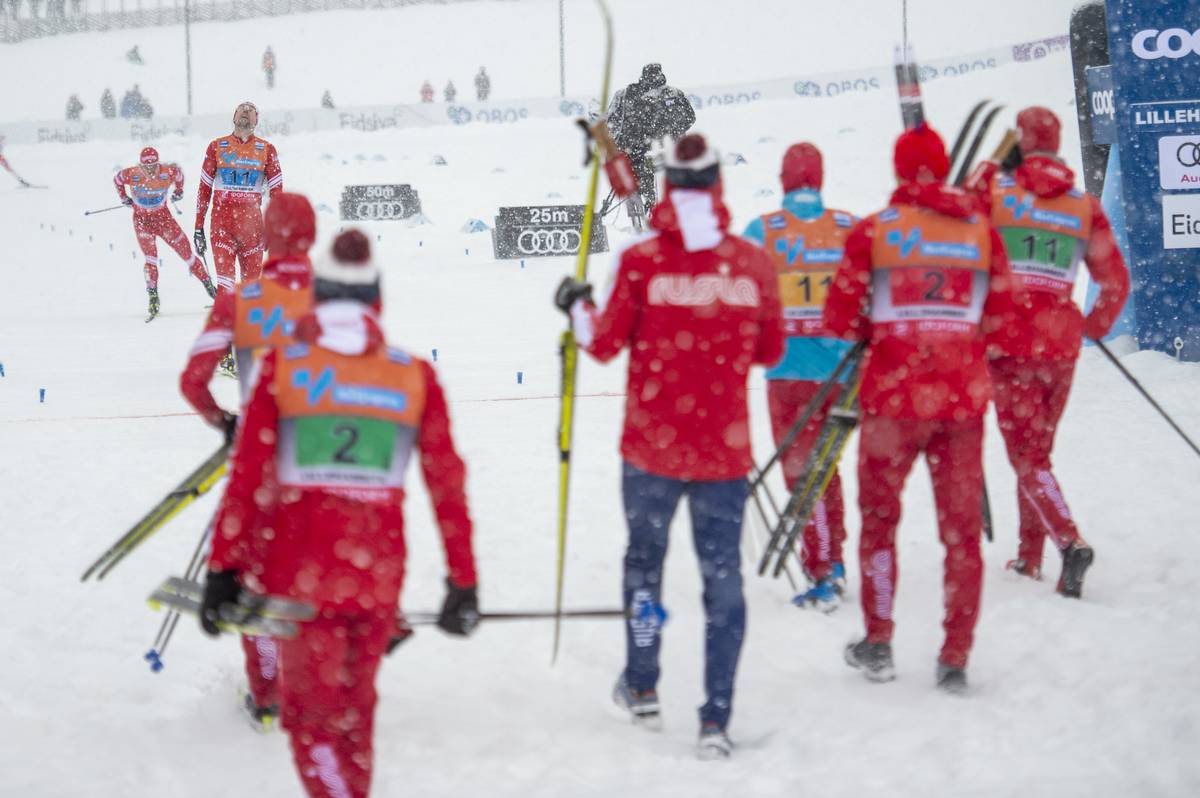
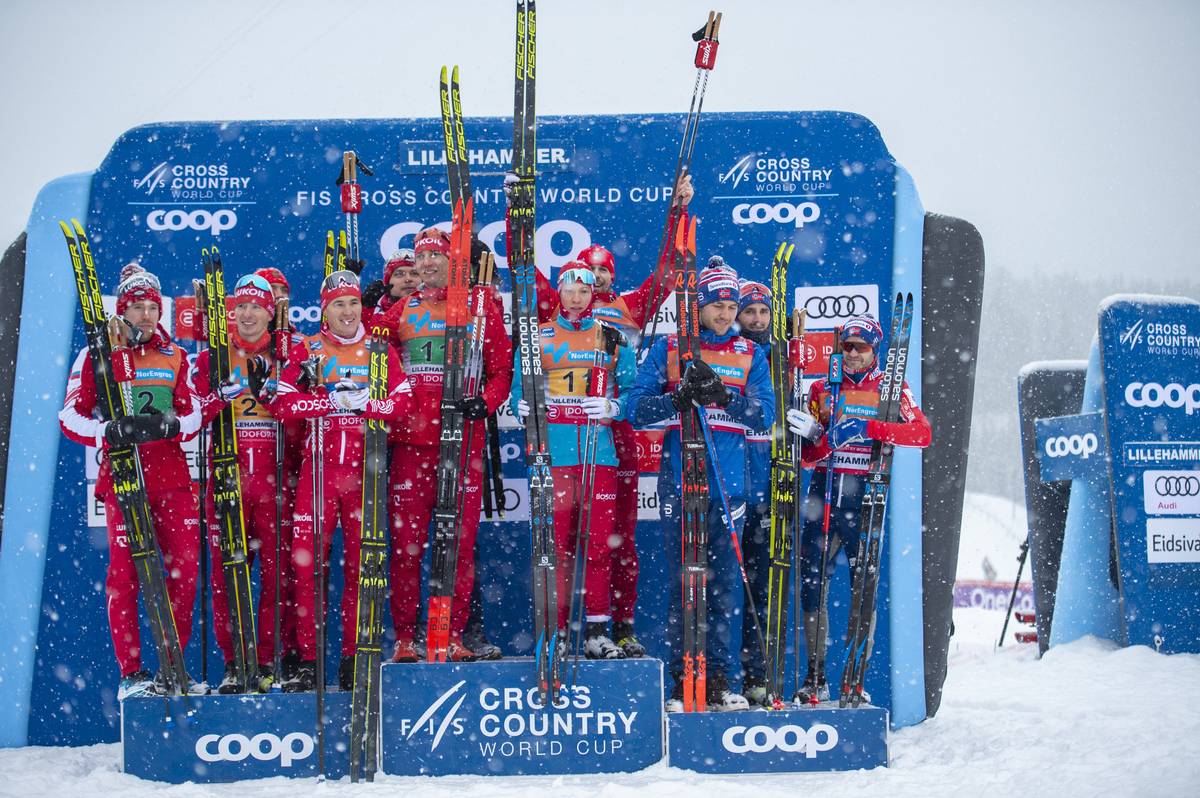
Russia soaking it in as they take 1-2 in the 4 x 7.5 k relay in Lillehammer, Norway. (Photo: NordicFocus)
Call it what you want: national pride, national bias, flag-waving: the team relays elicit nationalistic tendencies. In Lillehammer, Norway, you might think and maybe expect it’s your birthright to see the hometeam crush. That’s been the recent norm almost without exception.
Here’s the quick stats to either dispel or reinforce those tendencies: Norway has won nine of the last 11 relay races on the World Cup. Russia won the other two. In fact, Russia took first and second, Norway third in the last head-to-head 4 x 7.5 k match last season in Ulricehamn, Sweden. Throwing Norwegian dominance back into the equation, Norway has won five of the last six relays on home snow.
On paper, at least for Norway, some big names were missing from their team lineups. No No Emil Iversen. No Johannes Høsflot Klæbo. No Martin Johnsrud Sundby. That trio finished third, fourth. and fifth in Saturday’s 30k skiathlon. Add to that Didrik Tønseth who was busy representing Norway at the European Cross-Country Running Championships.
But Norway is deep with talent. As is Russia. For those keeping score, you’ll see no Alexander Bolshunov featured on either of the Russian teams — he won the skiathlon yesterday. That all said, in a non-championship year maybe it’s a time to tinker and experiment. Here were the teams holding the most podium potential.
Norway I: Pål Golberg, Hans Christer Holund, Sjur Røthe, Finn Hågen Krogh
Russia I: Andrey Larkov, Ilia Semikov, Denis Spitsov, Andrey Melnichenko
Russia 2: Ivan Yakimushkin, Evgeniy Belov, Ilia Poroshkin, Sergey Ustiugov
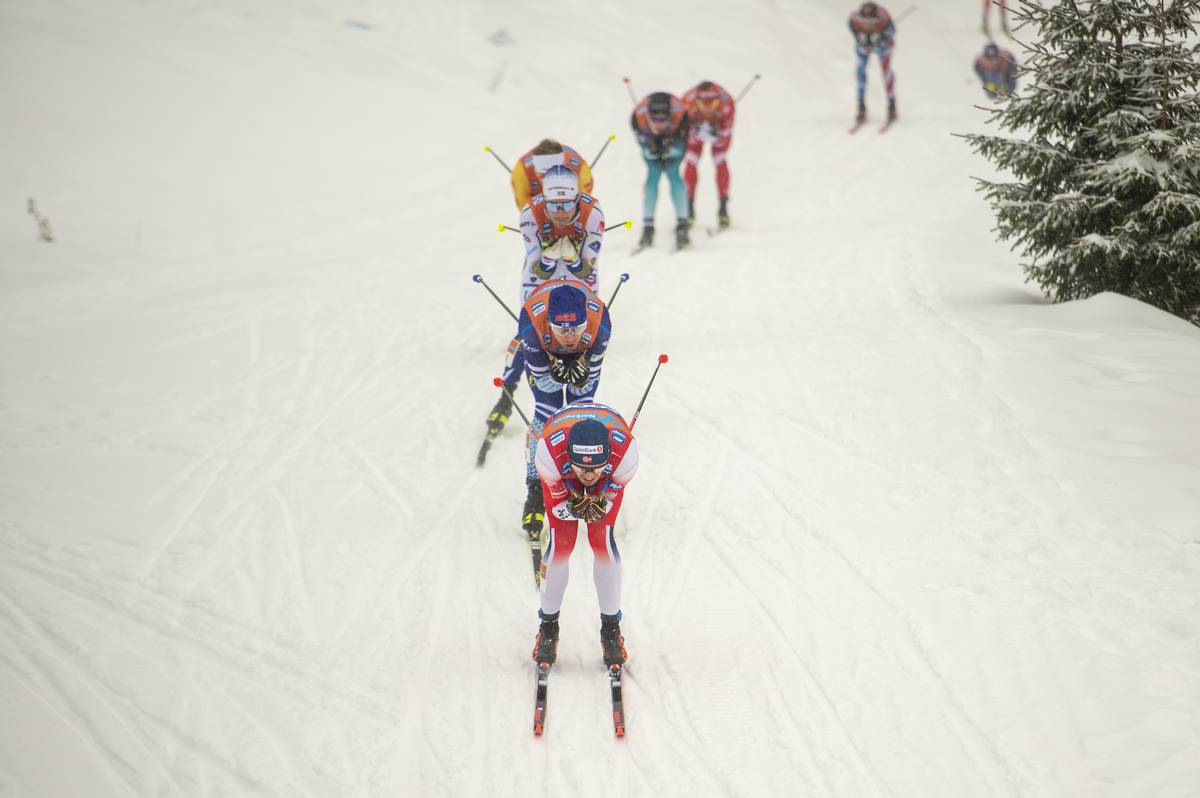
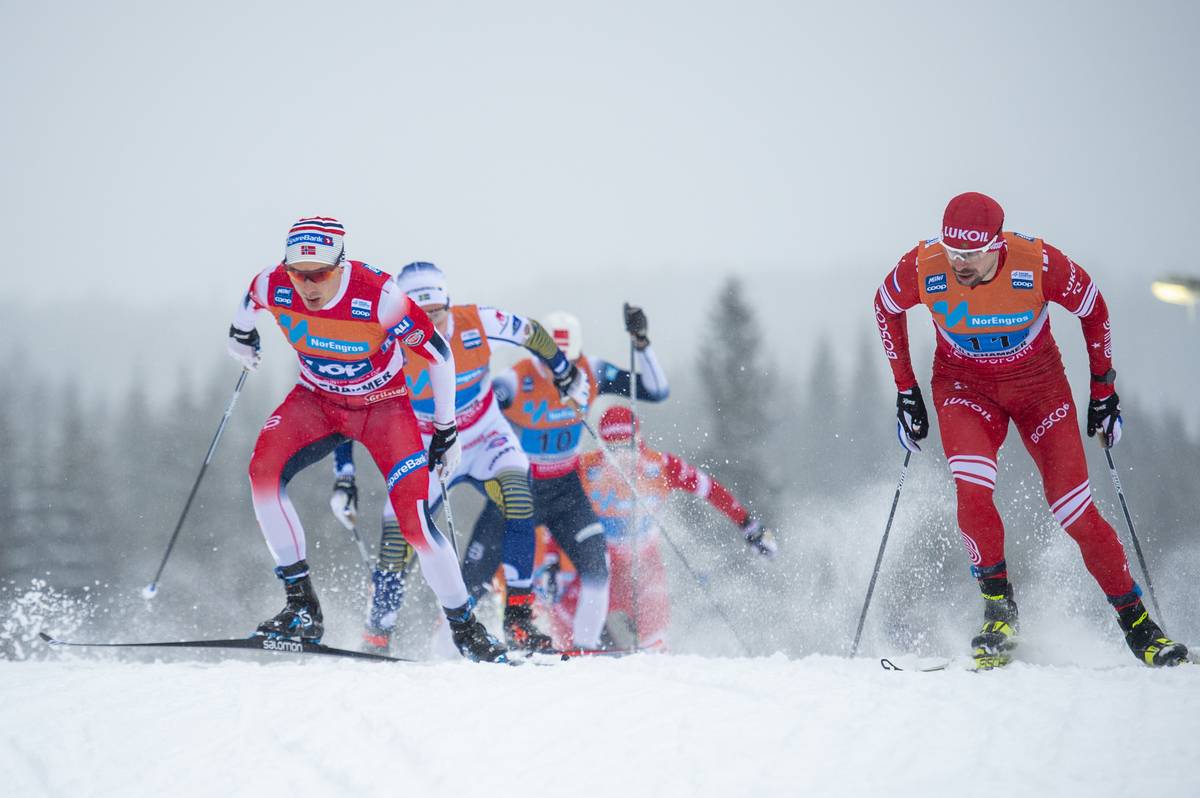
Pål Golberg (NOR) leading the pack during the scramble leg of the 4 x 7.5 k relay in Lillehammer, Norway. (NordicFocus)
The first tag, after 7.5 k, Russia I pulled through first, with Norway I and Sweden right behind. Russia II was 10.5 seconds back, Finland 15.5, the U.S. 17.0, and Norway II dangling 19 seconds off the lead.
As the classic legs ended at 15 k, the race was more about who was falling off out of contention, rather than a team up front making any decisive gesture for a kill shot. Finland came through first, with Russia II next (+0.4), then Norway I (+2.2), Russia II (+9.7), Norway II (+10.5), and Germany (+15.0).
The next closest team was Sweden, roughly twenty-nine seconds arrears in seventh place. At that point, the U.S. team of Erik Bjornsen, David Norris, Scott Patterson, and Kevin Bolger were in ninth (+1:13.7) and racing in a no-man’s-land with a sizable gap to France in eighth and Kazakhstan drifting back in 10th.
Simen Hegstad Krüger (bib 10) during the 4 x 7.5 k relay in Lillehammer, Norway. (Photo: NordicFocus)
The race began to look a tad spicy for Norway around the 21.2 k mark, nearly an hour into the race. Krüger for Norway II, a sometimes peerless skate skier at that, put his stamp on the affair as he powered ahead on the course’s most prominent climb. Norway I’s Røthe followed Krüger in step. And Sweden’s Jens Berman kept pace as well. The real tease was that Russia I (Spitsov) and Russia II (Poroshkin) appeared cooked as were their team’s chances for anything but third place.
But, it’s a four chapter race. And the fourth leg coalesced into a five team scrum by 25k. Both Russian teams, the Norwegian squads, and Germany were all in it. We should note that Ustiugov, tagged 15 seconds back at the exchange, looked impressive shutting down that gap as he reeled in the lead groups.
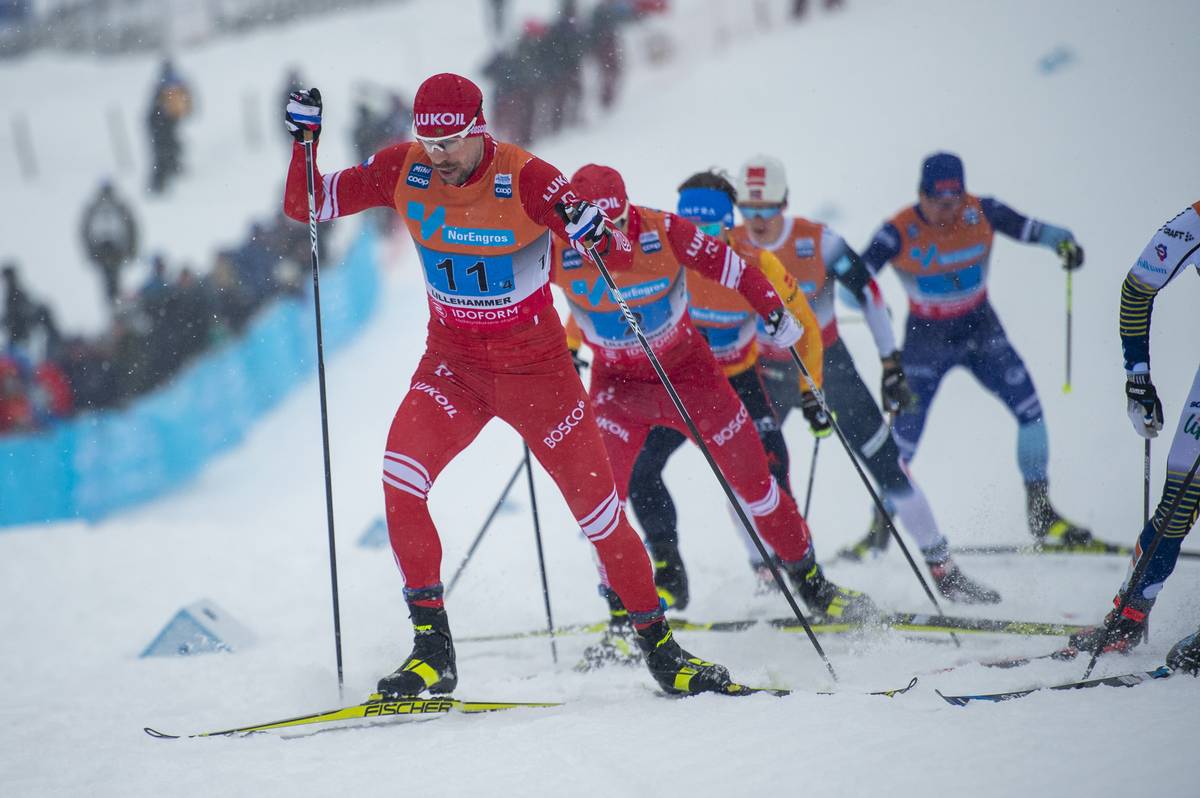
Russia’s Sergey Ustiugov (right) showing his solid form during the men’s 4 x 7.5 k relay in Lillehammer, Norway. (Photo: NordicFocus)
The racing scene’s old friend, Ustiugov, went to the front and eventually shut down the pace. It wasn’t exactly a crawl. It was Ustiugov revealing his tactical hand: wait until punishing terrain, and throw down a punishing push.
But it was Melnichenko for Russia I who made that move. Ustiugov kept pace and pulled through not long after Melinchenkov separted. Ustiugov looked like vintage Ustiugov: a full-body, all-in-it, furnace of power.
Sergey Ustiugov of Russia taking control during the 4 x 7.5 k relay in Lillehammer, Norway (Photo:NordicFocus)
And that was it. Norwegian dreams were snuffed, Russian dreams realized.
Russia I won in 1:26:46.8 hours. Russia II took second (+1.3), and Norway I third (+8.9). Norway II lost the toe-to-the-line finish by placing fourth (+9.0).
The U.S. team skied to ninth place, 3:33.3 minutes back. U.S. World Cup Coach Matt Whitcomb explained in an interview that relay racing is often a “game of contact and if contact is lost the race is often lost.” The U.S. did lose contact. It remained a relay for the U.S. bright moments and the reality of skiing solo for a few legs. (In the interview below, Whitcomb also notes the thrill of watching an emerging Chinese program finish the men’s relay in a non-championship event.)
Matt Whitcomb post-race interview
Closing out the day on the race course was China. They placed 11th (+12:44.6). Making note that the 2022 Olympics will be hosted by China, it will be interesting to see how this team develops.
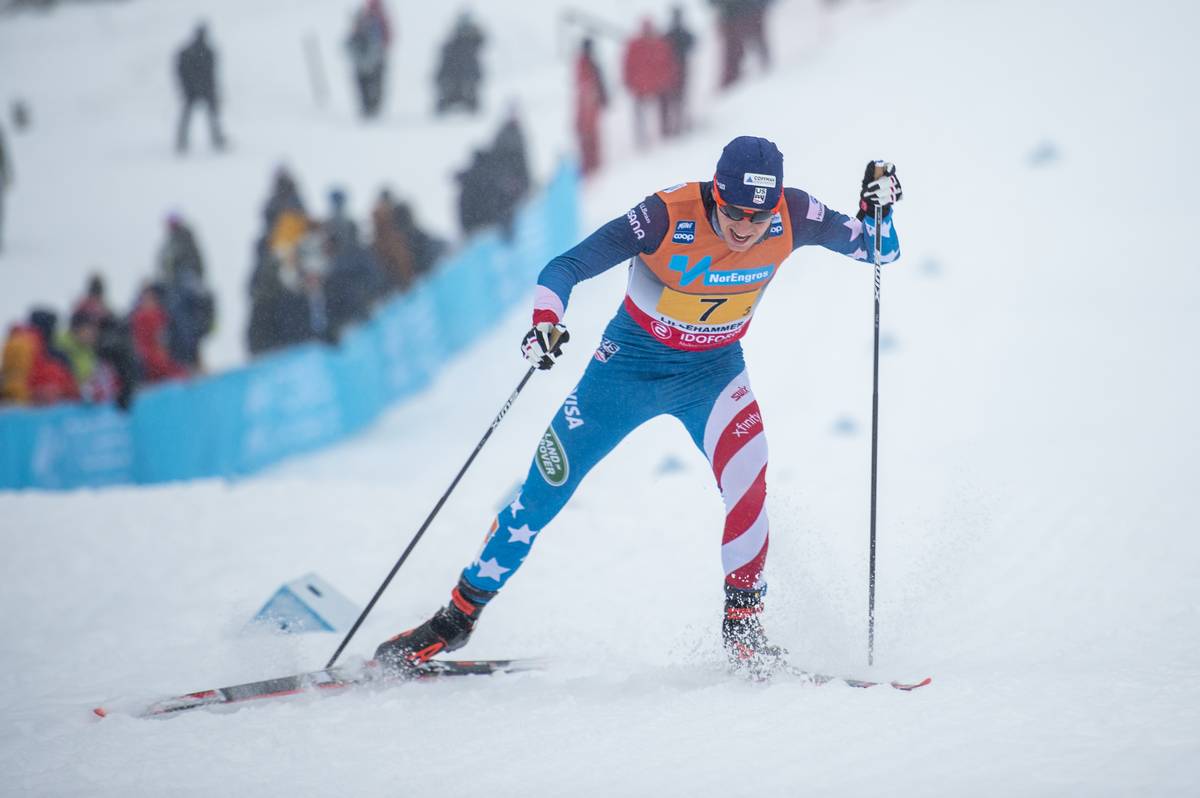
Scott Paterson of the U.S. Ski Team during the third leg of the 4 x 7.5 k relay in Lillehammer, Norway. (Photo: NordicFocus)
Scott Patterson post-race interview
Kevin Bolger during the 30k skiathlon in Lillehammer, Norway. (Photo: NordicFocus)
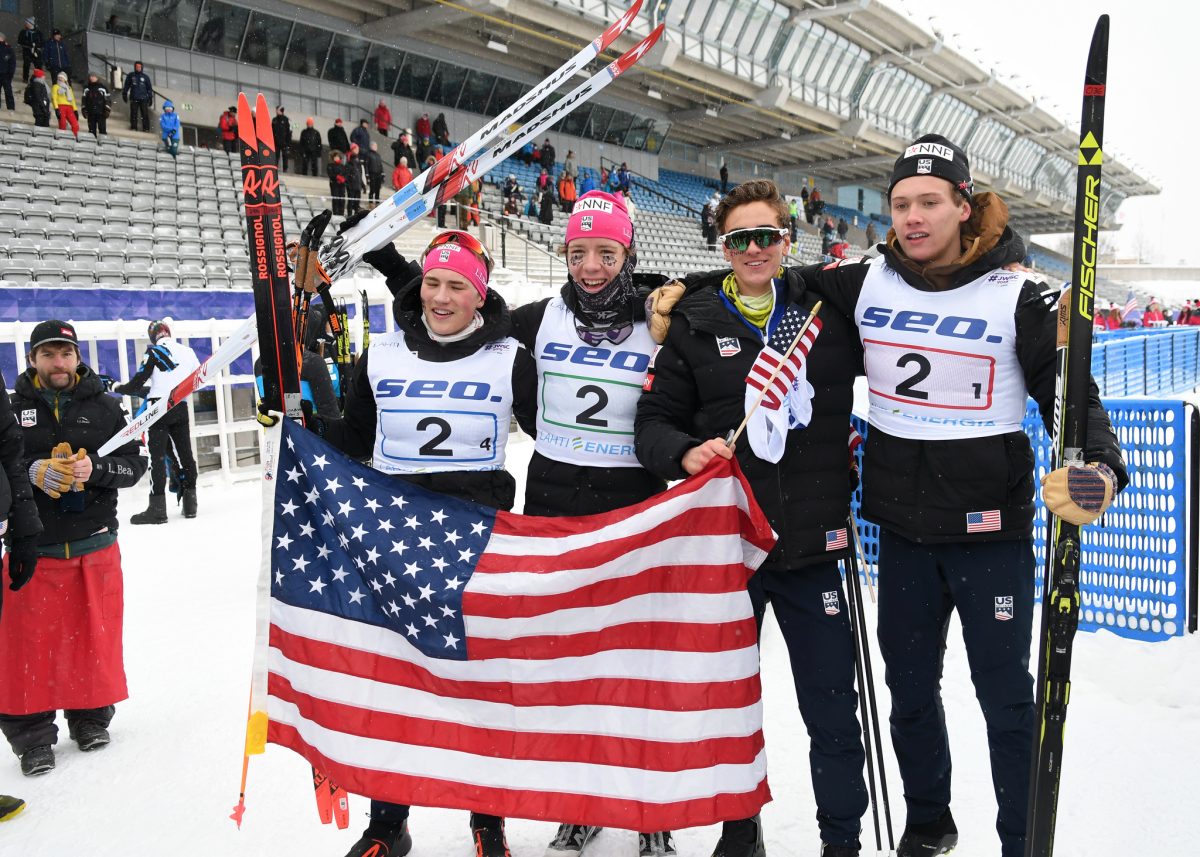
Ben Ogden (left foreground) and Luke Jager (right foreground) await the arrival of teammate Gus Schumacher (center background) in the U20 men’s relay at Junior World Championships in Lahti, Finland, in January 2019. (photo: JWSC2019 FIS broadcast screenshot)
Last Saturday, the American women placed fourth in the U20 relay at 2019 World Junior Ski Championships. In any other year before 2017 this result would probably be headline news; considering that the Americans had the youngest team in the race (you can compare athlete birthdates from the women’s race here if you really want to get into the minutiae), this may well be headline news next year, or the year after that, when the same athletes are potentially contending for the podium.
But a couple hours later, the U20 men went out and won their race, taking home a historic relay gold and deservedly garnering most of the headlines for the weekend.
Both races started in the middle of the night for most of this continent, and a daily viewing pass cost 9 Euros. You could be forgiven for not having woken up to watch it live. If you didn’t, or even if you did and you’d like to see it again, below are full replays of each race, courtesy of what appears to be a Russian YouTube user. (The same user also uploaded full broadcasts of the U20 women’s 5-kilometer freestyle interval start, U20 men’s and women’s classic sprint, and U23 men’s and women’s classic sprint if you’re looking for more.)
Here are time stamps for the start of each leg in both races, as well as a few choice moments from the end of the men’s race (all times are in reference to a point on the YouTube video, not the time on the live timing race clock, which is a few minutes behind the video timestamp):
3:57, the race begins, with Luke Jager skiing the scramble leg
15:37, first exchange: Jager tags off to Ben Ogden in first place
27:23, second exchange: Ogden tags off to Johnny Hagenbuch in first place
38:32, third exchange: Hagenbuch tags off to Gus Schumacher in third place, 2.0 seconds out of first
43:40, Schumacher and Germany go to the front and start pushing the pace, Schumacher visibly elevating as he V2s up a hill to cover Germany’s attack
46:08, with roughly a kilometer to go, the camera cuts to the Americans waiting in the stadium, cheering on Schumacher. “Team U.S. is cheering,” says the announcer. “But I have to say that Team U.S. is always cheering. It doesn’t matter if they win, or if they are number five or number six; they always have great team spirit up and running.” (Jessie Diggins said in response to this remark from the broadcast, in an ephemeral Instagram video, “that’s right.” If you were following social media on Saturday, you would have noticed basically the entire U.S. Ski Team assembled for watch parties to cheer on the U20 men and women, several of them doing so in advance of their World Cup freestyle races in Ulricehamn later that day.)
46:39, it’s Germany – America – Russia at the top of the penultimate hill, with a visibly tired Russia digging deep with labored technique but nonetheless staying with Schumacher
47:30, it’s now America – Germany – Russia by the bottom of the hill
Schumacher unleashes a devastating jumpskate … . The Finnish announcer exults, in slightly broken but endearing English, “And look at Schumacher bouncing! Schumacher is bouncing like maniac!”
47:50, approaching the top of the final uphill, Schumacher unleashes a devastating jumpskate, creating the separation from Russia and Germany that he will carry all the way to the finish. The Finnish announcer exults, in slightly broken but endearing English, “And look at Schumacher bouncing! Schumacher is bouncing like maniac!”
47:57, there are literally as many USST jackets on course here as there are representatives from all other nations combined. Several Americans sprint to follow Schumacher over and around the crest of the hill, waving flags and screaming their heads off.
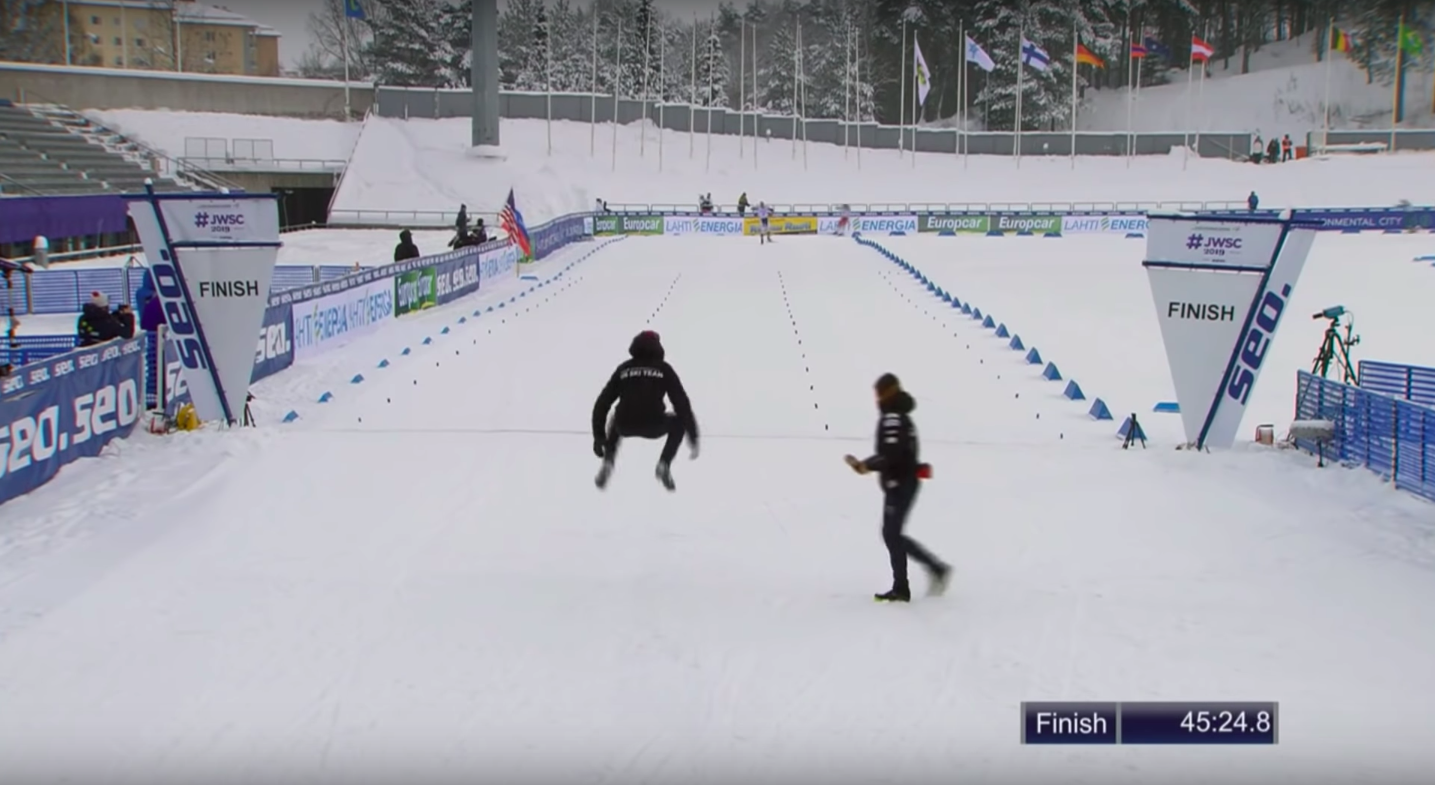
49:22, camera angle straight down the finishing stretch, with Schumacher narrowly but inexorably leading in Alexander Terentev of Russia. A meter past the finish line, Ogden is jumping 3 feet off the ground while Jager applauds.
49:32, Schumacher crosses the line in first. Ogden and Jager tackle/hug him.
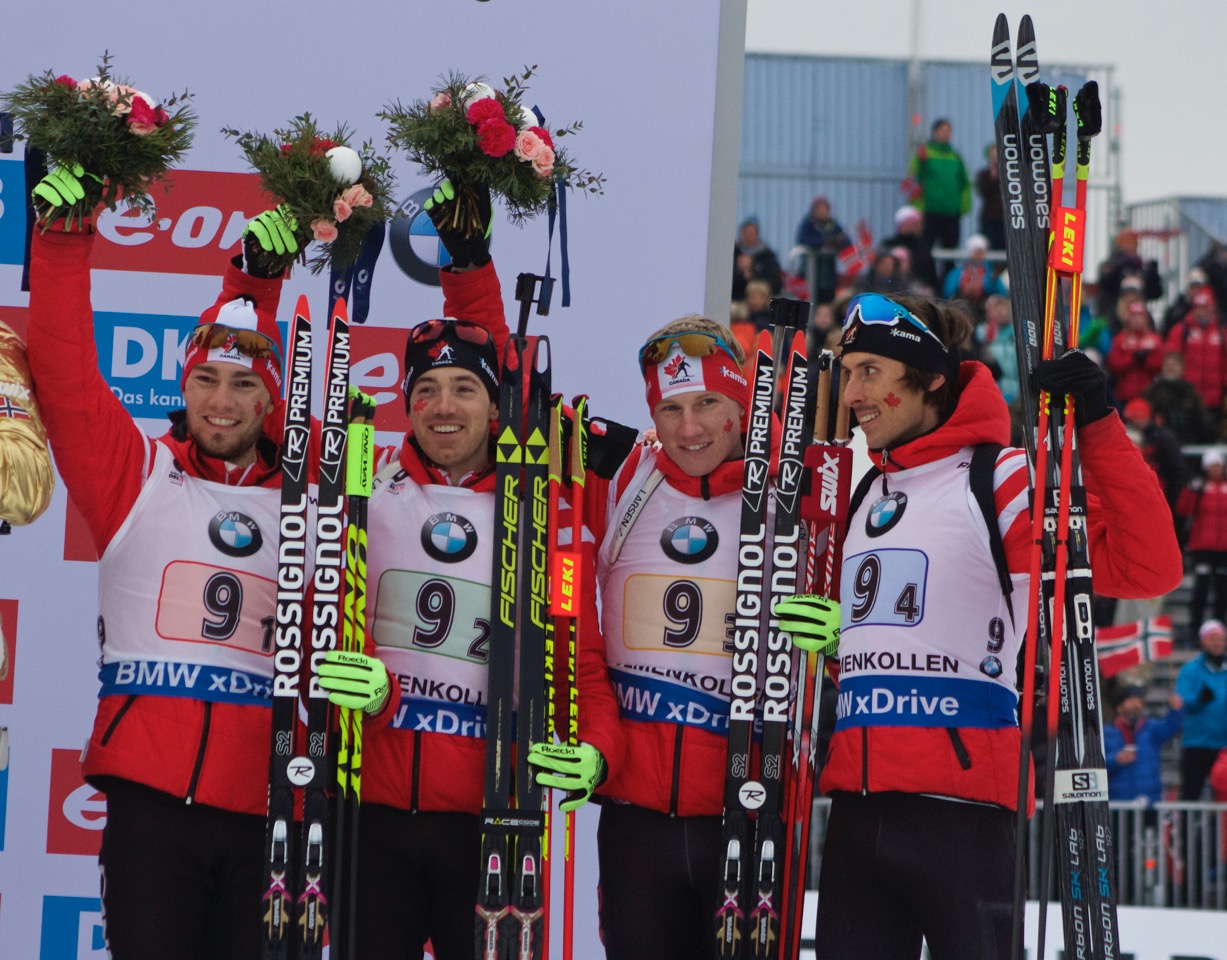
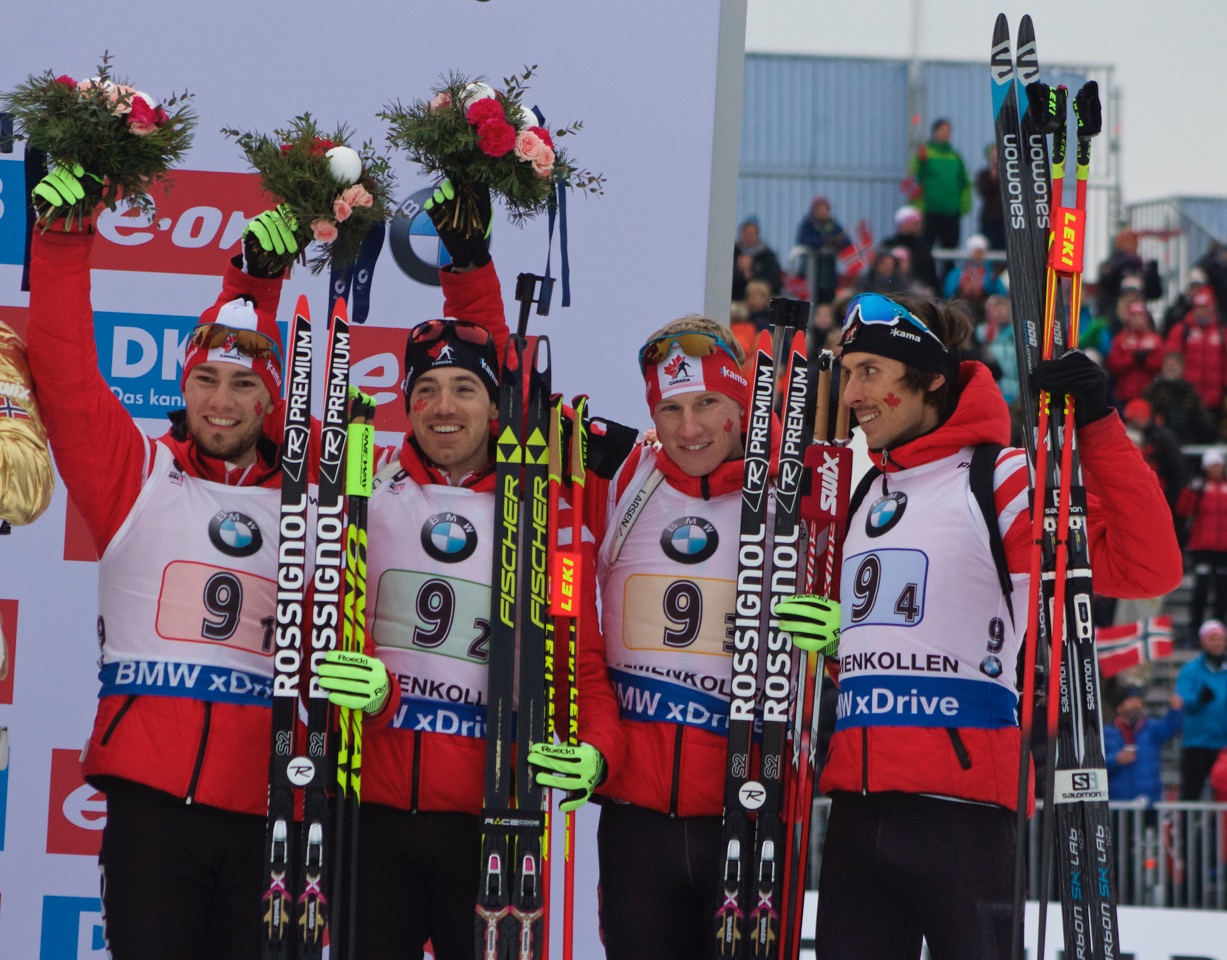
The Canadian men’s relay team (l-r) Christian Gow, Nathan Smith, Scott Gow, and Brendan Green on the podium at Holmenkollen ski stadium after claiming bronze in the World Championships relay. (Photo: JoJo Baldus)
OSLO, Norway—As Saturday’s men’s 4 x 7.5 k relay at biathlon World Championships progressed loop after loop longer, the Canadian team climbed to third position – and then stayed there.
And stayed.
And stayed.
Ultimately, the team claimed bronze.
“This is the sensation of the World Championships, perhaps the sensation of the season,” IBU Communication Director Peer Lange said to kick off the post-race press conference.
If the fans were surprised, so were the athletes. The Canadians themselves hadn’t expected such a breakthrough. Top five? Yes- that was a goal the team had set. But bronze?
“I didn’t think it would happen at World Championships, that’s for sure,” said Scott Gow.
“I think that we would have been happy with fifth or sixth today,” agreed Nathan Smith.
Never in the history of Canadian biathlon has a team won a relay medal at World Championships or the Olympic Games.
And today it happened.
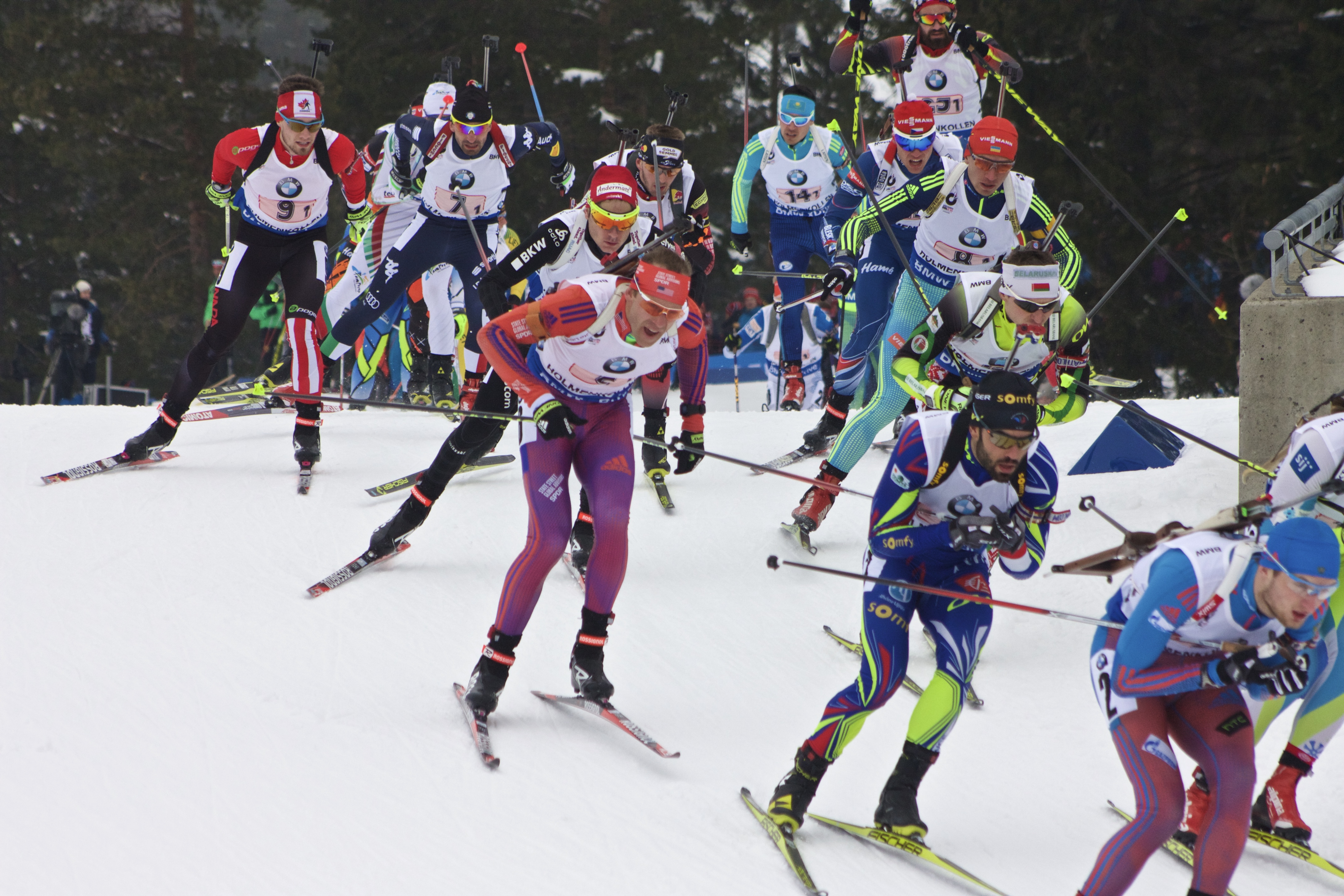
Christian Gow (far left) mixing it up in the scrum of leg one for Canada. The leadoff leg was aggressive and physical, with crashes and several broken poles.(Photo: JoJo Baldus)
“I think that the potential has been there for a little while now,” said relay anchor Brendan Green. “There have been some ups and downs along the way. But in a relay anything is possible. Today we all really put it on the line together. Every single one of us raced really well. When that happens, when things come together like that, it’s really incredible.”
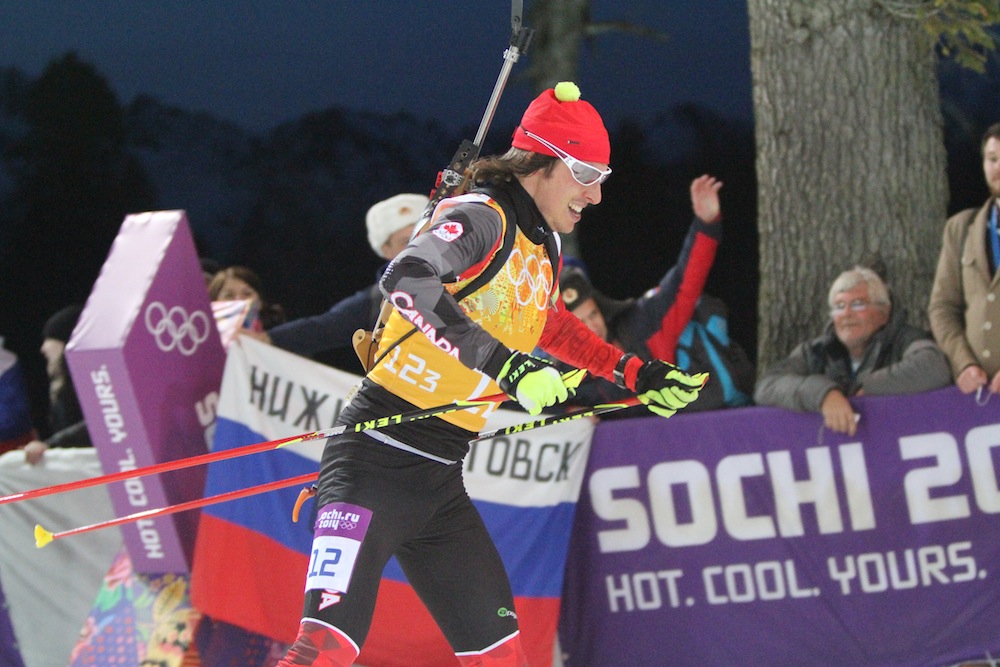
After a strong leadoff leg from Christian Gow, Smith took the team to the front, and they never left. After Scott Gow stuck to the Norwegian and German teams like glue on the trail, it was up to Green.
And Green proved why he was chosen to anchor the squad, staying cool under pressure and not even touching his spare rounds as he cleaned both prone and standing to cross the finish line in third, 23.4 seconds behind the winning Norwegian team. Germany placed second, +11.5.
So what came together for Canada?
“I would say everything,” laughed National Team Coach Roddy Ward. “Four guys having some of the best races of their lives, good shooting, good skiing, good skis. And the shape of our team I think has just come up every race at World Championships here, getting better and better… Every year you kind of think it’s coming. It’s close, it’s close, and we’ve been close for a couple of years. We were close enough, I guess, that on the right day we were there.”
Christian Gow is the youngest member of the team and hadn’t even been sure he would race the relay until late this week, after the 20 k individual. The Canadian team brought five men and hadn’t set its lineup; Macx Davies was ultimately left to watch and cheer his teammates.
Nathan Smith attacking on leg two. (Photo: JoJo Baldus)
“I was super pumped to be told I was racing today,” Christian Gow said. “I was doing most of the relays last season and this one. I was really excited to get the opportunity to do it. It’s one of the most fun races for sure. I was thrilled that [my brother] Scott also gets to race with me. And my dad is here to watch, too. I am sure he is just as thrilled.”
The Canadian team has been close in the early going of relays before- and Smith was an individual medalist at last year’s World Championships. So it wasn’t surprising that he took Christian Gow’s tag in seventh place, 14 seconds back, and by the end of the first loop had caught the leaders and took the prone stage in lane one.
“I didn’t on purpose pass them,” Smith said. “It was more like I got behind them and got really good draft. It wasn’t like I was going to stand up and push them. It was fun. Being in lane one is fun. It’s fun being in lane two and three too though.”
After Smith used one spare round in each stage, he skied to the finish even with Norway and Germany, tagging off 1.2 seconds out of first place.
So the pressure was on Scott Gow to hold the team’s position as the race went on. He left the stadium with Norway’s Johannes Thingnes Bø, and stuck on his tails.
Coming off a career-best 18th place in the 20 k individual, Gow had some added confidence, said coach Ward.
“I wanted to think I could,” he said of staying with the leader. “Watching Christian tag off really close, and then Nathan obviously moved us right into contention. And so I though okay, I have to, I don’t have a choice. I don’t know if I believed I could, but I had to, to try and keep our team in it. I’m just happy that I was able to stay right behind Johannes for most of it and hang on.”
Scott Gow shadowing Norway’s Johannes Thingnes Bø on leg three. (Photo: JoJo Baldus)
Scott Gow succeeded admirably, turning in the fifth-fastest time of his leg. Coming into standing, he missed one shot, and then had to take all three of his spare rounds to knock it down.
“Prone felt just on point,” he said. “Felt so calm, so steady, drilled them all, I was so happy with that. And then standing, I hit four, but I was so nervous. I couldn’t… I was like ‘okay just one spare’ and I knew Johannes had cleaned, so that put a lot more pressure to try and keep up.”
It was a nervous moment, but the Canadians were helped by the fact that other teams behind them also struggled on the stage and used spares, or in the case of Austria even went to the penalty loop. So Scott Gow left with over 30 seconds in hand over fourth place, and he maintained that gap to the tag.
Everything fell then on the shoulders of Brendan Green.
“I was definitely really nervous going into the race,” Green said. “I was following it up in the wax room. The whole race, the team was right in the mix up at the front. I was extremely nervous. But once I got the tag I was able to relax a little bit on course and zone out and just do my own race.”
Nerves or no, he not only held steady on the trails but shot with laser accuracy, confidently knocking down all ten targets. First five in prone: still Canada in third place. Then five in standing: Canada still in third place.
“All I saw really was Brendan’s last shooting, which was incredibly impressive,” said U.S. athlete Tim Burke. “There’s nothing harder in biathlon to do than that one in the relay. And he did an unbelievable job, and obviously the rest of the team did, too.”
By the time the relay reached the anchor stage, Brendan Green had third place all to himself. (Photo: JoJo Baldus)
Green still wasn’t quite sure how he did it, although he certainly has a years-long history of strong shooting on the World Cup.
“The focus is pretty high going into lane three each time,” he said. “On the range I would just try to focus on each shot and on my own shooting bouts. And not think about what Germany or Norway was doing. When it works out like that, it’s incredible.”
He left the range the final time with a remarkable 40 seconds on fourth-place Austria. Bronze belonged to Canada.
For Smith, who had already climbed the World Championships podium in the sprint in 2015, climbing it a second time with his teammates was even sweeter.
“I’d say it’s better,” he said. “We train together, every day, twice a day, for many years. I know, I can see that these guys saw last year’s success. They know that they train with me, and they beat me lots of the time.”
“Only when you’re slumming,” interjected Scott Gow.
“Everyone is fighting on our team,” Smith said. “We’re teammates, we’re friends, but we’re fighting every day to be better than each other. And it brings our whole team up. I knew that last year we were fifth here, so I knew that if we had an even better day it was possible. Not so likely, but possible.”
With none of the men qualifying for Sunday’s mass start, the guys can celebrate their medal already.
“Obviously, anyone here would like to be racing the next race,” Scott Gow said. “But since we don’t have to, we can let a little loose and really enjoy the whole experience.”
Julia Ransom (in black and red suit) helping the Canadian team to ninth place in the women’s relay in Ruhpolding, Germany, last week. (Photo: Biathlon Canada/Matthias Ahrens)
A lot of people on the Canadian biathlon team thought that Julia Ransom was going to have a breakthrough this year.
But few, including the 22-year-old herself, seemed to have thought that it would be this big, or happen this fast.
After shooting a perfect 20-for-20 in the 10 k pursuit in Antholz, Italy, Ransom was one of the biggest movers on the day, skiing from 46th up to 19th. She crossed the line 1:30.8 behind race winner Katja Yurlova of Russia.
“Top 20 is just… that was a pretty big stretch goal for me this year,” she said in an interview after her race. “Going into the season I wanted to get points, wanted to get my first-ever World Cup point [from being in the top 40], and then it happened. And then I thought last week ‘yeah, top 20 would be sweet. We should open some champagne for the top 20. That’s a champagne race.’ So then it happened. Woah that’s crazy.”
Those World Cup points came early in the year, in the sprints and pursuits in Östersund, Sweden, and then in the sprint in Pokljuka, Slovenia, all before the Christmas break.
Until Saturday, Ransom hadn’t broken into the top 30, much less the top 20.
It’s her first full year on the World Cup circuit. World Cup and World Championships starts in 2014-2015 gave her experience, which she’s happy to draw on now.
Ransom at 2015 World Championships in Kontiolahti, Finland. (Photo: Biathlon Canada/NordicFocus)
“I like to just be out there and have fun, and that’s no different than last year,” she said. “But it’s definitely nice to be skiing a little quicker. Making pursuits is also quite nice. So in that sense, yeah, that’s different, but I guess mentality towards racing is the same. Trying to do my best, but also enjoying the mountains, the spectators, and the energy and all of that in all the venues.”
So what, besides knowing what to expect, allowed Ransom to jump into the top 20?
In the past few days, she had gotten some good advice from teammates and coaches.
“In the Ruhpolding relay when it took me three spares to hit one target, I felt kind of shaken up,” Ransom said. “After the sprint when I was cooling down with Rosanna [Crawford], I was just like, ‘what do you do, how do you do it?’ And she kind of helped me out with a few things. She has definitely provided a lot of mentoring.”
Crawford wasn’t happy with her own race in the Antholz pursuit, where she missed six shots and finished 44th.
But she was thrilled to see Ransom succeed.
“It’s been really exciting to watch Julia, she is such a strong athlete and has really impressed me with her ski speed,” Crawford wrote in an email. “I knew that she was capable of a result like this, she just needed the shooting and skiing to come together at the same time and that was today! We had a chat about what I find works for me when I am shooting well and talked about what might help her in the range.”
The second key to success, apparently, came from a simple suggestion from National Team Coach Roddy Ward.
She’s come a long way: Ransom and teammate Emma Lodge with their first World Cup bibs back in January 2014. (Photo: Roddy Ward/Eat Sleep Train)
“Julia is a big time coffee fan,” Ward explained in an email. “After a sub-par practice yesterday (not focused enough) I found out she only had one cup of coffee that morning. In our pre-race meeting last night I advised she drink two today, as she did before the Sprint [where she shot 9 out of 10). I think we found the sweet spot for pre-race coffee intake.”
Ransom confirmed: it was a welcome suggestion.
With that renewed focus, she was one of only two athletes in the field to shoot a perfect race.
“It was a little windy, for sure,” Ransom said of conditions on the range. “I made wind corrections in both of my prone bouts. And I mean, I remember Antholz last year was crazy windy. So to just have a few clicks here and there was pretty good. I think a lot of the time the altitude can affect a lot of people because you don’t quite recover as well as soon as you come into the range.”
It was touch and go: the last shot was a split bullet, meaning that it hit the edge of the target with part of the bullet hitting the target and part the frame around it. But despite that, the target turned white and Ransom could head off to the trails without ever seeing the penalty loop.
“Cleaning 20/20 takes a great deal of focus and concentration,” Ward wrote. “She has been working on this a lot and its cool to see it pay off for her. I cheered quite loudly after her final shot was a hit… [a split] can go either way but you just need the target to go down! Doesn’t need to hit the middle…”
With Saturday’s result, the best 10 World Cup results of Ransom’s career have all come this season. She credits her teammates for a lot of the improvements.
“This year has been going really well, and I think a lot of it has to do training with some of the best guys in the world on this team,” she explained. “With Rosanna of course, and Nathan, and we’ve got a great group of girls, and we are all gelling, and trying to push each other and to create a good atmosphere. So I think that and the summer has really paid off this year.”
But Ward, who is Ransom’s main coach, said that she should be giving herself some credit too.
“Julia has worked very hard all training year,” Ward wrote. “I started to feel around August that it was paying off. She made a big jump this fall. I am still surprised by this result. This was beyond any of my expectations. She is a great athlete to coach, she is so driven and has a fantastic worth ethic. She also has a very good head on her shoulders… She has been quite consistent this season, which is impressive for a young athlete.”
Crawford agreed, saying that Ransom brings more than speed and straight shooting to the team.
“It’s been great having someone like Julia on the team,” she wrote. “She always looks at the positive side of things, which I have a hard time doing, and it’s been rubbing off on me.”
Up next for Ransom and her teammates is the 4 x 6 k relay on Sunday. In Ruhpolding they finished ninth and were close to the top six, and they hope to improve on that result.
“I absolutely love relays,” Ransom said. “It’s a time for all the girls to get together, kind of get fired up about everyone’s performances. It takes the selfishness out of racing a little bit, which I like. I like the team aspect. And we were so close to top six last relay, that I think it’s definitely doable. Definitely doable.”
“I think this will give our team a boost going into tomorrow’s relay,” Crawford added. “When someone has a [personal best] it really brings an exciting vibe to the team!”
And after that it’s home to Canmore for World Cups on the team’s home turf.
Ransom said she doesn’t have any specific results goals to thrill the Canadian crowd with, but she hopes she can get the community pumped up.
“Oh man, I am so excited to go back home,” she said. “I obviously want to perform at my best, and make the home-crowd excited to cheer for all the Canadians. Of course everyone is doing really well this year. And it’s just exciting to be home, and in your bed, with your friends, and get to see my boyfriend and my family. So that’s really exciting.”
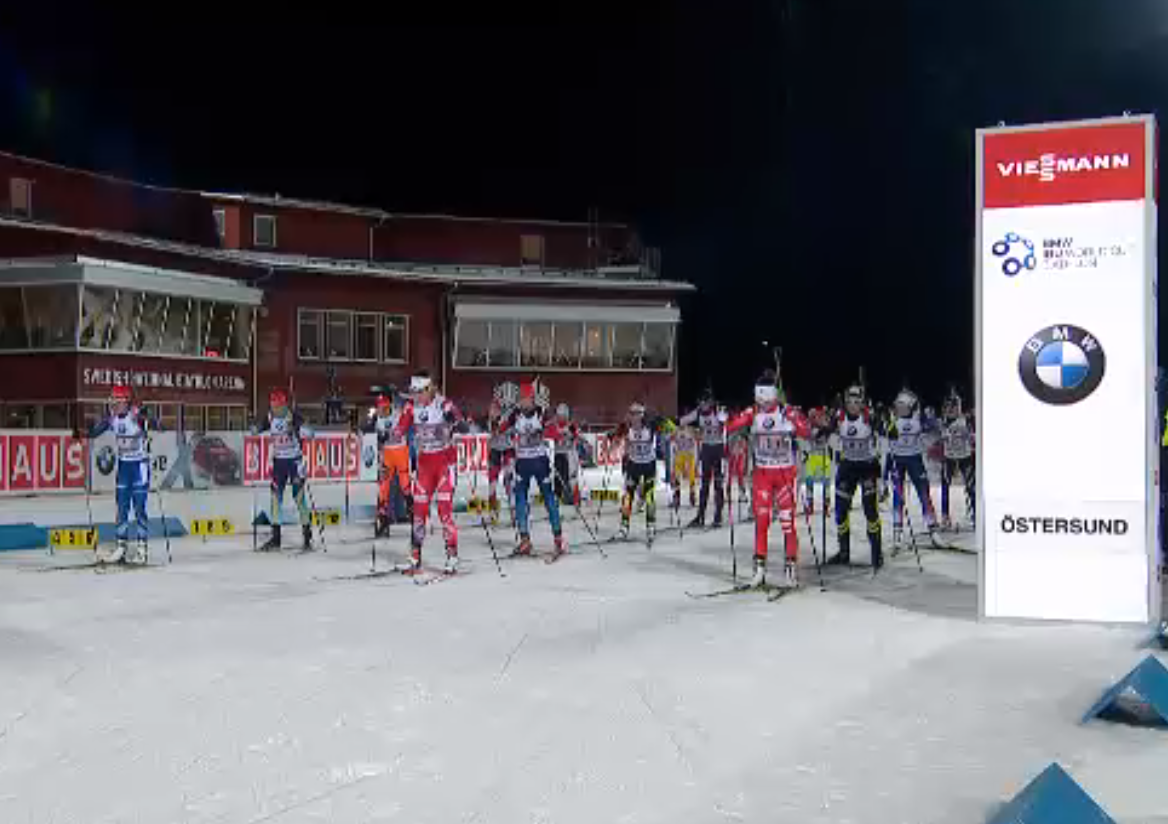
Women wait in three lanes before the start of the World Cup mixed relay this weekend. Only the top three teams – here (l-r) the Czech Republic, Norway, and Italy – are given a front-row starting position.
This year, the International Biathlon Union (IBU) approved a major new rule change. Instead of a start zone ten lanes wide for relays and mass starts, with a designated 50-meter double pole zone, the width of the start would be reduced to three lanes and skiers would be able to skate immediately.
The idea was that the start would be more smooth: a pack would already be formed, skiers could still move up, but there wouldn’t be the sometimes-messy period of ten skiers fighting for position as the trail quickly narrows.
With at least two kilometers before the first shooting, technical organizers assumed that there would be space for things to shake out. And if not, well, shooting presents an opportunity to make up lost ground.
The format got its first test this weekend in the World Cup mixed relay in Östersund, Sweden. How did it work? Things appeared to go smoothly, and there were certainly no obvious tangle-ups.
But when we talked to the two North American women who skied leadoff legs, Susan Dunklee of the United States and Rosanna Crawford of Canada, neither were fully convinced that the format should stick around.
“It’s strange,” Dunklee said. “Basically I think it’s designed to give the teams that are ranked higher an advantage, giving them the first spot off the line. Instead of ten people across it’s only three. It made it a little less stressful in some ways, that start – you don’t have as much room to maneuver, there’s not as much opportunity to move up, but there’s not as much potential for falling back either I guess.”
Both she and Crawford had smooth starts and were near the front by the time they hit the range; with good shooting, Crawford took the lead on the second lap, while Dunklee briefly led on the third lap. The two had started with bibs nine and eleven.
Crawford chalked it up to luck.
“I guess it will depend course by course if it’s going to work out or not,” she said. “But definitely for strong people from bib 10 onwards, it’s a bit of a fight to get to the front.”
And for those even farther back, it might be significantly worse.
“Kaisa [Makarainen of Finland] and I talked a little bit in the finish area,” Crawford said. “She really didn’t like it, being bib 20 she was a lot further back and had to work really hard to get to the front.”
Indeed, when Makarainen finally popped into view in the final few hundred meters of the first lap, it was like a revelation – viewers on television wouldn’t have even known she was in the race before that, because she was so far from the lead.
“I think it would have made a little more sense to go down to five or six people per row instead of three,” Dunklee said.
Seeing the experience of Makarainen and others, she is worried for her own team. The U.S. only brought three women to Europe for the first period of racing, so will not be able to compete in relays. That means they will miss out on valuable Nations Cup points and be seeded farther back when they finally do get to field a team.
“I’m a little bummed because we’re going to have to sit out the first few women’s relays because we don’t have four people here, so when we get to World Championships we will be starting way in the back of that race because of this,” Dunklee lamented. “I guess you just have to shoot well in the first stage and pass a bunch of people.”
In the past, it hasn’t been as much of an issue. A strong double-poler with smart tactics could quickly move close to the front in the old format.
“I think I’ve always been pretty good tactically when it comes to the start of races, when it comes to double-poling and dodging people and telling where people will go,” said Crawford, whose team has rarely been ranked in the top ten but who frequently turns in strong leadoff relay legs.
It looks like a determined skier, like Makarainen, can move up – and good shooting can help too. Both Dunklee and Crawford proved their chops.
But it will still be a tough road for late-seeded teams.
“We went immediately to skating and I was about 20 meters back from the first row,” Makarainen told Finnish news service YLE. “During the first lap I didn’t have room to move.”
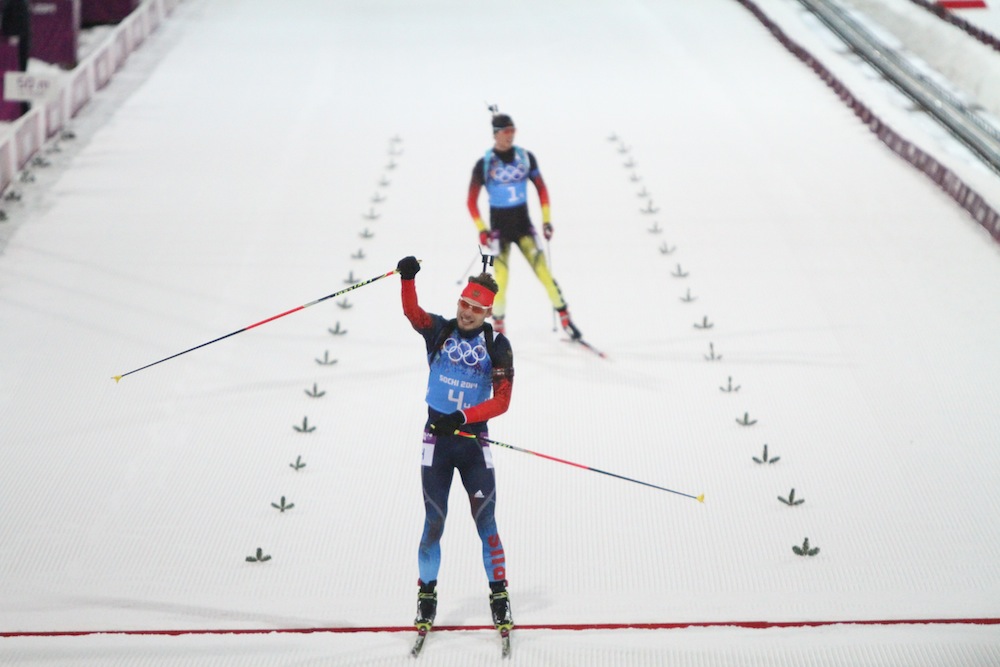
Russian anchor Anton Shipulin celebrates his team’s gold medal in the men’s relay over Germany’s Simon Schempp. Austria was third.
FasterSkier’s coverage is made possible through the generous support of Swix.
KRASNAYA POLYANA, Russia – There were 11 biathlon races at the Sochi Olympic Games, and the Russian team went through 10 of them without a gold medal.
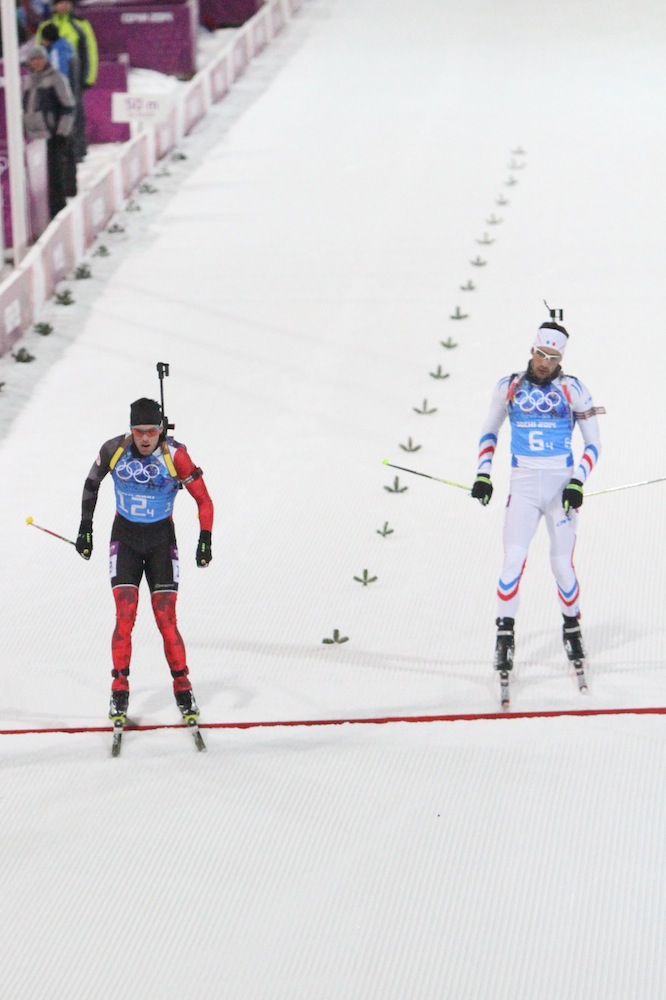
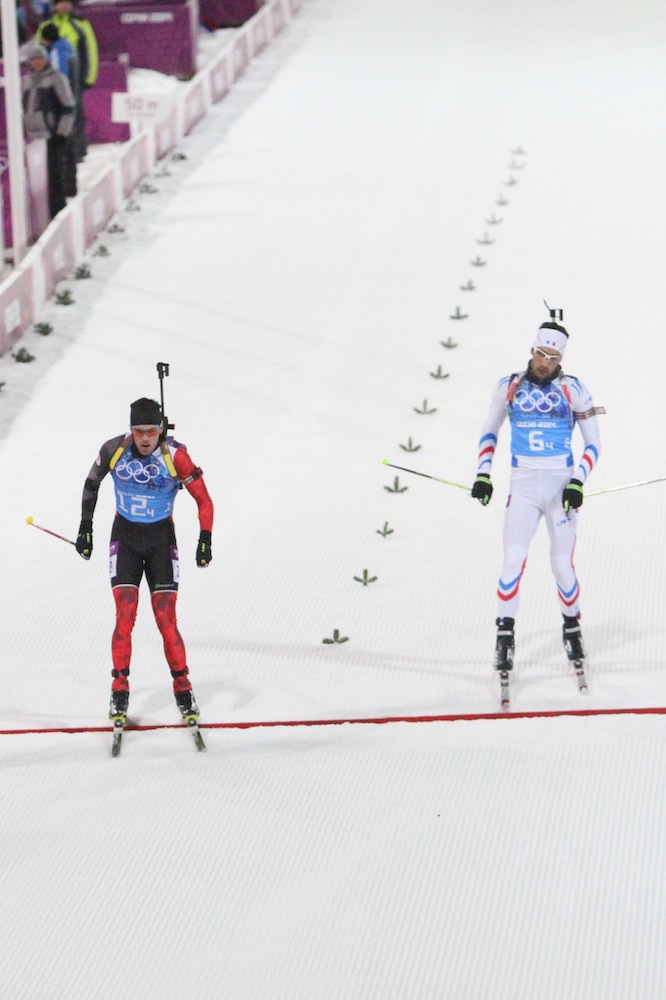
The last one was Saturday night, where before a boisterous crowd, the country’s men’s relay team bested athletes from 18 other nations—with anchor Anton Shipulin using perfect shooting and blistering skiing to emerge as the fastest of a four-man lead pack in the race’s waning minutes.
Germany was second, after anchor Simon Schempp lost to Shipulin in a sprint finish. Austria’s team was third, 30 seconds behind.
Norway was fourth, squandering a 20-second lead they held in the middle of the race. The country’s collapse was capped by a stunning failure by their anchor, Emil Hegle Svendsen—the same man who had skied to a gold medal in an all but perfect race in the mass start earlier this week.
Svendsen entered the final shooting stage with the other three teams. But even with eight rounds—five of those in his standard clip, and three extras that he hand-loaded, one at a time—he couldn’t knock down more than four out of his five targets, leaving him stuck in the penalty loop as his competitors raced off to claim their medals.
Shipulin leads into the stadium.
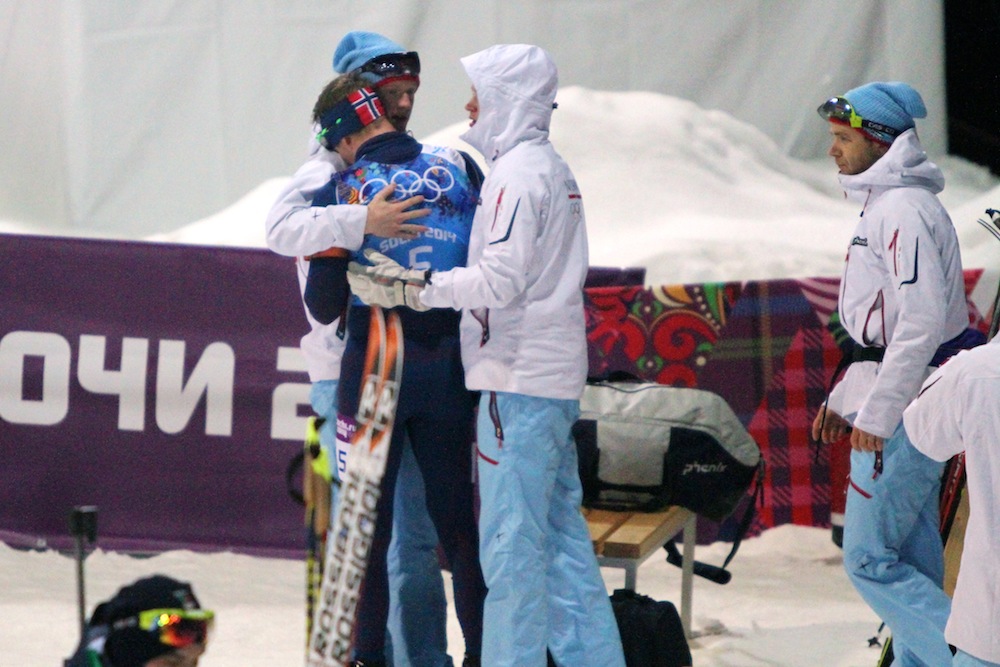
Ole Einar Bjørndalen, the Norwegian who became the winningest Winter Olympian of all time at this games, with 13 medals, was left tied with his countryman Bjørn Daehlie’s record of eight winter golds.
The result was glory for the Russians, who, led by the tycoon Mikhail Prokhorov—yes, the guy that owns the Brooklyn Nets—had poured money into the country’s biathlon union, only to be stymied in their quest for gold until the very end of the games.
Asked about the pressure the athletes felt heading into the final biathlon race of the Olympics without a gold, Shipulin, the Russian anchor, responded by thanking the crowd that had turned out to the ridgetop venue Saturday evening with flags, colored hats, and noisemakers.
“It’s a special when you hear, each and every step, people shouting in Russia,” he said. “It even gave me more energy—I felt I couldn’t relax.”
Russia was in the hunt for most of the race, but it seemed like gold was Norway’s to lose after Tarjei Bø, who skied the country’s first 7.5-kilometer leg, tagged off to his brother Johannes Thingnes Bø with a 10-second lead.
By the time the second Bø tagged off to Bjørndalen for the third leg, the Norwegian lead had grown to 20 seconds, over a small chase pack that included Austria, Russia, Slovenia, and Italy.
But Bjørndalen didn’t have his characteristic speed on his skis on Saturday—and despite not missing a single shot, he still lost time to the Russians, the Germans, and the Austrians.
When the anchor leg started, the Germans were even with Norway, and the other two teams caught up in time for all four men to enter the last round of shooting together.
Svendsen, the Norwegian anchor, is one of the best sprinters on the biathlon circuit; matching his competitors on the shooting range would have given his country a good shot at the win—and even one or two misses likely would have preserved a spot on the podium, thanks to the three extra rounds biathletes can use for each round of shooting in relays before they have to head to the penalty loop.
Instead, Svendsen used all eight of his rounds, and still left one of his five targets standing.
His meltdown dropped Norway to fourth place, and left Svendsen and his teammates inconsolable at the finish. As the race wound down, Johannes Thingnes Bø sat on a bench in the outdoor changing area staring into the snow, with his face buried in his gloved hands.
“I do not have much more to say other than that I’m disappointed,” Svendsen told Norwegian broadcaster NRK later, after taking
The Norwegians try to console anchor Emil Hegle Svendsen, after he missed four shots on his last trip to the range and had to ski a penalty loop, dropping his team from contention.
nearly an hour to pull himself together for an interview. “The last target would just not go down.”
Dominik Landertinger, who was skiing the last leg for the Austrians, needed one extra round to knock down his five targets, leaving Shipulin and Schempp, the Russian and German anchors, to duel for gold.
Shipulin said he wasn’t worried so much about Schempp, whom he had already beaten in a relay finish once this winter—but Shipulin said he did keep looking back to see if Svendsen was catching up.
The crowd, which had exploded during the last round of shooting, gave Shipulin a surprisingly muted cheer across the line.
But if it lacked in volume, the victory still set off a celebration that enveloped the whole venue for the rest of the evening.
Sergey Kuschenko, the executive director of the Russian Biathlon Union and a longtime Prokhorov deputy, was spotted giving bear hugs to officials at the finish, and high-fives to the Russian athletes.
Volunteers and even journalists at the post-race press conference gave the relay team an ovation when they entered, and when the press conference ended.
As for the Norwegians? Inge Andersen, the secretary general of the country’s Olympic committee, said: “I have been too many years in this game to be disappointed.”
In an interview, he said the relay had been “fantastic” to watch, and that the country had already had a “beautiful day” on Saturday, after Norway’s cross-country skiers swept the medals in the women’s 30-kilometer freestyle race in the afternoon.
“Emil Hegle Svendsen is one of the world’s best biathletes. Today, it wasn’t his day, but that’s life in sports,” Andersen said. “This is worst for the athletes—not for me.”
–Chelsea Little and Alex Matthews contributed reporting.
Nathan Smith of Canada secured seventh place for his relay team, besting Martin Fourcade of France at the finish.
FasterSkier’s coverage is made possible through the generous support of Swix.
KRASNAYA POLYANA, Russia – Usually when you’re trying to fend off Martin Fourcade at the end of a race, it’s for the win.
But today’s Olympic men’s relay – the last biathlon event of the Games – didn’t go quite the way it usually does for France, who had seven spare rounds but was more undone by slow ski times. And it certainly didn’t go as planned for Canada. Jean Philippe Le Guellec led part of the race but then got shaky in his standing stage and ended up skiing a penalty loop, dropping the team to 16th. He gained back a few spots with strong skiing by the time he tagged off to Scott Perras, and the team continued to climb through the rest of the relay.
So there they were: by the anchor leg of the relay, Canada’s Nathan Smith left the range in seventh place, and French anchor Martin Fourcade 11 seconds behind in eighth.
“We were watching Nathan go up the last hill, and we had [wax tech] Tom Zidek on top of that hill. “The feedback from Zidek was that Nathan was pushing as hard as he can, and this is good. Then the radio went silent. Then the radio came back on again and said, oh shit, Fourcade is going.”
Brendan Green moved the team from eighth to sixth.
Partway around the loop, Fourcade – who won two gold medals at this games and is a several-time overall World Cup champion – caught Smith. But from then on, it was even. In fact, Fourcade seemed to be playing tactical.
“It seemed like he was holding back a little bit – he was drafting me a little bit on the last lap,” Smith said. “He didn’t want to pass me on the last uphill. So I saved a little bit too for the end. To be sure that he wouldn’t outsprint me.”
Smith led on the downhill into the stadium, and wouldn’t let Fourcade past as they cruised across to the far end.
“Nathan was not going to let it go without a fight,” Lindsay said. “Whether it’s by an inch or a mile, it’s all that counts.”
It was a battle coming back down the finishing stretch, but Smith emerged victorious to salvage seventh place for Canada, a best-ever finish in an Olympic relay. The team finished a minute and a half behind the winning Russians, with one penalty loop and ten spare rounds compared to eight spares by Russia and even fewer by the other podium teams, Germany and Austria.
So did Smith think he was going to win that sprint against the best biathlete in the world?
“I thought I had good chances,” Smith said. “I’m usually pretty good at sprint finishes.”
After Le Guellec’s shooting woes, Scott Perras took over and skied a flawless leg, using one spare in prone and none in standing and skiing his way up to eighth place. He made an impressive move leaving the range after standing, passing a group of racers on the inside of a corner and leading them to make up time on the leaders.
“I knew we were fairly close to the top three so I didn’t care what position I was in,” Perras said. “I just wanted to close down that time to the top three even if it meant they were going to pass me later on.”
From there, Brendan Green used a spare in each stage to move up to sixth before Smith took over for the final anchor leg.
On one hand, the result was a bit disappointing based on what the Canadians thought they were capable of.
“Last year we were top eight at World Champs, to do that again, it wouldn’t be our potential but it would show some really good consistency,” Perras said. “I definitely woke up this morning thinking a top three was possible, probably third more than first, but just after the mixed relay I knew Nathan and JP had rested and they’re already in good shape and their shooting has been so solid this year so I was pretty confident.”
But it was still a best-ever result, and carried all the accolades that come with that.
“This is redefining where the new basement on performance has to be for the Canadian squad,” Lindsay said. “Eighth is the new norm. If we’re getting less than eighth, we’re doing something wrong.”
Olena Pidrushna of Ukraine pushes through the last leg of the women’s biathlon relay, earning Ukraine their first winter Olympic gold medal since 1992.
FasterSkier’s coverage is made possible through the generous support of Swix.
KRASNAYA POLYANA, Russia – It’s not often that a press conference at a sporting event starts with a moment of silence.
But that’s what happened today after Ukraine won gold in the women’s 4 x 6 k biathlon relay. Before she would answer any questions, Olena Pidrhrushna, the sprint World Champion from last season who anchored the team, stood up.
“Because of the events that happened in Ukraine, I would ask you for a minute of silence for those who died there in the last few days,” she said through a translator.
Everyone in the room obeyed, honoring the more than 70 people who have been killed in violent uprisings against the current president. Hundreds more have been wounded and hospitalized; 67 policemen are also reportedly being held hostage.
After the moment of silence, though, the Ukrainian women wanted to move on. But the press did not, asking questions like, who are you dedicating this win to?
“We will dedicate this victory to Ukraine first and foremost,” Pidhrushna said. “This is our first gold in biathlon in the history of Ukraine.”
In fact, it was the country’s first gold medal at all since 1992, when Oksana Baiul won in figure skating.
After a few more questions, Pidhrushna, who seemed to have been elected to speak for her teammates, answered with a more succinct explanation.
Vita Semerenko kicking things off for Ukraine.
“There is not a single question without politics today,” she said. “Actually every journalist asks the same. As for the concentration, we are professionals. We have been training over 15 years for this event. Despite all that is happening at home, we only thought about what we could do, what we should do, and how to do it. Correspondingly it bore fruit.”
Make no mistake: the biathletes care deeply about what is going on in their country. But they had decided that the best thing they could do is win a gold medal.
They were not about to pull a Bogdana Matsoska and leave the Olympics to go support their country. They were going to support it by succeeding in thrilling fashion, as they had done on the World Cup several times before but never in a championship event. Team handlers had been careful not to let them know the full extent of what was happening in Ukraine.
“We only know the minimum about what is happening there, and that is a great thing,” Pidhrushna explained.
So when Vita Semerenko, already a bronze medalist in the sprint, took the starting line, she just did her thing. That happened to be shooting well – just one spare round in two stages – and skiing the fourth-fastest course time. She tagged off in second place, 4.7 seconds behind Russia.
Juliya Dzhyma, up next, shot perfectly and took the lead by ten seconds.
Valj Semerenko, Vita’s twin, took over and built her lead to 45 seconds, but then used all three spare rounds in standing. No matter: she still tagged off with a 23-second margin over Russia.
Then it was down to Pidhrushna, who has not been having a good Olympics so far. This time, she delivered, using a spare in prone and then cleaning standing with no problem. She had just 11 seconds on Olga Vilukhina of Russia.
“As soon as I left the shooting range, it felt very difficult,” Pidhrushna said. “I felt that Olga was right behind me. She shot very fast and I knew she was very strong. I didn’t know where Tora [Berger] was, how far she was behind me. All along the leg the coaches advised me that I could win, and honestly I really felt my legs and hands shake. But I told myself, for everyone. I wanted very much to win.”
Luckily, she could. To be sure, it wasn’t the toughest competition Ukraine has ever faced: it wasn’t like their World Cup win in Hochfilzen, Austria, over strong German and French teams.
Today, German scramble-leg skier Franziska Preuss fell, which resulted in a broken pole and snow crammed into her rifle. She also looked unfocused, likely in part because of the news of a positive doping test by her teammate Evi Sachenbacher-Stehle. After Preuss’s leg, the Germans were in 16th place, almost three minutes back. While the rest of her teammates shot well, using only two spare rounds between the three of them, none skied impressively.
Germany eventually finished 11th.
“We’re talking about very young athletes, especially Preuss and [Laura] Dahlmeier, and they’re under pressure after the Games hasn’t gone as planned,” said U.S. High Performance Director Bernd Eisenbichler, German himself, referring to the single Olympic medal so far by the sport’s usual powerhouse. “If that’s linked to the [doping] case I’m not sure, but a lot of news came out during the day and for sure the girls were probably not unaffected by it… I’m too far away from the team to say how much. But this was probably one of the worst relay performances ever that Germany had at the Olympic Games.”
At least they finished: the French team withdrew after a single loop of skiing, when scramble skier Marie Laure Brunet suffered a vasovagal reaction, with her blood pressure dropping; she collapsed on course and had to be carried out on a stretcher, although she recovered afterwards.
Up-and-coming relay teams of Belarus and Poland took themselves out of competition with crashes and then poor shooting in the first stage; Krystyna Palka of Poland had to ski four penalty loops, while Liudmila Kalinchik of Belarus had one. Poland finished 10th, while Belarus was saved only by the incredible anchor-leg skiing of Darya Domracheva to finish fifth.
Of the other favorites, that left just Russia and Norway in medal contention. And by the final lap, neither was a threat to Pidhrushna.
Vilukhina had sat out a race earlier this week because she was sick. Although she said she was “alive and kicking”, she was in no shape to fight Pidhrushna.
“I can’t remember the last leg,” Vilukhina said. “I could not perceive what I was doing. I gave all of my strength and I really fell as soon as I crossed the finish line. Certainly I wanted to struggle for the gold, but I used one extra round [so I couldn’t]. But the struggle was very interesting. We are happy because silver is like gold for us.”
Norway started the final loop only 25 seconds behind Ukraine and 14 seconds behind Russia. Their anchor leg, Tora Berger, is accustomed to making up huge deficits on her skis. But today she faltered, and also lost time on Pidhrushna.
“I tried to fight as hard as I could today, but it was too long,” said Berger. “They were too far away from me. I had no chance to take Russian and Ukraine. I wasn’t so strong. It was too much seconds behind.”
Nevertheless, Norway claimed bronze over the Czech Republic, which finished almost another minute back.
Japanese skier Akira Lenting at the cross-country venue at the Olympics on Tuesday.
FasterSkier’s coverage is made possible through the generous support of Swix.
KRASNAYA POLYANA, Russia – Japanese cross-country skier Akira Lenting traveled all the way to the Sochi Olympics for one race: the 20-minute, 10-kilometer anchor leg of the men’s relay.
There wasn’t a huge amount of pressure on the Japanese team at the games—their skiers are good, but not great. And Lenting’s own goals for the relay were modest. A finish in the top six, he said, would have been a success, after two eighth-place finishes in Japan’s last two races.
In short, in Lenting’s athletic pantry here, there were none of the ingredients in the recipe for classic Olympic disappointment.
When Lenting, a tall, cheerful 23-year-old, arrived at the cross-country venue on Sunday, he started his warmup.
His teammates were already out on the race course, where, unbeknownst to Lenting, things had gone wrong from the beginning.
Hiroyuki Miyazawa, Japan’s first skier, dropped two minutes to the leaders; he was stuck with skis that were gliding more slowly than his competition’s. His team had chosen either the wrong skis for the conditions, the wrong structure ground into the skis’ plastic bases, or the wrong wax—a problem that afflicted more than one country that day.
Keishin Yoshida, the team’s second skier, fell two minutes further back before passing off to Nobu Naruse—the man who was supposed to tag off to Lenting for Japan’s fourth and final 10-kilometer segment.
Lenting hadn’t seen what was happening. He ended his warmup, then went to the finish, where he waited in his racing spandex for Naruse to arrive, and tag him.
Lenting is a good skier. Earlier this month, he placed in the top 30 on the World Cup—the benchmark for being internationally competitive—for the second time.
He’d trained specifically for the relay, since it would be his only race at the games.
But as Naruse made his way around the course on Sunday, the men from Sweden, the leading team, were skiing their 3.3-kilometer laps so much faster that they were threating to catch Japan from behind.
The loop here was short enough that if Japan fell more than seven minutes back, they’d get lapped, and officials would pull them out of the race.
Eventually, Naruse approached the finish. But as he did, he was in last place, trailing by six-and-a-half minutes. Marcus Hellner, Sweden’s anchor, was already in sight, nearing the end of his first lap before Lenting had even had a chance to start his own.
That’s when a race official found Lenting.
“Sweden is coming. So you can’t start the relay,” Lenting was told.
He hadn’t even begun racing, but his Olympics were over.
“At first, I can’t say anything,” said Lenting, who speaks functional English and spent five months last summer living and training in Sweden.
Since he couldn’t race, he went back out and skied for another hour. Then, before he could go back to the athletes’ village, he was selected for a drug test, which took another 45 minutes. He watched the post-race recognition ceremony on a television while he waited.
When he found his teammates afterwards, Lenting said, they apologized.
He was initially disappointed, and sad, he said.
But by Tuesday, he seemed to be doing fine. Even without the race, he was glad he had made the trip to Russia.
“I am still happy,” he said. “This experience is good for me, I think, to be more strong for the next Olympics.”
There are two more men’s cross-country ski races left here: the team sprint, and the individual 50-kilometer freestyle race.
But Japan already has two other men entered in the team sprint, and Lenting did not meet his country’s strict qualification criteria to compete in any of the individual races at the games. He’s leaving the Olympics on Thursday.
American cross-country skier Erik Bjornsen knows Lenting from competing in international junior races together.
Bjornsen saw Lenting standing at the start on Sunday, waiting for Naruse to get there, when the officials pulled him from the race.
“I was just like, ‘Oh, man.’ I felt so bad for him,” Bjornsen said. “He’s a fast skier. But it’s just, like, wrong place, wrong position at the wrong time. Coming so close to being able to race at the Olympics, and then not getting that start—it’s sad to see.”
A group of dejected Norwegians watch the men’s relay at the Olympics on Sunday.
FasterSkier’s coverage is made possible through the generous support of Swix.
SOCHI, Russia – Imagine waking up as a New Yorker on a Monday, after a weekend in which the Red Sox finished a four-game sweep of the Yankees in the playoffs on Saturday, followed by a Super Bowl Sunday that saw the Patriots trounce the Giants.
Then you could begin to understand the collective anguish of the Norwegian populace after last weekend’s cross-country skiing results at the Olympics.
In both the men’s and women’s relay events, Norway failed to win a medal—a national calamity for the country where residents are said to be born with nordic skis on their feet. It was only the second time Norway has been shut out of the relay medals since 1964.
Making matters worse, arch-rival Sweden won both races, racking up such a big lead in Sunday’s men’s competition that Marcus Hellner, the Swedish anchor, had time to ease up and carry a flag down the homestretch.
“To be beaten by the Swedes is the worst that can happen,” Petter Northug, the Norwegian anchor, said after the race.
For Norway, the collapse has prompted fevered news coverage, and speculation that the team’s coaches, and ski technicians, could lose their jobs after the games.
“This is, like, huge drama,” said Ida N. Rasch, a journalist with NRK, the Norwegian broadcaster.
Her colleague, Morten Stenberg, added: “The whole country is talking about the bad results this week.”
In fact, Norway’s problems began last Thursday and Friday, in the men’s and women’s individual distance competitions. Between those two races, the country won just a single medal.
That was far below expectations for the Norwegians, whose skiers hold the top four spots in the international women’s rankings, and three of the top four spots among men.
The relay races, however, are a matter of deep national pride.
At the Olympics, Norwegian fans relish the individual medals delivered by stars like Northug and Marit Bjørgen. But a strong showing in the four-leg team events affirms Norway’s status as a cross-country power.
Including their victory at the 2010 games in Vancouver, the Swedish men have now won two Olympic relays in a row, which the Canadian cross-country star Alex Harvey describes as “a big, big eff you” to Norway, except he used a more colorful term.
“You hear Norway talking about the relay 12 months a year,” Harvey said in an interview. “You hear Northug talking about how he’ll beat Hellner every day.”
Trond Nystad, the coach of the Norwegian men’s cross-country ski team, takes questions from the media after Sunday’s relay.
Much of the furor around the country’s collapse has centered on ski preparation—the sticky and slippery waxes applied to the bases of the cross-country skis, to help them push off from the snow and glide over it.
After the loss in the women’s race on Saturday, Norway’s athletes and coaches pinned their failure on skis they said were slower than their competition’s, which led to an all-out effort to fix the problem in time for the men’s event.
The day of that race, the Canadian team tallied 22 Norwegians who were out on the trails testing skis—including some masseuses and sports psychologists. That’s compared to the seven testers on the Canadian team.
“That’s just what we saw on the track. Maybe there were more in the wax cabin,” said Sacha Bergeron, the Canadian ski technician who did the count. “For sure, they were trying to find a solution.”
The desperate measures didn’t work. Norway’s men again complained about slow skis after their race, which television station TV 2 dubbed a “smøreskandale”—Norwegian for “wax scandal.”
Norway’s waxing problems have gotten so much attention in Sochi that an Oslo man put up a mock advertisement on the country’s Craigslist equivalent for the team’s service truck, a massive semi trailer that’s used to prepare skis before races. (He said he got 20 inquiries before the ad was taken down.)
But there are also questions about the Norwegians’ fitness, with speculation from other countries’ coaches, athletes, and fans that Norway’s skiers are simply failing to perform.
One poster on a Swedish cross-country forum went so far as to review the tape from the women’s relay to calculate how long it took for the Norwegian and Swedish skiers to descend from the top to the bottom of a hill, finding that the Norwegians actually went slightly faster.
And in an email, American cross-country skier Kikkan Randall said that her Norwegian counterpart in the women’s relay, Heidi Weng, was using skis that “seemed fine to me.”
“I think they’ll probably blame their skis,” said Justin Wadsworth, the coach of the Canadian cross-country team. “But their athletes are obviously not in top shape. I think they’re just off their A-game.”
Vidar Lofshus, the chief of Norway’s cross-country team, denied that.
“Right now, I have no explanation,” he said in an interview following the men’s relay, in which he pinned the country’s poor performance on slow skis. “It’s just a horror right now.”
While Norway’s struggles may be painful at home, officials at the International Ski Federation (FIS), which organizes the cross-country race circuit, view the diversity on the Olympic podiums as a positive development.
France, for example, won its first-ever relay medal on Sunday—a bronze that came at the expense of fourth-place Norway—and the upset should help raise the profile of the sport there, according to Pierre Mignerey, FIS’s race director for cross-country skiing.
“We all know when you have a medalist in your ski club, you have more kids who want to be skiing,” he said. “It’s good for cross-country when it’s not only gold medals for Norway.”
The Swedish media has also reveled in Norway’s defeat, much in the way the Boston press would celebrate in a Yankees blowout by the Red Sox.
But in Sochi, the Norwegian performances have been so bad that even the Swedish athletes are starting to feel sympathetic.
“After seeing them ski, you know they are much better than the results show,” Teodor Peterson, a Swede who won a silver medal in the cross-country sprint last week, said in an interview.
“You’d rather beat them by this much,” he said, spreading his fingers a few inches apart, “than by a lot.”
The relay defeats will sting for the next four years, until the Norwegians get a chance to redeem themselves at the 2018 Olympics, in South Korea.
There’s still time, however, for a few more medals at these games, which would go a long way towards salving the nation’s psychological wounds.
In fact, a recovery may be all but inevitable, said Magnar Dalen, a Norwegian who coaches the Finnish cross-country ski team.
“We have to respect them,” Dalen said, referring to the Norwegians. “Probably this is something temporary, and revenge will be very happy.”
SOCHI, Russia – The women’s 4 x 5 k relay on Saturday at the Laura Olympic cross-country stadium was a day of sun, smiles, and short sleeves. Did more than a few teams come up short of their expectations? Yes. But there was plenty of excitement to go around with the backdrop of the Caucasus mountains shining in the sun. Here’s the story of the relay, from start to finish, in photos.
For the North Americans, Sunday’s 4 x 6 k women’s biathlon relay started off well in Antholz, Italy.
Susan Dunklee of the United States left her standing stage on the scramble leg in second place. Rosanna Crawford was eighth, just 12 seconds from the lead. Dunklee handed off to Annelies Cook, who was in fifth when she came to her own standing stage; Megan Imrie, who had taken over for Crawford, was in eighth.
But all at once, the fog that had been lingering on the flanks of the surrounding mountains tumbled down into the Antholz stadium, obscuring everything. The first time the competitors noticed it was about a kilometer from the stadium, when all of a sudden they were skiing through thick, thick fog.
Then they arrived on the range.
“My first coping strategy was to shoot as fast as possible, as the targets would barely be visible,” said Megan Imrie.
Her idea: if she was going to miss a lot of targets anyway, might as well get it over with.
Ekaterina Shumilova of Russia was the first woman to arrive. She got into position, looked through her rifle’s sight, and then looked up, double checking the targets. She looked through her sight again. She looked up and looked straight down the range, trying to discern where the targets were.
Meanwhile, Anais Bescond of France and Andrea Henkel of Germany skied into the range, then Elisa Gasparin of Switzerland. Cook and Teja Gregorin of Slovenia arrived next.
“There was no chance to see the targets,” Cook wrote in an e-mail.
Henkel was the first to get a shot off. It was a miss.
Inernational Biathlon Union officials canceled the race, telling the women not to try to shoot.
“When I arrived in the range a minute later, everyone was standing on their shooting mats, and the officials were telling us not to shoot,” Imrie explained. “But it was a good decision at the time. There were no targets to speak of, we were staring into a white cloud. There was nothing to aim at.”
For the Canadian women, it was a tough pill to swallow. Earlier this season in Annency, France, they had had a career-best finish: fourth place. All of a sudden they knew what was possible, and were in a position where they just might realize such a finish again.
“I was just itching to finish the race,” Imrie said. “Rosanna had done a great job, our skis were blistering fast, and my teammates were chomping at the bit. Our entire team has had a much different lead up to these races than the European’s. We are rested and fit, so it was a huge disappointment to have yet another race cancelled.”
Another frustration for the Canadians was that Audrey Vaillancourt had traveled to Antholz from Ruhpolding, Germany, where she was competing on the IBU Cup. Megan Heinicke was sick, so Vaillancourt was to replace her after finishing 31st in the IBU Cup sprint on Saturday. But Vaillancourt turned out to have skipped the IBU Cup pursuit for nothing, as she never even raced in the relay.
“It’s at least reassuring to be feeling strong,” Imrie said. “Now the next task is to carry it into Sochi.”
The women’s pursuit in Östersund, Sweden, was also canceled earlier this season, that time for very high winds. In all, the women’s World Cup season has been significantly disrupted already. While the men’s race was also canceled in Sweden, in Antholz on Sunday the men were able to start their relay with a 30-minute delay after the fog cleared and turned to snow. It wasn’t necessarily fun conditions for them, but racing was at least possible.
Cook agreed with Imrie’s sentiments.
“That was a bummer,” she wrote of the cancellation. “It was good for me to end on a positive note anyways, but of course I would have liked to finish my race and also cheer my teammates on.”
Cook, who has been plagued by shooting trouble in individual races, had raced a strong leg so far: she had left prone in seventh but skied her way up to fifth.
“I was with a group of strong skiers like Andrea [Henkel],” she wrote. “It was great for me to feel like I was skiing with them but feeling really relaxed. It’s been a tough season so far and that was really good for my confidence.”
Despite the frustration of not being able to finish, Cook was able to find some humor and fun in the situation.
“It was a pretty funny day,” she wrote. “I always kind of like it when conditions are crazy because everyone relaxes a bit and remembers that biathlon is just a game.”
Officials trying to decide whether shooting is possible during the relay in Antholz on Sunday.
The course a few hundred meters before the stadium.
Ekaterina Shumilova (RUS) is the first skier to come into view at a time check a few hundred meters before the stadium.
Conditions on the range deteriorate even further.
Shumilova rounding a corner into the shooting range.
Mid-shooting, officials tell the women to stop.
A range official explains the decision over the PA system.
The women mull around after the race has been called off.
German support staff leaving the trails after the race is canceled.
Martin Fourcade (FRA) racing earlier this season in Hochfilzen, Austria. Today he turned in a strong anchor performance to help the French men to a World Cup relay win.
Weather in the mountains is unpredictable, and that certainly affected the World Cup biathlon field in Antholz, Italy, today.
At 11:45 in the morning, the women’s relay field set off, in unassuming weather; by the time the second-leg skiers had come into the range for standing, a massive fog had rolled in that made it impossible to see the targets. The race was cancelled, mid-go.
A few hours later, the men’s relay was delayed for 30 minutes and eventually started at 2:45 in the afternoon.
“First the zero was delayed because fog similar to what the girls faced rolled in,” Canada’s Scott Perras explained. “They knew the race had to start by 3 otherwise they would run out of day light, and Antholz is not like some of the other tracks that have night races. There are no lights on the course.”
It began raining when the men were zeroing – then it began to snow. Canada had as strong a start as anyone, with Jean Philippe Le Guellec cleaning all ten targets with no spare rounds. He left his standing stage in first place, but was overtaken by Germany, Norway, and France and tagged off in fourth place.
“My training block over Christmas had been cut short with the extreme colds out east,” Le Guellec explained in an e-mail. “As such, top race form wasn’t the priority for today and I definitely felt it on the last lap! Talk about red lining an engine… That was pure suffering.”
Le Guellec hopes that treating the race like training will allow him to tag off still in first if he’s in the same position in the Olympics.
“Peak form will be the goal for Sochi and if I have the luxury and honor to lead a lap, I’m sure hoping that my form will carry me to the wire then,” he wrote.
By the time the second-leg skiers like Perras took over up, thick flakes were falling all around them, slowing the track and obscuring targets. The difficult skiing took a double toll on the range.
“It was not easy shooting today,” Norway’s Henrik L’Abee-Lund told NRK television. “My legs were like jello.”
Andreas Birnbacher of Germany was in the lead coming into the standing stage, but used all of his spare rounds trying to knock down two pesky targets and still ended up skiing a penalty loop. L’Abee-Lund used two spare rounds and Perras all three.
“I missed my targets in standing because I was little excited and the shooting seemed more solid than I expected, so I put three shots quickly too high,” Perras said. “From there I just told myself to calm down and make sure I have stopped on the target before pulling the trigger.”
L’Abee-Lund moved into second behind Alexis Boeuf of France, the only one of the first group of racers to shoot clean. Despite using all three spare rounds, Perras escaped still in third position. It would have been surprising if he had been paying attention to his competitors, which he luckily was not.
“Honestly I was pretty focused on myself in the range,” he said. “I was aware that the others were missing when I was shooting, but there is no way to know if they would have penalty loops or not. There was pressure but we are getting more and more used to this situation which is great!”
As the skiers hit the trails, where snow was piling up in serious fashion, Boeuf looked especially beleaguered. He’d had the second-fastest first loop and the fastest second loop, but his final loop was just the 16th-fastest, more than 55 seconds slower over 2.5 k than Bjorn Ferry of Sweden, who had the fastest split. Known more as a shooter, Ferry was indeed perfect on the range, but was also the strongest skier and moved Sweden from 14th into fifth place.
“The start of my race was very good, but I had a big problem on my last lap,” Boeuf said in the press conference. “I hope it will be better in Sochi, we will see. Today it was just a personal problem.”
L’Abee-Lund blew by Boeuf to a 35-second lead by the handoff just 2.5 k later. Meanwhile, Perras tried to hold off Birnbacher, who finished up his penalty loop and made a move towards the front. He eventually passed Perras, who stuck with him until the exchange.
“On my last lap I had a big smile at first, not because I was happy with my shooting but the relief from hitting that last shot felt exhilarating,” Perras said. “I was happy to still be in the game I didn’t think too much about what place I was in. I didn’t know hat Birnbacher was coming but I could not have done much more. I was gassed from skiing the first two laps on my own and trying to catch the leaders. When he went in front I just focused on keeping up.”
The penalties continued to come fast and strong; on the third leg, Martin Eng took Norway out of the running with two penalty loops. On the fourth leg, Nathan Smith took two penalty loops of his own for Canada.
Instead, at the front, it was France and Sweden who battled it out on the anchor leg, with both Martin Fourcade and Carl Johan Bergman shooting perfectly.
“It was a really good fight,” Fourcade told the IBU in a video interview with the rest of the French team. “I wanted to drop him before the last loop, but Carl Johan was really strong on the shooting range, so I had to push really hard on the last loop.”
Bergman didn’t get demolished by the powerful Frenchman (who said that “my legs and my skis weren’t the best of the year today”), but he couldn’t overtake him either. France took a 2.6-second win in the relay.
Germany finished third, +38.8, and Norway fourth, +1:34.6. The Norwegian team was a “B” squad, as was the Russian team; the best racers from both countries are sitting out to prep for the Olympics.
“I’m just happy to have done well today, but you can’t forget that two of the best teams in the world (Norway and Russia) were not here,” Martin Fourcade told French newspaper L’Equipe. “The important thing, that will be in two weeks in Sochi. We will fight for the gold.”
Canada finished sixth, a best in the careers of any of the men involved. The team had been in fourth place at each of the first three handoffs (by Le Guellec, Perras, and Brendan Green) before dropping to sixth with Smith’s shooting woes.
“I think in general we are happy with today,” Perras said. “We had never made a prize ceremony and our previous best was a 7th place. So far this year we have been 9th, 8th and 6th so we are happy with the trend. I think the biggest thing we will take away from today is that we prevailed despite all the chaos, and we put a little more high pressure experience in the bank.”
Le Guellec agreed.
“Considering a lot of spares, two penalty loops and that our skis weren’t great either: it’s an amazing result,” he said. “This is by far the best battle laid out by the team yet… this is a new level (girls and boys). You can tell everyone has worked very hard in the summer to bettering themselves and it has hugely paid off. I don’t think anyone was expecting such strong performance though! Again: fuel going into Sochi.”
Jean Philippe Le Guellec shot clean to tag off in sixth place after a strong leadoff leg. Here he leads Alexis Boeuf of France and Michal Slesingr of the Czech Republic.
RUHPOLDING, Germany – There are a number of things that the Canadian biathlon team has done differently than their competitors coming into this week’s World Cup race series.
First of all, as usual, the “A” team skipped the last weekend of racing in Oberhof in order to enjoy some more time at home, for both recovery and a training block. On the one hand, that means that they were a little less race-ready for today’s 4 x 7.5 k relay than other teams that already have three races under their belts in the new year.
“Considering that we only arrived on Sunday and it’s still within our jetlag period, everybody was sort of so-so feeling,” head coach Matthias Ahrens told FasterSkier.
But a good athlete can take potential negatives and turn them into positives. Scott Perras? Missing last weekend didn’t bother him in the slightest. In fact, he thought it might be an advantage.
“We’re pretty used to it, and who really wants to go to Oberhof anyway?” he said, hushing his voice so no Germans would get offended. “And I think it gives us an edge, because people start to get run down and tired during the week. Whereas we should feel better, because we’ve only been here for four days.”
Regardless of how the pros and cons balanced out, the team managed a successful relay, finishing eighth with eight spare rounds and no penalty loops, 1:17 behind the winning Austrian team.
Scott Perras keeping his feet on one of the course’s downhills. The snow was dirty and at times deep.
Le Guellec had a strong first leg, shooting clean and tagging off in sixth, 16 seconds off the pace. Perras thought that he skied well, and he did – he had the fifth-fastest course time of any of the second-leg skiers.
“But my shooting was, I think I should have shot a little better,” he said.
With four spare rounds, Perras dropped the team to eighth, but Green was there to pick them back up. He used only a single spare and brought Canada back to sixth position. Smith needed two spares in prone and bounced back down to eighth, a position he maintained for the rest of the race.
Things didn’t go perfectly. But they went well enough, and the team seemed pleased enough.
“I’m very happy,” Ahrens said.
Olympic spirit
The other thing that is different is that the Canadians have already finalized their Olympic team. They will send four men: Jean Philippe Le Guellec, Brendan Green, Nathan Smith, and Perras. That’s the team that raced today.
And getting team naming out of the way lifts a huge weight from the athletes’ shoulders – none more so than Green, who had a tough route to qualifying this fall with several races where he was just portions of a percentage point outside of the times he needed to qualify. Failing to do so on the World Cup, he had to fly back to Canada and earn his spot in a series of trials races against the best other Canadians.
“It’s so sweet, I can’t even describe it in words,” Green said of racing without the specter of qualifying looming over him. “It was such a stressful few months before Christmas. I was pretty deflated after Hochfilzen, being so close to qualifying. I was feeling mentally drained when I got back to Canmore, but I was able to recharge and refocus for trials, and they went, well, they couldn’t have gone much better. It was pretty much perfect. So that’s a huge relief and I’m just really happy to be back racing.”
Even for Le Guellec and Perras, who were pre-qualified before the start of the World Cup season, having everything official just feels different.
Brendan Green approaches the range.
“The first tour really wasn’t fun because of it, even though I was done, it just wasn’t fun,” Perras said of all the stress his teammates were going through. “So I’m excited to just be here with the Olympic team and get racing again.”
Smith and Perras, who will be competing in their first Olympics in Sochi, might be even more excited than the rest of the team, who raced on home turf in Vancouver. Some of the Olympic promotional commitments, like a team naming ceremony last week at the Olympic cauldron in Canada, could seem like they were getting in the way of what was really important: physical preparations for the Games.
“If anything, it’s just like, what are your priorities in the next 40 days?” Perras asked. “it was pretty cool but I just wanted to get back racing.”
But he also admitted how cool it was to be at an event like that, and have it sink in.
“I think that Nathan and I were the only first-time Olympians, so it was more special for us,” he said.
These may be the same four guys that were on the World Cup in the first period, but now they have a different thing going on: they are a team.
“It definitely changes the energy a little bit,” Green said. “Now I feel like, now that I’ve earned my spot, it’s just a little different and I can just go about business without any further consequences.”
Ahrens saw it in his athletes, too.
“For sure, for feeling as one team now, having that load away makes a difference that they can concentrate more on the team,” he explained. “Especially for the relay.”
Watching the youngsters
Nathan Smith heading out on course.
While the World Cup team was at home training and getting fêted in Calgary, a new generation of Canadian biathletes were gaining some World Cup experience in Oberhof. The IBU Cup squad was used to fill the start quotas, including a few experienced athletes like 2010 Olympian Marc-André Bédard, but a few first-timers as well: Macx Davies, who finished 42nd in his inaugural start, and Julia Ransom and Emma Lodge.
The World Cup squad was watching the races with bated breath. In a way, it might have inspired them a little bit, too.
“We all train together,” Perras said. “I mean, I remember my first World Cup, so I was pretty excited, especially for Macx because he trains with us all the time. I was telling him how cool Oberhof was going to be. It was cool to see what he could do. It makes you think how lucky we are to be where we are still at.”
So does this mean it’s ready for the current Olympic team to step aside? While Le Guellec, at least, has concrete plans to retire after this season, a few others might stick around.
“I hope to compete,” Perras said. “I think, last Olympics when I didn’t make it I committed to four more years. Now it’s just one year at a time. I’d really like to be at the World Cup in Canmore in 2016, but that would be my last season I think.”
Maybe some of the newcomers like Davies will be on his team.
“I hope so!” he laughed. “They’re already nipping at our heels, so hopefully I’m racing with them, not them instead of me!”