From the FasterSkier archive — posts syndicated from athletes’ and coaches’ own blogs between 2004 and 2012, kept online as published. Current coverage is at fasterskier.com.

Tag: Remi Drolet

  • Colin Rodgers and the Culture of SMS T2

    Colin Rodgers and the Culture of SMS T2

    This article was made possible through the generous support of our voluntary subscribers. If you value coverage like this, please support FasterSkier with a voluntary subscription.

    The first time I saw Colin Rodgers, he was climbing onto a podium in the basement of a hotel in Biwabik, Minnesota. I honestly can’t remember the name of the hotel, but I can remember the rooms, the enormous lobby complete with an indoor minigolf course, and the basement where the awards were taking place. It was Junior Nationals, 1997, and he’d just won the opening U16 race. We were there with the New England contingent. They held the awards in this low-ceilinged basement room, and although he wasn’t the tallest of boys, his blonde hair almost touched the ceiling tiles. Colin went to Holderness School in New Hampshire, and as I looked up at his smiling face, it was obvious that he was the kind of kid who was going somewhere.

    A few years later, I was watching him again, but this time from behind as he skied away from me up one of the small climbs on Woodpecker during the 3 x 5 k Classic Relay at the Williams College Carnival. Colin raced for Middlebury, and I raced for UNH, and at carnivals, he’d ski away from me. That was the deal. He was always a step, or a lot more, ahead.

    We caught up over Zoom last week. Colin was in a hotel room in Falun, Sweden, traveling with the U.S. Ski Team on the World Cup circuit. I was sitting on a rocking chair in the foyer of our local dentist’s office while my boys were inside getting their teeth cleaned. That’s how FasterSkier interviews happen sometimes.

    Colin Rodgers (SVSEF) – 4th Place

    Since his competitive career ended, Colin has given himself fully to coaching. First with the SVSEF Gold Team, who he had raced for at the end of his career, and later junior skiers at Green Mountain Valley School, where he spent nine years. And now, as head coach of the SMS T2 Team at Stratton Mountain School in Vermont, he works with some of the best cross-country skiers in the world.

    The team this year included Jessie Diggins, Ben Ogden, Julia Kern, and Canadian skier Remi Drolet, as well as collegiate skiers Fin Bailey and Jack Lange. Of the professional skiers, three of them finished in the top six at the Olympics. All four were in the top 20. Ben Ogden came home with two silver medals and ended a 50-year Olympic medal drought for American men in cross-country skiing. And Jessie Diggins, who is currently wrapping up a career that is the best of any American skier ever, added a bronze medal to her collection.

    Colin still seemed a little stunned by it all when we spoke.

    “We were so far beyond wherever I thought we were going to be,” he said. “I had a good feeling about this year. But for Ben to take home two silvers, and Jesse a bronze, and Remi to be in the top 20 and really help Canada with a historic relay finish, and Julia in the top six. It’s stuff that I could never believe was truly going to happen. And here we are talking about it.”

    SMS T2’s Rémi Drolet, Ben Ogden, Julia Kern, Jessie Diggins, and coach Colin Rodgers. (Photo: courtesy photo)

    Colin grew up in Westford, Vermont. His father was the program director for the U.S. Biathlon team from 1984 to 1988, which brought the family to northern Vermont. His parents built a house in Westford that year and never left.

    He went to Holderness, then Middlebury, and after college, he headed to the Maine Winter Sports Center, where coaches like Jens Johansson, Eli Brown and Will Sweetser were building something in the northern reaches of the state. From there, he moved to Sun Valley, Idaho, where he joined the SVSEF Gold Team and kept racing.

    Colin was good. He raced on the World Cup. But the jump he’d always hoped to make didn’t quite happen.

    “I think as a nation now, we’re so much more educated,” he said. “I had amazing coaches. But we were just kind of, maybe sometimes trying too hard.”

    He talked about spending time in Scandinavia and being around athletes who were significantly better than him. What he noticed wasn’t that they worked harder. It was that they were smarter about the work.

    “I probably trained at level two way too much of the time,” he said. “Especially being a little more anaerobic and linked to the sprint side. I really needed to be doing the easy training even easier.”

    He paused.

    “When it’s time to go, you’ve got to let the dog run,” he said, quoting his old Middlebury coach Terry Aldrich. “And that was the exact opposite. Like, now it’s time to really peak, and you let it loose.”

    I told him I’d heard a version of that from the other direction. When I was coaching, I used to tell my kids about Matt Whitcomb, who had been a teammate of Rodgers at Middlebury, previewing a course at Junior Nationals and telling the athletes they had to “walk the f-ing dog.” Every time they got to a climb, they were pulling back on the leash. Walking the dog.

    Two coaches. Related metaphor. Opposite leash relationships. That’s about as clean a summary of training philosophy as you’ll find in this sport. Keep the dog relaxed in training often, until it is time to let it run when it matters.

    Matt Gelso on the finishing stretch with coach Colin Rodgers encouraging in West Yellowstone (Photo: Toko)

    Before Stratton, the coaching experience that shaped Colin most was the time he spent around Rick Kapala at Sun Valley.

    Kapala ran the Sun Valley Education Foundation for nearly 30 years and built a program Colin still talks about with real admiration.

    “It was serious training, but it was also really creative,” Colin said. “You’d go out for long mountain adventures, do different kinds of workouts. It kept people engaged.”

    That stuck with him. When he moved to GMVS to coach high school athletes, he kept coming back to a simple question.

    “What would make me really want to go to practice today?”

    He laughed when he said it.

    “It sounds basic. But it actually matters a lot. If people don’t want to be there, something’s probably off.”

    He talked about his coaching years at GMVS and how, for him, the job was about getting kids to believe in what they could do.

    “When kids are in high school, they’re questioning everything. How they look, how they’re growing. And you’re just like, no, dude, this is fun. This can be a real blast. And believe. Like, damn, I can do a good job at this. If I’m doing this every day, I might as well be good at it, right?”

    He spent nine years doing that work. And then the SMS T2 job came along.

    “It was an opportunity there’s no way I was going to pass up,” he said. “It’s changed my life. Literally.”

    The program at Stratton operates under a mission statement crafted by Colin’s predecessor, Sverre Caldwell: international excellence and local inspiration.

    Colin said that phrase was part of what sold him on the job.

    “It’s everything I believe in. We’re trying to be the best we can be, win races, kick ass internationally. But then also, along the way, inspire the next generation of skiers coming up.”

    At Stratton, those two things aren’t separate. The T2 athletes train on the same roads and trails as the younger skiers in the school’s Nordic program. When Stratton kids show up for a summer or fall practice, and the older athletes are there, everyone just funnels in together and heads out.

    “It doesn’t even need to be talked about, really,” Colin said. “It’s just showing up, doing the work. This is how it’s done. And if you keep working really hard for a long time, you’re probably going to get really good too.”

    He brought up the chain of inspiration that runs through American skiing. Jessie Diggins was inspired by Kikkan Randall, by Andy Newell, by Simi Hamilton. Kern was inspired by Diggins.

    “When you get motivated by somebody who’s special and inspiring to you, if you have some talent and the fire to go for it, you realize you can chase that person. And then it’s like, oh, I can maybe be them. And then it’s like, oh, maybe I can be better than them.”

    One of the more interesting aspects of Colin’s role at SMS T2 is that he’s not the only coach in the picture. Not even close.

    Kristen Bourne and Colin Rodgers out for a run during the OD run at Park City camp, 2025. (Photo: Matt Whitcomb)

    Diggins works primarily with Jason Cork on the U.S. Ski Team staff. Ogden’s training has long been guided by Patrick Weaver, his college coach at UVM. Kern has a deep relationship with Kristen Bourne, who is also a national team coach. Drolet works with Dave Wood, a former coach of the Canadian national team. And Bailey goes to UVM and skis for Weaver, while Lange goes to Dartmouth and is coached by Brayton Osgood.

    Colin sees his job as connecting the dots.

    “Each athlete comes in with their own support network,” he said. “Jason has been working with Jesse forever. Ben has a really close connection with Weave. And I’ve been able to learn a lot from Patrick about how Ben ticks.”

    He was honest about what that requires.

    “When you step into a role like this, you have to check your ego,” he said. “It’s not about being the only voice in the room. It’s about helping the athlete succeed.”

    What he brings is proximity. He sees the athletes more frequently than some of their other coaches, especially during training blocks in Vermont. He can offer technique advice, fill gaps when someone else isn’t available, and keep everyone communicating.

    “I think one of my strengths is the ability to connect people,” he said. “And to connect with people.”

    Colin has watched American skiing grow up. When he was racing, relatively few American men were competitive at the highest levels. The development pathways weren’t as clear. The coaching wasn’t as sophisticated.

    “We’re closer as a nation now to what it means to go to that next level,” he said. “We know what to do. As coaches, we’re totally clued in on this systematic, long-term idea of how to periodize correctly, and also how to make it fun.”

    Colin Rodgers, Jessie Diggins and Julia Kern. (Photo: courtesy photo)

    He pointed to results at every level. At the time we spoke, American athletes were fighting with the best in the world at the World Junior Championships. On the World Cup, Diggins, Kern, and Ogden, along with the APU-based skiers, are proving it can happen at the very top.

    “A lot of people have helped build this,” he said. “It’s not just one program or one coach.”

    But the jump from junior skiing to the World Cup is still enormous. And programs like SMS T2 exist to help athletes survive that transition.

    “Having environments where athletes can develop during that stage is really important,” he said. “The gap is huge.”

    Before we wrapped up, I asked Colin what success looks like for him five years from now.

    He went big picture with a slightly longer lens. The 2034 Olympics will be in Salt Lake City. There’s a generation of young American skiers who have already raced at Soldier Hollow, the Nordic venue, during their youth careers. Now they’re looking ahead to competing on home soil.

    “We’re working towards 2034,” he said. “And we want to be successful there. If we stay on this trajectory, we can have medals. That’s our ultimate goal.”

    Within Stratton, he wants to grow the team thoughtfully. This year was lean, focused on supporting the Olympic athletes. Going forward, he wants to build back toward four or five athletes on each side, men and women, plus NCAA skiers.

    “We have to do it the right way,” he said. “We don’t want to take on too many people too fast.”

    Jessie Diggins (USA), whose World Cup career will conclude in a week and a half, celebrates her bronze medal in the Olympic 10 k Freestyle in Tesero, Italy. (Photo: Vanzetta/NordicFocus)

    He’s also thinking about the athletes who won’t be there. Jessie Diggins is retiring. That will leave a void at SMS T2 and on the World Cup, where Colin noted she currently sits at 380 career starts, more than any other skier.

    “Jesse’s going to go on and do a lot of really cool things and still inspire the next generation in new ways,” he said. “And then there’s going to be up-and-comers who are going to step up and be inspired by everything she’s done, and by everything Ben and Julia and Remy are already doing.”

    International excellence. Local inspiration. It’s a simple mission. But Colin Rodgers has spent a career learning that the simple things are usually the ones that matter most.

    He’s been chasing the highest levels of this sport since he was 15 years old, standing on a podium in a hotel basement in Minnesota. The path just looks different now.


    Help Support Our Olympic Coverage!

    If you value the thoughtful work and access FasterSkier provides, please consider becoming a Voluntary Subscriber. Your support directly fuels our work to cover the people, places, and moments that make our sport special.

    Join the FasterSkier community!


    Rémi Drolet and Colin Rodgers. (Photo: courtesy photo)
  • Novie McCabe Becomes Three-Time NCAA Champ, Remi Drolet Makes Harvard History

    Novie McCabe Becomes Three-Time NCAA Champ, Remi Drolet Makes Harvard History

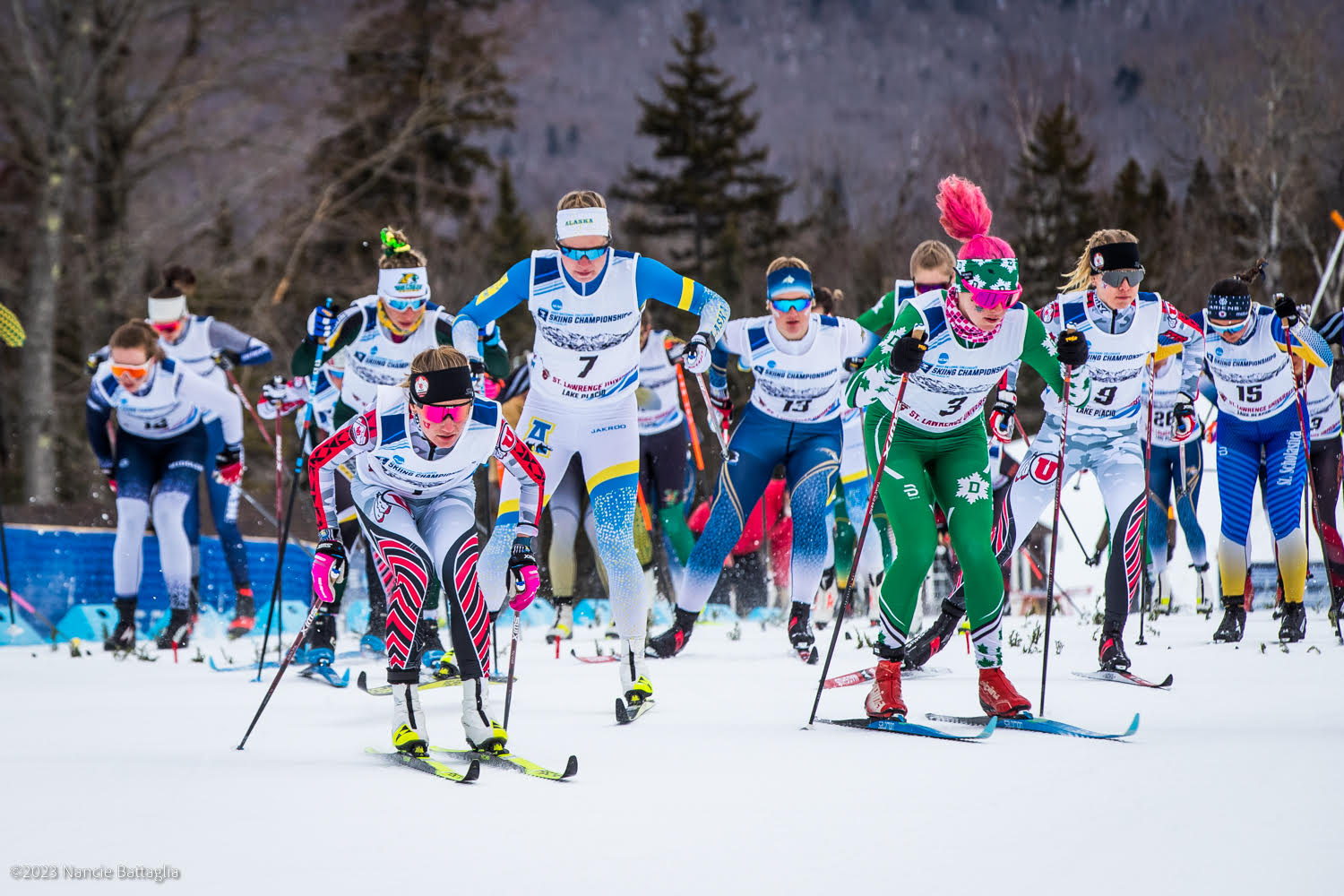
    The second half of this year’s NCAA Championships took place Saturday in Lake Placid, New York, with a 20 k mass start classic which both the women’s and men’s field would race in true, dynamic, mass start style. Packs came, moves went and, in the end, one skier would come out the strongest on the day in both the women’s and men’s races.

    Novie McCabe controlled the pack for much of Saturday’s 20 k mass start. McCabe became just the fifth three-time NCAA Women’s Champion with her win. (Photo: (c) 2023 Nancie Battaglia)

    Thursday’s results left open the possibility for plenty of history to be made. After dominant performances in Thursday’s 10 k/5 k skate race, Novie McCabe and Joe Davies opened the possibility to complete a “sweep” at this year’s Championship, winning both Skate and Classic races. Davies could have become only the second North American male to do so, after Ben Ogden completed the feat last year, and also the first British skier (Davies is half-Canadian, half-British, and competes for Team Great Britain). Novie McCabe, meanwhile, came into Saturday as the defending Classic champion, with a chance—after Thursday’s win—to become the fifth women to win at least three NCAA Championships, joining Laura Wilson (4), Katerina Hanusnova (4), and Antje Maempel (4), and Katharine Ogden (3).

    And while there was the possibility of history being made by individuals, the entire women’s field was bound to make history by starting on the day. In a first move towards equal distance racing, the NCAA Championship mass start was a 20 k for both the men’s and women’s field.

    The team standings also added intrigue around some historical implications. The University of Utah (UU) and University of Colorado (CU) went into the final Nordic day of NCAA competition separated by just a 1.5 points, 358 for UU, and 356 for CU, at the top of the team standings. With Alpine skiers having completed their part of the combined scoring competition, it would come down to the Nordies out at Mt. Van Hoevenberg. UU had the chance to complete the first 4-peat in modern NCAA history (since ski jumping was dropped in 1977), and Colorado had a chance for its first NCAA Championship since 2015, the last time the Championship was held in Lake Placid.

    Temperatures hovered right below the freezing mark on an overcast day in the Adirondacks, as the best collegiate skiers from the country looked to end the season in mass start, pack-style, fashion.

    Women’s 20 k Classic Mass Start

    The extra 5 k to the Women’s Mass Start this year only extended the tension. As the women’s field started to split mid-way through the race on Saturday, a trio of University of Utah skiers—all of them already NCAA Champions—started to push from the front. Novie McCabe, Sophia Laukli, and Sydney Palmer-Leger were joined by University of Alaska-Fairbanks’ (UAF) Mariel Pulles, and University of Colorado’s (CU) Hanna Abrahamsson. The five skiers traded some leads and pulls, but throughout the race, one skier appeared to control pack surges just a little more than the others, seeming to have an idea of when and where she wanted to make a move. 

    Novie McCabe controlled a pack that also contained her teammates Sophia Laukli and Sydney Palmer-Leger. The UU girls finished first, third, and fifth, propelling the Utes to their fourth consecutive NCAA Championship. (Photo: (c) Nancie Battaglia).

    That was McCabe, and when the group started to wind around the Lake Placid course one last time, she decided to go. By the end of the lap, she was on her own. McCbe went on to complete her sweep, winning her third NCAA Championship. Her teammates Sophia and Palmer-Leger came through in third and fifth, with Abrahamsson in second and Pulles in fourth splitting the UU girls results. First, third, and fifth though, was enough to all but guarantee that the University of Utah Utes would make history by winning their fourth consecutive NCAA Championship. The trio of McCabe, Laukli, and Palmer-Leger scored the highest team score in an event of the entire NCAA Championships.

    In post-race comments to FasterSkier, McCabe wrote that, “I am really excited that we managed to pull off the team win! The Alpiners had some crazy good performances which really helped us out and it was cool to be able to keep that lead today. My time at Utah has been really amazing and I feel so lucky to be part of the team, so being able to contribute to the win was a really great feeling!”

    The University of Utah Utes became the first team in modern NCAA Championships history to win four consecutive titles, with their Nordic team leading the way. (Photo: (c) 2023 Nancie Battaglia)

    UU Head Coach Miles Havlick wrote to FasterSkier about what distinguished this latest UU Championship: “This year was very much a team effort,” Havlick wrote. “Everyone both on the Alpine side and Nordic understood that their jobs were to score as many points as they could for the team, and it was very evident today. Both in the women’s race and men’s, each of our skiers left every ounce of energy out on the trails and I am super proud of that.”

    Havlick also highlighted McCabe’s place not just in this year’s Championship, but in that whole string of Team Championships: “She was definitely on form this week,” he said. “And she will certainly go down as one of the best Ute skiers of all time.” Havlick recognized that the Utes dominance has been part of a feedback loop of determined skiers begetting more determination for each other, “Any one of them, Novie, Sophia, and Sydney, have the ability to take both titles. It has benefitted each of them to have the competition of each other in training day-in and day-out.”

    For McCabe, there’s more ahead too, with Havlick being the first to say that after her NCAA sweep, “it will be fun to see how she stacks up she heads back over to Europe for the final World Cups of the season.”

    Men’s 20 k Classic Mass Start

    John Steel Hagenbuch has made the tough new course at Lake Placid a kind of home field this season. In January, he won the 30 k freestyle mass start at the World University Games, and was the bronze medalist in that Games’ pursuit as well. He swept this year’s St. Lawrence Carnival, and was runner-up in Thursday’s NCAA Championship race. Neon headband wrapped around his Big Green suit, the Dartmouth Junior was ready to light out for a win from the lead pack of three skiers that had formed mid-way through Saturday’s race.

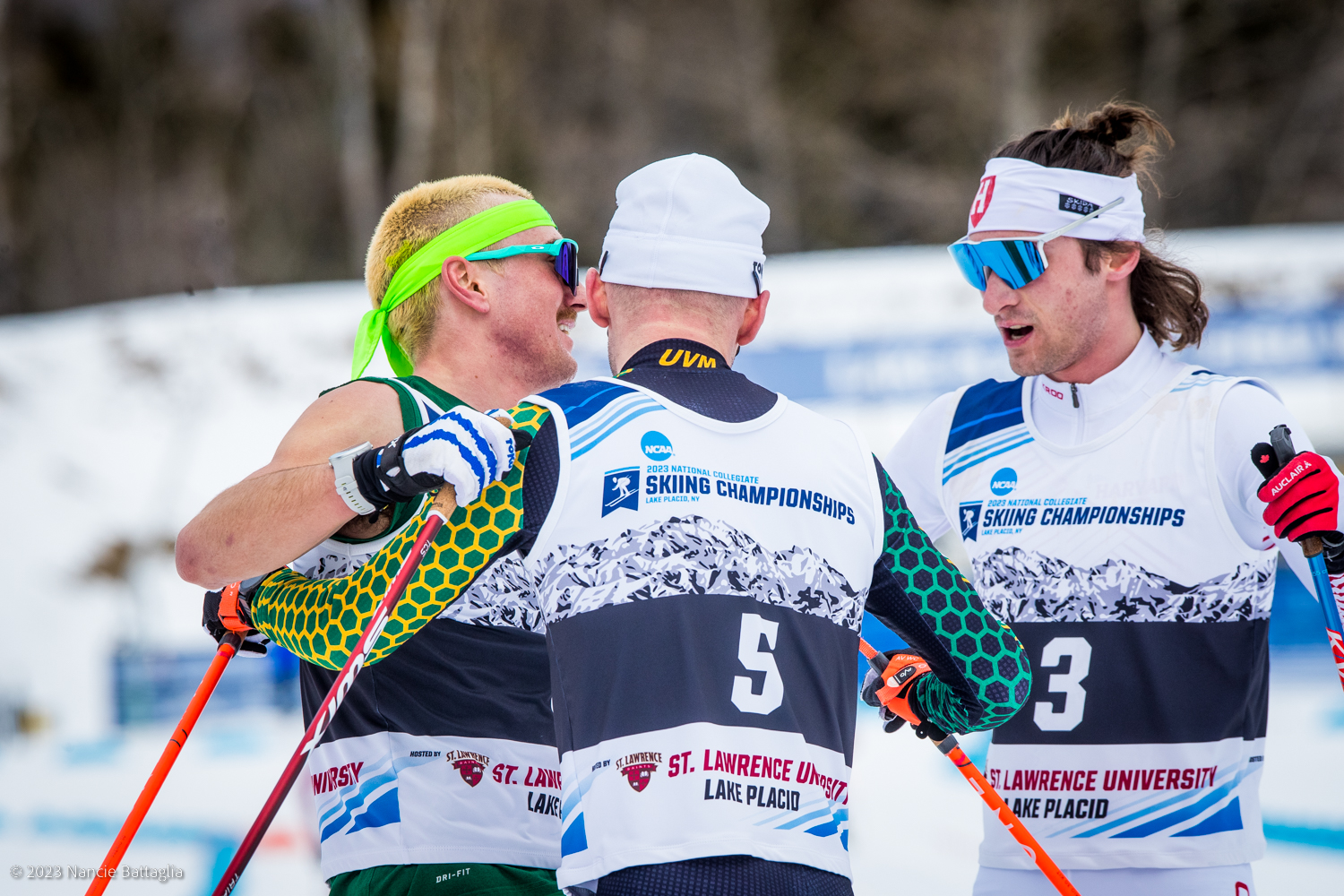
    The men’s lead pack embraces after a 20 k pitched battle: (L-R) John Steel Hagenbuch (Dartmouth), Jacob Nystedt (UVM), and winner Remi Drolet (Harvard). (Photo: (c) 2023 Nancie Battaglia)

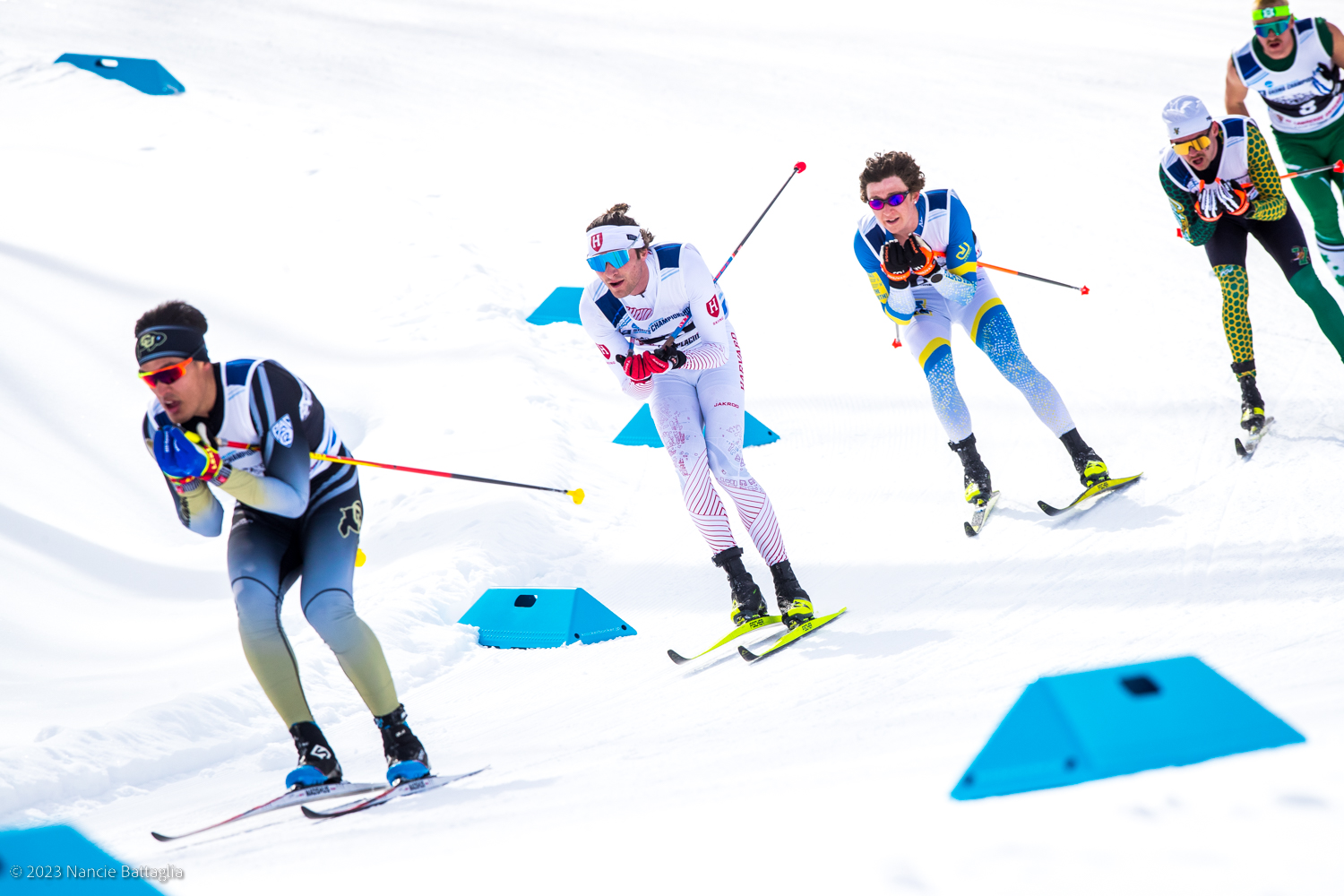
    For a little bit, it seemed Hagenbuch had left it all behind. University of Vermont’s Jacob Nystedt was dropped. Harvard’s Remi Drolet though, was just out of the picture. Then, as the finish came into focus, so did Drolet. The Canadian National Team member steadily, and then suddenly, passed Hagenbuch; a final battle concluded before they hit the finishing straight. Remi Drolet crossed the finish line to win his first NCAA Championship, and the first for the Harvard Crimson Nordic Ski Team in its history.

    “I tried to be aggressive throughout the race, and us top three eastern guys. [Hagenbuch and Nystedt] were able to pull away from the pack by pushing the uphill fairly hard every lap” wrote Remi Drolet in post-race comments to Fasterskier. “Apart from [the tactics], I think I just really wanted it. I wasn’t sure I had it in me going into the race, but I was able to dig really deep.”

    Harvard Head Coach Chris City wrote to FasterSkier that there was an underlying confidence heading into today that helped boost Drolet and the Harvard team,:“[Remi] is such a strong classic skier and it’s a course that really asks a lot in terms of striding. His seventh place [Thursday]—a first All-American for our program—gave us a feeling that Remi was in a good place to compete in a classic.” Pre-race confidence translated to, “one of the most exciting collegiate races I’ve seen,” added City.

    Remi Drolet became the first Harvard NCAA Champion in program history with his win in the 20 k classic Saturday. (Photo: (c) 2023 Nancie Battaglia)

    Excitement during the race crescendoed afterward, as both coach and athlete recognized that the result of one race extended far beyond the finish line, “It feels really nice to know that I wrote this down as a goal with [the Harvard team] at the beginning of the season, and that we were able to come together to make an NCAA title happen wrote Drolet. “I’m so proud of him and of his teammates,” Coach City wrote, “and of the many other Harvard skiers who helped build the program to where we reached today.”

    Collegiate Skiing Comes to a Close, with more to come

    College skiing is a circuit uniquely attuned to constant transition; so, as the banners and barriers come down in Lake Placid, coaches and athletes are looking back, and beginning to look ahead.

    For many programs, they will be looking not just at historic firsts at the top of the results, but the ranks of the All-American finishes that marked an individual achievement, powered by a whole program’s efforts. To be designated an All-American, skiers place in the top ten of an event.

    NCAAs leave Lake Placid with many programs having achieved milestones. Harvard saw its first NCAA All-American and Champion with Remi Drolet, while University of Alaska-Fairbanks saw seven All-American finishes over two days of racing. (Photo: (c) 2023 Nancie Battaglia)

    Remi Drolet’s history-making finishes for Harvard—a first All-American for the Crimson on Thursday, and a first NCAA Championship for the Crimson Saturday—is a stark and impressive example. Dartmouth College, the University of Colorado, and the University of Utah all showed impressive signs of sustained top performance, with four All-Americans between the Women’s and Men’s race on Saturday.

    That was nearly matched by the University of Alaska-Fairbanks (UAF), which had three All-Americans today, and a total of seven in this Championships. For the Nanooks, that is a sign of something special growing. “We come away from these championships both proud of what we accomplished, and also hungry for more” wrote UAF Assistant Coach Benjamin Buck to FasterSkier. “We came closer to winning the overall nordic competition than I think anyone expected.”

    After all the scores are tallied, honors awarded, and results sheets posted, the athletes and coaches leaving Lake Placid are looking at one aspect of the College circuit that doesn’t seem to change, even as the participants constantly do. Take it from this year’s winner, Novie McCabe: “The college ski community is just so great and everyone is supportive of each other,” she said. “It’s really just such a lovely group of people. Yes, winning was a goal of mine, but mainly, I’m just happy I got to experience racing in this insane atmosphere!”

    Full Women’s 20 k Classic Mass Start RESULTS

    Full Men’s 20 k Classic Mass Start RESULTS

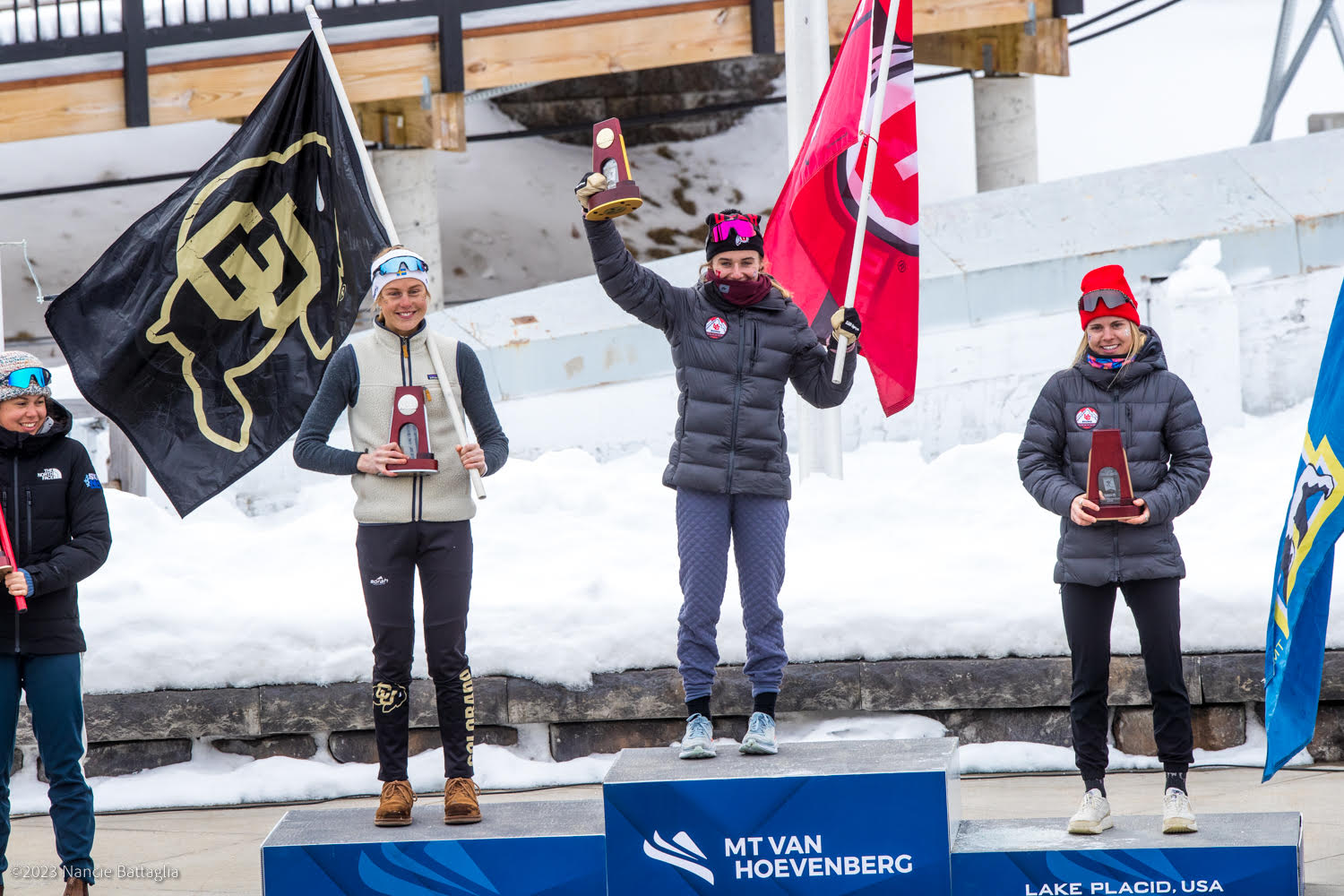
    Women’s 20 k classic mass start NCAA podium, 1st) Novie McCabe (UU), 2nd) Hanna Abrahamsson (CU), and 3rd) Sophia Laukli (UU). (Photo: (c) 2023 Nancie Battaglia)
  • Martin and Kern Stride to the Top on Day Two in Whistler

    Martin and Kern Stride to the Top on Day Two in Whistler

    Carrying the momentum from the first day of racing into a second distance event, athletes lined up once more at the Whistler Olympic Park for a 10 / 15-kilometer interval start classic. Over 130 men and 90 women participated in the open categories, representing clubs across Canada and the United States. 

    Adding a springtime layer of complexity to remind us that we are officially past the equinox, temperatures in Whistler hovered above freezing while a mix of precipitation fell off and on throughout the day. Webcams of the venue showed the spectacular mountain backdrop hidden amongst dense clouds and conifers still laden with the week’s snow.

    It’s a humidity-temperature combo that makes classic waxing tricky. Consequently, many athlete chose to use “hairies”, which are known as “rub skis” in Canada, essentially foregoing kick wax and opting instead for a sandpapered kick zone. For those with strong striding technique, this achieves grip without as significant a risk of icing issues, as klisters can be known create in such conditions. 

    Top Canadian U20 racer Xavier McKeever (Foothills Nordic), who was 13th overall today, explained how this changes the game for those who haven’t had the experience: “You have to be a bit more careful with your kicks and a bit more gentle, because they can slip out really easily. That was the biggest focus for me [today], just to try and ski technically well.”

    Craftsbury’s Adam Martin takes the 15 k classic win in Whistler. (Photo: Doug Stephen / VR 45 Photography)

    Following 10 k sitting and standing events contested by Nordiq Canada’s Para Nordic athletes, the open men’s category headed out for the three 5 k loops. In a close race for the top podium spot, Craftsbury’s Adam Martin took the win with a time of 40:29.3. Martin was chased by today’s Canadian National Champion, Antoine Cyr (Skinouk) who hunted his times from 19 bibs behind.  

    Though Cyr led through the first 10 k, a strong closing lap from Martin moved the American to the lead in the splits, with Cyr skiing the third fastest final lap to take second (+1.3). Canmore’s Russell Kennedy was third overall (+13.1) for the second spot on the Canadian podium, while fellow Canmore athlete Sam Hendry, who now trains with the University of Utah, was third for Canada in fifth overall (+48.0). Both Cyr and Kennedy had also raced onto the podium in yesterday’s 10 k free. 

    “I felt really good today,” Martin wrote to FasterSkier after the race. “Particularly in the second half, I started to figure out how to best race this course and these conditions, and I found a good place mentally to push. I’m really happy with the outcome – that was a dream to win.”

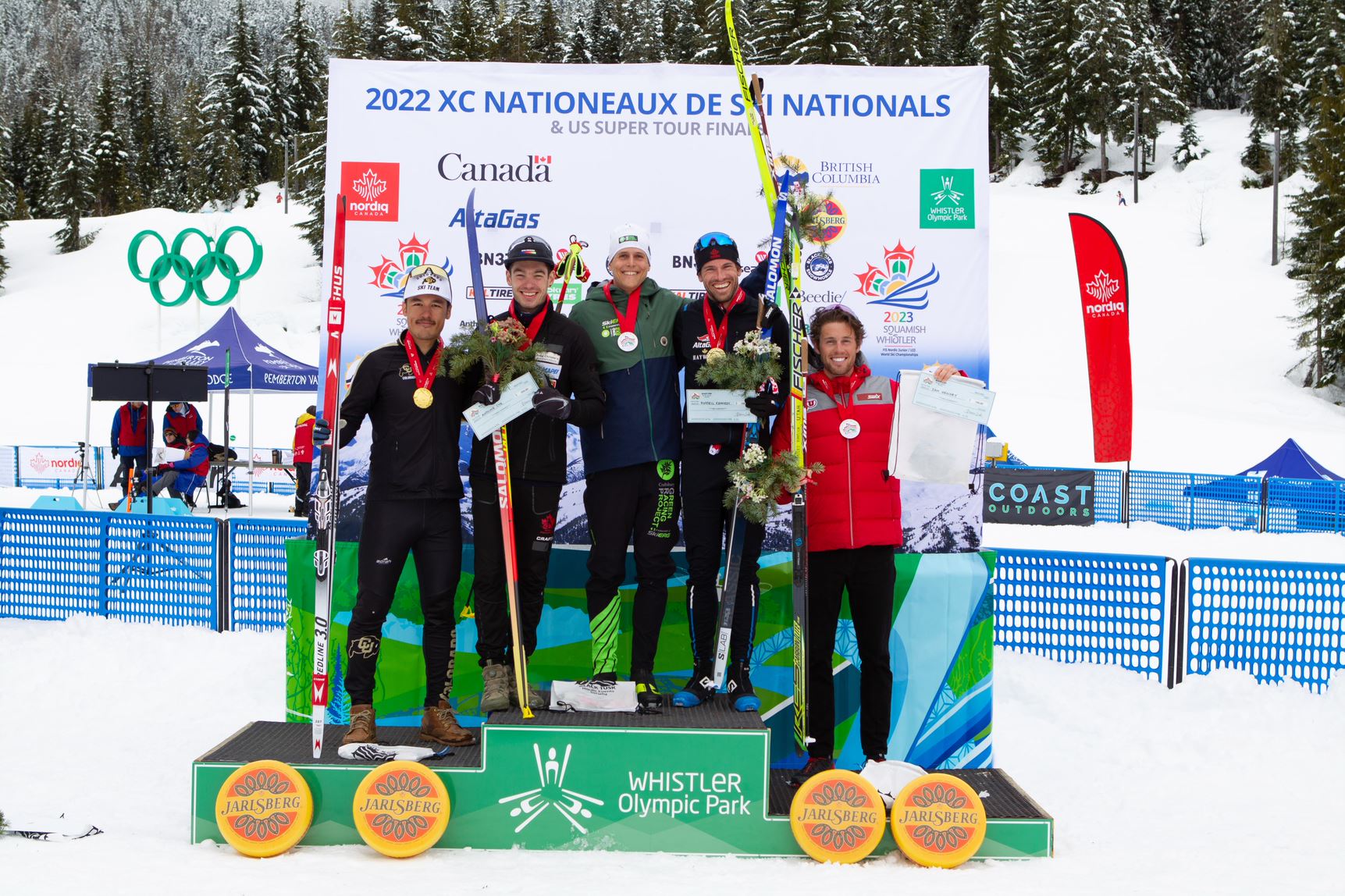
    The men’s 15 k classic podium in Whistler: Adam Martin (CGRP) took the win ahead of Antoine Cyr (Skinouk), and Russell Kennedy (Canmore Nordic). (Photo: Joern Rohde / Nordiq Canada)

    A successful season of SuperTour racing has Martin ranked at the top of the rankings, and earned him starts in post-Olympic World Cup events. After taking third at the American Birkie, Martin headed to Norway to race the 50 k classic at Holmenkollen, where he finished 26th. The following weekend, he skied to 44th in the 15 k free in Falun, Sweden. A week later, Martin is back with his Craftsbury team and standing atop the US SuperTour podium. 

    “It’s nice to return from the World Cup and still feel in good shape. After two 50 k’s, and travel, and a season that I’m really happy with, everything is a bonus at this point. I think it’s great that we are able to combine with Canada for these races. There are a lot of guys at a similar level, so it makes for some tight, fun racing.”

    A 23-year-old Quebec native, Cyr’s best results have been in classic this season, namely an 11th place finish in the opening World Cup 15 k classic in Ruka, Finland, and racing with Graham Ritchie to put the Canadian team in fifth during the Olympic classic team sprint in Zhangjiakou. After the team sprint, he was praised by both his teammate and coach Erik Bråten, along with armchair quarterback Devon Kershaw, for his classic technique.

    “Classic is always good for me and is a race I love,” Cyr said of today’s 15 k in a post-race interview with Nordiq Canada. “It was tough conditions this morning, and a good skier normally comes out on top in hard conditions. I was able to ski well, focus on the race, and came second overall, which is a little bittersweet because it was a really tight battle in the end. But it was really fun, the track is amazing. It’s an Olympic standard track, so it’s just really good.”

    Antoine Cyr races for the Canadian National Title in the 15 k classic in Whistler. (Photo: Nordiq Canada / Nathaniel Mah)

    In his second lap, Cyr had caught yesterday’s winner, Rémi Drolet (Team Black Jack), whom Cyr credited in supporting his strong result today.

    “When I saw was closing the gap on him on the first lap, I decided to go a little harder than I planned to catch up with him. [I then tried] to relax behind him for a lap or half of a lap.. In the end, I was missing a little bit on the last lap. I think that that helped for sure, skiing with someone strong like Rémi.”

    Finally, Cyr spoke to the importance of an international field featuring all age groups coming together this week, particularly on the heels of a two-year hiatus due to pandemic restrictions.

    “It is so good for the young kids — us older guys, we’ve been racing on the World Cup, but like the juvenile and junior, they almost have no races in Canada. To have a big event like this is just amazing and we’ve been looking at the younger guys’ results for an hour yesterday, seeing who’s in good form, and who’s coming up, and you are the next guys to be like taking over. So for them, it is awesome, and for us too, racing with the US is always — it should always be like this.”

    Joining Martin for the SuperTour podium, BSF Pro Team athlete Finn O’Connell was 7th overall (+1:06.4) and second American, with University of Utah’s Luke Jager half a second behind in 8th overall (+1:06.9).

    Julia Kern strides for the win in tricky conditions during the 10 k classic in Whistler. (Photo: Doug Stephen / VR 45 Photography)

    In the women’s 10 k, SMS T2’s Julia Kern skied a strong second lap to take the win in her second consecutive day on the podium, stopping the clock at 29:54.3. Her club and national teammate, Jessie Diggins, took the second step finishing +18.3 back, while University of Utah’s Sophia Laukli skied to third (+1:03.2).

    Looking at tough conditions, Kern explained she raced by trial and error today, exploring which techniques were most efficient on different sections.

    “I kind of had an open mindset going in today,” she told Nordiq Canada after the race. “I knew that the tracks might be a little bit punchy or washed out in sections, and so I was double pulling wide or double polling narrow or just like power striding on the flats if it was getting too punchy out there. So just trying it all.”

    She continued that she was looking to “have fun, send it from the start, and see if I could hold that pace the whole time,” which she ultimately proved able to do. It’s the time of year where the hay is in the barn training-wise, and athletes have had a long season, leaving them in varying states heading into the last hurrah. On whether she was looking to just have fun at these races, or whether it was a serious quest for the podium, Kern said “both”.

    “I think the end of the season is always really fun. It’s so cool to have this many athletes here. And I’ve been feeling really good the last few weeks and so enjoying racing when it does feel good and when I’m able to push really hard. We’re all really tired at the end of the season, but also, when the body’s in form you might as well take advantage of it and send it on the course.” 

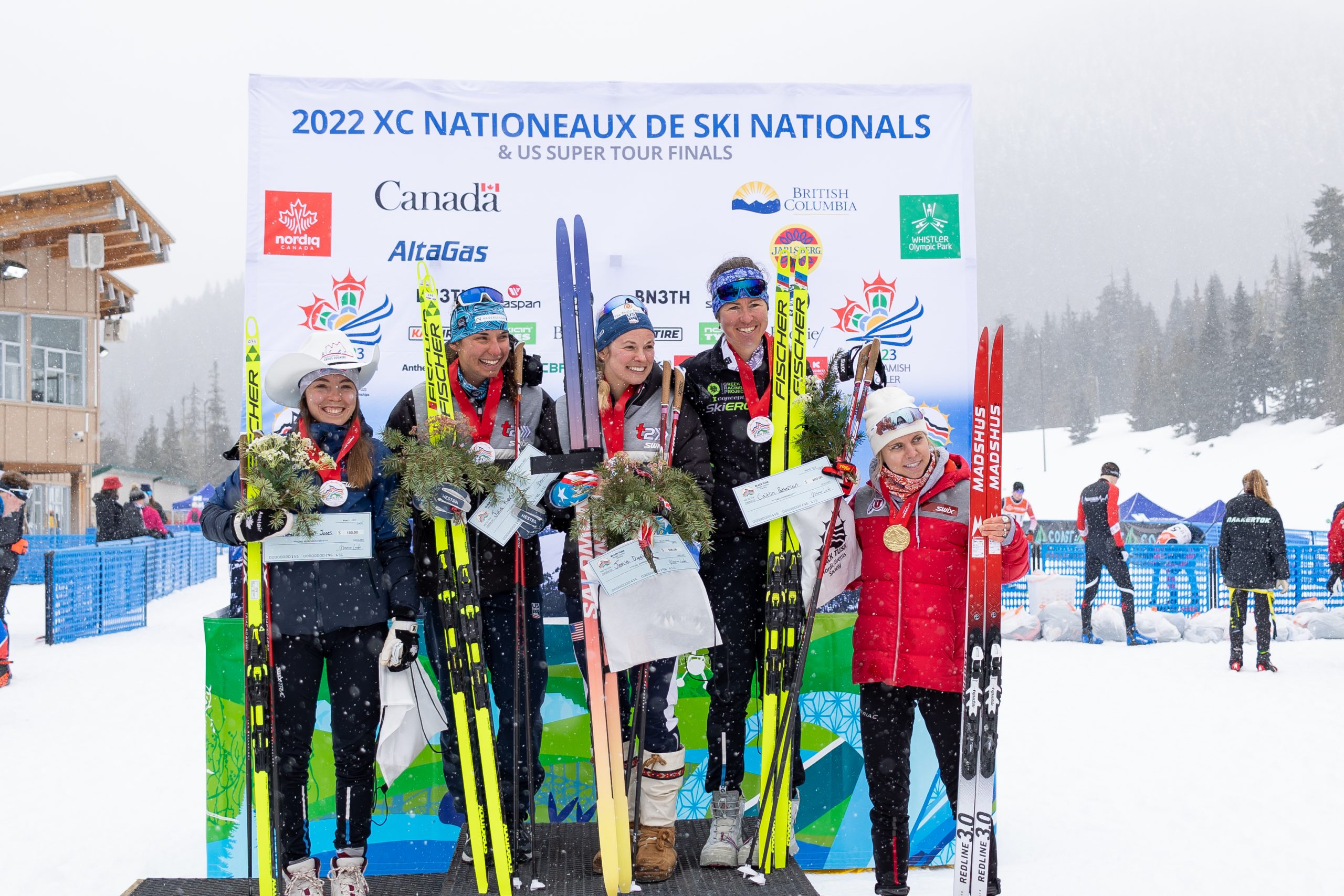
    The women’s 10 k classic podium on day 2 in Whistler: Julia Kern (SMS T2) took the win ahead of Jessie Diggins (SMS T2) and Sophia Laukli (Univ. of Utah). (Photo: Joern Rohde / Nordiq Canada)

    Winning back-to-back Canadian National titles, Katherine Stewart-Jones (Nakkertok Nordique) was again on top for the Canucks, finishing sixth overall (+1:17.5). Finishing in the same order as yesterday, Dahria Beatty (Whitehorse Ski Club) was second for Canada in eighth overall (+1:55.0), while Cendrine Browne (Fondeurs-Laurentides) rounded out the podium in ninth overall (+2:14.5). 

    “I went out really hard knowing that that’s what I had to do if I wanted to make the podium,” Stewart-Jones said of her race. “I had a good first lap, and I definitely slowed down a lot on the first part of the second lap. I was just tired and was having a hard time staying in the zone and keeping the rhythm, but I was able to pull it together a bit for the second half of the second lap. So I was really happy with that. And I was happy with how hard I pushed. I just didn’t have it quite in me today, and sometimes that happens.”

    On the importance of focusing on her technique on this type of course with sub-optimal conditions, she continued, “It’s really important, especially on the climbs. The grip isn’t always perfect in these conditions, so you really have to make sure to stay on top of your skis. If you get tired and you start leaning forward, then it makes it even harder to kick… And then on the flatter sections, it was a bit awkward, and you had to expect that. Either you’re striding awkwardly or you’re doing a kick double pool, but your poles are sinking. You have to just really focus on committing to whatever you decide to do and not like trying to switch too much between.”

    Speaking to already standing atop two podiums, Stewart-Jones responded with pride, while also acknowledging that the overall win would be sweeter.

    “Oh, it’s definitely nice to be winning the national championship title… because we’re racing against the Americans, I obviously care about the overall too, so maybe it feels a little less exciting, but for sure, I’m proud of that.”

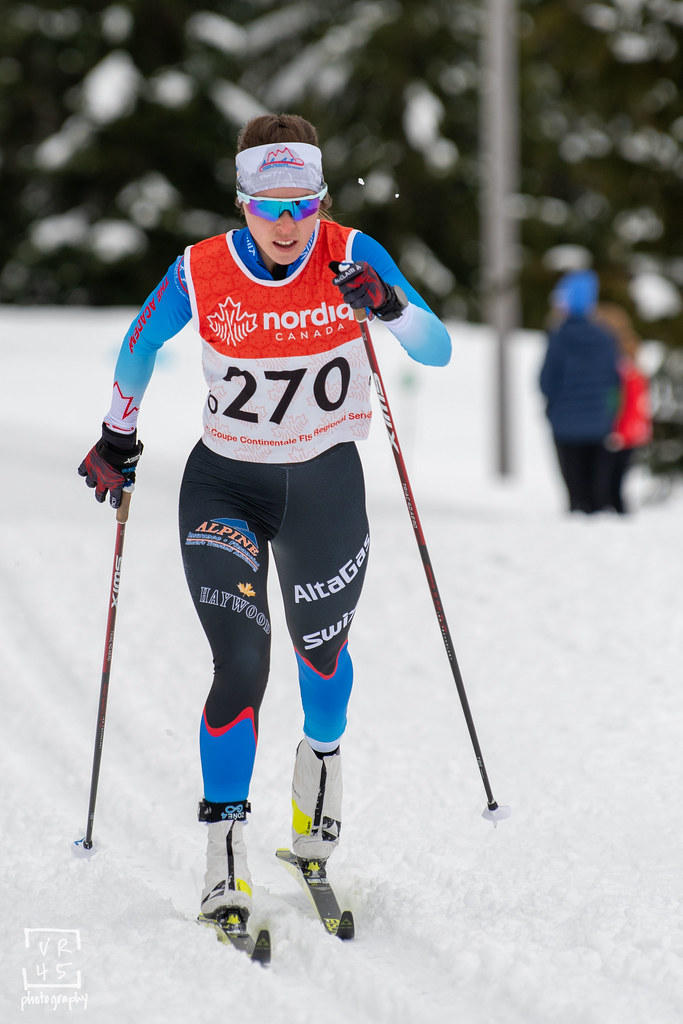
    Katherine Stewart-Jones (Nakkertok Nordique) takes back-to-back national titles in the women’s 10 k classic in Whistler. (Photo: Doug Stephen / VR 45 Photography)

    In order to get closer to the overall podium, she said he would focus on resting as much as possible and maintaining the head space to perform her best. “It’s been a long season and I haven’t raced this much in a long time. I think everyone’s pretty tired. But also just being able to also be mentally strong [over the next races]. And yeah, you never know what’s gonna happen.”

    Racing continues Wednesday with individual classic sprints, which will be live-streamed by the Black Tusk Nordic Events Society. If you’re looking for additional video updates, follow along on the Nordiq Canada and Black Tusk Instagram pages. 

    Full Results

  • Diggins and Drolet Top 5/10 k Skate Podium to Kick Off Combined Championships in Whistler

    Diggins and Drolet Top 5/10 k Skate Podium to Kick Off Combined Championships in Whistler

    The collaborative event featuring Canadian Nationals and SuperTour Finals kicked off Sunday March 20th in Whistler with 5 / 10-kilometer individual start freestyle races. (Photo: Nordiq Canada / Nathaniel Mah)

    Sunday kicked off a week of racing at the combined Canadian Cross-Country National Championship and U.S. Super Tour Finals event held in Whistler, British Columbia. Hosted by the Black Tusk Nordic Events Society (BTNES) on the Whistler Olympic Park courses, this event also offers junior and U23 skiers a preview of the courses for next year’s Junior and U23 World Championships. With Paranordic, Nordic Combined, and both junior and senior cross-country events, it looks to be a busy week of racing. 

    After a morning of Paranordic and junior events, the senior women got underway with a 5 k interval skate. This meant a single lap of the “Blue A” course, which features two major climbs, one almost right out of the start. Despite a wintery mix of precipitation forecasted throughout the week, and light snow accumulating on top of the corduroy, times were fast as athletes took to the course.

    The women’s 5 k individual start freestyle podium: Jessie Diggins (SMS T2) took the win ahead of teammate Julia Kern and Craftsbury’s Caitlin Patterson. Katherine Stewart-Jones (Nakkertok Nordique) was fourth, with Sophia Laukli fifth (University of Utah). (Photo: Nordiq Canada / Nathaniel Mah)

    Swapping stars and stripes for her red and blue SMS T2 team suit, Jessie Diggins won the women’s 5 k event in 11:47.9, with her club teammate Julia Kern in second (+7.7). Craftsbury’s Caitlin Patterson took third (+29.8), ahead of Katherine Stewart-Jones who was the top Canadian racer in fourth (+33.1). Dahria Beatty was second for the Canadian women in eighth overall (+56.1), with Cendrine Browne just behind as third for Canada and ninth overall (+1:00.6). 

    In an interview with Nordiq Canada after the race, Diggins first spoke to the experience of racing amongst a field of over 180 women and girls from across Canada and the U.S. 

    “This is super cool,” Diggins said emphatically. “I mean, I’m half-Canadian, so this is really very special for me any time I can come be in Canada. I really love it, and with COVID, it’s been a while.”

    She also spoke to the change of pace and pressure, in transitioning away from the high-stakes environment of the World Cup where the team operated under strict COVID precautions to ensure the season would not be derailed by an outbreak within the team.

    “The biggest draw for me was to be here with my club, to have fun. There’s all these really awesome kids racing. And, yeah, it’s really nice to have a little more relaxed, not quite as high pressure, [especially] after the Olympics. It’s nice to just get back to racing because it is super fun. So I’ve really enjoyed being here.”

    Diggins described watching the field of rising junior athletes race as “super cool” and spoke optimistically of what this means for the long term health and success of the sport at all levels.

    “It’s so fun to see how invested in the sport, overall, that they are — because they love it, and they want to work hard, and they’re having fun. It’s just really cool to see how our sport’s been growing and expanding, and how great this next generation is looking.”

    Sophia Laukli skates to fifth in the women’s 5 k interval start free, which kicked off Canadian Nationals and US SuperTour Finals in Whistler. (Photo: Doug Stephen / VR 45 Photography)

    Finally, on her own race, Diggins shared it was a “shock to the system.” Following the World Cup finals last weekend in Falun, Sweden, Diggins spent the week in Annecy, France, where she visited the Salomon design center, participated in a live Q&A with a Salomon representative, and even snuck in a guided mountaineering experience in nearby Chamonix.

    She then hopped aboard a flight to Western Canada, finding herself once more on a start line soon after. 

    “I got off the plane from France like 40 hours before the start,” Diggins laughed. “So it was one way to kick the jet lag, and it was highly effective. It was a bit of a bit of a shock, but it was really fun to just get out there and work hard, and really enjoy these — I mean, it’s fun. They’re Olympic courses. They’re really, really nice, they have great flow. So I really enjoyed being out there.”

    As the top Canadian woman, Katherine Stewart-Jones spoke with Nordiq Canada about the tough competition, “It was really exciting to race today and having the Americans here I knew it was going to be a competitive race, and I definitely wanted to perform because, you know, you want to show that Canadians are also competitive,” she said.

    Katherine Stewart-Jones, racing on behalf of her club, Nakkertok Nordique, is the top Canadian athlete in the women’s 5 k skate on day 1 of Canadian Nationals/SuperTour Finals in Whistler. (Photo: Nordiq Canada / Nathaniel Mah)

    “Overall, I was happy with my result. I didn’t think it was my best race. It was the type of race where the conditions are brutal, and nobody feels technically great, but you had to keep going. In warm-up I could tell it was hard conditions to ski in, so I gave myself a few technical cues during the race, making sure I reminded myself it was like this for everyone. I’m really happy with my effort.”

    Sydney Palmer-Leger (University of Utah) earned the top spot in the women’s U20 ranking with a time of 12:36.8. She finished seventh overall.

    Russell Kennedy (Canmore Nordic) skis to second place in the men’s 10 k interval start freestyle, which kicked off Canadian Nationals in Whistler. (Photo: Doug Stephen / VR 45 Photography)

    With the women’s race wrapped up, the competition turned to the men who skied 2 x 5 k. In a reverse of the women’s results, it was the Canadians who took the top three spots led by Rémi Drolet (Team Black Jack) in a time of 22:50.2. Russell Kennedy (Canmore Nordic) finished second, +19.8 behind Drolet, while Antoine Cyr (Skinouk QC) rounded out the podium in third (+29.7). 

    Luke Jager (University of Utah) was the first American of the day in fourth (+37.4). Jager was followed by two fellow collegiate athletes, Kjetil Bånerud of Northern Michigan University, and Sam Hendry of the University. Bånerud is a native of Norway, while Hendry was also racing on behalf of Canmore Nordic, his home club. This leaves BSF Pro Team athlete Finn O’Connell as the next on the US SuperTour podium in seventh overall (+49.7), with Craftsbury’s Adam Martin third for the US in eighth overall (+50.1).

    The top-six Canadians stand on the podium following a 10 k individual start skate. Rémi Drolet (Team Black Jack) took the top spot ahead of Russell Kennedy (Canmore Nordic) and Antoine Cyr (Skinouk). Sam Hendry (Canmore Nordic) was fourth, followed by Graham Ritchie (NTDC – Thunder Bay) and Philippe Boucher (Skibec). (Photo: Nordiq Canada / Nathaniel Mah)

    Like many of the top athletes, Drolet just recently returned from Europe after the conclusion of the World Cup circuit. He spoke with Nordiq Canada after the race saying, “I really went into the race today with zero expectations. I was thinking in my head that if I execute well and push hard, then I’ll be happy with the race, and the result just came so that was just a bonus for me.” 

    In soft and sloppy conditions there were a number of mishaps out on the race course and Drolet said, “I think with conditions like that it can be really easy to kind of sketch yourself out. I think a lot of people were doing that. But I think you can just kind of stay focused on skiing and not worry too much about the conditions, then everything will be okay.”

    “You need to stay focused on skiing and not on the conditions. When you overthink it, things happen. I was really happy I was able to put together a great race today. This is where I strive to be, and it feels really good.”

    Prior to traveling to Canada, Jager was competing at NCAAs in Soldier Hollow Utah where he and the rest of the Utes earned their third consecutive national victory. 

    University of Utah’s Luke Jager is the top American and fourth overall in the opening 10 k interval start skate in Whistler. (Photo: Doug Stephen / VR 45 Photography)

    The U20 men’s race was won by Tom Stephen (Foothills Nordic) in a time of 23:33.3. Stephen finished sixth overall. 

    Racing continues today, Monday March 21st, with a 10/15 k classic, followed on Wednesday March 23rd by an individual classic sprint. The sprint heats will be livestreamed; these be viewed here. 

    Full Results

  • Jouve takes back-to-back classic sprint wins, earning France the 2022 World Cup sprint globe; Ritchie leads for North America with Top-20

    Jouve takes back-to-back classic sprint wins, earning France the 2022 World Cup sprint globe; Ritchie leads for North America with Top-20

    This World Cup coverage is made possible through the generous support of Marty and Kathy Hall and the A Hall Mark of Excellence Award.  To learn more about A Hall Mark of Excellence Award or to learn how you can support FasterSkier’s coverage please contact info@fasterskier.com.

    It’s the last hurrah, folks! The World Cup Finals kicked off in Falun, Sweden today with a classic sprint. While the season has been a wild ride for many reasons – spills and thrills in the Tour de Ski, COVID-cancellations, Olympic Games, geopolitical nightmares – Falun evidenced that spring is on it’s way and it’s time for the World Cup crews to head home take a break, and begin anew.

    Contrasting the dim light and long shadows of far-north Ruka, Finland at the opposite bookend of the season, the sprints in Falun were raced under bright sun, with temperatures well-above freezing, bare ground and green grass emerging from beside ski tracks.  

    Zak Ketterson leads the U.S. in 39th during the classic sprint qualification round in Falun, SWE. (Photo: NordicFocus)

    The American men, particularly in sprint, headed into the Falun weekend at a significant disadvantage. Kevin Bolger announced on Instagram Thursday that he had tested positive for COVID, while Ben Ogden, JC Schoonmaker, and Luke Jager – the remainder of the four sprint men who competed during the 2022 Olympics in Zhangjiakou – are currently competing at the NCAA championships in Soldier Hollow, UT. The sprint field as a whole has been weakened; Russian athletes were banned from competition on March 1st, while Norway’s top-six sprinters, including sprint and overall World Cup leader Johannes Høsflot Klæbo, each tested positive for COVID following the World Cup race weekend in Lahti, Finland. With no Russian’s and the top-Norwegians out, the men’s field had been cracked wide open.  

    Finland’s Joni Mæki posts the fastest time in the classic sprint qualifier in Falun, SWE. (Photo: NordicFocus)

    Finland’s Joni Mæki took the top spot in qualification, setting the mark at 2:51.58. Sivert Wiig of Norway took second in the qualifier (+0.69), with Sweden’s Calle Halfvarsson in third (+1.41). Three nations represented in the top-three.

    Though new-to-FasterSkier names made the top-30, the early heats featured little surprise. Building momentum from a podium day in Drammen last week, France sent three of its top men to the semifinals: Lucas Chanavat and Richard Jouve, who had been third and first, respectively in Drammen, plus Jules Chappaz. Long-time sprint force Federico Pellegrino of Italy also moved through with an automatic spot, joining the day’s top-three qualifiers in the next round.

    What did shake up the quarters was some trouble for the two Chinese athletes in the field. Shang Jincai, who had qualified in 25th, had a false start in heat three. Jincai looked as though he had been trying to keep himself so primed for forward momentum at the start beep, that he lost his balance, kicking a foot forward to catch himself well-before the beep and thus triggering the start. After a discussion with a jury member, while Pellegrino shook his head and raised his hands nearby, looking impatient, Jincai received a yellow card and was disqualified. 

    After stumbling on a climb and losing ground, Wang Qiang (CNH) races to 18th in the classic sprint quarterfinal in Falun, SWE. (Photo: NordicFocus)

    In the next heat, Wang Qiang, who qualified in 9th and took second in Drammen, fell when hopping out of the track to run uphill, roughly two minutes into the heat. Qiang had been in the lead, though the pack remained tight. After a few missteps, he was back to his feet, chasing as real estate ran out, while Lars Agnar Hjelmeset (NOR) and Calle Halfvarsson (SWE) took the reins at the front to go 1-2 in the heat. Qiang raced his way back to fourth, just over a second back, but it was not enough for a lucky loser spot.  

    Richard Jouve (FRA) takes control through the rounds in Falun. (Photo: NordicFocus)

    In the semis, France’s Jouve took control of the fast first heat, beginning a surge just under-two minutes in as the men ran up the steep climb and banked left to head back toward the stadium. Around the last corner, Jouve still held the lead with Mæki (FIN) just off his shoulder. Jouve pulled ahead in the double pole sprint through the lanes, while Mæki, Wiig (NOR), and Chanavat (FRA) raced each other and the clock down the final meters. At the line, it was Norway-France-Finland, spread by 0.38 seconds, fifth and sixth less than a second behind also. Each of the top-four finishers advanced into the final round.

    The second heat was significantly less smooth, though times did not reflect the chaos and were only marginally slower than the first. As the course broke down, it looked to be continually harder to keep klister free and stay upright. Heading into the final downhill in strong position to take the heat, France’s Jules Chappaz looked as if his klister snagged some loose granules of snow; as he pushed off the outside ski to stay in the curve, the ski looked unable to slide and he crashed into the abrasive corn. 

    The remaining athletes in the head narrowly dodged Chappaz, allowing Hjelmeset and Pellegrino to take the lead and eventually win the heat. Sweden’s Halfvarsson also went down earlier in the heat, looking to have similarly iced up while running up the first climb, leaving him off the back after the subsequent downhill.

    After leading into the final downhill, a dejected Jules Chappaz (FRA) recovers from a crash to finish his semifinal. (Photo: NordicFocus)

    Once again, Jouve took control of the final early, with Pellegrino marking. Mæki stayed wide on the first climb looking for better snow, but came over the top and into the curve behind the top three. Jouve, still calling the shots, led into the downhill, but he could not create any significant gaps there; Wiig, Pellegrino, Chanavat and Mæki quickly accordioned onto the backs of his ski tails.

    Looking confident and composed despite being unable to break away, Jouve remained at the front heading into the final curve. Once in the lanes, Jouve began to pull ahead a final time, creating a gap of several meters to Mæki and Chanavat, who were evenly matched in the double pole sprint. 

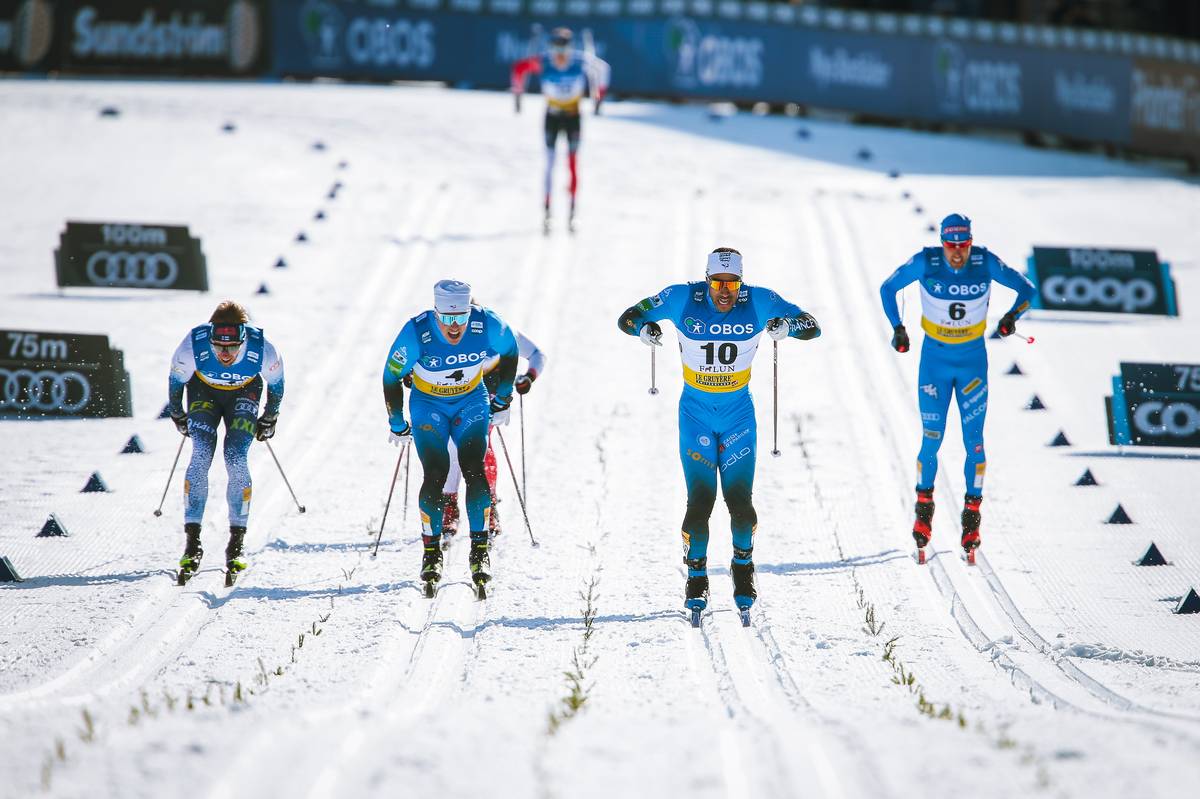
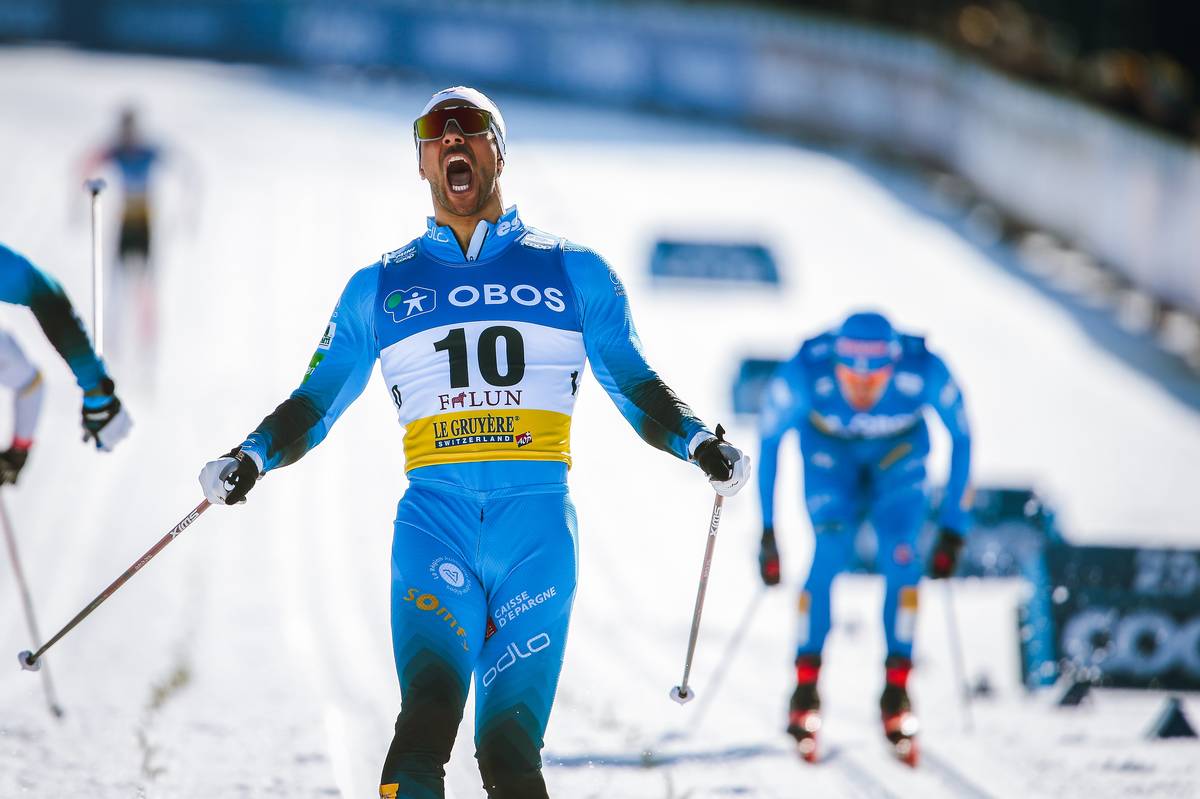
    Richard Jouve (bib 10) leads the men’s classic sprint final to the finish in Falun, while four athletes vie for the remaining two podium positions. (Photo: NordicFocus)

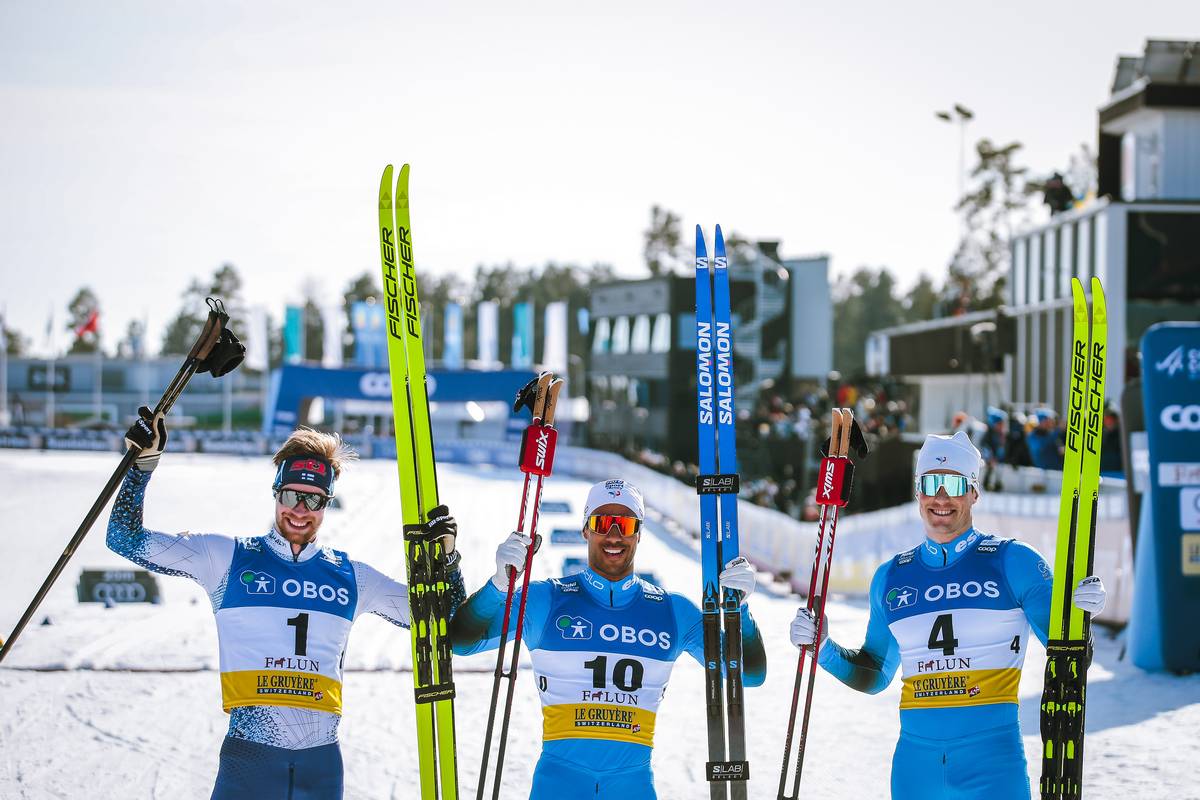
    Emptying his lungs with a triumphant cry, Jouve coasted over the line for the win in 3:03.62, while Mæki and Chanavat threw their boots forward in a photo finish for the second and third podium spots roughly half a second behind. From the slow-mo, it was Mæki with the better lunge, nipping Chanavat by 0.03.

    Just behind Wiig crossed fourth (+1.41), with Pellegrino fifth (+2.06), followed by a gap to Hjelmeset in sixth (+13.18).

    Richard Jouve (FRA) lets out a victory cry as he takes the classic sprint win in Falun. (Photo: NordicFocus)
    The men’s classic sprint podium in Falun, Sweden: Richard Jouve (FRA) took the win ahead of Joni Mæki (FIN) and Lucas Chanavat (FRA). (Photo: NordicFocus)

    “I’m very proud,” Jouve told FIS after the race. “Off myself, my team. It’s amazing.” 

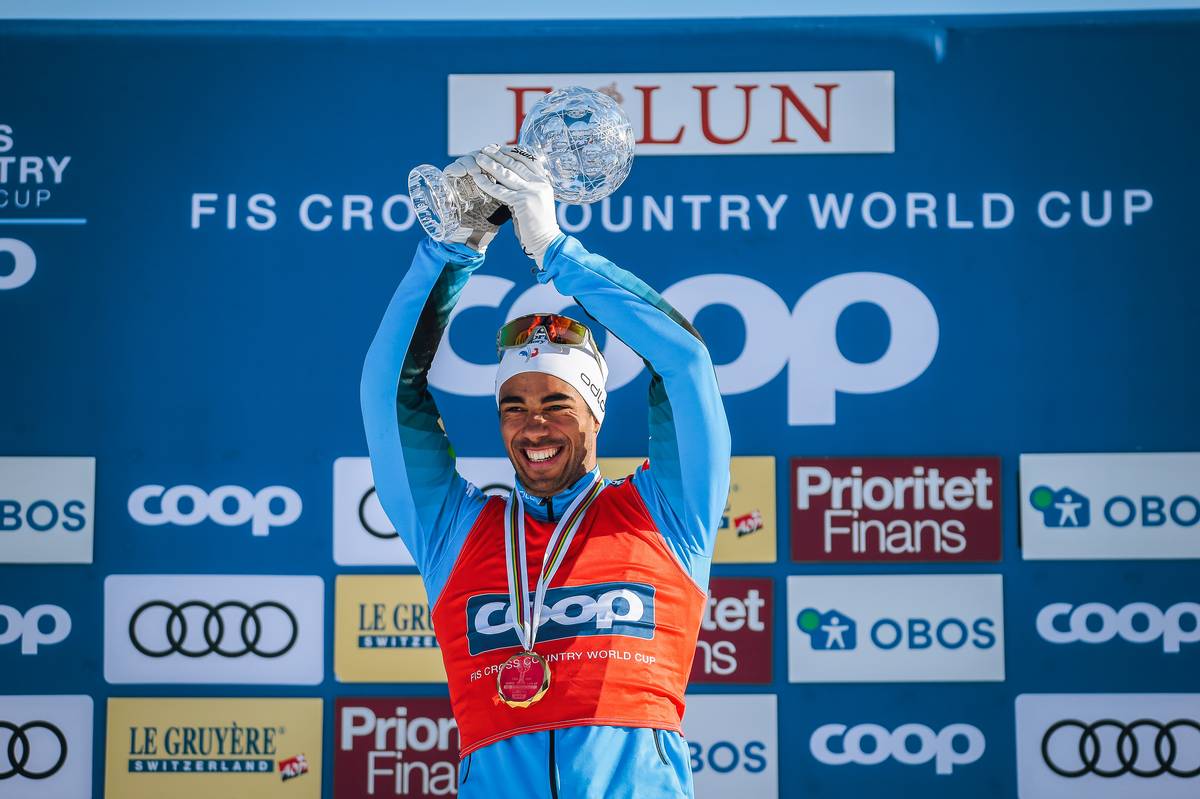
    With the win today, Jouve also took the lead in the sprint World Cup standings, advancing by just six points ahead of Johannes Høsflot Klæbo (NOR). The season saw Jouve land on four World Cup podiums, finish seventh in the freestyle sprint during the Olympics, and then earn his career first World Cup win in Drammen’s classic sprint last Thursday.

    “It’s amazing,” said an emotional Jouve, seemingly in happy disbelief. “The season was very great for me, to win at the end of the season is already a dream, but to grab [the globe], it’s big. Fantastic.”

    With a win in the final sprint stage, Richard Jouve becomes the 2022 World Cup sprint champion, hoisting his crystal globe. (Photo: NordicFocus)
    French teammates Richard Jouve (left) and Lucas Chanavat (right) end their season in first and third, respectively, in the World Cup sprint standings. (Photo: NordicFocus)

    A quick review of the final standings: With 568 points, Jouve is the 2022 sprint World Cup champion, with Klæbo second (-6) and Chanavat third (-107). Italy’s Pellegrino was fourth (-238), with Norway’s Håvard Solås Taugbøl fifth (-244). 

    The US had three starters for today’s final sprint stage. Zak Ketterson led the way for the American team in 39th (+9.92), followed by Logan Hanneman in 47th (+10.79), and Peter Holmes 54th (+13.38). 

    Listen to post-race interview with U.S. Ski Team Head Coach Matt Whitcomb here.

    Logan Hanneman skis to 46th in qualification in Falun. (Photo: NordicFocus)
    Graham Ritchie leads the way for North America, finishing 20th in Falun’s individual classic sprint. (Photo: NordicFocus)

    Racing for Canada, Graham Ritchie was the sole North American to break into the heats after qualifying in 28th (+8.11). Racing in the third quarterfinal heat, Ritchie crossed fourth, roughly three seconds behind Chanavat and Pellegrino, the heat winners. The effort landed him in 20th overall once final rounds were decided. 

    Missing the top-30 by just 0.27 seconds, Antoine Cyr was next for Canada in 31st (+8.76), with Xavier McKeever next in 44th (+10.54), followed by Rémi Drolet in 57th (+14.59). 

    Antoine Cyr just misses the mark in qualification, finishing 31st. (Photo: NordicFocus)

    Racing in Falun continues tomorrow with a 15 k individual start skate.

    Results:

    Qualification | Final | World Cup Sprint Standings


  • In Front of a Long-Awaited Crowd, Klæbo and Chanavat Take It to the Line in Lahti Freestyle Sprint

    In Front of a Long-Awaited Crowd, Klæbo and Chanavat Take It to the Line in Lahti Freestyle Sprint

    This World Cup coverage is made possible through the generous support of Marty and Kathy Hall and the A Hall Mark of Excellence Award.  To learn more about A Hall Mark of Excellence Award or to learn how you can support FasterSkier’s coverage please contact info@fasterskier.com.


    By Rachel Bachman Perkins and Ian Tovell

    During a brief reprieve from racing, the top tier of international racing made its way from the high desert of Zhangjiakou, China to a venue tucked into snow-capped pines and nestled amongst the lakes of southern Finland. With more start spots per country than during the Games and some athletes choosing a weekend away from the World Cup, a number of new faces appeared on the start lists in Lahti for the 1.6-kiilometer freestyle sprint. 

    Logan Diekmann (BSF Pro) makes his first World Cup appearance in the 1.6 k freestyle sprint qualifier in Lahti, FIN. (Photo: NordicFocus)

    For the U.S., these names included Logan Diekmann (BSF Pro Team) and Bill Harmeyer (SMS T2), both of whom earned their first World Cup starts this weekend via their performance on the SuperTour circuit this season. These athletes joined Kevin Bolger, Logan Hanneman, and Zak Ketterson; the Team Birkie athlete also earned his first World Cup starts earlier this year at the Tour de Ski.

    Diekmann currently leads the SuperTour sprint standings with 119 points. He was second in the freestyle sprint during the U.S. Cross Country Championships in Soldier Hollow in January and skied to 5th in the sprint in both Duluth and Lake Placid. 

    Harmeyer was ranked third in the sprint standings with 83 points, behind Noel Keeffe who is currently racing at the 2022 U23 World Ski Championships in Lygna, NOR. Harmeyer has consistently posted top-five times in qualification during the SuperTour sprint races, and has raced into the final in three out of six SuperTour sprints. A fall in the quarterfinal during US Nationals left him in 24th after qualifying in fifth. 

    Bill Harmeyer (SMS T2) makes his first World Cup appearance in the 1.6 k freestyle sprint qualifier in Lahti, FIN. (Photo: NordicFocus)

    Lucas Chanavat (FRA) was the top qualifier finishing the course in a time of 2:57.85. All five of the Americans finished outside the top-30 in qualification, but Canadian Graham Ritchie cracked into the heats for North America in 27th (+7.73). 

    The quarterfinal rounds played out mostly as expected, with Chanavat and Johannes Høsflot Klæbo (NOR) advancing from the first round after a close finish. Norway’s Håvard Solås Taugbøl and Olympic silver medalist Federico Pellegrino of Italy crossed the line first and second in heat two, spread by just 0.06 seconds. Winning the third heat, Andrew Young (GBR) crossed the line in 3:04.32, just ahead of Russia’s Gleb Retivykh (+.20). 

    The fourth quarterfinal heat saw a close finish, as Sindre Bjørnestad Skar (NOR) took the race to the line alongside Richard Jouve of France and Alexander Bolshunov of Russia were right at his heels. Skar won the closing sprint with Jouve +0.01 behind and Bolshunov in third (+0.07). Michal Novak (+.49) of the Czech Republic finished in fourth, with both Novak and Bolshunov narrowly missing out on lucky losers.  

    Fast racing in the fifth heat saw four competitors advance to the next round. Janik Riebli (SUI) won the heat in a time of 2:59.56, while China’s Qiang Wang finished second (+.10) to move onto the semis. A top prospect for the Chinese ski program, this is Wang’s first World Cup appearance since the pandemic began. Wang was fifth in qualification during the Olympic freestyle sprint in Zhangjiakou, where he took second in his heat to Norway’s Erik Valnes before being issued a disqualification for obstruction and being relegated last in the heat.

    Qiang Wang (CHN) leads at the start of the fifth quarterfinal heat in Lahti. (Photo: NordicFocus)

    Following the pace of the leaders, Maciej Starega (+.64) of Poland and Arnaud Chautemps (+1.61) of France crossed the line third and fourth to advance into the semis as lucky losers.

    In the first semifinal, five skiers all remained close coming into the finish to vie for the two automatic spots. Pellegrino was able to hold the field off and win the semi with a time of 2:59.57, however, he was later disqualified, pushing him to sixth place.  Klæbo crossed in second  (+.07), guaranteeing his spot in the final, while Chanavant and Taugbøl were third (+.21) and fourth (+.37), respectively. Due to Pellegrino’s disqualification, Taugbøl was able to make it through to the final as a lucky loser. 

    In the second semi, Retivykh held off a push from Skar to win in 2:59.67, with the Norwegian 0.02 behind. Wang crossed third (+.34) with a time fast enough to earn the second lucky loser spot in the final.

    Sindre Bjørnestad Skar leads his heat during the freestyle sprint in Lahti, FIN. (Photo: NordicFocus)

    In the final, an early tangle between Wang and Retivykh as the two rounded a corner sent the Chinese athlete to the ground, losing contact with the pack. 

    The remaining five men stayed close as they powered through the course. Rounding the bend into the final 100 meters, four skiers remained in contention for the podium, but it was Klæbo who slingshot from the outside, putting his closing speed on display as he threw his boot to win a photo finish with Chanavat in 2:58.34, Skar and Taugbøl on their tails. 

    Johannes Høsflot Klæbo with a look before taking the win in the freestyle sprint in Lahti, FIN. (Photo: NordicFocus)

    The Norwegian had advantage at the finish, with Chanavat just 0.04 seconds back in second place. Skar held off his teammate for the final podium spot in third (+.23), while Taugbøl took fourth (+0.58). Retivykh crossed a few meters back in fifth (+0.90), while Wang rebounded from his crash to finish 7.77 seconds behind in sixth.

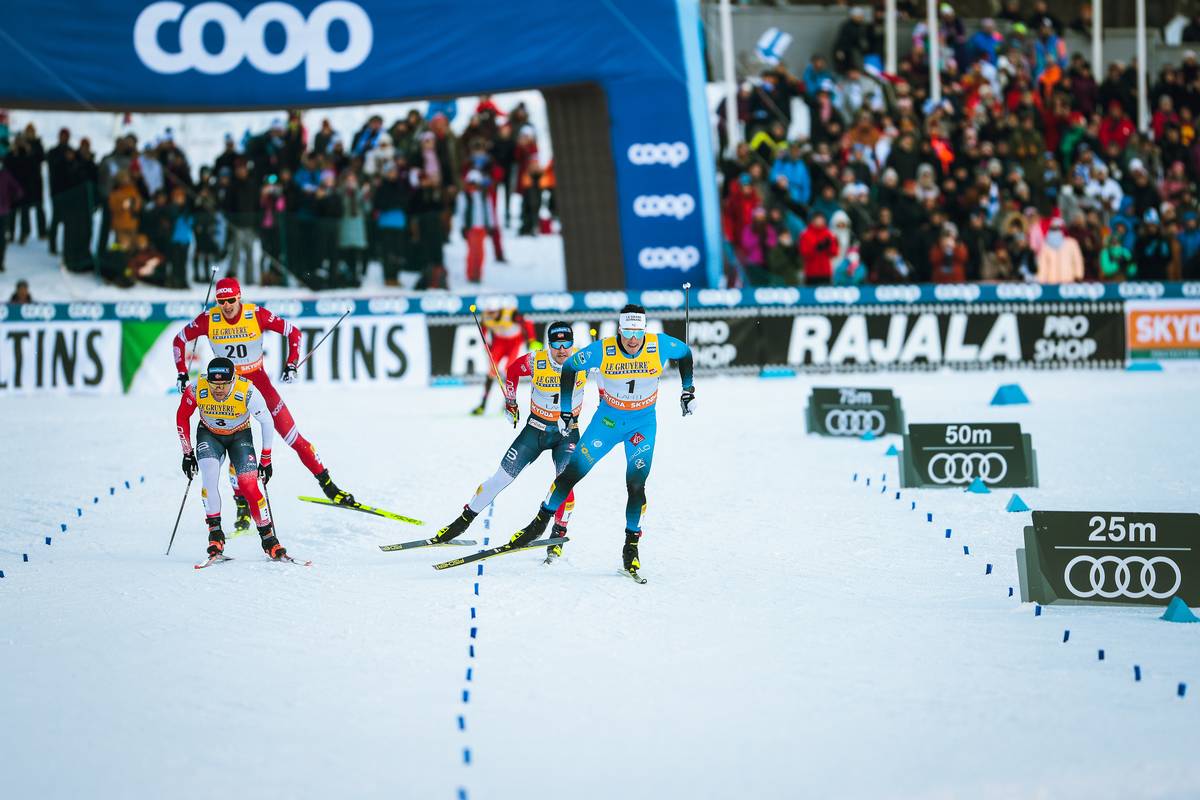
    A close race for second and third heads into the final 25 meters in Lahti. (Photo: NordicFocus)

    “It was amazing,” Klæbo told FIS after the race. “It isn’t so many days since we competed in the Olympics, but still, it’s always fun to race.” 

    Klæbo commented on the excitement of racing in Lahti, which has hosted many championship events including the 2019 World Championships. He added that the racing on these tracks is often tight, which keeps it exciting for spectators – of which there were many today. When asked about racing in front of a crowd after nearly two years of empty stadiums, Klæbo smiled.

    “It was amazing. I think what they have done, and finally seeing the end of the COVID situation – I think it’s amazing. It’s always great to compete against a big crowd, and it was amazing today as well.” 

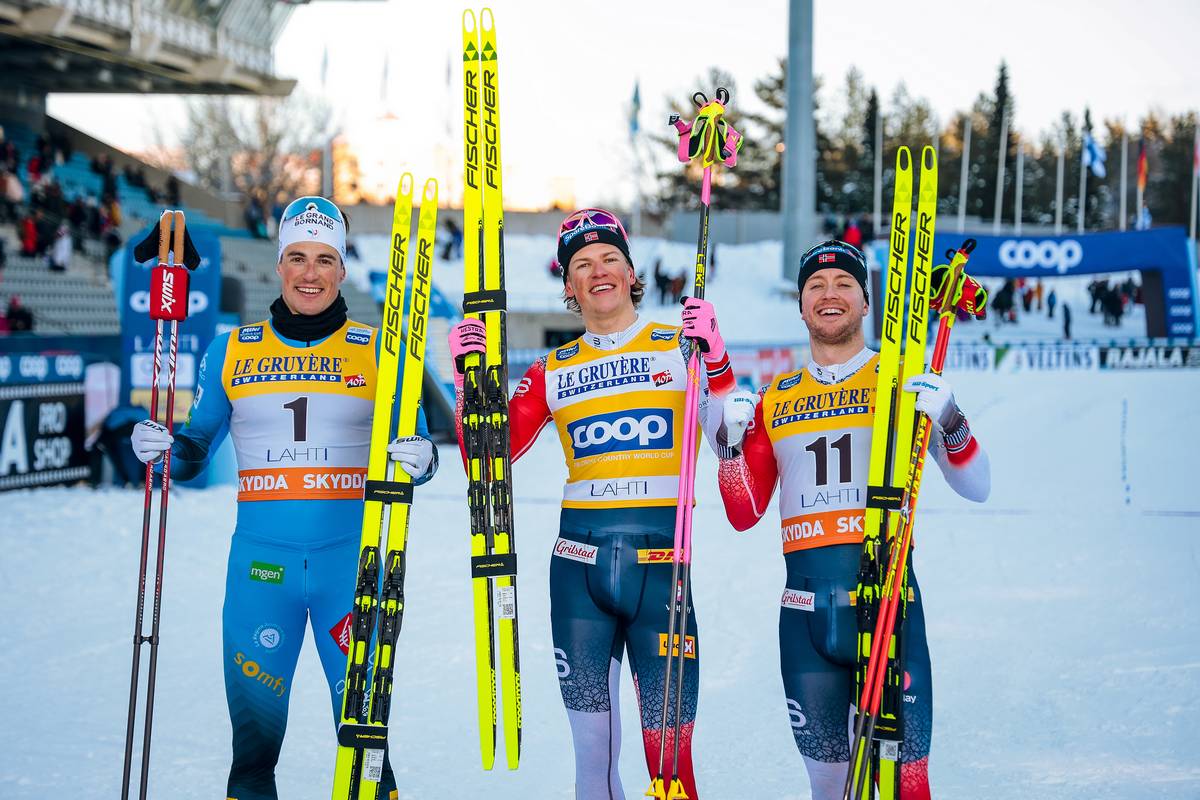
    Johannes Høsflot Klæbo (NOR) takes the win in Lahti’s freestyle sprint ahead of Lucas Chanavat (FRA) and Sindre Bjørnestad Skar (NOR). (Photo: NordicFocus)
    Graham Ritchie races in the quarterfinal of the freestyle sprint in Lahti, FIN. (Photo: NordicFocus)

    After finishing fifth in a tightly spread third quarterfinal heat, Graham Ritchie bumped up from his bib rank to finish 24th.

    Kevin Bolger was the top American qualifier in Lahti in 33rd (+8.90), just 0.41 seconds off the mark needed for the top-30. On his tails was Diekmann in 34th (+9.14), with Hanneman close behind in 39th (+9.79). Ketterson was next for the U.S. in 49th (+12.13), with Harmeyer next in 50th (+12.28).

    Kevin Bolger leads the American men in 33rd during the freestyle sprint qualifier in Lahti, FIN. (Photo: NordicFocus)
    Antoine Cyr (CAN) races the qualifier of Lahti’s freestyle sprint. (Photo: NordicFocus)

    Outside the top-30 for Canada, Antoine Cyr was 40th in qualification (+9.99), with Olivier Léveillé next in 46th (+11.79), followed by Phillippe Boucher in 55th (+14.02) and Rémi Drolet in 58th (+15.87). 

    Racing continues tomorrow with a 15 k individual start classic.

    Results:

    Qualification | Final

  • Bolshunov collects third gold medal while Krüger rebounds to bronze post-COVID; Patterson historic 8th place for USA

    Bolshunov collects third gold medal while Krüger rebounds to bronze post-COVID; Patterson historic 8th place for USA

    This World Cup coverage is made possible through the generous support of Marty and Kathy Hall and the A Hall Mark of Excellence Award.  To learn more about A Hall Mark of Excellence Award or to learn how you can support FasterSkier’s coverage please contact info@fasterskier.com.

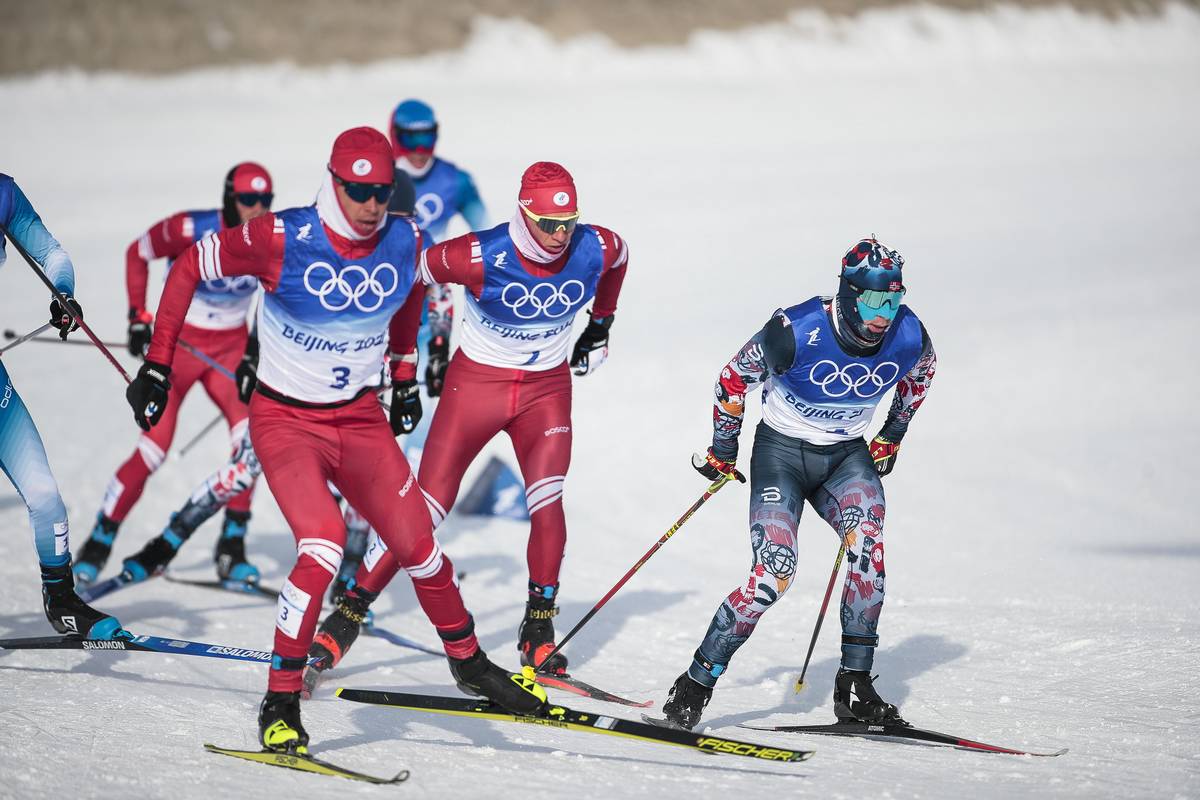
    There were a number of stories to unpack during the men’s 50-kilometer mass start free, which was changed last minute to 28 k due to extreme weather conditions in Zhangjiakou. You’ve got Alexander Bolshunov leading the charge to collect a third gold medal of the Games, continuing his streak of nine Olympic medals in nine Olympic appearances. Bolshunov was followed by his teammate Ivan Yakimushkin, with all four members of the Russian Olympic Committee (ROC) finishing in the top six, interrupted only by two Norwegians, Simen Hegstad Krüger and Sjur Røthe, the first of whom earned bronze in his first Olympic appearance following a COVID-19 detention in a hotel room in Seiser Alm, Italy. 

    But let’s get one key story to the front off the bat: The only American on the start list for the final men’s event of the 2022 Beijing Olympic Winter Games was Scott Patterson, and he skied to eighth place, just 26.9 seconds shy of a medal. It’s the second best result in American men’s cross country ski history, only surpassed by Bill Koch’s silver medal in 1976. That’s the best result in almost 50 years. 

    Scott Patterson tucks into the lead group, on the tails of Alexander Bolshunov (ROC) and Sjur Røthe (NOR). (Photo: NordicFocus)

    Let’s rewind.

    The news of the change in time and distance arrived just hours before the start of the race, with the following message from the organizers: “Due to strong winds and the resulting extreme conditions on course, the distance of the originally planned 50km will be shortened to 30km. The decision was taken in regards to the athletes safety, to reduce the time of exposure of athletes in extreme conditions.”

    While there were various opinions on this change, which we’ve covered separately, there’s no getting around the fact that the race distance was slashed nearly in half. Nonetheless, as the lead group moved in and out of the wind, finding shelter on the leeward side of hills and under the protection of treed sections, the four lap course skied like a long-distance event. 

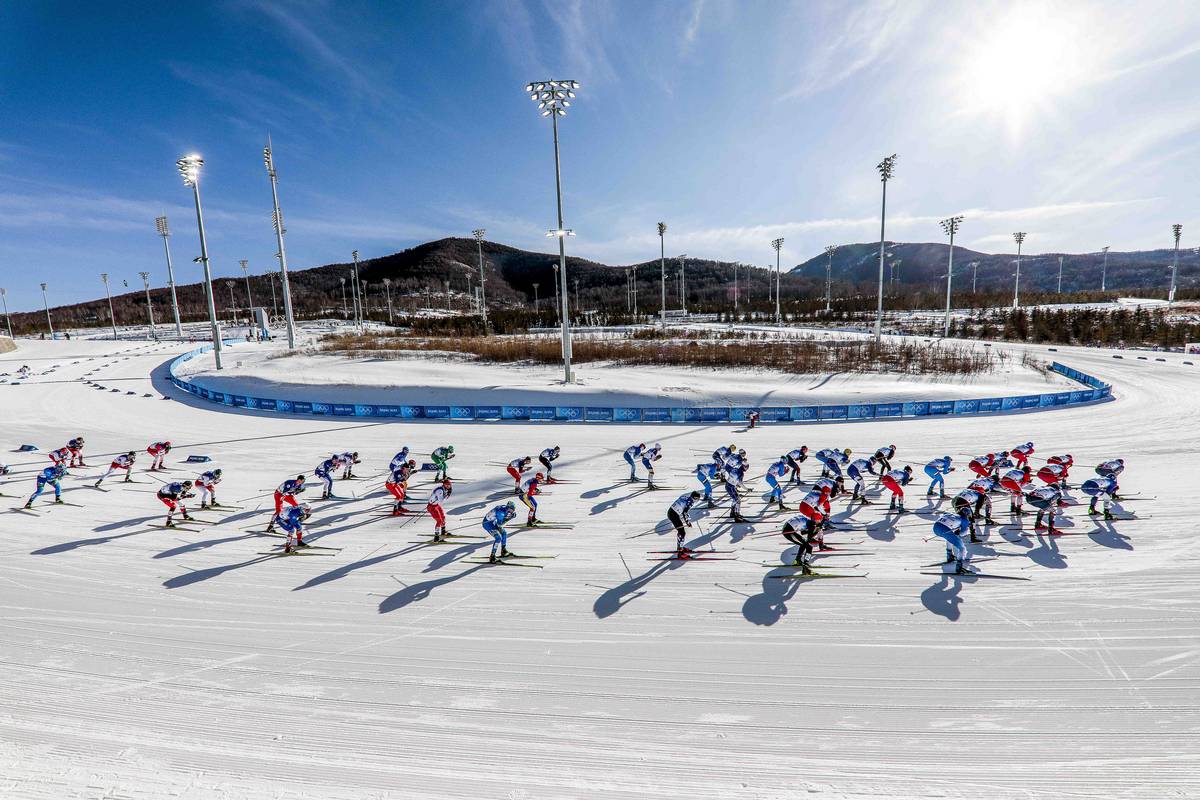
    Shortened due to extreme weather, the men’s 28 k mass start freestyle is underway in Zhangjiakou. (Photo: NordicFocus)

    At the end of the first lap, the top-30 were separated by less than five seconds, thinning to a 13-man pack by the end of the second lap, and a group of 10 by the end of the third, with an 11 second gap to the first chase group.  

    Perhaps the only truly noteworthy moment at this point in the race was the departure of Norway’s Johannes Høsflot Klæbo, who won gold in both sprint events – the individual freestyle and the classic team sprint – while also collecting a silver medal in the men’s relay and bronze in the 15 k classic. Klæbo later reported that he was struggling with a stomach illness and had spent more of the night prior to the race in the bathroom than he had been sleeping.

    “I thought I would’ve regretted it if I didn’t give it a try but now I’m standing here and it didn’t work out on the whole,” Klæbo told the media.

    He said it was “sad” pulling out of the race, but will focus on leaving the Games with his best Olympic distance results.

    “I’ll definitely bring with me what’s been positive. What makes it feel more annoying is that my shape has felt better and better and I’ve actually felt that I’ve had a good energy today too. Then the stomach started to speak up and then it got very far to make it to the finish line.”

    Johannes Høsflot Klæbo (NOR) dropped out of the 28 k mass start free after his third lap. (Photo: NordicFocus)

    The race for medals truly began in the final lap. With Bolshunov and Krüger each surging to thin the lead group, Sweden’s William Poromaa and France’s Maurice Magnificat began to fall off the back. Patterson was tucked into seventh, working with Clement Parisse (FRA) and Denis Spitsov (ROC) to maintain contact and respond to the accelerations of the front. 

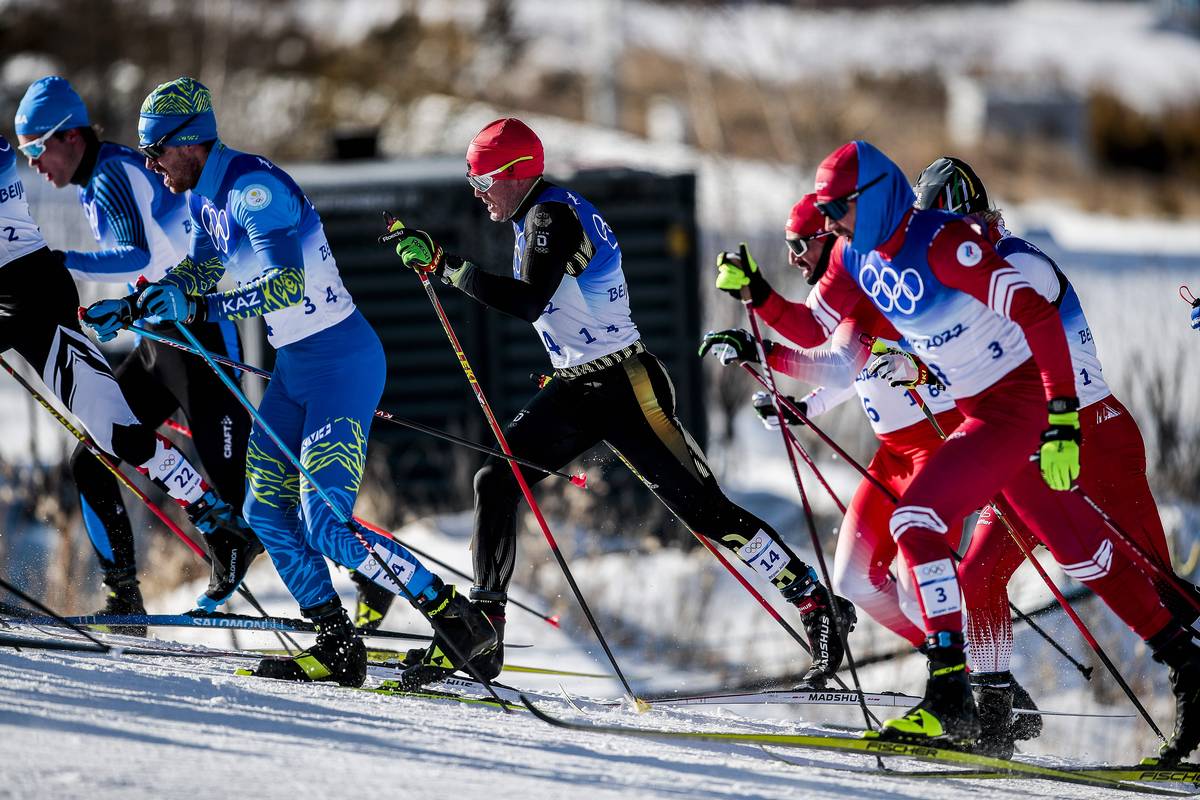
    Simen Hegstad Krüger (NOR) leads the men’s 28 k freestyle alongside the ROC’s Ivan Yakimushkin (bib 3). (Photo: NordicFocus)

    Over the final 5 k, Bolsunov kept the pressure on, looking relaxed as he tried to create space between himself and Krüger, who had been tucked onto his tails, matching him push for push. With them was Yakimushkin, the three skating in tandem as the finish line drew nearer. 

    At 24 k, the leaders had only a few seconds on Patterson’s chase group, but when they hit the 27.2 k checkpoint, the gap had drastically expanded. Artem Maltsev (ROC) and Røthe were still just a few seconds back, but Patterson, Parisse, and Spitsov were now over 20 seconds behind, with a 20 second cushion ahead of the next chasers.

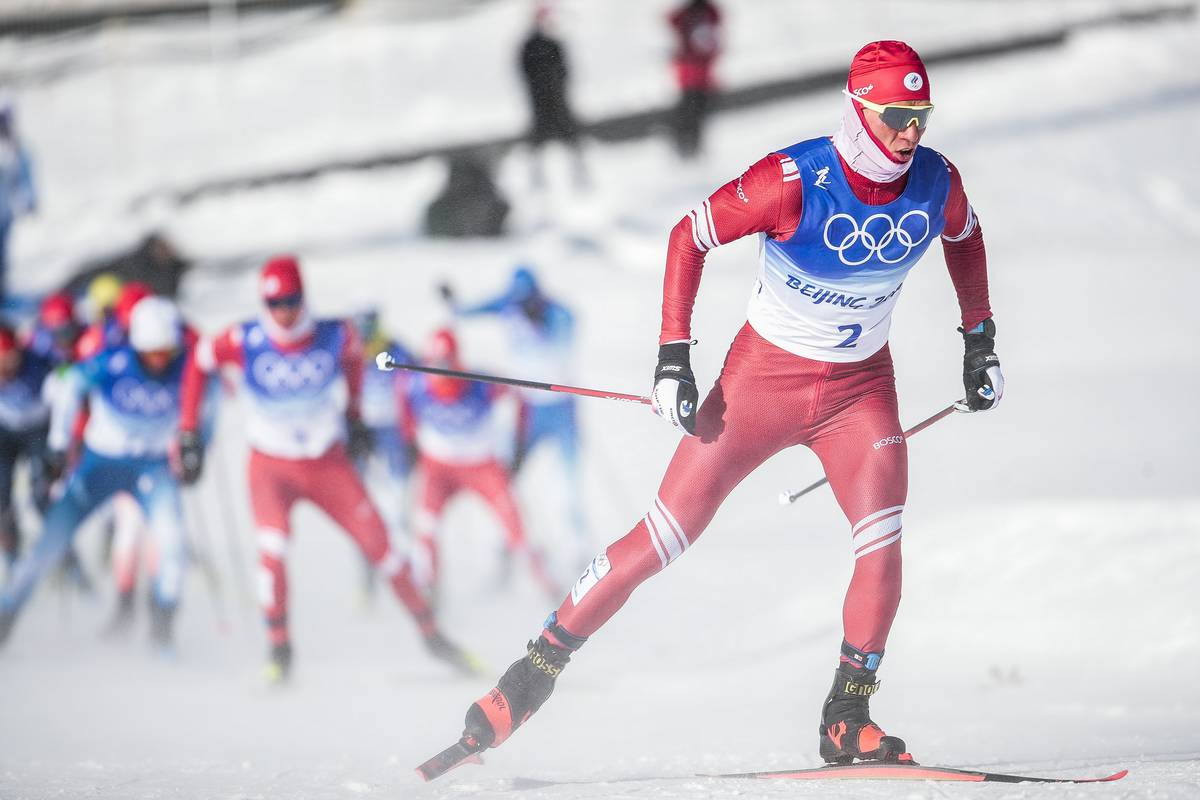
    Alexander Bolshunov (ROC) races to his third gold medal of the 2022 Olympic Winter Games during the men’s 28 k freestyle. (Photo: NordicFocus)
    Norway’s Simen Hegstad Krüger leads the charge during the men’s 28 k mass start freestyle. (Photo: NordicFocus)

    Up the final long climb, Krüger would not yield, holding his ground immediately behind Bolshunov. Tucked low into the downhill, the three stayed together, with Bolshunov upping the tempo and power as they accelerated out of the curves and over the gentle rises that interrupted the sweeping descent. 

    As the three hit the final rise into the stadium, Bolshunov began to break away, with Yakimushkin using Krüger’s draft to slingshot into second with 500 meters to go. 

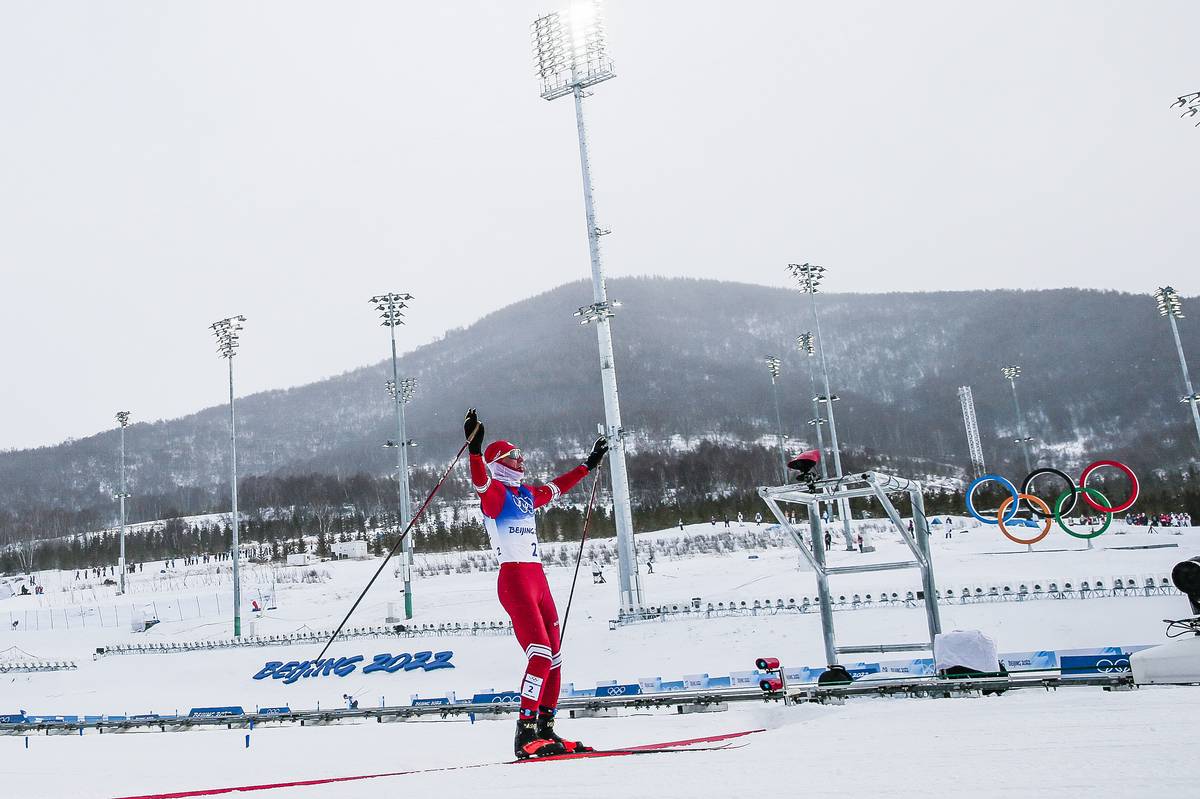
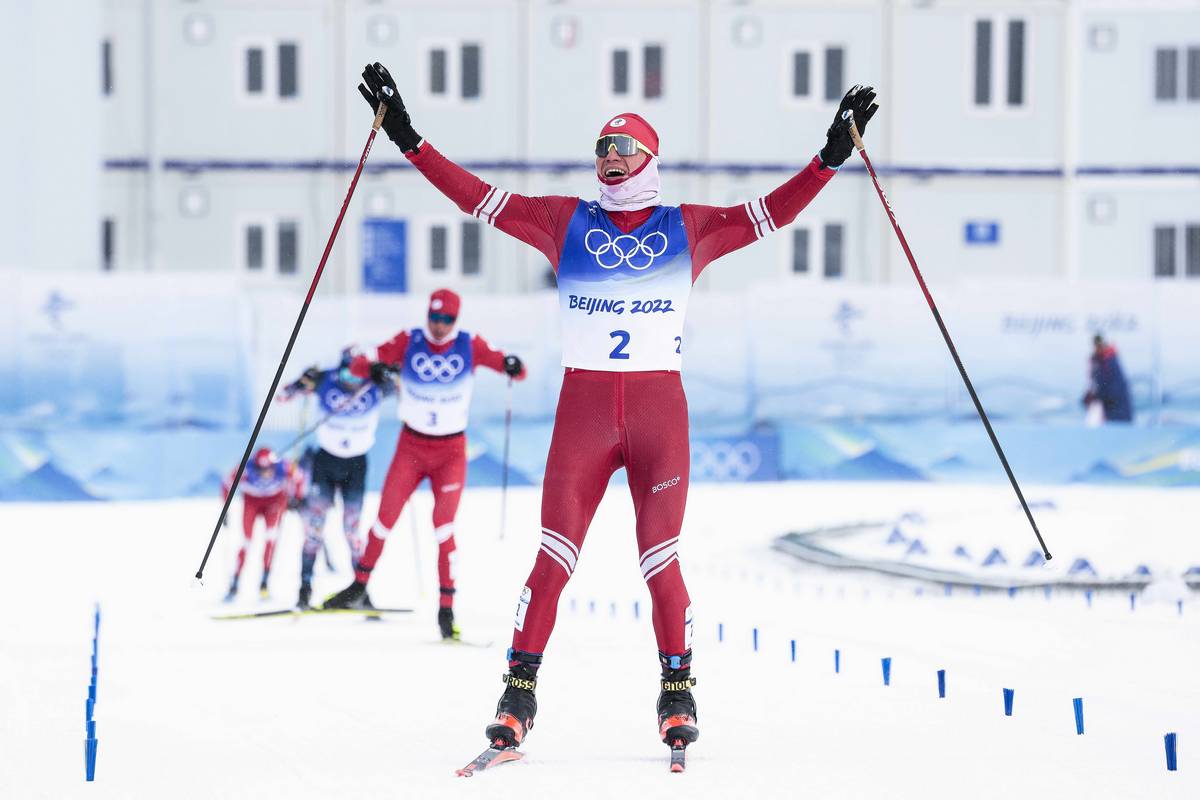
    Entering the stadium, the gold medal looked to be predetermined. With a fist pump as he made his way around the final bend into the finish lanes, Bolshunov V2ed powerfully down the home stretch, crossing the line with his hands raised in 1:11:32.7.

    Alexander Bolshunov (ROC) celebrates his win in the 28 k mass start freestyle. (Photo: NordicFocus)
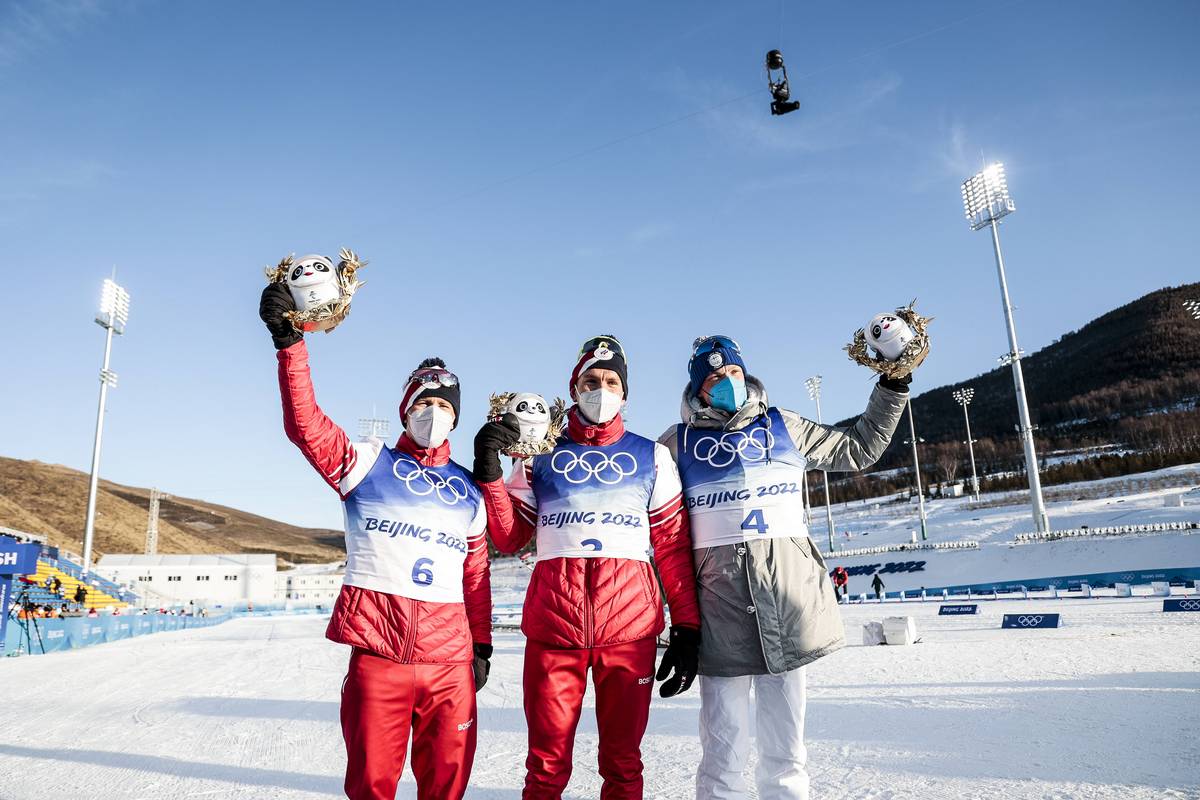
    Ivan Yakimushkin (ROC) takes silver in the men’s 28 k free, while Simen Hegstad Krüger finishes third for Norway. (Photo: NordicFocus)

    Holding his advantage through a final sprint to decide silver and bronze, Yakimushkin crossed the line second (+5.5) with Krüger taking third (+7.0) for Norway.

    Behind, Maltsev came to the line fourth (+10.7), followed by Røthe in fifth (+15.8). 

    Spitsov led the now-spread chase group to the line, taking sixth (+26.2) ahead of Parisse in seventh (+28.8) and Patterson eighth (+33.9).

    Alexander Bolshunov (ROC) wins his third gold medal of the 2022 Games in the men’s 28 k mass start freestyle. (Photo: NordicFocus)

    Nine Olympic medals. Three gold. Four silver. Two Bronze. Five from the 2022 Olympic Winter Games.

    “Five? Really?” Bolshunov counted on his fingers as he exuberantly celebrated the golden ending to his Beijing Games appearance. “Five medals, three gold, it is something unbelievable because before the season I set the goal of two gold medals and now I have three. I’m just unbelievably happy. The emotions overfill me. This is above all praise to win these medals here. It’s very cool, and in every race that I took part in.”

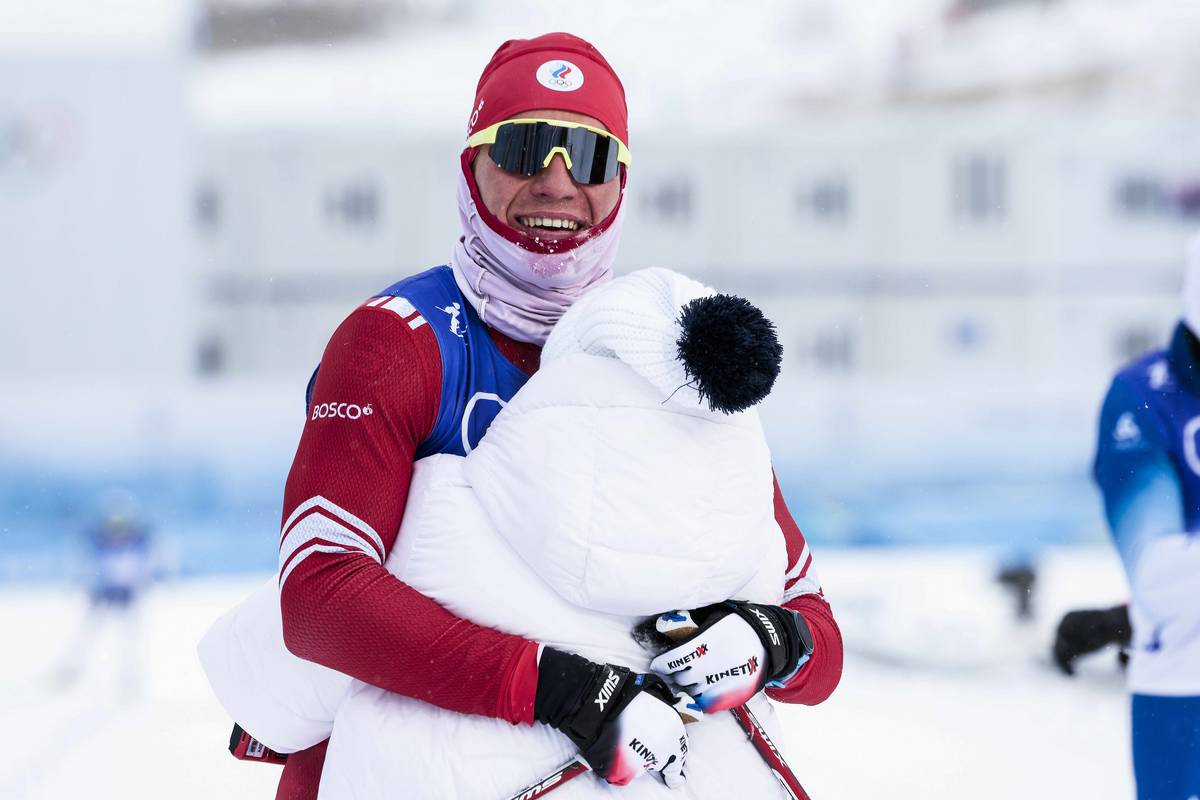
    Alexander Bolshunov (ROC) receives a cozy Olympic themed gift following his win in the men’s 28 k freestyle. (Photo: NordicFocus)

    Regardless of the color of the medal he earned, Krüger said his real victory was simply making it to Zhangjiakou and having the opportunity to race at the Games. Though his illness stayed mild and he stated that it did not impair him in today’s race, he had still spent 10 days in isolation in his hotel room, and remained in isolation while the opening event of the Games, the men’s 30 k skiathlon, was underway. Krüger was the defending Olympic champion in the event after taking gold in 2018. He went on to win a silver medal in the 15 k skate, and help Norway to gold in the men’s relay. 

    During the 2021 World Championships, Krüger earned two silver medals, first in the 30 k skiathlon and the next in the 15 k free, with a bronze in the 50 k skate. He was one of the top distance skiers on the World Cup heading into the 2022 Games, shouldering Norway’s medal hopes; the nation experienced collective heartbreak following the news of his positive COVID test in late January. 

    “To be able to go home with an Olympic medal, that’s a huge victory for me and an amazing feeling,” Krüger said after the race. “I’m really proud of what I have achieved today; from not thinking I would be able to ski one single competition to being able to get everything out here today.”

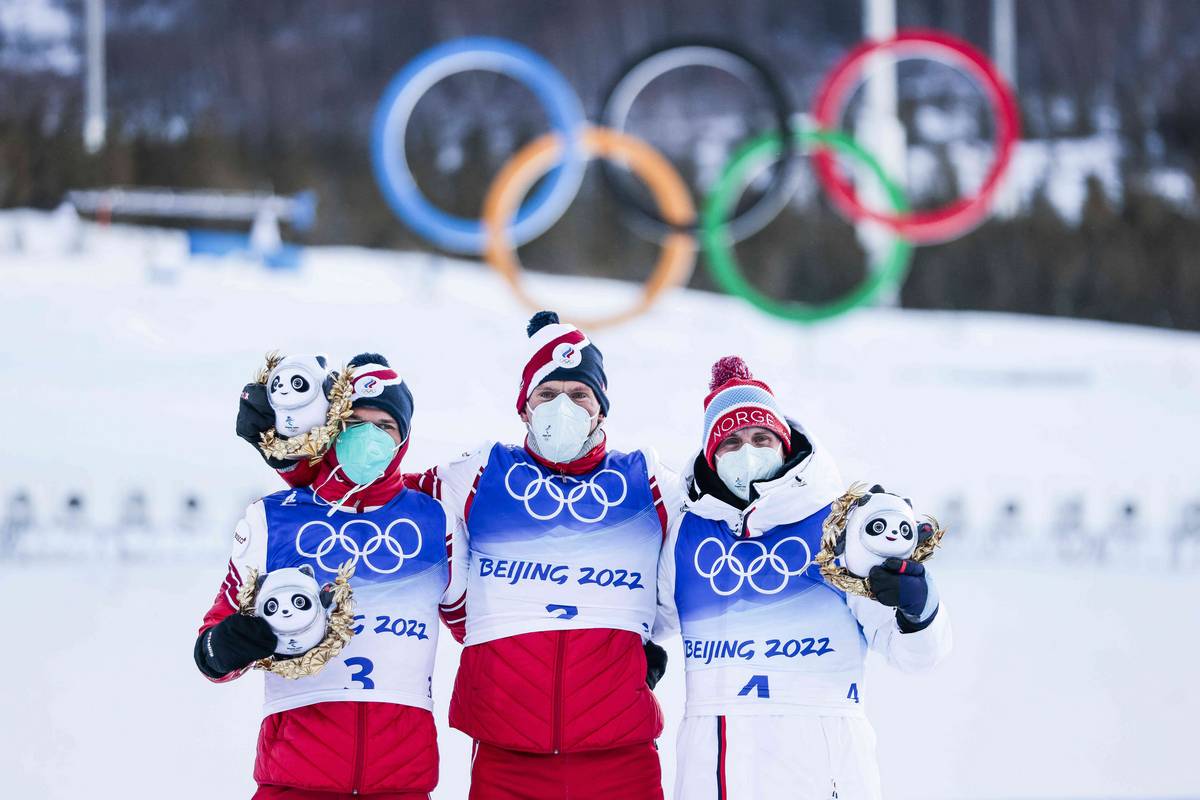
    The podium of the men’s 28 k freestyle: Alexander Bolshunov (ROC) took the win ahead of Ivan Yakimushkin (ROC) and Simen Hegstad Krüger (NOR). (Photo: NordicFocus)

    For Patterson, eighth place meant achieving the goal, though he admitted being in the hunt for positions even closer to the podium leaves him hungry for more. 

    “I’m happy,” he told FasterSkier in the mixed zone. “I came in wanting the top 10 and got it today. It’s a little tantalizing to be in eighth and 33 seconds back from the win.” 

    He continued that the “dream” of a medal crossed his mind as he found himself inside the lead group in the final lap, but he could feel the fatigue accumulating in his body and recognized that he was finding it hard to respond to the tactical moves of the eventual medal winners. “I don’t think it was exactly realistic to fully believe it was happening today,” he said frankly. 

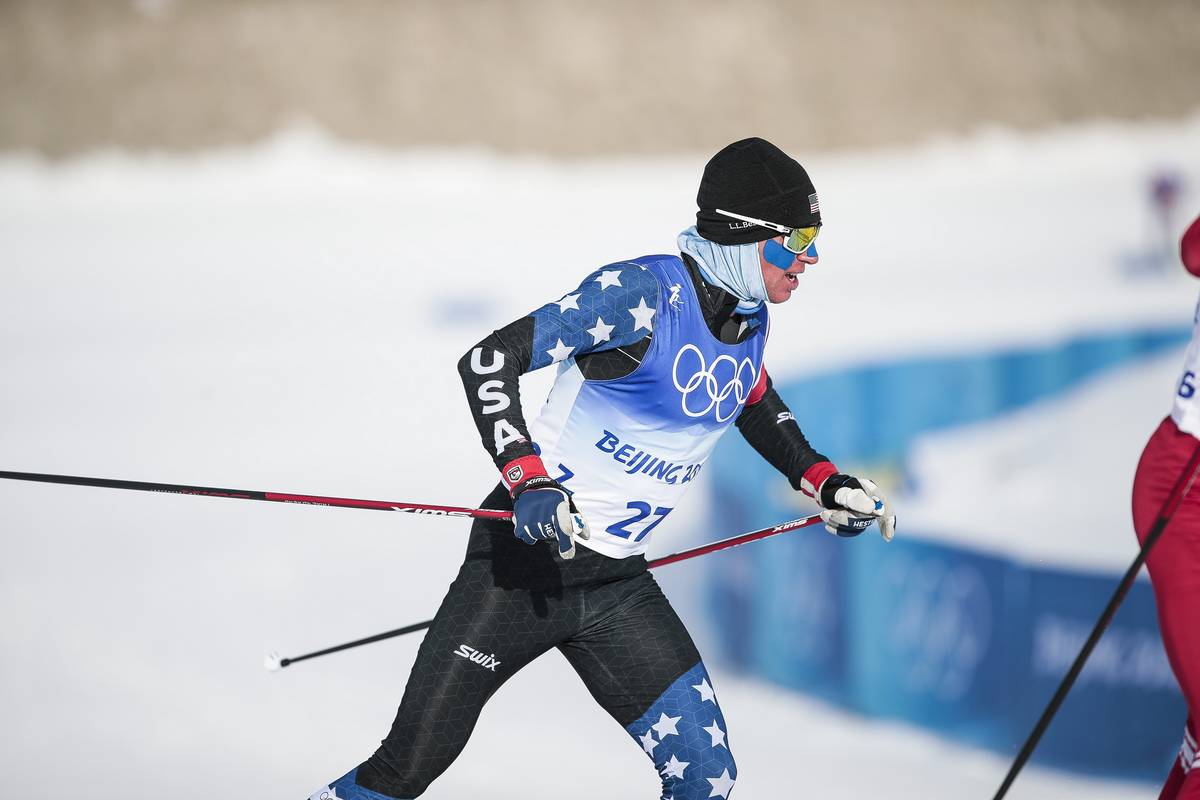
    Scott Patterson skis to an Olympic career best with 8th place in the 28 k mass start freestyle. (Photo: NordicFocus)

    Patterson’s result, while historic, should not come as a surprise to American cross country ski fans. He was 11th in the skiathlon at the opening of the Games, and has made his ability to come on form and earn season-best results during Championships well known over the last four years. 

    During the 2018 Games in PyeongChang, he put together breakout performances, skiing to 18th in the skiathlon, 21st in the 15 k skate, and 11th in the 50 k classic. He raced into the top-30 in each individual distance race of the 2019 World Championships, with a 23rd place finish in the 50 k free. Improving on these results in the 2021 World Championships in Oberstdorf, Germany, Patterson was 14th in the skiathlon, 27th in the 15 k skate, and 10th in the 50 k mass start classic. 

    And, he likes going long. He said he would have preferred another 20 k today – “I wanted the grinding instead of the punches” – and might have even been able to pull off a higher result had the race been longer. 

    Back in 2016, his first World Cup appearance was in the 50 k classic at the Holmenkollen, which sits above Oslo, Norway. He was 32nd on the day in perhaps the most storied and highly revered cross country ski race on the World Cup. Patterson advanced to 28th the following year, before making a leap into the top-20 to finish 16th in 2018 and 19th in 2019.

    Scott Patterson takes a feed during the men’s 28 k free in Zhangjiakou. (Photo: NordicFocus)

    From the outside, it can be hard to appreciate the dynamics of mass start racing among the best athletes in the world in the sport. Energy management, tactics, drafting, protecting equipment while the field remains dense in the first lap, which Patterson called “chaotic.”

    “You get those lead skiers fighting the wind, and a lot of the back skiers that could just draft in. And there are a few people who definitely don’t have a lot of World Cup experience making a mess out of the pack,” Patterson described.

    In his second Olympic appearance at the age of 30, with plenty of World Cup experience, Patterson skied a smart race, telling FasterSkier that he felt “strong” and “relaxed”, while looking to be “in a comfortable position and not [using] too much out of my energy.” He also reported having competitive skis that allowed him to utilize the downhills and stay in the position where he wanted to be. 

    U.S. Ski Team head coach Matt Whitcomb complemented Patterson on his race execution, telling FasterSkier emphatically that he was “so proud of him.”

    Scott Patterson races in the lead group during the men’s 28 k mass start freestyle. (Photo: NordicFocus)

    Talking through the race from his vantage point, Whitcomb pointed out that Patterson stayed calm through the congestion in the opening lap, rather than becoming flustered and wasting energy by constantly trying to move up. He also shared how Patterson was able to “wisely” keep himself on the correct side of other racers to utilize the windbreak on unsheltered sections of the course.

    “Some incredible skiers ended up on the wrong side of the break and were toast…” Whitcomb explained. “When that happened, I heard a Finnish yelling at a German skier saying, ‘Hey, take me up to them!’ People were desperate to do work together, and so [I’m] very proud of Scott and unsurprised that he was in a tactically wise position.”

    Apart from battling the elements, maintaining an optimal position within the lead group is also a skill that requires experience and maturity.

    “If you have a pack of 15 guys, of course, it’s easy to follow in a draft in 14th and 15th,” Whitcomb said. “But what you don’t realize is that there’s quite a big accordion effect, so you’re constantly pulsating on the gas pedal. What you saw [today] was Scott moving up into between fourth and seventh, for a large part of [the race], and that ends up being a much more efficient position to ride. Draft is good, but you’re also able to just kind of stay on a steady gap.”

    Scott Patterson races to the line, finishing 8th in the men’s 28 k mass start freestyle. (Photo: NordicFocus)

    For Whitcomb, Patterson’s eighth place ends the Games on a high note for the American men’s program as a whole.

    “This is, this is for sure one of the goals that our men’s program wants: to start breaking through in one of the ultimate races of the Olympics,” Whitcomb shared. “To do that today, under conditions like this, is such a huge success for our program and for Scott and for his club, APU. For all the coaches over the years, Erik Flora that’s worked with him, and the [rest of the] coaches at APU. It’s such a huge success for [Patterson’s collegiate program], the University of Vermont; Alaska Winter Stars where he started skiing; and just so many people have been a part of this incredible journey. And so happy for all of them. But mostly for Scott because he earned this sucker today. It was brutal.”

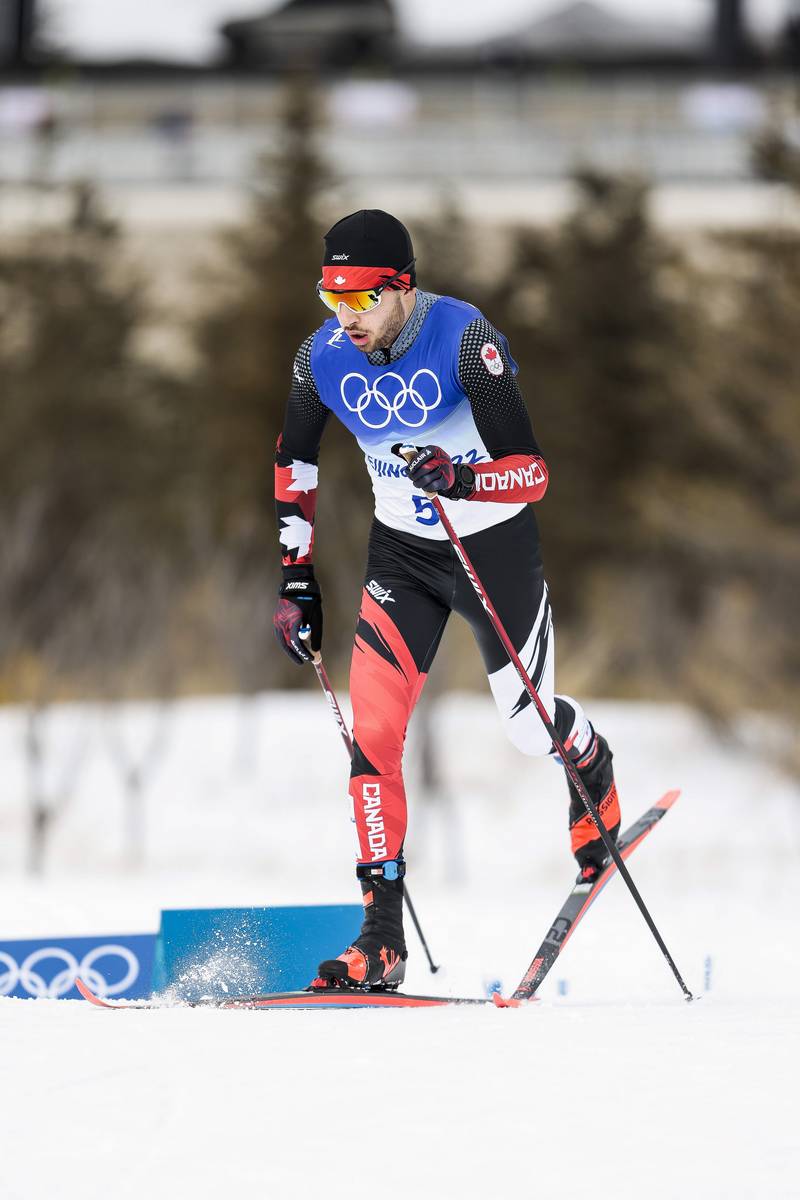
    Rémi Drolet (CAN) skis to 35th in the men’s 28 k mass start skate. (Photo: NordicFocus)

    Two Canadian’s raced the 50 k today, with Olivier Léveillé leading the Canucks at the finish in 27th (+4:21.6). 30 seconds back, Rémi Drolet crossed the line in 35th (+4:54.4). 

    Racing continues tomorrow with the women’s 30 k mass start freestyle, the final cross country event of the 2022 Beijing Olympic Winter Games. At this time, the distance of the women’s event remains unchanged, however, the start was moved up by 3.5 hours to account for the forecasted weather conditions.   

    Results

  • (Press Release) Olympic Rookie Olivier Léveillé Leads Canucks in Individual Classic Cross-Country Ski Race at Beijing

    (Press Release) Olympic Rookie Olivier Léveillé Leads Canucks in Individual Classic Cross-Country Ski Race at Beijing

    The youngest member on Canada’s Olympic cross-country ski team, Olivier Léveillé, battled to a 29th-place finish at the Beijing Olympics on Friday.

    The 20-year-old from Sherbrooke, Que. found his groove while steadily working his way around the 15-kilomtetre course to finish in the elite group of 30 with a time of 40:52.0.

    Canada’s Olivier Léveillé leads the North American athletes in 29th during the 15 k individual start classic. (Photo: NordicFocus)

    “It is always hard to ski at altitude, but I felt good today,” said Léveillé. “Sometimes you feel like you are stuck in a gear, but I felt like I was stuck in a good gear today.”

    Struggling with pace on a punishing skiathlon course in the Olympic opener earlier in the week, Rémi Drolet, of Rossland, B.C., bounced back and was Canada’s next best finisher in 33rd spot with a time of 41:07.7.

    “It was definitely an improvement from my last race. I don’t know that I felt a whole lot better. I think I am combating a decent amount of fatigue right now and I’m battling to get over it,” said Drolet. “But I think being able to race my own race and not having to fight to stay with the pack I didn’t blow up. I’m not satisfied with how I skied but my execution was good.”

    The nation’s top men’s skier heading into Beijing, Antoine Cyr (Gatineau, Que.), struggled to find his groove. The 23-year-old was left wanting more following a 37th place on Friday, completing the course in a time of 41:17.7.

    “I’m really disappointed in the race. It is sad, but this is life and that is why we love sports so much because there are ups and down,” said Cyr. “Emotion around a good performance is insane, but then it is also the same around a bad performance.”

    Antoine Cyr races the 10 k individual start classic during the 2022 Olympic Winter Games. (Photo: NordicFocus)

    Finland’s Iivo Niskanen was tops all day, posting the fastest splits throughout the course while skiing to the gold medal in a time of 37:54.8. Alexander Bolshunov, who is an athlete representing the Russian Olympic Committee, stopped the clock at 38:18.0 to win the silver. Norway’s Johannes Klaebo claimed the bronze medal with a time of 38:32.3.

    Canada will send Katherine Stewart-Jones, Dahria Beatty, Cendrine Browne and Olivia Bouffard-Nesbitt to the start line on Saturday for the women’s 4×5-kilometre relay.

    Complete Results: https://bit.ly/3rH4sb1


    For complete details on Team Canada at the 2022 Olympic Winter Games, please visit  https://olympic.ca/games/beijing-2022/

  • Bolshunov Dominates Men’s 30 k Skiathlon to Win First Olympic Gold; Patterson Matches Olympic Career Best in 11th

    Bolshunov Dominates Men’s 30 k Skiathlon to Win First Olympic Gold; Patterson Matches Olympic Career Best in 11th

    The first podium of the 2022 Olympic Games following the men’s 30 k skiathlon. Alexander Bolshunov (ROC) dominated the event for gold, ahead of teammate Denis Spitsov who took silver, and Iivo Niskanen (FIN) bronze. (Photo: NordicFocus)

    This World Cup coverage is made possible through the generous support of Marty and Kathy Hall and the A Hall Mark of Excellence Award.  To learn more about A Hall Mark of Excellence Award or to learn how you can support FasterSkier’s coverage please contact info@fasterskier.com.


    On the heels of the women’s opening Olympic race, a colorful lycra field in their Sunday best lined up to race the men’s 30-kilometer skiathlon. While the women raced a four-lap 15 k event, men faced double the distance – over 75% longer by finish time – though they were greeted by much more favorable weather. It was sunny, still, and clear. Classic tracks were crisp and firm, and the familiar sound of poles powerfully planting and pushing off from cold snow, akin to the blasters of Storm Troopers in the classic Star Wars films, was not obscured by wind ripping through the stadium. 

    A quick nod to the start list for North American fans: Scott Patterson and Gus Schumacher were the only men racing in stars and stripes today, while Olivier Léveillé, Antoine Cyr, and Rémi Drolet raced for Canada. 

    Athletes take to the course for the men’s 30-kilometer skiathlon, the opening event of the 2022 Beijing Olympic Winter Games. (Photo: NordicFocus)

    To review the last two Olympiads, the 2018 Games saw a Norwegian sweep of the skiathlon podium, with Simen Hegstad Krüger breaking away to win gold by eight seconds ahead of his teammates Martin Johnsrud Sundby and Hans Christer Holund. After testing positive for COVID-19 shortly before his scheduled departure for Beijing, Krüger is currently riding out his  quarantine in a hotel room, resolutely training on a spin bike in hopes of making it to the 2022 Games in time for the final event, the men’s 50 k freestyle. Sundby retired from World Cup level racing after the 2021 World Championships in Oberstdorf, Germany, in which he earned an auto start as the reigning champion in the 15 k classic. This season, Sundby raced a series of marathon and longer races in Italy during January. This leaves only Holund returning to the Olympic skiathlon in 2022.  

    In 2014, it was a dog fight to the finish, with Dario Cologna of Switzerland taking gold by just 0.4 seconds over Marcus Helner of Sweden. Near the peak of his career, Norwegian powerhouse Sundby was one second behind Helner in third. 

    Athletes take to the course for the men’s 30-kilometer skiathlon, the opening event of the 2022 Beijing Olympic Winter Games. (Photo: NordicFocus)

    Over the first 15 k of classic racing, two names that have not yet been mentioned, from countries who have not been on the podium in the last two Olympic competitions, pulled away from the field. Leading the charge was the king of the 15 k classic, Finland’s Iivo Niskanen. Niskanen has won seven World Cup 15 k classic events, including a grueling race through falling snow in Lenzerheide, SUI at the beginning of the 2021/22 Tour de Ski. The Finn was second to Johannes Høsflot Klæbo (NOR) a week later in Val di Fiemme, ITA, near the other end of the Tour. 

    On Niskanen’s tails over the first four laps was Alexander Bolshunov of the Russian Olympic Committee (ROC). Bolshunov was fifth and seventh in the two most recent 15 k classic events, amidst a start to the 2021/22 World Cup season that did not match his previous three seasons of racing. Bolshunov was the World Cup distance champion in 2019, 2020, continuing his dominance to win both the distance title and the overall World Cup title in 2021. He also earned three silver medals in the 2018 Games – he was the runner up in the 50 k classic, and supported the ROC to second place finishes in the relay and team sprint – in addition to a bronze medal in the classic sprint.

    Iivo Niskanen (FIN) leads Alexander Bolshunov (ROC) as the pair drops the field during the classic leg of the 30 k skiathlon. (Photo: NordicFocus)

    Leading into this season, Bolshunov has had a less than ideal buildup. The 25-year-old experienced a bike crash in addition to a tooth infection that required multiple surgeries, interrupting his ability to train with the consistency and volume – rumored to be over 1,200 hours annually –  that has contributed to his strength over the last quadrennial. 

    At the 5 k checkpoint, the top-10 racers were spread by less than 5 seconds, before Bolshunov and Niskanen began to pull away. At 10 k the duo had built a 12 second lead to the chase pack, led by Denis Spitsov (ROC), and between 10 k and the pit-box at 15 k where athletes switched from classic to skate, this lead more than doubled to 30 seconds. 

    The chase group of Hans Christer Holund (NOR), Denis Spitsov (ROC), and Pål Golberg race the classic leg of the men’s 30 k skiathlon in Zhangjiakou. (Photo: NordicFocus)
    Alexander Bolshunov (ROC) begins to pull away from Iivo Niskanen (FIN) at the start of the 15 k skate leg of the men’s skiathlon. (Photo: NordicFocus)

    Niskanen and Bolshunov left the transition from classic to skate together, but over the next lap, Niskan’s wheels began to fall off. At 16.3 k, Bolshunov was already 13.5 seconds ahead, with Spitsov racing on his own, nearly 18 seconds behind Niskanen and closing fast. Originally podium favorites, two Norwegian chasers worked together roughly 1:06 behind Bolshunov, sitting well over 30 seconds out of third place. 

    Looking like his body had flooded with lactate and his matchbox was suddenly empty, Niskanen was unable to respond as Spitsov reeled him in, eventually leaving the Finn in his wake by the end of the first skate lap. From then on, the podium story looked to be pre-written.

    At 20 k, Bolshunov had more than 40 seconds on Spitsov, with Niskanen in no man’s land 1:03 behind the leader, and 50 seconds ahead of the Norwegian chasers. At 25 k, Bolshunov had grown his lead to nearly a minute over his countryman, and 1:50 to Niskanen.

    With well over a minute lead on second place, Alexander Bolshunov (ROC) takes a bow as he enters the stadium to win the men’s 30 k skiathlon. (Photo: NordicFocus)

    Entering the stadium, Bolshunov had all the time in the world to savor the victory of his first Olympic gold medal.

    Before rounding the bend into the final straight, Bolshunov took a deep bow. He accelerated around the final bend toward the sidelines, where he collected a ROC flag. Coasting down the lanes, Bolshunov waved this flag over his head with one hand, while pumping his left fist into the air, basking in the glory of a dominant performance on the world’s most prestigious stage. 

    Alexander Bolshunov celebrates a dominant victory, earning his first Olympic gold medal at the men’s 30 k skiathlon. (Photo: NordicFocus)
    Olympic champion Alexander Bolshunov welcomes his teammate Denis Spitsov (right) to the finish of the men’s 30 k skiathlon, going one-two for the Russian Olympic Committee. (Photo: NordicFocus)

    Bolshunov took off his skis, unable to stop smiling, as he turned around to greet his teammate Spitsov, who crossed the line for silver 1:11.0 behind. Niskanen had padded his lead enough over the first half of the race so that his hold on a medal was never threatened. Regaining his form over the final kilometers, he skied smoothly through the stadium to collect the bronze medal in third (+2:00.2). 

    “I just couldn’t keep pace with those Russians,” Niskanen told the Finnish news outlet Yle after the race. “They were just ridiculously fast today. Unbelievable, the speed they can ski at. It was even a little bit surprising that I wasn’t able to respond to them at all.”

    Iivo Niskanen pushes to the line for a bronze medal in the men’s 30 k skiathlon. (Photo: NordicFocus)

    Spread over the next minute, Holund took fourth (+2:30.9), with Golberg in fifth (+2:52.5). 

    While a glance at his FIS profile this season might not have identified Spitsov as a favorite, the 25-year-old was fourth in the event in the 2018 Games in Korea, where he also collected a Bronze medal in the 15 k freestyle. Spitsov collected a slew of top-10 World Cup results over the subsequent seasons, and was named to the 2021 World Championships, before he crashed while training at the venue in Oberstdorf, sustaining a fracture in his left hand that left him unable to compete. Racing back into form this season, Spitsov was fourth and seventh during the 15 k classic stages of the Tour de Ski, where he finished 4th overall. 

    Whenever the podium is dressed predominantly in Russian Red, speculation arises that the state sponsored doping that overshadowed any Russian performance at the 2014 Sochi Games has continued through 2022. This is especially true when an athlete runs away with a race, despite facing a field made of the top athletes in the world who have all, presumably, prepared in a way that maximizes their potential on the race course. FasterSkier’s Nat Herz voiced this speculation during Bolshunov’s post-race press conference, asking if there was anything the Russian champion would like for people to know regarding his performance on the day.

    “Well, people don’t become Olympic champions all of a sudden,” Bolshunov stated matter of factly. “In the past several years, I have been proving this in every race that I participate in, and I achieved distinguished results and I fight to the end. As to doping – you’re hinting at doping – when I hear about this, I don’t feel good at all. When I hear these words, I want to turn and just walk away because I just hate hearing this, because this should have nothing to do with sports. 

    “We have clean sportsmen, clean athletes here at the Olympics. We go through doping tests almost every day and we have to fill out these forms where we indicate where we will be training from which hour to which hour, when the training session starts, when it finishes and so on…”

    Alexander Bolshunov takes the men’s 30 k skiathlon win in Zhangjiakou. (Photo: NordicFocus)

    Bolshunov continued to explain a system akin to American doping control, where athletes need to report their whereabouts daily, including all details on training, travel, and even times of day when they might be running errands, or otherwise not at a location where an anti-doping agent could arrive unannounced to collect a sample. In his mind, this level of testing makes questioning whether or not the Russian program is competing fairly a moot point.

    “I believe that it’s wrong to ask us these questions. Well you don’t achieve these results all of a sudden — you don’t become an Olympics champion because it takes years and years of training. This is very hard and if you personally want to see how we train, please, we invite you. You are welcome. And these training sessions are very difficult — believe me. And after you will have seen how we train, I believe that you and your audience will never have these questions again. So I believe these are not the best questions to be asked. They’re irrelevant.”

    Scott Patterson tucks in behind Alexey Chervotkin (ROC) during the 30 k skiathlon. (Photo: NordicFocus)

    Off screen, yet another impressive comeback was underway. At the transition from classic to skate, Scott Patterson sat in 19th place, 2:15 behind the leaders. Steadily picking skiers off, Patterson moved into 16th by 20 k, and was tied with Germany’s Lucas Bögl in 11th at the 25 k checkpoint. Jules Lapierre and Clement Parisse of France were within reach in 9th and 10th, only a few seconds ahead. 

    Over the final kilometers, Patterson passed Parisse and pulled ahead of Bögl, but was passed by Artem Maltsev (ROC) to maintain his position in 11th place (+4:00.2) at the finish. This result matches Patterson’s Olympic career best result; he was 11th in the 50 k freestyle in the 2018 Olympics, after finishing 18th in the skiathlon earlier in the Games. 

    If you’ve followed Patterson’s trajectory this season, you’re aware of two things: first, that he sustained a wrist injury from a mountain bike crash that left him in need of surgery just five weeks before the opening World Cup races in Ruka. He joined the team a week late for the Lillehammer mini-tour, racing in a brace that left him unable to fully utilize his poles. 

    Patterson finished 70th in the 15 k free in Lillehammer, followed by a 75th place finish in the same event the following weekend in Davos. 

    The second thing you’ll have noted about Patterson’s season is that the trend from that moment forward pointed toward a very different result. Stepping back to the summer, Patterson had put together several impressive trail races, including breaking a storied course record at the Crows Pass Crossing in August, in which he had competed in seven previous summers. It was evident that his fitness was at an all time high before the crash.

    At the U.S. Cross Country Championships in Soldier Hollow in January, Patterson broke away to win the men’s 30 k skate by over 11 seconds, and was second in the 15 k classic two days later racing in a perfect storm of above freezing temperatures with mixed precipitation, on skis that perhaps were not up for the task. 

    Scott Patterson races to 11th in the men’s 30 k skiathlon during the 2022 Olympic Winter Games. (Photo: NordicFocus)

    Speaking to FasterSkier after the race, Patterson called a spade a spade, acknowledging that he had a “slow start to the season.” However, he found confidence in his racing in the years prior, where he came into peak form surrounding February championship events, regardless of what his Period 1 results looked like. 

    “[The Olympics] also get right into the races that I really like – a 30 k, then towards the end the 50 k. I think also the little bit smaller fields at the World Champs or Olympics kind of help. It’s a little less chaotic, where I can just kind of get in my groove and ski. So, [how prepared I am] was a little unknown going in. I had some confidence coming off Nationals, and I had a good training block [afterward], so I was optimistic, but it definitely was a big question mark how it would go. Obviously, it started out pretty strong, and I’m looking forward to more racing.”

    Scott Patterson takes 11th in the men’s 30 k skiathlon. (Photo: NordicFocus)

    Patterson was asked to quantify the extent to which the cold and the challenge of the course factored into the time gaps seen at the finish. Patterson acknowledged the altitude, and the speed of the snow, but ultimately concluded that at an Olympic event, the results are not unexpected.

    “It’s the Olympics like people just go hard,” he said simply. “I think we saw that in 2018 where no one sits around at an Olympic race. And we saw that for sure today with Iivo and [Bolshunov] – really strong off that classic leg. And I don’t think there’s any way to hide out here with these long hills and tough course – especially with the way they groomed it, where you don’t have tracks on the downhills. It’s hard to recover, so you have to work for a lot of it. And a lot of these hills are just that grade kind of in between V2 and V1. Or if you switch early to V1, you’ll be V1-ing for a long time.”

    With that, Patterson headed out to “go pee in a cup”, acknowledging that he was heading to doping control, and in response to a question on the winners, that they likely were too. 

    Gus Schumacher races the men’s 30 k skiathlon during the 2022 Beijing Olympic Winter Games. (Photo: NordicFocus)

    Schumacher, in his first Olympic performance, was 39th (+9:04.5). The 21-year-old gave an emotional response in the mixed zone, saying felt “depleted and empty” after his race. Showing maturity beyond his years in the sport, Schumacher fielded questions from the media regardless, stating that he felt he had paced the race well, but his energy was not what he had hoped for, and he took pride in simply finishing the race. His next statements, uttered while clearly choked up behind his N95, were powerful. 

    “I think when I was younger, I would have seen someone like myself have a tough race on a big stage and kind of be disappointed [in them]. And I am disappointed. But I want younger people to know that it’s a long process, and there are going to be bad days. And sometimes there are going to be a lot of bad days – this season hasn’t been my best. But I know I’m doing the right things, and more years of doing that, it’s just going to get better. I don’t want people to doubt me – I don’t really care that much [if they do] – but that is something that’s on my mind, because I’ve doubted people before. But I know there’s a lot of people at home that believe in me, and that have supported me to get to this point. And I know that they’re proud of me. And that means a lot.”

    Gus Schumacher races in his first Olympic event, the men’s 30 k skiathlon. (Photo: NordicFocus)
    Olivier Léveillé leads the Canadian men in 31st in the men’s 30 k skiathlon. (Photo: NordicFocus)

    Just outside the Top-30, Olivier Léveillé was the top Canadian finisher in 31st (+7:32.2), with Antoine Cyr a minute and a half behind in 42nd (+9:16.2). Drolet was lapped just before the 20 k checkpoint and did not finish the race. 


    Men’s 30 k Skiathlon Results

  • (Press Release) Young Nordic Canucks Get First Taste of Olympic Experience in Skiathlon

    (Press Release) Young Nordic Canucks Get First Taste of Olympic Experience in Skiathlon

    Olivier Léveillé grinds out 31st-place finish on a monster of a course

    By Chris Dornan on behalf of Nordiq Canada

    BEIJING, Chn—A trio of Canadian men officially made their Olympic debut in the men’s 30-kilometre skiathlon race on Sunday at the Zhangjiakou National Cross-Country Skiing Centre near Beijing.

    The youngest member of the Canadian squad at 20 years of age, Olivier Léveillé (Sherbrooke, Que.), finished just outside the top-30 in the 70-man field, clocking a 31st-place time of 1:23:42.0.

    Olivier Léveillé leads the Canadian men in 31st in the men’s 30 k skiathlon. (Photo: NordicFocus)

    “It was a tough course and a really tough race, but I was able to stay in control and finish strong today so I’m feeling pretty good,” said Léveillé. “I’m happy now to be an Olympian. I’m going to eat, get some rest and come back strong for the sprint race.”

    Antoine Cyr (Gatineau, Que.) battled through the challenging conditions, completing his eight laps around the punishing course in a time of 1:25:26.9 for 42nd spot.

    Rémi Drolet (Rossland, B.C.) was one of 18 athletes pulled from the course after getting lapped near the 20-kilometre mark.

    Rémi Drolet competes in the men’s 30 k skiathlon during the 2022 Beijing Olympic Winter Games. (Photo: NordicFocus)

    The Canadians skied strong early in the mass start, matching the pace for the first five kilometres before the field broke apart. Léveillé bounced around the middle of pack before finding a comfortable pace in a small group of four who worked together to reel in a handful of skiers before crossing the finish line together.

    Two athletes representing the Russian Olympic Committee finished on top of the podium. Alexander Bolshunov dusted the field to win with a time of 1:16:09.8. Denis Spitsov skied to the silver medal at 1:17:20.8. Finland’s Iivo Niskanen secured the bronze with a time of 1:18:10.0.

    The men’s skiathlon consisted of 15 kilometres of classic cross-country skiing followed by a final 15 kilometres in the free technique. Athletes change equipment in a pit stop area between the two legs with the clock still running.

    The men’s and women’s Olympic free technique sprint races are slated for Tuesday, February 8.

    *****

    Complete Results: https://bit.ly/3rvbG1S

    For complete details on Team Canada at the 2022 Olympic Winter Games, please visit  https://olympic.ca/games/beijing-2022/

  • Canadian Journey to Beijing

    Canadian Journey to Beijing

    Katherine Stewart-Jones sprinting over the saddle at Sovereign Lake during the Beijing Prep Camp. (Photo: Peggy Hung)

    Canada was successful in delivering the team to Beijing and getting them on snow in Zhangjiakou. The decision to go above and beyond in isolating athletes before a carefully planned drive to a charter flight worked, although other countries also succeeded with a more laid-back approach.

    What can fans expect from the Canadian team in Beijing? It all comes down to qualifying and performing.

    Qualifying

    Canada had an Olympic quota of four women and three men, with a pretty high probability of gaining another woman and man in reallocation. The size of the quota depends on World Cup/World Championship performance and domestic FIS races; the top countries earned the maximum team size of 8 per gender. As Canada cancelled all races last season and only took a small team to Europe for a six week visit, the only path to a larger team would have been more athletes getting top 30 results in Europe last season.

    Three men (Tony Cyr, Olivier Léveillé, Graham Ritchie) and one woman (Katherine Stewart-Jones) met the world cup results standard for Olympic qualification during period 1. The Trials in Canmore (January 6th to 11th) would then select three women, and possibly one woman and one man who would have first dibs after reallocation.

    Dahria Beatty, an Olympic veteran from Pyeongchang, was one of the skiers who now had to qualify through a rigid qualification document at Canmore trials.

    “Yes, it was definitely different last time. I was qualified for the [2018] Games a season in advance, essentially,” Beatty explained at the Prep Camp at Sovereign Lake.

    At the Canmore sprint, Beatty qualified third and finished the heats in 4th, which meant Laura Leclair earned her first Olympic berth and Cendrine Browne her second.

    For Beatty, selection came down to Saturday’s 10km individual classic. If she won, or placed second to Stewart-Jones, she got the spot. The latter happened, with Beatty 0.5 seconds behind and 20 seconds clear of third.

    “Honestly, I don’t think I’ve had to qualify for a team specifically like that since U23 World Champs so it’s been a long time definitely.”

    Olivia Bouffard-Nesbitt was ranked 5th after trials, waiting on the reallocation process. Her journey has been longer than most, with injuries, training setbacks, car accidents, and bad luck. In 2014, she recovered from a back injury just in time to compete at Olympic trials. She won the qualifier on her first race day of the season. While lining up for the A-final heat with selection on the line, she was told that the jury had disqualified her for micro-skating during the quarter-final earlier. This year, the pieces came together.

    “​​It’s hard to find words. It’s something that I believed in, like my whole life, I believed that it was possible. But then throughout the setbacks, the doubt kind of built up. And, increased and I thought it wouldn’t happen, maybe and that I just had to grow up and face that reality. But there was still like, a little voice inside me that thought it was possible. And just to have– persisted, and trusted that with patience like things would line up for me. It means so much, it means so much for me but also for the people who helped me get here because it feels like I know that they would support me no matter what but it just feels like doing them justice as well. Like putting all the time into this project that is me trying to get to the Olympics was worth it.”

    Jasmine Drolet was next, with only the faint hope of moving up through a positive COVID test for an athlete above. Jasmine does have the consolation of earning a start at U20 World Championships.

    Russell Kennedy finished 27th in the Ruka 15km classic in November, enough to help Canada’s World Cup quota for next season. Kennedy would have needed to ski 15 seconds faster to take the 20th place from Federico Pellegrino and earn the 4th Olympic spot. The next day he moved up to 21st in the pursuit with the 24th fastest time of day, again just outside the criteria.

    The reallocation spot would be decided in the 15km individual start classic on January 8th. Whoever finished highest, after excluding the three already qualified men, would be on tenterhooks until the 17th and then be officially announced on the 19th.


    Rémi Drolet in a practice skiathlon at the Beijing Prep Camp at Sovereign Lake, Jan 23, 2022. (Photo: Peggy Hung)

    Cyr won, surprising no one, with Rémi Drolet edging out Kennedy by 10.8 seconds to take second. Every skier in the top ten had either a WC top 30 or a Canada Cup podium this season. Every one of those skiers could believe that their best effort would end in selection.

    Rémi is a second year senior who chose to take a gap year from Harvard to focus on getting faster on the World Cup and qualifying for Beijing. He didn’t get selected for Period 1, but did get some good results in early season Continental Cup races in Finland and Sweden.

    “For me, it was important to try really hard to make it this time around, because I think it’ll be an important stepping stone in my career,” he told FasterSkier during the prep camp. “To be able to, I guess, be a leader in the team, with so many strong guys coming up.”

    Rémi is getting good results for his age, but also looking over his shoulder at juniors like Tom Stephen and Xav McKeever, who are already collecting senior wins at Canada Cup races. These three teamed up with Léveillé to collect a relay silver at U20 Worlds two years ago.

    Kennedy is now 30. His ‘day job’ is with Canada’s Para National team, one of two guides for Brian McKeever. After PyeongChang, his goal was not just to qualify, but deliver at Beijing, and that dream ended with an invitation to train as a spare.

    “Well, I mean, for me, it’s been a rough two weeks. I spent three years working for this year. I was focused on the Olympics, and not really as much qualifying I guess.”

    Asked about sharing a bubble for two weeks with the four men who are living his dream, Kennedy didn’t shy away from truth.

    “And yeah, it’s been hard. But I’ve been trying to put on a good face around them. Because it’s sweet [for them]. They’ve done it, they’re going to the Olympics, it’s a huge goal and a huge achievement. But for me, it’s definitely hard. I’m really fast right now, which just makes it harder. But that’s part of sport.”

    Performing

    For some people, just reaching the Olympics is the pinnacle of their dreams. And it is a major achievement, even more so now with smaller quotas. In 2006, Canada had five women who earned Torino quota spots, in addition to the ten nations spots, allowing Canada to select 15 women. 

    What distinguishes the athletes who deliver results from those who participate?

    “Some people believe, and some people want to believe, but [it’s] the ones that really believe.” Dave Wood explained to FasterSkier in July of 2021.

    Going back to 2006, three Canadian women came home with medals: Chandra Crawford, Beckie Scott, and Sara Renner. Each of these women had individual World Cup podiums in the final two months of preparation and came into Torino with confidence. 

    The current team of nine Canadians has only two members with Olympic experience: Beatty and Browne. It will be much harder for this team to dream of podiums.

    Stewart-Jones, Cyr, Léveillé, and Ritchie can find confidence from their period 1 results. Drolet can find confidence in beating Léveillé and Kennedy at trials as both have World Cup top 30’s this season.

    The others? They will have to find confidence inside themselves.

    Expecting

    One of the common expectations of sports fans is that Olympians should produce their best performance of the season on the biggest stage. Athletes work their whole lives to get to an Olympics and it seems obvious that they should be peaking at precisely the right moment.

    “The results came from those that started their Olympics in May or April.” – Dave Wood, talking about Vancouver 2010.

    Wood was referring to athletes who qualified for the Olympics during the previous season, allowing them to build the entire training year around performing during a two week period. Athletes who have not qualified in advance have to focus their season plan on earning selection.

    Kennedy was one athlete who missed that balance.

    “Because sometimes I feel with sport, you have to choose if you want to go or if you want to do well. It’s the one thing that I’ve been struggling with. And also, it’s hard because like the people making the decisions don’t really have any repercussions for their choices. So the repercussions fall on athletes, and unfortunately, this year fell on me. Yeah. It sucks, but it’s part of it. I knew what I signed up for.”

    Once selected, each athlete can then reset their priorities. Four Canadians hit that point in December, three more on January 8th, and the last two on January 17th. With the first race on February 5th, which feels like the 4th after crossing the international date line, the one big thing athletes can do is not catch COVID-19.

    Back in 2010, Canada had four men performing on the world cup and when it came time to pick four men for the 50km on the final day, there were five names. Ivan Babikov, George Gray, and Alex Harvey had placed 5th, 8th, and 9th in the skiathlon and were obvious choices. The final place had to go to either Brian McKeever, who had qualified first at trials in Canmore, or Devon Kershaw, whose best individual result was a 16th. Unusually for Canada, there was outside pressure on this selection, as McKeever would have been the first person to compete at the Olympics and Paralympics in the same season.

    “The way the other four boys had been skiing, there was no decision, there was no discussion,” Wood explained. “Brian didn’t beat Kershaw and Alex and Ivan and George [at trials], he beat the others.”

    The coaches chose Kershaw, which paid off with a 5th place finish, 1.6 seconds from gold. In 2022, there will be no difficult decisions for the men, but there are five women and four starts per individual race.

    FasterSkier asked Beatty what races she was looking forward to.

    “Well, if I get a start in the team sprint, I love team sprints, I love team events. So I’m definitely hoping to be doing that race, I’m looking forward to that. I’m also really looking forward to the individual sprint and the 10k individual.”

    This may not be the Norwegian or Swedish level of choice, with eight skiers and four starts, but expect Canada to hold some time trials during the Olympics to inform the coaches’ choice.

    Beatty and Browne were in PyeongChang, and will have experience to share with the neophytes.

    “​​The races themselves, even though they will be the most stressful part, are also going to be the most fun because that’s what we dream of,” Bouffard-Nesbitt speculated three days before getting on the plane.

    “I’ve never been to an Olympic Games, and especially a COVID games. So I don’t know what the rest of the time will be like.”

    The Canadian women having (distanced) fun. Click the image to see the Instagram reel.

    Early evidence is athletes will be killing time in their rooms and finding virtual fun with your teammates.

    Dreaming

    FasterSkier asked a number of the athletes a simple question: when you first dreamed of the Olympics, what sport were you dreaming of?

    “I have to say, probably hockey with that one. For sure. I didn’t know I was gonna end up as a cross country skier.” — Ritchie

    “Cross country skiing. Yeah, it’s always been that.” — Stewart-Jones

    “I definitely think it was probably cross country skiing. That’s always been the sport I’ve been strongest at, even as a kid. I did a bunch of different sports. I always loved watching figure skating at the Olympics, but I knew that I was never going to pursue that long term, definitely was not flexible enough.” — Beatty

    “I don’t know. I guess when I first really thought about the Olympics was back when I was playing hockey. But at that time, it wasn’t really, it was kind of just like, whoa, it’d be cool to go to the Olympics. But I didn’t really think of what sport I might make it in. It’s only really four years ago, I started thinking, this is what I need to work towards, to make the Olympics in Beijing.” – Rémi Drolet

    “That is such a good question. Because around the time when I became really inspired by the Olympics was the 2000 Olympics in Sydney, and I think Simon Whitfield winning the triathlon was the really big moment at that Olympics. And at the time, in my youth, I was just obsessed with soccer, but also skiing, so I dreamt of either/or soccer or skiing.” — Bouffard-Nesbitt

    “Oh, man, I didn’t really have a sport I was dreaming of, exactly. But I thought maybe skiing because I was on skis at two years old. More downhill racing.” – Kennedy

    “I was the dreaming to go to the Olympics as a cross country skier. It didn’t happen as a cross country skier but as a technician.” — Simon Boisvert

    “Ah, to be honest, I’ve always been into cross country skiing with my dad and my sister, my older sister ahead of me, but always been into cross country skiing, and I thought that maybe mountain biking, but a few years ago, I knew I was not. I wasn’t going as an athlete, but I’m pretty pumped to go for my first time as a wax technician.” — Félix-Antoine Vezina

  • An Inside Look at the Canadian Olympic Prep Camp

    An Inside Look at the Canadian Olympic Prep Camp

    Katherine Stewart-Jones ready to start a skiathlon at the Olympic Prep Camp.

    The Canadian Prep Camp in Sovereign Lake and SilverStar, BC prior to the 2022 Beijing Olympics sounds like a nordic skier’s heaven.

    A two-week ski vacation with 100 kilometres of perfectly groomed snow. A private room above a great coffee shop (pain au chocolate!) and next door to some great beer. January weather just below freezing with enough falling snow to make every day a hardwax day. Two weeks of what locals call superhero snow. A whole lot of sunshine.

    The reality was a little different: COVID stress, travel uncertainty, and outside pressure combined to make this very much a work trip, not a vacation.

    The camp, which ran from January 12th to 25th, included nine athletes, the high-performance manager plus two coaches, two wax techs, a massage therapist, and a cook.

    The athletes included the majority of the 2022 Olympic Team: Katherine Stewart-Jones, Laura Leclair, Dahria Beatty, Tony Cyr, Olivier Léveillé, and Graham Ritchie. Alternates Olivia Bouffard-Nesbitt and Rémi Drolet would officially join the team after the quota reallocation during the second week. Second alternate Russell Kennedy will not add to his Olympic CV and will instead go to his third Paralympics as a guide, supporting the well-decorated visually impaired athlete, Brian McKeever. The only Olympic team member not in attendance was Cendrine Browne, who chose to train in Canmore, while second alternate Jasmine Drolet returned to school at Dartmouth and earned her first collegiate wins.

    World Cup coach Erik Bråten, Next Gen coach Eric de Nys, Team Lead and high performance manager Joel Jaques, techs Simon Boisvert and Félix-Antoine Vezina, massage therapist Stephen Waterreus, and Zoe the cook made up the support crew. Everyone except de Nys and Zoe are going to Beijing.

    When this writer asked for last names, the response was always, “Zoe? You know Zoe.” In the end, it was revealed that Zoe is Zoë Roy, who retired from racing in 2014 as a founding member of Team Ninja. Yup, we all know Zoë.

    All interviews were done on snow, from a distance, with FasterSkier wearing an N95 mask.

    On Snow Training

    The on-snow part of the camp was reported to have gone very well. The coaches were able to find times and trails that allowed training races that closely matched the Olympic course for profile and elevation while keeping distance from the local skiers. 

    The Zhangjiakou 5km course elevation range is 1639m to 1696m. The Sovereign Lake upper World Cup 5km is 1651m to 1708m, with the stadium at 1660m.

    The Friday sprint course worked fairly well, despite a layout that would give any technical delegate apoplexy. As Bråten explains above, the coaches chose to do four qualifiers instead of heats to manage risk.

    The Sunday skiathlon course ended up being 13km for the women and 17km for the men, with some flat sections removed from the 5km loop to better mimic the Olympic courses.

    Bråten was often seen working with athletes one-on-one.

    As the days counted down to departure, skiers were working on filling their bags with seconds gained: a tweak in one skate (V2) poling, free skating further on a fast flat section, experimenting with pacing on courses that simulate Zhangjiakou.

    The mood of the camp seemed slightly tense, at least to a journalist who was careful not to pierce the bubble. The change on Tuesday morning, 12 hours after everyone passed the final COVID test, was dramatic, with smiles everywhere.

    “It’s been fantastic conditions and just a really nice camp all around, it’s always nice when you get some sunshine,” Kennedy told FasterSkier. “So yeah, especially after a [World Cup] Period One in Finland in the dark.”

    First time Olympian Rémi Drolet is all smiles after passing the final pre-travel testing.

    COVID Management

    COVID protocols at the camp were strict, races were more relaxed.

    A positive test would be the end of one person’s Olympic dreams and a logistical nightmare for the support team. Any close contact of the infected person would not be able to travel. Any replacement person, athlete or not, would need to follow the same testing protocol. If that replacement wasn’t ready for the scheduled flight, the complexity of travel planning might be insurmountable.

    In order to travel to the Olympics, the athletes, coaches, and techs would all have to pass two PCR tests less than 24 hours apart in the final 96 hours before boarding. Once at the Calgary airport, there would be another PCR test, with a fourth upon arrival in China.

    Nordiq Canada chose a more restrictive plan than some other countries. Each person (athlete, coach, tech, cook, massage therapist) had their own room and didn’t enter other rooms. Meals were delivered. Grocery shopping was done by local resident, de Nys, scheduled for 7am to avoid crowds. No one entered coffee shops, bars, or restaurants. Each morning, everyone would do a rapid antigen test in their room. Athletes skied from their accommodation at SilverStar to the homologated trails at Sovereign Lake to avoid close contacts in vehicles. Only de Nys and Zoë the cook had contacts outside the bubble, and neither is going to Beijing.

    The goal behind this aggressive protocol was twofold. First, to prevent exposures. Second, if one person tested positive, there would be no close contacts forced into isolation or removed from the Olympics. The two wax techs (Simon Boisvert and Félix-Antoine Vezina) inevitably had a shared bubble as they shared a private waxing room.

    Was this the right answer? We got three answers to that.

    Drolet found the camp harder than usual: “We were still able to ski together a little bit, but it was definitely a little bit lonely at times.”

    Kennedy, entering with a mentally tough prospect of only making the team if disaster struck a friend, found the positive. “The guys have been playing, like hanging out online together… And we’ve been skiing together. So it’s separate, but at the same time, not too lonely.”

    “Ask me on Monday afternoon when we get all the results back,” Jaques told FasterSkier on Sunday morning. “We’ve taken the right precautions so we’ll just see. But I think it’s looking good.”

    A number of athletes mentioned feeling comfort in knowing they were doing everything possible to protect their Olympic dreams. 

    The system has worked. Everyone tested negative and the entire team is now on snow in Zhangjiakou.

  • (Press Release) Rémi Drolet and Olivia Bouffard added to Beijing 2022 cross-country skiing team

    (Press Release) Rémi Drolet and Olivia Bouffard added to Beijing 2022 cross-country skiing team

    CANMORE (January 21, 2022) – Team Canada will now have five women and four men on the cross-country skiing start line as Olivia Bouffard Nesbitt and Rémi Drolet are heading to Beijing for the 2022 Olympic Winter Games.

    Bouffard Nesbitt (Morin Heights, Que.) and Drolet (Rossland, B.C.) were the final two athletes nominated by Nordiq Canada to the Canadian Olympic Committee after an additional two quota spots were handed down to Canada by International Ski Federation (FIS) following a reallocation process.

    “This is a tremendous opportunity for Remi and Olivia to test themselves on the ultimate stage while having the opportunity to realize their Olympic dream,” said Stéphane Barrette, Chief Executive Officer, Nordiq Canada. “Gaining two additional quota spots allows Nordiq Canada to deepen our high-performance program by having more athletes on the start line competing against the world’ best.”

    Olivia Bouffard-Nesbitt striding into a skiathlon time trail at Sovereign Lake on January 23rd, 2022. (Photo: Peggy Hung)

    The 29-year-old Bouffard Nesbitt, who is a former National Ski Team member, was named first alternate for Canada’s cross-country ski team after placing second in the skate-sprint qualifier before going onto finish third in the head-to-head heats at Nordiq Canada’s Olympic Trials earlier this month.

    “Getting this confirmation was a huge moment for me and, quite honestly, overwhelming validation of years of hard work,” said Bouffard Nesbitt. “This journey has required patience and persistence through a lot of ups and downs, but the belief this was possible never wavered. I am so grateful to all of those who have invested in me. It was the most amazing feeling to call all of those people and tell them we made it happen. I’m so grateful. I’m so happy and I’m going to race my heart out with the team in Beijing for all of Canada.”

    Drolet, one of the top young prospects in the Canadian men’s program, earned his alternate spot following a second-place finish in the 15-kilometre classic cross-country ski race at the Trials. The 21-year-old Drolet skied the anchor leg of Canada’s historic silver medal-winning relay team at the 2020 Junior World Ski Championships.

    Rémi Drolet races the 50km freestyle during the 2021 World Championships in Oberstdorf, Germany. (Photo: NordicFocus)

    “When I found out I would be getting an Olympic spot I was overjoyed, and it was incredibly relieving,” said Drolet. “Making it to Beijing has been a dream goal of mine for the past four years so it feels amazing to have achieved it. Having this opportunity at this point in my career is encouraging for me to see what I am capable of and I want to use this a steppingstone to reach a strong international level in the next few years.”

    FIS distributes quota spots to each country based on international rankings. If the top nations do not use all of their qualified spots at the deadline, those spots are then reallocated to the next highest-ranking nation.

    Bouffard Nesbitt and Drolet round out the Olympic cross-country ski team which was announced on January 13.

    The athletes nominated are:

    Dahria Beatty (Whitehorse, Yukon)
    Olivia Bouffard Nesbitt (Morin Heights, Que.)
    Cendrine Browne (Saint-Jérôme, Que.)
    Antoine Cyr (Gatineau, Que.)
    Remi Drolet (Rossland, B.C.)
    Laura Leclair (Chelsea, Que.)
    Olivier Léveillé (Sherbrooke, Que.)
    Graham Ritchie (Parry Sound, Ont.)
    Katherine Stewart-Jones (Chelsea, Que.)

    Cross-country skiing events will take place February 5 to February 20 (Day 2 to 16) at the Zhangjiakou Cross Country Centre.

    Prior to being named to Team Canada, all nominations are subject to approval by the Canadian Olympic Committee’s Team Selection Committee following its receipt of nominations by all National Sport Organizations.

    The latest Team Canada Beijing 2022 roster can be found here and the qualification tracker can be found here.

    MEDIA CONTACTS:


    Chris Dornan, Communications Advisor for Nordiq Canada

    C: 403-620-8731

    E: hpprchris@shaw.ca

    Tara MacBournie, Team Canada’s Cross Country Skiing Media Attaché

    C: 647-522-8328

    E: tmacbournie@olympic.ca

    Josh Su, Team Canada’s Press Operations Lead
    C: 647-464-4060
    E: jsu@olympic.ca

  • A Pandemic, Virtual Harvard, and the World Cup: Checking In With Rémi Drolet

    A Pandemic, Virtual Harvard, and the World Cup: Checking In With Rémi Drolet

    Rémi Drolet rolling up to Nancy Greene Summit, supervised by coach Dave Wood. (Photo: Peggy Hung)

    Rossland, BC native Rémi Drolet had a lot going on during the first year of the pandemic. In his first year on the Canadian senior national ski team, he was studying theoretical physics at Harvard. 

    His junior career ended with a silver medal and an individual fourth place in the 2020 World U20 Championships, right before COVID cancelled the final World Cups and Canadian Senior Nationals. This was also his first season living in a foreign country as an Ivy league freshman.

    The previous (18/19) season, as an 18 year old, he collected two silver medals at Senior Nationals behind Lenny Valjas before his first World Cup starts. Drolet was the third best Canadian in the Québec mini-tour, beaten only by retiring athletes Alex Harvey and Valjas.

    These results put him onto the national team as a first year senior, and also set expectations high for the 20/21 season.

    FasterSkier caught up to Drolet at home in Rossland, suitably distanced in a park near his home. After a brief publishing delay related to this author’s day job, Drolet updated his status in an email from Muonio, Finland.

    University Life

    Pandemic life in the USA last season was remarkably varied, depending on the state a skier lived in. 

    “I wasn’t able to actually make it to Boston itself,” Drolet explained. “All classes were online, which made some things difficult. And I definitely miss being there, miss seeing all my friends.”

    Collectively, IVY League schools cancelled all sports programs for the 2020-2021 academic year, leaving student-athletes in a challenging predicament.

    “A lot of athletes and a lot of other athletes at Harvard just decided to take a leave of absence and take the year off because of that. Even then there were very few students who were allowed on campus, basically, just certain years and those students that needed to be there for personal reasons.”

    In terms of his individual handling of the circumstances, Drolet shared a silver lining.

    “[There were] some logistical issues, but overall, I think I took advantage of it pretty well, because I was able to be living at home the whole year.”

    Rémi Drolet races the 50km freestyle during the 2021 World Championships in Oberstdorf, Germany. (Photo: NordicFocus)

    Rossland is an outdoor enthusiast’s heaven. There are endless trail options, nicely paved roads, and a small population which ensures a minimum of traffic on roller ski routes. The Rossland Range, an offshoot of the Monashee Range, provides moderate elevation including the famous Seven Summits trail. FasterSkier, in Rossland on a mountain bike vacation, saw Drolet rollerskiing while driving to the campsite before running into coach Dave Wood at the grocery store.

    At the Races

    There were no FIS races in Canada last season. None.

    As best FasterSkier can determine, the Canadian who got the most starts in the 20/21 season was Sam Hendry, who was studying and skiing at the University of Utah. For Canadians not attending school in the US, the only options were the World Cup and World Championships. Pandemic restrictions in British Columbia included skiing only at your home trails, which meant most athletes weren’t able to train with their peers from other clubs. Clubs could organize interval start ‘races’ for one training group at a time.

    “My first race of the year was the World Cup in Lahti,” recalled Drolet.

    That first race was the 30km skiathlon, won by Emil Iversen in a Norwegian sweep. Most of the athletes had raced multiple WC weekends or the Tour de Ski already.  While some of the countries skipped some weekends, those athletes were able to enter Scando Cup races during the break.

    Logistics at the World Cup

    It’s no secret that moving country to country, each with slightly different restrictions and rules in place, to follow the World Cup poses challenges during a global pandemic.

    “Even beyond the fact that we hadn’t had any races, it was a lot of logistical issues just coming there. We had to be careful with COVID and try and navigate inconsistent regulations at the venues. For example, that first weekend in Lahti, we had some false positives on the team, and so we all got put into quarantine right before the relay race. And then, probably an hour before the start of the race, we all got told that they were false positives, and the wax techs just ran to the wax truck and prepared skis as best as they could. It was definitely a challenge to get it all together.”

    After time to rest and digest, Drolet reflected on his racing and training during what was hopefully the apex of challenges amidst the pandemics.

    “I think this whole year wasn’t, wasn’t my best racing year. We had a couple training errors leading up into the season, kind of related to a lot of fatigue from school that was managed poorly going into the World Cups.”

    With a short racing season, there wasn’t much time to change course. Returning to Canada to reset would have required quarantining at home instead of training.

    “Things gradually improved throughout the season, and I got a couple of decent races in, but not totally where I want it to be… I think I definitely learned a lot of things that I should do. And a lot of things I should be careful to avoid to manage energy properly and be as ready as I can for each race.”

    Rémi Drolet (center) races the 50km freestyle during the 2021 World Championships in Oberstdorf, Germany. (Photo: NordicFocus)

    Coaching

    Drolet had two coaches last season. Erik Bråten was the national team coach and Dave Wood was his personal coach. Drolet shared that he is happy to again work with Bråten this season, as he will be the WC coach in Europe for 21/22.

    “I think he’s very good at fostering a strong team atmosphere and making sure everything’s well organized and that athletes don’t have to think about every small detail all the time. And that makes a really big difference so that you can just get up and kind of focus on training. And he was very accommodating. Especially for me to do a lot of schoolwork while I was over there.”

    While working in Canada for NC, Bråten often promoted the idea that skiers need to race in Europe to learn what the standard is and then return to their home training environment to raise their skiing to that level. Drolet agreed with this approach.

    “I found it really hard to judge how I stacked up to the rest of the world, and just how fast I needed to be. What benchmarks I needed to be hitting. I mean, you see some data, but it’s hard to really see what that feels like until you’ve actually done it. It also brings a lot of confidence, I think, knowing exactly what you need to achieve, kind of makes it more tangible, rather than just chasing something more abstract.”

    There are few things more abstract than theoretical physics, but Drolet is clearly energized by a concrete sense of where he needs to be.

    Dave Wood spent many years as head coach at Cross Country Canada, working with athletes like Beckie Scott and Devon Kershaw. He moved to Rossland to become the head coach of the Black Jack club team just as Drolet aged out of Track Attack.

    “Pretty much everything I know about being an athlete, I know from Dave. And I definitely wouldn’t be where I am without him… One thing he’s really taught me that’s important is: ‘to be good, you have to be good at being good.’ And I guess to clarify… you need to set yourself up for success, rather than just doing the minimum and getting to the start line.”

    The 21/22 Training Season

    Drolet committed to taking a gap year from Harvard to focus on skiing, with the hope of racing period 1 of the World Cup and qualifying for Beijing. There were three national team camps, three more than in 2020. The first, scheduled for Penticton, was moved to Vancouver Island to escape extreme wildfire smoke.

    The second camp was in Mammoth, California, a Canadian tradition for elevation training.

    “The training camp in California, especially, was excellent, and we got in some good hours at altitude to get ready for the season,” Drolet wrote from Muonio. “I always love the time we spend down there and it was really great to have the whole team together for a few weeks.  Eric de Nys also started on as the Development coach, and he has been doing a great job so far!”

    The final camp was Frozen Thunder in Canmore, which in the current travel climate is even more important for spending hours on snow before the season starts.

    When Nordiq Canada published the list of athletes selected for period 1, the list of names was short, and Drolet’s name was not present. 

    “I would have liked to go, but I did not race fast enough last year to qualify.”

    Adversity is a large part of being a ski racer and the response to each challenge is revealing. Drolet is not arguing legal interpretations of the criteria or motivations of the selectors here, focusing instead on what he can control.

    Racing Again

    De Nys led a group of Canadians to early season races in Finland and Sweden. 

    On November 12th in Muonio, FIN, Drolet was 25th in the classic sprint, one of three Canadians to qualify for the heats. Some names in the final are familiar to ski fans: Sergey Ustiugov, Federico Pellegrino, and Erik Valnes have all won world cups.

    The next day, the 15km classic was dominated by Norway and Russia, with only Iivo Niskanen in first and Drolet in 15th adding colour to the top 16.

    “The racing in Muonio is not necessarily so different from racing at a NorAm or a Canada Cup,” Drolet wrote. “You still get ready the same way and show up on race day ready to race as fast as possible.  There are some things that are different, though.  First off, you need to deal with jet lag and be really on it so that you are properly rested for the races.  The whole setup is also a bit different. “

    This trip was planned as a learning experience for the NexGen athletes.

    “Everyone stays at one big hotel and eats at the same restaurant, which makes it feel like more of a big event.  It just feels more concentrated.  Then, of course, some of the world’s top skiers show up, so the competition is a lot stiffer than when racing in Canada.  I think if there’s anything I’ve learned it would just be a reinforcement of the importance of managing your time outside the races as effectively as possible.”

    “Whether it is just meals and proper rest or the warmup for your race, there are small things that the best do better.  It is good to be able to observe what they do and try to incorporate it myself.”

    Drolet finished the Muonio 15km 1:42 behind Niskanen and 50 seconds behind Ustiugov.

    “I am satisfied with the results in Muonio,” he wrote.  “I am judging them by a combination of time gaps, placing, and execution.  I think it was overall not bad for the first races of the year, and I hope I can keep improving as I get more competitions under my belt.”

    The next weekend, the Canadians moved from Muonio to Gällivare in Sweden where Drolet finished 17th and 16th in the distance races.

    Rémi Drolet (CAN) races the 15k freestyle in Falun, Sweden in January, 2021. (Photo: NordicFocus)

    Up Next

    “My plan is to compete in these early season races in Scandinavia then head back home for the Western Canada Cups.  I think having this amount of high level racing before Christmas will allow me to be optimally prepared for the Olympic Trials races in January.”

    Drolet was 6th in the free sprint at Sovereign Lake, and won the 15km individual classic.

    After WCC weekend 1, Drolet reflected on his Euro trip.

    “It was it was good, some [races] were better than others,” he said. “But it was I think it was really worthwhile to go over there and get some races in really early in the year against some really strong guys. I think it prepared us well for the season and I feel happy I went there.”

    The opportunity to race at home in Rossland for the second Western Canada Cup weekend was derailed by an ‘atmospheric river’ storm that damaged the snowpack at ski areas through southern BC and that race weekend will now be held at the backup venue, Sovereign Lake.

    Living in Rossland

    “Whenever I think about it, I just feel extremely lucky to have been born here. I just love, love, love living here. So fortunate that I’ve lived here my whole life and been able to benefit from everything that comes with living in Rossland. And then, yeah, Dave moved here at just the right time for when my skiing career was getting started. And it’s all been really amazing.”

    Watch this space for upcoming stories from Dave Wood recorded during this author’s recent trip to Rossland.


  • Western Canada Cup #3 and #4: Déjà Vu

    Western Canada Cup #3 and #4: Déjà Vu

    Rémi Drolet leads out the first mass start of the season. (Photo: Peggy Hung)

    Race, rinse, repeat. The Western Canada Cup series returned to Sovereign Lake for race days 3 and 4 of the new season.

    Originally scheduled for Rossland, BC, the event had to be moved after an ‘atmospheric river’ event delivered warm rain to almost all southern BC trail systems on December 1st. Sovereign Lake was the least damaged, able to hold WCC #1 and #2 on the 4th and 5th as scheduled. By December 11th, skiing conditions were much improved and the racers were primed to go again. 

    The organizing committee was a little less primed, with four chiefs unavailable, along with many of the 180 volunteers from the previous weekend. With some timely help from Nordiq Canada, it all came together. Next Gen coach Eric de Nys (a Vernon resident) could be seen moving V-boards with High Performance Manager Joel Jaques (from three ski areas to the south in Penticton) while Al Maddox shortened his vacation to fill in as Technical Delegate.

    Despite hosting major events on the two previous weekends, the club was able to find enough volunteers to make it work.

    While there was still plenty of rust on display, more athletes were getting more things right than last weekend.

    Saturday: 5km/10km Classic Interval Start

    The weather gods delivered one of everything for Saturday’s classic, with fresh snow, strong winds, a brief blizzard during wax testing, before settling for overcast race conditions with firm tracks that occasionally filled with dry blowing snow at -4C.

    On the flat 2.5km course, there were enough skiers lapping to keep the tracks packed. This is the first time this course has been used for the open categories and it has a distinctly different feel to the traditional 5km loop. Eliminating much of the climbing, the new course turns downhill halfway up the first A-climb at the 5km mark, before skipping the second A-climb entirely. 

    Dartmouth’s Jasmine Drolet took the win in 17:22.0, matching her result from last Sunday with an overall win, in addition to topping the U20 list. AWCA’s Olivia Bouffard-Nesbitt was 3.0 back in second ahead of teammates Laurence Dumais in third (+47.1) and Beth Granstrom in fourth (+1:00.8).

    “Definitely not my favourite race,” Jasmine Drolet told FasterSkier, despite preferring classic technique. “I tend to prefer the longer races but still good and a good effort out there.”

    “I was happy with it,” Bouffard-Nesbitt explained after the race. “It was unusual for us to start so late at one [pm]. It was sunny this morning, beautiful, mild. We showed up to the racecourse this afternoon and it was blizzarding, so windy. And then it cleared up for our race. So it was fun to do 5km.”

    “It’s definitely quite a bit different than the five km [course]: it’s less climbing and more flat,” Dumais told FasterSkier. “Which is in my favour, because I’m better at double polling, so it was good.”

    In the men’s 10km, Black Jack’s Rémi Drolet matched his sister’s achievement, finishing in 30:37.2, edging out Foothills junior teammates Tom Stephen by 4.7 seconds and Xavier McKeever by 7.0. AWCA’s Jack Carlyle (39.2 back) and Hardwood’s Scott Hill (54.3 behind) completed the senior podium.

    “It was a pretty good day,” Stephen explained. “Not a course that favours me, but I still pushed hard and I’m happy with the results.”

    Asked about ski and wax choices, Stephen said “the coaches were really accommodating today because they tested my skis before we got here, because we had such a late start. So that was nice, a lot less stress than having to get here and test all the skis with the new tracks and stuff like that.”

    McKeever enjoyed the ‘new’ course.

    “I felt really strong with the double pole, there was a lot of double poling on this course. That really played into my favour.”

    McKeever also broke down how the course skied during the race.

    “Overall, there’s some good climbs. there’s two good climbs in there for sure. But once again, it’s it’s a lot of double pole. So I’d say in that sense, it’s like fairly flat overall. There’s like gradual sections, but yeah, you definitely can’t get caught off guard.”

    There were 112 finishers. The smaller field was a result of only two age groups (open and U20) and road closures affecting some teams.

    Sunday: 10km/15km Mass Start Free

    Sunday was a great day of skiing, with snow clouds blowing away in the morning for a sunny afternoon of mass start racing on the traditional Upper World Cup 5km course that older racers know so well.

    Rémi Drolet leads Xav McKeever and Tom Stephen at the end of lap 2. (Photo: Peggy Hung)

    The men raced first, with a very tactical first lap before the action began on the second of three laps. 

    On the third lap, McKeever attacked on the ‘wall’ climb to get a gap he would not relinquish in the final 1.x km. With only one small climb left, racers need either a gap at the top of the wall or confidence in their final sprint.

    McKeever took his first open win in 37:22.3, 1.2 seconds clear of fellow U20 Tom Stephen. Carlyle passed a fading Rémi Drolet to take third, 21.0 seconds behind, while Bob Thompson narrowly missed out on fourth, finishing 40.0 back.

    “I was really happy with my race and how I skied both tactically and technically, so overall, [it was a] good day,” McKeever said after collecting his first senior win at age 18.

    He continued that he “couldn’t really have asked for anything better from a start [to the season], but we’ve just got to keep putting in the work, keep training hard.”

    Stephen, in his last year as a U20, was more philosophical.

    “I’m definitely feeling a little tired,” Stephen said. “There’s a lot of racing back to back for me. But yeah, I think it went well. I’m happy with the result.”

    On his approach to racing, Stephen explained how the weather factored into his race plan.

    “I think I was pretty smart in the tactics part. There were a lot of people throwing down sprints halfway through trying to break away and then easing up because the wind plays a big factor into it.”

    Carlyle also enjoyed the day: “It was good, super fun to ski in the pack and do a mass start race and it felt like Real Racing was back.”

    “I didn’t really think too much about how to win I just kind of wanted to like make their day as hard as I possibly could,” Carlyle continued. “The way it played out was going into the second last climb, I guess it would have been the like the super steep hill [the wall], Xav just had so much speed. So much speed. So Tom and I are kind of standing still and that’s pretty impressive.”

    Jasmine Drolet stretches out the group at the start of the 10km. (Photo: Peggy Hung)

    Shortly after the top men finished, the women began their first mass start of the season with two laps of the same course. Jasmine Drolet strung the group out quickly, opening passing opportunities for lower ranked skiers like Bouffard-Nesbitt who would quickly join the action at the front. After the pandemic break, the points list is a much less useful guide to current performance, but today there was no difficulty to pass on the wide opening climb with room to skate four abreast for over a kilometre.

    Bouffard-Nesbitt finished alone in 29:04.4.

    “It was really good. I love mass starts and I’m so happy that sovereign decided to host a mass start race today,” she said. “The conditions were the best they’ve been in the last two weeks. It was a great day.”

    Jasmine Drolet took second, 12.4 seconds back, followed by fellow U20 Marielle Ackermann from Kimberly in third (+21.0), and Granstrom in fourth (+26.5).

    Jasmine Drolet leads a large pack near the end of lap 1. (Photo: Peggy Hung)

    “It was pretty chill for the first lap,” Bouffard-Nesbitt said. “I didn’t feel that I needed to lead especially, [since] I’m pretty confident in my sprint. So I was happy just to follow and then, yeah, on the second lap, I started to have fun playing around, going to the front a little bit and pushing the downhills and unfortunately, as Jasmine might tell you if you interview her, she had a fall before the last two climbs. That was too bad and that’s where my gap opened up. I just pushed it from there.”

    Jasmine Drolet did include her fall in her post race comments, reflecting on an experience that was “Pretty hard. That’s all, really hard.”

    “A little bit frustrating,” Drolet continued. “I mean, I lead a lot of the race, which is not really what I wanted, but then fell and couldn’t catch up again. So a little bit frustrating, but that’s how mass starts are.”

    She fell on the one tricky corner on the course, a fast hairpin that becomes challenging as the lactate builds in the legs.

    The pandemic has made student life easier, with distanced exams that can be done anywhere. Easier, but not easy, with a large number of athletes needing a quiet space to write exams Sunday evening after the racing was done. Ackermann was one of those student athletes who rushed away before FasterSkier could catch up with her.

    In addition to all the racing, there were bets to be settled.

    Rémi Drolet explains his new purple hair to Next Gen coach Eric de Nys.

    This writer entered a casual masters program mass start classic race on Saturday morning, using the same course as the elite skiers used in the afternoon. The finish times were very different, but I am still smiling days later. To twist up Joni Mitchell, “you don’t know what you’ve got til it’s back!”

    Photo Galleries:

    Doug Stephen (VR45 Photography): Interval, Mass Start.

  • Western Canada Cup #1: Back to the Bibs

    Western Canada Cup #1: Back to the Bibs

    Olivia Bouffard-Nesbitt starts the first FIS race in Canada in 20 months.

    Racing returned to Canada after a lost season, and there are plenty of storylines to follow.

    This weekend, The Sovereign Lake Nordic Centre in Vernon, BC hosted a freestyle sprint and a classic 10/15-kilometer individual start. It sounds so familiar, a re-run of the annual NorAm kickoff with a new Western Canada Cup name.

    Travel to the venue became more challenging when a November 13th ‘atmospheric river’ destroyed the two main highways between Vancouver and Vernon. The two alternate routes reopened fairly quickly, but only for commercial traffic. This created an unusual situation where athletes from Vancouver had to fly while athletes from Manitoba (two time zones east) were able to drive.

    Official training on Friday was lightning fast.

    Another atmospheric river on December 1st brought record heat to the region, with a high of 16C in Vernon, well above the old 7C record. A timely cold snap saved the snow base, albeit with extremely fast glide for Thursday and Friday training. The sprint course was changed from the 2005 World Cup loop to a safer and slower variation.

    Despite border restrictions, a number of U.S. teams attended. Dartmouth made their annual trip from Vermont, joined this time by Green Mountain Valley School and Stratton Mountain School (not the post-graduate SMS T2 team; they went to Duluth). Methow Valley Nordic Ski Education Foundation sent a much smaller team than usual, but Sugar Bowl Academy in California helped to make up the numbers (and took a few medals home too).

    Further reaching by geography, Brazil and Portugal each had one woman racing, who were discussing plans to earn quota spots for the 2026 Olympics. Throw in the second ever Mexican National Championships and you have the makings of a great weekend.

    Saturday Freestyle Sprint

    Two themes dominated the sprint day: smiles and rust. With only a few athletes having raced the previous season (World U20/U23 and World Cup athletes), the excitement of racing again was visible everywhere. 

    The rust was also on display. Athletes regretted their layering choices. Enthusiasm led to extremely aggressive starts and ragged finishes. Many athletes forgot to allow time to collect timing chips on the way to the start. More forgot that it takes extra time to show the ‘fully vaccinated’ wristband to be eligible to start. Quite a few discovered that the wristband should not be on your watch arm, because the wristband is covered by a sleeve locked in place by the watch strap resulting in a longer delay. A wristband that is applied so that it can’t be transferred to another person also can’t be moved to the other wrist for day two. Lessons learned, or re-learned, for many skiers.

    National Team Development Centre Thunder Bay (NDC TBay) athlete Julian Smith summed up the first day back for FasterSkier.

    “Yeah, first day racing in Canada in a long time,” he said. “My last race was the American Birkebeiner in February 2020. So that’s pretty fun to put the bib on, really push the body and race with all our friends out here. The organizers here at the Nordic Center did a great job. And everyone was doing their job well and it ran really smoothly.”

    Behind the scenes, there were also a few learning and re-learning moments for the 180 volunteers running the event.

    Nonetheless, race morning dawned with a steady snowfall at -4C that provided great skiing and slower racing.

    Olivia Bouffard-Nesbitt was the top seed and became the first person to race for points in Canada in twenty months.

    Pre-race speculation had a changing of the guard, with the young athletes expected to displace the known entities, and most athletes feeling confident in their preparation with very little evidence to back it up.

    Bouffard-Nesbitt, who trains with Alberta World Cup Academy (AWCA), justified her #1 bib by winning the 1.3km qualifier in 2:59.69, 2.31 seconds ahead of Kimberly’s U20 Marielle Ackermann. Shaylynn Lowen (NDC TBay) skied to third (+6.54).

    In the heats, Ackermann comfortably won each U20 round to take the win while Bouffard-Nesbitt showed her experience to dominate the senior heats.

    Bouffard-Nesbitt, like most of the skiers, was visibly thrilled to be back on course.

    “Oh, it was really good,” she said, before laughing. “It was rusty! It kind of felt like the first race back in two years. But every heat got progressively better. Quarter was better than the [qualification] and then better after that, so yeah, it was great.”
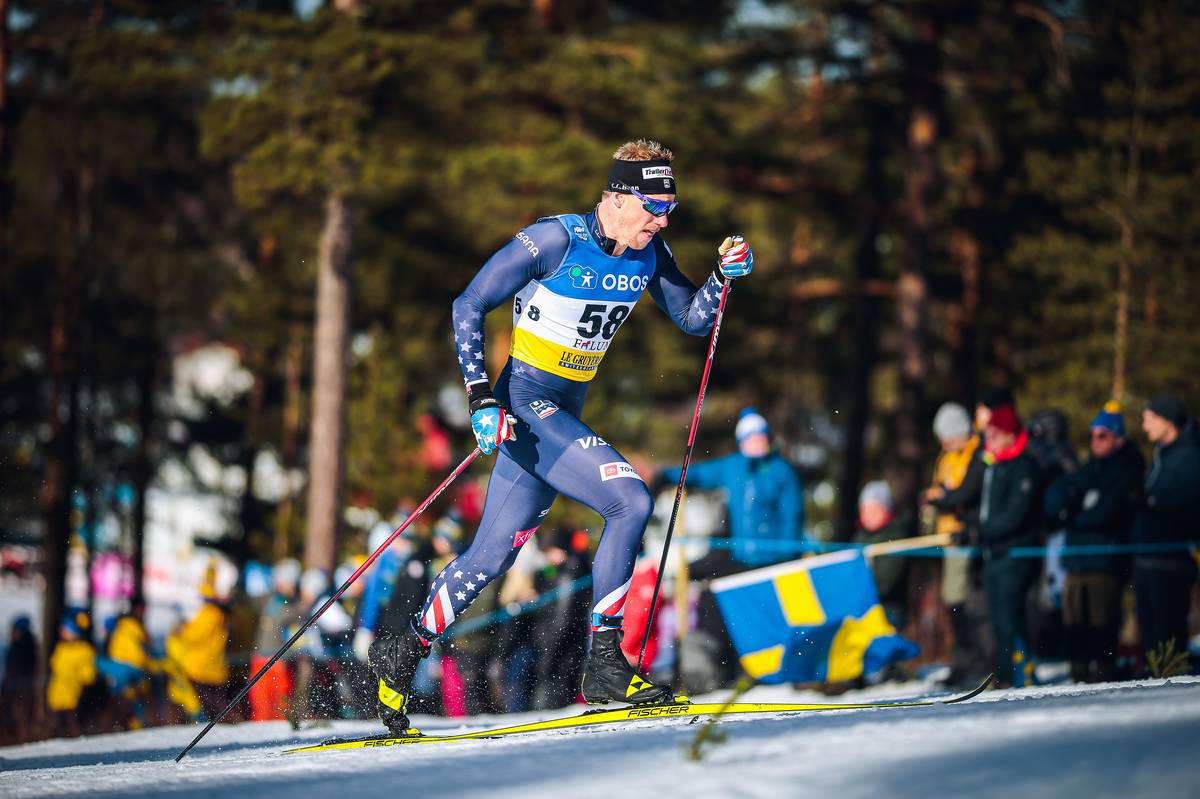
    Sovereign’s own Hannah Mehain got stronger through the heats to take second place, ahead of Dartmouth’s Callie Young.

    “I felt maybe not quite as snappy in the qualifiers,” Mehain told FasterSkier. “But it improved for the day and I just felt better and better .”

    As the American east and Eastern Intercollegiate Skiing Association (EISA) faced COVID restrictions that limited race opportunities, Young was in a similar boat to the Canadian women in terms of lack of high-level racing opportunities. She also shared her feelings on the sprint day.

    “I didn’t have my best qualifier, this is my second day at altitude,” Young said. “So it was kind of tough. But when I get into the heats, it’s always so fun and competitive.”


    On the same course NDC TBay’s Smith was clearly the strongest of the men, winning the qualifier and all three heats. Xavier McKeever and Tom Stephen, qualifying 2nd and 6th, both chose to race up in senior, resulting in some hard fought heats. McKeever and Stephen are both members of the national team and train with Foothills Nordic Ski Club in Calgary.

    “It was really fun,” said Smith after his race. “It was a blast for the body to do what it’s supposed to do, what I’ve been training it to do, so that was really fun.”

    Smith was one of the few who answered the tactics question with something other than how much fun it was to be racing again.

    “In the final, it kind of slowed down at about the first third. And I just tried to go when everyone else started to go and got a bit of a gap and in the end, was able to hold the lead. So that was really fun.”

    In the end, the juniors found themselves enrolled in the Locke School of Heat Tactics, with Black Jack’s Julien Locke using guile to take second in the final after qualifying 7th.

    AWCA’s Bob Thompson gapped NDC TBay’s Pierre Grall-Johnson on the climb to complete the podium.  

    World U20 relay silver medallist teammates McKeever, Rémi Drolet, and Stephen were 5th, 6th, and 7th, while Olivier Léveillé was away in Lillehammer. Though age and experience filled the podium, Grall-Johnson-Johnson was the first U23 athlete showing that the younger skiers are putting the pressure on.

    Sprint Results: Qualification, Heats, Final, U18/U16 Mass Start.


    10km/15km Classic Individual Start

    The race of truth was also the race of discovery as many athletes re-discovered why pre-race routines exist. Sunday dawned clear and cold, rising to -11C for the men’s start at 9am. With yesterday’s new snow packed hard, there was no difficulty in finding grip with hard wax, but not everyone found the glide necessary on a 5km loop that is flat and fast by World Cup standards.

    Rémi Drolet, just returned from racing Continental Cups in Muonio and Gällivare, skied a consistent race to take the win in 39:06.1, setting the fastest time in all three laps.

    Stephen was second, 39.6 behind, moving up on the final lap.

    “It was really good,” Stephen said. “It’s my first 15k back this season because I’ve been coming back from injury. And it went really well, it went just like I planned it, so really happy with it.”

    Interval starts are more exciting than they used to be.

    “Oh, it’s so fun,” Smith added. “I haven’t done something like this with this many people in a long time.”

    AWCA’s Jack Carlyle skied a very strong first 5km lap before struggling with the cold after a mistake choosing baselayers, finishing third at 49.2 back.

    “I made a rookie mistake and did not wear enough layers and froze halfway through the race,” Carlyle explained once he was warm again. “But I had great skis. And for the first bit of the race, I had great feelings. So yeah. Happier where the body is just need to remember not to make silly mistakes.”

    McKeever recovered from a slower first lap, moving up from 7th to finish 4th at 1:06.8 behind.

    “I was really lucky to start my season off in Europe, with a couple of victories in Finland and Sweden. And I was really happy with how they went, especially after last year being a really tough year for myself,” he said. “So overall, I’m pretty stoked to just be back at it.”

    “The sprint yesterday, I think went really well. Today, I was just missing a bit of gas. I feel I didn’t feel awesome, awesome, but it’s just nice to get out there and race again in Canada. And we have more next weekend.”


    Jasmine Drolet stepped up the sibling rivalry with a win in the 10km in 30:38.9. Now in her first year at Dartmouth, she made up for missing the sprint with a steady performance.

    “Definitely a shock to the system,” she told FasterSkier. “But I’m glad to have gotten it over with and to be in racing season now.”

    Back in Canada after her first semester in the Ivy League, she was adjusting to the changes.

    “I was nervous before [the race]. Changing training, and changing coaches and everything, but now, I feel confident that my training this fall was good. The US is maybe a little bit different than Canada, but not very different. It’s a lot of work to juggle school and skiing full time, but it’s manageable.”

    Bouffard-Nesbitt finished in second place, 41.4 back, with a fast first split.

    Another full-time student, Mehain was third at 1:09.7, just holding off a fast finishing Beth Granstrom.

    “I had a great day,” Mehain said. “It’s really fun to be out racing again, seeing everybody. I pushed fairly hard on that course for the classic 10k and had a lot of fun.”

    Distance Results: Interval Start, Full Weekend.

    Mexican National Championships

    Karla Schleske Shepard is the first female National Champion for Mexico. (Photo: Peggy Hung)

    This is the second National Championship for Mexico, with the first held in Canmore at Canadian nationals in 2019. Starting a ski program in a country without snow or a skiing tradition is hard, even without a pandemic disrupting progress. This year, there were six men and one woman competing.

    Jonathan Soto Moreno won both days, capping a year where he also earned a Beijing quota spot for Mexico at World Championships.

    Karla Schleske Shepard, a former heptathlete who represented Mexico at the PanAm games, became the first ever female champion after learning to ski in February 2021.

    What’s Next?

    December 11th and 12th has both the Eastern Canada Cup #1 at Nakkertok and the Western Canada Cup #2.

    The major storm that threatened the first weekend at Sovereign did even more damage in Rossland, forcing Black Jack’s Organizing Committee to cancel. WCC #2 will now be held at the backup venue, Sovereign Lake, with details forthcoming.

    With continued highway closures in BC and additional border restrictions related to the omicron variant, many travel plans will change. Both ECC #1 and WCC #2 may have smaller fields as US teams react to the increased friction at the border.

    NDC TBay, based in arguably the east/west centre of the country, is headed for the eastern Canada Cups. This will allow some comparison between the two series and give ski fans something to debate during the Christmas break.

    All will be made clear in Canmore on January 6th to 11th, when trials for OWG, U20/U23 World championships, and World Cup Period 4 will bring together the top athletes from the entire country.

    Photo Galleries: Doug Stephen (VR45 Photography): Sprints, Distance


  • Junior World’s Relay: In Photos

    Junior World’s Relay: In Photos

    Junior Men’s Relay:

    Luke Jager for the US, bib 1, a deep breath before the scramble leg beat down. (Photo: Doug Stephen)


    Luke Jager: onward. He gapped the field by 25 seconds on the scramble leg. (Photo: Doug Stephen)


    Ben Ogden for the U.S. on his solo journey to keep his team way off the front. (Photo: Doug Stephen)


    Ben Ogden tags to Johnny Hagenbuch for the first skate leg. (Photo: Doug Stephen)


    Gus Schumacher: The Closer. (Photo: Doug Stephen)


    The Win. (Photo: Doug Stephen)


    Canada’s Turn

    From left to right: Canada’s Olivier Léveillé, Tom Stephen, Xavier McKeever, and Rémi Drolet. Second overall in the World Junior’s 4 x 5 k relay. (Photo: Doug Stephen)


    Bib 11, Xav McKeever for Canada fighting for position on the scramble leg. (Photo: Doug Stephen)


    Leg 2, Canada’s Olivier Léveillé leading the chase. (Photo: Doug Stephen)


    Where they belong: Canada’s Tom Stephen taking the pull on the front chase group. (Photo: Doug Stephen)


    Rémi Drolet — closing it out. (Photo: Doug Stephen)


    Drolet, almost there. (Photo: Doug Stephen)


    The maple leaf group hug. (Photo: Doug Stephen)


    Junior Women’s Relay:

    Sydney Palmer-Leger (bib 4) during the scramble leg. (Photo: Doug Stephen)


    Kendall Kramer on the second classic leg. (Photo: Doug Stephen)


    Leg 3 for the U.S., Sophia Laukli (Photo: Doug Stephen)


    Novie McCabe on the fourth leg for the U.S. (Photo: Doug Stephen)


    The U.S. takes second overall. (Photo: Doug Stephen)


    Canada’s Molly Miller tagging Jasmine Drolet: Leg one to two. (Photo: Doug Stephen)


    Leg three to four: Canada’s Lilian Gagnon tags Elizabeth Elliott. (Photo: Doug Stephen)


    Let’s not forget the Swiss who had a fine day. Here’s Swiss skier Anja Lozza closing down for the team win. (Photo: Doug Stephen)

    Watch the races here on the FIS site.

    Doug Stephen has more photos here.

  • Junior World’s Relay: U.S. Women 2nd, U.S Men 1st, Canada 2nd

    Junior World’s Relay: U.S. Women 2nd, U.S Men 1st, Canada 2nd

    Friday was a much anticipated day across the Atlantic from the Oberwiesenthal, Germany: Junior World’s relay day. 

    Junior Women’s 4 x 3.3 k Relay

    For the U.S. junior 4 x 3.3 k relay, oh-so-close was last year’s World’s just off the podium fourth place performance. Twelve months later and a loaded team featuring (in this order) Sydney Palmer-Leger, Kendall Kramer, Sophia Laukli, and Novie McCabe, the group skied themselves into second overall, 4.9 seconds off the winning time of Switzerland in first. The Swiss won in 35:08.6. Sweden placed third, 14.2 seconds back. 

    The tag to the U.S. at 9.9 k saw the team 27.8 seconds down on Switzerland, followed by the Swedes about six seconds further behind. Around 11 k, the Swedes and the U.S. were paired together in the hunt. McCabe eventually began to pull ahead into a secure second place position. In 3.3 k, McCabe locked in and chipped away nearly 23 seconds on the Swiss — who no doubt were feeling the pressure as McCabe gapped up. 

    Canada’s Molly Miller, Jasmine Drolet, Liliane Gagnon, and Elizabeth Elliott placed ninth (+1:25.8).  

    Eighteen teams started the race, with Germany and Poland disqualified for not following the marked course. 

    Junior Women’s Relay Results 

    Junior Men’s 4 x 5 k Relay

    The U.S. juniors, Luke Jager, Ben Ogden, Johnny Hagenbuch, and Gus Schumacher had experience on their side for Friday’s relay. Last year the foursome clinched a first ever U.S. relay win at World Juniors. That victory came down to a Schumacher anchor leg in which he outpaced the Russians by 3.9 seconds to the line. 

    This year, in 54:54.9, the U.S. built a cushion of 35.5 seconds on second place Canada — which was the surprise, perhaps, of these Junior Worlds. (More on that in a few paragraphs.)

    But, it’s never over until it’s over. However, Jager ended this sooner than anticipated. He pegged the scramble leg, putting 25 seconds into second place Germany when he tagged Ogden. It was game over as the U.S. added a few more seconds on each successive leg in their win. 

    “Today ended up perfect, but in the morning we didn’t know that would happen, and with the past 2 years of great relays, we had a lot of pressure on ourselves to do it again,” Schumacher emailed. “We’d looked at the teams quite a bit, and were glad with how they looked, especially with a strong American skier to match every other strong German and Norwegian leg. I myself was fairly confident with a lot of different scenarios on the last leg, but I knew that it depended on the first 3 legs going well, and those boys exceeded my expectations in a big way. They’ll say they had great skis and that’s why they were able to splinter a stacked field, but really these boys are some of the best skiers in the world and when it comes together perfectly (which it seems to often do on relay day), there’s not much match for them. I’m so proud of this team for making a 3rd relay podium look almost easy, because it definitely isn’t. The execution out of them was unparalleled today and I’m so glad to be a part of this team. Also all of us were so proud and stoked for our women’s silver medal this morning and also the Canadian men’s silver medal! Both were great races and it’s great to see them get such good placement here. Now we’re all looking forward to some North American world cups, especially Minneapolis. Go USA!!”
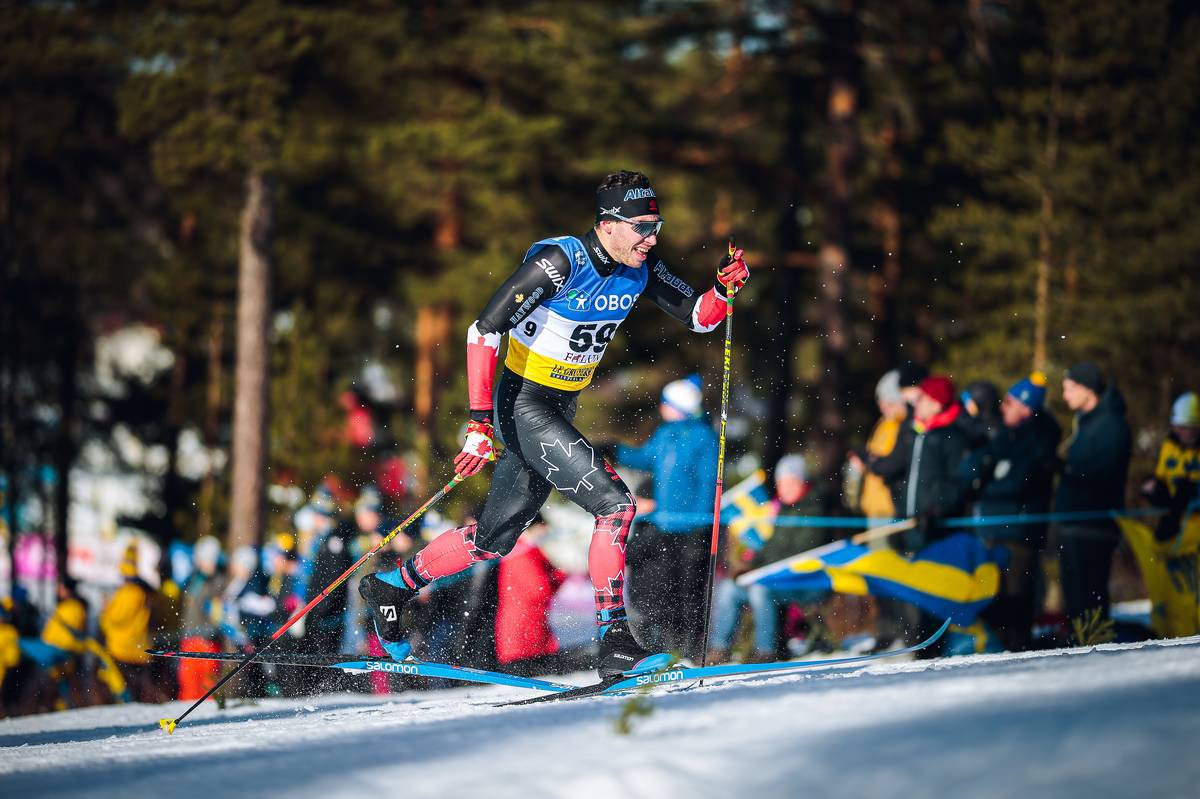
    Let’s get back to Xavier McKeever, Olivier Léveillé, Thomas Stephen, and Remi Drolet; starting in bib 11 for Canada. It clicked today for this group. Good skis? Surely. Inspired by their U.S. neighbors? Perhaps. Stoked by their on-site talisman Devon Kershaw (in Germany to coach)? Does that need an answer?

    No matter how you spin it, this was the race of the day. Certainly unexpected, and certainly deserved for a program rebounding from low funding and in the midst of a rebuild.

    At the 10 k mark, Italy, at 30.8 seconds behind the U.S., was trailed by Norway, Switzerland, Canada, and France — all within roughly seven seconds. That five team pack moved together through the final tag off at 15 k. Glued together through 16.8 k, only Norway fell off the pace. 1.5 k later, and it was Italy’s turn to feel the burn, as they fell off too. 

    That left Canada and Switzerland 10 seconds ahead of the now trailing Italians. By the time the next k had clicked by, Drolet, who was coming off a stellar fourth in the junior men’s 30 k mass start skate, made it real: he gapped the Swiss by 20 seconds. 

    It’s worth mentioning again – Canada in second overall, 35.5 seconds off the winning pace. The Italians rebounded as the Swiss fell back. Italy took third (+55.4), the Swiss placed fourth (+1:34.4).

    “This is absolutely incredible,” Drolet said to Nordiq Canada after the race. “We were so stoked to start this race, and we told ourselves last night we are going to go for the medal today. This is one of the best, if not the best, World Juniors for a Canadian team in terms of results. Knowing everyone on the relay team had a top-30 at the Championships we knew this was doable.”

    Adding his own poetry to the historic relay for Canada, “People don’t really understand what went down today, but it is insane,” Kershaw told Nordiq Canada.

    Junior Men’s Relay Results 

  • Mass Start day at World Juniors: Remi Drolet 4th, Schumacher 5th…Laukli 5th, McCabe 9th (Includes Audio Interview with USST Coach Bernie Nelson)

    Mass Start day at World Juniors: Remi Drolet 4th, Schumacher 5th…Laukli 5th, McCabe 9th (Includes Audio Interview with USST Coach Bernie Nelson)

    Helen Marie Fossesholm of Norway taking the junior women’s 15 k mass start skate. (Photo: Doug Stephen)

    Wednesday in Oberwiesenthal, Germany World Juniors continued with a 15 k mass start skate for the women. 

    Junior Women’s  15 k Mass Start Skate

    Norway’s Helene Marie Fossesholm (18) won her second race of these championships by taking the mass start skate in 35:55.6 minutes. Fossesholm also won the 5 k interval start classic race on Monday. Poland’s Izabela Marcisz placed second 1:09.3 back. Marcisz also won a bronze in the 5 k classic. Switzerland’s Siri Wigger skied herself into third (+1:10.6). The theme continues, this was Wigger’s second 2020 championship medal, after placing third in the skate sprint. 

    Sophia Laukli (bib 56) skied to 5th overall in the junior women’s 15 k mass start skate. (Photo: Doug Stephen)

    Starting in bib 56, layered well back at the start, was Sophia Laukli (Middlebury) for the U.S. Laukli (19), in her first Junior Worlds, moved up in the pack to place fifth overall (+1:26.5). 

    Novie McCabe (MVNST) skied to ninth (+1:33.0) for her best individual Junior World’s result. Mccabe placed 10th in last year’s championship 15 k classic in lahti, Finland. Kendall Kramer (Fairbanks Nordic) was 24th (+2:54.5), and Sydney Palmer-Leger (SVSEF) did not finish. 

    Novie McCabe on her way to 9th overall in the 15 k mass start skate. (Doug Stephen)

    Interview with U.S. Ski Team Coach Bernie Nelson

    Liliane Gagnon (Skibec Nordique) was the top finisher for Canada in 34th (+3:38.2). Jasmine Drolet (Blackjack Nordic Club) followed close behind in 36th (+3:39.0). Benita Peiffer (Whistler Nordic) placed 49th (+4:43.2), and Elizabeth Elliott (Revelstoke Nordic) skied to 51st (+4:39.1).

    From left to right: Canada’s Jasmine Drolet, Elizabeth Elliott, Benita Peiffer, and Liliane Gagnon. (Photo: Doug Stephen)

    Junior Women’s Results 


    Junior Men’s 30 k Mass Start Skate

    The junior men raced a 30 k mass start skate Wednesday with Norway’s Iver Tildhelm Andersen winning in a time of 1:13:39.0. Anderson medlaed in last year’s Junior World’s, placing third in the 10 k skate.

    Second place went to Germany’s Friedrich Moch who crossed the line 9.4 seconds back. Moch also placed second in Monday’s 10 k classic. Third place went to Martin Kirkeberg Mørk of Norway, who was 32.8 seconds off the winning pace. 

    Remi Drolet of Canada skiing to 4th overall at the Junior World’s 30 k mass start skate. (Photo: Dough Stephen)

    Scrolling not so far down on the results sheet to places fourth and fifth, respectively, added some excitement for North America; Remi Drolet (Black Jack Nordic) of Canada placed fourth overall (+43.2), and Gus Schumacher (AWS) of the U.S. fifth (+56.1). For Drolet, this was a Junior World’s career best result – he placed seventh in last year’s Junior World’s 30 k mass start skate. 

    At 25 k Wednesday, Drolet was positioned sixth overall, 19.4 seconds back on the then leading Moch. He was in a group with Mørk, and Italy’s Davide Graz. Roughly four seconds ahead was Schmacher as their carrot. By 28.8 k, Schumacher had faded slightly, as Drolet moved into fourth.

    Schumacher won Monday’s 10 k classic, and with Wednesday’s fifth, nearly matches his fourth place in the 2019 Junior World’s 30 k mass start classic.      

    Gus Schumacher (bib 1), leading the 30 k mass start skate at the 2020 Junior Worlds. (Photo: Doug Stephen)

    Thomas Stephen (Foothills Nordic) of Canada, placed 17th (+3:35.8), Xavier McKeever (Foothills Nordic) 32nd (+5:43.3), and Michael Murdoch (Whistler Nordic) 45th (+8:23.5). 

    For the U.S., Luke Jager placed 19th (+3:46.1), Johnny Hagenbuch (SVSEF) 20th (+3:49.2), and Zanden McMullen (APU) 35th (+6:03.3). 

    Luke Jager (bib 13) and Johnny Hagenbuch (bib 7), during the junior men’s 30 k mass start skate. (Photo: Doug Stephen)


    Thomas Stephen skiing to 17th overall in the Junior World’s 30 k mass start skate. (Photo: Doug Stephen)

    These events conclude individual racing for the juniors at these World Championships. 

    Junior Men’s Results