Tag: Renaud Jay

  • Martin Fourcade Nordic Festival Draws Big Crowds in Annecy, France

    Martin Fourcade Nordic Festival Draws Big Crowds in Annecy, France

    Enthusiastic fans fill the stands for the Martin Fourcade Nordic Festival.

    Nordic festival are two words most North American ski fans can only dream about. Skinny skiers here are unlikely to experience the reality of such an event for themselves unless they make a trip across the Atlantic. For residents of France, the opportunity to participate in the second edition of the Martin Fourcade Nordic Festival presented itself this weekend and there were many eager attendees. This lucky expat was among the masses.
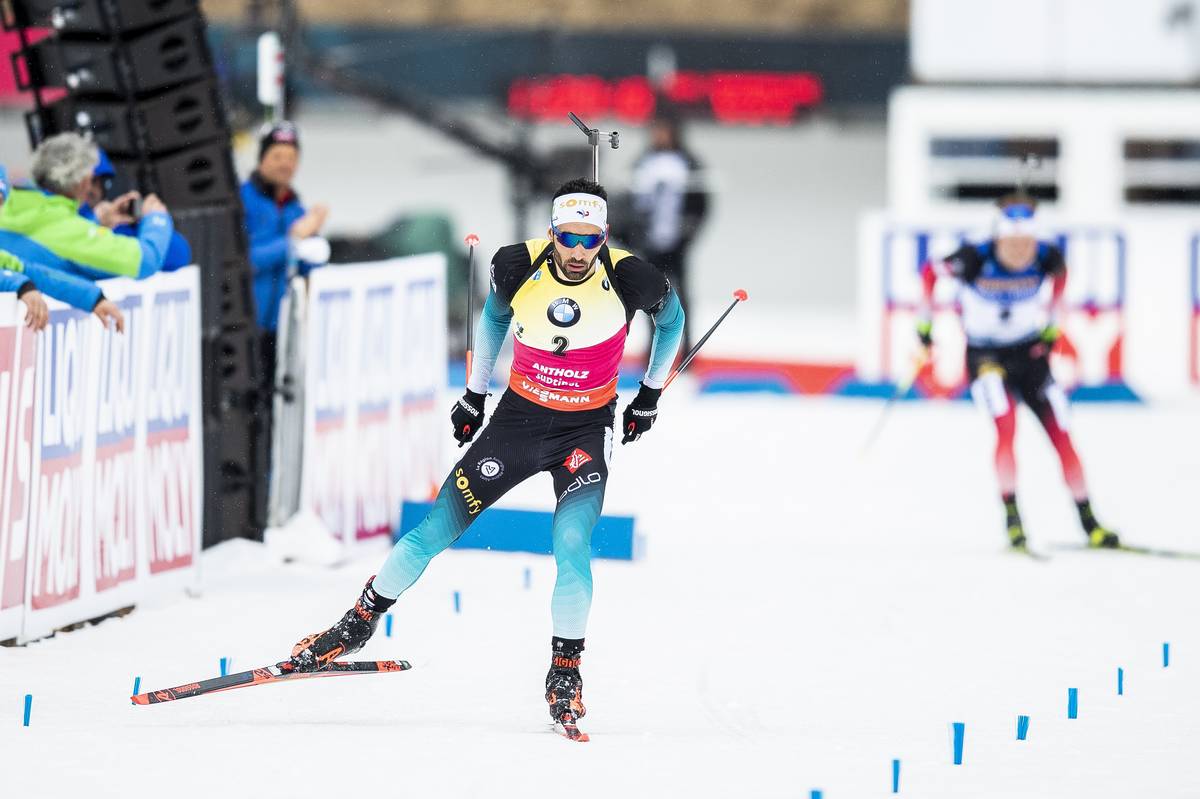
    Martin Fourcade (FRA) IBU world championships biathlon (Photo: NordicFocus)

    For those unfamiliar with the name, Fourcade retired from biathlon competition in March 2020 after a very successful career, including five Olympic gold medals and thirteen World Championships titles. He is the most successful French Olympian of all time and is celebrated as a beloved hero in his home country. Anywhere he went this weekend, he was accompanied by cheers and a train of fans hoping for autographs, handshakes, or photos. 

    The festival stretched over three days, beginning Friday, September 3rd and wrapping up on Sunday the 5th. Located in Annecy, in the Haut-Savoie department of France, the stadium sat facing the electric blue water of Lac d’Annecy, rimmed by limestone bluffs.

    It’s difficult to imagine a better setting for drawing crowds than the park Le Pâquier, which is right downtown and runs along the popular bike path that circumnavigates the lake. Indeed, the place was bustling with spectators all weekend long, both paying customers and those stopping by, drawn along the fence by all the commotion.

    Tickets cost €33 (about $40), and were sold out before the event began. As evidence, several posts were made in the days leading up to the festival on the French nordic Craiglist-esque site, searching for available tickets. 

    In addition to tickets, to enter the venue one needed to present their pass sanitaire, essentially a health passport in the form of a QR code which proves either you’ve been vaccinated, had a negative COVID test in the last 72hrs or, recovered from COVID in the last 11 days to 6 months. Furthermore, masks were required, even though the event was taking place outdoors where typically masks are not required in France. 
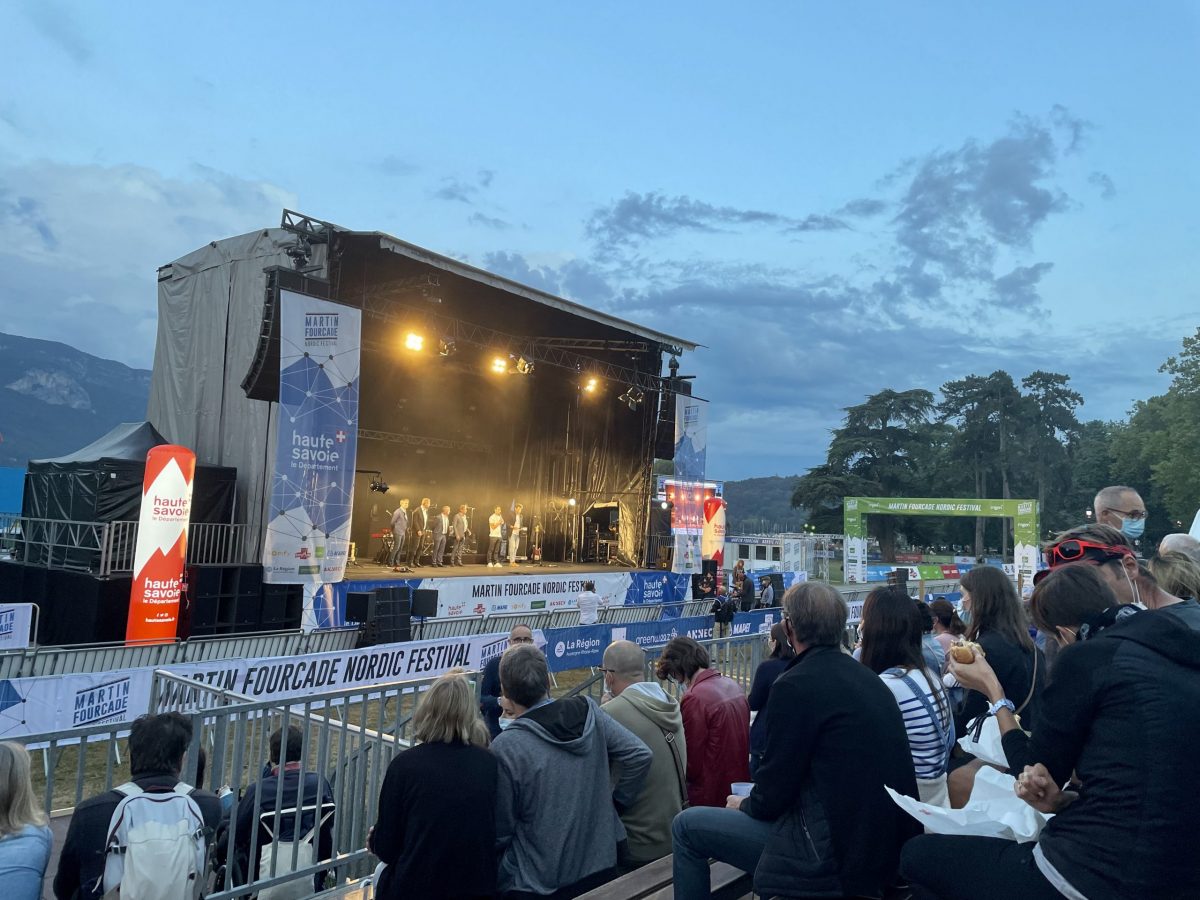
    Kicking off the weekend with the presentation of the athletes on Friday evening.

    The festivities kicked off in earnest Friday night, beginning with a presentation of the athletes on stage. While 30 international athletes had been recruited to the event, not all were able to make the journey. Many French national team members were present, both biathletes and cross-country racers, including: Richard Jouve, Renaud Jay, Delphine Claudel, Julia Simon, Anais Chevalier-Bouchet, Antonin Guigonnat, and Quentin Fillon-Maillet.

    As for the international contingent, some notable names in attendance were: Tiril Eckoff (NOR), Johannes Dale (NOR), Sturla Laegrid (NOR), Oskar Svensson (SWE), Jovian Hediger (SUI), Nadine Faendrich (SUI), Laurien van der Graaff (SUI), and Emma Ribom (SWE). 

    Following the presentation of athletes, a concert featuring Gaëtan Roussel, a well-known French musician drew quite a crowd and provided the festival with quite a lively start, setting the tune for the rest of the weekend. 
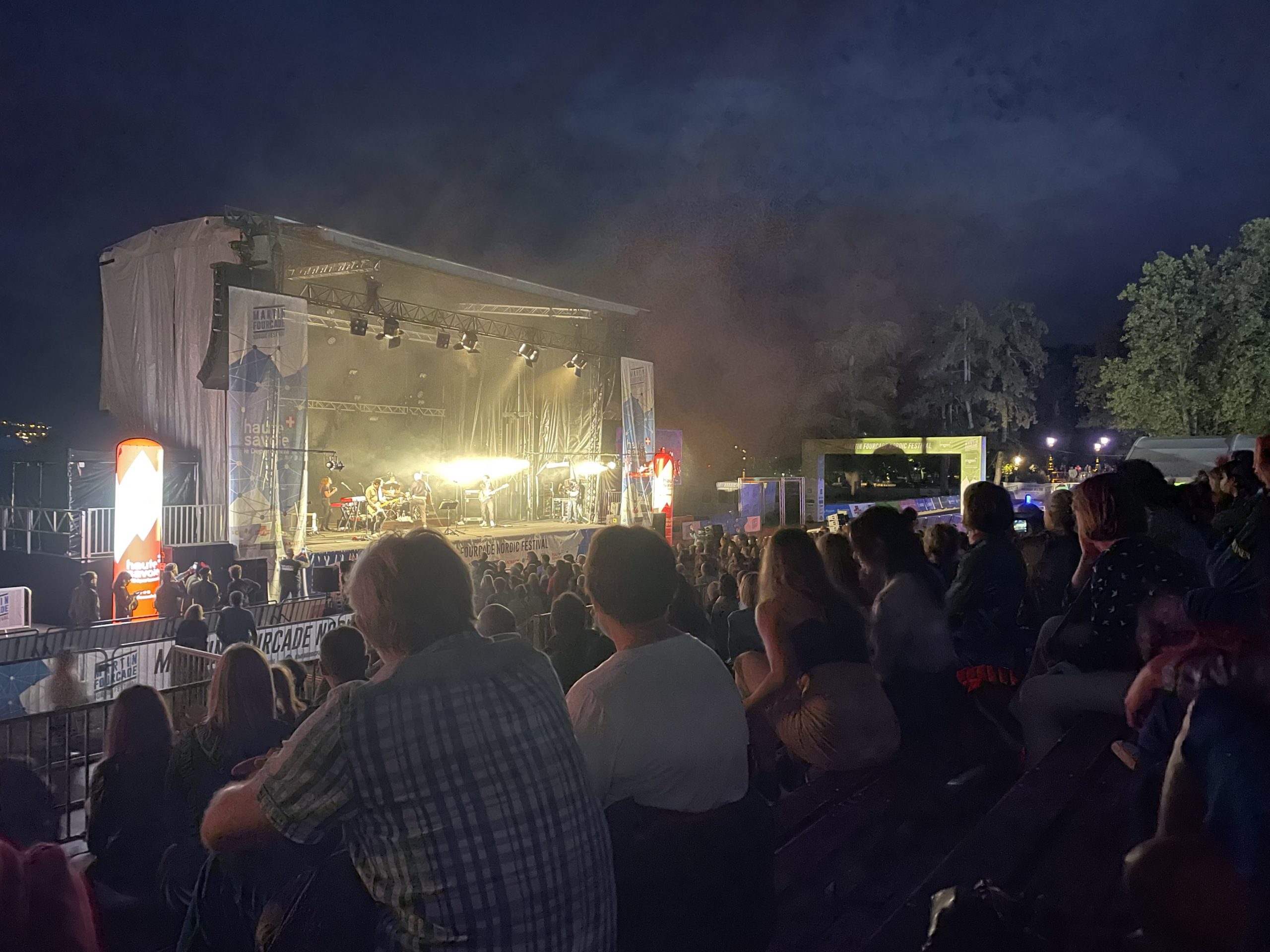
    Gaëtan Roussel in concert, Friday evening.

    Saturday started with the exposition village opening, a circle of vendor tents featuring nearly 60 brands, food and drink options, and shops. Attractions included, virtual biathlon, ski-erg competitions, and athlete appearances.

    Lines at both the Fischer and Salomon tents stretched for quite a distance as athletes patiently sat for hours, signing autographs and taking photos with fans. Not only were famous nordic athletes present, but recent competitors in the Ultra Trail du Mont-Blanc mountain running series, such as Camille Bruyas who took second place in the storied 170 km full tour around Mont-Blanc, and Thiabuat Beronian who finished 3rd in the 100 km “CCC”. These events both end in Chamonix.
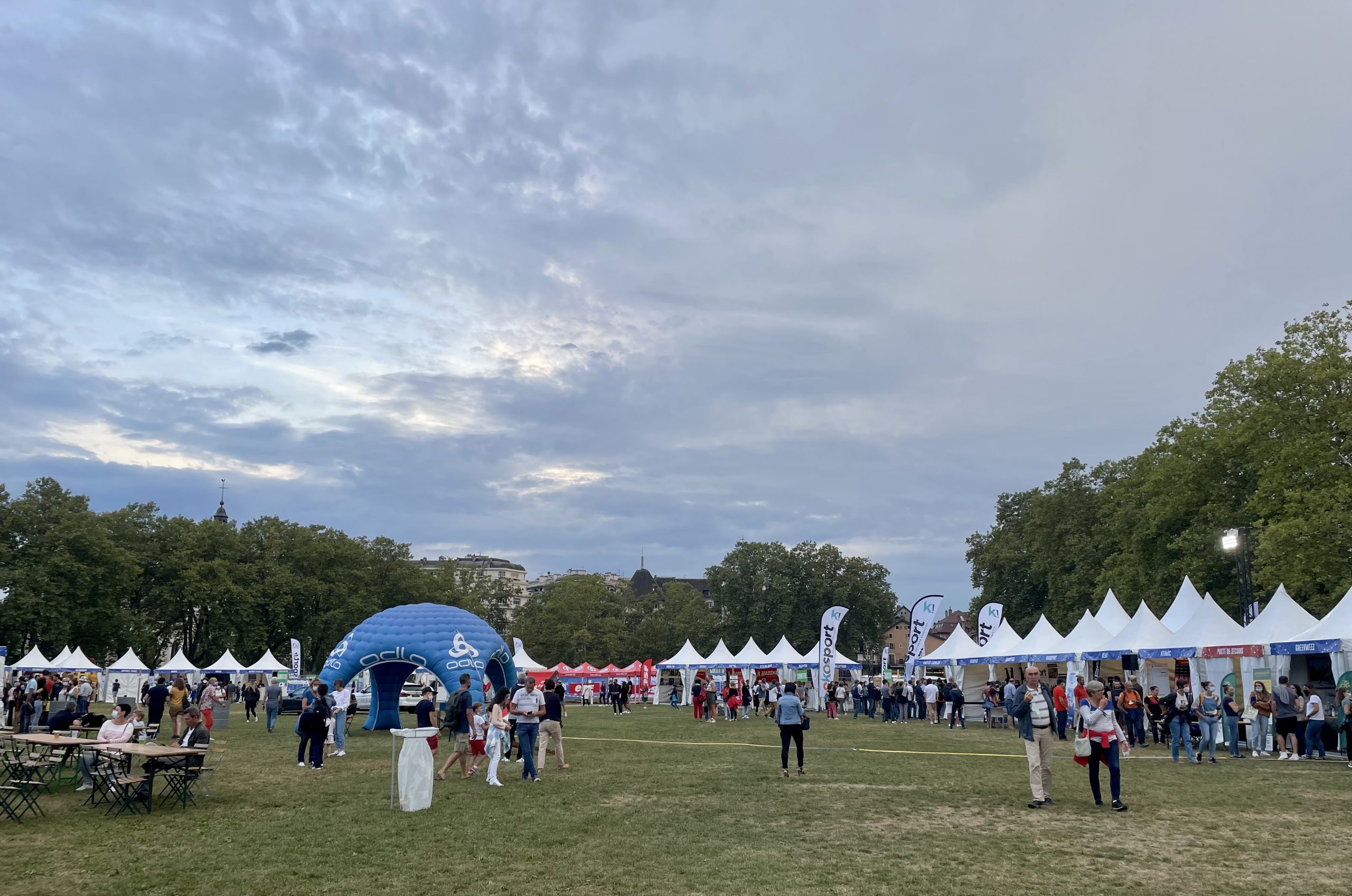
    The exposition area, filled with vendors (pictured here Friday evening).

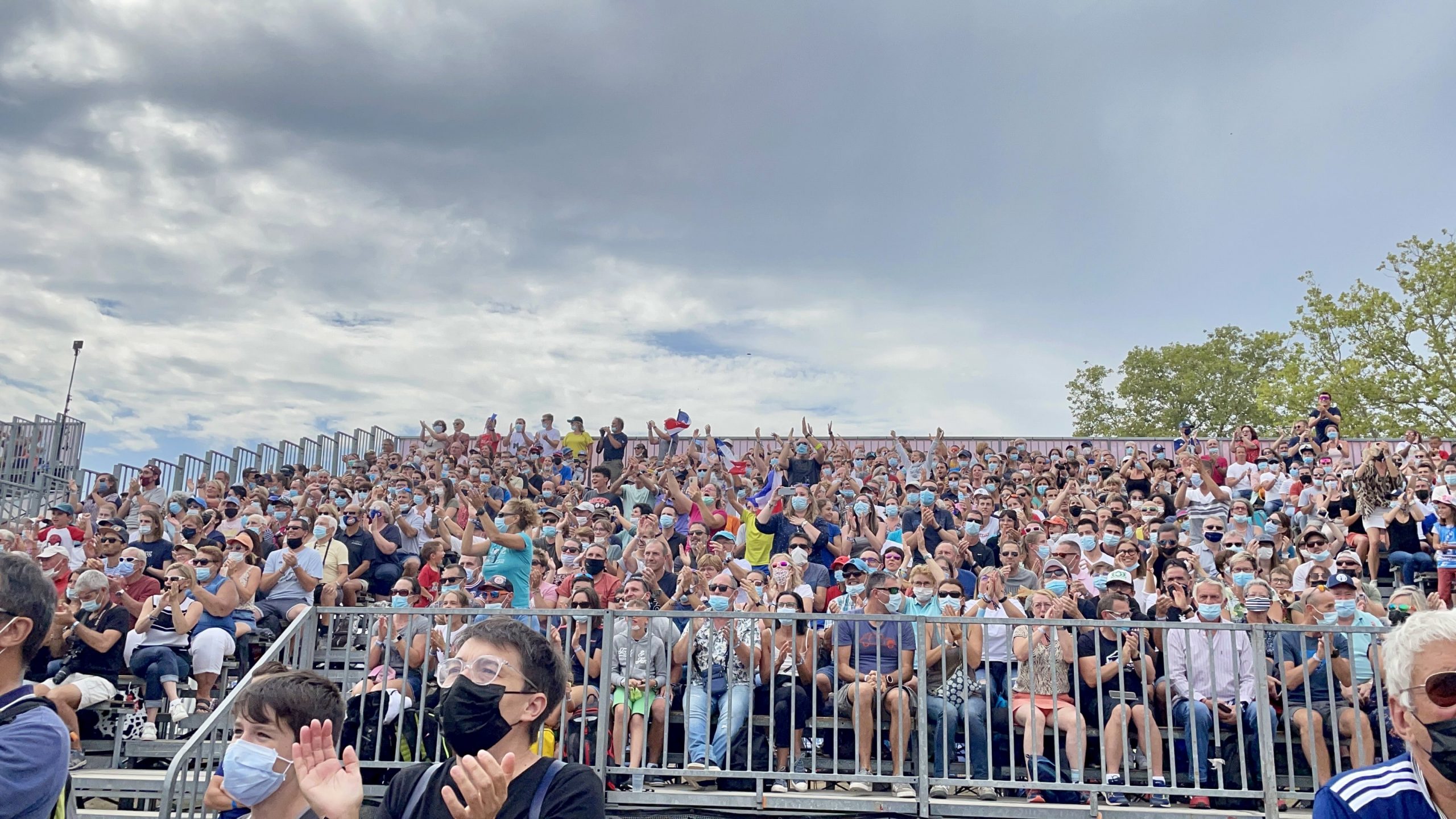
    Gradually, the crowd began to shift focus towards the stadium, as athletes started warming up for the afternoon show races. Over 3,000 attendees filed into the stands, giving Martin Fourcade a cheer that lasted for minutes as he gave an introduction.

    Explaining his motivation for organizing this event, Fourcade said, “When I think of a Nordic festival, I want an event that grows the sport, that shares the sport, and that promotes the sport.” He thanked the crowds for their support and provided a schedule for the afternoon events, starting with women’s biathlon. 

    Eight elite biathlete women toed the start line, headed by Eckoff of Norway. They completed four laps of the flat course, with two prone and two standing rounds of shooting. Eckoff lead to start, followed by Chevalier-Bouchet (FRA) who cleaned the standing shoot quickly and gained the lead for the penultimate lap, to the joy of the crowd.

    She maintained her lead and entered the final shooting round with a bit of a lead to Eckoff (NOR), cleaning again in rapid time. Franziska Preuss of Germany was second out of the range, followed by Eckoff.

    Out on the course, which at times was flanked directly by the lake where boaters had pulled close to cheer, Eckoff passed Preuss (GER) to find second place. Chevalier-Bouchet (FRA) finished first, Eckoff second (+14) and Preuss third (+29.2).

    The spectators were thrilled to begin the competitions with a French victory and showed their appreciation in the form of overwhelming applause.

    “Yeah it’s amazing,” said Chevalier-Bouchet after her victory, “Thanks everyone. I can’t hear anything because of the noise!”
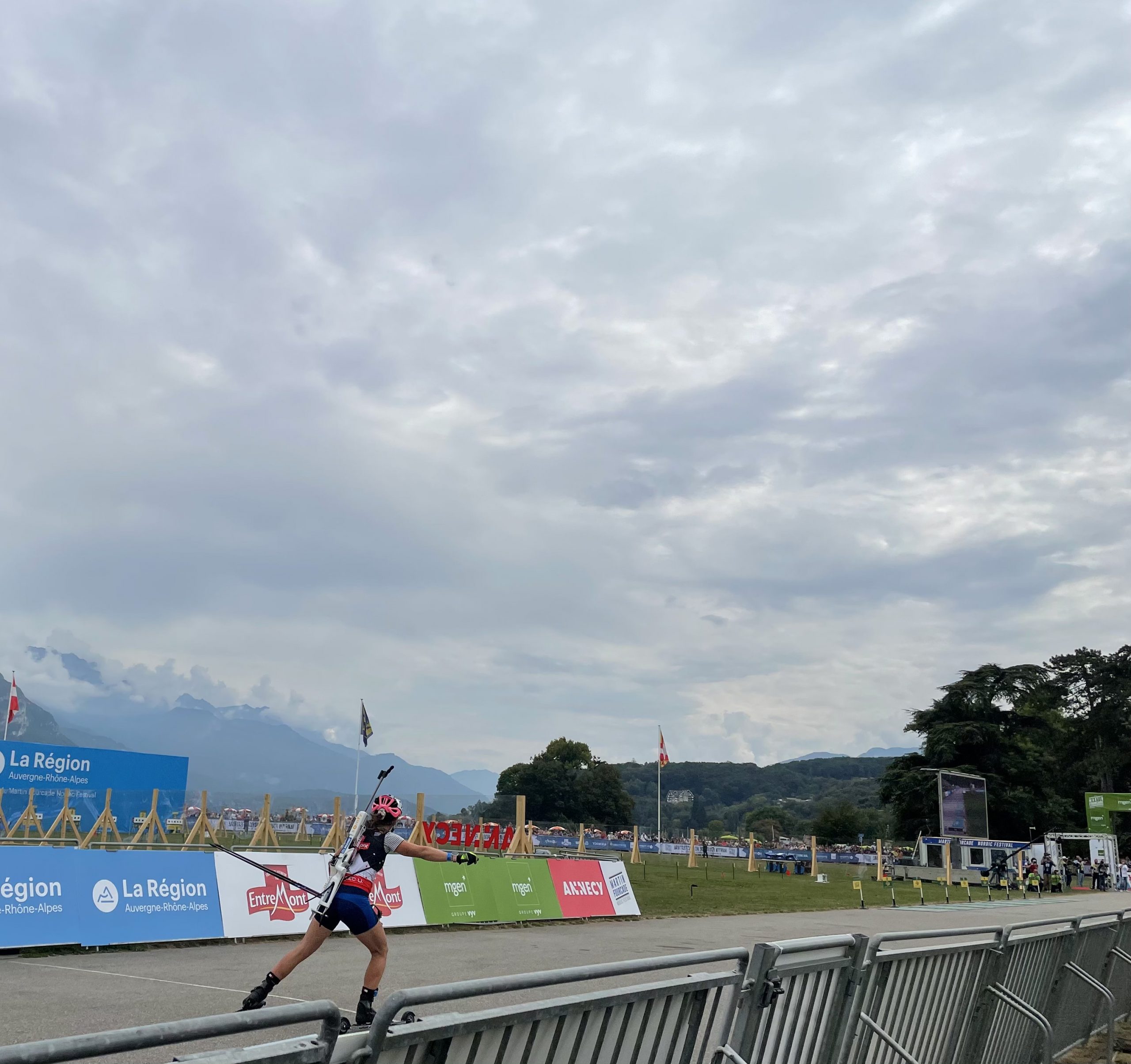
    Anais Chevalier-Bouchet (FRA) pumps up the crowd as she heads towards the finish line.

    Tiril Eckoff similarly enjoyed the support of the crowd and said, “It was very fun to be in such a good atmosphere again. It’s the first time in two and a half years to be in front of crowds so it’s really fun.” 
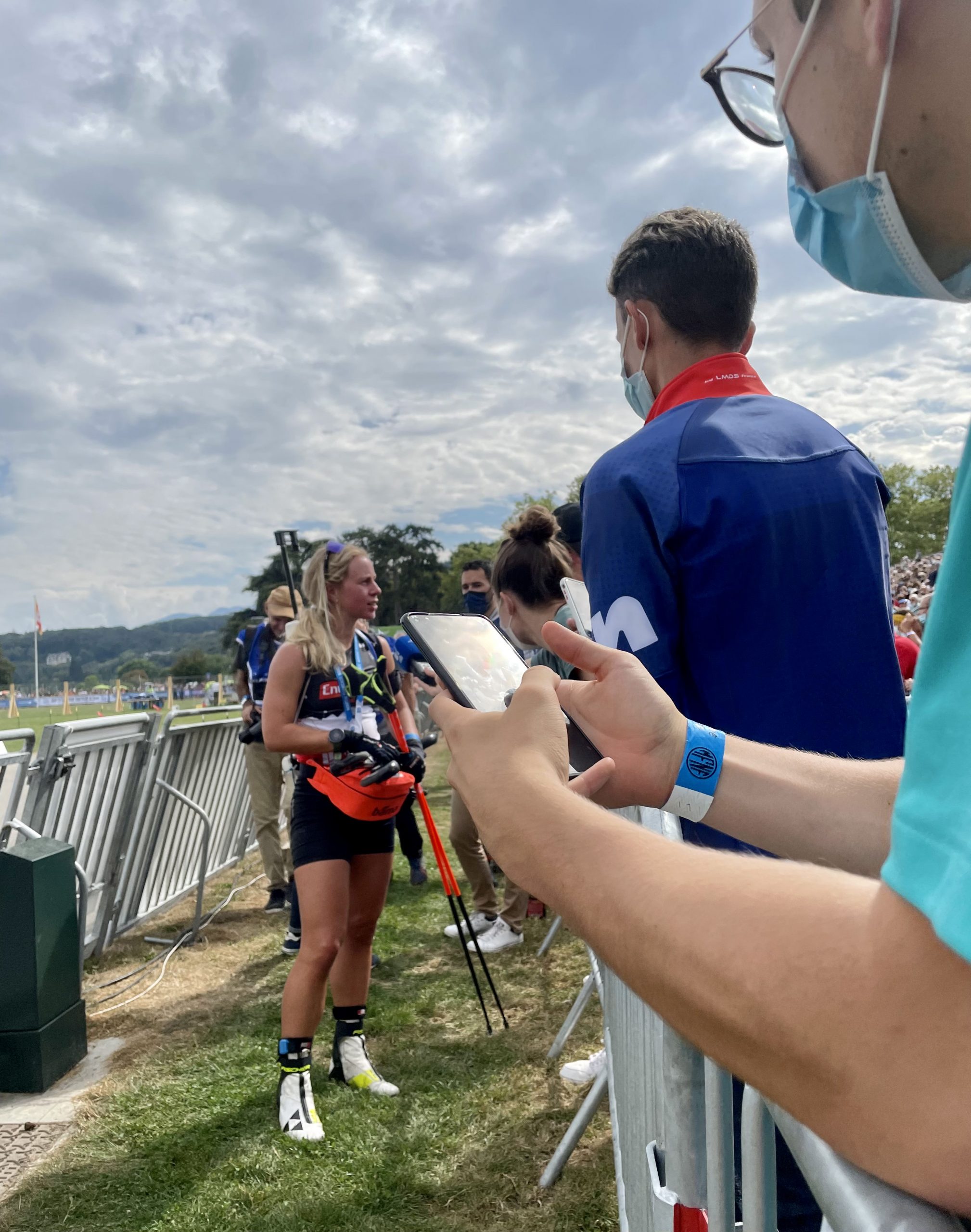
    Tiril Eckoff (NOR) finished second.

    Up next was the men’s biathlon. Guigonnat (FRA) was the first to clean and left the first round of shooting in the lead, while Fillon-Maillet (FRA), a fan favorite, struggled and exited well behind the pack. Through the second time, Doll of Germany was first to clean with Fak (SLO) right behind. Into the standing round, Laegrid (NOR) was the first to clean, Fak in second but with a penalty and Khalili (RUS) in third.

    Sturla Laegried (NOR) leads the pack along the lakeside. (Photo: NordicFocus)

    For the final time, Laegrid entered without anyone else in sight, shot 5/6 and left the range still in the lead. Khalili (RUS) was next out with Fak in third, followed closely by Fillon-Maillet who had made up ground and had a fast final round of shooting.

    Laegrid skied the last lap with a healthy gap and high-fived fans as he headed for the finish with a big lead, ending in 25:02.4. The Russian, Khalili held on for second place and Doll (GER) took third having passed Fillon-Maillet (FRA) and Fak (SLO).

    “I’m a very lucky man today so thank you Annecy!” said Laegrid after the race, “It was really fun and it was so nice to say hi to all my fans. Merci beaucoup!” 
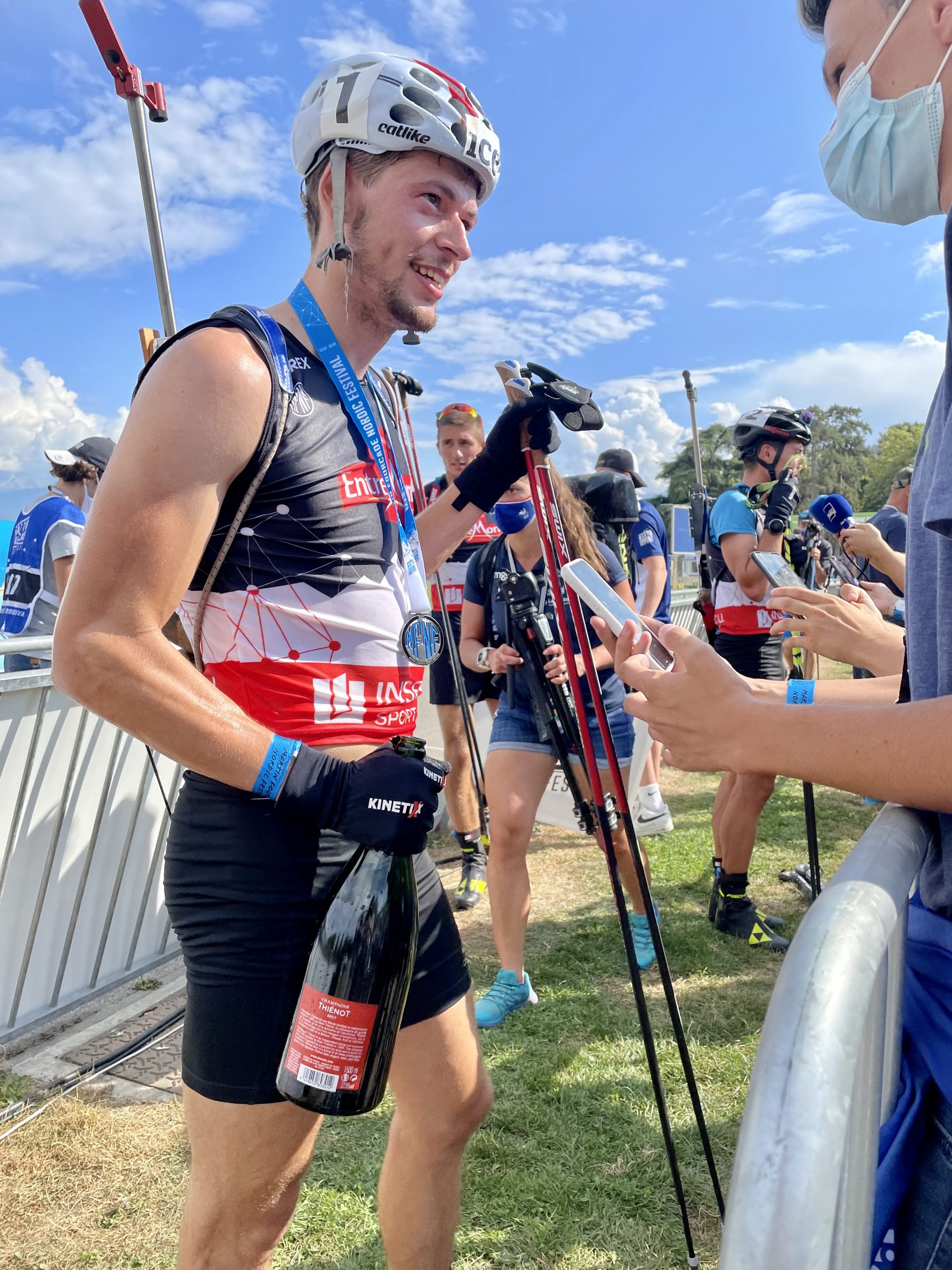
    Sturla Laegrid (NOR) holds a bottle of victory champagne after his win.

    With the biathlon races concluded, the crowd lost some it’s density before the cross-country rounds, biathlon being more popular. Nevertheless, there were still plenty of spectators who stuck around as the women lined up for their event. Not a true sprint event, the cross-country skiers completed six laps in succession with the final skier across the lap line being eliminated each round.

    The pack stayed tight for the first five laps, gradually losing skiers off the back. With a tight course, passing was quite difficult so the leaders did not change much. French skier Flora Dolci had the lead into the final lap, with the top seven athletes all within 1.4 seconds.

    Faendrich (SUI) dropped off as they passed along the lake, and then there were six. Ribom (SWE) made a pass to the front, shadowed by Van der Graaff (SUI). Rounding the final corner Van der Graaff launched an attack but Ribom held her off, keeping the advantage heading into the finish.
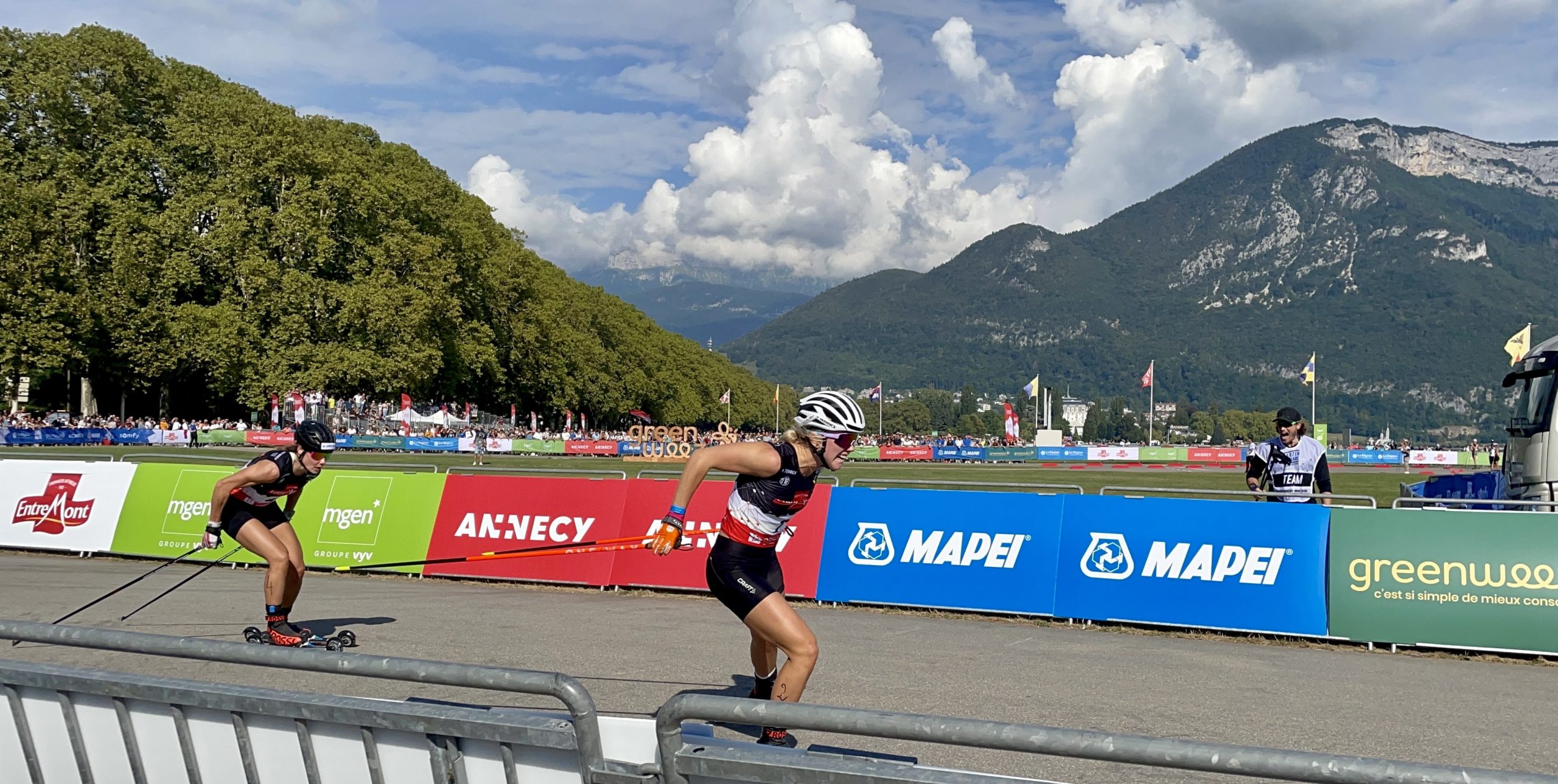
    Emma Ribom (SWE) guns for the finish line, followed by Laurien van der Graaff (SUI).

    Behind them, Dolci (FRA) outsprinted Claudel (FRA) to take third place, +4.5 back. “I felt really strong out there so it was a fun race,” said Ribom, “My plan was to have a good position the whole race so I tried to stay in the front and keep on pushing to the finish line.”

    Post race interview with Emma Ribom: 


    Van der Graaff, who speaks a bit of French, said, “I am very happy with the competition but not to do an interview in French! I tried really hard to get a second win here, but Emma was really strong.” 

    The final race of the day was the men’s cross-country. With such tight pack racing there was sure to be some broken equipment out there and sure enough, nearly every lap saw someone with a broken pole. Hugo Lapalus (FRA) was the first to be eliminated, Hediger (SUI) broke a pole near the end of the second lap and was next to stop.

    Svensson (SWE) dropped off the pace during the third lap and was stopped, followed by Valentine Chauvin (FRA) on the next lap. Jouve (FRA), a race favorite, broke a pole in lap three but managed to hang with the group, only to be eliminated with two laps to go. Heading into the final lap, Adrien Backscheider (FRA) had the lead, with Marcus Grate (SWE) the last to be eliminated.

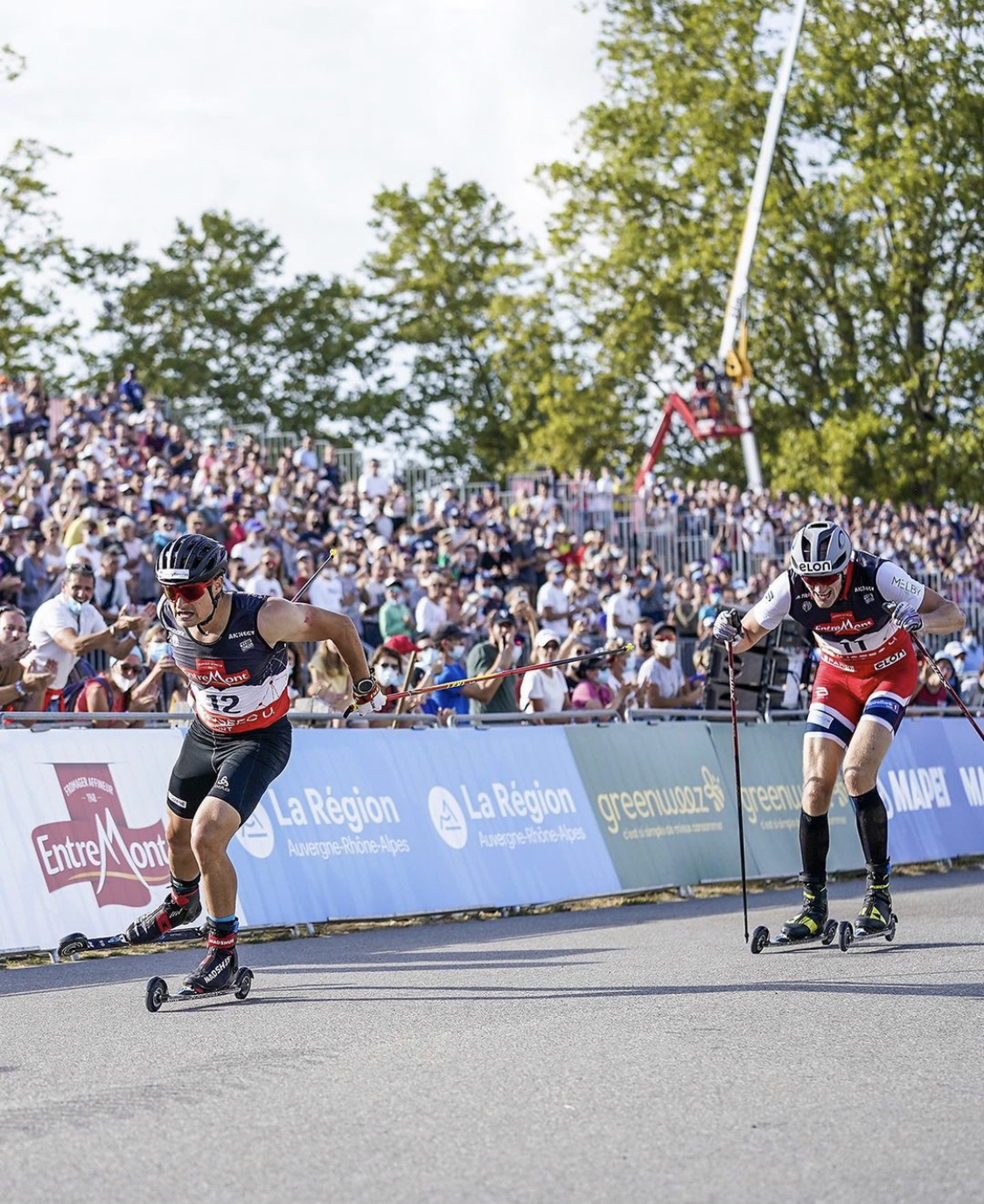
    As they neared the finish, Jay (FRA) and Pål Aune (NOR) were duking it out, ultimately the win going to Jay. Arnaud Chautemps of France finished third.

    “I’m really happy,” said Jay, “I wasn’t able to be here two years ago so this is really nice.” 
    Renaud Jay (FRA) and Pål Aune (NOR) speed towards the finish (Photo: NordicFocus)

    After the professionals raced on Saturday, it was the public’s turn to compete on Sunday. The “Biathlon Running” was open to all, involving teams of 4-6 in a relay style event. First up to compete were the kids, racing a 1km course with obstacles and shooting in between laps, followed by the adult teams.

    Kids navigate the “toile de l’araignée” (spider web) in Sunday’s obstacle course.

    There were three categories to sign up under (Mixed, female, and male) and the price was €200/team. The competitors were enthusiastic and lots of smiles were seen out on course, a fun way to wrap up a fun weekend. 
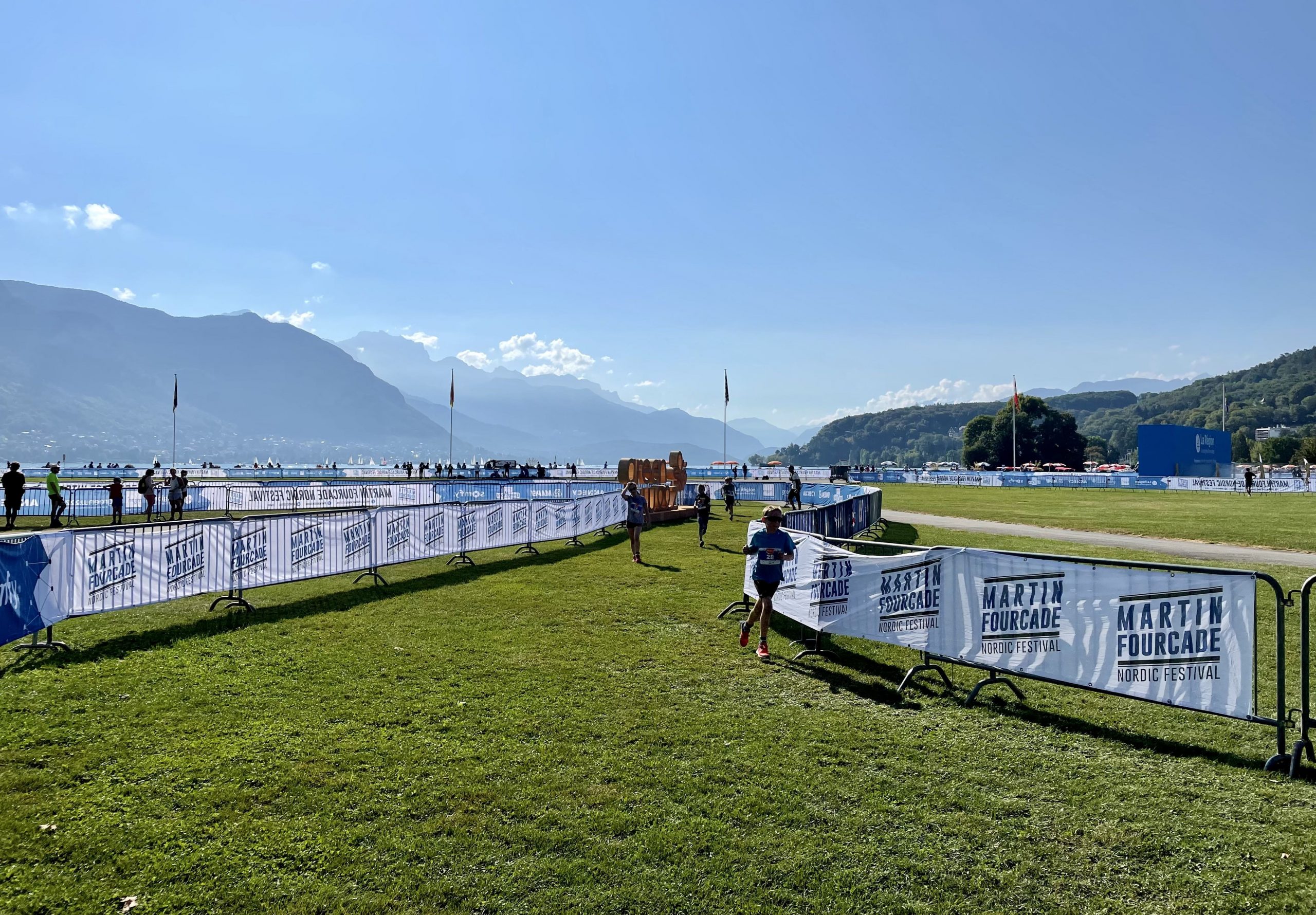
    Scenic backdrop of Sunday’s biathlon running event.
  • Saturday Rundown: Davos, Hochfilzen and Sovereign (Updated)

    Saturday Rundown: Davos, Hochfilzen and Sovereign (Updated)

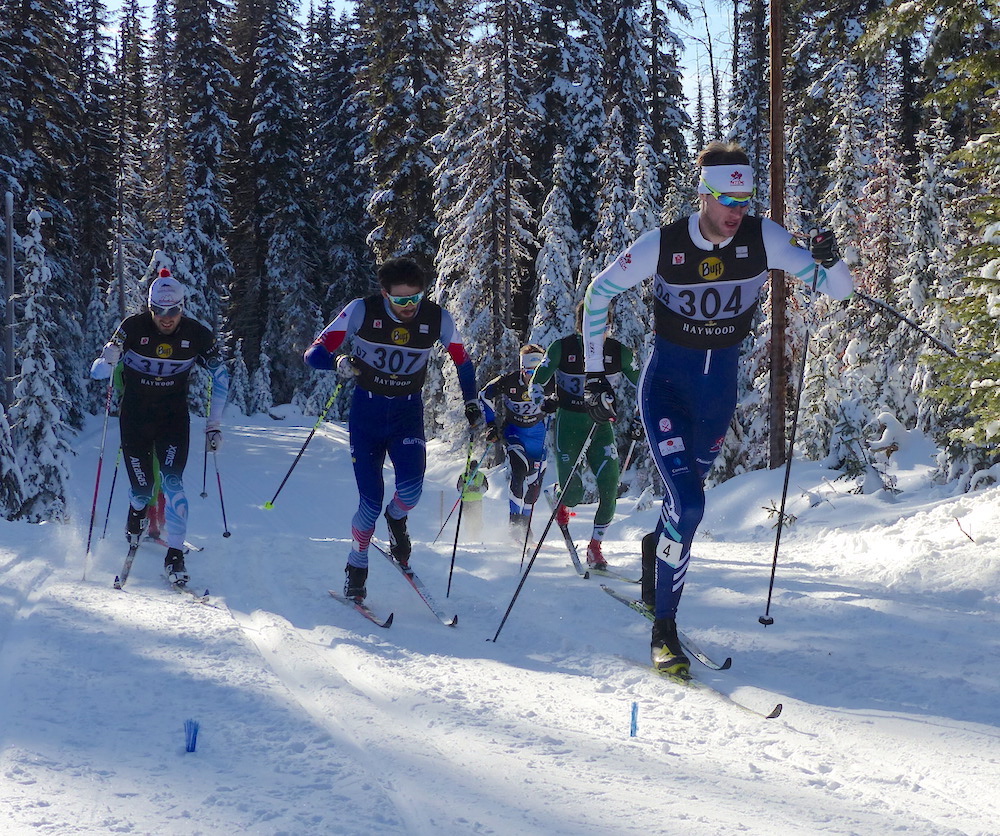
    Bob Thompson (304) of NTDC Thunder Bay leading Sun Valley’s Jack Hegman (307) and Patrick Stewart-Jones (317) of the AWCA during their quarterfinal of the NorAm men’s 1.3 k classic sprint on Saturday at Sovereign Lake near Vernon, B.C. (Photo: Peggy Hung)

    NorAm/SuperTour (Sovereign Lake near Vernon, British Columbia): Classic sprints

    On the opening day of the NorAm Continental Cup series in Canada (which doubled as a U.S. SuperTour), American Kaitlynn Miller of the Craftsbury Green Racing Project (CGRP) started Saturday with a nearly three-second win in the classic-sprint qualifier at the Sovereign Lake Nordic Centre, then went on to win her quarterfinal and semifinal before topping the final as well.

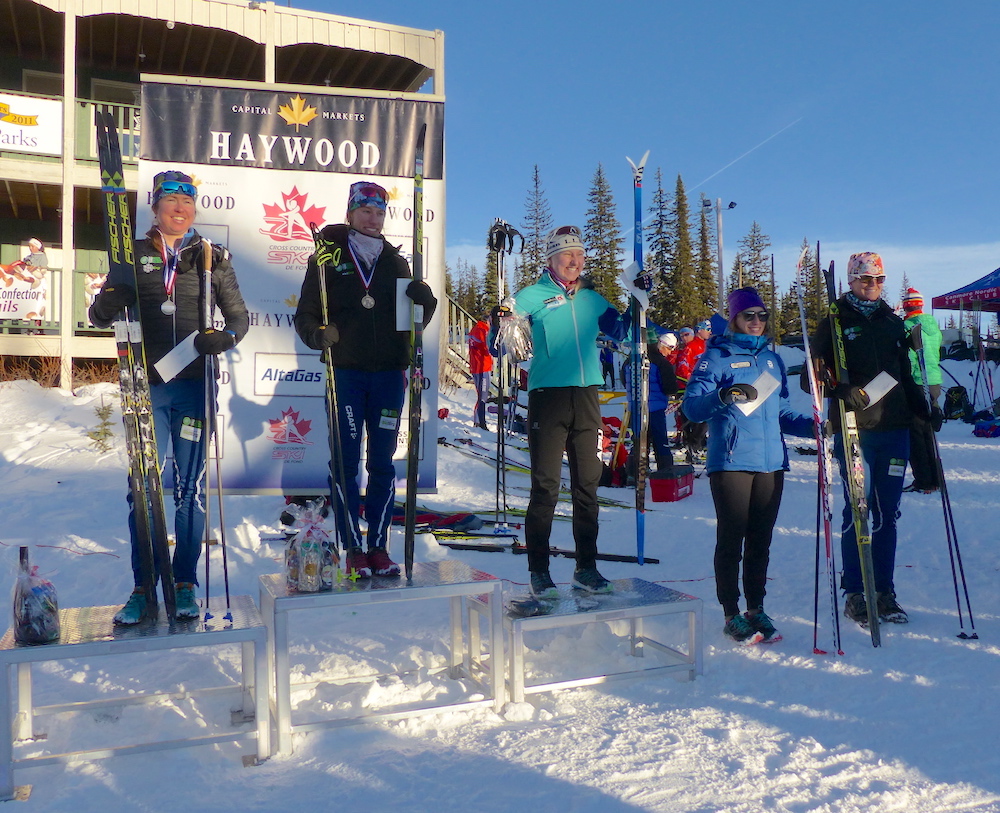
    The women’s 1.3 k classic sprint podium and top five at the first NorAm of the season on Saturday at Sovereign Lake near Vernon, B.C., with (from left to right) Caitlin Patterson (CGRP) in second, Kaitlynn Miller (CGRP) in first, Hannah Halvorsen (APU/USST) in third, Kelsey Phinney (SVSEF) in fourth, and Liz Guiney (CGRP) in fifth. (Photo: Peggy Hung)

    Miller was the fastest women’s qualifier by 2.87 seconds on the 1.3-kilometer course with a time of 2:59.39. Ultimately, she won the final in 2:57.53, 0.93 seconds ahead of her teammate Caitlin Patterson in second and 2.59 seconds clear of the third American on the podium, Hannah Halvorsen of Alaska Pacific University (APU) and the U.S. Ski Team (USST) D-team, in third place.

    Halvorsen previously qualified third behind Kelsey Phinney, of the Sun Valley Ski Education Foundation (SVSEF) in second. Phinney finished fourth in the final (+2.85), while a third Craftsbury skier, Liz Guiney placed fifth (+3.53). The lone Canadian in the six-woman final, Sophie Carrier-Laforte of the Pierre-Harvey National Training Centre (CNEPH) placed sixth (+4.38).

    Thompson Fends Off Five Americans

    Of the six racers in the men’s 1.3 k freestyle sprint final, five of them were American. Bob Thompson, of the Thunder Bay National Team Development Centre (NTDC), bested them all for the win in 2:29.31, just 0.03 seconds ahead of Ben Saxton, of the Stratton Mountain School (SMS) Elite Team, in second place. Cole Morgan (SVSEF), the qualifying winner who had so far dominated all of his heats, ended up third overall, 0.48 seconds behind Thompson.

    Sun Valley and APU each had two athletes reach the men’s final with Jack Hegman (SVSEF) taking fourth (+0.51), and APU’s Reese Hanneman and Tyler Kornfield placing fifth (+7.75) and sixth (+7.9), respectively.

    To start the day, Morgan posted the fastest men’s qualifying time in 2:31.00, while last weekend’s SuperTour skate sprint winner Nick Michaud, of the Bridger Ski Foundation (BSF), qualified in second, 0.78 seconds back. Americans took the top-three qualifying spots with Logan Hanneman (APU) in third (+1.59), while Thompson was the top Canadian qualifier in fourth (+2.34).

    Morgan won both his quarterfinal and the first semifinal to advance to the final, along with Thompson who placed second in that semifinal (and placed second to Hegman in the quarterfinals). Saxton won the second semifinal (after finishing second to Logan Hanneman in the quarterfinals) and Kornfield was second behind Saxton in that semifinal to automatically advance to the final. Reese Hanneman and Hegman made it to the final as lucky losers after placing third and fourth, respectively, in the first semifinal.

    Live results

    Qualifier results

    ***

    IBU World Cup (Hochfilzen, Austria): Men’s and women’s pursuits

    Men’s report

    Norway’s Johannes Thingnes Bø notched his second-straight win in Hochfilzen after Martin Fourcade of France missed three on the final shooting stage of the men’s 12.5 k pursuit on Saturday. Bø, who started the race 12 seconds ahead of Fourcade in second, cleaned the final standing stage to leave the range nearly a minute ahead of Slovenia’s Jakov Fak in second. Meanwhile, Fourcade, who had been skiing in first just ahead of Bø before the last stage, dropped 1:19 minutes back to fifth.

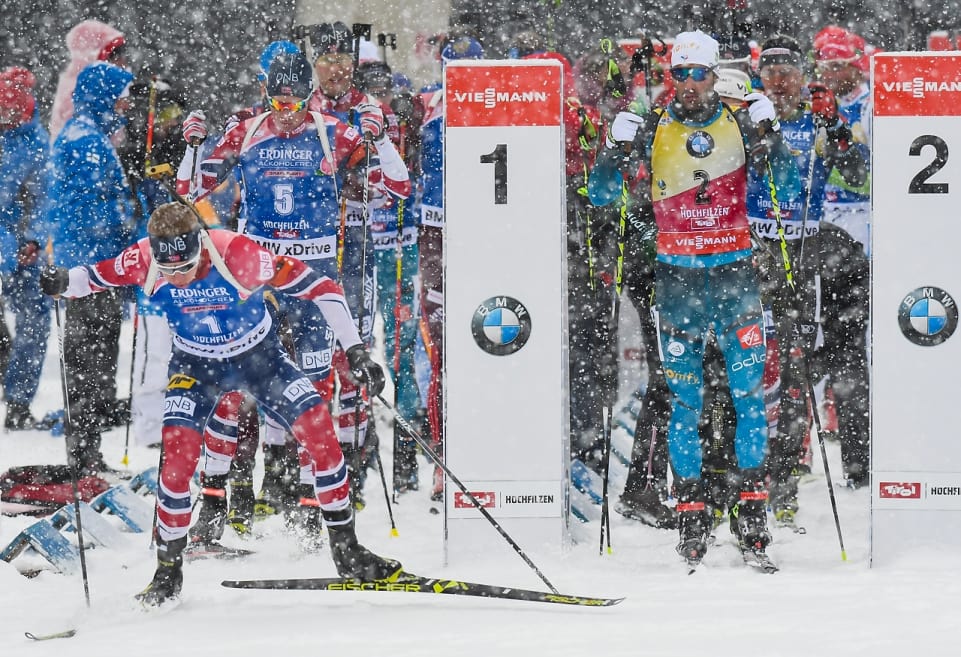
    Norway’s Johannes Thingnes Bø (1) heading out of the start, 12 seconds ahead of the second starter, France’s Martin Fourcade (yellow bib), on Saturday in the IBU World Cup men’s 12.5 k pursuit in Hochfilzen, Austria. (Photo: IBU/biathlonworld)

    While Bø skied the win in 36:41.1 minutes and Fak, the third starter, finished 58.8 seconds later in second place, Fourcade made up two places on the final loop to place third (+1:10.0) after passing Germany’s Simon Schempp and Russia’s Maxim Tsvetkov.

    Schempp settled for fourth (+1:10.5), and Bø’s older brother, Tarjei Bø, passed Tsvetkov as well to claim fifth (+1:11.9), while Tsvetkov finished sixth (+11:12.3).

    On another snowy afternoon in Hochfilzen, Johannes Bø had three penalties, two of which came in the first stage (2+0+1+0). Fak was one of four men in the race with just one miss (0+0+1+0) — no one cleaned — while Fourcade missed five (1+0+1+3). Schempp had four penalties (3+1+0+0) but held onto his starting position in fourth, Tarjei Bø improved from 14th at the start to fifth with just two misses (1+0+1+0) and Tsvetkov raced up from 20th to sixth with a single miss (1+0+0+0).

    American Sean Doherty tied his second-best World Cup result in 17th (+2:12.8) after starting 23rd and 1:39 out of first. He had two penalties (1+0+1+0).

    Canada’s top finisher, Nathan Smith placed 31st (+3:02.2) after starting 19th and missing three shots (1+1+0+1). His teammate Brendan Green rose to 33rd (+3:15.7), up from 52nd at the start, with three penalties as well (1+0+1+1).

    Four Canadians qualified for the pursuit, with Scott Gow placing 48th (+5:08.4) with seven penalties (1+1+3+2). His younger brother Christian Gow crossed next in 49th (+5:13.7) after missing five (+5:13.7).

    The other American man in the race, Lowell Bailey placed 36th (+3:20.6), up from 53rd, with three misses (0+2+1+0).

    Kuzmina Gets First Win in Three Years

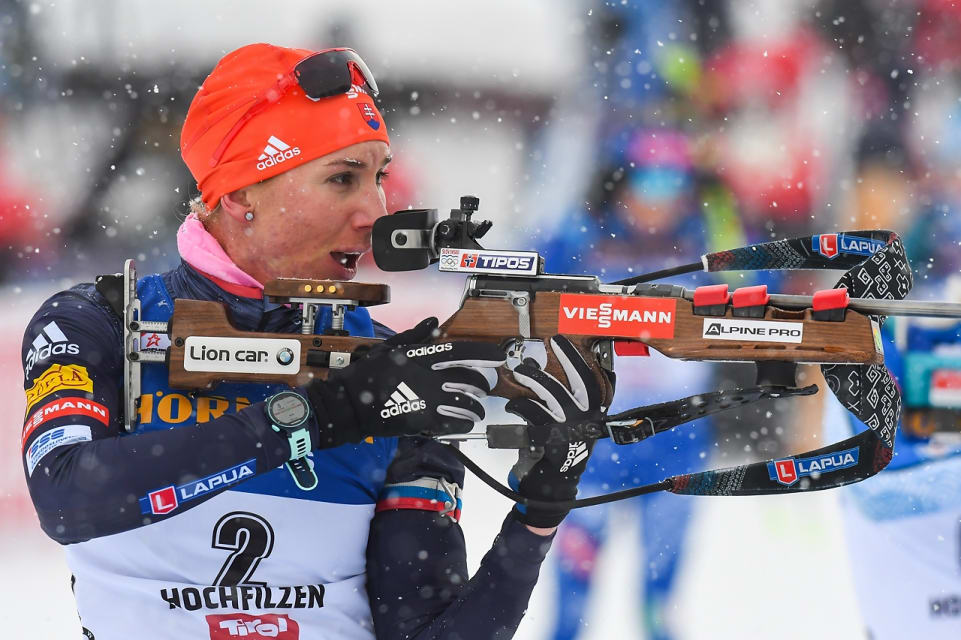
    Slovakia’s Anastasia Kuzmina cleaning one of two standing stages in the women’s 10 k pursuit at the IBU World Cup in Hochfilzen, Austria, en route to a 10-second win. (Photo: IBU/biathlonworld)

    In the women’s 10 k pursuit that followed, Slovakia’s Anastasia Kuzmina overcame a 22-second starting deficit to win her first race in three and a half years, shooting 19-for-20 (1+0+0+0) and finishing in 34:31.2. Kuzmina (the sister of Russia’s Anton Shipulin) started second behind Friday’s sprint winner Darya Domracheva of Belarus. Domracheva had a single miss as well in Saturday’s pursuit (0+0+1+0) but slipped to second after her penalty in the first standing stage, while Kuzmina cleaned the last three stages to take the win.

    Domracheva settled for third (+11.8) and Finland’s Kaisa Mäkäräinen rose to second (+10.2) after shooting 18-for-20 (1+0+0+1) and skiing the fastest course time to rise from her starting position in sixth.

    Italy’s Dorothea Wierer slipped one place to fourth (+51.6) after starting third and missing two (1+0+0+1), while Norway’s Marte Olsbu raced up from 13th to fifth (+58.2) with a single penalty (1+0+0+0). Ukraine’s Yuliia Dzhima improved from 20th to sixth (+1:08) with one miss as well (0+0+0+1).

    Canada’s Emma Lunder achieved her second-best career World Cup result in 27th (+2:31.6) after starting 42nd and cleaning three stages after missing one in the first prone (1+0+0+0). Her teammate Rosanna Crawford improved from 49th at the start to 39th at the finish (+3:44.3) with four penalties, one in each stage (1+1+1+1).

    The U.S. had one woman qualify for the race, Clare Egan, who finished 53rd (+5:21.6) with seven penalties (2+2+2+1).

    For the third and final day of World Cup racing in Hochfilzen, the men’s and women’s relays will be held Sunday.

    Results: Men | Women

    ***

    FIS Cross Country World Cup (Davos, Switzerland): Freestyle sprints

    Women’s report

    Men’s report

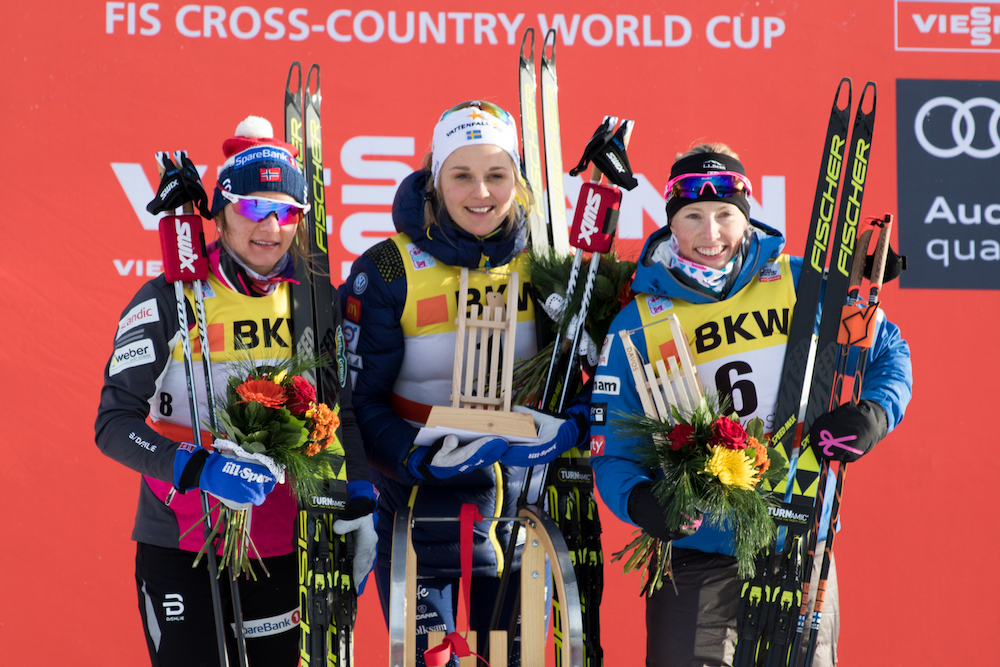
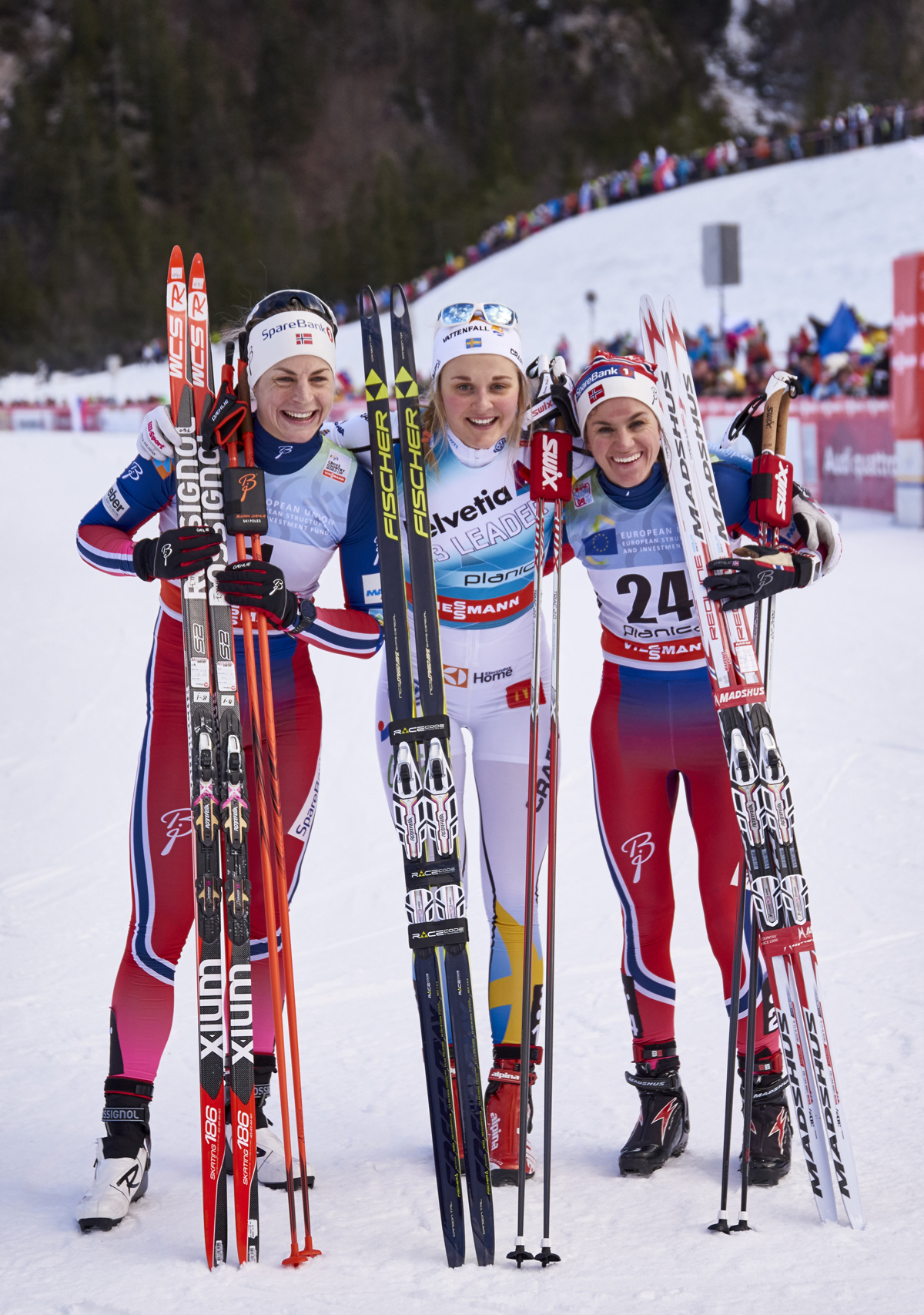
    The women’s skate sprint podium at Saturday’s World Cup in Davos, Switzerland, with Kikkan Randall (r) of the U.S. Ski Team in third place, Sweden’s Stina Nilsson (c) in first, and Norway’s Maiken Caspersen Falla (l) in second. (Photo: Reese Brown/US Ski & Snowboard)

    Kikkan Randall returned to the podium on Saturday in the first freestyle sprint of the 2017/2018 World Cup season, placing third in the women’s 1.5-kilometer skate sprint behind Sweden’s Stina Nilsson and Norway’s Maiken Caspersen Falla, respectively, in Davos, Switzerland.

    Americans made up half of the women’s final, with Jessie Diggins racing to fourth and Ida Sargent sixth, with Norway’s Ingvild Flugstad Østberg between them in fifth.

    Nilsson started the day by winning the qualifier in 2:51.71 minutes, while Østberg had the second-fastest qualifing time, 2.57 seconds back. Switzerland’s Nadine Fähndrich posted the third fastest qualifying time (+2.73), and for the U.S., Diggins qualified fourth (+3.37), Sargent fifth (+3.78), Randall sixth (+4.11), Sophie Caldwell ninth (+4.87), and Sadie Bjornsen in 11th (+5.38).

    Nilsson then won her quarterfinal and the first semifinal before outlunging Falla by eight-hundredths of a second for the final win in 2:47.99. Randall (who won her quarterfinal and advanced to the final as a lucky loser in third in the first semifinal) finished 2.53 seconds after Nilsson for third overall, and Diggins (who won both her quarterfinal and the second semifinal) was 4.41 seconds back in fourth. Østberg finished 5.62 seconds back in fifth, and Sargent crossed the line 14.49 seconds back in sixth.

    Caldwell placed eighth overall after winning her quarterfinal then placing fourth in the second semifinal, behind Diggins, Sargent and Germany’s Sandra Ringwald, respectively. Ringwald did not advance to the final, either, for seventh overall. Bjornsen placed 13th on the day after finishing third in her quarterfinal.

    Also for the U.S., Julia Kern (U.S. Ski Team D-team) finished in 57th in the qualifying round, 16.55 seconds out of first.

    Dahria Beatty was the top Canadian in 53rd (+15.53), followed by Katherine Stewart-Jones in 55th (+16.18) and Cendrine Browne in 64th (+18.27). 

    In the men’s 1.5 k skate sprint, Norway’s Johannes Høsflot Klæbo rocketed to his sixth-straight win in as many World Cup races this season, topping the qualifier in 2:23.10 (by 1.27 seconds over France’s Lucas Chanavat and 1.73 seconds over Italy’s Federico Pellegrino in third) then winning his quarterfinal and semifinal comfortably before capping the day with a victory in the final in 2:28.07. Pellegrino placed second in the final, 1.8 seconds back, and Russia’s Alexander Bolshunov tallied his third podium of the season in third place (+4.64). Finland’s Ristomatti Hakola placed fourth (+5.39), France’s Richard Jouve was fifth (+8.65) and Russia’s Gleb Retivykh was sixth in the final (+18.34).

    Americans Andy Newell and Simi Hamilton both qualified for the heats in 10th and 12th, respectively. Hamilton went on to place ninth overall after finishing second in his quarterfinal (behind France’s Renaud Jay) and fifth in the second semifinal (which Hakola won). Newell’s day ended in the quarterfinals, where he placed fifth, 2.44 seconds behind Klæbo, who won that heat. Overall, Newell was 21st.

    Canada’s Alex Harvey qualified for the heats in 21st and went on to place 23rd overall after finishing fifth in his quarterfinal, 1.14 seconds behind Retivykh in first.

    Also for Canada, Julien Locke missed qualifying in the top 30 by 1.07 seconds in 36th (+7.84). Russell Kennedy placed 48th (+9.39), Knute Johnsgaard was 52nd (+10.35), Jess Cockney 54th (+10.83), Devon Kershaw 63rd (+11.78).

    For the U.S., Erik Bjornsen finished 58th (+11.12) and Paddy Caldwell 108th (+24.04) in the qualifier.

    Results:

    Women’s final | Women’s qualifier

    Men’s final | Men’s qualifier

  • Nilsson, Pellegrino Anchor Team Sprint Victories, Complete Slovenian World Cup Sweep

    Nilsson, Pellegrino Anchor Team Sprint Victories, Complete Slovenian World Cup Sweep

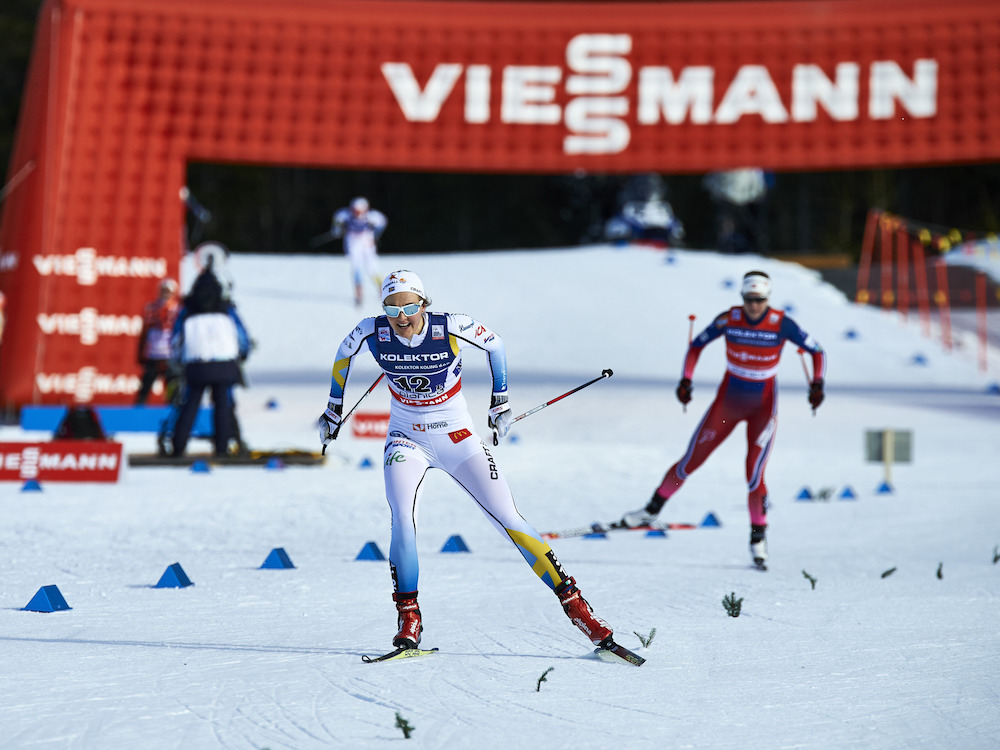
    Stina Nilsson on her way to securing the win for Sweden, with teammate Ida Ingemarsdotter (not shown), in the women's freestyle team sprint at the World Cup in Planica, Slovenia. (Photo: Fischer/NordicFocus)
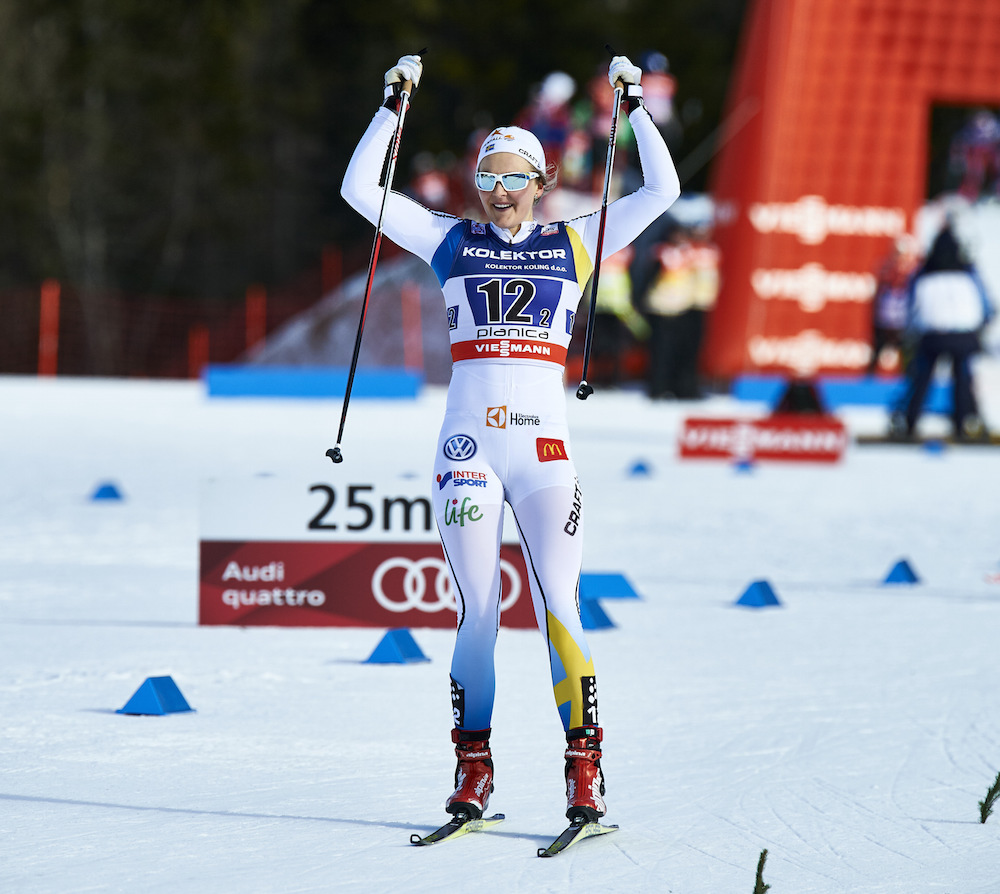
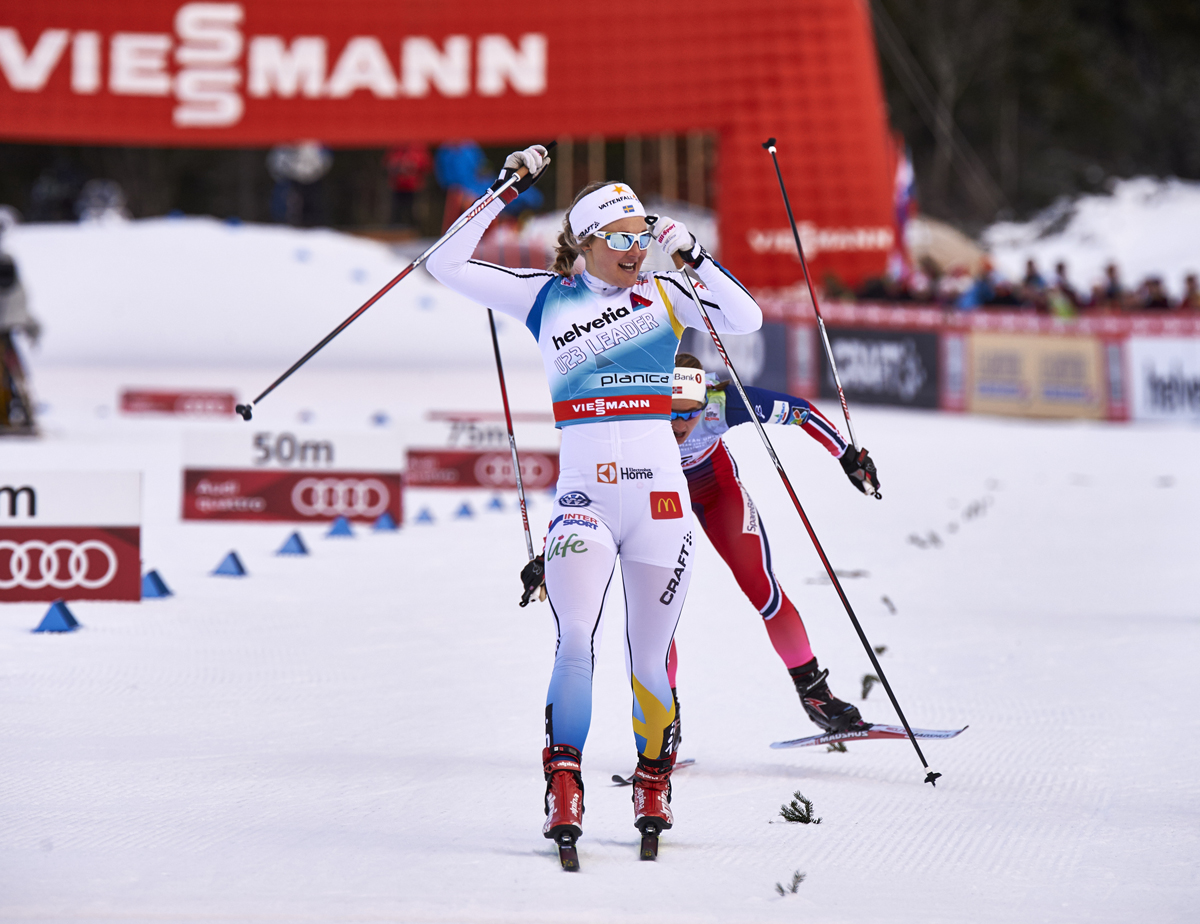
    Stina Nilsson smiles as she secures the win for Sweden with teammate Ida Ingemarsdotter (not shown) in the women’s freestyle team sprint final at the World Cup in Planica, Slovenia. She beat Norway’s Astrid Jacobsen (behind) for the victory. (Photo: Fischer/NordicFocus)

    Groundhog Day. That was the feel of Sunday’s 6 x 1.2-kilometer freestyle team sprints at the World Cup in Planica, Slovenia, a day after Sweden’s Stina Nilsson and Italy’s Federico Pellegrino won the individual freestyle sprints on the same one-lap 1.2 k course.

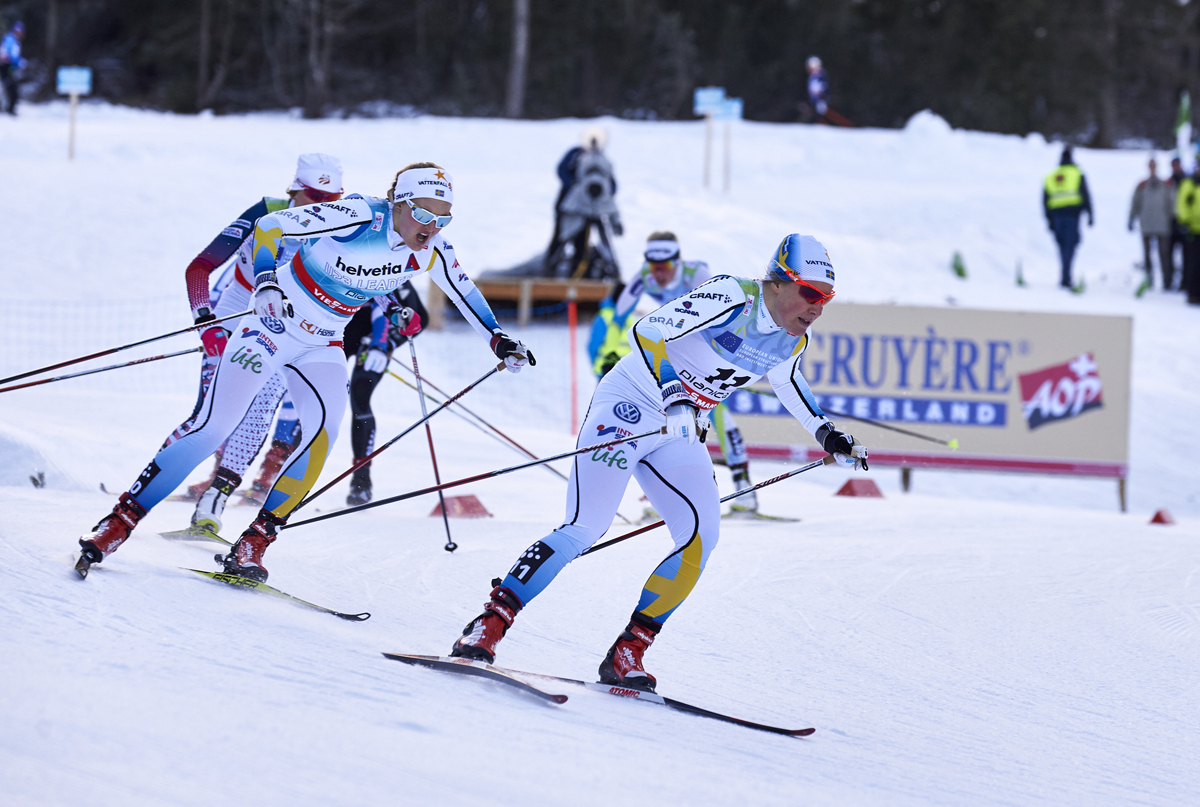
    The women’s team sprint came down to the final climb on the last leg — just like in the last round of the individual women’s sprint on Saturday. Trailing a Norwegian on the last descent and into the base of the climb back up to the stadium (yesterday it was Ingvild Flugstad Østberg; today it was Astrid Uhrenholdt Jacobsen), Nilsson carried her speed to pull up alongside and blow past the Norwegian, leading by the top.

    Look familiar? That's because it is. Sweden's Stina Nilsson notched her second-straight victory of the World Cup weekend in Planica, Slovenia, on Sunday, anchoring Sweden I to the freestyle team sprint win. (Photo: Fischer/NordicFocus)
    Look familiar? That’s because it is. Sweden’s Stina Nilsson notched her second-straight victory of the World Cup weekend in Planica, Slovenia, on Sunday, anchoring Sweden I to the freestyle team sprint win. (Photo: Fischer/NordicFocus)

    The 22-year-old Nilsson, both U23 and Sprint World Cup leader, continued to accelerate in the last 200 hundred meters to the finish, winning in 3.51 seconds for her second victory of the weekend. Nilsson shared it with Ida Ingemarsdotter, 30, teammates on Sweden’s first team (noted as Sweden I).

    “We had a great day as a team. You could say we are a good couple,” Nilsson told FIS after the race. “Ida did a great work. In the final lap I was in a good position and I could ski as I wanted. I am very satisfied with the weekend in Planica.”

    After sharing the podium with Nilsson on Saturday, Heidi Weng and Jacobsen teamed up for Norway I and finished second after leading at every exchange, just ahead of the Swedes. Nilsson and Ingemarsdotter had won their semifinal (ahead of Americans Ida Sargent and Sophie Caldwell in second) to automatically advance to the final, and Weng and Jacobsen won the other semifinal.

    “This is better than third, but not good enough tactically to win,” Jacobsen told VG after the final, according to a translation. “Towards the end Stina had a gear that I had not.”

    After nine of 10 teams skied within four seconds of the lead through the first two exchanges, Weng picked up the tempo on her second leg (third overall), and Ingemarsdotter and Germany’s I’s Sandra Ringwald stuck closest to her. Meanwhile, Sweden II slipped about 1.5 seconds off the pace in fourth, while the U.S., with Ida Sargent and Sophie Caldwell, skied in fifth (+4.46) at the third exchange — the halfway point.

    One lap later, Jacobsen and Nilsson remained close, about half a second ahead of Sweden II’s Hanna Falk in third. Germany’s I’s Hanna Kolb came through the exchange a second later in fourth. By the final exchange, Weng and Ingemarsdotter had gapped Germany’s Ringwald, skiing in third, by 2 1/2 seconds.

    “I knew Weng would run hard, especially in the second and third lap and am happy that I could latch on to and give Stina a good position,” Ingemarsdotter told Dagens Nyheter, according to a translation.

    “Ida made it perfect. I just got the position I wanted,” Nilsson said.

    Germany’s first team hung onto third and secured third, 8.84 seconds behind Sweden and 5.33 seconds behind Norway, for their first podium in almost two years.

    “My attack came maybe a little too early, but it was the plan, and maybe that didn’t totally work out because I folded a little in the end,” Ringwald told German TV broadcaster ZDF. “But the three of us were able to create a gap, and so we are satisfied with the third place.”

    “I am really relieved, because we knew we had a gigantic chance today and that we had to grasp it,” Kolb said. “Just a great feeling.”

    Last season, Nilsson and Ingemarsdotter won the only team sprint on the schedule — also freestyle technique — in Otepää, Estonia. There, they beat Norway’s Maiken Caspersen Falla and Østberg by 0.85 seconds, and Poland’s Justyna Kowalczyk and Sylwia Jaskowiec finished 0.95 seconds back in third.

    Falla and Østberg rested on Sunday, while Mari Eide and Kathrine Rolsted Harsem represented Norway II. Fourth through seventh were separated by 2.77 seconds, with Falk (Sweden II) leading the chase group in for fourth (+18.24), followed by Caldwell in fifth (+20.57).

    Germany II’s Lucia Anger edged Harsem in a photo finish for sixth by 0.01 seconds, 21 seconds behind the winners. Two Slovenian teams reached the final, placing eighth (+47.24) and 10th (+2:42.12), while Italy finished ninth (+55.98).

    (Story continues below)

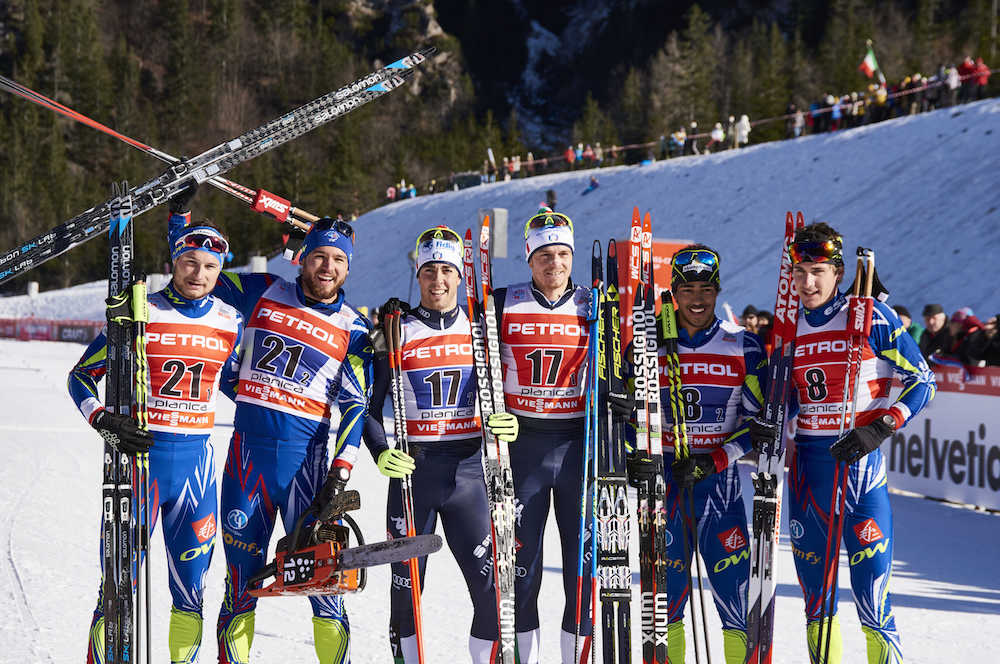
    The men's freestyle team sprint podium at the World Cup in Planica, Slovenia: with Italian winners Federico Pellegrino and Dietmar Nöckler (c), France I's Renaud Jay and Baptiste Gros (l) in second, and France II's Valentin Chauvin and Richard Jouve (r) in third. Yes, Gros is holding a chainsaw -- a noisemaker borrowed from spectators. (Photo: Fischer/NordicFocus)
    The men’s freestyle team sprint podium at the World Cup in Planica, Slovenia: with Italian winners Federico Pellegrino and Dietmar Nöckler (c), France I’s Renaud Jay and Baptiste Gros (l) in second, and France II’s Richard Jouve, age 21, and Valentin Chauvin, age 20, (r) in third. Yes, Gros is holding a chainsaw — a chain-free noisemaker borrowed from spectators. (Photo: Fischer/NordicFocus)

    Italy, France, France 

    Minutes after the women’s final, the men’s final played out to produce the identical winner to Saturday’s sprint — Italy’s Federico Pellegrino — who essentially pulled off the same move as Nilsson, not long after she anchored the Swedish women to the win in 16:14.08. Pellegrino anchored Italy’s first team (with teammate Dietmar Nöckler) to the win in 14:44.82.

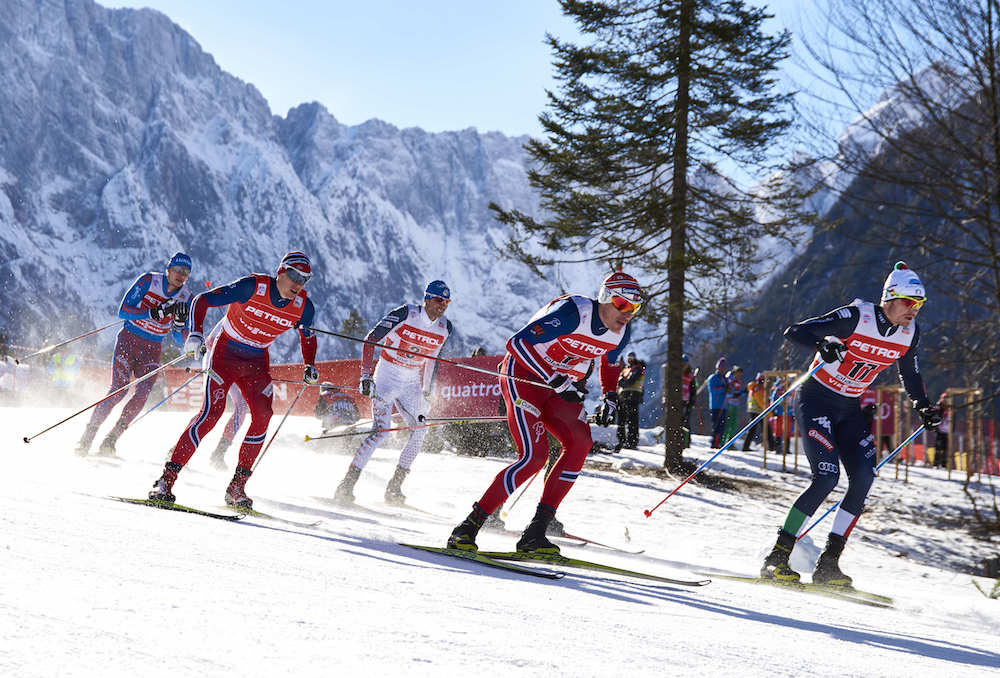
    In yet another repeat, France occupied the remaining spots on the podium in the men’s race. Renaud Jay of France’s first team led five frontrunners into the exchange zone for the last time, with France I, Germany I, Italy I, Russia I, and Norway I all within a second of one another.

    On the next lap, Jay’s teammate Baptiste Gros set a blistering pace and Pellegrino chased him up the longest climb on the course. There, they began to break away from Germany and France’s second team, and Gros continued to lead up the final ascent.

    On that climb, Pellegrino pulled a “Nilsson,” so to speak, as he carried his momentum from the downhill draft to pass Gros before the top. The 25-year-old Pellegrino, who became Italy’s winningest Italian male skier of all time on Saturday with his seventh individual World Cup win, added another victory to his resume as he skated away toward the finish, looking back a few strides before and winning in 1.79 seconds.

    (From right to left) Italy's Dietmar Nöckler leads Norway II's Ola Vigen Hattestad, American Andy Newell, and Norway I's Anders Gløersen and a Russian in the men's freestyle team sprint final at the World Cup in Planica, Slovenia. (Photo: Fischer/NordicFocus)
    (From right to left) Italy’s Dietmar Nöckler leads Norway II’s Ola Vigen Hattestad, American Andy Newell, and Norway I’s Anders Gløersen and a Russian in the men’s freestyle team sprint final at the World Cup in Planica, Slovenia. (Photo: Fischer/NordicFocus)

    France I’s Jay and Gros place second, and France II, with 20-year-old Valentin Chauvin and Richard Jouve, 21, held off Germany for third (+2.41).

    Germany I, with Thomas Bing and Sebastian Eisenlauer, notched fourth (+2.93). Norway missed the podium for the second-straight men’s race with Norway I’s Anders Gløersen and Eirik Brandsdal in fifth (+4.51) and Norway II’s Ola Vigen Hattestad and Pål Golberg in seventh (+7.66), behind Russia’s Gleb Retivykh and Alexey Petukhov in sixth (+6.46).

    Americans Andy Newell and Simi Hamilton crossed the finish line in eighth, but were disqualified for missing the tag in the zone on the second exchange.

    Early in the race, Gløersen led though the first exchange to give Norway I an early lead, but they slipped to sixth with Brandsdal on the next leg, 1.3 seconds behind Norway II in first. Hattestad had brought Norway II into the lead, and by the fourth exchange, his teammate Golberg remained third, within half a second of Pellegrino and Gros. One lap later, Norway I and II came through the last exchange in fifth and sixth, 1 and 2 seconds out, respectively.

    Norwegian commentators were quick to call Sunday’s final another instance of the Norwegians being “outclassed,” pointing out that six Norwegians occupy the top seven in the men’s overall World Cup standings. In the sprint standings, Pellegrino leads Norway’s Sondre Turvoll Fossli by nearly 200 points. Finn Hågen Krogh ranks fourth and Petter Northug is the third Norwegian in the top six.

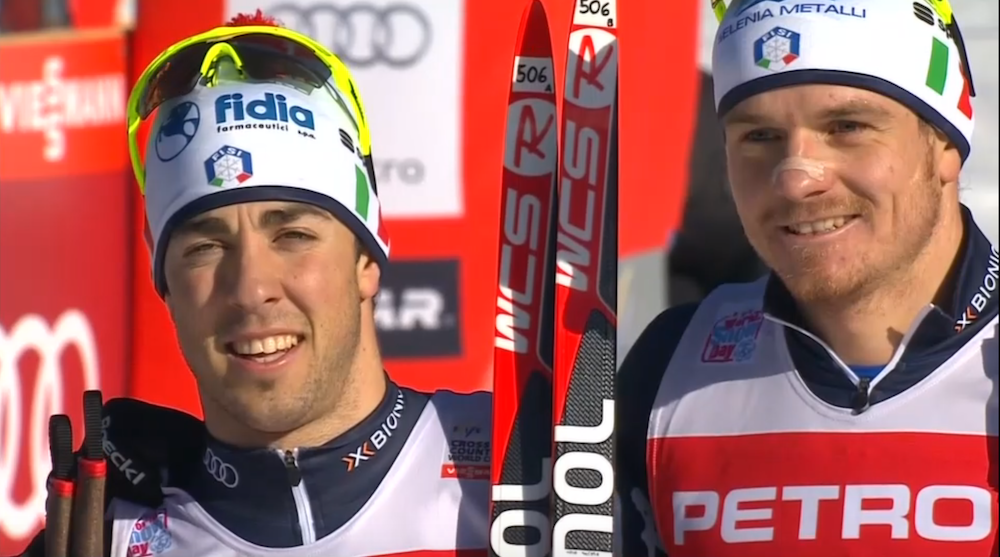
    Italian teammates Federico Pellegrino (l) and Dietmar Nöckler after winning Sunday's World Cup freestyle team sprint in Planica, Slovenia.
    Italian teammates Federico Pellegrino (l) and Dietmar Nöckler after winning Sunday’s World Cup freestyle team sprint in Planica, Slovenia.

    “I realized a dream I had at a very young age,” Pellegrino told Italy’s La Gazzetta after Sunday’s win, according to translation. It was apparently Italy’s first team-sprint win since the women won in 2010 in Düsseldorf, Germany.

    “In my early years of the World Cup, one of my first trips to the World Cup was in Düsseldorf, where they scheduled just a sprint and team sprint,” he added. “Seeing champions such [Italy’s Arianna] Follis and [Norway’s] Hattestad that could make a perfect weekend lit my imagination. I wondered if I could ever do it.”

    For Nöckler, 27, it was his first World Cup win.

    “I did not feel that good in the semifinal,” he told FIS after he and Pellegrino qualified second behind France’s Jay and Gros. France II won the other semifinal.

    “I knew Federico is the best finisher in the world,” Nöckler added. “I tried to work hard to prepare a good position for him. We have won five Italian national championships together. It is great to win the World Cup.”

    At 2015 Word Championships, Nöckler and Pellegrino earned bronze in the freestyle team sprint (behind Norway and Russia, respectively).

    France’s Jay was thrilled to be on the podium after placing fourth on Saturday.

    “I knew Baptiste was very strong today,” Jay told FIS. “I wanted to gain some meters before the last exchange so that Baptiste has advantage on Pellegrino, but Federico was too strong.”

    For Chauvin, the weekend marked his first on the World Cup.

    “It is just amazing,” he said of Sunday’s podium. “It is fantastic I could be on the podium with my friends. The whole team did great here during the whole weekend.”

    Results: 

    Women: Semifinals | Final

    Men: Semifinals | Final

  • Pellegrino Nabs Unprecedented Seventh Win for Italy; Nilsson Beats Three Norwegians in Planica

    Pellegrino Nabs Unprecedented Seventh Win for Italy; Nilsson Beats Three Norwegians in Planica

    France's Lucas Chanavat (front) and Richard Jouve (second from r) lead Italy's Federico Pellegrino during their 1.2 k freestyle sprint quarterfinal at the World Cup in Planica, Slovenia. Pellegrino won the heat, Jouve placed second and Chanavat faded to sixth. (Photo: Fischer/NordicFocus)
    France’s Lucas Chanavat (front) and Richard Jouve (second from r) lead Italy’s Federico Pellegrino during their 1.2 k freestyle sprint quarterfinal at the World Cup in Planica, Slovenia. Pellegrino won the heat, Jouve placed second and Chanavat faded to sixth. (Photo: Fischer/NordicFocus)

    Six days ago on Sunday, Jan. 10, the famed hill-climb finale up Alpe Cermis in Val de Fiemme, Italy, wrapped up the 10th annual Tour de Ski. This weekend, standard World Cup racing has resumed in Planica, Slovenia, marking the first time a World Cup event has been held in Planica — better known as a biathlon center. The last World Cup races in Slovenia took place in 2011 in Rogla, about 200 kilometers east.

    On Saturday, two familiar faces in the sprint scene topped the men’s and women’s 1.2-kilometer freestyle sprint.

    Italian record-breaker Federico Pellegrino raced to his fourth-consecutive freestyle sprint victory this season. He is the first racer in history to do so, and according to the International Ski Federation (FIS), is the only male to reach the podium more than once in these four races. The list of firsts goes on when it comes to 25-year-old Pellegrino.

    Last season, Pellegrino became the first athlete to win three consecutive skate sprints between December 2014 and January 2015. With Saturday marking his seventh World Cup win, he is now the winningest Italian male cross-country skier of all time, according to FIS. He was previously tied with Pietro Piller Cottrer with six wins.

    “Statistics are made to be changed,” Pellegrino told La Gazzetta della Sport, according to a translation. He said he had “great feelings” during the qualifier, which he won by 1.59 seconds over France’s Lucas Chanavat.

    He went on to win his quarterfinal (by 0.26 seconds ahead of another Frenchman Richard Jouve), and advanced out of his semifinal after placing second, 0.6 seconds behind yet another French skier Baptiste Gros.

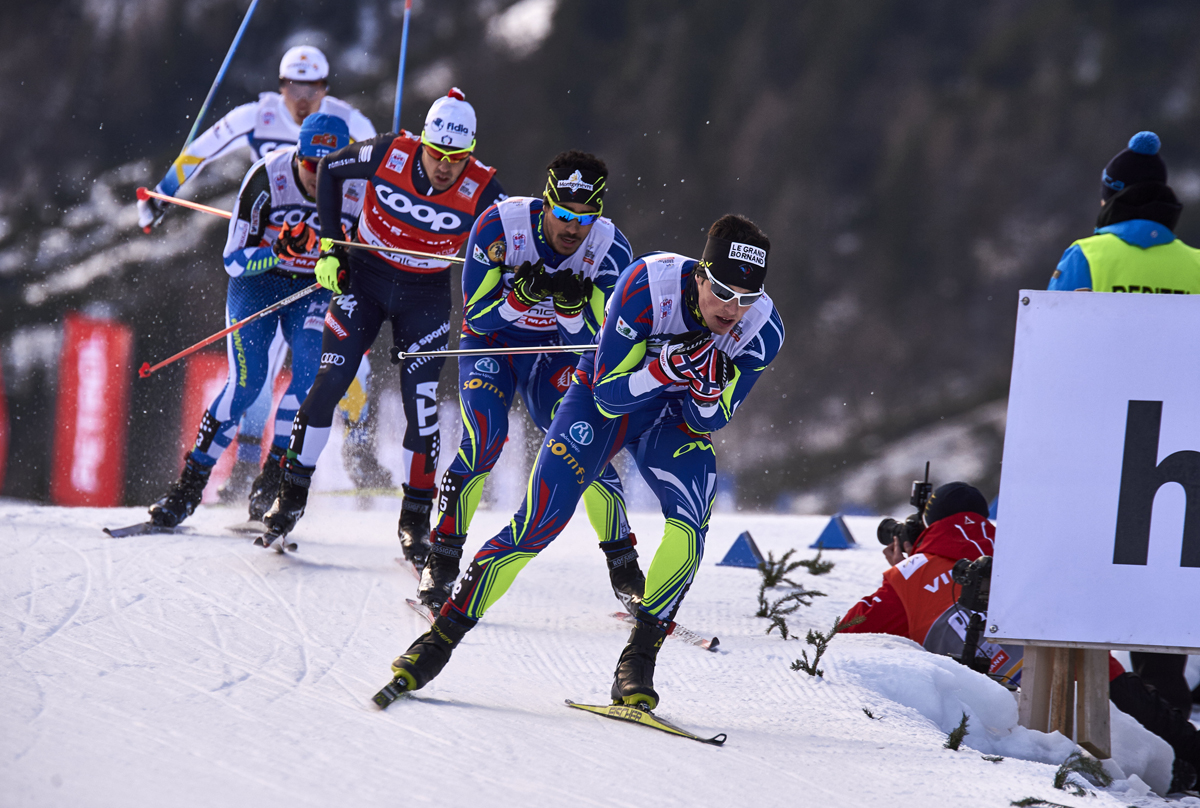
    In the final, a trio of Frenchman (Gros, Jouve and Renaud Jay) trailed Pellegrino into the last few hundred meters before the finish, with Gros leading the charge behind him. Pellegrino skied away to the victory in 2:15.12, holding off Gross by 0.88 seconds. Jouve placed third (+1.71) and Jay completed France’s sweep of second through fourth in fourth place (+2.23).

    Gros had also placed second to Pellegrino in the Davos World Cup skate sprint in December — Pellegrino’s first win of four in a row.

    Russia’s Gleb Retivykh and Germany’s Sebastian Eisenlauer finished behind the French contingent in fifth (+4.18) and sixth (+4.19), respectively.

    (Story continues below)

    Dedicated to all my lumberjacks friends ⚙🏆👊🏻😉 📷NordicFocus

    A photo posted by @federicopellegrinoxc on

    Easily the favorite going into the race, some pressure inevitably rode on Pellegrino. He reflected feeling like he “could only lose the race.”

    “It felt very good in the qualification,” he told FIS after the final, “But I was worried it could get worse.”

    He proceeded to comfortably advance through the heats with strategic execution. He won the third quarterfinal, which turned out to be the fastest and produced two lucky losers: Finland’s Martti Jylhä in third and Sweden’s Calle Halfvarsson in fourth.

    Pellegrino then carefully navigated a loaded semifinal, with all six competitors qualifying in the top eight. Gros took the lead at about halfway through, with Pellegrino stuck a few spots back. After being boxed out of the inside lane turning into the final climb, Pellegrino fought his way into second on the final climb to ensure he’d automatically advance in the top two. Gros cruised to a fairly commanding semifinal win, which did not go unnoticed by Pellegrino.

    “I learned in my semifinal how to ski in the final,” Pellegrino told FIS. “I expected Baptiste to be fast on this course, so my plan was to go in the front and get a gap on the others.”

    Confident in his chances in the semi, Gros had his doubts entering the final: “In the semifinal I thought I could win, but in the final it was clear that Federico [would] win,” he later told FIS.

    Gros led the final for most of the first half, while Pellegrino sat back around fourth place. This time, however, he didn’t let Gros get out of reach. About halfway through the race, Pellegrino made his move: passing on the inside, accelerating to the front of the pack ahead of Gros and significantly cranking up the pace.

    With that, the race proved to be as good as done. Pellegrino created a gap leading into the final downhill, breezed up the final climb with an unmatched tempo, enjoying a sizable gap on the field before throwing his arms up to celebrate across the line.

    Notably, there were no Norwegians in the men’s final. This starkly contrasts from most races throughout the World Cup season and the team’s Tour de Ski results, with the Norwegian men claiming seven of the overall top 10.

    That said, a number of top contenders did not race on Saturday — largely to rest and recover after completing the Tour de Ski — including Norway’s Martin Johnsrud Sundby, Finn Hågen Krogh, Petter Northug, and Didrik Tønseth. The strong Russian sprinter, Sergey Ustiugov, also was missing from the scene.

    “Today was another great day,” Pellegrino told La Gazzetta. “But it was a very difficult victory because I had to emotionally handle it right against the French, which always start as horses, head down, and it is difficult to rule them all. Fortunately with my skiing, I always managed to extricate myself from their traps, in the semifinals I figured out how to run the final and I did it. I can count on energy that I know I have.”

    “I am very confident of the work I’ve done,” he added. “At home, I can store hours of work that allow me to maintain this state of form. The success allows me to put more hay in the barn…”

    Pellegrino currently leads the Sprint World Cup by 196 points over Norway’s Sondre Turvoll Fossli, who placed eighth on Saturday after being eliminated in the semifinal (behind Gros, Pellegrino and fellow Norwegian Eirik Brandsdal, respectively). Gros ranks third overall, 224 points out of first.

    Stina Nilsson Earns Second Sprint Victory

    Sweden's Stina Nilsson celebrates her second-career World Cup victory on Saturday at the 1.2 k freestyle sprint in Planica, Slovenia. She beat three Norwegians -- Astrid Uhrenholdt Jacobsen, Heidi Weng and Ingvild Flugstad Østberg, respectively -- to do so. (Photo: Fischer/NordicFocus)
    Sweden’s Stina Nilsson celebrates her second-career World Cup victory on Saturday at the 1.2 k freestyle sprint in Planica, Slovenia. She beat three Norwegians — Astrid Uhrenholdt Jacobsen, Heidi Weng and Ingvild Flugstad Østberg, respectively — to do so. (Photo: Fischer/NordicFocus)

    In the women’s 1.2 k sprint, Sweden’s 22-year-old Stina Nilsson claimed her second World Cup victory in two months. She previously won the December freestyle sprint in Davos, Switzerland.

    With this win, Nilsson, the U23 leader, took the Sprint World Cup lead as well, ahead of Norway’s Maiken Caspersen Falla. While Falla’s doctor apparently warned her against starting Saturday, (“she was not in top form,” according to NRK), she raced the qualifier anyway and placed an uncharacteristic 45th, more than 14 seconds behind qualifying winner Astrid Uhrenholdt Jacobsen, her teammate.

    Nilsson started her day with the 10th-fastest qualifying time, 5.82 seconds behind Jacobsen. She proceeded to win her quarterfinal — the first one of the day — by 0.1 seconds over teammate Hanna Falk and 0.92 seconds ahead of American Sophie Caldwell in third.

    From there, Nilsson met one of Norway’s biggest threats in any race: Ingvild Flugstad Østberg. Both Nilsson and Østberg had raced the entire Tour de Ski (eight races in 10 days from Jan. 1-10), with Nilsson placing 24th and Østberg second overall. Yet less than a week later, here they were. Nilsson later told NRK she skied for a total of 35 minutes this week before Saturday’s race.

    Slovenian Vesna Fabjan led their semifinal of the gate, while local spectators cheered her on. Nilsson shadowed her until taking the lead about halfway through and creating a fairly big gap before into the finish. Nilsson won the semifinal by half a second over Østberg, who held off Fabjan by 0.33 seconds to advance to the final.

    Sweden's Hanna Falk leads teammate Stina Nilsson (l) during Saturday's 1.2 k freestyle sprint at the World Cup in Planica, Slovenia. While Falk was eliminated in the semifinal (after placing fourth), Nilsson ultimately won the final. (Photo: Fischer/NordicFocus)
    Sweden’s Hanna Falk leads teammate Stina Nilsson (l) and Sophie Caldwell (behind Nilsson) during their 1.2 k freestyle sprint quarterfinal at the World Cup in Planica, Slovenia. While Falk was eliminated in the semifinal (after placing fourth), Nilsson ultimately won the final. (Photo: Fischer/NordicFocus)

    For Nilsson, the final was her 11th straight in as many World Cup sprint starts — both skate and classic — since December 2014.

    On Saturday, she squared off in the final round against Germany’s Sandra Ringwald, Italy’s Gaia Vuerich, and three Norwegians: Østberg, Jacobsen and Heidi Weng. Third in the Tour de Ski, Weng was back in action less than a week later asa well.

    In Vuerich’s third final of her career, the Italian initially led out of the start, while Ringwald and Nilsson skied in second. Into the next downhill, Nilsson took the lead, with Vuerich hanging onto second.

    At about halfway through, Østberg accelerated on a climb to get in front of Nilsson. By the top of this hill, Østberg maintained her position with a fairly brisk pace, Nilsson held onto second, Jacobsen had moved into third, and Weng skied in fourth.

    But could Østberg, who had been in contention for the Tour de Ski overall title until the final grueling mountain climb, hold that high tempo six days later? The last uphill on the sprint course had proved crucial throughout the day. It led up into the stadium and into the finishing straight.

    As that climb approached, Nilsson rode the draft and her slick skis up alongside Østberg to challenge her to the top. She used the momentum to overtake Østberg, who began to fade at the crest of the hill, and Nilsson led over the top and toward the finish.

    Behind her, the three Norwegians fanned out in a wave, one in each lane to try to chase her down. Jacobsen moved into second ahead and Weng charged late for third, just ahead of Østberg.

    The women's World Cup freestyle sprint podium  in Planica, Slovenia: with Swedish winner Stina Nilsson (c), Norwegian runner-up Astrid Uhrenholdt Jacobsen (l), and Heidi Weng, also of Norway, in third. (Photo: Fischer/NordicFocus)
    The women’s World Cup freestyle sprint podium in Planica, Slovenia: with Swedish winner Stina Nilsson (c), Norwegian runner-up Astrid Uhrenholdt Jacobsen (l), and Heidi Weng, also of Norway, in third. (Photo: Fischer/NordicFocus)

    Nilsson captured the win in 2:33.03, 0.34 seconds ahead of Jacobsen in second and 0.55 seconds ahead of Weng in third. Østberg missed the podium by five-hundredths of a second in fourth (+0.60), Ringwald finished fifth (+2.78), and Vuerich waved to crowd as she cruised in for sixth (+26.26), happy to make the final.

    “I am really happy for the second win this season. I had a great day,” Nilsson told FIS. “My plan was to ski as much as possible in the front. I am excited to be in the lead of the Sprint World Cup.”

    Falla did not qualify for heats after she had been “battling illness,” according to FIS.

    A sprint specialist, Falla left the Tour de Ski after winning the first stage: a freestyle sprint in Lenzerheide, Switzerland. On Saturday, she dropped to third in the Sprint World Cup standings 94 points behind Nilsson in first. Østberg ranks second, 58 points behind the leader.

    According to NRK, Falla planned to travel back to Norway and skip Sunday’s freestyle team sprint.

    Results: Men | Women

  • Foreigners Add to Canadian Nationals, Reflect on Week

    Foreigners Add to Canadian Nationals, Reflect on Week

    French delegation at Canadian Ski Nationals (from left to right): National team sprint coach Matieu Fort, Baptiste Gros, Renaud Jay and Roddy Darragon after the skate sprints on Thursday.

    MONT SAINTE-ANNE, Québec — It all started with a little buzz about Québec hosting a World Cup.

    After the province’s native Alex Harvey and Devon Kershaw struck gold in the team sprint at the 2011 World Championships in Olso, Norway, Cross Country Canada and the International Ski Federation got to talking.

    The World Cup should feature a few races in Canada, and why not consider bringing it to the eastern part of the country?

    Once FIS accepted Québec City’s application to hold a sprint weekend Dec. 8-9, 2012, the race was on to generate more attention toward the brand new site.

    The director of events at CCC, Dave Dyer said the association almost immediately turned to Sport Canada, which governs the country’s sport policy and supports athletes and programs financially.

    They needed international hype and some competitive racers to see Québec beforehand.

    With the help of an under-$50,000 grant from Sport Canada’s International Hosting Program, CCC was able to pay the way of seven foreign athletes and three coaches to the Canadian Ski Championships, which ended Saturday in Mont Sainte-Anne, Québec.

    Norwegian National Junior Team members Sindre Bjornestad Skar (l) and Martin Loewstroem Nyenget after placing first and second, respectively, in the 30 k classic mass start at Canadian Ski Nationals on Saturday.

    The first to jump at the offer, Norway sent four racers – two juniors and two under-23’s – to Canada along with two coaches: head U23 coach Sjur Ole Svarstad and national women’s sprint team coach Roar Hjelmeset.

    France was next in line for a trip to Canadian nationals. The team’s head sprint coach, Mathieu Fort, accompanied three athletes: Roddy Darragon (World Cup sprint specialist and two-time Olympian) and U23 racers Baptiste Gros and Renaud Jay.

    Dyer said this wasn’t the first time Sport Canada had helped CCC host international competitors, but it was by far the most significant.

    “We did it last time we were here [at 2007 Canadian nationals] in Mont Sainte-Anne and got a very modest amount of support,” he said. “But I think that as the profile of our sport and the team increases, people are taking notice. It certainly has helped us on the overall funding perspective as far as support for the team.

    “I think the success we’ve had at the World Cups and hosting the World Cups has proven the benefits of inviting Europeans to come ski on our turf,” Dyer added.

    He designated Canadian National Ski Team coach Eric de Nys to invite teams, and de Nys said he spoke with several coaches at U23 World Championships in Erzurum, Turkey, in February. The idea was to entice juniors to give them a taste for jet lag and racing outside of Europe.

    “We had this pot of money and we were able to sort of talk to the Italians, the French, the Swedes, the Norwegians, the Germans, Japanese,” de Nys said. “Lots of them couldn’t come because they had nationals and OPA finals and things like that. But the French, the moment I said it, they’re like, ‘Yeah, we’ll come.’ ”

    With pre-existing good relations with Norway and France, this furthered the effort to bridge the global gap. It also gave Québec race organizers a chance to host athletes in preparation for its upcoming World Cup, with individual and team freestyle sprints.

    Dyer said this year’s sprint competition featured timed splits thought the heats, requiring more precision than seeding athletes by qualification time. A CCC Officials Level 3 Certification course was also in action at nationals.

    Organizers and officials had just one day to practice at the Plains of Abraham, where the World Cup is scheduled, after unseasonably warm weather melted most of the snow on the historic park in downtown Québec City.

    While they managed to hold classic team sprints there March 17 on a 1-kilometer loop, the open freestyle sprints were moved about 45 minutes away to the trails at Mont Sainte-Anne on March 22.

    Dyer said the experience with timing, officiating and helping international athletes find their way around was useful nonetheless for organizers. It also made nationals one of the most competitive in years.

    In his 30th year with CCC, Dyer said this was by far the association’s biggest international hosting effort. In 1986, they brought four Norwegians to nationals in Whitehorse, Yukon. The only other Canadian championship that was nearly as competitive was the one before the 2010 Vancouver Olympics.

    By bringing overseas skiers here, Dyer said it benefited Canada’s own athletes.

    “Whereas we might send 10 athletes to the World Juniors or to the U23 champs, there’s probably 85 juniors [at nationals] that get a chance to rub shoulders with Norwegians and find out they’re not superhuman,” Dyer said.

    First Impressions

    For most of the Europeans on the start line, it was their first time in Canada. Several soaked up the opportunity to race against some of the world’s best, including Kershaw, Harvey and Len Valjas.

    It’s a good experience because I never ran with in a final of the same level,” said 21-year-old Gros, of France, after placing fifth in the skate sprint A-final behind the three Canadian National Team athletes.

    Earlier this season, Gros finished 13th in a World Cup freestyle sprint in Szklarska Poreba, Poland. His teammate, Darragon was fifth in Poland and 11th in the sprint at Canadian nationals.

    Roddy Darragon of France crashing and burning near the B-final winner of Thursday's skate sprint at Canadian Ski Nationals, Drew Goldsack. Darragon placed fifth in the B-final and 11th overall, and literally got a rug burn on his knee after cutting his race suit above the knees on the balmy afternoon.

    While he had raced in other parts of Canada before, Darragon said coming to Québec was a first. On the tail end of his season, he was mostly interested in racing for a chance to see the World Cup venue.

    “When the coach told us that [we were invited], we said, ‘Yes, we go, immediately,’ ” Darragon said with a smile. “We wanted to travel and wanted to discover the country.”

    Although Darragon and his teammates didn’t get to ski on the Plains, he said they drove by it. Before flying back to France on March 23, the day before the distance mass starts, Darragon cut off his race suit above the knees. Shorts were better in hot weather, and 20 degrees Celsius was much warmer than what they were used to in France in March.

    “It will be a great souvenir,” Darragon said of his suit, looking down at his bloody knee after falling across the finish of the B-final.

    He said he’d be back next year, possibly a few weeks before the World Cup to train.

    On the Norwegian side of the wax cabins, all four of their athletes raced the classic distance races on Saturday. In the 30 k junior men’s race, National Junior Team skiers Sindre Bjornestad Skar and Martin Loewstroem Nyenget captured first and second.

    2012 Canadian Nationals women's 30 k classic mass start podium (from left to right): 2. Britt Ingunn Nydal (NOR), 1. Chandra Crawford (CNST), 3. Ragnhild Haga (NOR)

    In the women’s 30 k, Britt Ingunn Nydal and Ragnhild Haga of the Norwegian National Development Team placed second and third, respectively, after Chandra Crawford (CNST).

    “We probably knew we had a better chance here than at the sprint,” said Haga, who recently placed 33rd in a World Cup 30 k at Holmenkollen in Oslo. There, Nydal was 38th.

    “We’re very happy being on the podium, both of us,” the 21-year-old added.

    She and Nydal, 22, had one more 30 k remaining in Norway later this week. They planned to leave Sunday, but not before some sightseeing and a night out in Québec City.

    “It has not only been the races, we’ve been able to look around also,” Nydal said. “It has been an amazing week.”

    As for what they’d remember about their first trip to Canada, Haga said the heat. Skar said the size of things.

    “Everything is big,” Skar said. “The cars and the roads and the shops, everything is much bigger than in Norway. In Norway, everything is not so big.”

    “But it’s really nice here,” Nydal added.

    “The weather is great,” Skar continued.

    In southern Norway, he said there was no snow. Haga said skiing in such balmy conditions throughout most of the week reminded her of orienteering in the summer.

    “It’s a little weird to go cross-country now,” Nydal said.