From the FasterSkier archive — posts syndicated from athletes’ and coaches’ own blogs between 2004 and 2012, kept online as published. Current coverage is at fasterskier.com.
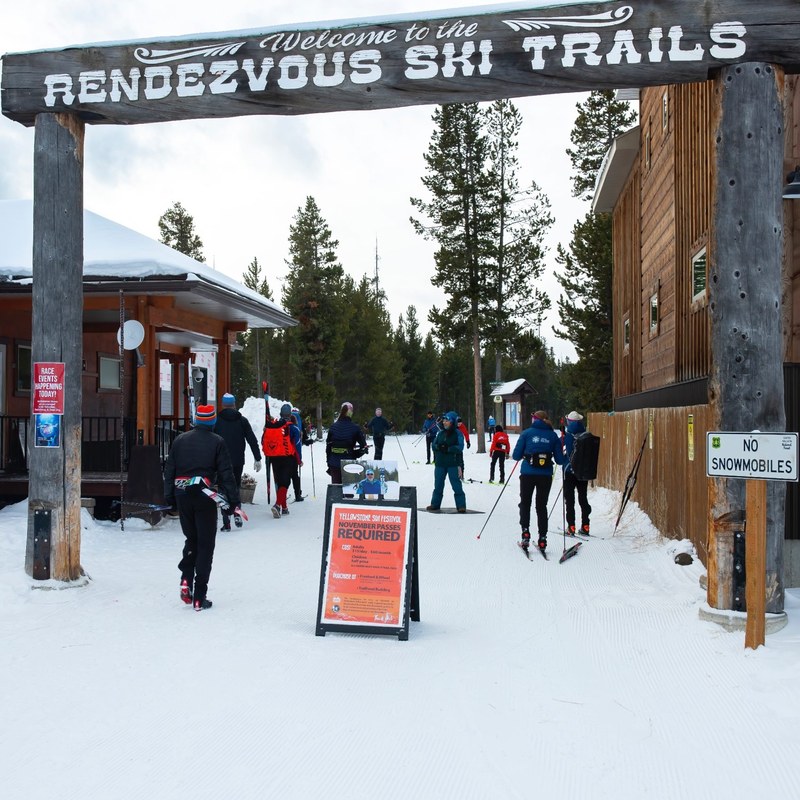
Skiers head under the arch at the Rendezvous Ski Trails, where a November pass is required for festival week. (Courtesy photo)
Hello, XC skiers!
Excitement is building in West Yellowstone after our first snow. It won’t be long before we’re back out on the trails, enjoying the fresh air, great skiing and the start of another season. Now is the time to make your plans for the 2026 Yellowstone Ski Festival, Nov. 21 through 28 on the Rendezvous Ski Trails.
Our trail crew has been working hard to get the trails ready, and we look forward to welcoming everyone back to regular grooming and miles of outstanding skiing. From first tracks in the morning to an easy ski with friends in the afternoon, there’s nothing better than getting out on the snow and enjoying everything West Yellowstone has to offer.
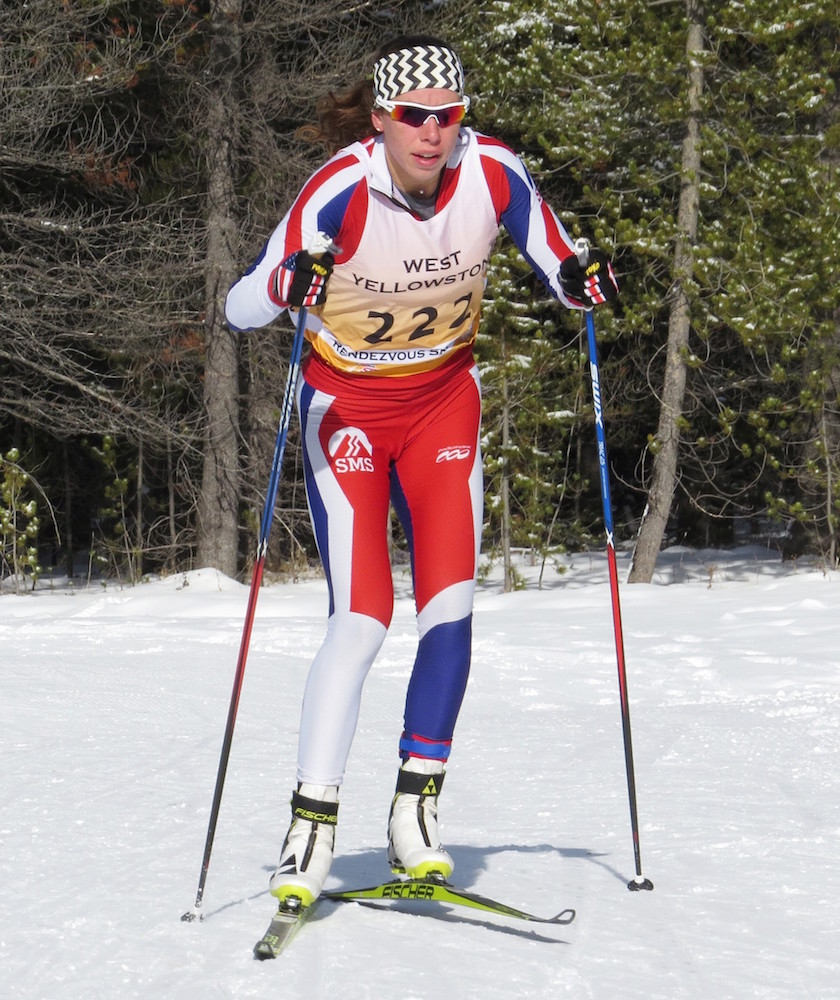
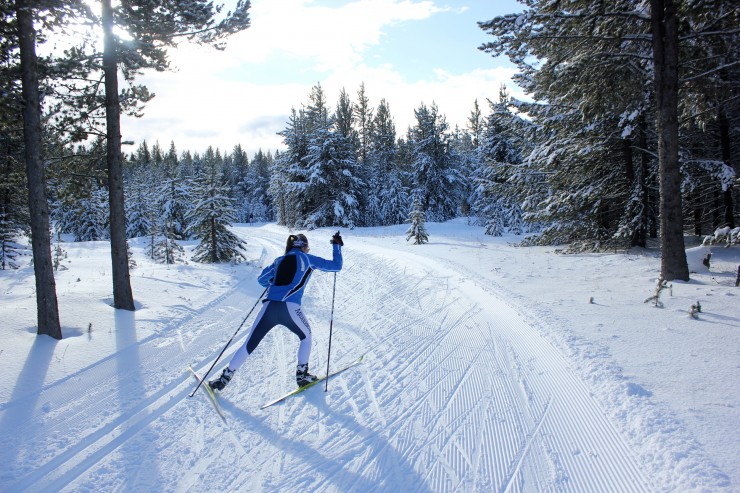
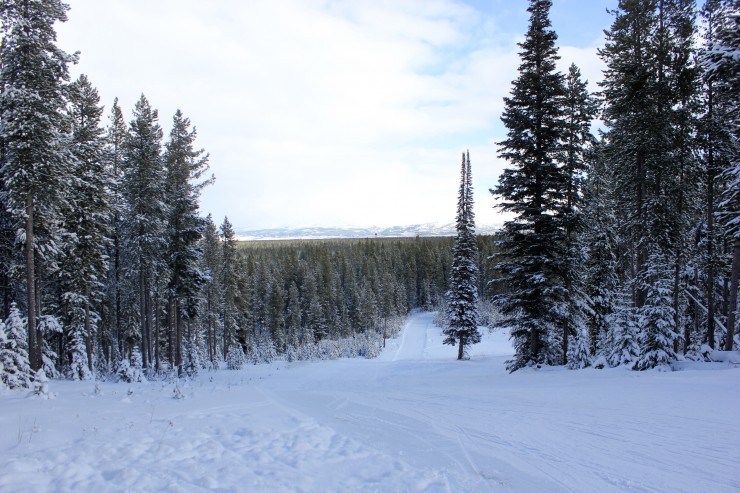
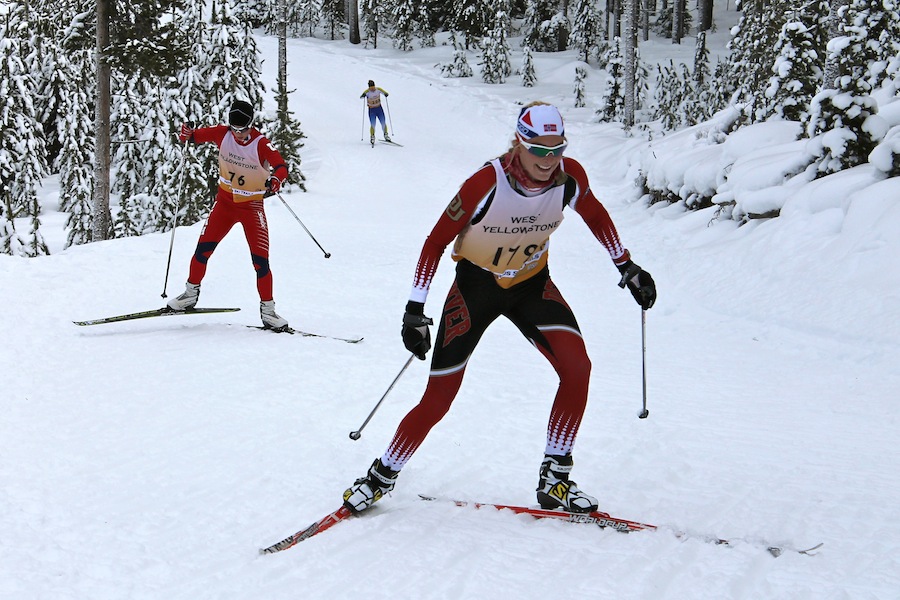
A skier strides through fresh classic tracks on the Rendezvous Ski Trails during the 2014 festival. (Photo: Lander Karath)
Eight Days on Early Snow
Thanksgiving week in West Yellowstone has belonged to skiers for a long time. Competitive athletes, first-timers and whole families come from all over to get on snow while most of the country is still waiting for winter. There is skiing every day of the festival, clinics for every level, biathlon on the range and a race to close out the week.
The tradition reaches back to 1979, when the U.S. Ski Team began bringing coaches to West Yellowstone each November to train them. FasterSkier told that story last fall in a look inside the festival and its clinics, and it is worth a read before you come.
A November trail pass is required for all of November and during the festival, and it is good through Nov. 30. From Dec. 1 through March 31, season and day passes are sold by the U.S. Forest Service at the Hebgen Lake Ranger Station, at Freeheel and Wheel, and at the Rendezvous Trailhead.
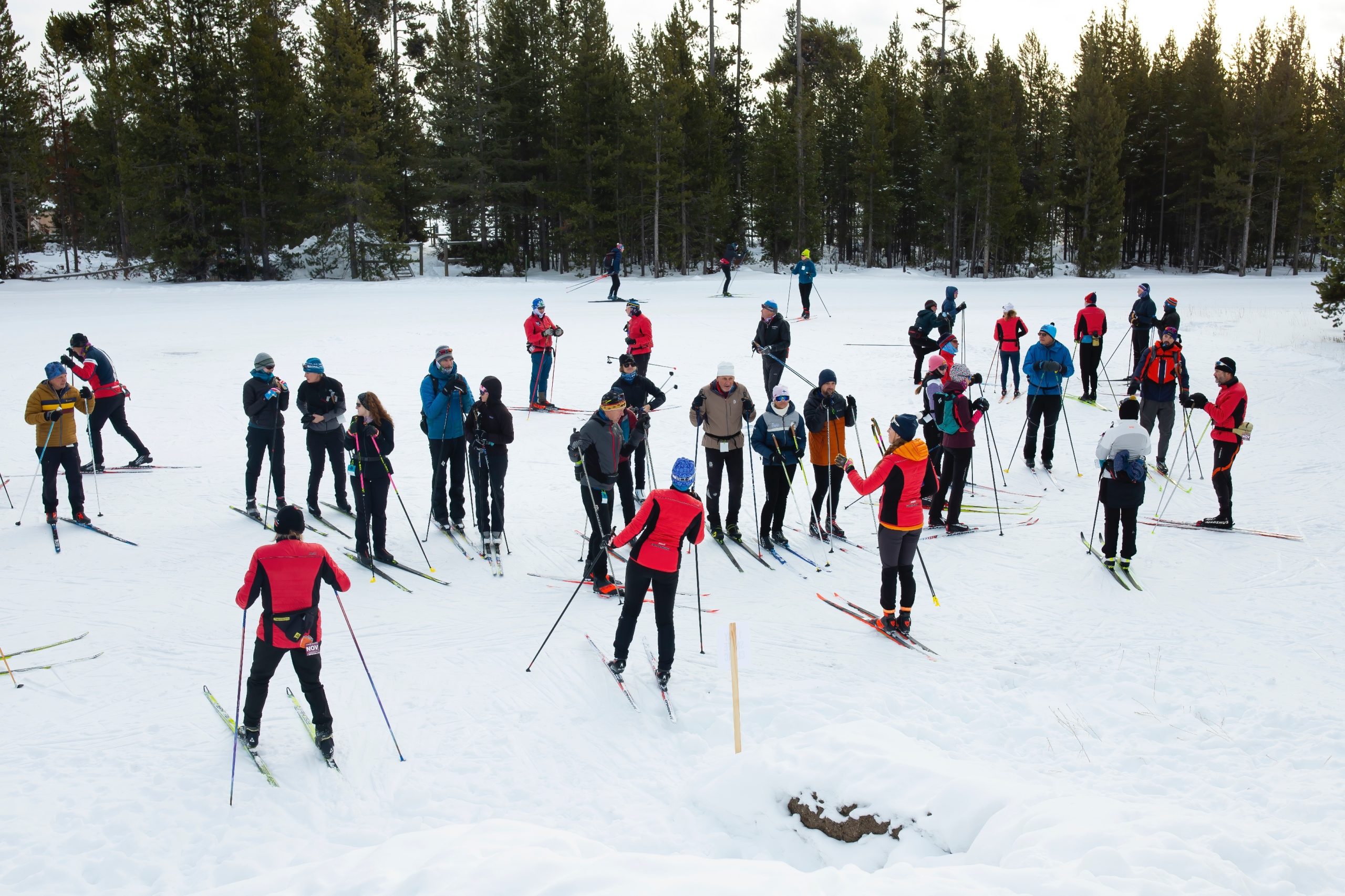
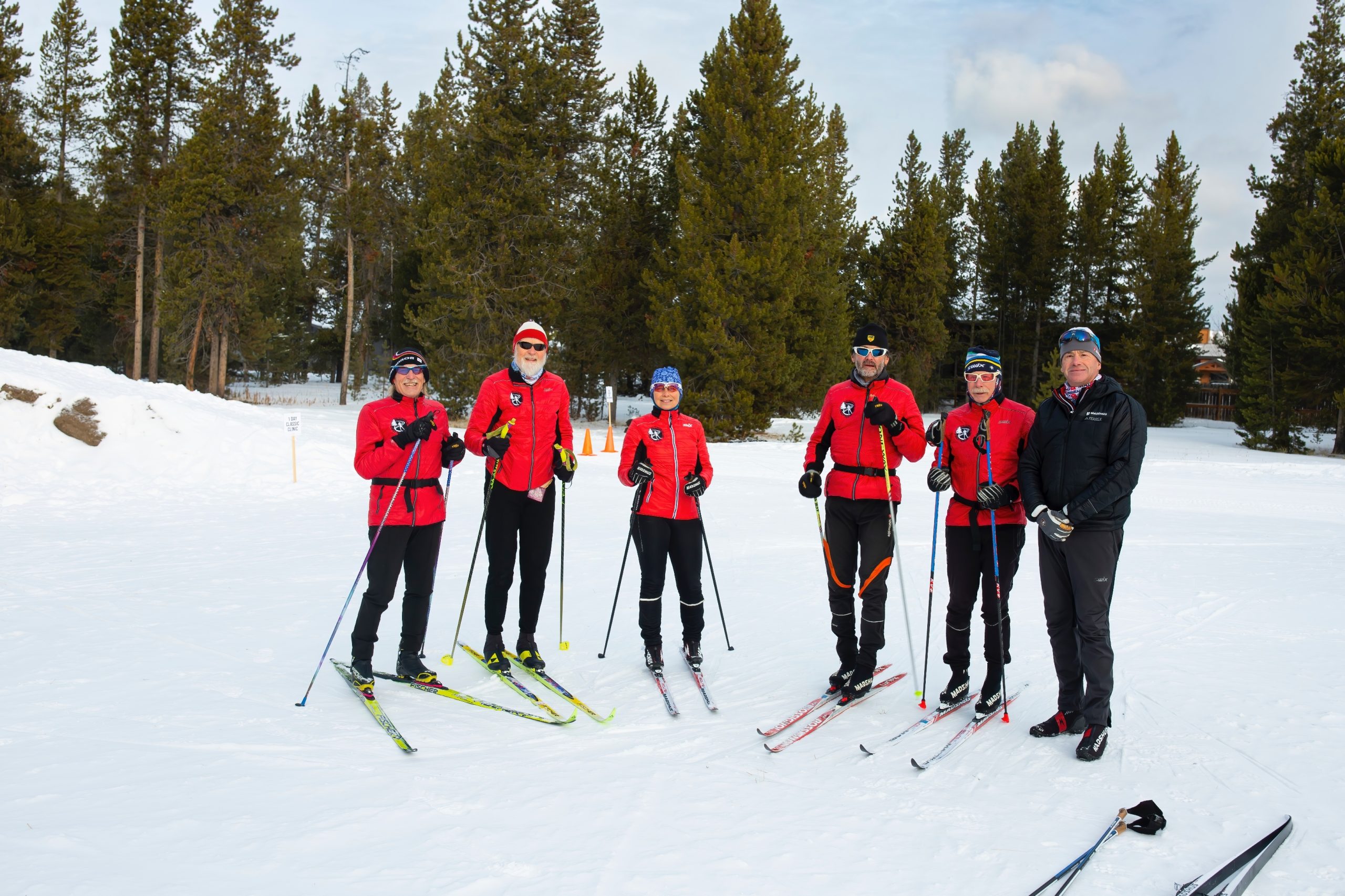
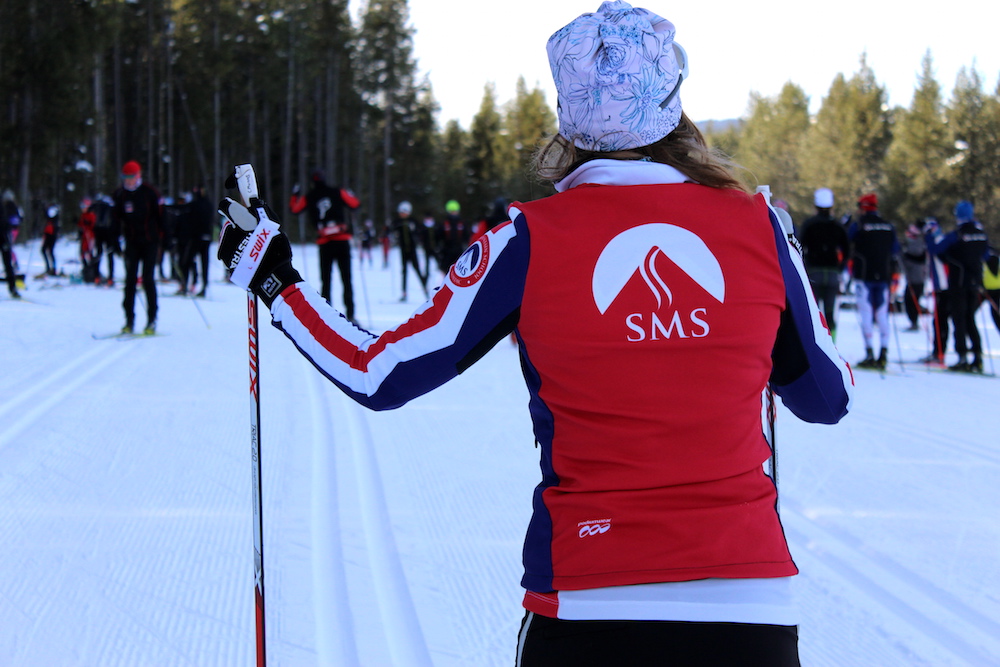
Clinic skiers sort into ability groups with coaches in red jackets at the Rendezvous Ski Trails. (Courtesy photo)
Clinics With Top Coaches
Looking to improve your skiing this season? Our clinics feature top coaches who can help you build skills, clean up your technique and get even more enjoyment out of your time on skis.
Jack Hart will be leading this year’s coaching staff. We place every skier in a group of similar ability, six to eight skiers per coach, and the coaches rotate through the groups each half day so you hear more than one voice over the week. Advanced groups also work on speed, endurance, strength, agility and race tactics.
The three-day Skate and Classic XC Fundamentals for Performance and the two-day Skate and Classic Tune Up both begin Tuesday, Nov. 24, with classic in the morning and skate in the afternoon. One-day technique clinics follow later in the week: skate on Thursday, Nov. 26 or Saturday, Nov. 28, and classic on Friday, Nov. 27.
Don’t wait to sign up. Any clinic with fewer than six skiers registered by Nov. 19 will be canceled. Find clinic details here and register here.
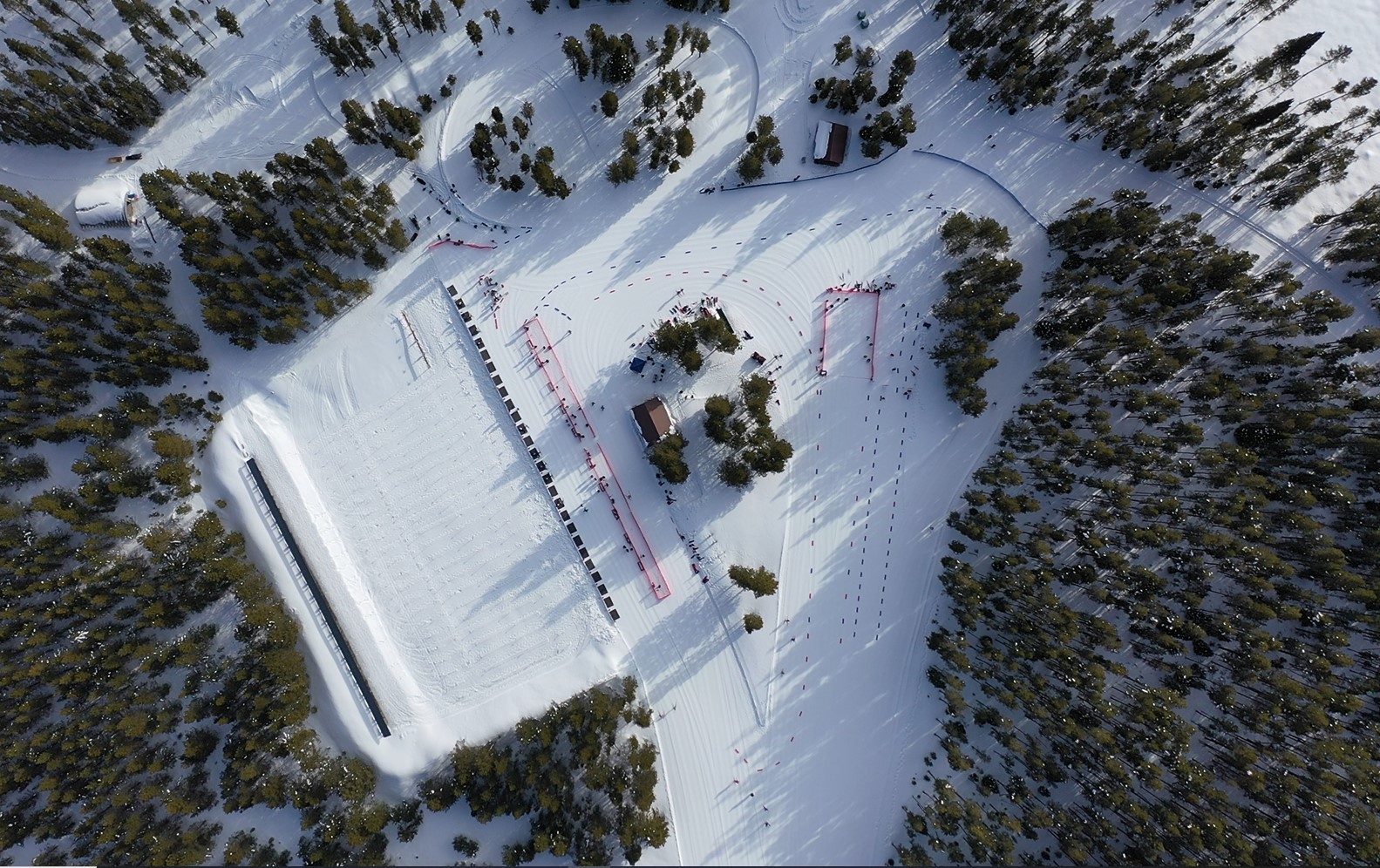
The stadium and biathlon range at the Rendezvous Ski Trails, seen from above. (Photo: WYSEF)
Biathlon, a Race and Après-Ski
Biathlon newcomers get a proper start. A Try-It clinic on Tuesday runs two sessions of up to 50 skiers each, and anyone planning to race the novice biathlon for the first time needs to attend it. The biathlon sprint and novice races follow on Wednesday, Nov. 25, at the stadium and range.
Friday afternoon brings après-ski at the Rendezvous Trailhead. On Saturday, Nov. 28, the week wraps up with a fun 5 km and 10 km freestyle mass start, open to all ages and abilities and capped at 200 skiers. Watch for race registration to open in the coming weeks.
Wax clinics, a mindful movement class and an evening speaker round out the week. Everything depends on snow: low snow means modified courses, and no snow means races and clinics are canceled, with clinic fees refunded less a small administrative fee. The full festival schedule is online and will be updated as November gets closer.
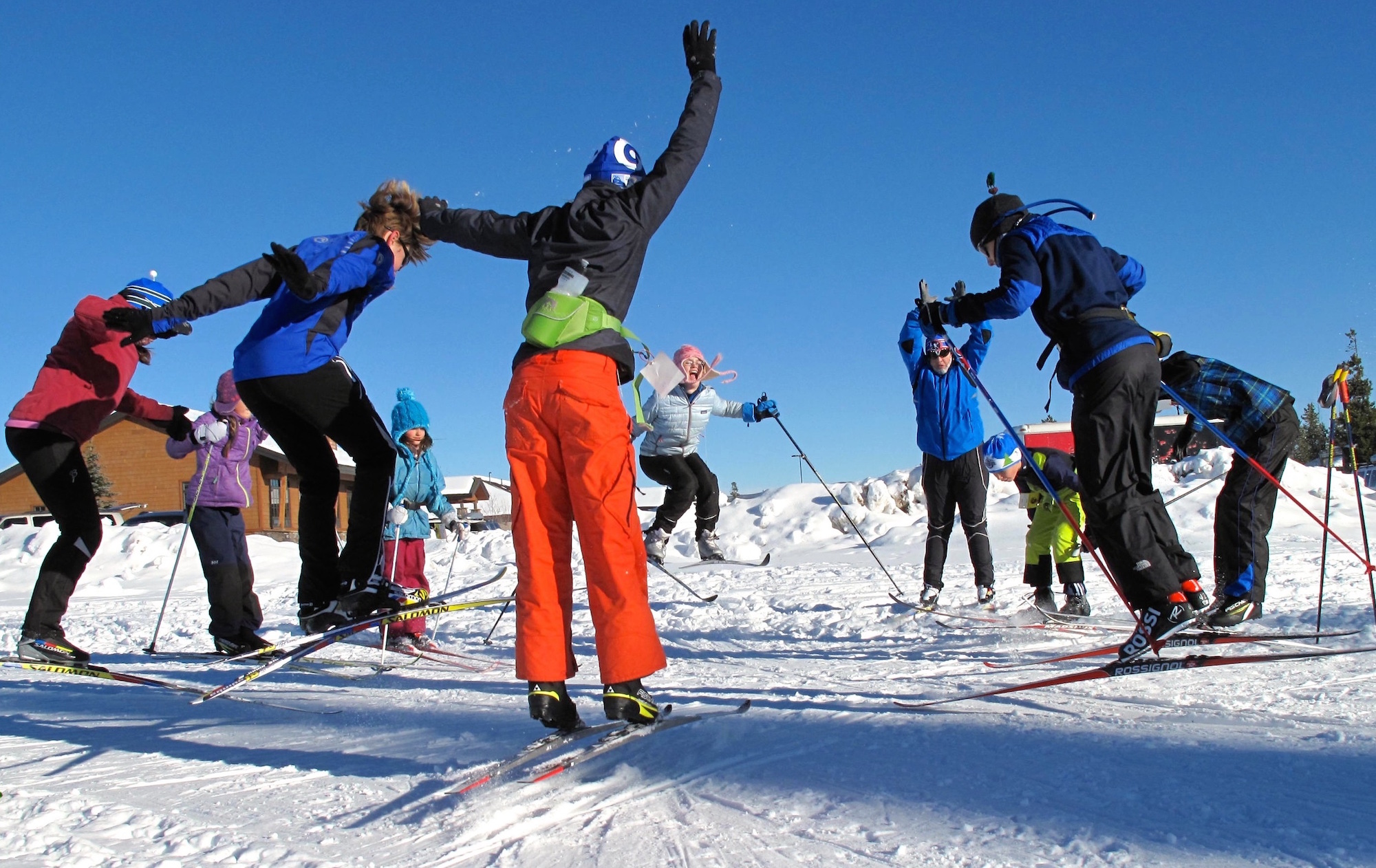
Young skiers warm up together in the sun at the Rendezvous Ski Trails. (Photo: WYSEF)
Places to Stay and Visit
When booking your stay, please consider our festival sponsors. They support our ski community, and we appreciate your support of their businesses.
While you’re in town, stop by Freeheel and Wheel for the latest ski gear, great coffee and a chance to catch up with fellow skiers before heading out on the trails.
If the snow is slow to arrive, there are still great ways to get outside: roller ski or bike the road into Yellowstone National Park, or head out on the nine miles of paved Shortline Trail. Destination Yellowstone has more on what to do around town.
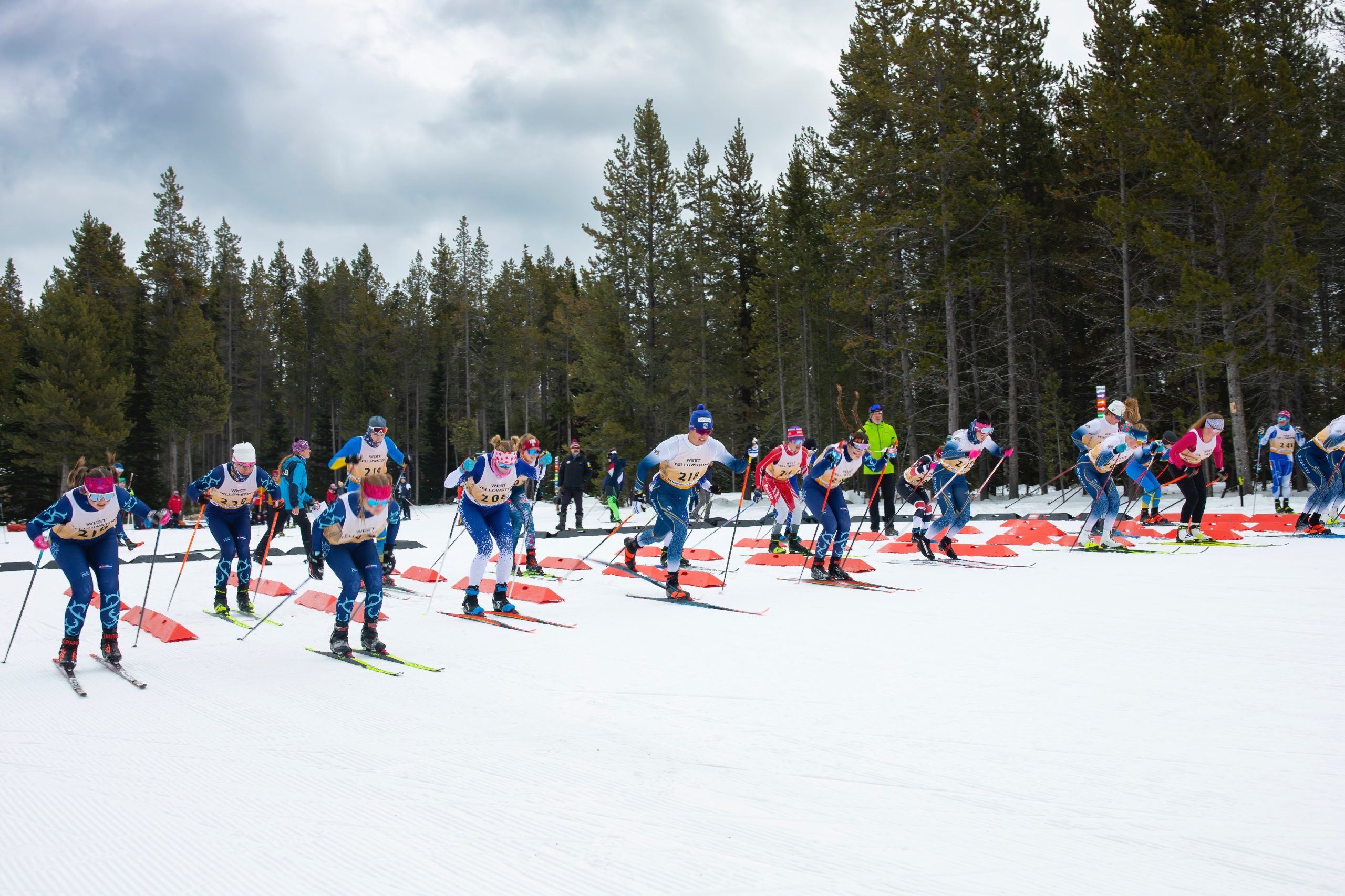
Racers push off the start in the stadium at the Rendezvous Ski Trails. (Courtesy photo)
Back in March for the Rendezvous
The season in West Yellowstone ends the way it starts, with a crowd on the trails. The Yellowstone Rendezvous Race, part of the American Ski Marathon Series, brings more than 600 skiers to town and is set for Saturday, March 6, 2027. Registration opens in November.
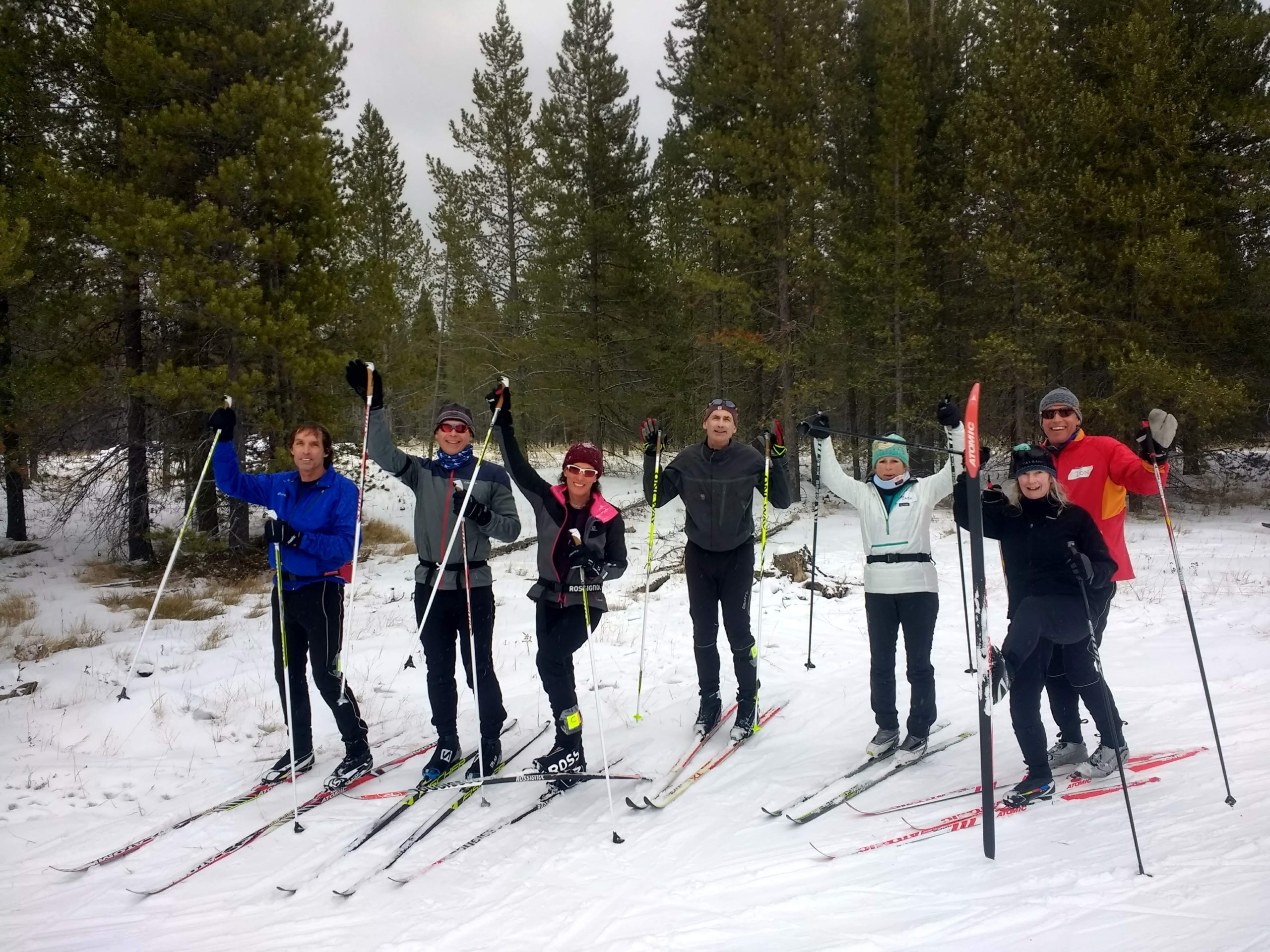
Festival skiers raise their poles on the Rendezvous Ski Trails during Thanksgiving week in 2018. (Courtesy photo)
See You on the Trails
The Yellowstone Ski Festival is a great way to kick off winter, catch up with old friends, meet new ones and get some real Nordic skiing in before December. Whether you’re joining a clinic, taking first tracks on fresh corduroy or just heading out for a relaxing ski, we can’t wait to see you. Start planning your trip, book your room and get ready for another great season in West Yellowstone.
For the latest festival information, visit skirunbikemt.com. Follow @RendezvousSkiTrails on Facebook and @Rendezvousskitrails1 on Instagram for updates and trail news.
Think snow, get excited, and we’ll see you in November!
The Yellowstone Ski Festival Committee
Clinic coaches line up on skis at the Rendezvous Ski Trails. (Courtesy photo)
When the first real snow falls in West Yellowstone, everything changes. The sound of car tires gives way to the swish of skis; coffee shops fill with cold hands and red cheeks; and this small Montana town of 1,100 becomes the epicenter of cross-country skiing in North America.
A Small Town With a Big Nordic Heart
Each Thanksgiving week, thousands of skiers descend on West Yellowstone for the Yellowstone Fall Ski Festival—an event that blends early-season training, clinics, races, and old-fashioned camaraderie. The teaching arm of the festival, officially called the Yellowstone Fall Ski Clinic, has become legendary in its own right.
“The festival has always been about community,” says Jack Hart, who is the co-director with Todd Eastman, and has been part of the event for more than three decades. “We’re a small town, but for this week, we become the center of the Nordic world. It’s a celebration of skiing in its purest form.”
Bridger Ski Foundation out for a first ski in West Yellowstone back in 2015. (Photo: Courtesy Bernie Nelson)
From Coaching Coaches to Coaching Everyone
The roots of the festival trace back to 1979, when the U.S. Ski Team established a coaching development program in West Yellowstone. Hart remembers it well.
“Before it became an official, commercial event,” he explains, “the U.S. Ski Team brought in coaches. They said, ‘We have a coaching program. We want to develop people like yourself who want to take their level higher. Come to West Yellowstone in November and we’ll train you to be a U.S. Ski Team coach.’ That’s really how this whole event started.”
As more coaches came west, the program began to evolve. “Torbjorn Karlsen, Drew Barney, and Dick Hunt—those are the three names that co-founded the event,” Hart says. “They realized we could turn this into something commercial and teach more people how to ski. We’ve got early snow, we’ve got the trails—why not invite everyone?”
By the early 1990s, that idea had taken hold. The first snow of the season, combined with West Yellowstone’s unique geography, made it a magnet for teams and individuals alike. “At its peak about twelve years ago,” Hart says, “we had over 5,000 day passes sold during the week. That’s how many people were here. These days we’ll sell 2,500 to 3,000 if we get a lot of snow—but it’s still the biggest kickoff to winter anywhere.”
Building Better Skiers — and a Stronger Community
The Yellowstone Fall Ski Clinic runs alongside the festival under the same umbrella. It offers structured instruction for everyone from teenagers to masters racers, with one-, two-, three-, and five-day options beginning the Tuesday before Thanksgiving.
“We take kids down to high school age,” Hart says. “We’ll have around one hundred people in actual instruction this year, and then another couple thousand here training with their own coaches—high-school programs, club teams, that sort of thing.”
The diversity of ability levels is part of the event’s charm. “We have literally people who have not been on skis before,” Hart says, “and we also have the five-day, full-time training type of skier. The idea is to enhance, improve, and enjoy skiing in this environment—with this community.”
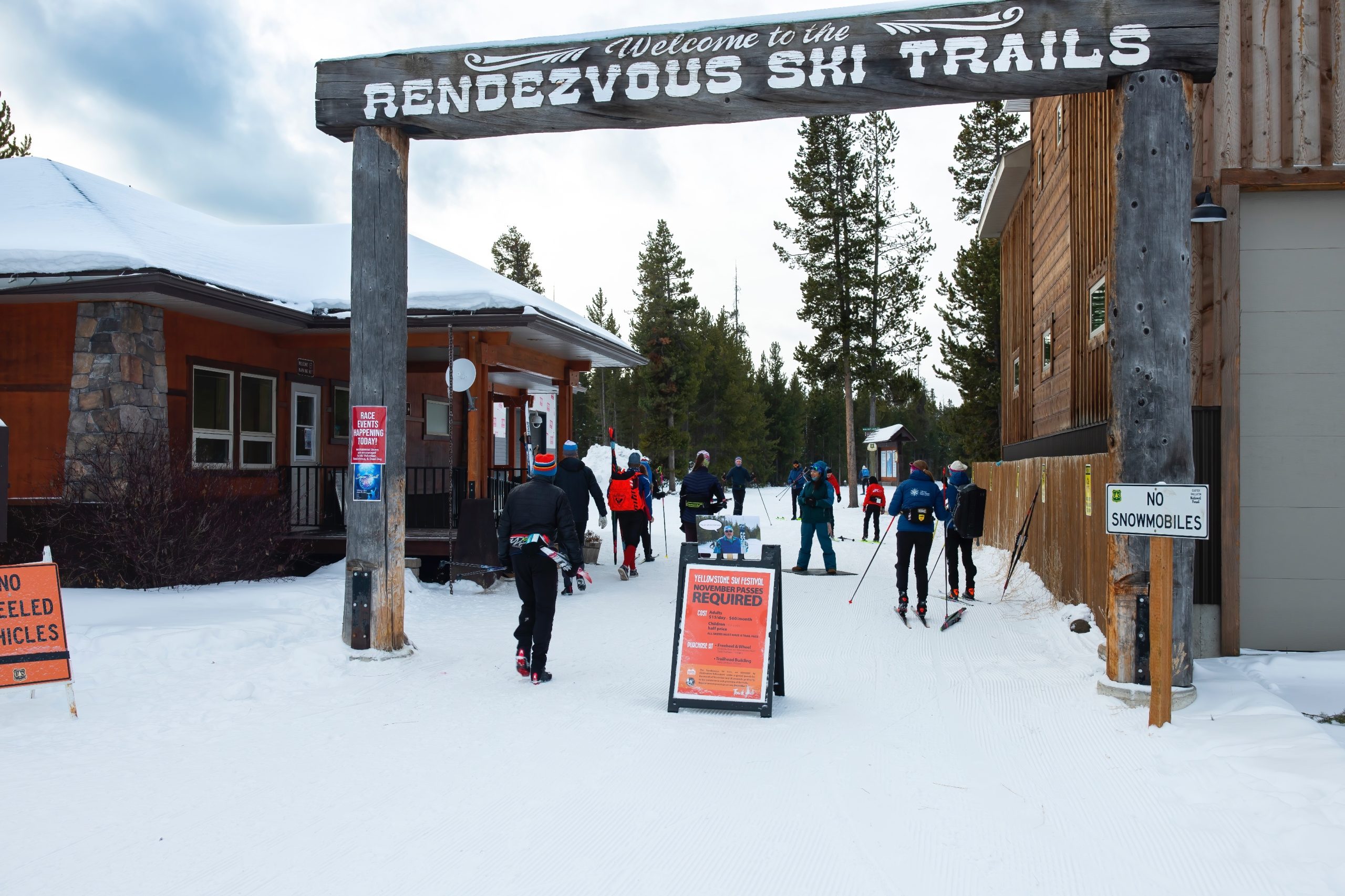
The entrance to the Rendezvous Trail System in West Yellowstone, Montana. (Photo: Courtesey Photo)
Each clinic begins with a quick on-snow evaluation. “We ask for a self-assessment on the registration form, but that can be different from where people really are,” Hart laughs. “The first fifteen or twenty minutes on snow, we do an evaluation and adjust the groups right there. We want everyone with others of similar ability so they can maximize their time and get more enjoyment out of it.”
The formula works. The Rendezvous Trail System becomes a living classroom—groups working on technique, coaches calling out cues, laughter echoing through the lodgepole pines. “The idea,” Hart says simply, “is to enjoy, to improve, and to learn—and obviously have a bunch of fun while you’re doing it.”
Philosophy in Motion: Teaching, Balance, and Joy
Behind the logistics of the clinic—the sign-ups, scheduling, and staffing—stands Eastman, whose background in both coaching and teaching shapes how the clinics operate.
“My contention,” he says, “is that all the coaches needed to do more ski teaching, and all the teachers needed to learn about coaching. The sweet spot is the combination of the two.”
That balance defines the Yellowstone approach. Eastman and Hart have assembled a team of approximately a dozen instructors who rotate throughout the week, exposing participants to a range of learning styles. “We’re not following PSIA or USSA scripts,” Eastman explains. “Most of our instructors have been skiing forever and teaching for years. It’s a mix of styles and personalities.”
The offerings reflect this flexibility: a five-day skate and classic clinic, a three-day version, two-day tune-ups, and popular one-day technique intensives for both skate and classic skiing. “The one-day stuff fills up really well,” Eastman says. “It’s at the end of the week—Thursday through Saturday—so people already in town can still jump in.”
Last year’s clinics drew 82 participants, supported by a staff of 12 instructors, a healthy ratio that ensures personalized attention. “Our ideal number is around a hundred,” Eastman notes. “We want everyone to leave feeling like they were seen and supported.”
Just as important as the structure, however, is the tone. “This isn’t about grinding or chasing a podium,” Eastman says. “We’re careful not to overwhelm people, especially early in the season. A lot of folks haven’t been on the snow yet. We want to be delicate with feedback, help them rediscover how it feels to glide again.”
That sentiment pervades the entire week. “Everybody at some point has a sensation—they go, ‘What was that? That felt good. I want more of that,” he says. “You may not find it for years, but it’s that moment that keeps you coming back.”
Eastman laughs at the sport’s reputation for being physically demanding. “Cross-country skiing gets this bad rap: ‘Oh, it’s the hardest cardiovascular sport in the world.’ Yeah, gee, that’s exactly what I want to sign up for on my vacation! We want people to see the joy in it—the beauty, the community, the stress relief, the meditation in motion. It’s the best way to deal with winter.”
The sense of inclusivity is central. “We have everyone from high schoolers to eighty-year-olds,” he says. “And if someone needs more challenge or less, we just move them. Our job is to make sure every skier finds their place.”
For Eastman, success is simple. “When a hundred people swear they’re going to tell all their friends how much fun they had—that’s when we know we did it right.”
Free Heel and Wheel: The Beating Heart of the Festival
For many participants, the festival’s unofficial headquarters is Free Heel and Wheel, the beloved ski and bike shop owned by Jack’s wife, Kelly Hart, and Melissa Alder.
“Every kid hangs out there,” Hart says. “They have hot chocolate, buy a new ski hat, talk skiing—it’s where everything happens. That little store is kind of the center of communication because people have been going there for thirty years.”
Part café, part gear shop, and part social hub, Free Heel and Wheel embodies the spirit of West Yellowstone. During festival week, it hosts evening events, wax clinics, and impromptu meetups that stretch late into the night.
“It’s just part of the experience,” Hart says. “Besides the Holiday Inn, which is where everything is based, it’s the other center of the place. A lot of the kids meet there, sit at the coffee bar, talk skiing, and talk about whatever teenagers talk about.”
The shop is also the birthplace of one of West Yellowstone’s most famous legends—the “snow-dance” story. Years ago, when November warmth threatened to derail the event, the Free Heel and Wheel crew improvised. “They all got on bikes in bikinis, with skis on the back, and rode around town,” Hart laughs. “They lit the skis on fire as part of the dance, and that night we got nine inches of snow. It’s one of those legends that’s become part of the lore around here.”
Lots of Après-ski fun to be had. (Photo: Courtesy Photo)
Exploring Beyond the Trails
While the festival’s focus is skiing, Hart emphasizes that West Yellowstone offers plenty beyond the tracks.
“If you were that customer saying, ‘Jack, what else can I do? I’m only skiing three days, but I’m here for five,’ there’s a lot,” he says. “The clinic has speakers and films—wax clinics, athlete talks, people like John Bauer speaking about his career and the park.”
Just outside town lies the west entrance to Yellowstone National Park, which remains open to non-motorized travel in late November. “You can either tour in, or, depending on conditions, you can skate on the groomed road,” Hart says. “It’s a big tradition for a lot of higher-end athletes to ski all the way to Old Faithful. That’s 30 miles in and 30 miles out. We call it the 100 K day.”
In the 1980s, before skate skiing, that tradition was even tougher. “We used to classic ski into Old Faithful and back on Thanksgiving Day,” Hart remembers. “You could eat like crazy that night—you were starving.”
“Our restaurants stay open for this event,” Hart notes. “The bars are open. The town comes alive. If you’re coming all the way to West Yellowstone, skiing our trails and seeing Yellowstone National Park in its winter beauty should hold your interest for at least three or four days.”
A Safe Adventure
Early-season skiing in bear country sometimes raises eyebrows among first-time visitors, but Hart reassures them that precautions are simple and effective.
“We always recommend traveling with bear spray,” he says. “Most bears are in hibernation by then, but it’s not unusual this time of year to see one that’s not. Ski in a group, carry bear spray—Free Heel and Wheel rents it, and the Chamber has them too—and follow park guidelines. We’ve never had an incident with an animal on the Rendezvous Trail system in 34 years.”
Snow, Weather, and the “Snow Dance” Factor
Reliable early snow has always been West Yellowstone’s calling card, but Hart admits that every year brings a little suspense. “We’ve had snow and we’ve been skiing on the plateau already,” he said in early November, “but it’s been wet—low 40s and even rain up to 7,000 feet. The good news is it’s supposed to snow today, tomorrow, Sunday, and part of Monday. Temperatures are dropping to the teens at night, and starting the week before camp, it’s supposed to snow steadily.”
If conditions in town fall short, organizers simply shift to the South Plateau Road, about six miles outside town, which reliably holds snow. “We’ve always been able to adjust,” Hart says. “If we don’t get snow until Wednesday, fine—we’ll ski Wednesday or go up on Tuesday. The key is being flexible. And if all else fails, we might call on the Free Heel and Wheel girls for another snow dance.”
Aerial view of the stadium and biathlon range at the Rendezvous Ski Trails in West Yellowstone. (Photo: WYSEF courtesy photo)
Try Something New—Free Biathlon
One of the most distinctive parts of the week is the chance to try biathlon—no experience required.
“The biathlon events we have during the week are free,” Hart says. “If you’ve never shot a gun, it doesn’t matter. Some of our highest participation numbers come from the ‘never-ever’ biathlon event. You spend half a day being taught how to shoot, and then that afternoon there’s a race for all those people who’ve never raced before.”
The facility is first-rate: a 26-station range that includes a Paralympic setup. “You can feel what it’s like to actually do a biathlon race,” Hart says proudly. “It’s one of the nicest ranges in the western United States.”
Thanksgiving, Nordic-Style
Thanksgiving is the centerpiece of the week—a mix of tradition, family, and fitness.
“Thirty years ago, you couldn’t even get a turkey in town,” Hart recalls. “Now we have two grocery stores that carry everything, from turkeys to cranberries. We’ve got six hotels open, and you can make your own dinner if you rent a VRBO. There’s plenty of food available.”
The scene on the trails that morning captures what the festival has become: families pulling children in pulks, elite athletes finishing intervals, and clusters of friends laughing as snow falls softly around them. “Thanksgiving Day is a big tradition for a lot of people,” Hart says. “They come out with their family, ski for an hour, have a big Thanksgiving dinner, ski Friday and Saturday, and head home Sunday. You’ll watch races, watch biathlon, see some of the best people in the world on snow—it’s a great time to be here.”
The West Yellowstone Ski Festival and Clinics is a gathering place for our community to celebrate the start of the new season. (Photo: Courtesy Photo)
The Spirit of the Festival
For Hart, who has worked at this event for the last 30 years, the reward is seeing the joy it brings. “We’re proud of what we’ve built,” he says. “It’s a massive effort for a small community, but when you see 3,000 people skiing, smiling, and reconnecting after a long summer—that’s everything.”
As the first flakes settle over town and the hum of wax being corked onto skis fills the air, West Yellowstone once again takes its place as the spiritual home of early-season Nordic skiing.
Amidst the pines and geysers, every November offers a fresh reminder: the ski season doesn’t begin with a race—it begins with a community.
Come and join West Yellowstone’s professional coaching staff to get a “jump start” on your 2022 – 2023 ski season
during the Yellowstone Ski Festival,November 22-26, 2022.
The staff provides a solid understanding of cross country fundamentals, and gives you the tools and drills to gain efficiency and strength at the camp and throughout your ski season. The coaching staff is composed of an elite group of XC ski professionals which includes retired world class skiers, coaches and professional instructors. The coaches know that the best way to ingrain effective movement is through practice. You’ll also get feedback, in the dose that’s right for you. While some just need a new focus and mileage, others benefit from a more consistent stream of information about whether and how much they’re performing the task to the desired degree. The coaches know how to pace the flow of information, and offer up a great balance of new information, drills, and practice.
Some of the special offerings include:
● 5-day Skate & Classic XC Fundamentals for Performance
● 3-day Skate & Classic XC Fundamentals for Performance
● 2-day Skate & Classic “Tune up”
● 1-day Improve Your Skate Technique
● 1-day Improve Your Classic Technique
Enjoy your First Tracks in West Yellowstone. Whether First Tracks truly means the corduroy and you, or
it is the first time on skis this season, or the first time on skis period; you are invited to take them at the
Yellowstone Ski Festival. Think Snow and make plans now to attend the 2021 Yellowstone Ski Festival.
For more information, http://www.skirunbikemt.com/master-clinics.html and follow us on our Facebook page
(@RendezvousSkiTrails) or Instagram (YellowstoneSkiFest) for up-to-minute news.
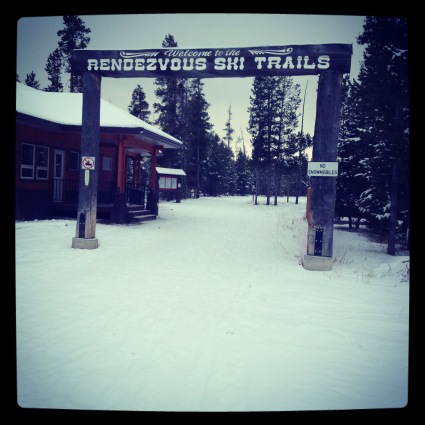
Rendezvous Ski Trail entrance with new construction in plain sight.
West Yellowstone is many things: a gateway to the world’s first National Park, a tourist-chotzche goldmine, a jumping off point to blue-ribbon streams and reliable late November cross-country skiing. Even remote West Yellowstone, like any other place boasting out your door recreation opportunities, can feel the pressure from development.
If you’re headed to West Yellowstone for the annual Yellowstone Ski Festival, expect to do a double take while parking near the trailhead. The iconic “Welcome to the Rendezvous Ski Trails” arch still remains with it’s signature cowboy font screaming “frontier”.
But just feet away from the arch, and literally inches from the fence line on which you’ve probably rested your skis, rises an under-construction multi-purpose garage. The garage, at over twenty feet tall, is part of a residence just to the west of the Rendezvous Ski Trail’s main entrance and lodge. Development happens. And in-fill development in less densely populated towns can initially be a visual shock.
Skiing and grooming will not be impacted during the festival. But for local stakeholders, in particular, the West Yellowstone Ski Education Foundation (WYSEF), the construction has raised concerns.
With normal snowfall in West Yellowstone coupled with well-below freezing winter temperatures, large amounts of snow can accumulate on roofs. Around town it’s common to see roof-cornices develop later in the season. WYSEF is concerned about trail user safety as the new structure encroaches on a longtime town right of way. According to a Forest Service letter posted in the Town Council’s minutes from September 17, over 40,000 users access the Rendezvous trail system via the trial entrance adjacent to the new garage. In the letter, the Forest Service also raised the issue of roof cornices as a potential hazard.
According to documents presented at the Town Council meeting, the garage owners claim the town had in fact signed off on the building plans and the designated setbacks for the new garage. The property owners claim the city granted a setback called a “zero lot line”. In other words, the garage was permitted to have a wall on the property line adjacent to the main ski trail access point.
Depending on who you ask, the setback rules are either convoluted, clear, or antiquated. This much is true: The WYSEF trailhead building sits on city land. WYSEF and the city have a memorandum of understanding, or MOU, allowing WYSEF to use the land for a nominal fee. The trail/grooming path leading to the ski trails crosses city property and terminates at Forest Service land where the trail system continues. A federal agency, the city, WYSEF, the Chamber of Commerce which owns the trailhead lodge, and the garage builders are all looking for some give.
At the September 17, Town Council meeting, a variance request from the homeowners was considered. The variance would have allowed the homeowners to bypass local zoning laws for their side yard setbacks. Concurrent with the variance request, and well before the meeting, stakeholders began to voice their concerns. As a result, the city suspended construction while stakeholders weighed in.
The Town proposed that the pre-existing WYSEF fence be moved seven feet further onto city land, towards the ski lodge. WYSEF would then move the Rendezvous Ski Trails arch and build a new groomer path on the east side of the building (See images). WYSEF submitted a claim that the proposed variance was flawed as it degraded access to federal land and it ceded public property to private use. The city ultimately granted a variance with a 2.5-foot setback from the fence line.
For now, it appears the fence line will remain in its historic place. This leaves WYSEF with some short and long term issues as it tip-toes through a maze of land parcels owned by private, city, and federal entities. Not to mention the prospect of a sliding roof-cornice.
Land use and stakeholder conflicts aside, WYSEF is a mom and pop entity. They work with several different stakeholders to provide affordable world class skiing. The costs for any of the proposed long term solutions are high. Who will pay for any of the permanent solutions remains undecided.
“The WYSEF Board will continue to work with the city in regards to this important issue and continue to look at all options going forward,” stated an email received by FasterSkier.
Prepare for that double take as you visit the Rendezvous Ski Trails for the first time this season. The Montana big sky is still there, but so is a big garage.
West Yellowstone remains an early season magnet for training. In good snow years, the grooming is otherworldly. In thin times, the fact that several trails are seeded with grass and legendary Rendezvous Ski Trails groomer Doug Edgerton turns water into wine means even meager snow can seem dreamy. And yes, there’s always the higher altitude South Plateau Rd. which comes into play when the winter blanket in town is lacking.
From Nov. 26-30, the Yellowstone Ski Festival will offer skiers new to the sport and those sporting dated Lycra or the latest fashion trends an opportunity to ski, mingle, and learn.
Liz Stephen (U.S. Ski Team) racing to 12th in the women’s 10 k freestyle mass start at 2018 SuperTour Finals in Craftsbury, Vt. (Photo: John Lazenby/Lazenbyphoto.com)
A few Festival highlights are worth mentioning. Former U.S. Ski Team member Liz Stephen will speak the evening of Nov. 29. This woman is formidable. She remains the high-turnover motor of her past World Cup days. Her value to the community persists as she espouses principles that ensure those around her are taken care of: she’s the consummate teammate. Walk of fame worthy in the cross-country community? Indeed. Worth hearing speak? Unequivocally.
Science writer Christie Aschwanden, author of the book “Good to Go: What the Athlete in All of Us Can Learn From the Strange Science of Recovery”, will speak on Nov. 27, the day before Thanksgiving. Aschwanden is known for her fastidious research. Her book is rife with nuggets dispelling what many believe are scientifically proven recovery methods.
Seriously, take a break from the cryotherapy on that Wednesday evening. Maybe shorten the foam rolling session: Aschwanden is the goods.
If you are looking for a one-stop, walk-to-the-trails ski vacation, where you can take a clinic, learn about waxing from Toko’s guru Ian Harvey, learn to shoot a biathlon rifle, test the early season fitness with a race, begin each morning with a yoga session, this could be your Thanksgiving destination.
Let’s circle back to note beginners are welcome. You’ll no doubt see plenty of carbon fiber poles, boots, and skis, and patch upon patch sublimated onto custom team clothing. It may look like an overly serious scene for something coined a festival. Remember, everybody was a beginner at some point – and West Yellowstone is the place to start.
Another SuperTour season opened in West Yellowstone, Montana, one weekend later than usual this year but with a lot of the old standbys, including a twisty, technical freestyle sprint course and puzzling conditions for the classic distance race.
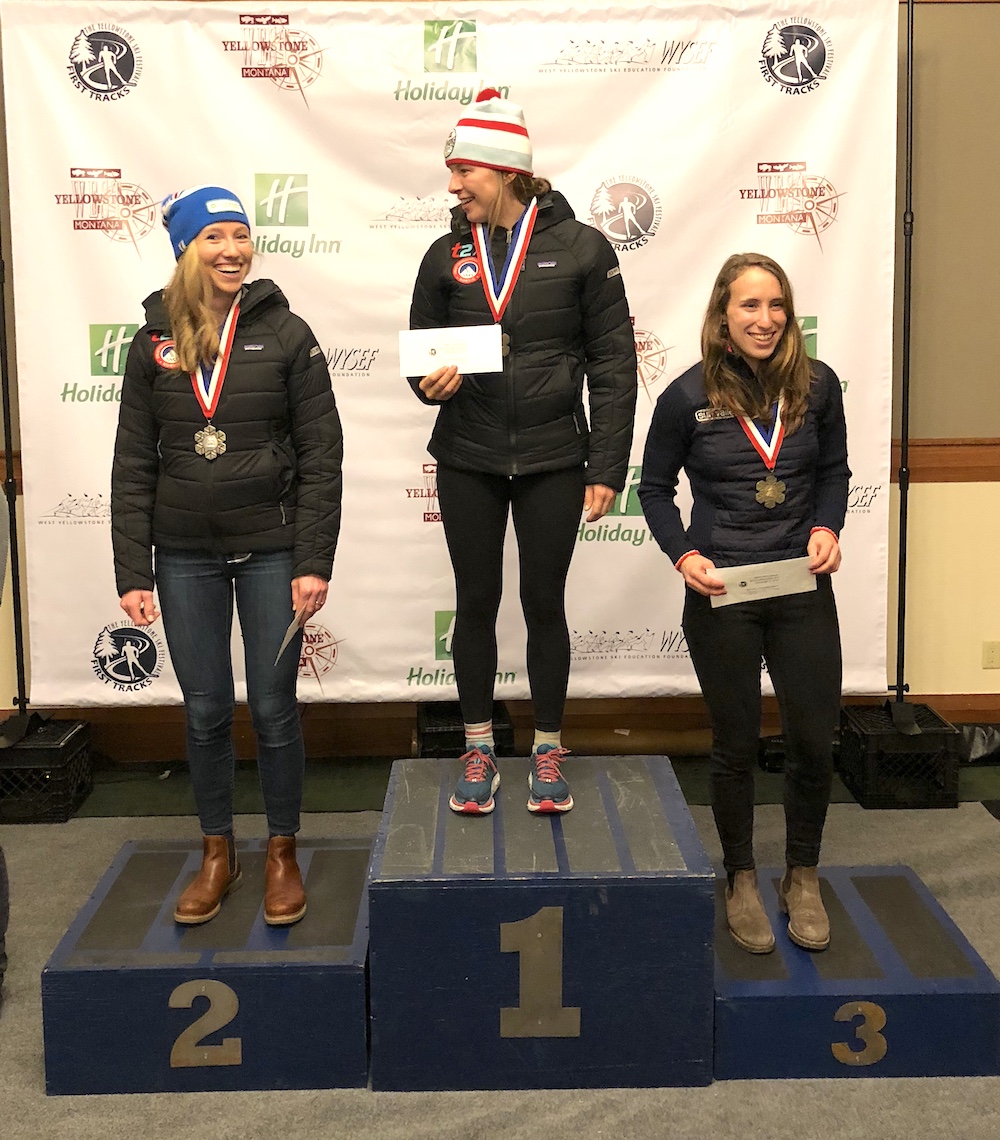
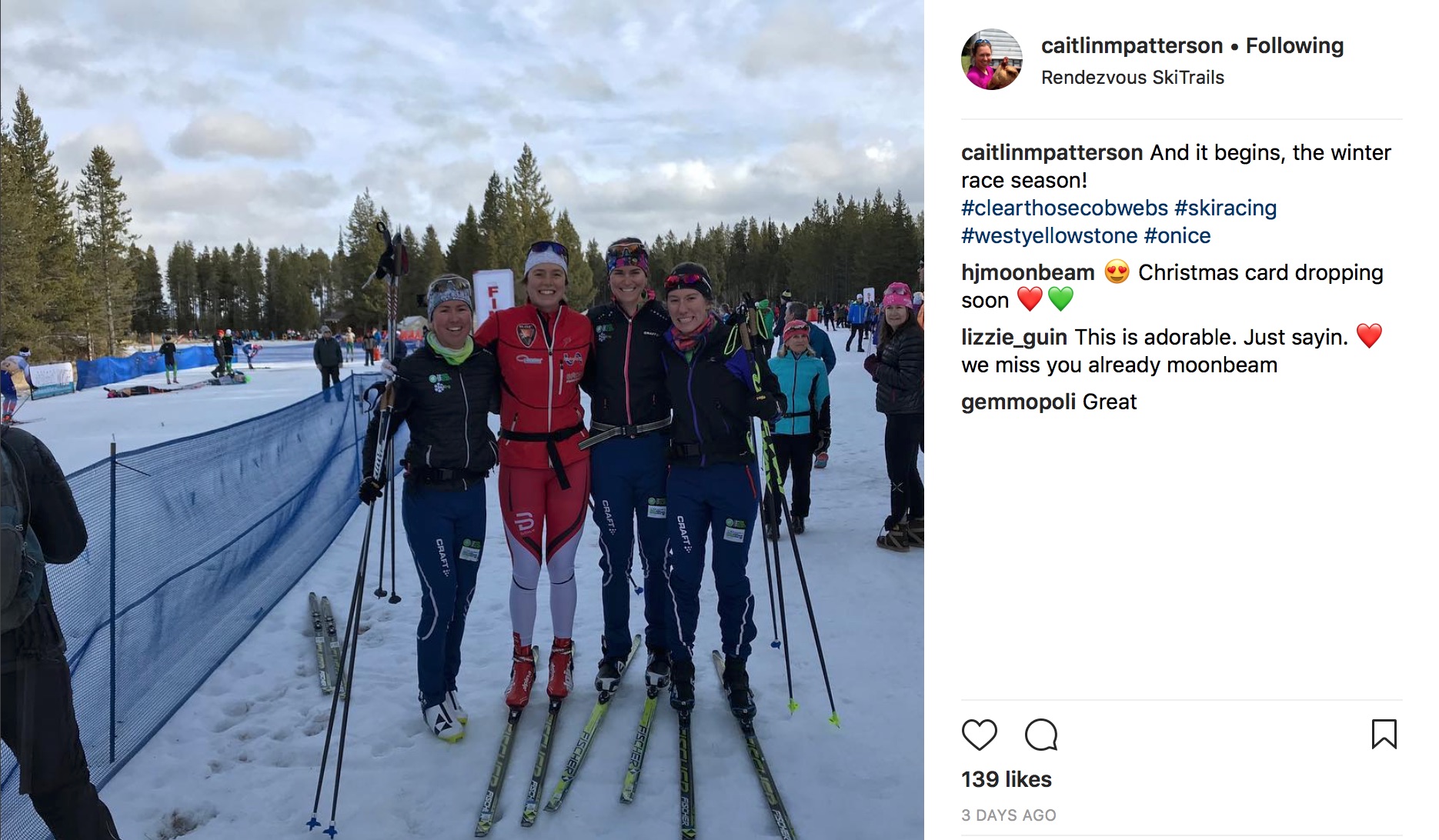
In a crash-marred women’s final on Saturday, Dec. 2, Anne Hart of the Stratton Mountain School (SMS) Elite Team avoided a tangle between Caitlin Gregg (Team Gregg) and Caitlin Patterson, of the Craftsbury Green Racing Project (CGRP), and skied to the win. According to Hart’s teammate, Erika Flowers, who also raced in the final, the two Caitlins collided in the final winding section before the last big uphill.
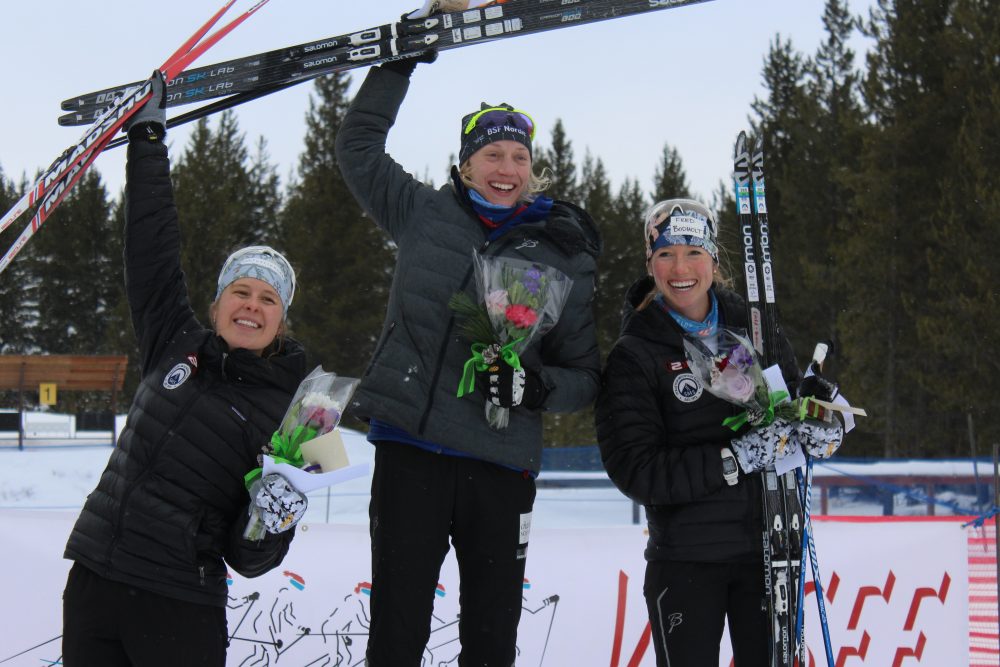
The women’s skate sprint podium at the first race of the 2017/2018 SuperTour season on Dec. 2, with the SMS Elite Team’s Anne Hart (c) in first and Erika Flowers (l) in second, and Sun Valley’s Kelsey Phinney in third. (Photo: FBD)
“They went down and some people were just ahead of them and were able to ski around,” Flowers said.
Hart was one of them.
“In my journal last night I actually had part of the course labeled ‘mushroom boost,’ which is right over the top of that last hill,” Hart said with a laugh in a post-race interview.
One of her goals for the day had been to save her “best burst for the end,” she continued. “So I was able to do my planned mushroom boost at the end, came across with the win and I couldn’t be more thrilled.”
She won the women’s 1.5-kilometer freestyle sprint final in 2:52.49 minutes, just 0.88 seconds ahead of Flowers in second and 0.92 seconds ahead of Kelsey Phinney, of theSun Valley Ski Education Foundation (SVSEF), in third.
Alaska Pacific University (APU) and U.S. Ski Team Development (“D”) Team member Hannah Halvorsen followed in fourth (+2.16), while Gregg finished fifth (+6.99) and Patterson was sixth (+7.22).
“I was fortunate not to go down,” Flowers said, “but I was stuck behind [the crash] so by the time I got kind of untangled from Caitlin Patterson, I was maybe 20 meters back from the group. I was feeling good and I really wanted to win today so I just hammered and was happy to sneak into second place at the end there.”
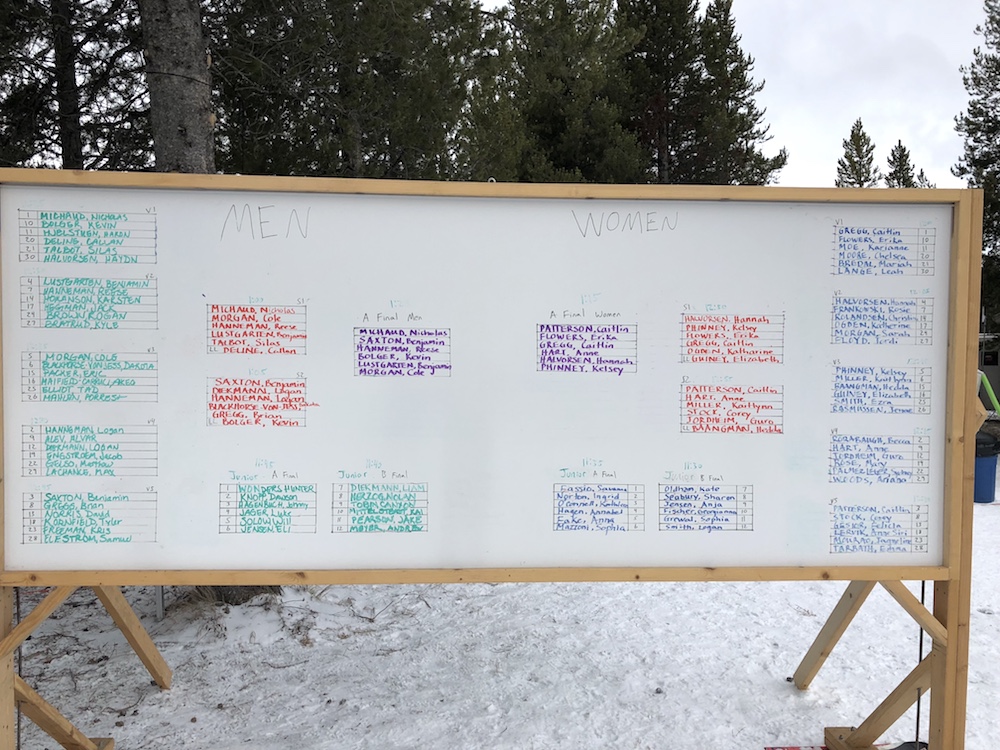
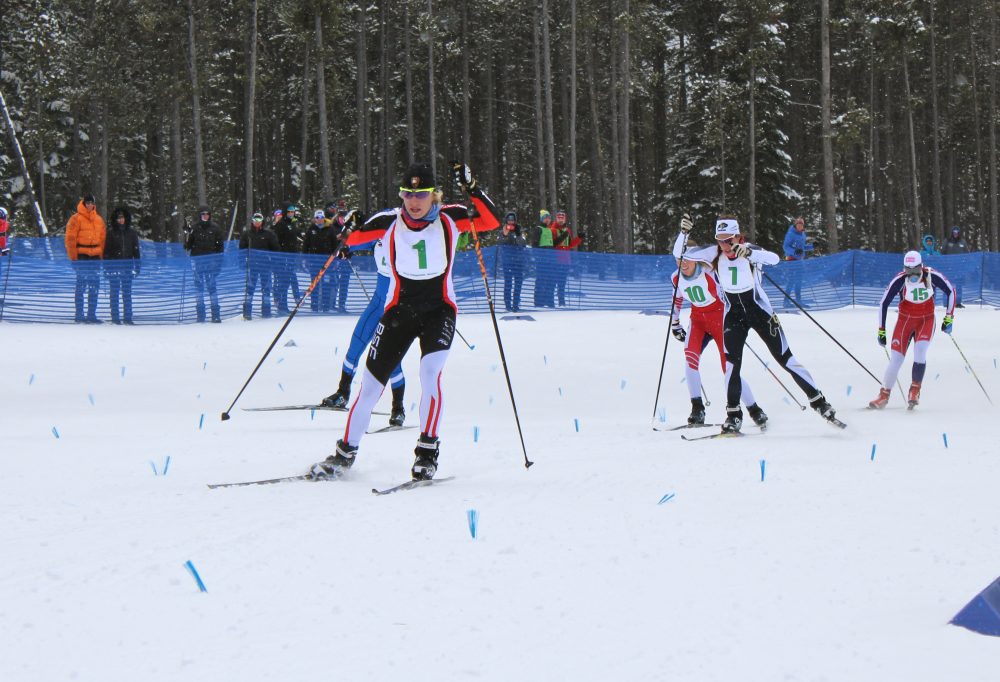
A look at the SuperTour sprint lineups for the heats on Dec. 2 in West Yellowstone, Montana. (Photo: FBD)
The sprint day began with Gregg winning the women’s qualifier in 2:50.79. Becca Rorabaugh (APU) qualified second (+2.7) and Patterson was the third-fastest qualifier (+3.0), ahead of Halvorsen in fourth (+5.64) and Phinney in fifth (+6.12). Hart qualified ninth (+8.98), just ahead of Flowers in 10th (+9.03) out of 58 in the women’s race.
“It’s a weird, fast and very tactical sprint course at high elevation,” Hart said of the Rendezvous Ski Trails’ race course some 6,800 feet above sea level. “So my qualifier wasn’t maybe exactly what I’d hoped but it wasn’t terrible, it wasn’t way off the mark, and I just tried to go through each round skiing in the front and in control. That didn’t happen in the final, but it turned out my being in the back and being sort of tactically aware allowed me to pass a crash.”
Hart won her quarterfinal and finished second to Patterson in their semifinal. Flowers won the other semifinal to advance to the final, and also won her quarterfinal. Phinney, who ultimately placed third, made it to the final as a lucky loser after finishing fourth in her semifinal, 1.88 seconds behind Flowers in first. Phinney had previously won her quarterfinal.
“You never really know what to expect for the first sprint of the season,” Phinney said. “I had a pretty good qualifier and then I led my quarterfinal and [that] ended up being the faster quarterfinal so I was feeling pretty good.”
Phinney’s winning quarterfinal time was more than 3.5 seconds faster than the winning times of the four other quarterfinals.
“The final was a little bit of mayhem,” Phinney added. “It was kind of just staying on your feet, being able to jump over people’s poles and hope for the best.”
While most of the top women planned to continue racing at the next SuperTour at the NorAm season-opener this weekend, Dec. 9-10, in Sovereign Lake (a.k.a. Silver Star), British Columbia, most are focused on U.S. Cross Country Championships from Jan. 3-8 in Anchorage, Alaska. And beyond that, some are hoping to get selected to the U.S. team for the 2018 Winter Olympics in PyeongChang, South Korea.
“I’d really like to win that skate race at U.S. nationals,” Flowers said. “That’s definitely been a goal of mine for the last few years and I haven’t made it happen yet, but I’ll definitely try this year.”
Michaud’s First Win
In the men’s 1.5 k skate sprint the same day, Nick Michaud of the Bridger Ski Foundation (BSF) won the qualifier and every heat thereafter to capture his first-career SuperTour win (and podium) with a winning final time of 2:30.69. He previously won the qualifying round in 2:29.5, just 0.08 seconds ahead of Logan Hanneman (APU) in second.
Ben Saxton (SMS Elite Team) qualified third (+0.63), Ben Lustgarten (CGRP) followed in fourth (+0.98) and Cole Morgan (SVSEF) was fifth (+1.3).
Michaud, a 25-year-old who has been jumping into SuperTours since 2010, then won his quarterfinal by 0.13 seconds over his BSF teammate Silas Talbot and his semifinal by just 0.05 seconds over Reese Hanneman (APU).
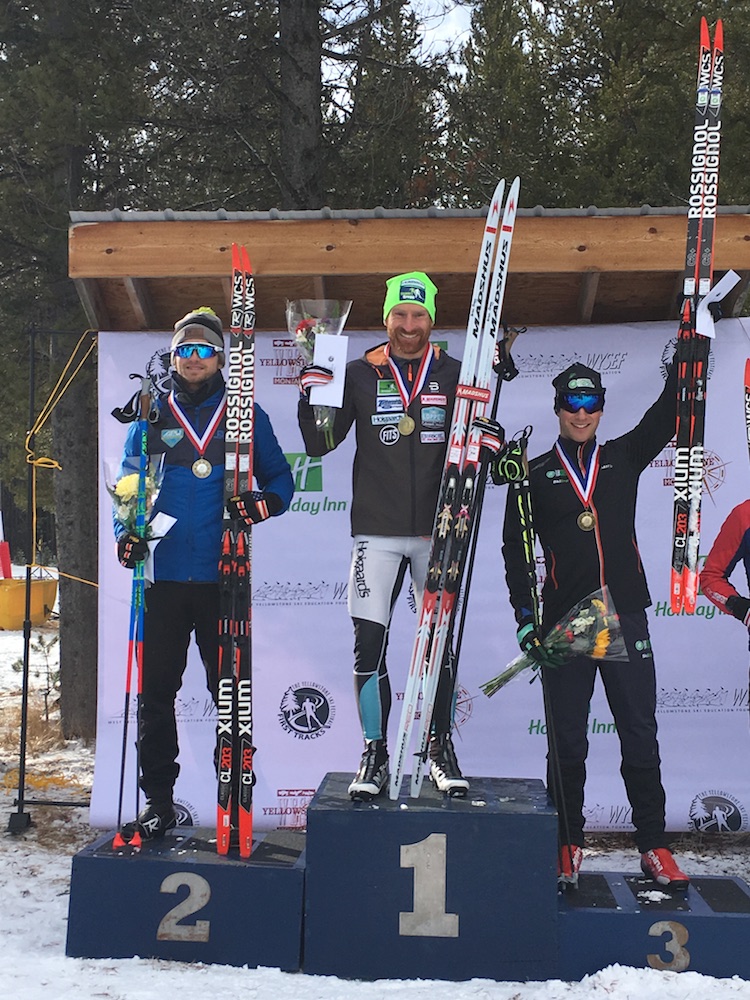
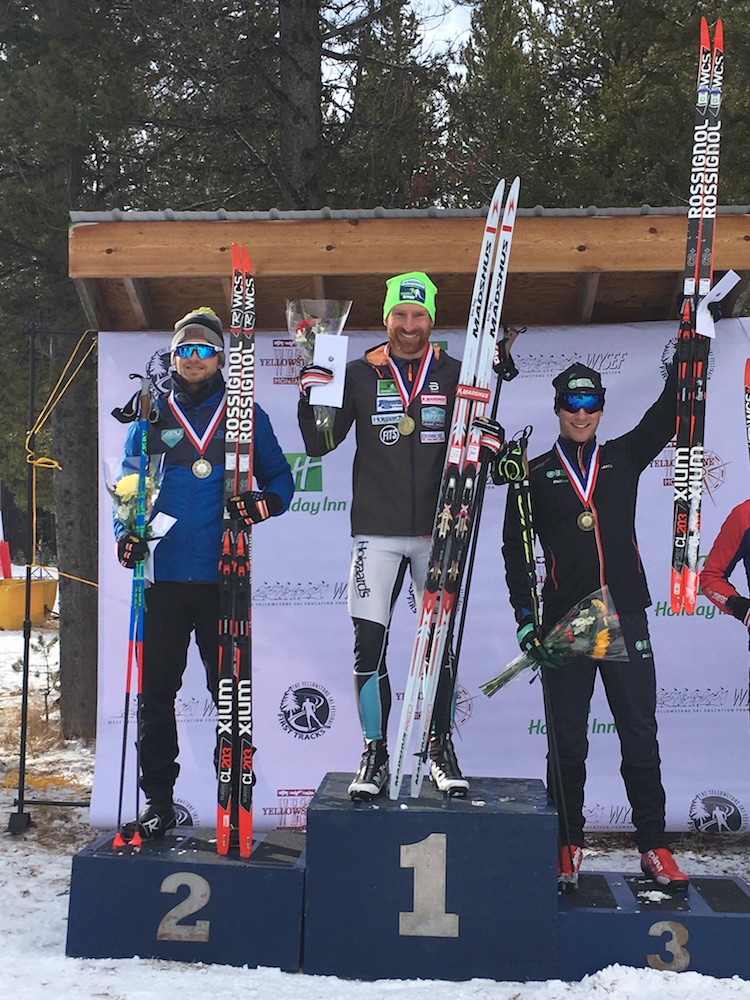
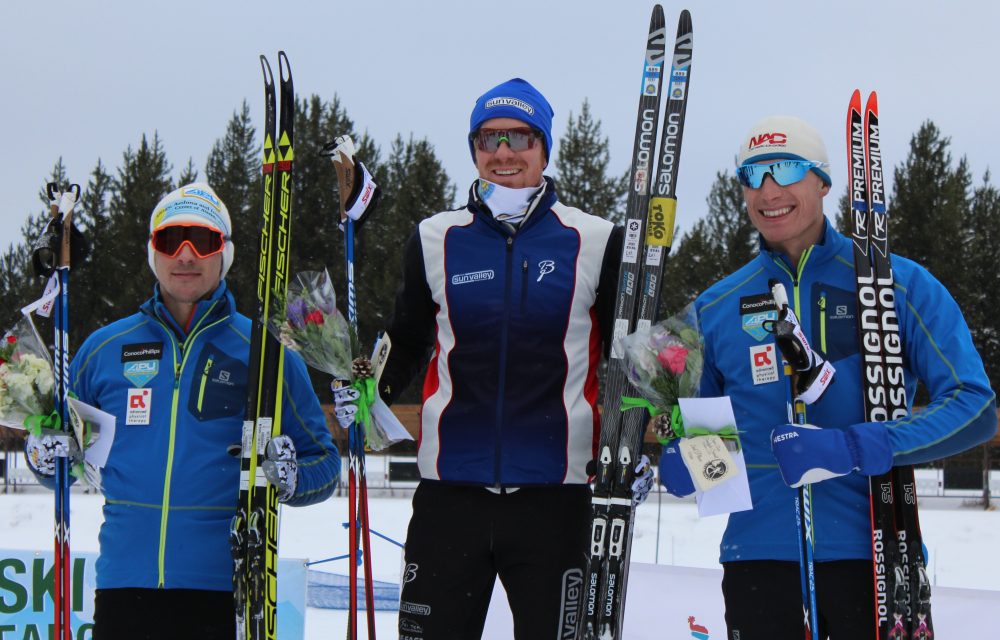
The men’s skate sprint podium at the first race of the 2017/2018 SuperTour season, with Nick Michaud (c) in first and Ben Lustgarten (l) in second, and Reese Hanneman in third. (Photo: FBD)
In the final, Michaud skated to a 0.17-second win over Lustgarten in second, while Reese Hanneman crossed the line in third (+0.84).
“It was just so fun,” Michaud said after. “Conditions were great. Everyone was out here. Great skis, great support; it was just so fun to race.”
Like many of his competitors, Michaud was looking for another standout result in the classic sprint at Sovereign Lake and had his sights set on U.S. nationals beyond that.
Hanneman had similar goals.
“The qualifying criteria for the sprint for the Olympics this year is just on the qualifier and obviously it’s a classic sprint at the Olympics so I think the classic sprints are going to be more important,” Hanneman said. “We have two classic sprints coming up between Silver Star next weekend and nationals in Anchorage [where both a skate sprint and classic sprint will be held] so I’m focusing on throwing down some good classic sprints.”
After qualifying in seventh then winning his quarterfinal and placing second to Michaud in his semifinal, Hanneman described the heats as “crazy fast.”
“This is probably the fastest I’ve ever seen it in West so that just means really high speeds and people weren’t really separating much, so you had to be really strong to make moves to pass people at those speeds,” Hanneman reflected. “In the final, everybody was just going for it, and I was able to find a hole and double pole by people going into that final hill there and kind of throw it down there. I burned up some of my matches trying to make that big move to go from the back of the pack into second so I faded a little bit in the final 100 meters, but other than that I was happy with it.”
Lustgarten, who advanced to the final after placing second in his quarterfinal and third in his semifinal (behind Michaud and Hanneman) described the rounds as “a bit sketchy with the corners. There’s a lot of turns out there; people trying to take insides, going out, going in,” he said.
“So that was pretty fun and also pretty sketchy and I just had to have really strong finishes because I kept getting boxed out in the back,” Lustgarten added. “But I managed to make my way through the pack on the hills.”
Also in the final, Kevin Bolger (SVSEF) finished fourth (+2.11), Saxton placed fifth (+2.86), and Morgan took sixth (+3.42).
Brian Gregg, Bångman Strike Late for Distance Win
On Day 2 of the SuperTour-opening weekend, racers faced freshly falling snow for the distance races: the women’s 10 k and men’s 15 k classic mass starts.
While a large group of men stuck together on the first of three laps, by Lap 2, the race leaders, including Brian Gregg, had started to break away. By the third and final time up Telemark Hill, the distance course’s signature climb, David Norris (APU) recalled that they were down to about eight.
“It was super snowy starting out,” Norris said. “… The pack actually ran really smooth. Every lap on Telemark, I think the pack got smaller. … [The last time up it] I led into Telemark, the big climb, and got to the top of there just with Lustgarten and Brian Gregg, and it was kind of a single-file drag race to the finish. On the last pitch, Brian got up next to me and just kind of pulled away a little bit into the finish.”
The men’s 15 k classic mass start SuperTour podium on Dec. 3 in West Yellowstone, Montana,with Brian Gregg (c) of Team Gregg in first, David Norris (l) of APU in second, and Ben Lustgarten (CGRP) in third. (Photo: FBD)
Gregg, of Team Gregg and Loppet Nordic Racing (LNR), captured the first SuperTour distance win of the season in 41:30.3, just 1.9 seconds ahead of Norris in second. Lustgarten notched his second-straight podium in third place (+4.6), while Kyle Bratrud (CXC Team) finished fourth (+10.9) and Kris Freeman (Caldwell Sport) was fifth (+12.6).
Tad Elliott (Ski & Snowboard Club Vail) followed in sixth, Eric Packer (APU) was seventh, Ian Torchia, of Northern Michigan University (NMU) and the USST D-Team, was eighth, Hunter Wonders (APU) ninth, andMartin Bergström (University of Utah Ski) 10th.
Gregg explained that after some pre-race deliberation, he chose to ski on zeros to ensure he had enough kick and avoid icing on the bottom. He was happy with his decision and noted that the he had waxing help from a group composed of several Midwest teams, including LNR, NMU and Central Cross Country (CXC).
“Our [lead] group of skiers out there all had really good skis so that was really fun,” Gregg said. “It was kind of a tactical race in the sense that it was really hard, like, [you’d] maybe get a little gap on the climbs, but then everybody would bunch back together, so I just tried to conserve energy and really focus on the last kilometer or two kilometers.”
When Norris attacked on Telemark Hill, Gregg said he followed Norris and Lustgarten over the top.
“… I was last, then we came in and I just had a little bit more in the end,” he said. “I was really happy with that. I haven’t won a classic SuperTour race since my first SuperTour win in 2010 so there was a few years in between there, but I’ll take it.”
Gregg, 33, is a 2014 Olympian, who, like his wife (2010 Olympian) Caitlin Gregg, is looking to qualify for a second Olympics this season in PyeongChang. He was pleased with his tactics on Day 2 in West Yellowstone after finding himself too far behind on the sprint’s last climb to contend (he made it to the semifinals and finished ninth overall in the sprint).
As for Sunday’s distance race, in which Gregg conserved his energy and struck at the right moment, Gregg said he learned from others, too.
“It’s fun to see other skiers — Tad Elliott is a really good tactician out there so I actually skied a lot with him watching where he’d spend the energy to move up in the pack and where he was just sort of relaxing,” Gregg said.
“It was definitely faster to be in the draft behind people so the leaders were kind of at a disadvantage,” Lustgarten observed after. “I was kind of mixing it up in the top 20 for the first two laps, and it felt pretty chill, but this is the kind of course where it can go from easy to hard in, like, 50 meters.”
He explained that Rogan Brown (SVSEF) led for most of the second lap. Brown ultimately tied Adam Martin (CGRP) for 11th place (+28.6).
“On the third lap I took the lead to do some work myself and then kind of was stuck in the lead unfortunately for most of the lap,” Lustgarten said. “It went from going to pretty easy to really hard in about a k.”
While he responded to Norris’s attack on Telemark Hill, he couldn’t match Gregg in the meters that followed.
“Brian Gregg came out of nowhere and I thought I could kind of sneak into second but I just didn’t have it today,” Lustgarten said. “That’s what I want to do with the race. He did it right. I think the best way to do it was to sit in the pack, kind of play the field, see how everyone goes, and just hammer the finish. He did really well today.”
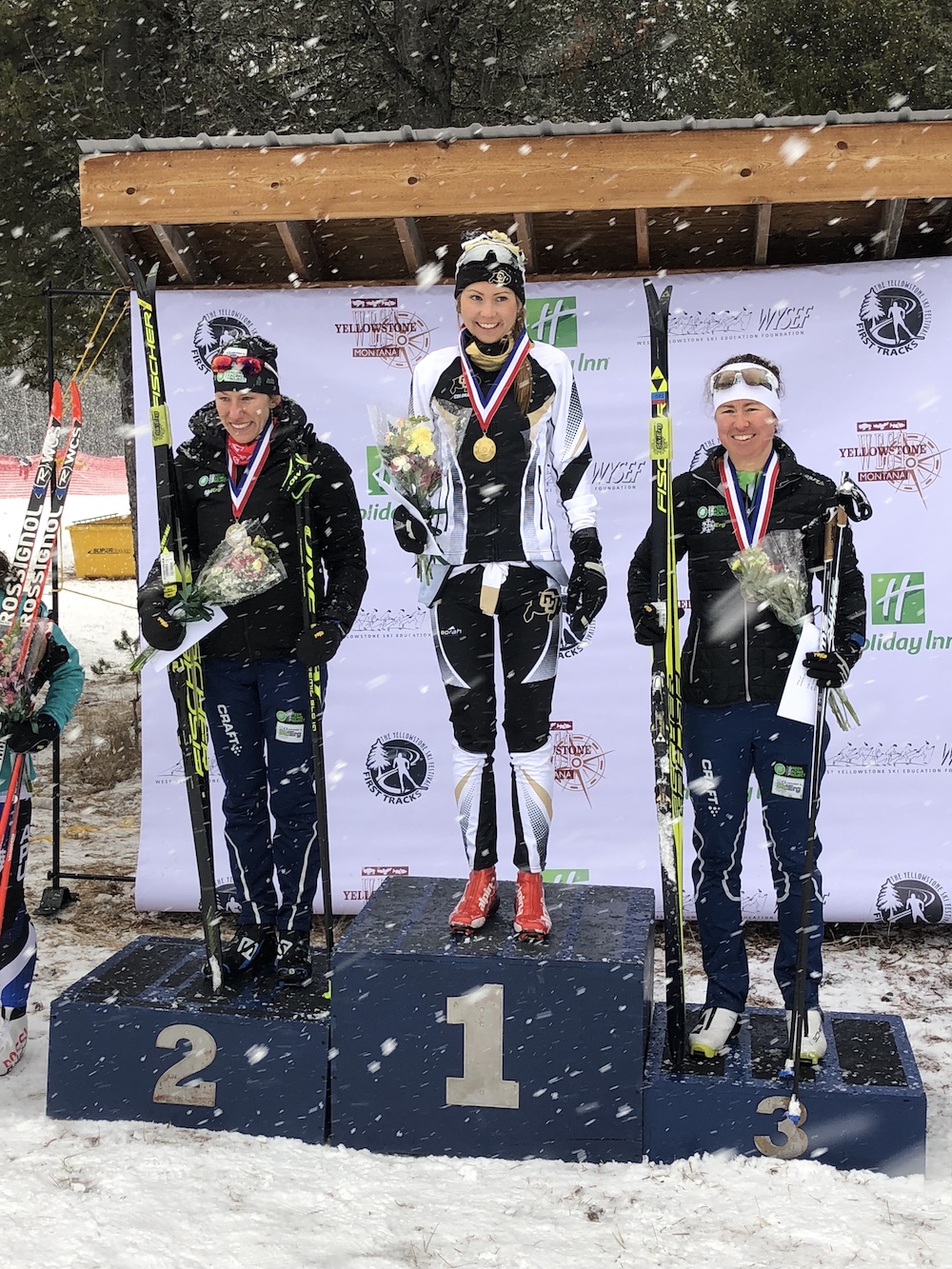
In the women’s 10 k classic mass start, Hedda Bångman, new to the University of Colorado Boulder (CU) Ski Team this year, double poled to the win in 30:24.8 over two Craftsbury’s Kaitlynn Miller and Caitlin Patterson, respectively.
“It was really hard conditions today, and I decided just one minute before the start to switch skis,” said Bångman, a 22-year-old Swedish student. “I took my zero skis and I think it was a good decision. I knew before I started I was forced to do double poling because my grip wasn’t the best on the skis so it was hard but … it felt good, except the technique zones [where double poling is not allowed], of course.”
The West Yellowstone SuperTour women’s 10 k classic mass start podium, with Hedda Bångman (c) of the University of Colorado Boulder in first, and Craftsbury’s Kaitlynn Miller (l) and Caitlin Patterson (r) in second and third, respectively. (Photo: FBD)
Bångman is new to the U.S. in her freshman season with CU.
“My shape is good. Everything was good today. It was fun to race and fun to be here to race,” she said. “It’s a little bit different compared to Scandinavia, but I like it. … It feels like it’s more relaxed here, but maybe it’s just my feeling.”
Miller raced to second place, 1.3 seconds back, ahead of her CGRP teammate Patterson in third (+3.4).
“It was a nice big group of us for a while there and the conditions were kind of lose and powdery, which I enjoy, so I was having fun with that,” Miller said, noting the APU’s Rosie Frankowski carried a lot of the load of setting the pace up front. “There was a nice group of us for a while that slowly just kept kind of stringing out until there were maybe four or five of us left, and then it was sort of just a sprint to the end there. Hedda kind of came in from third or fourth and just had a really good push to the finish…”
Frankowski finished 10 seconds after Patterson for fourth place (+13.5), Katharine Ogden (SMS/USST D-team) was fifth (+17.2), Caitlin Gregg sixth, Felicia Gesior (CXC Team) seventh, Anne Siri Lervik (CU) eighth, Flowers ninth, and Corey Stock (BSF) 10th.
“I want to commend Rosie Frankowski for really pushing the pace middle of the race,” Patterson said. “I think a lot of us out there had fairly slick skis so we were double poling a lot, but they had two technique zones per lap so that was interesting. We had to run those — a little striding, running, herringbone, whatever works to get the diagonal stride. … By the finish we were down to about three of us, and [Bångman] was first and my teammate Kaitlynn Miller had strong double pole into second and I was right behind them in third, so pretty solid day.”
The SuperTour circuit now moves to Canada to join up with the Sovereign Lake NorAm, with a classic sprint on Saturday, Dec. 9, and 10/15 freestyle individual starts on Sunday, Dec. 10.
The show will go on in West Yellowstone, Montana. After organizers of the Yellowstone Ski Festival (YSF) announced in an e-blast on Monday that the West Yellowstone SuperTour, set for this coming weekend, was canceled due to “damage done to the snowpack from the significant rainfall over the past few days,” it’s back on — according to a YSF press release on Tuesday.
“After much deliberation, alternate planning, checking and re-checking weather forecasts, and some more deliberation, the West Yellowstone Organizing Committee, Coaches, and US Ski & Snowboard officials, the decision has been made to hold the Super Tour openers in West
Yellowstone,” the release stated. Robert Lazzaroni, U.S. Ski & Snowboard’s nordic domestic program director, confirmed the races would be held in West in an email to FasterSkier.
As of Tuesday, the snow in the stadium and race course at the Rendezvous Ski Trails were suitable for 1.3-kilometer freestyle sprints to be held as planned on Saturday, Dec. 2, according to the release.
Sunday’s classic races (originally supposed to be 10/15 k classic mass starts) are another story. Organizers are considering four race options, the first three of which are classic races.
“On Saturday, December 2, the powers that be and the powers that ski will meet to decide on one of the following options for the race scheduled for Sunday, December 3,” the release stated, while listing the following:
“A. Classic Distance Mass Start Super Tour
a. We need 10 cm of natural snow to make this happen plus some help spot shoveling
B. Classic Distance Interval Start on homologated trails and with the Super Tour designation
a. We need 6-7 cm of snow to make this happen plus some spot shoveling
C. Classic Distance Interval Start on Dead Dog Super Tour
a. We need 4-5cm of snow to make this happen
D. Skate Distance Interval Start NOT A Super Tour, NRL with prize money
a. If we do this the Super Tour will move to Silver Star on Friday Dec 8th or Monday Dec 11th with the preference being on the 8th”
After this weekend, the SuperTour circuit will head north to link up with Canada’s NorAm opener as scheduled at Sovereign Lake near Vernon, British Columbia. Sovereign is set to host classic sprints and 10/15 k freestyle NorAm/SuperTour races Dec. 9-10.
If there’s no classic distance event in West this weekend, SuperTour organizers will aim to hold a classic distance mass start at Sovereign on Friday, Dec. 8. And if Dec. 8 doesn’t work, they’ll move it to Monday, Dec. 11.
“The West Yellowstone OC will meet tomorrow morning to begin the process of scouting for snow to harvest. An announcement will be made about a meeting time and plan of attack,” the release stated. “An agreement has been made to keep the race courses closed to preserve the snow as much as possible. Please respect this closure and keep off the course. We will do our best to get as many kilometers groomed as we can and will attempt to groom more on the Plateau Road. Keep your eyes on the daily grooming reports for the most up-to-date trail conditions.”
As of Wednesday morning, there was no rain in West Yellowstone’s forecast, but rather a chance of snow showers on Wednesday, Saturday and Sunday.
FIS Race Results
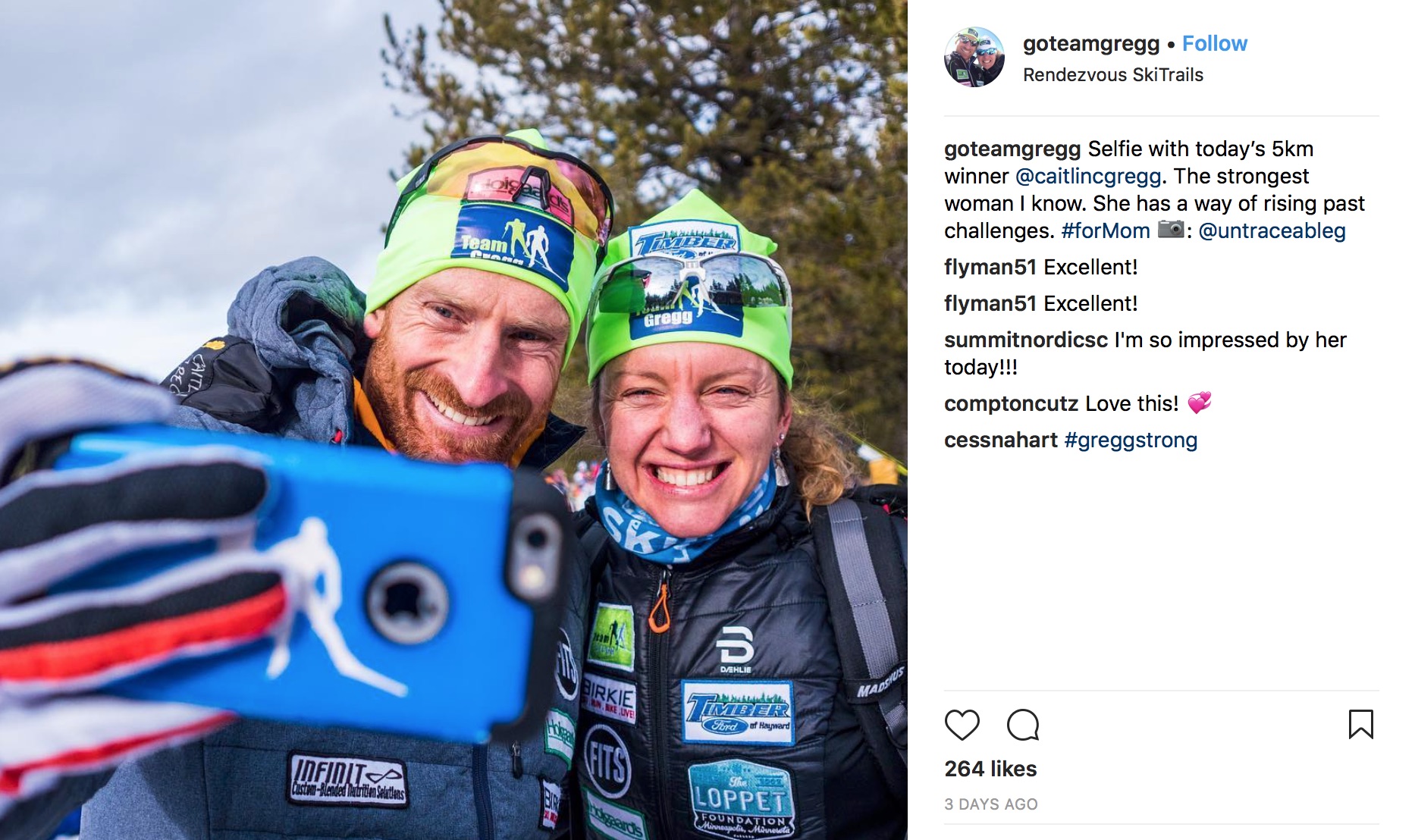
Last Saturday, Nov. 25, season-opening International Ski Federation (FIS) sanctioned races were held on the Rendezvous Trails, with Caitlin Gregg (Team Gregg) winning the women’s 5 k freestyle and Kyle Bratrud (CXC Team) topping the men’s 10 k freestyle.
Gregg won the individual start by just 0.9 seconds over Caitlin Patterson, of the Craftsbury Green Racing Project (CGRP), in 12:01.0 minutes. Petra Hyncicova, a University of Colorado Boulder (CU) senior from the Czech Republic, placed third, 5.6 seconds back.
Erika Flowers, of the Stratton Mountain School (SMS) Elite Team), finished fourth (+11.1), and Christina Rolandsen, a CU junior from Norway, took fifth (+19.7). Another Norwegian Anne Siri Lervik (Team Asker) finished sixth (+21.2), Mary Rose, of the Sun Valley Ski Education Foundation (SVSEF) was seventh (+28.0), Sydney Palmer-Leger (UOP Sports Clubs) was eighth (+32.5), Felicia Geisor ninth (+33.8), and Corey Stock, of the Bridger Ski Foundation (BSF) 10th (+41.1) out of 38 women.
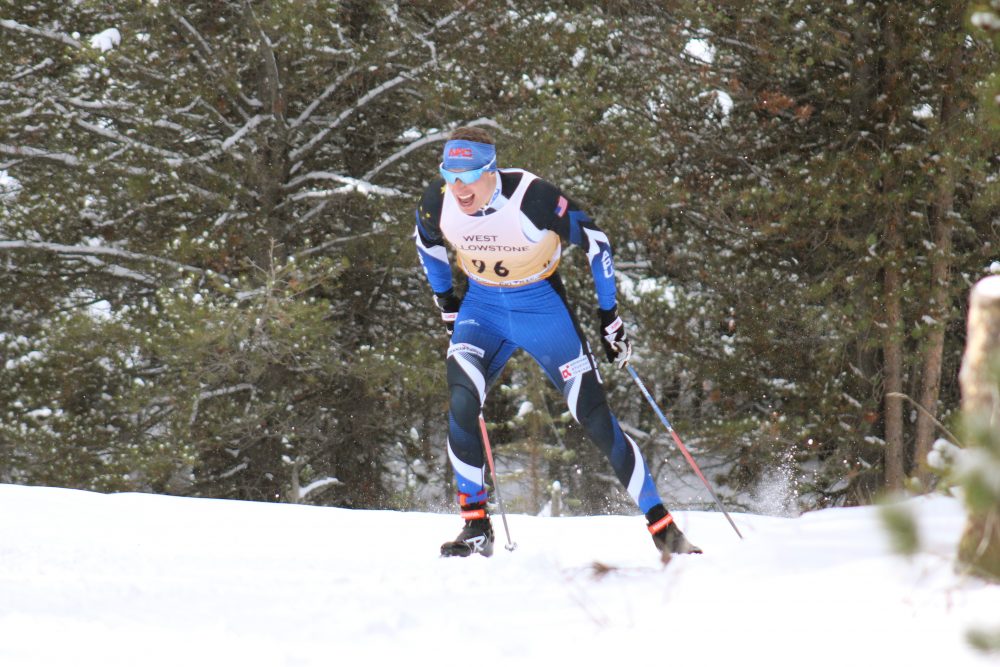
In the men’s race, Bratrud edged Rogan Brown (SVSEF) by 0.6 seconds with a winning time of 21:32.0. Sun Valley had two on the podium and three in the top four with Kevin Bolger in third (+3.7) and John “Jack” Hegman in fourth (+8.7). Karsten Hokanson, a Montana State University junior, placed fifth (+12.2), Brian Gregg (Team Gregg) was sixth (+15.5), Akeo Maifeld-Carucci (Bend Endurance Academy) seventh (+22.9), Ben Lustgarten (CGRP) eighth (+30.3), Cole Morgan (SVSEF) ninth (+32.8), and Silas Talbot (BSF) 10th (+37.8) out of 49 men.
Prepaid trail passes are available October 15-31, 2017 for the Yellowstone Ski Festival. Passes are valid from November 1-30, 2017. Passes can be purchased through the mail or online.
To purchase:
Discounted passes for the month of November are available now. Regularly $55 each, these passes can be purchased by any skier for $45 each. Skiers 10 and younger are $22. Passes purchased via mail must be paid for by check and received no later than October 31, 2017 to qualify for the special rate.
To qualify for this incentive, skiers or coaches must send the attached form containing the following information:
A complete list of skiers attending the Yellowstone Ski Festival
The exact name of the lodging establishment you will be staying in while in West Yellowstone
Your arrival date
Contact info including email and phone number
One check for all your ski passes, received no later than October 31, 2017 to:
The West Yellowstone Chamber of Commerce
ATTN: Yellowstone Ski Festival Coordinator
PO Box 458
West Yellowstone, MT 59758
Trail passes will be delivered to the front desk of your hotel prior to your arrival. Other options for pick-up are listed on the form. Please read carefully. There will be one package of passes delivered and coaches are responsible for distributing the passes to their teams. Please let your team members know that they will have to get their pass directly from you. Prepaid passes for the Rendezvous Ski Trails are non-refundable.
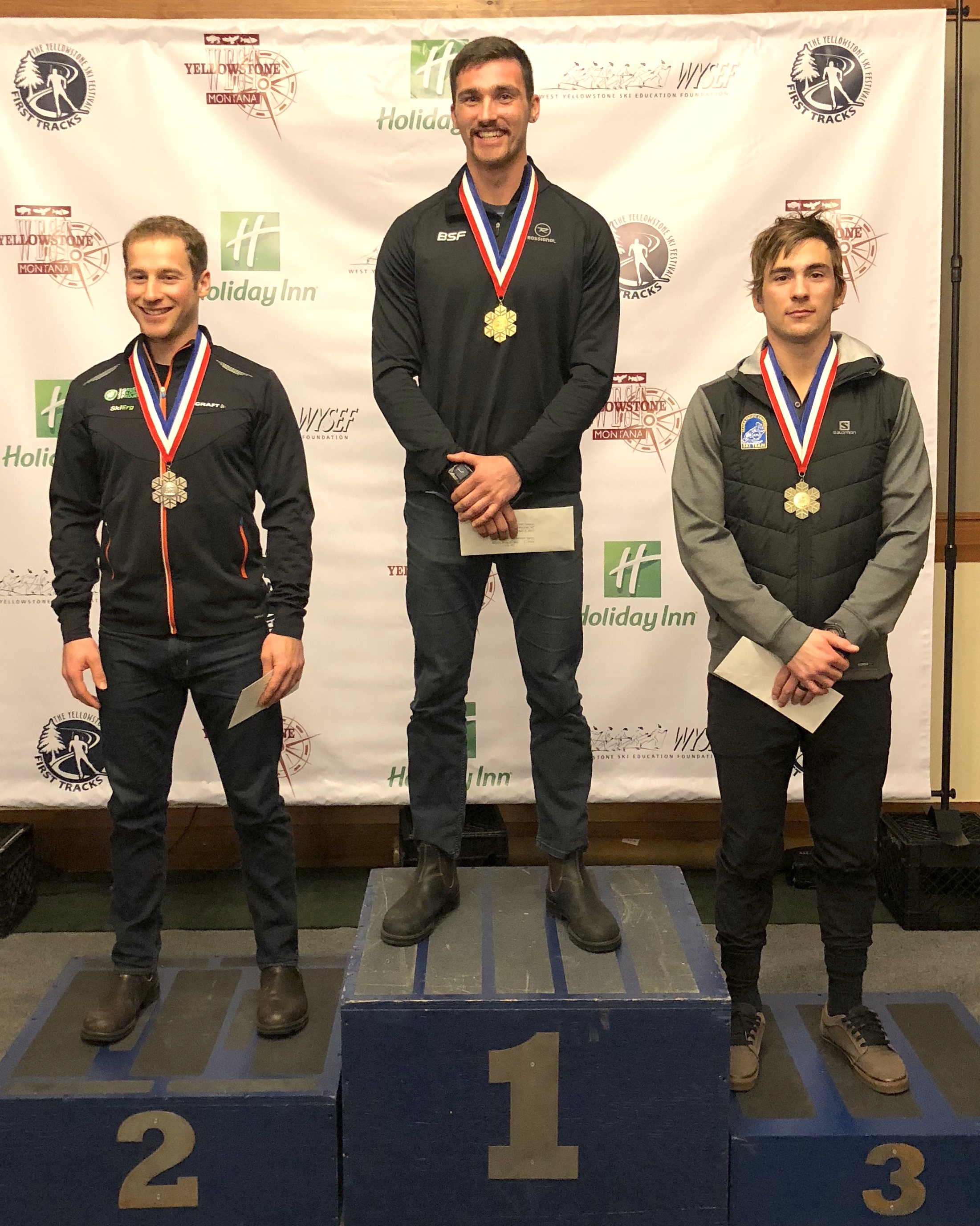
From left to right: Saturday’s third-place finisher Reese Hanneman (APU), winner Matt Gelso (SVSEF) and runner-up Tyler Kornfield (APU) on the podium at the men’s SuperTour 1.3-kilometer freestyle sprint on Saturday in West Yellowstone, Mont.
WEST YELLOWSTONE, Mont. — With a little less than a kilometer left, the pack started to panic. Saturday marked the first SuperTour sprint of the season and the gap Sun Valley Ski Education Foundation (SVSEF) Gold Team veteran Matt Gelso had put on the five other skiers in the men’s sprint final was not getting smaller.
The winner of last year’s SuperTour sprint season opener, Reese Hanneman of Alaska Pacific University (APU), saw the nearly 15-meter lead Gelso had established halfway through the 1.3-kilometer men’s freestyle sprint final heat as a sign.
Tyler Kornfield (APU) racing during the qualifier of the men’s SuperTour 1.3-kilometer freestyle sprint on Saturday in West Yellowstone, Mont.
“I was in third or fourth thinking, ‘Uh, OK, we better start closing this down,’” Hanneman said during an in-person, post-race interview.
“Basically in the final it was five sprinters and then Matt,” Hanneman said. “So I think he knew that he had to go out like … and then I think none of us thought that [Gelso] could hold it all the way. … It was really impressive skiing by him to just go for it the whole time.”
Yet, as Gelso began to climb the final hill of the course on the Rendezvous Ski Trails, he proved his gap on the other five finalists would take a strong challenge to beat. Hanneman pushed around Morgan, Saxton and Blackhorse-von Jess, while racing behind his teammate Kornfield. The two APU racers began gaining on Gelso, but not soon enough.
With 100 meters to go, Gelso, a 28-year-old SuperTour regular best known for his distance skiing, left the two sprint champions chasing, and crossed the finish line first in a time of 2:36.85 for his first SuperTour sprint win.
“I was pretty fired up,” Gelso said after. “I didn’t know going into the semifinal and final if [leading from the start] was going to still work … but I had the body and the skis to stay consistent with my plan.”
Crossing 1.94 seconds after Gelso was Kornfield, who indicated that his second-place finish was his best performance on the West Yellowstone sprint course since the start of his sprint career.
“The first year [I raced] here I didn’t even qualify,” Kornfield said after. “This is the first year I’ve moved on from the quarters…[last year] I got taken out and I took Eric Packer out too.”
“I think none of us thought that [Gelso] could hold it all the way … It was really impressive skiing by him to just go for it the whole time.”— Reese Hanneman (APU), on Matt Gelso’s sprint performance Saturday
The final podium finisher for the day was Hanneman, finishing 2.27 seconds after Gelso and 0.33 seconds out of second place.
“I didn’t feel that good in the qualifier,” Hanneman said. “I was skiing a couple gears lower than I needed to be but then I started feeling better in the heats … I think after today I’ll definitely wake up and feel a little bit better.”
The final three finishers included Saxton in fourth (+5.1), Morgan in fifth (+5.34) and Blackhorse-von Jess in sixth (+22.85).
In the women’s 1.3 k freestyle sprint, it was Jennie Bender of the Bridger Ski Foundation (BSF), who took first, besting SMST2’s Erika Flowers and Annie Hart.
Bender, 28, started the day by winning the women’s qualifier in 3:08.76, holding off Hart by three hundredths of a second.
“My goal is to do better in qualifying, and I did that today, so that was a big win for me,” Bender said. “I love this course and I hope to repeat last year, get back to Europe and race some World Cups.”
From left to right: Saturday’s third-place finisher Annie Hart (SMST2), winner Jennie Bender (BSF), and runner-up Erika Flowers (SMST2) on the podium at the women’s SuperTour 1.3-kilometer freestyle sprint in West Yellowstone, Mont.
After winning the qualifier, Bender’s course time only got faster. She won her quarterfinal in 3:08.24 and her semifinal in 3:06.86. By the time she finished the women’s final in first, she had covered the 1.3 k course in 3:04.78, almost four seconds faster than her qualifying time.
With a strong headwind challenging many of the racers who chose to lead, Bender decided in her final to follow the other finalists for the first half of the course before making her move.
“There’s a lot of wind happening so … you kind of have to play with the wind and whether or not you want to be the only one blocking it or not,” Bender said of the heats. “I led my quarter, and I was like ‘Holy sh*t, I took all the wind myself!’ so I was trying to kind of mess around with sitting behind people the next two heats, and that felt way better.”
While Bender’s plan for the final was to tuck in and conserve for the first half, then surge to the front in the second half, Hart decided to lead out of the start.
“Because we had some big headwinds [today] … the debate was whether to lead or follow,” Hart said. “I went into the rounds and decided to lead most of them, because I ski better generally when I kind of feel like I’m in control.”
Hart skied at the front of the pack up until the course’s last climb, where her teammate Flowers passed her on the right side and Bender cruised by on her left.
“I just, one, didn’t have much energy left, and two, there really wasn’t anywhere to go,” Hart said of her attempt to hold onto the lead. “I typically don’t do very well in West Yellowstone, so this year was by far the best first race I have had … I will take it.”
Jennie Bender (1) of the Bridger Ski Foundation leading her semifinal during the women’s 1.3-kilometer freestyle sprint on Saturday in West Yellowstone, Mont.
Rounding the final turn, Bender took the inside lane while Flowers remained to the far outside left. The two raced head-to-head through the final 100 meters, lunging to the line for a photo finish.
Bender was eventually awarded the win and Flowers took second by a mere 0.09 seconds. Hart crossed in third, 1.94 seconds behind Bender.
“I needed a lane, so I moved outside early and zoomed up the hill as fast as I could, and then into the finish,” Flowers said of final move up the course’s last climb. “I don’t think I quite realized I was as close to Jennie as I was until about ten feet from the finish line. It was exciting, I’ve never thought of myself as a sprinter, so it was fun to do well.”
“She was behind me the whole time until that hill,” Bender said of Flowers. “And you just save so much energy, due to headwind, so I think that helped both of us. It’s funny, we talked about it before our quarter — she was in my quarter, I was like, ‘it’s better drafting,’ and it worked out!
“I feel pretty fit compared to previous years, I would say, and I’m hoping for a good season,” Bender concluded.
Also in the final was Hannah Halvorsen of the Sugar Bowl Ski Academy and U.S. Ski Team in fourth (+2.0), APU’s Chelsea Holmes in fifth (+3.86), and University of Colorado-Boulder (CU) skier Petra Hyncicova in sixth (+4.53).
Katharine Ogden (SMS/USST) racing to an 11-second win in the women’s 5 k freestyle FIS race on Friday in West Yellowstone, Mont. (Photo: Ian Harvey/Toko)
The first official cross-country ski races of the season in the Lower 48 were held Friday in West Yellowstone, Mont., and for the first time in a long time, they weren’t U.S. SuperTour races.
But they were International Ski Federation (FIS) sanctioned and once again a big part of the West Yellowstone Ski Festival, which has been known to attract 3,500 skiers and has been an early season tradition for more than 30 years.
Paddy Caldwell, of the U.S. Ski Team’s D-team, Dartmouth College and the Stratton Mountain School (SMS) T2 Team, won the men’s 10-kilometer freestyle on Friday at the Rendezvous Ski Trails. He bested nearly 90 in the men’s race, putting down the fastest time in 20:32.4 minutes, which was 26.7 seconds ahead of runner-up Rogan Brown, of the Sun Valley Ski Education Foundation (SVSEF). Mads Strøm, a Norwegian-born University of Colorado-Boulder (CU) senior and two-time NCAA champion, placed third, 31.1 seconds behind Caldwell.
Just 0.2 seconds off the podium, Sun Valley’s Jack Hegman placed fourth (+31.3), and Ben Lustgarten, of theCraftsbury Green Racing Project (CGRP), was close behind in fifth (+32.4), as was Silas Talbot, of the Bridger Ski Foundation (BSF) Elite Team, in fifth (+37.4).
Rounding out the top 10, Karsten Hokanson (Montana State University) placed seventh (+53.6), Patrick Johnson (Far West) was eighth (+56.7), and Norway’s Petter Reistad (CU) and Welly Ramsey (Farmington Ski Club) tied for ninth (+57.6). Oscar Ivars (University of Utah) took the next spot in 11th (+1:01.5).
In the women’s 5 k freestyle, Katharine Ogden, another U.S. Ski Team (USST) D-team member who trains with SMS, took the win. She beat out CU’s Petra Hyncicova, originally from the Czech Republic, by 11.8 seconds with a winning time of 11:45. One of Ogden’s training partners, Erika Flowers (SMST2) placed third (+13.3).
Craftsbury’s Liz Guiney took fourth (+19.4), Jennie Bender (BSF) was fifth (+22.4), Mary Rose (SVSEF) sixth (+27.0), Anne Hart (SMST2) seventh (+32.8), Christina Rolandsen (CU) eighth (+34.7), Kaitlynn Miller (CGRP) ninth (+36.5), and Hannah Halvorsen (Sugar Bowl Elite Team/USST D-team) 10th (+36.8) in a tighter women’s field, which included 76 finishers.
FIS racing continues at the Rendezvous Trails on Saturday, with 5/10 k classic races scheduled.
In related news, the first SuperTour races of the season — which were supposed to take place next weekend, Dec. 3-4 — were canceled. At the top of the Bridger Ski Foundation’s SuperTour event page, it now reads: “Bozeman SuperTour Cancelled: Due to lack of snowfall the races are not able to be run.” The SuperTour opener doubled as the first races of the Canadian NorAm season as well.
Just like in the U.S., Cross Country Canada (CCC) intended to use Bozeman as part of its selection races for 2017 World Championships and the Continental Cup leader (COC) World Cup spots. Now instead of considering an athlete’s best three results out of seven race days, CCC will consider three out of five.
“Bozeman was part of our NorAm COC series selection process; however now that Bozeman is cancelled it’s not in the picture,” CCC High Performance Director Thomas Holland wrote in an email to FasterSkier on Friday night.
“Are you ready for some more West Yellowstone fun? ‘Cuz we’re hosting the SuperTour next weekend December 3 & 4,” the post read. “Saturday Freestyle Sprints, Sunday 15k/10k Classic; 5k U16 Classic. Registration site is in progress but will be on ysfraces.athlete360.com. And can you volunteer? Send us a message at info@skirunbikemt.com to give us your info. Thanks!”
“The altitude at West Yellowstone is too high to use it as a selection race for the Canadian team – will not count for the FIS COC series,” Holland wrote.
We’ll post more information as it becomes available.
SuperTour skiers won’t be starting their season at the Rendezvous Ski Trails in West Yellowstone, Mont., this November. For the first time in the Yellowstone Ski Festival’s history, SuperTour races are not on the schedule. Citing altitude and frigid temperatures, the series is starting north in Bozeman, Mont.FasterSkier previously shared a press release from the U.S. Ski & Snowboard Association (USSA) giving the where and when of the 2016/2017 SuperTour schedule for high-level domestic racing. This article provides the why – why are the season’s first races not in West Yellowstone? Why are some U.S. SuperTour races in Canada? Why are U.S. nationals returning to Soldier Hollow after just two years away? And so on. FasterSkier spoke with various members of the American cross-country ski community to help get some answers about why the country’s top skiers will be going where when this winter.
Period One: Western Swing (but no West Yellowstone)
The single most noteworthy change to this year’s schedule may be the move away from West Yellowstone for the season’s opening races. Skiers have flocked to West Yellowstone in search of early-season snow, and often raced there, for a very long time. For how long? And why the change now?
As FasterSkier previously reported, elite skiers have made the Thanksgiving-week pilgrimage to West for nearly forty years: It was 1978 when the U.S. Ski Team held its first Fall Camp there, “with then-U.S. Ski Team coach Marty Hall and skiers like Bill Koch, Dan Simoneau and Tim Caldwell. Koch didn’t come too many years after because of exercise-induced asthma, which worsened with altitude.” People kept coming back. In 2004, Fall Camp, which had long since expanded to include a range of citizen skiers from around the country, was renamed the Yellowstone Ski Festival, with a full slate of clinics, demos, and a gear expo.
So why the change? Well, here’s another number from our article on the history of early-season skiing in West Yellowstone: “6,663: Elevation of West Yellowstone. The Rendezvous Ski Trails are about 6,800 feet above sea level (2,000 meters), and the South Plateau just outside the park is about 1,000 feet higher.”
The athletes have noticed. Bill Koch evidently noticed in the early 1980s. More recently, as Alaska Pacific University (APU) skier Reese Hanneman blogged in December 2015, “For as long as I have been racing, these first two weekends of elite racing have been held in the high mountain west, at illegally high altitude (according to FIS), which always makes them a little funky.”
USSA and club coaches noticed, too. As Robert Lazzaroni, USSA’s nordic domestic program director, explained in a phone interview, the impetus to move away from opening the season in West Yellowstone “came from the club coaches when we met in Craftsbury” following last season’s SuperTour Finals in March. The decision to move elsewhere was close to a consensus, Lazzaroni said: “It was very clear that the season starts too early. It’s too early – November 23rd – to start to chase points, when we want the athletes to peak at Nationals [in early January].”
West Yellowstone, known as “West” for short, is also at altitude, Lazzaroni noted. And finally, Lazzaroni made the uncontroversial observation that “West can be very cold.”
Putting all that together, he said, it just seemed like too much to ask of the athletes: “When you ask the athletes for the first race of the season to be at full speed, and to be fit, and in a cold place – it can be too much. And it puts their season in jeopardy. The risk was too big in their [the club coaches’] mind – too early, too high and the weather can be difficult. And that’s not good that early in the season.”
Hence the move from West in late November to Bozeman in early December: later, lower, and hopefully a little warmer.
So what will be left in West Yellowstone over Thanksgiving week, without elite athletes eyeing the competition, washing their hands, and chasing SuperTour points? Quite a bit, both USSA and West Yellowstone boosters agree.
As Lazzaroni noted, it was a “bummer” to lose the SuperTour component of the Yellowstone Ski Festival, but the festival “will continue. They will still have the junior race, they will still have the Masters race. It will just not be a SuperTour. … We believe a lot of the clubs will be there, training.”
Moira Dow seemed to agree. The program director of the Yellowstone Ski Festival, Dow said on the phone that she was “disappointed” to lose out on the opportunity to host the SuperTour races, but had no hard feelings toward USSA and appreciated the need to structure a race series to support athlete development.
“We understand that the athletes have to look out for the best of their development on the national stage,” Dow said. “While we recognize that, we are disappointed. We think that having the SuperTour held in a small town of West Yellowstone is fun and exciting. So we’re disappointed, but we understand the need.”
Dow admitted that the schedule change “was a surprise” to the organizers of the Yellowstone Ski Festival.
“Going into the [USSA] Congress [in mid-May] I thought it was still up for debate,” she said.
But given “the way it was presented at Congress,” Dow continued, “the athletes made their statement – I think the schedule was decided before Congress.”
Despite the surprise, Dow underscored that she had no hard feelings, and certainly did not view the schedule change as a personal attack on her or the festival. And she emphasized that everything that citizen skiers have come to expect from West Yellowstone in Thanksgiving week – clinics, demos, etc. – will still be there, including the races: “We’ll be holding just as many races, they just won’t be designated SuperTour” races, she said.
“SuperTours are not the most important part of our festival,” concluded an upbeat Dow. “We hope to see you in West Yellowstone.”
(So will the SuperTour return to West next year? The short answer is that likely nobody knows. In August 2015, quoting then-USSA nordic manager Joey Caterinichio, we reported, “West is the perennial host for Period I and could potentially rotate with Alaska, although, ‘there is no intention of changing West Yellowstone,’ according to Caterinichio.” That obviously didn’t last long. As Dow said when asked about her plans for November 2017, “we’re waiting to see – it changes from year to year.” She added, reflecting the development of this year’s schedule, “we find out in May what the athletes are looking to do to help put them on the national stage,” and then respond to that.)
An early December morning at the Sovereign Lake Nordic Centre in Vernon, B.C.
So the opening SuperTour weekend will be in Bozeman, Mont., starting with a skate sprint on Saturday, Dec. 3. A 10/15 kilometer classic individual start follows on Dec. 4. It will be a short week before athletes return to action with a classic sprint at Sovereign Lake in Vernon, British Columbia, on the evening of Friday, Dec. 9, with another short turnaround before 10/15 k skate interval starts the next day. (A relay that is not scored for SuperTour points will be held at the same venue on Sunday.)
If the move away from West Yellowstone was the first thing that struck many skiers about this year’s schedule, the move across the border was probably the second thing of note. The races in Silver Star will be a joint SuperTour/NorAm weekend (that is, they will be held together with the Canadian high-level domestic race series), an arrangement that has occurred in the past but not for some time. Ski representatives from both countries – which are identified as “children of a common mother” in the inscription on the Peace Arch at the border crossing between Blaine, Wash., and Surrey, B.C. – agree that the cooperation is welcome.
As Cross Country Canada (CCC) High Performance Director Tom Holland said on the phone earlier this summer, “We had a couple of phone meetings this year and there’s a willingness to work more together on a NorAm/SuperTour. Why not? To have more of these North-South relationships in the East and the West so people don’t have to travel so far. We’re sort of repeating history here. We’ve wanted to do this, but we did a lot of it in the ’90s, if you look at the results there were some great races back then. So it’s kind of a common-sense thing to have a North American race circuit where we compete against each other. We went down to West Yellowstone the last couple of years. It would be nice if there was more than that one weekend, but the U.S. has some other commitments in December. It would be nice if we had three or four weekends. The Euros ski more than us before Christmas, so the more we do the better.”
Holland continued, “We have those races every year anyway. It’s more about getting a high level of competition so we’re competing against the best in each nation and get warmed up for the season. There’s lots of examples of it working in the past, but it sort of faded as the SuperTour got stronger at one point. Anyway, we’re totally committed, and the U.S. is making a commitment, and we’re happy about U23/World Juniors being down there. So we’re going to do our trials down there. There’s a lot of cross-border stuff going on this year. I hope that sets a good tone for the future.”
Lazzaroni concurred, explaining that USSA wanted to hold consecutive race weekends relatively close together in order to make transportation somewhat easier. He also said they were pleased to combine with Canada in order to create a larger and more competitive field. Lazzaroni said that he hoped to have more joint SuperTour/NorAm weekends in the future.
Period Two: SoHo and Truckee
Athletes and coaches test skis in the stadium at Soldier Hollow in Midway, Utah, at 2014 U.S. Cross Country Championships.
Athletes will have nearly a month off before racing resumes with U.S. Cross Country Championships in January at Soldier Hollow in Midway, Utah. There is a 10/15 k skate individual start on Jan. 7, a full classic sprint the next day, and a 20/30 k classic mass start on Jan. 10. A qualification-only skate sprint event rounds out the week on Jan. 12.
U.S. nationals visited Soldier Hollow fairly recently. The races were held there in 2013 and 2014, before moving to Michigan’s Upper Peninsula for 2015 and 2016. The move back to Utah after only two years away is atypical.
The “main reason” for the quick return to Soldier Hollow, Lazzaroni said, “is because of World Juniors.”
The U23/Junior World Championships will be held at Soldier Hollow from Jan. 30 to Feb. 5, 2017, and will include roughly 750 athletes from dozens of nations. Some of those athletes will be junior and U23 skiers from the U.S., and Lazzaroni said that USSA wants to provide American skiers with a home-field advantage: “It was very important to us to bring the Championships back to the U.S., to show our commitment to FIS, and also to provide our athletes home-field advantage.” Lazzaroni explained that the best way to give American athletes this advantage was to give them an additional chance to race at Soldier Hollow in advance of the championships.
Therefore, Lazzaroni explained, USSA did not look back to the last time when U.S. nationals were held at Soldier Hollow in setting this year’s schedule. Rather, they looked forward, asking how best to prepare American athletes for Junior Worlds. And the answer was to let them race at Soldier Hollow in January before – for some skiers – racing there again in February.
But there will be something missing from this year’s edition of U.S. nationals: a national championship skate sprint. Instead, in the 2016/2017 season only, the national championship skate sprint will be held at the season-ending SuperTour Finals, as part of a race series colloquially known as Spring Series.
This schedule change, Lazzaroni explained, is due to the overall load on the Soldier Hollow volunteers and local community. It is “asking a lot of the venue” to hold both U.S. nationals and Junior Worlds at Soldier Hollow within the same month, Lazzaroni said. Among other inconveniences, he noted that there is an elementary school at Soldier Hollow, which also serves as the timing building and race headquarters, that has to be shut down when high-level races are held. Lazzaroni said that the local community was unable to commit to a full U.S. nationals schedule, including a full skate sprint day, on top of its other hosting obligations.
A quarterfinal in the freestyle sprint at 2013 U.S. nationals at Soldier Hollow in Midway, Utah. There will be no heats at this year’s national skate sprint; a qualification-only skate sprint will be held instead.The initial solution was just to take away the sprint race, moving U.S. nationals week from four races down to three. But, Lazzaroni said, this created a problem from the perspective of U.S. Ski Team Head Coach Chris Grover, who needs to oversee the selection of the U.S. team for the 2017 World Championships in Lahti, Finland, later this winter.
The races in Lahti include an individual skate sprint and a team classic sprint. The first half of the SuperTour schedule includes two classic sprints, but only one skate sprint.
The compromise, Lazzaroni explained, was a qualification-only skate sprint event at Soldier Hollow on Jan. 12. This was acceptable to Soldier Hollow event organizers and volunteers. And, Lazzaroni states, he feels that this “was a good compromise.” This way, “Grover can still have a qualification to make sure he has the best skiers to go to Lahti, and we don’t burn out the skiers and volunteers at Soldier Hollow.” The result will be a qualification-only skate sprint day, with no rounds contested. Results from the qualification will be used for purposes of qualifying for the U.S. World Championships team, but will not be scored for SuperTour points.
Following the skate-sprint qualification event, athletes have nine days off before racing on the Auburn, Calif., trail system in late January. A classic sprint will be held on Jan. 21, and a 5/10 k skate individual start on Jan. 22.
Period Three: Why not Ishpeming?
Roughly a month later, the SuperTour resumes with two races in Ishpeming, Mich., about 15 miles outside of Marquette on the state’s Upper Peninsula. There will be a skate sprint on Friday, Feb. 17, and a 5/10 k classic individual start on Sunday. (A 15/20 k mass start skate race, which will be a FIS-sanctioned collegiate race but will not be scored for SuperTour points, will be held on Saturday.) The race weekend will be held in conjunction with the NCAA Central Region Championships hosted by Northern Michigan University.
Al Quaal Recreation Area (Photo: Travelmarquettemichigan.com)The trails at Ishpeming’s Al Quaal Recreation Area last hosted a FIS event in February 2016. Before that, the previous and only entry for Ishpeming in the FIS results database is for a race weekend in February 1993. Suffice to say that it’s been a while.
So why Ishpeming? As Lazzaroni explained, repeating part of a reporter’s question, “You say, ‘Why Ishpeming?’ I would say, ‘Why not Ishpeming?’ ”
He said USSA attempts to rotate the SuperTour sites within the regions each year, and that this year the mid-season races are coming to the Midwest. It also recognized that the American Birkebeiner is held in the Midwest in late February, so there is an incentive to keep the SuperTour in the area. And Theodore Wirth Park in Minneapolis is undergoing construction work at present, and so was unable to host SuperTour races this year.
Lazzaroni explained that USSA was looking for a venue that could host SuperTour races for two weekends in a row, but was unable to find any venue that would take on this commitment. He said that they were pleased to get a taker for just one weekend in Ishpeming (population approximately 6,500), which has newly homologated trails and was eager to show them off. When the discussion was opened regarding bringing the SuperTour to the Midwest, Lazzaroni said, Ishpeming jumped on board.
“They have a long tradition of nordic skiing,” Lazzaroni noted, adding that Ishpeming was hosting cross-country races as early as 1905. The National Ski Association of America, a group that would later become the modern-day USSA, was founded in Ishpeming that same year.
Although last year’s Birkie was only scored for half SuperTour points, USSA has since revisited this assumption. At this year’s working group for the SuperTour schedule, Lazzaroni explained, they opened the question of whether the Birkie should count for full points or half points. Although some people had argued over the past few years that the Birkie should count for only half points, because it is often not a “normal” race distance, he clarified that the USSA Nordic Competition Guide makes “no mention that it should be half points.” Accordingly, USSA opted to follow the Comp Guide and restore the Birkie to full-points status.
Something less than a full SuperTour field typically races the Birkie; there were 17 American skiers with FIS points in the men’s elite race last year, and nine in the women’s.
Period Four: Spring Series in the Golden Heart City
A month after the Birkie, racers will travel north to end the season at Spring Series in Fairbanks, Alaska. Races will be held every other day over a week-long period from March 27 to April 2. A skiathlon, a skate sprint, a mixed club relay, and a 30/50 k mass start skate race are on the calendar. With a full skate sprint not being held at U.S. nationals in January, all events save the skiathlon will be national championship races.
Longtime Fairbanks race director John Estle is already excited. In an email to FasterSkier, Estle explained that the races will be held on a series of newly homologated and re-homologated courses at Fairbanks ski area Birch Hill. He noted that the new men’s sprint course will be “between 1500 and 1600m, which seems to be the preferred distance for sprint courses. Guys seem to like them to be about 3:30 in duration.” The women’s course will be “just a bit shorter than the men’s course.”
A 2012 photo from the trails at Birch Hill in Fairbanks, Alaska. (Photo: Lauren Fritz)After explaining the combinations of homologated loops that will be used for the various races, particularly the 30 and 50 k races on the last day of the season, Estle concluded, “The courses for those races will be quite challenging.”
Of the four races at Spring Series the skiathlon stands out, for its presence as well as its non-canonical distance. The suggestion on the official schedule that the distances will be 14 k for the women and 24 k for the men is apparently not quite accurate. Rather, Estle wrote, the distances will be 15 k and 22.5 k, respectively. “That is because we will have two homologated 3.75Km courses, one for the classic leg and one for the skating leg. Two laps of each course for women, three laps of each course for men” comes to 15 k and 22.5 k.
Estle is well aware that, at the Olympic Games or World Ski Championships level, women typically race a 15 k skiathlon and men a 30 k. “But most of the feedback I got from coaches and athletes was that at the end of a long, long World Cup season 30Km would just be too much,” Estle wrote. “At the World Cup finals in Canmore last year they did a 30Km skiathlon on a 3.75Km course and a large chunk of the field was pulled from the race (and hence the tour) after getting lapped. That was on a really tough course on a really warm day, but still. Those were damned good skiers, and they were completely shot at the end of that race.” So 15 k and 22.5 k it is.
A skiathlon, over any distance, is a rare event at the SuperTour level. Estle recalled hosting skiathlons in Fairbanks in both 2008 and 2009, but it is unclear whether they have occurred in this country at the highest levels of domestic competition since then. (The races are often entered in the FIS database as “pursuit” rather than “skiathlon” when they are held in this country, making it difficult to search for them. They are held more broadly at the high school and citizen racer levels.)
Skiathlons may be uncommon at this level of competition, but there seems to be widespread agreement that there should be more of them.
As Estle wrote, speaking as a race director, “One of the reasons that we are doing a skiathlon is that nobody ever does them in the US. … A skier’s first experience in a format contested at the World Championships should not be at those championships: Junior WC or U23 WC. If we are thinking about developing skiers who can compete at the highest levels, and coaches who can support them, then we need to make sure that our domestic schedule (FIS or otherwise) provides the types of experiences that will prepare them for the next highest levels of competition. Our skiers need a broad spectrum of experiences, and right now, because there are very few, if any, skiathlons on the domestic schedule, we are not preparing those skiers as well as we could or should.”
Lazzaroni sounded similar notes on behalf of USSA, saying that the skiathlon is contested at various international championships, and “why not prepare our athletes for that?” Echoing Estle, he noted that athletes reported back from the most recent World Junior Championships that they had never done a skiathlon before, “And that’s not right.” Lazzaroni said that he wouldn’t expect to see “many, many more [skiathlons] in the future” – but he added, “my vision is that, yes, we should train our skiers to be better at skiathlon, to be better prepared to do skiathlon.”
U.S. Ski Team Women’s Coach Matt Whitcomb was in complete accord, telling FasterSkier in a recent interview, “It’s often that at the junior and even U23 level when we go internationally, that we’re scrambling last-minute to find skiathlon boots, or to teach athletes how to load an exchange zone and what the rules are. So we’ll consider this just a quick dose of education for our entire community, and I think it’s going to have a big effect.”
The athletes seem to agree as well. Lex Treinen of APU, a top domestic athlete who has recorded SuperTour podiums but has not yet raced on the World Cup (which sees a handful of skiathlons each year), wrote in an email that he had done a skiathlon in Fairbanks some years ago – but that otherwise, “I have just done a couple at World Juniors and U23s.”
As Treinen explained, “Skiathlons are great and there is a good reason that they don’t do them very often on the Supertour: they are a pain in the ass logistically … for coaches and athletes and as the APU SuperTour team operates right now, we would not have the resources to wax for a skiathlon very effectively most of the season. Fairbanks will surely be an exception, since #1 it is closer to home and #2 it is Nationals which means there is a little bit of extra tech support from our team. Either way I don’t have a doubt that the fittest person will win this March and I really think it is a positive thing to be able to race some new formats. I am very excited that the Fairbanks organizers have decided to do something novel.”
Annie Pokorny, of the Sun Valley Ski Education Foundation (SVSEF) Gold Team, expressed similar sentiments. “The only skiathlons I’ve raced were at U23 World Champs, one in the Czech Republic and one in Italy,” Pokorny wrote in an email. “Despite my slim experience, however, I was incredibly excited to hear that USSA had integrated the skiathlon into domestic racing.”
Pokorny wrote that, “While it will certainly take some adjustment, I am always excited to see a diversified schedule on the SuperTour circuit. The more events we have, the more opportunities there are for varied competition and exposure to certain skills that our World Cup brethren see on a regular basis. Personally, the skiathlon is one of the most fun and exciting races I’ve ever entered. Having a switch in technique changes the rules of the game so there are more chances for comebacks than in a traditional mass start.”
When asked whether she was going to do anything special to prepare for this addition to the schedule, Pokorny wrote, “Few people know this, but in my first skiathlon I literally had the slowest transition time in the world, by many seconds. I don’t think I’ll need to change training much to be ready for the racing part, but it would be in my best interest to spend some time skiing while taking on and off my poles.” (Pokorny, who finished 29th in that race, is correct that her transition time ranked 48th out of 48 skiers.)
Looking to the future: Cross-country ski cross?
While this year’s SuperTour aims at selecting the U.S. team for Lahti and assigning start rights for upcoming World Cup events, USSA is also looking toward the future. And to hear Lazzaroni tell it, the future may involve cross-country ski cross.
Hannah Halvorsen (Far West/Sugar Bowl Academy) qualified 10th in the first-ever Cross-Country Cross event at the 2016 Youth Olympic Games in Lillehammer, Norway. (Photo: Far West/Facebook)“The cross-country cross has been a big success at the Youth Olympic Games in Lillehammer this winter,” he said. “It’s a format that the TV likes, the athletes like, that everybody likes. … I do hear from FIS that this is a format they want to push forward. We don’t know yet where it is going to go, but this is something we are keeping our eyes open [for], and I would not be surprised if you will see cross-country cross at some of the national events in the near future.”
Lazzaroni clarified that, by “near future,” he does not mean right away – “Obviously not next winter.” He added that this could become an important event to prepare U.S. athletes for larger stages: “Again, if this is going to be an event at World Juniors down the road – in two, three, four, five years, I don’t know – at Olympics, down the road – we should prepare our kids. And we have this discussion at Congress with the club coaches at a younger age, and we did encourage them to put some cross-country cross events at the local races. And again, the kids love it, because it’s fun. It’s working on agility, and it’s working on balance, and they become better skiers. It’s not now on the calendar, but I wouldn’t be surprised if in the near future we see more and more of this type of events.”
Brian Gregg (Team Gregg/Madshus) (r) leads University of Colorado’s Mads Strøm during the last lap of the men’s SuperTour 15 k freestyle on Saturday in West Yellowstone, Mont. Gregg went on to win it by 5.5 seconds over training partner and friend Matt Liebsch (not shown).
Mads Strøm (University of Colorado-Boulder) leads Brian Gregg (Team Gregg/Madshus) at one point of the men’s SuperTour 15 k freestyle on Saturday in West Yellowstone, Mont. The two switched leads throughout the race; Gregg won and Strøm finished fourth.
Canadian Kevin Sandau (r) racing to a fifth-place finish in the SuperTour 15 k skate on Saturday in West Yellowstone, Mont. Here he’s seen leading fellow Alberta World Cup Academy teammate and sixth-place finisher, Knute Johnsgaard an Tad Elliott of Ski & Snowboard Club Vail.
Lustgarten (SVSEF) captures seventh, 37.7 seconds back from race leader Gregg, during the men’s SuperTour 15 k freestyle on Saturday in West Yellowstone, Mont.
One final time up the coach’s climb for Rogan Brown (SVSEF) during the men’s SuperTour 15 k freestyle on Saturday in West Yellowstone, Mont. Brown went on to place eighth overall, 52.2 seconds back from race leader Gregg.
In reverse start order, Matt Gelso (SVSEF) (r), leads Eric Packer (APU) (center), and Nick Hendrickson (University of Utah) during lap two of the men’s SuperTour 15 k freestyle on Saturday in West Yellowstone, Mont. Gelso went on to finish ninth overall, 53.5 seconds back from the race winner Gregg.
Lex Treinen (APU) chases a group during his second lap in the men’s SuperTour 15 k freestyle on Saturday in West Yellowstone, Mont. Treinen went on to place 10th overall, 1.04.1 back from race winner Gregg.
WEST YELLOWSTONE, Mont. — An athlete is often only as good as his or her training partner. Such was the case for the Hanneman brothers as seen in Friday’s SuperTour sprint and again on Saturday during the men’s SuperTour 15-kilometer freestyle individual start at the Rendezvous Ski Trails.
This time, however, the one-two podium pair belonged to good friends and Twin Cities training partners, Brian Gregg (Team Gregg/Madshus) and Matt Liebsch (Gear West/Salomon).
“Matt and I train a lot together back in the Twin Cities,” said Gregg, the 15 k winner by 5.5 seconds in 35:25.1. “We do a lot of intervals and time trials together.”
While the two share no blood relation, they do share a breadth of respect for each other.
“[I’m] super impressed with Matt because he also has a full-time job and three kids,” said 31-year-old Gregg.
“Maybe that’s something Caitlin and I need to start on,” he added. Gregg’s wife, Caitlin, was named to the U.S. Ski Team this year after taking bronze at 2015 World Championships in the 10 k freestyle.
Matt Liebsch (Gear West/Salomon) races to second during the SuperTour 15 k freestyle on Saturday in West Yellowstone, Mont.
Liebsch, 32, was equally excited for his buddy’s overall win.
“I’m hoping he can get SuperTour Leader so he can get [race] start rights over in Europe [and] go see his wife,” Liebsch said.
The overall U.S. male and female leaders at the end of two SuperTour weekends will earn a trip to Europe after U.S. nationals in January to start World Cups in Period 2. Gregg put himself in that position two years ago leading up to the 2014 Sochi Olympics.
For Gregg and Liebsch, their close training over the years translated into a close finish in Saturday’s distance race, despite starting more than 9 minutes apart. Liebsch started 16th; Gregg went out 53rd.
Gregg skied much of his race with the man who started 15 seconds ahead of him, Mads Strøm of the University of Colorado-Boulder. Strøm went on to place fourth, 14 seconds behind Gregg and 0.7 seconds back from Scott Patterson (Alaska Pacific University) in third.
“[My start was] definitely a lot faster than I’ve gone out in the past,” Gregg said. “In the past, I’ve probably been 15 seconds down to the leaders at the top of the coach’s climb. This year I was right even with [the leaders].”
Gregg believed his uncharacteristic charge out of the start gate was the right call.
“It was nice, because I’d make a big pull, then I’d get tired, then Mads would pull, then he’d get tired, and we sort of switched off leading a little bit,” he said.
While Strøm and Gregg jostled throughout the race, Patterson spent much of his race solo.
“The only time I really had a group was when people were behind me,” Patterson said.
“Oscar Friedman [of Dartmouth] skied with me for two laps,” he added. “It’s nice to have someone on your heels, but not quite as good as trading off the lead.”
Friedman went on to place 13th. During the race, Patterson heard he was in contention.
Scott Patterson of APU leads Dartmouth’s Oscar Friedman during the men’s 15 k skate SuperTour race in West Yellowstone, Mont.
“I was getting some splits early on that I was leading Matt Liebsch,” he said. “I was a little bit disappointed they got me in the end.”
This being the first time Patterson has ever raced in West Yellowstone, the 23-year-old Alaska native called it a solid start to his season.
“Last fall I had a fairly significant injury and that’s what kept me away from these races,” Patterson said. “But I knew a I had a good summer training and a good fall [this year] and I was definitely going in looking for a spot on the podium.”
Rounding out the men’s top five after Strøm in fourth (+14.0) was Canada’s Kevin Sandau of the Alberta World Cup Academy (AWCA) in fifth (+20.2). Sandau’s teammate Knute Johnsgaard was sixth (+34.5), and Sun Valley took the next three places with Ben Lustgarten in seventh (+37.7), Rogan Brown in eighth (+52.5) and Matt Gelso in ninth (+53.5). Lex Treinen (APU) was 10th (+1:04.1)
While Patterson plans to race next weekend’s SuperTour races in Sun Valley, Idaho, Liebsch and Gregg said they were undecided.
“I’m supposed to be working next weekend, so I don’t know we’ll see,” said Liebsch, who manages Gear West nordic sales and service. “I’m probably going to go home and train and go to nationals and do the distance races and just see how things go there.”
Gregg, on the other hand, will either plan to race the SuperTour weekend or take advantage of the altitude training in Sun Valley instead.
Regardless of what happens next weekend, Gregg and Liebsch were grateful for being able to train together and contribute to each other’s success.
“Brian drags me out of bed a lot of mornings to do intervals,” Liebsch said. “We’re literally the same speed in most workouts so, it’s cool to be right around him [in races].”
BSF Elite athlete Jennie Bender crushes the final during Friday’s SuperTour 1.3 k skate sprint in West Yellowstone, Mont.
Jennie Bender (BSF) dominated the first SuperTour of the season on Friday with a sizable victory in the 1.3 k freestyle sprint in West Yellowstone, Mont. (Photo: Bryan Fish/USSA)
Hannah Halvorsen (Sugar Bowl Academy) racing to qualify third in the West Yellowstone SuperTour skate sprint. Halvorsen went on to place second in the final.
The University of Colorado’s Petra Hyncicova qualified 12th in the West Yellowstone SuperTour skate sprint on Friday. She went on to place fifth in the final.
Petra Hyncicova (r) leads Hannah Halvorsen, Cambria McDermott and Caitlin Patterson in the semifinal of the SuperTour skate sprint on Friday in West Yellowstone, Mont.
WEST YELLOWSTONE, Mont.– After a day of skate sprinting on Friday in West Yellowstone, Bridger Ski Foundation (BSF) Elite Team member Jennie Bender stood as the fastest woman around the 1.3-kilometer course at the Rendezvous Ski Trails.
“Jennie was just in a class of her own today. I don’t think anyone could have beat her,” said Canadian third-place finisher, Dahria Beatty of the Alberta World Cup Academy and U23 national development team.
The lone woman to consistently finish first, starting with the qualifier and ending with the final, Bender positioned herself as the woman to beat in the first SuperTour race of the 2015/2016 season.
“I’ve really been working this year on getting a faster qualifier, so I was pretty stoked about my results there,” Bender said after the race.
After winning the qualifier in 2:59.26, 2.44 seconds ahead of Canada’s Jenn Jackson (Thunder Bay National Development Centre), who was the next fastest woman, Bender only got quicker.
“The conditions definitely got faster going into the rounds” said Bender, improving her course time to 2:54.42 in the quarter final, and 2:51.32 in the semi.
Sub-zero temperatures in West Yellowstone resulted in a two hour delay for Friday’s sprint race and slower conditions early on.
With warmer temps into the afternoon, Bender continued to bring the heat through the rounds.
“I usually come alive in the heats. I really like the head-to-head,” the 27-year-old Johnson, Vt., native said with a smile. “It’s a good power course, which was perfect for me.”
BSF elite athlete and bib No. 1, Jennie Bender fist bumps her coach Bernie Nelson before the start of the women’s SuperTour sprint final on Friday in West Yellowstone, Mont. Bender went on to win the final for the first SuperTour victory of the season.
Along with feeling powerful throughout the day, Bender’s tactical race was particularly on.
“Especially with the turns [on course], you don’t want to necessarily be first, but you can’t be far back or else you get dusted,” she explained.
For Bender, this at times meant staying relaxed while letting others lead.
Beatty explained she led their semifinal until the last climb, where Bender passed her on the first corner before it.
“She was just skiing so fast today. It was a fight to stay with her,” Beatty said.
In the final, Bender again chose to stay relaxed and tucked in behind Halverson for the first half of the course. “You can tuck in behind someone and save some energy on those first two downhills,” said Bender during a second in-person interview.
“Hannah lead [the final] and I was second for a while just trying to keep it cool and stay smooth and relaxed until the last half or third of the course” she added.
With a little over the first half of the final completed, Bender decided to make her move in the last third of the course.
“Going around the S-turns I put myself into position and then gunned it a few turns before the last hill,” said Bender.
Finishing close to 50-meters ahead of her sprint final competitors, Bender believed she closed her sprint race stronger than ever before.
“I felt like I was able to punch it harder and sooner than I’ve been able to in the past,” Bender said.
Bender’s impressive performance came, in her eyes, as a prime start to the race season.
“You go into the season and you never really know what picture you’re going to paint,” she said. “So I’m stoked on how things were drawn today.”
The runner-up in the final, 17-year-old Hannah Halvorsen (Sugar Bowl Academy) was pleased with the opening to her season, despite not knowing how her first race would go.
“I went into the qualifier not really knowing what to expect,” she said. “I put in a big week of training — about 22 hours –and that’s a big week for me.
“I felt a little flat [in the qualifier], but I knew I skied smart and hard,” Halvorsen added. She qualified third, 3.73 seconds behind Bender. “When I saw where I was in the qualifier, I decided to just stay as smooth and relaxed as possible and take the heats one by one.”
During her semifinal, Halvorsen edged out Czech and University of Colorado-Boulder skier Petra Hyncicova for first.
“It was tight,” Halvorsen recalled. “I knew that I just needed to stay in second [to advance] so I was working with her. I saw it as an advantage because she was pushing me.”
Hyncicova also advanced in second and went on to place fifth in the final.
Hannah Halvorsen (r) of the Sugar Bowl Ski Academy checks the women’s SuperTour sprint qualifier results on Friday in West Yellowstone. Halvorsen qualified third and went on to place second overall.
Despite her age, Halvorsen showed her experience during and between the rounds.
“I’m the kind of person who wears two down jackets. I’m [also] wearing two pairs of gloves, two buffs, and two pairs of pants. So I double up,” she said.
With second place under her belt, Halvorsen said she’s excited about this season.
“I’m really looking forward to trying to qualify to race in Europe this winter,” she said. “[Today] I was just having a good time with the big girls.”
After starting first in the qualifier, Beatty, 21, ended the day with a podium.
“I was bib number one this morning, which was a new experience for me,” she said.
With no one in front of her, Beatty accidentally started 15 seconds early during the women’s qualifier. “As I went, the [official] and I both realized that we were 15 seconds early, so when I got to the end of the 10-meter double pole [zone] I stopped and turned around,” she said.
Unsure whether or not she was going to be disqualified, Beatty stood waiting near the start until spectators told her to ski.
“I was backwards on the course standing still, looking at the starter like, ‘Uh oh, am I going to be disqualified? What’s going to happen?’ and then eventually everyone on the side was just yelling at me to keep skiing so I turned around and kept skiing,” she said.
Despite a rough start, Beatty qualified 25th, good enough to advance to the rounds and ultimately, the final.
“Skiing in the final was my goal,” she said. “I was hoping to get all four races in.”
While she accomplished her goal, Beatty explained it wasn’t easy.
“On this course, if you’re not in the top two, it’s tough to get around anyone,” she said. “[In] the final I didn’t get out to quite a good start and I knew as soon as I started that that was dangerous and I’d have to fight pretty hard to have a chance to be on the podium.”
Dahria Beatty of the Alberta World Cup Academy racing to third finish during Friday’s SuperTour freestyle sprint in West Yellowstone, Mont. Chelsea Holmes (r) of APU finished fourth.
However, with proper maneuvering, Beatty managed to finish third behind Bender and Halvorsen.
“[There’s] lots of contact with all those corners, which I think all us North Americans lack in our racing when we go to Europe,” Beatty explained of the competitive final.
“On the final corner, Hannah and Chelsea had the inside lines. Since they were still in front, I had to go wide to try to pass,” she clarified in an email.
“For most of the final, I was fourth or fifth. Then in the finish chute I was able to pull into third on the far outside,” Beatty said.
“Hannah did such a good job of getting herself into position early and securing that front spot. It was great to see her finish [in] second.”
Also in the final, Chelsea Holmes (Alaska Pacific University) finished fourth, Hyncicova was fifth, and Cambria McDermott (Montana State University) placed sixth.
Overall, many of the top women felt the race was a good start to the season.
In the words of Bender, “The season is just beginning and I’m just warming up.”
An SMST2 Junior athlete looks on before a speed session on Thursday at the Yellowstone Ski Festival. The U.S. SuperTour season starts Friday with the freestyle sprint in West Yellowstone.
WEST YELLOWSTONE, Mont. — The 2015/2016 season for the U.S. SuperTour, the highest level of domestic nordic racing in the country, kicks off Friday with a 1.3-kilometer skate sprint at the Rendezvous Ski Trails in West Yellowstone, Mont.
Originally scheduled for a 9 a.m. start, the organizers recently decided to start the sprint qualifier at 11 a.m. due to predicted sub-zero temps. While changes in start time can sometimes throw a wrench in to waxing and ski preparation plans, that’s unlikely to be the case tomorrow, as the snow conditions in West have been consistent, even as temperatures rise throughout the day.
Sun Valley Ski Education Foundation (SVSEF) Gold Team coach Colin Rodgers had a simple-enough solution: “Wear your wind briefs!” he advised.
APU wax techs test skis on Thursday at the start of the sprint course at the Rendezvous Ski Trails in West Yellowstone, Mont.
The start list includes 104 women and 154 men, including nearly all of the big names on the domestic race circuit. Much of the field is made up of the usual talents from U.S. elite programs such as the SVSEF Gold Team, Alaska Pacific University, Central Cross Country (CXC) Team, Stratton Mountain School (SMS) T2 Team, Craftsbury Green Racing Project, Bridger Ski Foundation Elite Team, Sugar Bowl Elite Team, Team Gregg, Ski Club Vail, Gear West, and Bend Endurance Academy.
There are always nerves and a bit of uncertainty, even among the stars of the elite scene before these first races of the season. Athletes have spent the summer working on their weaknesses and tweaking their plans, but until they put a bib on in West Yellowstone — where the SuperTour circuit starts each year — the result of all that hard work is an unknown.
Jennie Bender of the Bridger Ski Foundation (BSF) Elite Team, a two-time sprint national champion and SuperTour podium regular, is excited.
“This summer has been the first in quite some time that’s felt consistent and uninterrupted, so I am pumped for the season and to travel with my stellar BSF crew,” said Bender, 27.
Alaska Pacific University (APU) standout and the overall SuperTour leader two seasons ago, Reese Hanneman is looking for some redemption on the trails, but keeping the pressure low. He told FasterSkier that he’s “feeling pretty good, but after last season and so many bad races, I’m just looking forward to getting out there and feeling fast again and rippin!”
2014 Olympian Brian Gregg, of Team Gregg, is also feeling prepared, while also curious.
“I’m excited to see how everyone’s summer training stacks up,” Gregg said.
In addition to these athletes, many of whom compete on the SuperTour circuit throughout the four-month-long season, there are three distinct groups of SuperTour outsiders in West Yellowstone looking to mix things up. They are:
The Canadians: Some years, there is a strong Canadian presence here in West Yellowstone, and this is certainly shaping up to be one of those years. With nine elite Canadians from various national training centers on Friday’s start list, including women’s top-seed Dahria Beatty of the Alberta World Cup Academy and three of the top-five ranked men, the Canadians will certainly be vying for spots in the A-finals.
The Collegiates: The NCAA schedule is, for the most part, totally separate from the SuperTour schedule. Generally, these two groups of elite skiers meet up for head-to-head competition only once or twice per year. West Yellowstone is one of those meetings.
As Montana State Head Coach Matt Johnson points out, “Our athletes aren’t focused on sprinting, and they aren’t focused on peaking this early,” as there is no sprint format in NCAA racing, and NCAA Championships aren’t until March.
But, he adds, “a lot of our skiers are good sprinters and in great shape right now, and are excited to get out there and see what they can do.” College skiers tend to be a mix of elite European racers in the U.S. skiing on scholarship at the large NCAA Division 1 schools (Utah, Colorado, Denver, Vermont, New Mexico, Montana, etc.) and many of the best young Americans, pursuing their ski careers in tandem with their education. With at least 50 college skiers on Friday’s start list, expect to see some student-athletes in the A-final.
The Juniors: Every year, at least one fast junior begins to establish their name on the national cross-country scene with a great race in West Yellowstone. It happens most often in the sprint, as shorter races tend to favor younger racers, and it tends to happen more frequently in the women’s field, simply because junior girls are generally more physically on-par with their elite competition than junior boys, who often reach their peak in their early 20’s. With high-ranking juniors form a large number of programs in the mix, and with about half of the field made up of young racers looking to make their mark, expect to see a few juniors mixing it up in the top 10 or 15, especially on the women’s side.
FasterSkier will be reporting live from the SuperTour opening races Friday (with the freestyle sprint) and Saturday (10/15 k freestyle) in West Yellowstone. Follow us on Twitter for updates.
WEST YELLOWSTONE, Mont. — For the past couple years, it’s been somewhat of a tradition for FasterSkier to catch up with racers on the Rendezvous Ski Trails on Thanksgiving, the day before the season kicks off with the U.S. SuperTour races. We ask them what they’re thankful for. This year, the most popular answer was resoundingly, “Snow!”
For this week’s Wednesday Workout, FasterSkier contributor Hailey Swirbul of the Aspen Valley Ski Club in Aspen, Colo., takes us though a workout she and her team recently did on the snow-covered Rendezvous Ski Trails at the annual season-opening ski festival in West Yellowstone, Mont. (Trouble viewing video? Click here.)
***
The Aspen Valley Ski Club during a hard L3/L4 skate intensity workout in West Yellowstone, Mont. (Photo: Hailey Swirbul)
Every year in West Yellowstone, Mont., thousands of nordic skiers of all abilities flock to the trails for a weeklong training and racing opportunity over Thanksgiving week.
Aspen Valley Ski Club (AVSC) is one team of many here to take advantage of the pristine snow conditions and unbelieveable nordic skiing community during the week.
This festival provides a perfect location for AVSC’s athletes to move fast, work hard and prep for upcoming races this week and this season.
What better way to spend a morning than with a Level 3/ Level 4 combination skate-intensity workout?
AVSC’s West Wednesday Workout
Warmup: Recruit teammates and friends for this tough workout, and skate ski easy for 25 minutes. Pick a flat section of trail to do three build-up speeds, lasting about 10 seconds. Start slowly and work up to a full sprint.
Level 3: After warmup speeds, begin your first 8-minute Level 3 or threshold interval, about 85 percent of max, on gradual rolling terrain to focus on V2 and transitions. Take 2 minutes off after that interval and begin a second 8-minute effort.
Level 4: Now it’s go time. On similar terrain, ski three 4-minute L4 intervals with equal recovery between. On crowded trails like West Yellowstone’s, practice efficient passing!
Cool down: Now that the hard work is over, ski easy for 20 to 30 more minutes. A cool down is a great time to practice maintaining technique with tired muscles or mass start Chinese downhills, and is also a perfect opportunity to catch up with fellow skiers from across the country if you are lucky enough to be surrounded by thousands of them at the Yellowstone Ski Festival!
WEST YELLOWSTONE, Mont.–The list of athletes and clubs is seemingly endless. Skiers from from the elite to the novice cruise the Rendezvous Ski Trails at the 2015 Yellowstone Ski Festival. Though the range of abilities varies greatly from athlete to athlete, one point of contact connects all festival skiers together: Thor Godar.
“I am working for the entire week and I am the pass checker at the main entrance point,” said Godar, the one-way stop for all nordic skiers attending the event. “I’ve been doing this for about ten years; this is my 22nd fall festival. … I’m planning on having my ashes scattered somewhere on the trails. I just haven’t decided [which trail] yet.”
Thor Godar (l), Yellowstone Ski Festival trail-pass checker and West Yellowstone native, chats with Bridger Ski Foundation skier Jennie Bender on Tuesday at the trailhead of the Rendezvous Ski Trails.
That’s dedication in it’s truest form. While most individuals attending the ski festival hit the trails in the morning, head out around 11 for lunch, and return again for the late afternoon, Godar remains at the trailhead from when athletes first arrive until their final departure, for the whole week.
“I have over boots, over gortex hiking boots. I have fleece lined jeans, and I believe I have three coats,” he said after examining his layers of protection for the long hours standing outside. “No matter what I wear on my hands my fingers get cold because I have Raynaud’s syndrome,” he added.
Eight hours in the cold is plenty long, regardless. However, with close to 4,000 people estimated to attend the festival, Godar’s time does not go unwarranted.
“Last year our best estimate was about 4,000 [skiers]. But it’s hard to know how to count them because most people are skiing twice a day and some of them have been here for three weeks already,” he reflected, “I’m going to say 4,000…But I’m the only one who looks them all in the eye.”
Montana State University nordic team captains Cambria McDermott and Lina Hultin in the stadium at the Rendezvous Ski Trails during the Yellowstone Ski Festival in late November.
While the occasional forgotten trail pass may induce Godar’s moralizing look, for the most part, he feels trails users appreciate his service.
“Some of them are very grateful that I’m here every year and they know me. Some of them probably hate my guts because I ask to see their passes — most of the high-end people are in a desperate rush to get to the trail,” he said. “So I would say that it varies. But, I’m kinda famous.”
Despite his claim to fame, Godar deems his return to the festival gates is all part of the atmosphere.
“It’s my favorite week of the year. It’s like a family reunion of a large highly dysfunctional family,” he said. “Everybody knows everybody else and people are hugging all over the trails, some of them propose marriage on the trails and, I love it.
“I’m a highly paid professional, but I might even do it for nothing,” he added.
WEST YELLOWSTONE, Mont. — The trails were bustling in West Yellowstone, Mont., on Monday, as skiers from across the country gathered on the Rendezvous Ski Trails for the 2014 Yellowstone Ski Festival.
While ample snow is never a given in West Yellowstone, the festival has had no problem with coverage this fall. With intermittent snow showers throughout November and a heavy snowfall this past Saturday, skiers have shelved their rock skis and set our to explore the 35 k of the Rendezvous trails.
As in past years, the festival will conclude with the SuperTour season opener at the end of the week. The best skiers of the domestic circuit will race for a chance at various starting positions ranging from the 2015 Junior/U23 World Championships to the 2015 Nordic World Championships. To prove their mettle, skiers will compete in Friday’s freestyle sprint and Saturday’s classic interval start.
FasterSkier will join the throngs of skiers taking advantage of the extra-blue conditions as the festival continues. Take a look at a small collection of photos from our morning ski below.
Early season skiing at the 2014 West Yellowstone Ski Festival as pictured on Nov. 24. (Photo: Lander Karath)
West Yellowstone’s PistenBully goes out for its maiden voyage of the 2014/2015 winter season on the Rendezvous Ski Trails on Friday, Nov. 14, in West Yellowstone, Mont. “8+ [inches] and still falling,” Yellowstone Ski Festival Program Director Moira Dow wrote in an email. (Photo: Moira Dow)It has been an unseasonably warm and dry fall in Southwest Montana, with highs well above freezing and no snow events, but race directors are feeling better after the arrival of the first winter weather of the season.
The area plays host to two USSA SuperTour events in the coming weeks — at the Yellowstone Ski Festival on Nov. 28-29 in West Yellowstone, Mont., and at Bohart Ranch Cross Country Ski Center on Dec. 6-7 — and race organizers are confident about the snow situation, particularly in West Yellowstone.
According to Moira Dow, program director for the Yellowstone Ski Festival (YSF), there were 8 inches of snow at the Rendezvous Ski Trails as of Nov. 16. This is enough to hold the scheduled skate races at the trails, but in the event of a lack of snow, the races would be moved to a plateau six miles from West Yellowstone. As of Sunday, there was a base of 19 inches on the plateau, and according to the National Weather Service (NWS) temperatures should remain below freezing for the next seven days, preventing any significant snowmelt.
Dow explained that while it is difficult to drive to the plateau — which is usually reserved for snowmobilers — it is well set-up for hosting skiers. Two years ago, YSF organizers moved the races to the plateau, substituting two point-to-point races (a skate prologue and 9-kilometer individual skate race) in place of the scheduled full-fledged sprint and looping 10/15 k individual race. The plateau, however, isn’t as accommodating to spectators, and without a range, it is unable to host biathlon events.
Both of this year’s cross-country races are scheduled as freestyle, so organizers won’t have to worry about having enough snow to set tracks.
“We plan for the worst-case scenario and hope for the best-case scenario,” Dow said.
Fortunately, it looks like Dow and the YSF will not have to worry about the worst-case scenario. The NWS predicts a large-scale Pacific trough to move through the area over this coming weekend, bringing accumulating snow to West Yellowstone. In addition, temperatures are expected to peak at 30 degrees on Thursday and Friday before falling to near 20 by the weekend. The six-to-10 day outlook looks favorable as well, with temperatures remaining below normal and precipitation above normal — meaning snow should keep falling.
The six-to-10 day outlook looks favorable as well, with temperatures remaining below normal and precipitation above normal — meaning snow should keep falling.
A look at one of the ski trails on Tuesday, Nov. 18, at Bohart Ranch near Bozeman, Mont.
However, conditions are less favorable at Bohart Ranch, located at 6100 feet elevation and 16 miles northeast of Bozeman, Mont. Bohart “has five or six inches of snow,” said ski instructor John Skemp, and is currently closed to skiers. The center also does not have snowmaking capabilities (nor does West Yellowstone).
Dragan Danevski, nordic program director for the Bridger Ski Foundation, remains optimistic. Three weeks remain until the SuperTour races, and “every snow we get from now on will stick” due to the frozen ground, Danevski said over the phone.
He explained that the sprint course only requires about four inches of snow before it can be groomed with a snowmobile roller.
Fortunately, as in West Yellowstone, the forecast looks favorable for additional accumulating snow at Bohart Ranch. The same system affecting West Yellowstone will bring a good chance of snow to Bohart Ranch, while the NWS calls for a high of 32 on Thursday before highs fall to the upper 20s by next week.
“We depend on nature,” Danevski said, and it looks like in Southwest Montana, skiers will get some help from nature in the next couple weeks.
One of the trailside cabins at Bohart Ranch in Bozeman, Mont.
WEST YELLOWSTONE, Mont. — A look at the top 10 and some others in the women’s 10-kilometer freestyle individual start on Nov. 30 — the final race of the West Yellowstone SuperTour. Read more.
Stratton Mountain alumn Cambria McDermott (independent) on her way to sixth in the West Yellowstone SuperTour 10 k freestyle individual start on Nov. 30.
Cambria McDermott (independent), sixth
Jessica Yeaton (Montana State University), 10th
Caitlin Gregg (Madshus/Team Gregg) hammering up Tele Hill the first of two times in the West Yellowstone SuperTour 10 k freestyle individual start on Nov. 30. She won the race by more than a minute and 20 seconds.
Becca Rorabaugh (APU), ninth
Caitlin Patterson (CGRP), second
Eliska Hajkova (University of Colorado), seventh
Erika Flowers (SMST2), fifth
Kate Fitzgerald (APU), third
Annie Pokorny (SMST2), eighth
Sylvia Nordskar (University of Denver), fourth
Caitlin Gregg (Madshus/Team Gregg), first
Caitlin Gregg (Madshus/Team Gregg), first
Becca Rorabaugh (APU), ninth
Eliska Hajkova (University of Colorado), seventh
Caitlin Patterson (CGRP) leads Erika Flowers (SMST2) the second time up Tele Hill at the Rendezvous Ski Trails during the SuperTour 10 k freestyle.
Kate Fitzgerald (APU), third
Sylvia Nordskar (University of Denver) leads University of Utah skier Anna-Lena Heynen (l) the second time up Tele Hill in the West Yellowstone SuperTour 10 k freestyle on Nov. 30.