From the FasterSkier archive — posts syndicated from athletes’ and coaches’ own blogs between 2004 and 2012, kept online as published. Current coverage is at fasterskier.com.
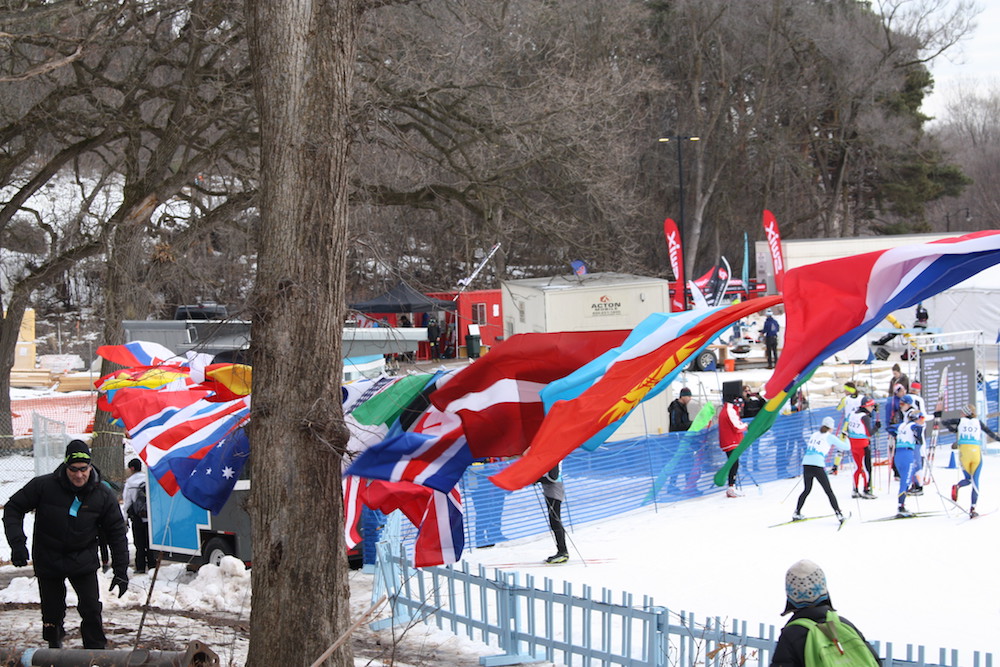
World flags waving on the first race day of the 2018 Masters World Cup on Saturday in Minneapolis, Minnesota.
MINNEAPOLIS, Minnesota — With temperatures staying in the mid-20s overnight on Friday, it was a warm, slightly sticky start to the 2018 Masters World Cup on Saturday in Minneapolis. However, despite temperatures in the upper 30s to low 40s, the 7.5-kilometer loop course at Theodore Wirth Park held up well — an important thing, as Saturday was all classic races.
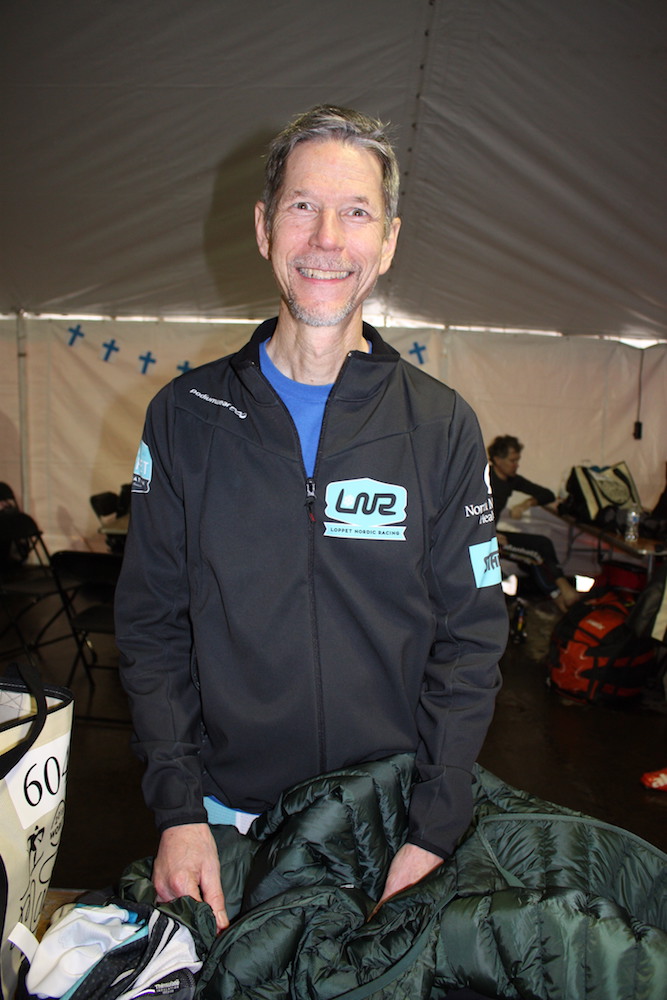
Tom Ajax, of Minneapolis, finished 14th in his men’s age group “6” 15 k classic on Saturday at the Masters World Cup in Minneapolis, Minnesota.
According to Tom Ajax, a Minneapolis-based skier who raced in the men’s 30 k classic on Saturday (and also coaches with the Ride & Glide ski club), the course was “very clean. Spectacular, loved it.”
The tracks held up well, and the hills, though a little tough, were “doable,” said Ajax, who finished 14th in his age group “6” and described his last laps as stronger than his first. Helping to keep the course in good shape were the racers.
“Nobody snowplowing, nobody dogging it—a lot of strong skiers,” he said.
The sun did make a few short appearances on the overcast day, which modified course conditions some for the afternoon racers.
Boulder Nordic Sports Race Service Director David Chamberlain described conditions as “fairly consistent throughout the day.”
“In the morning we went with a little harder klister … but then switched over to a little softer one [around 10 a.m.],” he said.
At the same time, Chamberlain noted the course was “a little variable. Some of the hills got baked in the sun in a couple spots, and then [it was] a little drier in other places. The kick wax that worked in one place may not have worked perfectly in the other place.”
Generally, though, the overcast skies kept things pretty constant.
Conditions for Day 2 look to be about the same as Sunday, if perhaps a bit cooler. But, with a winter storm watch set for the Twin Cities metro area from Sunday night into Monday, things look like they could get a bit interesting for the shorter distance classic and skate races on Monday.
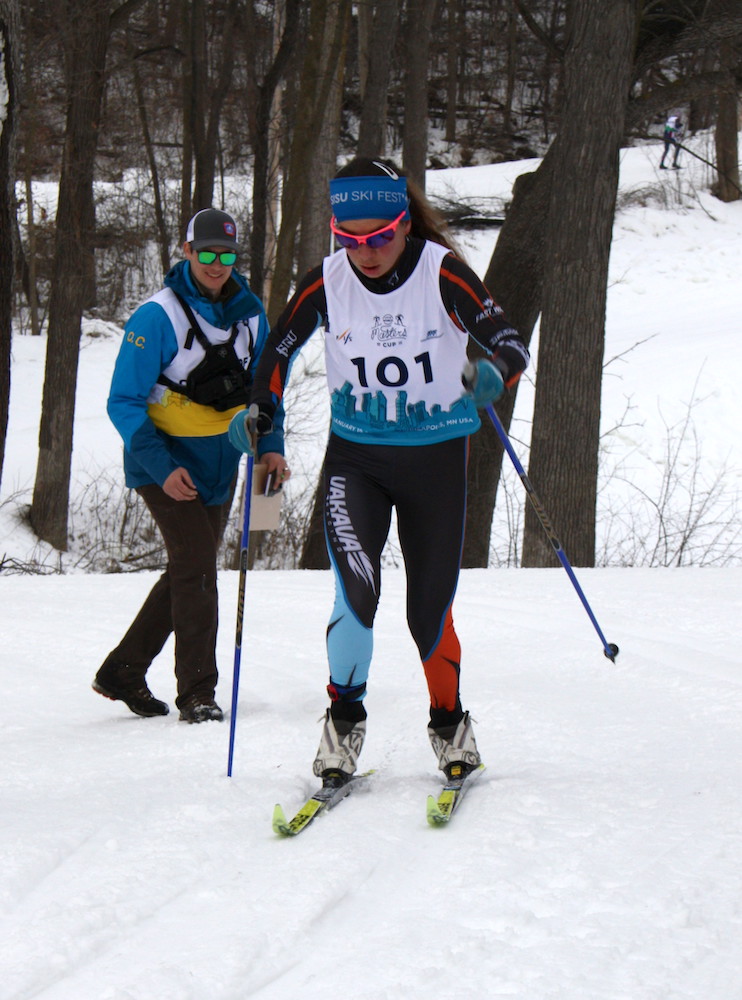
Elspeth Ronnander of the U.S. racing to third in her age group, the women’s “1” 15 k classic, at the Masters World Cup on Saturday in Minneapolis, Minnesota.
The races were broken into 24 different age groups, with the youngest racers being in “1” (e.g. born in 1986) and oldest in “13” (e.g. born in 1926). The largest race on Saturday was the men’s age-group “8” 15 k classic, which had 47 finishers. Finland’s Leino Nisula won that race in 41:19.7 minutes, another Finn Heikki Ruokonen won the men’s “7” 15 k in 40:07.4, and yet another Finnish man, Veikko Piirainen, won the “9” 15 k in 44:28.4.
The largest women’s age group was the “7” 15 k with 18 finishers, which Finland’s Marianne Niemi won in 47:18.9. American Carolyn Tiernan won the women’s “8” 15 k in 53:54.8.
Also racing 15 k were the women’s age groups 1 through 6. Elizabeth Youngman of the U.S. won the “6” in 45:31.7, Norway’s Ragnhild Bolstad won the “5” in 43:11.8, American Kim Rudd won the “4” in 45:49.3, Sweden’s Linda Hasselqvist won the “3” in 46:45.0, American Josie Nelson won the “2” in 45:51.8, and American Alexandra Jospe won the “1” in 45:45.9.
Women’s “9” through “11” raced 10 k, with American Gabriele Andersen winning the “9” in 30:37.0, Norway’s Else Marie Scharff won the “10” in 40:46.4, and American Patricia Kaald was the lone participant in the “11”, finishing in 1:06:56.5.
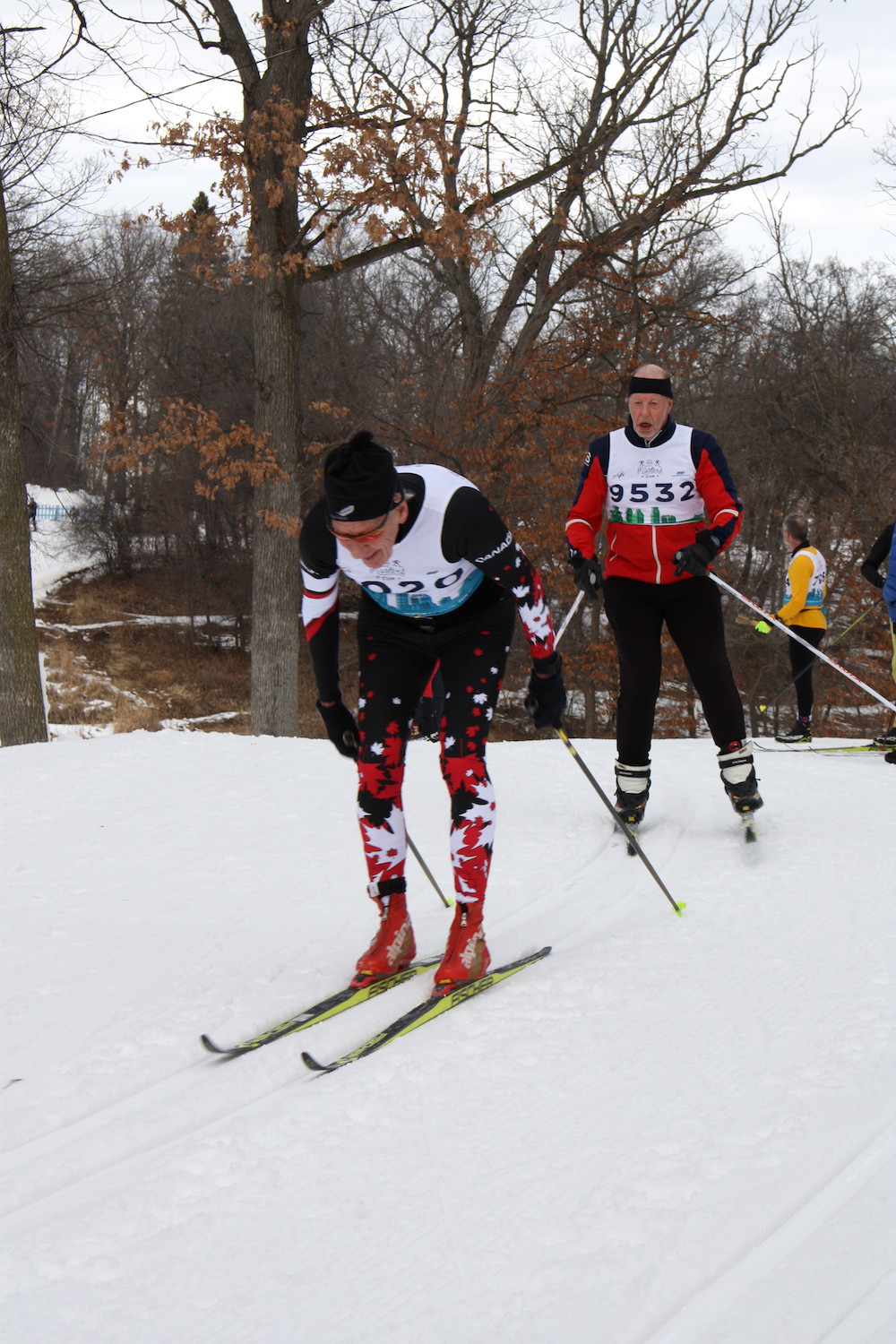
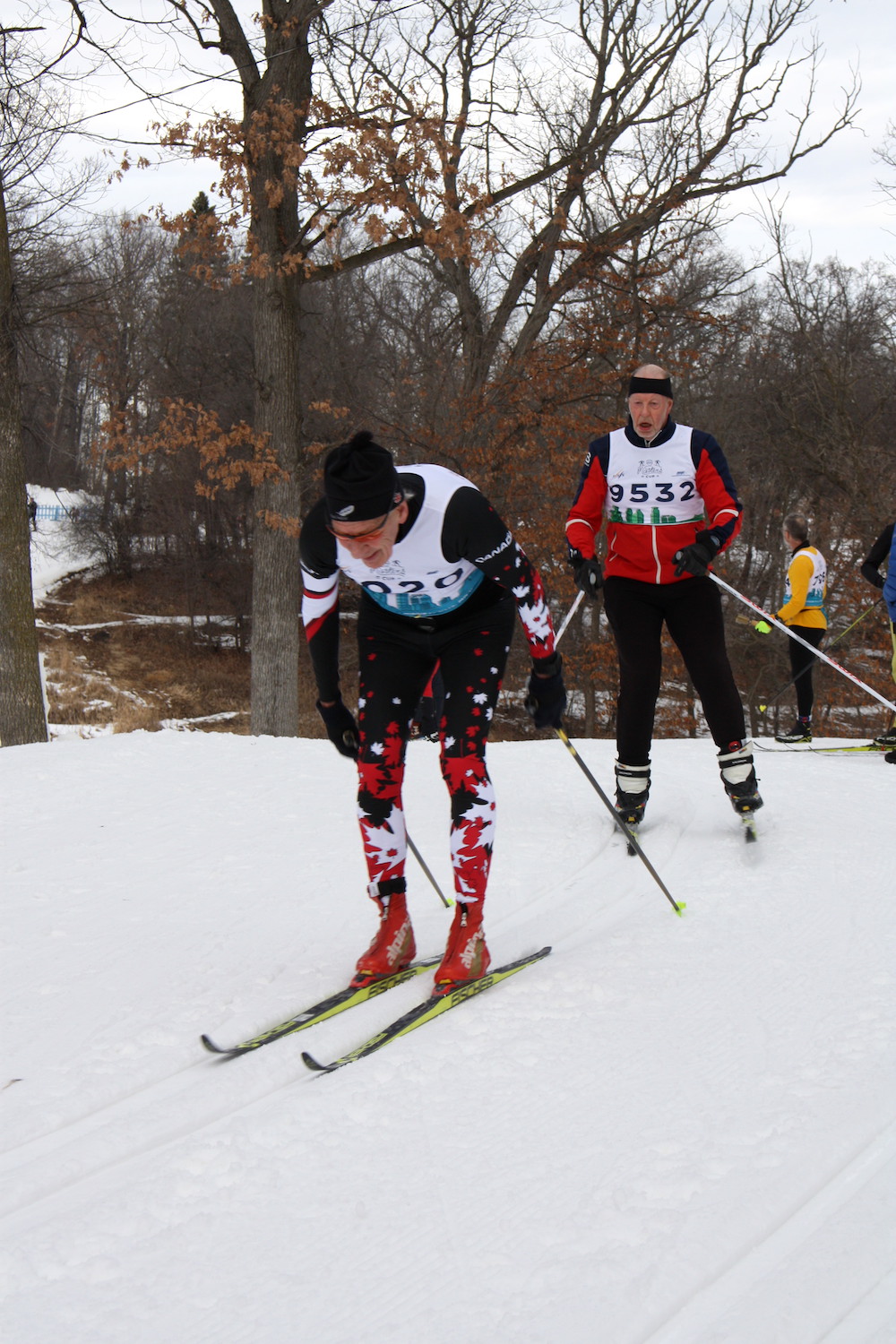
Rick Hubbard (9532) of the U.S. chases another masters skier while racing to 10th in his age group “10”, in the 10 k classic on Saturday at Masters World Cup in Minneapolis, Minnesota.
The men’s age groups 1 through 6 raced 30 k, with American Paul Allison winning the “1” in 1:15:16.5, American Erik Solberg winning the “2” in 1:25:47.3, Russia’s Andrey Lushnikov winning the “3” in 1:19:23.0, American John Bauer winning the “4” in 1:16:29.0, Sweden’s Tommy Gustafsson winning the “5” in 1:13:28.2, and Norway’s Jon Arne Envoldsen winning the “6” in 1:18:29.9.
The men’s “10” through “13” raced 10 k, with Norway’s Richard Johan Kringhaug winning the “10” in 29:12.9, Finland’s Tuomo Venalainen winning the “11” in 38:31.9, American Reno Deprey winning the “12” in 51:53.2, and the lone racer in the “13”, Charles French of the U.S., finishing in 49:47.4.
The 2018 Masters World Cup continues Sunday with 10, 15 and 30 k freestyle races.
About Andrea Potyondy-Smith: Andrea hails from the Twin Cities of Minneapolis (dontchya know) and has an MFA in creative writing. When she is not being an English geek, she can be found on her bike or skis, or playing in the Northwoods … typically on her bike or skis.
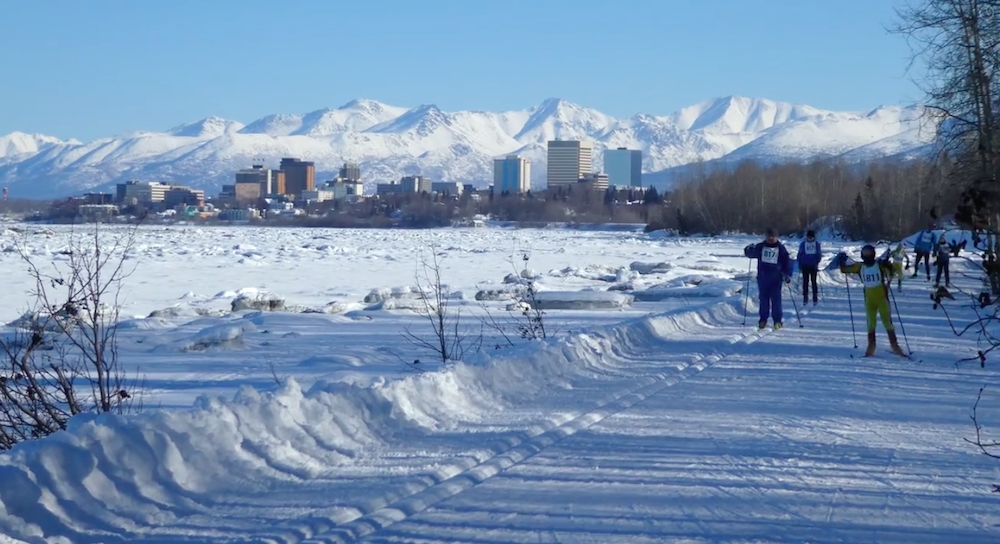
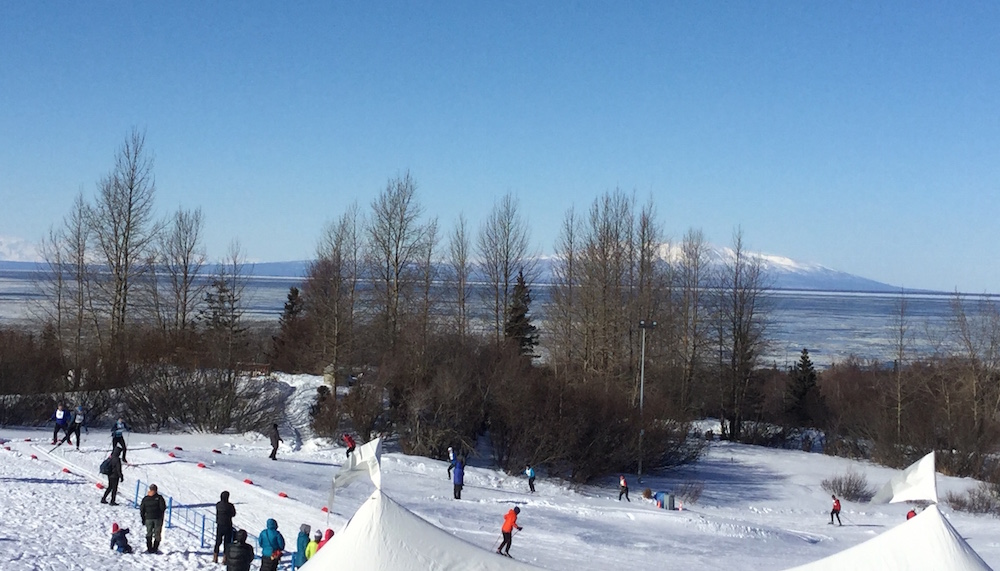
Midpack racers ski on the Coastal Trail, with the Pacific Ocean to their right and downtown Anchorage in the background, in the Tour of Anchorage on March 5 in Anchorage, Alaska (Photo: Robert Arnold video screenshot)
ANCHORAGE, Alaska — There are several strategies for winning the Tour of Anchorage, the annual 50-kilometer freestyle marathon from one side of town to the other that is the unofficial citizens’ race championship for the State of Alaska. There is one obvious way to lose it: Go out too hard on the climbs of the first 10 k, only to lose steam and be swallowed up by a chase pack at some point in the 40 k of flats and rolling downhills that follow.
But Alaska Pacific University skiers Thomas O’Harra and Rosie Frankowski were undeterred by these risks, as both got a gap early in the race and held it to reach the finish line unchallenged, claiming victory in the 30th Tour of Anchorage on a bluebird Sunday morning.
For Frankowski, pushing hard from the start was her plan all along. “I went off the line,” she told FasterSkier during an in-person interview after the race. “I knew that the only place where it’s easy to build a gap is Spencer’s, and I would much rather ski uphill any day than ski on a flat downhill course. So from the gun I went for it. I tried to ski relaxed, and then the minute I got to even the climbs heading up to the Gasline, I just hammered as if I was in like a 20 k race.”
Despite the fast pace at the start of a long day, Frankowski was relatively unconcerned about her effort level. “I knew that there’d be tons of recovery, even on Spencer’s,” she said. “We raced a 30 k there a couple years ago [at Spring Series 2014], and you hammer the uphills and you get two minutes of recovery on downhills. So I just went for it. I caught some groups, I had people to chase, people from the men’s waves, and had a lot of local support that definitely moved over.” By the bottom of the Spencer Loop, Frankowski was hearing that she had a five-minute gap on her nearest pursuer.
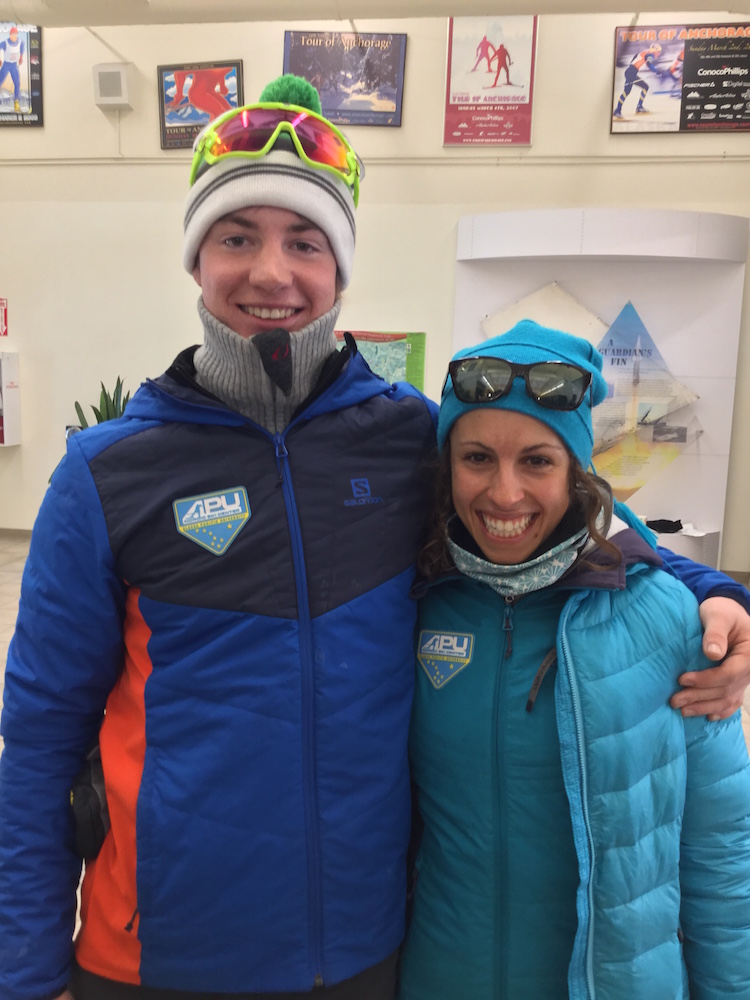
Alaska Pacific University (APU) skiers Thomas O’Harra (l) and Rosie Frankowski in the Kincaid Chalet after winning the 2017 Tour of Anchorage on March 5 in Anchorage, Alaska. (Photo: Gavin Kentch)
“And so I just tried to hammer” at that point and catch the next group, she recounted, “because I wanted to catch a group to draft for the mid-part of the race, and I caught Rob Whitney’s group.”
Frankowski had nothing but praise for her on-course treatment from Whitney, once a leading American junior and now a formidable Masters skier. “And with Rob and three other guys, we traded off the lead. And it was fun, because they were psyched to have me in the group, compared to – I mean, you hear about sometimes some of the male skiers being annoyed, but they were awesome. And we had this little group going with switching the lead every minute toward the end to try to catch some of the APU guys we could see in front of us. It was really fun.”
Ahead of all those APU guys was the fastest skier on the day, Thomas O’Harra. The 20-year-old junior and Anchorage native was skiing alone on familiar trails, at one point passing the house he had grown up in. “My season hasn’t really gone the way I’d hoped and so today felt awesome to have a good race at home, on trails that I grew up learning to ski on,” O’Harra said in an APU press release.
Like Frankowski in the elite women’s wave starting two minutes behind him, O’Harra led the race off the line. While Frankowski dropped the other women almost immediately, O’Harra had somewhat more company, leading a pack that included fellow APU skiers Reese Hanneman, Tyler Kornfield, and Jack Novak up through Gasline, roughly four kilometers into the race. O’Harra sat in second through the ensuing climbs of the Spencer Loop, until, he recounted, “I made a move going up Wall Street [at the top of the main climb] on Spencer, and I led from there to the finish line.”
O’Harra was pleasantly surprised that the gambit worked. “My plan coming into the race was to see how my skis were running and decide from there,” O’Harra told FasterSkier after the race, “Once I figured out that my skis were running pretty well compared to everybody else, I decided to go for it and try and stretch it out. I expected – I didn’t expect to ski alone the whole 50 k. I expected everybody else to chase me. And they tried, I heard, but I had a little bit too much of a gap.”
O’Harra crossed the line in 2:10:49.2. Hanneman (+2:11) and Kornfield (+2:54.8) made up the rest of the podium, with Novak finishing several more minutes back in fourth (+7:21.8). APU skiers took six of the top seven spots in the men’s race, including APU Masters Coach Galen Johnston and former Tour champ Dylan Watts.
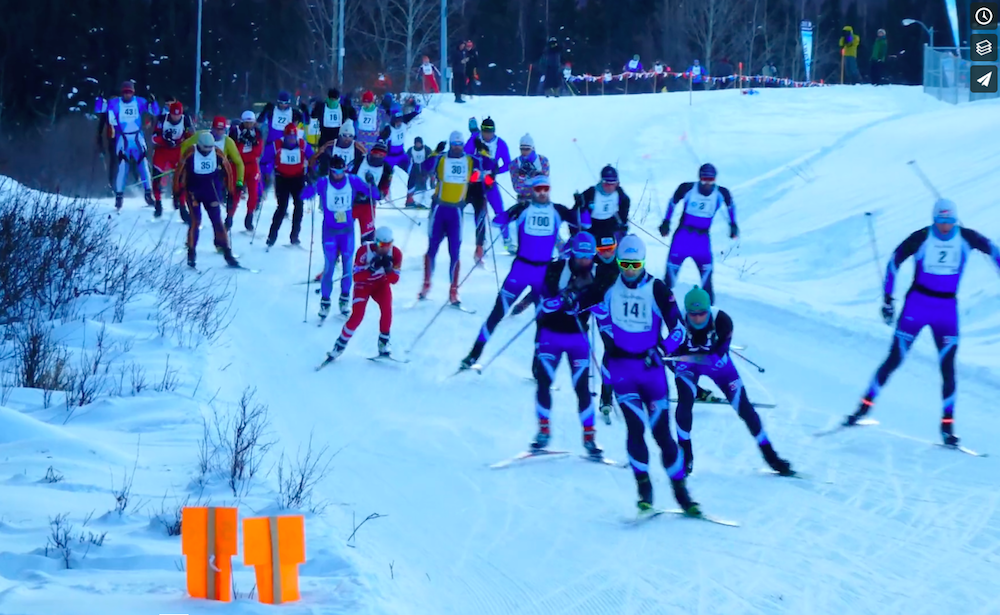
Eventual podium finishers Thomas O’Harra (14), Reese Hanneman (100) and Tyler Kornfield (2), all APU, lead off the starting line of the 2017 Tour of Anchorage on March 5 in Anchorage, Alaska. (Photo: Robert Arnold video screenshot)
Breaking away at the 7 k mark carries risk in any 50 k, because of the differences in efficiency between leading solo versus skiing in a chase pack that characterize any long race. It is particularly fraught in the Tour, given the elevation changes and topography of the point-to-point race from one side of town to the other.
Briefly put, the Tour goes up for the first 10 k, but down or flat almost all the rest of the way. More specifically, the 50 k course ascends the rolling uphills of the Hillside ski trails for around 5 k, then tackles the Spencer Loop. Spencer is locally notorious for having more climb than is allowed under International Ski Federation (FIS) regulations – the maximum climb of 104 meters readily exceeds the 80-meter limit permitted for an A-climb on a FIS-homologated course of any distance. Within the first 7 kilometers of the Tour, skiers have climbed more than 150 meters above where they started. (For comparison, the American Birkebeiner, famous for its hills, climbs roughly 105 meters over 11 kilometers.)
But it’s virtually all downhill from there. Racers descend Spencer, ski on rolling downhills back through the Hillside lighted trails, drop down through Campbell Tract, and then cruise on greenbelt trails until the 44 k mark before climbing up to the finish at Kincaid over the last six kilometers. For parts of the course skiers are on the Coastal Trail alongside the ice floes of Cook Inlet, elevation approximately one meter. All of which is to say that a chase pack has a lot of time to work together on the flats to reel in an early solo breakaway.
Oh, and it was not warm out there, so leaders were dealing with slow snow as well. Race-time temperatures Sunday morning were -4 degrees Fahrenheit at the starting line, down to -12 degrees in a notorious icebox spot in the black spruce forest of Campbell Tract. Skiers sported the latest in face-tape fashion – Frankowski carried the day with her pink tape and pink buff ensemble – and race photos show a series of frosty faces, ice beards, and clouds of frozen breath.
Even Frankowski, who dominated the women’s field en route to finishing sixth overall in 2:23:42 (Shalane Frost and Nicole De Yong followed roughly 15 minutes back), noticed the cold.
“I don’t think it was particularly fast,” Frankowski said. “I never race with a watch, but definitely the snow was slow. … It was not a warm day out there. And by the end – normally I die with 10 k left in all the 50 k’s I’ve done, so today I died with four k left, which was a vast improvement. And the worst part is, I had to stop like four times during the race, because I dropped my waterbottle, or it froze and I couldn’t get it back in my pack. So at one point at Westchester Lagoon I dropped it, my whole group had to go around me because I snowplowed to a stop to pick it up, and then I just threw it onto the Lagoon. So I have to go find it after the race.”
O’Harra also had plans for after race: “I was informed after the awards ceremony that there is a bottle of wine for me, waiting for when I turn 21, which is next Sunday, and I get it then.”
With the roof of the beer-garden tent in the foreground and Mt. Susitna in the background, skiers approach the finish line of the 2017 Tour of Anchorage on March 5 in Anchorage, Alaska. (Photo: Gavin Kentch)
But last Sunday morning, as skiers flocked to the outdoor beer garden following the race, O’Harra was left inside. Let his former roommate Frankowski graciously explain: “I am really excited mostly for my teammate Thomas O’Harra’s win. Thomas and I had been roommates, until December, for about a year, and Thomas now has my room on the APU campus. Which, obviously, the karma contributed to why he won. And in fact, Thomas isn’t even 21, so he can’t go to the beer garden that the Tour of Anchorage and [Nordic Ski Association of Anchorage] has graciously provided for us. So unfortunately, the Tour winner’s stuck inside.”
Other than bottles, of either wine or water, what were the winners’ future plans? Frankowski, reflecting the realities of life as a professional cross-country skier, was planning to use her $500-dollar winner’s check toward rent money. And as for the rest of her first-place prize, the roundtrip Alaska Airlines plane ticket? “You can’t fly to Cuba” with it, she lamented, “which is basically the main destination I wanted to go to. So now I have to find another destination where Alaska flies. Honestly, I’ll probably go to Minnesota, where I’m from.”
O’Harra, meanwhile, was planning to put in a three-week training block, “and be in good shape for Spring Series in Fairbanks” in late March.
O’Harra explained that he had been planning on racing this year’s Birkie before it was canceled, “so that would have been my first 50 k. This instead became my first 50 k. So hopefully my second 50 k, in Spring Series in Fairbanks, will be just as good.”
For Frankowski, Sunday marked the fourth-career 50 k for the Midwest native, including two Birkies and a win in last year’s Great Bear Chase in Calumet, Mich. “This is definitely the prettiest 50 k I’ve ever done in my life,” Frankowski said of a perfect day when mountains and ocean were visible in all directions throughout the course. “It was beautiful out there.”
A triumphant return
Frankowski’s sentiments were clearly shared by many in the crowd of 872 finishers, which marked both the smallest Tour field in over twenty years but also, with this year’s Birkie washed out, the largest ski race in the country this winter to date. Although the Tour was held over its full course 25 times in its first 26 years, the race only went halfway across town in 2014, and was confined to a lap race on Kincaid snowmaking trails in 2015 and 2016 as snowfall was scant and participation numbers plummeted.
But this year the Tour returned to Anchorage, and Anchorage returned to the Tour. Families raced. Parents raced. Grandparents raced. Anchorage Mayor Ethan Berkowitz raced. Alaska State Representative Matt Claman (D–Anch.), whose house lies within 100 meters of the course, raced. A 9-year-old completed the 25 k (in a healthy 2:08), and 87-year-old Reno Deprey classic skied the 40 k in 4:47. It was a great day for skiing in Anchorage.
It was also an historic day: March 5, 2017, was just over one century removed from the first recorded ski race in Anchorage, a town founded in 1914 as a construction camp for workers on the Alaska Railroad.
As former U.S. Ski Team athlete Tim Kelley recounts in more detail on his blog, a 10-mile race was held, starting and finishing on Fourth Avenue in downtown Anchorage, on March 4, 1917 (start line photo here). The winning time was a solid 1:08:30 for 10 miles, more than respectable considering what we would now term the primitive ski technology involved. First place went to a John Aho, with one Emil Gustafason second. A man whose given name was literally “Young Viking” served as race director. They raced again the following weekend, by which time the winning time was down to 57:25 for 10 miles. O’Harra posted a faster pace in March 2017 for 50 k, but not that much faster.
Other races
Three other races were held on Sunday. In the 40 k, which skips Spencer Loop and most of the Hillside trails, first place in the women’s division went to former junior standout and Besh Cup Trophy winnerJaime Bronga in 2:05:15.1. Christina Pohl and Melina Park followed.
In the men’s 40 k, three local juniors used the 40 k to once again unofficially see who is the fastest local junior not selected for Team Alaska for Junior Nationals. (One has to be 18 years old to race the 50 k. The 11 year old who skied this year’s 40 k in 3:06 suggests that there may be no lower age limit for the 40 k.) This year it was Chip Schoff, 17, who took the victory in 1:48:16.3, over 17-year-old Trent Fritzel and 16-year-old Hans Personius.
In the 25 k skate race, Jasmine Maurer of Homer took the victory for the women in 1:32:59.9, followed by Clare Ross of Anchorage and Mallory Conger of Nome, reflecting the fact that the Tour draws racers from the entire state. For the men, it was Kai Meyers, 16, in first in 1:12:22.6, Kevin Donley, 51, in second, and Dale Baurick, 14, in third.
And first overall in the 25 k classic was University of Alaska Anchorage skier Sadie Fox in 1:30:28.1, followed by Alison Arians and Anna Rix for the women. First among men, and second overall, was Erik Hjelm in 1:31:42.6, followed by Paul Kari and Karl Volz.
APU Masters camp in action on Eagle Glacier near Girdwood, Alaska, in July 2015. (Photo: Jim Falconer)
It’s not just a truism that one of the best ways to get good at going fast is to practice going fast. At least that’s the principle that Alaska Pacific University Nordic Ski Center (APU) coach Galen Johnston brings to bear when working with his athletes, no matter their age level or experience.
Johnston, 26, was born and raised in Talkeetna, Alaska, and is a lifelong Alaskan. He has been coaching skiing in some capacity for the last nine years, with athletes ranging from 5 years old (the Polar Cubs group of the Anchorage Junior Nordic League youth ski program) to 86 years old (locally famous octogenarian Reno Deprey, who skied the 55-kilometer 2015 classic Birkie in a healthy 5:47 at age 85 and has a ski race named after him in his native Maine). He is currently entering his third year of full-time coaching with APU, where he oversees both the Devos and the Masters groups in a total of ten practices per week.
APU Devos stretch from sixth through eighth grade, or approximately age 11 to 14. APU Masters are 30 and up. In this Wednesday Workout, Johnston breaks down a recent workout from APU Masters that has benefits for anyone at any point on the several-decades spectrum of Masters skiers.
The workout
Full warmup
5 x 35-45 seconds Level 5 (L5) rollerski skate sprint, over a course with one 180-degree turn and one corner. (Course should be in an empty parking lot, or somewhere else where it is safe to rollerski at speed.) Brief rolling recovery between each sprint interval.
4-5 minutes full easy moving recovery after the first five sets
5 x 35-45 seconds L5 skate sprint (that is, repeat step 2)
Cool down
The warmup: This should be a full warmup, as long as 45 minutes out of a 90-minute workout. Starting very easy, then, Johnston says, “Ending with up into L2, nothing more than that. You can throw some easy 10-15 second speeds in there if you need to warm the body up a little bit more than that, then rolling into these. With that in mind, if you’re not feeling particularly warmed up, just take the first one a little bit easier, just let things come around.”
Skate speeds: The course should be about 35 to 45 seconds, depending on skier speed. But there’s a lot going on within that relatively brief time: “Sprint off the line, go down 50 meters, swing a 180 degree turn, sprint back, and then around another corner and accelerate to the top of the parking lot,” Johnston says.
Recovery: Between each of the five sprints in the first set, recovery is just “enough time to glide back to the start, get your breathing slightly back under control, and roll again” for the next sprint. But after doing the first set of five sprints, take a full four to five minutes of easy moving recovery. The goal of this intermezzo is to flush out the muscles somewhat and hit the second set of five sprints ready to go with good energy and quality movements.
Cool down: As much as you can within a 90-minute workout window, before – in a nod to the reality of Masters training – going back to work/kids/job/life.
Technique thoughts for this workout
Johnston discussed the reasoning behind this workout with FasterSkier following the cooldown. He noted the gap that develops within even just the opening few minutes of an Anchorage Cup (citizens race), in which the APU Elite Team skiers and local collegiate skiers almost immediately start to distance themselves from even the fastest citizen racers.
“Why is that gap there?” Johnston mused. “A lot of it just comes down to being able to relax at speed. If you can create speed efficiently, you can sink the body weight into the poles and into the glutes and move off of that, and use that to create speed – great. As soon as you get thrown back onto the heels … most of the time when people start doing speedwork you get thrown into the heels and you stay really static. And so – in its simplest form, [you should be] letting yourself drop, and letting yourself stand back up. Get all the way up, get all the way down. And making sure that you’re not just stuck back on your heels as you do those sprints. If you feel like your quads are blazed out after the first one, maybe change up how you’re doing that.”
Johnston adds, “Today one of my big points was to be able to relax at speed, and be able to create speed without working that hard, and how that separates kind of the elite skiers from that next echelon of skiers.”
Theory and practice
This workout “tries to accomplish several things,” Johnston continued. “One is acceleration. So you have accelerating off the line, accelerating out of the turn, and then accelerating around another turn – kind of to work on, how to accelerate efficiently. The other is just the agility of the turning, being comfortable turning at speed. And as – today we didn’t do it as a group. Some days we’ll do it as a group of four or five skiers together, so that we get comfortable with that idea of cornering around something sharp with other people there. That one is easier to do on snow with more people.”
(The previous week had featured an analogous but not identical workout on classic rollerskis, where each interval went out as a group sprint – six Masters skiers, 10 total sprints, zero serious carnage. Plus a great opportunity to practice sprint starts.)
So why put Masters skiers through an L5 workout on rollerskis on unforgiving pavement, when even college skiers can crash and burn? Because sprinting is a great way to raise the athlete’s high-end speed, which can have benefits for skiing efficiency at any speed.
“This is a Level 5 workout,” Johnston notes. “It doesn’t necessarily need to be an all-out sprint, especially if you’re doing it on rollerskis and you’re not comfortable with that upper-end speed, but that is a big component of what this workout brings. The fact that it is Level 5, essentially an all-out sprint, with it being short, with it being in a group, really drives home how efficiently you’re sprinting. Most people will have technique issues crop up when they’re sprinting that they wouldn’t find in daily skiing – especially skiers that are used to training a lot of Level 1, Level 2, Level 3, they have a very small window of speed, and they can’t really go over that Level 3, that’s their ceiling. So doing a Level 5 workout raises that ceiling, allows us to move efficiently, and move efficiently faster.”
Looking ahead to a more endurance-focused training block later in the fall (Anchorage skiers are reliably on snow by the first week of November, even in southcentral Alaska’s recent snow-sparse winters), Johnston reiterates that his goal of this workout “is to raise the ceiling of what everyone’s capable of for speed.” With an eye to the future, the idea is that “so when we do more of our L3, L4, that those workouts can happen at a higher speed than they otherwise would have. Still going to be the same heart rates, same effort level, but because of working that ceiling up with the L5 work [now], those L3 and L4 workouts actually happen at a faster speed.”
Speedwork for the Masters athlete
“I think a lot of Masters skiers are a little tentative on their skis,” Johnston observes. “For anything – for downhills, for skiing fast, for sprinting, for anything like that – a lot of it is just a comfort issue. So the more that we enforce going fast as part of a fun, comprehensive workout, the more that comfort level comes up. So whether that’s bombing down a steep downhill, whether that’s sprinting, if we’re comfortable with speed, and comfortable with stuff happening fast, it allows us to react to stuff more quickly. And I work with that a lot with Devos, and obviously when you’re 12 years old you can faceplant and it’s no big deal, but you can get kind of the same thing in a more controlled environment for Masters – just avoiding as many falls. Being willing to push your limit a little bit on comfort, for speed – when you get into a race, when you’re skiing in a pack of 20, 50, 100 people, you’re not as worried about it. You’re able to concentrate on your own race, and not concentrate on the fact that you’re about to get taken out by 100 other people who may or may not be as skilled on their skis.”
Johnston concludes by reflecting on the decades-wide range of athletes he works with on a daily basis. “What’s neat is that you see that, from Devos to Masters, people all respond to very similar things. Specifically for Masters, age 30 to 85 is a huge age span – but everyone is dealing with relatively the same things. Technically, most people are pretty ingrained in their technique, so that takes a lot of time to bring that around. And speedwork is one of the things that really breaks everybody out of that mold. It’s something that most people never do. So when you go to ski fast, you have to learn how to ski fast.”