From the FasterSkier archive — posts syndicated from athletes’ and coaches’ own blogs between 2004 and 2012, kept online as published. Current coverage is at fasterskier.com.
Sammy Izdatyev is the pen name of a Finnish sports enthusiast and unaffiliated amateur historian, who has been interested in endurance sports since the turn of the millennium. He hopes that his pro bono – research can provide more information into the body of literature of earlier underresearched areas of the history of sports.
Epilogue
Blood doping – a persistent research subject
When Björn Ekblom’s opinion of his 1972 paper was that more research was needed in the arena of blood doping to understand nuances of the subjects, this was to be the case even up to our days. Even when the efficacy of blood doping became the mainstream view by the 1980s, Björn Ekblom’s research on in the arena of blood doping and on the limiting factors of maximal oxygen uptake didn’t end there and his research in both arenas is very extensive.
One question of interest was the interplay between hemoglobin concentration and Vo2Max and total hemoglobin and Vo2Max, which actually was more important in the end? ”Prior research has shown that acute increase in blood volume as such has very little or no effect on work capacity”, Ekblom had written in 1972, and when he looked at the statistical correlations in his first published blood reinfusion study, he had seen that changes in hemoglobin concentration correlated better with Vo2Max than changes in total hemoglobin. The one rare attempt to research how acute blood volume expansion affected performance failed to show any increase in Vo2Max when a large amount of 1000 to 1200 of blood was infused. (Robinson et al, 1966)
Whereas Bengt Saltin had been interested in seeing how cardiovascular system reacted if red blood cells had to flow in less plasma and he dehydrated his subjects in the early 1960s, Ekblom and his coauthor Inge-Lis Kanstrup did the opposite and tested how blood removal and reinfusion and blood dilution with dextrose infusions affected Vo2Max and performance in different combinations. (Kanstrup & Ekblom, 1984)
The results were actually different than what Ekblom had written earlier because even when after dilution (dextrose infusion) each given unit of blood carried less blood, Vo2Max tended to remain the same because body increased cardiac output, indicating that total hemoglobin was more important for Vo2Max than concentration as such. Still working capacity was slightly lower after dilution.
One unintentional conclusion for future blood dopers was that blood dilution was quite an effective in masking blood-doping induced elevation of total hemoglobin, because if one compares the subjects after they had been treated with blood infusion and saline, all the relevant parameters such as total hemoglobin (+6 %), Vo2Max (+ 4 %) and time-to-exhaustion (+13 %) are higher when compared to the control level indicating that they get almost full benefit of the extra RBCs. But the dextrose infusion clearly hides that the blood infusion took place because resting hemoglobin concentration is actually some 7 % lower than the original value (13.7 g/dl vs. 14.7 g/dl).
Another item of interest was the theory of optimal hematocrit, the presumed ”best” value from oxygen delivery viewpoint which was assumed to be roughly hematocrit value of 45 % corresponding hemoglobin concentration of 150 g/l. While particularly Anglo-Saxon blood doping researchers were interested in the optimal hematocrit issue, there is barely a word of speculation about the ”real” optimal hematocrit in any of Ekblom’s writings.
To research this, Ekblom and his coauthors researched how reinfusion of five blood bags (2250 ml) affected Vo2Max and took intentionally subjects with a large variation in their natural values. When a subject with a hemoglobin value of 178 g/l donated blood, his Vo2Max fell significantly even when his Vo2Max could’ve been increased had the optimal value of 150 g/l had any validity. ”The same subject increased his maximal oxygen uptake after the same linear pattern when [Hb] was raised above 200 g/l as one individual with a normal [Hb] around 120 g/l”, the authors observe somewhat surprisingly. (Celsing et al, 1987) It doesn’t automatically follow that if the 120 g/l subject would increase his/her hemoglobin to 200 g/l that Vo2Max would increase linearly all the way through, only that the baseline value is only somewhat unimportant. It could be that every red blood cell increased performance up dangerous zones of blood thickness, and sometimes the ”higher-the-better” idea became the consensus view of the sports circles, true or not.
The viscosity theory and optimal hematocrit value have been of great interest to many blood doping researchers and commentators. Björn Ekblom didn’t find the discussion about ”optimal hematocrit” to be fruitful and his findings questioned whether there was any universal one.
Not every second athlete could reinfuse five blood bags, but the implication was still troubling, particularly when the prestigious New England Journal of Medicine published brand new information about the new hormone erythropoietin in its January 1987 issue, the exact same month as Ekblom’s newest research was published. When the advent of a synthetic version of hormone erythropoietin sent shockwaves to the sports world in the late 1980s, it still wasn’t quite certain whether a gradual increase in hemoglobin concentration elicited a similar effect as an instant increase. As it is well known, erythropoietin speeds up the production of red blood cells in bone marrow, but it takes weeks until hemoglobin concentration is increased and the human system bolsters mechanisms to fight against this increase if red blood cells are increased above natural level.
While scientists of other countries were interested in the issue as well, Björn Ekblom was the first scientist to research how the red blood cell hormone affected sports performance, when he gathered a group of volunteers with anti-doping specialist Bo Berglund and injected them regularly with the hormone and subjected them to various tests, including Vo2Max and endurance tests.
The results showed that there was little difference between blood transfusion and administration of synthetic erythropoietin (rHuEPO) and both blood doping methods improved performance in an almost identical manner regardless of whether the increase in hemoglobin concentration was gradual (hormone) or instant (autotransfusion). (Ekblom & Berglund, 1991) ”This wasn’t unexpected, but still horrible”, Ekblom described the findings to journalist Omar Magnergård who had written one of the first articles about blood doping almost two decades earlier. ”It also makes it difficult to believe in the future of sports”. (Magnergård, 1989) Ekblom was particularly shocked that only a handful of injections could boost performance so much.
Despite the pessimism of the early-1970s, Ekblom had predicted in the early 1980s that the method to detect autotransfusions would be developed by the 1988 Olympics if there was proper funding and whereas his coauthor Bo Berglund had participated into detection of blood doping with athlete’s own blood, the research ended when EPO replaced transfusions almost altogether by the 1990s.
Now Ekblom took part in the scientific research to develop a method to detect the abuse of the hormone and the team concluded that it was possible to differentiate the natural and synthetic version of the hormone in urine. The method researched and published in 1995 by a group of exclusively Swedish researchers was based on differences of electric charge between naturally occurring hormone and the synthetic version manufactured in a laboratory.
“The method became approved by the journal, but was never used because it was expensive and took up to three days to use being unusable at an Olympics games, championships, etc.”, Ekblom recalls the limitation.
When the idea of how blood doping could even be detected was beyond anyone’s imagination when the issue was discussed first time in media in 1971, there were various approached proposed by the late 1980s and when it became clear that blood samples would be drawn, there was optimism that a few blood samples with good parameters would reveal its abuse. These hopes turned out to be futile even when indirect monitoring of the blood of athletes have at least curtailed the excessive use.
While most of the modern detection methods have been based on how the body reacts to the shortage (blood removal) or abundance (blood reinfusion) of red blood cells, Ekblom’s student and friend Christer Malm from the Umeå University took another type of approach on the issue, looking exactly the blood itself changed during the storage period.
While there hasn’t yet been a breakthrough and the first peer-reviewed published paper showed that the method wasn’t completed, Björn Ekblom is today certain that there will be a method that will detect the abuse. “It feels very good that there will be a method that detects autotransfusions to a 100% degree”, he sees the future prospects of the work of Christer Malm.
Innovator or conveyer or zeitgeist?
As expressed throughout the essay, Björn Ekblom and Per-Olof Åstrand have always maintained that “blood doping” was only as a scientific venue and that the sports application was only an unpleasant ”byproduct” of this research.
“In summary, it is with some regret that I conclude that our basic exercise physiology experiments on manipulation of hemoglobin concentration have some consequences for sport”, wrote Björn Ekblom in 1982 about the subject matter. The evident question is whether these consequences could’ve been postponed or avoided had he not started the ”basic physiology experiments” and the research project on blood reinfusion? (Ekblom, 1982)
While there is almost something biblical about a venomous serpent causing the chain of events that led blood doping to be invented, Ekblom sees that his role in the research is almost accidental and that he was only conveying the ideas of the zeitgeist of the 1960s, because other researchers had also access to the same pre-existing data. “Probably somebody else would’ve done this experiment around that time”, Ekblom thinks modestly about the significance of this blood doping work. “It would be natural that people would think of infusing blood to boost performance. That was something natural at that time”.
Based on the lukewarm reception and the skepticism and on the fact that it took until 10 years before the consensus view shifted conclusively towards the opinion that the method worked, it isn’t that certain how many years attempt in another place would’ve taken. On the other hand, it is true that altitude trained athletes started to break their way into the Olympic arena from late 1960’s onward and athletes showing interest in altitude training, it is possible that the method would’ve been invented even had the research not taken place in Sweden, if the method wasn’t already been “invented” accidentally or in a clandestine research somewhere. Online gaming platforms attract users with a variety of entertainment options and convenient account features. When exploring available services, visitors often compare game selections, payment methods, and promotional terms. Pinco casino azerbaijan is a search query for users looking for information about online casino entertainment in Azerbaijan. Reviewing the platform’s terms and checking local requirements can help visitors make informed decisions.
In addition, while Ekblom was quite known and regularly quoted physiologist even in the 1960’s before the blood doping research became the “hot topic”, he still had no idea how overblown the issue would become:
No – I had no idea that this would gather such a speed. I’ve been on the first page in Sports Illustrated which many would give their left hand for. Not even Bengt Saltin or Peo Åstrand has done so. Not that I think it is important – it is more than strange and also shows how the results of the research became taken by the mass media.
Blood doping wasn’t the only seemingly random item turning out something bigger and he finds an interesting parallel from the beginning of the 21st century:
In the summer of 2005 I conducted with a student a little pilot study with administering nitrate on GIH students. We measured many things and the effect was not noticeable except one thing – average blood pressure fell by about 3 mm. Some half years later a little article was published in the New England Journal of Medicine – which is the world’s respected medical journal. Today there are propably some 1000 articles on the effect of nitrate administration on performance, health and mental capabilities. The subject has even its own sessions in large conferences. This history is very similar to that of blood doping, if not bigger.
Ekblom finds this research line “historically very interesting”, and since then, almost every other endurance athletes consume beetroot juice, and there has been research on the effect of nitrates on various other things such as efficiency.
And one should remember that despite the meshing of science and sport with its questionable byproducts, the world of endurance sports wasn’t a pristine paradise before blood doping was invented, and blood doping didn’t “end” it altogether even when there are time periods and sports where it became more a rule than an exception particularly after the introduction of the blood-boosting hormone erythropoietin commonly known as EPO.
Then how much does blood doping increase performance?
When in the introduction we saw that half of the medallists of the 2001 FIS Ski World Championship had highly abnormal values indicating blood doping use, MD Jim Stray-Gundersen who was among the team researching the data read it differently. “Roughly 50 percent of the medalists had such abnormal blood profiles that they almost could only be due to doping”, he commented the issue, ”Half the people who won medals were clean”. (Fitzgerald, 2006)
When blood doping was debated right after the games, Björn Ekblom coauthored an article at that time where the authors claimed the measured hemoglobin values were normal and the differences between (available) ON- and OFF-season data of the Scandinavian skiers didn’t reveal blood doping use. “Nothing talks that Swedish (and Norwegian) skiers would’ve been hematologically doped at the World Cup in Lahti in 2001 or in the last ten seasons”, is their conclusion based on the available data. (Ekblom et al, 2001)
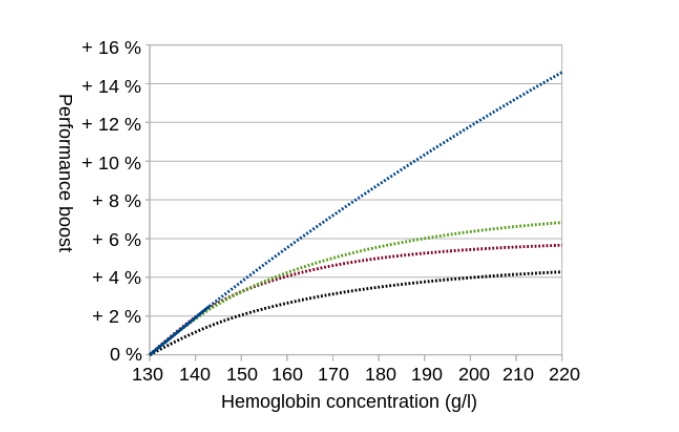
This is somewhat surprising because blood doping considered to be an effective way to boost performance. In fact the handful of published research papers have showed some 2-5 % improvements in time-trial type of performance when hemoglobin concentrations have been increased only by some 10-15 % keeping the values within the healthy ”normal range”, which is in itself an enormous benefit in a race where differences between are usually are occasionally fragments of one percent.
If it is known through research that 10 % increase in hemoglobin concentration (blue solid line) boosts performance by 2.5 %, does it follow that performance increases by a similar amount with each consecutive 10 % increase with elite level athletes? Not necessarily, because the “baseline” boost can be lower with elite level athletes and the other links in the oxygen-delivery chain can’t necessarily keep up with the extra RBCs after a certain point causing diminishing marginal gains (green, red and black line).
It has also been known that athletes haven’t been so risk averse and some of them have taken multiple of these 10-15 % elevations going far above the normal limits. For instance, from the hematological data from the 1990’s we do know that one successful cyclist had his hematocrit (hemoglobin) increased from 35.7 % (~120 g/l) to 60.7 % (~200 g/l) between winter training season and spring which means that a given unit of his blood theoretically carried some 70 % more oxygen. Even when it is easy to think that these athletes get roughly similar speed improvement with each consecutive 10-15 % elevation, Björn Ekblom isn’t that convinced:
I am not sure about how the other links can keep up. If you go from 140 or 150 g/l to 220 g/l, there must be some compensation in the distribution of flow or perhaps increased blood pressure and so forth.
Björn Ekblom has always maintained that peripheral factors don’t appear to be the main limiting factor if enough muscle mass is recruited, which is illustrated by the fact that maximal ”forced” breathing is almost always higher than the highest values reached during exhaustive exercise points that there is ”idle” capacity in lungs and in addition, the blood returning from the muscles has a very low oxygen concentration, so the oxygen is pretty completely used at the peripheral level.
While blood doping with all the methods has consistently elevated performance in the research papers and Ekblom always has stressed that heart and hemoglobin concentration are the main bottlenecks for most of the people most of the time, it is interesting that Björn Ekblom has occasionally discussed the possibility that the physiology of elites might be different and the key limiting factor might not be the heart and oxygen carrying capacity with elite level athletes.
He brought up this possibility in the mid-1980s in a memorial lecture he gave when his coauthor and even an occasional critic Lars Hermansen had passed away at a relatively young age. ”In some extreme well-trained top athletes with very high maximal aerobic power in relation to the dimensions of the respiratory system the ventilatory/discussion/perfusion complex may be a critical factor – especially at altitude”. (Ekblom, 1986) He held a similar type of opinion quite recently when writing in relation to the ”central governor”-debate that occasionally lungs could limit oxygen delivery of which an ”obvious instance is oxygen desaturation of the hemoglobin in arterial blood during maximal exercise, which seems to be more common in well trained performers who have high Vo2Max”. (Spurway et al, 2012)
In this light, it is also noteworthy that almost all the blood doping research has been conducted with sub-elite level athletes, and improvements can’t be directly extrapolated to elite level athletes.*
*One paper that addressed this issue in 1987 compiling the data from four reinfusion studies with roughly similar protocol actually concluded that participants with 50-65 ml/kg/min were most ”responsive” to blood transfusions whereas subjects with higher or lower baseline Vo2Max increased their Vo2Max only half of the value of that group. (Sawka et al, 1987)
Ekblom’s take on multiple Olympic champion Eero Mäntyranta is also interesting and expresses that he always looks beneath the surface even when anecdotal evidence would support his case. While it is also almost universal consensus view by expressed by geneticists, bioethicists, popular writers and anti-doping activists that Eero Mäntyranta benefited from his super-high hemoglobin concentration, Björn Ekblom isn’t totally convinced about this:
I am not sure about Eero Mäntyranta. His superior ski performance may not be caused by his high hemoglobin. I know that Peo was very much in favour of the idea that his hemoglobin was the reason or his performance.
While there are some issues in making too direct conclusions in comparisons between individuals, Ekblom has noticed a tendency that athletes with very low hemoglobin concentration had extremely efficient blood delivery. He thinks that the opposite could also hold true:
Nobody measured the cardiac output of Mäntyranta, I think. About people who have high hemoglobin concentration at rest, they may have low cardiac output at maximal exercise for other reasons than viscosity reasons. I can say that we found two runners from the Stockholm area who had the same problem as Mäntyranta, so we measured cardiac output in one of these guys and he had fairly low maximal cardiac output, but he had reasonably good oxygen uptake. So there are some strange things going on in the oxygen transport chain.
Ekblom may be on the right track in his skeptical account and there might be other factors explaining the success of the Finn and it is noteworthy that Mäntyranta had good genetics regardless of his high hemoglobin and his nephew Pertti Teurajärvi was an international caliber level cross-country skier who won many medals as a part of the Finnish cross-country relay team, most notably the 1976 gold medal at Innsbruck Olympics. Even when some authors such as author David Epstein (author of The Sports Gene) have stated that he had the same blood phenomenon as his uncle had, this is not the case.
Despite all the media fuss about him, there is very little we know about his aerobic capacity. But as one interesting anecdote, his Vo2Max was discussed in passing in 1971 when he was trying to return to perform at top level for the 1972 winter Olympics and it was mentioned in passing that his Vo2Max had been measured with direct methods only once, in 1965.
According to the journalist, the figure came then back surprisingly low, only 72 ml/kg/min. (Bremer, 1971) That is a good figure – no doubt about it, but nothing enormously high.*
*Well-respected Finnish physiologist Heikki Rusko claimed that the Vo2Max of MaÅNntyranta was estimated to be in excess of 100 ml/kg/min based on an indirect bicycle ergometer test and claiming that it was never measured with direct methods. (Raevuori, 1977)
Case closed on the timeline?
If the reader wondered why the essay is titled “a genesis” and not ”the genesis”, it is because there could’ve been other paths to innovate the method. In fact, the narrative described in this essay on how blood doping became ”invented” is prone to reevaluation even far in the future if and when new information emerges.
It is also difficult to pinpoint a moment when something is ”invented”. Blood doping wouldn’t even be the only hemoglobin concentration – related item that might’ve earlier than widely assumed. Even when there is a lot of truth in the claim that exercise physiologists James Stray-Gundersen and Benjamin Levine invented the so-called “live high/train low”- exercise method in the 1990s, one could argue that the idea was “really” invented some two decades earlier.
Because blood doping researchers Norman Gledhill and Alison B. Froese, in essence, noticed the detraining-problem some fifteen years earlier in their essay.
“A problem with altitude training, however, is that while acclimatizing to altitude, the athlete’s maximum work capacity is reduced approximately 10 %, and therefore, since the intensity at which the athletes can train is slightly reduced, a small amount of detraining can occur”, Gledhill and Froese wrote almost in passing in their 1978 paper. “However, it has been illustrated that it is possible to avoid this problem by transporting the athletes to a lower altitude for their daily training session or by having them train in an oxygen-enriched environment” (Gledhill & Froese, 1979)
The study they refer to where these shortcomings were avoided was published in 1980 and the preliminary report in 1976. If one looks for trails of the idea of intermittent hypoxia even further in time, the idea is mentioned before the 1968 Olympics in a transcript of a discussion that took place about high altitude training between the scientists from nordic countries. ”There is one interesting aspect which is not clearly answered as yet, and that is the effect of intermittent living on a high altitude”, physiologist Kaarlo Hartiala mentioned in passing in 1966 when discussing the matter with his nordic colleagues. “It might be to some benefit to keep the training on a lower and the living on a higher altitude”.
Still, it took until the 1990s before the Stray-Gundersen and Levine ”invented” the idea and gave it the scientific validation. About blood doping, the situation is slightly different because there is some smoking gun research, but in addition, there is also some gossip and evidence about the method actually been used before the 1970s and it is possible to locate some references of athletes having blood doped before the 1970’s even in academic publications. One theory actually is that Ekblom, Åstrand, Goldbarg and the others only gave the scientific validation to the method already in use.
“Among other variables, Åstrand and his Swedish colleagues paid attention to blood values, in particular, the oxygen-carrying ability of hemoglobin”, wrote Finnish historian Erkki Vetteniemi recently about the origins of the blood doping research. “In 1971, one of them (Björn Ekblom) discovered the blessings of blood transfusion for athletes – or, he claimed to have discovered the benefits of blood packing”. Referring to the earlier gossip about transfusions taking place before that, the historian continues that a ”more probable scenario is that the Swedish scientists published their blood packing paper as soon as the method had become commonplace in skiing and other sports”. (Vettenniemi, 2017b)
Vettenniemi has occasionally brought up the case Jonny Nilsson, for whom when Ekblom allegedly offered a transfusion in 1966, but another alleged blood doping case of interest he has mentioned took place early as 1948 before the London Summer Olympics. The incident was mentioned in one of his articles by MD Inggard Lereim, who was since the 1970s has been a Norwegian team doctor and later a member of the FIS Medical Commission. (Vettenniemi, 2017a; Lereim, 2001)
It is equally true that there is some confusion about the timeline amongst the ”in-the-know” Nordic MDs. For instance anti-blood doping activist researchers Tapio Videman, Inggard Lereim and James Stray-Gundersen (and coauthors) wrote about the origins of blood doping in passing in one of their research papers in 2000 that “[r]umors about the use of blood doping have been circulating since the 1960s” (Videman et al, 2000). Only three years later the same trio contradicted this timeline by a decade, writing that ”rumors and reports of transfusion use in endurance sports did not surface until the late 1970s” (Stray-Gundersen et al, 2003). Bengt Saltin on his part coauthored paper in 2012 stating that ”[b]lood doping practices in sports have been around for at least half a century”, indicating the starting point closer to the early 1960s if not earlier. (Lundby et al) This hasn’t precluded Saltin stressing occasionally the importance of the GIH-research line that Ekblom and Åstrand had started in the mid-1960s. (Saltin, 1995)
The case that the GIH-scientists knew about the benefits of blood doping before Björn Ekblom started the research around 1966 is a possibility but still somewhat unlikely one because why would Bengt Saltin have discussed transfusions publicly in 1965 if administering transfusions was the exclusively secret weapon of the Swedes? And why were there many foreign researchers involved in the research and why were the findings discussed as early as 1966 with some 200 nordic physiologists possible hearing about the line-of-inquiry even if the results were inconclusive at best?
“Real” blood doping isn’t the only reason to conduct transfusions in exercise physiology/sports context even they all are lumped technically together in the modern mind and in the current anti-doping regulations.
If there is one lesson from this lengthy essay, it is that all transfusions aren’t created equal and even if individual athletes had been administered transfusions, it didn’t necessarily mean that the rationale was to ”blood dope” in the same intellectual tradition that later (1971-) athletes performing similar operations did, because anemia was a medical condition treated with transfusions and it could’ve been used for altitude adaptation. It is still noteworthy that the gossip about these pre-1970’s transfusions are a few in number and later impressions of teammates and competitors can be deceptive.
About evolving recollections, multi-time Olympic gold medallist Eero Mäntyranta was furious in 1972 after the Finnish team underperformed at the Sapporo winter Olympics demanding an explanation why the Finnish sports bodies were reluctant to test how blood doping worked to “sacrifice” one of the eight Finnish male cross-country skiers as a guinea pig for the games. “Such a test would’ve been extremely valuable, but still a very modest one, when compared to the enormous medical testing one, hears having been conducted in the modern sports world by the big sports countries”, he wrote in the spring of 1972 shortly after the unsuccessful winter games. (Mäntyranta, 1972)
When blood doping practices were discussed once again in the media in 1985, some thirteen years later, he had a very different timeline and suspected that his Finnish compatriots had blood doped even for the 1966 FIS World Championships, some six years before he wanted the method to be tested. “I don’t want to insult anyone, but there was something strange when some Finnish skiers were in top form at the 1966 Oslo Championships but vanished after the games altogether”, he said. (Mörä, 1985)
It isn’t even certain that even honest recollections about transfusions are sound, because anemias were regularly treated with iron shots and the Swedish daily newspaper Expressen went so far to even describe the treatment of cyclists of the 1970 Tour de France as “blood through drop” while still describing the actual content as “sugar solution and iron”. In addition, there existed some blood reinjection treatments such as ozone therapies that were already in use in the 1960s, and it is known that perhaps the best cyclist of the era Jacques Anquetil believed in the method. “While Anquetil did engage in a form of blood manipulation, it would probably be incorrect to refer to it as a transfusion”, was journalist Feargal McKay’s reading of the treatment in his essay on the history of transfusions in cycling. “What he was actually playing with was super-ozone therapy, whereby a small amount of blood is extracted, treated with ozone and immediately re-injected”. (McKay, 2013)
It isn’t even certain that all the post-1972 transfusions were conducted in order to assume supranormal hemoglobin concentration was beneficial in every condition. Interestingly even cyclist Eddy Merckx (who was offered a transfusion in 1972) mentioned later that his “target” hematocrit was only 52 % when was planning to succeed in his attempt to break the hour world record at altitude, which was in the normal range of residents of 2200 meters and meant that his quest to thicken his blood wasn’t open-ended with the almost “higher-the-better” attitude of the 1990s. (Thirion, 2012)
If one also follows the roots of many known blood doping circles, the roots are usually one way or another traceable to the research conducted at the GIH. The Finns were aware of the Swedish research on some level by the late 1960s and endurance running coach and anti-doping activist Alessandro Donati has also claimed that the Italians didn’t ”know” about blood doping all along but started their research on the subject in the 1970s.
Did someone else observe the blood doping mechanism by an accident before Björn Ekblom and his team? While MD Brian F. Robinson and his coauthors didn’t try to elevate hemoglobin concentration as such and didn’t notice a general increase in Vo2max in their transfusion study in the mid-1960s, the observed that some did increase their Vo2Max. The mechanism they speculate having caused this boost is blood doping in the absence of any different term. (Robinson et al, 1966)
There is a negligible amount of material about the blood doping use by the East Germans, and when the evidence of the Soviet Union blood doping program was revealed, it also looks as if they started their clandestine blood doping research in secret in the mid-1970s as a response to the Swedish research. (Kalinski, 2003)
If they had known it all along, why reinvent it again?
End words
As far as I know, this has been a first deep look into the origins of blood doping, which is somewhat surprising, considering that the blood doping research at the GIH began over fifty years ago, and the first published research paper on the subject was published some forty-seven years ago.
The reason might be that the method of blood doping is so simple and tautologically true that many commentators looking the subject with the modern knowledge erroneously assume that there was not that much to be researched at all in the subject and correspondingly there was barely any debate at all about its efficacy.
If the first blood research paper published in 1972 was an interesting and somewhat unpolished paper on an arena not much researched before, opening the subject for further interest, I do hope that this essay will serve somewhat similar purpose for the subject of the history of blood doping, stimulating intellectual curiosity for “real” historians and researchers either to confirm or debunk my findings and conclusions and to pursue new avenues of research.
Regardless of what the response will be, I do hope that I’ve done justice for the research work that took place at the GIH and elsewhere many decades ago about the topic.
And when I have a huge respect towards Björn Ekblom, I do hope that I’ve proven him wrong when he once remarked that only a physiologist understands the research they are doing.
The author wishes to thank Dr. Björn Ekblom without whose help this essay would not have been possible and also Alex K. and Chelsea L., both of whom went through parts of the first version of the manuscript and corrected grammatical errors and made some improvements into the structure.
This is part five of a multi-part series titled “Limiting Factors – A Genesis of Blood Doping”.
The full bibliography for this research can be found at the end of Limiting Factors – A Genesis of Blood Doping (part one).
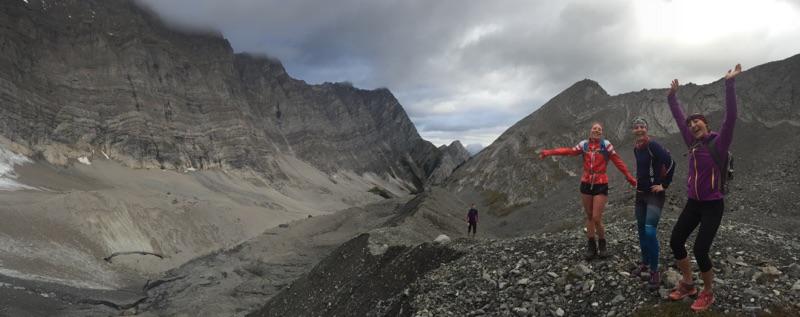
Canadian biathlete Nadia Moser on a hike up to the Old Goat Glacier with teammates Emily Dickson, Darya Sepanj, Anna Haslach, and Megan Bankes. A recent study found that the enjoyment of physical activity is more heritable in women than men. (Photo: Emily Dickson)
One of the biggest public health challenges worldwide is physical inactivity. As the World Health Organization reported in August, the number of obese children and teenagers has grown by ten times in the last 40 years, and in five more years there may be more obese children than underweight children in the world.
As a result, there’s a lot of interest in how to motivate people to take part in physical activity. As we wrote about earlier this fall, that includes a study of American Birkebeiner participants which found that participating in group-based exercise provided an important extra bit of motivation even for people who were quite self-motivated to exercise or train.
Another piece of the picture was examined in Finland. There, researchers had the opportunity to use a study of twins to disentangle the genetic and environmental contributions to people’s motivation to do physical activity in their “leisure time.”
“In classical twin studies, we compare a resemblance within pairs of identical twins to the resemblance within pairs of fraternal twins,” Dr. Sari Aaltonen, the lead author on the study which was recently published in the Scandinavian Journal of Medicine & Science in Sports (but is behind a paywall), wrote in an email. “For instance, if identical twins are more similar than fraternal twins, then genes significantly influence that trait. If the correlations for fraternal twins are equal to those for identical twins, then shared environmental influences (e.g., childhood home environment, if the children were raised together) are indicated to have influence that trait.”
Using this framework, Aaltonen and colleagues in Helsinki and Jyvaskyla, Finland, and in Amsterdam, the Netherlands, worked with 1,271 pairs of twins in their early and mid 30’s. They gave each twin a survey to assess how much each of eight different dimensions of motivation contributed to the reasons they exercise.
In that part of the study, three of these dimensions turned out to be most highly rated by the twins as reasons why they exercise. One was physical fitness, the next psychological state, and the third enjoyment of sport.
Then using genetic twin modeling, the researchers inferred how “heritable” each of these different types of motivation was. Heritability is an estimate of the proportion of variation in trait, in this case the source of motivation, which is controlled by genetic variation. In a perfectly heritable trait, 100% of the variation is controlled by genes inherited from the parents. In a completely non-heritable trait, genes have no influence and instead the environment or other factors control how the trait is expressed.
“In general, we know that the most of human phenotypic traits are complex traits; both genetic and environmental factors influence them,” Aaltonen wrote. “Our heritability estimates of the motives for physical activity have ranged between 13% and 53%.”
That’s a wide range. The paper gets into which sources of motivation are more heritable than others. For example, “others’ expectations”, “mastery” (improving one’s skills or abilities), “competition/ego”, and “physical fitness” were all highly influenced by environment. For these dimensions of motivation, around 80 percent of the variation in people’s assesment of their importance was driven by environment, rather than genetics.
Even for the more heritable dimensions of motivation, environmental factors were still clearly important. In the most highly heritable source of motivation, “enjoyment”, with 33 percent of the variation in men and 53 percent of the variation in women being explained by genetics influences.
“Enjoyment is a strong intrinsic motive, which means that a person is motivated to be physically active because she or he finds it pleasant, fun and/or satisfying,” Aaltonen wrote. “When people are intrinsically motivated, they follow their innate needs and interests. Therefore, it may not be surprising that ‘enjoyment’ was found to be the most heritable motive dimension in our study.”
Similarly, in a study in the Netherlands, lack of enjoyment was found to be moderately heritable in men – that is to say, for those who really hated exercise, environment didn’t do much to affect that.
“Previous animal studies (mainly in rodents) and human studies suggest that there may be a biological regulation in terms of the motives for physical activity,” Aaltonen added.
The next most heritable source of motivation was “affiliation”, defined as “be with friends and/or do activity with others,” with 39 percent of the variation in men and 35 percent of the variation in women being explained by genetic influences.
How can heritability be different between men and women – aren’t genes passed on in the same way? Aaltonen explained.
“Generally, the heritability estimate is always time-, age-, population specific and, above all, it is an estimate of the genetic influences to individual differences on a population level, not an estimate pertaining to a single individual,” she wrote, explaining that all the variation can be partitioned into either genetic or environmental sources, so a high heritability estimate can simply mean that environmental influences exist, but that they are not so important in terms of determining the trait. “The high heritability estimate for enjoyment in women, for example, means that women’s enjoyment as a motive factor for leisure-time physical activity is less affected by environmental influences.”
“Why environmental factors are less important for women’s, but more important for men’s enjoyment to exercise in Finnish adults in their mid-thirties?” she mused. “Right now, I don’t have an answer for that. Based on our quantitative genetic results, we are not even able to reveal what the specific genes or environmental factors are that cause the difference between men and women. In terms of clinical implications, physical activity-promoting measures that try to motivate people to exercise may be even more important for men than for women, because of the greater role of environmental influences in men.”
That was just one of the insights that the researchers gained about how public health efforts could be targeted for success in motivating people for physical activity.
For example, physical fitness and enjoyment were both highly-ranked sources of motivation, but the former was determined more by environmental factors – and thus may be easier to affect by intervention – while the other was fairly heritable, controlled by genetics rather than a person’s surroundings or interactions.
“Several studies have suggested that extrinsic motives (for example, you want to be fitter than others, you exercise only because someone told you to do so, etc.) could be dominant during the early stages of exercise adoption, but that intrinsic motives (enjoyment and the satisfaction of exercise) would be more important for progression to and long-term maintenance of activity,” Aaltonen explained. “In other words, it may not be that difficult to get people to be motivated to exercise, but a challenge is to get them continue the activity habit. It helps if you enjoy it.”
“Due to this, a key issue may be to find a physical activity habit that is the most enjoyable for you,” she continued. “Then, you may better be able to stick to your activity routines also when you have a lack of motivation.”
OK, so you’re not Martin Fourcade. But, given how variable performances are in biathlon, how much would you have to improve in order to be a reliable medal pick? (Photo: Glen Crawford)
Biathlon is a notoriously variable sport: besides skiing, there’s the shooting aspect which can ruin a race in a matter of seconds. Sometimes an athlete like Lowell Bailey wins a World Championship for the first time after 15 seasons competing; sometimes the most reliable guy in the sport, Martin Fourcade, finishes 46th. It’s a wild world.
Norwegian PhD student Øyvind Skattebo set out to quantify just how variable the sport is, and what amount of improvement is needed to make the signal of better performance come through that noise and lead to more medals.
“The trend is for more athletes on the podium in biathlon compared with cross-country skiing,” Skattebo, who recently published one of his studies with Thomas Losnegard at the Norwegian School of Sports Science in the International Journal of Sports Physiology and Performance, wrote in an email. (The paper is available for free/open-access here.)
“The reason for this is not that it’s a ‘tougher’ field than in cross-country skiing,” he explained. “If anything, there is less spread between the best athletes in cross-country skiing than in biathlon. However, the biathletes vary more in performance from race to race due to the combination of several components: skiing, shooting time, and shooting result.”
Skattebo reviewed data from World Cup sprint competitions from 2005 to 2015, making up 109 races for women and 110 races for men. That represented more than 10,000 performance observations, and more than 1,000 observations of athletes who were ranked in the top 10 during a World Cup season.
Looking at the variability of performance within and between individual athletes, he could find some interesting patterns. For instance, men were no more consistent than women, but the top athletes were better matched in terms of ski speed.
Another finding was that while shooting times are highly variable between athletes, in terms of statistical significance, the magnitude of this variation didn’t have much effect on the final result of a sprint competition. Athletes spend much more time skiing than shooting, and missing a shot has a greater effect than simply shooting slower than the next athlete on the range.
“There has been a great development in shooting time the last 10-15 years, and I believe a further reduction in shooting time (for the best athletes in the field) is more or less a waste of training time,” Skattebo asserted. “They have more to gain by getting more accurate or skiing faster. Understand me right, there are still a lot of senior competitors out there that can improve performance by reducing shooting time, but I think more or less that the best athletes don’t have anything to gain.”
It’s possible that shooting speed would have a bigger effect on total race time in head-to-head competitions like pursuits and mass starts, but Skattebo didn’t look at these results because sprints are much more straightforward to analyze – and there are more of them on the World Cup schedule, too.
“Maybe if we had looked at the last shooting in mass start or pursuit, where a quick shooting with several competitors entering the shooting range at the same time can definitely give an advantage on the last lap, [there would have been something],” he wrote.
Meanwhile, in terms of total race time, there was more variability in athletes’ overall performance than in either skiing or shooting separately.
“The shooting and skiing performance varies moderately and accumulates into a large variability in overall performance,” Skattebo explained.
Strategies to try to make teams and athletes more competitive should, at an organizational level, take this into account. In biathlon, having a solid, but not star, athlete — one ranked between 10th and 20th, for example — can lead to medals, but not reliably.
“The annual top ten cross-country skiers vary 1.8% in performance from race to race (in a 15 k skate race), compared with 2.5% for the same standard of biathletes,” Skattebo wrote. “Therefore, at one biathlon event the apparently best athlete can miss the top-10, and if several of the best performers fail a normally ~15th-ranked athlete can win. The biathletes are generally less reliable in performance than athletes in several other endurance sports and, therefore, it is less easy to predict the winner.”
In some ways, that’s a selling point of biathlon: the excitement of a race, the anything-could-happen feeling in a mass start, the lead changes and penalty loops.
“This makes it more exciting to watch,” Skattebo wrote. “Of course, [I’m being] completely objective since this is coming from a former biathlete.”
To get reliable medals instead of waiting for a chance for that 15th-ranked athlete to seize the day requires a targeted approach to improvement. Skattebo applied a calculation used in other sports to try to find the minimal “worthwhile improvement” needed for an top-10 athlete to get one more medal out of every ten sprint starts.
The strategy is to take the variability in performance of the top-10 athletes – and in this case, take the standard deviation as the measure of variability – and multiply it by 0.3.
“Previous statistical analysis of performance times and data simulations have shown that a performance improvement of 0.3-0.4 times an athlete’s SD will lead to about one more podium placement per ten competitions, for an elite athlete normally finishing among top 10,” Skattebo explained. “These analyses and simulations were originally conducted in track and field, but the derived thresholds have later been checked and used for other sports, such as rowing, swimming, orienteering, cycling, and cross-country skiing.”
For a biathlon sprint, that measure corresponds to about 12 seconds for both men and women if the athlete is already in the top 10.
In other words, that variability in performance will always be there for each athlete. But if one of them improves their performance on average by 12 seconds – skiing 1.2 seconds faster per kilometer for me, or hitting one more shot every other race, perhaps – then the best end of that variability will be medal-worthy 10% more of the time.
For athletes ranked further down the standings, bigger gains would need to be made.
“An improvement corresponding to 0.3 x an athlete’s SD that normally finishes 30th place would not get him/her to the podium,” Skattebo wrote. “This since the 30th-place male on average finishes ~96 seconds behind the winner, and an improvement of 12 seconds would ‘only’ get him to 24th place, on average. An improvement of six ranks is substantial, and would of course be meaningful for the athlete. But not enough to aim for the medals. So, even though the thresholds are calculated to evaluate how much a top-10 athlete need to improve to be at the podium more often, an athlete in the middle of the field would definitely benefit from a similar improvement.”
But for a top-10 athlete where 12 seconds will make a big difference, the next question is where those 12 seconds will come from.
One interesting result that Skattebo saw was that simply targeting greater resources for championship events — where medals matter the most — might not cut it. Although such a strategy might raise the performance of a team’s athletes, performance actually improves substantially across the board, so it might not be enough.
And showing up at the Olympics and turning in simply an average performance from the rest of the season will not lead to impressive results.
“It looks like all the athletes (on average) improve 2-3% towards championships compared to their mean performance at the World Cup,” Skattebo said. “So, to even finish equally as [they would at] World Cup they need to improve. And to improve their rank they need to improve their performance even more.”
To take a top-10 World Cup athlete and make an improvement worthy of an Olympic medal, then, Skattebo suggested that a 3-percent improvement would be needed — more like 45 seconds compared to the athlete’s standard previous World Cup time.
A number of strategies are possible to try to get to such a level, and probably they should all be pursued.
“I believe it is not a single explanation, but a combination of … better prepared skis and physiological peaking by the athletes,” Skattebo wrote.
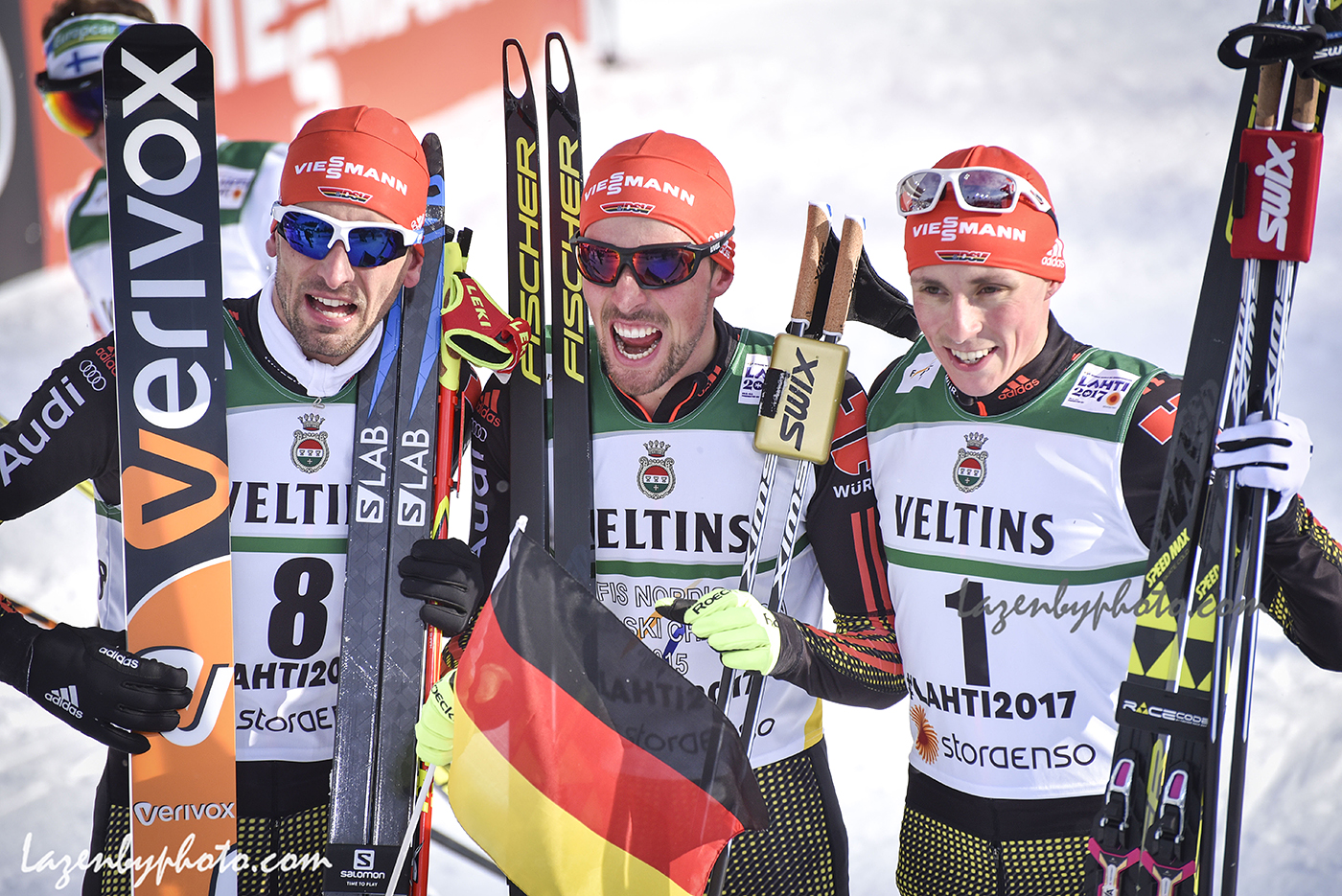
German nordic-combined stars Johannes Rydzek (c), Eric Frenzel (1) and Björn Kircheisen (8) after taking gold, silver and bronze, respectively, in the individual normal hill/10 k Gundersen at 2017 World Championships in Lahti, Finland. (Photo: John Lazenby/Lazenbyphoto.com)
What are the physiological capacities of nordic-combined athletes and can laboratory tests predict performance capabilities on the World Cup?
Those are the questions that a team of Norwegian researchers set out to answer by testing 12 competitors from eight different countries before a 2015 World Cup competition in Trondheim, Norway.
The study, led by Vegard Rasdal of the Norwegian University of Science and Technology and the Norwegian Olympic Sports Center, was recently published in the academic journal Plos One. It is an open-access journal, so you can read the paper here.
“The sport is always evolving,” Rasdal wrote in an email to FasterSkier about the results. “Today it is no longer enough to be ‘just’ a strong ski jumper or cross-country skier, you really have to excel in both in order to be successful in terms of podiums. Johannes Rydzek and Eric Frenzel, the two most successful athletes last season, were not only two of the best jumpers last season but also the fastest skiers.”
Indeed, they found that the best skiers in the nordic combined field have VO2Max capacities close to those of the best cross-country skiers, period – and even higher than those of Olympic medalist sprinters. Furthermore, this was a good predictor of World Cup results in the Trondheim competition.
Variability in Abilities and Physiology
There have been plenty of physiological studies on top cross-country skiers and some on ski jumpers, but the fascinating aspect of nordic combined is that two very different sports are combined. That creates uncertainty about what the ideal physiology for a competitor might actually be. Should they be light and explosive, for jumping? Strong and enduring, for skiing?
And do nordic-combined atheltes have as much explosive power as ‘special jumpers’, or as high aerobic capacities as cross-country skiers?
“As with most endurance sports, you will find a strong association between VO2Max and performance when the study group is heterogeneous, as e.g. a study group of 200 college students,” Rasdal explained. “Overall, VO2max is widely accepted as the most important factor for endurance performance. However, in a more homogenous study group, such as elite cross-country skiers, all athletes may have a ‘high enough’ VO2max to perform well at an elite level. Thus, other factors such as skiing efficiency becomes a stronger determining factor.”
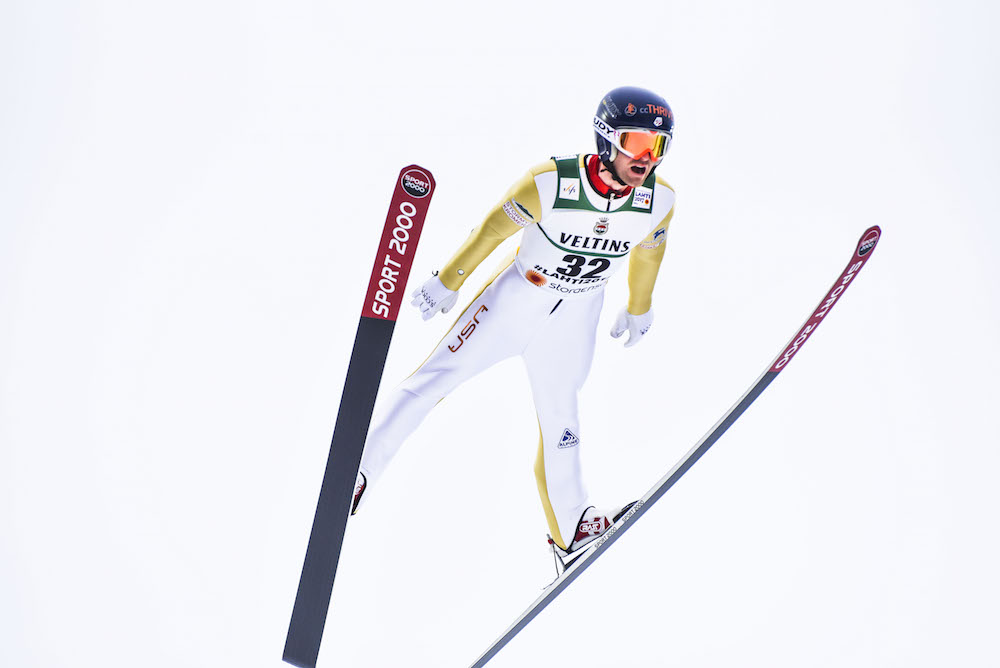
U.S. Nordic Combined skier Bryan Fletcher jumping to 31st on the large hill at 2017 Nordic Combined World Championships in Lahti, Finland. At the end of last season, he was the top-ranked American in the overall World Cup standings in 34th. (Photo: John Lazenby/Lazenbyphoto.com)
Rasdal and his co-authors wondered whether nordic-combined athletes fell into the first group, with moderately variable VO2Max, or the second group, where all had such high capacity that they had to be distinguished by some other characteristics.
Because some athletes get their start in ski jumping, and all must also train for jumping, the athlete selection process and training background from young ages is different than for cross-country skiers and could lead to more variability among individuals.
“It is not given that all nordic combined athletes have a ‘high enough’ VO2max or vertical jump capacity,” Rasdal wrote. “The shortcomings in one may to some degree be compensated with higher level in the other.”
To address that question, the research team partnered with the International Ski Federation (FIS) to conduct laboratory tests on athletes the day before a World Cup competition.
“FIS was responsible for the invitation of athletes, and each nation in the World Cup was invited and encouraged to participate with two athletes to be tested,” Rasdal explained. “To collect data on the very best athletes in the world is always a challenge, especially so close to an important international competition. We as a research group are extremely grateful that so many World Cup athletes chose to participate in the data collection.”
The athletes ran the gamut from being ranked second to 66th in the previous season’s overall World Cup standings, and included the eighth-best skier and second-best ski jumper.
About Endurance Capacity, and World Cup Success
The hypothesis that nordic-combined athletes were more variable in their physiology compared to single-sport specialists was largely upheld.
“Among the athletes we studied, a VO2peak range of 66.9-80.8 could be found, which does illustrate the heterogeneity in nordic combined,” Rasdal wrote. “This may make subordinate factors such as skiing efficiency relatively less important (although still important) than VO2peak.”
The upper measurements of VO2Max among the 12 athletes are close to those of cross-country skiers.
Furthermore, it was clear that the athletes on the lower end of the VO2Max spectrum were somewhat less successful on the World Cup. At least at this World Cup event, the overall ranking at the end of the day was strongly correlated to an athlete’s VO2Max and ski performance.
“This study together with the study by Tønnessen et al. may indicate that a body-mass normalized VO2Max in the region of 75 ml/kg/min is a sufficient capacity for a strong cross-country performance in Nordic Combined, whereas 80 is at very highest percentile,” Rasdal explained.
However, the Trondheim World Cup course is not necessarily representative of all World Cup venues. And poor cross-country skiing could have been penalized even more at this venue than usual.
“Trondheim is a special arena compared with other courses in the World Cup, with many steep uphills and fast downhill terrain,” Rasdal wrote. “In addition, 2015 was a bad winter in Trondheim, and the course was salted and ice hard. This made the event well suited for technical good skiers with strong upper-body capacity. It is therefore necessary to investigate the impact of ski jumping versus cross-country skiing on overall performance, as well as the associations to laboratory capacities, also at other venues and conditions.”
And About Those Jumps
2017 World Championships jump training on Feb. 21 in Lahti, Finland. (Photo: John Lazenby/Lazenbyphoto.com)
The implication is that perhaps at a different competition, the association between ski jumping performance and overall competition ranking might be stronger.
“Unpublished data does show that [across a whole season], the regression line for ski jumping to overall performance is similar to that of cross-country and the correlation coefficients are similar,” Rasdal explained.
When it came to benchmarking, the researchers also identified laboratory measurements that could predict ski jumping performance by nordic-combined athletes. They tried two measurements: a straight, simple squat-jump, and an “imitation jump” where the athletes were asked to start in the same position they would on a ski jump ramp. The jumping style and technique varied from athlete to athlete.
While it seems logical that these would be good predictors of ski jumping performance, it actually wasn’t a trivial matter. Such measurements have mainly been validated on straight ski jumpers, and because of their different body mass and physiology the relationship between squat jumping and performance, for example, could very well have been different among nordic-combined athletes.
“The time available at the take-off in the [ski jump] hill may present a greater challenge for NC athletes than specialist ski jumpers as two-thirds of the NC athletes’ annual training consists of endurance training,” the authors wrote in the paper. “This does not only leave less time available for power and [jumping-] specific training compared to the specialists, but endurance training may lead to negative effects on muscle strength and power.”
But in the end, the same measurements did predict ski jump performance.
“The jump capacity in the sport-specific imitation jump distinguished performance level better than the general jump capacity in squat jump,” Rasdal wrote. “That supported the argument for sport-specific testing at an elite level.”
Still, the imitation jump wasn’t perfect at predicting actual ski jump performance.
“The upper range of the lowest ranked performance group touches the lower range of the highest ranked performance group,” Rasdal said of the imitation jump measurements. “There is not necessarily a continuous linear relationship with performance. At some level, the ability to utilize the capacity in the field as well as other factors become more determining for performance, e.g. body mass, transition to flight (minimize the loss of speed), flight performance, etc… Ski jumping is an extremely challenging technical task to be performed in less than 0.35 seconds, and where a well execution may compensate more for a lack of physical capacity.”
And then there’s money.
“In ski jumping the equipment plays an important role, and the nations with the highest budgets may for instance have better suits which makes them jump farther,” Rasdal said of other potentially confounding factors in predicting jump performance.
What to Shoot For
At the end of the paper, the authors summarized the ideal characteristics of a nordic-combined athlete: high VO2Max, a strong upper body, a good vertical jump, and low body mass. Hitting all those different metrics at the same time is a tough calculus, but it’s what is required to be a champion these days.
“Although the relative importance of ski jumping to overall performance has varied in the sport over time, the pendulum today appears to lean more towards ski jumping,” Rasdal noted. “That’s both as a result of regulations (e.g. increase of meter-value in large hills in 2015), and also an increase in overall performance level where the best ski jumpers also ski fast.”
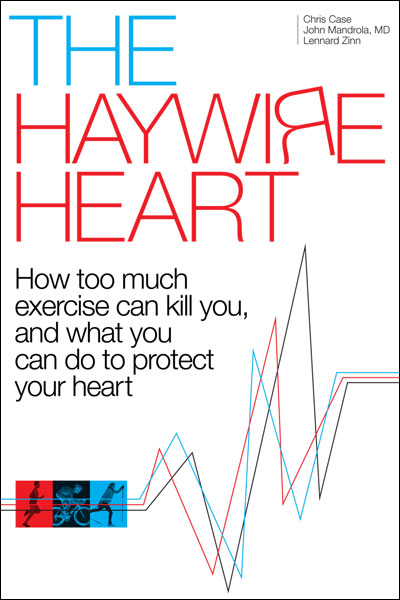
The Haywire Heart by Lennard Zinn, Dr. John Mandrola and Chris Case, is available for purchase directly from the publisher at VeloPress, or at Amazon and other booksellers.
When I heard that there was a new book coming out about heart arrhythmias in endurance athletes, I was interested.
Several years ago, I read some of the research papers that the book’s authors refer to. One was a cohort study on participants in the Vasaloppet, the 90-kilometer ski marathon in Sweden. Those researchers found that skiers who competed in more Vasaloppets had more heart arrhythmias – as did those who finished the race the fastest.
I wrote a piece about the findings at the time. The FasterSkier commenting system has changed, so original comments no longer appear at the bottom of the article, but I remember them clearly. Multiple commenters found the study hard to believe. One commenter was so sure that the findings were impossible that he wrote multiple angry comments arguing that exercise is good for you, so it couldn’t possibly cause heart problems.
As a scientist, I was flabbergasted.
There are a lot of crappy studies out there in sports science — and science in general, but I’m used to reading sports science papers with sample sizes of eight athletes. It’s hard to defend a lot of conclusions made from such studies. But this one? The researchers had following thousands and thousands of individuals and, well, numbers are numbers. An individual is either diagnosed with an arrhythmia or they aren’t. This was pretty straightforward.
Scientists go out and measure a phenomenon, and then we present numbers as an estimation of the world. There are many legitimate reasons to question the data or interpretation, and this is actually built into the scientific process. Before publication, other scientists will rip a a study apart as part of “peer review”, suggesting ways to make it better or even recommending it not be published.
That doesn’t mean that all published research is perfect. After publication, scientists continue to raise important points about whether the data collected represents reality (due to potential flaws like bias or study design), whether the statistical techniques are appropriate and correctly performed, whether alternative mechanisms could explain the patterns shown, and more. The public should absolutely engage in this process — and scientists should do better about engaging with the public. Anyone outside the study itself can ask questions that the researchers might not have seen, illuminating important aspects and leading to new research questions or repeating the study in a different way. In the end, this leads to gradually more and more accuracy in that estimation of the world.
Asking good questions is different than arguing that data is wrong simply because of a gut feeling or belief. The reaction to the Vasaloppet article was a frustrating moment for me but, I would come to realize, not an unusual one. When presented with facts that do not support our worldview, we tend to just discount them. It’s human nature.
All of which is to say that I was very interested to read The Haywire Heart by Chris Case, John Mandrola and Lennard Zinn.
First, I wanted to get more background on the topic, and I wanted it to be explained to me in clear, straightforward language instead of the scientific jargon of research papers.
Second, I wondered if the book would get the same reaction as my old writeup of the Vasaloppet study.
And third, I was interested to see whether, when presented with some scary narratives, I had the same reaction as those few FasterSkier commenters. After all, as much as I tout that I’m a scientist, I, too, have knee-jerk reactions — and I spend a lot of time exercising. I guessed that I might find the conclusions of the book plenty threatening.
The book opens with the story of Zinn, who is a former national team cyclist and a staff writer for VeloNews. Zinn is riding his bike outside of Boulder, Colo. He feels his heart skip a beat, and his heart rate “had jumped from 155 to 218 beats per minute (bpm), and stayed elevated.”
Zinn initially takes some rest and dials his training back, but ultimately he tries to keep riding and training. The incidents become more and more frequent until his heart actually stops at one point.
After that, Zinn radically changes his lifestyle. He does no hard efforts and much less training volume, period. Because of that, he’s still around to write the book today. His life is richer now, he writes (although it sometimes sounds like he is trying to convince himself as much as the reader). He has developed more different hobbies and can spend more time with his family. But it took him a long time to come to that understanding.
It’s a transfixing story about what can happen to a seemingly fit, healthy person. Because Zinn is an author on the book, you know that he will make it out alive. But how far will he go before he stops training? What will happen to him? Could that happen to me?
As we say in research, the plural of anecdote is not data.
While the authors include “case studies” at the end of every chapter (several of which feature cross-country skiers who nearly died on the side of Colorado ski trails), they also bring the data.
The book presents a compelling argument that we should be thinking more about our hearts – and particularly, the heart’s “electrical system,” as the authors call it. Endurance exercise doesn’t seem to increase the prevalence of problems with the “plumbing system,” or how the blood is pumped.
That’s not to say that athletes don’t have heart attacks (or, more accurately, myocardial infarctions). Risk factors are risk factors, and don’t completely disappear with exercise. High blood pressure, high cholesterol, a family history of heart disease, being male rather than female – these increase the risk of a myocardial infarction. In particular, athletes who came to endurance sports later in life and previously smoked or were overweight still carry those risks with them.
But the unique risk associated with long and intense bouts of exercise seems to be in the electrical system. Studies across multiple sports and countries, as well as in animal models like mice, rats and goats, have shown that the electrical impulses that keep the heart in rhythm can be made, well, haywire, by a lifetime of endurance training.
There’s a wealth of observational, epidemiological data suggesting that a long-term habit of endurance exercise can cause atrial fibrilliation, a rapid and irregular heartbeat originating in the atria. (Atrial fibrillation was the type of arrhythmia mentioned in the Vasaloppet study.)
Other arrhythmias seem to occur more frequently in athletes, too, like ventricular fibrillation. Premature ventricular contractions are common in trained athletes and don’t necessarily lead to bad outcomes; complex ventricular arrhythmias are also common, and can lead to cardiac arrest.
Exercise can also make genetic diseases like arrhythmogenic right ventricular cardiomyopathy (ARVC) more dangerous, and can lead to the disease even in the absence of genetic markers.
Some causes are straightforward. One symptom of “athlete’s heart,” as it is called, is enlarged chambers in the heart. And this is associated with atrial fibrillation: patients with atrial fibrillation tend to have larger left atria than those without.
Exercise also leads to inflammation of muscles. The heart is a muscle; inflammation can lead to scarring, which can then disrupt the transmission of electrical signals across cells.
The logic and evidence go on and on. The authors explain all of this much better than I can, even when paraphrasing. I’ll let you read the book and just say: it’s convincing. And if you haven’t studied human anatomy since high school, don’t worry. It’s clear and well-explained.
As to the second question, the authors tackle that, too. Mandrola, a doctor, notes that when many athletes receive a diagnosis of a heart problem, they go into denial. Many decide not to change their behavior. There’s a sort of cognitive dissonance to being told that something you have always believed is healthy is actually putting you at eventual risk of death.
“It is completely natural to go into denial for a while,” Zinn writes. “I don’t know of any masters athletes diagnosed with non-life-threatening arrhythmias who didn’t go back to pushing it hard in training or racing in hopes that the incident that sent them to a cardiologist was just a fluke.”
If you do have a problem with heart rhythm, the authors provide several chapters as a guide for when to go to the doctor, what to ask and tell them, and what treatment options might be available. Getting a correct diagnosis is key, and as cross-country skiers, that is not a trivial ask.
“Even doctors who run marathons don’t quite get the intensity thing,” Mandrola writes. “Marathons are a different sort of affair. There is no question that they are hard, but they generally have an even pace and don’t involve the competitive crises that flare up repeatedly in a bicycle race or a cross-country ski race or triathlon.”
Women, too, are often misdiagnosed. The authors explain that women are more likely to be assessed as having an anxiety disorder than men, even when suffering from the same underlying heart problems: “Women younger than 55 were seven times more likely to be misdiagnosed and turned away from the ER than their male counterparts.”
But the main advice, when confronted with a heart arrhythmia, is first to go to the doctor, and second to back off of training. It might save your life – and it might also make the problem disappear. That doesn’t necessarily mean stopping completely, but it might mean going slower and for shorter sessions. “Detraining” is a good therapy for several diagnoses.
“In the end, I believe that all that denial and continued racing and training hard with the hopes of retaining some portion of my former life either damaged my heart or trained it so that it now goes into arrhythmia more easily,” Zinn writes of his own situation.
Detraining might seem horrible, like an unacceptable lifestyle adjustment. But as the authors point out, once you know the other options – medications with scary side effects, procedures with non-trivial rates of complications, death – training a bit less might seem like a much better option.
As for me? I definitely reacted to the book, but not by going into denial. Instead, I was scared.
“The day before he died, he had gone for a six-hour run,” the authors wrote of Micah True, a barefoot- and distance-running legend.
I read that the day after I had done a four-hour overdistance running workout. It hit home: none of us are invincible.
That said, the one thing I found missing from the book was a real estimate of the prevalence of these heart problems. I could easily follow why they would develop, based on the physiology of the heart and what we do to it. And I found the research cited credible. But how many people does this happen to? Just what is the risk, statistically?
One reason the answer might be lacking is simply that it’s hard to do comprehensive research on such a topic. As the authors point out, you can’t really do a randomized, controlled, double-blind trial – the gold standard for scientific studies – about the effects of lifelong exercise.
Nevertheless, it’s clear that such health issues are common enough to give one pause.
I’m just 30 years old, and I am probably not going to change my exercise habits after having read this book. But it reinforced a lot of peripheral behaviors that I should know are important anyway.
For instance, in some patients, arrhythmias pop up only when they are stressed. Leading a high-stress life and sleeping too little are major risk factors. Burning the wick at both ends: that’s the sort of life I lead – and the sort of thing I always know I should work to address, but here’s another good reason to do so.
Likewise, making sure to get enough electrolytes when training, to avoid dehydration, to get good rest and recovery, and to listen to your body – these are important.
“You have probably been training for many years, if not most of your life,” Mandrola writes in one chapter. “Those years of training have given you a good sense of what ‘normal’ feels like. What you are looking for is anything that falls outside the boundaries of normal.”
If I do ever feel a flutter in my chest, I’ll now know not to ignore it.
Athletes on course in Rumford, Maine, at 2011 U.S. nationals, which were plagued by low-snow conditions. (Photo: flyingpointroad.com)
“I think if you’re a nordic skier in New England, you should definitely be alarmed.”
“That’s one of the main take-homes: skiing is not going to disappear completely, but it will generally be higher [in elevation].”
So says Cameron Wobus, a Bowdoin ski team alumnus and a researcher at Abt Associates, a global research firm. Wobus and colleagues based in Boulder, Colo., and Washington, D.C., recently published a study in Global Environmental Change assessing the impact of projected climate change on the ski industry. (The article is available free of charge here.)
Their results: by 2090, many cross-country ski areas across the U.S. are likely to see 50-100 percent reductions in season length. That could translate to more than a million fewer visits by skiers, and millions of dollars of losses in trail-pass revenue.
A lucky few ski areas could see only minor impacts, but a lot of that depends on greenhouse-gas emissions scenarios – basically, what the world does to curb the release of carbon dioxide and other greenhouse gases between now and then.
“I think a main finding is that elevation is your friend, which isn’t surprising,” Wobus said in a phone interview from Boulder last week. “If you’re a ski area in the Rockies and your base elevation is 10,000 feet, you’re obviously in better shape than if you’re a ski area in central Vermont and your base elevation is 500 feet.”
The Nerdy Part of Prediction
A previous report by Protect Our Winters and the Natural Resources Defense Council took a more detailed look at the economics of the winter sports industry under projected climate change.
Bob Rosso, Mike Sinnott, Gary Storey, Kate Barton, Kelly McClowskey, and Colin Rodgers shovel snow onto the SuperTour 10/15 k classic distance race course in Sun Valley, Idaho, in 2015.
What Wobus and his colleagues wanted to do rather than to get bogged down in predicting how interest and tourism for winter sports would change in a warmer world, was to make the best possible predictions of how snowpack and season length would be affected at ski areas.
“We wanted to do was a more detailed analysis of the physical snowpack modeling,” Wobus explained.
To get to their conclusions, the research team modeled snowpack at 247 alpine and nordic ski areas by combining historical datasets, climate change models, and greenhouse gas emissions scenarios. As a starting point, they used North American Land Data Assimilation System meteorological forcing data, which has been recorded at a fine scale since 1979.
They then put this meteorological data into the Utah Energy Balance model to derive snowpack at ski areas, based on what comes out of the sky and landscape factors that would determine how long snow stays on the ground.
When the researchers compared this derived snowpack estimate to actual measurements of winter season length collected for the Snow Data Assimilation System – a framework that combines satellite data, airborne measurements, and on-the-ground observations – the match was solid.
“We did a reasonably good job,” Wobus said. “Not surprisingly, it’s a little bit messy … but on a region-by-region basis, the only thing we need to get out of the physical model is the season length. So with the exception of the Pacific Southwest, we are generally capturing trends in season length from region to region.”
With that information about winter season length in different parts of the U.S. in hand, the researchers applied different climate change models to predict the magnitude of reduction in season length.
“We applied a simple delta from what all the climate models were telling us, to say, okay, we aren’t going to rely on the climate models to tell us what the weather is doing,” Wobus said. “We’re going to use a 30-year historical time series to look at natural month-to-month and year-to-year variation in weather. But then we’re going to superimpose on that weather, a climate change signal that is a change in monthly average temperature and monthly average precipitation, coming out of different climate models and different emissions scenarios.”
The climate models used, known as General Circulation Models, or GCMs, are mathematical representations of the physical processes happening on and around the earth.
“[GCMs], representing physical processes in the atmosphere, ocean, cryosphere and land surface, are the most advanced tools currently available for simulating the response of the global climate system to increasing greenhouse gas concentrations,” the Intergovernmental Panel on Climate Change writes on its website. “GCMs depict the climate using a three-dimensional grid over the globe, typically having a horizontal resolution of between 250 and 600 km, 10 to 20 vertical layers in the atmosphere and sometimes as many as 30 layers in the oceans.”
There are many different GCMs – and while they are pretty good at predicting temperature, their predictions about precipitation vary widely.
“The precipitation predictions tend to be all over the map,” Wobus said. “We tried to beat it down to the extent that we could by using as many different climate models as we could, given the constraints of our budget. And by modeling as many years as we would, again, given the constraints of how much time we have to do the modeling.”
In the end, that meant using five different GCMs. And additionally, the team put all of those models through two different greenhouse gas emissions scenarios.
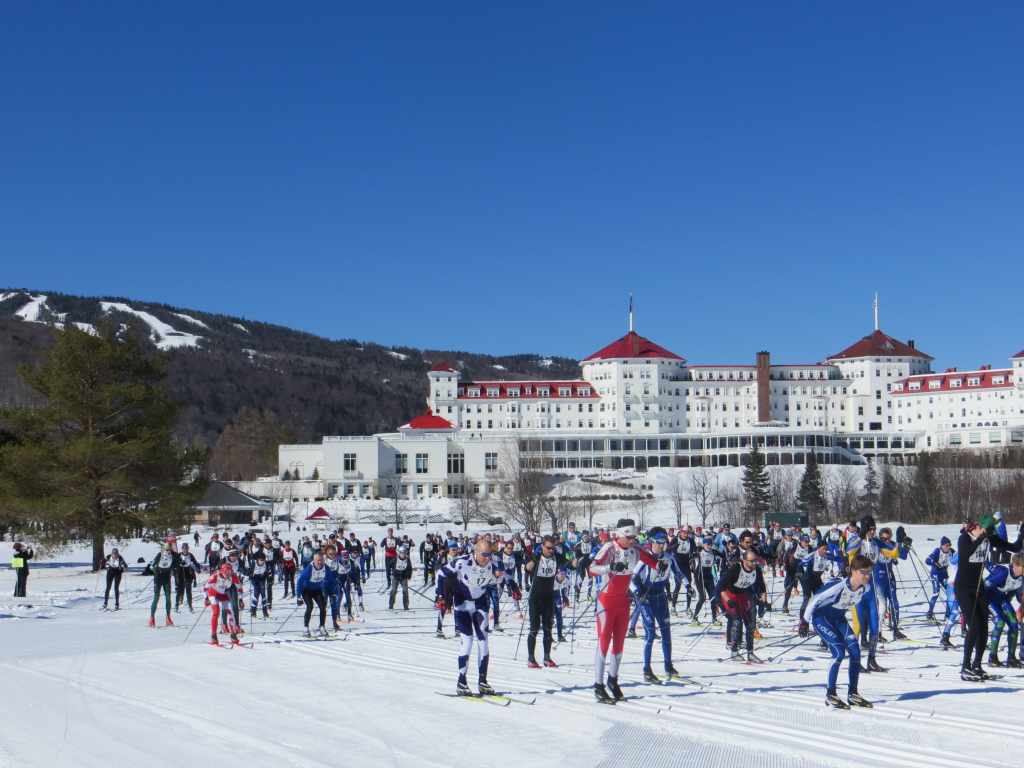
The Bretton Woods Nordic Marathon. Climate-change researchers used the Bretton Woods cross-country ski center as an example to demonstrate predicted reductions in ski season length. (Photo: Mark Butterfield)
The Findings
Especially under the high-emissions scenario, a lot of the differences between predictions made from the different GCMs disappeared by 2090.
The authors demonstrated this in a graph of predicted season length for the Bretton Woods cross-country ski area in northern New Hampshire. They showed the predictions for all five GCMs under both emissions scenarios, compared to the baseline season length at present (68 days, with a range of up to 150 days).
By 2050 under a lower emissions scenario, mean season length dropped precipitously to roughly 12-33 days, but the range of possible season lengths is quite wide for some of the GCMs.
“All these different GCMs have different parameterizations of precipitation, and so they are all going to do slightly different things,” Wobus said.
By 2090 under a high-emissions scenario, though, the model predictions all converge between two and 13 days, and the current average season length is not even in the range of possible predictions for any of the models.
“By 2090, it’s pretty clear that your distribution of season lengths is very different from baseline to future,” Wobus explained. “That’s kind of regardless of which [emissions scenario] you pick, but RCP 8.5 [the higher emissions scenario] is worse.
“That’s one of the main takeaways from the paper,” he continued. “Climate change isn’t good for skiing in the future, but a greenhouse-gas mitigation scenario looks better than a no-mitigation scenario, pretty much across the board.”
Why is that? Despite the variability in the precipitation predicted by the models, temperature increases would be so great by 2090 that precipitation largely wouldn’t matter.
“You’re looking at close to 10 degrees Fahrenheit of warming,” Wobus said, discussing predictions for the Midwest. “It doesn’t necessarily protect you to be way up north or to be really frigid now. There’s obviously a latitudinal dependence on where things are worse, along with elevation. So maybe if you’re up in northern Michigan with [the higher-emissions scenario] you might still have half your ski season, but it’s certainly going to be shorter than you’re used to.”
Snowmaking equipment at the Rikert Touring Center in Ripton, Vt. Snowmaking is becoming increasingly necessary to maintain winter ski areas, but should the ski industry also be developing other strategies?
Part of this prediction arises from the fact that the team assumed that cross-country ski areas don’t use snowmaking. Wobus said that he knows some nordic areas are investing heavily into snowmaking (or snow storage), but in general, not enough currently use it to build into their projects as they did for alpine ski areas.
But even if ski areas were to rely on snowmaking, they might be in trouble. For instance, under a high low emissions scenario, just 23 percent of alpine ski areas would have accumulated enough hours of snowmaking in 2090 to open by Dec. 15. As most of the cross-country ski areas are restricted to lower-elevation areas at the bottom of mountains, they would not be in better shape.
Without snowmaking, a high-emissions scenario would lead to roughly 87,000 fewer visits to cross-country ski areas by 2050 and 1.1 million fewer visits in 2090 – equivalent, by that point, to $10.2 million less in trail passes sold.
Are We Listening?
The idea for this piece of research came while spitballing.
“We’ve been doing work for ten years around impact of climate change on various sectors of the economy,” Wobus said. “I’ve published papers on the impacts of ocean acidification and ocean warming on coral reefs and linking that to a recreational use model. I did one on inland flooding and monetary damages from flooding. We’ve done all these different sectoral analyses for different economic impacts of climate change.”
Living in Boulder and being skiers, the team thought – why not look at that?
“We were basically pitching ideas, and we were like, skiing is a pretty important industry in certain parts of the country and it probably has a serious economic impact … so we did it,” Wobus laughed.
But the findings have made a splash.
“People seem to have been noticing,” Wobus said. “I actually credit Global Environmental Change for having a Twitter feed, of all things. Protect Our Winters picked it up, and Powder Magazine picked it up. … Most times people don’t pay any attention to my research. So it’s kind of cool to have something that’s a little more out there.”
Americans and Norwegians train alongside one another at the 2015 International Junior Camp in Oslo, Norway. According to a recent study in the British Medical Journal, nearly 20 percent of Norwegian junior women had disordered eating as of 2010. (Photo: Bryan Fish)
Research across sports and geographic regions has shown that elite athletes have a higher prevalence of disordered eating than non-athletes. For instance, a previous study found that 25 percent of all first-year students in elite sports schools in Norway showed disordered eating, and that for female athletes this primarily resulted from concerns about their appearance.
“Disordered eating is a disturbed and unhealthy eating pattern that can include restrictive dieting, compulsive eating or skipping meals,” Australia’s National Eating Disorders Collaboration explains on its website. “Disordered eating behaviours, and in particular dieting are the most common indicators of the development of an eating disorder. Eating disorders are severe and life threatening mental illnesses. An eating disorder is not a lifestyle choice.”
“[Eating disorders] have severe physical and psychosocial consequences, and are therefore not compatible with sports performance in the long run,” Ingvild Pettersen and her co-authors wrote in the new study.
Their research is notable because it focused explicitly on young female athletes in skiing and biathlon, achieving a large sample size. And the team looked beyond the elite sports schools to see whether sociodemographic factors may change the prevalence of disordered eating.
After the 2009/2010 season, Pettersen’s Oslo-based research group sent out surveys to all the young women who had finished in the top 30 of their age group in at least one Norwegian Junior Cup race. Of the 262 women contacted, 225 responded by filling out the Eating Disorders Inventory-2 and answering questions about their social and demographic backgrounds.
The researchers found that disordered eating seemed to increase with age, with just 10 percent of women in the 17-year-old age category displaying the behavior while more than 20 percent of those in the 18- and 19-year-old categories had disordered eating.
An athlete’s educational situation also played a role, with a high proportion — 28.9 percent — of women who were at elite-sports high schools exhibiting disordered eating. Less than 18 percent of those at any other type of school, including general studies high school, university, or a high school with a sports specialization, showed DE.
“The high occurrence of DE within these schools may be related to their environments,” the authors wrote. “[Elite sports schools] are known for having a high performance pressure. This can result in a performance-focused climate that can predispose to the use of dieting methods in order to improve their performance if the athlete does not cope with the pressure. In addition, the students often move away from home to attend these schools, which may increase the risk of poor nutrition without the parental control.”
The ski and sport schools have been working with a nutritionist as part of the Sunn Idrett (“Healthy Athletes”) initiative, founded in 2008 to help combat eating disorders in female athletes. Biathletes Tora Berger and Tiril Eckhoff and skiers Marit Bjørgen and Astrid Jacobsen are among the ambassadors for the program.
The authors also found a link between sport drop-out and disordered eating, although it was based on only 10 athletes who had ceased practicing their sport. But of those 10, four exhibited disordered eating.
The study design did not allow the authors to address whether drop-out was caused by an eating disorder, as has been speculated in some previous research. The opposite could also be true: the athletes could have developed disordered eating after quitting their sport.
“Athletes who were no longer active had a significantly higher occurrence of DE… than those who were still active, implying that DE may be caused by a morbid fear of fatness and body image disturbances,” the authors wrote.
In other words, once athletes stop training and burning so many calories, they may develop unhealthy eating habits to try to maintain their appearance with lower caloric intake.
In fact, in the study the researchers found that disordered eating in these young athletes was more correlated to body image dissatisfaction than by a drive for thinness.
But as to its ultimate cause and emergence, they concluded that more data was needed. Even by age 17, one in 10 of the women showed disordered eating. Stemming that pattern requires an understanding of the sports and social environment at an even younger age.
“To better understand the causal relationship of the predictors of DE, longitudinal studies are needed on both male and female athletes younger than the junior competing level,” the authors concluded. “There is a need for theory-based research on how we can change and prevent DE behaviour in sports. We need to identify psychological constructs that may influence eating behaviour in sport, and how those factors exert their influence.”
Serenity is being alone on the ski trails — but are we truly alone? Research shows that even a low-impact sport like cross-country skiing can have negative effects on wildlife. Those conflicts are likely to increase with climate change.
Schuss, schuss, schuss as you skate through the woods.
The occasional slap of your classic skis as you head up a climb.
Laughter as you chat with your training partner.
As cross-country skiers, we think of ourselves as fairly quiet out in nature: aside from the groomer, there’s little motorized traffic, no spewing exhaust, no chairlifts. In the grand scheme of sports, cross-country skiing is relatively low-impact, or at least that’s what trails are designed to make you think.
And it goes into the psychology of skiers, too. A team training session might be boisterous but most skiers also relish the solo days spent out on the trails, contemplating or working a problem through in their head, perhaps focusing on their technique, or simply admiring the natural world and beautiful views.
But is our impact on that natural world really so minimal? Not necessarily.
Poorly designed or sited trails can exacerbate erosion, for instance, while filling low-lying swampy areas affects natural hydrological patterns.
But research shows that even well-designed trails can have impacts on wildlife. This happens primarily through habitat fragmentation of interior forest, and when skiers encounter wildlife and trigger their flight reactions. Such disturbances can have dire consequences for animals living on the edge of their energetic requirements in a tough winter.
Additionally, climate change will cause increasing convergence between areas which are suitable for ski trails and habitat for native species.
Habitat Fragmentation
Where should new trail networks be built? As tempting as it might appear, probably not in pristine forest, according to bird researchers.
“My research found that the greatest richness and diversity of birds occurred in large areas of forest free of trails, which suggests that much like other effects of fragmentation, protecting birds from disturbance associated with trails can best be accomplished by setting aside large refuge areas,” Bill Thompson of the Lake Simcoe Region Conservation Authority outside of Toronto, Canada, wrote in an email.
Trails slicing through otherwise intact blocks of habitat cause what is referred to as “habitat fragmentation”. Fragmentation is also caused by cutting down forests, building houses and other development, and increasing agricultural intensity. Globally, habitat fragmentation is one of the leading causes of declining biodiversity.
Compared to building new towns or burning the rainforest, hiking and ski trails cause quite subtle fragmentation. Some species might not be affected at all, or might even do better where trails increase the amount of light reaching the forest floor or change the types of plants which are able to grow.
That’s in line with previous research. For instance, a 1998 study conducted in Boulder, Colo., found that in both forests and prairies, the types of birds found near trails were quite different than those found farther away. In particular, specialist species – those which require particular environmental conditions to succeed – were more rare near trails.
Birds which are specialized to interior forest need quiet, undisturbed habitat. They may need food that is specific to the deep forest. When that habitat is disrupted, for instance by a trail, power line or logging road, the birds move out.
“Research by the Wildlife Conservation Society in the Adirondacks has shown in the Science from the Field 2000-2010 Report that at least the 17 acres of forest surrounding a house and clearing become noisier, less sheltered, and vulnerable to invasion by domestic animals and nest predators and parasites,” Audubon Vermont wrote in a 2012 publication. “Interior forest conditions that are not impacted by fragmenting features do not occur until more than 200-300 feet away from the forest edge.”
As noted, trails can be highways for predators to access the forest, as well as for invasive species to arrive. Furthermore, in the Boulder study, bird nests near trails were more likely to be parasitized by brown-headed cowbirds, which lay their eggs in nests belonging to another species and leave those parents to raise the extra young. This can lead to higher death rates for the host birds because the cowbirds’ loud calls attract predators.
Thompson’s study showed that it wasn’t necessarily the intensity of trail use which disturbed birds in southern Ontario, but the presence of a trail itself.
“In my study sites there was a real range of public use levels and levels of popularity in trails, none of which appeared to influence my results,” he wrote in the email. “That suggests to me that it is the presence of the trail itself, rather than the presence of people which is the primary cause of disturbance. That could be a result of the localized loss of habitat, and associated loss of vegetation which acts as cover from predators and substrate to pick insects off, or that the compacted soil of the trail makes excavating for insects more difficult. I suspect part of the reason is that the major predators for songbirds in our area are mammals and snakes, which tend to use trails preferentially.”
Thompson suspected that the impacts of winter trails would be slightly less than those of summer trails. However, it’s important to note that most trails are used year-round.
A possible solution to the habitat fragmentation problem: setting up dense networks of trails, while leaving other tracts of land untouched.
“The important point is that neither the extent of trails, nor their density, had an impact, which suggests that a balance can be achieved between trail development and wildlife habitat,” he explained. “Trail designers have the option of either aligning trails along habitat edges as much as possible, or in identifying the most diverse and productive habitat within their natural area, and setting it aside as refuge habitat, focusing trail development on other, less ‘valuable’ habitat.”
Human Disturbance
Little work about habitat fragmentation by trail networks addressed winter-use trails. But plenty of work has been done about how skiers and other winter recreationalists disturb wildlife.
“The colder weather [increases] their energetic requirements,” Thompson wrote of his birds. “There has been a body of work which has observed that birds (even those foraging in the canopy) will stop foraging in the presence of trail users, presumably to ensure that they aren’t predators. During cold winters, some birds are living on very tight energetic margins, and need to consume a lot of food. Repeated disturbances in those situations could be extremely detrimental to winter survival.”
Other researchers have been focusing on how disturbance affects large mammals such as moose.
“I did some basic calculations for the animals involved in the experimental disturbances, but the real costs depend on many factors (terrain – movement uphill, downhill or plain), snow conditions (snow depth, wet/dry snow, icy snow, ice crust to walk on or not, …….),” wrote Wiebke Neumann, a moose researcher from Sweden.
“In general we can say that winter is a period animals usually live on their energetic reserves – any extra movement depletes them more quickly,” Neumann wrote in an email. “Single disturbances may not cause any problem for healthy animals that are in good body conditions. Yet, disturbances that occur repeatedly are likely to have an impact or animals that are on the edge [such as young, old, or ill individuals] may suffer heavily.”
A reindeer in the Kebnekaise valley in Sweden. (Photo: Wikimedia Commons)
Research on reindeer in Norway found that animals startled by cross-country skiers moved away even farther than when startled by snowmobiles, perhaps because they could detect the snowmobiles from farther away while skiers arrived quietly and unexpectedly.
Meeting three cross-country skiers, the researchers calculated, would use 3.4 percent of a reindeer’s energy reserves for the day.
Ski lifts were particularly bad for the grouse, reducing their densities and changing their behavior. In a separate paper, the research team calculated that black grouse habitat had been reduced by 12 percent in their study area by ski resorts themselves, but by another 16 percent due to outside-the-bounds activities like backcountry and freeskiing.
Like Thompson, the team suggested using habitat models to identify areas of habitat which could be kept free of recreation.
“By identifying zones of potential conflict, while rating its relative intensity, our model provides a powerful tool to delineate and prioritize areas where wildlife winter refuges and visitor steering measures should be implemented,” they wrote.
For her part, Neumann said that the ecological impacts of skiing didn’t mean we should feel so guilty as to abandon the sport altogether. Along with considerate siting of new trail networks, she recommended using common sense when encountering animals on trail.
“Being aware of having an impact as well,” Neumann wrote. “Avoid areas where animals gather to feed or rest, and do not track animals. Keep a sound distance, no need for impressive selfies with wildlife, use binoculars instead and enjoy.”
Increased Conflict?
Finally, human/wildlife conflict around skiing is certain to increase in the future as warming temperatures and changing snow patterns push both skiers and wildlife into smaller and smaller areas of higher-elevation terrain.
Researchers at the University of Turin in Italy modeled how the two sets of requirements would converge under different climate scenarios, focusing on downhill rather than cross-country skiing. The paper, recently published in the Journal of Biogeography, was written by Mattia Brambilla; the senior author was Dan Chamberlain.
“What we do is we go into the field and we study animals [or plants] in their natural environment,” Chamberlain said in an interview. “I’ve personally done a lot of bird surveys in the mountains, particularly at different altitudes … you can basically predict statistically where a species is likely to be in relation to habitat, but also to climate. So you can say, in this area, at this elevation, with this habitat, this species has an 80 percent probability of being present.”
The team then fed their model into different climate predictions. Their finding: suitable bird habitat above treeline in the Alps will be reduced by over half with standard climate change predictions, and habitat which hosts the best diversity of species or the most threatened species will see substantial conflict with areas suitable for ski areas.
“There’s quite an overlap already,” Chamberlain noted. “Skiing is a very common activity, and there’s a lot of ski pistes which are at quite high altitude above the treeline. So there’s already conflict … the management of the trail has a negative effect on the habitat. Often the more grassy areas, areas with meadow, not too steep or with cliffs but not too flat either, those are often the areas that birds like.”
The mowing of alpine ski trails in winter, along with grading and filling to make the trails suitable to skiers of varying abilities, drastically changes the way that some birds would use such meadows for habitat, Chamberlain said.
Above treeline, cross-country ski trails would likely have less impact on bird habitat requirements. But as climate change proceeds new trail systems may be built in the remaining more-suitable areas for skiing, which could lead to more of the type of fragmentation identified by Thompson in tracts of forest.
“The message I want to get across is that these are some possible things that we should keep in mind,” Chamberlain said. “We can’t predict the future. We want to say, this might be an issue, what can we do about it? Maybe we identify some particularly important areas and put a moratorium on building ski pistes in these valuable areas. I’d like to see the information used for conservation planning… What we might be able to say is, what density of ski pistes could an area support? Or how many protected areas do we need and how big do they have to be?
“We’re not anti-skiing,” he concluded. “It’s one of the major incomes for mountain communities. What you’re looking for is a compromise, but you have to plan for it. So you need these things in order to try to develop skiing sustainably.”
What makes the Norwegian women so dominant? The top six women from the 2014-2015 World Cup were put through their paces on a ski treadmill, and their physiology – as well as their year-round training – was described in a new paper. That includes Ski Tour Canada winner Therese Johaug (c), runner-up Heidi Weng (l), and third-place and Ingvild Flugstad Østberg (r). (Photo: Madshus/NordicFocus)
What truly separates the best skiers in the world from the rest of the pack? A team of Norwegian physiologists set out to answer that question, taking advantage of the fact that in the last few years all of the best women on the World Cup have come from Norway.
Dr. Øyvind Sandbakk’s lab at the Norwegian University of Science and Technology gathered top six women from the 2014-2015 season – Marit Bjørgen, Therese Johaug, Heidi Weng, Ingvild Flugstad Østberg, Ragnhild Haga, and Maiken Caspersen Falla – and compared their physiology to that of six national-level competitors. The results are being published in the journal Medicine and Science in Sports and Exercise.
The national-level women had average FIS points of around 72, similar to top-20 distance skiers or top-six sprinters among the U.S. women; two of them had achieved top-15’s on the World Cup that season. Women in both groups were mostly in their mid-20’s with Body Mass Indices around 22, although the World Cup women were shorter and lighter while achieving the same ratio.
After submaximal and max-effort rollerski treadmill tests – completed just before the beginning of the 2015-2016 season – the researchers compared the women’s numbers.
In the submaximal tests, where the treadmill was set to 3 meters per second at a gradual incline for double-poling and 2.25 meters per second on a steep incline for diagonal striding, the World Cup stars were operating at a much lower capacity than the national-level women: 74 compared to 85 percent of their maximal heart rates while double-poling, or 84 compared to 94 percent while striding.
The paper also included a specific description of Marit Bjørgen, the most successful female winter Olympian of all time, noting that she had trained 980 hours the previous year: “Although her VO2peak values normalized to body mass were not outstanding, the combination of high absolute VO2peak, skiing efficiency, and O2 deficit values allowed her to be one of the best WC skiers during the 3-min test with either technique.” (Photo: Fischer/Nordic Focus)
“The submaximal stages with either technique were less demanding for our WC skiers, even though the oxygen cost and skiing efficiency did not differ and the group differences in submaximal cycle characteristics were minor,” the authors wrote. “These findings are in contrast to previous observations on submaximal skiing, where the efficiency with which metabolic energy is transformed into work rate and speed together with cycle length differ between skiers of different levels of performance.”
The World Cup regulars also had lower blood lactate levels, and in diagonal striding took longer striding cycles, covering on average a quarter of a meter more per stride.
In the maximimal tests, it was apparent which athletes belonged to which group as the World Cup top-six covered both more distance (by a margin of six to seven percent) and hit significantly higher speeds during 3-minute timed tests.
In double-poling, this was because about a minute into the maximal tests the speed of the national-group skiers began to decline. The World Cup women were able to maintain their speed for about a minute longer before a drop at the end of the test. They did so by keeping significantly higher cycle rates (i.e., tempo) than the national-group skiers through the final two minutes of the test.
“In the case of [striding], neither cycle rate nor length differed significantly between the two groups, indicating that our WC skiers combine these two factors more effectively than NC skiers to achieve higher speed,” the authors noted.
The World Cup skiers also showed higher VO2Peak: 65 mL min-1 kg-1 compared to 58.8 for the national-level women while double-poling, and 70.9 compared to 65.0 while striding. Measurements of 75 and 71 mL min-1 kg-1 by World Cup skiers were believed to be the highest ever recorded by female skiers in a ski-specific exercise (as opposed to running on a treadmill, for example).
What gave rise to the differences? Any inherent differences between the athletes were compounded by differences in training. According to training diaries, the top six women reported training on average 532 hours between May and October; for the national-level skiers, that number was 411 hours. When training time during the competition season (November to April) was added in, the totals raised to 920 hours for the World Cup skiers compared to 709 for the national level skiers.
Therese Johaug leading Heidi Weng in the Ski Tour Canada. (Photo: Peggy Hung)
Modes of training also differed. The World Cup elite did about 26% more low-intensity endurance training than their national-level counterparts, and more mid-level and speed training but less high-intensity endurance training. The World Cup skiers also did more strength training, and their training was a stable 80-95 hours from June to October while the national-level skiers gradually increased in hours over the course of the off-season.
“Our present observation that the amounts of low- and moderate-intensity endurance training by the two groups differed provides further support for the proposal that such training constitutes the preparatory foundation for competitions in cross-country skiing,” the authors wrote. “Our present observations do not bring the importance of high-intensity training into question, although it can be speculated that in such highly trained athletes as ours, the quality of each session (i.e., optimization of physical, technical, and mental aspects) is more significant than the total number.”
One possible reason for the difference in high-intensity sessions between the two groups is that the World Cup skiers spent nearly twice as much time at elevation: on average, 42 days spent living about 1,500 meters (~5,000 feet). Time at elevation is often spent more on low-intensity than high-intensity training.
Finally, the World Cup skiers spent 33% more time running and 40% more time training skating technique, but no more time classic skiing or rollerskiing than the national-level skiers. For both groups, just over half the training time during the off-season was dedicated to ski-specific training (defined by the authors as skiing or rollerskiing), with the rest accomplished by running, cycling, kayaking, and other activities.
“This variation between sport-specific training and cross-training may help athletes to tolerate such large amounts of training during the preparation period, as well as lower the risk of injury,” the authors noted. “Our cross-country skiers varied their mode of low-intensity training considerably, whereas their moderate and high-intensity training was more ski specific.”
Guzzling water: a way to beat an Athlete Biological Passport test or something which will get you tripped up in the long run? (Photo: www.freestockphotos.biz)
Anti-doping administrators have worried for years that athletes were dodging tests by chugging water.
Some call it “void-drink-wait.” If doping control knocks on the door, an athlete could urinate, then drink a half liter (or more) of water, and then wait to provide a sample until that water diluted a drug. Some cyclists caught doping have admitted to this strategy.
It was so widespread that it’s described as a method for beating tests on forums about performance-enhancing drugs, and that doping officials at events such as the Pan-American Games are instructed to note on a supplementary form if an athlete appears to be drinking a particularly large quantity of water.
“It is another way to try and dilute the blood other than infusion,” Dr. Jim Carrabre, the International Biathlon Union’s Vice President for Medical Issues, told FasterSkier.
A new study investigates how such behavior could impact not only doping tests themselves, but also blood parameters which are used as part of the Athlete Biological Passport (ABP).
That program repeatedly tests athletes’ blood to establish baseline values for a number of blood markers like hemoglobin, red blood cells, and mean corpuscular volume. Although these markers change through time with the effects of training or elevation, for instance, bigger abnormalities compared to the baselines might indicate blood doping.
There have been relatively few suspensions to date based on the ABP alone.
Carrabre estimated that drinking a large volume of water could impact ABP markers in small ways, but that it would be hard to drink enough water to make a difference.
The study was headed by Dr. Jakob Mørkeberg of the mass spectroscopy unit at Copenhagen’s Rigshospitalet (and also a consultant to Anti-Doping Denmark) and written by University of Copenhagen research assistant Jacob Bejder.
They used 20 recreational athletes as test subjects, and dosed them with an “aggressive” regimen of recombinant erythropoietin (EPO) for three weeks. Afterwards they had a ten-day “washout” period before being microdosed with a different form of the drug.
The morning after the microdose, the athletes were woken up and a blood sample was taken. Then half had a “normal” drink of water, while the others chugged a liter, deemed “hyperhydration”. Blood samples were taken again at 20, 40, 60, and 80 minutes afterwards.
A few days later, the microdose procedure was repeated, with athletes who had initially had a normal treatment now drinking the one liter of water, and vice versa. This controlled for athlete-to-athlete variation.
The researchers then compared ABP markers from that early-morning blood sample through time after the 20, 40, 60, and 80 minutes.
“There are individual thresholds for the athlete that needs to be exceeded,” Mørkeberg wrote in an email of the ABP parameters. “These are based on the likelyhood of only 1 in 100 clean athlete would exceed these. If exceeded the profile is evaluated by experts. The parameters are normally looked at together and support each other. Nevertheless, each of them alone can be used to sanction an athlete if is atypical.”
Reporting inThe Scandinavian Journal of Medicine and Science in Sports, they found that after about 40 minutes, both hemoglobin concentration and off-scores were affected by the hyperhydration treatment.
“The important thing is not to let the athlete ingest massive amounts of water before sample collection, at least not if the period from drinking to sample collection exceeds 30 min,” Mørkeberg wrote.
But to back up, what is an off-score? It’s one of the ABP markers, which is calculated from two others.
“It is an algorithm where the hemoglobin concentration (hb) and the relative amount of young red blood cells (reticulocytes) are combined,” Mørkeberg explained. “High hb together with a low number of reticulocytes gives a high off-score. Low reticulocytes is a result of low production of red cells. This is seen when your body has many red blood cells and hence hemoglobin. Your body senses this and reduces its own production.”
After blood doping, reticulocyte production is often extremely low because the body already has plenty of healthy red blood cells.
If the phrase “off-score” sounds familiar, it might be because of British marathoner Paula Radcliffe, whose data was among those leaked in the International Association of Athletics Federation scandal and was deemed “suspicious.”
Indeed, even in the athletes who had only “normal” water intake, the ABP data was not always sensitive enough to detect changes or trigger that threshold for a given athlete (two blood samples had been taken before the study began to establish baselines).
Using hemoglobin concentration and off-score, only 45 percent of the “normal” samples would have triggered an ABP positive, and 18% of the hyperhydration samples.
Including another parameter, the Abnormal Blood Profile Score, would have improved that to 67% and 45 percent. But that score, which combines several markers, is not yet approved for ABP use.
The lack of detection – which contributes to the small number of ABP cases actually pursued by administrators– could be because many things affect blood.
For instance, training or racing, elevation, or heat exposure can shift plasma volume by as much as 10 percent, while drinking the liter of water shifted it by only 5 percent. That makes determining whether parameters which are based on the concentration of something in the blood, such as hemoglobin, tricky to interpret.
In the Radcliffe case, the marathoner said that her off-scores were high because she had raced in nearly 90-degree heat in Portugal and was dehydrated. The explanation is not completely implausible based on the known effects of dehydration on plasma volume, and is useful when thinking about the effects of hyperhydration – if the sample had been taken a few hours later and Radcliffe had begun rehydrating, her off-score would have gone down and been deemed less suspicious.
Thus it is clear tat manipulating plasma volume can reduce the abnormality of blood passport markers. In fact, the researchers tried to test whether albumin, a blood plasma protein, could be used to detect big changes in plasma volume. But in this study, that was not the case, meaning that hyperhydration remains impossible to detect without directly observing the act – and thus it remains hard to tell whether changes in blood markers are due to natural variation, or more sinister masking strategies.
“It would really mean a lot if such a marker could be developed,” Mørkeberg wrote. “Only time will show if anyone will be successful.”
The upside, however? If an athlete sometimes uses this “void-drink-wait” strategy, but not always, their ABP could become increasingly volatile over time, which could tip off anti-doping testers.
“It would be almost impossible in my mind to alter the off-score in a consistent and predictable way by drinking fluids,” Carrabre told FasterSkier. “You have to remember that it is the variations in the passport module numbers that lead to suspension, so even diluting a normal person’s blood could potentially lead to a positive passport. Remember that manipulation of blood equals positive passport. The cause for the manipulation is irrelevant.”
Martin Johnsrud Sundby of Norway celebrates the fruits of his labor over eight stages of the Tour de Ski (TdS), after winning the final climb. He has told Norwegian media that his lung capacity is 80% of a normal man’s, which is why he trains so much; Russian cross-country ski federation president Elena Välbe says that if he’s really so sick, he shouldn’t be competing. (Photo: Fischer/NordicFocus)
Elena Välbe, the President of the Russian Cross-Country Ski Association, recently had some thoughts on how the Norwegians attain their dominance in cross-country skiing: through inhaler use.
“It’s annoying because this team, everyone has asthma,” she said, according to a translation of an interview with the Russian news service Izvestia. “I personally don’t understand what kind of asthma you can have, and still ski so fast… [Martin Johnsrud] Sundby said in a recent interview that in Oberstdorf it was bad because it was warm, and he lost his breathing and had to use powerful drugs. For us, this is nonsense. If a person is so sick then how are they going as if they were healthy? It seems to me that if someone is sick, they don’t have to compete.”
She went on to say that the trend of inhaler use in young Norwegian athletes was “alarming”.
Many of the former World Champion’s statements are far off the mark, scientifically speaking. But Välbe isn’t the first to imply that the Norwegians obtain an unfair pharmaceutical advantage.
Russian Ski Federation President Elena Vyalbe in 2004. (Photo: Ivan Isaev, Russian Ski Magazine)
Inhalers using albuterol (also called salbutamol) and other drugs of that class, called beta-2 agonists, seem to have an unfair reputation as narrowly-disguised cheating in parts of the sports world. This is despite the fact that numerous studies have shown that such drugs are not performance-enhancing.
And with Bjørgen currently on the sidelines after having her first child, Sundby appears to be the new poster child for winning with asthma. The winner of the Tour de Ski and the current World Cup leader, Sundby initially didn’t respond to Välbe’s comments.
Besides asthma, there are also other reasons to use inhalers containing beta-2 agonists or other drugs. A number of disorders fall under the umbrella of airway hyper-responsiveness, when the airways narrow in response to some challenge more easily or quickly than they would in a healthy person. Symptoms include coughing, wheezing, and shortness of breath.
“Airway dsyfunction as described by Price in 2014 includes the following: airway hyper-responsiveness, exercise-induced asthma, and/or asthma,” explained Dr. Michael Kennedy, a researcher at the University of Alberta who has studied airway inflammation in cross-country skiers. “Airway hyper-responsiveness in reality is the most important of these specific definitions because it accurately describes the phenomenon of airway narrowing (bronchoconstriction) due to exercise or physical activity.”
American track star Jackie Joyner-Kersee is an example of a famous athlete who succeeded despite an asthma diagnosis. (Photo: Wikipedia)
Those with airway hyper-responsiveness and another disorder in that family, exercise-induced bronchospasm (EIB), also treat their challenges with inhalers. Most individuals with asthma also have EIB, but many people have EIB without having asthma.
“Both asthma and EIB are likely under-diagnosed, but diagnosis can be tricky and there are look-alikes, like vocal cord dysfunction,” Dr. Krystian Bigosinski, a sports medicine doctor in Maine who works with the U.S. Ski Team, explained in an email. “That is why it is very important to get a solid diagnosis with the help of testing, such as spirometry with exercise or cold air challenge.”
Beta-2 agonists are generally prohibited by the World Anti-Doping Agency, but inhaled salbutamol, formoterol and salmeterol (common ingredients in inhalers) are allowed up to certain doses without a Therapeutic Use Exemption (TUE).
That’s good news for a lot of athletes.
“The treatment for both asthma and EIB is similar, and in both cases, the first line treatment is albuterol,” wrote Bigosinski. “If that doesn’t work, other medications are added, such as long-acting beta-agonists, inhaled corticosteroids, mast cell stabilizers, and leukotriene inhibitors. EIB, if not accompanied by true asthma, typically responds better and often only necessitates the use of EIB, by itself, is rarely if ever life-threatening. However, EIB with a background of asthma is more likely to need other medications as mentioned above, and EIB with asthma can be a medical emergency.”
Välbe seems to suggest that if you need treatment, you shouldn’t be competing.
“It is mostly a lack of understanding for the use of medications,” Vidar Löfshus, the chief of the Norwegian ski team, told Norwegian newspaper Aftenposten regarding Välbe’s comments. “Use of asthma medications are strictly regulated in doping legislation, no one does it for performance enhancing reasons. There are many people who have some issue or another with their airways, and when they are allowed to use drugs they can get to a normal level with their airways.”
The data backs him up: a lot of athletes have asthma or other airway hyper-responsiveness, and even for those who don’t, using inhalers does not provide a performance advantage.
Many Asthmatics in Elite Sport
In fact, asthma and other respiratory problems are extremely common in elite athletes, especially those who compete in unusual air conditions: very cold air, very dry air, or the chlorine-filled air inside a swimming hall.
The prevalence is high enough that a team of British researchers and doctors from, among other institutions, the National Heart and Lung Institute recommended that airway dysfunction be classified as an “occupational disease” in athletes.
“Applying a label of occupational disease in this setting raises implications for the care and treatment afforded to elite athletes,” the authors wrote. “Indeed it is a key mandate of the International Olympic Committee–Medical Commission (IOC-MC) that no athlete is harmed by exposure to sport and that all care is taken to ensure their health is maintained.”
Among athletes, most asthma diagnoses could be broken down into two categories. A research team from Portugal and Norway set out to see how prevalent the diagnoses of each were, hoping this could lead to better targeted treatment.
The first type of asthma they identified is classic asthma, associated with allergy problems. The second is what the authors called “sports asthma”: induced by exercise and lacking the connection to allergy that often underlies the disease. In water and winter sports, athletes were three to nine times more likely to have this second type of asthma than those who did not compete in cold weather or in aquatic sports complexes.
“Sports asthma” might be more recognizable when called a term you have probably heard: “exercise induced asthma.”
“There is exercise induced asthma (EIA) and exercise induced bronchospasm (EIB),” wrote Dr. Ed Merrens, the Chief Medical Officer of the Dartmouth-Hitchcock Medical Center in New Hampshire and the former team doctor for the U.S. Biathlon Association. “It is different than childhood asthma. Winter athletes certainly have higher incidence of EIB and EIA.”
What does that mean, in terms of numbers?
An Italian study of 659 summer and winter Olympians over a 12-year period found that 15% of athletes had asthma, and for almost a fifth of those, their asthma was not “under control”. The researchers also found that the proportion of athletes on an Olympic squad who had asthma increased from quadrennial to quadrennial.
A study in Sweden found that depending on the age class investigated, between 20 and 35% of current and former elite skiers reported that they had been diagnosed with asthma by a doctor. Diagnosis was usually during adolescence, and prevalence was higher for women than men.
“Nordic athletes have a high prevalence of airway dysfunction and it is clear (and I mean definitive) that both the cold, dry air that nordic athletes inhale plus the volume of air (total exchange of air over months and years) as well as the flow rate (shear stress on the airway lining) caused by high-intensity intervals and races all combine to induce this,” Kennedy wrote.
Effects of Inhalers
Many, though certainly not all, of those athletes treat their asthma with inhalers of various kinds. And that’s allowed by the World Anti-Doping Agency.
“Inhalers using beta-agonists have absolutely no ergogenic or performance enhancing abilities,” wrote Merrens. “They do not require a use exemption from WADA.”
There’s plenty of research to back up this assertion: inhalers using salbutamol and beta-2 agonists do not enhance athletic performance.
They don’t enhance it in five-kilometer running races, whether using the maximum or half the allowable dose set by the World Anti-Doping Agency, a team from the United Kingdom found.
Nor did a combination of beta-2 agonists (including salbutamol) enhance performance by elite swimmers, a team in Denmark reported.
There are other results, too, but the message is clear: using an inhaler isn’t cheating. That’s in fact why the World Anti-Doping Agency took inhaled salbutamol and salmeterol off the Prohibited List (you can find the classification and legal dose limits, as well as information on which doses are contained in common inhalers, here).
“Everyone can use these in a FIS race if they so choose,” Kennedy, the researcher, wrote. “However the net effect for anyone whom does not have [exercise-induced bronchioconstriction] is negligible: you can’t relax smooth muscle in the airway if it has not been contracted. So Välbe is really politicizing something that is a non issue.”
Can Asthmatics Win?
Asthma can clearly have negative effects not only on health, but on athletic performance. Those are both reasons that the British team suggested designating airway problems as an occupational disease in athletes: the issues seem to be caused by the huge training loads that are part of athletes’ profession, and the diseases also have consequences in both professional and personal life.
But depending on the type and severity of respiratory problems, athletes may still be able to turn in winning performances.
For instance, the Italian study of 12 years of Olympic participants found that asthma had no impact on whether an athlete qualified for an Olympic team or not, and that at the 2008 Games, two of Italy’s 26 medal came from athletes who had asthma.
“Asthma, especially in its moderate or severe forms, can absolutely reduce athletic performance, but not necessarily so,” Bigosinski explained. “There are plenty of athletes who also have asthma that are able to train and compete at very high levels. Developing a good asthma treatment plan can significantly decrease asthma’s effect for many athletes with asthma.”
“There is no question that with proper treatment and even better, warmup, athletes with EIB/EIA can perform at the elite level,” agreed the former U.S. Biathlon Association doctor, Merrens.
Kennedy, the researcher, suggested that perhaps the reason that so many Norwegian skiers have a diagnosis of asthma is that their team is ahead of the curve on detecting and treating the disease. Rather than assume that shortness of breath or post-race cough is just a normal product of racing in cold weather, they look to see if there’s a clinical explanation.
“Using an inhaler is not cheating and many World Cup athletes need and should use an inhaled beta-agonist or inhaled glococorticosteroid for health reasons, and secondly to reduce EIB during racing and training,” Kennedy wrote. “In essence the Norwegians are on top of their game and have a comprehensive screening program for [airway hyper-responsiveness] so that all athletes in all their systems get screened at least once per year and use the best Therapeutic Use Exemption available to them. That is a great example of sport science at work because the Norwegians are using at their at disposal the available evidence to ensure that their athletes have the best performances possible.”
And furthermore, shaming atheltes for using inhalers is dangerous, he concluded.
“I find this disconcerting because having shortness of breath and wheeze that is severe due to EIB can lead to extreme emotional and psychological discomfort, and can be life threatening,” Kennedy wrote.
An elated Martin Johnsrud Sundby of Norway crosses the finish line at the top of Alpe Cermis to wrap up his second consecutive Tour de Ski title in Val di Fiemme, Italy, in 2015. A skier who trains over 1,000 hours every year, later in the season Sundby became ill and missed all but one race of World Championships, where he placed 11th in the 50 k. (Photo: (Photo: Val di Fiemme/www.fiemmeworldcup.com)
As the eight-race, ten-day Tour de Ski is about to launch on Friday, the evidence is mounting from a decade of racing: the grueling multi-race event often has negative impacts on skiers’ health and ski performance.
A research group at Loughborough University in the U.K. and at the Norwegian Olympic and Paralympic Committee and Confederation of Sports analyzed training and performance by 44 Norwegian athletes. Led by Ida Svendsen, the team was given access to training log data from national team athletes and recruits. They wrote their findings up in the Scandinavian Journal of Medicine and Science in Sports.
Some years, a focal athlete competed in the Tour de Ski; other years, they didn’t. That led to 42 seasons’ worth of data where the athlete participated in the Tour de Ski, and 73 were they did not. For each season, the team pored over training logs to see not only the training load in hours, but how much of what types of training the athletes did, how often they were sick, and how much time they spent at altitude.
Then the researchers pulled results and FIS points for the athletes in the six-week period leading up to the Tour de Ski and the six-week period afterwards. Their question: how much of an effect did six or ten races in a short period of time have on performance?
A much greater percentage of athletes got sick either during or immediately after the Tour de Ski than in seasons where the athletes weren’t competing in the Tour – in fact, almost three times as many illnesses were reported, proportionally.
The effect was greater for men, perhaps because race distances and time spent racing was much greater for the men. In the Tour de Ski, the men race on average 101 kilometers each year, taking just over four hours, while the women race on average 59 kilometers, taking around 2.8 hours.
For perhaps some of the same reasons, there was no drop in race performance for women following the Tour de Ski. In fact, later in the season when Olympics or World Championships rolled around, the women who competed in the Tour de Ski were even more likely to medal than if they had not done the Tour.
But for men, athletes were less often hitting the World Cup podium or placing in the top ten after the Tour de Ski compared to the same period of time in years when they didn’t do the Tour, and also compared to the six-week period leading up to the Tour. Their championships performance later in the season also dropped.
The authors calculated from FIS points that the performance effect of skiing a Tour, for men, was the equivalent of slowing down by about 26 seconds in a 15 k classic race.
What’s going on? In terms of illness, the authors call on some evidence suggesting that male athletes might have relatively lower immune function than their female counterparts, although data from the Olympics shows female athletes getting sick more often.
The main answer might be the training loads required for the Tour de Ski. As measured by training impulse, or TRIMP (more information here), women had slightly higher training loads than men leading up to the Tour de Ski. For both men and women, the training load increased during the Tour, because of the high-intensity racing day after day (so actually a racing load, not a training load).
After the Tour de Ski, training loads dropped for both men and women. But they dropped far more for the men, whereas the women appeared to be able to recover back to their normal training load more easily.
“The male athletes had a significantly lower training load going into TDS, so that the increase in training load above baseline during TDS was greater for the male athletes than it was for the female athletes,” the authors wrote. “This may have increased the risk of TDS participation leading to non-functional overreaching or even overtraining in the male athletes… and may help to explain why they were subsequently unable to maintain their normal training load after the competition.”
The authors also pointed out that results in men’s World Cup races are often more tightly packed together, so that even a modest drop in performance may lead to a bigger drop down the results sheet for men than women.
Alternatively, more of the very best women choose to take part in the Tour de Ski rather than sit it out: before an Olympics or World Championships, men are much more likely to skip the Tour, in part because the race distances are so much longer than for women. So perhaps any effect on female athletes is felt across the entire field resulting in no observable performance shift compared to one another.
This year’s Tour de Ski is particularly long, with eight races compared to seven the previous season. That’s because there’s no World Championships for athletes to peak for.
Instead, some of that recovery period will fall during mid-season World Cups; the six-week period will be long over by the time athletes land in Canada for the final World Cup period and the Ski Tour Canada, another long tour.
And after that? They can recover all they want to before another training season begins.
Herbal supplements could land you with not only a doping ban, but also in the emergency room. (Photo: Ano Lobb / flickr creative commons)
With the World Anti-Doping Agency (WADA) prohibiting the use of many stimulants and other drugs, some athletes turn to herbal or “natural” supplements to increase their energy, stimulate weight loss, or ensure that they are receiving necessary minerals and nutrients.
This can have catastrophic consequences for an athletic career. Because such supplements are largely unregulated, what’s in the box may not match the listed ingredients.
There have been roughly 1,000 positive tests for that stimulant, methylhexaneamine, most of them accidental by athletes who were using herbal supplements which they had assumed would be safe.
A new study published in the New England Journal of Medicine shows another reason to avoid herbal and “natural” supplements.
The paper, authored by Dr. Andrew Geller and colleagues at the Centers for Disease Control and Prevention, finds that over 20,000 emergency room visits per year in the United States can be attributed to such supplements.
The authors frame the topic with some stats on herbal supplements: there are over 55,000 of them on the market, as of 2012. About a third of Americans use “complementary health approaches”, with one in five taking supplements other than vitamins. And the market is work billions of dollars.
One might assume that the large and profitable market means that manufacturers don’t have much incentive to improve labeling or safety in the near future: if it’s not broke, don’t fix it?
It has been hard to track health problems caused by supplements because only the most serious, for instance hospitalization and death, are required to be reported.
To close the data gap, Geller and his colleagues looked at 10 years of data from each of 63 hospitals around the country. They looked for emergency room visits caused by supplements, excluding drinks like energy drinks or the tea supplements that tripped up Sachenbacher-Stehle. So their data may actually underestimate the complications caused by products from the herbal supplement industry.
With only non-food and non-drink supplements counted, the authors estimated that between 18,000 and 27,000 emergency room visits per year were caused by the products. About 2,000 of those visits each year led to hospitalization.
Alarmingly, almost a quarter of the emergency room trips were caused by allergic reactions to the supplements.
Another 10% were caused by the patient taking a larger dose than suggested. Many people seemed to think that because a supplement was “herbal” or “natural”, there was no such thing as too much – but many substances and chemical compounds can become toxic at a certain level. After all, most synthetic drug compounds either replicate or imitate compounds found in nature.
The study also found that herbal supplement use can damage other people in a patient’s family, with just over 20% of the emergency room visits due to “unsupervised ingestion” of a supplement by children in the house.
But back to athletes. The majority of the cases came from supplements claiming to promote weight loss, increase energy, or provide micronutrients like calcium, iron, and potassium.
Those are exactly the sort of products which may appeal to athletes hoping to become more lean or have more zip in their training, but who avoid regulated drugs because they include banned supplements.
For instance, a 2011 study found that between 70 and 80% of elite Finnish athletes used nutritional and dietary supplements, but less than a third had ever consulted a dietary specialist about why or how to do so.
Those types of supplements may be even more dangerous than the stimulants athletes are trying to avoid.
“Weight-loss or energy products caused more than half these visits, commonly for cardiac symptoms (palpitations, chest pain, or tachycardia),” the authors of the new study wrote. “Notably, cardiac symptoms were documented more frequently in emergency department visits for adverse events associated with weight loss (43%) and energy products (46%) than for prescription stimulants.”
The message? There’s even more reason to limit the number of substances and supplements which athletes rely on. Talk to a doctor and rely on safe, regulated products which are not on WADA’s banned list, or focus on a balanced diet and a healthy lifestyle to keep the pep in step.
A key to avoiding burnout in young athletes? Keeping parents from encouraging perfectionism: parents should emphasize learning and enjoyment rather than winning or avoiding mistakes. Here, kids are excited to ski at the start of the day at the fourth-annual Lickety-Splits Ski Camp for Kids in December, 2014, in Kincaid Park in Anchorage, Alaska. (Courtesy photo)
When we think of top athletes, we often think perfectionist. We picture an athlete working and working to hone a task or technique and never believing that they are good enough or have reached their potential. It doesn’t help that some of them describe themselves that way, voluntarily. In the pages of this website, World Champion Devon Kershaw and Paralympic and IPC World Championships medalist Oksana Masters have both said that they are perfectionists.
But is that really something to strive for? As the old saying goes, perfect is the enemy of good. Sean McCaan, the psychologist for the U.S. Biathlon Team, identified that endurance athletes have perfectionist tendencies.
New research shows that junior athletes who are major perfectionists are at higher risk of burning out from sport.
Published in the Scandinavian Journal of Medicine and Science and Sports, Henrik Gustafsson of Karlstad University in Sweden along with colleagues York St. John University and Umeå University wrote, “junior athletes high in perfectionism may be at comparatively greater risk to burnout and that this may especially be the case when they perceive their parents to emphasize concerns about failure and winning without trying one’s best.”
Gustafsson and his colleagues had previously researched other sources of stress on the lives of junior athletes, like increasing school demands or dealing with heightened training loads as each season goes by. They also identified what leads to burnout in older, elite athletes: things like high expectations and lack of balance with other parts of life.
Gustafsson also works as a psychology expert for the Swedish Olympic Committee, including with cross-country skiers and biathletes. So he knows about the pressure of having a perfect result – and how a lot of that pressure can come from within.
“Because everyone is so well trained, nerves and psychological causes become decisive for the outcome of races,” he said in an interview before the 2014 Olympics in Sochi. “Many participate in the Olympics only once. It is bad if it’s a big disappointment.”
Being emotionally and physically exhausted, as well as feeling like results do not show any real accomplishment or value, can lead to a loss of interest in sport, Gustaffson found. In a 2007 paper, he had found that burnout was not correlated to training load, so something else must be at play.
In the most recent study, the authors studied 216 Swedish junior athletes attending sport high school for sports like soccer, hockey, track and field, and swimming. They administered three questionnaires:
the Athlete Burnout Questionnaire, which analyzes attitudes about athletic accomplishment, exhaustion, and the value of spending time on sport;
the Multidimensional Perfectionism Scale, which asks questions about self-set standards, attitudes towards mistakes and failure, and parental pressure towards perfection growing up; and
the Parent-Initiated Motivational Climate Questionnaire, which asks how parents support learning and performance in terms of praise, reaction to mistakes, and the amount of effort required.
Overall, the Swedish athletes seemed quite healthy. They reported that parents emphasized the enjoyment of learning something new. They also said that as athletes they were only moderately concerned about making mistakes and set moderately high standards for themselves. As a result, they showed only low to moderate symptoms of burnout.
To see whether those which did score as a greater risk for burnout had consistent profiles from the other questionnaires, the researchers grouped the athletes according to four profiles ranging in perfectionism and parental pressure.
Athletes who reported a tough parental climate, with worry about mistakes and less emphasis on enjoyment of learning, and who were also themselves perfectionists, scored higher on the metrics of burnout than other groups in most cases.
Interestingly, even highly perfectionist young athletes could cope with the challenges of sport if they did not also face pressure from perfectionist parents. Only in terms of having a reduced sense of accomplishment – that is, feeling that their results weren’t good enough and that they weren’t performing up to their ability level – were they significantly more burnt-out than athletes who were only moderately perfectionist.
Indeed, having supportive rather than critical parents has been previously suggested as an essential part of the athlete-parent relationship.
“In sum, we would contend one of the primary characteristics of expertise in sport parenting is the ability for parents to consider sporting opportunities in the best interests of their child, and to be able to provide support that complements the demands of training and competition experienced by children,” wrote Chris Harwood and Camilla Knight in a review paper in Psychology of Sport and Exercise titled “Parenting in youth sport: A position paper on parenting expertise.”
To prevent burnout, Gustafsson and the co-authors suggest interventions in cases where parents put pressure on winning without also emphasizing enjoyment, or where they penalize or criticize mistakes too much.
That way, they might have a greater chance of sticking around in the sport for fun – or perhaps all the way to championship events like the Olympics, where they would receive another sort of advice from Gustafsson.
“Once [performance anxiety] slams them and becomes a problem, it doesn’t work to simply think positively,” he said in the 2014 interview. “More importantly [they need to have] the courage to practice and compete, and not to hope to avoid the unpleasantness. They must be prepared to accept that tiger of anxiety but not to feed it.”
Caitlin Gregg (Team Gregg/Madshus) gets a feed on the high point of the course in the 20 k freestyle mass start at U.S. nationals at Soldier Hollow, Utah, last January.
What’s the best strategy for feeds in a ski marathon? How many carbohydrates do you need, and how often?
That’s the question asked by a team of researchers from Mid Sweden University in Östersund and the University of Bath in Great Britain. With a group of experienced, but not elite, adult ski racers, they investigated high and low carbohydrate feeds delivered at high or low frequency over the course of several 30 k rollerski time trials on a treadmill.
The results were recently published in the Scandinavian Journal of Medicine and Science and Sports. While the skiers did not perform differently under the various feeding regimes, a number of physiological variables did change.
“The take-away message I would give to athletes, from this study, is to understand how nutrition can affect metabolism,” lead author Ben Stocks wrote in an email. “There are certain metabolic things we want to see during endurance exercise… One of those is maintenance of normal blood sugar levels and this study would suggest that, on average, drinking smaller volumes of carbohydrate more regularly is beneficial in that regard. Additionally, the little and often approach appears to cause less discomfort than the larger drinks taken less often.”
The feeds were calculated to provide particular rates of carbohydrates per minute, with amounts calibrated to each athlete based on how long they took to ski between the set distances where feeds were delivered.
Jakov Fak of Slovenia fueling up en route to a World Championship title in the 20 k individual at 2012 World Championships in Ruhpolding, Germany.
The high carbohydrate treatment delivered about double the rate of the low carbohydrate treatment. In the low frequency treatment only two feeds were given, while six were given in the high frequency treatment. This required also adjusting the amount in each feed, so that in the high frequency treatment athletes only received a third as much carbohydrate per drink.
The treadmill was slowed for the feeds as well as blood sampling, somewhat mimicking a downhill on the racecourse (although of course treadmills can’t go downhill). Each athlete did four time trials, one for each feeding regime, in a randomized order with at least four days in between.
The researchers found that with only two feeds, athletes could not maintain a normal, steady blood sugar level.
“This is important because glucose is transported from the blood into the muscles and forms a critical fuel during exercise performance,” Stocks wrote in his email. “We know from studies in other sports, such as cycling, that a reduction in blood sugar levels is related to the onset of fatigue and, therefore, an inability to continue exercising at the same intensity. Maintaining blood sugar levels is therefore a crucial strategy to maximising performance in endurance sports.”
Feeds aren’t just important for naitonal and world champions! Kids hand out drinks on the Marcialonga trail in Italy.
They also found that athletes experienced greater gastrointestinal discomfort when consuming a lot of carbohydrates but only infrequently.
However, performance did not improve under any particular feeding regime. Instead, times to complete the 30 k test improved with each successive time trial, no matter what order the treatments were completed.
“Increased gastrointestinal discomfort is not going to improve performance and, anecdotally, will negatively affect performance in some individuals,” Stocks wrote. “Therefore, in the absence of any obvious performance effects, increased gastrointestinal discomfort and poorer maintenance of blood sugar levels suggest to us that low frequency carbohydrate drinking should not be a recommended strategy.”
As for the amount of carbohydrate delivered, there didn’t appear to be major differences in physiological variables between the high-carb and low-carb feeding treatments when both were delivered six times over the course of the time trial. Frequency seemed to be more important than amount.
One suggestion in the paper was that after a baseline carbohydrate ingestion rate of 1 to 1.3 grams per minute, adding more and more carbs doesn’t give much benefit, at least over the 30 k distance. In a longer race, that may change as the body would be forced to dip into and deplete glycogen stores.
While the results seem to be clearcut that frequent feeds provide for a better race experience, if not necessarily better performance, Stocks cautioned that the real takeaway message was to get to know your body.
“It is important to stress that every individual responds differently to these things and that it is important to work out for yourself how different nutritional approaches affect you,” he wrote. “While it may be difficult to measure blood glucose without visiting a specialist sports science centre, your feelings of gastrointestinal discomfort are easy monitor, as is your performance and that is the ultimate goal. Get to know what works best for you.”
In July, we reviewed a recent paper summarizing research into how emotional intelligence is important for athletic success. It turned out to be one of the five most popular articles of the month.
Why so much interest? Besides physical training, mental and emotional training are keys to a winning trajectory. Sylvain Laborde, the researcher who penned the original review paper, defines emotional intelligence as “how people manage and deal with their own emotions, and with others’ emotions- so it’s both the personal and the other.”
Concepts included in emotional intelligence have helped athletes in the nordic sports find success already.
Last January Sean McCaan, a sports psychologist employed by the U.S. Olympic Committee to work with the biathlon team, said that one of the big things that he focuses on is resilience and how to manage emotions around failure, which is a big part of the volatile skiing and shooting sport.
“It’s been interesting to see that a lot of veterans on the team have learned through trial and error that being resilient, letting it go, allowing you expect good things to happen the next day – it’s absolutely essential,” McCaan said.
So with emotional intelligence so key to success and with so much interest by the ski community, we caught up with Laborde for a chat about his research and what it means for athletes. Laborde is currently a postdoctoral researcher at the German Sport University in Cologne.
This interview has been edited and condensed.
FasterSkier: What got you interested in studying emotional intelligence in relation to sports?
Sylvain Laborde: I started by studying sports psychology, and I did my PhD on the influence of emotions on decision-making. In sports, emotions play an extremely important role. Whatever sport you do, you can notice it at different levels. To be able to produce in a high-pressure competition, you can train that.
We have a symptom in sports that we call the “Training World Champion”, someone who can do everything at training, and as soon as it comes to competition it’s like nobody is there anymore. This has everything to do with emotions and stress management.
At our research institute, we have shown that emotional intelligence will act like a shield against stress. It’s like a protector… What is stress in the end? It’s just the way that you think about stress. If you think that stress is a threat to you, then of course it will have negative consequences. Emotional intelligence will make you appraise stressful situations more like a challenge that you have the resources to cope with.
FS: So is there a lot of variability in existing levels of emotional intelligence in different people?
SL: Yes. And those individual differences will be reflected in how we can observe that some people can cope with pressure, or others will be more likely to choke under pressure.
Very interestingly, at the biological level we can see a lot of differences in, for example, the way the heart is beating.
Let’s imagine a bottle. If this bottle is full, then I can regulate myself very well. People with high emotional intelligence will have high vagal activity going from the vagus nerve in the heart to the brain, and will help this person cope with anything in their environment. People will high emotional intelligence will have a bottle full of this vagal activity.
People with lower emotional intelligence will have a bottle half full of this vagal activity, and that means that in stressful situations they can’t use as much of this energy.
FS: And how is that connected to your heart rate?
SL: Basically, your heart can race much faster. It’s simplifying it, but the heart will have much more pronounced signs of stress when there’s low emotional intelligence.
At a similar level, we find things at the hormonal level. For instance cortisol, the hormone of stress. We can [test for] it in people’s saliva. So we had tennis players and we stressed them, and we found that people with higher emotional intelligence had lower cortisol.
Maybe you are familiar with this: if you are nervous when you have to speak in public, you notice that your mouth is dry. This is mainly because of the effects of cortisol.
FS: So is this one way that you can tell if you have high emotional intelligence or not?
SL: It’s just one parameter, but if you combine it with the heart, yes, you can have some idea.
I like it because we have hundreds, if not thousands, of questionnaires which claim to assess your emotional intelligence. But actually there are only a few which really do a good job. We can see that because we find links to those things in the body which I just explained. If they can’t do that, then they aren’t really helpful.
Then on the reverse, with those good questionnaires, it’s very interesting because by answering a couple of questions you can learn about how your body might react in stressful emotional situations.
[Note: Laborde later explained by email that one of the best questionnaires is the Trait Emotional Intelligence Questionnaire, by Dino Petrides of University College London. If you’re interested in taking it, you can find more information at http://www.psychometriclab.com and look at the options under TEIQue. The questionnaire takes about 30 minutes.]
FS: How do you study emotional intelligence? Is it a lot of observational study, or can you do experiments?
SL: We are trying to design experiments where we assess the emotional intelligence of athletes or students, and then we manipulate something. For example, we like to manipulate stress situations. Here are the German Sport University, we love to put people under stress. [laughs]
FS: What kind of stress?
SL: Normally in our experiments we try to include both low-pressure and high-pressure situations. Emotional intelligence doesn’t really play a role in the low-pressure situations, but as soon as we put people under pressure, yes, it does play a role on behavior, on the heart rate, on the cortisol. This can affect their performance at the cognitive or the motor level, specifically what they will do on the competitive field.
To give you some ideas, to induce pressure, we tell them that the results of the task or competition will be displayed publicly on the campus- which is of course not true, by the way. Or we film them and tell them that experts will analyze their performance. We can tell them during the experiment, “please don’t forget the camera, the camera is on.” Or we have a room with a one-way mirror, and we tell them that experts are currently watching them.
FS: How does emotional intelligence affect post-competition anxiety, and long-term performance and attitude?
SL: I believe that emotional intelligence has both acute effects, and long-term influences. It is highly linked to resilience.
No matter what the result of the competition, even if you are the winner, you still have to deal with being the winner and potentially being the favorite in the next competition. So that is pressure and needs emotional management. And if you lose, then emotional intelligence helps you to reconsider things, how and why things went this way.
It helps you to bounce back from failure, no matter what that failure is. In many sports, already the second position is a failure, because you didn’t win. You need to cope with that.
FS: What are you working on at the moment? What’s the next step?
SL: I’m actually very interested in those emotional intelligence trainings. All the emotional intelligence training that exists is not specific to sport. There are a few trials that I referred to in the review, but I’m not fully satisfied with them. So I tried to inspire myself from the work in general populations, and to try to integrate this into sport.
If you provide athletes with a specific emotional intelligence training, targeting for example emotional understanding, expressing emotions, perception of emotions, and so on, then yes, we can improve emotional intelligence.
The best emotional intelligence training so far was proven to decrease the cortisol reaction to stress not over a short period, but over a longer period of six months to one year. I believe it was a total of 15 hours of training over one month, plus some homework.
I want to prove to people that this kind of training for 15 to 20 hours can have a really significant effect on athletes’ emotional intelligence, and that this has a direct impact on how their body will react to the next competition.
FS: When you talk to coaches and athletes and teams, are they generally receptive to this idea?
SL: I have to say, indeed yes. In the first try I did, it was with a rugby team. In the beginning it was not easy. It was professional rugby players in France and they were not so open to the idea.
But I was working with the sports psychologist of the team, and as soon as the players saw that they were getting some very interesting feedback from their emotional intelligence result, some of them even said oh, last time I did the questionnaire I was watching TV and I didn’t do it very seriously, so can I do it again?
They understood after the first session that they could really get something out of this.
So we might still face some barriers which are due to the way that sports psychology is perceived. You see athletes who want to show that they are tough and that they don’t need mental training. That’s really the wrong approach.
FS: A lot of the very best athletes probably do very similar physical training; they are all at the top of their form. So is this the training that can make the biggest difference?
SL: If you ask a sports psychologist what makes the difference, at the end of a competition, between a gold medal, a silver medal, and a bronze medal, the amount of training is very similar between these athletes. They will differentiate themselves on very few variables.
The very top athletes, what differentiates them, is in the mind. You can see it sometimes. I like to think about tennis players, sometimes you see them doing very well but then they get to the end and they start to think too much. And then they lose the game. Then they lose the set. In the end they lose the match.
Staying positive and motivated is something the U.S. women’s cross-country ski team is famous for. Is it a sign of high emotional intelligence? Here, USST’s Caitlin Gregg (r), Jessie Diggins (c) and Liz Stephen (r) in the finish of the 2015 Holmenkollen 30 k. Stephen led the three in ninth, while Diggins and Gregg Placed 14th and 19th. (Photo: Madshus/Nordic Focus)
Emotional intelligence (EI) is associated with both increased performance in athletes and with healthy engagement with exercise in the general population. So what is it, and can you train it?
A recent review, penned by Dr. Sylvain Laborde of the German Sport University in Cologne with two collaborators in the Scandinavian Journal of Medicine & Science in Sports, sought to answer just those questions.
“EI refers to individual responses to intrapersonal or interpersonal emotional information and encompasses the identification, expression, understanding and regulation of personal or others’ emotions,” the authors explain.
Self-awareness, empathy, patience, respect, positivity, and self-control are all things associate with EI – and things that can be beneficial to athletes.
Emotional intelligence is sometimes thought of to as a trait, something which is relatively unchanged through time or situation and is intrinsic to the individual person. It’s also sometimes thought of as an ability, which someone can learn and improve over the course of their career.
Depending on which viewpoint research is coming from, assessing EI might be done with a test, like the Mayer-Salovey-Caruso Emotional Intelligence Test – think Myers-Brigs, but different. Or it might be assessed by giving athletes a survey and asking them to self-report their emotional intelligence.
To really understand how EI might influence sports performance or engagement, the best viewpoint might be the one that Laborde and his coauthors seem to advocate: the tripartite model. In this model, components of EI are based on knowledge, trait, and ability.
“An athlete might know that using a challenge reappraisal technique [to minimize stress] before a competition would help them (knowledge level) and can perform the technique efficiently (ability level), but does not often incorporate the technique (trait level),” the authors wrote. “In this example, we can see that the three levels are loosely connected and an understanding of all three would be most useful for the practicing sport psychology consultant.”
Surveying the scientific literature, the French-German-Austrian team found 33 papers examining EI, which is also sometimes called emotional competence, in relation to exercise.
Most of the research had to do with athletic competition. But to address that might be jumping ahead. An under-investigated, but very intriguing, line of research first showed that EI was associated with the difference between an inactive person and one partaking in a healthy amount of exercise.
In six studies about the relationship between EI and exercise, this manifested in different ways. In one study of undergraduates, EI was correlated with exercise behavior and diet. In another, high school students with high EI were able to intentionally use exercise to stabilize and improve their mood. As a result, they both got a healthy does of exercise, and also stayed mentally and emotionally more balanced.
What might the connection be? Staying true to an exercise regime requires motivation, and understanding and managing ones emotions is key to staying optimistic and motivated. Furthermore, a lot of recreational exercise and sports are done in groups, and being able to manage interactions with teammates, instructors, and exercise buddies makes the workout itself more enjoyable, and more likely to be repeated.
So it’s not surprising that these relationships between EI and exercise carry through to a more serious sporting environment, for instance one where practice is mandatory. Although everyone shows up to practice, for instance, what an athlete gets out of that practice might easily be related to their EI.
And there are new dimensions, too: recognizing emotions in others might mean that an athlete works better with his or her teammates, and expressing emotions might allow teammates to do the same. Recognizing and understanding emotions might also reveal a competitor’s mental state and use that towards victory.
Awareness and empathy might make an athlete a better team leader, or a better coach.
Indeed, studies of both teams and individuals found that higher EI scores were correlated with better performance metrics or objectives. In an earlier paper, Laborde used a technique called Structural Equation Modeling to reveal one mechanism for why this might be so. He wrote in 2014 that EI helps athletes deal with stress, and assists with coping mechanisms.
Other researchers found that athletes with high EI were more likely to use psychological strategies and skills, such as task-oriented coping strategies or success motivation.
Emotional intelligence might even be related to physiological performance. One study found that as a trait, EI was related to cortisol responses to anxiety in competition. Another found that EI was related to the maximal muscle contractions an athlete was capable of. These relationships need much further study.
In the life of an elite athlete, managing emotion is key, especially when competition goes on for days, or regularly for months through an entire career. Endurance runners with high EI felt more positive over the course of a six-day competition, and track and field athletes had less anxiety over the course of a meet than their lower-EI colleagues.
Even when the outcome of a competition is negative, researchers have repeatedly found that athletes with high EI have more positive feelings. It’s logical to think that this might help them move on to the next competition more easily.
So, with all of this evidence that EI is important for athletic success or even just healthy exercise, is it something that can be trained? Laborde and his colleagues list this as one major area that needs to be studied. But of the two studies which looked at EI training, there were some encouraging findings.
For instance, a South African cricket team was randomly divided into control and treatment groups. The treatment group was sent to 10 sessions of EI training, 3 hours each, teaching emotion perception, facilitation, understanding, and management. At the end of the experiment, their EI had increased.
Another study found that simply discussing the results of an EI test in a 30-minute coaching session led athletes to improve their EI in future tests.
“The theoretical advancement brought by the tripartite model makes it possible to envisage long-term changes in EI through interventions that target all three levels of the model and we recommend future applied studies to take steps toward designing interventions that target knowledge, ability, and trait components in sport and physical activity,” the authors conclude.
Unsurprisingly, EI is also being touted in the business world as a desirable trait in employees. Online seminars abound; for a sports application, the best strategy might be to find a sports psychologist to consult with (one option: the Association for Applied Sports Psychology). Many university athletic departments also have in-house staff.
One thing was pretty predictable last season: Marit Bjørgen was better than almost everybody else, almost all of the time.
How predictable do you find the results of a cross-country ski race? A study published in December comparing within-athlete and between-athlete variability in multiple sports found that cross-country ski races were among the most predictable of athletic competitions.
The study, published in the journal Sports Medicine by New Zealand-based researchers Rita Macata and Will Hopkins, compared sixteen different studies of competition in different sports. First, they assessed data on how consistently top athletes within each sport performed compared to themselves. Then, they looked at how large these variations in performance were compared to winning margins.
For cross-country skiing, the data was based on a 2014 paper in the International Journal of Sports Physiology and Performance written by Matt Spencer, Hopkins, and others, who were based at the time at the Norwegian Research Center for Training and Performance in Oslo. Spencer and the co-authors looked at results from the 2002 to 2011 seasons for more than 400 skiers competing in World Championships, World Cup, and Olympic races.
After removing effects like snow conditions and altitude, the authors found that the coefficient of variation for skiers was about 1.5 to 1.8% of race time from race to race, with the best athletes (the top 10 on the World Cup that season) having more consistent performances and only varying by 1.1 to 1.4%. This is perhaps not surprising: the best athletes are the best-trained and able to turn in good performances race after race.
In the December paper, Macata and Hopkins compared that to values calculated in other sports. Within-athlete variation in skiing fell somewhere in the middle, along with many other endurance and running-like sports.
The competitions with the smallest within-athlete variation came in skeleton and 1,000-meter speedskating. The authors explained that this was because most of the outcome in these races was determined by having a very fast start, and little changed after this initial burst. Thus, they called these “low-skill” sports which depended mainly on one highly trainable factor.
Those with the most variation? Surfing, where competitions are won and lost based on a judge’s objective score and tricks can either be successful and go wrong, and women’s weightlifting, which the authors explained might have extra variation because it is relatively new as an Olympic sport and the field is not so deep or well-developed.
The next step was to compare this within-athlete variation to among-athlete variation. To do this, researchers often use a metric called “ICC”, or the Intraclass Competition Coefficient. It essentially tells how well-correlated the results of one competition are to another.
Interestingly, the Spencer paper found that while overall results in cross-country skiing were very predictable, with >90% correlation between competition results both within and between seasons on the World Cup, it was much harder to predict the top 10. In the men’s field, there was practically no correlation between results of races from one weekend to the next. In the women’s field, the ICC was about 30% in distance racing, but much lower in sprints.
Why so low, particularly in the men’s field? Because the top athletes are so well-matched, within-athlete variability in performance was able to affect the outcome. The women’s field was less deep, the authors argued, so the within-athlete variations did not so often overwhelm the differences between athletes.
However, when Macata and Hopkins compared the ICC values to that of other sports, they used the high values of all the results rather than the low values of top-10 results. They also did this for the other sports, since it was difficult to find published ICC values at all, much less for only the best athletes (more papers had calculated within-athlete variation than ICC’s).
And with that overall World Cup field, cross-country skiing is more predictable than most other sports, they concluded. Rowing had an ICC of 65%; speedskating 74%; triathlon, 36%. Down at the bottom was surfing, where the difference of scores for any given athlete between two competitions could be extremely large. There, the ICC showed that results from one event to the next were only 18% replicated.
Of course, the review was not completely exhaustive. They used only sports which have time-, weight- or distance-based results, like track and field, rowing, speed skating, triathlon, and cycling. Surfing was the anomaly in terms of being a judged sport, and potentially other judged sports (like gymnastics, figure skating, or freestyle skiing) would have similarly low ICC numbers.
They also excluding team scoring-based sports like soccer, basketball, and hockey, where it’s difficult to directly compare performances between games.
But for the type of sports they could analyze, and find data for, cross-country skiing came out on top.
“For highly predictable sports, such as cross-country skiing, placings in any single competition are a good representation of a ranking of athletes’ abilities,” the authors wrote.
One takehome message? This should make it easy for coaches to calculate, using testing, what magnitude of improvement would win an athlete an extra medal.
“In this review we focused on the within-athlete variability as a statistic to derive the smallest and other important magnitude thresholds for changes in competitive performance,” Macata and Hopkins concluded. “These thresholds can be transformed into thresholds for research on factors affecting performance in laboratory and field tests.”
A recent study published in the European Journal of Applied Physiology showed that in a 10 kilometer race, skiers slow down over the course of consecutive 2.5 kilometer laps and do not match the speed of the opening lap.
The study used eleven Norwegian cross-country skiers who were training 12 to 15 hours per week and had competed at the national level. They had plenty of experience racing and deciding how to pace themselves over the distance for the best end result. So what was going on? Were they starting too fast, to the detriment of their performance?
The answer, it seems, is not necessarily. While it’s a commonly-stated goal for athletes to have even or negative splits (i.e., the last lap faster than the first), research across different endurance disciplines shows that most commonly, especially in interval-start events, a quick start gives way to a steady, but slower, rest of the effort. And that doesn’t necessarily mean a slower overall time.
Research in speedskating shows that in distances from three up to 10 kilometers, competitors slow their lap times over the course of a World Cup race. This was true for both the slower athletes and the race winners.
And in running, a study found that competitors slow after a fast start in a 10 kilometer time trial – but that the speed drops much more abruptly over the course of the competition for lower-performance athletes than for top athletes. Both groups, however, kicked it in for the final 400 meters.
The key may be the individual-start nature of the races in the cross-country skiing paper. When racing against the clock, there’s not necessarily a benefit to having a strong finishing sprint, as long as a competitor is fast throughout the whole race.
The limited prior research into pacing in ski races has shown that this is true even in sprint qualifiers: in a study using nine elite Swedish skiers, the second lap of a two-lap sprint qualifier time trial was 3% slower than the first lap.
“… the overall time of the winner needs to be faster in absolute terms (racing against the clock) because the best athletes are not directly competing against each other,” wrote the authors of the speedskating study. “According to this, energy that is left at the finish is useless. As a consequences, ice speed skaters may self-select a pacing strategy that does not allow to hold some energy back.”
Indeed, the authors of the more recent skiing study found that while the pace declined over the course of the 10 kilometer time trial, effort did not. Skiers’ heart rates remained more or less constant, and then went up in the final 2.5 k lap of the race. That last lap was slightly faster than the middle two, but not to a statistically significant extent.
Furthermore, the one skier who adopted a different pacing strategy suffered for it. Despite the fact that the sixth- and tenth-ranked skiers had similar VO2Max values, they ended up in very different positions. The authors believe this was because the skier who ended up tenth tried increased his pace in the second lap of the race, only to run out of energy later. They called this a “non-appropriate pacing strategy.”
A Case Study
While the women’s 10 k freestyle at 2015 World Championships in Falun, Sweden, was influenced by weather, the men’s 15 k was not to the same extent. Looking at pacing over the two 7.5 kilometer laps of the race could test whether the pacing found in the recent study holds true in high-stakes racing. Johan Olsson of Sweden won the race (results here).
While the lengths of the two laps aren’t necessarily exactly the same – the start and finish lines were not evenly distributed on the lap – one can make the assumption that this slight difference affects all skiers the same way. So while a slower second lap might be due in part to the extra length of the finishing chute, differences in the amount slower the second lap is are still representative of skiers’ different pacing strategies or abilities.
First of all, a strong first lap was generally indicative of success in the World Championships 15 k.
And furthermore, being fast on the first lap did not necessarily lead to a bigger slowdown on the second lap. Skiers throughout the top 26 finishers had varying differences between the speed of their first lap and their second lap, and it had little relation to what place they ended up. The one exception was Canada’s Ivan Babikov, who skied a much faster second lap. That pacing strategy did not prove ideal, as although he had one of the faster second-lap times he still finished 20th.
Because this variation in how much skiers slowed down was distributed evenly throughout the field, the relationship between second-lap time and finishing result looked fairly similar to that of first-lap time and finishing result. The skiers were slightly reshuffled on the plot, but the same general pattern held.
Takeaway
Prior research has looked at how to adapt pacing to terrain in cross country skiing, for example, adopting a higher intensity on uphill sections with the assumption of recovery on downhill. This type of information feeds back into training strategies, as athletes can prepare themselves for shorter, harder efforts within a long race and train themselves to recover as much as possible in short intermediate sections.
But there has been very little research into pacing strategies over longer time periods and multiple laps in distance racing. Thus, the results of the new study carry some weight.
The author’s conclusions are upheld by a look at data from 2015 World Championships: starting at a fast pace and maintaining a more-or-less even effort – not necessarily an even time – seems to be a better strategy in an individual-start race than starting at a strikingly slower pace and saving energy to speed up in the final kilometers.


 Here’s a call for questions and comments about a May 2019 article titled “Energy system contribution during competitive cross-country skiing” published in the European Journal of Applied Physiology. Longtime cross-country coach and athlete mentor Adam St. Pierre will be writing a story about these academic findings. FasterSkier will publish Adam’s story at the end of the month.